Tag: sit skiing

  • Norwegian Start-up Rethinks Dryland Sit-Ski

    Norwegian Start-up Rethinks Dryland Sit-Ski

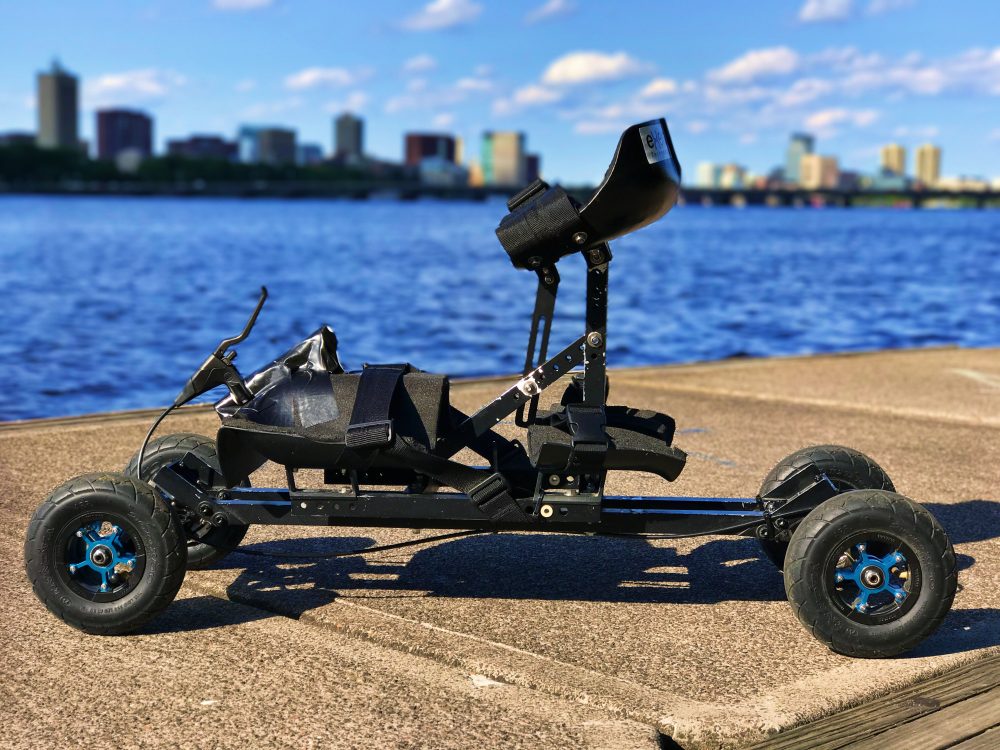
    A group of five Norwegian students updated the dryland sit ski: on display is the Exero Spike prototype. (Photo: Exero Technologies)

    There are ah-ha moments when an idea comes — poof — out of thin air. Then there are blunt-force type ideas, when reworking, redirecting and reconfiguring brings about the desired outcome. For five students from Norway who recently formed a start-up called Exero Technologies, there’s been a mix of ah-ha and continual reconfiguring.

    The group of five Norwegians, all studying at NTNU in Trondheim, includes mechanical engineers and a civil engineer with a business background, are developing a new dryland specific sit-ski. NTNU’s Business School is part of the Norway Entrepreneurship Program (NEP), which is based at the University of Oslo. A unique aspect of the program sends approximately 150 NEP students to the United States for 10 weeks during the summer.

    That’s how Nicoline Bergh, Bendik Fon and Solveig Christensen, three of the five founders of Exero Technologies, found themselves on their 10-week immersion at the Boston University (BU) Questrom School of Business. Bergh described BU as ideal for refining the group’s pitch and exposing their product to new user groups.
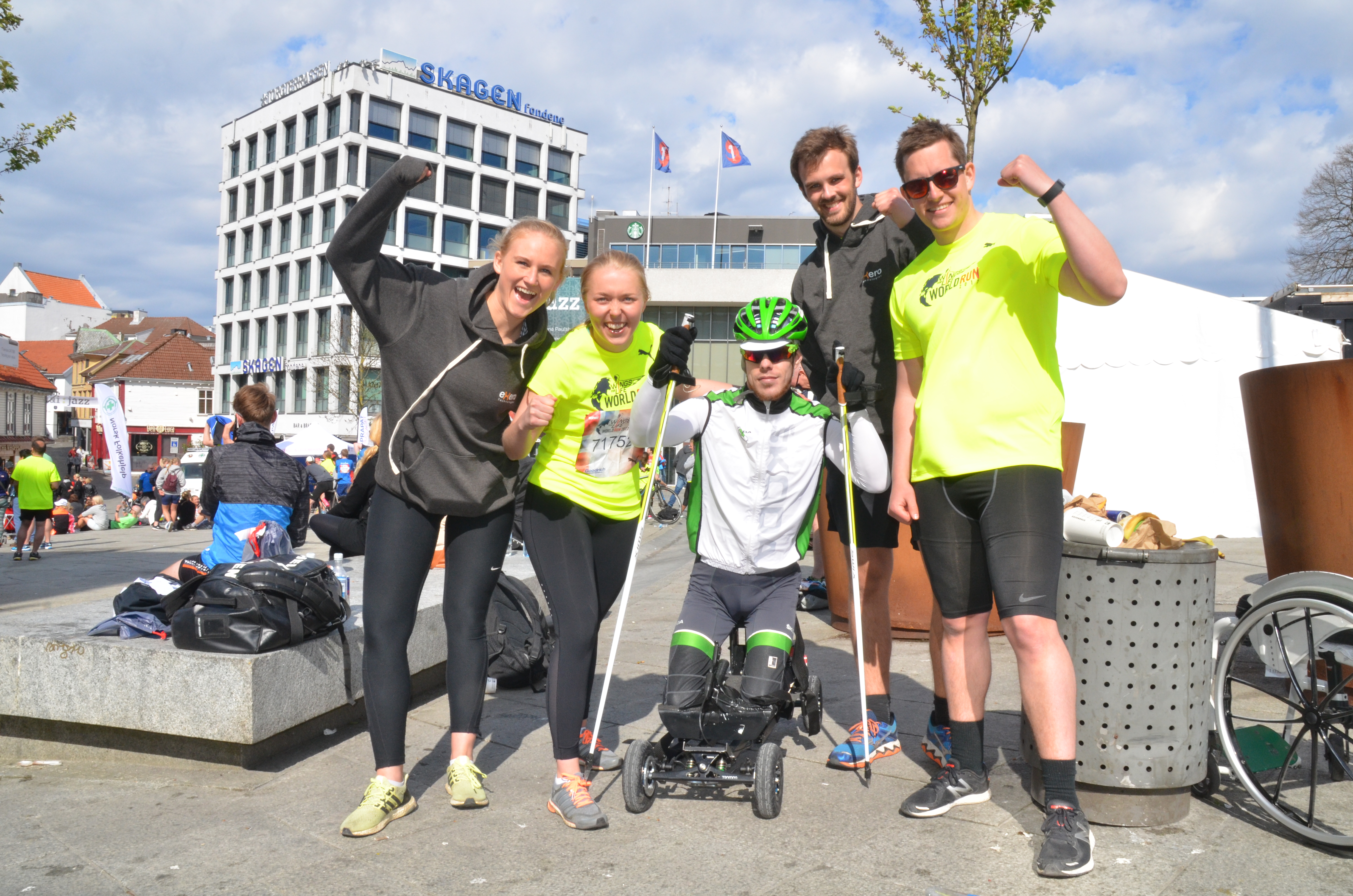
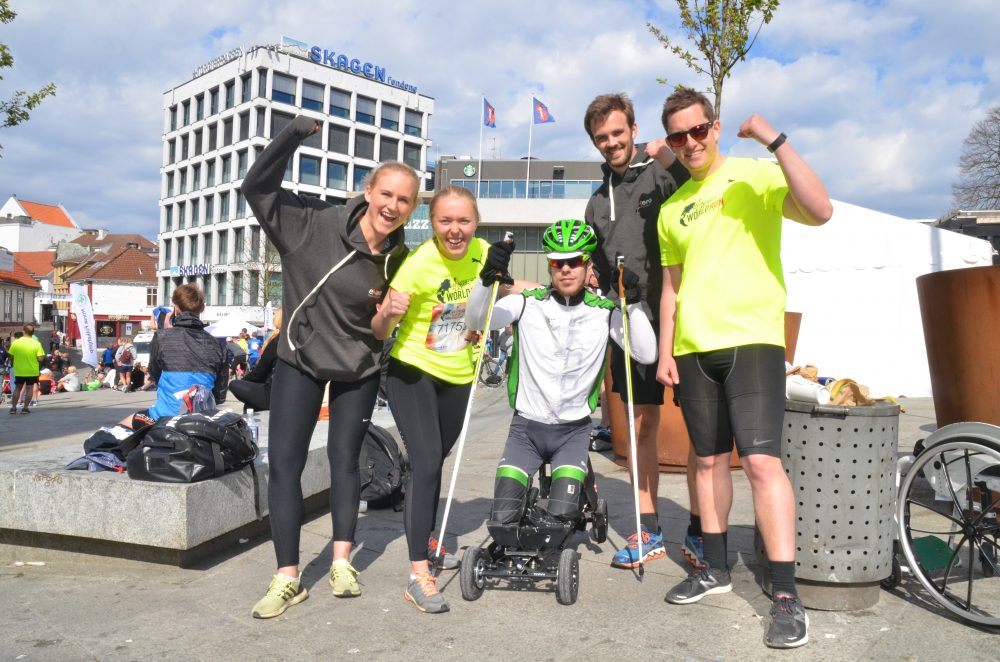
    From left to right: Solveig Christensen, Nicoline Bergh, Espen Aksnes, Mathias Berg, and Bendik Fon after the Wings for Life Run in Stavanger, Norway on May 7, 2017. (Photo: Exero Technologies)

    As part of NTNU’s course requirements, students must start a business.

    “This project started one year ago when the three guys on our team, they studied mechanical engineering, and they began production,” Bergh said. “Initially, the mechanical engineers in the group were given a problem that was looking for new solutions: how to win more medals in the Paralympics. They were looking for new solutions to improve athlete performance … the problem was to make a new solution for the cross-country sit-ski.”

    The on-snow XC sit-ski is simple yet functional. Most often the frame is aluminum or a composite with a pair of skate skis attached to the base. The athlete sits in an affixed molded seat. Forward movement is strictly a double-poling affair. Basic, light and minimalist — on-snow sit-skis have no steering or braking mechanism. In the racing scene, they are built for speed.

    Like their able-bodied counterparts, para athletes train in the offseason. That requires specialized equipment. Mountain boards, a wider and longer version of their skateboard park cousins, have been the go-to platform for dryland sit-skiing.
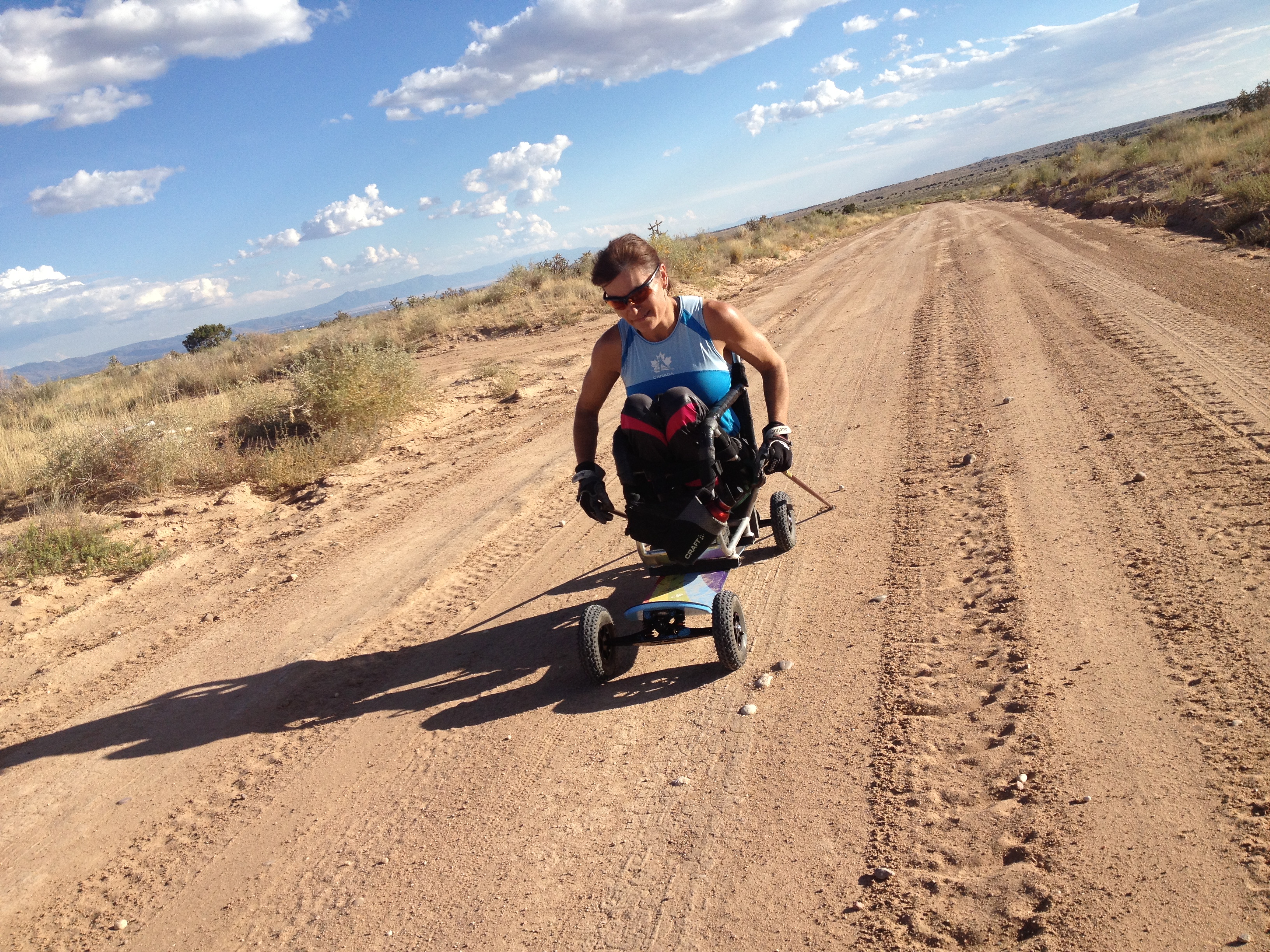
    Colette Bourgonje doing some mountain-board sit-skiing during a Canadian Para-Nordic Team training camp in Arizona in 2012. (Photo: Robin McKeever)

    Mountain boards feature pneumatic tires, beefier and stiffer trucks, and in some cases a hand-operated caliper brake. A molded seat is bolted to the board. And because of the single pivots on the front and rear trucks, athletes can steer by leaning their torso.

    Those modified mountain boards are a manifestation of making the best with what’s available off the shelf.

    That’s where Bergh says her team’s product, the Exero Spike, will make a difference. Bergh calls the Exero Spike the “total solution”. In other words, adaptive athletes will have more steering control, comfort, off- and on-road functionality, and hand-operated front-wheel disc brakes. All that amounts to better stability and possibly a potentially bigger user group, she asserted.

    Beyond the one-off mountain boards made for adaptive athletes, Bergh explained that none of the comparable products in the marketplace are best serving those adaptive athletes wanting a more fluid exercise experience.
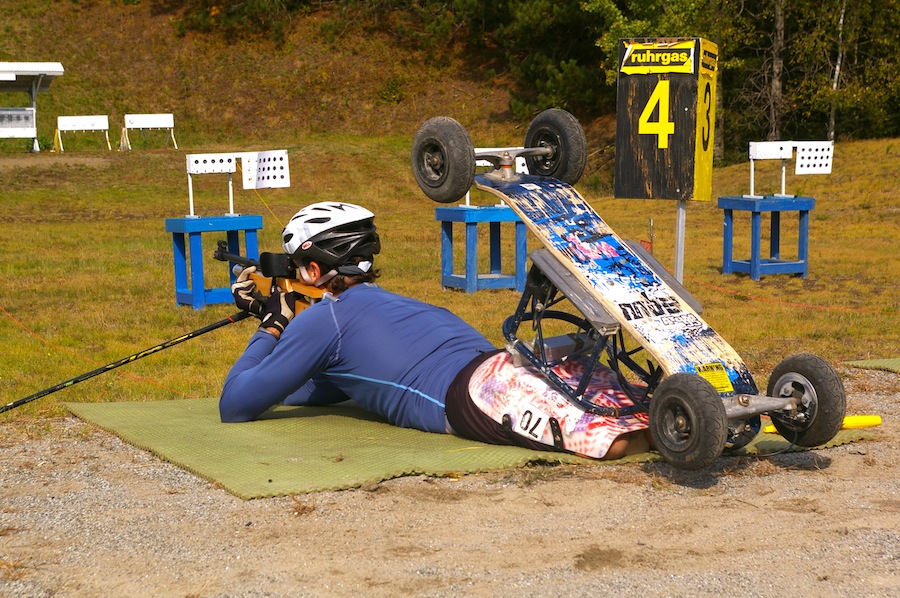
    U.S. Paralympics Nordic national-team member Andy Soule works on shooting at the Mt. Van Hoevenberg biathlon range during time-trial intervals on sit-ski mountain boards in September 2012.

    “Products used today are mostly hand bikes and 3 wheel wheelchairs,” Bergh wrote in an email. “The handbike is both big and heavy and often difficult to manage on your own. With a 3 wheel chair, it is difficult to both steer and make progress at the same time, as you have to use a steering wheel to change direction, forcing you to stop making forward movement at the same time.”

    Bergh envisions a market for the Exero Spike well beyond adaptive snow and dryland sit-skiers.  

    “So far, we have looked at people with spinal-cord injuries, amputees, cerebral palsy, polio, or other muscle diseases as our primary segment,” Berg emailed. “These also the segments that we are focusing on and see as the potential users. But, as we are developing a summer sports equipment, we see that the sled we are developing can be used for more than just cross country summer training. We’ve been testing with sledge hockey players and rowers, and we’ve got the impression that the movements they’re used to are quite similar to the sled we are developing.”

    Bergh and her partners foresee approximately 50,000 potential users in Scandinavia (12,000 of whom reside in Norway), and two million potential users in the U.S.

    Perhaps those numbers look inflated. As medical costs increase, in cases where more exercise correlates with smaller health bills in the long term, tools like the Spike, making outdoor exercise more accessible, may make sense. According to The Centers for Disease Control and Prevention estimates, 2.2 million people in the U.S. depend on wheelchairs for mobility. Another 6.5 million require a cane, walker or crutches.

    “We want to make a product, that is both fun to use, beneficial in terms of health and that looks cool,” Bergh wrote. “We want to make a product for people with disabilities that don’t have the same options to do exercising as you and me. Also, focusing on design and making a cool product, it will differ from many of the alternatives today.”

    Exero Technologies remains in start-up mode. Bergh said the group has no firm price set for their initial model, which they plan to release in a year.

    The longtime goal is to make several products, making a portfolio,” Bergh wrote. “By now, we’re starting out with the current product and will develop a sled for those who need their legs straight out. I think we will wait for the users’ feedback on the first product, and then decide whether we should experiment with different materials.”

    On Sept. 7, Norway’s Spare Bank 1 announced Exero Technologies had won its business innovation competition: Exero Technologies was awarded 250,000 Norwegian Krone (almost $32,000 U.S. dollars).

    https://www.instagram.com/p/BYyUG7lDu05/?taken-by=exero_technologies

  • South Korea’s Medal Hope, Eui Hyun Sin Preps for Home Paralympics

    South Korea’s Medal Hope, Eui Hyun Sin Preps for Home Paralympics

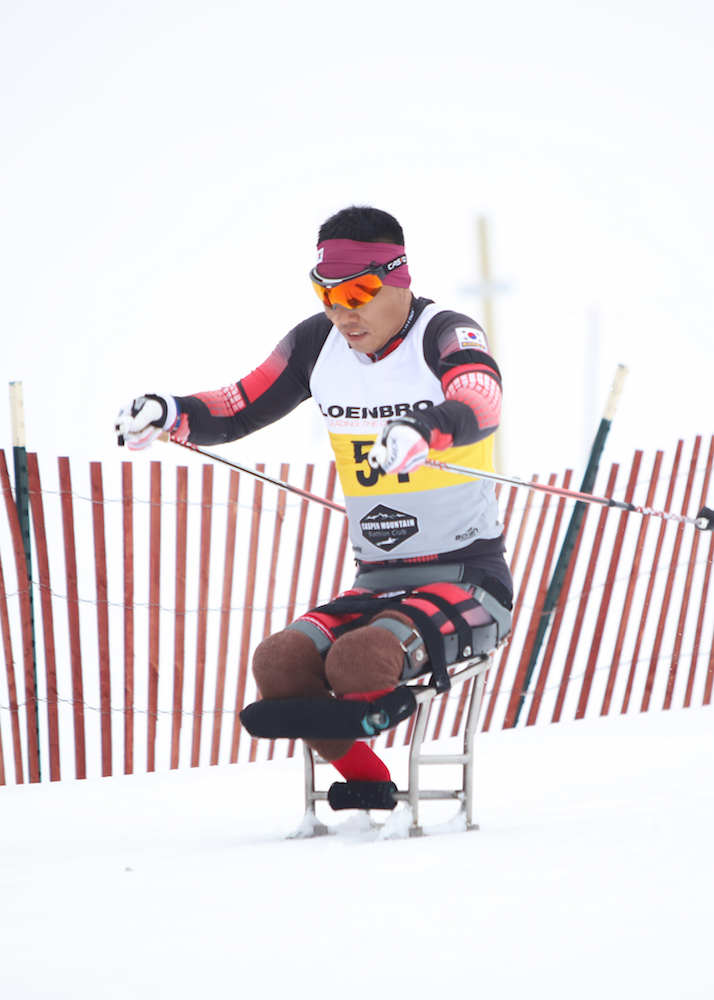
    South Korea’s Eui Hyun Sin won both biathlon races at 2017 U.S. Paralympics nationals and placed third in the cross-country sprint and short-distance races in Casper, Wyo. (Photo: Pearson Photography)

    For a few days at the end of January, a sea of stringed kites fills the skies of many cities in South Korea. The normally crowded streets of downtown Seoul — the country’s capital — empty and become almost devoid of people. Many of the residents are indoors with their families, or en route to the hometowns of relatives, all in order to celebrate Seollal, one of the nation’s greatest Korean holidays.

    Generally spanning a period of three to five days, Seollal is observed by many citizens as a time to feast, be with family, and pay tribute to ancestral figures. Shops and businesses close, and work is waitlisted until after the festivities’ culmination.

    While many enjoyed the extra days of leisure this year, one South Korean skier was itching to get back to work: Paralympian Eui Hyun Sin.

    Born in Gongju, South Korea, Sin became accustomed to the savory meats and spare time that are part of the holiday’s tradition. But now, Seollal — and many of the other Korean holidays he continues to observe — are as much a celebration as they are a symbol of something he must sacrifice: time spent training.

    As many of his competitors maintained a fairly consistent training plan in their preparation for this year’s 2017 World Para Nordic Skiing Championships, which took place Feb. 10-19 in Finsterau, Germany, Sin’s schedule forced him to skip a few training sessions. But that did not prevent him from medaling at the championships.

    Sin, a 37-year-old sit skier who lost both his legs following a car incident, raced to a bronze in the men’s 12.5-kilometer sitting biathlon race and a silver in the men’s 15 k sitting cross-country race in Finsterau (in the LW12 category). In doing so at his first World Championships, he became the most successful in para-nordic skier in South Korea’s history.

    “I was very happy, but I feel regretful at the same time, because I could not train enough because of the Korean holidays,” Sin wrote in an email, according to a team translator. “However, it means so much for me, because it was the first time for the history of Para Nordic ski of Korea.”

    Along with becoming the first South Korean to medal at World Championships, Sin also won three International Paralympic Committee (IPC) World Cup races, two in Ukraine and also in the 15 k cross-country race at home in PyeongChang, South Korea, where the 2018 Winter Olympics and Paralympics will be held.

    Nordic skiing is not the only realm of athletics in which Sin has made his mark. Prior to joining the Korean para-nordic ski team in 2015, he played internationally for the Korean para ice-hockey team and also competed in wheelchair basketball and para cycling at the national level. His involvement in these sports, as well as encouragement from friends, led him to turn to skiing for the past two years.

    “When I was playing Hockey and Cycling constantly, one of my friends suggested me to join the Para nordic ski club,” Sin wrote.

    He struggled with the decision as he had a solid job and needed to provide for his family.

    “However, I thought that I am not that young and it is very special chance to participate in the Paralympics held in my own country. So, I decided to start the nordic ski,” he wrote.

    He made the decision with a home Paralympics weighing heavily on his mind. And as he gears up for PyeongChang next March, he’s one of his nation’s best chances for a medal.

    “The 2016/17 was the season which made me confident for the Paralympic medal,” Sin wrote. “Since there will be Paralympic Games in this season, I want to win the gold medal by training hard.”

    Much of that training so far has taken place abroad. Following the last races of the season in April in Casper, Wyo., the South Korean para-nordic team planned to continue training in the U.S. until May 30.

    Then Sin and the crew will make their way to PyeongChang for the month of June, followed by travel to Finland in July. 

    “This year, we are training with the new head coach Kaspar Wirz who is from Canada,” Sin wrote. “He has much experience and knowledge to teach, so the training is very fun. I am focusing on the skiing positions and shooting for the biathlon.”

    With a full season ahead of him and a full one behind — he finished the 2016/2017 season ranked second in the overall cross-country IPC World Cup rankings — Sin is both excited about the opportunity to represent his country at home and the accomplishments he has already given to Korea.

    “The highlights were the moment I won the gold medals in cross country 7.5 K and 15 K in the World Cup held in Ukraine,” Sin wrote. “The win was a big moment for me.”