From the FasterSkier archive — posts syndicated from athletes’ and coaches’ own blogs between 2004 and 2012, kept online as published. Current coverage is at fasterskier.com.

Tag: Sjur Røhte

  • A Norway Sweep with Emil Iversen on the Top Step; Schumacher 18th, Patterson 21st

    A Norway Sweep with Emil Iversen on the Top Step; Schumacher 18th, Patterson 21st

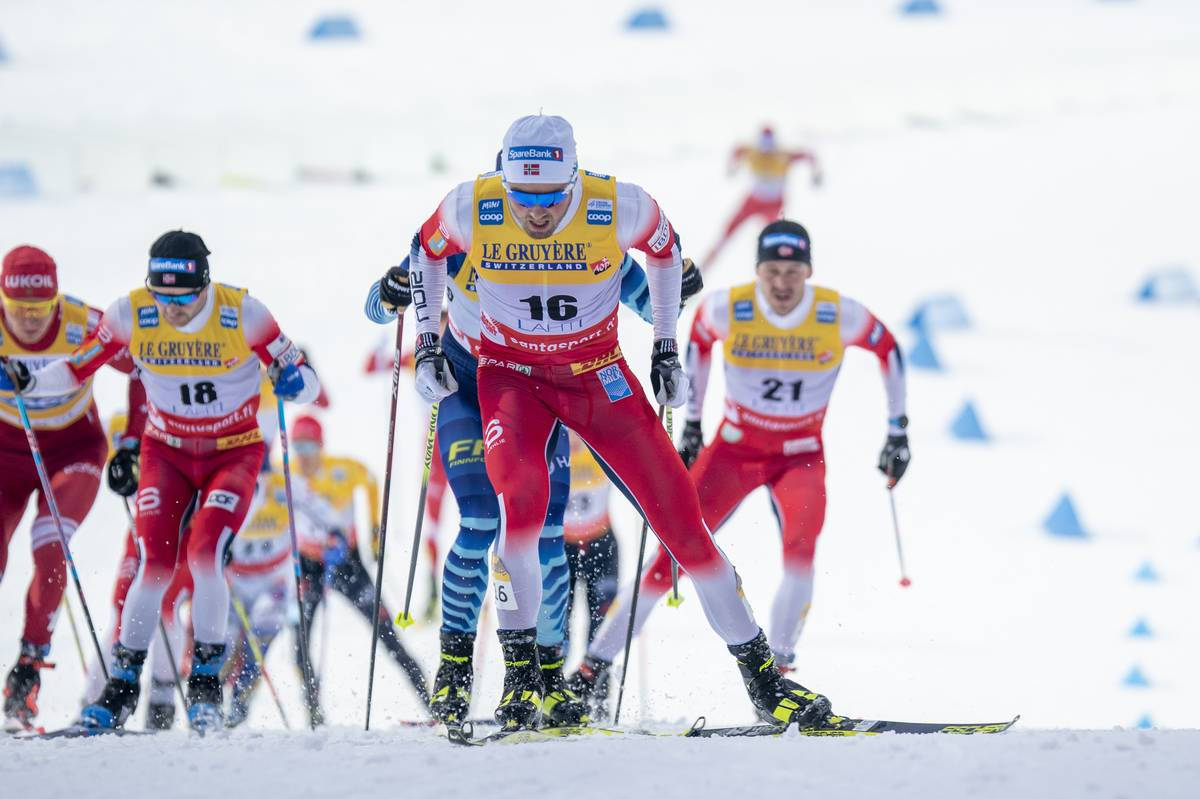
    Emil Iversen sets the pace at the front of the pack on his way to victory in the 15l/15k skiathlon in Lahti, Finland. (Photo: NordicFocus)

    Working off the premise that history repeats itself, there were only so many ways this grueling 30 k skiathlon in Lathi, Finland could end. The plot, this weekend, thickened with the return of Norway to the field and all eyes on Russia’s Alexander Bolshunov post-two week break from a historic and runaway win at the Tour de Ski. Would Bolshunov hold the snap and power for 30 k with a horde of Norwegian men hungry to prove themselves after a World Cup hiatus? Would Norway crush – fresh from high-level domestic racing but muscles absent the load of eight stages at the Tour?

    On the surface, Norway benefitted from their absence while Russia, still the bear of the men’s field, looked more withered (but still formidable) after a long hibernation than anything else.

    After 15 k of classic, Finland’s Iivo Niskanen led the top group of 30, who were separated by roughly twenty seconds.

    Not so much lurking behind the Finn as just biding their time was Norway’s powerhouse men’s squad, which had many cards to play. Near the front for Norway were 2018 Olympic skiathlon champion Simen Hegstad Krüger, Hans Christer Holund, Sjur Røthe, Emil Iversen, and Pål Golberg. The only Russians in the top-10 at that point were Bolshunov and Evgeniy Belov.
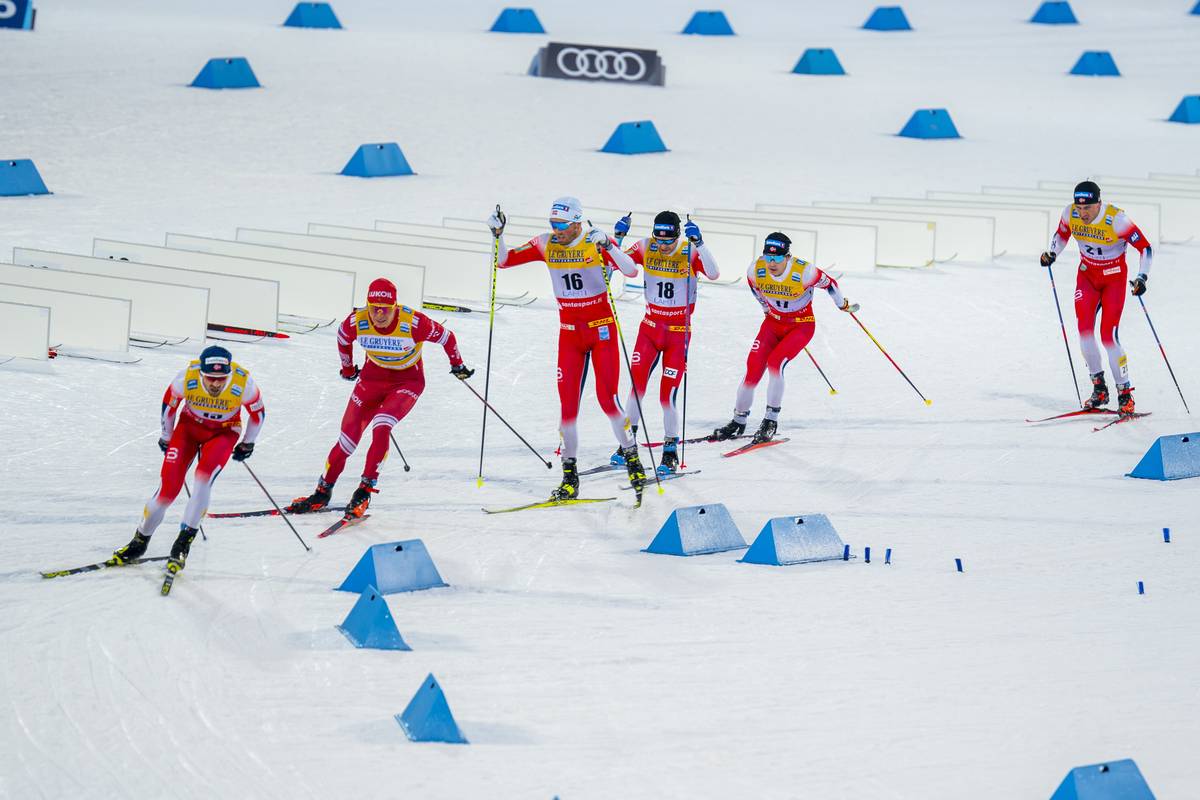
    Emil Iversen, tailed by Russia’s Alexander Bolshunov, leads a train of red on the way to a Norwegian podium sweep in the 30k skiathlon in Lahti, Finland. (Photo: NordicFocus)

    Absent the load of eight Tour stages, and perhaps eager to demonstrate their supremacy, Norway ruled the skate portion of the race. At 20 k, Iversen, Holund, Røthe were driving upfront in a pack of nine skiers — five Norwegians, two Russians, a lone Swede in Jens Burman, and the Finn, Niskanen.

    The lead pack ebbed and flowed during the next 5 k. What you need to know is this: six skiers popped off to animate the closing kilometers on this storied drizzle-slicked Lahti course. As we mentioned before, this was Norway’s race.

    At roughly 1:06:30 into the race, Krüger drove led followed by Røthe, Holund, Bolshunov, and Iversen — all within a few meters of one another with Golberg a second off the pace but holding on.

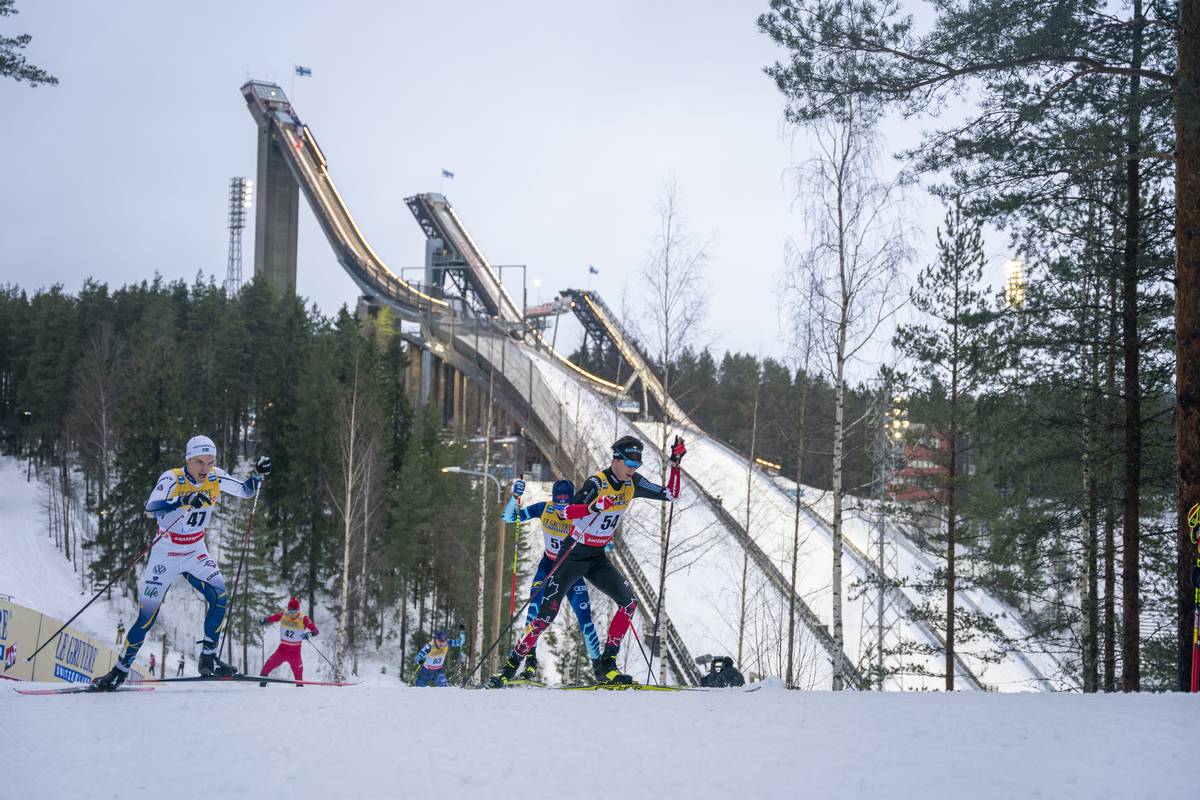
    Lahti possesses many locations where the topography makes for spicy racing. There’s Lahti corner, a sweeping downhill into the stadium which has, in the past, taken out many would-be heroes. But before that descent, there’s a curvy section leading into a notorious kicker — a place to make a move in the closing moments of the race.

    Leading into the punchy ascent, Bolshunov and Holund slid into the netting and crashed. The others streamed into the climb with no momentum lost. Iversen sent it, and with a hippity hop-skate passed Røthe, Golberg and Krüger. Bolshunov, after righting himself, faded slightly off the back while Holund straggled up with a broken pole.
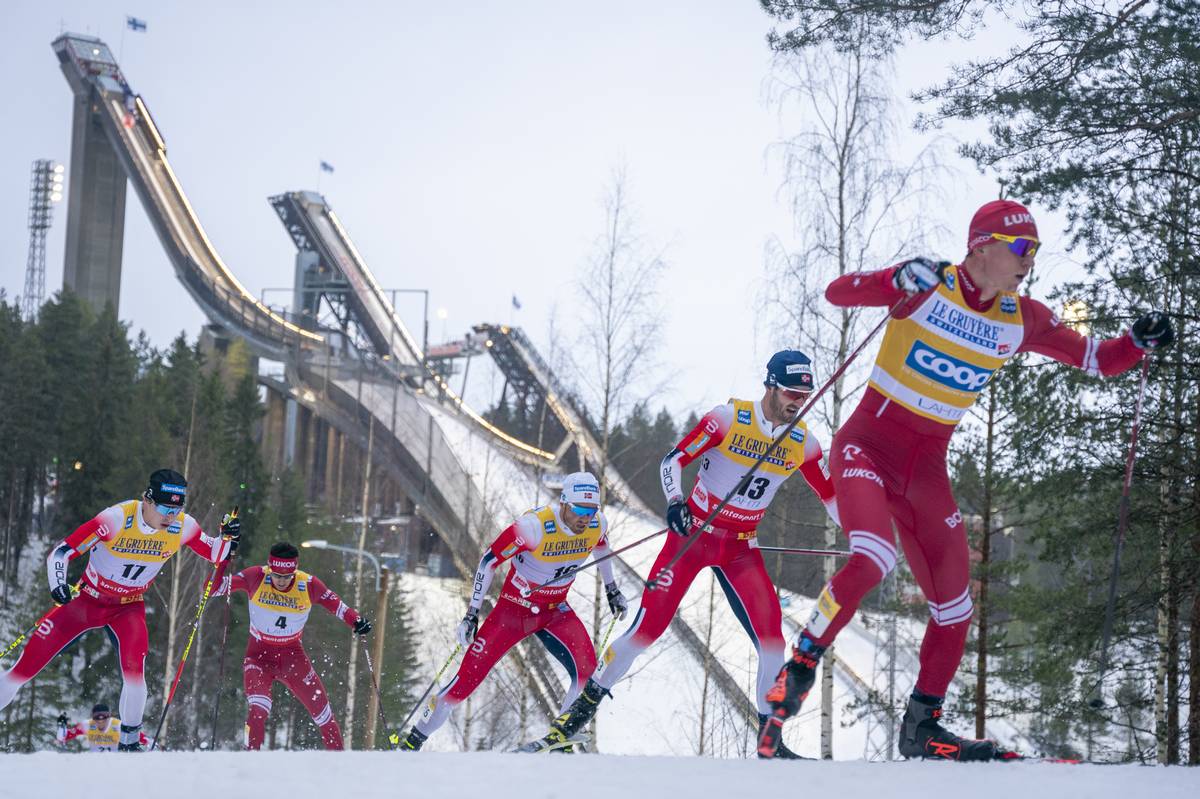
    With a ski jump backdrop, Russia’s Alexander Bolshunov leads the charge during the 30k skiathlon in Lahti, Finland. (Photo: NordicFocus)

    Iversen, Røthe, Golberg and Krüger came into Lahti corner clear for the top-four spots. Only Krüger botched the corner with a slight stumble. Iversen coursed into the straight followed by Røthe. Iversen took the win in 1:10:18.4, with Røthe second (+0.4), and Golberg third (+6.6). Krüger placed fourth (+9.5), Bolshunov fifth (+20.9) and Holund sixth (+28.7). This was Iversen’s first skiathlon win on the World Cup, an event he won last week at the Norwegian National Championships.
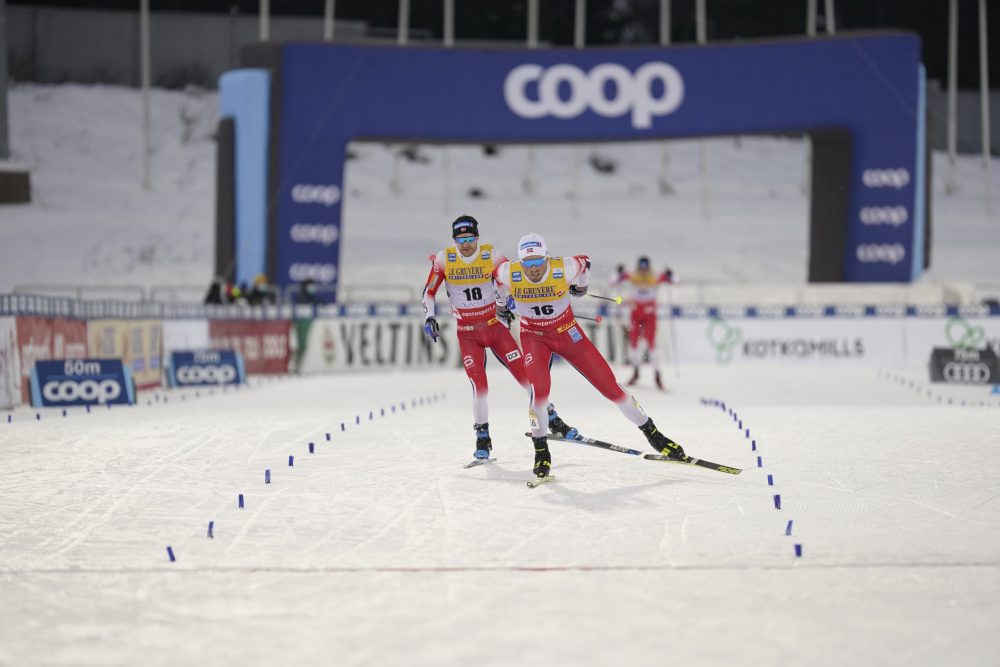
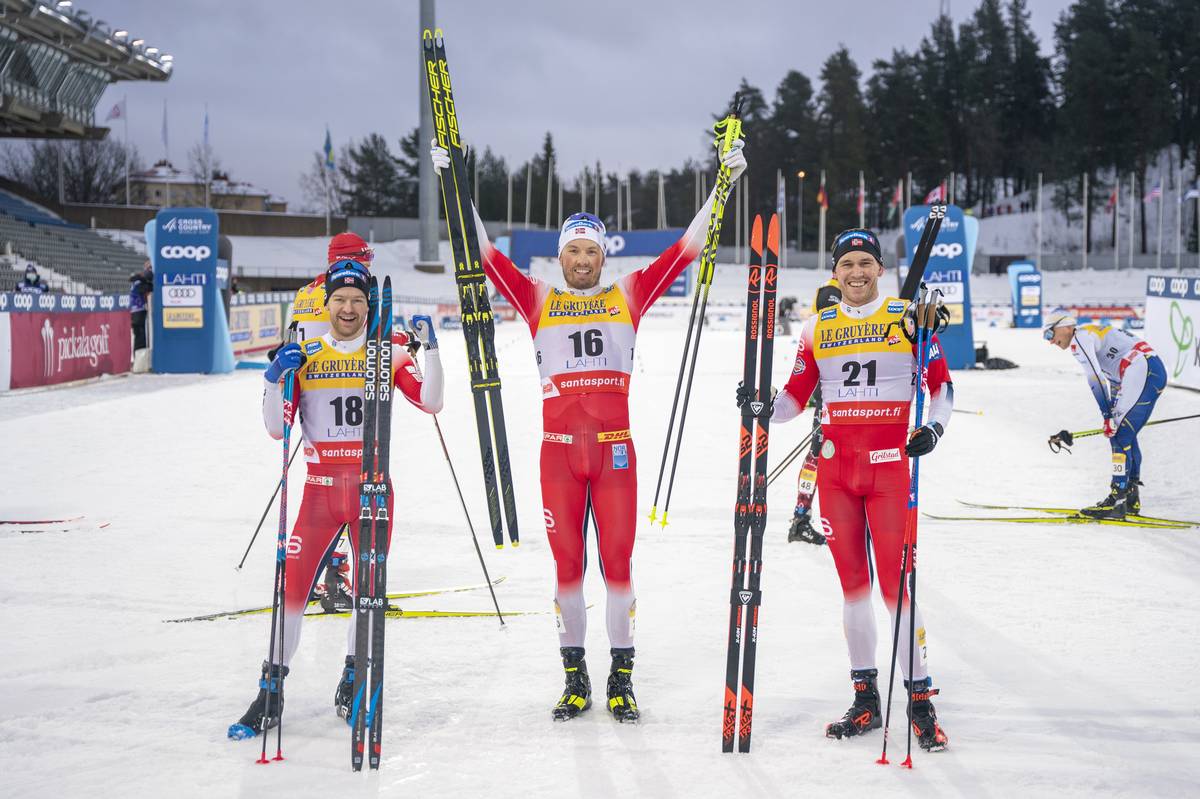
    Norway’s Emil Iversen edges out teammate Sjur Røthe for the 30-kilometer skiathlon victory in Lahti, Finland. (Photo: NordicFocus)


    An all-Norway podium for the 15k/15k skiathlon in Lahti, Finland. Emil Iversen took the win ahead of Sjur Røthe in second and Pål Golberg third. (Photo: NordicFocus)

    Adding to his string of top-20 finishes in the Tour de Ski, Gus Schumacher was the top finisher for the US in 18th (+1:31.1), finishing a pack led by Great Britain’s Andrew Musgrave in 15th (+1:29.8).
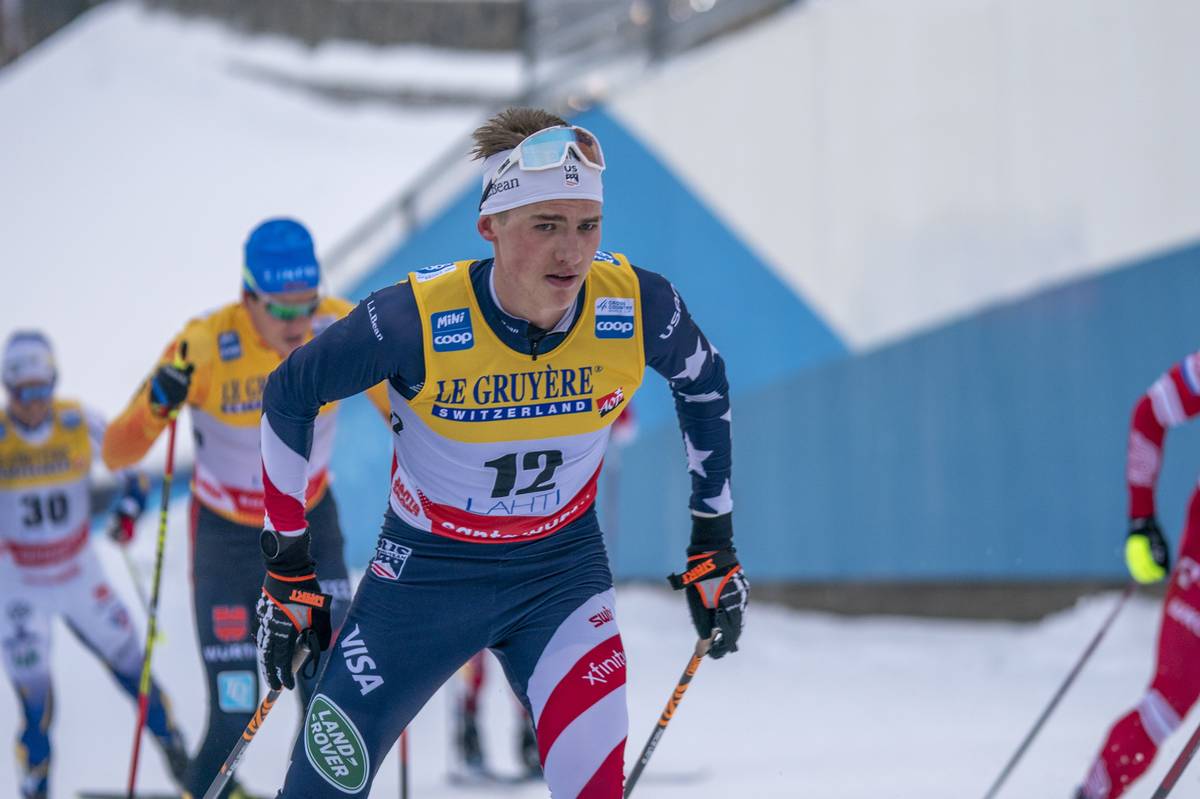
    Stringing together top-20 results, Gus Schumacher finishes 18th in the 30k skiathlon in Lahti, Finland. (Photo: NordicFocus)

    “It was definitely pretty nice to be in the classic and feel like I was relaxed and knowing that they weren’t necessarily pinning it, but there were still people falling off the back so I knew there was some gusto to that pace,” said Schumacher of his pacing in the classic portion with a full field of Norwegian skiers in the mix.

    Schumacher was 8.1 seconds off the lead, in a mass of skiers stringing out as he skied through the 15 k mark and beginning the skate. “I was lucky to start in bib 12 so I did not have to fight through the pack. My goal was to hold that position and did not experience a ton of accordion running into the back of people after downhills and I did pretty well with that and then it started to split up more, so it was pretty easy, relatively easy to stay relaxed in that pack.”
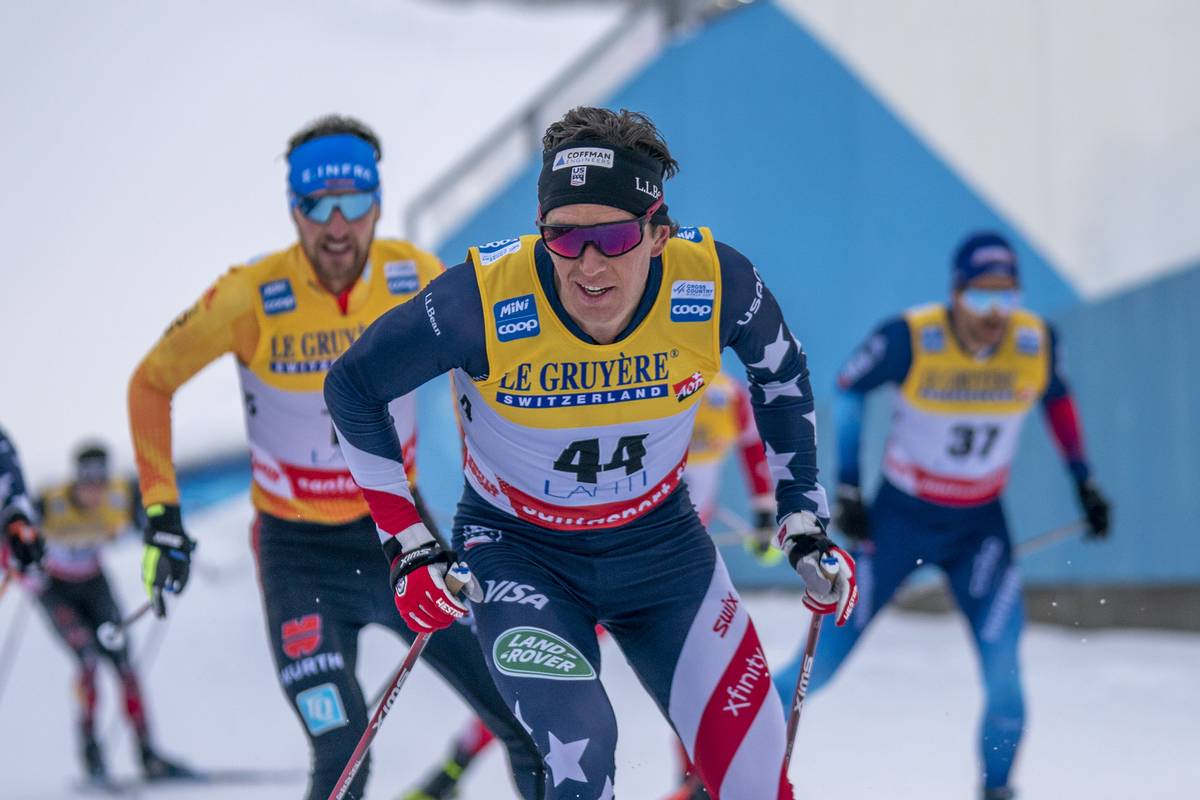
    Stacking up strong results in the event, Scott Patterson finishes 21st in the 15k/15k skiathlon in Lahti, Finland. (Photo: NordicFocus)

    A few seconds behind in 21st was Scott Patterson (+1:35.1) for his second time in the top-30 this season. Patterson has a history of strong results in the skiathlon; he finished 18th in the event during the 2018 Olympic Winter Games in PyeongChang and 30th at the 2019 World Championships in Seefeld, Austria.

    “I feel like I have really kind of struggled with classic this year, I haven’t really found a groove, I think that was kind of the case today,” Patterson said in a post-race call. “it felt really chaotic, and a lot of work there racing the classic 15 k.” Patterson came through 15 k, the race mid-point in 29th, 18.8 seconds off the lead.

    “I was feeling good and relaxed on the skate,” he added. “I am satisfied [with the result], I always want more, always want another breakthrough to make the next step or like get into the top-10 or something like that. But I am pretty happy with today. I think there are a lot more good opportunities to try and build some momentum here.”

    Patterson, at times, moved into the top-20 during the skate, coming through in 16th at 20 k.

    Returning to the World Cup after a COVID-19 infection interrupted his start to the season, David Norris finished 32nd (+2:56.8).

    “The travel to Finland went well and I’ve adjusted to the time change okay – a few hours around 2 am where I roll around. Post-Covid the hard efforts have been a challenge, but every hard workout is making it better. This was my second race of the season and I’m pleased with the improvement even from my first race in Anchorage two weeks ago.”
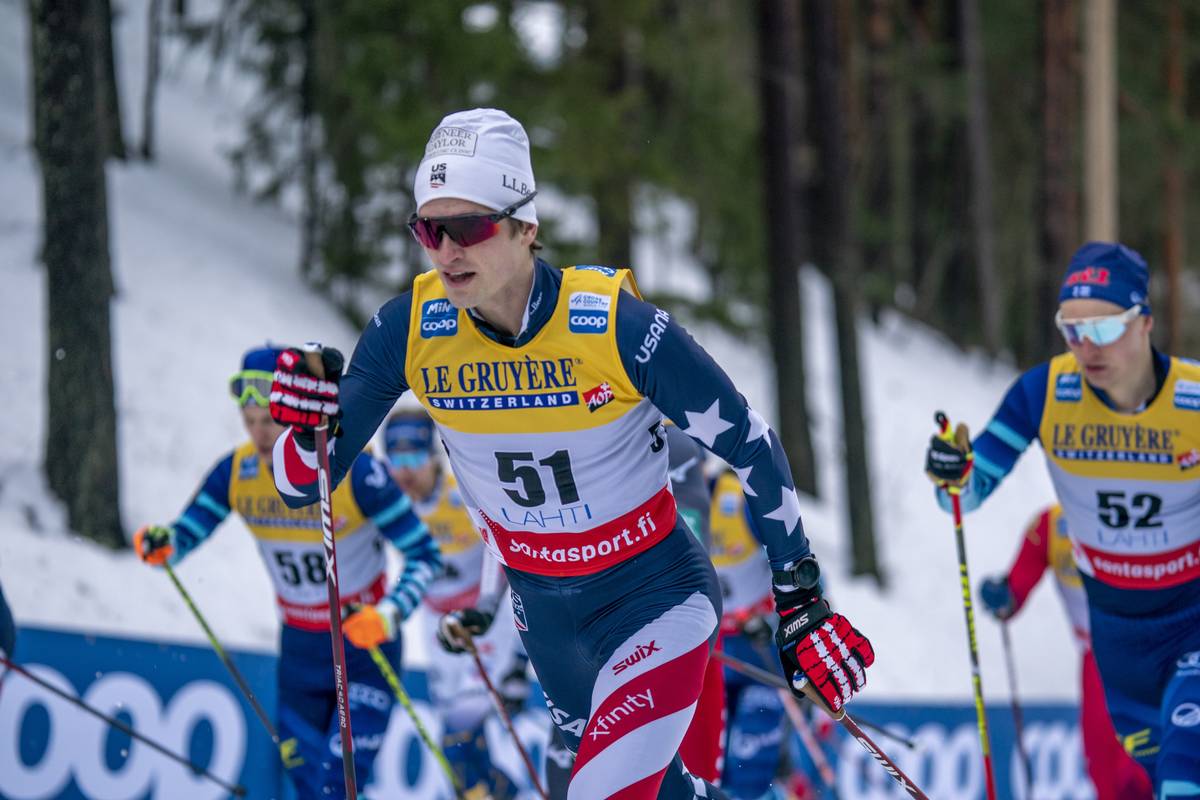
    David Norris on course for a strong showing in the 15k/15k skiathlon in Lahti, Finland. (Photo: NordicFocus)

    “The toughest part of today’s race was just getting into the mix and responding to the early pace changes. At this point I just need to race as much as possible- I expect that I’ll have a good response to these hard efforts over the next two weeks.

    “I’d say today was a success. Ten weeks or so my goal was to get back to race form by the end of the year. Today proved to me that I am not far from that and that my base from summer is still with me. I’m honestly relieved that I had glimpses of my usual shape during today’s race. Today was a great step towards reaching my season goals, which are in Oberstdorf.”

    Adam Martin was the next from the American squad in 45th (+5:27.9), finishing alongside Hunter Wonders in 46th (+5:27.9). Today was Wonders’ first appearance on the World Cup. Ian Torchia was lapped by the leaders on his eighth lap, forcing him to withdraw from the event at the 20-kilometer mark.

    Racing for Canada, Russell Kennedy was the top finisher in 29th (+2:40.8). Teammate Antoine Cyr finished 37th (+3:50.1), Phillipe Boucher 47th (+5:34.2), and Remi Drolet 49th (+6:30.1).
    In his first World Cup race of the season, Canada’s Remi Drolet skis to 49th in the 30k skiathlon in Lahti, Finland. (Photo: NordicFocus)

    15k/15k Skiathlon Results

    World Cup Standings: Overall | Distance

  • Attrition in the Fog: Bolshunov pips Krüger for the Oslo 50 k Classic Win

    Attrition in the Fog: Bolshunov pips Krüger for the Oslo 50 k Classic Win

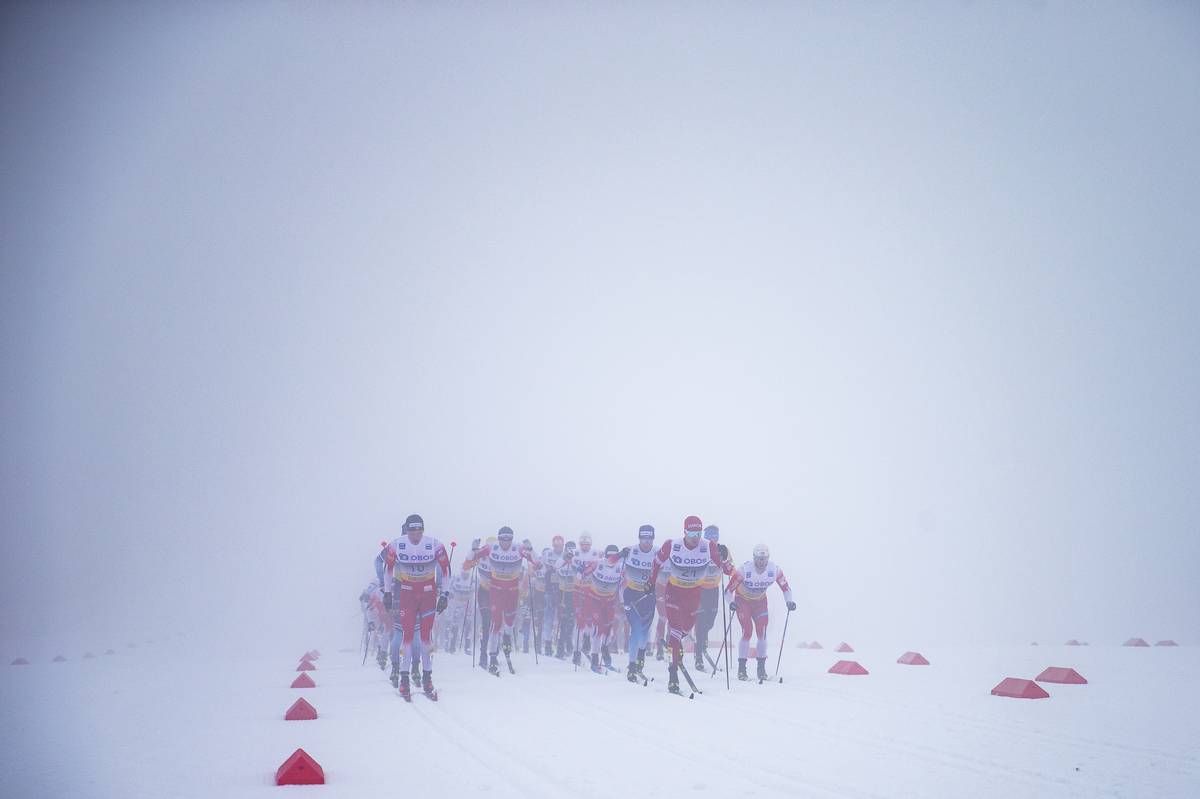
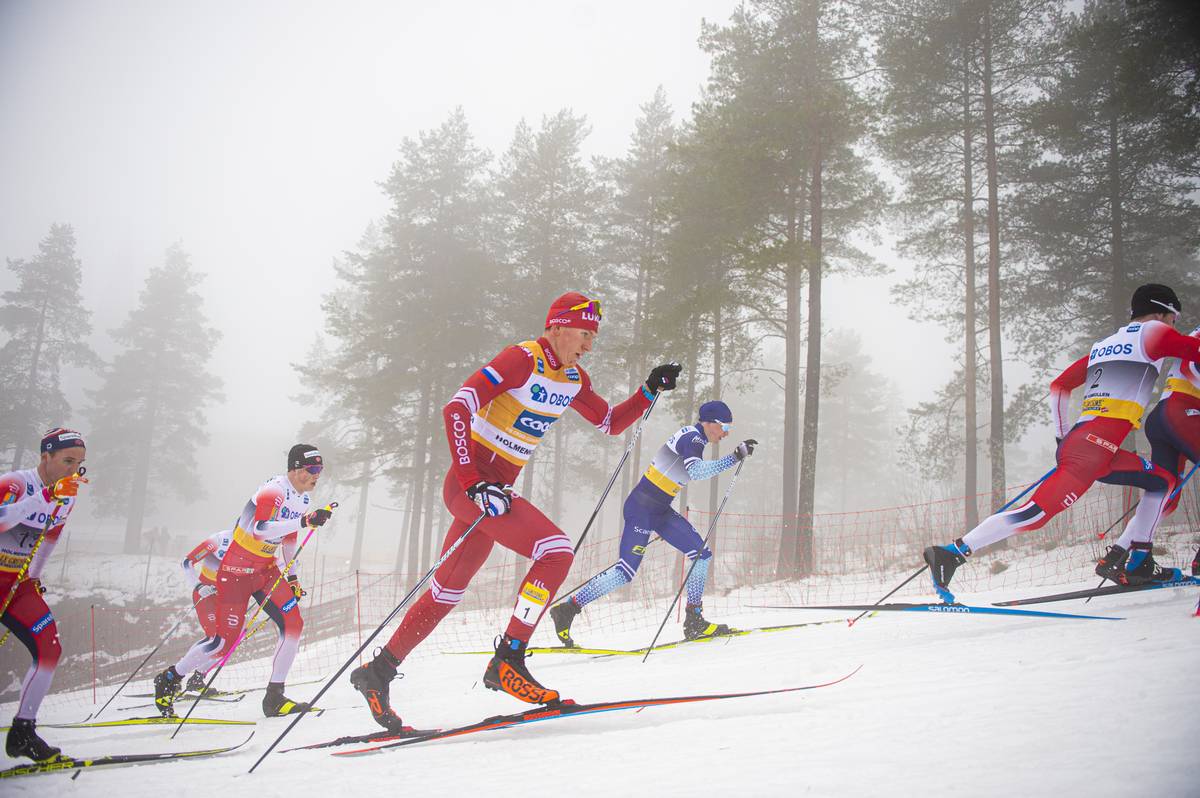
    En mass: early in the Oslo 50 k classic. (Photo: NordicFocus)

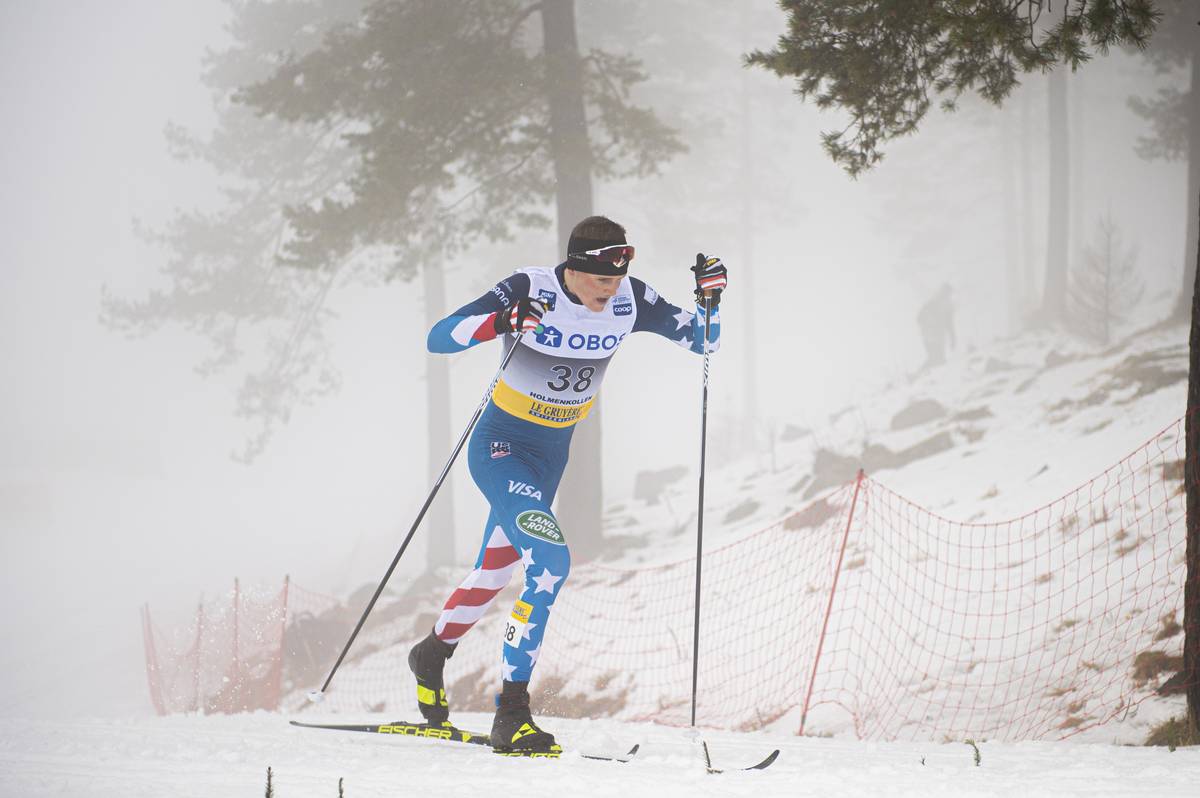
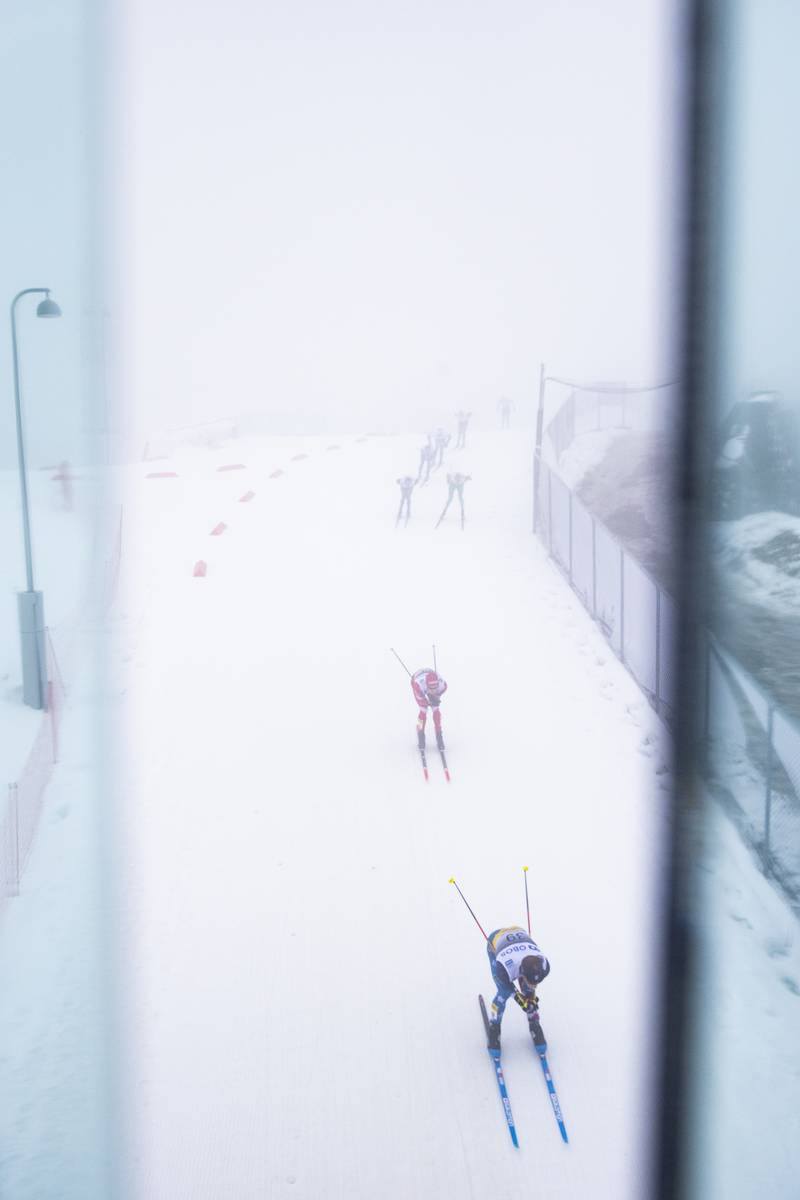
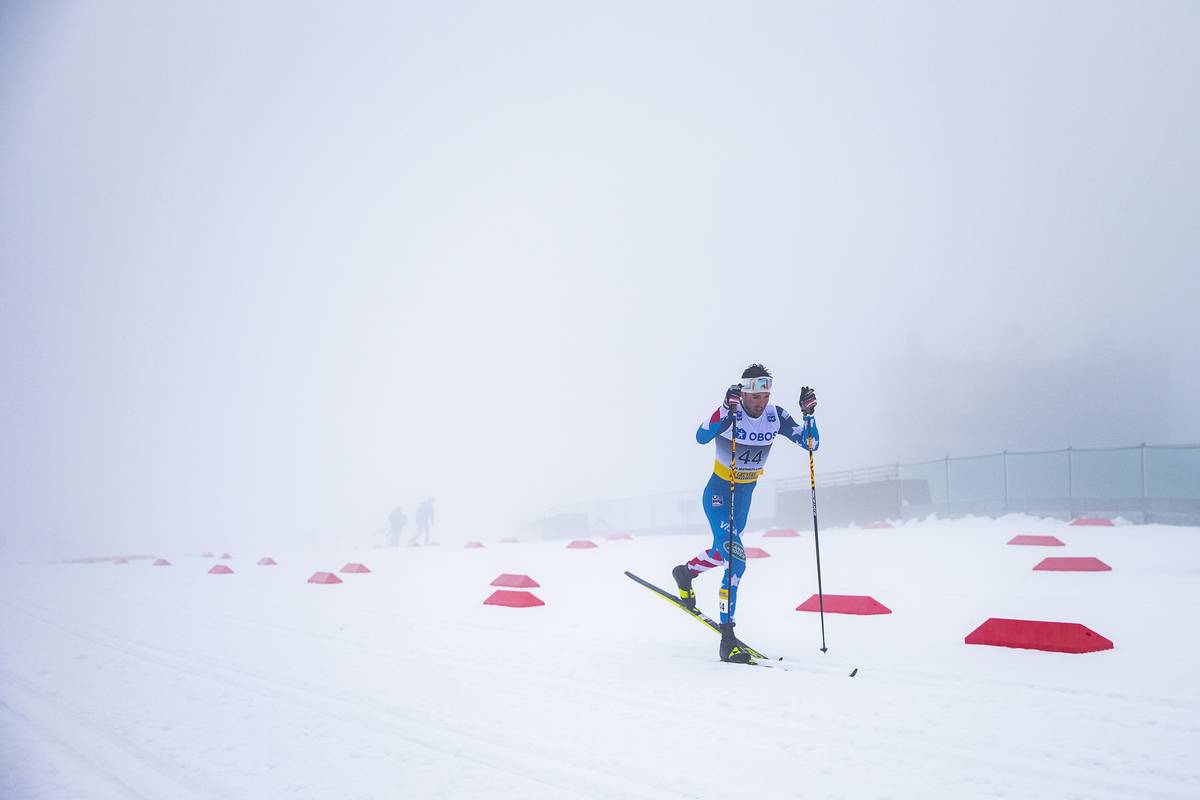
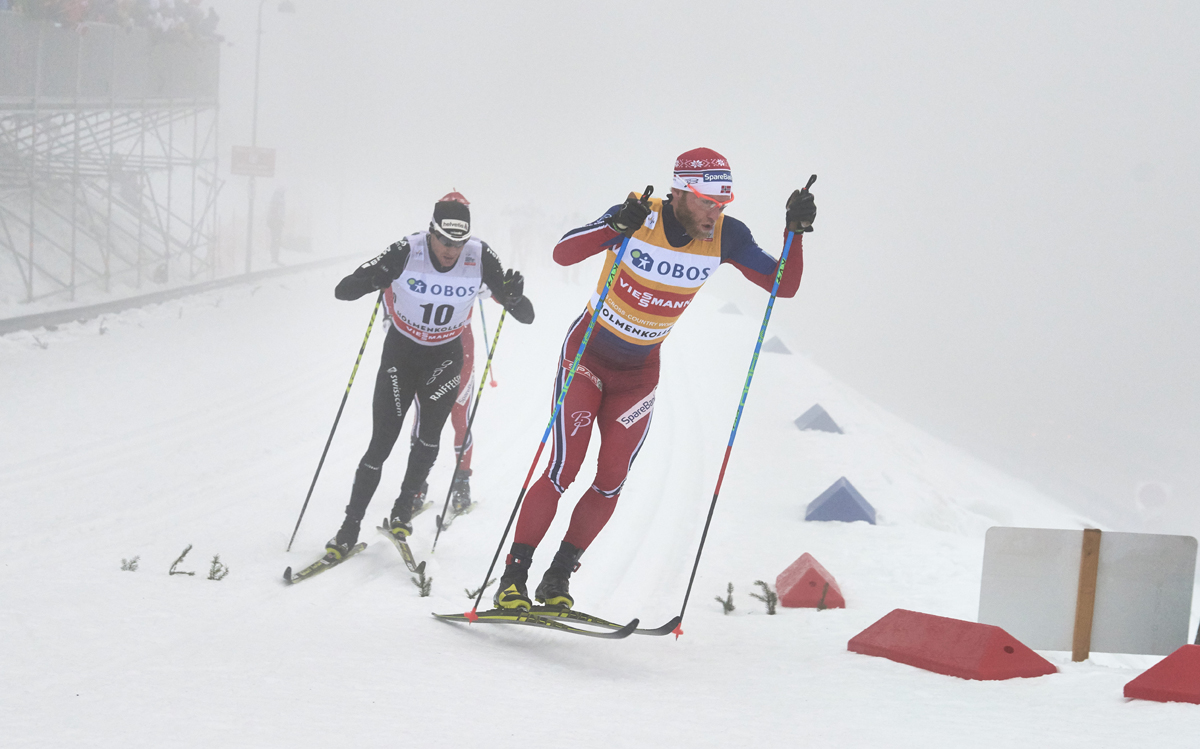
    Oslo in late winter – it’s be hit or miss. Fog. Bluebird. A maritime climate, with plentiful moisture in the air, a slight drop in temps can morph the Holmenkollen ski complex into a ping-pong-ball-world. Athletes were mere shadows striding into and out of view on a foggy- drizzly day at the Holmenkollen. As spectators were limited to trail side spots as the main stadium was closed due to the Covid-19 virus, for some concerned, it was a slog for the 50-kilometer classic to close out the European portion of the World Cup. (That’s right- it’s ocean hopping time for the entourage post-race as the World Cup moves to North America.)

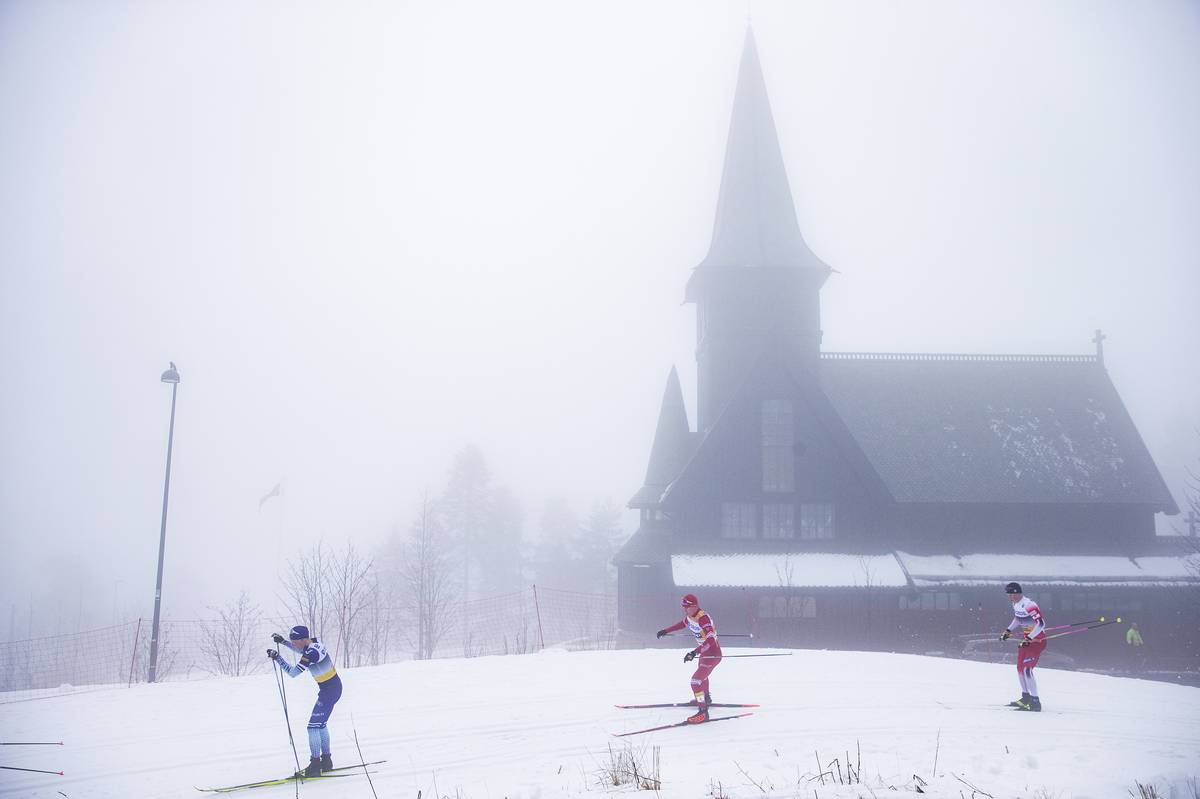
    Sunday church along the Holmenkollen course: Iivo Niskanen (FIN), Alexander Bolshunov (RUS), Johannes Høsflot Klæbo (NOR), (l-r). (Photo: NordicFocus)

    Let’s cut to the chase. The main action over 50 k involved main pack attrition. The sharp end pack remained robust with skiers through 18 k, as skiers passed through the main stadium as Sjur Røthe of Norway came through first. That much didn’t matter beyond a minor foot note in the day’s narrative, as a handful of Norwegian’s took pace leading chores throughout the race. 

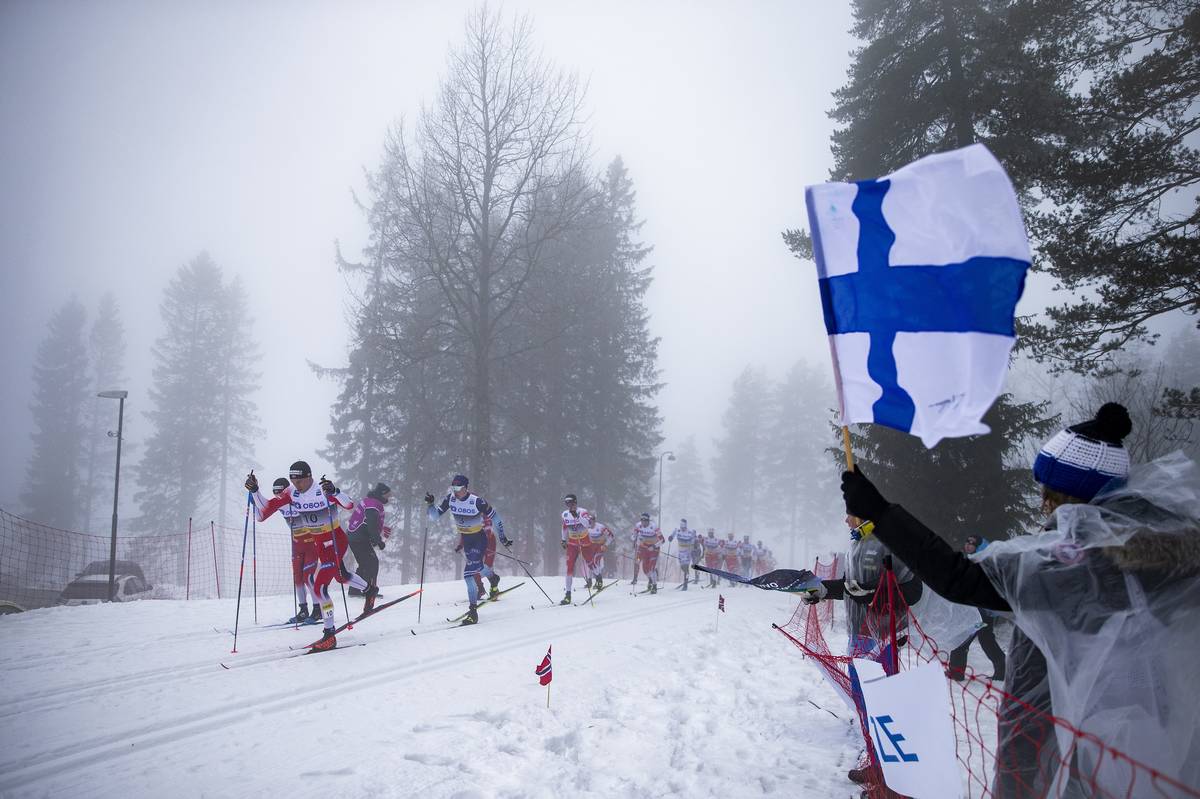
    On a day that many would have preferred to practice their own personal art of hygge, the main pack remained 20 deep at 30 K. The top-20, which contained all the key skiers, was separated by a scant 5.6 seconds. A group that big surely provided its own sense of Norwegian coziness despite the high heart rates. Of those 20 athletes, four were Russian, two Swedes, one Finn, one Swiss — the rest Norwegians. Charging through was overall World Cup leader Alexander Bolshunov. There was Emil Iversen, Pål Golberg, Martin Johnsrud Sundby, Simen Hegstad Krüger, Didrik Tønseth, Hans Christer Holund, and Johannes Høsflot Klæbo. Bundled in there was Dario Cologna of Switzerland, and Iivo Niskanen of Finland, who was lucky enough to have fans and there chanting “Iivo-Iivo”. 

    With so many skiers clustered together, and the tactics less explosive than simply see who could hang on, the camera shots at each turn of the race through the main stadium turned to the spare classics skis racers had the option of swapping into. The lure of fresh kick or speed, seemed like tempting race candy. Halfway through, at roughly 25 k, it appeared that Golberg was one of a few of the main contenders opting for a fresh pair. The rest skied through the ski exchange zone, at least content for another lap with their boards.

    Lapping through at 30 k, scores of skiers opted for fresh kick and glide. Post-ski-exchange,  the front pack soon coalesced into two orderly lines, like marching soldiers, as they crested a hill roughly an hour twenty into the race. 

    No matter any skiers herculean efforts to pop off the front, this was a simply a group affair. Any potential burst of speed, or pulse for bonus points, was absorbed. Ski speed or kick, seemingly equalized among the scrum. The question simply was this: which human engine would last the longest? Forty kilometers in, and the front group had winnowed 13 skiers separated by about seven seconds. Bolshunov led, followed by Røthe and Cologna. 

    Pål Golberg (NOR), Sjur Røthe (NOR), Iivo Niskanen (FIN), and Johannes Høsflot Klæbo(NOR), (l-r). (Photo: NordicFocus)

    Then it was two — barely. Just after the two hour mark, Krüger spiced up the pace. Striding and double poling in earnest, at 47.7 k. Krüger was only shadowed by Bolshunov, as the Norwegian’s late in the race move stuck. Røthe, Cologna, and Holund fell off in third, fourth, and fifth, respectively, to just over 11 seconds back. 

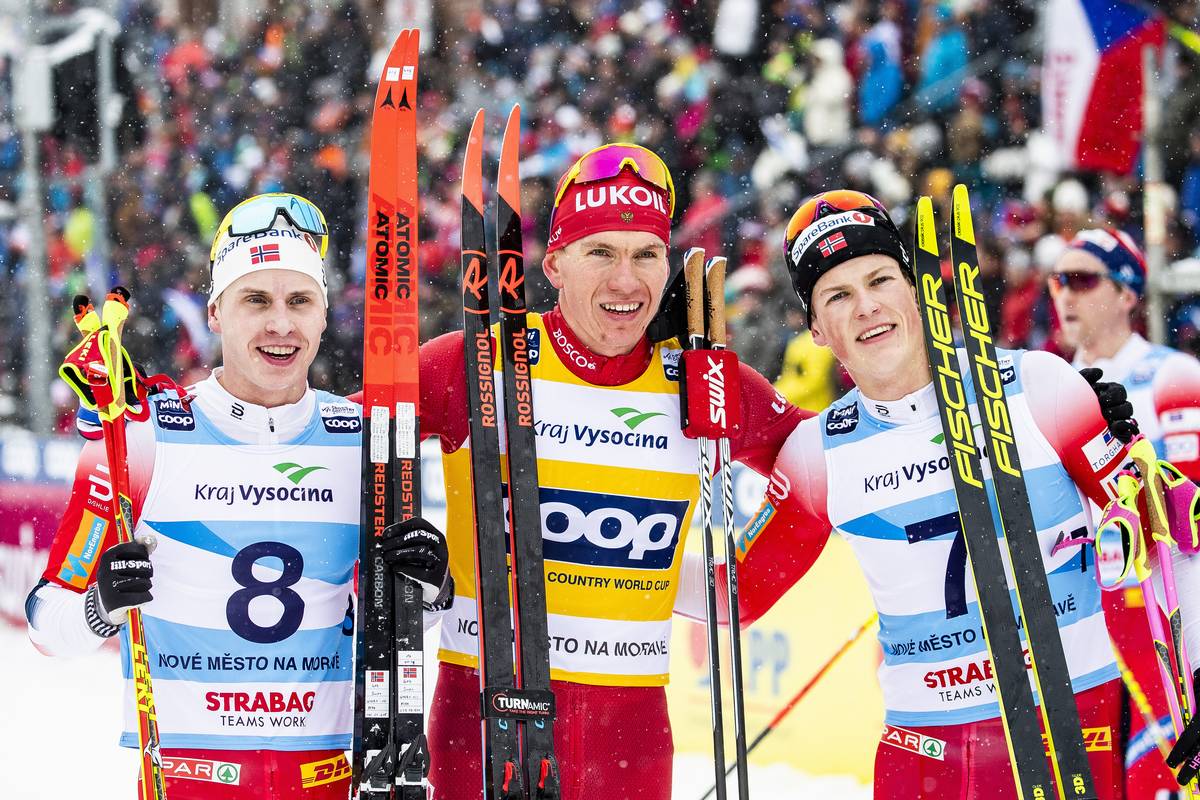
    Two stallions double poling into an eerily silent stadium. That was probably not such a bad thing (although fans present are always better), as one can imagine the fans falling silent had they been there in droves. Russia’s Bolshunov out sprinted Krüger to win in 2:08:05.3, 0.9 seconds better than the second place Norwegian. 

    “I knew that Bolshunov is strong on the final 100m so I tried to get rid of him before that,” Krüger  told FIS. “I felt really good today so I knew that I could really push myself before that. But he is strong and it’s hard to get rid of him. I almost made it but I am really happy to be on the podium. It’s an amazing feeling.”

    “Me, the team and the skis were all working together perfectly today and I am very happy to win here,” Bolshunov said after the race. “Because compared to Trondheim, where I had no possibility to do something with my skis, it was more important for me to win here today.”

    That Trondheim race mentioned by Bolshunov was the final stage of the SkiTour 2020 in which he lost the overall due to poor skis.

    For Bolshunov, this made for back-to-back 50 k classic wins in Oslo. Last season he won in a final sprint that saw Russia sweep the podium. And for Krüger, this was a career best in a 50 k race. He was seventh in last season Oslo 50 k. Lastly, when it comes to classic skiing, this has been a breakout year for Krüger – he is an athlete we had often considered a skate specialist. 

    For the final podium spot, Iversen placed third (+19.5). Norway claimed seven of the top-10 spots. 

    “In the last lap I heard that I can fight for the podium and this is where I got some more energy,” Iversen said to FIS. “So I am really happy to stay 50km all in because I am not known as the best athlete in our team so it is nice for me to show the coaches and all that I can stand a hard and long 50km. I am really proud of that.”

    Emil Iversen skiing to third overall in the 2020 Oslo 50 k classic. (Photo: NordicFocus)


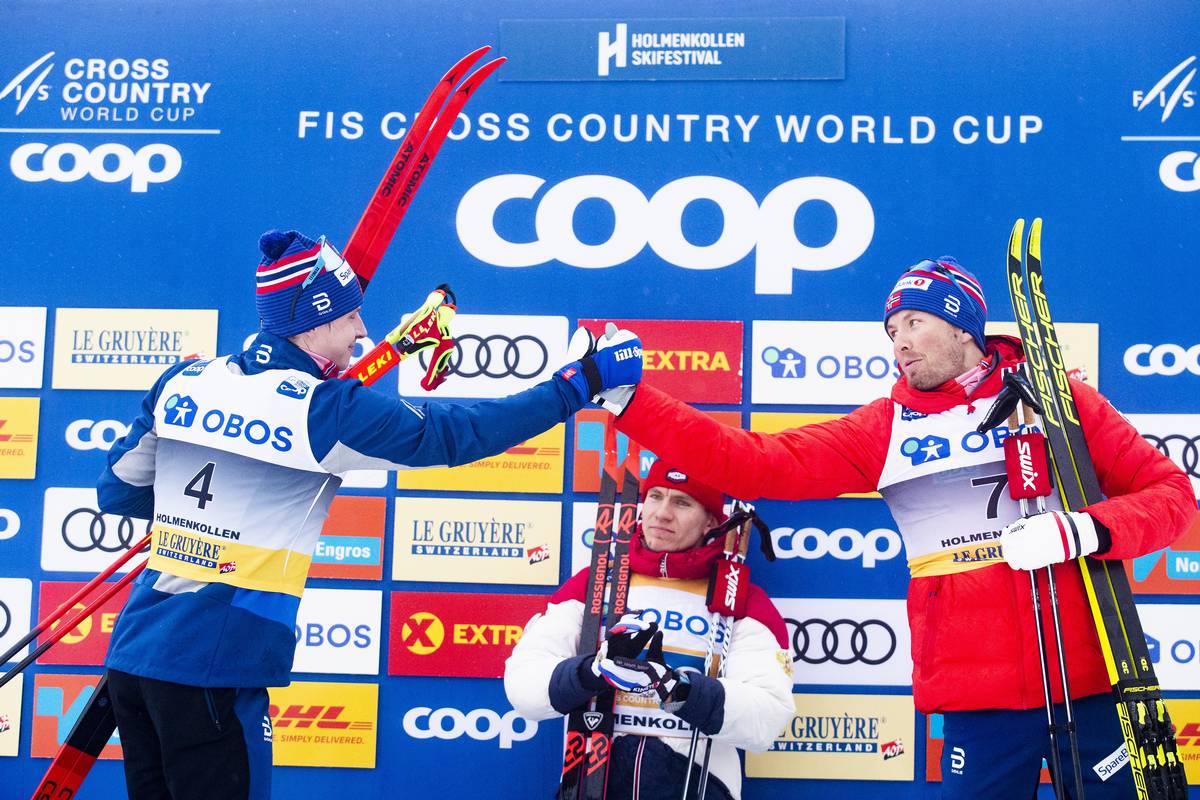
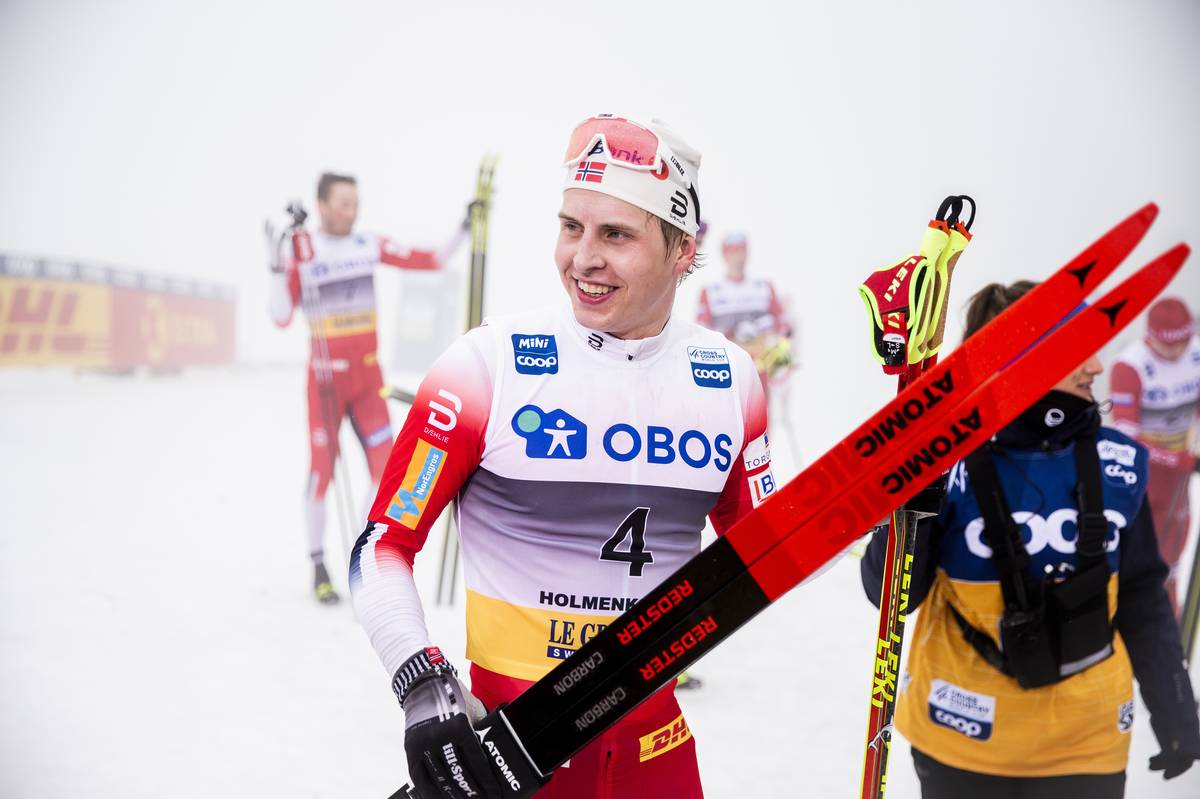
    The Oslo 50 k classic podium: Simen Hegstad Krüger (NOR) second, Alexander Bolshunov (RUS) first, and Emil Iversen (NOR) third, (l-r). (Photo: NordicFocus)

    This was a tough day for the Americans, who started four athletes. Ben Lustgarten (CGRP) finished in 47th (+13:20.1), and Adam Martin (CGRP) 50th (+15:10.1). David Norris and Ian Torchia did not finish as they pulled due to illness.
    “It was one of the toughest races I’ve been in,” Martin emailed. “I made a blunder by selecting zeroes and paid for it in the first lap. I used my one ski exchange as soon as I could at 6k with 44k to go. I spent a large majority of the race skiing by myself in windy conditions with no racers in sight. I am thankful for the spectators that cheered me on many k’s.
    Adam Martin during the Olso 50 k. (Photo: NordicFocus)
    Lustgarten reiterated the day’s difficultly.
    “The race today was absolutely brutal,” Lustgarten explained in an email. “The conditions were not as tricky as we thought because it was just rain and super saturated wet tracks, instead of the new snow they called for in the morning. Still the tracks were glazed wet and breaking down, and also got really slow after a lap or so because of the fluoros fading from the skis. I had amazing skis for my first pair.
    “I was able to stick with the lead pack for about 1.5 laps (we did 8 laps of 6.2km). I felt really good, my skis were amazing, fast and great kick. I started to fade a bit on the steep climbs and lost contact with the main front pack. Basically after that I skied alone or around a few other skiers for the rest of the race. The wind was tough being alone, and just forcing myself to ski well and try to keep my pace up. I swapped skis after 4 laps and unfortunately had a bit less kick on my second pair, in addition to fatigue and glazed tracks I found myself herring boning most of the steep climbs, but they were nice and fast for a few laps. My triceps started cramping about 20km earlier than most 50s, with about 30km to go. That was uncomfortable and not a great sign. My second half of the race was more about holding on and trying to finish the race instead of racing as hard as I could. I find at Holmenkollen it takes everything I have to just try and ski ok and finish the race because of how hard the course is. I was proud to finish today in such challenging conditions, even though my fitness didn’t feel amazing. Overall I was really happy with the skis and our wax techs deserve a shout out for that!”
    Ben Lustgarten (front) fog bound and Oslo 50 k determined. (Photo: NordicFocus)

    “This was a very tough weekend for our team, but I’ll say this first: We’ll be back next year to swing again,” U.S. World Cup Coach Matt Whotcomb explained. “Whether we are coaches or athletes, the process of figuring out this race is why we do this job. It’s just so difficult here, and we love it. We’ve been near the top and the bottom on the same weekend, and in each of those cases, the result is always over-shadowed by the experience with the crowd. This is a major-league sporting event in these woods, with crowds in the tens of thousands, strapping speakers to trees, screeching trumpets, blazing fires, and cheering for everyone. In fact, they cheer extra-loud for athletes who aren’t having a good race. In terms of uncracking the Holmenkollen, the courses, conditions, and 30/50k race formats are so difficult that anything but near-perfect skis, fitness, and health will put an athlete way off the mark. We just didn’t pull any triple cherries this weekend. We were also hit by a cold that caused us to scratch Sadie on the morning of her race, and it lead to David pulling out after three laps. I had the chance to talk to David in the feed zone as things were starting to go sideways, and I told him to pull out. He said, “But that’s not what I do.” It’s not my style either, frankly, but it would’ve been a season-ender for him to finish the race ill. There was no other way; he was pale green. Just behind David on the course, Ian was puking (on his birthday), so he had to drop out, too. So, like I said, it was a tough weekend. And while I support David and Ian in their need to drop out of today’s race, I’m also very proud of Ben and Adam for finishing this beast.”

    Results


    Simen Hegstad Krüger of Norway, post-race. (Photo: NordicFocus)


    A Bolshunov power surge. (Photo: NordicFocus)


    A lonely day at the Holmenkollen for some: Germany’s Jonas Dobler. (Photo: NordicFocus)


    Ian Torchia: Oslo 50 k classic. (Photo: NordicFocus)
  • Perfect Pacing: Sjur Røthe Claims Ski Tour 2020 Stage 1 Win

    Perfect Pacing: Sjur Røthe Claims Ski Tour 2020 Stage 1 Win

    The pacing master of Stage 1 of the Ski Tour 2020: Sjur Røthe. (Photo: NordicFocus)

    The six-stage Ski Tour 2020, which runs from Sweden to Norway over the next week, began Saturday in Östersund, Sweden with the men’s 15-kilometer individual start skate. The race began with twilight immersing Östersund with the sky eventually morphing into black as the seeded group of skiers looped around on what FIS called a 4.71 k course. This much can be concluded after a single day of what will be a hotly contested tour: the Norwegians fired on Stage 1 as they captured the top four spots in the field of 90 skiers. 

    The other take away beyond the Norwegian team’s blistering skis – Sjur Røthe paced himself a masterful 15 k of skiing as he won the event in 30:41.5 minutes.

    However, not all looked shiny for the Norwegian as he went on to win his first World Cup of the season. At the 5 k time check, Røthe came through in 19th place, 19.5 seconds behind Hans Christer Holund, also of Norway. At 7.6 k, the halfway mark for the race, Røthe had moved up to 10th overall but remained 20.3 seconds off the fastest split set by yet another Norwegian, Simen Hegstad Krüger. 

    Then the tides turned, and Røthe began chiseling away at the time deficit. As he lapped through at 10 k, he sat in fourth, 15.4 seconds behind the virtual leader, Krüger. The chisel became a jackhammer; at 12.6 k Røthe was within six seconds of Krüger.

    Simen Hegstad Krüger hammering during the 15 k skate, Stage 1 of the Ski Tour 2020. (Photo: NordicFocus)

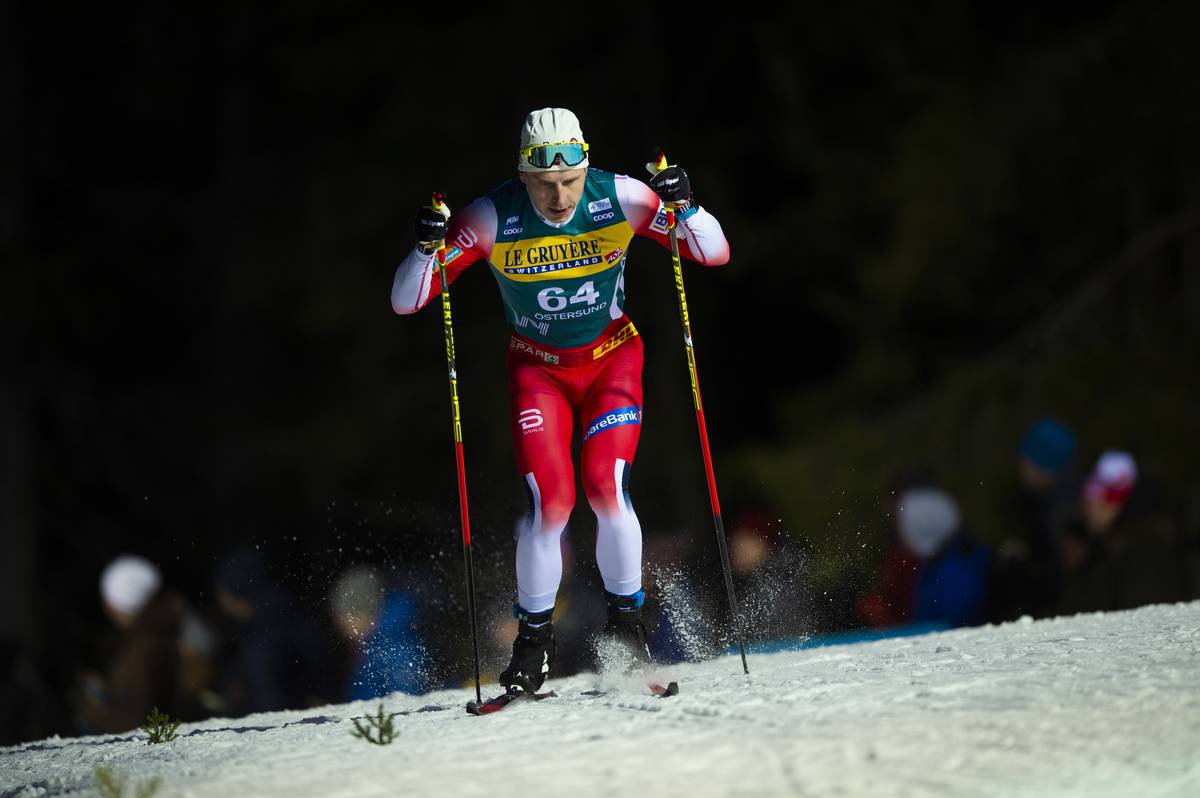
    The pacing proved perfect only when Krüger crossed the line: Krüger was a later starter than Røthe: Røthe began in bib 48, Krüger in bib 64. Røthe could, however, pace himself off the splits of Norway’s Finn Hågen Krogh who began in bib 16. Of the early starters, Krogh set the fastest marks at 5 k, 10 k, and the finish, respectively.

    Finn Hågen Krogh (bib 16) an early starter during Stage 1 of the Ski Tour 2020, but fast through his 15 skate effort for third overall. (Photo: NoridcFocus)

    Røthe’s first-place time (30:41.5) was 1.7 seconds faster than Krüger’s who took second on the day. Krogh was third overall (+16.6), and the veritable senior citizen of the Norwegian team, Martin Johnsrud Sundby, placed fourth (+17.3). 

    Saturday’s victory was Røthe first win of the season – however, it was his sixth individual podium which includes a second-place time of day podium in Ruka’s 15 k skate pursuit back in December. Last week, he was second in Falun’s 15 k mass start skate. 

    “It was a great day for me and the Norwegian team,” Røthe told FIS after the race. “I think we need to give a big hug to the guys in the wax cabin today. They made brilliant skis for us today, and for sure I have done my preparations well, I am really satisfied with today. I am looking forward to [the Ski Tour], it has been one of my main goals this season so for sure I am prepared, but I need to go home and get a good rest because it is not many hours before we do the classic race here in Östersund as well.”

    For those playing the long-term odds in the Ski Tour 2020, after one stage down, Russia’s overall World Cup leader, and 2019-2020 Tour de Ski winner, Alexander Bolshunov, placed fifth (+22.2). 

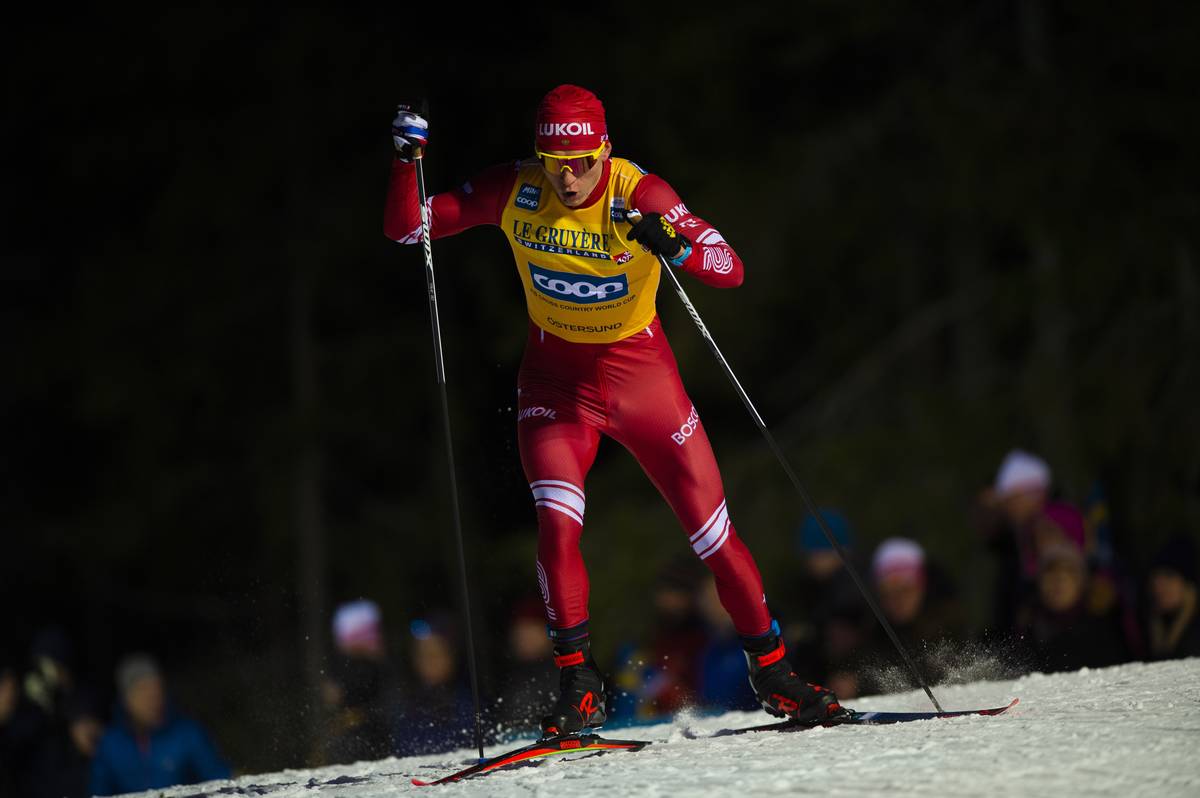
    Russia’s Alexander Bolshunov, the overall World Cup leader here during Stage 1 of the Ski Tour 2020. He placed 5th on the day. (Photo: NordicFocus)

    Along with capturing first through fourth places, Norway also claimed sixth (Hans Christer Holund), and eighth (Pål Golberg) place in the top-10. Norwegian Johannes Høsflot Klæbo was out of the points in 31st (+1:22.8). The Norwegian star returned after missing last weekend’s racing in Falun with a broken finger. Along with Bolshunov’s fifth place, Russia took ninth (Denis Spitsov) and 10th (Ivan Yakimushkin). The national team outlier in the top-10 was France’s Adrien Backscheider in seventh. 

    David Norris (APU), of the U.S., was the best-placed North American in 36th (+1:27.7). U.S. teammate Simi Hamilton (USST) placed 46th (+1:54.5). He returned to the World Cup racing after sitting out last weekend’s racing due to lingering neck pain. Kevin Bolger (USST) skied to 71st (+3:11.1), Ben Lustgarten (CGRP) 73rd (+3:12.2), and Logan Hanneman (APU) 86th (+4:35.6).  

    David Norris of the U.S. during the 15 k skate, Stage 1 of the Ski Tour 2020. (Photo: NordicFocus)

    Post-race comments from U.S. World Cup Coach Matt Whitcomb

    For Canada, Russell Kennedy skied to 52nd (+2:02.5), Evan Palmer-Charrette 60th (+2:31.9), Alexis Dumas 64th (+2:39.4), and Ricardo Izquierdo-Bernier 80th (+4:10.7).

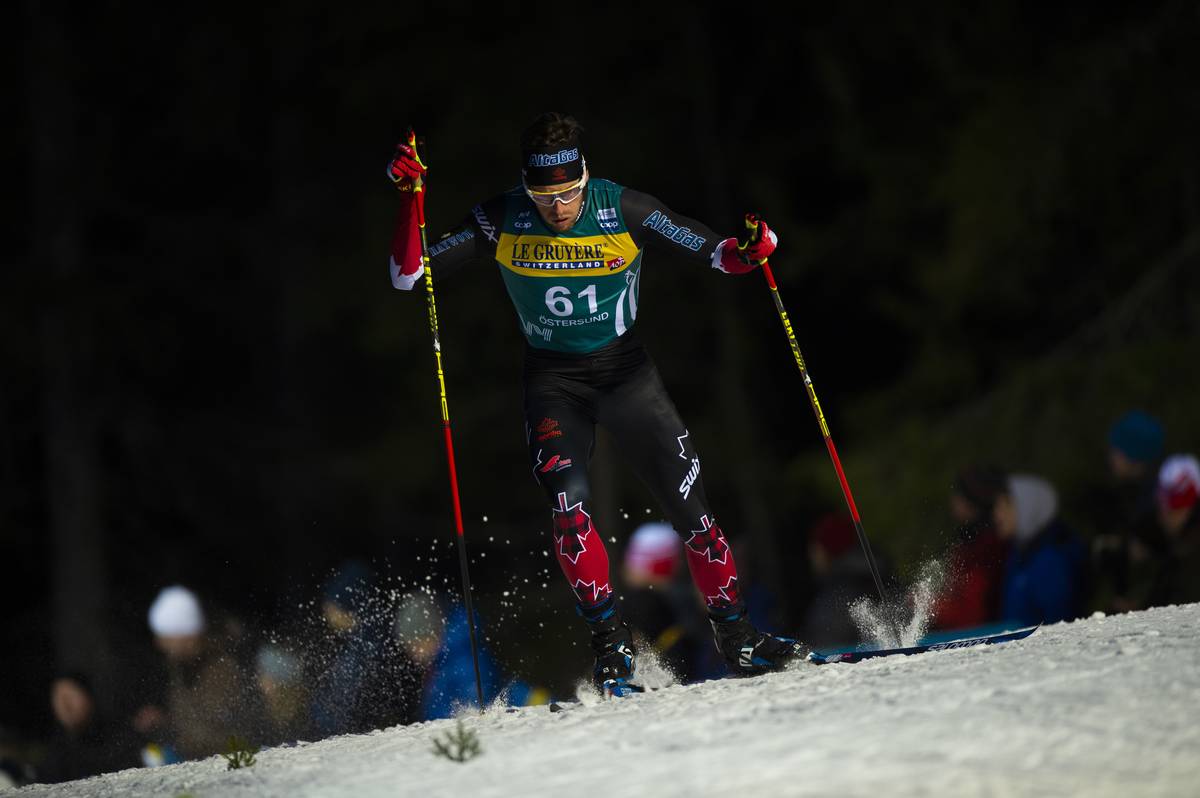
    Russell Kennedy of Canada, during Stage 1 of the Ski Tour 2020. (Photo: NordicFocus)

    Racing continues in Östersund tomorrow with a 15 k classic pursuit for the men and a 10 k classic pursuit for the women. 

    (No time bonuses were on offer in today’s race.)

     Results | Ski Tour 2020 Standings After Stage 1 

    Ski Tour 2020 Stage 1 podium: Simen Hegstad Krüger (NOR) second, Sjur Røthe (NOR) first, and Finn Hågen Krogh third. (Photo: NordicFocus)
  • Nové Město Pursuit: Bolshunov in Command

    Nové Město Pursuit: Bolshunov in Command

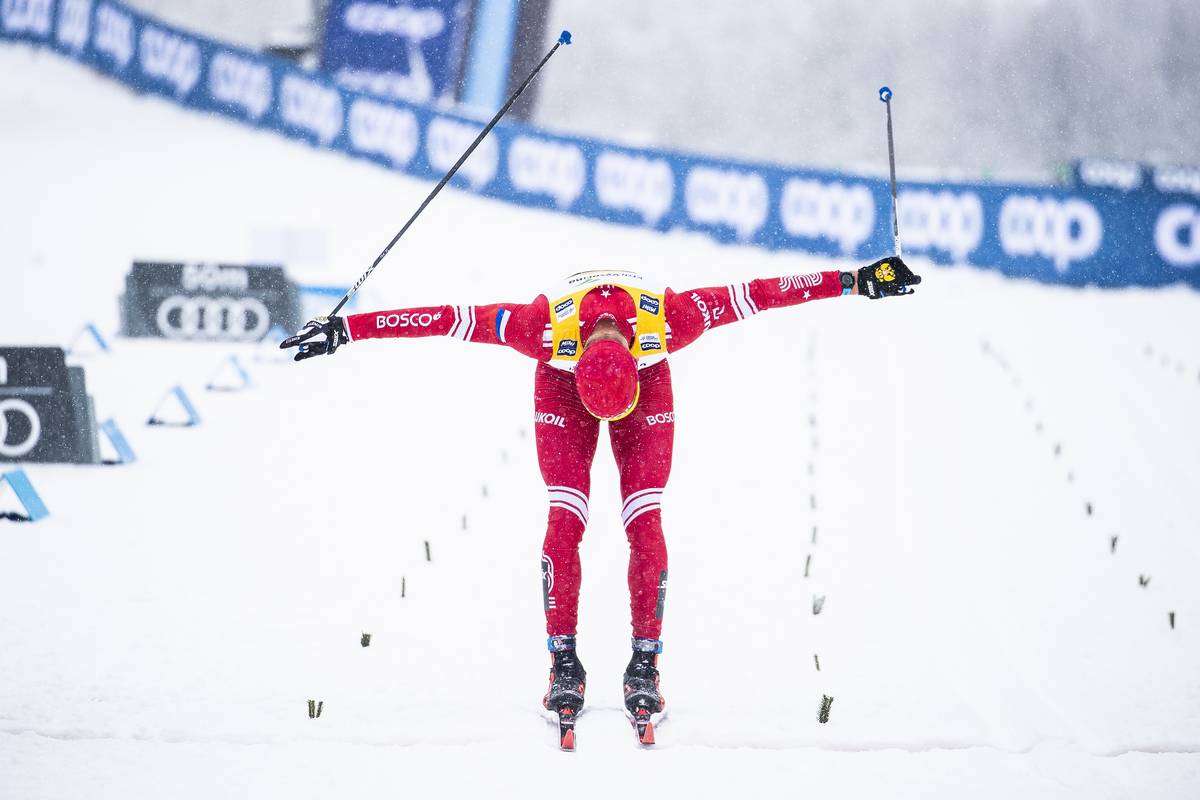
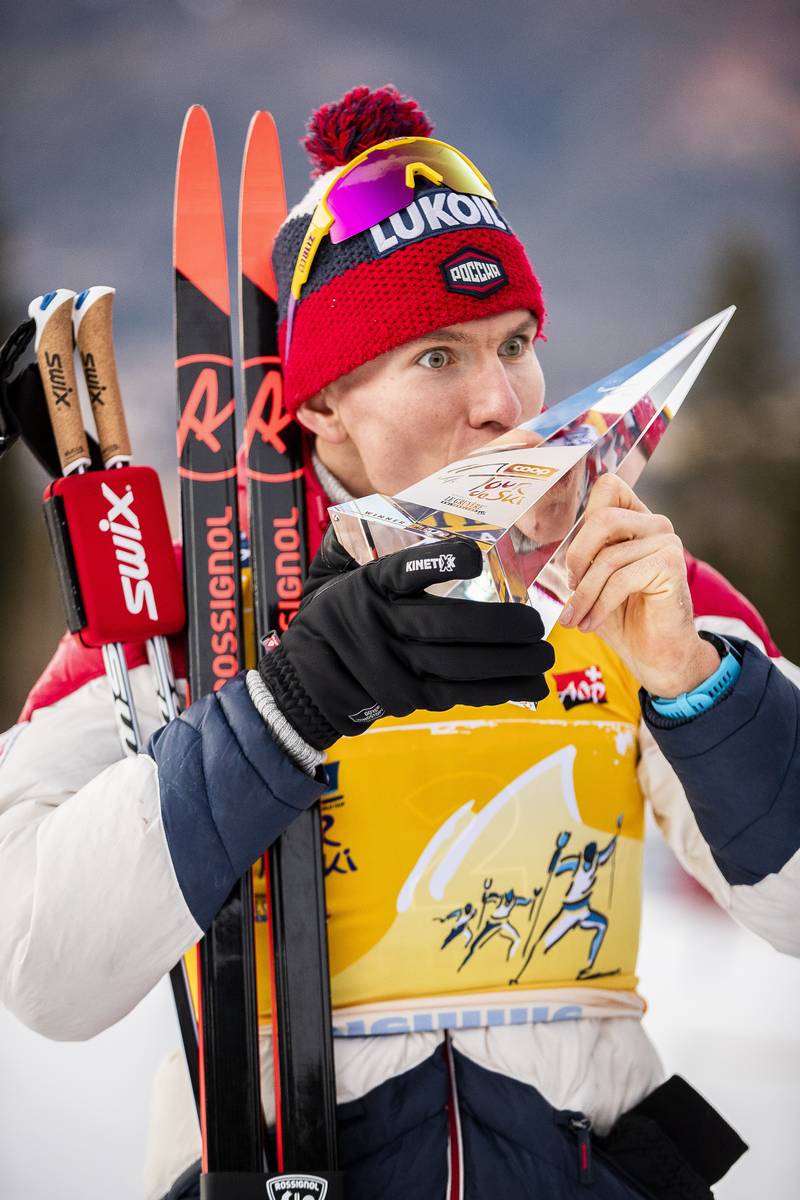
    Take a bow: Alexander Bolshunov (RUS) also takes the 15 k classic pursuit win in Nové Město. (Photo: NordicFocus)

    More snow. More fans. On Sunday in Nové Město, Czech Republic, day two of a pursuit weekend unfolded amidst trees draped in snow and a 5 k course with portions lined with fans. With snow falling, the men raced a 15-kilometer classic pursuit. 

    Rewind to yesterday’s first portion of the pursuit format, a 15 k interval start skate, which established the time-back start positions for Sunday. Russia’s Alexander Bolshunov won that race by a margin of 24 seconds over Finland’s Iivo Niskanen and 40 seconds over Norway’s Sjur Røthe.

    In a race where the chasers could coalesce into working groups hunting down time on Bolshunov, and on a day when the body might not feel perfect, or the skis begin to slip late in the race, one could posit several scenarios where Bolshunov was reeled in. 

    Iivo Niskanen of Finland striding during the 15 k classic pursuit in Nové Město. (Photo: NordicFocus)

    Whatever imaginations the chasers had of keeping Bolshunov in sight, let alone close enough for the catch, were illusions. Bolshunov proved on Sunday that his fitness is out of reach for the moment. He won the pursuit by adding time to his initial 24 second lead over Niskanen. The finish time stopped for the Russian at 37:01.3 minutes. 

    “It was a good race but also very hard because the full distance was very long,” Bolshunov told FIS after the race through a translator. “Fortunately, for the full distance, everything was under control. Lots of coaches told about the gaps and I was able to keep these gaps and make the best at the finish.”

    The tension for the win never developed. However, the positioning behind Bolshunov for the remaining podium spots was spicey. Back in seventh and eighth place were a tandem that became the principal animators on Sunday. Johannes Høsflot Klæbo in bib 7 and Simen Hegstad Krüger in bib 8, began 1:12 and 1:13 back, respectively. 

    Norway’s Johannes Høsflot Klæbo and Simen Hegstad Krüger on the hunt. (Photo: NordicFocus)

    Early into the race, the duo began making time. At 3.6 k, they had closed the gap to first to almost a minute back. This was less a threat to Bolshunov, and more a signpost to those sandwiched between the leader and their chase; Klæbo and Krüger were hunting. 

    Lapping through at 5 k, they had moved into fourth and fifth and 20 seconds behind Røthe. Stride by stride eventually the time was swallowed as were Røthe and Niskanen. Klæbo, Krüger, Røthe, and Niskanen came through the 10 k check together. Five strong, this group had no real threats from skiers gapping up from behind. They could settle into a hard driving pace as they covered the final 5 k lap. (Bolshunov, maintaining his solo off the front, had a 46 second lead on this group at 10 k.)

    Sjur Røthe of Norway. Shown here during the 15 k classic pursuit, a race he placed fourth in. (Photo: NordicFocus(

    At moments, the Norwegians looked as if timed by a metronome; their limbs synched as they moved efficiently uphill. Niskanen, the lone outlier, remains a formidable 15 k classic skier. Yet, at the 11.1 k time check, the Norwegians pulled through striding in the tracks, while Niskanen ran outside, keeping tempo, but perhaps working just that much harder to keep time.

    Krüger is known as a skate specialist who, on this day, illustrated he could find his classic skiing groove. He drove the pace, leading the line of striders, through the hill at 13.6 k. Again, Niskanen ran up the side. The Finn was able to catch a draft on the next downhill, but trending into the next uphill, he popped off the Norwegian train.

    With a sprint finish playing out, Klæbo took second place (+46.7), Krüger third (+47.2), and Røthe fourth (+47.7).

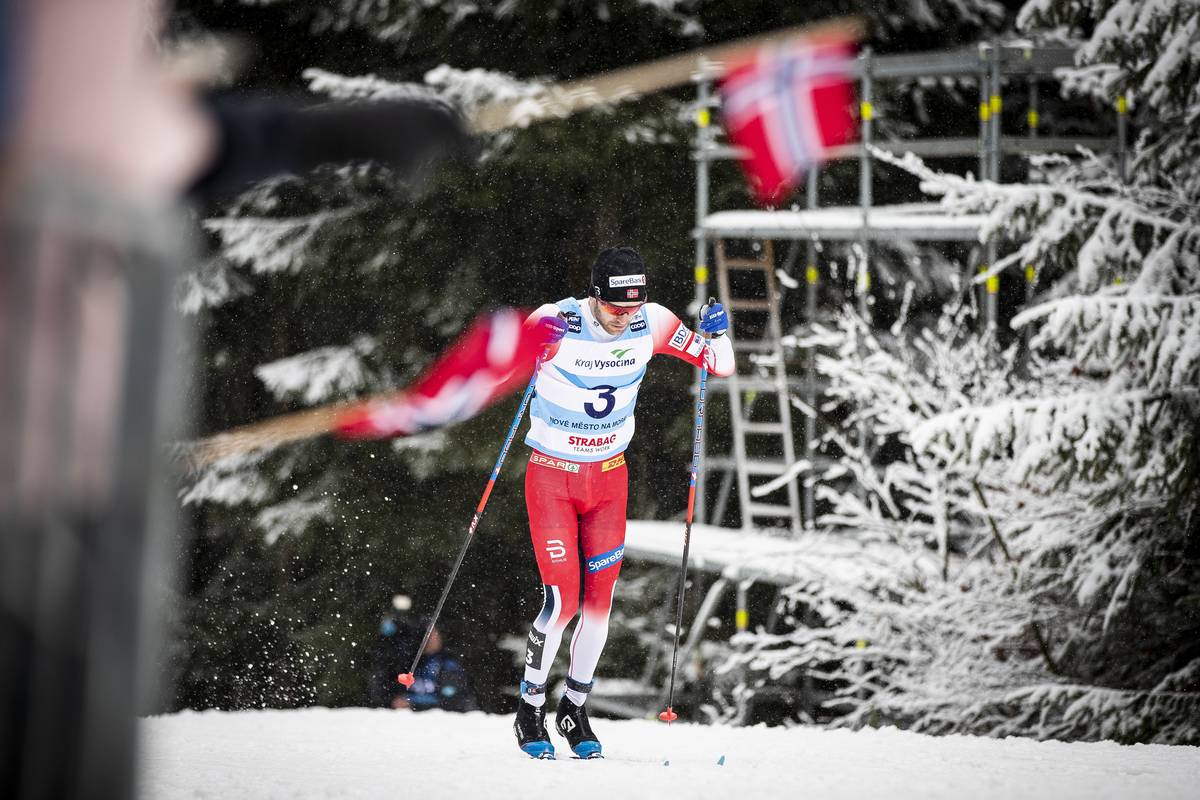
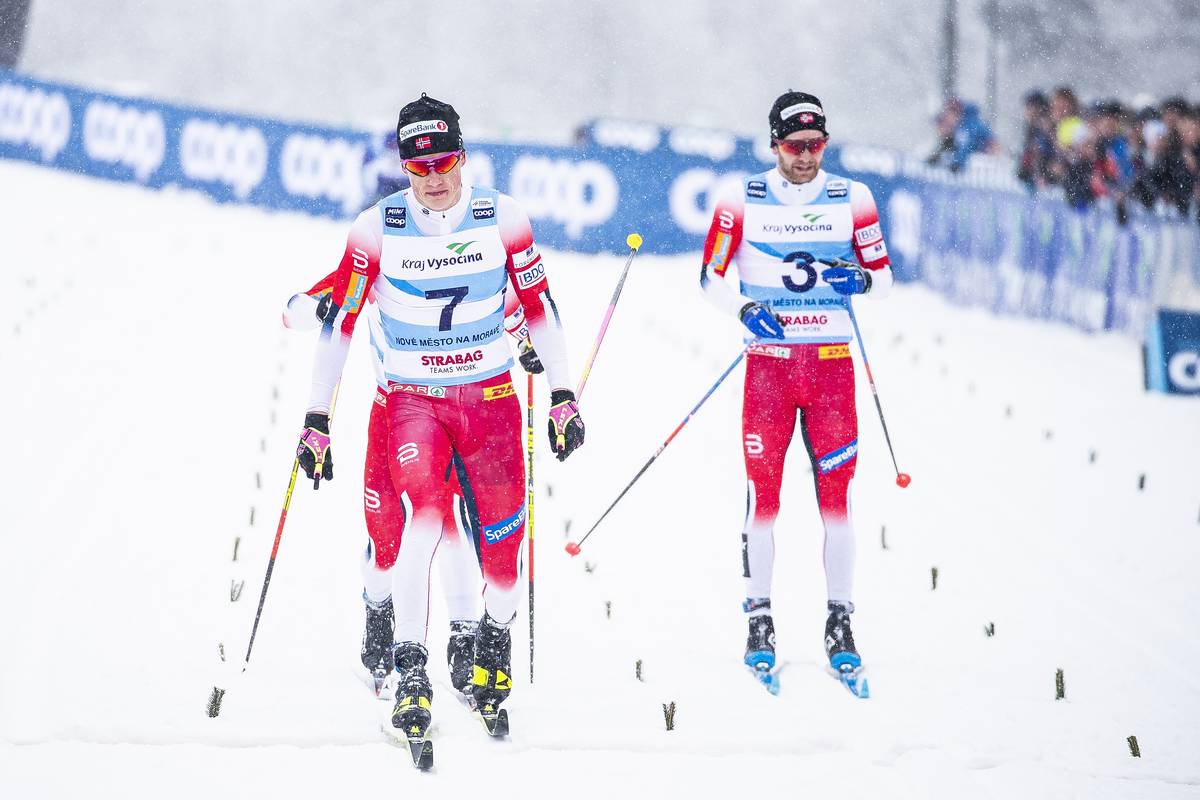
    Norway’s Johannes Høsflot Klæbo (bib 7) slots into second in Nové Město’s 15 k classic pursuit. Sjur Røthe (bib 3) was fourth. Behind Klæbo in the photo, Simen Hegstad Krüger placed third. (Photo: NordicFocus)

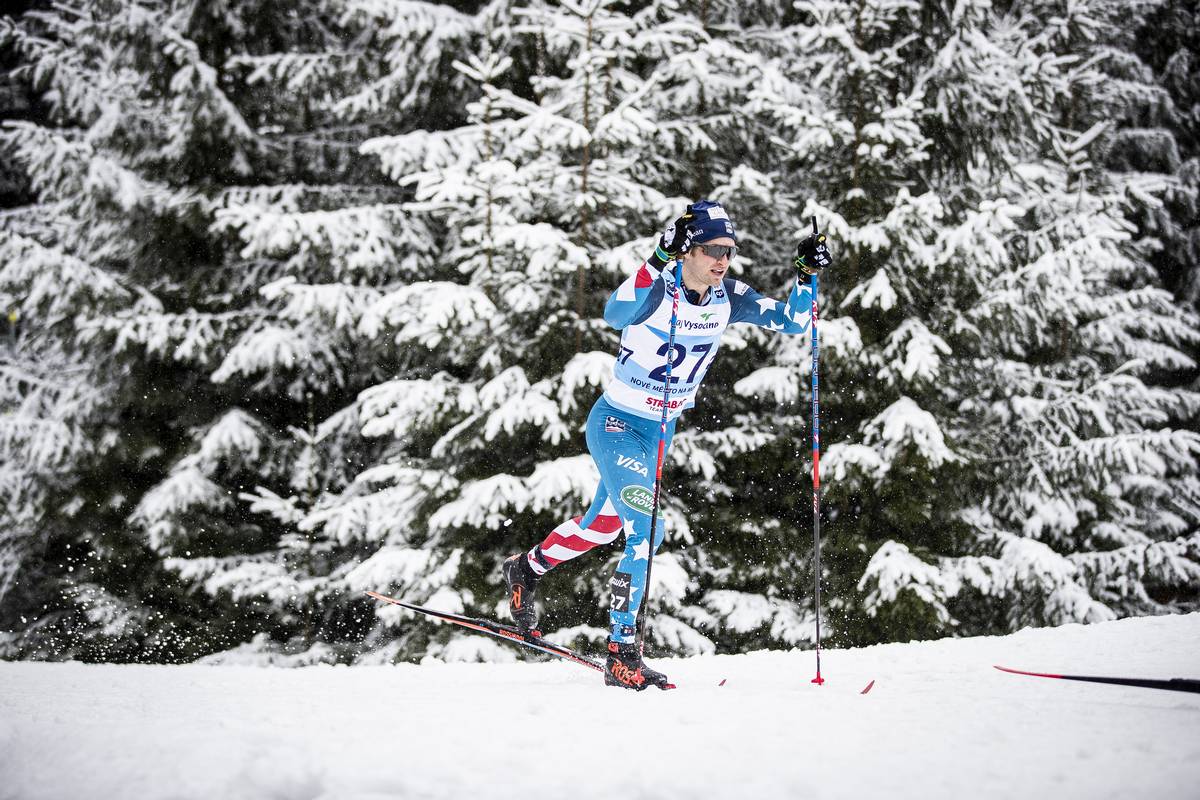
    David Norris (APU) slid into 30th (+3:43.8) for the day. Norris began in bib 27 and skied much of the race with a group of five other skiers. With a fall near the finish, Norris was able to right himself and retain a top-30 in the pursuit. Norris raced the 31st fastest time of day.

    David Norris, shown here skiing to a 30th place in the 15 k classic pursuit in Nové Město. (Photo: NordicFocus)

    “This weekend went well overall,” Norris emailed. “After the Tour, I was unsure how I would feel. Fortunately, I had good energy and was able to dig deep all weekend. Today I finished a little disappointed because I felt comfortable skiing with a group that had established, but at some point splintered and I found myself in the chase pack. These moments are the toughest for me. But, I’m improving. There were also plenty of other points throughout the race that I can find encouragement from.

    “The skis were great in these tough conditions. I’m very fortunate to have the awesome ski service on days like today. Big thanks to the USST wax techs and coaches.”

    Ian Torchia (SMST2), began in the wave start of skiers, wearing bib 68. He moved up to 64th (+8:57.5) by the finish.

    Ian Torchia zipping along during the men’s 15 k classic pursuit. (Photo: NordicFocus)

    Post-race comments from USST Head Coach Chris Grover

    The fastest time of the day went to Krüger in 36:35.5, with Klæbo 0.5 seconds off that pace. Bolshunov posted the third fastest time of day, 25.8 seconds back.   

    Racing continues next weekend in Oberstdorf, Germany with a skiathlon and a classic sprint. 

    Start List | Results | Time of Day (FIS Points List)

    The men’s 15 k classic pursuit podium:
    Simen Hegstad Krueger (NOR) in third, Alexander Bolshunov (RUS) first, and Johannes Hoesflot Klaebo (NOR) second, (l-r) www.nordicfocus.com. © Modica/NordicFocus. Every downloaded picture is fee-liable.
  • Bolshunov Locks Down the TdS Overall, Krüger Untouchable on the Alpe

    The winner: Russia’s Alexander Bolshunov. (Photo: NordicFocus)

    The hype. The Spectacle. Stage 7 of the 2019-2020 Tour de Ski (TdS) brings the show: the Alpe Cermis final climb. The race this year began as a mass start — a new format for the final stage, as this has historically has been a pursuit race, where the first skier to the finish line is the TdS champ. 

    With the opening sections of the course taking in the sprint course loop in Val di Fiemme, the man-made snow then led skiers on a snaking route, downstream along with the Torrent Avisio. At roughly 5.2 k into the what FIS had called a 10 k race, the gradient kicked up for the duration. The Alpe rears up at 12 percent initially, but soon morphs into a mountain-and-me struggle with gradients pushing 28 percent. 

    So the racers had that to mull as they no doubt had a somewhat anxious night of tossing and turning. And coupled with the big show final climb, FIS got its wish with a dearth of time bonuses on course this year for a tight TdS coming into the finale. 

    Last year’s TdS winner, Norway’s Johannes Høsflot Klæbo, wore the yellow leader’s bib by a single clock-tick, or one second over Russia’s Alexander Bolshunov. Last year’s TdS runner-up, Sergey Ustiugov of Russia, sat 15 seconds back. Ustiugov is seasoned on the Alpe. He won the TdS overall in 2016-2017, and was third in 2015-2016. 

    Let’s drill down on elapsed climb times and the work to be done for the top-three in the overall. Ustigov had to beat Klæbo by 15.1 seconds to take the overall, Bolshunov 1.1 seconds. Ustiugov clocked 31:47.6, the 11th fastest time of day for Stage 7 last year. Bolshunov, for his part, posted 32:34.1 for the 23rd fastest time in 2019. Klæbo’s time was 32:51.7, the 27th fastest time.

    Coming into that final stage in 2019, Klæbo had a 1:20.4 minute gap on second place Ustiugov. And with the pursuit format, Klæbo was never caught, despite ceding just over a minute to Ustiugov in the final stage. Bolshunov bested Klæbo by 17.2 seconds. On paper at least, Klæbo would have to maintain close contact today.   

    With the knowledge of last year’s climbing splits, Klæbo’s task this Sunday involved matching the Russians stride for stride. There would be no time to let up momentarily, reset on the Alpe, and grind to the finish. It was to be head to head racing.

    On the Alpe

    Part of the job here is building tension. Cutting to the chase, there was no Klæbo-induced tension Sunday on the Alpe. He hung in there for a bit. At 6.6 k, before the toll of cumulative climbing took effect, Klæbo was fifth, two seconds behind the lead pacesetter Ustiugov. Bolshunov shadowed his teammate one second back.

    As the Alpe kicked up, Klæbo, who at moments looked atypically spent, began to fall off in earnest. At 8 K he slid to 6.4 seconds back to Ustiugov, but more importantly, 5.1 seconds behind Bolshunov. Bolshunov, at that point was the virtual TdS overall leader. His task simple: keep pace with Ustiugov who had to gap his teammate by a bit more than 14 seconds to seize the overall. 

    Klæbo never regained traction on the Alpe. He placed 21st on the day. He lost 1:10 to Bolshhunov on the stage, and 58 seconds to Ustiugov. That put Klæbo in third overall for the Tour. 

    First time Tour de Ski overall winner, Russia’s Alexander Bolshunov. (Photo: NordicFocus)

    Ustiugov intially held on. With less than a kilometer to go, he and Bolshunov were velcroed. The younger Bolshunov did eventually surge and any semblance of a link between he and Ustiugov snapped. Bolshunov went ahead to place third on the stage and take the Tour overall win. By the finish, Ustiugov, who ended up fifth for the stage, had ceded another 12.3 seconds to Bolshunov. 

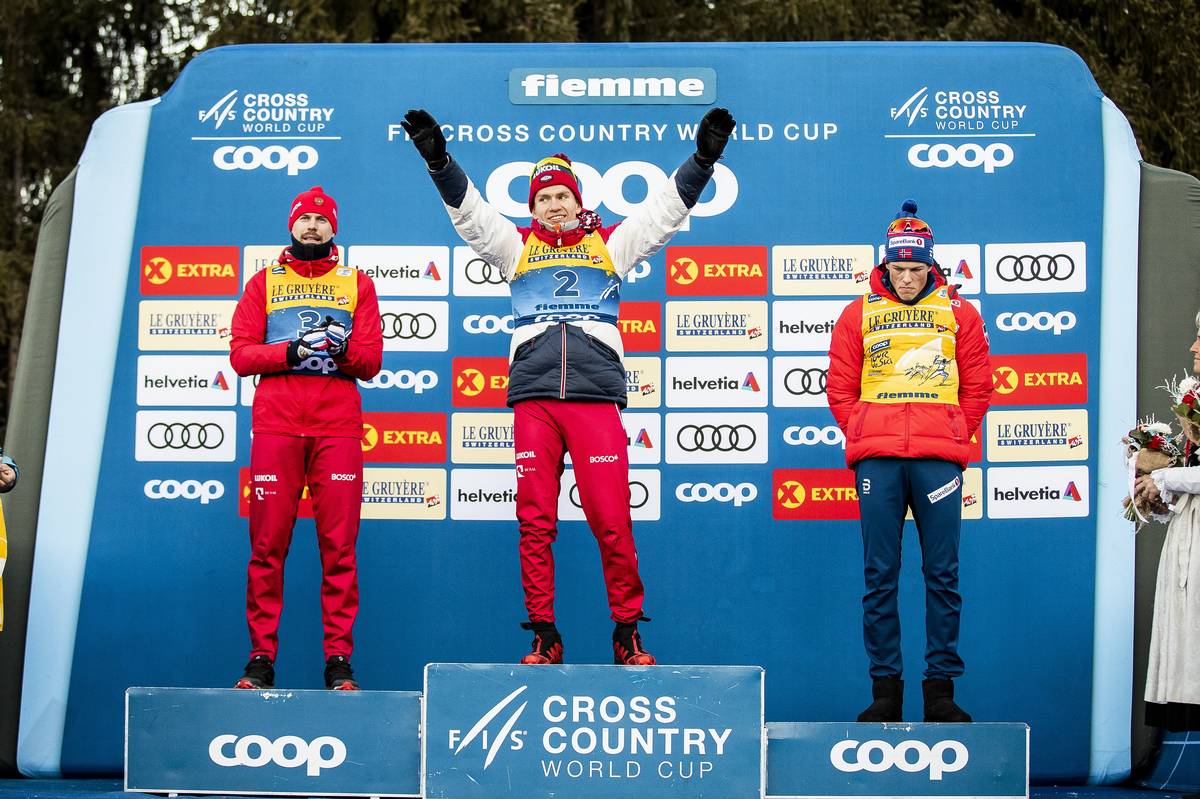
    The final TdS podium had Bolshunov in first, in 2:58.18.1 hours, Ustiugov in second (+27.1), and, Klæbo third (+1:09). It was Bolshunov’s first career Tour de Ski overall title. 

    The men’s final overall TdS podium: Sergey Ustiugov (RUS) in second, Alexander Bolshunov (RUS) first, Johannes Hoesflot Klaebo (NOR) third, (l-r). (Photo: NordicFocus)

    In fourth overall was Sjur Røthe (+1:51.6) and in fifth, Simen Hegstad Krüger (+2:53.7).

    Røthe and Krüger animated the racing for the stage win. Past the 8 k time check, the two Norwegians accelerated. No skiers near the front dared match. Last year, Røthe posted the fastest time of day on the Alpe, Krüger was a close second. (Krüger was third overall in last year’s TdS.)

    Simen Hegstad Krüger of Norway winning Stage 7 of the 2019-2020 Tour de Ski. (Photo: NordicFocus)

    Today, Krüger motored ahead of Røthe in the waning meters for the stage win in 30:55.8. Røthe stopped the clock 13.9 seconds later to secure a Stage 7 second place. With his climbing prowess on the Alpe, Krüger jumped from 12th overall after Stage 6, to fifth. Røthe moved from sixth to fourth. 

    “It hasn’t quite worked out in the Tour so far so I hoped to get a good finish,” Krüger told FIS after the race. “I knew that this hill suits me well and so I just tried to keep that steady pace and to keep it going all the way to the top and it was fun to cross the finish line as the first thanks to the mass start. 

    “Sjur and I were going together and he looked strong so I was far from sure that I was going to win but it was also tough going first so I really had to push.”

    David Norris of the U.S. This image captures the true sense of the TdS. A pure physical and mental test for skiers. (Photo: NordicFocus)

    Two Americans persevered in this Tour: David Norris and Logan Hanneman. Norris placed 30th on the stage (+2:12.4) and 35th overall (+10:18.1). Hanneman placed 56th overall (+20:05.5). He was perhaps the final pure sprinter to finish the Tour, as all the others had withdrawn. Hanneman was also 56th on the day (+4:53.8). 
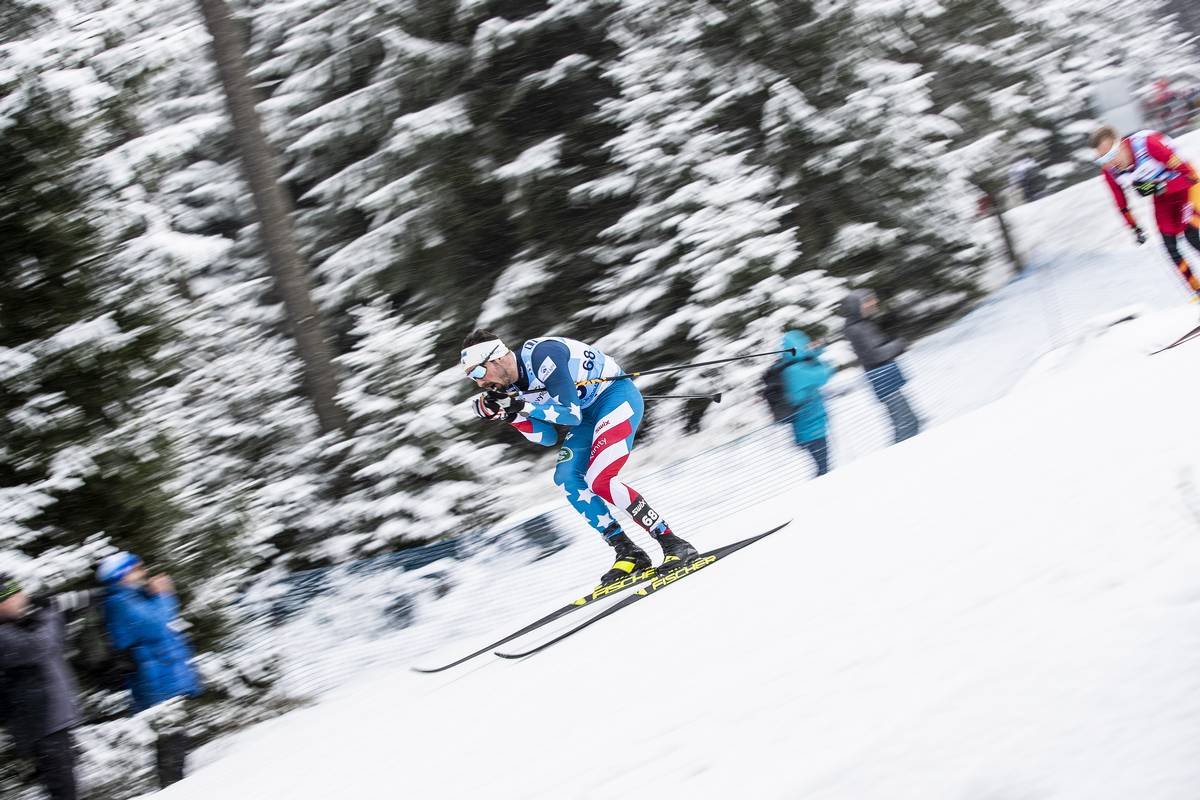
    Logan Hanneman of the U.S. finishing his maiden overall voyage at the Tour de Ski. (Photo: NordicFocus)

    So it’s a wrap. The TdS concludes with Klæbo unable to solve this seven-stage racing puzzle made more difficult by the two Russians who stymied his run for a second overall TdS win. 

    Racing continues next weekend on the World Cup with city sprints from Dresden, Germany. 

    Stage 7 Results | Final Tour de Ski Overall Results


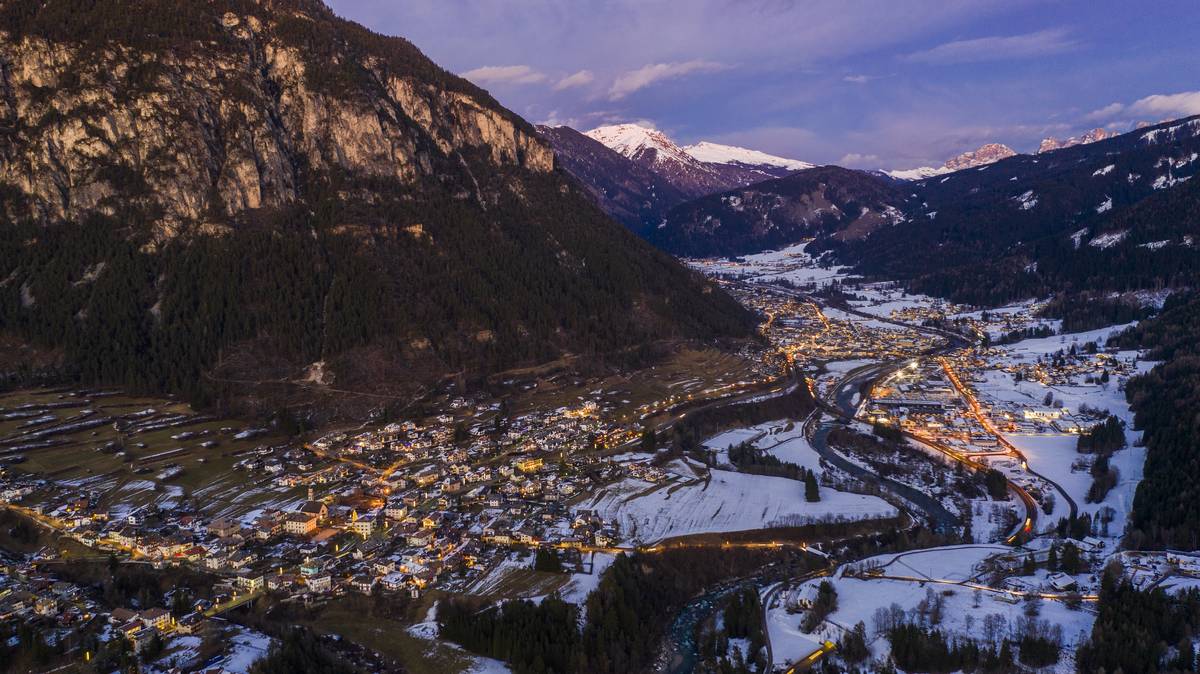
    Val di Fiemme settles in for another year. The 2021 TdS final stage awaits. (Photo: NordicFocus)
  • Russia takes the Podium in Holmenkollen; Harvey 5th, Patterson 19th

    Russia takes the Podium in Holmenkollen; Harvey 5th, Patterson 19th

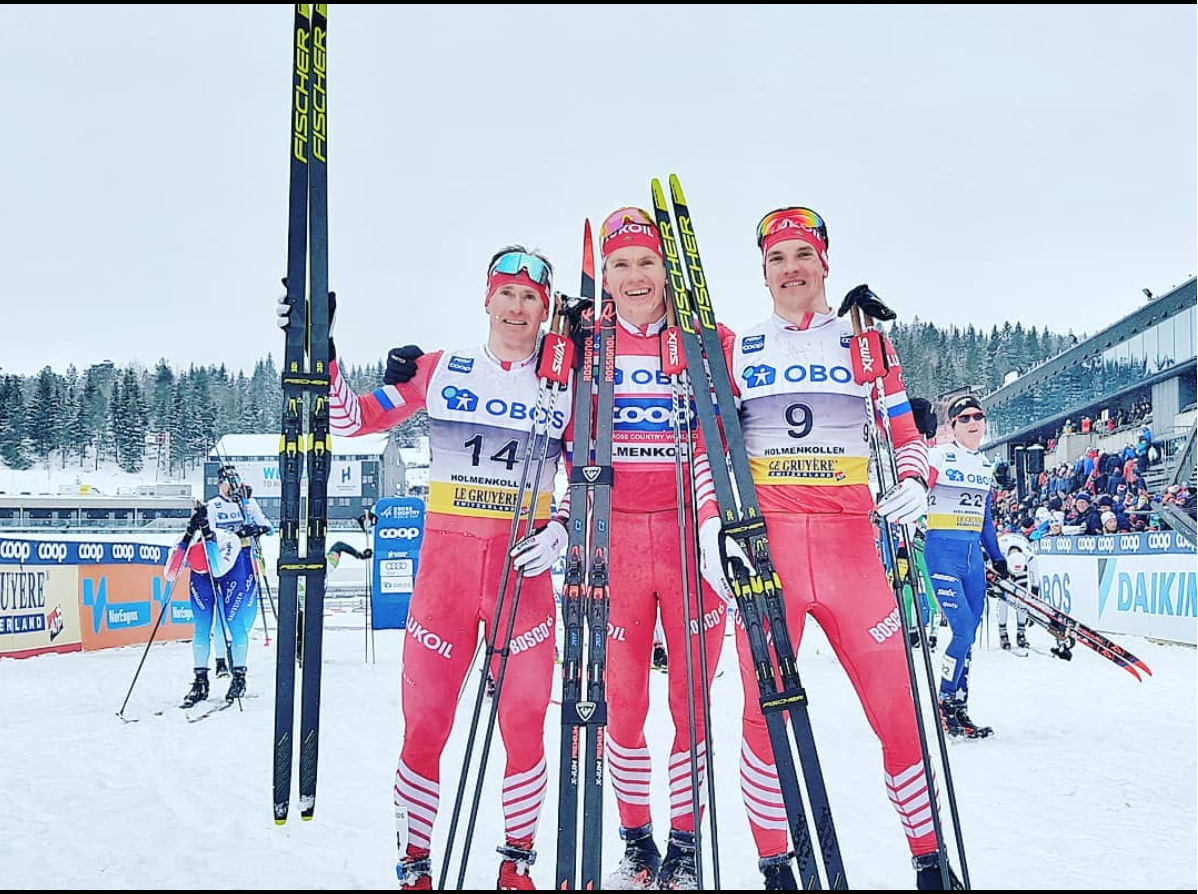
    A clean sweep for Russia today. From left to right, Maxim Vylegzhanin was 2nd, Alexander Bolshunov was 1st and Andrey Larkov was third. (Photo: Screenshot/ FIS Instagram)


    Russian skier, Alexander Bolshunov made history today during the Holmenkollen 50-kilometer classic mass start race. With his victory, Bolshunov became the youngest person and the third Russian to win the storied Holmenkollen 50 k. Bolshunov finished today’s race in 2:23:49.8 hours.

    For Bolshunov, who comes off a World Championships during which he won four silver medals, this was his fourth World Cup win of the season. The victory on Saturday reinforced Bolshunov’s lead in the World Cup distance cup rankings and he leapfrogged Norway’s Johannes Høsflot Klæbo for the overall World Cup lead. Bolshunov has amassed 1,230 points to Klæbo’s 1,181. Klæbo placed 38th in Saturday’s race.

    Bolshunov spoke about the end of the season and how he is approaching these finals races with a FIS reporter after the race, “At the end of the season, it is a necessity to show his best results each race and to fight in each race until the end and hopefully everything will be done.”

    The race featured no solo attack that could break away from the A-list of distance specialists. The lead was tossed around a number of times and for the first half of the race, Norway’s fans were treated to a 30-plus deep train of skiers engined by Sjur Røthe, Martin Johnsrud Sundby and Emil Iversen. But the ebb and flow of the 50 k allows skiers to sit in the pack, buy their time, conserve resources, then pounce.

    With 10 k to go, Russian skiers moved to the front, and began dictating the pace. At 1.6 k remaining, a Russian foursome consisting of Maxim Vylegzhanin, Andrey Larkov, Bolshunov, and Ilia Semikov were defining the flag waving rights on Norway’s holy-grail of ski loops.

    The race came down to the finishing stretch with Bolshunov charging into the finish, double poling all the way, and out sprinting his teammates to take the win. Vylegzhanin placed second and his teammates, Andrey Larkov and Illia Semikov, came in third and fourth respectively.

    This was the last World Cup race for Vylegzhanin who is retiring at the end of this season; this was his 24th podium in his career, but his first this season.

    https://www.allcreams.org

    Vylegzhanin spoke to a FIS reporter after the race, via a translator, “Of course it was a pleasure to see all the people coming to see me and congratulate me on the finish line and after the finish. The Russian team is very strong, we got all four places and we have many young potentials here who are proof that the Russian team is a very strong team. I started here at Holmenkollen in 2007 with the 7th place and since then I was getting 4th, 3rd, 2nd and actually it’s my best place to compete here.”

    Those skiing in the back of the well defined lead pack only began dropping off during the last 3 k. At that point, the Russians ramped up the pace and only Norway’s Martin Johnsrud Sundby, and Canada’s Alex Harvey were able to hang tightly connected to the Russians.

    The top 11 finishers were dominated by Russia and Norway. Russia took the top four spots as well as the tenth spot and Norway went 6, 7, 8, 9 and 11. Harvey was the only skier to break this pattern, finishing fifth overall.

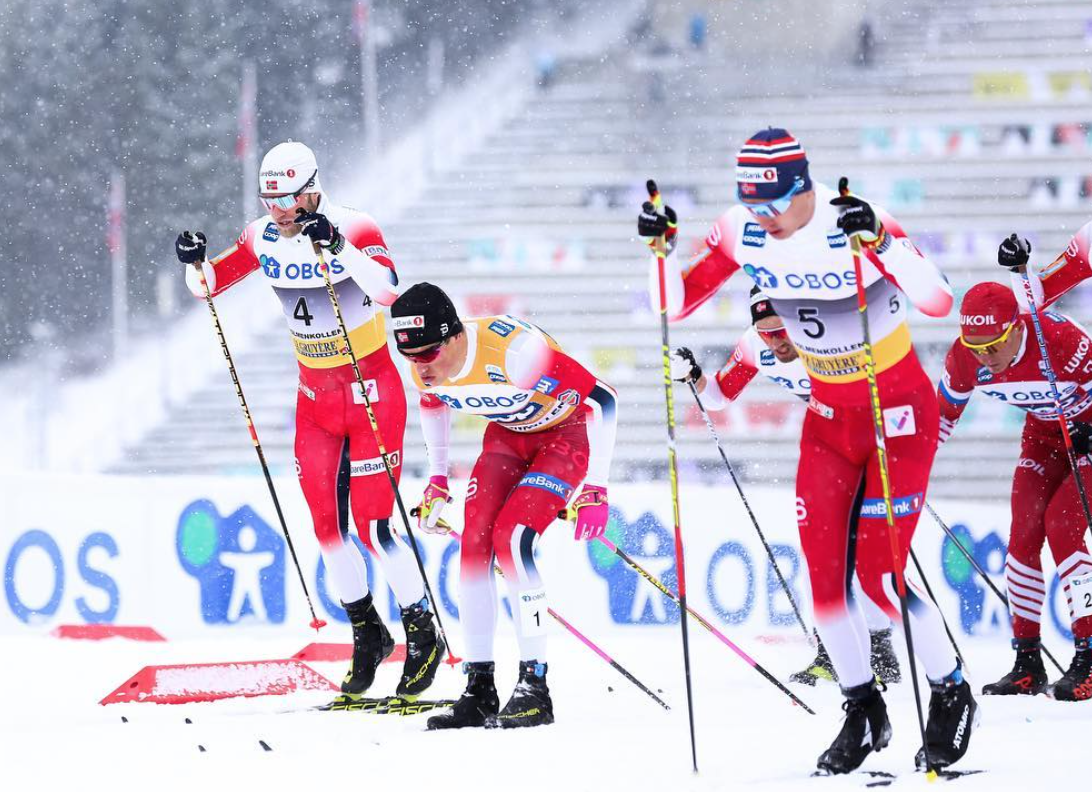
    Norwegian racers Marin Johnsrud Sundby, Johannes Høsflot Klæbo and Simen Hegstad Krueger starting the Holmenkollen 50k off strong (Photo: Screenshot/Holmenkollen Ski Fest Instagram/Jacques Holst)

    Harvey’s fifth place on Saturday matched his career best Holmenkollen 50 k finish — he was fifth during the 2011 Oslo World Chamionship’s 50 k skate. On Saturday, Harvey skied with the lead pack the entire race, sitting in the top 20 until the last 5k when he started making his way toward the front of the pack.

    “This year in classic, I never had good feelings really, so today was the first day I felt like I could actually race in classic, “ Harvey told FasterSkier in the mixed zone. “But of course, coming so close to the podium is always bittersweet. But the Russians, I think you could tell, had better skis, better glide. They were struggling on the kick but really high speed, so in the end they were really strong. So it was a really good race for me, but the podium was close, I could taste it.”

    He continued on, discussing today’s race pace, “It was a fairly easy pace the whole way. There was a huge group and guys were slowly getting dropped off the back, but there was never a big attack. So for me personally, I was in control the whole time, but I had good shape and pretty easy kicking skis.”  

    U.S. Ski Team member Scott Patterson finished 19th. This was Patterson’s best individual finish of the season. He skied with the lead pack until the last 3.75k, when he began to fall back.

    “This is my fourth time racing Holmenkollen, so I know that pack hangs on and people just start shooting off that back on the last couple laps,” Patterson told FasterSkier in Oslo. “So I figured I’d ski with that pack for as long as I could and hope I had energy for the finish. I think I did pretty good, I was pretty low on energy for that last 3.75, but it worked out pretty well.”

    Also for the U.S., David Norris (APU) finished 24th. For the Anchorage based skier it was a career best result on the World Cup. It follows a top-U.S. performance in last week’s 50 k skate at the Seefeld, Austria World Championships. Norris placed 20th in that event. 

    In Oslo on Saturday, U.S. skiers Adam Martin (CGRP) and Kyle Bratrud (SMS T2) were 31st and 40th respectively. Ben Lustgarten (CGRP) did not finish the race.

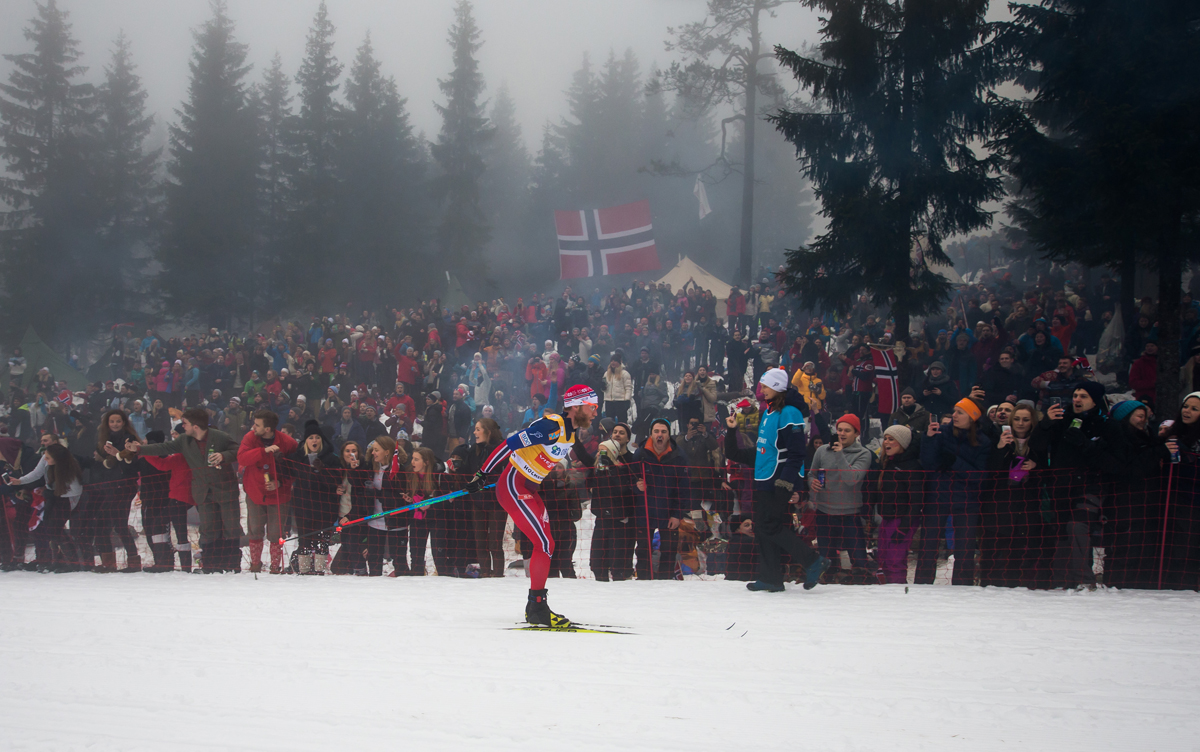
    Holmenkollen is a unique experience for races, with crowds, snow sculptures and bonfires lining the entire race course. It is essentially an end of season party for athletes and spectators alike.

    Norris commented on the atmosphere, “This is a highlight of the season. The crowd is so loud up top, and it’s so awesome to be here.”

    Harvey also appreciated the spectacle of the event, he told FasterSkier, “Having a little party is good for the sport, it make for good images. When the legs are screaming, to hear so much noise, it’s like you stop thinking for a bit, when you’re so exhausted, it kind of keeps you going.”

    Racing continues tomorrow in Oslo with the women’s 30 k classic.

    -Aleks Tangen contributed

    Men’s Results

  • Røthe Beats Sundby in Beitostølen; Harvey 13th

    Røthe Beats Sundby in Beitostølen; Harvey 13th

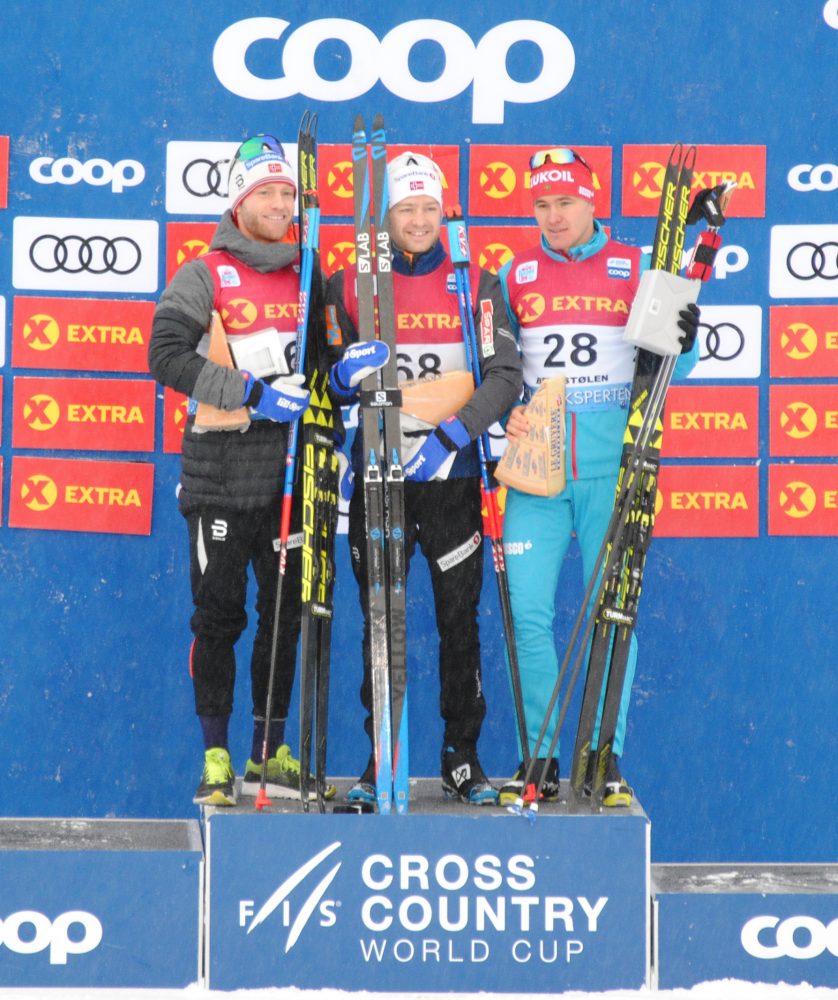
    The men’s podium from the 30 k freestyle individual start in Beitostølen, Norway. Sjur Røthe (center) of Norway placed first, teammate Martin Johnsrud Sundby (left) second, and Russia’s Andrey Melnichenko (right) third.

    It snowed continuously throughout today’s 30-kilometer freestyle individual Start in Beitostølen, Norway. There was already a  great deal of accumulation on the race course by the time the men started. This made the already challenging distance race even more grueling as the fresh snow created more resistance for skiers.

    Norway took the top two spots as Sjur Røthe won the with a time of 1:09:53.5. His teammate, Martin Johnsrud Sundby, was close behind in second (+35.2).

    This is Røthe’s third podium of the season. Last weekend, in Lillehammer, Norway, he won the 15 k freestyle individual start and placed second in the 15 k classic pursuit the following day. 

    “I was pretty proud of myself today,” Røthe told FIS at the end of the race. “I felt pretty good at the start. I was few seconds behind Martin [Sundby] and Didrik [Tønseth] out from the start and it looked like they are doing a sprint today. I felt very confident at the beginning of the race but looking at them taking up a high pace right from the start, I was unsure if I should change my pacing strategy.”

    Sundby set the tempo for the first 10 k, outpacing Røthe by just seconds. After the 15 k mark, Røthe took the lead and continued to put time between himself and Sundby. By 25 k, Røthe had a 30-second gap which he preserved for the remainder of the race.

    vteabp.org


    “I had a strong start but felt that between 10 and 20 k, it would be surprising, if some of the other nations would be much better than us,” Sundby told FIS. “We know the course, we have competed here for 10 years so we sure have some seconds in our favor.”

    It was Sundby’s best result of the young season and his first World Cup podium of the year. Sundby placed fourth in Ruka’s 15 k classic, missing out on a podium by 10 seconds. Last season, Sundby was the third-ranked World Cup skier in the distance overall.

    Russia’s Andrey Melnichenko took third (+49.2). At twenty-six-years-old, this was Melnichenko first career World Cup podium.

    “During the race in different splits, I got some information that I was around the sixth place and actually did not expect anything more than that,” Melnichenko told FIS.

    Canada’s Alex Harvey during the World Cup’s 30 k skate individual start in Beitostølen, Norway. Harvey placed 13th.

    Alex Harvey of Canada was the first North American to cross the finish line. Harvey finished in 13th (+1:49.8). Harvey has been known to come into form later in the season for distance races, this year he came on strong early in sprinting, placing third in the skate sprint last weekend in Lillehammer. 

    After 10 k today, Harvey was sitting in 15th, but he continued to fight and was able to gain five places in the next 15 k, putting him in 10th going into the last lap. But, he was unable to hold on as he faded slightly down the final stretch.

    ainhalers


    Harvey talked with FasterSkier after the race about the tough conditions. “The course doesn’t have much recovery, you have to work the whole time and then the conditions with the snow…there was resistance in the snow the whole way so you have to push on the flats, and on the gradual downhills so you’re always working,” Harvey explained. 

    Erik Bjornsen of the U.S. Ski Team (bib 50) during the men’s 30 k skate in Beitostølen, Norway. Jens Burman of Sweden (bib 27) and Jonas Dobler of Germany (bib 26) skied alongside Bjornsen for a portion of the race.

    Scott Patterson (USST) was the first American, finishing in 47th (+4:32.7). David Norris (APU) followed shortly behind in 51st (+5:13.3) and Erik Bjornsen was right on his heels, finishing 52nd (+5:14.9). Adam Martin (CGRP) finished 59th (+6:14.8).

    After the race, Norris commented on his strategy going into the race,

    ainhalers

    “My strategy was to put in the first two laps well and then just try to ski smooth and then get on the heels of some fast guys and try to hang in there,” Norris said. “I did that in certain points and struggled to do that at others. I felt like my first lap I went out well and then from lap two to lap five I kind of like hung in there. And then on the sixth lap, felt I like I charged pretty well and finished strong.”

    Racing continues tomorrow for the men with a 4 x 7.5 k relay.

    Men’s Results

    — Aleks Tangen contributed


  • Sundby Accomplishes Dream, Dominates Holmenkollen 50 k Start to Finish

    Sundby Accomplishes Dream, Dominates Holmenkollen 50 k Start to Finish

    Norway's Martin Johnsrud Sundby celebrates his first-ever victory in the men's 50 k mass start at the historic Holmenkollen World Cup near his hometown of Oslo, Norway. (Photo: Fischer/NordicFocus)
    Norway’s Martin Johnsrud Sundby celebrates his first-ever victory in the men’s 50 k mass start at the historic Holmenkollen World Cup on Saturday near his hometown of Oslo, Norway. (Photo: Fischer/NordicFocus)

    “It’s always been a dream for me to win this race, from when I was nine years old and tenting in the forest, cheering for all the big skiers at the time,” Martin Johnsrud Sundby said in a post-race press conference after winning Saturday’s 50-kilometer classic mass start held at the historic Holmenkollen stadium outside of Oslo, Norway.

    A perennial favorite at his home stadium in his hometown of Oslo, Sundby, landed on the podium in his four previous starts at the Holmenkollen 50 k, but the victory eluded him. Last year he finished third, half a second behind race winner and teammate Sjur Røthe.

    In an interview last year with the International Ski Federation (FIS) media’s Inside the Fence series, Sundby spoke of growing up on the track, “I did my first competition here as a 9 year old. Since then I’ve done probably over 100 competitions at this place. I have trained probably five thousand hours at this track. This is my home ground.”

    On Saturday, Sundby, who leads both the overall and distance World Cup, made no mistake that he would finally come away with a victory. With King Harald of Norway in attendance, the 31-year-old race favorite gunned it out of the stadium, appearing to want to weed out any potential chasers within the first few kilometers.

    Norway's Martin Johnsrud Sundby leads teammates Niklas Dyrhaug (3), Didrik Tønseth, and Russia's Maxim Vylegzhanin (r) during the men's 50 k classic mass start at Holmenkollen in Oslo, Norway. (Photo: Fischer/NordicFocus)
    Norway’s Martin Johnsrud Sundby leads teammates Niklas Dyrhaug (3), Didrik Tønseth, and Russia’s Maxim Vylegzhanin (r) during the men’s 50 k classic mass start at Holmenkollen in Oslo, Norway. (Photo: Fischer/NordicFocus)

    “My strategy for today was to shock the others from the start,” Sundby told reporters following the race, “Nobody expected that kind of pace from kilometer one, and I think I’ve never been skiing that fast for 50 k.”

    Despite warm temperatures and dense fog, the damp conditions did not seem to impact the lead racers. Instead it was Sundby’s blistering pace that thinned the group.

    Only 13.3 k in, a pack of three remained in contact Sundby as they charged through the fog: Norwegians Niklas Dyrhaug, 28, and Didrik Tønseth, 24, followed by Russia’s 33-year-old Maxim Vylegzhanin. Ten seconds behind these four was the main chase including past Holmenkollen champions, Norway’s Røthe and Petter Northug Jr., and last year’s runner-up Dario Cologna of Switzerland.

    Five kilometers later, at 18.8 k, the lead pack pushed their gap to 25.5 seconds over the chase. Leading the chase pack, Andrey Larkov, Alexander Bessmertnykh, Sergey Turyshev, Nikita Stupak — all from Russia — appeared set on tracking down and joining their teammate Vylegzhanin at the front.

    Less than a kilometer later, at the bonus sprint at 19.6 k (there was one on each of the six laps), Sundby gapped his three challengers, putting 4.6 seconds between himself and Tønseth. Although they reeled him back in at this point, Sundby made these moves throughout the day in an attempt to break free. By continuously pushing the pace, Sundby claimed all six of the World Cup bonus point preems throughout the course.

    At 24.9 k, roughly halfway through, the lead pack of four soldiered on, with the three challengers to Sundby absorbing every surge he attempted. Back in the main chase pack, the Russian attack of Larkov, Bessmertnykh, Turyshev and Stupak settled back in. While the Russians appeared positive for the chase, the group of 13 were taking the brunt of Sundby’s relentless attacks. Failing to match his relentless speed; they slipped 47 seconds behind.

    Norway's Martin Johnsrud Sundby (r) leads Switzerland's Dario Cologna early in the men's 50 k classic mass start at Holmenkollen in Oslo, Norway. (Photo: Fischer/NordicFocus)
    Norway’s Martin Johnsrud Sundby (r) leads Switzerland’s Dario Cologna (10) early in the men’s 50 k classic mass start at Holmenkollen in Oslo, Norway. (Photo: Fischer/NordicFocus)

    Colonga, an early challenger around 11 k and a presence within the main chase, abandoned the race near the halfway point. Bothered by a left calf injury that occurred during the Tour de Ski, Cologna hoped to make a comeback for Holmenkollen. After the race he told Neue Luzerner Zeitung, a Swiss-German paper, “The calf was not strong enough for the fifties,” referencing that he believes he can compete in shorter races, but the longer marathons are not yet possible given the severity of the calf strain he suffered in January.

    On course, Sundby’s charge continued. At the second of two possible ski changes at 33.3 k (the first was at 6.6 k), the gap over the main chase grew to 1:10.3. The only skier daring enough to try to bridge that gap between the main chase and Sundby’s group of four, Turyshev, made it as close as 40 seconds back.

    An hour and half in, and on their fifth of six laps, Sundby’s energy finally proved too much for Tønseth and Vylegzhanin. Over two large climbs, Sundby’s powerful stride put him and Dyrhaug 15 seconds ahead Tønseth and Vylegzhanin. After the race, Sundby reflected this move was essential to holding off the strong-finishing Vylegzhanin, “I was a bit afraid of Vylegzhanin; he has great finishes when he is in shape. I was actually quite happy when me and Dyrhaug put some seconds on him in the fifth lap.”

    Dyrhaug clung to his teammate, telling FIS afterward that he “felt strong especially on the uphills,” albeit describing the race as the “hardest race I have ever skied in my life.” He matched Sundby stride for stride until just before 44.6 k, where Sundby built a 13.6-second lead that would last until the finish.

    According to NRK, Sundby wanted Dyrhaug there to pull him through the final few kilometers. However, Dyrhaug could not match the pace any longer, telling NRK, “He wanted me there and go. I said, ‘It’s not going to happen. Sorry, buddy.’ ”

    Behind Dyrhaug, the race for third dissolved as Vylegzhanin dropped Tønseth, opening up 14.2-second gap on the third Norwegian at the final 44.6 k time check. Farther back, Turyshev maintained his pace within the top five, 2:21.4 behind Sundby and 1:01.5 after Tønseth.

    Norway's Martin Johnsrud Sundby racing to the victory in the Holmenkollen 50 k classic mass start on Saturday at the World Cup in Oslo, Norway. (Photo: Fischer/NordicFocus)
    Norway’s Martin Johnsrud Sundby racing to the victory in the Holmenkollen 50 k classic mass start on Saturday at the World Cup in Oslo, Norway. (Photo: Fischer/NordicFocus)

    Sundby emerged through the fog and into the stadium alone. Down the finishing stretch, he pumped his fists, a final celebration of a victory that’s been a long time coming. After crossing the line with a victory in his record fifth-consecutive World Cup podium at the 114-year-old Holmenkollen event, he kissed the snow, paying homage to the historic course.

    Following Sundby in second place, 18.8 seconds behind, his teammate Dyrhaug celebrated a personal best in the 50 k event. In third, 1:05.4 after Sundby, Vylegzhanin, broke up the Norwegian podium. Tønseth clung on to finish fourth (+1:36.3). Turyshev, who skied the majority of the second half of the race alone, rounded out the top five, 2:35.8 behind Sundby and 25 seconds ahead of Northug in sixth.

    Northug edged out an eight-man race to the line, with sixth through 13th finishing within 5 seconds of one another.

    Martin Johnsrud Sundby kissing the ground after winning the Holmenkollen 50 k classic mass start on Saturday in Oslo, Norway.
    Martin Johnsrud Sundby kissing the ground after winning the Holmenkollen 50 k classic mass start on Saturday in Oslo, Norway.

    With the victory, Sundby leads the overall World Cup by 720 points over fellow Norwegian Finn Hågen Krogh, who did not race on Saturday. Northug sits in third, 22 points behind Krogh.

    In the Distance World Cup, Sundby remains in first by a comfortable 473 points over Dyrhaug in second, and Røthe, who placed 10th on Saturday ranks third, 58 points behind Dyrhaug and just 1 point ahead of France’s Maurice Manificat in fourth.

    None of the French skiers started Saturday’s race. Of the 19 Norwegians in the race, 10 placed in the top 20 and five were in the top 10.

    “It sounds strange, but even if it’s no championship, this means a lot to me.” Sundby said in the post race press conference with a glint of sentiment towards finally breaking through at the fabled race.

    Notes

    • Sundby appeared to take a couple skate strides up and over the final bridge into the stadium. While XC Skiing News reported that he skated, Sundby did not mention that the jury had spoken to him about it. The incident was captured in this Vine:

    Results

  • Surprising Norwegian Lineup for the Men’s 30K Pursuit

    Surprising Norwegian Lineup for the Men’s 30K Pursuit

    Eirik Brandsdal

    Eirik Brandsdal is the wild card to the Norwegian team for the 30K pursuit Sunday. While defending World Champion Petter Northug was a given, and Sjur Røhte, Martin Johnsrud Sundby and Tord Asle Gjerdalen have proven themselves in distance events, few had guessed Eirik Brandsdal as the last one. Unfortunately, the selection is a result of sickness: Petter Eliassen was originally selected for the 30K pursuit, but he is sitting out due to illness. Another hot guess, Eldar Rønning, opted out in order to focus on the 15K classic on Tuesday.

    “Eirik was a good sport and agreed to race when asked,” said Morten Aa Djupvik, Norway’s national team head coach. “We had five spots in the race and wanted to fill all of them in a World Championship on home turf.”

    And home turf indeed it is for Brandsdal, who grew up only minutes from the venue and has raced in Holmenkollen since he was in elementary school. Needless to say, Brandsdal is excited to race one more time in front of the famous Kollen crowd.

    “I was given a unique opportunity to show my very best again. I think it will be amazing,” he said at the press conference Saturday morning. Brandsdal is currently also an alternate to the sprint relay, but doesn’t think racing the pursuit will hamper his chances if he is called on for the sprint relay.

    For the other racers on the team, the pursuit is an important bid for the 4×10 kilometer relay on Friday.

    “Theoretically, all spots on the relay team are up for grabs, but some names are better bets than others,” said Otto Ulseth, press attaché for the Norwegian men’s team.

    Ulseth mentioned Petter Northug, as one of those safe bets, and said they will decide by Monday, but emphasizes that there are a lot of candidates in the squad. Biathlete Emil Hegle Svendsen is another strong candidate, but it all depends on how the other cross-country skiers do in the pursuit on Sunday.