From the FasterSkier archive — posts syndicated from athletes’ and coaches’ own blogs between 2004 and 2012, kept online as published. Current coverage is at fasterskier.com.

Tag: Sjur Roethe

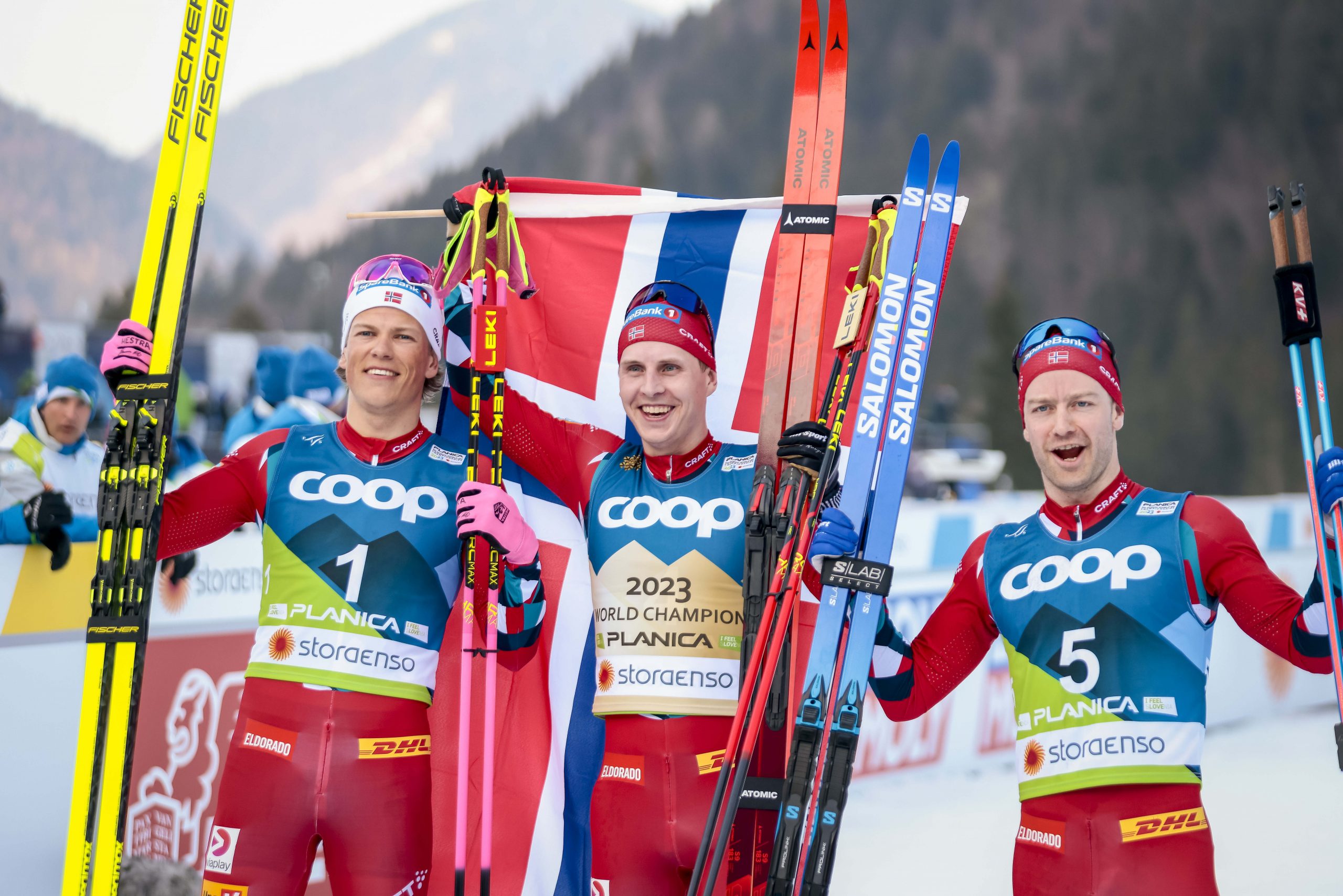
  • Only Norway—Krueger Leads Sweep of 30 k Skiathlon Ahead of Klaebo and Roethe

    Only Norway—Krueger Leads Sweep of 30 k Skiathlon Ahead of Klaebo and Roethe

    This World Cup coverage is made possible through the generous support of Marty and Kathy Hall and A Hall Mark of Excellence Award. To learn more about A Hall Mark of Excellence Award, or to learn how you can support FasterSkier’s coverage, please contact info@fasterskier.com. 

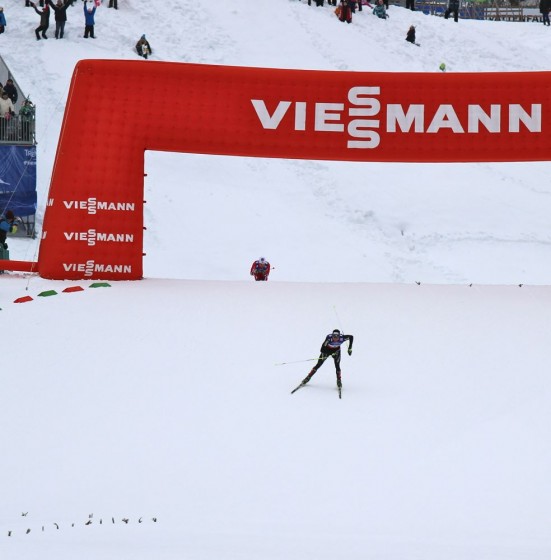
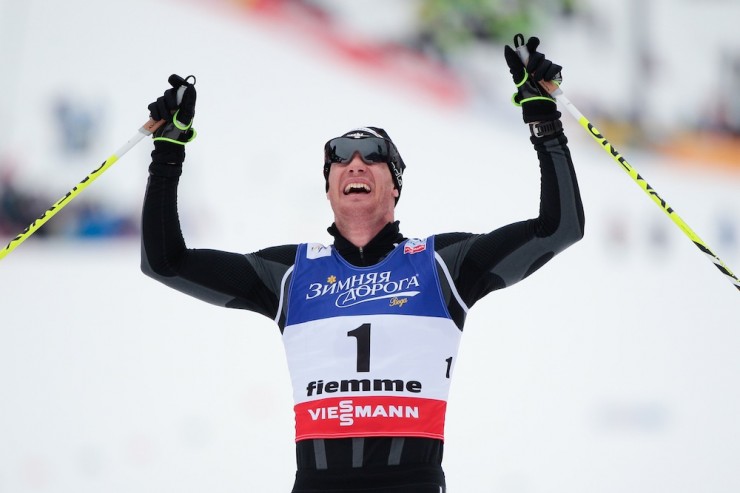
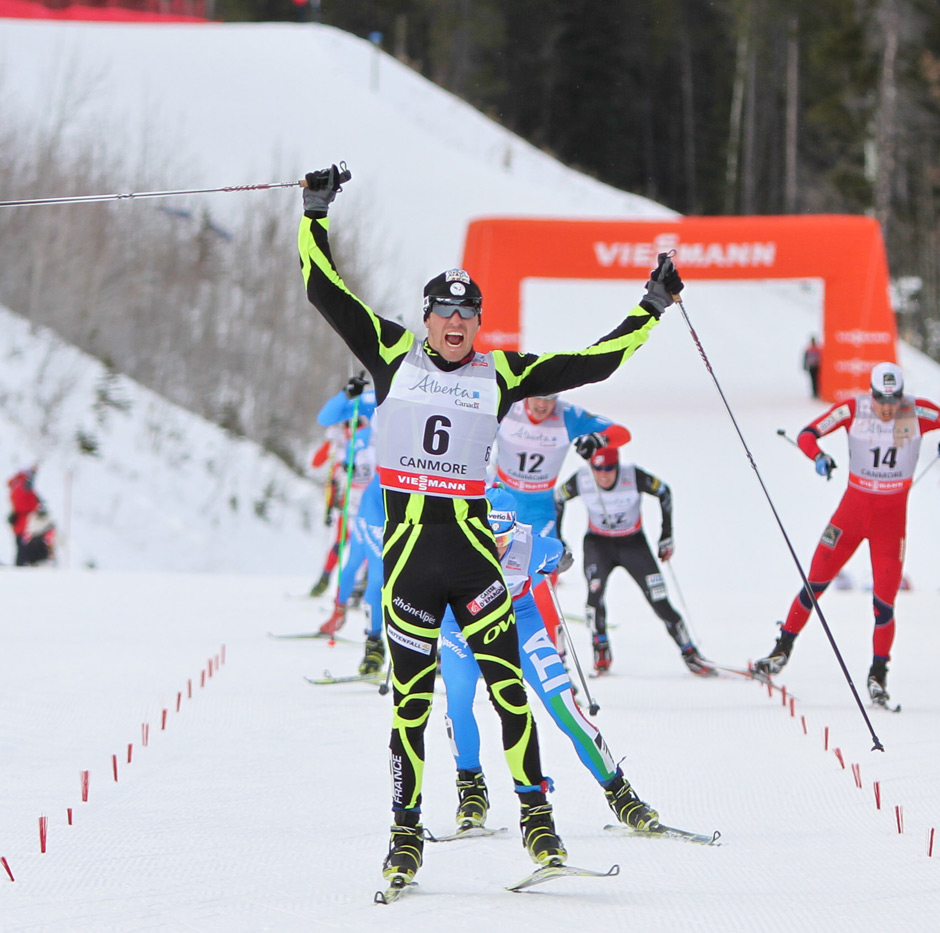
    Simen Hegstad Krueger (NOR) celebrates as he crosses the finish line as World Champion in the 30 k Skiathlon in Planica, Slovenia. (Photo: Modica/NordicFocus)

    Thirty kilometers is a long way to race. It’s the sort of distance that recreational skiers race as a “marathon,” the kind of overlong race effort from which mere mortals take weeks to recover. Coming so near the beginning of a 12-day World Championship schedule, a race of this length —one raced with such intensity and under such challenging and difficult conditions—is likely to have a profound effect on all the races to come. If the rest of the field could have peered into the future—could’ve seen what Simen Hegstad Krueger (NOR) was capable of in today’s Skiathlon—they might never have committed so much energy and passion to this race. Krueger—the reigning Olympic Champion in the event (and silver medalist from the last World Championships)—was never going to be denied. Not today . . .

    Simen Hegstad Krueger is sublimely glad he toed the starting line today: he claimed the victory with a dominating performance in the second half (the freestyle half) of the 30 k Skiathlon. Johannes Hoesflot Klaebo (NOR) and Sjur Roethe (NOR), the silver and bronze medalists, might also be relatively glad they raced today, though they may also have spent so much energy that their remaining races at the World Championships are likely to be affected. And everybody else? Those who earned no medals may be questioning whether racing this distance—at such an extraordinarily high measure of effort, through such challenging and difficult conditions—was really worth it.

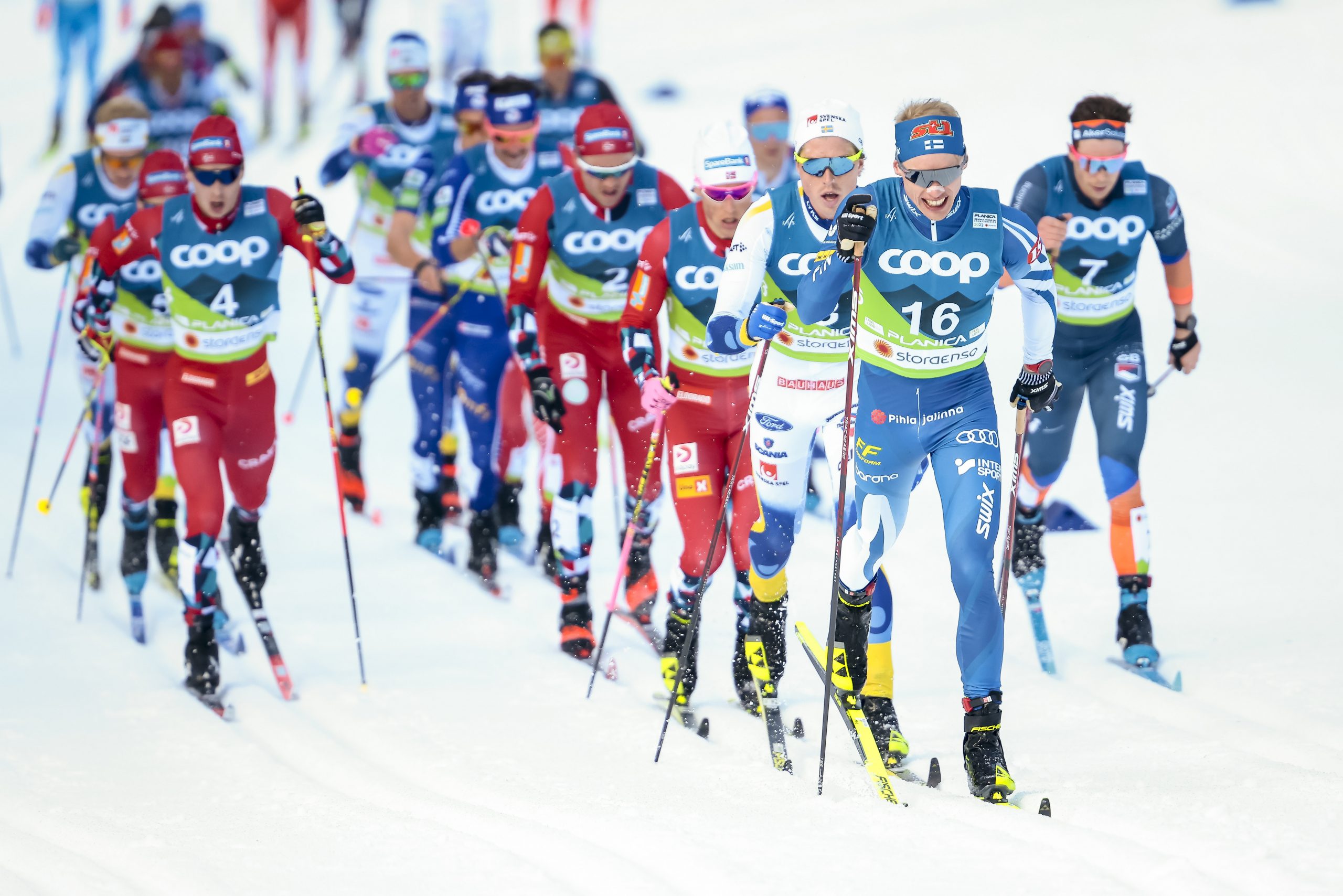
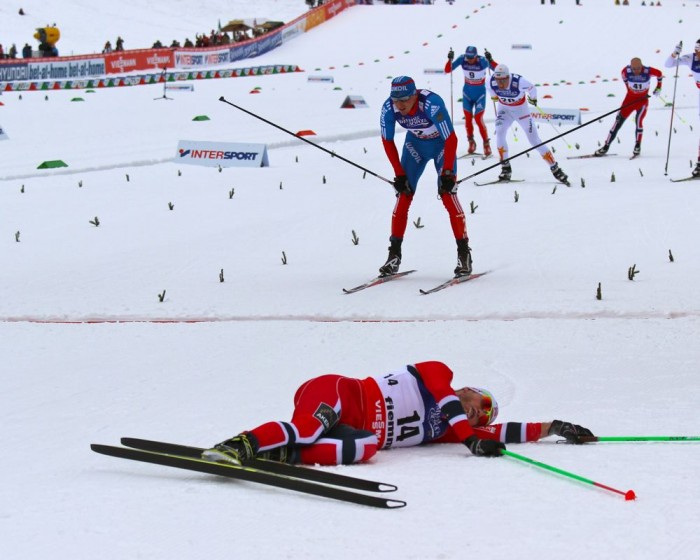
    Iivo Niskanen (FIN) led William Poromaa (SWE) for much of the classic leg, only to find himself undone by the way the pace increased after the classic-to-freestyle transition. (Photo: Modica/NordicFocus)

    If he had advance knowledge of the way things would turn out, Iivo Niskanen (FIN) might never have surged to the front in the classic leg; William Poromaa (SWE) might never have pushed the pace; Calle Halfvarsson (SWE) might never have stuck his nose out into the wind; Andrew Musgrave (GBR) might never have worked so hard to be near the front; Paal Golberg (NOR) might have saved his energy for another day (or for another week in his season-long race with Klaebo the the World Cup Overall crystal globe). Even bronze medalist, Roethe might have hesitated before committing so much in a race for silver that he would ultimately lose to the world’s best sprinter.

    Even the North Americans might’ve raced differently if they knew what levels of exhaustion the race would bring. Scott Patterson raced hard, holding his position through much of the day. He would finish a respectable 19th, ahead of his American teammates Hunter Wonders (24th), and Gus Schumacher (38th). Patterson confided that while a top-20 at World Championships is good, he had hoped for more. “I finished up 19th, which was okay,” he said. “When I’ve been top 10, I definitely wanted a little more today.” Canadian finishers included Russell Kennedy (37th), Olivier Leveille (43rd) and Xavier McKeever (44th).

    Thirty kilometers is a long way to race; probably every competitor leaves this race shattered, exhausted, cramping (as even race winner, Krueger, admitted he was). The twelve days of the FIS Cross Country World Championships is a grind. Racing takes place almost every day . . . even after thirty grueling kilometers, there are still ten more days of World Championships still to ski.

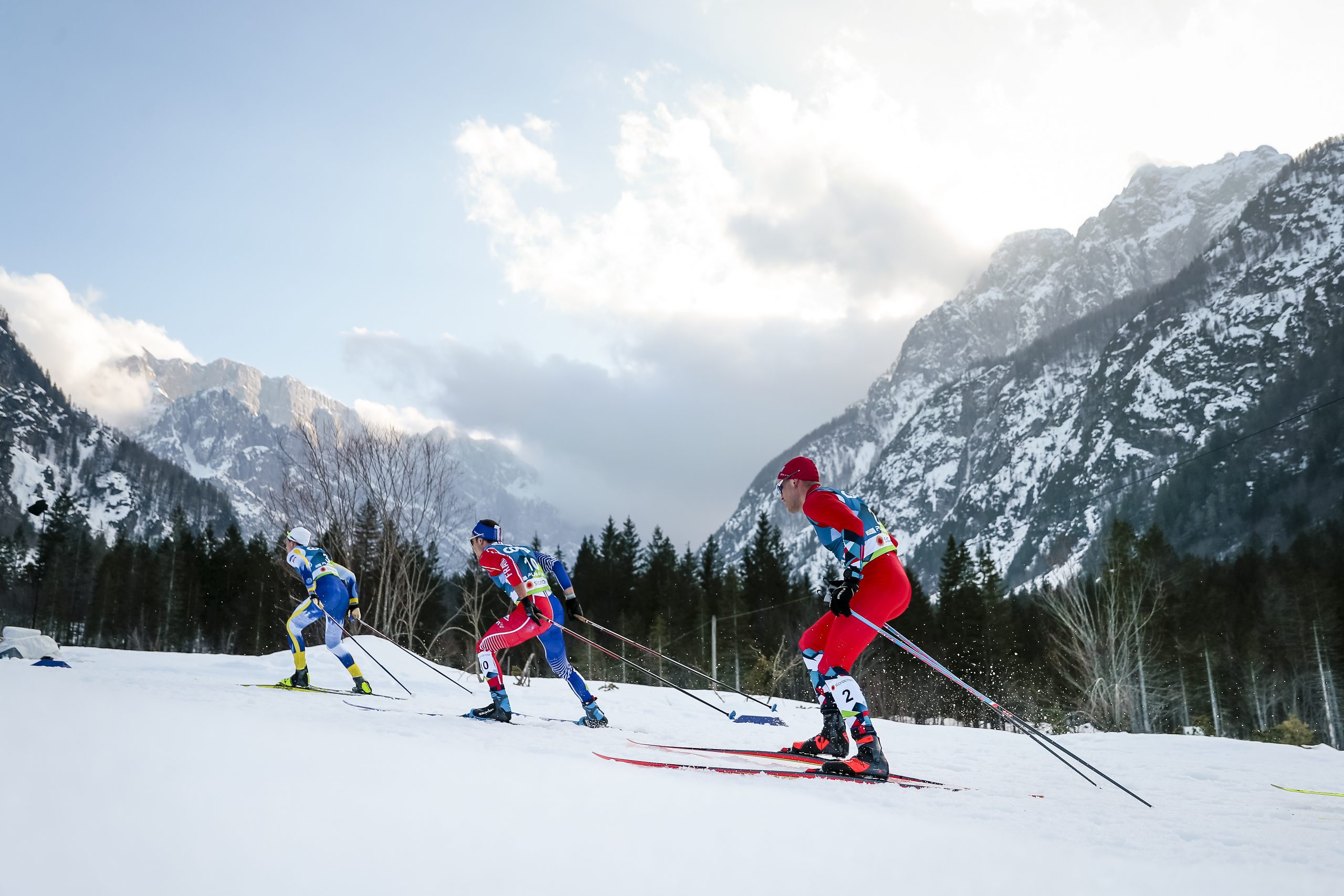
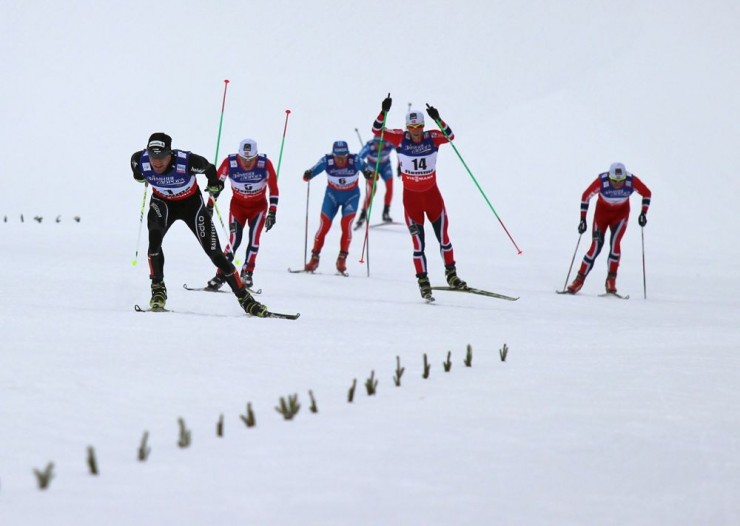
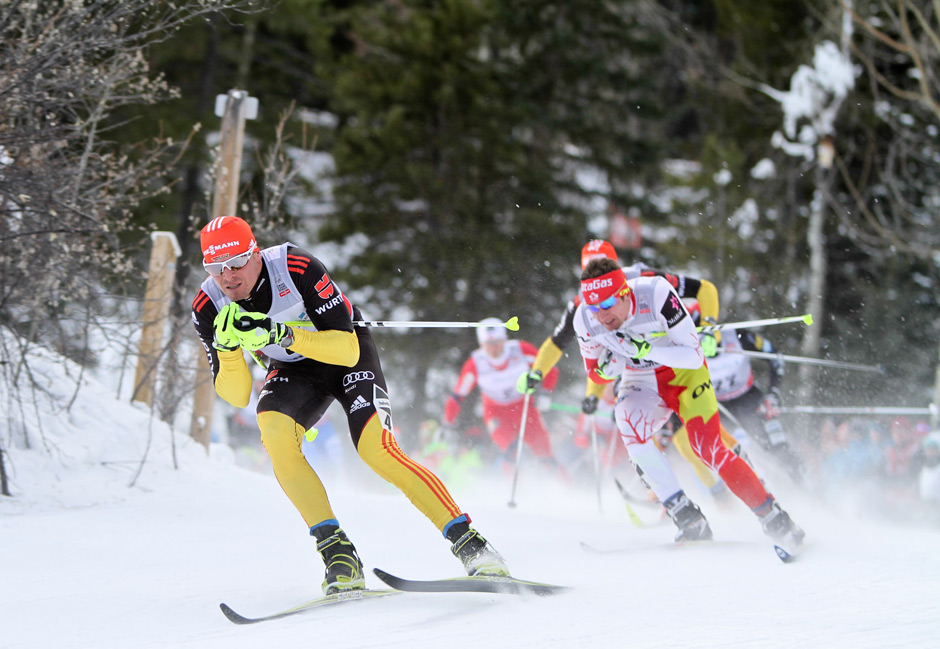
    William Poromaa (SWE), Jules Lapierre (FRA), Paal Golberg (NOR), (l-r) in the freestyle leg. The difficult conditions—and the hot pace set by eventual race winner, Simen Hegstad Krueger—exhausted even the most talented and qualified contenders. (Photo: Modica/NordicFocus)
    Men’s 30 k Skiathlon

    Planica, Slovenia occupies a beautiful corner of Europe’s mountain ranges, and the weather this week is a ski-vacationers dream. Ironic, then, that the very same weather is a wax technician’s nightmare. Sunny and warm, transitioning the snow between heats, changing the conditions even within the timeframe of an ongoing race. At the start of today’s skiathlon, race announcer, Kikkan Randall, mentioned, “You can already hear the snow . . . with a late-afternoon start, you can almost get a freezing effect. The snow can actually be pretty fast.”

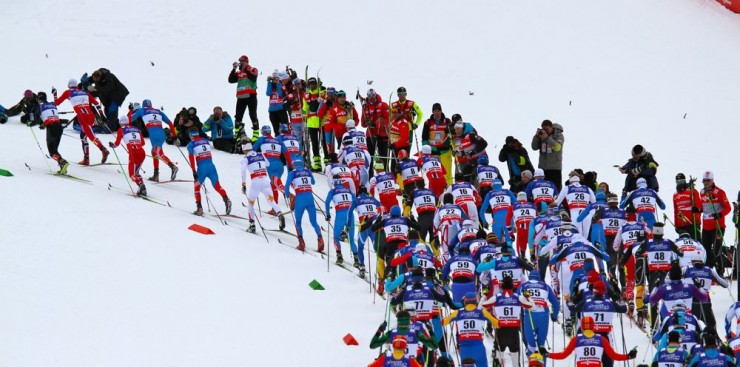
    The classic half of the Skiathlon indeed started out fast. The course began as a steady downhill; Klaebo stayed at the front and out of trouble (shadowed by his teammates Golberg and Krueger, and the Swedish stars, Calle Halfvarsson and William Poromaa). The classic leg was simple:  Finland and Sweden kept the pace fast, contenders stay tucked in the field, and Klaebo picked up ground on every downhill. It looks like great fun to ski a mass start event the way Klaebo does, and certainly his wax technicians and ski suppliers have something to do with that. But that doesn’t mean he can just float along effortlessly. The other racers have a say in the pace, as well . . . and none of them wanted to make it easy for Klaebo.

    Niskanen moved to the front as the pace-maker at the end of Lap 1. By Lap 2, his efforts had begun to string out the field: Niskanen followed by Poromaa, Musgrave, and the entire kingdom of Norway. At the beginning of Lap 3 the field split, with Americans Patterson and Wonders being gapped. Klaebo continued using each downhill to adjust his position within the lead pack, gliding and stepping past the pace-makers, and forcing them to accelerate back to the front at the base of each uphill, particularly in Lap 3 as it appeared that many other racers’ skis were beginning to drag.

    At the beginning of Lap 4, everyone looked over their shoulders to check the field, a momentary pause in the action that allowed the remarkable efforts of lone chaser, Esteve Altimiras (AND) to catch back on to the back of the lead group. He’d been bravely chasing for two laps while Finns and Swedes pushed the pace at the front, and this Lap 4 truce allowed the lead pack to settle as a group of 15. The truce would not last for long.

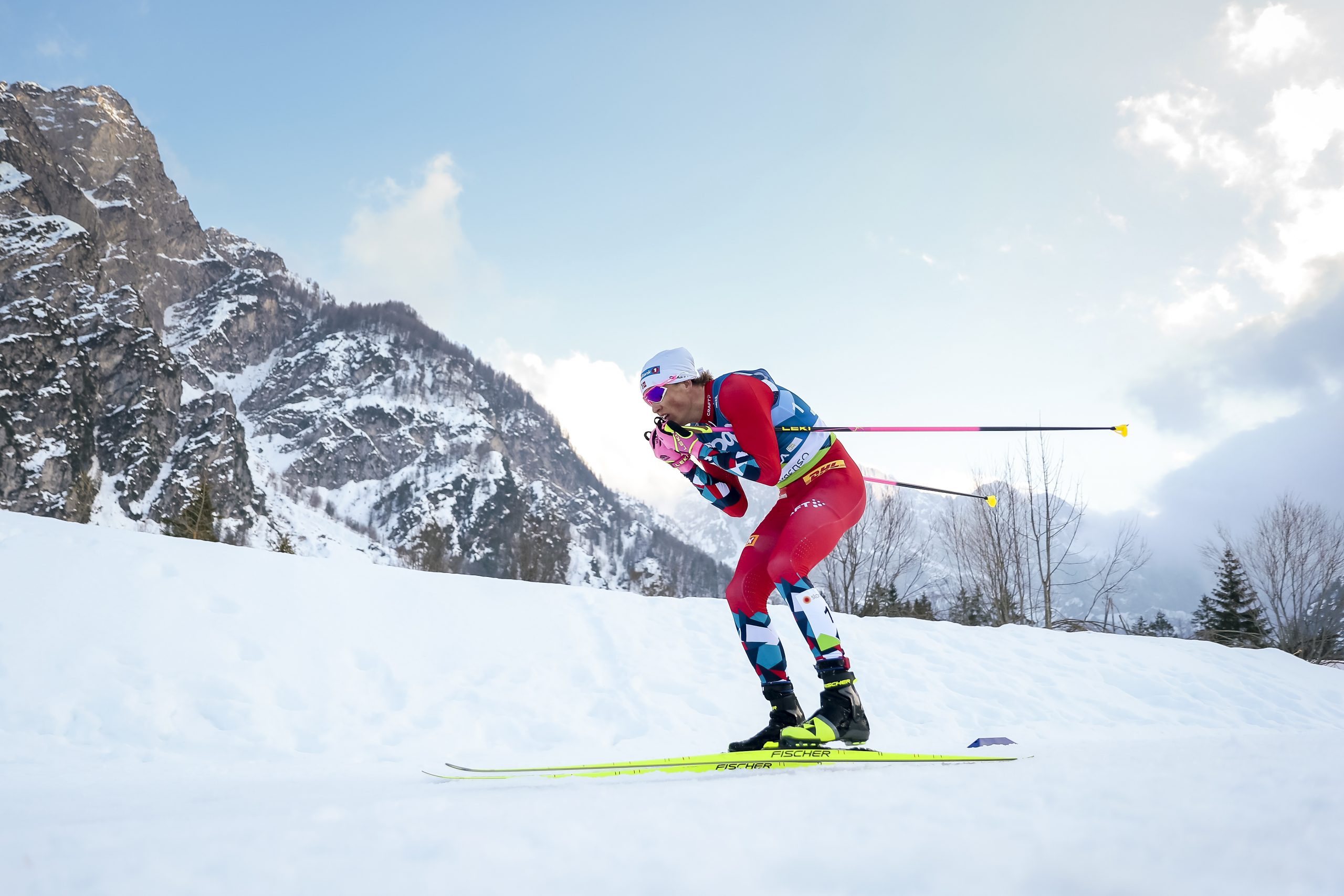
    Johannes Hoesflot Klaebo (NOR) was forced to do his own work for most of the freestyle leg. His determined chase of teammate Sjur Roethe (NOR) earned him yet another World Championships medal, this one a silver. (Photo: Modica/NordicFocus)
    Classic to Skate Transition

    The mid-point of the Skiathlon (15 k) is where skiers switch from classic skis/poles to freestyle skis/poles, a transition that they practice in anticipation of these races. Take too long in transition, and a skier can find himself gapped . . . even the best skiers . . . even Klaebo. Klaebo flubbed the transition, exiting at the rear of the lead pack, but he seemed untroubled. If he’d known what kind of acceleration Krueger was about to throw in, Klaebo would have hurried the transition a bit.

    Roethe exited the transition first with a considerable lead, followed by Krueger, Jules Lapierre (FRA), Roethe, Krueger, and Poromaa. Klaebo followed Golberg who would drag them both back to the chase pack. Once Klaebo got there, his prospects appeared obvious: sit in and let others work, which would probably give him an easier day, and allow him to sprint for the bronze medal. As it turns out, bronze is not enough for Klaebo, and he seemed to quickly assess that none of his companions was willing to pull him back to the leaders. Poromaa wasn’t fast enough, Lapierre wasn’t fast enough, Golberg wasn’t fast enough. If Klaebo wanted to remain in contention for this Skiathlon gold medal, he’d be forced to chase the leaders down, himself. So, Klaebo set out on his own to catch the two leaders—his teammates Roethe and Krueger.

    Krueger began his surge in Lap 7, picking his way through strings of lapped skiers. He definitely appeared the sharpest, while Roethe began to visibly falter (along with Klaebo and everyone else). Even so, Roethe continued gamely working each uphill, while Klaebo drove, faded, recovered, and drove again. The top three showed their class, their fitness, and their courage. At the end of a 30 k Skiathlon, there really is no place to hide. Klaebo was really forced to work for silver, which he stole from the courageous Roethe in the final kilometer. The efforts committed by the medal winners in this race could conceivably change the whole championships. Today, under the sunny skies of Planica, Slovenia, each of these champions appeared willing to pay that price.

    Men’s 30 k Skiathlon RESULTS

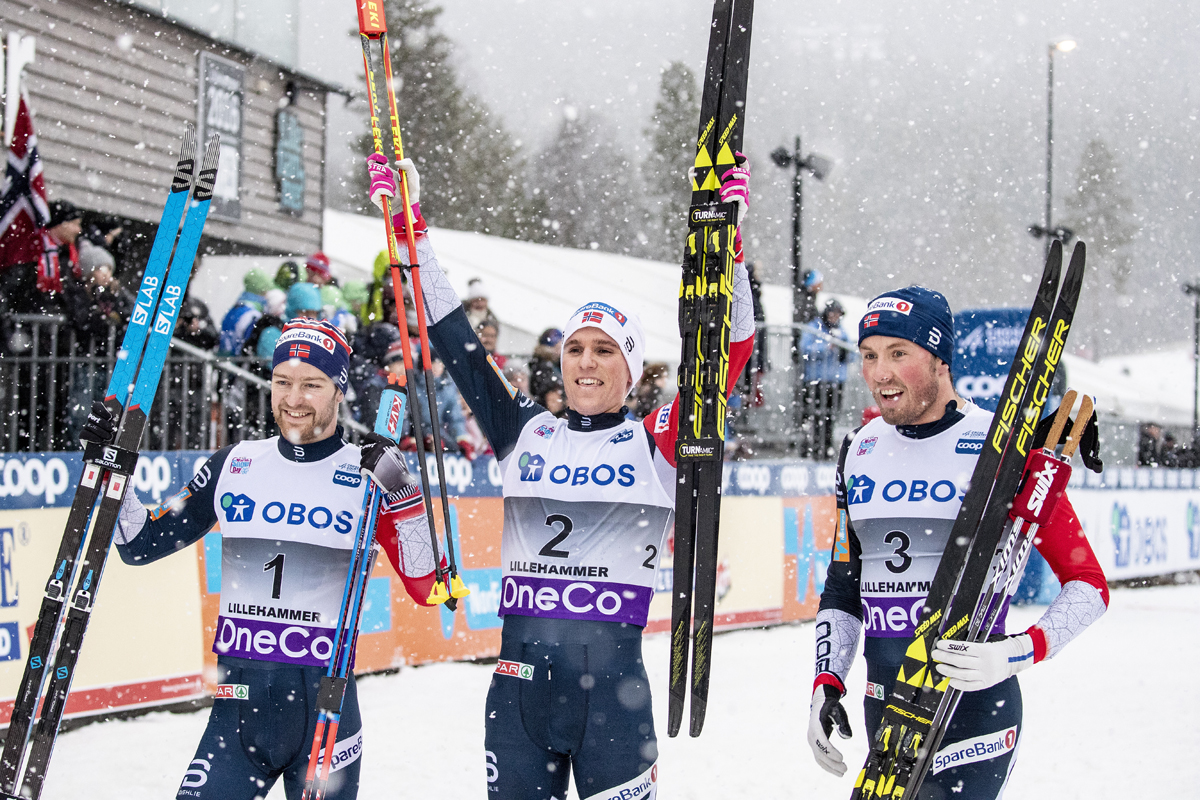
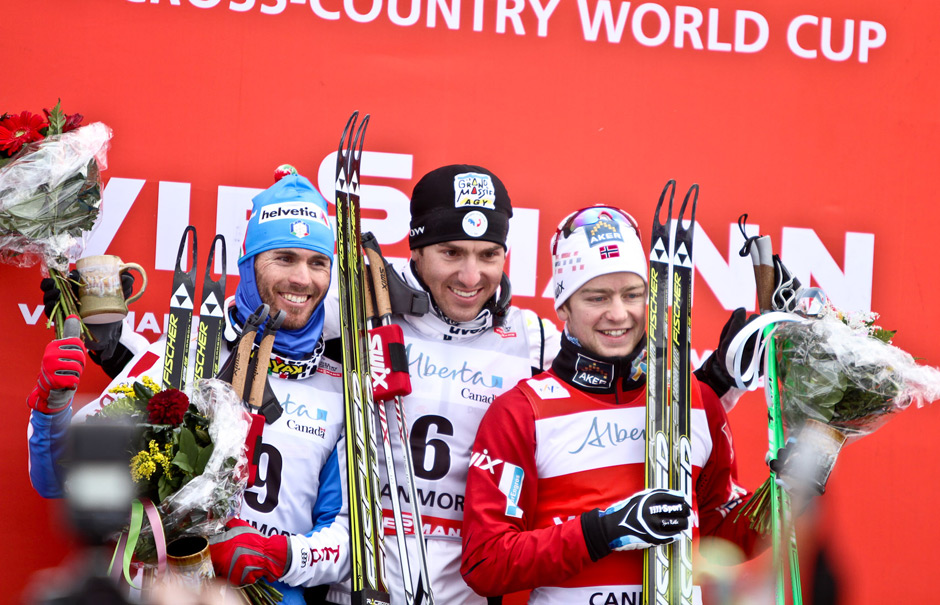
    Only Norway on the podium: (l-r) Johannes Hoesflot Klaebo (NOR), Simen Hegstad Krueger (NOR), Sjur Roethe (NOR). (Photo: Modica/NordicFocus)
  • Another Norwegian Heard From: Amundsen Earns First World Cup Victory in Les Rousses

    Another Norwegian Heard From: Amundsen Earns First World Cup Victory in Les Rousses

    This World Cup coverage is made possible through the generous support of Marty and Kathy Hall and A Hall Mark of Excellence Award. To learn more about A Hall Mark of Excellence Award, or to learn how you can support FasterSkier’s coverage, please contact info@fasterskier.com.

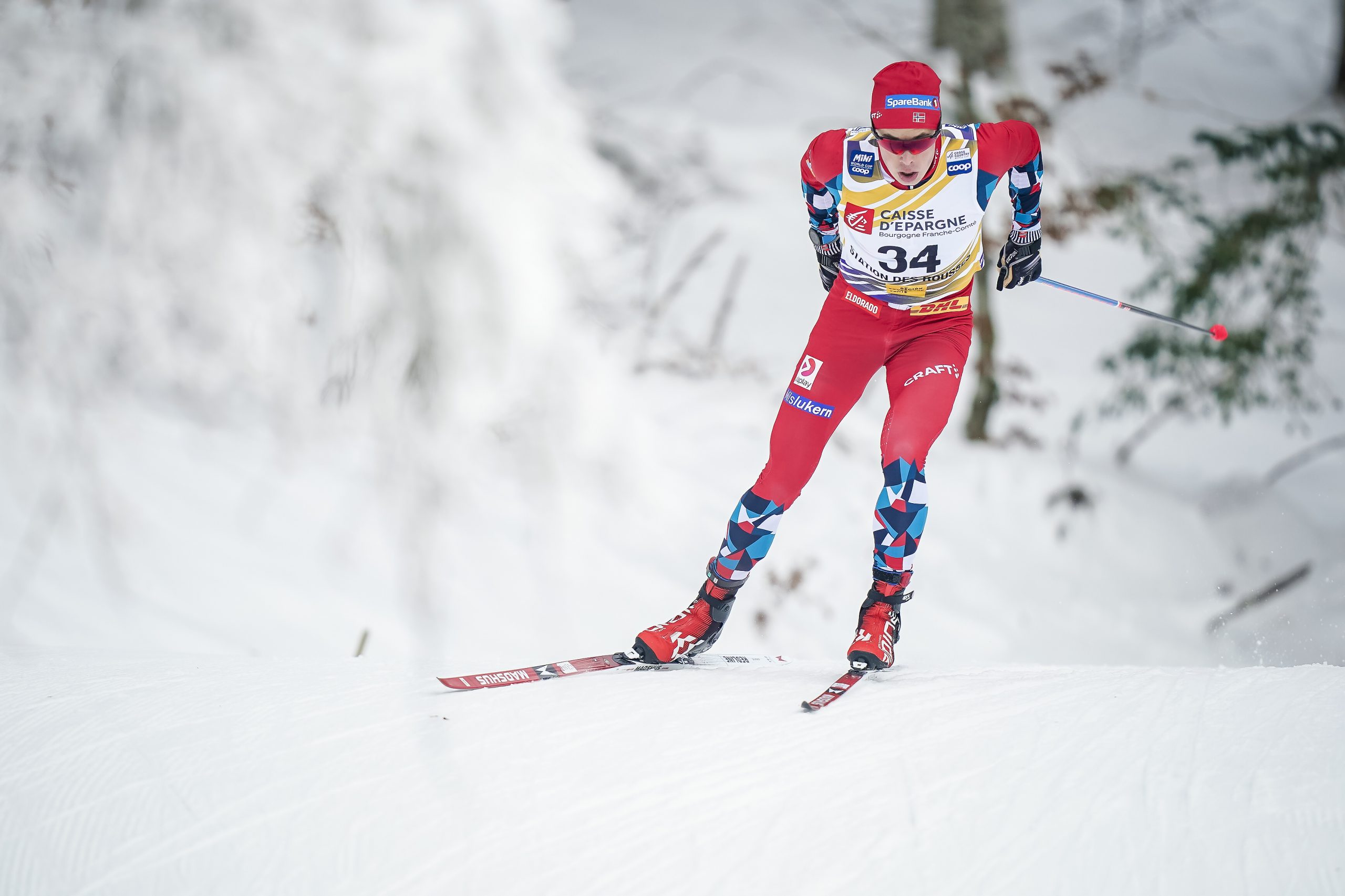
    Harald Oestberg Amundsen (NOR) earned his first FIS world cup cross-country victory at Les Rousses, France. (Photo:  Thibaut/NordicFocus)

    Fans have become accustomed to Norwegian men occupying the World Cup podium, but it’s getting pretty crowded there on the top step. Team Norway has delivered World Cup wins this season from Iver Tildheim Andersen, Paal Golberg, Simen Hegstad Krueger, Johan Hoesflot Klaebo (who has already won 12 times this season), and now Harald Oestberg Amundsen. It seems that any Norwegian can win on any given day . . . and no skier from any other country seems to have a chance.

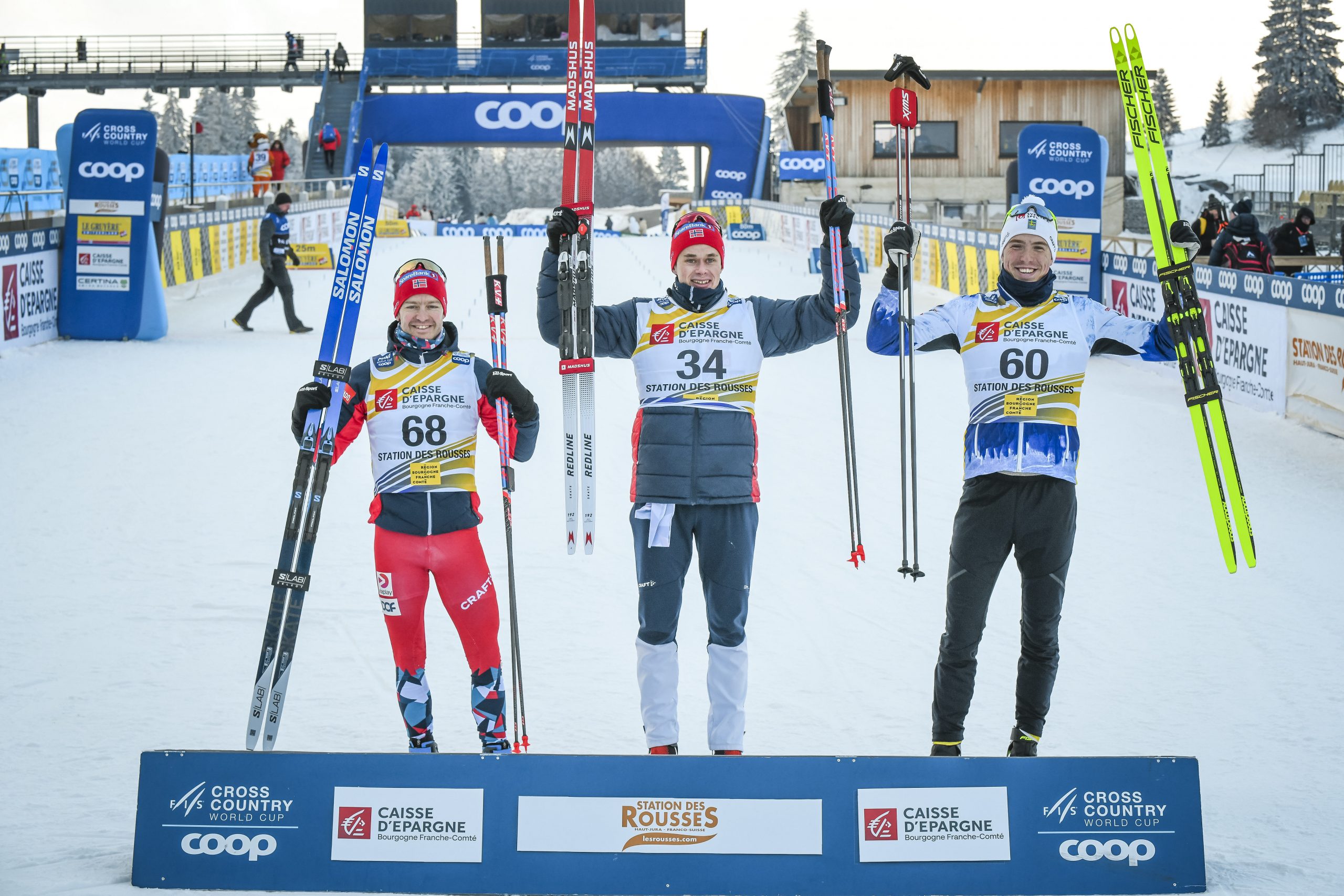
    Norwegian skiers have claimed so many of the podium spots in early-season World Cups, but at Les Rousses their usual dominance was somewhat less than total: Amundsen (NOR) claimed his first World Cup victory, Roethe (NOR) second, and William Poromaa (SWE) third. Frenchman, Jules LaPierre, had a spectacular day racing in his home country, further interrupting the usual Norwegian strangle-hold on the top placings and finishing a very impressive fifth, just 25 seconds behind race winner, Amundsen.

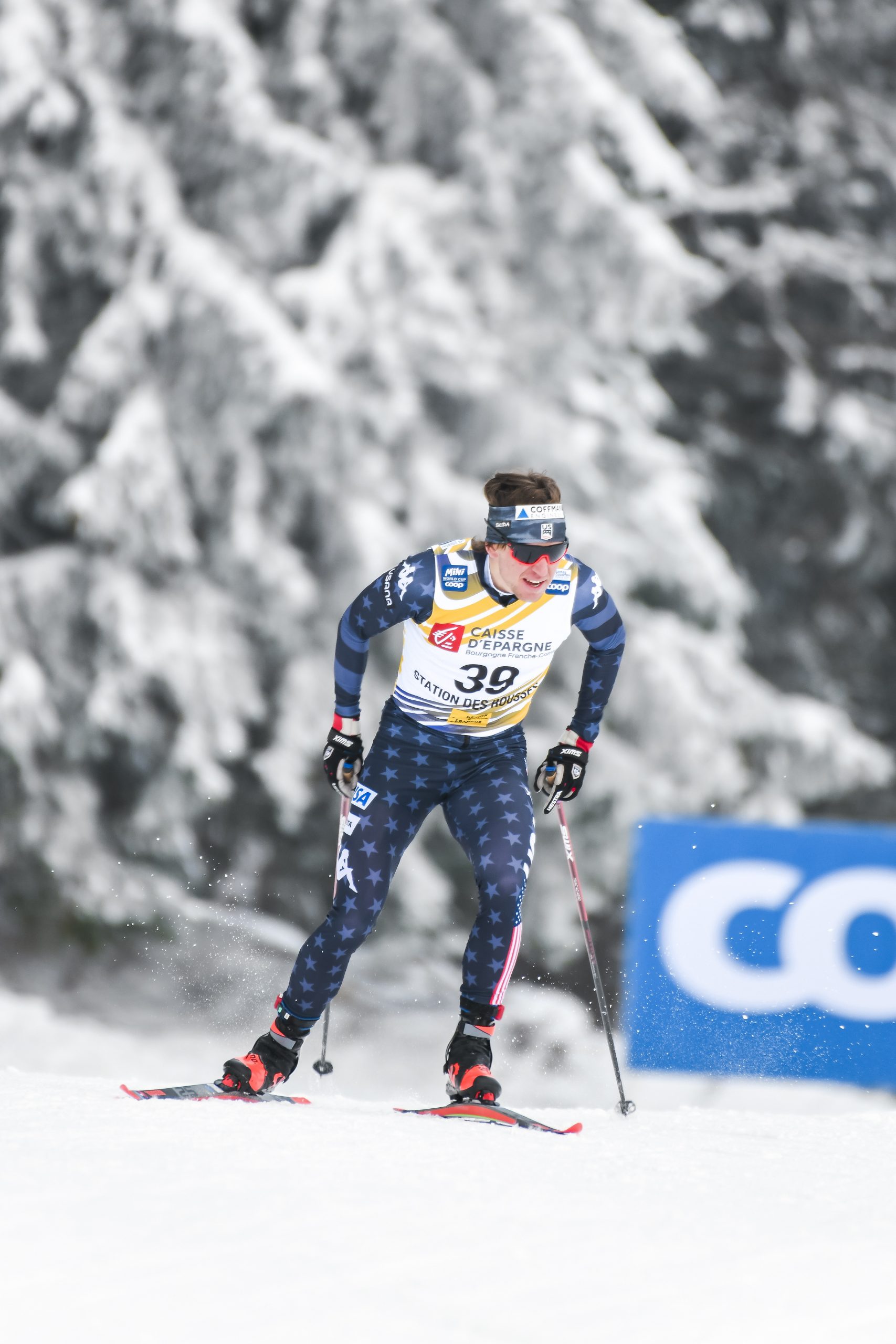
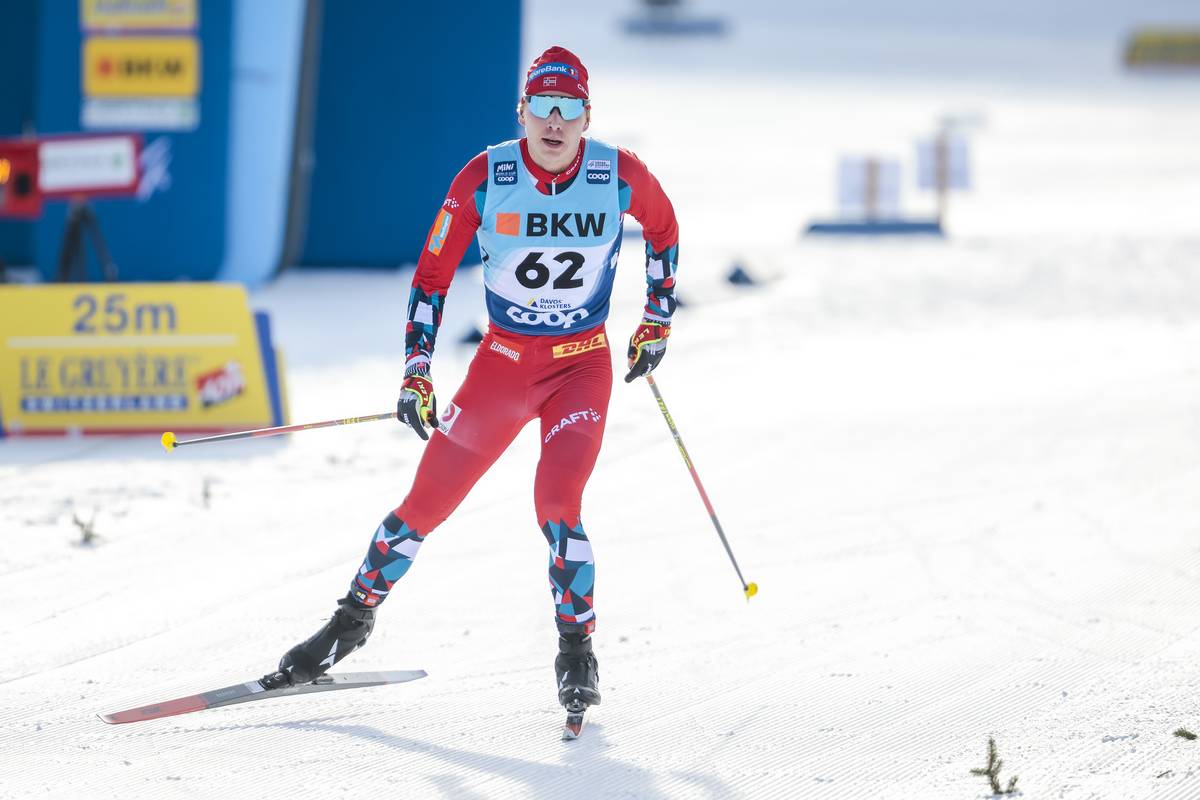
    Scott Patterson (USA) led the American contingent at the World Cup Skate 10km, Les Rousses, France. (Photo: Authamayou/NordicFocus)

    Scott Patterson (USA) continued a season of distance race performances in the top thirty with a 24th place finish.

    “It’s been a solid break after the Tour de Ski from World Cup racing,” said Patterson. “[I finished] 24th today: not everything I wanted, but I think it was a solid result. I was in the fight . . . I raced a distance double pole marathon last weekend and was still feeling some effects from it. I think the form’s coming along and I’m excited as we keep having ore races coming up and build toward [World Championships].”

    Other American finishers included Finn O’Connell 50th, Peter Wolter 56th, Will Koch 63rd, and Zak Kettterson 65th. Nordiq Canada chose not to enter skiers in the races at Les Rousses.

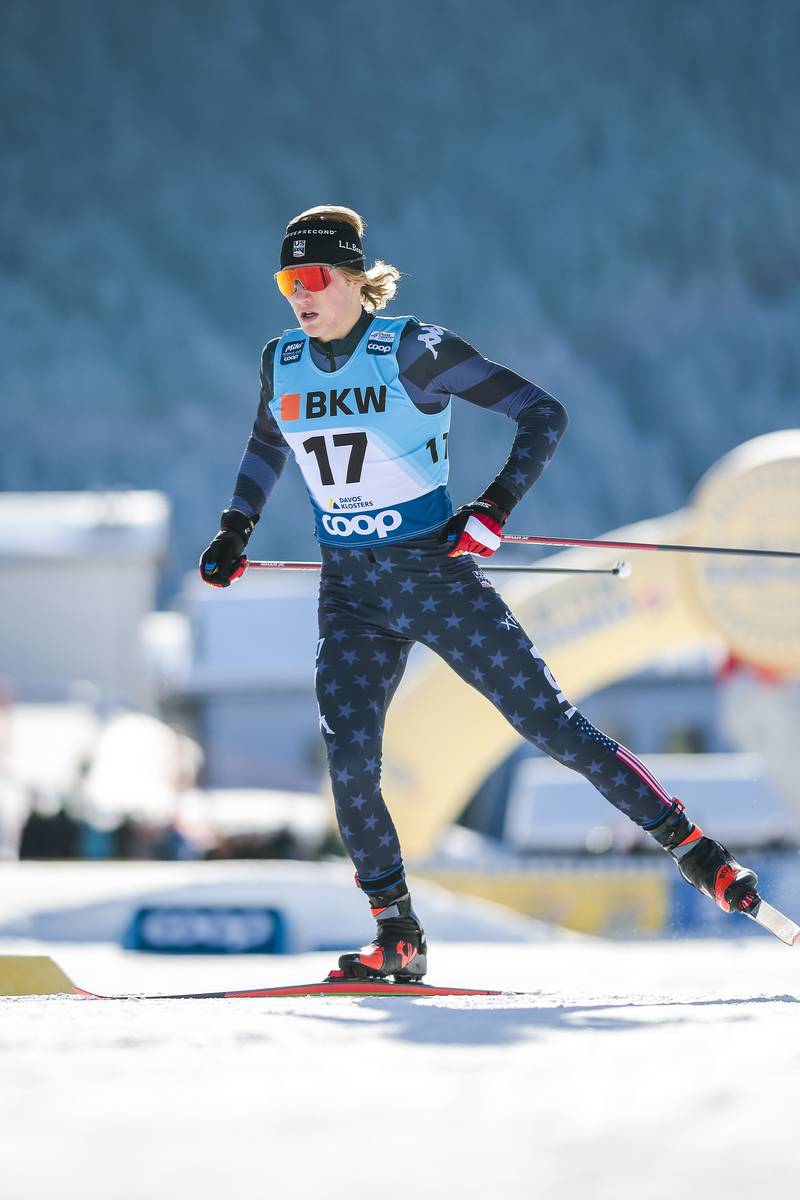
    Will Koch (USA) got his first taste of World Cup racing on the 10 k course in Les Rousses, France. (Photo: Thibaut/NordicFocus)

    The day’s results demonstrate how difficult it is to prepare for the upcoming World Championships while also defending individual places in the World Cup standings. Early in the season, Klaebo had stated that his chances at winning the overall World Cup championship were over. It appeared, then, as though he would pick and choose his World Cup starts in order to secure the Sprint crown, while prioritizing his preparation for the World Championships (which most competitors hold in higher regard than the World Cup). It would’ve been easier for Klaebo if he’d stayed that course. As it is, he now seems determined to pursue every win, and to chase points in any event in which Paal Golberg—his Norwegian teammate and closest rival in the race for the overall World Cup—is entered.

    Men’s 10 k Skate

    Fresh snow and overcast skies greeted competitors in Les Rousses, a resort community in the Jura Alps north of Geneva. At an elevation of nearly 4000 feet (1219 meters), Les Rousses offers challenges that other, lower, venues do not. Additionally, 10 k is not a typical men’s distance, raced this season in a nod to distance-equity that has been instituted between men’s and women’s fields. For skiers at the World Cup level, the 10 k distance is a bit of a sprint . . . and a distance in which much can go wrong. Sprinters have a chance to excel (though they could also blow up). Distance skiers are forced to press the pace, and hope that their speed will emerge.

    The Les Rousses World Cup 10 k was raced around three laps of a 3.3 k loop. In any such lapping course, there’s potential for results to be affected by the ways in which skiers pair up (or group up) over the course of three high-speed laps. Strategically, the greatest advantages are available to skiers who pair up with later starters (the faster/fresher skier “giving a ride” to the skier who has been on course longer). Veterans are always looking for this (entirely legal) advantage. Toenseth and Andersen grouped up on the course, working well together through the middle lap, but neither seemed to gain enough advantage to affect the final standings. Most other contenders seemed to race mostly on their own. Pre-race favorite, Krueger, found himself alone . . . no beneficial pairings for Krueger. Klaebo who was the day’s final starter, and was therefore unlikely to benefit from the speed of other racers; however, he would hear split times of all skiers who started before him. Game on . . .

    Amundsen, was an early leader, but he was also skiing alone. Krueger started conservatively, some 11 seconds behind Amundsen at the first check point. Klaebo started equally conservatively—only 21st fastest at the first check point—but would gain time through the first lap (5th at 3.3 k, only five seconds out of the lead). He lingered 13 seconds behind Amundsen at the halfway point. Klaebo has already earned 12 World Cup victories this season (only two behind the season-record of 14 wins set by Martin Jonsrud sudby), but his performance in Les Rousses appeared a bit flat. He may be conserving energy (lord knows he spends enough of it), or he may be in a pre-Worlds training cycle that hinders top-speed efforts. Either way, he skied consistently if not brilliantly—never really excelling, never really losing too much time—finishing the day in 8th.

    Klaebo’s countryman, Amundsen, continued to lead his teammates through the later check points. Early leader, Andersen (who won the 10 k skate earlier this season in Lillehammer), faded over the closing kilometers to finish 9th. Poromaa (SWE) started fast, though struggled a bit to maintain his form late in the later stages of the race. He moved into second at the finish (still behind Amundsen, and snatching crucial World Cup points from Golberg) where he remained until the later arrival of Roethe.

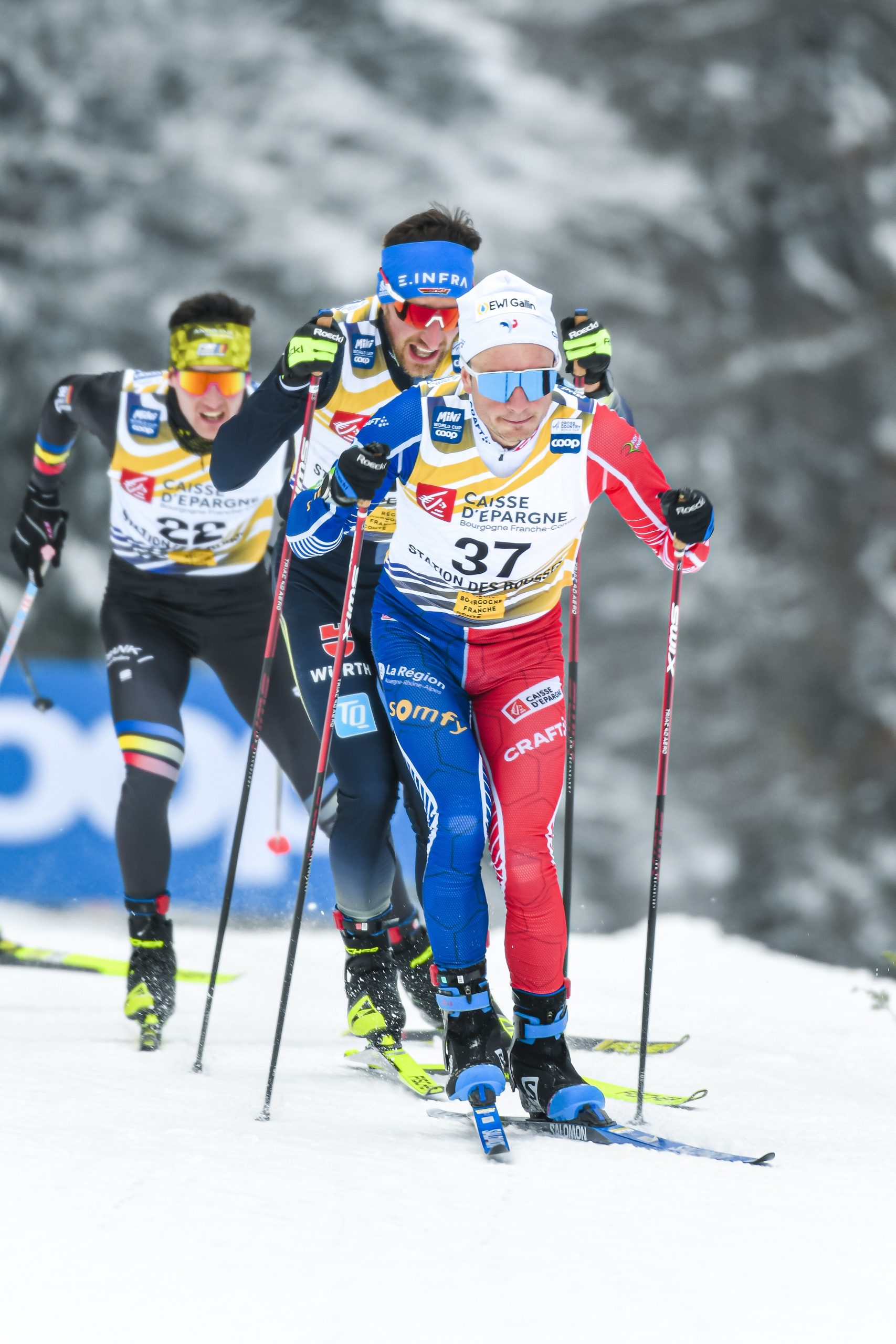
    Jules Lapierre (FRA) raced with bravery and panache in front of loyal French fans at Les Rousses, finishing a remarkable fifth. (Photo: Authamayou/NordicFocus)

    France’s Jules LaPierre led at 8.1 k, and sat in second in the results at the finish until Golberg eclipsed him (though still behind Amundsen). Ultimately, Amundsen finished in 21:26.5 for his first career World Cup win. Roethe finished second  (11.9 seconds behind), with Poromaa another six seconds behind to earn his second career World Cup podium

    With so many Norwegian skiers fighting for spots in the upcoming World Championships, Amundsen acknowledged the magnitude of his performance in securing his first World Cup victory. “It was a really important race for me,” he said.

    Men’s 10 k Individual Start Freestyle RESULTS

    Sjur Roethe (NOR), Harald Oestberg Amundsen (NOR), William Poromaa (SWE), (l-r)—FIS World Cup cross-country, 10km, Les Rousses, France. (Photo: Authamayou/NordicFocus)
  • Norway dominates in Davos, Schumacher 18th, Ritchie 21st

    Norway dominates in Davos, Schumacher 18th, Ritchie 21st

    A_Hall_Mark_of_Excellence_Award-logo-300.png (300×244)This World Cup coverage is made possible through the generous support of Marty and Kathy Hall and A Hall Mark of Excellence Award. To learn more about A Hall Mark of Excellence Award, or to learn how you can support Fasterskier’s coverage, please contact info@fasterskier.com.

    Norway has long been a dominant force in cross country skiing, but that dominance may never have been more clearly evident than now. Norwegian men have claimed victory in the last eight World Cup distance races. Thus far in Period I of the World Cup season, Norwegian skiers have claimed 13 of the 15 World Cup podium positions in distance races. Norway’s dominance seems impenetrable: injury interferes with one star performer, illness sidelines another; yet ever more Norwegians step up to fill the podium. Results in Davos would be no different, as Norway claimed the top six places in the Men’s 20 k Freestyle. Winner on the day was Simen Hegstad Krueger, followed by Hans Christer Holund in second, and Sjur Roethe third. Johannes Hosfloet Klaebo would finish fifth, securing his second-place position (behind Golberg) in the World Cup Overall points standings.

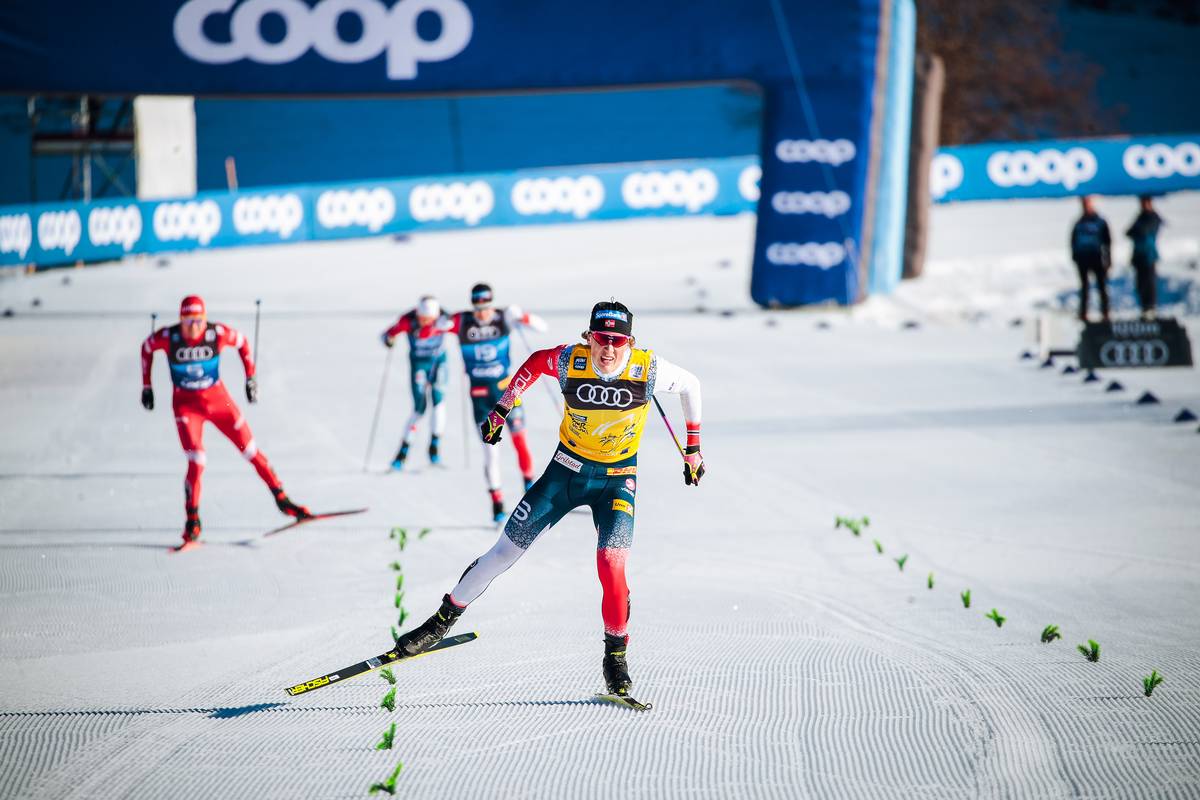
    Simen Hegstad Krueger nearing the finish line in his convincing win in Davos’ World Cup 20 k Freestyle. (Photo: Nordic Focus)

    Canadian skiers were coming off an historic day in which Graham Ritchie finished a career-best 17th in the World Cup Sprint, leading four Canadians into the quarterfinals. In Sunday’s 20 k, Team Canada’s successes continued as Ritchie finished 21st, followed closely by teammate Antoine Cyr in 24th. American finishers included Gus Schumacher 18th, Ben Ogden 22nd, Hunter Wonders 33rd, Scott Patterson 38th, and Zak Ketterson 43rd.

    Men’s 20k Freestyle

    If Klaebo’s World Cup campaign has been thrown into question by virtue of the many races he’s missed, then today was his chance to begin reclaiming some of those squandered points. World Cup Overall Leader, Paal Golberg (NOR), would be absent from both the sprint and distance fields in Davos. Klaebo has skipped numerous distance races this season, so much anticipation accompanied his name’s appearance on Sunday’s start list.

    Klaebo appeared to ski his race conservatively, perhaps knowing that the new points system would reward more than just the day’s winner (finally, that system would be working in his favor). This weekend, Klaebo would earn points for his second place in Saturday’s sprint qualifier, for his second place in Saturday’s sprint final, and for his fifth place finish in the 20 k . . . all while Golberg nursed a cold back home in Norway. For Klaebo: mission accomplished.

    But Sunday’s story was about far more than just Klaebo: Facing twenty kilometers skied over four laps of a five kilometer course, racers in Davos’ 20 k freestyle seemed likely to join up with other skiers in gaps of 22-23 places. In the otherwise random selection of start positions, this seemed most likely to benefit Norwegians Krueger and Holund who were separated in the starting order by 22 places—Holund would start earlier, with Krueger starting 22 places later. Predictably, Krueger and Holund were able to pair up at the beginning of Holund’s second lap, enabling Holund to convert his 8th place standing at the 10 kilometer checkpoint into a sizable lead at his finish. But Holund’s time would need to stand up against that of Krueger who still had one more lap to race. Ultimately, Krueger was able to drive on toward the finish—alone in his last lap—to finish in 42:12.3, besting Holund by 22 seconds.

    In his post-race interview, Krueger elaborated on his feelings for Davos. “It’s amazing. I love this course. It’s my favorite track,” he said. “It was a really good feeling to take the victory today.”

    Of being able to team up with Holund during today’s 20 k, Krueger beamed, “We made up a good pace,” he said. “And a great team effort as well.”

    Gus Schumacher (USA) skiing to 18th in the 20 k Freestyle at Davos, Switzerland. (Photo: Nordic Focus)

    Numerous North American men also had impressive weekends in Davos, as Schumacher (USA) has begun finding the distance-racing form for which he has become known. He finished 18th on the day, followed closely by Canada’s Ritchie at 21st. Going into the holiday break, North American skiers should feel reassured by their season’s preparations, and optimistic for the Tour de Ski and FIS World Championships to come later in the season.

    USA Team Leader in Davos, Chris Grover, commented on Schumacher’s race: “Gus had a great day,” Grover said. “That was cool to see him take another step forward. He ended up getting a ride with Krueger towards the end of the race. It really helped to hold him in the top twenty.”

    As for Team USA’s plans for the holiday break, Grover described a number of different plans for athletes and staff: “A lot of the main athletes are staying in Davos,” he said. “Obviously, it’s close to Val Mustair where the Tour starts. It’s a little bit of a logistical challenge; typically, people will try to take a little bit of recover. Then they’ll try to have a little bit of a training block. You can’t go into the Tour carrying fatigue.”

    As Period I of FIS Cross Country World Cup 2022 comes to a close, the Norwegian ownership of the podium seems unchallenged. They have survived illness and injury, they have thrived in a system where the greatest challenge in skiing may not be climbing onto the World Cup podium, but climbing into a Team Norway race suit. Any skier qualifying for this team has a chance to claim World Cup glory . . . at least until the following weekend when yet another Norwegian star is likely to rise.

    Davos World Cup 20 k Freestyle RESULTS
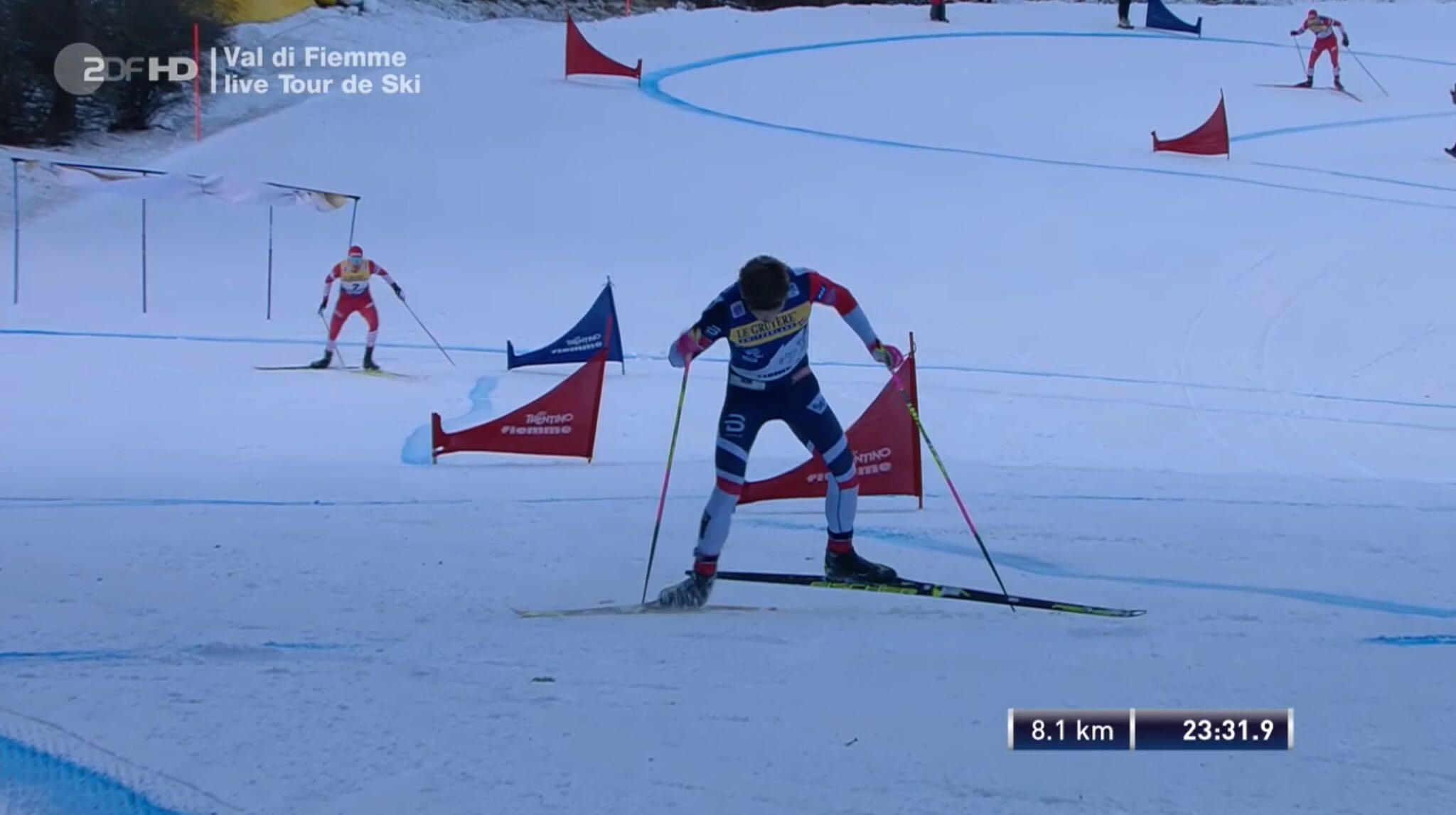
    Graham Ritchie (CAN) capped a strong weekend in Davos with his 21st place finish in the 20 k Freestyle. He was also top North American in Saturday’s World Cup Sprint, finishing in a career-best 17th place. (Photo: Nordic Focus)
  • Klæbo Skates Away With the Win in TdS Stage 3 15k Mass Start Free; Schumacher 25th

    Klæbo Skates Away With the Win in TdS Stage 3 15k Mass Start Free; Schumacher 25th
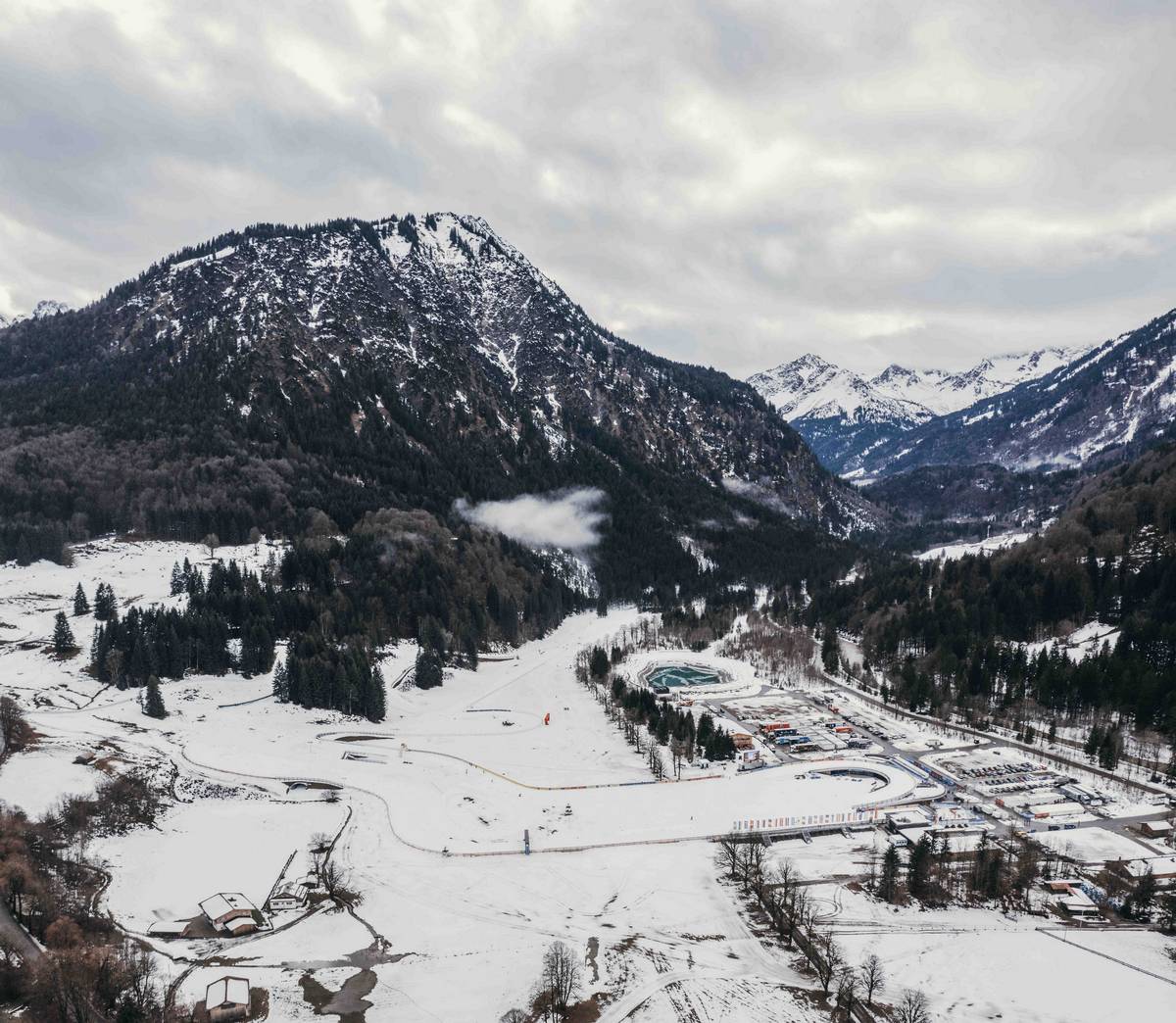
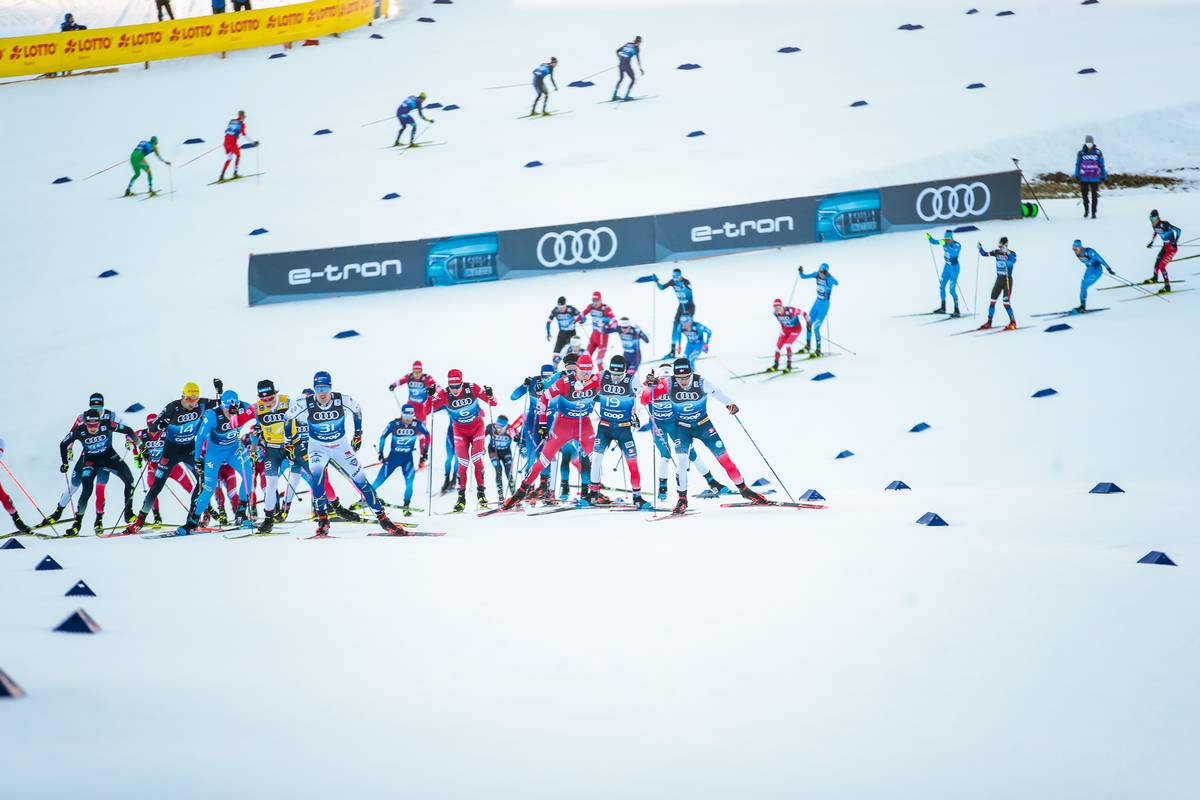
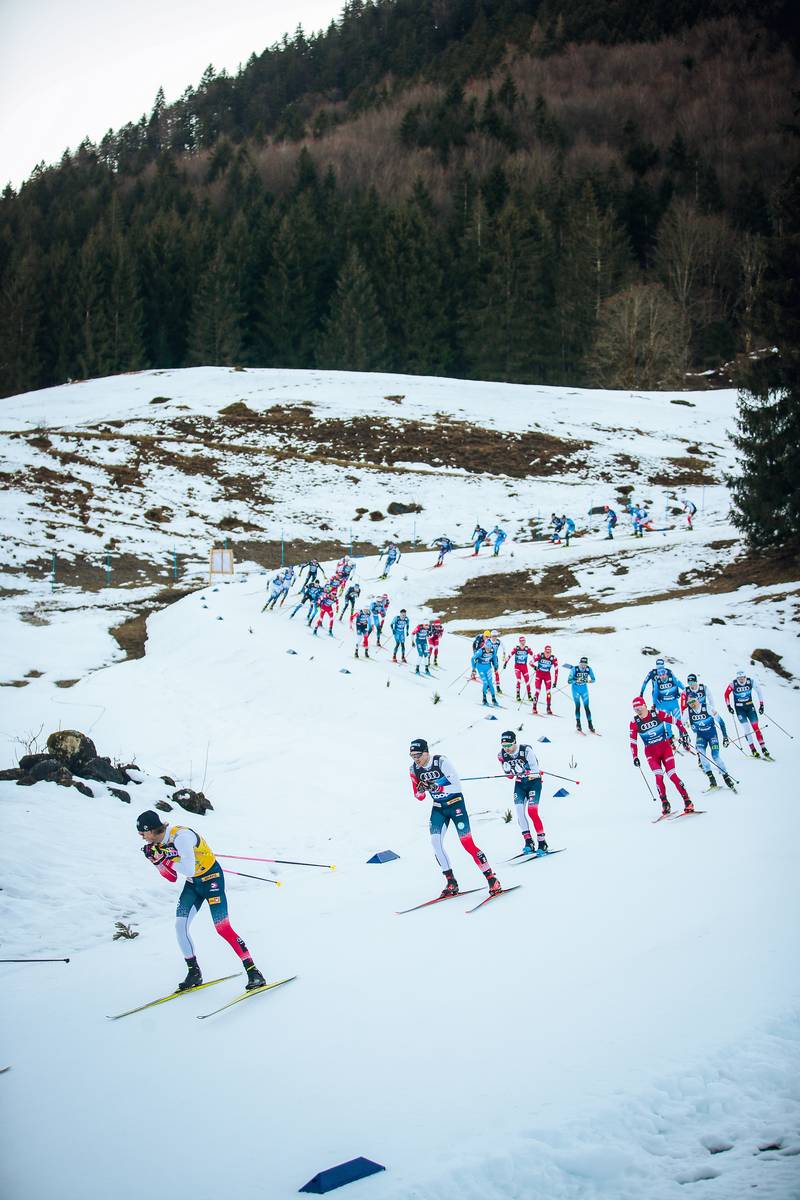
    An aerial view of the icy track in Oberstdorf, Germany, where winter looks to ebb and flow. (Photo: NordicFocus)

    This World Cup coverage is made possible through the generous support of Marty and Kathy Hall and the A Hall Mark of Excellence Award.  To learn more about A Hall Mark of Excellence Award or to learn how you can support FasterSkier’s coverage please contact info@fasterskier.com.

    Traveling Northeast from Lenzerheide, Switzerland to Oberstdorf, Germany, home to last year’s FIS World Ski Championships, athletes lined up for Stage 3 of the Tour de Ski for a mass start 15-kilometer skate. Once again encountering conditions altogether different from those in the previous stage, the tracks in Oberstdorf were lightning fast, and icy, with bare earth scarring the landscape between the ribbons of white. 

    Given the conditions and the winding nature of the 3.75k loop, there was little separation in the first three laps of the four-lap race. Johannes Høsflot Klæbo (NOR) and Alexander Bolshunov (RUS) surged to the front to collect the Tour bonus points at the 4.4k checkpoint, with Klæbo keeping putting in just enough effort to slide his boot over the line 0.3 seconds ahead of the Russian’s, earning them 15 and 12 points, respectively. Ivan Yakimushkin (RUS) was next in line at the checkpoint for 10 points, followed by Pål Golberg (NOR) for 8, and Calle Halfvarsson (SWE) for 6.

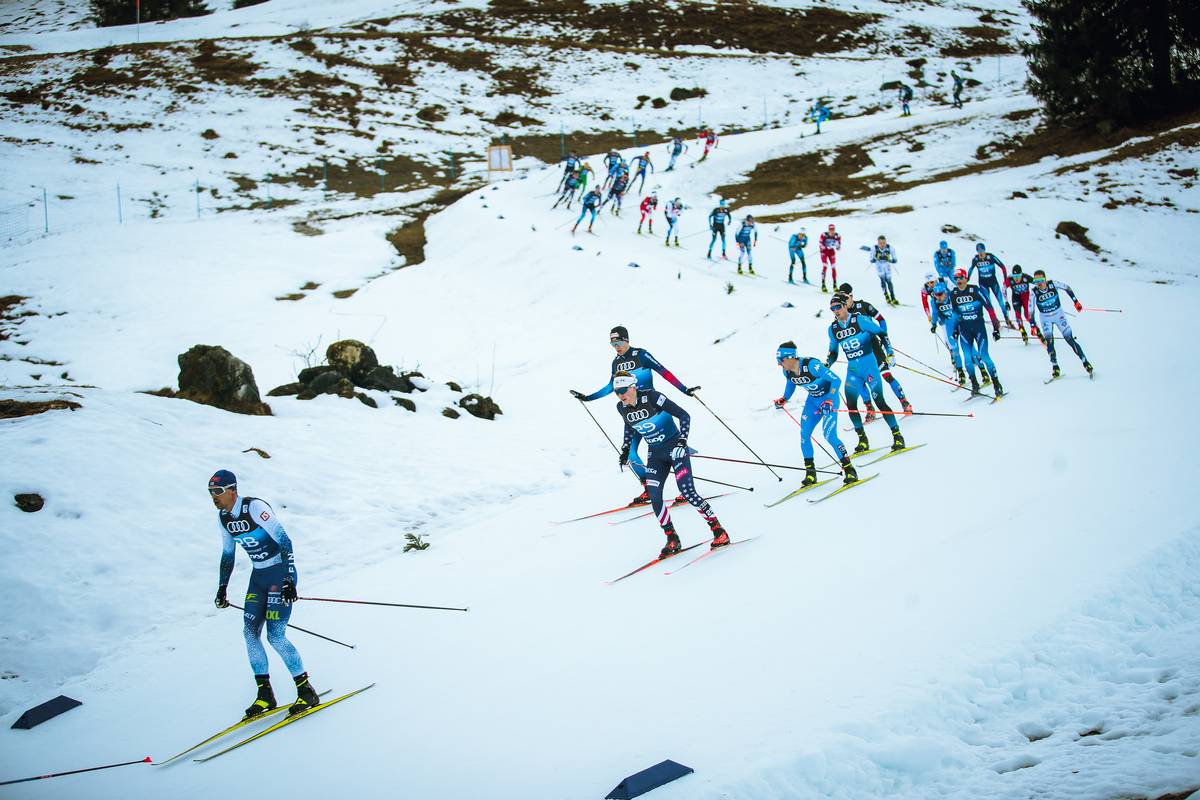
    The pack stayed tight through the first two laps of the men’s 15k freestyle mass start in Oberstdorf, Germany. (Photo: NordicFocus)

    Once the checkpoint was crossed, the men stood up, returning to a calm and relaxed state at the front of a massive pack of racers with little opportunity, or need, to break away just yet. Given the density of skiers on the course and the speed of the track, downhills were taken with care, with the leaders standing up, putting arms to the sides to indicate they were all on the same page – take it easy, keep everyone’s equipment intact, no unnecessary crashes. 

    The leaders wind through icy curves as they descend toward the stadium in Stage 3 of the Tour de Ski in Oberstdorf. (Photo: NordicFocus)

    This theme continued through the third lap, where the race for the podium finally began. 

    At 9.6k, just 12 seconds separated the top 30, who moved like a slinky through the woods, compressing on the climbs, stretching on the descents. Repeat, repeat. 

    However, by 12k, five men had dropped the masses, and by 13.4, this had dwindled to three. Led by Klæbo in the yellow bib, Bolshunov, Sjur Røthe (NOR), and Andrew Musgrave (GBR) quickly gapped the field to fight for the podium. 

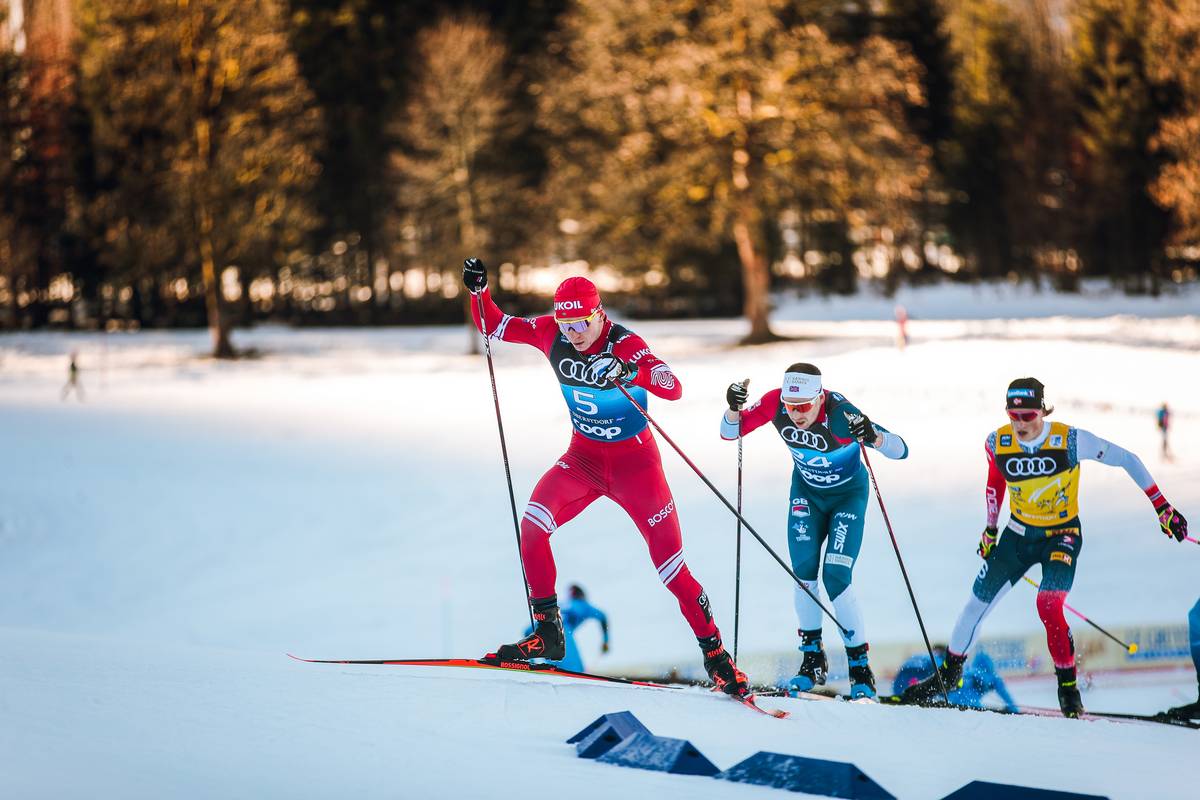
    Alexander Bolshunov (RUS) leads Andrew Musgrave (GBR) and Johannes Høsflot Klæbo (NOR) as the leaders begin to break away in the final lap. (Photo: NordicFocus)

    While one might expect Klæbo in such conditions to wait until the final meters to show off his acceleration, he started his kick much further out, pushing into the final descent and trusting his ability to race the following icy curves. Though his chasers began to catch him as they navigated tight bends that led into the stadium, Klæbo hop-skated over the final roller and held the others at bay, skiing into the finish lanes with plenty of space to earn a clear victory.

    Racing all the way to the line, Bolshunov pushed to claim second place (+3.4) with Røthe securing the final podium spot just behind in third (+4.0). 

    Johannes Høsflot Klæbo (NOR) powers to the line for the win in Stage 3 of the Tour de Ski, while Alexander Bolshunov (RUS) and Sjur Røthe (NOR) fight to the line for second and third. (Photo: NordicFocus)

    Lacking the closing speed for a podium spot but still putting together a season-best day, Musgrave closed for 4th (+5.6). Perhaps well-suited to the style of racing in Oberstdorf, the Brit had been tenth in the event on the same tracks during last year’s World Championships in similar conditions. The 2021 World Championships 15k free had an all-Norwegian podium, led by Hans Christer Holund, Simen Hegstad Krüger, and Harald Østberg Amundsen, with Bolshunov disappointed at the line in 4th, and Røthe nearly a minute off the lead in sixth.

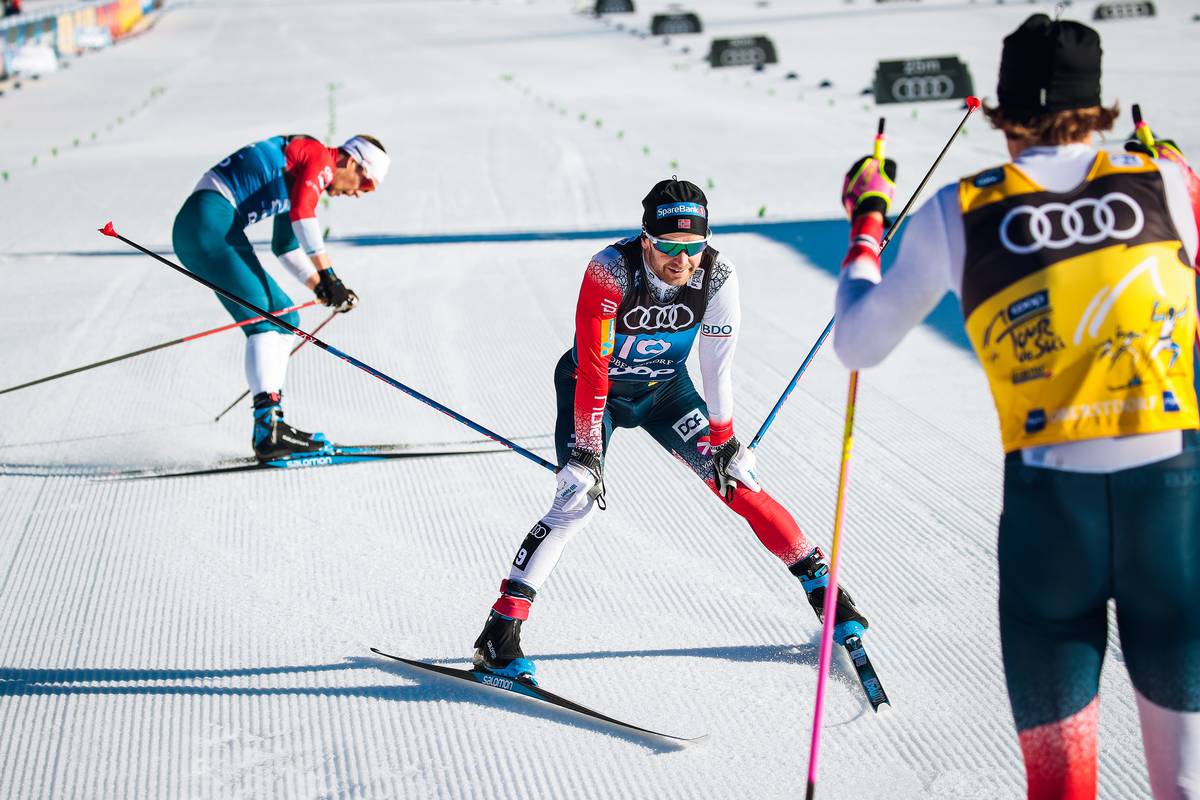
    Johannes Høsflot Klæbo (NOR) welcomes teammate Sjur Røthe (NOR) across the line in third, while Andrew Musgrave (GBR) takes fourth. (Photo: NordicFocus)

    “It was a wee bit annoying to let a podium finish slip through my fingers on a day when I was feeling good and had amazing skis,” wrote Musgrave in a post-race email to FasterSkier. “It was definitely nice to be back racing better after a very tough start to the season though!”

    Musgrave continued with a comment on a start to the season he deems sub-par, ending with some optimism.

    “I’ve had a rough season so far, struggling to take World Cup points, and just generally not feeling in form. I took a week completely off training between Lillehammer and Davos, and that seems to have got me back on track.”

    Though from afar, the race looked congested with the field of men staying tightly grouped through the first 11k, Musgrave painted a different picture, speaking to his approach to the course in fast conditions.

    “The race today was a bit less chaotic than I thought it might be. With such fast, icy conditions I thought there would be a big group still together sprinting for the win at the end. My plan was to keep as far forwards as possible, to avoid any falls that might happen in the pack. It ended up being a good call- the group ended up splitting up quite a bit on the technical, icy downhill. I was far enough forward to keep myself on the right side of any gaps that opened up.”

    Though just-shy of the podium, Andrew Musgrave (GBR) looked thrilled with his season-best fourth place result in Oberstdorf. (Photo: NordicFocus)

    As for Klæbo, today marks his 47th World Cup victory, tying the legendary and notorious Petter Northug, but remarkably, only his second win in a freestyle distance event. His last win in the 15k skate also took place in Oberstdorf, during the 2018/19 Tour de Ski. Of his five wins in the 15k classic, four have taken place in mass start races. 

    “The first round was pretty slow, then on the third lap it was starting to pick up a little bit,” Klæbo told FIS of his strategy after the race. “I was trying to be near the front today, the downhills were pretty sketchy. For the finish, I didn’t want to take the chance to be [second] in the last turn there, so I went for it.” 

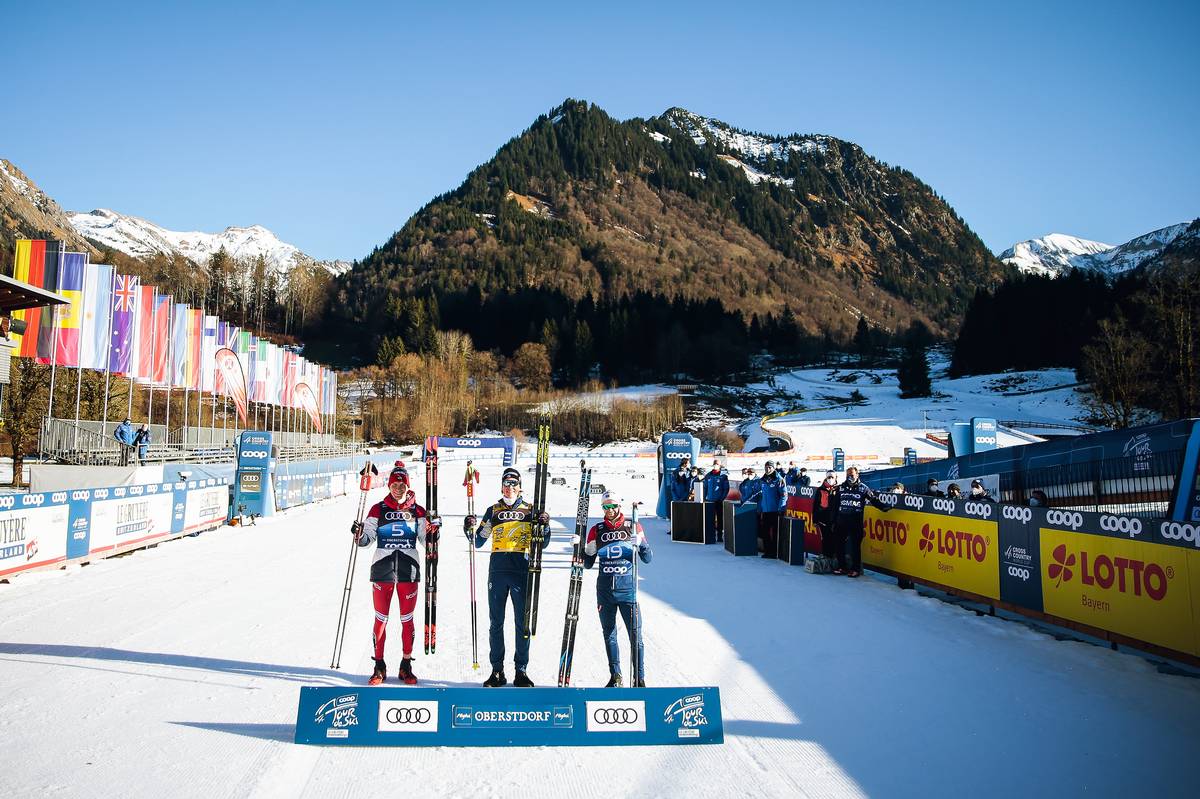
    The men’s podium of the 15k mass start freestyle in Oberstdorf: Johannes Høsflot Klæbo (NOR) took the win ahead of Alexander Bolshunov (RUS) in second and Sjur Røthe (NOR) in third. (Photo: NordicFocus)

    Asked what was the determining factor in the race, and where he found his advantage, Klæbo affirmed his plan of making a move on the winding downhill in the last kilometer. 

    “I was just trying to push really, really hard in the downhill, and just come through the downhills [safely] because, like I said, it was pretty sketchy.”

    Surviving amongst the masses, Gus Schumacher led the American men, breaking into the top-30 to place 25th (+53.3) on the day. Bouncing back from a cold that he feels has impeded him in the first two stages, Schumacher explained he is feeling stronger and more energetic by the day, contributing to his improvement from his first two finish positions. 

    “[It was] super icy, and I was a little nervous about the dynamics of the first mass start of the year,” Schumacher told U.S. Ski & Snowboard cross country communications manager Tom Horrocks on-site after the race. “But the guys at the front were pushing the pace well enough that it sort of strung out, so it was actually fairly good skiing, except for some of those corners where you’d toss it into a power slide and just keep going forward.”

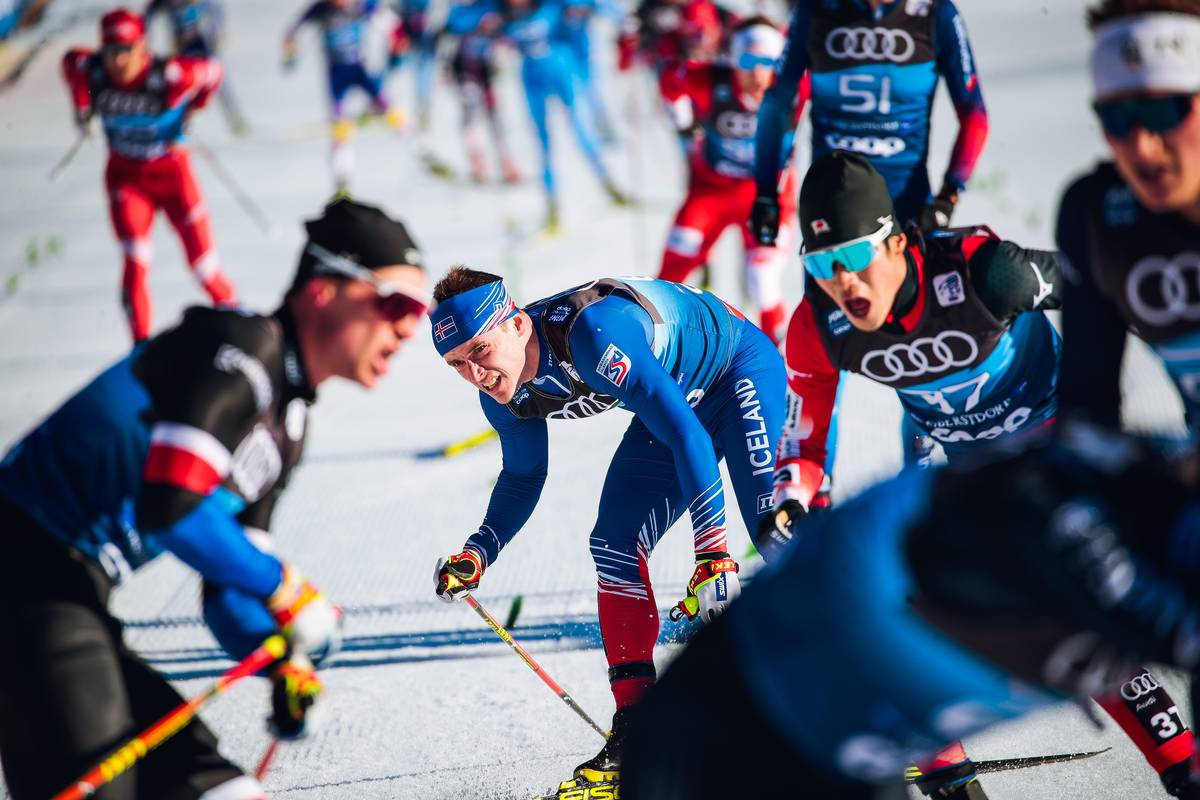
    Gus Schumacher navigates an icy downhill amongst a pack of men, each looking to stay upright with equipment intact through the race. (Photo: NordicFocus)

    Though he felt the pace was faster than it appeared from the live stream, he acknowledged that the pack did begin to spread significantly over the final lap and a half, which he identified as an “ideal mass start” situation for him in most circumstances. 

    “As it strung out, I didn’t quite have the gas that I’ve had before to keep jumping up to the next person, but I think it went well.”

    Full audio clip from post-race interview with Gus Schumacher, hosted by Tom Horrocks.

    Just off the mark for Top-30, Zak Ketterson skied to 36th (+1:02.6), just 5 seconds shy of 30th. As this year’s Tour de Ski are the first World Cup starts 24-year-old Ketterson has earned, this result marks an international career best at the senior level. Having been pulled up to the World Cup as SuperTour leader following the opening races in Duluth, MN and Cable, WI, the Team Birkie athlete is using this opportunity to vie for a widely-desired sixth spot for American men, which currently is not guaranteed to exist, on the 2022 Olympic team. 

    “I’m really happy with that. The goal for anyone is to be in the top-30, that’s just the first stepping stone, so for me to be close to that, it’s kind of a dream come true,” Ketterson told Horrocks post-race. “Especially with some rough races at the start of this Tour, it’s nice to have some positive feedback.”

    Chaos and carnage at the finish line as athletes chase the final spots in the Top-30. Gus Schumacher, who was 25th, is out of focus in the top right. (Photo: NordicFocus)

    “What’s led to me performing my best in the past is just to focus on things I can control and just the process,” Ketterson explained in response to how he is mentally handling these circumstances. “I think that’s what got me here from the SuperTour, I didn’t think about trying to be in the top SuperTour spot, I just thought, ‘Let’s have a good race, and if that gets me where I want to go, great. If not, that’s life.’ So I just try to give myself the best chance everyday and the rest takes care of itself.”

    Full audio clip from post-race interview with Zak Ketterson, hosted by Tom Horrocks.

    Ben Ogden was the next American in 64th (+1:59.0), crossing the line with his teammate, Kevin Bolger, in 65th (+2:00.4). Luke Jager skied to 70th (+2:19.7), while Logan Hanneman rounded out the men’s squad in 75th (+3:54.1).

    Ben Ogden races Stage 3 of the 2021/22 Tour de Ski in Oberstdorf. (Photo: NordicFocus)

    Looking to the overall Tour standings, with a one-minute time bonus for his sprint win, coupled with 4th in the 15k classic and a second win today, Johannes Høsflot Klæbo leads the overall standings by both time and points. By time, he is 45 seconds ahead of his teammate Pål Golberg, with Bolshunov moving into third with a 47 second deficit. By points, Klæbo has earned double that of the next athlete with 51, followed by teammate Erik Valnes with 26, and Bolshunov with 24.

    Racing continues tomorrow with a classic sprint, where Klæbo will again be a favorite. Quarterfinals begin at 12:00 CET / 6:00 EST.

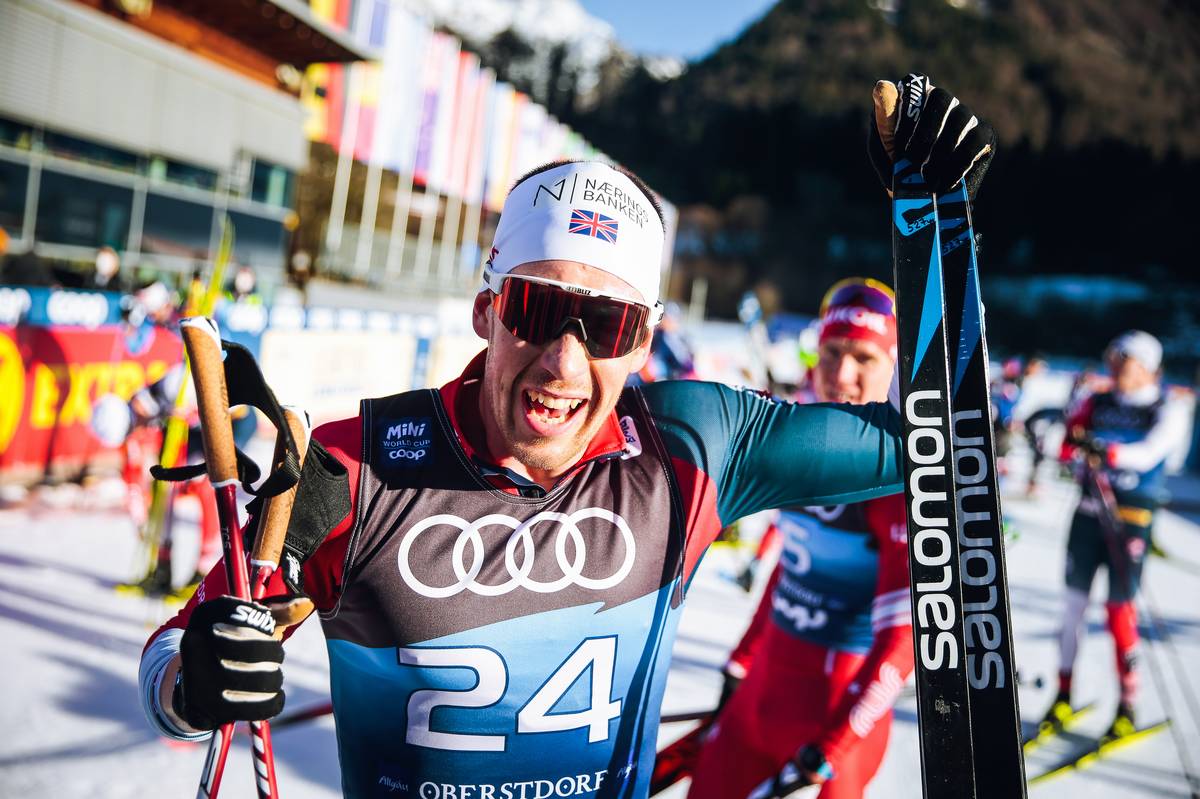
    Johannes Høsflot Klæbo (NOR) out for a training ski after arriving in Oberstdorf, Germany. (Photo: NordicFocus)

    Stage 3 Results | Overall Tour Standings by Time | Overall Tour Standings by Points

  • Røthe Clinches Skiathlon Win By 0.1 Second Over Bolshunov; Harvey 6th

    Røthe Clinches Skiathlon Win By 0.1 Second Over Bolshunov; Harvey 6th

    Norway’s Sjur Røthe (l) leading teammate Martin Johnsrud Sundby on their way to first and third respectively in the men’s 30-kilometer skiathlon on Saturday at the 2019 World Ski Championship in Seefeld, Austria. (Photo: John Lazenby/lazenbyphoto.com)

    *This article has been updated to include comments of Great Britain’s Andrew Musgrave

    By the time the camera panned past the 26-kilometer mark of the men’s 30 k skiathlon at 2019 World Ski Championships in Seefeld, Austria on Saturday, the original pack of 72 starters had dwindled to five: Norwegians Martin Johnsrud Sundby and Sjur Røthe, Russia’s Alexander Bolshunov, Finland’s Iivo Niskanen, and France’s Clement Parisse.

    The leaders had been unphased by Niskanen’s hot pace during the classic portion of the event and with less than 5 k of freestyle skiing to go, Bolshunov levied control of the pace. But it wasn’t long before one red suit was exchanged for another.

    With 2 k to go, the challenge came from a well known name in a discipline often tagged with his name: Sundby had moved himself into the lead and looked ready to hunt down his first individual World Championships gold. Since the start of Sundby’s World Cup career in 2005, he has raced in six World Championships–Seefeld being his most recent–yet never has the acclaimed nordic skier achieved a World Championship’s title.

    Russia’s Alexander Bolshunov during the men’s 30-kilometer skiathlon on Saturday at the 2019 World Ski Championship in Seefeld, Austria. (Photo: John Lazenby/lazenbyphoto.com)

    Saturday, he looked bound to break into that realm. In the second to last climb before the uphill to the finish, he began to separate himself from the lead pack of five. By the hill’s crest, only Bolshunov and Røthe had managed to maintain sight of Sundby’s ski tails. Through the gentle descent before the uphill to the finish, the three tuck skated in a line with Sundby setting the pace, Bolshunov just behind and Røthe just behind him.

    As the trio ascended the final uphill, Sundby looked steady; perhaps too steady. A brief glance back revealed the raw power of Bolshunov and equally quick tempo of Røthe pressing in from behind. By the finishing stretch, Sundby was swallowed. The sprint to the line became between Røthe and Bolshunov, with Røthe outlunging the Russian by 0.1 seconds for first in a time of 1:10:21.8. Bolshunov, claimed second (+0.1), finishing 0.6 seconds ahead of Sundby in third (+0.7).

    “It was an amazing feeling to cross the finish line first,” Røthe said according to a International Ski Federation press release. “When we changed skis, it was important for me to get away from the best athletes in the field. I had some problems with my legs during skating, but it worked out well in the end. I chose the right tactic today … and I hope I was good enough to be part of the relay team on Friday.”

    Røthe’s win on Saturday is predicated on a series of firsts this season: earlier in the year he earned his first World Cup win and Saturday marks his first career individual World Championships gold–he has a relay gold from 2013 when he raced the third leg for Norway at World Champs in Val di Fiemme.

    For Bolshunov, Saturday’s skiathlon silver medal is his first World Champs podium and, with the men’s 15 k classic yet to race, it may just be the start to his championships trophy case. The 22 year old Russian has made his way to the top of the podium a few times this season and, if Sundby hopes to take home his long sought after individual gold, it will not be without a challenge from the likes of Bolshunov.

    Rounding out Saturday’s top 5 was Niskanen in fourth (+12.3) and Parisse in fifth (+20.7).

    Canada’s Alex Harvey during the men’s 30 k skiathlon at the 2019 World Championship in Seefel, Austria.

    Finishing 58.9 seconds back from the winner was Canada’s Alex Harvey in sixth place. The winner of the 2017 Lahti World Championships 50 k and Canada’s favorite medal contender in Seefeld, Harvey recently announced that he will be retiring this season after World Cup finals in Quebec City, Quebec. Many are hoping for a repeat gold place finish for the 30 year old–over his career, he has accumulated five World Champs medals, two of those being gold one from the Lahti 50 k and one from the 2011 Oslo Team Sprint.

    On Saturday, however, Harvey told Cross Country Canada (CCC) that he “was never really in the hunt” for the podium, despite his high ranking result.

    “Normally when you are in the top-six you are in a mass start fighting for the podium until the end, but that wasn’t the case today,” Harvey said according to a CCC press release.

    “I missed the boat in the classic and the gap was made there. The equipment was great, but I just wasn’t skiing well and couldn’t create enough speed – especially on the flat part of the course,” he added.

    Happy with the skating portion of the race, Harvey implicated that more could have been had from his classic.

    “As soon as I clicked into the skate skis, I was feeling really good,” Harvey said. “I was skiing with a lot of big names, guys started popping a bit from the back and I was feeling really confident leading that group. The skiathlon is my favourite race. I will draw a lot of confidence from the skate today, but I am disappointed with the classic.”

    Finishing 1.4 seconds behind Harvey in seventh place (+1:11:22.1) was Great Britain’s Andrew Musgrave. The seventh place finish is Musgrave’s second best result at a World Championships event, his best having come in Lahti 50 k when he finished just off the podium in fourth.

    “I felt great on the classic today- having ridiculously good skis helped!” Musgrave wrote in an email to FasterSkier after the race. “The last lap of the classic was pretty hard though – when the worlds 2 best classic skiers started pushing the pace (Bolshunov & Niskanen). I must admit I was a bit glad when Niskanen fell on the 2nd lap- so we didn’t have an entire 15km of him stringing out the field & making us suffer!”

    The 29 year old Brit has had four Top 10 finishes this World Cup season and has stood atop a World Cup podium once, that having been a third place finish two years ago in the Toblach 15 k. In Saturday’s race he indicated that while the classic portion of the skiathlon for him went well, the skating segment had him searching for a second gear.

    “The first lap of the skate was OK… But I started to pay for the hard effort on the classic by the 2nd,” he wrote. “By 7km into the skate I was pretty wrecked. The last 2 laps were horrific- I was almost crawling by the end! I think I lost an impressive 50s to Harvey over the last 7.5km!”
    Either way, many rooting for Britain’s blue red and white,  are hopeful that the seventh is just the start of Musgrave’s World Champs performances.
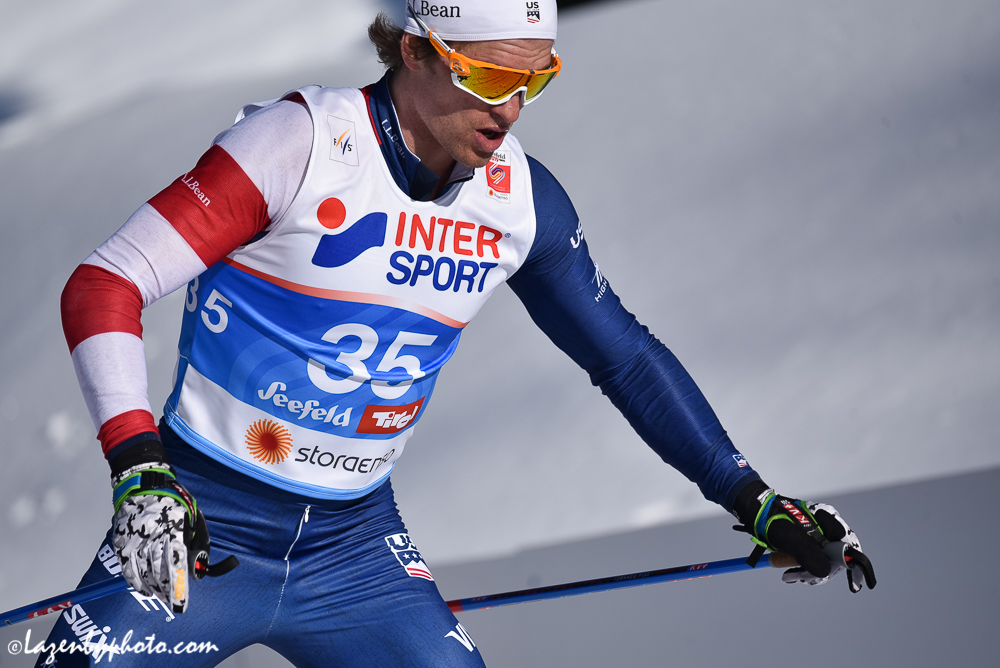
    American Scott Patterson (bib 28) during the men’s 30-kilometer skiathlon on Saturday at the 2019 World Ski Championship in Seefeld, Austria. (Photo: John Lazenby/lazenbyphoto.com)
    The next top North American finisher following Harvey was American Scott Patterson in 32nd (+4:40.6). In an email to FasterSkier, Patterson explained that the hot pace during the first classic portion of the skiathlon took a toll on him

    “In racing today, I struggled from pretty early on.” Patterson wrote. “Iivo Niskanen and others pushed the classic pace pretty hard early. I went with it for a while hoping to stick onto the pack, but it became a little too much for me as I was struggling to kick my skis. I was partially saved by having really fast skis, but it wasn’t enough.”

    The switch to his freestyle boards was a welcomed exchange, though low energy reserves left him wanting more.

    “In switching to skate, I felt slightly better, but had also dug my legs into a hole during the classic leg.” Patterson wrote. “I tried to work with a group around me, but we weren’t moving up all that well and I wasn’t quite feeling the initiative to go for it on my own.”

    “I was able to ski by a few people, but I really wanted to get the Norwegian pair of Klaebo and Iverson who were dogging it at the end,” he continued. “That would have made me a lot happier (along with a top 30).

    “Overall, I think my fitness is pretty good and I am looking forward to getting a little more dialed in and faster over the next few races,” he added.

    American David Norris the men’s 30-kilometer skiathlon on Saturday at the 2019 World Ski Championship in Seefeld, Austria. (Photo: John Lazenby/lazenbyphoto.com)

    American David Norris finished six places behind Patterson in 38th (+4:54.4).

    “Today had an awesome atmosphere with amazing fans and hot sun.” Norris wrote in an email. “I struggled in the classic portion and that is a little frustrating. My skate leg felt really good and I was catching guys the whole way. For my first Championship event this was a pretty awesome experience and a good start.”

    Next to finish was Canada’s Evan Palmer-Charrette in 45th (+6:12.4) followed by Americans Kyle Bratrud in 49th (+6:19.6), and Adam Martin in 54th (+7:47.4). Also racing for Canada was Scott James Hill in 56th (+9:58.8).

    British skier Andrew Musgrave skied to sixth overall (+1:00.3)

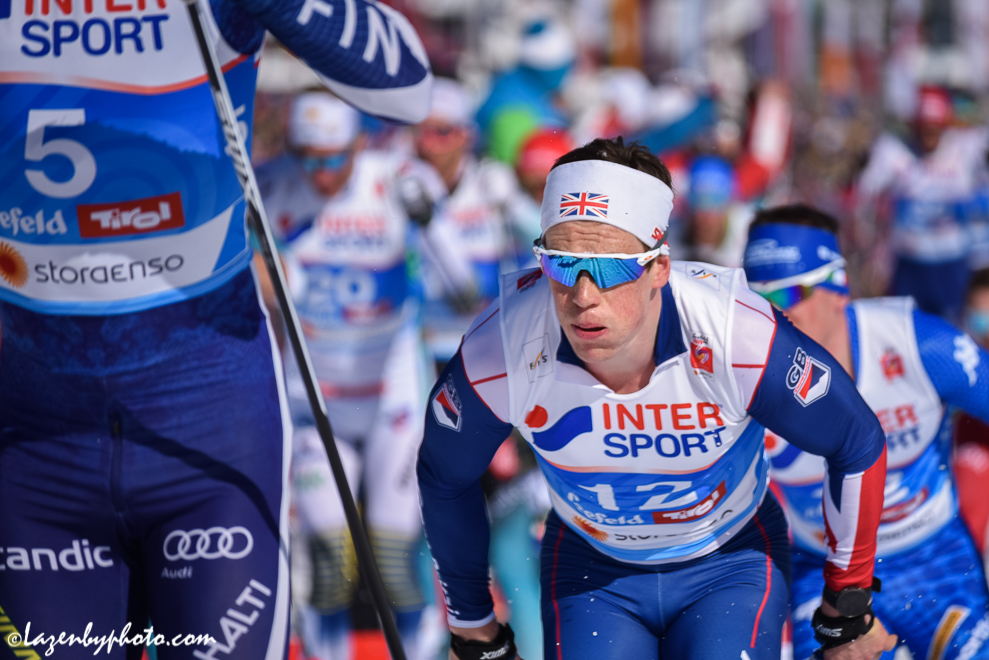
    Andrew Musgrave (bib 12) of Great Britain en route to a 7th place finish in the Nordic World Ski Championship skiathlon event. (Photo: John Lazenby/lazenbyphoto.com)

    World Championships picks up Sunday with a men’s and women’s Team Sprint.

    Skiathlon Results

  • Klæbo Holds Off Ustiogov to Become the Youngest Winner of the Tour de Ski; Lustgarten 42nd

    Norway’s Johannes Høsflot Klæbo exhaustedly crosses the line at the top of Alpe Cermis in Stage 6 of the 2018/2019 Tour de Ski. (Photo: Instagram screenshot @johanneshk)

    “It was just full speed to the finish and I am not stopping until the finish line now,” Johannes Høsflot Klæbo told the International Ski Federation (FIS) after his victory in Stage 6.

    With the 45 bonus seconds he gathered from his win in both the overall event and the bonus sprint in yesterday’s 15-kilometer classic race, Klæbo entered the final Stage of the 2018/2019 Tour de Ski with a bit of insurance on his lead over Russia’s Sergey Ustiugov, who was ranked second in the overall standings after Stage 6. The Norwegian began the 9 k skate race to the top of the Alpe Cermis ski area 1:20.4 ahead of Ustiogov, meaning that so long as he could keep the Russian at bay through one last stage, the 22-year-old would seal the deal on an overall victory in his first ever Tour de Ski.

    Sergey Ustiugov of Russia (l) chases Norway’s Johannes Høsflot Klæbo up Alpe Cermis in Stage 6 of the 2018/2019 Tour de Ski. (Photo: FIS Screenshot)

    Giving his all in his final opportunity to surpass Klæbo in the Tour, Ustiugov fought hard throughout the race to close the gap between the Norwegian and himself. As the men worked their way up the steep serpentine track, Klæbo looked over his shoulder to see the Russian just one switchback below him.

    Klæbo is known for his ability to make powerful moves on hills during sprint races, sometimes making the other skiers look as though they are standing still. His dominance is so well known that the short steep climb on the sprint course during the Olympic Games in PyeongChang became dubbed the “Klæbo-bakken”. However, after seven races in nine days, Klæbo looked exhausted as the men neared the top of the climb, no longer the spry sprint phenom. Ustiugov maintained a faster tempo, gradually reeling the Norwegian in. With a grimace and a last look back, Klæbo collapsed across the line in a time of 32:51.3, just 16.7 seconds ahead of Ustiugov.

    Men’s podium of the 2018/2019 Tour de Ski. Norway’s Johannes Høsflot Klæbo took first after winning five out of the seven stages, followed by Russia’s Sergey Ustiugov (l) and Simen Hegstad Krüger (r), also of Norway. Photo: Screenshot Instagram @fiscrosscountry

    “It was really tough,” Klæbo told FIS. “I was really tired after yesterday. I heard all the way from the bottom that Sergey [Ustiogov] was going quite fast so I was just trying to push myself. It was really tough but quite good to be here first.

    “I saw him all the time, so it was really tough to just look back and see him getting closer and closer,” Klæbo continued. “It was really tough mentally, but it was really good to come to the top and look back and see that you have the gap that you needed.”

    Klæbo’s win made him the youngest ever male winner of the TdS, an honor previously held by Dario Cologna of Switzerland who won his first tour in 2009. Today was also his fifth stage win in this season’s Tour, tied for the most wins with Cologna and Norway’s recently retired champion, Petter Northug jr.

    “It means a lot, for sure,” Klæbo told Fischer. “PyeonghCang was maybe the biggest moment in my life, but this is a good number two. I really think this is a great start of 2019.”

    The implications of differences in start time are not as cut and dry when the gut punch of the hill climb is taken into consideration. A contingent of Norwegians lurked hungrily behind Alexander Bolshunov of Russia and Francesco de Fabiani of Italy, ranked third and fourth, respectively, entering the final stage. Simen Hegstad Krüger, Sjur Røthe, Martin Johnsrud Sundby, and Didrik Tønseth held positions five through eight, all within 1:45 minutes of Bolshunov.

    The pack worked together, slowly drawing de Fabiani into their sights. They passed him near the bottom of the climb. Their next target, Bolshunov, proved harder to catch. With less than 500-meters to go, Krüger skirted around the Russian on a switchback, clearly exhibiting more energy and a higher tempo. As the first Norwegian powered ahead, Røthe also surpassed the fading Bolshunov.

    In the end, Krüger maintained his energy to steal the third position on the podium, 48.8 seconds behind his teammate Klæbo. Røthe took fourth (+1:05.3), followed by Bolshunov in fifth (+1:26.6).

    The sole American to finish the Tour, Ben Lustgarten, finished 42nd (+15:54.5).

    “It can definitely eat you alive,” said Matt Whitcomb in a call. “I was really happy to see him it finish it because it devours a lot of people.”

  • Norway Holds Off Russia for Another Relay Win; Americans in 12th

    Norway Holds Off Russia for Another Relay Win; Americans in 12th

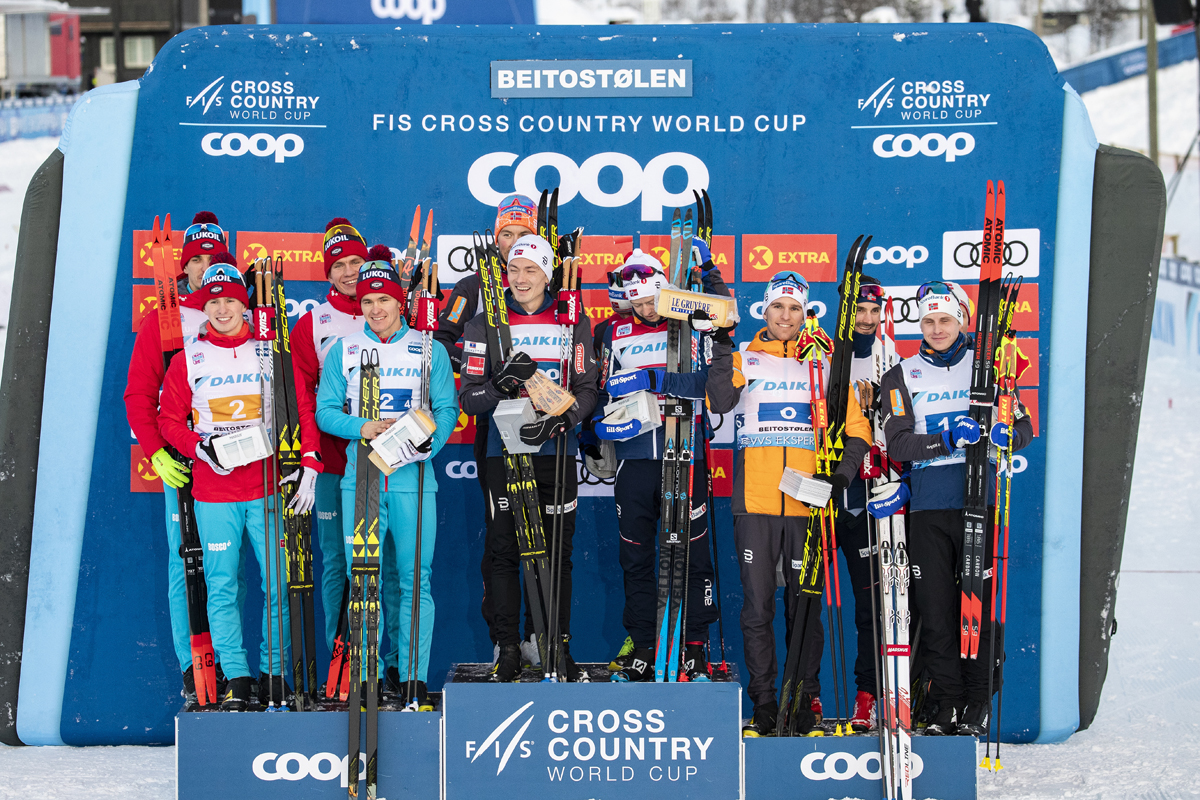
    The men’s 4 x 7.5 k relay podium from Beitostølen, Norway. Norway I (center) won, Russia I (left) placed second, and Norway II (right) third. (Photo: Fischer/Nordic Focus)

    As Emil Iversen took command of the field from the gun during the men’s relay in Beitostølen, Norway, striding smoothly up the first climb in the lead, the question quickly became, can anyone take down Norway?

    The team of Iversen, Martin Johnsrud Sundby, Sjur Røthe, and Finn Hågen Krogh must have liked their odds. Norway has claimed eight of the last nine men’s relay victories on the World Cup, falling only to Russia in Lillehammer’s 2013 men’s relay. Norway’s last time missing a podium in a relay occurred in 2007. While historically, the race has been a 4 x 10-kilometer event, the men’s relay on Sunday consisted of four 7.5 k legs.

    Norway’s Emil Iversen and Russia’s Evgeniy Belov lead the pack on the first leg of the men’s 4 x 7.5 k relay in Beitostølen, Norway. (Photo: Fischer/Nordic Focus)

    At the first exchange, Iversen had a sizeable lead over second place Norway II team, who tagged 7.7. seconds back. Russia 1 came through with a gap of 16.1 seconds. The first leg of the relay, called the scramble leg, most often doesn’t break the pack apart. It’s part gamesmanship, part high-tempo effort to shake off any non-contenders.

    As the second leg began, this much was clear: Russia wouldn’t let Norway run away with the race. Russia’s second leg skier, Alexander Bolshunov quickly caught Sundby during their first lap of the 3.75 k course. Before the end of their first lap, Bolshunov played his hand, upping his effort, and taking control of the second leg. By the time he tagged off for the third leg skier, Bolshunov had put nine seconds on Sundby and his Norway I mates.

    Norway II fell off the back, tagging off 33.7 seconds back.

    Røthe, winner of  

    At the final exchange, Norway was Russia’s heels, trailing by a mere 0.4 seconds. Third place Norway II was a distant 50 seconds behind the leaders.

    Norway’s Finn Hågen Krogh is the master-closer. Here he crosses the line for first place over Russia’s Andrey Melnichenko in the men’s 7.5 k relay in Beitostølen, Norway. (Photo: Fischer/Nordic Focus)

    Krogh, who has a history of being a strong closer, stayed calmly on the heels of Russia’s Andrey Melnichenko, matching his pace on climbs and tucking into his draft on descents. As the tempo accelerated for the final kilometer, Krogh edged around Melnichenko at a turn and held off the Russian through the final moments of the race. In the final stretch, it was clear that Krogh’s strategy had paid off as he glided through the finish with Melnichenko 0.7 seconds behind.

    The third-place Norway II team of Didrik Tønseth, Hans Christer Holund, Magne Haga, and Simen Hegstad Krüger crossed the line 53.4 seconds behind the leaders.

    “We are used to the tough race against Russia now,”, Sundby told the International Ski Federation (FIS) at the finish. “For the last relays, it has been the same way. They have a really strong team, with different skiers, but every time they have four strong guys. Same procedure today. Today we have back our last leg finisher with Finn [Krogh] and it was really nice for everyone to see him back in good shape. I think the last time was Lahti [World Championships in 2017]. And he’s back again now. So, it’s good for us and we hope for a nice race against for sure Russia.”

    While the podium positions seemed to be locked up early on, the remaining top ten positions were in contention as a large chase pack had formed behind the leaders. During the first leg, the U.S. Ski Team’s (USST) Erik Bjornsen was in the mix. At times Bjornsen led the chase pack. In a tightly packed group, Bjornsen tagged off to Kevin Bolger in fourth position, 33.1 seconds back.

    The U.S. Ski Team’s Erik Bjornsen (bib 9) during the first leg of Sunday’s 4 x 7.5 k relay in Beitostølen, Norway. (Photo: Aleks Tangen)

    “It’s always fun to do a relay with the boys, so it was a good day, working out the cobwebs and getting ready for Seefeld,” Bjornsen told FasterSkier at the finish. Bjornsen was happy with his classic leg. When asked how he felt, he expressed, “Just great! It was really fun! Good crew out there.”

    “On the men’s side, all four of our guys took a step forward today,” Matt Whitcomb told FasterSkier in an email. “While Erik isn’t quite in form yet to stay with the break, he controlled and drove a very competitive chase group. His performance was impressive.”

    Bolger, the leg skier for the U.S., maintained his position in the chase pack for his first lap. He skied through the exchange/lap zone in ninth place. As the decisive moves were made, Bolger could not maintain pace. The group split in two, and he fell back with the second chase pack.

    “Unfortunately, the relay is a contact game, and we lost that late in the second lap,” said Whitcomb. “Kevin dug deep, and was so close to keeping contact over the top of the last big climb, but once it opens slightly, it tears open.”

    Bolger eventually tagged third leg Scott Patterson (USST) in 10th (+1:52.4).

    “I’m happy with it,” said Bolger about his leg. “I wish I could’ve stuck together with the guys all the way through the finish but just to stick in and ski with some of those guys was good… I wish I could’ve skied it harder toward the finish, but I just got tired, went out a little hard maybe, but overall I’m happy, a lot of takeaways, so I’ll learn a lot from it.”

    Scott Patterson took the first skate leg for the U.S., skiing with Italy and Sweden in the second pack. He tagged off to closer Simi Hamilton (USST) in 12th position, with a 2:19.6 minute deficit to the leaders.

    “It was pretty good,” Patterson reflected on his race. “Kind of had a slow start to my season, today felt pretty good, skiing with Italy and Sweden, able to hang pretty well, so it was a fun one. … With these short relays, it’s so easy to hammer the first lap, the second is kind of hang on, and that’s a lot of what it felt like today.”

    When asked how the 7.5 k legs, compared to the traditional 10 k distance, affected their pacing during the race, Patterson was adamant that the shorter course was an added challenge for distance skiers.

    tizanidine online, buy lioresal online, zanaflex buy online

    “Absolutely harder,” he said of the change. “We’ve had so many 15k’s that you’re kind of used to that pace, and this is… I mean for me, it’s almost sprint qualifier pace. You just gotta’ go and hang in.”

    Though Hamilton was ultimately unable to gain any positions for the U.S., he was pleased with his performance and enjoyed the relay environment as the U.S. finished 12th (+3:22.7).

    The U.S. team for the men’s 4 x 7.5 k relay in Beitostølen, Norway. From left to right, Erik Bjornsen, Simi Hamilton, Scott Patterson, and Kevin Bolger. (Photo: Aleks Tangen)

    “I was happy with it,” Hamilton shared. “It wasn’t my best distance feeling ever, but it was a fun course, Scott tagged me in a great spot, just, right off of the tail of Viktor Thorn [of Sweden] and DeFabiani [of Italy] there, and those guys are really good skaters. B I tried. I didn’t really want to try to ski just dangling off the back the whole time, so I put in [a quick effort] there at the start, just to get in a draft behind them. And I feel like a relay is a kind of race where you kind of have to take the risk sometimes, especially later on in the race for the last couple of legs. So in that sense, it’s really fun. You just kind of throw caution to the wind and see what happens. But it was fun and I’m feeling like I’m kind of coming into better shape as the season progresses. I’m psyched for the sprint next weekend and everything else coming up this winter.”

    “It was an impressive relay debut,” concluded Whitcomb. “Watching this men’s team fight hard for contact today made us all incredibly motivated.  I think I share the sentiment with the rest of our staff and athletes – seeing the U.S. men’s relay hit the podium in a World Cup would rival the excitement of the Olympic gold.  We’re not there yet, but we can see it from where we are. And we plan to close.”

    The Canadian team did not field a men’s relay team.

    Racing continues next weekend in Davos, Switzerland.

    Results

  • Tønseth Bests Røthe to Lock Up Lillehammer Pursuit Win; Harvey 16th

    Tønseth Bests Røthe to Lock Up Lillehammer Pursuit Win; Harvey 16th

    Men’s podium from the 15 k classic pursuit in Lillehammer, Norway. The home country swept the podium. Sjur Røthe (left) placed second, Didrik Tønseth (center) won, and Emil Iversen (right) was third. (Photo: Fischer/Nordic Focus)

    In sport, there’s the win and then there’s the story behind the win. In the sport of nordic skiing, some of these stories seem all too familiar, such as Sunday’s Norwegian victory in the men’s 15-kilometer classic pursuit.

    But even among the Norwegians in the sport of cross-country skiing, there are idiosyncrasies to the success.

    In the case of Didrik Tønseth, the Norwegian winner of Sunday’s 15 k pursuit in Lillehammer, Norway, the victory was a long awaited recognition. Back in 2014, while competing in the Davos, Switzerland 15 k classic pursuit in early December, Tønseth crossed the finish line after Norwegian Martin Johnsrud Sundby for second place.

    Two years later, Sundby was stripped of the Davos 15 k win, as well as his 2015 Tour de Ski and 2014/2015 overall World Cup titles, due to a doping violation. Sundby had been found to have twice exceeded the amount of salbutamol, also known as albuterol, which Sundby indicated he used for asthma.

    The doping allegations and Sundby were under the spotlight. Few media outlets focused on Tønseth, the fact that he became the new race winner of the Davos 15 k, and that it was his first individual World Cup victory. He would have to wait until this December before another individual World Cup win would come his way for a toast to his individual victories.

    Tønseth now has two individual World Cup wins–the Davos 15 k from 2014 and this Sunday’s Lillehammer pursuit.

    “It feels incredibly good. It’s fascinating that I succeeded so,” Didrik Tønseth told NRK according to a Norwegian translation, also confirming to NRK that it was his greatest day as a cross-country skier.

    “It actually means everything,” the 27 year old added.

    Didrik Tønseth during the 2018 men’s 15 k classic pursuit in Lillehammer, Norway. (Photo: Fischer/Nordic Focus)

    Tønseth’s win this Sunday came in a time of 44:13.8 minutes. He earned the pursuit’s second start position, thanks to a second place finish in Saturday’s 15 k freestyle race. He was also, reportedly, the only Norwegian to race on zeroes on Sunday.

    “Tønseth was on zeroes,” U.S. World Cup head coach, Matt Whitcomb, said during a phone conversation on Sunday. “He was the only Norwegian that I know of that was on zeroes.”

    Still, Tønseth hardly skied alone during the pursuit. He and Norwegian Sjur Røthe started within one second of each other and the two continued to set the pace for the remainder of the race. Just before the third lap the day’s snowfall picked up drastically. Røthe and Tønseth, however, remained untouchable by the chase group, which was a little over a minute behind at the 8.3 k mark.

    In the final double pole showdown to the finish line, Tønseth bested Røthe by 1.6 seconds to take the win. Snagging the final podium spot by 1.1 seconds ahead of Sweden’s Calle Halfvarrson was Emil Iverson in third (+1:03.3). Halfvarrson took fourth (+1:04.4) and one tenth of a second behind the Swede was Russia’s Alexander Bolshunov in fifth (+1:04.5).

    Rounding out the top ten was Russian Andrey Larkov in sixth (+1:05.0), Finland’s Iivo Niskanen in seventh (+1:05.2), Norwegian Simen Hegstad Krüger in eighth (+1:05.3), Sweden’s U23 skier Viktor Thorn in ninth (+1:05.5) and Dario Cologna of Switzerland in tenth (+1:05.8).

    Leading the North Americans was Canada’s Alex Harvey in 16th (+1:08.7). Harvey started the pursuit in bib number 10, sandwiched by Great Britain’s Andrew Musgrave starting in bib nine and Norway’s Hans Christer Holund in bib 11. After chasing down and catching up to Sundby and Cologna, Harvey remained in the main chase pack through all three course laps.

    “[The first lap was the hardest, I had to close a decent gap, up to Dario [Cologna] and Sundby,” Harvey told Faskier during an in-person interview after the race. “They were closing on [Denis] Spitsov and these guys, so the first lap was the hardest for me, second was super easy, and first half of the third lap was also really easy.

    “I think I actually had really good skis and [my] body was feeling okay, just missing some punch at the end,” Harvey continued. “Given the shape that I have right now for distance, it’s the best I can do.”

    Snow dump — during the 2018 15 k classic pursuit in Lillehammer, Norway. Emil Iversen (bib 3) holds off the charging pack to take third. (Photo: Fischer/Nordic Focus)

    Finishing 7.9 seconds outside the top 30 in 32nd (+1:26.1), was U.S. Ski Team (USST) B-team member, Erik Bjornsen. Bjornsen ended the day with the third fastest course time.

    buy minocycline, antibiotics online

    “I was able to ski up into the top 30 but then the last lap with all this new snow, [I] just couldn’t get the skis to kick,” Bjornsen, who started in bib 43, told Fasterskier after the race. “You had to be relaxed with the kick and patient. As soon as I [started] getting tired it made it more difficult to be able to find the kick. Super tricky conditions.”

    Whitcomb explained that the result is a positive indication of Bjornsen’s direction this season.

    “Erik was able to ski from bib 40 up to bib 32 today, and [he was] in contact with 25 after the second lap, so 10 k through,” Whitcomb said. “He was looking much more like himself, not completely where he wants to be in terms of his race feeling yet, but it was a step in the right direction today. I think this will give him some confidence as we move forward to a big training week in Beitostølen.”

    “The main thing that will power these guys into the points, and for some, the podium, is confidence,” Whitcomb added later via text. “Small improvements each week lead to increasingly confident athletes.  it’s generally only the confident athletes that will do well. That’s why an athlete that starts to roll tends to keep rolling.”

    Following Bjornsen, American David Norris (APU) skied to 52nd (+3:21.9), Kevin Bolger (USST) 59th (+4:20.8), Adam Martin (CGRP) 62nd (+4:35.7), Scott Patterson (USST) 63rd (+4:39.0), Simi Hamilton 66th (+4:44.1).

    “We’re a bit thinner on the men’s side with regards to the distance depth and so when when they’re not on race form it really shows up,” Whitcomb said. “As soon as things start to open up and these athletes come out from under this blanket of fatigue, from fall travel, training, getting over here and adjusting to snow, things… results can start to open up much more quickly for us come December.”

    For Canada, Russell Kennedy (Team R.A.D.) was 61st (+4:32.4), and Andy Shields 71st (+6:06.7)

    World Cup cross-country athletes’ next stop is Beitostølen, Norway for the 15/30 k distance events and a relay.

    Results

  • Sundby Races to Giant Tour de Ski Lead; Harvey 7th in 30 k Classic

    Sundby Races to Giant Tour de Ski Lead; Harvey 7th in 30 k Classic

    Even if he didn't break the race open until late, Martin Johnsrud Sundby of Norway was at the lead from the beginning in the 30 k classic.
    Even if he didn’t break the race open until late, Martin Johnsrud Sundby of Norway was at the lead from the beginning in the men’s 30 k classic mass start at the second stage of the 2016 Tour de Ski in Lenzerheide, Switzerland.

    LENZERHEIDE, Switzerland—Martin Johnsrud Sundby is just as dominant as Norwegian teammate Therese Johaug in terms of wins: both are unbeaten at the finish line of any World Cup distance race this season.

    But where Johaug had broken the women’s race open from the start two hours earlier, Sundby as usual pulled off the victory in his own way here in the 30-kilometer classic mass start, the second stage of the 2016 Tour de Ski.

    It wasn’t until more than 15 k into the competition that the pace at the front accelerated for the first time, fracturing the field into a small leading pack.

    And then just before 19 k, Sundby upped the pace again, and skied the rest of the race alone to take a 34.6-second victory over teammate Petter Northug, with Didrik Tønseth and Sjur Røthe giving Norway a top-four sweep.

    “I felt tired on the start actually, from the sprint,” Sundby said in a post-race press conference. “I used a couple of laps to get into the race and find the pace. It was maybe also a little bit the altitude. It was a difficult and tough race as I expected, but I’m happy that I could find a good pace.”

    Alex Harvey of Canada (second from right) in the pack with Martin Johnsrud Sundby of Norway in the middle of the 30 k.
    Alex Harvey of Canada (second from right) in the pack with Martin Johnsrud Sundby of Norway in the middle of the 30 k.

    Early on, one might have had the impression that athletes from other teams could compete for the win, or at least the podium. Canada’s Alex Harvey was the first man across the line at the first bonus sprint at 5.8 k, collecting 15 seconds to pad his Tour de Ski time.

    “I knew I needed to get some bonus seconds when I could, so I wanted the first one,” Harvey said. “So at least Martin didn’t win everything, so that was the first positive of the day.”

    Harvey hung around in the lead pack, never at the front, but always just behind. Along with Russia’s Evgeniy Belov and Sergey Ustiugov, Italy’s Francesco De Fabiani, and Kazakhstan’s Alexey Poltoranin, he stuck with the Norwegian wave after the pace went up for the first time.

    For Harvey it was a tried and true strategy, which has brought him to the podium or close to it in many a long World Cup race before.

    “Justin [Wadsworth, Canadian Head Coach] made it clear yesterday that he didn’t want to see anybody, any of us, in the lead,” Harvey said. “I mean, that’s for the Norwegians to lead. They’re so dominant right now, it’s for them to do whatever they want in the front. Yeah, I played that well.”

    The group survived as first rain, then snow, blanketed the field, tripping up a number and teams and athletes whose skis either stopped kicking or gripped too much. Several athletes fell face-first on uphills; others slipped and slid around the tracks.

    “It was difficult snow conditions out there,” Tønseth said.

    Harvey agreed, but said that the Canadians did a fine job with the skis.

    Ivan Babikov of Canada on the move to 33rd place.
    Ivan Babikov of Canada on the move to 33rd place.

    “I had good kick,” he said. “They were competitive- not the fastest, but they were good enough to stay up there… the Russians had really fast skis, and then the Norwegians of course.”

    But try as he might to stay in contention, by the end it was Tønseth, Røthe, and Northug who had the most in their legs compared to the other chasers – that despite the fact that all three of the podium skiers had finished in the top ten in the sprint, meaning that they skied a qualifier, a quarterfinal, and a semifinal.

    Tønseth has rarely even started sprint races, and only skied one World Cup quarterfinal ever, in 2014.

    “I have never sprinted so much before in my whole entire life so I needed four laps to get in shape,” he said of the 30 k effort in today’s press conference.

    Alex Harvey of Canada skied much of the race surrounded by - but not in front of - a sea of Norwegians.
    Alex Harvey of Canada skied much of the race surrounded by – but not in front of – a sea of Norwegians.

    Despite their fatigue, the group dropped Belov, Poltoranin, and Harvey from in the very last kilometers. Poltoranin took fifth and Belov sixth; Harvey ended up seventh, 54.4 seconds behind Sundby and about 20 seconds off the podium.

    “I blew up,” he said. “It was hard, it was a really tough race… I was pretty tired on the last lap. I was pretty tired after lap four really.”

    With 48 bonus seconds already from the sprint, Sundby goes into Sunday’s 10 k skate pursuit with big lead – a minute and 18.4 seconds, to be exact. Northug will be the first chaser, with Tønseth 12.2 seconds behind.

    “I think it’s smart to find the right speed tomorrow,” Northug said. “Maybe me and Didrik can work together if he manages to capture me. We’ll see but I think that you never know. It’s a 10 k and you have to find a really fast pace for sure on this track.”

    Tønseth made it clear that he was going to try.

    “I think 12 seconds to Petter is going to be hard,” he laughed. “I don’t know how smooth it will be at breakfast tomorrow, we’ll see.”

    As for Harvey? He’ll start the pursuit in seventh after also picking up 34 bonus seconds over the course of the day. He will begin 2:22.1 behind Sundby and just 0.9 seconds ahead of Poltoranin.

    “I’m tired now, but for sure it’s short for everybody, so short recovery for everybody,” he said. “The plan is to move up the rankings. Go hard- it’s only 10 k.”

    Need for Speed

    Harvey was left out of the heats in Friday’s skate sprint, which frustrated him and put him at a disadvantage in the overall Tour de Ski standings compared to many of his main competitors.

    But after a day of reflection, he wasn’t as upset.

    Perfect skis? Devon Kershaw (center in red) slipped on some of the uphills, much like almost every other man in the field. He finished 41st on the day.
    Perfect skis? Devon Kershaw (center in red) slipped on some of the uphills, much like almost every other man in the field. He finished 41st on the day.

    “I looked, and I have not qualified in a world cup sprint since World Champs last year,” he said. “The last two World Cups last year, I didn’t qualify, and the first this year, the first four. I’m missing some top speed. It’s hard to know why, but I’m just not super fast right now.”

    He was less than two tenths of a second out of qualifying, ending up 33rd on the day. That’s a close margin and Harvey might be moving in the right direction.

    “During Christmas I was working on it,” he said. “33rd is better than I was in the other sprints, but it’s still not good enough. I mean, I’ve never- I’ve had really good sprint results in my career, but when I was young I’ve never been a sprinter really. So that is the first thing that I lose, is the speed. I’m confident it will come back.”

    Come back, and come back in time for other Tour de Ski stages. Qualifying for a sprint is a different animal than winning a finishing sprint in a long mass start or pursuit, and Harvey thinks he has that under control.

    “Yeah,” he said. “I think it is just that today I blew up with 3 k to go.”

    Teammate Ivan Babikov finished 33rd, +3:26.6, and Devon Kershaw 41st, +4:24.6. After also getting left out of the heats the day before, sprinter Lenny Valjas have the distance skiing a go, finishing 65th +6:54.6.

    Stay tuned for more reporting on the Americans in the men’s 30 k.

    Results | Tour standings after stage 2

  • Sundby Bests Bessmertnykh, Double Poles to Undefeated Distance Streak

    Sundby Bests Bessmertnykh, Double Poles to Undefeated Distance Streak

    Norway's Martin Johnsrud Sundby shows off his arm strength after double poling the entire 15 k classic at the World Cup in Toblach, Italy. He won by 12.6 seconds over Russian runner-up Alexander Bessmertnykh (l) and Norwegian teammate Sjur Røthe (r) in third. (Photo: Fischer/NordicFocus)
    Norway’s Martin Johnsrud Sundby shows off his arm strength after double poling the entire 15 k classic at the World Cup in Toblach, Italy. He won by 12.6 seconds over Russian runner-up Alexander Bessmertnykh (l) and Norwegian teammate Sjur Røthe (r) in third. (Photo: Fischer/NordicFocus)

    In an impressive display of strength and consistency, Norway’s Martin Johnsrud Sundby once again bested the men’s World Cup field by double poling on skate skis during Sunday’s 15-kilometer classic individual start in Toblach, Italy.

    Just like Kazakhstan’s Alexey Poltoranin double poled to the win in last year’s 10 k classic on the same course in Toblach, Sundby opted for strictly glide wax and double poled all three laps of the 5 k loop. With slightly below freezing temperatures on artificial snow, the kick wax was fairly straightforward, but some racers figured they’d be faster by simply hammering the course with brute arm strength.

    “I am incredibly happy. I have achieved a big goal, namely to win on shiny [skate] skis,” Sundby told NRK, according to a translation, after winning the 15 k by 12.6 seconds in 35:27.4.

    No stranger to double poling classic races, Sundby drew widespread media attention at this year’s Norwegian season opener in Beitostølen, Norway, for setting the fastest time in the 15 k classic and subsequently being disqualified for skating.

    Two of the top three used skate skis to reach the podium on Sunday. Sundby’s Norwegian teammate Sjur Røthe also opted to double pole and finished third, 48.6 seconds behind Sundby.

    “I started quite early and I did not know how I was doing comparing to others,” Røthe said in a post-race interview with FIS. “In the last lap I learned that I was fighting for the podium. I felt great and very strong in the last kilometers.”

    Røthe’s 5 k lap time ranked fourth, 20.8 seconds back. By 10 k, he was third, 38.2 seconds behind Sundby.

    Norway's Martin Johnsrud Sundby winning the men's World Cup 15 k classic on Sunday in Toblach, Italy. (Photo: Fischer/NordicFocus)
    Norway’s Martin Johnsrud Sundby finishing the men’s World Cup 15 k classic on Sunday in Toblach, Italy, which he won by 12.6 seconds. (Photo: Fischer/NordicFocus)

    Before ultimately placing second, Russia’s Alexander Bessmertnykh waited anxiously on the leader’s chair through 34 finishers before Sundby dethroned him. Bessmertnykh chose classic skis, as one of three in the top five and six of the top 10 on kick wax.

    “I had a very good race and it was a good choice to go with kick wax,” he told FIS. “I had amazing skis. Our service team did a great job.”

    After the first lap, both Sundby and Bessmertnykh’s times ran similar, with Sundby leading by 2.1 seconds. However, by 5 k, the two had already distanced themselves from the field with the next closest challenger, Norway’s Emil Iversen, 14.1 seconds behind Bessmertnykh.

    At 10 k, the gap widened a bit, with Sundby opening his lead to 5.2 seconds on Bessmertnykh and 38.2 seconds on Røthe, who had moved into third. The finishing order would not change from there, although Bessmertnykh’s time at 12.1 k was within 2.7 seconds of Sundby’s.

    “… I’ve got to throw some compliments to the Russian. He skied extremely well today,” Sundby told NRK. “It was a cool fight, but I’m glad it went my way of course.”

    Sundby has now won all five World Cup distance races so far this season, including the Ruka Triple pursuit despite not being the winner of the day (which leaves some interpretation about whether Sundby has won four or five distance races this season). Last season, he won two non-pursuit distance races (plus two pursuits) and ended up winning the Overall World Cup crown.

    For those keeping track at home, the male record for outright distance wins in one season is seven, achieved by Sundby’s teammate Petter Northug Jr. in 2009/2010, and Kazakhstan legend Vladimir Smirnov in 1993/1994.

    In nine total World Cup races this season, Sundby has won six — including a relay as a member of the Norwegian men’s 4 x 7.5 k team.

    Of 88 finishers, five were disqualified for skating: Kazakhstan’s Sergey Cherepanov and Nikolay Chebotko, Germany’s Andreas Katz, Austria’s Dominik Baldauf, and Korea’s Hwang Jun-ho.

    Harvey 16th for Canada

    Alex Harvey (Canadian World Cup Team) racing to 16th in the men's World Cup 15 k classic individual start on Sunday in Toblach, Italy. According to coach Justin Wadsworth, it was the first time he double poled a World Cup distance race on skate skis. (Photo: Fischer/NordicFocus)
    Alex Harvey (Canadian World Cup Team) racing to 16th in the men’s World Cup 15 k classic individual start on Sunday in Toblach, Italy. According to coach Justin Wadsworth, it was the first time he double poled a World Cup distance race on skate skis. (Photo: Fischer/NordicFocus)

    Leading the North American men on Sunday were Canadians Alex Harvey in 16th (+1:29.9) and Devon Kershaw in 28th (+2:14.7).

    According to Canadian head coach Justin Wadsworth, who is in Canada but touched base with his team after Sunday’s race, this was the first time Harvey and Kershaw double poled a World Cup distance race on skate skis.

    “They were satisfied with their race, happy with the skis,” Wadsworth said on the phone. “For double poling they’re both pretty satisfied.”

    Also for Canada, Graeme Killick double poled to 54th (+3:39.7) while Michael Somppi and Len Valjas opted for classic skis with kick wax and finished 70th (+4:34.9) and 75th (+5:03.6), respectively.

    Comparing Sunday’s classic distance race with the freestyle sprint the day before, where the Canadians all finished outside of the top 60, Wadsworth said his team showed resilience on Sunday.

    “Definitely a solid effort by the guys and I think it shows they are good mentally to be able to bounce back after yesterday,” he said in a Cross Country Canada press release.

    Devon Kershaw (Canadian World Cup Team) double poling to 28th in the World Cup 15 k classic on Sunday in Toblach, Italy. (Photo: Fischer/NordicFocus)
    Devon Kershaw (Canadian World Cup Team) double poling to 28th in the World Cup 15 k classic on Sunday in Toblach, Italy. (Photo: Fischer/NordicFocus)

    He added that Kershaw has landed in the points at every distance race this season, a potential first for him and a welcomed sign for the upcoming Tour de Ski, one of the team’s focuses going into the season. Wadsworth told FasterSkier that Canada’s starters for the upcoming 2015/2016 Tour de Ski will be announced on Tuesday, Dec. 22.

    For the U.S Ski Team, sprint specialist Andy Newell was the team’s top finisher after double poling to 52nd (+3:32.9). He was followed by Noah Hoffman in 61st (+4:00.3), and Kris Freeman in 78th (+5:15.3). After placing second in Saturday’s sprint, Simi Hamilton did not race on Sunday.

    Erik Bjornsen did not race as he was recovering from a cold and “playing it safe in order to be fully healthy for the [Tour de Ski],” according to U.S. head coach Chris Grover in an email.

    World Cup racing will resume after the holidays with the Tour de Ski kicking off Jan. 1 with a freestyle sprint in Lenzerheide, Switzerland.

    Results

  • Photo Gallery: World Championships Men’s Skiathlon

    Photo Gallery: World Championships Men’s Skiathlon

    FasterSkier’s coverage of the 2013 FIS Nordic World Ski Championships in Val di Fiemme, Italy, is brought to you by the generous support of Fischer Sports.

    VAL DI FIEMME, Italy — World Champion at long last, Dario Cologna (SUI) played the waiting game on Saturday in the 30 k skiathlon at the 2013 Nordic World Ski Championships while others attempted futile breakaways. It paid off in the end; he won the race by almost two seconds over Martin Johnsrud Sundby (NOR). Images from the day:

  • Magnificant Manificat Takes Win in Dramatic Skiathlon

    Magnificant Manificat Takes Win in Dramatic Skiathlon

    Manificat celebrates his win.

    Coverage of the Alberta World Cup made possible through the generous support of Travel Alberta and Tourism Canmore.

    CANMORE, Alberta — Three days ago Maurice Manificat of France was dragging his black-and-fluorescent yellow-clad body up the famed Canmore “wall,” a death march of a ski race, a French bumblebee without buzz.

    Manificat, seeded fourth in that 15 kilometer mass start, struggled to 44th place, but Sunday brought another race and another chance, and the Frenchman had his wings back, flying by Italian Roland Clara in the homestretch to claim victory in the 30 k skiathlon.

    Challenging Canmore courses and an aggressive field ensured that this race would not play out as so many men’s World Cup races are wont to do — a sprint to the line by a herd of more than 20 skiers.

    Four 3.75-k classic loops up the steepest climbs were followed by the same number of skate loops, on a relatively more rolling course.

    The pack stayed tight for the first loop but the second time up the massive climbs, the field slowly began to string out, an inexorable process that would continue for the bulk of the race.

    Norway leads out of the start.

    Each time through the hills, another handful of skiers slipped off the back. At lap one, the pack was 62 strong. The second time through it was down to 36. Another 3.75 k and it was 32. Halfway through the race, only 26 remained in the hunt.

    While the lead changed frequently, several numbers remained consistently at the front — Sjur Roethe (NOR), who entered the race wearing the red bib of the distance World Cup leader; Jens Filbrich, the veteran German; gangly Russian Evgeny Belov; the ancient Italian Giorgio Di Centa; Ivan Babikov, the Canadian bulldog; and the upstart of the bunch, American Noah Hoffman.

    Hoffman never dropped far from the back, and was often in the top five, taking turns leading. In the classic portion he was aided by skis that he said “might have been the fastest in the field.”

    And while he was “gliding up to the front without really being able to help it,” he entered the day planning to ski at the front of the pack.

    “I’m more comfortable skiing in the top five, especially with the yo-yo effect you get in the back,” Hoffman said.

    He was looking to be aggressive, and stay forward where he could relax.

    Hoffman in second behind Eliassen.

    While the pace was high, Belov and countryman Alexander Bessmertnykh were not content to let the steady attrition continue. On the fourth ascent of the classic loop, the pair attacked, quickly pulling away to a nearly 20-second lead.

    At the transition the lead was down to 12 seconds, and Babikov, switching to his preferred technique, flew through the transition, bridging the gap over the next 200 meters.

    With the new blood in the break, the lead increased slightly to 15 seconds before stabilizing. Hoffman said he wasn’t confident that the trio would come back, but Tobias Angerer (GER) who ended up in fourth, laughed when asked about the bold attempt to open up the race.

    The Russians on the break.

    “It was no problem,” Angerer said, adding that a lead of 15 seconds is not enough to pose a threat. “We had everything under control with the Norwegians.”

    There was no explicit communication among the chasers, but Angerer said there was a clear feeling that “there was no danger.”

    Norway led the charge with Petter Eliassen, Chris Andre Jespersen and Roethe, joined by Hoffman, doing the work. The gap slowly closed down, though Hoffman felt that it had less to do with any increase in speed by the pack and was a more a function of the leaders tiring.

    At the end of the second skate lap, coming down into the stadium, Bessmertnykh crashed on the sweeping right-hand turn, leaving Babikov and Belov to try to hold the gap.

    Babikov, a native Russian, had been in communication with Belov and Bessmertnykh as the three worked together to pull away, coordinating efforts.

    After feeling “so good” in the classic, he pushed hard in the skate, but ran out of legs after two laps. The chasers closed the final distance early in the third loop, absorbing the two leaders.

    Bessmertnykh recovered quickly from his mishap, joining the main group as it came by, but whether he was spent from his early attack, or somehow hindered from the fall, he could not hang, slipping back through the field to finish 29th. Babikov settled back in, looking “to save some energy for the finish,” and recover from the push.

    “I used too much at the beginning of the skating leg,” he said, adding that he was “proud” of his classic leg, usually a weakness.

    Babikov leading the break.

    “That’s good for World Champs, Sochi, [site of the 2014 Olympics]. We have duathlon there, and maybe one of those days I’ll have the legs and be able to take them away,” Babikov said.

    Known for his tenacity, Babikov hung tough, but he was drained from his attack. A weak sprinter, he did not factor into the fight for the podium. He did finish a solid 12th, however, coming across the line in the main group.

    “We wanted Ivan to attack early,” Canadian head coach Justin Wadsworth said. But they “didn’t want it to be that early.”

    The breakaway defeated, the race continued to play out with less drama for the next lap. By the 20-kilometer mark, the pack was down to 18 skiers, a group that would remain in relative contact until the final climbs.

    Hoffman continued to sit toward the front, but was not the only North American battling for position. Both teammate Kris Freeman and Canadian Graham Nishikawa were present, though generally toward the tail end.

    Freeman was right where he wanted to be early on as he worked “to conserve as much energy as possible in the classic,” so he could “really jam in the skate.” In contrast to Hoffman, he would rather be in the slipstream than up front.

    “Hoff doesn’t like skiing in groups so he goes to the front, and I’d much rather be sucked along in the draft,” Freeman explained.

    Seeing Freeman in the top 20 is hardly out of the ordinary, but in recent years he has struggled to do more than just hold on. However, U.S. Ski Team (USST) coach Matt Whitcomb was unsurprised to see Freeman in the mix, saying that the veteran showed up in Canmore with “a totally different energy … you could tell he was ready to pop some races here.”

    The pack, hunting.

    Graham Nishikawa’s performance, on the other hand, was most certainly unexpected, even to himself. While he has cracked the top 30 before, he has never hung with the pack in a World Cup mass start.

    “I kept surprising myself, like oh, made another lap, made another lap,” the Alberta World Cup Academy and Canadian Senior Development skier said. “I was just trying to stay really relaxed and in contact with the leaders and just take one lap at a time.”

    And as the race wound toward its conclusion, he put his “head down and tried to hang in there as long as possible.”

    He crossed in 15th, not losing contact until the final kilometer, and finished just ahead of the likes of Jespersen, Martin Johsnrud Sundby (NOR), and Evgeniy Dementiev (RUS).

    “It was unbelievable,” he said. “I had a career best day in my hometown.”

    Eliassen.

    Back up at the front, the intensity increased as the skiers headed out for the final lap. Eliassen took a chance, pushing on the first climbs out of the stadium, opening a small five-meter gap. He couldn’t get away, with Hoffman doing the initial work of responding.

    “It was time to go so if no one else was, I was gonna try to pick up the pace and get him back on,” Hoffman said.

    He did pay a price, and “suffered a little bit as guys came around,” but he did not slip far.

    During all the excitement of attacks and responses, Clara waited patiently, opting to stay back and catch a ride.

    “Half of the race was, for me, fast training,” the Italian explained after earning his fourth career World Cup podium. “Only the last lap was hard.”

    On the last climb out on the loop, Clara finally played his hand, attacking hard. Only Manificat was able to respond, though Roethe made a valiant effort. The Frenchman said that the pace on the last lap was very high, with “everybody wanting to go ahead.”

    The wide Canmore trails made passing easy, however, and though he was uncertain if he wanted to attack himself, when Clara went, Manificat followed, cognizant of the long descents ahead and the need to get clear.

    “I tried to push and I see that only Maurice can follow me,” Clara said. “In the downhill he passed me, and I stayed on his back and we made a really good race together in the last k.”

    Freeman working in the pack.

    Clara made one more go of breaking away on the final short hill. But at only “50 or 60 meters” he said it wasn’t long enough, and he couldn’t get free.

    The pair swooped into the stadium, Manificat riding the draft, before stepping out and powering by. At that point the outcome was not in doubt. Manificat is the stronger sprinter, and had the slingshot effect.

    “The last few hundred meters to the finish line I come back on him, and then I push,” Manificat said. “It was only in the head, you are so crazy and you know you can win.”

    Clara was not at all disappointed with the outcome, giving Manificat his due.

    “It’s perfect to find again the victory,” Manificat said. “It’s totally different from a simple podium. Every year I make podium but victory is very good to find again.”

    His last win came back in 2010 in Lahti, Finland, also in the 30 k skiathlon.

    Roethe couldn’t quite keep contact, but he did ski clear of the now strung-out field to earn the final podium position and retain the red distance bib. He was followed across the line by Angerer, who couldn’t get clear at the top of the course to respond to the attack.

    “I was behind some skiers and they were too slow for me,” Angerer said. “There I lost the race.

    Hoffman crossed just seconds later in eighth place, easily a career best.

    “In order to win one of these I probably do need to be able to break the field a little because I’m probably not gonna win this final sprint,” Hoffman said. “But today I’m happy to be able to hold the position and stay in the top ten.”

    He added that he was in no place to be part of the final break, saying “I was hurting up there.”

    Angerer and Babikov.

    He didn’t lose any ground in the final 200 meters, an accomplishment in itself.

    “Hoff holding his ground in a sprint? What?” Whitcomb said. “It was absolutely amazing. It is a new skier out there.”

    Freeman had his own strong finish, picking up a spot in the homestretch when he outlunged DiCenta at the line.

    Hoffman was realistic about his result, recognizing a number of top distance skiers were not present, but he recognized the quality of his effort regardless.

    “Not all World Cup fields are created equal…but there are some amazing skiers here…so I’m psyched to be able to ski with them in a 30 k,” Hoffman said.

    “Eighth is sweet, hopefully there’s more to come in the future but I’m psyched right now,” he concluded.

    — Alex Matthews and Gerry Furseth contributed reporting

    Men’s results

    Cornering.
    Podium.
  • Tscharnke Motors to First World Cup Victory, Leads Germans in Canmore

    Tscharnke Motors to First World Cup Victory, Leads Germans in Canmore

    Coverage of the Canmore World Cups was made possible through the generous support of Travel Alberta and Tourism Canmore.

    Germany’s Tim Tscharnke celebrates his 23rd birthday with a World Cup win in Thursday’s 15 k classic mass start in Canmore, Alberta. It was his first individual podium, and he was joined by Sjur Roethe (NOR) in second and teammate Tobias Angerer in third.

    CANMORE, Alberta – Thursday was a good one for Tim Tscharnke before it started. On his 23rd birthday, the German had some basic goals for the men’s 15-kilometer classic mass start, but once he realized how fast his skis were and how good he was feeling, he dug a little deeper.

    Following close behind 35-year-old teammate Tobias Angerer, who last skied in Canmore at the 1997 Junior World Ski Championships (where he tallied two distance top 30s), Tscharnke searched within himself on the last of four laps for something, anything else.

    Tscharnke (GER) sits tight before punching hard near the finish to win the Alberta World Cup 15 k classic mass start Thursday in Canmore.

    “[I] realized I had some more petrol,” Tscharnke said in a press conference.

    The extra gas and timing turned out to be key as Tscharnke skied away on the final climb and held off his contenders on the following flat. He then double poled like crazy down into the stadium, throwing his arms up at the finish and nearly buckling at the knees at his birthday achievement. It was Tscharnke’s first World Cup victory and first individual podium.

    He finished in 41:14.8, considerably slower than most World Cup 15 k courses and a testament to its difficulty at 1,400 meters (4,600 feet) above sea level. Roethe trailed 4.8 seconds behind and notched second for his first World Cup podium. Angerer took third (+5.8), an individual World Cup best (outside of stages) as well.

    Three Germans made the top six, after Hannes Dotzler held his own near the front early in the race and placed sixth (+9.3) behind Russia’s Evgeniy Belov in fourth (+6.2) and Italy’s Giorgio Di Centa in fifth (+8.7).

    Belov, 22, was in the running for the podium before Roethe outsprinted him and Angerer to the line. Di Centa, 40, remained competitive throughout the race in his 227th World Cup start.

    “We were very strong as a team today,” Tscharnke said in a press conference. “We had very good skis.”

    Feeds also worked for the Germans, who appeared to be among the few taking them. Angerer dropped outside the top 15 near the end of the second lap when he took one, and teammate Thomas Bing was vying for the lead before taking a feed just before that.

    A few minutes later, Bing regained his spot behind Norwegian leaders Chris Andre Jespersen and Roethe and next to Emil Jönsson (SWE). Meanwhile, Angerer worked his way to the front and was the second to Belov at the bonus preem at 9.7 k. Angerer took the lead for the final lap as Belov followed, and by the high point of the course, Tscharnke stuck behind his teammate to get in the top three. More than five seconds back with two kilometers to go, Dotzler, Russia’s Andrey Larkov, Di Centa, Roethe and Jespersen tried to catch up.

    Norwegians Sjur Roethe (l) and Chris Andre Jespersen (r) set the pace with Roland Clara (ITA) and Emil Jonsson (SWE) close behind in the first half of the 15 k classic mass start.

    Speed turned out to be on the Germans’ side, as Angerer and Tscharnke sandwiched Belov and dropped him in the final kilometer.

    “The downhills were our friends, not our enemy,” Tscharnke said.

    The chase pack absorbed Belov on the final downhill and Roethe skied around him to catch Angerer before the finish.

    Tscharnke said he “could not have hoped for a better result,” and Angerer said the Germans’ performance, with several taking turns up front, was a must for team morale. Jens Filbrich finished 13th (+31.2), and Bing was ultimately 21st (+1:10.1).

    “Today was the first time this season that we showed everyone that we are in good performance,” Angerer said. “The first two weeks we were a little tired. We trained a lot.

    “For me, I need to get the confidence in the mass starts to see if I can do the right things in the right place,” he added. “Today was good. … [I] wish every World Cup could be here.”

    Roethe echoed the enthusiasm after outsprinting Angerer and Belov to the finish.

    “I have had a few fourth places in the World Cup,” the 24-year-old said. “Finally I reached the podium. A little hard in the first lap, [but the] third and fourth, I felt really good.”

    ***

    Also: Martin Johnsrud Sundby (NOR) in bib No. 1 crashed on a downhill at the end of the first lap and later withdrew from the race. Larkov ended up seventh, Jespersen placed eighth and Jonsson was ninth.

    Alex Harvey led the Canadians in 11th for his best result this season, and Kris Freeman (USA) went from skiing in the top 10 to finishing 14th for his best performance of 2012/2013 as well.

    — Topher Sabot contributed reporting

    ***

    Men’s 15 k classic mass start results

  • Cologna Breaks Field for Lahti Victory, Harvey Follows Sundby for 3rd

    Cologna Breaks Field for Lahti Victory, Harvey Follows Sundby for 3rd

    Dario Cologna (SUI) takes control of the men's skiathlon in Lathi, Finland. Photo: Fischer/Nordic Focus.

    Like the man himself, Dario Cologna (SUI) wins with a certain quietness—no devastating sprint entering the stadium or on the homestretch, ala Petter Northug (NOR), and definitely no theatrics across the line.

    Instead Cologna relies on his clearly superior fitness to help wear down the field, pushing the pace at the perfect times, and usually attacking early and convincingly somewhere out on the course.

    Despite a sluggish start, Cologna executed a strategically fine performance to capture the men’s 20km skiathlon in Lahti, Finland.

    Martin Johnsrud Sundby (NOR) led the chasers across the line, besting Alex Harvey and teammate Sjur Roethe over the last kilometer.

    Dario Cologna (SUI) cruises down the homestretch. Photo: Fischer/Nordic Focus.

    After the race, Cologna said he was not strong in the classic portion, but after switching to skate he started “feeling better and better.”

    The overall World Cup leader and Tour de Ski Champion made little effort to contest the intermediate bonus sprints, picking up several points at the back of the top-10 when he happened to be in position.

    The pack remained large at the halfway mark—20 skiers, a five second gap and another 15 or so. Cologna was not interested in allowing everyone to hang around however, and pushed the pace at 20k, quickly stringing out the field.

    The lead group was down to 11 with smaller chase groups spread out behind. Cologna said he didn’t intend to break away at that point—he merely wanted to pare down the competition, saving a more convincing attack for later in the race.

    With just over six kilometers to go, Norwegian Petter Eliassen and Jean Marc Gaillard (FRA) moved to the front. Eliassen did the lion’s share of the work pushing the pace. His efforts, however bold, may have been ill-advised.

    He still led as the race left the stadium for the final 2.5k loop, but at the start of the climb, Cologna rocketed to the front, attacking “more seriously” this time.

    His competitors certainly found nothing amusing about the move, and there was little effort to respond. In a matter of seconds Cologna was 20 meters ahead, looking smooth and controlled as he powered his way up the final hills.

    Harvey was the only man to counter Cologna’s charge, but stuck at the back of the 11-man group by the time he had moved to the front, the gap was too large.

    In preparing for an untroubled trip down the homestretch, Cologna completely shattered the remnants of the pack.

    Eliassen spent from his time at the front slipped quickly back while Sundby, Roethe and Harvey opened their own lead in the race for the final podium spots.

    With Sundby setting the pace, and Roethe right behind, the Norwegians had the advantage of numbers.

    The Canadian team had arrived in Lahti in the wee hours Friday morning after driving from Seiser Alm, Italy.

    They had been training at the Italian mountain resort for 12 days, logging significant volume at an elevation of 1900 meters (6200’).

    Alex Harvey (CAN) on his way to a podium finish. Photo: Fischer/Nordic Focus.

    Harvey said that the training at altitude meant he was missing his top gear.

    “Had it been a ten guy group in the finish, I’m not sure if I could have had my usual sprint,” Harvey told FasterSkier. “I was lacking some speed, so it was good for me that the guys around me weren’t the best sprinters.”

    Neither Sundby nor Roethe even contests World Cup sprints on a regular basis, but finishing speed would not be the deciding factor.

    None of the three had much pop in the final 100 meters, and there was no drama as the line approached. Harvey had slipped ahead of Roethe before the stadium, and the three entered the final hairpin in a line that would remain to the finish.

    “This was the most important race for me this year,” said Sundby who has battled illness this year. “I pretended as if it was the World Championships today to be mentally prepared. I wanted to win but I am satisfied with second place.”

    Given the training and travel, Harvey said he was “very happy” with his podium result.

    He did not go out of his way to fight for bonus seconds, though he did pick up a decent amount on the strength of a second in one of the classic sprints.

    At that point in the race he was feeling good, and along with teammate Devon Kershaw was a consistent presence at the front of the pack.

    But then came the skating.

    “The pace was changing quite a bit,” Harvey said. “There were guys going to the front and going hard for a bit and slowing down and changing a lot.”

    While Harvey felt like he could recover between these surges fine, he was missing the speed to hold position.

    “I was always at the back of the pack, but luckily enough the pace was hard and the pack was shrinking and shrinking,” Harvey said, noting that any hopes for big bonus seconds was gone.

    “I just couldn’t burst,” he said, adding “I was naturally toward the back of the pack all day in skating.”

    Entering the race, his plan had been to focus on the final result, and with an inability to accelerate at the intermediate sprints, he did his best to keep in contact and be ready to fight at the end.

    Harvey had reduced expectations for this weekend of racing anyway. The Seiser Alm camp focused on generating a “small peak” for the 50k in Oslo and the subsequent World Cup Finals, not to bring top results in Finland.

    But despite recognizing that he might not be in his best form, he wasn’t making any concessions on the start line.

    “Every time I start a race I know in the back of my mind I can win that race or at least be on the podium,” Harvey said. “I’m never giving up before the start.”

    Dario Cologna (SUI) leads the men's field, including Canadian's Alex Harvey and Devon Kershaw out on the course. Photo: Fischer/Nordic Focus.

    Overall Tight After Cologna

    With a 600 point lead in the overall, Cologna has all but locked up the Crystal Globe yet again.

    But like today, the fight for position in the overall standings is hotly contested behind the Swiss powerhouse.

    Kershaw, on the strength of a 14th place finish and victories in three of four bonus sprints, is rapidly closing on Northug in second.

    Harvey moved up to 6th today, passing Russian Maxim Vylegzhanin. He trails another Russian, Alexander Legkov, by 124 points.

    The Canadian is gunning for a top-6 on the year, a result that would earn him a crystal medal and a spot on the extended podium in Sweden when the season wraps up.

    “Those Russian guys are strong, they are going to be strong in Oslo, they are going to be strong in the World Cup Finals,” Harvey said. “If I can stay in sixth I will be thrilled.”

    With distance maven Legkov and Vylegzhanin skipping Sunday’s sprint, and likely the sprint in Drammen, Norway, Harvey will have an opportunity to create a bit of a cushion.

    Sundby is now looking ahead to the famed Holmenkollen 50k.

    “There will be a big party next weekend. 50 km is always tough but I am prepared for hell,” the Norwegian said.

    Complete Results

    Martin Johnsrud Sundby (NOR), Dario Cologna (SUI) and Alex Harvey (CAN) share the podium in Lahti, Finland. Photo: Fischer/Nordic Focus.
  • Norwegian Men Go One-Two in Tight Finish; USA Strong in 11th

    With the Norwegian women taking the top two spots earlier in the day in the 4×5 k, the Norwegian men had the bar for success set high for their four-man relay effort.

    Northug getting it done in Sjusjoen (Photo: flyingpointroad.com)

    As always, Petter Northug Jr. was anchoring Norway I, supported to Eldar Roenning and Finn Haagan Krogh on classic skis, while Lars Berger, biathlete, brother of Tora Berger, and occasionally cross-country relay selection skied third in the 4×10 k race in Sjusjøen, Norway, on Sunday.

    Held on 2.5 k loops of man-made snow, the tracks quickly became extremely icy and hard.

    While Norway I had a slight advantage in the form of Northug’s traditional anchor-leg superhuman efforts, it was obvious that the men were not going to have as clear a path to the finish line as their female counterparts.

    Ultimately, the result was the same, as Norway I took the gold medal in a tight finish. In a surprise turn of events, Norway III emerged from the finish-line sprint with silver medal, while the Swedes picked up the bronze, narrowly edging out the French.

    Russia I and II as well as France pushed the pace on what is usually a fairly sedate opening leg of the relay, forcing the field to work, and whittling away several teams.

    As they rounded the corner into the exchange zone, the main pack was down to just six, with another six teams hanging close inside of 15 seconds, including the Americans, kept competitive with a strong leg by Andy Newell.

    The lead pack on the second leg (Photo: Liz Stephen)

    The major players on the outside were Switzerland, where Toni Livers dropped 46 seconds to the leaders, while Germany I employed Andy Kuehne — who could be seen running up hills on his skis — to finish the leg dead last, over a minute and 30 seconds back of the lead.

    Under strong efforts by a variety of teams including Russia I, using Maxim Vylegzhanin, the French who tapped Maurice Manificat, and Finlands’ Sami Jauhojaervi, the main pack was reduced to six teams, including Norway I with Krogh.

    Norway III, up until that point in the hunt, was let down by unknown quantity Ronny Fredrik Ansnes who dropped them out of the lead group and almost 30 seconds back of Russia I when the teams switched to the skate leg.

    Russia I, France, Finland, Norway I, Sweden and Italy all came into the exchange within five seconds, while Switzerland’s Dario Cologna, the Czech Republic, and American Kris Freeman making up a smaller chase pack, around 30 seconds off the pace.

    It took a massive effort for Cologna to draw back into the group – he skied the fastest second leg of the day by 13 seconds, blowing by Canada’s Ivan Babikov who broke a pole and was struggling as a result.

    With Sweden’s Daniel Rickardsson tagging off to Johan Olsson, winner of Saturday’s 15 k skate, fireworks appeared in the offing for the third leg, especially with the history between Norway and Sweden in the relay.

    But the Swede who was so strong on Saturday didn’t seem to be in the same world-class form. After leading for the first 5 k, Olsson could be seen looking around and motioning for someone else to come to the front.

    However, Olsson was mostly ignored, until Lars Berger of chief rival Norway I stepped up at 7 k and turned up the pace. Berger was matched by everyone, especially Roland Clara who was skiing third for Italy. Clara, who picked up a bronze medal on Saturday finishing just shy of Northug for silver, put in an attack in the last 700 meters on a steep uphill, managing only to shake Russia I in the form of Sergey Turychev before the third and final exchange.

    Roughly 30 seconds back of the lead pack, USA’s Tad Elliott attacked his small group of Morten Eilifsen (NOR III) and Remo Fischer (SUI), and then was attacked in turn, as Norway III and the Swiss handed off 44 seconds back, and Elliott handed off to Simi Hamilton 53 seconds behind the leaders.

    Heading into the fourth leg, it was clear that Northug hadn’t had a sudden urge to change his tactics. Immediately after taking the tag, the firebrand Norwegian pulled up to let the five others go by, slotting himself in the pack second from the back.

    The pace then dropped considerably, letting Curdin Perl (SUI) and Sjur Roethe (NOR III) claw back their considerable deficit. It was obvious for a long way out that the race had turned into an 8-way shootout at the finish line for just three medals.

    At that point, Northug does what he does best, unleashing his unparalleled finishing kick to get clear of the pack to pick up the gold medal for Norway I.

    But the surprise was Roethe, who stormed from 8th and a 44 second deficit to deliver a silver medal for Norway III, and secure the one-two finish for the second relay of the day.

    “I’m happy to be on the podium today,” said Roethe in an interview after the race.

    “The last leg was a tactical one but at the end I pushed hard and could take the second spot for our team.”

    Sweden’s Calle Halfvarsson made a valiant effort to break up the Norwegian party, but the young Swede – who opened his season with a career-best World Cup finish in 4th on Saturday – couldn’t find enough speed to get past the red suits.

    “In the last uphill I was behind and lost a bit the connection,” Halfvarsson said in a post-race interview with FIS Ski.

    “I had to pass all for the finish sprint and that was not so easy… I am satisfied with my race but for sure I was a bit nervous before and during it.”

    Left empty-handed at the finish line were the French, who finished fourth, just ahead of Russia I. Finland finished sixth, barely holding off the hard-charging Norway II, who placed biathlete Emil Hegle Svendsen on the anchor leg. Svendsen came from 12th spot, nearly two minutes back to have a shot, which gives you an idea of just how slowly the lead pack was going on the final leg.

    USA anchorman Simi Hamilton dropped just two spots, one to Ilya Chernousov (RUS II) and the other to Svendsen, to end the Americans day in a solid 11th.

    Canadian opening-leg specialist Devon Kershaw appeared strong in the early going, until a collision popped his ski off his foot, and put him to the ground.

    Kershaw has provided plenty of first-leg fireworks in the past, but his fall and resulting time loss put the Canadians in a deep hole early, while Babikov broke a pole and never managed to find his rhythm. Graham Nishikawa skated the third leg, but by the time he received the tag they Canadians were out of the running, and the Canadians failed to start their fourth skier, sprinter Len Valjas.