From the FasterSkier archive — posts syndicated from athletes’ and coaches’ own blogs between 2004 and 2012, kept online as published. Current coverage is at fasterskier.com.
Tomas Petterson, a veteran sports reporter for the Swedish newspaper Expressen, joins us to recap the men’s 15 k at World Championships, and to discuss Sweden’s fantastic women’s team and the country’s hopes for its raw, talented men’s squad.
Reach us at devon@fasterskier.com and nat@fasterskier.com. Seven days down, four to go.
This World Cup coverage is made possible through the generous support of Marty and Kathy Hall and the A Hall Mark of Excellence Award. To learn more about A Hall Mark of Excellence Award or to learn how you can support FasterSkier’s coverage please contact info@fasterskier.com.
There were a number of stories to unpack during the men’s 50-kilometer mass start free, which was changed last minute to 28 k due to extreme weather conditions in Zhangjiakou. You’ve got Alexander Bolshunov leading the charge to collect a third gold medal of the Games, continuing his streak of nine Olympic medals in nine Olympic appearances. Bolshunov was followed by his teammate Ivan Yakimushkin, with all four members of the Russian Olympic Committee (ROC) finishing in the top six, interrupted only by two Norwegians, Simen Hegstad Krüger and Sjur Røthe, the first of whom earned bronze in his first Olympic appearance following a COVID-19 detention in a hotel room in Seiser Alm, Italy.
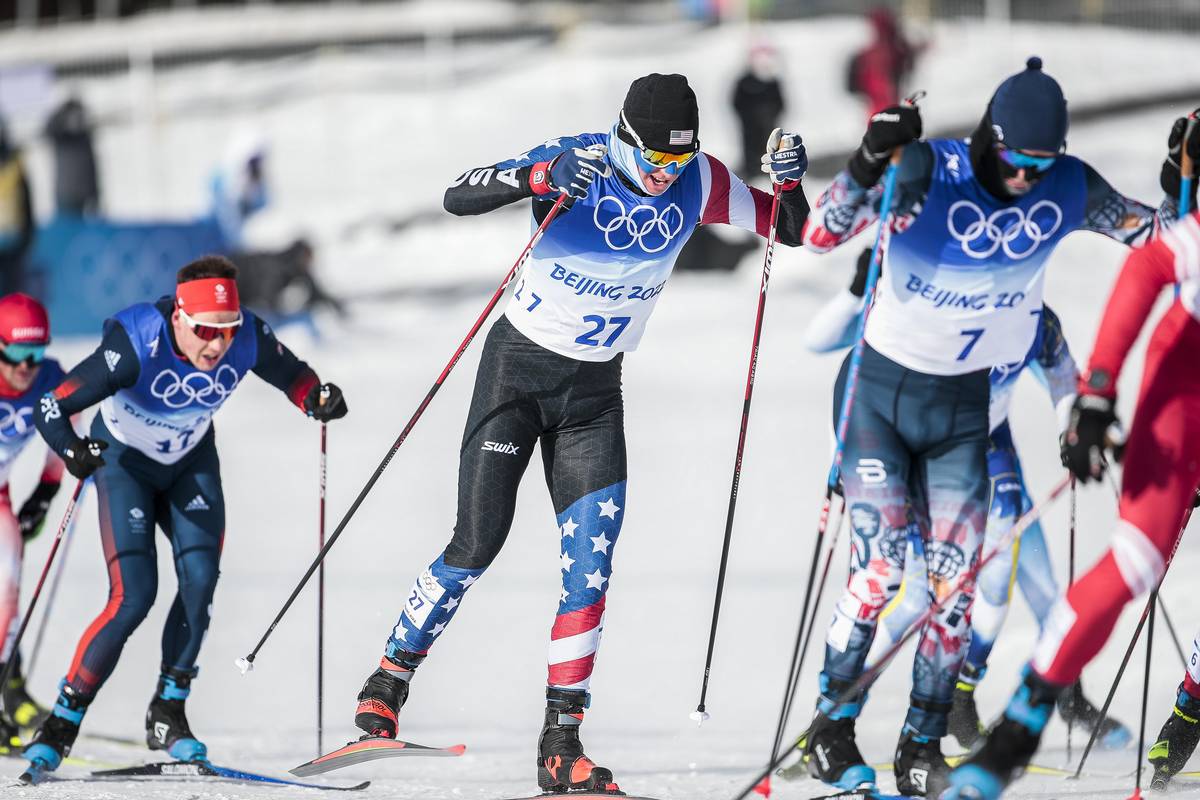
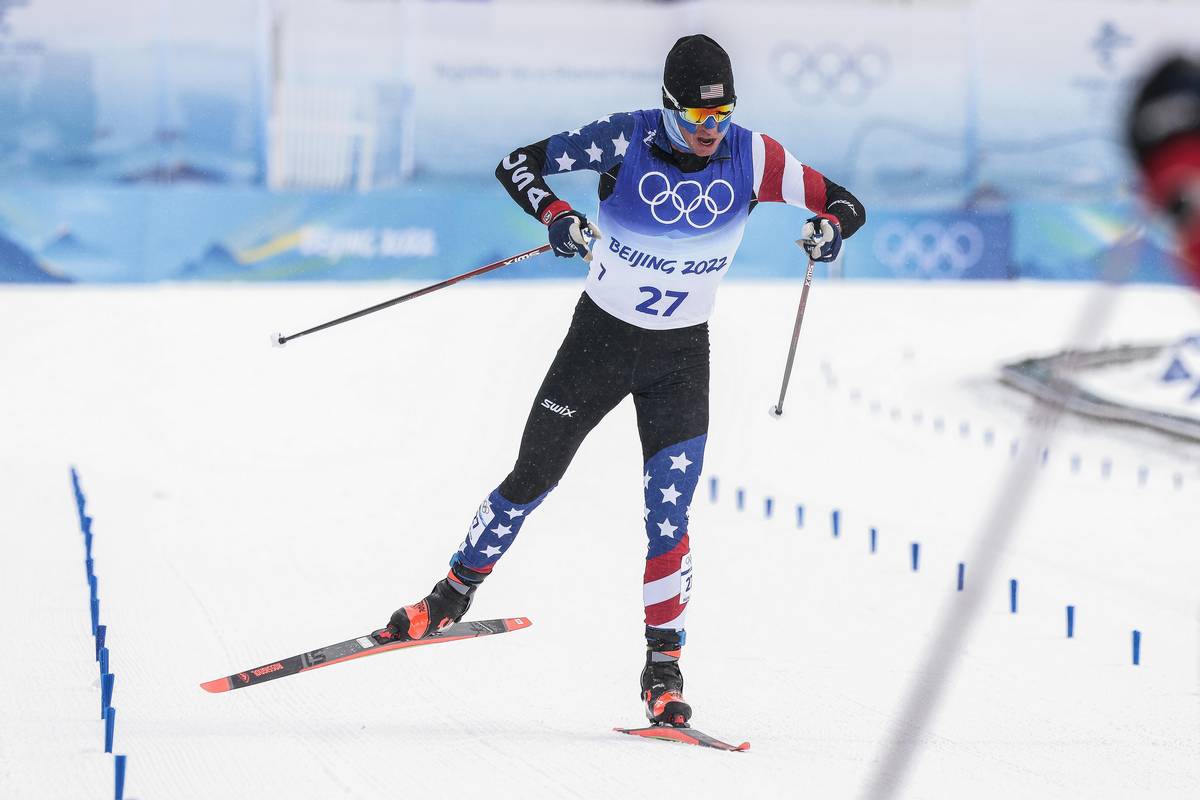
But let’s get one key story to the front off the bat: The only American on the start list for the final men’s event of the 2022 Beijing Olympic Winter Games was Scott Patterson, and he skied to eighth place, just 26.9 seconds shy of a medal. It’s the second best result in American men’s cross country ski history, only surpassed by Bill Koch’s silver medal in 1976. That’s the best result in almost 50 years.
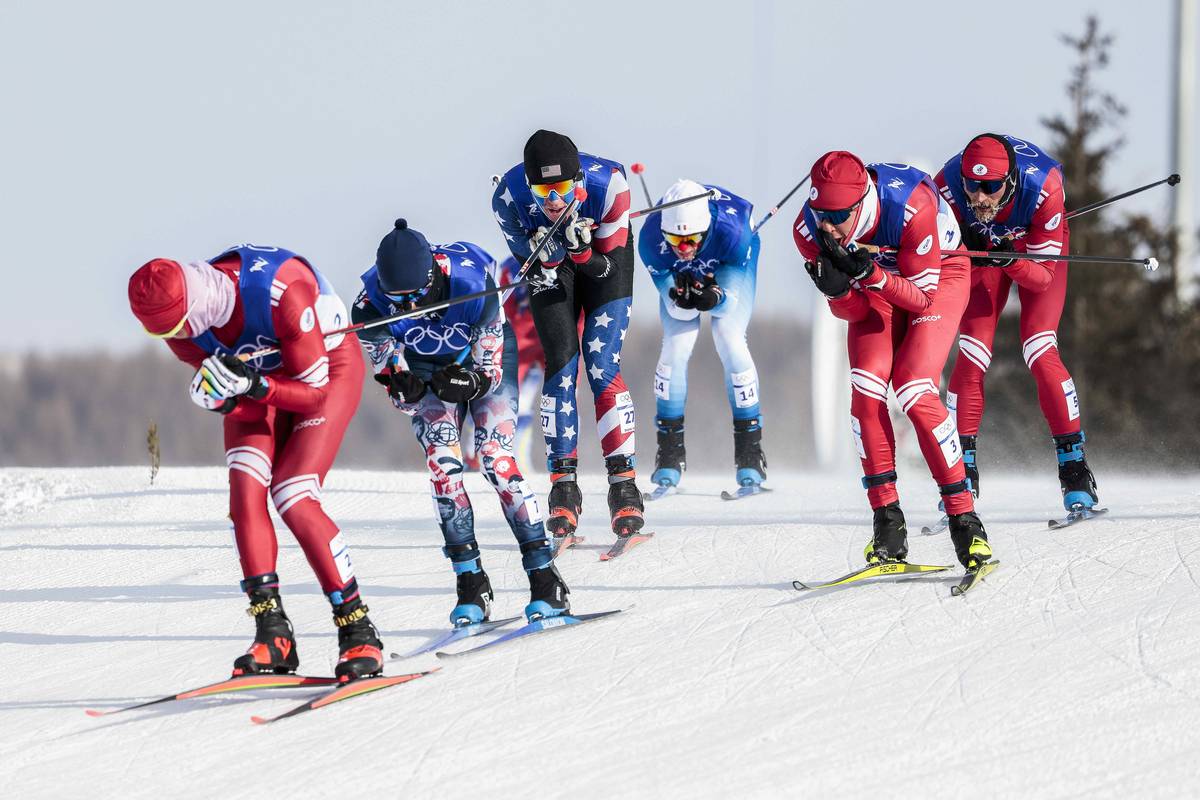
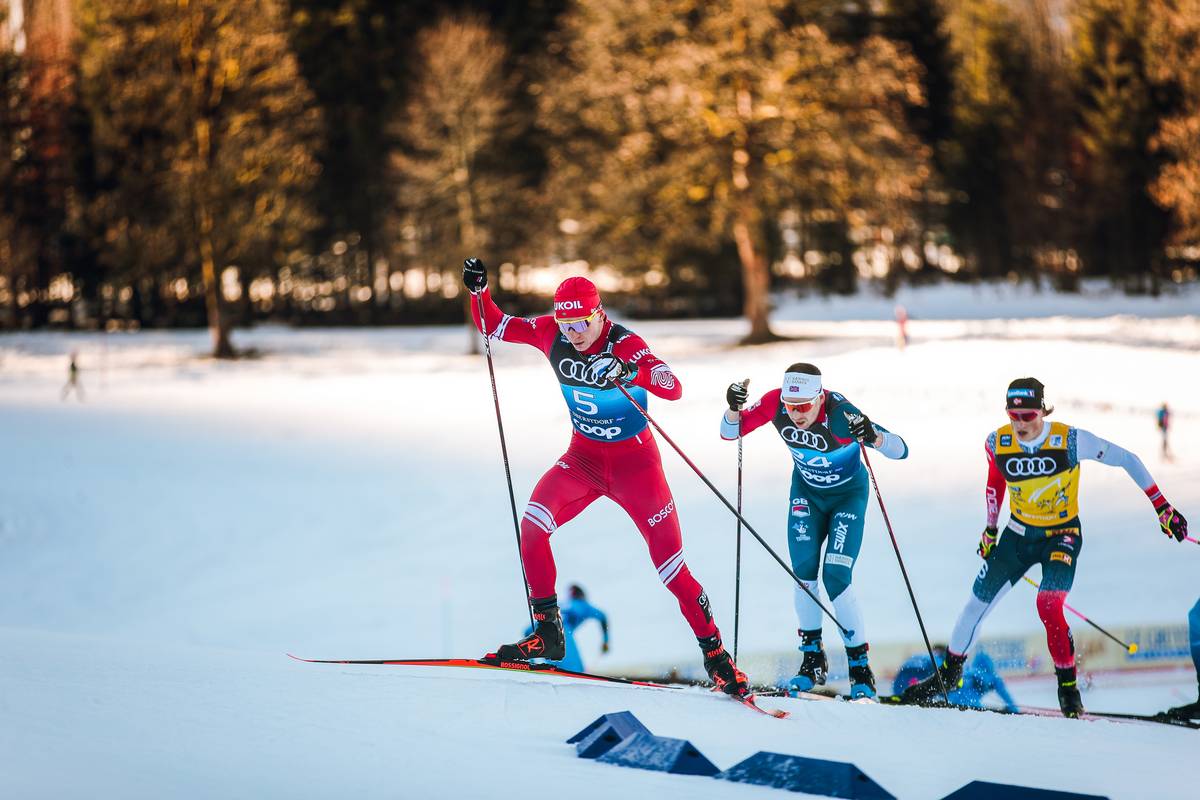
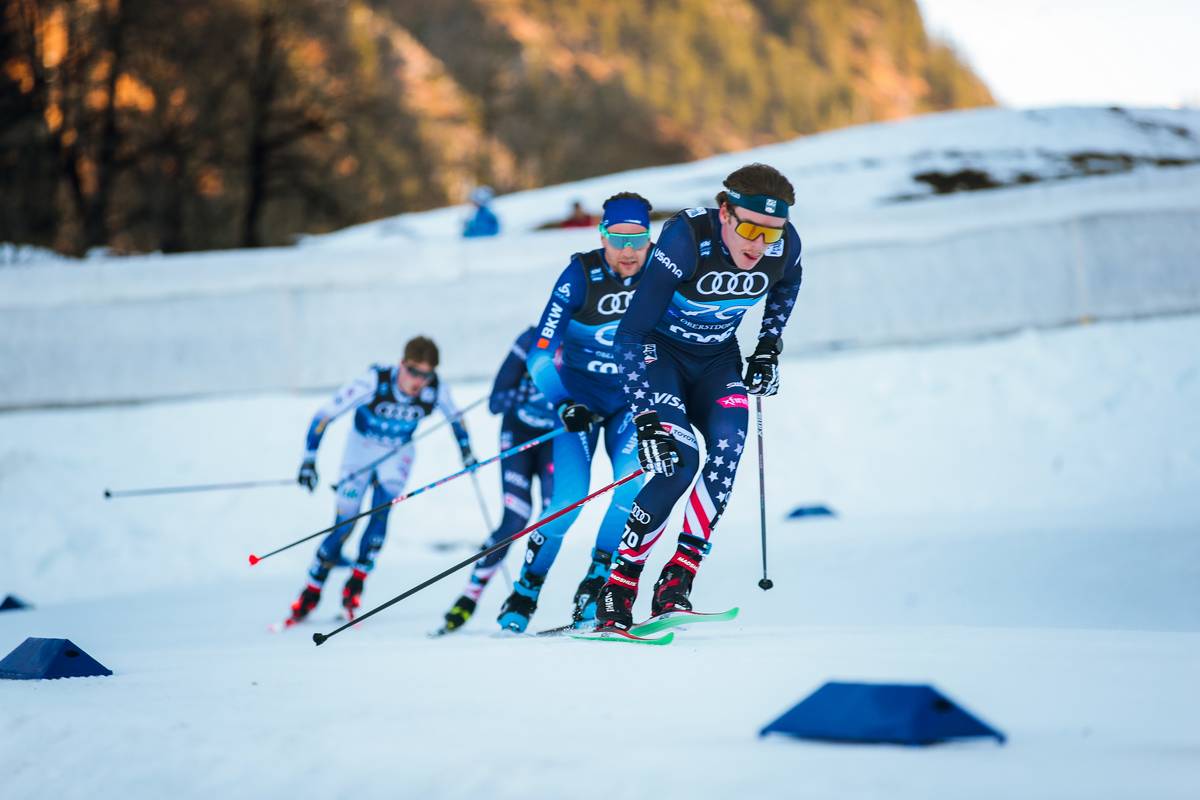
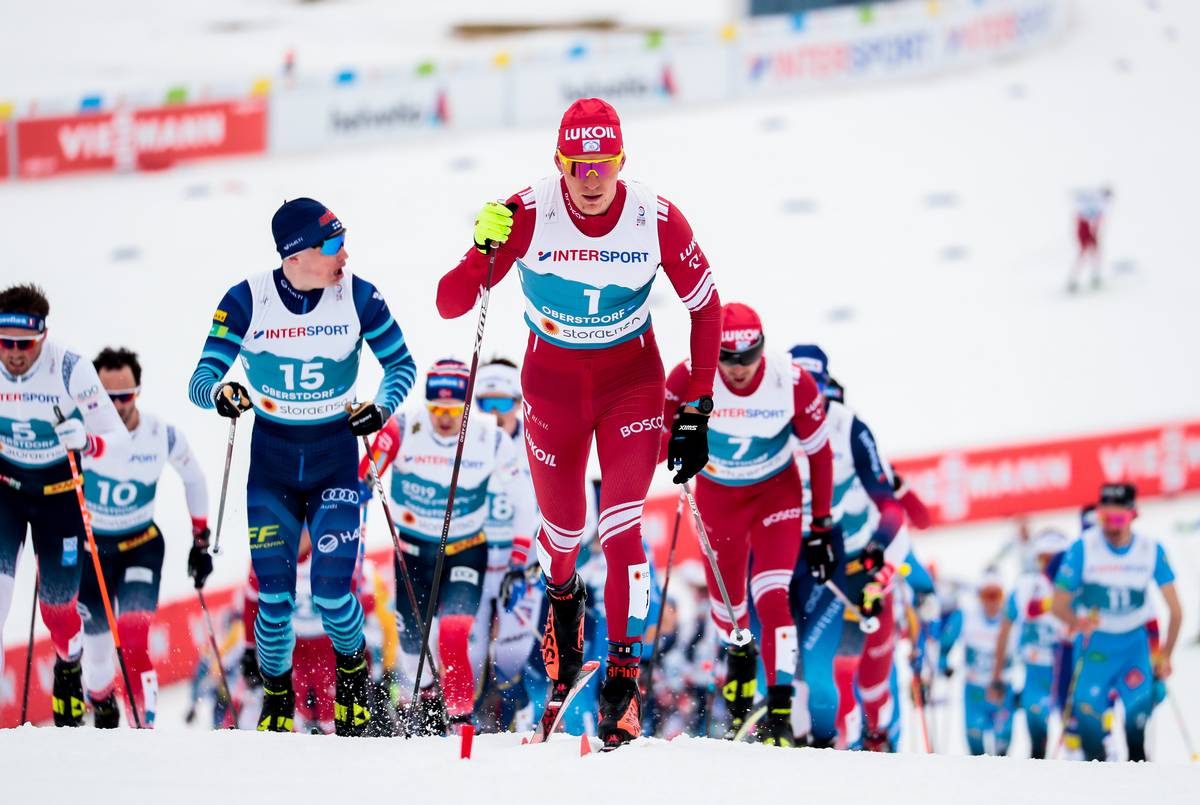
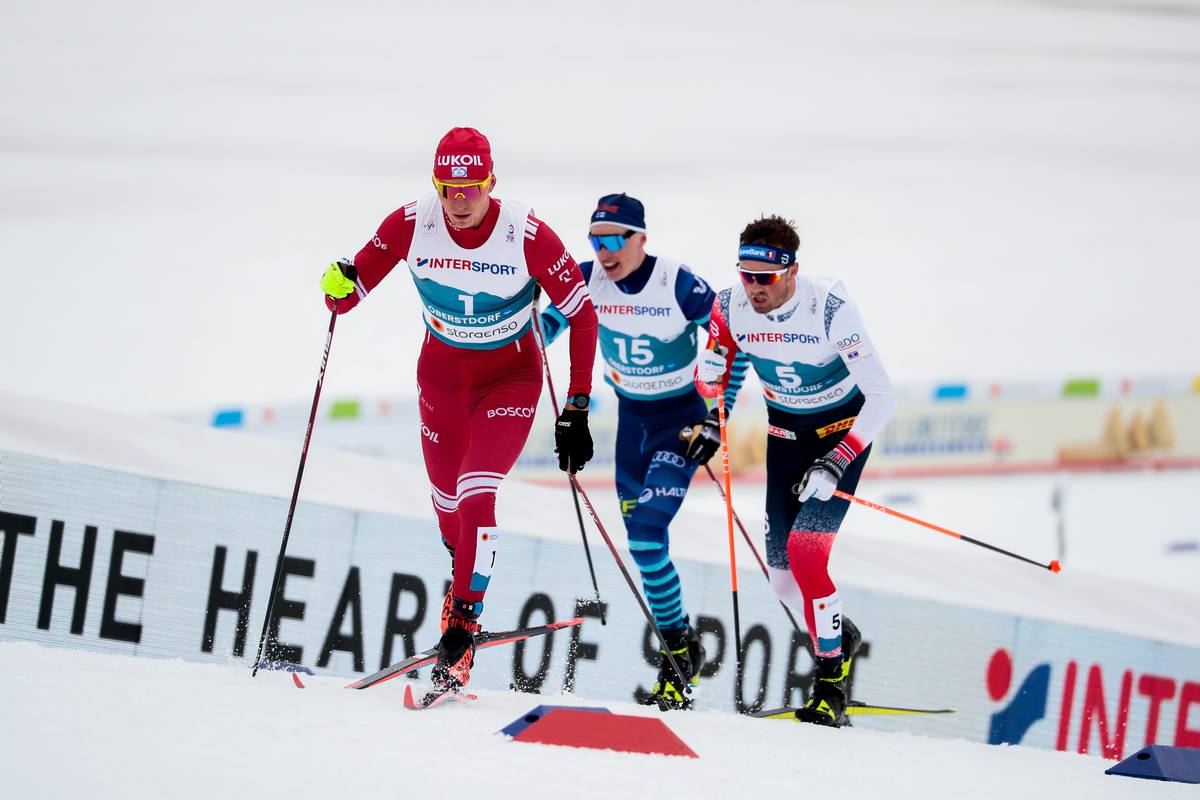
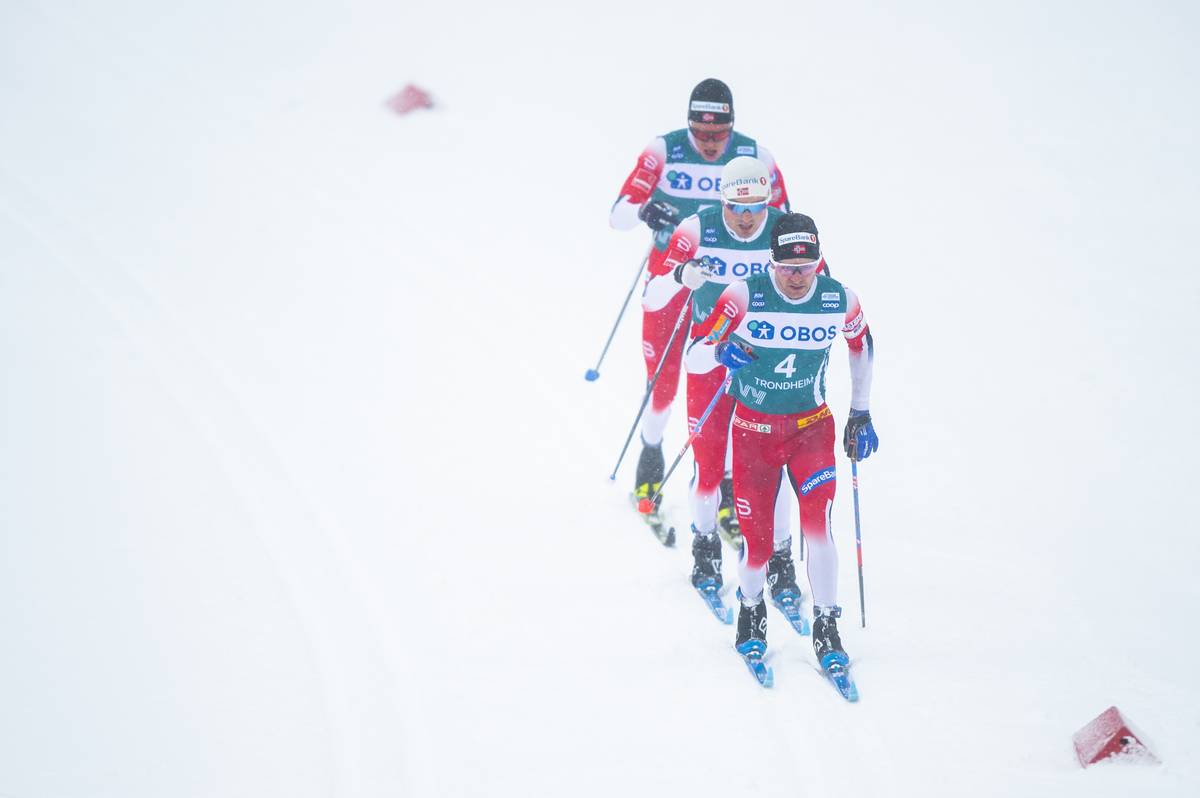
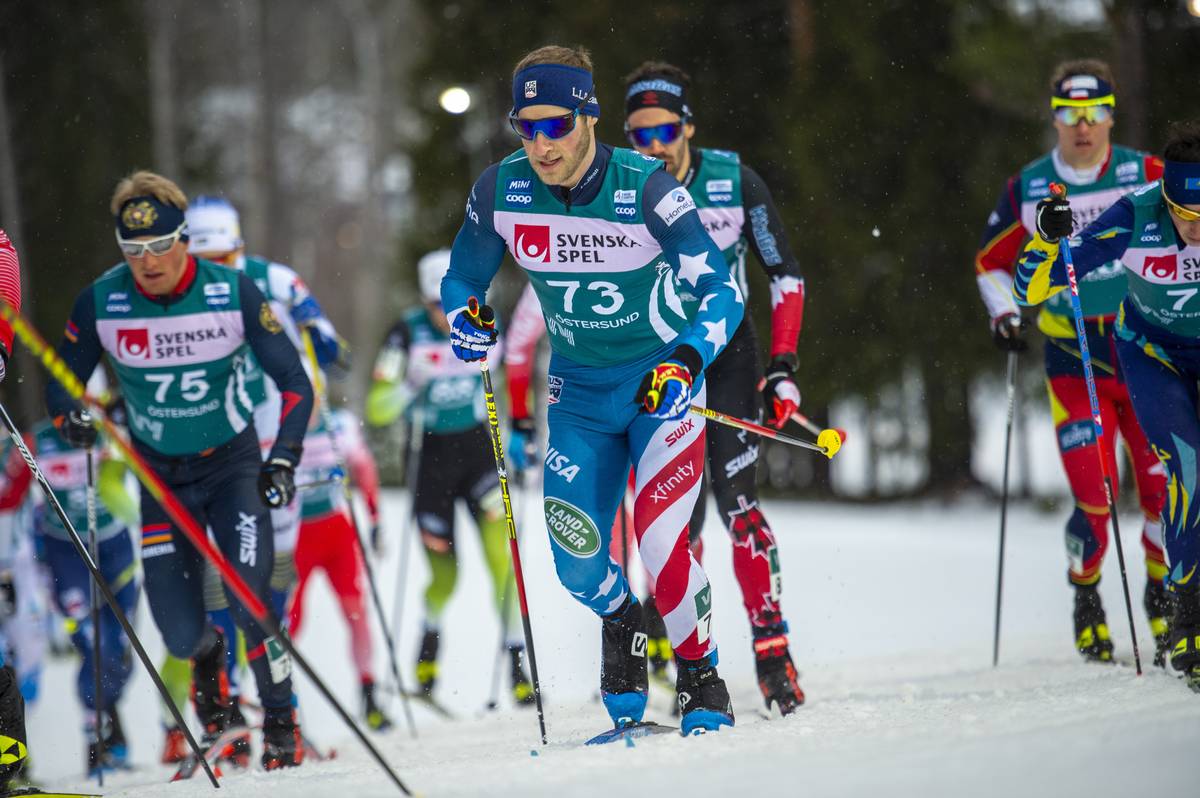
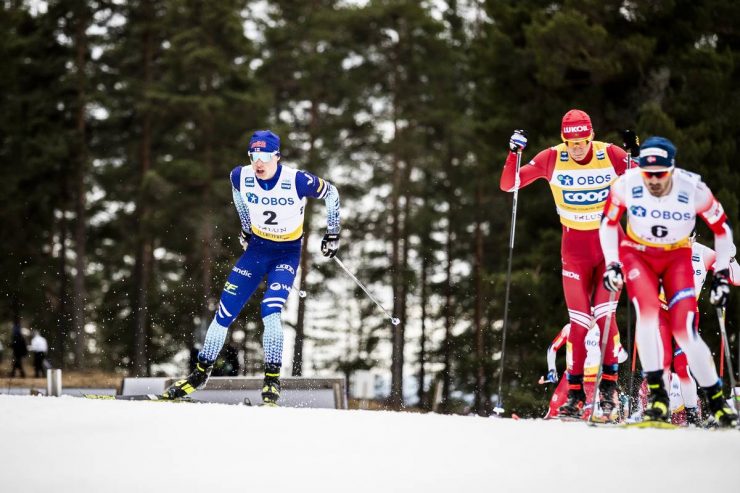
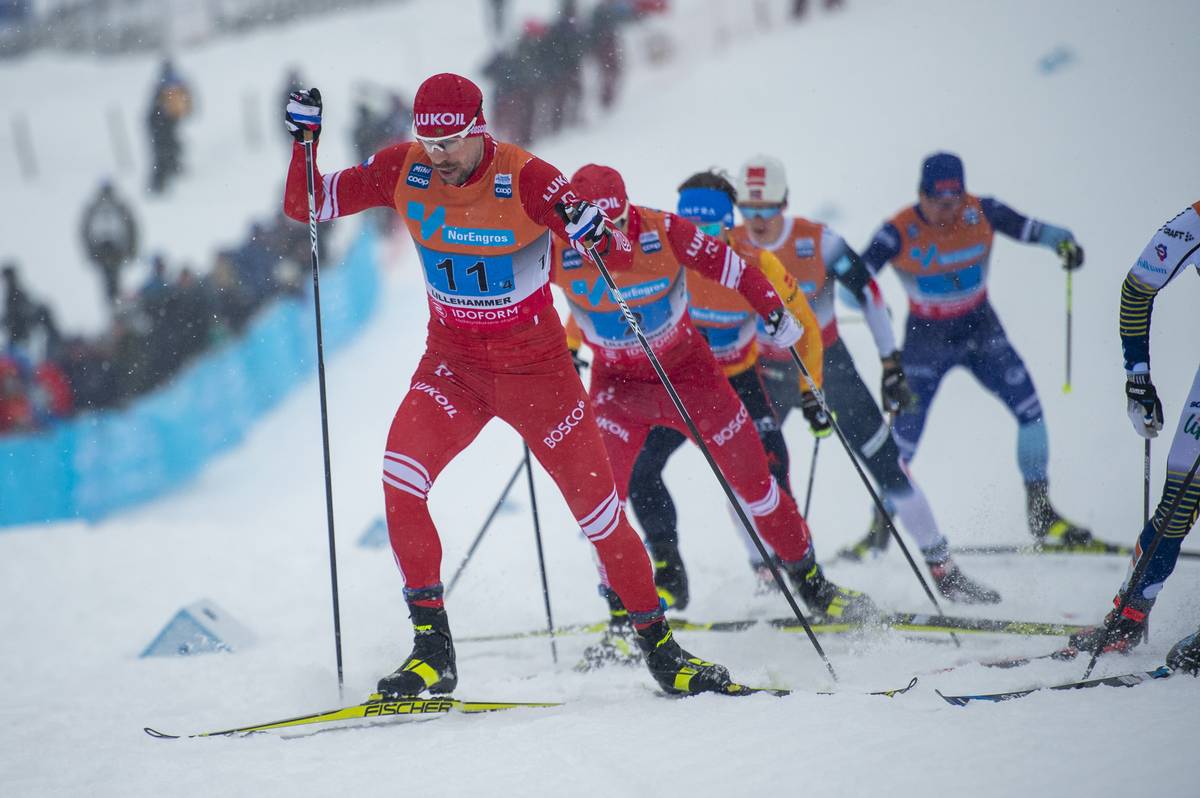
Scott Patterson tucks into the lead group, on the tails of Alexander Bolshunov (ROC) and Sjur Røthe (NOR). (Photo: NordicFocus)
Let’s rewind.
The news of the change in time and distance arrived just hours before the start of the race, with the following message from the organizers: “Due to strong winds and the resulting extreme conditions on course, the distance of the originally planned 50km will be shortened to 30km. The decision was taken in regards to the athletes safety, to reduce the time of exposure of athletes in extreme conditions.”
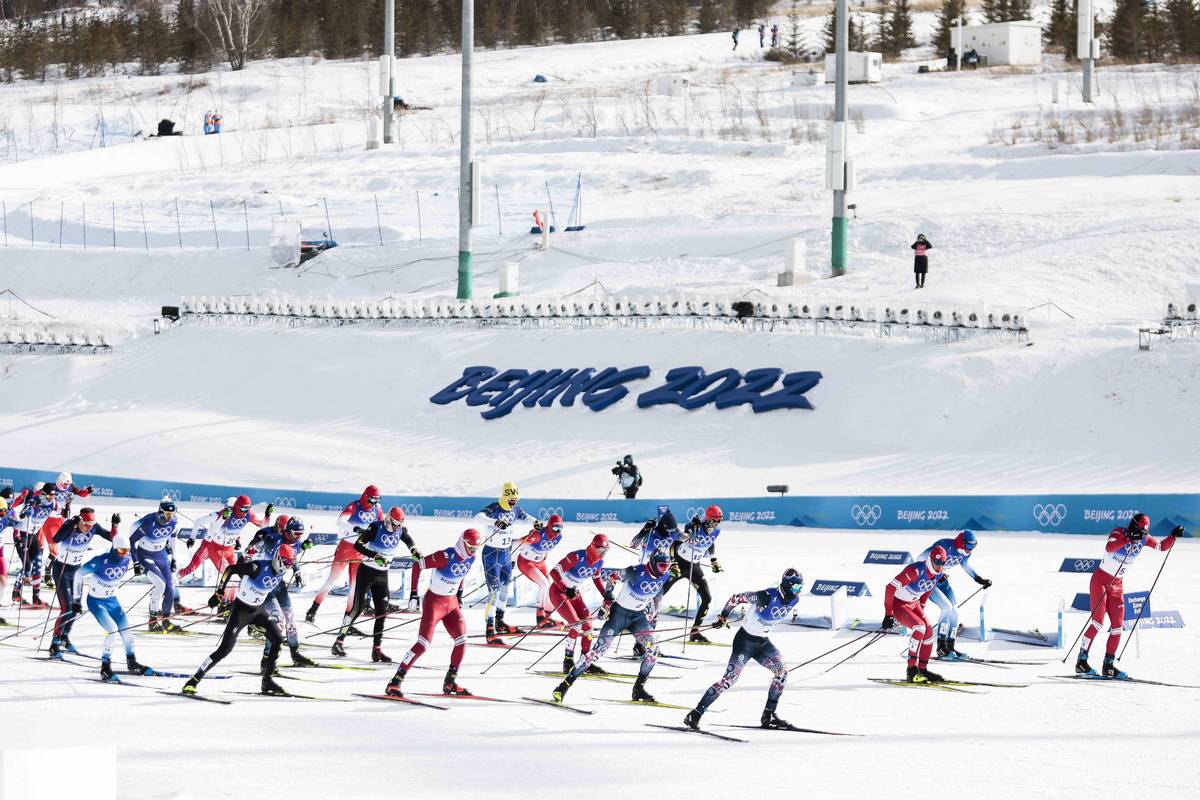
While there were various opinions on this change, which we’ve covered separately, there’s no getting around the fact that the race distance was slashed nearly in half. Nonetheless, as the lead group moved in and out of the wind, finding shelter on the leeward side of hills and under the protection of treed sections, the four lap course skied like a long-distance event.
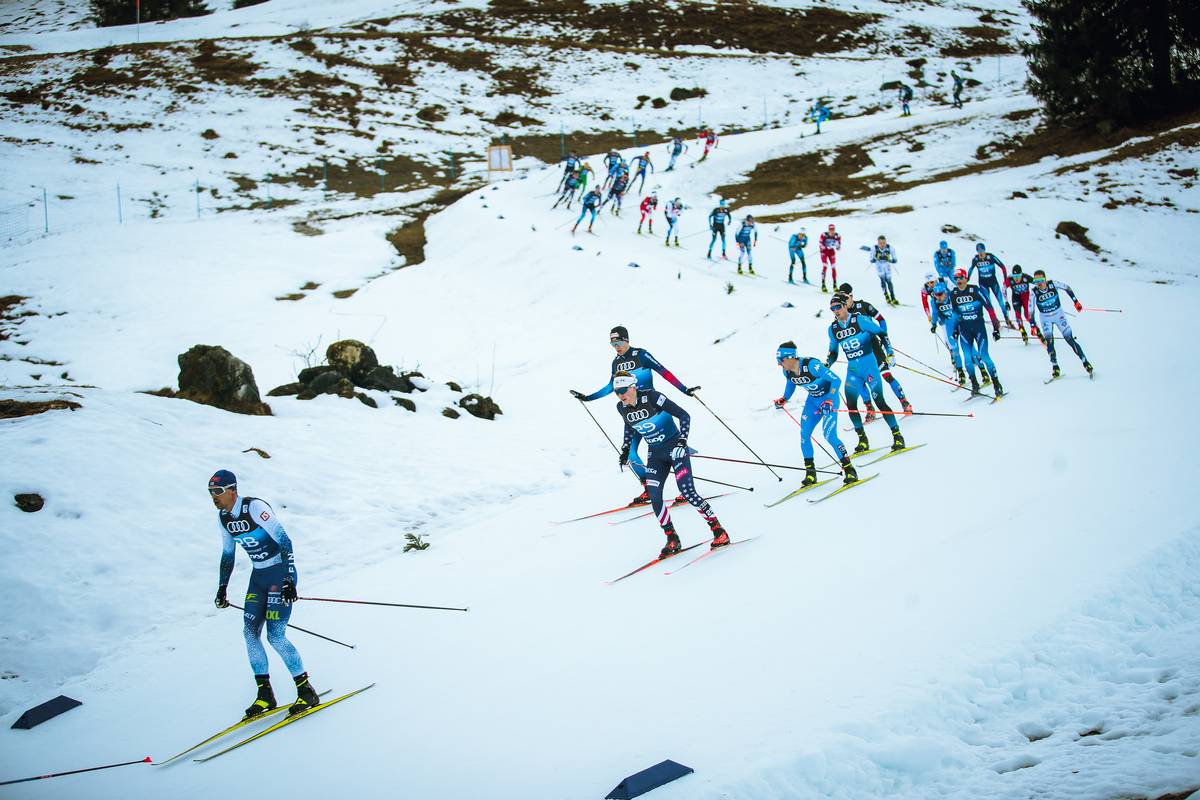
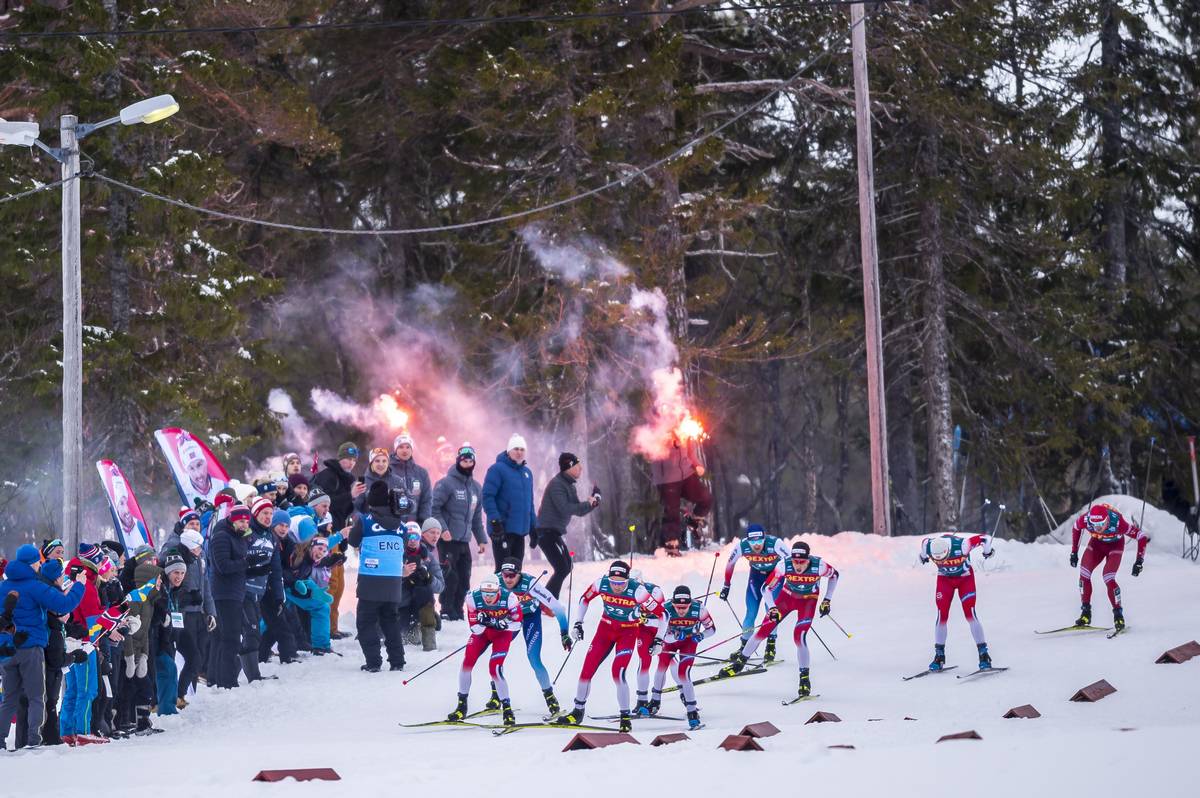
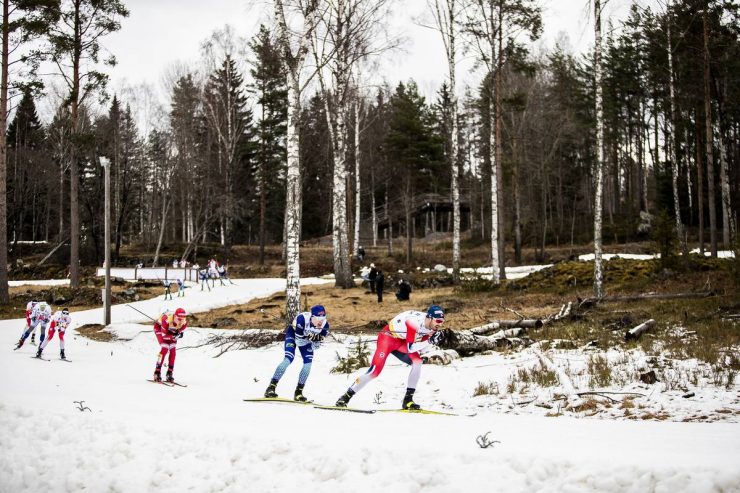
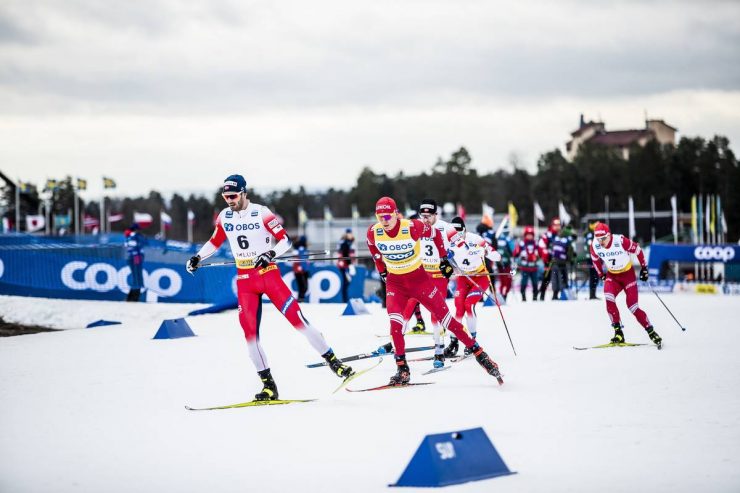
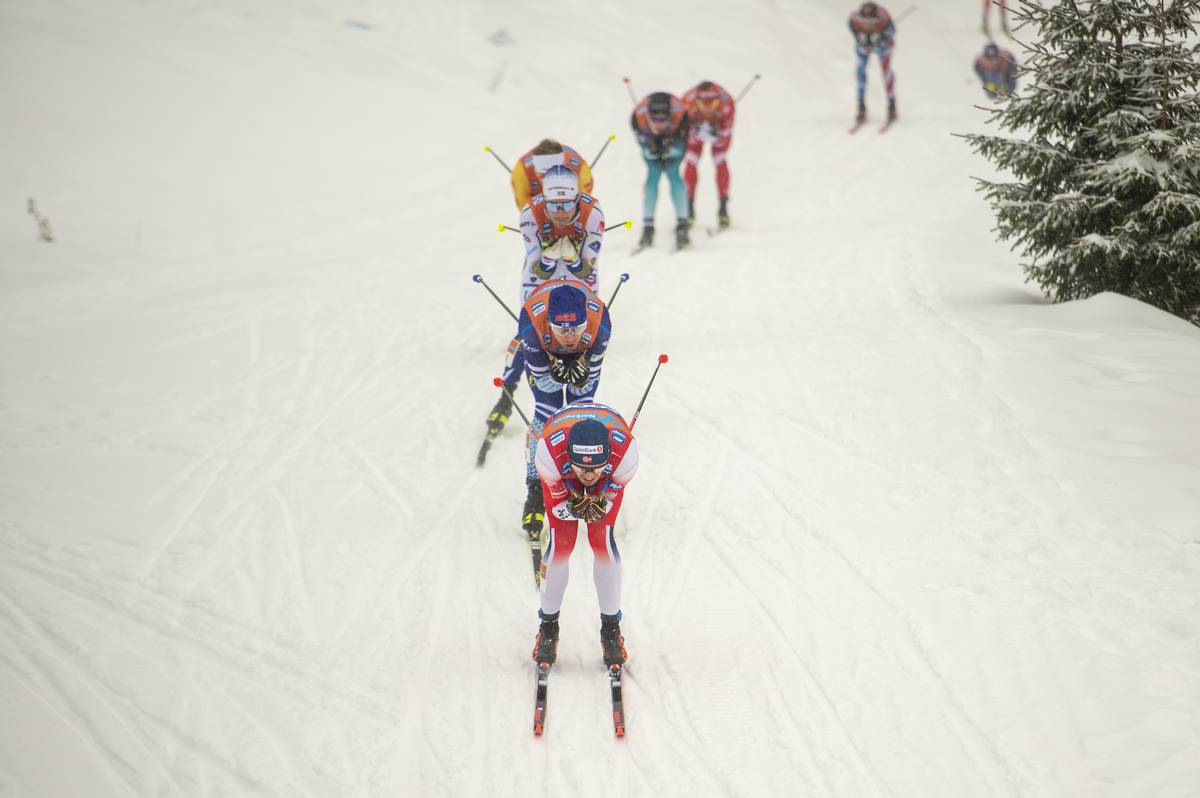
Shortened due to extreme weather, the men’s 28 k mass start freestyle is underway in Zhangjiakou. (Photo: NordicFocus)
At the end of the first lap, the top-30 were separated by less than five seconds, thinning to a 13-man pack by the end of the second lap, and a group of 10 by the end of the third, with an 11 second gap to the first chase group.
Perhaps the only truly noteworthy moment at this point in the race was the departure of Norway’s Johannes Høsflot Klæbo, who won gold in both sprint events – the individual freestyle and the classic team sprint – while also collecting a silver medal in the men’s relay and bronze in the 15 k classic. Klæbo later reported that he was struggling with a stomach illness and had spent more of the night prior to the race in the bathroom than he had been sleeping.
“I thought I would’ve regretted it if I didn’t give it a try but now I’m standing here and it didn’t work out on the whole,” Klæbo told the media.
He said it was “sad” pulling out of the race, but will focus on leaving the Games with his best Olympic distance results.
“I’ll definitely bring with me what’s been positive. What makes it feel more annoying is that my shape has felt better and better and I’ve actually felt that I’ve had a good energy today too. Then the stomach started to speak up and then it got very far to make it to the finish line.”
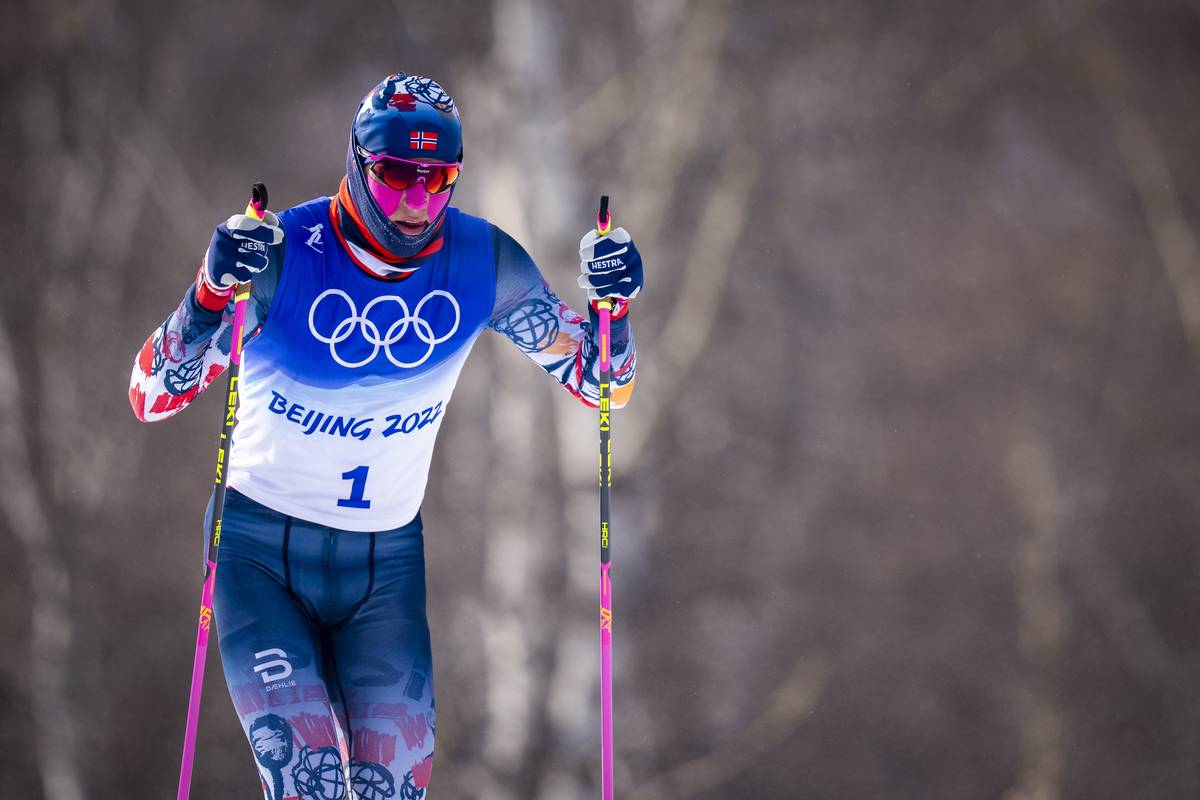
Johannes Høsflot Klæbo (NOR) dropped out of the 28 k mass start free after his third lap. (Photo: NordicFocus)
The race for medals truly began in the final lap. With Bolshunov and Krüger each surging to thin the lead group, Sweden’s William Poromaa and France’s Maurice Magnificat began to fall off the back. Patterson was tucked into seventh, working with Clement Parisse (FRA) and Denis Spitsov (ROC) to maintain contact and respond to the accelerations of the front.
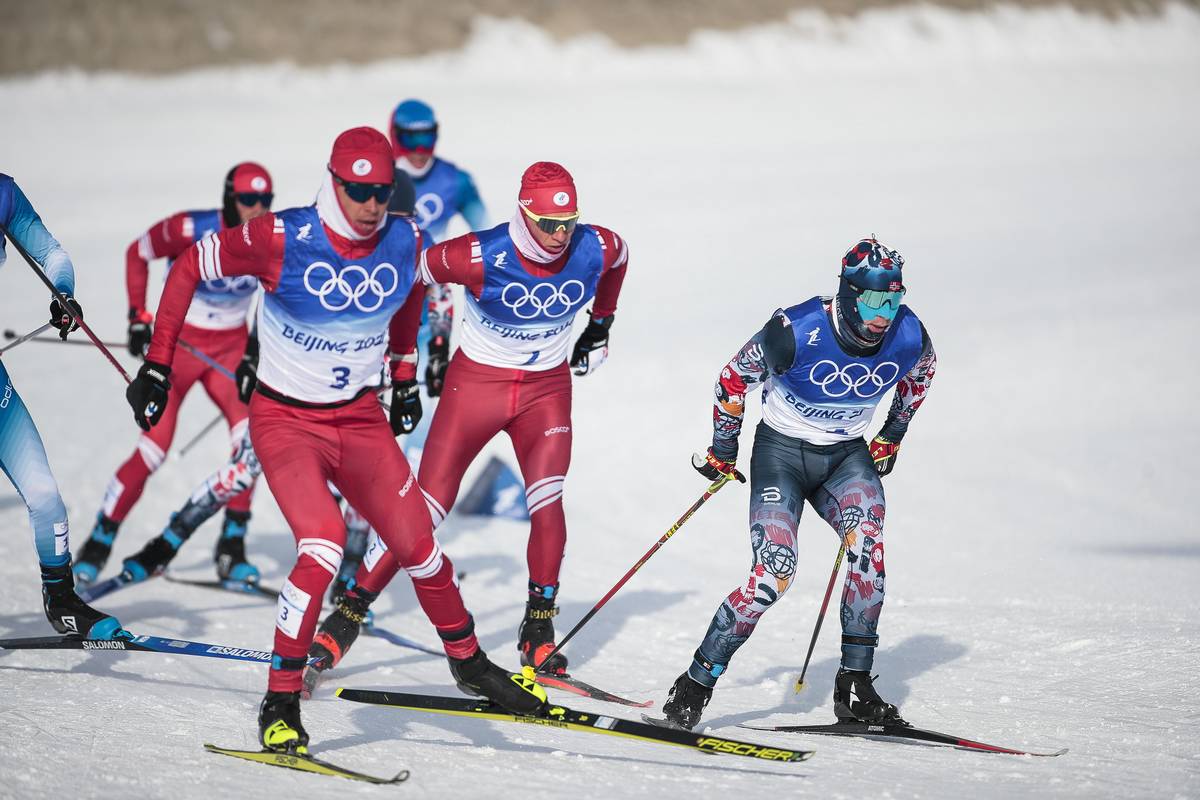
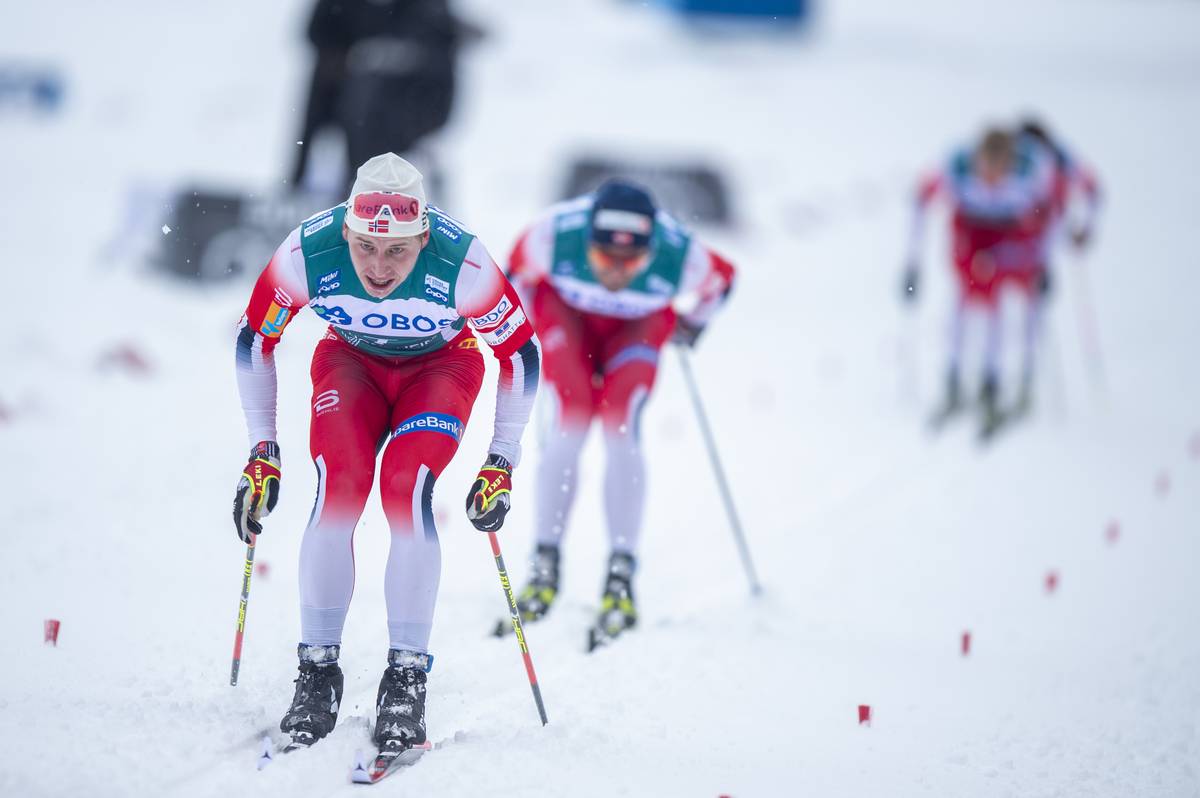
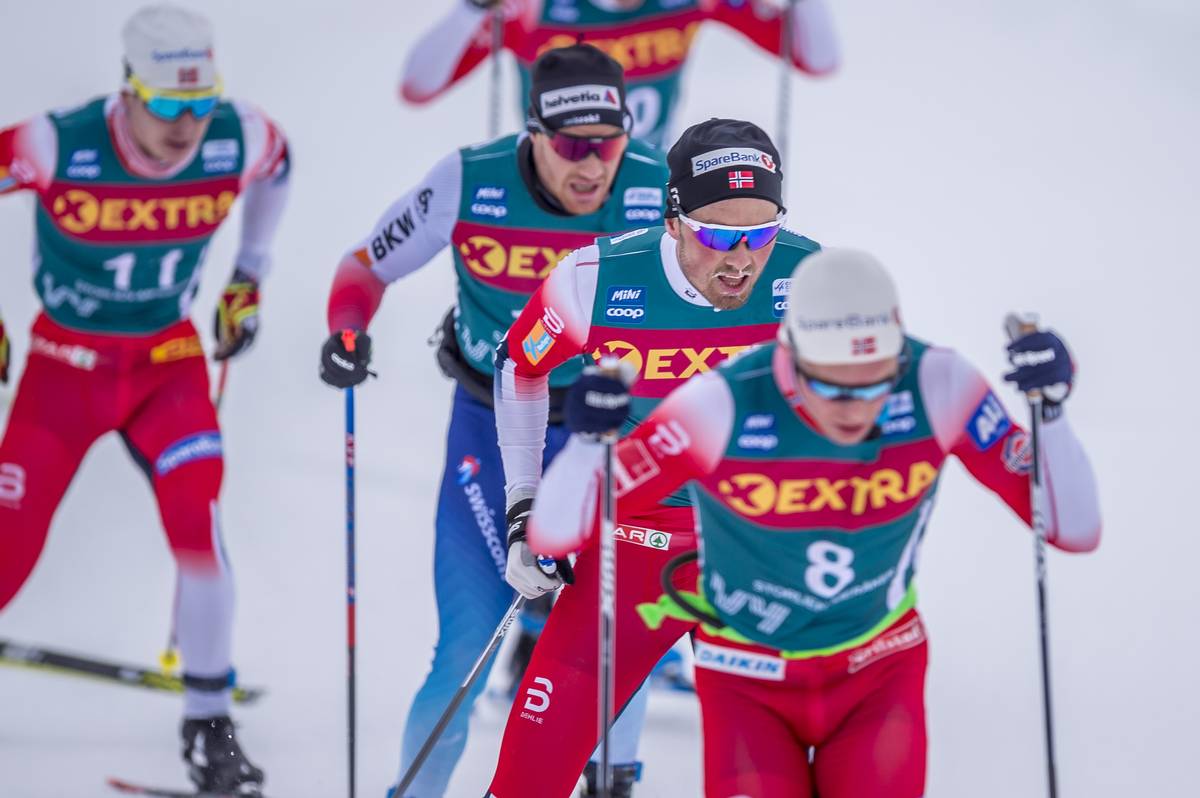
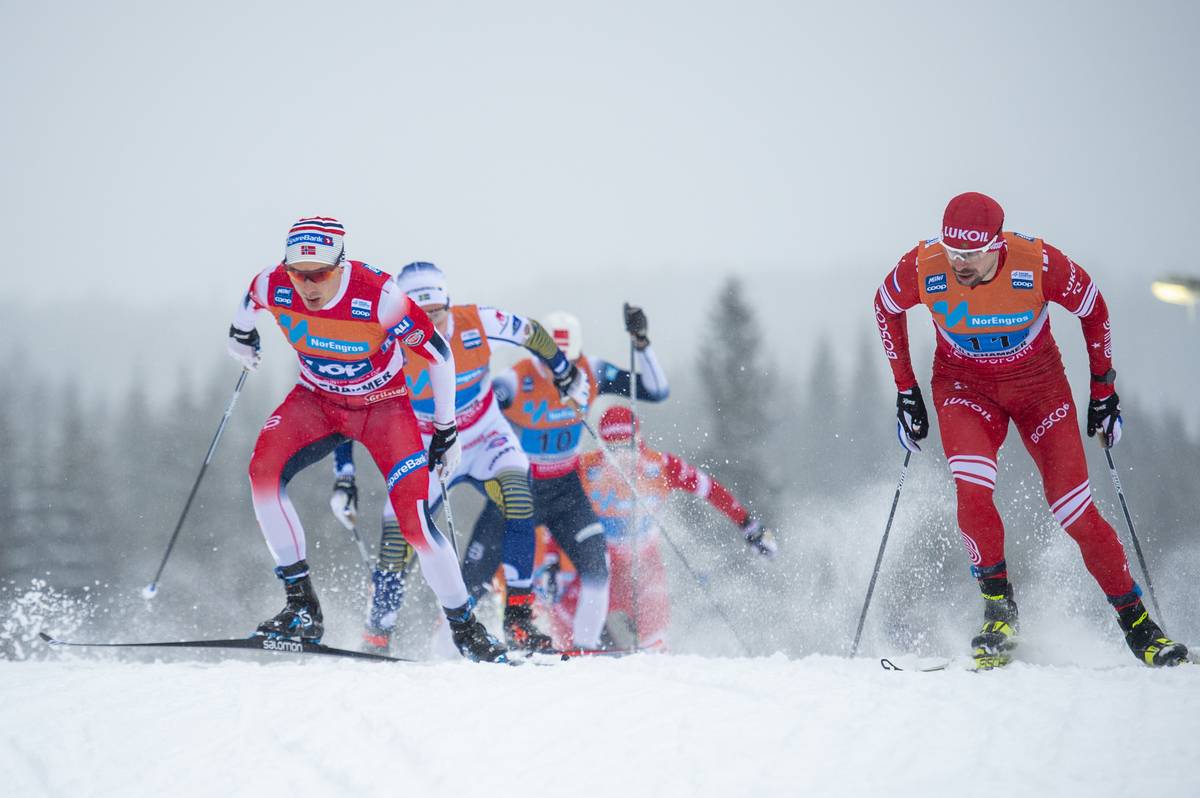
Simen Hegstad Krüger (NOR) leads the men’s 28 k freestyle alongside the ROC’s Ivan Yakimushkin (bib 3). (Photo: NordicFocus)
Over the final 5 k, Bolsunov kept the pressure on, looking relaxed as he tried to create space between himself and Krüger, who had been tucked onto his tails, matching him push for push. With them was Yakimushkin, the three skating in tandem as the finish line drew nearer.
At 24 k, the leaders had only a few seconds on Patterson’s chase group, but when they hit the 27.2 k checkpoint, the gap had drastically expanded. Artem Maltsev (ROC) and Røthe were still just a few seconds back, but Patterson, Parisse, and Spitsov were now over 20 seconds behind, with a 20 second cushion ahead of the next chasers.
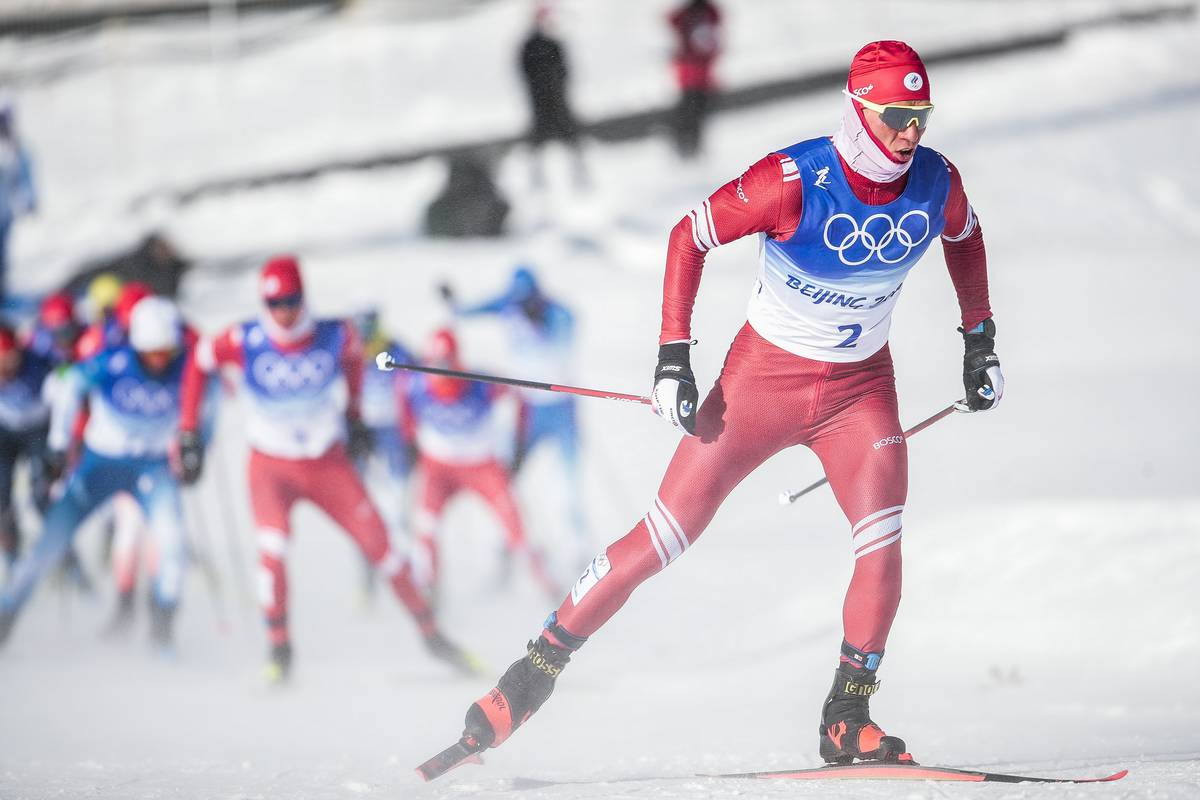
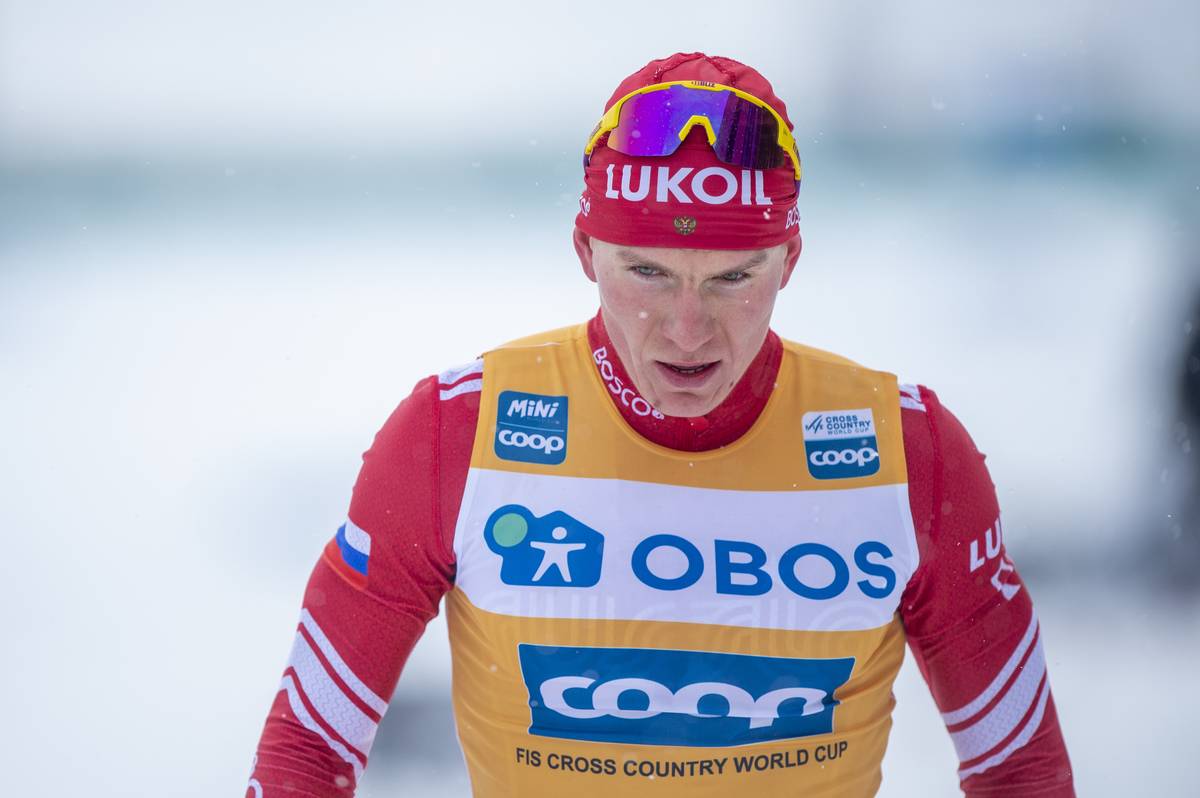
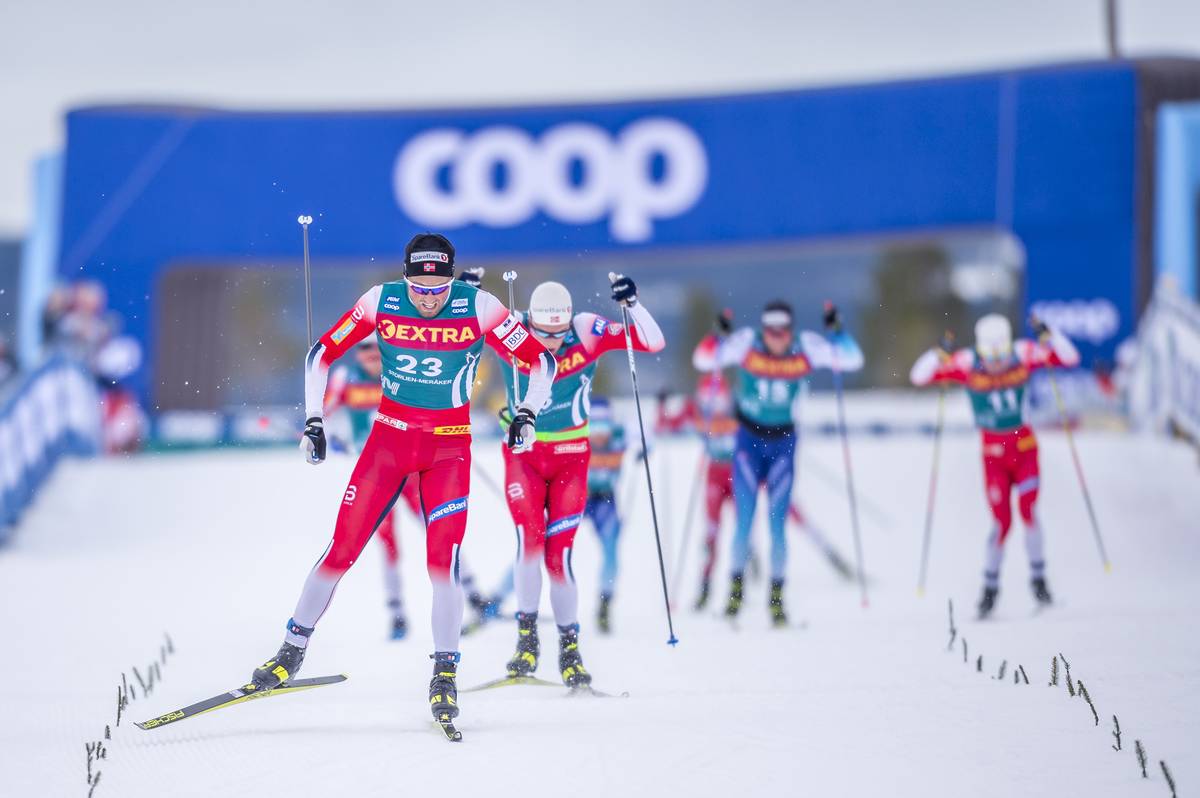
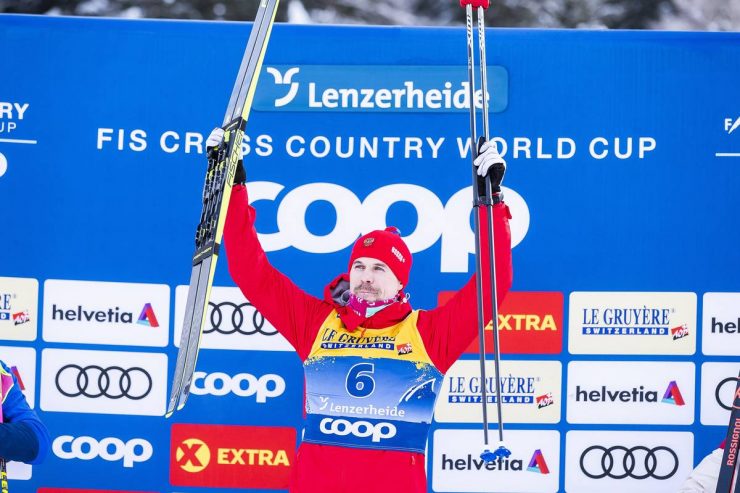
Alexander Bolshunov (ROC) races to his third gold medal of the 2022 Olympic Winter Games during the men’s 28 k freestyle. (Photo: NordicFocus)Norway’s Simen Hegstad Krüger leads the charge during the men’s 28 k mass start freestyle. (Photo: NordicFocus)
Up the final long climb, Krüger would not yield, holding his ground immediately behind Bolshunov. Tucked low into the downhill, the three stayed together, with Bolshunov upping the tempo and power as they accelerated out of the curves and over the gentle rises that interrupted the sweeping descent.
As the three hit the final rise into the stadium, Bolshunov began to break away, with Yakimushkin using Krüger’s draft to slingshot into second with 500 meters to go.
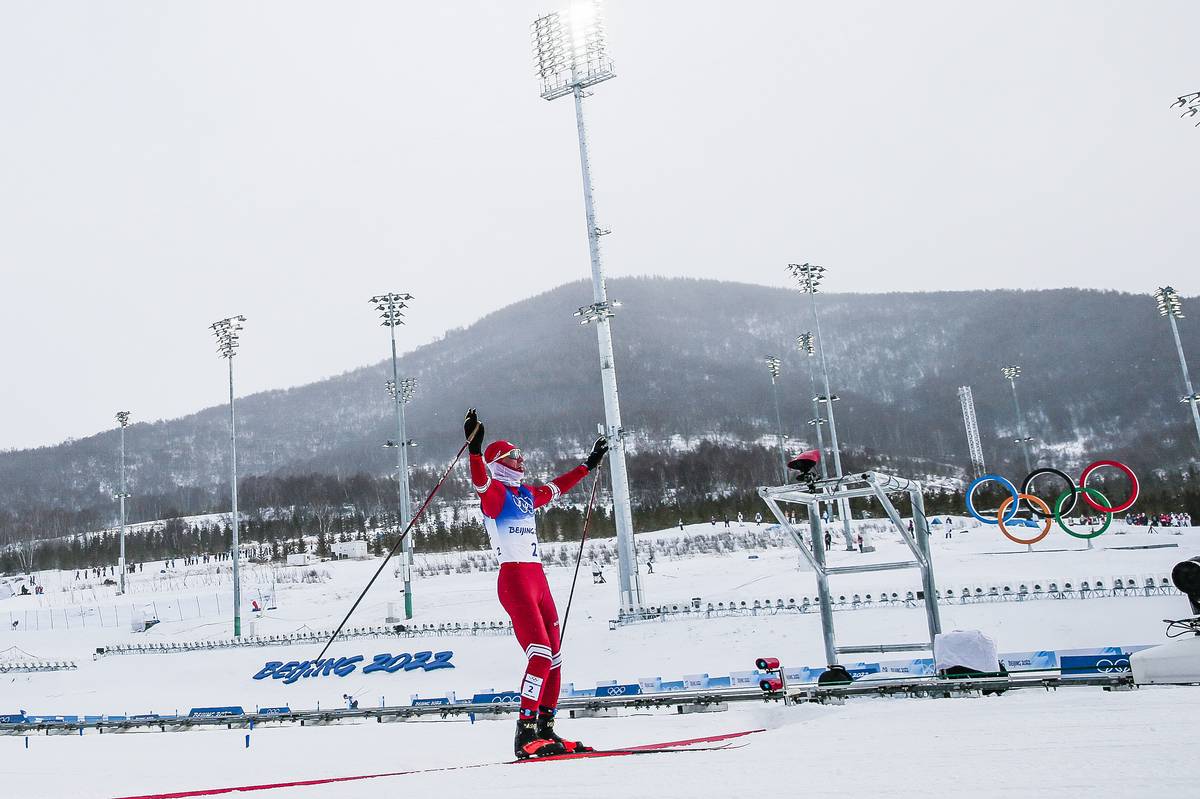
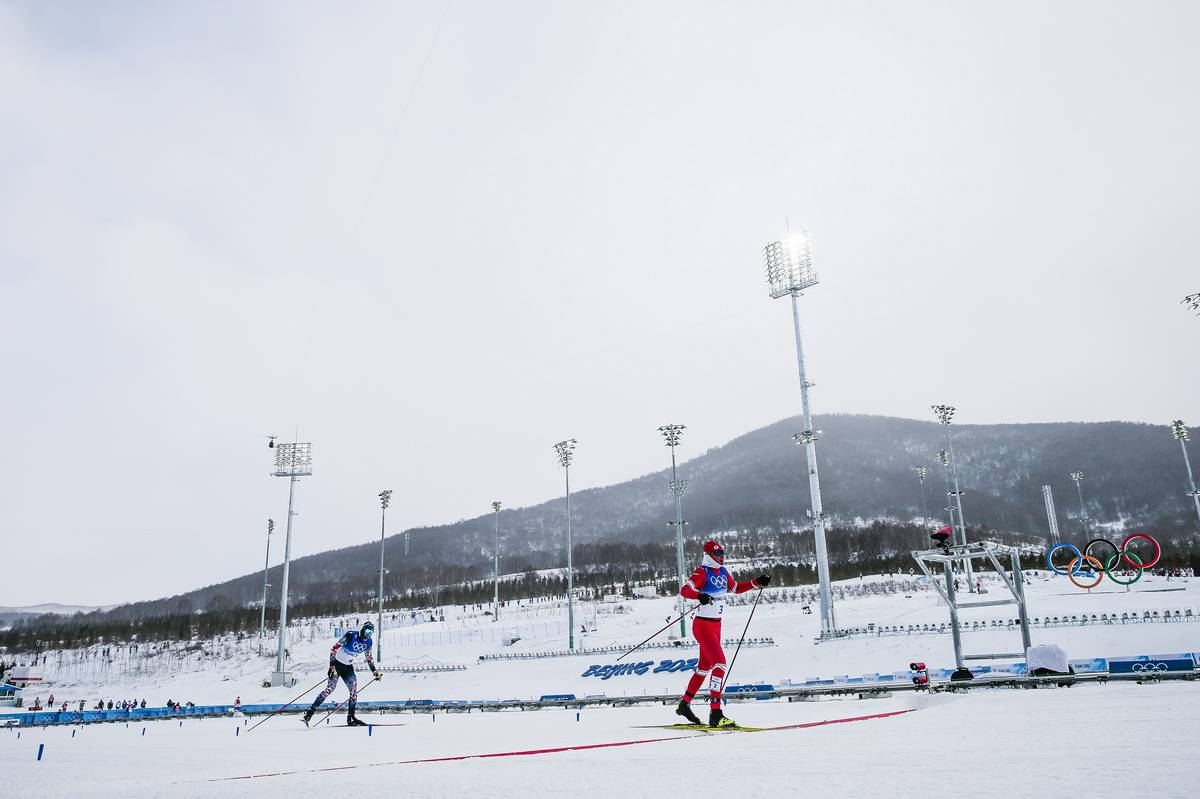
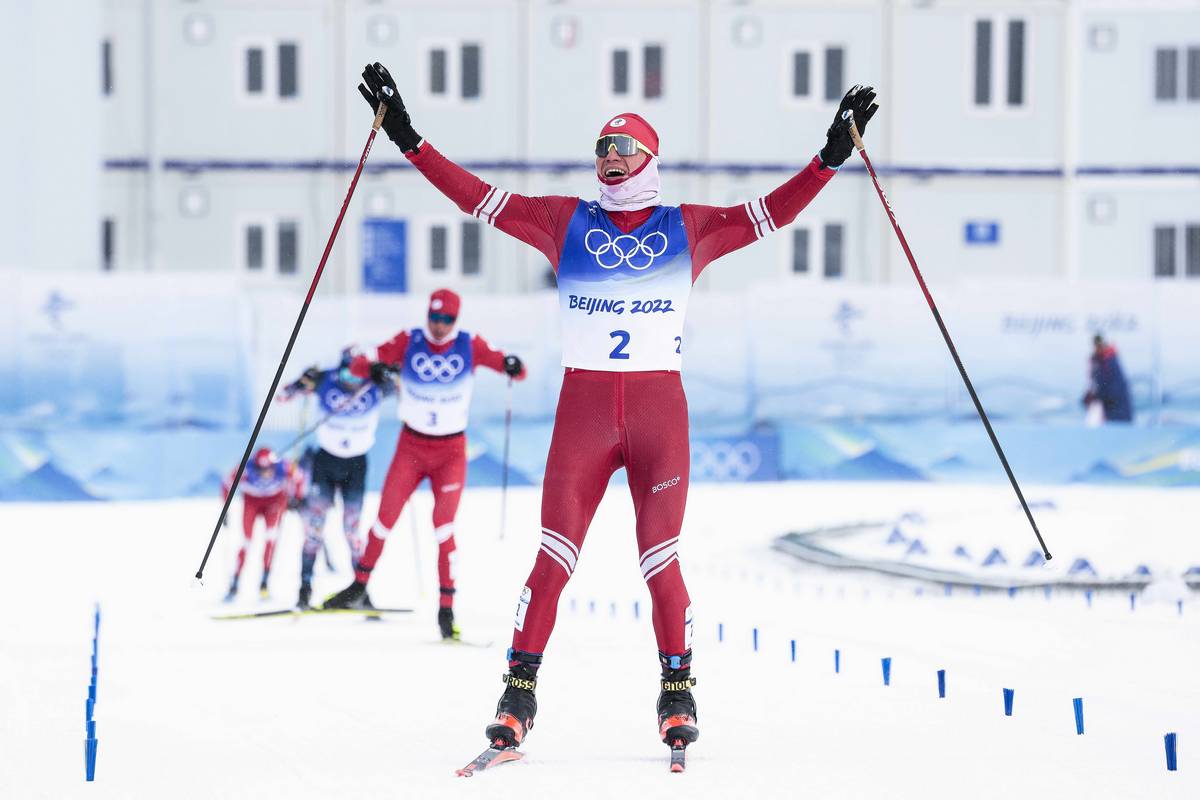
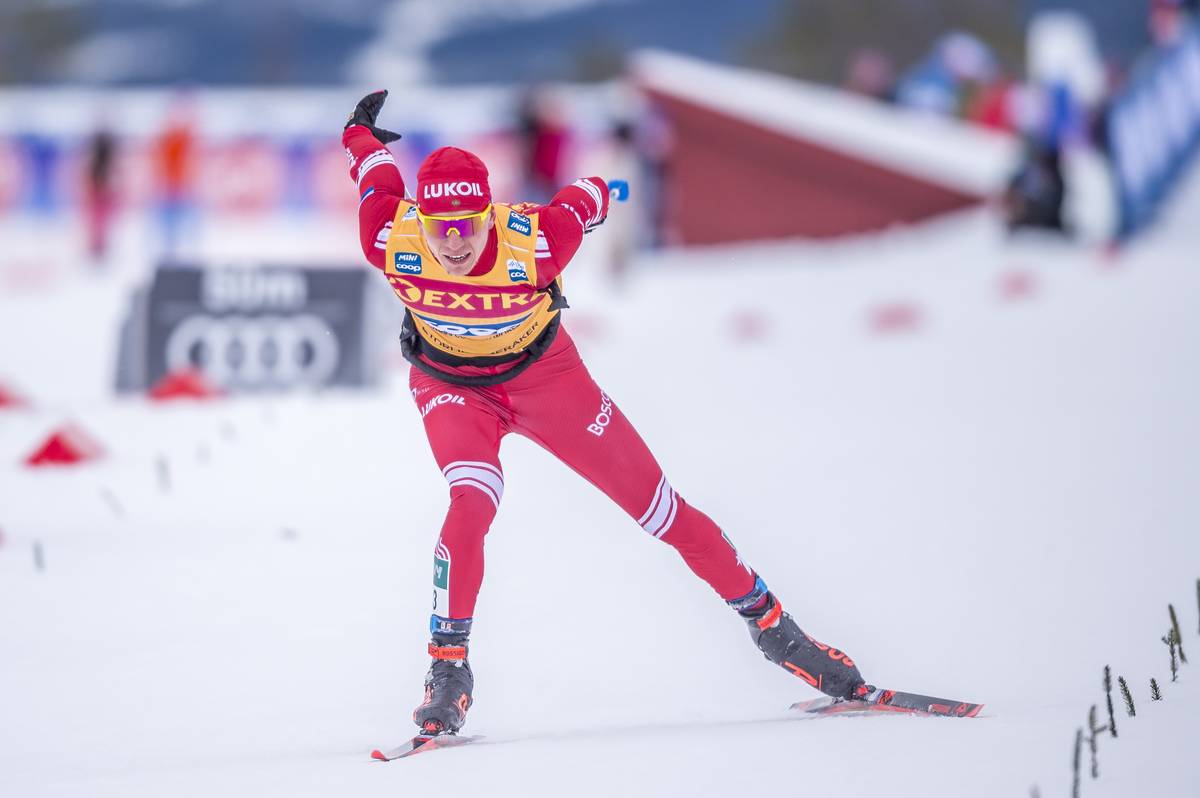
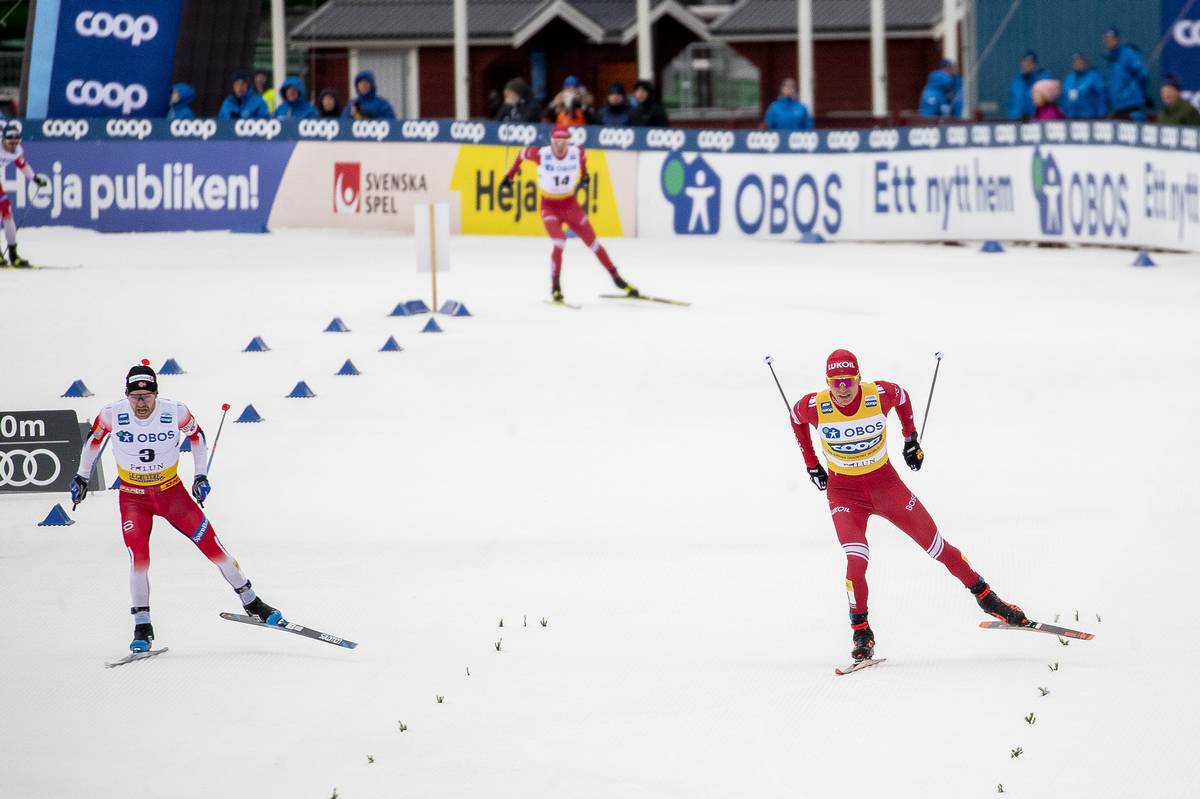
Entering the stadium, the gold medal looked to be predetermined. With a fist pump as he made his way around the final bend into the finish lanes, Bolshunov V2ed powerfully down the home stretch, crossing the line with his hands raised in 1:11:32.7.
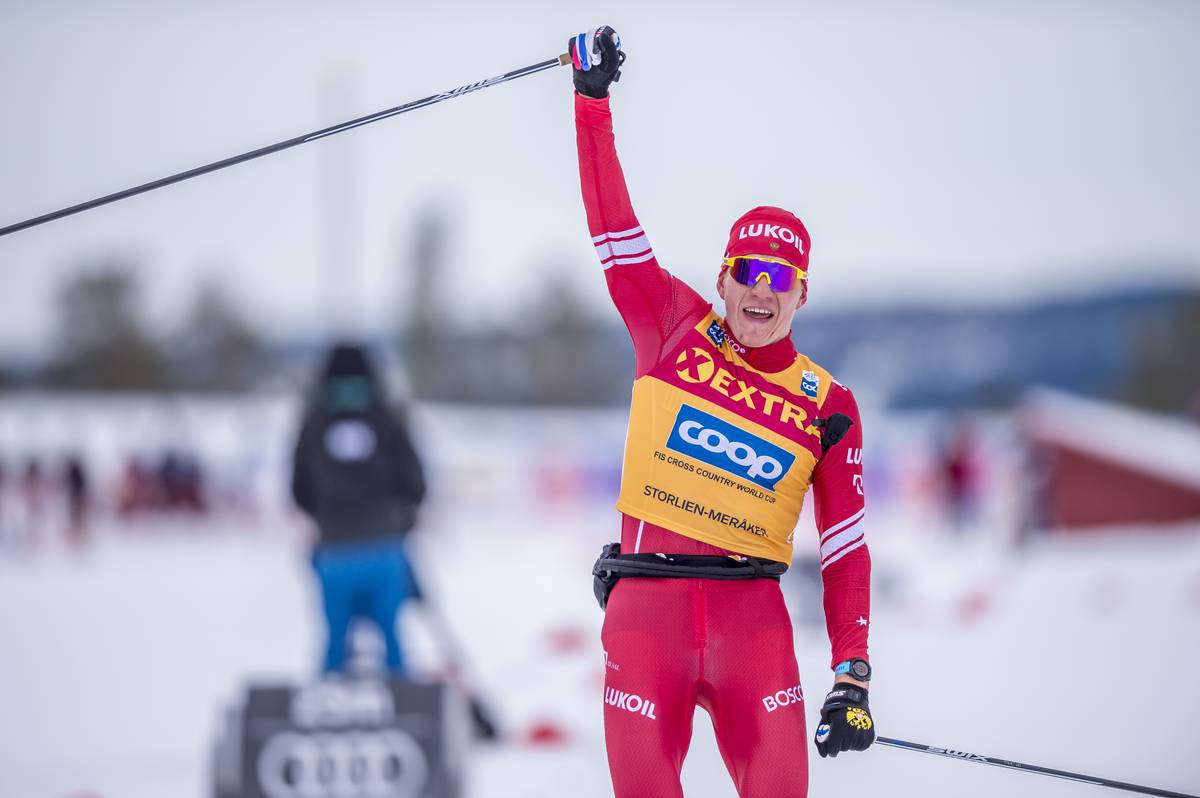
Alexander Bolshunov (ROC) celebrates his win in the 28 k mass start freestyle. (Photo: NordicFocus)Ivan Yakimushkin (ROC) takes silver in the men’s 28 k free, while Simen Hegstad Krüger finishes third for Norway. (Photo: NordicFocus)
Holding his advantage through a final sprint to decide silver and bronze, Yakimushkin crossed the line second (+5.5) with Krüger taking third (+7.0) for Norway.
Behind, Maltsev came to the line fourth (+10.7), followed by Røthe in fifth (+15.8).
Spitsov led the now-spread chase group to the line, taking sixth (+26.2) ahead of Parisse in seventh (+28.8) and Patterson eighth (+33.9).
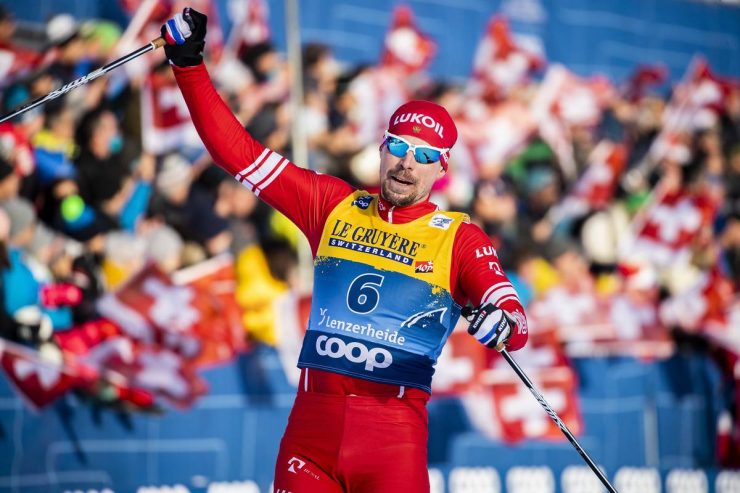
Alexander Bolshunov (ROC) wins his third gold medal of the 2022 Games in the men’s 28 k mass start freestyle. (Photo: NordicFocus)
Nine Olympic medals. Three gold. Four silver. Two Bronze. Five from the 2022 Olympic Winter Games.
“Five? Really?” Bolshunov counted on his fingers as he exuberantly celebrated the golden ending to his Beijing Games appearance. “Five medals, three gold, it is something unbelievable because before the season I set the goal of two gold medals and now I have three. I’m just unbelievably happy. The emotions overfill me. This is above all praise to win these medals here. It’s very cool, and in every race that I took part in.”
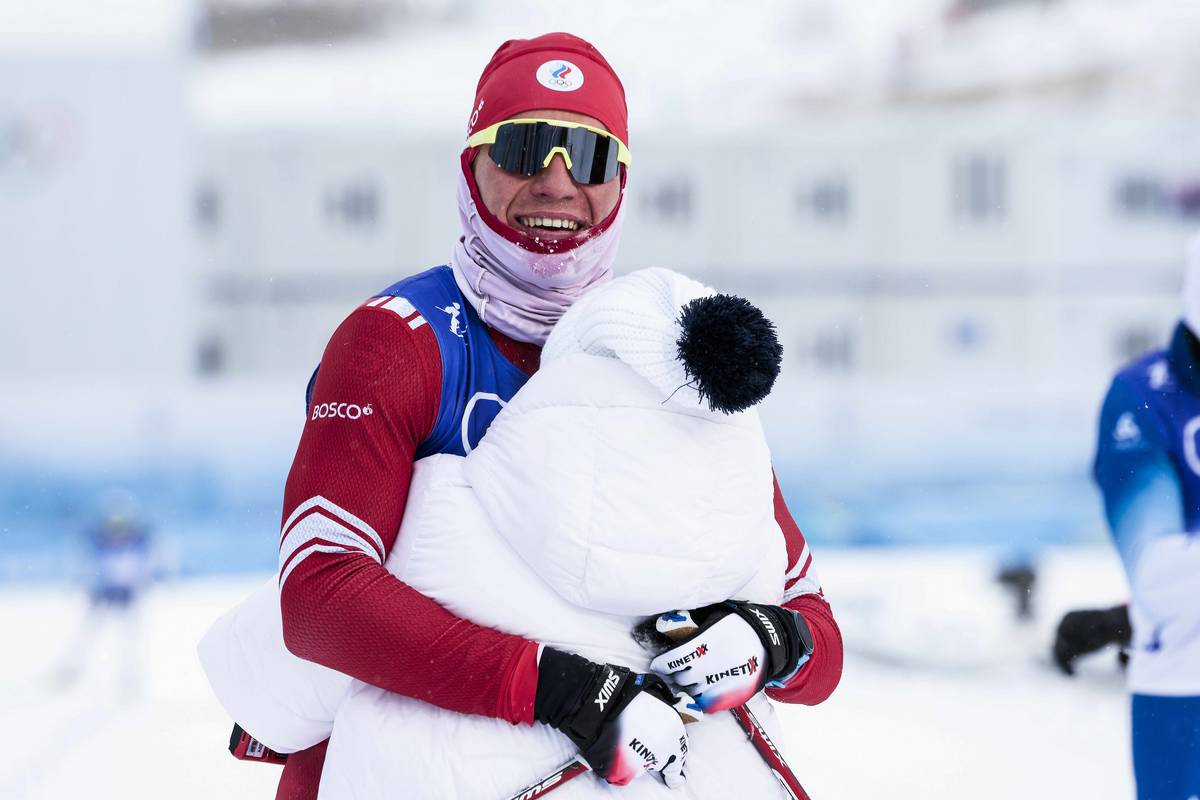
Alexander Bolshunov (ROC) receives a cozy Olympic themed gift following his win in the men’s 28 k freestyle. (Photo: NordicFocus)
Regardless of the color of the medal he earned, Krüger said his real victory was simply making it to Zhangjiakou and having the opportunity to race at the Games. Though his illness stayed mild and he stated that it did not impair him in today’s race, he had still spent 10 days in isolation in his hotel room, and remained in isolation while the opening event of the Games, the men’s 30 k skiathlon, was underway. Krüger was the defending Olympic champion in the event after taking gold in 2018. He went on to win a silver medal in the 15 k skate, and help Norway to gold in the men’s relay.
During the 2021 World Championships, Krüger earned two silver medals, first in the 30 k skiathlon and the next in the 15 k free, with a bronze in the 50 k skate. He was one of the top distance skiers on the World Cup heading into the 2022 Games, shouldering Norway’s medal hopes; the nation experienced collective heartbreak following the news of his positive COVID test in late January.
“To be able to go home with an Olympic medal, that’s a huge victory for me and an amazing feeling,” Krüger said after the race. “I’m really proud of what I have achieved today; from not thinking I would be able to ski one single competition to being able to get everything out here today.”
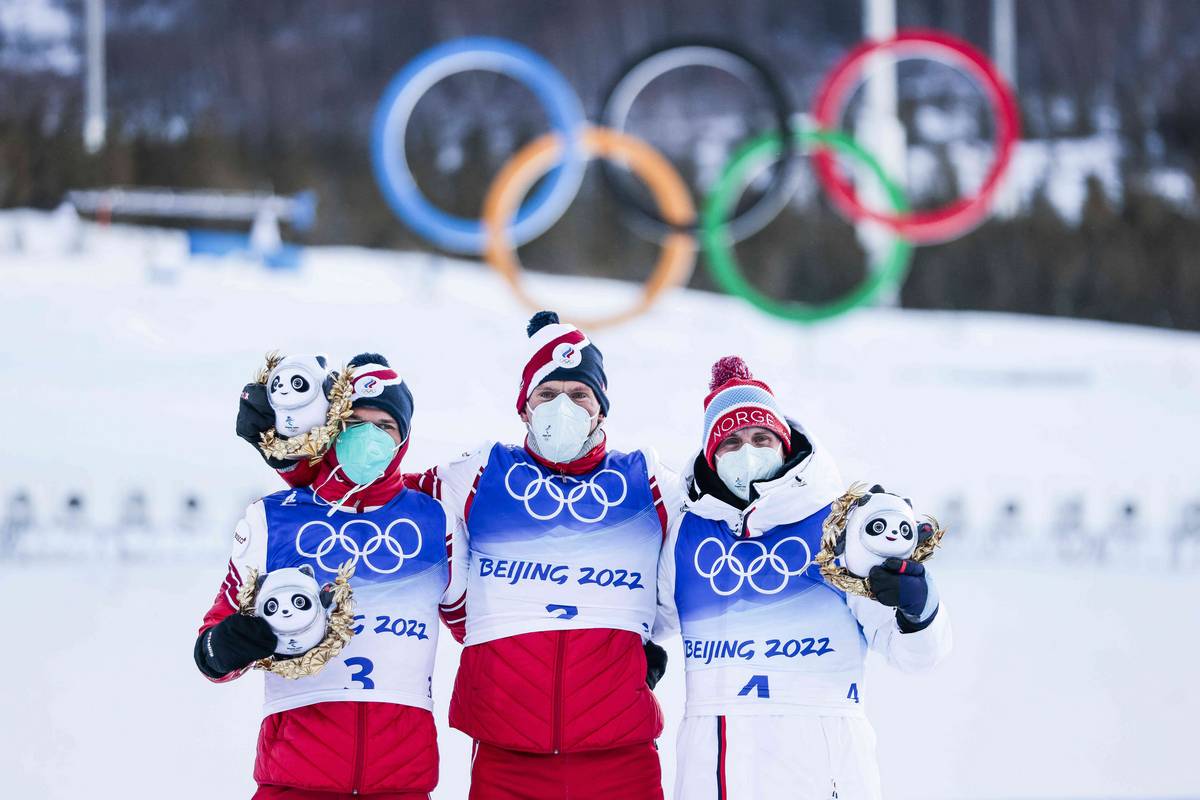
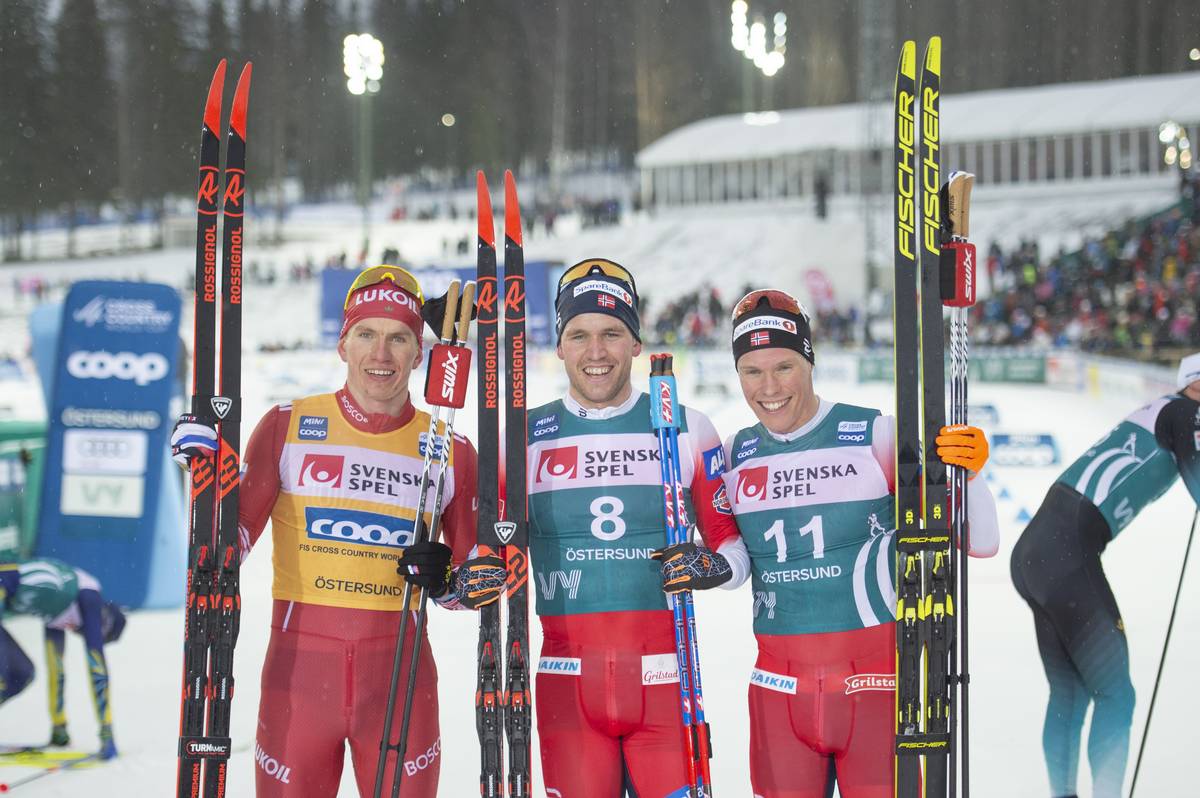
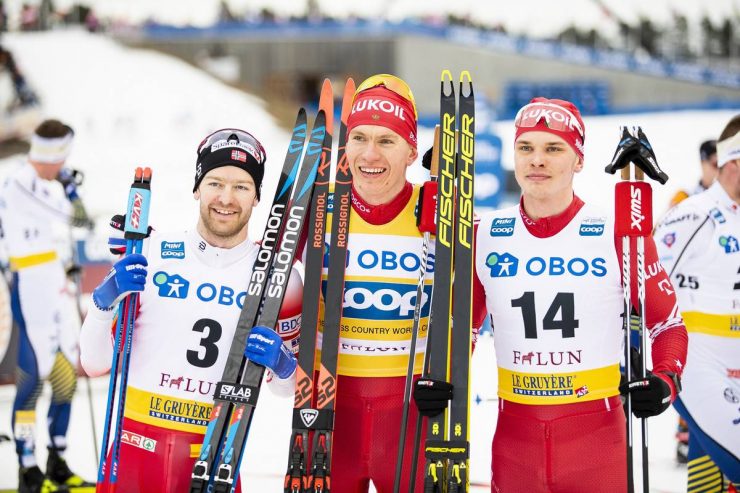
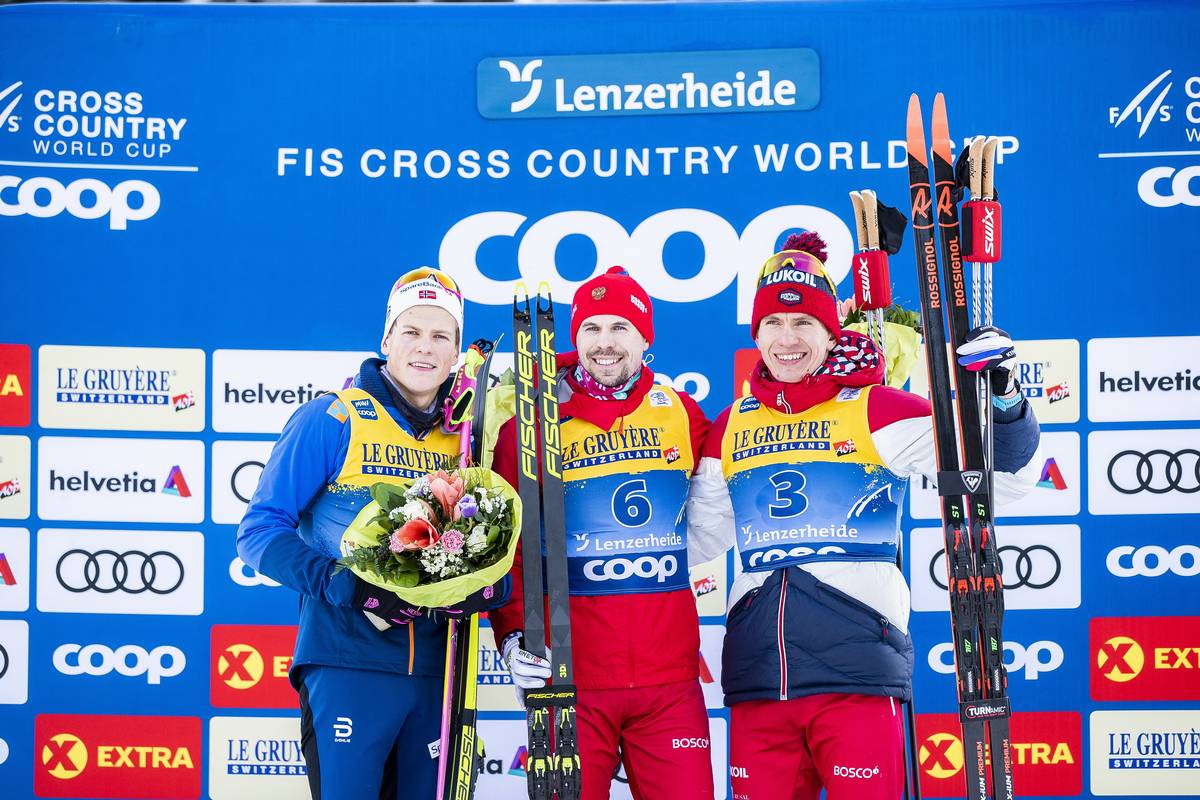
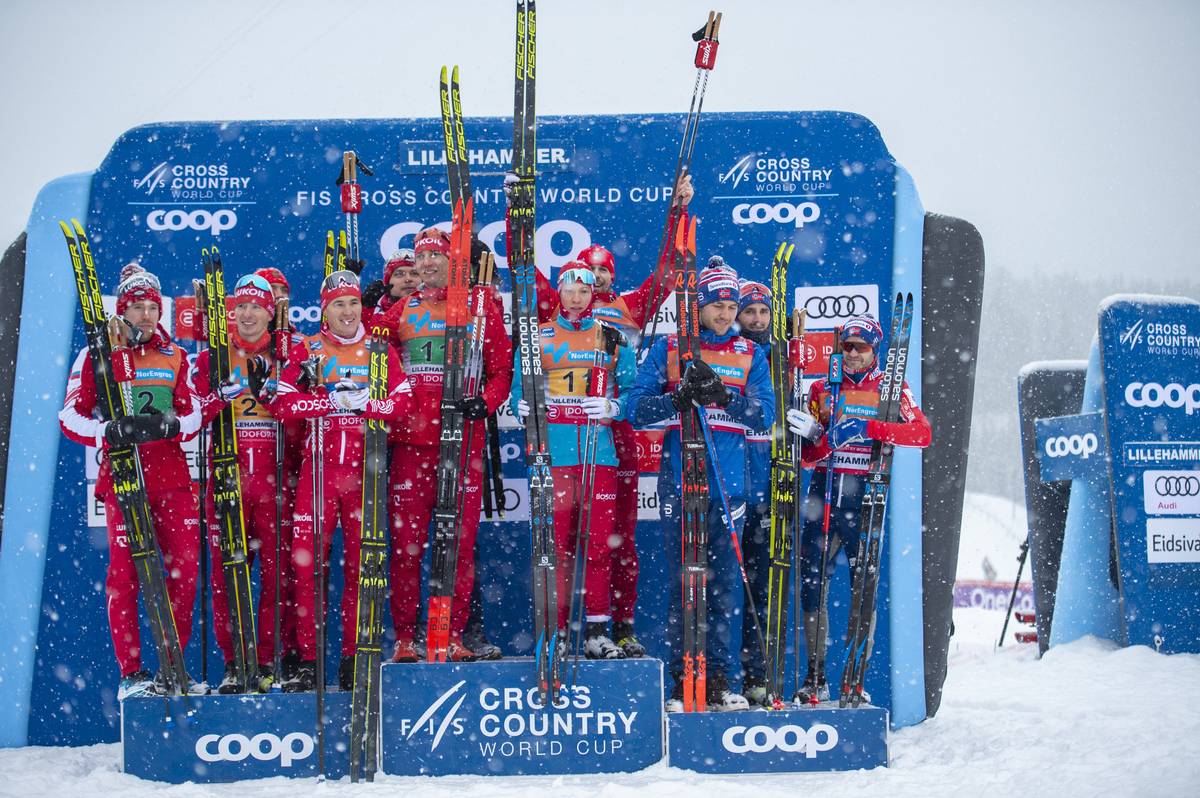
The podium of the men’s 28 k freestyle: Alexander Bolshunov (ROC) took the win ahead of Ivan Yakimushkin (ROC) and Simen Hegstad Krüger (NOR). (Photo: NordicFocus)
For Patterson, eighth place meant achieving the goal, though he admitted being in the hunt for positions even closer to the podium leaves him hungry for more.
“I’m happy,” he told FasterSkier in the mixed zone. “I came in wanting the top 10 and got it today. It’s a little tantalizing to be in eighth and 33 seconds back from the win.”
He continued that the “dream” of a medal crossed his mind as he found himself inside the lead group in the final lap, but he could feel the fatigue accumulating in his body and recognized that he was finding it hard to respond to the tactical moves of the eventual medal winners. “I don’t think it was exactly realistic to fully believe it was happening today,” he said frankly.
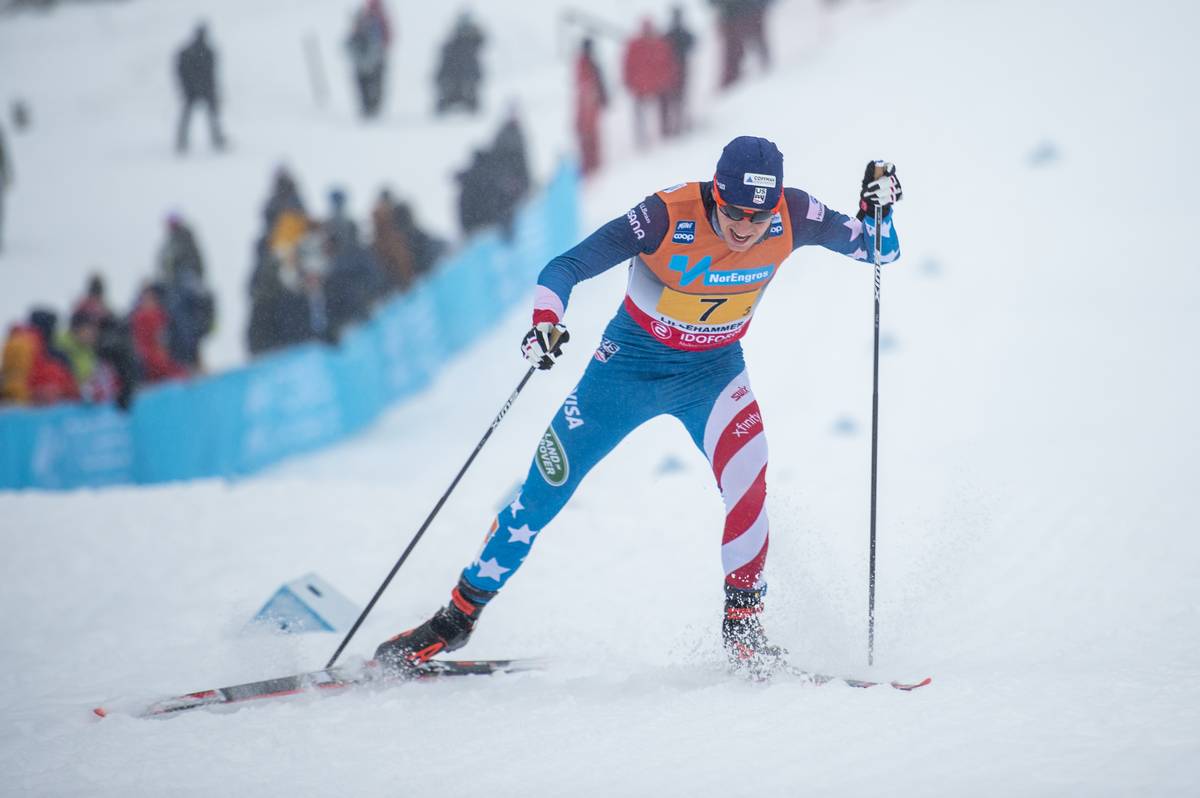
Scott Patterson skis to an Olympic career best with 8th place in the 28 k mass start freestyle. (Photo: NordicFocus)
Patterson’s result, while historic, should not come as a surprise to American cross country ski fans. He was 11th in the skiathlon at the opening of the Games, and has made his ability to come on form and earn season-best results during Championships well known over the last four years.
During the 2018 Games in PyeongChang, he put together breakout performances, skiing to 18th in the skiathlon, 21st in the 15 k skate, and 11th in the 50 k classic. He raced into the top-30 in each individual distance race of the 2019 World Championships, with a 23rd place finish in the 50 k free. Improving on these results in the 2021 World Championships in Oberstdorf, Germany, Patterson was 14th in the skiathlon, 27th in the 15 k skate, and 10th in the 50 k mass start classic.
And, he likes going long. He said he would have preferred another 20 k today – “I wanted the grinding instead of the punches” – and might have even been able to pull off a higher result had the race been longer.
Back in 2016, his first World Cup appearance was in the 50 k classic at the Holmenkollen, which sits above Oslo, Norway. He was 32nd on the day in perhaps the most storied and highly revered cross country ski race on the World Cup. Patterson advanced to 28th the following year, before making a leap into the top-20 to finish 16th in 2018 and 19th in 2019.
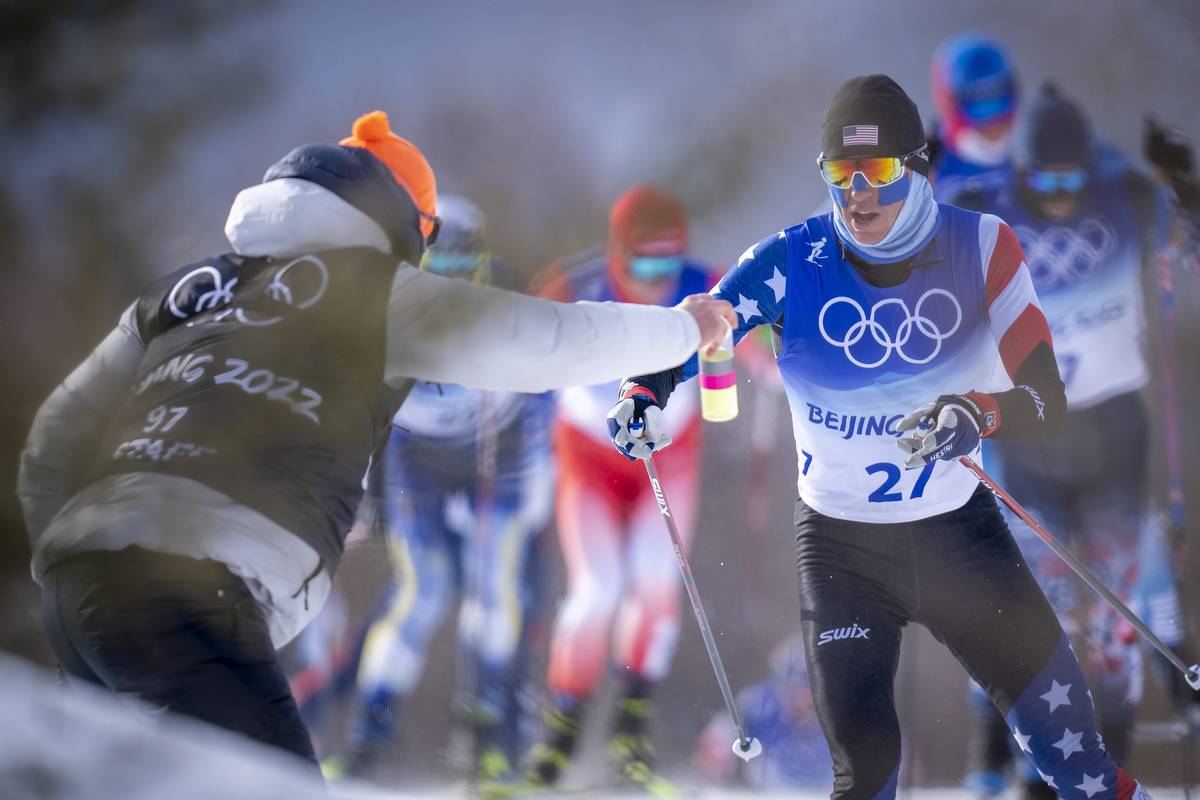
Scott Patterson takes a feed during the men’s 28 k free in Zhangjiakou. (Photo: NordicFocus)
From the outside, it can be hard to appreciate the dynamics of mass start racing among the best athletes in the world in the sport. Energy management, tactics, drafting, protecting equipment while the field remains dense in the first lap, which Patterson called “chaotic.”
“You get those lead skiers fighting the wind, and a lot of the back skiers that could just draft in. And there are a few people who definitely don’t have a lot of World Cup experience making a mess out of the pack,” Patterson described.
In his second Olympic appearance at the age of 30, with plenty of World Cup experience, Patterson skied a smart race, telling FasterSkier that he felt “strong” and “relaxed”, while looking to be “in a comfortable position and not [using] too much out of my energy.” He also reported having competitive skis that allowed him to utilize the downhills and stay in the position where he wanted to be.
U.S. Ski Team head coach Matt Whitcomb complemented Patterson on his race execution, telling FasterSkier emphatically that he was “so proud of him.”
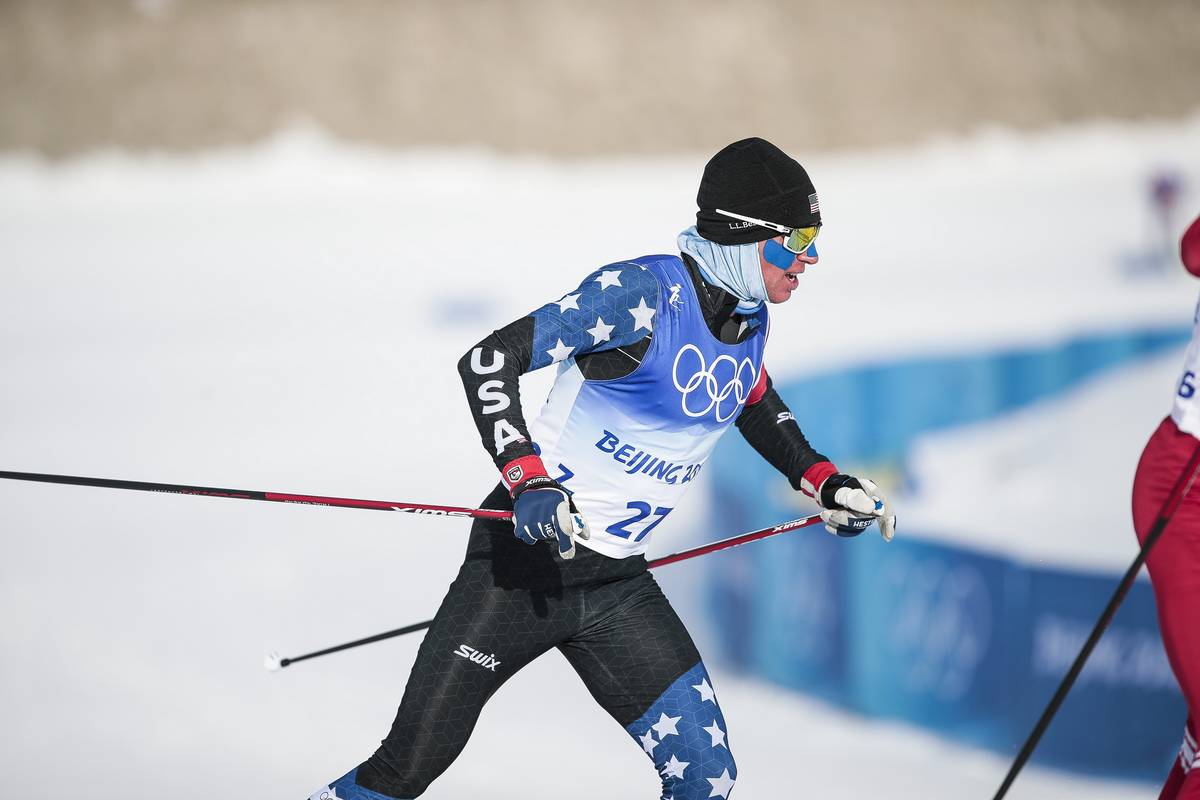
Scott Patterson races in the lead group during the men’s 28 k mass start freestyle. (Photo: NordicFocus)
Talking through the race from his vantage point, Whitcomb pointed out that Patterson stayed calm through the congestion in the opening lap, rather than becoming flustered and wasting energy by constantly trying to move up. He also shared how Patterson was able to “wisely” keep himself on the correct side of other racers to utilize the windbreak on unsheltered sections of the course.
“Some incredible skiers ended up on the wrong side of the break and were toast…” Whitcomb explained. “When that happened, I heard a Finnish yelling at a German skier saying, ‘Hey, take me up to them!’ People were desperate to do work together, and so [I’m] very proud of Scott and unsurprised that he was in a tactically wise position.”
Apart from battling the elements, maintaining an optimal position within the lead group is also a skill that requires experience and maturity.
“If you have a pack of 15 guys, of course, it’s easy to follow in a draft in 14th and 15th,” Whitcomb said. “But what you don’t realize is that there’s quite a big accordion effect, so you’re constantly pulsating on the gas pedal. What you saw [today] was Scott moving up into between fourth and seventh, for a large part of [the race], and that ends up being a much more efficient position to ride. Draft is good, but you’re also able to just kind of stay on a steady gap.”
Scott Patterson races to the line, finishing 8th in the men’s 28 k mass start freestyle. (Photo: NordicFocus)
For Whitcomb, Patterson’s eighth place ends the Games on a high note for the American men’s program as a whole.
“This is, this is for sure one of the goals that our men’s program wants: to start breaking through in one of the ultimate races of the Olympics,” Whitcomb shared. “To do that today, under conditions like this, is such a huge success for our program and for Scott and for his club, APU. For all the coaches over the years, Erik Flora that’s worked with him, and the [rest of the] coaches at APU. It’s such a huge success for [Patterson’s collegiate program], the University of Vermont; Alaska Winter Stars where he started skiing; and just so many people have been a part of this incredible journey. And so happy for all of them. But mostly for Scott because he earned this sucker today. It was brutal.”
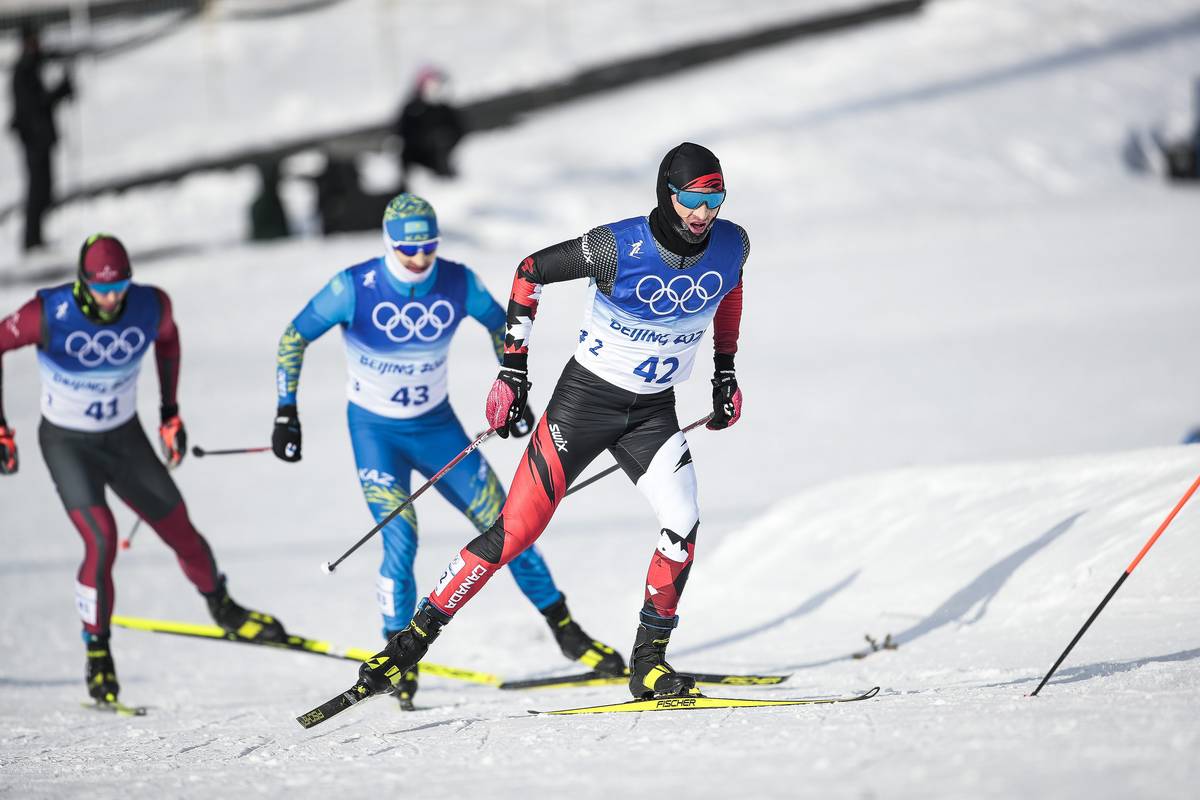
Rémi Drolet (CAN) skis to 35th in the men’s 28 k mass start skate. (Photo: NordicFocus)
Two Canadian’s raced the 50 k today, with Olivier Léveillé leading the Canucks at the finish in 27th (+4:21.6). 30 seconds back, Rémi Drolet crossed the line in 35th (+4:54.4).
Racing continues tomorrow with the women’s 30 k mass start freestyle, the final cross country event of the 2022 Beijing Olympic Winter Games. At this time, the distance of the women’s event remains unchanged, however, the start was moved up by 3.5 hours to account for the forecasted weather conditions.
Hall and the A Hall Mark of Excellence Award. To learn more about A Hall Mark of Excellence Award or to learn how you can support FasterSkier’s coverage please contact info@fasterskier.com.
We began this year’s coverage of the Men’s Tour de Ski with a prelude from 5 time Tour de France champion Bernard Hinault. So let us begin this coda with him as well.
On the cycling classic Paris-Roubaix, “the hell of the north” – famous for its cobblestones, and the mud, blood, sweat, and tears they bring – Hinault said in 1981, “[It’s] bulls**t.” He had just won the race.
Johannes Høsflot Klæbo (NOR) may feel the same about a certain climb in Val di Fiemme, Italy he continues to find himself on year-after-year at the end of the Tour de Ski.
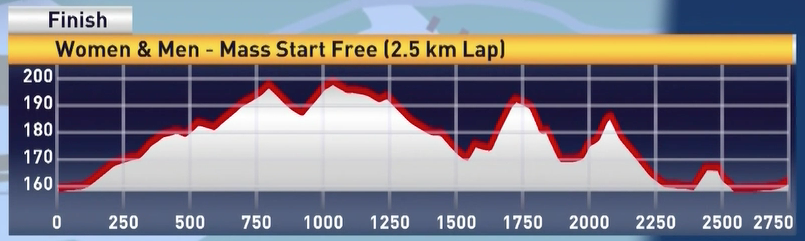
The profile of the point-to-point hill climb up the Alpe Cermis, the capstone of the Tour de Ski. (Photo: Screenshot 2022 FIS Broadcast)
Even among cross-country skiers and ski fans (admittedly, a Venn diagram that is nearly a singular circle), the final 10-kilometer stage of the Tour de Ski, and its roughly 3-kilometer, 28% gradient pitch-including climb up the Alpe Cermis, seems like a stupid proposition. We love skiing because it juxtaposes the brilliance and pure white benevolence of winter with the brutality, the pure push, the goddamn slog that fighting through it on a pair of skis can be. The Alpe – well – it piles onto the latter without balancing it with the former. We watch and look and say to ourselves why? But in piling on the pain, and the pure difficulty, the Alpe enters an uncanny valley as deep and awe-inspiring as its climb is high and mighty.
In short, why the Alpe? It’s masochistic, and it’s the most beautiful race in the world.
Johannes Høsflot Klæbo finished 5th in the Alpe Cermis hill climb to solidify his overall win in the 2021/22 Tour de Ski. (Photo: NordicFocus)
You don’t have to look any further than Klæbo’s history on the climb to tell you so. The Norwegian, with an opportunity to surpass none other than Bjørn Dæhlie himself for career Individual World Cup wins with a win in today’s stage (as it stood before the start, the two were tied at 46 apiece), has had both triumph and tribulation on the Alpe in previous editions of the Tour. In his first climb up the Alpe 2018/19, he came across the line in first after a pursuit start, becoming the youngest ever winner of the Tour de Ski. In his last climb up the Alpe in 2019/2020, he lost a one second advantage he carried into the day, consequently losing the Tour to Alexander Bolshunov (RUS).
This time around, his task was simpler. Instead of the 1 second advantage he had on Bolshunov in 19/20, he carried exactly two minutes over the Russian going into a mass start today. No need to be first to the top; all he would have to do was stick to the red suits of Alexander Bolshunov and his Russian teammates.
When the field, which remained compact throughout the approach, hit the bottom of the Alpe Cermis, Klæbo was doing exactly that. Alexey Chervotkin (RUS) had led the pack through most of the first six k, which followed the flow of the river valley, with his fellow countrymen Bolshunov, Ivan Yakimushkin (RUS), and Denis Spitsov (RUS) close behind. Also slotted within the field was the only American left to start today’s race, Zak Ketterson.
The animating move as the terrain kicked up, however, came from Iivo Niskanen (FIN), who went into the day in third place (+2:49) in the Tour standings, and was looking to maintain his place on the podium.
At the 7.5k checkpoint, Niskanen led a pack that resembled a cell in mitosis – stretched, but not yet split into packs with lives of their own. Less than a second behind him was a familiar sight, Sjur Røthe (NOR), who had previously won on the Alpe during his last ascent in 2019. Klæbo crossed the checkpoint in fifth place, with Bolshunov in sixth. Ketterson, meanwhile, was in the pack that followed – coming across in 26th place (+15.9).
Sjur Røthe takes the win in Stage 6 of the 2021/22 Tour de Ski. (Photo: NordicFocus)
The decisive pitch came shortly after the checkpoint. At a 26% section, Sjur Røthe’s attack was less a thrilling burst of energy than a confident crawl away from the pack. He created a gap, and looked to be set to face the last 1.6k of the climb alone.
That was, of course, until another face familiar to the Alpe slowly crawled out of the pack too. Last year’s hill climb winner, Denis Spitsov (RUS), skied up to Røthe , setting up a two-way battle that had, as Røthe didn’t race the Tour last year, been two years in the making.
The chase group that included Klæbo, Bolshunov, and Niskanen stayed together passed the 24% gradient. Niskanen, though, soon started to show signs that he was about to crack. When his V1 finally gave way to a coach’s skate, it was in one of the hairpins set-up to ease the gradient on the skiers. He brought, for a split second, the chase group to a complete pause. Bolshunov, who was the second skier behind Niskanen, was caught up for a moment, which allowed Klæbo to shoot to the outside and overtake both of them.
Niskanen faded, but Bolshunov now had to expend energy to stay up with Klæbo, who some 1.2k out from the finishing line was showing a resolve on the Alpe that he hadn’t in his previous ascents.
So it had broken into a race of sub-races. The lead group with Røthe and Spitsov, gunning for the stage win. The chase group, 20 seconds off, looking to decide the overall of this year’s Tour de Ski.
Sjur Røthe (NOR) leads in the final kilometer of the Stage 6 hill climb ahead of Denis Spitsov (RUS). (Photo: NordicFocus)
When the Alpe finally, impossibly, gave way to gradients that were in the single-digits, Røthe proved the Puncheur over Spitsov. His V1 gave way to a V2 that still somehow maintained some grace to it, and he came across the blue line painted in the snow at the top of the Alpe a champion again. Spitsov, not losing sight of the Røthe, crossed the line in second (+2.4).
The chase group meanwhile, was now being led by two skiers wearing suits not seen near the front of a Men’s World Cup so far this season. Indeed, it was two young Germans, Friedrich Moch and Lucas Bögl, who were pulling Klæbo and Bolshunov through the final moments of this year’s Tour. When the terrain gave way, Moch took it one step farther, gapping the field to claim his first individual World Cup podium in 3rd place (+18.9), and becoming the first German man to podium at a World Cup since Tim Tscharnke in 2015 (also in Val Di Fiemme).
Friedrich Moch (GER) climbs to third up the Alpe Cermis. (Photo: NordicFocus)
Then, 15 seconds later, the Tour was decided. Klæbo came in 5th place on the day (+34.9), gaining 3 seconds on Bolshunov who came in 8th (+38.1). Niskanen’s aggressive racing too, turned out to re-work the podium. He finished 12th on the stage (+1:00.4), maintaining his position for a third place overall finish in the Tour.
Iivo Niskanen (FIN) skiied his way to 3rd place overall in the Tour on the Hill Climb in Val Di Fiemme. (Photo: NordicFocus).
The final standings for this year’s Tour de Ski then: Johannes Høsflot Klæbo with the win (2:24:56.0), Alexander Bolshunov in second (+2:03.2), and Iivo Niskanen third (+3:14.5).
For Klæbo , it is his second overall Tour de Ski championship. He becomes only the 2nd Norwegian, after Martin Johnsrud Sundby, to win multiple Tours. He leaves tied with Bjørn Dæhlie on Individual World Cup stage wins. He also closes his most apparent weakness in the World Cup circuit, finishing 5th on the Alpe Cermis after previously never having breached the Top 10.
And yet, as he said in an interview with FIS media: Klæbo is “glad it’s over. It will be nice to get some days off now and rest for the Olympics.”
Johannes Hoesflot Klaebo (NOR) wins his 2nd Tour de Ski title (Photo: NordicFocus).
What lessons do we take from this year’s Tour de Ski then? While it has waxed and waned in importance and depth in championship seasons, it is a barometer by which we can see the history and the achievement of the sport’s greatest skiers. There are World Championships and World Cups, but the Tour is the Tour. As we head towards the sport’s biggest stage in Beijing next month, this edition reminds us that we are witnessing something one-of-a-kind in a Norwegian, still young at 25, that is poised to re-write any notion of what is possible in this sport: Johannes Høsflot Klæbo. Against the toughest and most glorious test in skiing on the Alpe Cermis, he has finally passed.
On his first climb up the Alpe, Zak Ketterson finished 48th (+3:01.3). He becomes the only American man to finish this year’s Tour de Ski, coming off the SuperTour in the U.S. to complete the sport’s most grueling test, and do so as his first World Cup starts no less. He finished 54th overall (+16:06.4).
Zak Ketterson finishes his first climb up the Alpe Cermis, rounding out his first World Cup starts at the 2021/22 Tour de Ski. (Photo: NordicFocus)
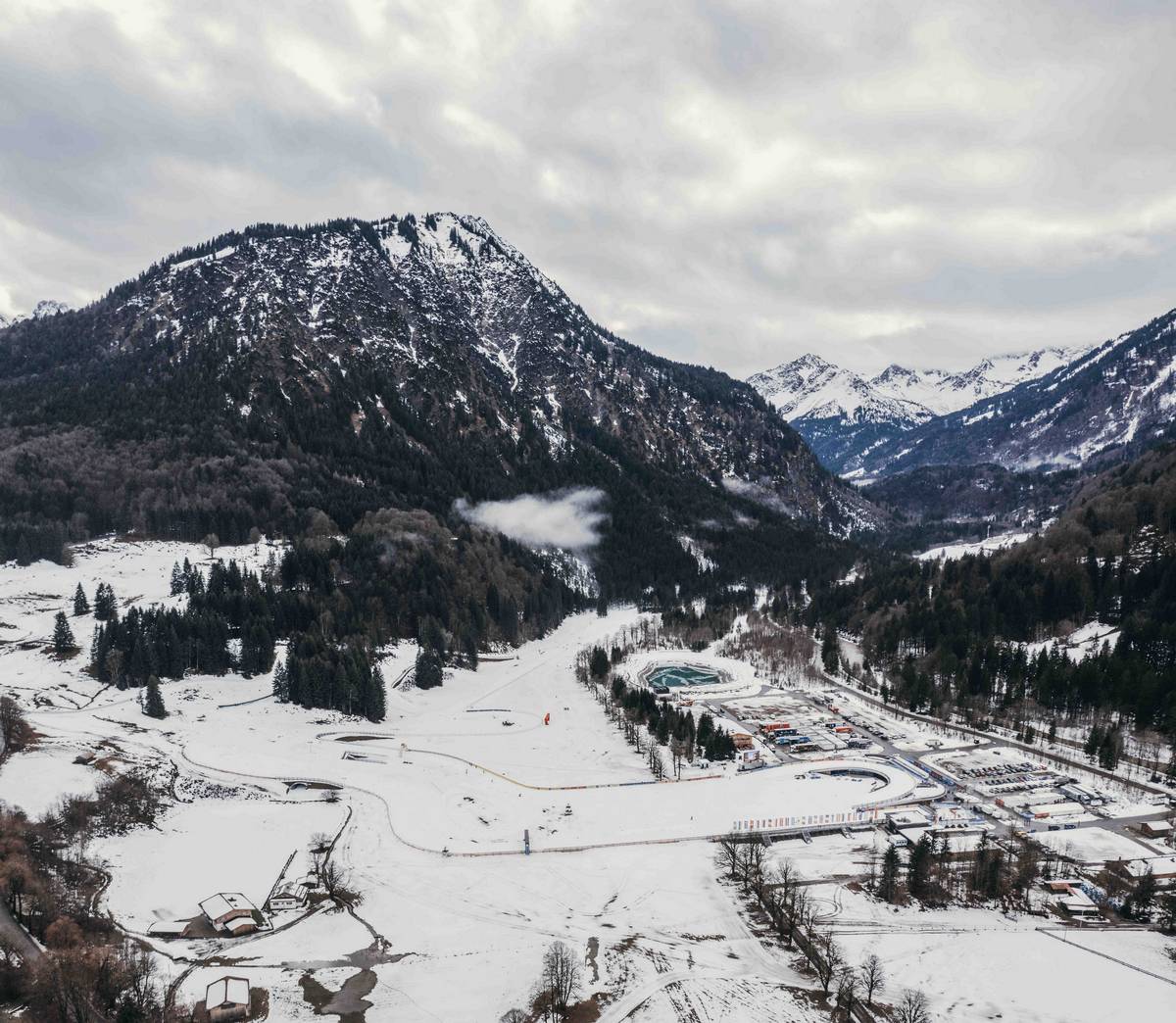
An aerial view of the icy track in Oberstdorf, Germany, where winter looks to ebb and flow. (Photo: NordicFocus)
This World Cup coverage is made possible through the generous support of Marty and Kathy Hall and the A Hall Mark of Excellence Award. To learn more about A Hall Mark of Excellence Award or to learn how you can support FasterSkier’s coverage please contact info@fasterskier.com.
Traveling Northeast from Lenzerheide, Switzerland to Oberstdorf, Germany, home to last year’s FIS World Ski Championships, athletes lined up for Stage 3 of the Tour de Ski for a mass start 15-kilometer skate. Once again encountering conditions altogether different from those in the previous stage, the tracks in Oberstdorf were lightning fast, and icy, with bare earth scarring the landscape between the ribbons of white.
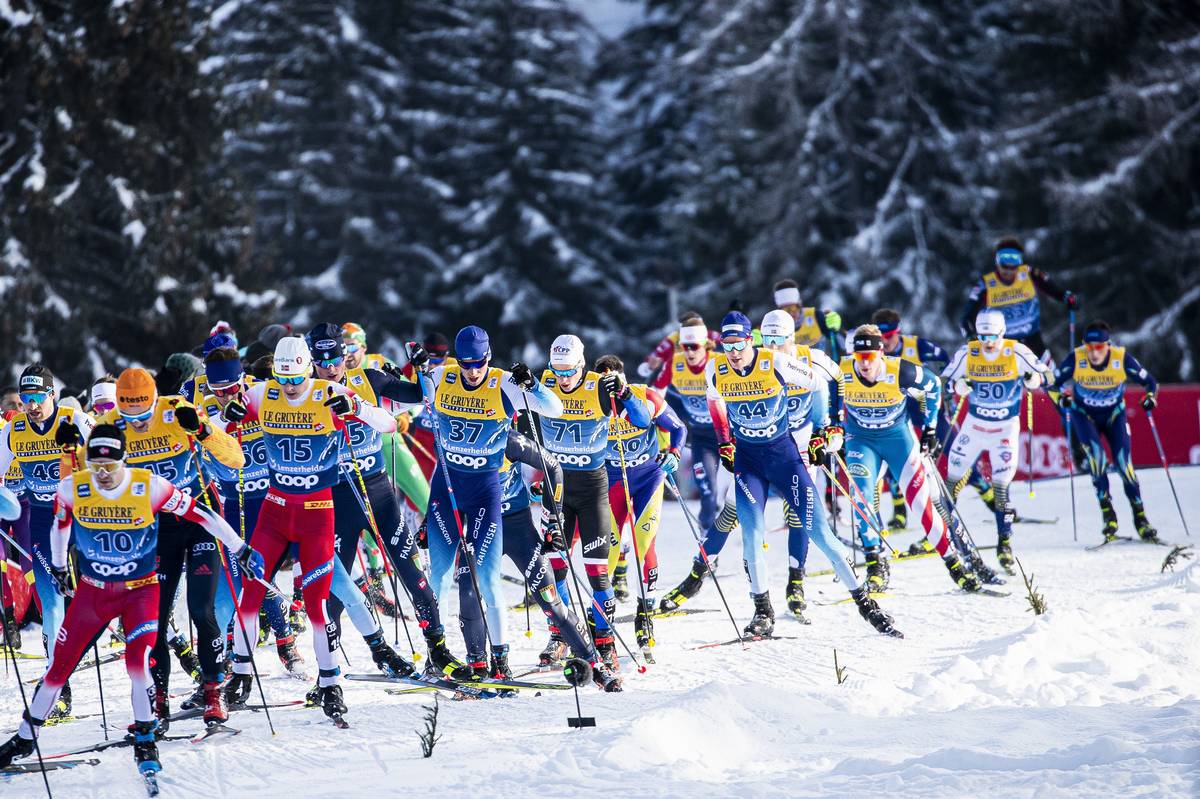
Given the conditions and the winding nature of the 3.75k loop, there was little separation in the first three laps of the four-lap race. Johannes Høsflot Klæbo (NOR) and Alexander Bolshunov (RUS) surged to the front to collect the Tour bonus points at the 4.4k checkpoint, with Klæbo keeping putting in just enough effort to slide his boot over the line 0.3 seconds ahead of the Russian’s, earning them 15 and 12 points, respectively. Ivan Yakimushkin (RUS) was next in line at the checkpoint for 10 points, followed by Pål Golberg (NOR) for 8, and Calle Halfvarsson (SWE) for 6.
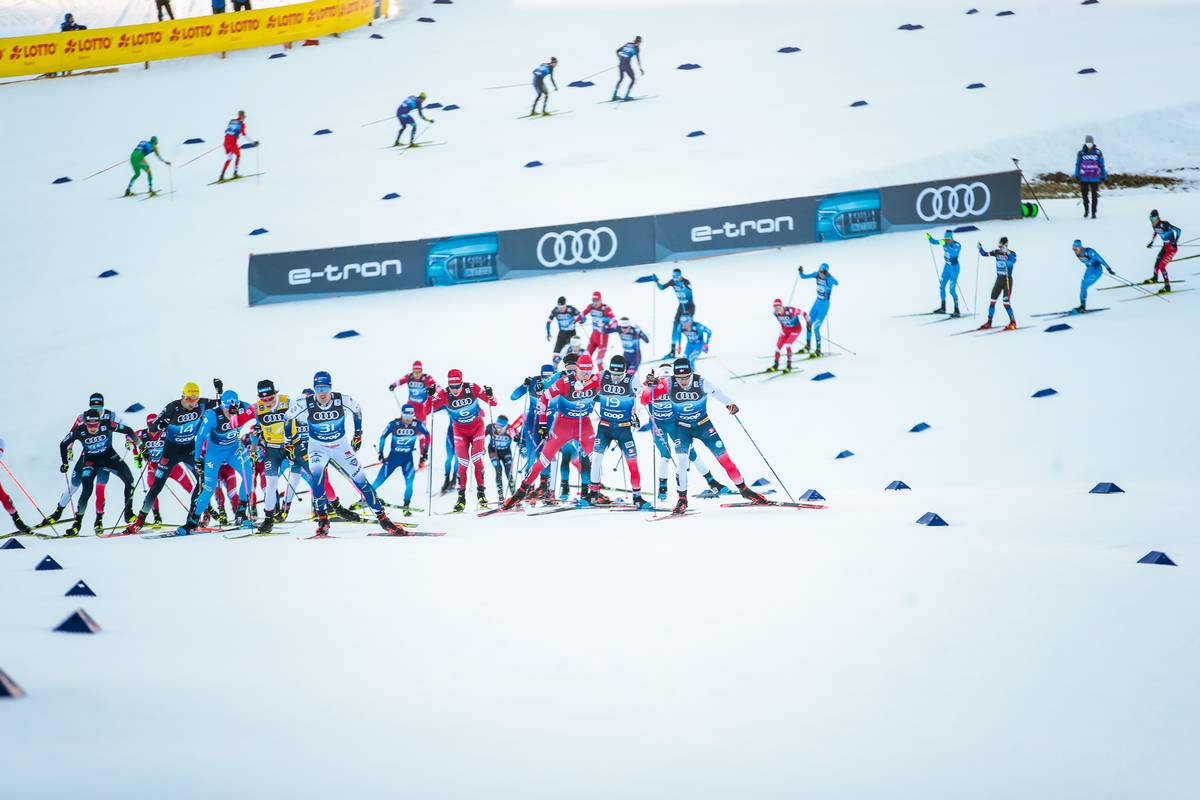
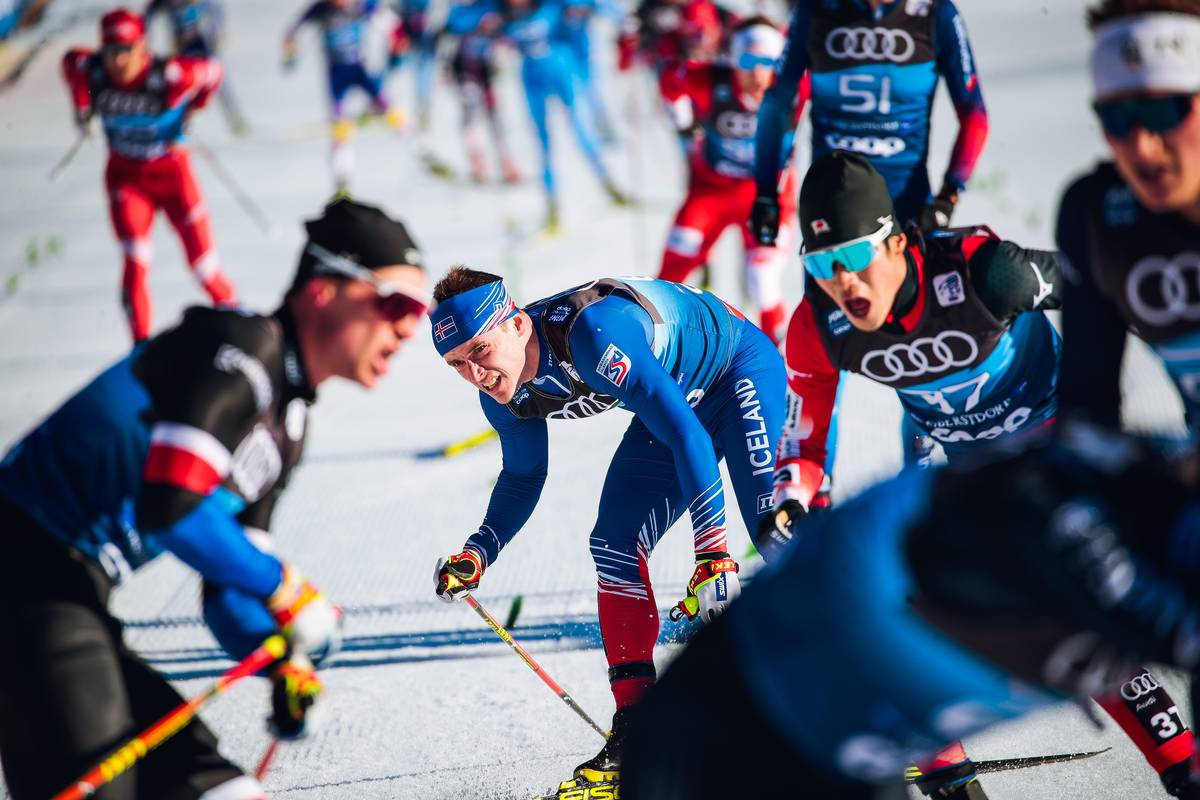
The pack stayed tight through the first two laps of the men’s 15k freestyle mass start in Oberstdorf, Germany. (Photo: NordicFocus)
Once the checkpoint was crossed, the men stood up, returning to a calm and relaxed state at the front of a massive pack of racers with little opportunity, or need, to break away just yet. Given the density of skiers on the course and the speed of the track, downhills were taken with care, with the leaders standing up, putting arms to the sides to indicate they were all on the same page – take it easy, keep everyone’s equipment intact, no unnecessary crashes.
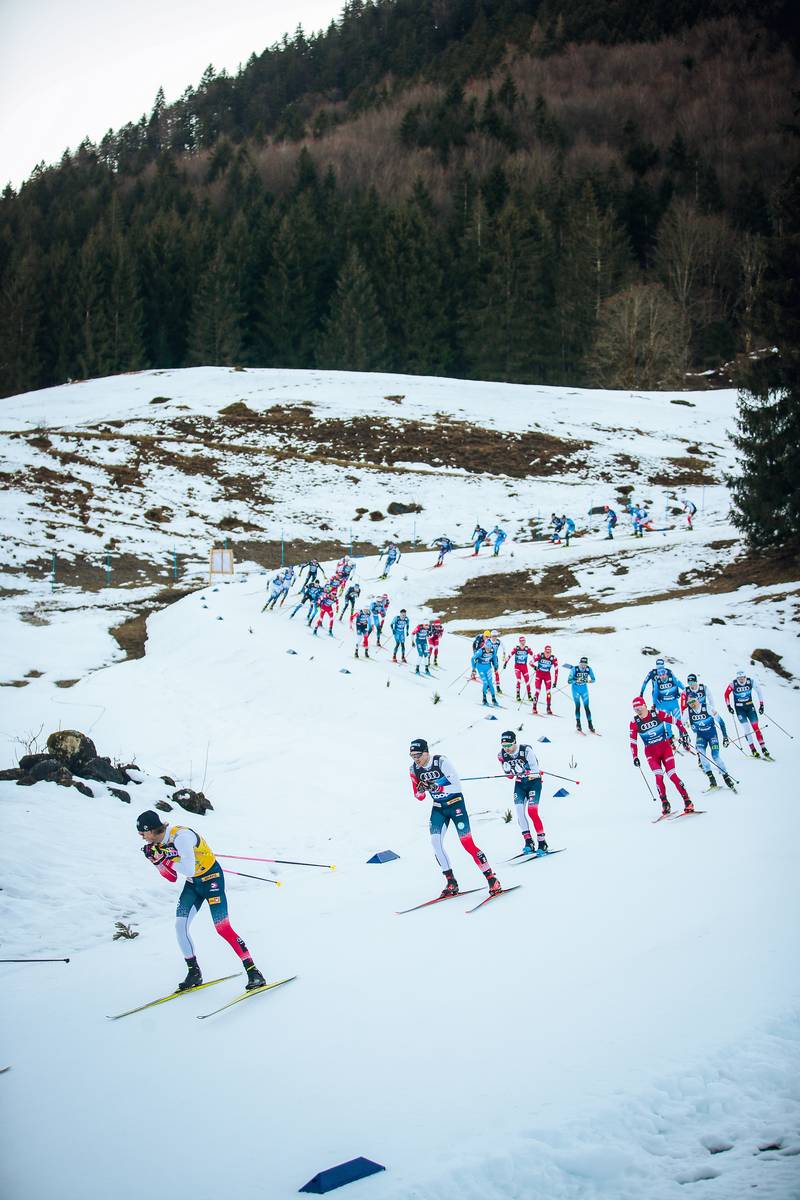
The leaders wind through icy curves as they descend toward the stadium in Stage 3 of the Tour de Ski in Oberstdorf. (Photo: NordicFocus)
This theme continued through the third lap, where the race for the podium finally began.
At 9.6k, just 12 seconds separated the top 30, who moved like a slinky through the woods, compressing on the climbs, stretching on the descents. Repeat, repeat.
However, by 12k, five men had dropped the masses, and by 13.4, this had dwindled to three. Led by Klæbo in the yellow bib, Bolshunov, Sjur Røthe (NOR), and Andrew Musgrave (GBR) quickly gapped the field to fight for the podium.
Alexander Bolshunov (RUS) leads Andrew Musgrave (GBR) and Johannes Høsflot Klæbo (NOR) as the leaders begin to break away in the final lap. (Photo: NordicFocus)
While one might expect Klæbo in such conditions to wait until the final meters to show off his acceleration, he started his kick much further out, pushing into the final descent and trusting his ability to race the following icy curves. Though his chasers began to catch him as they navigated tight bends that led into the stadium, Klæbo hop-skated over the final roller and held the others at bay, skiing into the finish lanes with plenty of space to earn a clear victory.
Racing all the way to the line, Bolshunov pushed to claim second place (+3.4) with Røthe securing the final podium spot just behind in third (+4.0).
Johannes Høsflot Klæbo (NOR) powers to the line for the win in Stage 3 of the Tour de Ski, while Alexander Bolshunov (RUS) and Sjur Røthe (NOR) fight to the line for second and third. (Photo: NordicFocus)
Lacking the closing speed for a podium spot but still putting together a season-best day, Musgrave closed for 4th (+5.6). Perhaps well-suited to the style of racing in Oberstdorf, the Brit had been tenth in the event on the same tracks during last year’s World Championships in similar conditions. The 2021 World Championships 15k free had an all-Norwegian podium, led by Hans Christer Holund, Simen Hegstad Krüger, and Harald Østberg Amundsen, with Bolshunov disappointed at the line in 4th, and Røthe nearly a minute off the lead in sixth.
Johannes Høsflot Klæbo (NOR) welcomes teammate Sjur Røthe (NOR) across the line in third, while Andrew Musgrave (GBR) takes fourth. (Photo: NordicFocus)
“It was a wee bit annoying to let a podium finish slip through my fingers on a day when I was feeling good and had amazing skis,” wrote Musgrave in a post-race email to FasterSkier. “It was definitely nice to be back racing better after a very tough start to the season though!”
Musgrave continued with a comment on a start to the season he deems sub-par, ending with some optimism.
“I’ve had a rough season so far, struggling to take World Cup points, and just generally not feeling in form. I took a week completely off training between Lillehammer and Davos, and that seems to have got me back on track.”
Though from afar, the race looked congested with the field of men staying tightly grouped through the first 11k, Musgrave painted a different picture, speaking to his approach to the course in fast conditions.
“The race today was a bit less chaotic than I thought it might be. With such fast, icy conditions I thought there would be a big group still together sprinting for the win at the end. My plan was to keep as far forwards as possible, to avoid any falls that might happen in the pack. It ended up being a good call- the group ended up splitting up quite a bit on the technical, icy downhill. I was far enough forward to keep myself on the right side of any gaps that opened up.”
Though just-shy of the podium, Andrew Musgrave (GBR) looked thrilled with his season-best fourth place result in Oberstdorf. (Photo: NordicFocus)
As for Klæbo, today marks his 47th World Cup victory, tying the legendary and notorious Petter Northug, but remarkably, only his second win in a freestyle distance event. His last win in the 15k skate also took place in Oberstdorf, during the 2018/19 Tour de Ski. Of his five wins in the 15k classic, four have taken place in mass start races.
“The first round was pretty slow, then on the third lap it was starting to pick up a little bit,” Klæbo told FIS of his strategy after the race. “I was trying to be near the front today, the downhills were pretty sketchy. For the finish, I didn’t want to take the chance to be [second] in the last turn there, so I went for it.”
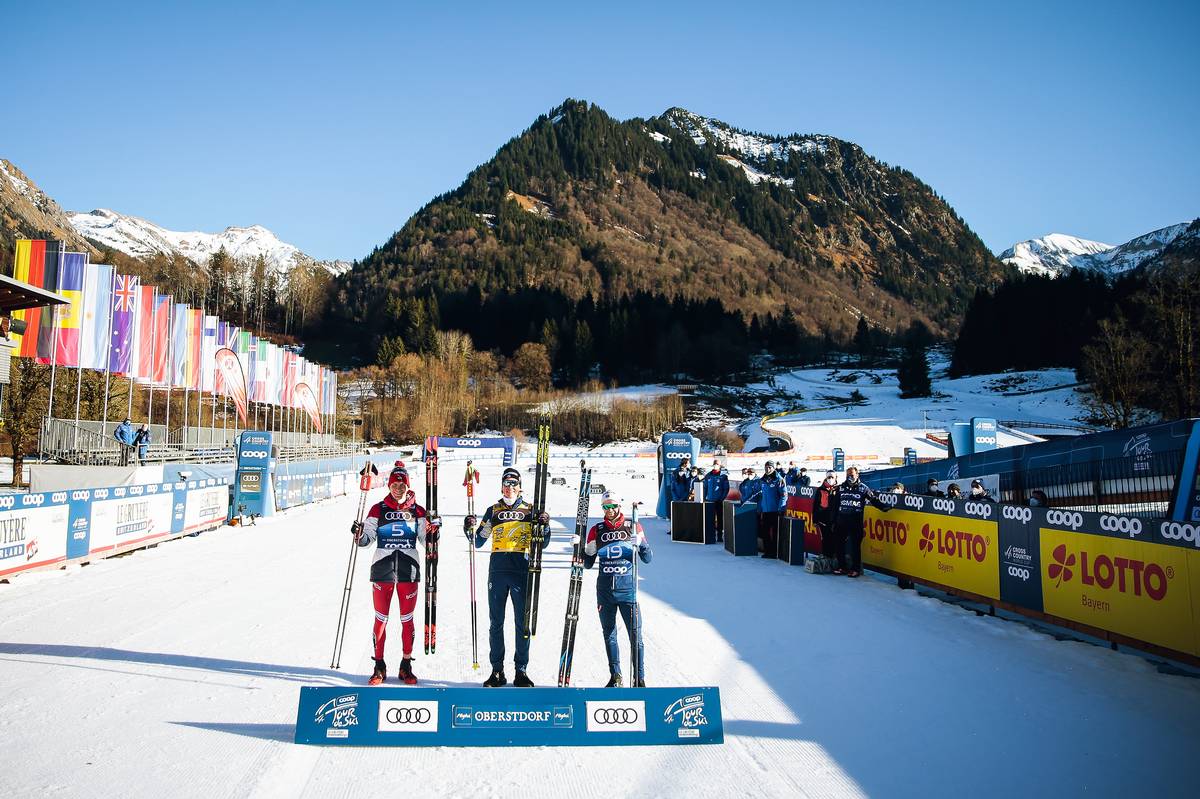
The men’s podium of the 15k mass start freestyle in Oberstdorf: Johannes Høsflot Klæbo (NOR) took the win ahead of Alexander Bolshunov (RUS) in second and Sjur Røthe (NOR) in third. (Photo: NordicFocus)
Asked what was the determining factor in the race, and where he found his advantage, Klæbo affirmed his plan of making a move on the winding downhill in the last kilometer.
“I was just trying to push really, really hard in the downhill, and just come through the downhills [safely] because, like I said, it was pretty sketchy.”
Surviving amongst the masses, Gus Schumacher led the American men, breaking into the top-30 to place 25th (+53.3) on the day. Bouncing back from a cold that he feels has impeded him in the first two stages, Schumacher explained he is feeling stronger and more energetic by the day, contributing to his improvement from his first two finish positions.
“[It was] super icy, and I was a little nervous about the dynamics of the first mass start of the year,” Schumacher told U.S. Ski & Snowboard cross country communications manager Tom Horrocks on-site after the race. “But the guys at the front were pushing the pace well enough that it sort of strung out, so it was actually fairly good skiing, except for some of those corners where you’d toss it into a power slide and just keep going forward.”
Gus Schumacher navigates an icy downhill amongst a pack of men, each looking to stay upright with equipment intact through the race. (Photo: NordicFocus)
Though he felt the pace was faster than it appeared from the live stream, he acknowledged that the pack did begin to spread significantly over the final lap and a half, which he identified as an “ideal mass start” situation for him in most circumstances.
“As it strung out, I didn’t quite have the gas that I’ve had before to keep jumping up to the next person, but I think it went well.”
Full audio clip from post-race interview with Gus Schumacher, hosted by Tom Horrocks.
Just off the mark for Top-30, Zak Ketterson skied to 36th (+1:02.6), just 5 seconds shy of 30th. As this year’s Tour de Ski are the first World Cup starts 24-year-old Ketterson has earned, this result marks an international career best at the senior level. Having been pulled up to the World Cup as SuperTour leader following the opening races in Duluth, MN and Cable, WI, the Team Birkie athlete is using this opportunity to vie for a widely-desired sixth spot for American men, which currently is not guaranteed to exist, on the 2022 Olympic team.
“I’m really happy with that. The goal for anyone is to be in the top-30, that’s just the first stepping stone, so for me to be close to that, it’s kind of a dream come true,” Ketterson told Horrocks post-race. “Especially with some rough races at the start of this Tour, it’s nice to have some positive feedback.”
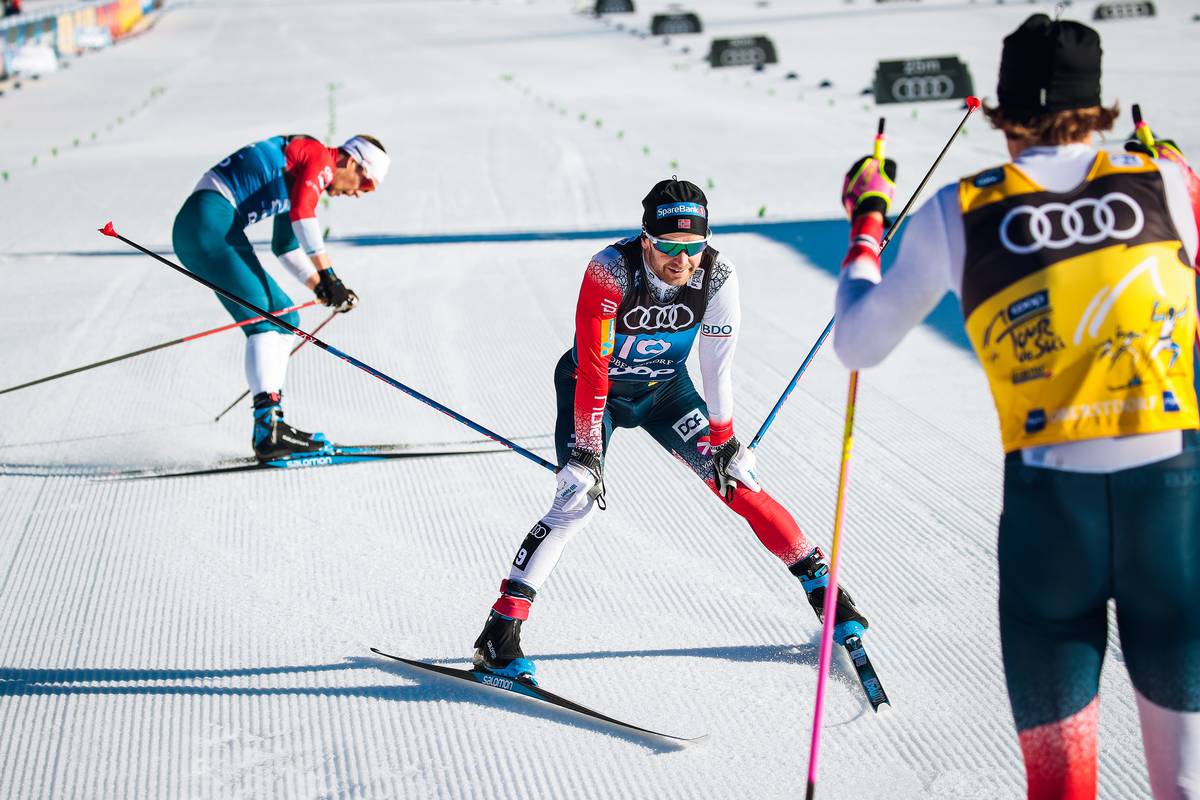
Chaos and carnage at the finish line as athletes chase the final spots in the Top-30. Gus Schumacher, who was 25th, is out of focus in the top right. (Photo: NordicFocus)
“What’s led to me performing my best in the past is just to focus on things I can control and just the process,” Ketterson explained in response to how he is mentally handling these circumstances. “I think that’s what got me here from the SuperTour, I didn’t think about trying to be in the top SuperTour spot, I just thought, ‘Let’s have a good race, and if that gets me where I want to go, great. If not, that’s life.’ So I just try to give myself the best chance everyday and the rest takes care of itself.”
Full audio clip from post-race interview with Zak Ketterson, hosted by Tom Horrocks.
Ben Ogden was the next American in 64th (+1:59.0), crossing the line with his teammate, Kevin Bolger, in 65th (+2:00.4). Luke Jager skied to 70th (+2:19.7), while Logan Hanneman rounded out the men’s squad in 75th (+3:54.1).
Ben Ogden races Stage 3 of the 2021/22 Tour de Ski in Oberstdorf. (Photo: NordicFocus)
Looking to the overall Tour standings, with a one-minute time bonus for his sprint win, coupled with 4th in the 15k classic and a second win today, Johannes Høsflot Klæbo leads the overall standings by both time and points. By time, he is 45 seconds ahead of his teammate Pål Golberg, with Bolshunov moving into third with a 47 second deficit. By points, Klæbo has earned double that of the next athlete with 51, followed by teammate Erik Valnes with 26, and Bolshunov with 24.
Racing continues tomorrow with a classic sprint, where Klæbo will again be a favorite. Quarterfinals begin at 12:00 CET / 6:00 EST.
Johannes Høsflot Klæbo (NOR) out for a training ski after arriving in Oberstdorf, Germany. (Photo: NordicFocus)
The field of all skiathlon athletes leaves the stadium in Oberstdorf, Germany. (Photo: NordicFocus)
This World Championship coverage is made possible through the generous support of Marty and Kathy Hall and their A Hall Mark of Excellence Award. To learn more about A Hall Mark of Excellence Award or to learn how you can support FasterSkier’s coverage please contact info@fasterskier.com.
With swaths of bare ground peeking through the melting snow, skis rattling through tracks and swooshing across the lanes, and short-sleeved race tops, World Championship racing continued in a warm Oberstdorf, Germany for the men’s 15k/15k skiathlon. Swirling through the stadium after each 3.75 kilometer lap, four in classic then another four in skate.
For some historical context, Norway’s Sjur Røthe won the event in 2019 during the World Championships in Seefeld, Austria by a margin of just 0.1 seconds over Russia’s Alexander Bolshunov, with Martin Johnsrud Sundby crossing the line just 0.6 seconds later. Because of this victory, Norway was able to enter five men in today’s skiathlon, compared to four representing other countries.
Two years prior at the World Championships in Lahti, Finland, Russia’s Sergey Ustiugov took the win ahead of Norwegian’s Sundby, who had fallen 500 meters from the finish, and Finn Hågen Krogh. The message – the 30 k championship skiathlon comes down to the wire.
With Bolshunov clearly on form this season and a pack of hungry Norwegians in pursuit, today’s mass start event looked again to be a Russia versus Norway dog fight.
Alexander Bolshuov leads the men’s field during the classic leg of the World Championship 15k/15k skiathlon in Oberstdorf, Germany. (Photo: NordicFocus)
As a large lead group of men slowly whittled down in the classic leg, Bolshunov held a steady position at or near the front alongside Finland’s Iivo Niskanen, who was 4th in 2019, and a slew of strong Norwegian racers that included Røthe, Hans Christer Holund, Emil Iversen, Johannes Høsflot Klæbo, and 2018 skiathlon Olympic champion, Simen Hegstad Krüger. These men entered and left the exchange together, with a steady stream of chasers not far behind.
Alexander Bolshunov (RUS) leads Iivo Niskanen (FIN) and Emil Iversen (NOR) during the classic leg of the World Championship 15k/15k skiathlon in Oberstdorf, Germany. (Photo: NordicFocus)
A train of Norwegians near the front of the pack during the 15k/15k skiathlon in Oberstdorf, Germany. (Photo: NordicFocus)
Bolshunov and company swapping skis. (Photo: NordicFocus)
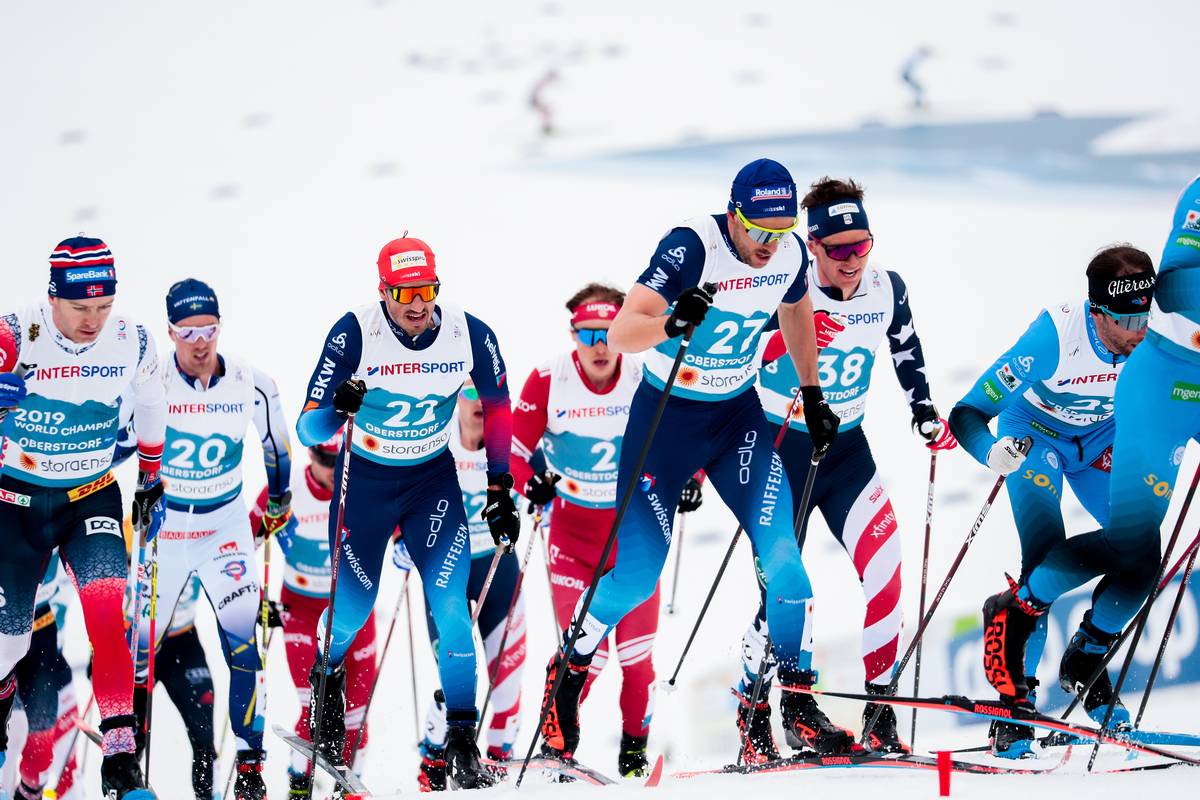
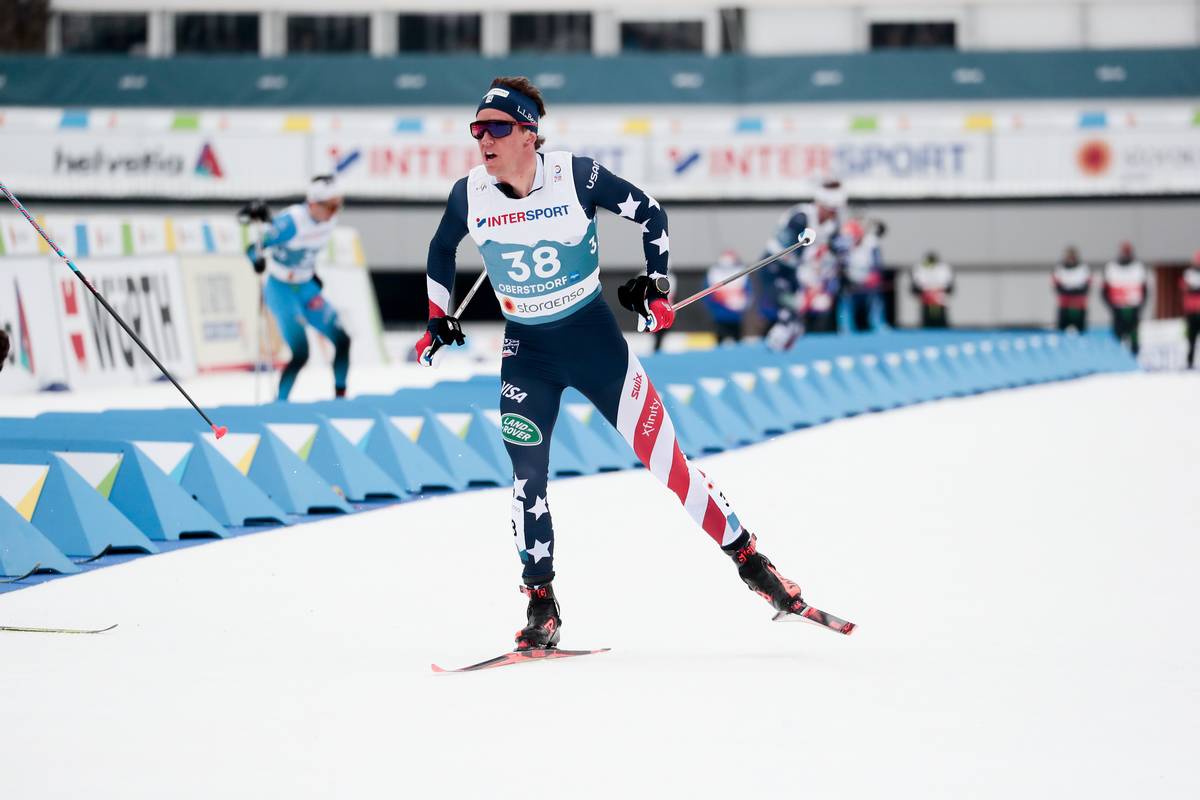
In the chase pack at the exchange and sitting in 11th place at the 16 k checkpoint was Scott Patterson. The American started in bib 38, well inside the inner workings of the accordion of racers that stretched and compressed over the first few laps. Nonetheless, Patterson steadily worked his way up through the field, looking to build on his 18th place finish in the event at the 2018 Olympics and 30th place finish the subsequent year in Lahti. With 11 k to go, Patterson was tucked in with Russia’s Ivan Yakimushkin and Alexey Chervotkin, roughly 21 seconds behind the leaders and reeling in Niskanen and Jens Burman of Sweden.
Scott Patterson (bib 38) skis his way up through the men’s field during the World Championship 15k/15k skiathlon in Oberstdorf, Germany. (Photo: NordicFocus)
Back at the front, it was still Bolshunov versus five Norwegians with Great Brittain’s Andrew Musgrave interjecting the pattern, though fitting within the red-blue-white color scheme.
With 6 k to go the pack whittled further. It was Røthe, Bolshunov, Holund, then Krüger, with Iversen and Klæbo chasing with pained faces a few seconds behind. Musgrave had fallen off the pace, and the chasers led by Patterson in 8th position were over 1:20 back.
The eventual winner, Bolshunov, setting the tempo on the skate leg. (Photo: NordicFocus)
Johannes Høsflot Klæbo (NOR) marks Andrew Musgrave (GBR) in the final laps of the World Championship 15k/15k skiathlon in Oberstdorf, Germany. (Photo: NordicFocus)
There was no question that Bolshunov looked strong and confident at the front; the spring in his V2 and full-body power in his V1 were enviable after 26 k’s of racing. But he had bobbled on a descent the previous lap as the men stepped as if on hot coals around a corner, a reminder that anything could happen in the final lap. The Norwegians were matching his every move, albeit from a few meters behind.
With 2 k remaining, Holund took to the front, pulling Bolshunov who finally showed signs of fatigue, with Krüger on his tails. Hop-skating up a rolling climb and building his small gap, Holund continued to hammer, but the threesome rejoined on the downhill.
Attacking the final roller with a seemingly superhuman tempo, stepping around a hairpin, and dropping into a tuck, Bolshunov took back the lead and tore away at the front. He created enough of a gap over Holund and Krüger that he could look over his shoulder, raise his arms, and take in the victory as he crossed the finish line in a time of 1:11:33.9.
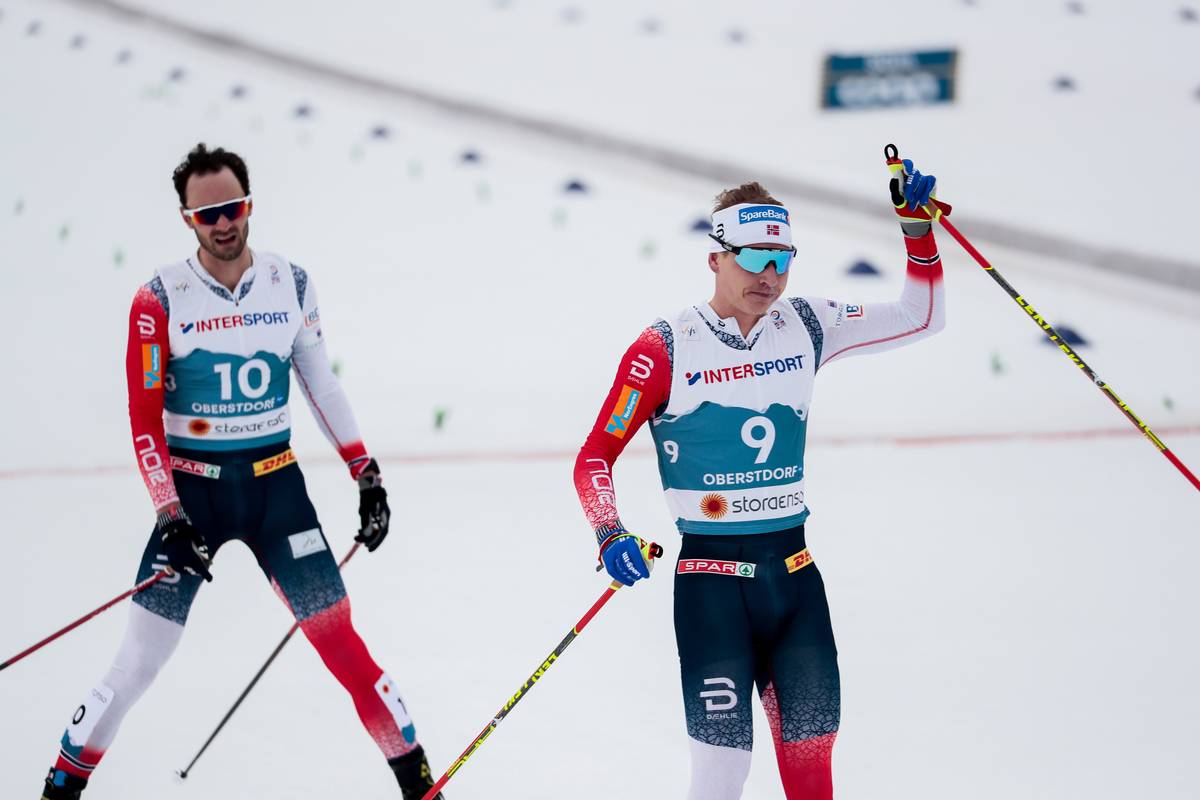
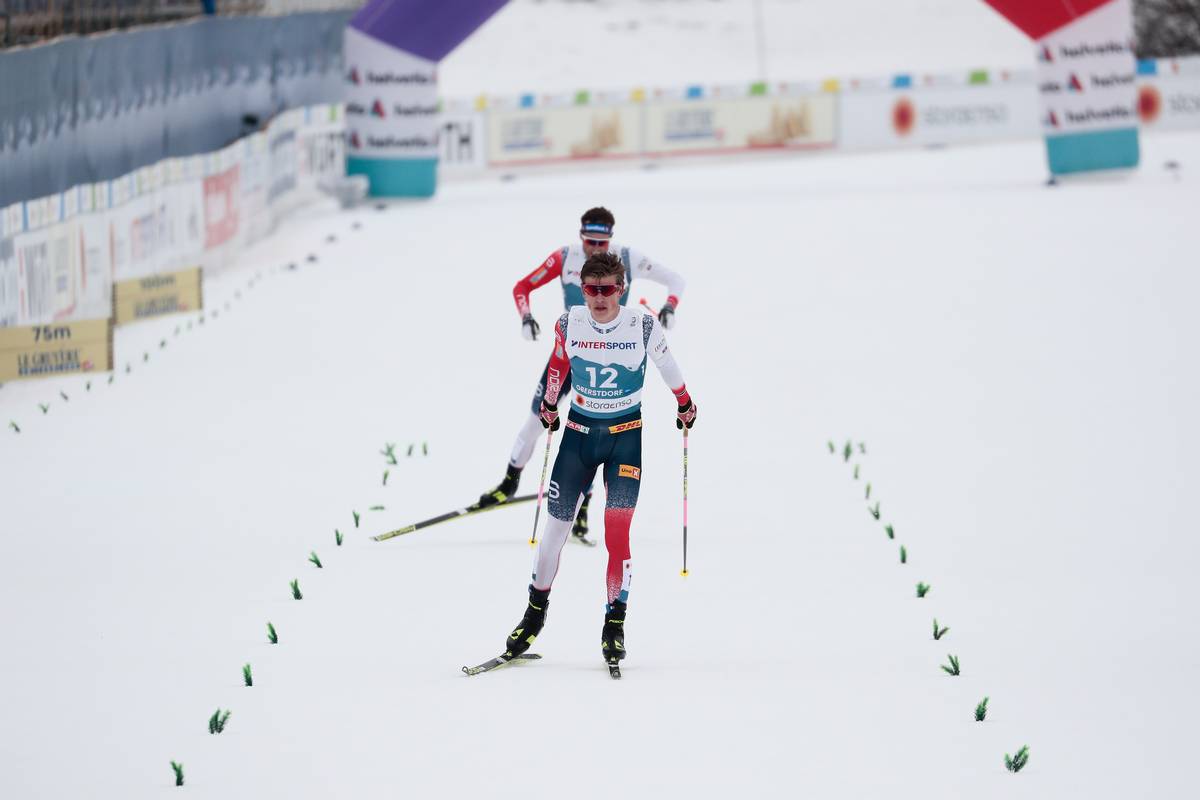
Alexander Bolshunov raises his arms in celebration as he crosses the line for the win in the World Championship 15k/15k skiathlon in Oberstdorf, Germany. (Photo: NordicFocus)Alexander Bolshunov for the win with Simen Hegstad Krüger and Hans Christer Holund behind. (Photo: NordicFocus)Simen Hegstad Krüger (bib 9) and Hans Christer Holund of Norway finish second and third, respectively, in the World Championship 15k/15k skiathlon in Oberstdorf, Germany. (Photo: NordicFocus)
Krüger took the silver medal (+1.1) with Holund just behind for bronze (+1.7).
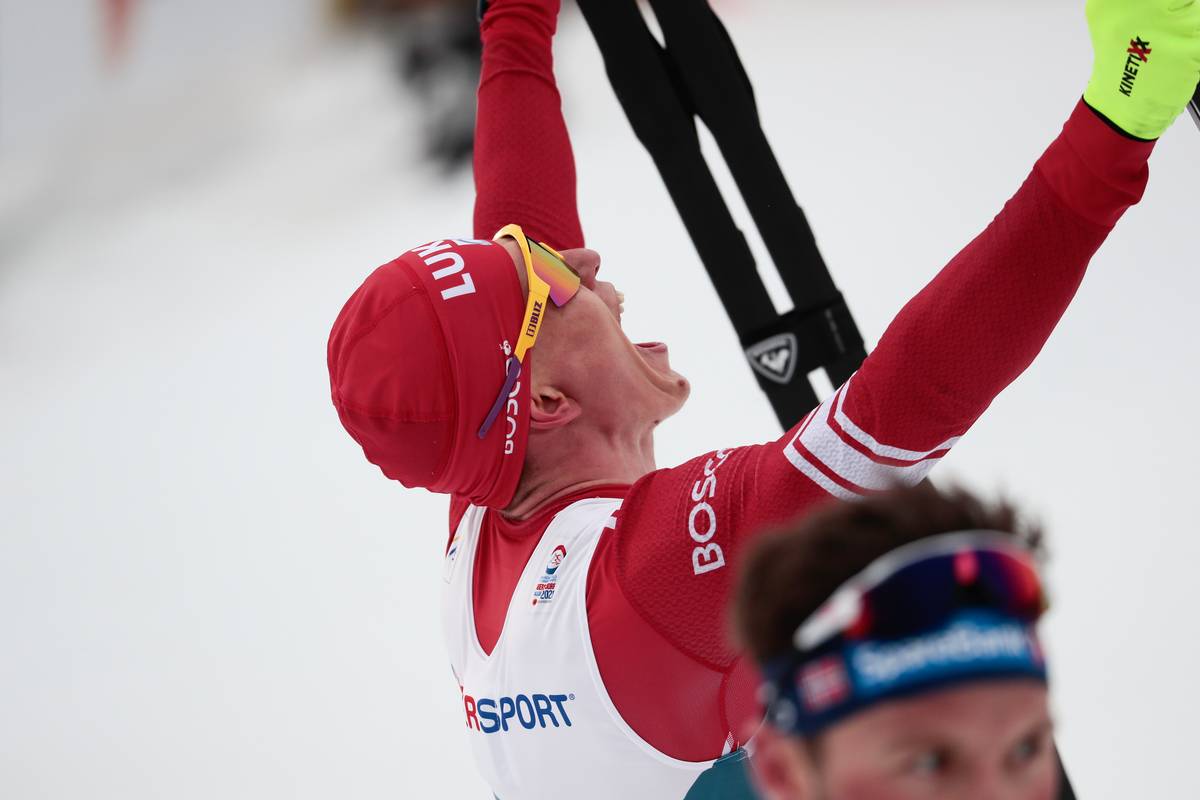
Alexander Bolshunov roars in celebration of victory at the World Championship 15k/15k skiathlon in Oberstdorf, Germany. (Photo: NordicFocus)
Today marks Bolshunov’s first individual World Championship gold medal. He holds two individual silver metals, one in the aforementioned skiathlon and another in the 50 k freestyle in 2019. He also helped the Russian team to second place in the 4×10 k relay and team sprint.
“I felt fine in the first half, then on the last uphill, I was repeating ‘I have to win today. I have to win today,’” Bolshunov told FIS through a translator in a post-race interview. “On the final descent, I could understand that this is the day that I finally achieved this task.”
Silver and bronze: Simen Hegstad Krüger (L) and Hans Christer Holund (R) of Norway finish second and third, respectively, in the World Championship 15k/15k skiathlon in Oberstdorf, Germany. (Photo: NordicFocus)The men’s podium of the World Championship 15k/15k skiathlon in Oberstdorf, Germany. Alexander Bolshunov (RUS) took the win ahead of Simen Hegstad Krüger (NOR) and Hans Christer Holund (NOR). (Photo: NordicFocus)
After a gap, Klæbo was next across the line in 4th (+21.5) followed by Iversen in 5th (+22.1) and Røthe 6th (+47.3).
Johannes Høsflot Klæbo and Emil Iversen ski to 4th and 5th in the World Championship 15k/15k skiathlon in Oberstdorf, Germany. (Photo: NordicFocus)
For the Americans, the excitement continued as Scott Patterson made his way with the chase pack toward the finish. He sat in 9th with 2k to go, but his group was nine men deep. As they made their way into the stadium and sprinted toward the line, Patterson was unable to hold this position, ending his day in a nearly indistinguishable photo finish with Niskanen. It was decided Niskanen edged him out for 13th, leaving Patterson 14th (+2:03.3), less than three seconds behind Yakimushkin who led this chase group.
“It was great, we had awesome skis today, classic felt pretty good,” Patterson said after the race. “The last lap the front guys definitely turned it up a bit and started spreading things out. But, kind in the transition I was able to put a pretty good switchover and get on some more guys… It is the first race of World Champs, I have not raced in a month. I felt good, so looking forward to some more racing. I think without a pack, I think 15 k skate next, I think it could be even better, I felt strong out there. Really excited for this week coming up.”
Scott Patterson skis to 14th in the World Championship 15k/15k skiathlon in Oberstdorf, Germany. (Photo: NordicFocus)
Commenting on the course conditions, Patterson continued, “It was definitely different than yesterday out there on the course; it was skiing really well. It was pretty consistent all the way around, the corners weren’t nearly as deep as we have had the last couple days. Honestly, this cloudy weather and a little rain over night made it really nice skiing. Consistent fair racing for everyone, I think. And we had awesome skis…the best thing.”
Behind this group but steadily holding his ground inside the top-20, David Norris finished 17th (+2:19.8). This is Norris’s best individual finish on the world stage since he took 16th in a 15 k freestyle in Falun, Sweden in March, 2019. Leading the American men, he took 20th in the 2019 World Championships in the 50k freestyle, finishing 24th in the 50k classic a week later at the Holmenkollen in Oslo, Norway.
David Norris cracks the top-20 with a 17th place finish in the World Championship 15k/15k skiathlon in Oberstdorf, Germany. (Photo: NordicFocus)
“It was good,” Norris put his race simply. “The classic was pretty mellow until it wasn’t with about 3 k to go before the exchange. That was the first time I really flooded and started to suffer. But then, I got through the exchange and then worked up in the skate with groups of seemed like groups of three and four. We kind of worked our way up until we caught a good chase pack.
“By the first 3 k of the skate I was really kind of still suffering the final effort in the classic,” Norris continued. “Then all of a sudden, my legs got under me and I felt pretty free — it is the best I have felt all season skating. And that was awesome.”
David Norris bumps fists with Imanol Rojo of Spain after the World Championship 15k/15k skiathlon in Oberstdorf, Germany. (Photo: NordicFocus)
At the 20k mark, Norris was roughly 30 seconds back on Patterson’s group, but made up 10 seconds over the last two laps.
“I worked my up until I was in the group with Scott and then it was kind of funny, because I mean, I was a little bit suffering on the climbs and dangling, and Scott was at the front kind of pushing, but I felt really good in the rolling terrain and flats, so I’d usually make up any ground I lost and I held kind of strong in that position, but I wasn’t really in it for the fight at the front of that group.”
Hunter Wonders skis to 31st in the World Championship 15k/15k skiathlon in Oberstdorf, Germany. (Photo: NordicFocus)
Fellow Alaskan Hunter Wonders was the next American, just outside the top-30 in 31st (+4:25.7). 21-year-old Ben Ogden rounded out the American starters in 45th (+6:27.4).
Antoine Cyr races to 27th in the World Championship 15k/15k skiathlon in Oberstdorf, Germany. (Photo: NordicFocus)
Racing for Canada, Antoine Cyr skied his way into the top-30 finishing 27th (+4:01.9). A minute back, Remi Droulet took 39th (+5:02.4), with Phillipe Boucher finishing 51st (+7:46.1).
Canada’s Remi Droulet skis to 39th in the World Championship 15k/15k skiathlon in Oberstdorf, Germany. (Photo: NordicFocus)
58 men finished the race with an additional 11 starters ending their day early after being lapped by the leaders. Racing continues on Sunday with the team sprint.
The men’s 15 k skate podium from Falun, Sweden: Simen Hegstad Krüger (NOR) second, Alexander Bolshunov (RUS) first, and Sjur Røthe, (NOR) third, (l-r). (Photo: NordicFocus)
This World Cup coverage is made possible through the generous support of Marty and Kathy Hall and their A Hall Mark of Excellence Award. To learn more about A Hall Mark of Excellence Award or to learn how you can support FasterSkier’s coverage please contact info@fasterskier.com.
Sunny skies and cold snow greeted the skiers for the start of the men’s 15 k individual freestyle on Friday, kicking off an extended weekend of racing in Falun, Sweden. With temperatures below 10°F (-14.1°C to be exact) the athletes were well bundled as they headed out of the start gate, one by one. Joni Mäki of Finland, perhaps better known now after his relay performance and ensuing run-in with Russia’s Alexander Bolshunov in Lahti last weekend, was the first starter in a field of 84.
Racing to yet another distance win, Russia’s Alexander Bolshunov squeaked out the 15 k victory in Falun, Sweden. (Photo: NordicFocus)
Initially, it seemed as though it would be another runaway performance from Bolshunov. With the exception of the first split at 1.8 k (taken by Sergey Ustiugov of Russia), Bolshunov led with an ever-growing margin over the course of 15 kilometers. When he finished, wearing bib 41, he led by over a minute (-1:14.5), ahead of the young Norwegian, Harald Amundsen. Among those first 41 finishers was Johannes Høsflot Klæbo of Norway, who returned to the World Cup circuit a week later than his fellow countrymen. Today marked his first World Cup race since the season opener in Ruka, Finland, in November 2020.
In his first World Cup race since the Ruka series, which concluded in early December, Johannes Høsflot Klæbo of Norway placed seventh in the Falun 15 k skate. (Photo: NordicFocus)
In a pre-race interview Klæbo said, “It’s great to be back and something I’ve been looking forward to for a long time now and to be back here in Falun, finally able to compete again, it’s something that I think will be really good… I think it will be really interesting, I’m going to do my best and go as fast as I can but there are a lot of strong guys here so it will be interesting.”
When asked whether he had been following the races in his absence, Klæbo replied, “Yeah for sure I’ve been following it, every weekend. I love skiing so for sure I’ve been following and the guys look really strong so it’s sad to be at home and not to be able to compete. The guys look really strong so we’ll see how it goes for me.”
Klæbo began in bib number 39 and just before 12.8 k was caught by Bolshunov, who started two places behind. At the conclusion of the day, Klæbo placed seventh, +1:01.3 back from Bolshunov.
Norway’s Simen Hegstad Krüger toeing the line- he missed the win by 1.8 seconds on Friday. (Photo: NordicFocus)
However, Bolshunov was not completely unchallenged. Further back in the field was a string of Norwegian starters who, spearheaded by Simen Hegstad Krüger, mounted an attack. At 6.8 k, Krüger was 6.5 seconds behind Bolshunov, and Sjur Røthe nine seconds behind the Russian. Jump forward to 11.3 k and Bolshunov had stretched the lead to +10.5 over Krüger while Røthe was down +23.9, having been overtaken by his teammate Hans Christer Holund.
At 14.1 k, however, Bolshunov’s lead began a precipitous decline, as Krüger raced through +0.7 seconds behind. Despite his best efforts, however, the victory remained elusive for Krüger as Bolshunov came away with the win, yet again, in a time of 32:33.3. Røthe closed hard and regained time from Holund, sneaking into third place (+23.9).
Sjur Røthe, on form, skiing to third overall in the Falun 15 k skate. (Photo: NordicFocus)
After the race Bolshunov spoke through a translator, saying, “This is my third victory in a row in Falun for a skating race, so this place is lucky. Big thanks to the technicians and my team, I had really good skis today.”
With such a dominant season thus far, Bolshunov is well on his way to taking the Overall Crystal Globe at the end of the season – he currently leads the standings with 1491 points, more than double that of the runner-up, Ivan Yakimushkin of Russia (720 points). When asked about this, Bolshunov responded, “[today’s victory] is really important because I have quite a secure lead in the overall, so I can add to it and that makes me relaxed and confident and I can focus on getting ready for World Champs.”
Scott Patterson for the U.S. remains on form skiing into 15th overall. (Photo: NordicFocus)
The day’s most notable results came in the form of two Americans in the top 20. Scott Patterson, who started bib 2, paced well throughout the race and held the leader’s chair through the first 24 starters, until his teammate, Gus Schumacher, crossed the finish line –18.9 seconds ahead of him. In an email, Patterson wrote, “My thought for the race today was to really take advantage of the power V2 and gradual rolling terrain. A lot of people look at Falun and see the Morderbaken as the key feature, but really there is a lot of time elsewhere on the course. I also figured after last weekend returning to low altitude from our post tour time in Seiser Alm that I really wanted to push hard the whole course and not hold much back pacing early. In the end I think this worked out quite well and I felt that I was able to charge even the last time up Morderbaken.”
“The coaches tried to provide some good information from splits, but I knew as an early starter it was mostly about hammering and then hammering some more. The big benefit of the early start was that I got to spend quite a bit of time in the leader’s chair at the finish. It made it even better than when I finally was displaced it was by Gus.” Patterson finished in 15th, a season-best finish for him, one-upping his 16th place in Davos, Switzerland during the 15 k skate.
Looking forward, Patterson wrote, “I’ve always been aiming for world champs as the focus of this season so it is good to be moving in the right direction. I’m feeling pretty good about my skating and fitness right now, but I really want to have some good classic races and boost my confidence there. My big goal for worlds is to get a top 10 in one of the individual distance races. I also am pretty excited that we seem to have a little momentum going for the guys team. It would be really sweet to throw down a good 4x10k relay.”
Gus Schumacher racing into the top-10 in Falun’s 15 k skate. (Photo: NordicFocus)
For Schumacher, today proved that his stellar performance in Val di Fiemme during the Tour de Ski, where he placed 8th, was no fluke. In a fully stacked field, Schumacher finished the day in 9th with a time of 33:50.7. Placing just behind him were a string of Russians, including Denis Spitsov, Evgeniy Belov, and Sergey Ustiugov.
Post race interview with Gus Schumacher:
Simi Hamilton, in his first World Cup since the Tour de Ski, was just outside the points in 32nd. (Photo: NordicFocus)
Also in the field for the Americans was Simi Hamilton, who placed 32nd having recently returned to the World Cup circuit after a brief break. David Norris placed 40th, Hunter Wonders was 52nd, and Kevin Bolger finished 61st.
Post-race interview with U.S. Head Coach Matt Whitcomb
For the second weekend in a row, Russell Kennedy skied into the top-30, placing 29th on Friday in Falun. (Photo: NordicFocus)
The Canadian men were led by Russell Kennedy who finished in 29th, matching his result from last week’s skiathlon in Lahti, Finland. Behind Kennedy, Philippe Boucher finished 58th, and Remi Drolet 63rd.
Early in the first leg of the men’s 4 x 7.5 k relay in Lahti, Finland. (Photo: NordicFocus)
This World Cup coverage is made possible through the generous support of Marty and Kathy Hall and their A Hall Mark of Excellence Award. To learn more about A Hall Mark of Excellence Award or to learn how you can support FasterSkier’s coverage please contact info@fasterskier.com.
The fog seemed to have thickened since the completion of the women’s race earlier in the day, at times obscuring the skiers with only their silhouettes visible. Eleven teams contested this men’s 4×7.5 k relay with nine nations represented, though with the disqualification of Alexander Bolshunov (more on that in a bit), anchor for Russia I, only 10 teams officially finished.
Historically, World Cup men’s relays have been a duel between Russia and Norway. Out of the fifteen relay races in the past 10 years (not including world championships or Olympics), Russia has won four of those times, the remaining victories all Norway. After a men’s podium sweep in the skiathlon on Saturday, it seemed fair to bet on Norway for today’s race. Indeed, when the race concluded Sunday in Lahti, Finland it was Norway once again on top. As skiathlon winner Emil Iverson so aptly put it yesterday, the Norwegians are “back with a boom.”
The race began, and ended with drama, particularly for team Russia I. Immediately out of the start gate, Alexey Chervotkin, who scrambled for Russia I broke a pole but recovered to quickly rejoin the field. Pål Golberg of Norway led the charge off the front, pushing the pace to string out the pack. By the end of the third lap, Golberg had created a gap to the rest of the field, followed only by Ilia Semikov of Russia II and a little way back, Chervotkin of Russia I. “It was good that it was snow and not rain coming down,” said Golberg after the race, “so it was possible to go hard at the front.”
Pål Golberg (NOR), Alexey Chervotkin (RUS), Ilia Semikov (RUS), Marko Kilp (EST), (l-r) during the men’s 4 x 7.5 k relay. (Photo: NordicFocus)Alexey Chervotkin (RUS), Pål Golberg (NOR), (l-r) scramble for their respective teams. (Photo: NordicFocus)
At the first exchange, Golberg tagged teammate Iversen with a +0.8 lead to Ivan Yakimushkin, who took over for Russia II, and +10.7 to Evgeniy Belov of Russia I.
These standings held steady for much of leg two. Russia II entered the tag zone +0.5 ahead of Norway for the third leg handoff. Andrey Melnichenko took over for Russia II with Sjur Røthe hot on his tails. Denis Spitsov of Russia I was tagged +11.9 back while Iivo Niskanen took over for Finland, not far behind. Over the next few minutes, Niskanen surged, catching Spitsov at the outset of their third lap.
Emil Iversen (NOR), Ivan Yakimushkin (RUS), (l-r), the second leg of the 4 x 7.5 k relay. (Photo: NordicFocus)Emil Iversen (NOR), Ivan Yakimushkin (RUS), (l-r), the second leg of the 4 x 7.5k relay in Lahti. (Photo: NordicFocus)
Further up the trail, Røthe made a decisive move, gapping Melnichenko (Russia II) by +6.95 at 20 k. At the conclusion of the third leg, Røthe had stretched this lead to +38.3 ahead of Niskanen.
“I felt really good today,” said Røthe to FIS after the race, “and we had really really good skis today. It was just for me to start hard and go even harder in the end.”
With the benefit of Røthe’s effort, Norway’s anchor, Simen Hegstad Krüger, cruised along with a healthy lead.
Simen Hegstad Krüger of Norway closing in for the win. (Photo: NordicFocus)
The race for second was where the podium racing became spicey. Niskanen skied a furious third leg, bringing his team into contact with Russia I and II — moving his team into second at the final tag off. Taking over at that third exchange (final leg) for Russia I was Tour de Ski winner, Alexander Bolshunov. Sergey Ustiugov made his season debut as an anchor for Russia II after missing Period I due to COVID-19 complications. For Finland I, Joni Mæki skied anchor after the tag from Niskanen.
Mæki, Bolshunov, and Ustiugov formed a group for the fourth relay leg as Krüger continued to stretch Norway’s lead out front.
Joni Mæki (FIN), Alexander Bolshunov (RUS), and Sergey Ustiugov (RUS), (l-r) during the final leg of the men’s 4 x 7.5 k relay in Lahti, Finland. (Photo: NordicFocus)Russia’s Alexander Bolshunov leading Jon Maki (FIN) and Sergey Ustiugov (RUS). (Photo: NordicFocus)
Exiting the stadium for the final lap Bolshunov picked up the tempo and succeeded in dropping Ustiugov, while Mæki stuck with this year’s Tour de Ski winner.
Out on his own, Krüger cruised into the finish straights and crossed the finish line in a time of 1:07:56.8. “I took the Lahti corner nice and steady,” said Krüger, a reference to his teammate Iversen’s notorious crash there during the 2017 World Championships, “all the guys gave me such a nice starting point at the end there. Really good day for team Norway and we are back in the World Cup.”
The ugly cross-country skis news of the day starts here – with Mæki and Bolshunov playing cat and mouse over the final kilometer. Mæki led Bolshnov into the final corner of the stadium, a sweeping left-hander. Trying to execute a slingshot move, Bolshunov took the corner wide, attempting to slot into the outside finish lane. Mæki, who was slightly ahead, shifted towards this lane too. Bolshunov continued full gas, Mæki, it appeared, made a subtle tactical move to quell the Russian’s closing speed. Pinched out of his lane, and much to his evident frustration as he swung a pole at Mæki, Bolshunov began his unraveling. Mæki crossed the finish line in second, only to be bowled over seconds later as an angry Bolshunov slid into him, knocking the Finn to the ground. This unsportsmanlike behavior resulted in the disqualification of Russia I, thus bumping Russia II into third place. According to FIS, this was Finland’s first men’s relay World Cup podium.
Bolshunov about to throttle Mæki. (Photo: NordicFocus)Bolshunov was eventually penalized and his team was disqualified. Mæki in bib 5 being tackled by a belligerent Bolshunov. (Photo: NordicFocus)
On Twitter after the race, U.S. Head Coach Matt Whitcomb was terse in his assessment of Bolshunov’s actions. “To be clear to any kids and coaches watching: This tackle by Bolshunov is not okay. If a U.S. athlete did this, they’d be sent home and removed from the team. A disqualification would just be the beginning of their problems.”
To be clear to any kids and coaches watching: This tackle by Bolshunov is not okay. If a U.S. athlete did this, they’d be sent home and removed from the team. A disqualification would just be the beginning of their problems. @FISCrossCountrypic.twitter.com/3FgfqqB5yC
Not exactly good visibility in Lahti, Finland as Scott Patterson laps through the stadium in Lahti. (Photo: NordicFocus)
The US team, composed of David Norris, Gus Schumacher, Scott Patterson, and Hunter Wonders, placed seventh (+4:04.3). The backstory for the men’s U.S. roster reveals the race was an opportunity for some to gain World Cup level relay experience. Schumacher and Wonders, both U23 skiers, were relay rookies at this level. This is Wonders’ first career World Cup weekend. He placed 46th in Saturday’s skiathlon. Norris, as many observers of the sport are aware, was diagnosed with Covid this past fall. The Lahti series is his initial foray into international racing post-diagnosis.
Russell Kennedy racing the anchor leg for Canada. Kennedy scored his first career distance points yesterday in the skiathlon. (Photo: NordicFocus)
The Canadian team composed of Graham Ritchie, Antoine, Cyr, Philippe Boucher, and Russell Kennedy was lapped and is listed as ninth in the results. Like the U.S. team, Canada featured two U23 athletes in Ritchie (22) and Cyr (22). Prior to this weekend, Canada had not sent athletes to the World Cup this season. Pictured above, Kennedy scored his first career World Cup distance points in Saturday’s skiathlon.
Sunday, for the men’s 4 x 7.5-kilometer relay in Lahti, Finland the scene was decidedly more fitting for winter sport: The race began amidst falling snow despite bare firs and hardwoods lining the course. It’s been a sparse winter in Lahti.
Eleven teams contested the relay, with ten nations represented; Russia fielded two teams. The U.S. was not represented.
First leg pack racing in Lahti, Finland. (Photo: NordicFocus)
Russia II’s Andrey Sobakarev and Russia I’s Ilia Semikov leading out the first leg of the men’s 7.5 k relay in Lahti. (Photo: NordicFocus)
For the first 7.5 k leg, Russia I’s Ilia Semikov and Russia II’s Andrey Sobakarev animated the sharp end with several pulses of energy to make a slinky of the pack. Norway’s Pål Golberg took some commensurate pulls too. The calories expended broke this into a front group of six teams at the first exchange separated by 2.4 seconds. The teams came through in this order: Norway, Russia I, Germany, Finland, Russia II, and Italy. Switzerland and Sweden, who had been loosely attached to the pack here and there, had popped – coming through roughly 20 seconds back.
Leg 1 of the men’s 4 x 7.5 k relay in Lahti, Finland: Pål Golberg (NOR), Ilia Semikov (RUS), Lauri Vuorinen (FIN), Bjoern Sandstroem (SWE), Beda Klee (SUI), Giandomenico Salvadori (ITA), (l-r). (Photo: NordicFocus)
The second leg played out much like the first, with the Russian teams, Norway, Italy, and Finland maintaining a gap. Finland’s Iivo Niskanen kept Finland in the hunt, and Russia II’s Alexey Chervotkin took a runner through the 13.6 k time check – otherwise the drama was subdued.
Through the woods, a leading Iivo Niskanen of Finland. (Photo: NordicFocus)
During the first skate leg, the front group ballooned modestly to seven with the addition of Germany beyond the original six teams. As the third leg skate moved towards the tag off for leg four, Finland had popped for good, and coming down into the stadium for the tag, it became a five team affair, with Russia I, Russia II, Germany, Norway, and Italy coming through in that order. Switzerland tagged off in sixth (+6.9).
Artem Maltsev of Russia II taking the pull: fourth leg of the men’s 4 x 7.5 k relay in Lahti, Finland. (Photo: NordicFocus)
During the fourth leg the Russians gave several hungry digs. But on the first pass through Lahti stadium at 25 k with a long glide out speeding into the lap area, Norway’s anchor, Johannes Høsflot Klæbo, clearly sported the slickest pair of skate skis as he moved to the front with little friction under his feet. And we all know how Klæbo can close.
At 27.5 k, the start of the last lap, Germany was no longer in the podium game. Five teams came through in a line led by the indomanable Klæbo. For the final 2.5 k lap, Klæbo killed the pace initially and then Russia I’s Andrey Melnichenkov tried in earnest to pull away and thin out the latched on Klæbo, Italy’s Stefan Zelger, and Switzerland’s Roman Furger. To no avail. Like he’s done before in countless sprints, Klæbo tapped into his vast stores of fast twitch muscle fiber and pulled away in the home stretch for the Norway win in 1:09: 53.
Johannes Høsflot Klæbo in his element: the finish straight. (Photo: NordicFocus)
The closer: Johannes Høsflot Klæbo. (Photo: NordicFocus)
Norway’s combo of Golberg, Hans Christer Holund, Sjur Røthe, and Klæbo momentarily reclaimed the men’s relay title over Russia -the Russians had won the last two relays, one in Lillehammer this season, the other in Ulricehamn, Sweden last year.
Switzerland’s Beda Klee, Dario Cologna, Jason Rueesch, and Furger placed second (+1.2), and Russia I’s Semikov, Alexander Bessmertnykh, Denis Spitsov, and Melnichenkov were third (+1.7).
For the Swiss, this was thier first men’s World Cup relay podium in nearly a decade.
“Russia has won the previous two relays, it was time to take the throne back,” Golberg told FIS after the race.
Klæbo’s comments to FIS post-race underscored his finish speed gift. “In the start it was quite high speed and I think that all of the other guys saw that it was really difficult to get a gap,” Klæbo said of his leg. “So I was just in the front and slowing the pace down, it was almost just like training, it was a really slow pace. But in the end it was all-in and I think it was a really fun and interesting race.”
Racing continues in Drammen, Norway on Wednesday with a classic sprint.
Yellow bibbed as the overall leader of the World Cup, out first on Sunday’s 30 k classic pursuit in Trondheim, and Norway’s Pål Golberg starting 34 seconds back: this was the situation Russia’s Alexander Bolshunov found himself in as he pulsed from the start. Thrown into this mix of tension was a helter-skelter mish-mash of weather. On and off again snow, blustery winds, and temps hovering right near that wax tech’s no man’s land of 0 °C.
We are not used to seeing Bolshunov falter. He has been a beast this season having won the Tour de Ski and hammering away from the field solo during this tour’s Stage 4 34 k mass start skate. Those are simply two highlights. But there he was, perhaps humbled by less than stellar skis on Sunday; the big Russian bear faltered.
Alexander Bolshunov of Russia — the hunted on Stage 6. (Photo: NordicFocus)
This was Golberg’s day. By 2.2 k he had nearly halved the gap to Bolshunov. Two k later, Golberg was on the Russian’s ski tails, with Bolshunov’s metaphorical tail beginning to droop between his legs. A Russian down — Golberg on his own solo quest for the win.
For the next 26 k, Golberg’s job was no longer to fend off Bolshunov, but to keep a motivated crew of Norwegian’s from gapping up. We’ll get to that piece of the story in a bit. Golberg won with a polite bow to the crowd in 1:23:51.6. This was the twenty-nine-year-old Golberg’s second win of the season. He won a classic sprint in Falun, Sweden earlier this month. His effort, and lovely skis on a day that saw several skiers stop and scrape ice off their kick zones, earned him the Ski Tour overall win.
“It’s surreal and something I did not expect before the Ski Tour and before the season,” Golberg told FIS after the race. “The crowd started to congratulate me on the third round so I had to stay focussed until the finish.”
Head down and driving for the win: Pål Golberg of Norway. (Photo: NordicFocus)
Pål Golberg on his solo winning effort. (Photo: NordicFocus)
Back to the chase – which was really a Norwegian hunt for that Russian bear. We’re going to begin with the hunters: Martin Løwstrøm Nyenget, Simen Hegstad Krüger, Johannes Høsflot Klæbo, Hans Christer Holund, Emil Iversen, and Sjur Røthe. (Imagine having that crew team trialing behind.) Maybe grotesque in their spoils, but certainly dogged in their pursuit, this all Norwegian chase was symbolic of a country’s ability to foster otherworldly endurance talent, and keep them fresh enough to crush the field in a six-stage tour. It was literally a train of Norwegian skiers who had likely been shadowing one another at the elite level since their late teens.
They slowly reeled Bolshunov in. At 13.9 k, the Russian kept a 14-second buffer between he and the Norwegians. Ultimately, this was no catch and release scenario. Bolshunow was swallowed near the 16 k mark. Another three k later, all but Røthe kept pace, the others gapped Bolshunov by nine seconds.
The Norwegians forged ahead, while Bolshunov, digetsing the inevitable, tried to minimize losses. Krüger, known for his skating, took strong pulls in the closing kilometers. He crossed the line in second (+28.9). Holund placed third (+30.1), Iversen fourth (+32.3), Nyenget fifth (+32.9), and Klæbo sixth (+34.2).
The Norwegian train during Stage 6 of the Ski Tour 2020. Hans Christer Holund (bib 8), Emil Iversen (bib 10). (Photo: NordicFocus)
Sjur Røthe leading out: State 6 Ski Tour 2020. (Photo: NordicFocus)
Simen Hegstad Krüger (front) down the finish straight to take second overall. (Photo: NordicFocus)
Bolshunov settled for seventh place (+1:41.0), ceding roughly 1:10 to that lead Norwegian group, as he lost grip on the Ski Tour overall. His demeanor across the line matter of fact: he unlocked his bindings as he glided across the line, stepped out his skis, then proceeded through the finish area without acknowledging the all-Norwegian scrum in the finish pen.
As for time of day efforts, the fastest time goes to Iversen in 1:21:25.9. Finland’s Iivo Niskanen notched the second-fastest time 10.9 seconds back. Niskanen placed eighth on the stage (+1:48.2). For his troubles, Bolshunov skied the 23rd fastest time, 4:06.7 off of Iversen’s best of day mark.
The look of missing out: Alexander Bolshunov after finishing Stage 6 of the Is Tour 2020. (Photo: NordicFocus)
David Norris led the day for the U.S. ending the day and the Ski Tour ranked 34th (+11:30.7). Ben Lustgarten placed 54th (+19:29.5). The remaining U.S. skiers who began the tour, dropped from competition after Stage 6. They include Logan Hanneman and Kevin Bolger who both have mild colds. Simi Hamilton dropped after Stage 4 with a mild illness as well.
Canada’s Russell Kennedy placed 39th (+12:50.5), Evan Palmer-Charrette 43rd (+14:33.2), Alexis Dumas 55th (+20:12.5), and Ricardo Izquierdo-Bernier 56th.
This concludes the epicness from Norway, as the Ski Tour closes out. Racing begins again in Lahti, Finland next Saturday.
With the course re-routed from the original 38-kilometer mass start skate to essentially an out and back into Meråker, Norway’s ski stadium, the day belonged to Russia’s Alexander Bolshunov who appears, at this point in the season, to be unstoppable in the distance events.
In the end, it was all Alexander Bolshunov: peerless. (Photo: NordicFocus)
In a post-race interview, Devon Kershaw noted that men paced it World-Cup comfortable for much of the first portion of the race. In other words, the effort up-front, although speedy for most, was not a break apart the 79 starters into small groups of similarly paced pockets of effort.
Fast forward to the 14 k mark, and 32 men came through the time check within 1.8 seconds. At that point, Jens Burman of Sweden was driving that train.
Through the race mid-point, the pack faced a steady headwind. Tactically, it made sense for any would-be endurance escape artist to wait until the turn home on the mostly out and back course, when a tailwind could aid their efforts, to make a move.
Pack skiing Norway style. (Photo: NordicFocus)
Sjur Røthe of Norway took big pulls leading as did his teammate Finn Hågen Krogh. Later in the race, Emil Iversen too sensed some podium opportunity. We could expand the list. But that would perhaps overshadow Bolshunov.
A select group began to pick up the pace as skiers sped towards the 20 k time bonus. This included Røthe, Krogh, Bolshunov, Iversen, and Johannes Høsflot Klæbo who came through the check-in 17th. (This was not the Norwegian national champs, although nine Norwegians, at that point, jammed the front 17 spots.)
Martin Løwstrøm Nyenget (bib 8) leads Emil Iversen and Dario Cologna during the Stage 4, 34 k mass start skate. (Photo: NordicFocus)
Emil Iversen comes in for third place on Stage 4 of the Ski Tour 2020. (Photo: NordicFocus)
Post-20 k time bonus, Bolshunov wound up, uncoiled, and made a decisive move. He set off solo, accelerating ahead of the pack of star names, and was able to gap the chase by 51.7 seconds at the finish for a solo effort win in 1:19:34.9.
Solo: Alexander Bolshunov way way off the front. (Photo: NordicFocus)
Klæbo placed second (+51.7), and hometown skier Iversen third (+51.8). Places fourth through 11th were separated by roughly nine seconds.
Bolshunov leads the Ski Tour 2020 with a total time of 2:26:16 hours after four stages. Golberg is second (+1:05), and Røthe third (+1:06).
Emil Iversen (bib 3) and Johannes Høsflot Klæbo share a stoke-moment after the race. (Photo: NordicFocus)
David Norris was the top North American in 26th (+3:08.7). Ben Lustgarten placed 51st (+5:30), Kevin Bolger 69th (+8:06.7), Simi Hamilton 74th (+9:28.1), and Logan Hannmen 76th (+9:39.3).
Canada’s Evan Palmer-Charrette skied to 37th (+3:46.0), Russell Kennedy 39th (+3:59.9), Alexis Dumas 67th (+7:32.3), and Ricardo Izquierdo-Bernier 77th (+13:03.6).
Racing continues Saturday in Trondheim with a 1.5 k classic sprint, the sixth stage of the Ski Tour 2020.
The men’s Stage 4 podium: Johannes Høsflot Klæbo (NOR) second, Alexander Bolshunov (RUS) first, and Emil Iversen (NOR) third, (l-r). (Photo: NordicFocus)
Picking up where we left off in Östersund, Sweden: a pursuit start 15-kilometer classic. Unlike the women’s field where Therese Johaug “administered a beatdown”, creating a large time gap for herself, the margins for the men were much smaller.
This year’s Tour de Ski winner Alexander Bolshunov of Russia, whose winning streak was interrupted, would start with a 22 second time deficit in fifth. Tenth place Ivan Yakimushkin (RUS) was 33 seconds back and Jens Burman (SWE) in 20th just inside a minute.
Alexander Bolshunov during Stage 2’s 15 k classic pursuit of the Ski Tour 2020. (Photo: NordicFocus)
With four 3.75 k laps to cover, the deficits were manageable. Perhaps the only Tour victory hopeful who was kept up about the work that needed to be done was Johannes Høsflot Klæbo, who would start 1:23 behind the leader after finishing 31st the day before.
The caveat would be to stay upright while navigating the icy winding bends of the primarily man made track. With grey skies and above-freezing conditions, it was fast and dicey, made evident by numerous crashes.
During one particularly noteworthy four-person pileup, Kamil Bury of Poland was taken out by Italy’s Maicol Rastelli as the two navigated a treacherous right hand turn at the bottom of a steep descent. Though neither had full control, Rastelli slid off the left side of the course, taking Bury along with him. Bury lost a ski and became tangled in the netting.
Just before impact… (Photo: Screenshot NBC/FIS Broadcast)
As Rastelli stood up and worked to right his skis, which were pointing in opposing directions, a third skier, Lin Bao of China, essentially slide tackled Rastelli, sending him in a complete backflip back down to the snow.
A fourth skier, Tadevos Poghosyan of Armenia, also lost control and slid into the pile. Bao and Poghosyan were able to stand up relatively quickly and continue on their way, but cameras cut away before the resolution of whether Bury found his ski and Rastelli was able to recover from his forced aerials.
Holy carnage… back to the race.
At the end of the first lap, it was as if the men were gifted ready-made groups. Røthe and Krüger matched stride for stride and double pole for double pole, while the remainder of the top five plus a handful of additional Norwegians, namely Pål Golberg, Hans Christer Holund, and Martin Løwstrøm Nyenget, chased from roughly six seconds back.
In bib 11, Martin Løwstrøm Nyenget (NOR) works his way towards the sharp end of the men’s 15 k classic pursuit. (Photo: NordicFocus)
It looked as though Røthe and Krüger might run away from the field, but it was not so easy. By 4.4 k, the gap was closed and an eight-man train chugged along the tracks. As Yakimushkin had fallen off the pace, it became seven Norwegians and Bolshunov.
Over the final two laps, the front pack whittled down from eight to five, where it remained with one k to go. Holund, Golberg, Røthe, Bolshunov, and Nyenget. The Russian in the yellow bib was primed to make a move.
Bending, rolling, and swooping, they headed for the stadium. Up the final punchy climb, Golberg and Bolshunov were side by side, and Golberg started to slip. He recovered and powered out of the climb, running with Klæbo-like dominance over the crest of the hill and into a tuck to lead into the stadium.
Bolshunov had fast skis and caught a draft before whipping into second place as the men entered the final straight. The Russian was right behind Golberg and absolutely charging. But there was not enough real estate. He changed lanes to challenge the Norwegian and looked as though he would overtake him, but the final meters evaporated and Golberg threw his foot for a clear win.
A lane switch wasn’t enough for Alexander Bolshunov as Pål Golberg of Norway takes the win. (Photo: NordicFocus)
Pål Golberg about to toe – during the 15 k classic pursuit, Stage 2 of th Ski Tour 2020 in Östersund, Sweden. (Photo: NordicFocus)
Golberg crossed the line in 34:50.8, with Bolshunov 0.3 seconds behind. Nyenget took third (+2.1) in a tight finish with Røthe (+2.5). Holund dropped off in the final sprint to round out the top five (+7.3).
Pål Golberg wins at the line over Alexander Bolshunov during the 15 k classic pursuit, Stage 2 of th Ski Tour 2020 in Östersund, Sweden. (Photo: NordicFocus)
“Perfect klister conditions,” Golberg told FIS at the finish. “I managed to get the ski pair from last weekend, so I had good skis this weekend as well. It was a really, really good day.”
The interviewer noted that conditions were much different than the previous day.
“It was hard in the middle,” Golberg explained. “It was a bit drier, so a bit difficult with klister in the downhill. But the tracks were perfect, so I’m really happy.”
Not the start of the FIS Ski Tour 2020 desired by Johannes Høsflot Klæbo. (Photo: NordicFocus)
Speaking of Klæbo, the Norwegian skied his way into 25th, but ceded an additional 52 seconds in the overall standings by finishing 2:15 back on the leaders.
FIS sent out a news brief shortly after the race with information regarding Klæbo’s injured finger. Here is the statement in full:
“Johannes Høsflot Klæbo (NOR) has to undergo an emergency check up for his broken finger. The check up has to take place with his doctor in Trondheim (NOR). As the rules of the FIS Ski Tour 2020 state no other transportation of athletes than by train, the jury gave permission to Johannes to travel by car to Trondheim and back to Åre for this special case. After the consultation, the jury will receive a report of the treating medical team in Trondheim.”
Leading again for the U.S., David Norris skis to 34th. (Photo: NordicFocus)
Stride and glide, Simi Hamilton climbs in Östersund, Sweden. (Photo: NordicFocus)
The American men hovered near their positions in Stage 1 at the end of the pursuit. Still grinding, David Norris finished 34th (+3:05.0), followed by Simi Hamilton in 43rd (+3:47.8).
Ben Lustgarten was the next American in 68th (+6:01.4), followed by Kevin Bolger in 70th (+6:12.7), and Logan Hanneman in 85th (+10:00.2).
Ben Lustgarten in the mix during the classic pursuit in Östersund, Sweden. (Photo: NordicFocus)
Racing for Canada, Russell Kennedy was again the top skier in 58th (+4:47.3). Next up was Alexis Dumas in 61st (+4:51.9), and Evan Palmer-Charette in 66th (+5:33.7).
Tomorrow is a rest day on the Ski Tour 2020, Stage 3, a skate sprint, will be held on Tuesday.
The men’s Stage 2 Ski Tour 2020 15 k classic pursuit podium: Alexander Bolshunov (RUS) second, Pål Golberg (NOR) first, and Martin Løwstrøm Nyenget (NOR) third, (l-r). (Photo: NordicFocus)
It was all Norway in both the men’s and women’s Stage 1 of the Ski Tour 2020 from Östersund, Sweden. Sjur Røthe on the men’s side was pacing perfection while Therese Johaug simply steamrolled. This was clear, Norway had the best skis, and perhaps by default, the fastest skiers almost across the top-10 board. Yet, it is a long week ahead, and we are one stage into a six-stage event.
Here’s the debrief from Devon: post 15 k/ 10 k interval start skate.
Hans Christer Holund of Norway leading down the ribbon of white. A low snow year in Falun, Sweden. (Photo: NordicFocus)
Around and around they go. Due to lack of snow in Falun, Sweden, the men again wheeled their way around a manmade ribbon of snow, skating six icy 2.5-kilometer laps. Reduced from 30 to the 15 k distance and without the long, steep climb for which the course is usually known, how athletes would fare was yet to be determined.
The 2.5-kilometer track of Falun in a low snow year. (Photo: Screenshot FIS Broadcast)
Along the way, two sets of 15 bonus points were available for the top ten skiers to sprint past the 6.7 and 11.7 checkpoints. It was at the first checkpoint that things began to spread out.
Overall World Cup and distance points leader, Alexander Bolshunov of Russia, dropped into a tuck on the downhill, accelerating past the Norwegians Hans Christer Holund, Simen Hegstad Krüger, Finn Hågen Krogh, and Sjur Røthe who had taken turns in the lead. Behind Bolshunov in blue Lycra sat the newly minted skate contender Iivo Niskanen of Finland. Known historically as a classic specialist, Niskanen has shown marked improvements in his skate results this season, including a second place finish in the freestyle distance event in Nové Město.
Alexander Bolshunov (center) primes himself to charge for the sprint bonus, surging past Iivo Niskanen (bib 2) and Hans Christer Holund (bib 6). (Photo: NordicFocus)
Like a slinky, the pack caught back up to Bolshunov, who relaxed and allowed the Norwegians to get to work again at the front. In a tuck or free skating, the group headed down the longest descent of the course, halfway through the lap. As the course bent to the left, the leader, Røthe, began to step turn, pushing off his right ski and leaning into the curve. As his ski left the ground, it pushed the tips of Bolshunov’s skis together, sending him to the snow (and almost to the grass) between a set of v boards. The Russian hopped back up, quickly regaining lost ground on the lead pack.
At the 10 k mark, only 8 seconds separated the top ten. But after the second bonus sprint, where Bolshunov again slingshot around the Norwegian leaders out of the downhill to grab the full 15 points, the field began to spread out.
A sea of red: the top six Norwegian and Russian athletes head into the final lap of the 15 k freestyle in Falun. (Photo: NordicFocus)
Bolshunov pushed the front of the pack, trying to break free of Røthe, Holund, and Krüger. His Russian teammates Ivan Yakimushkin and Andrey Melnichenko maintaining contact from a few seconds behind.
In the final lap, Bolshunov tried to break free, but Røthe matched his every move. Holund and Krüger fell off the pace and were overtaken by the chasing Russians. Rounding a downhill turn inside the final kilometer, Krüger caught a ski in the loose granular snow and was sent to the ground, no longer in the hunt for the third step of the podium.
Rocketing out of the downhill with less than 500 meters to go, Røthe soared past Bolshunov in a tuck to take the lead over the final roller before the stadium.
Down to the final meters, Alexander Bolshunov (right) and Sjur Røthe sprint for home in the 15 k skate in Falun. (Photo: NordicFocus)
It came down to the final sprint, and Røthe was outmatched. Bolshunov snuck back around, powering his skis down the track. He created enough of a gap that his victory was certain, and he threw his arms up in the air to celebrate. It was the Russian’s fourth consecutive distance win, and sixth of the season.
With arms raised, Alexander Bolshunov takes the win in Falun with Sjur Røthe in a close second. (Photo: NordicFocus)
Sjur Røthe collapses after a hard fought battle for second place in Falun. (Photo: NordicFocus)
Yakimushkin was next across the line for third (+9.7), followed by Melnichenko in fourth (+10.5) and Holund in fifth (+11.0). The twenty-three-year-old Yakimushkin was 2nd in the event in Toblach, Italy during Tour de Ski and also 2nd at Russian National champs in April 2019.
With today’s result, Bolshunov looks untouchable at the top of the distance standings with 924 points. Røthe sits in second with 596. Bolshunov also leads the overall by over 400 points ahead of the injured boxer, Johannes Høsflot Klæbo.
Alexander Bolshunov (RUS) and Sjur Røthe (NOR) exchange congratulations after an exciting finish in Falun. (Photo: NordicFocus)
“It was a really hard race because the Norwegian team made good tactics,” Bolshunov told FIS through a translator at the finish. “They always sent someone in front to run the race, so I have to always close some gaps on them and make the most of the bonuses to take maximum points there. Then to make the harder pace on the last lap and to make a good fight with Sjur Røthe at the finish lane.”
The men’s distance podium in Falun. From left to right, Sjur Røthe (NOR), Alexander Bolshunov (RUS), and Ivan Yakimushkin (RUS). (Photo: NordicFocus)
For much of the race, Norris hovered inside the top-20, looking to match or improve upon his career best result of 16th, which was achieved in a 15 k skate in Falun last March.
David Norris tucks in behind Sergey Ustiugov (RUS) heading down the ribbon of snow in Falun. (Photo: NordicFocus)
In a post-race interview, shares that he did not originally plan to compete in Falun, sitting out the 30k instead to focus on the upcoming FIS Ski Tour 2020. He also reflects on his race, how mass starts affect the energy moderation strategy he has been honing, and his outlook heading into the distance-focused tour.
Post-race interview with David Norris
Benjamin Lustgarten (CGRP) was next for the U.S. in 60th (+3:21.0) followed by Ian Torchia (SMST2) in 65th (+3:37.7), and Kevin Bolger (USST) in 68th (+3:59.1).
Post-race interview with U.S. World Cup Coach Matt Whitcomb
Ian Torchia climbs with the pack in Falun. (Photo: NordicFocus)
Evan Palmer-Charette was the top Canadian athlete in 52nd (+2:45.8), followed by Alexis Dumas in 64th (+3:33.3), Bob Thompson 67th (+3:45.5), and Ricardo Izquierdo-Bernier 74th (+5:36.7).
The men’s podium in Oberstdorf, Germany. Alexander Bolshunov (RUS) took the win in the 30 k skiathlon ahead of Norway’s Simen Hegstad Krüger and Sjur Røthe. (Photo: NordicFocus)
And the World Cup beat goes on. Nearly 70 men lined up in Oberstdorf, Germany for a 15/15-kilometer skiathlon, battling across techniques in front of a Bavarian Alp backdrop. The venue will be the home of the 2021 FIS Nordic World Ski Championships.
The 3.75 k course in Oberstdorf featured a variety of terrain, with the Burgstall hill climb bringing athletes to the high point of the course. To increase the pulse in the long race, four rounds of 15 World Cup bonus points were available at the 6.2, 9.9, 21.2, and 24.9 kilometer checkpoints in addition to those awarded to the top 30 athletes at the finish.
Russia’s Alexander Bolshunov looked to repeat his skiathlon victory in Lillehammer, preserving his position at the top of the distance standings and becoming the third athlete to win multiple skiathlon events in a season. Norway’s Martin Johnsrud Sundby did this in 2015/16 and Germany’s Tobias Angerer did so in 2005/06. Piggy backing on his back-to-back wins in Nové Město, a skiathlon win for Bolshunov would mark a third consecutive win.
And they’re off! Skiers take to the course in Oberstdorf for the 30 k skiathlon. Johannes Høsflot Klæbo (bib 3) dropped from the race during the classic leg. (Photo: NordicFocus)
Iivo Niskanen (center, bib 2) sets out to lead the classic leg of the 30 k skiathlon in Oberstdorf. (Photo: NordicFocus)
However, it was not the Russian that took the reins off the line. It was the Finns. In particular, Iivo Niskanen who has historically proven his capacity in distance classic events and more recently demonstrated his ability to skate with the best in the world. Niskanen led at nearly every checkpoint over the first 10 k, taking the maximum points at both 6.2 and 9.9 k.
Then things began to change. Bolshunov led at the exchange with a train of Norwegians on his heels. Sjur Røthe, Simen Hegstad Krüger, Hans Christer Holund, and Sundby, who had all taken a conservative approach to the classic leg, were now within 3.5 seconds of the Russian. Fading quickly from his position at the front, Niskanen sat nearly 30 seconds back in 9th.
A Norwegian power train in the 30 k skiathlon in Oberstdorf. (Photo: NordicFocus)
Up the hill and around the bend, Hans Christer Holund (NOR) leads Martin Johnsrud Sundby (NOR) and Andrey Larkov (RUS) during the 30 k skiathlon in Oberstdorf. (Photo: NordicFocus)
And so it was through the next wave of bonus points at 21.2 k. Røthe took the full 15, with Krüger, Bolshunov, Holund, Andrey Larkov (RUS), and Sundby close behind.
Rebounding from his large deficit, Niskanen had slashed his gap in half and was continuing to catch the lead pack. He rocketed his way back to the front by the 24.9 k checkpoint, collecting another 15 bonus points before being swallowed once more by the group.
Rebounding from a deficit, Iivo Niskanen closes the gap to the lead group in the 30 k skiathlon in Oberstdorf. (Photo: NordicFocus)
With just over a kilometer to go, the top seven men were separated by less than four seconds. The pack included the four Norwegians, two Russians, and Switzerland’s veteran Dario Cologna.
Taking the lead on a downhill and holding it on the final climb over a bridge just before the stadium, Bolshunov made his move. With Røthe and Krüger in hot pursuit, the 23-year-old Tour de Ski Champion powered down the final stretch to stop the clock at 1:13:40.6. Krüger took the next podium spot (+0.9), followed by Røthe in third (+1.2).
Alexander Bolshunov sprints for the win in the 15/15-kilometer skiathlon in Oberstdorf, Germany. (Photo: NordicFocus)
Bolshunov strikes again in the 2020 15/15-kilometer skiathlon in Oberstdorf, Germany. (Photo: NordicFocus)
“I’m very happy to win today on the course in Oberstdorf which will be used next year in the World Championship,” Bolshunov told FIS at the press conference through a translator. “The course became much more difficult and more interesting to compete on. For sure, we will see how it will be next year.”
When asked how he worked with the group that emerged at the front, Bolshunov responded, “It was [my] own race.”
“Cat and mouse.” Sjur Røthe (bib 4) chases Alexander Bolshunov’s yellow bib during the 30 k skiathlon in Oberstdorf. (Photo: NordicFocus)
“He really played a little [with us],” Røthe told NRK about Bolshunov’s tactics. “There were four mice against a cat out there.”
Just off the podium, Sundby took home the wooden medal with 4th place (+2.5). It is the 35-year-old’s best result of the season, though he has been unable to do much racing due to a back injury. In fact, Sundby’s last result came in early December in the skiathlon in Lillehammer, where he took 5th. Sundby has won three skiathlon events in his lengthy career, and holds the rare statistic of earning a spot on the podium in 12 seasons, the third-most of any World Cup athlete.
Martin Johnsrud Sundby (NOR) takes 4th in the 30 k skiathlon in Oberstdorf. (Photo: NordicFocus)
Johannes Høsflot Klæbo and Emil Iversen left us scratching our heads. After a poor start to the classic leg, both athletes dropped out. Klæbo’s DNF dropped him from third to fifth in the distance standings, though he remains in second place in the overall, trailing Bolshunov by 299 points.
“I do not know,” Klæbo told NRK, according to a translation. “It’s been a long time since I felt as bad as today. It was really just the whole day and nothing that felt particularly good. If I can’t fight for the top 30, then there is no point going around here.”
Iversen gave NRK a similar explanation.
David Norris skis to 28th in the 30 k skiathlon in Oberstdorf. (Photo: NordicFocus)
The sole American finisher David Norris landed inside the points in 28th (+2:01.0). The Fairbanks native hovered around this top-30 position throughout the race, reaching a peak placement of 20th place at the 9.9 k checkpoint.
“My plan going into the race was to use the classic leg to put myself into good position for the skate,” wrote Norris in an email. “You never know how your body will feel 15 or 20 km’s later so you have to risk it a little. I was happy with my classic skiing and I had moved up into a group on the last lap of the classic which was roughly positions 15 – 22. Unfortunately, over the top of a hill my klister iced up and I fell. That moved me back a few groups to about position 32. Overall my skis were very good, but the snow was variable and the tracks were breaking down.
“In the skate leg I intentionally kept a little in reserve during the first 10km trying to ensure I’d have some energy in the last 5km. I slowly worked up through some guys and felt really strong throughout the skate.”
Norris expressed that the techs did a great job selecting skis and choosing wax given the variable conditions in Oberstdorf. He added that he feels good about the performance and his sensations on course, though he has not felt this way leading up to the event.
“I feel fit. It has been odd that in training I don’t feel very good – tired and kind of flat, but I’m feeling pretty strong the past couple of races. In the skate leg I intentionally kept a little in reserve during the first 10km trying to ensure I’d have some energy in the last 5km. I slowly worked up through some guys and felt really strong throughout the skate.”
Ian Torchia on course during the 30 k skiathlon in Oberstdorf. (Photo: NordicFocus)
Ian Torchia also began the race but did not finish. He was one of seven men to drop from the race. An additional three were lapped and therefore pulled from the competition.
“I felt very bad out there today,” emailed Torchia. “I started flooding very early on while moving backwards in the pack. Very confusing as I felt better this week compared to Nové Město leading into the race. Hopefully a week in Seefeld and some consultation with my coach will put me on the right track.”
In a post-race call, Matt Whitcomb expressed pride in Norris’s grit and dedication to the process of becoming a World Cup contender. He also provided insight into both today’s event, including how Norris’s crash affected his position in reach of the top-20 and Torchia’s DNF.
Whitcomb also explained that Erik Bjornsen, who did not compete today, may return to the World Cup in Lahti after the FIS SkiTour 2020. In the meantime, Bjornsen has his eyes set on domestic distance classics, including the Boulder Mountain Tour and the American Birkie.
Post-race interview with Matt Whitcomb.
Recovering from a inopportune crash, David Norris fought to the point of wobbly legs in the last classic lap of the 30 k skiathlon in Obsertdorf. (Photo: NordicFocus)
Ustiugov claims his 8th stage win in the opening event of the 2019/2020 Tour de Ski. (Photo: NordicFocus)
The starting corral was blocked by a wall of red before the start of the 15-kilometer mass start freestyle in Lenzerheide, Switzerland. Of the top ten ranked athletes, eight hailed from either Norway or Russia, interrupted only by Iivo Niskanen of Finland and Lucas Chanavat of France.
Johannes Høsflot Klæbo thanks his supporters before climbing into the second spot on the podium after the first stage of the 2019/2020 Tour de Ski. (Photo: NordicFocus)
Front and center was last year’s victor Johannes Høsflot Klæbo. He became the youngest Tour de Ski Champion at 22 years of age after holding off Russia’s Sergey Ustiugov who was gaining on the Norwegian throughout the final climb up the Alpe Cermis. It was clear in the final meters that there was no showmanship or gamesmanship in this performance; the young star was fully spent as he collapsed over the line.
Now an aged and wizened 23-year-old working on his tactics and gears in distance racing, Klæbo aspires to become the second man in history to win consecutive tours. Swiss athlete Dario Cologna did this in 2011 and 2012.
Klæbo is not a lock for this achievement — today’s opening stage made that abundantly clear. He will need to hold off the likes of Sergey Ustiugov and Alexander Bolchunov (RUS), Niskanen, Emil Iversen (NOR) and an otherwise deep field all vying for the same goal.
“I will try my best and I will count [my time] after the last day,” Klæbo told FIS during a pre-race press conference.
With the starting pistol marking the start of the nascent tour, the men began soaring around the course, through snow laden pine forest in front of high mountains emerging from their wreath of snow.
For the first 10 k, the field held strong in a long train. The top men, who stemmed from the first row of the start line, regularly exchanged the lead and the top 40 were separated by 10 seconds. Though the pace began to accelerate, the top ten were only spread by three seconds with 1.5 k to go.
A dense pack of skiers during the first stage of the 2019/2020 Tour de Ski, a 15-kilometer mass start freestyle. Logan Hanneman can be found on the right side of the image wearing bib 85. (Photo: NordicFocus)
Moves and countermoves. With 1 k to go, Ustiugov took charge. He rocketed off the front to create a gap to the lead pack. His teammate Bolshunov was three seconds back, along with Cologne, Iversen, Klæbo, and their Norwegian teammates Simen Hegstad Krüger and Sjur Røthe.
Ustiugov managed to maintain his gap and flew through the final straightaway in a confident V2. In the screen behind him was a pack of men whose final standings were far less certain. Klæbo and Bolshunov were dueling tête-à-tête in a sprint to the finish, sliding their boots over the line in sync for a photo finish. It was decided that Klæbo edged out his competitor for second, though he and Bolshunov will both enter the second stage of the tour four seconds behind Ustiugov.
Johannes Høsflot Klæbo (NOR) and Alexander Bolshunov (RUS) slide across the line in a photo finish at the end of the first stage of the Tour de Ski. (Photo: NordicFocus)
Iversen surged for 4th (+7.2) ahead of his countryman Martin Løwstrøm Nyenget (+8.6) who bested Tour de Ski veteran Cologna, Hans Christer Holund, Jan Thomas Jenssen, and Sjur Røthe in a five-way photo finish. Finishing in the order listed, the five men were separated by a margin of 0.4 seconds. Krüger rounded out the top ten one second later (+10.0).
Dario Cologna (bib 24) finishes amongst a herd of men vying for position at the end of Stage 1 of the 2019/2020 Tour de Ski, a 15-kilometer mass start skate in Lenzerheide, Switzerland. (Photo: NordicFocus)
“It was a really good performance and the shape was okay,” Ustiugov told FIS through a translator at the finish. “It was for sure a pleasure to win the first stage and I wish to show the same results on the next stages. Big thanks to Russian fans because it’s a really big pleasure to hear Russian people [cheering] here in Switzerland. It’s great.”
Russia’s Sergey Ustiugov celebrates his victory after the first stage of the 2019/2020 Tour de Ski, a 15-kilometer mass start skate. (Photo: NordicFocus)
Today’s victory marks the Russian’s eighth win in a TdS stage, advancing him to the second most behind Petter Northug who has 13 wins. The winner of the 2016/2017 TdS, Ustiugov has reached the overall podium in three of his last four rounds, only missing the final TdS podium in the 2017/2018 tour where he withdrew after the 5th stage. The Russian also won the first distance stage of last year’s TdS.
The men’s podium of the first stage of the 2019/2020 Tour de Ski, a 15-kilometer mass start skate in Lenzerheide, Switzerland. Sergey Ustiugov (RUS) took the win over Johannes Høsflot Klæbo (NOR) and Alexander Bolshunov (RUS) who were second and third, respectively, in a photo finish. (Photo: NordicFocus)
Three Americans started in Lenzerheide. David Norris finished as the top ranked American in 58th (+1:11.2). Kevin Bolger finished 64th (+1:35.0), followed by fellow Logan Hanneman in 69th (+1:42.1). Simi Hamilton was slated to start, but withdrew from the TdS due to a pulled muscle in his groin.
For the first nine kilometers, Norris hovered on the cusp of the top-30. After the race, Matt Whitcomb explained the energy-expenditure challenges of racing in this position, along with the strategy of sprint specialists Bolger and Hanneman.
Post-race interview with Matt Whitcomb on men’s performance.
“This was a fun mass start – fast and flowing,” wrote Norris explained an email after the race. “For the first 12km or so I felt really comfortable in the group. I tried to ski relaxed and avoid any of the chaotic crashes and tangles that seemed to occur each lap. With about 2 km to the finish I felt great and my skis were running well, but all of the sudden I bonked incredibly hard – got tunnel vision and struggled to avoid tripping on myself. It was a tough way to finish the race, but I’m optimistic I have better days ahead in this tour.”
Swiss flags flying against a breathtaking backdrop. Wearing bib 77, Kevin Bolger can be found at the center. (Photo: NordicFocus)
Russia soaking it in as they take 1-2 in the 4 x 7.5 k relay in Lillehammer, Norway. (Photo: NordicFocus)
Call it what you want: national pride, national bias, flag-waving: the team relays elicit nationalistic tendencies. In Lillehammer, Norway, you might think and maybe expect it’s your birthright to see the hometeam crush. That’s been the recent norm almost without exception.
Here’s the quick stats to either dispel or reinforce those tendencies: Norway has won nine of the last 11 relay races on the World Cup. Russia won the other two. In fact, Russia took first and second, Norway third in the last head-to-head 4 x 7.5 k match last season in Ulricehamn, Sweden. Throwing Norwegian dominance back into the equation, Norway has won five of the last six relays on home snow.
On paper, at least for Norway, some big names were missing from their team lineups. No No Emil Iversen. No Johannes Høsflot Klæbo. No Martin Johnsrud Sundby. That trio finished third, fourth. and fifth in Saturday’s 30k skiathlon. Add to that Didrik Tønseth who was busy representing Norway at the European Cross-Country Running Championships.
But Norway is deep with talent. As is Russia. For those keeping score, you’ll see no Alexander Bolshunov featured on either of the Russian teams — he won the skiathlon yesterday. That all said, in a non-championship year maybe it’s a time to tinker and experiment. Here were the teams holding the most podium potential.
Norway I: Pål Golberg, Hans Christer Holund, Sjur Røthe, Finn Hågen Krogh
Russia I: Andrey Larkov, Ilia Semikov, Denis Spitsov, Andrey Melnichenko
Russia 2: Ivan Yakimushkin, Evgeniy Belov, Ilia Poroshkin, Sergey Ustiugov
Pål Golberg (NOR) leading the pack during the scramble leg of the 4 x 7.5 k relay in Lillehammer, Norway. (NordicFocus)
The first tag, after 7.5 k, Russia I pulled through first, with Norway I and Sweden right behind. Russia II was 10.5 seconds back, Finland 15.5, the U.S. 17.0, and Norway II dangling 19 seconds off the lead.
As the classic legs ended at 15 k, the race was more about who was falling off out of contention, rather than a team up front making any decisive gesture for a kill shot. Finland came through first, with Russia II next (+0.4), then Norway I (+2.2), Russia II (+9.7), Norway II (+10.5), and Germany (+15.0).
The next closest team was Sweden, roughly twenty-nine seconds arrears in seventh place. At that point, the U.S. team of Erik Bjornsen, David Norris, Scott Patterson, and Kevin Bolger were in ninth (+1:13.7) and racing in a no-man’s-land with a sizable gap to France in eighth and Kazakhstan drifting back in 10th.
Simen Hegstad Krüger (bib 10) during the 4 x 7.5 k relay in Lillehammer, Norway. (Photo: NordicFocus)
The race began to look a tad spicy for Norway around the 21.2 k mark, nearly an hour into the race. Krüger for Norway II, a sometimes peerless skate skier at that, put his stamp on the affair as he powered ahead on the course’s most prominent climb. Norway I’s Røthe followed Krüger in step. And Sweden’s Jens Berman kept pace as well. The real tease was that Russia I (Spitsov) and Russia II (Poroshkin) appeared cooked as were their team’s chances for anything but third place.
But, it’s a four chapter race. And the fourth leg coalesced into a five team scrum by 25k. Both Russian teams, the Norwegian squads, and Germany were all in it. We should note that Ustiugov, tagged 15 seconds back at the exchange, looked impressive shutting down that gap as he reeled in the lead groups.
Russia’s Sergey Ustiugov (right) showing his solid form during the men’s 4 x 7.5 k relay in Lillehammer, Norway. (Photo: NordicFocus)
The racing scene’s old friend, Ustiugov, went to the front and eventually shut down the pace. It wasn’t exactly a crawl. It was Ustiugov revealing his tactical hand: wait until punishing terrain, and throw down a punishing push.
But it was Melnichenko for Russia I who made that move. Ustiugov kept pace and pulled through not long after Melinchenkov separted. Ustiugov looked like vintage Ustiugov: a full-body, all-in-it, furnace of power.
Sergey Ustiugov of Russia taking control during the 4 x 7.5 k relay in Lillehammer, Norway (Photo:NordicFocus)
And that was it. Norwegian dreams were snuffed, Russian dreams realized.
Russia I won in 1:26:46.8 hours. Russia II took second (+1.3), and Norway I third (+8.9). Norway II lost the toe-to-the-line finish by placing fourth (+9.0).
The U.S. team skied to ninth place, 3:33.3 minutes back. U.S. World Cup Coach Matt Whitcomb explained in an interview that relay racing is often a “game of contact and if contact is lost the race is often lost.” The U.S. did lose contact. It remained a relay for the U.S. bright moments and the reality of skiing solo for a few legs. (In the interview below, Whitcomb also notes the thrill of watching an emerging Chinese program finish the men’s relay in a non-championship event.)
Matt Whitcomb post-race interview
Closing out the day on the race course was China. They placed 11th (+12:44.6). Making note that the 2022 Olympics will be hosted by China, it will be interesting to see how this team develops.
Scott Paterson of the U.S. Ski Team during the third leg of the 4 x 7.5 k relay in Lillehammer, Norway. (Photo: NordicFocus)
Scott Patterson post-race interview
Kevin Bolger during the 30k skiathlon in Lillehammer, Norway. (Photo: NordicFocus)
The men’s podium from the Falun, Sweden 15 k skate. From left to right, Norway’s Martin Johnsrud Sundby in Second, Alexander Bolshunov of Russia first, and Didrik Tønseth of Norway third. (Photo: fis-ski.com screenshot)
Sunday’s men’s 15-kilometer freestyle individual start race in Falun, Sweden, was the final European stop for the World Cup. With the race concluded, athletes will pack up ski bags, moth-ball the wax buses, and jet across the Atlantic. Next week athletes will race amidst the crowds and city-scape of Québec.
The final Euro-leg of the World Cup saw Alexander Bolshunov of Russia win his third individual race in a row. His top-step effort was his fifth win of the season. Norway took the next three spots with Martin Johnsrud Sundby in second, Didrik Tønseth in third and Sjur Røthe in fourth.
During the first 5k of the race Bolshunov moved up through a tight pack clustered near the top of the time splits.
After his first 5k lap, Bolshunov held a 4.4 second margin over Russia’s Alexey Chervotkin at 5k. Sundby kept it real for Bolshunov coming through at 5.6 seconds back. With the relative luxury of a late bib start, Bolshunov wore bib 69, Sundby 47, the Russian could push towards the redline of effort knowing precisely where he stood against Sundby.
At the 10 k mark Sundby was a an eyeblink back amounting to 0.4 seconds behind Bolshunov. In other words, Bolshunov understood his race lead margin was thin. With 2 k remaining, Bolshunov had a pad of 3.1 seconds. That buffer would have been enough as Bolshunov finished today’s race in a time of 33:18.6. Sundby placed second, 8.9 seconds back.
Along with the day’s top prize, Bolshunov seized for good the overall distance crystal globe. The twenty-two-year-old Russian began the distance crystal globe campaign with the first race of the season, a 15 k classic win in Ruka, Finland. Along the way, Bolshunov collected seven distance podiums, including Sunday’s win. His streak of three successive World Cup distance wins includes a 15 k classic in Cogne, Italy prior to World Championships. He then followed that with a win in the Holmenkollen 50 k classic.
Canadian skier Alex Harvey was the first North American to cross the line finishing 11th overall. During the second half of the race, Harvey skied from 21st to 11th, he finished +1:10.9 behind Bolshunov.
David Norris (APU) of the U.S. was the top American finisher. In Falun, he finished 16th for a career best individual World Cup result. The success curve of late for Norris has been remarkable. The twenty-eight-year-old Anchorage based athlete has been a highlight for U.S. men’s distance skiing.
The man has a motor. Ask the field contesting the Mt. Marathon race in Seward, Alaska. He’s a multi-time winner. The motor has now been fine tuned to excel in wintertime Europe. He placed 20th in the 2019 World Championship 50 k mass start skate. He proved that mark was no aberration with a 24th in the Holmenkollen 50 k mass start classic. And then Sunday was a bump in the standings for that 16th place.
“I am certainly more confident this spring than I was during Period 1 of World Cup,” Norris emailed when asked if he was carrying more confidence since his Seefeld result. “This higher confidence allowed me to improve my pacing today; I was more relaxed going into it and able to ski my own race.”
According to Norris, he’s more likely to push on the climbs and recover on more variable terrain. He attributes some of his success to making subtle pacing changes.
“My usual tendency is to focus on the climbs,” Norris wrote. “I have been working on relaxing a bit on the climbs so that I can focus more on pushing the gradual terrain. I know I can climb well, but if I emphasize that too much I tend to lose time over the rest of the course.
“The new snow today packed down well for the men’s race. I like how the course flowed; I felt strong on the long climb and had a game plan to really target the flats after the climb and the flats leaving the stadium.”
American David Norris the men’s 30-kilometer skiathlon at the 2019 World Ski Championship in Seefeld, Austria. (Photo: John Lazenby/lazenbyphoto.com)
During a year when the U.S. Ski Team has offered numerous international starts to a host of non-USST members, Norris and his trifecta of results in the points promotes the notion that on the right day and even the right World Cup string of races, elite U.S. skiers can step up.
“I am super happy with my result- I feel like I have recovered well from back-to-back 50ks, and my skis were good,” explained Norris when asked if he was surprised to find himself so close in the standings to Canada’s Alex Harvey, who placed 11th. “Today was the type of result I have been believing I should be able to do on a good day, so I am psyched to have made that happen.”
Johannes Høsflot Klæbo of Norway anchoring Norway to the 4 x 10 k relay win at the 2019 World Championships in a Norwegian fan filled Seefeld, Austria. (Photo: John Lazenby/lazenbyphoto.com)
While a temperature in the upper thirties would not normally classify as cool to a ski racer, it was a welcome break from the blazing sun and upper 50’s that have been ever-present in the 2019 Nordic World Ski Championships in Seefeld, Austria. Light rain peppered the athletes in the 4 x 10-kilometer relay, continuing to keep things challenging for the wax techs.
The relay is a testament to both a nation’s depth and strategy, a chess match and a horse race. As was seen in the women’s relay, the selection and placement of athletes decide how the race will evolve, but these decisions are made without the knowledge of an opponent’s line up.
In their quest for a tenth consecutive gold medal in the event, Norway chose the line up of Emil Iversen, Martin Johnsrud Sundby, Sjur Røthe, and as the closer, their sprint champion, Johannes Høsflot Klæbo. Røthe and Sundby sit in second and third respectively in the World Cup distance rankings, while Iversen has shown that he is an “all-arounder” who can respond to many dynamic racing scenarios. Sundby also brings experience to the team as he was a member of the gold medal team in both 2011 and 2017. After winning the overall Tour de Ski, Klæbo has shown that he can be a force in distance races but is most known for his closing speed and sprint prowess, which would come in handy should the race come down to the final meters.
Scramble leg of the men’s 4 x 10 k relay at the 2019 World Championships in Seefeld, Austria. (Photo: John Lazenby/lazenbyphoto.com)
As the race unfolded, it was unclear which nations’ tactics would trump the others. In the first leg, the men slowly began to string out, but the lead exchanged hands several times. Russia’s Andrey Larkov made an early run but was marked by Erik Bjornsen of the US who also spent time at the front. Despite slipping a bit on the climbs, Iversen, who was on harries, skied near the front throughout, entering the stadium first to tag his teammate. At the first exchange, Norway, Russia, and Germany were all within one second of each other, with the US in fourth fading into a chase pack with Sweden and France.
As the second leg began, Sweden’s Calle Halfvarsson surged to catch the leaders within the first kilometer, unwilling to lose sight of a possible 29th World Championship relay medal for Sweden. With him was Iivo Niskanen of Finland, Scott Patterson of the US, and Maurice Manificat of France.
Sweden’s Calle Halfvarsson during the men’s 4 x 10 k relay at the Seefeld, Austria World Championships. (Photo: John Lazenby/lazenbyphoto.com)
While the rain picked up, Niskanen charged to the front and began to string things out in a fashion reminiscent of his performance in the 30 k skiathlon. Sundby stuck with the Finn, and was closely tailed by Alexander Bessmertnykh of Russia. The three skiers atop the podium after Wednesday’s 15 k reunited on the relay tracks.
Halfvarsson began slipping on the hills and was unable to hold onto the pace, falling back a few seconds behind the leaders at first, then fading to nearly 30 seconds back by the end of his leg. Likewise, France, Germany and the US began to lose touch, dropping behind by over 30 seconds by the next exchange.
However, as the first skate leg began, Jens Burman of Sweden followed Halfvarsson’s lead with yet another powerful surge to reconnect with the lead pack, closing the gap from 27 seconds at the exchange, to just two seconds at the 2.5 k checkpoint. Also rapidly making up ground, Clement Parisse of France gained 22 seconds on the leaders within the first lap. Unfortunately for Sweden, Burman seemed to burn a few too many matches in his charge, and in the second half of his leg, he fell back again almost as rapidly as he had advanced. He was overtaken by Parisse who did manage to light a fire for France, drawing to within eight seconds of the bronze medal before his final exchange to French sprinter Richard Jouve.
At the front, Alexander Bolshunov of Russia and Røthe hammered their final lap, separating themselves from the field in yet another Norway vs. Russia battle for gold. The men entered the stadium together with a gap of more than 20 seconds on the Finn who sat in third. Bolshunov tagged Sergey Ustiugov to face Klæbo for their final World Championship duel, mano a mano.
Russia’s Sergey Ustiugov leads Norway’s Johannes Høsflot Klæbo of Norway as they race the fourth leg of the 4 x 10 k relay at the 2019 World Championships in Seefeld, Austria. (Photo: John Lazenby/lazenbyphoto.com)
In their last matchup in the sprint at the onset of the championships, Ustiugov pushed Klæbo after a tangle in the semifinals robbed the Russian of his momentum. After the heat, the men were seen in a heated shouting match where Ustiugov again pushed Klæbo and gave him an antagonizing pat on the cheek. He was issued a yellow card for obstruction and was disqualified for unsportsmanlike conduct, while Klæbo went on to win the gold. The two were also rivals throughout the Tour de Ski, where Ustiugov nearly caught the exhausted Norwegian leader in the final hill climb, but ultimately ran out of time and finished second.
As they took to the course in the final leg, this much was clear: the Russian did not want to hand the victory over to his opponent. Ustiugov dictated the pace with the Norwegian tucked in behind him. They did not take turns, rather, Ustiugov held fast at the front. But, as they entered their third and final lap of the course, Ustiugov’s fatigue began to become evident, and Klæbo had plenty left in his tank to capitalize on the moment.
Johannes Høsflot Klæbo of Norway in what has become his iconic gesture when crossing the line as a winner. Once again it was an opportunity for the arms being outstretched as Klæbo anchored Norway to the 4 x 10 k relay win at the 2019 World Championships. (Photo: John Lazenby/lazenbyphoto.com)
The Norwegian surged to the front and did not lay off the gas, leaving Russia trailing behind, desperately trying to keep it together for silver. Klæbo cruised through the lap with enough room to begin his celebration well before the finish. He stopped the clock at a time of 1:42:32.1, 38 seconds ahead of Russia.
“It was a really hard race, and I think the conditions now is really tough, but I think all of us had very good skis today and the waxing team and the guys helping us did a very good job,” Klæbo told the International Ski Federation (FIS) after the race. “So its very cool to stand here with those guys and take the gold medal. It’s unbelievable.”
“This is a different kind of emotional,” Sundby told FIS as he compared his wins. “But for the team, this is the most important. This is the race we’ve been thinking about since we started training in May, so for the team and for Norway, I think this is emotional for the nation. And for us, we are such good of a group, so to be able to do this together and of course for Johannes to destroy Russia on the last leg, that was amazing.”
Sergey Ustiugov of Russia coming in for second overall during the men’s 4 x 10 k relay at the 2019 World Championships in Seefeld, Austria. (Photo: John Lazenby/lazenbyphoto.com)
Behind the racers in red, a battle for bronze was underway between France and Finland. With a gap ahead and behind, Jouve and Perttu Hyvarinen had duked it out for nearly 8 k. With less than a kilometer to go, the men came to a standstill, neither willing to break the wind for the other in the last descent. Not wanting to be caught by the teams chasing behind, Hyvarinen conceded and took the lead. Rounding the last corner into the stadium, Jouve rocketed around the Finn, no pole skating with lightning fast tempo toward the line to win bronze, 1.8 seconds ahead of Finland.
After a strong start, the American team fell back in the pack. Patterson tagged David Norris in 7th to ski the first skate leg for the US, and the team was in 9th at the final tag to Kyle Bratrud. The team ended the day in 9th (+4:06.4).
Canada’s Alex Harvey, Scott James Hill, Evan Palmer-Charrette, and Lenny Valjas placed 12th (+7:05.5).
“We started off the morning on the wrong foot because Simi, who was going to be our anchor, woke up with a sore throat,” explained Chris Grover in a call. “After that, it went pretty well. Awesome opening leg for Erik… had a really great leg, had really good skis, felt like glide was excellent.”
“We were excited that Erik was able to put together yet another really strong classic leg, and also another really strong lead off relay leg,” he continued. “He’s almost always our lead off person in the relay, and this time might have been the closest he’s been to the leader coming in. So that was great.”
Erik Bjornsen of the U.S. during the men’s 4 x 10 k relay at the 2019 World Championships in Seefeld, Austria. (Photo: John Lazenby/lazenbyphoto.com)
Bjornsen was also pleased with his leg; despite a less than ideal starting position, he was able to advance through the pack into a better position to execute his race plan.
“I was trying to make sure to be in position for when the pace kind of turned up,” explained Bjornsen in a call. “And it actually took a little longer than I was expecting, but then on the last lap about halfway through on one of the big hills it started notching up and Russia made a big surge and I was able to jump right behind Larkov and kind of chase him on the big sprint climb. So I felt like I was able to play with the group and ski near the front, didn’t have the attack that I wanted on the last climb, but I saw by the splits that I was 5 seconds off the leader at the end, so I was pretty happy with that. I felt like I was able to compete with the best.”
While Patterson could not maintain contact with the leaders, he skied his leg with grit
“Another really solid leg out of Scott [Patterson], to go out and kind of close that gap that was presented to him,” said Grover. “At one point he said ‘Yeah, I got a little bit caught behind when the leaders broke.’ But at the same time, I think we recognize that the guys that broke away, Sundby, Bessmertnykh, and Niskanen, were the three guys that were on the podium in the 15k classic a few days before. So I think Scott recognized it was really hard for him to keep that pace. But he did a really good job when he was at his max really holding technique together and skiing really well.”
Scott Patterson of the U.S. during the men’s 4 x 10 k relay at the 2019 World Championships in Seefeld, Austria. (Photo: John Lazenby/lazenbyphoto.com)
Though he lost additional places, Grover also felt that Norris skied a strong leg.
“For a while, he was catching a ride with Dario Cologna who was skiing up from behind him, and David [Norris] held with him for a little bit, but then that pace was too hard for him. He fell off that and had to regroup a bit.
David Norris of the U.S. during the men’s 4 x 10 k relay at the 2019 World Championships in Seefeld, Austria. (Photo: John Lazenby/lazenbyphoto.com)
“By that time, the spread between teams was so big that Kyle started a minute or so behind, and had a minute or so to go to the person that was behind him,” Grover continued. “So, unfortunately, he skied by himself the whole time, which is not that conducive to having a fast leg, but he skied really well. Seemed like he was moving pretty good and skiing with great technique.
“Overall, it was a really solid day for those guys with some absolute highlight coming at the beginning,” he concluded.
The 9th place finish marks improvement for the team, as they finished 11th in the event two years ago in Lahti.
“I think for the most part the relay team is satisfied with our performance today,” wrote Patterson in an email. “Unless we win though, there are also little things that each of us wished had gone a little better. Erik skied a great leg and I am proud of the performances of our whole team. While there were 8 teams in front of us that I would have like to beat, we also did manage to beat some good teams. It is always fun to come together as a group and see what we can do.”
While the weather might not have been well received by all parties, the Americans didn’t seem to mind. In fact, they felt it may have been a benefit in many ways.
“Honestly, I’m a little excited about the rain,” Patterson told FIS before the race. “Everyone else gets miserable and you just have to enjoy the other’s misery.”
After the race, he still had an overall favorable opinion on the weather.
“It was a nice variation from the heat of the 15k,” he wrote. “However, I will also admit that I was pretty cold and miserable myself while hanging out in the rain for the skate legs of the relay.”
Wet and looking dour: wet fans during the men’s 4 x 10 k relay at the 2019 World Championships in Seefeld, Austria. (Photo: John Lazenby/lazenbyphoto.com)
Bjornsen also shared that he enjoyed the rain and thought it helped speed up the tracks.
“Once you start racing in the rain, you don’t even notice,” he laughed. “It was fun.”
From a waxing perspective, it was felt that the grey skies and moisture affected the course evenly. So while it was still a challenge for waxers, it was at least consistent conditions throughout the course.
“It was a bit more uniform than in the past where we had a sunny side and a shady side,” Grover shared. “The cloud cover helped make things more uniform out there, which may have helped some of the teams get closer in the hunt for the right wax. Because, unfortunately, it just seems like a lot of the days we’ve seen some big discrepancies in skis, where some of the bigger nations just have incredible skis and everyone else is trying to figure out how to solve the puzzle with not quite as much manpower.”
The World Championships in Seefeld conclude with a women’s 30k Saturday, followed by the men’s 50k on Sunday.
Norway’s winning relay team posing for the obligatory photos. (Photo: John Lazenby/lazenbyphoto.com)
France wins bronze in the men’s 4 x 10 k relay at the 2019 World Championships in Seefeld, Austria. Norway’s winning relay team posing for the obligatory photos. (Photo: John Lazenby/lazenbyphoto.com)
Johannes Høsflot Klæbo of Norway displaying what has become his iconic gesture when crossing the line as a winner. Once again it was an opportunity for the arms being outstretched as Klæbo anchored Norway to the 4 x 10 k relay win at the 2019 World Championships. (Photo: John Lazenby/lazenbyphoto.com)
The 4 x 10-kilometer men’s relay was a two-team tango as Russia’s Sergey Ustiugov and Norway’s Johannes Høsflot Klæbo were tagged for their respective anchor legs on Friday. The two teams stuck together until Klæbo moved ahead with less than five k to go and gapped Russia by 22 seconds.
It was enough final leg surge for Norway’s Emil Iversen,Martin Johnsrud Sundby, Sjur Røthe, andKlæbo to win in 1:42:32.1 hours. Russia’s Andrey Larkov, Alexander Bessmertnykh, Alexander Bolshunov, and Ustiugov placed second (+38.8).
The final podium spot came down to a final sprint won by France’s Richard Jouve over Finland’s Perttu Hyvarinen.
Adrien Backscheider, Maurice Manificat, Clement Parisse, and Jouve were 1:01.0 back in their third place statement.
Finland’s Ristomatti Hakola, Iivo Niskanen, Matti Heikkinen, and Hyvarinen were fourth (+1:02.8).
The U.S. team of Erik Bjornsen, Scott Patterson, David Norris, and Kyle Bratrud skied to ninth (+4:06.4).
Canada’s Alex Harvey, Scott James Hill, Evan Palmer-Charrette, and Lenny Valjas placed 12th (+7:05.5).


 Tomas Petterson, a veteran sports reporter for the Swedish newspaper Expressen, joins us to recap the men’s 15 k at World Championships, and to discuss Sweden’s fantastic women’s team and the country’s hopes for its raw, talented men’s squad.