From the FasterSkier archive — posts syndicated from athletes’ and coaches’ own blogs between 2004 and 2012, kept online as published. Current coverage is at fasterskier.com.
Madshus racers delivered a handsome collection of solid performances in biathlon and cross-country, including two stellar victories.
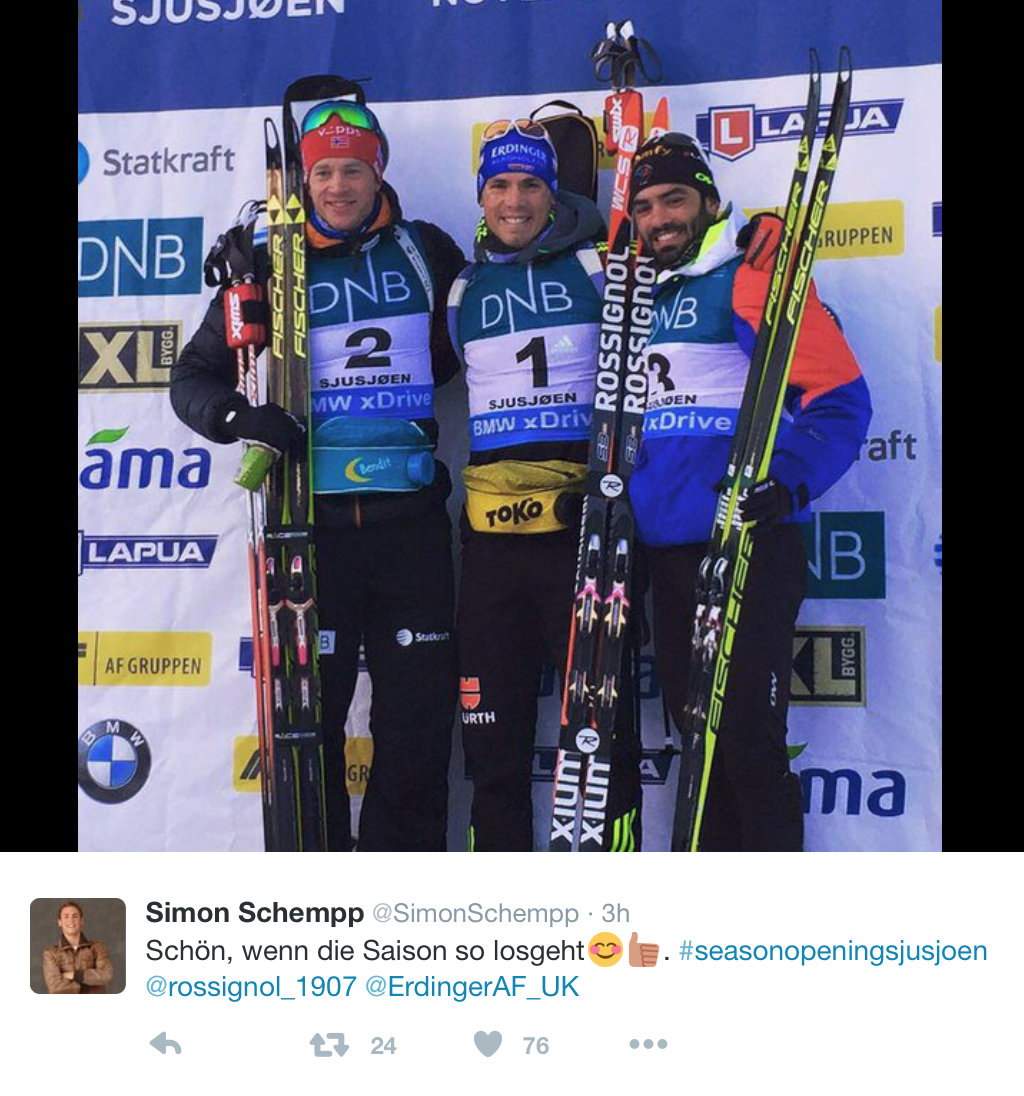
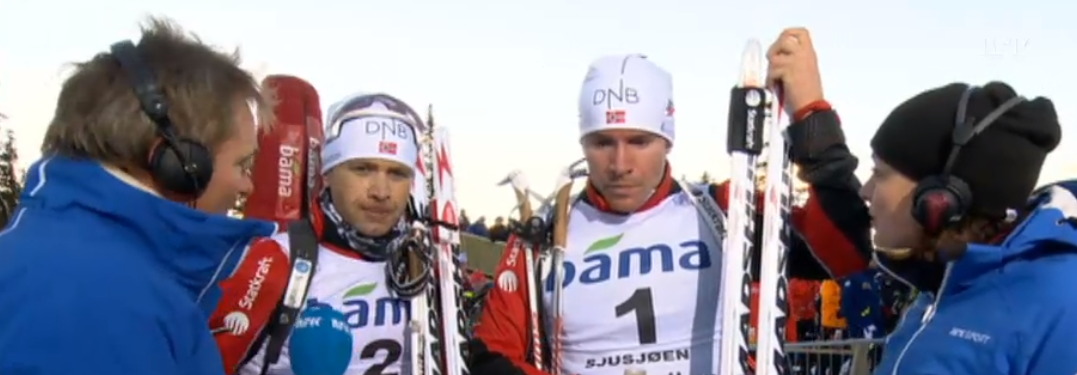
First, Sivert Bakken (NOR) set the standard both at the range and on the course, winning the biathlon season opener at Sjusjøen (NOR) on Saturday by ten seconds.
“What a way to start the season. It was huge for me to win in front of a huge crowd and with such a strong field,” says Bakken, who is thrilled to be back into racing and excited about the season ahead.
On Sunday, Bakken put in a top-10 finish in the mass start, despite two penalty laps.
As a curious side note: Ski Classics cross-country marathon specialist Astrid Øyre Slind posted the fastest skiing time in the women’s sprint on Saturday. Missing only one target the first time at the range, her nerves messed her up for the second shooting, and Slind ended up in 27th place overall with a total of five missed targets.
“I started shooting in March, and I thought it would be interesting to give biathlon a go before the marathon season starts in December,” Slind says after her first ever biathlon competition.
When Krista Pärmäkoski (FIN) stepped up to the start line for the first time this season on Sunday, she won the 10-kilometer skate race on home turf in Muonio.
“I have been waiting all summer to be able to compete again, over all it was a good and balanced performance,” says Pärmäkoski, after winning by 0.9 seconds in her first race of the season, with a start list worthy of a World Cup.
“It felt hard to get going, and it was hard to know how I was because I didn’t get many splits. But on the second lap, I was told it was really close and that I had to really push it all the way to the finish line.”
The 30-year-old Finn is entering her 14th season at the World Cup level and aiming for her fourth Winter Games in February.
Next weekend, both Norway and Sweden kick off their FIS cross-country seasons, in Beitostølen and Bruksvallarna, respectively, both featuring incredibly strong start lists.
On November 26 to 28, Ruka (FIN) host the FIS World Cup opener, while the biathletes head to Östersund (SWE) for the IBU World Cup opener on November 27 to December 5.
Earlier this month from Aug. 2-8, nine top American junior athletes had the opportunity to participate in the largest International Junior Camp to date. In total, 146 athletes and 37 coaches from nearly 20 nations gathered in Sjusjøen, Norway, for a week of training and collaboration. The camp offered athletes the opportunity to gain confidence by training with the best junior skiers in the world against whom they will soon be competing, and to learn from the prestigious Norwegian development team training methods.
To make the trip, athletes needed to be born in either 1999 or 2000 and have the lowest ranking on the FIS Distance and/or Sprint World Ranking list. The U.S. sent Gus Schumacher, Ti Donaldson, Noel Keeffe, Ben Ogden, and Wyatt Gebhart on the men’s side, and for the women, Sofia Shomento, Mae Chalmers, Abby Jarzin, and Molly Gellert. Two coaches joined the group: Bryan Fish, cross country sport development manager at U.S. Ski & Snowboard, and Maria Stuber, head coach at the College of St. Scholastica, and the National Nordic Foundation (NNF) partially subsidized the trip.
2018 International Junior Camp attendees: – Armenia
– Austria
– Bosnia/Herzegovina
– Belarus
– Canada
– China
– Czech Republic
– Estonia
– Italy
– Finland
– Japan
– Korea
– Latvia
– Norway
– Slovenia
– Slovakia
– Spain
– Sweden
– U.S.
The format of the camp was similar to what U.S. juniors might experience at an elite national camp; a large emphasis on volume (18-25 training hours), with some intensity, technique and strength mixed in. For most workouts, all the athletes trained together as one large group, only dividing into smaller groups for time trials or activities held in spaces that could not hold the nearly 200 attendees.
The camp opened with back-to-back time trials, beginning with a classic sprint event featuring “King’s Court” style heats, meaning that from each heat, the top skier moved up in the seeds and the last skier moved down. Each skier competed in four rounds of sprints plus the qualifier, one round more than in a typical sprint. The most notable result for the U.S. was a victory for Schumacher in the men’s final, and on the women’s side, an eighth-place finish for Gellert.
In the 10- and 15-kilometer distance races, the Americans continued to show their strength with another win for Schumacher and another eighth-place finish for Gellert.
“Local hero – Joergen Lippert from Lillehammer joined in on the 15 km freestyle race,” Fish explained. “This was a great measuring stick for the men since Joergen medaled in all four races last year at Junior Worlds (2018 Junior Worlds – 1 gold, 1 silver, and 2 bronze). At the 5km split, Lippert was leading, Ben Ogden was 2nd and Gus Schumacher 6th. Haavard Moseby took the lead after 10km. At 12km Haavard and Gus were tied, then Gus surged to edge Haavard for the second day in a row.”
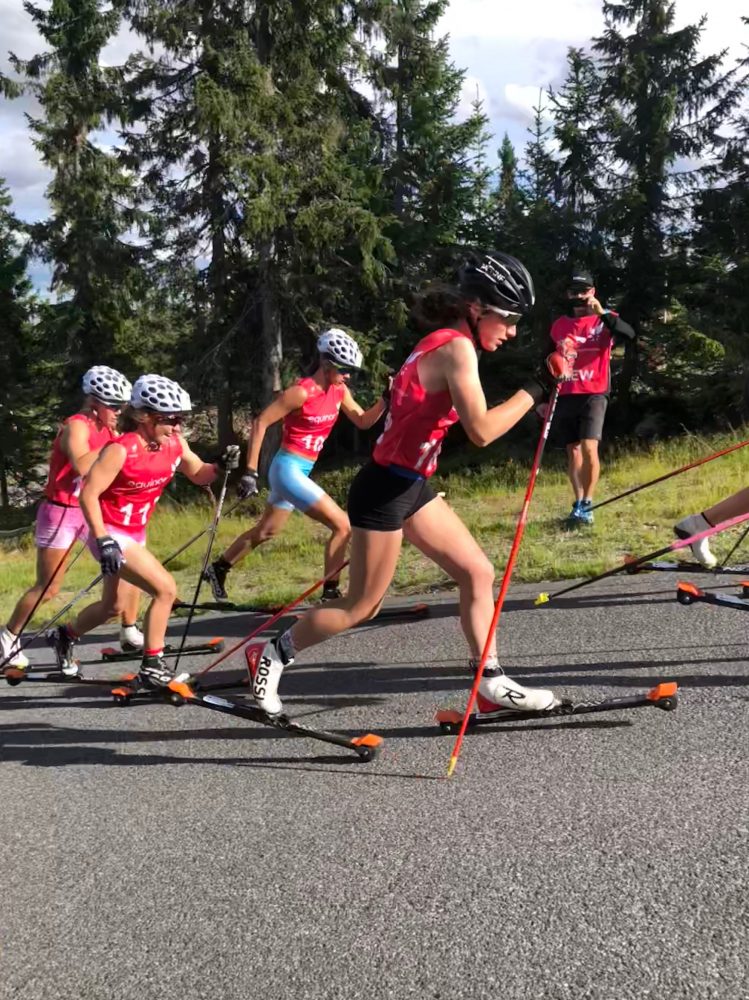
Molly Gellert striding in the sprint heats at the 2018 International Junior Camp in Sjusjøen, Norway. (Photo: Maria Stuber)
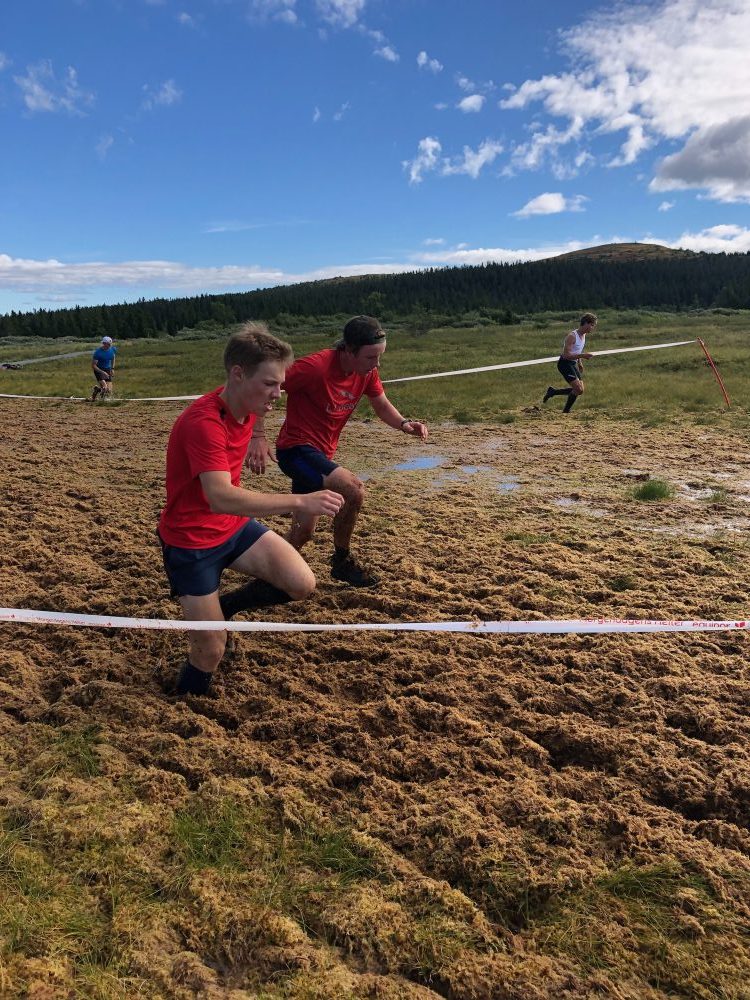
To take advantage of the unique terrain on the plateau around Sjusjøen, the group also participated in a 3 1/2- to 5-hour run crossing through several bogs, and a set of Level 4 bog intervals, which was reported to be the hardest workout of the entire camp. These 3-5 minute intervals were run in mud up to or above athletes knees, making it a full-body challenge to move forward through the course.
“Running through that stuff as hard as you can is incredibly hard,” Stuber told FasterSkier. “People were breathing at the end of those intervals harder than you ever hear, besides maybe the best athletes in the world in a 5- to 10-kilometer distance kind of race.”
Another highlight was getting to meet and hear from Olympic gold medalists Johannes Høsflot Klæbo, Ragnild Haga, and Astrid Uhrenholdt Jacobsen, who shared insight into the aspects of their training and development they felt have led to their success.
The U.S. coaches contributed to the camp by leading an agility workout, as this has been creatively emphasized in their own programs with positive results. Fish reportedly traveled with his own set of cones and plenty of sidewalk chalk to ensure they could set up a high-quality course.
“It was really fun to have the rest of the world interested in what we’re doing with agility,” said Stuber.
Ben Ogden (second from r) in the middle of a bog interval at the 2018 International Junior Camp in Sjusjøen, Norway. (Photo: Maria Stuber)
Apart from the training benefits, the U.S. development program considered the experience of collaborating with top athletes in this age group to be invaluable, as it showed how hard their international competition is working.
“In the U.S. when you’re a top athlete you feel like you’re working pretty darn hard, and this kind of shows them that, yeah, they’re working hard, but the kids that they want to be competing against are also working really hard,” Stuber said.
She added that the U.S. athletes were well-prepared for the camp, as all performed very well throughout the week despite the demanding training schedule.
“We fit in, we go there and see that we’re doing the right things, and we bring these kids back with the confidence that they can do this and the motivation to keep at it and work harder,” Stuber said.
It was noteworthy to the coaches that the U.S. is finally recognized as a nation that can train and compete with the best athletes in the world — a testament to the growth and success of the U.S. Ski Team at all levels over the last ten years.
“Going into this, I was expecting to just be learning a ton and less of a contributor,” Stuber said. “It was really cool to get there and feel like the U.S. was very much a country where people wanted to know what we were doing. Norway is clearly ahead, but otherwise, I think the U.S. had to say as much as any other place, which was a really eye-opening surprise for me.”
This is the third time that the U.S. has attended Norway’s International Junior Camp (also in 2015 and 2016), and American juniors will continue to make the trip biennially to maintain collaboration with other countries in the coming years. According to the U.S. coaches, because of the cost of the camp and the fact that it is similar each year, they plan to only attend every other year so they have a “fresh” group of athletes each time.
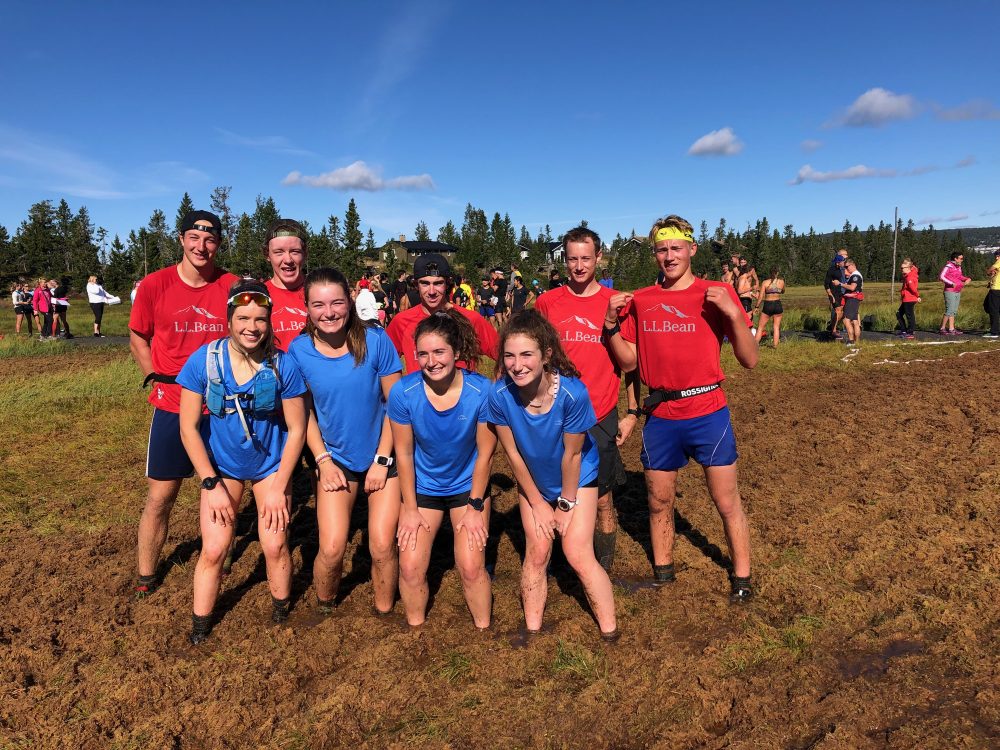
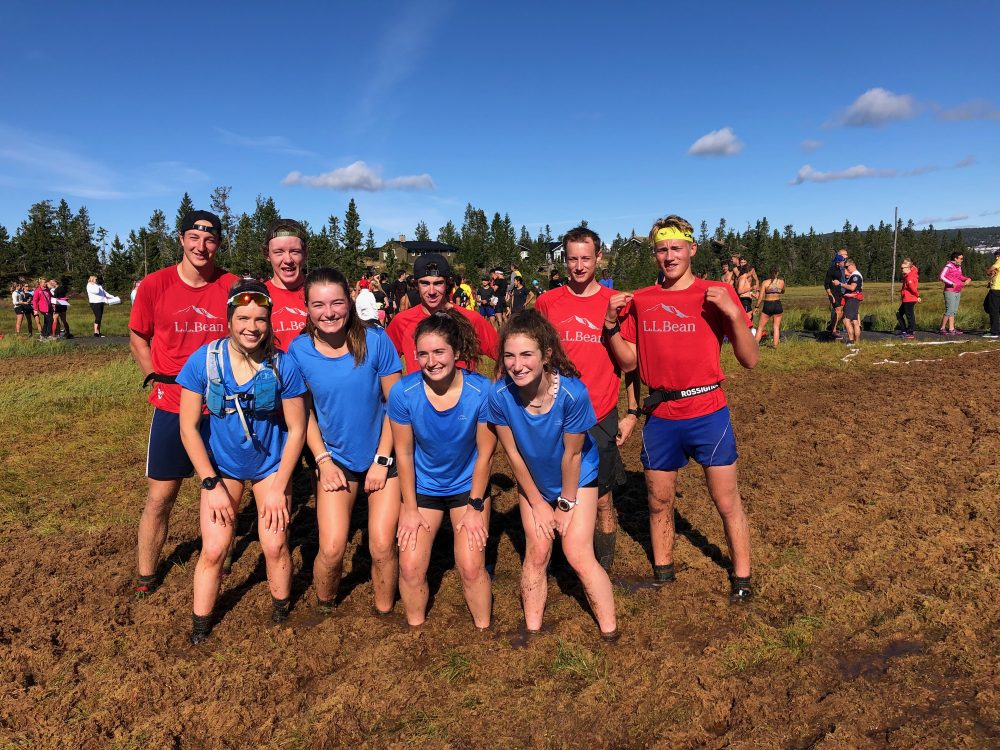
Americans during a muddy training session at the 2018 International Junior Camp earlier this month in Sjusjøen, Norway. (Front row, l to r) Abby Jarzin, Mae Chalmers, Sophie Shomento, Molly Gellert, and Noel Keeffe. (Back row, l to r) Ben Ogden, Wyatt Gebhart, Ty Donaldson, Gus Schumacher. (Photo: Maria Stuber)
Afternoon workouts at Natrudstilen Stadium in Sjusjøen, Norway. (Photo: Maks Zechel)
Editor’s Note: The following is part of a series proposed by Maks Zechel, a 20-year-old Canadian cross-country skier embarking on his first season training abroad. In August, he made the big move to Norway, where he’ll be training and racing with Team Asker for the entire winter. Through these updates, Maks hopes to share his personal “observations, stories and lessons learned” to help close the gap between North American and Scandinavian nordic skiing. Previous posts: 1,2,3, 4, 5, 6, 7 and 8.
This particular post, entitled “Head Games”, is broken up into three parts.
Part I: What Skiing Means to Us
If you’re dedicated enough to be reading an online magazine about cross-country skiing, then you probably really love skiing.
Don’t be too hard on yourself; I love skiing, too.
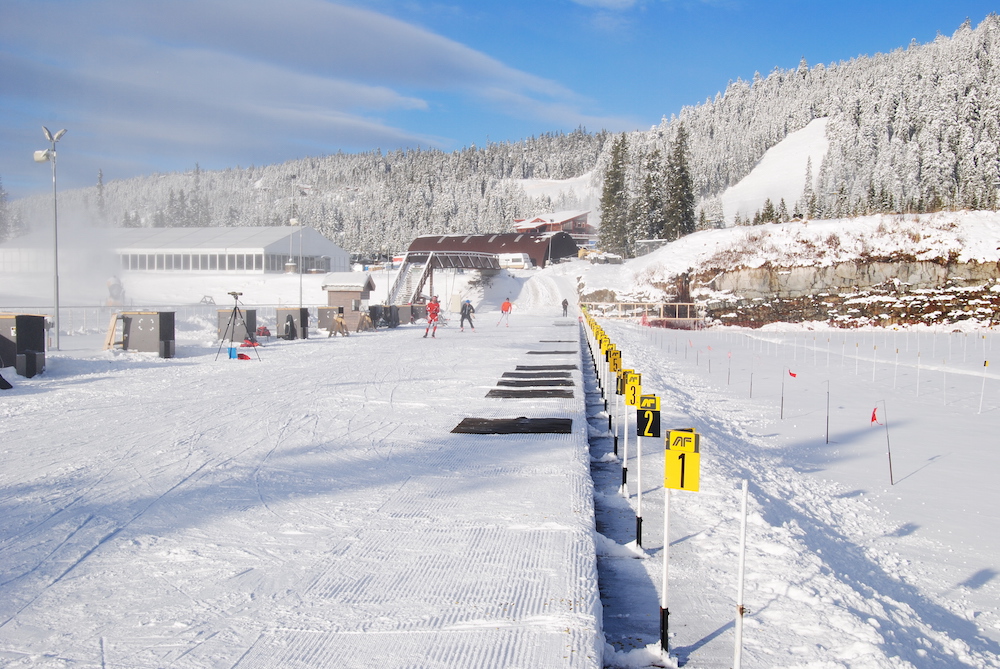
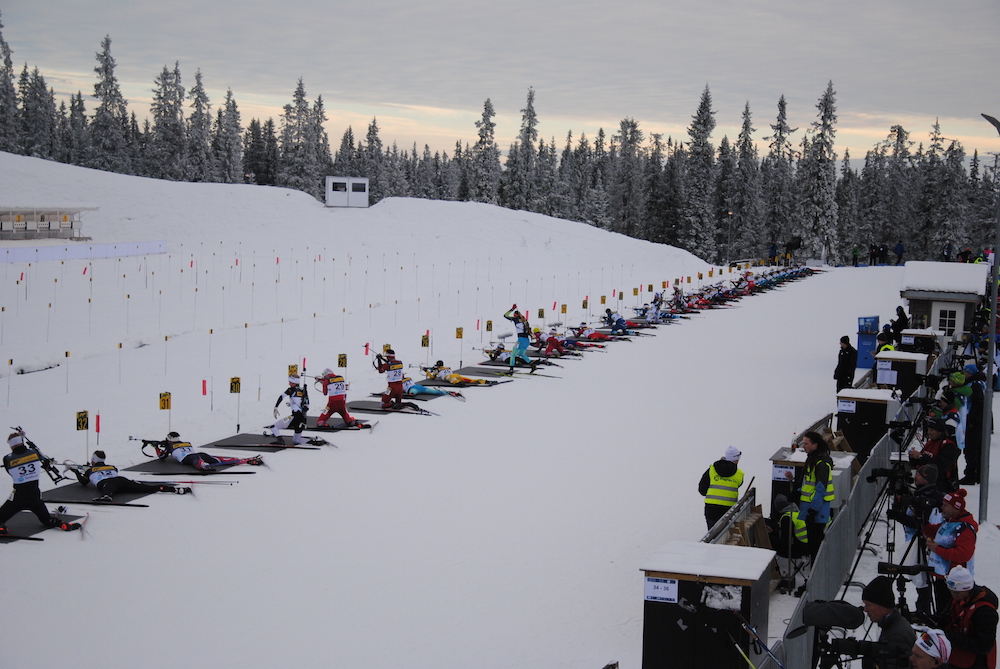
The shooting range in Sjusjøen, Norway, as seen on Nov. 2. (Photo: Aleks Tangen)
This post starts with a crisp day on skis just outside of Lillehammer on Nov. 2, 2017; a skier’s dream…
I have never been to Wall Street, but I imagine it feels a lot like Natrudstilen Stadium in Sjusjøen*, Norway, at 9 a.m., two weeks before the season opener in Beitostølen. It’s barely below freezing, but the snow guns are blazing. They hum, interrupted by the BEEP BEEP BEEP of heavy machinery transporting snow, and a steady stream of skiers moving in every direction imaginable. You hear them, too: the squeak, WOOSH, squeak, WOOSH of tips biting into snow and carbon swinging through the air. It’s a bluebird day and the snow is rocket-fast. The sun barely skims above the highest peaks in the distance, but nobody looks up. Something much more important is on everyone’s mind today, and that is going fast on skis.
My friends, Erland and Hedda, and I are doing intensity this morning. Dozens of others have the same plan, and Lillehammer Skiklubb (the biggest club in Norway) is running a time trial. It’s hard to tell what the biathletes are doing, as they always seem to be wearing bibs and going fast, but I jump out of their way regardless since they all carry rifles.
The main loop is slightly under 2.5 kilometers long. No section of the track is ever empty and coaches give encouragement and feedback from all sides. There is a four-way intersection at one point on the course, which skiers approach at speed from both directions. Most people are too focused to acknowledge one another, except to tell someone to get out of their way or when they almost collide; it is chaos on a mission. Just the way that I imagine Wall Street, everyone is going about their business, and everyone thinks their business is most important. At times like these, it can be easy to lose sight of the fact that the reason we are all whizzing about this track today, is not just because of our individual goals, but because of our shared passion for this beautiful sport.
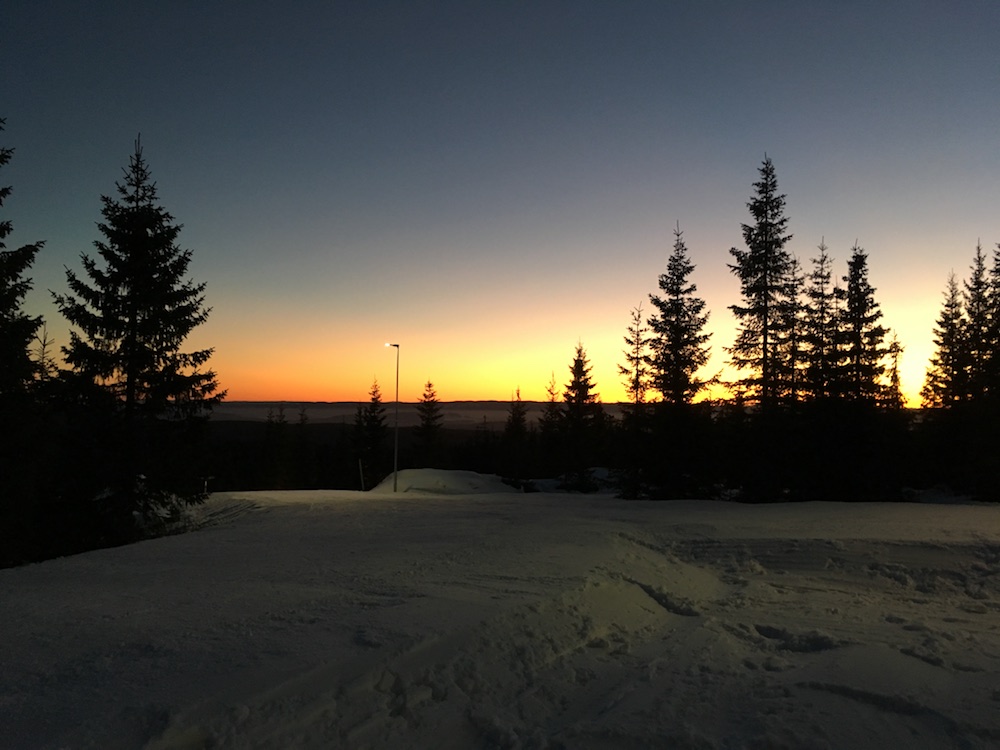
The next evening I am back at Natrudstilen, enjoying the extra 3 k of trail that was prepared the night before. The sky is a big northern sky; the horizon is dotted with the silhouettes of stunted trees as the last strip of pink sunlight warms the remaining dark blues and purples fading into black above. The moon is full, huge, and slightly orange. The crisp air is more potent than coffee and makes skating around the glazed track effortless. When the sun is gone, the lights turn on. Dozens of skiers still churn out laps well past the 5 p.m. sunset, but it is much more peaceful than the morning bustle.
As I ski by myself, a skier passes me in the classic tracks. He is wearing the Norwegian national team training clothes and skiing quite well, so I am quite sure he is not just a “Norges Skiforbund super-fan.” As he skis by, he pushes his strides over the short, punchy hill. He is not moving impressively fast, but by the way he moves I can tell that this is far below his competition speed. I should know who this is, but it is dark. As we crest the hill, I put my crazy-skiing-fan-sleuthing skills to work: I notice the telltale headphones, Leki poles, Fischer boots, and, the last piece of the puzzle, the initials JHK on his drinking belt. “OH S***, it’s Klæbo!”
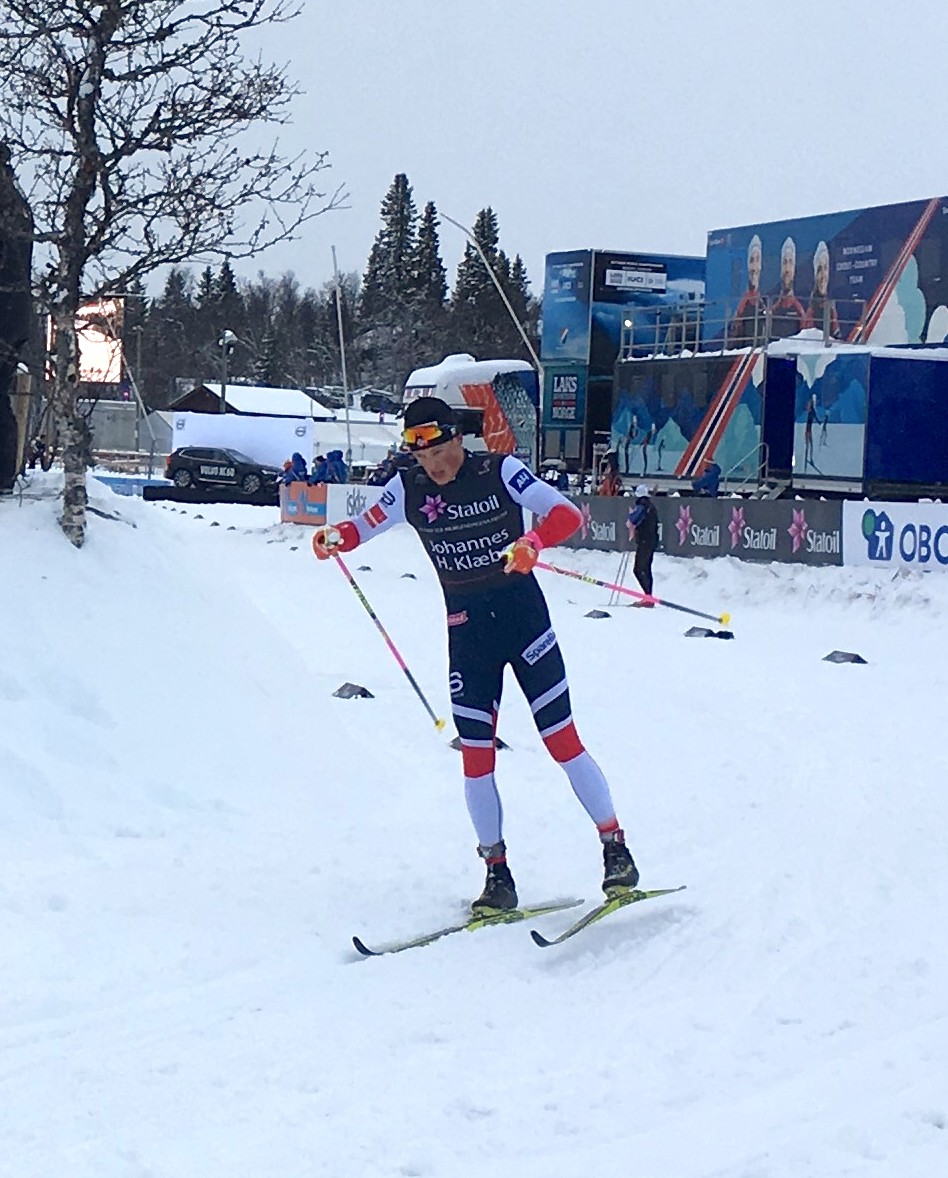
Norway’s Johannes Høsflot Klæbo in his debut race of the 2017/2018 season at the FIS season opener in Beitostølen, Norway, in November. (Photo: Maks Zechel)
Over the top of the hill he relaxes his strides and glides slowly, drooping his head and letting his arms hang. He looks back and then walks over to the side of the trail to take a break. Johannes Høsflot Klæbo is the youngest person to ever win the World Cup Sprint Crystal Globe. He is also a human being who seems tired and feels the pressure of the oncoming ski season like everyone else. I may not be a World Cup medalist, but as with all skiers, I have the same good and bad days.
The training season for a cross-country skier is long, never-ending really, with many skiers preparing for goals that are years away. How can we know that we will be ready to perform for a few minutes, or maybe an hour or more, in an event that is years away? Confidence takes many forms and comes and goes from moment to moment. The feeling that one gets in one hour of training can ruin the confidence that was built over weeks of perfectly executed workouts and races. It is an incredible skill to be able to have confidence in yourself throughout the ups and downs of training and day-to-day life and to have trust in a plan that must constantly be changed to respond to normal human imperfections.
Why do we continue down such a path, where the tiniest bumps and setbacks in the road have such great control over our well-being? Some of the drive comes from the small daily joys: the sense of purpose, the goal setting, and the achievement of those goals. For myself, much of the joy comes from the places skiing takes me and the people that I meet, but the biggest drive comes from the special moments, those moments of complete contentment in life where everything else momentarily fades away. Sometimes they happen with others, but with the solitary nature of cross-country ski training, these moments often occur when you are on your own. It’s hard to see them coming, and for me they happen just a few times every year.
Maybe it’s a ride to the race site with a car full of your friends, and that one song you all love comes on as you pass through the mountains. Maybe it’s 9 p.m., -15 ̊ degrees Celsius, and you’re sitting at a bus stop after a cold ski under the stars, about to make the journey home but the bus isn’t coming for another 15 minutes, when you remember to pull out your hot thermos of peppermint tea. Or maybe it’s an icy fast day on a Norwegian early season snow loop, and you just realized that one of the best skiers in the world feels just like you do.
*Sjusjøen: pronounced “shoe-shun” (“shoe”, as in the footwear). For a more accurate pronunciation guide, please seek out a Norwegian.
Norwegian Word of the Week:
Norwegian: koselig
Danish: hygge
Translation: a feeling of coziness and/or contentment. E.g. drinking a mug of hot chocolate under a blanket next to the fire during a snowstorm; laughing with your friends; a fast day on skis when you feel like you could ski forever.
***
Part II: What Skiing Does to Us
Anyone lucky enough to have grown up cross-country skiing should know what a privilege it is to have access to such opportunities. Few people have the means to take up ski racing, whether it is for financial, geographical, or other reasons. Nonetheless, skiing manages to bring together people from many different backgrounds, uniting us with the shared love of being outside. Skiing, more than most sports, is something that sticks with you for life. I know many people that only started ski racing in university, including my parents, and for them skiing has remained one of the most important parts of their lives ever since. In North America, skiing is a sport that lacks the same intimidating atmosphere that sports like hockey and football sometimes have. It is easy to join a ski program no matter your level of experience. Skiing brings together a special community of people, but at the elite level it also begins to alienate us.
Skiers are tough. We love how tough our sport is and we begin to encourage characteristics of toughness (at least to make sure children survive the elements of winter) in ski lessons at an early age. Skiers with the best “pain faces” are put on a pedestal by athletes and coaches because of how visible their effort is. Probably the most offensive thing you could tell a skier is that their rollerskis or skis are really fast; it is hard for skiers to admit that their performance has been aided by anything other than their own strength and technical abilities. In short, it is hard for skiers to admit they need help.
The toughness of our sport makes us hesitate to acknowledge feelings that might make us seem weak, especially when we fail to reach our goals. Instead of asking for help, skiers compare themselves with those faster than them, and in that way blame their failures on the unchangeable characteristics that make them unique:
“I need to look like a World Cup skier to be fast.”
“I need to train more.”
“I need to train harder.”
“I need to lose 10 pounds.”
“Am I just a slow skier who needs to work harder, or do I have a mental health issue?”
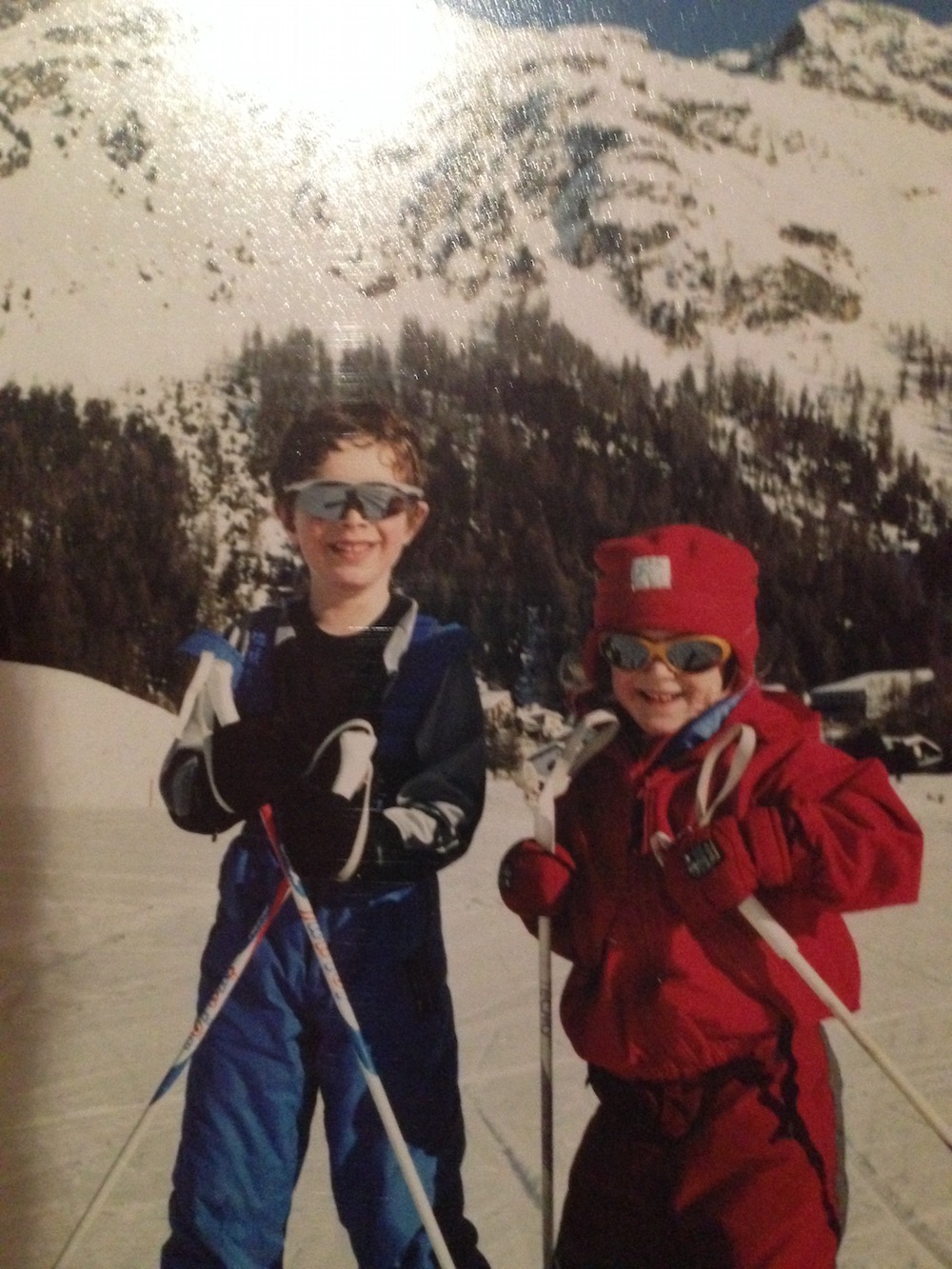
The early days: little Maks Zechel (l) and his sister Anni skiing in Switzerland. (Photo: David Zechel)
Many skiers get hooked on training at a young age. I started training at least four times a week when I was 11 years old; I did it because it was fun and I thought that it was the coolest thing to arrive at school and be able to tell my friends that “I ran 3 KILOMETERS this morning!” I haven’t changed much… But back then I could feel content, motivated and energized for the entire day just from that.
Unfortunately, increased fitness and getting older make it harder to achieve the same satisfaction from running a few kilometers. I didn’t realize it at the time, but at 11 I was already becoming addicted to training. It took me until I was almost 20 years old to realize that I could no longer satisfy my mental health, to achieve contentment in life, through training alone. Some days it is enough, but other days I can train for 5 hours and finish the day feeling overweight and unfit. Sometimes it is hard to tell whether I feel unwell because I have eaten too much, or because I have barely eaten all day.
It sounds ridiculous to call something that is “good for you” a mentally destructive addiction, but that in itself is part of the problem. Many athletes fail to gain control over their mental health issues because they don’t realize that they are sick. When somebody breaks their femur, they are told to stop training, recover and rest until they are healthy enough to train productively. It is harder to tell that someone is unwell when they are simply doing the things that are encouraged by our sport: excessive training, pushing through fatigue, gritting your teeth and working hard no matter how you feel. When one athlete races slower than another, the first thought of the slower athlete is that they have to train more and become fitter. Much of this culture comes from skiing itself, but we get a lot of it from team sports, where the motto is always, “if you’re not training hard, you may as well not be training at all.” But in endurance sports, where everybody is affected by training differently, sometimes training too much, or at the wrong time, or in the wrong way, can have the same effect on your fitness as you would have from training too little. Are you training to gain fitness or are you training to satisfy your confidence?
When you train once or twice a day, it is easy to pretend that these issues do not exist, but when this schedule disappears, everything comes back to haunt you. I experience the most difficulty with my mental health at two, essentially opposite, times: when I race, and during the “off-month” of April.
Racing is the amalgamation of months of rigorous training, obsessive motivation, and gasping with relief after hard efforts. Skiers take a leap of faith off of the start line, relying on all the confidence and focus they can muster to ski fast around a loop of snow in the woods. The race is exciting; it is also the origin of all your nerves, dreams and fears. In this place of vulnerability, even the smallest thoughts of doubt come to surface. It doesn’t matter if you gritted your teeth and pretended it didn’t exist for the entire year, your mental health is of utmost importance during a race, and it is essential to learn how to regulate it in order to achieve success.
[Racing] is exciting; it is also the origin of all your nerves, dreams and fears.
April is the period of rest and recovery craved by almost everyone at the end of a 3-5 month racing season. But for many it simply turns into the month of caving in to everything that we deprived ourselves of for 11 months: parties, staying up late, cramming in studying before exams, and being human for a change. Doing “normal” things? It’s the hardest month of the year, and every year I crawl my way to May 1st with desperation, more exhausted than at the start of April.
This past April, I decided to face my mental health issues that I had always known existed, but never understood or recognized for what they were. What an awkward thing to talk about, mental health, but it shouldn’t be. Our minds have to be taken care of with the same attention that we give our bodies through training and recovery. It doesn’t matter what it is that makes you begin to acknowledge your difficulties, but it has to be done; it is grossly underestimated just how permanent unchecked mental health issues can be. I didn’t acknowledge my health issues because I cared about my health, but I did care that it was starting to affect the way I raced, and although not the most important reason, it was enough to motivate me to work on my mental “fitness.”
Since moving to Norway, the issues I have had with my mental health have faded into the background. I’m too motivated and excited about where I am to think about such things. But it is still there, and the novelty of where I am will eventually wear off, and then I will have to be ready to deal with these things. It is important not to allow happy distractions to get in the way of how you deal with your mental health, because for every incredible high, there is a devastating low. It is better to take the time when you are feeling good to plan coping strategies, so that when you are hurting you can maintain your overall health in a way that is better for your success as a skier, and a person.
Although ski racing at the highest level can seem like the only important thing in life, that level of racing can’t be maintained forever. For people who may have been training hard with a single goal in their head since they were small children, throwing them into the regular world can be an overwhelming shock. The skiing community needs to put an emphasis on not only producing elite skiers who will ski fast, but also on developing people who will be successful and healthy beyond their years in competitive sport.
Norwegian Phrase of the Week:
Norwegian: Uten mat og drikke, duger helten ikke.
Translation: Without food or drink, even heroes aren’t good enough.
***
Part III: Skiing Healthy
We don’t get to choose the bodies and minds we are born with or the ailments that afflict us. But we can choose to learn about ourselves, talk to one another, and explore how we can be successful because of, not just despite, our unique personalities. Instead of struggling to get by in spite of what hinders us, thinking about our mental health should be seen as an opportunity to become better at the things in which we want to succeed.
An evening run with teammates Erland and Eirik during Team Asker’s 10-day training camp in Mar de Pulpi, Spain, in October. (Photo: Erland Kvisle)
People don’t understand how to talk about mental illness. If it’s in your head, then it’s not real, so get over it, right? When someone is functioning at a seemingly normal level on the surface, it is hard for people to recognize all mental illnesses as real issues. Excuses for unexpectedly poor races can be found everywhere, from eating the wrong thing for breakfast to having difficulty clearing lactate. For every race there’s a new excuse, something simple that can be easily improved on for the next race, but the subject of mental illness is never brought up. Everyone wants to hear the story behind your broken leg, but people have been taught to tip-toe around the subject of mental health. “Be considerate. Make sure you don’t offend him. She’s sick in the head. He’s really delicate. You can’t talk to her like a normal person.”
Not everyone wants to talk about their mental health issues, but many need to. When I decided to try to improve my mental health, I was afraid to talk to others. I wanted to talk to someone, but I didn’t want to burden those that I care about with the things that I thought about myself. I am generally a happy person and I did not want people to see me as anything less than that. What I really wanted was to talk to someone straight up: “Hi, I’m Maks. I’m a happy person who loves life, but for some reason I often hate myself.” I didn’t want to see the scared or awkward looks in the eyes of those I care about as they struggled to look for something positive to say. I didn’t want pity. I didn’t want someone to tell me something positive. I needed to talk logically about what I feel, why I feel it, and what I can do to control those things.
I desperately needed a third-party person, someone with whom I didn’t share a connection and with whom I could talk openly without affecting their happiness. This led me to seek the help of a psychologist.
Seeing a psychologist isn’t like getting a flu shot. Part of my brain thinks in a certain way, and that can’t be fixed. I can’t hide or run away or fight it. What I can do is acknowledge what I am feeling and what it makes me want to do. Seeing a psychologist was a relieving experience for me. Instead of feeling an unclear jumble of emotions constantly tearing me apart, I could talk with someone about exactly what I felt and how I could be happy and productive in the face of how I felt.
Spain sunsets (Photo: Maks Zechel)
Now when I feel an incessant urge to train in a way that is unhealthy, I recognize that urge, I think about what it is that I want to do, and then I give that thought space to dissolve in my head. For my issues, it has been more productive to allow these destructive thoughts to enter my head and to think about them, rather than clenching my teeth, pretending that they don’t exist and training myself into the ground. I train out of need, but I also train because I love it. The key to finding a balance between my dependence on training and doing it because I love it has been to think about the driving force behind why I train each day. Categorizing the motivations behind my actions has helped me to do what is best for my health and progression as a skier. This allows me to think positively and rationally with focus. Allowing space in my head to understand why I feel the way I do has been more effective for me than beating these thoughts away with artificial positivity.
If you’re reading this, then you probably really love skiing. It’s OK, I love skiing too, and I am happy to admit that it is one of the most important things in my life. But if I want skiing to continue to be a big part of my life, I can’t let it harm the rest of the person that exists beyond skier-Maks. Ski-racing careers can last a long time. I am lucky enough to have grown up around athletes and coaches who have proven that you can train and race for life, but in order to do that you have to take care of yourself. We skiers are competitive creatures, but acknowledging a mental health issue doesn’t have to mean giving up in defeat. The greatest skiers are those that understand their bodies, training, equipment, and minds the best. Each of our bodies is different, but that doesn’t prevent anyone from achieving their goals, and the same goes with our mental health.
Norwegian Phrase of the Week:
Norwegian: Gi drømmer en sjanse.
English: Give dreams a chance.
***
About Maks: Maks Zechel is a competitive cross-country skier who secretly wants to become a professional mile runner. He loves hiking and going on canoe trips with his family, as well as peanut butter cups in ice cream. Johan Olsson is his favourite skier and he hopes to race the Cortina-Toblach stage of the Tour de Ski one day. He enjoys writing about his experiences. Follow him on Instagram @makszechel.
“I haven’t straight out won a highly competitive race in two years, so winning on my arch nemesis course of West Yellowstone was huge,” Hart, 25, wrote in an email last week about her Dec. 2 sprint win. “I know that the period one altitude is not my best friend, and am really working on keeping a positive and confident mentality. The race for period two World Cup starts is tight (I think right now there are five or six women all within three points), so I’m trying not to focus on that too much. It would obviously be wonderful to lock those up, but more than anything I just want to set myself up physically and mentally well for a stellar nationals in Alaska.”
The day after her win in the 1.3-kilometer skate sprint, Hart finished 15th in West Yellowstone’s 10 k classic mass start on Dec. 3. Last weekend up at Sovereign Lake in British Columbia, Hart finished seventh both in the NorAm-opening skate sprint and 10 k skate, which counted toward SuperTour standings.
She started her season with a training block in Sjusjøen, Norway, then at the Beitostølen races, with a goal of racing on snow before it really counted at this month’s SuperTour and U.S. nationals. In Beitostølen, she told FasterSkier she was mostly focused on recovering, feeling fresh, and above all, having fun.
Anne Hart (SMS Elite Team) racing in last month in Beitostølen, Norway. (Courtesy photo)
“I’ve just been doing way less training this year and paying attention with my strength coach, saying that you’re trying to be an athlete first and then the skiing comes,” she said on Nov. 17, after placing 31st in the 10 k classic in Beitostølen (she raced all three races there, repeating in 31st in the classic sprint, then 19th in the 10 k skate). “So this whole summer I’ve been working on my general athleticism and I’m just now starting to hone in on the skiing intensity of that.”
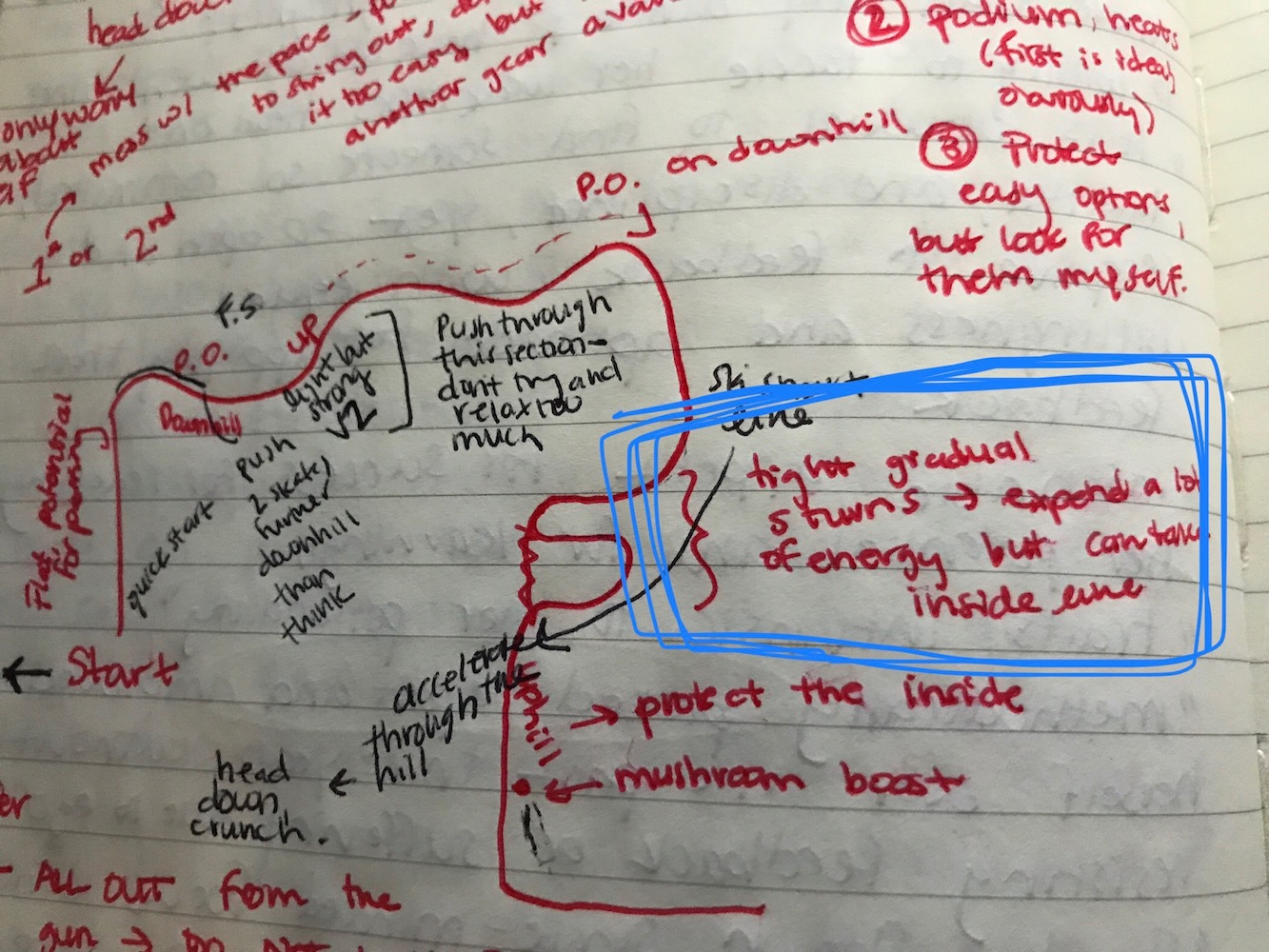
In West Yellowstone, she talked about using her journal to map out the sprint course, point pointing areas to focus on.
“In my journal last night I actually had part of the course labeled ‘mushroom boost,’ which is right over the top of that last hill,” Hart said after her sprint win, alluding to the speed burst featured in the Mario Kart Nintendo game.
“So I was able to do my planned mushroom boost at the end, came across with the win and I couldn’t be more thrilled,” she said.
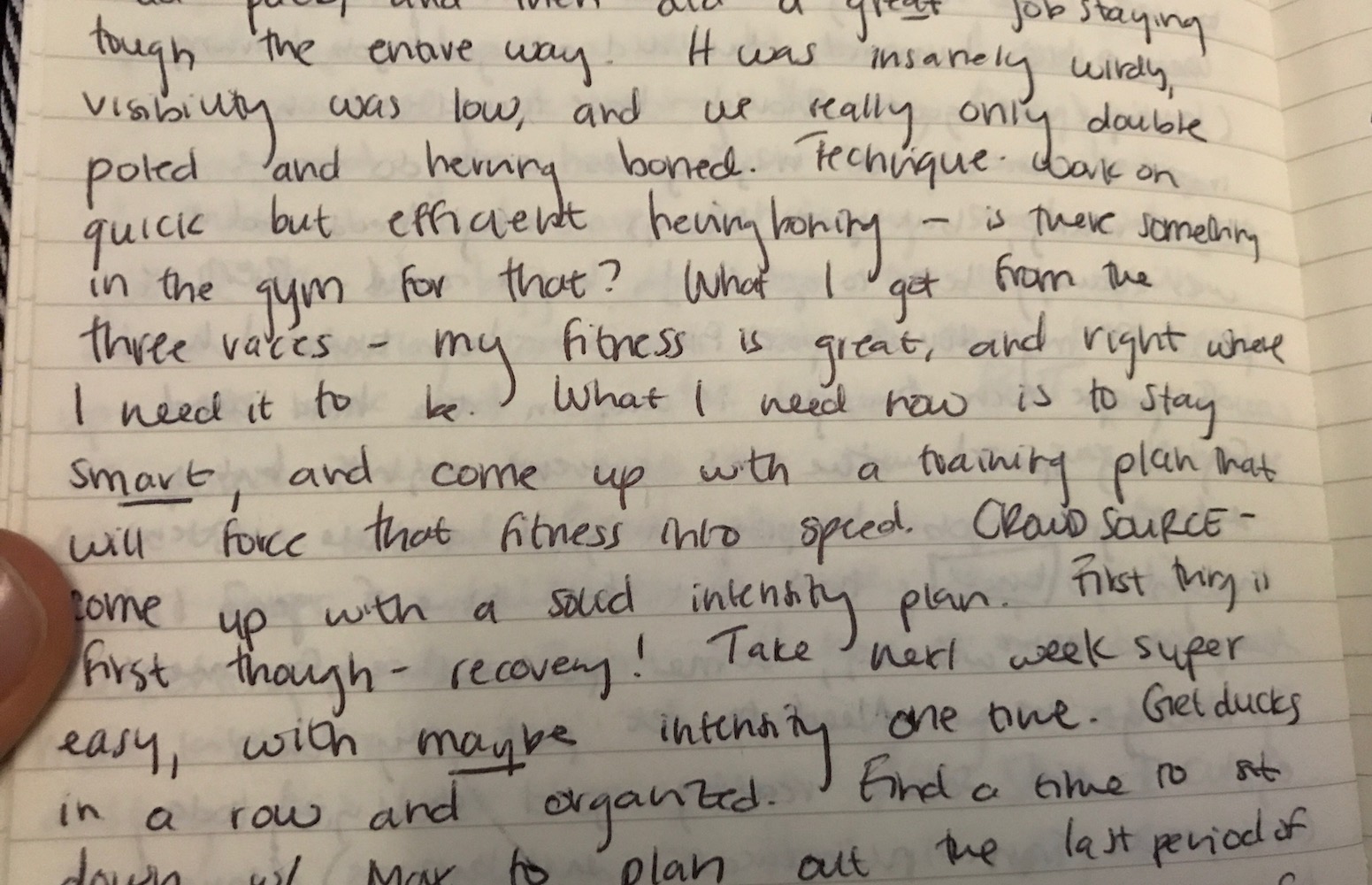
That mushroom-boost reference got us thinking: what kind of journal does Hart keep? It’s nothing like a training log, she explained, but rather a tool she picked up from a mental trainer she’s been working with since the summer, at the suggestion of her strength coach Max Lipset.
“I had been doing all of this physical training, but had been struggling a bit with how to wrap my mind around all the variables inherent in ski racing,” Hart wrote in an email. “This past season I had a really hard time shaking off bad races, and ended up carrying negative feelings from one weekend to the next. And I can tell you that there is no amount of physical training that can surmount that.”
She started speaking with John D’Agostini of Invictus Leadership, a “mindset and personal leadership coaching” company based out of the Twin Cities, according to D’Agostini’s Linkedin profile. Hart grew up in Stillwater, Minnesota, attended Dartmouth College in New Hampshire, and now trains out of Stratton in southern Vermont.
Hart explained that they initially spoke twice a week and are now in contact about once every 10 days.
“The Invictus program is a bit unique in that John is not a sports psychologist — he is just an individual with a lot of experience in the arena of mental fortitude, and has developed a curriculum that has helped me immensely,” Hart wrote. “As part of my ‘homework’ he suggested I start keeping a journal. I’m the only one who looks at it (although I’ll give you a sneak peak), and it has been a great way for me to critique myself without being negative.”
Here are the key aspects of Hart’s journaling:
1. Don’t think of it as a training log. It’s for everything else that’s on your mind.
“It has absolutely nothing to do with a training log (I have a big old google spreadsheet for that), but is instead a place I write down random thoughts, anything that is bothering me, things that are empowering me, and even recipes I want to try,” she explained.
2. It can include drawings, or more specifically, course maps for pre-race, mental training.
In West Yellowstone, Hart “drew a very loose representation of the sprint course, noting how I wanted to ski different sections and places I should look for passing opportunities (to either pass or be passed),” she explained. “This ended up being a huge help, as when it came to the final of the sprint and I found myself in the back, I had already figured out four or five different places I could attempt a pass as long as I kept my head cool and my wits about me. I ended up being able to use one of my pre-planned places and come out with the win.”
3. It’s your journal. Nobody else needs to see it. Although Hart did share a few excerpts (below) as examples:
Anne Hart’s course map, as she drew it in her journal, of the SuperTour sprint course in West Yellowstone, Montana.An excerpt from Hart’s journal entry after racing in New Zealand in this past September.Recipe notes as seen in Hart’s journal.
In terms of a physical workout, here’s one Hart recommended:
“Late last winter I did a workout with the Craftsbury team that I really loved,” she wrote. “It is designed to prepare for a hard but somewhat paced 10-kilometer race, and I did it once while I was in Norway to get ready for individual start distance races.”
The Workout: 2 x 5 k time trial
Warmup: 30 minutes of easy skiing, plus 3-6 minutes of threshold
The workout: On a measured 5 k loop, time yourself while completing 5 k at threshold with an occasional Level 4 pace.
Rest for five minutes, then try to complete the same loop 15-30 seconds faster.
“It is WAY harder than I would have initially thought, but is an awesome way to find a hard but sustainable pace, and a good way to pay off part of the mortgage on your own personal pain house :)” Hart wrote.
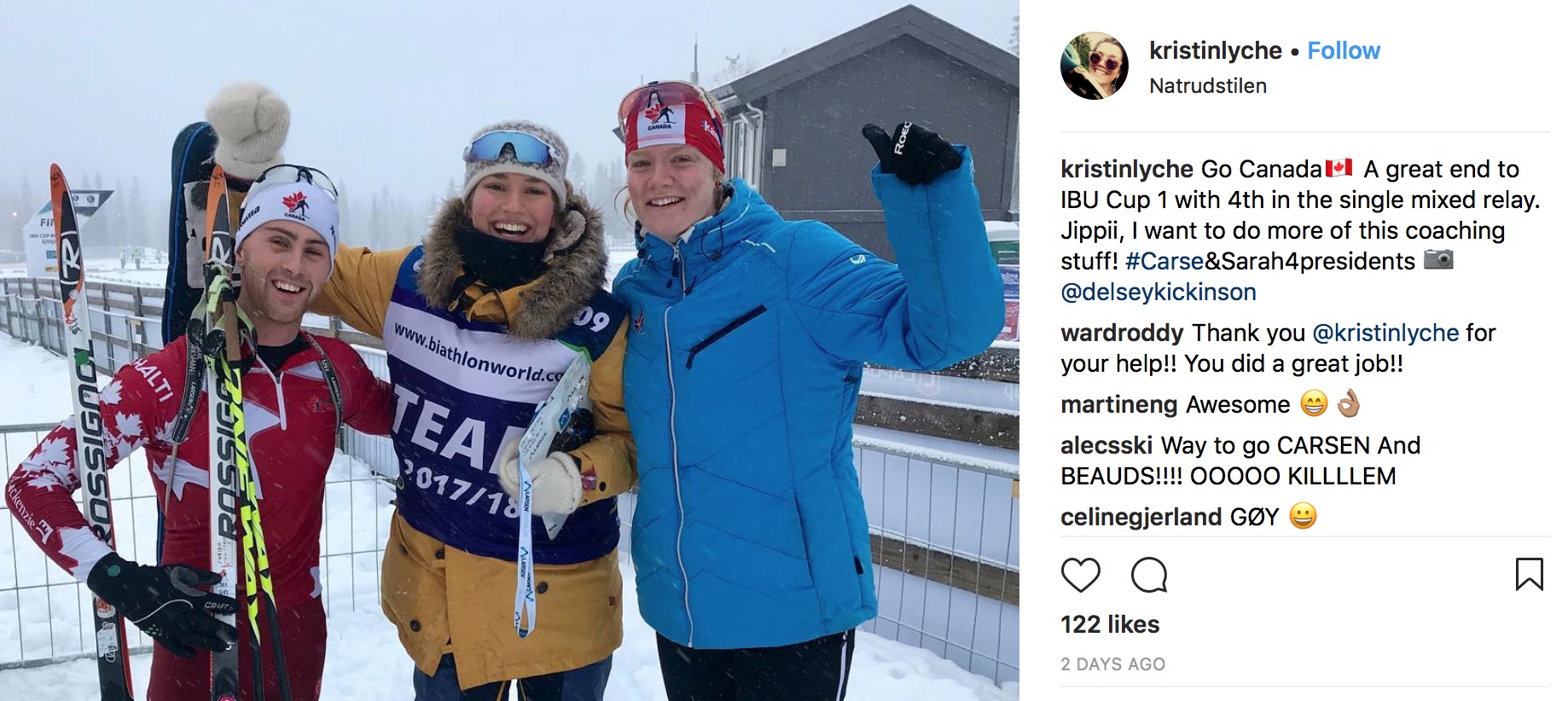
Carsen Campbell and Sarah Beaudry (Photo: Kristin Lyche Instagram)
Three Canadians and one American competed at last week’s International Biathlon Union (IBU) Cup opener in in Sjusjøen, Norway, with Canada’s Emma Lunder posting an individual top 20 and her teammates Sarah Beaudry and Carsen Campbell teaming up to place fourth in the single mixed relay on Sunday, Nov. 26.
In an email, Biathlon Canada High Performance Director Roddy Ward explained that Canada did not send its full IBU Cup team to the season-opening races, as IBU Cup #1 was not part of the national team’s plan.
“Current [national team] athletes were sanctioned to race, at their own expense, if they felt it would prepare them better for the season,” Ward wrote.
That created some additional legwork for those three athletes, as well as fellow national-team members Scott and Christian Gow and Brendan Green, who arrived in Europe on Nov. 12 to race at Norwegian trials Nov. 18-19 in Sjusjøen.
“Scott Gow was in charge of booking accommodations for everyone, and we ended up in an awesome little cabin in the woods quite close to the venue [in Sjusjøen],” Lunder, a 26-year-old Senior National Team member, wrote in an email. She and Campbell, of the National “Z” Team, arrived in Europe on Nov. 16 in an effort to get some early season racing in as well.
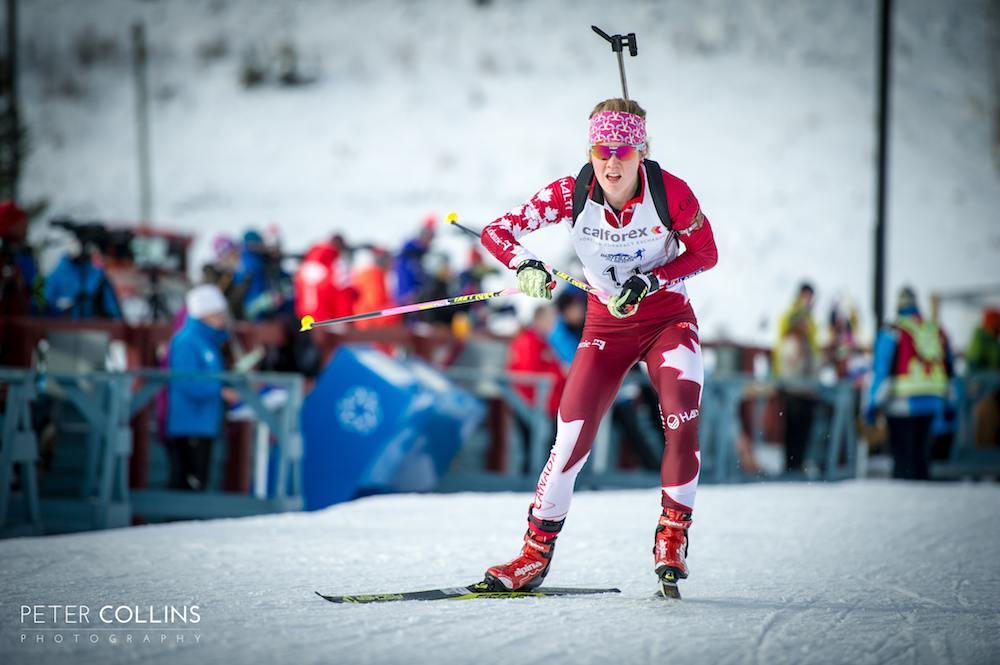
Emma Lunder (Biathlon Canada Senior National Team) racing to second in the women’s modified sprint on Friday, Nov. 10, the last day of Biathlon Canada’s team trials. After reaching the podium three times in three races, she was selected to the IBU World Cup team for the first trimester. (Photo: Peter Collins/petercollinsphoto.com)
“I also wasn’t sure whether I’d qualify for [World Cup] or IBU Cup from our Canadian trials, so just having the trip booked was some security for me, knowing that no matter what happened with trials, the next goal was to go and perform well in Sjusjoen which definitely helped me feel less pressure at trials,” added Lunder, who earned one of two remaining women’s spots on Canada’s World Cup team based on her results at team trials earlier this month in Canmore, Alberta.
On Thursday, Nov. 23, Lunder placed 19th in the IBU Cup’s opening 7.5-kilometer sprint. After that, she headed to Östersund, Sweden, to prepare for the first World Cup of the season. In Östersund, she was part of Canada’s team that placed 15th in the mixed relay on Sunday.
“Emma had a solid first race considering travel,” Ward noted of her IBU Cup performance. “The plan was for Emma to go early and race one IBU Cup before heading to Ostersund. 19th was definitely a good showing but I believe we’ll see more from Emma this season.”
Lunder wrote that she was pleased with her sprint result on Thursday, especially considering the weather, which she described as “extreme fog and also a lot of wind.”
“During our zero the coaches couldn’t even use their scopes – they closed the range so coaches could run down, grab the paper that had been shot at, and then athletes made corrections off of that,” Lunder reflected. “I was happy that through all of it I was quite relaxed, even thought it was a very different situation than I’m normally used to pre-race!”
With three penalties, two in her prone shooting stage and another in standing (2+1), Lunder finished 2:18.5 behind Russia’s Uliana Kaisheva, who won in 21:49.8 with clean shooting (0+0).
“Of course I hoped to hit a few more targets, but I think given the conditions I did an okay job,” Lunder wrote. “My skiing felt pretty strong, and it was nice to get the season started in a low-stress environment.”
Norway’s Thekla Brun-Lie placed second in that race (+41.9; 0+1), and Russia had two on the podium with Olga Iakushova in third (+1:18.8; 0+1). In fact, Russia had four in the top five in the women’s opening sprint.
Sarah Beaudry racing in 2015 (Photo: Jake Ellingson)
Beaudry, who will be starting her season on Canada’s IBU Cup team, finished 49th (+3:57.1) with five penalties (4+1). American Kelsey Dickinson placed 76th (+6:05.0) with six penalties (3+3), out of 97 women.
“My first sprint just wasn’t so great,” Beaudry, a 23-year-old Senior National Team member, wrote in an email. “I didn’t have a great zero and found it pretty hard to see in the fog and missed 4 prone and then crashed in the penalty loop. … I was happy with my effort and got to shake out the early season jitters in some challenging conditions.”
Thursday kicked off with the men’s 10 k sprint, in which Campbell, also of Canada’s IBU Cup team, finished 35th with one penalty (0+1), out of 128 men. His time was 2:00.1 minutes behind French winner Emilien Jacquelin, who won in 25:26.1 with one standing miss as well (0+1). Jacquelin won by 5.7 seconds over Germany’s Johannes Kuehn, who placed second after skiing three penalty laps (0+3). Russia’s Alexey Slepov placed third (+8.1) with one miss in each stage (1+1).
Two days later on Saturday, Nov. 25, it was back to more sprinting for the men and women. Beaudry raced to 23rd in the women’s 7.5 k sprint (+1:15.5) with a single standing miss (0+1) and Dickinson finished 86th (+3:56.6) with three penalties (1+2). Campbell placed 76th in the men’s 10 k sprint (+3:21.3) with four penalties (2+2).
“I am happy with my second sprint,” Beaudry wrote. “I felt really good skiing but I think there is still room for improvement as the season goes on. I was also pretty happy with my shooting except kinda pissed that my miss was my last shot.”
“Sarah’s second sprint was very strong,” Ward noted. “Time back from leader was very good. Sarah made big gains this offseason and I know she’s happy with it but looking for more. Carsen had a good first race and then struggled in the 2nd race. Carsen has been looking solid all fall and I’d like to see him score some top 20 results.”
Germany’s Denise Herrmann won the women’s sprint in 20:43.9 with two penalties (1+1). Austria’s Katharina Innerhofer hit all 10 of her targets (0+0) to place second (+4.0), and Brun-Lie shot clean as well to reach the podium for the second-straight race, this time in third (+15.8).
Norway went 1-2 in the men’s sprint with World Cup biathlete Tarjei Bø beating Fredrik Gjesbakk by 23.7 seconds in 23:00.1. Both had one standing miss (0+1), and Russia’s Eduard Latypov shot clean to finish third (+31.2).
On Sunday, while Lunder was racing the mixed relay in Östersund, Beaudry and Campbell raced to fourth in the single mixed relay in Sjusjøen, missing the podium by 13.2 seconds and finishing 1:10.9 out of first. Together, they used five spares and avoided the penalty loop (0+5).
Carsen Campbell (l) racing in 2015. (Photo: Jake Ellingson)
“Carsen and I definitely put together a really strong relay and had some really good shooting which is key in the single mixed relay,” Beaudry wrote.
She used three total spares to clean, two of which were in her first prone stage. Campbell used two spares: one in each of his prone stages.
“I was very happy with my shooting today,” wrote Campbell, who turns 23 on Dec. 9. “My standing was as close to perfect as I have ever done and I made it through the prone with no major issues. I was near the front for the whole race so I felt a lot of pressure not to blow the good work Sarah had put down. It was nice to see that I was able to handle it without cracking.
“Hopefully we get the chance to try again in Lenzerheide, I think we could make the podium,” he added, referring to the next IBU Cup in Switzerland, which opens Dec. 8 with relays.
Ward explained that a relay podium was a realistic goal for Beaudry and Campbell.
“Single mixed is a bit of a different race and hard to completely compare to traditional race distances,” Ward wrote. “Sarah was born for this race, she has unbelievable speed in short distance and is a quick and accurate shooter. Carsen is also great in the range and can hold his own on course. I knew in the weeks leading up that they had a shot at the podium, and they were close.”
France’s Julia Simon and Antonin Guigonnat won the single mixed relay after leading from the first leg. Despite Guigonnat having to ski one penalty lap on the last leg, they won by 36.7 seconds in 37:33.1, with one penalty and seven spares (1+7). Sweden, with Elisabeth Hoegberg and Tobias Arwidson, placed second with no penalties and five spares (0+5), and Austria captured third place (+57.7) with Innerhofer and David Komatz (1+9).
“My plan since the summer has been to come here to get the bugs out and be ready to go 100% by Lenzerheide,” Campbell explained. “Having a good relay today was a bonus! My sprints need some work but that’s why I’m here. Overall I’d say IBU Cup 1 has been a success for me and I’m excited for the next one!”
“With last season being a really hard year for me I definitely went into the season nervous,” Beaudry explained. “I didn’t have any specific expectations I was just hoping for better feelings then last year. Considering I already have had a better IBU cup race result then last season and my best relay result on the IBU cup, I can say I am happy with how the season is starting.
“This trip to race the IBU cup 1 was on our own and I definitely owe a big thanks to Carsen and Emma for organizing it all and letting me tag along last minute, as well as our Norwegian friend Kristin Lyche for hosting, coaching and taking care of us here in Norway,” Beaudry wrote, referring to a Norwegian friend whom they spent several months training with in Canmore this summer.
Lyche housed Beaudry upon her arrival in Sjusjøen, and Lunder and Campbell moved from their cabin rental to Lyche’s place on Nov. 23.
“And to the Italian team for waxing my skis all week,” Beaudry added. “Going to races without an official team can definitely be a little more challenging but I think it has been super beneficial and I am really happy that I came to Norway.”
“I had contacted the Italian team back in the fall,” Lunder explained, “and when Sarah Beaudry booked her trip last minute after trials, they also agreed to support her which was great. The race skis they prepared for me for Thursday’s sprint were really, really fast, so I was extremely grateful to them! … Overall it wasn’t as stressful as I expected to organize our own trip, and I would plan on doing something similar again next year if need be!”
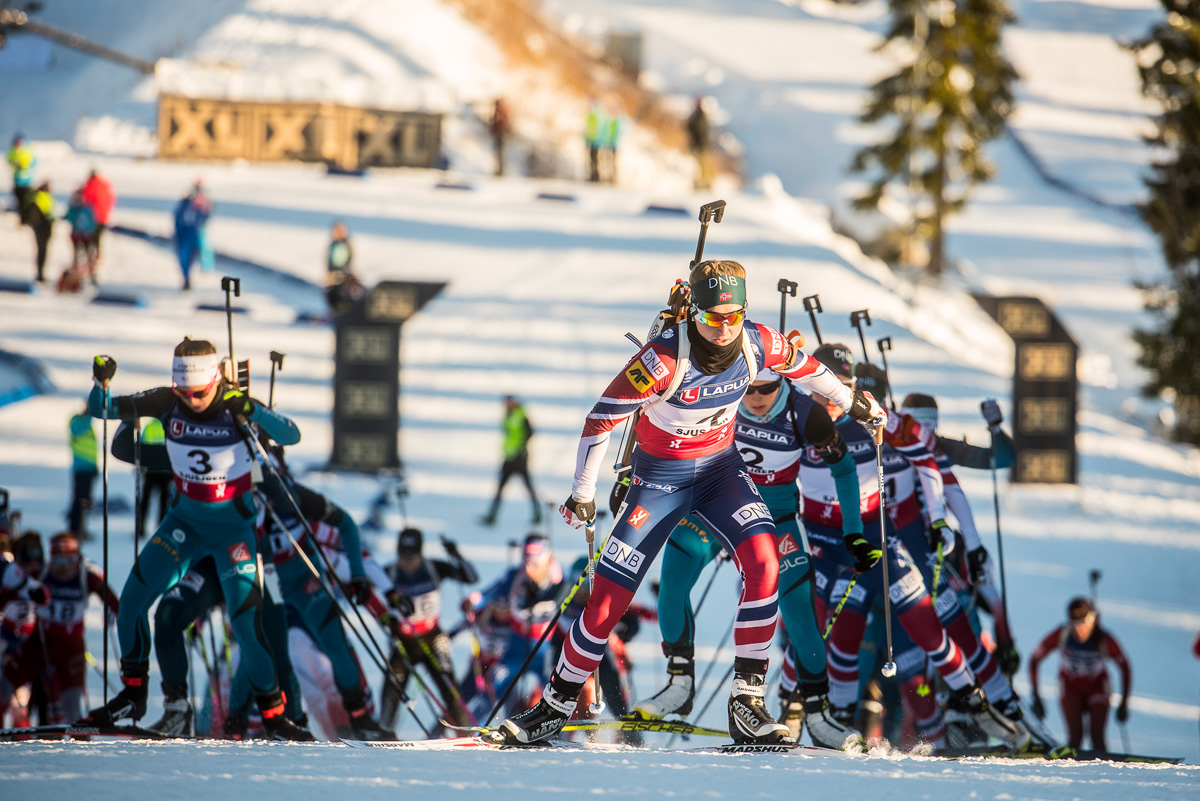
Marte Olsbu of Norway leads the women’s 12.5 k mass start out of the stadium in Sjujøen, Norway. (Photo: Vegard Breie/sesongstartskiskyting.no)
After a disappointing day of sprints in Sjusjøen, Norway, on Saturday, the Norwegian biathlon team rebounded in Sunday’s mass starts to claim wins from Marte Olsbu in the women’s race and Erlend Bjøntegaard in the men’s race.
In the women’s 12.5 k mass start, Olsbu had just one penalty, in the first prone stage, and came back through the field to ski to a 25-second win over Anais Bescond of France, who had two penalties. Synnøve Solemdal of Norway was third (+31.6) and Fuyuko Tachizaki of Japan fourth (+48.7), both shooting clean.
“It was very fun,” Olsbu told Norwegian broadcaster NRK, according to a translation. “I did what I had planned, and it means a lot that I can stand on the podium with another Norwegian.”
The men’s field was so large that it was split into two mass start races, an “A” and a “B” competition, each of which had more than the 30 standard entrants for a mass start competition.
Martin Fourcade of France was near the front for almost the entire race, on form after having won Saturday’s sprint, but missed the last shot of the competition. He was unable to make it back into first place by the end of the 15 k race.
Erlend Bjøntegaard heading for the win in Sunday’s 15 k mass start in Sjusjøen, Norway. (Photo: Vegard Breie/sesongstartskiskyting.no)
Instead, it was Norway’s Bjøntegaard taking the win. Bjøntegaard had missed just one shot, in the second shooting bout. He skated to an 11.8-second victory over teammate Johannes Thingnes Bø, who missed three shots over the course of the race. Fourcade was third, +16.1.
Despite his win, Bjøntegaard is not headed to the World Cup opener in Östersund, Sweden, next week. Norway’s team had already been decided, and Lars Helge Birkeland and Henrik L’Abee-Lund, who did not have stellar results this weekend, will go instead. They told NRK that they had not focused on these Sjusjøen races because the priority was instead performance at the World Cup.
“That’s how it is,” Bjøntegaard told NRK. “I don’t bother to spend time on it. I can promise that my possibilities will come.”
Based on his 29th-place finish in Saturday’s sprint, Scott Gow of Canada made the “A” mass start. He picked up six penalties, including three in the third stage, and skied to 37th place (+4:12.3).
“I shot poorly today due to me being too much inside my own head,” he wrote in an email. “My first prone was an oversight on the wind conditions, and my first standing was me totally rushing. Lesson learned, I hope… I would say I still have some speed in the tank. Shooting, aside from today, has been very good lately, so I’m happy with that. Skiing has been solid too, but I could feel the travel a bit this weekend, so hopefully that’s all gone by next weekend.”
Gow and his brother, Christian, went to Sjusjøen along with fellow Biathlon Canada National Team member Brendan Green. It was not an official team trip, but the trio felt the need to get some extra acclimation to the European time zone and another set of races under their belts before the World Cup begins.
“Christian, Brendan and I had been talking about wanting the team to go to Sjusjøen for a while, but that was never going to happen with our [national team] budget woes, so we took it upon ourselves to make the trip happen,” Scott Gow wrote. “We believe the early acclimation and high-end racing is great preparation for Östersund, where the three of us always feel like we start flat and struggle to achieve good results. Our goal is to adjust to Europe and have our bodies is the best shape possible. I would say we’ve accomplished our goals. We adjusted well to the jet lag, and we all had at least one decent race.”
After the sprint, Christian Gow and Green were slotted into the “B” mass start. They made the most of the opportunity, with Green missing two shots but taking the win, and Gow missing one shot and finishing 8.8 seconds behind in second place.
Things didn’t go particularly smoothly for either Canadian. Both of Green’s missed shots came in the first shooting bout, but he faced challenges even while cleaning the other bouts.
“In addition to the two misses, I had some problems in the range during each prone shooting which caused me to lose some more time,” Green wrote in an email. “I spent the entire rest of the race working my way back to the lead group. I think I came in for my final shooting bout in seventh, left the range in third, and was able to ski to the lead from there. Christian lost time early on with a broken pole right at the start of the race, so we both had our work cut out today.”
While the goal had been to make the “A” mass start, Green pointed out that there was value in racing in a competition where he was fighting for the win, even if few of his regular World Cup competitors were in this race.
“Today was still good preparation for the World Cup next week, and a nice way to finish the weekend of racing here,” he explained. “ t’s good sometimes to have a little more control during a race, and there is still the pressure when you’re at the front to perform which is always good practice.”
While Green said his speed was not yet at 100%, the group was excited to be back competing after a long summer and fall of training.
“I love this time of year because it means we’re racing!!!” Scott Gow wrote.
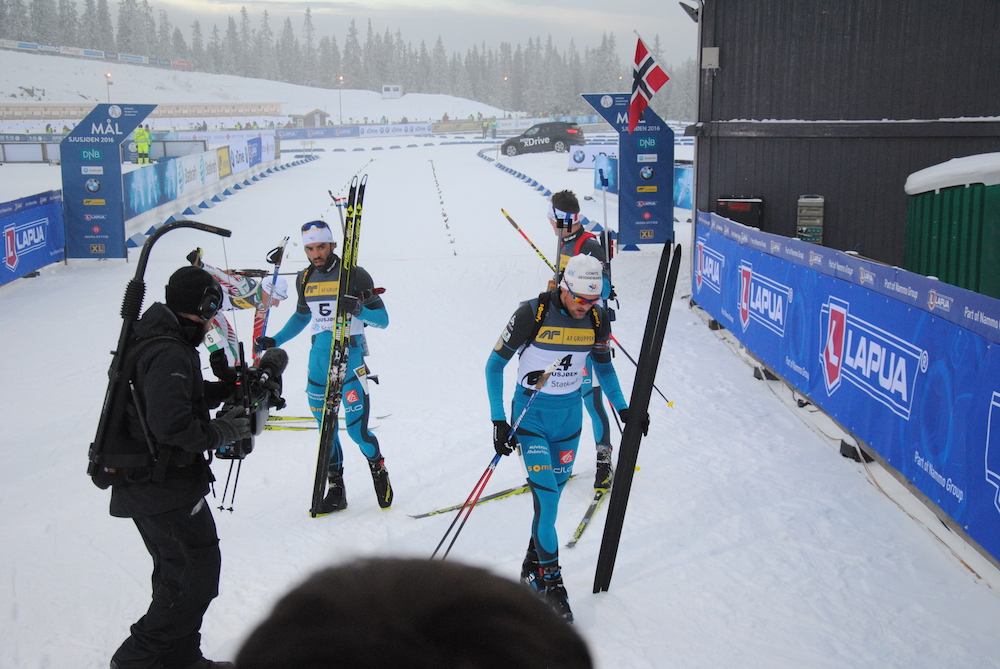
Allez les bleus: Race winner Simon Fourcade (bib 5) at the finish line of the 15 k mass start with second-place teammate Simon Desthieux (bib 4) and fourth-place finisher Fabien Claude (back).
SJUSJØEN, Norway–Before Sunday’s women’s mass start even began, expectations were high for an exciting race: all nine of the best-seeded biathletes were individual or relay podium finishers during the previous World Cup season, and bib number ten belonged to Junior World Champion Ingrid Landmark Tandrevold.
And not surprisingly, there was plenty of drama over 12.5 kilometers and four shooting stages.
The first lap was relatively even until the final climb where Tiril Eckhoff of Norway, Yuliya Dzhima of Ukraine, and Celia Aymonier of France created a slight gap. But the first shooting mixed up the order and set the standard for the remainder of the race. Dzhima hit five targets, as did Ukrainian teammate Olena Pidrushna, along with Anais Bescond and Anais Chevalier of France. The winner of Saturday’s sprint, Justine Braisaz of France, missed once.
Leaving the range in first, Dzhima held this position until the finish line. She hit all 20 targets except for her final shot, which was too far to the upper-left corner.
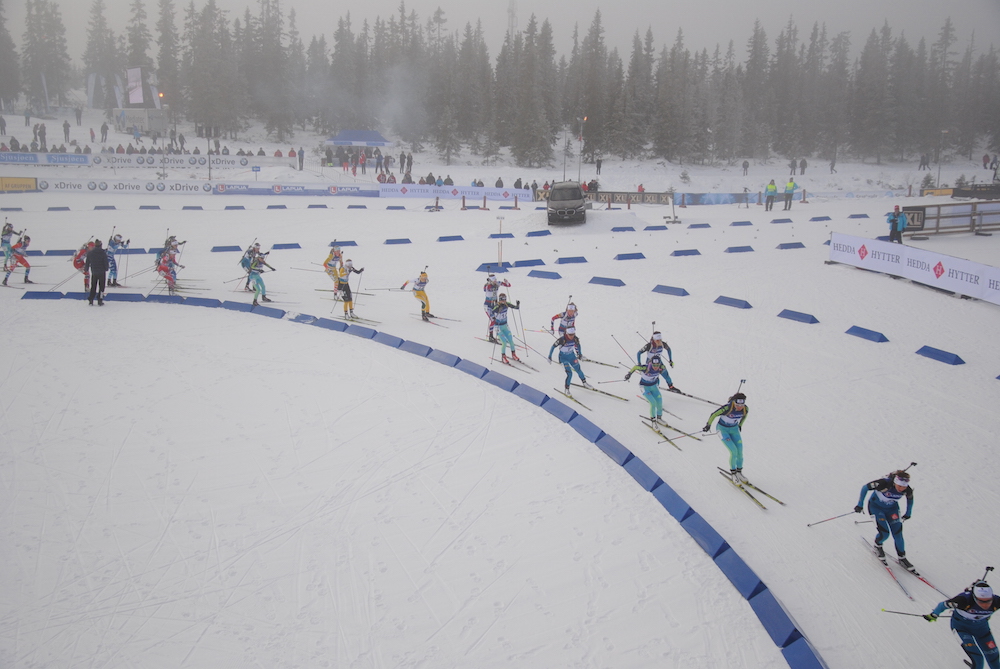
The women’s mass start in Sjusjøen, with eventual race winner Yuliya Dzhima of Ukraine fourth from right.
Dzhima skated hard with every stride. At times it seemed like she was breathing heavily, but the gap to second-place finisher Pidhrushna was never shorter than eight seconds, which was after the first shooting. From there on, Dzhima was in the clear. After 8.8 kilometers she had amassed a lead of 35 seconds to Pidhrushna and well over a minute to Braisaz, who eventually finished in third place.
During the post-race press conference, Dzhima – an Olympic relay gold medalist from 2014 – said that she was “unaware of how big the gap was.” While Pidhrushna sometimes seemed to be closing part of the gap, Dzhima’s spot in the lead was never really threatened and she finished the race with an 18.5 second margin.
Pidhrushna, who hit 20 out 20 targets, had a solid margin over Braisaz (+37.3), who had missed a shot each in the first three shooting stages.
Asked what she thought of her own performance, Dzhima replied, “I am very happy about today’s race, and the fact that there was almost no wind made it a little easier both to shoot and ski.”
The competitions were excellent prep for the World Cup, which starts in two weeks, Dzhima said.
“The downhills!” She laughed when asked what the easiest part of the course was. Pidhrushna agreed.
“We like the tracks in Sjusjøen really well,” the women said. “They are tough but very high quality, and the final climb is really hard. But once we finish that one we are ready for any course.”
But the happiest woman on the course today was without a doubt the fourth-place finisher, 18-year old Karoline Erdal. Last season, Erdal won the 6 k sprint and anchored Norway’s bronze medal relay team at World Junior Championships.
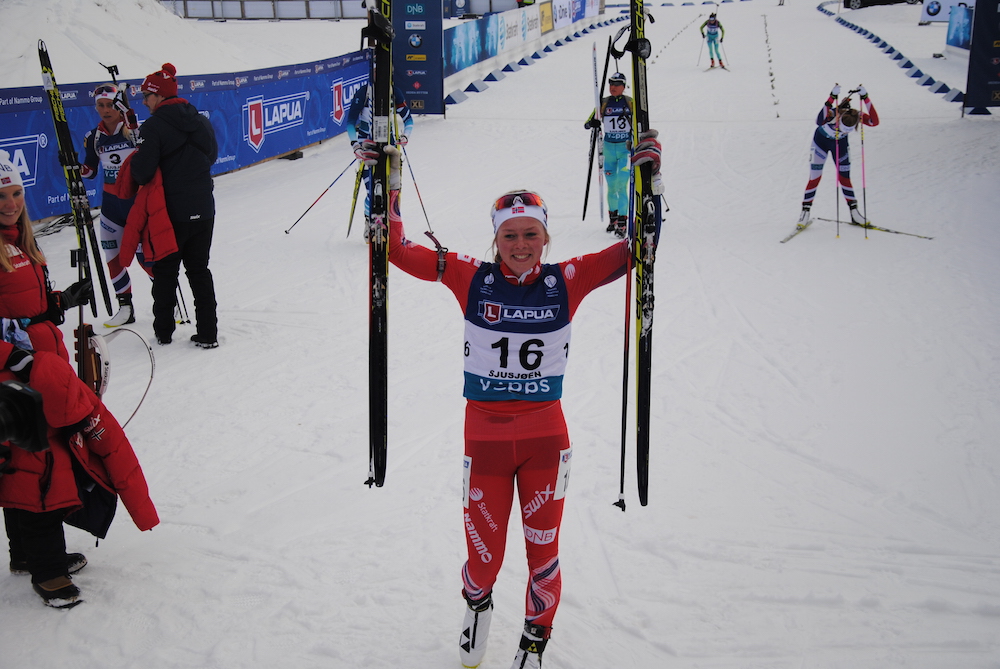
Karoline Erdal celebrates her fourth-place finish.
On Sunday, the young Norwegian hit all 20 targets and crossed the finish line 1:08.9 after Dzhima.
Later in the afternoon, the men’s 15 k mass start was set to be just as exciting as the women’s race. The big question was, would the French team be able to live up to the previous day’s strong performance? In the sprint, five-time World Cup champion Martin Fourcade had surged to a convincing victory, and the French had put five men in the top six.
On Sunday, they lived up to expectations.
The French team lacked Fourcade, who told L’equipe that he decided yesterday to pass on the mass start due to a lack of energy.
But the French still repeated their feat of stealing five out of top six finishes. Martin’s older brother Simon Fourcade won withSimon Desthieux second, just three seconds back. Krasimir Anev of Bulgaria placed third (+18.1), before a trio of Frenchmen: Fabien Claude (+29.2), Jean Guillaume Beatrix (+1:01.7), and Quentin Fillon Maillet (+1:04.4).
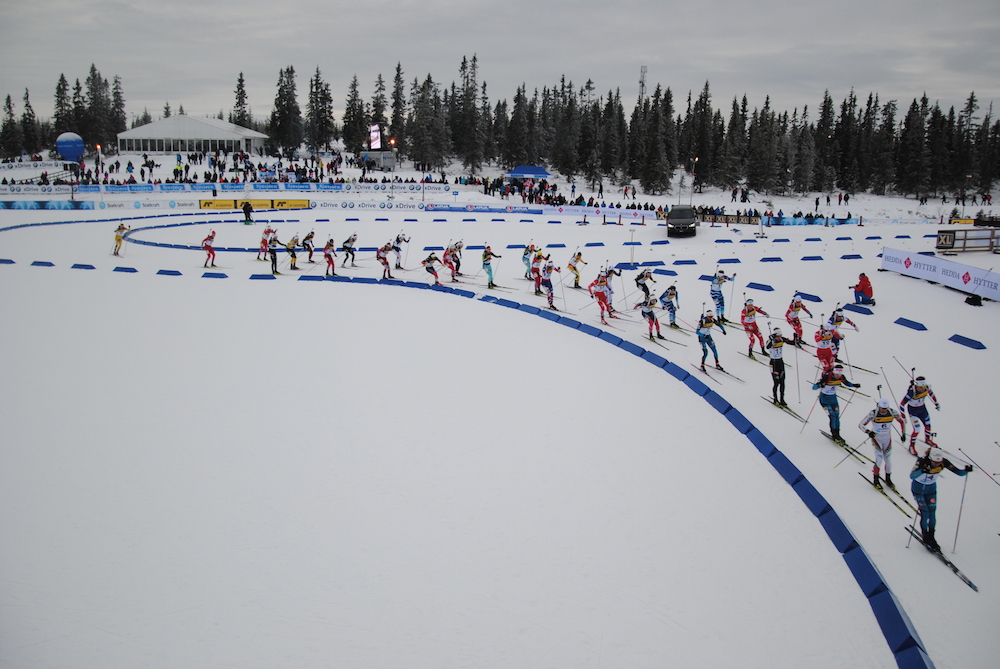
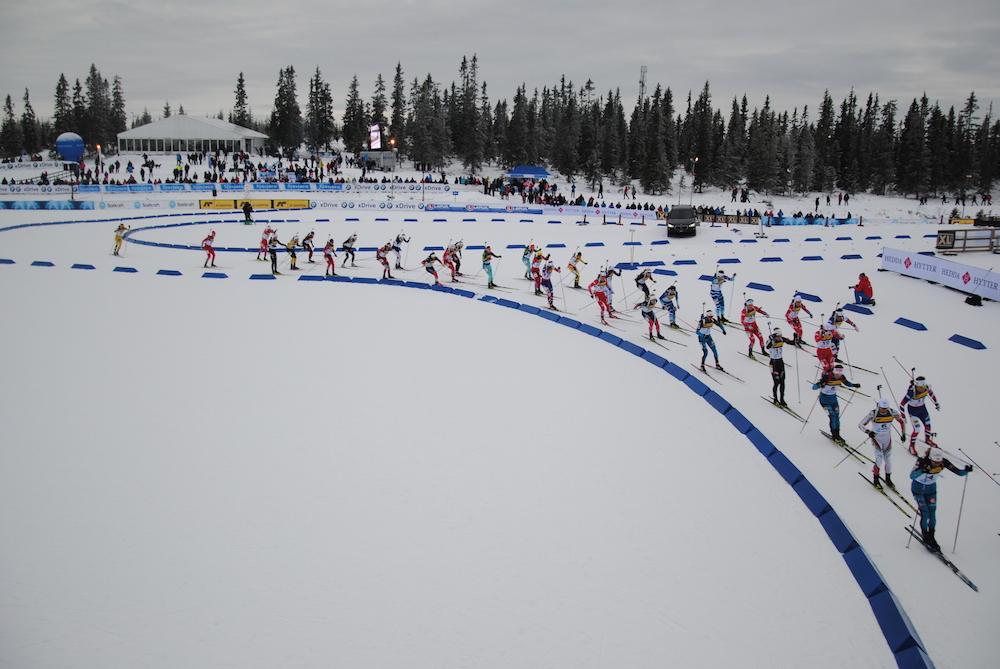
The men’s mass start snaking through the stadium.
“I had to represent my family today, and I am really happy about my race,” Fourcade said during his post race interview with NRK. “I was a little unlucky with the wind yesterday, but I was happy today. I was good in the shooting range and in the track so I am full of confidence for the beginning of the season in Östersund in two weeks… My goals are a little the same as last season, top ten in the World Cup and a medal at the World Championships.”
It was clear from the very beginning that the French didn’t just come to Sjusjøen to try, they meant business. After a first lap that was calm enough for the entire field to stay together, the French were among the top shooters. After the first stage Fourcade, Desthiuex, Claude, and Beatrix had hit all their targets, along with Anev and Norway’s Johannes Tingnes Bø.
This good performance on the shooting range continued on throughout the race except for Bø, who missed three shots in the second shooting. With it, Norway’s hopes for a podium seemed to slip away.
The remaining five skated on and were joined by Fillon Maillet, who had missed twice in his first shooting but made up ground.
By 7.8 kilometers – just over the halfway point – a leading pack had developed consisting of three French athletes and Anev. Rather than pushing the pace, all of them skated easily and it appeared that Norway’s Henrik L’Abee-Lund and Ole Einar Bjørndalen, in pursuit 13 seconds behind, still had a chance to catch them.
But L’Abee-Lund missed twice in his third shooting, and Bjørndalen once; Claude was the only one in the lead who didn’t hit all targets, and dropped from the front pack.
The competition wasn’t quite over yet. Fourcade delivered a fourth lap so fast that nobody else could match him, then headed to the final shooting. Where he had shot the fastest of anyone in the field on the previous stage, Fourcade took his time to make sure he knocked down all five targets. He held a lead of 20 second going into the final lap; Desthieux closed with the fastest lap time of the day, but was unable to catch his older teammate.
“I think we have a strong team this year, and the young boys are pushing me,” Fourcade said. “It really is a good team spirit this season.”
Sjusjøen’s large shooting range – 40 points rather than the standard 30 sets of targets – allowed for a larger mass start field than in World Cup competition.
Sjusjøen’s shooting range as seen from a bridge in front of the VIP/media tent on Nov. 2 in Norway. Sjusjøen is hosting the season-opening biathlon races on Nov. 12-13. (All photos: Aleks Tangen)
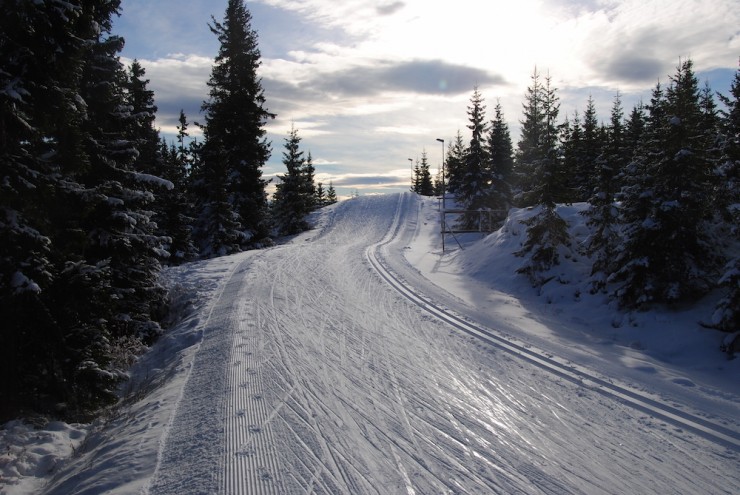
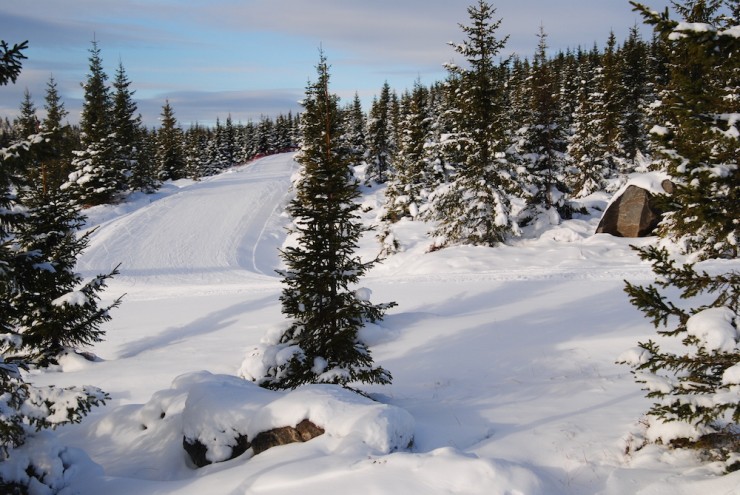
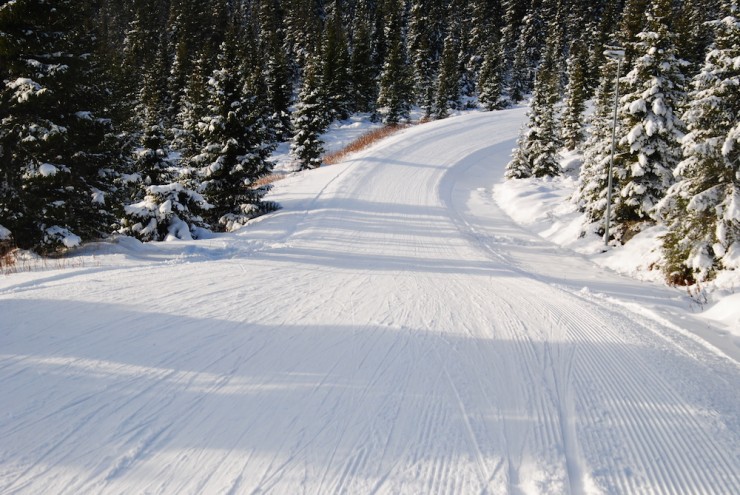
SJUSJØEN, Norway — Talk about early snow: Sjusjøen, a Norwegian ski destination just 20 kilometers outside Lillehammer, has offered a one-kilometer loop since Oct. 1 for biathletes and cross-country skiers of all levels.
Over the last month, the loop has grown to several kilometers as winter arrives in Norway. The area had a substantial snowstorm last weekend, with more than 12 centimeters of standing depth.
“It’s to give people a chance to ski. It’s an ‘offer’ this destination provides and it helps us maintain full-time positions, which is positive for the region and people that want to ski have a chance to do so,” Johannes Håukåssven, the head groomer in Sjusjøen, explained in a recent phone interview. “It also lengthens the season for Sjusjøen as a ski and tourist destination. For example, fifteen years ago, there were no tourists here before Christmas.”
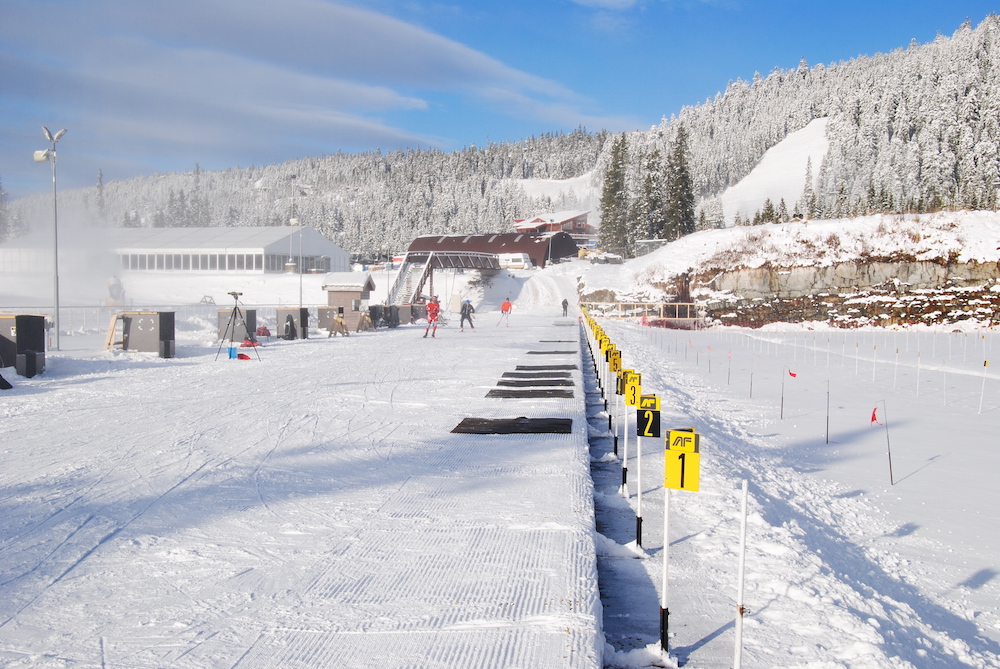
Looking down Sjusjøen’s race course, which will be used for this weekend’s season-opening biathlon races. The competitive course goes off to the right.
The early snow loop is financed primarily by Ring Alm, a locally based manufacturer of wood-based products.
Håkåssveen works on the loop from 6 in the morning until late at night. Many days during the season, he starts working on the tracks at 5 a.m., and some times even earlier.
“They have been salted nearly every day, but we stopped doing it the week of Oct. 17-23 when the temperature at night began to stabilize below zero [Celsius],” Håkåssveen explained. “We work hard to maintain a clean set of tracks with no gravel of any kind. We also have some snow stored, but most of it comes from snow canons.”
While the tracks support tourists as well as elite skiers from around the world (the U.S. team trained there for a pre-World Cup camp last season, for example), they are a primarily local resource.
Therefore, organizers take special care to preserve the boreal landscape that makes Sjusjøen a favorite ski destination.
“The environment is really considered,” Håkåssveen said. “We know that 60 to 70 percent of our potential users live in the surrounding area, and the short drive to Sjusjøen is far better than a long flight to, for example, the Alps. We also don’t use any chemicals and all of the electricity we use comes from hydroelectric power. Some trees will be removed, but this is far from substantial.”
Athletes from all over Norway come to Sjusjøen in order to ski the loop. Håukåssven says it has been quite popular among both professionals and recreational users.
“Biathletes such as Ole Einar Bjørndalen and cross-country skiers Heidi Weng and Øystein Pettersen have used the tracks,” Håukåssven said. “There are also many local athletes, in addition to biathletes from Ukraine and Latvia, that have tested the tracks. And they seem happy about the conditions.”
The venue also hosts season-opening biathlon races attended by not only Norwegian, but also other international athletes. Those competitions are slated for Nov. 11-13 this year, with men’s and women’s sprints and mass starts this weekend. In 2015, biathletes came from Germany, Ukraine, Italy, Finland, France, and the U.S. to start their race seasons in Sjusjøen.
The shooting range in Sjusjøen, Norway, as seen on Nov. 2. (Photo: Aleks Tangen)
“The event is continuously developing,” Norwegian Biathlon Association President Erlend Slokvik said of the season-opening races. “This year there will be a tent overlooking the shooting range for the audience. There will also be many invited guests from the eastern part of the country, people from politics, business and sports administration. What we’re experiencing is that people see the season opener as a fine place to witness great performances and to socialize.”
In an effort to attract spectators, the organizing committee is offering free transportation to the races from Lillehammer and nearby Moelv.
As of Thursday, there were nearly 400 athletes entered in various competition categories. Some teams use the opportunity to make roster selections for the World Cup, which adds excitement.
“It is perhaps a little too early in the season for the athletes to perform at their best level, but with the fresh snowfall, that’s being well maintained we are looking at some good conditions and potentially fast times,” Slokvik said. “I don’t think the artificial snow will have an effect on the performance, loose snow might favor the lighter athletes, but it doesn’t seem like that will happen.”
— Chelsea Little contributed reporting
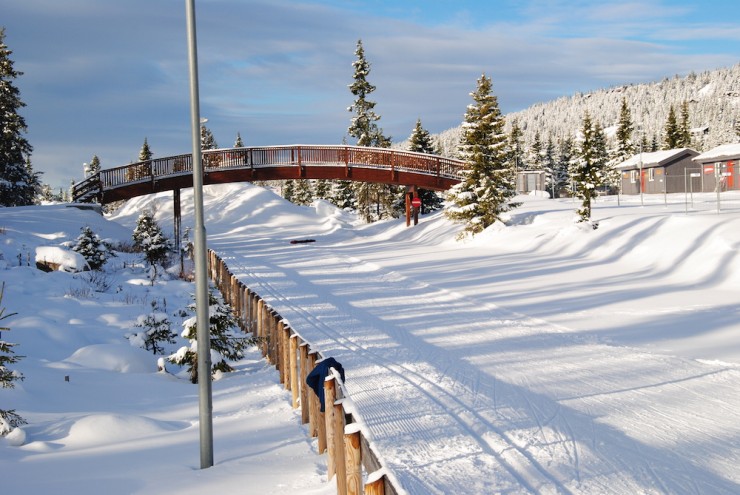
Just beyond the bridge is the start.
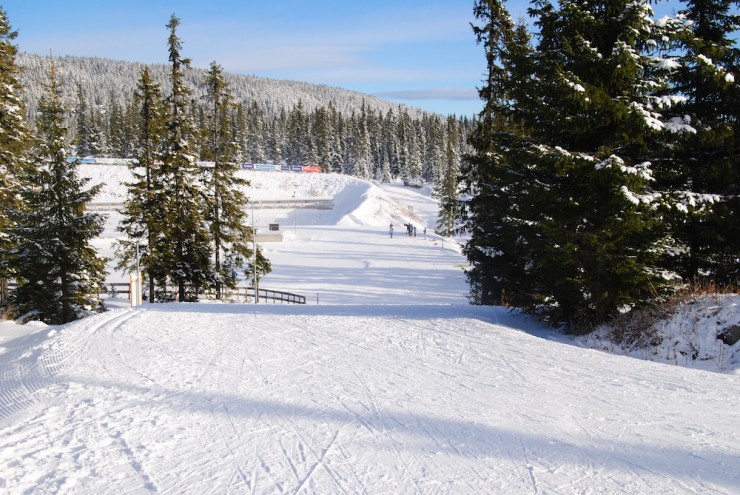
First hill after shooting.
The Sjusjøen course offers a variety of challenges, this is near the middle.
The toughest climb on the course, close to 200 meters long, and near the end of the loop.
On top of the hill seen in previous photo, after the turn comes a short climb before racers enter the stadium.
Jessie Diggins of the U.S. Ski Team won both races in last weekend in Gällivare, Sweden, leading a 1-2 U.S. women’s finish in the classic sprint with teammate Sophie Caldwell on Saturday, and sharing the podium with Caitlin Gregg, who was third in the 10 k skate on Sunday. (Photo: USSA/Stefan Nieminen)
A win is a win: especially when it’s north of the Arctic Circle in chilly conditions and in the first races of the season.
Jessie Diggins started 2015/2016 off with back-to-back wins at the International Ski Federation (FIS) races in Gällivare, Sweden, topping the podium in both the classic sprint and 10-kilometer freestyle.
Above all, the U.S. Ski Team member said the races were confidence boosting and a good way to take inventory on “what else needs to be improved, as well as a good reminder of warmups, race routines, and testing skis.”
On Day 1 of the cross-country races in Gällivare, Diggins and her teammate Sophie Caldwell captured first and second, respectively, in the classic sprint.
“I want to walk up to the start line of a classic race with that same confidence in myself that I have at the start of every skate race,” Diggins said after Saturday’s sprint.
“I don’t care if it’s a World Cup or a local club race. Having three of the six podiums was just a lot of fun,” U.S. women’s coach Matt Whitcomb said on Saturday, after Andy Newell finished second in the men’s sprint.
On Sunday, two American women again reached the podium, with Diggins in first and Caitlin Gregg in third. In the men’s 15 k freestyle, Canada had two in the top four, with Alex Harvey in second and Devon Kershaw in fourth.
“That … was probably my best individual-start skate race in 1.5 years,” Kershaw remarked.
Norway’s Petter Northug racing to a 10 k classic win on Nov. 20 in Bruksvallarna, Sweden. He did so in a custom suit with the Swedish colors. (Photo: AdaMedia Med Mera/@adamedmera)
About 900 kilometers south in Bruksvallarna, Sweden, Petter Northug ruffled feathers on Day 1 of the three-day FIS race series. He won Friday’s 10 k classic by 36 seconds while wearing a Swedish-national-team-like suit. Meanwhile, Sweden’s Charlotte Kalla won the women’s 5 k classic by 25 seconds.
The next day, Kalla won again — this time by 36 seconds in the 10 k freestyle. Led by Niklas Dyrhaug, the Norwegian men swept the Bruksvallarna 15 k skate podium.
Finally on Sunday, Stina Nilsson put the kibosh on Kalla’s streak as the 22-year-old Nilsson won the women’s skate sprint. Kalla placed second, and in the men’s sprint, Norway’s Havard Solås Taugbøl, 22, won by 0.09 seconds over Sweden’s Karl-Johan Westberg.
For the first time, the US Biathlon team logged some pre-World Cup race starts, traveling to Sjusjøen, Norway, to do so. In Saturday’s sprint, the American men all finished in the top 30. Tim Burke led them in 13th.
“Today was definitely a solid team performance,” Burke explained. “Our entire men’s team is at a very high level…”
At one point, American Susan Dunklee ranked first in the women’s sprint after cleaning the first stage, but missed four in standing and ended up 21st.
“My ski shape feels a little sharper than it usually does in November,” she wrote.
Less than four seconds back, her teammate Annelies Cook was 25th. Canadian Megan Tandy (formerly Heinicke) was 23rd with 90-percent shooting. Italy’s Dorothea Wierer won the race with clean shooting.
In Sunday’s mass start, the lone American competing, Leif Nordgren finished 19th with six penalties on a windy day. Tandy placed 40th in the women’s race with seven penalties.
“I was disappointed for sure since it was such a good opportunity against tough competition, but considering the conditions, I’ll get over it quick!” Nordgren wrote.
The men’s sprint winner from the day before, Germany’s Simon Schempp won the mass start as well, by fewer than six seconds over Norwegian Alexander Os of Team Feskslo — or fish guts.
Ukraine’s Juliya Dzhyma cleaned the final stage to win the women’s mass start.
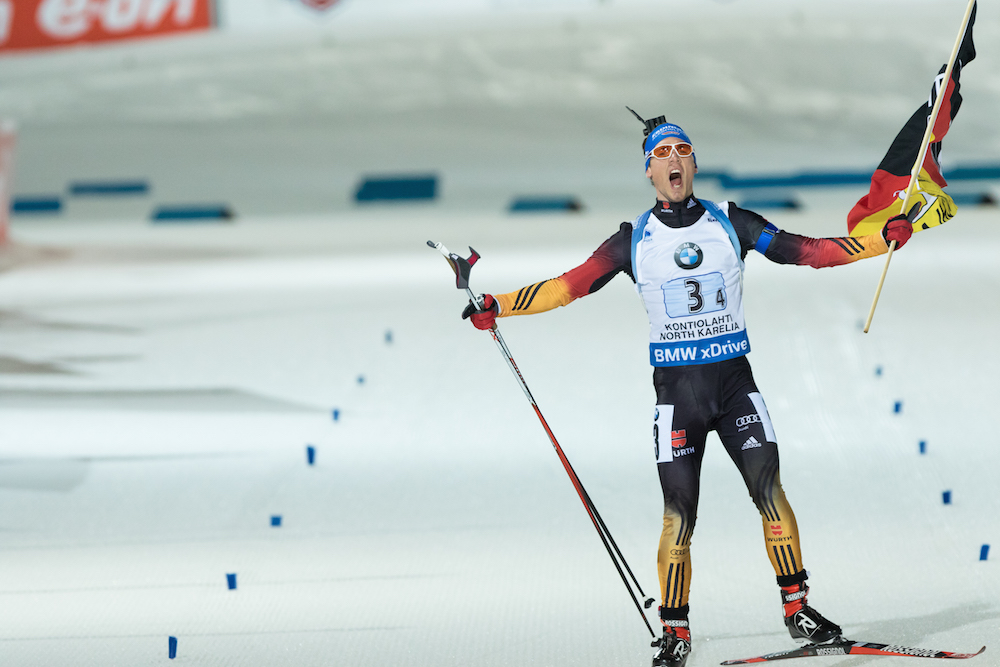
Germany’s Simon Schempp soaks up his team’s victory after anchoring the men’s relay to gold at 2015 IBU World Championships in Kontiolahti, Finland. (Photo: Kontiolahden Urheilijat/Risto Kuittinen)
For many teams, the first international races in mid-December are how World Cup rosters are decided. And that means they matter a great deal to athletes like Alexander Os.
A 2010 Olympian with seven individual World Cup podiums to his name, Os is now 35 years old. The Norwegian federation has made clear that they only want one old man on their national team, and that’s Ole Einar Bjørndalen, the “King of Biathlon.” Os has been named to World Cup teams every year, but he’s no longer on the national team.
So along with Michael Rösch, a German who transferred to Belgium, Os made a new team. It’s called Team Feskslo, or fish guts.
And just like last year, Os came to the season opening races in Sjusjøen looking to perform.
He didn’t win the sprint on Saturday as he had in 2014, but Os came very close to winning Sunday’s 15 k mass start competition. After leading the whole race, he missed two shots in the final shooting stage. That left him still at the front, but right with Germany’s Simon Schempp – the man who had won the sprint.
“Nice conclusion today,” Schempp tweeted after the competition.
He bested Os by 5.8 seconds, while Norway’s Tarjei Bø made a hard charge on the final loop to ski up to third, +8.8. It was an impressive performance despite six penalties; both Schempp and Os had three.
“He was a super talent, so he trouble a couple of seasons around 2010/2011 because of overtraining,” Bø told VG of Schempp. “Over the past year, he has had an incredible progress. Simon is one of the few complete biathletes, who is good to shoot and little lacking when it comes to skiing. He goes like a Norwegian, very easy on the skis… It is good that there are some foreigners here, because if it had only been Norwegians here we would not have received the ‘reality check’ we deserved to get.”
Bø said he felt great on his skis – he had the fastest ski time by 36 seconds over Germany’s Benedikt Doll – and wants to beat Schempp once the season begins.
“He says that, but I saw him in the rearview mirror,” Schempp laughed to VG, before sobering up. “These were just the first races of this season. Next week is the World Cup and it is more important for most people here.”
France’s Jean Guillaume Beatrix placed fourth, +17.6, and Germany’s Arnd Peiffer fifth, +19.5.
And as for the King of Biathlon, Bjørndalen returned to the scene after two months of illness this autumn. He placed 11th, +54.4 with five penalties and the sixth-fastest ski time.
“The shooting was all too bad,” he told Norwegian broadcaster NRK after the race. “But really an okay start. We will make it better eventually.”
Most of the American team was training rather than racing, but Leif Nordgren finished 19th with six penalties.
“For the shooting, it was quite windy again today,” Nordgren wrote in an email. “That made the shooting pretty tricky. I was happy with how the prone shooting went- it didn’t feel like it was only the second race. Standing was a little more rough, a lot of guys struggled with the standing today. I was disappointed for sure since it was such a good opportunity against tough competition, but considering the conditions, I’ll get over it quick!”
In the women’s race, Juliya Dzhyma of Ukraine used a clean five-shot sequence in the final standing stage to win the 12.5 k mass start over Franziska Preuss of Germany and Tiril Eckhoff of Norway, each of whom had one penalty; Marie Dorin Habert of France had been leading, but picked up two penalties.
That allowed Dzhyma to leapfrog from sixth place to an 11.6-second margin over Preuss. Eckhoff was another 5.3 seconds behind.
“On shooting the wind was blowing in the same direction, rather strongly, not always, but in gusts,” Dzhyma told xsport.ua after the race, according to a translation. “That means it’s luck – if you come when there’s the steady wind, you can adjust. If it’s a gust – it’s hard. The first standing, for example, I was not lucky – there were gusts and I went to two [penalty] loops. And then at the second [standing] was the opposite, it was lucky – the wind was steady and I worked cleanly.”
Indeed, there were many penalties throughout the field; four for Dzhyma and Preuss, and seven for Eckhoff.
“Today it was a real challenge on the shooting range,” Eckhoff told VG. “I misjudged it a little bit. I need to practice a bit in the wind.”
While Eckhoff and Preuss, both young, have established themselves as among the leaders of their teams with strong results last season, Dzhyma might be heading in that direction too. She has three World Cup podiums so far, but is yet to take a win.
“Of course, I want to run every race like it went today,” the 25-year-old said. “Let’s see how it goes. This season with our new coach very seriously changed and diversified the training, a change of emphasis. New emotions, new motivation. Work was fun and [we had] a good mood.”
Canada’s Megan Tandy placed 40th (+4:34.7) with seven penalties, three of which came in the first stage and knocked her to the back of the pack.
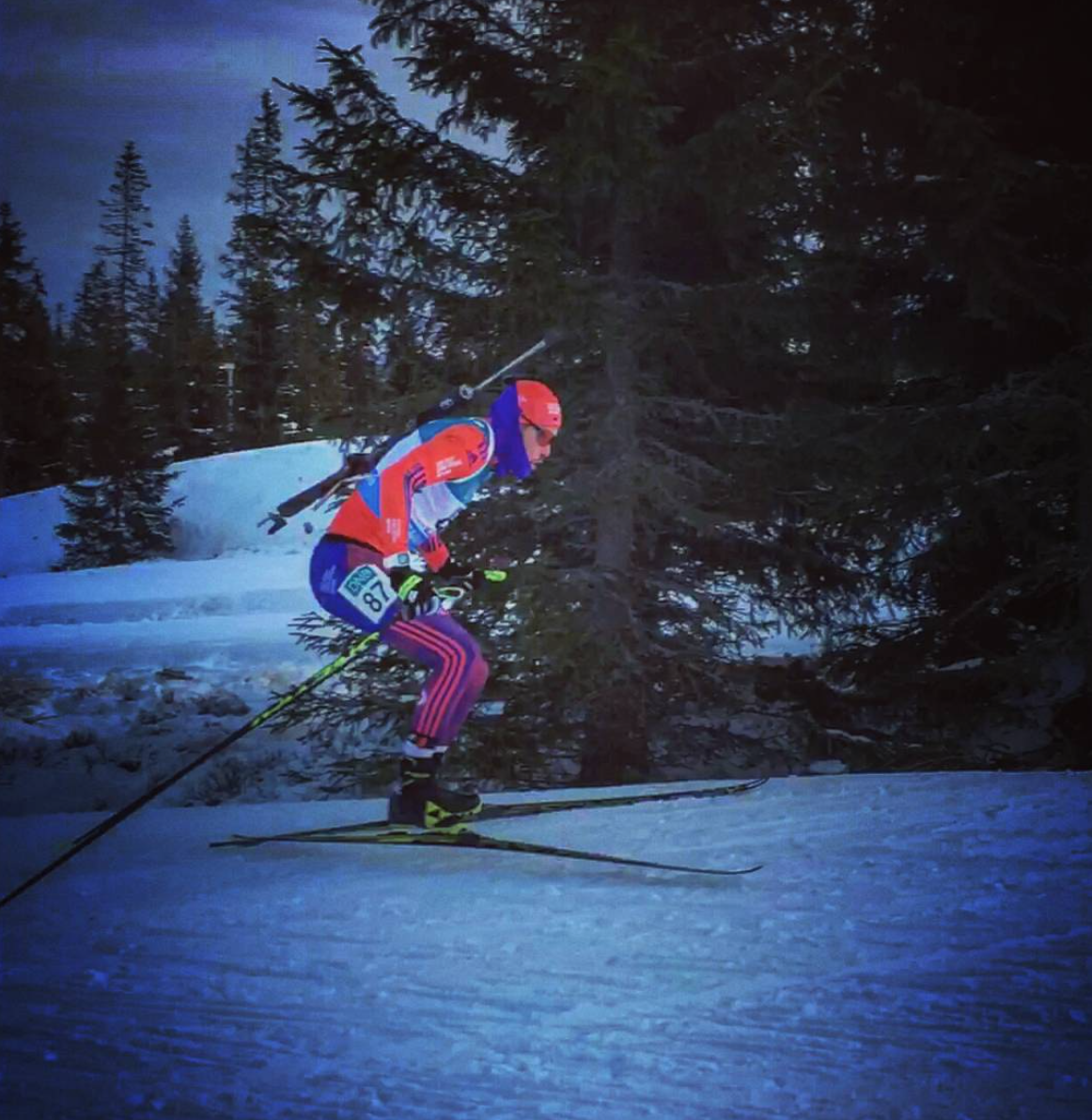
Leif Nordgren of the United States racing to 19th place in the sprint in Sjusjøen, Norway, on Saturday. The team’s new orange-and-purple suits have been provoking discussion… (Photo: Jonne Kähkönen)
As much as Tarjei Bø wanted to win one for the home team in Sjujøen today, the Norwegian biathlete knew when he missed his second shot that it wasn’t going to be.
“You do not deserve to win with two penalties,” he told Norway’s NRK broadcaster. “That hasn’t happened in the last two years I think. It’s good that someone could beat me.”
Simon Schempp of Germany had no such problem in the 10 k sprint. With just one missed shot, he beat Bø by 13.7 seconds to take the win in the first major biathlon competition of the 2015-2016 season.
“It was fantastic to win in the first competition,” Schempp told NRK. “I’ve felt good in training all year, and this confirms that my shape might last.”
Schempp broke through last season, winning three different World Cup races and landing fourth in the Total Score.
“It’s wonderful when the season starts like this,” Schempp tweeted after the race.
Simon Fourcade of France placed third, +32.3 with a single penalty. He landed just four seconds ahead of his younger brother Martin, who had three penalties and tried to charge hard for the podium after errors in standing shooting.
He made up ground, but not enough.
“Not so bad result with not so good feelings… Hope for better next week,” Simon Fourcade wrote on his Facebook page.
Much of the pressure was on the home team, which is preparing to host World Championships in Oslo in March.
Besides Bø’s second place finish, the team seemed shaky. Younger brother Johannes Thinges Bø had three penalties to place sixth.
“It was a little bit of nerves kicking in,” the several-time World Cup winner told NRK, according to a translation. “It was shitty shooting at the moment. But it will be an exciting season and it’s good to have started.”
On the other hand, the older Bø brother asked, well what did you expect?
“It was not Johannes who I feared most today,” Tarjei Bø told VG. “He is not the best in the wind. He has been okay in tailwind for several years, but with crosswind he is not so good.”
Several other Norwegians were in the top 20, but most were not the national team atheltes. Henrik L’Abee Lund placed 18th with three penalties, and Alexander Os, a successful Championships competitor who has lately been left off the national team and has started his own training group, finished 20th.
Stars Ole Einar Bjørndalen and Emil Hegle Svendsen didn’t start today’s race.
All of that might be worrying for the host country. But Tarjei Bø is confident.
“I want to be good all winter,” he told NRK. “I think I might be the type to be good from start to finish.”
Four Americans competed, and all finished in the top 30. Tim Burke led the pack in 13th with two penalties, +1:25.7.
“This was my fourth session on skis and my first speed on snow, so I was definitely not expecting to feel great,” he wrote in an email. “I felt very flat for the entire race, considering this, I was pleasantly surprised with the result. Everyone comes into these races with very different goals. Some are trying to qualify for World Cup teams and others are coming in under a big training load. With all of these variables, I don’t read too much into the results.”
That’s to be expected, said Women’s National Team Coach Jonne Kähkönen.
“In general, I would say most of the struggle was mainly because of the travel overseas (arrival on Tuesday pm) and due to that not quite adjusted,” he explained in an email, speaking of both the women’s and men’s teams. “At the same time; this was what I expected and wanted to do to speed things up in terms of adjustment.”
This is the first season that the U.S. team has competed in these races. Previously, the team would travel directly to Östersund, Sweden, to train in advance of the World Cup beginning there.
Burke appreciated the chance to get an extra race start in and feels that he’s working towards good race shape.
“This training season was a little up and down for me with a few different sicknesses,” he wrote. “I feel like I did not really start to get on track until the end of October. I’ve had some great training days in the past month and then some days where I feel pretty flat like today. I’m hopeful that I will be more consistent now when I start backing off the hours and get a few more races under the belt.”
Close behind on the results sheet were Leif Nordgren in 19th (+1:33.1, 2 penalties), Lowell Bailey in 25th (+1:41.9, 3 penalties), and Sean Doherty in 29th (+1:47.6, 2 penalties).
“It’s always nice to get the first race of the year in the books, and it’s an even better feeling when it does fairly well,” Nordgren wrote in an email. “I feel like in the past season I’ve started off much to slow, yes, my goal this year was to start as close to where last season ended as possible. I’m not at that point today, but I’m not so far off like I’ve been in the last few years, and with a few more races under my belt, hopefully it’ll pick up fast.”
Like Burke, he said it was unusual to go through the process of getting used to racing while also getting used to being on snow.
“I could tell it was the first race of the year today, I definitely felt a little off balance, and it was a little weird to be on fast skis!!” he wrote. “The conditions here in Sjusjøen are near perfect though, almost like mid winter conditions, its getting quite cold at night and there is plenty of snow!”
Of the four, only Nordgren is planning to compete in Sunday’s mass start, while the rest of the team will be training.
“I just feel like racing is something that helps me get into good form,” Nordgren wrote of his decision to buck the team trend. “This is a good opportunity to get a really high quality race in, so why not race!”
The success of all four in the first test of the season was taken as a good sign for the men’s team.
“Sean has definitely taken a good step forward already in the training season and today was a good confirmation on it,” Kähkönen wrote of Doherty’s top-30 debut. “Looking forward to seeing what he can do this year.”
With two half-seasons of World Cup racing under his belt, Doherty – who still has one year of junior eligibility left – has already been a calm presence in team events.
“Today was definitely a solid team performance,” Burke wrote. “Our entire men’s team is at a very high level and we are all very excited to see what we can do in the relay.”
This is too good not to include: also in the race was fun-loving Swedish cross-country skier Robin Bryntesson, who missed nine of his ten shots and finished last. That prompted retired star biathlete and fellow jokester Carl Johan Bergman to basically ask if the results sheet was upside down:
U.S. national team coach Jonas Johansson takes video of Annelies Cook as she skis to 25th place. (Photo: U.S. Biathlon Women / Facebook)
The international biathlon season started in earnest on Saturday, with Sjusjøen, Norway, hosting most of the top teams as well as a deep domestic field for 7.5 and 10 k sprint races.
In the women’s 7.5 k, Tiril Eckhoff just missed out on being able to give the home team a win. She finished 3.1 seconds behind a clean-shooting Dorothea Wierer of Italy, meaning that shooting ten for ten would have likely given her the victory.
“I am very pleased with how I did the shooting,” Eckhoff told Norway’s NRK broadcaster, according to a translation. “Especially the prone series. That’s something I can take forward with me.”
Last season in this race, Wierer also won with perfect shooting. In 2014 Eckhoff was also second, but with two penalties and 37 seconds behind.
The top Norwegian is closing the gap.
“I know I am stronger,” Eckhoff told NRK. “So time will tell whether I am as strong throughout the season.
Germany’s Maren Hammerschmidt was a surprise third place, with clean shooting like Wierer. Olga Abramova of Ukraine placed fourth, Franziska Preuss of Germany fifth, and Krystyna Guzik of Poland sixth, all with one penalty.
For several teams, the results will add to curiosity about roster choices for the first World Cup. Germany, for instance, had already selected Preuss, Laura Dahlmeier, and Franziska Hildebrand for the World Cup, but leaves three spots open. Hammerschmidt’s podium was unexpected. Vanessa Hinz and Karoline Horchler, who placed 14th and 16th, are also in the running, while former star Miriam Gössner missed five shots but with quick skiing was able to stay in the top 30.
Norway’s favorites struggled on the shooting range as well, with only Kaia Wøien Nicolaisen, not a usual member of the World Cup team, joining Eckhoff in the top ten. Fanny Horn Birkeland (formerly Welle-Strand Horn) missed four shots to place 20th, and Synnøve Solemdal also missed four to land 32nd.
Susan Dunklee led the American team in 21st place, +1:40.3. She was actually leading the race as well, after cleaning the prone stage.
But then she missed four shots in standing and dropped back in the penalty loop.
“My major focus in summer training was to improve my shooting speed and it has taken a big step,” Dunklee wrote in an email. “Normally I stick with the same race shooting cadence that I use in training but today I may have been better off to reset mid-stage after missing a few targets… I missed this race stuff during the summer; it’s good to be back at it. My ski shape feels a little sharper than it usually does in November.”
Dunklee’s teammate Annelies Cook placed 25th with two penalties just 3.7 seconds further back.
“The race was fun and hard today,” she wrote. “I am satisfied with how it went today, nothing was perfect so there is room to improve but I didn’t feel as far behind where I want to be as I have in the past. It was great to practice a ‘mini World Cup’ to have a soft entrance into the racing season. I have to say that I actually only felt nervous about two minutes before my start, so that was kind of nice having a more relaxed confident feeling leading into the race. I wanted to remember that it is just racing and is supposed to be something we do because it is fun to race.”
Canada’s Megan Tandy placed 23rd, +1:41.3, with a single missed shot.
“I was satisfied with shooting 9/10 in somewhat windy conditions, I felt focused and stuck with my shooting plan,” she explained. “Skiing was hard and I don’t think today’s ski performance reflects what I expect from myself this season.”
The Canadian team is not traveling to Europe until later this week when they will go straight to Östersund, Sweden, for the start of the World Cup.
Tandy, however, has been based in Europe already so made the trip to Norway on her own.
“It is always more stressful to be alone than in a team,” she wrote in an email. “I need to cover all of my own expenses and be organized (book my own flights, rental car etc.) However, I am well taken care of here!! My home coach, Knut Tore Berland, lives in Lillehammer so I actually have my own coach here to support me. I have known his family for almost 10 years and look forward to visiting them every November… The USA Team is taking care of my race skis which I really appreciate!”
Like Cook, she appreciated the lower-key start to the season, even though most of her World Cup competitors were actually already in the field in Sjusjøen.
“I feel like there was a lot less pressure here, especially because in the back of my head these are training races,” she wrote. “The stakes will certainly be higher [in Östersund] but I am sure that racing here will help me start the first World Cup feeling more confident and relaxed.”
Tandy moved to a new part of Germany this year, so her training hasn’t been the same as usual. She said that it was good to check back in with the field and get race time instead of just time trials.
“My on-snow preparation will be shorter than usual this year as I will travel back to Germany for 5 days so I can have a last visitation with my son before joining the Canadian Team in Östersund in time for the Individual race,” she explained. “This means that I haven’t tapered for these races, they are just integrated in my training plan and my goal here is to have a great week of snow training and use the races as experience and good hard sessions… I feel really glad to have the opportunity to race here.”
For the United States, Clare Egan placed 84th (+5:26.4) with seven penalties.
Racing continues on Sunday with mass starts, but the American women confirmed that they did not plan to compete.
Snow saved from last season is dumped in Beitostølen, Norway. The resort opened its cross-country ski trails on schedule on Oct. 30, but warm temperatures are jeopardizing the upcoming season-opening FIS races there in mid-November. (Photo: NSF)
A lot of places have snow in the middle of the winter, but destinations that can offer reliable and consistent snow at the beginning of the season have a leg up in the battle for the skiers.
The first snow in the fall is magical for skiers, and many are willing to travel quite far to get on snow. Accordingly, guaranteeing early skiing conditions has become big business for the ski resorts, and they no longer trust the weather gods to provide the white gold on schedule.
Norway’s destinations of Beitostølen, Sjusjøen and Trysil are known for early season skiing, and the past few years the resorts have been competing to be the first to offer cross-country skiing in the fall, investing large amounts of money and resources in their early season packages.
Trysil, a ski destination in eastern Norway known for early snow and stable winters, already expanded its season this year with a guaranteed opening date of Oct. 29. After calculating that they will need 12,000 cubic meters of snow to pack and groom 6 kilometers of snow 5 meters wide and 0.35 meters deep, the resort stored 25,000 cubic meters of snow since late March.
Significant investment
Trysil has stored 25,000 cubic meters of snow since March. (Photo: Ole Tangnes)
ForTrysil, this marks the first year the venue is offering early skiing on old snow. Over the past couple of years, the snow manufacturing division in Trysil has invested about a million dollars in water pipes and snow guns, and cleared a site for storing snow over the summer, where the mound has been kept since March.
The mound of snow was covered with 30 centimeters (about a foot) of sawdust, bark and cellulose chips to prevent melting over the summer, and presently, the snow is being transported back onto the trails.
It takes two excavators and two days just to uncover the mound. Then, several trucks transport the snow onto the tracks, along with the excavators, before the groomers will pack and track the courses.
The whole process takes about 10 days, and started on Oct. 20 for an as-scheduled Oct. 29 opening.
Science
Storing snow over the summer takes more than just piling up a bunch of snow and covering a mound. To prevent as much runoff as possible, the snow must located out of direct sunlight and covered with substance that won’t attract heat and turn the snow to ice.
The head of Trysil’s early season snow project, Ola Gerhard Sørhuus stands near a snowmaking machine and mound of snow in Trysil, Norway. (Photo: Ole Tangnes)
Furthermore, developing an ample snow depot is a project that takes years to cultivate. The first year, there will be a bigger runoff, but as the depot is used year after year, the ground will develop permafrost where the mound sits. Accordingly, the runoff is significantly reduced after the first couple of seasons, explained Ola Gerhard Sørhuus, who is in charge of the summer snow project in Trysil.
But how does it feel to ski on last season’s snow? “It will be somewhat more compact than fresh falling powder, more like spring skiing,” Sørhuus said on the Trysil website.
In its first season, Trysil reports having more than 7,000 skier-days booked for the early snow. Skiers pay 50 kroner or roughly $6 U.S. dollars per day in trail fees, which also includes access to the service building with bathrooms and showers. Additionally, teams and training groups that sign up for the early skiing in Trysil get their own wax cabin at stadium by the trailhead.
Popular strategy
Beitostølen has been storing snow from the previous season for several years now, and opened its World Cup trails at the ski stadium as planned on Oct. 30. The venue planned to groom its higher-elevation trails as well if there was sufficient snow, but this year there is currently no natural snow up high.
Furthermore, warm weather on the opening weekend and through the first part of this week has created a headache for Beito, which is scheduled to host the national International Ski Federation (FIS) season-opening races Nov. 13-15. The snow is melting rapidly, and it is too warm to make additional snow with traditional snowmaking equipment. According to NRK, there is no solid plan B, but organizers are trying to cover the snow and restrict use until temperatures drop below freezing.
Beitostølen event coordinator Erik Østli by a woodchip-covered snow pile in 2013. (Photo: NSF)
“It looks unfortunately, not as bright,” Beitostølen event coordinator Erik Østli told NRK, according to a translation. Temperatures reached 9 degrees Celsius (48 degrees Fahrenheit) on Monday night. “It’s like a hairdryer, and very bad news for the trails.”
In a phone interview with FasterSkier last month, Østli emphasized that offering early skiing on last season’s snow was worth the effort, even though he doesn’t anticipate making a profit on the old snow. However, putting Beitostølen on the map as a guaranteed destination for early skiing is valuable in itself, Østli said.
While cross-country skiing in Norway generally is free, even on groomed trails and on private property such as ski resorts, the areas offering early skiing tend to charge a trail fee.
“We have to charge a small fee for the early season skiing,” Østli explained. “The labor and materials involved in storing the snow over the summer, insulating the snow with saw dust to reduce melting, then uncovering the mounds in the fall, moving the snow back to the trails and grooming the stadium is expensive.”
The daily trail fee most places is 50 kroner, or roughly $6 dollars, for 5 kilometers of World Cup standard trails at the Beitostølen stadium. To break even on the early snow, Beitostølen would need 20,000 skiers to come through the stadium before December, when the fee is lifted, and although the early skiing is popular, Østli didn’t expect the proceeds to reach that mark.
Manmade snow
Snow guns are hardly a new invention, but last fall, Sjusjøen’s World Cup venue, Natrudstilen by Lillehammer, invested almost $1 million dollars in a set of snow guns capable of producing snow at temperatures well above 20 degrees Celsius (about 75 degrees Fahrenheit).
Trysil’s groomer. (Photo: Inge Scheve)
However, the higher the temperature, the lower the production capacity. At 15 degrees Celsius (59 Fahrenheit), the guns can make 250 cubic meters of snow per day, which means it will take 15 days to cover 3 kilometers of trails at Natrudstilen, trail manager Johannes Haukåssveen told NRK.
Natrudstilen has put the guns to work, and opened its World Cup courses and the biathlon stadium on Sept. 25.
The entire World Cup venue at Natrudstilen now has a solid foundation of manmade snow that will be able to handle a lot of traffic until natural snow accumulates and the skiers have more options to choose from.
Other resorts and trail systems will also start using conventional snow guns as soon as the temperatures drop and the humidity level allows.
Next year, Geilo, Norway, will also store snow to kick off the nordic season in late October. The resort currently offers early skiing for alpine starting in late September and uses the same kind of snow guns that Natrudstilen has.
Note: Seventeen-year-old U.S. juniors Hailey Swirbul, of the Aspen Valley Ski and Snowboard Club, and Hannah Halvorsen, of the Sugar Bowl Academy, interviewed Norwegian 2007 World Champion Astrid Uhrenholdt Jacobsen and collaborated on the above video. The two recently returned from the International Junior Camp in Oslo and Sjusjøen, Norway, which included 15 nations: Finland, Sweden, Norway, France, Italy, Austria, South Korea, Slovenia, Belarus, Latvia, Lithuania, Estonia, Czech Republic, Canada, and the U.S. Swirbul wrote and submitted the following recap of Jacobsen’s group presentation.
***
In the cross-country ski nation of Norway, it would be impossible for National Ski Team members to commit to anything besides full-time skiing, right? Wrong. Astrid Uhrenholdt Jacobsen, 28, member of the Norwegian Women’s National Team, is pushing that proposition aside. The skier is currently the only one of 10 women on the national team taking classes, choosing to “take a break from being an athlete and also prepare for life after skiing” by balancing full-time medical school with her full-time ski career.
“Studying and being an athlete is a good combination, it just takes dedication,” Jacobsen said.
As a junior, Jacobsen attended a school that prioritized academics and chose nordic skiing as more of a hobby. However, in a presentation to 135 juniors (ages U18 to U20) at the recent International Junior Camp in Sjusjøen, Norway, she noted that she focused on mastering technique while remembering to train with “high quality.”
Four U.S. juniors at the International Junior Camp with Norway’s Astrid Jacobsen, who presented to the camp in Sjusjøen, Norway. From left to right: Alayna Sonnesyn, Hailey Swirbul, Jacobsen, Katharine Ogden, and Hannah Halvorsen. (Photo: Hailey Swirbul)
“I worked so hard with things that were my biggest weakness,” Jacobsen said.
Her focused training led her to become a two-time junior world champion in Kranj, Slovenia (2005/2006). The following season at age 19, Jacobsen won her first World Championships title in the classic sprint in in Sapporo, Japan. In 2009, she suffered a career-altering mountain bike crash, in which she fractured both elbows, her jaw, and broke her back. She was told that she might not be able to ski again, but within eight months, Jacobsen finished seventh in the classic sprint at the Vancouver Olympics.
“You will struggle, you will fall … You will feel all of the work is for nothing, but it will always turn out in the end,” Jacobsen said.
While recovering from her bike crash, Jacobsen spent three months in a back brace and was confined to strict rehabilitation to regain movement in her body. Last season, she dislocated her shoulder in a rollerski accident, and directed her energy during that rehab toward studying to become a doctor.
“Instead of feeling like a failure, I felt like I did something,” she said of her schooling. “It is another thing that I love to do.”
Last season, after being accused of not fully committing to her athletic career, Jacobsen took courses “secretly,” rationalizing that she’s fastest when she is most relaxed and happy as a student-athlete. She enrolled in classes that didn’t require attendance, and told her teammates about her studies after a few months of school.
“[My teammates] were surprised when they saw I was able to pull off a full-time school in addition to skiing fast last winter,” Jacobsen said. “In a way I think I proved both athletes and coaches wrong.”
At 2015 World Championships in Falun, Sweden, she captured two medals: silver in the skiathlon and gold in the four-person relay.
Jacobsen attributed her ability to balance school, skiing and a social life to her “flexible mind.”
“I am really quick to change my plan,” Jacobsen said. “You need to be a bit flexible towards training plans for it to work.”
During the school year, Jacobsen cuts back on both traveling and social events to manage her schedule, and reminds herself of the importance of eating, drinking and sleeping properly to maintain a healthy mind and body. That mindset allows her to have time to chase multiple dreams and appreciate the long-term picture.
“I love skiing, but it is not my life,” Jacobsen said. “I don’t feel like everything is falling apart even when it’s not going so well.”
The World Cup skier of ten years has learned that “preparation is key,” she said. Before an important race, she enjoys relaxing reading or watching short movies. She always makes a race execution plan, and suggests to “keep reminding yourself of what you do well” and to remember your past successes as an athlete.
To this skier, even the slightest improvement, academically or athletically, is a win. Her advice to young athletes?
“I just want young athletes to think what they want, now and for the future, and make choices that will bring them there,” she said. “Hard work is required for success in all arenas, not just sport.”
This week, 17-year-old Hailey Swirbul, a member of the Aspen Ski and Snowboard Club and one of nine American skiers invited to the International Junior Camp in Norway, shares a workout from that very camp, taking place Aug. 6-14 in Norway. It’s called the Triple ‘S’, which stands for Skate Sprint Simulation, and involves a prologue, sprint heats and an epilogue on a 1.5-kilometer loop. Athletes completed this workout on Monday
in Sjusjøen, and Swirbul captured the sprint simulation in the above video.
***
1. Warmup: Since the simulation represents a race effort, warm up like you would a sprint race. This is an ideal opportunity to experiment with different warmups to find out what works best for you.
International Junior Camp participant and sprinter Hannah Halvorsen (Sugar Bowl Academy) suggests:
– Play your favorite song to get you pumped for the workout!
– 20 minutes of L1 [Level 1] easy skiing on the course to learn the turns and downhills of the track.
– One lap of the course in Level 2 – Fast enough to get a feel for which techniques to use in different terrain, but still easy enough to keep your heart rate fairly low.
*Bathroom break!*
– One lap of the course in Level 3 with specific focus on transitioning terrain.
– One lap of the course with 30-40 second speeds in the most important and valuable sections (over the tops of hills, carrying speed into hills, etc.)
– 3 or 4 sprints on the finishing stretch.
– Jump around, plyos, run with poles, and when it’s time, smile and dance your way to the start line!
2. Prologue: After warming up well, it is time for the prologue, or qualifier. Each skier starts at 15-second intervals and skis one lap of the sprint course to determine the start positions in the heats. It is important to give 100-percent effort to give yourself the best advantage for the heats.
Then take a 15-minute active recovery break
3. Heats: The six fastest skiers from the prologue will be in heat 1, the next six in heat 2, and so on. The first two skiers from each heat (with the exception of heat 1) will move up to the higher ranked heat in the next round of sprints, while the last two skiers from each heat move to a lower ranked heat. Ski aggressively and push yourself to win your heat. Separate each of the sprints with a 15-minute active break period.
International Junior Camp participant Katharine Ogden (Stratton Mountain School) says: “Don’t worry about offending people. When you are skiing aggressively, it not only helps your own skiing tactics, but it helps your competitors improve their skiing, so everybody wins in this situation!”
4. Epilogue: In the same start order and format as the prologue, complete one final sprint loop, trying to ski smoothly and improve your time from your prologue. 5. Cool Down: Finish the workout with 15-minutes of easy skating.
Dorothea Wierer of Italy shone bright early in her career, sweeping all three races as World Junior Championships in 2011.
Then what?
Frequently a perfect shot, she initially had trouble adapting to the speed of the World Cup circuit. But in the past few seasons she upped her training, focus, and speed, and emerged in 2014 as a contender. She notched six different top-ten performances, including a podium in Pokljuka, Slovenia, and sixth place in the Olympic sprint.
This season, Wierer has started off with a bang and made it clear that her competitors should be worried.
After a convincing win in the opening sprint in Sjusjøen, Norway, on Saturday, she came right back with an 8-second victory over Norway’s Tiril Eckhoff in the 12.5 k mass start today.
“Anything could happen,” Eckhoff told Norwegian broadcaster NRK regarding the last shooting stage. “I hoped that Dorothea would miss.”
But she didn’t. At that point, Eckhoff had two penalties to Wierer’s one, but as the fastest skier in the field, the Norwegian had caught up by the time they hit the range for the final standing bout.
There, Eckhof missed two more, but Wierer only accrued one more penalty, and skied her way to the win.
Nicole Gontier of Italy placed third, 35 seconds back with two penalties, asserting Italy’s status as a much-improved team in advance of the World Cup opener in Östersund, Sweden, at the end of the month. In the sprint, Karin Oberhofer had represented Italy in third place, giving them two thirds of the podium spots on each day of racing.
The news wasn’t all bad for Norway, either, however. Eckhoff’s ski speed impressed, and veteran Synnøve Solemdal placed fourth with three penalties, a huge improvement over her disastrous sprint race.
Solemdal, a former World Cup winner, disappointed at the 2014 Olympics and later found out she had mononucleosis. She had placed 21st in the sprint.
“I would like to be further ahead than I am today, but I’ll stay calm,” she told NRK after the sprint. “I have less of a base than the others and I’ll continue to train into the winter. I don’t look at this as darkly as you might think.”
The Norwegians also took the next three places with Hilde Fenne, Kaia Wøien Nicolaisen, and Elise Ringen.
Germany’s celebrated biathlete and four-time Olympic medalist, Andrea Henkel cruises along Lake Placid’s 1-year-old rollerski loop at the Olympic Jumping Complex in northeastern New York.
This might be Andrea Henkel’s swan-song season, but the 35-year-old German biathlete and multiple Olympic gold medalist showed she’s in the hunt for one of her best winters yet – sweeping the opening biathlon races last weekend in Sjusjøen, Norway.
Before the start of her 15th World Cup season, Henkel completed Saturday’s 7.5-kilometer sprint with one penalty and a 27-second win over France’s Marie Dorin Habert. On Sunday, she missed just one target and won the 12.5 k mass start by 9.1 seconds over Ukrainian Valentyna Semerenko.
Andrea Henkel on her way to the podium last season at a December World Cup in Ostersund, Sweden (Photo: Fischer/NordicFocus)
“I have trained for a few years to get into this kind of shape!” Henkel said with a laugh to NRK on Sunday. “But actually I didn’t feel as good today as I did [Saturday]… I hope I am feeling better for the Olympics, but if I still win there then it doesn’t matter!”
In early October, FasterSkier caught up with Henkel, who was third in last year’s overall International Biathlon Union (IBU) World Cup. The eight-time world champion – and first biathlete to win a world title in each individual event – was visiting her boyfriend, US Biathlon’s Tim Burke, in Lake Placid, N.Y., for just over two weeks. She said that marked her first time in upstate New York in the fall.
“Usually, I come in summer,” she said while putting her classic rollerskis in Burke’s car after a double-pole workout on the team’s new rollerski loop. For the short stay, she left her rifle at home.
Used to visiting in June and July, Henkel made the trip over earlier this year as well, staying April through May. Now she’s been to the U.S. almost every month except January and December, she said.
“At first, I planned to go to Utah – that was last year – and then I decided in spring I would not go to Utah and would come back to here,” she explained of picking Lake Placid over Soldier Hollow.
“In Utah last year, I felt pretty tired after the traveling and then this altitude and was there for a little bit over two weeks just, too,” she added. “Here I have a little set up already so I don’t have to plan so much. … Everybody is saying it’s so nice in fall.”
After arriving on Sept. 26, she flew back to Germany later in October when the U.S. team left for Soldier Hollow for the final rollerski trials of the season.
Here’s what else Henkel had to say while in Lake Placid:
Andrea Henkel double poles her way up the rollerski loop at the Olympic Jumping Complex on Oct. 3 in Lake Placid, N.Y.
FS:How have you been feeling, and what have you been working on?
AH: Basically, I’m getting better faster. At the moment I did a lot of intensity, you know, I’m pretty tired doing this, and now I am working on my strength [with double poling], so everyday something to work on.
FS:You had a big intensity block back home?
AH: Already at home and then when I came I just continued and will have another few workouts doing this here. At the moment, I didn’t bring my rifle for this short time because it’s sometimes tricky [with airlines] so I took a shooting break. So I’m kind of [training] by myself. If something works out then I would like to be with the girls or sometimes with the guys to train, but yeah, two weeks is not so long and then I can handle it by myself, too.
FS:Now that you’re gearing up for your fourth Olympics, how meaningful is this one?
AH: This time will be my last time, but also I said last time already this will be my last one.
FS:So you never know?
AH: No. I know. Last time I knew that this will not be my last season. This time I decided that this will be my last season and so it’s a little bit different and more focused I think, and after this I know that it’s over.
FS:How’s your health been and what is your hope for these Olympics?
AH: I am healthy. Everything is working so far and I hope for another medal, of course.
FS:As a team and individually, too? (She won gold in the 15 k individual and with the relay at the 2002 Salt Lake Games.)
AH: The best thing would be both, so I see. At the moment, I just train and hope it works out again.
FS:What is it like to be on a team with several promising younger women?
AH: That’s good. I mean every time pushed the older ones by youngest ones. I was a few years ago, too, and pushed the older ones so this helped everybody and is a little bit congruent in their own team. It’s good to see the young ones are pushing again cause they had a little time – maybe two years – that it didn’t happen this way and now they are back and it’s good.
FS:How did you like racing in Sochi?
AH: I was once fourth [in the 15 k individual last season] … but the track is tricky and I had to change a little bit what I really should do because it’s pretty uphill – the uphills are great. I like that, but the downhills were a little bit too aggressive, I would say. For us girls, it was still fine, but in the guys’ race it was already, like, always night time as late afternoon and it got colder and was freezing and then the course was just not doable anymore for a lot of good skiers. So they should change something up.
FS:Outside of Sochi’s course, what do you think of the whole area?
AH: The area is beautiful. It’s kind of sad to see how many trees just had to go for this. I am sure the athletes will have everything they need … I think for us, it will make a nice Olympics. Everything that’s coming with is maybe not be so nice.
FS:So what’s next, after biathlon? What would you like to do?
AH: I plan on moving one day to the U.S., but at first I have to get all when and how and … I think at first, I need my time to settle down a little and organize myself, my new life. Then I can tell you what I can do.
Andrea Henkel (GER) at 2013 World Championships, where she took silver in the 15 k individual.
Today’s biathlon mass starts in Sjusjøen, Norway, were just a warm-up before the real season begins – but they had many trappings of a World Cup race.
Live television coverage? Check. High-profile coporate sponsors? Check. Throngs of fans lining the trails, eating their picnic lunches and shouting “Heja Tora” for World Champion Tora Berger? Check, check, check. Pine boughs were laid on top of snow that had been shaped into benches around the course, and smoke drifted away from campfires next to tents. No matter what time of year it is, in Norway it’s time to watch a ski race.
Teams even showed off their new uniforms, with Ukraine and Germany strutting redesigned Adidas duds and France a much-improved version of the OneWay suits. Austria, meanwhile, added some black to their traditional red-and-white getups. Let the games begin!
Women’s 12.5 k Mass Start
The races may have been lacking a few of the sport’s top competitors, but spectators were still treated to a classic showdown between two of biathlon’s greats: Berger, who won the World Cup total score last season, and Andrea Henkel, who was third last season and had previously won it in 2007.
The race started out looking more like a team time trial. After the first shooting stage, only Anais Bescond of France could break into the top seven – the rest were all Norwegians, surging in a pack around her. Berger and teammates Ann Kristin Flatland and Hilde Fenne were able to break away for a small lead by the time they hit the second shooting stage. There, only Berger was clean.
Meanwhile, Henkel had accrued a penalty in the first stage, and worked hard to battle her way back into the top ten. She cleaned in the second stage and was able to move into second place, albeit 27 seconds behind Berger. Over the course of the next two and a half kilometers, Norway’s Elise Ringen worked her way up to Henkel and the two entered the range together for standing.
Berger had put a little bit more time on the chasers, but her luck began to turn. On her second shot, she split her bullet – part went into the wood surrounding the target, and a shard hit the target itself. The mechanical arm tipped slowly back…. and then righted itself, the half of a bullet not enough to knock it down completely. Berger headed for the penalty loop.
Henkel cleaned and set off 13 seconds behind her. But honestly, she told Norwegian broadcaster NRK, she wasn’t expecting to ever regain the lead.
“I actually thought the race was over,” Henkel admitted. “Tora is usually such a strong standing shooter. I thought I would be alone for the rest of the race, but I really focused because I still didn’t want to be on the penalty loop.”
Berger put a few more seconds on her rival before they arrived at the final shooting. Then, the unexpected: Berger missed two shots.
“I was very surprised when she missed two,” Henkel said. “I was just trying to be very concentrated. I didn’t feel so good today, so I really didn’t want to go to the penalty loop.”
The focus paid off and Henkel sailed out onto the course while Berger was still stuck in the penalty loop. Valj Semerenko of Ukraine also cleaned, and hit the trails second, nine seconds behind the German. Berger left with a 26-second gap to close if she wanted the win – which she did, after a disastrous prone stage knocked her down to sixth in yesterday’s sprint.
Henkel used her remaining energy to push hard over the first half of the loop, extending her lead on Semerenko. Berger seemed to be closing, but never quite made it. An exhausted Henkel crossed the line in first, pumping her fist. She had given up the time she gained earlier in the lap and Semerenko was again nine seconds behind; Berger was this close to gaining a spot, coasting across the line two seconds behind the Ukrainian.
“It was too many penalties for me,” Berger told NRK. “I started out well, but I’m still getting used to racing again. I got upset at the penalties and didn’t do exactly as I should [after that]. I’m going to harp on the shooting from now on. Now I have something specific to work on for next week.”
It was the second win of the weekend for Henkel, who dominated Saturday’s sprint with a 27-second victory over Marie Dorin Habert of France, who was fourth today.
“I have trained for a few years to get into this kind of shape!” Henkel laughed when the NRK interviewer asked her how she was so fit early in the season. “But actually I didn’t feel as good today as I did yesterday… I hope I am feeling better for the Olympics, but if I still win there then it doesn’t matter!”
Extras: In the women’s “B” race, Megan Heinicke of Canada was fifth, 1:38 behind Olympic bronze medalist Marie Laure Brunet of France.
Men’s 15 k Mass Start
The men’s race was a bloodbath, if you weren’t Norwegian. Heck, even if you were. It was vicious from the start, with fast-moving pack skiing that claimed Germany’s Erik Lesser in an early crash. And last year’s World Cup winner and World Champion Martin Fourcade was having a bad race and dropped out in the fourth lap; television cameras followed him as he walked through the woods back to the stadium.
(“A bit disappointed about today’s feeling on the track!” he had tweeted after placing fifth in Saturday’s sprint. “Tomorrow race will give me more informations.” What did he learn?)
Many of the pre-race favorites accumulated a penalty in the first prone stage, but Norway’s Lars Helge Birkeland took the lead and kept is almost all the way through the next lap. He was eventually passed by teammates Tarjei Bø and Emil Hegle Svendsen, who skied onto the range together with Carl Johan Bergman, a Swede who lives just a five minute drive from Sjusjøen in nearby Mesnali. Despite a different suit, these trails are as much his home turf as anyone’s.
Bø seemed to take control of the race, as one of five men who cleaned the stage. He skied with Svendsen, two Austrians, and Arnd Peiffer of Germany for the entire next lap, then went out in front again after the first standing shooting. Again, there were many penalties. He skied the next lap with Andriy Deryzemlya of Ukraine and Julian Eberhard of Austria, while the chase pack moved within striking distance. Bø was frequently at the front of his groups, pushing the pace and setting the narrative.
But despite seeming so confident, Bø lost control at the last minute, missing two shots in the last stage. The first two racers to clean were veteran Norwegian Ole Einar Bjørndalen, who had gradually worked his way up after two prone penalties, and young teammate Vetle Sjåstad Christiansen. 39-year-old Bjørndalen took the lead, until Christiansen passed him on an uphill. The Norwegian coaching staff looked on, amused, at the jumbotron in the stadium. A kilometer later, Bjørndalen attacked and left Christiansen in the dust, skiing easily to the win.
Bjørndalen, who was second behind Svendsen in Saturday’s sprint, was glad to report that he felt stronger than just one day before. After this weekend, criticism that he’s too old for a heroic result at what will be his sixth Olympics seem moot.
“Today I had completely different energy,” he told NRK. “Because of my penalties I had to push very hard to take the lead. It was a long way, but on the trails here it is possible. So I could push hard the whole way and was able to respond to pressure.”
The battle for third place was even more exciting. Peiffer, Svendsen, and Bø’s younger brother Johannes Thingnes Bø had left the range together, but their group did not stay together long. Other racers dragging themselves towards the front, eager to prove their worth before the opening World Cup races next weekend.
It was Lars Berger, the Olympic veteran who was not nominated to the national team for this season, who came charging through the fastest. Despite four penalties to Svendsen’s three – Bjørndalen and Christiansen each had two – he pulled Svendsen with him as the pair left Peiffer behind. They made it within two seconds of Christiansen, but could not overtake him. The two Norwegians battled it out in the finishing stretch but Svendsen eventually conceded, and Berger took the mini-victory for third.
In all, Norway took nine of the top 12 spots. Peiffer was relegated to fifth, and Simon Desthieux was again the top Frenchman, snagging sixth after placing third in the sprint on Saturday.
Sprint winner Emil Hegle Svendsen (2nd from right) and Norwegian teammate Ole Einar Bjørndalen (2nd from left) are intereviewed by NRK commentators in Sjusjøen.
Season start? Season started.
The elite biathlon field hit the tracks in Sjusjøen, Norway, which hosted not only the Norwegian national team but the Germans, Austrians, Ukrainians, French, and others for the first international competitions of the season. The races were big: 103 men and 68 women toed the line in the sprint races, and half were from outside the host country. With the World Cup kicking off in Östersund, Sweden, next weekend, many of the teams will use these races to finalize team selections.
On the men’s side, the Norwegian team came out winners – hardly unexpected, given their dominance in the last few years. Emil Hegle Svendsen had one penalty and skied the fastest course time to take the win in the 10 k sprint over teammate Ole Einar Bjørndalen by seven seconds. The “king of biathlon” shot clean, but was unable to match Svendsen’s speed. Simon Desthieux of France took third place, also with clean shooting.
“I started out quite controlled, and it worked out fine,” Svendsen told NRK broadcasters. “It wasn’t top speed…. if I’d had a harder last round, I would have had more to go on. Instead it was an easy passage… especially the standing shooting was good. I’m happy.”
Bjørndalen was also pleased with his efforts.
“When Emil shoots clean, he is so fast that he beats me,” he told the interviewers. “Today I should have taken him, but he was fast and on a roll. I’ll try tomorrow…. I had expected to be skiing better today, but not to shoot clean. It was fun to go today and it meant a lot to me to shoot clean.”
Last season’s overall World Cup winner, Martin Fourcade of France, was fifth with one penalty, just one second behind a clean-shooting Andreas Birnbacher of Germany. Alexander Os and Johannes Thingnes Bø of Norway were just behind, more good news for the home team.
In the women’s 7.5 k race, Andrea Henkel of Germany opened with a bang: despite a penalty in standing, she sped to a huge 27-second win over Marie Dorin Habert of France. Norway’s Ann Kristin Flatland and Tiril Ekhoff were third and fourth, with the top four competitors all accumulating a penalty.
Tora Berger, the Norwegian favorite who was so dominant last season, placed sixth after missing three shots in her prone stage.
“Three penalties can happen to anyone,” Henkel told NRK. “Tora is just a human being.”
Canada’s Megan Heinicke competed – the only North American to do so, as the rest of the Canadians haven’t left for Europe yet and the Americans are already in Östersund – but was disqualified for violating shooting safety rules.
Racing continues in Sjusjøen tomorrow with mass starts.
Finally, the World Cup season is under way. The individual 10/15km freestyle races this past weekend had some predictable performances (the Norwegian women) and some not so predictable performances (Swedish men).
Men
Let’s focus on just three of the men with notable performances on Saturday:
Definitely strong races for each of these guys, but there are some differences. Note that in Johan Olsson’s case, the past three seasons have seen him more or less plateau, and maybe even fall off a bit. He hasn’t laid down an effort quite like that in some time. Given his age and the trend over the past few seasons, I’d guess that we aren’t going to see Olsson pull this rabbit out of his hat each weekend, but you never know.
Calle Halfvarsson, on the other hand, is quite young, only around 22 I believe. For some reason I had it in my head that he was more of a sprinter, but looking back at his results I see now that he’s not quite that lopsided. He has racked up a 1st and 5th place in the WJC sprints, and several top 30 appearances in WC sprints, once as high as 9th. His distance results haven’t looked quite as impressive, but they certainly haven’t been poor. One interesting point to make is that after some strong WJC results, Halfvarsson had some strong results in WC races last season, including the sprints I mentioned. But he didn’t fare well at U23′s last year, finishing 23rd, 25th and 27th. This is a good reminder that you can’t put too much emphasis on a single set of championship level races in evaluating skiers.
All that said, this Saturday’s race was clearly out of the ordinary for him. I’d guess this performance is a good sign for him, but I wouldn’t expect him to do this every weekend this year. Even if this is his best result of the season, and the rest of his races fall between this performance and his median from last year, that would represent an enormous jump.
There was plenty of excitement about Alex Harvey’s 5th place, particularly on this side of the Atlantic. In contrast with Olsson and Halfvarsson, though, this result doesn’t look nearly as extreme for Harvey. If anything, I’d call this a strong race, but not at the outer limits of what he’s shown before. That’s why I’m taking Alex Harvey very seriously this season.
Women
To be honest I’m a little bored by the Norwegian Domination (impressed, but a bit bored) so I’m just going to look at two of the American’s:
Kikkan showed touches of this kind of performance last season, so it’s exciting to see it come to the surface right off the bat in the season opener. I don’t think she’ll be enough of a threat in distance events to be a serious podium threat in the stage races, but that’s mostly a reflection of how little weight the sprint races get in those events. If the sprint races were actually given equal footing in terms of time penalties, she might be giving some of the Norwegians a run for their money in the stage races with distance performances like these.
Similarly, it’s awesome to Liz Stephen get off to a strong start. Hopefully this will be a confidence builder for her. She essentially matched her career best, but the follow-up question is whether she can improve on it. I want to see her bust through to the Elite range a few times this season.
Miscellaneous
Over at NordicXplained, they commented that the margin of victory in the men’s race seemed unusually large. Close races are of course expected in mass starts, but they have become fairly routine in interval start races as well. How big was Olsson’s winning margin? Well…
These are the winning margins for men’s interval start races over the past five seasons. I’ve scaled the margins by race distance, for a somewhat fairer comparison. Olsson’a margin is certainly quite large. Not unprecedented, but quite unusual.