It’s not just a truism that one of the best ways to get good at going fast is to practice going fast. At least that’s the principle that Alaska Pacific University Nordic Ski Center (APU) coach Galen Johnston brings to bear when working with his athletes, no matter their age level or experience.
Johnston, 26, was born and raised in Talkeetna, Alaska, and is a lifelong Alaskan. He has been coaching skiing in some capacity for the last nine years, with athletes ranging from 5 years old (the Polar Cubs group of the Anchorage Junior Nordic League youth ski program) to 86 years old (locally famous octogenarian Reno Deprey, who skied the 55-kilometer 2015 classic Birkie in a healthy 5:47 at age 85 and has a ski race named after him in his native Maine). He is currently entering his third year of full-time coaching with APU, where he oversees both the Devos and the Masters groups in a total of ten practices per week.
APU Devos stretch from sixth through eighth grade, or approximately age 11 to 14. APU Masters are 30 and up. In this Wednesday Workout, Johnston breaks down a recent workout from APU Masters that has benefits for anyone at any point on the several-decades spectrum of Masters skiers.
The workout
- Full warmup
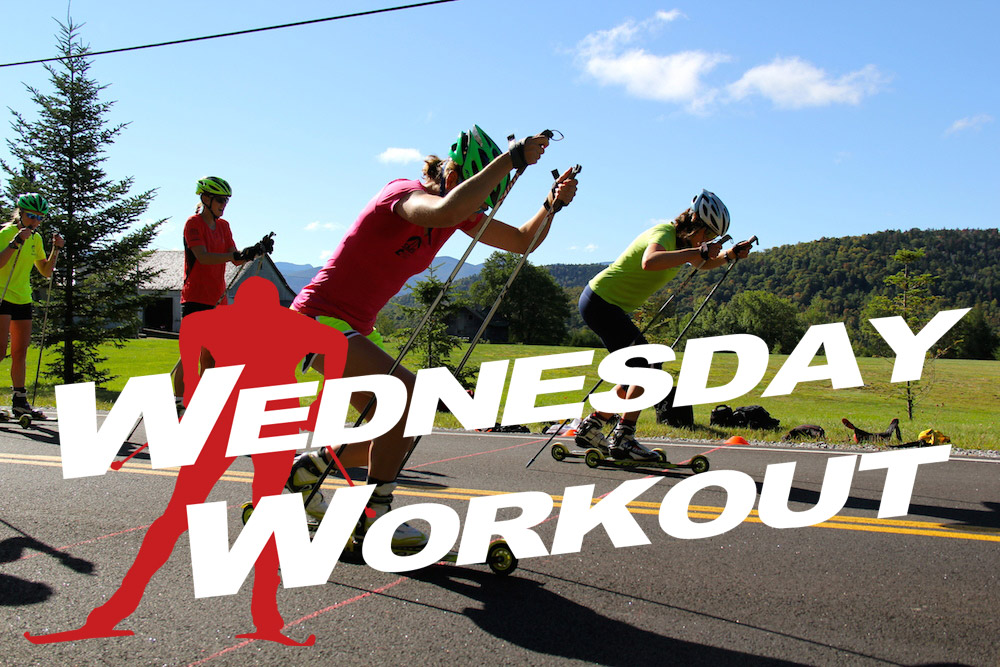
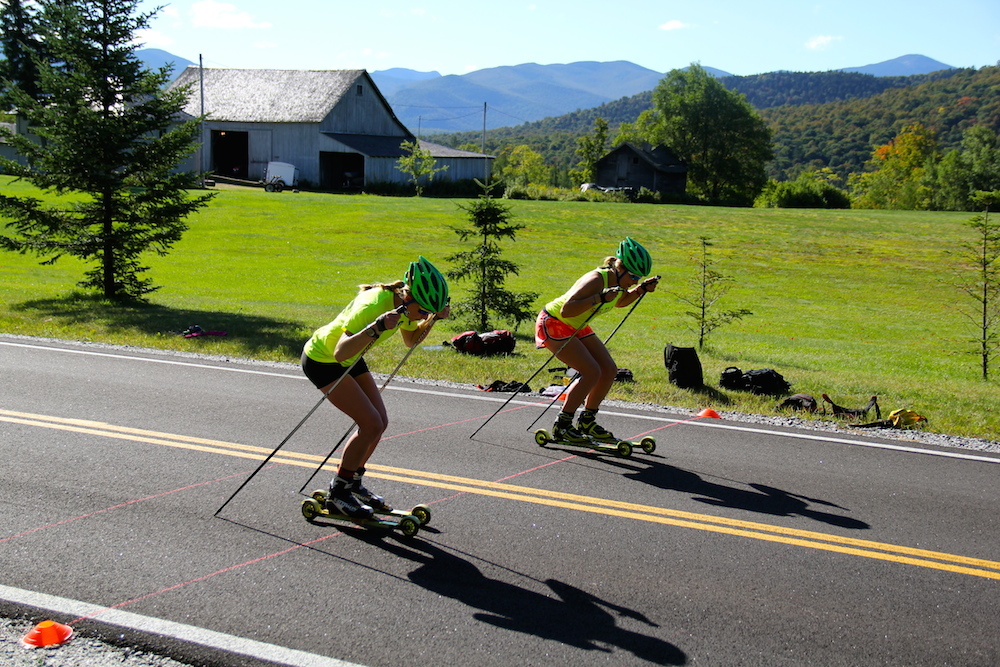
- 5 x 35-45 seconds Level 5 (L5) rollerski skate sprint, over a course with one 180-degree turn and one corner. (Course should be in an empty parking lot, or somewhere else where it is safe to rollerski at speed.) Brief rolling recovery between each sprint interval.
- 4-5 minutes full easy moving recovery after the first five sets
- 5 x 35-45 seconds L5 skate sprint (that is, repeat step 2)
- Cool down
The warmup: This should be a full warmup, as long as 45 minutes out of a 90-minute workout. Starting very easy, then, Johnston says, “Ending with up into L2, nothing more than that. You can throw some easy 10-15 second speeds in there if you need to warm the body up a little bit more than that, then rolling into these. With that in mind, if you’re not feeling particularly warmed up, just take the first one a little bit easier, just let things come around.”
Skate speeds: The course should be about 35 to 45 seconds, depending on skier speed. But there’s a lot going on within that relatively brief time: “Sprint off the line, go down 50 meters, swing a 180 degree turn, sprint back, and then around another corner and accelerate to the top of the parking lot,” Johnston says.
Recovery: Between each of the five sprints in the first set, recovery is just “enough time to glide back to the start, get your breathing slightly back under control, and roll again” for the next sprint. But after doing the first set of five sprints, take a full four to five minutes of easy moving recovery. The goal of this intermezzo is to flush out the muscles somewhat and hit the second set of five sprints ready to go with good energy and quality movements.
Cool down: As much as you can within a 90-minute workout window, before – in a nod to the reality of Masters training – going back to work/kids/job/life.
Technique thoughts for this workout
Johnston discussed the reasoning behind this workout with FasterSkier following the cooldown. He noted the gap that develops within even just the opening few minutes of an Anchorage Cup (citizens race), in which the APU Elite Team skiers and local collegiate skiers almost immediately start to distance themselves from even the fastest citizen racers.
“Why is that gap there?” Johnston mused. “A lot of it just comes down to being able to relax at speed. If you can create speed efficiently, you can sink the body weight into the poles and into the glutes and move off of that, and use that to create speed – great. As soon as you get thrown back onto the heels … most of the time when people start doing speedwork you get thrown into the heels and you stay really static. And so – in its simplest form, [you should be] letting yourself drop, and letting yourself stand back up. Get all the way up, get all the way down. And making sure that you’re not just stuck back on your heels as you do those sprints. If you feel like your quads are blazed out after the first one, maybe change up how you’re doing that.”
Johnston adds, “Today one of my big points was to be able to relax at speed, and be able to create speed without working that hard, and how that separates kind of the elite skiers from that next echelon of skiers.”
Theory and practice
This workout “tries to accomplish several things,” Johnston continued. “One is acceleration. So you have accelerating off the line, accelerating out of the turn, and then accelerating around another turn – kind of to work on, how to accelerate efficiently. The other is just the agility of the turning, being comfortable turning at speed. And as – today we didn’t do it as a group. Some days we’ll do it as a group of four or five skiers together, so that we get comfortable with that idea of cornering around something sharp with other people there. That one is easier to do on snow with more people.”
(The previous week had featured an analogous but not identical workout on classic rollerskis, where each interval went out as a group sprint – six Masters skiers, 10 total sprints, zero serious carnage. Plus a great opportunity to practice sprint starts.)
So why put Masters skiers through an L5 workout on rollerskis on unforgiving pavement, when even college skiers can crash and burn? Because sprinting is a great way to raise the athlete’s high-end speed, which can have benefits for skiing efficiency at any speed.
“This is a Level 5 workout,” Johnston notes. “It doesn’t necessarily need to be an all-out sprint, especially if you’re doing it on rollerskis and you’re not comfortable with that upper-end speed, but that is a big component of what this workout brings. The fact that it is Level 5, essentially an all-out sprint, with it being short, with it being in a group, really drives home how efficiently you’re sprinting. Most people will have technique issues crop up when they’re sprinting that they wouldn’t find in daily skiing – especially skiers that are used to training a lot of Level 1, Level 2, Level 3, they have a very small window of speed, and they can’t really go over that Level 3, that’s their ceiling. So doing a Level 5 workout raises that ceiling, allows us to move efficiently, and move efficiently faster.”
Looking ahead to a more endurance-focused training block later in the fall (Anchorage skiers are reliably on snow by the first week of November, even in southcentral Alaska’s recent snow-sparse winters), Johnston reiterates that his goal of this workout “is to raise the ceiling of what everyone’s capable of for speed.” With an eye to the future, the idea is that “so when we do more of our L3, L4, that those workouts can happen at a higher speed than they otherwise would have. Still going to be the same heart rates, same effort level, but because of working that ceiling up with the L5 work [now], those L3 and L4 workouts actually happen at a faster speed.”
Speedwork for the Masters athlete
“I think a lot of Masters skiers are a little tentative on their skis,” Johnston observes. “For anything – for downhills, for skiing fast, for sprinting, for anything like that – a lot of it is just a comfort issue. So the more that we enforce going fast as part of a fun, comprehensive workout, the more that comfort level comes up. So whether that’s bombing down a steep downhill, whether that’s sprinting, if we’re comfortable with speed, and comfortable with stuff happening fast, it allows us to react to stuff more quickly. And I work with that a lot with Devos, and obviously when you’re 12 years old you can faceplant and it’s no big deal, but you can get kind of the same thing in a more controlled environment for Masters – just avoiding as many falls. Being willing to push your limit a little bit on comfort, for speed – when you get into a race, when you’re skiing in a pack of 20, 50, 100 people, you’re not as worried about it. You’re able to concentrate on your own race, and not concentrate on the fact that you’re about to get taken out by 100 other people who may or may not be as skilled on their skis.”
Johnston concludes by reflecting on the decades-wide range of athletes he works with on a daily basis. “What’s neat is that you see that, from Devos to Masters, people all respond to very similar things. Specifically for Masters, age 30 to 85 is a huge age span – but everyone is dealing with relatively the same things. Technically, most people are pretty ingrained in their technique, so that takes a lot of time to bring that around. And speedwork is one of the things that really breaks everybody out of that mold. It’s something that most people never do. So when you go to ski fast, you have to learn how to ski fast.”