From the FasterSkier archive — posts syndicated from athletes’ and coaches’ own blogs between 2004 and 2012, kept online as published. Current coverage is at fasterskier.com.

Tag: skate sprint

  • All in the Timing: Inside Chicco Pelle’s Last Dance in Lake Placid

    All in the Timing: Inside Chicco Pelle’s Last Dance in Lake Placid

    This coverage is made possible through the generous support of Marty and Kathy Hall and A Hall Mark of Excellence Award. To learn more about A Hall Mark of Excellence Award, or to learn how you can support FasterSkier’s coverage, please contact info@fasterskier.com.

    LAKE PLACID, New York (March 21) — As the snow settled on Lake Placid and clouds began to dissipate over Mt. Van Hoevenberg, a growing sense that something momentous could happen permeated the crowd assembling for the last Sprint of the 2025-26 World Cup.

    That something unusual would happen was assured. With the Sprint Globe already secured to Johannes Høsflot Klæbo, the golden-haired juggernaut would not be on the starting line – opting instead to rest his legs, and head, in hopes of defending his 12-point lead over Harald Østberg Amundsen in the Distance standings. By default, then, someone other than Klæbo would stand atop Saturday’s podium – a rare occurrence in a season where the Norwegian had already won 8 of 11 Sprints in commanding fashion. (Two wins evaded Klæbo due to falls; the third because he did not start in Oberhof).

    Who would take his place? Ben Ogden, the Northeast’s homegrown favorite and the Sprint silver medalist in Milano-Cortina? Gus Schumacher, Ogden’s partner in the Olympic Team Sprint? France’s embattled specialist, Lucas Chanavat, who appeared on track to rival Klæbo during the 2023-24 season, who had seized the opportunity – and the win – after Johannes’ bobble in Davos last December? Ansgar Evensen (NOR), who had done the same in Drammen?

    Or, perhaps, it would be Federico Pellegrino (ITA) – the 35-year-old elder statesman of the league; making his 344th (and penultimate) World Cup start, eyeing an 18th and final Sprint victory?
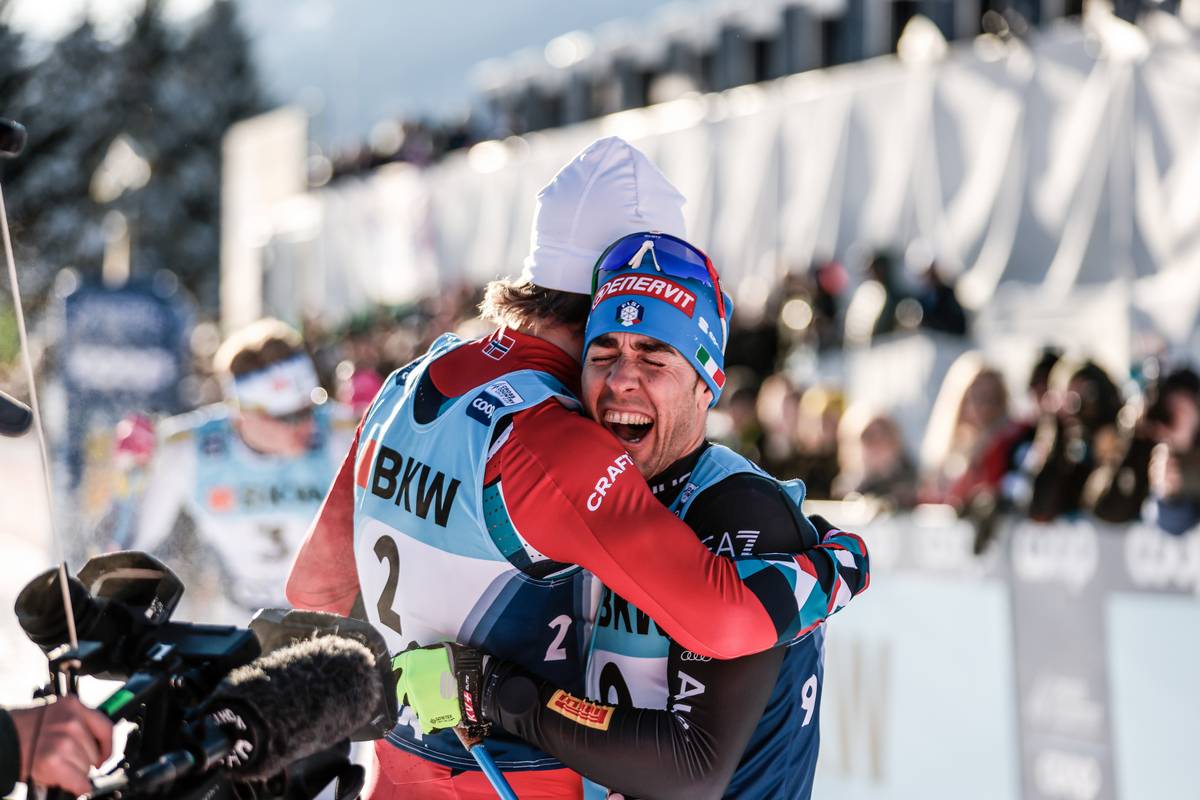
    Johannes Hoesflot Klæbo (NOR) and Federico Pellegrino (ITA) after the finish of the Finals in Davos, 2022. Pellegrino bested Klæbo on the eve of the birth of his first child. (Photo: Nordic Focus)

    It states the obvious to say that success in cross-country skiing is a matter of timing, and for “Chicco Pelle’s” 15 seasons, the timing had been just shy of right. The formative and final years of Pellegrino’s career were defined by the dominance of skiers other than he. Pellegrino made his World Cup debut in Drammen in March 2010, finishing 49th. The winner that day was Emil Joensson (SWE); runner-up was Petter Northug (NOR), then on his way to his first of two Overall Globes. These were the halcyon days in which Dario Cologna (CHE) descended from his Alpine fastness to rack up World Cup and Tour de Ski titles; when Northug, Joensson and Marcus Hellner (SWE) traded sprint victories and taunts in a bitter intra-Scandinavian rivalry. Pellegrino was 12th in his first World Championships Sprint (Oslo, 2011) and 11th at his first Olympic Sprint (Sochi, 2014).

    While notching his debut victory in December, 2014 in the Davos Freestyle Sprint, Chicco’s break came in the 2015-16 season. He won 5 of 13 sprint races, becoming the first non-Scandinavian male to win the Sprint Globe. As Pellegrino hit his stride, Northug’s star was showing its first flickerings ahead of a dramatic waning, Joensson had entered the twilight of his career, and although Sergey Ustiugov (RUS) was approaching his own prime, the factious cast of World Cup sprinters was looking for a new leading man.

    That man would not be Chicco. An upstart dramatist from Trondheim, Johannes Høsflot Klæbo, had arrived to script skiing’s long, and mind-bogglingly successful, next chapter. After making his debut in Drammen in 2016, Klæbo outscored Pellegrino in the 2016-17 Sprint standings, taking his first of 8 (and counting) Sprint Globes. The two went head to head at the 2017 World Championships in Lahti, Finland, where Pellegrino surged from behind to claim his first World Title ahead of a legendary lineup, including Ustiugov, Klæbo, and Northug, but this maiden gold would also be his last. In Pyeongchang the next year, the Olympic gold went to Klæbo; Chicco brought home silver.

    The wins did keep coming for Chicco, including a tear of three consecutive Sprint victories and his second Sprint Globe in 2020-21. And, though they admittedly came in greater abundance to Klæbo (who, it should be noted, did not start in those races, or the 2020-21 Tour de Ski), it is rather glib to assert that Chicco’s career had slid “in[to] the shadow of” the Norwegian. Pellegrino bested Klæbo in Dresden and Lahti in the spring of 2018; in Lillehammer that winter; and in Davos in 2022. He was near-omnipresent on Sprint podiums and won his second Olympic silver in Beijing in 2022; moreover, he was among the very few men who could disrupt Klæbo’s dominance in the discipline, and the clear favorite when Johannes was absent.

    But Pellegrino’s win in Davos in December 2022 marked the beginning of a long, and perhaps self-inflicted, World Cup drought. Chicco declared his intention to focus on distance races ahead of Milano-Cortina, and did indeed record four such podiums in classic, skate, and skiathlon formats, alongside a welter of Sprint podiums – including an ecstatic World Championships silver in Trondheim in 2025, and Olympic bronzes on home soil in the Team Sprint (alongside Elia Barp) and in the 4 x 7.5 k Relay (which he described as “the proudest day of [his] life!”) this February.

    Elia Barp welcomes Federico Pellegrino to a bronze-medal finish in the Olympic Team Sprint in Milano-Cortina, February 18th, 2026.
    (Photo: Vanzetta/Barbieri/NordicFocus)

    Outright wins, however, were not forthcoming. By the time March 21, 2026 arrived in Lake Placid, it had become Pellegrino’s last, best chance to secure one more Sprint victory.

    Anticipation and emotions ran high. While Pellegrino had been impervious to the crowd in Friday’s 10 k Classic – earbuds deadening the world beyond his blue racing cap during warmups, and his face a deaf mask of exertion during the race – their excitement overwhelmed him on Saturday. During his first warmup lap, he skated calmly up the course’s A-Climb through a chorus of “CHI-CCO, CHI-CCO, CHI-CCO.” On his second, the frenzied chant began again, and the gravity of the impending race dragged him to a halt. His skis splayed wide against the pitch; he buried face in his hands. “The energies I got in the Final were coming from the warmup lap, where I stopped in the middle of the climb, crying,” Pellegrino told me at the finish line. “I think the public deserved this kind of show, and I deserved to finish my career, with a Sprint skate like this.”

    Pellegrino embraces the crowd ahead of Sprint qualifying in Lake Placid. “The energies I got in the Final were coming from the warmup lap, where I stopped in the middle of the climb, crying.”
    (Photo: Thibaut/NordicFocus.)

    To reach that final finish line, however, was a perilous journey.

    After qualifying second, Pellegrino sidestepped two falls (the first from Jules Chappaz (FRA); the second from Elias Keck (GER)) in his Quarterfinal, moving from sixth to first in the course’s final descent and level hairpin. In Semifinal 1, he attempted to close on Lucas Chanavat (FRA) and Anton Grahn (SWE) through the crest of the A-Climb but couldn’t get by; pushed to the outside on the level hairpin, he was out-lunged by Lars Heggen (NOR) in the final meters, finishing third by 0.03.

    While the Lucky Loser spot was Chicco’s to lose heading into Semifinal 2, Erik Johansson (SWE), Harald Amundsen (NOR), and Even Northug (NOR) lost time playing for a slipstream position as they approached the top of the A-Climb. Pellegrino was on to the final by a comfortable margin.

    Lars Heggen (NOR) outlunges Federico Pellegrino (ITA) by 0.03 in Semifinal 1. Federico moved on to the Final as a Lucky Loser. (Photo: Thibaut/NordicFocus)

    Once more around the track, and the day could be his. After being fourth out of the gate, he attacked from the outside on the B-Climb; breaking into an aggressive V-2 and taking Chanavat and Heggen by surprise, he moved into second behind Grahn. The pace increased again at the base of the A-Climb, but where Grahn and Chanavat’s broad frames moved up the hill in sweeping, powerful strokes, Pellegrino leapt into a furious V-1.

    The move was decisive. To the adulation of the crowd, he opened a decisive gap through the crest of the climb. His lead only grew through the final descent into the level hairpin, but Chicco was taking no chances. While Grahn and Heggen grappled for second behind him, Pellegrino hammered to the line, threw his arms wide and his head back, roaring with the crowd.

    An 18th victory and 46th career podium, clinched.

    Federico Pellegrino secures his 18th and final World Cup victory. Lake Placid, March 21, 2026. (Photo: Thibaut/NordicFocus)

    What had happened in the Semifinal, when this triumphant last dance had nearly evaded him by three hundredths of a second? And what had changed for the Final?

    “I could not do what I did in the Final, because the energies of the other athletes were still quite big,” Chicco admitted our post-race interview. “About the last downhill, I was not the same as the others. I am not, I know, but I have some different qualities, and if I could get quite good gap in the top of the uphill, then I knew that I could keep it until I end. This is what I did. This is how I loved to win all along my career – not wait until the last meter, but trying before.”

    “Sometimes it happened, mostly before Klæbo came,” he laughed. “But today I was there, and I studied the best tactics in the end . . . the public here in Lake Placid deserves this kind of show, and I think we are all happy now.”

    And, this was nothing short of “the best way” to end his journey. “I could not do different. In the end, the last four years have been strange. I didn’t focus so much on sprinting; I tried to discover my body in different fields. Sometimes I got really great feelings and performances, but then, to come back here . . . and to win in that way, I could not do more.”

    Pellegrino after his final win. “I think the public deserved this kind of show, and I deserved to finish my career, with a Sprint skate like this.” (Photo: Thibaut/NordicFocus)
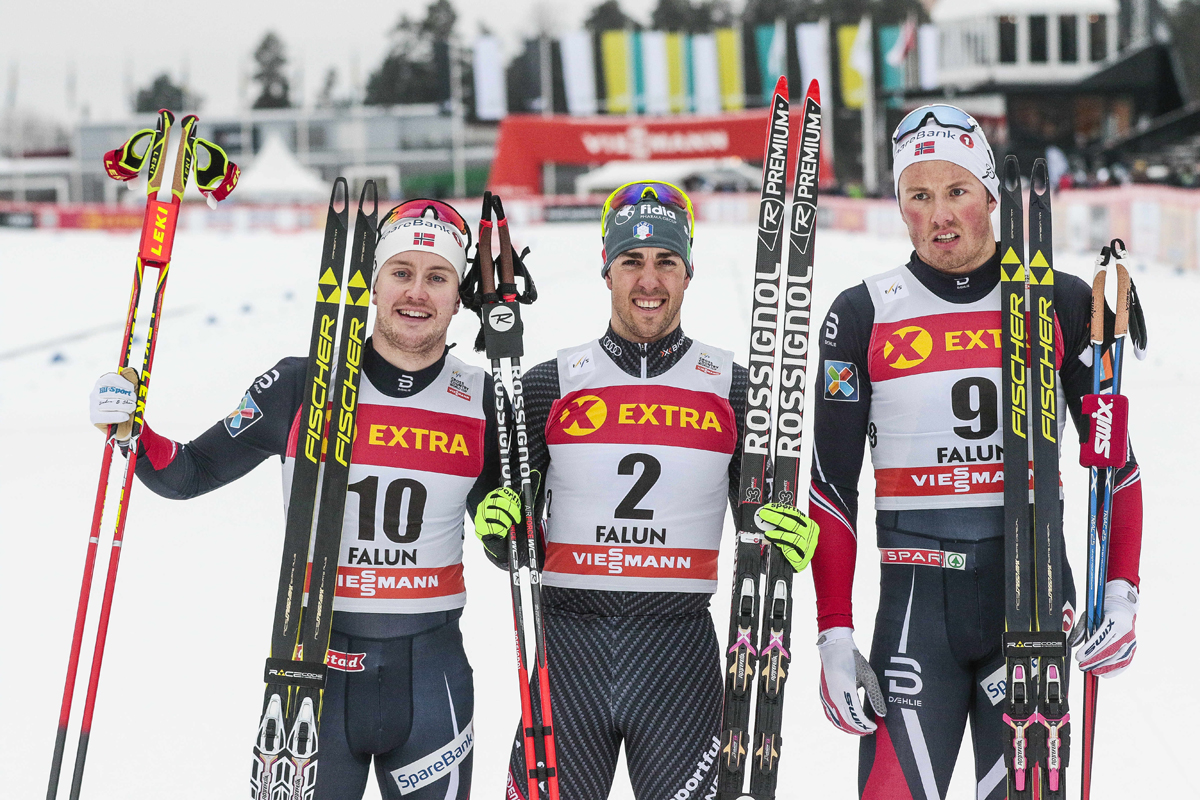
    One more podium for Federico Pellegrino, alongside Lars Heggen (NOR) and Anton Grahn (SWE). (Photo: Thibaut/NordicFocus.)

    In 15 seasons, Pellegrino proved himself to be far more than a runner-up to those Swedish and Norwegian titans who loomed large over his early and later years. He had taken the Sprint Globe from the Scandinavians for the first time; outsprinted Klæbo, Ustiugov, and Northug in Lahti; perpetually challenged – and occasionally beaten – the greatest athlete in the history of the sport; and secured Olympic medals on home soil, alongside a team of up-and-coming Italians ready and eager to fill his boots. “I’m really happy that he finished his career with probably one of the best weekends for him so far,” Elia Barp (ITA) told me on Sunday. “I’m very happy for him; I’m very happy for the team. I think we have proved that we are ready to race without him – not only me, but a few other young guys are ready to try to take victories next year . . . [He showed] that it is important to keep fighting and try to be a good overaller as he was in the last years. And, now we know that it’s possible; everyone is human as us, and we can do that.”

    To Chicco’s fans, that determination – to grapple with giants; to reinvent himself; to seize the final, perfect timing and a final, perfect victory – defined his career. But for Pellegrino himself, “the biggest memories will not stay about the races, but much more about the hugs I got from the teammates, from the coaches, even outside of Italy, from my family, from the people that love me – and not only when things went well; even when things were not going so well. I think this is something that sport teaches us; that in the end, it’s only a cross-country ski race, and life is different. That’s it. The hugs are something I will remember for my entire life.”

    Pellegrino, the most popular man at Zig Zag’s on Saturday, March 21. (Photo: Lily Den Hartog)

    At Zig Zag’s Pub on Saturday night, Pellegrino told this reporter’s associate that his win vindicated his decision to retire. On Sunday, soaked with rain and champagne and tears after his last World Cup race, he reaffirmed it:

    “That’s it. I tried to enjoy today as well . . . I tried to give my best, as always, and it was good after the finish line; under the rain, it was special. But with the teammates and coaches and waxers celebrating this moment, it was good for me.”

    “Now, I really need to stay with my family. They deserve this, and I need to give them a lot of time.”


    Love Stories Like This? Help Keep Them Coming.

    Feature stories like this one take time, access, and care to produce. If you value thoughtful storytelling and independent ski journalism, please consider becoming a Voluntary Subscriber. Your support directly fuels the work we do to cover the people, places, and moments that make our sport special.

    “Grazie Papao!!” Team Italy was waiting at the finish of the 20 k Skate with champagne and a tribute to Pellegrino’s children and wife, Greta Laurent (ITA, ret.). (Photo: Thibaut/NordicFocus)
  • Lauren Jortberg and the Long Way Around to the Olympics

    Lauren Jortberg and the Long Way Around to the Olympics

    This article was made possible through the generous support of our voluntary subscribers.  If you value coverage like this, please support FasterSkier with a voluntary subscription.  

    By the time Lauren Jortberg made the U.S. Olympic Cross-Country Ski Team, the achievement arrived not as a burst of disbelief or relief, but as something quieter and stranger: a moment that required processing.

    “It is a lot to take in,” she said, speaking from Seefeld, Austria in the middle of a pre-Olympic training block. “It’s been a big goal. But it’s one of those big goals that I’ve tried not to think about too much and just really focus on being my best self.”

    The phrasing matters. Jortberg did not describe the Olympics as a finish line or a culmination. She spoke about it as something she had to learn how to hold — something earned, yes, but also something that could overwhelm if mishandled. “Now,” she said, “I’m trying to put aside the completion of the goal and really focus on performing. And performing really well.”

    That distinction — between achievement and performance, between arrival and presence — has come to define her career. It is also the reason her story resists easy telling. Jortberg was not a prodigy. She was not a junior star. She did not dominate early or move cleanly through the system. She took the long way around.

    The Long Way Around

    Jortberg grew up in Boulder, Colorado, a town dense with endurance athletes and outdoor ambition. “I’m super fortunate to have been born and raised in Boulder,” she said. “It has one of the highest percentages of Olympians for cycling and running.”

    Her parents were athletic — her mother was a professional runner, her father competed in multiple sports — and movement was woven into daily life. There was mountain biking, trail running, hiking, time spent at a family place in Winter Park. But skiing, she noted, was not central to Boulder’s identity. “If you’re familiar with Boulder, it’s not really a winter place. We had to work hard to get to snow.”

    Her earliest athletic identity was split. She loved soccer deeply and still wonders what might have happened had she stayed with it. “I do kind of wonder what I could have done if I had pursued soccer,” she said. Her father spent hours training with her, and she took pride in improvement more than outcome.

    The turn toward skiing came, in part, through her older sister — six years ahead, a steady presence, someone to chase. When her sister tore her ACL playing soccer and pivoted fully to skiing, Jortberg followed. “I really looked up to my sister,” she said. “She went to U18 Scandinavian Cup, Junior Nationals, skied at the University of Denver. Seeing her do all these cool things with skiing really felt like, well, I can do that.”

    But progression was slow. In high school, Jortberg struggled. She did not make Junior Nationals her first year — a moment she still remembers clearly. “I was devastated,” she said. “It was one of the first big adversities in my career.”

    She never cracked the top ten at Junior Nationals until she was a U20. “I had a lot of 11th places,” she said. “I could never crack that top ten.”

    It is difficult, in hindsight, to overstate how thoroughly unremarkable her junior results were by Olympic standards. This is not revisionism; it is the point. There was no obvious through-line, no early validation to cling to.

    After high school, she took a gap year at Stratton Mountain School. It did not go smoothly. She fractured her arm in a parking lot crash. The season was disrupted. Progress stalled again.

    What she had, instead, was a willingness to stay.

    Dartmouth and the Work of Becoming

    At Dartmouth, something shifted. Not overnight, and not magically — but structurally.

    “I think it was a big surprise starting at Dartmouth,” Jortberg said, “the level I was at and the level the team was at.” She majored in environmental science and found herself inside a women’s program that emphasized individual growth within collective intensity.

    Under coach Cami Thompson Graves, the team culture was demanding but non-coercive. “She’s really amazing at coaching athletes to really know what is good for them,” Jortberg said. “She’s incredibly good at getting athletes to become very independent with an amazing team culture.”

    The women’s team was deep, competitive, and internally driven. “We were going one through five, or one to four, five, eight, ten,” she said. “It was insane.” NCAA spots were scarce; no one could coast.

    Crucially, Dartmouth supported international racing alongside collegiate commitments. Jortberg went to World Juniors, U23s, OPA Cups — sometimes twice in a season. “Having that support was super helpful,” she said. “Not just to perform in a green suit, but to perform later on.”

    For the first time, development felt cumulative.

    The women’s final of the 2021 Keys to the Castle rollerski sprint in Lake Placid, NY. From left to right, Lauren Jortberg (BSF Pro), Julia Kern (SMS T2/USST), Jessie Diggins (SMS T2/USST), Alayna Sonnesyn (SMS T2). (Photo: Reese Brown RDB Marketing)

    The Bubble Years

    Post-collegiately, Jortberg entered what many American skiers know intimately: the bubble.

    She moved through programs, spent time with Bridger Ski Foundation Pro and later SMS T2, and began working with coach Perry Thomas. She earned World Cup starts, lost them, re-earned them. Progress was intermittent. Confidence, fragile.

    “It was a lot of back and forth,” Thomas said. “Getting starts and not getting starts. Proving herself again in the U.S. and then getting those World Cup starts again.”

    Thomas had recruited Jortberg as one of his first athletes when he began coaching at the professional level. Their early years together were not seamless. “Our first year together, there was a lot of figuring things out,” he said. “There were ups and downs.”

    What mattered was not immediate success but shared patience. “We were both willing to make it work,” Thomas said. “And work through difficulty together.”

    During this period, Jortberg made a deliberate choice that would shape the rest of her career: she doubled down.

    Lauren Jortberg (USA) training in Tignes, France, last June. (Photo: Authamayou/NordicFocus)

    Choosing One Thing

    Sprinting had always been her strength — particularly skate sprinting. Classic sprinting lagged behind. Rather than attempting to become broadly better at everything, Jortberg and Thomas made a narrower decision.

    “Let’s spend one day a week, every week, for an entire summer and fall, working on classic skiing,” Thomas said. “Double pole. Thirty to sixty minutes. Just consistently.”

    It was not glamorous work. It was not optimized for social media or immediate payoff. But Jortberg committed fully. “She was like, ‘Hell yeah, let’s do this,’” Thomas said.

    Even when they were no longer formally affiliated with the same team, she continued the work remotely. “She continued that work on her own,” he said. “From afar.”

    At the same time, something else was happening — something less visible.

    Lauren Jortberg (USA) during the qualification of the World Cup Individual Skate Sprint in Oberhof, Germany, two weeks ago. (Photo: Authamayou/NordicFocus)


    The Mental Turn

    Jortberg began working seriously with a sports psychologist. She and Thomas independently immersed themselves in books, podcasts, and writing about mental performance. They traded recommendations. They talked openly about processing failure.

    “I don’t care how pretty your technique is,” Thomas said. “If you don’t have control over the on-off switch in your brain, you’re not going to get to the line fastest.”

    What Thomas noticed later, during Period 1 Super Tour in Alaska, was a change. “That was a different Lauren than even a year ago,” he said. “In such a good way.”

    Jortberg describes it less as a breakthrough than a reframing. “Everyone is going to have setbacks,” she said. “It’s about how you respond. Chipping away little by little. Not letting setbacks impact how you see yourself.”

    She learned to loosen her grip on outcomes. “Often when we think things have to happen a certain way,” she said, “that’s when they don’t.”

    Lauren Jortberg with boyfriend Antoine Cyr (CAN). (Photo: Courtesy Photo)

    Two Places at Once

    In the fall, Jortberg moved to the Mount Sainte-Anne area of Quebec. The decision was partly personal — she is dating Canadian skier Antoine Cyr — but also practical.

    She began training at the Pierre Harvey Training Centre, known for its demanding terrain and extensive roller-ski infrastructure. “The terrain is really hard,” she said. “I think it’s been awesome for intensity. Especially my classic skiing.”

    Her coaching arrangement became hybrid: remote communication with Thomas, daily training in Quebec. “We text pretty much every day,” Thomas said. “Or we’re on the phone.”

    Jortberg chose not to maintain two residences. “That’s just not something that financially would be feasible,” she said. More importantly, she valued stability. “I really prioritize my personal life. That’s what allows me to perform at the highest level.”

    It is an unromantic truth of elite skiing: stability is performance.


    Alaska and Leadership

    When Jortberg declined early World Cup starts to focus on Super Tour and U.S. Nationals, she rejoined Coach Thomas and the rest of the Mansfield Nordic Pro team in Alaska. What stood out was not just her skiing.

    “I was so impressed with her as a leader,” Thomas said. “We used her a ton in team meetings. Tactics. Pacing. Course preview.”

    After Alaska, the decision to formally add her back to the team was unanimous. “It was an easy decision,” Thomas said. “She just wanted to be part of the team and demonstrated awesome leadership.”

    Kendall Kramer, Samantha Smith, Lauren Jortberg, and Julia Kern (l-r) will join Jessie Diggins, Rosie Brennan, Novie McCabe, and Hailey Swirbul to represent the United States in Val di Fiemme, Italy, from Feb. 6–22, 2026. (Photo: Authamayou/NordicFocus)

    Not Jaded

    Jortberg will arrive at her first Olympics as one of three women on the U.S. team making their Olympic debut. She sees that as an asset.

    “I want to bring non-jaded energy,” she said. “Just that first-time excitement.”

    She wants to be present — not consumed by outcome. “I want to look back and be grateful that I was even there,” she said. “And really appreciate the experience.”

    It is not a rejection of ambition. It is a different relationship to it.

    Forward

    Jortberg plans to continue racing. She hopes for 2030, in the French Alps — a place she loves, a skate sprint on a stage that suits her. She is considering an online master’s program in sustainability and renewable energy, thinking carefully about how to prepare for the life that will follow skiing without rushing herself toward it. For the first time in her career, she feels no urgency to escape the present.

    “I feel the most stable I’ve ever felt in my career,” she said. “And it’s showing.”

    Stability, for Jortberg, has never been accidental. It is something she built deliberately, after years of motion without certainty — years of chasing snow from a town where Olympians ran past her on bike paths and reservoir loops, where excellence was ambient and ordinary at the same time. In Boulder, she grew up watching greatness move casually through public space, learning early that world-class athletes were not mythical figures but people who showed up every day and kept going.

    She was not the fastest junior in that environment. She was not the one with the early results or the easy narrative. She lingered on the edges, finished just outside the frame, learned patience in a place that celebrated inevitability. And still, she stayed.

    Lauren Jortberg (USA) anchors the relay for the United States in Toblach, Italy, in 2023. (Photo: Modica/NordicFocus)

    Now she is an Olympian — not because she followed the shortest line between promise and performance, but because she learned how to endure the long arcs in between. She learned when to narrow her focus, when to loosen her grip, when to trust work that did not announce itself right away. She learned how to live inside uncertainty without mistaking it for failure.

    There is something quietly astonishing about that return: a young woman who grew up surrounded by Olympians, never quite believing she was one of them, becoming one anyway — not by force or speed, but by accumulation. By choosing stability when chaos was easier. By learning how to stay.

    For an athlete who never arrived early, this moment is not a surprise step so much as a natural one. The long way around, it turns out, still leads somewhere.


    Help Support Our Olympic Coverage!

    FasterSkier will have our own Nat Herz on the ground at the Olympics, which, to be honest, is a very big financial lift for us. If you value the thoughtful work and access FasterSkier provides at championships like this one, please consider becoming a Voluntary Subscriber. Your support directly fuels the work we do to cover the people, places, and moments that make our sport special.

    Join the FasterSkier community!


  • Brennan Nails First World Cup Podium and Win in Davos; Caldwell Hamilton 5th (updated)

    Brennan Nails First World Cup Podium and Win in Davos; Caldwell Hamilton 5th (updated)

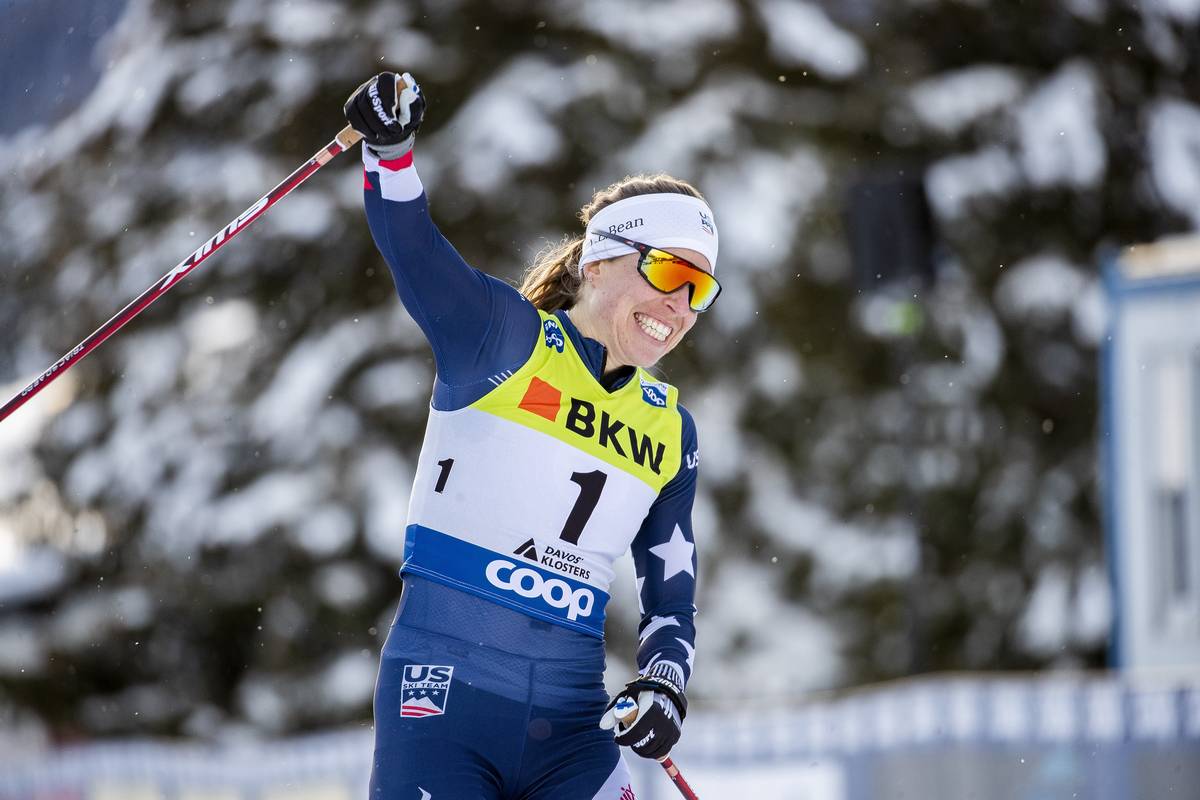
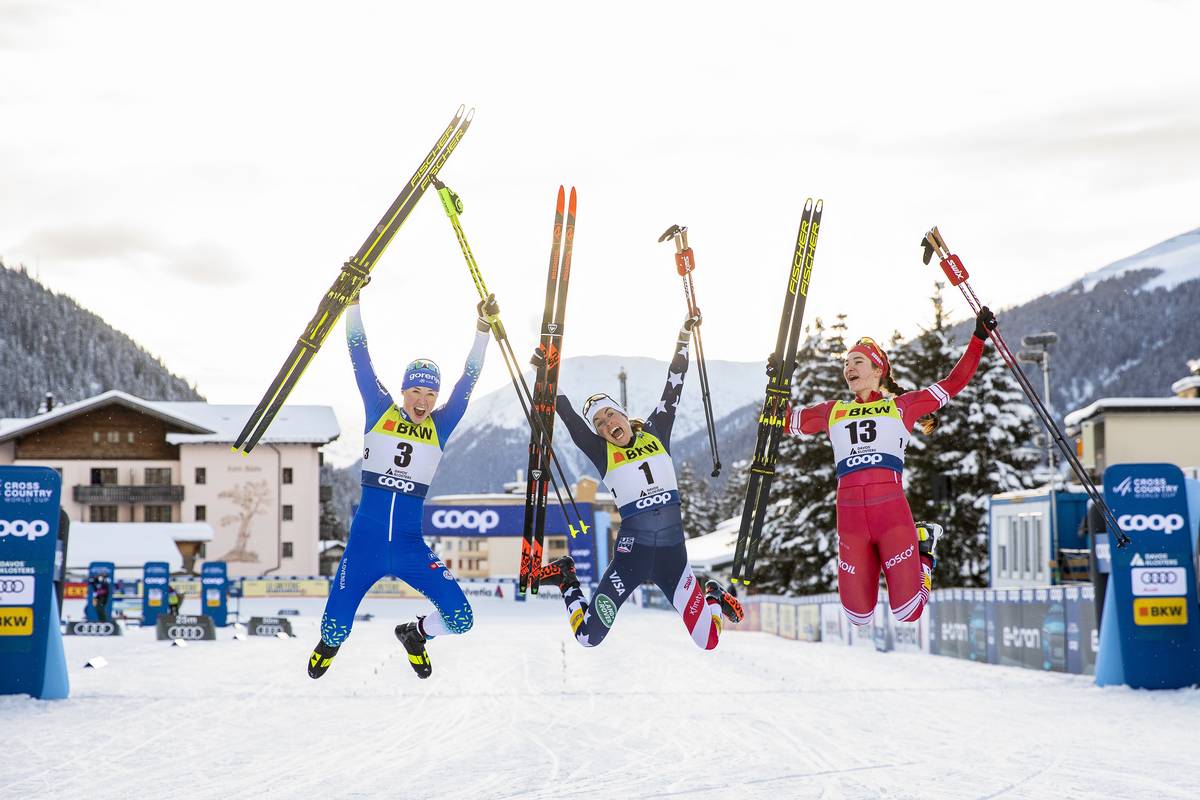
    Rosie Brennan was all smiles after her first World Cup victory and podium in Davos, Switzerland. Photo: NordicFocus

    This World Cup coverage is made possible through the generous support of Marty and Kathy Hall and their A Hall Mark of Excellence Award. To learn more about A Hall Mark of Excellence Award or to learn how you can support FasterSkier’s coverage please contact info@fasterskier.com.

    With a thick, fresh coat of fluffy white snow that fell over the last week, Davos, Switzerland looked regal as ever despite the smaller field and lack of spectators for today’s 1.5-kilometer freestyle sprint. FIS described conditions as hard-packed, elevating what Sophie Caldwell Hamilton, who landed on the podium in Davos the last two years, called in a pre-race interview with FIS as a “technical and tactical” two lap course. Pumping music and cheering coaches, though perhaps a muted version of the norm, made the stadium feel significantly more full than the no-spectator reality.

    With the Scandinavian teams out of the running as they withdrew from the December rounds of the World Cup due to Covid-19 concerns, it would be easy to focus on who did not in Davos. Let’s instead focus on who did. 

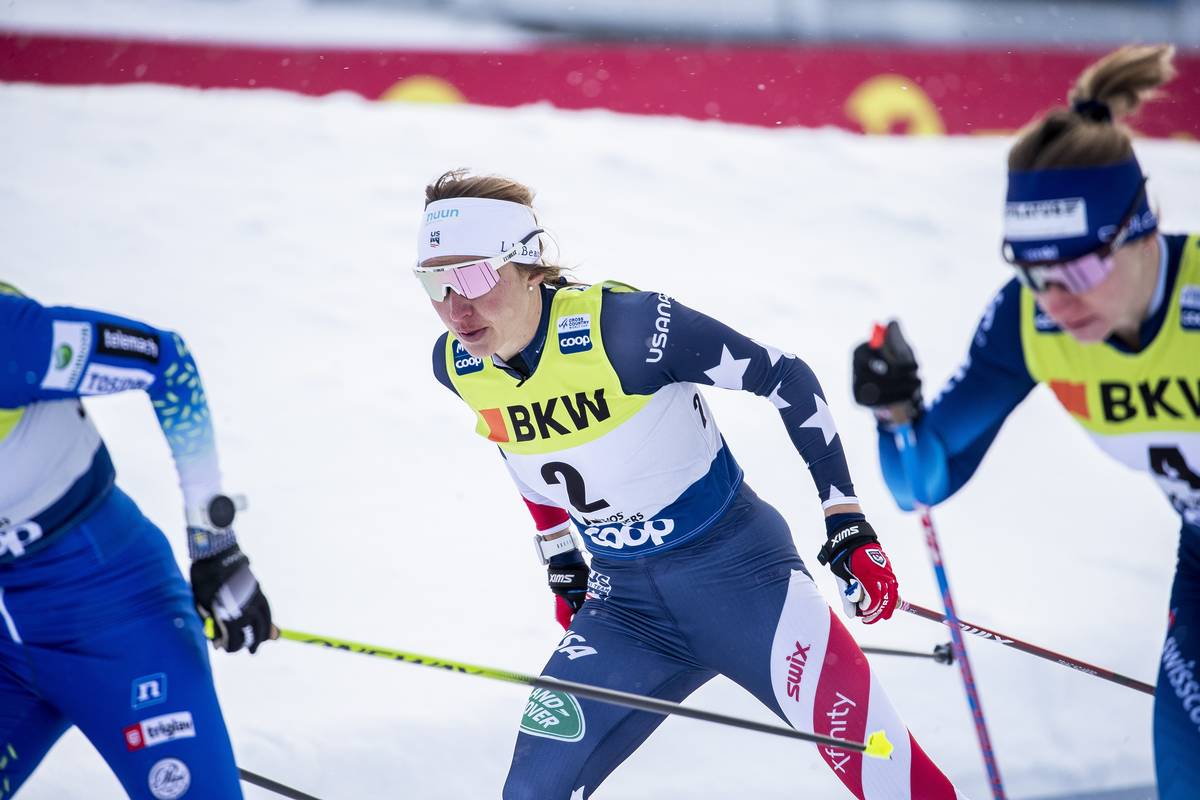
    Rosie Brennan during the skate sprint qualification in Davos, Switzerland. Brennan won the qualifier – a career-best for the American. (Photo: Nordic Focus)

    On a roll this season, Rosie Brennan won the qualifier by 1.75 seconds in a time of 2:40.03. Rounding out the Americans in the finals, Caldwell Hamilton took second, Diggins fifth, Julia Kern 10th, and Hailey Swirbul 18th. 

    Jessie Diggins racing to 5th in the Davos sprint qualifier. (Photo: Nordic Focus)

    In the quarterfinals, Caldwell Hamilton faced off with Switzerland’s Nadine Fähndrich in what would be the fastest heat. The pack stayed together in the first lap, but the two peeled off to finish comfortably off the front, Fähndrich in the lead. 

    The next heats were much closer. Brennan finished second in a pack of four behind Slovenia’s sprint star Anamarija Lampic in heat two, and after taking the lead in the second lap, Kern won the third heat. 

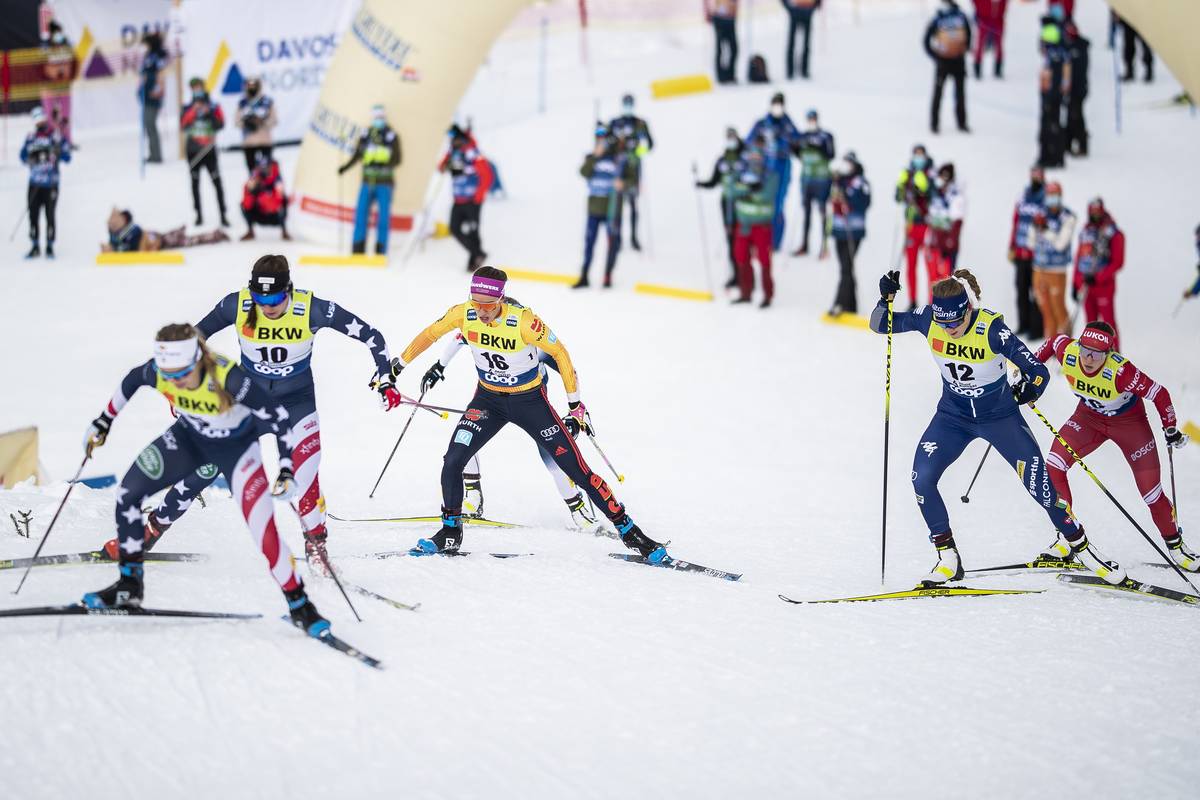
    Jessie Diggins (left) leads Julia Kern (bib 10) at the front of the group during the quarterfinal of the 1.5 k sprint in Davos, Switzerland. (Photo: NordicFocus)

    Dropping into a tuck on the last descent and on Kern’s tails in the fast and furious final turn into the stadium, Diggins was in a tough position. Rather than putting herself in position for the sprint to the finish, she maneuvered to avoid tangling skis with Kern and lost some of her momentum. Despite powering down the straightaway and throwing her boot, she took third in the heat and was not fast enough to earn a lucky loser spot. 

    Round the bend, Julia Kern in the lead heading into the final straight during the quarterfinal of the 1.5 k skate sprint in Davos, Switzerland. (Photo: NordicFocus)

    Swirbul was also eliminated in the quarters after taking fourth in her heat. 

    Hailey Swirbul climbs amidst the pack during the quarterfinal of the 1.5 k skate sprint in Davos, Switzerland. (Photo: NordicFocus)

    In the semis, the three remaining American women lined up together in a stacked first heat with Lampic and Fähndrich. Brennan and Caldwell Hamilton held strong in the middle of the group while the Swiss and the Slovene set the pace. The foursome stayed tight, jockeying for positions in the second lap. 

    It was anyone’s game in the final straight, but Fähndrich held the others off on home turf to win the heat with Lampic and Brennan in a photo finish for second and third, respectively, behind her and Caldwell half a ski length further back in fourth. Both were able to secure lucky loser positions to advance into the final. Kern was eliminated after finishing 6th in the heat.

    To the line, Rosie Brennan (L) leads Switzerland’s Nadine Fähndrich and teammate Sophie Caldwell Hamilton in the final sprint during the semifinal of the rounds in Davos, Switzerland. (Photo: NordicFocus) 

    Eva Urevc of Slovenia and Natalia Nepryaeva of Russia advanced from the second heat of the semifinals. 

    Fähndrich and Lampic again took the pace out hot in the final round, but Brennan kept herself in the mix. Challenging Fähndrich, she powered into the lead on the final climb, cresting the hill in front and dropping into a tuck on the downhill. Brennan held her lead out of the final turn and into the straightaway, but Lampic, Fähndrich and Nepryaeva were close on her tails. 
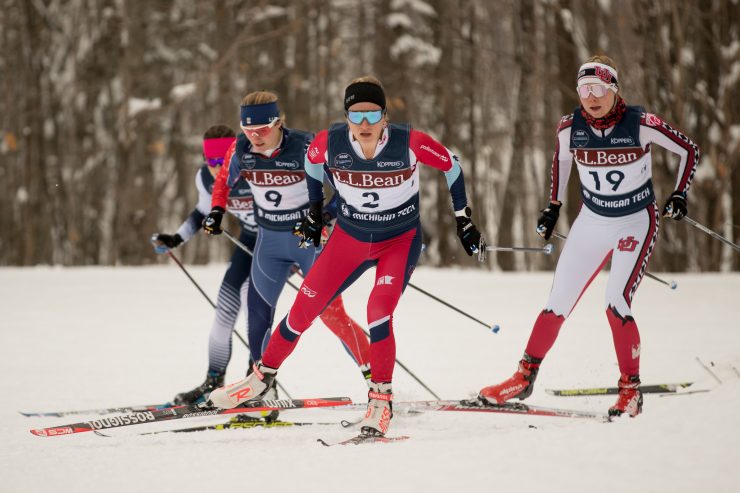
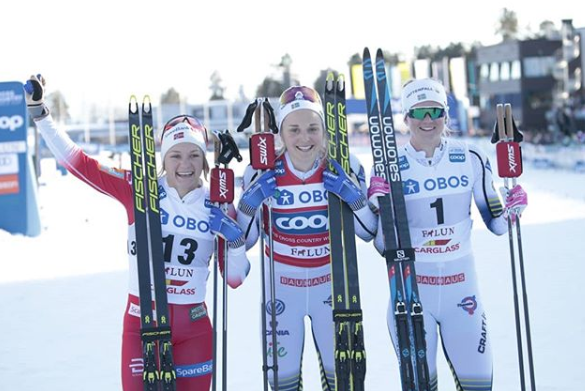
    Adrenaline pumping and poles lashing, Brennan held her lead by a narrow margin, pumping her fist in the air as she crossed the finish line in 2:37.36, breaking into a wide grin as she gasped for air.  

    Rosie Brennan celebrates her victory and first World Cup podium after the freestyle sprint in Davos, Switzerland. (Photo: NordicFocus)
    Rosie Brennan celebrates her victory and first World Cup podium after the freestyle sprint in Davos, Switzerland. (Photo: NordicFocus)

    “It’s wild,” Brennan told FIS after the race. “I’ve never considered myself a sprinter, so to find myself on the podium is something I couldn’t even dream of.” 

    Lampic finished on her tails in second (+0.28), with Nepryaeva and Fähndrich in a photo finish for the final podium spot. They finished third (+0.49) and fourth respectively (+0.53). 

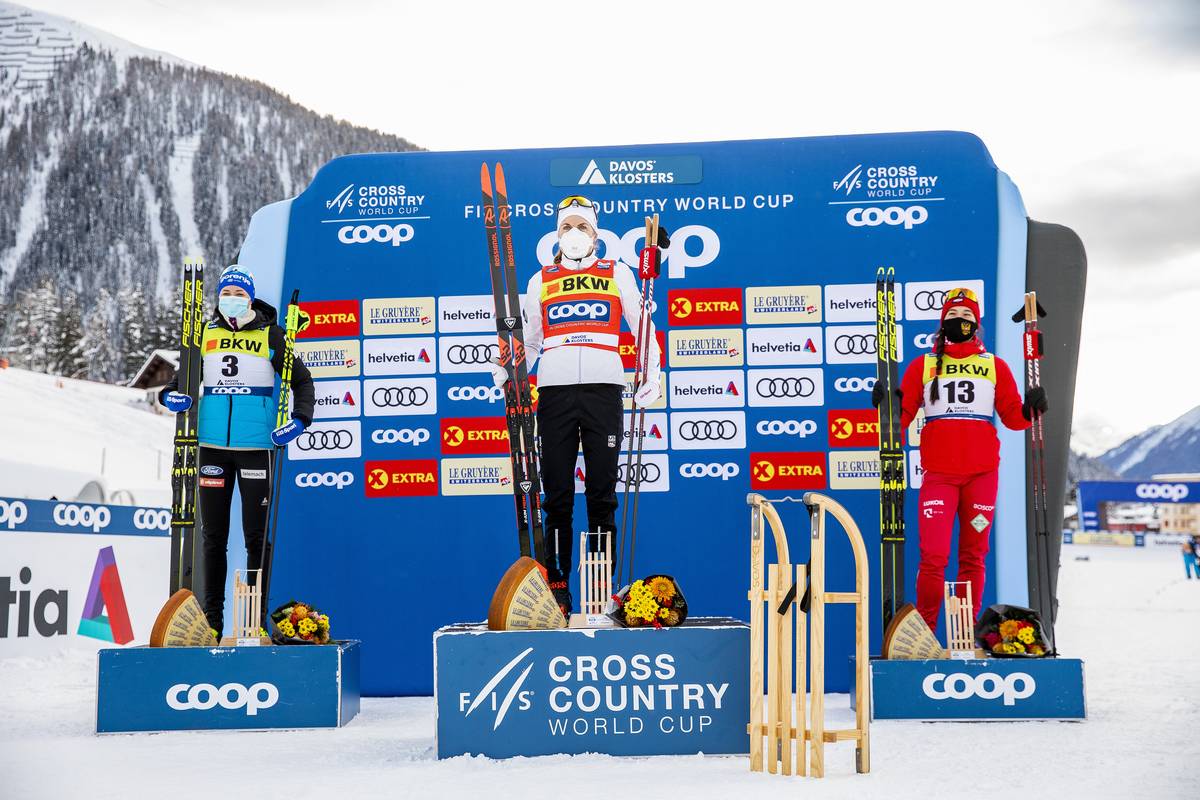
    The women’s podium at the 1.5 kilometer skate sprint in Davos, Switzerland. (Left to right) Anamarija Lampic (SLO) 2nd, Rosie Brennan (USA) 1st, Natalia Nepryaeva (RUS) 3rd. (Photo: NordicFocus)

    After losing contact with the lead group, Caldwell Hamilton finished fifth (+6.83), with Urevc behind in sixth (+15.58).

    FasterSkier spoke with Brennan while she awaited a blood draw at antidoping. Still euphoric, Brennan recounted her day and a result that she called “pretty unbelievable” and hadn’t fully set in. In fact, she thought there may have even been a mistake in the timing when she saw her name at the top of the qualifying list. Brennan also discusses training separately with clubs throughout the season, then coming together as a full American squad in Europe.

    Post-race interview with Rosie Brennan.


    Exhale. Sophie Caldwell in the mix during the heats of the 1.5 k skate sprint in Davos, Switzerland. (Photo: Nordic Focus)

    In a post-race interview, Caldwell Hamilton discussed her own strategy to keep herself out of risk of becoming tangled up with other skiers while staying in contention throughout the heats. She also shared how significant today’s results are for the team as a whole, regardless of the presence of the Scandinavian teams.

    Post-race interview with Sophie Caldwell Hamilton.


    Hannah Halvorsen, qualifying in 38th, in her first World Cup since suffering devastating injuries when she was hit by an automobile in 2019. (Photo: Nordic Focus)

    Returning to the World Cup just over a year after being struck by a car and sustaining severe injuries, Hannah Halvorsen placed 38th in today’s qualifier. Halvorsen provided an optimistic comment on how she feels after her first race. 

    “It was such a thrill to be able to get back on the race course,” wrote Halvorsen in an email. “I was both nervous and excited going into today’s race because I wanted to put down my best race. Everything went really well today so I am quite happy. Thanks to the coaches and wax techs, I had great skis and support. This feels like a great starting point, and I hope to improve off of this as the season continues. It is such an opportunity and honor to be here. The US team performed incredibly well today, and I couldn’t be more proud to be a part of this team.”

    Post-race interview with U.S. Head Coach Matt Whitcomb.


    Results: Qualification | Final

    Taking the victory and the sled, Rosie Brennan stands atop the podium in Davos, Switzerland. (Left to right) Anamarija Lampic (SLO) 2nd, Brennan (USA) 1st, Natalia Nepryaeva (RUS) 3rd. (Photo: NordicFocus)
  • U.S. Senior Nationals Skate Sprint Rundown (Updated)

    U.S. Senior Nationals Skate Sprint Rundown (Updated)


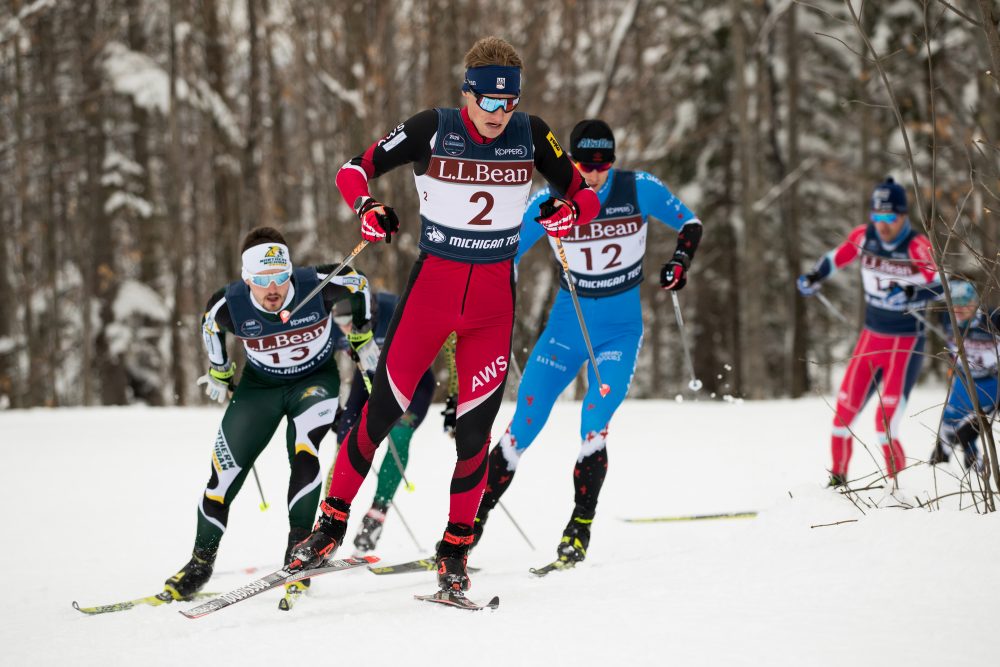
    The top name on the men’s side was no surprise: Gus Schumacher. The 19-year-old from Anchorage, Alaska captured his first career Senior National Championship today in the 1.5-kilometer skate sprint in Houghton, Michigan.

    Schumacher (USST/AWS) qualified in second at 3:10.85, behind JC Schoonmaker (UAA) in first (3:08.88). Schumacher won the second quarterfinal, and the second semi in a smoking time of 3:04.16. 

    Gus Schumacher (bib 2), during the men’s skate sprint at the 2020 Senior Nationals in Houghton, MI. (Photo: Reese Brown)

    Post-race interview with Gus Schumacher

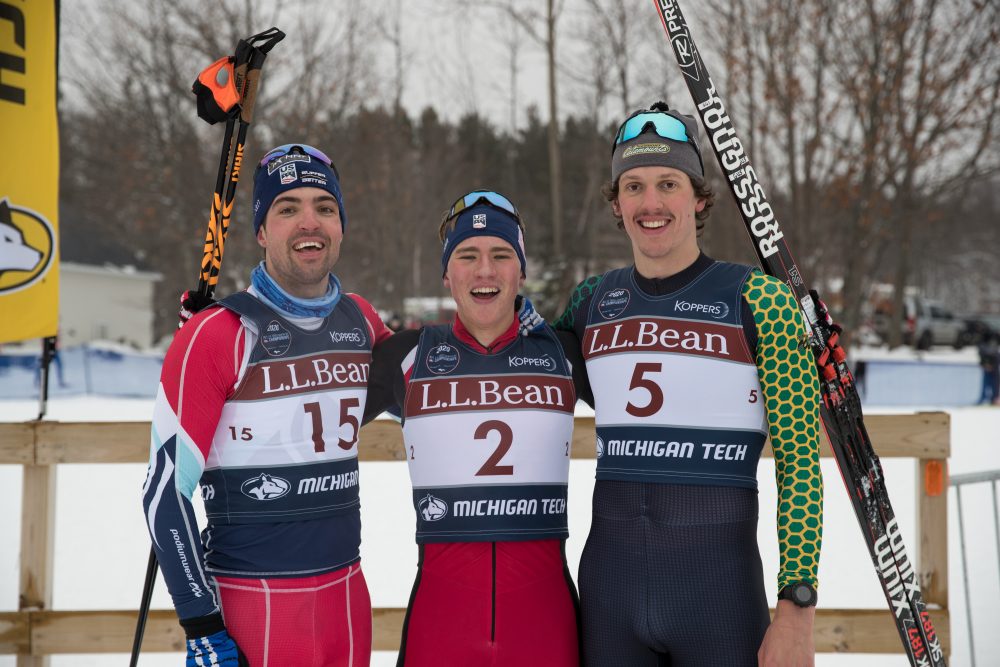
    The men’s final shook out with Schumacher in first (3:02.95), Ben Saxton (SMST2) in second (3:03.88), and Bill Harmeyer (UVM) third (3:04.84). 

    Norway’s Kjetil Baanerud (NMU) placed fourth (3:05.33), Canada’s Julien Locke (CNST) placed fifth (3:05.77), and Thomas O’Harra (APU) sixth (3:07.32). 

    The Men’s podium from 2020 Senior Nationals in Houghton, MI. Ben Saxton in second, Gus Schumacher first, and Bill Harmeyer third (l-r). (Photo: Reese Brown)

    Post-race interview with Ben Saxton

    Men’s Results 


    The women’s skate sprint final: Hailey Swirbul (bib 1), Alayna Sonnesyn (bib 2), and Caitlin Paterson (bib 3). Photo: Reese Brown

    Post-race interview with Hailey Swirbul

    For the women, the day’s fastest qualifier, Hailey Swirbul (USST), also won the skate sprint final in 3:36.47. Alayna Sonnesyn (SMST2) was second (3:36.81), and Caitlin Patterson (USST/CGRP) third (3:37.32). 

    This was Swirbul’s first career Senior National win and podium. She placed fourth last year in Craftsbury at Senior Nationals in the 20 k mass start skate and sixth in the skate sprint.

    Canada’s Cendrine Browne skied to fourth (3:38.32), Erika Flowers (BSF) fifth (3:38.36), and Laura Leclair of Canada sixth (3:39.84). 

    Women’s Results

    Racing continues tomorrow with a 10 k/ 15 k interval start skate race.

    We will be updating this article throughout the day.

    The women’s skate sprint podium at Senior Nationals. In third, Alayna Sonnesyn, first place went to Hailey Swirbul, and third to Caitlin Patterson. (Photo: Reese Brown)


    Caitlin Patterson (bib 3) and Alayna Sonnesyn: 2020 US National’s skate sprint. (Photo: Reese Brown)


    Bill Harmeyer during the 2020 Senior National’s skate sprint in Houghton, MI. (Photo: Reese Brown)
  • Saturday Race Rundown

    Saturday Race Rundown

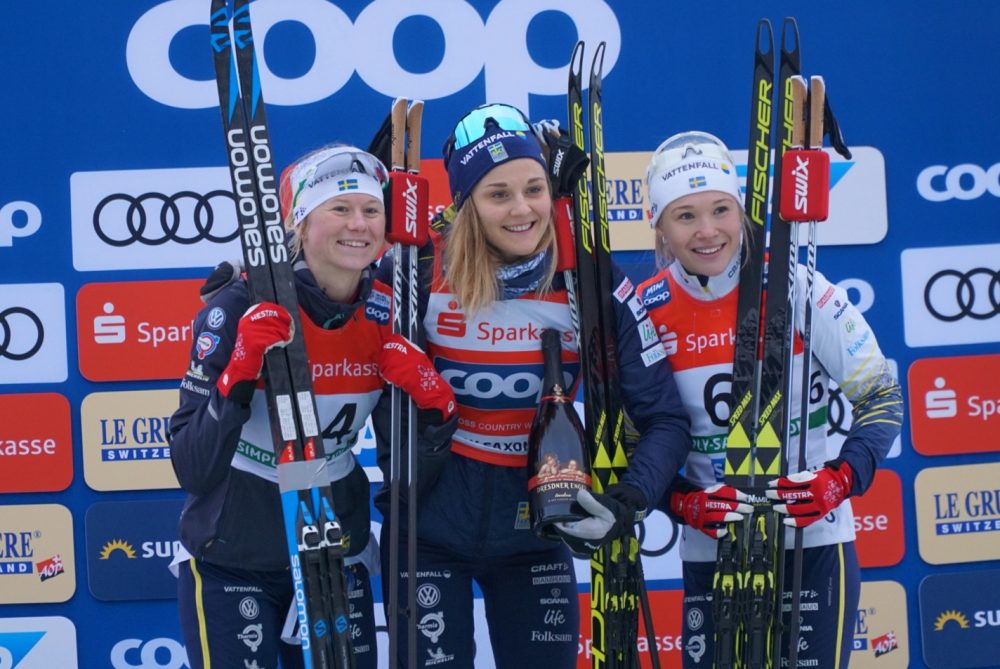
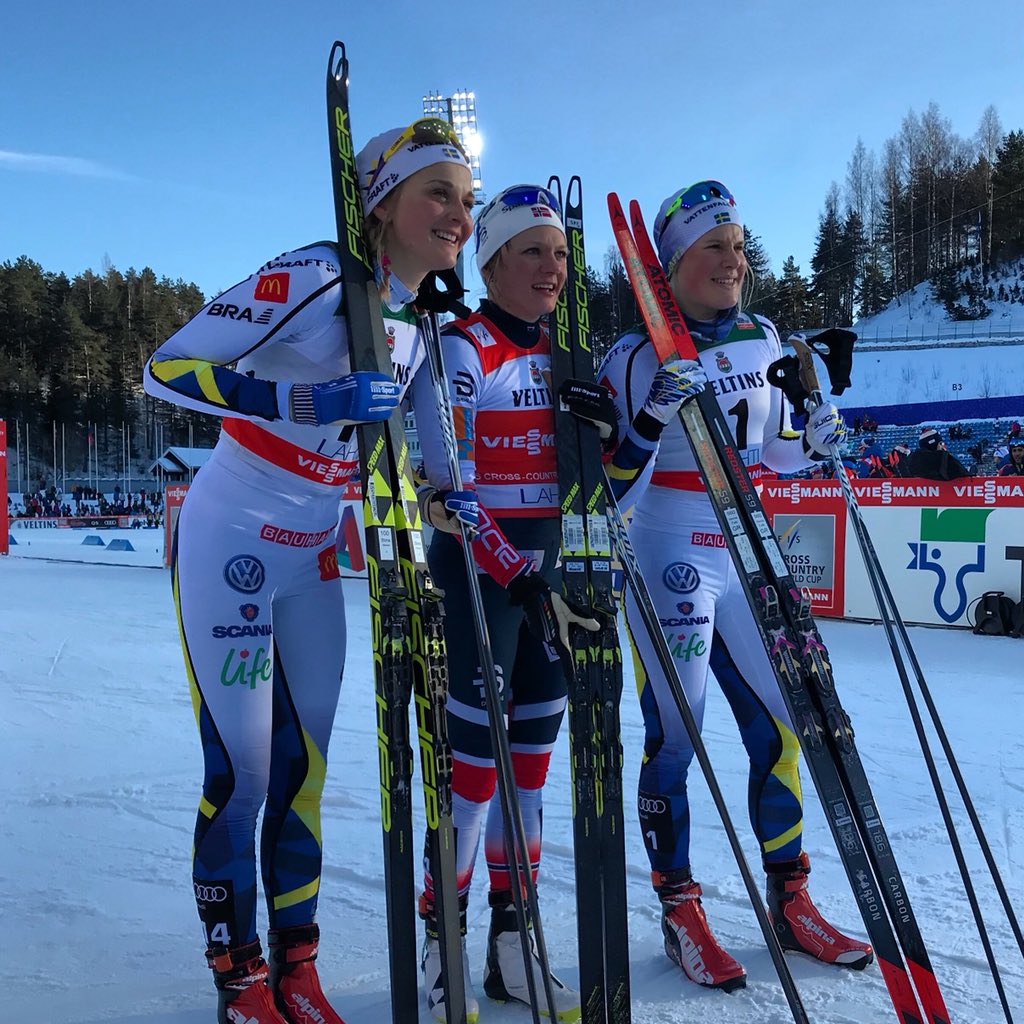
    Women’s podium from the Falun, Sweden 1.4 k skate sprint. From left to right, Maiken Caspersen Falla of Norway in second, Stina Nilsson of Sweden in first, and Maja Dahlqvist of sweden in third. (Photo: @fiscrosscountry Instagram screenshot)

    FIS World Cup Falun, Sweden 1.4 k Freestyle Sprint

    On a day when sugary snow course picked off skiers trying to advance during Falun, Sweden’s 1.4-kilometer freestyle sprint, Stina Nilsson, yes of Sweden, took the win. She won the final in 3:07.72 over Norway’s Maiken Caspersen Falla  in second (+0.67). The day’s top qualifier, Maja Dahlqvist, placed third (+2.14).

    The Americans entered in the race were some of the key players who tumbled on course. Jessie Diggins (USST) qualified in 21st and was leading the second quarter final when she fell on a sugared downhill to place 28th overall. Both Sadie Bjornsen (USST), ranked fourth after qualification, and Sophie Caldwell advanced to the semis.

    Caldwell took a belly slide on the the course’s funky downhill to place sixth in her semi and finish 11th overall. In the second semi, Bjornsen was eliminated after placing fifth. She finished 10th overall.

    ponstel online

    Also for the U.S., Julia Kern (USST) placed 34th, Ida Sargent (USST) 37th, Rosie Brennan (APU) 53rd, and Kaitlynn Miller (CGRP) 61st.

    Results

    In the men’s 1.4 k skate sprint, Norway’s Johannes Høsflot Klæbo continued his winning ways with another sprint victory. He won the final in 2:52.38,  0.1 seconds over teammate Emil Iversen. Another Norwegian, Sindre Bjørnestad Skar, placed third (+0.28).

    U.S. skier Simi Hamilton (USST), who qualified in 16th, bowed out in the quarterfinals after placing fifth in his heat. Hamilton was 22nd overall. Kevin Bolger (USST) advanced to the heats where he was eliminated to end up 27th overall.

    Also for the U.S., Logan Hanneman (APU) placed 39th, and Ben Saxton (SMS T2) was 60th.

    Alex Harvey of Canada ended his race in 31st. He was the only Canadian entered.

    Men’s Results


  • Sweden takes 1, 2 and 3, with Nilsson Leading the Way in Dresden City Sprint; Caldwell 5th

    Sweden takes 1, 2 and 3, with Nilsson Leading the Way in Dresden City Sprint; Caldwell 5th


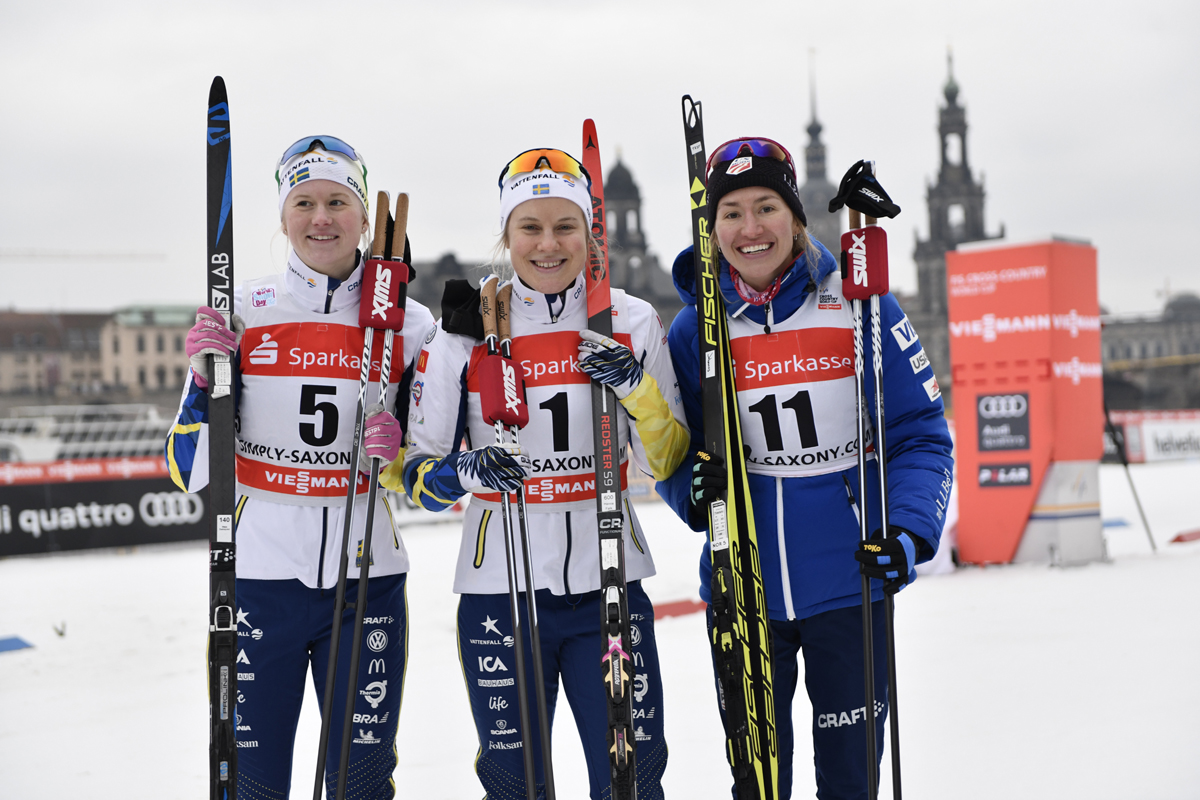
    An all Swedish podium, from left to right: Jonna Sundling, Stina Nilsson and Maja Dahlqvist after the women’s 1.6-kilometer freestyle sprint in Dresden, Germany. (Garrott Kuzzy /LumiExperiences.com)

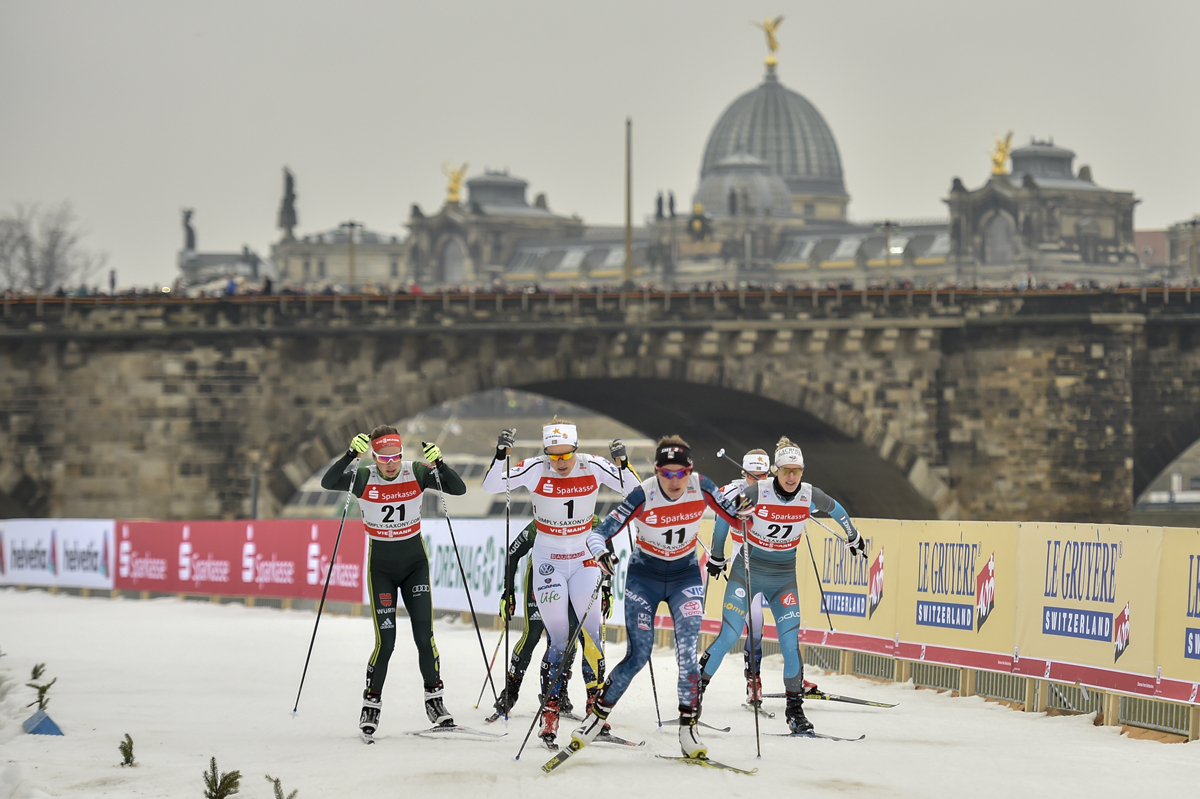
    With the 2019 Tour de Ski complete, World Cup athletes returned to competition on Saturday for a 1.6-kilometer freestyle sprint. The race took place in the city of Dresden, Germany–an icy, two lap sprint course along the Elbe river  offered racers the non-traditional backdrop of cathedrals and other gothic architecture. Temperatures hung around 40 degrees Fahrenheit on Saturday and the snow that was trucked in to cover the streets made for a hard packed, icy racecourse. Wind gusts between 15 and 25 mph added another challenge to those competing. 

    “It was really windy, so I just wanted to save some energy the first lap and be in a good position the whole last lap,” Sweden’s Stina Nilsson said during an interview with the International Ski Federation (FIS).

    Nilsson went on to take the overall win, finishing the final first in a time of 3:48.49 after also winning both her quarterfinal and semifinal. The 25 year old Swede now has 16 individual World Cup sprint titles, this being Nilsson’s fourth successive sprint win in a row.

    Two more Swedes finished on the podium, with Maja Dahlqvist claiming second (+0.24) and Jonna Sundling third (+0.54) after she bested Switzerland’s Nadine Fähndrich by 0.02 seconds in a photo-finish. 

    “When I realized there were three [Swedish] girls on the podium I was really happy because we have such a strong team and I am really proud to be a part of it,” Nilsson told FIS after the race.

    The podium finish is Dahlqvist’s fourth in the individual top three at the World Cup level. Last year in the Dresden sprint, the 24 year old placed second (then to her teammate Hanna Falk). Dahlqvist has yet to win an individual World Cup sprint. 
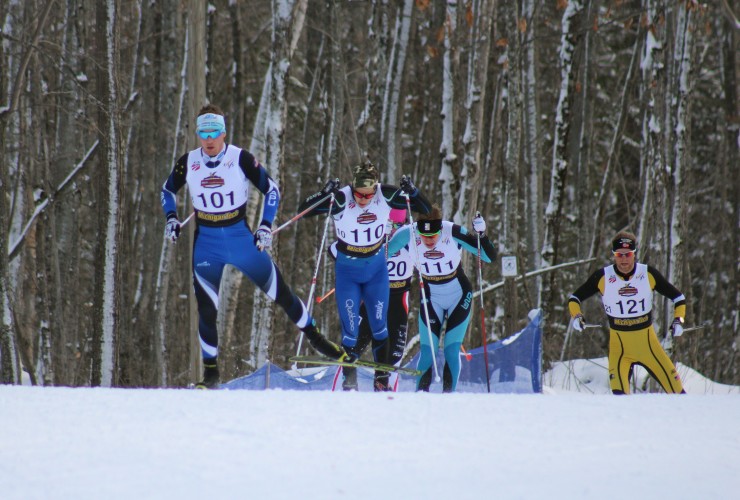
    Also at 24 years of age, the other Swede making a name for herself in sprints, Sundling, now has three individual World Cup podiums. Her first individual win came earlier this season during the Lillehammer mini-Tour in late November. 

    Following Fähndrich’s fourth place finish (+0.56) was American Sophie Caldwell in fifth (+2.61). Caldwell started the day with the second fastest qualifying time of 3:42.34, Sweden’s Hanna Falk posting the fastest qualifier in a time of 3:41.85. The U.S. skier went on to cross second in her quarterfinal, which was won by Fähndrich, and then second again in her semi final, this time to Nilsson.

    In the final, Caldwell remained in contact with the group for the first two thirds of the race. Until the race’s midway mark, she was positioned in third, just behind Sundling and Fähndrich who led the first half of the final. Cornering into the last half kilometer, Slovenia’s Alenka Cebasek fell and Nilsson took over the lead. Caldwell clung to the three Swedes and Fähndrich, but the four broke away their last time up the courses lone, short uphill.

    “My strategy was to conserve energy for the first lap and try position myself well with fresh legs for the second lap. This worked quite well in my quarter and semi, but in the final I was bopping around not quite in the draft at the beginning of the second lap and definitely lost my legs a bit for the last half of the lap,” Caldwell wrote in an email. “That said, it’s always a good day when you make it into the final, and these long courses used to be a challenge for me, so I was really happy to ski into the final with confidence.”

    Sophie Caldwell racing the qualifier of the women’s 1.6-kilometer freestyle sprint in Dresden, Germany. (Photo: Garrott Kuzzy /LumiExperiences.com)

    “She’s pretty happy with the day,” the U.S. Ski Team’s World Cup head coach, Matt Whitcomb, told FasterSkier after the race. “At the end, I think the 1.6-kilometer course coupled with it being very flat and then one thing tactically went very poorly near the end where she ended up having to break some wind and she just got tired. No real mistakes out there, she executed the plan like she wanted to, there were just a lot of good women out there, it was a strong final. She also had a very strong semi-final which made for an exciting day.”

    Julia Kern racing the qualifier of the women’s 1.6-kilometer freestyle sprint in Dresden, Germany. (Garrott Kuzzy /LumiExperiences.com)

    In her first World Cup start of the season, American Julia Kern ended the day in 19th after qualifying in 23rd. She advanced to the same quarterfinal as Nilsson and Sundling and for the first lap of the race, Kern was in second, right on Sundling’s tail. During the second lap, Nilsson ramped up the speed and took over the front pace. Kern was able to hang onto the pack and ultimately crossed fourth after a photo finish with Canada’s Dahria Beatty. 

    “I was really psyched to lay down a good qualifier and make it into the heats!” Kern, 21, wrote in an email to FasterSkier. “My family is here watching (parents, grandparents, and aunt and uncle) so I wanted to qualify for heats so they could watch me more than once.”

    “I think coming off a strong start to season, I carried in more confidence and excitement coming into this World Cup which put me in a great place to go for it and have fun!”she added.

    Saturday’s heats were the first of the season for Beatty. The 24 year old Canadian qualified in 20th and ended the day in 16th overall. 

    “I am really happy to have made my first World Cup heats of the season…16th is one of my best ever World Cup results.” Beatty wrote in an email. “I would have loved to make the semis and was pretty close today but I will keep chasing that goal. My skis were amazing and the atmosphere was great, I made a few small mistakes tactically in my heat but hopefully I can have another shot next weekend in Otepää.”

    U.S. Ski Team member, Hannah Halvorsen racing the women’s qualifier for the 1.6-kilometer freestyle sprint in Dresden, Germany. (Garrott Kuzzy /LumiExperiences.com)

    Also in her first World Cup start, American Hannah Halvorsen placed 35th with a time of 3:55.73. The 20 year old was 1.54 seconds away from scoring World Cup points and qualifying for the day’s heats. 

    The next U.S. finisher was Ida Sargent in 38th.

    “Today was rough for me,” Sargent wrote in an email to FasterSkier after Saturday’s sprint. “I have been having an issue this year with my femoral nerve and I think the icy conditions really flared it up.  I’m hoping to be able to manage it better tomorrow. My energy is good though so I’m looking forward to more racing.”

    Another World Cup rookie, Hailey Swirbul of the U.S. Ski Team D-Team, finished 41st on Saturday. 

    “It was exciting to have a city sprint be my first World Cup experience,” Swirbul wrote in an email. “I thought I skied powerfully and as smoothly as I could for the conditions. Each race is an opportunity to learn something and I absorbed as much as I could from these incredible teammates and athletes around me. I can’t wait for another shot at the World Cup at some point!”

    Hailey Swirbul racing the qualifier of the women’s 1.6-kilometer freestyle sprint in Dresden, Germany. (Garrott Kuzzy /LumiExperiences.com)

    “[R]eally awesome to have some of our D Team girls here and have Julia get a top 20!” Caldwell wrote. “I’m really proud of them all and it should be a fun day of team sprinting tomorrow. I’ll be teaming up with Julia and I’m really looking forward to it! Ida and Hannah will also have a really strong team and Hailey will be cheering strong with her relay socks.”

    Results: Qualifier | Final 

  • World Cup Preview: #9 Italy

    World Cup Preview: #9 Italy

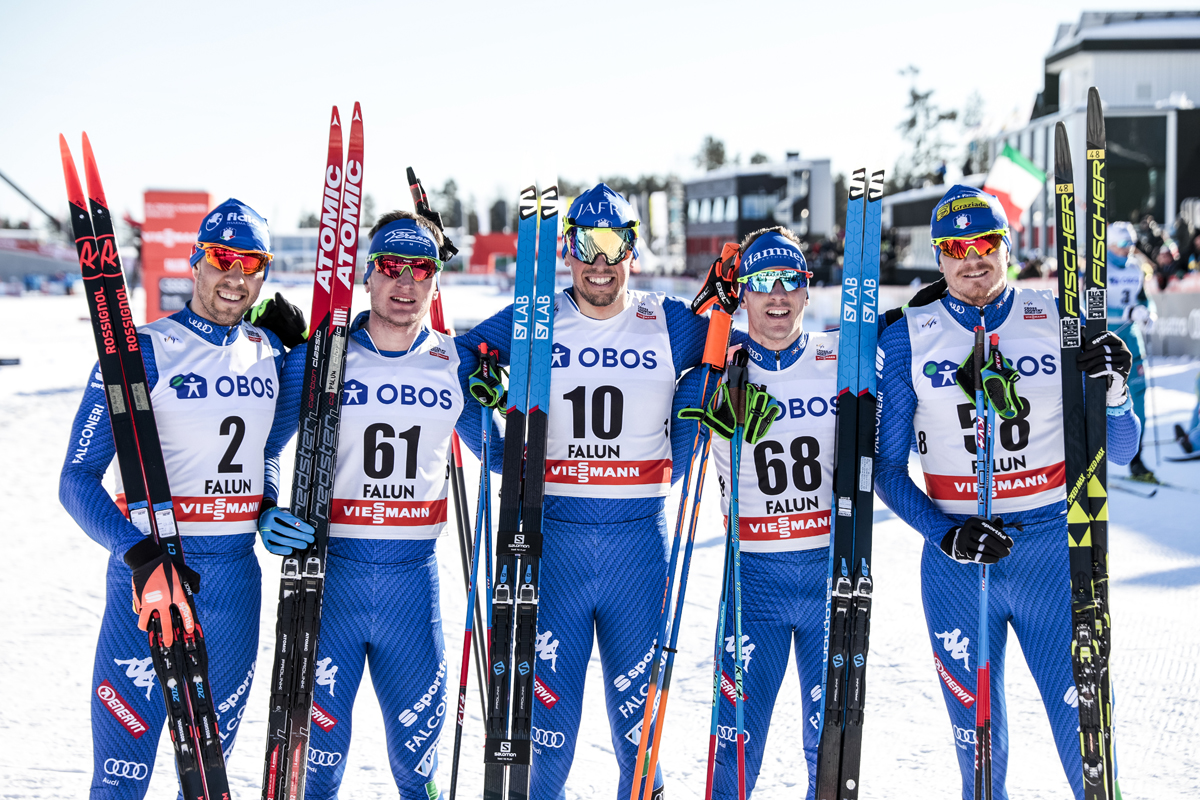
    The Italian men’s team after Saturday’s 15 k classic mass start at 2018 World Cup Finals in Falun, Sweden, with (from left to right) Federico Pellegrino, Giandomenico Salvadori, Francesco De Fabiani, Maicol Rastelli, and Dietmar Nöckler. (Photo: Fischer/NordicFocus)

    Welcome to FasterSkier’s World Cup Preview, where we check in with the top-10 teams from last year’s FIS Cross Country World Cup tour before the season starts with the Ruka weekend in Kuusamo, Finland, on Nov. 24 with a classic sprint.

    ***


    Italy

    Overall in Nations Cup Last Year: Ninth

    Women’s Ranking 2017/2018: 10th

    Men’s Ranking 2017/2018: Sixth

    Italians to Watch:

    One name to rule them all in Italy: Twenty-eight-year-old Federico Pellegrino. Synonymous with fast and furious when it comes to freestyle sprints. Last season Pellegrino won World Cup sprints in Dresden and Lahti, both were skate. He stood second on World Cup skate sprint podiums on three other occasions in 2017/2018. One of those seconds was in Seefeld, Austria – site of the 2019 Nordic Ski World Championships. And yes, it’s a skate sprint this season in Seefeld.

    For the naysayers out there, claiming Pellegrino is a one-trick-pony, the skate specialist claimed a 2018 Olympic silver medal in the classic sprint. 

    The 2016 winner of the overall FIS Sprint Crystal Globe, Pellegrino has been out-hustled by Norway’s Johannes Høsflot Klæbo for the sprint cup since. With nine of the 12 World Cup sprints this season designated skate technique, it may be time for the Italian flyer to claim sprint cup number two.

    Dietmar Nöckler returns as a possible Pellegrino partner in the team sprint. The duo placed first in Dresden’s skate team sprint in January. The big-stage team sprint in Seefeld is classic technique.

    buy zyrtec online

    Francesco DeFabiana provided the Italian men some 15-kilometer punch in 2017/2018. DeFabiana placed third twice on the World Cup last year: in the Oberstdorf’s 15 k skate and Falun’s 15 k classic — both were mass starts.

    Thirty-four-year-old Elisa Brocard stepped up for the Italian women. She was a steady top-30 skier, including several top-20 results. Brocard was Tour de Ski ready, placing 17th overall. By season’s end, she ranked 29th in the distance cup – her highest position since beginning her World Cup career in 2008.

    On the sprint side for Italy’s women, Greta Laurent placed consistently in the top-30. Her best result, a ninth place, came in Seefeld’s skate sprint. Laurent finished 2018 ranked the 36th sprinter on the World Cup.

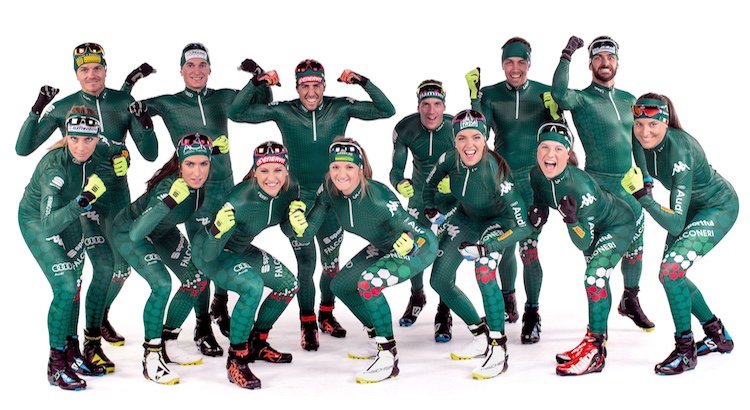
    On a lighter Note: the Italians raced in sporty royal blue suits last season. It didn’t take long for a rebrand. Kermit the Frog may have spoiled it for Italy when he bellowed, “It’s not easy being green”. Despite that lyrical foreboding from the iconic amphibian, you will not miss Italy this season on the race tracks. Think green.

    Italy’s National Cross Country Ski Team in…Green race suits for the 2018-2019 season. (Photo: FISI.org)


  • Bolger’s World Cup Debut: ‘The Hard Part Was Over, Now It Was Time to Have Some Fun’

    Bolger’s World Cup Debut: ‘The Hard Part Was Over, Now It Was Time to Have Some Fun’

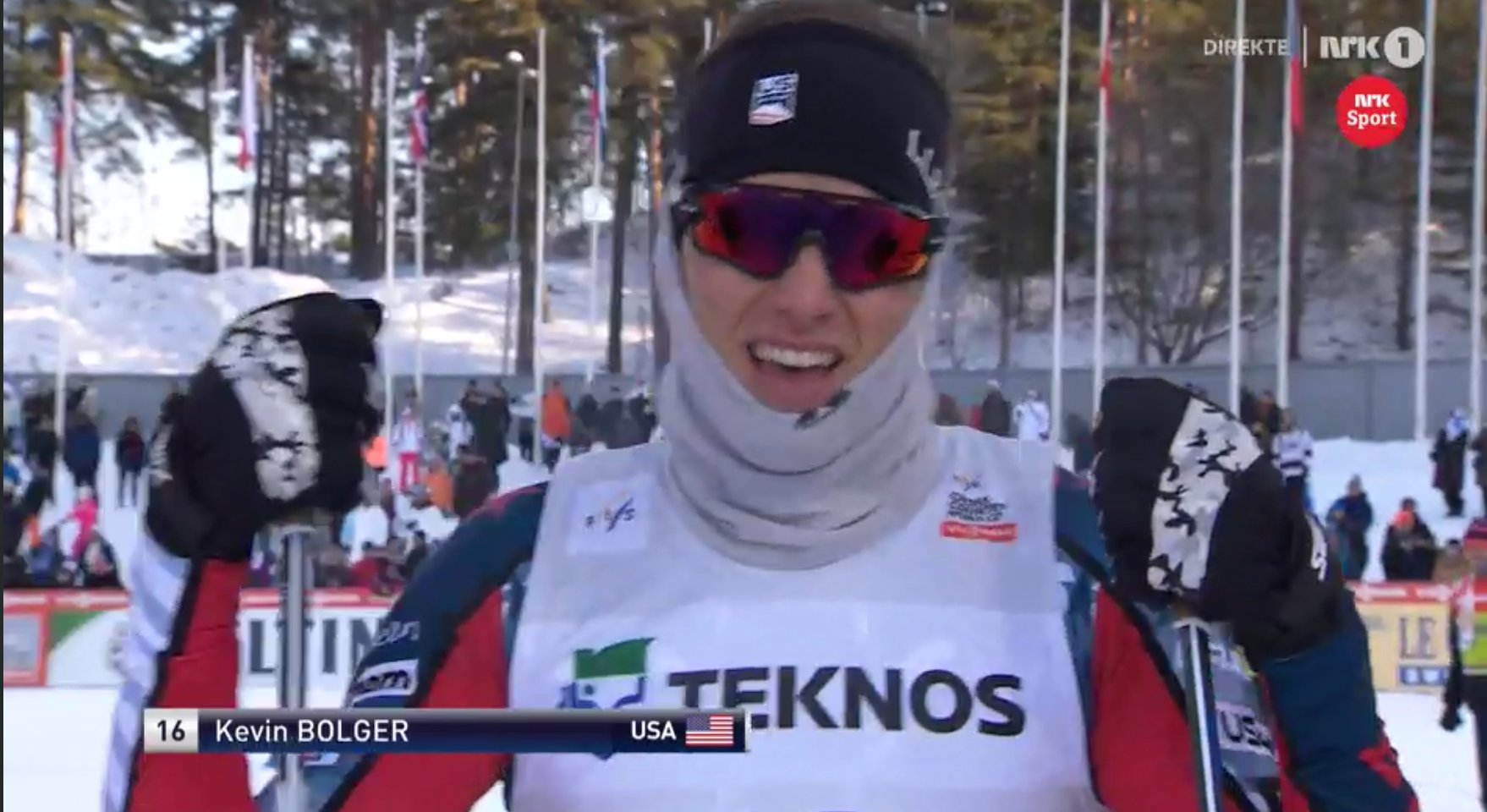
    Kevin Bolger (Sun Valley XC Gold Team, second from left) in his quarterfinal heat in the World Cup skate sprint in Lahti, Finland, on Saturday. (Photo: Ophira Group)
    Kevin Bolger (Sun Valley XC Gold Team, second from left) in his quarterfinal heat in the World Cup skate sprint in Lahti, Finland, on Saturday. In fifth here going into the last downhill, he moved into fourth in the finishing straight and advanced to the semifinals as a lucky loser, finishing 11th on the day. (Photo: Ophira Group)

    On Saturday in Lahti, Finland, Kevin Bolger of the Sun Valley XC Gold Team made his World Cup debut. In his first season since graduating from the University of Utah, Bolger earned start rights for the final period of World Cup racing by leading the SuperTour.

    It was quite the debut: in the skate sprint, Bolger qualified in 16th, then advanced through the rounds to the semifinals and finished 11th on the day. There are not so many U.S. men who have ever finished that well in a World Cup in the last decade, much less on their first try – such a debut hasn’t been matched since  Garrott Kuzzy finished ninth in a skate sprint in Canmore, Canada, in 2008, in his first weekend of World Cup racing.

    The crowd certainly wasn’t expecting it. The Norwegian television commentators referred to him as “the surprising man”, and Bolger admitted in an interview over email after the race that he was a bit surprised himself.

    The next day, he finished 54th in the 15 k classic, +3:09.5 from the time set by Kazakhstan’s Alexey Poltoranin.

    The following interview has been lightly edited and condensed.

    FasterSkier: Your coach, Chris Mallory, and he mentioned that getting some World Cup starts was a big goal for you this year. How does it feel to check that box, especially in such a fashion?

    Kevin Bolger: Reaching the World Cup is the next step for skiers back in the U.S., so once I got my opportunity to get over here and race I wanted to capitalize on it. Just cracking the top 30 would have been amazing, so to have qualified 16th, and then overall finish in 11th on the day, is incredible, and I know there is more. But it also shows that I have what it takes to be competing over here with these guys.

    FasterSkier: Do you usually consider yourself a strong qualifier skier in sprints? 

    Kevin Bolger: Qualifying has been, in the past, a weaker point for me. So I have been putting a lot of thought into how I can improve this with my coach Chris Mallory. I think we have dialed in a great pre-race strategy. And obviously I think this year it has been working.

    FasterSkier: What were your first thoughts when you saw that you were 16th in the qualifier? 

    Kevin Bolger: I didn’t quite understand what happened when I finished. I remember some official telling me I was 16th, but I did not think he was talking to me. Once I saw my name up on the Live Timing board next to 16th, I was blown away. A lot of emotion kicked in. The hard part was over, now it was time to have some fun. It’s crazy watching World Cups back home, and suddenly I was in the middle of it, and I wanted to put a staple in my day!

    FasterSkier: Does this course play to your strengths as a skier? Was there a part that you could work particularly well?

    Kevin Bolger: I always try to ski a course and think of sections that will play into my advantage – being a big guy there are always good and bad spots. But I think this course skied well, and a lot came down to where you were positioned coming into the last turn at the top off the last climb, and coming down the final hill into the finish. The finishing stretch was my biggest strength, being a big guy and being able to really slingshot that corner and carry speed all the way to the finish, as I did in my quarterfinal. But I wasn’t where I wanted to be in the semi, and unfortunately it was too late.

    FasterSkier: In your quarterfinal, you seemed stuck at the back for a long part of the heat. Was that a deliberate strategy to just save energy, or was it stressful to be back there and not able to get around people?

    Kevin Bolger: My biggest strategy was just to stay on my feet, own my space, and not get intimidated. I talked a lot with Matt Whitcomb and we both agreed that I should ski confident and do what felt comfortable. Going to the back is not normally what I would like to do, but this is sprinting – sometimes what you plan doesn’t always happen and you need to be able to change your game plan and tactics. I had to work a little harder but that’s okay. I learned a lot for being my first World Cups, and next time I’ll be able to try new tactics.

    FasterSkier: How did the semifinal go?

    Kevin Bolger: The semi was great. Unfortunately I only had about a few minutes from the time I finished my quarterfinal until my semi started, so that was a quick turnover, but the U.S. guys were on it with my skis and helping out so much, without them I would have been a lost puppy! So, huge shout out to the U.S. crew!

    FasterSkier:  Are you happy with your skiing? 

    Kevin Bolger: After any race you can always look back and think about what you could have done differently, and of course I wish I would have skied a bit more aggressive in the final climb, but I was toeing the line with the gold and silver medalist from the Olympics, and some of the best guys in the world – so to know I’m right there shows I have what it takes to compete with these guys! I am very happy with my skiing. Not everyone gets this opportunity, so being able to show up on the world stage and ski like I know I can and throw down – I can’t be anything but happy!

  • On World Champ Turf, Pellegrino Crushes Lahti Sprint; Bolger 11th in World Cup Debut

    On World Champ Turf, Pellegrino Crushes Lahti Sprint; Bolger 11th in World Cup Debut


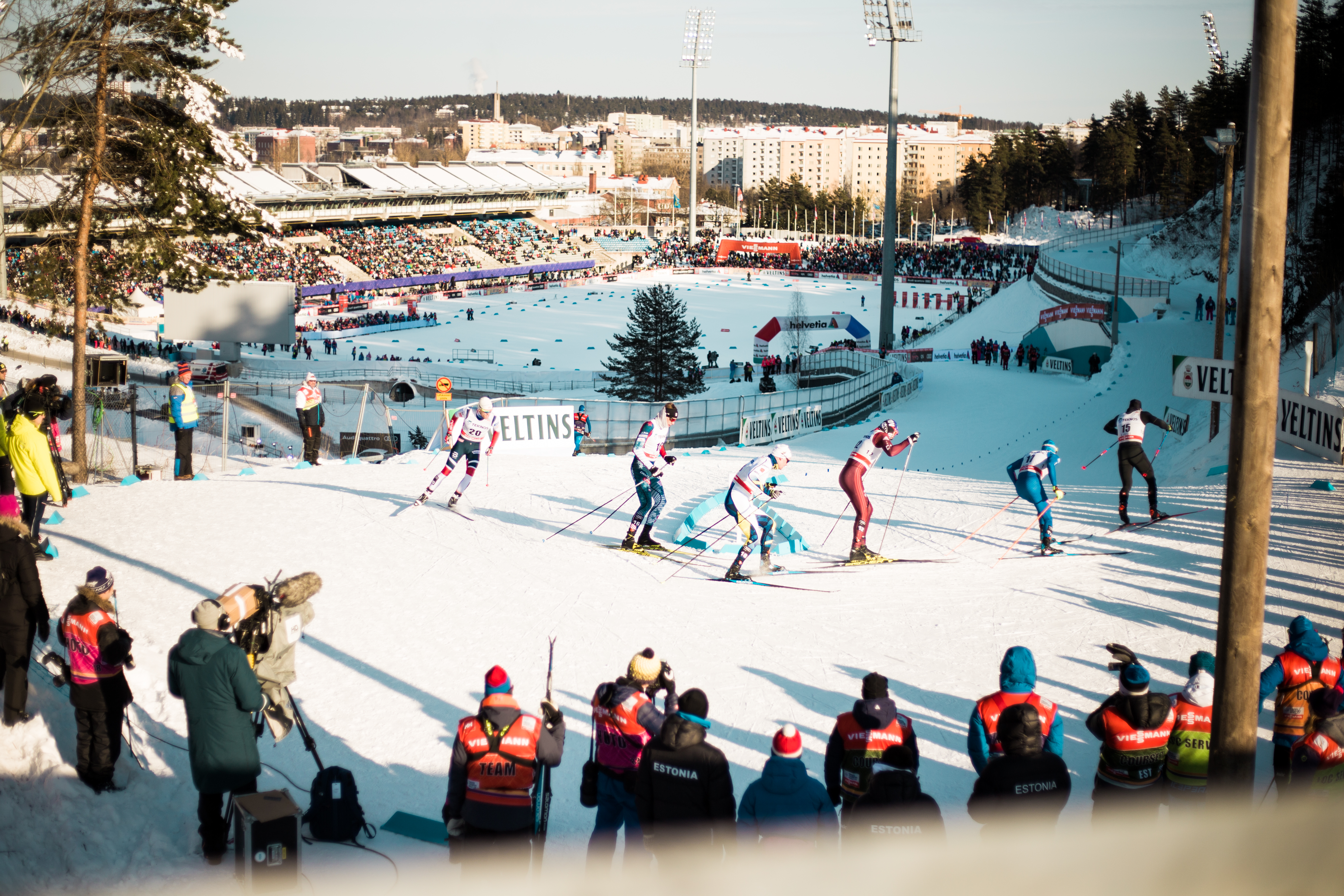
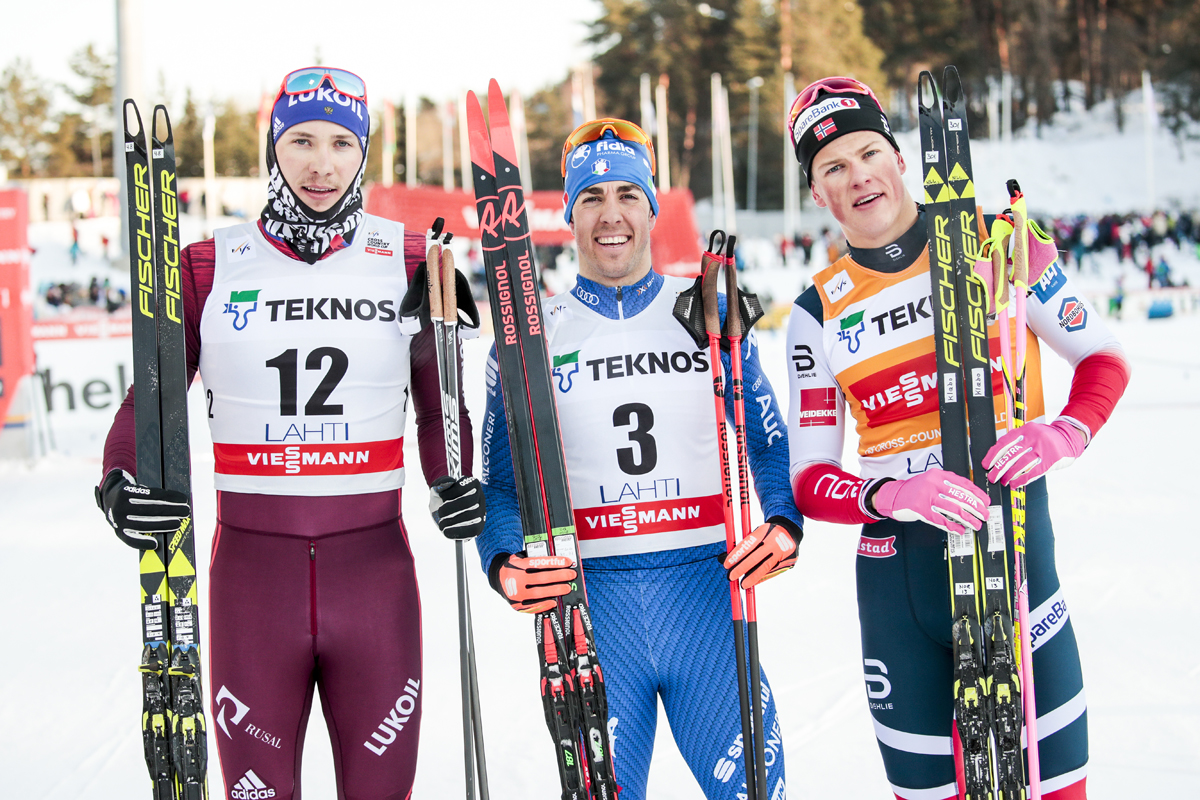
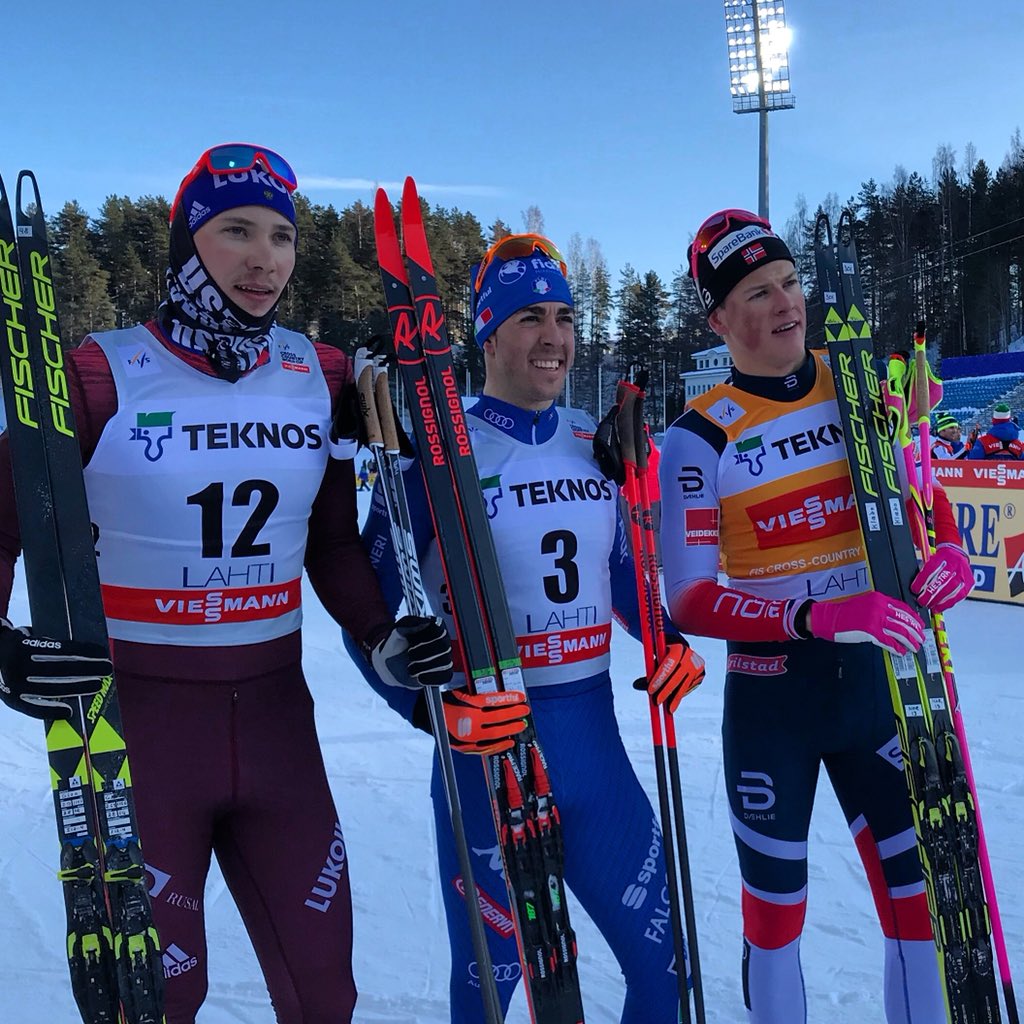
    The men’s 1.6 k freestyle sprint podium at Saturday’s World Cup in Lahti, Finland, with Italy’s Federico Pellegrino (c) in first, Russia’s Gleb Retivykh (l) in second and Norway’s Johannes Høsflot Klæbo (r) in third. (Photo: Fischer/NordicFocus)

    The men’s freestyle sprint final in Lahti, Finland, started in almost comical fashion: the six men who had made it to the final heat of the day skied slowly, then even slower, as nobody wanted to lead.

    The final was full of dangerous men. Norwegian youngster Johannes Høsflot Klæbo has won five sprints this season, and he just became an Olympic gold medalist in the sprint in PyeongChang, South Korea, a mere ten days ago. In his quarterfinal and semifinal heats, he had put in big turns of speed which had dropped most of the field.

    They hadn’t dropped Italy’s Federico Pellegrino, though, and the 2017 World Champion was the only man competing in Lahti who had beaten Klæbo in a sprint this season.

    Then there was France’s Lucas Chanavat, who put in a huge burst of speed up a hill in his own quarterfinal, perhaps mimicking the move that Klæbo usually makes to test it out or prove a point.

    They were all lurking there in the final, along with Russia’s Gleb Retivykh, Finland’s Ristomatti Hakola – consistently one of the fastest qualifiers on the World Cup – and Norway’s Sindre Bjørnestad Skar.

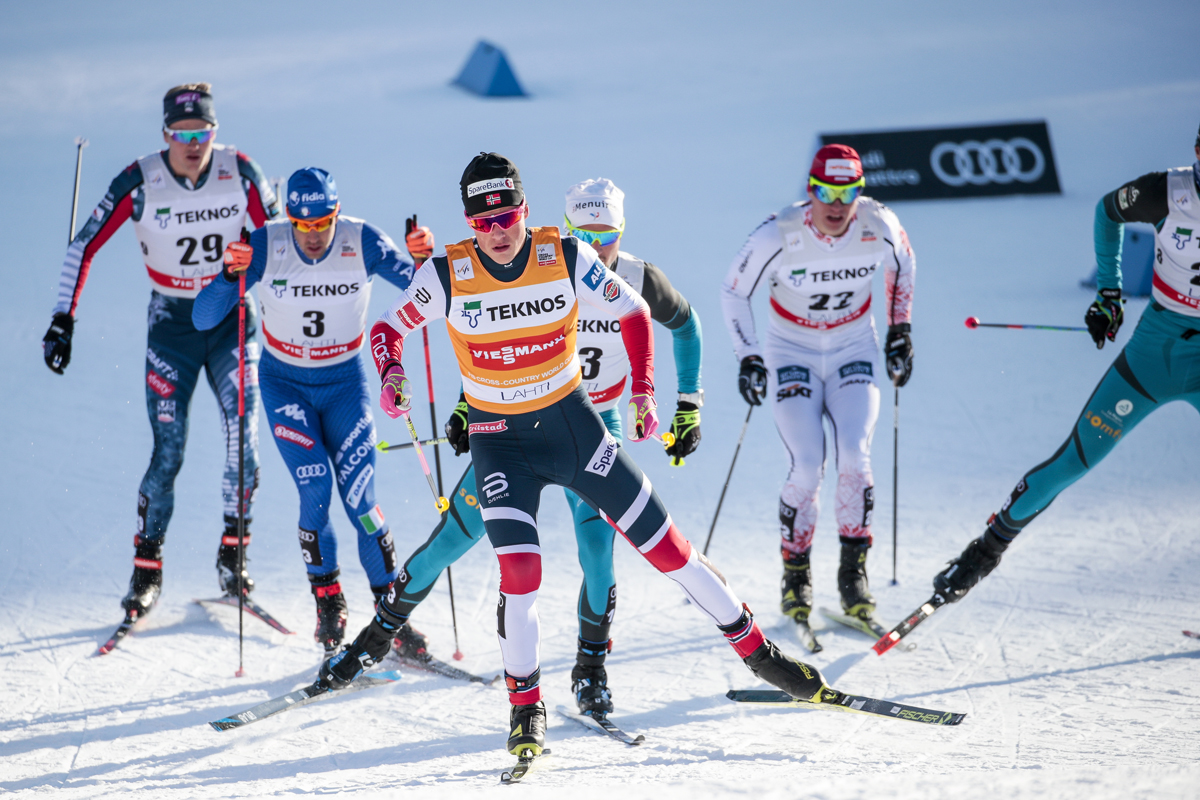
    Norway’s Johannes Høsflot Klæbo leading his quarterfinal, which included Italy’s Federico Pellegrino (3) and American Erik Bjornsen (29), in the men’s 1.6 k skate sprint at the World Cup in Lahti, Finland. (Photo: Fischer/NordicFocus)

    Klæbo finally got up to some sort of speed on a gradual downhill, stringing out the field after a full 90 seconds of being clumped together and moving at walking pace. But he still wasn’t going full bore. On one of the final opportunities, it was Skar who went to the front and sprinted up a hill, finally turning the speed dial to “full”.

    Coming down the final hill into the stadium, it was Skar, Klæbo, and Pellegrino, who overtook the leader going into the last turn. In the finishing stretch, the two Norwegians seemed to just fade away; Pellegrino sprinted for the line and a big win of 0.77 seconds.

    “I think that when I returned after the Olympics, back home I had a very good time, really good weather in the Alps,” Pellegrino – the silver medalist in the PyeongChang sprint – said in a post-race interview with FIS. “And it was very good to recover and train a lot, so that I could come here in the best shape. I’m really proud of this.”

    Also surging past the Norwegian duo was Retivykh, who had accelerated into and through the final corners and pulled away in finishing lane.

    “I have been waiting quite long for the World Cup podium,” said Retivykh, according to FIS. “Last time I was top three was in PyeongChang last year. So it feels great to be back. I am not surprised to be second because I knew I could do it. It feels great… I am sharing the podium with two great athletes.”

    Klæbo hung on for third, +0.90 seconds, and Skar was fourth, +1.30. He edged Hakola (+1.44) while Chanavat was left in sixth (+7.55).

    Coming into the final as the giant everyone feared, Klæbo’s tactics had not paid off.

    “I’m glad this was not the Olympics,” Klæbo told Norwegian broadcaster NRK, according to a translation. “Pellegrino was too strong. I had nothing to answer with. Then you have to be thankful for third place. And I’m still smiling pretty wide.”

    Pellegrino, meanwhile, played his cards exactly right. He also beat Klæbo here one year ago to win World Championships gold, and he channeled that experience.

    “I lost too many races in the past when I was leading almost the whole race,” he told FIS. “I think that on this track I know how to do it.”

    And with the win, Pellegrino became the most decorated skate sprinter in men’s World Cup history. It was his tenth skate sprint victory, a new record.

    With third place, however, Klæbo has sealed this year’s overall Sprint Cup trophy even though there are still two sprints to come in Drammen, Norway, and Falun, Sweden.

    “That is a bright spot, then,” he told NRK. “It helps a little, but there was no snap today. The [qualifier] was good, but otherwise it was a bit dead.”

    By placing 11th in the freestyle sprint in Lahti, Sun Valley’s Kevin Bolger won some Gruyere cheese for being the top-ranked Continental Cup skier of the day. (Photo: Matt Whitcomb)

    Bolger 11th in World Cup Debut, Bjornsen 20th

    You didn’t have to scroll very far down the qualifier results sheet to find the name of a World Cup debutant. In 16th place was Kevin Bolger of the Sun Valley XC Gold Team. The SuperTour leader made the most of his opportunity, and NRK broadcasters referred to him as “the surprising man – Kevin Bolger.”

    “Honestly, I didn’t necessarily expect him to qualify in a Scandinavian World Cup, in his first go at it,” Bolger’s coach Chris Mallory wrote in an email. “He generally builds into sprint days as they progress, as he’s a bit of an all-arounder. But he really stepped up to the plate today.”

    In his quarterfinal, Bolger was last out of the start gates and sat in sixth place for much of the race. But near the end of the heat he moved into fifth and then coming into the finish turned on the afterburners to move up to fourth.

    The last of the quarterfinals, it also turned out to be the fastest one, and both Bolger and third-place Karl-Johan Westberg of Sweden moved on to the semifinals as lucky losers behind Retivykh, the heat’s winner, and second-place Franceso De Fabiani of Italy.

    “He’s a big glider, and can carry his speed really well, but he’s focused a lot on improving his speed this year,” Mallory wrote of that finishing sprint.

    In the semifinal, Bolger couldn’t quite pull the same move. He was again in sixth out of the gate, but Pellegrino broke a pole, dropping to last. The two traded off places as Pellegrino then caught back up, and then replaced his pole again. Then Bolger passed Emil Iversen, but the Norwegian passed him back by the finish and Bolger ended up sixth in the semifinal and 11th on the day.

    Bolger before the start of his semifinal heat. (NRK screencap)

    Bolger graduated from the University of Utah last year and it is his first season as a full-time senior racer with the Gold Team, although Mallory said that Bolger had trained with Sun Valley for two years as a high school postgraduate before heading to college.

    Before heading to Europe for the World Cup, Bolger had won a SuperTour sprint in Ishpeming, Michigan, and placed second and sixth in 20 k and 10 k races there. Earlier in the season, he was second in the skate sprint and fifth in the classic sprint at U.S. National Championships.

    “My goal was for him to get some World Cup starts and a top 30 this season, so those opportunities would keep coming,” Mallory explained. “I watched FIS live timing all night, normally not so exciting, but last night it was!”

    Erik Bjornsen of the U.S. Ski Team and APU qualified in 29th place and in his quarterfinal, had a poor start position as a result of his bib and was immediately shunted to the back of the heat.

    “Up the first climb I tried to make a couple moves, but I was just kind of boxed in,” he explained.

    He was in the first quarterfinal, along with Klæbo, Pellegrino, and Renaud Jay of France. By late in the heat Bjornsen was able to move up to fifth when Poland’s Maciej Starega, who had led early, began to fade. Then in the final downhill he moved into fourth and held that position through the finish.

    Norway’s Johannes Høsflot Klæbo and Italy’s Federico Pellegrino (3) going head to head down the finishing stretch in the first men’s quarterfinal at the World Cup 1.6 k skate sprint in Lahti, Finland, with American Erik Bjornsen (l) chasing. (Photo: Fischer/NordicFocus)

    But he hadn’t been able to get to the front early in the heat, and by the finish, the two eventual podium finishers were jetting off at hyperspeed. Though he wasn’t able to catch onto their tails, Bjornsen said that he was feeling better than he had at the Olympics, where his results had been disappointing.

    “I definitely kind of struggled,” he admitted of the 2018 Olympic experience. “It was some of my worst distance racing of the year, so it was obviously very frustrating.”

    After today’s sprint, however, there might be light at the end of the tunnel.

    “I felt like I had good energy left,” Bjornsen said of his heat. “I tried making moves on both sides… the fitness is feeling a lot better than it was a couple of weeks ago. And so, I mean, the peaking plan for the Olympics didn’t work as planned. But it’s been a relatively good season for me, pretty consistent. I had a lot of top 30 finishes… I’m just trying to move past [the Olympics] and have a solid period four on the World Cup.”

    He now looks to the 15 k classic on Sunday, which he called “one of my favorite races.”

    And on getting upstaged by Bolger, Bjornsen seemed the opposite of upset.

    “I was just really psyched to see that,” he said. “The kid has put in a lot of work the last few years and – I mean, I was very surprised. It was great to see. I like to see those younger dudes coming here and having successful results. It’s really impressive. You know, it’s his first World Cup and he just looked comfortable and good out there. It’s just the perfect transition to the World Cup. Keep it up!”

    Canada’s Julien Locke on his way to 42nd in the men’s 1.6 k skate sprint at the World Cup in Lahti, Finland. (Photo: Fischer/NordicFocus)

    “It was so awesome to have two World Cup first timers, Kelsey [Phinney] and Kevin, have such impressive results,” agreed teammate Sophie Caldwell. “Kevin had the race of the day and it was so inspiring for our entire team, staff, and hopefully all the skiers back home to see that success in a young, up and coming racer who just sent it today. We were going crazy!”

    The rest of the North American field did not make it into the quarterfinals. In the qualifier, Logan Hanneman (APU) placed 49th (+11.45). Paddy Caldwell (U.S. Ski Team/SMS T2) finished 59th (+13.55), and APU’s Reese Hanneman and David Norris placed 61st (+14.33) and 67th (+19.27).

    Julien Locke led Canada in 42nd place (+9.78), and Andy Shields finished 60th (+14.29).

    — Harald Zimmer contributed

    Results

    Logan Hanneman (Alaska Pacific University) on his way to 49th in the men’s 1.6 k skate sprint at the World Cup in Lahti, Finland. (Photo: Fischer/NordicFocus)
  • Saturday Rundown: Lahti and Otepää

    Saturday Rundown: Lahti and Otepää

    The men’s 1.6 k freestyle sprint podium at Saturday’s World Cup in Lahti, Finland, with Italy’s Federico Pellegrino (c) in first, Russia’s Gleb Retivykh (l) in second and Norway’s Johannes Høsflot Klæbo (r) in third. (Photo: FIS Cross Country/Twitter)

    FIS Cross Country World Cup (Lahti, Finland): Men’s & women’s freestyle sprints 

    Women’s report

    Men’s report

    The defending world championships from the 2017 freestyle sprint prevailed again in Lahti on Saturday, with Norway’s Maiken Caspersen Falla winning the women’s 1.4-kilometer freestyle sprint final and Italy’s Federico Pellegrino coming out on top in the men’s 1.6 k final at last year’s World Championships venue.

    Falla’s rise to the final started with her qualifying in 12th, 7.96 seconds off the fastest qualifying time set by Sweden’s Hanna Falk in 2:54.72. Russia’s Natalia Nepryaeva qualified second (+0.63) and Finland’s Krista Pärmäkoski third (+3.62), just ahead of Germany’s Victoria Carl in fourth (+3.88) and American Sadie Bjornsen in fourth (+3.88). Four American women qualified for the heats, with Sophie Caldwell in 17th, Ida Sargent in 21st and Rosie Brennan in 29th.

    The women’s 1.4 k freestyle sprint podium at Saturday’s World Cup in Lahti, Finland, with Norway’s Maiken Caspersen Falla (c) in first, and Sweden’s Stina Nilsson (l) and Hanna Falk (r) in second and third, respectively. (Photo: FIS Cross Country/Twitter)

    Falla went on to place second in the first quarterfinal, 0.71 seconds behind Sweden’s Stina Nilsson in first. According to the race jury’s ruling, Carl obstructed Pärmäkoski coming out of the last downhill before they entered the finishing straight and both crashed out of contention, with Pärmäkoski finishing fifth in the heat (+12.11) and Carl sixth (+49.5). Carl was relegated to last (30th place) for the obstruction.

    Falla then won the first semifinal by just 0.04 seconds over Nilsson in second. The two other Swedes in that heat, Falk and Ida Ingemarsdotter, advanced to the final as well as lucky losers with fast-enough times.

    In the final, Falla found herself at the front of the pack early then held her position to the finish, crossing the line in 2:54.83 and beating Nilsson by 0.36 seconds. Sweden had two on the podium with Falk in third (+0.78), Germany’s Sandra Ringwald placed fourth (+0.88), Ingemarsdotter was fifth (+1.83), and Switzerland’s Laurien van der Graaff placed sixth (+3.02).

    Caldwell was the lone American woman to make it past the quarterfinals, as she placed second in her quarterfinal, 0.25 seconds behind Ringwald in first, then fourth in the second semifinal, 1.46 seconds behind Ringwald, who also won that heat. Overall, Caldwell finished the day in eighth.

    Bjornsen placed 17th overall after finishing fourth in her quarterfinal, 2.84 seconds behind Falk in first. Sargent had been second in her quarterfinal until the final tight lefthand corner into the finishing straight, where she slipped to sixth and ultimately finished sixth, 1.07 seconds behind Sweden’s Anna Dyvik in first. Overall, Sargent finished the day in 27th, and Brennan placed 29th overall after finishing sixth in her quarterfinal, 4.91 seconds behind Ingemarsdotter in first.

    Two American men advanced to the heats as well, with Kevin Bolger of the Sun Valley Ski Education Foundation (SVSEF) qualifying in 16th in his World Cup debut, 6.38 seconds behind Norway’s Johannes Høsflot Klæbo, who topped the qualifier in 2:59.06. Erik Bjornsen of the U.S. Ski Team qualified 29th, 8.29 seconds back.

    Meanwhile, Pellegrino qualified for the heats in third (+1.9) behind France’s Baptiste Gros in second (+1.23).

    There, Pellegrino won the first quarterfinal by 0.19 seconds over Klæbo, with the Norwegian visibly backing off before the finish — comfortable enough to automatically advance to the semifinals in second place. But Klæbo showed Pellegrino what he’s made of in the first semifinal and beat the Italian by nine-hundredths of a second.

    Bolger also raced in that first semifinal after placing fourth in his quarterfinal, 0.73 seconds behind Russia’s Gleb Retivykh in first. Bolger’s time was good enough for one of two lucky loser spots in the semifinals, where he went on to finish sixth, 1.86 seconds after Klæbo. Overall Bolger finished the day in 11th.

    Erik Bjornsen placed 20th on the day after finishing fourth in the first quarterfinal (with Pellegrino and Klæbo), 1.56 seconds out of first.

    In the final, Klæbo set the tone, slowing the pace to almost a stop at one point, while he and Pellegrino stood side by side at the top of the course. On the way down, they accelerated, but Norway’s Sindre Bjørnestad Skar was the one who truly attacked. It might’ve been a bit too early, as Pellegrino caught him by the top of the final climb and took the lead on the following downhill into the stadium. Pellegrino held off his challengers, including Retivykh who came on strong out of the downhill, to take the win in 3:16.73, 0.77 seconds ahead of Retivykh in second and 0.9 seconds ahead of Klæbo in third. Skar settled for fourth (+1.3), Finland’s Ristomatti Hakola placed fifth (+1.44) and France’s Lucas Chanavat finished sixth (+7.55).

    In the qualifier, Canada’s Dahria Beatty finished 34th, +13.39 and just 0.9 seconds from making the quarterfinals. She was the only Canadian woman competing.

    American Kelsey Phinney (SVSEF) was also close to making the cut. In her first European World Cup, she placed 36th in the qualifier, +13.74. Caitlin Patterson and Kaitlynn Miller, both of the Craftsbury Green Racing Project,  placed 56th (+20.12) and 61st (+21.70).

    Mathilde Petitjean of Togo, a primarily Quebec-based skier, finished in 59th (+20.80).

    In the men’s qualifier, Logan Hanneman (APU) placed 49th (+11.45). Paddy Caldwell (U.S. Ski Team/SMS T2) finished 59th (+13.55), and APU’s Reese Hanneman and David Norris placed 61st (+14.33) and 67th (+19.27).

    Julien Locke led Canada in 42nd place (+9.78), and Andy Shields finished 60th (+14.29).

    Qualifier results: Women | Men

    Final results: Women | Men

    ***

    IBU Youth World Championships (Otepää, Estonia): Junior women’s and men’s sprints

    Full report

    American Chloe Levins racing to seventh in the junior women’s 7.5 k sprint on Saturday at IBU Junior World Championships in Otepää, Estonia. (Photo: Terri Dickson)

    Poland’s Kamila Zuk won her second race in a row, taking gold in the junior women’s 7.5 k sprint after also winning the individual at World Junior Championships. Zuk had one penalty to two by second-place Marketa Davidova of the Czech Republic, who finished 26.0 seconds back. Bronze went to Myrtille Begue of France, who shot clean to finish 52 seconds back.

    The sole U.S. starter, Chloe Levins followed up her sixth-place finish in the individual with seventh place in the sprint. Levins had a single penalty and finished +1:31.7.

    For Canada, Megan Bankes was close behind Levins in ninth, with two penalties and +1:49.5. Teammate Nadia Moser was 21st, also with two penalties, +2:46.2. Emily Dickson finished 36th, +3:50.5 with two penalties, and Zoe Pekos just missed the pursuit cutoff in 66th (+6:22.4) with four missed shots.

    In the junior men’s 10 k sprint, Vasilii Tomshin of Russia took the gold with perfect shooting. France’s Martin Perillat Bottonet was second, less than a penalty-loop’s worth of time back at 20.5 seconds – and he did have one penalty. Norway’s Sverre Dahlen Aspenes took bronze (+29.4) with two missed shots.

    Trevor Kiers led Canada in 16th, a breakthrough result; his previous World Juniors best was 39th in the pursuit last season. Kiers missed two shots, both in prone, and finished 1:34.9 behind the time set by Tomshin.

    Adam Runnalls placed 26th for Canada (+2:08.3) with three missed shots. Teo Sanchez also qualified for the pursuit by placing 53rd (+3:19.2) with one penalty, and Angus Tweedie was left on the outside looking in with 69th place (+4:41.3) with three missed shots.

    Cody Johnson led the Americans in 37th, with clean shooting, 2:31.1 back from Tomshin’s time. Tim Cunningham was the next finisher in 71st (+5:13.5) with seven missed shots, followed by Jacob Pearson in 79th (+6:24.2) with two penalties and Cam Christiansen in 86th (+7:52.5) with three penalties.

    Results: Junior women | Junior men

  • Caldwell Third in Dresden City Sprint; Falk Gets First Win Since 2010

    Caldwell Third in Dresden City Sprint; Falk Gets First Win Since 2010

    The women’s freestyle sprint podium on Saturday at the World Cup in Dresden, Germany, with Sweden’s Hanna Falk (c) and Maja Dahlqvist (l) in first and second, and American Sophie Caldwell (r) in third. (Photo: Fischer/Nordic Focus)

    In Sophie Caldwell’s quarterfinal heat of the World Cup skate sprint in Dresden, Germany, she led from start nearly to finish. In the final 200 meters she was passed by Sweden’s Hanna Falk, but won a photo finish for second place and advanced to the semifinals.

    In that quarterfinal heat, the U.S. Ski Team member had finished just 0.24 seconds behind Sweden’s Falk.

    As the racing got even tighter in the semifinals and final, it became more difficult to shoot off the starting line and into first place. Caldwell spent much of those heats boxed in the middle or even the back of her six-woman heats, partly on purpose, but advanced to the final as a “lucky loser” anyway.

    American Sophie Caldwell (11) leads Sweden’s Hanna Falk (1), Germany’s Hanna Kolb (21), France’s Aurore Jean (27), and others during their 1.2 k freestyle sprint quarterfinal on Saturday at the World Cup in Dresden, Germany. (Photo: Fischer/NordicFocus)

    “Sophie really executed the way she wanted to all day,” U.S. Ski Team Head Coach Chris Grover said. “She was in control of her quarterfinal, and then when she got to the semifinal, she purposely wanted to relax a little bit… same thing in the final. She was not going to, like, burn a match early. She was going to relax, be in the draft, save a little bit of energy early, and look to make a move.”

    By the end of the final, despite skiing from the back instead of the front, Caldwell’s margin to Falk was almost the same as it had been in the quarterfinal, this time 0.30 seconds.

    Falk took the win while Caldwell finished third, earning her second podium of the year.

    “It was pretty frantic, and in the final I didn’t have a great start,” Caldwell said. “I found myself in the back and it’s easy to waste a lot of energy being in the back and trying to move up, so I tried to be patient and pick people off when I could. But you also kind of have to capitalize on those opportunities when they come, so I just tried to be patient and pick people off. There was a fall that I dodged, which worked to my advantage, and so I am really happy with it.”

    The crash belonged to Sweden’s Stina Nilsson, the favorite to win the final even though Falk had the fastest qualifying time. Near the end of the race loop Nilsson tripped and went down, with Caldwell and Switzerland’s Laurien van der Graaf splitting to go around her, one of each side.

    “The crash happened right in front of me,” Caldwell said in a U.S. Ski & Snowboard press release. “But I managed to avoid it and then put in a big push to maintain contact with the leaders.”

    That liberated Caldwell from the back of the field, although she still had work to do to get near the front. From the beginning of the heat, Falk, Nilsson, and Swedish teammates Anna Dyvik and Maja Dahlqvist had controlled the pace.

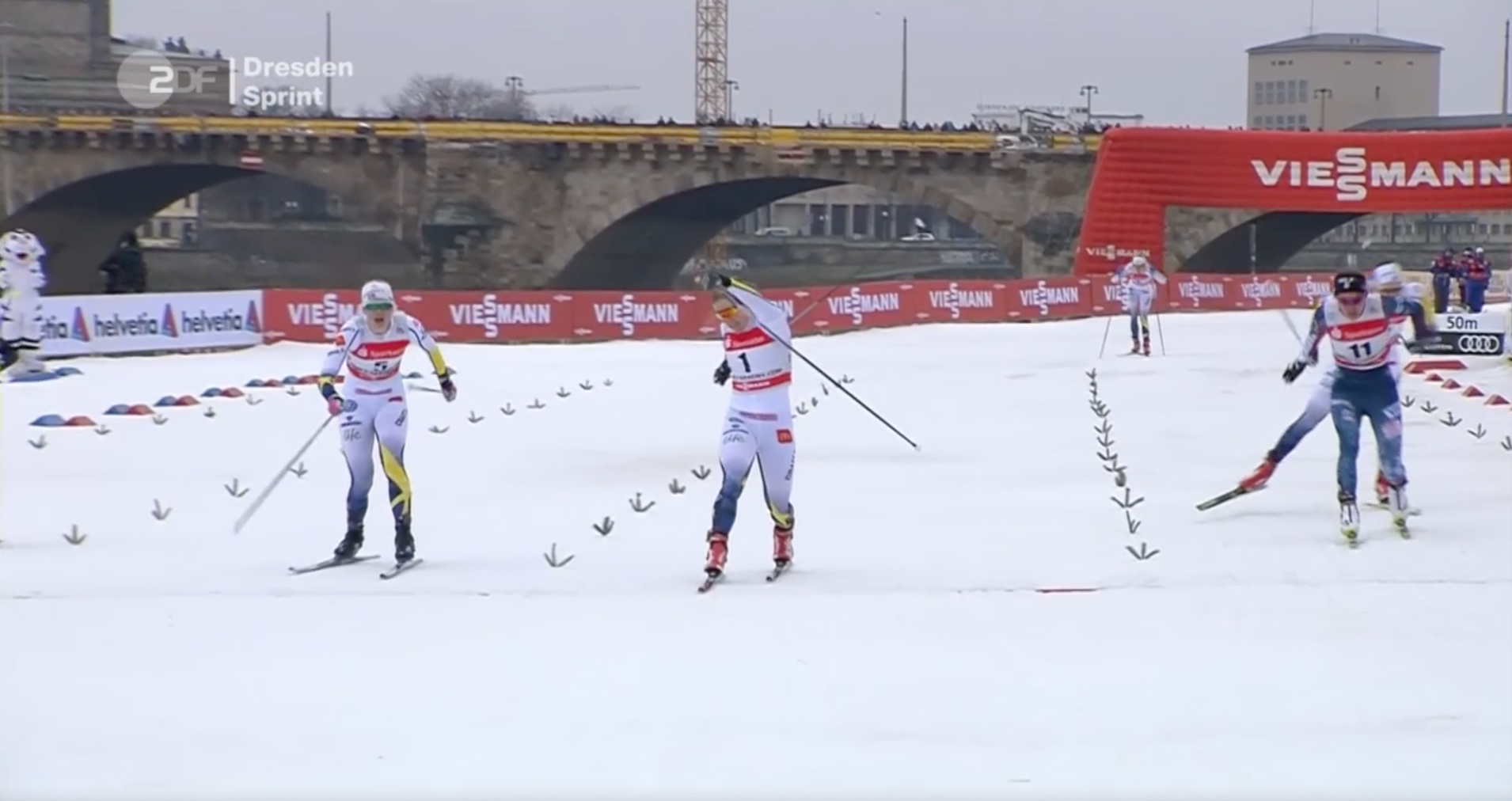
    Sweden’s Hanna Falk (1) edges her teammate Maja Dahlqvist (l) and American Sophie Caldwell (r) in the women’s 1.2 k freestyle sprint final on Saturday at the World Cup in Dresden, Germany. (Screenshot: ZDF broadcast)

    As the meters ticked down to the finish, Caldwell finally was able inch towards the lead.

    “Where she ended up making that move, under the bridge, was a targeted strategy of hers,” Grover said.

    Coming into the finish, everyone except Nilsson was still in it, and the five women all crossed the line within 0.68 seconds of one another. Falk, though, managed to stay clear of the pack and take her first win since 2010.

    “I think I was a little unfocused in the start in the semifinal, so in the final I really tried to focus on the start,” she said in a finish-line interview with FIS’s Jeff Ellis. “Then I took the front, and it was just to push hard… I really like this kind of city sprint. It was a good day for me. I have all my family and fans from Ulricehamn here cheering for me here, so it was a good day.”

    Dahlqvist claimed second (0.23), van der Graaf fourth (+0.58), and Dyvik fifth.

    Sophie Caldwell’s last podium came just two weeks ago, where she finished second in the 1.5 k sprint in Lenzerheide, Switzerland. (Photo: Fischer/NordicFocus)

    While pursuing a completely different strategy from Falk in the final, Caldwell proved that there are many ways to the right position, as long as you play your cards right.

    “I am really psyched to be here,” Caldwell said. “ I’ve never had great results in Period 1 in the past, so I was really happy to have made the semifinals in all three of the sprints. I considered it a really strong start, but I was left wanting more.”

    She is following up a second-place finish in the skate sprint in Lenzerheide, Switzerland, which kicked off the Tour de Ski. But Caldwell fell ill partway through the Tour, and didn’t start the (later-canceled) classic sprint in Oberstdorf, Germany.

    “I woke up sick the morning of the sprint in Oberstdorf, so I was sick for a week,” she explained. “I am actually still clearing things out, but energy-wise I felt good the past few days. Today was going kind of be a test to see how I felt, and I guess I was well rested. It felt good.”

    She is now third in the Sprint Cup behind Nilsson and Norway’s Maiken Caspersen Falla, who did not race in Dresden.

    Sweden’s Stina Nilsson (2) winning the second semifinal just ahead of her teammates Hanna Falk (1) and Maja Dahlqvist (not shown) and American Sophie Caldwell (not shown). Dahlqvist placed second, Caldwell third and Falk fourth in that heat. (Photo: Fischer/NordicFocus)

    City sprints aren’t so unusual; they have been held in Drammen, Norway, for many years straight, with other venues like Stockholm, Dusseldorf, Milan, and Quebec City coming and going from the schedule.

    But even for a city sprint, this course was particularly flat, short, and fast, which played to some athletes’ strengths and left others just trying to do their best to get by.

    “It was a really funny course a lot different than anything we have ever done — by far the shortest I have ever done and flattest,” Caldwell said.

    Her American teammate Ida Sargent qualified in 14th position, a new experience on such a course.

    “It’s a weird course,” she said. “It’s fast and flat. Not at all my favorite kind of sprint race. I just went into it looking at it as a challenge and an opportunity to improve on some of the things that are not really my strengths. So I’m pretty psyched with the qualifier to be right up there, on a course where I feel like a year or two ago I definitely wouldn’t have qualified on. That was exciting.”

    Like Caldwell, Sargent led out her quarterfinal heat. And like Caldwell, she got swept up at the end of it, with her competitors using a small uphill and a subsequent downhill to shoot into the finishing straights. She couldn’t hang on to the top two and finished fourth in the heat, 0.43 seconds behind Sweden’s Ida Ingemarsdotter.

    That put her 17th on the day.

    “Coming into the finish, it was pretty fast and I wasn’t quite ready for that,” she said. “I should have switched to V2 sooner, and I felt like it was all over the place. So I’m kind of kicking myself.”

    “Ida had a great start, took control, skiing how she wanted to ski, just ran out of gas at the end,” Grover said. “And I think it was a course where there’s no rest, it’s continuous effort – if V2’ing hard, V2 alternate-ing hard, if that isn’t your deal, then you could run out of gas at the end.”

    Both Sargent and Caldwell thought it was important to start well on this course, even though in the semifinal and final Caldwell managed to succeed without ever leading.

    “It’s really narrow and hard to pass,” Caldwell said. “It was pretty easy to sense when people were coming up, so I think people were guarding their space. That made it even harder to pass. When I was leading my quarterfinal I got to do some of that, and then when I wasn’t leading it was frustrating sometimes — you would see people bouncing around out there trying to make moves.”

    “There’s room to move up, but it’s definitely big decisive moves,” Sargent agreed. “I just got out fast [in the quarterfinal] and tried to stay in my rhythm at the beginning. I could feel the others coming up and I would just try to increase the pace whenever I could feel someone coming up so I could keep control.”

    Kikkan Randall (U.S. Ski Team) racing to 34th in the 1.2 k freestyle sprint qualifier on Saturday at the World Cup in Dresden, Germany. (Photo: Fischer/NordicFocus)

    Also starting for the U.S., Kikkan Randall narrowly missed qualifying for the quarterfinals in 34th, 6.57 seconds behind Falk’s time and 0.6 seconds behind 30th-place Giulia Stuerz of Italy.

    Randall, Caldwell, and Sargent are now looking forward to the Olympic Games, which begin in less than a month. Sargent sealed her qualification with that 17th-place finish, as she is now ranked 13th in the Sprint Cup, well within the top-50 designation required by the U.S. Ski Team.

    “I am looking forward to the Olympics,” Caldwell said in a post-race press conference. “It has been a strong year for me, and especially for my whole team. We are going to compete as a team to win the first medal for the U.S. women in Olympics, and I am proud to be on the team.”

    Julia Kern (U.S. Ski Team/Stratton Mountain School) racing to 38th in the women’s 1.2 k freestyle sprint qualifier at the World Cup in Dresden, Germany. (Photo: Fischer/NordicFocus)

    Julia Kern finished 38th (+7.78) and Caitlin Patterson 40th (+8.56).

    “We had an uncharacteristically poor qualification,” Grover said. “I have a feeling it was a combination of things… Just over two minutes for women and men a minute fifty, I think that might have been a little bit of a shock to the system. I couldn’t tell if our group was a little flat, or [this race is] just so uncharacteristic, something that we don’t really prepare for because it’s that much more on the anaerobic side instead of a mix of aerobic and anaerobic like we’re used to for a sprint.

    “Anyway, to have Erik Bjornsen just miss the qualification, to have Kikkan just miss the qualification, to have the four athletes who did go in not have the best qualifications, something was a little bit missing,” he concluded.

    In Sunday’s team sprint, Sargent and Caldwell will team up, with Randall and Patterson forming the second U.S. team in a field of 20 entries.

    No Canadian women competed in Dresden.

    Results: Women’s qualifier | Women’s heats

    — Gabby Naranja and Ian Tovell contributed

    Caitlin Patterson (Craftsbury Green Racing Project) racing to 40th in the women’s freestyle sprint qualifier at the World Cup in Dresden, Germany. (Photo: Fischer/NordicFocus)
  • Hanneman Bros. Headline National Skate Sprint: Logan Wins Qualifier, Reese Wins Final

    Hanneman Bros. Headline National Skate Sprint: Logan Wins Qualifier, Reese Wins Final

    Reese Hanneman (c) of Alaska Pacific University celebrates his win in the men’s freestyle sprint final on Friday at 2018 U.S. Cross Country Championships. He finished 0.08 seconds ahead of Kevin Bolger (r) of the Sun Valley Ski Education Foundation for the win at Kincaid Park in Anchorage, Alaska. (Photo: Michael Dinneen Photography)

    ANCHORAGE, Alaska — Friday was a good day for Team Hanneman and its friends. Younger brother Logan Hanneman won the qualifier, older brother Reese Hanneman won the final, and Alaska Pacific University (APU) put three skiers in the final and two on the podium in the men’s freestyle sprint on a bluebird day at Kincaid Park on Day 2 of racing at the 2018 U.S. Cross Country Championships.

    A long day of sprint racing got underway with the men’s qualifier at 10 a.m., precisely 10 minutes before the official sunrise. But it was already brighter then than at any point during the day on Wednesday, when a sodden snowfall blotted out most of the daylight and APU skier Rosie Frankowski openly mused about wearing a headlamp during her warmup.

    Friday, by contrast, brought light fog in the morning, burning off to reveal full sunshine during the heart of the day and bring actual warmth to the hundreds of fans lining the sprint course around Kincaid Stadium and up and down the Gong Hill. Temperatures had reached as low as 14 degrees Fahrenheit during the night before, and were never much above 19 degrees during the day Friday. The course of mostly manmade snow, with a mixture of natural snow from the roughly three inches that fell on Wednesday, was firm and fast. There was no wind. In stark contrast to the slush racers experienced on Wednesday, conditions were essentially perfect.

    Logan Hanneman Fastest in Qualifying

    Dakota Blackhorse-von Jess (Bend Endurance Academy) led out the field of 191 men with bib No. 1 for the qualifier. Less than an hour later, APU skier Logan Hanneman had proven fastest in the individual time-trial portion of the day.

    The Hanneman brothers after Friday’s skate sprint at 2018 U.S. Cross Country Championships in Anchorage, where they live and train with Alaska Pacific University. Reese Hanneman (l) won the men’s final and younger brother Logan (r) won the men’s qualifier.

    Logan’s time on the 1.6-kilometer course was 3:07.40. The 24 year old was followed, on the imaginary but meaningful “qualifier podium,” by Kevin Bolger, of the Sun Valley Ski Education Foundation (SVSEF) in second, 0.48 seconds back, and Reese Hanneman in third, 1.13 seconds behind.

    The rest of the qualifying top 10 were Nick Michaud (Bridger Ski Foundation) in fourth, Martin Bergström (University of Utah) in fifth, Dag Frode Trollebø of the University of Denver (DU) in sixth, Cole Morgan (SVSEF) in seventh, Tyler Kornfield (APU) in eighth, Eivind Romberg Kvaale (DU) in ninth, and Gus Schumacher (Alaska Winter Stars), Wednesday’s top junior in the distance race, in 10th.

    Brian Gregg, representing Central Cross Country (CXC), Loppet Nordic Racing (LNR) and Team Gregg, took the coveted 30th and final qualifying spot, 8.82 seconds back from Logan. Nicholas Sweeney (DU) was another second-plus back in 31st.

    This laundry list of results is of more than academic interest if you are a male sprinter trying to make the U.S. Olympic team for next month’s Olympic Winter Games in PyeongChang. As FasterSkier recently explained, the points list for Olympic selection “will only consider qualification-round finish placing,” and not an athlete’s final position based on racing in the heats. Notably, while both Logan Hanneman (fifth in his semifinal) and the day’s fastest female qualifier, Anne Hart (third in her semifinal), did well, neither of them made their respective final.

    APU’s Logan Hanneman (l) leading the University of Vermont’s Bill Harmeyer in the men’s 1.6-kilometer freestyle sprint quarterfinals on Friday at the 2018 U.S. Cross Country Championships in Anchorage, Alaska. After winning the qualifier, Hanneman was eliminated in the semifinals.

    If there was one person who had seen Logan Hanneman’s speedy qualifying time coming, it was his older brother.

    “He’s one of the best qualifiers,” Reese, 28, said of Logan before this season began. This was true on Friday even though Logan was racing with a dislocated rib, according to Kornfield.

    “So the fact that he won the qualifier is unbelievable,” Kornfield said after.

    The added significance of the qualifier result for U.S. Olympic selection purposes, coupled with the desire to still have enough energy left to ski well through three rounds of heats, was on the radar of all three eventual podium finishers.

    “I would say all the top sprinting guys, everyone’s focusing kind of on the qualifier, more so than normal,”  Reese said on Friday. “There’s no margin for error, and you just have to ski it absolutely as fast as possible. It’s definitely different tactics than in the heats… but if you’re fast, you’re fast.”

    According to Bolger, who finished second in both qualifying and the final, the significance of the qualifier “absolutely” affected his approach to the day overall.

    “Definitely wanted to go into the qualifier and have a strong result,” Bolger said. “I was happy with being second, just barely behind Logan, which I was bummed about but also super happy – there’s a lot weighing on it. So to be able to have a good qualifier, and then still be able to, I think, ski strong throughout the heats, and then into the final – I think that says just as much. So overall I’m really happy.”

    “All the pressure was on the qualifier,” echoed Kornfield, who finished third in the final after qualifying in eighth. “I’m normally not very good at qualifying, so the chance of me making that [No. 1 qualifying] spot would have been a moonshot, but I was happy with how I qualified. I know that if I qualify well, then my heats go well, so I was just, after qualifying well, trying to get back and focus on the heats.”

    Reese Takes First Throughout Heats

    Of the three podium finishers, Reese and Bolger had the smoother paths throughout the day. Reese was first in his quarterfinal and first in his semifinal to automatically advance to the final, winning each heat by less than 0.2 seconds. Similarly, Bolger won his quarterfinal, then was second to Reese in a fast semifinal, 0.17 seconds back.

    Left to right: Eivind Romberg Kvaale (University of Denver), Nick Michaud (Bridger Ski Foundation), Reese Hanneman (APU), Kevin Bolger (SVSEF) and Tyler Kornfield (APU) during their men’s 1.6 k freestyle sprint semifinal on Friday at the 2018 U.S. Cross Country Championships in Anchorage, Alaska.

    Kornfield skied fast enough in his semifinal to earn a lucky loser bid for the final in fourth, after finishing second behind Reese in his quarterfinal. The top-four men in that second semifinal all finished within less than a second of Reese as the winner, and both lucky losers — Kvaale in third and Kornfield — came from that heat.

    Throughout the rounds, Reese skied fairly close to the front throughout the day. In his quarterfinal, the men’s fifth of the day, he was one of three skiers near the lead as the pack took a righthand turn heading up and out of the stadium. He was second coming off the course’s largest downhill back into the stadium, then turned on Beast Mode, approaching the final straightaway to pull into the lead and take the win in 3:10.62. Kornfield was second, 0.19 seconds back.

    In the semifinal, similarly, Reese skied in the top three throughout the race, ultimately leading the four-man group sprint to the line for first.

    Reese Hanneman Holds Off Bolger 

    Nearly four hours into the day, six men lined up for the final, now under bright sunshine. From skier’s right to left, it was Eric Packer (APU), Zak Ketterson (Northern Michigan University), Bolger, Reese, Kvaale, and Kornfield lined up across the south end of the capacious Kincaid Stadium.

    That’s three APU skiers with national titles to their name, last year’s classic sprint national champion in Bolger, one skier whose previous best at U.S. nationals was 15th (Kvaale), and a 20 year old whom the livestream announcers called a “surprise finalist” (Ketterson).

    The field had a clean start off the line, and into the slight-downhill straightaway through the Kincaid Stadium. After approximately 200 meters, the racers took a righthand turn up to the base of a gradual, all-V2, two-stage uphill. At this point it was Ketterson in the lead, with Kvaale and Reese tucked in immediately behind him, and the other three athletes following no more than a ski length further back.

    By the top of this climb, it was still Ketterson in front, with Reese following and Packer up into third position.

    Roughly one minute later, it was Ketterson in front coming down the waterfall downhill back into the stadium at high speeds. There was a gap of five meters back to Kornfield and Reese, who jostled slightly on the descent but did not fall, and Bolger and Packer immediately behind them. Ketterson was technically still in front, but five meters’ separation at those speeds meant little, and the lead pack was effectively still five athletes strong.

    By the time the racers had negotiated a broad 180-degree turn and climbed back up into the stadium, Hanneman was in the lead coming around the final curve. Bolger was second, with Ketterson and Kornfield just off to his left.

    Reese Hanneman (c) takes first, roughly half a ski length ahead of Kevin Bolger (r), with Tyler Kornfield (l) third. Zak Ketterson (second from l) and Eric Packer (third from l) are immediately behind Kornfield, with Eivind Romberg Kvaale farther back. (Screenshot: U.S. Ski & Snowboard live stream)

    Hanneman came into the final straightaway with a slight lead, and took the middle lane. He skied smoothly through the finish, but Bolger was coming on strong to his left in the outer lane.

    Reese kept his slight lead all the way to the finish. Bolger lunged better, but Reese skied faster. Bolger’s lunge got him to within less than half a ski-length of Reese by the finish, but Reese took the victory.

    To Reese’s right, Kornfield led Ketterson and Packer in the next lane to the inside. Kvaale skied in leisurely at the back after suffering an untimely broken pole.

    Reese’s winning time was 3:11.33 for the 1.6 k course. Bolger was 0.08 seconds back, with Kornfield another 0.8 seconds behind him for third. There was a gap of over a second to Ketterson and Packer, then another 12 seconds back to Kvaale.

    Reese aimed to continue his frontrunning ways in the final, he explained to FasterSkier in a post-race interview.

    “Everyone’s fighting for the front half because you know that’s kind of where you’ve got to be,” he said. “Everyone’s too fast; you know you’re not going to come from sixth. So I just fought really hard to stay kind of in the front half, throw down the move on the last hill coming into the finish, and it paid off.”

    The men’s freestyle sprint podium at 2018 U.S. Cross Country Championships, with Reese Hanneman (c) in first, Kevin Bolger (l) in second and Tyler Kornfield (r) in third on Friday in Anchorage, Alaska.The men’s freestyle sprint podium at 2018 U.S. Cross Country Championships, with Reese Hanneman (c) in first, Kevin Bolger (l) in second and Tyler Kornfield (r) in third on Friday in Anchorage, Alaska.

    Reese said he was thrilled by a day in which he won the national title — his third — and Logan won the qualifier.

    “He’s one of the best in the country,” Reese said of Logan, “and he and I have been going back and forth in the sprints for a while now. He’s the defending champion in this event from last season, so I knew he was a factor. He’s a powerful skier, and it’s awesome to see him do well. I think we’re both better because we’ve been fighting with each other for years.”

    Bolger explained he approached the final differently than his other heats.

    “Honestly, I just tried to stay relaxed,” the 24-year-old Wisconsin native said. “I tried to kind of keep an open mind and not put too much into it, overthink it. … I wanted to ski kind of my own race and let things unfold in front of me, and then take chances where I could.”

    In practice, this put Bolger in fourth coming off the big downhill back into the stadium. But he trusted his skis, and his finishing skills, and was able to move back into second within just a few hundred meters.

    “I kind of got, not pushed to the back a little bit, but kind of toward the back,” he recounted. “But coming toward those last few corners I was right in there. And I was confident in my skiing and I knew I was strong, I felt strong, so I was kind of able to push those corners hard.”

    Kornfield, similarly, said, “This is a hard course, so you just had to keep pushing to the finish.”

    “The way the course starts, it doesn’t start too hard, it’s pretty flat for the first part. And the uphill is so big that – for some reason you can’t break away on that,” Kornfield added of Kincaid’s brand-new sprint course. “You couldn’t gain that much time; I think people were just conserving until that last 200 meters. It always bunched up with about 200 meters to go, and it was only about who had the best kick and who got lucky with the hole shot. If you tried to get yourself in good position by the final, you would have a good go at the finish.”

    Reflecting on the vagaries of sprint racing, he noted, “This is an incredibly fair course. It’s incredibly wide, and it was a lot of fun, but we don’t race those kind of back-and-forth heats that often. So I was just pretty relieved to make the podium, because anything could have happened. You could have snapped a pole easily, you could have fallen. It was kind of a relief just to make it to the final in the first place, and then to make it on the podium was unbelievable.”

    Kornfield, 26, who was born and raised in Anchorage and has raced at Kincaid Park dozens of times, summoned the same adjective when asked if he had ever seen a crowd like this at Kincaid for a ski race before.

    “This is unbelievable,” Kornfield said. “I remember back [at U.S. nationals at Kincaid] in 2010, and I felt like it was just a wave of noise coming in. This is even more. It’s incredible that people were here and out here. I’m so excited that Reese and I could make the podium and make ’em proud.”

    (A sportswriter for the local Anchorage Daily News with 30 years’ experience called it “One of the biggest spectator crowds ever to gather at Kincaid Park.”)

    Kornfield likely has fond memories of 2010 for many reasons; he won his first national title then. Friday’s third-place finish marked his seventh time on a U.S. nationals podium, including two national titles. Reese, similarly, took home his third national title (after the 2014 classic sprint at Soldier Hollow in Utah and 2016 skate sprint in Houghton, Michigan), and recorded his eighth national podium. And Bolger notched his second-career podium finish at U.S. nationals, after winning the classic sprint at Soldier Hollow last year.

    New Sprint Course Meets with Rave Reviews

    As FasterSkier recently explained, Friday marked the debut of the new sprint course at Kincaid. And the athletes approved.

    “It was a great course,” Reese said. “Really hard – I would say probably the hardest sprint course we’ve had at nationals in a while. It rivals Fairbanks last year. But there’s a big hill, something you would see on a World Cup, or [World] Championships, so that made it hard. Super-fast downhills. … I think it’s one of the best courses we’ve had in a while. There’s some gradual terrain, there’s a hill, an A-climb, one of the biggest climbs I’ve seen on a sprint course in the U.S., probably ever. I think it’s a great course. It’s fair, everybody likes it, it’s fun. But it skis really well, it’s fast. You can’t get too much better than that.”

    “It’s a good course,” concurred Bolger. “It’s really fun. Good hills, good downhills, good cornering. I think it kind of gets at, you’ve kind of got to be a good all-around skier to kind of be able to go from the qualifier to the final.”

    “This is an incredibly fair course, it’s incredibly wide, and it was a lot of fun,” said Kornfield.

    Athletes will get another shot at it on the final race day of U.S. nationals, the classic sprint on Monday. Classic distance races (20/30 k mass starts) are the next races up, starting at 10 a.m. Sunday morning.

    Results: Final | Heats | Qualifier

    –Gabby Naranja contributed

    Reese Hanneman video interview

    Highlights video by Max Romey Productions

  • Pellegrino is Back; Iversen Frustrated After Photo Finish in Falun Sprint; Valjas 10th

    Pellegrino is Back; Iversen Frustrated After Photo Finish in Falun Sprint; Valjas 10th

    Italy's Federico Pellegrino (r) edging Norway's Emil Iversen in Saturday's freestyle sprint final at the World Cup in Falun, Sweden. (Photo: Fischer/NordicFocus)
    Italy’s Federico Pellegrino (2) edging Norway’s Emil Iversen (9) by 0.06 seconds for the win, with Norway’s Sindre Bjørnestad Skar (l) following in third and Sweden’s Oskar Svensson (5) in fourth, in the men’s freestyle sprint final on Saturday at the World Cup in Falun, Sweden. (Photo: Fischer/NordicFocus)

    It didn’t seem likely until the last second – but last season’s star sprinter has once again arrived on the World Cup circuit.

    Italy’s Federico Pellegrino collected his ninth individual win on Saturday in Falun, Sweden, nipping Norway’s Emil Iversen by six-hundredths of a second in a photo finish in the freestyle sprint. The winner of last year’s Sprint World Cup, Pellegrino didn’t make his first sprint final of the season until after Christmas.

    However, since then, he has been second (in Val Müstair, Switzerland), fourth (in Toblach, Italy), and now, finally, first.

    “This season is not so easy right now for me,” he told the International Ski Federation (FIS) in a finish-line interview. “Now I think [the way it is going] is the right way, going toward the World Championships.”

    Pellegrino had the second-fastest qualifying time around the 1.4-kilometer course in the morning. Then, he won his quarterfinal with a blazing display of speed at the finish to best Norway’s Finn Hågen Krogh. In the semifinal, Pellegrino pulled a similar move to win the heat by 0.21 seconds over Sweden’s Teodor Peterson.

    In the final, coming into the last few hundred meters it looked like Pellegrino was too far off the pace to make it to the front. The rest of the men – all Swedes and Norwegians – jostled for the lead constantly. As the field shot down a long hill into the stadium, though, Pellegrino made his way to the front; he said he had amazing skis. He followed Iversen over the last bump of an uphill and down a corner to the finish. The pair’s paced outstripped anything the others could keep up with.

    “In the final I showed up still fresh, but with a long downhill before the finish I couldn’t pull, and when you’re behind you risk losing [moves],” he told the Italian Winter Sports Federation, according to a translation. “In fact, I found myself in fifth place and I thought I would not make it. But on the last hill before the finish I took a wide path and I went for it, giving everything I had in the body. Then I made it a photo finish.”

    Iversen had thought he had the win in the bag. He seemed incredulous that Pellegrino could catch up with him in the final meters – and the Italian timed his finishing lunge better, eventually edging Iversen by just six hundredths of a second.

    Iversen slapped his poles in the snow in frustration after finishing, breaking one, and lay unsmiling while the two waited for the results of the photo finish. He remained restrained during the post-race photo opportunities.

    “I thought I had the win today,” Iversen told FIS. “I didn’t know who was coming but I could feel the shadow. I was very disappointed in the finish but in the end I have to be happy with second place.”

    “I’ve been pretty mad at my little brothers, but I don’t think I’ve been this angry in years,” Iversen elaborated to NRK.

    Another photo finish gave Sindre Bjørnestad Skar of Norway third place (+0.47), by three hundredths of a second over Falun’s own Oskar Svensson. Johannes Høsflot Klæbo – the fastest qualifier on the day – finished fifth (+1.32), and Peterson placed sixth (+2.08).

    The men's freestyle sprint podium on Saturday at the World Cup in Falun, Sweden, with Italian winner Federico Pellegrino (c), and Norway's Emil Iversen (r) in second and Sindre Bjørnestad Skar (l) in third. (Photo: Fischer/NordicFocus)
    The men’s freestyle sprint podium on Saturday at the World Cup in Falun, Sweden, with Italian winner Federico Pellegrino (c), and Norway’s Emil Iversen (r) in second and Sindre Bjørnestad Skar (l) in third. (Photo: Fischer/NordicFocus)

    “It’s really tough to make it on World Cup as a Norwegian and so every time I can make a podium result it is important,” Skar told FIS, referring to simply earning start rights.

    Indeed: Pål Golberg, who before this weekend led the Sprint Cup, did not even get the chance to start Saturday’s race. The Norwegian team deemed him too slow. Other skiers also found this amazing. Alex Harvey told Norwegian media that the Canadian team would be happy to take Golberg and give him a starting spot.

    “They seem sure, like me, that it’s comical,” Golberg told Norwegian broadcaster NRK. “I’ve certainly gotten lots of messages from people who think it’s strange, so I’m glad that other people share that view.”

    He now worries that he might not have a chance to start the sprint at World Championships. Five of the top seven men in the Sprint Cup standings are Norwegian: Skar in second, Iversen in fourth, Krogh in fifth, Golberg in sixth, and Klæbo in seventh.

    There’s no such problem for Italy, a team which is thrilled that its star is back in top form. Pellegrino now has the most podiums in skate sprints of any Italian man ever, with 13.

    World Championships is the only thing on his mind.

    “At this time the [Sprint Cup] ranking does not interest me,” he said in the federation press release. “I’ll skip the next stage in Korea, and then will race in Otepaa [Estonia, the last World Cup before World Championships.”

    Valjas 10th After Blistering Quarterfinal Finish

    Len Valjas (Canadian World Cup Team) racing in Saturday's freestyle sprint at the World Cup in Falun, Sweden, where he ended up 10th on the day. (Photo: Fischer/NordicFocus)
    Len Valjas (Canadian World Cup Team) racing in Saturday’s freestyle sprint at the World Cup in Falun, Sweden, where he ended up 10th on the day. (Photo: Fischer/NordicFocus)

    Only two Canadians started the sprint. Alex Harvey missed qualifying in 46th, but teammate Len Valjas not only made the quarterfinals, but shone there.

    Valjas was skiing near the back of his heat, only to find his way to the front at the last possible moment, much like Pellegrino. While Klæbo had seemed to have the quarterfinal locked up with only a possible challenge from Andrew Young of Great Britain remaining in the finishing stretch, Young and Valjas came down the last downhill with more momentum and some speed in their legs. Eventually all three crossed the line together in a photo finish, from which Valjas emerged second.

    In his semifinal heat, Valjas also hung near the back of the pack. But the whole heat finished within about a second, and he wasn’t able to fight his way through the crowd. Valjas landed fifth, this time 0.99 seconds behind heat winner Klæbo.

    “I definitely felt like I had a little more,” Valjas said in a Cross Country Canada press release. “I was able to close in the finish, but I just lost a little too much contact with the pack. I had the speed at the finish and felt great. I was really comfortable staying at the back. I thought I could bring it back on the second hill, but I just stayed a little too far back.  I needed to work on my tactics a bit better.”

    He finished 10th overall, his best individual result in a year since he finished 10th in a classic sprint in Oberstdorf, Germany, as part of last year’s Tour de Ski.

    “I had great skis and I know the fitness is there,” Valjas said in the press release. “Being in the fifth heat in the quarters, I likely could have used about five more minutes of rest time before the next heat, but I can’t complain and have to be happy with a top 10.”

    Hamilton, Newell in the Quarters

    Simi Hamilton (U.S. Ski Team) racing to 13th in the men's qualifier of the 1.4 k freestyle sprint on Saturday at the World Cup in Falun, Sweden. He went on to place 18th on the day. (Photo: Fischer/NordicFocus)
    Simi Hamilton (U.S. Ski Team) racing to 13th in the men’s qualifier of the 1.4 k freestyle sprint on Saturday at the World Cup in Falun, Sweden. He went on to place 18th on the day. (Photo: Fischer/NordicFocus)

    For the U.S., Simi Hamilton qualified 13th and Andy Newell 25th. Both were at the front of their quarterfinal heats at some point, before fading at the finish.

    For Hamilton, things more or less immediately deviated from plan.

    “I actually lost my basket on my right pole coming out of the start,” Hamilton said. “The pole holes were pretty gnarly at the start since people are double poling so hard, and I think my basket got stuck in on of the previous pole plant holes… [the snow] was actually firm enough that I could still pole pretty well, but I knew that the rest of the course got a little bit softer. So Andrew Morehouse, who is one of our techs, made a great hand-off and I got a new pole at the first corner. That’s probably only 20-25 seconds in the race at the point, but I was definitely off that back a little bit.”

    Hamilton did manage to catch back up to the group. And then on the last uphill before the descent to the stadium, the skiers in the left lane got a bit jammed up. Being in the right lane, Hamilton was able to ski freely – but then found himself leading the heat, exactly what he didn’t want to do.

    As Pellegrino had said, leading down the hill into the stadium means that most likely, the competition would sail past you thanks to the draft effect.

    “You know, a lot of the race was going to come down to that final little bump that is in the stadium,” Hamilton said. “So I knew if I came into that with some really good momentum and hopefully get a slingshot off of someone in front of me, that I would be able to crush that bump and make a move into the finish lanes and then have a open lane for the finish… that was what I was really hoping for, it didn’t totally play out like that.”

    Instead, a few competitors slingshot past Hamilton.

    “I kind of found myself tangling with a lot of dudes going over that bump and through that corner,” he explained. “I just didn’t really ski the last 200 meters the way I would have really liked to, with a lot of energy power and speed. So found myself fighting in the pack going into the finishing stretch. I just focused on just skiing a good finish, and unfortunately wasn’t quite enough.”

    He landed fourth in his heat (+0.87), and not close enough to get a lucky loser spot. He finished 18th on the day.

    Andy Newell (U.S. Ski Team) racing to 25th in the men's qualifier of the World Cup freestyle sprint in Falun, Sweden. He ended up 16th on the day.(Photo: Fischer/NordicFocus)
    Andy Newell (U.S. Ski Team) racing to 25th in the men’s qualifier of the World Cup freestyle sprint in Falun, Sweden. He ended up 16th on the day.(Photo: Fischer/NordicFocus)

    “It’s a frustrating day, but I felt good in my qualifier, and it’s hard course and I know my fitness is really good right now,” Hamilton said. “It was just kind of one of those days that happens out there, not a lot of things really connecting in terms of luck and positioning and equipment. But still a decent day so I am okay with it.”

    Newell also found himself outgunned in the final meters, finishing third in his heat and 16th on the day.

    Also for the U.S., Erik Bjornsen finished 43rd (+9.30) and Matt Gelso 59th (+13.12) in the qualifier.

    Results

  • Photos from U.S. Nationals: The Skate Sprint

    Photos from U.S. Nationals: The Skate Sprint

    HOUGHTON, Mich. — Day 2 of the U.S. Cross Country Championships took place Monday with the 1.5-kilometer freestyle sprint on the Michigan Tech Trails. Past national sprint champs Jennie Bender and Reese Hanneman racked up another title each after dominating all day, from the qualifier to the finals.

    Racing resumes Thursday with the 20/30 k freestyle mass starts and ends Saturday with the classic sprint.

  • Hanneman Rides Confidence and Finishing Punch for U.S. Nationals Skate Sprint Title

    Hanneman Rides Confidence and Finishing Punch for U.S. Nationals Skate Sprint Title

    APU’s Reese Hanneman (Bib No. 101) leads Bend Endurance Academy’s Dakota Blackhorse-von Jess (Bib No. 104) as well as (back: left to right) Miles Havlick (SVSEF),  Evan Palmer-Charrette (NDC Thunder Bay), Fredrick Schwencke (NMU), and Julien Locke (Team Black Jack) during the final of the men’s 1.5 k freestyle sprint on Monday at U.S. nationals in Houghton, Mich.
    APU’s Reese Hanneman (Bib No. 101) leads Bend Endurance Academy’s Dakota Blackhorse-von Jess (Bib No. 104) as well as (back: left to right) Miles Havlick (SVSEF), Evan Palmer-Charrette (NDC Thunder Bay), Fredrick Schwencke (NMU), and Julien Locke (Team Black Jack) during the final of the men’s 1.5 k freestyle sprint on Monday at U.S. nationals in Houghton, Mich.

    HOUGHTON, Mich. — With close to a 500-meter incline to the finish, rounding the same course potentially four times in head-t0-head heats and a qualifier, Monday’s 1.5-kilometer freestyle sprint at U.S. Cross Country Championships proved a test beyond sheer fitness and tact. For overall race winner, Reese Hanneman of Alaska Pacific University (APU), it was combination staying smart, smooth and relaxed.

    “I was just trying to stay relaxed [through the heats],” said Hanneman, a 2014 classic sprint national champion, after notching his second sprint title on Monday. “I know that I’m in great sprint form right now. I have the acceleration, I have the power and I was just trying not to use that unnecessarily early. This finish is very long and very uphill so it takes a big punch in order to make it to the line first.”

    The fastest qualifier in a time of 3:18.07, the 26-year-old Hanneman held his own in first all the way through the men’s final.

    “I could tell all day watching Reese that he was very comfortable,” runner-up and defending skate champion Dakota Blackhorse-von Jess, of the Bend Endurance Academy, said in a post-race phone interview. “He’s skiing really well right now.”

    In his quarterfinal, Hanneman was first out of the start and in the lead as the group headed out onto the 1.5 k course. Rounding the final corner, again it was Hanneman in first, followed by Canada’s Alexis Turgeon (Skinouk/Quebec Ski Team) close to 10 meters behind.

    Hanneman won that heat in 3:18.07, while Michigan Tech’s Didrik Elset, chose the left outside lane to overtake Turgeon, ending up 0.31 seconds behind Hanneman for second in the quarterfinal. 

    Hanneman and Elset met again in the same semifinal, along with Blackhorse-von Jess, Brian Gregg (Team Gregg), Canada’s Michael Somppi (NDC Thunder Bay), and Silas Talbot (Alaska Winter Stars).

    Canadian Julien Locke (l) (Team Black Jack) challenges Eric Packer (APU) at around 400-meters to the finish of the semi-final for the men’s 1.5 k freestyle sprint on Monday at U.S. nationals in Houghton Mich. Locke went on to finish third overall (+2.89). Canadian Evan Palmer-Charrette (Bib No. 128) also advanced to the final and finished sixth overall (+12.93).
    Canadian Julien Locke (l) (Team Black Jack) challenges Eric Packer (APU) at around 400-meters to the finish of the semi-final for the men’s 1.5 k freestyle sprint on Monday at U.S. nationals in Houghton Mich. Locke went on to finish third overall (+2.89). Canadian Evan Palmer-Charrette (Bib No. 128) also advanced to the final and finished sixth overall (+12.93).

    Hanneman and Elset led out of the start gate, with Blackhorse-von Jess and Gregg tucked in close behind them. However, it was Hanneman once more who led the final uphill stretch to the finish, with Blackhorse-von Jess skiing right on his ski tails.

    Gregg managed to close the gap to the front two, and the three lunged for the line with Hanneman finishing first in 3:17.42, 0.21 seconds ahead of Blackhorse-von Jess in second, and 0.33 seconds ahead of Gregg in third.

    As Gregg waited to see if his time would be fast enough for a “lucky loser” spot in the final, the second semifinal, with APU’s Eric Packer and Logan Hanneman, Northern Michigan University’s Fredrik Schwencke, Miles Havlick (Sun Valley Gold Team), and Canadians Julien Locke (Team Black Jack), and Evan Palmer-Charrette (National Development Centre Thunder Bay) stepped up to the line.

    Schwencke and Havlick led from the start with Packer, the two Canadians, and Logan Hanneman (Reese’s younger brother) not far behind.

    Packer cornered into the final stretch in first, but with approximately 150 meters to go, Schwencke made the pass on Packer’s right while Locke moved into the left lane. Palmer-Charrette moved in behind Locke, while Havlick challenged Schwencke on the right.

    In a four-way lunge for the line, Scwencke won the second semifinal win in 3:17.04, while Havlick finished just 0.07 seconds after. The third- and fourth-place efforts by the two Canadians, Locke (+0.14) and Palmer-Charrette (+0.27), proved worthwhile, as they both earned the two available lucky loser spots in the final. 

    Fredrick Schwencke (NMU) leads Miles Havlick (SVSEF) and Haakon Hjelstuen (Lyn Ski) around the final corner before the last 500-meter incline to the finish during their quarterfinal of the men’s 1.5 k freestyle sprint on Monday at U.S. Nationals in Houghton, Mich.
    Fredrick Schwencke (NMU) leads Miles Havlick (SVSEF) and Haakon Hjelstuen (Lyn Ski) around the final corner before the last 500-meter incline to the finish during their quarterfinal of the men’s 1.5 k freestyle sprint on Monday at U.S. Nationals in Houghton, Mich.

    “In both the quarter and semi, I stayed pretty relaxed during the first two thirds of the course and was at the back of the pack,” Palmer-Charrette, 21 said. “After saving my legs off the start, I was able to work my way up after the main climb through the finishing stretch to the front, or close to the front.” 

    The action for Palmer-Charrette and the five other finalists — Hanneman, Blackhorse-von Jess, Locke, Schwencke, and Havlick — continued as they lined up for the men’s final. 

    Hanneman and Havlick took it out from the starting gate, with Havlick moving to the front for the first part of the course.

    “I was leading on the lower part of the course and then I just kind of ran out of steam on the top part,” Havlick recalled. “Obviously these sprint races are some of the toughest days, but I was psyched to be in the final for sure.” 

    After Havlick led the first part of the final, Hanneman made his move during the second large climb on the course.

    “I was in second up the first climb and then there was a little downhill and I tried to work that corner and I was able to slingshot around and get my own lane up the second climb,” Hanneman said.

    From that point on, the past classic-sprint champ and last year’s early season SuperTour leader gained momentum for the finish.

    “The final didn’t really break up until the second main climb, then Reese Hanneman really pushed the pace and opened the field up a bit,” recalled Palmer-Charrette, who placed sixth overall.

    As Hanneman rounded the final corner in first, Blackhorse-von Jess raced into the righthand lane, challenging him for the win.

    “I built a little gap and Dakota was able to get away from the rest of the guys and he bridged up to me,” Hanneman said. “Then we came into the final lanes and I was ahead and he kicked and pulled up next to me and I was able to kick again and put the hammer down in the last 30 meters and get away from him.” 

    Hanneman took the final win in 3:15.14, while Blackhorse-von Jess finished 0.35 seconds behind him.

    “I’m pretty pleased to finish the day on the podium, fighting for the win,” said 29-year-old Blackhorse-von Jess.

    Left to right: Overall winner Reese Hanneman (APU), ahead of Dakota Blackhorse-von Jess (Bend Endurance Academy) and Brian Gregg (Team Gregg/Madshus) during their semi-final of the men’s 1.5 k freestyle sprint on Monday at U.S. Nationals in Houghton, Mich.
    Left to right: Overall winner Reese Hanneman (APU), ahead of Dakota Blackhorse-von Jess (Bend Endurance Academy) and Brian Gregg (Team Gregg/Madshus) during their semi-final of the men’s 1.5 k freestyle sprint on Monday at U.S. Nationals in Houghton, Mich.

    “I don’t think I’ve been in fifth place in a heat in a normal SuperTour or a nationals championship in a long time, and I was in fifth place today at one point and that’s cool,”  added Blackhorse-von Jess, who won both sprints at last year’s nationals. This year, he won the SuperTour classic sprint in Sun Valley, Idaho, in early December.

    “There’s a lot more moving around. There’s a lot more jostling for position. There’s more sprinting going on and it makes racing fun,” he said.

    Finishing 2.89 seconds after Blackhorse-von Jess was Locke in third for his first-ever U.S. nationals podium.

    “Today was fun,” Locke, 22, said. “We have our U23 World Champ trials next week so today was mostly just to see how my shape is and have a good race before that event. I’ll race the sprint on Saturday here and hopefully I can podium again”

    Palmer-Charrette is also looking for a top result at Canada’s U23 World Championship trials Jan. 14-17 at Lappe Nordic in Thunder Bay, Ontario.

    “It was a good day for Evan,” NDC Thunder Bay head coach Timo Puiras wrote in an email. “His shape has been steadily improving all race season and I look forward to seeing how he will race at the World U23 Trials on his home trails in Thunder Bay next week.”

    In his first skate-sprint final, collegiate skier Schwencke raced to fourth overall, 4.27 seconds after Hanneman.

    “I’ve never in my whole career of skiing qualified for a skate sprint so it was pretty fun to be in the final,” Schwencke said.

    “After the qualifier and the quarterfinal, everything was just a bonus,” the 23-year-old Norwegian added. “It was an amazing day.”

    Havlick finished fifth (+6.29) and Palmer-Charrette took sixth (+12.93).

    While it’s no secret that Hanneman will leave this race as the name to beat, he remains elusive about the pre-race sound beats that helped him come into his own.

    “It wasn’t Justin Bieber, we’ll just say that,” said Hanneman with a smile. 

  • Randall, Caldwell Finish in Top 10 in Val Müstair Skate Sprint

    Randall, Caldwell Finish in Top 10 in Val Müstair Skate Sprint

    Sophie Caldwell (USA) shows her cornering skills in Val Mustair (SUI). (photo: Fischer/Nordic Focus)
    Sophie Caldwell (USA) shows her cornering skills in Val Mustair (SUI). (photo: Fischer/Nordic Focus)

    While she may not be back to her winning ways, American Kikkan Randall still put together a solid performance during the women’s Tour de Ski 1.4 k freestyle sprint in Val Müstair, Switzerland.

    “It was fun to return to Val Müstair where I had a great performance two years ago. We didn’t get to compete under the lights this time but it was sunny and beautiful,” she wrote in an email to the press. Randall won that Tour stage, a freestyle sprint on the first day of 2013, over Weng and Norway’s Ingvild Flugstad Østberg.

    Randall took care of business during qualifying, finishing 13th and +8.77 behind Norwegian Marit Bjørgen (3:38.62), who would win the final heat and earn her third straight Tour victory. The 32-year-old then finished third in the final and fastest quarterfinal heat of the day to earn a lucky loser spot, +1.95 behind Norway’s Heidi Weng (3:36.35).

    “[The Norwegians] set a hard pace the whole heat and I did my best to stay in close,” Randall wrote. “I tried to come out of the draft off the final turn but didn’t put together a great final sprint … Thankfully it was good enough for lucky loser.”

    Maiken Caspersen Falla (NOR) and Kikkan Randall (USA), (l-r) during the heats in Val Mustair (SUI). (photo: Fischer/Nordic Focus)
    Maiken Caspersen Falla (NOR) and Kikkan Randall (USA), (l-r) during the heats in Val Mustair (SUI). (photo: Fischer/Nordic Focus)

    In the semifinal, Randall maintained a position in the back of the pack throughout the race, but Østberg set a pace that prevented her from making a decisive move. She finished the heat in fifth, 3.20 behind Østberg (3:35.84), and ended up tenth overall.

    While Randall was disappointed that she did not have the strength to keep up with the Norwegians, she wrote that she was happy to be close to advancing to the final.

    “I still haven’t quite found all my gears yet but it’s good to keep getting in hard efforts and inching my way back to top form,” she explained.

    Meanwhile, American Sophie Caldwell had a fine day of her own. The 24-year-old qualified in seventh (+7.16) before winning her quarterfinal heat. In a moment reminiscent of her semifinal heat in Sochi, when she defeated Østberg in a photo finish by 0.01 seconds, Caldwell narrowly outlunged Italy’s Gaia Vuerich to win by 0.05 in 3:42.25.

    Caldwell explained over the phone that she made the tactical decision to remain behind Norway’s Therese Johaug, who “is not known for her sprint finishes,” and Vuerich, who Caldwell has often competed against in sprint finishes. She made her move on the final stretch, setting up another exciting battle with Vuerich.

    “I think one of my strengths has always been the final stretch in sprinting for as long as I can remember, and I’m not sure why that is; I just find an extra gear there and have a pretty quick sprint finish,” Caldwell said.

    United States Ski Team Head Coach Chris Grover expanded on Caldwell’s race over the phone, saying that during one of the major turns on the first lap she took a less icy, outside line while all the other skiers took an inside line. He said Caldwell’s line was not the ideal one for carrying momentum.

    However, “to her credit, she saw that preferred line during the race and the second time down when she came to the finish she just nailed that [corner], and was able to catapult into a position where she was able to go and win the quarterfinal,” Grover said.

    Grover said Caldwell has the unique ability to preserve and create speed through a transition instead of gripping or locking up and losing speed.

    “She really sets herself up to carry a lot of momentum out of the corners and I think that is really one of her strengths,” he continued.

    Caldwell explained her tactics for the semifinal, saying she wanted to stick with the leaders for as long as possible. She stayed true to her tactics and spent most of her semifinal behind the leaders, though failed to challenge Bjørgen or Sweden’s Stina Nilsson down the stretch – “they opened up a bit of a gap on me on the uphill,” Caldwell said. She finished in third, 1.24 seconds behind Bjørgen (3:39.04).

    Unfortunately, the fast pace of the second semifinal prevented Caldwell from moving on as a lucky loser. She finished seventh overall, which is her best World Cup result of the season. Especially after a summer during which she broke both of her elbows, she is happy about where she is.

    “I’ve been really psyched about how things have been going lately. I feel like I’ve been taking a big step each weekend, and doing a little better and a little better in sprints, and I think physically I’m getting stronger,” she explained.

    American Sadie Bjornsen is in ninth place on the Tour after finishing 13th overall on Tuesday. She had a strong qualifier, finishing in 12th (+8.64), before being outsprinted for the second-place spot by Norwegian Ragnhild Haga at the finish of her quarterfinal heat. She finished 3.44 seconds behind Østberg, who comfortably won the heat in 3:39.58.

    Grover said it was a great qualification for Bjornsen, especially after the frustrations of the last sprints in Davos, where she failed to qualify in two consecutive weekends.

    Meanwhile, American Jessica Diggins qualified in 26th and ended up 23rd overall after finishing fifth in her quarterfinal heat (+4.66) behind Nilsson. She skied off to a fast start and was in first place until about halfway through the race, “but by her own admission I guess she ran out of a bit of gas,” recalled Grover.

    Results

    Tour de Ski overall standings

    Sadie Bjornsen (USA) and Ragnhild Haga (NOR), (l-r) during today's Tour de Ski action in Val Mustair (SUI). (photo: Fischer/Nordic Focus)
    Sadie Bjornsen (USA) and Ragnhild Haga (NOR), (l-r) during today’s Tour de Ski action in Val Mustair (SUI). (photo: Fischer/Nordic Focus)
  • Bjornsen a Lone Star for USST as Americans Struggle in Lillehammer Sprint

    Sadie Bjornsen leads Liz Stephen in 2014 U.S. Distance Nationals 30 k classic mass start at Hillside trails in Anchorage, Alaska
    Sadie Bjornsen leads Liz Stephen in the 2014 U.S. Distance Nationals 30 k classic last March in Anchorage, Alaska. Bjornsen was the top American finisher in Friday’s World Cup freestyle sprint in Lillehammer, Norway. (Photo: ADN)

    The U.S. Ski Team was predicting a slow start to the season this year, but in Friday’s World Cup freestyle sprint in Lillehammer, Norway – perhaps the team’s best event – they had one of their worst days in recent history.

    While there were a few bright spots, including Sadie Bjornsen’s 21st place, it was a far cry from last Saturday’s classic sprint where five athletes qualified for the finals, and Ida Sargent finished a career-best fifth overall.

    “Five people in the qualifier in Kuusamo – that’s our standard. Anything below that begins to be a compromise performance,” U.S. Ski team (USST) Women’s Coach Matt Whitcomb said on the phone after Friday’s race. “Today, with only qualifying Sadie, was way off the mark.”

    According to Whitcomb, there were several reasons their squad failed to meet expectations.

    First, the team, especially on the women’s side, faced several injuries and illness prior to the weekend.

    Sophie Caldwell, last season’s Olympic standout in the same event, returned to competition after breaking her elbow in October. Friday’s sprint was her first race since the injury and she placed 61st. In addition, both Caldwell and three-time Sprint World Cup champion Kikkan Randall suffered from illness in the week prior to racing in Lillehammer.

    Furthermore, several Americans cited dragging skis on a course where downhills played a major role in finish times on the first day of the three-stage mini tour.

    Whitcomb said that, despite the fact both coaches and skiers were disappointed with the day’s results, there is no reason to worry about the rest of the USST’s season.

    “I would encourage people to not be frustrated with the results of today or anything in this early season. What goes down in February, that’s what we’re really targeting,” he said.

    Bjornsen, the sole USST member to advance to the final, qualified in 16th, 8.67 seconds behind eventual race-winner Marit Bjørgen of Norway.

    Bjornsen explained that she started her 1.3-kilometer qualifier at a fast pace, and “went out too hard.” However, her pacing was good enough to put her well within the top 30.

    Before entering the quarterfinals, she and Whitcomb devised a plan for the demanding course. She decided to start conservatively and make a move on the first hill so that she would be in good position headed into the stadium. It was a strategy that many skiers, especially the Norwegians, used in the quarterfinals with much success.

    Unfortunately for Bjornsen, her start was too slow and she found herself far behind the others in her quarterfinal. In the first third of the the race, she was out of the mix with all five skiers in font of her, including eventual second-place finisher Celine Brun-Lie of Norway.

    “I was trying to be more conservative at the beginning. I don’t know if it was that I was too conservative, or that I just wasn’t fast enough at the beginning because I found myself in the very back,” Bjornsen said on the phone. “If I skied it again, I would try to be aggressive right off the start.”

    However, Bjornsen made up ground and kept contact with the group. Heading into the last few hundred meters of the race, Bjornsen inched into fourth position, but was unable to hold her speed around the corner into the stadium. Russia’s Anastasia Dotsenko passed her, and Bjornsen ended her heat in fifth for 21st overall.

    According to Whitcomb, the result, in combination with last week’s races, readies the 25-year-old Bjornsen for a strong season. He explained that her next step in sprinting will be to focus on her ability to advance past the quarterfinals.

    “With Sadie, we’re still working on getting through these quarterfinals. She can qualify often, but the quarterfinals have been challenging for her,” he said.

    Randall Misses Rounds 

    The next American on the results list was Randall, who finished 43rd  and 1.63 seconds outside 30th. The placement was an uncharacteristic finish for Randall, who is known as one of the fastest sprinters on the World Cup circuit.

    The last time Randall did not place in the top 30 in a freestyle sprint was in a World Cup in Lahti, Finland, in March 2009, where she was 47th. According to the FIS database, the last sprint she didn’t advance — freestyle or classic — was four years ago in a classic-sprint World Cup opener in Kuusamo, Finland.

    Going into the Lillehammer sprint, the second sprint of the season, Randall said she was optimistic. While she did not feel in top form during the previous day’s race preparation, she explained that she had outstanding performances in the past with similar pre-race feelings.

    Randall felt her effort in the qualifier would be enough to get her into the finals, but she was “very surprised” when she discovered that she was out of contention for a spot in the heats.

    “I knew it wasn’t going to be a light-the-world-on-fire kind of day, but I actually felt like it was a decent qualifier,” Randall said. “I kept the pedal down the whole way and I paced it quite well. I was aggressive up the first hill and saved some energy for the last climb and skied all the different sections the way I wanted to. I didn’t feel like I had full power out there, but I was very surprised to not qualify today,” she said.

    “I knew it wasn’t going to be a light-the-world-on-fire kind of day, but I actually felt like it was a decent qualifier. … I was very surprised to not qualify.” — Kikkan Randall, 43rd in Lillehammer World Cup 1.3 k freestyle sprint on Friday

    Randall said a combination of lacking race form, being sick earlier in the week, and having “tough” skis were all factors in her result.

    “You put all those things together in a World Cup field where everybody is on, and you don’t make the top 30,” she explained.

    However, Randall found a silver lining in Friday’s performance — because she’s not in top race form, she still has a lot of room to improve over the season.

    “I’m certainly not feeling like I’m in race form yet so that’s the good news,” she said. “The big goal this year is the World Championship in Falun so I’m just going to focus on that.”

    Newell Top U.S. Male in 36th

    In the men’s 1.5 k race, Andy Newell was the first American in 36th, 8.34 seconds back from qualifier winner Sergey Ustiugov of Russia and 0.78 seconds out of the top 30.

    Newell entered the sprint feeling strong and ready to race, but left the venue unsure of what happened.

    Much like Randall, he has a long history of qualification. On the phone Friday, he said the last time he didn’t advance to finals without a crash in his qualification round was in 2005 or 2006.

    “I’m not really sure what to think. It feels kind of weird not to qualify,” he said.

    According to Newell, the combination of several factors, such as racing form and slow skis, led to where he ended up. However, he said that in the past, he has always overcome such problems.

    “I think even with slow skis I should be able to get in there,” he said. “One of my strengths has always been to qualify.”

    Despite his disappointment in Friday’s result, Newell said his finish was a reminder that a spot in the top 30 is never guaranteed.

    “It’s good to have days like this to remind you how tough it is on the World Cup if your skis aren’t gliding or if you make a mistake,” he said.

    Newell will participate in the remaining two races of the mini tour, but said he will focus on performing well in next weekend’s classic sprint in Davos, Switzerland.

    “One of my strengths has always been to qualify. … It’s good to have days like this to remind you how tough it is on the World Cup,” — Andy Newell, 36th in Lillehammer World Cup 1.5 k freestyle sprint

    Other American finishers of the day were Sargent in 51st and Jessie Diggins in 55th.

    Sargent, who holds the top result for an American on the World Cup so far this season, was unable to break into the points on Friday.

    Diggins explained she was disappointed in her result and pointed to timid skiing on the downhills as to why she didn’t make the heats for the first time since 2011. One of the only U.S. racers to say her skis were fast, Diggins added that she wasn’t ready for their speed after switching from her slow warmup skis.

    Behind Sargent and Diggins was Caldwell in 61st, who explained she was happy to be racing again after finishing in 61st.

    As mentioned previously, the race was Caldwell’s first since her injury. While she’s expected to fully recover at the 12-week mark  (she’s currently at week nine), she said that there was no pain in her elbow in Friday’s race.

    The result was nothing noteworthy for Caldwell, who placed sixth in the Olympics skate sprint last year, but she explained that the fact she was racing again was a victory in itself.

    “I made it a goal to have zero expectations going into today and to just be grateful to be racing again,” she wrote in an email.

    Whitcomb was excited to see Caldwell wearing a bib again, especially ahead of schedule.

    “It was a good move to race … I’m really pleased with how the recovery from the broken elbow has gone,” he said. “We’re right on track if not a little bit ahead. We were discussing about Davos being her first race, so this is a bonus. We’re not going to push it but I’m encouraged by today’s result.”

    Rounding out the U.S. women were Liz Stephen in 71st and Cailtin Gregg in 78th.

    For the men, Erik Bjornsen and Simi Hamilton finished 58th and 59th, roughly half a second apart.

    The two men had very different experiences on the course, but both ended the day wanting more.

    Bjornsen said that he was very excited about the effort and that he gave what he thought to be a strong performance until he saw his results. Hamilton, on the other hand, wrote that he felt lethargic and fatigued during his race, and that the hilly course did not favor his strengths. Both were optimistic about future races and explained they were ready to prove themselves in future sprints.

    Reese Hanneman was the final American skier in 99th. Hanneman, who is in Europe as the 2013/2014 men’s SuperTour leader, wrote in an email that he paced the race as well as he could as he was feeling in better racing shape than a week ago.

    The Lillehammer mini tour continues tomorrow with 5/10 k freestyle individual starts.

    The highest-ranked American headed into Day 2, Bjornsen said that she was looking forward to the freestyle competition, as one of her focuses this summer was to improve her results in the discipline.

    “In the past I’ve been stronger in classic, but I really worked to change that this summer so I’m excited to see what I can do tomorrow and see if I can find a way to float in my skate skiing,” she said.

    Stephen’s ‘Scapular Impingement’

    Stephen, a strong skater who placed fifth in the 5 k freestyle at the 2013 World Championships, will also be looking to perform well in Saturday’s race.

    Stephen met up with the team just two days before last week’s Kuusamo World Cup races due to what Whitcomb called a scapular impingement.

    He said the injury’s source was unknown, but caused the 27-year-old Stephen to minimally use her upper body for two weeks before the start of the World Cup.

    “It felt like a muscle fairly deep in her shoulder that was pushing on her first rib. It really hurt her to breathe and it essentially felt like the rib was out of place,” Whitcomb explained. “It had been hurting her a couple days double poling and I made the mistake of pushing her too hard in an interval session and not really understanding the nature of the injury. It set her back.”

    However, Stephen wrote in an email that the injury had recovered 100 percent and that she was ready to see what she can do in the season’s first freestyle race. She explained that Friday’s sprint was a “big step forward” in how her body functioned in the race, even though she’s not at full racing shape yet.

    “Last weekend was a bit of a tough start for me, and my body and shape are not where I wanted them to be at this point, but the season is long and I have to be patient with these early races,” Stephen wrote. “I am focused on the next two races, making up some time on some people tomorrow and continuing my fight for spots in the 10k classic on Sunday. The courses are really challenging here, with long, hard climbs and fast downhills, so I am excited to see how it will go.”

    Full results: Men | women

  • After a Nearly Decade-Long Countdown, Randall’s Moment Arrives Tuesday

    After a Nearly Decade-Long Countdown, Randall’s Moment Arrives Tuesday

    Kikkan Randall skiing on the skate sprint course in Sochi on Monday with her teammates, preparing for Tuesday's race.
    Kikkan Randall skiing on the skate sprint course in Sochi on Monday with her teammates, preparing for Tuesday’s race.

    FasterSkier’s coverage is made possible through the generous support of Rudy Project. 

    SOCHI, Russia — Kikkan Randall has been waiting for Tuesday’s Olympic sprint race for eight years.

    The Winter Games come every four years, but each time, the sprint alternates between two different techniques — classic, then skating, which is Randall’s specialty.

    In the last Olympic skate sprint, in Italy in 2006, Randall placed ninth — at that point, a career-best result for the then-23-year old.

    Since then, Randall, 31, has developed into a skate sprinting machine, finishing on the podium in 10 of her last 12 international races.

    The Alaskan is the favorite to win gold on Tuesday, which would be only the second-ever Olympic medal for an American cross-country skier—and the first since Bill Koch won a silver in Austria in 1976.

    “All of cross-country skiing in the U.S. is really excited for this moment,” said Holly Brooks, who trains with Randall in Anchorage and is one of her teammates at the Olympics. “I know—we all know—it would be huge for the sport, huge for the country, if she were to take gold, or a medal whatsoever.”

    Winning the sprint on Tuesday will test Randall’s training preparation—her fitness, and her tactical acumen—and it will pit her against Norway’s Marit Bjoergen, an eight-time Olympic medalist with unprecedented athletic ability. It’s a race that Randall has taken unprecedented measures to practice for, like training on a trail on an Alaska glacier mapped out with GPS data to mimic the Sochi sprint course.

    But it’s also a race that’s inherently unpredictable—one that’s just three minutes long, in which all that preparation can be derailed by a stray pole or ski.

    That’s what happened in Randall’s last big skate sprint: At the World Championships in 2011, contact with another competitor spun Randall around and left her sprawled in the snow, watching her medal hopes race away.

    The perfect terrain

    Randall has been eyeing Tuesday’s sprint ever since the 2006 Olympics, in Italy. But her preparation grew more focused this year.

    During the off-season, she trained on two courses in the U.S. laid out to mimic the Sochi trails, which one of the American coaches had mapped with a GPS during a race series in Russia last year.

    One of the courses was groomed at her Anchorage club’s training facility on the Eagle Glacier, in the mountains just south of the city. The other was on the roads of Utah’s Heber Valley, where a pair of Randall’s coaches spent 10 hours in a truck searching for the perfect terrain for a training camp there.

    “We had our maps out, and we would just drive from one neighborhood to the next,” said Erik Flora, the head coach of Randall’s Alaska Pacific University club team. “It was crazy.”

    In Russia, Randall has spent the last few days practicing different segments of the course, from the start, to the first tricky corner, to the finish, which Flora said had been nudged upwards since last year into a slight uphill grade.

    She sat out the first event at the Olympics, a distance race, which she said left her with a little too much free time.

    “It’s kind of hard to not ski as much, and watching others race,” she said in a phone interview Monday. “I’ve been feeling anxious, excited.”

    The sharpest tactician

    The sprint course here is a demanding one—fast, and tough. From the start, athletes immediately hurtle into a sharp righthand turn, followed by a long climb that gradually flattens out before sending the skiers back down into the stadium for the homestretch.

    The hill will be crucial, but the start of the race could be just as important, given that there are few easy places to pass over the 1.3-kilometer distance.

    The start is one place where Randall may have an advantage over Bjoergen, the Norwegian.

    “You’ve seen Marit off the line—she is slow off the line. Kikkan’s fast off the line,” said Brooks. “Of course, the trail is wide enough to pass. But there’s a best line, and if you pass on the outside, it’s longer.”

    Flora wouldn’t divulge Randall’s likely tactics for the event, but he said he thinks Randall is the sharpest tactician out of all her competitors, with instincts built up over a career of more than 100 international races.

    He and Randall don’t plot out a detailed strategy before sprints, so much as they prepare her to react as a sprint unfolds.

    “There’s two ways to approach racing. One is to have a pretty structured plan for each race, where maybe the coach sits down and looks at it and says, ‘Okay, let’s try this,’” Flora said. “The other way to do it is to have the racer be a racer, and be the experienced one—be the one that sees the openings and runs the tactics. And that’s the philosophy I believe in.”

    Up against the best

    Randall’s most serious challenger in the skate sprint is likely to be Bjoergen, who has essentially been the Norse goddess of cross-country ski racing since the last Olympics, in 2010.

    She won five medals there—three of them gold—and has beaten Randall twice in skate sprints this year, including the final one before the games, in Italy in January.

    She also won Saturday’s distance race, for her first gold in Sochi.

    Bjoergen’s a different athlete from Randall; the Norwegian excels at events of all lengths, and the sprint is just one of six races for her at the Olympics. She lacks Randall’s pure speed, but has a deep well of fitness she can draw on as the women race through quarterfinal, semifinal, and final heats in the sprint.

    “It’s going to be very close, I think,” Bjoergen said in a brief interview Sunday, before a pair of fans pulled her away for a photo.

    At one point several months ago, Bjoergen was rumored to be considering skipping the sprint, according to Brooks—though Egil Kristiansen, the Norwegian women’s coach, denied that.

    Regardless, Randall said she was looking forward to having Bjoergen competing.

    “She’s proven to be one of the best skiers of all time, and you want to be up against the best at the Olympics,” Randall said. “If she wasn’t in the race, I think you’d always kind of wonder what would have happened. So now, we’ll know.”

    You get one chance

    The sprint race can be one of the most confounding for skiers—the margins are so close, and a single tactical error, a misstep, or a crash can keep the strongest athlete off the podium.

    “Small things can happen in a sprint that can influence the results,” said Kristiansen, the Norwegian coach. “It’s very close. You get one chance, and if you don’t take that chance, you’re out.”

    Randall’s last skate sprint, a week ago in Italy, was a reminder of that unpredictability: After she led over the top of the tallest hill on the course, a group of skiers tucked in behind her, used the slipstream to save energy, and ultimately passed Randall on the homestretch.

    She finished fifth, attributing the result to a poor tactical move.

    There’s also the example from the last major skate sprint, at the World Championships in 2011—an event one notch below the Olympics, where Randall was also favored to win gold.

    She was racing in a preliminary heat when she slipped on one of her opponent’s skis and crashed, leaving her with no hope of catching up.

    For Randall and her friends and her teammates, her coaches and fans, it’s unsettling to consider that the same thing could happen in Russia.

    “I have the utmost confidence in her, but I’m also really nervous. I’m almost more nervous for the sprint day—and I’m not racing—than I am for my own races. Just because I know the work, and the effort, and the passion that she’s put into this goal,” said Brooks. “I just kind of want Tuesday to come and go so we can know the outcome.”

    Flora, Randall’s coach, acknowledged the uncertainty. But he also said that there are ways for athletes to reduce it, like making sure to stay at the front of the pack on a narrow course, where there are fewer opportunities to pass.

    On a wider course, like in Sochi, there’s more flexibility.

    “There’s risky ways to race, and there’s safer ways to race,” Flora said. “There are a lot of variables in sprint racing, but we try to minimize them.”

    On Monday, Randall admitted she’s been nervous. But she also said that after her crash in in 2011, she’d come to realize that her buildup to the events like that one, and to the Olympics, have given her plenty to fall back on—like her string of wins on the World Cup circuit, or her two season titles in sprinting.

    “I’m excited about tomorrow, but I’m happy it hasn’t been me off in some desolate mountain place focusing everything I can, every day, for one race. I’ve been able to have a lot of successes along the way,” she said. “And that definitely helps going into tomorrow, because I know no matter what happens, I’m going to be okay. I’ve had a great career.”

  • First Shots at Black Mountain: Day 1 of U.S. Nationals (Photos and Video)

    First Shots at Black Mountain: Day 1 of U.S. Nationals (Photos and Video)

    RUMFORD, Maine — A look at the freestyle sprint course on Black Mountain, about 1 1/2 hours before the start. The women’s 1.4 k qualifier kicks off at 9 a.m. and the men start the 1.6 k qualifier at 10 a.m.

    Video: Athletes were busy warming up on the sprint course and some coaches had been testing wax since before dark.