From the FasterSkier archive — posts syndicated from athletes’ and coaches’ own blogs between 2004 and 2012, kept online as published. Current coverage is at fasterskier.com.

Tag: skate technique

  • Treating Compartment Syndrome Without Surgery: One Skier’s Season

    Treating Compartment Syndrome Without Surgery: One Skier’s Season

    Author’s note: From the PT: a Look at Chronic Exertional Compartment Syndrome is a good introduction to the current article and includes a more detailed description of the anatomy, pathophysiology, and associated research. Since it was published on FasterSkier in 2022, that article has served as a resource for the Nordic skiing community, and I have fielded multiple requests for guidance from skiers around the world with CECS. In that article, I suggested that conservative treatment has potential; however, I was still more optimistic about surgical intervention based on the available research. The published research hasn’t changed, but my experience has, and now I’d like to make the case for non-surgical treatment of CECS. As with any medical information found on the internet, this article should be taken as the opinion of the author and not a replacement for direct consultation with a medical provider.
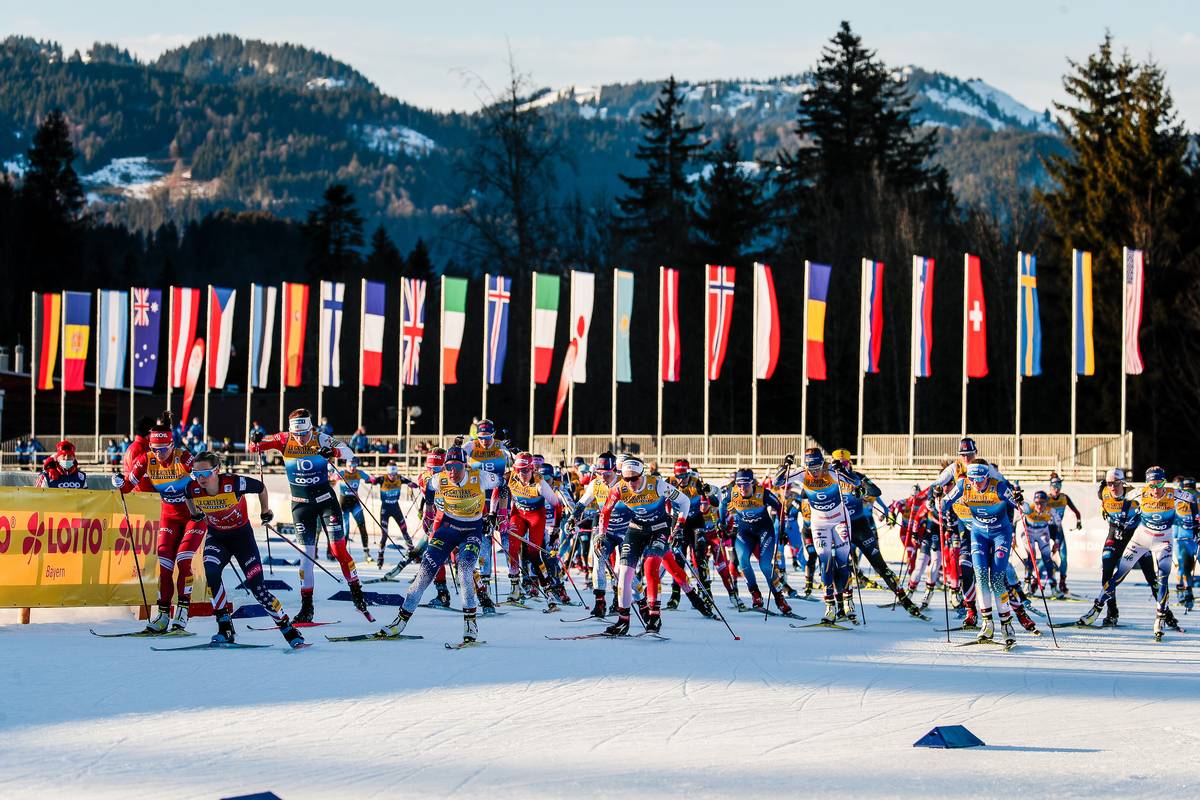
    The start of the women’s 10-kilometer mass start free during Stage 3 of the 2021/22 Tour de Ski in Oberstdorf, Germany. (Photo: NordicFocus)

    The primary symptoms of Chronic Exertional Compartment Syndrome (CECS) include pain, weakness, and/or numbness that only occurs with exertion. These characteristics are fairly distinct, although there can be enough overlap with other soft tissue disorders, namely tendinopathies, that CECS remains a diagnosis of exclusion when everything else has been ruled out. In Nordic skiers, symptoms affect the anterior, lateral, and/or posterior compartments of the lower legs and are most common with (often exclusive to) skating. Typically, or at least initially, these skiers will be symptomatic with high-intensity skating, but will be asymptomatic with classic skiing and running even at the same intensity.

    The physiology is relatively straightforward: our muscles are wrapped in a thin layer of connective tissue called fascia. As muscles repeatedly contract, especially at high intensities, they become enlarged; however, fascia is not elastic and does not stretch. If the muscle size exceeds the volume of the fascial compartment, blood flow is constricted, oxygen delivery is decreased, and the muscle gets strangled. This hypoxia in the muscle triggers a pain response, which is usually a good defense mechanism to make us stop doing something that the body perceives as harmful.

    The why is far more complex: some theorize that the fascia is just wrapped too tightly. Others suspect that the muscles are too big for the fascia. In either case, the common solution is a surgical fasciotomy where an incision is made in the fascia to increase the size of the compartment and decrease its stranglehold on the muscle.

    The why with skiing is even more complex. With CECS occurring with skate vs. classic, the initial theories centered around the ski retrieval phase. This makes sense with the work being done by the tibialis anterior muscle, which dorsiflexes the ankle while the ski is brought back to its glide phase position. Except that CECS can affect other lower leg muscles/fascial compartments which would not be active during the retrieval phase. Arguably the biggest difference between skate and classic techniques, at least as far as the muscles of the lower leg are concerned, is the stability demand of balancing on the gliding ski: the muscles must work much harder with skating.

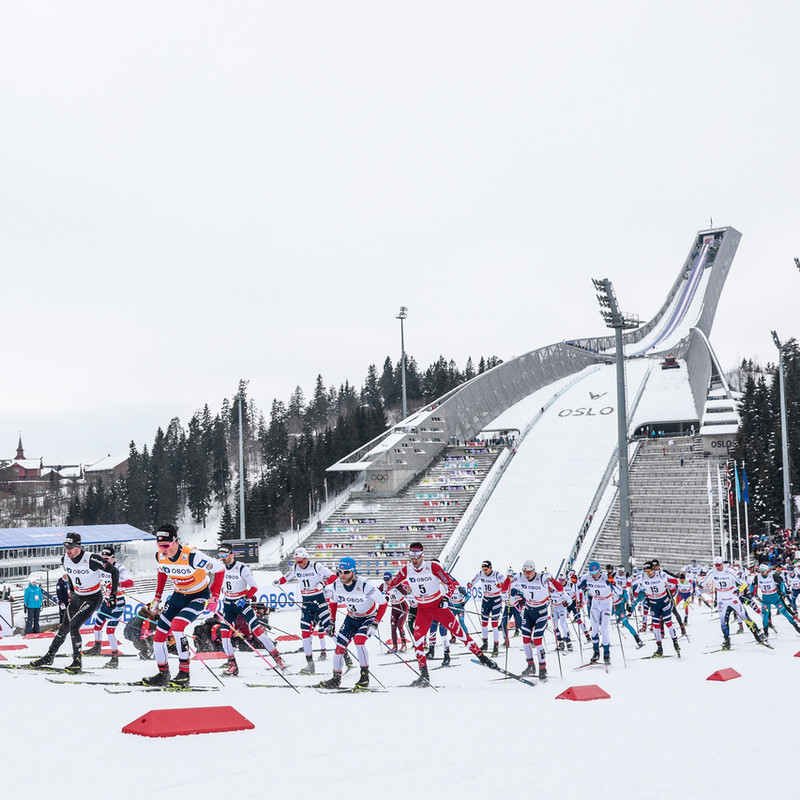
    A dense field of men’s skiers during Saturday’s 15 k mass start classic in Falun, Sweden. (Photo: NordicFocus)

    A case study

    The patient in our story is an 18-year-old male skier. He is a very competitive skier regionally and would have qualified for Junior Nationals had his skate races not been disrupted by leg pain. We had our initial physical therapy visit in mid-January, mid-race season. He reported pain, progressing to numbness, in both shins, which only occurred during high-intensity skate skiing. Symptoms were first noticed the previous winter during a skate race in icy conditions, but he didn’t have any additional episodes for the remainder of that season or during the summer. In October, however, symptoms returned during a skate interval session, persisted with any high-intensity skating, and got progressively worse through the race season. He was unable to finish his last skate race due to severe pain.

    In physical therapy exams and diagnostics, we are keen on reproducing patients’ symptoms. If we can do this in specific ways, we can begin to rule in or rule out anatomical structures which may be involved. For better or worse, I was unable to reproduce the patient’s symptoms in the clinic. This would likely rule out a muscle strain or tendinopathy, both of which tend to be painful with resisted tests (assuming we can make the tests both hard enough and specific enough). Differential diagnosis still included lumbar radiculopathy (nerve irritation at the spine leading to symptoms in the leg) or a bone stress injury (a.k.a. stress fracture), but neither of these fit the picture of symptoms being exclusive to high-intensity skating and absent at rest or especially with other modes of exercise. The symptoms really fit the pattern of CECS. To confirm, the gold-standard diagnostic would be compartment pressure testing; however, this testing is quite painful, fairly inconvenient (unless you have a rollerski treadmill in the clinic), and primarily aimed at determining if the patient is a candidate for surgery. Since this patient was looking to salvage his race season and avoid, or at least delay, surgery, we opted to skip the pressure testing but assumed that he was dealing with CECS.

    The remainder of the physical exam focused on ski technique, or at least the static components we could observe in the clinic: hip strength (fair), balance (compensated with lateral trunk lean), ankle dorsiflexion range of motion (appropriate), and foot stability (notable flexibility and forefoot varus). These findings were significant enough to suspect that the patient’s lower leg muscles were working very hard to maintain balance on his glide ski. The hip weakness and compensated single-leg balance made me suspect that if he was lacking stability from the top down, then he was having to work much harder from the bottom up, thus overloading the muscles at the ankle and leading to CECS.

    The root cause of any musculoskeletal symptoms can be described as an imbalance between load being placed on the body and the body’s ability to tolerate that load. In physical therapy, we are looking to balance that equation. Sure, we can decrease load by telling patients not to do things that are painful, and some of that may be required in the short term, but we’re not in the business of telling people to stop doing fun things. Thus, much of the work we do is aimed at improving the patient’s ability to tolerate load. The trick becomes sorting out where there is room for improvement and how to get there.

    His first round of exercises focused on balance without compensation (single-leg stance with a Pallof press and lateral hops to balance on one leg) and hip strength (side plank variants and fire hydrants). On the load mitigation side, we discussed using more supportive insoles, which he had only recently acquired, and training modifications with skating limited to short bouts of low-intensity skating and all high-intensity work done in the classic tracks.

    At his second PT appointment, we were very fortunate to have the involvement of his ski coach who attended the visit with the patient. We continued exercise progressions for balance and hip strength; but we also got much more technique specific, identifying areas for improvement and providing corresponding cues: “heel down” (when asked to stand as if he was balancing on the glide ski, he was over-exaggerating the very common “hips forward” cue and shifting his weight so far forward that his heel was no longer on the floor. Arguably this is okay on steep terrain but not in this context), “tripod foot” (equal pressure on the inside, outside, and heel of the foot), and “weight shift with the hips” (get the center of mass over the glide ski via the pelvis vs. leaning to the side). He and his coach then took these cues to technique sessions and eventually higher intensity intervals.

    At our next appointment a few weeks later, the patient reported zero symptoms with hard L4 skate intervals. Unfortunately, the rapid melt-off of snow in the West ended the race season before he could fully test the effectiveness of the intervention. However, as of the time of this writing, he has been skiing and training for five months without symptoms.

    The critical reader (and all readers should be critical) might point out that we have a false sense of accomplishment because he hasn’t raced. I would argue that he has had plenty of pain-free training sessions that would have previously been symptomatic. The reader might say that this is simply a case study and an N=1 is pretty weak research. That is certainly true. A randomized, double-blind, placebo-controlled study with a very large population would be ideal. But a case study is not nothing. Not all skiers with CECS are going to respond to the same intervention. But if we have seen that it is possible to effectively treat CECS without surgery, then we might want to consider exhausting our non-invasive options first. The reader might further pick holes by saying that without compartment testing, we don’t even know for sure if this skier had CECS. That is also very true and should be acknowledged. In the name of science, I should have subjected the patient to the very unpleasant testing before and after our intervention to both establish a baseline and to prove that he was cured. But in the name of practicality and the patient’s well-being (along with the patient’s and family’s input), I declined.

    Again, the story of one skier’s ability to overcome CECS without surgery does not mean that all skiers with CECS will have the same success. But it’s very much worth a try. If you are reading this article because you are a skier with CECS, I would encourage you to take a very detailed look at your skating technique and be very specific about your approach to changing it. This likely means working on the component parts in a low-complexity setting (not on skis) and progressing to technique sessions on skis with a heavy emphasis on the cues that you and your support team (coach, PT, trainer, etc.) have identified. Hopefully this can be a path back to fun, fast, and pain-free skiing.

    Help Support Our Coverage!

    FasterSkier is independent, reader-supported, and free to read. If health and training coverage like this is worth something to you, a voluntary subscription keeps it coming.

    Join the FasterSkier community!


  • 5th ANNUAL Sovereign 2 SilverStar Ski Marathon (S2S):  Early season savings for your late season finale

    5th ANNUAL Sovereign 2 SilverStar Ski Marathon (S2S): Early season savings for your late season finale

    Best pricing until midnight November 23, 2025

    Accommodation deals

    Group savings

    Enjoy one of Canada’s most popular and scenic point-to-point ski marathon, with some night sprints too!

    Ski Marathon

    • Two days: April 4 & 5, 2026
    • Two distances: 21km & 41km
    • Two ski techniques: Classic (day 1), Skate (day 2); Wave starts
    • Two world class venues: SilverStar Mountain Resort and Sovereign Lake Nordic Club, Vernon, British Columbia
    • Rates steady for 5 years! With thanks to our sponsors, who allow us to offset increasing costs.

    Stussi Night Sprints

    • April 2, 2026 after 4:00pm
    • Sovereign Lake Nordic Club Stadium
    • Competitive and Elite/ Racer categories
    • Exciting race format and very spectator-friendly

    To register or learn more: Check out the S2S website, Register, or contact info@sovereign2silverstar.com

    Sovereign2Silverstar Ski Marathon 2024

    S2S features officially on the Worldloppet Global Calendar, and is part of the Ski Classics Challenger series. It’s quickly becoming a popular season finale for ski groups, clubs, and elite racers too.

    “All of us athletes are so fond of the Loppet, and thrilled by its growing popularity. Every year more and more of our teammates have been adding S2S to their calendars as the finale to their ski season.” Olivia Bouffard-Nesbitt, Olympian and Team Canada, Cross Country Skiing

    For most skiers at the S2S, Finishing is Winning. Photos and videos from past years say it best, with the smiles, the hugs, the cheers. We want YOU to experience that this year.

    Often the biggest hurdle to finishing is signing up. To help get you over that hurdle, check out a Q&A with a first-time S2S participant. Marcy did it; you can too!

    Sovereign2Silverstar Ski Marathon 2024. (Photo: S2S / Vanessa Garrison)

    Curious what S2S participants have to say about the event? Their comments are consistent, year over year:

    • Awesome late season snow and grooming
    • Extremely friendly and helpful volunteers
    • The focus on Finishing is Winning
    • A very fun and social atmosphere; great to enjoy with family, friends, ski groups, and others
    • A Point-to-Party event at world-class venues; start in the stadium at Sovereign Lake Nordic Club and finish in the village at SilverStar Mountain Resort
    • Club championships, with prizes for 1st, 2nd and 3rd place

    Now that you’re sold on signing up (right?!), be sure to cash in on savings and make your planning as easy as possible. Here’s how:

    We look forward to seeing you in April! Questions? info@sovereign2silverstar.com

  • Wednesday Workout: Skate Speeds and Acceleration with APU Masters

    Wednesday Workout: Skate Speeds and Acceleration with APU Masters

    APU Masters camp in action on Eagle Glacier near Girdwood, Alaska, in July 2015.  (Photo: Jim Falconer)
    APU Masters camp in action on Eagle Glacier near Girdwood, Alaska, in July 2015. (Photo: Jim Falconer)

    It’s not just a truism that one of the best ways to get good at going fast is to practice going fast. At least that’s the principle that Alaska Pacific University Nordic Ski Center (APU) coach Galen Johnston brings to bear when working with his athletes, no matter their age level or experience.

    Johnston, 26, was born and raised in Talkeetna, Alaska, and is a lifelong Alaskan. He has been coaching skiing in some capacity for the last nine years, with athletes ranging from 5 years old (the Polar Cubs group of the Anchorage Junior Nordic League youth ski program) to 86 years old (locally famous octogenarian Reno Deprey, who skied the 55-kilometer 2015 classic Birkie in a healthy 5:47 at age 85 and has a ski race named after him in his native Maine). He is currently entering his third year of full-time coaching with APU, where he oversees both the Devos and the Masters groups in a total of ten practices per week.

    APU Devos stretch from sixth through eighth grade, or approximately age 11 to 14. APU Masters are 30 and up. In this Wednesday Workout, Johnston breaks down a recent workout from APU Masters that has benefits for anyone at any point on the several-decades spectrum of Masters skiers.

    The workout

    1. Full warmup
    2. 5 x 35-45 seconds Level 5 (L5) rollerski skate sprint, over a course with one 180-degree turn and one corner. (Course should be in an empty parking lot, or somewhere else where it is safe to rollerski at speed.) Brief rolling recovery between each sprint interval.
    3. 4-5 minutes full easy moving recovery after the first five sets
    4. 5 x 35-45 seconds L5 skate sprint (that is, repeat step 2)
    5. Cool down

    The warmup: This should be a full warmup, as long as 45 minutes out of a 90-minute workout. Starting very easy, then, Johnston says, “Ending with up into L2, nothing more than that. You can throw some easy 10-15 second speeds in there if you need to warm the body up a little bit more than that, then rolling into these. With that in mind, if you’re not feeling particularly warmed up, just take the first one a little bit easier, just let things come around.”

    Skate speeds: The course should be about 35 to 45 seconds, depending on skier speed. But there’s a lot going on within that relatively brief time: “Sprint off the line, go down 50 meters, swing a 180 degree turn, sprint back, and then around another corner and accelerate to the top of the parking lot,” Johnston says.

    Recovery: Between each of the five sprints in the first set, recovery is just “enough time to glide back to the start, get your breathing slightly back under control, and roll again” for the next sprint. But after doing the first set of five sprints, take a full four to five minutes of easy moving recovery. The goal of this intermezzo is to flush out the muscles somewhat and hit the second set of five sprints ready to go with good energy and quality movements.

    Cool down: As much as you can within a 90-minute workout window, before – in a nod to the reality of Masters training – going back to work/kids/job/life.

    Technique thoughts for this workout

    Johnston discussed the reasoning behind this workout with FasterSkier following the cooldown. He noted the gap that develops within even just the opening few minutes of an Anchorage Cup (citizens race), in which the APU Elite Team skiers and local collegiate skiers almost immediately start to distance themselves from even the fastest citizen racers.

    “Why is that gap there?” Johnston mused. “A lot of it just comes down to being able to relax at speed. If you can create speed efficiently, you can sink the body weight into the poles and into the glutes and move off of that, and use that to create speed – great. As soon as you get thrown back onto the heels … most of the time when people start doing speedwork you get thrown into the heels and you stay really static. And so – in its simplest form, [you should be] letting yourself drop, and letting yourself stand back up. Get all the way up, get all the way down. And making sure that you’re not just stuck back on your heels as you do those sprints. If you feel like your quads are blazed out after the first one, maybe change up how you’re doing that.”

    Johnston adds, “Today one of my big points was to be able to relax at speed, and be able to create speed without working that hard, and how that separates kind of the elite skiers from that next echelon of skiers.”

    Theory and practice

    This workout “tries to accomplish several things,” Johnston continued. “One is acceleration. So you have accelerating off the line, accelerating out of the turn, and then accelerating around another turn – kind of to work on, how to accelerate efficiently. The other is just the agility of the turning, being comfortable turning at speed. And as – today we didn’t do it as a group. Some days we’ll do it as a group of four or five skiers together, so that we get comfortable with that idea of cornering around something sharp with other people there. That one is easier to do on snow with more people.”

    (The previous week had featured an analogous but not identical workout on classic rollerskis, where each interval went out as a group sprint – six Masters skiers, 10 total sprints, zero serious carnage. Plus a great opportunity to practice sprint starts.)

    So why put Masters skiers through an L5 workout on rollerskis on unforgiving pavement, when even college skiers can crash and burn? Because sprinting is a great way to raise the athlete’s high-end speed, which can have benefits for skiing efficiency at any speed.

    “This is a Level 5 workout,” Johnston notes. “It doesn’t necessarily need to be an all-out sprint, especially if you’re doing it on rollerskis and you’re not comfortable with that upper-end speed, but that is a big component of what this workout brings. The fact that it is Level 5, essentially an all-out sprint, with it being short, with it being in a group, really drives home how efficiently you’re sprinting. Most people will have technique issues crop up when they’re sprinting that they wouldn’t find in daily skiing – especially skiers that are used to training a lot of Level 1, Level 2, Level 3, they have a very small window of speed, and they can’t really go over that Level 3, that’s their ceiling. So doing a Level 5 workout raises that ceiling, allows us to move efficiently, and move efficiently faster.”

    Looking ahead to a more endurance-focused training block later in the fall (Anchorage skiers are reliably on snow by the first week of November, even in southcentral Alaska’s recent snow-sparse winters), Johnston reiterates that his goal of this workout “is to raise the ceiling of what everyone’s capable of for speed.” With an eye to the future, the idea is that “so when we do more of our L3, L4, that those workouts can happen at a higher speed than they otherwise would have. Still going to be the same heart rates, same effort level, but because of working that ceiling up with the L5 work [now], those L3 and L4 workouts actually happen at a faster speed.”

    Speedwork for the Masters athlete

    “I think a lot of Masters skiers are a little tentative on their skis,” Johnston observes. “For anything – for downhills, for skiing fast, for sprinting, for anything like that – a lot of it is just a comfort issue. So the more that we enforce going fast as part of a fun, comprehensive workout, the more that comfort level comes up. So whether that’s bombing down a steep downhill, whether that’s sprinting, if we’re comfortable with speed, and comfortable with stuff happening fast, it allows us to react to stuff more quickly. And I work with that a lot with Devos, and obviously when you’re 12 years old you can faceplant and it’s no big deal, but you can get kind of the same thing in a more controlled environment for Masters – just avoiding as many falls. Being willing to push your limit a little bit on comfort, for speed – when you get into a race, when you’re skiing in a pack of 20, 50, 100 people, you’re not as worried about it. You’re able to concentrate on your own race, and not concentrate on the fact that you’re about to get taken out by 100 other people who may or may not be as skilled on their skis.”

    Johnston concludes by reflecting on the decades-wide range of athletes he works with on a daily basis. “What’s neat is that you see that, from Devos to Masters, people all respond to very similar things. Specifically for Masters, age 30 to 85 is a huge age span – but everyone is dealing with relatively the same things. Technically, most people are pretty ingrained in their technique, so that takes a lot of time to bring that around. And speedwork is one of the things that really breaks everybody out of that mold. It’s something that most people never do. So when you go to ski fast, you have to learn how to ski fast.”