From the FasterSkier archive — posts syndicated from athletes’ and coaches’ own blogs between 2004 and 2012, kept online as published. Current coverage is at fasterskier.com.
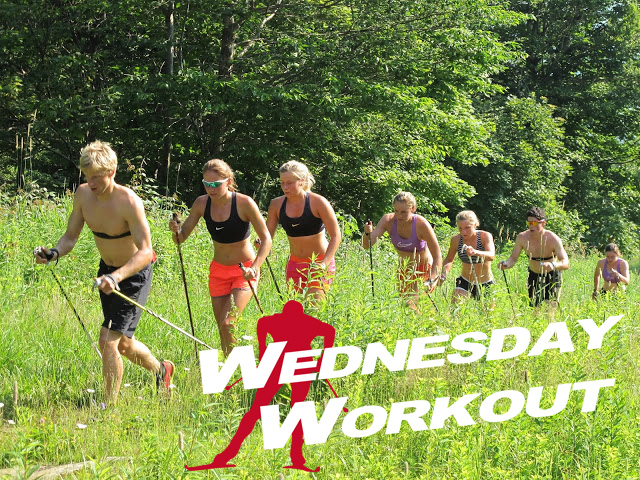
The SMST2 Team hard at work last season. (Photo: Erika Flowers/SMS)
This week’s Wednesday Workout comes from Erika Flowers, a member of the Stratton Mountain School T2 elite team. Flowers graduated from Dartmouth in 2012 where she was a three-time NCAA All-American skier. Throughout her career with SMS, she has had multiple top-10 finishes at the U.S. Cross Country Championships. Keep up with Flowers and her training by following her blog.
***
Most of the workouts we do here at Stratton are pretty simple. Especially during the early training season, the focus is on quality, practicing good technique and building a strong base. Ski walking up Stratton Mountain is one of our basic go-to workouts that we use throughout the summer to improve efficiency at threshold, build explosive power, and fine-tune ski technique. Although we introduce more bounding towards the middle and end of the summer, we try to force the “walking” early in the season in order to practice a good forward body position and avoid simply running up the mountain with poles.
The basic workout:
25-30 minutes easy running/ski walking with poles plus a few short uphill pickups (15-30 sec.) to get the body primed and ready for ski walking at threshold
6×8 minutes uphill ski-walking with poles at Level 3 or Threshold with 2-4 minutes active recovery between each interval
20-30 minute cool-down
Total time: About 2 hours
A few notes:
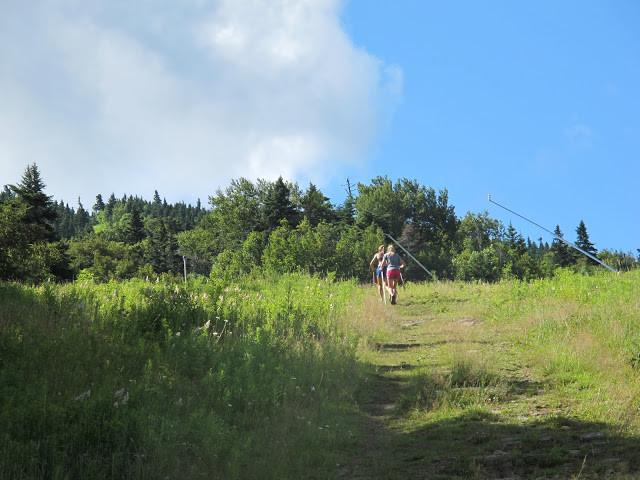
Erika Flowers and Sophie Caldwell work together during their ski walking intervals in Stratton in 2013. (Photo: SMS)
Equipment needed: Running shoes, water bottle and holder, HR monitor/watch, ski-walking/bounding poles (shorter than classic ski poles), a fun group who want to go charge up a mountain (or hill… depending on where you live)
Interval options: During the early spring and summer the ski walking intervals tend to be shorter (6X6-8 minutes). We will increase length and/or number of the intervals throughout the training season as we build fitness and total time at threshold (6X10-15 min. towards the end of the summer).
This workout also allows us to really dial in our heart rate at threshold by testing blood lactate between intervals. The goal is to maintain blood lactate levels around 4mM.
Recovery Time:The recovery time is largely dictated by terrain. We try to run down the mountain between each interval for 3-4 minutes so that we finish our last interval at the top of the Stratton.
If you have a smaller mountain you may need to run down a little further between each interval. Alternatively, if you live out West where the mountains climb for days, you may be able to take shorter breaks and still not reach the summit by the end of the workout.
Technique tips:
Our coaches emphasize a few basic technique tips for ski walking intervals:
1. Fall “up” the mountain with forward hips rather than reaching with legs
2. Use your poles; Engage your lats, core and arms to weight your poles and push off of them
3. Full extension with legs
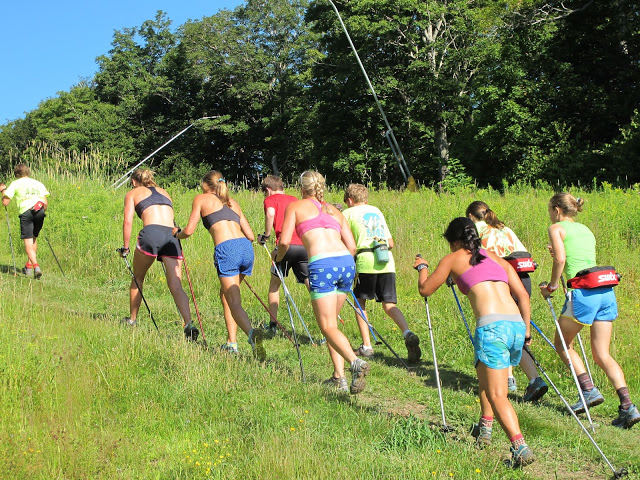
The SMST2 Team is joined by the SMS juniors in their ski-walking intervals.(Photo: SMS)
Group/Team Suggestions:
The SMST2 team often joins the SMS juniors for ski walking intervals. This workout is great for groups because it is easily adaptable for different ages and abilities and allows athletes to work together and learn from each other.
Between intervals, the fastest skiers run down the mountain for recovery while the slower skiers walk down. This way, the slower ski-walkers can learn from some of the more experienced athletes by jumping in behind them at the start of each interval.
The younger skiers can hop in behind older athletes to mimic technique and practice keeping pace, even if just for a minute or two at a time. The interval number and length can also be modified for skiers of different fitness levels and abilities.
About 25 elite nordic skiers did maximal-intensity, ski-bounding intervals up Whiteface Mountain on Tuesday as part of the U.S. Ski Team Elite Camp in Lake Placid, N.Y.
WILMINGTON, N.Y. — The view from partially up Whiteface Mountain on Wednesday morning was about as picturesque as they get. From the trail, one could see that the leaves had started to turn shades of red and yellow — just in time for the U.S. Ski Team’s fall training camp in Lake Placid, N.Y.
Way down below, a few small dots proceeded up the dirt access road: first to warm up, then to get after it. US Ski Team Head Coach Chris Grover organized the maximal-intensity, ski-bounding interval workout for about 25 athletes, and said it was probably the toughest many had done this training season.
“Typically what we’re doing in the fall is switching gears from kind of our base anaerobic phase in training, where we’re concentrating more on is distance and technique acquisition, and now starting to work a little bit more poignantly with developing the athletes’ VO2 max,” Grover said. “You probably heard comments from athletes who said this was the first session of quite hard bounding that they’ve done this season. A lot of these guys have done quite a bit of threshold-type bounding, but they haven’t done short, hard bounding like that. It’s intended to develop their maximal aerobic capacity.
“So that’s what we’re going for,” he added. “It’s the beginning of September, kicking it into a little bit more intensity mode. Obviously during the camp, we have some more hard workouts coming up, including the Climb to the Castle [on Saturday], the sprint rollerski time trial, as well as some threshold sessions. Just trying to start into a little bit more hard training.”
“We saw some great performances [today] out of individual athletes, both national-team athletes and club athletes, but it’s definitely early in the season and we won’t get the real measuring stick until we get to Muonio [Finland], get to Gällivare [Sweden] in the fall and see how these guys stack up.
“This is the point of the year where I think everyone around the world is looking around going, ‘Oh yeah, these guys have made great progress through the summer,’ but it’s easy to forget that probably everybody in the world has made good progress through the summer. It’s kind of hard to take away from this particular workout except for particular technique changes, perhaps, that someone’s made, that they’re maintaining their form through the bounding sessions, for example. And if they’re mature enough to learn to really pace it well so that they’re still there at the end.”
How did each athlete decide whether to do five or seven intervals?
“Each of these guys is pretty much talking with their individual coach about what they should be doing right now and kind of what their training history has been over the summer, how old they are, and particularly what they’ve done over the last couple of weeks. Some athletes have come in with a good rest week, for example, and they’re ready to do the full-prescribed seven [intervals]. Others are coming off a little bigger training block, for example, and they’ve got to kind of work their way into camp a little slower.”
Andy Newell:
“I felt good. I always try to pace this workout well. It’s one of the harder ones we do at the camp, I think, as far as how much it takes out of your body. It kills my legs usually. But these are the kind of workouts that really you make lot of gains in building VO2 max. We haven’t done a ton of them so far this year, so for me I try to build into them so I can make the last few intervals hard. But it’s a long camp so we try not to blow ourselves out too much.”
How did you like doing the intervals with about 15 others, including some up-and-comers pushing to lead the pack?
“I like that. Some people don’t like training with a big group, but I think it’s sweet. I think the more people you have out, the better for an interval session. It’s funny, some of the young guns come to the front and go really hard on one, and they’re dead two intervals later. I was that same guy probably five or six years ago back when I was coming to these camps, too. So it’s cool to see these younger guys go out and hammer in front.”
Jessie Diggins:
“At the start of the workout I wasn’t feeling that great. It wasn’t the worst workout, definitely not the worst, but I wasn’t feeling the very best. It took me a while to warm into it and on the last three it started feeling really good, which is nice. I’m still trying to experiment with when beforehand I should take my inhaler. … I’m getting closer and closer to make it kick in when I want it.
“When you do these intervals, it’s super, super important to not dig yourself into a huge hole, but once in a while it’s really good to figure out exactly where your limits are and know what it feels like right before you hit the wall, and I found that 30 seconds before I was done today so that was really nice.”
Tad Elliott:
How was your summer?
“I’ve had a great summer out in Park City, [Utah]. I’ve been there pretty much all summer and then, just to Europe and back really quick [for a USST men’s camp in Austria and Germany]. It’s really nice to have my old coach Jason Cork back [as] the U.S. Ski Team men’s coach. He trains with me every day and we hang out, so training’s been going really well and it’s fun to have him around, too. Things are going awesome.”
What kind of training changes have you made?
“Ski training. I’ve been ski training a lot more, haven’t been mountain biking as much and a lot more strength, too, this year with our coach Michael [Naperalsky] at the COE. A lot more bounding, a lot more running, and yeah, less biking.”
What are some of the bigger mountain bike races you’ve done this year?
“I did nationals and that went all right. I was still solid when I came on the last lap, but nowhere near as well as I did last year. I think it’s all this muscle I’ve gained in my upper body, can’t carve as fast. I was 14th this year, sixth last year [in my first two years in the elite field].”
What was it like watching mountain biking at the Olympics?
“Man, the Olympics was awesome. Todd [Wells] is one of my good friends back in Durango. My dog, Gus, and his dog, Winston, have little man crushes on each other so we always go on play dates together with Todd, and I play golf with him. It was really fun to see him get a 10th place in his final Olympics [the best U.S. men’s result in Olympic history]. That was really cool. And then I’m good friends with Georgia [Gould], got to talk to her at nationals; she came home with some hardware [as the second U.S. mountain biker to ever win Olympic bronze] so that was sweet.”
Ida Sargent:
How was your summer?
It’s been great. I was in Craftsbury [Vermont] for basically the whole summer, except for our camp in Sweden, so it’s been good to be home and in one place for a while.
What have you been working on, and what did you learn from your first season on the World Cup?
“More hard training and keeping some consistency with the gains that I made last year and a lot of technique stuff, too. … It was tough to race the full season on the World Cup. I was pretty tired at the end of the year after having been on the road and traveling and racing the World Cup every weekend, so that was a great experience. This year I’m looking forward to building on that and returning to some of the same venues and having a little more familiarity with the whole scene, just ready to improve my results with that extra experience.”
What would you say your strengths are?
“I think sprinting is my strength, so this year I’m going to try to focus a little bit more on [that], but I would love to be a really good distance skier, too, so I don’t consider myself a sprinter. I want to be in the points in the distance races as well. It’s great to do training camps with Jessie, and Liz will be here later this week, and these other girls, too, to kind of improve my distance skills, too.”
How was your joint camp with the Swedish women’s national team in Sweden?
“It was good. We trained a ton. It was a lot of hard work, a lot of hours, but it was cool to see that they weren’t doing anything different than us, and we could hang with those guys and train with them. It was just a good confidence builder that our team’s really on the right track and building momentum also.”
Ragnhild Bolstad of Hedmark Skikrets based in east central Norway has organized training camps for the top regional juniors in east central Norway for more than a decade. When putting together camp training schedules for junior skiers, Bolstad has some key ingredients in mind: The social aspect is huge. The athletes want some feedback on where they are and where they can improve. Strength is important and roller skiing is often over-emphasized.
Ragnhild Bolstad (left) skiwalking with a group of junior girls near Rena in Hedmark. (Photo: Inge Scheve)
Building an environment
First and foremost, a lot of the skiers train alone or with a limited group of other skiers and coaches. Bolstad tries to compose a training camp schedule that exposes the skiers to other coaches, technique sessions and workouts that are fun to do in a big group, such as relays and group challenges.
“The number one objective of these camps is to get together with others on the same ambition level, compete and compare themselves to others,” Bolstad says. Additionally, they want to get some pointers, learn something new to take home and get a break from their regular training routine.
“It’s always useful for the skiers to get feedback on how they ski, whether its roller skiing or on snow,” Bolstad says. During a camp, skiers often do more than in a regular week, both in terms of intensity and volume, so variety is a big component, she says. “My philosophy is that they can easily do a lot of easy distance and volume on their own, but that they enjoy doing intensity with other, and that they push themselves more when they do intervals and mock races at in a camp setting,” Bolstad says. “I usually recommend that they come to the camp well rested and take care to do a very easy week following a camp.”
Add more strength
One area where Bolstad thinks there is room for improvement is strength.
“A lot of the time it seems like strength is just a few minutes of abs and core at the end of a workout, but I think we can do more here. Strength is becoming increasingly important in cross-country skiing, so it should be a natural component of a camp too. Some coaches believe you need a sophisticated gym to do a structured strength workout, but you can do a lot just with the elements you find outside,” she says, mentioning rock ledges for benches, rocks for cones, grassy areas instead of foam mats, and tree branches for hang-ups and pull-ups, as well as simple things like elastic bands that are easy to roll up and bring on a workout. “I think most juniors do some sort of strength at least 2 or 3 times per week at home.”
Bolstad also thinks including strength into roller ski workouts provides better use of the time on roller skis than just logging miles and hours on the pavement.
Juniors working on specific strength at Rena in Hedmark. (Photo: Inge Scheve)
Roller skiing is over-emphasized
Bolstad believes a lot of skiers overestimate the importance of roller skiing.
“Certainly, you need some and most skiers should do two roller ski workouts per week in the meat of the dryland season, but I don’t think there is much value in more than 3 or max 4 roller ski sessions per week,” she says, explaining that while specific to skiing, there are other aspects of training that needs attention during the dryland season.
“Roller skiing is a great alternative to other endurance training, and is definitely useful in keeping the ski muscles sharp, staying up on technique and getting a load off your legs, but there is nothing that beats running in developing capacity,” Bolstad says. She swears by running, skiwalking and bounding with poles as some of the most efficient, versatile and enjoyable forms of dryland training.
“I firmly believe in running with poles, bring them everywhere, and run in a lot of different terrain, such as wetlands and gnarly trails to improve both strength and balance. Use your poles everywhere,” says Bolstad, adding that part of what makes skiing so great is the nature experience. Roller skiing confines athletes to the pavement, while running opens up much more terrain.
Favor mountain biking
Bolstad also believes cycling has a place in a well-rounded varied dryland program. However, she recommends mountain biking and trail riding over road biking.
“When riding trails, you ride in and out of the saddle, you have to balance your bike through turns and over obstacles and you really have to engage your core, which develops balance and core strength to a much greater degree than riding on roads.”
Issues and training principles
Finally, Bolstad also makes sure every junior camp has some sort of theoretical content. She usually sets up at least one lecture on a relevant topic, ranging from training principles and fundamentals, doping and eating disorders.
This last year, she invited officials from Anti-Doping Norway to talk about diet and dietary supplements in the context of doping.
“Ambitious athletes are willing to stick to a strict and sometimes almost extreme diet, and for some the step to supplements is not that far. What is doping? And what are the gray areas?” Bolstad also notes that once skiers reach the junior level, they can be tested for doping at sanctioned events, so she felt that it would be useful for them to know what the procedure is like.
This spring, Bolstad organized a lecture from the new initiative Sunn Jenteidrett (“Healthy Girl Sports”), which was launched as a joint project from the Norwegian Ski Association, Norwegian Biathlon Association, Norwegian Track and Field Association, and Norwegian Orienteering Association. The project is also backed by the Olympic Development Center (Olympiatoppen), the Norwegian Athletic Association (NIF) and the national lottery (Norsk Tipping). The project focuses on female athletes age 13-22 and emphasizes on building supportive training environments, increasing awareness of eating disorders and information on how to find resources. The project also teaches young athletes – both girls and boys – how to plan meals before, during and after workouts and competitions, as well as how to eat right and what to eat, since many junior skiers move away from home to attend ski academies during their high school years. Young athletes who attend ski academies often live in apartments near their schools and have to cook for themselves during the week. For a lot of juniors, this is their first experience with living alone.
“A lot of people think eating disorders only affect girls, but the truth is that a lot of boys also have trouble getting the right balance in their diets, maybe for different reasons. Also, eating disorders are something that affects everyone in the sport, from coaches to teammates and everyone in the support system. It’s important to talk about it, and to let the athletes know that there are resources out there, how to help and how to get help.”
So bottom line, the most important aspects with junior camps include building an environment among regional athletes where they can learn from each other, test their limits and get feedback on their technique and progress.
The junior racer on camps: Socially rewarding and bloody serious
Maja Solbakken, 17, from Engerdal on the Swedish border is one of Norway’s promising young skiers. She’s attended a number of ski camps since she was 13 or 14 years old, and raves about the value of the experience. For her, the most important take-aways from the camps are the friendships that she has formed with skiers from different parts of the country, and the intensity and focus that only happens in a camp environment.
“It’s so nice to hang out with other kids who have ambitions in skiing. It’s a really social experience, and every time I go, I get really motivated to keep training hard,” Solbakken says, explaining that training with celebrity coaches and other skiers you usually only see during the race season, she really wants to show off her best game.
“You push a lot of limits when you’re at the camps. I’ve done uphill intervals to the point of throwing up. There are coaches there from the junior national teams or regional teams, and you just really want to show what you’ve got,” Solbakken says.
Solbakken doesn’t think the national team coaches base their team selection on the junior camps, but she certainly thinks that skiers who look like they work hard and have the right attitude can get on their radars during the camps.
“The national team coaches are at all the big races in the winter, so if you’ve made a good impression in the summer, there’s a chance that they’ll remember that. I think they observe a lot during the camps,” Solbakken says.
Feedback and pushing limits
Solbakken enjoys going to the camps to get feedback on her technique and progress from coaches that she doesn’t work with on a regular basis. Also, she says it’s inspiring to be coached by some of the top World Cup racers. National team skiers often serve as assistant coaches on the summer ski camps that attract junior skiers from all over the country.
“We had Astrid Uhrenholdt Jacobsen as our strength and plyometrics coach last summer. She was really nice, but she required full attention to the task while training and didn’t take any crap. So we got some really intense, focused and efficient workouts there. That was really motivating,” Solbakken recalls.
Solbakken says that the summer camps are the highlights of her summer training program.
“The camps really mean a lot to me as an athlete and as a person,” Solbakken says, adding that she hopes to come back as a coach some day. “Only the top skiers in the country are invited to coach at the national summer ski camps. It would be a big honor to be asked one day.”