Tag: Ski Classics

  • Klaebo’s 100th: Norwegian Sprint Cauldron Boils Over in Trondheim

    Klaebo’s 100th: Norwegian Sprint Cauldron Boils Over in Trondheim

    This coverage is made possible through the generous support of Marty and Kathy Hall and A Hall Mark of Excellence Award. To learn more about A Hall Mark of Excellence Award, or to learn how you can support FasterSkier’s coverage, please contact info@fasterskier.com.

    Erik Valnes (NOR) and Johannes Hoesflot Klaebo (NOR), (l-r) crest the final climb before descending into the stadium during the World Cup Classic Sprint in Trondheim (NOR). (Photo: Modica/NordicFocus)

    Johannes Høsflot Klaebo’s 100th World Cup win did not arrive with the roar he’d grown used to on this course.

    Granåsen last March had been a cauldron—tens of thousands of fans in plastic ponchos, rain pouring sideways, the World Championships turning Trondheim into a temporary capital of the sport. Eight months later, on the first Friday of December, the same stadium felt smaller. The sky was already dim by early afternoon, the floodlights casting a clean, blue-white glare across sugary tracks. The weather had finally cooperated—no rain, firm snow, kick wax that actually bit—but the crowd was thin enough that you could hear individual cowbells and specific voices when the finalists swung into the stadium.

    Still, the stakes were anything but small. Norway flooded the start list with a full Nations-Group, 12 men in red suits, all chasing the same thing: an Olympic ticket to Milano–Cortina. Russia’s return to the World Cup had been confirmed in principle earlier in the week, adding long-term uncertainty to an already cutthroat season, but there were no Russian suits on the start line in Trondheim.

    And in the middle of it all, on the same course where he’d taken six gold medals at Worlds, Klaebo lined up for a classic sprint with 99 World Cup victories to his name and the chance to round the number off in his own backyard.

    By the end of the afternoon, the number would be 100. The route there was messier—and more revealing—than the record book will show.

    Ben Ogden (USA) on his way to posting the fastest qualification time. (Photo: Modica/NordicFocus)
    A qualifier that flipped the script

    The first jolt of the day came from the American side of the results sheet.

    Ben Ogden, the 25-year-old Vermonter who has been quietly (and sometimes not so quietly) remaking the U.S. men’s sprint profile, didn’t just survive the qualification round—he beat the entire Norwegian armada on their home snow. Ogden set the fastest time of the morning, ahead of Johannes Hoesflot Klaebo in second and a 19-year-old Swede, Alvar Myhlback, in third.

    For U.S. head coach Matt Whitcomb, the signal was as much about skis and process as it was about the scoreboard.

    Norway had sent out its complete Nations-Group—extra men beyond the regular quota—12 in total, and every one of them qualified for the heats. To outski so many Norwegians in a Norwegian sprint, Whitcomb later pointed out, is not an accident. It takes real form and excellent skis.

    Ogden’s own description of the qualifier sounded almost deliberately un-dramatic, as if he were trying to file the moment under “routine” before the day had even finished.

    “They all feel the same for me, for the most part,” he said afterward. “I definitely knew I was having a good one, skiing pretty fast, but you never know till you cross the finish line. In the middle of the race, I don’t think about that too much—I just sort of think about the next hurdle… At the bottom of the hill, I think about getting to the top, at the top, I think about pushing hard into the downhill, and on the downhill, I think about skiing the corner at the bottom of the hill well. That’s kind of the way it goes mentally for me. I definitely felt good, felt strong. I just felt like I could push and push and push and still have some energy, so it’s a good feeling for sure.”

    Behind him, the margins were tight everywhere. Gus Schumacher and Jack Young both hovered just outside the top 30; Kevin Bolger lurked not far behind.

    JC Schoonmaker, representing APU and still the same powerful sprinter who has lived on the brink of significant breakthroughs for several seasons, slid into the heats in 24th.

    If Ogden’s run lit the American side of the results board, Myhlback’s qualification told a different kind of story—a long-distance skier breaking into the sprint world by almost ignoring one of its foundational assumptions.

    Alvar Myhlback (SWE) double poling the qualification (and heats) on skate skis in Trondheim (NOR). (Photo: Modica/NordicFocus)
    The double-poling kid from Bjursås

    On the face of it, a 1.4-kilometer classic sprint in Trondheim is not where you’d expect to see the aftershocks of Vasaloppet.

    Myhlback, a 19-year-old Swede from Bjursås, arrived in Trondheim already something of a legend in a different corner of the sport. In March, he had become the youngest winner in the hundred-year history of the Vasaloppet, staving off the best of the Ski Classics field over 90 kilometers of classic racing and double-poling his way under the blue arch in Mora.

    His recent résumé reads like a long-distance syllabus: victories at Vasaloppet, the Klarälvsloppet, Alliansloppet, and the Blink Classics roller-ski race, all in the three-hour-plus universe of Ski Classics racing.

    Yet in Trondheim, he and the coaches around him made a choice that felt deeply rooted in that marathon background. While almost the entire field stuck to traditional classic setups—grip wax underfoot, long diagonal-stride climbs—Myhlback rolled to the start on skate skis, no kick wax, no plan to stride. His day would be decided on pure upper-body power and glide.

    He stuck with that choice all afternoon. In qualification, he was third, just 0.24 seconds behind Klaebo and less than half a second behind Ogden, double-poling up the long climb where others were striding. In the heats, he doubled down, literally: double-poling on skate skis in a classic sprint, in a World Cup final, on a course where the kicks of Norwegian diagonal stride have defined the past decade.

    That he advanced at all would have been a story. That he finished the day on his first World Cup podium, sandwiched between Oskar Opstad Vike (second place) and Lars Heggen (fourth place) in a final dominated by Norwegians, turned it into something else.

    It also sharpened an old talking point: Norway’s legendary wax trucks versus a kid who effectively opted out of grip wax altogether, trusting that his marathon-honed double-poling engine could hang on a course built for diagonal stride.

    Oskar Opstad Vike (NOR), JC Schoonmaker (USA), Amund August Korsaeth (NOR), Alvar Myhlback (SWE), (l-r) during their quarterfinal. (Photo: Modica/NordicFocus)
    The corner that wouldn’t let go

    If qualification belonged to Ogden and the chemistry of Norwegian wax trucks, the afternoon’s defining feature was a corner—and the way it kept finding Americans.

    Granåsen’s men’s sprint course climbs from the start to a right-hand turn that looks elementary on a map and on television. It’s not an overtly decisive feature: no off-camber sweeping change of direction, no opportunities for bold attacks, just too early on the course to gain a significant advantage. Yet, over and over again, as head coach Matt Whitcomb later put it, “that corner has become a problem spot.

    In the men’s quarterfinals, Schoonmaker arrived there in a good spot, charging with what Whitcomb described as “gas to burn.

    Then he tangled with Italy’s Simone Mocellini at the top of the climb, went down, and his day ended with a broken pole and a replay that U.S. coaches will be watching for years.

    “Today was definitely a step in the right direction, Schoonmaker wrote afterward. “It builds some confidence for the next races and for the season. I feel good and feel like I’m skiing pretty well, but it’s just not quite coming together the way I would like. I’m happy with the spot I’m in at the moment.”

    Italy’s Simone Mocellini and JC Schoonmaker (USA) crest the final climb before descending into the stadium, but they were out of contention to advance. (Photo: Modica/NordicFocus)

    In an Olympic year, that kind of tempered optimism reads differently. Under the U.S. selection procedures for Milano–Cortina, an individual top-eight finish in one of the Olympic events—sprint classic, 10 k skate, 20 k skiathlon, 50 k classic—can lock in an athlete’s nomination through objective criteria. For sprinters like Schoonmaker and Ogden, these early-season classics are more than just race days; they’re auditions with permanent consequences.

    Ogden’s quarterfinal, by contrast, looked like the blueprint for surviving that fraught middle of the course. He surged early, stretched his heat into a line, and controlled the race in a way that kept him clear of chaos. He won his quarter almost casually, looking like a man who had solved Granåsen’s puzzle.

    Then the semifinal brought him back to the same corner.

    Ogden selected quarterfinal five—the last men’s heat in the rotation, the one where recovery time before the semifinal is shortest. By the time he lined up again, he could feel the effort in his arms; the plan, he said, was to sit in the pack early and save his move for the big climb.

    Instead, the day tightened around a single moment.

    “In the semifinal, I was kind of feeling the quarterfinal in my arms a little bit, he said. “So I thought, all right, I’ll just sort of sit in the pack here and wait until that big climb and try and do what I do on that. But I kind of paid the price early on, getting tangled up in that corner. I don’t think Harald [Østberg Amundsen] obstructed me or anything of the sort—he just happened to step on my tip. And when that happens, people who have ski raced will know that your ski comes to a stop, and you can’t really move it. And then that kind of caused me to get spun around, and we both went down.”

    Harald Oestberg Amundsen (NOR) and Ben Ogden (USA), (l-r) cross the line in their semifinal heat after the two tangled on the courses first corner. (Photo: Modica/NordicFocus)

    “Definitely [a] frustrating way to end the day, especially when I was feeling so good. But these things happen. And there’s always tomorrow.”

    Whitcomb, who has coached through more sprint generations than most of the field has been alive for, sounded almost exasperated with that stretch of trail.

    “This is probably the most competitive sprint we’ll race all year, until Drammen, he said, noting that every team—not just Norway—is living with Olympic selection pressure this winter. “For us, that corner is not an important part of the race, but it keeps becoming one… It’s a place where you should be skiing stable, defending your space, not trying to drop into the stadium with maximum speed.

    The Americans, in other words, left Trondheim with film to study as much as with results to celebrate. Ogden’s ninth-place finish—best in the U.S. men’s camp and agonizingly close to that top-eight Olympic criterion—is both a milestone and a marker.

    Alvar Myhlback (SWE), Lars Heggen (NOR), Johannes Hoesflot Klaebo (NOR), (l-r) battle down the finish stretch of the individual classic World Cup sprint final in Trondheim (NOR). (Photo: Modica/NordicFocus)
    Five Norwegians, one Swede, and a milestone

    By the time the men’s final lined up, the race had distilled into a different kind of pressure.

    Norway had put five men into the last six: Klaebo, Oskar Opstad Vike, Erik Valnes, Lars Heggen, and Ansgar Evensen. The lone non-Norwegian was Myhlback, the kid on skate skis, bib 3 set alongside four pairs of Fischer classic boards and one more pair of Atomics.

    On paper, the stakes were layered. For Klaebo, it was win number 100 and the chance to keep an almost absurd streak alive: seven straight wins in Granåsen sprints, counting Worlds.

    For Vike and Evensen—both already rising up the sprint standings—a podium here, in the hardest sprint of the season and on home snow, would strengthen an Olympic case in front of national coaches who did not have unlimited roster spots to hand out. Under IOC rules, each nation can take a maximum of eight men and eight women in cross-country; FIS allows only four athletes per gender per event.

    From the gun, it was clear this would not be one of Klaebo’s processions.

    Vike drove the pace early, taking the field up the major climb and over the top with a small gap. Heggen, just 20 and already a three-time junior world champion, looked at home in the front half of the pack. Valnes hovered near Klaebo, doing what he has done for seasons now: protecting his status as Norway’s most consistently useful classic sprinter.

    Klaebo, for once, did not look invincible on the climb. He came over the top under pressure, with Vike controlling the line, and Myhlback momentarily buried deeper in the pack.

    Then, on the descent back into the stadium, the familiar pattern snapped back into place.

    Whitcomb described what happened there with a kind of forensic appreciation: “Klaebo’s signature move, popping out of his tuck to give two short, almost invisible pushes, gaining just enough speed to own the entry into the turn.”

    From there, the physics feels pre-written: better speed into the corner means better speed out of it, and better speed out of it means that when the straightaway arrives, the race belongs to him.

    Vike held on for a second. Behind them, Myhlback produced one last, pulsing double-pole assault, hauling himself from sixth off the final corner past Heggen and Valnes to grab third—the lone white and blue Swedish suit in a sea of red, and his first World Cup podium.

    The official result sheet will show a clean column of numbers: Klaebo first in 2:59.89, Vike +0.31, Myhlback +0.34, Heggen, Valnes, and Evensen rounding out the six. The messy part—the decisions that got them there—was already being replayed on screens in wax trucks and team vans before the snow had stopped squeaking.

    Johannes Hoesflot Klaebo (NOR) celebrates his 100th World Cup victory in front of his home crowd in Trondheim (NOR). (Photo: Modica/NordicFocus)
    “Number 100. I’m taking it here.”

    When the stadium interviewer finally put a microphone in front of Johannes Hoesflot Klaebo, the question almost wrote itself: had he, as some had suggested, deliberately eased off in last weekend’s distance race in Ruka to engineer his 100th win on home snow?

    Klaebo, grinning, swatted the idea away.

    “Number 100. I’m taking it here, he said. “To take it and to also do it in a sprint—it’s special… I wish I could say that. But no, I didn’t. I just feel like it was a perfect place, and doing this at the start of the weekend is really good. Now we can really just enjoy the weekend and hopefully some more good racing the next couple of days.

    At 29, he is now the first man to reach 100 World Cup wins and only the second athlete overall, joining fellow Norwegian Marit Bjørgen, who finished her career with 114.

    Whitcomb, who has been on the circuit for the entirety of Klaebo’s rise, sounded as if he were still trying to convince himself the story was real.

    “It almost doesn’t seem like a true story, he said. “Given that he won every race at World Championships in his backyard, given that he won his 100th World Cup in his backyard… and yet he does it. And that’s, I guess, the point of this whole thing.

    Today’s win, he noted, was not a walkover. Klaebo was genuinely under pressure on the climb. He had to make the pass on the descent. For an athlete whose dominance can sometimes feel inevitable, that mattered—it turned the milestone into a race rather than a coronation.

    Johannes Hoesflot Klaebo (NOR) jumps for joy after his 100th career World Cup victory. (Photo: Modica/NordicFocus)
    Norway’s sprint cauldron—and everyone else inside it

    For the Norwegian men’s team, Trondheim’s result sheet reads less like a celebration and more like a spreadsheet.

    The host nation deployed its full quota: twelve athletes, all of whom qualified into the top 30.

    Seven Norwegians made the semifinals. Five made the final. The internal competition for Olympic places—which Norwegian media routinely describe as more cutthroat than the Games themselves—tightened another notch.

    Evensen, who podiumed in Ruka and again came close here, is building what looks suspiciously like a “you can’t leave me home dossier. Vike’s second place gives him a marker race in front of home coaches. Heggen, not long removed from the junior ranks, now has “World Cup final in Trondheim on his resumé. Valnes remains what he has been for several years: the quiet constant, who makes every relay debate harder.

    All of it plays out under the exact challenging numbers that govern every other nation: eight men, eight women total; four start spots per event. In a year when Russia’s gradual reintroduction will eventually change World Cup standings, and when nations like Sweden are suddenly finding new men’s sprint stars in unlikely places, no Norwegian result feels expendable.

    For the Americans, the lens is different but just as sharp. U.S. selection procedures put heavy weight on top-eight finishes in events that mirror the Olympic schedule; Ogden’s ninth today falls just outside that automatic tier but lands him firmly in the heart of the conversation as the season unfolds. Schoonmaker’s “step in the right direction, as he put it, is also a reminder that sometimes the key line on a selection sheet is not a single result but a trend—of qualification, of speed, of that “look in his eyes Whitcomb referenced.

    And somewhere beyond the World Cup bubble, Myhlback’s coaches and sponsors in the Ski Classics universe are waking up to a fact they probably already suspected: the kid who won Vasaloppet isn’t only a marathoner. His decision to show up in Trondheim, on skate skis, for a classic sprint, and walk away with a podium is going to complicate every conversation about where he belongs.

    Ben Ogden (USA) although a tangle during the first corner of the semifinals left him wondering what might have been there was a lot of positives today for Ogden in Trondheim (NOR). (Photo: Modica/NordicFocus)
    A quieter Granåsen, and a long season ahead

    As the stadium emptied on Friday evening, Granåsen sounded more like a training venue than a World Championships site: a few kids sliding around on the outrun, the soft hiss of sprinters cooling down, coaches trudging back to wax trucks under a sky already leaning toward night.

    Inside those trucks and team rooms, the day’s big moments were already being analyzed into data points. For Klaebo, the milestone win will sit at the top of his personal mythology, another chapter in the story of a hometown kid who has somehow bent the sport around his own arc. For Norwegians like Vike, Evensen, Heggen, and Valnes, the Trondheim sprint will live on as Exhibit A, B, C, and D in Olympic selection debates that will stretch deep into January.

    For Ogden and Schoonmaker, the corner that took them down will become homework—grainy replay clips, course maps, and, eventually, new lines in the U.S. sprint “playbook the team keeps for every World Cup venue.

    And for Alvar Myhlback, who insists he is still a long-distance skier first, Trondheim may end up feeling like an interruption: a single day on a familiar course in Norway when he parked the marathon skis, rolled out on skate boards, and proved that his double-poling engine works just fine in the cramped, chaotic, oxygen-starved world of classic sprinting.

    The World Cup moves on quickly—20k skiathlons on Saturday, 10k skate starts on Sunday, Davos and the Tour de Ski looming just ahead. But for one early-winter afternoon in Trondheim, on a course that is beginning to feel like the sport’s central stage, the story belonged to a corner, a kid on skate skis, and a 29-year-old Norwegian who somehow made history again in his own backyard.


    Complete Results

    Trondheim Men’s Classic Sprint RESULTS

    Trondheim Men’s Classic Sprint QUALIFYING


    Love Stories Like This? Help Keep Them Coming.

    Feature stories like this one take time, access, and care to produce. If you value thoughtful storytelling and independent ski journalism, please consider becoming a Voluntary Subscriber. Your support directly fuels the work we do to cover the people, places, and moments that make our sport special.

    Join the FasterSkier community!


    Oskar Opstad Vike (NOR), Johannes Hoesflot Klaebo (NOR), Alvar Myhlback (SWE), (l-r) take the individual classic sprint podium in Trondheim (NOR) – Klaebo’s 100th World Cup victory. (Photo: Modica/NordicFocus)
  • Saturday Rundown: Quebec City, Oslo and Lillehammer (Updated x4)

    Saturday Rundown: Quebec City, Oslo and Lillehammer (Updated x4)

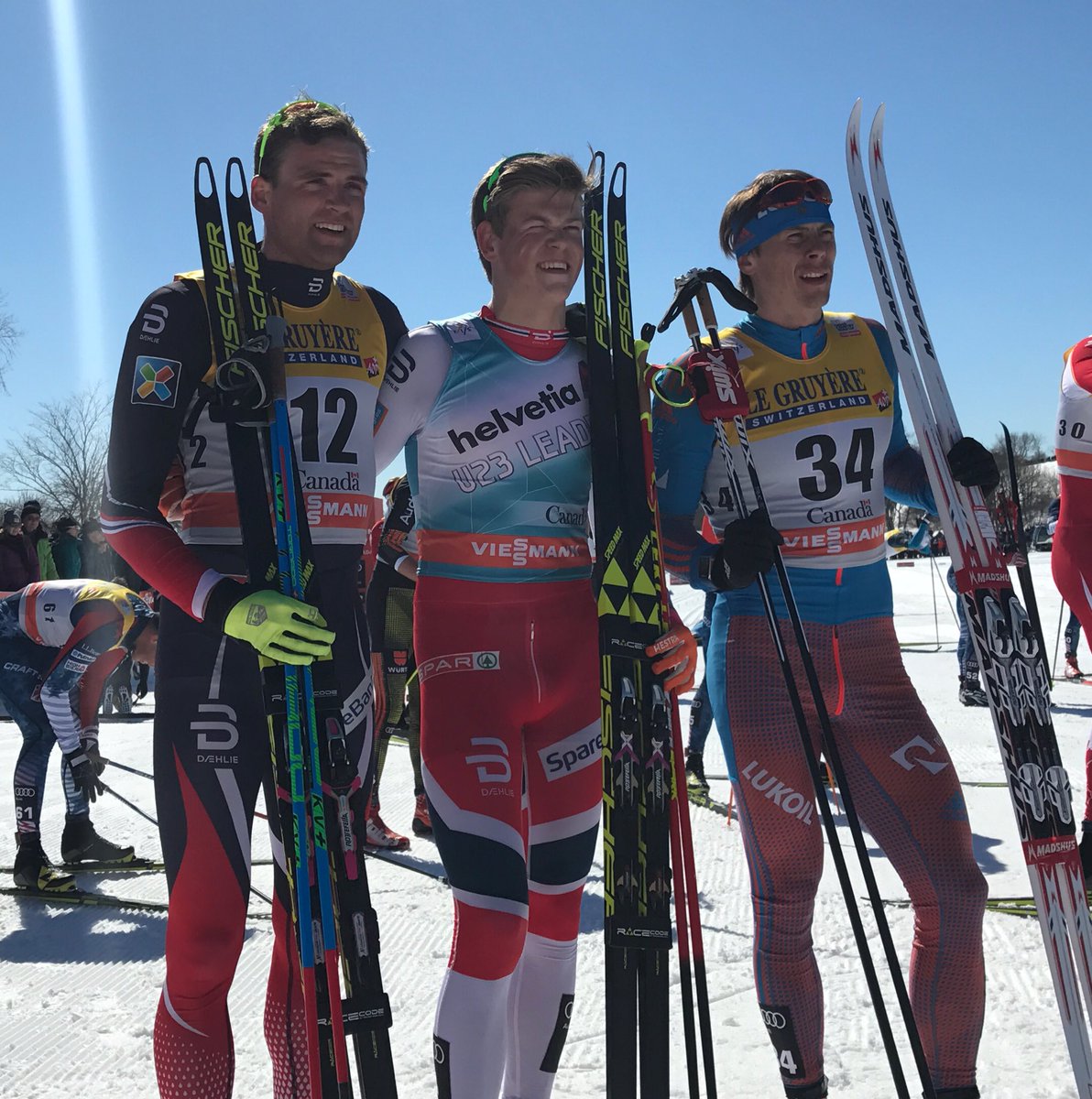
    The men’s 15 k classic mass start podium on Saturday at World Cup Finals in Quebec City, with Norway’s Johannes Høsflot Klæbo (c) in first and Niklas Dyrhaug (l) in second, and Russia’s Alexander Bessmertnykh (r) in third. (Photo: FIS Cross-Country/Twitter)

    FIS Cross-Country World Cup Finals (Quebec City): 10/15 k classic mass starts

    During Saturday’s 15-kilometer classic mass start at World Cup Finals, Canada’s Alex Harvey was in it until the end. But so were Norway’s Johannes Høsflot Klæbo and Niklas Dyrhaug, and Russia’s Alexander Bessmertnykh, to name a few.

    Sitting in second with a few hundred meters to go, Harvey was primed to make his move on Dyrhaug, who was leading at the time. But then came 20-year-old Klæbo, the season-long Sprint World Cup champion, who proved to have more left in the tank than anyone else and passed them both to lead into the finishing straight.

    Klæbo took the victory — his first in a World Cup distance race — on a bluebird day under a beating sun in 35:23.7 minutes, 0.6 seconds ahead of Dyrhaug. Bessmertnykh followed another 0.2 seconds back in third (+0.8) just ahead of Harvey in fourth (+1.2).

    Norway’s Sjur Røthe took fifth (+1.7), Switzerland’s Dario Cologna placed sixth (+1.9), and Norway’s Pål Golberg was seventh (+2.5), half a second ahead of another Norwegian Didrik Tønseth in eighth (+3.0). The top nine were within 3.7 seconds of first, with Russia’s Andrey Larkov in ninth.

    Devon Kershaw was the second Canadian in the points on Saturday in 28th (+1:08.4), after breaking a pole and working his way back up from outside the top 60.

    Erik Bjornsen led the U.S. men in 31st (+1:16.8), about a second ahead of Canada’s Graeme Killick in 32nd (+1:17.7).

    Also for the U.S., Matt Gelso finished 37th, Andy Newell 45th, Scott Patterson 46th, Noah Hoffman 48th, Ben Lustgarten 49th, David Norris 50th, Simi Hamilton 54th, Paddy Caldwell 59th, Jack Hegman 62nd, Cole Morgan 64th, and Brian Gregg 69th.

    For Canada, Bob Thompson finished 55th, Knute Johnsgaard 57th, Len Valjas 61st, Russell Kennedy 63rd, Evan Palmer-Charrette 65th, Andy Shields 66th, Jess Cockney 67th, Brian McKeever 68th, Joey Foster 70th, Gareth Williams 72nd, Ricardo Izquierdo-Bernier 74th, and Julien Locke 75th.

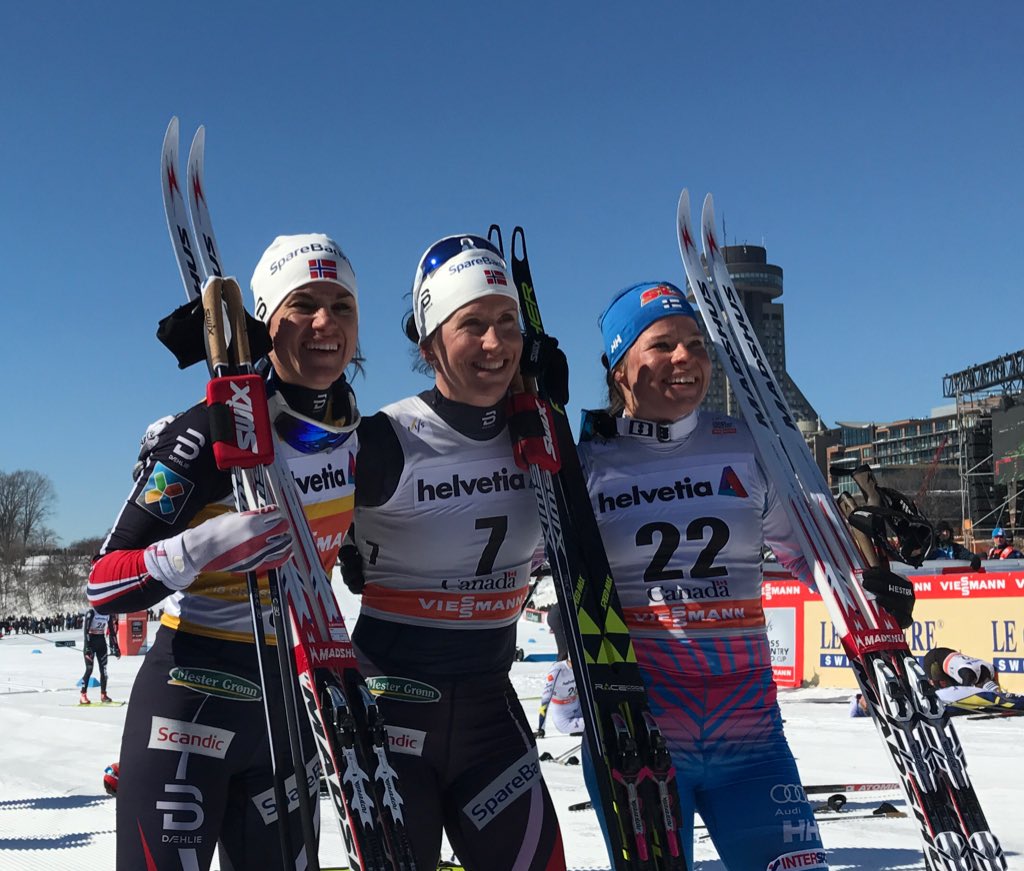
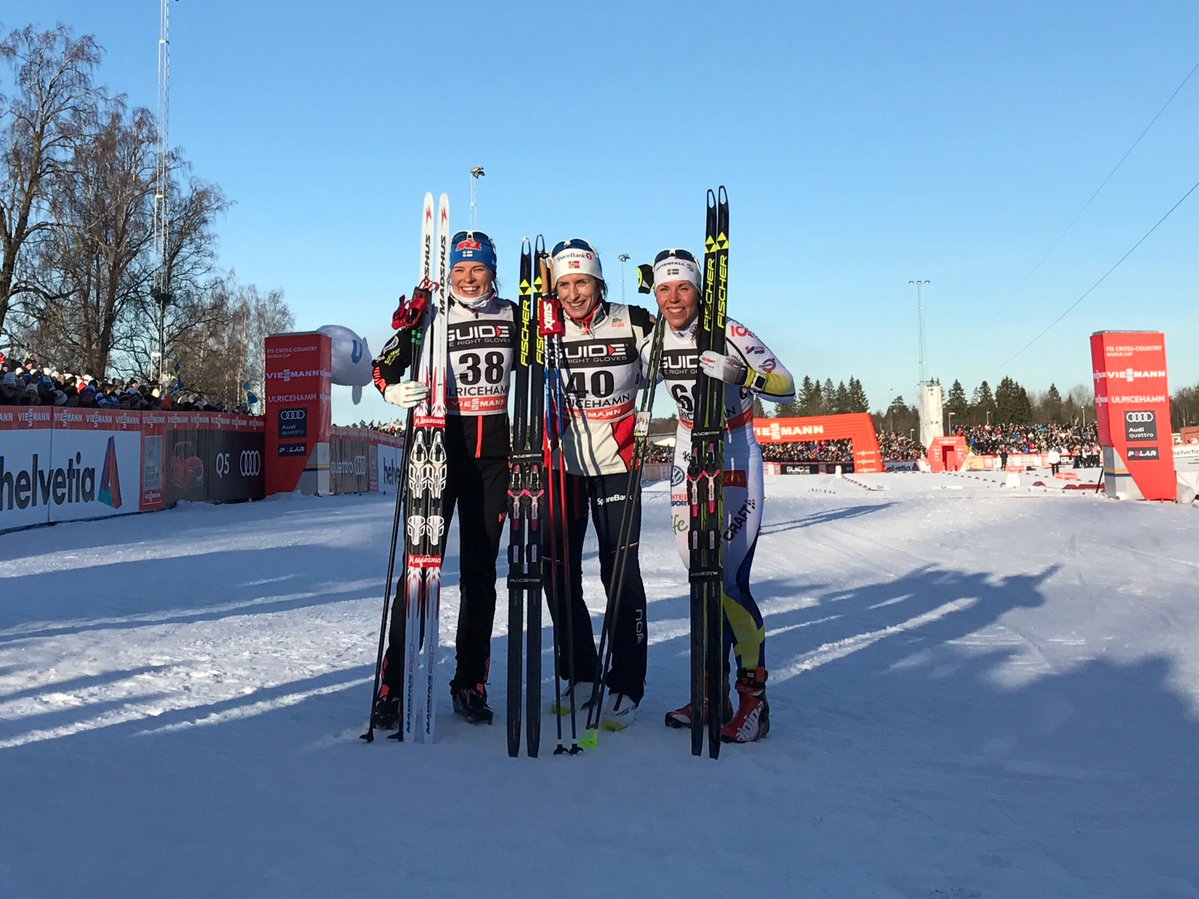
    The women’s 10 k classic mass start podium on Saturday at World Cup Finals in Quebec City, with Norway’s Marit Bjørgen (c) in first, Norway’s Heidi Weng (l) in second and Finland’s Krista Parmakoski (r) in third. (Photo: FIS Cross-Country/Twitter)

    In the women’s 10 k classic mass start earlier in the day, Norway’s Marit Bjørgen racked up her seventh victory of the season after leading a pack of two other Norwegians and Finland’s Krista Pärmäkoski and holding them off to the finish.

    Bjørgen put a few meters into the foursome as she entered the finishing stretch and held her lead across the line in 24:23.6 minutes. Norway’s Heidi Weng finished 0.6 seconds back in second to lock up the Distance World Cup title, in addition to the Overall World Cup title she secured on Friday.

    Pärmäkoski finished 2.9 seconds after Bjørgen in third, and Norway’s Ingvild Flugstad Østberg missed the podium in fourth (+7.8).

    Behind them, Germany’s Nicole Fessel outlasted a large chase pack to place fifth (+18.6), just ahead of Sweden’s Charlotte Kalla in sixth (+19.9) and Anna Haag in seventh (+19.1).

    Sadie Bjornsen of the U.S. Ski Team led the North American women in 15th (+29.9) after skiing at the back of that chase pack in the final stretches of the race. Also for the U.S., Jessie Diggins placed 27th (+1:06.9) and Sophie Caldwell 38th (+1:56.0).

    Canada was led by Emily Nishikawa in 37th (+1:51.7). Behind her, Cendrine Browne finished 41st (+2:28.2), Dahria Beatty was 53rd, Annika Richardson 54th, Katherine Stewart-Jones 56th, Frederique Vezina 59th, Annika Hicks 60th, Sophie Carrier-Laforte 61st, Andrea Dupont 62nd, Katherine Weaver 63rd, Alannah MacLean 64th, Sadie White 66th, Lisle Compton 67th, Mia Serratore 68th, and Laura Leclair 69th.

    For the U.S. Caitlin Patterson finished 44th, Liz Guiney 45th, Kaitlynn Miller 47th, Chelsea Holmes 48th, Rosie Brennan 50th, Julia Kern 52nd, Erika Flowers 55th, Becca Rorabaugh 57th, and Jennie Bender 58th.

    One day left in the 2016/2017 World Cup season remains, with the women’s and men’s 10/15 k freestyle pursuits on Sunday in Quebec City.

    Results: MenWomen

    World Cup Finals standings (Day 2 of 3): Men | Women

    ***

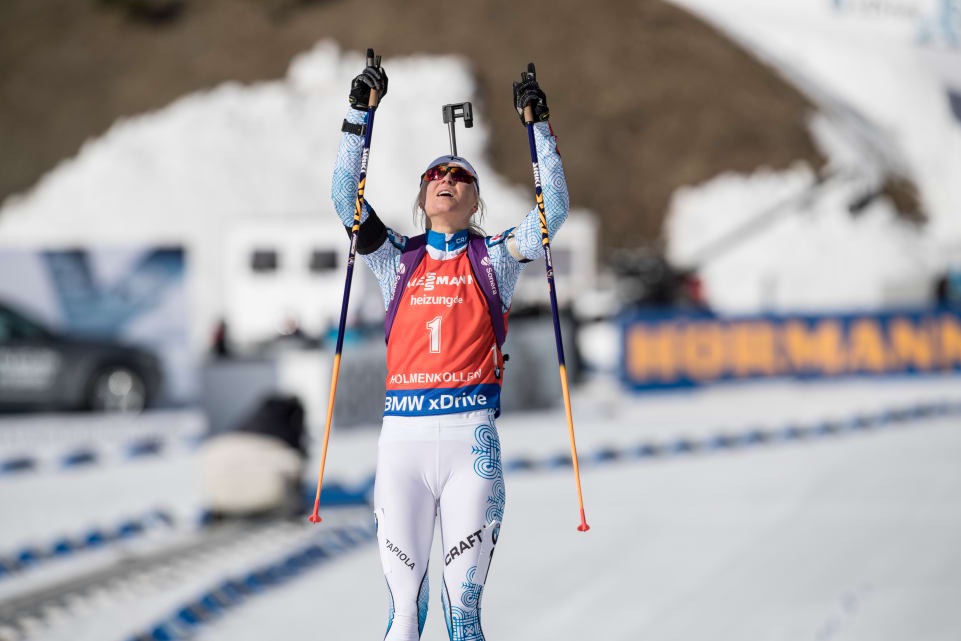
    Finland’s Mari Laukkanen pointing to the sky in honor of her late shooting coach, after she won the women’s 10-kilometer pursuit on Saturday at the 2017 IBU World Cup in Oslo, Norway. (Photo: IBU)

    IBU World Cup (Oslo, Norway): Women’s and men’s pursuits

    Less than 24 hours after winning her first IBU World Cup on Friday in the women’s 7.5 k sprint, Finland’s Mari Laukkanen immediately capitalized on her ideal position with a start-to-finish victory in Saturday’s 10 k pursuit that was never in doubt, cleaning the first three shooting stages before incurring one penalty in her final standing shooting (0+0+0+1) to cross the line in a time of 29:33.3 minutes.

    In addition to experiencing the most successful weekend of her biathlon career by far, it was an emotional day for the 29-year-old Finn due to a personal reason. Laukkanen spread her arms like wings skiing down the homestretch with a commanding lead, pointing repeatedly to the sky and a black ribbon she wore around her right upper arm, before kneeling in the snow in the finish for a few seconds. With those gestures, she reportedly wanted to commemorate her shooting coach Asko Nuutinen, who passed away Friday after suffering a heart attack during the World Cup in Kontiolahti, Finland, a week ago. He was 60 years old.

    “It’s been a really emotional day for me. We have heard really really sad news that last night we lost our longtime shooting coach,” Laukkanen told reporters with a trembling voice in the press conference. “After this it was more or less only about working for him. Working as he has asked me to do for years and years. So I wasn’t thinking about losing or winning today, I was only thinking about him. And I feel really big pleasure that I was able to come to the finish like this, that I can own the victory for him.”

    “I knew it will be difficult after the first victory in my career took me so long,” she added. “And to do it again immediately with good shooting. But as I said I didn’t think about winning or losing today, just doing my work.”

    Finishing 26.5 seconds after her, the Czech Republic’s Gabriela Koukalová reached the finish, moving up from her fourth place starting position with a clean shooting performance (0+0+0+0).

    “I wanted to miss all targets yesterday because I was so tired I didn’t even want to race,” Koukalová confided in the press conference. “It’s difficult to concentrate, three World Cups after the main goal of the season [the World Championships] is too much. Last year it was many times easier… I tried to catch her, but about one kilometer before the finish I saw her far away so I was happy I didn’t have to fight with anyone and was just enjoying the last meters.”

    Despite four penalties (1+1+0+2), France’s Justine Braisaz defended the third place on the podium against a three-person chase group on the last loop (+1:01.4), falling back only one position after having finished the sprint in second.

    “I did not expect such a good place today during the race,” Braisaz commented in the press conference. “Because in the last shooting I completely [failed]. I really wanted to have a clean shooting today, and I did not succeed. So I am happy and surprised, too.”

    Her teammate Anais Bescond who had started the pursuit in third place fell back to 22nd position (+2:53.5) with seven penalties.

    Slovenia’s Teja Gregorin finished fourth with one penalty (+1:08.2), Austria’s Lisa Theresa Hauser shot clean as the only athlete aside from Koukalova on her way to move up from 22nd to fifth place (+1:12.5), while Norway’s Marte Olsbu finished sixth like in the sprint despite three penalties (+1:15.9).

    Unlike in Friday’s sprint race where Germany’s Laura Dahlmeier had still given up a seemingly commanding lead in the sprint World Cup discipline standings to Koukalova, she held onto her lead in the pursuit standings on Saturday, moving up from the 31st starting position to ninth place with a penalty in each of her standing shootings (0+0+1+1, +1:53.8). A 22nd place would have been sufficient to win the “small crystal globe” award in the pursuit. Laukkanen’s teammate Kaisa Mäkäräinen finished 8th  with two penalties in the standing stages (+1:51.2), and thereby claimed the third place in the World Cup pursuit ranking.

    “I knew that I didn’t need to have a perfect race today, just a good one, but that’s always easier said than done,” Dahlmeier told broadcaster ARD after the race. “I am incredibly happy that it worked out and that I could secure myself another small globe… It’s a bit of a weird feeling, standing at the start gate in the middle of the field and the clock ticks and ticks as one athlete after another skis out on the course. And you can only observe how far they have gone and have to wait and be patient, and not make a false start. But then the snow burns, then the chase begins!”

    US Biathlon’s Susan Dunklee experienced an uncharacteristically problematic day on the shooting range and fell back to 37th place (+4:00.2), after starting seventh and less than a minute behind Laukkanen. Dunklee had three misses between two prone stages and seven more in her standing shootings (2+1+4+3) therefore having to ski more than an additional kilometer in the penalty lap.

    “It is a testament to her fighting spirit that she notched the fourth-fastest ski time — one of her best ranks of the season — and never gave up despite suffering a biathlon blowout on the range,” teammate Clare Egan said of Dunklee, according to a US Biathlon press release. “Bad races happen to the best and Susan is no exception, but not everyone fights through till the end no matter what.”

    Egan herself started the pursuit in 34th position and initally was able to make up ground, but then fell back slightly to 41st place (+4:13.9) with four penalties (0+2+0+2).

    “I am satisfied with my race even though the result was not what I was hoping for, and that’s how I would summarize my entire season as well,” Egan said after the final race of her season. “I’ve made a good step forward but my competitors also work hard all summer and we seem to improve at a similar rate.”

    Canada Biathlon’s Julia Ransom moved up to 47th place (+5:04.8) with three penalties (1+0+1+1), after starting in 52nd position.

    [UPDATED] Later on Saturday in the last men’s 12.5 k pursuit of the season, the three best athletes of the season fought throughout the race exchanging in the lead, before they stood next to each other on the range for the final shooting to decide the winner.

    Russia’s Anton Shipulin managed to shoot clean with his elaborate rifle stock in the design of a red dragon, proudly waving to the cameras as he left the arena while his two competitors had to ski into the penalty lap. France’s Martin Fourcade – who had already secured himself the overall World Cup Total Score title as well as the award for the pursuit discipline – was left to duke it out against Norway’s Johannes Thingnes , the winner of Friday’s sprint.

    On the last big climb before the Holmenkollen arena, Fourcade accelerated with a series of explosive jump-skate steps to decisively gap Bø. He even got fairly close to Shipulin on the finish stretch, who had slowed down a bit to grab a Russian flag before skiing over the line in a time of 32:11.9 minutes with one penalty (0+0+1+0), 5.7 seconds ahead of Fourcade who had incurred two penalties (1+0+0+1). While Fourcade shook hands with Shipulin, Bø came into the finish in third place, 21.6 seconds back and also with two penalties (1+0+0+1).

    “It was a crazy race, but I am happy that I managed to finish first,” Shipulin said in the press conference through a translator. “Tough conditions on the shooting range, I had to really work to concentrate on my shooting. On the last loop I was all alone until I saw Martin chasing me, then I got a little bit scared but I managed to [keep him behind].”

    It was Shipulin’s second win of the season, for which he credited his recently improved shooting performance.

    “It was a really exciting competition with Johannes and Anton,” Fourcade agreed with his rival. “I expected to fight with them for the victory on the last loop, but then Anton was simply stronger in the last shooting. My strategy was to be focused on my technique and skills and not on the results, like I did too often in the past few weeks focusing on records and not the victory.”

    Asked about his blazing attack on the final climb, Fourcade added: “Of course I train for that, but I think a lot of athletes do. I talked to Johannes, it was my revenge for the [2016] World Champs where he did exactly the same to me on the last uphill. But I know how it is, it can be different already tomorrow.”

    “I am happy with a new podium of course,” Bø said in the press conference. “I was not at my best in the skiing today. But I still managed to shoot 18 out of 20. As Martin said it was [annoying] that we did not shoot zero [misses] and could not fight with Anton in the finish, but it was quite interesting and fun to stand there in the last shooting … I expected Martin’s attack the second he did it, but I had no energy to fight with him. That was quite strong.”

    Sweden’s Fredrik Lindström placed fourth with no penalties (+44.7), and was the only man in the field who managed to shoot clean in all four stages.

    “For the podium, I was never really close“, Lindström told the IBU in a post-race interview. “But it was a great day anyway. Four times zero [misses], and especially in the standing stages that makes you climb a lot in the standings. Super happy with my performance.”

    US Biathlon’s Lowell Bailey, who had to start closer to the back of the field in 44th position, almost two minutes behind the leaders based on his sprint result, managed to move up 21 spots in the race despite three penalties (2+0+1+0).

    “I’m happy with the race, considering it started out pretty rough with the first two misses,” Bailey told US Biathlon after placing 23rd (+2:23.3). “I just read the wind wrong and didn’t correct enough. After that, I tried to keep my head in the race and make the best of it. I was happy with my skiing and glad to clean the last stage; this brought me up nine spots and I was able to gain another in the last loop. Now, it’s just one race to go. I’m looking forward to tomorrow.”

    Shooting quickly, Bailey recorded the ninth-ranked range time of the day and the ninth-fastest last loop.

    His teammate Sean Doherty started 35th but fell back after having to ski six times through the penalty lap (1+3+1+1) to finish 46th (+4:05.6).

    For Sunday’s mass starts as the final races of the 2016/2017 IBU World Cup season, the only qualified North American starters will be Dunklee (currently in 10th position in the World Cup Total Score standings) and Bailey (currently in eighth).

    The women’s season award in the mass start discipline once more will be decided between Germany’s Dahlmeier and Czech Republic’s Koukalova, while Germany’s Simon Schempp will try to defend his narrow lead on Fourcade. But during Saturday’s final loop, the French star did consider saving energy for the final competition.

    “No,” he simply quipped when asked about this in the press conference. “Of course the mass start is important tomorrow because it will decide about the [mass start] crystal globe. But I think today the pursuit was also really important, and you fight for victory and being one of the best athletes. You can’t be satisfied with only a third place when you can claim a second, and I think all athletes in my position would do the same.”

    Results: Women | Men

    ***

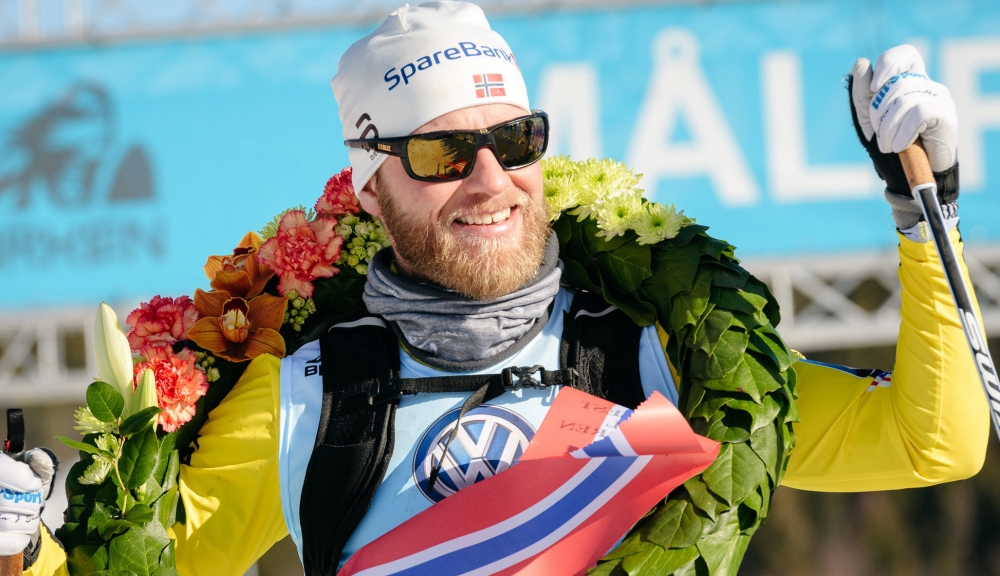
    Norway’s Martin Johnsrud Sundby after winning the Norwegian 54 k classic Birkebeinerrennet, part of the Ski Classics series, on Saturday in Lillehammer, Norway. (Photo: Ski Classics)

    54 k Birkebeinerrennet (Rena to Lillehammer, Norway): Part of the Ski Classics series

    [UPDATED] Not even a snowmobile clipping him and sending him tumbling 20 k before the finish could keep Norway’s Martin Johnsrud Sundby from winning the Birkebeinerrennet on Saturday in Norway. Representing Team United Bakeries, Sundby set a high pace from the start and broke the group down to three by 9 k, with Petter Eliassen of Team LeasePlan and Simen Østensen of Team BN Bank sticking with him until about 30 k in the 54 k marathon.

    With about 20 k to go, Sundby collided with a Ski Classics TV production crew snowmobile while trying to double pole in the snowmobile’s tracks. He was OK and went on to win by 48 seconds over Eliassen in second, and smiled about the incident after the finish.

    “It came in with tremendous speed and mowed me down,” Sundby told NRK, according to a loose translation.

    Ski Classics CEO David Nilsson told NRK he didn’t know exactly how that happened and emphasized that it was unacceptable.

    “We always put safety first, but it is a difficult balancing act with the snowmobile at high speed to get TV pictures,” he said, according to a loose translation. “The skiers often ski in the [snowmobile] track and here it happened and somehow the driver missed it.”

    While Sundby pulled out the win in 2:20:53.5 hours, Eliassen took second and Østensen followed another 3.5 seconds later for third place.

    In the women’s race, Poland’s Justyna Kowalczyk (Team Santander) pulled out a 4 minute and 15 second win over Sweden’s Britta Johansson Norgren (Lager 157 Ski Team). Japan’s Masako Ishida (Team United Bakeries) was another 48.6 seconds back in third.

    “I’m really happy to win this race,” Kowalczyk said, according to a Ski Classics press release. “Everything went well and the cheering on the course was amazing. I will do the rest of the races in Visma Ski Classics, but this victory was the most important for me. Of course, I want to win again in Årefjällsloppet like I did last year, but to win here in front of this audience means so much to me.”

    Tord Asle Gjerdalen, who finished fourth in the men’s race, and Johansson Norgren continue to lead the overall Ski Classics standings with three races to go. The next stop is the Årefjällsloppet in Sweden on March 25.

    “It was a great race and we kept a high tempo up all the way,” Sundby said, according to the press release. “I was able to use uphills for my advantage and get a gap. I had good skis, the conditions were perfect, and to win here was one of my goals for the season. I have the Norwegian Championships in two weeks, and I haven’t counted out the option of going to Finland for the Visma Ski Classics finale.”

    Results

  • Wednesday Workout: Double-Pole Endurance Training

    Wednesday Workout: Double-Pole Endurance Training

    The Marcialonga course follows the rivers in the Fiemme and Fassa valleys for the first 67 kilometres. (Photo: Ian Murray)
    The Marcialonga course follows the rivers in Italy’s Fiemme and Fassa valleys for the first 67 kilometres. (Photo: Ian Murray)

    Double poling is an increasingly important part of cross-country skiing and it pays to be good at it. If watching World Cup stars double pole short races on television doesn’t have you convinced, take a look at the races you might enter. Most loppets, marathons and citizen races feature flatter courses with a lot of double-poling time. Even in skating, the three main techniques all include slight variations on double poling.

    When five Canmore skiers decided to make the 70-kilometer Marcialonga in Italy (part of the Ski Classics marathon series) their major target for this season, they decided to emphasize one technique in their preparation.

    “Pretty much the whole elite field will [double pole the Marcialonga without grip wax],” Erik Carleton, a longtime Canadian Para-Nordic Ski Team guide, explained. “It’s all about getting to the last uphill, and then it’s 3 k pretty steep and you just try and survive that.”

    Here are three of the workouts that the 38-year-old Carleton and his Canmore-based training partners, including Canadian Para-Nordic veteran Brian McKeever (age 37), his other guide Graham Nishikawa (33), Ian Murray of North Highlands Nordic (38), and Jon Arne Enevoldsen (54), a former Norwegian biathlete who now runs a coaching business, used to prepare. Each of these five athletes had a different mix of goals for the season and shared workouts were just a part of their individual preparation. FasterSkier has suggested variations for those of us who are less than elite.

    Workout 1: Go to a local classic loppet/marathon/citizen’s race and don’t bring kick wax.

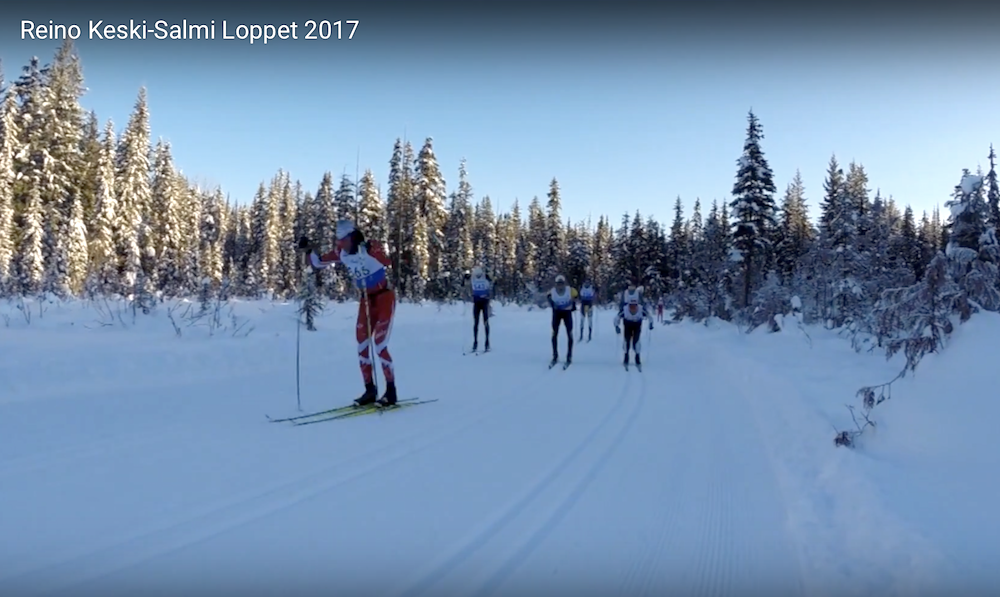
    Erik Carleton leads a group through Bilbo's Bog at the RKS 2017. (Photo: Larch Hills)
    Erik Carleton leads a group through Bilbo’s Bog at the 2017 Reino Keski-Salmi Loppet at the Larch Hills trails in Salmon Arm, B.C. (Photo: Larch Hills Nordic)

    The Canmore crew chose the Reino Keski-Salmi loppet, a 34 k race at the Larch Hills trails in Salmon Arm, B.C., known to locals as the RKS. This event is a typical regional loppet: the long course is relatively flat with a little over 600 metres of climbing, the demographic is dominated by kids and retired people, and most of the 396 finishers were solidly focussed on having fun on snow.

    Before the race, Enevoldsen correctly predicted that local skiers with grip wax would easily beat anyone double poling on squeaky -17 Celsius snow. Their goal was not to win, but to get some quality DP training done two weeks before the Marcialonga.

    In the end, Larch Hills local Thomas Hardy cruised to victory on grip wax in 1:38:52, just four days after placing 18th at the U.S. nationals 30 k classic mass start at Soldier Hollow in Utah.  McKeever and Nishikawa returned from Soldier Hollow ill and didn’t start.

    Carleton was feeling the effects of his 15th at Soldier Hollow, finishing the RKS 4:03 minutes behind Hardy. Carleton said afterwards, “It felt good off the start and I tried to push the pace a bit, but then the body was — not today.”

    Murray and Enevoldsen were fresher but still treated the RKS as a training workout, finishing at 1:32 and 9:00 respectively to win their age groups.

    If it seems wrong to go to a race and not push for the best possible finish, these guys weren’t alone in looking past the result sheet. Retired Canadian national-team member Alysson Marshall returned to her hometown event with her new husband Chris Hamilton to have fun on the trails she grew up on.

    Variations:

    • Choose a race to suit your needs. McKeever and Carleton have double poled 50 k races in the past, but your local weeknight 10 k might be a better fit.
    • Split a race in two. If you aren’t ready to double pole the full race that fits your calendar, choose a point on the course where you will pretend you have switched to skate skis and double pole to the finish.


    Workout 2: Long DP rollerski with race pace at end

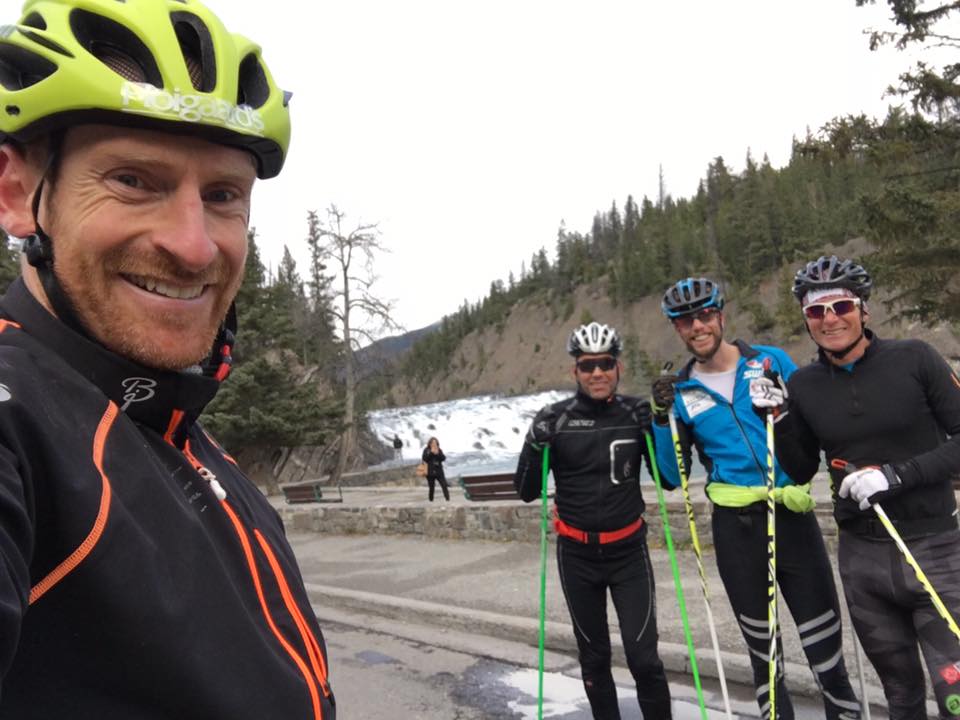
    Brian Gregg, Jon Arne Enevoldsen, Erik Carleton, and Ian Murray during a double-pole rollerski to Banff. (Selfie: Brian Gregg)
    (From left to right) Brian Gregg, Jon Arne Enevoldsen, Erik Carleton, and Ian Murray during a double-pole rollerski from Canmore to Banff, Alberta. (Photo: Brian Gregg)

    Roughly every two weeks, the crew would get together for a long Zone 1 (Level 1, or easy chat level) double-pole ski followed immediately by 30 to 60 minutes in Zone 3 (loppet race pace).

    “The idea is you tire out your body and then try and push it a bit more,” Carleton said, “so that it will give you that endurance double-poling at the end of loppet races.”

    For this crew, the long easy session was two to four hours.

    While this workout could be done on snow, it was a rollerski favourite because of available trails. “We’ve got this nice legacy trail to Banff and it’s good flat terrain for that,” Carleton said. Few ski areas can provide flat trails suitable for a four hour ski without excessive laps.

    Variations:

    • Adjust the times. Starting out, one hour of Zone 1 followed by 30 minutes of Zone 3 might be hard enough.
    • Use your legs for the Zone 1 part. If you don’t have enough flat terrain to stay in Zone 1 double poling, stride or skate as needed in the first part of the workout. For the second part, hilly terrain is less of a problem in Zone 3.


    Workout 3: 4 x 45-minute intervals 

    Double pole 45 minutes in Zone 3, followed by four hours of rest between.

    Murray came up with this workout after getting good performance gains from doing mountain bike relay races like ’24 Hours of Adrenaline Canmore’ and ‘Golden 24’.

    “Some of my friends give me a hard time, saying this is too difficult,” Murray wrote in an email. “But the mountain bike races are far harder.”

    Variations:

    • Don’t do this. While this workout seems unnecessarily hard, it is clearly working for Murray. Maybe we can all think outside the box to build new workouts from races, events, or long backcountry days that produced good results.
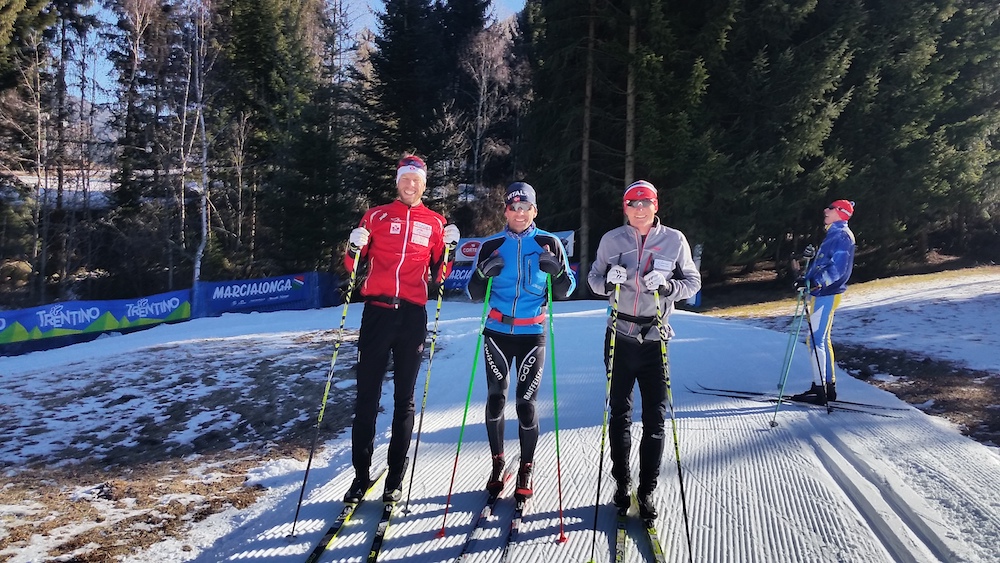
    Erik Carleton, Jon Arne Enevoldsen, and Ian Murray previewing the Marcialonga course. (Courtesy photo)
    (From left to right) Erik Carleton, Jon Arne Enevoldsen and Ian Murray previewing the Marcialonga course. (Courtesy photo)

    Conclusions:

    So how did these five fare in the Marcialonga after all the preparation?

    McKeever was the fastest of the group (and fastest Canadian), finishing the shortened 57 k course in 2:21:32.5 hours, 9:13 minutes behind the winner Tord Asle Gjerdalen for 57th overall. Nishikawa was next, 81st at +12:56, then Murray (86th, +13:37), Carleton (113th, +17:50), and Enevoldsen (160th, +22:14).

    Murray was pleased with his personal best at a Ski Classics event, writing “The double pole training has worked out well. I was able to hold a hard effort for the first 50km although I faded a bit in the last 7km.”

    Murray’s event highlight: “Being so close to the lead for the first part of the race.  Also skiing down the streets of 4 old Italian towns along the 57km track.  I didn’t get to soak in that aspect of the race during the event but rather in the pre-skis and post race ski it was fantastic.”

    And how much did the double-pole preparation pay off? Considering there were 5761 finishers including many former world cup stars like Gjerdalen, Anders Aukland, Toni Livers, and Østein Pettersen, top 200 is impressive.

    2017 Marcialonga results

  • Saturday Rundown: Ulricehamn, Antholz, Chaux-Neuve, Zuoz, Whistler, & Truckee (Updated x6)

    Saturday Rundown: Ulricehamn, Antholz, Chaux-Neuve, Zuoz, Whistler, & Truckee (Updated x6)

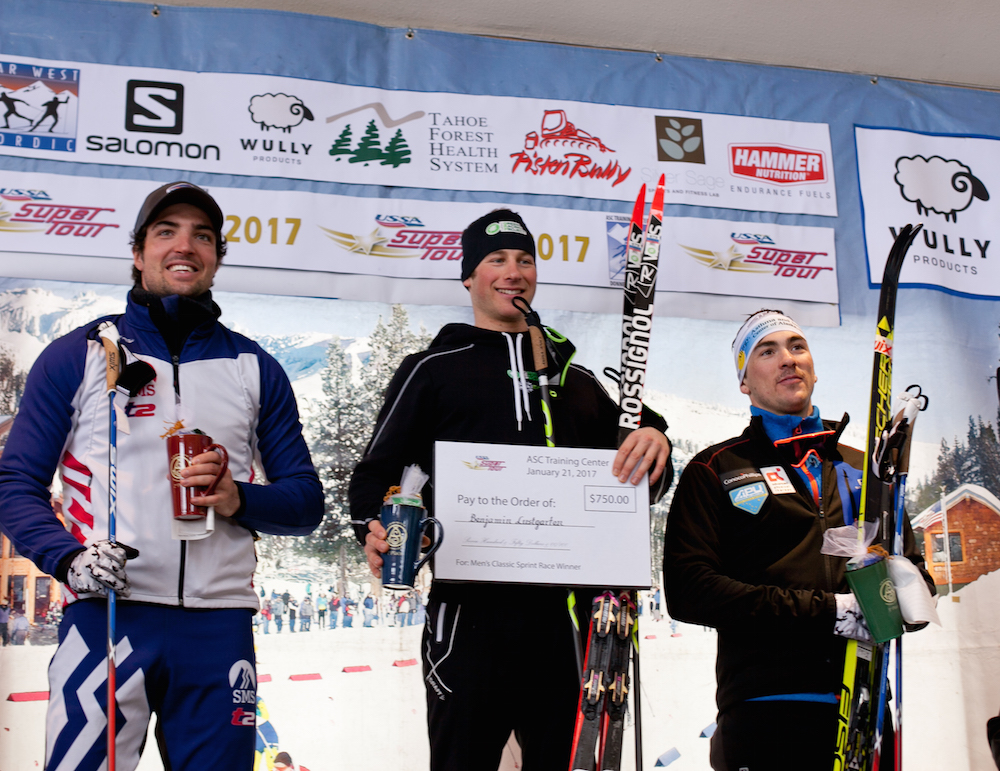
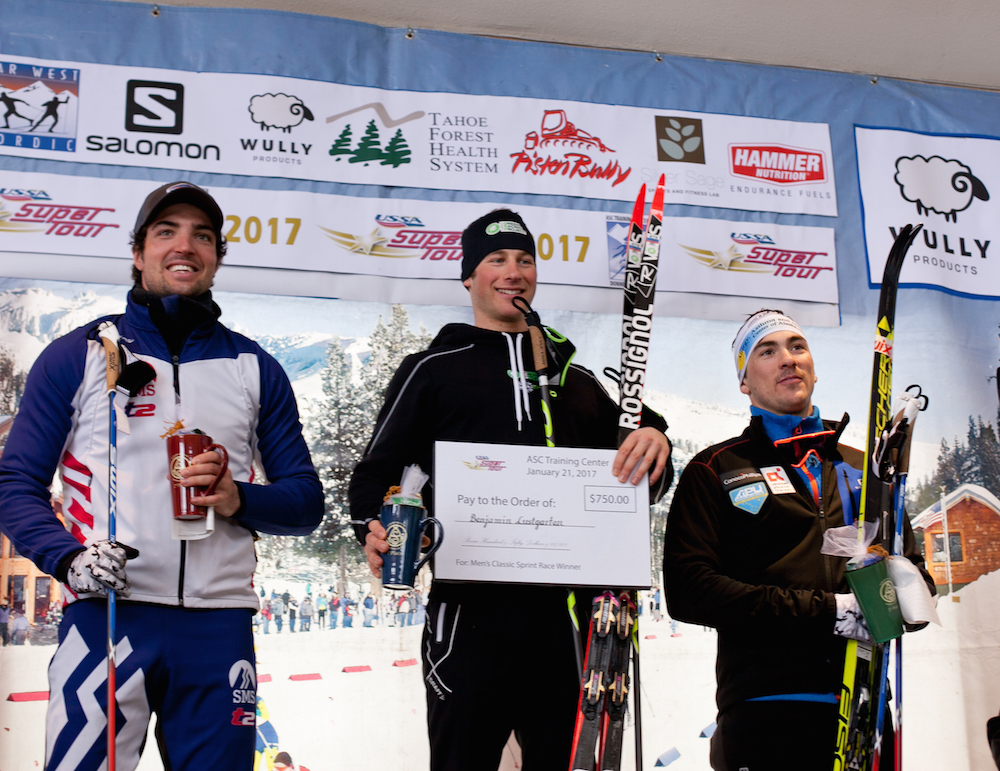
    Ben Lustgarten (Craftsbury Green Racing Project) with his $750-dollar check for winning the men's SuperTour classic sprint on Saturday near Truckee, Calif. Stratton's Ben Saxton (l) placed second and APU's Reese Hanneman (r) was third.
    Ben Lustgarten (Craftsbury Green Racing Project) with his $750-dollar check for winning the men’s SuperTour classic sprint on Saturday near Truckee, Calif. Stratton’s Ben Saxton (l) placed second and APU’s Reese Hanneman (r) was third.

    U.S. SuperTour (Truckee, Calif.): Classic sprints

    [UPDATED] Less than a week after being named to the U.S. team for 2017 World Championships, Ben Lustgarten — the men’s 30 k classic mass start champion at this year’s U.S. nationals — won Saturday’s SuperTour classic sprint as well.

    Lustgarten, of the Craftsbury Green Racing Project, raced to a 1.58-second victory in the men’s A-final at the Auburn Ski Club in Soda Springs, Calif., finishing in 3:03.4. Ben Saxton, of the Stratton Mountain School (SMS) Elite Team, placed second, and Reese Hanneman, of Alaska Pacific University (APU), was third (+2.77).

    Hannenman’s younger brother Logan also reached the final and placed fourth (+4.5), Dakota Blackhorse-von Jess (Bend Endurance Academy) was fifth (+5.86), and the third APU skier in the final, Tyler Kornfield sixth (+18.69).

    Blackhorse-von Jess started the day off as the fastest qualifier in 2:58.8. Saxton qualified second, 4.1 seconds back, Logan Hanneman qualified third (+4.2), and Lustgarten fourth (+6.5). Blackhorse-von Jess went on to win his quarterfinal and place second in his semifinal, while Lustgarten and Saxton both won their quarterfinals and semifinals.

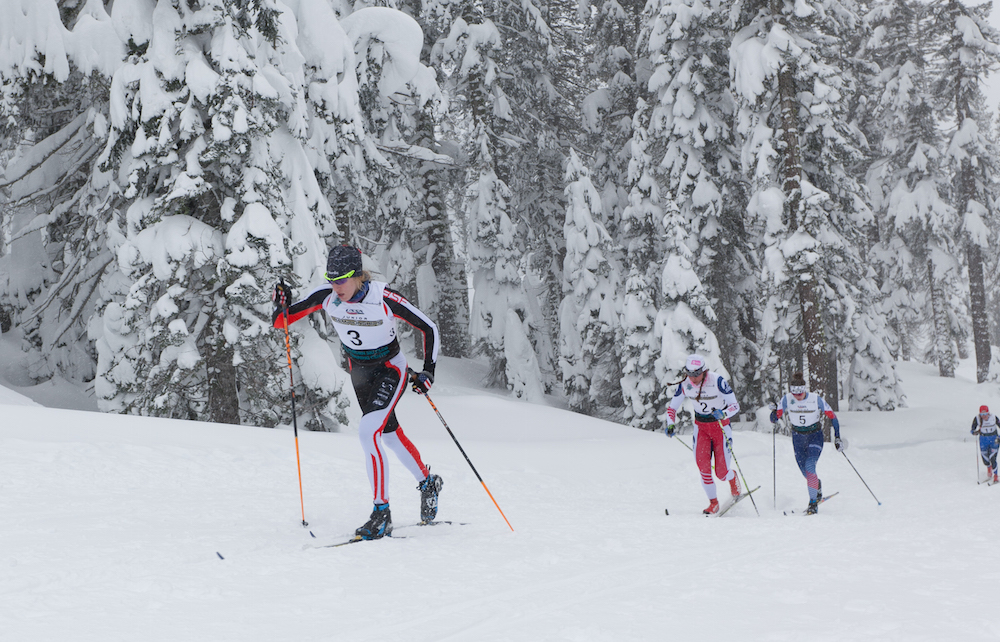
    Jennie Bender (3) of the Bridger Ski Foundation leading Stratton's Julia Kern (2) and Sun Valley's Deedra Irwin (5) during the second women's classic sprint semifinal at Saturday's SuperTour near Truckee, Calif. Bender went on to win the semifinal, as well as the final.
    Jennie Bender (3) of the Bridger Ski Foundation leading Stratton’s Julia Kern (2) and Sun Valley’s Deedra Irwin (5) during the second women’s classic sprint semifinal at Saturday’s SuperTour near Truckee, Calif. Bender went on to win the semifinal, as well as the final.

    In the women’s A-final, Jennie Bender of the Bridger Ski Foundation, coming off a classic sprint win at nationals, scored another victory in 3:29.07. She edged Craftsbury’s Kaitlynn Miller by just seven-hundredths of a second, and Stratton’s Julia Kern placed third (+3.42). Racing at home, Hannah Halvorsen (Sugar Bowl Academy) finished fourth (+3.88). Craftsbury had three in the women’s final with Caitlin Patterson in fifth (+3.93) and Heather Mooney in sixth (+27.35).

    Miller proved to be the woman to beat throughout the day, winning the qualifier in 3:30.9, along with her quarterfinal and semifinal. Kern qualified second (+3.2) and Bender third (+4.6). Bender went on to win her quarterfinal and semifinal as well before facing off with Miller in the final.

    Results: Men | Women

    ***

    NorAm Western Canadian Championships (Whistler, B.C.): 10/15 k classic 

    It was interval-starts day at Western Canadian Championships at Whistler Olympic Park and national-team veteran Emily Nishikawa completed the four laps of the women’s 10 k classic in 30:35.5 to win ahead of teammate Dahria Beatty, 16.5 seconds behind. Maya MacIsaac-Jones completed the national team and Alberta World Cup Academy (AWCA) sweep in third (+1:36.5).

    Sovereign Lake’s Hannah Mehain, of the national junior team, was the top junior for the second-straight day in eighth overall (+3:22.1).

    In the men’s 15 k, Lappe Nordic’s Andy Shields won the six-lap race in 40:34.2, showing some of the form that won him the NorAm overall last season. National-team member Jess Cockney collected his second-straight podium, finishing second, 4.3 seconds behind Shields. Evan Palmer-Charrette (NTDC Thunder Bay) completed the podium in third (+55.1).

    Results

    ***

    FIS Cross-Country World Cup (Ulricehamn, Sweden): 10/15 k freestyle

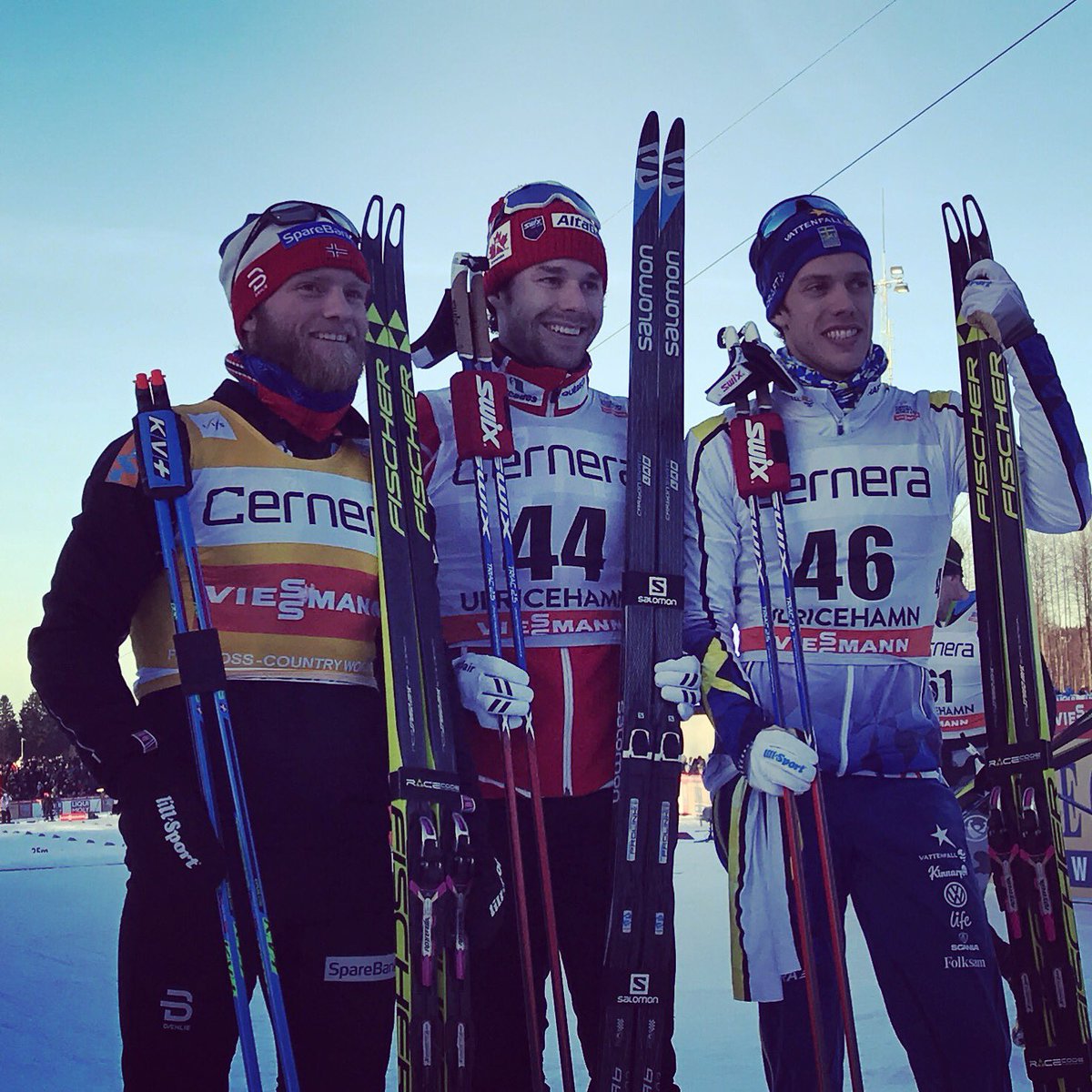
    The men's 15 k freestyle podium at Saturday's World Cup in Ulricehamn, Sweden, with Canadian winner Alex Harvey (c), Norwegian runner-up Martin Johnsrud Sundby (l), and Sweden's Marcus Hellner (r) in third. (Photo: FIS Cross Country/Twitter)
    The men’s 15 k freestyle podium at Saturday’s World Cup in Ulricehamn, Sweden, with Canadian winner Alex Harvey (c), Norwegian runner-up Martin Johnsrud Sundby (l), and Sweden’s Marcus Hellner (r) in third. (Photo: FIS Cross Country/Twitter)

    Men’s report | Women’s report

    First individual win of the season (second straight, after winning last weekend’s team sprint), fifth individual victory of his career. That’s the latest news on Canada’s Alex Harvey, who won the World Cup men’s 15-kilometer freestyle individual start on Sunday in Ulricehamn, Sweden, for his first victory in a 15 k skate race and fourth individual podium of 2016/2017.

    To say Harvey is on a roll is an understatement. On Saturday, he beat Norway’s Martin Johnsrud Sundby by 6 seconds after starting a minute behind the Norwegian defending World Cup champion. Harvey’s fastest time across the line in 32:46.2 held up through 76 finishers, with Sweden’s Marcus Hellner coming somewhat within range after starting a minute behind him. Hellner ended up 14.3 seconds back from Harvey at the finish for third place, behind Sundby.

    Switzerland’s Dario Cologna missed the podium by 0.5 seconds in fourth (+14.7), and Norway’s 24-year-old Daniel Stock broke through in fifth (+16.2) for his first World Cup top 20.

    Great Britain’s Andrew Musgrave placed sixth (+18.7), Sweden’s Daniel Rickardsson was seventh (+25.0), Norway’s Finn Hågen Krogh eighth (+32.2), Russia’s Petr Sedov ninth (+33.9), and Japan’s Keishin Yoshida 10th (+34.2).

    American Erik Bjornsen landed in the points as he tied Norway’s Simen Andreas Sveen for 28th (+1:09.2), leading fellow U.S. Ski Team members Noah Hoffman, who placed 41st (+1:28.8), and Simi Hamilton in 53rd (+1:56.2). Also for the U.S., Matt Gelso, the Period 1 SuperTour leader from the Sun Valley Ski Education Foundation (SVSEF) Gold Team, finished 68th (+3:00.3).

    Harvey’s Canadian World Cup teammates Len Valjas finished 35th (+1:17.7) and Devon Kershaw 38th (+1:22.2). Knute Johnsgaard (Canadian U25 Team) did not start.

    The women's 10 k freestyle podium on Saturday in Ulricehamn, Sweden, with Norwegian winner Marit Bjørgen (c), Finland's Krista Parmakoski (l) in second and Sweden's Charlotte Kalla (r) in third. (Photo: FIS Cross Country/Twitter)
    The women’s 10 k freestyle podium on Saturday in Ulricehamn, Sweden, with Norwegian winner Marit Bjørgen (c), Finland’s Krista Parmakoski (l) in second and Sweden’s Charlotte Kalla (r) in third. (Photo: FIS Cross Country/Twitter)

    In her first World Cup race in over a month and at a brand-new World Cup venue, Norway’s 36-year-old Marit Bjørgen returned to her winning ways, topping the women’s 10 k freestyle on Saturday in Ulricehamn.

    Bjørgen started 40th out of 61 finishers and took the lead from Finland’s Krista Parmakoski at the finish with a time of 23:46.3 minutes. Parmakoski, who started a minute ahead of her in bib 38, ended up second, 10.7 seconds back. Sweden’s Charlotte Kalla reached the podium for the second time this season in third (+24.9).

    “It is always great to win,” Bjørgen said, according to an International Ski Federation (FIS) press release. “I stayed at home for five weeks and was training. It is great to come back with a victory. I know that the training I had done was good. It was an amazing atmosphere today by the course. There were people cheering everywhere.”

    Norway swept fourth through sixth with Astrid Uhrenholdt Jacobsen in fourth (+25.7), Ragnhild Haga in fifth (+32.3) and Heidi Weng in sixth (+34.0).

    American Jessie Diggins raced to seventh (+34.9), ahead of Sweden’s Hanna Falk, who recorded her best distance result in eighth (+36.4). Norway’s Ingvild Flugstad Østberg finished ninth (+44.8), and Germany’s Sandra Ringwald was 10th (+56.6).

    “I didn’t have the snappy good feelings I was hoping to have in my body today, but it was a solid race,” Diggins wrote in a post-race email to FasterSkier. “It’s always hard when you know that on your best days you are capable of more, but at the same time we had great skis, and it was really fun for me to be able to ski with my teammates today!”

    The U.S. had three in the top 20 and four in the top 30 with Sadie Bjornsen in 12th (+1:00.5), Liz Stephen in 16th (+1:07.3) and Rosie Brennan in 24th (+1:30.7).

    Cendrine Browne as Canada’s lone woman in the race achieved 35th (+1:52.0) for her career best in an individual race. Also for the U.S., Kikkan Randall placed 40th (+1:59.6) and Liz Guiney of the Craftsbury Green Racing Project 52nd (+2:33.2).

    Results: MenWomen

    ***

    IBU World Cup (Antholz, Italy): Men’s relay & women’s mass start

    Men’s reportWomen’s report

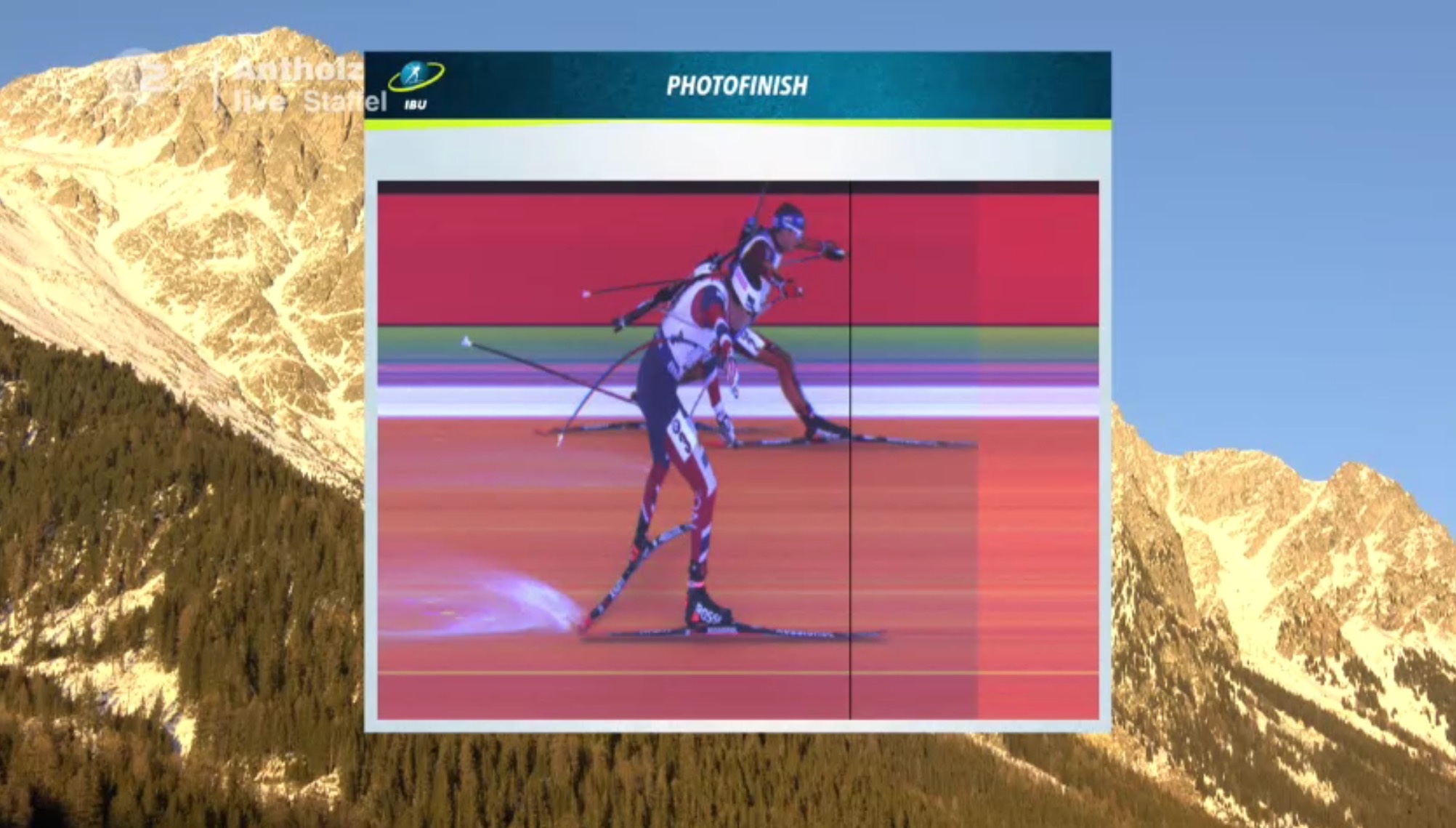
    The photo finish of the men's 4 x 7.5 k relay on Saturday at the IBU World Cup in Antholz, Italy, with Germany's Simon Schempp outlunging Norway's Emil Hegle Svendsen. (Photo: IBU screenshot)
    The photo finish of the men’s 4 x 7.5 k relay on Saturday at the IBU World Cup in Antholz, Italy, with Germany’s Simon Schempp outlunging Norway’s Emil Hegle Svendsen. (Photo: ZDF broadcast screenshot)

    For the U.S. men, top six was a target for the 4 x 7.5 k relay on Sunday in Antholz, Italy, according to US Biathlon Men’s Coach Jonas Johansson.

    Mission accomplished. In the final team event before 2017 World Championships, Lowell Bailey, Leif Nordgren, Tim Burke, and Sean Doherty combined for sixth, finishing 1:04.9 minutes behind the German winners. The Americans used a total of 10 spares but avoided the penalty loop, as did the Germans who used seven spares to clean the eight-stage race and won it in 1:13.57.2.

    Germany’s Simon Schempp narrowly outlasted Norway’s Emil Hegle Svendsen in the finishing stretch to secure the victory for Germany (with teammates Erik Lesser, Benedikt Doll and Arnd Peiffer) by one-tenth of a second. Norway finished second with nine spares and no penalties (with Lars Helge Birkeland, Henrik L’Abee-Lund, Johannes Thingnes Bø, and Svendsen), and Russia secured third (+33.6) with nine spares and zero penalties as well (with Maxim Tsvetkov, Evgeniy Garanichev, Dmitry Malyshko, and Anton Babikov).

    Ukraine used a total of just five spares and had zero penalties for fourth (+46.7), and Austria took fifth (+49.2) with eight spares and no penalties, after Austria’s Dominik Landertinger skied away from Doherty on the final loop and finished 6.9 seconds ahead of him for fifth place.

    For the U.S. men, sixth was close to their team-best fifth with the same lineup in last year’s World Cup relay in Presque Isle, Maine. The same group also took sixth in Ruhpolding, Germany, last year as well.

    With all four making US Biathlon’s World Championships team, announced Saturday, they will likely be aiming for a best championships result early next month in Hochfilzen, Austria.

    Canada (Christian Gow, Scott Gow, Macx Davies, and Brendan Green) finished 16th (+4:13.8) on Saturday with two penalties and 11 spares. Scott Gow skied them up to 15th by the second exchange but they dropped to 18th after Davies had two penalties on the third leg. With Green anchoring and using just one spare, they recouped two places before the finish.

    In the women’s race, Germany’s Nadine Horchler achieved a lifetime dream with her first World Cup win, after starting in bib 30 and earning her start as a reserve athlete. Germany took first and second with Laura Dahlmeier in second, and the Czech Republic’s Gabriela Koukalova placed third. Susan Dunklee of the U.S. was the lone North American starter and finished 24th after leading at the start of the second loop.

    Results: Men’s relay | Women’s 12.5 k mass start

    ***

    FIS Nordic Combined World Cup (Chaux-Neuve, France): Individual large hill/10 k

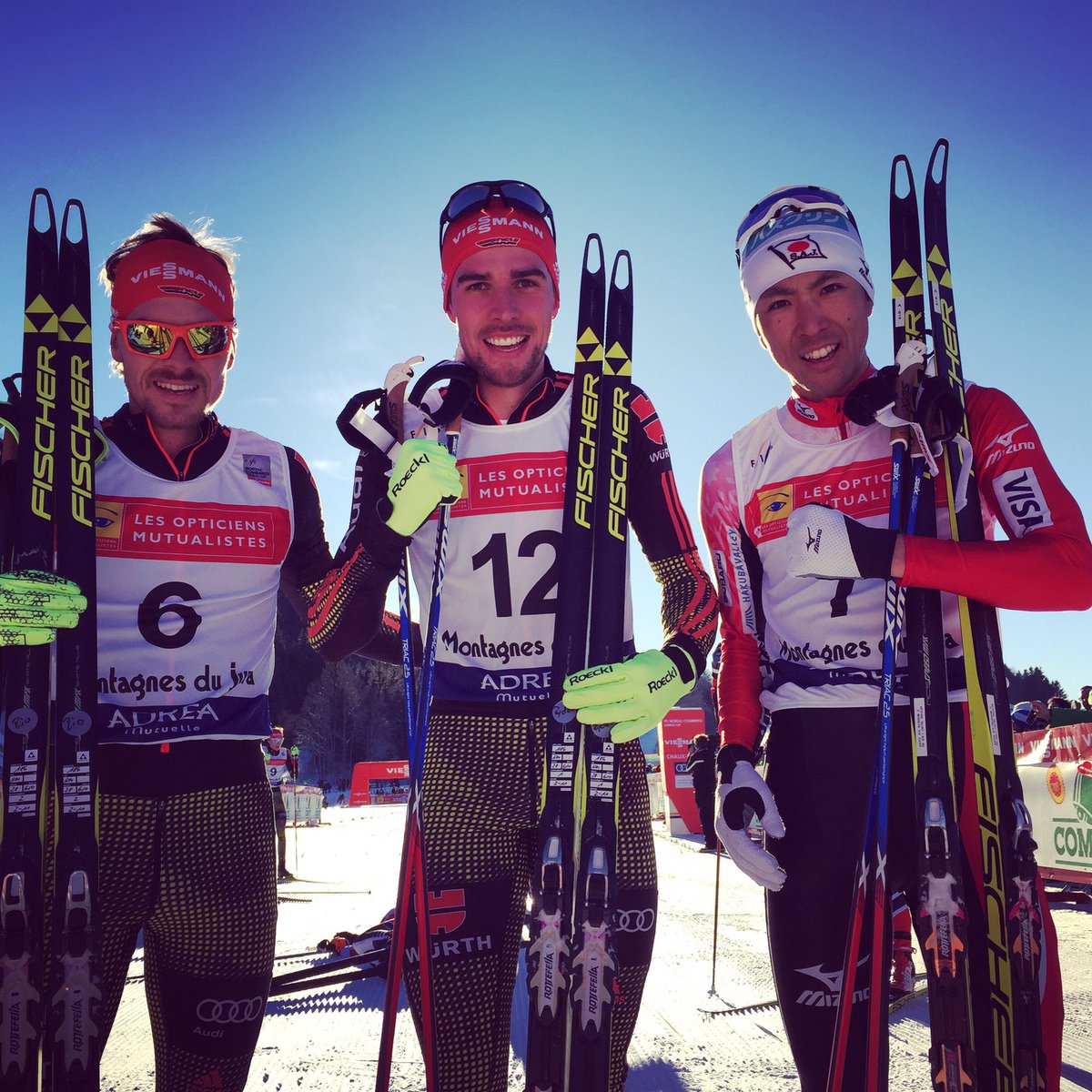
    Saturday's Nordic Combined World Cup podium in Chaux-Neuve, France, with German winner Johannes Rydzek (c), German runner-up Fabian Rießle (l) and Japan’s Akito Watabe (r) in third. (Photo: FIS Nordic Combined/Twitter)
    Saturday’s Nordic Combined World Cup podium in Chaux-Neuve, France, with German winner Johannes Rydzek (c), German runner-up Fabian Rießle (l) and Japan’s Akito Watabe (r) in third. (Photo: FIS Nordic Combined/Twitter)

    The first part of Saturday’s Nordic Combined World Cup individual large hill/10 k competition was a shining moment for U.S. Nordic Combined skier Ben Berend, who jumped to second for a total of 127.5 points, trailing only Norway’s Jarl Magnus Riiber with 139 points in Chaux-Neuve, France.

    Berend flew farther than Germany’s Eric Frenzel, who jumped to third on the Chaux-Neuve large hill.

    Later in the day, they started the 10 k Gundersen in that order, with Riiber heading out first, followed by Berend 46 seconds later, then Frenzel 53 seconds back in third.

    Germany’s Johannes Rydzek started 1:15 minutes back in 12th and skied the fastest 10 k to take the victory at the finish (in 23:01.7). He held off his German teammate Fabian Rießle by 2.8 seconds for the win, after Rießle started sixth and 1:01 back. Japan’s Akito Watabe reached the podium in third (+5.7) after jumping to seventh and starting the race 1 second behind Rießle.

    Frenzel ended up fourth (+8.3), and the fourth German in the top five, Björn Kircheisen improved to fifth (+22.6) after starting 11th.

    Riiber dropped to 15th (+54.0), and Berend fell outside the top 30 to end up 32nd (+2:26.0) with the 39th-ranked course time.

    Berend finished 12.2 seconds ahead of his U.S. teammate Taylor Fletcher, who placed 34th (+2:38.2) after the jump put him in 48th.

    Bryan Fletcher was 49th after the jump but did not start the 10 k.

    The Nordic Combined World Cup continues Sunday in Chaux-Neuve with another large hill/10 k.

    Results

    ***

    Ski Classics #5: La Diagonela (Zuoz, Switzerland): 50 k classic

    [UPDATED] Under “blue skies, no wind and perfect track conditions” in the Swiss Engadin Valley on Saturday, according to a Ski Classics press release, Russia’s Ilya Chernousov and the Czech Republic’s Kateřina Smutná won the men’s and women’s La Diagonela, respectively, in Zuoz, Switzerland.

    Chernousov, of Team Pioneer Investments, and Tord Asle Gjerdalen (Team Santander) led a large pack of men into the final major climb on the 50 k course. There, Gjerdalen attacked and Chernousov matched him, accelerating away from his competitors up the last steep pitch to the finish, according to the press release. He finished in 2:03:39.6 hours, holding off Gjerdalen by 1.5 seconds, while Øystein Pettersen (Team BN Bank) finished third (+3.0).

    In the women’s race, Smutná (Team Santander) pushed to break up the field around the halfway point, where the men caught the women. Britta Johansson Norgren (Lager 157 Ski Team) hung with Smutná, but lost contact over the last 5 k. After finishing second in the last two Ski Classics races, Smutná took the win by 1:03.2 minutes in 2:20:49.2. Nordgren finished second, ahead of Sara Lindborg (Team Serneke) in third, who finished more than three minutes later (+4:17.4).

    Results


  • Saturday Rundown: Hamilton Second in Toblach Skate Sprint (Updated)

    Saturday Rundown: Hamilton Second in Toblach Skate Sprint (Updated)

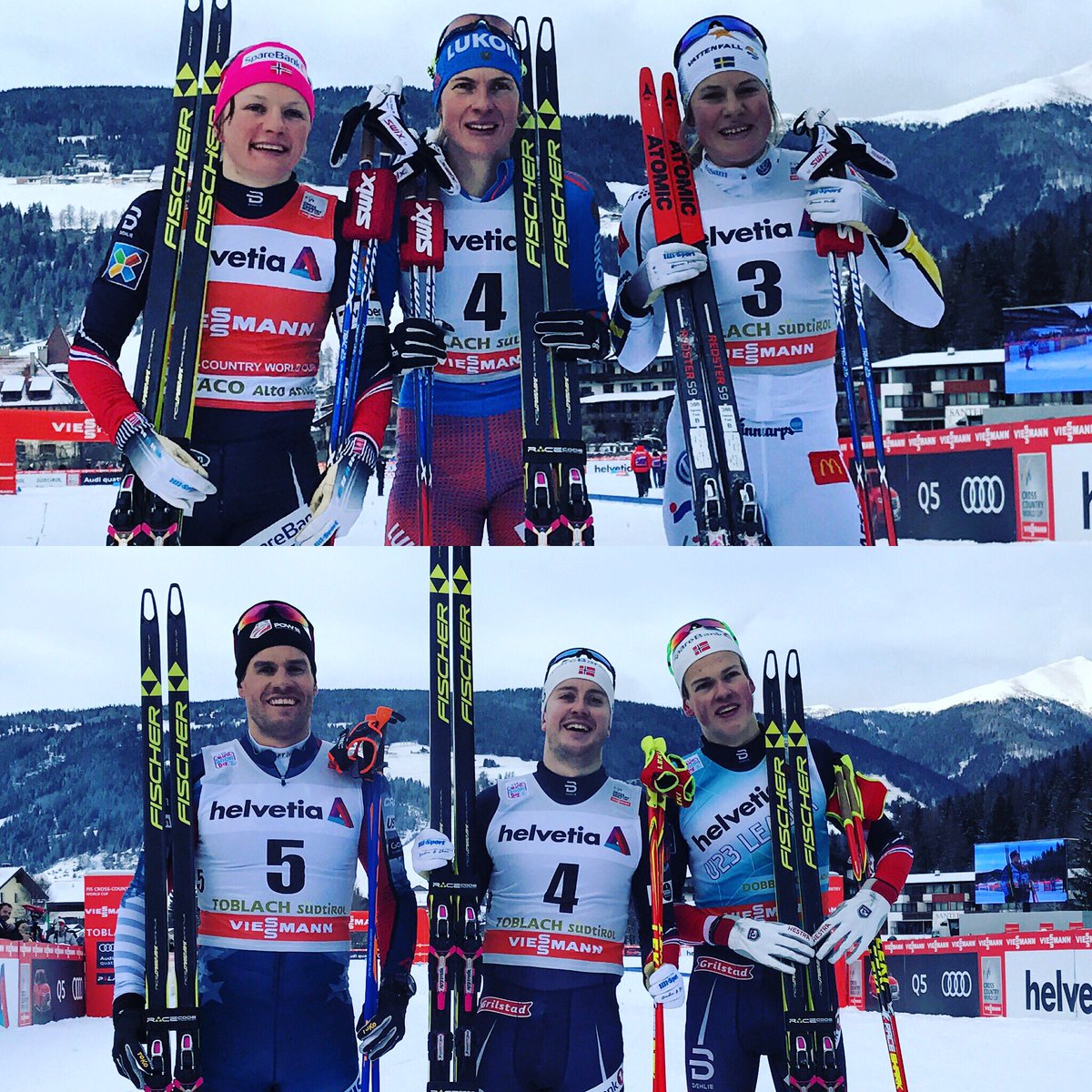
    The women's (top) and men's (bottom) podiums at the World Cup 1.3 k freestyle sprints on Saturday in Toblach, Italy. Russia's Natalia Matveeva (top center) won the women's final, ahead of Norway's Maiken Caspersen Falla (top left) and Hanna Falk (top right). American Simi Hamilton (bottom left) took second in the men's final, behind Norway's Sindre Bjørnestad Skar (bottom center) and ahead of Norway's Johannes Høsflot Klæbo (bottom right) in third. (Photo: FIS Cross Country)
    The women’s (top) and men’s (bottom) podiums at the World Cup 1.3 k freestyle sprints on Saturday in Toblach, Italy. Russia’s Natalia Matveeva (top center) won the women’s final, ahead of Norway’s Maiken Caspersen Falla (top left) and Hanna Falk (top right). American Simi Hamilton (bottom left) took second in the men’s final, behind Norway’s Sindre Bjørnestad Skar (bottom center) and ahead of Norway’s Johannes Høsflot Klæbo (bottom right) in third. (Photo: FIS Cross Country)

    FIS Cross-Country World Cup (Toblach, Italy): Freestyle sprints

    Race report

    Simi Hamilton is back on the World Cup podium and was three-hundredths of a second away from the win on Saturday in the men’s 1.3-kilometer freestyle sprint in Toblach, Italy. The American qualified fifth and went on to win his quarterfinal then advance as a lucky loser in third out of him semifinal. In the men’s final, Hamilton waited until the last hill to strike and used his conserved energy in the two-lap race to outlast the likes of Italy’s Federico Pellegrino and Norway’s Johannes Høsflot Klæbo at the finish. Hamilton put it all on the line in a photo finish with Norway’s Sindre Bjørnestad Skar, with Skar taking his first individual World Cup victory in 2:47.91. Hamilton placed second for his first podium of the season and fourth of his career. It was also Hamilton’s first time in the final this season.

    Klæbo was the second Norwegian on the podium in third, 0.66 seconds behind Skar, Pellegrino placed fourth (+1.27), Hediger was fifth (+1.84), and Norway’s Håvard Solås Taugbøl (who won the qualifier to start the day in 2:47.38) took sixth (+3.77).

    “I just had a good feeling that I was a little bit before [Hamilton],” Skar said in a post-race interview with FIS of his immediate finish-line celebration before confirming that he won. “It was very, very tight.”

    Skar, who turns 25 on Jan. 22, qualified fourth and won his quarterfinal and finished second in his semifinal, 0.05 seconds ahead of Hamilton.

    Also for the U.S., Andy Newell qualified for the heats in sixth and took third in his quarterfinal for 13th overall. Canada’s Alex Harvey qualified eighth and finished fourth in his quarterfinal for 17th overall, and the second Canadian racing this weekend, Len Valjas, qualified 23rd and took fourth in his quarterfinal for 20th.

    In the women’s race, Russia’s 30-year-old Natalia Matveeva notched the 12th individual podium of her career (all in sprints) and first victory since 2007. She challenged Norway’s Maiken Caspersen Falla on the last climb and overtook her in the finishing stretch of Saturday’s 1.3 k skate sprint final for the win in 3:04.13. Matveeva qualified fourth to start the day, then placed second in both her quarterfinal and semifinal en route to the victory. Falla won the qualifier in 3:10.89, and continued to dominate her quarterfinal and semifinal before ending up second on the day, just 0.08 seconds out of first.

    “I’ve waited a lot of time to be [here],” Matveeva told FIS afterward. “I’m very happy and the Russian team is very happy. Thank you very much my service team. Good job today.”

    Sweden’s Hanna Falk reached the podium in third (+2:41), Germany’s Sandra Ringwald placed fourth (+3.46), Sweden’s Ida Ingemarsdotter was fifth (+5.88), and Slovenia’s Vesna Fabjan sixth (+19.39).

    Americans Kikkan Randall and Sophie Caldwell tangled in the first semifinal and ended up 10th and 11th, respectively, at the end of the day. Also for the U.S. Ski Team, Ida Sargent qualified for the heats in 16th (behind Caldwell in 15th while Randall qualified 27th), and reached the semifinals as well, placing sixth in the second semifinal after skiing in third into the finishing stretch. Sargent ended up 12th for her best result in over a year.

    Results: Men | Women

    ***

    IBU World Cup (Ruhpolding, Germany): Women’s 7.5 k sprint

    Race report

    Finland’s Kaisa Mäkäräinen posts a 22-second win for her first victory of the season and first time shooting without a miss in an individual race since the Ruhpolding sprint almost exactly a year ago. Dunklee leads North Americans in 33rd and qualifies for the pursuit, along with Canada’s Rosanna Crawford (55th), Megan Tandy (56th) and Julia Ransom (60th).

    Results

    ***

    Ski Classics Kaiser Maximilian Lauf (Seefeld, Austria): 60 k classic 

    [UPDATED] Imagine knee-deep snow drifts over the course of 60 k. That’s what faced racers in Saturday’s Kaiser Maximilian Lauf, the fourth stop in the 2016/2017 Ski Classics series, in Seefeld, Austria.

    Team Santander’s Kateřina Smutná and Andreas Nygaard fared best in the conditions, racing to the women’s and men’s victories in 3:43:48.7 and 3:21:44.5, respectively.

    Smutna won the women’s race by 10.8 seconds over Astrid Øyre Slind (Team United Bakeries), and Britta Johansson Norgren (Lager 157 Ski Team) finished more than three minutes later in third place (+3:35).

    “It was the right decision to go with kick today,” Smutná said after, according to a Ski Classics press release. “It was hard for us to be in the lead and open the tracks for men. We waited for them to catch up and do the work on our behalf. I noticed it was tough for Britta because she was double poling. So, Astrid and I decided to work together in the final section of the course, and it worked perfectly.”

    The men’s race was much closer with Nygaard holding off his Team Santander teammate Tord Asle Gjerdalen by 0.6 seconds. Stian Hoelgaard (Team Leaseplan) placed third, another 0.6 seconds back.

    “It was a tough race because there was so much snow on the course,” Nygaard said, according to the press release. “At some point, we were knee-deep in soft snow. The pace was slow, but you get tired after a while because you have to work hard when it’s snowing like this. I just kept telling myself that I need to keep up with the guys and win the race in the end. This is something that I didn’t expect to happen when the season started. Let’s see how long I can keep the yellow [leaders] bib.”

    The overall Ski Classics series leader, Nygaard is also the sprint leader as well. On the women’s side, Johansson Norgren possesses both the overall and sprint bibs as well.

    FasterSkier Editor-at-Large Chelsea Little placed 17th.

    Results: Men | Women

  • Alsgaard on the Advent of Double Poling and FIS’s ‘Stupid Rule’

    Alsgaard on the Advent of Double Poling and FIS’s ‘Stupid Rule’

    Thomas Alsgaard is all about the evolution of double poling, especially as it pertains to long-distance ski marathons. Alsgaard, the owner and manager of Team LeasePlan, took a selfie his team's new shirts for the 2016/2017 Ski Classics season. (Photo: Thomas Alsgaard Instagram via OpenSki.ru)
    Thomas Alsgaard is all about the evolution of double poling, especially as it pertains to long-distance ski marathons. Alsgaard, the owner and manager of Team LeasePlan, took a selfie his team’s new shirts for the 2016/2017 Ski Classics season. (Photo: Thomas Alsgaard Instagram via OpenSki.ru)

    Thomas Alsgaard is fired up. Having challenged the International Ski Federation (FIS) regarding rules he considers arbitrary and insensitive to other venues for nordic skiing besides the World Cup, a potential divide may be opening up between the Ski Classics marathons and World Cup racing. With 15 Olympic and World Championships medals, Alsgaard is considered by many to be the most apt pupil of the skating technique, and has the palmares to corroborate that claim. As a veteran of World Cup and professional racing, and the owner/manager of Team LeasePlan, ski fans are receptive to his points against the FIS’s new regulations.

    Earlier this month, the day before La Sgambeda, the opening race of the Ski Classics season, the Russian ski website Openski.ru interviewed the legend himself in Livigno, Italy. Reporter Denis Kabanen covered topics ranging from the FIS rule restricting pole length in classic-technique racing, to the growing divide between the Ski Classics and FIS, women racers at the highest level of the sport, and the future of double poling.

    Kabanen provided FasterSkier with the original interview in English. Here is part of it (to read more, see Part I and Part II of OpenSki’s interview with Alsgaard):

    OpenSki: What do you think of the development of double poling? Do you think the women’s side will develop the same as the men in a couple of years?

    Thomas Alsgaard: I think so. You see, the distance between men and women in long distance; years ago it was usually half an hour, now it’s just a narrow … The men have developed, very fast, but the women have developed [at an even faster rate].

    OS: Let’s talk about the double-pole rule. I was checking my length today for the first time, I have ski poles that are a centimeter too long. I will actually put something under my heel. What’s your opinion?

    TA: The rule is there, so now you can’t do anything, so what’s the point? It’s a stupid rule… everything they are doing is because they are organized by people who think World Cup, and everything and every rule is meant for World Cup, and long distance racing … we just have to follow. So, I talked to them and said, ‘you knew this doesn’t change anything,’ and they said, ‘yeah, it doesn’t change anything.’ So, why the hell do you do it then? Are you kidding with us? Why? What’s the point?

    OS: They say we don’t want technique to go a different way, like super-long ski poles.

    TA: Yeah, but they don’t. That’s where they don’t have the knowledge … the double-poling king [two-time Ski Classics overall champion Petter Eliassen], he used one centimeter lower than the 83-percent rule.

    Two-time defending Ski Classics champion Petter Eliassen, of Team LeasePlan. (Photo: Visma Ski Classics)
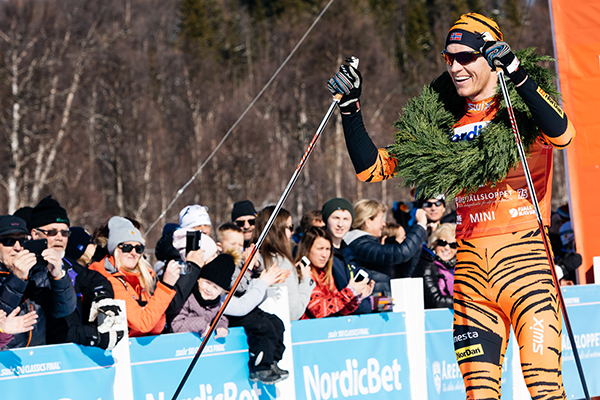
    Two-time defending Ski Classics champion Petter Eliassen, of Team LeasePlan, celebrating another win in his team’s tiger suit. (Photo: Visma Ski Classics)

    OS: Could you tell me more about [Eliassen’s] experience last year? The year before he started with 150 centimeters, and then he went to 170, 172 cm, but you feel that he lost frequency? What did he gain?

    TA: It’s more comfortable. If you do slow training, it’s very comfortable, but we have experienced, during the spring and summer, that in shorter hills and sprints you don’t get the frequency. If you have too long poles, it’s too much to move, so … Uphill it’s quite good, and for the average racer, just ski one speed around the track, it’s comfortable, but for the best poling speeds, a lot of times during the race then you have to go slower.

    OS: I read that he said that regular classic length minus 30 centimeters for flat races, and hillier races maybe closer to skate. So two different lengths?

    TA: That might be, but I still think skating poles … if you want to win the races, it’s too long.

    OS: What’s the best frequency for double poling? 

    TA: It’s impossible to say. It’s all up to feeling. The terrain, speed of the snow, conditions, there are so many factors…

    OS: In terms of technique, ski classics are developing like cycling races with teamwork; did you work out some kind of team tactic [for Team LeasePlan]?

    TA: No, I never do that. I know from experience that if you want to win the race, you have to be able to read everything as it happens. You have to make the right decisions at the right time. It doesn’t matter if you have the best plan in the world if the [other racers] do something else, you have to adapt, you have to be there in the moment. It’s very complicated, but if you’re calm and have experience you usually do the right thing.

    Thomas Alsgaard (near) jogging with fellow former Norwegian skiers Espen Bjervig and Bjørn Dæhlie earlier this year. (Photo: Thomas Alsgaard Instagram via OpenSki.ru)
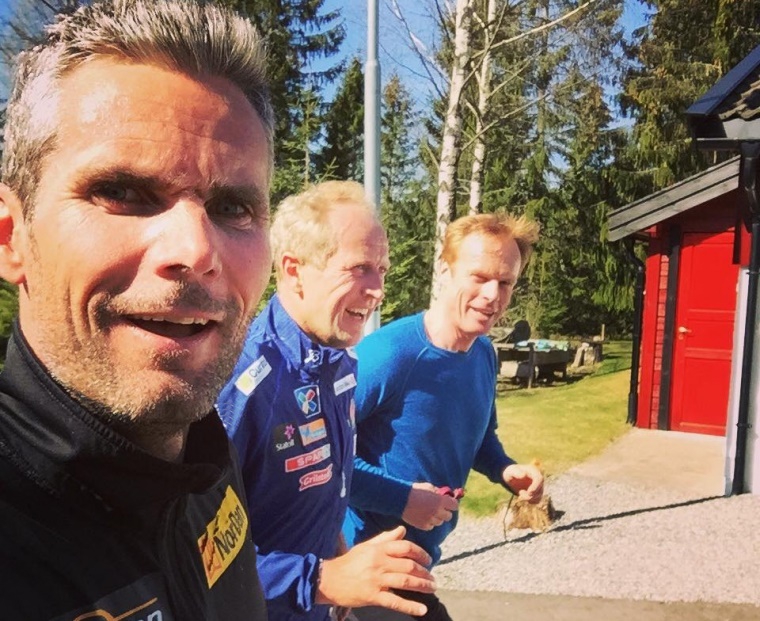
    Thomas Alsgaard (near) jogging with fellow former Norwegian skiers Espen Bjervig and Bjørn Dæhlie (far) earlier this year. (Photo: Thomas Alsgaard Instagram via OpenSki.ru)

    OS: Do you think double poling is something that will help young skiers get better at any kind of skiing?

    TA: Yeah… People on a high level, with a high capacity, when they have been thrown out of the national team and get on to a long distance team, they train a lot more double poling and long distance training. Then they get also much more stronger in all-around skiing.

    OS: That’s good for sport! Why would you stop that? 
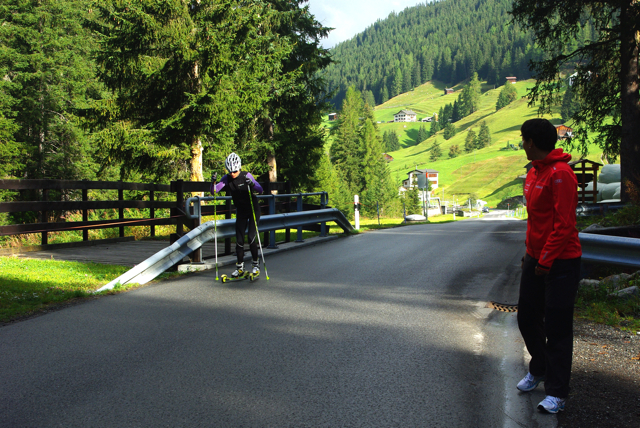
    TA: Why avoid double poling? It makes everyone stronger. And the younger guys I have trained with are 16, 17; they are so strong. They can’t hold it for long, because the age, but they are so incredibly strong. I cannot keep up with them. When they grow up, when they get older, five, seven years from now, then we’ll really see. I know because I was from the first generation that grew up with skating, and when I won Lillehammer I was on a completely different level, technically, than all the other guys. I think the same will happen in classic in six years when these young guys grow up we’ll see some amazing double poling.

    — FasterSkier’s Jake Ellis contributed reporting

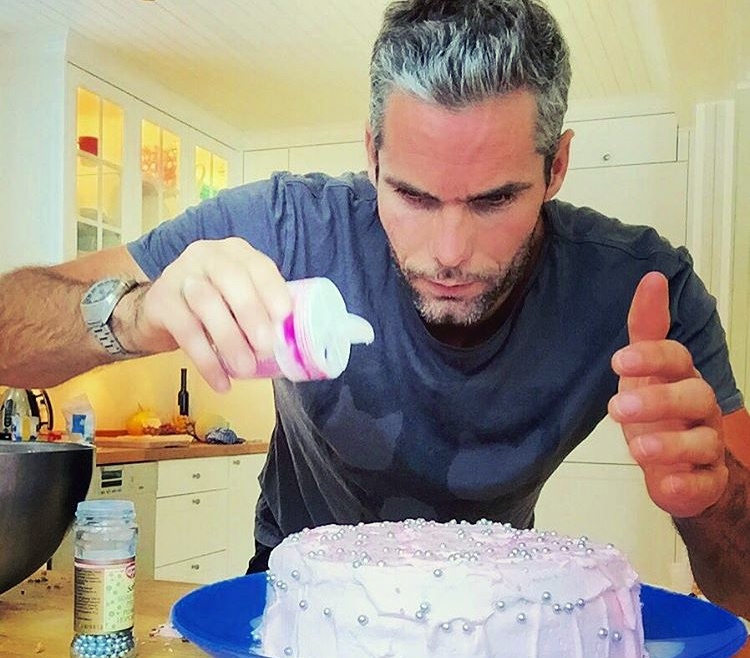
    Marathon team owner/manager and five-time Olympic gold medalist Thomas Alsgaard, of Norway, shows his softer side, decorating a cake for his Team LeasePlan before the start of the 2016/2017 Ski Classics season: "... Winter has come ❄️❄️ It's a happy day." @leaseplan_tigers celebrates with (pink ...) birthday cake !!! How are you celebrating?" (Photo: Thomas Alsgaard Instagram via OpenSki.ru)
    Marathon team owner/manager and five-time Olympic gold medalist Thomas Alsgaard, of Norway, shows his softer side, decorating a cake for his Team LeasePlan before the start of the 2016/2017 Ski Classics season: “… Winter has come ❄️❄️ It’s a happy day.” @leaseplan_tigers celebrates with (pink …) birthday cake !!! How are you celebrating?” (Photo: Thomas Alsgaard Instagram via OpenSki.ru)
  • Sweden Debuts Domestic Marathon Series: Björn Dæhlie SKI Challenge

    Sweden Debuts Domestic Marathon Series: Björn Dæhlie SKI Challenge

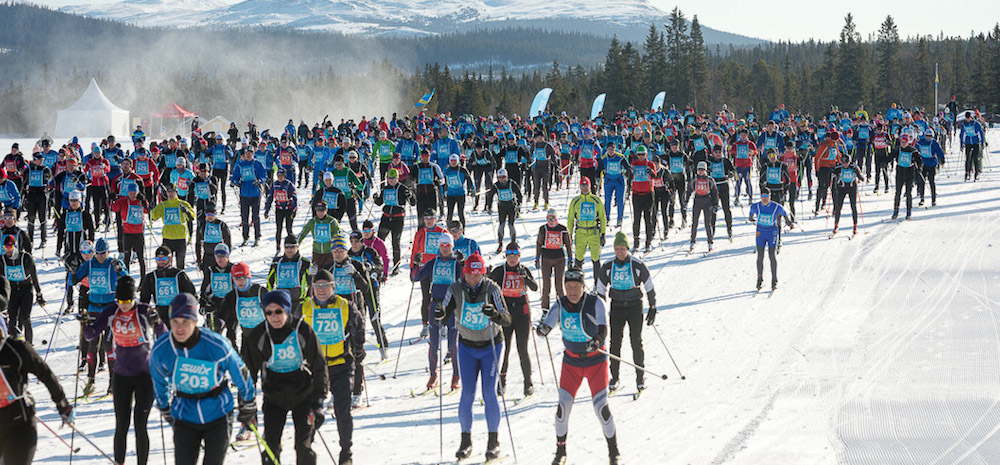
    The Björn Dæhlie SKI Challenge, a new long-distance cup in Sweden, is offering a domestic alternative to the hugely popular international race series Swix Ski Classics. (Photo: Magnus Osth/Swix Ski Classics)
    The Björn Dæhlie SKI Challenge, a new long-distance cup in Sweden, is offering a domestic alternative to the hugely popular international marathon series, the Swix Ski Classics. (Photo: Magnus Osth/Swix Ski Classics)

    Note: This article has been updated to include the prize money up for grabs in this season’s Björn Dæhlie SKI Challenge.

    A new long-distance series in debuting in Sweden this winter, with five popular marathon races — all classic — much like a national version of the international long-distance cup, the Swix Ski Classics.

    The first race of in the inaugural Björn Dæhlie SKI Challenge is the AXA Ski Marathon in Falun on Dec. 28. The next event is the Intersportloppet on Jan. 17 in Mora, followed by Västgötaloppet on Feb. 8 in Ulricehamn, and the Wadköpingsloppet on Feb. 15 in Örebro. The Skinnarloppet on Feb. 22 in Malung concludes the five-race series.

    Björn Dæhlie SKI Challenge 2014/2015:
    (Say these five times fast)

    – Dec. 28: AXA Ski Marathon, Falun
    – Jan. 17: Intersportloppet, Mora
    – Feb. 8: Västgötaloppet, Ulricehamn
    – Feb. 15: Wadköpingsloppet, Örebro
    – Feb. 22: Skinnarloppet, Malung

    According to the founders and CEOs of the cup, Martin Holmstrand and Lasse Strand, the idea of the race series is to allow both elite and recreational skiers to participate in the same events, with the same start and finish, and a fun and inclusive atmosphere.

    “At five different occasions, we head to the tracks, for different reasons and with different ambitions,” Holmstrand said in a press release on the Björn Dæhlie SKI Challenge website. “For a lot of skiers, our marathon events serve as a motivation to challenge themselves and push their own limits. For others, these events represent exciting adventures and simply experience something entirely new. No matter what group you fall into, we will do this together, side by side on the start line with skis on our feet and poles in our hands.”

    Erik Wickström is an important ambassador for the new long-distance cup. The marathon guru plans to race the cup as well as offer advice to potential participants through the race series web site. (Courtesy photo)
    Erik Wickström, an ambassador for the new long-distance cup, plans to race the SKI Challenge series as well as offer advice to potential participants through its website. (Courtesy photo)

    Erik Wickström, a guru in Swedish marathon circles, masters coach and author of several books about skiing and endurance training, will take part in the series and help promote its concept. Wickström also plans write several articles for the SKI Challenge website on training advice, technique tips, equipment guides and an online primer on ski waxing.

    “I’m stoked about the new long-distance cup,” he said on the SKI Challenge website. “I used to race the Swix Ski Classics events all over Europe, but now that I’ve become a dad and have a family and a house to take care of as well, I am looking to minimize travel while still being able to race. So a cup with high-level competition right here in Sweden is just what I was after.

    “In 2011, I raced all of the events in the mountain bike cup, and I really loved the concept that allows both elite and recreational athletes to race in the same events with an inclusive and fun atmosphere,” he added. “If the organizers do as good of a job with the winter version as they do in the summer, this long-distance cup is going to be world-class.”

    The SKI Challenge is based on the Swedish Mitsubishi MTB Challenge, a nationwide marathon mountain-bike cup that has been held every summer since 2000.

    In addition to naming the top male and female over the course of the season, the new long-distance cup will also name the overall top male and female in the junior and masters age categories.

    Prize money was announced Thursday on the website, with the top overall male and female each earning 12,000 Swedish krona ($1,614 dollars). Second-place gets 8,000 SEK ($1,076), third 6,00o SEK ($807), fourth 3,000 SEK ($403), and fifth 2,000 SEK ($269).

    In the masters’ categories, men and women, 40, 50 and 60, there will be product prizes for the overall top 3.

    Additionally, there will be raffle drawings for non-elite racers who have participated in at least four of the five races.

    Finally, clubs collect points for all participating members, and the club with the most points after the series will be recognized at the awards ceremony at the Skinnarloppet on Feb. 22.

    Erik Wickström is an important ambassador for the new long-distance cup. The marathon guru plans to race the cup as well as offer advice to potential participants through the race series web site. (Courtesy photo)
    Sweden’s marathon guru, Erik Wickström (Courtesy photo)
  • Marathon Queen Seraina Boner, with Scandinavian Support, Eyes Unconquered Vasaloppet

    Marathon Queen Seraina Boner, with Scandinavian Support, Eyes Unconquered Vasaloppet

    Swiss national team coach Guri Hetland checks Team Coop's Seraina Boner's time on a threshold interval on Wednesday.
    Swiss national team coach Guri Hetland checks Team Coop’s Seraina Boner’s time on a threshold interval on Wednesday.

    DAVOS, Switzerland – Seraina Boner hasn’t been part of the Swiss national team since the 2010 season, when the 2006 Olympian was left off the squad for the first time.

    But has that stopped her? Not at all. Boner decided three years ago to focus on long-distance racing, and has become the world champion in that discipline. A two-time Birkebeiner winner, last year she also won the prestigious Marcialonga marathon in Italy and the Engadin Marathon in her home region here in Switzerland.

    At 31 years old, she might not be part of the national team, but she’s still welcome.

    “My philosophy is that anyone who wants to train with us, can,” Swiss head coach Guri Hetland told FasterSkier. “It’s good to have her here to push the women.”

    On a recent Wednesday morning Boner was at a national team training session that actually didn’t include any other women, just Dario Cologna and Roman Furger. She was taking advantage of the fact that Hetland was driving the men down a long, narrow, winding hill – not ideal for skiing down – in between intervals, and hopped in for the workout.

    “It’s really good for me to join the training group in Davos when I’m back home, and I’m back home pretty often,” Boner said at the end of the session. “It’s more fun if there are more girls around. There are not so many up here, but we try to fix some workouts together, and that helps.”

    Boner, who is part of the Team Coop marathon squad, is focused exclusively on racing very long distances. But that doesn’t mean that she can’t train with the other Swiss women, who are primarily focused on sprinting (Laurien Van Der Graaf and Bettina Gruber are tops on the team). In fact, she doesn’t think that she trains many more hours than them, and still does plenty of fast workouts.

    “I think that the basic training is pretty much the same probably,” Boner said. “The ones that are more specializing for sprints will have some specific workouts, and I will have some specific workouts for long distance, but the average is pretty much the same…  sometimes it’s good to have company, especially in speed workouts. You can help each other a lot when you’re in a group.”

    Boner putting in the hours in Davos.
    Boner putting in the hours in Davos.

    Boner is also still no slouch at shorter distances. This past season, she won two titles at Swiss national championships. In the 5 k skate, she was fourth behind Americans Liz Stephen, Jessie Diggins, and Holly Brooks. The next day, with the Americans sitting out, she won outright in the 10 k classic pursuit.

    But while national teams around the world are gearing up for the Olympics, Boner is focused on the Vasaloppet, a race where she has “always struggled a bit.” She is doing more double-pole training, including a recent 48 k workout in southern Sweden, far from the mountains she is used to here.

    “I’ve been three weeks in Norway this summer, so there I focused a lot on double-poling,” Boner said. “And also when we’re at training camps with the team we have a lot of double-poling sessions. But you can also find some flat parts like here, you just have to look for it a bit more.”

    And so continues the renaissance of Boner’s career. 41st in her only individual start in the Olympics back in 2006, she has now won the Swix Ski Classics title as well as almost every major European marathon except the Vasaloppet, where she finished third the last time she tried.

    Boner has to look outside of Switzerland for support. Despite her dominance at long distances, she is not the star she would be in Norway or Sweden.

    “Cross country skiing is not so big in Switzerland,” she said. “Of course, since Dario is racing pretty okay it’s getting bigger and bigger.”

    She jabbed Cologna, who was sitting next to her in the team van.

    “But it’s not as big as in Scandinavia, at least not marathons and stuff,” she explained. “There is some support, but for doing the long distance I had to join a Scandinavian team and that helps me a lot of course.”

    With Scandinavian backing, she hopes to add the legendary Swedish 90 k race to her list of conquests this year.

    “That is kind of the biggest, so it’s a goal to have a good race there,” she said.

  • Tartu Maraton joins Ski Classics

    Ski Classics 2012 will include 7 long distance ski races, new for 2012 is the Estonian race Tartu Maraton.

    Ski Classics is the long distance championship across Europe, it had a fantastic first season in 2011. The Ski Classics 2012 season will  consist of 7 long distance ski races, new in 2012 is the Estonian race Tartu Maraton. Tartu Maraton start in Otepää and finish 63km later in Elva, it is held in classic technique. The race has a more than 50 years strong tradition and was in the 80´s the biggest ski race in the then Soviet Union.

    “The calendar for Ski Classics 2012 looks very exciting, now when also Tartu Maraton has joined Ski Classics the long distance ski concept feels complete. Tartu Maraton is held 2 weeks after König Ludwig Lauf and 2 weeks before Vasaloppet filling up a previous gap in the Ski Classics calendar” Says David Nilsson, Executive Director Ski Classics, he continues “Tartu Maraton is one of the world´s most classic ski races, and gather every year the best long distance skiers.”

    “Björn Daehlie, multiple Olympic gold medalist as well as Anders Aukland, double Tartu Maraton winner, have both given a high value to the course of Tartu Marathon mentioning it as one of the best cross country ski courses in the world due to its variable scenery.” says Indrek Kelk, general director of Tartu Maraton, and he continues “Being a part of Ski Classics gives us the possibility to prove to millions of TV-viewers that these two ski-kings have told the truth. We hope that after seeing the beauty of the course and the high organization level of the race through the TV-broadcast, thousands of new skiers around the Europe would like to participate the Tartu Marathon in the future years.”

    More Ski Classics news will be presented during the fall in the build up for the 2012 season starting on January 8th in the Czech Republic.

    Ski Classics schedule 2012:
    Event 1 Jizerska Padesatka                               Czech Republic 8th   January 2012
    Event 2 Marcialonga                                          Italy                              29th January 2012
    Event 3 König Ludwig Lauf                                Germany                       5th   February 2012
    Event 4 Tartu Maraton                                        Estonia                         19th February 2012
    Event 5 Vasaloppet                                           Sweden                        4th   March 2012
    Event 6 Birkebeinerrennet                                  Norway             17th March 2012
    Event 7 Ski Classics Final – Norefjell                  Norway             31st March 2012

    More info at:
    www.skiclassics.com

  • FIS Classics: Ulvang shocked over König Ludwiglauf Fair Play Violation

    “Ski Classics can’t just go in there and appoint their own jury. Only the FIS jury can judge in cross-country skiing,” Vegard Ulvang said to Langrenn.com.

    Ulvang is reacting to the Sandra Hansson’s case of unfair play in the 2011 König Ludwiglauf in Germany last weekend, which resulted in Hansson having her points for winning the FIS Ski Classic race reduced as a penalty for her actions.

    “I am shocked that Nils Marius Otterstad (ed. Hansson’s team manager) and Ski Classics steps up and plays jury here. They do not have the right to do that. Only an FIS-appointed jury that can make these decisions. That is the first principle, and this is shocking,” Ulvang said to Langrenn.com.

    “This is a clear example that private players in this field are a concern,” Ulvang added.

    – But why didn’t FIS act on this after the incident?

    “I don’t want to comment on this case. The FIS had a jury on site, and as far as I know, this jury did not act on the situation. Nobody else can put together a jury of their own and make these decisions,” Ulvang said. “If anyone is discontent, they have the right to appeal,” he emphasized.

    – Nils Marius Otterstad criticized the FIS for not taking action, and argue that the FIS doesn’t care about the ski marathons. What is your comment on that?

    “If he criticizes the FIS, he is basically criticizing himself. The FIS has a separate citizen race and marathon committee, consisiting of representatives from all the major ski marathons. This committee appoints the jury,” Ulvang explained.

    David Nilsson: – We had to take action

    David Nilsson, the Ski Classics director, said to Langrenn.com that in their opinion, the Hansson incident was grave enough that they felt required to step in.

    “If we hadn’t reacted in this case, that would have been damaging to both the reputation of the Ski Classics, and ski marathons in general. We have a point system, and there is a lot of prize money at stake,” Nilsson said.

    While Langrenn.com was interviewing Nilsson, they were informed that the Swiss Ski Association (representing the offended skier Seraina Boner) had submitted a formal protest to the FIS about the incident between Hansson and Boner.

    “To us, it would be peculiar if the FIS doesn’t react to this incident,” Nilsson concluded.

    “They totally didn’t care about König Ludwiglauf”

    Jørgen Aukland (NOR/Team XtraPersonell) said the FIS has ignored marathon racing for too many years.

    Aukland has raced the FIS marathon circuit for a decade and argues that FIS never cares.

    “FIS has neglected and ignored marathon racing for far too long,” Aukland said to Langrenn.com.

    After Sandra Hansson (Team United Bakeries) was stripped of a portion of her points due to the incident in the König Ludwiglauf in Germany last Sunday, several people have reacted both to Hansson’s unfair behavior in the race and to the Ski Classic organizers taking matters in their own hands.

    “But what should the Ski Classic organizers have done? FIS didn’t care about the König Ludwiglauf. Nowbody knew where the technical delegate was, he didn’t have a cell phone on him, there was no coaches’ meeting and there was no m formal seeding. This was all just a mess. How should the racers deal with that? Nobody did anything,” Aukland said to Langrenn.com.

    Aukland is mad

    “I understand that this creates a conflict of interest, but Otterstad and Ski Classics have already publicly apologized for that. But that’s not what this is about. I’ve never seen Vegard Ulvang at a FIS marathon before. He speaks before he even knows the details. Nothing has happened on the marathon circuit for the last decade. Ski Classics really does a great job exposing this aspect of ski racing and contributes to unite the cross-country communities. It’s awesome that someone finally took action in the incident on Sunday,” Aukland said to Langrenn.com.

    “All the racers I’ve talked with supports the Ski Classic’s decision in this case,” he added.

    The youngest Aukland brother in the strong ski family tried repeatedly to contact Ulvang on Tuesday but was unable to get a hold of him.

    “I just wanted to give him my opinion. This is a hopeless situation,” Fredrik Aukland said.

    “The FIS is sleeping in class, and during the König Ludwiglauf they definitely didn’t do their job. Then someone else has to do it, and it’s good that they did,” he concluded.

    From Langrenn.com, February 8 and 9, 2011 By Ola Jordheim Halvorsen, translation by Inge Scheve

  • Ski Classics Penalty to Sandra Hansson: with VIDEO

    Ski Classics experienced a Fair Play incident in yesterdays König Ludwig Lauf on which Ski Classics will take action.

    During the last kilometer in König Ludwig Lauf, the athletes Sandra Hansson and Seraina Boner, had an intense fight for the leading position in the women class. These so-called fights are a part of cross-country skiing ,however, in this particular fight  Sandra Hansson clearly blocked Seraina Boner on several occasions in an unfair way. It is stated in Ski Classics Rules Paragraph 8, that “All athletes participating in Ski Classics must act according to Fair Play”, hence Sandra Hansson’s behavior was in violation to this paragraph.

    Ski Classics will reduce Sandra Hansson´s score in the Ski Classics Champion race with 30 points, and she will receive 70 points for König Ludwig Lauf instead of 100 points.

    No adjustment will be made to Seraina Boners 80 points. Hence Seraina Boner is the new leader of Ski Classics Champion race.

    Please note that this penalty only affects Ski Classics, and not  FIS Marathon Cup.

    Ski Classics will continue to promote Fair Play in cross-country skiing, and strongly believe that this was a single isolated incident by Sandra Hansson.

    Video of the situation:

  • Aukland, Hansson and Team Exspirit in the Ski Classics Lead

    Aukland, Hansson and Team Exspirit in the Ski Classics Lead

    Jizerska Padesatka 2011 – Men's Podium – Oskar Svard, Anders Aukland, Stanislav Rezac

    After a long and intense battle between Oskar Svärd, Team Exspirit, and Anders Aukland, Team Xtra Personell, the later turned out victorious in the Ski Classics event Jizerska Padesatka held this weekend in Bedrichov, Czech Republic.

    The two broke away after the first 10k climb and stayed together until the Smedava climb at kilometer 30. In the climb Anders Aukland went all in and showed great climbing skills. Third came Stanislav Rezac, Team Patria Direct, and fourth Mathias Fredriksson, Team Exspirit, after a sprint against Audun Laugaland, Team United Bakeries,  who finished in 5thplace.

    The women’s race was won by Sandra Hansson, Team United Bakeries. Second was Seraina Boner from Engadin Skimarathon Team, and third and fourth place went to two Team Exspirit skiers, Susanne Nyström and Jenny Hansson.

    In the Ski Classics Team competition, where the two best male and single best female skier count, the Swedish based Team Exspirit leads ahead of the two Norwegian teams – Team United Bakeries and Team Xtra Personell. Lars Ljung from Helsinge Ski Team is the current leader of the Ski Classics youth competition, the best skier under the age of 26.

    Next Ski Classics race is the Marcialonga, Italy on the 30th of January.

    Further info on www.skiclassics.com

    Jizerska Padesatka 2011 – Complete Results (PDF)

    Jizerska Padesatka 2011 – Women's Podium – Serraina Boner, Sandra Hansson, Susanne Nyström
  • “Ski Classics” Introduces Team Tactics in XC Skiing

    OSLO, Norway – Joergen Aukland and fellow Norwegian Kjartan Roland  were the original marathon specialists, who almost singlehandedly represented Norway consistently in the large international ski marathons outside of Norway.

    But that was ten years ago. Today, thousands of Norwegians travel to marathons such as Italy’s Marcialonga, and the races now boast a number of high-profile athletes, including Aukland and his brother, Anders.

    Both have fought for fame and glory, mostly for their own personal bragging rights, but with the launch of Ski Classics, they now have to consider their team – in this case, Team Xtra Personell. Ski Classics is a points-based competition running across all the season’s big marathons, with a Tour de France-style yellow jersey for the overall Ski Classic Champion, a pink jersey for the top racer under 25, a sprint jersey and a team jersey. Team points are awarded to the top two men and top two women in each race.

    “It’s really exciting that we get something like this. I’ve dreamt about it for a decade. Now we can race even more like a team in the big marathons,” Joergen Aukland told Langrenn.com.

    Sprint points will also count toward the overall team points throughout the season. One tricky issue for Team Xtra Personell is that they lack a strong female skier on their squad, who would have the potential to earn the women’s points. Both brothers Aukland and team manager Nils Marius Otterstad, exchanged furtive glances when Langrenn.com asked about who might step into that role during the formal launch of the Ski Classics in Oslo on November 29.

    The races in Ski Classics 2011:
    1 – Jizerska Padesatka, Czeck Republic, January 9, 2011
    2 – Marcialonga, Italy, January 30, 2011
    3 – König Ludwig Lauf, Germany, February 6, 2011
    4 – Vasaloppet, Sweden, March 6, 2011
    5 – Birkebeinerrennet, Norway, March 19, 2011
    Final – Norefjellrennet, Norway, April 2, 2011

    All six events will be televised live for Norwegian viewers via TV2, except for the Birkie, which can been seen live on NRK.

    From Langrenn.com, November 30, 2010. By Geir Nilsen, translation by Inge Scheve