We are trying to stay slightly ahead of the overuse injury and poor air quality curves. You may be midway through your summer training schedule and dealing with a bum ankle. Or you live in a place like much of the Western U.S. that has been or will be affected by poor air quality due to wildfires.
Whatever the causation, skiers can find themselves in make-do mode. If the air quality index (AQI) is high where you live, or a bum ankle precludes running or roller skiing, you have training options. And to remain optimistic, what you might think of as a compromise, can, in fact, benefit you in the short and long term.
Talk to most elite athletes who have trained abroad, and they will tell you that double pole specific workouts are the norm. Double pole capacity remains one mandatory piece of results success. This is where a Ski-Erg and upper body specific strength programs come in handy.
Many athletes are lucky to have access to a ski-erg. If you don’t, please don’t stress. According to a study published in 2017 that compared the effects of strength training and specific ski-erg training on junior cross-country athletes, both groups made double poling gains.
The researchers examined double-poling gross efficiency, maximal speed (V max), and peak oxygen uptake (VO2 max).
No ah-hah moments in terms of an either-or. “No between-group differences were found for any of the investigated variables,” was a key conclusion.
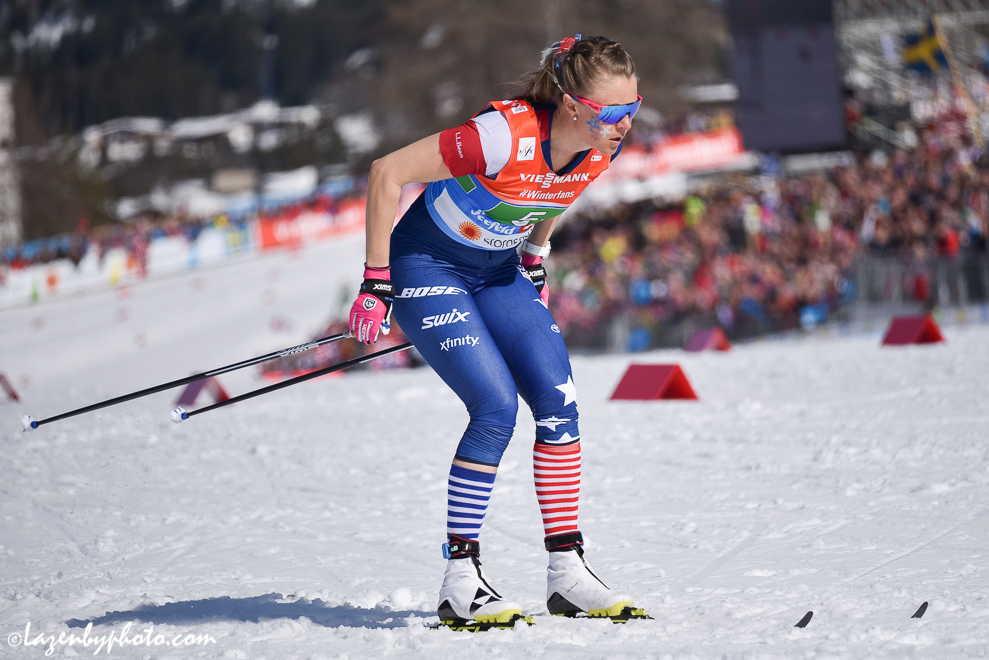
Sadie Bjornsen of the U.S. during the second leg of the 2019 World Championship 4 x 5 k relay in Seefeld, Austria. (Photo: John Lazenby/lazenbyphoto.com)
For those with access to a ski-erg, here’s a 2017 Wednesday Workout from a newly married Sadie Bjornsen. (Congrats!) If your local air quality is sub-par, we’re hoping the ski-erg is located indoors. (If you have a bum ankle, grab a chair, sit down in front of the ski-erg, and begin pulling.
The Start: “I start my workout with a fifteen-minute warm up. During this time, I often shut my eyes, and visualize skiing. This helps bring in true ski form, and feel my movements, rather than just fall into a ‘SkiErg-specific technique.’”
Getting Speedy: “During this time, I will do some little ten-second increases in power to warm up my back and arms, and get ready to go hard.”
The Workout: “After fifteen minutes, I begin the workout known as 30-30’s. This means 30 seconds of intervals followed by 30 seconds of recovery, then repeat for 30 minutes. What may feel easy at first, quickly catches up after 10 minutes, so I always start this workout more conservative than feels appropriate.”
Keeping It Going: “After about five minutes of 30 seconds on, 30 seconds off, I start to see a common number of watts I am exerting during the 30 seconds. This is where I set a goal. Maybe it’s 190 watts I am hitting, I want to continue to reach that level or more for the next 25 minutes of this workout. This becomes increasingly hard around 20 minutes, and requires a certain amount of mental power. The 30 seconds of rest begins to pass too quickly, and I find myself becoming really focused in my own little world… forgetting where I am (maybe a garage, maybe a gym).”
Finishing Up: “By the end of 30 minutes of 30-30’s, I am pretty worked, and feel like I have just done a race out on the snow. This is when I bring myself back to my surroundings, and finish with a fifteen minute easy warm down to help flush my arms out.”
Final Thoughts: “Not only does this one hour pass really fast, but it is a really focused workout that feels like it truly helps build specific power. I always make sure I finish this workout with a little five minute walk. This helps flush all my muscles, but also helps make sure my back goes back to moving naturally after a pretty intense workout.”
The Workout: Solo, high-focus, double-pole distance session
Erik Bjornsen of the U.S. skiing to 17th overall during the 15 k classic at the 2019 World Championships in Seefeld, Austria. (Photo: John Lazenby/lazenbyphoto.com)
Find suitable terrain and timing: “I choose the terrain based on how hard I want the workout to be. I try to fit this workout in mid-week between intervals sessions,” he wrote in an email. “The point is to get the biggest benefit without fatiguing the body too much.
“Most often I head up Campbell airstrip road. It’s a five-mile-long road, with a majority of the terrain measuring out at a gentle 5% incline,” Bjornsen continued. “There’s one steeper climb in the middle that’s about 500 meters long. For this workout, I go out and back twice.”
Warmup: 15-minute easy Level 1 (roller)ski to the start.
Go-time: Typically takes him 1 hour and 20 minutes to rollerski the 5-mile section twice.
“The steep 500-meter section is VERY hard to double pole — that portion of the road is something you would for sure stride in a race. During this workout, I try to spend an hour at L2 [Level 2] and end up bumping up to L3 [Level 3] only when double poling up that steep segment (2 X 5min in L3). I like having the two short but demanding double pole sections in this workout.
“The important part of this training session is not the 2 x 5-minute L3 sections, it’s the time before and after that L3 effort. You have to figure out how to get the muscles to recover from the hill while still double poling and determine what gear/tempo to use while still applying power efficiently — and recover at the same time.”
Cool down: 15-minute easy ski home.
Notes:
“The idea is to work specifically on double pole and upper body strength. You get an opportunity to work on all gears, from long double pole to very quick choppy double pole up the steep section.
“You can gain a lot from just focusing on two intensity sessions a week throughout the summer. This is a way I find I’m able to gain quite a bit from specific double pole training. But ideally, you don’t fatigue the body so much that it takes energy away from the true intensity sessions.”
Lastly, here’s the strength protocol from the 2017 study we mentioned up top. After a specified warm-up, here is what the researchers prescribed for the non-ski-erg test group.
(1) for different training days, the participant was allowed to alternate between five repetitions maximum (RM) of snatches, squats or deadlifts at 60–85% of body mass,
(2) 8 RM sit-ups or vertical sit-ups,
(3) 6 RM pull-downs, chin-ups or seal row
(4) 6 RM of pushdowns, bar-dips or narrow bench press
(5) 6 RM of belly-backs with or without dumbbells.
“All five exercises were conducted with two sets per exercise and 1-min rest between sets. Thereafter, the participants completed 5–10 min with different core-stability exercises, which were followed by 90 s of cable crunches, 60 s of pulldowns with a rope, and 30 s of triceps pushdowns with a rope without rest between exercises. After 1-min rest, these three exercises were repeated once. Finally, 3 sets of 45 s of medicine-ball slams (3–5 kg) with 15-s rest between sets were conducted. After the group-specific training session, the [strength] group performed 20 min of roller skiing using the double-poling technique in the heart-rate intensity zone MIT”
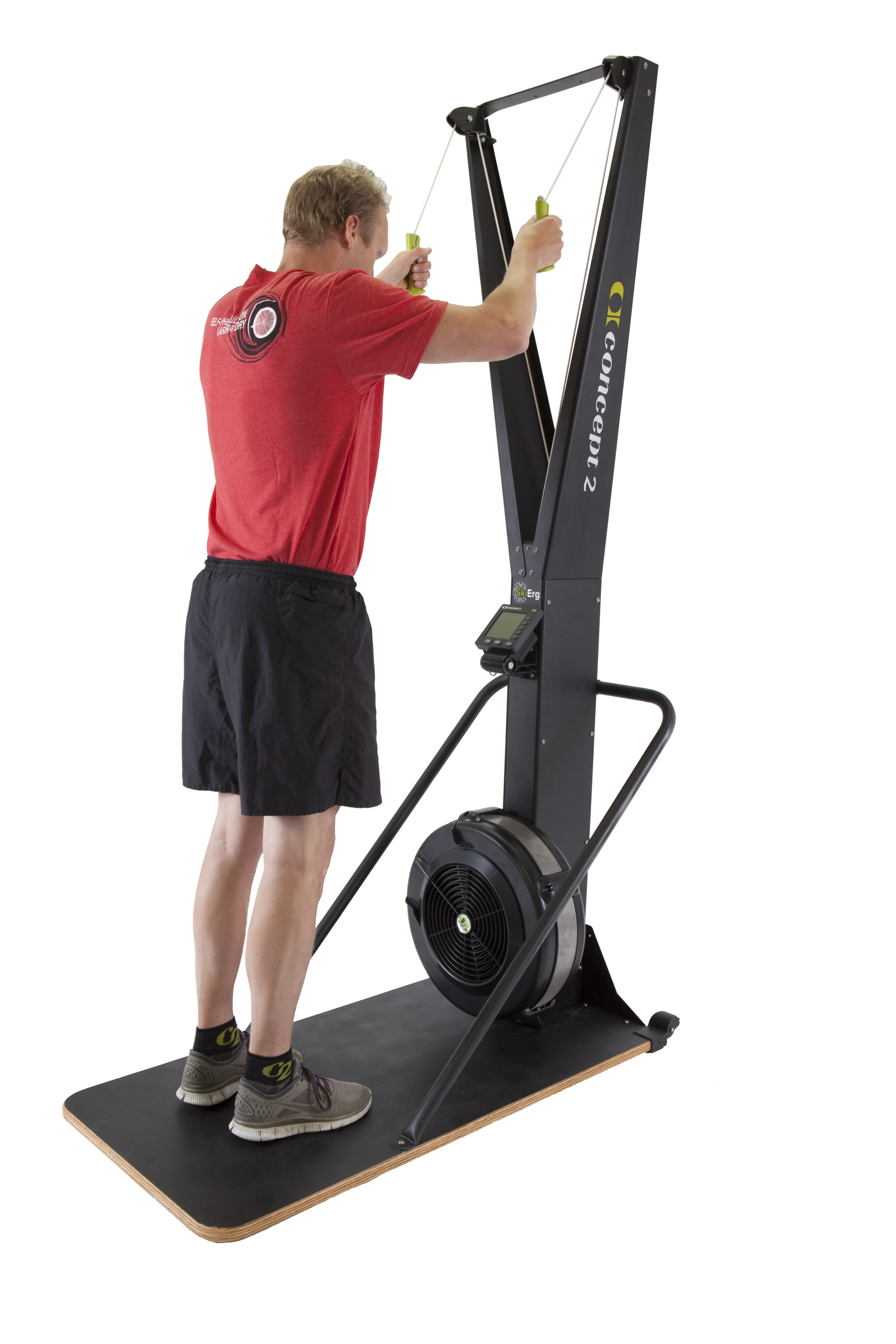
One of the best features of Concept2 ergs (The SkiErg or indoor rower) is that they accurately measure the work you’re doing. In addition, the flywheel calibrates itself on every rundown to take ambient conditions into account, so someone at altitude can compare their erg time with someone at sea level, regardless of the weather and environmental conditions.
What’s so great about this? It means you can race, and compare your times and distances with friends and competitors in another state, country or continent! It also makes the SkiErg a great tool for tracking your training progress by comparing your performance over a certain time or distance from one training block to the next. You can also race against your own performance from a previous workout using the ReSki function.
Do you have a competitive streak? Or do you just want to make your workouts more interesting? We invite you to try the following challenges—some are geared for individuals and some for teams:
100 Meter Dash: Pre-set the Performance Monitor for a 100 meter distance. The meters will count down to zero, and your total time will be displayed at the end.
1 Minute Max Meters: Pre-set the Performance Monitor for a 1 minute piece. The time will count down to zero, and your total meters will be displayed at the end.
2000 Meter Mixed Team 2k relay (two men/two women): Pre-set the Performance Monitor for a 2000m distance. Rotate each team member through in order, with each person skiing as long as they can maintain their goal pace, then switch on the fly. The meters will count down to zero, and your elapsed time will be displayed at the end.
1000 Meter Individual Sprint: An indoor version of the standard Nordic sprint. Pre-set the Performance Monitor for a 1000 meter distance. The meters will count down to zero, and your total time will be displayed at the end.
Post your results and pictures on the Concept2 SkiErg Facebook page .
About the second generation SkiErg:
We have reworked the internal mechanism with the goal of improving cord wear and making maintenance easier. This also allowed us to support classic single-stick technique. The SkiErg is now aluminum, so it’s lighter in weight, and the optional floor stand has a lower profile. Adaptive athletes will like the longer standard cord length. As with all our indoor rowers, we have introduced the Performance Monitor 5 (PM5), which offers a backlit screen, Bluetooth Smart connectivity, and a new USB flash drive Logbook, among other features. We are excited to offer these additional features at similar pricing: $770 for the SkiErg, $180 for the optional floor stand.
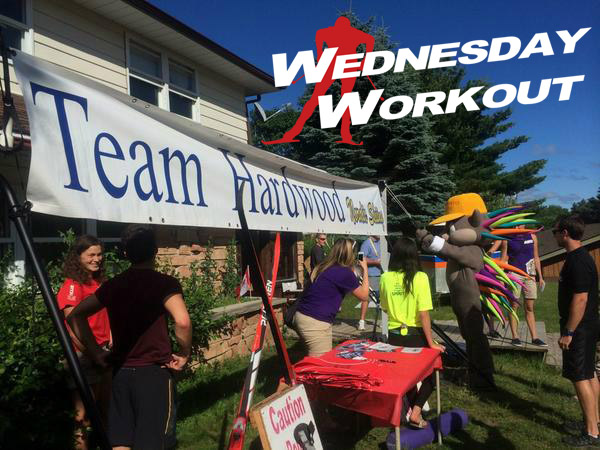
Team Hardwood’s info night with mascot Pachi trying the Ski Erg in July. (Photo: Team Hardwood/Twitter)
This week’s strength workout comes from Team Hardwood Head Coach and Technical Director Ron Howden. Based in Barrie, Ontario, Hardwood consists of “45 national-level skiers to high school and elementary skiers who all have a passion for the sport,” Howden writes. Submit your own workouts to info@fasterskier.com with the subject line: ‘Wednesday Workout’.
***
Team Hardwood demo video
This is a Power Endurance and intensity workout combined; the athletes love to do this workout as a group as it really challenges them. We have designed this to build on the previous strength and Zone 3 intensity workout we have done through the summer. Athletes have all said after a couple of weeks, they feel more powerful and learn to pace themselves and work through pain in their upper body and legs. The goal of the workout is to get them ready for more specific strength when the snow arrives.
Start: with a 20-minute warmup: 10 minutes on the Ski Erg and a 10-minute run. Then 10 minutes of dynamic stretches.
Once warmed up and good to go: Do 2-4 sets of the following depending on the athletes’ age and development:
– 3 minutes on the Ski Erg at Zone 3 (as shown in video above)
During the 3 minutes on the Ski Erg, you want to look at the average watts and encourage athletes to pull the max possible in 3 minutes without sacrificing technique and to maintain that for 4 sets. In the beginning they will pull hard for 1 set then tail off, as they get better the will learn how to pace themselves to pull hard for 3 minutes.
We put mirrors in front and to the sides of the Ski Erg, it helps them ski with good technique and focus on the pacing and not on the digital display.
When they are doing legs we use weight vests rather the dumbbells.
It’s a great workout and the first time will take a bit to recover from, but after one or two workouts they will feel tired at the time but will be ready for training the next day.
About Team Hardwood: With its base at Hardwood Ski and Bike north of Toronto, Team Hardwood is one of Ontario’s most successful developmental cross country ski racing clubs. Its athletes regularly progress to Canada’s national development centres and university teams. It includes current NST member Lenny Valjas and several top Junior and National Talent Squad skiers on its roster for the 2014-2015 season.
Vermont Company’s Customers Work Out to Support Disaster Relief Organizations
Participants in Concept2’s 12th Annual Holiday Challenge not only rowed or skied millions of meters between Thanksgiving and Christmas Eve, they also helped raise over $31,000 for disaster relief organizations, including one that supports the company’s home state of Vermont in the aftermath of Hurricane Irene.
Concept2 Model D Indoor Rower
Every year, Concept2, the leading manufacturer of rowing machines, hosts a Holiday Challenge, asking its customers worldwide to row or ski either 100K or 200K between Thanksgiving and Christmas. Over 5900 individuals rowed or skied their way to fitness during the challenge while supporting organizations whose mission it is to offer disaster relief to affected people around the world. Nearly 1.3 billion meters were completed.
For every person who completed 100K during the challenge, Concept2 donated $.02 for every kilometer (1000 meters) to one of the following organizations: Vermont Disaster Relief Fund (vt211.org), American Red Cross Disaster Relief-International (redcross.org), Unicef—Emergency Relief Programs (unicef.org). For each kilometer beyond 100k, Concept2 donated an additional $.04.
Participants entered their meters into Concept2’s Online Logbook—a tool that allows participants to track their meters and see the donations accumulate. Throughout the year, rowers can use the Concept2 Online Logbook to monitor their progress, rank their best workouts, and interact in a virtual community.
“Working out for disaster relief was a rewarding way to end 2011, a year scarred with tsunamis, earthquakes, tornados, and flooding” explained Concept2’s Meredith Haff. The Vermont Disaster Relief Fund was the most popular choice amongst athletes. “We are touched that our customers worked so hard to help our neighbors in need. This is a reflection of our customers’ commitment and support.”
Concept2 extends its thanks to all of this year’s Holiday Challenge participants for helping to make this group effort such a success.
Concept2 was founded by Dick and Peter Dreissigacker in 1976. Fresh from Olympic training, the two brothers designed and manufactured carbon fiber racing oars, then went on to create the world’s first air-resistance indoor rower. The SkiErg, launched in 2009, builds upon Concept2’s years of experience in designing and manufacturing high-performance training equipment. For more information about Concept2, visit concept2.com.

 We are trying to stay slightly ahead of the overuse injury and poor air quality curves. You may be midway through your summer training schedule and dealing with a bum ankle. Or you live in a place like much of the Western U.S. that has been or will be affected by poor air quality due to wildfires.