From the FasterSkier archive — posts syndicated from athletes’ and coaches’ own blogs between 2004 and 2012, kept online as published. Current coverage is at fasterskier.com.

Tag: ski grinds

  • What makes a fast ski? A discussion on league-wide wax protocols and ski performance theory with Andy Gerlach, Zach Caldwell, and Knut Nystad (Part 2)

    What makes a fast ski? A discussion on league-wide wax protocols and ski performance theory with Andy Gerlach, Zach Caldwell, and Knut Nystad (Part 2)

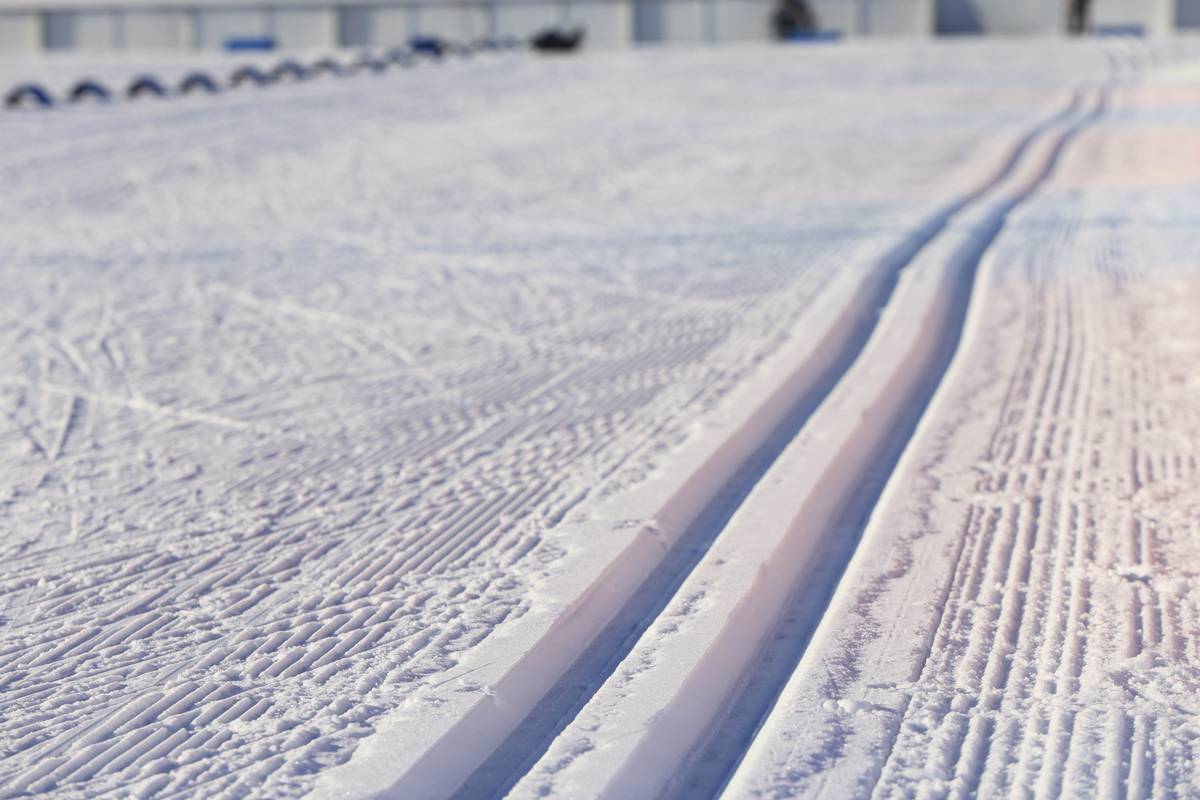
    Cold, firm tracks and perfect corduroy: the stuff of cross country skiers’ dreams. (Photo: NordicFocus)

    Click here to read part 1 of this story.

    In most states, youth skiing is divided between club and high school programming, where club programs support skiers looking to race competitively on a regional, national, or international level, perhaps with goals of NCAA skiing and beyond. High school ski programming is typically more participation focused, and comes with a much lower price tag for families, consequently with a much smaller program budget. It’s less about year-round training, and more about learning to ski, enjoying a low-cost introduction to the sport, and providing a healthy activity to get kids outside in the winter. In some places, athletes may fall into an overlapping Venn diagram of  categories, while in others, it may be a choice of club versus high school racing.

    Within high school programs, it is much less common to have multiple pairs of skis, and conversations on grinds and structures are less likely to be overheard between coaches. Here in Colorado, it’s one of the only (maybe the only?) high school sport that does not have a uniform rule – kids can essentially race in whatever they want; no lycra required.

    In this setting, a universal wax call might be a more reasonable proposition, according to Nystad. 

    “Arguments can be made on both sides. If everyone just agrees: ‘We have one pair of skis and we wax with blue.’ Okay, it probably will be as fair as you can probably make it, but just be aware that still there will be huge individual differences on the quality of the skis and how they differ from different conditions… there will still be variations, it’s not like everyone will start on the starting line having identical skis. That’s not realistic.”  

    Slovenian sprinter Eva Urevc tests skis with her wax technician at the 2022 Olympics in Zhangjiakou, CHN. (Photo: NordicFocus)

    With all of this in mind, is there a way to create equity via equipment or waxing at any level of the sport? 

    “No,” said Caldwell frankly. “No, there isn’t.” Adding perspective from his business, Caldwell explained that the cost of equipment has been steady over time with respect to inflation. That said, among competitive programs, the demand for skis has increased with time, in particular, following the removal of a now-banned leveler that we haven’t yet mentioned: fluorocarbons.

    “It’s a technical sport,” Caldwell said. “And the fact is that people have become more aware of the opportunity to get ahead with material. And I think what we’re seeing is a reaction to the reality of what the sport is. It’s not running. It’s just not. And yet people are doing the same thing in running with these carbon-plated shoes. Now you can only win if you have a high-tech shoe that goes 4% faster. Does that mean that those shoes shouldn’t have been invented? Or should they be banned? Possibly. I mean, whatever, we have to talk about this. 

    “They banned fluorocarbons for a lot of very good reasons, or they’re in the process of it. When it’s health and safety that is the problem, then you have to take the necessary steps. And yet, we also have to acknowledge that removing fluorocarbons really takes a big, big leveling factor out of the equation. There’s no opportunity to take a universal cold grind ski and put it in a wet race. That kid’s screwed. Every single time we remove the opportunity to optimize the solution that’s at hand, you’re penalizing the kids who don’t have the perfect setup.”
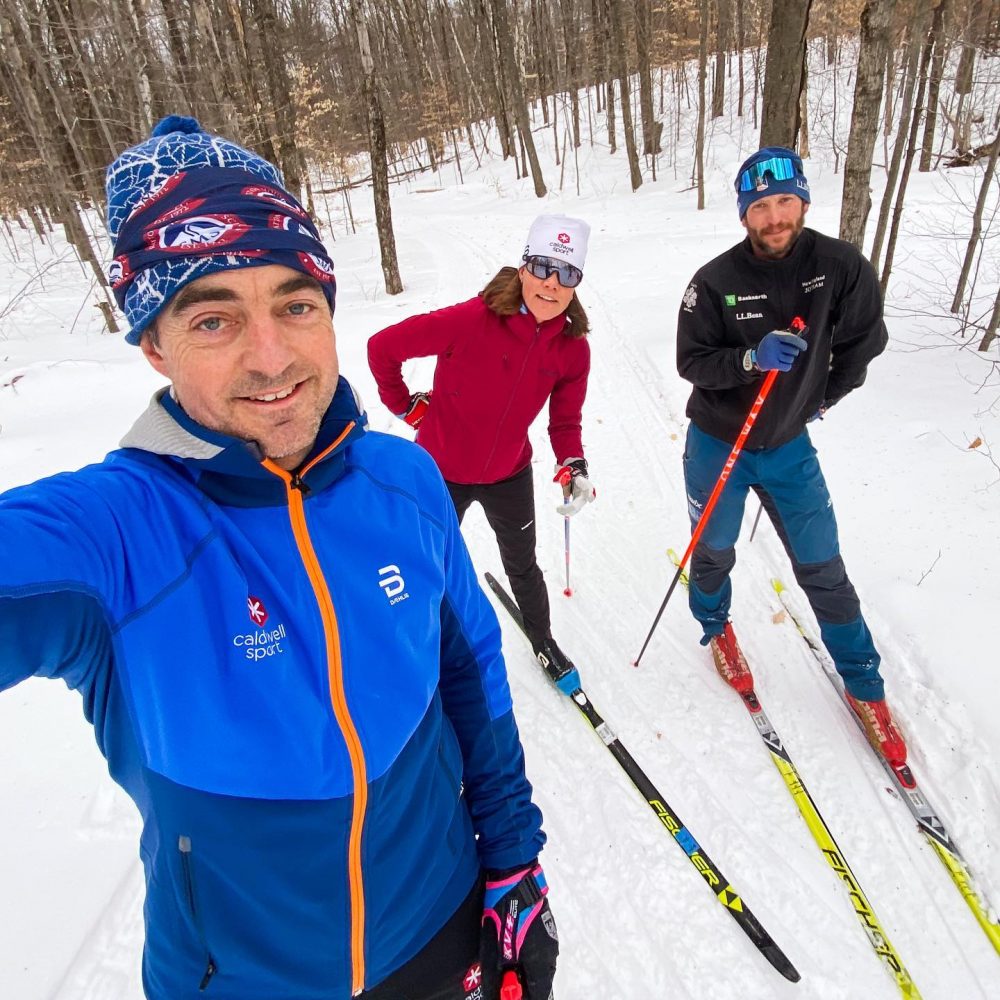
    Zach Caldwell (left) out for a ski with his wife and business partner Amy and Craftsbury Green Racing Project wax tech Nick Brown. (Photo: Facebook Caldwell Sport)

    Making it clear that his opinion is not clouded by the inability of a Colorado, Wisconsin, or Washington-based club skier to use a non-Swix wax purchased through Caldwell Sport, he added, “From a business perspective, with regard to my overall outlook, I probably should be applauding this model because it creates a massive incentive for kids to carry a lot more skis. And we’ve already seen this with the removal of fluoros from competition – you wouldn’t believe the uptick that we’ve seen in demand for warm weather skis, and grinds, and bases.”

    In Caldwell’s opinion, the opportunity for athletes and coaches to optimize a ski through testing and the use of a product line they know well, regardless of brand, is a more viable option for “leveling the playing field” as it could bring any ski closer to what he called it’s “terminal velocity.” A wax protocol that puts every athlete on the same brand and hardness of wax, creates “a situation where that opportunity doesn’t exist and the only way to gain competition advantage is to buy another pair of $800 skis. So it very quickly becomes a sport that, really, is hard to succeed at without a lot of personal resources.” 

    While the focus of these points might suggest that competitive youth skiing will trend toward an arms race, Nystad’s points included a reminder that a skier with limited access to equipment and race-day wax expertise may not be doomed. Other aspects of athlete development remain as important as ever in a skier’s trajectory and long term prospects. 

    “Quite honestly, I don’t want kids to have ten pairs of skis,” Nystad said. “I have kids that ski, but I try to limit the amount of skis and I try to buy used skis and rather look at what properties do the skis have, so that they have okay skis for for each condition. And then we focus on other things that are far, far more important. And that is the mentality to learn to train, to have fun while you’re training, and then to work on technique and tactics. So it’s also a cultural thing.

    “If you only focus on buying yourself time by buying equipment and buying wax and tweaking things and using resources — yes, you are probably going to gain some time, but you have to also say, ‘Are you investing as much time training and enhancing your technique and your tactic as the others are?’ So it’s definitely possible, even if you come from less resources, you can beat the guys with the most resources if you just train well and smart and develop good technique and good tactics.”
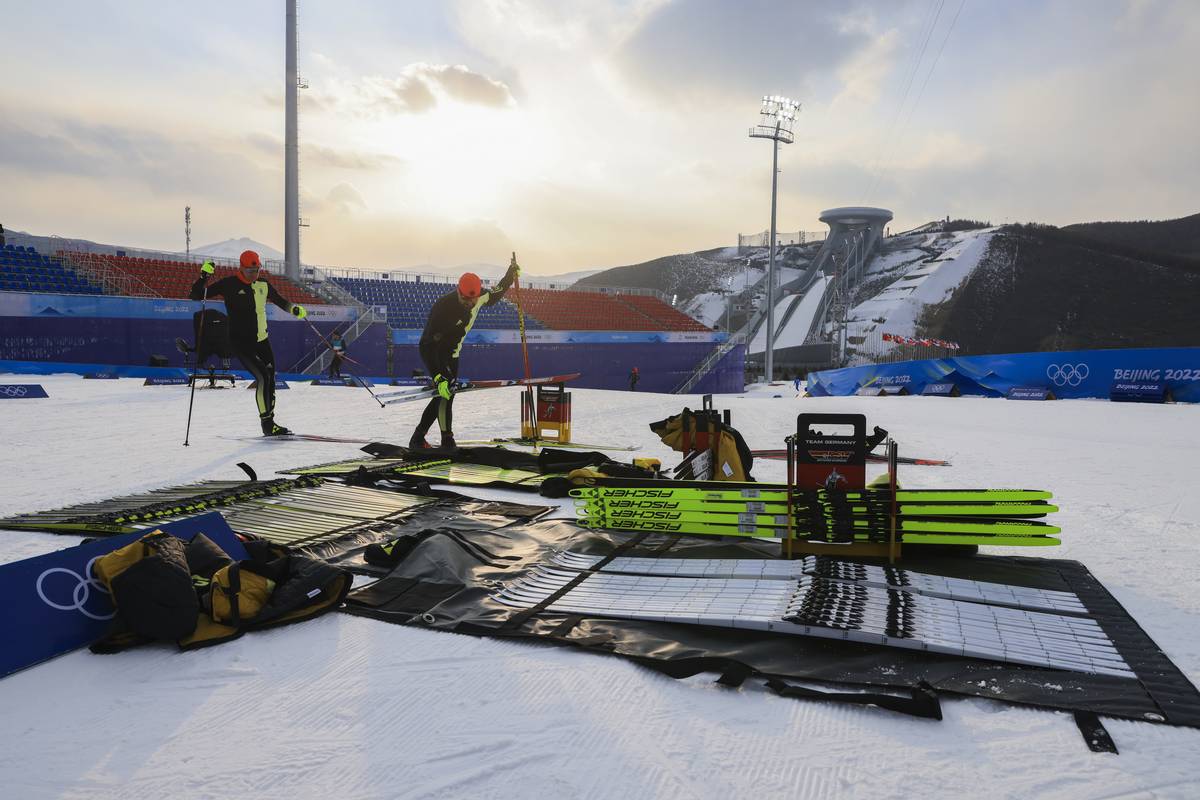
    The German biathlon team tests skis during the 2022 Olympic Winter Games in Zhangjiakou, CHN. (Photo: NordicFocus)

    As a serviceman working at the highest level of sport, Nystad also offered a thought-prompt on the impact to athlete knowledge and the ability to develop a new generation of wax technicians under a protocol, regardless of brand. 

    “If you want to educate athletes to also be able to become great service people at World Cup level races – if you take away that experience in club skiing or in high school skiing or in collegiate skiing, you will have no resources that are going to be able to serve your American athletes going to World Cups or World Championships or Olympics. Where are they going to get the knowledge? Because it’s like anything else, if you want to become good at something, you have to work at it.”

    According to Caldwell, incorporating a wax protocol is “reductionist attempt to level the playing field” that creates more disparity than equity. And so, the goal of leveling the playing field in cross country skiing remains “laudable”, but out of reach, and perhaps unattainable. 

    “I understand the discussion, but I think you have to cater to common sense,” Nystad concluded. “You can always tell people that we decide to [have] one pair skate, one pair classical. I think you can also try to have the waxes [matched]. But still be aware, it’s never going to be fair.” 

    Stay tuned next week for follow-up series which highlights some of the leagues who have enacted a waxing protocol, namely, the Wisconsin Nordic Ski League (high school & club), and coaches from Rocky Mountain, Intermountain, and the Pacific Northwest. This discussion includes the evolution and reasoning behind the protocols, and what advantages/disadvantages have been identified by each league.

  • What makes a fast ski? A discussion on league-wide wax protocols and ski performance theory with Andy Gerlach, Zach Caldwell, and Knut Nystad (Part 1)

    What makes a fast ski? A discussion on league-wide wax protocols and ski performance theory with Andy Gerlach, Zach Caldwell, and Knut Nystad (Part 1)

    FasterSkier shares insights into ski performance theory from Any Gerlach, Zach Caldwell, and Knut Nystad. (Photo: NordicFocus)

    In November 2021, the Wisconsin Nordic Ski League (WNSL), which oversees both high school and club level youth programming state-wide, accepted a sponsorship proposal from Swix and Salomon, which would provide the league with $10,000 in funding per year for three years. The proposal also included stipulation that a standardized wax protocol using Swix waxes would be adopted by the league at all affiliated races, including the state championship. 

    In practice, this would look like an email going out to all coaches a day or two prior to the event indicating which of a subset of Swix glide waxing products should be used by athletes that weekend. Equivalent temperature range and performance level waxes from other companies would be disallowed. In the sponsorship presentation given to the league by Swix, the proposal promoted the simplicity and affordability of a unified wax call, and a shift in focus for coaches away from time-consuming wax testing to race day support of their athletes. 

    The concept is not new, and WNSL is not the first league to adopt such a protocol. An equivalent protocol has been used by the high school, club, and collegiate level ski programs in the Rocky Mountain region (RMN and RMISA) for the last six years, and has more recently been adopted by the Pacific Northwest and Intermountain Division junior club programs. On the whole, these policies have been seen as beneficial by these regions. 

    While an additional $30,000 of funding has the potential to profoundly impact the reach of the WNSL, which will be discussed in a subsequent story, the adoption of the corresponding wax protocol also raised red flags, particularly among members of the Independent Nordic Distributors of America (INDA). The INDA includes distributors of wax products from other smaller companies like Start, Vauhti, Star, and more, and are primarily based in the Midwest. 

    The two primary issues that were flagged were the restriction of trade should Swix monopolize the buyer market encompassed by the WNSL, and also whether limiting the available choices to a single option actually creates the equity and uniformity that one might anticipate from putting all skiers on the same wax. Instead, could it widen the opportunity gap between those who could afford high-end skis with condition specific grinds and those who could not?

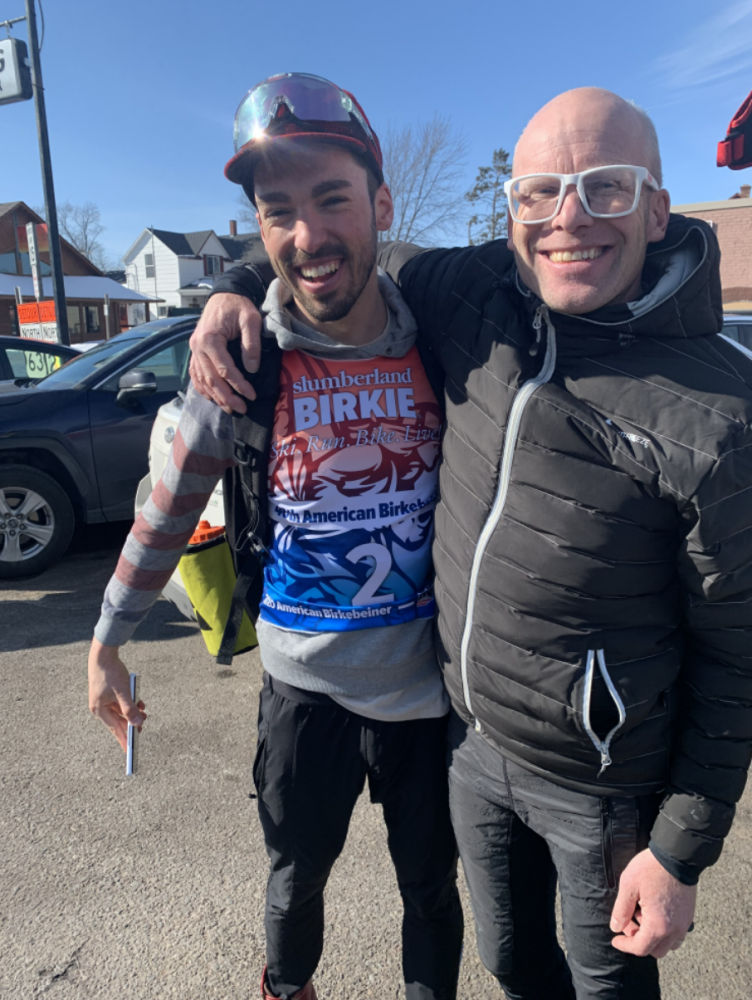
    Enjoy Winter’s Andy Gerlach snaps a picture with 2020 Birkie Champion Ian Torchia (SMS T2). (Photo: EnjoyWinter.com)

    In the fall, these issues were brought to FasterSkier by Andy Gerlach, director of Madison, WI based EnjoyWinter, which distributes Start, among other cross country related brands like Blitz Eyewear and Swenor rollerskis. With vested interests in the implications to his own business, but also as someone who offers brand-neutral education on wax theory for coaches, Gerlach actively opposed the decision by WNSL to accept the offer from Swix. 

    “The biggest argument against these exclusive sales agreements and proof that they are bad for the sport, and in fact illegal, is that they decrease the incentive for any other brand to fight for any part of a team’s or consumer’s business,” Gerlach said in the fall. “Why should my business continue to do wax clinics for Madnorski (Madison Nordic Ski Club) members if we know we are no longer getting a large chunk of their business. Why should any brand even visit Colorado clubs if we know we do not have a chance at a large chunk of the business there? Legal marketing arrangements should increase competition in the market, not decrease it. Change the agreements to marketing rights and not sales rights and every other brand would increase their efforts to reach the individual teams.”

    After discussions among the cross-country sport committee during the recent U.S. Ski & Snowboard annual spring congress meetings, Gerlach summarized his objections to wax protocols to the following four points.

    1. “They perpetuate a misconception that waxing is so difficult and mysterious. Our clinics state just the opposite.
    2. “They perpetuate a misconception that extensive testing is effective and needed to select a glide wax that an athlete can race up to their abilities with. Our clinics state just the opposite.
    3. “They increase the likely hood that those skiers with a quiver of skis will have the fastest skis. Multivariable mathematical analysis, as well as ski industry testing and ski sales figures shows this.
    4. “They endorse one brand ‘because it is the most available’ and in so doing extends this advantage.”


    There is plenty more involved in the debate on the legality and consequences on the business end of the decision whether to accept the sponsorship offer from Swix, which will be revisited in subsequent parts of this story. This installment, however, will focus on the underlying principles of ski performance theory, with input from experts, like Gerlach, on what factors ultimately determine ski speed, and whether restricting the waxes available for a given race would level the playing field by reducing variables, or adversely affect the pre-existing disparity between ski performance, thus limiting the potential of the skier clipped into the binding.

    Brimming with insights into ski performance, this thought-provoking conversation should provide fodder for discussion within race-leagues at all levels as they consider waxing protocols and avenues to improve equity within the sport. 

    ***

    We’ll start with what Gerlach identified as the factors that affect the performance of a ski from most to least significant, and where in this process limiting a coach/athlete to a single wax from a single brand becomes significant. 

    “In my hierarchy of ski speed deciding factors, it’s a flexible ski, the freshness of the base is the next important, the structure, then the hardness of the wax, and then the brand,” Gerlach explained in a call. “Now we’re going to take away the hardness of the wax as a differentiator between them. And now, all we have as the only differentiator is the ski model, the freshness of the base, and the structure.” 

    The understanding of this theoretical model underscores the remainder of the question. When we hear “wax tech”, the name seems to imply the key player being adjusted and assessed is the wax. Gerlach explained that this reasoning is misguided.

    “I, and scientific studies, will show you that 95% of this theoretical wax testing is not determining the fastest wax to apply that day. If it was, at US Nationals, or at any of these races, the line Saturday morning two hours before the race start would all be at one wax trailer. But you know, every coach comes up with their own thing… There is a different theoretical ideal wax for a Rossignol with an aggressive grind to the same Rossignol with a fine grind, and you would theoretically wax it differently. If you are testing on your Madshus cold skis and all your kids are on dried burnt out skis, or are on Fisher or on Salmon, theoretically, there’s a different wax [for each ski].”

    It’s a counterintuitive concept to those, like myself, who prefer to focus on the technique and training aspects of the sport, versus the technical side. Why doesn’t putting everyone on Swix PS8 on a day forecasted to be in the right temperature range remove a factor that might create disparity between ski performance, thereby improving equity? Particularly in a larger state, like Colorado, where teams are driving long distances (through vastly different elevation zones) to race without knowing exactly what conditions will be like until arrival, I could see the appeal for coaches of removing a step in the planning process. 

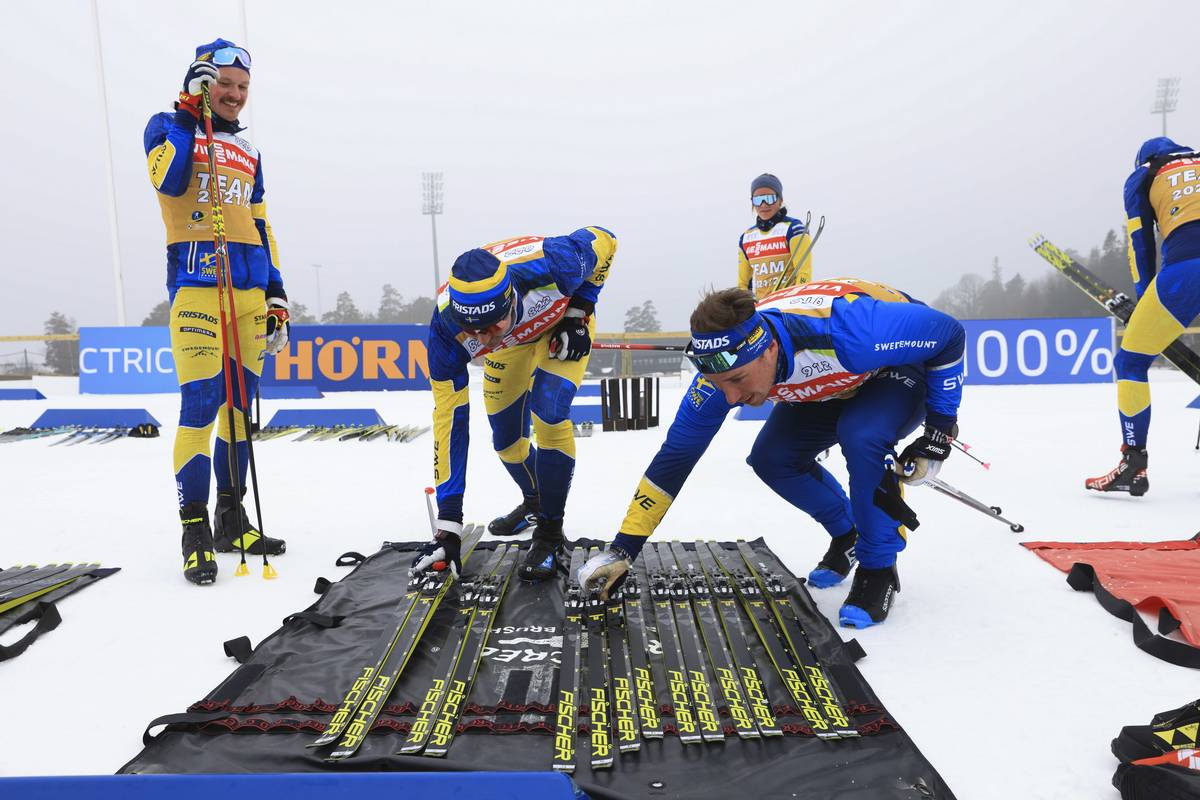
    Swedish Technicians at work at a March, 2022 biathlon World Cup event in Oslo, NOR. (Photo: NordicFocus)

    To simplify the answer on why equity may not be achievable with wax, Gerlach offered an analogy most skiers can relate to, regardless of their background knowledge in waxing theory.

    “If you’ve ever shaved your legs or your face with a razor,” he began. “A sharp, brand-new razor is like a fresh ski with a fresh base. You don’t need shaving cream and that razor works great. But a dull razor – a dried, crappy base – you need that shaving cream. And you need the best shaving cream you can get, and it’s going to help that razor and that shave a whole lot more.”

    How does this affect youth level programming? Ultimately, it accentuates the ever-growing “pay to play” problem of competitive sports. A newer, higher-end ski with a fresh base, or perhaps a quiver of skis that are ideal for different conditions, becomes much more important without the ability of a skier or coach to add versatility and improve the performance of a single pair of skis ski by utilizing a range of products to optimize the wax job. 

    “We have one ski with a great freshness of the base and a great structure, and one ski with a really dried up base. Had I applied wax to [the dry base], it does more to increase the ski speed than applying wax to a great ski… The more skis you can add to that quiver, all waxed the same, one of those is going to highly outperform the others. Versus when you had the ability to not only figure out which ski to go with, but which wax to go with. So by taking away variables that are easy to change, you make it more important to have a very good ski.”

    To include additional knowledgeable voices in the discussion, FasterSkier also spoke with Zach Caldwell and Knut Nystad, two savants in the complex and nuanced world of wax and skis. Caldwell is a leading expert in ski selection, wax, and grinds in the US, and the co-owner of Caldwell Sport. As a distributor of Vauhti, Rode, Star, and other waxes, Caldwell is also a member of the INDA. 

    Nystad is the former head of the Norwegian Wax Team, who still works as a ski serviceman for the Norwegian program at the World Cup, World Championship, and Olympic level. Prior to this work in his home country, Nystad spent twelve years as the head coach at the University of Denver. 

    “The idea of having a fair competition and limiting variables in order to generate more fairness and equity in the racing and create equal opportunity and a lower barrier to entry is a really laudable goal, but it misses the point,” Caldwell said simply in a call. 

    “The fact is that it’s a pretty complex system that we’re working with, with a lot of additive contributing variables that contribute to a whole solution, including ski flex, base material, base preparations, waxing, hand structure, all of it. When you have a lot of variables available to you, you have a lot of different pathways to success. The peak performance that might be available [on a particular ski] can be considered something along the lines of terminal velocity; you’re just not really going to go past a certain level of performance [on a day], the performance that the snow is going to yield. But there are a lot of ways to get there.” 

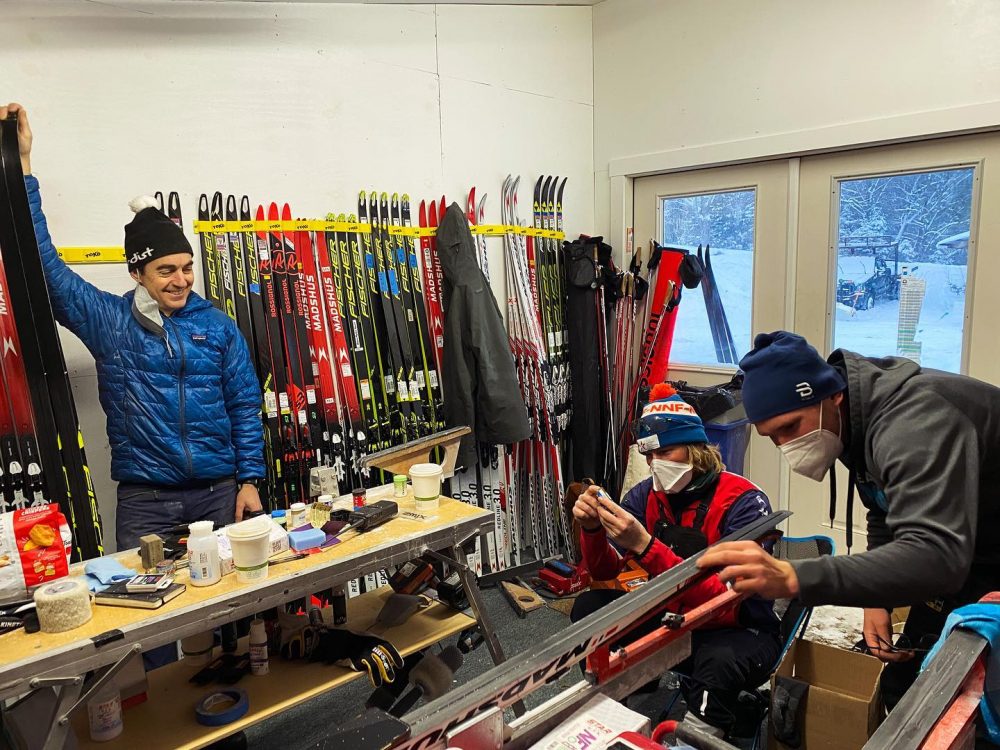
    Inside the wax at a February SuperTour race weekend in Craftsbury, VT, where Zach Caldwell (left) supported SMS T2 athletes. (Photo: Facebook Caldwell Sport)

    “As you begin to limit variables,” Caldwell explained, “you begin to place much more emphasis on other variables. They become proportionally much more important in determining how to get to the best performance possible [on the day]. And as you remove wax, which is a really inexpensive variable per application that can be put on specific to a day, you skew the emphasis toward skis base materials, grinds and hand structures.”

    Individual variation among the skis and in the technique and strengths of the skier on those skis adds additional complexity to the scenario.

    “Think about classic skis; this is a better way to imagine this,” Caldwell pitched. “Some athletes or some skis require different layering and build up of classic wax on a day. But if you’re saying, ‘Oh, you get two layers of extra blue. That’s it.’ That’s asinine. It means some people get to race and others basically have to herringbone.”

    Nystad also questioned the premise of leveling the playing field by creating uniformity in the wax selection.

    “Let’s start with the beginning,” Nystad said. “All of us that have done this for a long time, the only thing we know is that we don’t know. The only thing we know is that we need to test in order to get the answers. But what I can tell you from my experiences is that if you limit one factor, sometimes it just opens up another can of worms…

    “There’s definitely good arguments for trying to make the sport as simple as possible. But I think that for the people that think that just by waxing with blue, that that’s going to make it more equitable. It is a sign to me that they don’t have that much in-depth knowledge.”

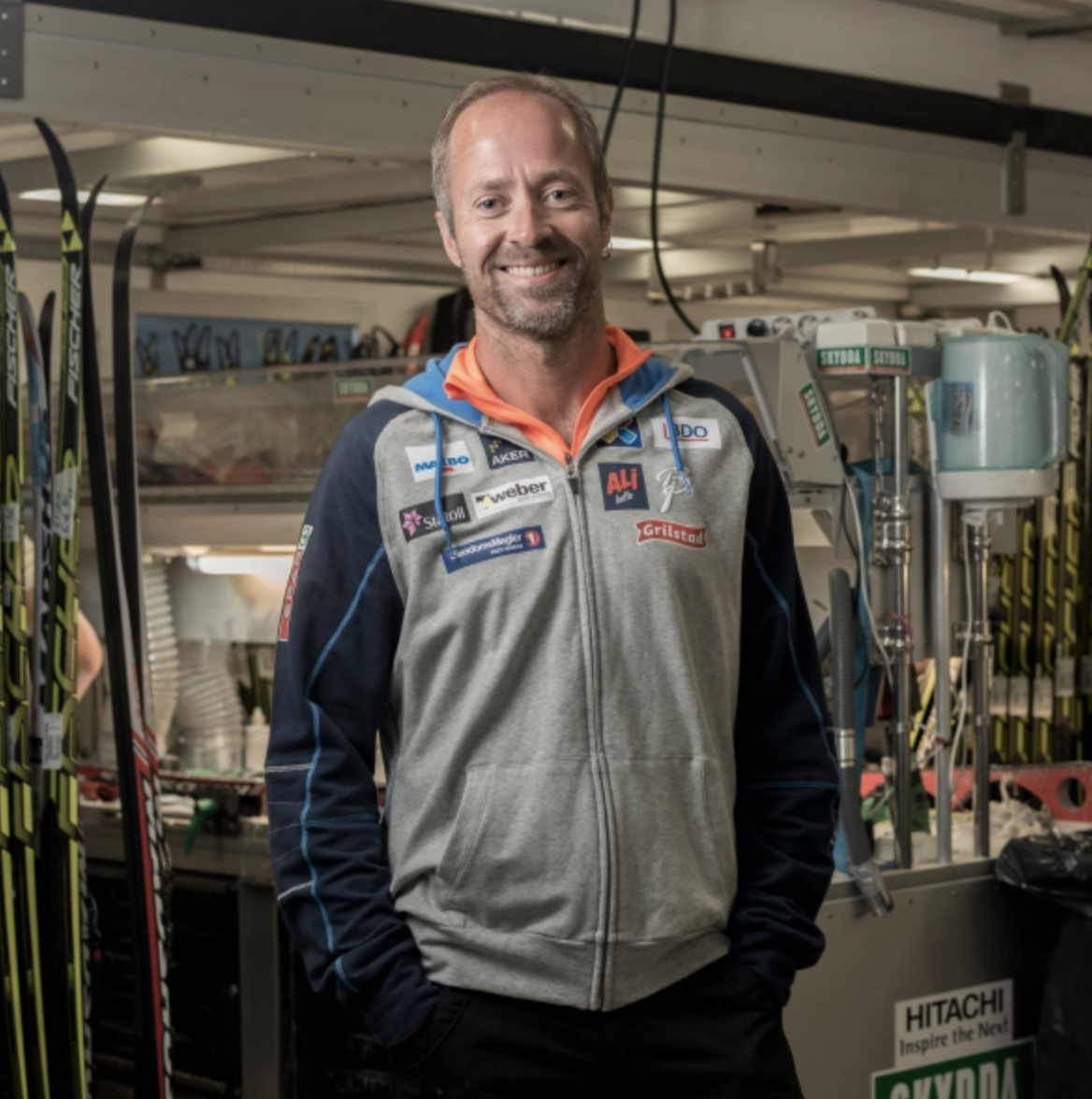
    Knut Nystad provides insight into ski performance theory and why a one-wax call may widen the gap in cross country skiing. (Photo: knutnystad.com)

    Without giving hierarchical ranking, Nystad also discussed the myriad of factors that contribute to the performance of a ski on a given day: the properties of the ski, including flex and splay, the quality of the base and its structure, the manual tools used, and the wax. “And then to top it all off, you have the method methodology that you use to apply the wax.”

    He walked through various ways a particular wax could be applied to yield different results, before echoing Caldwell’s sentiments that equity and uniformity cannot be achieved by restricting the options for wax that can be applied to a ski. 

    “When people say, ‘Well, can’t we just all wax with the same thing? It will make it easier.’ Clearly it will make it easier; you have one less factor to think about. But if the intention was to make it more of an even playing field, it’s not necessarily the truth. Because when you go to a race,  you’re only limited to try to test what you can afford from money, resources, and of course, time being one of those resources. So if you don’t have the test wax, what else can you test? Well, you can test many more skis, with many more properties with many more different bases, with many more structures, with many more manual tools. 

    “So it just opens up other things that you can test to get an advantage. And everything that you’re going to test if you’re going to have more skis, of course, that’s going to cost more. If you’re going to have more structures, different kinds of structures, that will also cost more. If you’re going to add manual tools, that will also cost more.”

    Stay tuned for more insights from Gerlach, Caldwell, and Nystad in Part 2 of this story.


  • The Birth of the E-Ski by Kevin Brooker

    The Birth of the E-Ski by Kevin Brooker


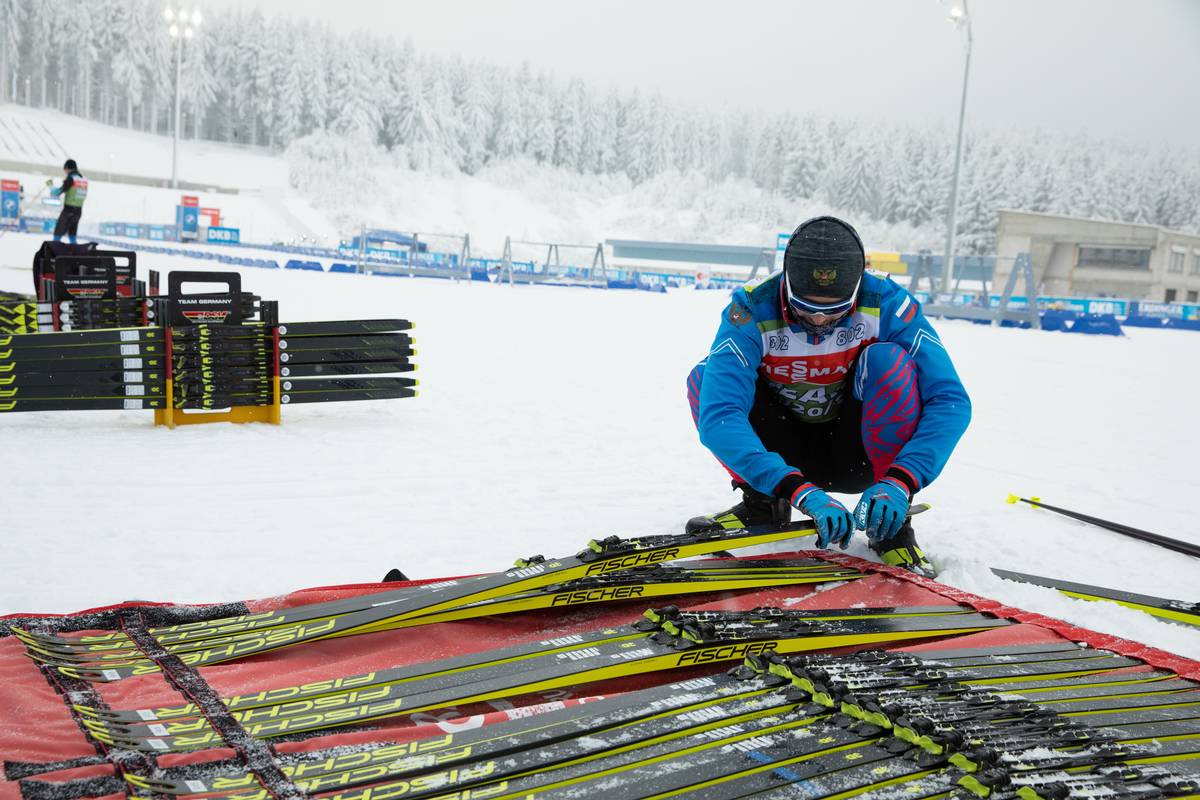
    Fischer was unavailable for comment regarding new developments in E-base tech. (Photo: NordicFocus)

    With great pride, I will admit to being an unabashed fluoro powder addict. After finding an affordable source of the stuff (200 grams for $50.00) my use might be considered reckless. I have unapologetically sprinkled powder on skis with the same vigor and arrogant nature as Samuel L. Jackson drops F-bombs in Tarantino films. Powder made my skis slick and fun. I LOVE the feeling of dusted sticks. I also love the planet and realize my careless use must come to an end.

    This season the powders were tucked away and not disposed of hoping there was an error with the science and we can eventually use them again. My skis only came in contact with hydrocarbon waxes without any fluoros. Quite frankly, the skiing sucked. The boards were slow and had no life to them. Skiing wasn’t fun so I basically stopped, choosing to ride my Peloton instead. In this post-apocalyptic dystopian era of no fluoros, I missed skiing but not the associated sluggish feel of hydrocarbon wax. 

    Banning the use of fluorocarbons in skiing was a difficult decision by FIS. As you probably know, they too are equivocating. By definition, speed is a requirement for racing. Speed is exciting to experience and it’s fun to watch others go fast. Taking a stand to legislate the ban of a speed device (fluoros) to help ensure the long-term wellbeing of planet earth supersedes the short-term gains of ski racing speeds is commendable and admirable. Eliminating fluoros has the real potential to make cross-country ski racing slow and as exciting as watching grass grow. By eliminating a component contributing to speed, there is a real possibility to kill off the sport. 

    Eliminating fluoros also has the potential to unlock an era of innovation and creativity. Waxing technology has remained pretty much unchanged for decades. After waxing reached a stagnation point considering it’s contributing to speed, innovative thinkers took another look at base friction and determined the structure of the base was the next untapped well of speed. 

    Now, another group of innovators is taking a look at ski bases. Instead of focusing upon grinds, this group of tinkerers is examining how to manipulate the bases electronically to enhance glide and generate speed. After hearing rumors this past summer, Fasterskier spent the better part of the winter working to obtain an interview with this group of forward thinkers. We finally caught up to them. Once the patents were applied for, these disruptors were granted the opportunity to present their idea to the ski world. Here is their story and begins with a quick explanation of waxes.

    ***

    “The concept is actually really simple.” begins Vanessa Taylor, one of the chemists working on the project. “In order to glide, a ski needs a thin film of water to lubricate the plastic base. Unfortunately, the water also sticks to the base without using wax. The friction caused by water molecules dragging along the base leads to viscoelastic energy dissipation. The water also adheres to the ski bases due to static electric attraction which causes the dreaded suction we use grinds to overcome. The wax essentially insulates the base from the water and has a higher repellency allowing the water to act more like a ball bearing than grease. fluoros are extremely hydrophobic and have more influence reducing the stiction caused by the electromagnetic attraction of the plastic.”

    Taylor walks across the room to a stainless steel table. A series of wires hang from an overhead gantry. At each end of the table sits a metal box with pink string coming out from a vertical slit in the face. At the end of the string is a small snap swivel similar to what a fisherman will use to attach lures.

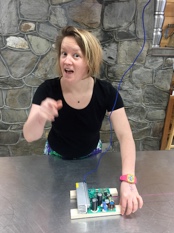
    Vanessa Taylor showing off the test sled for the E-ski.

    “This,” Taylor waves her hand like a magician introducing a prop “is the testing table. We take sections of ski base and attach the string to either end. Then we set a 2 kilogram weight on top to simulate a skier during a glide. One box winds in the string and the other pays it out. We know the force required to break the initial movement and the force loss due to friction based upon the wattage needed to turn the motor. The payout string gives a measured resistance to pull against.” 

    She takes a common spray bottle and applies a thin film of water to the table. “The water field on stainless is a decent simulation to test the efficacy of ski waxes and our product. The basses are also set flat to eliminate the variability of flex and crowning. We grind a specific pattern into the base too. We eliminate the variable of snow conditions to obtain data on the glide.”

    Each sled is 20 cm. long and she attaches one to the table by the strings and connects one of the umbilical wires from the gantry. A click of the laptop and the sled begins its journey down the table. “There we go. 152 watts. This was unwaxed P-tex. Now let’s run fluoros.”

    The setup is the same and after the test run the number is 84 watts. A significant change.

    “Now let’s run our idea.” The result is 51 watts. I’m astonished. “Pretty wild, eh?” She asks.

    “What type of wax have you developed?”

    “Not wax but bases. We use a small electric charge in the base to repel the water in place of the wax.”

    “Wow.” Is all I can muster. “Is this legal?”

    “The FIS race rules are a bit ambiguous on this point. The rules outlaw accumulators (bracketed by air quotes) but allows energy originating from the competitor. [For a closer see the excerpt from the FIS rules below] 

    “At first we were going to go after the race market. We incorporated small piezo generators, similar to the clicker used to ignite a gas grill, into the bindings. This gave us enough current to power the base but the need for a storage device to carry the effect on long downhills was problematic. We are abandoning the race market for now.

    “The focus will be on making recreational skiing fun. Plus, it’s actually a much larger market with the added bonus of no rules. Battery technology is making rapid advances too. Just pop a small battery into the ski and have at it. Bicycles are embracing E-technology and we intend to bring this to snow sports.” 

    We leave the test room and move to the R&D portion of the reconditioned barn they call HQ. The sign above the door reads “Fearless”. 

    Inside we meet William Gordon, the man who first thought electrifying skis might be possible. He tells me the story (which has been edited for brevity, William can talk) of watching snowflakes align themselves on a cutting board being used for insulating an old aluminum lugged carbon fiber bike frame.

    William Gordon heading into the R&D lab. Photos were not allowed once past the door.

    “We were TIG welding an aluminum lug on a real old, Time carbon frame. To insulate the carbon from the welding table, we used a plastic cutting board (made from UHMWP the same stuff as ski bases) to keep it from conducting the electricity used to weld. The TIG process for aluminum uses alternating current and we can alter the frequency and how the sign wave is delivered to the metal. We were jamming in Joe’s garage during the winter and it was snowing. Each time Joe struck an arc I noticed the snowflakes begin to move around the plastic. At first I thought it was vibrations causing them to dance but soon realized the flakes were being repelled and levitated by the welding process. When the flakes melted, the droplets did the same thing.  Just like you, I like to ski and use fluoros like some people put salt on popcorn. With them going away I needed something to keep skiing fast and fun. What if I can put the same properties I saw on the welding table into a ski base? Might be a workable idea.”

    “I thought the plastic was an insulator?” I ask William.

    “It is for transferring current but this doesn’t mean it won’t hold a static charge. Wax companies add graphite to create a small static charge created by friction with the dry snow. We do the same thing by electrifying the bases.”

    William brings me to the back corner of the room where a 3D printer is set up. Spools of carbon fiber thread move through a series of loops to a small CNC head where they split apart into much smaller bundles.

    “We use the printer to incorporate carbon fiber into the bases. The carbon is conductive and is used to carry the impulses from the processor located inside the ski. We found running the frequency at a bit over 200 hertz makes the best glide. There are over 300,000 individual circuits in each base. Right now, the process is very slow. We are working on getting it automated and simplified. We are currently hiring a few engineers from the semiconductor world to help us make the transition from a single base each week to hundreds per day. We also have to scale the processors and batteries to fit inside the ski. Weight and how the ski feels are just as important as glide.”

    My mind is a bit numb trying to get a handle on what these guys are doing. How it all works is as mystifying as why waxes make skiing more fun. His next revelation sounds counterintuitive and unbelievable even by comparison to the E-ski concept.

    “We can also reverse the repellency and cause the skis to stick. The attraction is pretty small but for classic skiing, we have the entire base grab onto the snow. It works, but achieving the same classic ski feel is tough. We tried putting force sensors into the binding to activate the grip function. When it works, it’s great but it is more unreliable than hard wax right at the freezing point. Something to work on.

    “We have also played with the idea of alternating the pattern and alignment of the static discharge points to act as a small motor to actually propel the ski. If we nail this, the E-ski will really shine. Right now it works but requires a lot of power and processing. So much we couldn’t get it all into a backpack. What we have figured out given the restraints of the ski based system is how to slow down the ski. We use the same idea to act as a brake to slow the ski. We Bluetooth connect it to the ski pole and then you can apply stopping power. We hope this will reduce the snowplowing and save the snow, require less grooming, etc. Saving the limited snow is also a benefit to the environment. My wife suggested making brakes as she hates fast skis. They scare her. We asked a few recreational skiers if this was a good idea and they LOVED it.” Gordon threw his head back and laughs. “Ironic isn’t it. We were trying to make skis faster and the big application is using the technology to slow them down.”

    “This all sounds great but when can I get a pair and will the skis have the same feel as using fluoros?” My eagerness and self-interest are difficult to hide.

    Vanessa chimes in. “We have proven the concept and are seeking investors to develop the idea into a practical application. We have been filing new patents almost weekly. If the funding comes through we expect to be selling skis for the 2022 season. When we have some production-ready skis we’ll send a few pairs to FasterSkier for you guys to review.”

    The rest of the tour was confidential, having to do with proprietary manufacturing techniques. Will the E-ski revolution have the same impact as the E-bike? Time will tell and I’m excited to know the fluoro ban has ignited a host of innovations. This is exciting and we’ll keep you up to date on the progress of the E-ski.


    FIS rules with respect to legal skis:

    1. Cross-Country Skiing Competition Equipment 1. General Rules The following rules apply to all type of Cross-Country competition equipment such as skis, bindings, boots, poles and any additional equipment. 1.1 Restrictions No equipment is permitted which: a) Affect the natural push-off movement of competitors’ feet and arms or those that enhance it (such as spring devices or other mechanisms in skis, poles, binding or boots). b) Makes use of energy not originating from the competitor, such as artificial heating devices, chemical energy accumulators, electric batteries, mechanical aids, etc.).


  • La Nina – Does it Affect Grinds and Skis?

    La Nina – Does it Affect Grinds and Skis?

    SEATTLE, Wash. – The La Nina winter forecast is widely welcomed by skiers of all stripes in the northwest, as the weather pattern generally dumps generous amounts of snow on the region. Last season featured an El Nino weather pattern, with the drab conditions that typically produces: less precipitation, unusually warm conditions with rain at elevations that generally are on the snow side of the freezing mark, and overall a shorter ski season.

    Mark Waechter's grinding machine. Photo: Inge Scheve

    Mark Waechter of Nordic Ultratune in Winthrop, Wash., tries to make sure skiers don’t base their choice of grinds for this season based on what they saw last season.

    “People want to grind based on what they saw last season, which was warm and wet and not much snow, and that’s not necessarily the right plan. You should grind for what you expect, and this year, we should expect more normal conditions,” Waechter said.

    But regardless of season, you need to cover all your bases – literally speaking.

    “You can’t just have five different cold grinds and nothing for warm. I try to suggest reasonable choices,” he explained.

    Typically, the conditions in the central Northwest will be cold, dry snow that doesn’t see a lot of transformation until things warm up in February, Waechter said.

    For the beginning of the season, he finds that fine dry-snow grinds are faster. Then for the last half of the season, he suggests a warmer grind that handles more transformed snow.

    “If people have two pairs of skate skis, I’d suggest a S2 grind that’s cold and dry, and a D5 for warmer, wetter new snow and snow that has been transformed,” he said, adding that both of these have broad ranges and will work in a wide variety of temperatures.

    Experience is Key

    Zach Caldwell at Boulder Nordic Sports is more cautious about using the long-term weather forecast to guide his grinding choices.

    Caldwell was a part of the U.S. wax team during the 2010 Olympics in Whistler, where snow conditions are notoriously tricky. He spent two years prior to the Games analyzing the snow in Callahan Valley, and can only conclude that it’s a moving target.

    “It’s tempting to want to look ahead. Given the conditions at the Olympics we saw everything of weather, but overall it was warmer,” Caldwell pointed out.

    “I’ve never seen anyone be able to predict a whole season. I’d say the best bet is to trust the past more than the future. You know what the prevailing conditions are in your area, and that is not going to change dramatically, but maybe the center of the bell curve might skew a little in one direction compared to an average season,” Caldwell said.

    Caldwell explained that the bigger climatic changes take longer to develop than from one season to the other.

    “The snow that falls out of the sky isn’t going to be very different from what you normally see,” he said, noting that all of the regions have their characteristics, which in the big picture are going to remain the same.

    “The northwest is always the most volatile and also with the skiable venues so close to the snow/rain threshold, these differences play a bigger role. In the Upper Midwest, the weather patterns are formed by arctic airstreams and whether they are one or two degrees colder or warmer than normal just means you’ll freeze seven fingers instead of eight,” Caldwell explained.

    Focus on Skis

    So if La Nina doesn’t affect the choice of grinds and flexes that much, what does matter?

    “Having good skis is the number one most important part. Then you want a broad-range structure that can handle changing weather conditions. You don’t want to pigeon-hole yourself into a very narrow range,” said Caldwell, noting that a good pair of both wet and dry skis is more important than a specific grind.

    That said, Caldwell explained that in North America, the plus-models of the skis and finer grinds seem to work best. “That’s probably because we have less aggressive snow crystals here than in many places in Europe and especially Scandinavia,” he concluded.

    A longer season is a benefit for developing skiers. Photo: Inge Scheve

    Weather is a Gift for Skiers

    However, there is no doubt that a typical La Nina weather pattern is a bonus for Northwest skiers. Brenna Warburton, a coach with the Bend Endurance Academy in Bend, Ore., pointed out that La Nina is a Christmas present that comes early and stays late.

    That is particularly beneficial for new skiers.

    “We’ll probably be able to ski earlier, which is great, especially for the younger kids and skiers at the development level,” she said.

    “They get more time on snow, and at the development level, the more time on snow the better. That time would be replaced by dryland training, which is also great, but snow time is better,” Warburton explained, adding that they will also be able to ski longer at lower elevations.