From the FasterSkier archive — posts syndicated from athletes’ and coaches’ own blogs between 2004 and 2012, kept online as published. Current coverage is at fasterskier.com.
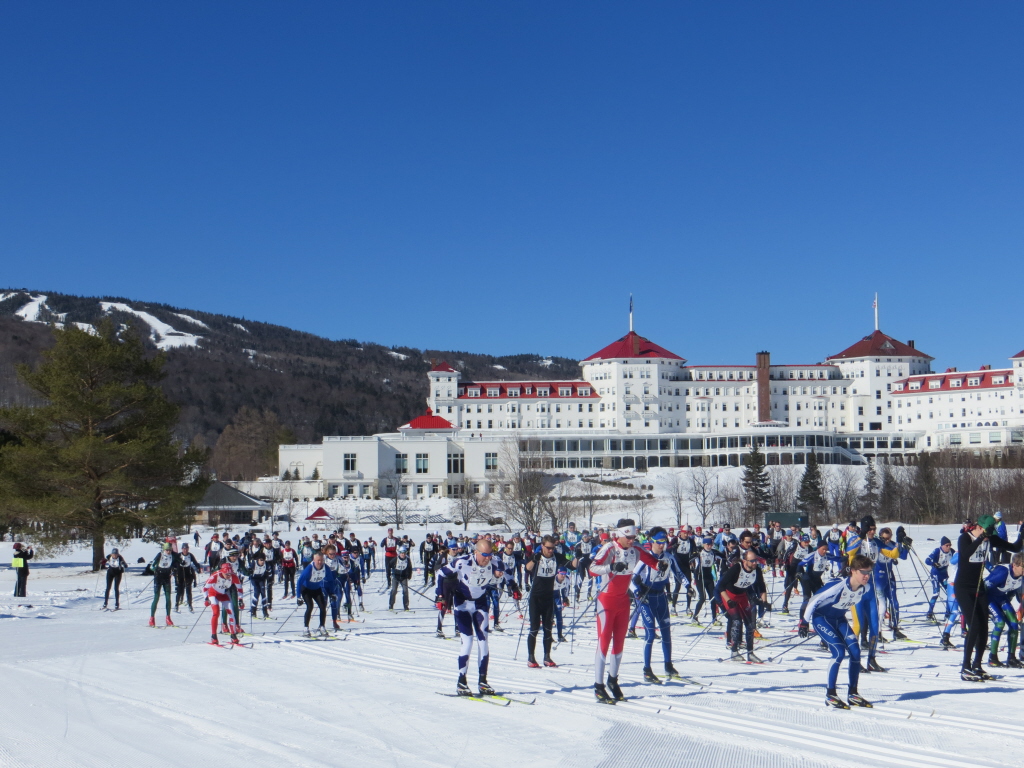
Athletes on course in Rumford, Maine, at 2011 U.S. nationals, which were plagued by low-snow conditions. (Photo: flyingpointroad.com)
“I think if you’re a nordic skier in New England, you should definitely be alarmed.”
“That’s one of the main take-homes: skiing is not going to disappear completely, but it will generally be higher [in elevation].”
So says Cameron Wobus, a Bowdoin ski team alumnus and a researcher at Abt Associates, a global research firm. Wobus and colleagues based in Boulder, Colo., and Washington, D.C., recently published a study in Global Environmental Change assessing the impact of projected climate change on the ski industry. (The article is available free of charge here.)
Their results: by 2090, many cross-country ski areas across the U.S. are likely to see 50-100 percent reductions in season length. That could translate to more than a million fewer visits by skiers, and millions of dollars of losses in trail-pass revenue.
A lucky few ski areas could see only minor impacts, but a lot of that depends on greenhouse-gas emissions scenarios – basically, what the world does to curb the release of carbon dioxide and other greenhouse gases between now and then.
“I think a main finding is that elevation is your friend, which isn’t surprising,” Wobus said in a phone interview from Boulder last week. “If you’re a ski area in the Rockies and your base elevation is 10,000 feet, you’re obviously in better shape than if you’re a ski area in central Vermont and your base elevation is 500 feet.”
The Nerdy Part of Prediction
A previous report by Protect Our Winters and the Natural Resources Defense Council took a more detailed look at the economics of the winter sports industry under projected climate change.
Bob Rosso, Mike Sinnott, Gary Storey, Kate Barton, Kelly McClowskey, and Colin Rodgers shovel snow onto the SuperTour 10/15 k classic distance race course in Sun Valley, Idaho, in 2015.
What Wobus and his colleagues wanted to do rather than to get bogged down in predicting how interest and tourism for winter sports would change in a warmer world, was to make the best possible predictions of how snowpack and season length would be affected at ski areas.
“We wanted to do was a more detailed analysis of the physical snowpack modeling,” Wobus explained.
To get to their conclusions, the research team modeled snowpack at 247 alpine and nordic ski areas by combining historical datasets, climate change models, and greenhouse gas emissions scenarios. As a starting point, they used North American Land Data Assimilation System meteorological forcing data, which has been recorded at a fine scale since 1979.
They then put this meteorological data into the Utah Energy Balance model to derive snowpack at ski areas, based on what comes out of the sky and landscape factors that would determine how long snow stays on the ground.
When the researchers compared this derived snowpack estimate to actual measurements of winter season length collected for the Snow Data Assimilation System – a framework that combines satellite data, airborne measurements, and on-the-ground observations – the match was solid.
“We did a reasonably good job,” Wobus said. “Not surprisingly, it’s a little bit messy … but on a region-by-region basis, the only thing we need to get out of the physical model is the season length. So with the exception of the Pacific Southwest, we are generally capturing trends in season length from region to region.”
With that information about winter season length in different parts of the U.S. in hand, the researchers applied different climate change models to predict the magnitude of reduction in season length.
“We applied a simple delta from what all the climate models were telling us, to say, okay, we aren’t going to rely on the climate models to tell us what the weather is doing,” Wobus said. “We’re going to use a 30-year historical time series to look at natural month-to-month and year-to-year variation in weather. But then we’re going to superimpose on that weather, a climate change signal that is a change in monthly average temperature and monthly average precipitation, coming out of different climate models and different emissions scenarios.”
The climate models used, known as General Circulation Models, or GCMs, are mathematical representations of the physical processes happening on and around the earth.
“[GCMs], representing physical processes in the atmosphere, ocean, cryosphere and land surface, are the most advanced tools currently available for simulating the response of the global climate system to increasing greenhouse gas concentrations,” the Intergovernmental Panel on Climate Change writes on its website. “GCMs depict the climate using a three-dimensional grid over the globe, typically having a horizontal resolution of between 250 and 600 km, 10 to 20 vertical layers in the atmosphere and sometimes as many as 30 layers in the oceans.”
There are many different GCMs – and while they are pretty good at predicting temperature, their predictions about precipitation vary widely.
“The precipitation predictions tend to be all over the map,” Wobus said. “We tried to beat it down to the extent that we could by using as many different climate models as we could, given the constraints of our budget. And by modeling as many years as we would, again, given the constraints of how much time we have to do the modeling.”
In the end, that meant using five different GCMs. And additionally, the team put all of those models through two different greenhouse gas emissions scenarios.
The Bretton Woods Nordic Marathon. Climate-change researchers used the Bretton Woods cross-country ski center as an example to demonstrate predicted reductions in ski season length. (Photo: Mark Butterfield)
The Findings
Especially under the high-emissions scenario, a lot of the differences between predictions made from the different GCMs disappeared by 2090.
The authors demonstrated this in a graph of predicted season length for the Bretton Woods cross-country ski area in northern New Hampshire. They showed the predictions for all five GCMs under both emissions scenarios, compared to the baseline season length at present (68 days, with a range of up to 150 days).
By 2050 under a lower emissions scenario, mean season length dropped precipitously to roughly 12-33 days, but the range of possible season lengths is quite wide for some of the GCMs.
“All these different GCMs have different parameterizations of precipitation, and so they are all going to do slightly different things,” Wobus said.
By 2090 under a high-emissions scenario, though, the model predictions all converge between two and 13 days, and the current average season length is not even in the range of possible predictions for any of the models.
“By 2090, it’s pretty clear that your distribution of season lengths is very different from baseline to future,” Wobus explained. “That’s kind of regardless of which [emissions scenario] you pick, but RCP 8.5 [the higher emissions scenario] is worse.
“That’s one of the main takeaways from the paper,” he continued. “Climate change isn’t good for skiing in the future, but a greenhouse-gas mitigation scenario looks better than a no-mitigation scenario, pretty much across the board.”
Why is that? Despite the variability in the precipitation predicted by the models, temperature increases would be so great by 2090 that precipitation largely wouldn’t matter.
“You’re looking at close to 10 degrees Fahrenheit of warming,” Wobus said, discussing predictions for the Midwest. “It doesn’t necessarily protect you to be way up north or to be really frigid now. There’s obviously a latitudinal dependence on where things are worse, along with elevation. So maybe if you’re up in northern Michigan with [the higher-emissions scenario] you might still have half your ski season, but it’s certainly going to be shorter than you’re used to.”
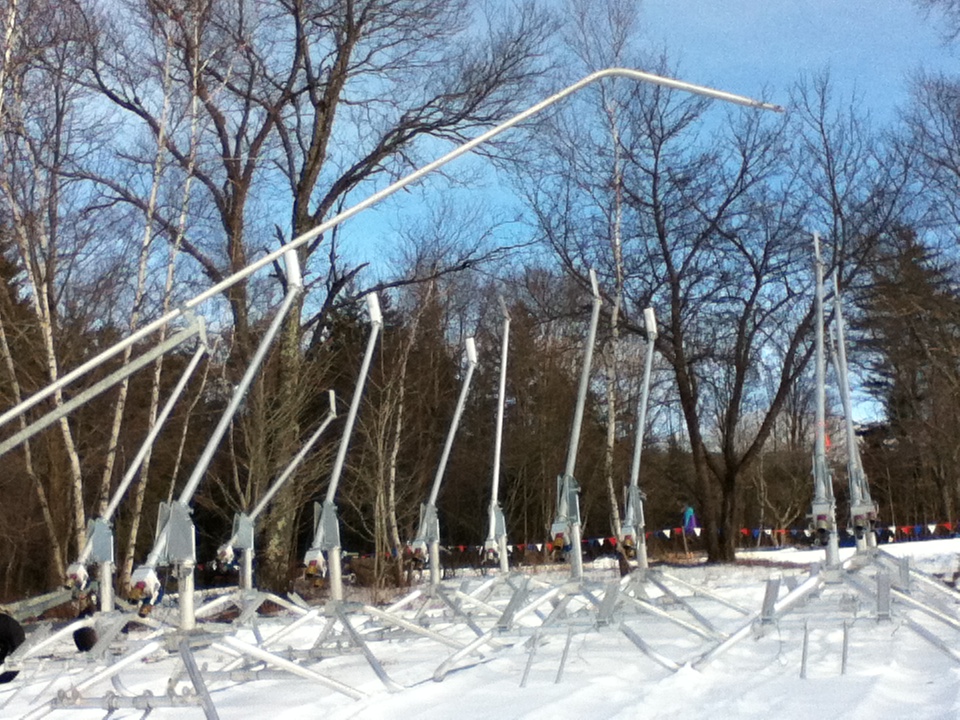
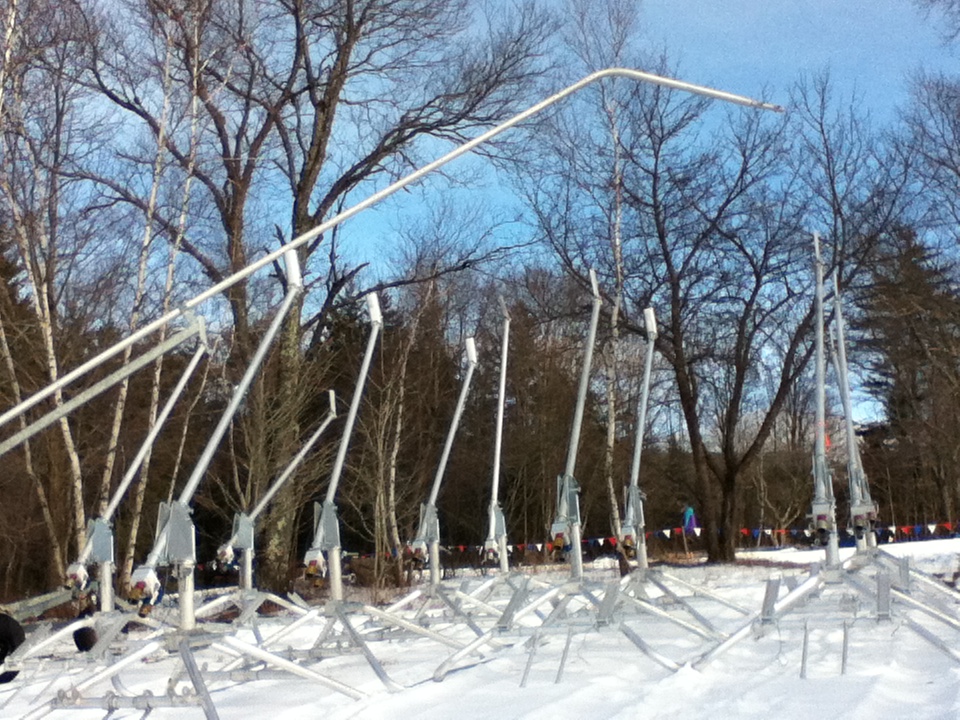
Snowmaking equipment at the Rikert Touring Center in Ripton, Vt. Snowmaking is becoming increasingly necessary to maintain winter ski areas, but should the ski industry also be developing other strategies?
Part of this prediction arises from the fact that the team assumed that cross-country ski areas don’t use snowmaking. Wobus said that he knows some nordic areas are investing heavily into snowmaking (or snow storage), but in general, not enough currently use it to build into their projects as they did for alpine ski areas.
But even if ski areas were to rely on snowmaking, they might be in trouble. For instance, under a high low emissions scenario, just 23 percent of alpine ski areas would have accumulated enough hours of snowmaking in 2090 to open by Dec. 15. As most of the cross-country ski areas are restricted to lower-elevation areas at the bottom of mountains, they would not be in better shape.
Without snowmaking, a high-emissions scenario would lead to roughly 87,000 fewer visits to cross-country ski areas by 2050 and 1.1 million fewer visits in 2090 – equivalent, by that point, to $10.2 million less in trail passes sold.
Are We Listening?
The idea for this piece of research came while spitballing.
“We’ve been doing work for ten years around impact of climate change on various sectors of the economy,” Wobus said. “I’ve published papers on the impacts of ocean acidification and ocean warming on coral reefs and linking that to a recreational use model. I did one on inland flooding and monetary damages from flooding. We’ve done all these different sectoral analyses for different economic impacts of climate change.”
Living in Boulder and being skiers, the team thought – why not look at that?
“We were basically pitching ideas, and we were like, skiing is a pretty important industry in certain parts of the country and it probably has a serious economic impact … so we did it,” Wobus laughed.
But the findings have made a splash.
“People seem to have been noticing,” Wobus said. “I actually credit Global Environmental Change for having a Twitter feed, of all things. Protect Our Winters picked it up, and Powder Magazine picked it up. … Most times people don’t pay any attention to my research. So it’s kind of cool to have something that’s a little more out there.”
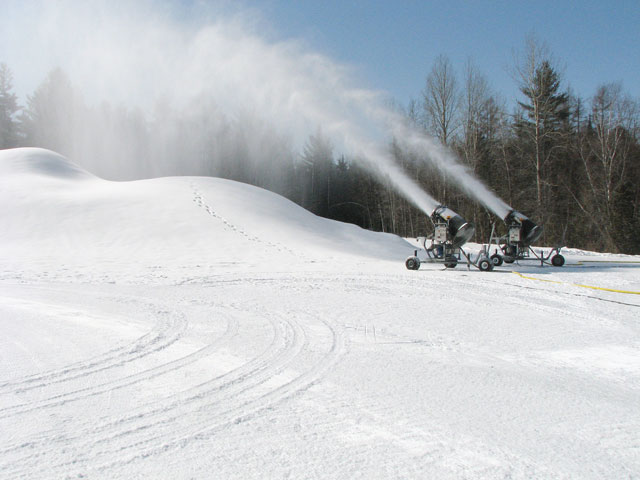
Snowmaking equipment at the Rikert Touring Center of Middlebury College. Snowmaking is becoming increasingly necessary to maintain winter ski areas, but should the ski industry also be developing other strategies?
Welcome back to This Month in Journals! After taking the winter off to focus on race reporting, we’re doing a series to catch up on the ski-related research that has been published in scientific and social science journals this winter.
The Intergovernmental Panel of Climate Change (IPCC) recently came out with a new report, even more alarming than its previous ones. Besides noting that extreme weather events would increase and certainly have a huge impact on people around the world, the panel cited the need for adaptation.
“Responding to climate-related risks involves making decisions and taking actions in the face of continuing uncertainty about the extent of climate change and the severity of impacts in a changing world, with potential limits to the effectiveness of incremental approaches,” the panel wrote in their technical summary. “… Adaptation planning and implementation at a range of scales are contingent on values, objectives, and risk perceptions. Some types of adaptation options, such as insurance or large-scale infrastructure projects, may differentially affect stakeholders.”
What does this mean for the ski world? A variety of research groups published papers this winter looking at perceptions of climate change in the ski industry, both from tourists and other stakeholders, and whether they think adaptation is important. Here’s what they found.
* Drs. Mia Landauer, Wolfgang Haider, and Ulrike Pröbstl-Haider published a comparison of climate change perceptions in Austrian and Finnish cross country skiers in the Journal of Travel Research in January.
The authors identified three potential ways for ski areas to adapt to climate change: using technology such as snowmaking, snow saving, and ski tunnels; diversifying into activities that don’t depend on snow; and promoting all-season tourism rather than winter tourism. Then they examined how Finnish and Austrian skiers’ preferences for these strategies were affected by their cultural background.
And there were major differences between these cultural backgrounds. For instance, in Finland, skiing was a form of transportation for hundreds of years, trails are groomed free of charge, and citizens expect to be able to use public and private land for recreation, as one of their basic rights. Most skiers learn in their childhood. In general, the culture has been characterized by more long-term than short-term thinking.
In Austria, cross-country skiing is much more of a tourist product, and trails these days are more likely to be groomed by private businesses or individuals who charge for trail access. Skiers are more likely to have learned as adults. The authors identified masculinity and “avoidance of uncertainty” as general cultural traits in the country.
The authors found that about half the skiers in each country mainly hit the trails to enjoy nature and get outside. But in Finland, almost twice as many of the others ski for the sporting and fitness aspects of the activity and don’t mind skiing alone, while more Austrians consider it a social activity. 85% of the Finns skied more than 30 days in a winter; most Austrians went out just six to ten days.
What did this mean for climate adaptation? The Finns, with their emphasis on skiing as sport, were more interested in using technical advances such as snowmaking and building ski tunnels. The Austrians, who were more interested in seeing nature with their friends, were uninterested in ski tunnels. However, the Finns expected these infrastructure improvements to be paid in the interest of the public good, although they were somewhat willing to pay for access ski tunnels if the snow was good. Since Austrians already pay trail user fees, they were willing to do so for further improvements.
In terms of diversification, Finns were more interested in seeing resorts offer other non-snow and year-round sport activities, either indoors or outdoors. Because the Austrians were not as interested in skiing as an athletic or fitness activity, they had less strong preferences for this type of adaptation. Instead, they were more interested in seeing cultural programs and nature experiences being offered in the place of on-snow skiing.
The authors write that their study emphasizes how climate change must be addressed differently in different settings.
Snowguns going strong at the Craftsbury Outdoor Center (Courtesy photo).
“Ignoring cultural differences would likely increase management problems, lead to conflicts, and also to a significant decrease in skiing participation,” they wrote in their conclusion. “[Our study] underlines the importance and necessity to consider social limits—such as culture—to adaptation to climate change.”
* Other work looked at the attitudes of not the skiers themselves, but those running the ski areas. Dr. Lisa Trawöger from the University of Innsbruck assessed the perception of tourism stakeholders in Austria about whether climate change was a threat to their winter tourism system.
In the journal Tourism Management, Dr. Trawöger began by reviewing previous work on stakeholder attitudes. She noted that ski resort operators in Switzerland have been cognizant of, and worried about, climate change since the early 2000’s: after all, they have seen its effects firsthand.
Attitudes of winter tourism businesspeople in the rest of Europe range from skeptical of climate change, to acknowledging its existence but worrying only about the bottom line. In many places, like northern Sweden, people weren’t sure whether climate change would affect tourism. In others, increased awareness of the problem had been noted in time spans as short as two years, perhaps because of low-snow winters in 2006 and 2007.
So, Dr. Trawöger turned to the Tyrol region of Austria. There, she found ski company CEO’s who had discussed climate change in their work but were highly skeptical of its effects, and who did not believe research which predicts that it will affect winter tourism their region.
“A few years ago they said we would have less snow,” a cable care company CEO told her. “We had a lot of snow and they told us it was an exception. We had five exceptions in a row. They also said it would get warmer and then we had a freezing cold winter. That doesn’t increase our confidence in studies. We can‘t estimate the long-term effects of climate change from the results we have received so far.”
Of 24 CEO’s interviewed, only five were actively planning for climate change impacts, and they all ran cable car companies, not tourism associations. 11 CEO’s believed climate change was real, but were waiting to see if it affected Tyrol; five were unsure about climate change but optimistic that it might not affect them; and three completely denied its effects.
Overall, Dr. Trawöger wrote, the Tyrolean ski industy does not believe that climate change is a threat and has not management or adaptation strategy for how to deal with it if it becomes one.
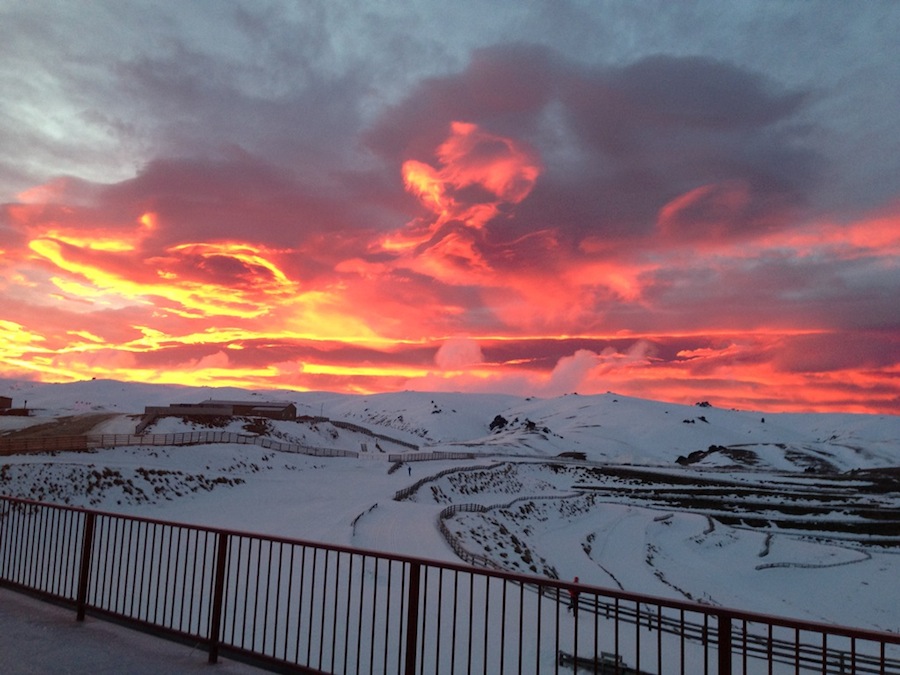
The Snow Farm was among the New Zealand ski areas investigated by Dr. Hopkins.
* Finally, Dr. Debbie Hopkins of the University of Otago undertook similar work in New Zealand. Writing in the Journal of Sustainable Tourism, she concluded that the winter tourism industry is turning to snowmaking as a cure-all for the low-snow blues, without regard for long-term environmental and social consequences.
Because the ski areas around Queenstown (including the Snow Farm, a cross-country ski destination for the U.S. and Canadian national teams and others) area all more than 15 and sometimes over 30 kilometers from the city, they are separated from other non-snow tourism draws and developing diversified strategies is challenging. For instance, there’s plenty of mountain biking in Queenstown itself, so using that as a draw for more remote areas has had limited success.
Unlike in Austria, most skiers were aware of climate change and took it seriously as a threat to skiing. Talking to ski industry workers, locals, and tourists, Dr. Hopkins found that all considered increased snowmaking to be the solution to the climate change problem: other studies have shown that snowmaking can increase the days of skiing available compared to the 1990’s, even as natural snow is predicted to decline in the next three decades. Ski areas are now opening about a month earlier than they used to.
With a warming climate, making snow early in the season could become much more difficult. Some managers also pointed out that snowmaking would become more costly under these circumstances and may not remain financially worthwhile for the ski areas.
And some community members worried about the amount of electricity and water used to make snow a month before natural snow arrived. A few went so far as to say that they would be uninterested in supporting an industry based entirely on manmade snow. Overall, the paper questions whether snowmaking is a viable long-term strategy for the ski areas to use to attract tourists.
“While snowmaking has many positive outputs for the ski industry, there are also perceptions of negative externalities which impact upon perceptions of sustainability and (mal)adaptation in the longer term,” Dr. Hopkins wrote.
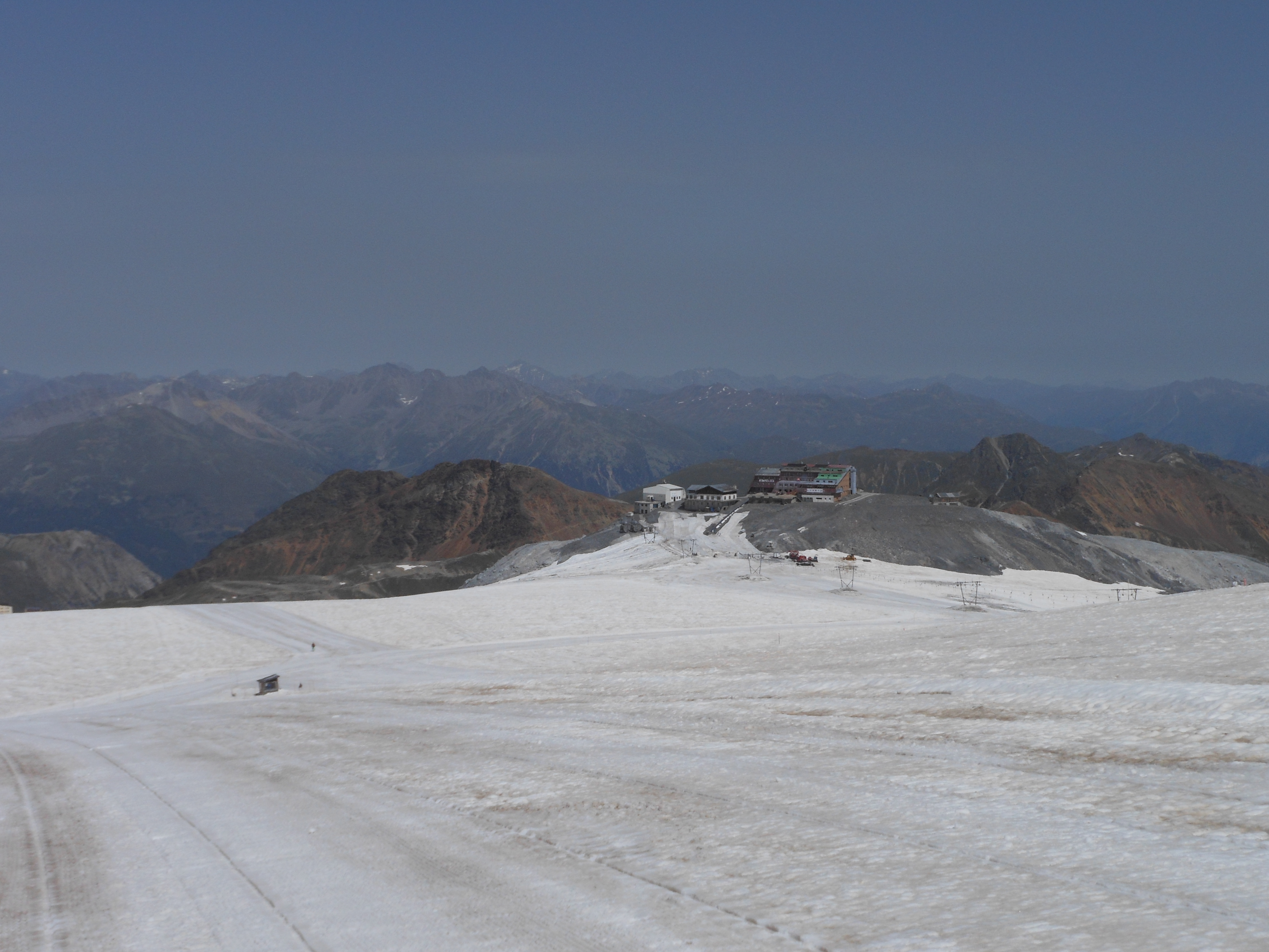
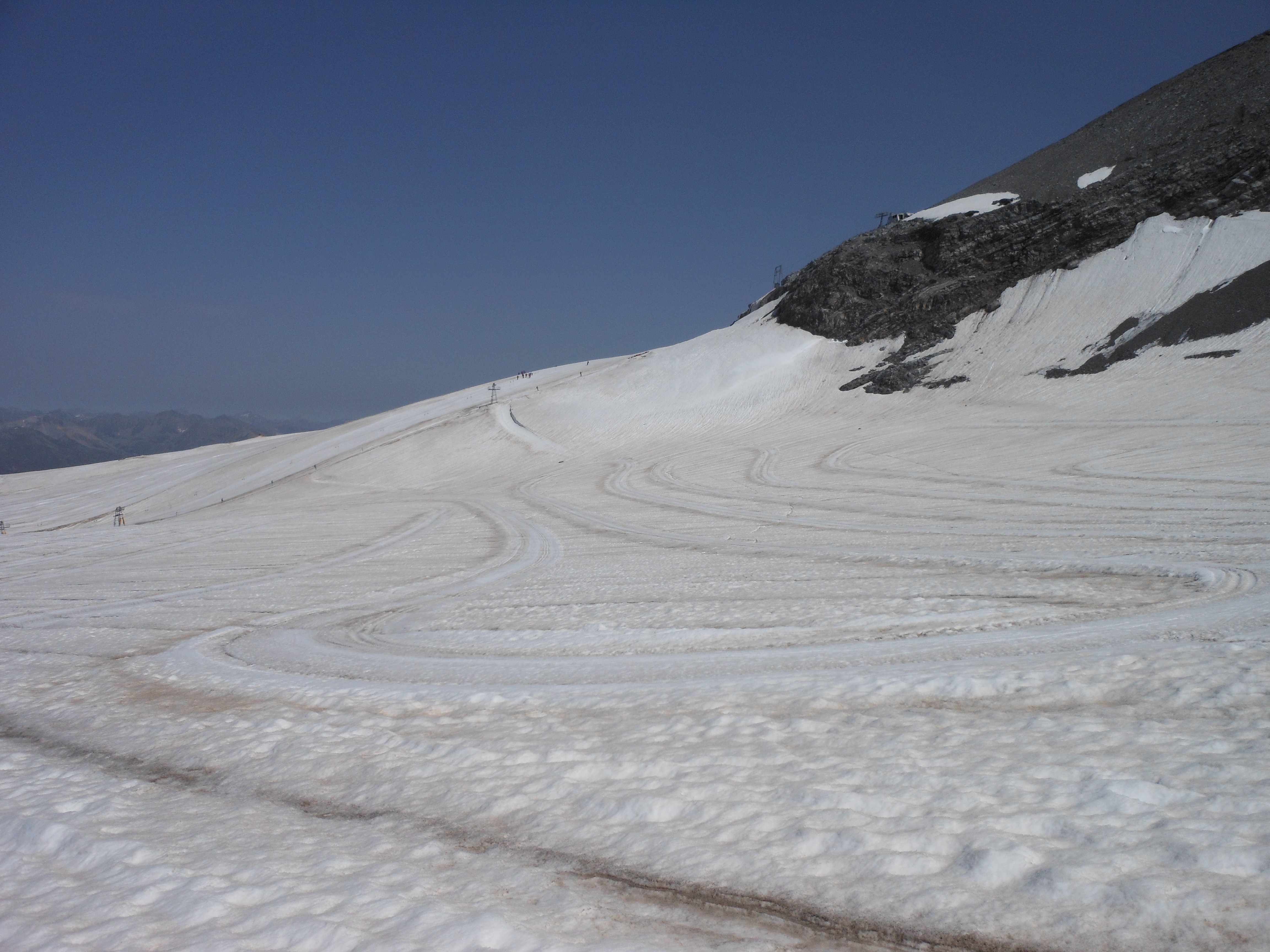
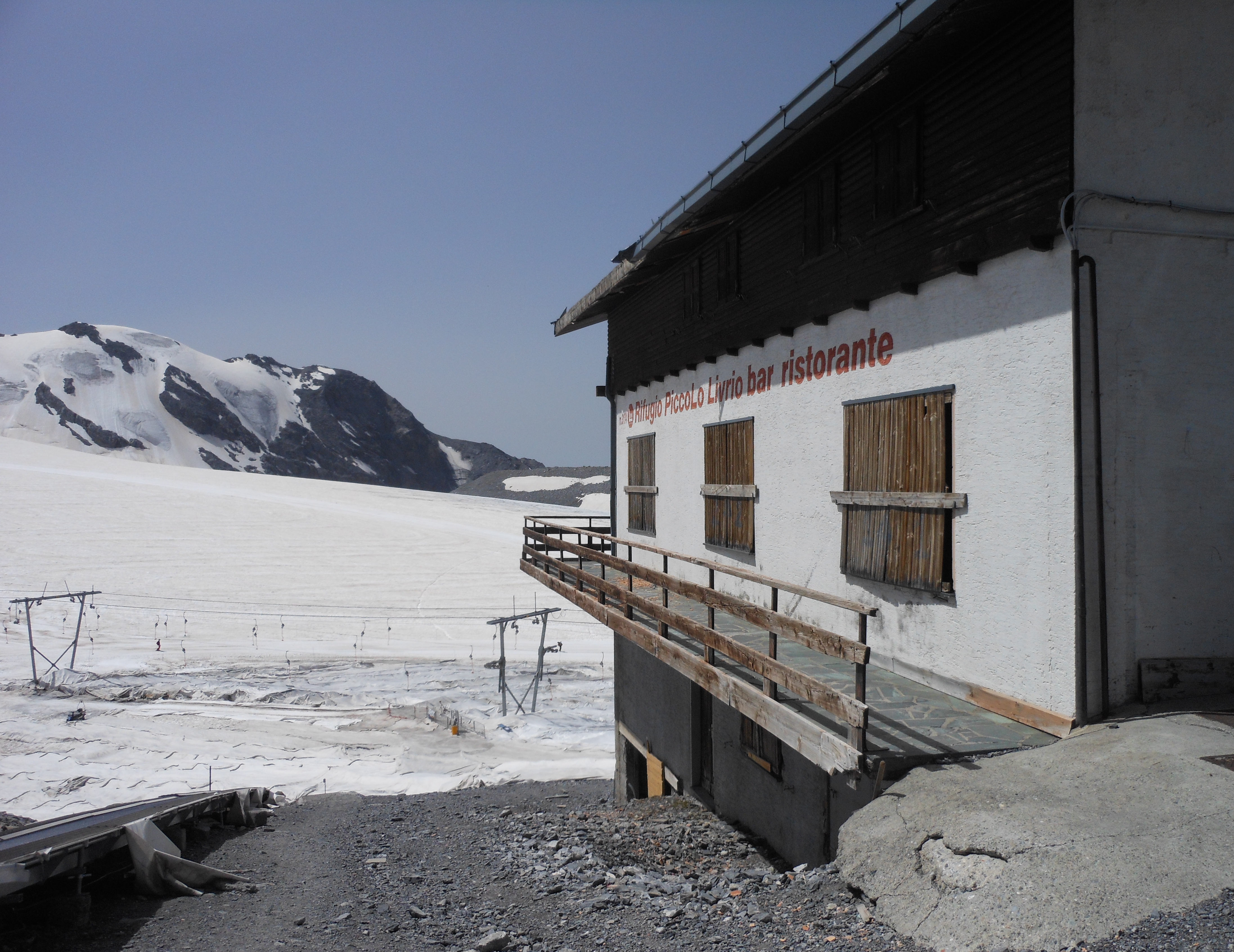
Looking from the ski trails of Passo dello Stelvio down to Livrio, the top of the second cable car line.
BORMIO, Italy— I used to be a ski racer. I trained, all year; I raced, all winter.
But the funny thing is, I became a skier through two programs which placed an emphasis on things like “skiing as a way of life” and “the joy of skiing.” Were we supposed to train hard, ski fast, improve our technique? Yes. But there was a tacit understanding that in order to accomplish these goals, we had to appreciate skiing for what it was: skiing. If we were working only for results, then eventually the love affair would end and we’d be out of the sport.
My old coaches did their jobs well and although it’s been a few years since I would call myself a ski racer, I still seek out skiing wherever and whenever I can find it. I tried moving on. I even tried living in cities where it doesn’t snow. But I couldn’t shake that itch, and just myself spending more and more of my weekends traveling in pursuit of my favorite white, powdery drug: snow. It always makes me feel better.
So, Cascades? Check, so much that my friends got sick of me sleeping on their couch. Arctic circle in November? Check. Pyrenees in the spring sun and French Alps in the spring rain? Check, check.
The natural extension of this quest was summer skiing. And so when I found myself with a four-day weekend, I looked at the map and realized that snow – which I see in my work in the Swiss Alps every day, but not in any skiable form – was not so far away. Just across the Italian border was the small town of Bormio, and behind it the legendary Passo dello Stelvio, one of the first popular summer ski destinations. Skiing in August was possible, and just a train ticket away. Of course, I bought the train ticket.
What is it about summer skiing that has such an allure? It doesn’t matter if you are a backcountry explorer, an alpine racer, or a cross-country enthusiast. When you think of escaping the summer heat of wherever you live, heading into the mountains in your t-shirt, and hopping on your skis, your eyes get a little brighter and your heart beats a little faster.
Even glaciers themselves are magical – living things that grow and shrink and move, and that hold snow when it should be impossible. Beneath a smooth(ish) surface might be a crevasse that could swallow you whole. Far below, rivers run into waterfalls, and even if the glacier appears to be the same size from above, they are constantly melting enough water to feed entire valleys below them. To a New Hampshire girl like me, this is goosebumps stuff.
At work the next day, I told my coworkers about my plan.
“You get to go skiing?” my Swedish friend Sofia said through literally clenched teeth. “Oh my God. I want to go skiing so badly. Skiing in the summer!”
My Austrian co-worker, Günther, describes snow with reverence. He refers to it as “the fifth element,” something on its own distinct from water, and definitely much better. So when I said I was going skiing for the weekend, he was jealous. He had friends coming to visit from Austria to do a long backpacking tour, but his first reaction was, “I almost wish they weren’t coming so I could go skiing instead.”
From that, it became something else.
“Shut up,” he said. “Shut up. Shut up. Shut the f**k up.”
(The three of us actually have a very fun and productive working relationship.)
My coworkers understood perfectly this quest for summer snow. For Günther, the idea of me spending all day on the glacier, skiing until I was too exhausted to move, seemed almost unbearable. Every time we saw someone who asked what our plans were for the long weekend, I’d begin to say, “I’m going to Italy to go sk—“
“Shut up,” he’d interrupt. “Shut the f**k up. I don’t want to think about it!”
From there, he began to console himself by imagining why it wouldn’t be as wonderful as I was boasting. We’d be on some mountain, doing our work, when he’d stop and say something like: “You know the freezing line is 4,000 meters?”
“Yeah.”
“Well there aren’t even any mountains in Italy that are 4,000 meters. How is the snow supposed to be any good? It’s probably going to be really hot and the snow is going to suck.”
“I don’t know,” I’d reply. “It’s pretty high. I mean, I guess it’s not 4,000 meters, but it’s at least 3,000 and I saw some pictures of the Italian national team there last week. It looked pretty gorgeous. It definitely looked like good skiing.”
He would just shake his head.
But he understood.
***
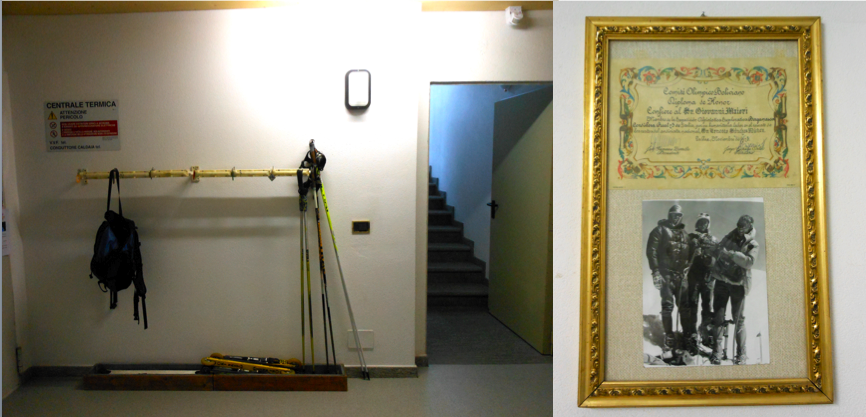
Evidence, past and present, of the Maiori family’s ski tradition.
Strangely, when I arrived in Bormio, the people I met didn’t have the same attitude. Whether it was the other guests at the hotel’s breakfast buffet, or the Canadian girl who accosted me in a restaurant after hearing me speak English and insisted on telling me her life story, or the German guy who tried to talk me up as I walked down the cobbled streets to dinner, their reactions were the same: wait, you’re here to ski?
To me, it was obvious. Unlike most places in the world, the opening of the ski resort at Passo dello Stelvio doesn’t signal the start of winter. Far from it. In winter, the pass is so buried by snow that it is closed completely. Only in May, when enough of the snow melts, does the pass open. That signals the start of summer. The first ski school opened here in the 1950s, and they might be the most famous summer ski schools in the world.
(For a nordic perspective, from the pass, it’s under half an hour to Santa Maria Val Mustair, Swiss star Dario Cologna’s hometown. He sometimes trains at Stelvio. The Norwegian team has done a camp here too.)
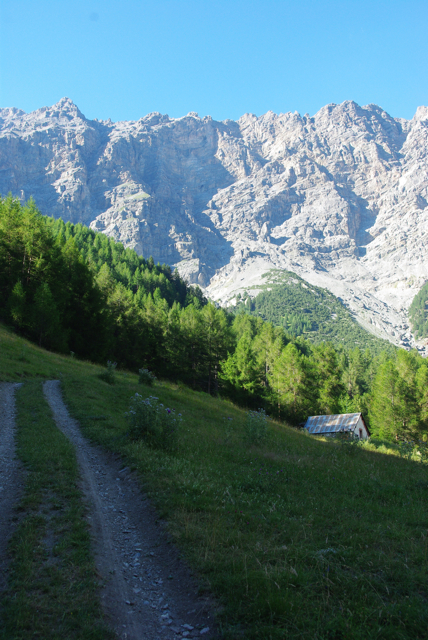
Many tourists come to see the beauty of the national park.
All around Bormio is evidence of a great skiing past. Hotels have trophies, plaques, and photos of the members of their families who were ski champions or who accomplished noteworthy feats of mountaineering in days gone by. The hotel where I am staying is run by the Maiori family; as I unpack my skis, Mr. Maiori’s eyes light up and he tells me that his son, Andrea, is a biathlon champion of Italy, and he thinks that the younger girl, Francesca, will be a good cross country skier.
There are rollerskis in the corner and pair of top-of-the-line OneWay poles.
“A month ago, the cross country skiing at Stelvio was perfect,” Mr. Maiori tells me, kissing his fingers and then releasing them into the air in that typically Italian gesture.
Today, though, my skis are the only ones in the racks that line this basement room. Bormio doesn’t have many ski tourists, at least not at this time of summer. There are plenty of tourists, but they are here either for sightseeing or to ride their bikes up the famous Passo dello Stelvio, with its 30-plus hairpin turns and 1500 meters in elevation gain. Even though that lands them at the bottom of the ski area, most were completely unaware that it was even open for business.
Some of the surprise was justifiable. It’s gets up to 80 degrees during the day here in town, so imagining skiing is pretty tough.
But even after I would describe how at the top of the pass, you take a cable car up to the glacier and then it’s all skiing – they would still be confused. Every single person I talked to in town had the same next question: “so you’re a professional skier or something?”
To them, skiing in the summer was not something you would ever do unless it was part of your job, or unless you were training for something big.
I emphatically disagree with this attitude.
But after a few of these interactions, I begin to wonder: does searching out snow like this mean that I’m crazy?
***
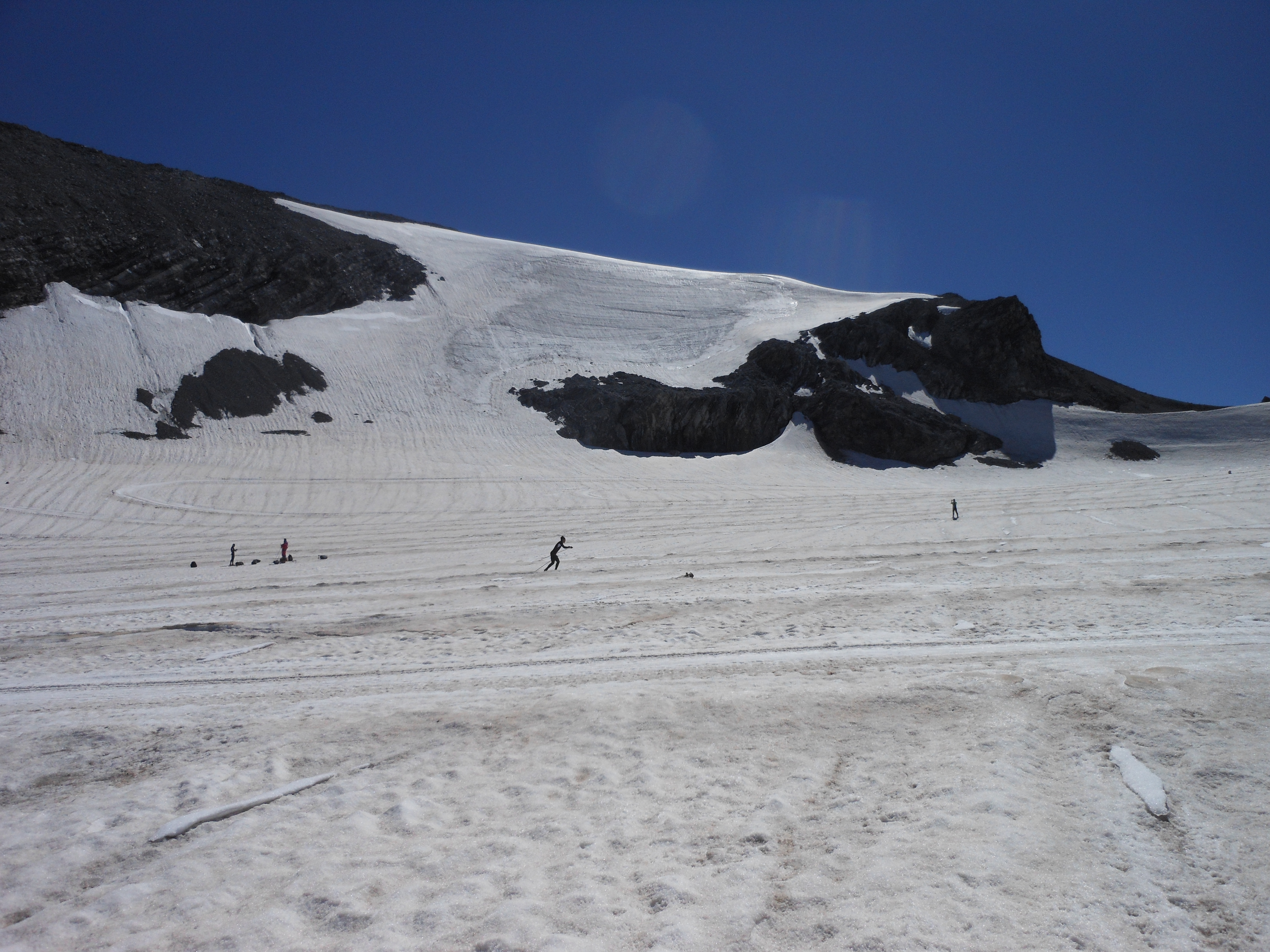
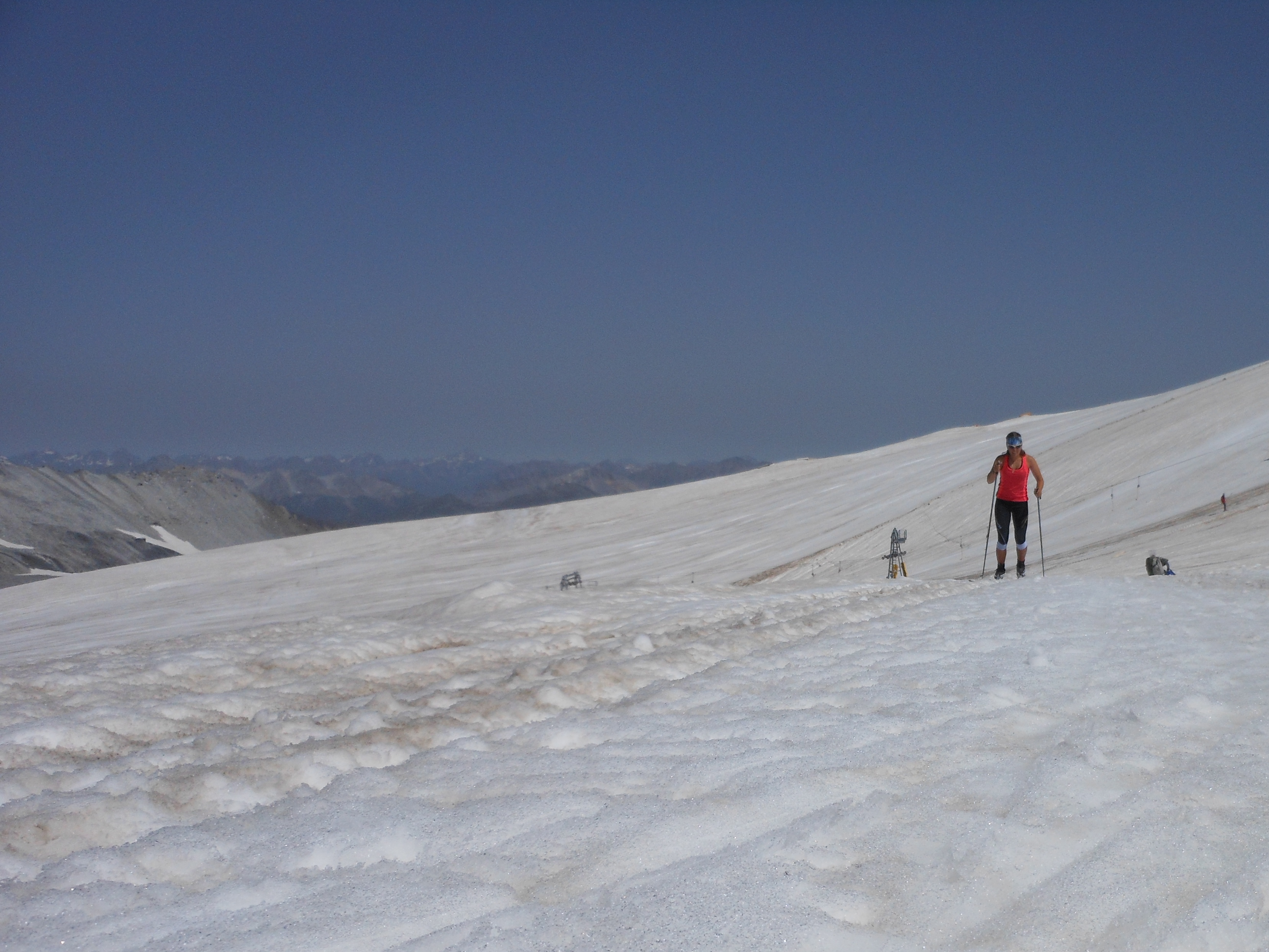
At nearly 11,000 feet, the looping tracks of the Cristallo nordic trails at Passo dello Stelvio.
If you don’t have a car, then the way to get from Bormio up to Passo dello Stelvio is by bus. I settled down with the tourists, who were mostly just headed up to take a few pictures, drink a cup of espresso, and then go back down again. The guy sitting behind me talked to himself the whole time as the bus labored around the hairpin turns and through the narrow covered galleries that protect the road from avalanches. I don’t know Italian, but I know that he was crazy.
Passo dello Stelvio is the second-highest pass in Europe, sitting at 9,045 feet. It has some cool history: it is right on the Swiss-Italian border, and right next to “Dreisprachenspitze” or “three-languages peak”, where Italian, German, and Romansch are spoken on different sides. In World War I, Austria even owned a corner of this territory, and Austria and Italy had to make a deal not to fire over the Swiss portion of the land when they were trying to attack each other.
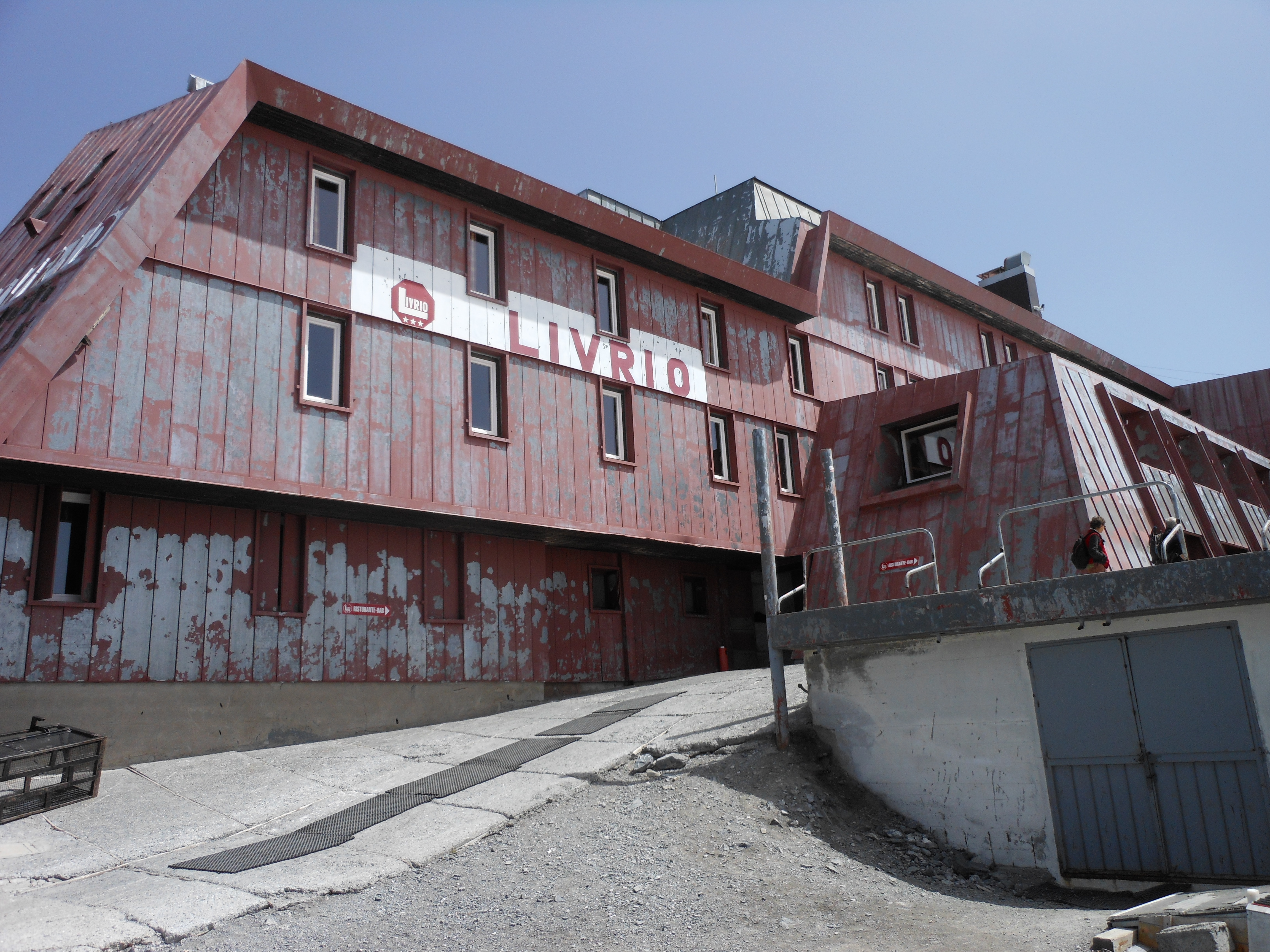
At some point after that, the hotels went up. They are huge buildings that were once stately, but most look like they haven’t had any external upkeep in a while. The names are painted on the outside, along with advertisements for their summer ski schools. The paint is fading and there are a few that appear to be crumbling at the edges. One is closed completely.
(I later went inside one of the functioning hotels, and though it isn’t the lap of luxury, it’s quite a bit nicer on the inside – a perfectly fine place to stay, with food that looked good. The five cars looking lonely in the huge parking lot wouldn’t have suggested as much, though.)
We arrived in a parking lot that was full of ski team vans but no people – everyone was already up on the glacier. After hiking up the stairs of an ugly concrete building, I got my ticket for the day and hopped in the first cable car. I was alone with the operator, and we glided silently over the mixed snow and rock below. As a cross-country skier, I’m not used to having to take this sort of transportation to get to my trails. At the end of the ride we were only at an intermediate station, and switched to a second cable car for the rest of the trip up.
Finally, I walked out of the next decrepit concrete building and onto a porch with a few empty picnic tables. A hike down to through the gravel would bring you to the snow and the first lift; on either side I could see groomed expanses of hills, dotted with orderly arrangements of gates where tiny alpine skiers were weaving in and out.
“Where is the cross country track?” I asked the lift technician.
“Somewhere over there today,” he pointed around the corner of the hillside and shrugged. “It’s open. Open, over around the hill. You can’t see, but over there.”
Then he went back inside. I had to just trust him.
My first idea was to ski up to the area he had been generally pointing to, but as soon as I started it hit me that I was nearing 10,000 feet in elevation, and wearing a backpack. The joy of being on snow for the first few seconds quickly disappeared as I looked up the hill and thought, there is no way I can ski up this. So I labored away until the first crossover trail, where, ashamed, I climbed onto the lift and took it to the top.
From there, I still couldn’t see the nordic trails. Some Norwegian downhillers looked at me and almost visibly scoffed. But I could see that there were two more lifts, so, sticking to the shallow side of the hill, I carved some turns down to the bottom and looked up. There, snaking back and forth in the space between the two lift lines, were some tracks, and I could see a few guys classic skiing. I took one more lift up and was finally able to drop my backpack on the side of the trail and get going.
The alpine “trails” (actually just wide open hillsides) I had negotiated had been crisp white snow, frozen corduroy in some places, slushy ruts in others where too many athletes had practiced the courses set by their coaches. As I began to ski, I encountered something totally different. The trails were dirty – only a narrow white section in the middle of the trail could be called at all pristine. It was unclear whether it had been groomed that morning or not, but my instincts were telling me no. I cringed inwardly for my skis and the amount of dirt they were picking up.
There were just five other skiers, and they were classic skiing, so the trail had not been skied in for skating at all. I found myself laboring again, pushing a V1 on the flat to get through the sluggish snow. With the elevation now almost 11,000 feet, it was hard – really, really hard. I was quickly reduced to skiing in my t-shirt and sweating profusely in the sun. Every once in a while in the middle of the trail there would be a rock sticking up, beginning to melt out the snow around it.
I had envisioned a morning of skiing, then eating a relaxing lunch and reading my book in the sun, followed by an afternoon of more skiing. But I began to panic. What had I gotten myself into? There was no way I could ski in this stuff all day – I was barely sure I could skate for an hour. This was not the winter-in-summer that I had dreamed of.
It was like a real-life version of the old saying: be careful what you wish for, because you just might get it. I had wished for summer skiing, and that’s what I got. Maybe Günther was right. I stuck it out until lunchtime, then hitchhiked back down to Bormio for the afternoon, exhausted.
***
Day two at Cristallo. The Japanese national team trains in the background.
I guess I had been naïve. My expectations were too high. In a recent NPR radio piece, Kikkan Randall called the Eagle glacier in Alaska “not the most glorious conditions to ski in.” If, unlike me, you’re a glacier-skiing pro, you probably know that summer snow isn’t exactly perfect.
But I wasn’t expecting an extra-blue day, either, and those expectations were built on at least a shred of truth. I know what I’ve seen: pictures of snow, the recognizable texture of corduroy. The images from Eagle look far nicer than what I encountered at arguably the most famous summer ski destination in Europe. Even the photos from the Italian team, taken a few days earlier, looked much more inviting.
(I wonder whether the ski area takes greater pains to prepare the tracks when they know their own national team will be there. It doesn’t seem a stretch to imagine. I also wonder whether the nice, crisp snow on the alpine trails is the result of salting or some other preparation that they don’t deem necessary for the ugly stepchild of cross-country skiing.)
Regardless of why I had hoped for more, 24 hours later I had accepted the reality of Stelvio. My illusions and silly childhood dreams had been dashed, but with lower expectations, day two was a lot more enjoyable. I brought classic skis and while traversing and descending the alpine trails to get to my own loop was a lot less fun, once I was out there and got the right wax on my skis, I was really skiing. I no longer felt like the trip was a mistake.
It was a slow slog, but I could stride with good technique and make my way around the zigs and zags without having to take a million rest breaks. Was it just as hot and slushy? Yes. But this was summer skiing that, for at least a day or two, was a real treat. My drug was working, just as it always did: the stress from my working life was melting away, and it was just me there, in the moment, with my skis and the snow and, soon, a sunburn.
Yet I still wondered: is this all there is? Skiing back in forth in parallel, dirt-crusted tracks between whiter slopes where World Juniors racers are laying down run after run of giant slalom training?
Say that I’ve learned nothing from this experience, but I still think there might be more. Maybe it’s not in Italy, maybe it’s somewhere further afield. Or maybe I just missed it in time. But I don’t think that the Stelvio I experienced is the one that earned all the fame.
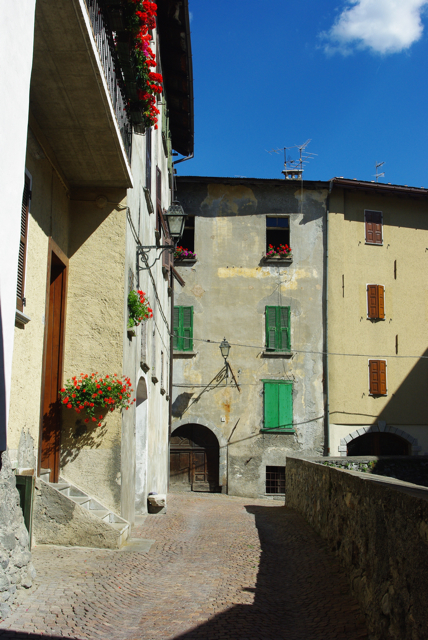
A typical scene in Bormio.
These aren’t the 1960s; they aren’t the 1990s, either. Stelvio isn’t the mecca it once was. Yes, there are all those junior teams. But if you’re looking for tourists and recreational skiers, you won’t find too many of them. I encountered a group of stoner snowboard bros in the cable car, but that was more or less it.
Twice, I ended up hitchhiking down from the pass to Bormio, and I discussed Stelvio’s fate with my drivers. We all agreed on at least one thing: the valley itself was perfect, amazing. The pass is surrounded by a big national park where there are no Mcmansions, nothing at all except hiking trails and a few farms. My first driver was a mountain runner who had first visited four years ago and couldn’t stop coming back. He and his wife had bought a small house and escaped here from Parma as often as possible.
And Bormio, too, is too perfect to be real. It’s still small, and while it has plenty of tourists, it’s not overrun. It’s a ski town but not a resort town, and there aren’t enough people to drive up the costs of lodging or to spur the construction of luxury hotels. The couture houses don’t have their handbag shops here yet. Instead, you wander narrow, cobblestone streets with red geraniums spilling off of every balcony. You can get enough gelato – of any flavor – to put you in a sugar coma for just two and a half Euros, at a dozen different shops. People are friendly, if seldom on time. The mountains are right there.
So what happened up on the pass?
***
The fading hotel at Livrio. Although it still has a website and a page on booking.com, it didn’t appear very open on welcoming when I was there.
I’m not sure, but there are a few clues. My first driver told me that four years ago, the snow would have been better. There’s been so little in the last few years. I ask – this was a really late spring, so surely this year was better?
His young daughter wonders, wide-eyed, in the back seat.
“Yes, there was a lot of snow quite late,” he says. “But then it got so hot that is just disappeared like that.”
He snaps his fingers.
So, July was great, and maybe August never is. Climate change seems to be a significant problem for places like Stelvio, and there’s less snow than there used to be. If you want to have good snow all summer, you have to get a lot in the winter, and that’s becoming less and less common.
While skiing is gaining popularity across Europe, with the industry growing by 1 percent in 2013 after four years of decline, things aren’t so simple in Italy. The country’s share of the ski tourism market has been dropping, and the Italian economy itself is in its longest recession since World War II. The Financial Times recently referred to the country as “paralysed by political and economic torpor” and “rich in suffering bureaucratic impositions.” Young people are leaving in mass exodus, and family-level purchasing power has fallen to levels not seen since the ’90s. None of this is good for the domestic tourism industry.
Fabio Ghisafi, an Italian who serves as wax tech and women’s coach for the Japanese national team, tells me that the Italian ski team has less and less money.
At lunchtime, my skis were the only ones leaning up outside the Livrio restaurant as I took this picture. Years ago, the porch would have been filled with skiers.
On my second day hitchhiking, I pick out a couple who are loading two pairs of beautiful wooden downhill skis into a pristine Volvo. They have the sleepy-eyed affluence of Como, and as the wife heads languidly into the Hotel Genziana to use the bathroom before we leave, I chat with the husband. He doesn’t want to admit the last time he was at Stelvio – I get the sense it might have been a decade – but he is astounded at what they saw this time. The lack of snow and skiers, the crumbling infrastructure. The shuttered hotels at the midpoint and at Livrio, the top of the second cable car.
“We were talking about this when we were skiing,” he tells me. “I mean, the old hotels– some of them haven’t been used in years. It’s not a new thing. They should tear them down, because it’s making the mountain ugly.”
I got the sense that this couple would not be back for another trip.
The talk of tearing down the ugly hotels is easy to chalk up to rich snobbery – if you’re used to skiing St. Moritz in winter, then yes, Stelvio would be a shock – but he was right. Passo dello Stelvio used to be a playground not just for athletes, but for families. And of course, it would be great if it could be again. There are several dozen perfect bunny slopes – why aren’t there any kids there now, learning how to turn? Why isn’t there someone serving pizzocheri, the local buckwheat pasta and cheese dish, at the top of the cable car line?
But if it can’t, if climate change and economics and the decline of snow sports is too much to overcome for potential investors, then maybe Stelvio should reverse direction. It would be better to get the buildings that are in use looking a little more presentable, and turn the rest back into, well, mountain. The current shabbiness isn’t doing the area’s tourism industry any favors.
Just as I adjusted my expectations for Stelvio, maybe the ski area should do the same. The dreams it was built on might not be realistic anymore. It’s easy, if sad, to imagine the future of Passo dello Stelvio. People will always ski there, but it might get more and more discouraging to do so.
And that leaves me with only one thing still up in the air: what about my own dreams? Am I the only one who still dreams that dream that Stelvio was built on? Am I 20 years too young for this burning, insatiable desire to ski everywhere, all the time? Somewhere along the way, was I dealt a bad line about whether this is even possible, let alone fun? Does the rest of the ski community dream like me, or am I the lone crazy one?
I’m not sure. But I like to think that one of the things that makes me a lifelong skier is the ability to hold two ideas in my head. The first is the image of a little corner of New Hampshire, whose twisting and climbing trails will always represent my favorite place to ski.
And the second idea is that at any given moment, somewhere in the world, there’s great skiing. If I can’t be back home and if it’s not December through March, then a corner of my mind is occupied wondering where that snow is and whether I can get there.
Most of the time, I can’t. But sometimes opportunities fall into your lap; that’s why you can’t forget about the quest, because then they might slip by unnoticed. Childlike, I hope that the next time I find improbable skiing, it will be magical again.
Artificial snow, solar panels and ski racing. 2012 SuperTour Finals, Craftsbury, Vermont.
There is a certain optimism that hangs in the air now that October is fast approaching. The temperature has cooled, leaves are turning red and snow is already accumulating in the mountains. Every year, signs of the changing seasons bring a sudden need for snow sport enthusiasts to urgently dial in their gear to be ready the instant the first skiable snow falls.
Skiers may be chomping at the bit more than usual this season because last year was such a disappointment. From December 2011 onward, the ground was uncooperatively warm and dry. Season-long snowpack levels were recorded as low as 30 percent below average in some places. The National Oceanic and Atmospheric Administration reported that temperatures from October 2011 through March 2012 were 3.8 degrees Fahrenheit above the norm, the second-warmest winter on record for the contiguous U.S.
It’s not unusual for some pockets of the country to have poor snow while others areas get dumped on. Last season was unique because snow was absent almost everywhere, and particularly so in the eastern half of the country. Manmade ski loops often provided the only skiing to be had. Major races got canceled. National championships in the U.S. and Canada relied on premade stockpiles to cover their courses. The inconvenience underscored the reality that this sport depends on a force of nature beyond any immediate control.
This fact is never far from the minds of people in the business of selling skis. Low snowfall is disappointing for consumers, but for the ski industry it dictates the bottom line at the end of the year, and 2012 was no exception.
“The reality is that we’re farmers to a certain extent,” said Boulder Nordic Sport owner Nathan Schultz. “If the snow doesn’t come, then we don’t get crops.”
This may come as a surprise to the faithful and dedicated members of the ski community, who will find a way to ski no matter what. But no matter how committed that group is to having the best and newest equipment to race on, the majority of the ski market is made up of a recreational demographic.
People in the U.S. who put on cross-country skis last season went out an average of only nine times over the course of the winter months, according to an annual study commissioned by SnowSports Industries America (SIA). That average is driven by a large number of people whose decision to buy skis is heavily influenced by the presence or absence of snow out their front door. In the absence of snow last winter, fewer skis were sold and used.
“The dedicated consumers will buy product,” said Peter Ashley, vice president of Fischer Sports USA. “It’s the recreational area where the industry is really suffering.”
Ashley estimates that as much as 75 percent of Fischer’s U.S. sales are recreational skis, and 60 percent of his business comes from the populous Midwest and Eastern regions. It is this fact that, when combined with poor snow, can wreak havoc on the ski industry.
“The recreational skiers won’t buy anything until they actually see snow,” Ashley said. “Racing gets a lot of PR, but when it comes down to actual dollars and units, the recreational, junior and backcountry business — that’s the majority of the business. And I’m the market leader for racing … So when the recreational skier doesn’t ski: ouch. It hurts.
“When you have no snow in the Midwest, and very little to marginal snow in the East, you’re toast. And that’s what happened this winter.”
SIA, the non-profit trade organization that keeps track of annual market and participation data, reported in June that retail sales across all winter sports were down 12 percent in units from 2011. The nordic corner of the market fared particularly poorly, ending the season down 29 percent in units sold and down 26 percent in dollars. The numbers don’t lie: when it doesn’t snow, people generally don’t buy skis.
“No matter what you do that element will always be a large factor in what your end results are,” Schultz said. “Which is hard, when something is out of your control and can have such a large effect on you.”
What does this mean for the ski industry? It depends on whom you ask. Retailers and manufacturers both took a hit. Their losses were compounded by the relatively exceptional snowfall that came two winters ago. Sales were so good that year that ski shops ordered an unusually high number of skis in anticipation of similar growth the following winter. Then, when it hardly snowed all season, that equipment stayed on retail floors.
“From my perspective it was hard because we ended up with way more inventory than we needed, so trying to pay all the bills at the end of the year was really tough,” Schultz said.
For vendors, any good snowfall and associated sales that might come next winter will be tempered by inventory carrying over from last year. With so much equipment already filling retail stock rooms, shops won’t need to reorder skis until a later point in the season than usual.
Beyond companies like Fischer and BNS, diminished sales last year translates into reduced spending on promotion and sponsorships this year.
“None of us have the resources we had a year ago,” Ashley said. “There for sure is going to be some trickle-down effect to paid advertising, web promotions, athlete sponsorships, race sponsorships. … As an industry we’re not going to be able to do a lot of things that we should be doing, but you just can’t when you have the lack of sales that we do.”
There are two major metrics that SIA studies to measure the health of the ski industry every year: sales are one of them, and the other is participation. The sales decline paints a subdued picture of the state of the industry, but nationwide participation data from tells a more nuanced, even optimistic story.
People skied less than the year before, but the cross-country subset proved to be more resilient when compared to other snow sports. SIA reported that 4.3 million people cross-country skied last winter, 4.7 percent fewer than the previous year. By comparison, alpine ski participation went down 11.3 percent and snowboarding decreased 7.5 percent. Nordic enthusiasts may have only skied nine days on average, but this figure led the way for the industry; downhill skiers only skied 7.4 days while snowboarders went out an average of eight times last season.
“Cross-country skiers are a pretty dedicated group,” said SIA research director Kelly Davis. “You don’t get a lot of people showing up to cross-country ski in their jeans for the first time because they think it’s going to be cool. When I look at the numbers and I see cross-country survived this season in fairly good shape in terms of [participation] numbers, that tells me that cross-country is pretty core.”
It has such a devoted core that about a third of the people who skied last season did so out their own door or on ungroomed, free trail systems. While this is good for participation, it means ski areas have to work harder to attract business.
For the few ski areas that actually lucked into decent snow last winter, the biggest challenge was communicating to the broader public that it was there. The Jackson Ski Touring Center in Jackson, N.H., had a decent, if abbreviated, season. Once it got snow, Jackson had 150-plus kilometers of good skiing; the problem was that nobody knew about it.
“Certainly snow and weather is a heavy influencer of what’s going on, but frequently it’s the perception of snow versus the snow itself,” said Thom Perkins, Jackson’s executive director. “With four inches we can provide 40 k of good or great skiing. That’s not a lot to ask. The problem is Boston, which received nine inches of snow last winter. It’s a matter of mindset.”
Most of Jackson’s visitors come from the Massachusetts city, and if Bostonians don’t see snow on the ground, they’ll believe the same thing to be true on the slopes nearby. The industry calls this ‘backyard syndrome,’ and cross-country areas suffer when the perception of snow isn’t there.
For Jackson, 35,000 skier-days would be “a comfy number” for the season; it brought in just over 28,000. This being the case, Perkins said, “We’re not running scared.” Next winter will be his 36th year in the ski business, and he’s weathered bad seasons before. In his experience, if next year brings good snow, the industry will bounce back.
He’s not the only one that feels that way.
“It’s not like people don’t want to go skiing,” Ashley said. “Cross-country is the perfect sport for the economic times. It’s relatively inexpensive, it’s a family sport, it’s a social sport, you don’t have to go a long way to go skiing. All those things are perfect for what’s going on now. … This is not the end of the world. It’s going to snow, we’ve survived this before I don’t know how many times, and none of us are going away.”
Sami Jauhojärvi (FIN) is the first World Cup skier to sign on with OneWay's new skis. Photo: OneWay Sport.
Earlier this week, OneWay Sport announced that it had signed Finnish skier Sami Jauhojärvi to compete on its brand-new skis for the coming year. OneWay has been around since 2004 when it began making carbon-fiber poles, but only introduced a complete line of cross-country equipment to its product lineup in 2012.
As with any sporting goods brand, sponsoring a highly visible athlete is a big step in both establishing the company and integrating a new product into the market. We already know they make a good pole, and with OneWay’s neon yellow featured prominently on France’s and Canada’s race suits this past season, visibility was hardly an issue. But signing Jauhojärvi to their new products establishes that the World Cup skier is confident in the quality of their skis.
“Sami is the first one and of course very important because … he is the number one [skier] in Finland,” said OneWay CEO and President Andreas Bennert. “It’s a big thing for us as a Finnish brand for the domestic market.”
After doing some on-snow testing up until last Friday in Rovaniemi, Jauhojärvi said he came to the decision to make the switch from Fischer to OneWay’s equipment.
“[OneWay] is the most active and innovative brand in developing our cross country sports,” he said, adding that he also fully believes in the company’s efforts to develop youth skiing in Finalnd. OneWay is the main sponsor of Hopeasompa, Finland’s junior championships.
Jauhojärvi is also partnering with OneWay for personal reasons. The 31-year-old views it as the “last chance in my career to get some change in the routines, to get some new motivation with some new equipment.”
OneWay hopes that Jauhojärvi is the first of several skiers to represent its skis and boots next season. According to Bennert, a few more World Cup athletes are currently in the process of testing the equipment.
The signing of its first major athlete would be a big step forward under any circumstances, but it is especially good news for OneWay in light of its recent setback from the injunctions from Fischer Sports in Finnish and German courts. Fischer claimed that OneWay’s use of yellow and black in its products was unfair competition and violated trademark rights, but the courts eventually dismissed each case. Now OneWay is seeking compensation for what it sees as a significant loss of pre-season sales during the six weeks of the injunction’s duration, which began in mid-March.
That was a crucial time for their new skis and boots, said Bennert, because it coincided directly with the European trade shows where retailers decide what to buy for the coming season.
“Yellow is a brand color for us; about 50% [of our products] are yellow with other color details,” said Bennert. “By taking out all these products our range was looking pretty poor… We were not able to present our full package, and have been limited to sell textiles, poles, and so on.”
The injunction did not apply in the U.S. and Canada, but Bennert said Fischer notified North American retailers of the injunction. Fischer declined to make any comment on the case, as OneWay is still in the process of seeking compensation.
Now that OneWay’s name is in the clear, Bennert is looking to keep growing the relatively young company. In his mind, what sets OneWay apart from more established ski companies is a modern approach to marketing and its 100% focus on the nordic sports.
OneWay’s marketing campaigns are certainly unlike those seen anywhere else in the nordic world. One of its mid-level skis, for example, features a woman in a bathing suit on the top sheet. The vibrant ski imagery throughout the OneWay catalogue would fit right in a Warren Miller film.
“This is exactly what the consumer would like to have today,” said Bennert. “A lot of nordic brands make good, solid, well-known products, but the brand is very traditional. We have a big change in the generation of cross-country skiing, in all the countries nowadays, and these people are demanding more than just a product.”
OneWay may now be back on track in Europe, but its footing in the US market is a bit less certain. When the company made the announcement a year ago that it would begin its own ski line in 2012, it began working with a new distributor, Quality Bicycle Products in Minnesota.
Bennert said that QBP couldn’t keep up with OneWay’s needs this past winter, forcing them to find something new for 2012.
“We sold 30,000 pairs of poles last winter, and this winter with QBP we went down to 1,000 pairs, which was very bad for us,” said Bennert.
At the moment, OneWay is in the process of finding a new distributor, and Bennert hopes that over the course of the summer he will have found a good match for the company’s needs.
“It’s definitely irritating the market, but it’s something that you cannot solve in a day.”