From the FasterSkier archive — posts syndicated from athletes’ and coaches’ own blogs between 2004 and 2012, kept online as published. Current coverage is at fasterskier.com.
USA NORDIC ANNOUNCES TEAM NOMINATIONS Group of 45 nordic combined and ski jumping athletes earn spots
USA Nordic has nominated 45 American athletes to its 2021-22 national and junior nordic combined and ski jumping teams. Athletes achieved the nominations based on selection criteria. They will have the option of being a part of the 2021-22 U.S. Nordic Combined or U.S. Ski Jumping Team.
The nominations were made after the conclusion of the 2021 competition season. Athletes are now in training for the upcoming summer and winter seasons.
“Our team nominations include a wide range of veterans across our national teams, but some great up-and-coming athletes on the junior teams,” said USA Nordic Sport Director Jed Hinkley. “It was especially challenging this year with ever-changing schedule changes and cancelations.”
Athletes will have the option of accepting nominations prior to the 2021-22 season. The final teams for the season will be named this fall. With the Olympics coming up next winter in Beijing, athletes will be striving to earn positions on Team USA. Those nominations and team naming will be announced just prior to the Olympics.
2021-22 U.S. NORDIC COMBINED SKI TEAM
Men’s National Team
Grant Andrews, 23, Steamboat Springs, Colo., Steamboat Springs Winter Sports Club
Taylor Fletcher, 30, Steamboat Springs, Colo., Steamboat Springs Winter Sports Club
Jasper Good, 24, Steamboat Springs, Colo., Steamboat Springs Winter Sports Club
Ben Loomis, 22, Eau Claire, Wis., Flying Eagles Ski Club
Niklas Malacinski, 17, Steamboat Springs, Colo., Steamboat Springs Winter Sports Club
Evan Nichols, 17, Lyme, N.H., Ford K. Sayre Memorial Ski Council
Jared Shumate, 22, Park City, Utah, Park City Ski & Snowboard
Stephen Schumann, 21, Park City, Utah, Park City Ski & Snowboard
Women’s National Team
Tess Arnone, 18, Steamboat Springs, Colo., Steamboat Springs Winter Sports Club
Alexa Brabec, 16, Steamboat Springs, Colo., Steamboat Springs Winter Sports Club
Annika Malacinski, 19, Steamboat Springs, Colo., Steamboat Springs Winter Sports Club
Tara Geraghty-Moats, 28, W. Fairlee, Vt., Craftsbury Nordic Ski Club
2021-22 U.S. SKI JUMPING TEAM
Men’s National Team
Erik Belshaw, 16, Steamboat Springs, Colo., Steamboat Springs Winter Sports Club
Kevin Bickner, 24 Wauconda, Ill., Norge Ski Club
Decker Dean, 20, Steamboat Springs, Colo., Steamboat Springs Winter Sports Club
Patrick Gasienica, 22, Spring Grove, Ill., Norge Ski Club
Casey Larson, 22, Barrington, Ill., Norge Ski Club
Andrew Urlaub, 20, Eau Claire, Wis., Flying Eagles Ski Club
Canadian Athletes Training with USA Nordic
Mackenzie Boyd-Clowes
Matthew Soukup
Women’s National Team
Annika Belshaw, 18, Steamboat Springs, Colo., Steamboat Springs Winter Sports Club
Jillian Highfill, 17, Park City, Utah, Park City Ski & Snowboard
Anna Hoffmann, 20, Madison, Wis., Blackhawk Ski Club
Paige Jones, 18, Park City, Utah, Park City Ski & Snowboard
Cara Larson, 20, Barrington, Ill., Norge Ski Club
Nina Lussi, 27, Lake Placid, N.Y., New York Ski Education Foundation
Samantha Macuga, 20, Park City, Utah, Park City Ski & Snowboard
Logan Sankey, 22, Steamboat Springs, Colo., Steamboat Springs Winter Sports Club
2021-22 U.S. NORDIC COMBINED SKI TEAM – JUNIOR TEAM
Men’s Junior Team
Carter Brubaker, 17, Anchorage, Nordic Skiing Association of Anchorage
Tate Frantz, 16, Lake Placid, New York Ski Education Foundation
Gunnar Gilbertson, 18, Steamboat Springs, Colo., Steamboat Springs Winter Sports Club
Henry Johnstone, 20, Concord, Mass. Andover Outing Club
Aidan Ripp, 20, Cloquet, Minn., Cloquet Ski Club
Zach Selzman, 16, Park City, Utah, Park City Ski & Snowboard
Caleb Zuckerman, 15, Norwich, Vt., Ford K. Sayre Memorial Ski Council
Women’s Junior Team
Aspen Bennett-Manke, 15, Steamboat Springs, Colo., Steamboat Springs Winter Sports Club
Charlotte Ripp, 16, Cloquet, Minn., Cloquet Ski Club
2021-22 U.S. SKI JUMPING TEAM – JUNIOR TEAM
Men’s Junior Team
Jason Colby, 15, Steamboat Springs, Colo., Steamboat Springs Winter Sports Club
Hunter Gibson, 20, Woodstock, Ill., Norge Ski Club
Stewart Gundry, 15, Eau Claire, Wis., Flying Eagles Ski Club
Shane Kocher, 17, Algonquin, Ill., Norge Ski Club
Landon Lee, 18, Eau Claire, Wis., Flying Eagles Ski Club
Women’s Junior Team
Rachael Haerter, 16, Park City, Utah, Park City Ski & Snowboard
Josie Johnson, 14, Park City, Utah, Park City Ski & Snowboard
Elise Loescher, 18, Burlington, Vt., New York Ski Education Foundation
Macey Olden, 16, Park City, Utah, Park City Ski & Snowboard
Adeline Swanson, 15, Woodbury, Minn., St. Paul Ski Club
About USA Nordic
USA Nordic is the national leadership organization for nordic combined and ski jumping in the United States, providing support and guidance to the nations’ clubs and coaches while overseeing the national elite teams. To stay connected, visit www.usanordic.org.
FasterSkier wants to help spread the word that USA Nordic will be organizing camps this summer geared towards new and experienced junior ski jumpers. The first camp will be held in Anchorage, AK., in June, the second in Eau Claire, WI., in July.
The schedules and registration for each camp are linked below.
Over 100 athletes from more than 20 countries compete in biggest event since the Olympics
WHISTLER, BC — Whistler Olympic Park is getting ready to host the biggest ski jumping event since the 2010 Winter Olympic Games, with a FIS Cup Ski Jumping on December 7 & 8 and a FIS Continental Cup Ski Jumping on December 9 & 10.
Over 100 ski jumpers from over 20 nations will compete on the park’s normal hill. There will for example be athletes from Canada, Japan, Germany, Poland, Norway, USA, Korea, Italy and many more countries. The FIS Cup category will see both women’s and men’s competitions, while the FIS Continental Cup will have a men’s event.
Training Schedule (subject to change):
Monday, Dec 4 10:30-12:00am Training (women/men)
1:00-2:30pm Training (women/men)
Tuesday, Dec 5: 10:30-12:00am Training (women/men)
Whistler Olympic Park (WOP) is operated by Whistler Sport Legacies, a non-profit organization dedicated to grow sport at three venues: Whistler Olympic Park, the Whistler Sliding Centre, and the Whistler Athletes’ Centre. Each facility plays a unique role in inspiring sport excellence for the benefit of athletes, residents, and visitors. WOP was the 2010 Olympic Winter Games venue for competitions in ski jumping, Nordic combined, cross-country skiing and biathlon; and the 2010 Paralympic Winter Games cross-country skiing and biathlon competitions. Today, participation in WOP’s recreational activities helps support the growth of Nordic sport in the Sea to Sky corridor. For more information, visit whistlerolympicpark.com
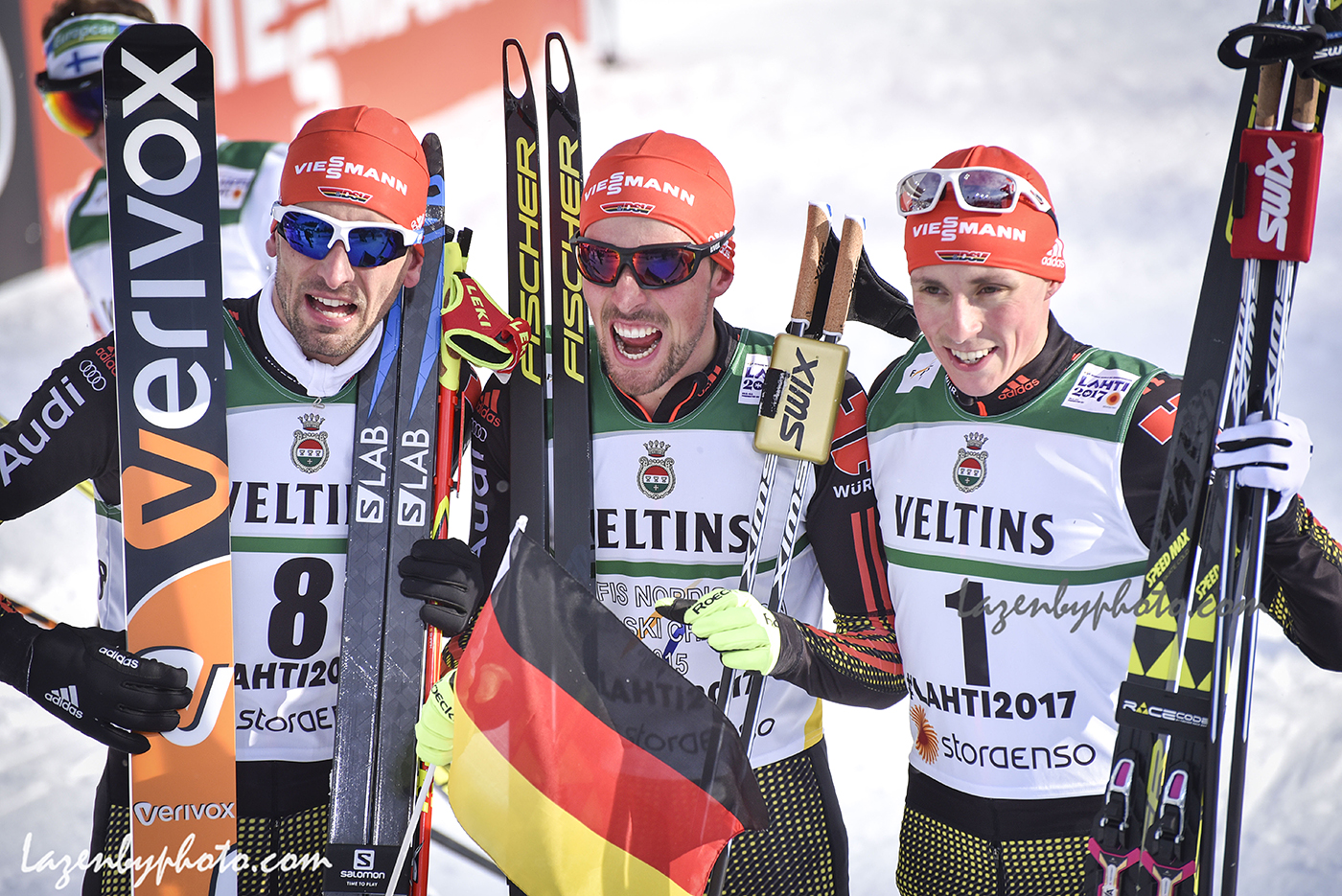
German nordic-combined stars Johannes Rydzek (c), Eric Frenzel (1) and Björn Kircheisen (8) after taking gold, silver and bronze, respectively, in the individual normal hill/10 k Gundersen at 2017 World Championships in Lahti, Finland. (Photo: John Lazenby/Lazenbyphoto.com)
What are the physiological capacities of nordic-combined athletes and can laboratory tests predict performance capabilities on the World Cup?
Those are the questions that a team of Norwegian researchers set out to answer by testing 12 competitors from eight different countries before a 2015 World Cup competition in Trondheim, Norway.
The study, led by Vegard Rasdal of the Norwegian University of Science and Technology and the Norwegian Olympic Sports Center, was recently published in the academic journal Plos One. It is an open-access journal, so you can read the paper here.
“The sport is always evolving,” Rasdal wrote in an email to FasterSkier about the results. “Today it is no longer enough to be ‘just’ a strong ski jumper or cross-country skier, you really have to excel in both in order to be successful in terms of podiums. Johannes Rydzek and Eric Frenzel, the two most successful athletes last season, were not only two of the best jumpers last season but also the fastest skiers.”
Indeed, they found that the best skiers in the nordic combined field have VO2Max capacities close to those of the best cross-country skiers, period – and even higher than those of Olympic medalist sprinters. Furthermore, this was a good predictor of World Cup results in the Trondheim competition.
Variability in Abilities and Physiology
There have been plenty of physiological studies on top cross-country skiers and some on ski jumpers, but the fascinating aspect of nordic combined is that two very different sports are combined. That creates uncertainty about what the ideal physiology for a competitor might actually be. Should they be light and explosive, for jumping? Strong and enduring, for skiing?
And do nordic-combined atheltes have as much explosive power as ‘special jumpers’, or as high aerobic capacities as cross-country skiers?
“As with most endurance sports, you will find a strong association between VO2Max and performance when the study group is heterogeneous, as e.g. a study group of 200 college students,” Rasdal explained. “Overall, VO2max is widely accepted as the most important factor for endurance performance. However, in a more homogenous study group, such as elite cross-country skiers, all athletes may have a ‘high enough’ VO2max to perform well at an elite level. Thus, other factors such as skiing efficiency becomes a stronger determining factor.”
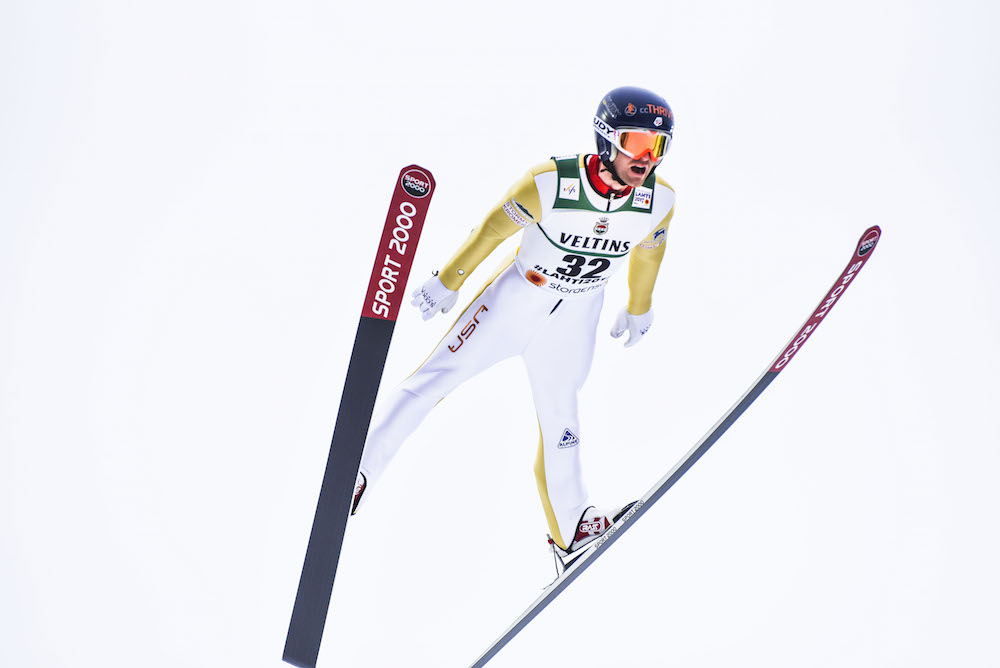
U.S. Nordic Combined skier Bryan Fletcher jumping to 31st on the large hill at 2017 Nordic Combined World Championships in Lahti, Finland. At the end of last season, he was the top-ranked American in the overall World Cup standings in 34th. (Photo: John Lazenby/Lazenbyphoto.com)
Rasdal and his co-authors wondered whether nordic-combined athletes fell into the first group, with moderately variable VO2Max, or the second group, where all had such high capacity that they had to be distinguished by some other characteristics.
Because some athletes get their start in ski jumping, and all must also train for jumping, the athlete selection process and training background from young ages is different than for cross-country skiers and could lead to more variability among individuals.
“It is not given that all nordic combined athletes have a ‘high enough’ VO2max or vertical jump capacity,” Rasdal wrote. “The shortcomings in one may to some degree be compensated with higher level in the other.”
To address that question, the research team partnered with the International Ski Federation (FIS) to conduct laboratory tests on athletes the day before a World Cup competition.
“FIS was responsible for the invitation of athletes, and each nation in the World Cup was invited and encouraged to participate with two athletes to be tested,” Rasdal explained. “To collect data on the very best athletes in the world is always a challenge, especially so close to an important international competition. We as a research group are extremely grateful that so many World Cup athletes chose to participate in the data collection.”
The athletes ran the gamut from being ranked second to 66th in the previous season’s overall World Cup standings, and included the eighth-best skier and second-best ski jumper.
About Endurance Capacity, and World Cup Success
The hypothesis that nordic-combined athletes were more variable in their physiology compared to single-sport specialists was largely upheld.
“Among the athletes we studied, a VO2peak range of 66.9-80.8 could be found, which does illustrate the heterogeneity in nordic combined,” Rasdal wrote. “This may make subordinate factors such as skiing efficiency relatively less important (although still important) than VO2peak.”
The upper measurements of VO2Max among the 12 athletes are close to those of cross-country skiers.
Furthermore, it was clear that the athletes on the lower end of the VO2Max spectrum were somewhat less successful on the World Cup. At least at this World Cup event, the overall ranking at the end of the day was strongly correlated to an athlete’s VO2Max and ski performance.
“This study together with the study by Tønnessen et al. may indicate that a body-mass normalized VO2Max in the region of 75 ml/kg/min is a sufficient capacity for a strong cross-country performance in Nordic Combined, whereas 80 is at very highest percentile,” Rasdal explained.
However, the Trondheim World Cup course is not necessarily representative of all World Cup venues. And poor cross-country skiing could have been penalized even more at this venue than usual.
“Trondheim is a special arena compared with other courses in the World Cup, with many steep uphills and fast downhill terrain,” Rasdal wrote. “In addition, 2015 was a bad winter in Trondheim, and the course was salted and ice hard. This made the event well suited for technical good skiers with strong upper-body capacity. It is therefore necessary to investigate the impact of ski jumping versus cross-country skiing on overall performance, as well as the associations to laboratory capacities, also at other venues and conditions.”
And About Those Jumps
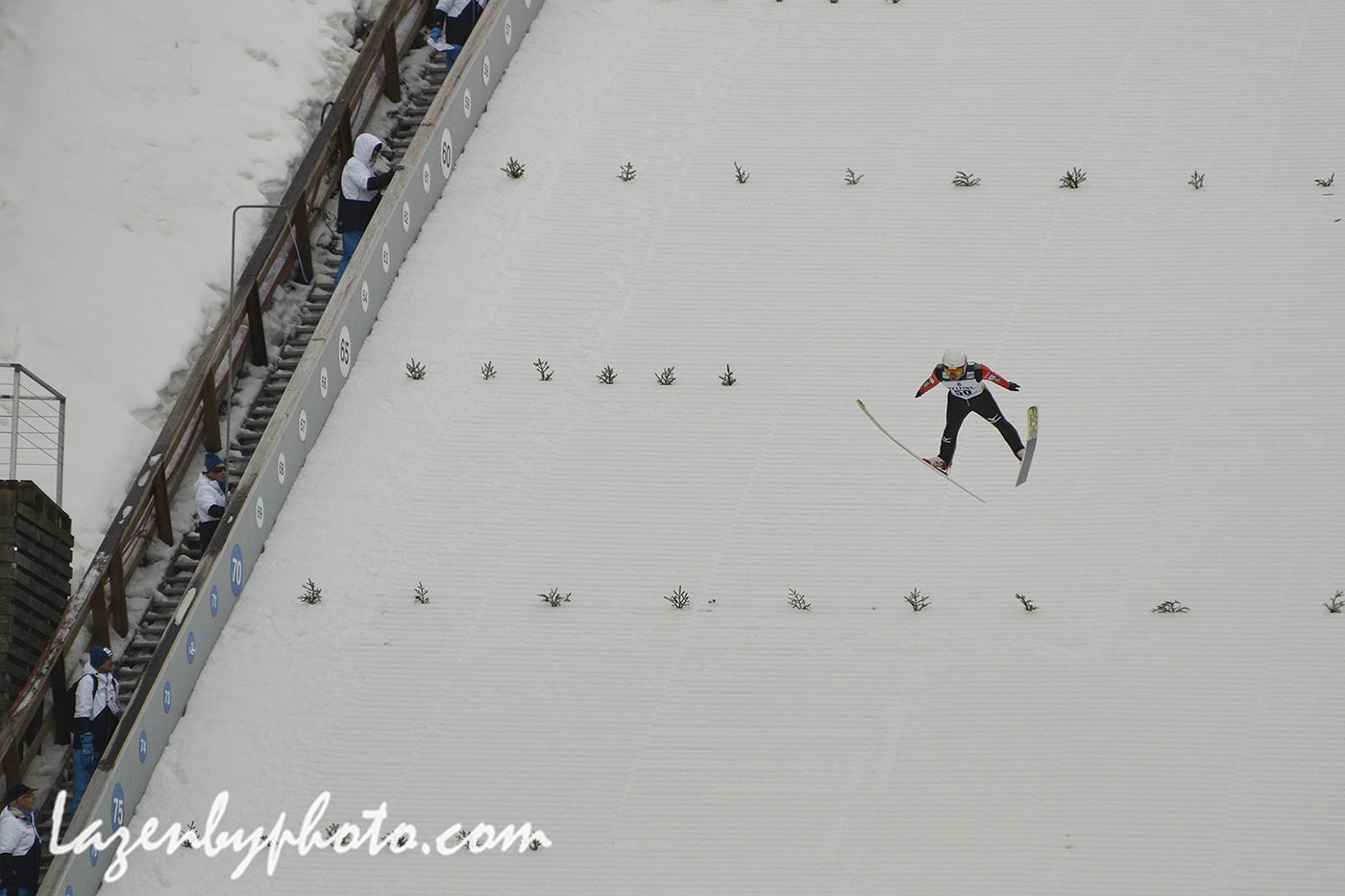
2017 World Championships jump training on Feb. 21 in Lahti, Finland. (Photo: John Lazenby/Lazenbyphoto.com)
The implication is that perhaps at a different competition, the association between ski jumping performance and overall competition ranking might be stronger.
“Unpublished data does show that [across a whole season], the regression line for ski jumping to overall performance is similar to that of cross-country and the correlation coefficients are similar,” Rasdal explained.
When it came to benchmarking, the researchers also identified laboratory measurements that could predict ski jumping performance by nordic-combined athletes. They tried two measurements: a straight, simple squat-jump, and an “imitation jump” where the athletes were asked to start in the same position they would on a ski jump ramp. The jumping style and technique varied from athlete to athlete.
While it seems logical that these would be good predictors of ski jumping performance, it actually wasn’t a trivial matter. Such measurements have mainly been validated on straight ski jumpers, and because of their different body mass and physiology the relationship between squat jumping and performance, for example, could very well have been different among nordic-combined athletes.
“The time available at the take-off in the [ski jump] hill may present a greater challenge for NC athletes than specialist ski jumpers as two-thirds of the NC athletes’ annual training consists of endurance training,” the authors wrote in the paper. “This does not only leave less time available for power and [jumping-] specific training compared to the specialists, but endurance training may lead to negative effects on muscle strength and power.”
But in the end, the same measurements did predict ski jump performance.
“The jump capacity in the sport-specific imitation jump distinguished performance level better than the general jump capacity in squat jump,” Rasdal wrote. “That supported the argument for sport-specific testing at an elite level.”
Still, the imitation jump wasn’t perfect at predicting actual ski jump performance.
“The upper range of the lowest ranked performance group touches the lower range of the highest ranked performance group,” Rasdal said of the imitation jump measurements. “There is not necessarily a continuous linear relationship with performance. At some level, the ability to utilize the capacity in the field as well as other factors become more determining for performance, e.g. body mass, transition to flight (minimize the loss of speed), flight performance, etc… Ski jumping is an extremely challenging technical task to be performed in less than 0.35 seconds, and where a well execution may compensate more for a lack of physical capacity.”
And then there’s money.
“In ski jumping the equipment plays an important role, and the nations with the highest budgets may for instance have better suits which makes them jump farther,” Rasdal said of other potentially confounding factors in predicting jump performance.
What to Shoot For
At the end of the paper, the authors summarized the ideal characteristics of a nordic-combined athlete: high VO2Max, a strong upper body, a good vertical jump, and low body mass. Hitting all those different metrics at the same time is a tough calculus, but it’s what is required to be a champion these days.
“Although the relative importance of ski jumping to overall performance has varied in the sport over time, the pendulum today appears to lean more towards ski jumping,” Rasdal noted. “That’s both as a result of regulations (e.g. increase of meter-value in large hills in 2015), and also an increase in overall performance level where the best ski jumpers also ski fast.”
Bryan Fletcher (U.S. Nordic Combined) jumping to 20th on the normal hill at 2015 World Championships in Falun, Sweden. (Photo: FlyingPointRoad)
Nordic combined is exactly that: a combination of the two discrete nordic-sport disciplines. There’s the cross-country side, which if you read FasterSkier regularly, you’re pretty comfortable with in terms of technique, gear, and the nuts and bolts of race dynamics. If you’re like me, the jumping side is a bit more foreign. I took the opportunity in this podcast episode to explore ski jumping.
For nordic combined competitions, it is the ski jumping portion that dictates the start order for the freestyle pursuit-style race. So to fully understand the discipline, and know why, for example, a skier starts one minute back from the morning’s ski-jump winner, I reached out to Bryan Fletcher, a 30-year-old old U.S. Nordic Combined Team veteran (he’s also a new dad), and Clint Jones, a former U.S. Ski Team jumper and currently a jumping coach and team director for USA Nordic, which encompasses nordic combined and ski jumping.
From those two we get a jumper’s perspective of a massive ski flying hill in Planica, Slovenia, and firsthand knowledge of jumping technique. Jumping may not be for the faint of heart, but understanding how it sets up the cross-country ski race after the jumps is critical to following nordic combined.
And when you listen to the podcast, you’ll hear Bryan Fletcher say this: “For me, I’m kind of an adrenaline junkie. I’ve done a lot of stupid adrenaline things in my life. And one of those is base jumping off of the bridge in Twin Falls, [Idaho]. And typically they recommend you have 100 sky dives before you ever go base jumping. Instead I spent two months learning how to pack a parachute, and then went and took six jumps off the bridge. And to give you perspective, base jumping I didn’t know anything about … However with ski jumping, you kind of have those rumors and commentary from other jumpers, I was more nervous getting on the bar of a ski flying hill for the first time than I was crawling over the railing of a bridge to base jump for my first time.”
You’ll also learn the difference between a ski flying hill — the type of jump Fletcher refers to in his base-jumping quote — and a regular, Olympic-style ski jumping hill. It’s always a good day to learn something new.
Billy Demong, a former U.S. Nordic Combined skier and five-time Olympian, jumping at 2015 World Championships in Falun, Sweden. (Photo: FlyingPointRoad)
Twenty-two World Cup podiums and five Olympics later, Billy Demong can’t leave what’s in his blood behind; he was born to jump and ski fast. No, Demong, 36, is not announcing a comeback — he retired from international competitions after the 2014/2015 Nordic Combined World Cup season. For a year he stayed away. Post-retirement, Demong worked in marketing for Utah-based Reynolds Cycling. He’s back as executive director of USA Nordic Sport.
Let’s turn back the clock for a moment to gain some perspective. Beyond Bill Koch’s 1976 Olympic medal, the U.S. Nordic Combined team remains the only other nordic discipline to win a coveted Olympic medal. In 2010, Demong won an individual gold and was part of the team relay silver in Vancouver, British Columbia.
There’s a reason to reference past Olympic glory — as part of this narrative, it matters.
A scant four years after the Vancouver Games and two months after the 2014 Sochi Olympics, the U.S. Ski and Snowboard Association (USSA), once the primary funder and governing body responsible for U.S. Nordic Combined, dropped most of its funding for nordic combined. It was a seismic event that most insiders had a feeling was coming. Current U.S. Nordic Combined Head Coach Dave Jarrett said at the time, “Based on [USSA’s] study in 2010 that eliminated jumping in other sports, they didn’t think nordic combined was a podium-potential sport for 2018 or 2022.”
Looking back, Demong voiced his understanding of USSA’s decision.
“At the end of the day it really comes down to resources,” Demong, now in his full-time role with USA Nordic Sport, said on the phone late last month. “Resource allocation is a tough thing. USSA, they are successful organization — I have watched them grow and develop. But there are a lot of teams and a lot of athletes. There were a lot of hard choices that needed to be made, but I believe in the potential of the athletes we have in the pipeline today and the opportunity for long term sustainable success with strong leadership in both ski jumping and nordic combined.”
The defunding setback also served up an opportunity for the primary nordic-combined stakeholders to take ownership over the sport’s viability.
“The community of ski jumping and nordic combined athletes and alumni have historically really leaned on USSA to develop athletes and I think now over the last six-seven years, we have taken a lot of that back onto our community,” Demong explained. “And it’s been successful. I think we have some of the best athletes in the pipeline right now that we have had in a long time in ski jumping. We have some great up and coming talent in nordic combined. And we have a growing base. Last year we developed a study that indicates about 800 kids put bibs on or participated in a program. So it is a healthy number for a sport that is not big anywhere.”
The community Demong referenced was not beginning from scratch. An organization named USA Ski Jumping — founded originally by past ski jumping and nordic combined Olympic athletes and coaches including Rex Bell, Jim Holland, Jeff Hastings and Alan Johnson — was already carrying the ski jumping torch. With their help over time, Demong said during the interview, that group worked to grow and develop the scope of the organization. In the spring of 2015 they adopted new bylaws and became committed to assisting the nordic combined community. With the more inclusive snow sport focus, the organization was renamed USA Nordic Sport. And two months ago, Demong was named its Executive Director.
Back to Demong’s World Cup and Olympic credentials. Demong offers proof that the US can develop nordic combined skiers ranging from kids soaring off small-scale jumps to international champions. He also comes with the cache of Olympic hardware: that can be a draw when soliciting funds and volunteers.
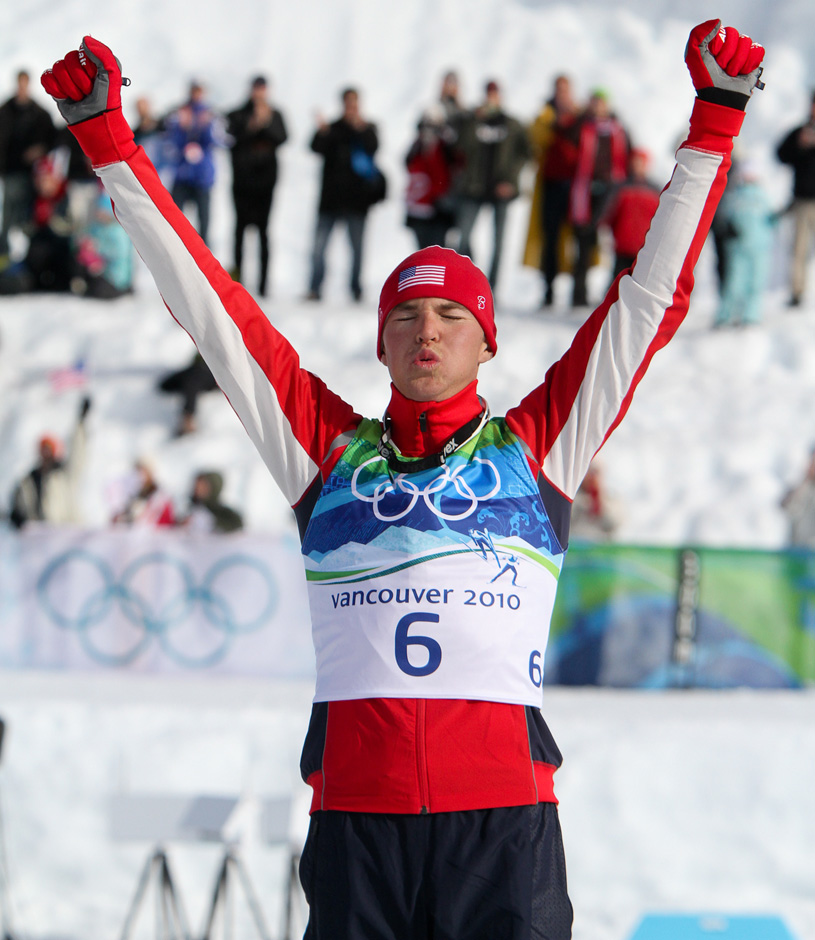
Billy Demong soaking up his victory atop the podium after winning the individual large hill competition at the 2010 Vancouver Winter Olympics.
The whirlwind of a new job and mission have given Demong a fresh perspective of what endurance means beyond chasing elite skiers around a loop.
“The first two months here have been exciting,” Demong said of his appointment as Executive Director. “I feel very passionate about what I am doing and there is a lot going on every day. Because this isn’t simply going out and raising some money and spending it. We’ve got ten staff. We’ve got a lot people and we are working together and making sure that everybody’s efforts are moving the sports in the right direction together. That requires a lot of time and energy as well as raising funds and keeping our audience and community engaged.”
Ski jumping and nordic combined are not completely devoid of USSA’s support and input. Demong noted that USSA is the National Governing Body. Therefore, nordic combined’s FIS representatives are appointed by USSA. And sponsors like LL Bean and Craft — both sponsors of the U.S. Cross Country Ski Team — also uniform the nordic combined team. Additionally, team USA’s head nordic combined coach remains Dave Jarrett and his position, as well as a grant for sport development, are funded by USSA. In this fashion, a quasi partnership has emerged between USA Nordic and USSA.
USA Nordic Sport (USANS) operates much of the day to day business of the U.S. Nordic Combined and U.S. Men’s Ski Jumping teams (women’s ski jumping has been its own entity since 2003, Women’s Ski Jumping USA). It’s also tasked with growing the sports of ski jumping and nordic combined, fielding competitive elite and international teams and building a pipeline of athletes for the future. This last part of the equation, Demong said, is where USANS is placing much of its effort as they support their pre-existing athletes and clubs while building a broader community.
“We are focusing a lot of our efforts on the operating clubs we have, adding new clubs as opportunities arise, establishing and disseminating best practices to those clubs so they can develop,” Demong said. “They can recruit more athletes, they can engage those athletes and those communities, and develop higher-quality experiences and opportunities. Ultimately, that is really our big goal right now, basically one team, one community, where all of our nordic combined and ski jumping clubs, and athletes, coaches and parents feel like they are part of something bigger. And athletically, we are really focused upon recruit, retain, and engage.”
“That is really our big goal right now, basically one team, one community.” — Billy Demong, USA Nordic Sport’s executive director
Specifically, Demong said that USANS has a detailed plan to execute the mission. They can assist clubs with building low-tech jumps made of snow and absent any permanent jumping structure. For more ambitious clubs, USANS will provide building plans, detailed architectural drawings of jumps, and the tools to build and operate a facility.
“The medium-range goal is to take these small feeder clubs, and if there is local desire and a champion, to help them drive a fundraising effort to build a more sizable hill,” he added. “We would like to be able to help accomplish that, and additionally, provide opportunity and a pathway for athletes that want to take it to the next level.”
Taking it to the next level could mean higher-end jumping equipment and travel assistance to places like Park City, Utah, that host events for aspiring jumpers and skiers. One Park City-based summertime event is called Springer Tournee — it doubles as the US Large Hill Ski Jumping and Nordic Combined Championships. USANS also organizes what they call Virtual Nationals. It’s a low-cost low barrier of entry competition allowing juniors to participate in a nationwide event without leaving their local jumping hill.
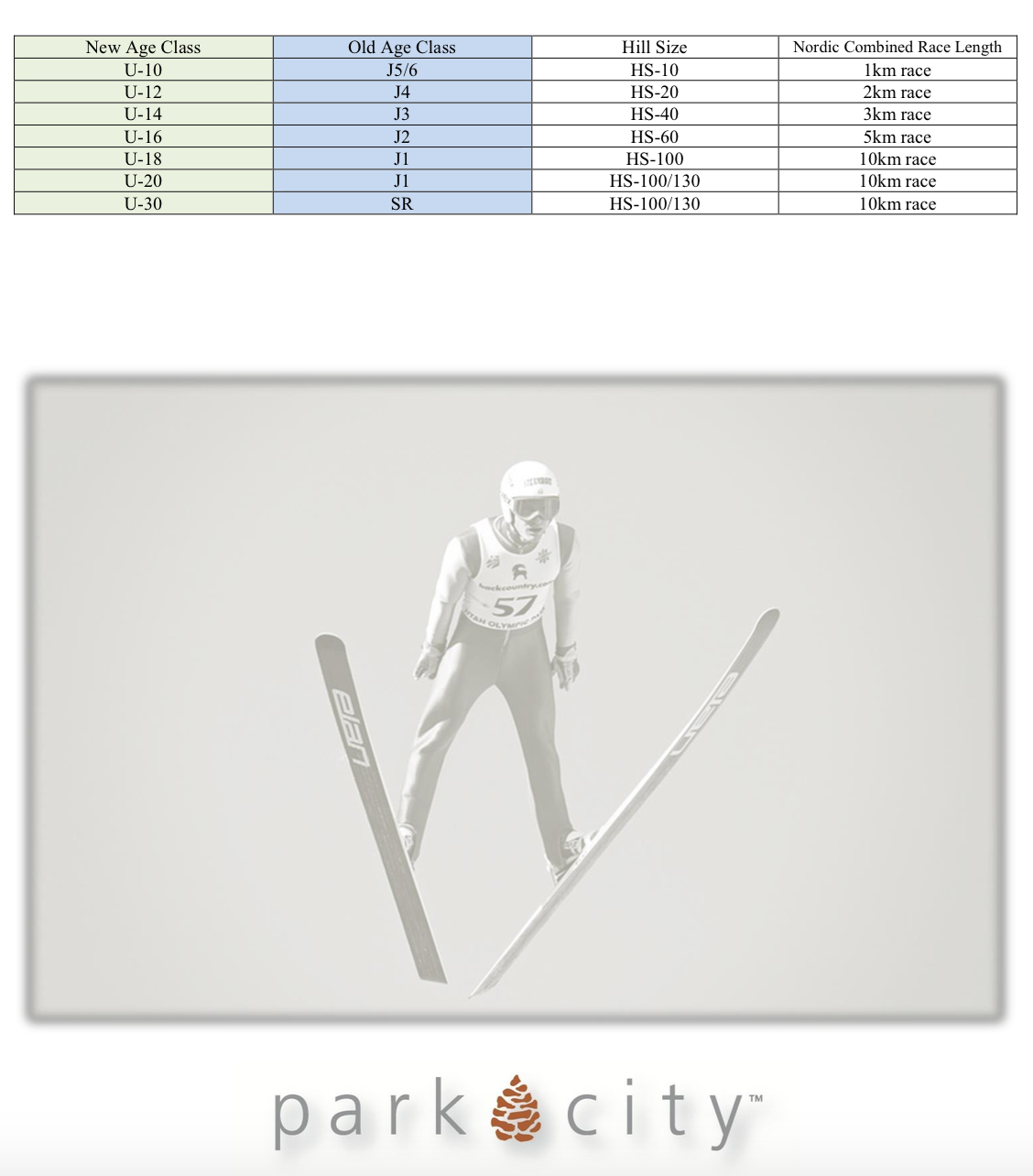
“What we do is we ask the kids and parents to send in videos of their children jumping and then they are broken into classes like U-10 girls, U-12 boys, etc.” Demong said. “Last year, we had a group of judges like Sarah Hendrickson and Clint Jones … that basically allowed the kids to compete in their peer group around the country. So that’s been really effective in getting everybody engaged together.”
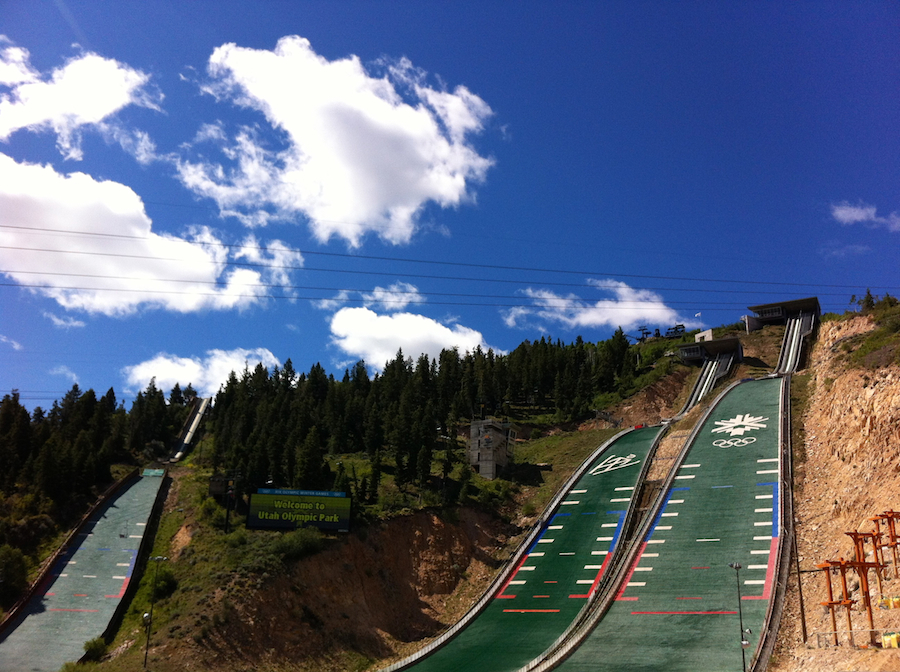
The U.S. nordic combined and ski jumping hills in Park City, Utah (Photo: Mikko Kokslien)
Demong said nordic combined has suffered from a lack of record keeping when it came to junior development. He hopes things like Virtual Nationals will help change that dynamic.
“That has been one of the struggles historically — we have some clubs with quite a few athletes but nobody has really been keeping records,” Demong explained. “Does U-12 usually make to U-16? We know that we have attrition along the pipeline just like any sport, but how can we have less? How can we retain more? How can we have a more complete pipeline from first jump on a 10-meter to a World Cup team?”
Demong insists the health of jumping and nordic combined are way beyond life-support status. On the contrary, Demong believes his beloved sports are poised for growth. That may, in some part, be attributed to the roughly fifty percent of the population — women — traditionally unable to participate in jumping and nordic combined. Although opportunities to jump internationally are not on par with those afforded to men, 2014 marked the first time women’s ski jumping was an official Olympic sport.
On the nordic-combined side, Demong mentioned this winter will be the first for women’s international nordic-combined competitions without an age limit.
“In the past couple years, when women’s nordic-combined has been brought online, it has been age limited to mostly junior competitions, and now all of sudden there is going to be open class, senior-level events. It will not be in PyeongChang [South Korea for the 2018 Olympics], but certainly I think it is tracking to be in Beijing [in 2022]. And so that is something Dave Jarrett has definitely been a proponent of at the FIS level and is also preparing to gear up to develop a national-team program for that as well.”
With new ventures moving forward, Demong also mentioned the links cross-country skiing and nordic jumping sports share. In his eyes, they each possess attributes that benefit the other.
“Cross country is an amazing sport. It’s so difficult, it teaches so much discipline and perseverance and work ethic, and a host of other core values. They obviously have the same heritage,” he said. “And there is a whole other set of values ski jumping offers for personal growth, like courage: the ability to stand on top of the in-run, even to stand on top of the 40-meter [hill] and look down as a good skier and know that if you let go to the bar there is no backing out. It is a skill set unto itself. If I had one vision for our nordic communities, it is that we will continue to work together to provide as many participants as possible the opportunity to experience all that the nordic sports have to offer… I think there is a tremendous opportunity there … to add some additional skills to the cross country side by participating at whatever level in some ski jumping activity and vice versa.”
17th Annual North American Jindro Mayer Springer Tournee
&
US Large Hill Ski Jumping & Nordic Combined Championships
(Press release)
GENERAL INFO:
The 17th Annual Springer Tournee will be only 1 event on each ski jump up to the HS-100, in which top Junior and Senior Ski Jumpers and Nordic Combined athletes from all over North America compete. After the events on each hill, an overall winner is crowned the Jindro Mayer Springer Tournee Champion for each hill & U class for Ski jumping and Nordic Combined.
Overall awards 1-3 in each U class, and Nordic Combined will be given out. Awards will take place Saturday evening following the events in Soldier Hollow, Utah.
COMPETITION FORMAT:
The Nordic Combined events will consist of one jumping event, and one cross-country running event U12 and younger and roller skiing for U14/16/18/20. The Nordic Combined events will be Gundersen start format, (U20- Open events will be run like a FIS event only using the 1st jump)
REGISTRATION:
Please pre-register using the official registration document included with the invitation. An athlete is only allowed to enter a MAXIMUM OF 2 HILLS, PLUS ONE NORDIC COMBINED EVENT. Send registration forms to AAlborn@uolf.org and please only one entry form per division!! National teams will be separate.
If you have trouble opening the registration form electronically, please contact AAlborn@uolf.org for a fax or hard copy. Please be sure to fill out all appropriate info.
(*A valid U.S.S.A. membership is required For the US Championships only)
REGISTRATION DEADLINE IS Monday, JULY 20th 5pm. ENTRIES MUST BE RECEIVED BY Alan BY THIS DEADLINE TO ENSURE YOUR ENTRY INTO THE EVENT!
WAIVERS:
All participants will be required to have a Utah Olympic Park Waiver as well as a Soldier Hollow waiver if competing in the Nordic Combined running/roller skiing races. You can find the waivers by going to the links here:
Springer Tournee All HILLS(HS-15 – HS-100) $155.00 for all events and food on Saturday + Ropes course. (Hill Fees included for the week)
Springer Tournee & US Championships (HS-70 –HS-134) $235.00 (Hill Fees included for the week)
US Championships Only (HS-134 SJ) $80.00
The HS-134 US Championship event is separate from the Springer Tournee.
HS – 134 SJ (Hill Fees not included for the whole week, only official training and competition)
Awards Dinner (Saturday Aug 1st)
We will have food on site for the Awards from 6-8PM on Saturday Aug 1st in Soldier Hollow.
TRAINING FEE: UOP Hill use fees/lift fees are included in the entry fee. Training requests need to be sent to mterwillegar@uolf.org and days outside of the Springer Tournee week fees are $15 Small Hills and $25 Large Hills. Season pass is $110. (HS-134 only entries, hill fees are included in entry for Friday & Saturday only)
WAXING/CHANGING FACILITIES:
Each team will be provided the appropriate changing areas/waxing facilities. Please check with the PCNSC office to find out where your team’s facilities are located when you arrive. Please respect other teams’ spaces and utilize only your teams’ facility for waxing and changing.
HOUSING/TRAVEL:
Each team is responsible for your own transportation and lodging. Below are several numbers for possible housing.
(*UOP Partner)
*Best Western Landmark Inn: Kimball Junction/ right at the bottom of Utah Olympic Park; 800.548.8824
Hampton Inn and Suites: Landmark drive/right at the bottom of Utah Olympic Park; 435.645.0900
Marriott Hotels: Several locations in Park City; 800.228.9290
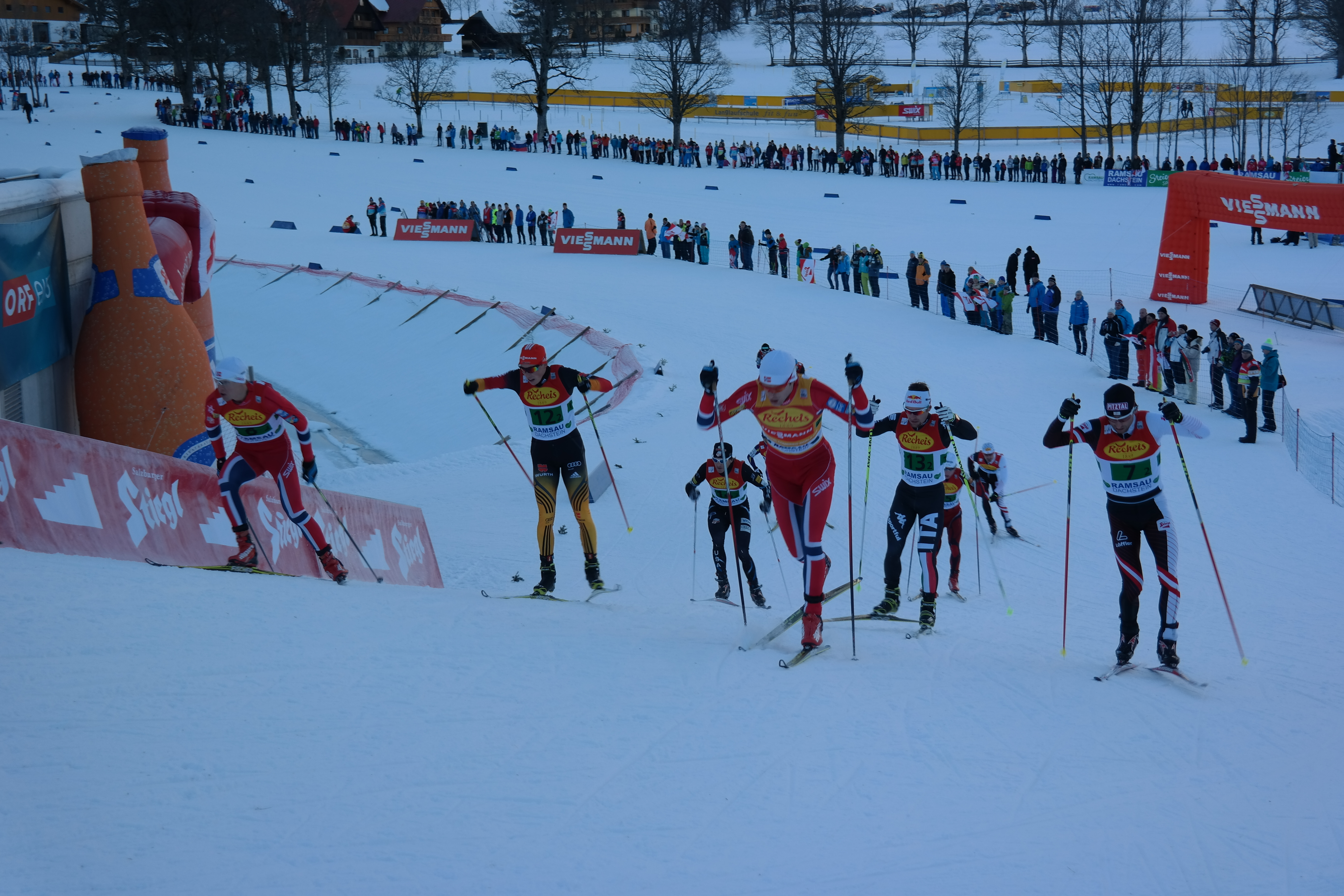
Norwegians lead the pack in Saturday’s Nordic Combined World Cup 2 x 7.5 k in Ramsau am Dachstein, Austria. Norway placed first and second, Italy was third, and the U.S. was just 1.2 seconds off the podium in fourth. (Photo: Tim Hug)
Americans Bryan Fletcher and Todd Lodwick narrowly missed the podium in the 2 x 7.5-kilometer sprint in Ramsau am Dachstein, Austria, finishing fourth for U.S. Nordic Combined’s best result in a team sprint.
A little off in the jumping portion of Saturday’s competition, Fletcher and Lodwick ended up starting 14th of 20 teams, 44 seconds behind the Estonian leaders, Kristian Ilves and Karl-August Tiirmaa.
While the Estonians clocked the second-slowest race time, getting passed by all but two teams to finish 18th, Fletcher and Lodwick rose to the challenge and notched the fastest-combined time to finish 10 seconds behind the winners, Norway’s Mikko Kokslein and Jørgen Graabak, who rose from 11th to first in 33:59.3. Norway’s Haavard Klemetsen and Magnus Krog took second (+8.2) after jumping to sixth, and Italy’s Samuel Costa and Alessandro Pittin captured third just 1.2 seconds ahead of the Americans.
According to U.S. Head Coach Dave Jarrett, skiing fast was their plan all along.
“It was a really tight jumping competition, so we knew after that result, they were in a position to fight for a podium,” he said in a phone interview. “That’s what we’ve been saying all along, that we need to just put ourselves in that position and then we should hopefully be able to take advantage of that.”
Most teams wouldn’t consider starting 14th ideal, but it was time back that mattered to Fletcher and Lodwick. And fourth place was nothing to scoff about — it was the best U.S. finish in the relatively new event.
“It’s definitely a solid day,” said Fletcher, who’s notched a World Cup top 10 five other times in the last three years. “We turned some tough jumping into a great cross-country race, so it was a positive performance all around.”
“We’re really, really proud to put Norway in its place and to know that we are the fastest team out there, whether it’s by a second or ten seconds, it doesn’t matter. We are the fastest team and it shows on the results.” — Todd Lodwick
According to Jarrett, there were 12 teams bunched together at one point, making the exchanges “pretty interesting.”
“Some people had more luck than others in the exchange zone,” he said. “Todd and Bryan were smart and they did a good job tagging off and kind of pacing themselves and placing themselves among the lead group. When the last two laps came around, the Norwegians were in a good spot and they got a gap on the field.”
While jumping hasn’t been a strong point for the Americans in the first World Cups of the season, Fletcher said Saturday was a confidence booster.
It was a crowded and fast at the front of the pack in the Nordic Combined World Cup 2 x 7.5 k in Ramsau am Dachstein, Austria. (Photo: Tim Hug)
“I haven’t had quite my best performances on the jump hill, but I’ve kind of nailed my problems and working to fix them and I thing that’s a positive take away from it,” he said. “Today I had a really good jump in the trial round and then the competition jump was close. It definitely wasn’t what I’m capable of, but it was in the hunt and that’s all we needed.”
Lodwick added a solid jump to the mix, which Fletcher said brought them closer to the front of the pack. “Overall it wasn’t our best day on the jump hill, but we weren’t out either,” Fletcher said.
“I didn’t jump horrible,” Lodwick said. “It’s just missing just a little bit and that’s going to come. The more we compete, the better off we get and we’re going to be in really, really top shape.”
For the 37-year-old Lodwick, it wasn’t his best overall performance in nearly two decades on the World Cup, but he said it was up there with those he’s proud of. Last Sunday in Lillehammer, Norway, he placed 11th for his best result in nearly three years. In the same race, Fletcher placed 10th.
“I know that we’re on the right track,” he said. “We’re on the verge of just making the season. It’s been a slow [start], but results like that give us a lot of confidence so we’re excited.”
Last year, the U.S. broke through in a World Cup 4 x 5 k team event in Schonach, Germany, with their first third-place finish. Both Fletcher and Lodwick were on that team with Billy Demong and Taylor Fletcher, and those four went on to notch a historic bronze at 2013 World Championships in Val di Fiemme, Italy. Lodwick also has also helped the team to a few fourth-place results in previous relays.
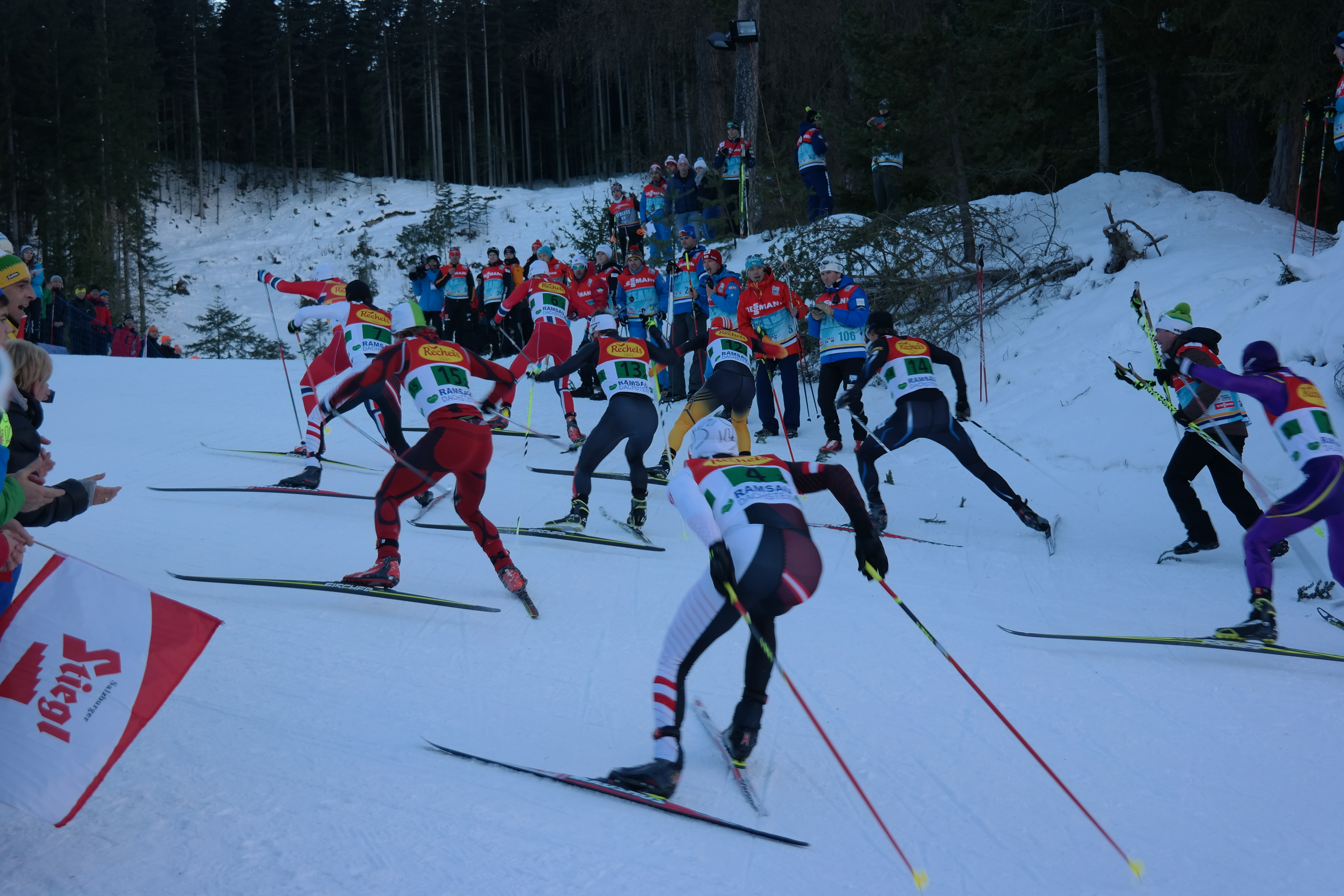
A tight-knit race at the Nordic Combined World Cup 2 x 7.5 k team sprint on Saturday in Ramsau, Austria. (Photo: Tim Hug)
A World Cup competitor since 1995, Lodwick laughed and said, “I am the oldest guy on the circuit.”
But his past experiences helped him post one of the fastest individual times in Saturday’s race.
“I don’t feel [old] in my body or my heart and I went out there and knew that staying in the front pack and positioning and taking corners the right way and pushing people out and not letting people in,” he said. “That’s just what it takes to be aggressive and to be in that pack. Within this packed kind-of race, it definitely takes a little bit of skill and knowledge. I guess I relied on that.”
Although the team sprint will not be a medal event at the Olympics in February, Lodwick said their cross-country times should come as a warning to the competition they’ll meet at the 2014 Games.
“We train all summer and to have a result like [this] is humbling,” he said. “We’re really, really proud to put Norway in its place and to know that we are the fastest team out there, whether it’s by a second or ten seconds, it doesn’t matter. We are the fastest team and it shows on the results and we can chock that up for a win.”
The second U.S. team, with Brett Denney and Taylor Fletcher, placed 15th, 1:36 back from the winners. Taylor clocked the fastest individual time of 16:50.7. Teammate Billy Demong is resting this weekend in anticipation of next week’s Continental Cup in Park City, Utah.
Had Demong been on skis Saturday, Jarrett said it’s likely the U.S. could have had an even-stronger showing.
“Bill would have been a really useful addition into one of the teams today and could have been more like the Norwegians or Japanese or Germans that have two teams fighting in that top 12 for sure,” he said.
He added that there’s still plenty of jumping and racing left in the season before the team heads for Russia.
“Our sights are set and we’re measured against our results in the [Vancouver] Olympics,” he said of their unprecedented medal haul at the 2010 Games. “USSA has made it no secret that [the 2014] Olympics are what they’re measuring everything against, and our plan is to do well in [Sochi].
“It’s a tall order because the Olympics only come around once every four years and it’s only one day for that competition and there’s a lot of variables that can take place,” he explained. “But we’re going to continue to work in each competition and just live up to our potential.”
He said his team is nowhere near its February peak. “It’s always good mentally to have good results every time you do a competition,” he said. “I think these guys are focused and ready to continue competing. We have another individual competition [Sunday], and then two more next weekends and then Olympic tryouts in Park City, and then three more weekends in January. There’s plenty more.”
Bryan said he was looking forward to what’s to come, especially given the season’s slow start.
“We know that this time of year can either go one of two ways,” he said. “You can either come into the World Cup season and start off doing great and sometimes you come in with a little bit of a rough start like we had this year.”
Each week, it’s a matter of building on the previous week, he explained. “These last two weekends especially, we’ve really taken some positive steps forward to show we’re not out of the game. We are here to contend. We just narrowly missed the podium but given the circumstances, we’re pretty happy about the fourth place and I think these narrow misses just make us hungry for more.”
Bryan Fletcher (c) at the top of the podium after winning the World Cup Finals on March 10 at Holmenkollen in Oslo, Norway. (Photo: Margo Christiansen/USSA)
This summer, U.S. Nordic Combined Head Coach Dave Jarrett expressed his frustration with zero-centimeters of leeway when it comes to form-fitting jump suits. If the new rule passed down from the International Ski Federation (FIS) last spring remained, athletes and their coaches would be spending more time at sewing machines than talking tactics, technique or recovery.
Yet once again, the rules changed. At the FIS Autumn Meetings in Zurich, council members decided to allow up to 2 centimeters of extra fabric beyond each individual’s body size. That was down from +6 centimeters last season, but it was better than nothing. In July at the Summer Grand Prix in Sochi, Russia, American Billy Demong was disqualified because he hadn’t tailored his suit between competitions. Officials randomly checked Demong and discovered his jump suit had 3 centimeters of extra space.
Billy Demong sporting an FIS-regulation form-fitting jump suit in April. This fall, FIS reevaluated the zero-centimeter-of-space rule to allow up to 2 centimeters of extra fabric. (Demong photo: Twitter.com/BillyDemong)
Jarrett said in an October phone interview that the +2 centimeter rule, which follows international ski-jumping regulations, was a compromise.
“It’s essentially tight suits, but it’s enough wiggle room that you’re not gonna have to constantly sew suits,” he said.
Also new to nordic combined this year, a World Cup final for those ranking in the overall top 30 is scheduled for March 15-16 at Holmenkollen in Oslo, Norway. The competition will entail two jumps (one more than usual) and a 15-kilometer individual gundersen start (5 k longer than the normal skate distance). It was supposed to happen last season, but shortened due to bad weather. (American Bryan Fletcher won the one-jump, 10 k final.)
Finally, fans watching the Nordic Combined World Cups in person might enjoy the new Athletes’ Zone, where the top 10 skiers from the jumping portion will hang around to sign autographs until that competition ends. FIS reasoned this will make the athletes more accessible to both spectators and television crews.
FasterSkier asked Jarrett to elaborate on each of these alterations and how they affect the sport at its highest level.
1. Suit changes:
FasterSkier: Is +2 centimeters workable?
Dave Jarrett: It’s clearly not optimal as far as jumping performance goes, and it’s not, in my opinion, serving the purpose of mitigating the wind. I don’t know if there’s a solution with the skis or making them not as wide, or maybe just rethinking it. If they’re going to go back to having competitions with a bigger [wind] corridor that they should go back to bigger suits and give people a chance to at least make a good jump in tail wind. I don’t know what the answer is, but it’s going to continue to be a problem as long as there’s wind involved.
[Note: Wind corridors are designed to compensate the impact of headwinds and tailwinds. According to a FIS press release, a proposal to expand the corridor from +/- 1 m/s to +2/-1 m/s will be submitted to the FIS Council on Nov. 3.]
Japan’s Akito Watabe soars in the old suits (with up to 6 cm of space allowed) during the large hill team relay at the 2011 World Championships in Oslo, Norway.
FS: What might some solutions be?
DJ: Maybe going in the other direction of being more aerodynamic will make it possible to jump in tailwind and achieve relatively good distances because as it is now when you get tailwind with these tight suits, you’re screwed. You have no chance. It’s even more of a spread, headwind versus tailwind, with tight suits than it was with normal plus-six-centimeter suits.
To be honest, it has been suggested and it might be a good idea for nordic combined to go its own direction when it comes to equipment because the body types in nordic combined and ski jumping are slightly different. There’s a big enough difference that maybe what isn’t a big factor for ski jumping is a big factor for nordic combined. Maybe we should examine looking at our own rules when it comes to suits so when you do a nordic combined World Cup, you have your own nordic combined set of rules for equipment. It’s something to think about. Traditionally, it’s never happened.
Nordic combined has always followed the jumping rules just because it makes it easier for the nordic combined skiers to cross over into jumping, there’s not a lot of jumpers that just jump into nordic combined competitions because they don’t race. So it might be that for junior-national age … have the same rules for jumping and nordic combined, and once you get to Junior Worlds, the World Cup rules apply for nordic combined and jumping as they already do. Maybe that would be a better thing for nordic combined.
FS: Could this centimeter rule change again soon?
DJ: It’ll stay to plus-two for this season and World Championships, and I wouldn’t be surprised if they change it again next spring to something else or material changes or something.
2. World Cup Final
FS: A good thing for the sport?
DJ: It’s OK, but I think we already have enough trouble getting one jump finalized; it is a step backward to take two jumps. Once a year is fine though, and 15 k race will be cool, too.
FS: What do you mean you’re ‘having trouble’ finalizing one jump?
DJ: We have wind calculations and equipment modifications to mitigate the wind just to get one jump off then you’re just making it twice as hard making a competition where there’s two jumps even though it’s cut to 30 [athletes]. It’s one competition and it’s not really that big a deal. If there was a proposal to go back to half the competitions having two jumps and a 15 k, then we’d have to seriously reexamine the rules with the wind and everything and TV time because it would be impossible. It would take forever to do two jumps.
That’s also one of the arguments with the equipment. In ski jumping, they have two jumps, so if you get kind of hosed on one jump, you’ll have a second jump if you qualify that you might not get hosed. In nordic combined if you get hosed once, you’re screwed. You can’t make it up in cross country.
FS: What are your thoughts on the 15 k?
DJ: I think it will be good for [my athletes] and it would certainly be fun to do 15 k again. Like I said, for one competition it’s fine, and it’s kind of cool to go back to that for the final and only have the top 30. That was what the plan was when Bryan won, but the second jump got canceled.
3. Athletes’ Zone
FS: How will it change things?
DJ: Most likely the top 10 will be among the last 20 jumpers. It’s going to be the same faces and they’re just going to be sitting there. I think it’s more of a way to engage the live audience. I don’t know how much of a TV impact it’s going to have.
It depends on the venue and the timetable. If you have to leave the jumps to go to the cross country, or if you’re in a place where the cross country is at the jumps, and if the race is an hour after the jumping ends, then it’s not a lot of time so it’s going to be somewhat of a disadvantage for the guys that have to wait there.
Let’s say they’re number 20 on the start list and there’s 30 more guys to go and they end up first after their jump, if they stay in the top 10 they’re going to have to wait there for another half an hour until they finish the jumping competition. We’ll just have to see what it does.
Now it becomes more important that those guys have a bag packed so the PT at the bottom of the hill can just hand them their backpack. They can change out of their jumping boots and I don’t know [about] their suit, but at least start eating and getting ready for the race.
Beneath crisp blue skies, the world’s finest junior ski jumpers flew into the annals of Olympic history today in Seefeld, Austria. The individual ski jumping event marked the first competition event to be held at the 2012 Winter Youth Olympic Games.
Youth Olympians prepare for takeoff atop the HS 75 meter hill in Seefeld
As if to prove that world-class ski jumps are more prevalent in Austria than are Mini-Golf courses in Fort Lauderdale, Youth Olympic action shifted today across the Inn River valley from downtown Innsbruck’s Bergisel Ski Jumping stadium, where the Opening Ceremonies were held, to the Toni Seelos Ski Jumping Center in Seefeld.
In the women’s individual event, fourteen competitors battled for top honors during two competitive rounds held on the HS 75 meter hill. Gold went to Japan’s Sara Takanashi who posted two back to back jumps of 76.5 meters. Despite being a junior competitor, Takanashi is one of the world’s best, having placed second to American Sarah Hendrickson in the most recent World Cup event, held in Hinterzarten Germany.
Silver in the women’s competition went to Germany’s Katharina Althaus, who edged out Bronze medalist Ursa Bogataj of Slovenia by a mere 2.2 points.
In the men’s event, Gold was awarded to Slovenian Anze Lanisek who posted jumps of 81 and 79 meters– the longest jumps of the day. Silver went to Norway’s Mats Berggaard, who laid down two consistent jumps of 77.5 and 78 meters. Yukiya Sato of Japan claimed Bronze. 23 athletes competed in the men’s event.
New York Ski Ed Foundation athlete Will Rhoads soars above the Seefeld Stadium
Despite relatively calm conditions, substantial margins separated the top three in the men’s field. Lanisek bested silver medalist Berggaard by 8.3 points on the HS 75 meter hill, and Berggaard led Sato by 17.7 points.
North American athletes also jumped to solid finishes in the Ski Jumping event. On the women’s side, Canadian Taylor Henrich of Calgary led the North Americans with a 5th place finish and jumps of 64 and 66 meters. Emiliee Anderson of Eau Claire, Wisconsin placed 9th, with a strong second jump of 65.5 meters.
Sverre Caldwell and Piotr Bednarski busy applying the special Caldwell touch to the fleet
On the men’s side, Dusty Korek of Calgary posted an 8th place finish, just behind Austrian Elias Tollinger. Will Rhoads, of Park City, finished 19th in the event.
This is Rhoads’ third experience competing in Europe. He competed in Falun, Sweden in a FIS Cup event in 2010, and in another round of FIS Cup events held in Einsiedeln, Switzerland, in 2011.
Rhoads describes the Youth Olympic Games as having a slightly different feel than his previous experiences in Europe.
“It’s a little more competitive, but at the same time it’s a little more friendly,” says Rhoads, “It’s more of a youth competition, meaning there are more athletes your age, and it’s not quite as serious. It’s definitely alot more friendly than other events I’ve been to.”
When Worlds Collide: Will Rhoads and Heather Mooney were busy testing new equipment for the upcoming Mixed Relay
Nordic action continues tomorrow in Seefeld with the Individual Nordic Combined event taking place in the morning, followed by the Biathlon Sprint event in the afternoon.
Thrice is nice. The Olympic torches from 1964, 1976 and 2012 lighting up the Bergisel Stadium
Lindsey Van of the U.S. Women’s Ski Jumping Team returned to the Continental Cup the weekend of Sept. 11-12 in Lillehammer, Norway, resuming high-level international competition after taking last season off to rest and recharge after a tumultuous yet exciting couple of years.
Van made history in 2009, becoming the first-ever World Champion in women’s ski jumping. She was also a leader in the fight to include women’s ski jumping in the 2010 Olympic Winter Games, joining teammate Jessica Jerome and 13 other female jumpers from around the world in a lawsuit challenging the discipline’s omission from the Games. Van more often found herself in front of reporter’s microphones and television cameras than on the jump hill as the battle for Olympic inclusion stretched to the highest levels of the Canadian court system. The women were still not allowed to jump in the 2010 Games and the focus has turned toward the 2014 Games in Sochi, Russia.
Van said she’s eager to put politics aside for the time being and simply focus on flying again. She recently talked about her return to the sport prior to the weekend competitions in Lillehammer:
Q: With the Vancouver Olympics in the past, has it been refreshing to simply focus on jumping again?
Van: Ski jumping is a whole new thing for me without the political aspect now. I can focus on jumping and only jumping. It feels like it did when I was a kid, the way it should be. I sure do enjoy it a lot more.
Q: Describe your emotions as you get back to competition? Excited, nervous, eager to gauge your fitness level?
Van: I am excited to compete again for the first time in over a year. Honestly, it doesn’t feel like it has been that long. The year off was great, and it feels good to be excited about ski jumping again.
Q: You’ve had a lot of time off to think about doing other things. Is it hard to come back?
Van: I needed that break for my brain, and my body. I did a lot of skiing, and was able to have a different perspective on ski jumping. I went to school, and worked during my time off so that was good, too. I am now back on track with school and look forward to continuing my education in the future. Coming back to ski jumping was not hard. It was a much easier choice having had a different perspective on it. The idea of ski jumping was simple: I am back because it’s fun, I love the sport, and that is the only reason. I had to rediscover my motivation, but taking away the political aspect made that pretty easy.
Q: How focused are you on getting to Oslo and defending your world championship?
Van: I am excited the Worlds are there, but I wouldn’t say it’s at the top of my list to go there and defend that title. I just want to jump far, and have fun. I have no expectations, except to make it fun. For me it has to be that way, I can’t have these high expectations, it just does not work for me. I jump because it’s fun to fly, and I am going to keep it simple.
Q: What are your immediate goals for the competitions in September?
Van: My goals for September are just to get back into the competition world. I don’t have any expectations. It is what it is, and if I make expectations or high goals, then it feels more like a job to me. The simplified version seems to fit me right now. There is no rush to get back to that same mindset that I had before. I found it very stressful, and I don’t want to feel that. I want to enjoy myself, and keep it fun.
Readying myself for my first-ever ski jump, on the 18-meter hill in Lake Placid. Photo, Dave McCahill
As I pulled into the parking lot in Lake Placid at 8:30 on a Saturday morning, two hours before the launch of my ski jumping career, I was feeling an appropriate amount of trepidation. Not none, but not a jaw-clenching, heart-thumping terror, either. More like pre-race nerves.
I got out of the car, carried my backpack up to the lodge, and took a look around. I could see four ski jumps: the two gigantic Olympic 90- and 120-meter hills, a slightly smaller one, and then a medium-sized jump directly in front of me. That couldn’t be the 18-meter hill that I’d be jumping off later today, could it? It looked way too big. Where was the tiny jump that I’d be learning on?
I was in Lake Placid for a Grasshopper Camp hosted by the New York Ski Educational Foundation (NYSEF). All the other participants were juniors, but Dave McCahill, one of the coaches, had agreed to let me participate. He told me that as an experienced cross-country skier, I’d be jumping off the 18-meter hill with ease by the end of the day. I took his word for it.
At 8:45, McCahill arrived. After exchanging greetings, I pointed at the medium-sized jump and asked him as nonchalantly as possible: “So, is that the 18-meter?”
I was trying to sound calm, even though an answer in the affirmative would consign me to certain death.
“Oh yeah!” McCahill said cheerfully. “That’s it!”
My mind immediately filled with unprintable words. My fate was sealed.
Suiting Up
My plan for the day was twofold. First, I was in Lake Placid to write a standard, third-person story about the Grasshopper camps. I was hoping to answer the question that everyone asks—or at least the question that I always ask—whenever I see anyone competing in ski jumping: How would you ever get started in such an insane sport?
The purpose of my second piece was essentially the same, but from a different angle. Instead of merely watching the kids jump and getting the story second-hand, I wanted to try it myself. If a bunch of ten-year-olds with minimal skiing experience could successfully land from the 18-meter hill, I should be able to pick it up fairly quickly, given my eight years of cross-country ski racing experience. Right?
McCahillagreed. “We could shoot you off the 18-meter by the end of the first day. It’d be radical,” he wrote in an e-mail.
The gear I borrowed from NYSEF for the day.
McCahill, a former elite jumper and nordic combined racer himself, helped me pick out an eight-foot pair of neon green Elan jumping skis and ratty boots, the latter of which did not look like they would be able to withstand the massive forces of landing from the 18-meter jump. To test them out, I squeezed the boots on, stepped into the bindings, and found myself tilting forward at a precarious angle. I felt like I was about to pitch face-first onto the carpet. At what point was I getting too far into this operation to back out?
The kids started arriving, all of who were rambunctious, friendly, and inquisitive. And normal—none of them had mohawks or piercings. The parents were normal, too: They didn’t look negligent, or even indifferent, as one might expect of people who would allow their children to participate in what I was beginning to see as a dangerous, fringe sport. After a fierce game of soccer and a quick stretching session, it was time to suit up. The kids peppered me with questions.
“How old are you?” “Have you ever been ski jumping before?” “Are there going to be pictures of me in the newspaper?”
I tried my best to answer all of them. Through these fractured conversations, I also obtained some valuable information myself. I was informed that a mere three kids had had to go home so far, presumably due to injury. One girl told me that she was the “only” kid left from Connecticut—there was another, but he broke his collarbone during the previous day’s jumping session.
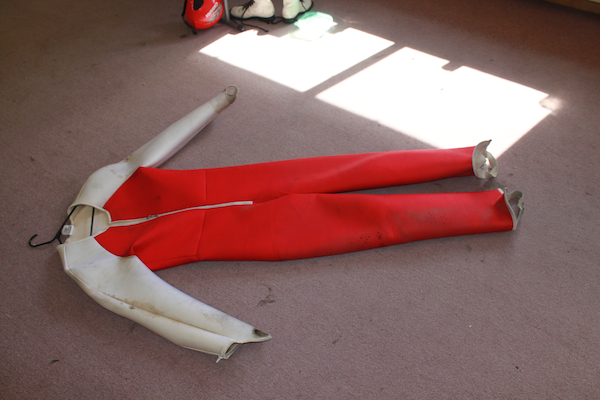
All these disturbing tidbits were imparted to me as I was preparing to go outside and tackle the same collarbone-destroying hill myself. Before doing so, I had to remove my clothes and step into the red-and-silver jumping suit I’d been issued, which felt like an oversize wetsuit made out of thick, soggy cardboard. Capped off with my black alpine ski helmet, I felt like an ungainly summer snowman.
A few of the kids immediately started hiking to the top of the hill, but I stopped in the middle of the slope, along with most of the other participants. Before flying off the jump, McCahill wanted me to glide down the landing hill a few times, starting at the flat area just beneath the take-off. That would allow me to get a feel for my equipment, and for the plastic surface that Lake Placid uses to replace snow during the summer.
I watched a handful of the kids slide down. It seemed pretty straightforward, although the hill still looked steep. I took my place at the top, jammed my boots into my bindings, and cautiously inched out over the crest. I was at the bottom, unscathed, before I knew it.
After two more quick runs without any trouble, I was starting to get a little more confident. But I still needed some more time to adjust to the equipment.
Wrong. When I got back up the top of the landing hill for the fourth time, McCahill told me to keep walking. It was time to hit the jump.
“Really?” I asked, hoping he was joking. My preference at this point was to take a few dozen more landing hill runs before lunch, then perhaps attempt a single jump in the afternoon session. If I was up to it.
“Oh yeah, you’re ready,” McCahill said.
McCahill did not appear to be kidding—he had already refocused his attention on a string of ten-year-olds as they flew through the air. Resigned, I put my head down and began hiking up the rest of the hill.
Summoning the Confidence
At the platform at the top of the hill, I was greeted by the half-dozen kids in line to take their own jumps. There were five different start positions, each with their own “bar”—a six-foot long section of two-by-four spanning the width of the tracks. Jumpers sit on the bar before pushing off and sliding down the in-run to the take-off.
McCahill had told me to start from the second position, almost at the bottom of the platform. Many of the kids were jumping from higher up, at four and five. I watched a handful of them. The majority flew through the air and landed smoothly—one confident boy in a cow-spotted suit even got his skis into the textbook V-style. A few lost their footing on the landing and spun their way to a stop on the grass below, but all of them quickly jumped up, dusted themselves off, and headed back up the hill.
As I watched the kids jump, I could see that there didn’t seem to be any life-threatening forces at work. The kids were sliding down no more than 50 feet of in-run, and they didn’t appear to be traveling more than 15 or 20 miles an hour when they reached the take-off—which was no more
Inching my way out onto the bar. Photo, Dave McCahill
than four feet off the ground. It looked close to fail-safe, but none of that mattered—it’s impossible to rationalize something as precipitous as ski jumping for the first time. All I could think about were broken legs and broken arms—frustratingly unimaginative injuries.
As I began the process of putting my skis on, I could feel myself tightening up. My heart was already pounding, and then, before I was ready, it was my turn. Matt Cook, another NYSEF coach and former elite ski jumper, put the bar in place for me. I leaned out and plopped my butt on the nearest edge, scooting cautiously out to the middle. The two-by-four felt more like a one-by-two, and I could feel it bending beneath me. And just like that—after a few e-mails to coordinate my visit, a three-hour drive, and twenty minutes of familiarizing myself with the gear—I was alone at the top of the in-run, and I no longer had a choice. Like it or not, I was about to begin my ski jumping career.
I looked at Cook, waiting for him to tell me that everything would be fine, that I wasn’t going to hurt myself. Instead, he tried to give me practical advice, saying something about keeping my weight centered over the middle of my feet. It was absolutely not what I was looking for; I wanted straight, dumb reassurance. But I didn’t get it.
When Cook finished talking, I waited for a grand total of five seconds. Then, I stood up. Working up the courage to take a ski jump isn’t at all like navigating a steep hill on alpine or cross-country skis—when you’re doing that, you have to renew your commitment each time you start a new turn. With ski jumping, you only have to summon your confidence once, and then you have no choice: There’s nothing you can do to stop yourself once you’ve started sliding.
McCahill captured the jump on video, which shows me assuming a highly conservative crouching stance as soon as I stand up. While there was a vague resemblance, this stance is not to be confused with what real jumpers call in-run position. This was holy-crap-I’m-about-to-go-flying position. I went sailing off the end of the jump without moving a muscle—the only parts of my body that budged before hitting the ground were my arms, which I threw
In the air on my first-ever ski jump. Photo, Dave McCahill
backwards to steady myself. I traveled roughly three meters—just over two percent of the distance that Swiss jumper Simon Ammann flew in his gold medal-winning jump in the large hill competition in the Vancouver Olympics—before touching down, upright. I stayed atop my skis for a few meters, then sat down as I reached the bottom of the landing hill. My skis splayed to the left as the plastic ran out, then slammed into the grass and dirt at the bottom, wrenching the back of my boots against my calves. I sat up to the sound of whistles and tiny hands clapping. For something that had made me so terrified, the experience was remarkably straightforward.
Getting Comfortable
I took two more jumps that morning. The second was as scary as the first, but by the third jump, I was getting a little more steady. However, I had yet to actually jump—all I’d done was ride my skis through the take-off, too tense and focused to bother with even straightening my legs.
After my three jumps, we were already done with the morning session—which was fine with me. Imagine hiking uphill on a sunny summer day while wearing an extra-thick wetsuit and helmet, with skis in tow—that’s what I’d been doing for the past half-hour, and the activity had resulted in a level of perspiration that I never thought possible. Even after pulling down the zipper and letting the top half of the suit hang around my waist, I was still sweating buckets. By the end of the day, I had nearly soaked the suit through, and I would remain dehydrated for days.
It was only eleven, but I was already tired and beat up. The backs of my legs were sore from being slammed against my boots at the bottom of the landing hill, and I was covered in the dirt kicked up from my skis. We all headed inside and peeled off our suits, and the kids immediately moved on to a session on the giant trampolines used by the freestyle jumpers to practice. I was content to watch, and to chat with McCahill about NYSEF’s programs.
After a couple of hours for lunch, it was time to jump again. I pulled the suit on for a second time, and despite my hopes that might have dried off in the two hours that I left it in a heap on the floor, it hadn’t. It was sticky and clammy, which, as I was informed by assistant coach Tara Geraghty-Moates, is “part of summer jumping.” No matter—I would be hot and covered in sweat again in a few minutes, anyway.
The kids began the afternoon session by practicing telemark position while sliding down the landing hill. (Telemark landings are slightly more
My suit, dirty and soggy after a day of jumping.
stylish, and earn extra points in competitions.) McCahill told me not to worry about this just yet, instead recommending that I try to make my jumps a little more aggressive—at least, when I feel comfortable doing so. I head up the hill intent on jumping—not just riding through the take-off.
After hitting the jump a couple more times, I realized that I was not longer intimidated—and that I was actually starting to have fun. Despite the imposing look of the hill, the unwieldy skis and the sport’s reputation for inaccessibility, jumping was actually easy, and intuitive. By my fourth flight of the afternoon, I was practically sprinting my way back up to the top of the hill, rushing past kids lugging skis twice their size and refusing to even take the time to unzip my suit.
Despite the fact that I was now jockeying for position with them at the top of the hill, the kids were adding to my enjoyment. They seemed to have a full grasp of the scale of my endeavor—while they were unfailingly sympathetic and encouraging on my first few jumps, the kids also seemed to recognize the absurdity of a 23-year-old being a participant in their camp, and none of them hesitated to laugh or poke fun at me. But they also told me, in jumper’s vernacular, to “have one,” each time I sat on the bar and readied for take-off. One girl even offered me technique advice, suggesting that a lower in-run position would force me to make a more powerful jump. It worked.
Blue Meters
After five attempts in the afternoon, I was finally starting to jump. I was gliding farther and farther down the hill each time (although still nowhere near as far as the best kids), and I’d figured out how to sit back on my skis and avoid toppling over as I approached the run-out.
My suit was soggy and my legs were sore from the backs of my boots, but I still had one more goal for the day: to reach the blue line that stretched across the landing hill roughly 15 meters from the take-off.
I was still jumping from the second start position, and I was getting close—my boots were coming down about even with the line on my fourth and fifth attempts of the afternoon. On my way back up the hill, I informed McCahill that I had to make it to the blue line by the end of the day.
“You know how to do that, don’t you?” he asked me. “If you start from five, I guarantee you that you’ll make it.”
That was not what I was hoping to hear from McCahill—I was under the impression that I wouldn’t have to stretch my comfort zone any further on this day. While I had been content for my jumping career to begin and end from the second start position, I was now faced with the challenge of starting 10 feet higher on the in-run.
Strapping on the skis. Photo, Dave McCahill
I climbed up the hill to the platform and contemplated the view from the bar—it wasn’t hugely different. I gulped, stood up, and rode down the in-run to the take-off, jumping with the same conservative technique as I had on my first attempt of the day—barely budging my position until I’d landed. Predictably, this left me with an unimpressive result, still a couple of meters shy of the blue line.
“You didn’t think you’d actually have do anything to get there, did you?” McCahill teased me as I hiked past. “You still have to jump—and this is your last shot before the end of the day!”
Dirty and sweating, but still intent on hitting the blue line, I hiked up the hill and strapped on my skis one final time. At the take-off, I mustered just enough of an impulse to clear the blue line—or so I thought. I walked back up the hill to pick up my camera and ask McCahill if I’d made it.
“Blue meters!” he said. “Nice work!”
Triumphant, I returned to the lodge and pulled off the suit. With the quarter-inch of soggy foam no longer clinging to my body, I felt amazing. I stacked my skis against the wall alongside the rest of the NYSEF loaners, returned my boots, and hung up my suit. All told, I’d taken ten jumps, and probably flown no more than a cumulative 100 meters—still far shorter than Ammann’s gold-medal winning flight. But I already felt like a seasoned veteran, and I caught myself contemplating sticking around for another day of the camp. Jumping had been shockingly easy to learn—I spent no more than an hour in the morning getting used to my gear, and by the afternoon the fear factor had already worn off. A few days later, I was already plotting my return to Lake Placid for weekend jumping sessions, and scouring the internet for novice nordic combined competitions in the winter. It’s not too late for me to make a run for the 2014 Olympics, is it?
Interested in trying ski jumping or nordic combined? There are a large number of clubs with novice hills throughout the country, especially in the northeast, which welcome newcomers. For anyone already comfortable on a pair of cross-country skis, the basics can be learned in a session or two. Contact your nearest club for more information—the website SkiJumpEast.com has an extensive directory, as does SkiJumpingCentral.com.
A participant in the New York Ski Educational Foundation's August Grasshopper camp prepares for lift-off.
How do you get dozens of youngsters to try out a sport like ski jumping?
For the staff of the New York Ski Educational Foundation (NYSEF), that’s not just an idle question to ponder. It’s crucial for the club to attract large numbers of kids to try out the sport if they want to turn out athletes with hopes of ever competing at an elite level.
From the outside, ski jumping seems like it should be difficult to break into, with its intimidation factor and high cost scaring off wary parents. But a visit to a NYSEF “Grasshopper” camp for juniors at the Lake Placid Jumping Complex in mid-August showed just how the club had overcome those hurdles—making the sport accessible, and attractive, to local children.
Make it Accessible
According to NYSEF Ski Jumping Head Coach Casey Colby, the club tries to attract local kids to the sport by reducing costs for interested parents.
A Grasshopper camp participant readies himself at the top of the K-18 with the help of coach Matt Cook.
“It’s hard to get kids to do this sport, because it’s not something you do recreationally, with your buddies,” Colby said. “It’s like the drug-dealer style of recruitment. You’ve gotta go out and let ’em do it for free.”
Colby cited a program that NYSEF ran last winter, Learn to Fly Wednesdays, in which local kids could take a crack at jumping in exchange for $5. They weren’t big moneymakers, but Colby credited the sessions with creating greater interest in the Grasshopper camps throughout the summer. Twenty-six kids were enrolled in the mid-August session, as opposed to a mere seven last summer.
At $150 for three days, including lunch, the Grasshopper camps don’t break the bank, either. Equipment would be a formidable expense for parents—if they had to buy it. But the kids in the NYSEF programs don’t have to bring their own: The club owns an entire fleet of skis, and spare suits hang from a rack in the lodge.
The low cost doesn’t mean that kids will sign up automatically, though—their parents must also be convinced of the safety of the sport before they’re willing to let their children strap on skis.
Colby said that he has enlisted the parents of some of Lake Placid’s best jumpers to help sell the sport, including the mother of 2010 Olympian Peter Frenette.
“Her job last winter, as she saw it, was to make sure the parents were involved,” Colby said. “I think parents—their view of ski jumping is ABC’s Wide World of Sports, agony of defeat…The first time they go to practice and they see a couple of kids fall, they’re kind of freaked out, because it looks horrendous. But 99.9 percent of the time, they get back up, they grab their stuff, and they go back up the hill.”
Scaling Down the Fear Factor
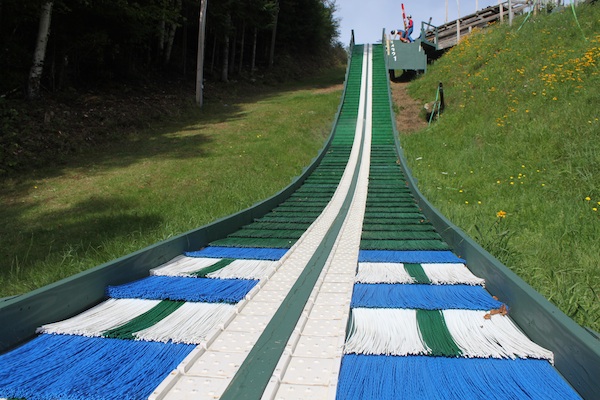
Ski jumping doesn’t sound like a summer sport, but during the off-season the snow and ice that covers Lake Placid’s hills in winter is replaced by a porcelain and plastic facsimile—the former substance is used for the tracks on the in-run, and the latter is laid out in shingles the landing hill.
Regardless of the surface, for anyone who has seen ski jumping on TV—or worse, in person—it’s difficult to imagine how anyone could ever be convinced to launch themselves from those towering, Olympic-sized hills.
But the only time the kids in the Grasshopper camp go near the top of Lake Placid’s Olympic jumps is for lunch, which occurs in the observation platform of the 120-meter hill.
The rest of the time, participants hone technique and confidence on the K-18 jump, which is tucked out of the way on the complex’s hillside, between some
The in-run of Lake Placid's K-18 jump.
buildings and a stand of trees.
Unless you’re already familiar with the sport, describing Lake Placid’s smallest jump as “the K-18” doesn’t say much. The number refers to the distance from the take-off, in meters, at which the landing hill begins to flatten out—generally the farthest that the young athletes traveled on their jumps.
During the August camp, few flew farther than 15 meters, and the kids were never more than a few feet off the ground.
While the K-18 is far smaller than Lake Placid’s Olympic jumps (which are K-90 and K-120), the kids still build their way up to it.
During the winter Learn to Fly lessons, they start with ski play and balance drills before progressing to actual jumping. In the summer, many of the children warm up simply by gliding down the landing hill, without jumping at all.
“We’ve learned to take down the intimidation factors—the big skis, the gnarly crashes that kids see,” said Dave McCahill, one of the NYSEF junior coaches behind the winter jumping sessions and the Grasshopper camps.
According to McCahill, the younger kids seem to pick up the sport more quickly. But regardless of age, the initial jumps are still scary. Pre-teen A.J. King described his first time as “a little freaky”—although it didn’t take long for him to get over it.
“I was kind of scared. But then I did it and I felt great,” he said. King, a New Hampshire native, learned to jump with the Andover Outing Club, and he also competes in nordic combined.
Billy Demong, another Lake Placid native who won gold in nordic combined at the 2010 Olympics, recalled being the most reluctant of all of his friends when he started in the sport. But that feeling, he said, eventually dissipated.
“Fear kind of fueled me to keep showing up. And then you kind of hit that requisite point where you finally get some air under your skis and…go down the hill a little ways, and it makes it worthwhile,” he said. “That’s where you go from being afraid of the sport to, ‘[I] can’t wait to get back to the top of the hill.’”
Incremental Increases
The progression from the K-18 up to Olympic hills is incremental: once the kids master the K-18, they move up to Lake Placid’s K-40, where they build confidence and gain experience. There’s nothing between the K-40 and the K-90 at the complex, but athletes will practice on other hills throughout the country between K-60 and K-70 before making that jump.
At the August camp, there were kids all along the continuum—some who were still working up the courage to try the jump for the first time, and others who would jockey for position at the top of the hill.
While the camps are informal—they’re about having fun—there’s still a lot of thought going into the coaching. McCahill has the kids practicing take-off
Camp participants taking in the action at a "Soaring Saturday" competition
technique during morning stretching, and he gives them feedback on their jumps throughout the day. There’s even a brief video review session after lunch.
“We’re trying to stress a good understanding of technique and form at an early level,” McCahill said. “We’re trying to keep the kids informed about what they’re doing, and why it’s working.”
It’s not as serious as the rigorous analysis you might find at the college level, but Colby says it still works.
“These kids are actually learning, and they don’t have a clue,” he said. “Half the time they just come off every single jump and ask, ‘How far’d I go? How far’d I go?’ They really don’t know that they’re getting better.”
Make the Path Clear
As much as anywhere else in the country, the path to jumping greatness is laid out clearly for the aspiring juniors at the Grasshopper camp.
Aside from the obvious progression in the size of the hills, from K-18 to K-120, camp participants can see elite athletes in action on a weekly basis, which provides them with ample inspiration.
Each weekend during the summer, the complex hosts Soaring Saturdays, a low-key competition in which elite jumpers like Frenette, a Lake Placid native,
Kids gather to get their equipment autographed.
vie for a prize purse of a few hundred dollars.
Given the sport’s eye-catching nature, it’s easy for the events to draw crowds of the town’s ubiquitous tourists. An announcer hypes up the athletes, and even officiates a few minor league baseball-style t-shirt giveaways.
The festive atmosphere is like a drug for the camp participants, who spend an hour after lunch at the Grasshopper camp taking in the competition. They stand next to the take-off and watch in awe as their idols fly past, picking out the best jumpers by name. Later, they swarm Frenette and others for autographs.
The attention and status afforded to the elite jumpers makes the sport that much more appealing to the youngsters, some of whom even see ski jumping as a path to fame and fortune, misguided as that may be. (The American jumpers gained notoriety at the 2010 Olympics for the odd jobs each had taken on to support their competition schedule; Frenette was an ice cream scooper.)
Asked what he liked about the sport, King spent just as much time talking about stardom as he did about the jumping itself.
“Everybody’s cheering you on, [you] get in the newspaper, on the news, go really far, and stuff. Win money, and have fun,” he said.
OBERWIESENTHAL, Germany (Aug. 20) – The women’s ski jumping crew were flying through the sky on Friday, competing in the Oberwiesenthal Continental Cup. USA’s Sarah Hendrickson (Park City, UT) stomped on the podium in third. Austria’s Jacqueline Seifriedsberger won the event.
The women competed on the normal hill Friday with Seifriedsberger landing two consistent jumps of 96.5 meters for a total of 232.5 meters. Second place Coline Mattel of France scored the longest jump of the day with her second jump, 98 meters. The jump would not be enough to claim the win, keeping Matel in second 1.5 meters behind Seifriedsberger.
U.S. ski jumper Hendrickson, only 16 years old, put down two solid jumps to earn a spot on the podium in third. Hendrickson’s second jump of 94.5 meters, edged her over Japan’s Sara Takanashi in fourth. Hendrickson’s total distance was 218 meters.
The women jumpers will be in the start again on Saturday, for the second normal hill competition of the Continental Cup series in Oberwiesenthal, Germany.
OFFICIAL RESULTS
Continental Cup
Oberwiesenthal, Germany
Women’s Normal Hill
1. Jacqueline Seifriedsberger, Austria, 232.5
2. Coline Mattel, France, 231
3. Sarah Hendrickson, Park City, UT, 218
4. Sara Tanashi, Japan, 216.0
5. Maja Vtic, Slovenia, 215.0
–
19. Alissa Johnson, Park City, UT, 184.0
28. Abby Hughes, Park City, UT, 169.0
An 18-meter ski jump in Lake Placid. A new project in Australia could result in the construction of similar-sized hills in that country.
A few days before competing in the Engadin Marathon in Switzerland last March, Ben Sim stood atop a snow-covered hill in Germany. Sim, an Australian, was about to find out whether he could make the jump from cross-country skiing to nordic combined.
Literally.
Observing were Finn Marsland, the coach of the Australian cross-country ski team, and Fabian Mauz, a German coach who had assisted some Australian athletes at the Junior World Championships in the Black Forest in January.
Sim, an Olympian in cross-country, had never launched himself off a ski jump before. But he and Marsland had prevailed upon Mauz—who was also a nordic combined coach and former competitor—to loan Sim some equipment and let him try it out.
The conditions weren’t ideal. The small jump had been built by Mauz himself, and there was no grooming—the men had packed down the tracks with their boots the previous day.
Sim wasn’t intimidated at all, though. He strapped on his pair of borrowed skis, slid down the in-run, and flew through the air. Then he climbed back up to the top for another round, and kept at it for half a day.
Sim was enjoying himself, and it didn’t take long for him to get used to the equipment. By the end of their session, Mauz was impressed.
“Fabian was actually quite surprised how quickly he picked it up,” Marsland said. “He gave Ben a lot of really good feedback.”
From there, Marsland sprang into motion, and that single session in the Black Forest has now snowballed into an ambitious attempt to launch an Australian program in nordic combined—the sport that pairs cross-country skiing and ski jumping.
Around the same time Sim was taking flight in Germany, Marsland had contacted Greg Poirier, an American nordic combined national team coach, to get some information about athlete development. When he returned home, Marsland successfully applied for funding for an initiative to establish the sport in Australia, which has already paid for Sim to travel to Utah for a jumping camp, and could lead to his participation in nordic combined at the 2014 Olympics in Sochi. There’s more: Marsland’s ambitions may also result in the construction of a series of small ski jumps in Australia, where none currently exist.
Uli Wehling, the nordic combined race director for the International Ski Federation (FIS), said that a project like Marsland’s had never been attempted.
“In [the] case that we start from more or less zero to build up the discipline—I think it’s the first time,” he said. But, he added: “We welcome all new nations to take part in nordic combined.”
A Two-Pronged Plan
Ski jumping in Australia dates back at least to the 1930s—a 1932 article in the Australian Quarterly cites the incorporation, two years earlier, of the Australian Ski-Jumping Club. Several hills were constructed in the southern part of the country, but according to Sim and Marsland, none remain today.
Hal Nerdal, a Norwegian immigrant, is the only Australian ever to compete in the Olympics in either ski jumping or nordic combined—he finished dead last of 31 athletes in the nordic combined competition at the 1960 Squaw Valley Games.
Sim could be the next. While on a good day he can be competitive at the upper levels of cross-country skiing, Sim said that his two top-50 finishes in the sport in Vancouver most likely fell short of what was necessary to obtain future funding from the Australian government.
In fact, before the Olympics, a strength coach had suggested to Sim that at 5’10” and just shy of 150 pounds, his slighter build was more suited to nordic combined than to cross-country skiing. Sim laughed off the comment at the time, but after the Games, he and Marsland discovered that there was money available from FIS and the International Olympic Committee (IOC), to introduce countries to new Olympic sports. Facing the prospect of having to self-fund the next few years of his cross-country career—and after the promising day of jumping in Germany—nordic combined began looking like a more attractive option. Especially when Marsland, back in Australia, was able to quickly obtain a roughly $9,500 grant from FIS.
“When you have to work full-time to do your sport, to work to earn money so I can travel, it makes it a lot harder,” Sim said. “Doing nordic combined—it lets me just do another year of full-time training.”
The FIS grant, as well as additional money forthcoming from the IOC, will be used to pay for a two-pronged attempt to establish nordic combined in the Australia. First, Sim will spend at least a year learning to jump, with the hopes of reaching the World Cup nordic combined circuit by 2012-2013 and the Sochi Games in 2014.
Second, with the help of Poirier, Marsland is hoping to find a suitable location in Australia for the construction of some novice ski jumps, which will be used to introduce a pool of younger athletes to the sport.
“It’s the bigger project of trying to see whether we can put in a bit of a development plan,” Marsland said. “It would be fantastic if we could have jumps here in Australia to get development happening at a junior level. For any sort of long-term security of the sport, that’s the only way to go.”
An Uphill Battle for Sim
After obtaining the grant from FIS, Marsland worked with staff and coaches at the U.S. Ski and Snowboard Association to schedule a two-week jumping camp for Sim in Park City, Utah, in July.
Poirier connected Sim with Alan Alborn, a former Olympic ski jumper who now coaches Park City’s club program. Alborn had Sim start from scratch, beginning with trips down the landing hill of a 10-meter jump to get used to the summer sliding surface. By the time Sim returned to Australia a few weeks ago, he had worked all the way up to the venue’s 40-meter hill.
“He’s doing quite well, as far as the progression that we normally see,” Alborn said, adding that Sim had been very receptive to coaching.
Ben Sim at a World Cup race
To become a proficient jumper at age 25, Sim still has his work cut out for him. According to Poirier, nordic combined skiers typically start jumping before they turn 10 years old.
However, a similar path has been blazed at least once before, by American Matt Dayton. Dayton didn’t take up jumping until he was 18, then qualified for the 2002 Olympic Games seven years later and helped the U.S. team to a fourth-place finish in the relay.
According to current U.S. Nordic Combined Team Head Coach Dave Jarrett, Dayton was never among the top jumpers on the World Cup circuit. But like Sim, Dayton was a strong cross-country skier, and he relied on that fitness to propel him to three top-ten finishes over the course of his career.
“Had he been able to get his jumping a little bit closer, he would have been even better,” Jarrett said.
According to Poirier, Sim possesses the same qualities that made Dayton successful—drive and self-motivation.
“Ben Sim falls in that same ballpark,” Poirier said.
Sim is now back in Australia for the Southern Hemisphere’s winter season, but he will return to the U.S. for another two- to three-week camp at the end of September—possibly accompanied by a junior teammate, Jackson Bursill.
On that trip, Alborn said, Sim will likely move up to Park City’s 60-meter hill, where he’ll have to hunker down and spend a lot of time working on technique and accumulating repetitions.
Sim acknowledged that he still has some work to do to get comfortable. During his next camp, he said that he’ll be focused on staying “a bit more relaxed in the air.”
“I feel like I’m pretty tense,” he said.
Sim will take one more trip home in late October to spend time with his fiancée, then fly back to Utah again, where he plans on spending most of the winter, “just jumping every day, as much as I can.”
He’ll continue to train for cross-country skiing, but Sim will limit his racing to the U.S. domestic circuit, save for the World Ski Championships in Norway at the end of the season.
“Realistically, if I want to have any chance for trying to qualify for World Cup competitions or Olympics in four years, I think I need to learn how to jump pretty quickly,” Sim said.
Sim’s goal is to jump from the 90-meter hill—generally the smallest size used for elite competitions—by the end of the winter, which is “pretty realistic,” according to Alborn.
But Alborn added that graduating to larger jumps is not simply a matter of courage. Technique and fundamentals are crucial, and launching from the big hills can sometimes act as an impediment to learning by sending athletes flying at higher speeds.
“It inhibits them from learning the really basic skills for ski jumping,” Alborn said. “We like to teach the more fundamental ideas first, so they really groove that in.”
If his timeline goes according to plan, and if he demonstrates sufficient potential for the sport, Sim hopes to be able to obtain funding for future seasons of nordic combined training from Australia’s ski federation. But if he hasn’t been able to brave the 90-meter hill by next summer, the project will conclude.
“Fingers crossed it works,” Sim said. “I’m just keen to see how it goes, really.”
One thing that does not seem to be in doubt is Sim’s ability to cross-country ski with the best of the nordic combined athletes. According to Jarrett, Sim participated in a handful of workouts with the American team during his July jumping camp, and he “certainly held his own.”
“It’d be good for us to have another fast guy around,” Jarrett said.
The “Crazy Idea”
While Sim travels to the U.S. for his second camp in September, Poirier, the American coach, is planning his own trip to Australia.
For three or four days, Poirier will visit ski resorts in the towns of Falls Creek and Perisher Valley. Funded by the grant money, he’ll be scouting a suitable site for a series of small ski jumps designed to introduce juniors to the sport.
Initially, Poirier said, the jumps would be sculpted from snow, at a relatively minimal cost.
“It’s a matter of [a ski] area’s willingness to dedicate some snowmaking time and some Cat time,” he said. “Hopefully, they’ll be psyched for this kind of crazy idea.”
If the jumps go over well, more extensive work would be required to make them suitable for competitions. But for now, Poirier said, “I don’t think we need perfect jumps.”
“We just need a slope and a jump to get kids excited about trying jumping and nordic combined,” Poirier said. If they’re successful, he added, “then hopefully they’ll put some financial resources into the long run.”
Marsland said that he hopes Sim’s nordic combined exploits will inspire younger athletes to take up the sport. “That will certainly help bring a little more attention to nordic sports in general, and that’s definitely part of our thinking,” he said. “I think we should be able to get a bit of publicity…out of the media here in Australia.”
However, he cautioned, it’s still too early to tell whether Sim will be able to bring his jumping to a level that will get him results.
“That’s what Ben’s goal is at the moment—to make it to a competitive level,” Marsland said. “We’ll find out over the next year if he has what it takes, or if he doesn’t.”
Lindsey Van used a new wax produced by Willy Graves and Eric Camerota en route to two national championships last weekend. Photo: WSJUSA
At 23 years old and without a college degree, Willy Graves does not seem like the kind of guy who could compete with scientists at wax companies like Swix or Toko. But armed with a blender in the confines of his garage, Graves has invented a product that just might eat into those companies’ market shares—at least a little bit.
Along with his former teammate Eric Camerota, Graves, a recently-retired U.S. nordic combined B-teamer, has concocted a secret homemade formula for summer ski jumping wax. And it works. Better than anything else out there. At last weekend’s U.S. ski jumping and nordic combined championships, Lindsey Van, Peter Frenette, and Camerota’s brother Brett all used it en route to national titles, Graves said.
“I like it a lot,” said Van, a world champion in women’s ski jumping in 2009. “I don’t want to tell anybody about it, because I don’t want anybody else to have it.”
Ski jumpers and nordic combined athletes jump in the summer not just to train, but also in competitions in the U.S. and Europe. Instead of sliding on snow, athletes glide down a porcelain in-run and land on plastic shingles.
To protect their bases and obtain decent glide, athletes leave a thin layer of hard wax on their skis while jumping. But according to Graves, until he and Camerota began tinkering in their garage, only one other small company made a summer-specific product, in a similarly small-scale operation. Most athletes, Van included, used stock winter varieties like Swix’s CH4.
“We knew there had to be something better,” Graves said.
He and Camerota embarked on their project this spring. Lacking formal knowledge in chemistry, they went straight to the Web in search of the right ingredients. They knew they needed something that would allow the wax to bond to ski bases while remaining hard and flexible.
It took more than one try to get the formula right, but after a number of “complete disasters,” they had a recipe. Graves wouldn’t reveal the components, saying only that it was a basic hydrocarbon wax mixed with a few key additives for durability and lubrication. But he was happy to talk to about the advantages it offers over winter products.
First, it doesn’t chip like CH4 or other cold-weather waxes, making each coat more resilient. Graves said that the lifespan of his wax was nearly twice as long as other varieties.
It also makes for a smoother acceleration as athletes push off the bar atop the in-run, allowing them to get into an aggressive position more quickly.
“I felt quite a bit of difference,” Van said. “I was able to sit a little lower—better balance—without being on my toes or my heels.”
Despite Van’s hopes to keep the wax a secret, word seems to be getting out. Graves sent the product to Europe with the U.S. Nordic Combined Team for their Summer Grand Prix competitions, and he just filled a big order for the Canadians. In the past week, he’s heard from athletes as far away as France and Austria.
The operation, dubbed the Alien Wax Project–still runs out of the garage, and it’s still small-scale. There’s no website (although a Facebook page may be in the works), and Graves said that the total investment in equipment and materials has been roughly $1,000. Given the small size of the summer jumping community and the low price they’ve set for their wax, Graves and Camerota have limited ambitions for the product—although they are contemplating an expansion into winter waxes for alpine skiing and snowboarding.
“The major goal is not really to make money—we just want to make the best product out there,” Graves said. “It’s just kind of a fun little project.”
A collegiate race at Mount Van Hoevenberg in Lake Placid, which faces the possibility of closure if funding is not delivered in the New York state budget
Lake Placid’s cross country, biathlon and ski jumping venues face the possibility of closure if the state does not appropriate money later this month.
The Lake Placid Daily News reported in March that New York’s Olympic Regional Development Authority (ORDA), was at risk of losing all of its state funding for the coming fiscal year. The aid, approximately $6.6 million last year, comprises some 20 percent of ORDA’s budget.
A member of ORDA’s board of directors is on record in the Daily News story as saying that the authority would have to close without the state’s appropriation.
ORDA is the body that manages the legacy venues of the 1980 Winter Olympics in Lake Placid, including the cross-country, biathlon and sliding facilities at the Olympic Sports Complex at Mount Van Hoevenberg, just outside town. The Olympic ski jumps, Whiteface Mountain Ski Center, and Olympic Training Center in are also managed by ORDA.
While the closing of these areas would be a big loss to recreational skiers, it would be an even bigger blow to the elite and developing athletes that train at these venues. The combination of ski trails, biathlon range and jumps in close proximity to one another make this a valuable resource for local athletes.
The New York Ski Education Foundation runs extensive youth programs that make use of the Olympic Sports Complex. It’s also a training center for American biathletes and Nordic combined skiers. The U.S. Ski Team holds an annual fall training camp in Lake Placid.
“It would be a tragedy for biathlon if Mount Van Hoevenberg were to be shuttered,” said Max Cobb, U.S. Biathlon’s executive director.
Cobb said he thought that juniors and developing athletes would be impacted more than elite athletes. Juniors ski and compete in the area all year round, while elite athletes like Lowell Bailey and Tim Burke train in Lake Placid only during the dryland season, prior to traveling for World Cup events.
While people might be willing to drive a long distance to try a new activity for the first time, Cobb said that to ensure consistent training and world class progression, athletes should live within a one hour drive of a venue.
As well as the cross-country trails and biathlon range, Lake Placid is also home to the ORDA-managed ski jumps. In addition to the iconic 90- and 120-meter Olympic hills, the jumping complex has three smaller hills for developing athletes. Athletes can train on three of the five jumps during the summer, sliding on a combination of plastic shingles and porcelain marble halves.
While there are ski jumping hills throughout New England, ranging from 10 to 90 meters, few of them have summer jumping facilities. And Ken Barker, president of the Salisbury Winter Sports Association in Salisbury, CT, said that summer jumping is essential to training from J5 through Olympic athletes.
Barker’s club will put plastic shingles on their 20-meter hill for the first time this summer. (They’re also rebuilding their large hill for the 2011 Junior Olympics.) And Barker cited the Lebanon Outing Club, in New Hampshire, as another facility that offered summer jumping. But few jumps in the region have the same level of programming as Lake Placid.
Finally, there’s ORDA’s Sports Development Program, which offers year-round educational opportunities to youth groups, including sports clinics in biathlon, luge, bobsled and curling. They even partner with the New York City Parks Department’s Winter Jam, offering residents the opportunity to try out cross-country skiing in Central Park.
Brad Clark, ORDA’s sports development manager, organizes outreach programs—activities like school field trips and interactive clinics at the various venues. If a child shows potential in a particular sport, Clark helps them find appropriate coaching. Without ORDA, Clark said, these outreach programs would not exist.
The tight budget situation is underscored by the news last week that ORDA had declined an opportunity to host a biathlon World Cup race at Mount Van Hoevenberg in February, 2011.
Jon Lundin, ORDA’s communications director, said that the organization “would have needed to upgrade the facilities to comply with IBU [International Biathlon Union] requirements for a major World Cup event.”
“We certainly are looking into [making the upgrades]; we just couldn’t do it this year,” Lundin said. He added that passing on the biathlon race was a “one-time blip,” noting that ORDA planned to host international events in the sliding sports, and possibly a World Cup freestyle event, in the coming year.
In an interview with FasterSkier, Lundin said that he didn’t know how ORDA’s operation might be changed if the state does remove funding. However, he added that state law stipulates that Mt. Van Hoevenberg cannot be privately owned or leased to a business-person in the private sector.
Travis Proulx, the state senate’s deputy press secretary, told FasterSkier that there is “still no finality to the status of ORDA’s funding.” He said that the senate didn’t want to cut ORDA’s appropriation in the first place, but that alternative funding is needed.
With one to two weeks until a budget is finalized, Proulx said that the Senate is “looking for ways to keep the state’s role in ORDA alive,” citing alternative budget cuts brought to the table by the Democratic caucus and alternative revenue options submitted by the Governor David Paterson—including one proposal to allow the sale of wine in grocery stores. Regardless of the final decision, both houses of the New York legislature, as well as the governor, are required by law to be in agreement on the state budget.
Members of the U.S. Women’s Ski Jumping team and their nonprofit foundation Women’s Ski Jumping USA are hosting a benefit Aug. 19, 2009 at the exclusive Huntsman Mountain Estate in Deer Valley, Utah in an effort to keep their program from dissolving.
In May, the U.S. Ski and Snowboard Association – which had been supporting the elite athletes for three years – dropped all funding to the women’s team citing it as a budget decision and because the women aren’t considered part of the Olympic program.
WSJ-USA has hired the women’s ski jumping coach Kjell Magnussen and these athletes are working hard to raise $150,000 by the fall so the team can continue to train and compete.
The USSA drop in funds came on the heels of a historic year for the U.S. team as women were allowed to compete for the first time in ski jumping in the Nordic Word Championships and American Lindsey Van became the first American to win a gold medal in ski jumping and the first American to medal in the event in more than 80 years. In addition, the women’s team positioned itself as one of the best in the world with four jumpers finishing in the top three during the 2008-2009 season.
Women ski jumpers from around the world gained unprecedented attention this spring as a group of 15 elite jumpers, including three Americans, sued the Vancouver Organizing Committee (VANOC) to gain entry into the 2010 Winter Olympic Games. In July, the British Columbia Supreme Court denied the women ski jumpers the declaration they sought, but found discrimination by the International Olympic Committee. Lawyers for the “Flying Fifteen”, who’ve been working pro bono, have filed an appeal with the BC Court of Appeals.
The U.S. women jumpers and their supporters have secured the Jon Huntsman Sr. Mountain Estate in Deer Valley as the venue for the benefit. The $55 million estate has long been a family retreat for the Huntsman family and will make for a perfect setting for this event.