This article was made possible through the generous support of our voluntary subscribers who have helped put our Nat Herz on the ground at the Olympics. If you value coverage like this, please support FasterSkier with a voluntary subscription.
LAGO DI TESERO, ITALY — A day before Norway’s Johannes Høsflot Klæbo won his fourth straight gold medal in cross-country skiing at the Winter Olympics, a strange sight was unfolding next to the race trails in Northern Italy.
Two figures, dressed in Norwegian team suits, were skiing loop after loop on a tiny test track — in search of the most infinitesimal edge over rivals from France, Finland, Italy and America.
Neither figure was Klæbo: The superstar was back at his hotel room playing video games and resting up for the next day’s race.
Instead, the two men were retired ski racers hired by the Norwegian team for one of the strangest jobs of the Olympics: sprinting for miles over the same small patch of snow to help identify which waxes and other products can be applied to the surface of cross-country skis to make them faster.
While Klæbo spent much of Saturday in bed, one of the testers, Mats Iversen, skied dozens of laps adding up to more than 15 miles. Earlier in the Games, Iversen was skiing even more: as far as 44 miles a day, and just over 200 miles in his first week in Northern Italy, according to numbers he logs on the Strava tracking app.

There’s no question that Iversen is skiing “way more” than the athletes competing at the Olympics, Klæbo said at a news conference Wednesday after winning his fifth straight gold.
Iversen’s one 44-mile day is “close to what I’ve done the whole week,” said Klæbo, whose race Wednesday totaled just over six kilometers, or some 3.5 miles.
“They’re amazing, and they are doing an amazing job to help us have the best possible skis,” Klæbo said. Referring to the winners’ podium, he added: “None of us would be able to sit here if it wasn’t for them.”
In a 45-minute interview after a 22-mile day last week, Iversen, his fellow tester, Pål Trøan Aune and their boss Tord Hegdahl offered a behind-the-scenes glimpse of the huge investment of equipment, technology and manpower that go into preparing the Norwegian team’s skis.

They spoke in a lounge area on the upper floor of an enormous, customized truck that houses hundreds of pairs of skis, along with work stations for staff members who prepare them for testing and racing. Iversen and Aune are, essentially, the engines of an intricate machine — with others operating the controls.
“You don’t need a 200 IQ to be a ski tester,” Iversen said. Pointing to the lower floor, where the technicians work, he added: “The brains are in here.”
‘Dizzy’ from all the loops
The Norwegian truck is parked in a big lot beside the competition trails in Italy where other nations like France, Sweden and the Czech Republic have their own vehicles and trailers.
The American team truck cost some $750,000 and is named Yolanda — a reference to a line from actor Samuel L. Jackson’s character in the cult classic film Pulp Fiction, according to NPR.
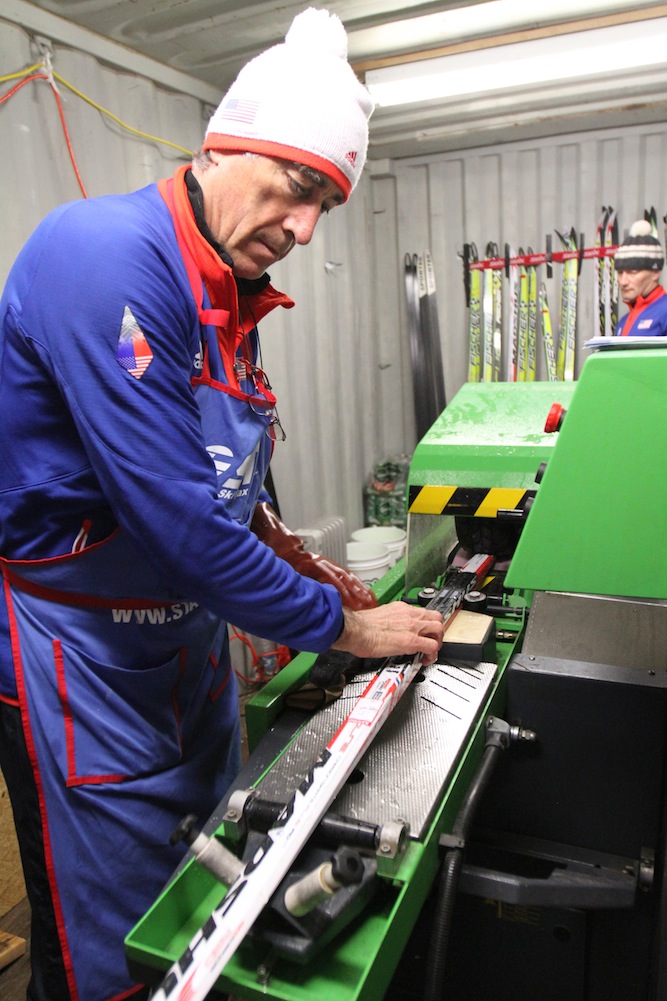
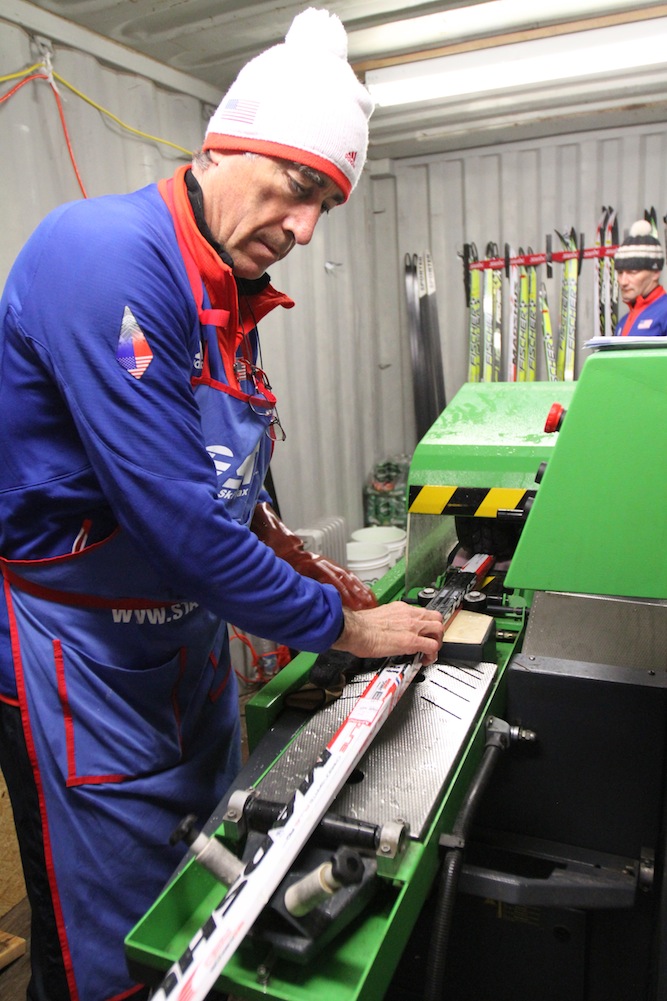
Inside the trucks, teams of technicians work to identify the skis and products that will slide the fastest given a specific set of snow conditions.
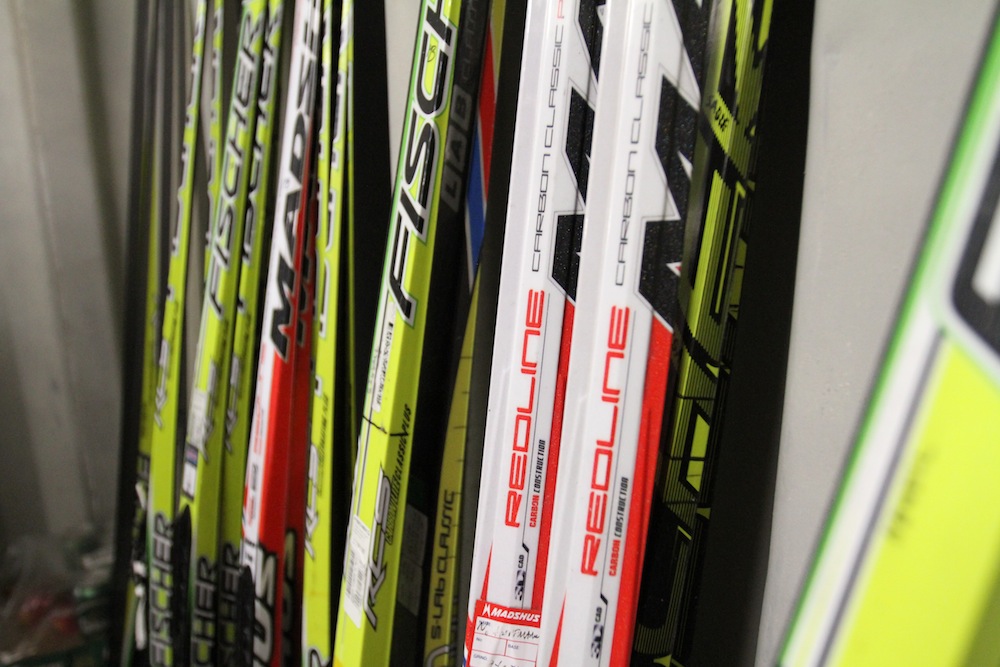
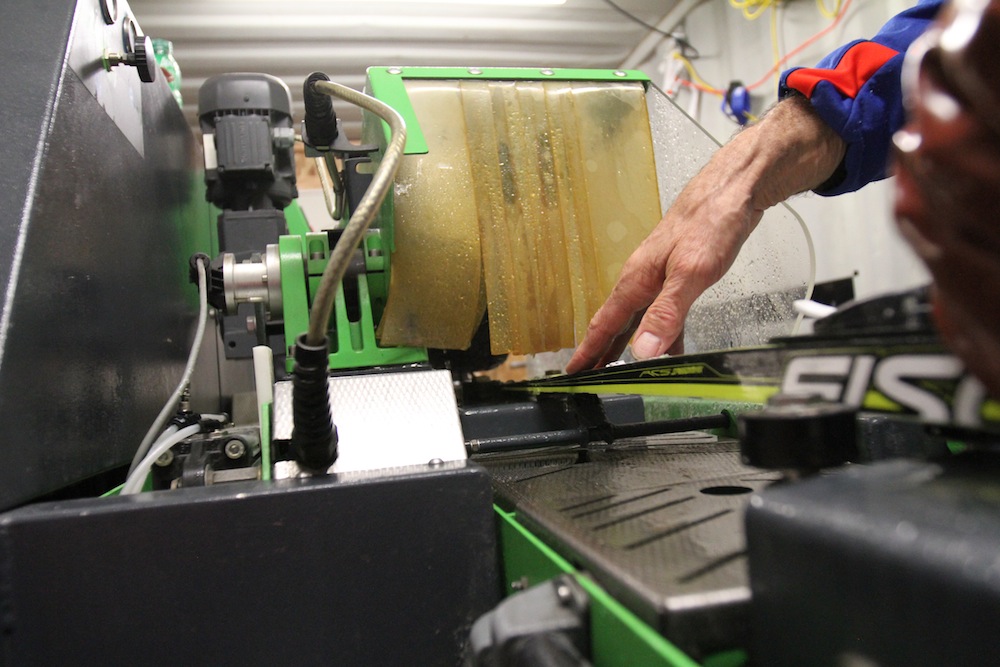
The work has several layers. Each athlete may have dozens of pairs of skis, and teams have to find the best ones for each day. Then, there’s what’s known as the “stone grind” — a pattern of tiny etchings that a machine can apply on the bottom side of a ski to help it move more easily over different types of snow crystals.
Finally, there’s wax, which can be applied to the ski base to give athletes even more of an edge. Dozens of products and brands exist in block, powder and liquid form, which can be melted or rubbed into the skis with waxing irons or obscure tools like a rotating wool brush attached to a drill.

Testers like Iversen and Aune help identify which combinations of skis, wax and grind work best in a given set of circumstances.
Every country does some level of testing. But Norway’s big budget for staff has afforded the team the luxury of an unusual level of specialization at the Olympics, with Iversen and Aune doing very little other than skiing — while other teams’ can mix testing in with other staff responsibilities, like waxing.
“We are terrible waxers,” Iversen said. Addressing a reporter, he said: “I think you are probably better.”
The Americans, by contrast, sometimes lean on coaches to test waxes on the trails, freeing up their specialized technicians to focus on picking skis with the athletes.
“If you take a look at our skis — we might have three bags and a couple of racks out before the race” for testing, said Matt Whitcomb, one of the U.S. coaches. “Norway will have two or three times that.”

Canada’s team, meanwhile, employs two Italian “ski pilots” who, like Aune and Iversen, focus on testing at big events during the winter — often skiing upwards of 15 miles in a day. The rest of the year, one of them, Thea Schwingshakl, is a research biologist, while the other, Sara Hutter, markets Tyrolean apples.
Like Aune and Iversen, they spend their days in the tiny testing area, where Schwingshakl joked that they get “a bit dizzy there, from all the loops.”
But, she added: “It’s good for the whole team. We can just focus on skiing and testing, and they focus more on the product and on the wax and structures.”

It’s not so much that the right skis, wax and grind will produce an Olympic medal — though they certainly help — as much as the wrong ones can put an athlete out of contention. After the men’s cross-country relay last weekend, American Johnny Hagenbuch suggested that his inability to keep up with rivals on the downhills had to do with his equipment.
“I was with everyone at the top of the climb and then — yeah, no longer,” he said. “There was nothing I could do.”
‘Simple and boring’ work
Iversen and Aune are part of a larger Norwegian project aimed at boosting numerous Olympic snow sports — not just cross-country skiing, but also Nordic combined and biathlon, said Hegdahl, their boss.
The effort includes a stone grinding machine that Norway operates near the cross-country race trails; Iversen and Aune help test patterns that can be used across those sports.
Another staff member has the sole task during the Games of driving skis over the mountains to the biathlon venue, said Hegdahl, who leads the Norwegian cross-country service staff.
One of the essential tasks that Aune and Iversen perform is the “paired glideout.” At the top of a small hill in the test track, the men stand side by side, then push themselves forward. As they start moving, Iversen equalizes their speed by grabbing ahold of a ski pole that Aune holds firm.

Then, they let go without accelerating or jostling and see which of the different waxes or structures beneath their feet is faster.
Typically, they’re assessing sets of eight pairs of skis that — aside from the products underfoot — have been chosen because they’re perfectly matched. That, in turn, allows the technicians to more precisely measure the impact of the wax and grind patterns on speed.
The testing is set up like a single-elimination tournament, with quarterfinals, semifinals and a final. Results are transmitted back to technicians in the truck via WhatsApp messages or a GPS watch.
The matching of the eight pairs is so precise that, after the final test, Aune and Iversen take extra laps on the skis that are knocked out early to equalize them with the top pairs, to make sure the winning skis aren’t getting extra wear. Which also means that a mishap during a test lap requires three extras, to keep the six other pairs even.

The whole process — from the unending right turns down to the bending over to take each pair of skis off and put the next set on — is hard on the body. They can ski 200 or more laps of the test track in a day.
But Iversen and Aune are both fit, and capable of the workload, according to Hegdahl.
“Testing is quite simple and boring. But we need guys to do the skiing who have the feeling of the skis,” Hegdahl said. “They’ve done a lot of skiing together with some of the best athletes, as well. So they know a bit.”
Aune and Iversen have also been friendly for years, and enjoy the camaraderie and the chance to participate at a championship event that neither reached as an athlete.

Iversen’s brother Emil is competing for Norway in Italy, and won a gold medal with the men’s team in the relay.
“It’s very special — it’s our best friends who are racing,” said Aune. “I think they trust that we will do all we can.”
The work can get boring, Iversen conceded. “But it’s nice to be with a friend,” he said.
They’re “better than most” with their team spirit, Iversen added. But Hegdahl, their boss, acknowledged that the testers might need a little time off after three weeks of rooming and working together through the Olympics, which conclude Feb. 22.
“I’m not sure Pål will be at Mats’ place for a glass of wine on the 24th,” said Hegdahl. “But maybe the 28th.”
Help Support Our Olympic Coverage!
FasterSkier will have our own Nat Herz on the ground at the Olympics, which, to be honest, is a very big financial lift for us. If you value the thoughtful work and access FasterSkier provides at championships like this one, please consider becoming a Voluntary Subscriber. Your support directly fuels the work we do to cover the people, places, and moments that make our sport special.
Join the FasterSkier community!