Tag: Ski Tour 2020

  • Johaug Crushes Stage 6 for Ski Tour Overall Win; Diggins Leads U.S. in Sixth (Updated)

    Johaug Crushes Stage 6 for Ski Tour Overall Win; Diggins Leads U.S. in Sixth (Updated)

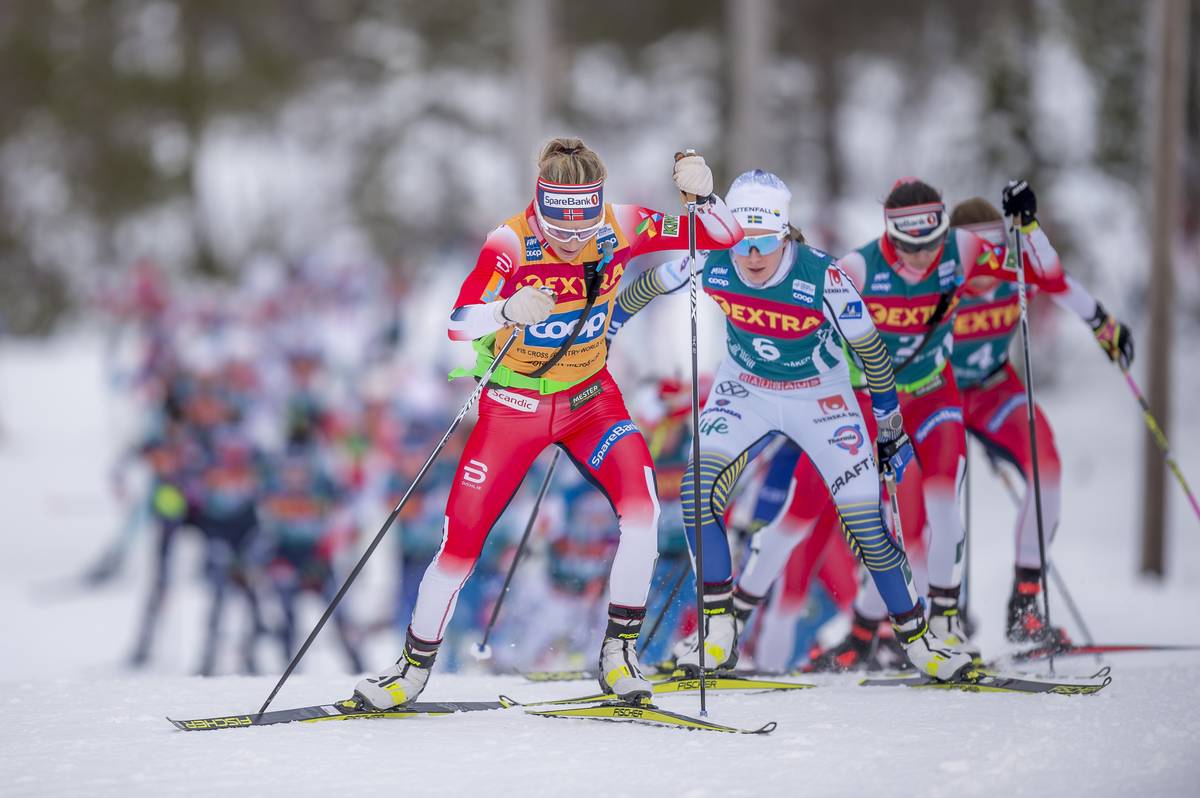
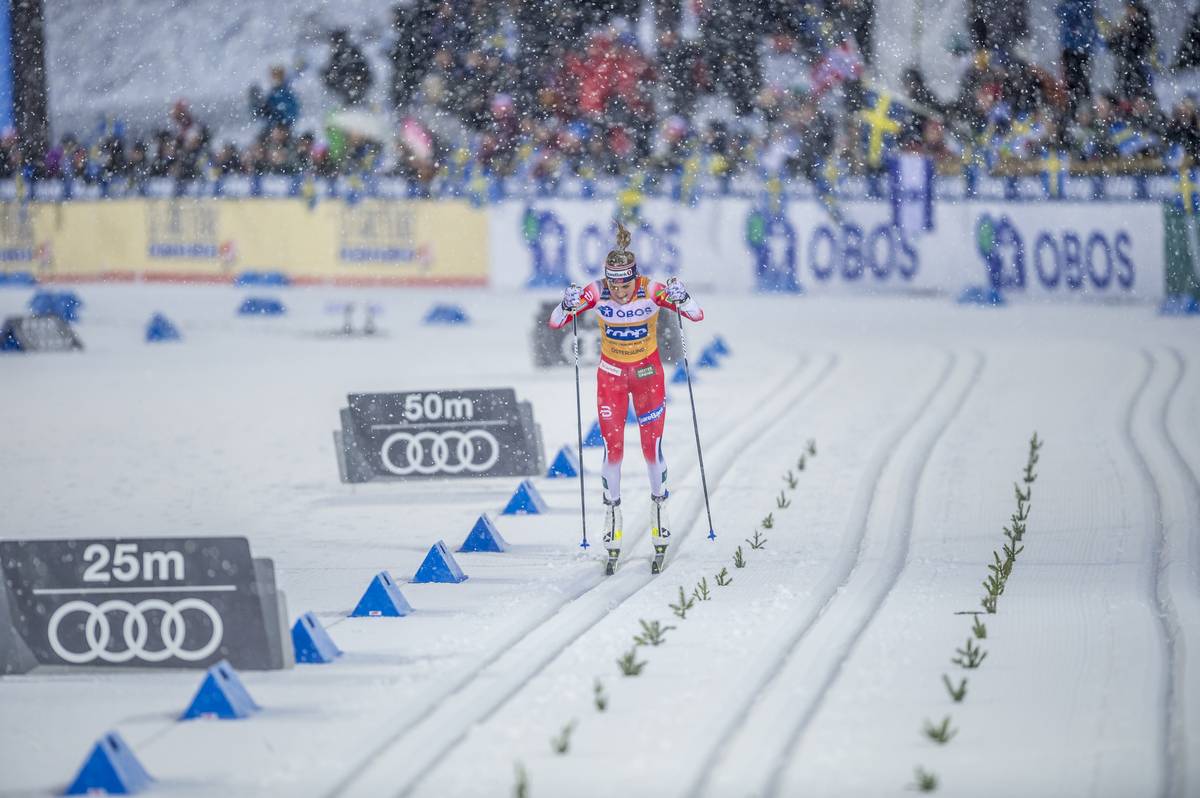
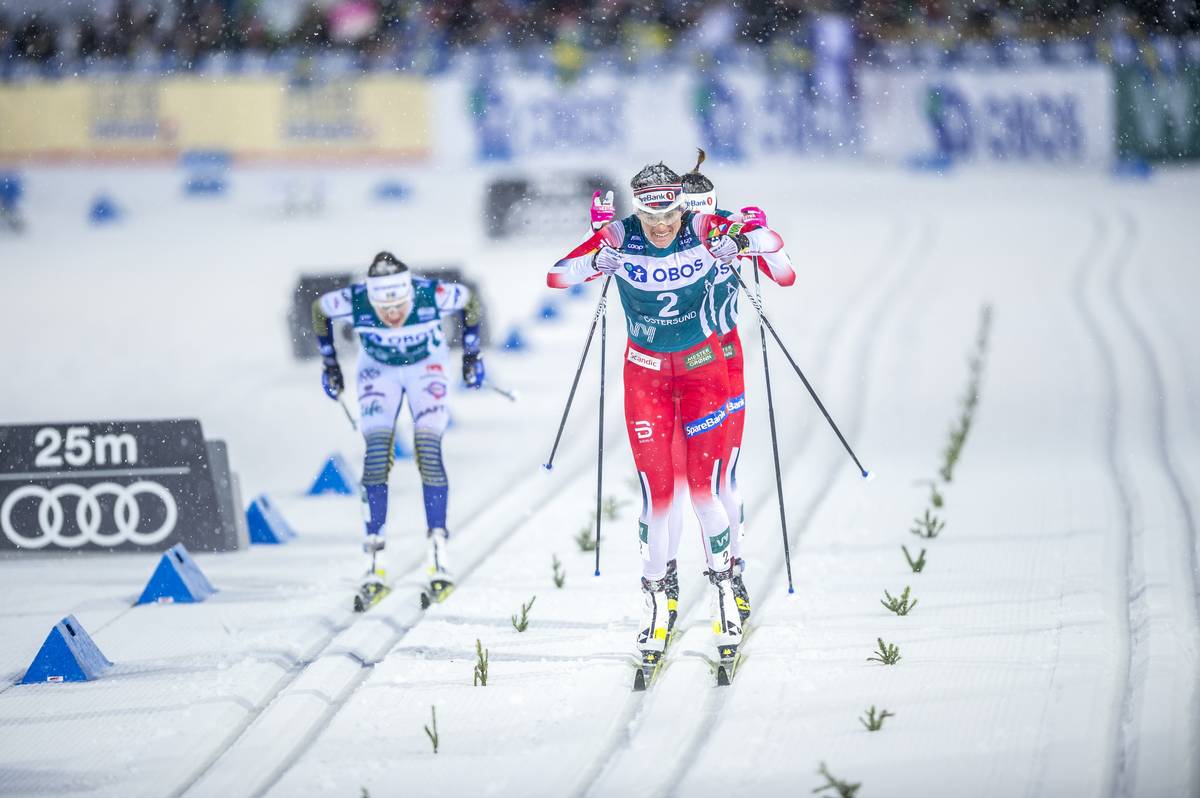
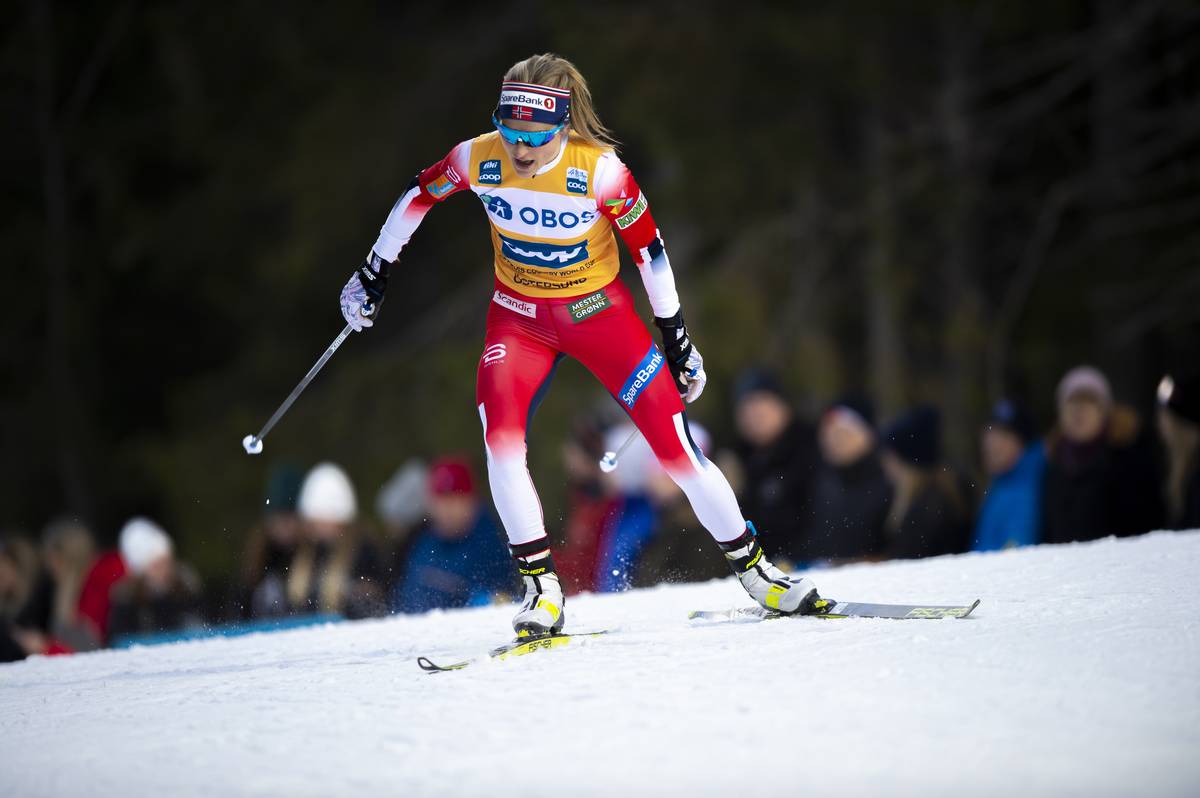
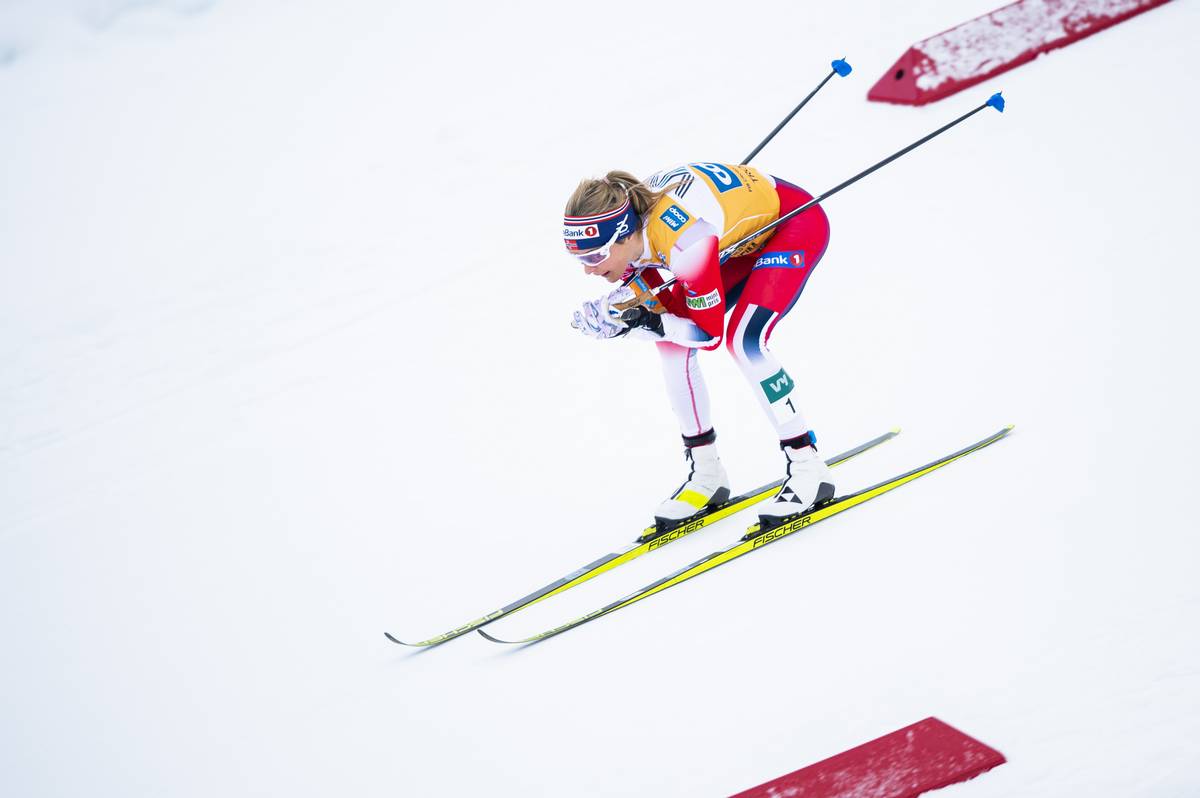
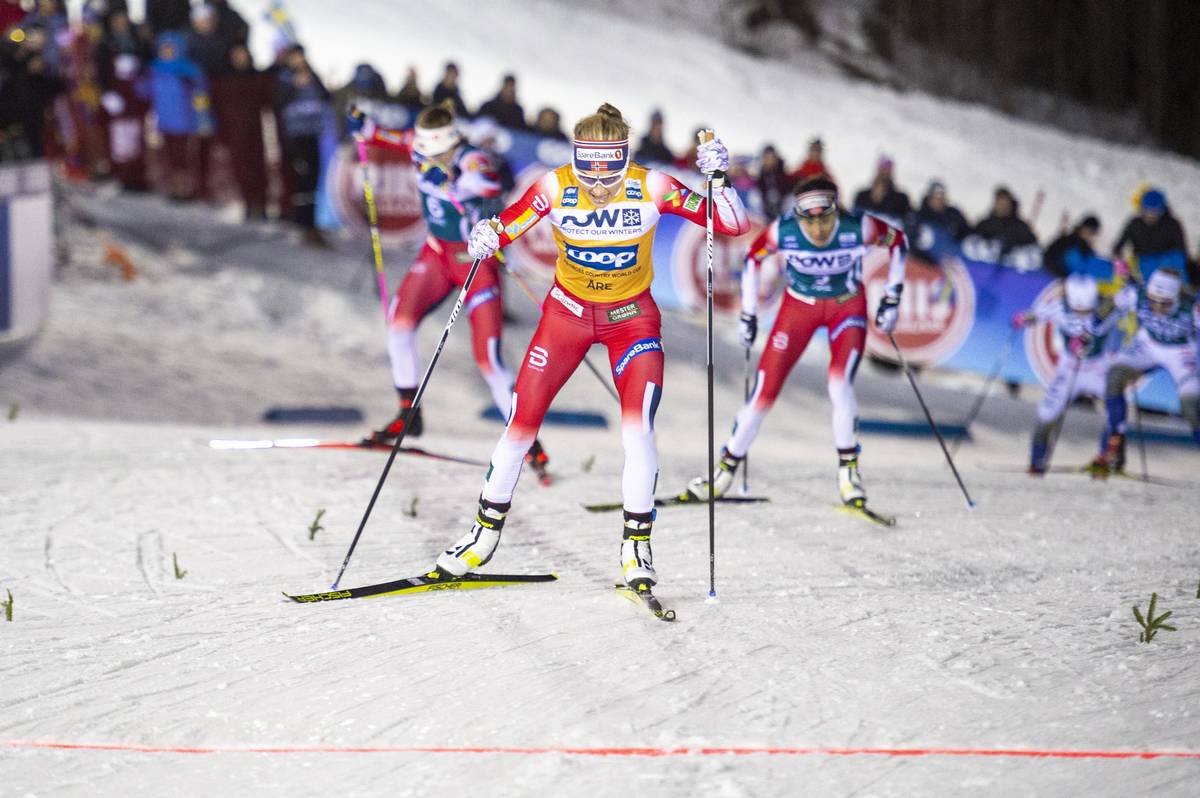
    Therese Johaug, untouchable during Stage 6 of the Ski Tour 2020. (Photo: NordicFocus)

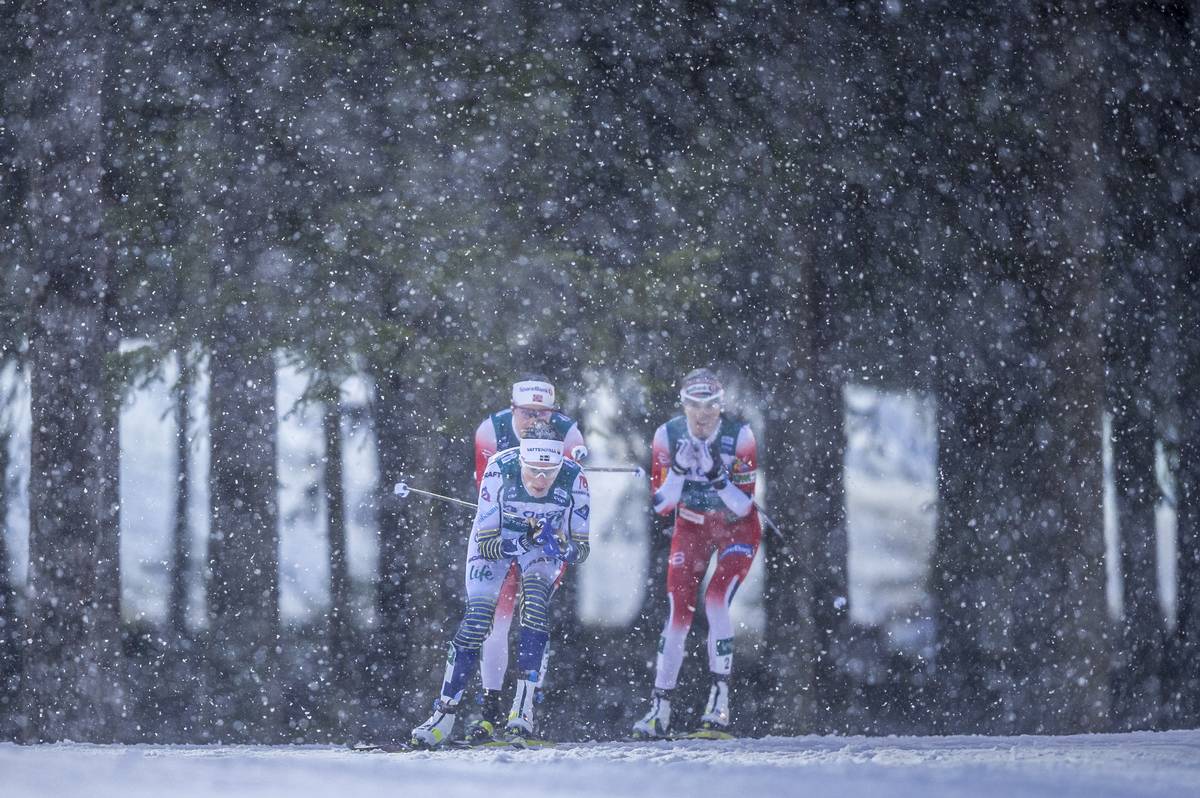
    We’ll start with the weather: think all over the place. A moving target for meteorologist with moisture spitting from the skies, and air masses swirling this way and that making the trees sway like a mamba line along the course. A wax tech’s nightmare scenario? Yes. It certainly trended in that direction.  

    By all measures, this was Therese Johaug’s, Norway’s latest version of a cross-country skiing record-breaker, stage and tour. Of six stages total, she won five outright, with the lone exception, Saturday’s Stage 5 classic sprint in Trondheim.

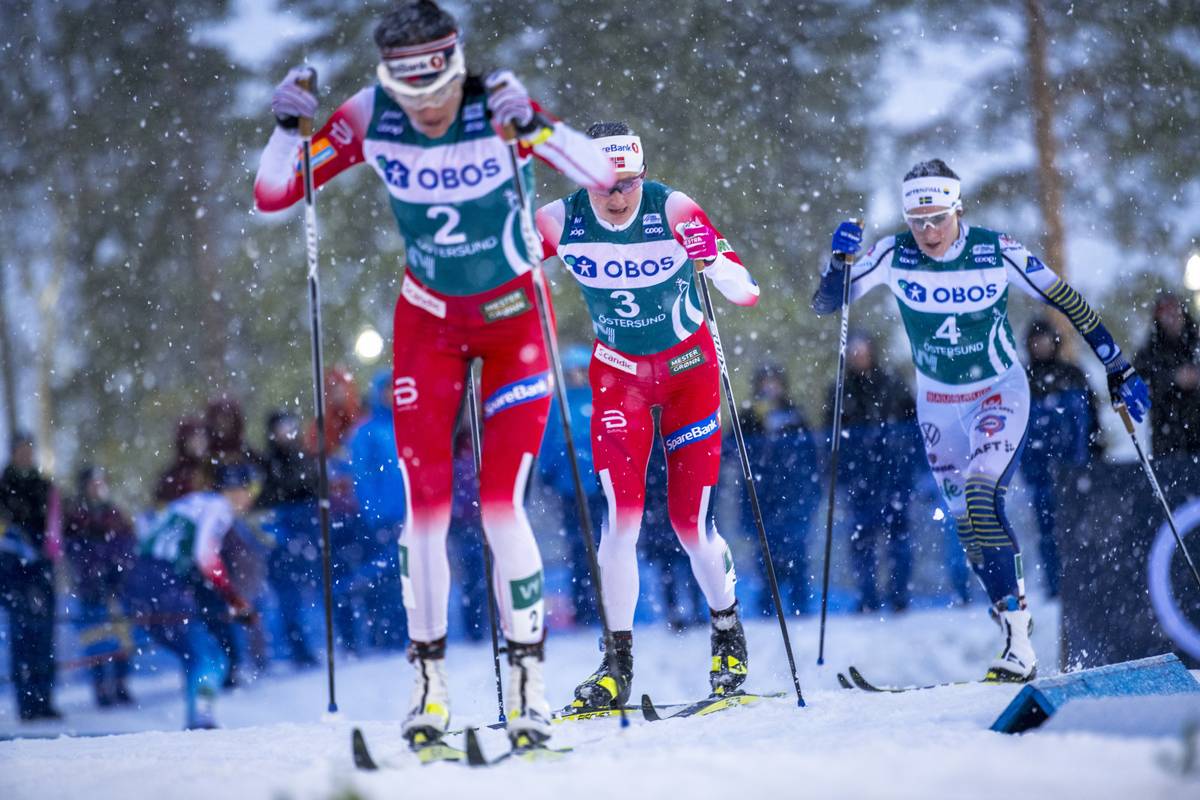
    Stage 6 featured a 15 k classic pursuit. Call it a pursuit, however, on the race’s sharp end, this was a runaway. Although the field was, in theory, pursuing Johaug, she simply put more time into her challengers on Sunday. She began 2:33 ahead of Norwegians Heidi Weng in second, while Ingvild Flugstad Østberg set off another second back. 

    Johaug expanded her lead at the finish, by over a minute, to Weng and Østberg. Johaug won the pursuit in 41:13.8. Weng placed second (+3:40.8) with a slight gap over Østberg, who toed the line 0.7 seconds further back. Sweden’s Ebba Andersson, the day’s fourth starter at 4:48, lost time to0, finishing 5:54.3 back to end the Ski Tour in fourth overall. 

    “I felt really good today and the waxers had done a really good job the whole Ski Tour and today as well I have the perfect skis,” Johaug told FIS after the race. “When the skis are good and the shape is good I can just go out there and enjoy all the people that come here and cheering us.”

    As far as time of day, Johaug took that prize as well. However, Norway’s Astrid Uhrenholdt Jacobsen placed fifth overall and had the second-fastest race time, 44.8 seconds off Johaug’s winning mark. Krista Pärmäkoski of Finland notched the third-fastest time of day (+1:04.4). 

    Jessie Diggins of the U.S. was the top placed North American in sixth (+8:40.1). (She skied the 17th fastest time of day.) 

    “Today, like yesterday, was a crazy day in terms of weather and waxing. It kept snowing on and off, the sun coming out and then the wind picking up as more snow came down! I was pretty much skiing an individual start race as I was alone the entire time, but I was really proud of my pacing and efforts as I held my placing without anyone to work with. There was a really tricky time in the middle of the race when the skis weren’t kicking very well (for much of the field, I think) but I was able to refocus and reset and keep pushing as hard as I could.

    “As for the overall tour, I’m really happy with my efforts and how I hit my goals for every race. One of my big goals was to see each day as an entirely separate opportunity and to not put pressure on myself for the overall tour, since there are so many factors that I can’t control that play into that placing. But by hitting my own process goals for each race and staying consistent I was able to have a tour that I’m proud of.

    “I’m really proud of our tech team and coaches for their tireless efforts day in and day out through this tour. It’s been exhausting but they’re the hardest working guys out there!”

    Sadie Maubet Bjornsen ended her tour in 10th (+9:43.8). With the big time gaps, the second wave of skiers (the mass start) began with Pärmäkoski in bib 13, starting at 8:08 back. Maubet Bjornsen (bib 12), began 16 seconds ahead and was the initial target of the wave starters. Maubet Bjornsen held off a charging Pärmäkoski for over 5 k. 

    “Wow, I made it!! That was one heck of a tough tour! Things were looking mighty rough to begin with, but I knew I had to just keep fighting and believing!,” Maubet Bjornsen emailed. 

    “But among some challenging times, there were some glimmering hopes in there. Tours are my favorite types of racing, because you have to be so resilient and such a fighter. Day after day, you have to put your fatigue and emotions aside, and just stay so positive. 

    “The tummy troubles at the beginning of the tour were particularly tough! It was scary to start a tour so depleted, but I was thankful we had our nutritionist, Susie Parker Simmons around to help me stay on my feet! From there it was just a matter or fighting for every second from there on.

    “Today was a totally wild scene! Conditions were constantly changing, and it was hard to find the perfect skis! I knew the name of the game was to just keep fighting, because everyone would be struggling at some point out there. I managed to find something to work, and went through some highs and lows out there in the 15k which brought me to 10th overall in the tour! I’m super happy and satisfied with that, given the little fatigue hole I had to crawl out of this past month. Thank you to our team for helping make a tricky classic day at the finish of the tour possible to fight with the others. 

    “I’m looking forward to taking a rest now, and finding the energy to finish the end of the season strong, for the third tour of the season. 

    “Thanks to the Ski Tour 2020 for bringing some different types of racing. While it wasn’t always the best type of races for my strengths, it was so refreshing to visit some new locations with some different types of events! These are some of my favorite memories this season! 

    “And of course, hugest thanks to the staff. We couldn’t race day after day like this without them!!! They are the heroes.”

    Sadie Maubet Bjornsen (bib 12) racing to 10th overall in the Ski Tour 2020. (Photo: NordicFocus)

    Rosie Brennan, starting in bib 10, 7:27 behind the first starter Johaug, placed 12th (+9:53.3).

    “Today was a very challenging day,” Brennan wrote in an email. “Due to the massive time gaps in the overall, the wave started at bib 13 so I had a big pack starting not too far behind. The conditions were very challenging with snow, sun, rain and everything in between and some very icy tracks. I did my best to stay in front of the wave but just didn’t have the skis or the energy to make it happen today. I am very disappointed in myself. After having a great tour, it was hard to end on this note, but I am doing my best to look at all the positives from the tour as a whole and make a nice little work list to improve on the things that were so tough today.”

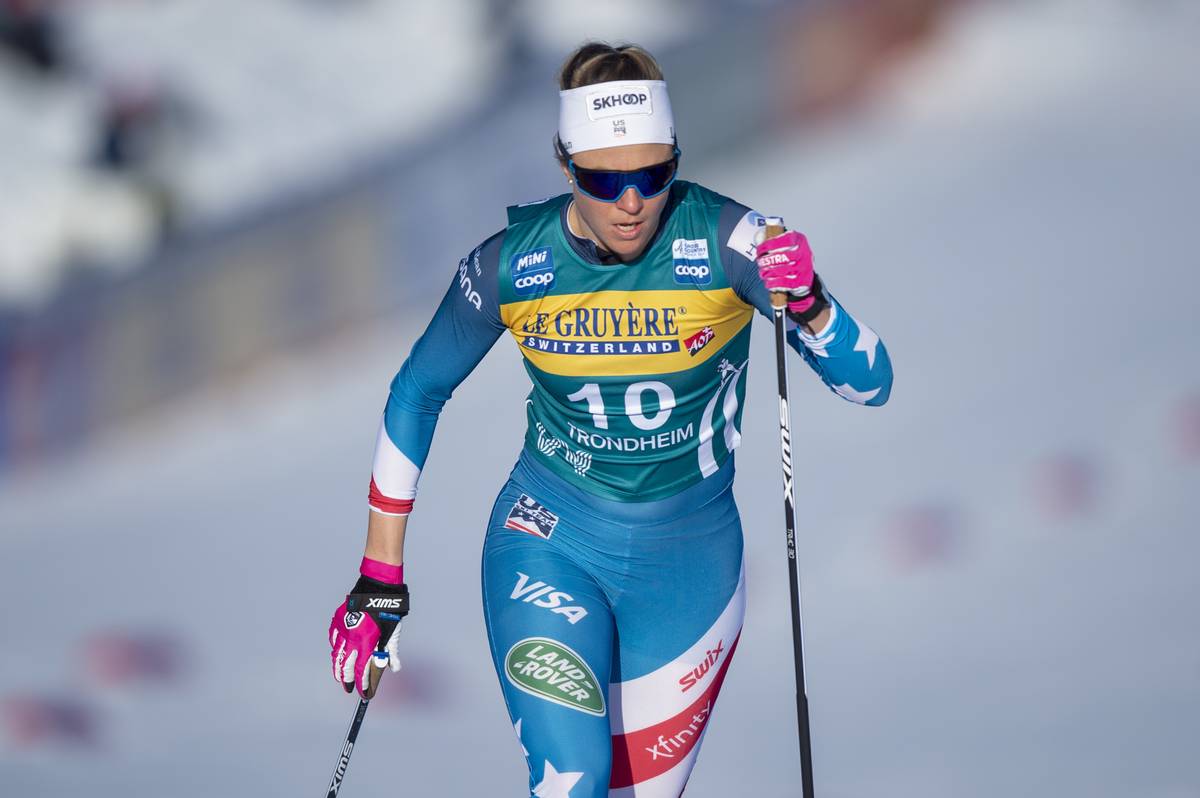
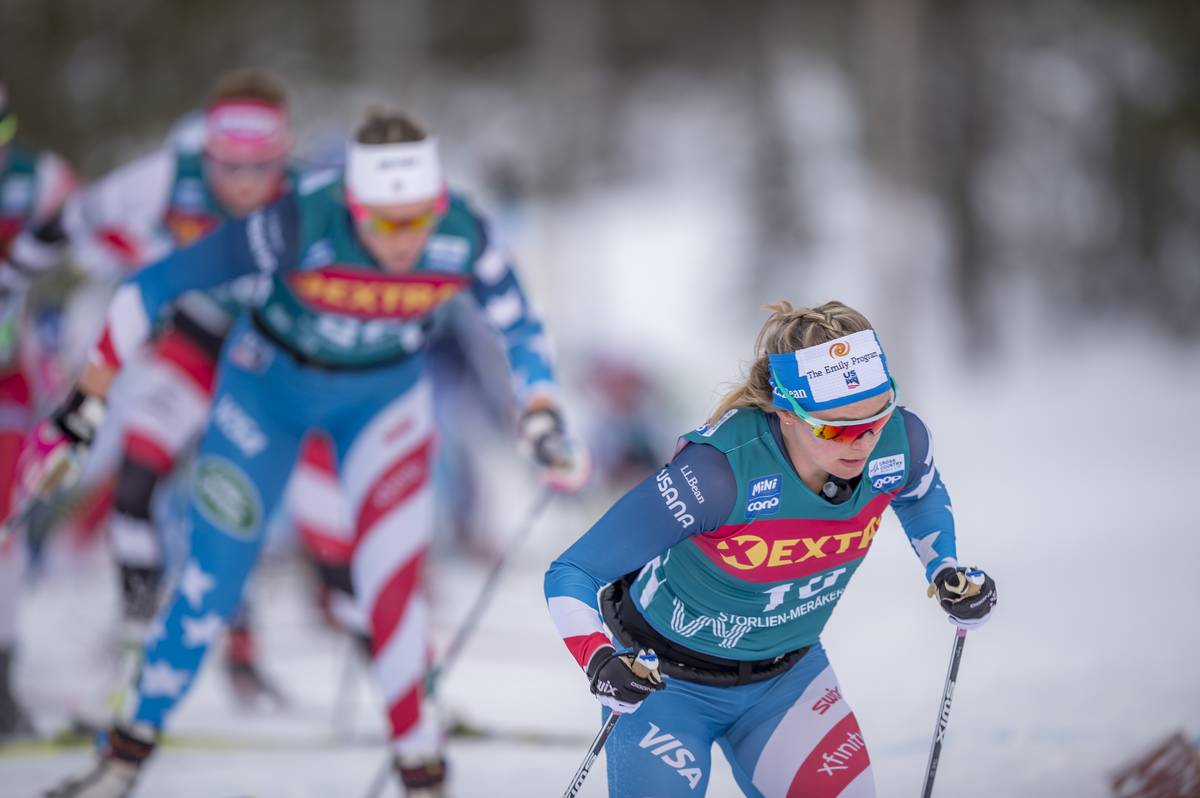
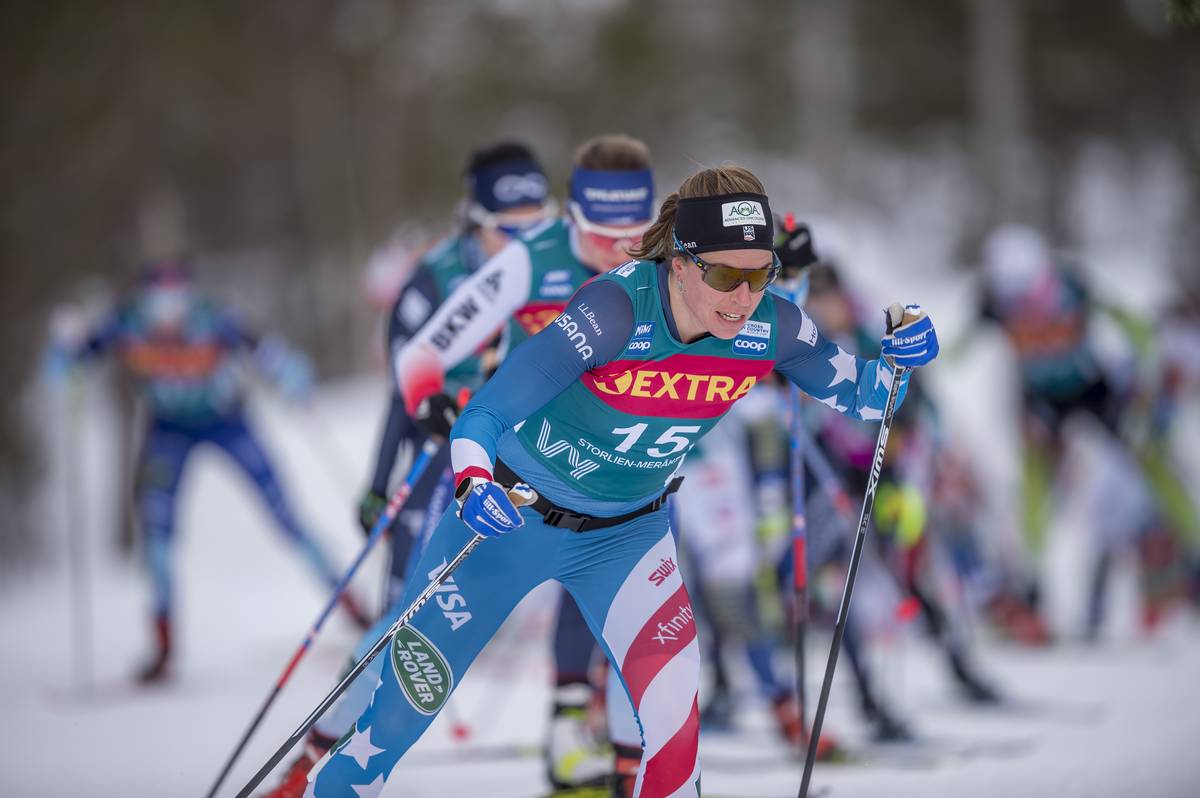
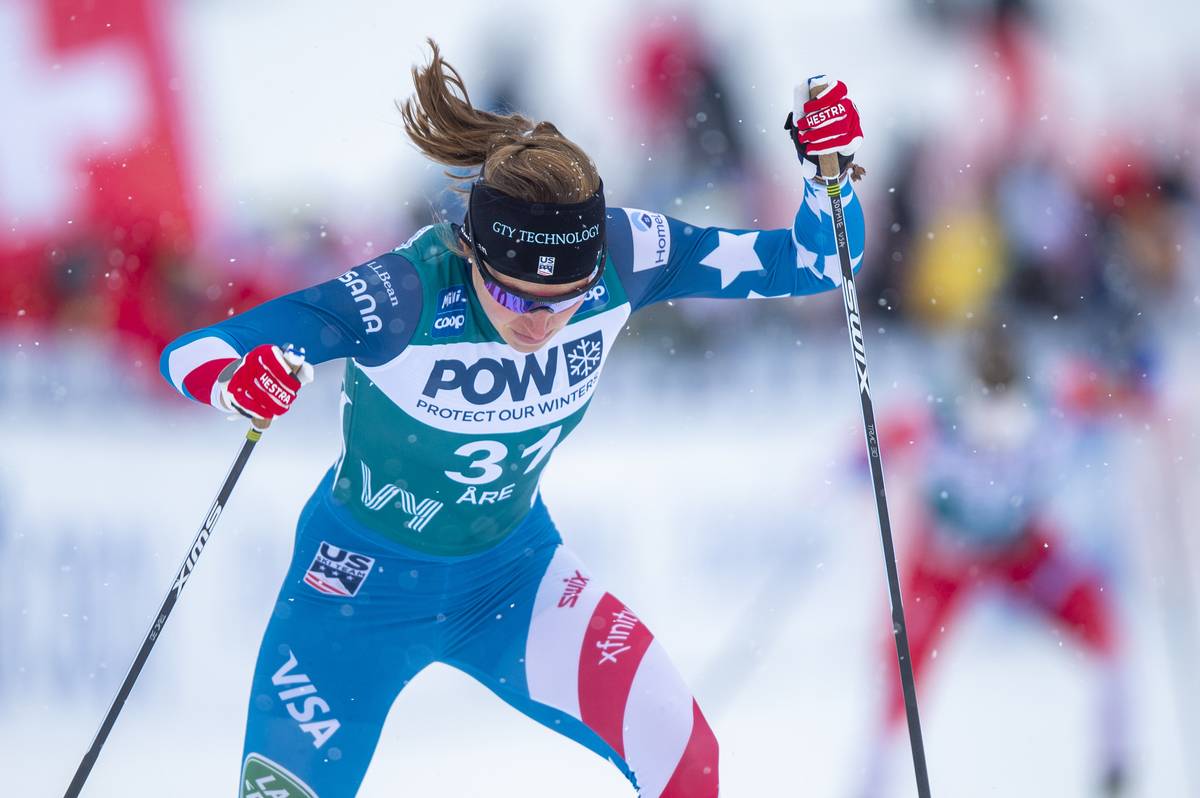
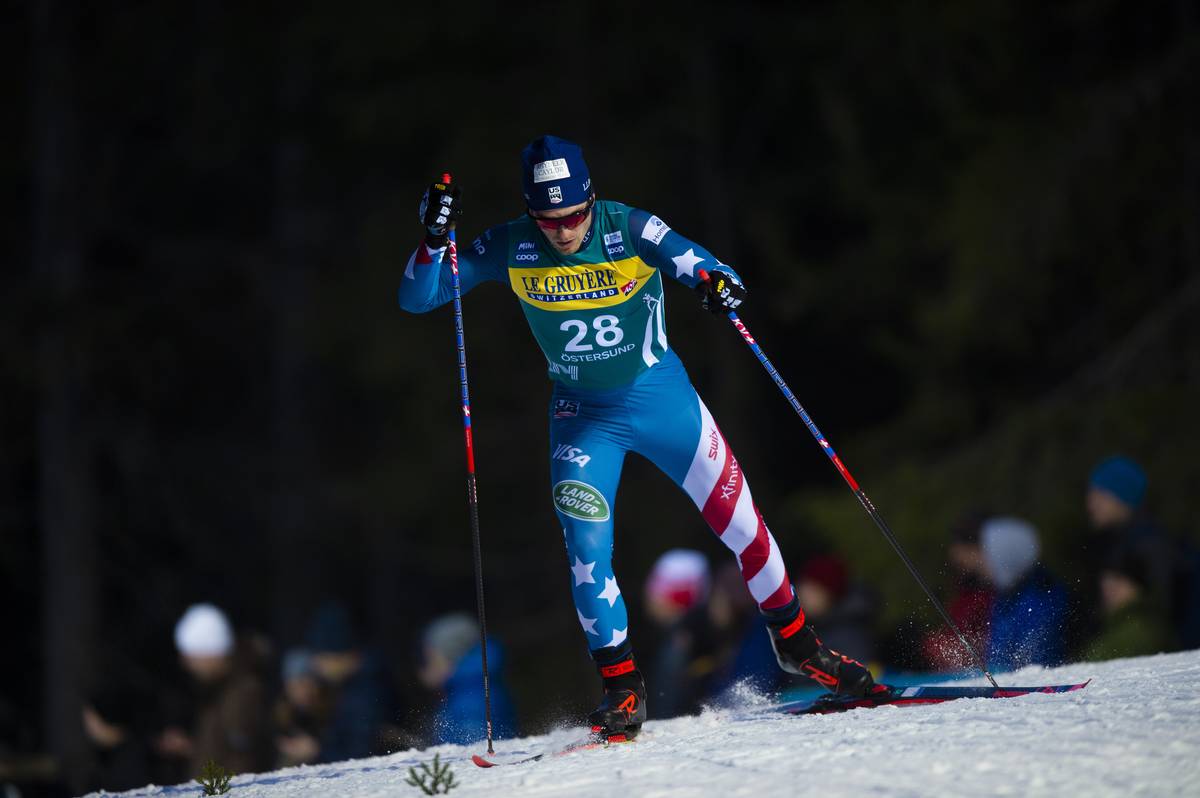
    Rosie Brennan (stars and stripes) during Stage 6 of the Ski Tour 2020. (Photo: NordicFocus)

    Also for the U.S., Julia Kern placed 30th (+14:51.4), Caitlin Patterson 36th (+16:38.4), Katharine Ogden 42nd (+20:26.6), Rosie Frankowski 43rd (+20:36.7), Sophie Caldwell 44th (+21:41.2), and Alayna Sonnesyn 48th (+24:34.6). 

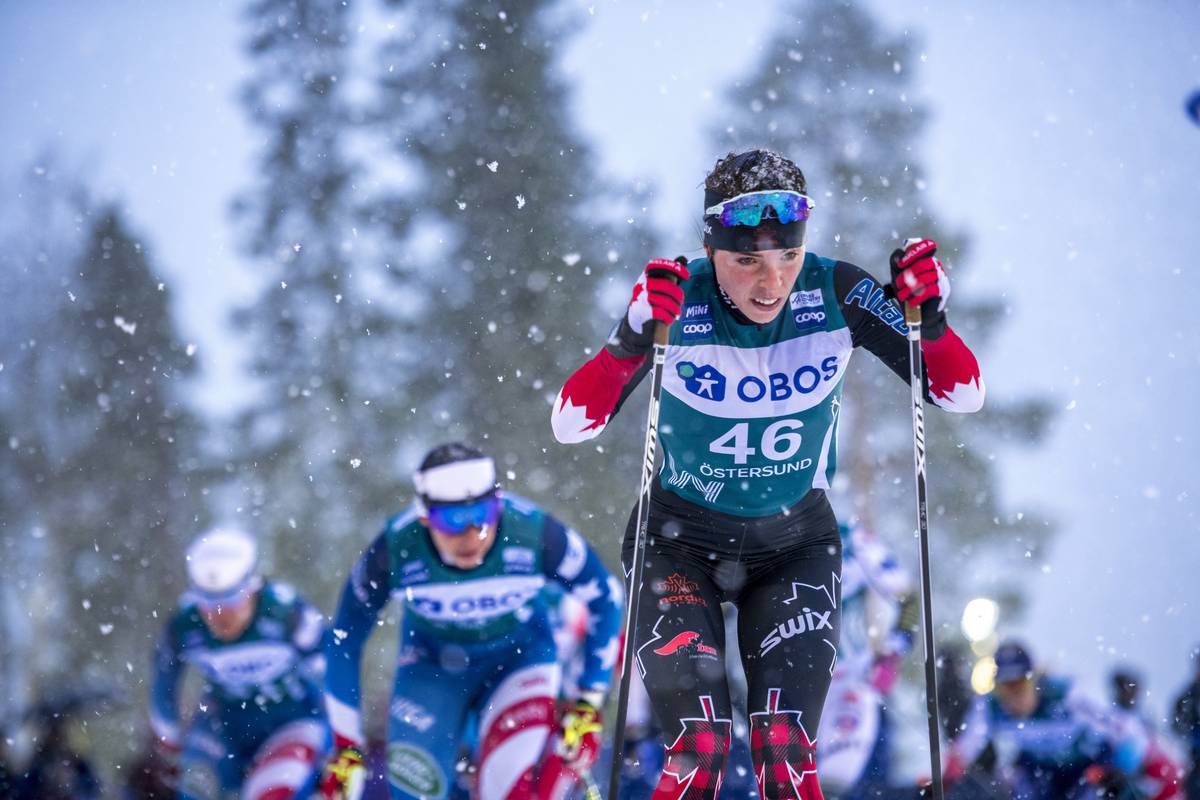
    Canada’s Katherine Stewart-Jones placed in the points for the tour overall, by finishing 29th in the pursuit (+14:46.3). Cendrine Browne was 33rd (+15:47.5), and Emily Nishikawa 35th (+16:08.4). 
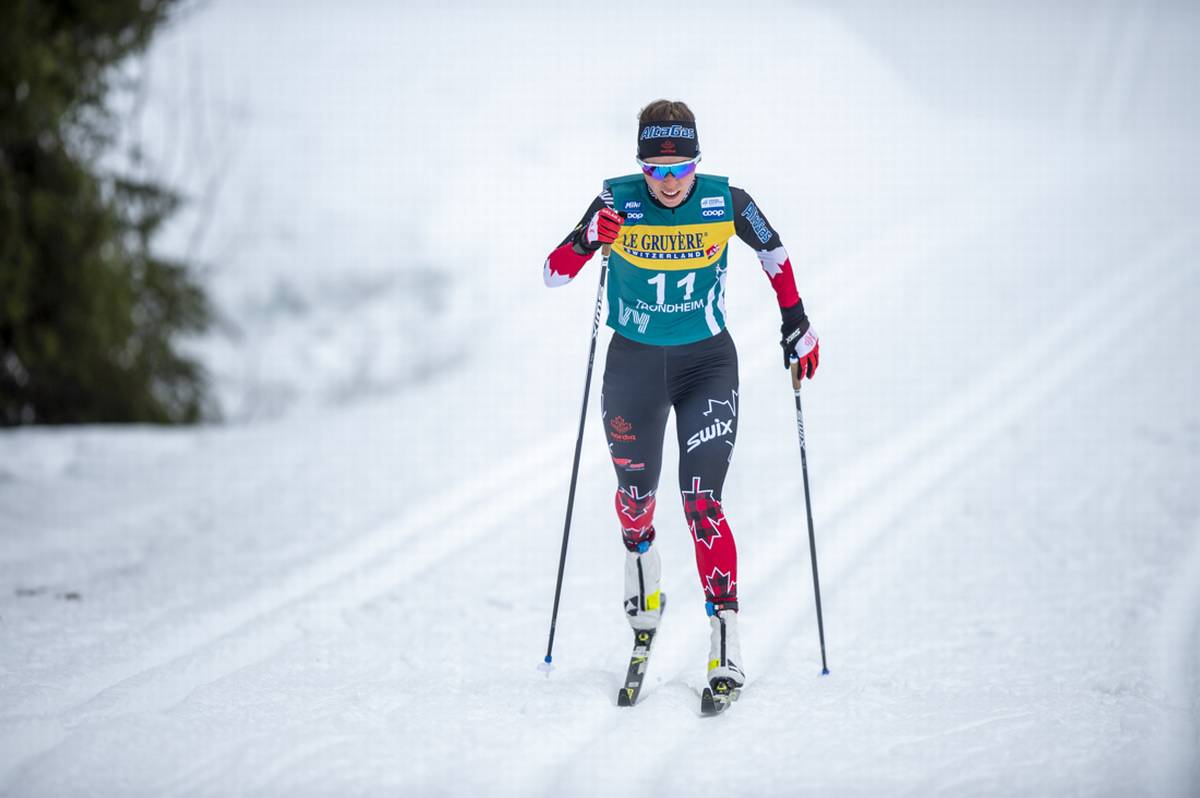
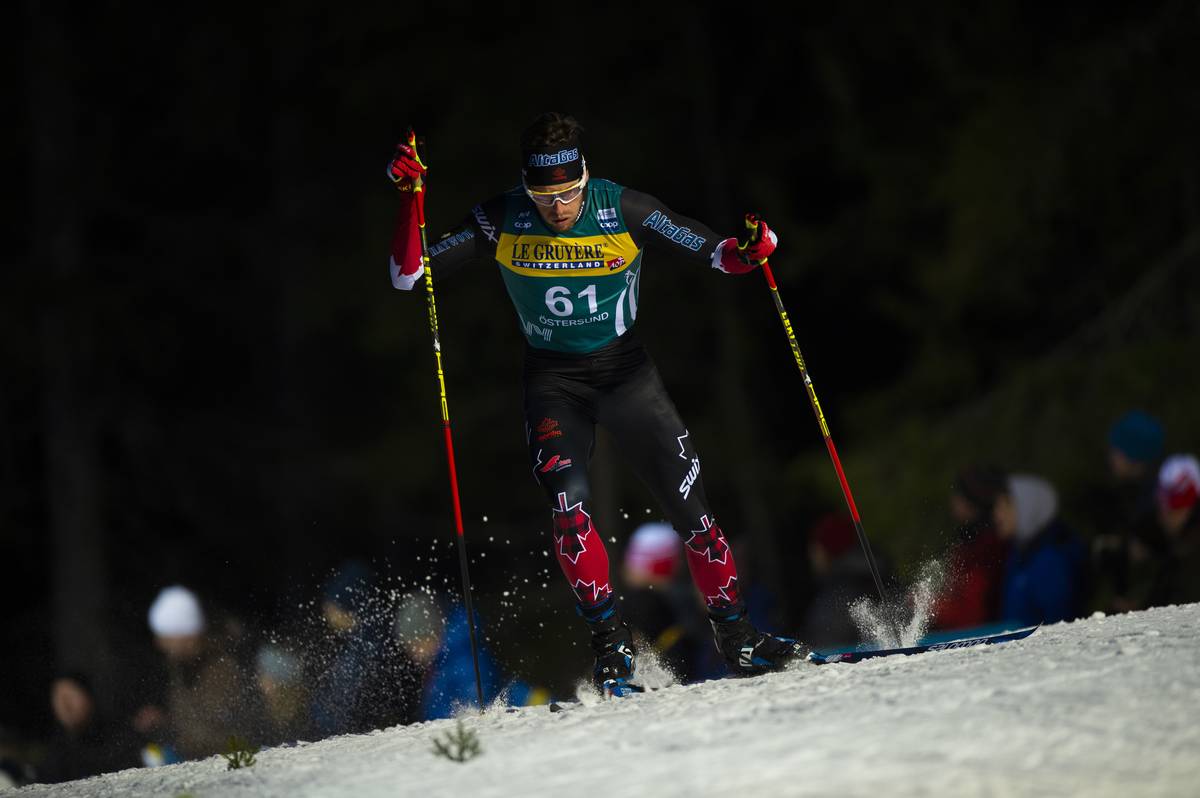
    Katherine Stewart-Jones during Stage 5 of the Ski Tour 2020. (Photo: NordicFocus)

    This stage concludes the Ski Tour. Racing continues in Lahti, Finland next Saturday. 

    Results | Overall Standings | Winner of the Day
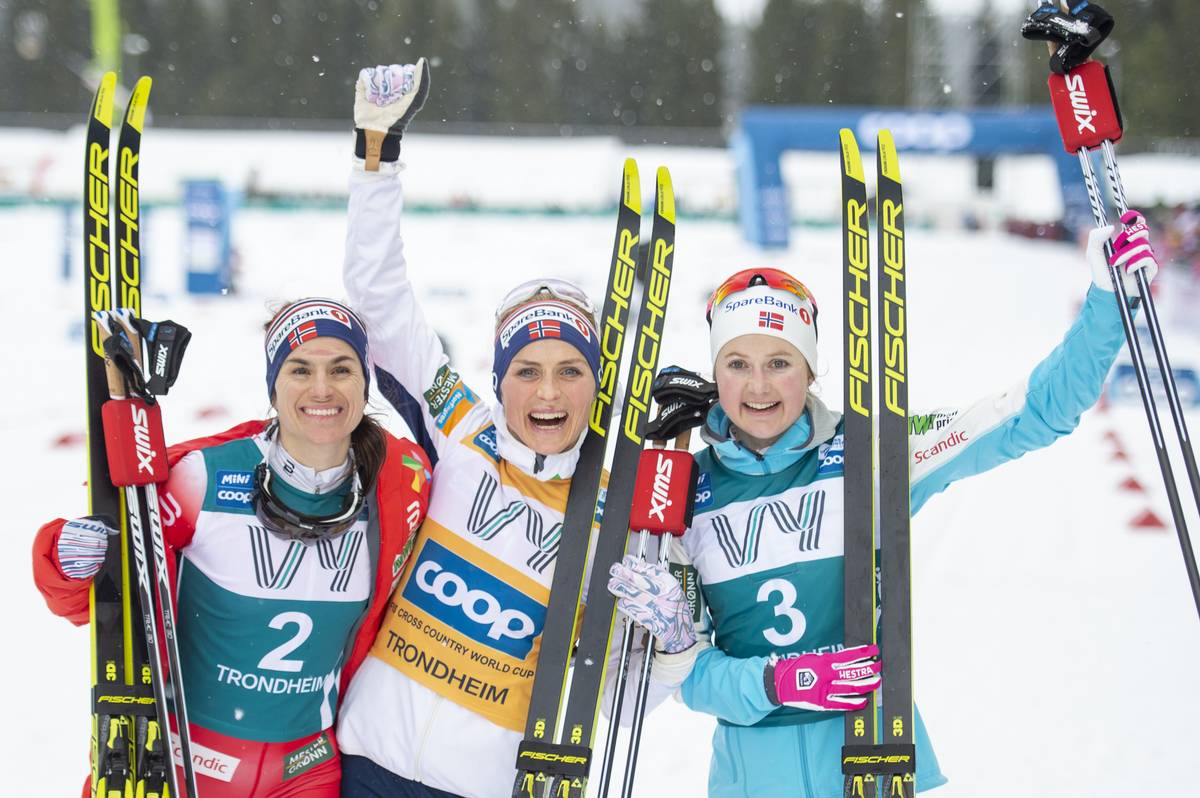
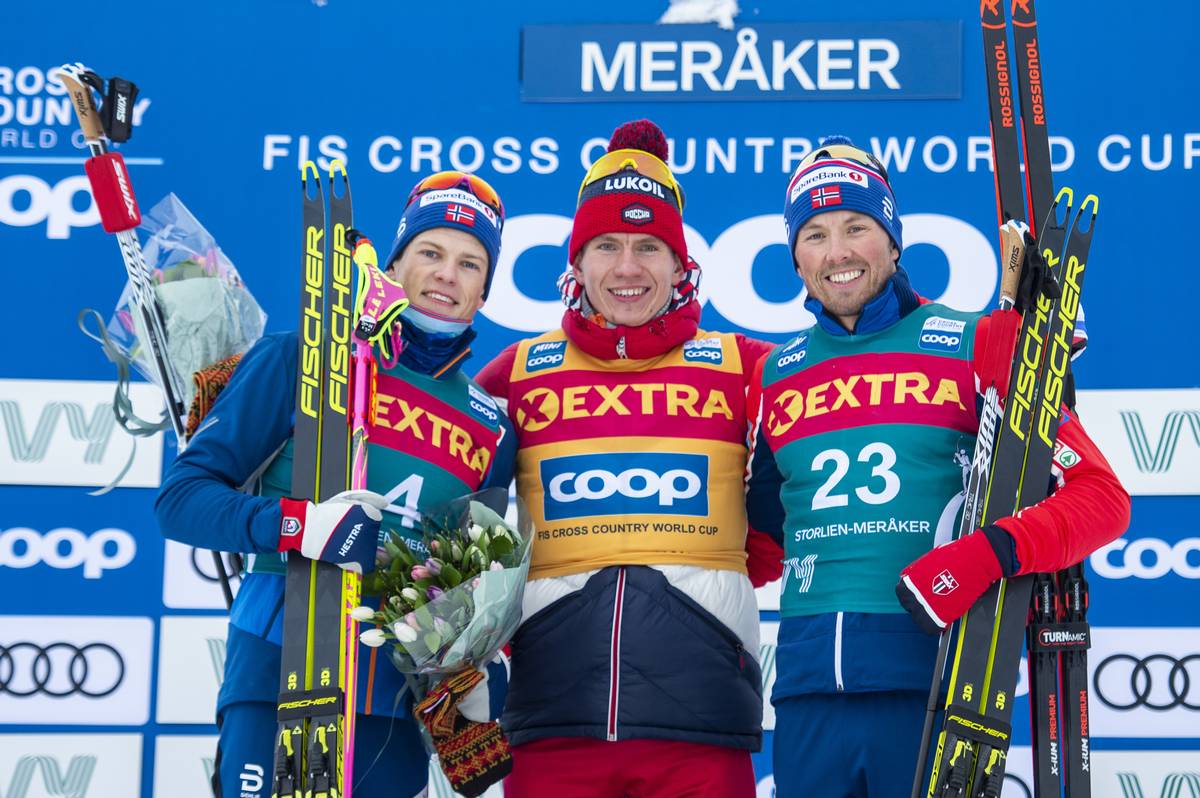
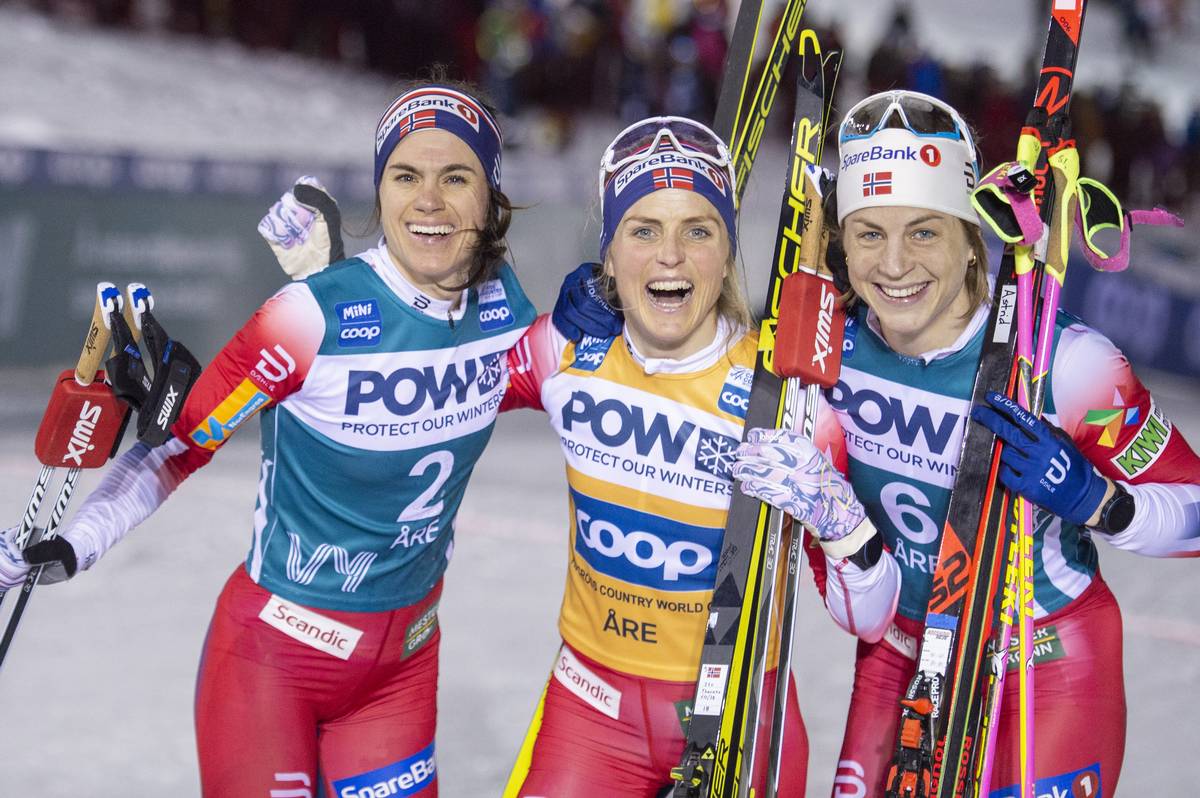
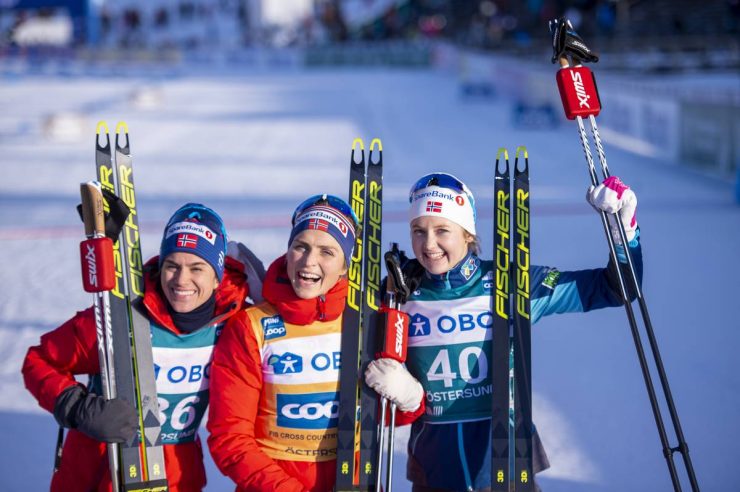
    The women’s Stage 6 and overall Ski Tour 2020 podium: Heidi Weng (NOR) in second, Therese Johaug (NOR) first, and Ingvild Flugstad Østberg (NOR) third, (l-r). (Photo: NordicFocus)
  • Falla Steps up For the Trondheim Win; Five U.S. Skiers in the Heats

    Falla Steps up For the Trondheim Win; Five U.S. Skiers in the Heats

    The day began in Trondheim with a centimeter of snow, which then transitioned to big blue skies for the thousands of fans attending the fifth stage of the Ski Tour 2020, a 1.5 k classic sprint. The Norwegians can throw a cross-country race party. The scene, despite the different setting, was reminiscent of the festive cowbell and camp-out sideshow of Holmenkollen’s Frognerseteren. It’s not quite the Yankee stadium of cross-country skiing, but a sign that in the hot-beds of the sport, fans arrive in droves. 

    The sprint course was more traditional, meaning this was no simple VO2 max test of an effort — that went down on Stage 3, in  Åre, Sweden as athletes ascended an uber steep alpine ski hill to close out that event. Trondheim’s classic sprint was bolstered by two punchy climbs on a three-terrace course, long and fast glide outs, and two speedy corners which swung skiers through a 180-degree direction change to keep it spicy.   

    Sweden’s Jonna Sundling laid down the fastest qualifying time in 3:22.75, shadowed by her teammate, Linn Svahn, 0.24 seconds back. Maybe, not surprisingly, Therese Johaug was the third-fastest qualifier, 0.83 seconds back. Johaug won her first career sprint on Stage 3 of the Ski Tour

    Jonna Sundling of Sweden in bib 1, during her quarterfinal of the Stage 5 classic sprint in Trondheim, Norway. (Photo: NordicFocus)

    The U.S. packed five skiers into the heats. Sadie Maubet Bjornsen qualified in 10th (+6.20). Rosie Brennan in 11th (+6.34), Sophie Caldwell 15th (+7.32), Jessie Diggins 20th (+8.58), and Julia Kern 24th (+9.54). Yet the story on the U.S. women’s side ended earlier than their highwater mark norm, which is most often, representation in the six skier final. In no uncertain terms, this is the golden age of U.S. women’s cross-country skiing. A stars and stripes void marked the semis and final. No U.S. skiers advance beyond the quarterfinals. 

    In the third quarterfinal, Kern and Brennan lost contact with Sundling and Tiril Udnes Weng who came in 1-2, respectively. Kern was fourth in the heat (+3.7), Brennan fifth (+7.71). 

    Maubet Bjornsen and Diggins fell off the pace as well in the fourth heat, placing fourth and fifth respectively. Both were over four seconds off Norway’s Anna Svendsen’s pace of 3:19.34 who won that quarterfinal. 

    22.02.2020, Trondheim, Norway (NOR):<br /> Sadie Maubet Bjornsen (USA) - FIS world cup cross-country, individual sprint, Trondheim (NOR). www.nordicfocus.com. © Thibaut/NordicFocus. Every downloaded picture is fee-liable.
    Sadie Maubet Bjornsen during the Stage 5 classic sprint in Trondheim, Norway. (Photo: NordicFocus)
    “It was an extremely tricky weather day with a combo of rain/snow/sun, and everything in between,” Maubet Bjornsen emailed.
    “I was excited to put together a solid qualifier, but felt like a few adjustments would allow things to be even better for the heats. My body felt sharp and powerful, so I knew the key for me was to be quick out of the start, and do my favorite thing… ski from the front. I was quick out of the start, but struggled to hold the speed up the first climb. Since climbing is generally my strength, it’s unclear whether it was skis, body, or both that held me back. But, that’s how ski racing is. You can’t overthink anything too much, you just keep believing, and chasing away!
    “It is the tour of crazies for me, so I’m going to let it go, and look on to “the chase” tomorrow. With the tour ending with a 15k classic, I am sitting just outside top 10 overall, and really hoping to climb my way within that tomorrow. Let’s see if I can channel all amounts of frustration towards some constructive racing in the final day!”

    The last U.S. athlete eliminated was Caldwell. She placed third in the fifth quarterfinal, 1.53 seconds back on Norway’s Heidi Weng in first. Caldwell placed 14th in the final standings, Maubet Bjornsen 16th, Kern 20th, Brennan 21st, and Diggins 23rd. 

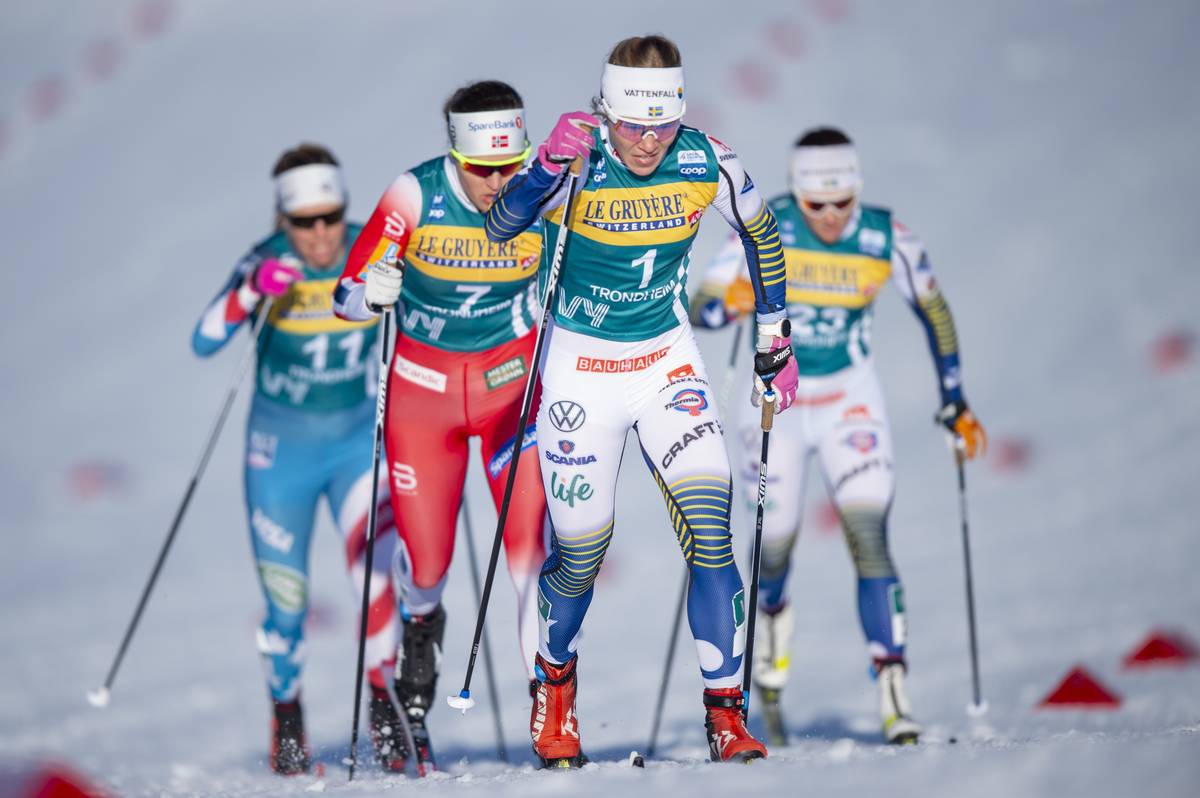
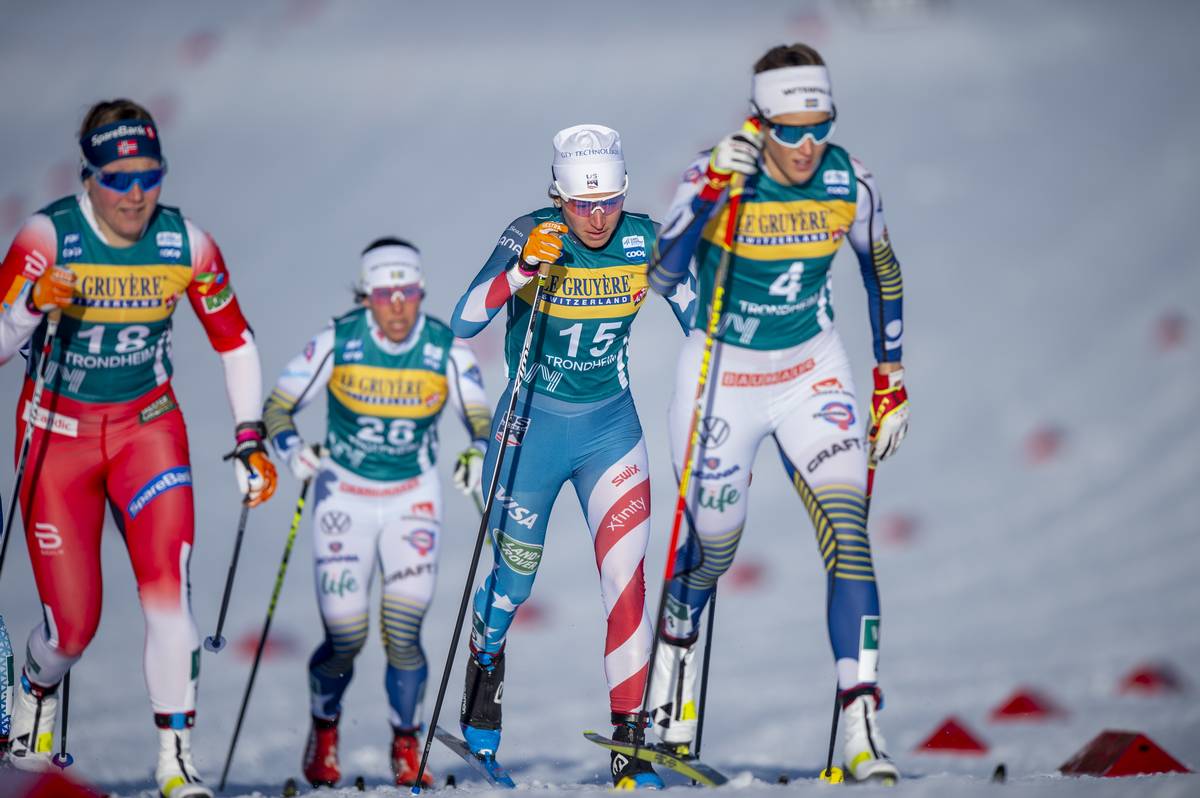
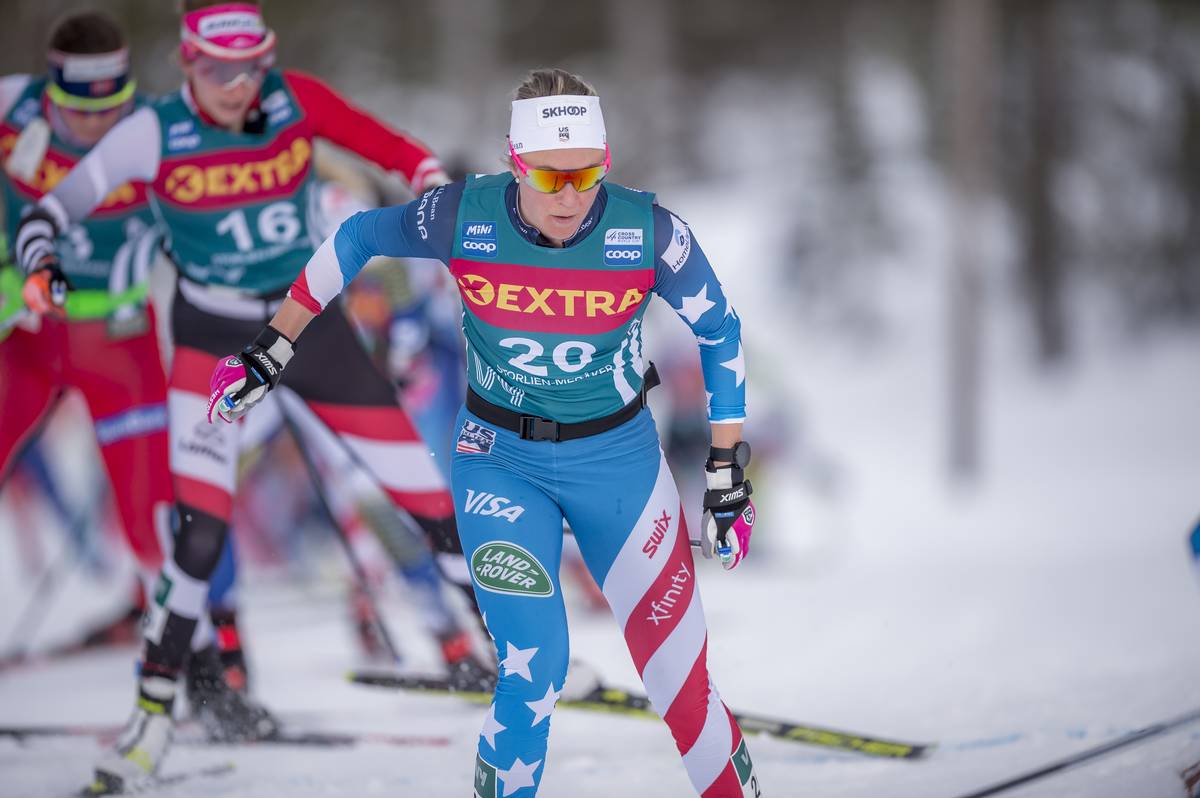
    Sophie Caldwell (bib 15) during her quarterfinal in Trondheim: Stage 5 of the Is Tour 2020. (Photo: NordicFocus)

    Post-race interview with U.S. World Cup Coach Matt Whitcomb

    Wintry weather moved in during the men’s quarterfinals. The blue-bird scene morphed quickly into an intermittent snowglobe. With the swift winds swirling around the stadium, the snow squalls eventually moved on as the semifinals progressed. 

    The 12 skier field in the two women’s semis consisted of six Norwegians, four Swedes, and two Swiss skiers in Laurien van der Graff in the first semi, and Nadine Fähndrich in semi two.  Fähndrich kept Swiss hopes alive by advancing to the finals after winning her semi. 

    The first semifinal featured Norway’s Maiken Caspersen Falla and Sweden’s Sundling. These two athletes were the skiers to watch. For Falla, by her own high standards, this has been an offseason, as the young Swedish sprint team has pushed her aside for precious top-of-the-podium real estate. Falla won the opening World Cup sprint in Ruka, Finland, otherwise, it’s been a first-place void for the former Crystal Globe sprint winner.

    In bib 12, Maiken Caspersen Falla strides it during her quarterfinal in Trondheim. (Photo: NordicFocus)

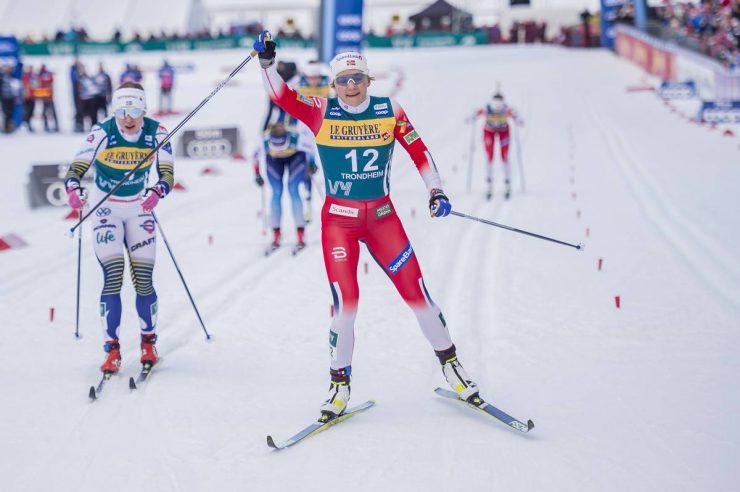
    In Falla’s semi, she and Sudling took first and second, respectively, with Astrid Uhrenholdt Jacobsen and Linn Svahn of Sweden in close contact, only a few tenths of a second back. In the final, Falla was locked in. Although at moments Sundling was side by side with Falla, the Norwegian dictated the decisive move off the front. Over the second climb, at roughly 2:25 into the race, Falla powered over the hill and into the glide out transition with only Sundling able to match two meters back. 

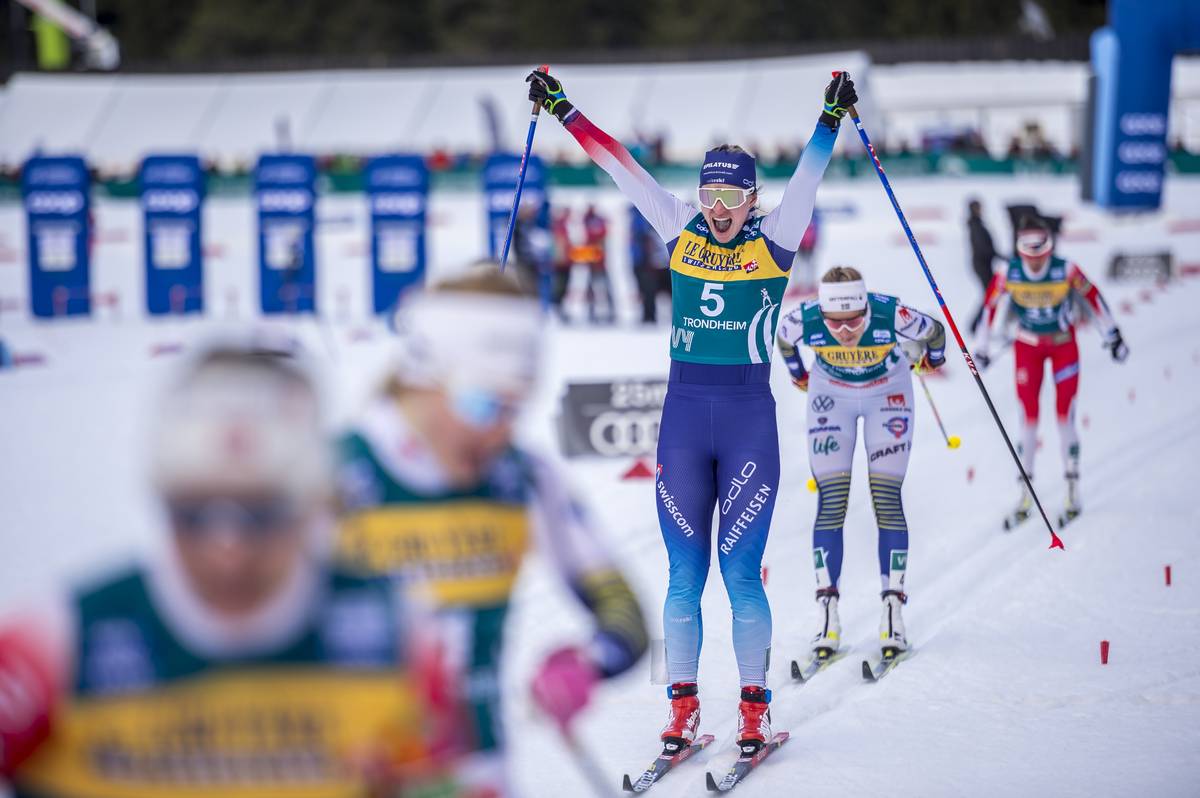
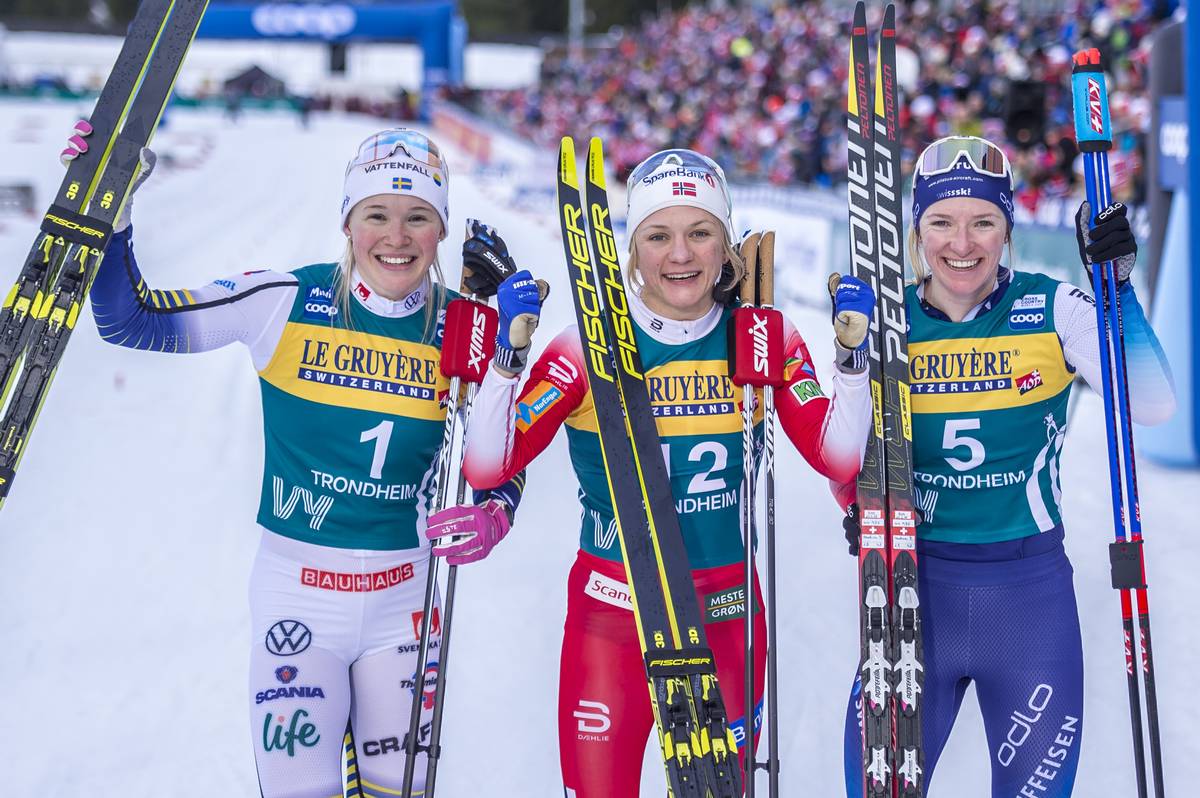
    Falla took the win in 3:15.55 with Sundling in second (+0.48). Fähndrich was third (+2.88), Anna Dyvik of Sweden fourth (+3.71), Svendsen fifth (+5.26), and Heidi Weng sixth (+6.64). 

    “This feels always like the [World Championships] so crowded and so many people screaming my name at the start and after the finish,” Falla told FIS after the race. “It’s an amazing atmosphere and I’m so happy to be here. There has been some hard distance races for me now. The 30 k and also 10 k was really hard so I’m really happy that I stayed in the tour, didn’t go home and got this opportunity to win here and race in this amazing atmosphere.”

    This was Falla’s 21st individual sprint win. She sits second overall in total World Cup sprint wins. Marit Bjørgen of Norway still reigns with 40 World Cup sprint victories. For Fähndrich, this was her second career individual podium. Prior to her third place on Saturday, the Swiss skier posted up a second place in Cogne, Italy’s 2019 10 k classic for her first World Cup podium.

    Hands up: Nadine Fähndrich earns a third place for the Swiss in Trondheim. (Photo: NordicFocus)

    Katharine Ogden in 37th was the top-U.S. skier outside the top-30. Alayna Sonnesyn placed 42nd, Caitlin Patterson 48th, and Rosie Frankowski 51st.

    For Canada, Emily Nishikawa finished in 34th, Katherine Stewart-Jones 35th (+14.19), Cendrine Browne 40th, 

    The Ski Tour overall looks certain for Johaug who placed ninth in Saturday’s sprint. She leads with a total time of 2:19:28. Weng remains in second (+2:33), and Ingvild Flugstad Østberg third (+2:34). Østberg finished 22nd in Stage 5.  This Norwegian trio is the likely overall podium, as Sweden’s Ebba Andersson is fourth at 4:48 back. Racing concludes for the Ski Tour on Sunday with Stage 6, a 15 k classic pursuit for the women.  

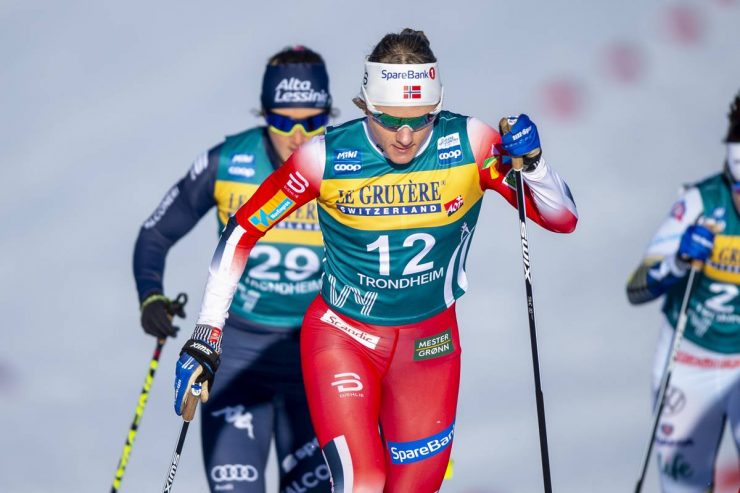
    Norway’s Therese Johaug (yellow bib) the Ski Tour’s overall leader was the third overall qualifier. (Photo: NordicFocus)

    Qualification | Results | Overall Ski Tour Standings 

    The women’s Stage 5 podium: Jonna Sundling (SWE) in second, Maiken Caspersen Falla (NOR) first, and Nadine Faehndrich (SUI) third, (l-r). (Photo: NordicFocus)
  • Bolshunov Goes Down; Klæbo on Form to Capture Tour Sprint Win

    Bolshunov Goes Down; Klæbo on Form to Capture Tour Sprint Win

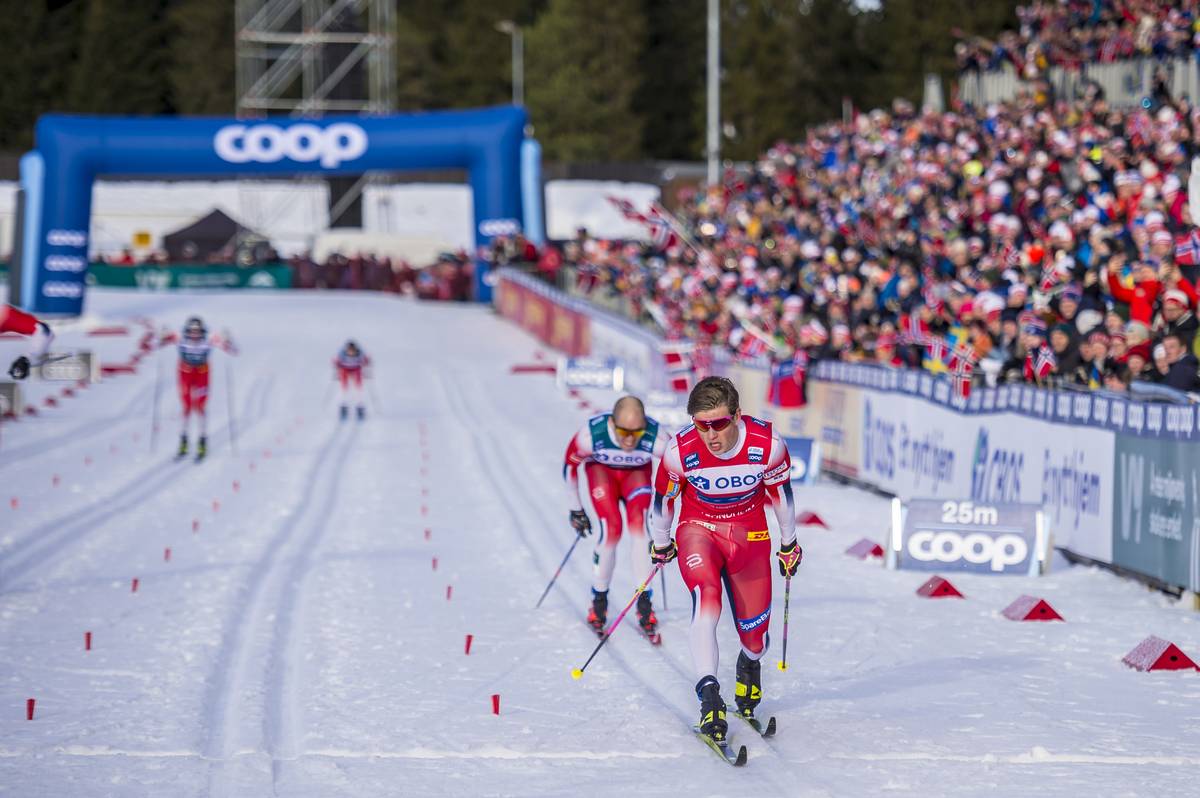
    Norway’s Johannes Høsflot Klæbo crossing the line first for the last time of the day on Saturday to win the men’s 1.5 k classic sprint final, Stage 5 of the Ski Tour 2020, ahead of his teammate Pål Golberg, in his hometown of Trondheim, Norway. (Photo: NordicFocus)

    Takeaways from Stage 5 (of 6) of the Ski Tour 2020? Alexander Bolshunov no longer has his minute-plus cushion to Pål Golberg in the overall, and Johannes Høsflot Klæbo is rounding into G.O.A.T. (Greatest-Of-All-Time) form.

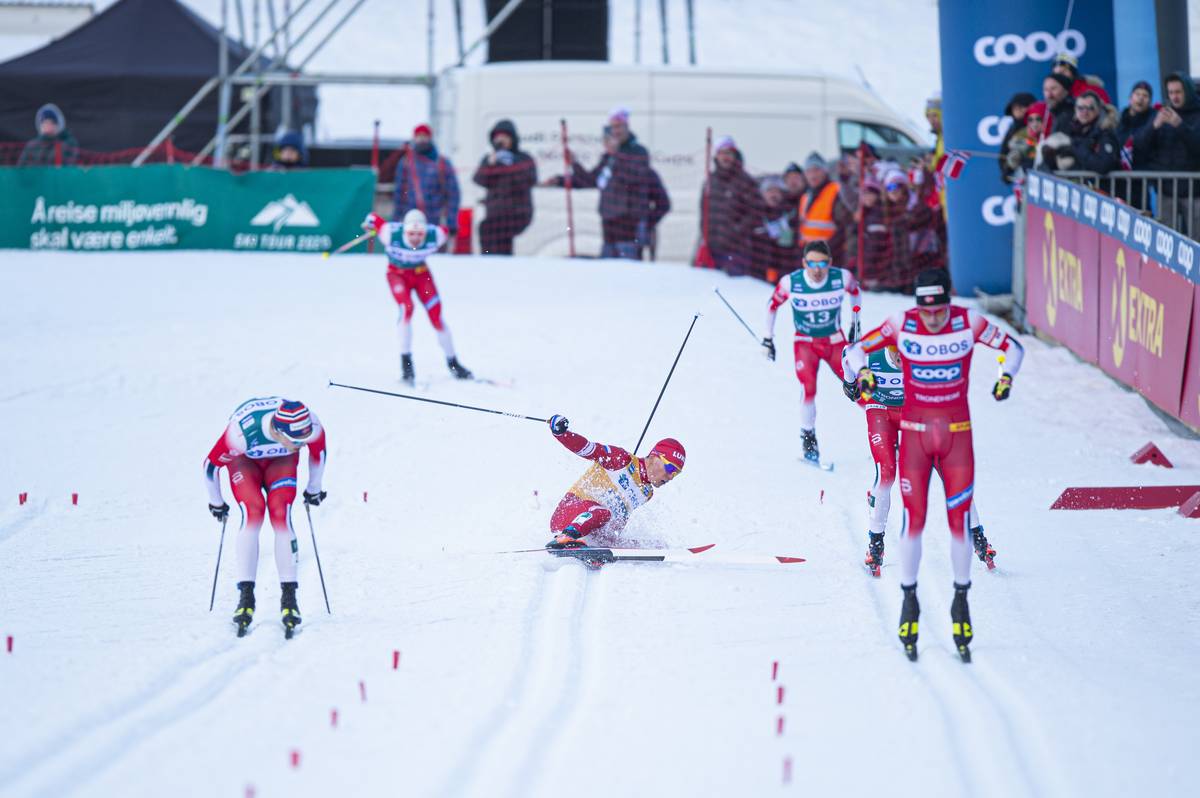
    The 23-year-old Bolshunov, a Russian powerhouse who won the Tour de Ski last month, ranks first in the overall World Cup standings, and has landed on the podium in four out of five races so far this month (before Saturday’s classic sprint), crashed and burned in Saturday’s semifinal. He took himself out while switching tracks with 100 meters to go, clipping his left leg with his right ski and falling out of contention (from fourth to sixth) in the finishing straight. That was the end of his day, and his 1:05-minute lead in the Tour standings was reduced to 34 seconds on Golberg, who kept himself in prime position by finishing second to Klæbo in the final.

    Russia’s Alexander Bolshunov (center) takes an untimely tumble with 100 meters to go in the first men’s semifinal of the 1.5 k classic sprint at the Ski Tour 2020 on Saturday in Trondheim, Norway. Up front, Norway’s Johannes Høsflot Klæbo (r) skis to first in the heat. (Photo: NordicFocus)

    Then there was Klæbo, also 23, second in the overall World Cup standings and a Norwegian celebrity in his hometown of Trondheim, who did what he does best — dominate a sprint race — in front of a slew of familiar faces. He had never won a race at home in Trondheim before, and he did so Saturday in the men’s 1.5-kilometer classic sprint for his 14th straight World Cup individual win and 49th World Cup podium.

    “I’ve been dreaming about this since I knew we were coming here,” Klæbo said of his latest victory in a post-race interview with the International Ski Federation (FIS) on Saturday. “So to be able to win here is just amazing, and I’m really proud to be able to win here today.”

    He started the day by winning the qualifier by more than 2 seconds (over fellow Norwegian Erik Valnes +2.42 in second), and later advanced comfortably out of the quarterfinals and semifinals to the final. In the first quarterfinal, Klæbo cruised to second place behind Golberg, after Golberg set the pace up front for the bulk of the nearly 3-minute race, before decisively winning his semifinal (after passing Golberg on the last climb) by 1.2 seconds.

    That semifinal saw five Norwegians — Klæbo, Golberg, Valnes, Finn Hågen Krogh, and Simen Hegstad Krüger — pinned against Bolshunov. They finished in that order after Bolshunov, who had qualified fourth and advanced in second behind Valnes in their quarterfinal, went down in front of the stands while Krogh and Krüger passed him by. Klæbo, who had the luxury and time to ease way off before the finish line, moved on to the final along with Golberg, Valnes, and Krogh. Bolshunov, who crossed the line nearly 17 seconds after Klæbo, did not, and he ended his day in 12th.

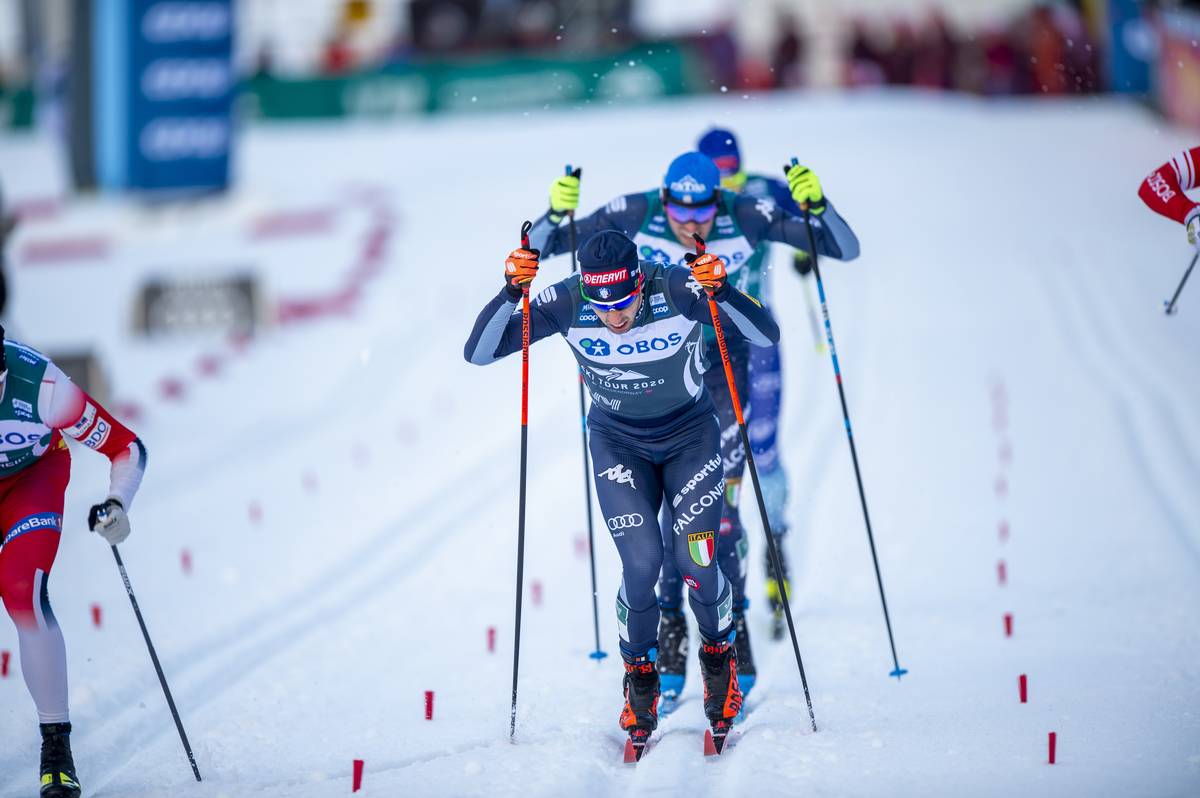
    Powering up in Trondheim: Federico Pellegrino of Italy, followed by teammate Francesco de Fabiani . (Photo: NordicFocus)

    The second semifinal was more diverse with two Italians — Federico Pellegrino and Francesco de Fabiani — going head to head with Norway’s Emil Iversen, Russia’s Gleb Retivykh, Finland’s Lauri Vuorinen, and Sweden’s Johan Haeggström. Wet snow that had begun in the later men’s quarterfinals had mostly stopped falling, and the sun began to poke through on the +3 Celsius afternoon.

    On an early climb, Haeggström fell to his knees and broke his pole while skiing at the back of the pack. He quickly received a replacement, but wasn’t able to regain contact with the group while Pellegrino took charge up front. Despite leading into the stadium, Pellegrino lost some steam in the finishing stretch while Iversen came from behind to cross the line first, 0.3 seconds ahead of Pellegrino and 0.6 seconds ahead of Retivykh. Iversen and Pellegrino advanced to a nearly all-Norwegian final, with five men in red against the Italian in dark blue.

    From there, it was another Klæbo jam sesh as the local hero set the tone in the final. Valnes initially led up the first climb while Klæbo, Golberg and Iversen followed closely. By the next uphill, Klæbo used his ferocious double pole to outmatch his teammates, who were still striding. Meanwhile, Pellegrino fell off the pace and into sixth. Klæbo kept the lead for the rest of the race, getting a gap on Valnes and Golberg on the descent into the stadium before running away with the win in 2:52:07. Golberg placed second, 1.2 seconds back, Valnes third (+1.6), Iversen fourth (+5.79), while Krogh, who also faded when Klæbo kicked into high gear, pulled some theatrics at the line and stalled before crossing 18.91 seconds back. Pellegrino finished last for sixth on the day, 22.78 behind Klæbo. That secured Klæbo’s spot as the men’s sprint champion for the Ski Tour 2020, while Pellegrino placed second, 13 points back, and Golberg was third, another 26 points back.

    “It was an amazing day for us Norwegians,” Klæbo told FIS. “We had really good skis today, and I think we have done something right. It was a really fun race, and I think it’s an amazing to see how many people that actually come here and cheer for us. It’s something we really appreciate.”

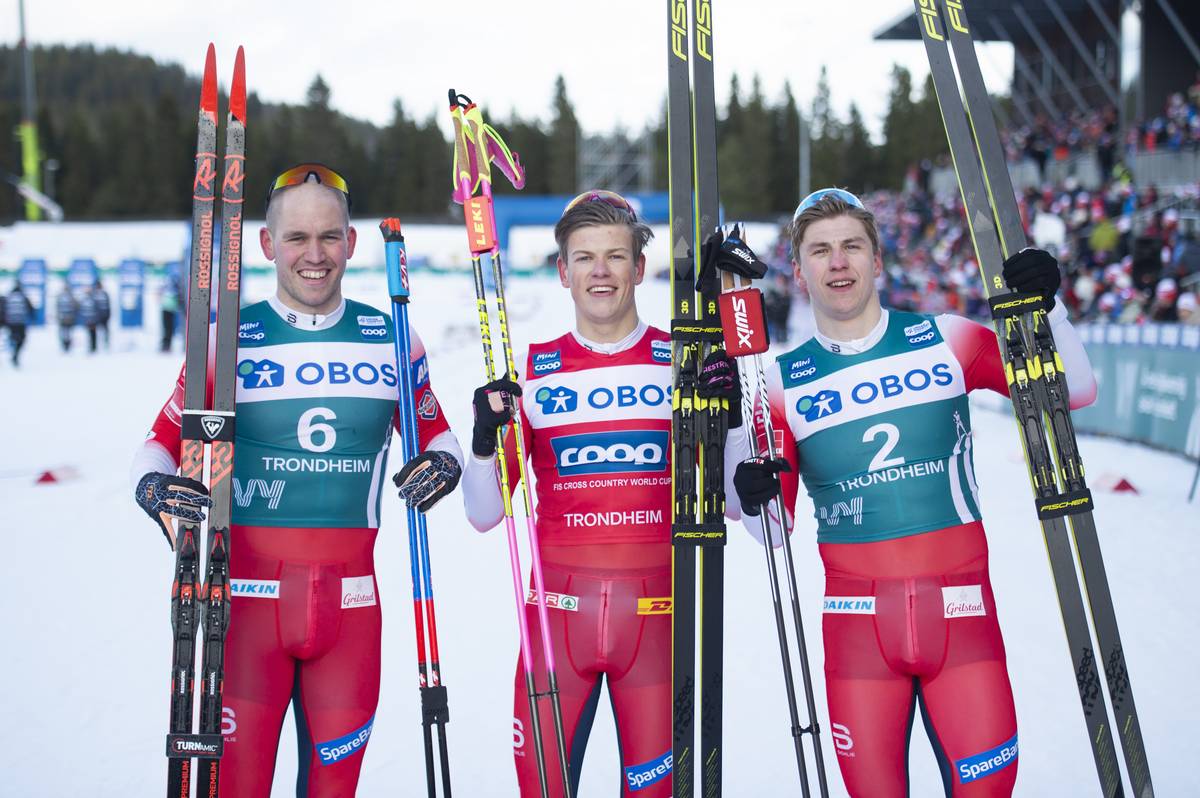
    The all-Norwegian, Ski Tour 2020 Stage 5 men’s 1.5 k classic sprint podium on Saturday in Trondheim, Norway, with Johannes Høsflot Klæbo (c) in first, Pål Golberg (l) in second and Erik Valnes (r) in third. (Photo: NordicFocus)

    In the overall Tour standings, Klæbo is up to sixth (+2:00.0) with one race — a 30 k classic pursuit — remaining on Sunday. Golberg will start 34 seconds behind Bolshunov, while Krogh in third overall will start just over a minute later (+1:35), ahead of Sjur Røthe (+1:40) and Martin Løwstrøm Nyenget (+1:46), also from Norway. In fact, eight of the top 10 men in the overall Tour standings are Norwegian. The other two are Russian: Bolshunov and Andrey Melnichenko (9th place).

    American Logan Hanneman (APU) racing to 34th in the men’s 1.5 k classic sprint qualifier at Stage 5 of the Ski Tour 2020 in Trondheim, Norway. (Photo: NordicFocus)

    No North Americans qualified for the heats on Saturday, with Alaska Pacific University skier Logan Hanneman coming closest in 34th, 0.9 seconds out of 30th and 14.38 seconds behind Klæbo. Fellow American Kevin Bolger placed 48th (+17.28) while Canada’s Russell Kennedy followed in 49th (+17.43) in the qualifier. American Ben Lustgarten finished 57th (+18.81) while Canada’s Alexis Dumas, Evan Palmer-Charrette and Ricardo Izquierdo-Bernier placed 59th (+19.6), 61st (+20.54) and 62nd (+20.74), respectively. American David Norris was 69th (+23.81), while Simi Hamilton did not start and is thus out of the Tour.

    According to U.S. Ski Team coach Matt Whitcomb, Hamilton and Bolger have mild head colds, and Bolger and Hanneman, who rank 64th and 71st, respectively, out of 73 still in the Tour, will not start Sunday’s final stage.

    Stage 5 final results

    Stage 5 qualifier results

    Tour overall standingsTour sprint standings

  • Bolshunov Takes a Bold Flyer and the Stage 4 Win

    Bolshunov Takes a Bold Flyer and the Stage 4 Win

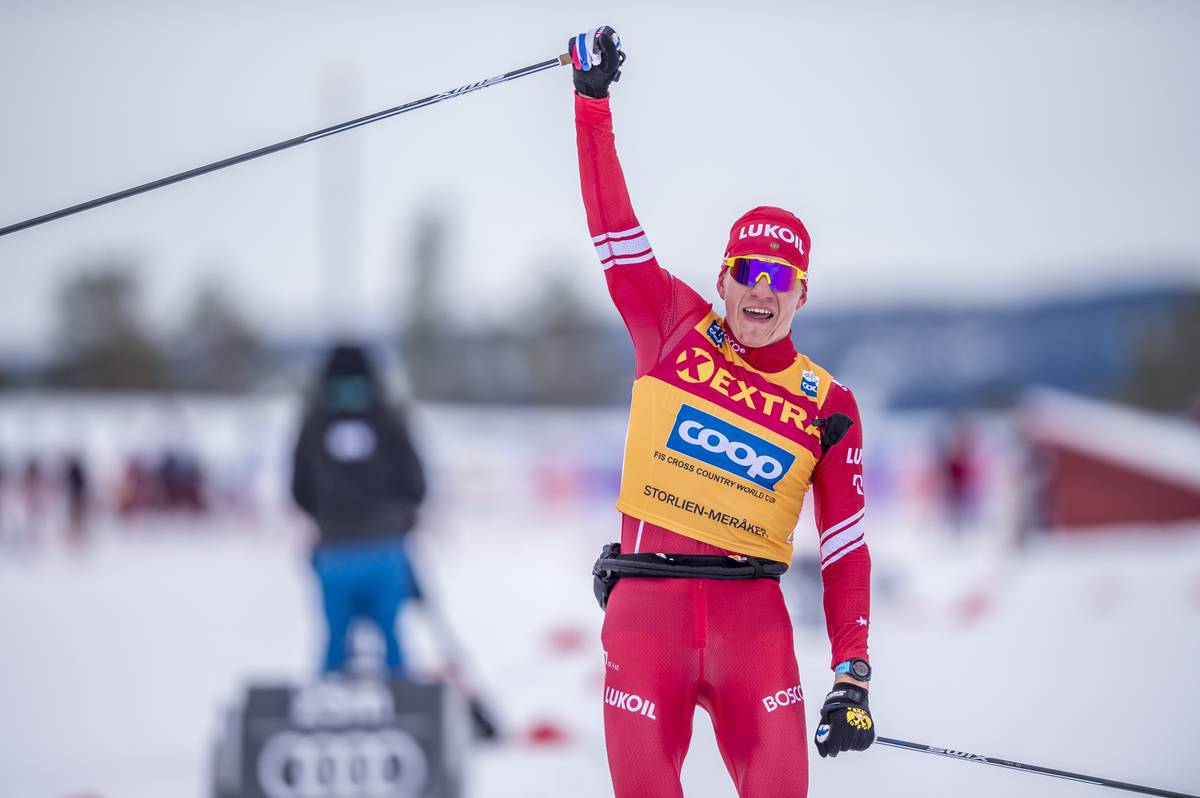
    With the course re-routed from the original 38-kilometer mass start skate to essentially an out and back into Meråker, Norway’s ski stadium, the day belonged to Russia’s Alexander Bolshunov who appears, at this point in the season, to be unstoppable in the distance events. 

    In the end, it was all Alexander Bolshunov: peerless. (Photo: NordicFocus)

    In a post-race interview, Devon Kershaw noted that men paced it World-Cup comfortable for much of the first portion of the race. In other words, the effort up-front, although speedy for most, was not a break apart the 79 starters into small groups of similarly paced pockets of effort. 

    Fast forward to the 14 k mark, and 32 men came through the time check within 1.8 seconds. At that point, Jens Burman of Sweden was driving that train. 

    Through the race mid-point, the pack faced a steady headwind. Tactically, it made sense for any would-be endurance escape artist to wait until the turn home on the mostly out and back course, when a tailwind could aid their efforts, to make a move. 

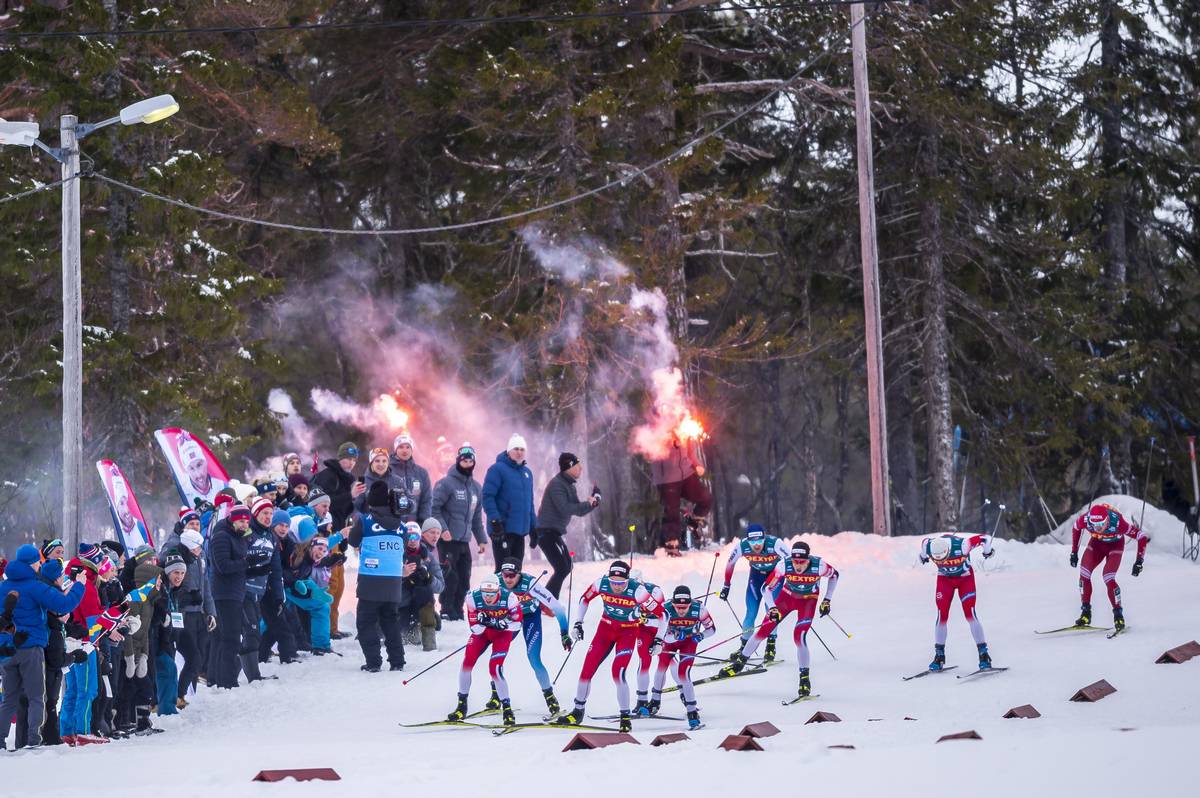
    Pack skiing Norway style. (Photo: NordicFocus)

    Sjur Røthe of Norway took big pulls leading as did his teammate Finn Hågen Krogh. Later in the race, Emil Iversen too sensed some podium opportunity. We could expand the list. But that would perhaps overshadow Bolshunov. 

    A select group began to pick up the pace as skiers sped towards the 20 k time bonus. This included Røthe, Krogh, Bolshunov, Iversen, and Johannes Høsflot Klæbo who came through the check-in 17th. (This was not the Norwegian national champs, although nine Norwegians, at that point, jammed the front 17 spots.)

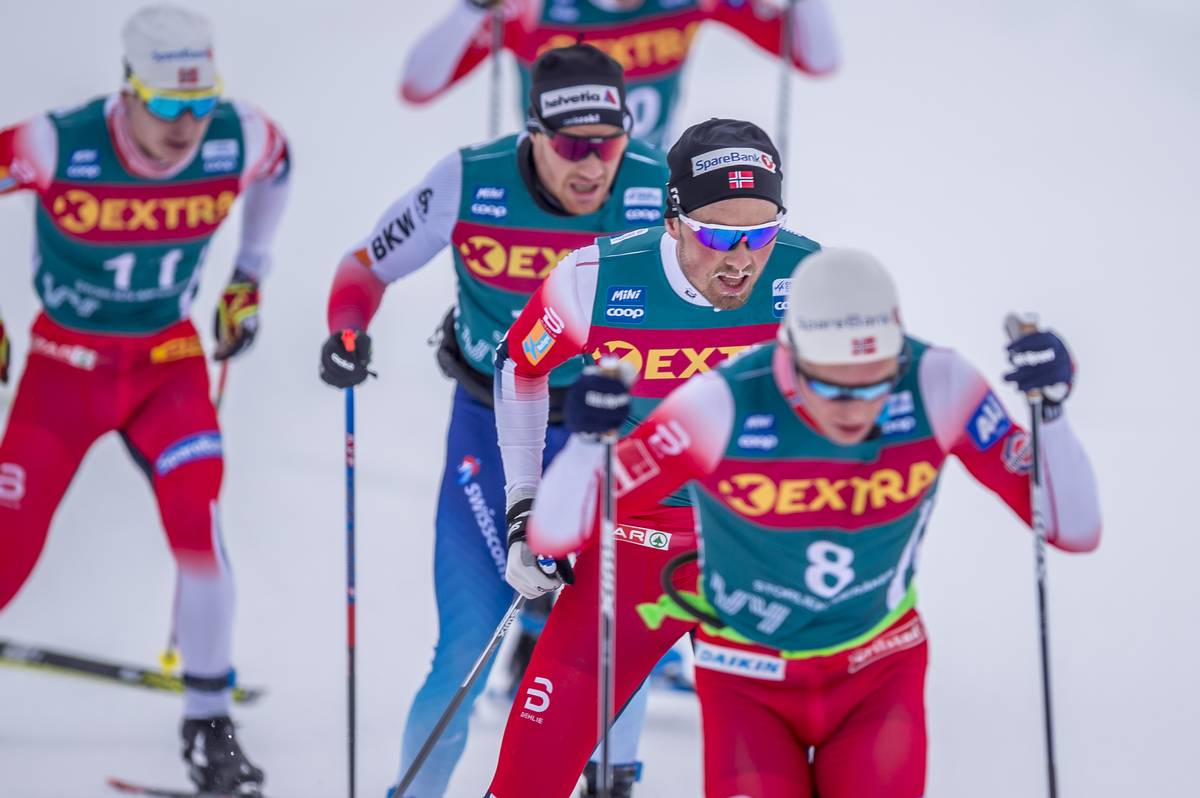
    Martin Løwstrøm Nyenget (bib 8) leads Emil Iversen and Dario Cologna during the Stage 4, 34 k mass start skate. (Photo: NordicFocus)


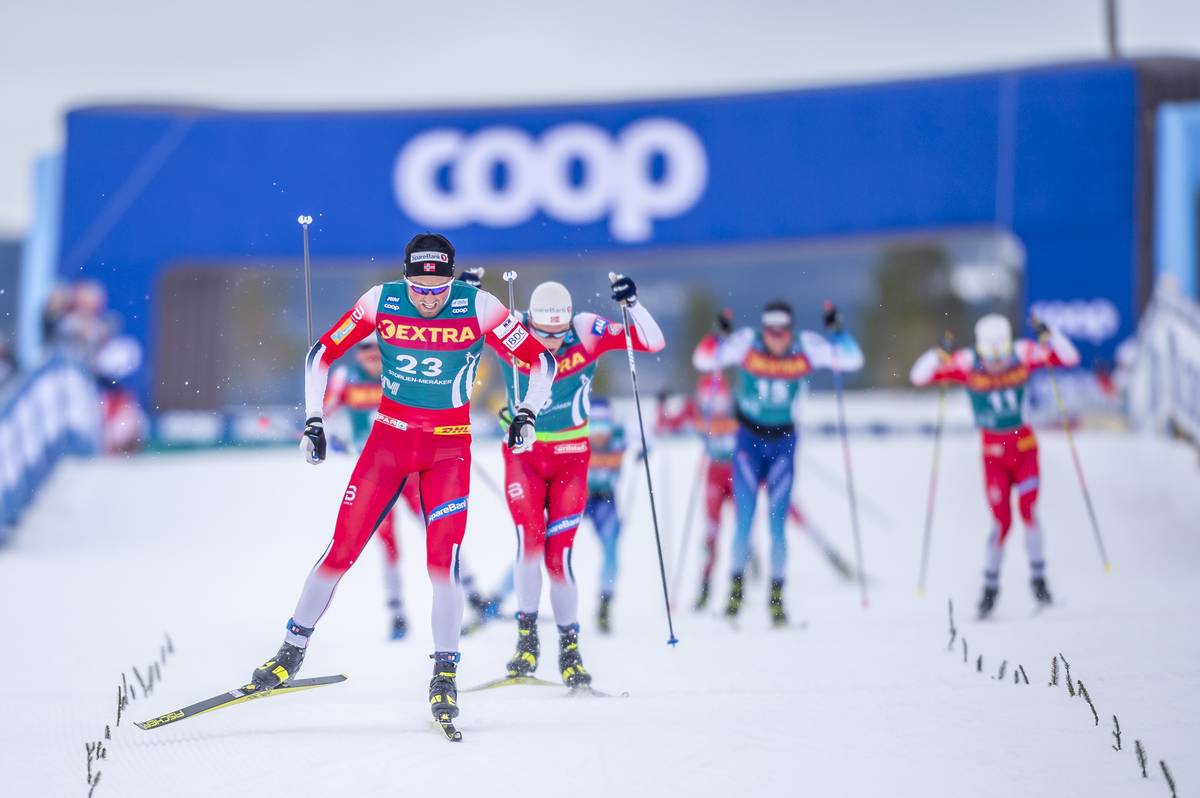
    Emil Iversen comes in for third place on Stage 4 of the Ski Tour 2020. (Photo: NordicFocus)

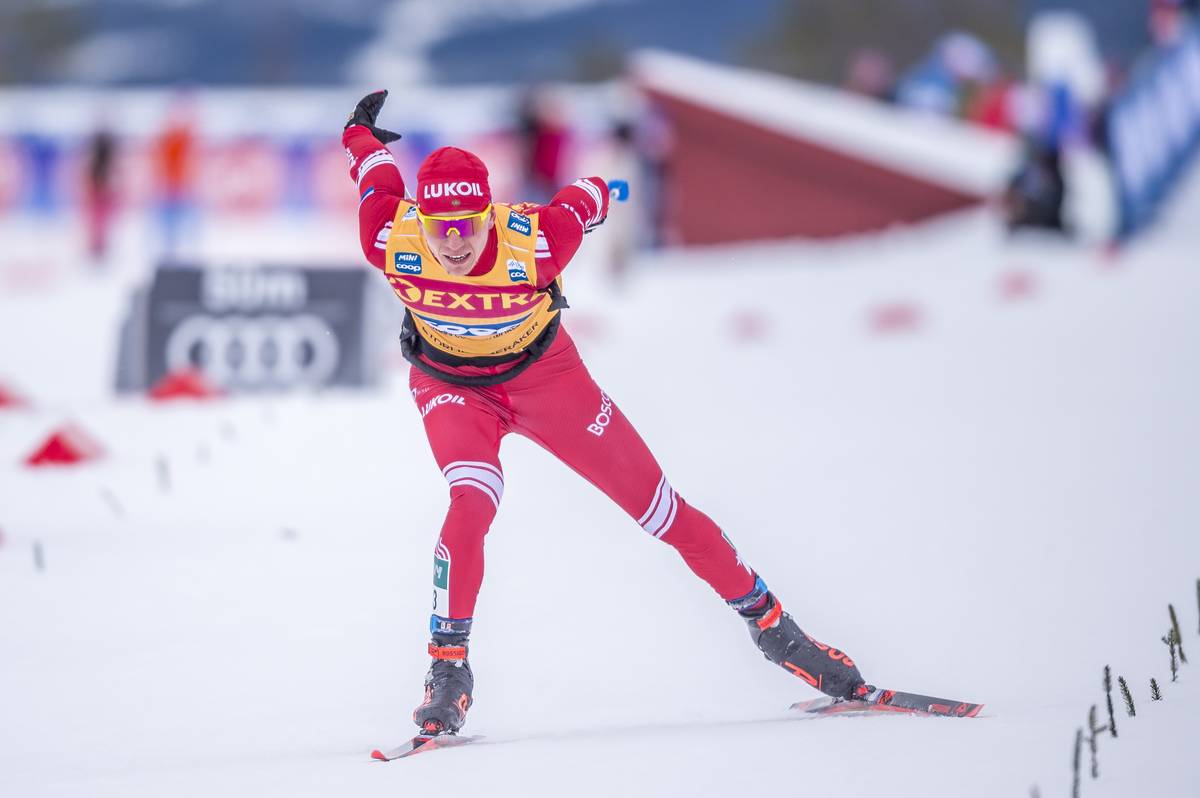
    Post-20 k time bonus, Bolshunov wound up, uncoiled, and made a decisive move. He set off solo, accelerating ahead of the pack of star names, and was able to gap the chase by 51.7 seconds at the finish for a solo effort win in 1:19:34.9.  

    Solo: Alexander Bolshunov way way off the front. (Photo: NordicFocus)

    Klæbo placed second (+51.7), and hometown skier Iversen third (+51.8). Places fourth through 11th were separated by roughly nine seconds.

    Bolshunov leads the Ski Tour 2020 with a total time of 2:26:16 hours after four stages. Golberg is second (+1:05), and Røthe third (+1:06). 


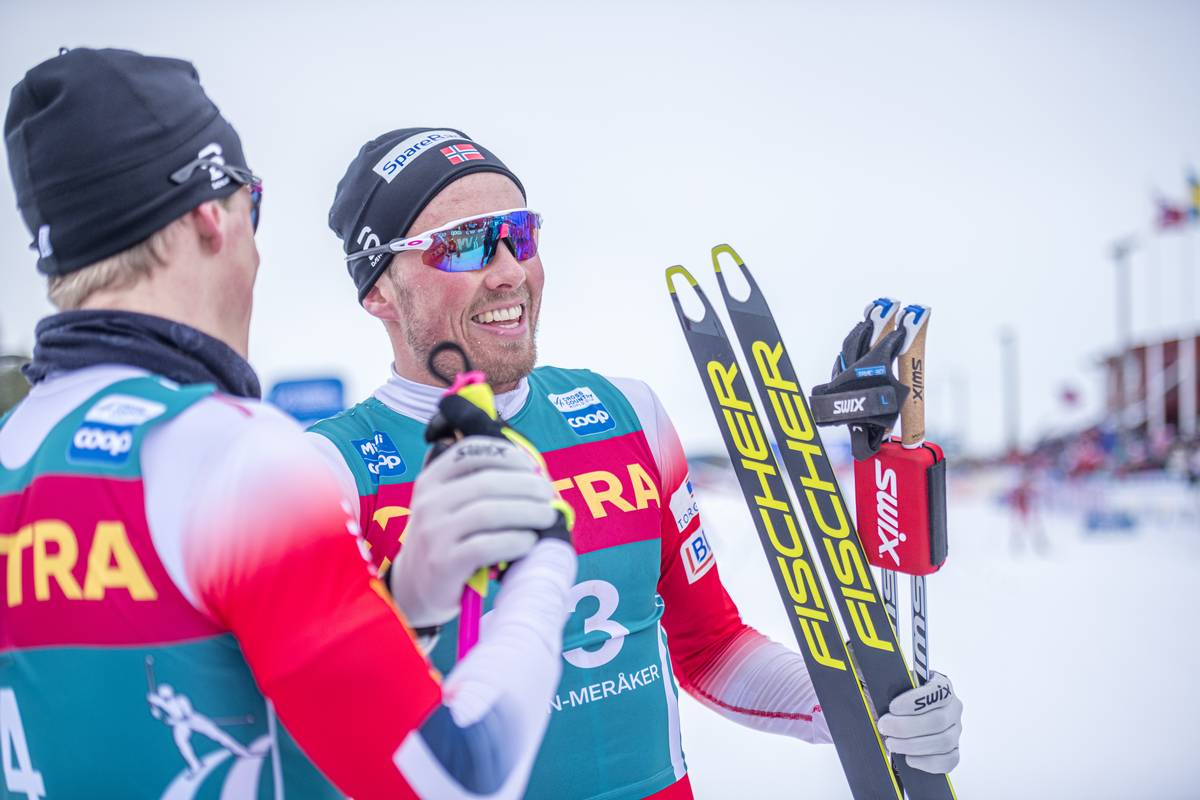
    Emil Iversen (bib 3) and Johannes Høsflot Klæbo share a stoke-moment after the race. (Photo: NordicFocus)

    David Norris was the top North American in 26th (+3:08.7). Ben Lustgarten placed 51st (+5:30), Kevin Bolger 69th (+8:06.7), Simi Hamilton 74th (+9:28.1), and Logan Hannmen 76th (+9:39.3). 

    Canada’s Evan Palmer-Charrette skied to 37th (+3:46.0), Russell Kennedy 39th (+3:59.9), Alexis Dumas 67th (+7:32.3), and Ricardo Izquierdo-Bernier 77th (+13:03.6). 

    Racing continues Saturday in Trondheim with a 1.5 k classic sprint, the sixth stage of the Ski Tour 2020. 

    Results | Overall Tour Standings

    The men’s Stage 4 podium: Johannes Høsflot Klæbo (NOR) second, Alexander Bolshunov (RUS) first, and Emil Iversen (NOR) third, (l-r). (Photo: NordicFocus)
  • Mother Nature Forces a Re-Route; Johaug Fights For the Win (updated with Diggins audio interview)

    Mother Nature Forces a Re-Route; Johaug Fights For the Win (updated with Diggins audio interview)

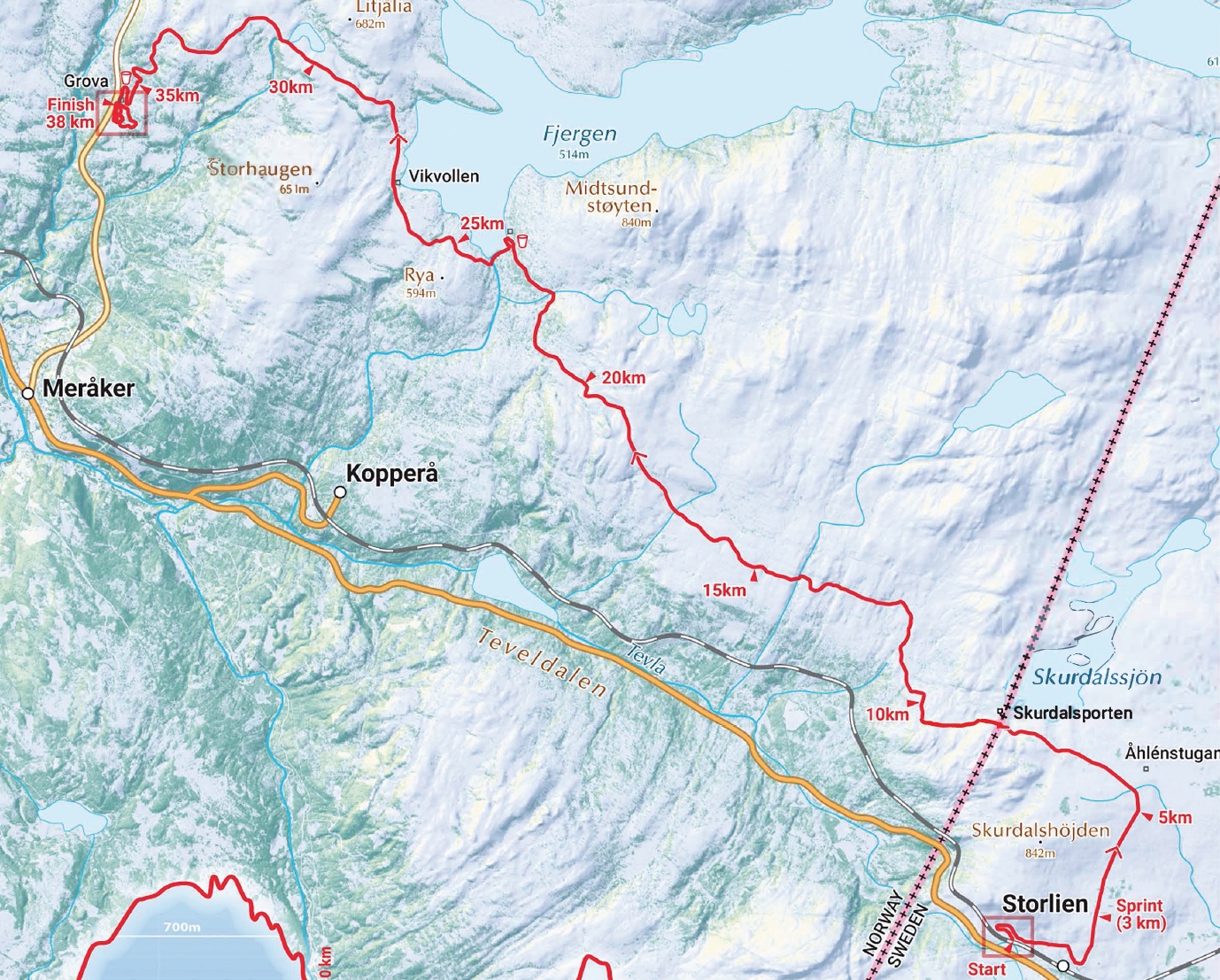
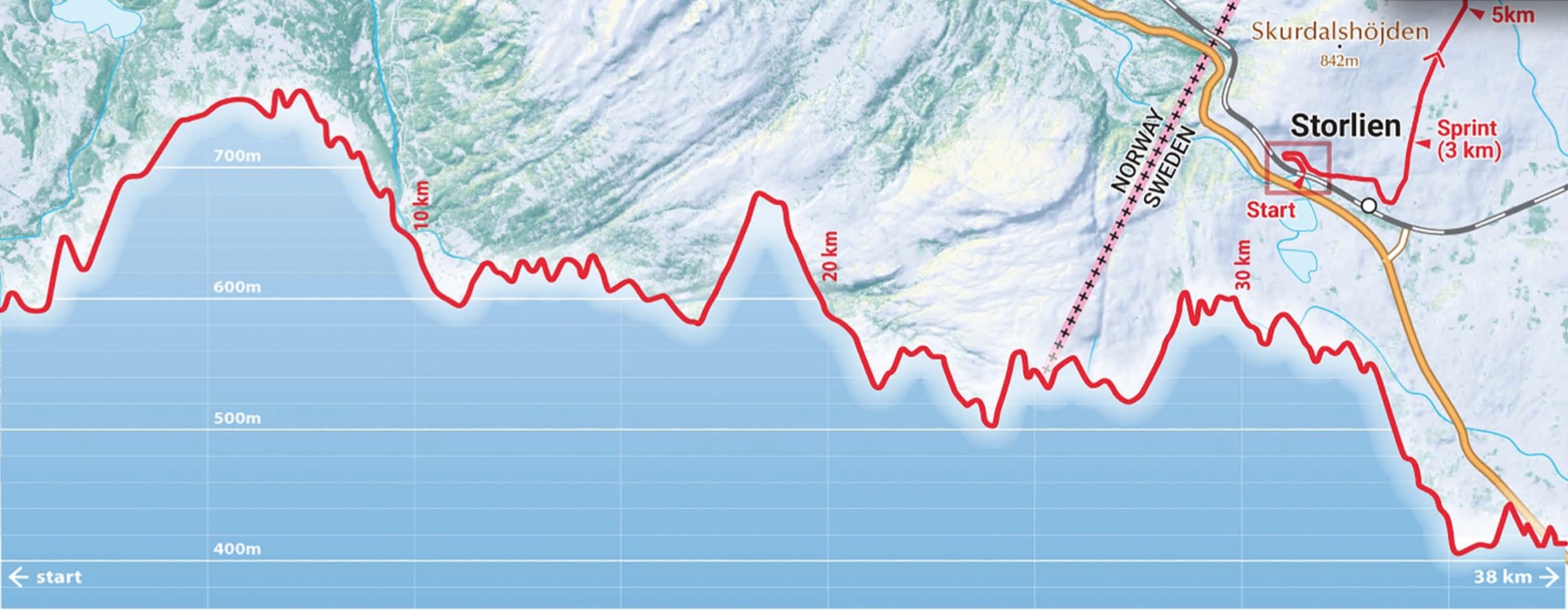
    Nature has a lovely way of being, well, natural. In other words; marginally unpredictable, sometimes downright uncomfortable, and finicky. Prior to the Ski Tour 2020’s Stage 4 weather forecast and on-the-ground big-wind gust reality, the stage had been scheduled to pulse 38-kilometers from Storlein, Sweden to Meråker, Norway in a point to point event. Cool, right? An international border crossing during a race, with a single sanctioned coaching/feed zone for athletes around the 25 k mark. A think-out-of-the-box format with a nod to the old-school days of Norwegian countryside racing. 

    Nature interfered. Or at least the predicted inclement weather scheduled to pummel the rolling mountains featured in the point to point race was enough to scare off race organizers. 

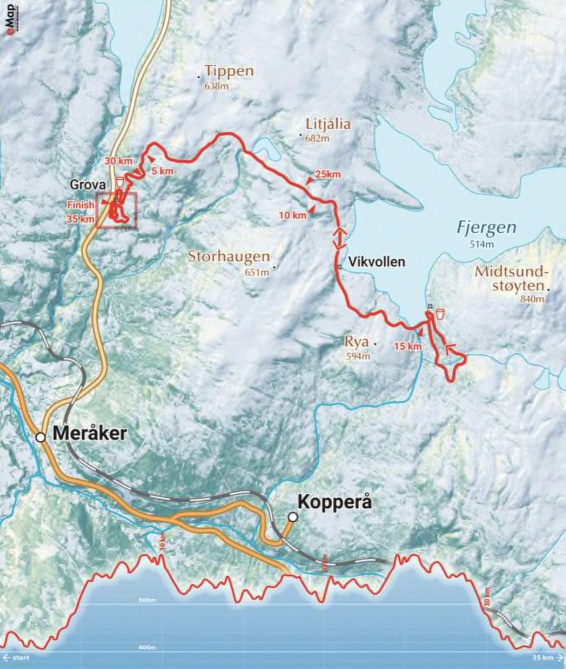
    An updated map and course profile for Stage 4 of the Ski Tour 2020.

    The stage was rerouted the stage. Stage 4’s freestyle mass start streamed from the start/finish area in Meråker, to the original coaching feed zone at approximately 15 k, where athletes skied a several k loop, and then routed onto the main course back to the Meråker ski stadium. In total, the new route was 34 k, with approximately 30 k consisting of an out-and-back. Organizers maintained a single feedzone policy. (Thus, you’ll see several athletets with hydration belts. Most notably, the Norwegians.) 

    Prior to her breakaway on Stage 4, Norway’s Therese Johaug began to stretch the cord to the pack. (Photo: NordicFocus)

    Although mother-nature dictated the course reroute, Norway’s Therese Johaug dictated the intro and closing chapters of Stage 4.

    This was no surprise, as she has dominated World Cup distance events with a few second-place efforts here and there, to prove maybe she is human after all. Analyzing her results, it’s clear she is a record-setter. And another record of sorts fell today as Johaug won in  1:26:32.8 hours. It was Johaug’s eighth individual distance World Cup victory in a row. A streak that outdoes her run of seven consecutive wins, which the Norwegian has strung together on two occasions — once between January- March of 2016, and again between March-December 2019.  

    20.02.2020, Storlien-Meraker, Norway (NOR):<br /> Therese Johaug (NOR) - FIS world cup cross-country, mass women, Storlien-Meraker (NOR). www.nordicfocus.com. © Thibaut/NordicFocus. Every downloaded picture is fee-liable.
    Johaug on her 34 k journey. It’s early, the pack is still in contact. (Photo: NordicFocus)

    The day was not a singular Johaug show. Her teammate Ingvild Flugstad Østberg kept the racing on the front-end honest for the overall win. 

    Earlier in the race, it did appear like a Johaug runaway. At 14 k, she had gapped the second place Østberg by 28.0 seconds. Chasing in a line through the time check along with Østberg were Norway’s Heidi Weng, and Sweden’s Ebba Andersson. American Jessie Diggins led a group, 1:24 back, including Austria’s Teresa Stadlober, and Krista Pärmäkoski. 

    Another 30 seconds back, an organized chase pack including Charlotte Kalla, Rosie Brennan, Sadie Maubet Bjornsen, and Astrid Uhrenholdt Jacobsen churned along.

    Jessie Diggins (left), Teresa Stadlober (center),  and Ingvild Flugstad Østberg (right), on the Stage 4 course. (Photo: NordicFocus)

    Through 20 k, those gaps remained relatively firm. However, out on course, the winds were evident with swaying treetops. A solo effort can take its toll with no draft to exploit. No matter how you look at it, either Johaug slowed or Østberg sped up, the time between the two skiers diminished between 20 k and 30 k. At the 31 time check, Johaug’s lead had shrunk to 7.9 seconds over Østberg, who had snapped away from a hard to shake Weng early in the race. Weng paced through the 31 k mark in third (+51.0), Andersson in fourth (+1:37.3), and Diggins in fifth (+3:01.2). 

    Have no doubt, despite Joahug’s singular dominance, this was a hunted Johaug. Her effort in the closing Ks never waned, as Østberg proved a worthy foil. As much as Østberg wanted to will the 30-40 meter span to Johaug away, Joahug was able to keep four seconds between herself and the fearless Østberg at the finish. Weng came through solo in third overall (+1:21.6), with Andersson in fourth (+2:00.5). 

    Norway’s Heidi Weng placed third on the Stage 4 34 k skate mass start race. Note the nifty hydration belt (Photo: NordicFocus)

    Jacobsen pipped the next chase group, taking fifth (+3:06.5), with Tiril Udnes Weng of Norway in sixth (+3:10.3), and Diggins in seventh (+3:13.9).

    Jessie Diggins during Stage 4 of the Ski Tour 2020. She placed seventh overall. (Photo: NordicFocus)

    Post-race interview with Jessie Diggins 

    Also for the U.S, Brennan ended her day in 10th (+3:41.9).

    “It’s been an adventurous couple days here in the ski tour,” emailed Brennan. “A lot new things, a lot of surprises, and a lot of last minute changes. Our point to point race was changed due to high winds but we still managed to to an out and back in the same trail starting and finishing in Meråker. It was really windy still making it challenging to ski alone out there. Knowing that I did all I could to stay in my group. There were a few kilometers that I was dangling and unsure if I could hang, but I was fortunately able to find another gear climbing and work my way back up to my group. , unfortunately,y missed the first break on the way back but was able to pick off some people all the way to the finish. I am really happy with the race as 30km has been a struggle for me in the past. I am still feeling strong in the tour and am going to do all I can to hold on to a top 10 in the closing stages.”

    Rosie Brennan, pack skiing to 10th overall on Stage 4. (Photo: NordicFocus)

    Maubet Bjornen clocked in one place after Brennan in 11th (+3:44.8).

    “It was a thrilling day of ski racing today, with lots of course changes, weather delays, a long2-hour bus trip to the start, and a total ‘unknown’ in front of us with this long race,” wrote Maubet Bjornsen.
    “I have finally felt my body feeling better, and I just kept my mind excited to take on whatever was coming.
    “It was windy as heck, which made the course super tough, but still beautiful. I didn’t look around a ton, because I was so focused, but in the few chances we went down a hill, and I got a glimpse, I just felt so lucky to be part of this fun experience. It is so different than any race I have ever done, and the total ‘unknown’ put the cherry on top.
    “I’m so excited to find my strength again, and put together a race that is more representative of where I am at. 11th in a long distance skate race is huge for me!”
    Maubet Bjornsen: Stage 4, Ski Tour 2020. (Photo: NordicFocus)

    Also for the U.S., Julia Kern placed 19th (+6:04.5), Rosie Frankowski 29th (+6:12.2), Caitlin Patterson 41st (+8:20.3), Katharine Ogden 42nd (+8:49.8), Alayna Sonnesyn 48th (+10:23.3), Sophie Caldwell 56th (+12:27.3). Hailey Swirbul did not start. 

    For Canada, Cendrine Browne scored in the points in 25th overall (+6:07.9). Katherine Stewart-Jones skied to 31st (+6:16.1), and Emly Nishikawa 39th (+7:52.9). 

    In the Ski Tour overall, Johaug looks unstoppable – she has won all four stages thus far. Her elapsed time, which factors in a 60-second time bonus for her sprint stage win on Tuesday, and three 15 second intermediate time bonuses on the course Thursday, is 2:16.33. Østberg sits in second (+2:06), Weng third (+2:39). Diggins was the best-positioned American in sixth (+6:02). 

    Racers have a rest day Friday, with racing starting up in Trondheim for Stage 5’s 1.5 k classic sprint.

    Results | Overall Ski Tour Standings

    The women’s Stage 4 podium: Ingvild Flugstad Østberg (NOR) second, Therese Johaug (NOR) first, and Heidi Weng (NOR) third, (l-r). (Photo: NordicFocus)
  • The Devon Kershaw Show: Stage 3 Ski Tour 2020 – The Leg Flooding Sprint

    The Devon Kershaw Show: Stage 3 Ski Tour 2020 – The Leg Flooding Sprint

    Åre, Sweden — the site of the national (alpine) ski area in Sweden. Also the site of Stage 3 of the Ski Tour 2020’s skate sprint. Short at 0.66 k, but oh so steep with a finishing climb with slopes at 28 percent. Yah! 28 percent. Maybe part sideshow, maybe not. Either way, athletes had to get themselves to the top. In what was a leg-burning affair, for a one-off event, it was sporting entertainment.

    Italy’s Pellegrino: totally spent. He placed second overall in the Stage 3 Ski Tour 2020 sprint. (Photo: NordicFocus)

    Thanks for listening.

    And…here’s a link to some research we mention in the podcast. It’s some good material on how Marit Bjørgen trained.


  • Three In A Row, Johaug Wins the Hill Sprint Showdown in Åre; Diggins 11th, Caldwell 12th

    Three In A Row, Johaug Wins the Hill Sprint Showdown in Åre; Diggins 11th, Caldwell 12th

    When Therese Johaug wins a sprint qualifier by 4.5 seconds and Sophie Caldwell qualifies in 23rd, you know it is not your average course. Held at the Swedish national alpine ski area in Åre, today’s event seemed to blend the infamous climb up the Alpe Cermis in the final stage of the Tour de Ski with skier cross on perhaps the shortest but toughest sprint on the World Cup.

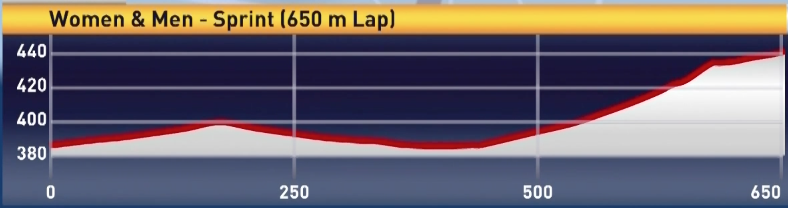
    A gradual uphill start led skiers to a fast downhill into a swooping banked turn to the left. The course then ascends a pitch as steep as 28% up the base of the alpine hill, climbing nearly 60 meters within the final 200 meters of the course. Athletes would then need to walk back down to the start area. 

    The Åre sprint hill climb in profile. (Photo: Screenshot FIS Broadcast)

    Though less than 700 meters in total length, nearly half the usual distance, the course took the women roughly two and a half minutes, on par with a usual sprint time. 

    The event drew a roaring crowd, with fans lining the course, their yells and gaps echoing as athlete’s skied by. After the race, Matt Whitcomb recognized the event organizers for putting together a unique stage and drawing so many energetic spectators.

    Post-race comments from Matt Whitcomb.

    With Johaug at the top of the qualification list were Heidi Weng (NOR), Greta Laurent (ITA), Linn Svahn (SWE), and Laura Mononen (FIN), the most diversity in nations among the top five in the tour so far. This result also added mystery and excitement as it could be anyone’s game. Weng is a top distance skier, Laurent and Svahn are most recognized for their sprint performances, and Mononen normally hovers on the border of the top-30 FIS point scorers list, a relative unknown.  

    Rosie Brennan climbs to the top American result in qualification during the Stage 3 “sprint”. (Photo: NordicFocus)

    Rosie Brennan was the top American qualifier in 14th, followed by Jessie Diggins in 17th, Julia Kern in 18th, Sadie Maubet Bjornsen in 21st, and Caldwell in 23rd.

    Racing in the second wave of the quarterfinal, Diggins and Brennan took the pace out hot, trying to create a gap over the two top qualifiers, Johaug and Weng. Diggins led the way over the gradual climb and into the downhill, fearlessly flying into the banked turn with high speed. Riding up the berm to the outer lip of the curve, Diggins stayed in control, though only just. 

    Brennan and Diggins were still in the lead beginning the hill climb, but the two high-tempo Norwegians were gaining quickly. Weng and Johaug overtook the Americans midway up the climb, but Diggins did not let them get away. Maintaining contact, she crossed the line within 1.5 seconds of the Norwegians and advanced as lucky loser, her early effort to push the pace making it the fastest of the five heats.

    Diggins attacks the hill climb during the Stage 4 sprint in Åre, Sweden. (Photo: NordicFocus)

    Brennan fell back to fifth in the heat and did not advance. She ended her day in 22nd.

    Maubet Bjornsen and Kern raced in the fourth heat, finishing fourth and sixth, respectively. Maubet Bjornsen’s final rank was 20th. 

    At the start of the last quarterfinal round, Caldwell skied off the front, navigating the banked turn with ease and picking up momentum as she approached the base of the hill in V2. Caldwell stayed near the front through the climb, her technique smooth and controlled. As the course curved and leveled to the finish, it was Mononen and Caldwell at the front. They crossed the line together, immediately folding with hands on their knees in anguish.

    If this is what the finish of the quarters looks like, what will happen as the deep burn of cumulative fatigue starts to sink in?

    In the semis, Diggins faced off again with Johaug and Weng. Rather than flying off the front, Diggins sat in the middle of the pack over the first climb, hooking 180 degrees left and dropping into a tuck heading into the banked downhill. 

    Johaug was last into this turn and last to the base of the climb, but she was far from out of the race. Jump skating up the left side of the course, Johaug rocketed from the back of the pack to the lead, edging out Weng to win the round. 

    Diggins fell off the pack at the base of the climb and finished last in the heat, and 11th for the day.

    Relaxed, smooth, collected, per usual, Caldwell rounded the banked turn in second and was in the mix at the base of the climb. Then it was over.

    At the front, Svahn, Astrid Urenholdt Jacobsen (NOR), Laurent, and Mononen stepped powerfully up the climb. In the final meters, Svahn was at the front with Laurent close on her tails looking like a lock for second, until a last second surge by Jacobsen snuck her just ahead of the Italian at the line. As the heat was slower than the first, only Svahn and Jacobsen advanced.

    After falling off the pack, Caldwell took last in the heat and ended the day in 12th. 

    Breaking down the lineup in the final, you’ve got two pure distance skiers with a history of outstanding results in the TdS hill climb, Johaug and Weng, alongside their teammate, Jacobsen, an all-arounder skewed toward distance. These three women paired with three sprinters, Svahn, Jonna Sundling (SWE), and Nadine Faehndrich (CHE). A World Cup cocktail. 

    The Swedes took the lead at the start of the final, shooting around the banked curve and into the climb. Johaug, again, the last to the base of the hill. 

    As the grade increased, Weng and Jacobsen accelerated up the right side of the course, while Johaug repeated her uphill attack as she weaved through the other women to the front. The Norwegians skied three abreast as they passed under the Audi e-tron arch toward the steepest pitch, shortly before the finish.

    Therese Johaug leads Heidi Weng and Astrid Urenholdt Jacobsen through the final meters of the sprint hill climb. (Photo: NordicFocus)

    Increasing her tempo and beginning to jump skate, Johaug rounded the final bend in the lead with the win locked up. Her teammates, Weng then Jacobsen, crossing behind her in second and third, respectively. 

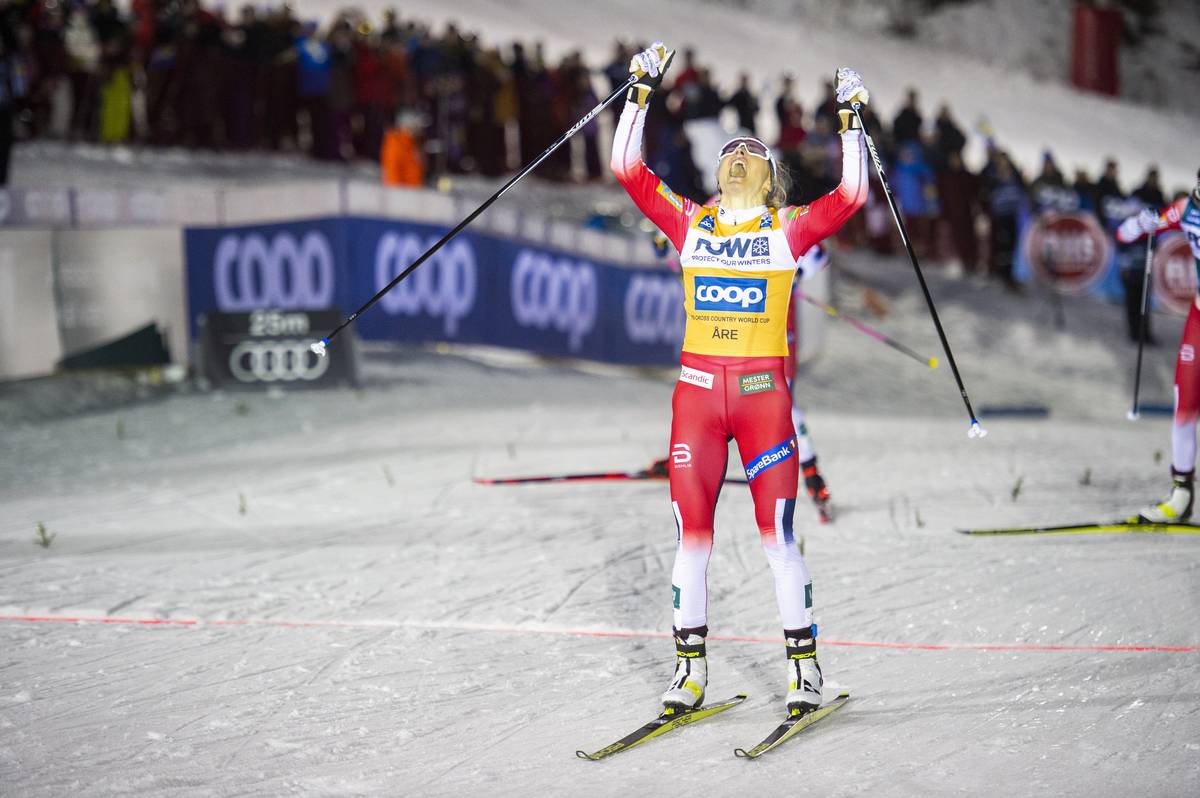
    As the other wobbly-legged women collapsed, writhing in agony with faces turned toward the snow, Johaug raised her arms in celebration, her lungs still functional enough to let out a loud yell. She looked as though she had just completed a particularly successful interval session, a much different appearance than the others. 

    Therese Johaug takes Stage 3 of the FIS Ski Tour 2020. (Photo: NordicFocus)

    “It was a crazy race,” smiled Johaug as she spoke with FIS at the finish. “But, as you know, I love uphills, and today as well was my day. Of course, you cannot call it a sprint race, but for me, it means a lot to stand atop the podium and I worked really hard for that, so I’m really happy.”

    The third straight all-Norwegian women’s podium of the FIS Ski Tour 2020. (Photo: NordicFocus)

    Commenting on the event in a post-race email, Caldwell wrote:

    “Today was a very different kind of sprint. I wasn’t sure what to expect, but when we checked out the course yesterday, I was pretty shocked that we were literally going up an alpine hill! I had never done anything like this because and I know I have the potential to flood, so I wanted to make sure I did some pacing for my qualifier. It didn’t end up being a ripping fast qualifier, but it was good enough and I was honestly psyched to qualify on a course like this that doesn’t exactly play to my strengths.

    “In my quarter I tried to get out fast and ski the technical corner how I wanted to and then I just focused on finding the faster snow and leaving a little left for the end. I was really happy with how my quarter went and on a course like this, making the semi final is a really good day for me. I also left everything I had in my legs on the course, so unfortunately in my semi final, even though I didn’t feel like I was breathing very hard, my legs weren’t exactly moving. So that was pretty different from a normal sprint where I usually feel like I can keep pretty good legs and energy through the final. Now it’s time for some recovery before the next stage!”

    Head down and grinding, Sophie Caldwell skis to 12th place in Åre. (Photo: NordicFocus)

    Outside the heats, Alayna Sonnesyn skied to 42nd (+17.24) in the qualifier, followed closely by Hailey Swirbul in 43rd (+17.31). Caitlin Patterson finished 46th (+19.76), Rosie Frankowski 56th (+23.55), and Katherine Ogden 59th (+27.58). 

    Racing for Canada, Katherine-Stewart Jones was the top qualifier in 34th (+15.56), followed by Cendrine Brown in 45th (+18.88), and Emily Nishikawa in 49th (+20.04).

    In a post-race call, Whitcomb provided further insight into the women’s day, expressing that the his athletes were “quite positive” about the result, but impressed by the difference in feelings between qualification and the quarterfinal.

    Whitcomb also explains that because of impending weather, the planned 38-kilometer point to point race across the Sweden-Norway from Storlein to Meråker may not be possible. The backup plan is a 15 k race for both men and women on an approximately 3 k loop in Meråker.

    Post-race interview with Matt Whitcomb.


    Qualification | Final Results | Tour Standings After Stage 3

  • Johaug Takes the Stage 2 Win: Brennan in 10th, Diggins 11th

    Johaug Takes the Stage 2 Win: Brennan in 10th, Diggins 11th

    Therese Johaug (yellow bib) with enough time at the finish to gather skis and watch 2nd, 3rd, and 4th come across the line. (NordicFocus)

    The early evening show, under the lights of Östersund, Sweden’s ski stadium, Stage 2 of the Ski Tour 2020 – a 10-kilometer classic pursuit – got underway as the plentiful moisture falling from the sky transitioned from steady rain to big snowflakes.

    This was a 10 k race with three discrete tales. First, the story with the least tension. 

    That would be Norway’s Therese Johuag’s 10 k effort. Which, despite the pursuit format, was a solo time trial affair. She set herself up for that narrative by winning Stage 1’s 10 k individual skate by 45.6 seconds. No skier on the World Cup could fathom closing that gap to a generational distance skier.

    Johaug won in 27:29.0 minutes. Her effort gained her even more time in the Ski Tour overall as teammates Heidi Weng placed second (+57.4), and Ingvild Flugstad Østberg third (+57.8). Sweden’s Ebba Andersson lost out on third in the closing meters, as she placed fourth (+58.6).

    Therese Johaug for a clean no-one-in-site win. (NordicFocus)

    This was Joahug’s 13th World Cup distance win of the season and according to FIS, this brings her closer to a hallowed record. Marit Bjørgen, a legend from Norway holds the World Cup distance win record with 62 victories. Sunday’s win brings Johaug’s total to 59.

    Let’s be frank: with a 45.6 second lead on the second starter Weng, 47.3 seconds on Østberg in bib 3, and 53.1 ticks ahead of Andersson in bib 4, this was as much a sure thing as sunrise and sunset.

    Ebba Andersson leads Heidi Weng and Ingvild Flugstad Østberg during the Stage 2 10 k classic pursuit. (Photo: NordicFocus)

    Behind Johaug, the tactic for the three closest chasers — Weng, Østberg, and Andersson was clear: cede no ground to the All-Star list of skiers starting roughly 20 seconds further back. For much of the race, the threesome kept a tidy buffer of 30 seconds on those in fifth to 16th place. At times Andersson took pulls up front, motivated by chants of “Ebba” from the home-nation fans. Østberg and Weng too remained motivated to secure a potential podium as they burned their matches prudently but with enough gusto to keep the masses at bay.

    Taking her turn pacing the premier chase group, Heidi Weng (bib 2), followed by Ingvild Flugstad Østberg and Ebba Andersson. (Photo: NordicFocus)


    Heidi Weng (bib) taking second in Stage 2 of the Ski Tour 2020. (Photo: NordicFocus)

    Weng led the charge into the final straight.  Østberg slotted in behind Weng using her as a double-poling pace machine. Weng and Østberg gained a precious few meters on Andersson to take second and third, respectively. 

    Johaug leads the Ski Tour 2020 after two stages with a total time of 49:18. Weng is second at 0:57, and Østberg is third overall with the same time back. Andersson sits one second further back in fourth overall.

    The race behind the top-four had a different vibe. It was less about fending off a potential chase, and more about how a large group of skiers would coalesce, who would lead, and who would sit back and take advantage of the more skied in tracks.

    Jessie Diggins skiing to 11th overall during the Ski Tour 2020 Stage 2 10 k classic pursuit. (Photo: NordicFocus)

    American Jessie Diggins, in bib 8, pulled the group through the 3.3 k mark 1:25.2 behind Johaug. In contact with Diggins, and coming through in this order were Astrid Uhrenholdt Jacobsen, Ragnhild Haga, Rosie Brennan, Krista Pärmäkoski, Frida Karlsson, and Natalia Nepryaeva. The group from fifth to Austria’s Therese Stadlober in 16th place was separated by 11 seconds. 

    Brennan took her turn up front though the 4.9 k mark, as did Karlsson later in the race. By the finish, the collective group did not gain time on those ahead, they ceded a few more seconds to the top four. But we would be remiss to make note of Brennan’s determination. You could see it in yesterday’s 10 k skate, and it was evident today; she’s got moxie and now the confidence to take pulls, as she did with Karlsson today, and try to break the pack. In a post-race interview (audio posted below), Brennan noted she had in fact been keen on making a move during the pursuit. 

    Grit: Rosie Brennan during Stage 2 of the Ski Tour 2020. (Photo: NordicFocus)

    Post-race interview with Rosie Brennan 

    Slovenia’s Anamarija Lampic ended up fifth overall (+1:38.7), as the first finisher of the third group out on course. Brennan ended her day in 10th (+1:43.3), and Diggins in 11th (+1:43.6). 

    “It was a pretty crazy day out there!” Diggins wrote. “I was actually super stoked about the rain while warming up because klister skiing in the rain is such amazing kick and really fun getting up all the hills on. The snow right before the start made it a really strange race because the one track became exponentially faster as it got skied in, which led to massive packs (for a girls race, anyway) forming. Huge thanks to the tech team because my skis stayed competitive and were kicking well even in the rapidly changing conditions!

    “I’m excited for the rest of the tour – the next two races are formats we’ve never done before, so I’m ready to go give it my very best shot!”

    Sadie Maubet Bjornsen, who began in bib 22, 1:51.4 behind the first starter Johaug, placed 19th (+2:12.5).    

    “After recovering from a mild tummy bug or a form of food poisoning that visited the night before the start of this tour, I am feeling thankful and hopeful after the second stage of the tour today,” Maubet Bjornsen emailed. “With a snow/rain downpour, I was feeling right at home strapping classic skis on my feet and heading out in the misery. I have spent plenty of days in this exact condition during summer training up on Eagle Glacier, so I was trying to channel every bit of internal strength I could find. The fact that I was able to work my way up to 19th today, and had encouraging feelings in a somewhat depleted version of myself is something I will take and run with!

    “I am excited to have a day to recover and fill up my tank, and take on this tour in the same way I did the last. An imperfect start will just fuel me with the extra fight for the days to come!
    “Thanks to the tech team for putting wonderful skis together given the absolute craziness coming out of the sky!”

    In speaking to U.S. World Cup Head Coach Matt Whitcomb after the race, he explained that skiers in the back of the field were able to take advantage of the considerably faster skied in tracks. Again, heavy wet snow fell during the race. 

    Post-race interview with Matt Whitcomb

    U.S. skier Hailey Swirbul in bib 36 moved into the points on Sunday to place 24th (+2:20.2). Her trajectory in the standings aligned with her 13th fastest time of day. Along those lines, Julia Kern of the U.S. Ski Team skied from 50th to finish 36th (+2:43.8). Her on course time was the sixth-fastest of the day.

    Also for the U.S., Caitlin Patterson was 41st (+2:54.1), Sophie Caldwell 51st (+3:07.0), Alayna Sonnesyn 54th (+3:55.7), Katharine Ogden 55th (+4:03.8), and Rosie Frankowski 62nd (+4:59.7). 

    For Canada, Katherine Stewart-Jones placed 32nd (+2:37.5) and skied the ninth fastest time of day. Cendrine Browne was 39th (+2:45.9), and Emily Nishikawa 44th (+2:59.8).

    Katherine Stewart-Jones (CAN) during Stage 2 of the Ski Tour 2020. (Photo: NordicFocus)

    As far as the overall standings and how times are calculated, time of day is used to determine a skier’s time for Stage 2.    

    Results | Overall Ski Tour Standings | Time of Day Results


  • Down to the Wire, Golberg Out Sprints Bolshunov for the Pursuit Win

    Down to the Wire, Golberg Out Sprints Bolshunov for the Pursuit Win

    Picking up where we left off in Östersund, Sweden: a pursuit start 15-kilometer classic. Unlike the women’s field where Therese Johaug “administered a beatdown”, creating a large time gap for herself, the margins for the men were much smaller. 

    A glance at the start list shows yesterday’s winner and Tour leader Sjur Røthe of Norway starting only two seconds ahead of his teammate, Simen Hegstad Krüger, and 17 seconds ahead of Finn Hågen Krogh and Martin Johnsrud Sundby. 

    This year’s Tour de Ski winner Alexander Bolshunov of Russia, whose winning streak was interrupted, would start with a 22 second time deficit in fifth. Tenth place Ivan Yakimushkin (RUS) was 33 seconds back and Jens Burman (SWE) in 20th just inside a minute. 

    Alexander Bolshunov during Stage 2’s 15 k classic pursuit of the Ski Tour 2020. (Photo: NordicFocus)

    With four 3.75 k laps to cover, the deficits were manageable. Perhaps the only Tour victory hopeful who was kept up about the work that needed to be done was Johannes Høsflot Klæbo, who would start 1:23 behind the leader after finishing 31st the day before. 

    The caveat would be to stay upright while navigating the icy winding bends of the primarily man made track. With grey skies and above-freezing conditions, it was fast and dicey, made evident by numerous crashes. 

    During one particularly noteworthy four-person pileup, Kamil Bury of Poland was taken out by Italy’s Maicol Rastelli as the two navigated a treacherous right hand turn at the bottom of a steep descent. Though neither had full control, Rastelli slid off the left side of the course, taking Bury along with him. Bury lost a ski and became tangled in the netting. 

    As Rastelli stood up and worked to right his skis, which were pointing in opposing directions, a third skier, Lin Bao of China, essentially slide tackled Rastelli, sending him in a complete backflip back down to the snow. 

    A fourth skier, Tadevos Poghosyan of Armenia, also lost control and slid into the pile. Bao and Poghosyan were able to stand up relatively quickly and continue on their way, but cameras cut away before the resolution of whether Bury found his ski and Rastelli was able to recover from his forced aerials. 

    Holy carnage… back to the race.

    At the end of the first lap, it was as if the men were gifted ready-made groups. Røthe and Krüger matched stride for stride and double pole for double pole, while the remainder of the top five plus a handful of additional Norwegians, namely Pål Golberg, Hans Christer Holund, and Martin Løwstrøm Nyenget, chased from roughly six seconds back.

    In bib 11, Martin Løwstrøm Nyenget (NOR) works his way towards the sharp end of the men’s 15 k classic pursuit. (Photo: NordicFocus)

    It looked as though Røthe and Krüger might run away from the field, but it was not so easy. By 4.4 k, the gap was closed and an eight-man train chugged along the tracks. As Yakimushkin had fallen off the pace, it became seven Norwegians and Bolshunov. 

    Over the final two laps, the front pack whittled down from eight to five, where it remained with one k to go. Holund, Golberg, Røthe, Bolshunov, and Nyenget. The Russian in the yellow bib was primed to make a move. 

    Bending, rolling, and swooping, they headed for the stadium. Up the final punchy climb, Golberg and Bolshunov were side by side, and Golberg started to slip. He recovered and powered out of the climb, running with Klæbo-like dominance over the crest of the hill and into a tuck to lead into the stadium. 

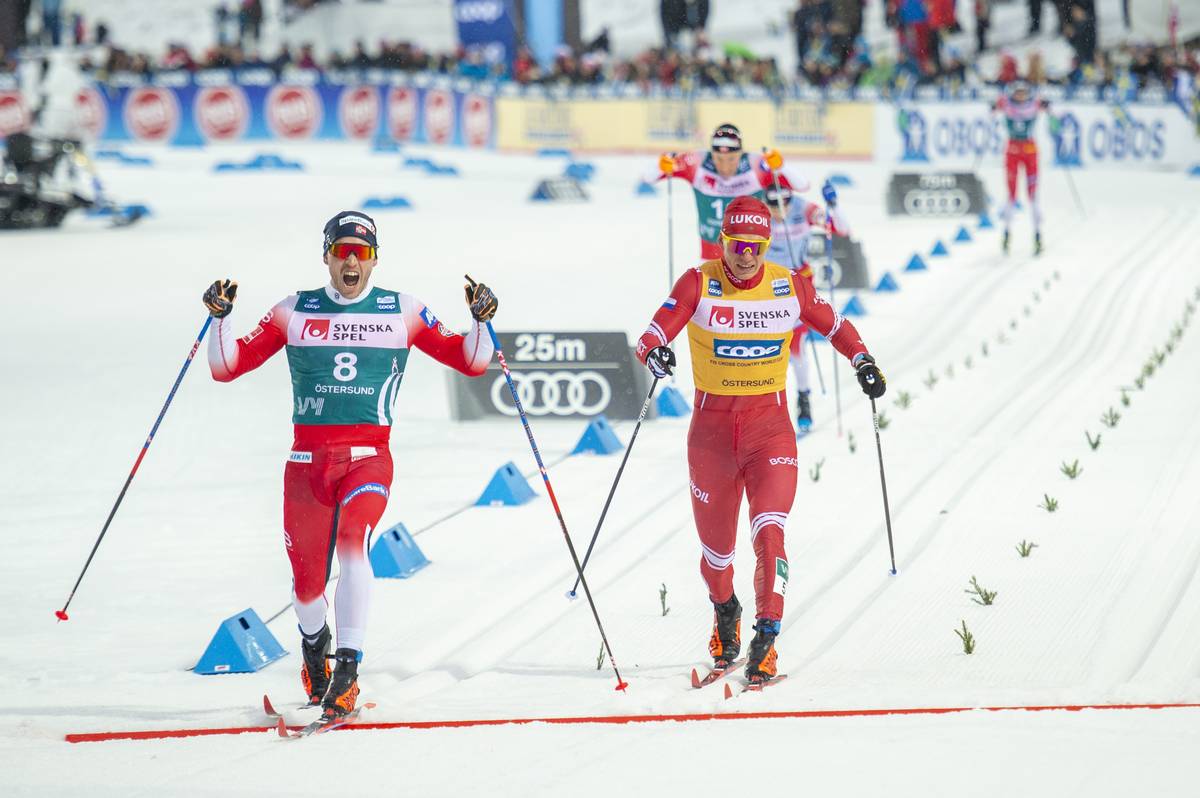
    Bolshunov had fast skis and caught a draft before whipping into second place as the men entered the final straight. The Russian was right behind Golberg and absolutely charging. But there was not enough real estate. He changed lanes to challenge the Norwegian and looked as though he would overtake him, but the final meters evaporated and Golberg threw his foot for a clear win. 

    Golberg crossed the line in 34:50.8, with Bolshunov 0.3 seconds behind. Nyenget took third (+2.1) in a tight finish with Røthe (+2.5). Holund dropped off in the final sprint to round out the top five (+7.3).

    Pål Golberg wins at the line over Alexander Bolshunov during the 15 k classic pursuit, Stage 2 of th Ski Tour 2020 in Östersund, Sweden. (Photo: NordicFocus)

    “Perfect klister conditions,” Golberg told FIS at the finish. “I managed to get the ski pair from last weekend, so I had good skis this weekend as well. It was a really, really good day.”

    The interviewer noted that conditions were much different than the previous day.

    “It was hard in the middle,” Golberg explained. “It was a bit drier, so a bit difficult with klister in the downhill. But the tracks were perfect, so I’m really happy.” 

    Not the start of the FIS Ski Tour 2020 desired by Johannes Høsflot Klæbo. (Photo: NordicFocus)

    Speaking of Klæbo, the Norwegian skied his way into 25th, but ceded an additional 52 seconds in the overall standings by finishing 2:15 back on the leaders. 

    FIS sent out a news brief shortly after the race with information regarding Klæbo’s injured finger. Here is the statement in full:

    “Johannes Høsflot Klæbo (NOR) has to undergo an emergency check up for his broken finger. The check up has to take place with his doctor in Trondheim (NOR). As the rules of the FIS Ski Tour 2020 state no other transportation of athletes than by train, the jury gave permission to Johannes to travel by car to Trondheim and back to Åre for this special case. After the consultation, the jury will receive a report of the treating medical team in Trondheim.”

    The American men hovered near their positions in Stage 1 at the end of the pursuit. Still grinding, David Norris finished 34th (+3:05.0), followed by Simi Hamilton in 43rd (+3:47.8). 

    Ben Lustgarten was the next American in 68th (+6:01.4), followed by Kevin Bolger in 70th (+6:12.7), and Logan Hanneman in 85th (+10:00.2). 

    Ben Lustgarten in the mix during the classic pursuit in Östersund, Sweden. (Photo: NordicFocus)

    Racing for Canada, Russell Kennedy was again the top skier in 58th (+4:47.3). Next up was Alexis Dumas in 61st (+4:51.9), and Evan Palmer-Charette in 66th (+5:33.7).  

    Tomorrow is a rest day on the Ski Tour 2020, Stage 3, a skate sprint, will be held on Tuesday.

    Final Results | Overall Tour Standings After Stage 2 | Time of Day Results

    The men’s Stage 2 Ski Tour 2020 15 k classic pursuit podium:
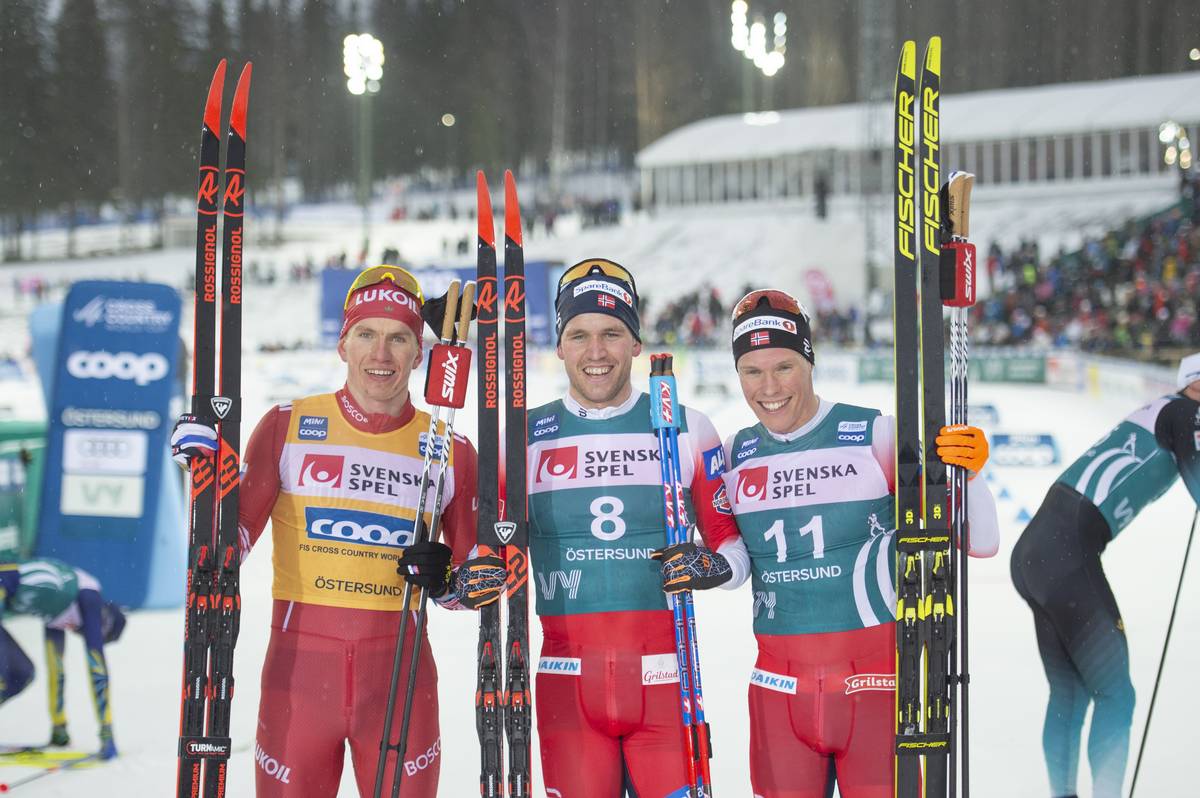
    Alexander Bolshunov (RUS) second, Pål Golberg (NOR) first, and Martin Løwstrøm Nyenget (NOR) third, (l-r). (Photo: NordicFocus)
  • The Devon Kershaw Show: Ski Tour 2020 Stage 1

    The Devon Kershaw Show: Ski Tour 2020 Stage 1

    It was all Norway in both the men’s and women’s Stage 1 of the Ski Tour 2020 from Östersund, Sweden. Sjur Røthe on the men’s side was pacing perfection while Therese Johaug simply steamrolled. This was clear, Norway had the best skis, and perhaps by default, the fastest skiers almost across the top-10 board. Yet, it is a long week ahead, and we are one stage into a six-stage event.
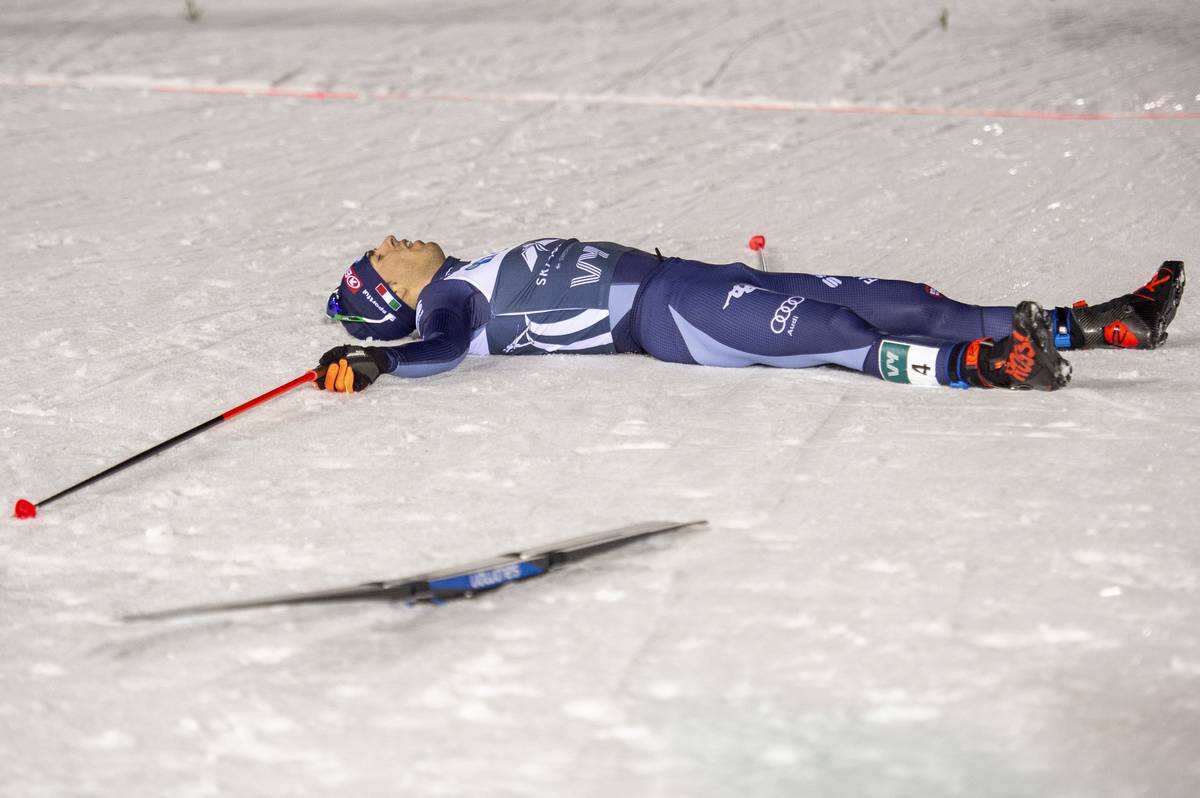
    Here’s the debrief from Devon: post 15 k/ 10 k interval start skate.


  • Perfect Pacing: Sjur Røthe Claims Ski Tour 2020 Stage 1 Win

    Perfect Pacing: Sjur Røthe Claims Ski Tour 2020 Stage 1 Win

    The pacing master of Stage 1 of the Ski Tour 2020: Sjur Røthe. (Photo: NordicFocus)

    The six-stage Ski Tour 2020, which runs from Sweden to Norway over the next week, began Saturday in Östersund, Sweden with the men’s 15-kilometer individual start skate. The race began with twilight immersing Östersund with the sky eventually morphing into black as the seeded group of skiers looped around on what FIS called a 4.71 k course. This much can be concluded after a single day of what will be a hotly contested tour: the Norwegians fired on Stage 1 as they captured the top four spots in the field of 90 skiers. 

    The other take away beyond the Norwegian team’s blistering skis – Sjur Røthe paced himself a masterful 15 k of skiing as he won the event in 30:41.5 minutes.

    However, not all looked shiny for the Norwegian as he went on to win his first World Cup of the season. At the 5 k time check, Røthe came through in 19th place, 19.5 seconds behind Hans Christer Holund, also of Norway. At 7.6 k, the halfway mark for the race, Røthe had moved up to 10th overall but remained 20.3 seconds off the fastest split set by yet another Norwegian, Simen Hegstad Krüger. 

    Then the tides turned, and Røthe began chiseling away at the time deficit. As he lapped through at 10 k, he sat in fourth, 15.4 seconds behind the virtual leader, Krüger. The chisel became a jackhammer; at 12.6 k Røthe was within six seconds of Krüger.

    Simen Hegstad Krüger hammering during the 15 k skate, Stage 1 of the Ski Tour 2020. (Photo: NordicFocus)

    The pacing proved perfect only when Krüger crossed the line: Krüger was a later starter than Røthe: Røthe began in bib 48, Krüger in bib 64. Røthe could, however, pace himself off the splits of Norway’s Finn Hågen Krogh who began in bib 16. Of the early starters, Krogh set the fastest marks at 5 k, 10 k, and the finish, respectively.

    Finn Hågen Krogh (bib 16) an early starter during Stage 1 of the Ski Tour 2020, but fast through his 15 skate effort for third overall. (Photo: NoridcFocus)

    Røthe’s first-place time (30:41.5) was 1.7 seconds faster than Krüger’s who took second on the day. Krogh was third overall (+16.6), and the veritable senior citizen of the Norwegian team, Martin Johnsrud Sundby, placed fourth (+17.3). 

    Saturday’s victory was Røthe first win of the season – however, it was his sixth individual podium which includes a second-place time of day podium in Ruka’s 15 k skate pursuit back in December. Last week, he was second in Falun’s 15 k mass start skate

    “It was a great day for me and the Norwegian team,” Røthe told FIS after the race. “I think we need to give a big hug to the guys in the wax cabin today. They made brilliant skis for us today, and for sure I have done my preparations well, I am really satisfied with today. I am looking forward to [the Ski Tour], it has been one of my main goals this season so for sure I am prepared, but I need to go home and get a good rest because it is not many hours before we do the classic race here in Östersund as well.”

    For those playing the long-term odds in the Ski Tour 2020, after one stage down, Russia’s overall World Cup leader, and 2019-2020 Tour de Ski winner, Alexander Bolshunov, placed fifth (+22.2). 

    Russia’s Alexander Bolshunov, the overall World Cup leader here during Stage 1 of the Ski Tour 2020. He placed 5th on the day. (Photo: NordicFocus)

    Along with capturing first through fourth places, Norway also claimed sixth (Hans Christer Holund), and eighth (Pål Golberg) place in the top-10. Norwegian Johannes Høsflot Klæbo was out of the points in 31st (+1:22.8). The Norwegian star returned after missing last weekend’s racing in Falun with a broken finger. Along with Bolshunov’s fifth place, Russia took ninth (Denis Spitsov) and 10th (Ivan Yakimushkin). The national team outlier in the top-10 was France’s Adrien Backscheider in seventh. 

    David Norris (APU), of the U.S., was the best-placed North American in 36th (+1:27.7). U.S. teammate Simi Hamilton (USST) placed 46th (+1:54.5). He returned to the World Cup racing after sitting out last weekend’s racing due to lingering neck pain. Kevin Bolger (USST) skied to 71st (+3:11.1), Ben Lustgarten (CGRP) 73rd (+3:12.2), and Logan Hanneman (APU) 86th (+4:35.6).  

    David Norris of the U.S. during the 15 k skate, Stage 1 of the Ski Tour 2020. (Photo: NordicFocus)

    Post-race comments from U.S. World Cup Coach Matt Whitcomb

    For Canada, Russell Kennedy skied to 52nd (+2:02.5), Evan Palmer-Charrette 60th (+2:31.9), Alexis Dumas 64th (+2:39.4), and Ricardo Izquierdo-Bernier 80th (+4:10.7).

    Russell Kennedy of Canada, during Stage 1 of the Ski Tour 2020. (Photo: NordicFocus)

    Racing continues in Östersund tomorrow with a 15 k classic pursuit for the men and a 10 k classic pursuit for the women. 

    (No time bonuses were on offer in today’s race.)

     Results | Ski Tour 2020 Standings After Stage 1 

    Ski Tour 2020 Stage 1 podium: Simen Hegstad Krüger (NOR) second, Sjur Røthe (NOR) first, and Finn Hågen Krogh third. (Photo: NordicFocus)
  • Johaug Tops an All-Norwegian Podium; Diggins 8th, Brennan 9th

    An all-Norwegian podium in Östersund, Sweden. Therese Johaug won the day ahead of Heidi Weng and Ingvold Flugstad Østberg. (Photo: NordicFocus)

    Here we go again. A new Scandinavian Ski Tour takes the spot of a World Championship or Olympic Games during this off-cycle year. Six stages working east from Östersund, Sweden to Trondheim, Norway, beginning with today’s 10-kilometer individual start freestyle event. 

    Under clear skies, light fading and shadows lengthening as the sunset looms just a few hours away, the women time trialed through the tall conifers to set the tone of the overall tour standings. Crowds arrived in droves to line the course and fill the stadium, a cacophony of cheers creating the soundtrack to the stage. 

    Today’s format suits the Tour favorite, Therese Johaug, who has expressed that mass start events do not suit her as well. This season, Johaug won the Tour de Ski and has taken the top spot in each of the last ten individual start distance skate events. 

    Her story today essentially wrote itself. In Devon Kershaw’s words: “Gun to tape annihilate.”

    Therese Johaug (NOR) dominates the first stage of the FIS Ski Tour 2020. (Photo: NordicFocus)

    Johaug hammered out of the start gate and did not slow down until she crossed the line, her grimacing face making clear the unmatchable power and tempo she was forcing herself to maintain. Stopping the clock at 21:49.7 and raising her arms briefly in the air before collapsing over her poles, Johaug sealed the deal on best in show. 

    Her time gap on her competitors increased in an almost alarmingly linear fashion throughout the stage. 12.8 seconds at 2.6 k increased to 20 at the halfway mark, growing to 45.6 seconds at the finish. 

    Victorious in Östersund, Therese Johaug has a strong start to the FIS Ski Tour 2020. (Photo: NordicFocus)

    “Oh yes, I could never get a better start than this,” a glowing Johaug told FIS at the finish. “I feel that it was my best skating distance in my career, so I am really happy with the skis and with the shape. It was an amazing race today… It’s good to start the Tour and I’m looking forward to the next races.”

    Here’s what else went down.

    Racing in bib 27 amongst the first wave of 30 skiers, Rosie Brennan set the bar high for the seeded group of  top-ranked skiers who followed in bibs 32 – 60, posting some of the fastest time through each checkpoint. Although she faded into the results as the seeded group came through, it was still a noteworthy performance, placing her 9th for the day (+1:25.7) and second American.

    Rosie Brennan sets the bar, racing to 9th in the first stage of the FIS Ski Tour 2020. (Photo: NordicFocus)

    Of other skiers in her group, Brennan was only challenged by Norway’s Ragnhild Haga and Sweden’s Frida Karlsson, who was recently cleared to return to World Cup competition. Karlsson sat out the majority of the season after failing to meet team health standards for body composition and bone density. 

    Karlsson took the pace out hot, clearly gunning for the win, or at least for the bonus points available at the 2.6k checkpoint. She had the second fastest overall time there, then she attacked the steady climb with high tempo. But she was unable to hold the effort, fading back into the ranks as the race went on. She ended her day in 19th (+1:46.0).

    After a fast start, Frida Karlsson falls to 19th in the 10 k skate. (Photo: NordicFocus)

    Among the first starters of the seeded group in bib 36, Heidi Weng (NOR) went hunting. From 4.2 k onward, she knocked down the previous best time, setting a new and short-lived time to beat, as Johaug chased from two bibs behind. Weng, the 2017 and 2018 Tour de Ski winner who is currently ranked third in the overall World Cup standings hung on to take the second podium spot. 

    Next over the line was Ingvild Flugstad Østberg in third (+47.3), who hovered a few seconds behind Weng at each checkpoint. The trio sealed the deal on an all-Norwegian podium. 

    Ebba Andersson of Sweden interrupted the string of Norwegians in fourth (+53.1), followed by Haga (+1:04.3) and Astrid Urenholdt Jacobsen (+1:05.0).  

    Leading the Tour for North America, Jessie Diggins skied to 8th (+1:18.1). Diggins currently sits 5th in both the distance and overall World Cup standings. 

    Jessie Diggins skates to 8th in the first stage of the FIS Ski Tour 2020. (Photo: NordicFocus)

    In a post-race call, Diggins described the track in Östersund as a “thinking course”, full of swooping turns that kept athletes focused and on their toes. Diggins explained that she has been experiencing an abnormal amount of fatigue over the last few weeks, but felt some encouraging sensations in today’s event and has a plan in place to optimize her recovery between stages so she can keep going hard. 

    She also shares insight about some of Tour’s sustainability initiatives to decrease the environmental impact of such an event, and weighs in on the energy generated from a large American team. 

    Post-race interview with Jessie Diggins.

    Jessie Diggins leads the way for Team USA after the first stage of the FIS Ski Tour 2020. (Photo: NordicFocus)

    Just behind Diggins, Brennan was the next American. It was the APU/USST athlete’s third top-10 result of the season. Her last two were also earned in stage events; she was 9th in the 10 k skate during the third stage of the Tour de Ski in Toblach, Italy and 6th in the 10 k classic in Ruka. She also skied the 7th fastest time of day up the Alpe Cermis in the final TdS stage. 

    “It was a good opening day of the Ski Tour 2020 for me,” Brennan wrote in an email to several news outlets. “After a frustrating weekend last week, I was ready to try to turn things around. The course here is hard and has lots of climbing so I felt it suited my strengths. It was fast conditions but there was also little rest so it was a tricky pacing game. I didn’t perfectly pace it and lost a little in the closing kilometers but I had much improved race feelings so I am very satisfied and hope I can continue this way throughout the tour.”

    Sadie Maubet Bjornen was the next American in 22nd (+1:51.4), followed by her APU teammate Hailey Swirbul in 36th (+2:09.3). Caitlin Patterson was next for the U.S. in 40th (+2:19.1),  Alayna Sonnesyn 43rd (+2:27.3), Julia Kern 50th (+2:38.0), Sophie Caldwell 51st (+2:39.3), Katherine Ogden 53rd (+2:48.0), and Rosie Frankowski 56th (+2:50.0). 

    In a post-race call, Matt Whitcomb sheds light on how the team is approaching the Tour in comparison to the Tour de Ski or a ski tour at the end of the season. Whitcomb explains that a major focus leading into the week was recovery and mental preparation.

    “We didn’t focus to much on performance — that’s never a great way to go. We work on the process and getting people psyched by giving them the confidence to know that they’re recovered. Whether or not they’re sharp on the first day or two, they should be sharp by the end. Whether that ends up happening or not, we’ll see. But believing in it is the key.”

    Whitcomb explains further how he gages how tired or recovered his athletes are and provides further insight into the women’s performance. Lastly, Whitcomb comments on Swirbul’s noteworthy rise in the ranks this year, attributing it to her fun but focused mental approach and the effect of the strong APU women’s training group.

    Post-race interview with Matt Whitcomb.

    On the Canadian side, Emily Nishikawa was the top finisher just outside the FIS points in 32nd (+2:05.0). She started one bib ahead of Sweden’s Charlotte Kalla, who she marked and followed to the finish once caught. 

    Emily Nishikawa leads the Canadian team in 32nd in Östersund, Sweden. (Photo: NordicFocus)

    Next up was Cendrine Browne in 35th (+2:09.0), followed by Katherine Stewart-Jones in 46th (+2:29.8).

    The tour is young. Racing continues tomorrow with a 10 k pursuit start classic on the tracks in Östersund.

    Final Results | Distance World Cup Standings 


  • Ski Tour 2020: The Basics

    Ski Tour 2020: The Basics

    New on the World Cup this season is the Ski Tour 2020: a six-stage tour beginning in Östersund, Sweden on February 15, and concluding in Trondheim, Norway on February 23rd.

    (To view the map as a stand-alone web page, click here.)

    As the interactive map illustrates, races will be held at venues along a similar latitude in Sweden and Norway, with the World Cup entourage traveling East to West. 

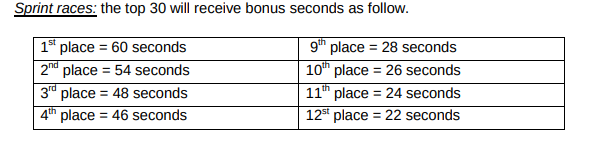
    The Ski Tour 2020 is organized much like the Tour de Ski. Overall standings will be calculated after each race and will be based on actual racing times. For sprint competitions, qualifying times will be used to determine an athlete’s rank in the overall standings. Time bonuses from each stage will be factored into the standings. (Time bonuses are subtracted from a racer’s overall elapsed race time.) 

    Sprint races have the following time bonuses associated with the top-30 places.

     A time bonus is on offer for the top-10 athletes at an intermediate location for each mass start race. Racers receive 15, 12, 10, 8, 6, 5, 4, 3, 2 and 1 second bonuses, respectively.

    For the final overall standings, World Cup points are tripled. For example, a stand alone World Cup win is 100 points. The overall winner of the Ski Tour 2020 secures 300 points. World Cup points are accrued after each race, however, those points are halved; the daily stage winner, for example, earns 50 points. 

    There are cash incentives; the biggest amount goes to the overall winners who receive CHF 47,000 each.     

    On paper at least, the most compelling stage appears to be the 38 k mass start skate races, the fourth stage of the Ski Tour. Yes, women and men ski the same distance as they cross an international border racing from Storlien, Sweden to Meråker, Norway. Athletes are restricted to a single feed zone at kilometer 25. Otherwise, the rules stipulate that no coaching or coach-feeds are allowed between 3 k and 35 k. Athletes wanting to fuel between 3 k and 35 k will need to carry their own food and drink. In the event of a broken pole, a neutral spare pole service will be available to racers between 3 k and 35 k.  

    Stage 4 race course


    Stage 4 course profile