From the FasterSkier archive — posts syndicated from athletes’ and coaches’ own blogs between 2004 and 2012, kept online as published. Current coverage is at fasterskier.com.
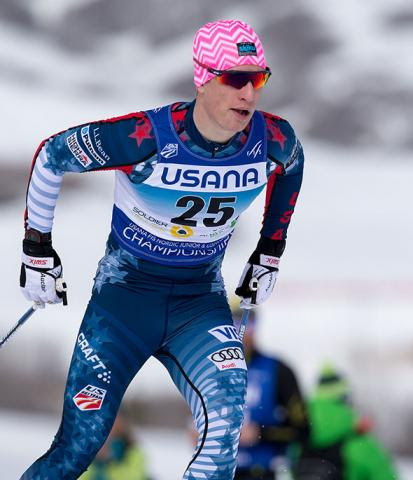
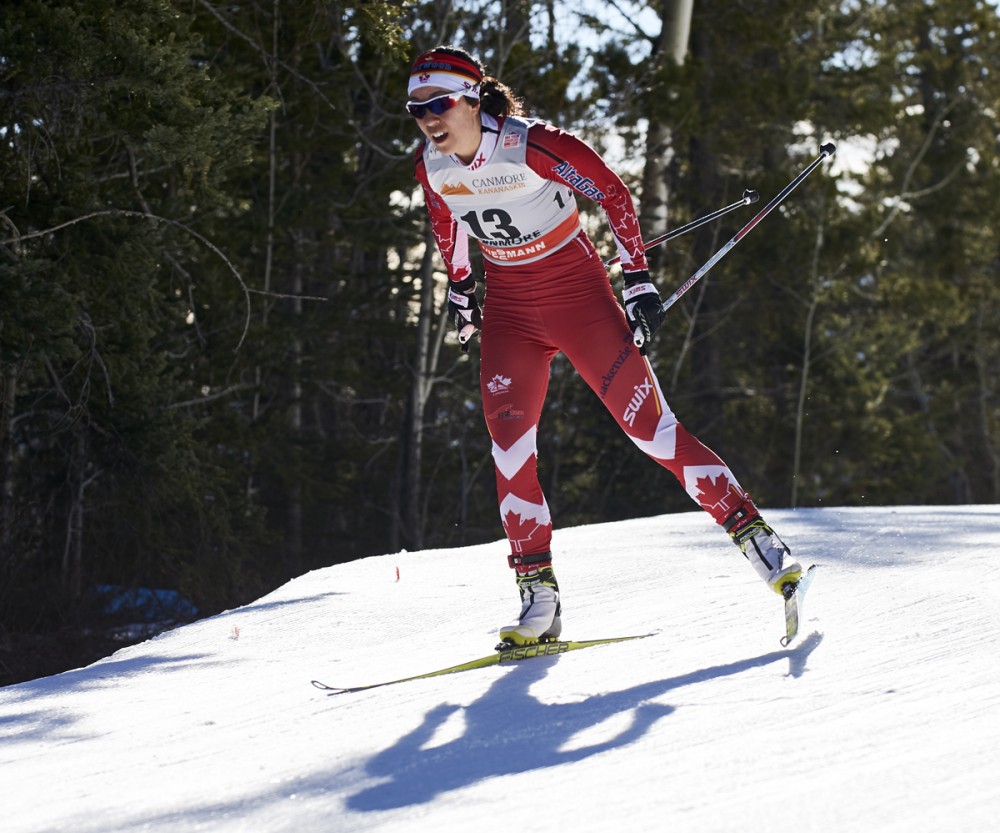
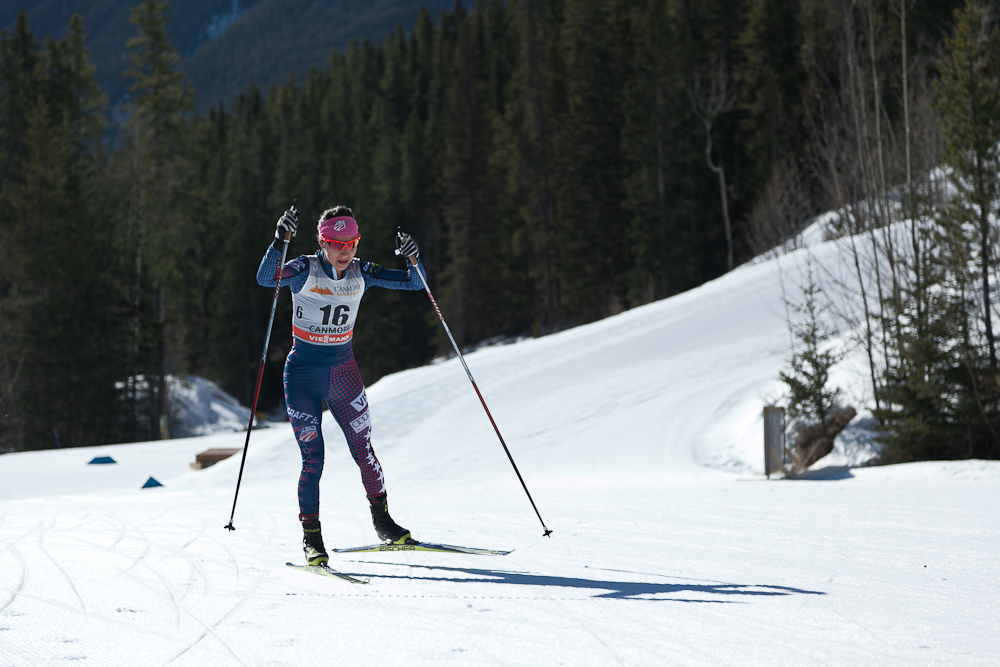
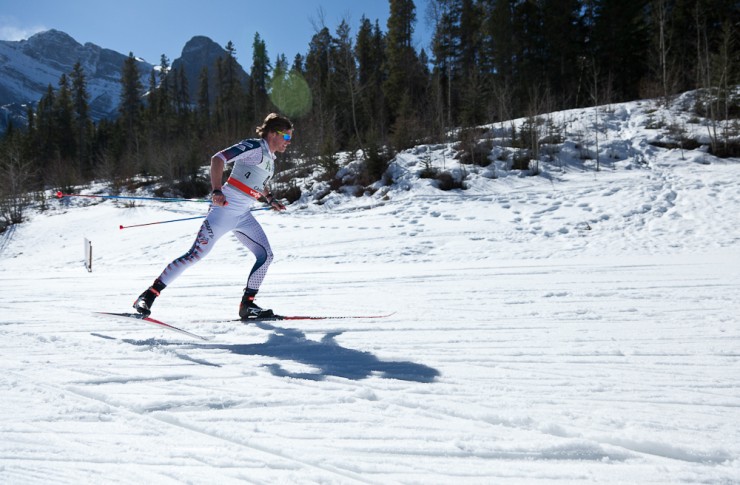
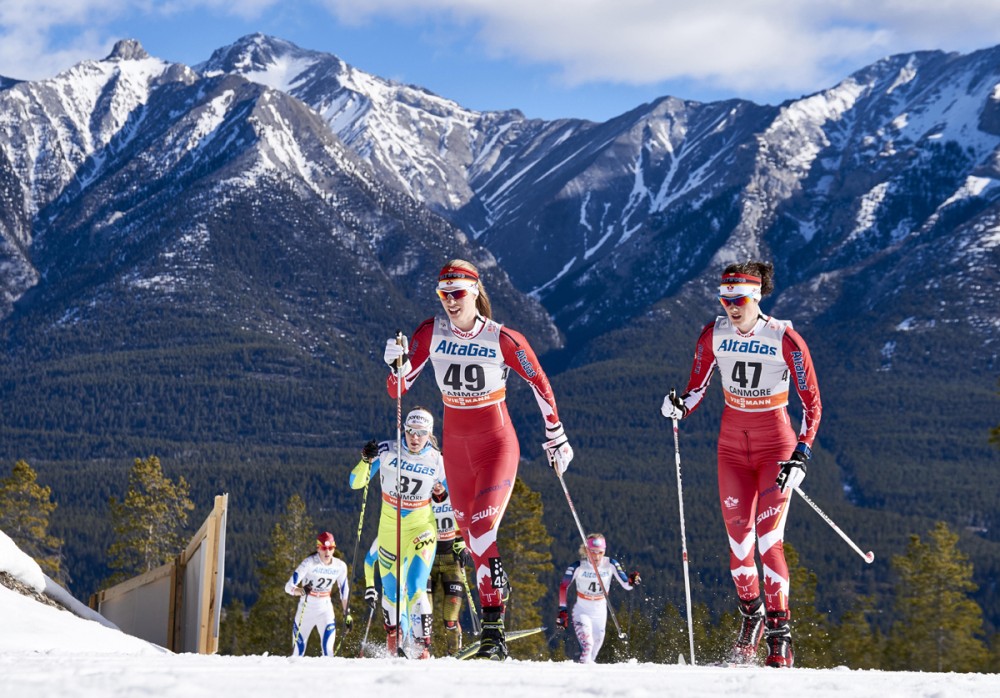
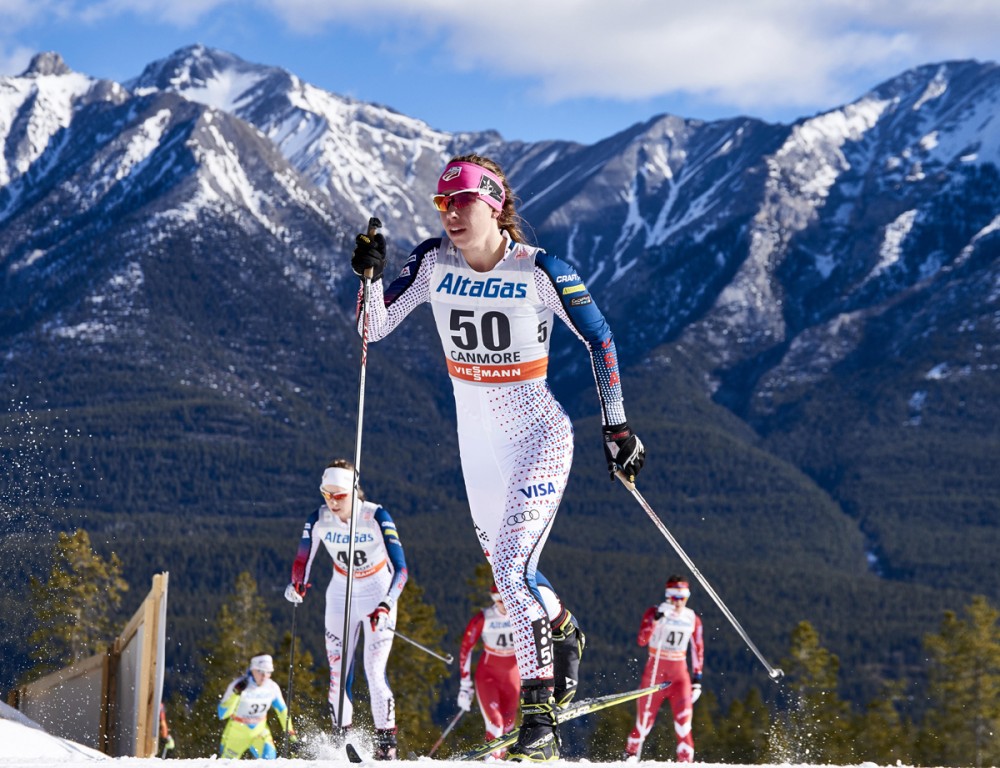
Katharine Ogden (Stratton Mountain School/U.S. Ski Team D-team) racing to fifth in the women’s 5 k freestyle at 2017 Junior Worlds on Wednesday for her best result in her third Junior Worlds. (Photo: FlyingPointRoad.com)
(Note: This article has been updated to include comments from Americans Katharine Ogden and Taeler McCrerey, as well as Canada’s Gareth Williams.)
Katharine Ogden’s name had already been in the U.S. Ski & Snowboard Association (USSA) record books, right behind Lindsey Williams, Leif Zimmerman and Torin Koos as one of the top finishers in U.S. history at Nordic Junior Worlds Championships.
Ogden, 19, of the Stratton Mountain School (SMS) and U.S. Ski Team (USST) Development “D” Team, was tied with five other Americans who also placed sixth at Junior Worlds, including current World Cup skiers Andy Newell and Kikkan Randall, and Kris Freeman, who went on to finish fourth in two senior World Championships.
On Wednesday, Ogden moved up in the ranks, placing fifth for the second-best U.S. result at Junior Worlds, equalling Zimmerman and Koos.
Katharine Ogden (Stratton Mountain School/U.S. Ski Team D-team) racing to fifth in the women’s 5 k freestyle at 2017 Junior Worlds on Wednesday at Soldier Hollow in Midway, Utah. (Photo: FlyingPointRoad.com)
“I’m really psyched about my result … it was so awesome to see that I’m in a good place to stick with these top girls in the mass start race,” Ogden wrote in an email after the women’s 5-kilometer freestyle at Soldier Hollow in Midway, Utah.
She had previously finished sixth in the 10 k skiathlon two years ago in Almaty, Kazakhstan.
“My goal going into the 5k skate was mostly just getting a feel for how I can race in this field and on these courses so as to know how to race the skiathlon,” she explained, referring to her target race on Friday. “In the skiathalon I’m really hoping for another top 6 and maybe (hopefully) a podium.”
“It’s really encouraging to know that all those U.S. Ski Team girls that are doing so well [on the World Cup] right now were in the same place that I am at one point,” Ogden said in a post-race interview with the U.S. Ski Team.
She has her share of World Cup starts, eight to be exact, after racing the entire Ski Tour Canada — an eight-stage series that closed out the 2015/2016 international race season. This year, her fifth place on Wednesday puts her soundly within U.S. Ski Team criteria for selection to 2017 World Cup Finals, which will take place March 17-19 in Quebec City, Quebec.
But back to Junior Worlds: Ogden achieved a career best on Wednesday and was 6.5 seconds shy of a medal. Ogden started the one-lap 5 k individual start in bib 54 (of 57).
Asked what she was thinking about as she warmed up and lined up at the start, Ogden couldn’t get over how nervous she was.
“Honestly I was pretty nervous before the start of the race. That’s basically all that I was thinking about,” she wrote. “I felt good once I started racing, the nerves just went away! The course was totally awesome for me.”
While she didn’t get many splits, Ogden explained she heard just enough to know that she was with the leaders.
“That motivated me because I was aware that every second was important,” she wrote.
Just over 13 minutes later, she crossed the finish line in third, 6.5 seconds behind behind Russia’s Mariya Istomina, who was fastest across the line in bib 50. Italy’s Anna Comarella, who started 53rd, 30 seconds ahead of Ogden, came up 3.2 seconds shy of the Russian for second at the time. And Ogden was another 3.3 seconds back in third.
“I honestly didn’t have too much of a strategy,” Ogden told the U.S. Ski Team. “It was a short race, so I knew I was going to have to go hard basically from the start. But I was also trying to walk the line of not blowing up.”
The 2002 Olympic trails at Soldier Hollow peak out around 5,900 feet above sea level. That can be a doozy for most of the world that trains closer to sea level, including Ogden from Landgrove, Vt. Asked in a pre-Junior Worlds questionnaire what she was most excited for at these championships, Ogden wrote “racing at altitude.”
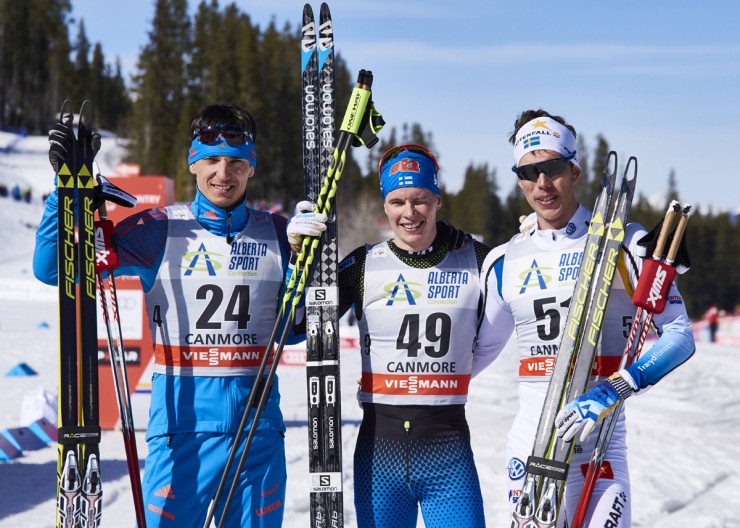
The women’s 5 k freestyle podium on Wednesday at 2017 Junior World Championships at Soldier Hollow in Midway, Utah, with Sweden’s Ebba Andersson (c) in first, Norway’s Marte Mæhlum Johansen (l) in second and Russia’s Mariya Istomina (r) in third. (Photo: FlyingPointRoad.com)
Of the three women that started after Ogden, two of them reached the podium. Norway’s Marte Mæhlum Johansen in bib 56 bested Istomina’s time by 1.5 seconds to become the new race leader — albeit briefly. That bumped Ogden to fourth and the American ultimately placed fifth after the final starter, Sweden’s Ebba Andersson, finished 13.8 seconds faster than Johansen for the win in 12:45.4 minutes.
Andersson became a three-time Junior Worlds champion, after winning last year’s 10 k freestyle and 4 x 2.5 k freestyle relay with Sweden’s women’s team in Rasnov, Romania.
“When I was thinking about the race I made a tactic that I would have a controlled start and then power to the end and I think I succeeded,” Andersson told the U.S. Ski Team media. “The course was amazing today. It was incredible and the weather, too.”
Following the trend of the rest of the week so far, conditions were hard-packed and temperatures just below freezing on a bluebird day.
Ogden led three U.S. women in the top 20 on Wednesday, with Hannah Halvorsen (Sugar Bowl Academy/USST) in 13th (+1:01.2) and Taeler McCrerey (University of Denver) in 20th (+1:18.9). The team’s fourth woman, Hailey Swirbul (University of Alaska Anchorage) placed 31st (+1:35.5).
“My goal for this race was to pace it well so I could use my energy wisely,” Halvorsen, also a member of the USST D-team, wrote in an email. “I liked how firm and fast the course was because I could focus on skiing smooth, powerful, and relaxed. I was really happy with how things went!”
As the 22nd starter, Halvorsen initially crossed the line in second.
“I was excited to cross the line in second but I didn’t know how promising that would be with half the field still to finish,” she wrote. “I was a little bummed to not stay in the top ten but I know this was a great race for me.”
Two days earlier, in her first race of her first Junior Worlds, Halvorsen finished 11th in the classic sprint.
Also on Monday, McCrerey, a sophomore at the University of Denver, placed 40th in the classic sprint. She landed 20th on Wednesday for a career best at her first Junior Worlds.
“Today I set out to achieve my first solid race at world juniors,” McCrerey wrote in an email.
She explained that interval-start races are her strength and growing up 9,000 feet above sea level in Frisco, Colo., didn’t hurt, either.
“The 5k course is one of the most challenging I have raced at Soldier Hollow so that also benefited me,” McCrerey noted.
The 44th starter, she explained that she received splits at two parts of the race.
“The splits were surprisingly close as skiers 5-18 were all within 6 seconds of each other,” she wrote. “Unfortunately all the fast girls started behind me so I was not receiving splits off of them. Racing at ‘home’ in this big of races has been an incredible experience. It’s fun to hear people cheering for the ‘host country’ and waving the stars and stripes so proudly!
“Today was a good day,” McCrerey added. “I learned a lot about racing at this level which has made me grow as a skier. Special congratulations to my teammates Hannah and Katherine on their exceptional performances today.”
Canada had four women in 39th through 46th, with Lisle Compton (NTDC Thunder Bay) in 39th (+1:51.9), Annika Richardson (NTDC Thunder Bay/Canadian Junior Team) in 41st (+1:57.8), Claire Grall-Johnson (Nakkertok) in 42nd (+1:58.2), and India McIsaac (Rocky Mountain Racers) in 46th (+2:12.9).
Russia Sweeps Men’s Podium; Wonders 16th
The all-Russian 10 k freestyle men’s podium on Wednesday at 2017 Junior World Championships at Soldier Hollow, with winner Vladislav Vechkanov (c), Egor Kazarinov (l) in second, and Yaroslav Rybochkin (r) in third. (Photo: FlyingPointRoad.com)
After women’s race wrapped up in the morning, the men’s 10 k freestyle began at noon. Hunter Wonders, of Alaska Pacific University, led two Americans in the top 20 — finishing 16th in 24:25.8. The winner, Russia’s Vladislav Vechkanov, who had qualified fifth in the classic sprint then went on to place 10th on Monday, started in bib 59 (of 73) and posted an untouchable time of 23:08.6.
Russia swept the podium with two of Vechkanov’s teammates coming closest to him. Egor Kazarinov, the 70th starter, finished 7.9 seconds back in second, and Yaroslav Rybochkin was 13.3 seconds back in third.
For 19-year-old Vechkanov, the gold was his first medal in two Junior Worlds, after placing seventh in the skate sprint last year in Rasnov.
“I arrived at the finish and actually I didn’t think I would win gold,” he told the U.S. Ski Team media. “So I pushed knowing that I would be in top three, but not winning. I started really slow. The on the second loop I tried to increase my speed. On the last uphill I tried my best to make it to the finish line without any strength and I hoped I would be in the top three. But now I’m first!”
American Hunter Wonders (APU) racing to 16th in the men’s 10 k freestyle at 2017 Junior World Championships on Wednesday at Soldier Hollow in Midway, Utah. (Photo: U.S. Ski Team/Steven Earl)
Wonders’s time was 1:17.2 minutes back, which put him 16th in his first Junior Worlds race. He started 25th, two minutes behind his U.S. teammate Wyatt Gebhardt, of the Steamboat Springs Winter Sports Club. Gebhardt ended up 19th (+1:21.9), also in his Junior Worlds debut.
Also for the U.S, Bill Harmeyer (University of Vermont) placed 29th (+2:02.6) and Lance McKenney 61st (+4:23.3).
Following Gebhardt in 19th, Canada’s Gareth Williams, of the Telemark Race Team in Kelowna, B.C., placed 20th (+1:24.6) in his first Junior Worlds race. His Canadian teammates Antoine Blais (Skibec) followed in 32nd (+2:07.8), Philippe Boucher (CNEPH) 35th (+2:10.3), and Remi Drolet (Black Jack) 50th (+2:49.1).
“This and the skiathlon were both my target races after not qualifying for Canada’s sprint team,” Williams explained in an email. “In my head I wanted to be inside the top 20 on the day, but since it is my first Worlds race I had no idea what to expect.”
Toward the end of the second lap, he started cramping.
“This made it difficult for me to give a proper finishing kick on the last few hills. I was getting splits that I was fighting for a top 20, so for me that was motivating,” Williams wrote. “Overall I am happy with the day, top 20 is something to be pleased with. Now that I have a taste of what it’s like here at Worlds, I can adjust my goals for the coming races. I hope tomorrow’s skiathlon can go equally as well, if not better.”
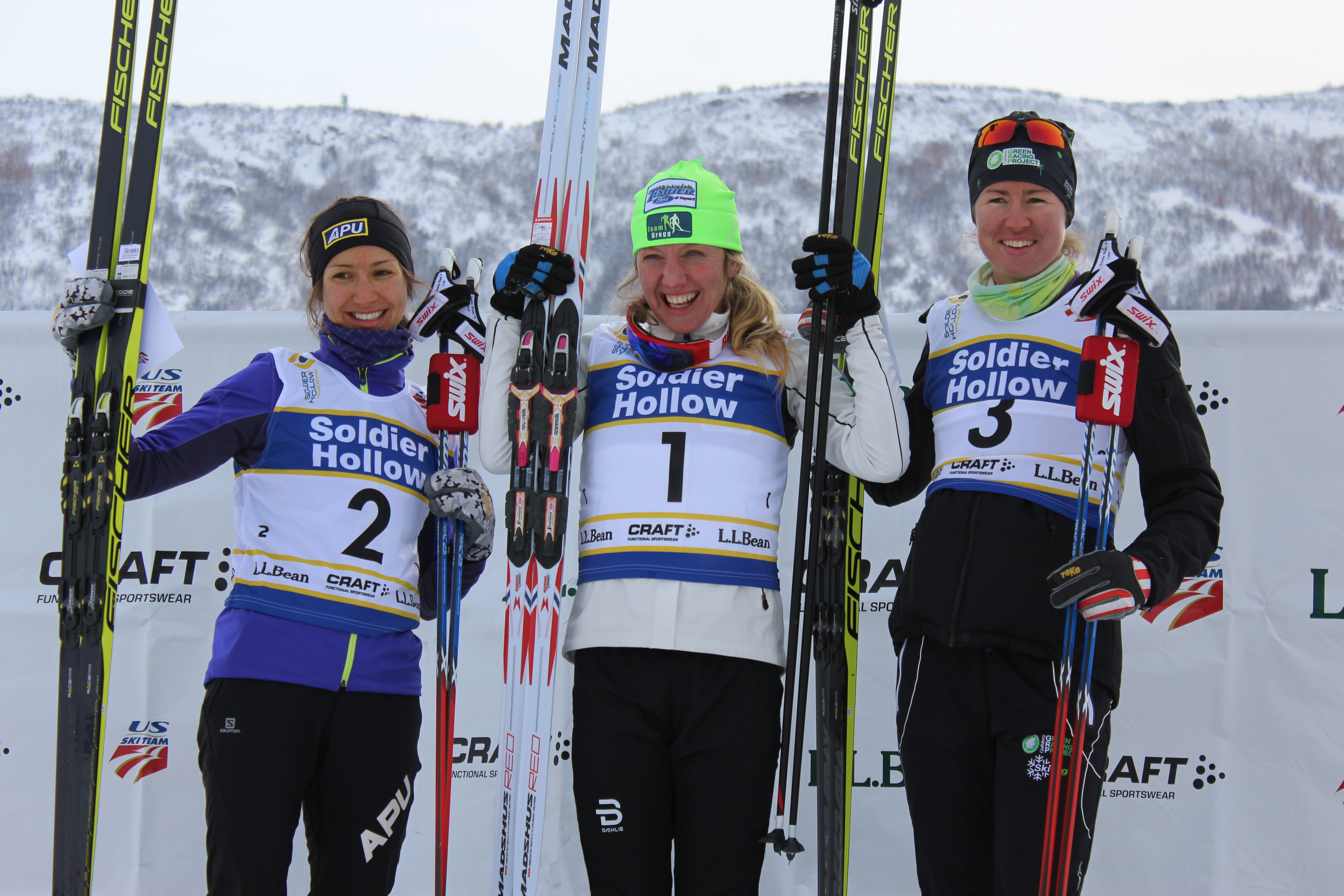
The women’s 10 k freestyle podium on the first day of 2017 U.S. Cross Country Championships at Soldier Hollow, with (from left to right) Chelsea Holmes (APU) in second, race winner Caitlin Gregg (Team Gregg) and Caitlin Patterson (Craftsbury Green Racing Project) in third on Saturday in Midway, Utah.
MIDWAY, Utah — With four grueling uphills per lap, the new U.S. Cross Country Championships women’s 10-kilometer course at Soldier Hollow (SoHo) totals some 400 meters of solid incline. Divide those 400 meters by eight and what do you get? The hill metricCaitlin Gregg, based in Minneapolis/St. Paul, Minn., has used as a race-season springboard for the past nine years.
Maybe flats are easier to find on Gregg’s Twin City turf than the hills that abound in SoHo. But the 36 year old still considers herself a climber.
Gregg proved a point after she won by 2.2 seconds in the women’s 10 k freestyle on Saturday, the first day of nationals: put a hill, any hill, in front of her and she’s going to climb it — whatever form that hill happens to take.
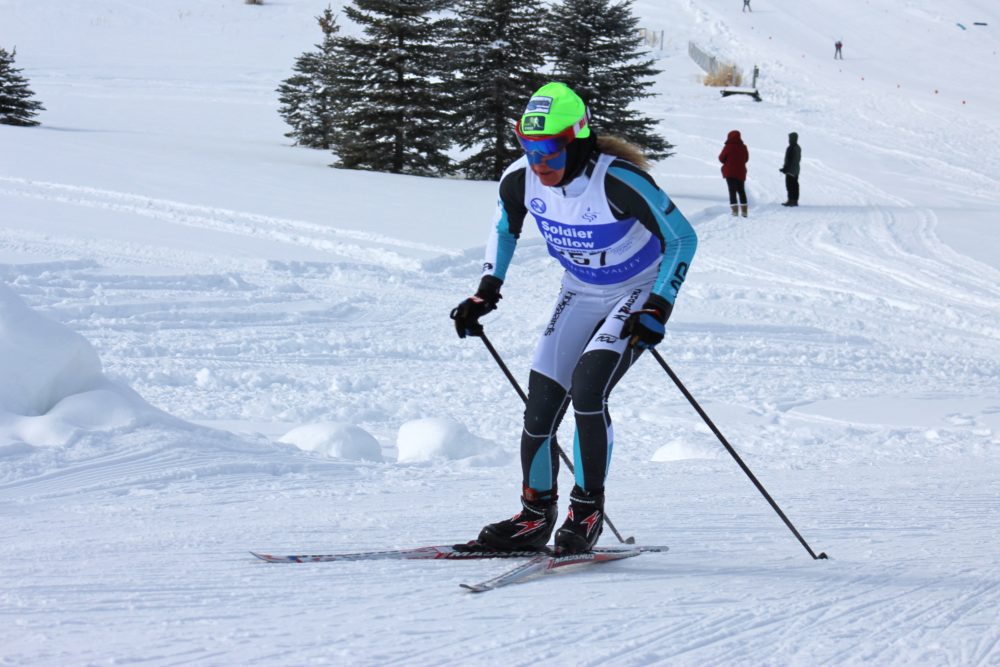
Caitlin Gregg of Team Gregg on her way to a first place finish in the women’s 10-kilometer freestyle event on Saturday at U.S. nationals in Midway, Utah.
In 2014, Gregg missed making the U.S. Olympic team, after competing in Vancouver in 2010.
Now representing Team Gregg with her husband Brian, she has her sights set on 2017 World Championships in Lahti, Finland. Gregg’s chances for world champs, however, depend greatly on her performances this week at U.S. nationals.
So far, with her first place finish in 27:00.6 — Gregg’s eighth national title, according to the International Ski Federation (FIS) records — she’s off to a good start.
“My competition has been really strong this year and that is something that I don’t think is a negative at all,” Gregg told FasterSkier on Saturday. “The goal of this entire country is to really step it up and be more competitive on the international field.”
“I want it to be the top athlete, whoever it is [who goes to World Championships],” Gregg said. “Whether it is me or not, I just want [today’s 10 k] to be an opportunity for domestic athletes to get there.”
The other domestic athletes Gregg referred in particular were her Saturday podium counterparts, Chelsea Holmes of Alaska Pacific University (APU), who finished second (+2.2), and Caitlin Patterson of the Craftsbury Green Racing Project (CGRP) in third (+9.1).
Holmes earned World Cup starts last season and competed in the Ski Tour Canada, where she scored her first World Cup points. She explained she is taking the U.S. nationals day by day.
“For me, I just try focusing on every day doing my best,” Holmes said. “I’m not a number person. I just try to do as best as I can and I kind of see where it gets me.”
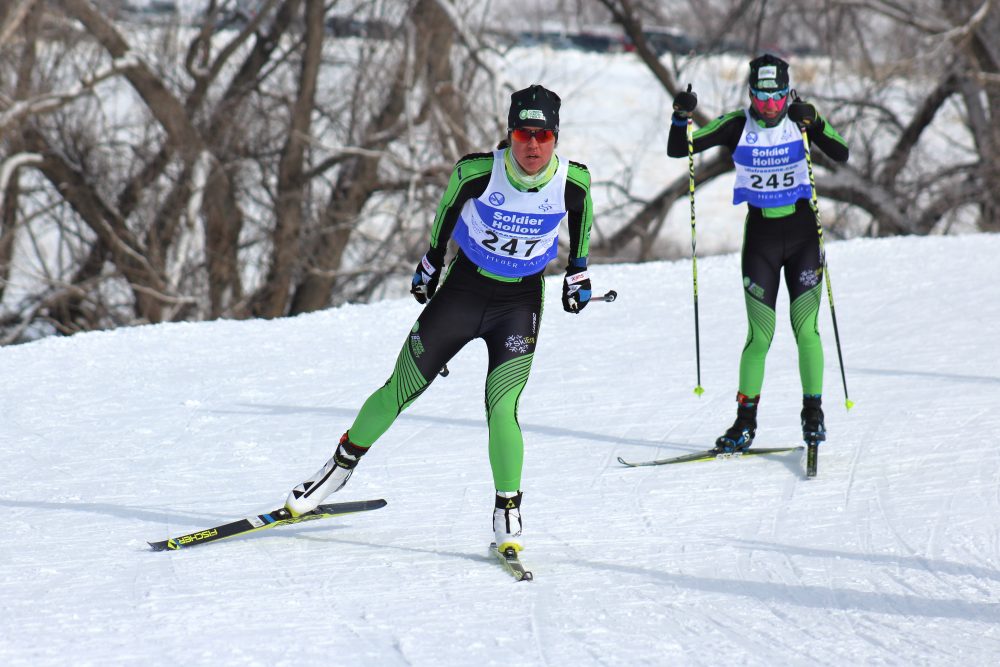
Caitlin Patterson leading her Craftsbury Green Racing Project teammate Kaitlynn Miller during the women’s 10-kilometer freestyle on Saturday at U.S. nationals in Midway, Utah.
Patterson, on the other hand, recently returned to the U.S. after racing on the World Cup for Period 1. She also scored World Cup points in November, and entered nationals confident she was a podium contender.
“I had some pretty solid races [in Period 1] – some ups and downs there, too – and I was certainly hoping to come back and be able to have a strong showing here today,” Patterson said on Saturday. “Today was actually a little bit of a tough day for me, I didn’t quite feel as snappy as I was hoping, but I ended up OK.”
Both Patterson and Holmes started in front of Gregg, who indicated she received no specific splits. But she did hear her positions being called out. At various points they ranged from second to fifth and sixth.
“I didn’t really have a rabbit,” Gregg said. “So I tried to catch as many people as I could. I knew it really wasn’t really the longevity that was the issue it was just the right moment to attack. So I made a plan to attack at about 6 k and attack hard.”
Around 6 k, Gregg did as she planned and put down the hammer, especially on the uphills. Despite being “in the hurt train” during her last 4 k of racing, she finished with just over two seconds to spare on second place.
“It was more about racing against myself,” Gregg explained. “Be patient and then go.”
Katharine Ogden of the U.S. Ski Team and Stratton Mountain School was fourth (+20.0) and the first under-23 finisher. Becca Rorabaugh and Rosie Frankowski finished fifth (+58.4) and sixth (+1:05.0), respectfully, to give APU three of the top six.
“I felt like I was able to move pretty well, most of it, but you really had to keep the pressure on the whole time,” Rorabaugh said. “Your body didn’t want to do it today, but you had to kind of just go there anyway.”
Originally from Fairbanks, Alaska, Rorabaugh said the cold weather on Saturday morning — which delayed the women’s start by an hour — suited her.
“I mean, I’m from Fairbanks. I can’t help it, I like it a little bit,” she said. “I wouldn’t consider myself as much of a skate skier, so this is my best skate result at nationals in a distance race so I’m excited about that. But I think the cold, definitely I have a comfort in the cold.”
Jessie Diggins (U.S. Ski Team) loving on her Salomon boards after placing second in Tuesday’s 10 k skiathlon at Stage 3 of the Tour de Ski in Oberstdorf, Germany. (Photo: Salomon/NordicFocus)
A little more than four years ago, a group of women clad in all black race suits and bib 3 huddled in an athlete warming room. The muffled voice of an announcer speaking in Swedish could be heard broadcasting outside, an English translation relaying the same message: 10 minutes to start.
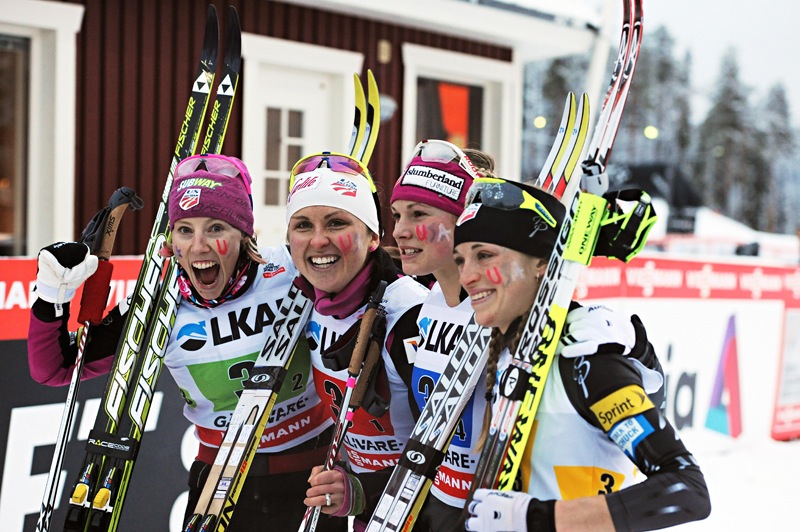
The quartet departed the building, four blondes — one highlighted pink — headed for the start gate. A pass through a patch of sunlight revealed a second similarity. Cheeks swiped in sparkles, artwork courtesy of the then and now, youngest U.S. Ski Team (USST) A-team member, Jessie Diggins.
Diggins would go on to anchor the team in what became a historic cross-country World Cup relay for the U.S. — it was the first time an American women’s team reached the podium, with the group finishing in third overall.
The U.S. women (l-r Kikkan Randall, Holly Brooks, Jessie Diggins, and Liz Stephen) after their first ever World Cup relay podium in November 2012. (Photo: Fischer/NordicFocus)
It could be said that the game-face glitter and a give-it-all relay leg performance from Diggins was the kickstarter of her World Cup career.
For the next few years, team races such as the above, would become some of the Afton, Minn., native’s favorite, and arguably, better performances. Her first individual podium came almost exactly a year ago at the 2015/2016 Tour de Ski.
“For years, I would pull out these awesome performances on relay day and I was like, ‘Oh my God, where did that come from?’ ” Diggins said during a phone conversation in November.
Now, at 25 years old, Diggins has reached the World Cup podium 13 times. Of the eight individual podiums, six occurred last season. The other two more recent: her win in the 5 k freestyle race last month and her second place finish in Tuesday’s Stage 3 skiathlon in Obsterdorf, Germany.
With close to five years of World Cup racing now under her belt, Diggins explained that while her love for team racing and facepaint has not changed, her mental approach toward individual races has. Part of the difference stemmed from her discovery that her individual effort is no less important than the one she puts forth for the team.
“I finally realized it’s OK to race that hard in an individual race, too,” she said. “Like that doesn’t make me a bad person for wanting to do it for myself and for my hometown and for all the people cheering for me.”
That said, Diggins is not bent on lining up and looking for the win at the start of every ski race this season. Her focus, as she indicated, will be where it matters: the Tour de Ski — which she currently ranks fifth in — and 2017 World Championships in Lahti, Finland.
“You’re not going to be able to race to the point of being barely conscious 40 times,” Diggins said, predicting that, if this season matches last year’s competition count, she’ll probably tackle close to 40 ski races. “I’m going to get ready for the big races, like the tours, World Championships, the ones that are the most important to me.”
Left to right: American Jessie Diggins with Norway’s Kari Øyre Slind and Ragnhild Haga after a strength training session with the Norwegian ski team this summer. (Photo: Roar Hjelmeset)
A firm believer in the role every individual plays within the team structure, Diggins described her part within the women’s USST as that of a “spark plug.” While some individuals show strength in race analytics, others psychological breakdown, hers comes as enthusiasm for the sport itself, which includes her signature sparkles.
“You know, everyone has very unique skills that they bring to the table and mine is energetic optimism,” Diggins said. “I’m kind of the cheerleader of the team, if you will, covered in glitter. My job is to make the team, get people excited about what we’re doing.”
Diggins does her job well. As an athlete ambassador for Fast and Female, once again aiding with the ‘dance and endurance’ station at this fall’s annual event in Park City, Utah, she acted as inspiration for more than 160 girls in attendance.
Her enthusiasm for the sport is also proactive. Before last season came to a close, she approached the Norwegian women’s head coach at the time, Egil Kristiansen, at the Ski Tour Canada, proposing the notion of her joining his Norwegian team for a summer training camp.
Three months after her conversation, Diggins received an email from Norway’s new women’s head coach, Roar Hjelmeset, listing training camps she could attend.
“If you want to be the best, why not go train with the best?” Diggins said of why she chose Norway.
With many of the Norwegian women a similar age as herself (to include some of Norway’s leading talent: Heidi Weng, Maiken Caspersen Falla and Ingvild Flugstad Østberg), and the potential of racing alongside these same athletes for the next few years, Diggins also saw an opportunity to create connections as more than just competitors.
“If you want to be the best, why not go train with the best?” — Jessie Diggins on spending a week training with the Norwegian national team
“Why not make good friends and have a coffee buddy in between races on the World Cup?” Diggins said. “I love making friends and learning more cultural things. It’s about more than just skiing, I guess, for me.”
Her time in Norway gave her more than just a few extra World Cup coffee buddies. She was also able to compare notes on Norway’s training strategies with those of the U.S. What she found was, surprisingly, there were no big secrets. Much of the training she did with the Norwegians mirrored work she’d done at camps on North American soil.
“The training we did over there in Norway was almost identical to what we did at our Bend camp,” Diggins said of the U.S. Ski Team’s annual spring camp. “We just need to believe in ourselves as a nation and know that eventually we will get there too.”
It wasn’t that her Norwegian counterparts were doing more intervals than what she was used to or even longer. What it did come down to, according to Diggins, was the complete conviction with which they approached their training plan, even if it meant doing less than others around them.
“They go into every workout with this awesome confidence, like what I’m doing today is the right thing for me and it’s going to make me faster and I’m going to kick ass,” Diggins said. “It’s just a really good mindset I really admire.
“It’s really hard because a lot of us are wired in that more, more, more, more is better,” she added. “It’s my job to train, so I’ll just train a ton. But it doesn’t always make you faster, unfortunately. Or else it be super easy and we’d all be winning World Cups.”
As she continues to become a regular podium contender and challenger of Norwegian names, Diggins proves that the trust she has placed in her training is not to be taken lightly. With another individual win added to her first one from last year, Diggins doesn’t doubt her ability do it for herself or her team.
“Last year was a big confidence boost,” she said. “Now [coming into this season], I know that I can do it, because I’ve done it before.”
***
We asked Diggins to give our ’17 Questions for 2017′ a go. Here are her responses:
1. Biggest change in your life in the last five or so months since the ski season ended?
Not a whole lot has changed! I’m still a ski bum living out of my suitcase, and the longest I’ve been in one place was 3 weeks in a row. I guess the biggest change is that I can now pack up my life in under an hour (yep, I clocked it).
2. Biggest change in your training?
I’m still slowly getting better at finding the line between training a lot and recovering from it before moving on, and paying a lot of attention to how I’m feeling day to day is something that’s helped me a lot over the past year.
3. Major areas of improvement you’ve seen so far?
Classic technique! I’ve been putting a lot of work into classic over the years and I’m finally feeling as comfortable striding as I am skating. I can’t believe I just wrote that.
4. Whom you’ve been working closest with this offseason (coaches or training partners)?
I work with a lot of people! Jason Cork has been my personal coach (and tech!) for a looooong time, and I also train and work with the USST coaches and athletes. I spend the summer bouncing between USST camps and living and training with my teammates at SMS and our SMS team coach, Pat. Basically, I love working with everyone. I even got a special trip to Norway to train with their National team girls, and I had such a great camp with them. I firmly believe that the more we can get together and help each other get better and faster, the better everyone will be!
5. Best trip in the last five months (and why)?
I have a serious thing for New Zealand. We had another amazing training camp there this August, and I love everything about that country! The training was amazing with 35km of groomed trails, the food was spectacular, the views were inspiring and the people were super friendly.
6. Favorite cross-training?
I like long adventure runs. Point to point, NOT out and back, please.
Jessie Diggins (r) with her boyfriend, Wade, during a trip to Winnipeg, Manitoba, this summer. (Courtesy photo)
7. Favorite non-athletic activity or pastime this summer?
Spending time with my boyfriend in Boston, and my family in Minnesota! There are a lot of pretty amazing people in my life, and I like being around them as often as I can.
8. Song that was your jam this summer?
“Handclap” by Fitz and the Tantrums got me through my own set of glacier skiing tantrums 🙂
9. All-time favorite race moment?
OH man. There are so many! Every relay I’ve ever been a part of is a great memory for me…even the times we really blew it 🙂 But it’s a tie between the moment I crossed the finish line and barreled right into Sophie, Sadie and Liz’s arms in Nove Mesto, and when Kikkan and I won the World Champs team sprint relay. Those were days when the whole team was jumping up and down!
10. First thing you pack in your bag when you leave for Europe?
Glitter. Aeropress coffee maker. Peanut butter/Almond butter and American Gum (I swear, it’s different. And very important!). But the first thing is always glitter for race days
11. Venue/event you’re most excited to visit this season?
I am really excited to see the new one in Ulricehamn, Sweden. It’ll be fun to see a new place!
12. Who will win the men’s and women’s World Cup titles this year?
Your guess is as good as mine!
13. Biggest sacrifice you feel you’ve made choosing this career path?
Being far away from the people I love in my life. I’m a cuddly, got-to-be-with-you-there-in-person kind of person, and it’s hard to be gone so much. Thank goodness for Skype, but it’s not the same when you really need a hug from home.
14. If you could change one thing about your sport, what would it be?
Have more World Cups in North America, and finally bring some back to the US! Our sport is growing and it would be incredible to bring all the exciting action back home to keep the next generation of skiers fired up.
15. What did you have for breakfast this morning?
Oatmeal with berries, nuts, yogurt and local honey made by my friends at home! Lucky me.
16. In 5 years, I’ll be ____?
Still racing the World Cups, of course!
17. In 50 years, I’ll be ____?
Embarrassing my grandkids by dressing up, glittering my cheeks and skiing the Slumberland American Birkie.
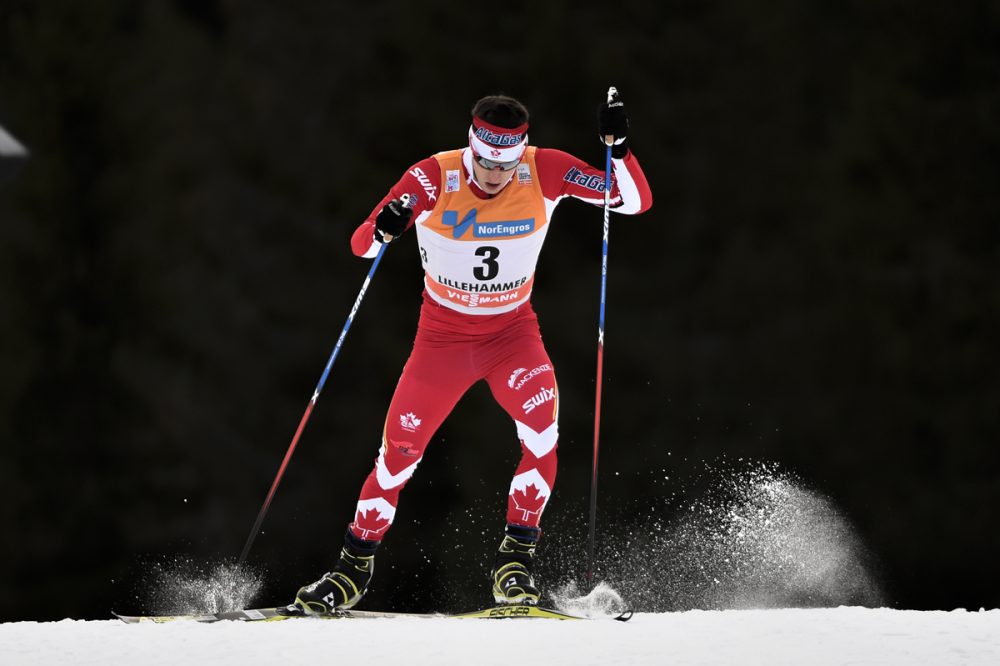
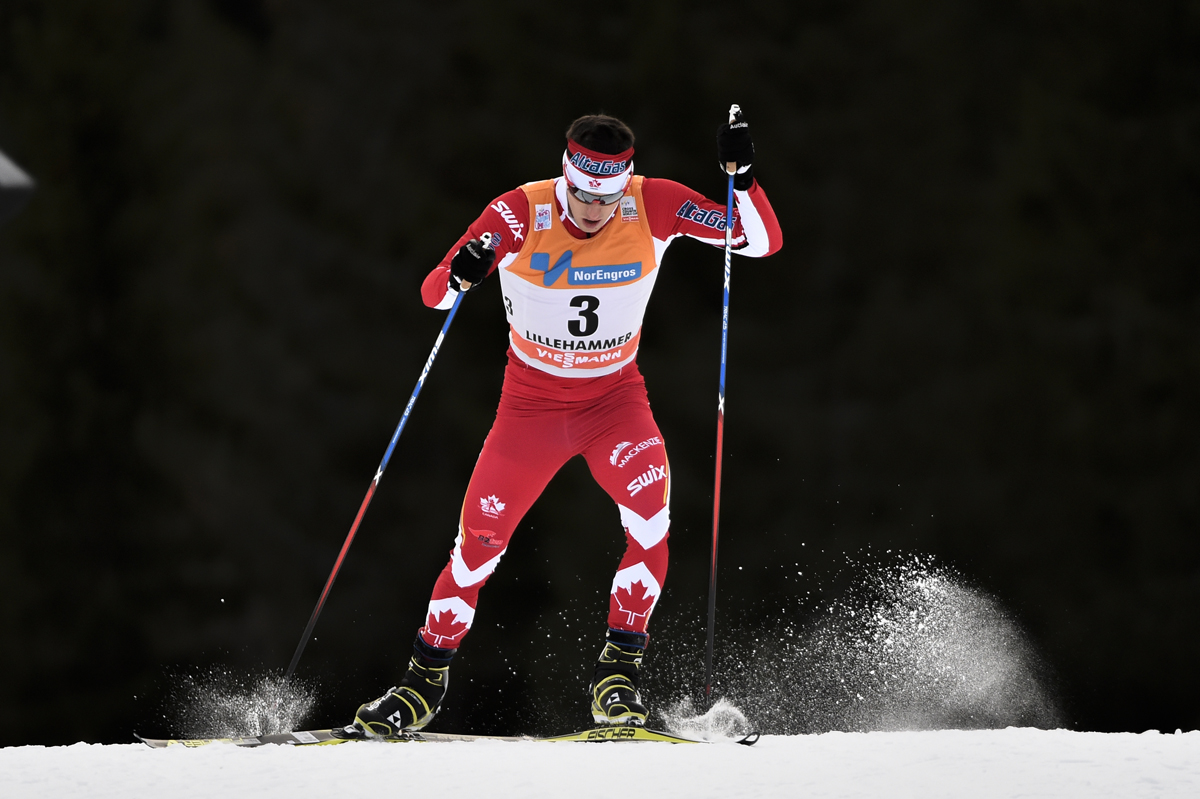
Canadian Andy Shields competing in the men’s 10-kilometer freestyle earlier this month in Lillehammer, Norway. (Photo: Fischer/Nordic Focus)
At the start of last season, Canadian cross-country skier Andy Shields specified two goals on his personal blog: 1.) to be the NorAm leader and earn World Cup starts by 2016, and 2.) to race the Ski Tour Canada.
Though several of his fellow Canadian competitors may have had similar ambitions, Shields was one of the few who lived them out. He emerged the 2015/2016 NorAm overall men’s winner, besting runner-up Kevin Sandau of the Alberta World Cup Academy (AWCA) by just one point.
Canada’s Andy Shields competing in a 2016 World Cup men’s team sprint last season in Planica, Slovenia (Photo: Fischer/NordicFocus)
With some of his early season results –including a first place finish in last year’s NorAm skate sprint at Sovereign Lake, B.C. –Shields earned the opportunity to compete for Canada in two World Cup races in Planica, Slovenia. They were his first.
A little less than a month later, Shields returned to Canada to compete in more domestic racing, and before he knew it, he found himself living out his second goal of racing in his native country’s Ski Tour.
While last year marked his debut appearance on the international World Cup, this season is the first time the 25-year-old Shields has joined Cross Country Canada (CCC) for Period 1 of the World Cup.
“I’ve know I have had these World Cups starts for several months now, so I am really prepared for the day to day racing weekend after weekend,” Shields told FasterSkier after the men’s freestyle sprint last Sunday in Davos, Switzerland. “I am just not as recovered as I would like to be to actually compete against the best in the world … it’s not like Ski Tour Canada last year where they were on their last legs, and I was in top form.”
Shields is also venturing into new territory after leaving his national training centre and returning to his original coach — his dad. For the last six years, Shields was a member of the Thunder Bay National Development Centre (now the National Team Development Center). Before that, he skied for Waterloo Region Nordic Ski Club.
“I joined my club where my dad is the coach,” Shields said of his father, Kevin Shields, who coaches at Lappe Nordic, north of Thunder Bay. “I kind of am … focusing on some of the things I felt like I needed to improve, rather than what the team was doing. I had been [with] the training centre for six years, so it was time for a change for sure.”
Though no longer affiliated with NTDC Thunder Bay, Shields indicated that he maintained a good relationship with Thunder Bay’s head coach Timo Puiras. Throughout the summer and fall, he jumped into team training sessions, which he said Puiras had “no problem with.”
Former NDC Thunder Bay skier Andy Shields racing a NorAm skate sprint qualifier last season at Sovereign Lake in Vernon, British Columbia. (Photo: BUFF Canada/M-Eve Bilodeau.C.)
After making the switch, Shields does not feel he has lost any opportunities, but rather gained some.
“It was what I needed,” Shields said. “[I’m] starting to get into the last half of my career now so I kind of have an idea of what I want to be doing.”
A change for Shields this season was not just starting the season on the World Cup, but doing so after having worked with his dad as his club coach. With a few weekends of World Cup racing behind him, Shields sees himself as headed in the right direction.
“I am always a little slow for the first couple races of the season so you know [Saturday’s 30 k], even though it wasn’t that great it was still a big improvement over how I was racing in Ruka and Lillehammer,” Shields said on Sunday, referring to the first two weekends of World Cup racing in Finland and Norway leading up to last weekend in Switzerland.
His next stop will be France for the men’s skiathlon and relays. Following those races, he will fly back to Canada for the holidays and then to Utah for the 2017 U.S. nationals race series at Soldier Hollow.
With goals of competing at 2017 World Championships in Lahti, Finland, Shields is simply focused on racing fast, unconcerned at this point with any criteria qualifications.
“I don’t even know what the criteria exactly is or if there [will] even going to be spots up for grabs at trials down there,” Shields said, referring to U.S. nationals. “I just want to race fast and see what happens, I don’t really need to see the criteria.”
— Chelsea Little and Ian Tovell contributed
Canada’s Andy Shields (Lappe Nordic) racing to 83rd in the 15 k classic pursuit at the 2016/2017 World Cup opener in Kuusamo, Finland. (Photo: Fischer/NordicFocus)
American Eric Packer (r) leads Canada’s Len Valjas (l) during the men’s 15 k freestyle pursuit at Stage 4 of the 2016 Ski Tour Canada in Quebec City in March. Packer placed 68th on the day. (Photo: FlyingPointRoad.com/NNF)
Eric Packer is back home. The 26-year-old Anchorage native is in his third year of training with Alaska Pacific University (APU), after heading East for college at Dartmouth and following that with a two-year stint on the Vermont-based Stratton Mountain School (SMS) T2 Team. Now he’s back in Alaska for good, training with the APU men and enjoying the benefits of this environment.
“We had a great summer of training with the whole [APU] team,” Packer said in a recent phone interview from Alaska. (Note: He’s currently in Europe on the World Cup circuit.)
“I feel really lucky to be part of this group of guys that’s really pushing the boundaries forward. Everybody’s looking really good, and I’m really excited to see what the team can do. I personally feel like I’ve made some big improvements. I’ve trained more than I ever have, and was more consistent throughout the entire summer than I ever have been before. So feeling really positive about that.”
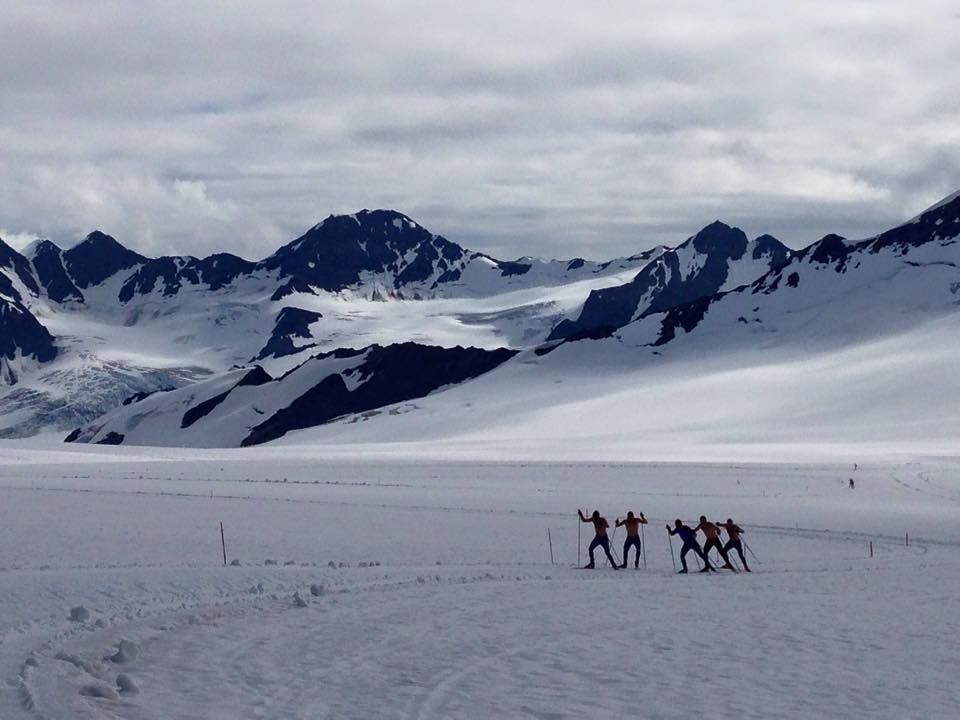
Packer reflected that the APU training facility on Eagle Glacier outside Girdwood, Alaska, is a key part of his estival endeavors. “Getting up on the glacier is a big component of that,” Packer said. “We had three really productive camps, with about 75 hours on snow. That really helped getting back on snow. I was having a conversation, I think, with Reese [Hanneman], and it was three-quarters of the way through the ski before he realized that it’s like technically our first ski. It’s like, ‘Oh yeah, this is the first ski.’ So that was kind of cool – just like having that contact with snow throughout the summer really makes the transition super easy, and that’s nice.”
The APU men on Eagle Glacier in summer 2015. (Photo: Zuzanna Rogers)
While Packer was not logging 25 hours per week on snow for the entire summer, he did credit volume training for his steadily increasing fitness.
Rather than a quantum leap, Packer identified the incremental gains that most athletes at his level are looking for. “Just every year chipping away at uphill running times, chipping away at ski bounding times,” Packer observed. “You never really see a big jump, but it’s just, every month, trying to get two, three, five seconds faster. And I felt like this year was a good continuation of the past few years – I saw a lot of improvements, just kind of across the board generally. … I’m feeling pretty good with that, where the base fitness is.”
Packer said that he “was just able to train consistently through the whole summer, so I was really happy with that.”
But that’s not a given after last summer, in June 2015, when Packer had a scary fall in the Chugach Mountains near Anchorage that left him falling off “a small vertical drop of 10-15” feet, then “tumbl[ing] head over heels down steep rocky terrain” for another 60 feet or so. “I had no control in the fall,” Packer wrote about the incident, “which was a really scary feeling, but I remember being pretty sure I was not going to survive.”
The story has a happy ending: As Packer previously explained, “In terms of my actual injuries, I was incredibly fortunate for as bad as the fall was, I somehow managed to not break any bones, which still amazes me to this day.” Nonetheless, Packer said, “I was so banged up that I stayed home for a week with no training. Once I got the clearance from my doctor and PT to resume light activity, all I could do were easy walks.”
Going through the injury and recovery process last year “definitely did” change his outlook for this year, Packer said. “It impacted my approach to last season, and I think this summer I just felt really lucky that I was injury-free, and was able to train at full capacity all summer long and not have any setbacks like that. It was definitely one of those moments where you take a step back, and kind of reflect on everything, and reflect on how lucky you are to be a ski racer, to be able-bodied and healthy and all those sorts of things. I have a history of ankle sprains; for the first time in six years I didn’t have a serious ankle sprain. Didn’t fall off any cliffs this time.”
Packer planned to put that consistent training and improved fitness to the test in Europe; he had Period 1 World Cup start rights for 2016/2017 by virtue of being last season’s domestic SuperTour leader.
But he didn’t think it would be easy. “Racing World Cups, Period 1 in Europe, is really tough,” Packer said before he left for northern Scandinavia. “There’s no question about that. It’s probably the hardest competition that you’ll see all year in terms of depth of the field.”
(Packer’s comments seemed prescient a week later, when, in the season’s first World Cup race, Norway put two skiers on the podium it hadn’t planned on starting.)
Nonetheless, Packer was “very excited” for his first World Cup races in Europe; he had previously raced in Europe and on the World Cup last season in Canada, but this marked his first overseas World Cup. “The Ski Tour Canada was obviously amazing and really a cool racing experience,” Packer enthused, “but getting to race at classic venues, in Finland and Norway and Switzerland, that’s really the dream. So I’m looking forward to it.”
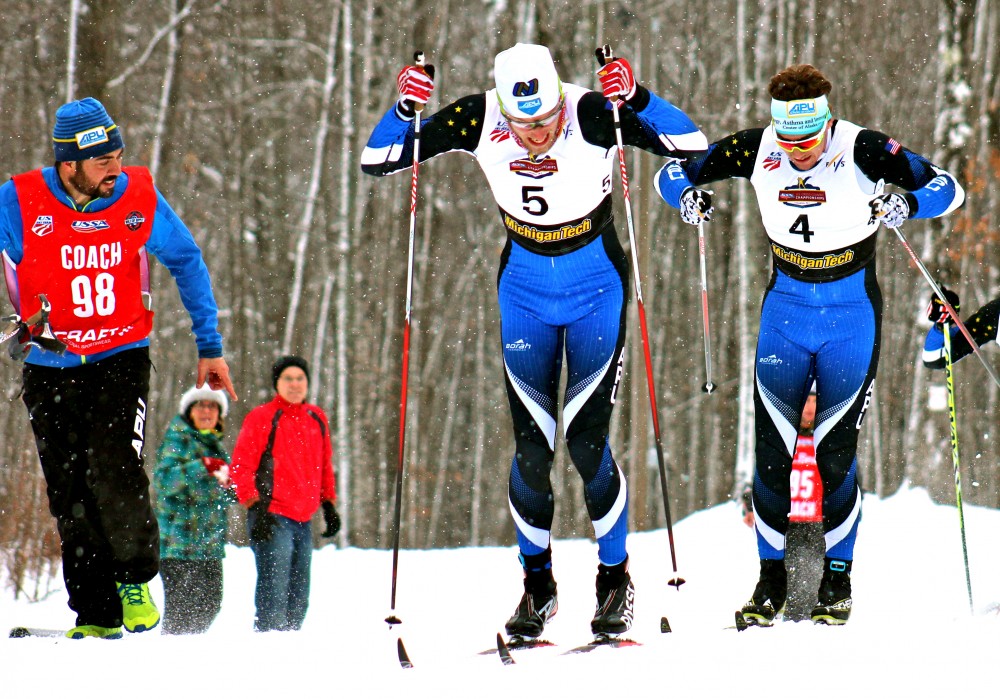
APU head coach Erik Flora (98) runs alongside his athletes Eric Packer (5) and Reese Hanneman during (4) the final of the men’s 1.5 k classic sprint at U.S. nationals in Houghton, Mich., in January 2016. (Photo: Christopher Schmidt)
Packer, who spoke with FasterSkier before leaving for Europe and racing in Ruka, said that he had two goals for his time in the opening swing of the World Cup season.
“My main goal is to take advantage of the opportunity to get, potentially, nine World Cup starts, and build as much experience as I can over the next month, and also learn the venues, and learn the cadence of World Cup racing,” he said. “And just really … have my eyes and ears open, and learn as much as possible. And learn from what I’m seeing other competitors doing – tactically, technically, that sort of thing. So that’s the first goal.”
“And the second goal,” he continued, “is to take each race as it comes. … I know that there will likely be tough days, but I’m just focused on taking each race, each day individually, and trying to give it my best shot in each one. It only takes one good day. So that’s really what I’m looking for, is to take advantage of the opportunity and give it my best on each day. Make the people back home proud.”
By the “cadence” of World Cup racing, Packer explained, he meant “building comfort and familiarity with that routine. To the point that you have a system where you can be focused on preparing for the race, and not get distracted by all of the other things surrounding the race.”
As an example, Packer cited the races at Gatineau this March: “At the World Cup venue there, they had a warmup track that was probably an 800-meter run from the wax cabin. And then the area that you actually accessed the course and accessed the start was yet a different location; that was probably like a 300- to 400-meter run. You’ve got ski boots on. And so just figuring out how to warm up, and then get on course.”
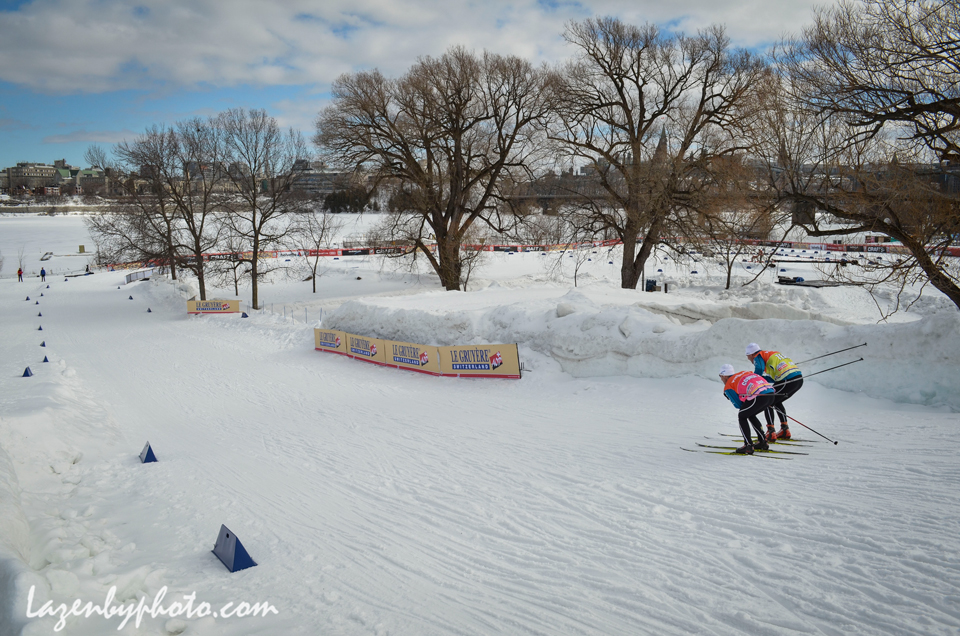
A little wax testing on Gatineau’s 1.7 k sprint course, with the start/finish area visible at the upper right. (Photo: John Lazenby/lazenbyphoto.com)
“More generally,” he said, the cadence involves “just figuring out the racing logistics, and getting used to the extra hurdles that exist at the World Cup level in the race-day routine, that’s a big goal, too. So that you get to the point where you’re focused on the racing, and you’re doing the optimum warmup and everything, and working within the constraints of that World Cup atmosphere.”
When asked about his overall goals for the season, Packer hesitated to look much past Period 1 of the World Cup, although he acknowledged that World Championships in Lahti, Finland, were on his radar. “I would definitely be excited to qualify for Lahti, and that is one of the goals for the season,” Packer said. “I would say, right now my focus is first on Period 1, and doing my best there, and then I will reevaluate once that’s over.”
Regarding possibilities for the second half of the winter, he reiterated, “It’s really hard to tell right now. There’s so many different potential paths through the winter. Definitely hoping to be racing in Europe, that’s always the goal. But if not, I would certainly like to come back and give the [American] Birkie my best shot, so there’s many different options there.”
(Packer has raced the Birkie once before, in 2014, finishing 22nd overall.)
But he was glad to look back to what he identified as the highlight of his ski career to date.
“Winning Nationals last year,” was his immediate answer. “That was just – and not actually winning, but coming into the finish with Reese and with Tyler together,” Packer said, referring to his APU teammates Hanneman and Tyler Kornfield. “And having that moment of like, ‘Wow, we have three of us here in contention, and being part of that group.’”
Packer continued: “And [APU head coach Erik] Flora was running next to us, and he was like swinging his arm around like a windmill, and just so excited. And then at the same time my childhood coach, Jan Buron from [Alaska] Winter Stars, and my college coach, Ruff Patterson, were both there at the finish. So kind of that moment of having everybody who’s been involved in my skiing from seventh grade all the way through now, and coming into the finish with my two teammates – that was a really special moment.
Eric Packer racing in the Ski Tour Canada in March 2016, with the beard in full late-winter flourish. (Photo: FlyingPointRoad.com/NNF)
“It was pretty fun. I got a big hug from Flora, then got a big hug from Jan, got a big hug from Ruff – it was a cool moment, for sure. It will definitely be a special moment for me.”
Finally, Packer looked back more recently, to what he’d had for breakfast that morning, then once more ahead, to his plans for hirsute management over the course of the winter.
“I had two pieces of toast, with avocado, and a fried egg on top of that; a cup of coffee, with just a little bit of half-and-half, no sugar; and a banana,” Packer explained, with the precision of someone whose Dartmouth degree is in mechanical engineering.
And as for the facial hair? “So last winter,” recalled Packer, who was previously recognized with Bearded Honorable Mention #1: The Lumberjack in FasterSkier’s West Yellowstone beards roundup of Nov. 2015, “I went with the ‘grow it all season’ approach. I think I’m going to take a step back from that this year, and keep it more in check. We’ll see. You never know; it has a mind of its own.”
Canadian cross-country skier Cendrine Browne on an over-distance adventure this fall. (Courtesy photo)
Welcome to “17 Questions for 2017″, where we are catching up with American and Canadian national-team members before the beginning of the winter season.
***
Cendrine Browne raced her first World Cup back in December 2012, on home turf in Quebec. She was 19 — and finished 59th in the skate sprint qualifier.
When the World Cup swung back around to Quebec last season as part of the Ski Tour Canada, Browne had come a long way. She had since notched a 15th-place finish at World Juniors in 2013, notched several of top-30 U23 World Championships performances, and competed in a handful of European World Cups as well as myriad continental cup races. This time around, Browne finished 40th in the Ski Tour Canada, the second Canadian woman in the rankings behind Emily Nishikawa.
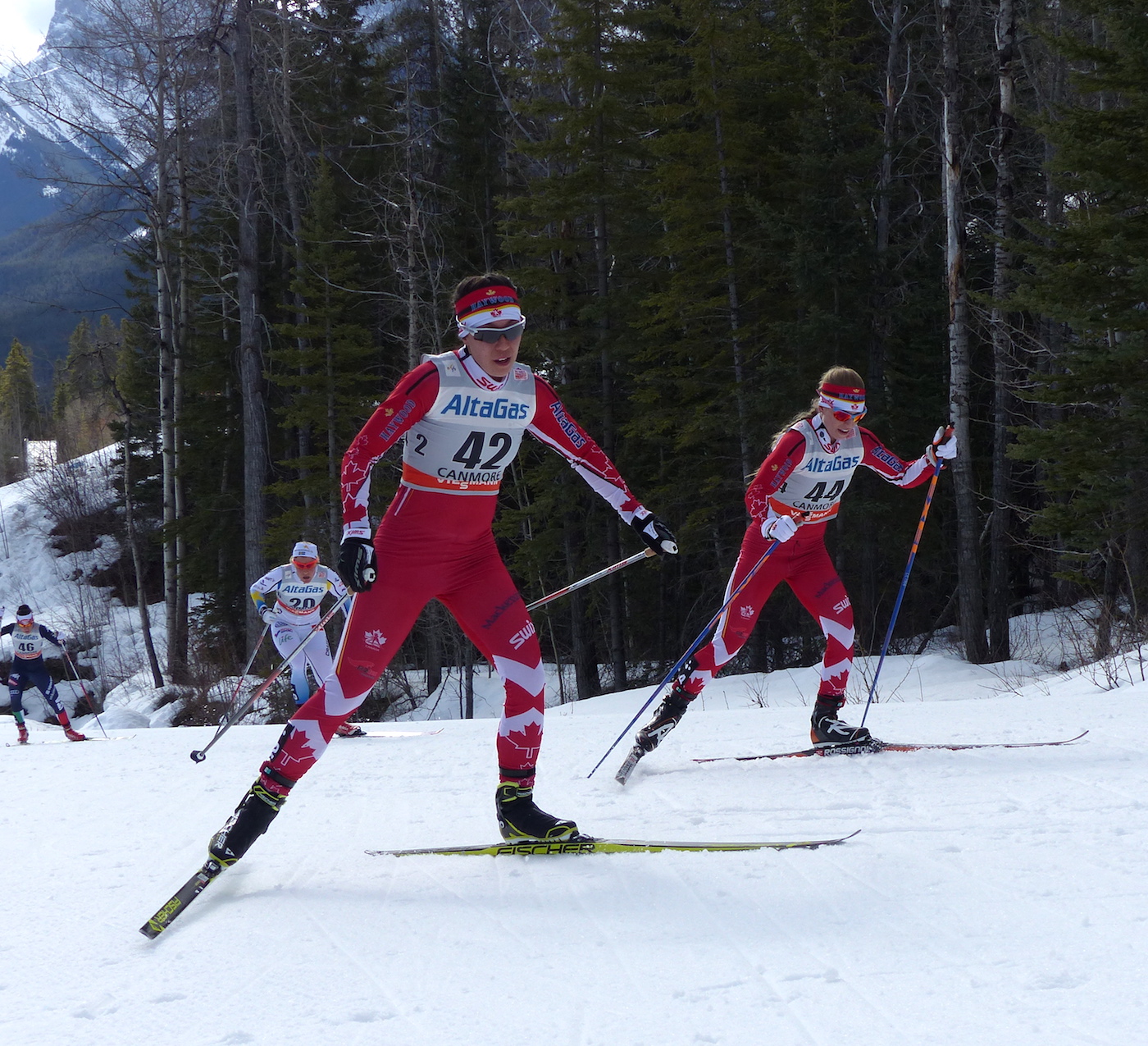
Browne (right) chasing teammate Emily Nishikawa in the 15 k skiathlon in Canmore, Alberta, as part of the Ski Tour Canada. (Photo: Peggy Hung)
A member of Canada’s senior national team, the 23-year-old tackled our 17 Questions after a training camp in Park City, Utah.
1. Biggest change in your life in the last five or so months since the ski season ended?
I got the opportunity to be on the World Cup circuit this season! I’m really excited about that!
2. Biggest change in your training?
My coach and I are trying something different this year. My plan changed a little, lets hope it works well!
3. Major areas of improvement you’ve seen so far?
My classic technique has improved a lot since last year. Before I was only comfortable skating but now I’m comfortable in both styles.
4. Whom you’ve been working closest with this offseason (coaches or training partners)?
My personal coach is now Louis Bouchard and that’s a new and exciting change. I’ve been working hard with Louis during the offseason.
5. Best trip in the last five months (and why)?
I just left Park City and that was the best trip so far but there are lots more to come during the winter! Park City is so nice and full of colors during fall. We took so many nice pictures!
6. Favorite cross-training?
I really like road biking. If I wasn’t a cross country skier, I would probably be a road biker!
7. Favorite non-athletic activity or pastime this summer?
I like to do camping with my boyfriend and discover new places!
Dahria Beatty (left) and Cendrine Browne make friends on a rollerski. (Courtesy photo)
8. Song that was your jam this summer?
Killem’ with kindness
9. All time favorite race moment?
When I came in 15th at World Juniors in 2013 in Liberec.
10. First thing you pack in your bag when you leave for Europe?
All the nice casual clothes I want to wear while I’m gone. The girls always tease me about that, but I love having a nice selection of clothes with me when I’m gone for a long time!
11. Venue/event you’re most excited to visit this season?
I’m really excited to go to Norway for the World Cup! I’ve been dreaming to go to Norway for a long time.
12. Who will win the men’s and women’s World Cup titles this year?
Well I thought Johaug would win the overall title but she just got caught for doping… On the men’s side, I would tend to say Sundby but because of all the stuff that happened with the Norwegians lately, I’m not sure for which athletes I’m going for anymore.
13. Biggest sacrifice you feel you’ve made choosing this career path?
I had to move away from home to go train with the Centre National d’Entrainement Pierre Harvey when I was 18. My family and boyfriend stayed behind. That was very hard for me at the beginning.
14. If you could change one thing about your sport, what would it be?
Canadian National Ski Team Head Coach Justin Wadsworth during Wednesday’s afternoon training at the 2013 Nordic World Ski Championships in Val di Fiemme, Italy.
Days after the conclusion of the inaugural Ski Tour Canada, Justin Wadsworth announced he was stepping down after six years as Canada’s National Team Head Coach. Wadsworth, the father of two young children, cited time away from his family as one of the primary reasons for making his decision.
A California native, Wadsworth came to the Canadian team experienced both as a former World Cup skier and U.S. Ski Team coach — a rare combo in North American coaching circles.
One year away from a World Championships, and two from an Olympics, these two big-time events loom on the horizon. Upon Wadsworth’s departure, FasterSkier reached out to several Canadian World Cup veteran athletes — Devon Kershaw, Alex Harvey and Ivan Babikov — as well as a few other athletes Wadsworth coached. The aforementioned three responded.
Devon Kershaw (l) and Alex Harvey (r) celebrate their classic team sprint victory at the 2011 World Championships. (Photo: Hemmersbach/NordicFocus)
It’d be tough to refute that during Wadsworth’s tenure Canada’s men’s team experienced its best overall results since the onset of the modern World Cup — in 2012, Kershaw finished second overall in the World Cup and Harvey followed in his footsteps placing third overall in 2014. In the last three World Championships, Harvey has racked up four medals, including gold with Kershaw in the team sprint in 2011.
When asked if he was surprised by Wadsworth’s exit, Kershaw said he knew the coach was pulled in many directions.
“I’m an older athlete. I’ve been around the block a bit and Justin is also a friend of mine, too,” Kershaw, 33, said in a phone interview. “When he started a young family and then that family started to get a little older, but not old by any stretch of the imagination, that takes a lot of energy and time. In one sense, it seemed to me that he made the decision fairly quickly, but at the same time, the writing was on the wall. If I am being honest, it did [surprise me], because we are half through an Olympic cycle and in North America that is kind how things are structured from Olympics to Olympics.”
Harvey, 27, also explained he wasn’t quite expecting the news.
“It was a surprise to see Justin step down, though I really think that the transition will be smooth for the team,” he wrote in an email. “He’s been working on all the logistics for Lahti 2017 and PyeongChang 2018 and I know he will share all of that with the new coach and the whole team.”
Harvey paid compliments to Wadsworth’s many contributions. “As soon as Justin came onboard you saw a jump in the team’s performance,” he wrote. “We did have a talented group but he did bring the team to the next level. There’s always a bunch of reasons explaining that, for sure bringing someone new brought freshness on the team, just like we hope this will happen now, but his focus and unprecedented search for ‘little edges’ made us take the jump as a team, and I’m talking about both the women’s and men’s team. Our girls were on World Cup podiums too with him and we had 3 in the red group for a while!”
“His focus and unprecedented search for ‘little edges’ made us take the jump as a team, and I’m talking about both the women’s and men’s team.” — Alex Harvey, on national-team coach Justin Wadsworth’s impact
In particular, since 2010, Wadsworth’s knowledge and style made a lasting imprint on Kershaw.
“He brought a slightly different flavor and he brought a bit of American swagger with him,” Kershaw said. “Which for someone like me, I am not the most confident athlete in the world, that was a really big positive and something that he really helped me with in my career, was being more confident. Not just on the start line, but with my training, with my technique and just how I carried myself.
“Justin obviously brought a lot,” he continued. “In my career, by far my best results were the first couple of years he coached. He brought a lot to the program. Mainly, he’s incredibly analytical, and he thinks things through a ton.”
Babikov expressed over the phone that Wadsworth emphasized quality over quantity when it came to training.
“Being cautious enough, not being too tired, also lots of physiological testing and making sure we will not overtrain, we are rested and ready to race fast,” Babikov said.
Canadians Graeme Killick (46), Devon Kershaw (c), and Alex Harvey, (5) during the men’s 30 k skiathlon at the Ski Tour Canada in Canmore, Alberta. (Photo: Fischer/NordicFocus)
That philosophy was something new for Kershaw when Wadsworth took over the Canadian program.
“He really wanted you to maintain a high level of energy to execute the key workouts every week at a high level, which was something different for me from the past,” Kershaw said of Wadsworth’s less-can-be-more strategy. “I used to get really beat up, maybe more the normal way of training and looking at things. He really, really stresses the system, you have days, maybe weeks that you just feel, like, really, really tired, incredibly tired, then you rest a bit and you come back and you are stronger and then you roll through that cycle.
“And with Justin, he really believed in the ‘why’ when you do training,” he added. “For sure, you can get big improvements and big gains, but the other side of the coin is that if you maintain better energy though a whole year you will have more consistent high quality workouts, and those high-quality workouts add up and then by the main season you don’t have any junk interval sessions.”
For Kershaw, the new paradigm meant dialing the overall training hours back. Initially, Kershaw’s 2012 runner-up finish in the overall World Cup was a proof-positive result. After that high point, Kershaw’s results fell off in comparison: he was 27th overall in 2013, 43rd in 2014, 93rd in 2015, and back up to 35th this season.
“There is no question that it worked for a couple of years there. [Wadsworth] had some good ideas, but at the same time, skiing is always changing and we probably, he’d probably admit that too, we probably made the mistake of after getting a lot of good results there for a couple years,” Kershaw said. “But how sustainable is that over the long term? With hindsight, he would probably agree, too, maybe it would have been better to boost the volume back up to 850-860 [hours] and then before championships, follow the same formula and we didn’t do that. We both believed that at the time, and when you get second in the distance cup and second in the overall, it’s hard to say, ‘You know what? … We are going to put 100 more hours in and get back to feeling really tired,’ and it’s hard to make those decisions at the time.
“Hindsight is 20/20 and … the sad reality is, I don’t do something I don’t believe in,” he concluded. “If I could go back in time and have the same knowledge at the time that I made the decision, I’m pretty confident I’d make the same decisions I made at the time.”
As Canada searches for its new coaching leaders, Kershaw, Babikov and Harvey all reflected on the upside of change: that with new people come new ideas — not necessarily better ideas, but ideas that reinvigorate drive and curiosity.
“Freshness is a big part of it,” Harvey wrote. “I’m looking for a coach that will be able to integrate our system at first, and then bring his knowledge and new ideas to the table.”
Harvey mostly trains under the guidance of Louis Bouchard, head coach of the Pierre-Harvey National Training Centre in Quebec. Kershaw has spent much of the last year overseas in Norway, even during the offseason, with his Norwegian wife Kristen Størmer Steira. Babikov, 35, is based in Canmore, and worked with Wadsworth at the national team’s home base along with senior-development-team skier Graeme Killick. Emily Nishikawa was another one of Wadsworth’s athletes last season, and World Cup Team member Lenny Valjas worked with him for several years.
Although the athletes stated they have no say in the new coach-selection process, that doesn’t mean they don’t have preferences in terms of philosophy.
“I know what I am doing. I probably can do it by myself, but having a coach, especially a national-team coach, you need someone to inspire you, make you go harder than you can by yourself in training or in a race,” Babikov said. “You need someone you trust, someone you respect, someone you feel comfortable with, someone who has your back on the bad days, of course on the good days, everybody is hopefully going to be there for you. What matters on this level, on the bad days, is to turn the bad day around and make it positive and make it pay off the next day.”
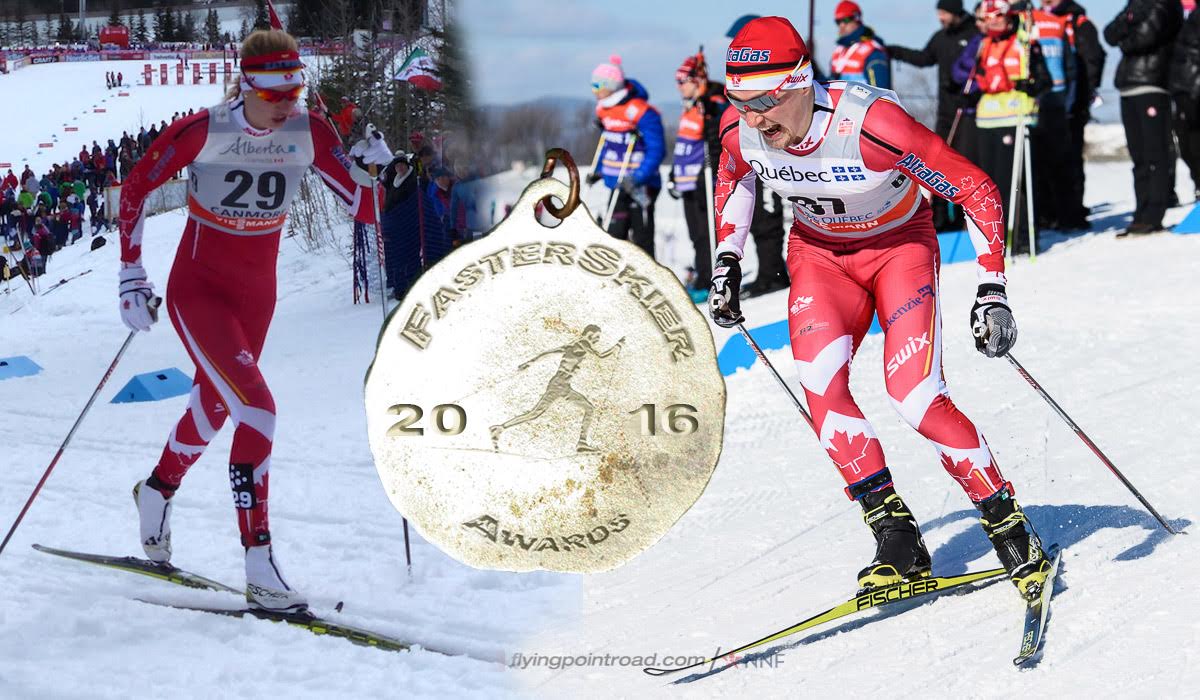
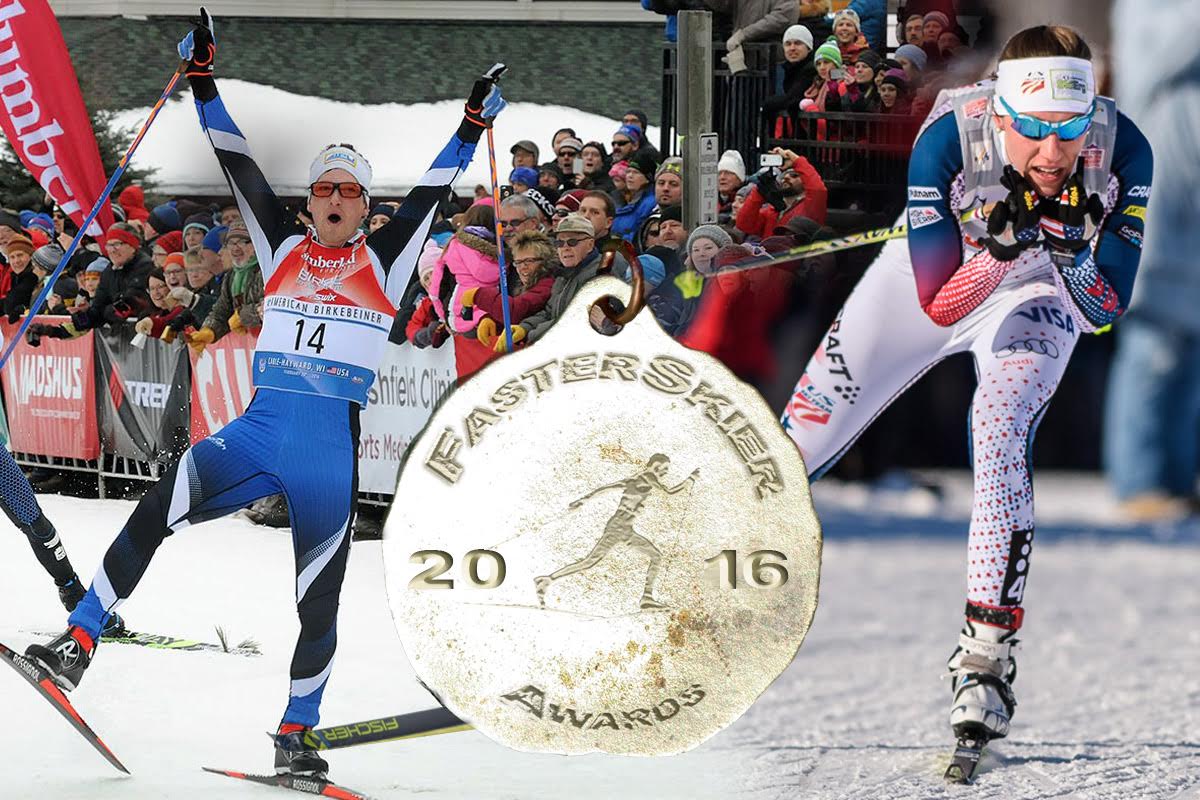
Canada’s Alex Harvey (c) and two members of the U.S. women’s team, Sophie Caldwell (l) and Jessie Diggins (r) are FasterSkier’s award winners for Cross-Country Performances of the Year. (Photos: FlyingPointRoad.com, Salomon/NordicFocus, Fischer/NordicFocus)
We’re entering the homestretch for the 2015/2016 FasterSkier awards, chosen by our staff based on performances last season. While not scientific, these points of recognition are intended to reflect a broader sense of the season in review.
The following set of honors goes to outstanding North American male and female cross-country performances of the year. See also: biathlon performances of the year.
On the women’s side, FasterSkier selected two North Americans to share the honor of performance of the year. Since we’ll honor their performances chronologically, Sophie Caldwell is up first.
Sophie Caldwell (U.S. Ski Team): Winning the classic sprint at Stage 4 of the Tour de Ski in Oberstdorf, Germany
Early this year, Sophie Caldwell became the third U.S. woman ever to win a World Cup race. She etched her legacy by winning the Tour de Ski’s Stage 4 classic sprint in Oberstdorf, Germany. Not only was it Caldwell’s first win, it was also the first-ever classic sprint win for an American woman. It proved what many witnessed during the season, that Caldwell, 26, has become an omnipresent threat to qualify, and then move through the heats. By season’s end, Caldwell was the seventh-ranked sprinter on the World Cup.
In 2014, the Vermont native scored five top-10’s, four of which were in freestyle sprints. In 2015, Caldwell posted two top-10’s, both skate technique. That pattern continued in 2016 — five top-10’s, four of five in freestyle sprints. Of all her top-10’s, there are two classic technique outliers during her three-season World Cup career. One of those is her classic sprint victory in Oberstdorf.
A surprise? Just a bit because it was a classic sprint. Her classic sprint victory surely didn’t fit with her lopsided freestyle results.
A surprise to see her name atop the results sheet? Not really.
Back in 2014, she was the eighth-ranked sprinter overall on the World Cup. This year, she began the season charging up the ranks. Starting with the second World Cup sprint on the calendar in Davos, Switzerland, Caldwell placed sixth, then seventh in the next sprint in Toblach, Italy, fourth in Lenzerheide, Switzerland, and ultimately first in Oberstdorf, without missing a beat.
Jessie Diggins (U.S. Ski Team): Winning the 5 k freestyle at Stage 6 of the Tour de Ski in Toblach, Italy
For Diggins it was a breakout year with numerous breakout performances. Tasked with choosing her 2016 best was a no-brainer. Her gutsy — when is she not?— simply screaming-fast skiing in Toblach, Italy where she exploited a course suited to her strengths was her gem.
Here’s the rundown on where the win stands:
– Fourth U.S. women (just days after Sophie Caldwell’s classic sprint victory) to win a World Cup
– First U.S. woman to win a modern distance World Cup
Diggins’ name is now forever linked with the U.S. Ski Team’s emergence as a world power. She’s achieved two World Championship medals, a 10-kilometer freestyle silver in 2015 and a 2013 gold with Kikkan Randall in the team sprint. And just this year, Diggins scored four individual podiums.
Mining the International Ski Federation (FIS) site for Diggins-data, a surprise emerges: prior to this year, she had never stepped on the podium in an individual World Cup (non-championship) event. In 2016, the 24-year-old Minnesota native earned four individual podiums including her 5 k distance win.
“You need to have kind of everything perfect to have such a good race,” Diggins said in the press conference after her Toblach stage victory. “You have to have really good skis and your head has to be in the right place and then your body has to feel good, so it’s really exciting for us that it all worked out so many times this year.”
Finishing the year ranked eighth overall on the World Cup — ninth on the distance list and eighth on the sprint list — Diggins is poised to do what she’s done before. So surely in the future when as Diggins says, “everything is perfect,” it should all seem like déjà vu.
Alex Harvey (Canadian World Cup Team) at the Ski Tour Canada
With a legacy surname, he’s the golden child of Quebec. And he’s able to back up that notoriety with results. At the inaugural Ski Tour Canada (STC), Harvey was the face of both Canadian pride and its expectations.
Getting into gear on the STC’s Stage 3 skate sprint in Quebec City, Harvey placed second for his best sprint result of the season. Considering the pressure and the depth of competition, that effort alone could have sealed the deal for North American performance of the year. But it was Harvey’s native province, and close to his hometown, with hoards of local fans cheering him on. It seemed like almost a slam-dunk scenario for popping a result. But despite this being Harvey’s first sprint podium of the season — it was one of two top-10 World Cup sprint results for Harvey — all things considered, FasterSkier was looking for something just a little bit more.
And Harvey provided.
Canmore as a venue is a tease. Big-time alpine walls, the Bow River snaking through the valley, and an Olympic legacy venue make the Canmore Nordic Centre feel idyllic. Then there’s the nearly 5,000 foot altitude and courses with grinding uphills and steep technical downhills affording racers little recovery time. It’s these attributes that historically have been unkind to Harvey.
Prior to the STC, in four World Cup starts in Canmore between 2010 and 2012, Harvey’s results trended towards the lackluster: there’s a 62nd place, a 48th, an upward-looking 11th, and a 52nd. Not results one would reference if they thought Harvey and Canmore were an amalgam for success.
“When I was a junior I was struggling to be top three in Canada just on this course,” Harvey, 27, said moments after finishing Stage 7. “And I’d be top three at World Juniors. Canmore has been really hard on me in the past … I never thought I would be strong internationally on a course like this.”
That all changed for Harvey in that seventh stage, the 15 k freestyle individual start during which Harvey remained in the victory-hunt for nearly the entire race. At the race’s mid-point, Harvey posted the second-fastest split, only 1.2 seconds behind eventual third-place finisher, Sweden’s resurgent Marcus Hellner.
As the race progressed, the nail biting became more tense. At 12.7 k, Harvey faded slightly, and ultimately was fourth fastest, again behind Hellner in third by 3.3 seconds.
Harvey, starting in bib 31, finished fourth on the day. But he sat in second place for a bit and tenuously clung to the podium as the later starters rolled across the line. Ultimately, Finland’s Matti Heikkinen placed first, with Russia’s Evgeniy Belov in second.
“Today I’m fourth, so anything is possible,” Harvey remarked post-race. “Today, to me, that’s what it shows,” he added. “That anything is possible.”
A quote like that coming from a skier of Harvey’s stature means he understood the odds were stacked against him on the day.
Harvey finished the Tour fifth overall and he persevered in a place where he’s been more than likely to fade off the back. That’s worthy of the North American male performance of the year.
Honorable mentions:
Simi Hamilton (l) hugs fellow U.S. Ski Team member Jessie Diggins after both placed third in their respective freestyle sprint finals at the World Cup stage in Gatineau, Quebec. (Photo: John Lazenby/Lazenbyphoto.com)
Simi Hamilton (U.S. Ski Team): second place in the freestyle sprint in Toblach, Italy
Two podiums, a third place on the STC’s Stage 1 freestyle sprint in Gatineau, Canada and his second place last December in Toblach, were the high points of Hamilton’s consistent season. He finished the season as the best-ranked North American male sprinter in 10th overall. His podium in Toblach was a result of Hamilton’s shrewd and tactical skiing — a combination we are likely to see propel him onto more podiums.
U.S. women’s relay: second place in Nove Mesto, Czech Republic
It was a dream relay team ready for a step up. Sophie Caldwell, Sadie Bjornsen, Liz Stephen, and anchor Jessie Diggins led the U.S. women’s team to a best-ever 4 x 5 k result with its second place in Nove Mesto. Prior to this race, the women had notched several third-place podiums. Now it seems they are knocking on Norway’s door. Time to rest up those relay socks!
Jessie Diggins: third place in Stage 1 of the STC in Gatineau, Quebec
No doubt, Diggins emerged as a star this season. On this day in Gatineau, Diggins complimented Simi Hamilton’s third place with a third place podium of her own. Diggins was a threat all day, qualifying in second, moving through her quarterfinal in first, and then a photo-finish second place in her semi. Make way for Diggins, there’s more to come.
The sibling duo Caitlin Patterson (l) and Scott Patterson of Anchorage, Alaska, are FasterSkier’s U.S. Continental Cup Skiers of the Year. Both are seen here competing on separate teams in the mixed relay at U.S. SuperTour Finals last month in Craftsbury, Vt. (Photos: John Lazenby/Lazenbyphoto.com)
The 2015/2016 awards continue, chosen by the FasterSkier staff based on performances from last season. While not scientific, these points of recognition are intended to reflect a broader sense of the season in review.
The Patterson siblings, Caitlin, 26, and Scott, 24, have a lot more in common than just their natural knack for nordic skiing. Both grew up Anchorage, Alaska, after moving there from McCall, Idaho. They both attended and graduated from the University of Vermont in Burlington, Vt., prior to pursuing professional skiing. They both have engineering degrees — Caitlin in civil engineering and Scott in mechanical engineering.
They were both national champions after the first race of this year’s U.S. nationals in their respective races — Caitlin in the women’s 10-kilometer classic race and Scott in the men’s 15 k classic. Due to the duo’s domination over the continental circuit this year, they were also both the SuperTour leaders through Period 1, which qualified both of them for this year’s Period 3 of World Cup racing. With their 2016 continental accomplishments in mind, both are also recipients of FasterSkier’s 2016 Continental Skiers of the Year Award.
Caitlin Patterson, Craftsbury Green Racing Project
Almost exactly two years older than Scott, Caitlin started her season for the Craftsbury Green Racing Project (CGRP) with a sixth in the 10 k freestyle at the West Yellowstone SuperTour in Montana. She then went on to place third in the classic sprint at the following SuperTour in Sun Valley, Idaho, behind her CGRP teammate Kaitlynn Miller (2016 Breakthrough Skier of the Year) in second, and Alaska Pacific University’s Becca Rorabaugh in first.
After her second place, Caitlin took third in the 10 k classic mass start in Sun Valley. At the next SuperTour stop at nationals in Houghton, Mich., and she opened the week of races with a win in the 10 k classic.
“I was personally really excited to see that my brother won this morning,” Caitlin said after both she and Scott won the first race of nationals. “That was encouraging, but also a little bit of competition. He was going to give me a pretty hard time if I didn’t match him in that one.”
Caitlin’s podium streak continued, and she went on to finish third in the freestyle sprint and snagged her second championship title of the week by taking first in the 20 k freestyle mass start. In her final race of the week, the classic sprint, she placed fourth and maintained the overall SuperTour lead for Period 1, which qualified her for Period 3 of the World Cup.
She then went on to score World Cup points by placing 25th in the women’s 10 k freestyle mass start in Falun, Sweden and 29th in the women’s 15 k skiathlon in Lahti, Finland.
Caitlin also won the Lake Placid SuperTour 10 k classic mass start in New York and took second in the sprint there. She finished her season at Spring Series at home in Craftsbury, Vt., placing seventh in the 10 k freestyle, 10th in the classic sprint, and third in the women’s 30 k classic mass start. As the overall SuperTour leader, she’ll start next season in Europe on the World Cup as the Continental Cup leader.
Scott Patterson, Alaska Pacific University
Scott’s list of season achievements is also almost as long as his sister’s. He, too, opened nationals with a victory, cruising to his first national title and first national podium, after winning the men’s 15 k classic.
“I won the 15k classic race on Sunday to take my first US national title (and first podium ever).” Patterson wrote in a blog post after the second day of racing at nationals. “Topping off the day, my sister, Caitlin Patterson, won the women’s 10k classic race as well. Not a bad day for the Patterson family.”
Scott then placed fifth in the 30 k freestyle mass start for his second-best U.S. nationals finish.
Earlier in the season, Scott also raced to third place in the 15 k freestyle in theWest Yellowstone. He went on to win the 15 k classic mass start at the Sun Valley SuperTour, ahead of the University of Colorado’s Mads Strøm (2016 Collegiate Skier of the Year) in second and his APU teammate, Eric Packer in third.
In his third individual World Cup race and first Holmenkollen 50 k, Scott finished in 32nd, his best World Cup result of the season and just outside of his first World Cup points. He raced the Ski Tour Canada (STC) and ended his season at SuperTour Finals/U.S. Distance Nationals in Craftsbury. During his final races of the year, he finished second in the 15 k freestyle and sixth in the 50 k classic mass start, closing out the season in fourth overall in the SuperTour standings.
Honorable mentions
Eric Packer, Alaska Pacific University
Eric Packer (5) on his way to beating APU teammate Reese Hanneman (r) and the rest of the men’s final in the classic sprint at 2016 U.S. Cross Country Championships for his first national title. (Photo: Christopher Schmidt)
Sometimes adversity secures a route to success. Following a scary training accident last year, Packer raced to his first national title in the men’s classic sprint in Houghton.
“In a split second, I went from being a top-level athlete to barely being able to get out of bed,” Packer recalled. “Training became a privilege not a chore and I ended up having the best late summer/fall training of my career. In the end, that crazy accident helped me develop that little bit of extra motivation that I needed to take me to the next level.”
Also at nationals, he placed fourth in the 15 k classic and 11th in the freestyle sprint. Previously in Sun Valley, he raced to a fourth in the classic sprint. Packer also finished second in the freestyle sprint at the Lake Placid SuperTour and fifth in the 10 k classic. He raced to a seventh in the 10 k classic at the Craftsbury SuperTour and qualified for Period 4 racing of the World Cup, the STC. He finished his season at Spring Series in Craftsbury, where he took fifth in the 15 k freestyle, sixth in the classic sprint and fifth in the 50 k classic mass start.
At the end of the season, he ended up leading the SuperTour standings, earning Period 1 World Cup starts next season.
(Photo: John Lazenby/Lazenbyphoto.com)
Chelsea Holmes, APU
Another Alaska native and APU skier, Chelsea Holmes finished the season third in the SuperTour behind Caitlin Patterson and Annie Hart (Breakthrough Skier of 2016 Honorable Mention).
In the season-opening races, she placed second in the 10 k freestyle in West Yellowstone and fourth in the freestyle sprint. She went on to win the 10 k classic mass start in Sun Valley, ahead of Patterson, and also placed fifth in the classic sprint there.
At 2016 nationals, Holmes finished second in the 20 k freestyle mass start and third in the 10 k classic. Her performances qualified her for Period 3 and her first European World Cups, and in her second international World Cup race — the 10 k freestyle in Nove Mesto, Czech Republic, Holmes placed 37th.
Back in the U.S., she raced to fifth place in the Lake Placid freestyle sprint and third in the 10 k classic. At the Craftsbury SuperTour, she finished second in the 5 k freestyle and fourth in the women’s 10 k classic. She also qualified for the STC and earned her first World Cup points by finishing 22nd in the women’s 10 k freestyle in Canmore.
Dahria Beatty (l) and Knute Johnsgaard (r) are FasterSkier’s Breakthrough Skiers of the Year for Canada. (Photos: Peggy Hung & Flying Point Road)
The 2015/2016 awards continue this week, chosen by the FasterSkier staff based on performances from last season. While not scientific, these points of recognition are intended to reflect a broader sense of the season in review.
Dahria Beatty, Alberta World Cup Academy/Canadian U23 Development Team
Dahria Beatty is the definition of breakthrough skier of the year for Canada, as the 22-year-old Whitehorse, Yukon, native placed 15th in a World Cup classic sprint in front of a home crowd at the Ski Tour Canada (STC) in Canmore, Alberta.
Before that, her best individual World Cup result had been 32nd in a freestyle sprint in January in Planica, Slovenia. That was two spots away from qualifying for the heats, two spots away from the points, and she blew both away by reaching the quarterfinals in Canmore.
And she almost made the semifinals.
“I pushed really hard and missed out on the lucky loser position by I think 0.3 of a second,” said Beatty, a member of Canada’s U23 Development Team and the Alberta World Cup Academy in Canmore. “It was by far my best result ever … My best result at World Juniors is [15th] so to have that on the senior World Cup level is amazing.”
Beatty opted out of U23 World Championships this year to focus on the STC, of which she raced seven of eight stages.
“You always feel a little bit like maybe I’m not quite good enough to be here,” Beatty told FasterSkier after the Canmore classic sprint. “But having a day like this makes me go, even if some days aren’t that great. There is something in there that I can be able to compete at this level and that’s nice to know.”
Beatty finished the NorAm season as the overall winner and tallied national titles in two out of the four races she competed in at Whitehorse in late March (the 10 k freestyle and skate sprint).
She rivaled World Cup regular and national B-team member Emily Nishikawa throughout the week at nationals, with Nishikawa tallying two titles as well (in the 5 k classic and 30 k classic mass start).
“Emily is a very strong skier, but I think we have a group of girls now ready to join her at the World Cup level,” Beatty told Cross Country Canada, according to a press release. “At least we are certainly ready to try. I think it is time we have a real women’s team over in Europe which is definitely going to make us stronger together if we continue to push each other.”
Beatty topped the overall NorAm standings after nationals with 960 points, 160 more than runner-up Cendrine Browne, of the Pierre Harvey National Training Centre. The NorAm winner for the last two seasons, the 26-year-old Nishikawa placed 14th overall after spending the entire season in Europe.
Knute Johnsgaard, AWCA/Canadian U23+ Development Team
Another Whitehorse native who spent the last season training with the AWCA in Canmore, Johnsgaard, 23, broke into the points in the first stage of the STC. After previously having placed outside the top 50 in World Cup races, Johnsgaard qualified 29th and finished 30th in the freestyle sprint in Gatineau, Quebec.
“Thanks to everyone who helped me score my first World Cup point yesterday!” Johnsgaard tweeted on March 2. “Hopefully many more to come.”
It was his sixth World Cup race. Johnsgaard raced a total of 10 this season, making his international World Cup debut in Planica, Slovenia, and finishing the winter on the overall NorAm podium in third (behind Andy Shields and AWCA teammate Kevin Sandau).
In the season-ending races at nationals, Johnsgaard placed third and fourth in the 10 k classic interval start and 50 k classic mass start, respectively — behind World Cup regulars Alex Harvey and Len Valjas to start the week, and trailing Harvey, Graeme Killick and Ivan Babikov in the final mass start.
Honorable mentions
Maya MacIssac-Jones, Rocky Mountain Racers
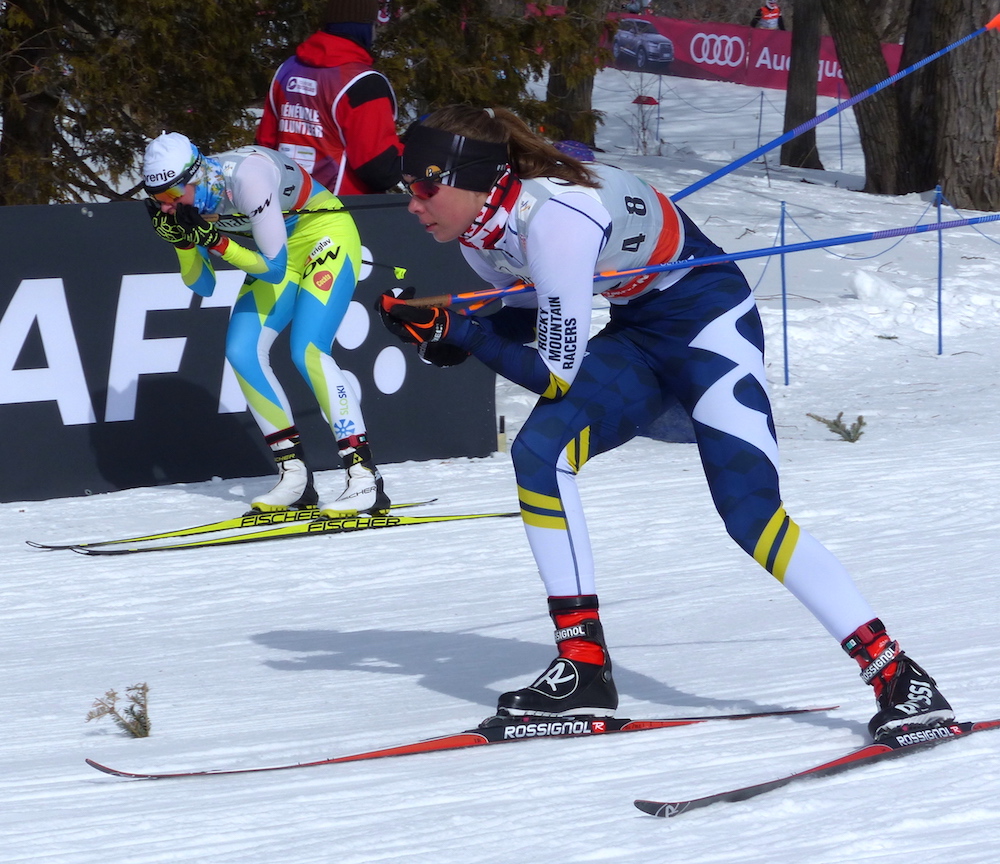
Canada’s Maya MacIsaac-Jones (Rocky Mountain Racers) on her way to 30th in the women’s 1.7 k freestyle sprint qualifier at the Ski Tour Canada’s opening stage in Gatineau, Quebec. She went on to place 29th for her first World Cup points. (Photo: Peggy Hung)
With a six-syllable, three-part name, Maya McIssac-Jones of Rocky Mountain Racers gets our vote for women’s breakout honorable mention. In a single season, this 20 year old won her first NorAm race then proceeded to place 31st in her first European World Cup in Planica.
“I was both shocked and very excited to finish 31st!” MacIsaac-Jones wrote in an email after the Planica skate sprint. “Although I would have loved to race in the heats, my result today gives me confidence and belief in myself that I am capable of top-30 results on the World Cup circuit.”
McIsaac-Jones qualified for the STC, then achieved her goal — finishing 29th in the Stage 1 Gatineau skate sprint.
“It really means a lot for me to be in the points today,” MacIsaac-Jones said afterward. “I hope this will help inspire the other Canadian skiers on the tour with me and I hope this shows we are capable of being in the mix.”
In Stage 3 in Quebec City, she placed 34th in another skate sprint and finished her first World Cup tour in 49th overall. In her final race of the season at nationals, she placed third in the skate sprint (behind Beatty and Olivia Bouffard-Nesbitt) and ended up second to Beatty in the NorAm sprint standings (25 points shy of first).
Jess Cockney, Canadian B-team
Jess Cockney racing to 29th in the freestyle sprint qualifier at Stage 3 of the Ski Tour Canada in Quebec City. He went on to place 10th after reaching the semifinals. (Photo: John Lazenby/Lazenbyphoto.com)
If we had an award for comeback skier of the year, Cockney would get it, but since we don’t — breakthrough honorable mention makes the most sense for this 26 year old from Yellowknife, N.W.T.
After starting the season on the World Cup and finishing outside the top 60 in individual sprints, Cockney returned to Canada for some NorAm racing and notched podiums in the skate sprint (third place) and 20 k classic mass start (second) at Eastern Canadian Championships.
He made the standard for the STC, and raced to 10th in the skate sprint in Quebec City. It was his best individual World Cup result since placing ninth in the skate sprint in December 2012 in Canmore.
“Man, I have had a really hard go of it this year,” Cockney told FasterSkier after the Quebec City sprint. “Nothing was working at the start of the year … So this is a big lift. I’m really happy with that. Skiing a semifinal is always awesome. Nice to have a two-heat day again.”
In his final race of the season, Cockney placed fourth in the nationals skate sprint behind Harvey, Valjas and NorAm overall sprint winner Julien Locke. He finished the NorAm season ninth in the overall sprint standings.
David Norris (l) and Kaitlynn Miller (r) are FasterSkier’s Breakthrough Skiers of the Year for the U.S. (Photos: Tom Kelly/USSA and Flying Point Road)
The 2015/2016 awards continue this week, chosen by the FasterSkier staff based on performances from last season. While not scientific, these points of recognition are intended to reflect a broader sense of the season in review.
American Breakthrough Skiers (Canadian award winners will follow)
Kaitlynn Miller, Craftsbury Green Racing Project
If Craftsbury’s Kaitlynn Miller had been told at the beginning of last season that she’d be spending some her last few races on the World Cup at the Ski Tour Canada (STC), she might not have believed them.
By the end of the 2016 season, Miller had pushed any doubt aside. The 24-year-old Elmore, Vt., native not only qualified for the STC in March, but also left 2016 U.S. nationals in January in Houghton, Mich., with a string of personal bests.
Prior to this year, she had never reached the podium at nationals. In her second season as a CGRP athlete, Miller podiumed twice in Houghton — first in the women’s 10 k classic individual start and again in the classic sprint — the latter of which she won for her first national title. She finished the week within the top 10 in every race. Last season, her best result at U.S. nationals was 13th in last year’s 20 k classic mass start.
“To come away from Nationals with two podium finishes, including a national championship, was incredibly exciting, a bit overwhelming, and definitely unexpected,” Miller wrote on her blog after nationals.
Kaitlynn Miller (front) on her way to 39th in the Ski Tour Canada women’s 10.5 k classic mass start, the second stage of the Tour, in Montreal, Quebec. She went on to place 41st overall in her first World Cup Tour. (Photo: Flyingpointroad.com/NNF)
Along with breakthrough performances in Houghton, Miller raced to her best-ever SuperTour result earlier last season in Sun Valley, Idaho, finishing second in a classic sprint in December.
She also finished sixth in the Sun Valley 10 k classic and second in another 10 k classic SuperTour race in Lake Placid N.Y., fifth in the 30 k classic at U.S. Distance Nationals in Craftsbury, Vt., and 41st in her first World Cup multi-stage tour.
“I’ve never raced a World Cup before, or even an international race for that matter (unless you count North American Midget Championships),” Miller blogged after the initial stages of the STC. “With each race I finish I have more confidence in myself and I’m very grateful to have this amazing opportunity to compete against the fastest women in the world.”
David Norris, Alaska Pacific University
Even after back-to-back victories in two SuperTour races this season, it was the third time at the top of the podium that left David Norris of Alaska Pacific University (APU) without words.
For 25-year-old Norris, of Fairbanks, Alaska, some wins can only be summed up with a whoop.
That included his victory in this year’s American Birkebeiner in Hayward, Wis., in his first-ever Birkie. Norris’ breakthrough result also made him the first American male to win the Birkie since Tad Elliott did so in 2012.
“Crossing the line Saturday was the first time in my life where I threw up my hands and screamed in excitement!” Norris wrote on his blog after winning the 51 k Birkie skate race. “Taking the win, having the confidence to lead the last 800 meters of the race, and to pull it all off was an incredible feeling.”
Leading the last 800 meters of the race for Norris included holding off France’s Ivan Perrillat Boiteux, of team Houte-Savoie, Frenchman Benoit Chauvet, Frenchman Adrien Mougel, Switzerland’s Candide Pralong (all of GEL intérim Rossignol), France’s Mathias Wibault, and the 2014 Birkie champion from Italy, Sergio Bonaldi (Team Salomon Italia).
Norris had a number of other season firsts beyond his Birkie win. He also won his first ever SuperTour races at the Lake Placid SuperTour, topping the men’s freestyle sprint and posting the fastest time in the 10 k classic individual start. He finished on the U.S. Distance Nationals podium for the first time in two years by placing third in the men’s 50 k classic mass start in Craftsbury, Vt.
“The highlights to my season would have to be my American Birkie win and picking up my first Super Tour wins ever,” Norris wrote in an email after the 50 k, his last race of the season.
“I always want more from myself when any season comes to to an end,” he added. “I don’t think my results have put me in a different position that last year but I’m going into the summer with excitement knowing that some really great results are possible for me.”
Honorable Mentions
Tad Elliott, Ski & Snowboard Club Vail
Although Tad Elliott of Ski Club Vail is not a new name to the top of U.S. distance results, this past season saw a re-breakthrough for the 27 year old from Durango, Colo.
Tad Elliott of Ski and Snowboard Club Vail crosses the line in first for the men’s 30 k freestyle mass start on Thursday at U.S. nationals in Houghton, Mich. (Photo: Christopher Schmidt)
“In the months leading up to the race, I could only dream of the podium,” Elliott said in an interview after his 30 k win. “Hell, I didn’t know if I was going to be healthy enough to even start, but as you know, once the gun goes off, it really is anyone’s race.”
Elliott also raced to second place in the Craftsbury SuperTour 10 k classic in February, as well as a second place in the men’s 50 k classic mass start at U.S. Distance Nationals in Craftsbury in March. Before that, he qualified for the STC World Cup races in March, finishing the tour in 51st overall.
“This season was a step in the right direction,” Elliott wrote in an email after his last race of the season. “To come off Ski Tour Canada, and a long week in Craftsbury and to ski like this after all the health issues the last two years shows that I am in a really good place. I am excited for the future.”
Annie Hart, Stratton Mountain School T2 Team
Hart is another skier that’s been a regular contender in recent years, but a few personal bests at U.S. nationals — second in both the women’s freestyle sprint and classic sprint, fifth in the 20 k freestyle mass start, and eighth in the 10 k classic — make the 23-year-old SMS T2 Team skier our pick for female honorable mention.
American Annie Hart leads the start of the women’s 10 k freestyle at Stage 7 of the Ski Tour Canada in Canmore, Alberta. She placed 39th and would later finish the Tour in 43rd overall. (Photo: Fischer/NordicFocus)
She won her first SuperTour race in February, posting the fastest time in the in the women’s 5 k freestyle in Craftsbury. She also placed third in the Lake Placid SuperTour freestyle sprint and competed in her first World Cup races at STC (finishing the tour in 43rd overall).
After starting in bib 1 for the first time in the 10 k freestyle individual start in Canmore, Alberta, Hart raced to 39th in Stage 7. She previously placed 36th in the Stage 5 classic sprint, narrowly missing her first World Cup points.
“With eight races in twelve days on the most elite and competitive cross country ski stage in the world, I was most certainly in for a lot of surprises,” Hart bloggedafter the STC. “I didn’t know what race day would bring, I didn’t know how the travel would go, and I really had no expectation results-wise. But [my strength coach Max Lipset’s] words reminded me that I could also be the surprise — it didn’t have to be other things surprising me, I could be surprising myself.
Alexander Legkov of Russia leads Hans Christer Holund of Norway and Sergey Ustiugov of Russia in the 15 k classic mass start stage of the 2016 Tour de Ski in Oberstdorf, Germany. (Photo: Harald Zimmer)
Russian ski star Alexander Legkov has admitted that he used the drug mildronate in the past, but has not used it since before it was added to the World Anti-Doping Agency (WADA) Prohibited List on January 1.
Mildronate, also called meldonium, was added to the Prohibited List for 2016. It has caused headaches for a number of athletes, with well over 100 positive tests in international sport in the last three months.
A number of those athletes were Russian, including tennis star Maria Sharapova and a high-profile swimmer. Over the weekend, it was announced that a top Russian gymnast and four Russian judo athletes had tested positive, bringing the numbers even higher.
The drug is a metabolic modulator which changes the way the body burns energy, and is used widely around the former Soviet Republics. Clinically, it is prescribed for those recovering from heart attacks and angina.
Many in Eastern Europe do not see why it is banned, seeing it more as a vitamin than a medicine despite it’s original design for severe heart problems.
“I do not think mildronate is doping,” Legkov told Sport-Express. “This is complete nonsense and a political game.”
Two Ukrainian and one Russian biathlete have been provisionally suspended for using the drug, with one other unnamed athlete now suspended as well (the name will be released by the IBU after the ‘B’ sample is handled.
However, no positive tests have been found in cross-country skiing – even though nearly every other endurance sport, including biathlon, running, cycling , and speedskating – has had several.
Alexander Legkov (3) after winning his first Olympic medal with gold in the 50 k freestyle mass start in Sochi, Russia. He beat fellow Russians Maxim Vylegzhanin and Ilia Chernousov, who took second and third, respectively, to complete Russia’s first-ever podium sweep at the Olympics.
When Legkov, a 2010 Olympic gold medalist in the 50 k skate, left the Ski Tour Canada early, some fans suspected that it might be because of a positive test. But in the interview, he said he was just tired. It was his second straight season without winning a World Cup race.
“Just four years of preparation for the Olympics in Sochi have been very difficult, and after them I cannot get to my maximum level,” he said. “However, this season I have been very stable, many times I have been in the top ten or directly behind it. This allowed me to stay in the top ten of the [overall] World Cup distance standings. Of course, I would like to be better.”
Sharapova was snagged for meldonium and claimed that she had never seen the announcement from WADA that the drug, put on a watch list a year earlier, would become banned.
Legkov had no such problems, although he said he hadn’t taken the substance in a long time.
“I was aware of it,” he said. “The federation has warned all of us… We have in the federation have workers that help with the ADAMS [whereabouts] filing. They remind athletes that we should rather write where we are, for example. These people and warned everyone.”
But it doesn’t mean that he hasn’t shed a tear for those caught in the scandal – one which he sees as political.
“I am genuinely sorry for athletes who were, so to speak, ‘stung’,” he said. “Personally for myself, I am absolutely calm. I did not take this medication for a long time. I do not even remember when the last time it was.”
Legkov has diversified his focus in the last years, starting a ski club around Moscow. He also is running for the Moscow City Duma, a regional parliament.
He only hit the top 20 once in the Ski Tour Canada before dropping out, a 20th-place finish in the 17.5 k mass start in Montreal.
Before that he had seven World Cup top-tens, with a best result of sixth in both the 10 k skate in Lahti and later the Tour de Ski 15 k classic mass start in Oberstdorf, Germany.
Norway’s Therese Johaug was happy to be done with the eight-stage Ski Tour Canada on Saturday, March 12. She won the Tour title along with the Overall and Distance World Cup Crystal Globes. (Photo: Fischer/Nordic Focus)
CANMORE, Alberta — After eight races in 12 days, the final day of the Ski Tour Canada last Saturday brought both extreme exhaustion and feelings of completion for the 14 Americans (10 women, four men) and 12 Canadians (seven men, five women) who made it to the culminating finish of the season-ending World Cups.
Here is some of the best from the North Americans who made it to the last two stages (the Stage 7 freestyle individual start and Stage 8 classic pursuit):
Canada’s Emily Nishikawa racing to 35th in the women’s 10 k freestyle at Stage 7 of the Ski Tour Canada in Canmore, Alberta. She went on to lead the Canadian women in 37th overall in the Tour. (Photo: Fischer/NordicFocus)
“It was initially very overwhelming, but once I got the hang of how things go on race day, it was really fun to be out racing with so many fast women.” — Kaitlynn Miller (Craftsbury Green Racing Project), 41st overall
“I’ve never done anything like this before. It is a test of will because you are either traveling or seeing the course … It is so different, I was so glad I had a chance to do this in a place like Canada where there are so many supporters. It was fun, I’m stoked it is over but it was actually really fun.” — Jennie Bender (Bridger Ski Foundation), 48th overall
“It was pretty intimidating in the beginning but I guess I’m kind of getting used to it.” — Katharine Ogden (Stratton Mountain School/USST D-team), 36th overall
On how the body held up:
“Before the race, I felt really nauseous and pale and I thought, ‘I should go drink some water.’ … I did not think today was going to go well at all. I was thinking best-case scenario would be finishing. I don’t know, I never know what my body is going to do, but my back felt good and I skied with a group, which was freaking awesome.” — Bender
2016 Ski Tour Canada finishers:
CANADA:
5. Alex Harvey
14. Ivan Babikov
16. Devon Kershaw
27. Graeme Killick
37. Emily Nishikawa
40. Cendrine Browne
43. Kevin Sandau
44. Olivia Bouffard-Nesbitt
47. Annika Hicks
49. Maya MacIsaac-Jones
49. Michael Somppi
50. Russell Kennedy
USA
5. Jessie Diggins
11. Sadie Bjornsen
24. Rosie Brennan
31. Chelsea Holmes
33. Caitlin Gregg
34. Ida Sargent
34. Noah Hoffman
36. Katharine Ogden
41. Kaitlynn Miller
42. Erik Bjornsen
43. Anne Hart
46. Scott Patterson
48. Jennie Bender
51 Tad Elliott
“I broke my finger about two weeks ago right before the Birkie but I felt solid there. When I start to get tired, my immune push-back starts flaring up and I was dealing with that a bit in the beginning of the tour and didn’t know how I would fare with all this hard racing. Honestly, I thought about pulling the plug after the first half, I was really suffering. But they said, ‘Go West, it is where you are from and the sunshine will do you well, stay relaxed and just enjoy ski racing.’ That is what I tried to do today and things have been coming around fast so it is kinda nice to feel that way.” — Tad Elliott (Ski & Snowboard Club Vail), after placing 41st in the 15 k freestyle at Stage 7 (he went on to finish 51st overall in the Tour)
“I just had to focus on the process and just ski as well as I could and I think I did that. I didn’t have much energy to work with so I had to make due with what I had. I skied as well as I could and just focused on technique.” — Emily Nishikawa (Canadian Senior Development Team), after placing 35th in 10 k freestyle at Stage 7 (she went on to place 37th overall in the Tour)
“The season is wearing on me. I’ve been traveling a lot and racing a lot this year and haven’t had time to do any volume training and I think that is showing, my body has nothing left to give.” — Michael Somppi (NDC Thunder Bay), after placing 50th in the 15 k freestyle at Stage 7 (he placed 49th overall in the Tour)
On finishing:
“Everyone was so awesome, I am glad I made it to the end. I’m stoked. Finished my first tour, I can’t complain.” — Russell Kennedy (Canmore Nordic), 50th overall
“My goal was just to finish without getting lapped and I achieved that so I am really pumped to have finished the Tour. … I learned that my fitness is good enough to make it through all these races, but it needs to get better in order to improve.” — Jessica Yeaton (Australian national team and Alaska Pacific University), 46th overall
“I raced it for myself. I didn’t have any expectations for today and I, 100 percent, wanted to race my own race. I crossed the finish line happy with my effort and that is all I wanted.” — Olivia Bouffard-Nesbitt (Canadian Senior Development Team), after placing 42nd in 10 k freestyle at Stage 7 (she went on to place 44th overall in the Tour)
“It is my first interval start on the World Cup ever. It was fun to kind of ski my own race, but Johaug just blew by me on the wall of course.” — Annika Hicks (Canmore Nordic) after placing 48th in the 10 k freestyle at Stage 7 (she went on to place 47th overall in the Tour)
“Honestly, I thought about pulling the plug after the first half, I was really suffering. But they said, ‘Go West, it is where you are from and the sunshine will do you well.’ ” — Tad Elliott, of Durango, Colorado
On highs and lows:
“There was definitely highs and lows. Racing this much is pretty taxing physically and emotionally, but every day I was training or racing I was thinking about how ‘effing’ awesome this is to do at home. It is something I might not be able to do it again, but I hope I will. It is such as privilege and every time I thought about it I was so thankful to be here.” — Bouffard-Nesbitt
“I got passed by both Therese and Heidi [in the 10 k freestyle], which was great, and I was like, ‘Holy sh*t!’ … Actually, proud moment of the race: I skied behind Therese on the downhill and she snowplowed and I did not so I was beating her on the downhill. But yeah, they climb like fiends. I don’t think I have the ability to go that tempo, being twice as big as both of them.” — Bender
“It is great if you can pick up a good ride, but today I had Sundby blow past me. You want that ride that is just a bit too fast, not one that is killing you.” — Scott Patterson (APU), after placing 47th in 15 k freestyle (he went on to place 46th overall in the Tour)
“I tried to ski with Maurice [Manificat] out there but then kinda exploded. I knew you follow Maurice it brings you to a top 20, within sight brings me to a top 30. I wasn’t able to accomplish that today, but to feel this good after all the health issues I’ve gone through recently is a sign of good things to come.” — Elliott after placing 41st in the 15 k freestyle at Stage 7
On takeaways from the Tour:
Canada’s Michael Somppi racing to 50th in the men’s 15k skate in Canmore, Alberta. He went on to place 49th overall in the Tour. (Photo: Fischer/Nordic Focus)
“I definitely feel like I have the endurance for long events like this — that is one of my strong suits. I seem to recover well. I mean, I am exhausted now, but I’ve still been getting out of bed and excited to race. I was racing pretty well on the domestic circuit, but it is just so different. I learned so much in the five distance races … In mass start races, you have to be aggressive and fight for those spots early on. I’m noticing my redline that I am comfortable skiing at in domestic races; the pace is different here.” — Kevin Sandau (Alberta World Cup Academy), 43rd overall
“I think it’s really just essential to getting us used to the World Cup atmosphere and no longer just feeling super nervous as you get to the start line. Making it more part of just any other race that you are able to focus more on the procedure of the race and feel the speed that these ladies race at and try to even just stay with it for five or 10 seconds through the race just gives you that little glimpse of where you need to be.” — Dahria Beatty (Alberta World Cup Academy/Canadian U23 Development Team) , 44th after Stage 7, (did not race Stage 8 due to a sore back)
“One of the big things is seeing just how hard all the women race at every race. In the NorAm circuit, we all ski hard but the World Cup is at a whole different level. These women go as hard as they can from the start until they collapse at the end. I think just being able to see just how hard they push shows me just how hard I need to be working and how hard I have to push to ski at this level.” — Maya MacIsaac-Jones (Rocky Mountain Racers), 49th overall in the Tour
“… The maturity and strength these guys have, it was good for me to see. I know the work I need to do in the summer and I am motivated to do it.” — Elliott
On future plans:
“Continue to train hard. I’ll stay at the centre next year and continue to try and improve. Also, keep working on the sprints.” — Sophie Carrier-Laforte (Pierre-Harvey National Training Centre), after placing 52nd in the 10 k freestyle at Stage 7 (she did not race Stage 8)
“I’ve been patient and I have had a long-term plan all the way through so I can see into my career now, but the support of a good coach is to keep that lid on. After Spring Series, I’m taking six weeks. I just ordered some Oakley golf gear, ordered some clubs from Wilson — I’m going to enjoy some golf and some warm weather and some mountain biking with my brother and come June maybe I’ll think about dusting off the rollerskis.” — Elliott
Video:Inside the Fence - Coming to North America
Ever wonder what European athletes think about coming to North America? Inside the Fence takes a look at the impressions from World Cup athletes participating in Ski Tour Canada
Posted by FIS Cross-Country Skiing on Thursday, March 10, 2016
Jessie Diggins (U.S. Ski Team) racing to fifth in the overall 2016 Ski Tour Canada with the third-fastest time of day in the women’s 10 k classic pursuit at the eighth and final stage of the tour in Canmore, Alberta. (Photo: Peggy Hung)
CANMORE, Alberta — It’s not always the ability to break through that builds the bridge to betterment, but the recognition that a breakthrough is possible.
That’s what the U.S. women realized as each consecutive athlete — rookies and veterans alike — concluded the final stage of the Ski Tour Canada (STC) with the women’s 10-kilometer classic pursuit on Saturday.
“My personal highlight is watching athletes who have never been in the points, like Katharine Ogden and Chelsea Holmes, ski their way in there,” said U.S. Ski Team (USST) Women’s Coach Matt Whitcomb said after the race.
Six American women scored World Cup points on Saturday, according to their actual time on course. World Cup regulars, Jessie Diggins led the team with the third-fastest time, Sadie Bjornsen skied 12th fastest and Rosie Brennan was 14th fastest. A first-year member of the USST D-team, 18-year-old Ogden (Stratton Mountain School) posted the 15th-fastest time, Holmes (Alaska Pacific University) had the 28th-fastest time, Caitlin Gregg (USST/Team Gregg) nabbed the 29th-fastest time.
“It almost brings tears to my eyes because it is the bridge to Jessie Diggins,” Whitcomb said. “A club athlete has a hard time picturing themselves skiing as fast as Jessie Diggins, but they perhaps can picture themselves skiing as fast as someone whose in the top five in a SuperTour and then suddenly they work their way into the points.”
For Whitcomb and the U.S. women, the final stage of the STC marks a watershed moment for future performances like those of Diggins.
While Diggins has strung together a solid STC — including her fifth-place finish the 10 k classic pursuit on Saturday for fifth overall in the Tour — and has often led the women’s team during the season, she considers herself just another beat to the American melody.
“I don’t feel like you can point to one person as leading the team because we’re all a piece of the puzzle,” Diggins said afterward. “We need everyone together to make it work. So I don’t see myself as leading the team, I see myself as being the team cheerleader. And that’s my role and I’m really proud to be in that role.”
“I don’t see myself as leading the team, I see myself as being the team cheerleader … I’m really proud to be in that role.” — Jessie Diggins, top U.S. woman in fifth overall in 2016 Ski Tour Canada
For the 24-year-old native of Afton, Minn., true leadership comes in all forms. Even though she toed the start line of Saturday’s race nervous and with a sore throat, she treated the eighth race day of the Tour just like any other: smiles and skis set to go.
“I was definitely feeling a lot of pressure coming into today,” Diggins said. “I knew Krista [Parmakoski of Finland] was going to catch me so I just thought, ski with her, we would trade leads, we’d try to hopefully make up time together and then hopefully hang on.”
Starting seven seconds behind Diggins, Parmakoski caught Diggins on the second of three laps and the two remained together by the final climb before looping back into the stadium. Diggins latched onto the Parmakoski, and both overtook Norway’s Astrid Uhrenholdt Jacobsen as they headed through the stadium around 6.6 k to start their final lap.
“I actually had no idea,” Diggins said of catching Jacobsen, who started fourth, 1:22 ahead of Diggins. “I was just trying to stay with Krista.”
Parmakoski pulled Diggins through their final lap together, crossing in fourth and fifth respectively. Parmakoski had the fastest time of the day in 33:41.8. Diggins finished with the third-fastest time, 18.9 seconds off of Parmakoski and 18.3 seconds behind Norway’s Therese Johaug, who posted the second-fastest time en route to the overall victory.
“To have an athlete in the top five after eight stages is truly a remarkable result that we are very proud of and I know Jessie is too,” Whitcomb said of Diggins. “I’m very encouraged with the way this tour ended.”
With three in the overall top 30 for Saturday’s pursuit and six in the top 30 for the fastest course times, the Americans have plenty to be encouraged by coming off of the Tour.
“I mean it makes me believe that I have the fitness and the strength to do this,” Brennan said after finishing the Tour in 24th overall. “I’m happy to feel like I have the fitness to compete on the circuit and hopefully move up as I learn little things here and there.”
Brennan who started in the pursuit in a wave with 11th through 50th place, 6:30 behind the leader, Norway’s Heidi Weng, skied behind Bjornsen — who led the massive wave out in 11th — during the first lap.
Heading into the major first climb of the second lap, Brennan moved the front and drew a few athletes, including Bjornsen up the hill past Sweden’s Charlotte Kalla.
“I was feeling good and I looked up and I saw Kalla up there and so I just thought, if I go next to Sadie she’s going to start going,” Brennan said. “We caught Kalla and I think that hopefully gave Sadie a little extra to fight for.”
Buttressing the USST women’s belief in themselves is their belief in their teammates and team.
“We’re teammates,” Brennan said. “I just thought if I can give her a little bit then that’s going to be worth a lot for us.”
And Bjornsen? The help from Brennan was crucial as she finished 11th in the Tour. Kalla finished less than a second back in 12th.
“I was working hard every uphill,” Bjornsen said “Everyone is so tired right now. It’s just a matter of using your brain, it’s not about your muscles anymore.”
The rest of the women remained grateful to finish the Tour and World Cup season on a high note.
“I love this,” Gregg said after. “I love the suffering, I love the victories, I love every part of it. It’s a complicated puzzle, in a way, to have everything align. You have so much respect for the athletes who do it day in and day out on the top of the podium and the you get a podium yourself and you really start to appreciate how fortunate we are just to be doing this.”
“It’s a complicated puzzle, in a way, to have everything align.” — Caitlin Gregg, 33rd in the overall Ski Tour Canada and 29th on the day in Saturday’s 10 k classic pursuit
Holmes, who finished in 31st overall on Saturday, echoed Gregg’s sentiment.
“I’ve learned more in the last two weeks of racing then I could have hope to do in a year,” 29-year-old Holmes said. “I feel very grateful that I’ve had this opportunity.”
Also competing for the U.S. women’s squad in the 10 k pursuit was Ida Sargent in 34th overall, Ogden in 36th, Kaitlynn Miller in 41st, Anne Hart in 43rd, and Jennie Bender in 48th.
Johaug Achieves Season Dream, with STC Overall and Two Crystal Globes
The all-Norwegian women’s Ski Tour Canada final podium, with Therese Johaug (c) in first, Heidi Weng (l) in second and Ingvild Flugstad Østberg (r) in third. (Photo: Madshus/NordicFocus)
When Norway’s Therese Johaug wins, she wants it to count.
After starting 30 seconds behind the tour leader, Weng, Johaug cranked out the first 3 k and caught onto the back of Weng by the final climb before lapping in the stadium.
As the pair double poled through the stadium and back into the lap’s first major climb, Johaug ratcheted past Weng to reclaim the lead for good.
“For me, I think this victory is bigger than the Tour de Ski because I not have a hill in the end here,” Johaug said during an in-person interview, referring to the final hill climb of the annual the Tour de Ski in Val di Fiemme, Italy.
Johaug finished in the STC pursuit in 34:12.4, more than a minute ahead of Weng, who placed second (+1:07.8), yet 0.6 seconds behind fastest course time of the day set by Parmakoski in fourth.
With her final victory, Johaug managed to accomplish in a season what no other woman has before: 17 individual World Cup wins as well as the Overall and Distance World Cup crowns. This is her second overall World Cup Crystal Globe.
“The whole season has been a dream,” Johaug told NRK. “It’s a bit sad that the season is over, even if it is good.”
Finishing the day in second place and second overall in the STC, was the previous tour leader, Weng.
“I’m pretty disappointed,” Weng said, according to a Langrenn press release. “It was incredibly hard to ski today.”
Completing the all-Norwegian podium was Ingvild Flugstad Østberg in third (+2:13.3).
“This was a battle from start to finish,” Østberg told Langrenn, after starting 1:25 behind in third. “I’m just happy to reach the finish and clear third place.”
Norway’s Martin Johnsrud Sundby crossing the line with the win during the men’s 15 k classic pursuit Canmore, Alberta. (Photo: Fischer/Nordic Focus)
CANMORE, Alberta — Over night, Friday’s sun gave way to cloud-draped peaks, unpredictable winds and weather that seemed to change by the minute. When the men’s final Stage 8 of the Ski Tour Canada (STC) commenced on Saturday, a 15-kilometer classic pursuit, the tracks were warm, slow and barely holding form.
Although the weather was finicky, Stage 8 began with a simple premise. The Tour leader skied away first and those behind skied off depending on their overall time back. (For the sake of practicality, those ranked 11th-53rd started in a wave, 6:10 minutes back from leader, Russia’s Sergey Ustiugov, and their times were later adjusted at the finish.)
Norway’s Martin Johnsrud Sundby raced from third to first in the men’s 15 k classic pursuit on Saturday to win the overall Ski Tour Canada by nearly a minute in Canmore, Alberta. (Photo: Peggy Hung)
With one race left in the World Cup season, it was time for Norway’s Martin Johnsrud Sundby to go get the globes. He did that by winning the World Cup overall and the World Cup distance globe. The extra sparkle on those two iconic trophies, his win in Saturday’s pursuit gave him the Ski Tour Canada crown as well.
En route to winning the pursuit in 47:24.1, Sundby catapulted past Ustiugov, who began the day 32 seconds ahead of Norway’s Petter Northug and 39 seconds ahead of Sundby, who started third. Ustiugov ultimately finished second, 57.7 seconds behind Sundby, and Northug placed third (+1:52.5).
Maurice Manificat of France, who started the day seventh in the STC standings, jumped to fourth overall with the fastest time of the day in 45:54.6. The skier Manificat replaced in fourth, and who subsequently fell to fifth, was Canada’s best hope, Alex Harvey.
Harvey Spearheads a Maple-Leaf Charge
Harvey began the race 2:10 behind Ustiugov and wearing bib 4 as the STC’s fourth-ranked skier. With Sundby 1:31 ahead in third and Norway’s Finn Hågen Krogh starting 1:19 behind in fifth, Harvey double poled down the stadium corridor amidst Canadian flags waving and a boisterous home-country crowd urging him on.
Four laps of a deteriorating course — 15 k of hurt — is what Harvey had to endure. For the first two laps, the first half of the race, Harvey skied alone in fourth. But Manificat, starting at the back of a three-man pack, 19 seconds behind Krogh and 11 seconds behind Norway’s Emil Iversen in sixth, skied fresh — as if it weren’t the eighth day of pain.
France’s Maurice Manificat nearing the halfway point of the men’s 15 k classic pursuit on Saturday at the final stage of the Ski Tour Canada, while chasing Canada’s Alex Harvey (not shown) in his pursuit for fourth. Manificat rose from seventh to fourth overall, while Harvey placed fifth. (Photo: Peggy Hung)
Stride by stride, the Frenchmen overcame a 1:38 starting deficit to Harvey to reel the Canadian in.
At 7.5 k Harvey remained 20 seconds ahead, but 2.2 k later, the duo were in a dead heat. They shadowed each other for another two kilometers, through the 11 k mark. Talk about tension. The crowd wanted a duel, but a duel with a favorable conclusion.
That hoped-for conclusion was rewritten by Manificat. At the finish, Harvey skied across the line 35.5 seconds behind Manificat for fifth-place overall.
“I was not skiing well,” Harvey said after the race. “I was not skiing well technically. I was just not on a good day. Bad body. Like the guys were starting so far behind me, I thought there was no way I would get caught, but I got caught.”
The 27-year-old Harvey did have a Canmore-career day on Friday during the 15 k skate. In the past, he explained that he struggled with Canmore’s altitude and steep climbs, and the soft snow conditions aren’t his preference. What he could subdue on Friday became a nemesis on Saturday. Add to that trifecta the last stage of an eight-stage tour and it’s a cocktail with the potential for a knock-out punch.
“You start feeling fatigued halfway through the tour,” Harvey said. “I didn’t feel that worse than yesterday, but just once the race started I was not on. I mean, I have a lot of bad days in my career. It’s just one of them. There’s nothing to worry about; you can’t be on top everyday.”
Pull the lens back, and instead of focusing on the moment’s result, things look brighter. Harvey was fifth overall in the inaugural Ski Tour Canada, 2:53.9 back from Tour winner Sundby.
Canada’s Alex Harvey before the start of the men’s 30 k skiathlon on Wednesday in Canmore, Alberta. (Photo: Fischer/NordicFocus)
“It’s really good,” Harvey said of his fifth place. “Top five like that in a long stage tour, that’s the best result for me. By far the best, before it was 10th, so I cut that in half, so it was a great tour for me. I wanted to stay fourth. I thought a had a good shot at staying fourth, just because I had such a big gap on fifth.”
Canadian Head Coach Justin Wadsworth commented on a day when lots of shifting occurred in the Tour’s overall top 10.
“Anything can happen, and today it did,” Wadsworth said. “We saw a lot of things go on in the top 10 even. For sure we are disappointed to drop one spot with Alex, but overall, a top five is really good.”
Finland’s Matti Heikkinen, who podiumed twice at the STC, almost skied Harvey into sixth. But Harvey held him off, finishing 12.9 seconds ahead of Heikkinen, who posted the second-fastest time of day to race from ninth to sixth.
“He was able to hold off Heikinnen who was really charging,” Wadsworth said. “Heikkinen seems to be getting stronger and stronger. I think that was really good for [Alex] to fight it at the end and stay ahead. I think he should be satisfied, a top five is an amazing result, just really tough race out there today … Today was a real battle. It makes the best in the world look not that great.”
On the season overall, Wadsworth said it had its highs and lows.
“A bit up and down,” he said. “Kind of like the Tour, you know? It’s normally like that, I think it was a better finish. The Tour was pretty good in general for us, and it is a nice way to end the season. People scoring points that had never scored before and Ivan getting a lot of top 10’s. These guys, [Babikov and Kershaw], finishing 14th and 16th now overall. So we have three in the top 16 of the tour, which maybe is one of the stronger teams outside Norway [and] Russia … That’s something to keep in perspective. It’s pretty solid.”
Canadian National Team member Ivan Babikov mirrored Harvey’s STC consistency. On Saturday, Babikov was 14th through all three splits and ended up 14th overall (+7:30.3).
Canada’s Ivan Babikov racing to 10th in the men’s 15 k skate on Friday in Canmore, Alberta. (Photo: Salomon/NordicFocus)
“Hard. Tough,” Babikov said of the stage. “But still it was good, so I was happy.”
After the first half of the Tour in eastern Canada, Babikov ranked 35th in the Tour. Back home in Canmore, Babikov knew he’d be finding his groove.
“I just needed to get to Canmore,” Babikov explained. “And luckily everything came together. My skis and body felt amazing and I stayed away from trouble, from crashes and everything. I would say this is my best Tour ever. Even when I finished top 10 in the Tour de Ski. But [in the Tour de Ski] there’s only one or two sprints, but here there’s three sprints. So right away I had a big disadvantage, but I mean coming back and two top 10’s and today’s a solid race, so I’m really happy.”
About finishing the Tour in his adopted home, the Russian-born Babikov said it couldn’t have been better.
“It’s magical. I mean, we don’t have this kind of competition that often and we’ve got to cherish them,” he said.
At 35 years old, Babikov can still ski the world’s toughest courses with the best.
“I still have fire in me. I still want to keep doing it,” he said. “If I can help my team in the relay race or the other races, World Championships coming up. I’m still alive.”
“I still have fire in me. I still want to keep doing it … I’m still alive.” — Canada’s Ivan Babikov on his future in racing after placing 14th overall in the Ski Tour Canada
Kershaw was another STC highlight for Canada. On his way to 16th overall (+8:17.1), Kershaw skied the 14th best time on the day, but remarked it wasn’t an easy effort.
“It was really hard,” Kershaw said. “The conditions were viciously bad so it made for a really hard 15 k.”
Also at home in Canmore, Kershaw, 33, was able to reflect and note that the STC was a personal success.
“It’s my best tour of the year. We’ve done three: one in Kuusamo, the Tour de Ski, and then this,” he said of the 2015/2016 World Cup schedule. “[Sixteenth] was good for the overall. I didn’t have any great races, but I had a lot of solid races, so it’s a good way to end the tour.”
Add Graeme Killick to the list of Canadians in the STC top 30. Killick had the 25th fastest time of day and placed 27th overall (+11:44.3).
“I was happy with it,” the 27-year-old Alberta native said. “I didn’t feel good in the start. I just tried to conserve as much I could and survive. I popped up the last hill, but didn’t lose as much time as I thought I would. It was tough but it’s good to be done.”
Killick mentioned that North American World Cups change the norms.
“It’s a big deal for us,” he said. “Just like the Americans, it’s tough going back and forth to Europe. If you have an opportunity like this that North America can take advantage of, it pays off for sure down the road. Just giving the young skiers a chance. That’s really what opened my eyes to what the level is on the international circuit.”
The International Scene
Throughout the week in Canmore, many of the European athletes expressed they loved the Ski Tour Canada, but qualified their admiration with comments about the tough travel and distance from home.
Perhaps the sport’s most affable ambassador is Sundby.
“It’s been for one thing; it’s been really cool, this tour has been really cool,” Sundby told FasterSkier. “But we had to travel so much we have been so different places and Canada is a huge country. So this is a difficult tour in that. And also, to have like eight races in such a short time at the end of the season it is challenging for the health of the skiers … because, like, half our team is quite sick and that is not good for the health. Even though the Tour is cool, the concept is cool, and the places are nice, so that’s the main thing.”
The men’s 15 k classic pursuit podium: Russia’s Sergey Ustiugov, Norwegians Martin Johnsrud Sundby and Petter Northug Jr., (l-r).(Photo: Fischer/Nordic Focus)
Growing a more global cross-country World Cup brand and bridging across the Atlantic is an idea Sundby endorses, but with some constraints.
“We can’t do this traveling every year, but we have to push it out, like one season or every other season, we need to come here,” he said. “We need to promote, we can’t be every fourth year because we need to sell the sport in this part of the world. I think we have found a good solution. After all, people think of this as a success. Like Tour de Ski, Ski Tour Canada will go out as a success.”
And so will Sundby’s season. With the overall and distance globes locked up before the final stage, Sundby had only the STC overall to take before his flight back to Oslo. But making up 39 seconds on an emergent Ustiugov, even Sundby had his doubts.
“After seeing the women’s race [where Johaug caught Weng for the win after starting 30 seconds back] I actually knew it was quite a big advantage to start behind,” Sundby said. “I knew that we were going to take seconds on Ustiugov, I didn’t know how many. I was a bit surprised we catch him early I reckon we had to go at least two or 2.5 laps before we were able to completely catch him.”
Northug and Sundby skied together, eventually catching the Russian. “I tried to go as soon as possible just to psyche him out,” Sundby said.
Saturday, Sundby awoke thinking he’d be doing work on Northug’s behalf.
“Actually this morning I didn’t think I had the chance. I felt like crap. I felt sick, and I told Petter this morning I was going to ski for him if we were be close to Ustiugov,” he recalled. “I had to give a big push just to get him up to Ustiugov and and then he could fight for the win because I didn’t feel good at all. But as soon as we started, it was a totally different story and my body felt good, skis were amazing, I felt this is definitely possible. I just went for it.”
When Sundby goes for it, few can keep pace. Northug quickly fell off and then it was Ustiugov’s turn to get distanced. Northug ultimately finished third, but his spin on the stage and the Tour was positive.
“It’s a been a great Tour and it’s been many good races for me in this Tour,” he said. “I am happy with Tour and the overall. I didn’t have the best skis today so it was difficult to follow Martin and Ustiugov in the easier part, so when I don’t have the best skis, it is impossible to win. I tried to fight hard for third place.”
On a final note, Northug was asked about his beard.
“I don’t know how long I will wear it,” Northug said. “Maybe it is gone today or tomorrow. We will see.”
Like Northug’s goal of standing atop the STC overall podium, the beard may be fleeting too.
The American scene
Noah Hoffman (U.S. Ski Team) during the 10 k classic at the World Cup last month in Falun, Sweden.
“I’m very encouraged with the way this tour ended,” U.S. Ski Team Women’s Coach Matt Whitcomb said.
For the U.S. men’s team, Noah Hoffman finished it out as the top American in 34th overall.
“Forty-seven minute 15 k, it was hard,” Hoffman said after the race. “I felt pretty good, like yesterday which is a step in the right direction. The season’s is over, time to rebuild, I am definitely looking for more. This tour and the year were good enough to keep me going, I want to go work way harder and get way better and come back and be competitive.”
Hoffman’s offseason starts with the upshot that he skied the 19th fastest time on the day. “I was pleasantly surprised to find myself in the top 20. I didn’t realize the wave was moving faster than many of the top-10 guys,” Hoffman wrote in an email afterward.
“Our guys skied a really strong race,” Whitcomb said. “They all started in the wave and all pushed the pace of the wave for a few laps. When the pace eventually turned up on lap three, unfortunately it was only Noah who was able to hang.”
Fellow U.S. Ski Team (USST) member Erik BjoBjornsen (APU/USST) was 42nd, Scott Patterson (APU) 46th, and Tad Elliott (SSCV) 51st.
For Canada, Michael Somppi (NDC Thunder Bay) was 49th, Canada’s Kevin Sandau (AWCA) was 43rd, and Russell Kennedy (Canmore Nordic) 50th.
Finland’s Matti Heikkinen (49) leads France’s Robin Duvillard (25) during the men’s 15 k freestyle individual start on Friday at Stage 7 of the Ski Tour Canada in Canmore, Alberta. Heikkinen went on to win and Duvillard placed fifth. (Photo: Salomon/NordicFocus)
CANMORE, Alberta — From the roots of patience and perception sprouts performance.
At least, such is the case for Finland’s Matti Heikkinen, who locked away his third World Cup win on Friday in the men’s 15-kilometer freestyle individual start at Stage 7 of the Ski Tour Canada.
“I think it’s five years ago when I’ve been winning race,” Heikkinen, whose last World Cup win was in 2011, told FasterSkier. “A little bit too long time, but it’s a sport you need to be stronger than anybody else if you want to win.”
Five years is a long time to chase after the top of the podium, but for Heikkinen, 32-years of age, it’s only a fraction of his lifelong career and passion: skiing.
“More than 20 years [in] the sport, and that makes me ready,” he said of his victory at the post-race press conference.
Along with persistence, Heikkinen, coming off a third-place finish in Wednesday’s 30 k skiathlon (Stage 6), remained perceptive of his opportunity to pull off the win.
Finland’s Matti Heikkinen racing to the win during the men’s 15 k freestyle individual start on Friday at Stage 7 of the Ski Tour Canada in Canmore, Alberta. (Photo: Salomon/NordicFocus)
“I [would] be very tired,” Heikkinen told FasterSkier regarding his expectations coming into 15 k. “But I saw yesterday, when we were making some training, I saw [on] other athletes’s faces that everybody will be tired.”
After starting 49th, the Finn was skiing in 10th at the 2.7 k mark, trailing the race leader at the time, Marcus Hellner of Sweden by 9.3 seconds. At 7.7 k, Heikkinen had moved into fourth, just six-tenths of a second behind the Swede.
Heading into his third lap, Heikkinen punched the pace. With 2.3 k to go, he surpassed Hellner, who dropped to third, by 12.3 seconds, as well as Russia’s Evgeniy Belov, who had previously led at that point.
“I know that I can be stronger than anybody else in the uphills,” Heikkinen said of how he made up ground on his competitors.
Heikkinen held his lead from then on, finishing with a time of 35:16.3, with 13.6 seconds to spare on Belov’s previous time to beat.
“It feels good,” Heikkinen said of his victory, “I will go to the sauna [to celebrate].”
After leading the last third of the race until Heikkinen blew through the checkpoints, Belov took second on the day. It marked his first individual podium of the season, and he finished 48.8 seconds ahead of his Russian teammate and current Tour leader, Sergey Ustiugov, sending a clear message about his performance.
“Sergey is not the only strong skier on the team,” 25-year-old Belov said at a press conference. “[Our] entire group was preparing for this specific moment, this specific week.”
Ustiugov placed 12th on Friday, 1:02.4 behind Heikkinen, but remains 32.3 seconds ahead of Norway’s Petter Northug in the Tour standings with one stage to go.
Marcus Hellner of Sweden racing to third in the men’s 15 k freestyle individual start on Friday at Stage 7 of the Ski Tour Canada in Canmore, Alberta.
Hellner also achieved his first individual podium of the season, placing third, just 0.3 seconds out of second place.
“I’m a bit surprised because it’s been a tough season for me,” Hellner told FasterSkier. “It was one of my goals to come back and be in this kind of result, but I don’t know if I believed it all the time.”
The 30-year-old Swede has fought a few illnesses and injuries this season, none of which held him back from fortifying his presence on the circuit in time for the finale of the Ski Tour Canada (STC).
“How it felt today in the morning when I woke up I didn’t believe that I could be this high in the results,” Hellner said. “But that’s how sport and cross country is, you never know. That’s the beauty of it also. Sometimes it just turns around and you’re surprised by yourself.”
As the athletes head into the final stage of the Tour, Ustuigov continues to lead, while Northug sits in second (after finishing eighth on Friday, 47.4 seconds behind Heikkinen). Norway’s Martin Johnsrud Sundby, who placed sixth (+37.5) on Friday, is 39.6 seconds back in third. Canada’s Alex Harvey is 2:10.3 minutes back in fourth and Norway’s Finn Hågen Krogh (seventh on Friday) is 3:29 behind in fifth overall.
‘Best Race of My Life’ for Harvey in Canmore; Four Canadians in Top 30
Canada’s Alex Harvey leads Erik Brandsdal of Norway while Canadian head coach Justin Wadsworth (l) calls out to him during the men’s 15 k freestyle individual start on Friday at Stage 7 of the Ski Tour Canada in Canmore, Alberta.
At altitude, some racers have to hold on. Harvey is no longer one of them.
“I think it’s one of the best races of my life here [in Canmore],” Harvey said afterward. “I’ve struggled a lot in my life with altitude, on this specific course. It doesn’t suit my style of skiing, but I’m amazed by the day today.”
The 31st starter, Harvey initially finished second behind Belov, in bib 24, until Heikkenen bumped both down to second and third, then Hellner knocked Harvey out of the top three.
Still, Harvey, a 27-year-old Quebec native, considered his fourth-place finish (+21.7) a breakthrough moment dating back to his early years on the Canmore Nordic Centre’s trails.
“When I was a junior I was struggling to be top three in Canada just on this course,” Harvey explained. “And I’d be top three at World Juniors. Canmore has been really hard on me in the past … I never thought I would be strong internationally on a course like this. Now today I’m fourth, so anything is possible.
“Today, to me, that’s what it shows,” he added. “That anything is possible.”
When it comes to their home course, the Canadian men know how to crank. Counting Harvey’s fourth-place finish, four athletes from Canada landed well within the top 30, ending the season on a high note before the final stage of the STC.
“We skipped Lahti [World Cups in Finland] and we’ve trained here at altitude to prepare for Canmore because we knew these four races are kind of the crux [of the Tour],” Canadian head coach Justin Wadsworth explained. “I’m really happy that the guys did a good job in their prep camp here and it’s paying off.”
Canada’s Ivan Babikov skiing ahead of Norway’s Petter Northug during the men’s 15 k freestyle individual start on Friday at Stage 7 of the Ski Tour Canada in Canmore, Alberta. Northug placed eighth and Babikov finished 10th on the day. (Photo: Salomon/NordicFocus)
For the second-straight race, Ivan Babikov placed 10th (+1:00.2) on Friday, after notching a season-best 10th in the skiathlon.
“Alex has been solid the whole season, pushing our team,” Babikov, 35, said of his teammate Harvey. “He’s still young and I think he has some of his best races of his career ahead of him.”
In regards to his own top 10, Babikov, a Canmore local, credited his family, friends and fans teeming the trail sides.
“For all of us, here at home we got to deliver for our people and community here,” he said.
Babikov moved up two spots to 15th overall in the Tour, 7:43.5 out of first and 18.7 seconds from 14th.
Devon Kershaw was the third Canadian in the top 20 on Friday in 20th (+1:30.0), putting him in 17th (+8:27.9) overall.
“I felt really really good for 12 k and then the last 3 k I think I died,” Kershaw said. “The soft snow got me and I really struggle to the line which is too bad because I think I was putting together a really good race until that time.”
Kershaw, who also has a home in Canmore, attributed much of his success to the home crowd.
“It’s just so fun to race at home,” Kershaw said. “It’s my mom’s birthday is tomorrow and she’s here and of course, friends and family … I’ve been pretty nervous this week because I haven’t had that many great races in Canmore before. So today was an exception to that and I’m pretty happy.”
Graeme Killick rounded out Canada’s top 30 finishers in 29th (+1:48.4).
“I’m super pumped on that,” Killick said. “I didn’t know what to expect … It’s just a brutal course; every lap adds up. You start as easy as you can and then just try to maintain.”
For the Americans, U.S. ski team member Noah Hoffman led the team, finishing in 23rd (+1:34.1).
“I’m just happy to be skiing clean and little closer to what I feel like is a representative effort,” Hoffman said. “I’m really impressed with the Canadians. I mean they’re going to have three in the top [20] again, which is really cool.”
Though Harvey and Hoffman did overlap each other on course, Hoffman was by himself for most of the 3 x 5 k course.
“Alex came by me but he was too much to stick on,” Hoffman said. “At the very end I got bib 55 from Russia, which was nice kind of down the last hill. But other than that, I was on my own, which was fine. It’s a course where rides are less important because it’s so hard and not a lot of drafting to be had.”
Noah Hoffman (U.S. Ski Team) racing to 23rd in the men’s 15 k freestyle individual start at Stage 7 of the Ski Tour Canada in Canmore, Alberta. (Photo: Madshus/NordicFocus)
U.S. Ski Team coach Matt Whitcomb found Hoffman’s result on Friday a good sign for the final STC stage, the 15 k classic pursuit.
“It’s hard to put together a more difficult course,” Whitcomb said. “And yet Hoff still put together a good race, placing [23rd]. He was dancing right around the edge of top 30 through the first couple laps and I think was able to ratchet it up and really finished strong today. So I think that bodes well for tomorrow.”
Also for the U.S., Erik Bjornsen finished 34th (+2:08.1) on Friday, tired, but tenacious to tag back onto a group in Saturday’s pursuit.
“I’m starting to feel a little tired,” Bjornsen said afterward. “Hopefully I can get a good night of sleep and recovery. Fifteen k classics are usually the best events for me … should be some good opportunities to fight with some fast guys.”
Tad Elliott (Ski & Snowboard Club Vail) finished in 41st for the U.S., and Canadians Kevin Sandau (Alberta World Cup Academy) and Russell Kennedy (Canmore Nordic) followed in 43rd and 45th, respectively. American Scott Patterson finished 47th, while Canada’s Lenny Valjas (Canadian World Cup Team) and Michael Somppi (Thunder Bay National Development Centre) came in 49th and 50th, respectively.
Norway’s Ingvild Flugstad Østberg leads Slovenia’s Alenka Cebasek during the women’s 10 k freestyle at Stage 7 of the Ski Tour Canada in Canmore, Alberta. Østberg went on to win the stage by 23 seconds over her teammate Heidi Weng. (Photo: Madshus/NordicFocus)
CANMORE, Alberta — High-alpine sun, firm snow and fast tracks were a Canmore Visitor’s Center dream during the Ski Tour Canada’s (STC) Stage 7 freestyle individual-start races on Friday. It was also a dream day for Ingvild Flugstad Østberg of Norway.
Hers is a name all over the top-three results during this year’s World Cup season. Østberg has podiumed in 18 individual races this year, one of which included a distance win at the Tour de Ski’s 5-kilometer freestyle pursuit in Lenzerheide, Switzerland.
In the women’s 10 k freestyle on Friday, Østberg crushed the field to win her second race of the season and a coveted Alberta World Cup Academy cowgirl hat along with it.
Finland’s Krista Parmakoski (r) broke up an all-Norwegian sweep of Friday’s 10 k freestyle podium, placing third behind Norwegian winner Ingvild Flugstad Østberg (c), and runner-up Heidi Weng (l) also from Norway, in Stage 7 of the Ski Tour Canada in Canmore, Alberta. (Photo: Madshus/Nordic Focus)
“The hat is perfect,” Østberg told FasterSkier. “I thought I was going to win a hat the other day when I started the sprint, but then I got this cool belt buckle. Now I got the hat so that is perfect. So that was motivation today.”
The western wear may not be the most conventional nordic head gear, but Friday, Østberg looked like she could have sported the new lid along with her lycra and still dominated.
Østberg climbed, glided the flats and hopped-stepped up the steeps faster and more efficiently than anyone in the 53-women field. The 10 k course took Østberg all of 23:20.1 minutes to complete and she gapped her nearest competitor, teammate and second-place skier Heidi Weng, by a stunning 23 seconds. Finland’s Krista Parmakoski was third, 24.5 seconds back, besting fourth-place skier Norway’s Kari Øyre Slind, by 0.1 seconds.
“This was unbelievable,” Østberg said in the post-race press conference. “I never thought I was going to win this kind of competition, 10 k skate individual start. I thought that was my weakest kind of competition, But today was perfect.”
Østberg was second at the first time check, and first at the second and third checkpoints. By 6.9 k, she was already 24 seconds up on Norway’s Therese Johaug. Despite her obvious speed on the course, Østberg explained she remained in a comfortable zone, within her limits.
“I was so focused on doing my best and focusing on the technique, and tried not to ski fast,” Østberg told FasterSkier. “It was like I felt my speed was average. I guess that is when you ski fast. I heard that I was fighting second and third place. I thought that was good. With two kilometers left my coach said you are fighting for the win. And then I was like, ‘Oh my God, are you kidding me?’ And then all of a sudden I was 23 seconds ahead, that is crazy. I thought it was my weakest kind of race. Turns out that I win, and it is my best. Crazy.”
Looking at Østberg’s podiums from the past few years, it’d be easy to compartmentalize her as a sprinter; a one-dimensional skier who would likely podium on sprint day, but could be feast or famine — most often famine — on distance days.
“Many years now that I am a sprinter, but I’ve always said I am not a sprinter,” Østberg explained to FasterSkier. “Don’t call me a sprinter because I want to be an all-around skier and I want to do good in all kind of distances.”
The 25 year old is mindful that she has a model on the Norwegian team.
“I see Marit Bjørgen and I see that it is possible, and I see myself in her or I see that I am like her, the same type,” Østberg said. “I’ve also said that I want to fight for medals in distance races. When I was in Sochi, I said I want to fight for it on the next Olympics. So I am ahead of my development, how do you say, my goals. This is kind of earlier than I thought I was going to be good in distance races, but it is so fun, I can ski fast and skating and classic and short and long races. Sometimes when Therese wins by one minute, you feel like she is so strong that you can never be as good as her. Today I see it is possible.”
“Sometimes when Therese wins by one minute, you feel like she is so strong that you can never be as good as her. Today I see it is possible.” — Norway’s Ingvild Flugstad Østberg, after her second win of the season, the 10 k freestyle at Stage 7 of the Ski Tour Canada
Johaug, who sits second overall with one stage to go, exactly 30 seconds behind Weng, found herself in a spot she rarely visits; off the podium in sixth place, 40.1 seconds behind Østberg. Not only was Østberg as good as Johaug, she proved next year Norway could have a four-way fight for the overall Crystal Globe — there’s Johaug, Weng, Bjørgen, and now Østberg.
Norway’s Heidi Weng racing to second in the women’s 10 k freestyle at Stage 7 of the Ski Tour Canada in Canmore, Alberta. Here she’s seen leading Canadians Cendrine Browne (4) and Annika Hicks (31). (Photo: Madshus/NordicFocus)
This year, Østberg is second in the World Cup overall standings with 2051 points. Johaug is first with 2235 points.
Weng, third on the overall World Cup standings and first in the Ski Tour Canada (STC), knew the race was Østberg’s, but the STC could be hers.
“I start very slowly I think, but in the last lap I wasn’t very tired and Ingvild was so strong, so that’s good,” Weng said in the press conference. “I take some seconds to Therese and that was very good to hear. It’s been a good day.”
By placing second on Friday, Weng earned a 10-second time bonus, and a buffer from the always charging Johaug heading into Saturday’s final stage, a 10 k classic pursuit.
Diggins Digs in
Norway, Norway, Norway, Norway reads the STC’s top-four women’s overall standings. Finland, Norway, Finland, Finland, Sweden reads sixth through 10th. Sandwiched in between all that Scandinavian power, fifth overall, is U.S. skier Jessie Diggins.
Now a top-10 staple, Diggins skied aggressively on the twisting, technical, and energy-sapping course. Her three official time splits were fifth, sixth and sixth place. When the day’s serious challenger’s had finished, Diggins was fifth on the stage, one spot and 7.5 seconds ahead of Johaug.
Diggins explained each day on a Tour is unique. One day the body is good, the other, maybe bad.
“You know, I felt better than the last race,” Diggins said. “Not as good as I was hoping to feel, but also you just don’t know during the Tour. You just have to get out there and do the best that you can. You’re body is going to feel awesome or it’s not and it was a solid race. Not what I was hoping for, but it’s OK. It kind of goes in waves out there you feel good, you recover, or you don’t.”
U.S. Ski Team members Jessie Diggins (l) and Ida Sargent (r) racing to fifth and 38th, respectively, during the women’s 10 k freestyle at Stage 7 in Canmore, Alberta. (Photo: Salomon/NordicFocus)
The other grinding tour on the World Cup calendar is the Tour de Ski. It features the mother of all hill climbs, the Alpe Cermis, as it’s final stage. That beasty climb is atypical on the race circuit. Diggins noted that Saturday’s stage, a pursuit, will have its own drama, but a drama most skiers are more familiar with than those on the Cermis.
“A hill climb, it’s like not ski racing,” Diggins said. “It’s its own category. It’s totally, totally different. With the hill climb, you’re either really good at it or you’re not and people change by minutes. I mean minutes are made up and lost out there and it’s going to be more like seconds [on Saturday].
“It will be very interesting to see it as a normal pursuit race instead of a hill climb and I think that you might see less dramatic shifts, unless there’s some explosion out there,” she added. “I think it’s more fair in the interests of ending a tour. If you’re ending overall it’s nice to end it with a race that we do all year, instead of something we do once a year. I think it’s probably the most fair way to do it.”
Sadie Bjornsen, also of the U.S. Ski Team, skied to 17th on the stage (+1:25.0).
“It was okay,” Bjornsen said of her race. “It wasn’t great, but I went as hard as I could with all the rest of my energy. Seven days in, I’m tired. My second lap itself felt considerably slower than the first one and I think it was just hard to fight from the back of the pack today for those top positions.”
Her sensations were spot on. Bjornsen skied her first 5 k lap in 11:57.3. Bjornsen’s second 5 k was approximately three quarters of a minute slower.
Despite the interval start and a two lap course, Bjornsen skied on her own for much of her race.
“I didn’t really ski with anybody,” Bjornsen said. “I was kind of skiing on my own most of the day today, which with skate skiing, that’s been is a battle that I’m trying to figure out. I find that if I can skate behind somebody I can figure out the skate pacing. But today my goal was to work on my individual pacing and see what I could do. You know I feel like maybe I went out a little too hard and got tired, but at this point in the Tour, why not send it and see what you can do.”
With a solid race on the final stage, Bjornsen’s stars could align — she’s currently 11th overall in the Tour (+6:35.4), one spot out of the top 10 and 47 seconds behind tenth place Charlotte Kalla from Sweden.
“I’m really excited,” Bjornsen said. “Tomorrow is going to be, probably one of the toughest races of the year — and maybe in my life. We’ll see what can happen. It’ll be fun. Although honestly every race here in Canmore has felt somewhat like that hill climb. At this point it’s almost the same thing as a hill climb.”
Caitlin Gregg (U.S. Ski Team/Team Gregg), leads Italy’s Giulia Stuerz during the women’s 10 k freestyle at Stage 7 of the Ski Tour Canada in Canmore, Alberta. Gregg placed 19th for her season best. (Photo: Madshus/NordicFocus)
The third U.S. Ski Team (USST) women in the top 20 was Caitlin Gregg, 19th and 1:26.9 out of first.
“Today was awesome,” Gregg said. “My best finish of the season. Pretty psyched. Really, really close to the top 15 and you know I think considering I did a lot of racing in the last couple, last week. And after coming back from the Birkie, I feel like kind of on top of the world. That’s pretty sweet.”
Asked if she thought the renowned 50 k race set her up for success as the STC, “I would say probably not,” Gregg said. “I mean maybe, if we had a 30 k in here, it could have been. But it’s a lot of shorter racing and it’s just a different kind of racing, a different kind of event. But I’ve been pretty happy with my range, I suppose, of my ability. I was pretty close to qualifying in the sprint last week in skate. Then today to be a solid 19th. I think it speaks volumes to just the older you get, the more you can do in terms of length, but then keeping that speed going. So I’m pretty happy.”
Starting in bib 23, Gregg’s checkpoint split times reveal a consistent race: 20th, 19th and 18th.
“To be honest I wanted to go out kind of conservatively, which doesn’t seem to happen for me,” Gregg said.
She gained ground steadily on the women in bib 22, Italian Giulia Stuerz — Gregg’s new World Cup ally.
“But I was really lucky,” Gregg admitted. “I met up with an Italian girl, I caught her from 30 seconds ahead of me. She pushed me really well in the second lap. We worked together and I think it was her first time ever in the points. We raced together now in the mass start back in Quebec and we raced together I think in the skiathlon. We’re kind of joking, we’re like teammates now. We’re just pushing each other every race to get better and better. So I have a friend in Italy. … I’m known to make a lot of friends on and off the trails and so it’s always fun when they help you get your best and you help them get their best.”
After the stage, Gregg is 34th overall (+14:17.6)
The last North American in the top 30, and well within it, was Alaska Pacific University (APU) skier Chelsea Holmes. On Friday, Holmes earned her first World Cup points by placing 22nd (+1:35.1).
Chelsea Holmes (APU) racing to a World Cup carer best of 22nd during the women’s 10 k freestyle at Stage 7 of the Ski Tour Canada in Canmore, Alberta.
Despite her World Cup career best, Holmes admitted she felt less than optimal. “But I think everyone did,” Holmes said. “Which is something you have to remember.”
Holmes made her European World Cup debut this season on Jan. 16 in Planica, Slovenia.
“This year when I was in Slovenia, I had a hell of a time, I was so distracted by all the impressive people,” Holmes said of the high-octane international racing. “I just try to not pay attention to anyone else, it’s really hard otherwise. It’s really easy to get caught up in everything else going on around you.”
Seven stages through, Holmes has proven each day is unique and each race day begins with a blank results sheet.
“I thought about what I wanted to do and I knew it was going to be really tough today because the skiathlon was super rough,” Holmes said. “I definitely knew the first kilometer was like, ‘This is not going to go well.’ ”
She recalled U.S. Ski Team Women’s Coach Matt Whitcomb and APU Head Coach Erik Flora telling the team the night before that you don’t have to feel good to ski well.
“So you just have to keep going, I guess,” Holmes said.
Holmes will keep going. She has the privledge of racing the STC’s last stage on Saturday. She currently is 32nd overall (+13:39.9).
Also for the U.S., Rosie Brennan placed 31st, 0.8 seconds out of 30th (for 25th overall). Just over a week after her World Cup debut, Katharine Ogden, of the Stratton Mountain School (SMS) and USST D-team, placed 34th. Ida Sargent, of the Craftsbury Green Racing Project (CGRP) and USST was 38th, Annie Hart (SMST2) 39th, Kaitlynn Miller (CGRP) 41st, and Jennie Bender (Bridger Ski Foundation) 49th.
Leading the way for Canada, Emily Nishikawa (Canadian Senior Development Team) placed 35th (+2:11.3). Dahria Beatty, of the Alberta World Cup Academy (AWCA) and national U23 team, was 40th, Olivia Bouffard-Nesbitt (CNST) 42nd, Cendrine Browne, of the Pierre-Harvey Training Centre (CNEPH) and U23 team, 44th, Maya MacIsaac-Jones (Rocky Mountain Racers) 46th, Annika Hicks (Canmore Nordic) 48th, Sophie Carrier-Laforte (CNEPH) 52nd, and Jenn Jackson (Thunder Bay National Development Centre) 53rd.
Racing continues for the women on Saturday with the final stage, a 10 k classic pursuit.
— Gabby Naranja, Gerry Furseth and Alex Kochon contributed
CANMORE, Alberta — The seventh stage of the Ski Tour Canada on Friday, the men’s 15 k freestyle individual start, tightened up the standings for the overall with one stage to go. Russia’s Sergey Ustiugov leads, but by only 32 seconds ahead of Norway’s Petter Northug. If that wasn’t reason enough for Ustiugov to keep a high-octane pace, Northug’s teammate, Martin Johnsrud Sundby starts 39 seconds back from the Russian.
The following photos capture the action of a beautiful day in Canmore and a decisive day for the men, with the stage win going to Finland’s Matti Heikkinen, Russia’s Evgeniy Belov placing second and Sweden’s Marcus Hellner placing third.
Tour leader, Russian Sergey Ustiugov during the men’s 15k skate on Friday in Canmore, Alberta. (Photo: Fischer/Nordic Focus)
Norway’s Martin Johnsrud Sundby during the men’s 15k skate leg of the Ski Tour Canada in Canmore, Alberta. Sundby may not be the only Norwegian athlete who used a nebulizer to take asthma medication – even healthy athletes were apparently recommended to do so. (Photo: Fischer/Nordic Focus)
Canada’s Len Valjas during the men’s 15k skate on Friday in Canmore, Alberta. (Photo: Fischer/NordicFocus)
Canada’s Graeme Killick during the men’s 15k skate on Friday in Canmore, Alberta. (Photo: Fischer/Nordic Focus)
Canada’s Devon Kershaw during the men’s 15k skate stage of the Ski Tour Canada in Canmore, Alberta. Kershaw finished the tour ranked 16th. (Photo: Fischer/Nordic Focus)
Canada’s Alex Harvey during the men’s 15k skate on Friday in Canmore, Alberta. (Photo: Fischer/Nordic Focus)
Canada’s Alex Harvey during the men’s 15k skate on Friday in Canmore, Alberta (Photo: Fischer/Nordic Focus)
Canada’s Kevin Sandau (2) and Norway’s Emil Iversen (29) during the men’s 15k skate on Friday in Canmore, Alberta. (Photo: Fischer/NordicFocus)
Noah Hoffman (U.S. Ski Team) racing to 23rd in the men’s 15 k freestyle individual start at Stage 7 of the Ski Tour Canada in Canmore, Alberta. (Photo: Madshus/NordicFocus)
Finland’s Matti Heikkinen racing to the win during the men’s 15 k freestyle individual start on Friday at Stage 7 of the Ski Tour Canada in Canmore, Alberta. (Photo: Salomon/NordicFocus)
Canada’s Ivan Babikov during the men’s 15k skate on Friday in Canmore, Alberta. (Photo: Salomon/NordicFocus)
Finland’s Matti Heikkinen (49) leads France’s Robin Duvillard (25) during the men’s 15 k freestyle individual start on Friday at Stage 7 of the Ski Tour Canada in Canmore, Alberta. Heikkinen went on to win and Duvillard placed fifth. (Photo: Salomon/NordicFocus)
Canada’s Ivan Babikov (11) skiing ahead of Norway’s Petter Northug during the men’s 15 k freestyle individual start at Stage 7 of the Ski Tour Canada in Canmore, Alberta. Northug placed eighth and Babikov finished 10th on the day. (Photo: Salomon/NordicFocus)
Marcus Hellner of Sweden racing to third in the men’s 15 k freestyle individual start on Friday at Stage 7 of the Ski Tour Canada in Canmore, Alberta.
Canada’s Michael Somppi racing to 50th in the men’s 15k skate in Canmore, Alberta. He went on to place 49th overall in the Tour. (Photo: Fischer/Nordic Focus)
Canada’s Alex Harvey leads Eirik Brandsdal of Norway while Canadian head coach Justin Wadsworth (l) calls out to him during the men’s 15 k freestyle individual start on Friday at Stage 7 of the Ski Tour Canada in Canmore, Alberta.
Erik Bjornsen (U.S. Ski Team) and a Russian skier (r) during the men’s 15k skate on Friday in Canmore, Alberta.
Norway’s Petter Northug Jr. during the men’s 15k skate on Friday in Canmore. Alberta.
American Tad Elliott leading Switzerland’s Jonas Baumann (13) during the men’s 15k skate on Friday in Canmore, Alberta.
Noah Hoffman (U.S. Ski Team) during the men’s 15k skate on Friday in Canmore, Alberta.
American Scott Patterson during the men’s 15 k skate on Friday in Canmore, Alberta.
The men’s podium (from l to r) with Russia’s Evgeniy Belov in second, Finland’s Matti Heikkinen in first, and Sweden’s Marcus Hellner in third at the men’s 15 k skate on Friday in Canmore, Alberta. (Photo: Fischer/NordicFocus)
CANMORE, Alberta — Craving more photos from the 2016 Ski Tour Canada? Here’s another batch highlighting the women’s event from Stage 7, the 10-kilometer freestyle individual start. The event took place on Friday at the Canmore Nordic Centre, with Norway’s Ingvild Flugstad Østberg running away with the win by 23 seconds. Tour leader, Heidi Weng of Norway finished in second while Finland’s Krista Parmakoski rounded out the podium in third.
American Anne Hart leads the start of the women’s10 k freestyle at Stage 7 of the Ski Tour Canada in Canmore, Alberta. (Photo: Fischer/NordicFocus)
Norway’s Maiken Caspersen Falla racing to 18th overall in the women’s10 k freestyle at Stage 7 of the Ski Tour Canada in Canmore, Alberta. (Photo: Fischer/NordicFocus)
U.S. ski team member, Sadie Bjornsen racing to a 17th overall in the women’s10 k freestyle at Stage 7 of the Ski Tour Canada in Canmore, Alberta. (Photo: Fischer/NordicFocus)
USA’s Chelsea Holmes skiing to a World Cup best result (22nd overall) during the women’s 10 k skate in Canmore, Alberta.
USA’s Caitlin Gregg, and Italy’s Giulia Stuerz, (l-r) during the women’s 10km , Canmore, Alberta. (Photo: Madshus/NordicFocus)
U.S. ski team member Ida Sargent racing during the women’s 10 k freestyle at Stage 7 of the Ski Tour Canada in Canmore, Alberta.
Norway’s Heidi Weng racing to second in the women’s 10 k freestyle at Stage 7 of the Ski Tour Canada in Canmore, Alberta. Here she’s seen leading Canadians Cendrine Browne (4) and Annika Hicks (31). (Photo: Madshus/NordicFocus)
American Katharine Ogden crests a hill during the women’s10 k freestyle at Stage 7 of the Ski Tour Canada in Canmore, Alberta. (Photo: Fischer/NordicFocus)
American Rosie Brennan racing to a 31st overall women’s 10 k freestyle at Stage 7 of the Ski Tour Canada in Canmore, Alberta.
Norway’s Ingvild Flugstad Østberg leads Slovenia’s Alenka Cebasek during the women’s 10 k freestyle at Stage 7 of the Ski Tour Canada in Canmore, Alberta. Østberg went on to win the stage by 23 seconds over her teammate Heidi Weng. (Photo: Madshus/NordicFocus)
Norway’s Ingvild Flugstad Østberg leads Slovenia’s Alenka Cebasek during the women’s 10 k freestyle at Stage 7 of the Ski Tour Canada in Canmore, Alberta. Østberg went on to win the stage by 23 seconds over her teammate Heidi Weng. (Photo: Madshus/NordicFocus)
Canada’s Emily Nishikawa racing to 35th in the women’s 10 k freestyle at Stage 7 of the Ski Tour Canada in Canmore, Alberta. She went on to lead the Canadian women in 37th overall in the Tour. (Photo: Fischer/NordicFocus)
U.S. ski team member Jessie Diggins races to an overall 5th pace in the women’s 10 k freestyle at Stage 7 of the Ski Tour Canada in Canmore, Alberta.
Norway’s Therese Johaug (r) leading U.S. skier Jennie Bender during the women’s 10 k freestyle at Stage 7 of the Ski Tour Canada in Canmore, Alberta.
Finland’s Krista Parmakoski racing to a third place overall in the women’s 10 k freestyle at Stage 7 of the Ski Tour Canada in Canmore, Alberta. (Photo: Madshus/NordicFocus)
Norway’s Invild Flugstad Østberg (r) being interviewed by FIS’s Jeff Ellis after she won the women’s 10 k freestyle at Stage 7 of the Ski Tour Canada in Canmore, Alberta. (Photo: Madshus/NordicFocus)
Race winner Ingvild Flugstad Østberg of Norway (center) with Norwegian teammate, Heidi Weng in second (l) and Finland’s Krista Parmakoski in third, stand on top of the podium for the women’s 10 k freestyle at Stage 7 of the Ski Tour Canada in Canmore, Alberta. (Photo: Madshus/NordicFocus)
Finland’s Krista Parmakoski (r) broke up an all-Norwegian sweep of Friday’s 10 k freestyle podium, placing third behind Norwegian winner Ingvild Flugstad Østberg (c), and runner-up Heidi Weng (l) also from Norway, in Stage 7 of the Ski Tour Canada in Canmore, Alberta. (Photo: Madshus/NordicFocus)
Kikkan Randall (U.S. Ski Team) at left, bib 33, and former Canadian national team member Chandra Crawford (front, bib 32) leading the Fast and Female forerunners before the Tuesday’s classic sprint at Stage 5 of the Ski Tour Canada in Canmore, Alberta. (Photo: Fischer/NordicFocus)
CANMORE, Alberta — Throughout the first two days of racing in Canmore at the Ski Tour Canada, FasterSkier caught up most everyone competing for the U.S. and Canada. Here is what you haven’t read — quotes from the Stage 5 classic sprint and Stage 6 skiathlon earlier this week — listed in alphabetical order (of athlete last names).
Dahria Beatty (AWCA/Canadian U23 Development Team)
On her skiathlon (41st place)
“I’ll start with the positives: the second half of the race, the skating felt really good. I was able to get a second wind and be revived in the skate leg and really push hard and pick up some people.
“The classic leg unfortunately, the back didn’t hold up the entire 7.5 k, at about 3 k, it started to seize again so the second lap I was limited very much by my body and wasn’t able to reach my aerobic capacity so that was frustrating. I lost a lot of time there just not being able to move fully, but once I got to the skate I made up some time so I think it bodes well for the skate race in two days time.”
Jennie Bender (Bridger Ski Foundation)
On her sprint qualifier (51st place):
“I actually felt good. Flipped up onto my knee at the very top, but I felt good.”
On her skiathlon (54th):
“I haven’t done a pursuit in a really long time. The classic I knew would definitely be my initial struggle and then I was just kind of hanging on. I hung on. I’m feeling it but you know, it’s done.”
On how she’s feeling:
“My back is really tight, especially going from a really hilly hard classic to a skate. It’s something I’ve been dealing with all year.”
On her goals:
“My goal is to finish up the Tour. I knew that these last few days would be rough for me, but I’m in a better position than I was this time last year, so at the moment I’m in it for the long haul.”
“Felt good. Broke a pole in the start gate, so that was a huge bummer, but that’s how that goes sometimes.”
On his focus at this point in the Tour:
“Ski smooth. It’s easy to get to get punished out here with the altitude and the climb. When you watch the best skiers ski, they always ski beautifully and that was my mantra.”
On his results so far:
“I’ve had better distance results than I expected and it came a lot easier because I was just skiing smooth. I wasn’t trying to woodchuck my way to the front, you know? In the sprints I kind of over-skied the courses a little bit and it hasn’t worked out. I was really hoping today for something different. I felt great, I skied really hard, but there’s not much you can do at that point.”
Olivia Bouffard-Nesbitt (Canadian U23+ Development Team)
Canadian National Development Team skiers Dahria Beatty (l) and Olivia Bouffard-Nesbitt (r) during the women’s 15 k skiathlon on Wednesday in Canmore, Alberta. (Photo: Fischer/NordicFocus)
On her skiathlon (42nd place):
“It was a lot of fun. It was really hard as skiathlons always are and I tried really hard.”
On pacing the classic portion:
“I actually thought I paced it well, I was tempted to go harder, but I tried to keep it a race pace I could sustain so I could push it in the skate. But I thought that even though I had somebody to work with and my body was feeling good, my body wouldn’t follow what my mind wanted to do in the skate leg… Definitely a Day 6.”
Cendrine Browne (CNEPH/Canadian U23 Development Team)
On her skiathlon (38th place):
“It was so, so hard. The classic course is so hard, but I managed to stay with Emily and we skied together the whole race and I am happy with the result. It is my best World Cup result. I am getting closer to 30th place so that is nice.”
On mental preparation during a Tour:
“I just tell myself I will try and follow today, when it is a mass start it is easier mentally to follow. So I had Emily in front of me to follow and that really helped. Also I just tell myself, everyone is tired today so don’t discourage myself, I just try my best.”
Tad Elliott (Ski & Snowboard Club Vail)
On his skiathlon (58th place):
“Things are starting to turn around here during the Tour. I got to [return] to altitude. That was the best I’ve felt the whole Tour.”
On looking back at eventual winner, Norway’s Martin Johnsrud Sundby, closing in on the second skate lap:
“I actually hit Patrick’s [Stewart-Jones’] pole. We knew they were coming, I was waiting for it, but I went as hard as I can to try to stay on that lap.”
On finishing out the race:
“I was getting splits and knew they were coming so I went pretty deep on that third lap. I’m a skate skier so I’m looking forward to a 15 k skate at altitude. That’s the race I circled all Tour. The goal was to survive today so goal accomplished.”
Brian Gregg (Team Gregg)
On his skiathlon (lapped; 68th place):
“It’s a hard course here. The slow conditions, it’s good to have a hard course for the race at this point, but I’d say the Tour sort of caught up with me. I didn’t feel it for today.”
On the freestyle half of the race:
“Normally I do [like the skate leg]. I didn’t quite make it to the skate exchange, but certainly I was looking forward to that because that’s where I can usually move up a little bit. The classic section was hard. Body wasn’t feeling good, the skis and our service crew did a really good job though.”
Caitlin Gregg (Team Gregg/U.S. Ski Team)
On her skiathlon (31st place and 0.1 seconds out of 30th):
I felt really good. I like these hard hills for sure. I kind of wish the skate course was on slightly steeper hills, I’m really looking forward to the 10 k skate. I had a 14th here in 2010 and that was kind of out of nowhere. I think it was one of [my] better distance results up until that point so I’m looking forward to getting back on those tough, hard climbs, kind of similar to Falun to some extent. My skis, wow, my skis felt amazing today. Just phenomenal. I have nothing I would’ve changed with the skis, that’s for sure.
On finishing one-tenth of a second outside the points:
“I have a broken toe right now so I’m a little apprehensive on some of the [downhill] turns. It’s just painful and I know it’s not as stable. I tried to get away on that last climb today, right before the final downhill under the bridge. I just wanted to be safe and I didn’t realize how close the girls were behind me so I think I maybe started my sprint a little too late and just didn’t anticipate there being that many girls right there. … I didn’t know [how close it was] until actually we were going at the line. I had to lunge at that point.
On her plan for Friday’s 10 k skate:
“Going forward, perhaps giving myself even a little bit more of a cushion on some of the uphills and having a little bit more stability in my skate boots will help with the toe issue. … The next race, I think it really comes down to the uphills on this course, and I’m looking forward to that so much.”
On her sprint qualifier (47th place):
“I felt pretty good on the climbs. That last little pitch though, I had to get out of the tracks and herringbone a bit. That definitely lost me some time. I’m definitely glad that my sprinting is over for this Tour, looking forward to some distance races now and the big hills at altitude.”
On racing in Canmore:
“I’ve had some awesome races here in the past. The last time I got to race here we had the same format with a 10 k skate. And I’m looking forward to some… I dunno… suffering I guess.”
Reese Hanneman (APU)
On his sprint qualifier (62nd place):
“I was not feeling too bad for so many races in such a tight amount of time and a lot of travel between almost every one of those. I was pretty optimistic this morning and did everything I could do.”
On his goals at this point in the Tour:
“Survive. I don’t know, I mean I was kind of focusing on today and from this point I’ll play it by ear, see if I can gut it out.”
On excelling in a World Cup Tour:
“The guys who are doing well are really just all around good skiers. … It just shows you that if you can do that, you be good at anything.”
Annie Hart (SMST2)
On her sprint qualifier (36th place):
“Damn, I really wanted to be in the top 30. … So close! I felt awesome. It’s a great course. Hard! Really hard. No rest. And every day is a new experience, new learning. I mean, if you hated it today, you girls should just quit the sport. It is so glorious outside. Almost just played hockey and went for a six-hour ski, but figured that would have made them a little mad.”
On her motto for the Tour:
“Just to leave it all out there and treat these as they are my first World Cups and just kind of figure out what I need to work on. Basically I have come away with a lot of confidence. I am close, it’s not like I am leagues away and going into the summer training like, ‘Oh crap, I don’t even know where to begin.’ It’s been really great learning. Take it each day at a time and keep on going.”
“If you hated it today, you girls should just quit the sport. It is so glorious outside.” — Annie Hart
Annika Hicks (Canmore Nordic)
On her skiathlon (49th place):
“I think it’s the first day I’m starting to feel the residual fatigue of the whole Tour. … I did the best that I could do today. I’m looking forward to a rest day tomorrow and starting again without a sprint race first so that could be good for me.”
On the course:
“The classic part was quite tough. I know the hills here pretty well and I knew the classic was going to be harder than the skate and it definitely was.”
On the advantage of racing on a home course:
“Coming down the corners I feel super confident, I could do them with my eyes closed. So that was good.”
Chelsea Holmes (APU)
On her skiathlon (33rd place; career best):
“Today was rough. I guess I was tired. Some days are better than others. It was fun. I’m glad to be here.”
On her biggest takeaway from the Tour so far:
“Just learning tons. It’s great all around.”
Jenn Jackson (NDC Thunder Bay)
On her skiathlon (52nd place):
“It was good. I hung in there. I definitely felt like I had more fight today compared to earlier in the week. The classic felt pretty good — I hit a rough patch going up the wall the second time, but turning over to the skate leg, my legs felt like jelly so I really struggled up those hills.”
On how she’s feeling after six races in the last week:
“My energy is actually pretty good. Without having to do heats, the sprint days are just one hard four-minute effort.”
Knute Johnsgaard (AWCA/Canadian U23+ Development Team)
On his sprint qualifier (48th place):
“I felt pretty good. The course held up pretty well. Up the hills it started to break down a little bit. So I tried to keep it smooth on the steep section and keep a narrow herringbone. Unfortunately it wasn’t quite fast enough to make the heats, but it was all right. Still a solid day.”
On racing at altitude:
“I think I did some good preparation at altitude, so now that we are in Canmore at 1400 meters, hoping to maybe have a little bit advantage there. But I am definitely feeling the effects of the last weeks of racing, but did what I could today.”
Russell Kennedy (Canmore Nordic)
On his skiathlon (52nd):
“It was a lot of work; the conditions were hard. I’m pretty pleased with it. I think definitely one of my better classic legs. I had to push myself a little harder than I wanted to but the skate was awesome, I love skating.”
On concerns about being caught on Lap 7:
“I was definitely relieved when we got into the exchange. I think that following [American Erik] Bjornsen and being right next to [inaudible] … I knew they weren’t going to let that happen so I just tried to hang on for dear life. It was tough knowing those guys were coming so we were pushing. In the end, Bjornsen skied a nice race. I’m sure Bjornsen wasn’t super stoked with it but I’m happy.”
On tactics: pacing or simply survival?
“In the classic I just tried to hang on for dear life, that was my tactic. I didn’t have the fastest skis on the downhill, but I had plenty of kick so tried to kick smooth on the long uphills and try to save energy for the skate leg, but by the time I got to the skate leg, I didn’t have much left anyway.”
Simon Lapointe (Skinouk)
On his sprint qualifier (70th place):
“Today was a tough course, but it was better today. Not quite the result I want.”
On Canmore’s elevation:
“You don’t feel it in the warmup, but in the race you feel it.”
On the Tour in general:
“I don’t think my shape is there anymore so I am a little disappointed with that, but that’s life.”
Matt Liebsch (Gear West)
On his sprint qualifier (83rd):
“I felt good which is probably a bad thing. I just was not moving very well. Skis were a little slippery.”
On his goal at this point in the Tour:
“Just try to stay relaxed and have fun, take it all in. I’m looking forward to that 15 k skate on Friday.”
On how he would describe the Tour:
“This is like a traveling circus. It’s awesome though.”
“I felt good which is probably a bad thing. I just was not moving very well.” — Matt Liebsch
Maya MacIsaac-Jones (Rocky Mountain Racers)
On her skiathlon (51st place):
“It was mostly challenging in the sense that I am pretty tired by this point in the Tour. This is the sixth race so I’m definitely starting to feel the fatigue, but on the bright side, it was so much fun and the skis were outstanding out there.”
On racing at home in Canmore:
“It has really been great to race here so far, to be able to race in my club suit and have the support everyone in town and especially from all my teammates from Rocky Mountain Racers, that has really been amazing for me.”
Kaitlynn Miller (Craftsbury Green Racing Project)
On her sprint qualifier (38th place):
“It’s definitely a really hard course.”
On her goals:
“Just to ski as hard as I could and really learn from all the new experiences.”
On her experience at the Tour so far:
“It’s been amazing to race against the fastest women in the world and see how you stack up. It’s really amazing.”
Emily Nishikawa (Canadian Senior Development Team)
On her skiathlon (37th place):
“It was tough. I’m feeling pretty tired.
“It is a long season and this is the sixth race in a short number of days, but everyone is in the same boat. I’m just a bit flat today, but there are still two great races for me so it is not over yet.”
Katharine Ogden (Stratton Mountain School/USST)
Katharine Ogden (50) leads fellow American and Stratton teammate Annie Hart (48) during the women’s 15 k skiathlon on Wednesday in Canmore, Alberta. (Photo: Fischer/NordicFocus)
On her skiathlon (32nd place):
“It was so awesome. It was kind of annoying to be that close to the points … but I do need to work on finishing speed. But I’m still so excited. It was awesome to be able to ski with Caitlin [Gregg].”
On the skiathlon transition and skate leg:
“My exchange went really smoothly, surprisingly, because I haven’t done it in a year. But that went well and I got out with a group of a couple Americans. I think maybe Chelsea [Holmes] was there and then Caitlin caught up to us and I just was like, ‘You know what? I’m just going to stick right on her and see what happens,’ and it worked out really well.”
On her biggest takeaway from the Tour:
“All those little things that you try and work on, like the little weaknesses, they can definitely get magnified when you come [to the World Cup]. It’s good motivation.”
“All those little things that you try and work on, like the little weaknesses, they can definitely get magnified when you come [to the World Cup]. It’s good motivation.” — Katharine Ogden
Eric Packer (APU)
On his sprint qualifier (73rd place):
“Today was tough, for sure. The track condition really changed during the qualifier. We were on a bit icier snow in the morning and it kind of turned to slush and broke right when we were qualifying.”
On his motto for the Tour:
“Just try to take each day as it comes.”
Scott Patterson (APU)
On his skiathlon (55th place):
“I didn’t get lapped so that was good. First lap of the classic was pretty good, I think I was in the top 20 or at least top 30, but then second lap, it just kind of blew up on me. I struggled for a couple laps and then skis ended up slowing way down so classic was rough. Once I got to skate, things felt a little better. I was skiing with Michael Somppi and a few other Canadians around me, which was fun and we managed to hold off getting lapped.”
On race plan:
“I’ve kind of been going for the gamble-and-hope for a big one. You get a good day and things can go awesome.”
Kevin Sandau (AWCA)
On his skiathlon (40th place):
“It was a long day out there. I thought I had a good start, but then I figured out those guys were just chilling at the start. I was able to ski pretty close to the front, but then a few speed changes and I just didn’t have it, I was red-lining pretty early and I had to pull back if I wanted to survive.”
On how long he stuck with the pack:
“I’d say about the third lap and then gaps opened up. I was skiing in no-man’s land for way too long so burned energy like that, but once I got back with people I felt better.”
Ida Sargent (CGRP/U.S. Ski Team)
On her skiathlon (35th place):
“I felt like it was Stage 6 in the tour. I was really excited, because I’ve been feeling great all the way through qualifier yesterday. And then the past two days, the quarterfinal and then the race today, my body was really really tired. It was so nice to have my teammates out there; skiing with Caitlin [Gregg], Katherine [Ogden], Chelsea [Holmes] and Anne [Hart] at the end to keep me going. But the altitude and the hills and everything, I was just struggling out there. But my skis were great, so that really pulled me back in quite a few times.
“My classic legs were really tired out there, so when I switched to skate it was a nice reprieve where normally it’s kind of a struggle. I was like, ‘OK, I can do this for a little bit longer.’ I really lucked out with fast skis. And I am looking forward to an off day, and coming back and finishing strong for the last two.”
On the Tour in general:
“I’ve noticed before in the Tour de Ski, you have lows and highs. There is a lot of ups and downs for how your body feels. Each day can be totally different. I’m hoping that that’s what it is, and that I can come back strong on Friday.”
Andy Shields (NDC Thunder Bay)
On the sprint qualifier (64th place):
“I pushed pretty hard on the first lap and kind of held it together on the second lap. The top of the hill was pretty hard. Very, very hard course … I had a little bit of a race cough after that.“
On how he’s feeling so far:
“It’s a tough set of races in five days. Just take each race and trying to digest it as quick as I can and recover for the next one.”
On World Cup racing at the Tour in general:
“It’s been a lot of fun. It’s pretty sweet to have all these awesome athletes to see what they are doing. We don’t have a chance to race them very often.”
Michael Somppi (NDC Thunder Bay)
On his skiathlon (54th place):
“Honestly, the pace didn’t feel that crazy at the start. I was able to stay in the lead group the first lap and I had to push a little bit extra to stay in there, but that was my plan to go for it. It didn’t actually feel that bad and then the second time, the wall, it just hit me and I was going back pretty fast and losing positions. It took me about a lap to start to come around again and could ski hard again.
“I gave myself a chance to be top 30 and it just didn’t happen. I didn’t really think about the guys lapping us until I was going out on my last lap and I saw them finishing and I thought, ‘Holy …. that was a lot closer than I thought.’ The rest of the race I skied a solid pace and that was all I could do.
“I’m happy. It was probably the longest I’ve stayed comfortably in the lead group in a World Cup.
It was fun, I was right behind Northug for a bit, but it went backwards pretty quick after that.”
On pacing:
“If you are trying to get your best result, it is better to ski within yourself and pace better. That was Knute’s [Johnsgaard’s] plan and he dusted me today. But if you are going for a top 30, the spread isn’t that big so you have to go for it. You are going so much faster when you are skiing behind someone in the draft with less effort so you have to go for it.”
Katherine Stewart Jones (NDC Thunder Bay/Canadian U23 Development Team)
On her skiathlon (48th place):
“It was pretty rough, I’m starting to feel pretty tired today after so many races. Especially on the classic leg, the second lap, my legs and arms just felt so full of lactate I didn’t know if I was able to finish the race. I felt better after switching to skating and it was a lot of fun when I was able to ski with other people because it is very mentally tiring to ski alone.”
On the course:
“The skate course is super-fun actually. I like how there is not a lot of flats because it is hard to ski flats when you are tired but on uphills you can get into a rhythm and just keep going.”
Bob Thompson (NDC Thunder Bay)
On his skiathlon (lapped; 62nd place):
“It was definitely tough. I’m happy with the classic section. … Just didn’t quite have enough today. I got two laps in and was starting the third, when they came running at me to stop. I was kind of like, ‘No, I don’t want to’ but I skied up to Justin [Wadsworth] and he confirmed that, yes, I would have to stop … so it’s a little frustrating, but you got to just accept getting upset about it and you can’t change anything you just got to move on. I’ll focus on [Canadian] nationals now and recover a bit.”
On his first World Cup experiences:
“I’ve definitely learned a lot and know what I need to do to get to that next level now that I’ve seen it.”
Lenny Valjas (Canadian World Cup Team)
On his skiathlon (46th place):
“It was tough. In the classic I felt OK and starting the skate I felt really good and I tried to catch the Austrian skier, but as soon as I did he just blew my wheels off and I ended up bonking at the end.”
On trying not to get caught on the seventh lap:
“I was trying to salvage my position. I was sitting 41st for a while so I was trying to not lose too many spots. I was just trying to hold on and not let too many guys catch me.”
Jessica Yeaton (APU/Australian National Team)
On her skiathlon (47th place):
“It wasn’t my greatest. My hair tie fell out, so that was unfortunate. Comb it like a big ’fro. Coming in in style at least.”
On her biggest takeaway from the Tour so far:
“The biggest takeaway from this experience would be how awesome it is to have all the national group here. … To have the group in the end, it’s been really fun to see that kind of racing, and have way more World Cups in North America. Basically, that is way better!”
“My hair tie fell out, so that was unfortunate. Comb it like a big ’fro. Coming in in style at least.” — Jessica Yeaton
Bonus Round:
Andrew Musgrave (Great Britain)
On his skiathlon (42nd place):
“Terrible… I broke a pole in the classic and then I was in the back of the pack. I felt OK in the skate, but I lost so much time in the classic that there wasn’t much else I could do.”
On looking ahead to the final two stages:
“I’m going to have to go dead fast both days to make up for all the lost time from today. It was absolutely awful, so disappointed.”
Kikkan Randall (U.S. Ski Team)
Kikkan Randall (U.S. Ski Team) watching the Wednesday’s skiathlon races at the Ski Tour Canada in Canmore, Alberta. (Photo: Fischer/NordicFocus)
After forerunning the Canmore sprint:
“I’m feeling really good. Happy to be back, it’s like coming to a reunion. Seeing everybody, and the sun’s out. We just got our cool Fast and Female suits. So I’m just psyched to be here.”
Her take on the sprint course:
“That’s one heck of a hill so I think it’s gonna be [about] carrying momentum over the top, and then having a good burst for that second time up, and still having good power for the finish. It’s gonna be a challenging course today. But that’s good, that’s what the end of the season is all about!”