From the FasterSkier archive — posts syndicated from athletes’ and coaches’ own blogs between 2004 and 2012, kept online as published. Current coverage is at fasterskier.com.
I originally wrote the following article in 2004. Twenty-two years later, I believe it remains just as relevant. To me it illustrates that while we tend to assume training has changed a great deal, in many ways it has stayed much the same. I have rewritten it here to improve clarity without changing the content.
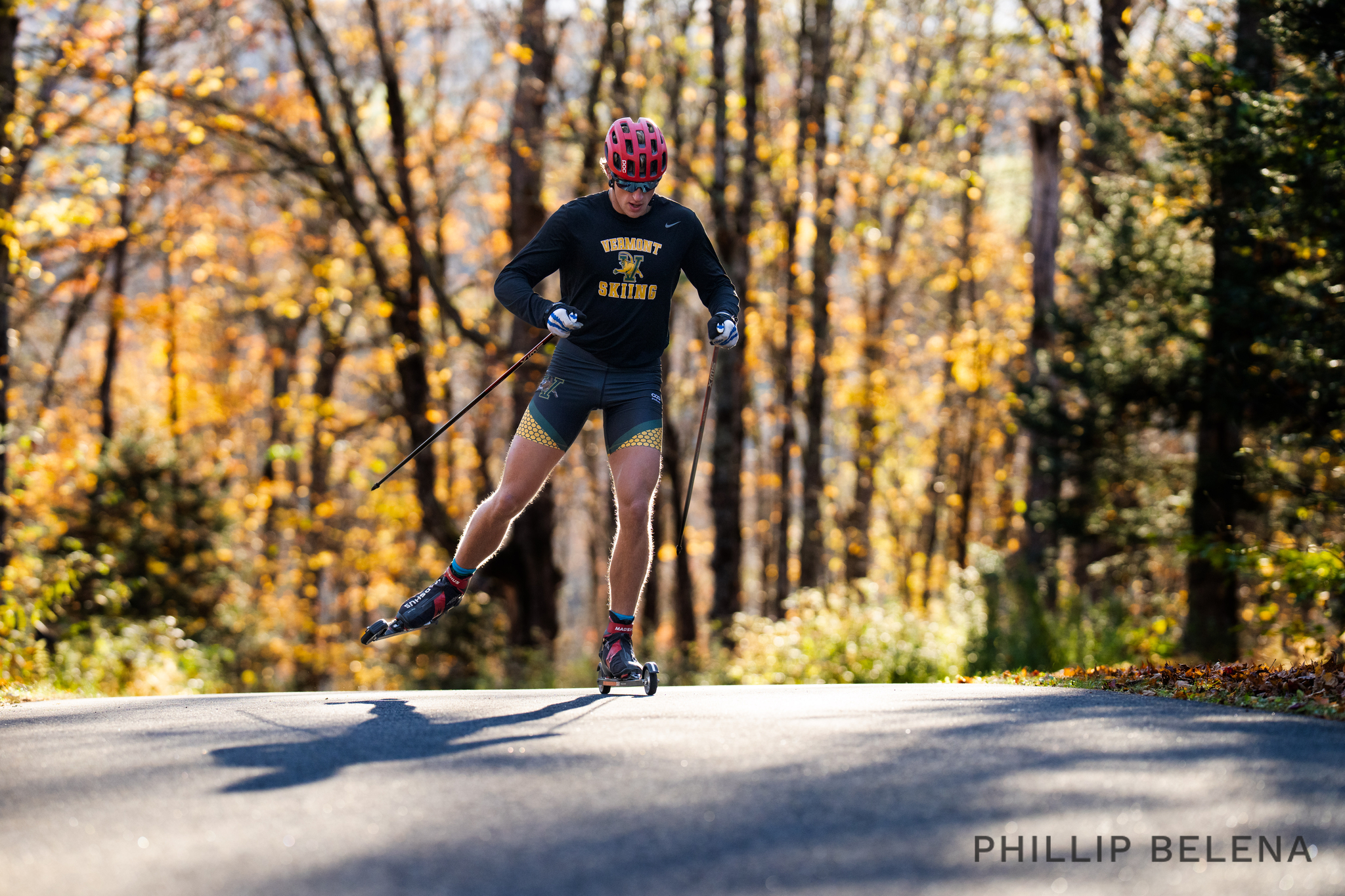
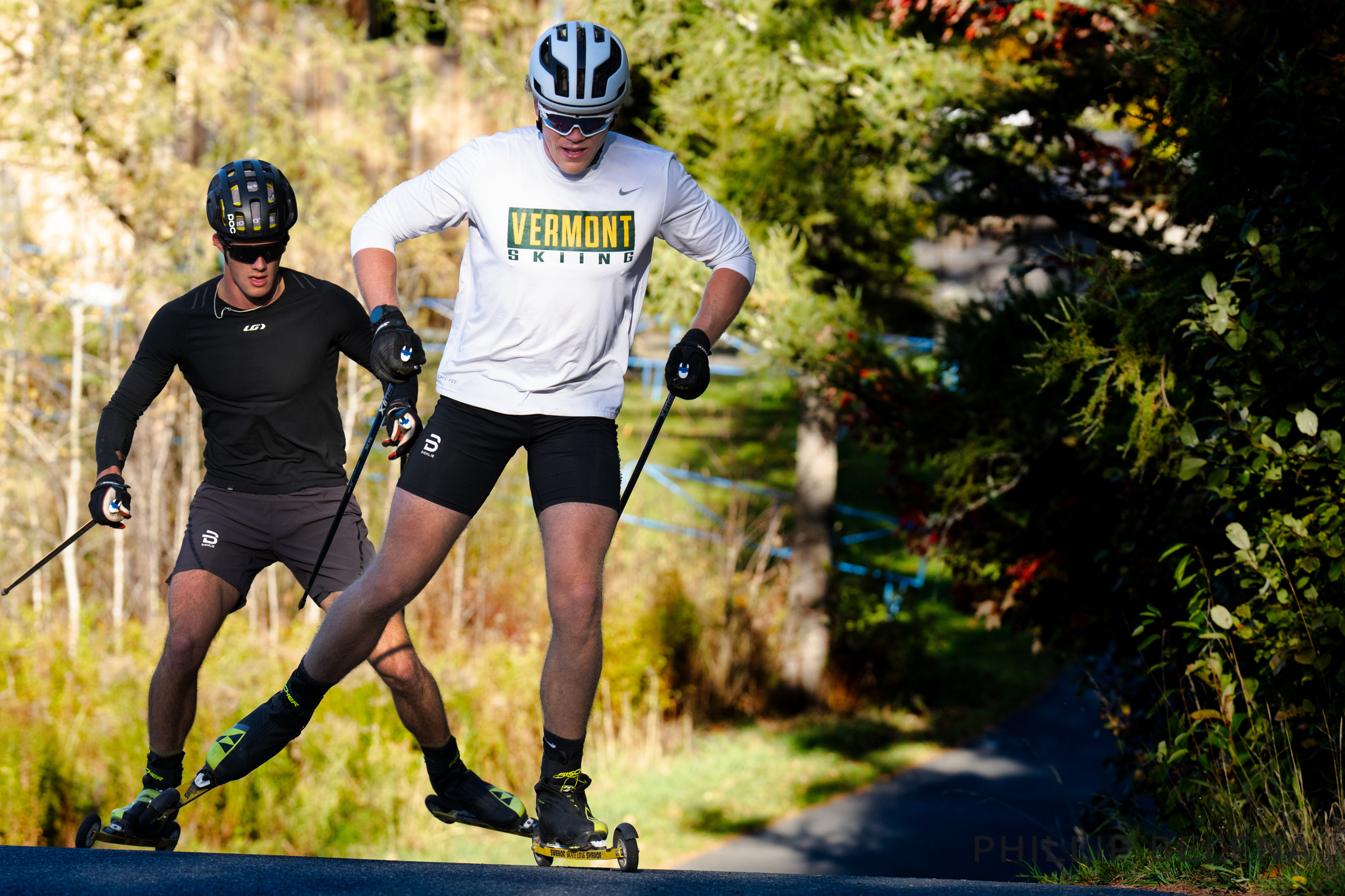
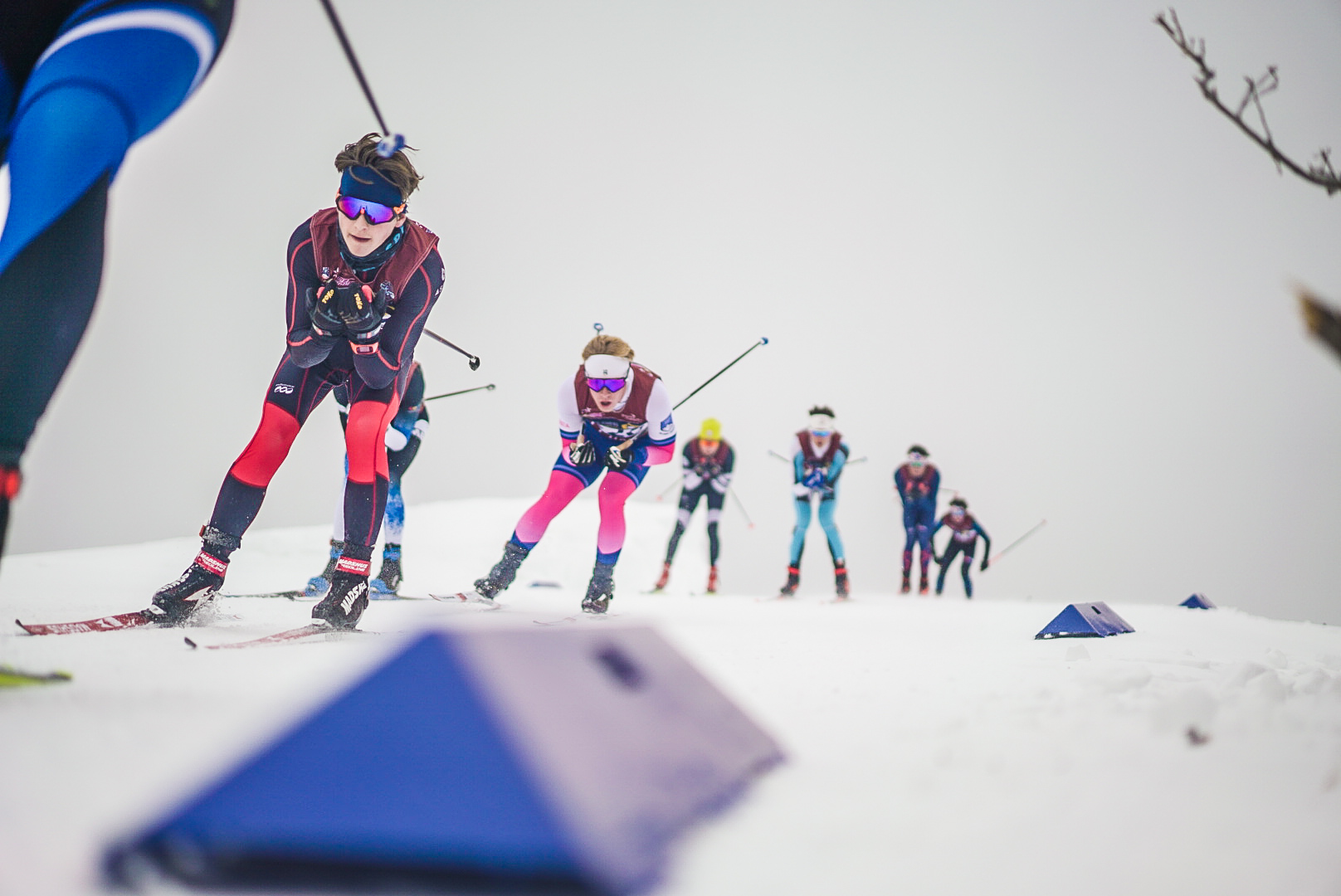
UVM’s Fin Bailey drives up a climb on the Craftsbury Outdoor Center track last fall, generating speed through clean extension rather than grinding against the grade. (Photo: Phillip Belena)
The development of basic speed, neuromuscular power, and speed endurance is critical for high-level cross-country skiing performance. I would also argue that, once an athlete reaches a certain level of aerobic development, future improvements in aerobic capacity may become limited if the athlete cannot produce enough power to generate a sufficient training stimulus.
This article presents a concept that has influenced my coaching for many years: before continually increasing the external loads, volume, and intensity of training, athletes must first develop the ability to produce greater speed and power.
Training loads can be increased in two ways. The first is externally, by making the terrain more difficult or increasing resistance. The second is internally, by improving neuromuscular function so the athlete is capable of producing more power and therefore greater speed.
My experience has been that increasing external loads without first improving power production often yields little improvement in performance and, in some cases, little measurable gain in aerobic development. Athletes simply work harder while producing little additional external work.
We have all seen unfit or less-developed athletes walk up a steep hill while reaching near maximal heart rates. We have observed this repeatedly in junior skiers. Simply walking, skiing, or running uphill slowly can produce extremely high heart rates. Does this indicate inadequate aerobic capacity or inadequate power production? The answer is usually a combination of both.
However, in athletes whose performances have plateaued despite years of increasing training volume and intensity, this question deserves closer examination. Many continue to produce high heart rates while moving slowly. In these athletes, the limiting factor may not be the cardiovascular system itself, but rather an inability to produce enough power to create a greater demand on the aerobic capacity.
For this reason, I believe that early in an athlete’s development, and often early in each training year, speed, movement quality, efficiency, and neuromuscular power should receive significant emphasis. These qualities should not replace aerobic training, but they should develop alongside it. Improving an athlete’s ability to produce power increases the speed at which aerobic training can be performed and therefore increases the potential aerobic training stimulus.
Our observations over many years have consistently shown that athletes lacking sufficient power gradually slow during uphill skiing, running, or bounding intervals while heart rate continues to rise. The internal effort increases even as external work declines.
We have also observed athletes become overtrained despite carefully planned training programs. In many cases the common factors were excessive metabolic cost of endurance training, elevated lactate concentrations at relatively modest speeds, deteriorating movement quality, and inefficient power production.
Again, I believe the underlying issue is often inadequate neuromuscular function.
When athletes cannot produce power efficiently, every uphill carries a large metabolic cost. Heart rate and blood lactate increase rapidly even though speed remains relatively low. The athlete experiences considerable physiological stress without generating the external workload necessary to increase adaptation.
For one summer training period we emphasized extensive speed and neuromuscular training. Several athletes improved their maximal treadmill workload by as much as seven percent during a graded treadmill protocol. At the same time, blood lactate concentrations were lower at each workload stage.
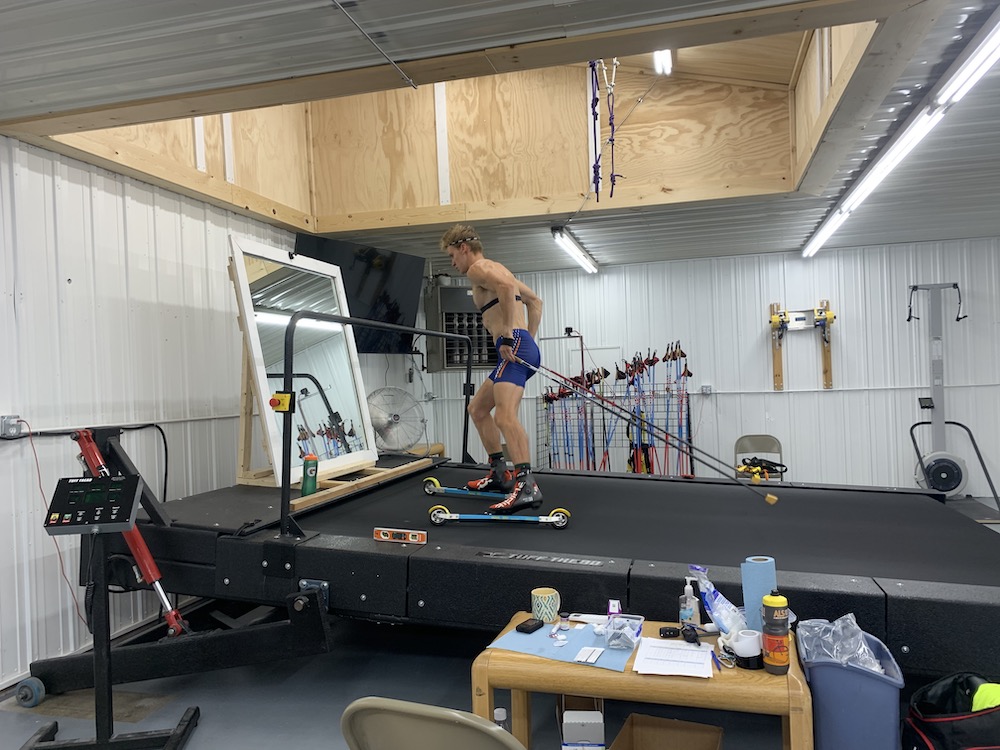
Zak Ketterson doing work on the rollerski treadmill. (photo: courtesy Team Birkie)
These findings do not prove that VO2max increased. However, they strongly suggest improvements in movement economy, neuromuscular power, and the athlete’s ability to express aerobic capacity. The athletes could sustain greater workloads at the same relative physiological cost.
Although the sample size was too small to draw firm scientific conclusions, the observations were both encouraging and consistent with our coaching experience.
One useful coaching tool has been estimating the oxygen demand of uphill terrain using the Balke or ACSM treadmill equations. While these equations were developed for walking and running, not roller skiing or ski-specific movements, they provide a reasonable estimate of the external workload required to climb terrain of a given grade and speed.
Using these estimates, I evaluated athletes on both a maximal 500-meter uphill test and a 3,000-meter uphill test conducted on the same hill. Our top male skiers consistently sustained estimated oxygen demands of approximately 70 to 72 ml·kg⁻¹·min⁻¹ during the 3,000-meter effort. During the 500-meter test, estimated oxygen demands ranged from approximately 83 to over 90 ml·kg⁻¹·min⁻¹. These values represent estimated metabolic demand rather than directly measured oxygen consumption.
The athletes who consistently produced the highest estimated workload during the 500-meter test were also our best performers. The shorter test reflected the athlete’s ability to produce high neuromuscular power. The longer test reflected how much of that capacity could be sustained aerobically.
During summer testing, the best athletes generally sustained only about 80 to 85 percent of their maximal estimated workload during the longer effort, leaving room for further improvement as fitness and skiing specificity increased during the competitive season.
Several practical conclusions emerged from these observations.
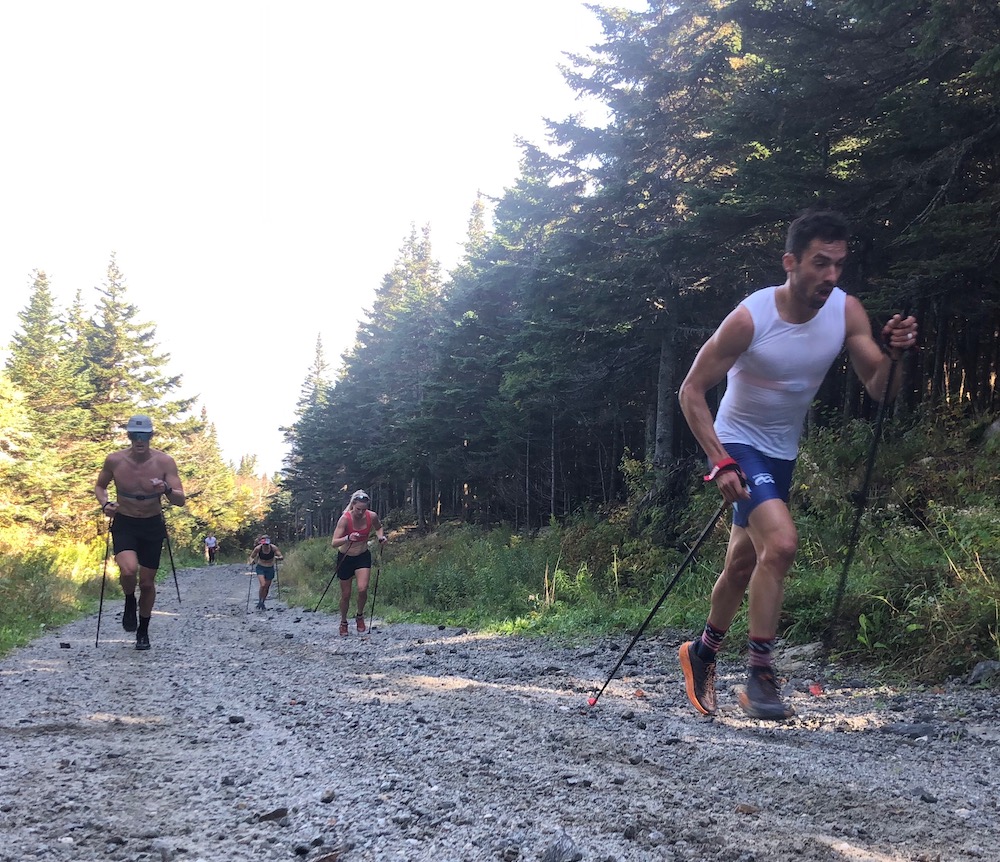
Ian Torchia, far right, leads bounding intervals up Stratton Mountain in summer 2021. Ski bounding remains one of the most direct ways to build the neuromuscular power Galanes describes, with the athlete loading and driving off each step. (photo: courtesy SMS)
Maximal power production establishes the athlete’s aerobic potential.
The estimated workload achieved during the 500-meter test reflects the athlete’s ability to produce power. If this value is too low, it becomes increasingly difficult to create a training stimulus large enough to maximize aerobic development, because the athlete cannot sustain sufficient speed.
Small differences between maximal and sustainable power may indicate a different limitation.
If the athlete’s maximal 500-meter workload is only slightly greater than the workload sustained over longer efforts, further improvements in aerobic capacity may be limited until maximal power production improves.
Lower-level athletes often need speed before more intensity or volume.
Many developing athletes have maximal power values only five to ten percent higher than their longer uphill performances. These athletes often benefit more from improving neuromuscular function, movement quality, and speed than from simply adding more difficult interval training.
Hard uphill intervals are not always the answer.
If athletes lack sufficient power to increase speed, making the terrain steeper or simply asking them to work harder often produces more fatigue than adaptation. Increasing the load without increasing movement quality seldom solves the underlying problem.
Sustainable aerobic power is not enough.
Athletes capable of sustaining a very high percentage of their aerobic capacity but possessing relatively low maximal power often plateau. They may already be performing close to their physiological ceiling and will likely require improvements in neuromuscular power before further performance gains occur.
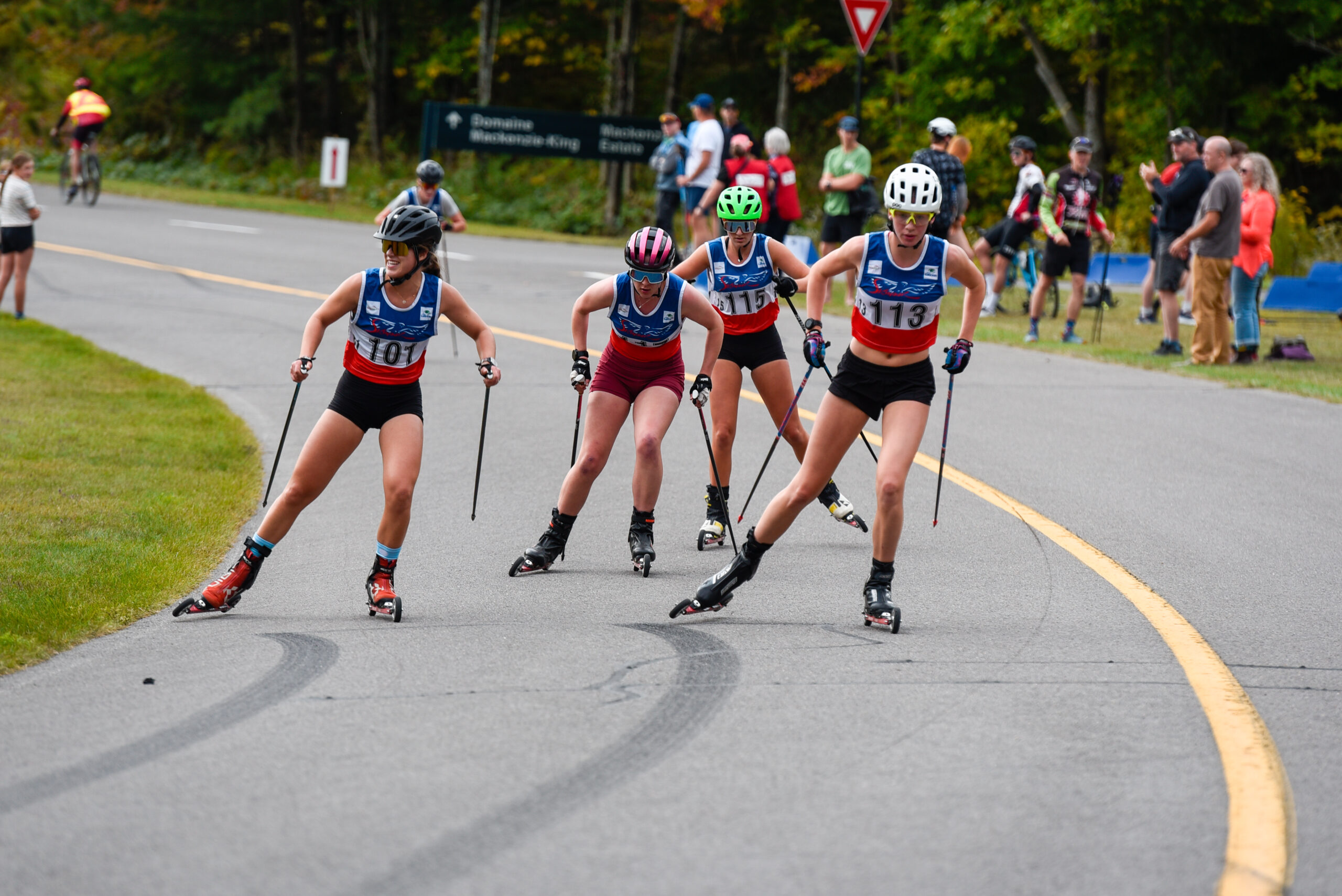
Youth skiers during a Skinouk Roller Ski Race. Galanes argues these athletes often gain more from speed and movement quality than from steeper terrain or harder intervals.
Speed should create the load.
Uphill training remains essential in cross-country skiing. However, I believe the primary driver of training should be generated through efficient movement rather than terrain alone.
Whether athletes are performing distance training or intervals, movement should remain clean, crisp, coordinated, and quick. If technique deteriorates and speed slows simply because the terrain is harder, the athlete is no longer training optimal movement. They are merely increasing physiological stress.
Ultimately, endurance performance depends upon the interaction between physiology and movement. The aerobic system can only respond to the workload the neuromuscular system is capable of producing.
For that reason, coaches should devote as much attention to developing speed, power, and movement quality as they do to increasing training volume and intensity. In the long term, improving an athlete’s ability to generate external workload may be one of the most effective ways to unlock further aerobic development and higher performance.
Help Support Our Coverage!
If you value the thoughtful work and access FasterSkier provides, please consider becoming a Voluntary Subscriber. Your support directly fuels our work to cover the people, places, and moments that make our sport special.
UVM’s Benon Brattebo rollerskiing on the Craftsbury Outdoor Center track last fall. Galanes argues that speed and neuromuscular power, not just harder terrain, should create the training load. (Photo: Phillip Belena)
Registration is open for the Stratton Mountain School BKL Summer Camp, which runs August 3-6, 2026, on the SMS campus in Stratton Mountain, Vermont. The camp is open to athletes ages 10 to 14, with a maximum grade of eighth.
The four-day program is built around progressive skill work in a low-pressure setting. Hiking, swimming, roller skiing, ski bounding, and games are all on the schedule, along with the camp’s annual lip-sync contest. Campers will also sit down with members of the SMS T2 Elite Team for a Q&A — the T2 group has put skiers on World Cup and Olympic start lists, and the session is one of the camp’s longer-running traditions.
The camp is split into two sections, one for male athletes and one for female athletes, both running the same August 3-6 dates. Registration and payment deadlines are both July 31, 2026.
If the camp fills before the deadline, SMS is keeping a waitlist through a Google form linked on the registration page. Note that the form does not allow duplicate phone numbers. Cancellations made fewer than 30 days before the camp start date are non-refundable.
For questions, contact Nordic Program Director Matt Boobar at mboobar@gosms.org or 570-594-7555.
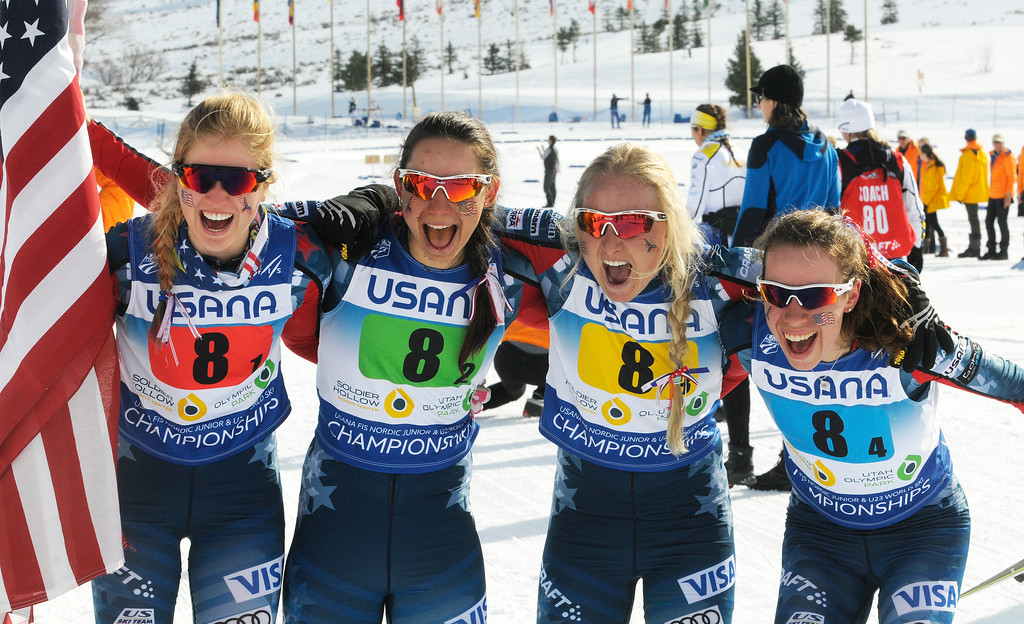
The U.S. women’s relay after taking a historic third in the 4 x 3.3 k relay at 2017 Junior World Championships on Sunday at Soldier Hollow in Midway Utah, with (from left to right) Hailey Swirbul, Julia Kern, Hannah Halvorsen, and Katharine Ogden. (Photo: U.S. Ski Team/Tom Kelly)
As the season winds down, it’s worth stepping back and asking a simple question: Does the way we develop young skiers in the United States reflect the philosophy we say we believe in? I know everyone is probably done with hearing about how the Norwegians do it, so let’s look at what we say we know and what we embrace.
Many coaches and programs describe cross-country skiing as a lifetime sport. We talk about patience and say it takes ten years or more to develop as a skier. Clubs reference long-term athlete development models, and parents hear that endurance sports reward athletes who build gradually and peak later in life.
All of that is true.
But much of the system we’ve built rewards the opposite.
Once rankings, camp selections, college recruiting, and program reputation become tied to junior results, the incentives quietly shift. Development begins to be measured by podiums and training hours rather than movement quality, long-term improvement, or whether athletes are still engaged in the sport five or ten years later.
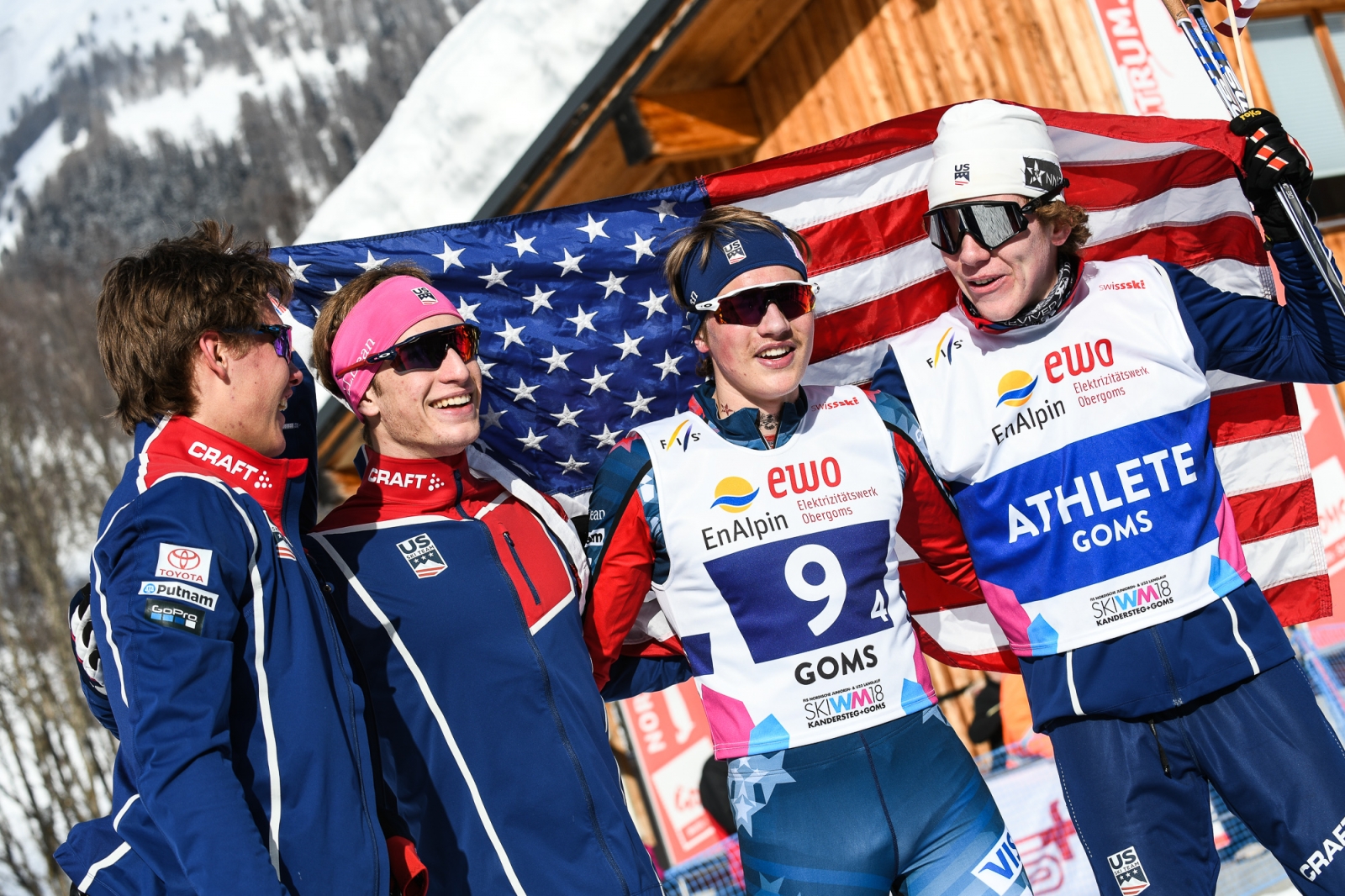
The U.S. men’s silver-medal relay at 2018 Junior World Championships in Goms, Switzerland, with (from left to right) Luke Jager, Hunter Wonders, Gus Schumacher, and Ben Ogden. (Photo: JWSC2018.ch)
What is long-term development
Aerobic capacity develops over years, often decades. Technical efficiency improves gradually. The durability required to handle training load is built slowly through years of training. Most elite endurance athletes reach their peak in their mid-twenties or early thirties, not in high school.
If peak performance happens ten or fifteen years after an athlete first enters the sport, the early years should focus less on maximizing results and more on building the foundation that supports long-term growth.
That foundation includes several elements.
Movement skill. Nordic skiing is a technical sport, and the best skiers move efficiently long before their physiology fully matures. This efficiency is critical to managing training loads in the future. More efficiency in technique equals less stress and load from training.
General athletic development. Running, biking, jumping, climbing, and playing other sports all contribute to coordination and resilience. Athletes who move well tend to adapt better to training later.
Motivation. The most valuable asset a young athlete has isn’t VO₂ max or the hours trained by some arbitrary definition. It’s the desire to keep showing up year after year.
Junior athletes race during the 2022 U.S. Cross Country Championships in Soldier Hollow, UT. (Photo: Tobias Albrigtsen / @untraceableg)
The System Sends Mixed Signals
In practice, the system often sends young athletes a different message.
Junior racing has become increasingly competitive. Rankings exist even for younger age groups, and selections for camps, trips, and development programs often depend on early results. National events and development pathways can make performance at 14 or 15 feel like it carries some long-term significance. Yet we also claim to know that identifying future elite athletes at that age is extremely unreliable. If that’s true, it’s worth asking why the system places so much weight on those results.
One example is allowing U14 athletes to ski up in order to qualify for Junior Nationals. It doesn’t happen frequently, but it happens every year. It’s hard to reconcile that with the philosophy of not rushing development. If long-term development truly matters, governing bodies should show leadership and address this issue.
In some regions of the country, qualifier races have U16 athletes seeded in the start list with U18 and U20 athletes. People say it doesn’t matter because we separate them in the results. I disagree, the are intermingled with much older and more developed athletes. But more than that it is again the message begin sent?
At the same time, training culture has shifted. Training data is widely shared, and conversations often revolve around hours. Young athletes begin comparing workloads long before their bodies are ready to handle them. Often the more is better attitude prevails, even though we say that we should be working on other skill aspects of development.
These pressures can push athletes toward earlier specialization and higher training loads than their stage of development requires. A 14-year-old begins to feel like they need to train like a college skier. A 15-year-old worries that missing races or reducing training volume might put them behind.
The Boulder Nordic Junior Race Team out for an adventure ski in 2014. (Photo: BNST)
What are the impacts of the mixed signals
The most visible consequence is burnout. Many people challenge the idea of burnout. But after more than forty years around this sport, I’ve seen the pattern repeatedly. Just because we don’t measure something well doesn’t mean it isn’t happening.
Coaches who have spent time around junior skiing see the pattern: talented athletes who disappear from the sport sometime between their late teens and early twenties. Sometimes academics, finances, or changing interests are the reason. But often the explanation is simpler, they are tired from too much too early and to intense.
There are also physical consequences. Adolescence is a complex period of growth and development. Training loads that are manageable for more mature athletes are impossible for a developing body. When volume and intensity climb too quickly, overuse injuries and chronic fatigue become more likely.
Early specialization is not the problem. Rather, it is ineffective programming that has these young athletes training like more mature athletes. This early training focus limits athletic development. Athletes may accumulate impressive training hours but miss the movement diversity that builds long-term durability.
The biggest loss in this process is one that is unseen because those athletes are lost from the sport.
From a coaching perspective, the shift shows up in small ways. Conversations revolve around weekly training hours instead of how well athletes are skiing. Easy sessions slowly become harder. Fatigue accumulates while movement quality quietly declines. None of this happens overnight, but over time, the focus drifts away from skill development and toward simply doing more.
Development in endurance sports isn’t about accumulating work. It’s about adapting to the work being done and building the capacity to handle more later. A training log that looks impressive at 15 doesn’t necessarily translate into success at 25. What matters more is whether the athlete remains healthy, motivated, and technically sound over the long term.
Hailey Swirbul celebrates the U16 Junior National Championship title in the Freestyl Mass Start in Stowe, Vermont, in 2014. (Photo: Voisin/FasterSkier)
What Good Development Actually Looks Like
If long-term development is the goal, the early years should look different from elite training. Young skiers benefit from variety. Running, cycling, hiking, and other sports build coordination and resilience. The goal isn’t to replicate elite training programs but to create athletes who move well and enjoy being active.
Technique deserves major attention. Nordic skiing rewards efficiency, and athletes who develop strong movement patterns early often progress faster later because every hour of training becomes more productive. Training volume should increase gradually over time. Consistency across years matters far more than pushing limits in any single season.
Most importantly, development should seek to preserve motivation. The sport needs athletes who remain engaged long enough to realize their potential. We often see athletes try to do a big training year to catch up or reach a target training volume. It rarely works out.
The Problem With “More Volume” Thinking
In Nordic skiing, training volume carries a certain mystique. Conversations quickly turn to hours, weekly totals, yearly totals, and stories of elite athletes training 800 to 1,000 hours per year.
It’s easy to see why. Endurance sports reward consistency and large training volumes. But a subtle misunderstanding often occurs. Volume stops being seen as the result of long-term development and starts being treated as the cause of performance.
Correlation becomes mistaken for causation.
Hunter Wonders (APU/Alaska) winning the U16 Boys Mass Start Freestyle race at the US Junior National Championship in Stowe, Vermont. (Photo: Voisin/FasterSkier)
High Volume Works for Elite Skiers
At the elite level, high training volume makes sense. World Cup athletes have spent years building the capacity to handle that workload. Their aerobic systems are highly developed, their movement patterns are efficient, and their bodies have adapted gradually.
High volume works because it sits on top of a massive foundation: technical skill, durability, and years of progressive training.
The problem arises when that model gets copied without the same foundation underneath it.
The Missing Variable: Training Age
One of the most overlooked concepts in endurance development is training age. Training age refers to how many years an athlete has spent consistently adapting to structured training. Two 18-year-old skiers may have very different training ages. One may have spent eight years gradually building capacity. Another may have entered the sport recently and increased training dramatically. On paper, their training logs may look similar. In reality, their ability to adapt to those loads can be very different.
Training only produces progress when adaptation occurs. Without adaptation, training simply builds fatigue.
The U18 Girls field works its way past the Loppet Foundation Adventure Center in Minneapolis during Junior Nationals on March 11th, 2022. (Photo: David J Owen Photography)
The Efficiency Problem
Elite skiers move extremely well. Their technique allows them to ski long distances while conserving energy and minimizing unnecessary muscular stress. Developing this efficiency early is critical. In the future, it will allow the athletes to train large volumes without the metabolic and neuromuscular stress that can lead to overtraining.
Young athletes often lack efficiency. When technique is still evolving, large training volumes can actually slow technical development. Fatigue reinforces inefficient movement patterns that later become difficult to change.
For developing skiers, time spent improving movement quality can be far more valuable than time spent extending distance.
The Cost of Chasing Hours
There is also a practical cost to the “more volume” mindset. Elite athletes structure their lives around training. Sleep, nutrition, and recovery are integrated into the system. Young athletes are balancing school, travel, social life, and other commitments. When training volume climbs, something gives. Sleep declines, recovery becomes inconsistent, and fatigue accumulates.
Under those conditions, simply adding more hours rarely produces better results.
What Volume Should Really Represent
Training volume does matter. Endurance sports ultimately require substantial workloads. But volume should be viewed as a long-term outcome of development, not a short-term objective. Successful endurance athletes rarely build training hours quickly. They accumulate them gradually across many seasons, allowing their bodies to adapt step by step. By the time they reach elite levels, high training volumes feel natural because they have spent years building the durability to support them.
The 2026 US Ski and Snowboard Junior National Championships in Cable, Wisconsin, hosted by the American Birkebeiner Ski Foundation. (Photo: Tryg Solberg)
A Better Question to Ask
Instead of asking how many hours an athlete should train, a better question might be:
What training can this athlete adapt to right now?
For some athletes, the answer may involve increasing volume. For others, improving technique, strength, or intensity distribution may produce greater gains. Development is not identical for every athlete. What matters is finding the training load that promotes consistent adaptation rather than constant fatigue.
Why This Matters for the Future of the Sport
Cross-country skiing, like all endurance sports, depends on long-term participation. The sport needs athletes who remain engaged, not only as competitors but as lifelong skiers, coaches, and community members.
A development system that pushes athletes too hard, too early risks losing them before they reach their potential. It also narrows the pathway to elite performance by favoring early maturity and filtering out late developers.
If Nordic skiing truly wants to remain a lifetime sport, its development culture must reflect that philosophy.
Closing
Cross-country skiing has always valued endurance. That value should extend beyond physiology and into how we develop athletes. Endurance isn’t just about how long someone can ski hard on race day. It’s about how long they can remain engaged in the process of improving.
If we truly believe Nordic skiing is a lifetime sport, then our development system should not resemble a funnel that selects kids out at every progressive age group. It should look more like a runway, where every young athlete has the opportunity and the time to fully develop their potential, not just the ones who mature early.
Help Support Our Olympic Coverage!
If you value the thoughtful work and access FasterSkier provides, please consider becoming a Voluntary Subscriber. Your support directly fuels our work to cover the people, places, and moments that make our sport special.
The 2026 US Ski and Snowboard Junior National Championships in Cable, Wisconsin, hosted by the American Birkebeiner Ski Foundation. (Photo: Tryg Solberg)
On an ordinary winter afternoon in Fairbanks, before NCAA titles and World Cup bibs and FIS profiles, there was just a loop—eight hundred meters of snow and one long, unforgiving hill.
Middle-school Kendall Kramer skied it after class, day after day, with her dad. Birch Hill. Blue Loop. One big climb, same as yesterday, same as tomorrow. What changed was how it felt.
“We would just go for, like, 30 minutes after middle school every day,” she remembers. “And I remember really liking the feeling of this specific loop in Fairbanks at Birch Hill called Blue Loop. It’s like 800 meters, but it has this really big, steep, long hill. And we would do that every day. And I became really addicted to feeling like the hill was easier to get up every single day.”
Kramer didn’t start as the kid who loved hard things. She started as the kid who had to be bribed—stickers, money, chocolate, extra iPad time—just to go outside with her very active dad, a former Washington State runner who picked up skiing when he moved back home to Fairbanks.
“I really didn’t like hard things. I didn’t like pushing myself. I didn’t like going outside. I didn’t like athleticism,” she says now, half amused, half incredulous. “I was into theater, and I went to art camps, and I went to fashion designing and sewing camps, and I was just doing a bunch of art stuff until seventh grade.”
The shift did not come from some early, noble desire to maximize her potential. It came from middle-school social dynamics: her best friend and the “cool, funny kids” were in the local ski club, FXC. They were getting strong; she wanted in.
“All of the cool, funny kids, and my best friend, were on the ski club FXC,” she says. “I noticed that she was getting really muscular. And, I want to get muscular too. That was literally my motivation. I wanted to spend more time with my friends.”
So she flipped the script. The kid who once needed bribing was suddenly begging to ski. “In middle school, I asked [my dad] to take me skiing every day,” she says. “I liked the feeling of the work I was putting in quantifying to something. You don’t get that with everything in life.”
That tiny addiction—to feeling the hill get easier—would quietly rewire the course of her life.
Running Into an Identity
Before she thought of herself as an athlete, there was one race that hinted at what might be possible: a local 5K in eighth grade.
“There was this one race,” she says. “There was this local 5K, and I won that. And I beat a UAF girl. And I was in eighth grade. And so then I thought, oh, I could start training for another level at this.”
It’s a funny hinge moment: a middle-schooler passing a college athlete on a random Fairbanks course—”I think it was the Chena River Run 5K”—and suddenly reevaluating what “participation” might mean.
From there, skiing and running braided together. Everyone in her circle seemed to do both—cross-country in the fall, cross-country skiing in the winter, track in the spring. The sports gave structure to adolescence. They also gave her a first glimpse of what high-level results feel like: she made Junior Nationals, then Junior Worlds, and at 16, in her first year there, she finished fourth.
It looked, from the outside, like a linear rise.
It wasn’t.
Kendall Kramer on her way to fourth place in the U20 15 k classic mass start at World Juniors in Lahti, Finland. (Photo: Doug Stephen)
Burnout at the Top of the Podium
The breakout year rolled into something heavier. Right as college coaches were calling and scholarships were appearing, Kramer’s relationship with skiing began to fracture.
“After my breakout year, I went through a large burnout of skiing,” she says. “Looking back, maybe kind of predicted with how huge a jump it was… but I went through a huge burnout that happened to coincide with my senior year of high school.”
She was in the rare position of being heavily recruited and deeply ambivalent about the thing doing the recruiting.
“I didn’t want to do any athletics,” she says. “I wanted to go to school. I just wanted to do academics. I only applied to Ivy League colleges, [but] I didn’t get into them.”
The plan, as she saw it then, was to walk away from elite sport altogether. No more ski clubs, no more interval sessions, no more World Juniors. She would be a student, full stop.
But mid-winter, another pivot arrived. Running, with its promise of a single daily practice and a more contained lifestyle, began to look like a compromise.
“I was like, I’ll run,” she recalls. “I really feel like I could have a balanced life if I just ran in college. I might as well do something athletic.” She started talking “very seriously” with Northwestern—”for quite a few months,” she says, laughing at how she kept mixing it up with Northeastern.
Still, skiing lurked in the background. Friends were planning official visits. There were trips to New England—Dartmouth, UVM—to meet both ski and running coaches. “We worked out a plan for me,” she says of Dartmouth, “like what days I would go to running practice, what days I’d go to ski practice, how I would do all of that.”
In those conversations, UAF—her hometown university in Fairbanks—barely registered as a serious option. If anything, it was the anti-option.
“There’s a FasterSkier article where [Jason Albert] interviewed me my senior year of high school,” she says. “I did say, ‘Oh, I’m definitely not going to UAF.’ Because I need to get away. Just like every high school senior.”
The only reason she even agreed to visit was for social reasons. “I had a bunch of friends at that time… they were also going on an official visit, and I wanted to hang out with them at UAF for that weekend,” she says. “I was like, ugh, okay, fine, I’ll go to UAF for the weekend.”
That reluctant trip changed everything.
Choosing the “Wrong” School
UAF did not look like the kind of program that impresses strangers in an Instagram bio. It looked like something else: a coherent life.
Kramer noticed first what happened away from intervals and wax benches.
“The team I felt really… not only got along just at practice, and practice was fun, but they chose to hang out with each other as people outside,” she says. “They really felt genuine about it. They are really friends with each other. They actually care about each other. They’re having fun. They’re all a little bit weird.”
The second revelation was structural. At UAF, running and skiing weren’t two programs negotiating over a dual-sport athlete’s time. They were one.
“At UAF, it’s literally one program,” she says. “We share a locker room and a team room, and the coaches have their offices in the same room. Like, it’s really the same program, cross-country running and skiing.” While coaches at other schools were willing to coordinate, the Fairbanks setup was seamless. “I barely had to, like, go out of my way. I didn’t have to change my training at all with UAF, and that was really valuable.”
There was also something less tangible: the sense that staying close to home might be protective at a time when she was “really… sensitive mentally.”
“This is really a tumultuous time for me,“ she recalls thinking. “I can stay close to home. I don’t have to change too much while I’m in this mental state. I can see my family every single week. I think that would be a really good move for me.“
From the outside, it didn’t fit the script; hometown program, Div. II running, and a school she had publicly ruled out. She knew people would talk.
“Of course, people, you know, judge me for staying in my hometown,“ she says now. “People still are like, ah, you needed to finally leave Fairbanks. You need to get out. But I know that didn’t sound the best, that I’m going to UAF, because it’s not ‘the‘ program. But I’m really glad that I let what things ‘sound like‘ go, because it gave me a lot of happiness, and it made me feel like it was my choice.“
Reverse Podiums and the Slow Build Back
UAF didn’t magically solve everything. Her first years there were heavy.
“My first two years, not only was I recovering from burnout and not wanting to go to practice at all and really trying to get back into sport my whole freshman year of college,“ she says, “I was also super overtrained, and I could not go fast for the life of me. I think that I was getting a ‘reverse podium’ in my Western college races.“
The COVID year wiped out her first NCAA running season entirely—”there’s just no running races held,“ she notes. In skiing, she salvaged an All-American by the end of winter, but the trajectory felt nothing like her high-school ascent.
If her junior years had been a rocket ship, college was more like a slow climb back onto the trail.
“Luckily, I feel like one of my strengths athletically, besides that, blip, is consistency,“ she says. “I did feel like it was a gradual buildup leading up to my last year at UAF, where both [sports] were progressing from that low burnout point.“
On the running side, her NCAA results tell the story: 170th in her first nationals, then 8th—”because it was cold and super late, so I was already in ski form”—then 20th, then runner-up in Sacramento. She says, simply, “That was really cool.”
In skiing, she went from anonymous trips to the NCAA Championship to a national title. Before that win, she says, “I don’t think I got better than seventh at other NCAAs.“ Last March, she finally broke through and won.
It wasn’t a straight line. But it was, in its own way, a larger version of the Blue Loop lesson: keep showing up, let the hill get fractionally easier, trust that one day you crest the top.
Two Degrees, One Classroom
Through all of this, Kramer was not just an athlete. She was building an intellectual life, too.
“Yes. Biology, specifically, arctic ecology, which was cool. And psychology,“ she says, almost offhand, when asked about her majors.
The combination sounds eclectic until she explains her real career ambition.
“It seems unrelated to both of them,“ she says, “but it is actually related to both of them, as I want to teach.” She’s not yet sure about age group—”I am leaning towards high school”—but the vision is clear: “I want to teach high school science and high school psychology. I think [that] is a way to be still involved with both of my subjects.“
This is not a vague, post-sport idea. She’s already testing it. This year, while racing and training out of Anchorage, Kramer has been substitute teaching.
“I’ve been substitute teaching, actually, this year in Anchorage,“ she says. “That’s been really cool. That’s exposed me to that, and I have really confirmed that it’s something that I enjoy going into, and I feel fulfilled after I do the job, and I really enjoy it, and it’s something new every day.“
The logistics fit surprisingly well with elite training. Kramer logs into the Anchorage School District’s database, looks a week ahead, and drops half-days into the white space between sessions.
“You can go into the online database every week,“ she explains. “You’re like, oh, I don’t have training Monday, and it’s on your own Wednesday, and we have our afternoons off on Thursdays, so I could do all those days. And then you just sign up for what you can do.“ Elementaries offer half-days—”like 11:30 to 2:30″—which sit perfectly between morning and afternoon workouts. “It’s really good pay,“ she adds, “and that’s completely in between the two sessions, so it’s really been perfect.“
There is also a deeper satisfaction. “I think it’s a really respectable career,“ she says of teaching. “I think that it’s… one of the pillars of society. And so I would feel really fulfilled every day doing that.“
It makes the future feel less contingent on a result sheet.
“In my personal life aspect,“ she says, “to know that I have a career available for me at any time that I want to take it, that I really am passionate and excited about, not just something that pays a bill… I’d be perfectly fine if I were doing that.“
The Type-A Gap Year
Kramer did not grow up assuming she would ski professionally.
“I still am… it was a surprise to me that I am even skiing past college,“ she says. “I really was planning on, you know, doing my absolute best through college, but ending on a high note.“
This season, now that she’s graduated, is something different: “an experimental year in the first place of just trying out professional skiing, giving myself, like, a gap year of sorts and seeing how it plays out.“
She is grateful that the experiment is optional, not existential.
“I’m really grateful to have some educational and career stuff that I really am also passionate and fulfilled by to fall back on,“ she says. “If along the lines [skiing] becomes not what I’m enjoying anymore… I really am enjoying it right now, so that’s what I’m finding in my gap year, I guess. But yeah, I really am taking it year by year.“
It’s an outlook that sits a little oddly with the logistics of the World Cup, where you can’t plan a life too far in advance. Her personality wants spreadsheets; the selection system gives you “we’ll tell you Sunday.“
“I’m extremely Type-A,“ she says, laughing at herself. “I packed my ski bag for this Europe trip, like, two weeks before I left. And everyone I was asking what skis they’re bringing, they’re like, ‘I haven’t even thought about it.‘ I like to plan months in advance for things.“
Right now, as she races into mid-winter, that Type-A planner is bumping against the uncertainty of World Cup selection. Tour de Ski rosters, for example, are announced three days after Davos.
“I haven’t necessarily done something that makes it, like, super obvious that I’m going to Tour de Ski,“ she admits. “I haven’t gotten a top 30 or 20 or whatever. And so I’m actually completely unsure. I’m definitely having a freak-out situation where on Sunday night, when I finish my Davos race, I don’t know where I’m going.“
She’d love to do the Tour—”I would take the opportunity… if it’s granted to me”—but she’s honest that she hasn’t hit the automatic criteria, and that there may be Lake Placid nationals in her near future instead. “There are no bad options,“ she says, sounding like someone who has practiced this perspective.
Kendall Kramer (USA) racing the 10 k Freestyle this past weekend in Trondheim (NOR). (Photo: Modica/NordicFocus)
Racing in the Deep End
On paper, her World Cup results this year might make casual fans nervous: numbers in the 30s and 40s, no breakthrough into the top 20—yet. From inside the bib, it feels very different.
“I feel like I have done really good races,“ she says. “I felt like I could push every second. I feel like I’m recovering really fast. I feel strong in my skiing. I’m really liking how I’m taking the races, and I’m going absolutely as hard as I can.“
What’s changed, she says, is her understanding of context.
“I think that it’s opened my eyes to… how things look on paper on a ski race,“ she says. “People back home have maybe been watching, and they’ve seen placement numbers near my name that they haven’t seen before… And I don’t think that people understand the context of the strength of these athletes that we’re against here.“
Everyone is there in Period 1. Everyone is fit. Everyone is fighting for the same 0.3 seconds.
“Even though we are strong and fast as well,“ she says, “that’s just where we’re ending up in this pool of really… the strongest and fastest in the world.“
Kendall Kramer (USA) on her way to 18th place in the 10km Freestyle iin, Cogne (ITA) last February. (Photo: Authamayou/NordicFocus)
Still, the goals are clear. “I definitely go into any World Cup wanting a top 30,“ she says. “That opens a lot of doors for the national team… I have reached that level before,“ she adds, noting her 18th in a World Cup 10K skate last year. “Top 30 is a pretty sweet spot.“
She is also honest about the practical stakes. “Top 30s will get you nominations for more things,“ she says. “That’s a really good number.“
On the Olympic question, she doesn’t dodge.
“Yeah,“ she says when asked if making the team is a big goal. Then she pauses. “I’m trying to… so far, I could just take it weekend by weekend. I really hope that by doing my best every single time and making the correct decisions, it can build up to that, and I can do well enough to earn a spot there. But I’m not going to define if my season was worthwhile or if I’m a talented athlete or whatnot on that.“
It’s not that she doesn’t care. It’s that she refuses to let a quadrennial selection meeting be the sole judge of her life.
Kendall Kramer (USA) – racing the Mixed Relay in Engadin (SUI) last January. (Photo: Authamayou/NordicFocus)
Process Over Podiums
If you want to understand how she’s trying to get there, you don’t look at the results sheet. You look at the small, specific things she’s attacking.
“I’m trying to be braver on downhills,“ she says. “I’ve always been very cautious because I think I’ve just had too many instances where I’ve tried to be crazy on something, and then I break something, and it ends up costing more time than if I just skittered a little bit.“
She’s working on classic technique so she doesn’t feel like she’s “just flailing around and fighting my kick all the time.” She’s learning to lean into the brutality of World Cup individual starts, where a tenth of a second can be the difference between important FIS points she is chasing.
She is, perhaps unsurprisingly, an individual-start partisan. Mass starts have burned her before.
“In every Junior World mass start race, I’ve had somebody knock into me and break my pole, and then I’m out of it,“ she says. “Or I fall, and I’m out of it… Your race was defined by someone else.“ On the World Cup, she loves that an individual start feels like “how I ski the course against how other people ski the course, as opposed to if you’re in the right place at the right time.“
She also wants something simpler: volume.
“I really want to take every opportunity presented to me,“ she says. “I really like to race, and I like being in the thick of race season. I want to race a lot, and I feel like I’ve built up now a tolerance to building on a lot of races.“ For the first time, she’s planning to carry a full season through the SuperTour Finals. “I want to have a real ski season like the rest of the skiers who start racing in December instead of August… and keep myself together through the end of Spring Series.“
It’s a small, quiet ambition. It’s also a radical one in a sport where so many seasons end in March with more relief than joy.
Kramer racing the World Cup 10 k Freestyle in Minneapolis (USA). (Photo: Modica/NordicFocus)
The Hill, Again
These days, Kramer spends more time on World Cup courses than on the Blue Loop. The hills are longer now. The stakes are higher. There are TV cameras, FIS points, and spreadsheets full of criteria that will determine who gets a call before the Olympics.
But if you strip all of that away—if you put her on a snowy climb and ask what she’s chasing—it doesn’t sound all that different from the middle-schooler trying to make it to the top without stopping.
“I like the feeling of bettering myself,“ she said of those first, shaky loops at Birch Hill.
This fall, between substitute teaching shifts and Type-A packing lists, and this winter between Tour de Ski uncertainties and top-30 dreams, she is still chasing that feeling: the knowledge that the hill is getting a little easier, and that the life she’s building, with two degrees, one dream, and a classroom waiting, makes sense no matter what the result sheet says.
Love Stories Like This? Help Keep Them Coming.
Feature stories like this one take time, access, and care to produce. If you value thoughtful storytelling and independent ski journalism, please consider becoming a Voluntary Subscriber. Your support directly fuels the work we do to cover the people, places, and moments that make our sport special.
Eventual winner David Norris (l) and his APU teammate and second-place finisher Scott Patterson (r) race in the Bird Ridge Hill Climb overlooking Turnagain Arm outside Anchorage, Alaska, in June 2016. (Photo: David Norris)David Norris is having a moment. The 25-year-old native of Fairbanks, Alaska, won his first-ever SuperTour race in Lake Placid in January. The next day, he won his second SuperTour race. In February he won the prestigious American Birkebeiner, taking home more than $10,000 dollars and leaving behind an iconic shot of him exulting as he crossed the finish line. In March, after missing out on qualifying for the Ski Tour Canada, he stayed in Alaska to train and won the Tour of Anchorage, then finished third in a slushy 50-kilometer classic mass start at U.S. Distance Nationals in Vermont.
David Norris earlier this month above Eagle Glacier outside Anchorage, Alaska. (Courtesy photo)For all of these accomplishments, Norris, who skis for Alaska Pacific University (APU), was named the FasterSkier Breakthrough Skiers of the Year among American men. As Norris wrote at the time, “I always want more from myself when any season comes to an end. I don’t think my results have put me in a different position than last year but I’m going into the summer with excitement knowing that some really great results are possible for me.”
That was in April. Norris’s words seem prescient now. Since then, he placed second in the year’s first big mountain run in southcentral Alaska, finishing behind only APU teammate Scott Patterson on a course in the Chugach foothills outside Anchorage that gained a healthy 4,300 vertical feet over 8.5 kilometers (5.3 miles). And earlier this month he traded places with Patterson, edging out his APU teammate for first in the Bird Ridge hill climb mountain run, a race that gains 3,500 vertical feet in less than three miles.
Oh, and Norris also set a new course record at Bird Ridge. The race has been held annually since 1989, and has long been a favorite fitness test for Alaskan skiers. Norris’s 37:04.70 from earlier this month beat everyone on a long line of past champions at Bird Ridge that includes Olympians Holly Brooks, Todd Boonstra, and Bill Spencer, plus former World Cup skiers Nicole DeYong, Trond Flagstad, Brent Knight, Frode Lillefjell, Toby Schwörer, and Rob Whitney.
So what’s Norris’s secret to mountain running success? As Norris modestly notes, “In the last few summers my uphill running has improved tremendously. I am not alone in this as many of my [APU] teammates both on the men’s and women’s side are constantly earning new personal best times. As a result, they regularly share the podium with me in local mountain races.”
Norris also admits, “I don’t specialize or focus on my mountain running performances, but as you can imagine the training for ski racing is great for mountain running results.”
Despite Norris’s announced lack of focus in this area, his results suggest that he knows something about running uphill fast, then translating this to ski speed.
In his own words, here are some of Norris’s top tips for going uphill fast, be it in racing or training:
– Train really hard for ski racing! “Since the major goal is skiing well next winter my training recommendation is to train a lot for skiing and the uphill running will take care of itself. I do believe the longer sustained threshold bounding workouts and distance running sessions in the mountains are especially good preparation for both winter and summer racing.”
– Switching techniques. “For many of the Alaskan mountain races there are steep sections where most racers switch to hiking. Hiking is fine and maybe even better on certain pitches, but forcing yourself back into a running stride as soon as the terrain allows is crucial. It is in some of the gear/tempo changes that I have either been dropped on a bad day or realized an advantage on my competitors. The hiking usually feels more comfortable, but it may not be the fastest.”
– Pacing. “I have discovered through epic explosions that in uphill running I can hardly move up the mountain once I max out or push too hard too early. The pacing for me seems similar to ski racing, but more important because there is no recovery time in an uphill course, in contrast to a rolling ski course. The ideal pace for me is to go out hard, then settle into something that I know is manageable before trying to pick up the pace during the last five or ten minutes of the race. Sometimes I don’t get to choose the pace and I am forced into hanging with my competitors with an early pace that is faster than I believe I can handle. In that case another important aspect to pacing is just running relaxed and keeping your arms loose through the first three quarters of the race.”
As Norris graciously concludes: “I hope some of these tips help you in your next time trial or race. The major tip that I have seen work for myself is to just train a ton for skiing! Make a lot of your training going up big hills – that is, both in easy distance and during intervals. Don’t just hit the flats because you’re supposed to be doing easy distance; take to the hills and just monitor your pace to keep it where you want it.”
David Norris of Alaska Pacific University celebrates his first victory in the American Birkebeiner 52 k freestyle race in February in Hayward, Wis. (Photo: James Netz/American Birkebeiner Ski Foundation)