Our spring sale is live now, including low prices on alpine line paraffins (Soft Base and Extra Soft Base are our favorite storage waxes) and base cleaner. Now through May 15, enjoy 50% off retail prices for brushes, scrapers, and corks. Get those skis cleaned and put to rest for the summer! Check out Maplusskiwaxusa.com.
Maplus had a great year with Olympic results and continued innovation in fast-race skis on the World Stage. We just came home from Italy with even more respect for the research and development at Maplus—and with some excellent new test products specifically formulated for the damp and transformed snows they saw in Val di Fiemme, Cortina, and Stelvio.
Here in the US, Maplus continues to amaze as we use the products in our everyday training and racing. We particularly like the Arctic Green and Soft Base Liquids for durability and everyday ski conditioning, and have found that BP10 Cold liquid speeds up almost every wax application. Thanks to our wide network of Elite partner clubs, we can offer products this season that have been specifically developed for North American conditions. Our first World Cup Reserved product, developed here at home, BP10 Violet M (moly), is now in production and available on our order form. It has consistently performed as the top solid paraffin underlayer in our testing across the U.S. and Canada.
For cost-effective ski conditioning, buying the paraffin waxes by the kilogram (4x250g individually packaged blocks) is a must for shops and clubs. And, our local ski shop cannot keep the eco-touring cream in stock. We prefer the liquid ourselves (it is even easier to apply). These 12-piece boxes are a neat, self-contained display and have an easy retail price point at $19/each.
Clubs and Teams interested in our Club Pricing or Elite Partner programs should contact us for details.
Our spring sale is live now, including low prices on alpine line paraffins (Soft Base and Extra Soft Base are our favorite storage waxes) and base cleaner. Now through May 15, enjoy 50% off retail prices for brushes, scrapers and corks. Get those skis cleaned and put to rest for the summer! Check out Maplusskiwaxusa.com
Norwegian ski testers Pål Trøan Aune, left, and Mats Iversen carry bags back to the country’s service truck at the Olympic cross-country ski venue in Lago di Tesero, Italy. (Nathaniel Herz/FasterSkier)
This article was made possible through the generous support of our voluntary subscribers who have helped put our Nat Herz on the ground at the Olympics. If you value coverage like this, please support FasterSkier with a voluntary subscription.
LAGO DI TESERO, ITALY — A day before Norway’s Johannes Høsflot Klæbo won his fourth straight gold medal in cross-country skiing at the Winter Olympics, a strange sight was unfolding next to the race trails in Northern Italy.
Two figures, dressed in Norwegian team suits, were skiing loop after loop on a tiny test track — in search of the most infinitesimal edge over rivals from France, Finland, Italy and America.
Neither figure was Klæbo: The superstar was back at his hotel room playing video games and resting up for the next day’s race.
Instead, the two men were retired ski racers hired by the Norwegian team for one of the strangest jobs of the Olympics: sprinting for miles over the same small patch of snow to help identify which waxes and other products can be applied to the surface of cross-country skis to make them faster.
While Klæbo spent much of Saturday in bed, one of the testers, Mats Iversen, skied dozens of laps adding up to more than 15 miles. Earlier in the Games, Iversen was skiing even more: as far as 44 miles a day, and just over 200 miles in his first week in Northern Italy, according to numbers he logs on the Strava tracking app.
Screenshots from the Strava workout tracking app that show a map of one of Mats Iversen’s testing days, and some of the times he skied on a test loop.
There’s no question that Iversen is skiing “way more” than the athletes competing at the Olympics, Klæbo said at a news conference Wednesday after winning his fifth straight gold.
Iversen’s one 44-mile day is “close to what I’ve done the whole week,” said Klæbo, whose race Wednesday totaled just over six kilometers, or some 3.5 miles.
“They’re amazing, and they are doing an amazing job to help us have the best possible skis,” Klæbo said. Referring to the winners’ podium, he added: “None of us would be able to sit here if it wasn’t for them.”
In a 45-minute interview after a 22-mile day last week, Iversen, his fellow tester, Pål Trøan Aune and their boss Tord Hegdahl offered a behind-the-scenes glimpse of the huge investment of equipment, technology and manpower that go into preparing the Norwegian team’s skis.
Aune and Iversen relax on the top floor of Norway’s service truck. (Nathaniel Herz/FasterSkier)
They spoke in a lounge area on the upper floor of an enormous, customized truck that houses hundreds of pairs of skis, along with work stations for staff members who prepare them for testing and racing. Iversen and Aune are, essentially, the engines of an intricate machine — with others operating the controls.
“You don’t need a 200 IQ to be a ski tester,” Iversen said. Pointing to the lower floor, where the technicians work, he added: “The brains are in here.”
‘Dizzy’ from all the loops
The Norwegian truck is parked in a big lot beside the competition trails in Italy where other nations like France, Sweden and the Czech Republic have their own vehicles and trailers.
The American team truck cost some $750,000 and is named Yolanda — a reference to a line from actor Samuel L. Jackson’s character in the cult classic film Pulp Fiction, according to NPR.
Inside the trucks, teams of technicians work to identify the skis and products that will slide the fastest given a specific set of snow conditions.
The work has several layers. Each athlete may have dozens of pairs of skis, and teams have to find the best ones for each day. Then, there’s what’s known as the “stone grind” — a pattern of tiny etchings that a machine can apply on the bottom side of a ski to help it move more easily over different types of snow crystals.
Finally, there’s wax, which can be applied to the ski base to give athletes even more of an edge. Dozens of products and brands exist in block, powder and liquid form, which can be melted or rubbed into the skis with waxing irons or obscure tools like a rotating wool brush attached to a drill.
A staff member prepares skis inside the Norwegian service truck. (Nathaniel Herz/FasterSkier)
Testers like Iversen and Aune help identify which combinations of skis, wax and grind work best in a given set of circumstances.
Every country does some level of testing. But Norway’s big budget for staff has afforded the team the luxury of an unusual level of specialization at the Olympics, with Iversen and Aune doing very little other than skiing — while other teams’ can mix testing in with other staff responsibilities, like waxing.
“We are terrible waxers,” Iversen said. Addressing a reporter, he said: “I think you are probably better.”
The Americans, by contrast, sometimes lean on coaches to test waxes on the trails, freeing up their specialized technicians to focus on picking skis with the athletes.
“If you take a look at our skis — we might have three bags and a couple of racks out before the race” for testing, said Matt Whitcomb, one of the U.S. coaches. “Norway will have two or three times that.”
Australian technicians Leopold Hensler and Toni Escher take a break from testing on the Olympic trails in Italy. (Nathaniel Herz/FasterSkier)
Canada’s team, meanwhile, employs two Italian “ski pilots” who, like Aune and Iversen, focus on testing at big events during the winter — often skiing upwards of 15 miles in a day. The rest of the year, one of them, Thea Schwingshakl, is a research biologist, while the other, Sara Hutter, markets Tyrolean apples.
Like Aune and Iversen, they spend their days in the tiny testing area, where Schwingshakl joked that they get “a bit dizzy there, from all the loops.”
But, she added: “It’s good for the whole team. We can just focus on skiing and testing, and they focus more on the product and on the wax and structures.”
Canada’s ski pilots, Sara Hutter, left, and Thea Schwingshakl ski upwards of 15 miles a day. (Nathaniel Herz/FasterSkier)
It’s not so much that the right skis, wax and grind will produce an Olympic medal — though they certainly help — as much as the wrong ones can put an athlete out of contention. After the men’s cross-country relay last weekend, American Johnny Hagenbuch suggested that his inability to keep up with rivals on the downhills had to do with his equipment.
“I was with everyone at the top of the climb and then — yeah, no longer,” he said. “There was nothing I could do.”
‘Simple and boring’ work
Iversen and Aune are part of a larger Norwegian project aimed at boosting numerous Olympic snow sports — not just cross-country skiing, but also Nordic combined and biathlon, said Hegdahl, their boss.
The effort includes a stone grinding machine that Norway operates near the cross-country race trails; Iversen and Aune help test patterns that can be used across those sports.
Another staff member has the sole task during the Games of driving skis over the mountains to the biathlon venue, said Hegdahl, who leads the Norwegian cross-country service staff.
One of the essential tasks that Aune and Iversen perform is the “paired glideout.” At the top of a small hill in the test track, the men stand side by side, then push themselves forward. As they start moving, Iversen equalizes their speed by grabbing ahold of a ski pole that Aune holds firm.
A French team member stands in the testing track at the Olympic trails. (Nathaniel Herz/FasterSkier)
Then, they let go without accelerating or jostling and see which of the different waxes or structures beneath their feet is faster.
Typically, they’re assessing sets of eight pairs of skis that — aside from the products underfoot — have been chosen because they’re perfectly matched. That, in turn, allows the technicians to more precisely measure the impact of the wax and grind patterns on speed.
The testing is set up like a single-elimination tournament, with quarterfinals, semifinals and a final. Results are transmitted back to technicians in the truck via WhatsApp messages or a GPS watch.
The matching of the eight pairs is so precise that, after the final test, Aune and Iversen take extra laps on the skis that are knocked out early to equalize them with the top pairs, to make sure the winning skis aren’t getting extra wear. Which also means that a mishap during a test lap requires three extras, to keep the six other pairs even.
Teams leave skis alongside the race trails for testing. (Nathaniel Herz/FasterSkier)
The whole process — from the unending right turns down to the bending over to take each pair of skis off and put the next set on — is hard on the body. They can ski 200 or more laps of the test track in a day.
But Iversen and Aune are both fit, and capable of the workload, according to Hegdahl.
“Testing is quite simple and boring. But we need guys to do the skiing who have the feeling of the skis,” Hegdahl said. “They’ve done a lot of skiing together with some of the best athletes, as well. So they know a bit.”
Aune and Iversen have also been friendly for years, and enjoy the camaraderie and the chance to participate at a championship event that neither reached as an athlete.
Mats Iversen’s brother Emil has had a standout season this winter. (Vianney Thibaut/NordicFocus)
Iversen’s brother Emil is competing for Norway in Italy, and won a gold medal with the men’s team in the relay.
“It’s very special — it’s our best friends who are racing,” said Aune. “I think they trust that we will do all we can.”
The work can get boring, Iversen conceded. “But it’s nice to be with a friend,” he said.
They’re “better than most” with their team spirit, Iversen added. But Hegdahl, their boss, acknowledged that the testers might need a little time off after three weeks of rooming and working together through the Olympics, which conclude Feb. 22.
“I’m not sure Pål will be at Mats’ place for a glass of wine on the 24th,” said Hegdahl. “But maybe the 28th.”
Help Support Our Olympic Coverage!
FasterSkier will have our own Nat Herz on the ground at the Olympics, which, to be honest, is a very big financial lift for us. If you value the thoughtful work and access FasterSkier provides at championships like this one, please consider becoming a Voluntary Subscriber. Your support directly fuels the work we do to cover the people, places, and moments that make our sport special.
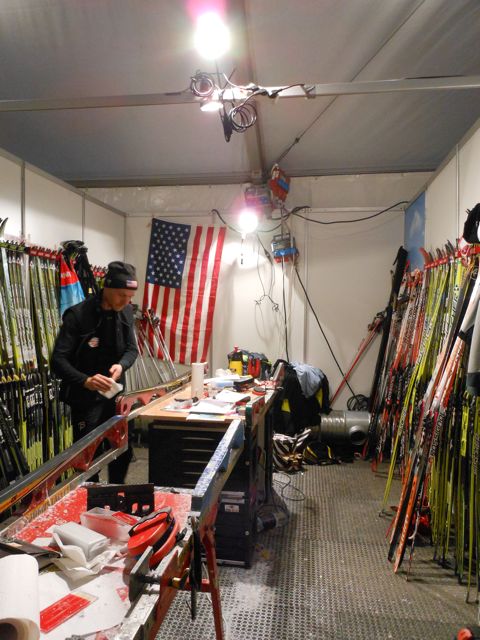
Relatively clutter free and ready for waxing inside the new USST wax truck. (Photo: Noah Hoffman)
There’s truth in jest as the saying goes. While FasterSkier’s April 1 piece made light of the issues, it hit home in some unexpected places. During one of FasterSkier’s conversations with the Environmental Protection Agency to examine why it had begun investigating the importation and sale of perfluorinated waxes, the EPA’s representatives cited the April 1 piece to question why FasterSkier had begun reporting on the issue. Whether readers appreciated the humor or not, the April 1 piece was intended as entertainment. This is our first story detailing what we’ve learned so far.
Let’s start with the EPA.
As part of a broader national compliance initiative, the EPA has begun auditing the ski wax industry. After emailing detailed questions to the EPA regarding its regulatory guidelines, the agency stated it was unable to speak broadly about the ski wax industry. It remains an ongoing enforcement issue for the EPA.
“EPA has identified certain ski waxes manufactured, processed or imported into the United States contain per- and polyfluoroalkyl substances (PFASs), also referred to as perfluorinated chemicals (PFCs), that may be in violation of the Toxic Substances Control Act (TSCA). These waxes were identified both in brick-and-mortar stores as well as available for sale domestically on e-commerce websites. As a matter of policy, the Agency is unable to discuss compliance monitoring targeting and/or investigations in more detail.”
Challenges for Swix and Toko in Winter 2018
Swix and Toko are the two largest brands of wax imported and distributed in the U.S. Both lines are imported and sold domestically by Swix USA. Swix USA is a subsidiary of its parent company, Swix Norway. According to Steve Poulin, CEO of Swix USA, the company was first contacted by the EPA during the winter of 2018 about meeting specific EPA mandates. In what became a steep learning curve regarding EPA compliance, Poulin said Swix/Toko began a review of “every product in every mixture.” We’ll explore what being EPA compliant entails later on, but it remains an exacting process that involves knowing the chemical recipe list for every Swix/Toko products imported, sold, and used in the U.S.
That formal review process began 18 months ago for Swix/Toko. Poulin said the company quarantined its entire wax line in June of 2018. They then chose not to sell perfluorinated products on their direct sales websites or ship product to their U.S. based retailers this past ski season. Many non-performance wax product, known as non-fluorinated waxes were shipped to retailers and sold.
“I decided to quarantine everything because I wanted to go through the full review and be 100 percent compliant and follow EPA regulations,” Poulin said. “I decided to be completely safe and I guess cautious, so we decided to quarantine our waxes and not ship anything until we went through the proper review process with the EPA. It was our decision.”
The Swix and Toko LF, HF, and top-coat/finishing product you may have purchased from online or brick and mortar shops was the back stock retailers possessed from this year’s inventory — shipped before June 2018 — after Swix/Toko has been contacted by the EPA.
“I shipped wax to retailers before I quarantined the whole line … I did ship wax, early preseason orders, I filled stores up,” said Poulin. “Because we were not bound, we did not find any violations at that point. And then when we discovered the true complexity of what they were asking for and compliancy regulation, that is when I put a halt to it. To be completely safe and in cooperation with the EPA.”
Outside of the Swix and Toko wax lines, skiers interested in a competitive advantage through ski wax chemistry had perfluorinated options from brands like Vauhti, Start, Star, Solda, HWK, Rex, Holmenkol, and others. The impact of the current regulatory environment on those brands is less well understood, but most were available this season.
Poulin said in a July 8 phone call that Swix/Toko will be selling performance ski wax this upcoming season.
Speed Comes at a Cost: Fluorochemistry Background
Get ready for some basic O-Chem. (For your reference, click the image titled “A Toxic Family Tree” to assist with understanding perfluoros and their chemical lineage.)
According to Dr. Merle Plassmann, the lab manager at the ACES (Department of Environmental Science and Analytical Chemistry) at Stockholm University in Sweden, perfluorinated ski wax is complicated. Plassmann’s Ph.D research examined fluorinated compounds in ski wax and their presence and fate in the environment.
“Family tree” of PFASs, including examples of individual PFASs and the number of peer-reviewed articles on them since 2002 (most of the studies focused on long-chain PFCAs, PFSAs and their major precursors). (Source: Environ. Sci. Technol.20175152508-2518. A Never-Ending Story of Per- and Polyfluoroalkyl Substances (PFASs)? Zhanyun Wang†Jamie C. DeWitt‡Christopher P. Higgins§Ian T. Cousins*∥
Plassmann explained that his research detected numerous fluorinated compounds with carbon chains between C6-C22 in some ski waxes. He added that many fluorochemicals found in ski wax are not added deliberately but are impurities from the manufacturing process. He referred to those chemicals as PFAAs – or Perfluoroalkyl Acids. He also wrote that ski wax manufacturers do add semi-fluorinated and fully fluorinated alkanes to their product. Again, these compounds are long carbon chains with the “semi” versions partially fluorinated, the “full” versions are saturated with fluorine. Plassmann went onto explain that the constituent parts of today’s wax could be more complicated. He has not assayed ski wax since 2011.
Some skiers may throw caution to the wind and take ski speed at all cost. It’s well known that in certain conditions, perfluoros applied properly to a ski base makes those skis faster. So we asked Plassmann the burning question: What are the ingredients in ski wax that might be of concern?
“Of potential concern are not only the impurities (the PFAAs which show low levels but still can be found in the ski tracks afterwards) but also the main ingredients, which are either fully fluorinated alkanes or semi-fluorinated alkanes,” Plassmann replied. “To my knowledge, nobody has studied their environmental fate, except the one study we performed on their behaviour during snow melt and presence in snow and soil from a ski track in Sweden. Here we found that they strongly sorb to particles and thus can be found after snow melt in the soil underneath the ski tracks. But nothing is known regarding their possible breakdown. As the Carbon-Fluorine bond in molecules is a very strong bond, those chemicals will be very persistent, but for example with the semi-fluorinated alkanes, the not fluorinated part could be breaking down, thus potentially leading to the formation of PFAAs. This, however, has not been studied and shown to happen.”
In May of 2016, the EPA released a document explaining some of the health risks associated with exposure to certain perfluoros. They include thyroid disorders, hypertension and preeclampsia during pregnancy, and testicular and kidney cancer.
Bringing Science to the Market
When you head into the local shop and ask for the wax goods, the response can be confusing. We’ll refrain from using the term “pure fluoro”. There are varying percentages of fluorocarbons in gliding and kick wax product, none that we can confirm are 100 percent “pure” fluorocarbon. The products containing the highest percent perfluorinated compounds are used for glide and often come in the form of a powder, block, liquid, or gel.
All brands have their own trade secrets when it comes to percent perfluoro and hydrocarbons added. The terms used in the industry like low-fluoro, high-fluoro, and super-fluorinated are marketing terms, not a standard. Brand X might have a 40 percent perfluoro HF wax, brand Y, thirty percent. Amongst the super-fluorinated gliding products, those percentages vary too from brand to brand as do their naming devices. Start wax’s naming devices, for example, use the term “ultra high fluor glider” for its highest perfluoro content finishing product.
Hydrocarbon or paraffin wax is what we would consider the cheaper and sometimes less effective means to make a ski slide on snow. These waxes are perfluoro free.
We’ll refer to any wax with fluorinated compounds as perfluorinated wax.
PFAS, the broad group of perfluorinated substances to which PFAAs belong, are ubiquitous and can be toxic. From fire suppressing foams, stain-proof carpet and upholstery coatings, non-stick pans and food wrappers, and that snazzy waterproof jacket, fluorochemicals make these products “work”. The perfluoros in ski gliding products fall into the PFAS class.
This February, the EPA published a “Per- and Polyfluoroalkyl Substances (PFAS) Action Plan” to further address the issue of perfluoros in the environment. The action plan states, “there is evidence that continued exposure above specific levels to certain PFAS may lead to adverse health effects.”
Fluorochemicals were once considered a miracle. They are hydrophobic and repel grease, oils, and dirt. Better living through chemistry? That’s now up for debate as the EPA moves in.
The leading science journal Nature published a piece in February detailing how researchers have traced fluorochemicals in the environment back to their source. Fluorochemicals are not naturally occurring. They are all man made. So if it’s in the environment, its there due to direct use in the environment like fighting a fire at an oil-depot, or they are residual compounds from the manufacturing process that have not been contained.
(This oft-cited Scientific American article speaks to the bioaccumulation of ski wax chemicals in the blood.)
The chatter in the ski wax industry usually has to do with a subclass of PFAS called PFOAs. PFOAs will be banned in the EU for most uses starting July, 2020. In the ski wax industry, PFOAs, or what many ski-wax junkies call “C8”, is often referred to as the magic behind wicked fast skis: the actual perfluorinated turbo boost when conditions call for it. Those C8s will be replaced in perfluorinated ski products with C6 compounds. The C8 refers to a perfluoro with an eight carbon spine with fluorine atoms branching off. The C6 is a shorter six carbon spine.
Those PFOAs are often called “forever chemicals” due to their persistence in the environment. The carbon-fluorine bond is amongst the strongest known in chemistry. C6 compounds, however, reportedly breakdown more readily and are considered more benign. Many claim the C6 half-life in the environment is shorter.
Anecdotally, many ski wax experts report C8 perfluoro finishing products most often outperform C6 analogs. You probably all know someone hoarding C8 product right now. That raises several other questions about wax equity at all levels of racing.
For now, let’s put aside the O-chem and focus on the nuts and bolts of domestic regulations and remaining EPA compliant.
The EPA and the Toxic Substances Control Act: The Tools for Oversight
In 1976, during the heyday of the environmental movement in the U.S., the federal government sharpened the EPA’s regulatory teeth by passing the Toxic Substances Control Act (TSCA). The TSCA allows the EPA to better monitor the “production, importation, use, and disposal” of chemicals in the U.S.
For years, domestic ski wax producers and importers were literally off the EPA’s radar. In 2016 and 2017 the TSCA was updated with new guidelines. The hands off EPA stance evolved. The law’s 2016 amendment is called the Frank R. Lautenberg Chemical Safety for the 21st Century Act.
According to a Harvard University Science in the News article, the 2016 amendment, “gives the EPA the authority to ban new and existing chemicals that pose a risk to human health and the health of the environment. To do this, the EPA must now make an affirmative determination on all new chemicals and all new uses of existing chemicals.”
The prevalence of fluorinated compounds in the environment and the increased awareness of the potential health risks those compounds pose began to focus attention on fluoro-intensive processes. The outdoor textile industry is literally awash with perfluorocarbons — high tech fabrics that repel water owe that functional property to the carbon-fluorine bond.
A few degrees separated from outdoor performance textiles are perfluorinated ski waxes. If the EPA was following the supply chain tree to determine where fluorinated chemicals are used, at some point they’d branch-off to the ski wax industry.
The TSCA requires wax importers and domestic wax manufacturers (importers are considered manufacturers under TSCA) to properly document the chemicals used within the country.
In the past, before the EPA glanced at the ski wax industry, ski wax importers might simply declare “ski wax” on a TSCA import compliance checklist and claim the shipment complied with TSCA guidelines.
I certify that all chemical substances in this shipment comply with all applicable rules or orders under TSCA and that I am not offering a chemical substance for entry in violation of TSCA or any applicable rule or order there under.
I certify that all chemical substances in this shipment are not subject to TSCA. The statement must be typed or stamped on an appropriate entry document or commercial invoice or an attachment to that entry document or invoice.
With greater oversight, it appears the EPA found a disconnect between the chemicals contained in ski wax and what was being declared.
To be clear, none of the importers we spoke to acknowledged any intentional non-compliance. In other words, there was no intent to omit or misrepresent through their TSCA declarations. However, there appears to have been either confusion, misunderstanding, or a shift in how EPA scrutinized the forms or applied the standards that resulted in a major disruption to the ski wax market.
CAS Numbers: Millions of them
The TSCA regulatory comb is fine toothed. To meet TSCA compliance standards, wax importers require CAS numbers. CAS stands for the Chemical Abstracts Service. Every chemical substance disclosed in scientific publications are assigned a unique CAS number. Think of that number as the chemical’s numerical ID. Well beyond one hundred million chemical substances have been assigned CAS numbers. The EPA maintains a record of all the chemicals either produced within or imported into the U.S. This is known as the TSCA inventory. At its most basic, the TSCA inventory is a list of CAS numbers.
There is both a public inventory that is downloadable, and a private inventory that includes information for proprietary substances a company may not want publically available.
Here’s what’s at issue. Any material coming into the U.S., like a ski wax, must have all its chemical components, the parts that make up the sum, on the TSCA inventory. In other words, the importer must ensure that each chemical substance’s CAS number is registered on the TSCA inventory. (The TSCA inventory is organized by CAS number.) If an ingredient’s CAS number is not on the inventory, the substance cannot be imported. Further, those chemicals on the TSCA inventory must be approved for public use/consumption if sold in the marketplace.
Boulder Nordic Sport (BNS), the importer of record for several wax brands, was sent a subpoena from the EPA to ensure the CAS numbers of the perfluorinated compounds imported in their wax product were on the TSCA inventory.
“The letter from the EPA specifically asks only about fluorinated compounds,” BNS owner Nathan Schultz told FasterSkier on March 28. “However, legally, everything that is in those substances, everything that is in the wax, including dyes, colorings, perfumes, whatever, every chemical compound has to be on the TSCA inventory.”
Finding and cross-referencing CAS numbers on the TSCA inventory meant Schultz had the tedious task of obtaining a chemical specific ingredients list for every perfluoro containing product BNS imports. BNS imports Skigo wax, Holmenkol and Guru products.
“And so basically what people are finding out is that this really complex process of having to identify every compound in the substances that we are importing,” Schultz added.
“All these formulations are secret. That had been one of the challenges, that all of this information has to be kept confidential, and so we have to take extra steps to protect it from when the suppliers give it to us. One of the suppliers refused to give us the information. They say they will only give it directly to the EPA. Right now, there are some fluoros available that are on the TSCA inventory and they are OK to use. And then there are some that aren’t and the ones that aren’t are not available, they are off our site.”
In Schultz’s case, he began cataloging CAS numbers during the Federal Government’s shutdown which ran for 35 days beginning on December 22. So getting timely responses from the EPA was challenging.
As Schultz bolstered his knowledge of the TSCA, he learned that if a specific CAS number (or compound) is not on the TSCA inventory, importers do have a few options. One option is to apply for a pre-manufacture notice. (Again, importers are treated as manufacturers when it comes to TSCA compliance.)
A pre-manufacture notice is no small hurdle to jump. The notice must be filed 90 days prior to manufacture/import. The EPA also requires mounds of chemical related information including available test data on the effect to human health or the environment.
Another option to continue importing and selling a product with an ingredient not on the TSCA inventory is to file for a low volume exception. This is what it sounds like: it’s a way to declare that the substance in question will be manufactured/imported in low quantities. In this case, at or below 10,000 kg/year.
Each low volume exemption filed is for a specific chemical. If, for example, a type of performance wax contains 10 distinct chemicals, that’s 10 distinct low volume exceptions to be researched, filed, and paid for.
The potential cost associated with filing a single low volume exception is prohibitive for a small business like BNS. Those costs also don’t factor in potential legal fees.
“It is hard to say and it is also a challenge because a low fluoro paraffin wax is probably going to be 5% maybe 10% of the fluoro compound itself,” Schultz said as he contemplated how much perfluorinated substances were being imported via the wax industry. “So the pure fluoros, I would imagine in the entire U.S., we are certainly under 200-300 kg of just the fluorinated substances. The whole number is small when considering the fluorinated compounds and I mean, 100 kg, 1000 kg I don’t know what it is. I have not calculated that out. It is a small number. Certainly, all of the wax industry in the country could be under that 10,000 kg weight limit for a low-volume exemption. So relative to other uses, we are tiny.”
How did we get here?
Longtime industry insider, Andrew Gerlach, knows the ins and outs of importation. For many years he’s imported Start wax manufactured by Start Finland through his business Endurance Enterprises. According to Gerlach, Start products are the third most widely used nordic ski wax in the U.S.
Athletes, coaches, and techs test skis on the 2019 World Championships course in Seefeld, Austria. (Photo: John Lazenby/lazenbyphoto.com).
The common story about wax importation and environmental regulations that we heard from Gerlach and others was something premised on the notion that European safety guidelines are stricter. The assumption was U.S. importers of ski wax must be in TSCA compliance if the waxes in question could be sold within the European Union.
“We have been doing things the same old way for decades,” Gerlach said in early April. “The European manufacturers or primarily the European manufacturers of the wax have told us, have given us a broad opine of all the ingredients in our wax and said this meets or exceeds European standards for chemical transport chemical distribution chemical use. And therefore if it meets European standards, they are tougher in every aspect than American standards, so you are good to go. So we import wax and we have a very good understanding of the ingredients within that wax but not the final nature of their pure chemical compound because that is very proprietary and most of us are mere distributors of the brand and the products and not part of the parent company.”
The EPA’s involvement with ski wax has nothing to do with EU chemical regulations known as REACH. And the EU’s regulations on the use and sale of perfluoros have nothing to do with cross-referencing CAS numbers with the TSCA inventory and being EPA compliant.
That said, the domestic wax importation industry in the U.S., like Gerlach said, had been following Europe’s lead.
EU chemical regulations originate with REACH, or Regulation, Evaluation, Authorisation and Restriction of Chemicals. REACH dates back to 2006 and has evolved and been refined many times since. The REACH net has captured the use of PFOAs, or “C8”, in the supply chain.
PFOAs will be banned in the EU for most uses starting July, 2020. They will be replaced in the ski wax industry with C6 compounds.
“We have taken Europe’s word for it,” Gerlach said. “That if their products meet or exceed European REACH standards, which they have all, they are told in the research they are tougher than American standards. So we import the wax, and everytime we have an import shipment coming in, we sign a form that says these products comply to TSCA standards.”
Back in November 2018, Gerlach said he heard rumblings within the ski community that Swix and Toko were having issues selling product. He initially, like many people, thought this had to do with pending EU restrictions on the use of PFOAs.
C8 or C6, Gerlach assumed he was TSCA compliant. Good enough in Europe, by default, meant good enough in the States. But the story circles back to CAS numbers and the TSCA inventory.
“I felt that I had better figure out what was going on, because if Swix-Toko had errors, there is the likelihood that I had errors and every other wax company that is importing had errors because we are all pretty much importing like substances in the same manner,” Gerlach said.
Gerlach contacted an EPA official in Chicago since his company is registered in the Midwest. He left a voicemail and some follow up emails. Gerlach heard nothing back.
In the meantime, Gerlach said he conversed with Schultz at BNS and became better informed about the CAS number TSCA inventory dilemma. He also communicated with the EPA’s Washington D.C. bureau and received a response when the government shutdown ceased in January. During this time, Gerlach reached out to Start Finland to secure CAS information and detailed wax recipes.
“I discovered that the vast majority of ingredients in Start wax be it perfluoros, be it hydrocarbons, be it alcohol based liquids, petroleum based liquids, on and on, all used ingredients as Start signified since day one that are on the TSCA inventory,” Gerlach said. “We did have a couple waxes with CAS numbers not on the inventory and so overtime, it took a while to delve and discover and learn all these things.”
Gerlach self-imposed a ban on selling or continuing to import product he believes is not in full compliance with the TSCA. He even went a step further.
“We have done our own self-disclosure to the EPA, saying ‘hey we have imported, unknowingly, we have imported some wax with ingredients that are not on the TSCA inventory,” said Gerlach. “They amount to these items with this amount of volume in the past five years and this is what we are planning on doing etc. with them’. As far as I can tell from my brief discussions with the EPA, I just need to focus on my ingredients list and make sure they are on the TSCA inventory and with a double bullseye focus on the perfluorocarbons and make sure those are on the TSCA and if they are on the inventory they are good to go and there’s nothing to report.”
The TSCA compliant Start products, which Gerlach said was 97 percent of the Start Wax line, are still imported and distributed to dealers around the country. His non-compliant inventory remains under quarantine in his warehouse and is not included on next year’s price list. This self-imposed restriction was taken not due to any EPA action, but as a precaution until he is told what to do with those items by the EPA.
Gerlach also explained that moving forward, Start Finland’s ingredients would meet TSCA requirements. According to Gerlach, Start Finland does not produce its own perfluorocarbons for use in their waxes. They source that from a chemical manufacturer and supplier.
“Start Finland now examines the ingredients they are putting in beforehand, “ said Gerlach. “Before they start mixing up compounds, they make sure that the ingredients that they are using are on the TSCA inventory. I am talking milliliters of fluorocarbon and grams in all my waxes that are fluorinated and whatever the law is we need to follow it. I am much more educated on what is in our waxes than I was a year ago. And Start Finland is much more aware that being good enough in Europe is not necessarily in itself good enough for America.”
Gerlach’s initial chemical bookkeeping and self-reporting were steps. He was told by his lawyer to use a statute of limitations of five years for documenting what he had imported during that time span and discerning if it was on the TSCA inventory.
That five year limit appears to be an unofficial timeframe for the statute of limitations on importing non-TSCA compliant chemicals.
“A subpoena letter I have seen did not put a date on it,” Gerlach explained. “It said, tell us all about waxes with fluorocarbons in them and the times you have imported them. And surprisingly it did not give a time frame. It just said tell us everything.”
Exhausting his avenues to remove his “violating items” from circulation Gerlach contacted Start wax retailers.
“I have looked at my orders for the last two years of these and emailed the dealers and explained that if you have any in stock I will take it back,” said Gerlach. “I did a recall of any of the waxes and none of those waxes are left in stock. And so there is nothing to recall because it has been such small quantities.”
This was what Gerlach called a voluntary recall.
In years past, Swix USA has shared prime real estate with a retailer at the American Birkebeiner expo — they were housed within the same display.
Not this year. At the Swix concept area at the expo, Swix did not sell perfluorinated product. However, Swix perfluoro products were for sale through a retailer at the expo.
FasterSkier is unaware of any official recall of non-compliant ski wax product. According to Section Five of the TSCA, any chemical not on the TSCA inventory is considered a “new chemical”. “New chemicals” to be imported and used within the country are subject to rigorous guidelines to determine their fate. A recall of pre-existing non-compliant substances by importers/distributors and retailers appears not to be one of those steps.
A quick search on the web shows product still available for sale by retailers in limited quantities.
In my candid interview with Gerlach, he was mildly prophetic as we signed off.
“So, the earthquake has happened, no one is sure about the tsunami, but no matter what, there will be a shakeout of brands and or waxes because of this,” said Gerlach
In early May, I received an email from a reader saying HWK USA was no longer in business. At the time of publication, FasterSkier had not received a reply from HWK USA after messaging and emailing the company.
Ear to the Ground
Like Gerlach and Schultz, Caldwell of the eponymous Caldwell Sport based in Putney, VT. has had his ear to the ground. Caldwell is known for custom ski selection and grinding services, but also retails wax. In the past, he was an importer of Vauhti wax out of Finland. Vauhti is now imported by Park City, UT., based Sisu Sports.
Caldwell sells wax online, or onsite at select races during the season. He sells Rex, Rode, Star, and Vauhti products.
“So what I know is that the EPA instructed [Swix] to stop selling when they went through item by item and reviewed the contents of what they were selling — and that is it,” Caldwell said when asked what he knew about the direct discussions between Swix/Toko and the EPA.
At the time of our conversation on April 9, Caldwell said he had had no contact with the EPA to date.
Caldwell Sport’s role as a retailer rather than importer means its relationship with the TSCA is indirect. Caldwell Sport is not responsible under the TSCA, for ensuring the wax it sells is compliant — that remains the importer’s role.
“My understanding is that the EPA’s concern is with importation and that they are not concerned at the retail level,” Caldwell said. “They are concerned at the chasing things to their source, where they are coming into the country. So I have not heard of any retailer who is not an importer being instructed to stop selling product. For instance, no Swix retailer that I am aware of has been told they cannot sell Swix waxes. But Swix the importer which is also owned by Swix Norway has been told they cannot sell waxes which would mean both at wholesale and at retail.”
Caldwell’s process of obtaining perfluorinated wax products is simple. For example, he orders Vauhti product directly from SISU Sports. It then ships UPS from Utah to Vermont.
“As far as I know, there is no oversight of that aside from regular domestic shipping restrictions on air, on flammable goods for air shipments,” said Caldwell. “You cannot put some of the solvents on an airplane. So we have to be cautious about that and plan shipping. We are just ordering form those guys.”
For Caldwell Sport, it has been business as usual. Caldwell said he resupplied with Start and Vauhti this spring with no issues. Yet Caldwell was mindful of his stake in the high-end wax game. As a small business he is evaluating how to proceed as perfluorinated waxes come under scrutiny.
“From our point of view, the question has been whether we should try to anticipate action by the EPA and pre-order a whole bunch of stuff or whether we should continue to run as we normally do to run a lean family business,” said Caldwell. “We cannot afford to carry a huge quantity of really high-end wax because it cost a whole lot to have. As a family business retailer, we are in a position where we need to be pretty cautious about how far we stick our neck out on a lot of high-end product.”
Patrick Coffey, the Vauhti brand manager for Sisu Sports, emailed FasterSkier to state that as of May 24, he still had not been contacted by the EPA.
“There’s no reason for me to expect it at any given point, but given that it’s the offseason, my approach will be to see what we need to do to make sure that there will be no delays in delivery late summer when the product comes from Finland to Utah,” Coffey said during an April phone call.
“If someone within a government agency wants to get in touch with us and ask for information, I’m going to get that information,” said Coffey. “The goal here is not to keep our head down and hope nobody notices, I want to make sure that we’re in a position, because retailers are asking ‘are you able to bring product in?’ and I’ve told all of them at this point ‘yes’. If anything changes they will be the first to know, because I don’t want them to all of a sudden to realize in December that they are not getting product.”
The Bigger Picture
The wax industry remains a drop in the financial and environmental degradation bucket when considering the widespread use of perfluoros in industry. But, perfluorinated compounds are making news. High Country News published a piece about PFAS pollution on May 30. Several news outlets have reported that the state of New Hampshire is suing chemical giants 3M and DuPont “for damage it says has been caused by a class of potentially toxic chemicals found in pizza boxes, fast-food wrappers and drinking water,” according to a Boston.com piece.
The ski wax industry has been reforming when it comes to using the more caustic C8 and longer chain chemistry in its waxes. The type of fluorochemistry that has been newsworthy. Longchain fluorocarbons are on their way out and C6 chemistry is in.
Is the ski wax industry and the quest for ski speed to blame for shirking environmental regulations and drawing attention to itself? Probably not. It’s simply that the EPA has the law on its side and the science to support its stance to bring more oversight.
Although Swix and Toko did not ship perfluorinated wax last season, it appears the EPA is conducting a broader industry-wide review. Ski waxes are obviously not the domain of skinny skis alone. Imported and domestically manufactured alpine specific waxes fall within the same regulatory benchmarks applied to popular cross-country wax brands.
Fast skis are a drug. That first slide on a slippery pair of perfluoro soaked boards can be dreamy. But, everybody pays to play for that speed.
For now, it seems certain that your ski speed fix, thanks to modern chemistry, will and can be satiated when snow falls next winter. But the Swix/Toko challenge this season has the potential to be a more significant industry wide challenge moving forward. There’s no question, those little vials of speed be it in liquid, block, powder, gel, or fluorinated hydrocarbon form, will have regulatory fingerprints all over it.
Peter Johansson works on some of the many U.S. skis in preparation for another day of racing in Gallivare, Sweden, in 2012. U.S. skiers have been outspoken in the past about the health risks to their service team.
The health effects of airborne particles from ski waxing is a hot topic – and the more expensive and fluorinated the wax, the worse the health effects are.
Just ask the U.S. Ski Team, which two years ago raised a fuss at the Davos, Switzerland, World Cup, where there is no ventilation system in the common waxing tent shared by all the teams.
“They put up a huge tent with very little ventilation,” Noah Hoffman wrote on his blog in 2013. “All of the air is communal so as soon as one team starts burning fluoro-powders, the air is bad for everyone. This poses a huge health risk for the wax techs and is a major reason many of the wealthy teams have gotten wax trucks. The techs and athletes have complained about the Davos setup for years and nothing has been done to address the problem. Some athletes are talking about boycotting venues that don’t address technician health.”
But how many of these particles, also called inhaled aerosol fractions, are wax techs actually exposed to? And what are the implications for racers who wax their own skis, or waxers who work in a ski shop, for instance?
That’s the topic of a recent study in the journal Annals of Occupational Hygiene. And it’s published by researchers at Norway’s National Institute of Occupational Health – of course, because Norway is perhaps the only country where being a wax tech is a widespread enough occupation to merit government investigation.
Dr. Baard Ingegerdsson Freberg and six other authors write that “Ski waxing cabins used during World Cup competitions most often have no ventilation system, or at best limited general ventilation systems…. Also the time pressure and the stressful working conditions for the ski waxers reduce the potential for preventive actions and exposure control.”
To assess the amount of inhaled aerosol fractions, the team used size-selective aerosol samplers attached to a belt so that the air sampled would actually be in the area that the wax techs were breathing from. Furthermore, they used two different filters: one for inhalable particles (100 microns or smaller in size), and one for respirable particles (10 microns or smaller).
They convinced 45 different wax techs to participate in the study, sampling for the duration of a waxing session – which lasted from as short as half an hour to a full eight-hour day. The wax techs all worked for different international ski teams, and data was collected at six different race weekends in Oslo, Trondheim, and Beitostølen, Norway.
They found average exposures of 3.1 mg·m−3 and 6.2 mg·m−3 to respirable and inhalable aerosols, respectively. What does that mean? There’s no set occupational exposure limit for ski wax fumes, but a comparable hazard might be paraffin wax fumes. In Norway, the maximum exposure limit for that is 2 mg·m−3 in the inhalable aerosol mass fraction.
The average inhalable aerosol fraction for the wax techs was about three times that – not a good sign. It explains why wax techs have reported respiratory problems or even long-term issues with lung function.
Still, those numbers might not mean much to anyone other than a chemist, but there were also some interesting patterns: over the course of a work day, there were peaks in exposure, generally occurring just before the start of a race.
And biathlon and Nordic combined wax techs were exposed to much higher concentrations than cross country ski wax techs, perhaps because classic kick wax does not produce as many aerosols.
Together, these patterns suggest that if there’s ever a time to wear a good respirator, it’s when the powders are flying in the final push to get skate skis to the start line.
(A previous study by the same team found that applying powders was the most hazardous work task for wax techs in terms of chemical exposure, although using solvent to remove kickwax wasn’t so great, either.)
What’s a better solution? An effective ventilation system which would make waxers less reliant on respirators, which may be uncomfortable and limit communication between different members of the ski prep team.
The research team built its own custom-made ventilation hood which covers the whole length of a ski, and compared the exposure to aerosols with and without the hood when preparing a series of 15 pairs of skis. The system did succeed in reducing exposure by 95% when using fluoro powders, and by 88-92% when using block glidewax.
Here’s hoping that a system like this begins to make its way into wax cabins and tents at the World Cup and many other levels of competition.
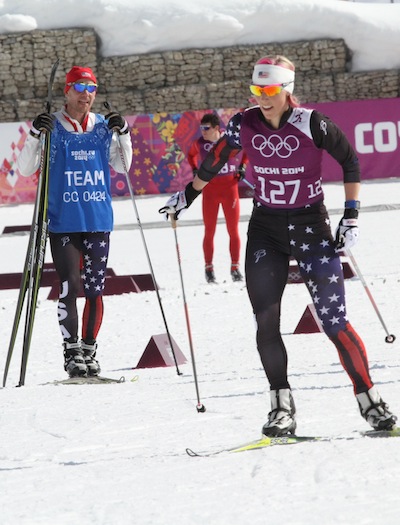
Peter Johansson, the U.S. Ski Team’s head of service, watches as Kikkan Randall trains in Sochi on Monday.
FasterSkier’s coverage is made possible through the generous support of Rudy Project.
In Sochi this week, Kikkan Randall has a good chance of becoming the first American in nearly four decades to win an Olympic medal in cross-country skiing.
But one of the very last people to touch her skis before she steps to the starting line will be a man from Sweden, a rival nation.
Not to worry: The man, Peter Johansson, is not a saboteur sent by the Swedes to torpedo the Americans’ chances. Instead, he’s the leader of the U.S. team’s small support staff, playing a role that is his sport’s answer to the NASCAR pit crew.
Over the course of 12 Olympic competitions, Johansson and his colleagues will be charged with matching Team USA’s equipment to what are expected to be challenging, erratic conditions in Sochi-a key job in a sport where minute differences in specialized waxes and structures applied to the bottom of skis can make the difference between gold and silver, or even no medal at all.
Johansson, who hails from northern Sweden, works with two Americans, plus a veteran Estonian wax technician named Oleg Ragilo. It’s a crew that, despite its international flavor, works tirelessly to put Americans on the podium.
“You forget that these guys are actually from a different country, because they feel like such an integral part of the team,” said Chris Grover, the head coach of the American team. “They are really invested in the success of the U.S. athletes.”
The wax technicians are start early and quit late, their hands marked with burns, blisters and cracks from repeated exposure to ski waxes and the blowtorches and solvents used to apply and remove them. Their job is to manage the complicated relationship between skis and snow.
Before race day, the technicians use special grinding machines to apply intricate patterns to the skis’ plastic bases, which help them slide more smoothly over certain types of snow crystals.
Then, in the hours before the gun goes off, they test skis out on the trails to help pick the right pair out of the dozens owned by each athlete-and then they apply the sticky waxes that help the skiers grip the track when they push off, and the smooth wax that helps them glide over the snow.
“It’s a full day’s work, for sure,” Johansson said.
It also can be a high-wire act, with decisions on skis and wax sometimes waiting until the last minute.
Sochi will present extra challenges: Its relatively southern location means the sun will rise higher overhead during the day, potentially forcing teams to deal with rapid changes in temperature.
Last year, when the Americans visited during a test event, they were confronted with three straight days of snow, followed closely by warm sun that led to rapid melting and difficult waxing.
Those challenges are compounded by the “very limited access” the Americans have had to Sochi’s competition venue, said Grover-in contrast to the “continuous access” he said has been afforded to the Russian squad.
“They are going to have, from a service perspective, from an athlete preparation perspective, a massive home field advantage,” Grover said. “The good news is that a lot of the other ski nations besides the Russians don’t necessarily have an advantage.”
Johansson will be charged with leading the American team’s support staff.
He started waxing skis after a career as a competitive skijorer, in which he raced with dogs on some of the same courses that the cross-country ski circuit visits in Scandinavia and Central Europe.
In 2006, he began working with the Americans, who were making a concerted effort to strengthen their service team, according to Pete Vordenberg, Grover’s predecessor as head coach-an effort that Vordenberg said included a bigger budget.
“It paid off huge. We went from really bombing some stuff, to pretty rare that they totally screw it up,” Vordenberg said.
Johansson was promoted to head of service last season. In addition to that role, he works personally with Randall-a relationship that predates the 2010 Vancouver Olympics.
Both say they’ve developed a rapport that helps defuse what can sometimes be a hectic process of picking skis and wax when the clock is ticking-something that should help in Sochi.
“When we go out and ski before a race, even in the highest-stress situations, I have total trust in him,” Randall said. “We just kind of go through our process and get the work done.”
Johansson’s role on the American team has led to a small measure of fame, including spreads in Swedish newspapers and even a line of commercially marketed wax scrapers imprinted with his signature.
Really, though, the job is not that glamorous. Grover declined to say how much the Americans pay their service staff but Johansson said he spends the off-season driving trucks and other equipment in an underground iron mine in northern Sweden.
In Sochi, the U.S. crew will compete against other countries with far larger service budgets and staffs-many of which travel the European racing circuit with semi trucks specially outfitted for ski waxing. (The Americans, by contrast, pack their equipment into a cargo van.)
Grover said the team is taking a different approach in Sochi from the one it took in Vancouver, where the U.S. staff had extensive access to the venue before the Olympics and narrowly tailored the treatments of their skis to the conditions they were expecting. Conditions turned out to be different than expected, Grover said. So in Sochi, the Americans will prepare their skis to work in a broader range of weather.
Randall, a medal contender in Tuesday’s skate sprint, said her familiarity with the U.S. service staff should help take the pressure off.
“We don’t have to pull any magic out of a bag,” she said. “We just continue to operate like we usually do.”
–This story was reported for the Anchorage Daily News/adn.com
Lindsey Van used a new wax produced by Willy Graves and Eric Camerota en route to two national championships last weekend. Photo: WSJUSA
At 23 years old and without a college degree, Willy Graves does not seem like the kind of guy who could compete with scientists at wax companies like Swix or Toko. But armed with a blender in the confines of his garage, Graves has invented a product that just might eat into those companies’ market shares—at least a little bit.
Along with his former teammate Eric Camerota, Graves, a recently-retired U.S. nordic combined B-teamer, has concocted a secret homemade formula for summer ski jumping wax. And it works. Better than anything else out there. At last weekend’s U.S. ski jumping and nordic combined championships, Lindsey Van, Peter Frenette, and Camerota’s brother Brett all used it en route to national titles, Graves said.
“I like it a lot,” said Van, a world champion in women’s ski jumping in 2009. “I don’t want to tell anybody about it, because I don’t want anybody else to have it.”
Ski jumpers and nordic combined athletes jump in the summer not just to train, but also in competitions in the U.S. and Europe. Instead of sliding on snow, athletes glide down a porcelain in-run and land on plastic shingles.
To protect their bases and obtain decent glide, athletes leave a thin layer of hard wax on their skis while jumping. But according to Graves, until he and Camerota began tinkering in their garage, only one other small company made a summer-specific product, in a similarly small-scale operation. Most athletes, Van included, used stock winter varieties like Swix’s CH4.
“We knew there had to be something better,” Graves said.
He and Camerota embarked on their project this spring. Lacking formal knowledge in chemistry, they went straight to the Web in search of the right ingredients. They knew they needed something that would allow the wax to bond to ski bases while remaining hard and flexible.
It took more than one try to get the formula right, but after a number of “complete disasters,” they had a recipe. Graves wouldn’t reveal the components, saying only that it was a basic hydrocarbon wax mixed with a few key additives for durability and lubrication. But he was happy to talk to about the advantages it offers over winter products.
First, it doesn’t chip like CH4 or other cold-weather waxes, making each coat more resilient. Graves said that the lifespan of his wax was nearly twice as long as other varieties.
It also makes for a smoother acceleration as athletes push off the bar atop the in-run, allowing them to get into an aggressive position more quickly.
“I felt quite a bit of difference,” Van said. “I was able to sit a little lower—better balance—without being on my toes or my heels.”
Despite Van’s hopes to keep the wax a secret, word seems to be getting out. Graves sent the product to Europe with the U.S. Nordic Combined Team for their Summer Grand Prix competitions, and he just filled a big order for the Canadians. In the past week, he’s heard from athletes as far away as France and Austria.
The operation, dubbed the Alien Wax Project–still runs out of the garage, and it’s still small-scale. There’s no website (although a Facebook page may be in the works), and Graves said that the total investment in equipment and materials has been roughly $1,000. Given the small size of the summer jumping community and the low price they’ve set for their wax, Graves and Camerota have limited ambitions for the product—although they are contemplating an expansion into winter waxes for alpine skiing and snowboarding.
“The major goal is not really to make money—we just want to make the best product out there,” Graves said. “It’s just kind of a fun little project.”