From the FasterSkier archive — posts syndicated from athletes’ and coaches’ own blogs between 2004 and 2012, kept online as published. Current coverage is at fasterskier.com.
The International Ski and Snowboard Federation (FIS) unveiled its proposed 2026/2027 cross-country skiing World Cup calendar this week at the FIS Spring Meetings in Portorož, Slovenia.
The schedule — first shared publicly through FIS social media and still pending FIS Council approval — builds the season around the 2027 World Championships in Falun, Sweden, with three pre-Christmas stops, a nine-race Tour de Ski, a stretch of three weekends between the Tour and Worlds, and a Scandinavian closing kick that ends with the Finals in Ulricehamn.
For North American fans, the calendar is once again entirely European, with no scheduled stops in Canada or the United States.
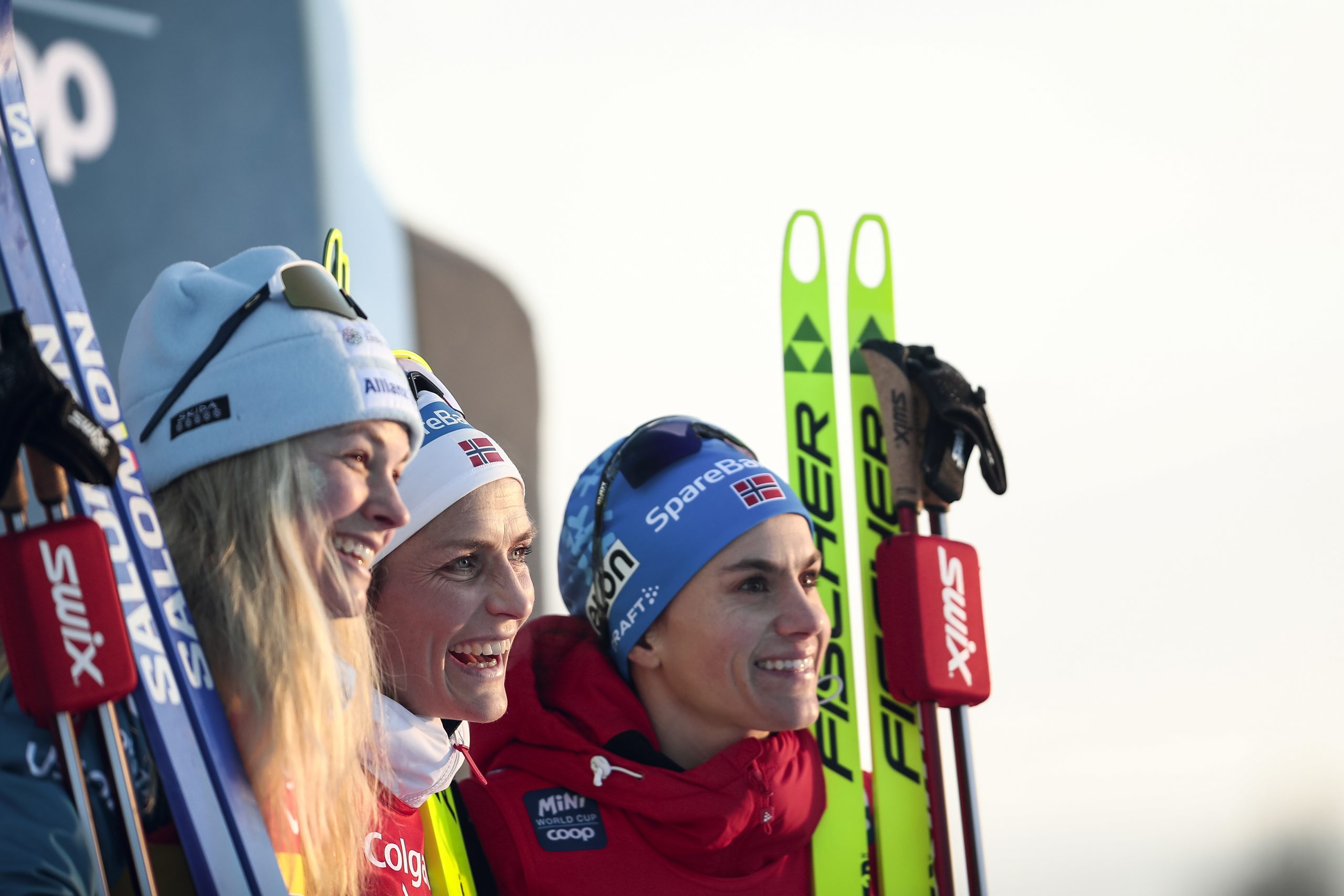
Frida Karlsson (SWE) poses with Mr. and Mrs. Claus following the 10k Classic to start last season in Ruka (FIN). (Photo: Modica/NordicFocus)
Pre-Holiday: Ruka, Trondheim, Davos
The season opens where it almost always does — in Ruka, Finland, where the World Cup begins November 27. From there, the circuit moves to Trondheim, host of the 2025 World Championships, before the pre-Christmas block closes in Davos, Switzerland, with a team sprint.
November 27-29, 2026: Ruka, Finland
27/11: 10km Interval Start Classic
28/11: Sprint Classic
29/11: 20km Mass Start Freestyle
December 1-3, 2026: Trondheim, Norway
01/12: 10km Interval Start Classic
02/12: Sprint Freestyle
03/12: 20km Skiathlon
December 11-13, 2026: Davos, Switzerland
11/12: 5km Heat Mass Start Freestyle
12/12: Sprint Freestyle
13/12: Team Sprint Freestyle
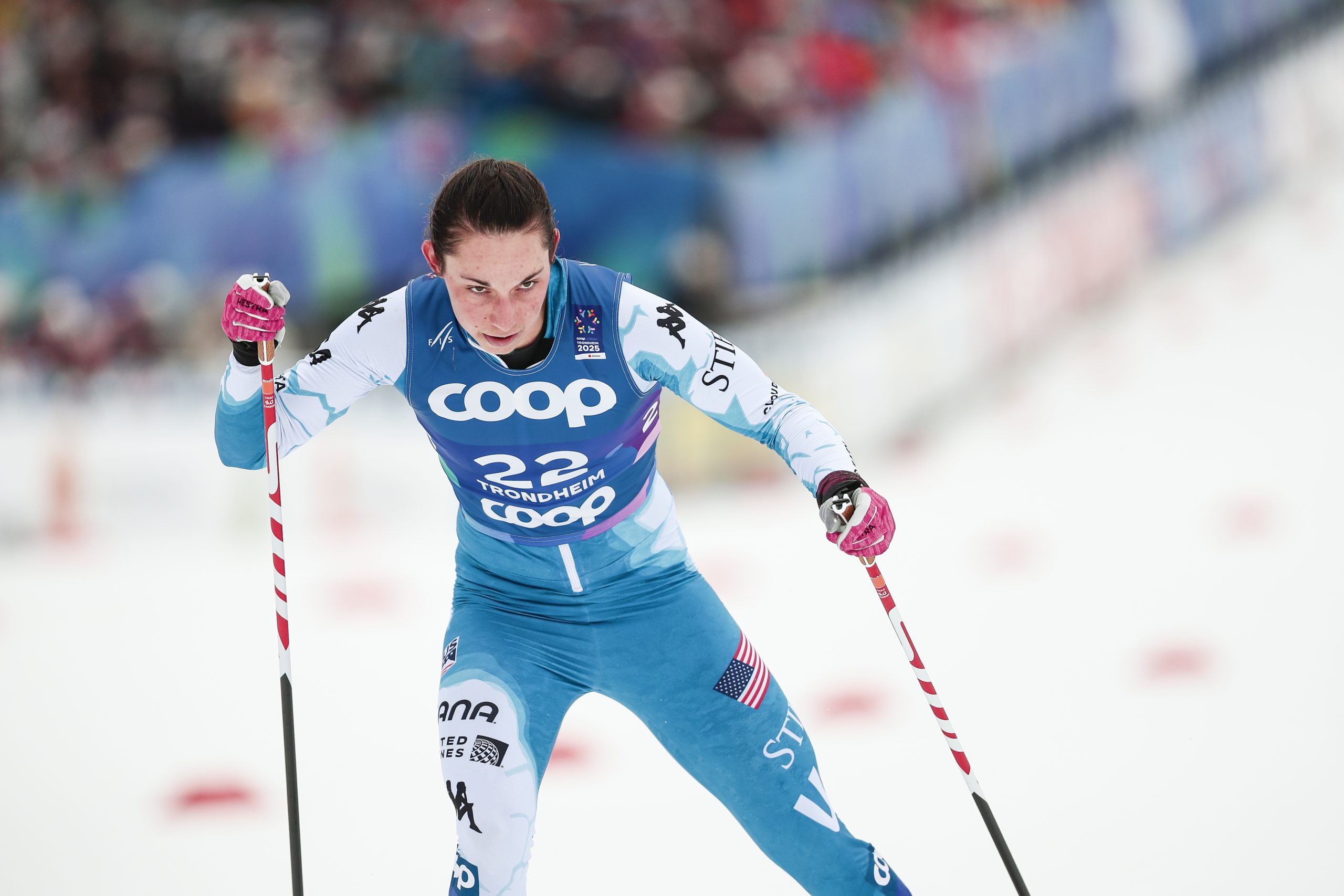
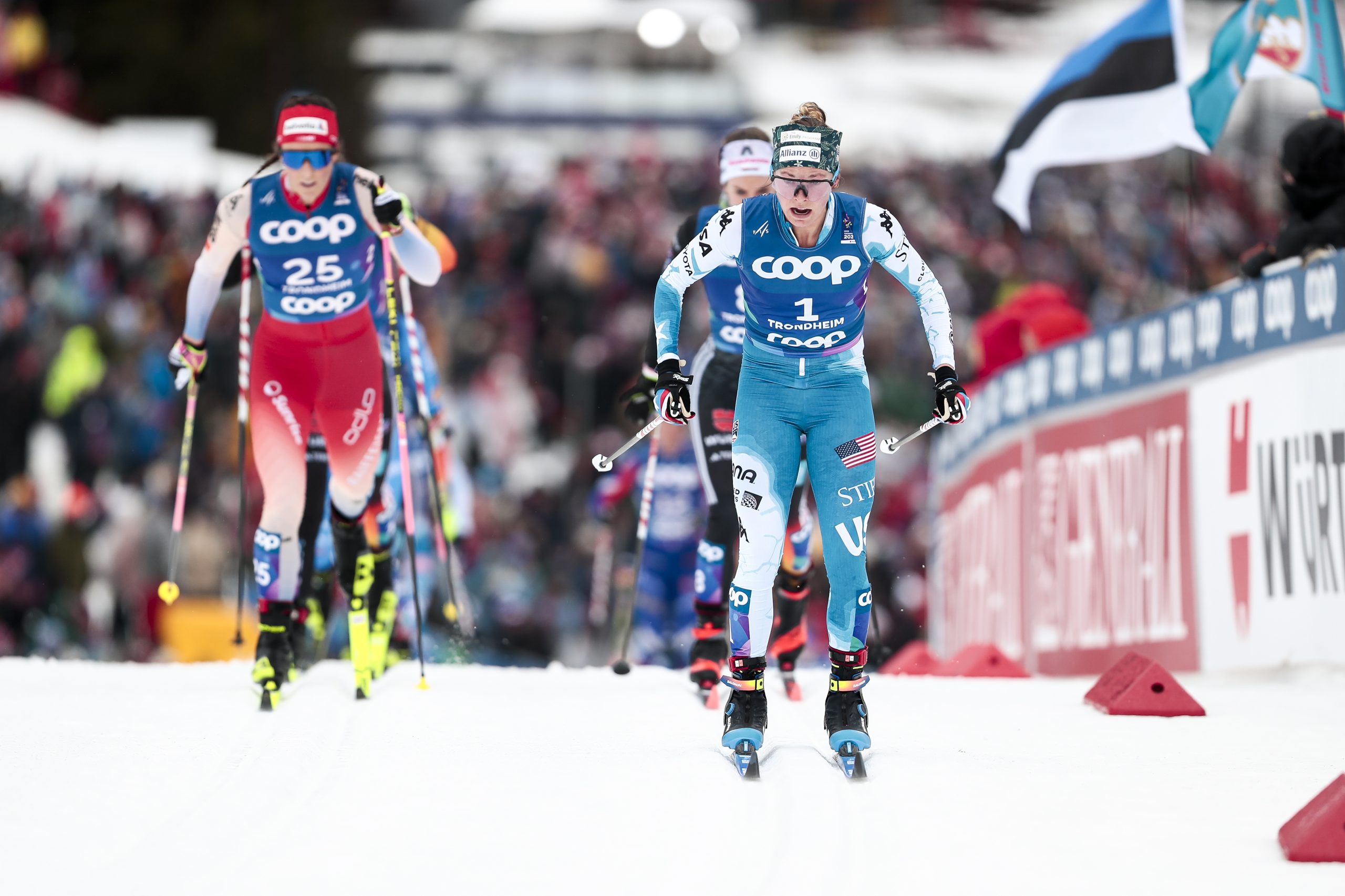
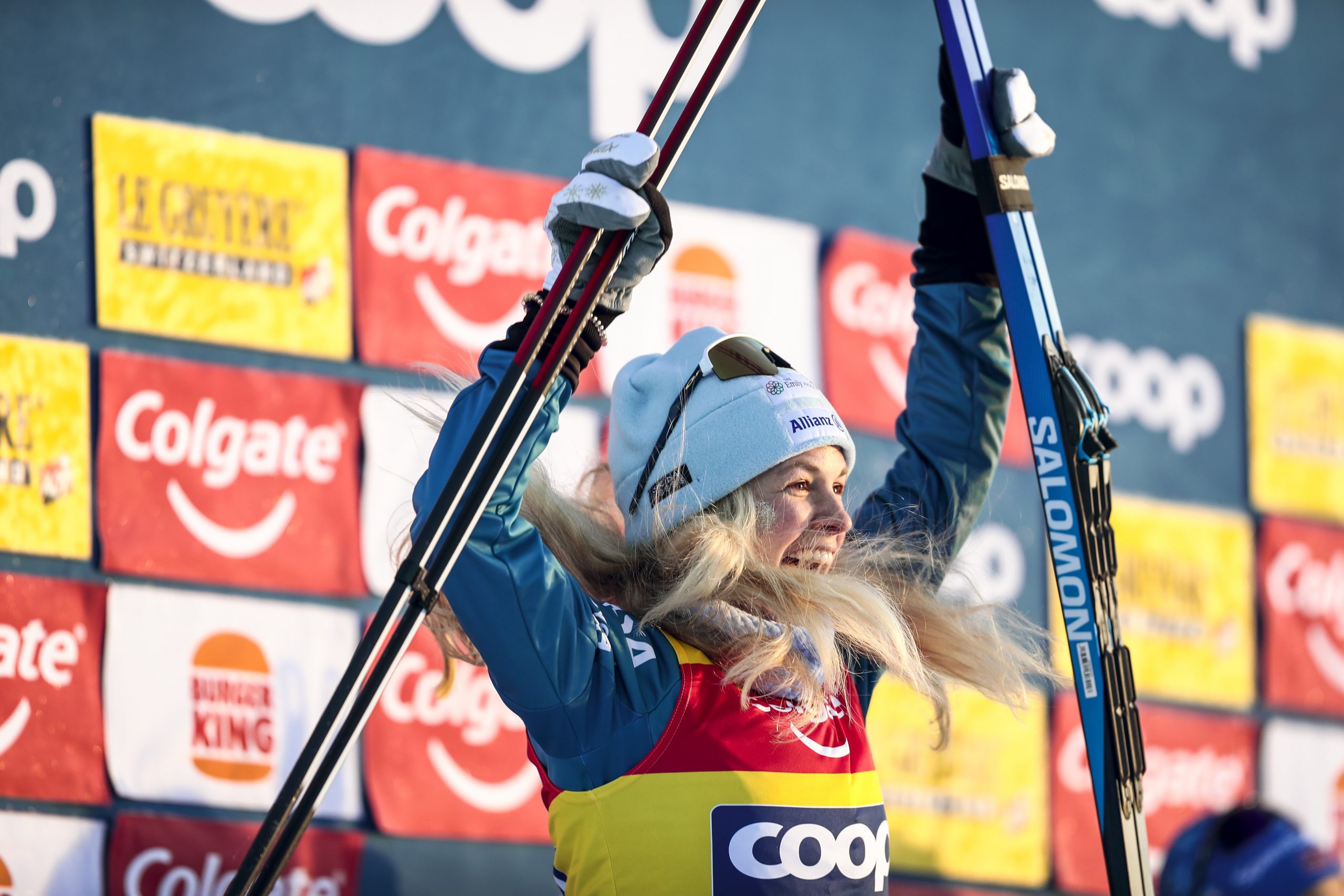
With Jessie Diggins (USA) now retired, there will be a new FIS Overall Crystal Globe and Tour de Ski champion next season (Photo: Vanzetta/NordicFocus)
Tour de Ski 2026/2027
The Tour de Ski returns to a three-country format, opening in Les Rousses, France, on New Year’s Day, moving to Oberstdorf, Germany, and finishing with three races in Val di Fiemme, Italy — capped, as ever, by the Final Climb up Alpe Cermis.
January 1-3, 2027: Les Rousses, France
01/01: Sprint Classic
02/01: 20km Mass Start Classic
03/01: 15km Pursuit Freestyle
January 5-6, 2027: Oberstdorf, Germany
05/01: 15km Mass Start Classic
06/01: 5km Heat Mass Start Freestyle
January 8-10, 2027: Val di Fiemme, Italy
08/01: 15km Skiathlon
09/01: Sprint Freestyle
10/01: Final Climb
Gus Schumacher (USA) and the rest of the US team will hope to continue their success in Toblach (ITA). (Photo: Modica/NordicFocus)
After the Tour, Before Worlds: Engadin, Toblach, Lahti
Three weekends bridge the Tour de Ski and the World Championships. Engadin opens its weekend with a mixed relay — a format the FIS has been working into more World Cup weekends — and Lahti closes the pre-Worlds stretch with its classic 20km skiathlon and 10km interval start.
January 22-24, 2027: Engadin, Switzerland
22/01: Mixed Relay
23/01: Sprint Freestyle
24/01: 20km Mass Start Freestyle
January 29-31, 2027: Toblach, Italy
29/01: 10km Interval Start Freestyle
30/01: Sprint Freestyle
31/01: 20km Mass Start Classic
February 12-14, 2027: Lahti, Finland
12/02: Sprint Classic
13/02: 20km Skiathlon
14/02: 10km Interval Start Classic
Kendall Kramer (USA) had a breakout World Cup Skiathlon in Falun (SWE) last season. (Photo: Authamayou/NordicFocus)
2027 FIS Nordic World Ski Championships: Falun, Sweden
The 2027 FIS Nordic World Ski Championships run from February 22 through March 7 in Falun, Sweden, with all title formats on the program. Falun last hosted Worlds in 2015.
Final Period: Oslo, Drammen, Ulricehamn
The closing stretch is a Scandinavian one. Oslo’s Holmenkollen weekend features back-to-back 50km mass start classic races on March 13 and 14 — long a fixture of the late-season calendar — before a one-day sprint stop in Drammen and the World Cup Finals in Ulricehamn, Sweden.
March 13-14, 2027: Oslo, Norway
13/03: 50km Mass Start Classic
14/03: 50km Mass Start Classic
March 16, 2027: Drammen, Norway
16/03: Sprint Classic
March 19-21, 2027: Ulricehamn, Sweden (World Cup Finals)
19/03: 10km Interval Start Freestyle
20/03: Sprint Freestyle
21/03: 20km Mass Start Classic
The calendar remains subject to FIS Council approval.
Zak Ketterson (USA) during the 10 k Classic in Toblach, Italy, as part of the 2026 Tour de Ski. (Photo: Vanzetta/NordicFocus)
On Monday, a clear winter morning in northern Italy, Zak Ketterson skied intervals while his teammates enjoyed a point-to-point on an idyllic pre-Olympic winter day. The sun was out. The snow was good. He was working.
“I did some hard intervals,” he said later. “So it was still nice and sunny and everything, but not as enjoyable.”
That small distinction — between the workout that feels good and the workout that gets you ready — has followed Ketterson for most of his career. He has never been the prodigy. He has never been the junior who arrived early, polished, and inevitable. His path to the Olympic start line has been indirect, uneven, and occasionally fragile. It has also been intentional in ways that only make sense in hindsight.
At 27, Ketterson is preparing to race at his first Olympic Winter Games, starting with the Skiathlon on Sunday, the culmination of a season that has quietly redefined his place in American men’s cross-country skiing. He has been competitive across formats, consistent across weekends, and calm in moments that once rattled him. But none of that came from doing things the “right” way — at least not the way modern development systems tend to define it.
Ketterson arrived here by starting late, resisting structure, leaning into racing before training, and trusting that if he kept showing up long enough, the pieces might eventually fall into place.
They have. Just not quickly.
Ketterson’s favorite sports as a child were football and baseball. (Photo: Courtesy Photo)
A Winter Without a Script
Ketterson grew up in Minnesota, where winter is not an inconvenience so much as a condition. The days shorten. The lakes freeze. School calendars and community life bend around the cold. You don’t opt out of winter there; you adapt to it.
In many households, adaptation means skiing. For Ketterson’s, it meant something else first.
“For me, I was always really into football and baseball,” he said. “That was my fall sport and my spring sport.”
Those sports gave his year shape. Football stretched into late autumn. Baseball pulled him toward summer. They came with teammates, structure, and a clear sense of belonging. Winter, by contrast, arrived as a blank space.
Basketball — his favorite sport to this day — lived somewhere between play and possibility. He loved it but never formally committed to it. Organized winter athletics never quite settled into his life. Not yet.
Before skiing was ever part of his life, Ketterson dreamed of being a pro athlete. (Photo: Courtesy Photo)
Cross-country skiing entered almost accidentally, carried in by family rather than ambition.
“My brother, for whatever reason, was more into cross-country running, track, and cross-country skiing,” Ketterson said. “He kind of convinced me, like, yo, you don’t have anything going on in the winter, you should just try this.”
It wasn’t a calling. It was a solution.
He was thirteen — late by elite skiing standards, but early enough to slip into the margins of the system. In Minnesota, seventh graders could train and travel with high school teams. Ketterson joined at the JV level, young and mostly anonymous.
The draw wasn’t the work. It was the race.
“I really liked racing, especially mass starts and sort of the competitive head-to-head aspect of it,” he said.
Training, on the other hand, felt like an obstacle.
“I absolutely hated that,” he said. “When it came to going into the woods and just doing a two-hour ski or something, I hated it.”
Sometimes, hatred turned into avoidance.
“There were a lot of practices where I would hide in the woods,” he said. “My friends and I would just pretend that we trained, but we were actually just building snow forts.”
If this were a conventional development story, it might end there. Plenty do. A late start, uneven buy-in, resistance to structure — those are often warning signs.
But Ketterson kept finding himself back on start lines.
Early days on skis for Zak Ketterson. (Photo: Courtesy Photo)
Racing as the Through Line
What sustained him through those early years was not discipline, but opportunity. Each step forward offered another race, another environment where effort produced immediate feedback.
Junior Nationals. Then World Juniors. Eventually, college.
“The thing that kept me in the sport initially was just the racing,” he said.
That instinct — to measure himself against others rather than against a stopwatch or a training plan — would define much of his early relationship with the sport.
By the time he reached Northern Michigan University, skiing stopped being seasonal. It became daily. The margin for avoidance narrowed.
“I started to develop more of a relationship with the training aspect of it,” he said. “Especially in college, I began to really enjoy the process of trying to improve and optimize things.”
Sleep. Nutrition. Recovery. The quiet details, that barely registered when skiing was something you fit around football and baseball, suddenly mattered.
The shift wasn’t romantic. It was practical.
That change carried him into a professional career after graduation — not as a finished skier, but as someone finally willing to do the work consistently.
A young Zak Ketterson (Midwest/Loppet Nordic Racing) leads the U16 Boys 5 k Classic Mass Start at the 2013 Junior Nationals in Fairbanks, Alaska. (Photo: bertboyer.zenfolio.com. Proceeds go to NNF)
Northern Michigan, Daily Work
Northern Michigan University didn’t transform Ketterson overnight. It narrowed the margins.
Skiing there demanded repetition. Cold mornings. Tired legs. Routine. Improvement stopped being incidental.
The biggest shift came junior year, when he began dating his now wife, Julie Ensrud, and skiing stopped being something he did mostly alone.
“When I started dating her my junior year in college,” Ketterson said, “that really coincided with when I started doing a lot better in skiing.”
Julie grew up in Norway, in a system that treated sport as something you lived inside rather than something you added on. She attended a specialized Norwegian sports high school. She trained at volume. She understood structure.
“She was kind of living semi-professionally from the age of 16,” Ketterson said.
She noticed the basics first.
“I started going to bed a lot earlier,” he said. “I would always just be on my phone until 11 or 11:30.”
Food followed.
“Not only eating healthier,” he said, “but eating more of the right things. More carbs. The timing of what you eat with training.”
By living together senior year, Ketterson’s bad habits became visible.
“She’s probably the hardest worker and most efficient person I’ve ever met,” he said. “She gets an email and does it immediately.”
Ketterson noticed the contrast.
“I used to be super disorganized,” he said. “I used to lose stuff and leave things everywhere.”
Being around someone who treated time deliberately changed how he approached his own days.
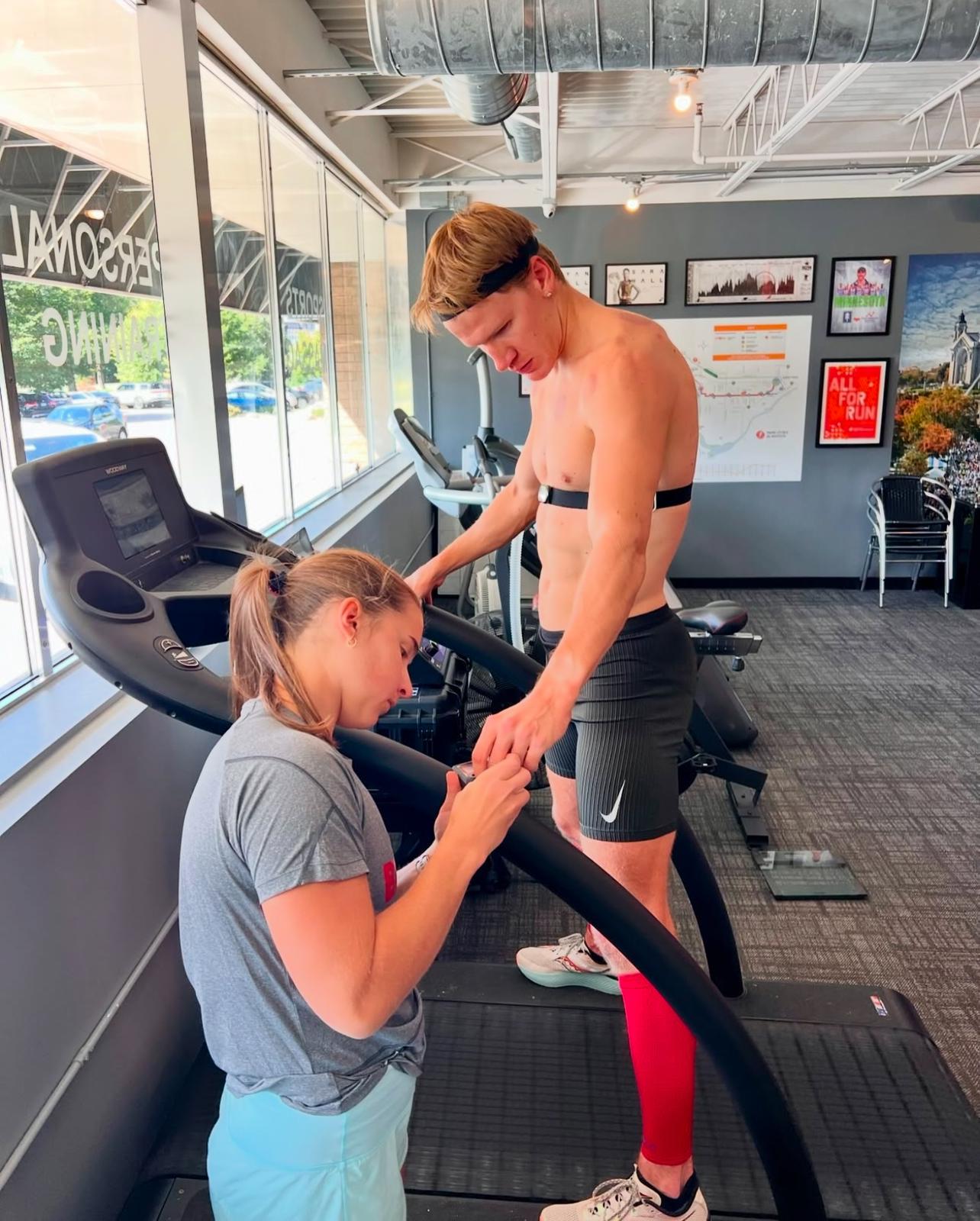
“She comes to basically every interval session I do,” he said. “Takes video. Takes lactates. Gives technique tips.”
What could have felt like a sacrifice became shared life.
“If I were single and just kind of doing this grind alone,” he said, “it would feel like a much bigger sacrifice.”
Ketterson (NMU) racing at the CCSA opener in Houghton, Michigan during his college days at Northern Michigan University. (Courtesy photo)
Learning How to Stay Anyway
Leaving college did not feel like an arrival. It felt like exposure.
Professional skiing offered fewer guarantees. Results came without permanence. Progress was harder to measure.
“This is maybe my fifth year as a professional,” Ketterson said. “I feel like I’ve just been sort of taking small steps each year.”
From the outside, those steps were hard to see. He qualified. He scored points. Then momentum faded.
“I’ve had glimpses here and there of being quite good on the World Cup,” he said. “But it was so inconsistent and few and far between.”
One year, sprint qualification came easily while distance slipped. Another season, the opposite.
“I would qualify every sprint but struggle in distance,” he said. “Or I wouldn’t qualify in sprints, but I’d get a lot of top-30s in distance.”
The belief stayed intact.
“I believed I had that all-around potential,” he said.
Belief, however, doesn’t quiet doubt when seasons stack without resolution.
Ketterson’s wife, Julie Ensrud, assists him with lactate testing during a treadmill session. (Photo: Zak Ketterson)
Choosing a Place That Could Hold the Work
For American skiers, Europe is often something you pass through. For Ketterson, Norway eventually became something else.
Julie’s family lived outside Oslo, close to training venues and the airport. There was also a cabin — quiet, familiar.
“It works out super well,” Ketterson said. “I can just get these three- or four-day stints at the cabin and unpack my bag and feel really at home.”
Most American skiers live out of their bags.
“There are a lot of Americans who just live out of their bag and are constantly in hotels,” he said.
In Norway, life slowed just enough for training to accumulate rather than reset.
“They’re super into skiing,” Ketterson said of Julie’s family. “Her brother skied competitively growing up.”
Her father, especially, was absorbed by the details.
“He’s so into ski waxing and the nitty-gritty stuff,” Ketterson said.
The support wasn’t motivational. It was stabilizing.
“They’ve sort of adopted me,” he said. “Like, how can we support him?”
Norway wasn’t the breakthrough. It was the ground beneath it.
USA I takes the win in a rare World Cup 4 x 5 k mixed relay in 2022. From left to right, Scott Patterson, Rosie Brennan, Zak Ketterson, and Jessie Diggins. (Photo: NordicFocus)
Nothing Fancy, Just Better
With stability in place, the training changed.
“I started working with a coach in Oslo,” Ketterson said.
The relationship was loose.
“He created the framework,” Ketterson said. “But I was still writing probably 90 percent of my training.”
The biggest change was subtraction.
“I used to do strength twice a week, sometimes even three times a week,” he said. “Now it was basically once every ten days.”
The logic was blunt.
“If you want to get better at double pulling,” he said, “you just need to double pull more.”
He replaced strength with ski-specific work. Fitness became the priority.
His training rhythm flattened.
“My training became much more consistent,” he said. “Every week was pretty similar.”
No dramatic rest weeks. No spikes. Stress accumulated steadily.
He returned to the same hills. The same treadmill sessions.
“If something feels way worse than the last six times,” he said, “then you know you need rest.”
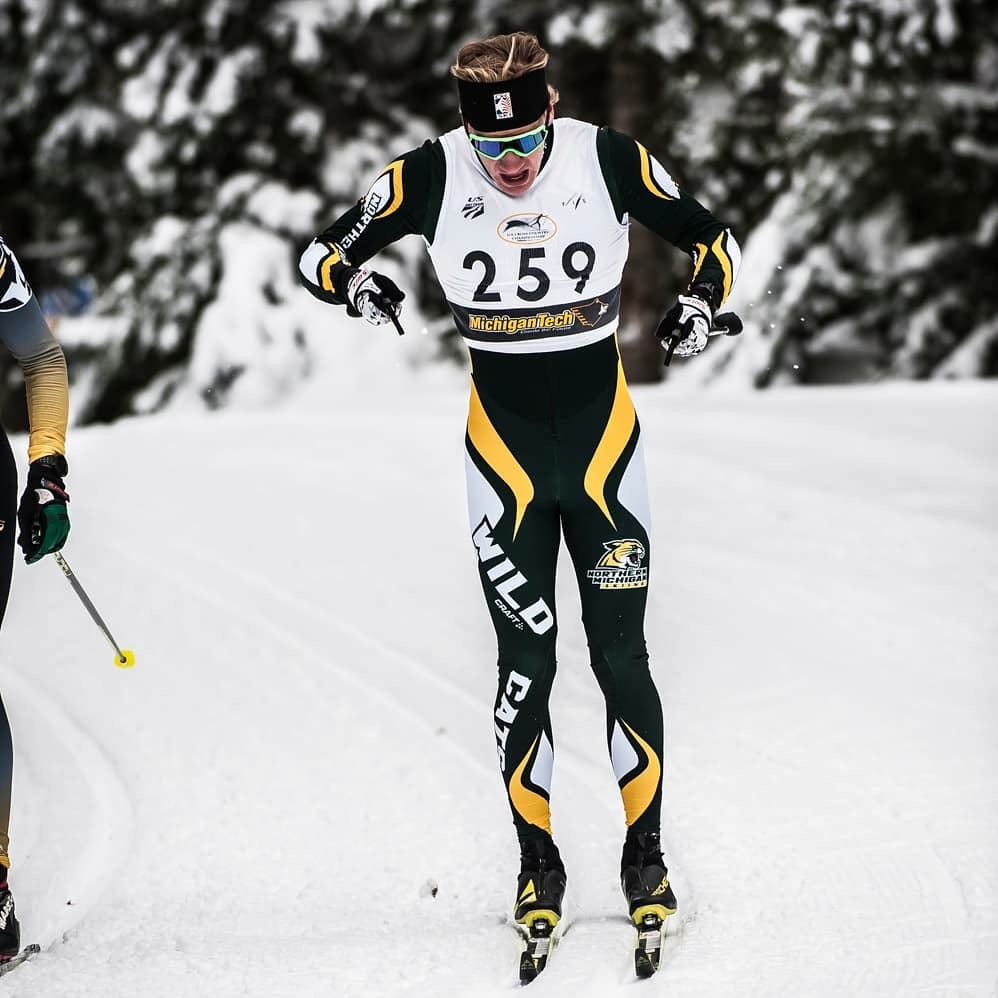
Zak Ketterson logs some roller-ski hours in Minneapolis with Team Birkie. (Photo: Instagram @zaketterson)
Toppidrettsveka
Late in August, Ketterson lined up at Toppidrettsveka, Norway’s popular roller-ski stage race.
“I was expecting to be absolute middle of the pack,” he said.
Instead, he stayed with the leaders.
“From the first race — a mass start 50k — I was fighting for the win,” he said.
Three years earlier, he had been dropped halfway.
“That was one of those moments where it’s like, wow,” he said. “This is a really big difference from anything I’ve felt before.”
Across stages, the pattern held.
“That gave me a lot of confidence,” he said. “Like, okay — what we’re doing is really working.”
Still, he waited.
The Ultimatum
By autumn, the feeling hadn’t faded.
“I told Julie that this had been by far my best off-season ever,” Ketterson said.
Then came honesty.
“I told her that if I’m not good this year,” he said, “or if I don’t make a really big jump, then I kind of want to retire.”
It wasn’t dramatic. It was diagnostic.
“If this doesn’t work,” he said, “then I don’t know anything about training.”
Zak Ketterson (USA) and Friedrich Moch (GER) (l-r) lapping through the stadium during the Men’s 20 k Mass Start Freestyle in Ruka, Finland, at the beginning of the 2025/2026 season. (Photo: Modica/NordicFocus)
Ruka
Ketterson finished 14th in the World Cup opener in Ruka.
“I was crying in the finish,” he said.
Not from disappointment.
“It was such an emotional rush,” he said. “All the work that I’d put in, and that my wife had supported — it finally got some validation.”
For the first time since college, the feeling matched the effort.
The season didn’t spike. It held.
“For the first time,” he said, “regardless of whether it’s a sprint or a distance race, I feel like I can compete that day.”
Zak Ketterson (USA) racing on the Olympic Sprint Course in Val di Fiemme, Italy, during the 2026 Tour de Ski last month. (Photo: Vanzetta/NordicFocus)
Arrival Without a Finish Line
Ketterson will start his first Olympic race just days from now — older than most of his teammates, newer to the stage, and unusually calm.
“I’m just treating it like any other race,” he said.
There is no demand for the outcome. Only execution.
“What would haunt me,” he said, “is doing something that was within my power not to do.”
So he will race. He will pace. He will pay attention.
The long way in has given him that luxury.
Help Support Our Olympic Coverage!
FasterSkier has our own Nat Herz on the ground at the Olympics, which is a significant financial lift for us. If you value the thoughtful work and access FasterSkier provides at championships like this one, please consider becoming a Voluntary Subscriber. Your support directly fuels our work to cover the people, places, and moments that make our sport special.
This reporting costs money. Please support this coverage with a voluntary subscription (below) so FasterSkier can provide this level of access to the sport we all love year-round.
This reporting costs money. Please support this coverage with a voluntary subscription (below) so FasterSkier can provide this level of access to the sport we all love year-round.
This reporting costs money. Please support this coverage with a voluntary subscription (below) so FasterSkier can provide this level of access to the sport we all love year-round.
This reporting costs money. Please support this coverage with a voluntary subscription (below) so FasterSkier can provide this level of access to the sport we all love year-round.
This reporting costs money. Please support this coverage with a voluntary subscription (below) so FasterSkier can provide this level of access to the sport we all love year-round.
This reporting costs money. Please support this coverage with a voluntary subscription (below) so FasterSkier can provide this level of access to the sport we all love year-round.
This reporting costs money. Please support this coverage with a voluntary subscription (below) so FasterSkier can provide this level of access to the sport we all love year-round.
This reporting costs money. Please support this coverage with a voluntary subscription (below) so FasterSkier can provide this level of access to the sport we all love year-round.
This coverage is made possible through the generous support of Marty and Kathy Hall and A Hall Mark of Excellence Award. To learn more about A Hall Mark of Excellence Award, or to learn how you can support FasterSkier’s coverage, please contact info@fasterskier.com.
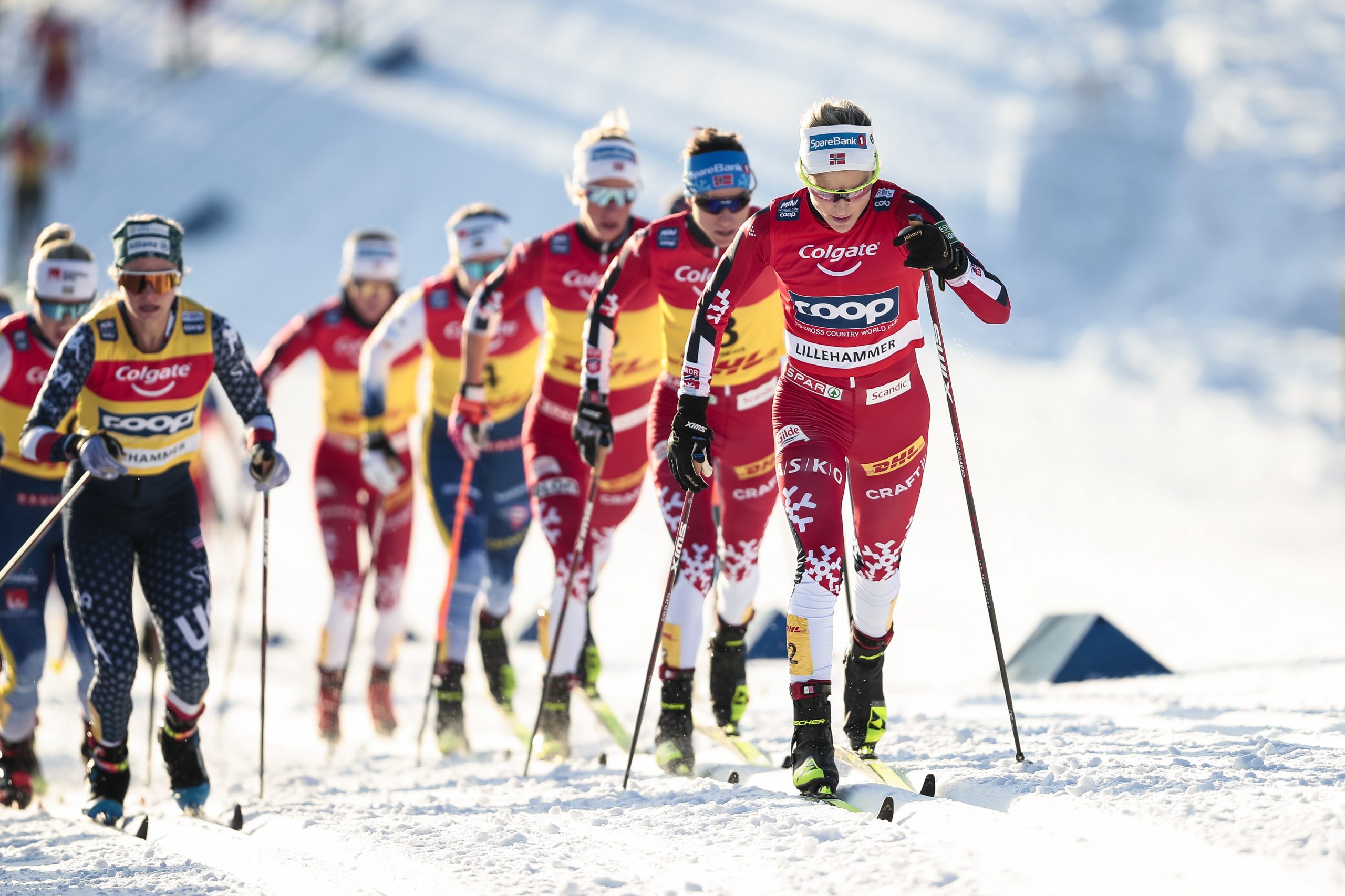
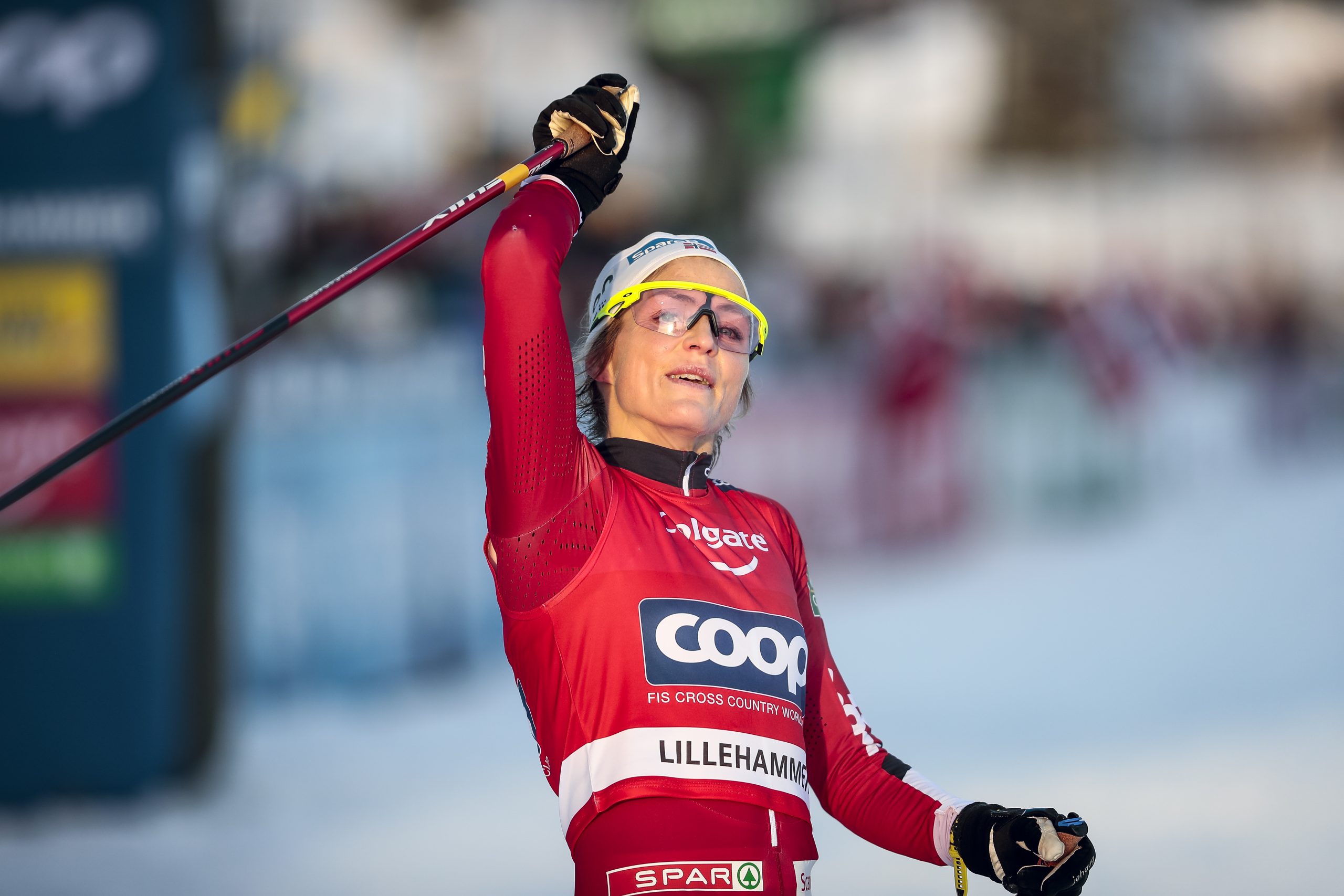
Therese Johaug (NOR) set a blistering pace throughout Lillehammer’s 20 k Skiathlon, dominating the field from start to finish. It’s not a “comeback” anymore. (Photo: Modica/NordicFocus)
It’s weird . . . Skiathlon is hardly ever contested on the World Cup Tour, but is always on Olympic and World Championship event rosters. That means that Olympic and World Championship medals—and the everlasting fame accompanying the winning of those medals—are handed out in an event that hardly anyone ever does. In some years, there is a Skiathlon staged within the Tour de Ski, but the World Cup field can go years in a row without waxing up two different sorts of skis on race morning.
Lillehammer’s 20 k Skiathlon was staged as a dress-rehearsal for the World Championships to be held in Trondheim later this winter. If today’s results are predictive of that later event, the Norwegian hosts are likely to be very satisfied, indeed. Therese Johaug (NOR) returned to the form that made her the most dominant distance skier of her generation, quick-tempoing her way to a 42 second victory over Heidi Weng (NOR) and Jessie Diggins (USA).
In post race interviews with FasterSkier, Diggins commented on her own progression as a Classic skier: “I have worked really really really hard,” she said, “As evidenced by the fact that I’m literally looking around in Classic races watching technique and making notes!”
Jessie Diggins’ (USA) third place finish in Lillehammer’s 20 k Skiathlon maintained her lead in the Overall FIS World Cup standings. (Photo: Modica/NordicFocus
Diggins entered the day in the World Cup leader’s bib, followed closely by Johaug and Weng. Frida Karlsson continues to nurse a foot injury sustained some weeks ago; she elected not to start today’s Skiathlon. Likewise, Rosie Brennan (USA) is dealing with an undisclosed injury here in the early part of the World Cup season; she chose not to start on Sunday in Lillehammer.
Among American finishers, Sophia Laukli skied to an excellent 11th, ahead of Julia Kern (20th), and Alayna Sonnesyn (43rd). Sydney Palmer-Leger did not finish the race.
Canadian finishers included Liliane Gagnon (34th) and Katherine Stewart-Jones (39th).
In the early kilometers of Sunday’s Skiathlon, Ebba Andersson (SWE) worked with Jessie Diggins (USA) and Therese Johaug (NOR) to keep the pace high. As it turns out, Johaug really doesn’t need any help in that regard. (Photo: Modica/NordicFocus)
Women’s Skiathlon
Hoping to challenge Johaug in a mass-start event? Get a good warmup—a REALLY good warm up—because Johaug is going to go from the gun. No waiting around, no easing into anything, no tactical shenanigans: Johaug just goes. From the start of Sunday’s Skiathlon in Lillehammer, there was a glaring difference between the tempo chosen by Johaug and the tempo chosen by everyone else. Johaug’s metronome is simply set to a much more rapid setting. She doesn’t create the same sort of per-stroke power that her rivals employ, but it’s apparent that the sum total of her many-more pole plants is sufficient to more than make up any power deficit.
Lillehammer’s Skiathlon consists of four laps of a 2.5 k Classic course, then a ski exchange, followed by three 3.3 laps of a Freestyle course. Within the first two kilometers, Johaug’s pace setting had begun to string out the field, creating an eleven-person breakaway group that included Diggins, Weng, Kerttu Niskanen (FIN), Astrid Oeyre Slind (NOR), Ebba Andersson (SWE) Jonna Sundling (SWE) Victoria Carl (GER), Emma Ribom, Katarina Hennig (GER), and Kristin Austgulen Fosnaes (NOR). The early pace created by Johaug and Andersson quickly trimmed away Fosnaes, Hennig, Sundling, Carl, and Ribom, leaving the top five contenders to continue on as a group.
Kern and Laukli skied the opening kilometers together solidly positioned in the top 20.
“The pace in the classic leg started super hot, and it was a quick realization that I wouldn’t keep up,” said Laukli. “But I was anticipating this a bit. Instead of stressing, I’m happy how I just found my rhythm and stayed in control, focused on technique and skied fast but made sure to be conservative so I could ski faster in the skate. So, I’m happy that I managed to play out this tactic well.”
Nearing the end of the Classic leg, Johaug began to reassert the pace, stringing out the lead group. By the ski transition, Johaug led Slind, Weng, and Andersson by eight seconds, with Diggins just another two seconds behind. Diggins would transition quickly, leading the chase group in pursuit of Johaug.
At one point in the broadcast, on-screen announcer Andrew Kastning, was heard to say “We’re seeing a bit of a surge from Johaug.” A more accurate analysis might be that Johaug never, ever, stops surging. She looks not unlike a determined, stubborn little kid racing in a field of adults . . . never willing to let anyone else’s ski tips be out front. Earlier in her career, the World Cup field would simply let her ski away (not that they really could’ve stopped her). Now, after her recent comeback, the primary contenders are not willing to surrender so early, skiing closely in Johaug’s wake for as long as possible. Bet that hurts . . .
Sophia Laukli (USA) showed how far she’s come as a classic skier in the first leg of Lillehammer’s 20 k Skiathlon. (Photo: Modica/NordicFocus)
Laukli exited the transition in 12th (1:22 behind the leader), attesting to the great improvements she continues to make in Classic skiing. She had no other skiers around her, and would be forced to ski much of the skate leg alone. Kern also skied a solid Classic leg, exiting the transition in 15th in the company of a group of chasers.
Ten seconds, twenty, thirty, forty . . . Johaug continued to press the issue, and her lead over the chasing four continued to grow. Andersson did most of the pacing in the chase, but the camera switches between Johaug and her pursuers made it look like they were racing different events. Johaug’s intensity never waned, while the four in the chase group must’ve begun considering conserving their energy in the race for silver.
Less than a kilometer from the finish, Diggins skidded unsteadily through a sweeping downhill curve, allowing Weng to jump to the lead, an advantage she was able to hold through the finish line. Andersson and Slind crossed the line moments later to round out the top five.
Laukli continued driving forward in pursuit of a group containing Carl, Niskanen, Sundling, and Krist Parmakoski (FIN). She would latch on to the group a kilometer before the finish, having brought Fosnaes up with her. Laukli would finish the day in 11th.
“I would definitely still consider myself a freestyle specialist, and will obviously still work the uphills best,” said Laukli. “But I’ve focused a lot on improving on the flats and descents this year so I can be more in the mix. The first few races this year have shown me that I can now ski more than just uphills, so it means I can be much more motivated and ambitious with skate results in general.”
Kern’s 20th place finish suggests that she’s left her early season question marks behind her, and is rounding into form.
Therese Johaug (NOR) had plenty of time to celebrate at the finish line of the Lillehammer Skiathlon. With a World Championship Skiathlon event scheduled for Trondheim later this winter, Norwegian fans are certainly thrilled to have her back on the team. (Photo: Modica/NordicFocus)
Johaug allowed herself to ease up slightly, just enough to wave to the Norwegian crowd as she crossed the finish line more than 40 seconds ahead of her pursuers. We can stop calling it a “comeback” now. Therese Johaug is the dominant distance skier on the FIS World Cup circuit . . . almost as though she’s never been away at all.
After the race, Diggins was seen in a smiling discussion with Johaug in the finish area: “I was complimenting her on her Classic technique!” Diggins confessed. “I saw that her wax was slipping, and I saw that she held super strong and stable and upright . . . I really admire that, because it’s incredibly hard to do. I think it was really cool to watch. I also think you should never waste an opportunity to compliment someone when they’ve done something well. So I wanted to make sure I told her that!”
Striding out of the stadium at the Zhangjiakou National Cross-Country Skiing Center (Photo: NordicFocus)
This World Cup coverage is made possible through the generous support of Marty and Kathy Hall and the A Hall Mark of Excellence Award. To learn more about A Hall Mark of Excellence Award or to learn how you can support FasterSkier’s coverage please contact info@fasterskier.com.
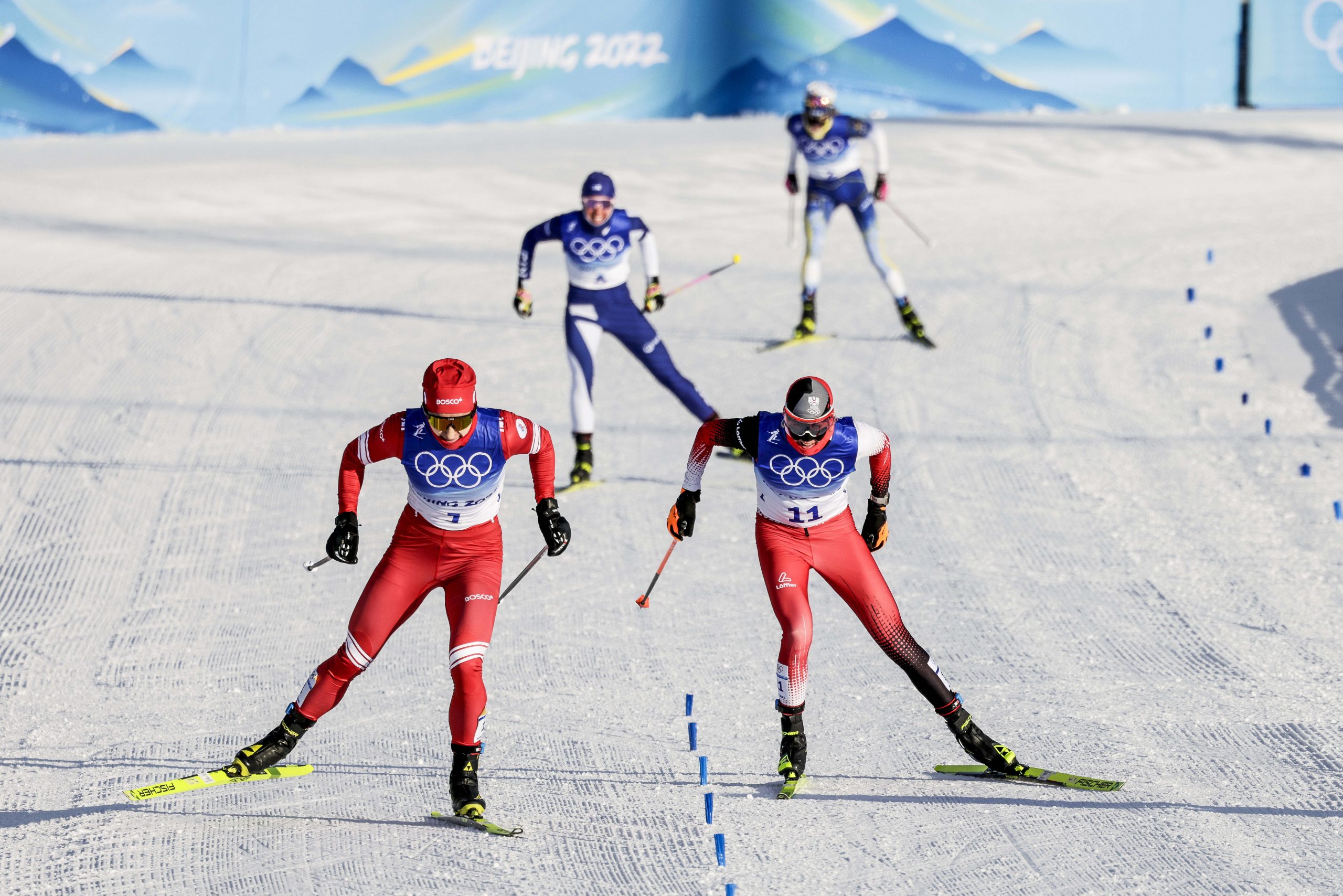
After a long hiatus from international racing, the top athletes found themselves on the start line once again, ready to contest the first event of the 2022 Winter Olympics. First up, a 15-kilometer skiathlon, featuring 64 starters completing four 3.75 k loops. The skiathlon, which combines both classic and skate in one race (7.5 k of each in this case), is an infrequent event on the World Cup circuit though appears on the schedule at all championships.
Four years ago, at the Olympics in PyeongChang, it was Charlotte Kalla of Sweden who bested the field to take gold, followed by Marit Bjørgen of Norway and Krista Pärmäkoski of Finland. Notably, this year’s winner, Therese Johaug was not present, but we will return to this point later on.
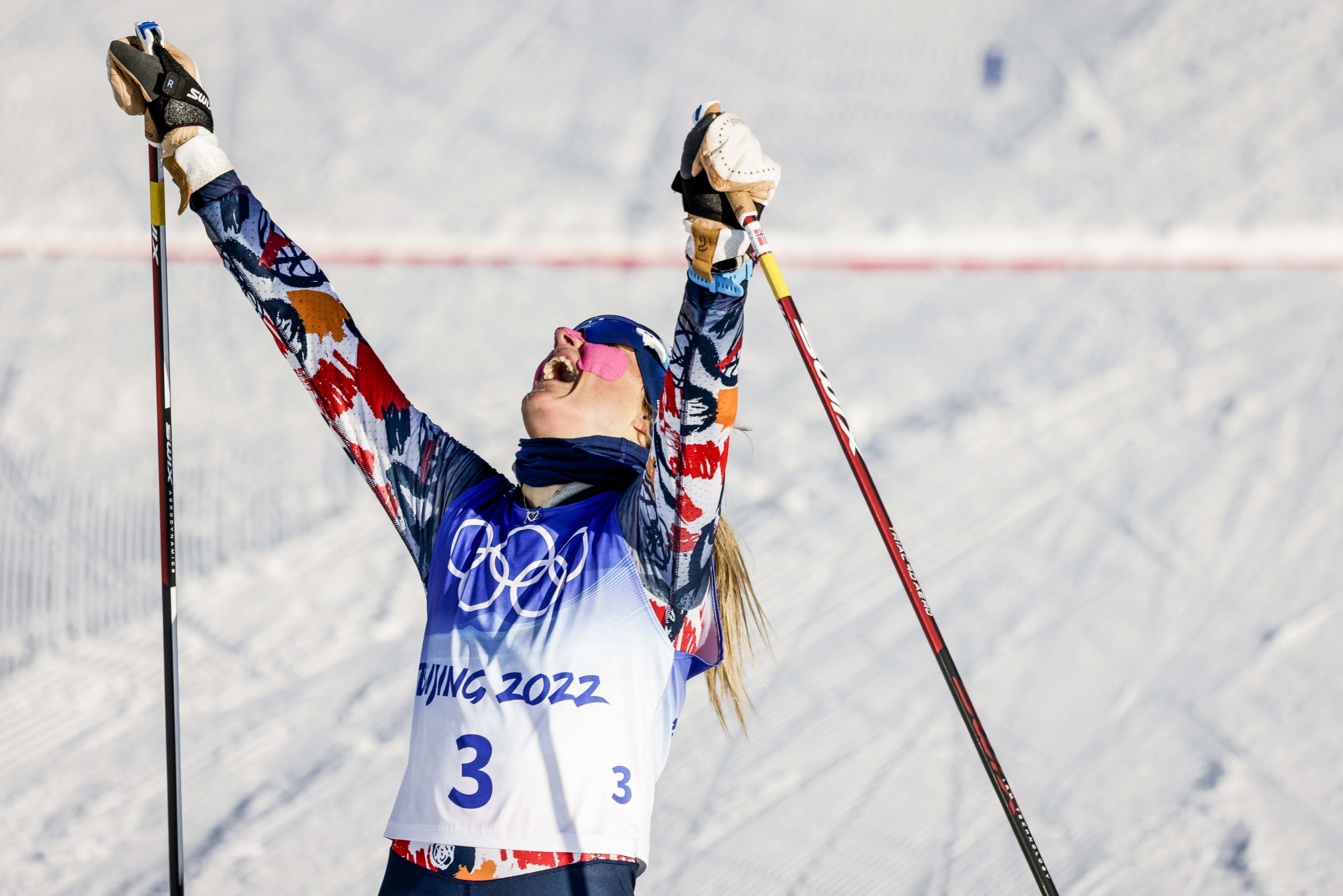
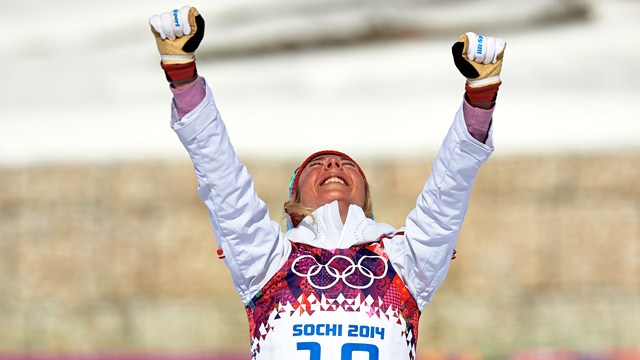
Celebration for Therese Johaug (NOR) as she takes her first ever individual Olympic gold medal (Photo: NordicFocus)
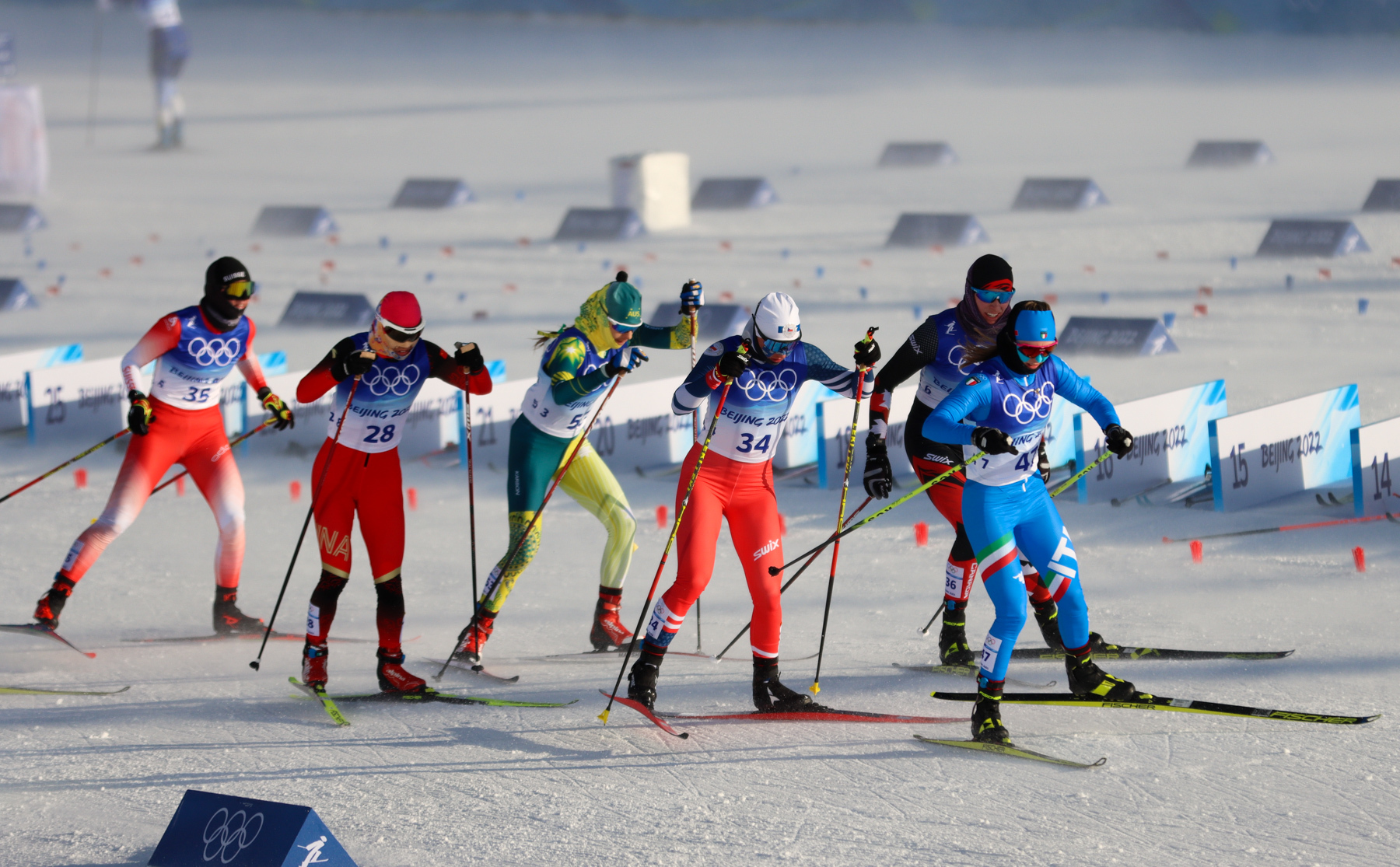
Watched by a few masked fans in the stands, the athletes completed final preparations before the start. Even without looking at the temperature, the cold was evident, from the blowing trees and bibs to the drifting snow across the tracks and the face-tape present on all the starters. The thermometer said -12.5°C or 9.5°F, though this reading likely didn’t factor in the windchill. With minutes to go, the athletes emerged from a set of underground stairs, bundled in parkas, to take their places on the start line.
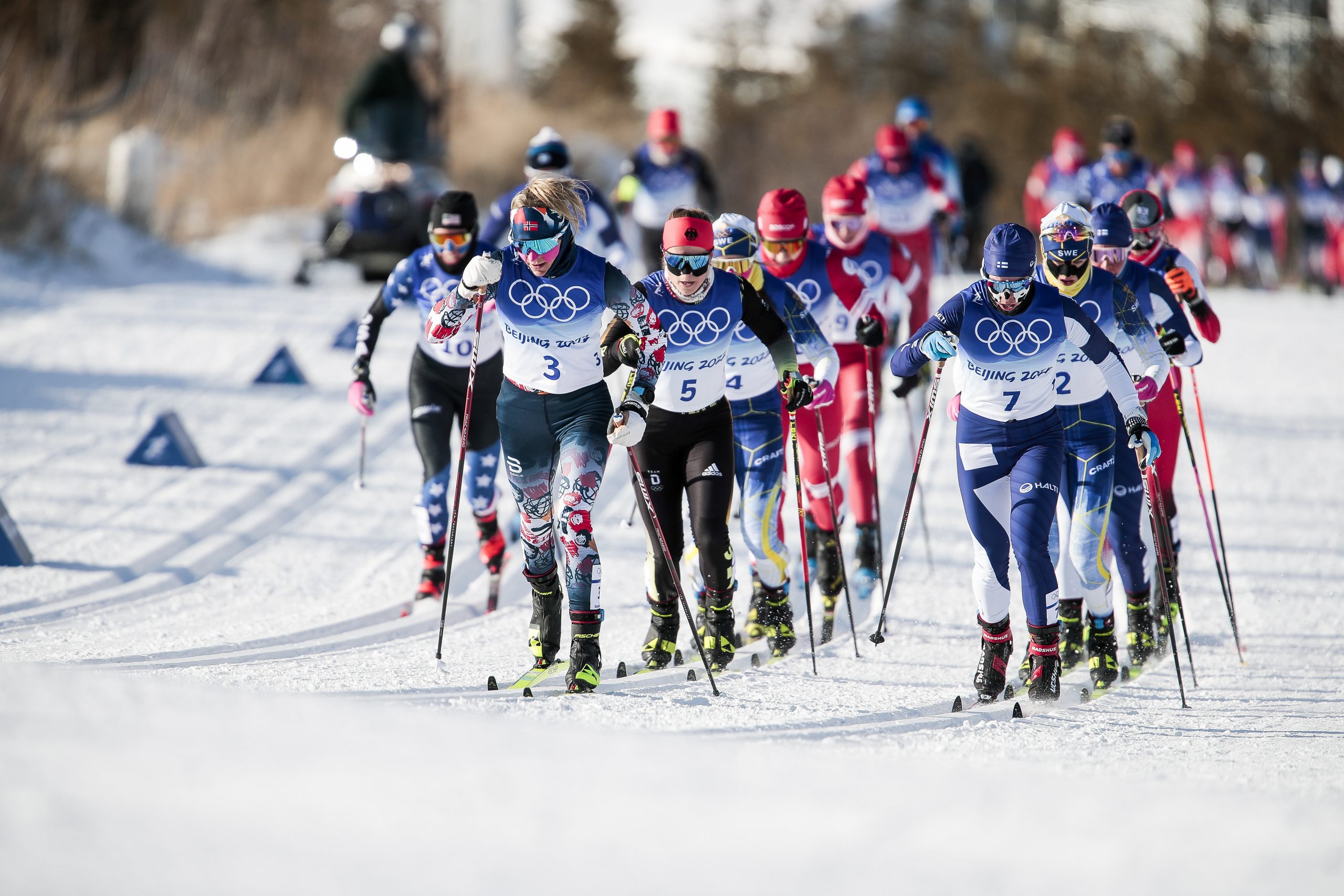
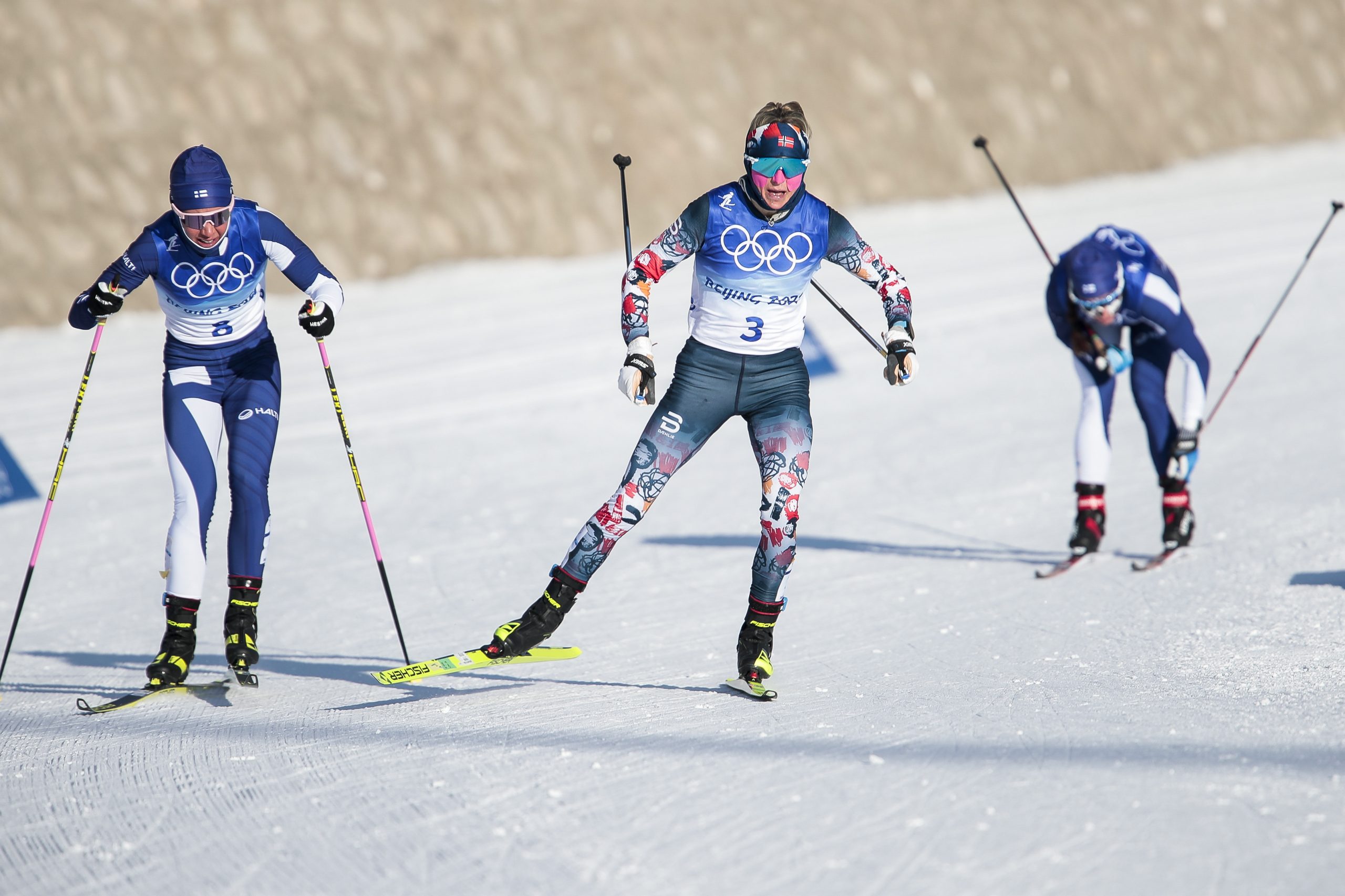
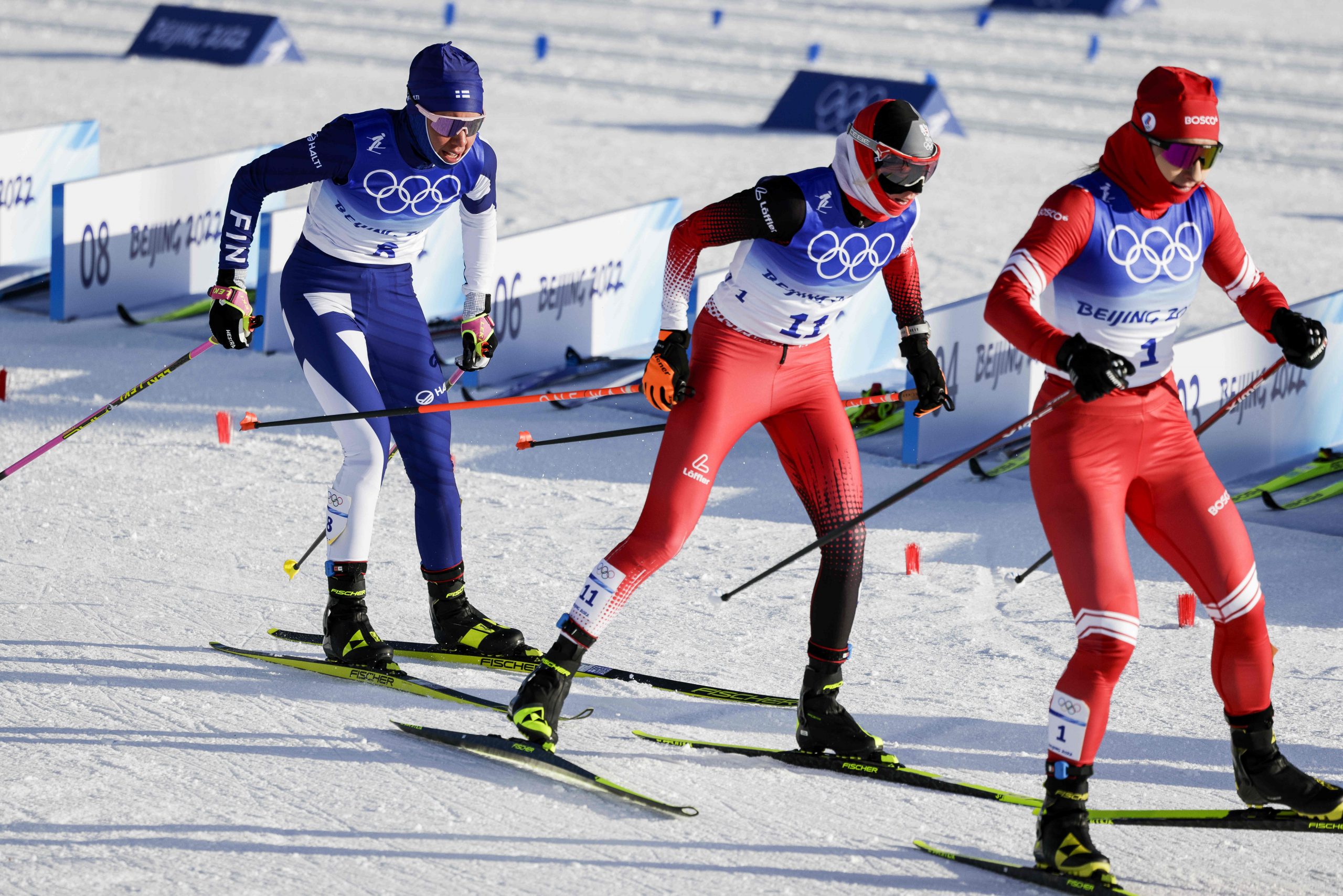
At the starters command, the first cross-country ski race of the 2022 Olympics was underway, and almost immediately two skiers went down in a crash, though thankfully the damage did not impact the rest of the field. Coralie Bentz of France and Anne Kyllönen of Finland recovered quickly and rejoined the pack. With the first A-climb less than 1 k into the course, early leaders Rosie Brennan (USA) and Therese Johaug (NOR) pushed the pace, and the pack soon thinned.
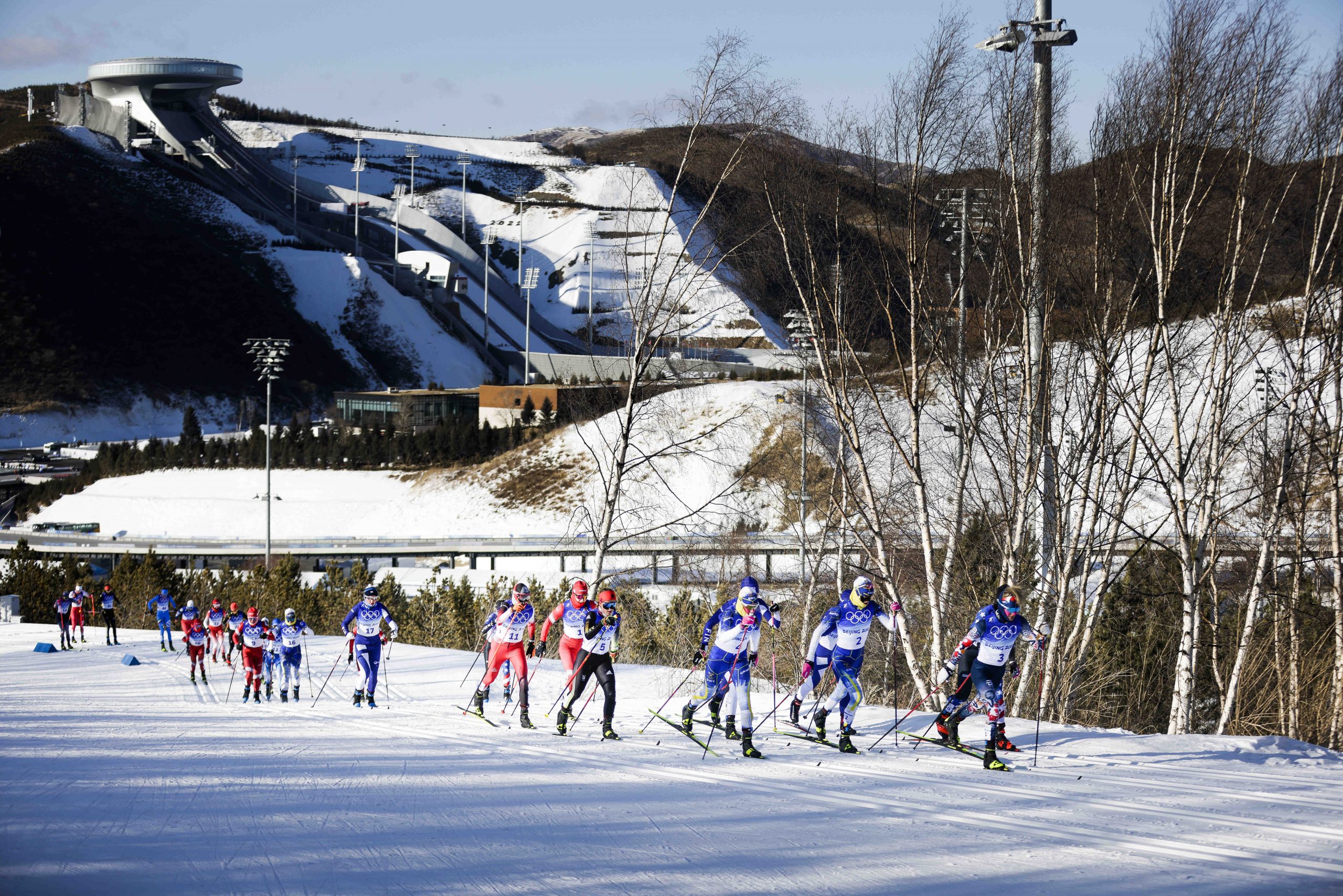
Therese Johaug (NOR) leads the charge up the first big hill, Rosie Brennan (USA) can be seen leading the left most column (Photo: NordicFocus)
On the descents, the camera showed most athletes opting to ski on the platform, rather than the tracks, due to the drifting snow that was filling them. Skirting another fall, this time from Johanna Matintalo of Finland, the front group entered the stadium for the first round in a pack of roughly fifteen. With just over eleven minutes on the race clock, there were ten athletes within five seconds of Johaug, a slight surprise given her tendency for early breakaways.
Heading out for the second lap, Johaug visibly upped the pace though still had difficulty shaking her followers. Through the 5.1 k mark, the spread was now ten athletes over the span of ten seconds, led by Kerttu Niskanen (FIN) and ending with her teammate Matintalo, who had recovered from her fall. Whittled away over the duration of that lap, when they reached the second A-climb of the course before descending towards the stadium, Johaug was leading a group of just six skiers.
Entering the stadium for the transition to skate skis, Johaug double-poled the final rise, managing to open a slight gap to Niskanen, Frida Karlsson (SWE) and Pärmäkoski (FIN). Executing a quick exchange she held the lead and was out with 23:04.7 elapsed on the clock. Niskanen followed +1.0 behind, Pärmäkoski +2.2 and Karlsson +4.3.
It is worth noting that after the exchanges, Jessie Diggins of the USA was in tenth, +57.5 seconds behind Johaug, having dropped significantly over the first two classic loops. Rosie Brennan was next in 14th (+1:11.9), with Hailey Swirbul in 23rd (+1:52.6) as the final American inside the Top-30. Julia Kern was +4:07.1 behind in 53rd, about to hit the gas on the skate laps.
Jessie Diggins (USA) strides up one of the many challenging climbs (Photo: NordicFocus)
Capitalizing on her one-second advantage, Johaug found herself off the front for the first time. Pärmäkoski, Karlsson and Niskanen shared leads in an attempt to chase her down but by 8.8 k the gap had stretched to +15.8, effectively securing Johaug her first ever individual Olympic gold medal. From that point, the margins only grew: +26 at 10 k, +44 at 12.6 k and +30.2 at the completion of 15 k.
Despite her utter dominance of World Cup races and World Championships the past few seasons, Johaug’s results sheet at the Olympics is not what you might expect.
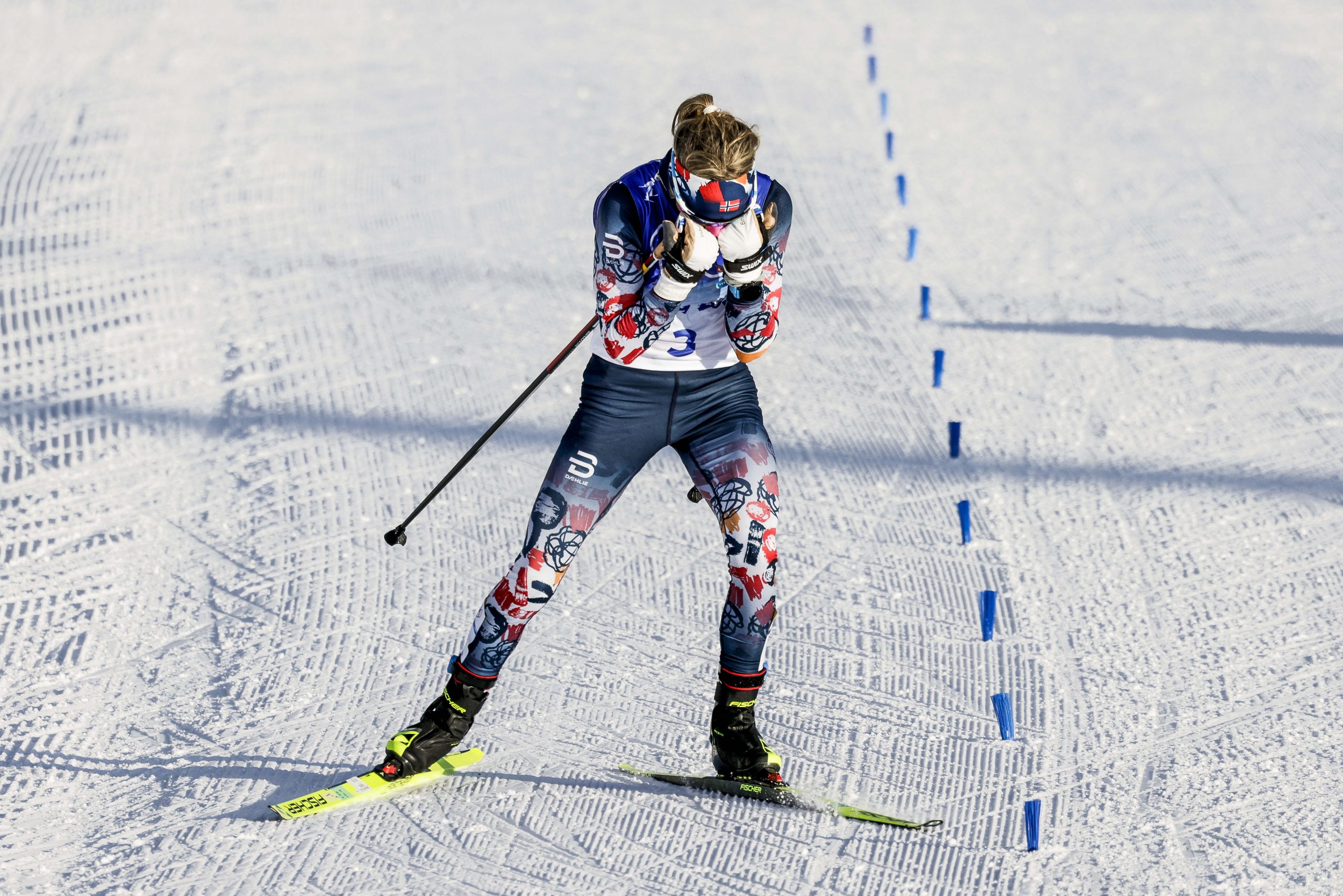
Tears were shed by Therese Johaug (NOR) as she finally gets her long deserved gold medal (Photo: NordicFocus)
Prior to the day’s skiathlon victory, she had only one other gold medal, coming from the team relay in the 2010 Games in Vancouver Canada. She was a runner-up in Sochi 2014 during the 30 k freestyle mass start when she placed second behind teammate, Marit Bjørgen, and she also earned bronze in the 10 k classic in Sochi. Johaug received an 18-month competition ban in 2017 for a positive doping test which prevented her from attending the 2018 Olympics in PyeongChang.
In her post-race press conference, Johaug said she does not hold onto anger about her suspension, which left her even more motivated to prove herself this year.
“I’m finished with these years and I’m focusing on myself, and the future and things I can do something with,” Johaug said in a press conference. “It means maybe more for me today when I’m didn’t have this gold medal, and maybe if I had the gold medal before, this Olympics, maybe I would not been here.”
Therese Johaug (NOR) on top in the first cross-country competition at the 2022 Olympics (Photo: NordicFocus)
With the recent outbreak of COVID amongst the Norwegian team, Johaug’s path to Beijing has not been as smooth as she would have liked. She only arrived at the venue on Wednesday, leaving just a few days to adjust to the time change and climate before the first event. In spite of these challenges, she proved equal to the task, skiing away with the victory in a time of 44:13.7.
Behind Johaug, the race for silver and bronze was playing out in a dramatic way. Initially, Karlsson of Sweden seemed to have pulled away, when at 10 k she was 26 seconds behind Johaug, and 10 seconds ahead of Niskanen (FIN) and Teresa Stadlober of Austria. However, this break was short-lived, and at 11.3 k, Karlsson was less than a second ahead of Natalia Nepryaeva (ROC) who had worked with Stadlober to rejoin the chase pack. Pärmäkoski (FIN) began to drop off the pace and the group was down to four. At this point, Diggins (USA) could be spotted closing in on Pärmäkoski, who continued to fade.
Entering the final A-climb of the race, Stadlober (AUT) injected some pace, attempting to pull away but Karlsson of Sweden and Nepryaeva (ROC) hung on. Only Niskanen (FIN) dropped slightly.
Thus it was three skiers vying for two medal spots. But as they descended towards the stadium Niskanen closed in again, making the group four. Nepryaeva crested the final rise in front as across the stadium the camera showed Johaug crossing the line, arms raised and a frozen smile on her face.
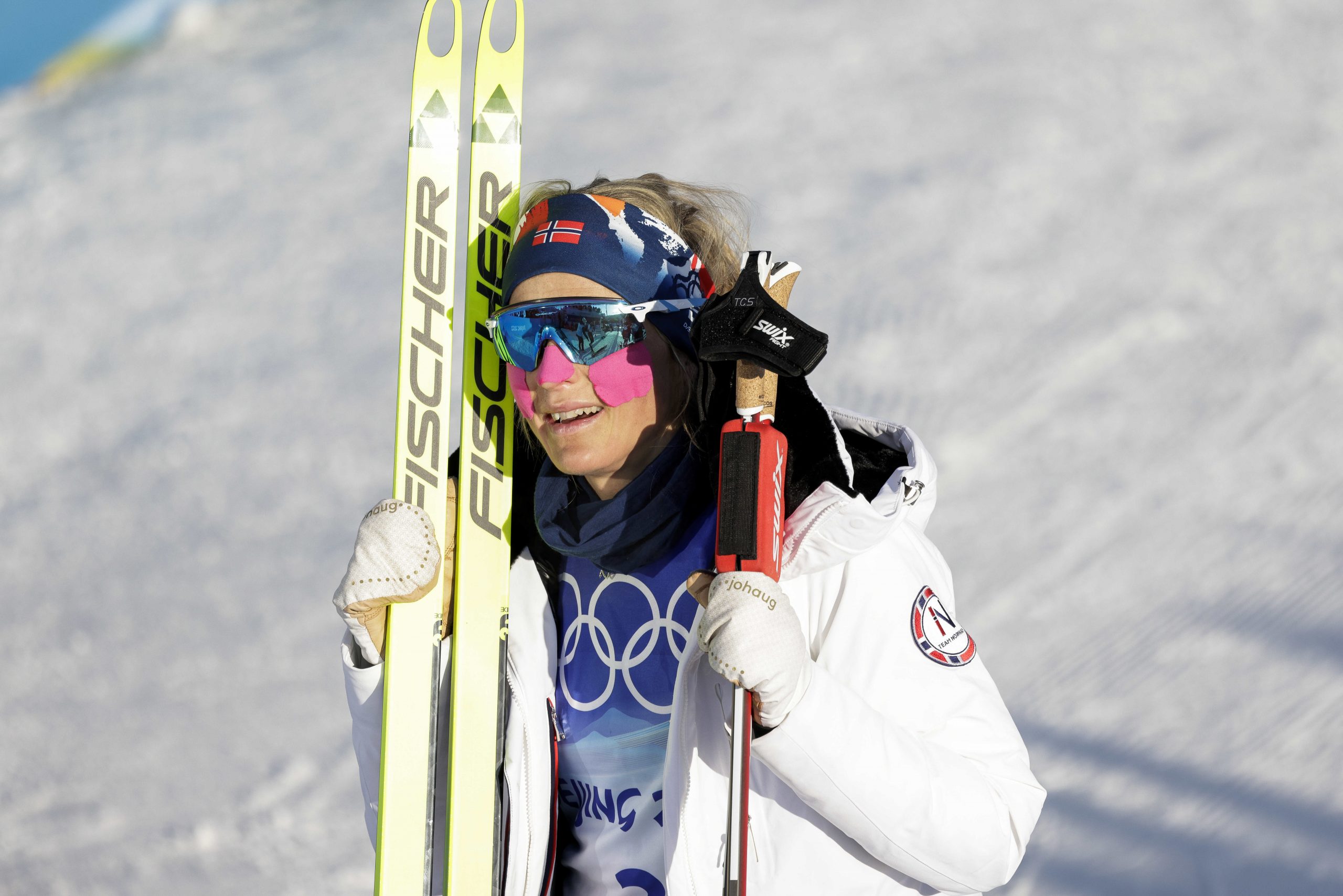
Frozen but happy, Therese Johaug (NOR) (Photo: NordicFocus)
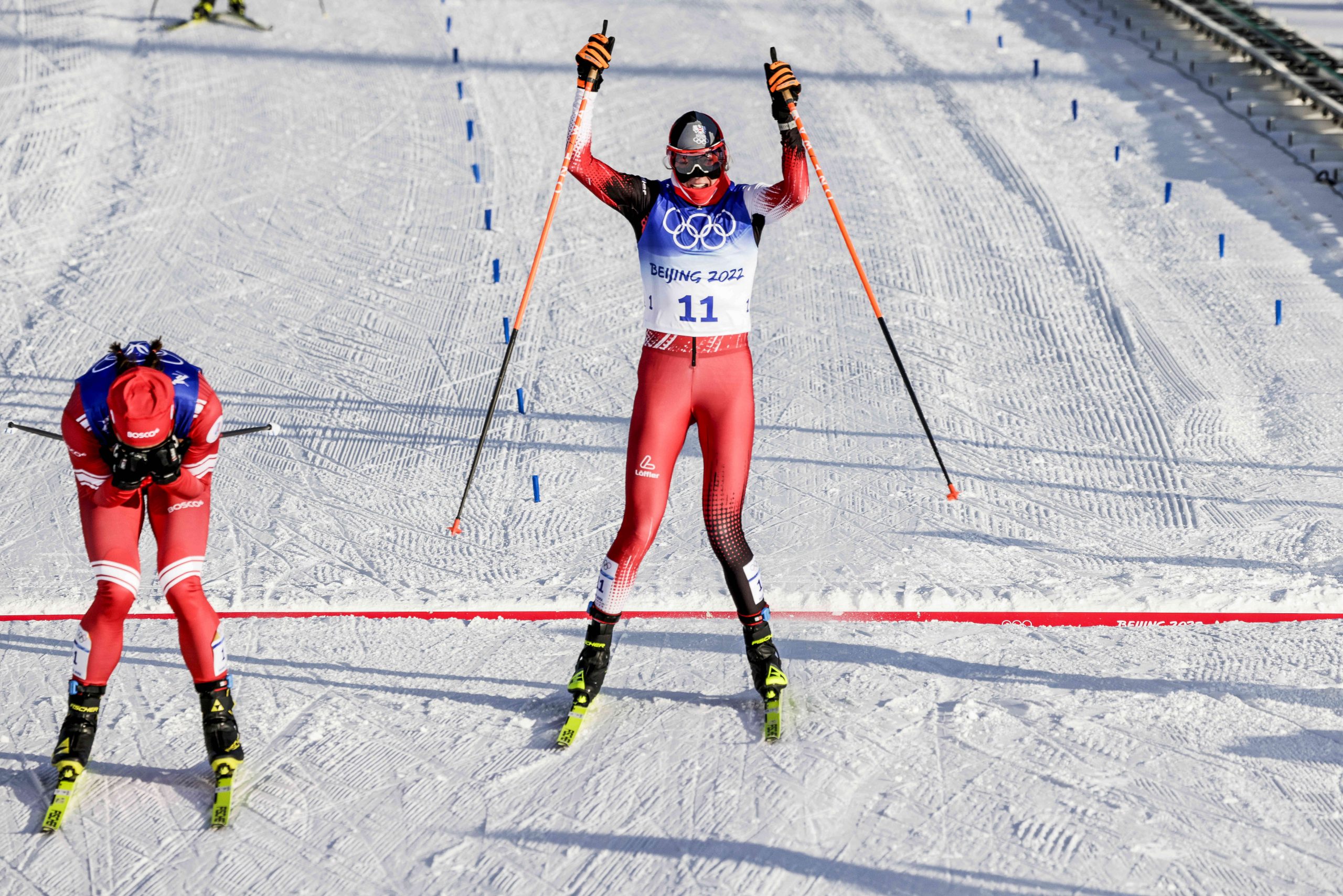
Down the finishing straight Nepryaeva held onto her lead as Stadlober mounted a final challenge, ultimately running out of space as the two finished in silver and bronze position respectively. Niskanen (FIN) finished fourth (+36.1), Karlsson (SWE) in fifth (+42.5), and in an impressive comeback, Diggins crossed the line sixth (+50.5).
A tight battle for silver and bronze between Teresa Stadlober (AUT) and Natalia Nepryaeva (ROC), (l-r) (Photo: NordicFocus)
This silver is the first Olympic medal for Natalia Nepryaeva, who most recently became the first Russian women to win the Tour de Ski. Her only other Olympic appearances came in PyeongChang where her best finish was fourth in the classic sprint.
Teresa Stadlober (r-AUT) celebrates a bronze medal as Natalia Nepryaeva (l-ROC) is overcome with emotion (Photo: NordicFocus)
For Teresa Stadlober of Austria, this bronze medal could be viewed as redemption. Stadlober was in medal contention during the 30 k classic at PyeongChang when a last minute wrong turn took her out of the running. Furthermore, after a total of 18 individual starts at championship events (Olympics and World Championships), this is Stadlober’s first medal. She holds just three World Cup podiums, two during the 2018 edition of the Tour de Ski in Toblach where she placed third in the 10 k classic mass start and had the second fastest time of the day on the Alpe Cermis hill climb. The third podium was in a 15 k skiathlon in Oberstdorf Germany in 2020 where she also placed third.
First Olympic medal for Teresa Stadlober (AUT) (Photo: NordicFocus)
Other noteworthy performances from the day includes Anastasia Rygalina (ROC), who has had just ten World Cup starts in her career and never finished in the top ten, finishing the race in 8th. Behind her, Delphine Claudel of France earned a new personal best for the Olympics placing 9th.
Jessie Diggins (USA) exits the transition zone, followed by Ebba Andersson (SWE) (Photo: NordicFocus)
After being +55.5 seconds behind Pärmäkoski and the chase group at the exchange, Diggins ended up finishing a full eight seconds ahead of the Finn and was just 20 seconds behind bronze medalist, Stadlober.
“I definitely finished with nothing left so I feel really good about that,” said Diggins in the mixed zone after the race. “I was so proud of never giving up. I feel really good about the pacing and where my fitness is. I definitely want to figure out some things with my power striding, but overall I think this was a really encouraging start to the Games and honestly it feels really good just to have gotten here and to be able to race.”
Left it all on the course, Jessie Diggins (USA) collapsed in the finish (Photo: NordicFocus)
When asked about the cold and windy conditions Diggins replied, “My hands got pretty cold because I needed thinner gloves for the pit-box changing. My muscles stayed warm though. [The wind] is really something, and that’s what makes it so cold, so I think it’s important to really push that and stay warm.”
Regarding the course, Diggins said, “They’re really good courses. I really like them. I think they’re really fair and great championship courses. They’re as hard as they look, you’ve really got to work for it.”
Jessie Diggins fields media questions in the mixed zone. (Nat Herz/FasterSkier-ADN)
In Diggins final 5k, she advanced from eighth place and over 1:13 back to finish sixth place and roughly 50 seconds back. This is a difference of 23 seconds gained on the leader over 5k, with ten seconds gained in the final 2.4k.
“I had amazing skate skis and I think I had paced just well enough to be able to do that,” Diggins said of this progress. “I crossed the finish line with nothing left. It’s really cool to get a race on these courses in and I think I’m figuring [them] out.”
Rosie Brennan leaves the exchange zone halfway through the women’s 15k skiathlon, the opening race of the 2022 Winter Olympics. (Nat Herz/FasterSkier-ADN)
Brennan was the next finisher for Team USA, in fourteenth position (+2:51.7). Brennan had initially fallen behind Germany’s Katharina Hennig in the skate leg to slide into 15th, but she regained her position with 3 k to go, further accelerating to give herself a 7 second cushion at the finish.
“Definitely a little bit of everything out there today,” Brennan told U.S. Ski & Snowboard communications manager Tom Horrocks after the race. “Some good, some ugly, some in between.”
While Brennan’s result might not be evidence that she is a medal threat in the event, and she is surely left wanting more, she spoke like a true veteran, showing maturity and perspective in her response to how she will look back on the performance.
“I think I have to take the like big picture perspective. Four years ago, I think I was close to dead last fighting some [mononucleosis], and that was my first and last Olympic race. So I really had kind of a — I don’t know what you’d call it — a demon in the back of my mind that I needed to get rid of. So to be in a better place today, even if it wasn’t my best, was a step in the right direction. And that’s something that I’m proud of.”
Rosie Brennan catches her breath after finishing 14th in the women’s skiathlon at the 2022 Beijing Winter Olympic Games. (Nat Herz/FasterSkier-ADN)
While official start lists are not yet available, as Brennan is one of USA’s top skiers, she will likely start in multiple upcoming events.
On her mindset and how she’s feeling heading into these stages, Brennan said, “It’s been a while since I’ve done racing at an international level. (Brennan left Europe after the Davos World Cup races in mid-December, spending the last six weeks near her home in Park City, UT.) I’m really hoping that the effort today was what I needed to just get back into things and find a better place ,because I certainly have had some workouts that have indicated that I’m in good shape. So I do want more and I think I can get more. I’m really looking forward to the other races.”
Behind Brennan, Hailey Swirbul finished in 40th (+5:28.8).
“It’s a lot of V1 skate, it’s hard,” Swirbul said in the mixed zone in reference to the course, “It makes for fair racing but you have to be totally on your game. It didn’t feel like [you get a break] today, it was a tough day for sure.”
Hailey Swirbul transitions from classic to skate, fighting windy conditions on course during the women’s 15k skiathlon. (Nat Herz/FasterSkier-ADN)
When asked about taking part in the Olympics and the momentum of the team, Swirbul said, “It’s a hugely exciting time to be part of this team. We’ve shown over the last four years what we’re capable of. We will give everything we have out there. It feels like a relief that we made it here and that our team has been healthy and we prepared really well so far. A race is a race, no matter if it’s an Olympic or local race. It’s important to keep your head in the game, and be ready to fight no matter what.”
Hailey Swirbul (USA) embraces teammate Julia Kern (USA) after the skiathlon (Photo: NordicFocus)
Julia Kern rounded out the US finishers in 53rd position (+7:51.8). It was “windy and tough,” said Kern definitively. “That was a really tough race, probably the windiest race I’ve ever done. I had a ton of base layers on so I stayed warm, but the wind cools you right down on the downhill.”
Regarding her participation in the Games, Kern said, “It’s a dream come true, I’m really excited to see what we can do as a team for the rest of the Games. This is just the beginning.”
Julia Kern (USA) fights hard to the finish (Photo: NordicFocus)
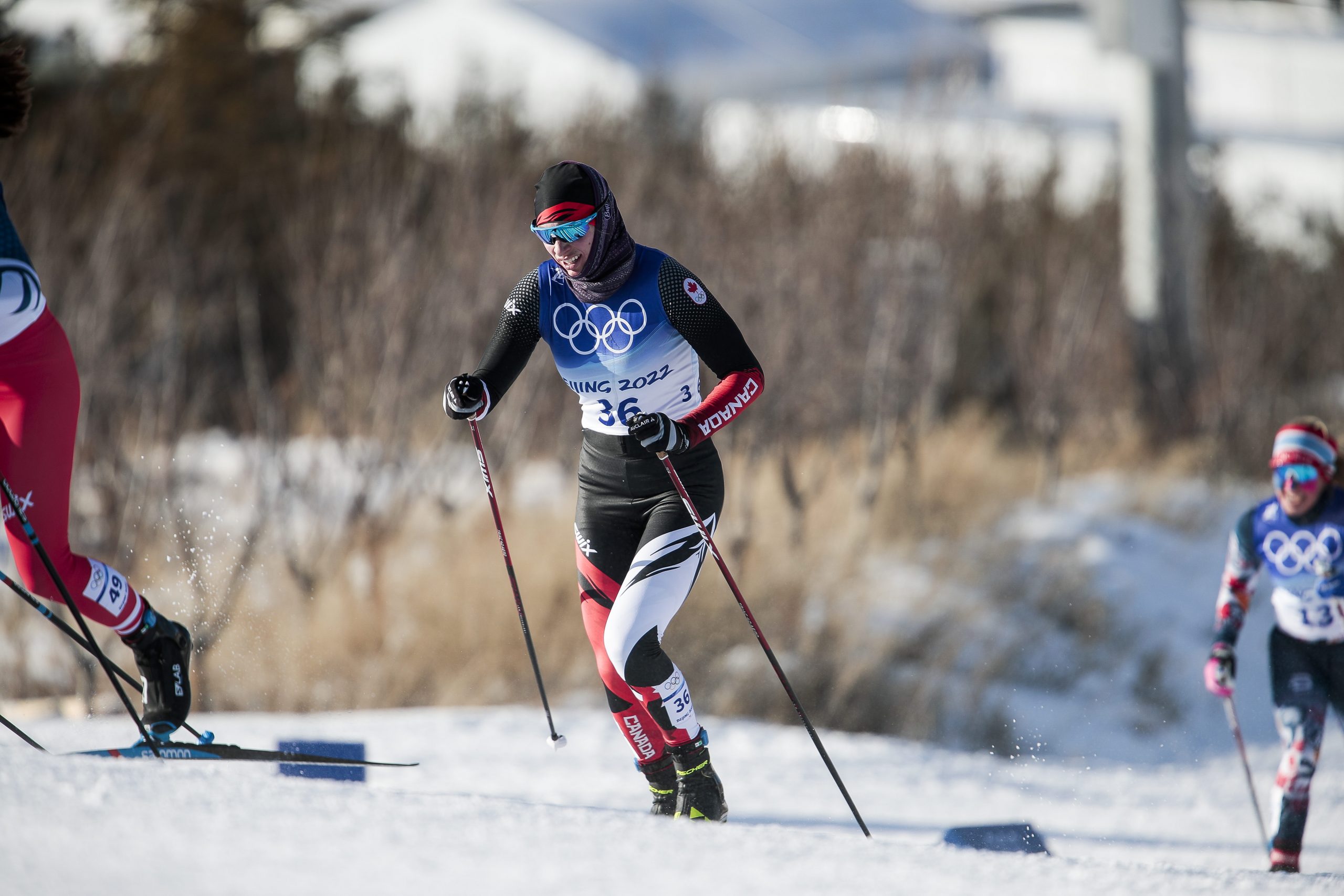
The Canadian women made a strong showing in the top thirty, led by Cendrine Browne in 20th (+3:44.4). Not far behind her was Kathrine Stewart-Jones, matching her bib number and finishing in 23rd (+4:03.6). In a dramatic finish – essentially a forward fall across the line – Dahria Beatty finished 28th (+4:38.8), putting three Canadians in the top thirty. Olivia Bouffard-Nesbitt was the fourth Canadian and finished 44th (+5:58).
Dahria Beatty (CAN) finished 28th in the 15 k skiathlon (Photo: NordicFocus)
Racing for Australia, APU’s Jessica Yeaton finished just outside the Top-30 in 31st (+4:40.3).
Australia’s Jessica Yeaton (bib 53) races to 31st in the women’s 15k skiathlon, which opened the 2022 Winter Olympics in Beijing. (Nat Herz/FasterSkier-ADN)
The men will race a 30 k skiathlon tomorrow, and the next women’s event will be the freestyle sprint on February 8th. You can find a detailed schedule for the Olympic cross-country events, including how to watch, here.
The most special of special guest on the podcast today, Kristin Størmer Steira. Størmer Steira, a retired Norwegian ski star, chats it up with Devon from Lillehammer, where the two are busy raising two young daughters.
In her own right, Størmer Steira was a Norwegian ski star. Back in 2005, Størmer Steira had a breakout in Oberstdorf at the World Champs where she placed third in the 2 x 7.5 k pursuit and won gold as a member of the 4 x 5 k Norwegian relay team. Along with accolades such as more World Champs and Olympic hardware, she’s known as a salt of the earth human being. As listeners of the podcast know, the medals are stashed in a humble wooden box somewhere above the garage.
Kristin Størmer Steira after taking bronze in the 30 k mass start at the 2014 Olympics. (Photo: FIS)
Along with Devon, Størmer Steira provides insight into the vagaries of racing in Oberstdorf and the highlights from today when Alexander Bolshunov won his first individual championship medal as he pulled away in the closing moments of the 30 k skiathlon, and Norway’s Therese Johaug steamrolled on the women’s side.
Thanks for listening to our championship coverage.
The men’s podium in Oberstdorf, Germany. Alexander Bolshunov (RUS) took the win in the 30 k skiathlon ahead of Norway’s Simen Hegstad Krüger and Sjur Røthe. (Photo: NordicFocus)
And the World Cup beat goes on. Nearly 70 men lined up in Oberstdorf, Germany for a 15/15-kilometer skiathlon, battling across techniques in front of a Bavarian Alp backdrop. The venue will be the home of the 2021 FIS Nordic World Ski Championships.
The 3.75 k course in Oberstdorf featured a variety of terrain, with the Burgstall hill climb bringing athletes to the high point of the course. To increase the pulse in the long race, four rounds of 15 World Cup bonus points were available at the 6.2, 9.9, 21.2, and 24.9 kilometer checkpoints in addition to those awarded to the top 30 athletes at the finish.
Russia’s Alexander Bolshunov looked to repeat his skiathlon victory in Lillehammer, preserving his position at the top of the distance standings and becoming the third athlete to win multiple skiathlon events in a season. Norway’s Martin Johnsrud Sundby did this in 2015/16 and Germany’s Tobias Angerer did so in 2005/06. Piggy backing on his back-to-back wins in Nové Město, a skiathlon win for Bolshunov would mark a third consecutive win.
And they’re off! Skiers take to the course in Oberstdorf for the 30 k skiathlon. Johannes Høsflot Klæbo (bib 3) dropped from the race during the classic leg. (Photo: NordicFocus)
Iivo Niskanen (center, bib 2) sets out to lead the classic leg of the 30 k skiathlon in Oberstdorf. (Photo: NordicFocus)
However, it was not the Russian that took the reins off the line. It was the Finns. In particular, Iivo Niskanen who has historically proven his capacity in distance classic events and more recently demonstrated his ability to skate with the best in the world. Niskanen led at nearly every checkpoint over the first 10 k, taking the maximum points at both 6.2 and 9.9 k.
Then things began to change. Bolshunov led at the exchange with a train of Norwegians on his heels. Sjur Røthe, Simen Hegstad Krüger, Hans Christer Holund, and Sundby, who had all taken a conservative approach to the classic leg, were now within 3.5 seconds of the Russian. Fading quickly from his position at the front, Niskanen sat nearly 30 seconds back in 9th.
A Norwegian power train in the 30 k skiathlon in Oberstdorf. (Photo: NordicFocus)
Up the hill and around the bend, Hans Christer Holund (NOR) leads Martin Johnsrud Sundby (NOR) and Andrey Larkov (RUS) during the 30 k skiathlon in Oberstdorf. (Photo: NordicFocus)
And so it was through the next wave of bonus points at 21.2 k. Røthe took the full 15, with Krüger, Bolshunov, Holund, Andrey Larkov (RUS), and Sundby close behind.
Rebounding from his large deficit, Niskanen had slashed his gap in half and was continuing to catch the lead pack. He rocketed his way back to the front by the 24.9 k checkpoint, collecting another 15 bonus points before being swallowed once more by the group.
Rebounding from a deficit, Iivo Niskanen closes the gap to the lead group in the 30 k skiathlon in Oberstdorf. (Photo: NordicFocus)
With just over a kilometer to go, the top seven men were separated by less than four seconds. The pack included the four Norwegians, two Russians, and Switzerland’s veteran Dario Cologna.
Taking the lead on a downhill and holding it on the final climb over a bridge just before the stadium, Bolshunov made his move. With Røthe and Krüger in hot pursuit, the 23-year-old Tour de Ski Champion powered down the final stretch to stop the clock at 1:13:40.6. Krüger took the next podium spot (+0.9), followed by Røthe in third (+1.2).
Alexander Bolshunov sprints for the win in the 15/15-kilometer skiathlon in Oberstdorf, Germany. (Photo: NordicFocus)
Bolshunov strikes again in the 2020 15/15-kilometer skiathlon in Oberstdorf, Germany. (Photo: NordicFocus)
“I’m very happy to win today on the course in Oberstdorf which will be used next year in the World Championship,” Bolshunov told FIS at the press conference through a translator. “The course became much more difficult and more interesting to compete on. For sure, we will see how it will be next year.”
When asked how he worked with the group that emerged at the front, Bolshunov responded, “It was [my] own race.”
“Cat and mouse.” Sjur Røthe (bib 4) chases Alexander Bolshunov’s yellow bib during the 30 k skiathlon in Oberstdorf. (Photo: NordicFocus)
“He really played a little [with us],” Røthe told NRK about Bolshunov’s tactics. “There were four mice against a cat out there.”
Just off the podium, Sundby took home the wooden medal with 4th place (+2.5). It is the 35-year-old’s best result of the season, though he has been unable to do much racing due to a back injury. In fact, Sundby’s last result came in early December in the skiathlon in Lillehammer, where he took 5th. Sundby has won three skiathlon events in his lengthy career, and holds the rare statistic of earning a spot on the podium in 12 seasons, the third-most of any World Cup athlete.
Martin Johnsrud Sundby (NOR) takes 4th in the 30 k skiathlon in Oberstdorf. (Photo: NordicFocus)
Johannes Høsflot Klæbo and Emil Iversen left us scratching our heads. After a poor start to the classic leg, both athletes dropped out. Klæbo’s DNF dropped him from third to fifth in the distance standings, though he remains in second place in the overall, trailing Bolshunov by 299 points.
“I do not know,” Klæbo told NRK, according to a translation. “It’s been a long time since I felt as bad as today. It was really just the whole day and nothing that felt particularly good. If I can’t fight for the top 30, then there is no point going around here.”
Iversen gave NRK a similar explanation.
David Norris skis to 28th in the 30 k skiathlon in Oberstdorf. (Photo: NordicFocus)
The sole American finisher David Norris landed inside the points in 28th (+2:01.0). The Fairbanks native hovered around this top-30 position throughout the race, reaching a peak placement of 20th place at the 9.9 k checkpoint.
“My plan going into the race was to use the classic leg to put myself into good position for the skate,” wrote Norris in an email. “You never know how your body will feel 15 or 20 km’s later so you have to risk it a little. I was happy with my classic skiing and I had moved up into a group on the last lap of the classic which was roughly positions 15 – 22. Unfortunately, over the top of a hill my klister iced up and I fell. That moved me back a few groups to about position 32. Overall my skis were very good, but the snow was variable and the tracks were breaking down.
“In the skate leg I intentionally kept a little in reserve during the first 10km trying to ensure I’d have some energy in the last 5km. I slowly worked up through some guys and felt really strong throughout the skate.”
Norris expressed that the techs did a great job selecting skis and choosing wax given the variable conditions in Oberstdorf. He added that he feels good about the performance and his sensations on course, though he has not felt this way leading up to the event.
“I feel fit. It has been odd that in training I don’t feel very good – tired and kind of flat, but I’m feeling pretty strong the past couple of races. In the skate leg I intentionally kept a little in reserve during the first 10km trying to ensure I’d have some energy in the last 5km. I slowly worked up through some guys and felt really strong throughout the skate.”
Ian Torchia on course during the 30 k skiathlon in Oberstdorf. (Photo: NordicFocus)
Ian Torchia also began the race but did not finish. He was one of seven men to drop from the race. An additional three were lapped and therefore pulled from the competition.
“I felt very bad out there today,” emailed Torchia. “I started flooding very early on while moving backwards in the pack. Very confusing as I felt better this week compared to Nové Město leading into the race. Hopefully a week in Seefeld and some consultation with my coach will put me on the right track.”
In a post-race call, Matt Whitcomb expressed pride in Norris’s grit and dedication to the process of becoming a World Cup contender. He also provided insight into both today’s event, including how Norris’s crash affected his position in reach of the top-20 and Torchia’s DNF.
Whitcomb also explained that Erik Bjornsen, who did not compete today, may return to the World Cup in Lahti after the FIS SkiTour 2020. In the meantime, Bjornsen has his eyes set on domestic distance classics, including the Boulder Mountain Tour and the American Birkie.
Post-race interview with Matt Whitcomb.
Recovering from a inopportune crash, David Norris fought to the point of wobbly legs in the last classic lap of the 30 k skiathlon in Obsertdorf. (Photo: NordicFocus)
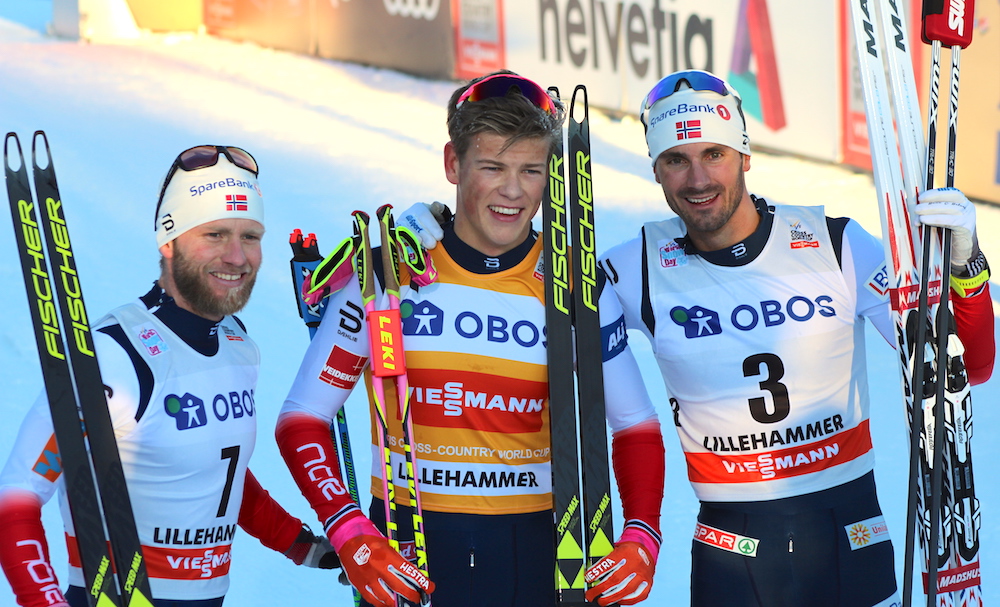
The all-Norwegian men’s 30 k skiathlon podium on Sunday in the 2017 World Cup in Lillehammer, Norway. Johannes Høsflot Klæbo (center) placed first, Martin Johnsrud Sundby (left) second, and Hans Christer Holund (right) third. (Photo: Henrik Hunnes)
Imagine for a moment that only months ago, at about 33 years old, you were in your prime — with World Cup globes on the mantle, six World Championship medals presumably in a drawer somewhere, and four Olympic medals (three of which are from the 2014 Games and will be awarded post-Sochi since the Russians that cheated have been scrubbed from the results sheet). And of course, there’s the iconic beard adorning the iconic Sundby — a technical master with a lung capacity like a blue whale.
But there’s the problem with the human condition of always wanting more. One more win, one more piece of hardware to reaffirm the legacy before the inevitable decay of Father Time.
On a sunny bluebird Sunday in Lillehammer, Norway, on the final buckling climb 28.65 kilometers into the men’s 30 k skiathlon, it looked like Norway’s Martin Johnsrud Sundby would satisfy his need to win. A need that’s been satiated since his first individual World Cup victory in Kuusamo, Finland, in 2008.
When Sundby made his move, he shattered a pack that included fellow Norwegians Hans Christer Holund and Simen Hegstad Krüger, France’s Maurice Manificat and Canadian Alex Harvey. And yes, the relatively new kid on the block from Norway, 21-year-old Johannes Høsflot Klæbo.
The Sundby move that historically would have been a kill-shot turned out to be a slight misfiring. Holund and Klæbo both looked mortal, but the bleed-out wasn’t terminal.
As Sundby glided down the rolling terrain towards the finish. It appeared to be another coronation.
But the roar from the crowds began rising as Klæbo worked the slight ups and the double-polable sections. With his skis running fast, Klæbo dropped Holund and reeled in Sundby by the finishing straight.
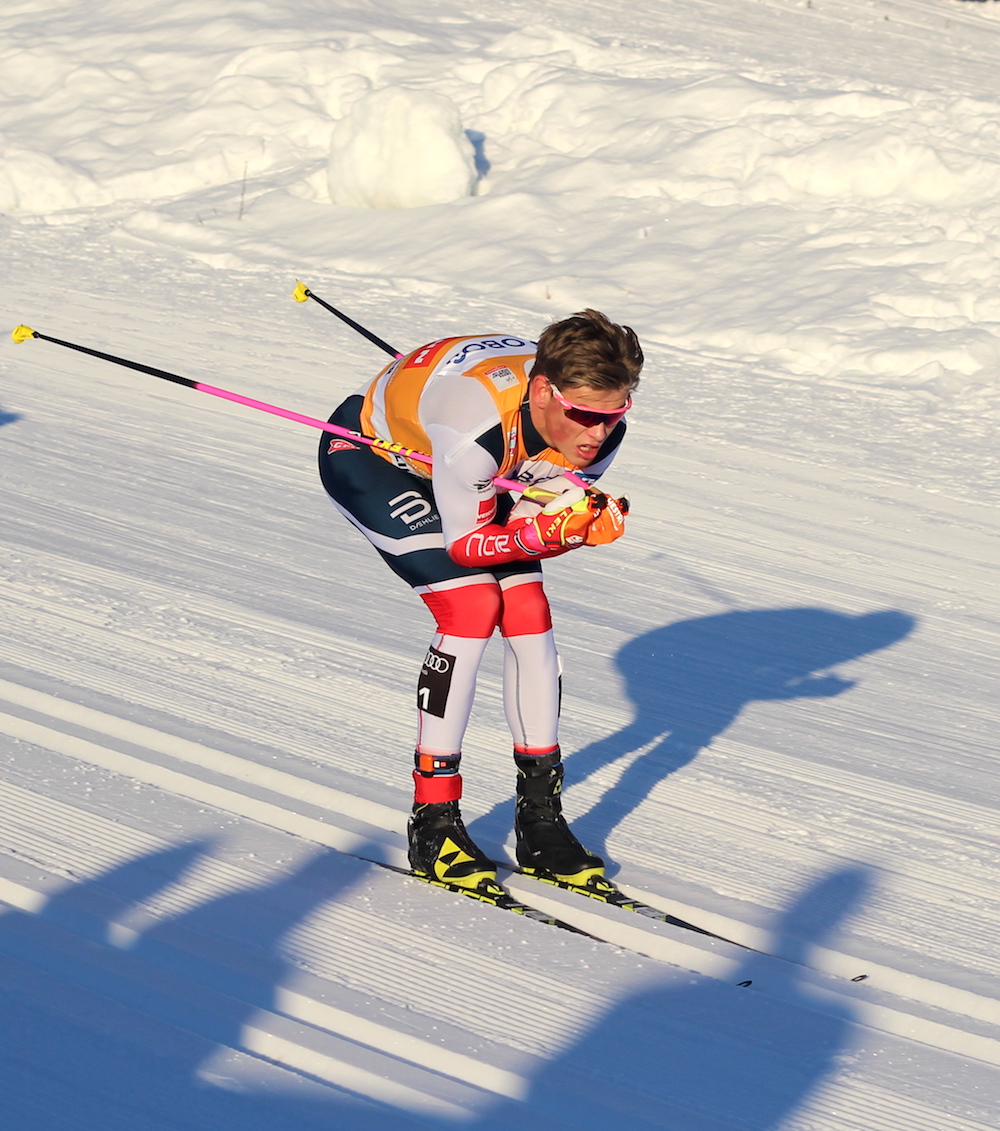
Norway’s Johannes Høsflot Klæbo on his way to winning the 2017 Lillehammer, Norway 30 k skiathlon. (Photo: Henrik Hunnes)
It was a Klæbo win as he claimed his fifth World Cup win this season in as many races. Sprint or distance, no doubt it is Klæbo-time.
The sport’s cliches could be in play. The older, once-dominant lion in Sundby licking his wounds. But these are humans after all. Winning ends for everybody, just not in such a public forum.
Amidst the Klæbo victory, this much was palpable: Sundby’s championship mantle has been usurped. During the concluding seconds of the skiathlon, Sundby saw his racing mortality sprint past with a hair-gelled coif and pink Oakleys.
Klæbo’s winning time was 1:16:47.1 hours.
Sundby placed second, 1.3 seconds back, and Holund third (+6.8). Krueger skied to fourth place (+10.9), Manificat fifth (+11.3), and Harvey sixth (+13.1).
Harvey was the best placed North American, proving once again his deserved reputation as one of the World Cup’s best. After five races, Harvey is ranked fifth in the overall World Cup standings.
“I am really happy — top 10 was the goal, so yeah, it’s really good to fight for the podium until the last three minutes of the race and it’s really good,” Harvey told FasterSkier in Lillehammer. “I felt good. Good skis. I was missing some at the last part of the long climb. The Norwegian guys were the best as expected.”
Harvey’s plan was simple. Tap into a huge training base, keep pace and mark the Norwegians on the skate leg.
“Kind of hide in the classic and then position myself well for the skate, just to be able to cover an attack that was going to come,” Harvey said of his tactics.
In the longest race of the season before February’s PyeongChang Olympics, it was an opportunity for Harvey to test his endurance, but also choose wisely when it came to skis.
“I went for easy kicking skis in classic and that was good,” Harvey said. “I saw Holund especially slipping a lot in the classic. I was just relaxing, and in skate, I wanted a ski that was feeling free on the climbs, because I know on the downhill you have such a big draft, it is not so much about the skis.”
The classic leg offered a more bunched-up group as the primary pacing surges transpired amongst the leaders. That changed quickly after the classic to skate exchange.
France’s Maurice Manificat (4) making a push at the start of the skate leg during Sunday’s 30 k skiathlon in Lillehammer, Norway, while Canada’s Alex Harvey (l) and Norway’s Hans Christer Holund (c) chase. (Photo: Henrik Hunnes)
“Then the skate, right away on the first lap, Holund and [Sundby] went to the front and they tried to make the first selection,” Harvey said of the first pacing challenge. “I think for the first or second lap of skating it was down to six guys. Then Manificat was pushing super hard on the long uphill. But then we kind of started chilling a bit at the end of the third lap.”
The perceived “chill” pace was simply a momentary lull. Sundby is never one to wait for a sprint finish to decide a distance effort.
“From then we went hard again on the last lap,” Harvey said of the turn of pace on the fourth and final skate lap. “Just steady pace from the stadium just fighting for position. We knew it would happen on the big back hill. So it was just about the best position. I entered there in second place behind Klæbo. So really that is hard to be better than that for starting the last hill. And then it was just man on man.”
We know how this race ended. But Harvey’s summation of the final chapters of this skiathlon was keen.
“Sundby was the strongest, but Klæbo was the most clever,” Harvey said of his old and new rivals.
A gassed Johannes Høsflot Klæbo (yellow bib) holding off fellow Norwegian Martin Johnsrud Sundby (r) for the win on Sunday in the men’s 30 k skiathlon at the Lillehammer World Cup in Norway, while Norway’s third man, Hans Christer Holund (3) races to third. (Photo: Henrik Hunnes)
Harvey also reflected that, in terms of results and physical sensations, he is exactly where he’d like to be. Sustainable high output efforts are doable; it’s the 1 percent of the top high speed gear he’s waiting to access.
“Just the punch — I cannot dig super deep yet,” Harvey said. “It’s like that for me before Christmas. It is not unexpected. I think the base is better than in the past, so I can rely on that. So when it is time to really go, I am not there yet, but that is the training, the training is meant for that, too.”
Canada’s Devon Kershaw finished 19th (+2:59.7), just ahead of the U.S. Ski Team’s (USST) Erik Bjornsen in 20th (+2:59.9)y. Although finishing a place apart, their race tales only merged after the transition to the skate leg.
Kershaw must have felt good on the initial classic leg. Six kilometers into his kick-and-stride effort on what was described a quintessentially beautiful hard wax day, Kershaw was positioned 15th in large scrum of skiers, only 4.5 seconds off the lead. The Canadian World Cup vet then played more cat than mouse.
He skied well towards the front by 11 k moving into fifth. At 11.1 k he bolted ahead and won the bonus points. From that point on, Kershaw faded a bit and came through the technique-exchange zone in 18th and 36.2 seconds out of first; his first 15 k were done in a total of 39:58.5 minutes.
Bjornsen’s race took on a different tone early on. He skied conservatively in a technique in which he’s known to thrive. Bjornsen’s classic leg took him 40:28, and he came through the exchange in 23rd, 1:05.7 behind the leaders.
Bjornsen proved on Sunday his race tactics have matured as he’s rounded into a constant World Cup points threat this young season.
“The skiathlon here two years ago, I was feeling great and I charged into the top 10 on the classic and just paid for it on the skate leg,” Bjornsen told FasterSkier in Lillehammer after the race. “So today I tried to be a little smarter.”
Two years ago at the Lillehammer skiathlon, Bjornsen’s early efforts cost him places. He faded from what looked liked a top-20 effort to a sufferfest in the skate portion. After the skate leg, Bjornsen placed 42nd overall, over five minutes back from Sundby, that day’s winner.
Bjornsen’s strategy paid off on Sunday. In a post-race phone call, he explained that at one point on the classic leg, he had the leaders in sight.
“There were times in the second and third lap where the leaders were right there,” Bjornsen said. “But I think it would have been costly to close the 50-meter gap they had. … I think it’s just growing up in the U.S., I didn’t race a lot of 30 k’s. I have had more chances in the last few years over here to see what that race feels like. The 30 k, you can’t make those short sprints to gap up or you pay for it in the end.”
Erik Bjornsen (48) of the USST placed 20th and Noah Hoffman (49, red hat) placed 28th on Sunday’s World Cup 30 k skiathlon in Lillehammer, Norway. (Photo: Henrik Hunnes)
Although his relative position after the exchange did not change considerably, Bjornsen did draw skiers back towards him with his skate effort.
“I think I gained about five spots on the skate leg,” Bjornsen said. “Most of those guys were moving backward. I don’t think we were making any moves towards those front guys, but I was with a good group [including Kershaw]. I could see a pack of ten guys behind us, so my group was motivated to keep charging as well. It was a good plan for me.”
Bjornsen’s 20th place was a career best in a World Cup skiathlon: he placed 27th in the 2016 World Cup skiathlon in Lahti, Finland. Sunday’s result is also Bjornsen’s best in a World Cup race longer than 15 k.
Bjornsen’s former USST teammate, Noah Hoffman was in the points for the first time this season. Hoffman placed 28th after starting in bib 49. Like Bjornsen, he moved up in the standings as the race progressed.
Hoffman finished the classic portion of the race in 41:17.7 minutes and was ranked in 40th place. Kilometer by kilometer, he picked off places. He was 34th at the 19.55 k mark, and in the closing moments had locked into 28th, finishing 3:37.8 behind Klæbo.
Finishing 46.4 seconds outside of the points on Sunday was Scott Patterson of the USST in 36th (+4:56.1).
“Prior to the race, I was quite looking forward to this event,” Patterson emailed. “However, the Norwegian courses and the extra competition of the Norwegian nations group are never things to take too lightly.”
The newly minted USST member has skied against the Norwegian juggernaut before. In last season’s Holmenkollen 50 k classic in March, Patterson placed 28th for the best American result that day. Yet this is Patterson’s first full season on the World Cup and his first time racing World Cups before late January. (Patterson’s first World Cup race was two seasons ago.)
Undaunted, Patterson did keep a top-30 spot as his goal. He began the day in bib 39.
“My approach was to try and move up from my starting position through the classic but also really focus on conserving energy,” Patterson wrote. “I know my skating is a bit more on form currently. From the start things were not going my way. Early on I decided to defend my place in track rather than running up the side. This put me in almost last 500m into the race. For the first two laps I gradually made up some ground but was struggling to ski fast and relax the whole time. I found a little more form for the 3rd and 4th lap, but by that time I had lost a lot of ground.
“The skate leg was better, but I took things a little conservative early,” he continued. “While I was moving up, I was not able to close the gaps to get a good group to work with. Thus most of the skate was trying to catch a few small groups and move through them. Most of the time I felt that I was working on my own. I think I salvaged an ok race from a pretty rough start, but again this one is leaving me wanting more. While I was close again, I still am running with 0 world cup points.”
“It was really cool to start 19th today,” Caldwell reflected in an email. “I didn’t put the early bib to great use but it was a good learning experience and great practice skiing in a big, aggressive pack.”
As the USST’s youngest male World Cup skier gains valuable starts on what is projected as a long World Cup career, Caldwell, 23, did have a moment to reflect in the learning takeaways from the day.
“Mass start races are always fun and a good chance to learn from other skiers,” Caldwell wrote. “I was really impressed with how relaxed the top guys skied on the big climbs. Everyone is hammering but the best guys are so on it technically, really cool to see.”
Canada had three finishers outside the points: Russell Kennedy in 53rd (+7:30.7), Graeme Killick 54th (+6:41.3), and Knute Johnsgaard 60th (+9:49.0).
Racing continues next Saturday in Davos, Switzerland, with a freestyle sprint and a 10/15 k interval start skate race on Sunday.
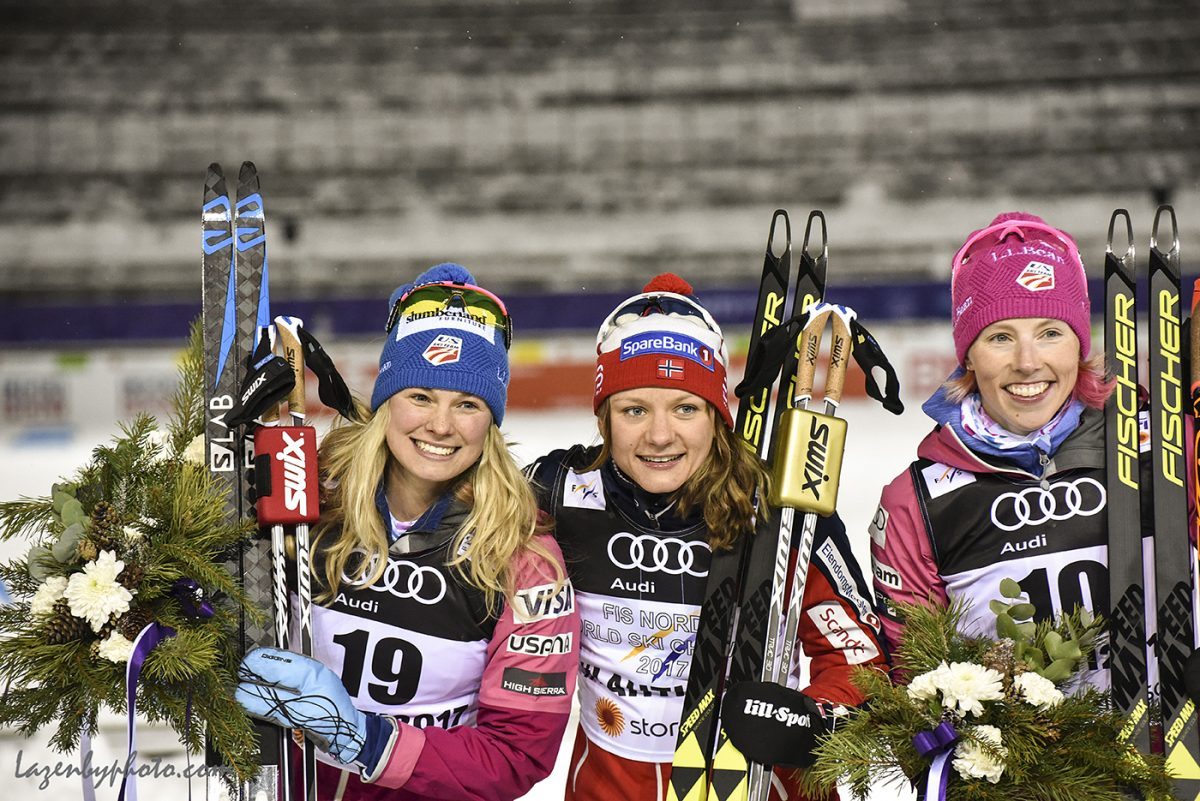
An American sandwich: U.S. Ski Team members Jessie Diggins (l) and Kikkan Randall (r) sharing the podium with Norway’s Maiken Caspersen Falla (c) after Falla won the women’s freestyle sprint at 2017 Nordic World Championships on Thursday in Lahti, Finland. Diggins placed second and Randall was third. Diggins and Randall are now tied for the most World Championships medals with three apiece. (Photo: John Lazenby/Lazenbyphoto.com)
LAHTI, Finland — Three: that’s the magic number. On a historic night in Lahti on Thursday, three of the four U.S. women entered in the 2017 Nordic World Championships 1.4-kilometer freestyle sprint advanced from their quarterfinals to the semifinals and eventually, the final.
Toeing the start line for the American triad was the U.S. Ski Team’s (USST) Kikkan Randall, Jessie Diggins and Sophie Caldwell. Filling the final three spots were two Swedes — Hannah Falk and Ida Ingemarsdotter — as well as Norway’s Maiken Caspersen Falla.
Not making the cut was the week’s sprint favorite, Stina Nilsson. The young Swedish superstar had crashed while cornering the final turn in her semifinal, taking out Russia’s Natalia Matveeva and earning herself a yellow card and relegation to last in the heat. Randall and Caldwell, who were both in Nilsson’s semi, maneuvered around the spill to advance in second and third, respectively.
With no Nilsson, Sweden put its faith in Ingemarsdotter and Falk, while the U.S. comprised half of the field in the women’s final.
“That’s for sure the funnest final I have ever been a part of,” Randall said during a post-race press conference. “Before we went to the start we did a little team cheer … we had such good energy between the three of us.”
Norway’s Maiken Caspersen Falla (1) leading Sweden’s Hanna Falk (r) and Stina Nilsson (l) and American Kikkan Randall (10) during the first semifinal of the women’s 1.4 k freestyle sprint at 2017 Nordic World Championships in Lahti, Finland. Falla went on to win the final for the first gold medal of the championships and Randall placed third overall. (Photo: Fischer/NordicFocus)
Feeding off each other’s energy as they started the race, the Americans remained grouped together through the first climb toward the back of the pack. Meanwhile, Falla found herself skiing in the front by the time the finalists crested the top of the first hill.
“That’s my favorite tactic I am always using. If I am doubting or don’t know what to do, I take the lead and hope for the best,” Falla said during the press conference.
The Norwegian kept it that way for the remainder race, distancing herself by close to 10 meters by the top of the second climb. With one final descent to go, she had tightened her hold on the World Championships freestyle sprint title.
Leading the charge from behind was Ingemarsdotter. Diggins pressed closely behind to the Swede’s right, Randall to the left. Breathing down their necks were Caldwell and Falk.
By the bottom of the descent, Diggins had moved around the Swedish skier. Randall continued press from behind, but so, too, did Falk.
Norway’s Maiken Caspersen Falla celebrates her gold medal in Thursday’s freestyle sprint ahead of Americans Jessie Diggins (19) and Kikkan Randall (r), who placed second and third, respectively, at 2017 Nordic World Championships in Lahti, Finland. The third U.S. woman in the final, Sophie Caldwell (second from r) finished sixth. (Photo: Fischer/NordicFocus)
In the final 100 meters, Falla staved off any attempts from Diggins, crossing first in a time of 3:02.34 minutes for the gold medal. Just 1.66 seconds back, Diggins claimed silver — her third World Championships medal and second individual silver.
Though she placed second in last year’s Lahti World Cup freestyle sprint, Diggins admitted that the 2017 event was not where she had planned to put her focus for the week.
“I was … targeting some other races this week,” the 25-year-old Diggins said during the press conference, noting that she has been feeling strong this year on the World Cup. She’s already won two individual races this season and placed second in the skiathlon Obsterdorf, Germany. At the start of Thursday’s sprint, she recalled thinking, ” ‘Why not? This could be my day.’ ”
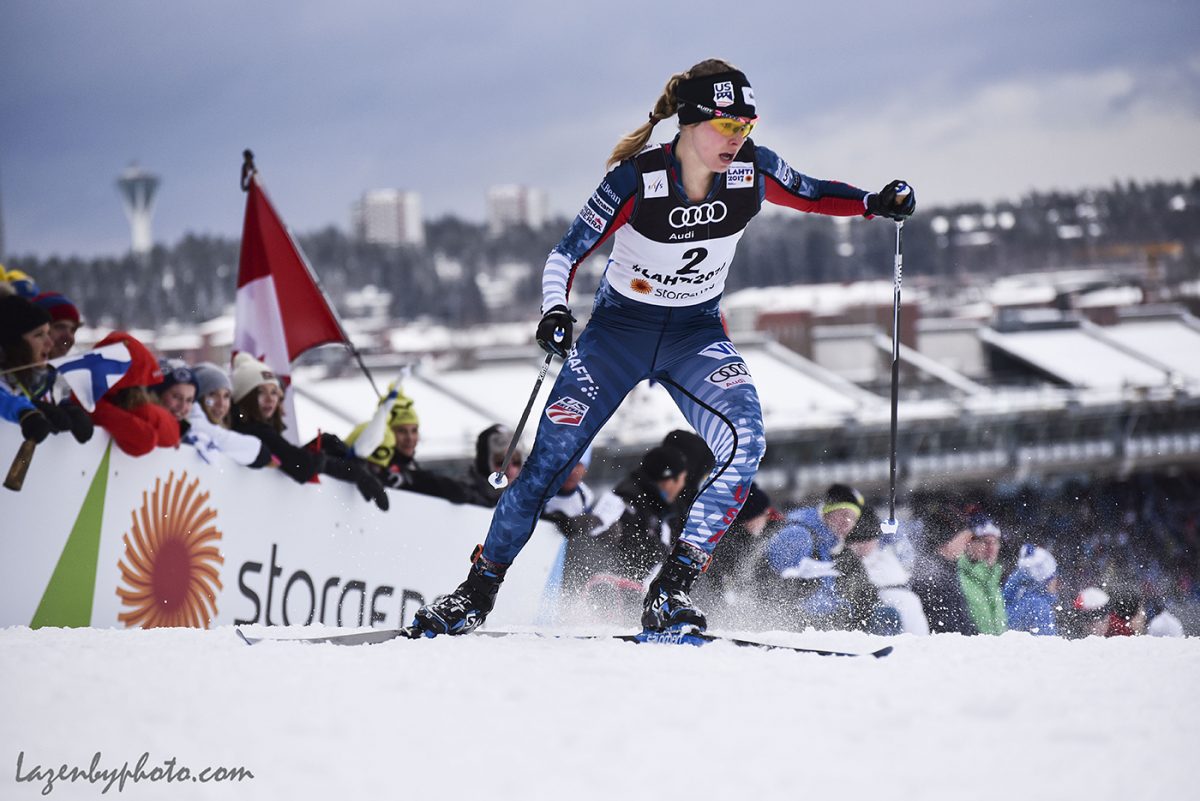
Jessie Diggins (U.S. Ski team) during qualification on Thursday in the 1.4 k freestyle sprint at the Lahti World Championships. She qualified in 19th and went on to finished second overall for her second-career individual World Championships silver medal. (Photo: John Lazenby/Lazenbyphoto.com)
The Minnesota native proved it was, with her second-place finish tying her for the most champs medals won by a U.S. woman. The other woman to have three? After capturing third place (+3.76) on Thursday, that would be Randall.
The U.S. Ski Team veteran and three-time Sprint World Cup winner, now has two individual World Championships medals, as well: a bronze on Thursday, a silver from the 2009 sprint in Liberec, and her 2013 freestyle team-sprint gold, which she earned with Diggins in Val di Fiemme, Italy.
“It was a slow start to the season, and it took a lot of patience,” Randall said of some of her earlier-season performances and whether those had her worried as she entered World Championships. “But the shape was building and building, and I hoped to find the best shape here, and it worked!”
This year’s world medal, however, is a bit different for the 34-year-old Alaskan. It’s one she’s won as a mom.
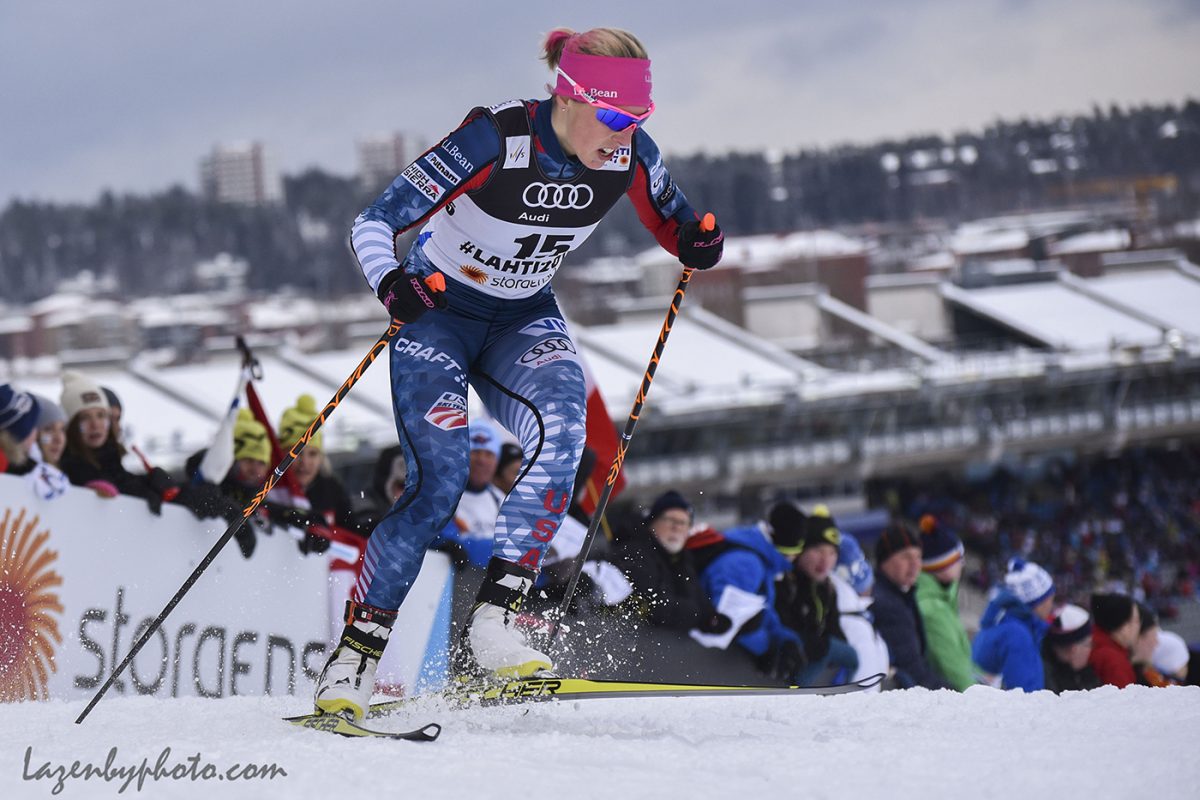
The U.S. Ski Team’s Kikkan Randall lays it down during the women’s 1.4 k freestyle sprint qualifier on Thursday at Nordic World Championships in Lahti, Finland, where she qualified 10th and went on to claim bronze in the final. (Photo: John Lazenby/Lazenbyphoto.com)
“I think it’s very encouraging to know that it’s only been 10 months [since I had a baby], and I have been able to come back to top form,” Randall said. “I was able to train well through my pregnancy, and come back to training pretty soon after the birth. So it’s great to see everything come together here.”
Sweden was shut out of the medals; Falk placed fourth (+3.91) and Ingemarsdotter finished fifth (+4.42).
Caldwell once again performed on the big stage. In front of a packed Lahti Ski Stadium and a global television audience, the 26-year-old Vermonter appeared unfazed. In fact she’s been in this spot before — she placed sixth at the 2014 Sochi Olympics in the skate sprint. Déjà vu all over again? Not exactly. But in Sochi, the sprint final did feature two athletes Caldwell faced in Lahti: Falla and Ingemarsdotter. And if familiarity breeds comfort, racing against teammates Diggins and Randall positioned her against known athletes, a book she’s read hundreds of times either in practice or in competition.
Caldwell, teammates with Diggins at the Stratton Mountain School in Vermont, qualified 13th. And her first pass through the media zone after placing second in her quarterfinal was the look of hyper-focus.
By the time she moved onto the final as a lucky loser — after deftly angling around Nilsson and Matveeva — a grin broke through.
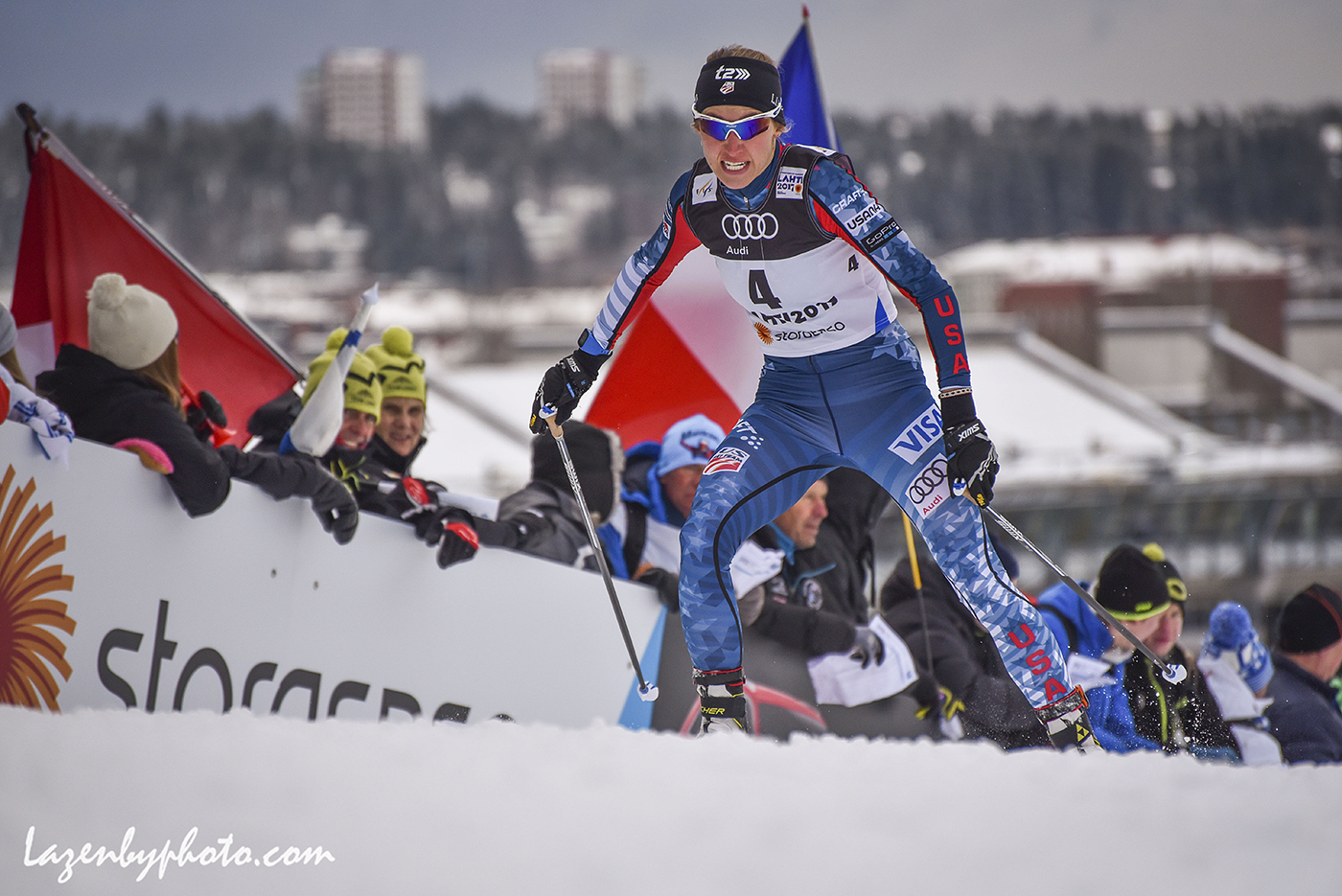
Sophie Caldwell (U.S. Ski Team) racing to 13th in the women’s freestyle sprint qualifier on Thursday at 2017 Nordic World Championships in Lahti, Finland. She went on to reach the final, where she placed sixth to tie her career best at a world championship (actually an Olympics, after placing sixth in the skate sprint in Sochi). (Photo: John Lazenby/Lazenbyphoto.com)
Caldwell placed sixth in the final, 5.37 seconds in back of Falla after qualifying 13th, for her best result in her third World Championships.
“Today was an incredible day for the team. I don’t know if we ever had three people in the final,” Caldwell said. “And to have Jessie and Kikkan on the podium is amazing.”
Caldwell acknowledged the personal significance of the evening’s sprint. “It was a great day for me, this is the first final I made this year,” she said. “And I had strong feelings throughout the day. I feel like I felt better as the day went on, with the exception of the final where my legs got a little tired.”
Of the four U.S. women that started Thursday’s sprint, all four qualified for the heats. Ida Sargent made the top 30 in 27th, behind her teammates Randall (10th), Caldwell (13th), and Diggins (19th). Sargent went on to finish fifth in her quarterfinal (4.6 seconds behind Matveeva, who won that heat) for 24th overall.
“I am just really proud of the athletes,” U.S. Ski Team Head Coach Chris Grover said. “All of the athletes that were competing today, all of the athletes on the U.S. program that were not competing today that were cheering from in front of the television this evening. … I am really proud of the team that we have collected here, in terms of the service team, and coaching team, medical and support team … and everyobdy that is surrounding that for USA.”
Kikkan Randall (l) and Jessie Diggins celebrate their bronze and silver medals, respectively, in the women’s individual freestyle sprint on Thursday, the first day of 2017 Nordic World Championships in Lahti, Finland. (Photo: John Lazenby/Lazenbyphoto.com)
“For us this was definitely a target event,” he explained.
In five consecutive visits to Lahti, the U.S. has reached the podium in every World Cup skate sprint. Andy Newell started the trend back in 2008, but Randall got the ball rolling for the women’s program in 2013 and 2014, winning the skate sprint there both years. Also in 2014, Caldwell reached the podium for the first time in third place. In 2015, Randall scored another Lahti podium in third (while Diggins was just off it in fourth), and last season, Diggins placed second.
So you can say freestyle sprint, especially in Lahti, have been the U.S. team’s jam for some time.
“It’s been a great race historically for us,” Grover said. “When we looked ahead at what our best medal-potential races were for the championships, obviously skate sprints have been one of the best events for us for years in general, but in particular for these championships, we really targeted this day.”
Canada entered three women, all members of its U25 Team, with Dahria Beatty placing 37th and missing the top 30 necessary to qualify for the heats by 3.67 seconds. Cendrine Browne finished 48th (+20.42) and Katherine Stewart-Jones 58th (+26.29) out of 107 women in the qualifier.
— Harald Zimmer, Chelsea Little, and Alex Kochon contributed
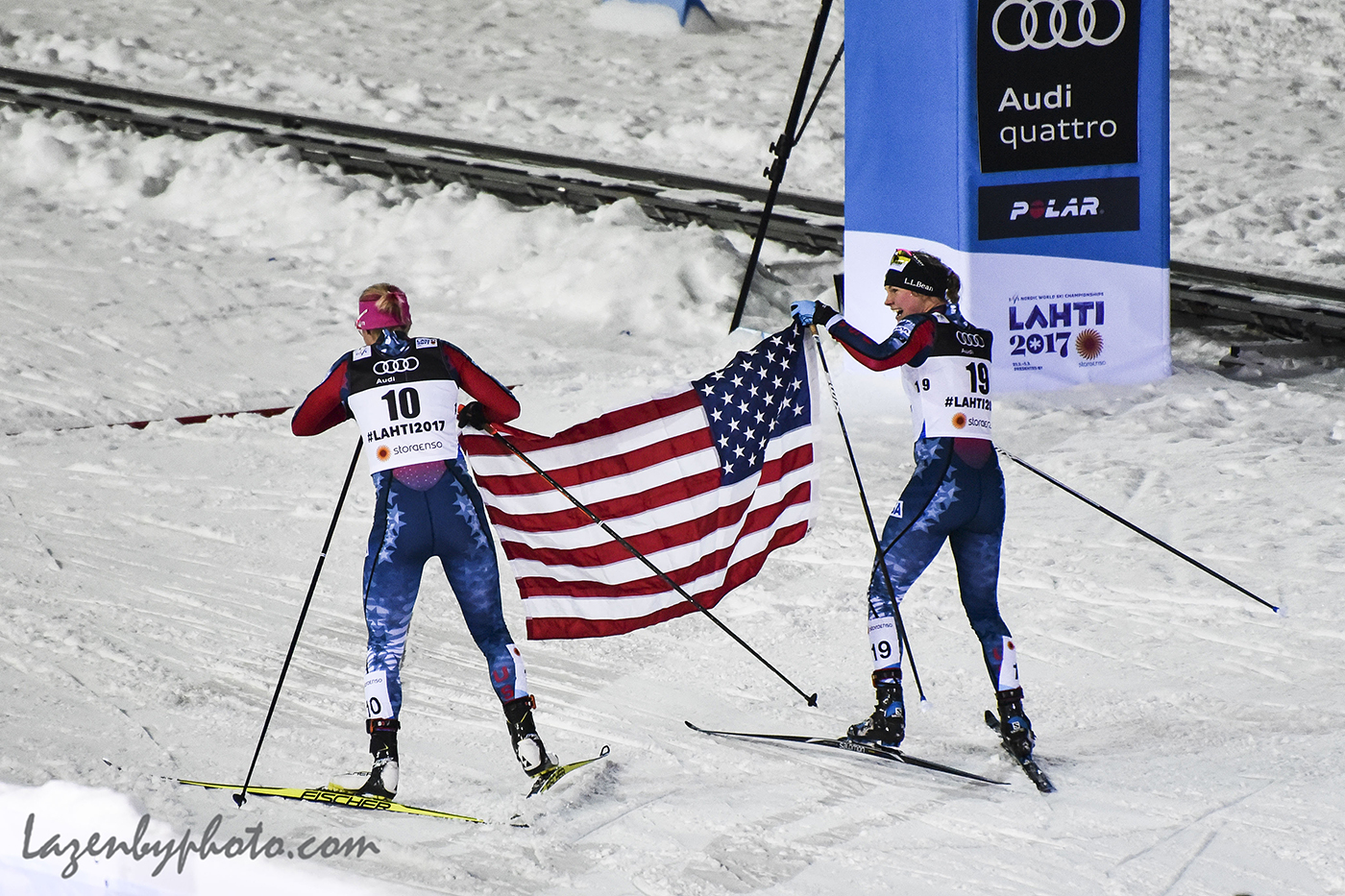
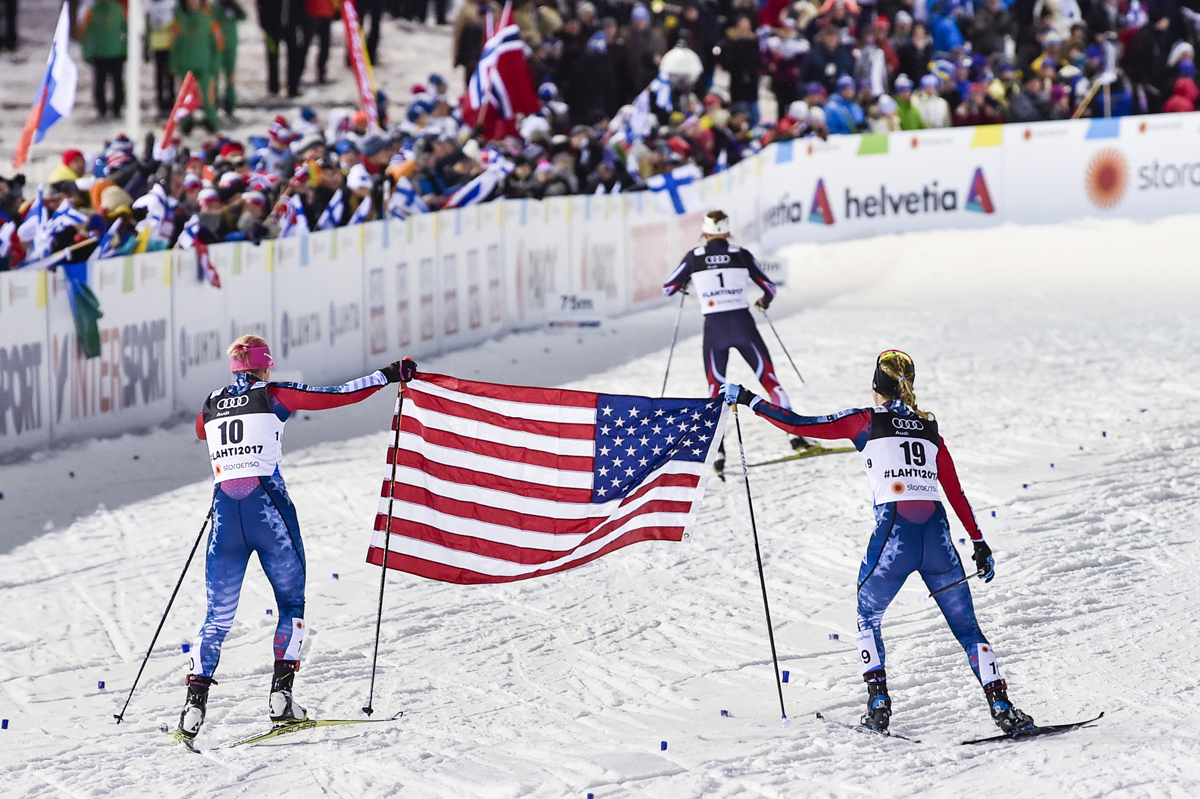
Kikkan Randall (l) and Jessie Diggins (r) hold the American flag during a victory ski down the finishing lanes to celebrate their bronze and silver medals, respectively, in the women’s individual freestyle sprint on Thursday, the first day of 2017 Nordic World Championships in Lahti, Finland. Ahead of them, Norway’s Maiken Caspersen Falla celebrates gold. (Photo: Fischer/NordicFocus)
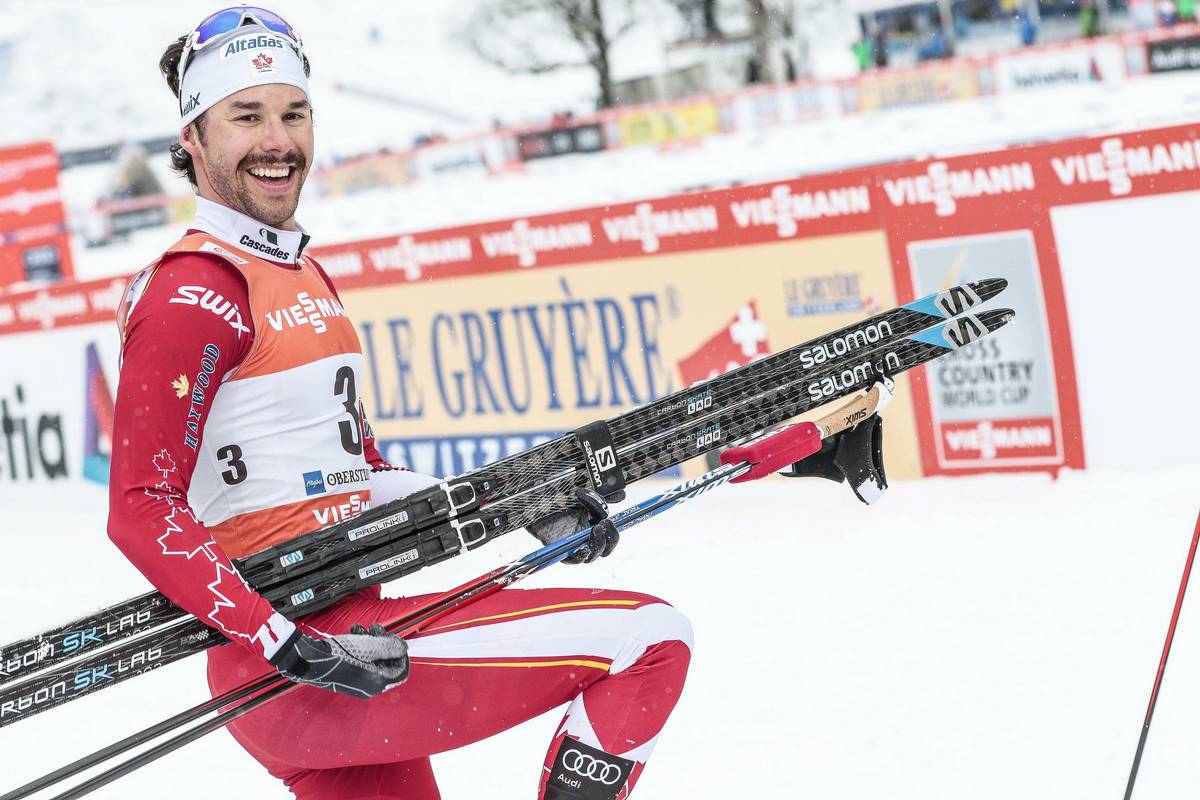
Canada’s Alex Harvey in his well-known guitar stance to celebrate third in the men’s 15 k freestyle pursuit on Wednesday at Stage 4 of the Tour de Ski in Oberstdorf, Germany. (Photo: Salomon/NordicFocus)
Canada’s Alex Harvey is still on the podium.
Then there’s the U.S. women’s team, with athletes in fifth, 10th and 12th in the Tour de Ski standings after big-time performances in Oberstdorf, Germany.
Harvey kept himself in third overall and ahead of Switzerland’s Dario Cologna with a strong pursuit finish on Wednesday, and Jessie Diggins led her U.S. teammates on consecutive days, notching second on Tuesday for a career-best skiathlon result and holding onto fifth overall in the pursuit. Not far behind her, Sadie Bjornsen captured a career-best World Cup result of fifth on Tuesday, and Kikkan Randall skied into the top 10 on Wednesday. Also for the U.S., Liz Stephen clocked the seventh-fastest 10 k time in the pursuit.
Here are some of the comments and photos that didn’t make it into our race reports:
On the strategies for Jessie Diggins and Sadie Bjornsen: “The plan is flexible in the Tour. You never know what type of body is going to show up for you on any given day. We try and be a little bit flexible and try and respond to the cards that you are dealt that day. If you do feel good, try and control things a little bit, stay up near the front third of the pack that you are in, that will decrease the amount of turbulence and crashes and what not. That’s exactly what Sadie and Jessie were able to do today. It worked out fantastically.”
On Liz Stephen: “Pretty strong classic performance out of her today. At the top of the first climb on the last classic lap, she was only 19 seconds out of the lead and just in contact with the main pack, so we expected pretty big things.” (but then skis were bad, as covered in piece.
On slow skis: “It’s tough. We don’t often focus on it too much, but when an athlete or two are skiing really well, I think it’s important for them to be able to put some of the responsibility on the skis. It’s not always the athlete. A bit ironic today, as we felt we had some of the fastest skis in the race as well. There’s a lot that goes into making good skis… I think every brand of skis have their strengths, you know have their conditions that they’re great in. Some brands have some conditions that they can struggle in, a bit more than others. Sometimes, with this new snow, which we have a little bit of trouble with occasionally, not specific to any one. While it is a cold, fresh snow kind of day, it doesn’t mean it is going to be particularly straightforward on the glide.”
On starting alone in a pursuit: “That’s something to consider, but in a tour like this for the women, it’s also important to remember that a lot of people will be released from the gate alone. It’s not like everybody’s in a pack except for her. It will be a pretty fair race tomorrow.”
Sadie Bjornsen, U.S. Ski Team:
On last weekend: “Val Müstair was a little interesting. I definitely wasn’t stoked about my sprint and then I had quite the blowup in the classic race. It definitely was challenging mentally, but I felt pretty confident in how I felt in my qualifier, the very first day, so I knew I couldn’t be in a disaster zone, I just forgot that I was at altitude in that 5 k race, and I did things a little bit wrong there.”
On the pace in the skiathlon: “It’s hard to tell because the people in the very front look like they’re working hard, because I think they’re breaking the wind, and then there’s that draft effect for the middle section, and then you go a little bit farther back and then it becomes like they are working hard again, because it’s that constant traffic jam, it’s like, stop-go, stop-go, stop-go. I actually watched the race this afternoon, because they were showing it on TV, and that’s interesting, like it looks like it is a different pace than normal.”
On her own pace in the skiathlon: “I felt like I was working hard at the beginning of that classic section simply because I was having to go through this accordion effect. But the times when I was conserving energy, I was certainly conserving, but it would be like conserve to sprint. That’s like a challenge of it’s own. I think that’s part of mass-start racing with not much snow anymore, you kind of deal with a little bit of that.”
On lack of a breakaway: “I don’t really know if it was windy, I didn’t notice. I think it was just that maybe the type of snow, that it just seemed [windy]. All those downhills had flat sections afterwards, that may have a been a part of it, too. It was almost like there was more flat than normal in this course, because there’s that middle section that’s very flat. Most World Cup courses, you’re either going up or down, I think that’s what made a draft.”
On the final climb: “It’s hard for me to remember, actually, what happened. I felt really strong going up that climb until maybe the last 20 meters of it, I was like, ‘Oh man, I hope I’m gonna make it over the top of this, ‘cause I’m red-lining.’ That’s certainly where I looked up and saw that those front four girls had gapped, and it was simply a difference right there.”
On leading a group to the finish: “I was definitely stressed about being in the front of that pack, because I knew that there was a draft on the bottom. And I don’t know what happened, I tried to take that last downhill really well, and I had no idea what was going on behind me. I knew it was not ideal, but I was just going to go for it.”
Jessie Diggins, U.S. Ski Team:
On energy conservation with fast skis: “I had great skis, and then our techs did a great job. And then on top of that, downhills are my thing. So it was great because it was a really hard course to move around a lot, and change position. So if I just let myself just tuck the final parts of the downhill, like glide and draft and find myself able to kind of make some moves out there, or just chill out a little bit. So that was really cool.”
On lack of a breakaway: “I actually don’t think anyone was really seriously trying to make any breaks, and I don’t know, that’s just my opinion, from where I was sitting, but it seemed like a different sort of race out there.”
On uphills in traffic: “That will happen, you kind of have to keep your head on a swivel. There were times I felt like I was doing a little hopscotch thing, trying to not step on anyone’s poles, and very carefully, I’m going to put my ski here, and, ‘Oh well.’ ”
On mixed new and manmade snow: “There were a couple sections where over the top of the hill, if it was powdery, if it had been raked or something, you might kind of get a little ‘ooh’, kind of tripping. I thought the downhills were skiing really well; they’re just fast, with some turns at the bottom. The one where the men crashed, everyone was skidding it, it was one of those corners, that maybe if you were by yourself, you could maybe just step it, but like in a group you need to skid it, and sometimes you don’t have room. Yeah, it’s always harder to ski in a group.”
On her energy level in the Tour de Ski: “In general, tours are good for me, because I tend to get stronger as I go. And I really like the big grind of it, and because I can stay really positive, I think that’s a strength of mine. It’s not like you can smile away the tired feelings, but you kinda can [laughs]. I’m looking forward to it, so far it has felt really good.”
Sweden’s Stina Nilsson (r) and American Jessie Diggins (l) lead Norway’s Maiken Caspersen Falla (second from l) and Heidi Weng (second from r) down the finishing stretch of the women’s 10 k skiathlon on Tuesday at Stage 3 of the Tour de Ski in Oberstdorf, Germany. (Photo: Salomon/NordicFocus)
Sweden’s Stina Nilsson celebrates her first World Cup distance win in the women’s 10 k skiathlon on Tuesday at Stage 3 of the Tour de Ski, just ahead of American Jessie Diggins (l) in second. (Photo: Salomon/NordicFocus)
Jessie Diggins (U.S. Ski Team) celebrating second, her career best in a skiathlon, at Stage 3 of the Tour de Ski in Oberstdorf, Germany. (Photo: Salomon/NordicFocus)
The women’s 10 k skiathlon podium at Stage 3 of the Tour de Ski in Oberstdorf, Germany, with Sweden’s Stina Nilsson (c) in first, American Jessie Diggins (l) in second, and Norway’s Heidi Weng (r) in third. (Photo: Salomon/NordicFocus)
Jessie Diggins (U.S. Ski Team) loving on her Salomon boards after placing second in Tuesday’s 10 k skiathlon at Stage 3 of the Tour de Ski in Oberstdorf, Germany. (Photo: Salomon/NordicFocus)
Russia’s Sergey Ustiugov (in blue) leading the men’s 20 k skiathlon with Norway’s Martin Johnsrud Sundby (l) and Canada’s Alex Harvey (r). (Photo: Salomon/NordicFocus)
Canada’s Alex Harvey (3) alongside Russia’s Sergey Ustiugov (l) and Norway’s Emil Iversen during the men’s 20 k skiathlon at Stage 3 of the Tour de Ski in Oberstdorf, Germany. (Photo: Fischer/NordicFocus)
Norway’s Martin Johnsrud Sundby leads Switzerland’s Dario Cologna, Sweden’s Marcus Hellner, and Russia’s Sergey Ustiugov, respectively, during the men’s 20 k skiathlon on Tuesday at Stage 3 of the Tour de Ski in Oberstdorf, Germany. (Photo: Fischer/NordicFocus)
Norway’s Martin Johnsrud Sundby (2) racing at the front of the men’s 20 k skiathlon on Tuesday, with Canada’s Alex Harvey (3) among those chasing in Stage 3 of the Tour de Ski in Oberstdorf, Germany. (Photo: Fischer/NordicFocus)
Canada’s Alex Harvey racing to fourth in the men’s 20 k skiathlon on Tuesday for third overall in the Tour de Ski through Stage 3 in Oberstdorf, Germany. (Photo: Salomon/NordicFocus)
The men’s 20 k skiathlon podium at Stage 3 of the Tour de Ski, with Russian winner Sergey Ustiugov (c), Norway’s runner-up Martin Johnsrud Sundby (l), and Switzerland’s Dario Cologna (r) in third. (Photo: Fischer/NordicFocus)
On pacing with Dario Cologna: “It was in both our interests, both him and I, to try and keep the speed high in the front and stay away from the chase group and maybe gain a few seconds from the front guys.”
On the conditions: “It was pretty windy today so you had a big advantage by following along on the flats.”
On race strategy: “I knew where he would try to attack me, which was on the big hill the same way he did [in the Skiathlon]. So I was just making sure I had enough legs to try and match his speed on the big hill.”
Devon Kershaw, Canadian World Cup Team:
On the upcoming stages: “I hope to feel good like this coming into Val de Fiemme and the classic race there, that’d be really really sweet. The uphill [final climb] is my least-favorite race in all of maybe any competition I’ve ever done, that’s a bit of a survival one, but the Saturday race is definitely something I look forward to.”
Sadie Bjornsen
On winter storms: “With the super-windy conditions and the slower snow, it was challenging to be exactly where you wanted when moves were made. Those hills were challenging today, but the flats were almost more challenging because of the strong wind and slow conditions. There really wasn’t any resting out there!”
Liz Stephen, U.S. Ski Team:
On how mass starts have been frustrating lately: “It’s a nice change! We’ve done so many mass starts, but I feel like there’s so much you can get right or get wrong. It’s nice to have a race that’s engaging because there’s people around. And I like skiing around people! I just don’t enjoy it when the courses are so narrow that you can’t make passes when you want to. Those are the only times I get frustrated with mass starts. I like to ski with people, but it’s hard to want to make these moves and feel like there’s no place to go. It’s nice to have a race I could do what I wanted out there.”
On form coming around: “I don’t know about yesterday. I feel like I’m coming up little by little, skis are part of it, sometimes, for sure, but I feel like I’m racing myself into the kind of shape that I’ve been trying to get in the season. The Tour generally does that for me. I’m looking forward to more racing and more time going this hard. And I think it’s helping me get into the race shape I want to be in, and I think this Tour is playing its role.”
On looking forward to Friday’s Stage 5: “Toblach is a really tough course for me. It’s just so gradual, and a 5 k is so short that I have it on my radar to not lose a ton of time. I’m not setting out there to get a podium or anything, or a top 10 on the 5 k skate here. I’m just setting out to not lose a bunch of minutes on a 5 k where I can help it. I want to pace it really well, and ski it the best that I can, and keep my eyes on the prize in Val di Fiemme.”
On her team: “Watching Sadie skate up the hills, she’s a different Sadie than she’s ever been. Jessie is just a fireball that can’t be caught right now. I think just being a part of the momentum of this team is really a special experience for me. I feel really proud watching my team out there, for sure.”
Noah Hoffman, U.S. Ski Team:
On form at this point in the Tour: “I still feel like my energy is good, even though I didn’t show it with a great result today, and I’m looking forward to three more stages.”
On the wave start: “Starting in a wave is a great position to start, getting a fast time on the day, because there are guys skiing around you who are fast, and guys to follow. I have no complaints about it. It’s basically a small mass start at that point. It’s a really effective way to have a good race.”
Erik Bjornsen, U.S. Ski Team
On form coming into the Tour: “I tried to put in a hard training block after La Clusaz and I think it was a little to close to the Tour. I’ve been feeling a little heavy and tired which is not the way you want to start a seven-stage tour.”
On overall Tour position: “I won’t be competitive in the overall tour. I lost too much time in the skiathlon. That doesn’t mean I’m ready to drop out, though. I’m excited to go into the next couple races with an open mind and try my best to put together a strong race and hopefully take home some more World Cup distance points.”
On the wave start/conditions: “In these conditions, it tends to makes drafting more important and passing even harder. Being in the wave start has its positives and negatives. It was hard to make passes out there, but at least being in the back we had a little drafting effect.”
Russia’s Sergey Ustiugov racing to his fourth-straight victory in the fourth stage of the Tour de Ski on Wednesday during the 15 k freestyle pursuit in Oberstdorf, Germany. (Photo: Fischer/NordicFocus)
Norway’s Martin Johnsrud Sundby racing alone, en route to second in the men’s 15 k freestyle pursuit on Wednesday at Stage 4 of the Tour de Ski in Oberstdorf, Germany. (Photo: Fischer/NordicFocus)
Norway’s Martin Johnsrud Sundby en route to second in the men’s 15 k freestyle pursuit on Wednesday at Stage 4 of the Tour de Ski in Oberstdorf, Germany. (Photo: Fischer/NordicFocus)
Canada’s Alex Harvey outlasting Switzerland’s Dario Cologna in the final meters of Wednesday’s 15 k freestyle pursuit at Stage 4 of the Tour de Ski in Oberstdorf, Germany. (Photo: Salomon/NordicFocus)
Sweden’s Marcus Hellner en route to sixth in the Tour de Ski Stage 4 men’s 15 k freestyle pursuit on Wednesday in Oberstdorf, Germany. (Photo: Fischer/NordicFocus)
Graeme Killick used the Tour de Ski to hit Olympic qualification criteria. (Photo: Fischer/NordicFocus)
Canada’s Alex Harvey celebrates third on the podium of the men’s 15 k freestyle pursuit at Stage 4 of the Tour de Ski in Oberstdorf, Germany. (Photo: Salomon/NordicFocus)
Canada’s Alex Harvey in his well-known guitar stance to celebrate third in the men’s 15 k freestyle pursuit at Stage 4 of the Tour de Ski in Oberstdorf, Germany. (Photo: Salomon/NordicFocus)
Sweden’s Stina Nilsson leading Norway’s Heidi Weng during the women’s 10 k freestyle pursuit on Wednesday at Stage 4 of the Tour de Ski in Oberstdorf, Germany. (Photo: Fischer/NordicFocus)
Sweden’s Stina Nilsson leading Norway’s Heidi Weng and Ingvild Flugstad Østberg during the women’s 10 k freestyle pursuit on Wednesday at Stage 4 of the Tour de Ski in Oberstdorf, Germany. (Photo: Fischer/NordicFocus)
Sweden’s Stina Nilsson en route to her second-straight distance win in the women’s 10 k freestyle pursuit on Wednesday at Stage 4 of the Tour de Ski in Oberstdorf, Germany. (Photo: Fischer/NordicFocus)
American Sadie Bjornsen (l) racing to 12th in the women’s 10 k freestyle pursuit at Stage 4 of the Tour de Ski on Wednesday in Oberstdorf, Germany. (Photo: Fischer/NordicFocus)
American Sadie Bjornsen racing to 12th in the Tour de Ski Stage 4 women’s 10 k freestyle pursuit on Wednesday in Oberstdorf, Germany. (Photo: Fischer/NordicFocus)
Sweden’s Charlotte Kalla leads American Kikkan Randall during the women’s 10 k freestyle pursuit at Stage 4 of the Tour de Ski in Oberstdorf, Germany. Kalla ended up 18th and Randall 10th at the finish. (Photo: Fischer/NordicFocus)
American Kikkan Randall climbed to 10th place in the standings by the end of the Tour de Ski Oberstdorf stages. (Photo: Fischer/NordicFocus)
The women’s 10 k freestyle pursuit podium at Stage 4 of the Tour de Ski on Wednesday in Oberstdorf, Germany, with Sweden’s Stina Nilsson (c) in first, Norway’s Heidi Weng (l) in second, and Norway’s Ingvild Flugstad Østberg (r) in third. (Photo: Fischer/NordicFocus)
Race winner Stina Nilsson of Sweden (c) and second-place Jessie Diggins of the U.S. both had the best results of their careers over 10 kilometers, in Tuesday’s skiathlon in Oberstdorf. Norway’s Heidi Weng was third. (Photo: Fischer/NordicFocus)
In the final kilometer of Tuesday’s 10-kilometer skiathlon in Oberstdorf, Germany, American cross-country skier Jessie Diggins saw a chance to grab her second World Cup win of the season.
It came on the final lap up a 35-meter tall climb, just a few hundred meters from the finish. All she had to do was go over the top and ace the next downhill – a downhill where she had been flying by other racers all day.
If only it were so easy.
“I had decided I was going to go ahead and try to win it,” Diggins said in a phone interview after. “I wanted my own lane, but I didn’t have any room. Luckily, I got in behind [Sweden’s Stina Nilsson] and was able to have a pretty clear shot at [the uphill]. But then I didn’t ski the final downhill the way I had in every practice. I kind of chickened out, my legs were really tired, and I was just so scared of making a mistake and falling, ruining everything.”
Nilsson was a good pick to follow, though. She crested the towering hill before anybody else, including the favored Norwegian women. Despite the lactate burning in her legs, Diggins stuck to her over the top.
Shooting off the downhill and into the finishing stretch, Diggins tuck-skated furiously as Nilsson picked up her poles. They battled all the way to the line, with Diggins crossing just 0.2 seconds back for second place.
Sweden’s Stina Nilsson leading over the top of a hill early on in the Oberstdorf skiathlon. (Photo: Fischer/NordicFocus)
“I wish I could do it again, because I know if I had skied that downhill the way I can, I would have given myself a better chance,” she lamented. “That said, I am obviously thrilled with how it went. But you know, at the end of a race, you always play back. What would I have changed? You ask, what have I learned from today?”
Second place was still good for Diggins’s first podium at the 10 k distance.
Packing It Up
It came on an unusual day. After seemingly years of one woman — usually Therese Johaug or a Norwegian teammate — shattering the pack in long mass-start races, World Cup saw something a bit unusual in this Tour de Ski stage: an entire skiathlon where the top four, count ‘em four, racers were never separated by more than three and a half seconds.
“It was definitely a very different race, with the whole lead group being such a big pack for so long,” Diggins said. “That was really cool, and very different. It’s not something we’re used to. I don’t know if it was the new snow on the course that was just conducive people sticking together more, or what, I don’t know, but it was really cool.”
Norwegian coach Vidar Lofshus speculated that perhaps after coming down from altitude – the previous races were held in Val Mustair, Switzerland – more of the field was feeling fresh and feisty.
But regardless of the cause, pre-race favorites like Norway’s Heidi Weng were unable to break away from the competition. And that meant tight quarters for the women – something the men’s field is far more used to – and not everyone was happy.
“It was a lot of bumping into each other here and there,” Weng told NRK. “If there’s a distance race here again then the course has to be wider. There is barely enough room for one person up the hill. It was goofy.”
That’s called ski racing, though, Diggins thought.
“I’m not going to name names, but somebody full-on used both hands and shoved me sideways, and I was like, all right, we need to keep our hands to ourselves,” she said. “I’m sure I did my share — not on purpose — of accidentally stepping on someone’s ski or their pole. It was wide enough for really two people. And when you’re in a pack of twenty and you’re trying to pass, and you come into the bottom of the hill thinking, oh there’s enough room for three and it turns into two, that is racing.”
In all that chaos, it paid to stay out of trouble and keep a cool head. Sweden’s Nilsson did just that, earning her second win of this year’s Tour and her first ever World Cup victory in a distance race.
Stina Nilsson going for the win in Stage 3 of the Tour de Ski in Oberstdorf, Germany. (Photo: Fischer/NordicFocus)
“I always liked the skiathlon,” Nilsson said, according to the FIS news service. “It was a perfect day for me. My shape was great, everything was perfect. I knew if I wanted to be on the podium I had to be in the front.”
To take the win, she had to hold Diggins in the final meters.
“I felt Diggins was pushing very hard,” Nilsson said, according to FIS. “I thought I had more power than Jessie before the finish.”
And she did: just enough to take a 0.2-second win.
Norway’s Weng was third (+1.5), and teammate Maiken Caspersen Falla fourth (+3.3).
And then, after Falla: another charging American. Bjornsen held off hometown favorite Nicole Fessel to claim fifth place.
“She had her PR, big breakthrough, and that is so cool,” Diggins said of her teammate. “Sadie skied like such a champ, and I don’t want that to get lost either. She is such a consistent skier, she is always up there, and she’s going to be on that podium so soon.”
Another Norwegian teammate expected to be near the top missed big. Ingvild Flugstad Østberg broke a pole on the final climb.
“It’s at the bottom of the final hill where I as about to step out from the pack and increase my speed, but then the opposite happened and I crashed into someone else and broke my pole,” she explained to VG. “Then it becomes all about crawling/pulling myself to the finish line and losing as little time as possible… It’s extremely annoying, especially in a Tour. In a single race you lose a place or a podium finish, but here it’s about the Tour standing and seconds. I’m losing a lot because of this.”
She finished the day 13th, 19.2 seconds behind Nilsson, and lost the overall Tour leader’s bib to Nilsson as well. That puts her in third in the Tour standings, 12.4 seconds behind Nilsson and 8.4 behind second-place Weng.
“These things aren’t supposed to happen, that you’re falling behind, but I have to think positive now,” Østberg told VG. “About new opportunities and new races where I can cut the gap.”
Best-Ever Day for Americans
Sadie Bjornsen (U.S. Ski Team) racing to eighth in the Stage 1 freestyle sprint qualifier last Saturday in Val Mustair, Switzerland. She went on to place 23rd on the day. (Photo: Fischer/NordicFocus)
“I didn’t even know that she was right there,” Bjornsen said of the German she edged at the finish. “I bobbled and almost fell over, similar to what happened in my sprint race in Val Mustair. And I was like, ‘Oh no, not this again. I’m almost going to fall over.’ I didn’t realize that [Fessel] was there until almost at the finish line when I saw that somebody was right there. I was just trying to focus on getting across the line.”
It was a tight photo finish, but Bjornsen ultimately claimed fifth place. It’s a best-ever result for her on the World Cup.
“It’s fun to have a good race, but it’s way better when you have a good race with your teammate,” Diggins said. “And I think it’s cool to have a good race in the skiathlon, because it is proving to yourself that you are an all-rounder, which is something that I’ve always worked on, and I don’t want to speak for her, but I know Sadie feels the same way. We like to sprint, like to do distance, like to do it all, want to be able to do everything.”
Bjornsen was coming off a “blow-up” in the 5 k classic in Val Mustair. On Sunday, she went out hard and ended up spit out by the altitude. But the team wasn’t worried that her blowup would harm her for a second race in a row.
“Normally, when you have an athlete who is tired, they don’t bounce back that quickly,” U.S. Ski Team Women’s Coach Matt Whitcomb said. “So I think our guess that it was just a full-blown the other day at altitude was spot on. Not surprised to see her feeling good today.”
One remnant of the Val Mustair races was bib 22. Racers start Tour de Ski mass starts in the order they are ranked in the Tour, rather than their World Cup ranking. This put Bjornsen farther back in the mass start then she was used to.
“I was trying to just stay super-positive and just be a little more patient today,” Bjornsen said. “Trying to wait to find some openings. I could tell that I felt strong and I felt good.”
By the halfway point Bjornsen was up to 12th position, and then she let it rip.
“Generally in pursuits in the past, I’ve struggled a bit because I’ve always felt I’m stronger in the classic part,” Bjornsen said. “But I am starting to almost prefer switching onto skate. It’s exciting for me. As soon as I felt strong in the skate section, I knew it could be an awesome day. I just went for it after that.”
She was motivated, too, by the course’s big final hill, where she’s had success before.
“In Oberstdorf two years ago, there was a 3 k skate prologue and I got seventh, and at the time that was like my best skate result ever, by a long, long ways,” she said. “I think that kind of started my confidence that I could skate ski. I always get a little belief on that hill, and I was kind of just channeling my past results and just trying to tell myself I can ski hills strongly too.”
Both Diggins and Bjornsen enjoyed some of the fastest skis in the field.
“It was pretty cool to have some really great skis today because a [skiathlon], in the middle of the Tour de Ski, is exceptionally challenging for the waxing crew — just having to put together so much testing,” Bjornsen said. “So I definitely want to give some great credit, because if you watch the race at all, you can see we had quite amazing skis.”
“Just a huge thanks to our staff, obviously they did an incredible job,” Diggins agreed. “If you think the Tour is hard on athletes, it’s doubly hard on the staff, and they don’t even get any sort of thank-you’s, usually. I mean, they get them from us, but … they don’t get the same recognition for all of their hard work, and I think what they’re doing everyday is incredible. Not to mention, they have to tear down and rebuild the wax room.”
Next Steps for the U.S. Team
The women compete in a 10 k skate pursuit on Wednesday, something many are keenly excited for.
Pursuits are one of Diggins’s favorite formats. She will start more or less alone: in fifth position, 12 seconds behind Krista Parmakoski of Finland and 18 ahead of Kathrine Harsem of Norway.
“Tomorrow, I’m just going to go hunting, and chasing, and that is what I love to do,” Diggins said. “I love being given a goal, this really hard test, and I’m just going to go out there and try with all my might. Obviously, the girls that I am chasing down are incredible, incredible athletes. I’ve had some amazingly fun times skiing with Krista Parmakoski, where she’ll lead the climbs, and I’ll lead the flats and downhills. We ski really well together, so if there’s a chance I can catch her and work with her, that will be so fun. But I’m not any presumptions, I’m just going to go out there and try my hardest.”
“Nobody closes a gap more effectively than Jessie,” Whitcomb laughed. “So if she’s feeling good, she’s unlikely to be alone for too long.”
For Bjornsen, the pursuit brings four more cracks at her believe-in-yourself hill.
“I actually really excited,” Bjornsen said. “I just looked at the standings and it looks like I will get to ski with Nicole [Fessel] and [Yulia] Tchekaleva, so definitely I’m really looking forward to testing my skate skills again.”
Other Americans also have another shot. Kikkan Randall finished 28th in the skiathlon (+43.8) and Liz Stephen 30th (+59.9). Rosie Brennan clocked in 45th (+2:14.5).
“We didn’t get her skate skis going today,” Whitcomb said of Stephen. “So that was a little unfortunate and it’s a bummer for her. I know she was excited to attack that skate leg, but we struggled a little bit with [skis for] both Rosie and Liz on the skate section today. So they are both much better than their results indicated today.”
Randall summed up her race as “decent,” in an email to media outlets.
“I struggled to kick my skis in the classic and lost touch with the lead pack on the 2nd classic lap,” Randall wrote. “Had good energy in the skate though and was almost able to bridge back up to the back of the main pack. I was happy with the way my body felt today but a little frustrated with my classic skiing.”
CANMORE, Alberta — Stage 6 of the Ski Tour Canada featured a brutal course for both the women’s 15-kilometer and the men’s 30 k skiathlons. It was simply survival of the fittest as the classic loop featured a grueling 1.2 k climb while the skate leg was punctuated by dicey soft-snow corners navigated at high speed.
The women’s race became a showdown between second place overall in the Ski Tour Canada, Norwegian Therese Johaug and Tour leader Heidi Weng, also from Norway. Weng took the win.
In the men’s race, Norway’s Martin Johnsrud Sundby played at times a cool follower and at others an aggressive pace setter. Sunday won the day and jumped to third overall Ski Tour Canada’s standings.
Therese Johaug and Norwegian teammate Heidi Weng during the women’s 15 k skiathlon in Canmore, Alberta. The competition was part of the Ski Tour Canada, one of many World Cup events Johaug won last season. (Photo: Fischer/NordicFocus)
Chelsea Holmes (APU) during the women’s 15 k skiathlon on Wednesday in Canmore, Alberta. (Photo: Fischer/NordicFocus)
American Chelsea Holmes leads Canadians Emily Nishikawa (42) and Cendrine Browne, and Hanna Falk of Sweden, during the women’s 15 k skiathlon on Wednesday in Canmore, Alberta. (Photo: Fischer/NordicFocus)
Katharine Ogden racing in her first World Cup events during the Tour de Canada in 2016, pictured here in the women’s 15 k skiathlon in Camore, Alberta (Photo: Fischer/NordicFocus)
Canada’s Katherine Stewart-Jones during the women’s 15 k skiathlon in Canmore, Alberta, last season. (Photo:Fischer/NordicFocus)
Canadians Dahria Beatty (l) and Olivia Bouffard-Nesbitt (r) during the women’s 15 k skiathlon on Wednesday in Canmore, Alberta. (Photo: Fischer/NordicFocus)
Norwegians Heidi Weng and Therese Johaug, (l-r) during the women’s 15 k skiathlon on Wednesday in Canmore, Alberta. (Photo:Fischer/NordicFocus)
Norwegians Therese Johaug and Heidi Weng, (l-r) during the 2016 women’s 15 k skiathlon in Canmore, Alberta. (Photo: Fischer/NordicFocus)
Norway’s Therese Johaug, Heidi Weng, and Astrid Uhrenholdt Jacobsen, (l-r) on the podium at the women’s 15 k skiathlon on Wednesday in Canmore, Alberta. (Photo: Fischer/NordicFocus)
The start of the men’s 30 k skiathlon on Wednesday in Canmore, Alberta. (Photo: Fischer/NordicFocus)
Canada’s Alex Harvey (5) and Ivan Babikov (34) lead Norway’s Martin Johnsrud Sundby (yellow bib) during the men’s 30 k skiathlon on Wednesday in Canmore, Alberta. (Photo:Fischer/NordicFocus)
(From left to right) Norway’s Martin Johnsrud Sundby, Finland’s Matti Heikkinen, Norway’s Niklas Dyrhaug and Didrik Tønseth, and Canada’s Alex Harvey leading the pack during the men’s 30 k skiathlon on Wednesday in Canmore, Alberta. (Photo: Fischer/NordicFocus)
Russia’s Sergey Ustiugov, Norway’s Finn Hågen Krogh, and Canada’s Alex Harvey, (l-r) during the men’s 30 k skiathlon on Wednesday in Canmore, Alberta. (Photo: Fischer/NordicFocus)
(From left to right): Russia’s Sergey Ustiugov in second, Norway’s Martin Johnsrud Sundby in first, and Finland’s Matti Heikkinenin third after the men’s 30 k skiathlon on Wednesday in Canmore, Alberta. (Photo: Fischer/NordicFocus)
Lenny Valjas of Cananda during the men’s 30 k skiathlon on Wednesday in Canmore, Alberta. (Photo: Fischer/NordicFocus)
Graeme Killick of Canada during the men’s 30 k skiathlon on Wednesday in Canmore, Alberta. (Photo: Fischer/NordicFocus)
Knute Johnsgaard of Cananda during the men’s 30 k skiathlon on Wednesday in Canmore, Alberta. (Photo: Fischer/NordicFocus)
Alex Harvey of Cananda before the start of the men’s 30 k skiathlon on Wednesday in Canmore, Alberta. (Photo: Fischer/NordicFocus)
Norway’s Martin Johnsrud Sundby and Russia’s Sergey Ustiugov, (l-r) during the men’s 30 k skiathlon on Wednesday in Canmore, Alberta. (Photo: Fischer/NordicFocus)
Canadians Graeme Killick , Devon Kershaw, and Alex Harvey, (l-r) during the men’s 30 k skiathlon on Wednesday in Canmore, Alberta. (Photo: Fischer/NordicFocus)
Norway’s Eirik Brandsdal, Canada’s Lenny Valjas, (l-r) during the men’s 30 k skiathlon on Wednesday in Canmore, Alberta. (Photo: Fischer/NordicFocus)
Norwegians Hans Christer Holund, Finn Haagen Krogh, Martin Johnsrud Sundby, Petter Northug, Russia’s Sergey Ustiugov, (l-r) during the men’s 30 k skiathlon on Wednesday in Canmore, Alberta. (Photo: Fischer/NordicFocus)
Kikkan Randall (U.S. Ski Team) watching the Wednesday’s skiathlon races at the Ski Tour Canada in Canmore, Alberta. (Photo: Fischer/NordicFocus)
Alex Harvey of the Canadian World Cup Team racing at the Drammen classic sprints in Norway last March. So far this year, Harvey has finished in the top 10 in three of four races. (Photo: Fischer/NordicFocus)
On a race course described by top American finisher Noah Hoffman as “super painful almost the entire time,” the North American men seemed to embrace the pulverizing eight, 3.75-kilometer, laps of Lillehammer’s famous Birkebeiner Stadium trails in Norway, and came away with several top results in Saturday’s 30 k skiathlon.
With five North American men in the top 25, four of which were Canadians, the group held its own.
“I was really impressed with all the guys today,” Canadian National Team Coach Justin Wadsworth said in a post-race phone interview about his athletes. “When the World Cups are in Norway, it’s the hardest place to score World Cup points.”
Proving his point, the home squad of Norwegians dominated the race, putting seven men in the top 10 and 13 in the top 30. Norway’s Martin Johnsrud Sundby continued his dominance, skiing away from the pack in the skate leg to post a 44-second victory over teammate Niklas Dyrhaug in second. A third Norwegian, Hans Christer Holund finished 2.9 seconds after Dyrhaug in third and was 46.9 seconds behind Sundby.
However, from the start of the race, the North Americans looked prime to spoil the homecoming. Canada’s Alex Harvey led early, attempting to execute his plan of sticking to the leaders. Together with American Erik Bjornsen, he clung to the chase pack 6 kilometers into the 15 k classic leg.
Bjornsen skied an impressive classic leg, nipping at the heels of Norway’s Petter Northug Jr. for a good portion of the first 15 k, and transitioned to the skate leg in 22nd, 59 seconds behind Sundby as the race leader. Meanwhile, Harvey’s classic race took on a different feel, with that fleeting glimmer of crashing the Norwegian party giving way to some tense moments as he drifted back around 40th place.
“Everyone was concerned at first to see Alex dropping back,” Wadsworth said.
“I had to change my plan pretty early in the race; the classic was really bad for me,” he said on the phone.
Although he continued to move up toward the end of the classic leg, on his second-to-last and final classic lap, he fought to stay in the game.
“I had to adapt the strategy. I was just fighting against myself and trying to push away the thoughts of dropping out,” Harvey said.
Graeme Killick (Canadian National Development Team) racing to 41st in the men’s 15 k classic last March at the World Cup in Lahti, Finland. On Saturday, he scored his first World Cup points in Lillehammer, Norway, where he placed 21st in the skiathlon. (Photo: Fischer/NordicFocus)
His persistence paid off. Once on skate skis, the top Canadian roared back, skiing briefly with his teammates Ivan Babikov, Devon Kershaw and Graeme Killick, then quickly accelerating all the way through to a 10th place, 1:57.1 behind Sundby.
According to Wadsworth, Harvey attributed his slower classic pacing to tired muscles.
“He got a lot of lactate going out of the stadium,” Wadsworth said.
The buildup is not surprising given the 64-meter climb. At the same time, Harvey overcame it.
“…Through the early part of the skate race he was able to clear that lactate, which is a really good sign for his fitness,” Wadsworth said.
Persistence was Harvey’s highlight.
“I pushed back those thoughts of dropping out but also kept pushing as hard as I could even though at one point I didn’t feel like I was fighting for anything,” he said.
He expressed happiness with his result, adding, “Anytime you’re in the top 10, you can’t really be disappointed about your day.”
Harvey’s teammates, Babikov, Kershaw and Killick, also contributed to Canada’s impressive day. All three bounced around the top 30 throughout the race before finishing in a cluster, with Killick in edging Russia’s Sergey Turyshev in a photo finish for 21st (+2:27.3), Kershaw placing 23rd (+2:30.6) and Babikov in 24th(+2:32.3).
They did not aim to race as a team, but the teammate proximity ended up reassuring Killick, who scored his first World Cup points on Saturday, partially by using his teammates and Hoffman, of the U.S. Ski Team, to maintain his pace.
“It was sweet skiing with the group there,” said Killick, 26, of the Canadian National Development Team. “Hoff is super strong up the climb and I sat in behind him on the second to last lap of the skate; he was beasting up the hill.”
With two career top 30s, one at 2015 World Championships (in which he was 19th in the 50 k classic mass start) and one at the 2014 Sochi Olympics (28th in the 50 k freestyle mass start), Killick’s capabilities were well known. His best outright World Cup result was also a big deal.
“For him to get his first World Cup points of his career is pretty exciting,” Wadsworth said. “You remember that day for sure as an athlete.”
Finishing right behind Killick was Kershaw, a Canadian World Cup Team veteran coming off a rough couple of years in terms of World Cup success relative to his historical record. Since the start of the World Cup last weekend, Kershaw has posted two previous top 30s in the opening World Cup stages in Kuusamo, Finland (where he was 24th in the 10 k freestyle and 23rd overall after the 15 k classic pursuit).
Although pleased with Saturday’s race, he described his hunger for podium results, referencing his 2011 World Championship gold with Harvey and overall World Cup runner-up finish that same year.
“We’re not popping champagne with a mid-twenties result with my history on the World Cup,” Kershaw said. “But at the same time, it’s a step in the right direction.”
“We’re not popping champagne with a mid-twenties result with my history on the World Cup, but at the same time, it’s a step in the right direction.” — Devon Kershaw, 23rd in Saturday’s 30 k skiathlon at the Lillehammer World Cup
Babikov reverberated this momentum swing on his personal website, explaining his 24th place finish as a positive sign. “…I’m getting my fitness and [what’s] most important some speed back.”
Skiing a similar race to Harvey was top U.S. finisher, Hoffman, who acknowledged battling a poor starting position on his way to finishing in 25th (+2:34.6).
Noah Hoffman (U.S. Ski Team) racing at 2015 World Championships in Falun, Sweden.
“Starting from bib 63, you’re at the mercy of your ability to move up,” Hoffman said.
Injured for most of last season, Hoffman’s points put him outside the seeded group of starters, toward the back of the skiathlon mass start.
Despite his less-than-ideal positioning, he went into the race without a deliberate plan in an effort “to be thinking on [his] feet out there. Too often I’ve gotten sucked into trying to follow some sort of plan that I can follow no problem, but it doesn’t lead to the best result,” Hoffman said.
His flexibility paid off. He eased into it, moving up from 52nd around 7 k to 48th at 11 k, then all the way up to 28th at 22.2 k, 7.2 k into the skate leg. He wasn’t exactly sure why the first half of his classic leg started so slowly, but attributed his acceleration up the results sheet in the second half of the race to some of the skiers he transitioned with, including Norway’s Sjur Røthe and Italy’s Roland Clara, both of whom went on to finish in the top 20.
His teammate, Bjornsen skied opposite, throwing down an impressive classic leg but fading in the skate to finish 42nd (+5:09.1). In an email Bjornsen wrote that he “… felt great in the classic leg and was able to comfortably ski in the top 20.”
He didn’t realize he was so far up until he received a split that he was in 15th. Bjornsen explained his ski choice may have cost him in the skate portion as he picked a pair of skis anticipating snow rather than the rain that ended up falling.
U.S. Head Coach Chris Grover was excited about the first half of Bjornsen’s race.
“One of the untold stories that doesn’t show up as much in the results is Eric had a super classic leg. He was really flying through the classic leg and getting closer and closer to the guys in front of him,” Grover said. “Noah was a little the opposite, he wasn’t skiing the way he wanted to early in the classic race but … settled into it … And of course the skate race was good and [he] was able to move up quite a bit.”
Although temperatures hovered above freezing, around 39 degrees Fahrenheit, both the U.S. and Canadian wax techs nailed the wax by the team’s accounts. With the exception of Bjornsen’s skate-ski selection, it didn’t appear as though the wax made a difference for either team.
Other North American finishers included Canada’s Michael Somppi in 60th (+7:51.9) and American Kris Freeman in 64th (+8:56.5).
Racing continues Sunday with the men’s 4 x 7.5 k relay. Kershaw will start first for Canada, handing off to Harvey, followed by Babikov and Killick. For the U.S., Andy Newell will scramble followed by Bjornsen, Hoffman and Simi Hamilton.