From the FasterSkier archive — posts syndicated from athletes’ and coaches’ own blogs between 2004 and 2012, kept online as published. Current coverage is at fasterskier.com.
What a year. In the spirit of optimism, we want to highlight a few non-profits worthy of your consideration when thinking of buying gifts this holiday season. We know the wonder cross-country skiing provides. Gliding through the woods, no noise, totally connected. Silent sports fuel us. Why not support organizations lifting kids up and sharing the wealth that is skiing.
Spirit North: Canada based and supporting Indigenous youth. Founded by Beckie Scott, a former champion cross-country skier, the organization speaks to the values of empowerment. Among some of their offerings, Spirit North engages Indigenous youth in cross-country skiing, mountain biking, cross-country running, and canoeing.
“Spirit North is a national charitable organization that uses land-based activities to improve the health and well-being of Indigenous youth, empowering them to become unstoppable in sport, school and life.”
Skiku: Skiku and NANANordic remain cornerstones for wellness in many rural and urban communities in Alaska. What the program is best known for is providing cross-country ski instruction for week-long blocks. Community schools are then entrusted with housing and maintaining ski gear accessible to local youth. The program has expanded and offers running camps during non-snow months.
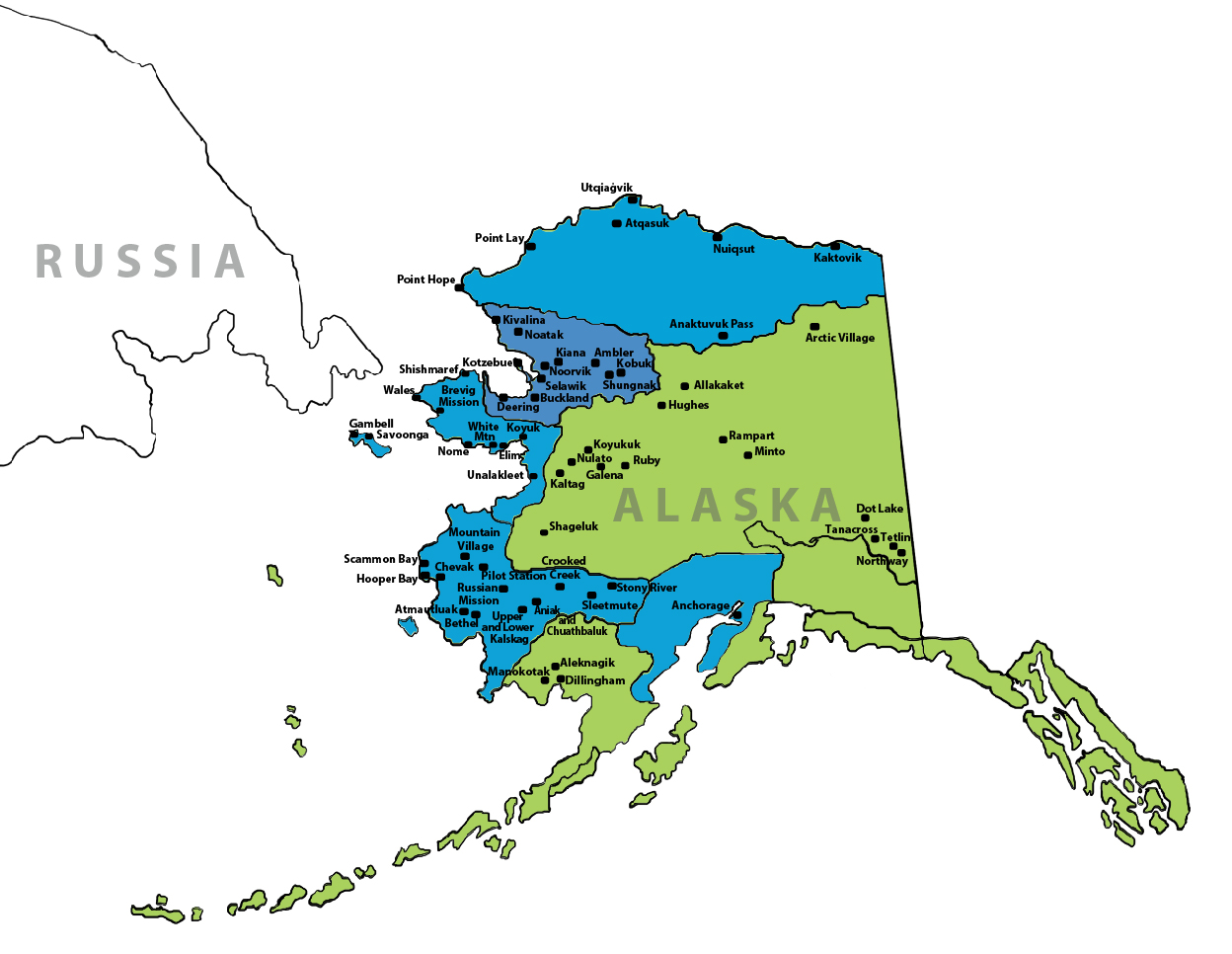
Below is a list of places involved with Skiku’s skiing efforts:
“Where We Ski:
Upper Kuskokwim Region: Aniak, Chuathbaluk, Crooked Creek, Sleetmute, Stony River, Upper Kalskag, Lower Kalskag
The leader of the organization is Gilberto “Juan” Rejón Magana- a passionate and committed advocate. We described his work this way in our feature:
“What’s important about Magana’s work is its longitudinal scope: His organization supports youth from kindergarten to high school with the end goal of matriculating in college.”
You can donate to Hartland Community 4 Youth and Families here.
Share Winter seeks to benefit kids interested in cross-country skiing, alpine skiing, or snowboarding. In Share Winter’s own words, they are “working to improve the lives, health, and fitness of youth through winter sports.”
Share Winter grantees include the Bridger Ski Foundation, Central Cross Country Skiing and their Nordic Rocks program, and the New England Nordic Ski Association.
Challenged Athletes Foundation (CAF) Idaho: CAF provides financial assistance to create access to outdoor recreation for individuals with physical challenges, particularly in the area of equipment grants. CAF Idaho is embarking on a new model with their adaptive ski program, recently hiring a cross country ski coach, Wilson Dippo, whose aim is to get kids in Idaho and from the surrounding Intermountain West out on skis and recreating in the outdoors year round. Their message is this:
“Idahoans of all abilities have the right to practice, play, perform, and compete at their best. So let’s hike, bike, swim, ski, skate, move—and keep breaking barriers.We’ll unite through sport and drive Idaho forward.”
You can donate to CAF here. All donations up to $25,000 will be matched by a private donor this holiday season, helping your gift reach more adaptive athletes.
No Excuses Unlimited: No Excuses Unlimited provides training and racing grants for Paralympic level athletes, fostering development of athletes bound for international racing. This includes travel expenses and adaptive equipment. Your donation goes directly to the athletes to help with the high monetary cost of elite level training and competition.
Even in the way northern latitudes, there is no denying the earth’s 23.5-degree tilt on its axis and our relationship with the sun. Spring has sprung. In the spirit of holding onto winter just a little bit longer, we struck up a conversation with newly minted Olympian, Alaska Pacific University (APU) skier and Alaskan native, 27-year-old Tyler Kornfield.
Tyler Kornfield (tall skier on left) and Rosie Brennan (adult to right of Kornfield) during a Skiku on-snow session this spring. (Courtesy photo)
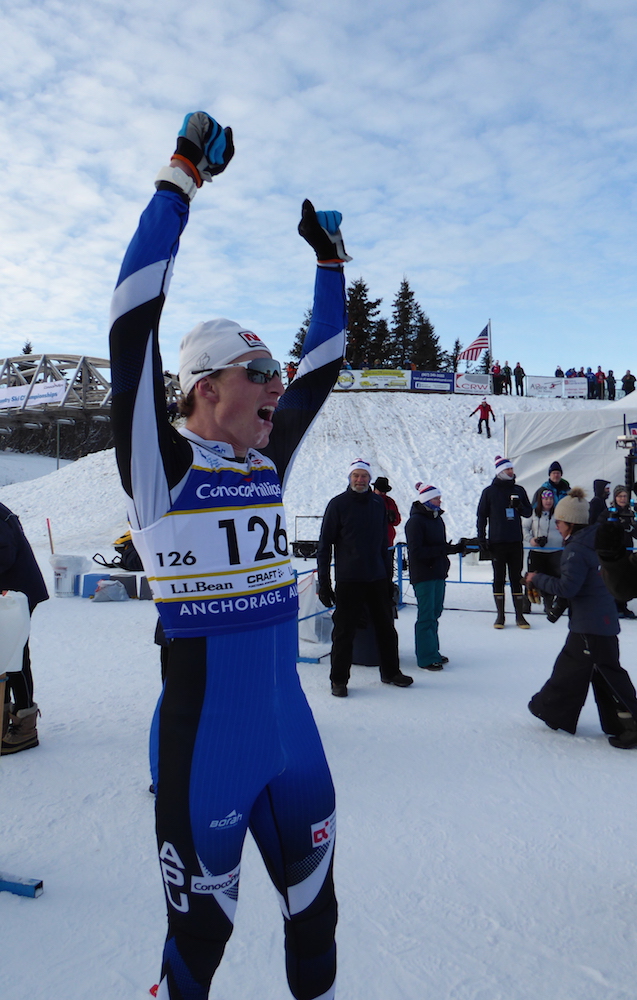
On the competition side of things, Kornfield set the domestic scene abuzz back in 2012. At U.S. nationals that year in Rumford, Maine, he won the classic sprint and placed third in the freestyle sprint. This past January at 2018 nationals in Anchorage, Kornfield skied to seconding the classic sprint and third in the skate sprint. The experienced skier’s most He also won the 30 k classic to cap off a stellar championships week.
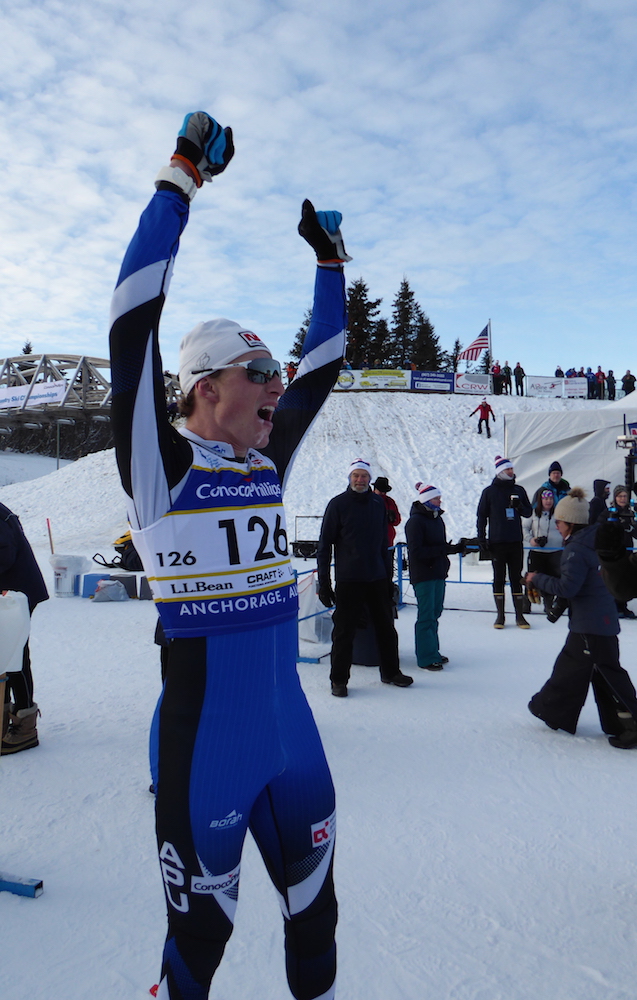
APU’s Tyler Kornfield celebrates after winning the men’s 30 k classic at U.S. nationals on Jan. 7 at Kincaid Park in Anchorage, Alaska.
But maybe, more importantly, Kornfield has helped bring cross-country skiing to rural Alaskan villages through Skiku. Kornfield is not alone in this endeavor: many skiers and coaches have volunteered their time to “to foster the health and recreational benefits of skiing, biathlon and running through sustainable programs across Alaska”.
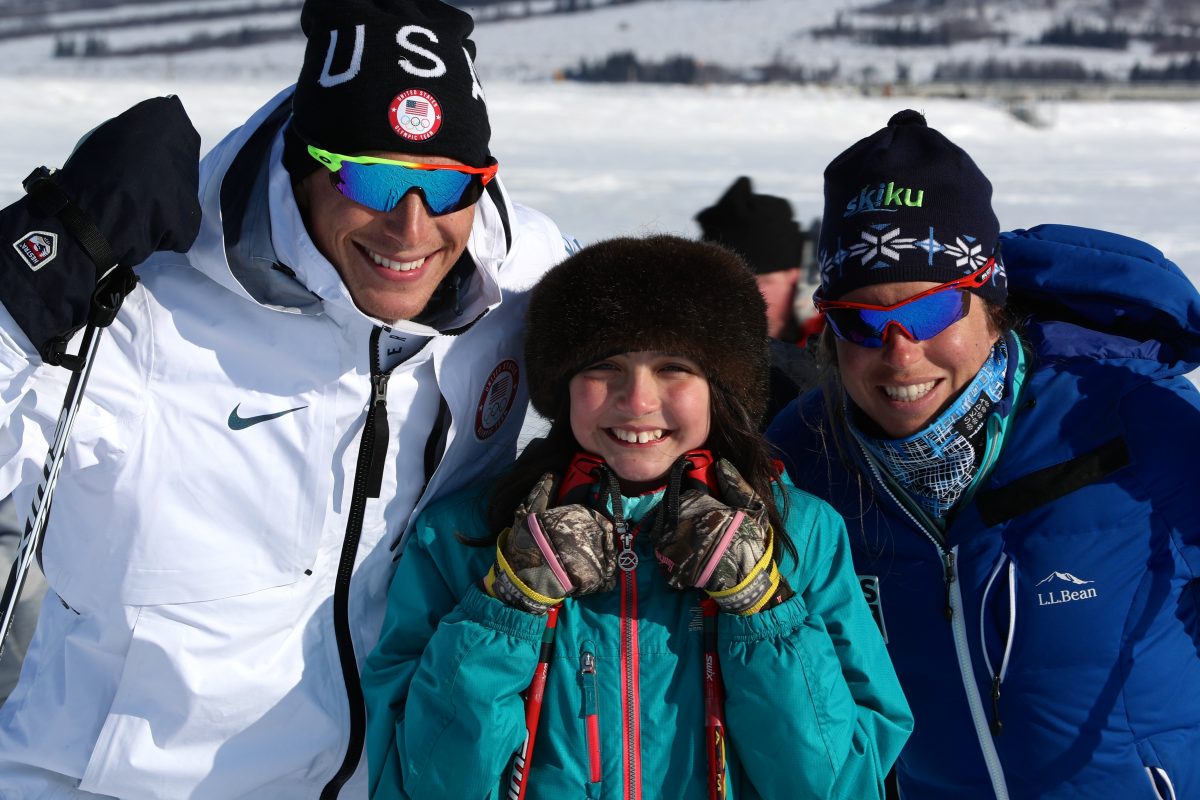
All smiles. Olympian Tyler Kornfield (l) and Rosie Brennan (r) with a young Skiku skier. (Courtesy photo)
We spoke to Kornfield on May 3 to learn more about his commitment to Skiku and get the rundown on his year.
Do you have experience in communications, marketing, and working in a nonprofit environment?
Are you passionate about helping develop Nordic skiing as a sport all across Alaska?
Nordic Journeys is looking for a communications and marketing coordinator tasked with maintaining a consistent and professional look and feel for our organization’s public communications and marketing tools. You must have excellent interpersonal and communication skills, be willing to work collaboratively to complete projects, and have expertise using social media platforms and other communications software tools.
Responsibilities:
Supports the staff team in administration and implementation of programs through:
Database management
Volunteer base communications
Events communications and marketing
Post-event communications and marketing
NANANordic and Skiku village ski program communications and marketing
Website and social media
Fundraising support and sponsor recognition
Public relations
Qualifications, Skills, and Abilities:
Marketing and Communications background
Program and event planning experience
Strong written and verbal communications skills
Design skills and training are an asset
Media relations skills are an asset
Requires the ability to use and manage databases on a variety of software and web-based applications
Willing to work in a flexible, task-oriented environment
Strong organizational, teamwork, and time-management skills
Passionate about cross country skiing or other healthy outdoor activities
Understanding of the rural communities in which we operate programs is an asset
Hours and Pay:
This is an hourly part-time position with approximately 10-20 hours per week of work during the summer (June-January) and 30 or more hours per week during the main program implementation months (February-May). Pay is hourly, rate DOE.
Submission Process:
Please submit a current resume and a letter of interest to the Nordic Journeys Executive Director, Robin Kornfield: robin@skiku.com
The Nordic Journeys office is located:
5401 Cordova Street, Suite 303
Anchorage, AK 99518
Only those selected for an interview will be contacted. Candidates for hire will be reviewed on a rolling basis until the position is filled.
About Nordic Journeys:
Nordic Journeys, a 501(c)(3) nonprofit, operates programs that encourage healthy lifestyles all across Alaska through Nordic skiing, biathlon, and running programs. Nordic Journeys’ mission is to foster the health and recreational benefits of skiing and biathlon through sustainable programs across Alaska. We envision healthy and active families enjoying Alaska’s vast and beautiful landscape on skis.
ANCHORAGE, Alaska — The President’s Council on Fitness, Sports & Nutrition (PCFSN) has selected Skiku/NANANordic to receive a 2015 PCFSN Community Leadership Award. The award is given annually to individuals or organizations who improve the lives of others within their community by providing or enhancing opportunities to engage in sports, physical activities, fitness or nutrition-related programs.
Skiku/NANANordic’s vision is healthy and active families traveling together on skis while enjoying Alaska’s vast and beautiful terrain. Skiku/NANANordic brings high-level athletes— Olympians, World Cup athletes and elite high school skiers—to work with children for five days per village. Beginning with four villages and 18 volunteer coaches and 600 people on skis in 2012, the program served the eleven villages in the NANA region by 2013, and 27 villages and 3000 skiers statewide by 2014. The statewide program is now called Skiku, a name that attaches the word ski to the Inupiaq word for ice, siku. In 2015 Skiku expanded to serve 40 communities and 4500 students. NANANordic will continue to operate in the 11 NANA communities where it got its start.
“Skiku/NANANordic has worked to consistently promote physical activity, sports and/or good nutrition throughout their community,” says Shellie Pfohl, Executive Director of the Office of the President’s Council on Fitness, Sports & Nutrition. “For our nation to become healthier, it has to be transformed by acts of people and organizations such as Skiku/NANANordic and because of its efforts and contributions, communities across Alaska can embrace a healthier and more active lifestyle. Together we are all working to make our nation a healthier one.”
The Alaska Native Health Board (ANHB) celebrates Skiku/NANANordic; its leadership and vision contributes toward the improved health status of rural Alaska and across the state. We are proud that its beginnings are rooted with tribal programs, with seed funding from Maniilaq Association and NANA Regional Corporation, and has been successfully replicated and grown to a statewide program. It is truly the result of collaboration, volunteerism, and is a work of love from many of Skiku/NANANordic’s coaches, participating schools, corporate donors and contributions from many non-profit organizations. ANHB congratulates Skiku/NANANordic leaders, Lars Flora and Robin Kornfield for their leadership and passion. Together, all have helped Alaska’s students and rural communities learn to ski.
This year, the President’s Council presented the Community Leadership Award to 47 recipients across the country for making sports, physical activity, fitness, and nutrition-related programs available in their communities.
About the President’s Council on Fitness, Sports, and Nutrition
The Office of the President’s Council on Fitness, Sports and Nutrition (OPCFSN) works with the Council and, under its authority in Title XVII of the Public Health Service Act, shares the Council’s mission to engage, educate and empower all Americans to adopt a healthy lifestyle that includes regular physical activity and good nutrition. PCFSN is a committee of volunteer citizens who advise the President through the Secretary of Health and Human Services. Through partnerships with the public, private, and non-profit sectors, the OPCFSN promotes programs and initiatives that motivate people of all ages, backgrounds, and abilities to lead active, healthy lives. Specifically, the OPCFSN works to overcome the challenges, and develop opportunities, to promote fitness, sports, and nutrition across the United States. For more information about the Council, visit www.fitness.gov and follow us on Twitter @FitnessGov.
Nick Treinen works to keep up with the kids in Shishmaref. (Photo: Brice Habeger, Piksik)
“It’s not about skiing,” Shungnak School Principal Roger Franklin wrote in an email to FasterSkier. “It’s much more, and it’s saving lives daily.”
Just don’t tell the kids that. The hundreds of them skiing and laughing and jumping and falling down might think you were crazy.
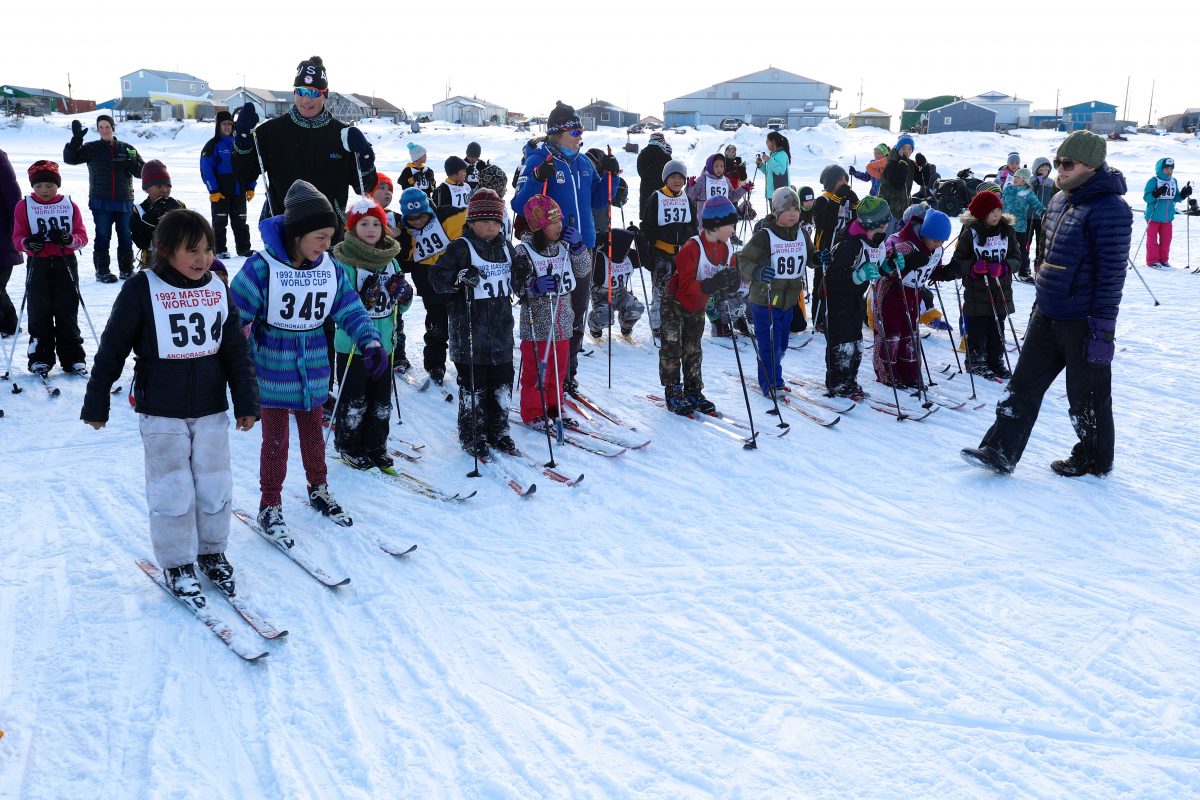
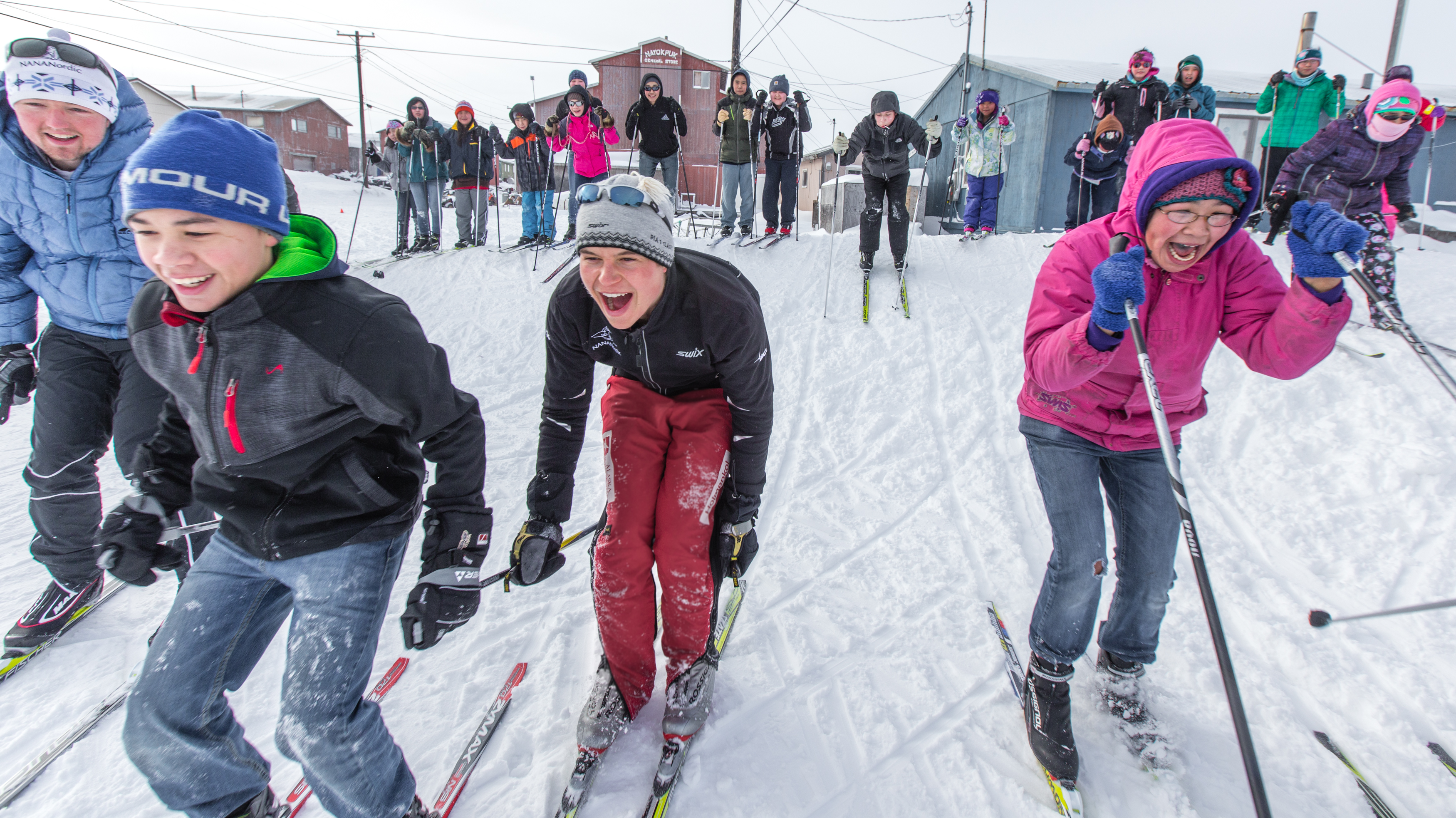
The Shungnak School is 150 miles east of Kotzebue on the Kobuk River. Shungnak is one of 27 communities that received ski instruction through Skiku, known in the Northwest Arctic region as NANANordic. The program brings world-class ski racers, elite high-school racers, and community coaches to rural Alaskan schools each spring, along with ski equipment and enthusiasm for teaching the students to ski.
NANANordic was covered by FasterSkier in 2012, the program’s first year, and in 2013 with the addition of biathlon to the program. FasterSkier also compiled links to videos made about the program in 2013 and 2014.
“NANANordic has bought a positive trend to this region and our little village,” Franklin continued. “This program helped our kids find different ways to find a positive outlet than a negative one. It has given our students a chance to live a healthier life style and much more. It also has a component for family time spent skiing and understanding their kids’ struggles in life. It also has helped our students to stop thinking about suicides and other harmful things.”
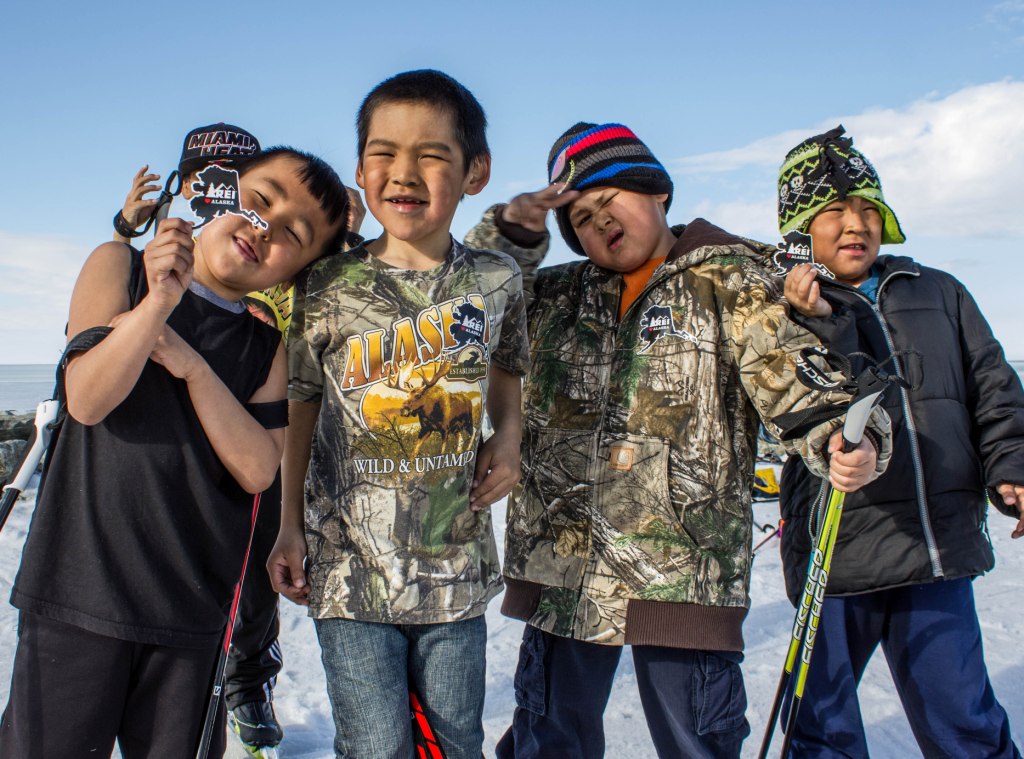
Kids in Kivalina. (Photo: Reese Hanneman/Skiku)
The statistics on rural Alaska are heartbreaking: rates of alcoholism, sexual violence and teen suicide are many times the national averages. In many areas the rates are so high that it constitutes a public-health emergency. So when Franklin says that NANANordic/Skiku is “saving lives daily,” it’s not merely hyperbole.
History
The program was started in 2012 by Lars Flora (a former elite racer and brother of Alaska Pacific University Head Coach Erik Flora), with the help of Robin Kornfield (who works for NANA Development Corporation), and Scott Warren, an educator with the Northwest Arctic Borough School District.
That first year, NANANordic visited four villages — Kiana, Noorvik, Selawik and Kotzebue — in the NANA region in northwest Alaska. The following year it expanded to all 11 villages in the Northwest Arctic plus Anaktuvuk Pass, located in the Brooks Range, Alaska’s northernmost mountain range.
As NANANordic grew and expanded into other regions, with the door open to further expansion, they needed a name that would be inclusive of the entire state. The directors settled on Skiku, a play on the word “siku,” the Iñupiaq word for ice. Within the NANA region the program is still called NANANordic, but for the sake of clarity both will be referred to as Skiku in this article.
As NANANordic grew and expanded into other regions, with the door open to further expansion, they needed a name that would be inclusive of the entire state. The directors settled on Skiku, a play on the word “siku,” the Iñupiaq word for ice.
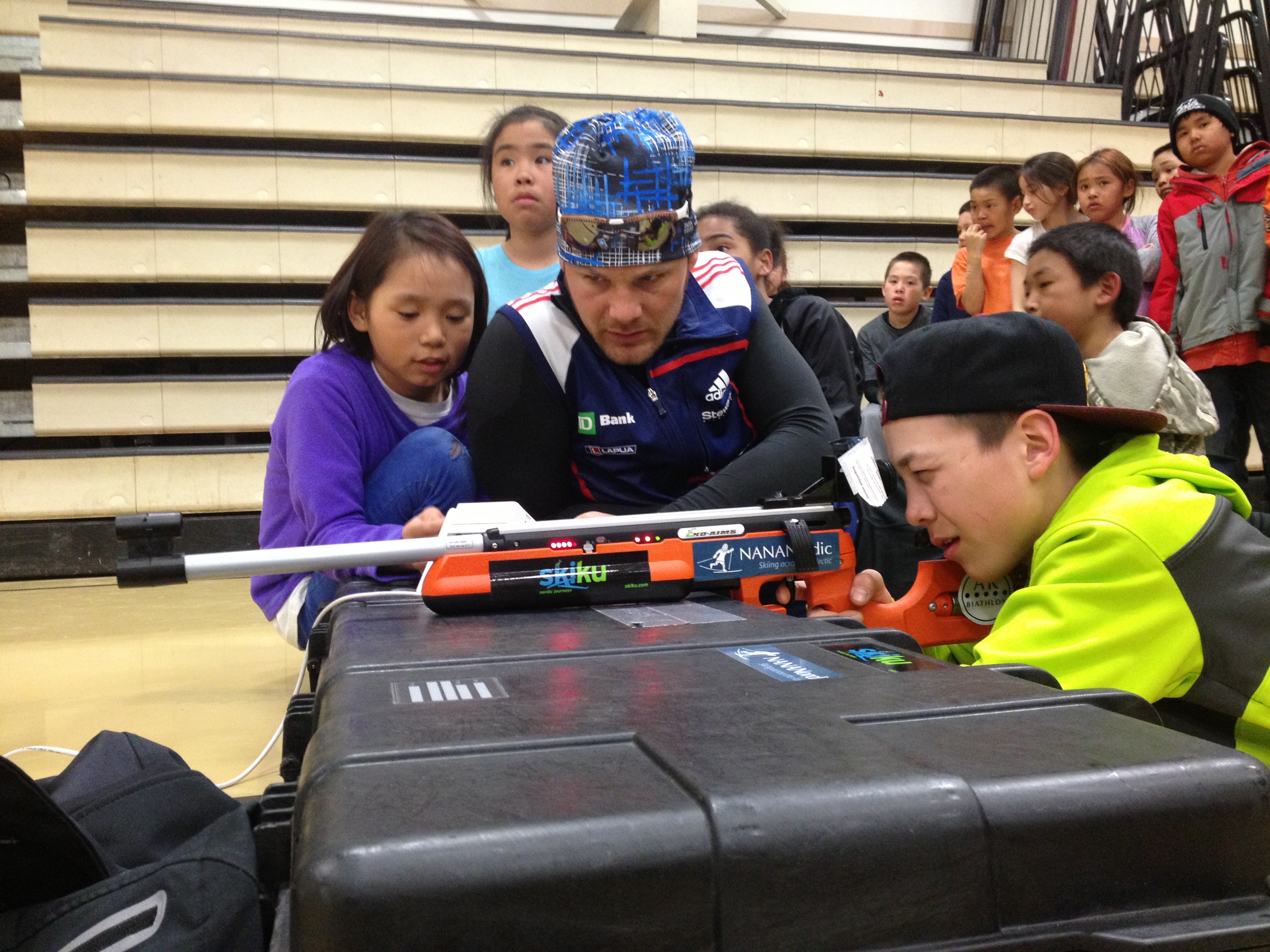
This year, Flora and a veritable army of volunteer coaches — 80 in all — helped to bring skiing to over 3,000 kids, spending a week in each village, with many students skiing during school and again afterwards. The program has also begun a push to bring biathlon to village schools — a logical sport for the students, given the strong tradition of hunting in rural Alaska. They founded AK Biathlon as a sister organization to Skiku, brought on Zach Hall as the coach, and were able to purchase four infrared rifles to use with the kids.
Zach Hall teaches shooting skills at an indoor range in Kotzebue. “Biathlon is a huge component of the program that makes cold days manageable since we stay inside shooting biathlon infrared systems,” Flora says. (Photo: Skiku)
Future of the Program
After the 2013 season, Flora became the full-time director of Skiku, allowing him to push the expansion of Skiku into more than twice as many communities in 2014. Such rapid expansion is complicated for a small nonprofit, and Flora plans to expand more in 2015, looking to Bethel, in the Yukon-Kuskokwim region in southwestern Alaska.
“A lot of activity directors across the state are a little worried about our expanding to so many places,” Flora said. “What [they’re worried about] is that you put the focus on teaching kids how to ski, and then what happens is that your websites aren’t polished. We could easily pull back and keep it at 27 for next year and make sure we have everything perfect in the office, but among everyone involved we just want to keep going getting the program into more places.”
When asked about his priorities for future funding, Flora said that, in addition to expanding into more areas, he’d like to find a way to keep coaches in the communities longer.
“In the very rough draft we made up, we put [next year’s volunteers] at about 110,” Flora said. “But the time spent in villages is a key piece. You can’t just dump ski equipment at a school and think that the teachers or the admin will run a ski program for you. It’s been done before, and what we’ve learned is that a lot of those kids don’t really know how to ski. At the end of the day we want to make sure that they actually learn how to ski at the places we go.”
Community Support
Photographer Brendan Smith joined the program in 2012 and 2013 as part of Healthy Portraits, an initiative by the Alaska Native Tribal Health Consortium, a native-owned public health consortium. Healthy Portraits focuses on success stories stories in rural Alaska, celebrating those who are taking steps to improve themselves and their communities. Smith produced a video about his involvement with NANANordic.
27 Villages Visited in 2014:
Barrow, Kotzebue, Kiana, Ambler, Anaktuvuk Pass, Noorvik, Shungnak, Deering, Noatak, Atqasuk, Kaktovik, Nuiqsut, Kobuk, Kivalina, Selawik, Buckland, Aniak, Sleetmute, Stony River, Crooked Creek, Nome, Shishmaref, Koyuk, Gambell, White Mountain, Unalakleet, and Pathway Home in Anchorage
The observations of the volunteers support the idea that the kids are enthusiastic about picking up the sport.
“I guess the part that has surprised me the most how quickly the kids have learned to ski,” Alaska Pacific University (APU) coach Charlie Renfro wrote in an email about his experiences. “I take a lot of video footage of the kids each year and this year was crazy. Kids are V2-ing and hitting jumps and just making it look easy. All with pretty minimal time on skis. They aren’t afraid to fall, they aren’t afraid to look silly, they aren’t really afraid of anything. I think that is such an awesome way to learn. As a result they are getting pretty proficient quickly and they all really seem to like it, which makes it super-fun for all of the coaches. The kids can feel themselves improving too, and, I think that is a big motivator.
“The NANA/Kobuk River Region is so vast and beautiful,” Renfro continued. “That, combined with the incredible people and of course the awesome interactions with the kids, has kept me coming back year after year.”
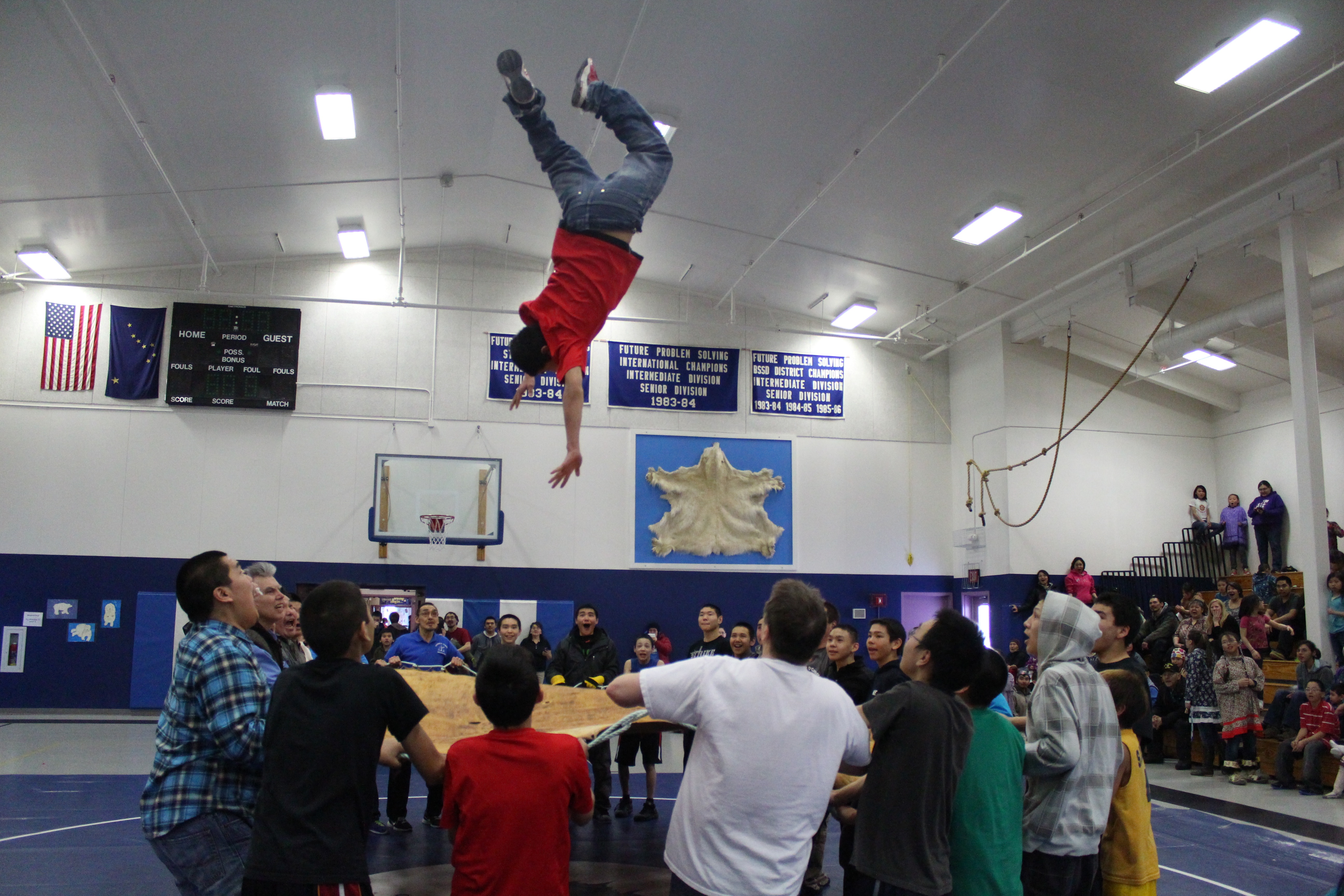
A student is thrown into the air as part of the traditional blanket toss — using a walrus hide — in the school gym in Gambell. (Photo: Skiku)
Renfro was not alone in his enthusiasm for the program. Husband and wife Brian and Caitlin Gregg of Team Gregg/Madshus participated this year for the first time.
“The whole experience was amazing,” Caitlin Gregg wrote in an email. “I really liked learning about the strong cultural history that the villages retain and teach all the youth. I left the NANANordic trip with so much excitement. The energy of the kids was amazing and I can’t believe how excited the towns were for us to be there! I look forward to spending even more time with the program next spring!”
APU Elite Team member Lex Treinen participated in NANANordic this year as an envoy of a club called club called K’enaanee Kkaazoot — a similar program started by former University of Alaska Fairbanks skier Heidi Rader in 2011.
“She had been doing gardening workshops in the villages on behalf of UAF’s Cooperative Extension Service and Tanana Chiefs Conference (the Interior non-profit native organization) and had always brought her skis,” Treinen explained in an email. “She saw that the kids were always interested. So I got to be part of the first K’enaanee trip in spring of 2012 and we went to Fort Yukon, Venetie, and Arctic Village. The next year we did a three-day trip to Ruby.
“This year Heidi decided to work through NANANordic,” Treinen continued. “Since they were expanding to regions outside of the NANA region, and got a grant that she could give to UAF students.”
Treinen went to the village of Nuiqsut, a village founded in 1974 in response to oil development on the North Slope. Treinen wrote about his experiences in UAF’s student newspaper, the SunStar.
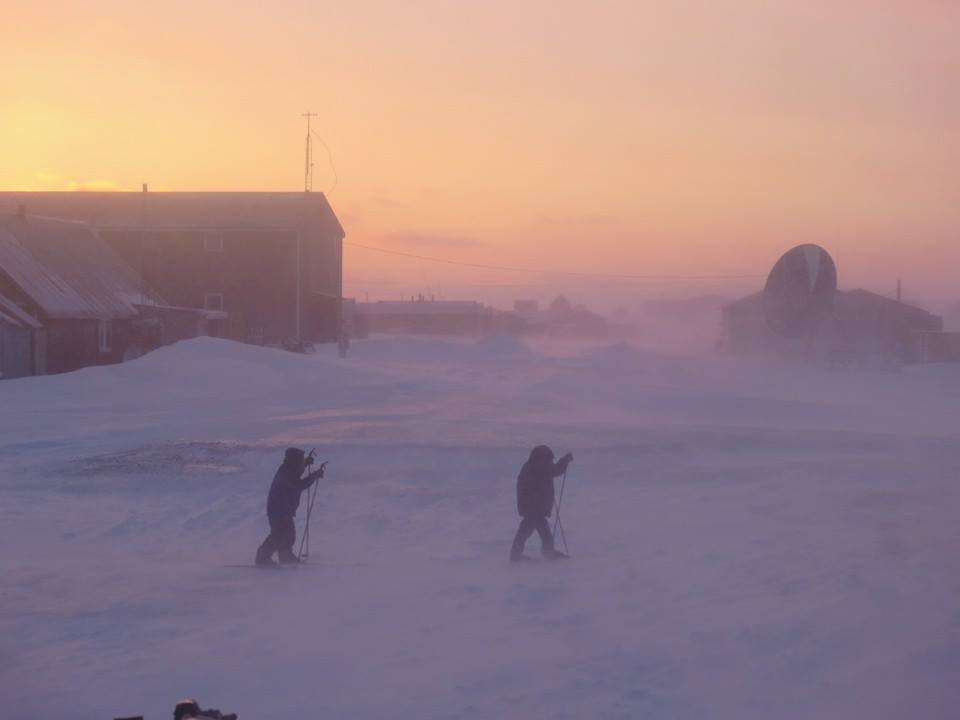
Kids brave a ground blizzard, caused by high winds, in Gambell. Gambell is on St. Lawrence Island, in the Bering Sea. (Photo: Skiku)
A Rewarding Experience
All those interviewed for this story had positive things to say about the innate ability and enthusiasm of the students for skiing in a region typically dominated by basketball and snowmobiles. The volunteers couldn’t help but be caught up in the excitement, many getting so much more from the experience than just the typical rewards of coaching.
Even Flora, who has been Nordic skiing nearly his whole life, feels the experience has changed him. In 2012 he had just finished a tough season of racing and immediately began NANANordic’s debut season.
“It was the perfect transition out of ski racing,” he wrote in an email. “It kept me involved with the ski world but opened my eyes to this amazing world that had nothing to do with ski racing. There was this deep rich Alaska Native culture that we got thrown into the first year and the NANA values started influencing our ski program in more ways than I can express.
“Basically this whole program has brought me back to my childhood memories of chasing around my two older brothers on skis and going on family ski trips,” Flora remembers. “I was so fixated on performance the last few years of my career, my performance started influencing my choices and decisions in a negative way. … My perspective on sport has changed. As a ski community we can learn a tremendous amount from villages in Alaska that can help us grow as teams, communities, and individuals. Skiku is as much about teaching kids how to ski as it is about our volunteers learning about a new culture, which can impact our own goals and dreams in life. ”
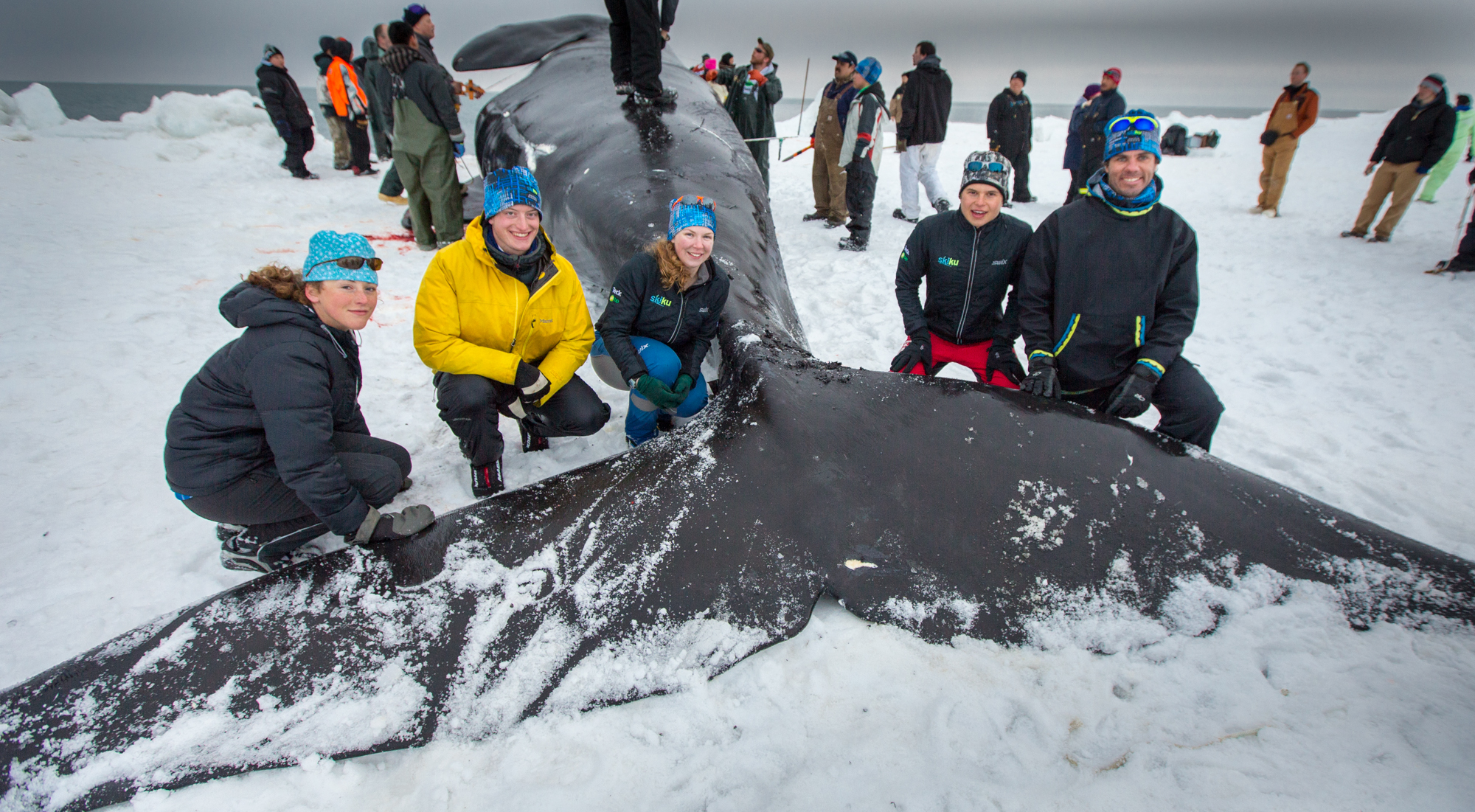
The Skiku Crew and a bowhead whale that was taken during the traditional spring whale hunt in Barrow. (Photo: Brice Habeger, Piksik)
2014 Volunteers: Aimee Demientieff, Alice Knapp, Allison Phillips, Amanda Del Frate, Ana Jager, Andrew Kastning, Andrew Dougherty, Anna Rix, Annie Connelly, Bailey Arend, Bre Donovan, Brian Gregg, Caitlin Gregg, Caitlin Patterson, Carlin Rauch, Carly Craig, Catie Bursch, Celia Haering, Charles Renfro, Conner Truskowski, Dana Tower,Dave Stamp, David Apperson, Deland Anderson, Donny Donovan, Dylan Watts, Emily Decker, Eric Packer, Erik Bjornsen, Fischer Heimburger, Frances Pillifant, Galen Flint, Gigi Banas, Greg Jernstrom, Greta Anderson, Ian White, Jaime Bronga, Jan Spurkland, Janey Hoefler, Jarrid Huckfeldt, Jasmine Neeno, Jeffery Fox, Jim Oksotaruk, John Farr, Jonas Loeffler, Josh Smullin, Julie Truskowski, Kathleen Rehm, Keri Hull, Lars Flora, Laura Pillifant, Lauren Fritz, Lauren Hess, Lex Treinen, Libby Kugel, Marie Steringer, Marine Dusser, Megan Spurkland, Michael Sinnott, Molly Schouweiler, Nancy Hanneman, Nick Treinen, Odin Brudie, Paul Kovacs, Peter Madsen Kling, Rachelle Kanady, Reese Hanneman, Robert Rosser, Rosie Brennan, Ryan Terry, Sadie Fox, Samuel Dougherty, Sara Studebaker, Sikulik Johnson, Tamra Kornfield, Taryn Hunt Smith, Tully LaBelle-Hamer, Tyler Kornfield, Will Mans, Zach Hall
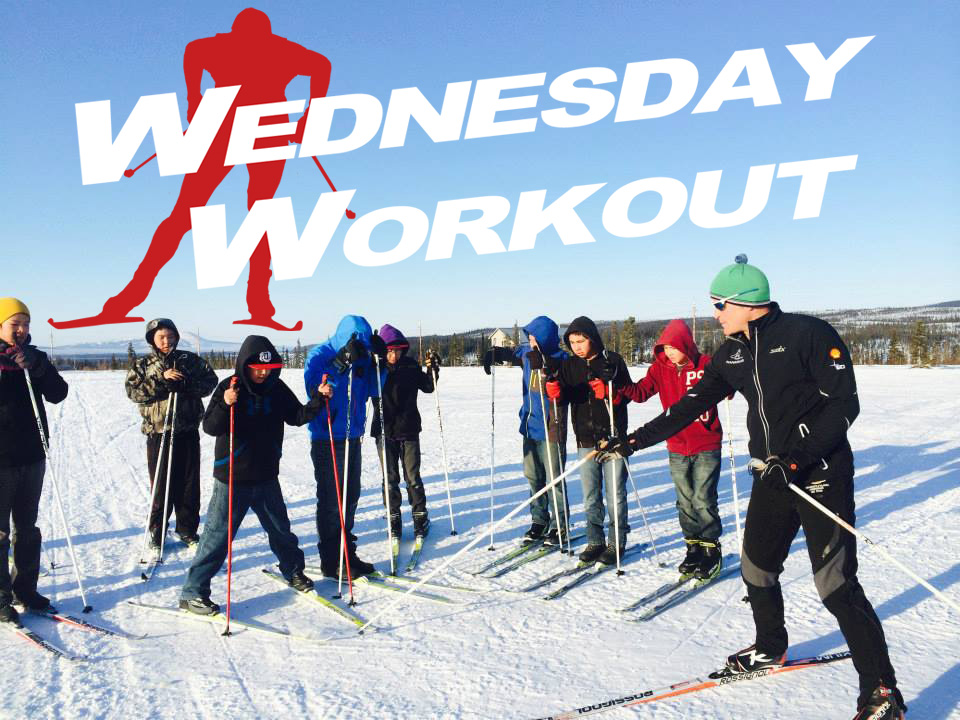
Andrew Kastning teaching the 7th grade boys to V2 in Kiana, Alaska. (Photo: Celia Kastning/Facebook)
The following non-traditional workout comes from Andrew Kastning, head coach of the University of Alaska Anchorage. Kastning recently returned from his third trip to remote Northwest Alaska (where he visited Kiana and Noorvik) with the NANANordic program, which brings cross-country skiing knowledge and equipment to elementary through high-school students.
***
Having the opportunity to teach 8 days of cross country skiing to the remote villages of Alaska is both rewarding and demanding. It’s hard to pin down an exact ‘workout’ we do up there, because by the end of just one day, your feet burn, and your mental focus just got tested by 100+ eager Inupiaq kids, thirsty for time on skis. There can, however, be progress made toward personal growth depending on how you want to slice it.
Every day you’re there, you wake with the spinning sun to eat breakfast with the kids, some whom like to greet you with a speedy free climb to hang on your neck. Throughout the day you get 1 hour with each grade, k-12, to teach skating and play games. Almost all sessions match different grades together to get everyone out at least once, and to spread the demand for different boot sizes as far across the spectrum as possible.
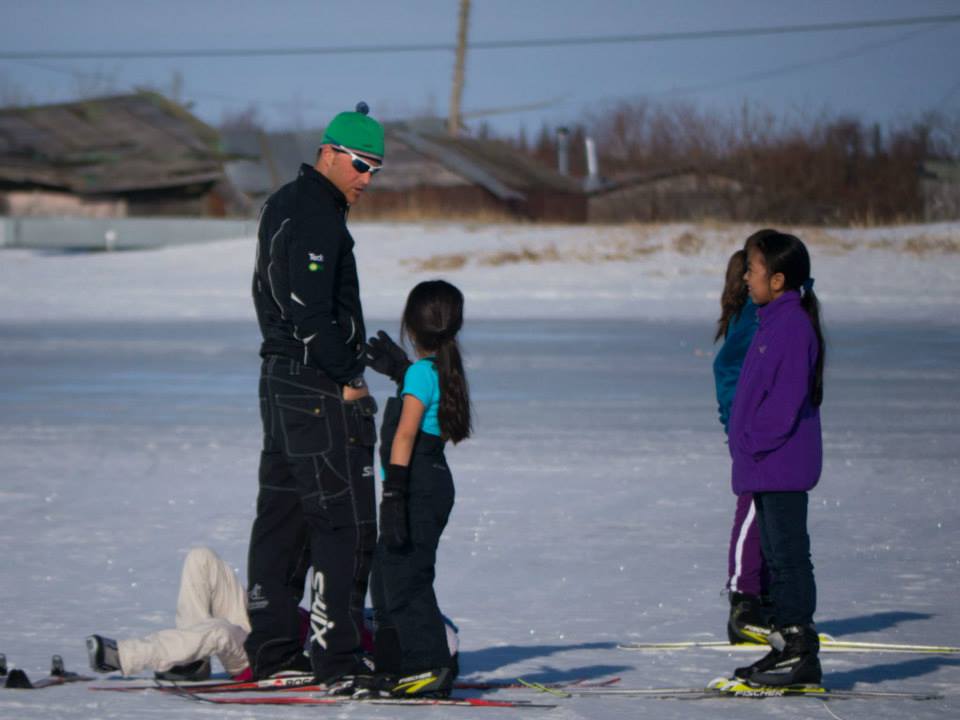
Coach Andrew Kastning answers a few questions in Noorvik, Alaska. (Photo: NANANordic Facebook)
So your day might start with eight too-cool-for-skiing 9th and 10th graders and sixteen energetic 2nd graders. They all request boots that are too big, and poles that are too small, so individual negotiation periods ensue during checkout, as we try to promote proper ankle support for skating, and adequate leverage opportunities for the ‘sticks’. The little ones need help properly fastening the boots, so you get about 8 squats tying bows, and strapping Velcro, followed by a quick sprint outside to catch the quick ones before they zoom off to the river bluff to hit a ‘fly’.
The curriculum throughout the day is a sliding scale based on age and ski aggression, all of which land you on a certain point of the learning curve. The goal of the whole experience is to catch that point on the curve and nudge it along through brief demonstrations, laps around the school yard, games, and zigzagging adventures through town.
Your heart rate doesn’t quite reach level 1 during all this, but your cheek muscles might get tested for smiling endurance. Your core strength can get a workout depending on how many tree well hazards your constituents find, and your legs can get a solid workout if you succumb to all the requests for chariot pulls. After an hour of this, it’s either a race or a plod back to the ski room to switch the gear out to the next group… and repeat!
When the final school bell rings for the day, a line of the 70 most enthusiastic kids shows up at your makeshift ski room, clamoring their way through the line to get another hour and a half on skis. Here you have free range to take the better ones on a distance ski up some icy river, or meandering toward a far hillside on the ‘snowgo’ trails. The young ones stay back and work with you on 1-ski balance with a piggyback ride, or jumping skills, or some food-chain style sprints of wolves chasing caribou (sharks and minnows). All this can leave you firmly planted in the teacher lounge chairs for the remainder of the evening, or you could go get schooled in basketball by the same locals you just schooled in skiing.
In 2012, this routine played out in 4 villages, last year jumped to 11 villages, and this year we expanded once again to 26 villages, each getting about 4 days of concentrated skiing! If you were still standing at the end of four days, there were a lot of 20-60 mile skis you could challenge yourself down the snowgo trail to the next village.
Some of these were into the wind across parts of the Chukchi Sea, others had a strong tail wind down a frozen river hopping from windblown patch to windblown patch. My first year I skied from Noorvik to Selawik (32mi) with Lars Flora, Reese Hanneman, Charlie Renfro, and Evelyn Dong and we ran into about 2,000 caribou sidling across the frozen tundra! Each of these trips left you with a sense of being in the middle of nowhere, on a grand adventure hoping to have a brush with raw nature. No matter how tired you got though, as you came gliding into the next village, you had to be sure to smile and exude a big love for skiing, because you were about to be overwhelmed with the next kids excited to cross country ski.
By the time I boarded the commuter jet back to Kotzebue this year, I felt like I had just finished a volume week at training camp. Be sure to inquire about volunteer opportunities with NANANordic and Skiku, for 2015, and you too can take part in this unique volume training camp while spreading the good vibes of sliding on snow!