Tag: Slovakia

  • Slovak Indirect: How an Alaska-raised skier ended up representing Slovakia at the Olympics

    Slovak Indirect: How an Alaska-raised skier ended up representing Slovakia at the Olympics

    This article was made possible through the generous support of our voluntary subscribers who have helped put our Nat Herz on the ground at the Olympics. If you value coverage like this, please support FasterSkier with a voluntary subscription.

    Peter Hinds racing at the Olympics for Slovakia. He grew up in the 49th state, wore bib 49 in Tuesday’s sprint race, and finished 49th. (Courtesy Peter Hinds)

    PREDAZZO, ITALY — On Denali in Alaska, there’s a famed climbing route called Slovak Direct — a nod to a group of skilled alpinists from Slovakia who established it in 1984.

    Now, as this year’s Winter Olympics kick off, an Alaska-raised athlete is making something of a name for himself in Slovakia, competing for the nation’s Olympic team in cross-country skiing.

    Peter Hinds, a 23-year-old graduate of University of Alaska Anchorage, realized last year that he could race for the country where his mother grew up — then qualified to represent it in Italy.

    Call it Slovak Indirect.

    Hinds competed in his first Olympic race Sunday in Italy, finishing 60th — capping a whirlwind season that’s also included a ceremonial team-naming in Bratislava with a handshake from the Slovak president, Peter Pellegrini.

    Peter Hinds shakes hands with Slovakia’s president, Peter Pellegrini, in a pre-Olympics ceremony in Bratislava. (Office of the President of the Slovak Republic)

    “They had the guards with the little floofy hats and the guns, standing perfectly still,” Hinds said. “It was cool — it kind of felt like royalty. And that’s the thing about something as big as the Olympics: It lives bigger in people’s minds.”

    Hinds’ Olympic saga starts with the fall of the Iron Curtain, at the end of the 1980s. His mother, Elena Hinds, grew up in the Slovakia city of Bratislava when it was part of the Eastern Bloc.

    “I was young, fresh out of school, just wanted to travel and see the world,” she said in an interview in Italy, after watching her son’s first Olympic race. “Landed in Los Angeles.”

    There, Elena met Peter’s father, Cory, when she joined the local mountaineering club, and the couple ended up in Alaska.

    Peter grew up there as an only child with, he joked, “no rights.”

    “I had to do everything that the parents decided to lug me on,” he said — including being roped in with them on glaciers during alpine traverses.

    A young Peter Hinds on the Eklutna Traverse, a famed climbing route in the mountains behind Anchorage, Alaska. (Courtesy Peter Hinds)

    Hinds also spent time absorbing Slovak language and culture growing up, including a school year in Bratislava, where he still has family. Elena cooked Slovak foods, too, like bryndzove halušky — a gnocchi-like dumpling traditionally paired with sheep cheese and bacon bits.

    “It’s so good,” Hinds said. “You get the sour blanket, white canvas taste of that cheese. And then you get a really sharp, salty bacon bit in there — it’s really a good dish.”

    As a kid, Hinds trained with Anchorage’s Alaska Pacific University club program, then studied engineering at the University of Alaska Anchorage, where his results included a 14th place at the collegiate national championships. He’s also placed sixth in the sprint at the U.S. national championships.

    As school was wrapping up, he went to the career fair and interviewed with several companies with offices in Anchorage; he thought maybe he could pair an engineering job with an assistant cross-country ski coaching gig. He also contemplated graduate school.

    But Hinds had Slovak citizenship through his mother, who’d been following the country’s ski team, thought her son would be competitive and encouraged him to explore whether he could join. At a ski marathon last spring, he also got a nudge from an international athlete, Australian Rosie Fordham, who attends the University of Alaska Fairbanks.

    Hinds eating makové slíže, a Slovak dish of potato dumplings with maple syrup and ground poppyseed. “The poppyseed is exquizite,” Hinds wrote in a text message. (Courtesy Peter Hinds)

    “She was like, ‘Mate, you should totally just switch your (International Ski Federation) license to Slovakia. You’d probably be the best skier there,’” Hinds said.

    He didn’t really know where to start that process, though, so he went to the internet, where he noticed that his rankings were competitive with Slovakia’s top racers. “I looked them up on Instagram, sent them a DM,” and the process unfolded from there, effectively “no questions asked,” Hinds said — though he acknowledged detecting a little skepticism, at first, from Slovak athletes at risk of being displaced by an American-raised interloper.

    “I came over and I actually knew how to speak Slovak, and they were impressed,” he said.

    The license change prompted an enthusiastic press release from the Slovakia ski team, which celebrated the addition of a “promising young endurance athlete.” Slovak media has also chronicled Hinds’ progress and results, with family members collecting copies of print newspapers.

    A Slovak print newspaper featured a story about Hinds. (Courtesy Cory Hinds)

    After training in Alaska last summer, Hinds bought a one-way ticket to Bratislava, where he has a “home base” with family. Since then, he’s been ski racing, at training camps with the Slovakia team or staying with other friends around Europe.

    At stops on the top-level World Cup circuit, he’s encountered other Alaska athletes that he’s raced and trained with, like JC Schoonmaker and Gus Schumacher — both standouts on the U.S. team.

    “I’m a small fish compared to those boys on the circuit, so I’ve got to know my place,” Hinds said. “But it’s cool to see them, say hi, and see that this is really where they’re able to do things that few can, you know?”

    Fordham, the Australian who Hinds credits with inspiring his European experience, described him as a “good friend on the World Cup who doesn’t take things too seriously, but is pretty serious about ski racing.”

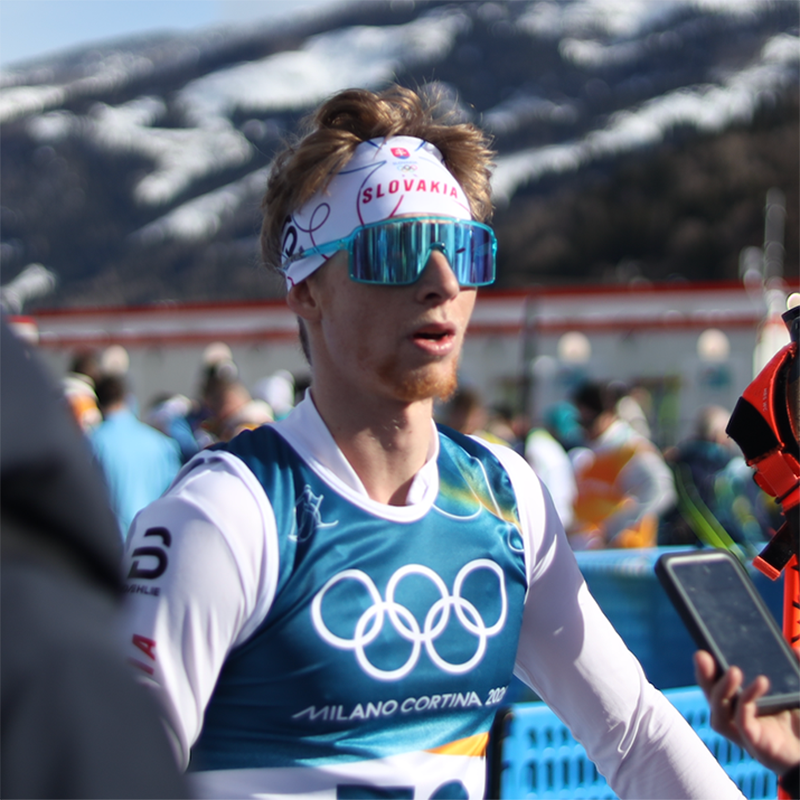
    Hinds speaks with reporters after his first race at the Olympics. (Nathaniel Herz/FasterSkier)

    “He’s just, like, so excited to be here,” she said. “It’s good to see someone who has such enjoyment of the sport and just wants to be out here having fun skiing fast, and with his friends.”

    At the Games, Hinds got to attend one of the opening ceremonies, then found himself surprised by the gravity of the moment when he finally got to the start of his first Olympic race.

    “It’s super cool to see all these people here — I mean, it was a great atmosphere. But I was genuinely nervous,” Hinds said in an interview afterward. A crash on a busy corner early in the 20-kilometer race set him back, but he made it to the finish without getting lapped and pulled out — a fate suffered by a number of athletes from other small nations.

    One of the benefits of being on a small team: Hinds will get to race more events in Italy, unlike some of the athletes from the larger U.S. team who might only get a single start at the Olympics.

    And while he doesn’t plan to spend time at bars, he does plan to spend some time enjoying and absorbing the Olympic experience — perhaps getting over the mountains to another satellite competition venue in the resort town of Cortina. He’ll also get time with his girlfriend and parents, both of whom are in Italy to watch.

    “Nobody expected this. But he’s making it happen, and it’s pretty exciting,” Cory Hinds said. “Everybody’s cheering for Peter like crazy.”


    Help Support Our Olympic Coverage!

    FasterSkier has our own Nat Herz on the ground at the Olympics, which is a significant financial lift for us. If you value the thoughtful work and access FasterSkier provides at championships like this one, please consider becoming a Voluntary Subscriber. Your support directly fuels our work to cover the people, places, and moments that make our sport special.

    Join the FasterSkier community!


    Hinds’ parents Elena and Cory and his girlfriend Eva Weymuller take a moment to relax after watching his first race at the Olympics. (Nathaniel Herz/FasterSkier)
  • For Biathletes Bédard and Godbout, Spartan Lifestyle is Anything But

    For Biathletes Bédard and Godbout, Spartan Lifestyle is Anything But

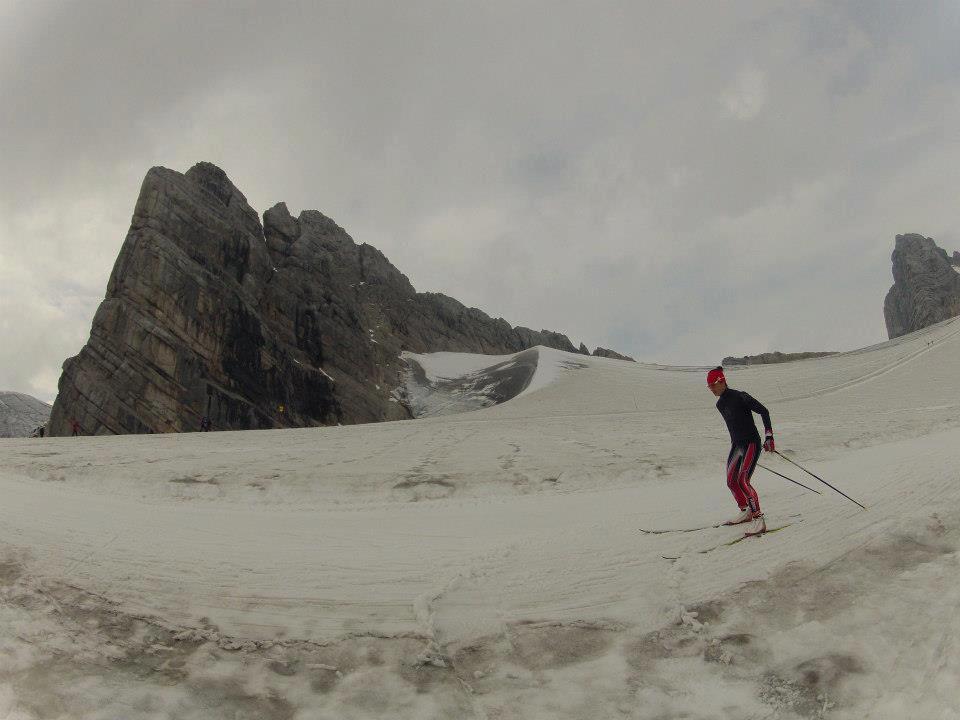
    Canadian biathlete Claude Godbout, who has won two of the four Spartan races she has entered, training on the Dachstein glacier in Ramsau, Austria. Her training camp is being facilitated by Spartan organizers, who flew her and boyfriend Marc-André Bédard to Slovakia to compete. Courtesy photo.

    As FasterSkier wrote last summer, Canadian biathletes Marc-André Bédard and Claude Godbout joined the Spartan Race craze almost on a whim, albeit a whim that hinted at the possibility of a payout.

    A year later, the partners have competed in three more of the notoriously brutal obstacle races, and neither has missed the podium yet. In June in Montreal, Bédard placed second among men and Godbout third among women. A month later in Pennsylvania, Bédard was again second while Godbout won the women’s race, and last weekend in Slovakia, both Quebec natives won the first-ever Spartan event held in continental Europe.

    So: running over hill and dale, crawling through mud and barbed wire, climbing fences, jumping over fire, dodging blows from gladiators … is this going to become a second career for the 2010 Olympian and his girlfriend, who also has World Cup experience?

    Godbout and Bedard after their double victory in Slovakia. (Courtesy photo)

    Probably not. After all, both are aiming for the Sochi Olympics, which are just a year and a half away. Earlier this summer, Godbout told FasterSkier that the 2014 Games were her main focus.

    “This is pretty much as big as it can go for me,” Bédard said in an interview from Ramsau, Austria. “We’re biathletes so we need to focus on that. This is fun for us and it’s good cross-training, but we’re not training at all to be good at it. It just happens that way, cross country skiers are good overall physically, so for us it’s easy to perform well.”

    National-team coaches were not initially pleased when the pair mentioned heading to Slovakia for a race (their trip was paid for by the organizers). But the biathletes are set on making Spartan racing work for biathlon and tried to think outside the box.

    “We were able to negotiate to get a training camp while we were in Europe, since they were sending us anyway,” Bédard said. “Instead of just sending us for five days and doing the one race, we get to stay here for longer [until the end of the week]. We’re having a good training camp right now in Dachstein. Our coaches were pretty happy about that, because otherwise we wouldn’t have gone to the Dachstein this year.”

    Bedard climbing a rope, one of the obstacles in the Slovakian race. (Courtesy photo)

    Spartan organizers helped the Canadians get a car, and they are staying in some apartments owned by Fischer, Bédard’s ski company. Bédard has been to Ramsau several times before, so it’s easy for him to get around; the duo also has several contacts in town and regarding the glacier.

    “We get a free trip to Europe and a free training camp, so that’s amazing,” Bédard said.

    Why would organizers go so far out of their way to help a few biathletes? According to Bédard, it has a lot to do with publicity. While more than 400,000 people have participated in Spartan races so far, the bulk of those entrants are in the United States. The franchise is already successfully expanding into the Canada, but it wants to go farther.

    And not just geographically: organizers dream of a day when Spartan racing is a competitive, more or less professional sport. Already in the U.S., some races put up prize money and there are bigger purses for end-of-season points leaders. In order to encourage that development race promoters need top athletes to show up to the starting line. And with their records, Godbout and Bédard definitely qualify. For the Pennsylvania event, Godbout was even featured on a poster advertising the top women who would be competing.

    And in Slovakia, organizers offered up $10,000 to anyone who could beat Bédard. They also arranged for the pair to go on the country’s equivalent of Good Morning America to introduce Slovakia to the concept of Spartan Racing and demonstrate how they conquer some of the typical obstacles. According to Bédard, it was as a “very weird” experience.

    “Really we don’t even know what happened!” he laughed. “They filmed us doing a bunch of stuff and asked us a bunch of questions, but it was funny because it was all in Slovakian so in between the questions in English they were just talking, talking, talking in Slovakian. We still haven’t seen the footage.”

    Godbout readying herself for the “spear throw” in Slovakia. (Courtesy photo)

    Since the champions are putting in their time to do publicity for the franchise, it’s worth the organizers’ effort to keep them racing, even if it means subsidizing a few more days in Europe.

    And while the training camp in Austria is an exciting development, it’s not the only way that Spartan racing is helping out the Canadians’ biathlon careers. In Pennsylvania, the two combined for over $2,000 in prize money, which Bédard said was more than either had ever won in a biathlon race. Becoming part of the Spartan world has gained them sponsors, too.

    “It’s not only that we get the checks from them, but those people are really into sports and love competition, so they want to help us,” Bédard said. “There’s a lot of contacts [to be made] … they have brought us a couple of sponsors already, and I’m sure these races this weekend can help. We got good money out of this and it will definitely help us for the winter.”

    He and Godbout use their appearances as a platform to tell people about their day-to-day job as athletes, too.

    “People know that we train for biathlon, and we put that at the front, that we are biathletes, and this helps our sport,” Bédard explained. “Especially in the states, people don’t even know what this is, so it’s really in a lot of different ways that we’re trying to get the most out of this.”

    But while plenty of Spartan participants are interested in biathlon, Bédard said there was a big difference between his attempts to promote his “real” sport career and his experience when he talks about Spartan races. He may be raising awareness about biathlon, but he doubts that he is gaining the sport any new athletes.

    “We talk about our sport to people and they are happy to hear about it, they even want to hear more, but they’re not going to go out and buy some cross-country skis and a gun,” he said. “It doesn’t really touch them personally because they don’t see themselves doing that. These races are more people-friendly. With all the videos and stuff they make it seem like it is hell, but really it just challenges people physically, and getting people off their couches is huge.”

    Although Bédard is unlikely to defend his original title from the 2011 Spartan Beast in Killington, Vt., on Sept. 22 — he has already done three of the races this year and his coaches aren’t keen on losing him to another, despite the allure of $4,000 in prize money — he and Godbout said that they’d do a few of the races next summer if they could fit them into their regular national-team training schedule, and particularly if the organizers keep catering to their needs as biathletes. One key to their participation is removing the cost of competing.

    “We’re not ready to put money into it, because we are already struggling to be able to race in our sport,” Bédard said. “But if we’re able to do more training camps like this, like doing one race and then being able to do a sweet training camp, then that’s a really good deal, to my ears. If it happens that they still want us next year, and I think they will, then I think, why not? It’s good cross-training and it’s fun.”

    Bedard denying his challengers the $10,000 they were offered to beat him in Slovakia. (Courtesy photo)
    Godbout waiting to demonstrate some Spartan skills on Slovakian television. (Courtesy photo)