From the FasterSkier archive — posts syndicated from athletes’ and coaches’ own blogs between 2004 and 2012, kept online as published. Current coverage is at fasterskier.com.
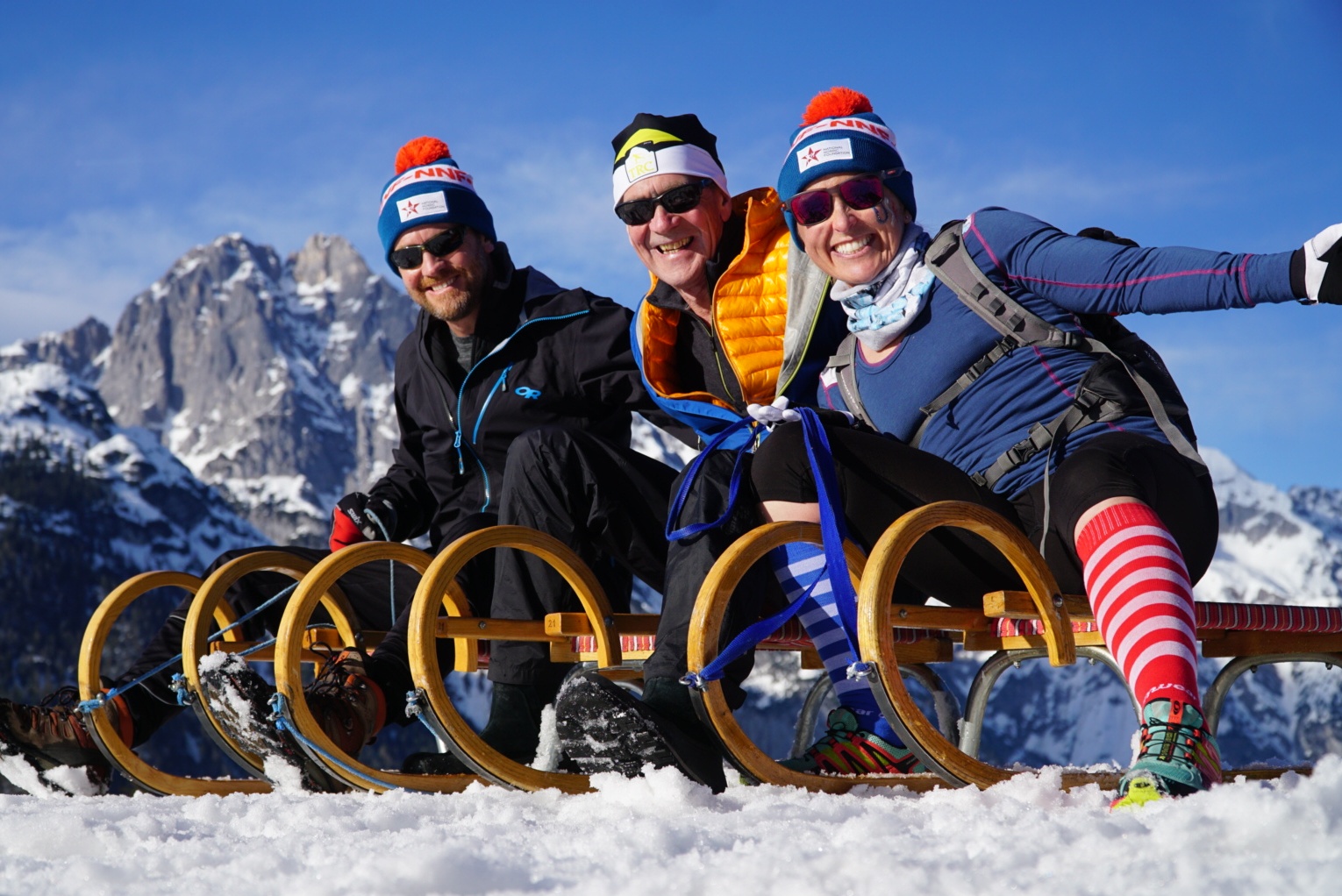
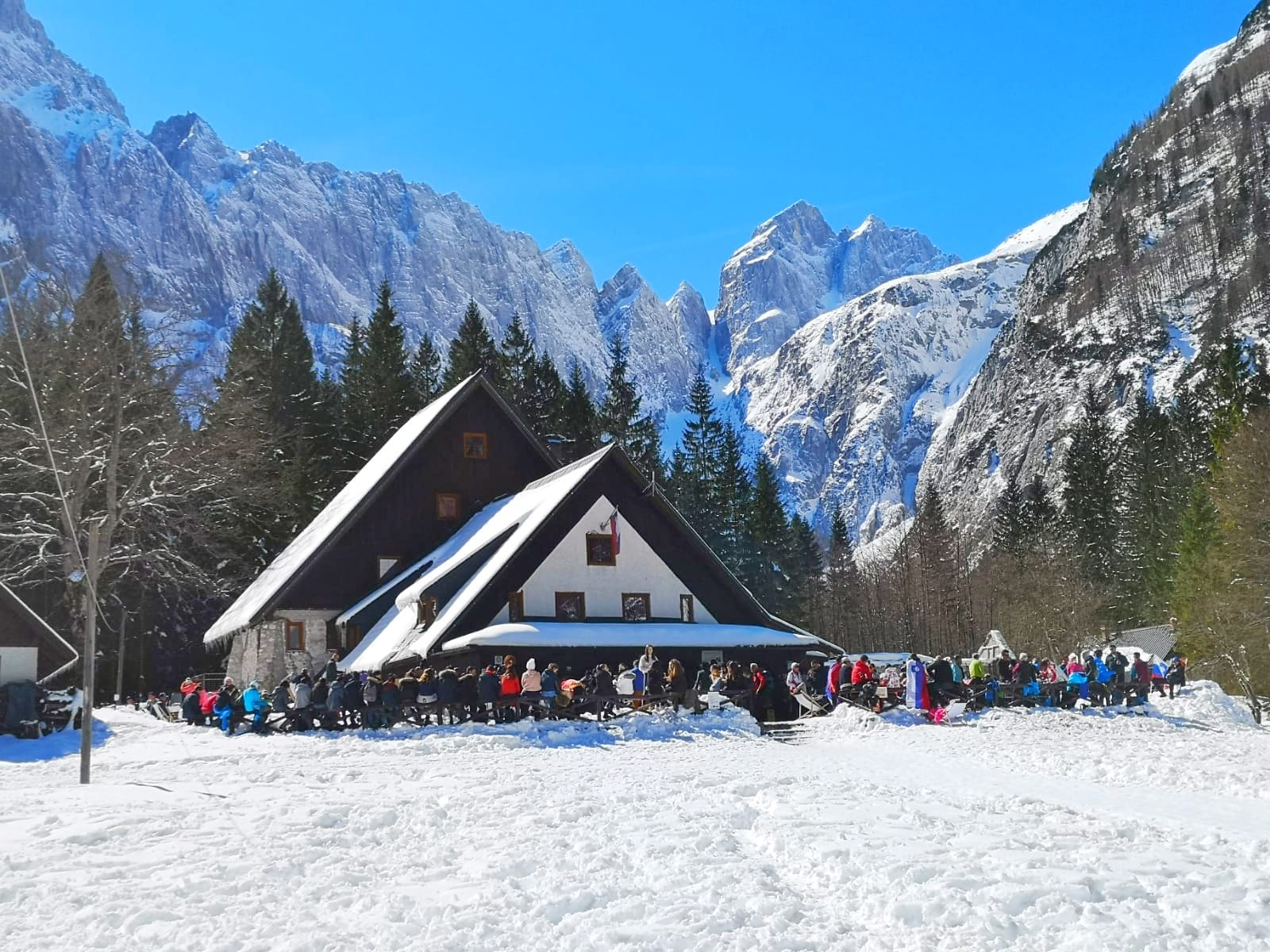
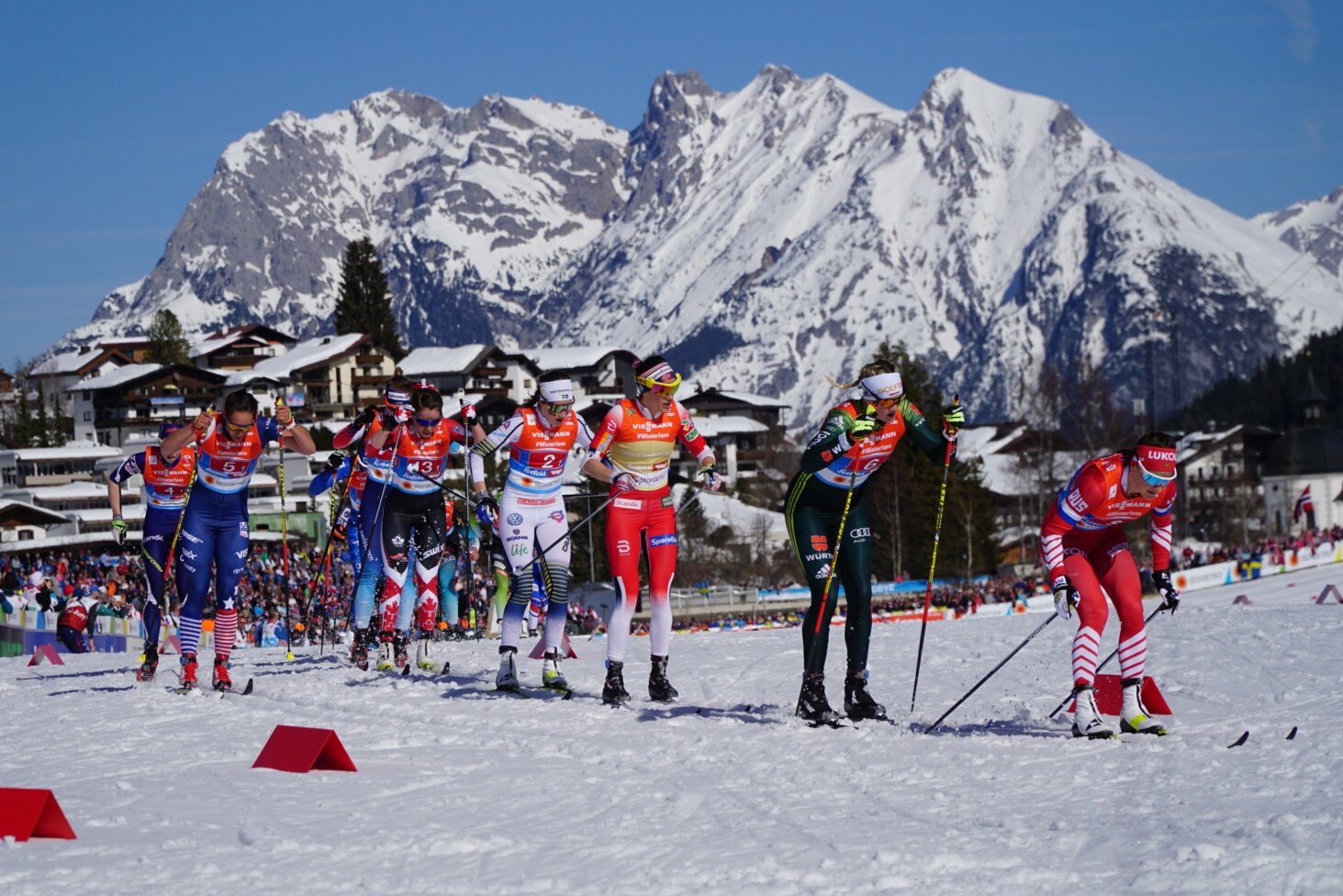
This unique, 7-day trip features grandstand seating for the first week of World Championships, including the classic sprints, skiathlon and skate team sprints – some of the best medal events for the US (the full schedule can be found here). When you’re not trailside cheering on your favorite athletes, the trip features a variety of cultural activities, hallmarks of a Lumi Experiences trip: daily skiing within a short walk from your hotel in Italy, a boat ride on Slovenia’s picturesque Lake Bled, a World War I walk through the mountain trenches led by your hotel’s historian, and sledding and lunch at a trailside hut above Italy’s emerald green Lago di Fusine. And of course, daily ski waxing, plus support and insights from your local trip leaders to make the most out of some of southern Europe’s best ski venues. All the transportation, tickets, lodging and logistics are taken care of so you can enjoy this once-in-a-lifetime trip with your travel companions.
The best part? Proceeds from this trip will help provide the financial platform to continue the Trail to Gold Fellowship (T2G), inaugurated this year to provide talented US women coaches with World Cup coaching experience.
(Photo: Lumi Experiences).
The trip was developed by Lumi Experiences founder and Olympian Garrott Kuzzy. Learn why Planica is one of Garrott’s favorite nordic ski venues.
1988 & 1992 Olympian Nancy Fiddler, one of the authors of the Trail to Gold book, traveled with her husband Claude on the Lumi trip to the 2019 World Championships:
“We loved all the excitement surrounding the event, skiing every day, meeting a fun group and getting to know our trip leaders. Lumi did all the planning, so all we had to do was have fun! Plus the food and guides were great. Europe at its best!” – Nancy & Claude Fiddler
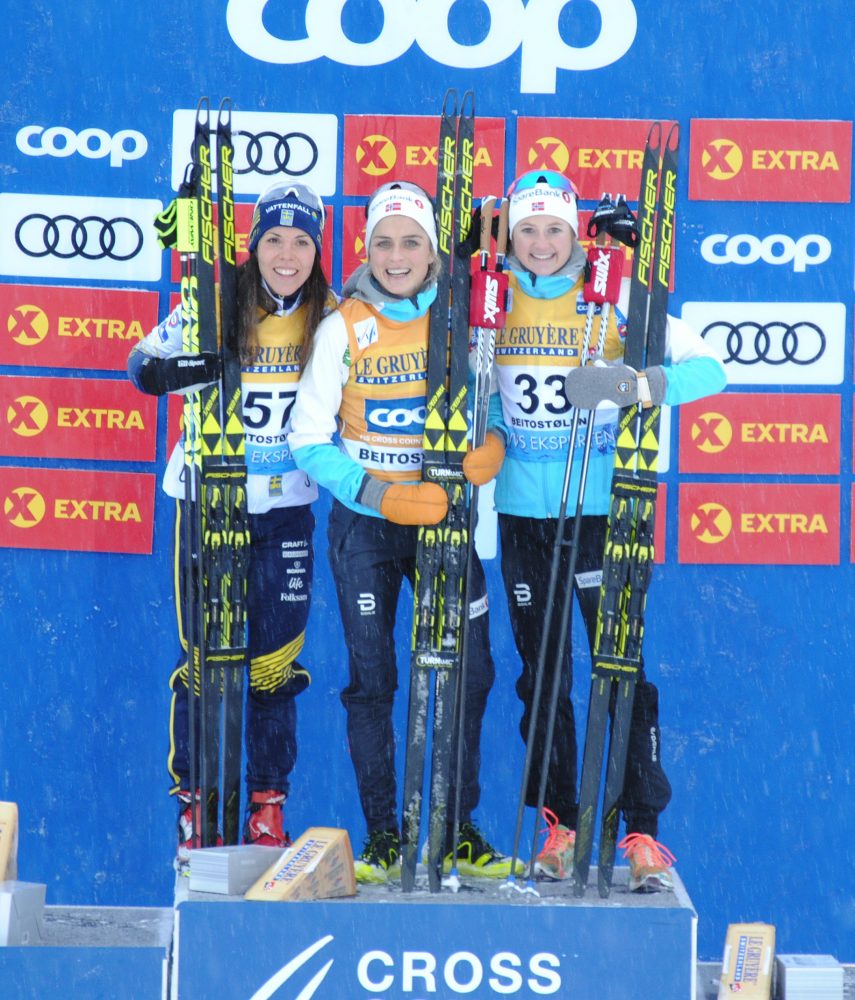
The Women’s podium from the World Cup 15 k freestyle in Beitostølen, Norway. Norwegian Theresa Johaug (center) was first, Sweden’s Charlotte Kalla (left) second, and Ingvild Flugstad Østberg (right) of Norway third.
FIS World Cup Beitostolen, Norway 15 k/30k Freestyle Individual Start
With snow falling and trees covered with fresh snow, Beitostølen, Norway’s wintery essence was on full display during the women’s 15-kilometer freestyle individual start on Saturday.
Keeping her distance win-streak alive was Norway’s Therese Johaug who won her fourth World Cup distance race of the season making it four for four in 2018/2019.
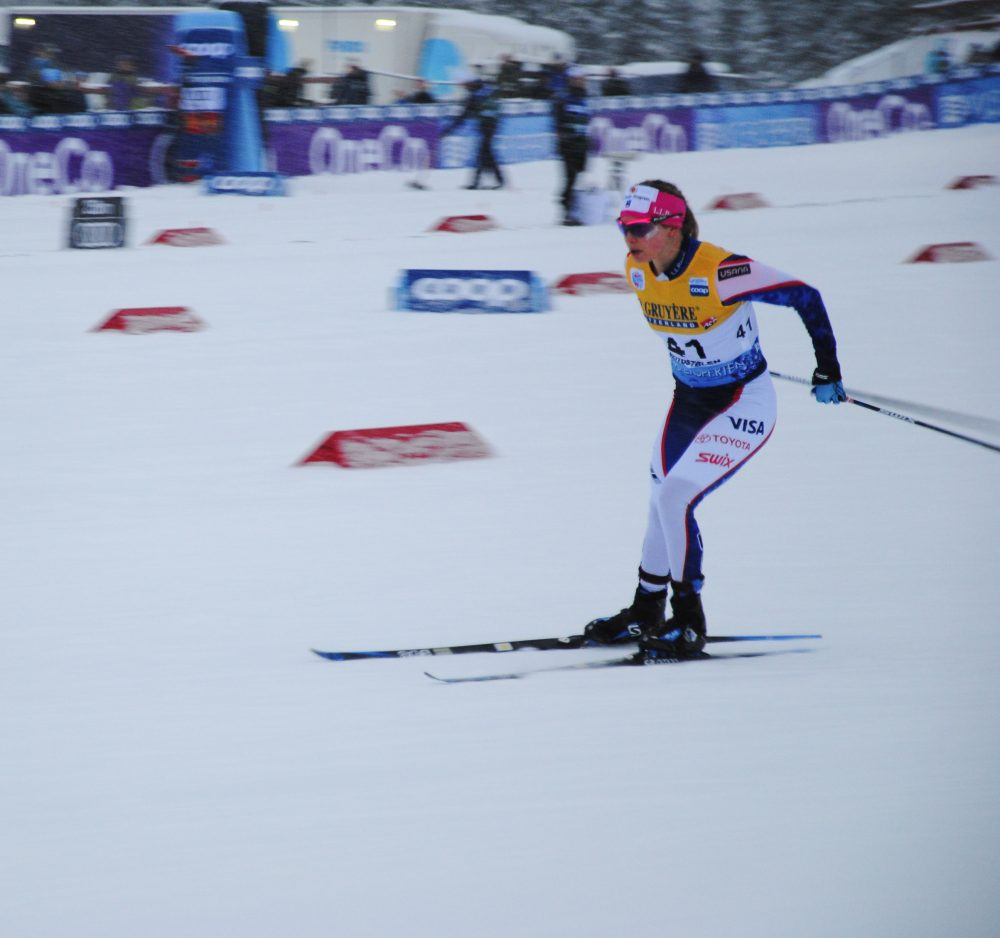
Jessie Diggins of the U.S. Ski Team on her way to eighth place during Saturday’s 15 k freestyle in Beitostølen, Norway.
Johaug won in a time of 38:39.8 minutes. The only blip of egalitarianism on the tracks was at the first time check at 1 k, where Johaug was tied for the best time with Russia’s Natalia Nepryaeva. Otherwise, Johaug gradually pulled away from the fifty-eight finishers by the time she crossed the finish line.
Sweden’s Charlotte Kalla placed second (+1:05.9), and Ingvild Flugstad Østberg of Norway was third (+1:06.1).
U.S. Ski Team (USST) athlete Jessie Diggins finished in eighth (+1:29.6) for her first top-10 result of the season. Sadie Bjornsen (USST) placed 13th (+2:22.9), Rosie Brennan 15th (+2:33.9), Caitlin Patterson (CGRP) 32nd (+3:46.0), and Kaitlynn Miller 50th (+5:02.8).
Canada entered a women’s team for the first time this season. Emily Nishikawa of the Canadian National Team (CNT) was the best placed Canadian in 34th (+4:01.6). Cendrine Brown (CNST) was 38th (+4:16.4).
Sitting atop the men’s overall World Cup this season after Saturday’s racing is Russia’s Alexander Bolshunov. The young skier is a killer in the sprints and distance events. But it is perhaps Norway’s Sjur Røthe who has impressed the most this season in the distance events. Røthe has a slight seven-point lead in the distance overall.
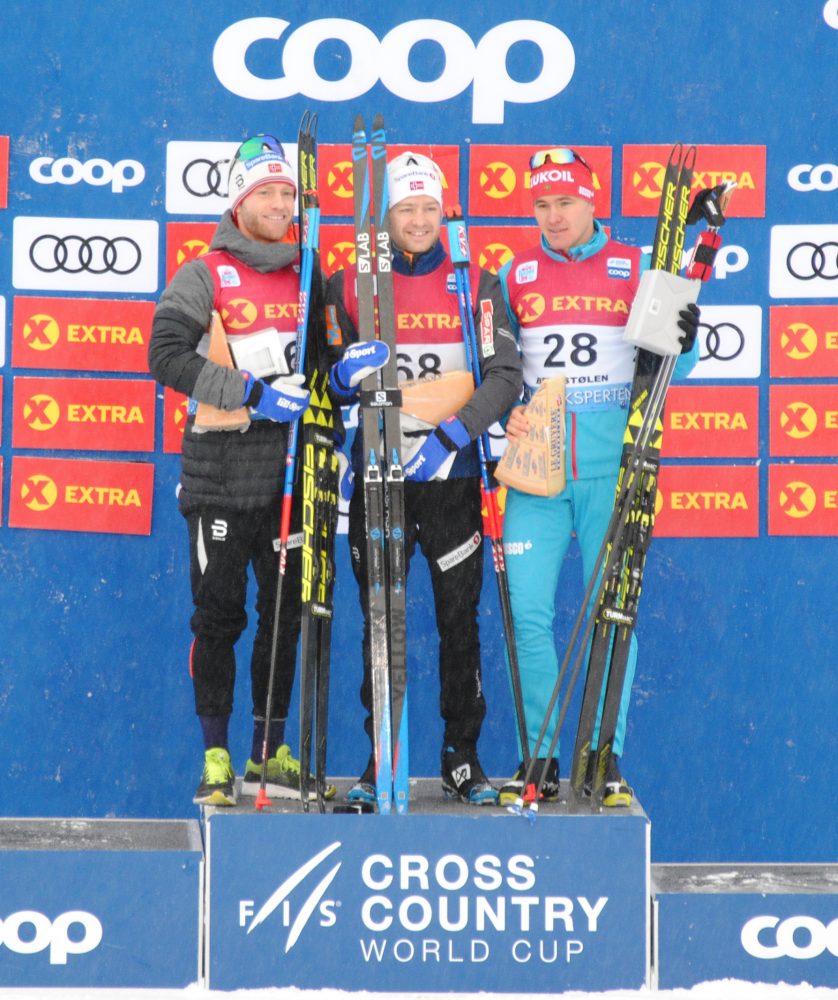
The men’s podium from the 30 k freestyle individual start in Beitostølen, Norway. Sjur Røthe (center) placed first, teammate Martin Johnsrud Sundby (left) second, and Russia’s Andrey Melnichenko (right) third.
Røthe won Saturday’s 30 k skate individual start in a time of 1:09:53.5. It was his second World Cup victory this year. Teammate Martin Johnsrud Sundby, with his first podium of the season, placed second (+35.2), Russia’s Andrey Melnichenko was third (+49.2). For the twenty-six-year-old Melnichenko, it was his first career World Cup podium.
Canada’s Alex Harvey was the best placed North American in 13th (+1:49.8). Also skiing for Canada, Andy Shields finished in 63rd (+7:05.6).
Scott Patterson (USST)was the best-positioned skier for the U.S., placing 47th (+4:32.7). David Norris (APU)skied to 51st (+5:13.3.) Erik Bjornsen (USST) was 52nd (+5:14.9), Adam Martin (CGRP) 59th (+6:14.8).
Egan Leads North Americans in 15th Place in Pokljuka Sprint.
Just before her race on Saturday, US Biathlon’s Clare Egan seemed to be in a relaxed mood and could be seen on the broadcast joking with other athletes and posing for pictures in the warm-up zone. Starting into the women’s 7.5-kilometer sprint in an early group in bib 26, Egan began the race fast and still managed to shoot clean in her prone stage.
She kept near the top at the split times during this early phase of the race.
“I am skiing way faster than I have in past years,” Egan commented on her improved course time in an email to FasterSkier, which in past seasons occasionally had prevented her from achieving positions in the points or qualifying for pursuit and mass start races. “I think my previous best ski time was in the 20’s, but my average was probably in the 50’s. So to have 11th ski time in the Individual [on Thursday] and the 6th today is a very significant improvement for me. It means that I can now aim for the flower ceremony, and even the top of the podium.”
In the standing shooting stage she then missed her very last shot of the race, having to ski once through the 150-meter penalty lap. After another fast final loop she came to the finish in fourth place. But after several athletes who began the race later finished ahead, she was pushed down in the standings, ultimately ending her day in 15th position (+1:08.8, 0+1). According to Egan she only narrowly missed a career-best result, having finished in 13th place in the sprint in Kontiolahti, Finland, during the last season.
“Today I would have been 4th or 5th if I had hit my last shot,” Egan wrote. “Overall my shooting is there, and now my skiing is too, so I just need some more races to get comfortable in this position. I really fought for my last two shots today and I got the 9th one and I’m very happy about that. Also my prone was perfect and I don’t take that for granted. I am focusing on the positive things and learning what I can to do better next time… which is tomorrow!”
Behind Egan, her teammate Susan Dunklee also had drawn a spot in the first start group starting early in bib 2, and remained clean in the prone stage as well. But in her second shooting she incurred two penalty laps, and ultimately ended her race day finishing in 45th place (+1:50.4, 0+2). The third U.S. starter, Joanne Reid, finished 57th with two penalties (+2:06.8, 1+1).
“Our whole women’s team did excellent training and it is paying off: last year at World Cup 1, zero American women qualified for the pursuit, whereas all three of us did today,” Egan commented.
She also credited their revamped coaching staff around which centers around Armin Auchentaller. Auchentaller spent the last few seasons coaching the Swiss women’s team.
“And it’s worth noting that with Susan’s 11th place in the Individual, we’ve now had two women go in the top-15 already in the first two races of the year (which is likely a first for US Biathlon). We are proud of ourselves and motivated to keep climbing. As usual, our ski service team is on fire. Tomorrow we’ll go for it again in the pursuit!”
For Biathlon Canada it was a difficult day on the shooting range overall, with Megan Tandy posting the best result in 73rd place (+2:46.6, 0+2). Her teammates Rosanna Crawford finished 77th with four penalties (+2:52.1, 2+2), Nadia Moser was 88th (+3:42.1, 2+2) and Megan Bankes was 99th (+4:39.6, 1+4). All missed qualifying for the pursuit on Sunday.
About a minute ahead of Egan, the race was won by Finland’s Kaisa Mäkäräinen in a time of 20:08.1 minutes, with no penalties.
“I enjoyed today,” last season’s Overall World Cup winner Mäkäräinen commented in thepress conference. “I really tried to be confident. … Of course it gives you a lot more energy when you shoot clean. I know if I shoot clean that I can fight for the top positions. … But I still had to work hard and had a good last loop.”
In the finish she was 14.8 seconds ahead of Italy’s Dorothea Wierer, who also had no miss and recorded the fastest shooting time on the range on Saturday, but couldn’t match her Finnish rival on the course. Hitting all targets as well, Justine Braisaz of France finished third (+42.1, just two days after ending the individual race only in 82nd place with seven penalties. That’s the ups and downs of biathlon. Also shooting clean and just off the podium was Braisaz’s teammate Julia Simon in fourth place (+44.6), for her first top-ten result in a World Cup. Wierer’s teammate Lisa Vittozzi was fifth with one penalty (+46.9, 0+1).
Julia Kern (SMS) leads Dahria Beatty (CNST) into the final straight in the A final. (Photo: Peggy Hung)
Sovereign Lake Noram/SuperTour, Vernon, BC
North American racing resumed with free technique sprints at Sovereign Lake. The first weekend of the NorAm series was also the second weekend in the SuperTour.
SMS’s first year senior Julia Kern continued her strong start to the season, winning the qualifier and the A final and looking dominant throughout. National team member Dahria Beatty kicked off her season with a crash in the qualifier, but got up to finish 7th. Dartmouth and AWCA’s Laura Jortberg was in third, followed by national team member Maya MacIsaac-Jones. APU’s Hannah Halvorsen was fifth and Stratton Mountain School’s (SMS) Erika Flowers trailed in last after breaking a pole on the final downhill corner.
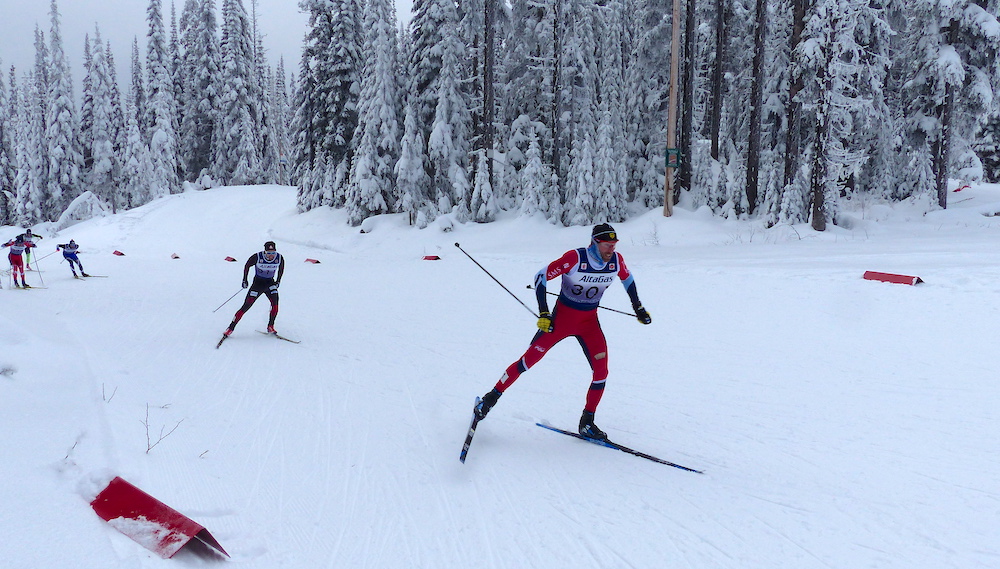
Andy Newell leads Antoine Briand into the finish straight in the A final. (Photo: Peggy Hung)
On the men’s side, Andy Newell (SMS) continued the American domination, winning the qualifier in 2:15.180, 4.050 seconds ahead of APU’s Logan Hanneman, before winning all of his heats comfortably. Antoine Briand represented for Canada and the Centre National d’Entrainment Pierre Harvey (CNEPH), placing second to Newell in every heat. Ben Saxton (SMS) completed the podium, edging out APU’s Logan Hanneman in a four way battle for third. Antoine Cyr (CNST) and Ben Lustgarten (Craftsbury Green Racing) trailed in two ski lengths behind.
“It was a cascade of issues,” jury member Dave Dyer told FasterSkier.
The short, short version is that the timing system has a number of redundant systems to detect errors. While the timing team was working on an unrelated issue, two athletes tied exactly. There are two sets of results zone4: the provisional (timed to 1/1000ths of a second) and the official (timed to 1/100th of a second). The bib list was generated from one list and the zone4 live timing database was populated from the other, with the two skiers who were tied shown in different order. From this point on, all the backup systems indicated errors and everything had to be hand checked. The results were right, the right athletes advanced, but live timing was switched off and delays ensued.
Full details and video interviews will be in Monday’s event wrap-up.
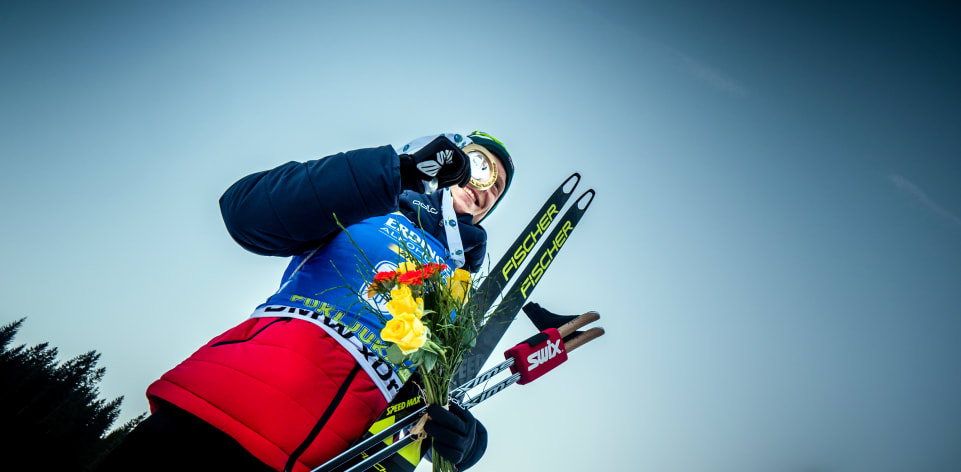
Norway’s Johannes Thingnes Bø with the first place hardware after winning the men’s IBU World Cup 10 k sprint in Pokljuka, Slovenia. (Photo: Biathlonworld,com)
IBU World Cup Pokljuka, Slovenia Men’s 10-kilometer Sprint
The men’s 10-kilometer sprint in Pokljuka, Slovenia was won today by Norway’s Johannes Thingnes Bø in a time of 23:46.3 minutes. During the two shooting stages, Bø skied a single penalty lap after missing one shot while standing.
Bø led the race from beginning to end, marking the fastest split at the first time check and never relinquishing control of the race.
France’s Antonin Guigonnat placed second 16.1 seconds back. Guigonnat shot clean, skiing no penalty laps. Alexander Loginov of Russia was third. He also shot clean and finished 16.4 seconds behind winner Bø.
Canada’s Christian Gow had another strong performance, placing 17th (+1:01.2) after shooting clean. Christian Gow placed 16th in yesterday’s 20 k individual race.
Also for Canada, Brendan Green finished 81st (+2:36.9). Green had three penalties, one in prone, two standing. Nathan Smith was 88th (+2:54.4) after missing one target shooting prone. Scott Gow placed 93rd (+3:08.6) with four penalties. He missed two targets shooting prone, two standing.
American biathlete Sean Doherty placed 26th (+1:15.1) while shooting clean. Also for the U.S., Leif Nordgren crossed the line in 31st (+1:20.90.) He missed a single target shooting prone, and shot clean standing. Travis Cooper placed 103rd (+3:57.4). Cooper missed two targets shooting prone and three standing. Max Durtschi finished in 108th (+4:36.4) missing six targets in total; two in prone, four standing.
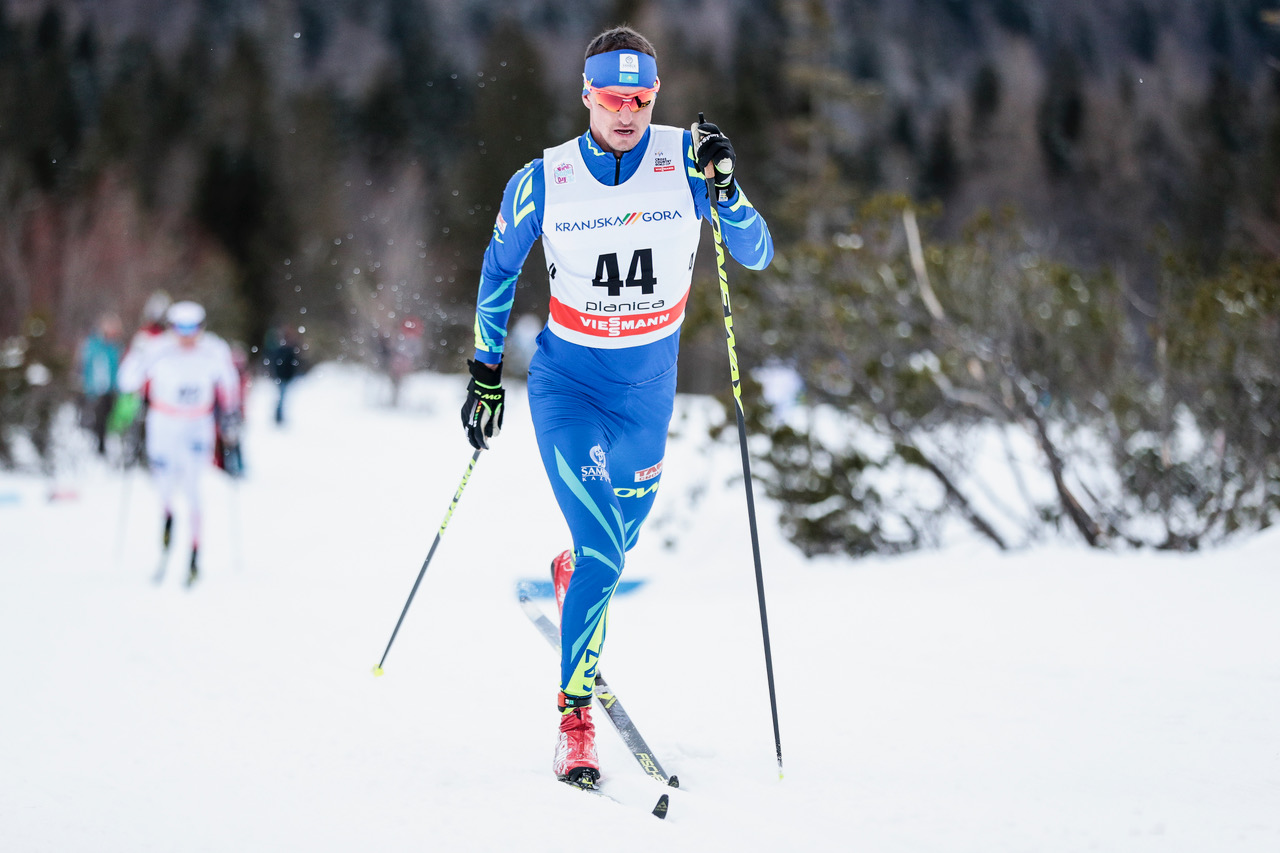
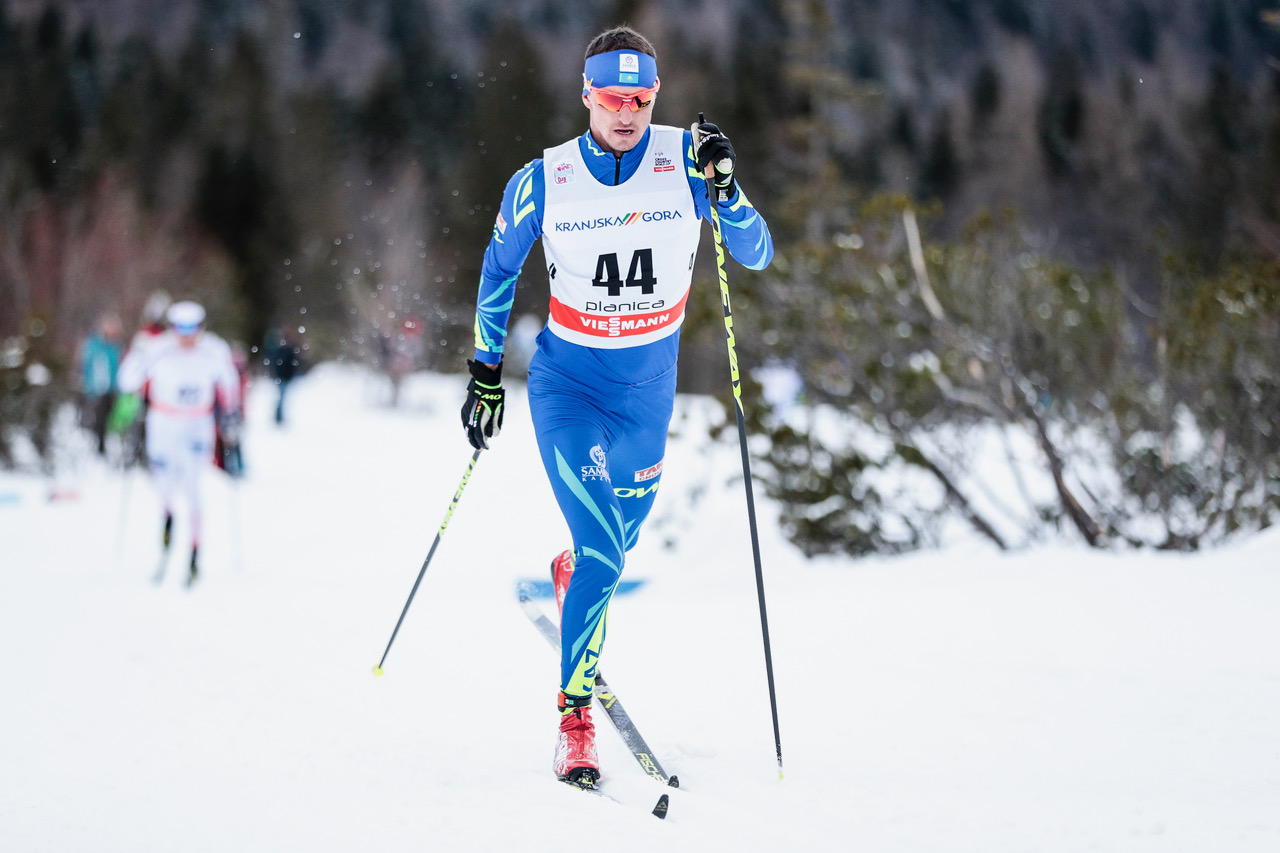
Kazakhstan’s Alexey Poltoranin racing to the win in the men’s 15 k classic at Sunday’s World Cup in Planica, Slovenia. (Photo: Fischer/NordicFocus)
Sunday’s World Cup 15-kilometer classic in Planica, Slovenia was a coupling of efficiency, power transfer and patience. Three laps of the course on which skiers climbed roughly 650 feet per 5 k cycle required the low-revving thump-thump-thump of a diesel engine and just the right timing for speed bursts to close time gaps.
Kazakhstan’s Alexey Poltoranin covered the 15 k distance in 36:45.7 and won the race by 13.2 seconds over overall World Cup leader, Norway’s Johannes Høsflot Klæbo. Calle Halfvarsson of Sweden, who did not finish Saturday’s classic sprint after crashing into netting in his quarterfinal, placed third (+42.8) for his second World Cup podium of the season. Emil Iversen of Norway missed out on his second podium of the weekend (he had placed second to Klæbo in the classic sprint) striding to fourth place (+54.7) on Sunday.
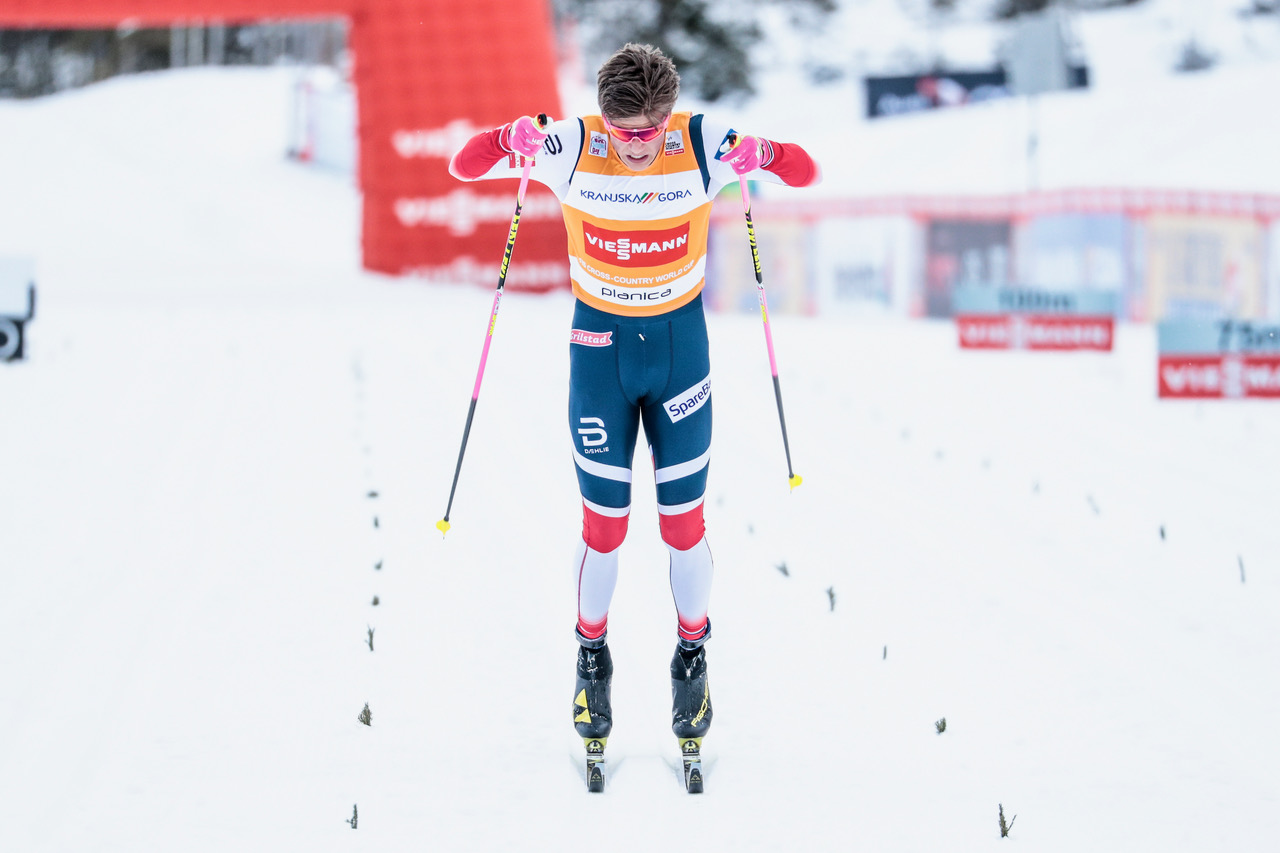
Norway’s Johannes Høsflot Klæbo finishing the men’s 15 k classic on Sunday at the World Cup in Slovenia. He finished second to Kazakhstan’s Alexey Poltoranin. (Photo: Fischer/NordicFocus)
This season Klæbo has barnstormed — he’s podiumed in every race entered with the exception of a 10th place in a 15 k skate in Toblach, Italy. He’s won the most World Cup distance races of any skier with three this season. The Klæbo buzz is worthy and justified.
Yet Sunday marked a historic moment for Poltoranin. He tied the longtime mark at seven wins in the 15 k classic held by Swedish legend Gunde Svan. Klæbo may be center stage, but Poltoranin is no simple supporting actor. Revered as a classic specialist, but proving his all-around capacity by placing fourth in this year’s Tour de Ski (TdS), Poltoranin is not one dimensional.
As he kicked and strided on Sunday, Poltoranin made clear why he holds the record (15) for 15 k podiums. His tall and muscular frame epitomize clean classic strides that belie the amount of wattage produced.
Poltoranin was never first through any of the time splits until the finish line. Through 3.9 k, 6.9 k, 8.9 k, and 11.9 k, it was Klæbo with the fastest times. Klæbo began in bib 42, Poltoranin began a minute back as the 44th starter. With the knowledge of Klæbo’s splits, however, Poltoranin could wait until the final lap to punch the speed.
At 3.9 k, Poltoranin was 5.5 seconds back with the second-fastest split. By 11.9 k, he was right on par with Klæbo, as 0.3 seconds separated the two skiers. In the next three k, the 30-year-old Poltoranin was able to gain 13.5 seconds on Norway’s 21-year-old for the win.
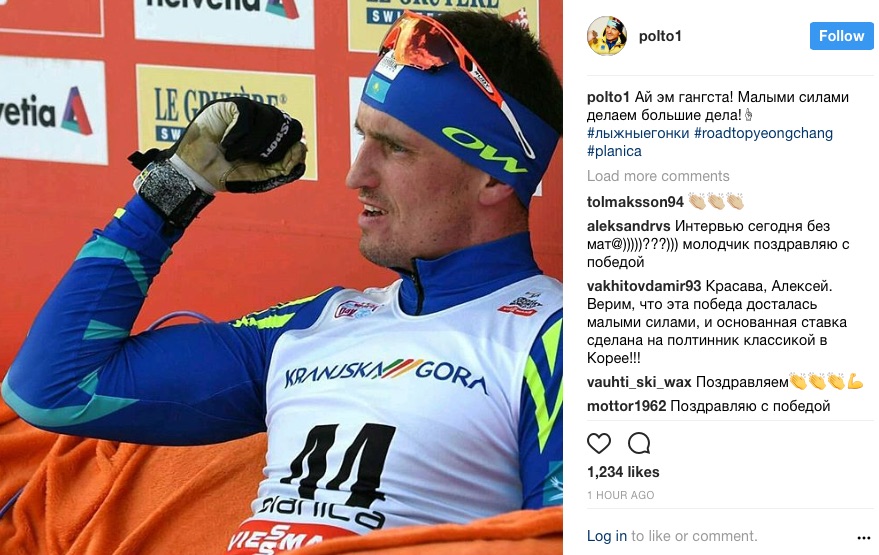
Men’s 15 k classic winner in Planica, Slovenia, Kazakhstan’s Alexey Poltoranin flexes his muscle in the leader’s chair. (Photo: Alexey Poltoranin/Instagram)
Flexing his bicep for the cameras in the leader’s chair, Poltoranin showed, for now, who’s the 15 k classic boss.
“I am really happy to win,” Poltoranin said, according to an International Ski Federation (FIS) press release. “This is a good course for me and I had very good skis and want to say thank you to my service team.”
Klæbo, a press-conference regular this season, paid respects to Poltoranin with his comments.
“It was a very hard course,” Klæbo said, according to the release. “I had great skis on the downhills, but was a bit light for kick on the climbs. Polto was so fast from 12 k and I couldn’t match his pace.”
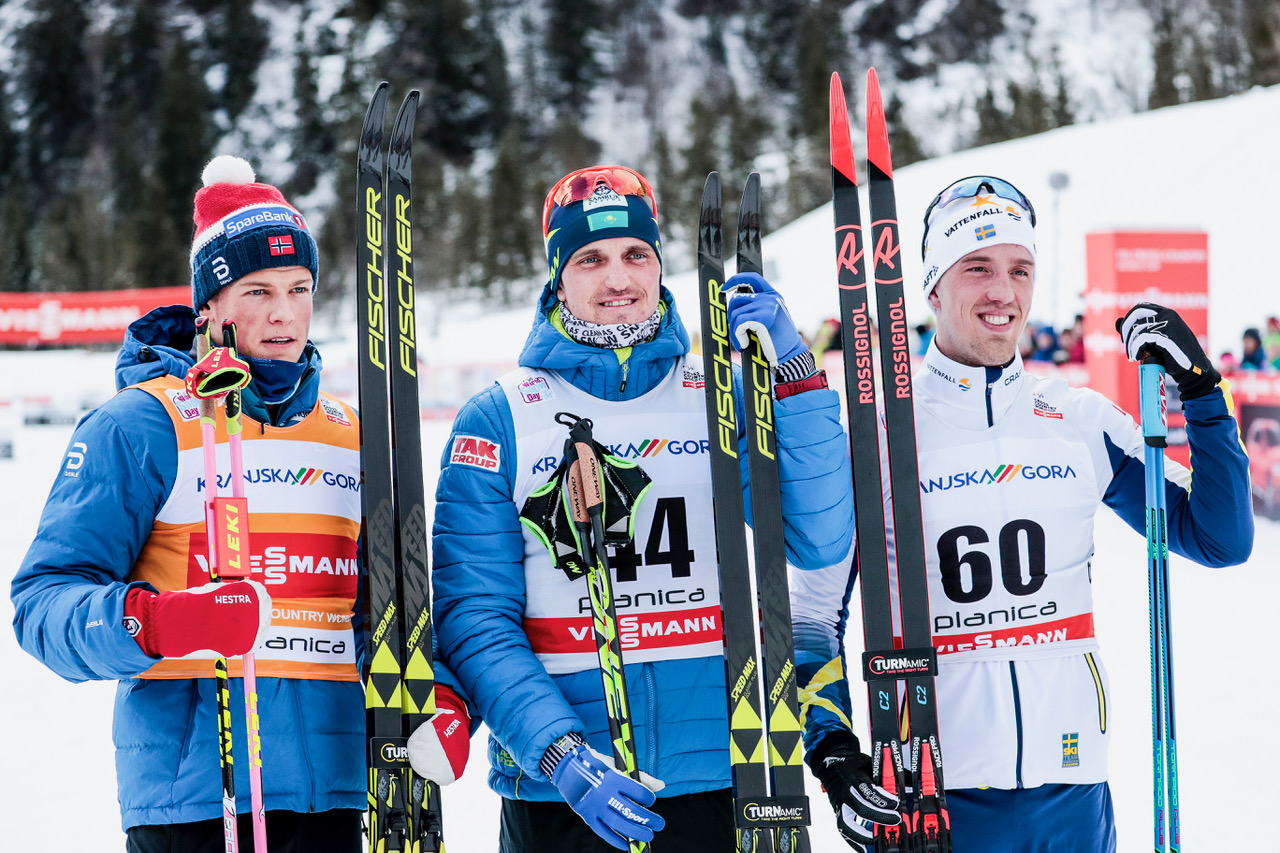
The World Cup men’s 15 k classic podium on Sunday in Planica, Slovenia, with Kazakhstan’s Alexey Poltoranin (c) in first, Norway’s Johannes Høsflot Klæbo (l) in second, and Sweden’s Calle Halfvarsson (r) in third. (Photo: Fischer/NordicFocus)
After Sunday’s race, Klæbo leads the World Cup overall with 1012 points, while teammate Martin Johnsrud Sundby, who did not contest the weekend’s races, sits in second with 875 points.
Scott Patterson (U.S. Ski Team) was the top North American in 43rd (+2:56.2). In his first race back in Europe since racing at U.S. nationals in Anchorage, Alaska, where he won the 15 k freestyle, Patterson told FasterSkier in Planica that he was recovering from a post-national bout with bronchitis.
“This was kind of building back and see what I could do,” Patterson said. “Didn’t feel great out there, it was a race to build a little experience.”
Patterson also commented on the nature of the Planica course’s long hills which kicked up gradually.
“It was a deceptively hard course,” Patterson said. “You never felt like you were going that hard, but it just wore you down over time. You almost want to double pole them, but not really.”
Patterson said he plans to race in next Sunday’s 15 k freestyle mass start, the last World Cup race before the Olympics, in Seefeld, Austria.
Ben Lustgarten (Craftsbury Green Racing Project) was the next best American finishing 46th (+3:04.9). Lustgarten earned World Cup starts as the Period 1 SuperTour leader.
After Sunday’s race, Lustgarten recalled focusing on relaxed skiing and maximizing his effort.
“We all know the hills are long,” he told FasterSkier. “It was a good race. I didn’t feel amazing, to be honest, but I felt like I pushed as hard as I could. And I really worked the technique. I might have lost some time on the transitions and cresting hills because I was so dead. … But I don’t think I could have gone any harder because my whole body was maxed out on the top of the climbs.”
Also on the American side, Tyler Kornfield (Alaska Pacific University) was 57th (+4:03.7). Andy Newell did not finish.
“For sure not our best weekend,” U.S. Head Coach Chris Grover told FasterSkier in Planica. “That said, classic weekends are usually our best. But at the same time, I thought some of our skiers looked a little bit flat — probably to be expected, we have some athletes obviously who just got here, some who came out of U.S. nationals, some who are just coming back to skiing after the Tour de Ski. And some of those athletes that are coming from the Tour de Ski are feeling good, like one-hundred percent back, others are ninety percent back, and are not quite there I think. … Also, a few that are getting over some illnesses, and we also have some that are kind of in the middle of a training block to get ready for the Olympics — kind of a mixed bag.”
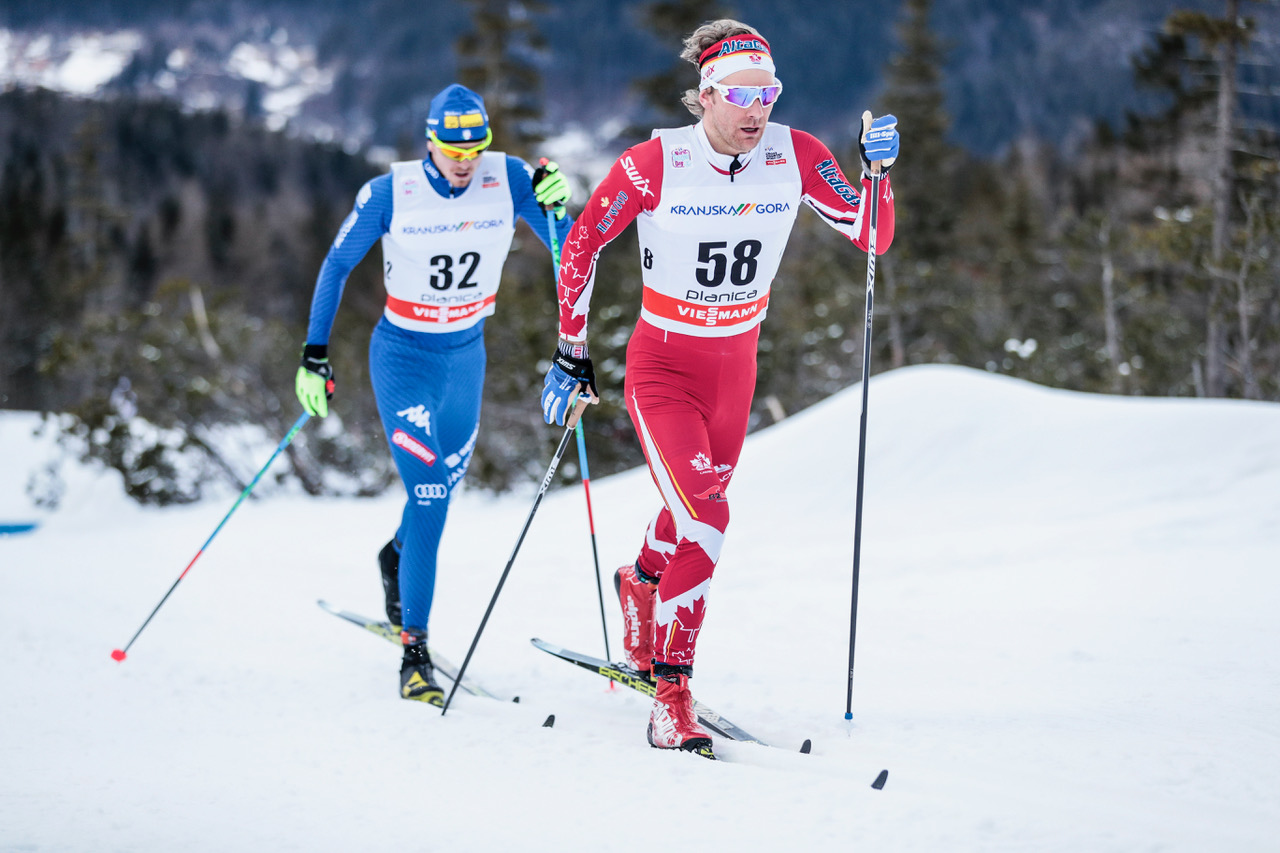
Canada’s Devon Kershaw (58) leads Italy’s Dietmar Nöckler in the men’s 15 k classic at the World Cup in Planica, Slovenia. Nöckler went on to place 38th and Kershaw 44th. (Photo: Fischer/NordicFocus)
But Grover also noted that in the end, the weekend proved positive.
“A couple of great performances,” Grover added. “Jessie’s fourth yesterday, that is her best classic sprint result of all time. Really cool to see her making that progress. I thought it was a great race yesterday out of Logan Hanneman to be that close to qualification, he just got over here this week from the U.S. Similarly, a really nice qualification out of Tyler Kornfield yesterday. Same deal. Just got over here. Those were some silver linings for sure.”
Canada’s Devon Kershaw returned to the circuit and placed 44th (+2:57.1), Bob Thompson (NTDC Thunder Bay) was 64th (+5:05.0), and Dominique Moncion-Groulx (Alberta World Cup Academy) was 70th (+6:11.7).
Racing continues next weekend with a freestyle sprint and 10/15 k freestyle mass start.
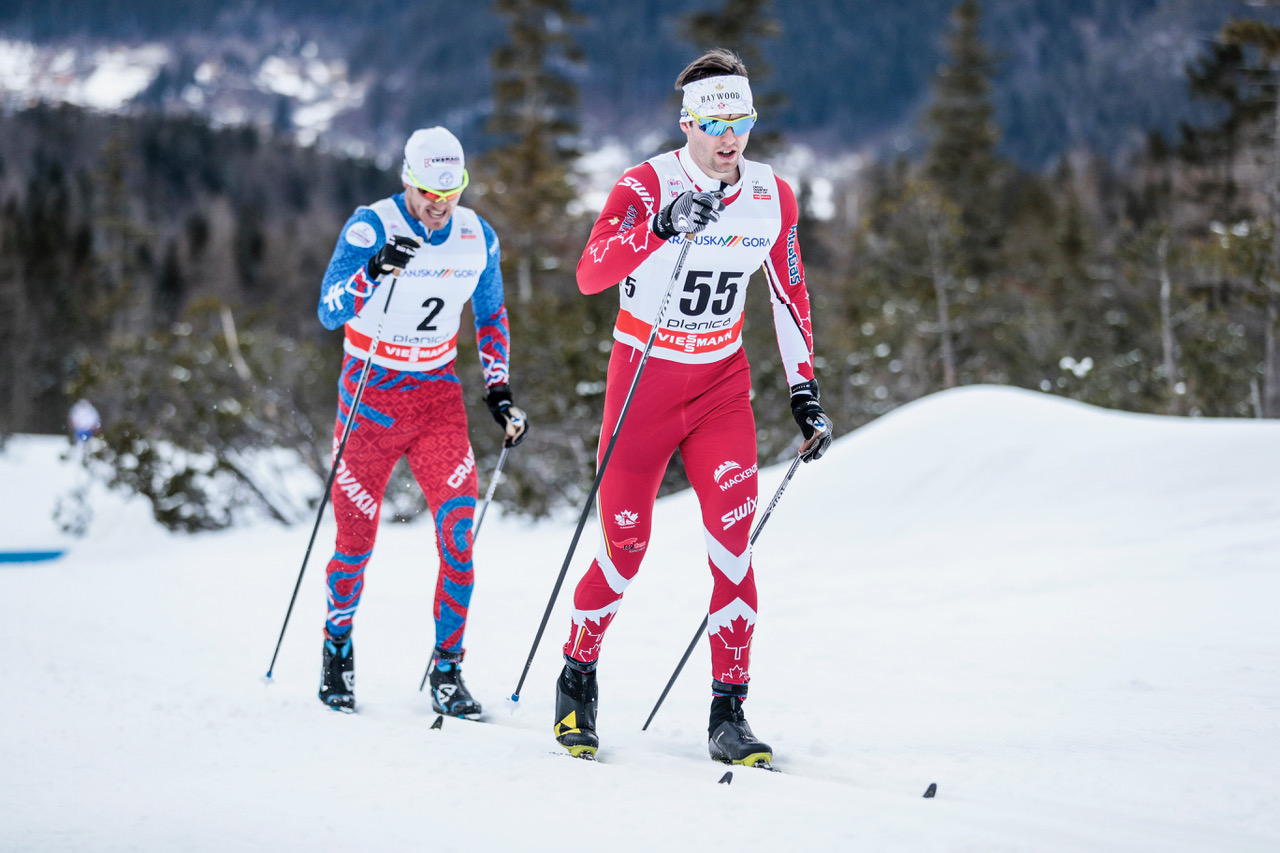
Canada’s Dominique Moncion-Groulx (55) with Slovakia’s Peter Mlynar (2) during the World Cup men’s 15 k classic in Planica, Slovenia. Mlynar went on to place 48th and Moncion-Groulx finished 70th. (Photo: Fischer/NordicFocus)
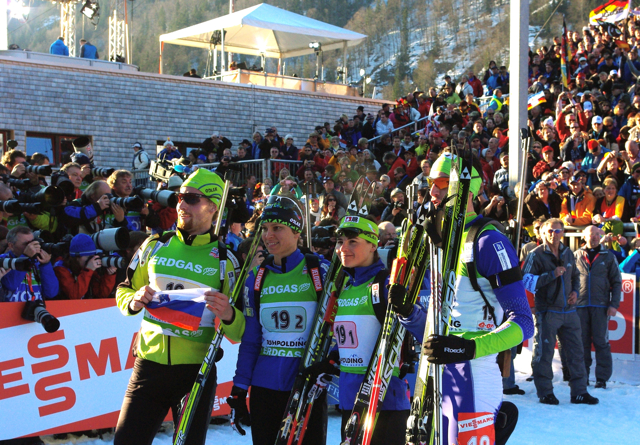
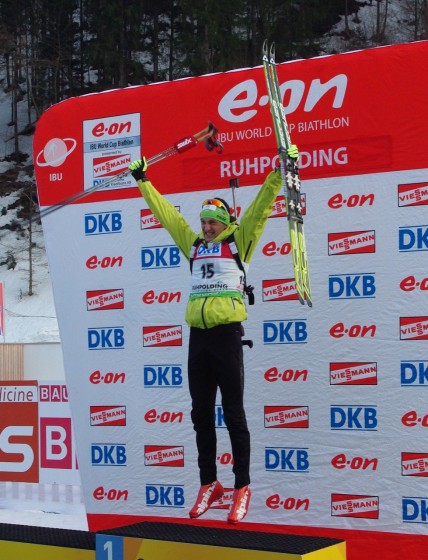
The Slovenian biathlon team of Klemen Bauer, Teja Gregorin, Andreja Mali, and Jakov Fak after winning silver in the 2012 World Championships mixed relay in Ruhpolding, Germany.
Slovenian biathlete Klemen Bauer has competed in nine World Championships and three Olympics, landing just one spot away from a medal in the sprint in Vancouver in 2010. He has a handful of top-10 World Cup finishes to call his own.
Bauer has also been a prominent voice for fair and ethical sport, speaking out in support of the anti-doping process and more recently participating in a campaign to eradicate sexual abuse from sport.
Bauer tweeted cryptically when the International Olympic Committee (IOC) announced that one athlete had been caught doping when samples from the 2010 Olympics were re-tested this year using up-to-date analytical methods. When it was announced that Gregorin was the athlete in question, he tweeted, “Sad, mad, & disappointed.”
Klemen Bauer of Slovenia (right) racing at an IBU World Cup in Hochfilzen, Austria, in 2013.
In a press conference after the news was released, Gregorin said, “I sincerely apologize to all who have been affected my actions in any way.”
Among those affected are, obviously, Gregorin’s competitors, some of whom have voiced their own anger. But her teammates are also affected. Bauer, along with Andreja Mali and Jakov Fak, won mixed relay silver at 2012 World Championships. It remains to be seen whether that result will be invalidated.
Besides that, the Slovenian team’s reputation is affected.
“I feel bad for her other teammates, like Klemen, who has been at this for a long, long time, and it would seem that he will be the victim of speculation surrounding the case,” said U.S. veteran biathlete Lowell Bailey. “That’s just the natural tendency. ‘Well, if there’s one case, then how did she do it? Why did she do it? Who was helping her?’ All those questions come up.”
“Klemen is like a lot of other athletes – he is really a really hard-working, motivated, determined athlete,” U.S. veteran Lowell Bailey said in an interview last week. “He has always been a person that understands the seriousness of what it takes to be a career biathlete, but also understands that there’s a balance there. He has a son, Axel, and a family, and he has that personal balance that is important for a lot of the elder statesmen of the biathlon world. He’s a great guy and I have always enjoyed competing against him and with him.”
Bauer agreed to answer some questions about the Gregorin case and how it is affecting him and his team. The lightly edited interview is presented below, followed by more context from Bailey.
Klemen Bauer of Slovenia (right) chasing Martin Fourcade of France in the 20 k individual at 2017 IBU World Championships in Hochfilzen, Austria. (Photo: Glen Crawford)
FasterSkier: When did you hear about this case and what was your reaction? Were you with the team at the time, or did you have to process this all on your own?
Klemen Bauer: We (athletes) were informed a week before the public announcement. First reaction was shocking and frustrating. Then I was really mad and sad about it. I was on my own at the time. We were all back home.
FS:I guess you have known Teja for a long time.
KB: Yeah. I’ve known her since I was a little kid. She started in the same local club, training with her father. We were training mostly together (at training camps) for the past eight years.
FS:Would you have thought someone could do something like this with nobody else finding out?
KB: I think it’s an easy job to do it without anybody knowing it — as long as it’s a matter of an individual, which it was in Teja’s case.
FS:Do you think or do you worry that this violation by Teja will also affect your reputation? Slovenia’s reputation?
KB: Absolutely. That was actually one of my first biggest concerns. All the good stories we [Slovenian biathlon] have created in the past 8-10 years were destroyed in a moment. Well, hopefully it won’t be that cruel as I think — At this point I find it crucial to expose that it was an act of a single individual athlete. Me personally, I don’t like teams who were involved into doping scandals, so I can imagine the response of the athletes after this. But as I said, I really hope they will realize the rest of us are far away from what happened.
FS:Have you talked to any athletes from other teams/countries since the news came out?
KB: Not really.
FS:What about Teja, have you talked to her?
KB: Not at all. I have no intention to. I will wait for her to come in and explain (apologize).
FS:Has this affected your training for the upcoming season?
KB: It was hard to fall asleep first few couple of days after the news, but the training went well. Sometimes I even got an extra boost, when thinking about it – my anger came out.
FS:What about your attitude?
KB: In general after any doping scandal, my morale goes down. I would rather give up right away. But let’s say I still kind of believe in fair, clean sport (which is very naive), and probably that’s what still keeps me in sport. After recent events I’m even more determined to prove that a good result can be done in a fair, clean way.
FS:Is there anything else you would like to say about this situation, to fans of the sport for instance?
KB: I’d like to emphasize to have faith in our small team — most of other athletes are still young — and not to judge us by the act of one individual.
FS: Is this something you would have said in the past, when an individual from another team was caught?
KB: There are countries doing it [doping] on national level (supported by their government), and there are individuals. Of course a single act usually leads to suspicion of the whole rest of the team even if not so. I might be a little more careful about my judgment after this incident.
Bailey could sympathize with Bauer to some extent – the American had no idea that Gregorin had been doping, and he did not indicate that he’d ever had suspicions of the Slovenian team, who he called “always really friendly and open.”
It got more personal for Bailey when he pulled up that athletes’ petition during the interview and realized that Gregorin had signed it, adding her voice to demands for stronger anti-doping policies.
“That’s troubling to see from someone who had three positive tests – that, in my mind, represents knowingly committing an anti-doping rule violation,” he said. “To be quite honest, she was an athlete who I had a lot of respect for. She came from a smaller country in terms of biathlon and had some really impressive results. I always looked at her as an example of an athlete who was working hard within the rules. So it’s a feeling of betrayal to have something like this come out.”
Bailey emphasized that Gregorin deserves due process. When the case is over, competitors and fans may know more about how and why she decided to dope.
“I stand steadfastly behind every athlete having due process – there has been a lot of discussion about just treatment of alleged doping cases,” Bailey said. “I totally support that. I support due process and quick and fair and just proceedings. I hope that her case is treated that way. But it’s really sad. It’s really unfortunate to see that happen.”
Craftsbury’s Caitlin Patterson before anchoring “Vailbury Green” to second in the mixed relay at 2016 SuperTour Finals in Craftsbury, Vt. (Photo: John Lazenby/Lazenbyphoto.com)
Welcome to ’17 Questions for 2017′, where we are catching up with top American and Canadian athletes before the beginning of the winter season.
***
Craftsbury Green Racing Project skier Caitlin Patterson had a tough end to the winter in 2016: she locked up the overall SuperTour title, but got sick before the Ski Tour Canada and was unable to compete in the final World Cup series of the year, something that had been the focus for so many North American athletes.
But that SuperTour title earned her World Cup start rights for the first period of racing this season, and Patterson headed to northern Europe a bit early to get some early starts in Muonio and Saariselkä, Finland.
While the top Finns were present in Muonio, as well as Polish star Justyna Kowalczyk, the field in Saariselkä was primarily Russian, with the German national team also present.
“The races this past weekend were a bit of an adventure – 0°C and very tricky classic conditions,” Patterson wrote in an email about the races in Saariselkä, where she finished 23rd in the 5 k classic and 14th in the classic sprint. “And the courses had some funny 180 degree corners which are not what you usually see, and yet the races felt pretty big and official with all the different nations represented and especially so many Russians. Once again it was fun for me to put on a bib and race, and though I definitely didn’t feel my best for the distance race, I had quite a good sprint day and was happy to end the weekend on a good note.”
Patterson, 26, is now ready for to represent as the SuperTour leader.
“Yes, I am ready for the World Cup to start, or will be by the weekend at least!” Patterson wrote after traveling to Ruka, where the first weekend of racing will be held. “I have a few more days to become more familiar with the courses, test skis, do some pre-race intensity and then it will be go time! Of course I’m nervous, it’s the World Cup, but I’m also very excited and looking forward to racing!”
1. Biggest change in your life in the last five or so months since the ski season ended?
I got a car, my first one. Yes, I’m 26. I drove my parents’ cars during high school, but I never had a car in Vermont until this summer.
2. Biggest change in your training?
A little more volume, better quality all around. There haven’t been any huge changes, just a progression that makes sense while following the same training philosophy as the past years with the GRP.
3. Major areas of improvement you’ve seen so far?
Strength, particularly core stability/body connectivity, which has helped me ski with better and more stable technique.
4. Whom you’ve been working closest with this offseason (coaches or training partners)?
I’ve been working as closely as ever with coach Pepa Miloucheva, and enjoying training sessions with all of my GRP teammates.
5. Best trip in the last five months (and why)?
Oo that’s a tough one, I’ve been on several great trips, one to Alaska to ski on the Eagle glacier for the first time, and one to Slovenia and Austria to train on snow there. I’d have to go with the Slovenia/Austria trip, because the Julian Alps of Slovenia were great for exploring and make me want to go back soon for more hiking. And Ramsau, Austria is a spectacular place and great for fall training; I am building up lots of good memories from the three September camps I’ve been to on the Dachstein glacier in Ramsau.
6. Favorite cross-training?
Running, which luckily is a staple of my summer and fall training
7. Favorite non-athletic activity or pastime this summer?
Looking at close-up details of the natural world, and sometimes photographing them.
8. Song that was your jam this summer?
I enjoy hearing what other people come up with for pump-up workout music or music for the gym and car rides, but I’m not exactly great at coming up with that stuff myself, or staying on top of current trends. Some of my favorite music is by a folk group called Crooked Still.
9. All-time favorite race moment?
Of my personal race moments, the 10k skate mass start in Falun last year, where I first scored World Cup points, stands out. During the race I had no idea what place I was skiing in, but I was fighting for every second and pushing myself as hard as I ever have. It was incredible to learn in the finish pen that the hard work had been worth it, I had skied to a 25th place result!
10. First thing you pack in your bag when you leave for Europe?
Metaphorically, I pack my camera first. Physically the camera doesn’t go into the bottom of my bag, that would be my ski boots.
11. Venue/event you’re most excited to visit this season?
All of the World Cup venues in Period I, since they’ll all be new to me. So we can start with Ruka, Finland, since that will be first!
12. Who will win the World Cup title this year?
Oestberg and Sundby
13. Biggest sacrifice you feel you’ve made choosing this career path?
I don’t regret that skiing has been my highest priority for a long while now, but sometimes I do wish that I could give my full effort to academic studies or an engineering career. As a ski racer my time and attention is just so divided, with training and travel and racing, that I’ve never been able to commit 100% to intellectual work. Some day in the future I will, but for now there’s no rush.
14. If you could change one thing about your sport, what would it be?
Doping. I wish there was a better way to ensure that all athletes are competing clean, to be able to trust our fellow competitors and have the public trust the integrity of the athletes.
15. What did you have for breakfast this morning?
This morning I made egg-banana pancakes and ate them with yogurt, berries, and honey. It took me a few days to fill in all these questions and I had to change this answer every day! I really like eating something different just about every morning, because breakfast foods are nice, and fun to cook! Especially this past week as one of the last that I’ll be able to cook for myself for a while, I’ve been rotating through many of my favorites. I just have to be careful not to let myself launch into complex or long-lasting breakfast projects most days because I need to get out the door and train.
16. In 5 years, I’ll be ____?
Either ski racing at the Olympics, or engineering bridges while skiing on the side. Only time will tell which path is right.
17. In 50 years, I’ll be ____?
Still skiing and enjoying playing outside as much as ever.
Adam Loomis exploring the mountains outside of Planica, Slovenia. (Photo: Ben Berend)
Welcome to “17 Questions for 2017″, where we are catching up with American and Canadian national-team members before the beginning of the winter season.
***
24-year-old Wisconsin native Adam Loomis has become one of U.S. Nordic Combined reliables, contributing to a number of top-eight team results over the last few years. After competing in his first senior World Championships in Falun, Sweden, in 2015, Loomis is targeting the Lahti World Championships this season for his best performances yet.
After scoring World Cup points three times in individual races in the 2014-2015 season, Loomis was left outside of the top 30 last season.
Biggest change in your life in the last five or so months since the ski season ended?
This year I spent April and May at an internship in Denver. The opportunity arose from one of USA Nordic’s sponsors, Basin Holdings. It was a totally new experience to work in a business setting – and great to gain some real world work experience. I really enjoyed my time in Denver and the office team that I worked with… but, at the end of the day, this time reaffirmed that life as a full-time athlete beats working in just about any office!
Biggest change in your training?
Adam Loomis (U.S. Nordic Combined B-Team) competing at the World Cup in January 2015 in Chaux-Neuve, France, where he scored his first World Cup points. (Photo: Sandra Volk)
This summer, we committed to an extended training camp in Europe. After Summer Grand Prix competitions in August, I stayed overseas with some of my teammates until late October. We rented an apartment near Planica, Slovenia, which is arguably the best venue for Nordic Combined in the world. Our coach, Martin Bayer, lives there now, which worked perfect. It was really beneficial for everyone – and a blast!
Major areas of improvement you’ve seen so far?
With the help of our new coach, Nik Huber, I put increased focus on strength training this summer. I’ve made some big headway improving the strength and speed of me legs. Of course the key will be to show it this winter!
Whom you’ve been working closest with this offseason (coaches or training partners)?
Overall, whether we’re in Park City or training overseas, we do most of our training as a team – which is key to our success. That said, when I’m in Park City, I probably do the most training with my brother, since we live together and his schedules been more lined up with mine this year than in the past.
Best trip in the last five months (and why)?
As I already mentioned – the time in Slovenia was great. A cool part of this was when we took trips from our base to train at other venues. Later in the trip, we spent a few days in Ramsau, Austria and nearly a week in Oberstdorf, Germany. It was so nice to have these trips be separate excursions, rather than just the next hotel room that we had to haul our packed duffel bags into – like it normally is when we’re on the road for a long time.
Favorite cross-training?
Backcountry skiing on bluebird spring days.
Favorite non-athletic activity or pastime this summer?
Adam Loomis competing in the summer Grand Prix in Villach, Austria, this year. (Photo: Romina Eggert)
Cooking (and eating) are honestly some one of my favorite activities. Fortunately, I’m not a special jumper.
Song that was your jam this summer?
Aquarius Apocalypse by Stop Light Observations
All time favorite race moment?
The first time I scored World Cup points, in Chaux-Neuve, France. I put myself into a great position after challenging conditions on the jumps, so I knew I had an opportunity to finish in the top-30. The crowd lining the narrow strip of race course was so loud that I didn’t hear anything from my coaches until the last lap – when I heard that I was just outside the top-20. In the end, I finished 21st – and it’s also worth noting that if my teammate Bryan Fletcher hadn’t caught me and set a good pace for a few laps, I don’t think I would have finished where I did.
First thing you pack in your bag when you leave for Europe?
I would say my passport, but that would be a lie… My most important non-equipment item is my Kindle. It’s one of the originals, for books only, and one of the few distraction-free relaxation activities these days.
Venue/event you’re most excited to visit this season?
Adam Loomis in the third leg the team Gundersen 4 x 5 k at the 2015 FIS Nordic World Ski Championships in Falun, Sweden. The U.S. finished seventh overall. (Photo: FlyingPointRoad.com)
The 2017 World Championships in Lahti, Finland. Making the team and performing well there are among my top goals for the season. Having experienced the atmosphere at the annual Lahti World Cups, I know the Championships will be incredible.
Who will win the World Cup title this year?
If he is able to stay healthy, youngster Jarl Magnus Riiber (NOR) will be hard to beat. He already proved that at Summer Grand Prix, but he has a habit of dislocating his shoulder which might dampen his season.
Biggest sacrifice you feel you’ve made choosing this career path?
Not taking the “traditional path” of going to college right after high school. I’ll be able to complete my degree with DeVry University online while I’m still skiing, but we really miss out on the social side of college. However, I think the experiences, friendships and opportunities that Nordic Combined have offered me are well worth the tradeoff.
If you could change one thing about your sport, what would it be?
I wish we could make it more visible in the US, whether by offering EuroSport in the US, or getting us into the ESPN rotation. If I made the Sport Center top-10, I’d know I made it.
What did you have for breakfast this morning?
Oats with homemade applesauce, strawberries, banana and walnuts.
In 5 years, I’ll be ____?
Panicking about being nearly 30. Definitely still involved in Nordic Combined, whether as an athlete or otherwise remains to be seen.
The U.S. Nordic Combined juniors after a rollerski workout in Slovenia this summer. (Photo: Martin Bayer)
Welcome to “17 Questions for 2017″, where we are catching up with American and Canadian national-team members before the beginning of the winter season.
***
One of U.S. Nordic Combined’s young guns, Jasper Good spent last season bouncing between the Continental Cup and World Cup, with a brief jaunt to World Junior Championships where he notched finishes of 11th and 12th.
The Steamboat Springs native just turned 20 and is gearing up for his first season outside the junior ranks.
1. Biggest change in your life in the last five or so months since the ski season ended?
I started taking classes at the University of Utah, got to start sometime!
2. Biggest change in your training?
I have chosen to have more of a focus on the ski jumping side of my training plan than I have in the past.
3. Major areas of improvement you’ve seen so far?
Jasper Good (U.S. Nordic Combined) racing to 11th in the normal hill/10 k individual competition at 2016 Junior World Championships in Rasnov, Romania. (Courtesy photo)
In the last couple months my jumping has made great strides along with my overall XC performance!
4. Whom you’ve been working closest with this offseason (coaches or training partners)?
The last couple months I was in Europe with Adam Loomis, Ben Berend, Grant Andrews, Koby Vargas and Taylor Fletcher for a short stint. We were coached by Martin Bayer and Nik Huber.
5. Best trip in the last five months (and why)?
The trip I just returned from in Central Europe. We rented an apartment in Slovenia for about two months and made short trips to Ramsau, AUT and Oberstdorf, GER.
6. Favorite cross-training?
Mountain Biking hands down. I may not be as good as I would like but I love it!
7. Favorite non-athletic activity or pastime this summer?
Hanging with family or friends, whether its at a concert or on a fun adventure ‘vacation’!
8. Song that was your jam this summer?
Left Hand Free – alt J / also our EU camp jam this fall was Aquarius Apocalyptic by Stop Light Observations.
9. All-time favorite race moment?
Jasper Good at jumps training in Park City, Utah. (Photo: Clint Jones)
Last year in the Seefeld Triple WC I skied with one of the fastest guys on the circuit for longer than I ever had and logged my best race time!
10. First thing you pack in your bag when you leave for Europe?
Peanut Butter and Cholula
11. Venue/event you’re most excited to visit this season?
Ramsau, AUT. It’s one of my favorite places to go anytime of the year for training and competitions. Amazing place.
12. Who will win the World Cup title this year?
I would have to put my money on a repeat title for Eric Frenzel, but I’m seeing a strong performance from Bryan Fletcher with his new ‘baby boost’.
13. Biggest sacrifice you feel you’ve made choosing this career path?
I’m sure you hear this a lot but the social aspect of someone my age. The Nordic Combined world is a small world so we may not have as many opportunities to make lots of friends but our NC community are great friends!!
14. If you could change one thing about your sport, what would it be?
I would add some more technical features to the downhill of our cross-country races, just to keep things exciting. Oh and have competitions in the US!!!
15. What did you have for breakfast this morning?
A sunny side up egg with smoked salmon, and a banana with Peanut Butter!
16. In 5 years, I’ll be ____?
I will just have turned 25 so I will have to go rent my first car from Hertz.
Loomis racing at U.S. National Championships in Park City, Utah, this summer. (Courtesy photo)
Welcome to “17 Questions for 2017″, where we are catching up with American and Canadian national-team members before the beginning of the winter season.
***
A silver medalist at 2016 Youth Olympic Games in Lillehammer, Norway, 18-year-old Ben Loomis was named this year to the U.S. National Team for nordic combined. He also got his first taste of summer Grand Prix racing in Europe, competing in Germany and Austria with the senior team.
1. Biggest change in your life in the last five or so months since the ski season ended?
I’m gearing up for graduation in a few weeks.
2. Biggest change in your training?
This summer I was named to the USA Nordic Combined Team and therefore have had many more opportunities to train with the best guys! It has been great experience to be pushed harder every session and learn from more experienced athletes.
3. Major areas of improvement you’ve seen so far?
Loomis in Planica, Slovenia, as part of a junior training camp this summer. (Courtesy photo)
My jumping has been on the highest level I have ever seen this summer. Much of this can be attributed to spending more time training in Europe.
4. Whom you’ve been working closest with this offseason (coaches or training partners)?
This summer has been a great mix of training with older athletes as well as many of my old team members. Stephen Schumann and myself are the only two national team athletes in school, so we have been doing a large amount of training together. We also have a new Austrian coach (Nik Huber) who has been a very positive influence on the team.
5. Best trip in the last five months (and why)?
This summer’s Europe trip. It started with a fun couple weeks with just juniors and then finished off with the Summer Grand Prix.
6. Favorite cross-training?
Mountain biking hands down. Park City has trails that never get old.
7. Favorite non-athletic activity or pastime this summer?
Not something I have been able to do much of this summer, but waterskiing has always been my favorite pastime.
8. Song that was your jam this summer?
Chill Bill
9. All time favorite race moment?
American Ben Loomis (2) leads Germany’s Tim Kopp (1) during the Nordic Combined Men’s Individual Gundersen NH/5 k cross-country race at Birkebeineren Cross-Country Stadium at the 2016 Youth Olympic Games in Lillehammer Norway. Loomis went on to place second behind Kopp. (Photo: Thomas Lovelock for YIS/IOC)
Racing at the Youth Olympic games this winter. Last lap of the race I was in group with myself and two others coming into the last hill. Knowing I would land a podium spot was very special.
10. First thing you pack in your bag when you leave for Europe?
My neck pillow and headphones to make traveling more tolerable.
11. Venue/event you’re most excited to visit this season?
I’m looking forward to competing at home in Eau Claire, Wisconsin. It has been two years since I last jumped in Midwest and having a home crowd is always very special.
12. Who will win the World Cup title this year?
Akito Watabe. He has been on the podium the last five years and should be on top!
13. Biggest sacrifice you feel you’ve made choosing this career path?
Loomis jumping this summer. (Courtesy photo)
Having a normal high school life was something I never really experienced. I attended public school for the first half of my freshman year, and after that I moved across the country to attend the Winter Sports School of Park City.
14. If you could change one thing about your sport, what would it be?
Ben Berend put it right, we need more girls!
15. What did you have for breakfast this morning?
Roll with jam, egg, ham, cheese, and of course coffee.
16. In 5 years, I’ll be ____?
Hopefully still following my dreams.
17. In 50 years, I’ll be ____?
Retired.
Ben Loomis, then 17 years old, celebrates a career-best Continental Cup fourth-place in December in the 10 k cross-country race at Soldier Hollow in Midway, Utah. (Photo: U.S. Ski Team/Tom Kelly)
Bryan Fletcher (U.S. Nordic Combined) jumping to 20th on the normal hill at 2015 World Championships in Falun, Sweden. (Photo: FlyingPointRoad)
Nordic combined is exactly that: a combination of the two discrete nordic-sport disciplines. There’s the cross-country side, which if you read FasterSkier regularly, you’re pretty comfortable with in terms of technique, gear, and the nuts and bolts of race dynamics. If you’re like me, the jumping side is a bit more foreign. I took the opportunity in this podcast episode to explore ski jumping.
For nordic combined competitions, it is the ski jumping portion that dictates the start order for the freestyle pursuit-style race. So to fully understand the discipline, and know why, for example, a skier starts one minute back from the morning’s ski-jump winner, I reached out to Bryan Fletcher, a 30-year-old old U.S. Nordic Combined Team veteran (he’s also a new dad), and Clint Jones, a former U.S. Ski Team jumper and currently a jumping coach and team director for USA Nordic, which encompasses nordic combined and ski jumping.
From those two we get a jumper’s perspective of a massive ski flying hill in Planica, Slovenia, and firsthand knowledge of jumping technique. Jumping may not be for the faint of heart, but understanding how it sets up the cross-country ski race after the jumps is critical to following nordic combined.
And when you listen to the podcast, you’ll hear Bryan Fletcher say this: “For me, I’m kind of an adrenaline junkie. I’ve done a lot of stupid adrenaline things in my life. And one of those is base jumping off of the bridge in Twin Falls, [Idaho]. And typically they recommend you have 100 sky dives before you ever go base jumping. Instead I spent two months learning how to pack a parachute, and then went and took six jumps off the bridge. And to give you perspective, base jumping I didn’t know anything about … However with ski jumping, you kind of have those rumors and commentary from other jumpers, I was more nervous getting on the bar of a ski flying hill for the first time than I was crawling over the railing of a bridge to base jump for my first time.”
You’ll also learn the difference between a ski flying hill — the type of jump Fletcher refers to in his base-jumping quote — and a regular, Olympic-style ski jumping hill. It’s always a good day to learn something new.
Len Valjas (Canadian World Cup Team) racing to 31st for the third time this season in a World Cup freestyle sprint. He was 0.05 seconds outside of the top 30 needed to make the heats in Saturday’s sprint in Planica, Slovenia. (Photo: Fischer/NordicFocus)
Hundredths of a second continue to haunt Len Valjas. For the third time this season, the Canadian World Cup Team skier missed out on the top 30 needed to qualify for the World Cup heats in Saturday’s 1.2-kilometer freestyle sprint in Planica, Slovenia.
In three out of four skate sprints this season, Valjas, 27, has finished 31st. On Saturday, his qualifying time was 0.05 seconds behind 30th. At the last skate sprint in Lenzerheide, Switzerland, he was just 0.01 seconds out of qualifying, and in December in Davos, Switzerland, he was 0.04 seconds off the mark. Add all those times up and Valjas is left with one-tenth of a second separating him from World Cup points in a combined three races.
“I’m pretty disappointed to finish 31st for the 3rd time this season in skate sprints,” Valjas wrote in an email on Saturday after finishing 5.64 seconds off the top qualifying time set by Federico Pellegrino of Italy. Pellegrino went on to win the men’s final.
“There is nothing more frustrating because you know that you are in good shape and your day is being decided by a fraction of a second,” Valjas added.
Len Valjas on his way to 31st in Saturday’s World Cup 1.2 k freestyle sprint qualifier in Planica, Slovenia. (Photo: Fischer/NordicFocus)
Just over a week ago on Jan. 8, he raced in an OPA Cup skate sprint on the same course in Planica. He qualified in 19th and went on to place 10th.
While the goal had been to preview the course in advance “and try to get into the rounds this week,” according to Canadian Head Coach Justin Wadsworth, “He did say last week that this just wan’t the course for him, not his style.”
Wadsworth was reached by phone Saturday morning while in Vancouver, British Columbia. He said Valjas reported the course required a lot of grinding one skate, or V2, which didn’t necessarily suit his strengths. Regardless, they discussed how he needed to finish.
“I tell him every time, ‘You need to throw the biggest lunge in at qualifying … that’s one-tenth of a second,’ ” Wadsworth said.
After Saturday’s race, Valjas explained that he “felt really good,” he wrote. “I know I would have had some fun in the heats. I’ve missed out on valuable points and it’s not an awesome feeling.”
MacIsaac-Jones, Beatty Close to Top 30
In the women’s 1.2 k qualifier, Canada had two just outside the top 30 with Maya MacIsaac-Jones (Rocky Mountain Racers) in 31st (+0.31) and Dahria Beatty in 32nd (+0.84). For both MacIsaac-Jones, of Rocky Mountain Racers, and Beatty, 21, of the Alberta World Cup Academy (AWCA), Saturday marked their individual career bests in their first World Cup of the season.
Canada’s Maya MacIsaac-Jones (Rocky Mountain Racers) in her first international World Cup start on Saturday, racing to a career-best 31st in the women’s 1.2 k freestyle sprint in Planica, Slovenia. (Photo: Cross Country Canada/NordicFocus)
For MacIsaac-Jones, 20, it was her first international World Cup after competing in Canada’s World Cups in December 2012.
“It felt great to be racing in a World Cup again,” MacIsaac-Jones wrote in an email. “This race felt different than the Canmore World Cup because in 2012, I was competing in World Cups purely to have fun and learn from the experience. While the same can be said, in a sense, about today’s race, I started today with much higher expectations of myself.”
At the Planica OPA Cup sprint last week, she qualified in 28th and went on to place 20th. That race gave her confidence, she explained, “knowing that I could pace myself well and race the course efficiently. The snow today was a bit colder and more hard-packed than last weekend, which was great for me because it is the kind of snow I train on all the time in Canmore.”
“I was both shocked and very excited to finish 31st!” MacIsaac-Jones added. “Although I would have loved to race in the heats, my result today gives me confidence and belief in myself that I am capable of top-30 results on the World Cup circuit. It was a strong day for Canadian women, and hopefully Cross Country Canada will continue to bring more women on the World Cup circuit so that we have the opportunity to chase down some World Cup points.”
According to Wadsworth, all five women on the Canada’s current World Cup roster — MacIsaac-Jones, Beatty, Emily Nishikawa (who notched a sprint career best in 39th), Cendrine Browne (42nd), and Katherine Stewart-Jones (54th) — will continue onto the Nove Mesto World Cup in the Czech Republic next weekend. Valjas wrote that he will skip Nove Mesto to take “a short break” before the classic sprints in Drammen, Norway, and Stockholm, Sweden, in early February.
“It’s a great start, it’s exciting and that’s why we have them over [there],” Wadsworth said of two Canadian women coming so close to the points. “Stepping up on your first [World Cup] in Europe and being so close to qualifying is really what our program needs right now.”
For Beatty, a U23 Development Team member, this was her second European World Cup since placing 65th in the freestyle sprint last season in Lahti, Finland. At the OPA Cup last weekend, she qualified in 17th and placed 18th overall.
“I felt like I was climbing well today, but I didn’t take the last downhill corner very well and stumbled a little over the final bump into the stadium,” Beatty wrote on Saturday. “Coming into the finish I knew it was a better qualifier than last weekend and was hoping it would put me in the top 40.
“When I crossed the line in 31st and then later ended up 32nd I was extremely happy with the result but it was also a tiny bit bitter sweet,” she added. “When you are so close to the heats you always think about the little things that could have gotten me those 0.83 seconds. Overall it was a really good day and definitely my best qualifier of the year to date…”
On Sunday, she’ll start the team sprint with MacIsaac-Jones. AWCA Head Coach Chris Jeffries is leading the team in Slovenia, and in an email, he explained how he selected Canada’s lineup for the freestyle team sprint.
“To be honest, I kept it pretty simple with the team selections and based it completely on the results from the sprint today,” Jeffries wrote. “I kept the [OPA Cup] distance racing from last week in mind as well, but the results from today fell in line with the results at the OPA last weekend, so it made for a pretty easy decision without possible questions.”
MacIsaac-Jones and Beatty will make up one women’s team (“Canada I”), and Browne and Nishikawa will make up the other (“Canada II”). Both teams will start in the second semifinal.
“The only asterisk is Emily, since she is our female distance leader on the team and had the strongest results last week in all 3 races, despite being 3rd best today,” Jeffries continued. “But I’m really happy with Cendrine’s fitness right now, especially after her 9th place in the [OPA Cup] skate 10k last weekend. I feel as though both teams are quite even in strength, and after today’s results, am really excited to watch the girls fight it out heads up with the other teams.”
Nishikawa’s Career-Best Sprint
Emily Nishikawa (Canadian Senior Development Team) racing to a career-best World Cup sprint result of 39th in the 1.2 k freestyle sprint in Planica, Slovenia. (Photo: Fischer/NordicFocus)
For Nishikawa, of Canada’s Senior Development Team, 39th was her best World Cup sprint result since placing 48th in the skate sprint at the Canmore World Cup in 2012. A week ago, she finished fourth in the OPA Cup sprint final — her first skate sprint of the season.
“I was happy with my race, and it was nice to have my best ever world cup sprint result,” Nishikawa, 26, wrote Saturday. “I’m still trying to figure out sprint qualifying, but I’m happy with how my fitness, speed and power have come along in the past year. It was way harder and faster today than it was a week ago in the OPA race, but it was really fun racing today. Especially exciting seeing some great results from my teammates Maya and Dahria.”
Joining Valjas in the men’s sprint, Knute Johnsgaard (AWCA/U23+ Development Team) finished 54th, Andy Shields (Thunder Bay National Development Centre) was 56th, and Jess Cockney (Senior Development Team) was 61st on Saturday.
For Johnsgaard and Shields, it was their first international World Cup. For Cockney, it was his fourth World Cup sprint of the season and fourth time outside the top 60.
“I’ve been feeling slow this season and I’ve found it hard to dig into my fitness and really push through the race days and today was very similar to how I’ve felt all year,” Cockney wrote in an email. “My goals going into these races has been to find that ability to push again and I’m disappointed I haven’t made it happen yet.
“In general I’ve been really unhappy with my sprinting,” he added. “I’ve worked hard all training season and prepared well in the winter and it’s for sure been the most disappointing season I’ve ever had.”
On Tuesday, the 26-year-old Cockney will head home to Canmore, which he explained he was “thrilled about” since he hasn’t been home more than three weeks since early July.
“I’ll focus on bringing my fitness back and try to get some volume training back home and doing some different types of intensities hoping to find that consistency that I’ve been missing,” he wrote. “I won’t compete in any world cups before the Ski Tour Canada but I don’t even think I have a spot in that tour with the level I’ve been skiing lately, hopefully I can show more fitness racing the NorAms in MSA [Mont Sainte-Anne] and Easterns.”
On Sunday, Johnsgaard and Valjas will team up as Canada I, and Cockney and Shields as Canada II.
“Len is our best sprinter, and Knute has had the strongest results in both sprint and distance, so that pairing was straightforward,” Jeffries explained.
“I am fired up to race tomorrow in the team sprint,” Valjas wrote. “Hopefully get some payback for today’s disappointment!”
Knute Johnsgaard (Canadian U23+ Development Team) racing to 54th in his first international World Cup, the 1.2 k freestyle sprint in Planica, Slovenia, in January. (Photo: Fischer/NordicFocus)
Canada’s Andy Shields (NDC Thunder Bay) racing to 56th in his first international World Cup, the 1.2 k freestyle sprint in Planica, Slovenia. (Photo: Fischer/NordicFocus)
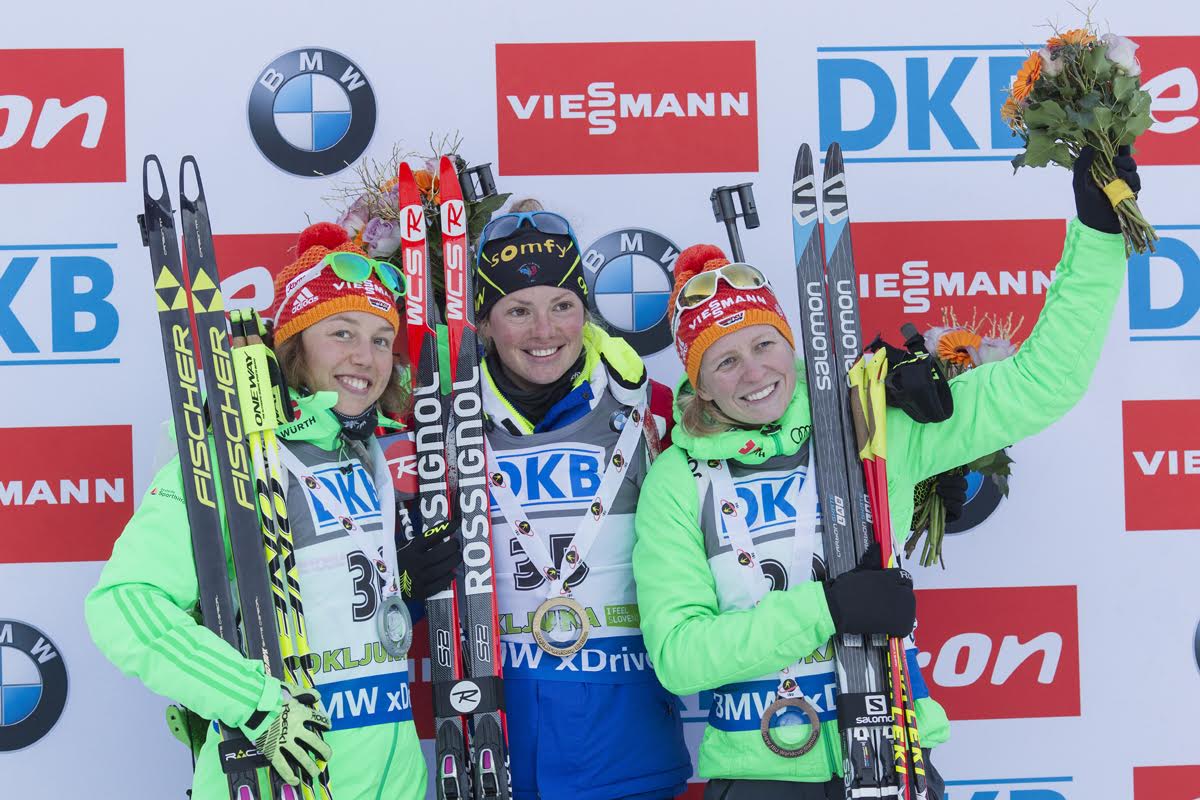
The women’s 7.5 k sprint podium on Friday at the IBU World Cup in Pokljuka, Slovenia, with winner Marie Dorin Habert of France (c), and two Germans: Laura Dahlmeier (l) in second and Franziska Hildebrand (r) in third. (Photo: Fischer/NordicFocus)
Note: This article has been corrected to include American Susan Dunklee’s sixth-place pursuit finish last season in Antholz, Italy. On Friday in Pokljuka, Slovenia, Dunklee tied her best result last season and posted her best sprint finish in two years.
This season, several of the best cross-country skiers in the world, including Norway’s Marit Bjørgen, Kikkan Randall of the U.S. Ski Team, and Finland’s Aino-Kaisa Saarinen, are taking a sabbatical while expecting the birth of their first children. If the skiing of France’s young mother Marie Dorin Habert is any indication, they really don’t need to worry about making successful comebacks.
For quite a while during the women’s 7.5 kilometer sprint at the International Biathlon Union (IBU) World Cup in Pokljuka, Slovenia, it looked like Germany could achieve another victory on Friday — just like the team did a week ago with a podium sweep of the sprint in Hochfilzen, Austria. But Dorin Habert had other plans and claimed the top spot on the podium with a winning time of 20:17.8 minutes.
France’s Marie Dorin Habert takes aim during the standing stage of Friday’s sprint at the IBU World Cup in Pokljuka, Slovenia. She cleaned the two-stage race and won by 1.1 seconds. (Photo: IBU/Kvetoslav Frgal)
Last March, the 29-year-old French biathlete was the big surprise of 2015 IBU World Championships in Kontiolahti, Finland, with two gold medals (in the sprint and pursuit) and two silvers (relay and mixed relay), which she achieved just half a year after the birth of her daughter Adele in September 2014. She returned to the World Cup last January.
On Friday, Dorin Habert added and first victory of the season (and third World Cup win) to her list of achievements, beating two Germans, Laura Dahlmeier — the winner of last week’s pursuit — by 1.1 seconds and Franziska Hildebrand, the winner of last week’s sprint, by 13.0 seconds.
Under sunny skies with calm, stable wind, just like the men raced in Thursday, all of the three women on the podium shot clean in the two-stage race, incurring no penalties.
Asked how she is managing her life with a 1-year-old while competing as a World Cup athlete, Dorin Habert explained in an English interview with German broadcaster ZDF: “It is very complicated to organize everything. I am lucky because my husband [retired French biathlete Lois Habert] can sometimes go with me. He is a commentator on TV for Eurosport France,” she said.
He and the baby joined her at the first IBU World Cup in Östersund, and last week, Adele returned home while Dorin Habert raced in Hochfilzen.
“This week she is with me in the hotel in Bled [Slovenia] with the nanny,” she explained. “So very nice, but very complicated to organize the travel and flights and everything.”
Dorin Habert started 35th on Friday and after two flawless stages, she left range for the second time trailing Dahlmeier, in bib 30, by 5.4 seconds.
“My standing [shooting] was very bad throughout all the start of the season,” Dorin Habert told ZDF. “[Today is] the first time that I am okay, so I’m very happy for that.”
Already skiing fast and with the added advantage of hearing her coaches call out split times to the leaders, Dahlmeier and Hildebrand, Dorin Habert pushed hard on the final loop to make up the deficit. Descending down a small ramp into the stadium, she entered the finishing straight with long, gliding steps while swinging her arms without using her poles, and crossed the line 13 seconds faster than Hildebrand (who started 20th) to take the lead. At the end of the day, nobody else out of 105 starters could catch her, although Dahlmeier came within 1.1 seconds at the finish.
“I am not surprised, but I am very happy,” Dorin Habert said of her win at an IBU press conference. She posted the third-fastest course time.
“I did a good job on the shooting range. I worked hard on my standing shooting,” she added. “It was hard on the skis, as we had a lot of races last week. I tried to be very concentrated on each target.”
Germany’s Laura Dahlmeier racing to second in the women’s IBU World Cup sprint in Pokljuka, Slovenia. (Photo: Fischer/NordicFocus)
Looking like the winner for a long time, Dahlmeier shot clean and skied the fourth-fastest overall course time.Despite missing out on another win by just over a second, the 22-year-old German was very satisfied with her performance.
“This is the first time this season that I’ve managed to shoot a ‘zero’ [no misses],” she told ZDF. “I’m extremely excited to be back on the podium. I knew it would be a close race, and that you really would have to deliver a ‘zero’ on the shooting range.
“It was a perfect day for me,” she said at the press conference. “Marie was first today, we will see what happens tomorrow. I am happy about my form. We are a little higher above sea level, and that’s stressful [on the body]. I am already looking forward to the Christmas break.”
Dahlmeier missed the World Cup opener in Östersund, Sweden, with a nagging cold. She’ll start Saturday’s pursuit 1 second behind Dorin Habert and 12 seconds ahead of Hildebrand, her teammate.
Like the other two podium finishers, Hildebrand, 28, took her time on the shooting range to hit all 10 targets. Her standing shooting time ranked 96th.
“I had to catch my breath after the second or third shot. From my point of view that was a great series, all very secure hits, everything in, everything white,” Hildebrand told ZDF. “That saved me today.”
But she more than made up for a few lost seconds on the range by avoiding the penalty lap and skiing fast, recording the fifth-ranked overall course time. From the last shooting to the finish she still lost about ten seconds to Dahlmeier, but for a reason: “I’m a little bit under the weather today,” she said. “I didn’t know how it would work. I felt during the race, especially on the last lap, that I was not quite as fresh anymore. But I think it was still a great race, and overall I’m really satisfied.”
Showing the depth of their team, all six of Germany’s starters finished in the top 15 with Maren Hammerschmidt in seventh, Franziska Preuss in ninth, Vanessa Hinz in 13th, and Miriam Gössner in 15th. Less than two years after leaving the 2014 Olympics without any women’s biathlon medals — and with several decorated athletes such as Magdalena Neuner and Andrea Henkel (now Andrea Burke) having retired in recent years — the team feels like it is on a good trajectory again.
“We trained hard. We are a good team, and we can push each other to become better,” Hildebrand said in the press conference.
“We have proven that we have arrived at the top again, and you always have to account for us,” Dahlmeier told ZDF. “I hope we can keep this up all season, and then achieve our peak at the World Championships [in March].”
Fourth place went to Veronika Vítková of Czech Republic, who finished 16.4 seconds behind Dorin Habert, also with two clean stages. Her teammate and overall World Cup leader Gabriela Soukalová placed fifth (+25.2), as the best athlete who had to ski a penalty lap (with a single standing miss).
American Susan Dunklee placed sixth for her best sprint result in two seasons. She finished 30.6 seconds behind Dorin Habert and 17.6 seconds off the podium. She might have been able to make it had she avoided her penalty lap in the prone shooting, and was the second-best athlete with a penalty on Friday. She’ll start 31 seconds back in the pursuit.
The women’s top six at the flower ceremony following the IBU World Cup sprint in Pokljuka, Slovenia, with Marie Dorin Habert of France in first, Germany’s Laura Dahlmeier and Franziska Hildebrand in second and third, respectively, Veronika Vitkova (third from r) and Gabriela Soukalova (second from r) of the Czech Republic in fourth and fifth, and American Susan Dunklee (far right) in sixth. (Photo: IBU/Kvetoslav Frgal)
Pursuit up next
The times back from Dorin Habert as the winner of the sprint carry over into the pursuit race on Saturday.
“Everyone can expect a very exciting race,” Dahlmeier told ZDF. “The shooting range will be decisive again. You just have to shoot well, and then everything is possible, I am looking forward to it.
“Everything is possible,” she said in the press conference. “It is difficult to predict who will win, but I will fight for the first place in tomorrow’s competition.”
Ingvild Flugstad Østberg (in red bib) awaits her longtime friend and Norwegian teammate Maiken Caspersen Falla at the finish of the women’s 6 x 1.2 k classic sprint on Sunday at 2015 World Championships in Falun, Sweden. The two took gold by more than eight seconds over Sweden. (Photo: FlyingPointRoad)
FasterSkier’s coverage of the 2015 FIS Nordic World Ski Championships in Falun, Sweden, is brought to you by the generous support of L.L. Bean, now featuring a complete line of Kikkan Randall training wear.
FALUN, Sweden — With Marit Bjørgen out of the freestyle team sprint on Sunday after what she considered a disappointing sixth-place finish in Saturday’s skiathlon at 2015 FIS Nordic World Ski Championships, that left someone to step up in her absence.
The Norwegian national-team staff decided one of their best bets was Ingvild Flugstad Østberg, a longtime friend of their other athlete in the race, Maiken Caspersen Falla.
Teammates for the last decade, the two wouldn’t have wanted it any other way.
“If there is anyone who makes me better, it’s Ingvild,” Falla, the 2014 Olympic classic-sprint champion told NRK, according to a translation, after Sunday’s race.
“We’ve known each other a long time and push each other on countless sessions,” Østberg added.
Both 24, the two are nearly three months apart in age, with Falla being the elder. Partners in the World Cup freestyle team sprint last month in Otepää, Estonia, Falla and Østberg placed second, 0.85 seconds behind Sweden’s Ida Ingemarsdotter and Stina Nilsson in first.
While the Swedes stuck with their winning order, the Norwegians switched it up on Sunday, with Østberg leading out and Falla anchoring the 6 x 1.2-kilometer freestyle team sprint. The combination worked, as the two won the first semifinal of the day ahead of Poland’s Justyna Kowalczyk and Sylwia Jaśkowiec. The two teams automatically advanced to the final, and Sweden in third earned a spot as one of six teams with fast-enough times to move on as well.
Germany’s Nicole Fessel and Denise Herrmann won the second semifinal, and the Americans, with Sophie Caldwell and Jessie Diggins, placed second in that heat. Finland, Russia and Slovenia advanced as well, along with France and Switzerland from the first semifinal.
Poland’s Justyna Kowalczyk leads Norway’s Ingvild Flugstad Østberg on the second lap of the women’s 6 x 1.2 k freestyle team sprint on Sunday at 2015 World Championships in Falun, Sweden. Østberg reclaimed the lead for good for Norway. (Photo: FlyingPointRoad)
In the final, Norway got down to business from the start, with Østberg leading out of the stadium and into the first-and-only climb of the women’s 1.2 k course. Fessel and Ingemarsdotter followed, while the U.S. positioned itself in fourth with lead-out skier Sophie Caldwell.
By the time the pack returned to the stadium, Kowalczyk put herself in third for Poland, less than half a second behind Østberg in first and Fessel in second. Ingemarsdotter came through the exchange in fourth (+0.88), Slovenia’s Katja Visnar tagged Nika Razinger in sixth (+1.47) while the U.S. was 2.01 seconds back in sixth.
One lap later, Germany was up to first with Herrmann, and Jaśkowiec was 0.55 seconds back in second and Falla 0.57 seconds behind in third. The silver medalist from Thursday’s classic sprint, Nilsson came through in fourth (+1.01) for Sweden, with Diggins three-tenths of a second behind her in fifth. Flying into the exchange and prohibited from snowplowing to stop, Diggins ran into one of the Germans and nearly caused Ingemarsdotter to crash before the Swede headed out on her second loop.
“The U.S. was falling in front of me so I had to go around them,” Ingemarsdotter said in a press conference. “It was a little bit scary for a while, I think, ‘Oh I hope, I don’t fall.”
She didn’t.
With two of six laps completed, the race for gold appeared wide open — until Østberg launched an attack on the steep climb.
Fessel went with her, as did Kowalczyk, while Ingemarsdotter started to fall off the pace and Caldwell drifted farther back in fifth. Østberg led Fessel into the exchange, where they tagged in first and second, respectively, 0.43 seconds apart. Kowalczyk tagged her teammate some 3 seconds out of first, while Ingemarsdotter was another second back in fourth and Visnar 10.17 seconds behind in fifth. Behind Russia in sixth (+10.41), the U.S. slipped to seventh (+11.21).
Heading out on her second lap, Falla made a point to stay up front and push the pace, leading Herrmann up the steep climb while Jaśkowiec and Nilsson clung tightly to them. Diggins moved up into fifth several seconds behind the leaders, while Falla widened the space between her and everyone else on her way back down into the stadium.
By the time she reached the tag zone, Falla put Norway 1.07 seconds ahead in first, followed by Herrmann, Jaśkowiec (+1.67), Nilsson (+2.56), and Diggins (+16.28).
Her final time around, Østberg went for it once more on the sprint hill, this time dropping Fessel. Kowalczyk took advantage of the fading German and moved into second over the top, while Østberg led by a significant margin on the way down. Meanwhile, Kowalczyk, Fessel and Ingemarsdotter pushed to take hold of second.
“I had a little gap to Poland and Germany so I just tried to push everything I had to get Stina in as good a position as possible for the last lap,” Ingemarsdotter recalled. “I know if Stina has a little bit feeling that she is with them, then no one will beat her.”
While she put Sweden in fourth, Østberg gave Falla a 6.11-second head-start for their final lap. Kowalczyk tagged Jaśkowiec in second, six-tenths of a second ahead of Germany in third and nine-tenths of a second ahead of Sweden.
Falla continued to plug away alone up front, while Jaśkowiec, Herrmann and Nilsson jockeyed for position in the chase pack. On a tight turn before a final descent into the stadium, Nilsson came from behind and nearly collided with Herrmann. The two stayed upright, but Herrmann dropped to fourth while Jaśkowiec led Nilsson into the finishing stretch.
The women’s freestyle team sprint podium at the medals ceremony on Sunday night at 2015 World Championships in Falun, Sweden. Norway’s Ingvild Flugstad Østberg (third from l) and Maiken Caspersen Falla (third from r) teamed up for gold, Sweden’s Ida Ingemarsdotter (l) and Stina Nilsson (second from l) took silver, and Poland’s Sylwia Jaskowiec (second from r) and Justyna Kowalczyk (r) tallied bronze. (Photo: Falun2015/Twitter)
There, Falla, the 2015 World Championships classic-sprint bronze medalist, crossed the line uncontested for the Norwegian victory in 14:29.57.
“We were planning to start a little bit easy in the first round and speed up in the second and give it all in the last round, and we did as planned,” Østberg explained in the conference. “It was amazing to give Maiken some seconds and she was really strong in the last lap, and then we could cross the finish line first. That was amazing.”
Nilsson outsprinted Jaśkowiec to clinch second for Sweden, 8.17 seconds after Norway and 0.31 seconds ahead of Poland.
“I was very inspired by Ida’s amazing last lap so I felt that the medals were really close,” Nilsson said after her second-straight silver. “I gave it everything I had on the last lap and I’m very happy it worked out well.”
“I saw only the back of Falla,” Jaśkowiec recalled in the conference. “I was going [for] second place in the finish area, but I felt in my back that somebody push very fast and I tried to focus on only to get the final line. Stina was amazing with amazing finish and I could just only watch how she passed, but bronze medal is for us. I am really happy we could even be a part of this today.”
Her teammate, Kowalczyk was just as thrilled after missing out on a medal when she placed fourth in the classic sprint on the first day of World Championships.
“Before the race, I was sure that we’ll be good because Sylwia has really good skating, but there was five or seven really strong teams,” Kowalczyk told FasterSkier. “I am so happy because this is the first medal for Poland [at these World Championships], and I’m so happy for me and of course for Sylwia because she’s ranking number two in Poland now, who have the medals in cross-country skiing. … It’s not only Justyna now.”
Jaśkowiec reveled in her first World Championships medal after coming back from a rollerski accident in 2010.
“Four years ago, I had a very bad accident and I spent one year on rehabilitation so comeback was very tough,” she said in the conference. “I have a lot of thought if I could come back in skiing — the level is so high that I felt that the top athletes just run away from me so today it’s a huge satisfaction and my dream has come true. I know that the tough time was worth so much pain and fighting, and I hope that my courage just now start to be faster and faster and it will be the beginning of the show.”
Herrmann anchored Germany to fourth, 11.57 seconds back from the winners and three seconds off the podium. Russia’s Anastasia Dotsenko and Natalia Matveeva improved to fifth (+29.19) after ranking ninth at the second-to-last exchange. France was sixth (+30.26) with Coraline Thomas Hugue and Celia Aymonier, and Switzerland was seventh (+33.98) with Seraina Boner and Laurien van der Graaff.
The U.S. finished eighth (+34.06) after slipping from fifth to eighth on Caldwell’s last lap. Slovenia placed ninth (+42.39) and Finland — which reached the team-sprint podium in the last three World Championships — was 10th (+42.9) with Riikka Sarasoja-Lilja and Anne Kyllönen,
At the last World Championships in Val di Fiemme, Italy, the U.S. won the freestyle team sprint with Diggins and Kikkan Randall in 2013. Sweden took silver with Charlotte Kalla and Ingemarsdotter, and Finland earned bronze with Sarasoja-Lilja and Krista Lahteenmaki (now Pärmäkoski).
Østberg and Falla placed fourth in that race, some 20 seconds after the U.S. and 10 seconds off the podium. After that showing, Østberg viewed Sunday as an opportunity.
“When Marit said she wasn’t supposed to go [in the team sprint] then I’m really happy that I could show that I also could do a really good job,” she said in the conference. “In 2013, we were the same team and the same distance and then I ruined it, and today we could do this for the team and to do this with Maiken is amazing. We’ve been teammates for several years and good friends so that’s an awesome feeling.”
“In 2013, we were the same team … and then I ruined it, and today we could do this for the team and to do this with Maiken is amazing.” — Norway’s Ingvild Flugstad Østberg, who won gold with teammate Maiken Caspersen Falla on Sunday in the 2015 World Championships freestyle team sprint
“We were a proper gold team today,” Falla told NRK, according to a translation. “It means so much to stand here with Ingvild — we’ve been through so much together.”
The two set the tone for back-to-back Norwegian victories on Sunday, as Finn Hågen Krogh and Petter Northug teamed up for gold in the men’s 6 x 1.4 k team sprint later that afternoon. They beat Russia’s Alexey Petukhov and Nikita Kriukov by 5.64 seconds.
Jakov Fak celebrating his first World Championship gold in the 20 k individual race in Ruhpolding last season. His first regular-season World Cup win didn’t come until this season, but in four weeks of racing so far he has two victories and two more podiums.
When Jakov Fak of Slovenia won his first World Cup biathlon race earlier this season, it wasn’t shocking; he had been fast since he was a junior, where he mixed it up at World Championships and European races with the likes of Martin Fourcade, Arnd Peiffer, and Anton Shipulin.
But until this season, Fak had an uncanny knack for doing his best on the sport’s biggest stages. It certainly was surprising in 2009 when, one year out of the junior ranks, he won bronze in the individual race at World Championships in Pyeong Chang, South Korea.
Back then, Fak was not Slovenian but Croatian. And after carrying the flag for his country in the opening ceremony of the Vancouver Olympics, he came through for his country with a bronze-medal performance in the sprint.
But all was not well in Croatia. (As we wrote yesterday, it has taken varying amounts of time for small countries to establish not only strong governments, but sports federations after the breakup of the Soviet Union, Czechoslovakia, and Yugoslavia.) While some sports had excellent infrastructure and support, and found success – siblings Janica and Ivica Kostelic for instance were (are) among the best alpine skiers of their era – biathlon was not so lucky or as organized.
Fak had been working with the Slovenian team, and in the fall of 2010 he switched nationalities. Both the cross country team, headed by Petra Majdic and her sprinting teammates, and the biathlon team were strong, and that’s where he’s made his home. The politics of his departure from Croatia, on the other hand, are something he’d rather not remember.
Fak fueling up en route to his World Championship title.
If that stress didn’t provide enough adversity, Fak traveled to the World Cup competitions in Fort Kent, Maine, the next season, where he got frostbite on his firing hand so badly that he was at risk of amputation – a career-ender for a biathlete.
By the next World Championships he was back to his usual self, winning gold in the 20 k individual a few days after taking part in the Slovenian mixed relay that appeared to also have won a championship, but had to settle for silver after an equipment malfunction mis-tallied penalties on the range. Coming so close to gold didn’t seem to temper the Slovenians’ enthusiasm one bit; they soaked up the experience and are surely looking forward to the format’s introduction at the Olympics next year.
But in all that time, Fak still had a single podium from a non-championship event. This season, things have changed. In the first semester the Slovenian had his breakout races on the World Cup, placing third in the sprint in Hochfilzen, Austria, and then turning it into a win in the pursuit. The next weekend on home turf in Pokljuka, Slovenia, he won the sprint and placed second in the mass start. He currently sits eighth in the World Cup standings.
Despite the intense travel and competition schedule experienced by World Cup biathletes, who race more days of the week than almost any other endurance athletes, Fak made time to answer some of our questions over e-mail.
FasterSkier: First of all, congratulations on your success so far this season! What do you think has allowed you to gain that extra gear? Did you have big changes in your training?
Jakov Fak: Thank you for your congrats!! I think we didn’t change much, but the main reason should be the hours under my belt and the experience that I got through the past seasons.
FS: Are you focusing on the Total Score in particular this year, and what are the differences for you between trying to peak at big races versus doing well all season?
JF: The main goal for me personally was to try to maintain a high competitive level through the whole season. I think that the main thing if you want to keep the good results going is your head. The level of form always goes up and down, but with a good preparation the ups and downs are not so big. Peaking at the chosen events is easier, but you can still make mistakes and fail to get the best for the event.
FS: You said after your first win this season that you had previously been a “big race” skier. What makes you able to do so well when it counts?
JF: The Slovenian media called me a ”big game” player, not me. I am a modest biathlete and do not like to call my self a big game player. I was making a joke after that, that I am not a big game player anymore; my big dream was to be good on the World Cup, and I am a big dreamer! I think the main thing is focus, but sometimes you can over burn in that process. I try to make it simple with lots of focus and no stress.
FS: The whole Slovenian team is doing well this year, like Teja Gregorin and Klemen Bauer. Do the women and men train together, and is your team close?
JF: Yes, Teja is doing well but I think that she would like to do even better. Our team is very good, and it is like a big family. We train together a lot, all the training camps are mainly done together so there are a lot of days spent together, which makes it easier to bond. The good thing is that you can bond easily, but the hard thing is when someone ends his career, like this year Vasja Rupnik ended his career, and a big hole was left behind him.
FS: It seems like in biathlon it is particularly hard to be consistent, not just in a season but from year to year. Why do you think that is?
JF: I think that the field in biathlon is very tight and that there is a constant pressure of a lot of athletes for the top places so it is hard to be consistent. Multiple seasons are even more hard, because every year the field gets stronger and tighter.
FS: I am very curious about your switch to Slovenia. Is it true that you had had a Slovenian coach for a long time and already been training with the team?
JF: Oh it’s not my favorite subject of conversation but, yes it is true I have been working with the whole team from summer of 2009.
FS: What is the sports system like in Croatia? In general, there are some strong sport teams there, but is there much of a biathlon or even cross country skiing community?
JF: The sport system is different in every sport. There are a lot of good systems, but you have to be lucky to work in a system like that. In biathlon that was reintroduced to the cross country skiers again in the year 2001. It was not developing as it should have, but that was due to ineffectiveness of the president of the Croatian biathlon association. As a matter a fact, his politics crashed and destroyed all the chances for biathlon to become a respectable sport in Croatia. I had a lot of struggles and fights to keep my career going on. This is a subject that could be discussed more but there is no need for it. Cross country skiing and biathlon are cooperating very well now because a lot of children are competing in both sports. But I am sure that that could be on a much higher level.
FS: Despite all that you seem to still be very patriotic to Croatia.
JF: Of course, who wouldn’t be! Nobody can take that from you. I will always be proud on my birth country. [The switch] is not a big deal, and it was all in sport purposes. That time it was a little confusing and I had some problems with Croatian biathlon association, but everything is okay now.
FS: Do you feel like you have the support of Slovenian fans at this point? Winning at World Championships must have helped.
JF: Yes, I think that I have, the media like to interview me and the fans are all positive. The medal always helps, and sometimes you feel like you have to give something back to your supporters, and what is a better gift than the medals.
FS: Do you still consider Croatia your home, and how much time do you get to spend there?
JF: Yes of course, but I can say that I have two homes. But still Croatia, and my hometown Mrkopalj are my true home. I like to spend time there, living near to my roots. I find peace there.
FS: Does the team’s training camp schedule allow you to go home?
JF: I spent a lot of time in Croatia, training camps are usually in Slovenia and the rest of the time I like to spend near to my family. The system in our team is that in training camps are usually held in our training center on Pokljuka, and all of the time in between the camps we train by ourselves where we want.
FS: Is there anything you are particularly looking forward to this season?
JF: I look forward to the races. There is nothing more interesting than the World Cup: every race is special, and every day is different and that is the beauty of outdoor sports.
FS: You will get to see the Sochi courses for the first time; what are you hoping for? What sort of trails and range would suit you the best?
JF: Yes, this is the first year that we are visiting the Sochi track, so I am curious about everything. I would like to get to know the courses and the shooting range, although it is a short time to get to know everything but we will do our best. Sometimes we like to joke that when you are in shape, everything suits you, and when not nothing suits you.
With racing taking a break for the day in Ruhpolding, Germany, here’s a gallery from the kickoff race, yesterday’s mixed relay. Norway took the win followed by Slovenia and Germany. Click any photo to enlarge.
World Champions (l-r): Tora Berger, Synnøve Solemdal, Ole Einar Bjørndalen, and Emil Hegle Svendsen.
Norway, along with the other teams, awaits the podium ceremony.
Roland Lessing of Estonia sporting the white piece of paper that shielded many shooters from the sun.
The Slovenian biathlon team of Klemen Bauer, Teja Gregorin, Andreja Mali, and Jakov Fak after winning silver in the 2012 World Championships mixed relay in Ruhpolding, Germany.
The Norwegian team mobs Emil Hegle Svendsen after he crosses the with a win for his team.
Tim Burke taking over for the U.S.
Andrea Birnbacher (GER), about to take the lead.
Susan Dunklee (USA) on the warpath.
Marie Dorin (FRA) leading the race after four stages.
Zina Kocher (CAN) after receiving her tag.
Mari Laukkanen (FIN) and Barbora Tomesova (CZE) starting the second leg of the relay.
Tora Berger (NOR) leaves the range first after the standing stage.
Sara Studebaker (USA) and Andrea Henkel (GER) in the mixed relay at 2012 World Championships.
Marie-Laure Brunet (FRA) is the first woman out of the range after the first stage.
Russia’s Olga Vilukhina leads the women out of the start.
Norway’s Ole Einar Bjørndalen leaving the range; he skied a penalty loop that he later found out was not required.
RUHPOLDING, Germany – There were plenty of errors at the IBU World Championships mixed relay today, mistakes that were big enough to have a surprising and significant impact on the outcome of the race.
France’s third-leg racer, Simon Fourcade, received the tag from Marie Dorin Habert in second place, just 11 seconds behind Norway. But he imploded in spectacular fashion, using all six of his spare rounds, hitting the penalty loop, and losing almost two and a half minutes to the leaders; France dropped to 12th and was never able to recover.
Peiffer in the mixed relay in Ruhpolding.
Arnd Peiffer, too, finishes this race as an unpopular figure in his home country. The German anchor began skiing with a 40-second advantage over Norway, which grew after the prone shooting stage. Peiffer choked in standing, however, using all three spare rounds and still skiing a penalty loop.
But the most notable error wasn’t by an athlete. It was instead by the eletronic target system, which inexplicably failed to record Ole Einar Bjørndalen’s first shot of the standing stage.
The third skier for Norway, Bjørndalen later said that he had felt like it was a good shot. The target, though, stayed black. Bjørndalen struggled through the rest of the stage and ended up skiing a penalty loop, dropping his team several places.
“It is a shame that the target system didn’t work for Ole, because maybe the race will have gone differently if you didn’t miss your first shot,” German third-leg skier Andreas Birnbacher told the media.
Both a Norwegian trainer who had scoped the shot and a jury member noticed that Bjørndalen’s shot should have been a hit. They brought it to the attention of Max Cobb, the technical delegate for this series and also the president of the U.S. Biathlon Association, who walked out, examined the target, and saw that it was indeed a on the mark. He, in turn, went to the jury.
Magdalena Neuner of Germany, working to give the men a lead.
“It was not recorded – there was no signal coming from the target to the computer which scores the competition,” Cobb said in a press conference after the race. “Fortunately, both the Norwegian trainer and one of our jury members had scoped the shot… We told the trainers on the shooting range that Norway would receive a credit, first for the penalty loop and then for the extra shot that had to be fired. The jury discussed this and awarded a time credit of 28.4 seconds.”
That information was not relayed to staff on the range until before the final stage of the anchor leg, and the exact amount of time wasn’t clear at that point. By that stage, Peiffer was in the lead, with Norway’s Emil Hegle Svendsen and Slovenia’s Jakov Fak trailing by a significant margin.
When Peiffer missed his shots and hit the penalty loop, Fak took the lead. It was shaping up to be an exciting race: Germany trailed by several seconds, and Norway by about 15. Given the ski speed of Svendsen in particular, the race was likely to come down to a sprint finish.
But while Fak managed to hold off the Svendsen by eight seconds, it didn’t matter: as soon as results were posted on the board, the second-place Norwegians had a star next to their time, indicating that something unusual was happening. Later, the team – who won this event last year but came into the race ranked 20th after starting a “B” squad in the two World Cup races this season – finished as the victors by a margin of 20 seconds.
Emil Hegle Svendsen, knowing that he was winning even in third place.
The Norwegians were happy for the gold, but not pleased with the way they got it.
“It was a little bit strange today,” Bjørndalen said in a press conference. “When I came to the finish line I was told that I had hit one more target… It is not a good feeling, when you do not cross the finish line first, but you win.”
As to whether the problem was addressed appropriately, he said only that it was a matter for the jury.
The rest of the team might have felt more like winners. Both leadoff skier Tora Berger and second leg Synnøve Solemdal tagged off in first place. And while Svendsen wasn’t the first one to finish, he had enough information to know that he was winning.
“I heard on the last loop that we had maybe some time cut off, so I knew that if I was within 15 or 20 seconds of Slovenia we could have the gold,” he said. “I just tried to control that.”
Jakov Fak embarking on the anchor leg.
The Slovenians put on a happy face and quelled any lingering discontent they might have about the time adjustment.
“This is when dreams come true,” leadoff racer Andreja Mali said of the silver medal. “After all these years this is my first medal at World Championships.”
The Slovenian men, too, were able to look on the bright side. Fak said that he hadn’t even thought a medal was possible today, much less gold, based on the team’s 19th-place ranking in the event.
And for Bauer, a speedy skier who is less reliable on the range, today’s performance was certainly something to be happy about.
“It’s been a while since I left the shooting range without a penalty loop, so I was quite happy today,” a smiling Bauer said at the press conference. “Even though I spent five spare rounds, I made some progress in the rankings. I guess also my competitors missed a little bit more than me. It went out perfectly.”
As for the Germans, well, they too acted happy with their bronze, although the pressure to win gold has been intense leading up to these home World Championships. Even while the athletes were warming up, the stadium, full of thousands of people not even counting those lining the trails, would explode with noise every time a German racer skied by.
When Birnbacher was leading during the third leg, the stadium was completely silent as he shot, and would then explode in a single, unified roar with every hit. The cheers echoed up and down the narrow valley that houses the Chiemgau arena; even the mountains themselves seemed to be urging the Germans toward victory.
But it was not to be.
“I knew that the Norwegian team got a time bonus of 30 seconds, so I had no hassle,” Peiffer said. “I knew they were in front of us. I thought about my shooting, not about Emil.”
I had hoped to have actual racing to write about by this week, but as we all know the snow situation in Europe hasn’t been cooperating. Hopefully we’ll finally get some racing done this weekend.
In the meantime, everyone keeps writing their little nation previews. FasterSkier’s piece on Slovenia mentioned an up and coming junior with the impressive sounding name of Rok Trsan. How are his FIS points compared to future WC top ten finishers at his age?
A little better than average for distance events, not so much with the sprinting. Although at this age, particularly with sprint points, it can be hard to read much into this.
As for the Czech’s, as usual I’m more interested in the folks not named Lukas Bauer:
I left Ondrej Horyna off this graph as he simply has too few races to be worth looking at. Jiri Magal has been on a slow decline, which is natural for older skiers. He did have fewer truly terrible races last season, which helped improve his median result a bit. Looking back at his career, I’d love to ask him what happened between 2001 and 2002. He was definitely progressing in the wrong direction and just turned everything around. Well done!
Everyone else here has been seeing a mostly even trend. Janeckova flirts with ok-ness every now and then. Kozisek had a particularly poor year last year. And Nyvltova put together two, consistent seasons in a row, but her best results remain fairly average.
Hopefully after the weekend I’ll have some actual racing to write about…
The Slovenians managed to ski their way into the top 10 on the Nations Cup with only three skiers – all female – contributing to their points total. Embarrassing for other countries? Slightly, but when the three athletes you’re facing are Petra Majdic, Vesna Fabjan and Katja Visnar, it’s not so bad. All three finished in the top 11 in the sprint cup standings, no small feat.
In what could be the understatement of the year, you probably have heard of Petra Majdic. After the Olympics, she needs no introduction, although if you really need a reminder, there are plenty of places that recount her Olympic experience.
Fabjan and Visnar are not quite as well known, but rest assured, if you watched a World Cup this winter, you would have seen them. Mostly because of Slovenia’s choice of the highlighter-yellow racing suit (which they tragically eschewed in Vancouver), but also because they sprint really fast.
Vesna Fabjan rocking the highlighter-yellow
Fabjan tore up the sprint circuit, failing to qualify just once and finishing on the individual podium twice. Her best weekend of the year was in Rybinsk, Russia, where Fabjan took her first World Cup victory in the individual, then won team sprint silver with Visnar. Fabjan and Majdic were a lock to make the Olympic team sprint an event to remember for Slovenia, until Majdic’s injuries forced her to bow out.
What You Should Know For This Season
Petra Majdic is back! More importantly, she’s healthy! She also specifies that finishing second in the sprint cup last year – despite not racing a single event after the Olympics – just isn’t good enough. She wants the Crystal Globe.
If Majdic can regain her form – and when she’s in top shape she is one of the absolute best on the circuit – things will go well for Slovenia. If not, Fabjan and Visnar will be able to pick up the slack sprinting – though the distance results will be non-existent.
Oh, right, and just in case you thought FasterSkier was being sexist, there are literally no males on the radar for Slovenian skiing. The odds are good, boys!
Who You Should Watch
Katja Visnar was good last year – she went 11 for 11 in qualifying for the heats in the sprints she started, including the Olympics. While she never stood on the podium as an individual (she did get that second in the team sprint in Rybinsk), the kind of consistency she displayed in classic and skate sprinting means that it’s only a matter of time – especially with Majdic there to guide her.