From the FasterSkier archive — posts syndicated from athletes’ and coaches’ own blogs between 2004 and 2012, kept online as published. Current coverage is at fasterskier.com.

Tag: SMS T2 Team

  • Colin Rodgers and the Culture of SMS T2

    Colin Rodgers and the Culture of SMS T2

    This article was made possible through the generous support of our voluntary subscribers. If you value coverage like this, please support FasterSkier with a voluntary subscription.

    The first time I saw Colin Rodgers, he was climbing onto a podium in the basement of a hotel in Biwabik, Minnesota. I honestly can’t remember the name of the hotel, but I can remember the rooms, the enormous lobby complete with an indoor minigolf course, and the basement where the awards were taking place. It was Junior Nationals, 1997, and he’d just won the opening U16 race. We were there with the New England contingent. They held the awards in this low-ceilinged basement room, and although he wasn’t the tallest of boys, his blonde hair almost touched the ceiling tiles. Colin went to Holderness School in New Hampshire, and as I looked up at his smiling face, it was obvious that he was the kind of kid who was going somewhere.

    A few years later, I was watching him again, but this time from behind as he skied away from me up one of the small climbs on Woodpecker during the 3 x 5 k Classic Relay at the Williams College Carnival. Colin raced for Middlebury, and I raced for UNH, and at carnivals, he’d ski away from me. That was the deal. He was always a step, or a lot more, ahead.

    We caught up over Zoom last week. Colin was in a hotel room in Falun, Sweden, traveling with the U.S. Ski Team on the World Cup circuit. I was sitting on a rocking chair in the foyer of our local dentist’s office while my boys were inside getting their teeth cleaned. That’s how FasterSkier interviews happen sometimes.

    Colin Rodgers (SVSEF) – 4th Place

    Since his competitive career ended, Colin has given himself fully to coaching. First with the SVSEF Gold Team, who he had raced for at the end of his career, and later junior skiers at Green Mountain Valley School, where he spent nine years. And now, as head coach of the SMS T2 Team at Stratton Mountain School in Vermont, he works with some of the best cross-country skiers in the world.

    The team this year included Jessie Diggins, Ben Ogden, Julia Kern, and Canadian skier Remi Drolet, as well as collegiate skiers Fin Bailey and Jack Lange. Of the professional skiers, three of them finished in the top six at the Olympics. All four were in the top 20. Ben Ogden came home with two silver medals and ended a 50-year Olympic medal drought for American men in cross-country skiing. And Jessie Diggins, who is currently wrapping up a career that is the best of any American skier ever, added a bronze medal to her collection.

    Colin still seemed a little stunned by it all when we spoke.

    “We were so far beyond wherever I thought we were going to be,” he said. “I had a good feeling about this year. But for Ben to take home two silvers, and Jesse a bronze, and Remi to be in the top 20 and really help Canada with a historic relay finish, and Julia in the top six. It’s stuff that I could never believe was truly going to happen. And here we are talking about it.”

    SMS T2’s Rémi Drolet, Ben Ogden, Julia Kern, Jessie Diggins, and coach Colin Rodgers. (Photo: courtesy photo)

    Colin grew up in Westford, Vermont. His father was the program director for the U.S. Biathlon team from 1984 to 1988, which brought the family to northern Vermont. His parents built a house in Westford that year and never left.

    He went to Holderness, then Middlebury, and after college, he headed to the Maine Winter Sports Center, where coaches like Jens Johansson, Eli Brown and Will Sweetser were building something in the northern reaches of the state. From there, he moved to Sun Valley, Idaho, where he joined the SVSEF Gold Team and kept racing.

    Colin was good. He raced on the World Cup. But the jump he’d always hoped to make didn’t quite happen.

    “I think as a nation now, we’re so much more educated,” he said. “I had amazing coaches. But we were just kind of, maybe sometimes trying too hard.”

    He talked about spending time in Scandinavia and being around athletes who were significantly better than him. What he noticed wasn’t that they worked harder. It was that they were smarter about the work.

    “I probably trained at level two way too much of the time,” he said. “Especially being a little more anaerobic and linked to the sprint side. I really needed to be doing the easy training even easier.”

    He paused.

    “When it’s time to go, you’ve got to let the dog run,” he said, quoting his old Middlebury coach Terry Aldrich. “And that was the exact opposite. Like, now it’s time to really peak, and you let it loose.”

    I told him I’d heard a version of that from the other direction. When I was coaching, I used to tell my kids about Matt Whitcomb, who had been a teammate of Rodgers at Middlebury, previewing a course at Junior Nationals and telling the athletes they had to “walk the f-ing dog.” Every time they got to a climb, they were pulling back on the leash. Walking the dog.

    Two coaches. Related metaphor. Opposite leash relationships. That’s about as clean a summary of training philosophy as you’ll find in this sport. Keep the dog relaxed in training often, until it is time to let it run when it matters.

    Matt Gelso on the finishing stretch with coach Colin Rodgers encouraging in West Yellowstone (Photo: Toko)

    Before Stratton, the coaching experience that shaped Colin most was the time he spent around Rick Kapala at Sun Valley.

    Kapala ran the Sun Valley Education Foundation for nearly 30 years and built a program Colin still talks about with real admiration.

    “It was serious training, but it was also really creative,” Colin said. “You’d go out for long mountain adventures, do different kinds of workouts. It kept people engaged.”

    That stuck with him. When he moved to GMVS to coach high school athletes, he kept coming back to a simple question.

    “What would make me really want to go to practice today?”

    He laughed when he said it.

    “It sounds basic. But it actually matters a lot. If people don’t want to be there, something’s probably off.”

    He talked about his coaching years at GMVS and how, for him, the job was about getting kids to believe in what they could do.

    “When kids are in high school, they’re questioning everything. How they look, how they’re growing. And you’re just like, no, dude, this is fun. This can be a real blast. And believe. Like, damn, I can do a good job at this. If I’m doing this every day, I might as well be good at it, right?”

    He spent nine years doing that work. And then the SMS T2 job came along.

    “It was an opportunity there’s no way I was going to pass up,” he said. “It’s changed my life. Literally.”

    The program at Stratton operates under a mission statement crafted by Colin’s predecessor, Sverre Caldwell: international excellence and local inspiration.

    Colin said that phrase was part of what sold him on the job.

    “It’s everything I believe in. We’re trying to be the best we can be, win races, kick ass internationally. But then also, along the way, inspire the next generation of skiers coming up.”

    At Stratton, those two things aren’t separate. The T2 athletes train on the same roads and trails as the younger skiers in the school’s Nordic program. When Stratton kids show up for a summer or fall practice, and the older athletes are there, everyone just funnels in together and heads out.

    “It doesn’t even need to be talked about, really,” Colin said. “It’s just showing up, doing the work. This is how it’s done. And if you keep working really hard for a long time, you’re probably going to get really good too.”

    He brought up the chain of inspiration that runs through American skiing. Jessie Diggins was inspired by Kikkan Randall, by Andy Newell, by Simi Hamilton. Kern was inspired by Diggins.

    “When you get motivated by somebody who’s special and inspiring to you, if you have some talent and the fire to go for it, you realize you can chase that person. And then it’s like, oh, I can maybe be them. And then it’s like, oh, maybe I can be better than them.”

    One of the more interesting aspects of Colin’s role at SMS T2 is that he’s not the only coach in the picture. Not even close.

    Kristen Bourne and Colin Rodgers out for a run during the OD run at Park City camp, 2025. (Photo: Matt Whitcomb)

    Diggins works primarily with Jason Cork on the U.S. Ski Team staff. Ogden’s training has long been guided by Patrick Weaver, his college coach at UVM. Kern has a deep relationship with Kristen Bourne, who is also a national team coach. Drolet works with Dave Wood, a former coach of the Canadian national team. And Bailey goes to UVM and skis for Weaver, while Lange goes to Dartmouth and is coached by Brayton Osgood.

    Colin sees his job as connecting the dots.

    “Each athlete comes in with their own support network,” he said. “Jason has been working with Jesse forever. Ben has a really close connection with Weave. And I’ve been able to learn a lot from Patrick about how Ben ticks.”

    He was honest about what that requires.

    “When you step into a role like this, you have to check your ego,” he said. “It’s not about being the only voice in the room. It’s about helping the athlete succeed.”

    What he brings is proximity. He sees the athletes more frequently than some of their other coaches, especially during training blocks in Vermont. He can offer technique advice, fill gaps when someone else isn’t available, and keep everyone communicating.

    “I think one of my strengths is the ability to connect people,” he said. “And to connect with people.”

    Colin has watched American skiing grow up. When he was racing, relatively few American men were competitive at the highest levels. The development pathways weren’t as clear. The coaching wasn’t as sophisticated.

    “We’re closer as a nation now to what it means to go to that next level,” he said. “We know what to do. As coaches, we’re totally clued in on this systematic, long-term idea of how to periodize correctly, and also how to make it fun.”

    Colin Rodgers, Jessie Diggins and Julia Kern. (Photo: courtesy photo)

    He pointed to results at every level. At the time we spoke, American athletes were fighting with the best in the world at the World Junior Championships. On the World Cup, Diggins, Kern, and Ogden, along with the APU-based skiers, are proving it can happen at the very top.

    “A lot of people have helped build this,” he said. “It’s not just one program or one coach.”

    But the jump from junior skiing to the World Cup is still enormous. And programs like SMS T2 exist to help athletes survive that transition.

    “Having environments where athletes can develop during that stage is really important,” he said. “The gap is huge.”

    Before we wrapped up, I asked Colin what success looks like for him five years from now.

    He went big picture with a slightly longer lens. The 2034 Olympics will be in Salt Lake City. There’s a generation of young American skiers who have already raced at Soldier Hollow, the Nordic venue, during their youth careers. Now they’re looking ahead to competing on home soil.

    “We’re working towards 2034,” he said. “And we want to be successful there. If we stay on this trajectory, we can have medals. That’s our ultimate goal.”

    Within Stratton, he wants to grow the team thoughtfully. This year was lean, focused on supporting the Olympic athletes. Going forward, he wants to build back toward four or five athletes on each side, men and women, plus NCAA skiers.

    “We have to do it the right way,” he said. “We don’t want to take on too many people too fast.”

    Jessie Diggins (USA), whose World Cup career will conclude in a week and a half, celebrates her bronze medal in the Olympic 10 k Freestyle in Tesero, Italy. (Photo: Vanzetta/NordicFocus)

    He’s also thinking about the athletes who won’t be there. Jessie Diggins is retiring. That will leave a void at SMS T2 and on the World Cup, where Colin noted she currently sits at 380 career starts, more than any other skier.

    “Jesse’s going to go on and do a lot of really cool things and still inspire the next generation in new ways,” he said. “And then there’s going to be up-and-comers who are going to step up and be inspired by everything she’s done, and by everything Ben and Julia and Remy are already doing.”

    International excellence. Local inspiration. It’s a simple mission. But Colin Rodgers has spent a career learning that the simple things are usually the ones that matter most.

    He’s been chasing the highest levels of this sport since he was 15 years old, standing on a podium in a hotel basement in Minnesota. The path just looks different now.


    Help Support Our Olympic Coverage!

    If you value the thoughtful work and access FasterSkier provides, please consider becoming a Voluntary Subscriber. Your support directly fuels our work to cover the people, places, and moments that make our sport special.

    Join the FasterSkier community!


    Rémi Drolet and Colin Rodgers. (Photo: courtesy photo)
  • Training Out East: An Update from Summer in Stratton

    Training Out East: An Update from Summer in Stratton

    As the saying goes, skiers are made in the summer. If that is the case, then many are forging their way to success in Stratton, Vermont this season. Depending on the year, various clubs around the country may play host to an increased number of athletes for a summer; from Bend, Oregon, to Anchorage, Alaska, to Stratton, the “hot spot” shifts periodically. This year, as SMS T2 Team Head Coach Perry Thomas put it, “we’ve had a lot of talent in southern Vermont.”

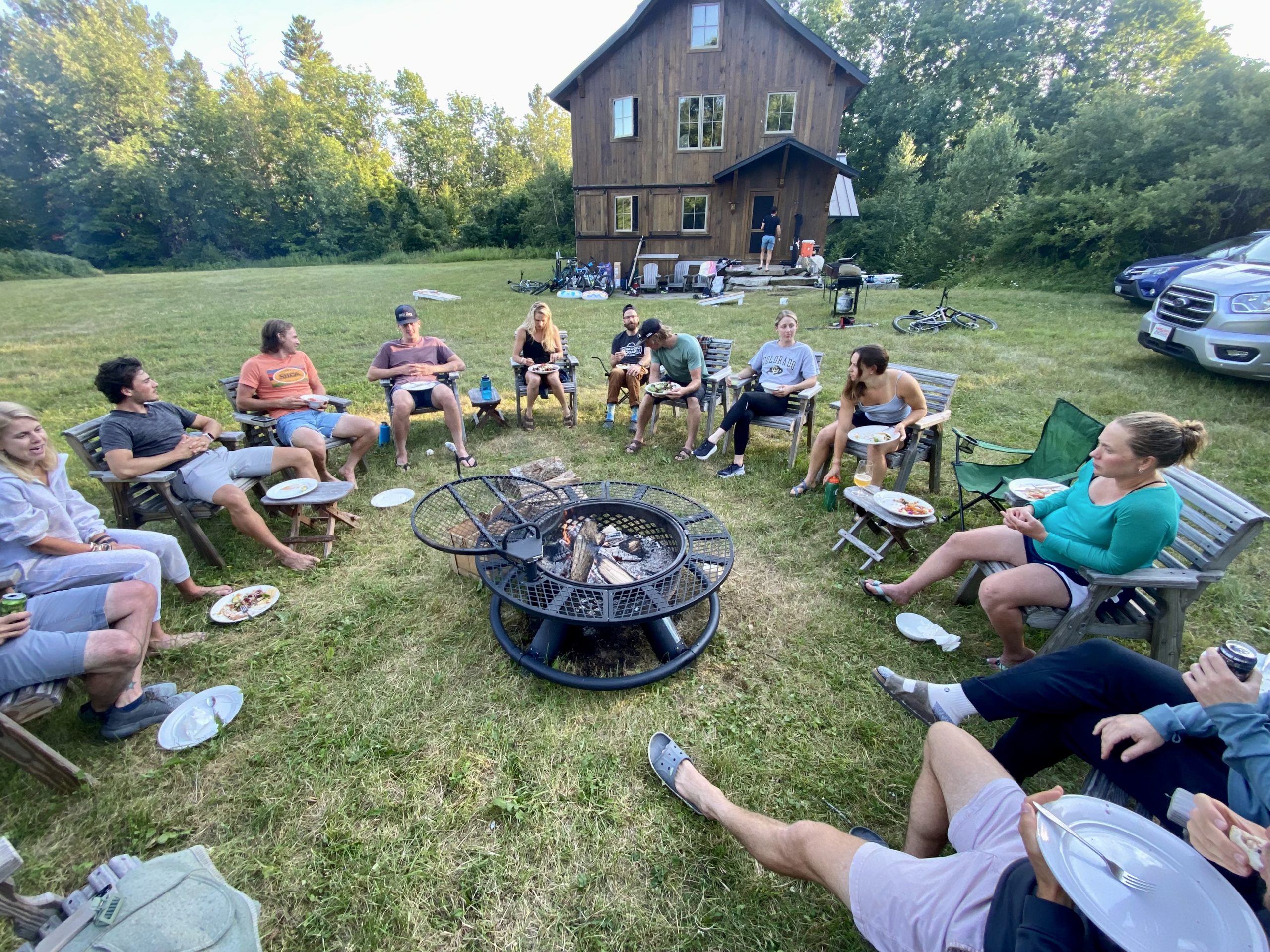
    As the summer of training kicked off out east, it was primarily members of the SMS T2 Team for the first month or so. Thomas explained that the team had a couple of mini camps so far this summer, the first being at Green Woodlands in New Hampshire. In an email to FasterSkier, Thomas wrote, “we had a lot of great training including some long mountain bikes, rollerski intervals in Lyme, and a Presidential Traverse. It was somewhat “camping” style as many of us stayed in these rustic cabins on the water. We cooked great food, played a few games, and hung out on the water.” 

    Dinner around a campfire for the SMS T2 Team at Green Woodlands in New Hampshire (Photo: Lina Sutro)

    More recently, the team had a second mini camp in the Waitsfield/Warren area, north of Stratton. Highlights from this camp included a 5 k hill climb pace project on the Appalachian Gap, combining with the Eastern and Midwestern U16 camp, and Team Birkie who also held a camp in Vermont recently. About this activity Thomas shared, “the team had a great time chatting with the U16’s after App Gap, and we had a fun run/hike on part of the northern section of the Long Trail.” He extended his thanks to Justin Beckwith and NENSA as well as Colin Rogers and Green Mountain Valley School (GMVS) for their efforts in putting together some great events. 

    Joining the SMS T2 Team for varying lengths of time this summer are a number of U.S. Ski Team and college athletes. This list includes: Sydney Palmer-Leger (new member of SMS T2 team, University of Utah (UU), U.S. Ski Team), Novie McCabe (UU, U.S. Ski Team), Sophia Laukli (UU, U.S. Ski Team), Weronika Kaleta (University of Colorado (CU), Polish National Team), John Hagenbuch (Dartmouth, U.S. Ski Team), Gus Schumacher (Alaska Winter Stars, U.S. Ski Team), Luke Jager (UU, U.S. Ski Team), Adam Witkowski (Michigan Tech University (MTU)), Zander Martin (Bates College), and Asa Chalmers (Dartmouth). 

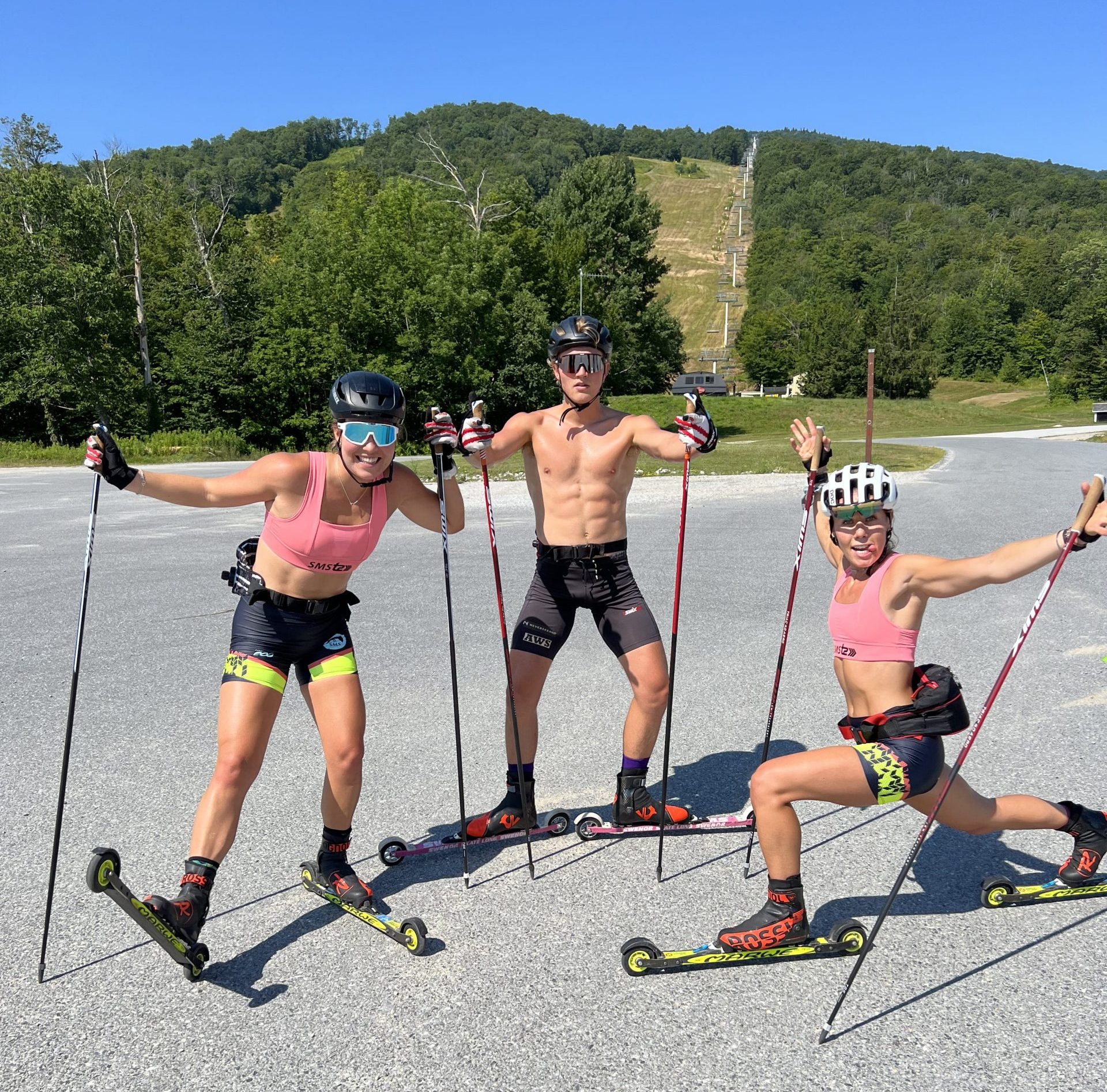
    Happy athletes in the White Mountains in New Hampshire (photo: Lina Sutro)

    Thomas, who took over as head coach of the SMS T2 Team this past spring, expressed his enthusiasm for the crew of athletes saying, “I feel very fortunate to be working with such an accomplished group of U.S. skiers. It has been fun and rewarding to say the least!” He’s had some assistance in the coaching department, U.S. Ski Team D-Team Coach Kristin Bourne, and Head Coach Matt Whitcomb have come through to work with the U.S. Ski Team athletes, but also help support everyone. Annika Martell and Steve Monsulick of Williams College have come to help at Thomas’ invitation, and with the additional support from the SMS junior coaches, Matt Boobar, Alex Jospe, and George Forbes, the coach to athlete ratio has been pretty good. Thomas also said, “I feel very fortunate to be able to work with Pat O’Brien, Jason Cork, Sverre Caldwell, and Matt Boobar this summer (among many other great coaches). Having such an excellent coaching staff to work with and learn from has been such a privilege.  Everyone is very open, hard working, great to get along with, and they are all massive resources for myself as well as the team.”

    For many of the athletes, this summer has been their first time in Stratton. Thomas reflected, “I think many of the athletes that have never been to Stratton before, or maybe haven’t trained with the T2 team as much, have realized how great a place it is to train here. It seems like everyone has been really enjoying themselves, and we hope to continue having a strong summer training group in the future.”

    Lina Sutro, Gus Schumacher, and Lauren Jortberg (l-r) head out for a rollerski (photo: Lina Sutro)

    One of those athletes is Sydney Palmer-Leger, who is not only spending her first summer in Vermont, but is also the newest member of the SMS T2 Team. When asked about her decision to come east this year, Palmer-Leger shared, “Last year I spent two months in Anchorage, Alaska. I had a lot of fun exploring a new beautiful place with the APU group and working with Erik Flora. I had never spent a period of time out East besides a couple bike and ski races. I had heard amazing things about the SMS T2 Team so I decided to try something new. I packed up my car not knowing what to expect and drove the three days out to Vermont.” 

    Born and raised in Utah, Palmer-Leger said she is used to bigger mountains and a drier climate than you find in the East, but the SMS T2 Team was welcoming from the start and made her feel at home. She wrote, “I am used to working with many different coaches so that was an easy transition. I had been on a couple trips with Pat (O’Brien) and met Perry (Thomas) in Bend, so I wasn’t super uncomfortable joining a new team. I felt I belonged in this group from the beginning and loved training in Vermont so I decided to join the SMS T2 Team.”

    SMS T2 crew (photo: Lina Sutro)

    Palmer-Leger pointed to a number of highlights from the summer, including the mini camps in Craftsbury, Warren, and Greens. She reflected, “[the] camps were fun ways to get a lot of training while exploring new parts of the East. I have also loved being close to water where we have gone paddleboarding and waterskiing with the Ogdens. I am very fortunate to have this group to come back to every summer. In addition to running and rollerskiing, I have been able to explore more bike trails. Biking used to be my other sport so I have loved going out with the team every week. I went to Burke the other weekend and helped with the Little Bellas. It is inspirational to see these young girls out on the trails shredding.” 

    Gus Schumacher also made his way east this summer, though for a few weeks rather than the whole summer. Initially, the motivation for this change in scenery was a way to break up the jet lag on the way to Norway for the U.S. Team camp happening next week. But when Schumacher decided not to go to Norway he realized he still wanted to train with Ben Ogden and SMS to “return the favor” of him coming to Alaska last summer. Schumacher said, “I also wanted to hopefully get some rollerski racing and rollerski track skiing in but I didn’t really do my research on when/where to come.” 

    The summer climate in southern Vermont is typically different from that of Alaska where Schumacher spends most of his summer. “[It’s] definitely a little hot and humid but it’s kind of nice to get a little sweaty,” wrote Schumacher, “the biggest issue is that our dryer doesn’t really work so there’s not a great way to dry washed or wet clothes.” (A problem which anyone who has spent a summer in the East can identify with). 

    For his time in Vermont, Schumacher had a couple of goals he was focused on. The first, to stick to his general progression/training layout. This meant getting good group sessions, but not losing focus of his own process. The second was to keep up good daily habits like consistent bedtime, morning mobility, healthy meals and recovery stuff. Third, to take care of some body stuff that was acting up recently. And finally, to generally make use of being around a strong team and use them to push himself whenever possible. Schumacher concluded by saying that he is “very thankful to SMS and southern VT for taking us in and helping us figure out lodging and training, as well as getting us exposure to some races and cool mentoring opportunities.” 

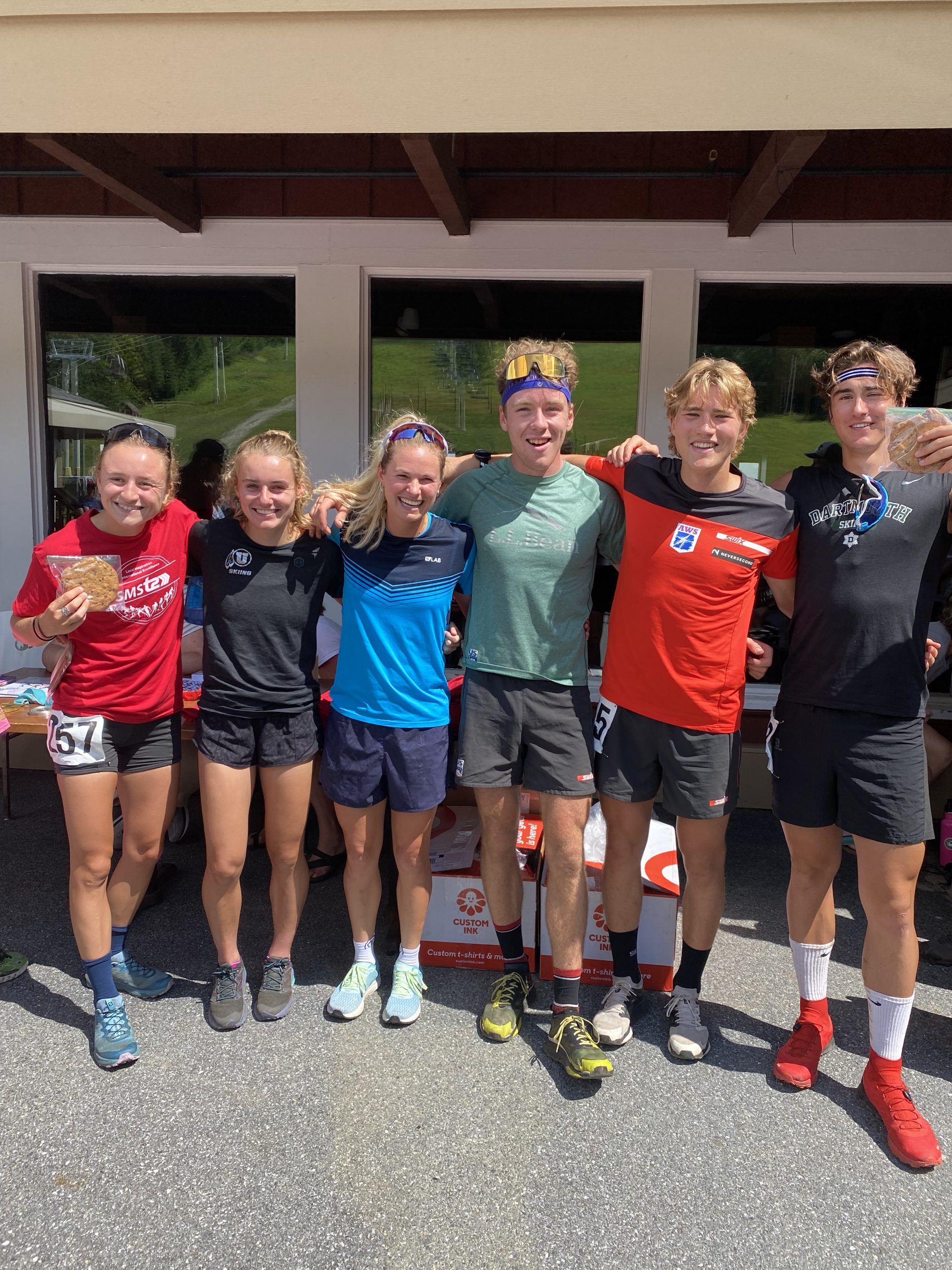
    Alayna Sonnesyn, Novie McCabe, Jessie Diggins, Ben Ogden, Gus Schumacher, John Hagenbuch (l-r) after a hillclimb up Stratton Mountain (photo: Lina Sutro)

    Approaching the final few weeks of August, as the summer winds down, athletes and coaches alike will be going their separate ways. Schumacher is headed back to Anchorage next week when the team goes to Norway. He said, “In sticking with my plan, I felt like it made more sense to take a recovery week and get back into my swing in Anchorage.” 

    Palmer-Leger, who has spent two and a half months in Stratton with the SMS T2 Team, is heading back to Utah for school. After having finished summer school this past weekend, she has a little break before going back to classes in Salt Lake. 

    Thomas reflected that the summer has flown by, saying “it’s crazy how fast time goes by when you’re training hard and having fun.” With many of the summer athletes heading back to school or back to their main club, the crew in Stratton will be dwindling.

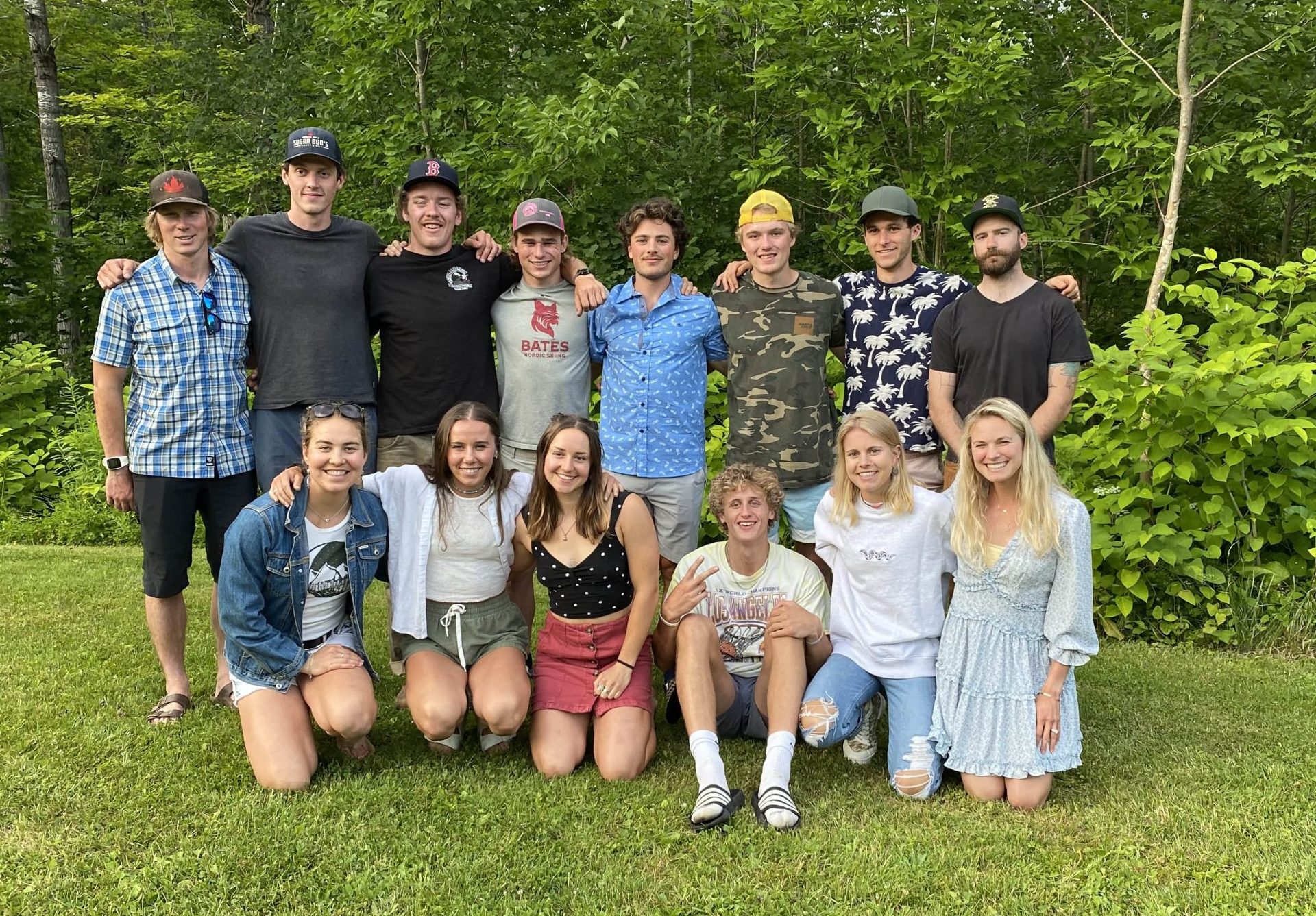
    Back-row: Bill Harmeyer, Ben Ogden, Zander Martin, Will Koch, Asa Chalmers, Adam Witkowski and Perry Thomas. Front-row: Lina Sutro, Lauren Jortberg, Sydney Palmer-Leger, Fin Bailey, Sophia Laukli and Jessie Diggins (photo: Lina Sutro)

    A couple athletes will be traveling to Scandinavia for the U.S. Ski Team camp in the Torsby ski tunnel and competing in the Toppidrettsveka rollerski races. Jessie Diggins, Julia Kern, and Jason Cork are headed to Australia for a three week on-snow camp there. Thomas will be headed to Oberhof, Germany with SMS T2 athletes Lina Sutro, Lauren Jortberg, and Alayna Sonnesyn for a ten day camp in the Oberhof ski tunnel. Eventually, the core T2 team will reconvene back in Stratton in early September before heading to the U.S. Ski Team camp in Park City in early October. 

  • Head Coach Transitions for the SMS T2 Program with Pat O’Brien and Perry Thomas

    Head Coach Transitions for the SMS T2 Program with Pat O’Brien and Perry Thomas

    After eight years at the helm of the Stratton Mountain School (SMS) T2 team, head coach Pat O’Brien is in the process of taking a few steps back, passing the reins to Perry Thomas, who has spent the last five years as the assistant coach at the University of Vermont.

    Perhaps highlighting this transition and the sharing of responsibilities the two are in the process of navigating, FasterSkier connected with Thomas in mid-May while he was in his second week of supporting the SMS T2 athletes who had joined the U.S. Ski Team for their spring training camp in Bend, OR, and with O’Brien who was back in Stratton, having recently wrapped up with his participation in U.S. Ski & Snowboard spring congress sessions. 

    Pat O’Brien supports some of the SMS T2 athletes during a 2022 SuperTour weekend in Sun Valley, ID. (Photo: SMS T2)

    A 2006 graduate of SMS himself, O’Brien raced collegiately for Dartmouth College, then spent four years training and racing professionally with the Craftsbury Green Racing Project. His move from Craftsbury back to Stratton was timed with his retirement following the 2014 Sochi Olympic Quad. Given his age and the proximity to his racing career at that time, many of the athletes on the T2 team were among what he called his “peer group”, having overlapped with many of them during either high school, college, on the race course, or all of the above. Jessie Diggins and Sophie Caldwell Hamilton were quickly becoming rising World Cup stars on the women’s team, while Andy Newell and Simi Hamilton headlined the men’s roster, and a young Julia Kern and Katharine Ogden were spending a PG year training with the T2 team.

    Eager to stay connected with the sport after retirement, O’Brien seized the opportunity to take over in Stratton, stepping in as his predecessor Gus Kaeding departed.

    “Ski coaching is the one thing that I’ve always known that I wanted to do, it was just kind of a natural progression for me. I knew that I was done with my athletic career – I didn’t really want to ski race anymore – but I knew that I still wanted to ski, I still wanted to be involved and to give back to the sport. I felt like, to some extent, when you spend basically your entire life skiing, you get pretty good at understanding the sport. But we never know as much as we think we do, and we always need to be students of the sport and have an open mind and learn.”

    As he began his coaching career, he quickly realized that writing training plans and facilitating training was only a small subset of the responsibilities of an elite club coach.  

    “Good coaching is being comfortable wearing a bunch of different hats. And I mean, I joke, but the actual coaching is such a small part of it. The nitty gritty of pulling an athlete on the side of the trail and looking at video and all of that is important, but you’re there as a friend, a drill sergeant at times, and as someone that is just really trying to be supportive.

    “And that’s all-encompassing. So for me, it has been a pretty fun experience to see people figure stuff out and be there to support them when they needed a little extra help and to do it in a pretty collaborative, dynamic way.”

    He described his experience transitioning to coaching primarily as a mindset shift from the inevitable self-centric focus required of professional athletes toward selflessness; but the work required and pace of life remained equally taxing. 

    “When you coach at a club level – all coaching is a demanding job. I do think that you have to – I don’t want to use the word ‘sacrifice’, but when you transition from being an athlete yourself to being a coach, your job as an athlete is to be a little selfish. You’re trying to maximize your athletic performance. You need to have balance… but at the end of the day, you need to make sure that you’re training well and with purpose, you’re recovering well, you have goals and you’re going about achieving them. It shouldn’t be simply looked at as like what you have to give up to do that, but to be the most professional athletes and succeed against people who are trying to do the exact same thing, you just have to do a really, really good job with it. And coaching is the same thing. You have to be willing to approach everything that you do with the same degree of drive and focus that you would as an athlete…

    “Basically, I just threw myself into it with the same approach that I had as an athlete which is, I’m just going to work, and work, and work, and learn all along the way. And then give it my best push and know that if I get to the point where that balance starts becoming harder and harder, or I can’t really do the job that I want, to be supportive of the athletes [to the level I want to be], that’s when you’ve got to know that you either double down and keep pushing or make a transition.”

    While O’Brien is no less dedicated to the SMS T2 program or its athletes, a new endeavor has begun which will make achieving the balance he described significantly harder: he’s about to become a father. His wife, two-time Olympian and long-time U.S. Ski Team member Ida Sargent, is due in mid-August.

    After eight years as head coach of the SMS T2 team, Pat O’Brien takes a step back as he and his wife, Ida Sargent, begin their family. (Photo: SMS T2)

    Since retirement, Sargent has been working for her high school alma mater, Burke Mountain Academy, in Northern Vermont, and is currently the Academic Director for the school while also teaching STEM classes. O’Brien has been splitting his time between Burke and Stratton, which lies roughly 150 miles southeast in the opposite corner of the state. His usual coaching schedule pulled him around the country for weeks at a time to support athletes at U.S. Nationals and SuperTour events, and sometimes around the globe for World Cup, U23s, and other international camps and races. 

    While he acknowledged that there are many examples of coaches at all levels who have successfully juggled a demanding work and travel schedule with raising a family, what felt like the best fit given his and Ida’s vision and priorities for their own growing family was for O’Brien to decrease his level of responsibility with the T2 program, allowing greater flexibility and more time at home. 

    “I just felt like there’s part of me that was like, ‘I’m not seeing a pathway that I feel like I can still commit [to coaching] at the level that I want and know that you need to in order to to do the best job with your job, while simultaneously trying to start a family.’ I felt like it was my time to reevaluate and maybe step back or be completely done with ski coaching, because I certainly didn’t want Ida to have to put her growing career on hold to be the [primary] caregiver…

    “Eight years is a long time to do something and I am very proud of what the team has accomplished in that time… it’s really cool having spent this time seeing athletes grow, not just not just athletically and within their their ski careers, but as individuals from high schoolers to finishing up college to full blown ‘this is my job.’”

    While his role will be smaller, O’Brien is certainly not stepping away from the T2 team altogether. “Starting a family does not necessarily mean that it means the end of being involved in the sport,” he said. “It just means trying to figure out what the right relationship is with it.” 

    Pat O’Brien supports SMS T2 skiers Julia Kern and Alayna Sonnesyn at the 2022 U.S. SuperTour Finals in Whistler. (Photo: SMS T2 Blog)

    The exact balance and distribution of responsibilities remains a work in progress as Thomas moves into the head coach role and the new season of training begins, and both O’Brien and Thomas are excited to collaborate and support one another throughout the year. 

    Explaining his philosophy as “under-commit so I can open perform”, O’Brien anticipates taking on many of the behind the scenes tasks that support the team, from collaboratively blocking out the season calendar, to managing travel logistics for camps and SuperTour races. As he put it, the little details of deciding “which flights to take to get from Canmore to Sun Valley” and where to stay are often made easier with several years of trial and error under your belt. 

    While Thomas will spend more time with ski boots on the ground, both in Stratton during the summer and at races and camps throughout the year, O’Brien anticipates he’ll still be plugging in a fair amount too. Though his stay might be shortened to the period immediately surrounding races, he plans, at minimum, to be in Houghton, MI for U.S. Nationals in January, and also the SuperTour finals in Craftsbury in late March.

    He’s also excited to reconnect with the team in Stratton early in the summer before Ida gets close to her due date, but also to take off a few of his usual coaching hats while doing so. 

    “I think it’ll be really fun for me to actually be able to flow in and out get to see people, connect with them, but also not be like ‘Okay, now I don’t have to worry about making sure that the van’s filled up with gas, or water jugs have been filled, or that I’ve ordered all the lactate strips in advance so that we don’t run out.’”

    Perry Thomas out for a crust ski with the SMS T2 athletes who joined the national team training camp in Bend, OR this spring. (Courtesy photo)

    As Thomas gets his feet under him in Stratton, he explained that he feels “very fortunate that Pat will still be involved.”

    “As much as I can have him in the mix, the better,” Thomas said. “His knowledge with skis and wax is just unreal, so tapping into that resource is huge for me, for sure.” 

    ***

    UVM assistant coach Perry Thomas in action during the 2022 U.S. Cross Country Skiing Championships in Soldier Hollow. (Photo: Instagram @oneswellperry)

    Prior to joining the UVM program, Thomas spent five years as the assistant coach at the University of Vermont, working alongside head coach Patrick Weaver. During his own collegiate racing career, Thomas spent four years racing for the University of New Hampshire, where he served as team captain during his senior year in ‘12-13. Departing briefly from the cross-country ski world, he spent a year teaching high school science to underprivileged youth in the Oakland area of California, before returning to the Northeast to begin his coaching career as the assistant coach at Williams College in Massachusetts. 

    “Working at UVM was unreal – a great experience,” Thomas said emphatically. “I really loved working with Patrick Weaver and the athletes there and it seems like almost a seamless transition, in many ways. Four of the skiers on the T2 team I actually coached at UVM. So knowing a lot of athletes here already – what they’re working on with technique, and racing, and goals and all that – has been very seamless, and that’s been great.”

    The UVM graduates who now ski for SMS T2 include Alayna Sonnesyn (‘18), Bill Harmeyer (‘20), Lina Sutro (‘21), and Ben Ogden (‘22). 

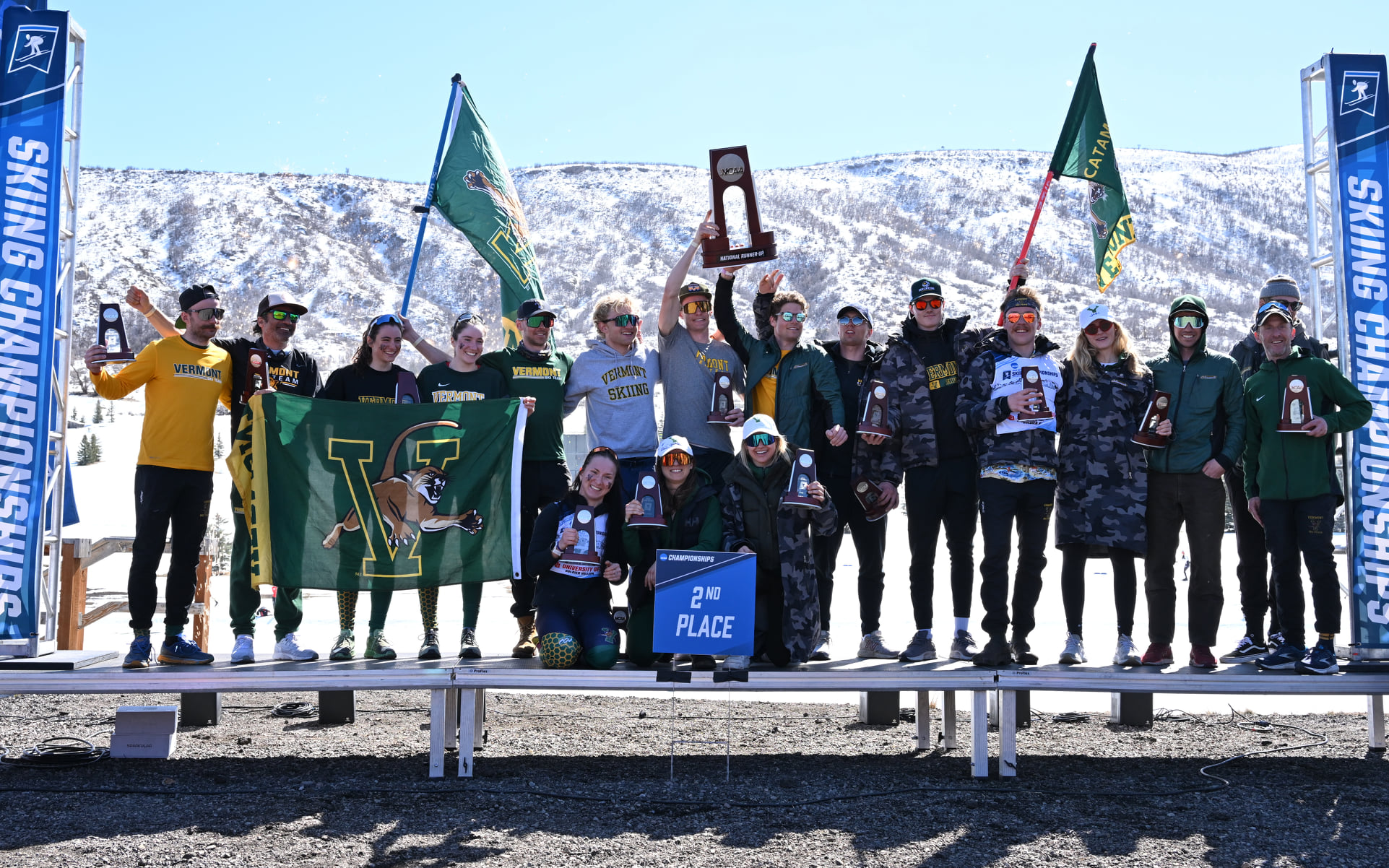
    The UVM ski team celebrates a successful 2022 NCAA Championship. Assistant coach Perry Thomas is at the far left. (Photo: UVM Skiing)

    Given the caliber of these athletes and the success of the UVM team as a whole during his tenure, Thomas credits his time with the program to the acceleration of his development as a coach, preparing him to take his next steps forward with SMS T2.

    “Patrick Weaver definitely gave me a lot of opportunities and ownership over different facets of coaching that team and I think that’s been instrumental in me being here now with T2. I was able to go to World Cup Finals with Ben Ogden in Quebec his first year in school [in 2019], and I was just able to do trips like that on my own with athletes. That was huge for my development as a coach and for my experience of waxing, ski testing, and [other responsibilities at that level of racing]. So working at UVM was a lot of fun – I’m gonna miss it for sure – but it set me up very well for this transition.” 

    Ben Ogden gets a congratulatory fist bump as he heads to the podium during his sweep of the 2022 NCAA Championships. (Photo: Tobias Albrigtsen / @untraceableg)

    A theme of both Thomas and O’Brien’s comments on the difference between collegiate and elite club coaching is small in terms of the training and technique coaching itself, but vastly different in terms of the opportunities elite club coaches have to support their athletes. 

    “I think the big differences are what we can and can’t do throughout the year from collegiate [racing] to the elite team,” Thomas explained. “Like, I wouldn’t be here [in Bend] and been doing an on-snow training camp if I were at a college team. And obviously the racing schedule is super different.

    “The college schedule is pretty efficient, whereas the SuperTour calendar is quite a bit more spread out. And then, in addition to that, you have an athlete’s like Jesse Diggins, and Ben Ogden, and Julia Kern that are going to be on the World Cup, as well as athletes that are trying to make it to the World Cup. And at UVM, we had crazy talented athletes – Ben Ogden is one of them – so working with with high caliber athletes is nothing entirely new, but dealing with athletes where some are on the World Cup and some of them on the SuperTour is an interesting dynamic that you don’t often get with the college teams.”

    In terms of what Thomas adds to the program as he steps in as head coach, he described his coaching philosophy and the environment he seeks to create within the training group, which keeps athletes motivated and happy through the arduous and long-term development process.

    “[Cross-country] skiing is such a hard sport – it’s so much time that that we’re putting in, and so many sacrifices that we’re making, that I wholeheartedly believe in making that time that we’re together training and working hard fun and enjoyable,” Thomas said. “I think that’s a big part of what we do –  and it has to be a big part of what we do –  because like I said, it’s a hard sport. So I think making things light and having fun with all that is super important. And that’s definitely something I bring to the table in that regard.”

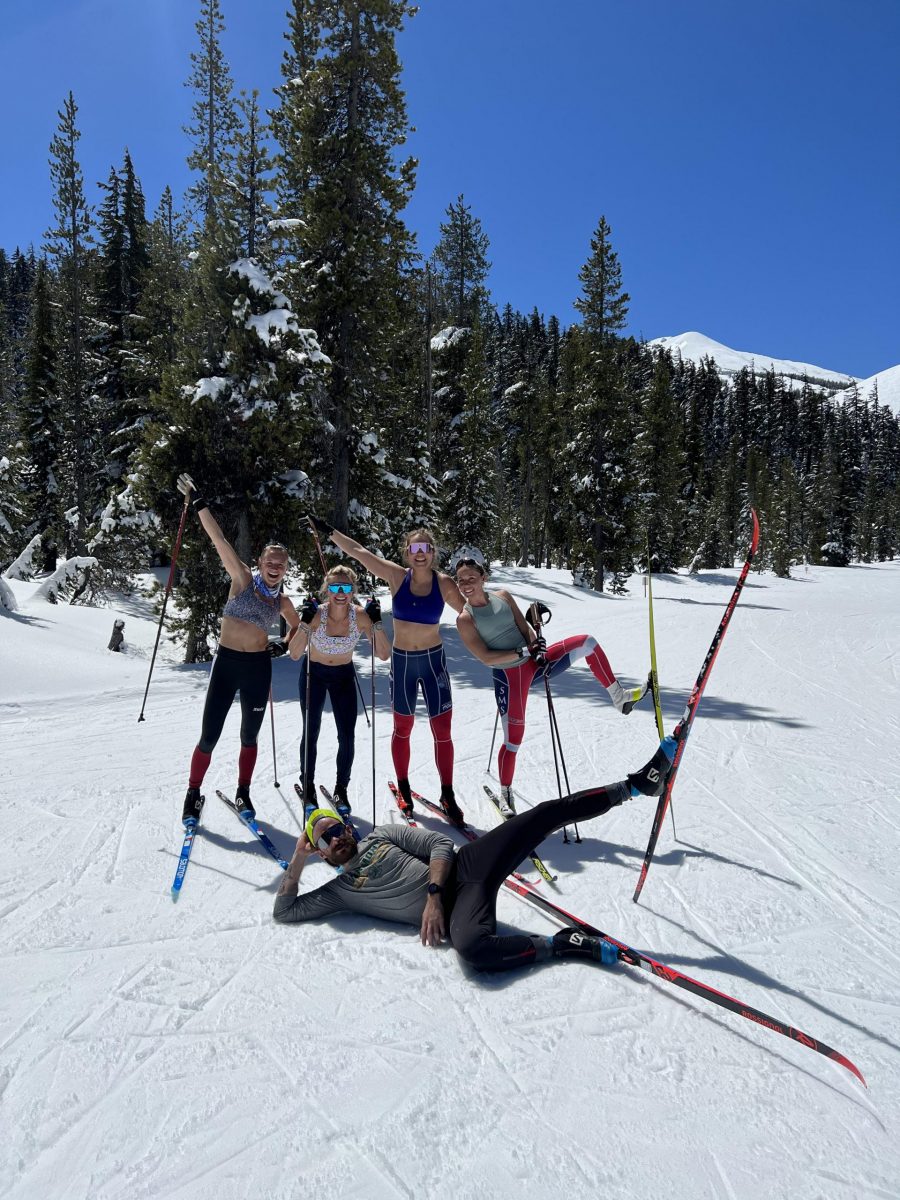
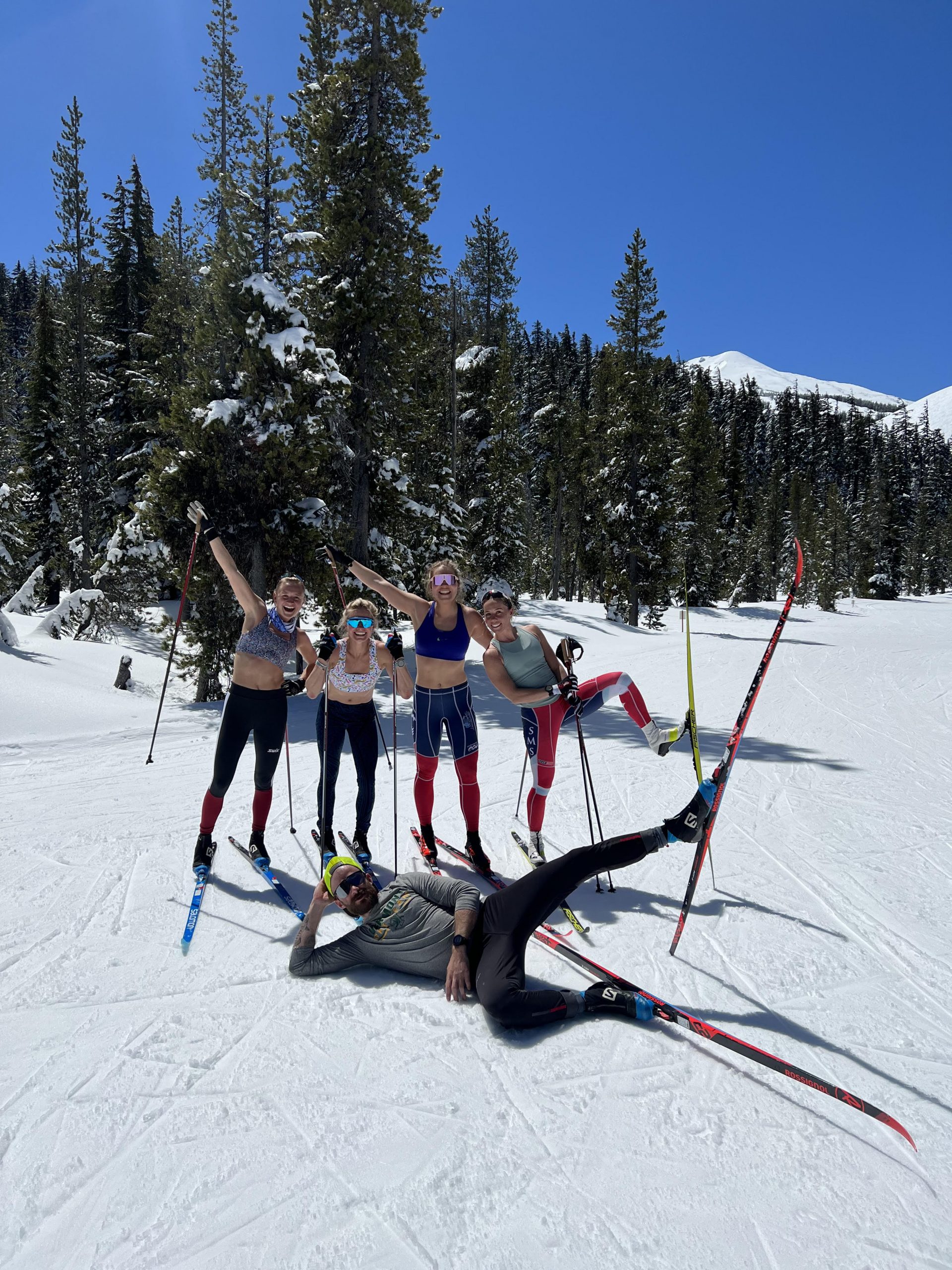
    The SMS T2 team enjoys spring skiing at the Mt. Bachelor Nordic Center. From left to right, Alayna Sonnesyn, Jessie Diggins, Lina Sutro, and Lauren Jortberg, with head coach Perry Thomas. (Photo courtesy Alayna Sonnesyn)

    But Thomas will add more than just fun to the T2 program. While he may be, as phrased by his new colleague, “almost too humble”, O’Brien was quick to highlight Thomas’s preparedness to prescribe training, coach technique, and otherwise lead an elite team stacked with some of the nation’s best athletes. 

    “If you have been at a D1 college program where you’re dealing with 15-20 athletes and that dynamic environment where student athletes are constantly balancing all these different commitments and time constraints… And really, what you learn there as an athlete and what you learn there as a coach is that working with a club – it just isn’t that different.”

    O’Brien added that the shift to an elite club from college may, in fact, be easier than going in the other direction. When athletes no longer have to miss key workouts to take an exam or rush off to class halfway through a team meeting, barriers to consistent communication and training are removed, and consequently a coach has a greater capacity to build relationships with the athletes as they stack together the bricks of the training program. 

    “You get an opportunity to really work one-on-one with the athletes and to really be there to facilitate and support their training and their racing. In that sense, I think coming from a college background – especially given his ties with many of the current athletes that are on the team – you’re just working with the same people and you’re doing the same stuff.

    “I mean, there’s no magic formula,” O’Brien continued. “Someone can claim that they can write the best training plan in the world. And that’s all fine and dandy – there are definitely people who do an amazing job with it and they really enjoy that aspect of that aspect of the sport. But at the end of the day, it’s just really just working with people. You don’t need to make it more complicated than it is. The best athlete is not a robot. The best athlete is someone that is self aware, that can think critically, learn from mistakes, recognize when things go well, and the coach is there to support them along the way.”

    New SMS T2 head coach Perry Thomas working with his athletes during a 2022 spring training camp at the Mt. Bachelor Nordic Center. (Photo: Lauren Jortberg)

    Thomas identified building upon his relationships and experience with his former athletes, who account for half of the team’s eight athletes, as something he’s looking forward to in joining T2. 

    “I am very appreciative of the continuity and being able to work with some athletes I’ve worked with in the past,” said Thomas. “I love all of them –  they’re incredible people, incredibly hard workers. So to be able to continue working with them is just awesome. With that, too, it’s like – I have been working with Ben for the last four years, I worked with Lina Sutro for four years, I worked with Alayna for a little bit. It’s just a matter of knowing how they operate and how they train and knowing what they’ve been working on too. It’s easy for me in training, [even] this morning, to see some of them and be like, ‘okay, like this is something we’ve been working on for the last however many years’ or maybe, ‘a couple years ago, this was something we’re working on’. So let’s continue this, let’s continue these cues that we’re working on, and have that continuity there. 

    “It’s been awesome to be able to continue that work with them. It’s nice to see the progress – to see what they were doing in college a few years ago, and then to see where they are now, and then also to be able to help them through the transition to professional skiing.”

    Simultaneously, these UVM-T2 athletes are excited to be working with their former UVM coach again. In an email to FasterSkier, Alayna Sonnesyn reflected on her time as a professional skier guided by O’Brien, while crediting Thomas’s contributions at UVM for her reaching the professional level in the first place. 

    “Stepping into the professional ski world four years ago and onto the SMS T2 team was super intimidating to me,” wrote Sonnesyn. “The team has been home to some of the fastest skiers in the world and I was clueless when it came to racing at that high of a level. Pat O’Brien helped steer me in the right direction as I made this adjustment and took huge jumps in my skiing ability. He taught me when to train for fun and when it was time to buckle down and get serious. When Pat says it’s go time, you go! He helped develop me from a reasonable distance skier to a strong and powerful distance AND sprinter, a trait I never thought I would be capable of. Pat’s knowledge of the sport and ski waxing, as well as the mental and emotional obstacles that come along with it, is unparalleled. He was a coach that believed in me as a junior skier and saw potential. The only thing that can make a good ski race even better is when Pat gives you a proud hug at the finish line. Although I will miss these hugs and his direct coaching, I know that he will use these skills to care for his growing family and I am excited to see where life takes him next.
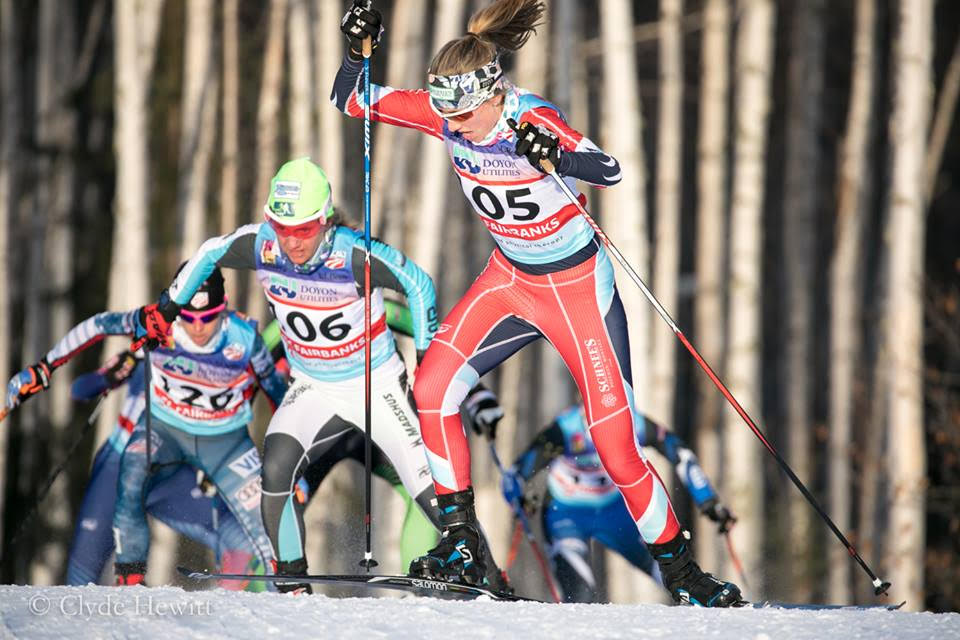
    Perry Thomas works with a few of the SMS T2 ladies in Bend. (Photo: Alayna Sonnesyn)

    “Back when Pat was just seeing the potential in my college skiing, I was working with Perry Thomas when he was the assistant coach at UVM. I feel like my athletic career has come full circle as I get to transition back to a coach who helped put me in a place where I first believed skiing professionally was an option. Although I only had the pleasure of working with Perry for one year at UVM, it was a very special season! I instantly trusted him with my skis and could feel his enthusiasm for the sport radiate on the ski trails. I’ve witnessed just how hard Perry has worked over the years and how well-prepared he is to take over the position as head coach of the SMS team. Just in the first month of working with Perry again, I already know the team is heading down a path to continue its mission; local inspiration, international excellence.”

    Likewise, Lina Sutro shared she is looking forward to the transition, applauding Thomas’s dedication to his athletes.

    “I am truly so excited to be working with Perry again,” she wrote. “He is one of the most hard working and committed coaches I have worked with. He has a strong work ethic that I am excited for the Stratton community to experience. Pat and Perry both give so much back to the ski community and their athletes, I am excited to see the two of them work together.”

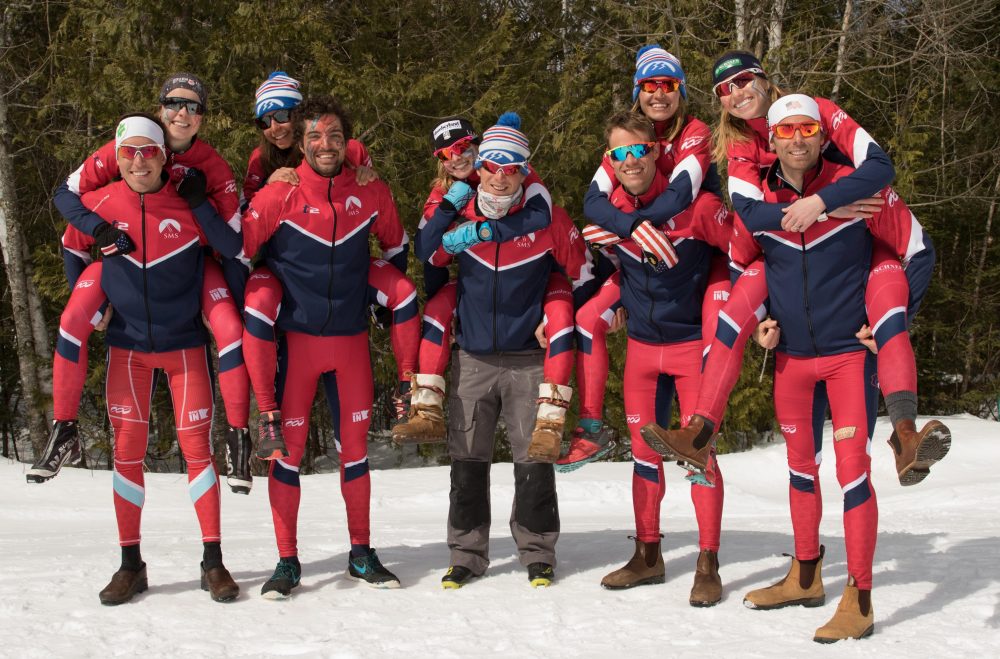
    The 2021/2022 SMS T2 Team. Back row (l – r): Ian Torchia, Ben Ogden, Bill Harmeyer, and Will Koch; front row: Alayna Sonnesyn, Julia Kern, head coach Pat O’Brien, Lina Sutro, Katharine Ogden, and Jessie Diggins. (Photo: SMS T2 Blog)

    As for the broader questions of “what’s new?” and “what lies ahead for the SMS T2 team this summer?” Following Katharine Ogden’s retirement in March, Lauren Jortberg will join the team as the fifth athlete on the women’s side – five and five is what the team identifies as the sweet spot for numbers. Jortberg joins Jessie Diggins, Julia Kern, Alayna Sonnesyn, and Lina Sutro. The men’s team is light this season, as Ian Torchia moved on this spring also, leaving behind a three-man roster of Bill Harmeyer, Will Koch (who also competes for University of Colorado), and Ben Ogden. 

    After Bend camp, the team will part ways with many attending “a big event in the Midwest” which happened over Memorial Day Weekend. The SMS T2 team will finally reconvene as a whole in Stratton in early June. Though regional and international camps are planned, particularly for athletes named to the national team, Thomas anticipates ample quality training based in Vermont and the surrounding region.

    “We’ll be in the Stratton area for the majority of this summer,” he explained. “I think one of the cool things that we’re doing is: Sverre, and Pat and I have started working on doing a summer [training] program, so we have some awesome athletes joining our crew this summer.”

    This list includes University of Utah and U.S. Ski Team skiers Sydney Palmer-Leger, Novie McCabe, and former SMS junior athletes Adam Witowski and Zander Martin, who now ski for Michigan Tech and Bates College, respectively. JC Schoonmaker and Gus Schumacher also plan to join the T2 team for some training in Vermont throughout the summer. 

    “So a really stacked crew, for sure,” said Thomas. “It’s gonna be a really exciting summer to say the least.”

  • The College Conflict: Part 2

    The College Conflict: Part 2

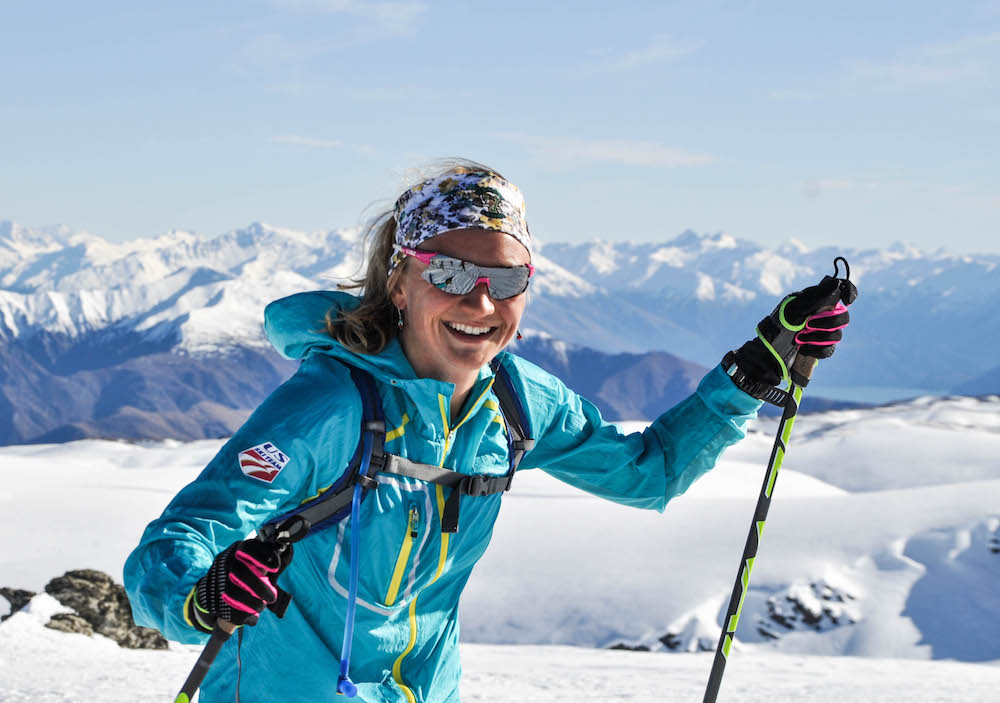
    Author Alayna Sonnesyn during a crust ski at the Snow Farm this summer near Wanaka, New Zealand. (Photo: Matt Whitcomb)

    The following was written by Alayna Sonnesyn, a new member of the Stratton Mountain School (SMS) T2 Team who graduated from the University of Vermont (UVM) this past spring.

    Originally from Plymouth, Minnesota, Sonnesyn, 22, raced on the UVM Ski Team for four years and qualified for four NCAA Skiing Championships teams. She placed second and third in two races at 2017 NCAA Championships, and in her senior season, won the first five Eastern Intercollegiate Ski Association (EISA) races and went on to reach the podium in 10 out of 11 EISA races. Sonnesyn expressed an interest in exploring the dilemma many of the nation’s top skiing talents face out of high school: whether to attend college or get an early jump on a pro-racing career. Part 1 can be viewed here, and the two-part series is also on her blog.

    ***

    According to the Bureau of Labor Statistics about 70 percent of 2017 high school graduates enrolled in some form of college the following fall. In addition, a handful of the working population decided to either start college after a few years or return to classes after a much-needed hiatus. But what happens if you stray from the norm … and something pulls you in another direction? For Jessie Diggins and Andy Newell, there were alternative ideas for the future.

    At the time, both Jessie and Andy followed the same route, exploring collegiate racing right out of high school. Similar to many high school skiers, they went through the process of applying to schools, talking to coaches and establishing academic opportunities for themselves after graduation.

    Jessie Diggins being goofy during our recent training camp in New Zealand. (Photo: Julia Kern)

    “When I decided to go full-skiing, I had deferred a place at NMU, and had that as my Plan B if I decided that full-time skiing was too stressful or not as fun as I wanted it to be,” Jessie said.

    “What I decided to do was defer from UVM, but I was also able to take some classes from the University of Utah with tuition reimbursement and a loaned laptop courtesy of the US Ski Team,” Andy explained.

    At the time, both skiers were still open to going to college, but decided to “take a year off.” The only difference was that they never experienced that longing to go back into full-time school. As previously mentioned in Part 1 of this series, many skiers who decided to take a gap year soon came to the realization that something was missing and that they still wanted a balance in their life. It made sense for them to go back to school and ski in college. But why change something when you’re already happy?

    According to Jessie, “At the end of the day, a happy skier is a fast skier… For me, I was super happy having all my eggs in one basket and making skiing my full-time job. I love having skiing as my career, and I perform well under stress so having the pressure of becoming a professional athlete at a young age didn’t create too much anxiety.”

    This stress worked well for Jessie. With such a unique combination of personality, work ethic, and training load, she knew taking this route would be better for her.

    buy ciprofloxacin online, ajedrezextremadura

    “Personally, going to college wasn’t going to work for me if I wanted to get the grades I wanted and train as hard as I wanted,” she said.

    Jessie went on to note how important it is to figure out your own personality; whether you can do a good job at balancing school and skiing, or whether you’re excited to focus all of your time and energy on one goal. She found that specificity suited her lifestyle really well after high school and carried that momentum for years to follow.

    Similarly, Andy found success from a young age and didn’t see a reason to change what was already working so well for him.

    “To get that kind of international exposure was sweet for a junior, but more importantly it got me hooked on skiing — the addiction to the big show and excitement of European racing,” Andy said of racing at World Juniors, U23’s and World Championships his first year out of high school.

    With the need for speed and an obvious progression into becoming an elite skier, Newell admitted that he pretty much gave up any opportunities for racing in college after he started signing contracts and collecting win money. Although, he notes that the ski racing environment was slightly different at the time he made this choice. In high school, Andy was named to the U.S. D-team, which, at the time, provided free housing in Park City, access to daily coaching, and most of the Winter travel expenses covered.

    “I consider myself lucky that the U.S. Ski Team was in a position then to support D-team members a little bit better,” Andy said.

    He explained that he wouldn’t have given up his opportunities for anything. He was feeding his addiction to the big show of European racing, making decent money, and having the time of his life! What else could he need or want?

    So, the big question is, do all the stars need to align? Do you need to have the right opportunities present themselves at just the right time? Maybe! But it’s important to note that this right moment appears differently for everyone! What is more impactful, is the way you respond to the opportunities presented to you.

    U.S. Ski Team coach Matt Whitcomb pointing us in the right direction during a crust cruise at the Snow Farm in New Zealand. (Photo: Julia Kern)

    “There are a lot of options these days,” said U.S. Ski Team coach Matt Whitcomb, “but those who become exceptional are the ones who actually pick something from the list, and they run like hell with it.”

    You don’t need to do exactly what your teammate did, or what an Olympic medalist did.

    “Create your own path, get vulnerable,” Whitcomb advised. “Most people just run down America’s path of mediocrity, when they could instead be cutting their own unique route.”

    Every skier can take a different road. Maybe that road is pin-straight without a single bump, or maybe that road has curves and hills and potholes. It doesn’t matter what it looks like or how you approach it, as long as you figure out the best scenario for you and what makes you happiest. One way to solve this solution would be to test out every possibility; take a gap year, go to one school, maybe transfer, take another year off — but this is unrealistic and requires far too many resources. I think that the easiest way to find your way is to talk to others that have faced a similar situation — an older sibling, teammate, coach, or friend. Also, remember that you really can’t go wrong. No matter what choice you make you will still face unexpected fears, experience a new lifestyle, and figure out why exactly you still love this crazy sport!

    goochelaar, lugardepascuais

    For those of you taking a year off from school, I wish you the best of luck in finding the perfect place where you belong. For those heading back to school, I hope you cherish every moment of it, because it goes by far too quickly. Regardless of which road you choose, own it! Make it your decision and give it your best shot/all you’ve got. If you do that, you can’t go wrong.

    “There is no right or wrong decision, do whatever works for you!” — Sophie Caldwell

    “You can be the fittest person out there, but if you are not happy and motivated, it will be very hard to ski fast.” — Julia Kern

    “My only regret in my skiing career is that I was not mentally prepared to win a medal at my first Olympics as a 22 year old…. I thought I had a chance of winning a medal but I didn’t actually BELIEVE I could do it. So above anything else I want young skiers who are graduating from high school to know that four years is not a long time and you can find yourself at the start line of the Olympics before you know it.” — Andy Newell

    “I don’t think there’s one model that fits every person. It’s also important to remember that it’s not forever!” — Jessie Diggins

    “The opportunities will present themselves when the the time is right!” — Ida Sargent

    “If you want to be exceptional, don’t be afraid of being an exception.” — Matt Whitcomb

    Alayna Sonnesyn with one of her former UVM coaches Perry Thomas at the 2018 App Gap Challenge Rollerski Race in Vermont this summer. (Courtesy photo)
  • Nordic Nation: The Patrick O’Brien (Patty O’) Epsiode

    Nordic Nation: The Patrick O’Brien (Patty O’) Epsiode

    He’s another skier who bleeds maple syrup. Raised in Putney, Vermont. Skied at the Statton Mountain School (SMS), Dartmouth, and post-collegiately with the Craftsbury Green Racing Project — take a breath — and yes, still in Vermont as the SMS T2 Team head coach is Pat O’Brien. Thirty years old this summer, O’Brien has been at the helm of one of the dominant elite level programs in the U.S. since 2014. As he begins his fifth year leading the program, he has had the unique opportunity of guiding emerging athletes, like new SMS T2 skier Alayna Sonnesyn, along with a newly minted Olympic gold medalist, Jessie Diggins.

    Aviators? Check. Hi-vis attire? Check. Five o’clock shadow from a gruelling dryland camp? Check. SMS T2 coach Patrick O’Brien on the last day of this year’s Lake Placid summer training camp. (Photo: Matt Whitcomb)

    In this episode, we spoke with O’Brien on Aug. 15, shortly before his departure for an on-snow camp in New Zealand. He discussed how he entered the coaching game and how he navigates working with skiers who have found success on the World Cup to those just breaking into the world of SuperTours and post-collegiate skiing. Bonus info from the interview, O’Brien claims to have once beaten Simi Hamilton at something.

    Patrick O’Brien at the 2018 SuperTour Finals in Craftsbury, Vermont. (Photo: Reese Brown/ U.S. Ski and Snowboard)

    (To subscribe to the Nordic Nation podcast channel, download the iTunes app. If you have iTunes, subscribe to Nordic Nation here.)

  • The College Conflict: Part 1

    The College Conflict: Part 1

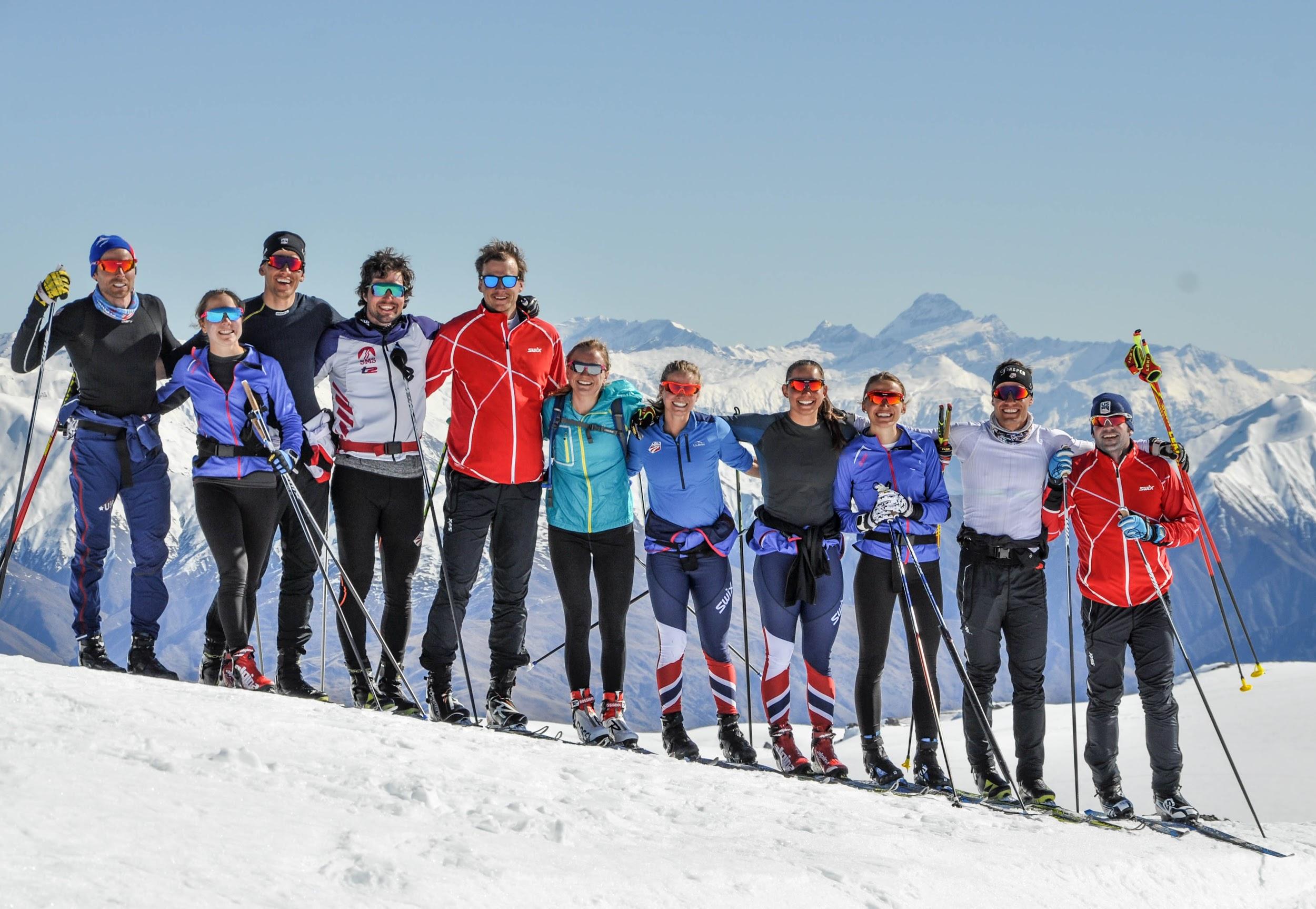
    2018 U.S. Ski Team camp at the Snow Farm in New Zealand, with author Alayna Sonnesyn (teal jacket) in the middle of the group shot. (Photo: Matt Whitcomb)

    The following was written by Alayna Sonnesyn, a new member of the Stratton Mountain School (SMS) T2 Team who graduated from the University of Vermont (UVM) this past spring.

    Originally from Plymouth, Minnesota, Sonnesyn, 22, raced on the UVM Ski Team for four years and qualified for four NCAA Skiing Championships teams. She placed second and third in two races at 2017 NCAA Championships, and in her senior season, won the first five Eastern Intercollegiate Ski Association (EISA) races and went on to reach the podium in 10 out of 11 EISA races. Sonnesyn expressed an interest in exploring the dilemma many of the nation’s top skiing talents face out of high school: whether to attend college or get an early jump on a pro-racing career. She plans to post this two-part series on her blog as well.

    ***

    For the first time in 17 years I will not be going back to school this fall. Saying that out loud is more daunting than I had anticipated. For the most part, the classmates that I graduated with can say that they are “going to grad school,” “starting a new job,” or “taking a year off to travel,” but I still don’t know where I lie. I am not taking any classes this year, I am not working anywhere consistently, and I am doing more than just traveling to explore, I’m traveling to race!

    I am wrapping up a three-week training camp in New Zealand with the SMS, Craftsbury, and US Ski Team. When I walked through customs I had to write down my reason for visiting New Zealand: Was I a student? Was I visiting a family or friend? Was I working? What was my job? In the rush of the moment and due to habit, I wrote that I was still a student and continued on my way. I later had a few reflections; I still haven’t reached the point yet where I can say I have a job. I don’t have a salary and there are no company benefits. Yet, I work 24/7 toward my job — my job is ski racing. But why is this so hard for me to admit to myself? Is it because, for my entire life, I’ve been a student? What if I hadn’t taken this route? How do others make this decision?

    National Training Group (NTG), summer 2013, in Park City, Utah.

    Racing throughout high school, I was given a number of perspectives about picking skiing versus school. My friends were all preparing to go to college and I always assumed I would go to college, too. My parents and older sister went to school, why wouldn’t I go as well? But then I thought about skiing. I never had the most outstanding results in high school (never qualified to race internationally), but I was good enough to qualify for regional and national level camps like REG, NEG and NTG. I traveled to these camps and trained with other high-level athletes, getting more and more motivated by each skier or coach that I met. Then the thought came to me… what if I didn’t go to college? I could focus on training, make those vital steps toward international racing, and continue along the “pipeline” that so many Olympians had followed. Maybe I would make bigger jumps and improve my skiing exponentially? I was entering the unknown and I was unsure how to pick the right choice for me. Looking back on this four years later, I realize that I was far from alone in this predicament.

    buy clomid online, buy yaz online, yasmin buy online

    I have since had the opportunity to talk to a wide variety of skiers and competitors and have learned so much that I wish I knew in high school. It’s OK to be confused. It’s OK to make your own path. Every athlete is in a different situation, comes from diverse athletic and academic backgrounds, and has various goals that they hope to achieve post-high school.

    “I’ve always believed that the most important thing to remember when discussing the decision to go to school or not (or when to go to school) is that is it a completely individual decision and the right decision for one person might not be the right decision for the next.” — Sophie Caldwell

    Personally, I finally decided that taking a gap year might be too big of a jump for me. I wasn’t ready to focus on skiing and I had a lot of goals for myself academically. I decided to attend the University of Vermont and upon reflection, can admit that this was one of the best decisions of my life. Similarly, SMS teammate, Kelsey Phinney, went from high school in Boulder, Colorado, directly to Middlebury College.

    “The reason I chose Middlebury College was simple: I went to visit and I was ready to unpack and stay for good. I loved the people, the area, the ski team, and the classes I sat in on.” — Kelsey Phinney

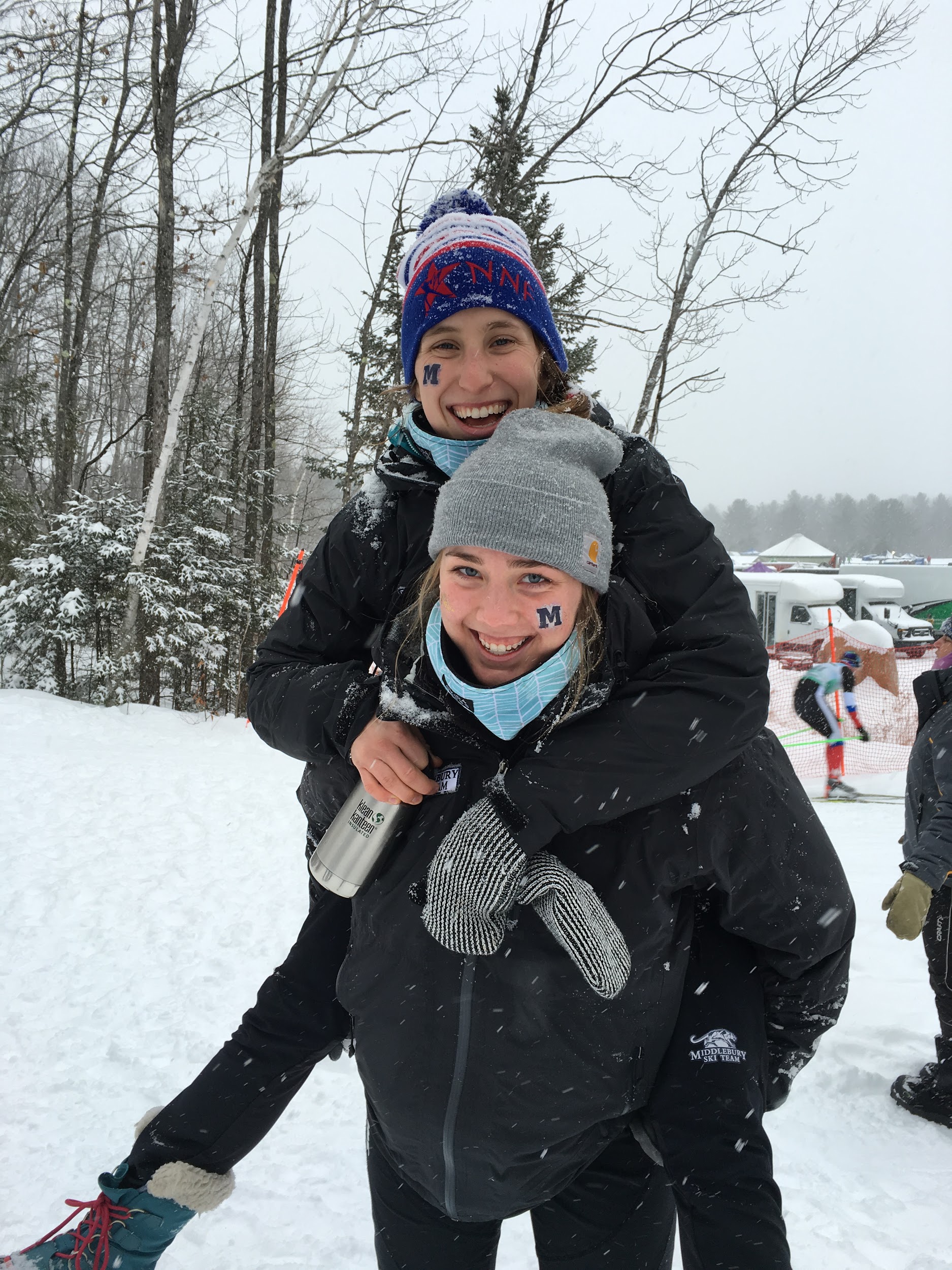
    Carnival love, with Kelsey Phinney (top) and Katie Feldman.

    Kelsey and I both fell in love with our schools from the start and knew we were where we belonged. We took these college experiences as learning opportunities; maybe we wouldn’t have been ready to jump right into the professional circuit but we both determined this was the right path for us.

    “I loved the experiences I had on the Carnival circuit. Both good and bad times taught me a lot about life and skiing, and I felt like the balance of school and sport made me better at both,” Kelsey reflects.

    Similarly, Sophie Caldwell had her mind made up without the need to hesitate over a gap year or jumping into full-time skiing.

    “I chose to go to college right out of high school, and it was something I had always known I wanted to do. I knew there was a good chance I wanted to ski professionally at some point in my life, but when I was 18, I wasn’t ready to 100% commit to skiing,” Sophie, a Dartmouth graduate, explains.

    With academic goals in mind and the confidence to pursue skiing in the long run, sometimes there’s no need to question it. Going directly to college might challenge you more than you think and it might make you question what you’re doing. The balance of school and skiing is great, but it’s TOUGH! At least you worked through those challenges and figured out where you want to be though.

    “I definitely had my ups and downs throughout college and at times I considered not pursuing skiing after college, but by the time I entered my senior spring, I knew I wanted to give skiing professionally a shot and knew it was because it was what I wanted to do, not what I had to do,” Sophie notes.

    Over the course of four years, we were able to say goodbye to our homes, grow into adults and develop as skiers, allowing a much smoother transition into the professional racing circuit post-college. This decision to go right to college made sense for Kelsey, Sophie and me — it was simple; but I recognize that this choice isn’t as straightforward for everyone.

    ***

    “I loved my time at Burke and wasn’t quite ready to leave. I also didn’t know where I wanted to go to college as part of me wanted to go out west while part of me wanted to stay closer to home.”  — Ida Sargent

    The conflict of picking a school, a place we are willing to spend at least four years of our lives at, can be intimidating to anyone. Taking a year off to think and explore what motivates you once the structure of school is taken out of the picture can be extremely vital to one’s skiing longevity. Other times, this year off can be done to test out what skiing professionally is actually like.

    “I wanted to test out whether I could do only professional skiing.” — Katharine Ogden

    A feat that might sound easy to accomplish — ski, eat, sleep, repeat — can’t be THAT hard! But what happens when you suddenly put all of your time and energy into one goal?

    “Ironically, my gap year did not turn out even close to how I had planned or imagined!” reflects Julia Kern.

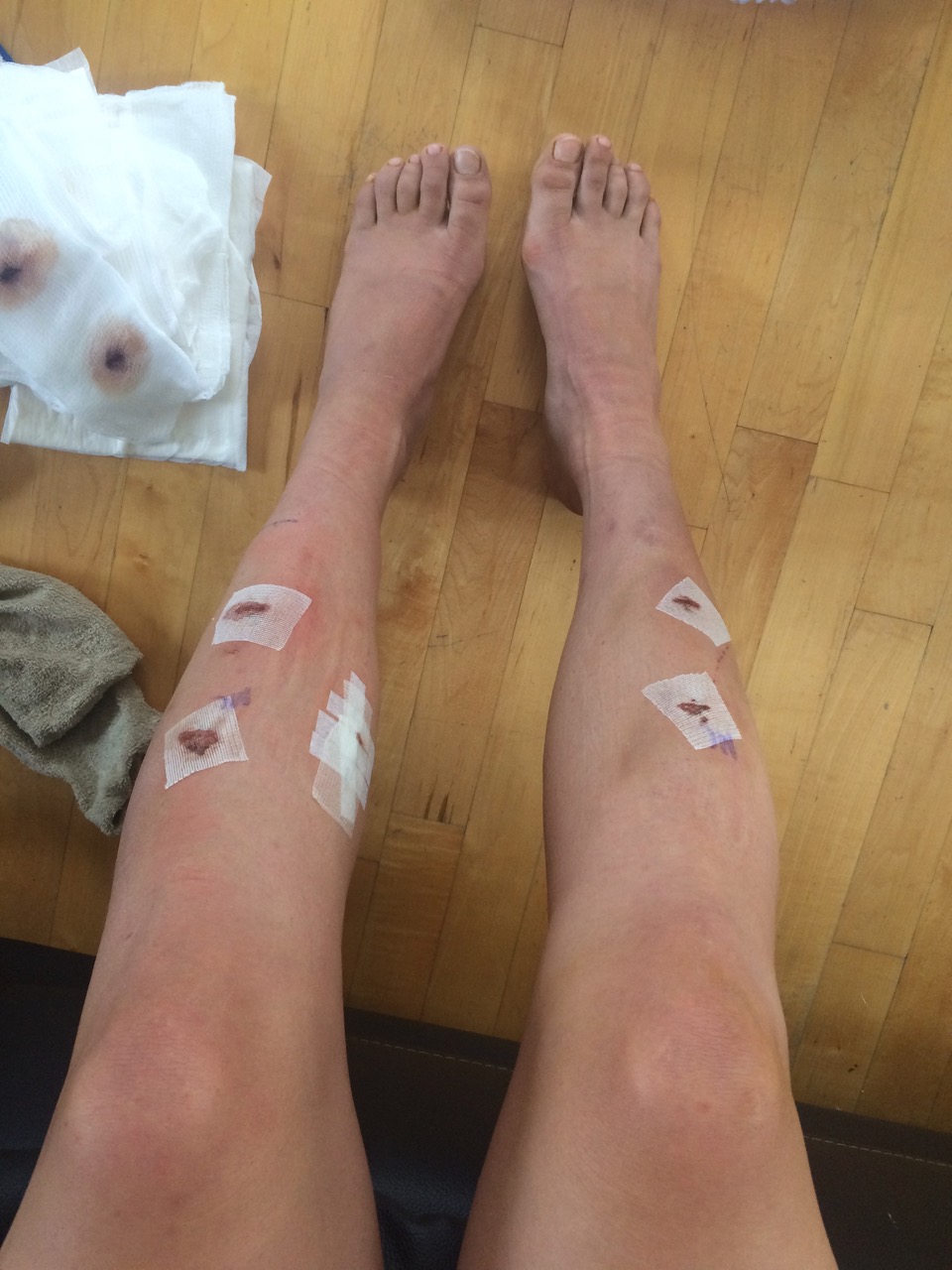
    Julia Kern with swollen legs after surgery, requiring A LOT of physical therapy during the summer.

    After facing an early summer surgery for compartment syndrome and then an untimely back injury in the fall, Julia notes that her gap year was extremely tough with plenty of lows and setbacks.

    Ida Sargent offers, “My PG year was a bit of a disappointment as I wasn’t as happy as I was expecting and I also didn’t feel like I made as big of a jump with my results as I had hoped.”

    “I think in hindsight it was a good philosophy but I think I approached it wrong. I didn’t do a good job securing other things to do besides training and was thus pretty bored, which led to me putting a lot of stress on skiing and racing,” says Katharine Ogden.

    Maybe taking a gap year isn’t as easy as it sounds? Coming face-to-face with this type of ski-focused intensity as an 18 year old can be challenging.

    “It showed me how much I really wanted to go to college,” offers Katharine.

    It can also be validating, as it can prove to oneself where they really belong at that point in their life.

    “It made me realize that I wasn’t ready to ski full time and I still needed balance in my life,” reflects Ida.

    What might be the most beneficial aspect of taking a gap year are the lessons you learn throughout. How to deal with the pressure, free time, potential obstacles, and how to respond when you’re suddenly put in an unfamiliar situation.

    “My gap year turned out to be far from ideal from a training/fitness standpoint, but I became very in tune with my body, learned how my body responds to training, became mentally tougher, and learned that I love the skiing lifestyle (even if it is tough sometimes) and that I want to ski at the highest level possible,” says Julia.

    Some things you just can’t learn in a classroom.

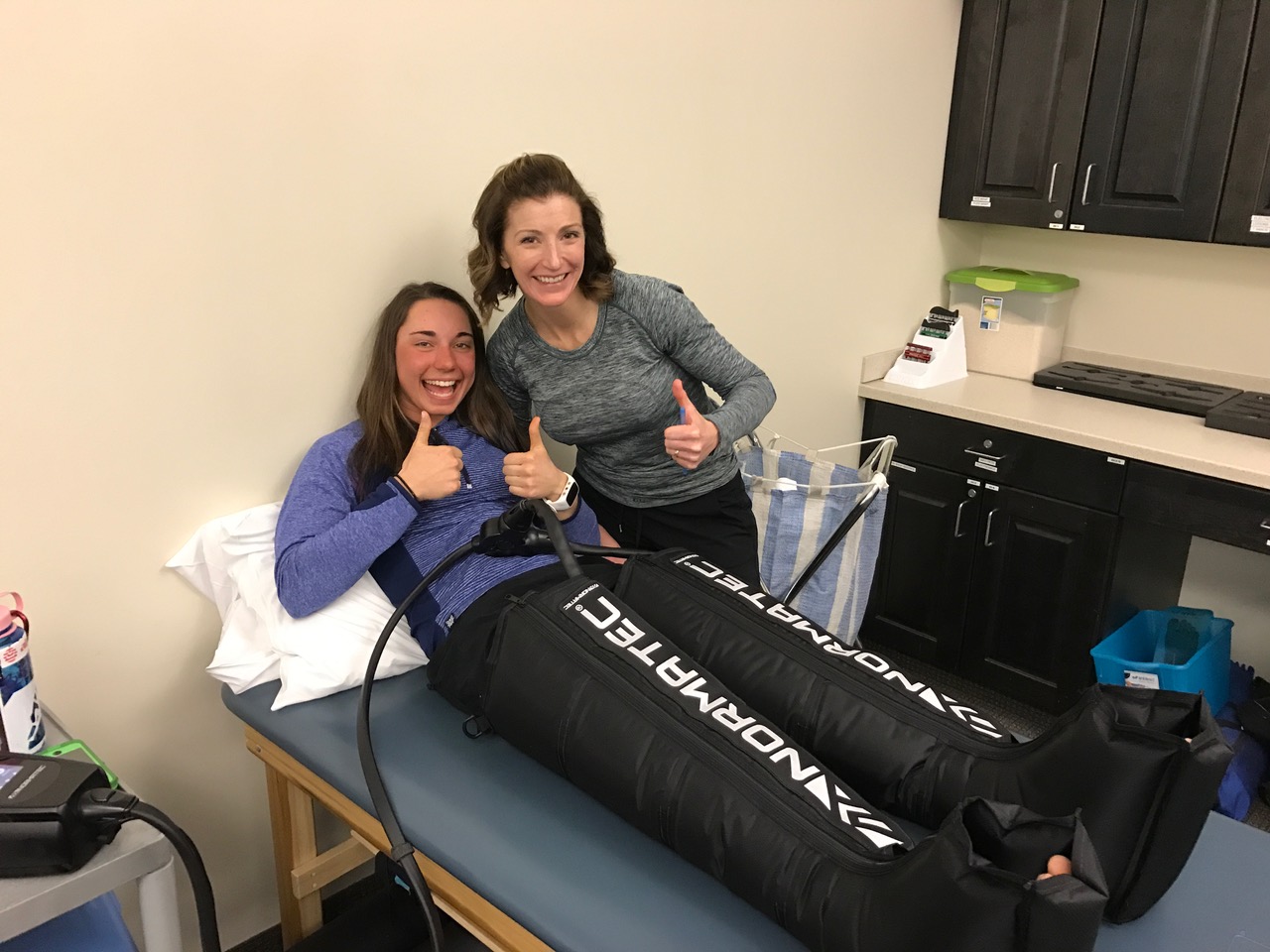
    Julia Kern (on table) still smiling!
    Julia Kern taking the time to think about something other than skiing during her gap year. (Photo: Julia Kern)

    How to pass the time away, when you have so much of it. (Photo: Julia Kern)

    After taking a gap year to figure out what skiing was like full-time; Ida, Katharine, and Julia attended Dartmouth College (via various routes):

    Ida states, “I started by going to school full time and I raced for Dartmouth for three years and then made the National team so I took my senior winter off to race for the USST and then I went back for a spring term my fifth year.”

    “One year in [as a traditional student], I am very happy at Dartmouth and racing the collegiate circuit last year reignited my love for the sport,” adds Katharine.

    While Julia contributes, “I chose Dartmouth because I wasn’t sure what skiing and school balance I wanted to have, but I did know that I wanted to be able to take terms off to race internationally.”

    Regardless of which Dartmouth plan they followed, all three skiers seem to have enjoyed the choices they made. Whether taking a gap year is or isn’t part of your plan, the most important takeaway is that you should TAKE SOMETHING AWAY! Learn something new about yourself, about skiing, or about classes you want to study.

    So what about other options for pursuing a ski career? Jessie Diggins and Andy Newell both chose to skip college and go straight into skiing. Stay tuned for my next post when I’ll include input from both of them as well as what U.S. Ski Team coach Matt Whitcomb has to say on this topic.

  • Back in Bozeman, Flowers Switches Gears

    Back in Bozeman, Flowers Switches Gears

    Erika Flowers (in red) racing at 2017 SuperTour Finals in Fairbanks, Alaska, where she posted a best result of third in the skate sprint. In the last six years, Flowers has reached the SuperTour podium 16 times and finished the 2017/2018 season fourth overall. (Photo: Clyde Hewitt)

    It wasn’t until recently that Erika Flowers learned the meaning of her middle name. At the time of her birth, her father had been cutting around Montana’s mountain slopes on Elan alpine skis. Though the brand’s company is based out of Slovenia, the definition of élan, according to Webster’s dictionary, is a vigorous spirit or enthusiasm.

    Whether Flower’s father, Pat, had researched the word’s meaning or whether the name had simply struck him, the skis were his muse. Erika became Erika Élan.

    “He just happened to be skiing on that brand, and I think he liked the sound of it,” Flowers said during a recent phone interview from her hometown of Bozeman, Montana. “So he and my mom named me Erika Élan Flowers.”

    For anyone familiar with Flowers, long, stick-straight, blond hair often bouncing around in a high ponytail and glacial blue eyes are idiosyncratic to the 28 year old. So is an intense verve, or élan.

    “I actually never knew it had any meaning (beyond just being a ski brand) until this winter when I randomly came across it in an article and looked up the definition,” Flowers wrote in an email. “That said, I think it describes how I try to approach life in general.”

    ***

    While many nordic skiers dream about racing against the all-stars of Norway, Sweden and other powerhouse ski nations, not everyone gets the chance to do so year after year.  

    A former University of Utah skier, Kevin Bolger, now 25, managed to make his way onto the international ski scene this past March, sprinting to 11th place in his debut World Cup race in Lahti, Finland. Two weekends later, Bolger claimed another top 30 at the World Cup Finals in Falun, Sweden.

    His breakthrough came after less than a year of training with the Sun Valley Ski Education Foundation (SVSEF) Gold Team; Bolger graduated from Utah in May of 2017.

    The timing was impeccable. Just as Bolger was working toward a spot at the World Cup level, two U.S. veterans stepped away from the circuit. Flowers’s husband, Andy Newell announced this spring that he would pursue new career adventures and train apart from the U.S. Ski Team (USST), and Noah Hoffman officially retired from ski racing in March.

    By the end of May, Bolger had earned a nomination to the USST B-Team.

    In an email to FasterSkier this spring, Bolger himself concluded that his transition to World Cup racing “couldn’t have been written any better.”

    Making it onto the women’s World Cup circuit as an American, at least for the past six years, has been more complicated. It’s even harder to make the USST. Since 2010, a number of strong names — like Sadie Bjornsen, Jessie Diggins, Ida Sargent, and Sophie Caldwell — have been added to the team, while few women have left.

    Aside from the retirements of Kikkan Randall and Liz Stephen this spring, Holly Brooks was the only other woman to retire from the team in the past six years. Brooks left in 2014.

    Rosie Brennan was first nominated to the USST in high school before being renominated in 2015,  and had been on the team ever since, but was not renamed for the upcoming season.

    In short, a roster of seven women (not including the development team) has been fairly standard to the USST for close to a decade.

    Outside the national team, the U.S. domestic women’s field also witnessed a surge in talent and depth over the last six years. From 2012 to 2018 alone, at least 10 non-national-team women worked their way to the World Cup race scene, including Caitlin Patterson, Kaitlynn Miller and Liz Guiney of the Craftsbury Green Racing Project, Chelsea Holmes, Becca Rorabaugh and Rosie Frankowski of Alaska Pacific University, Caitlin Gregg of Team Gregg (when she wasn’t on the national team in 2015), Jennie Bender of the Bridger Ski Foundation, and Anne Hart of the Stratton Mountain School.

    Any skier pushing to make a break would have a number of strong names to work around. But for Flowers, racing World Cups was a long-term goal, as was making skiing a sustainable profession for herself. She could spend hours sifting over rosters and names, but the only way to confirm anything was to try it out for herself. 

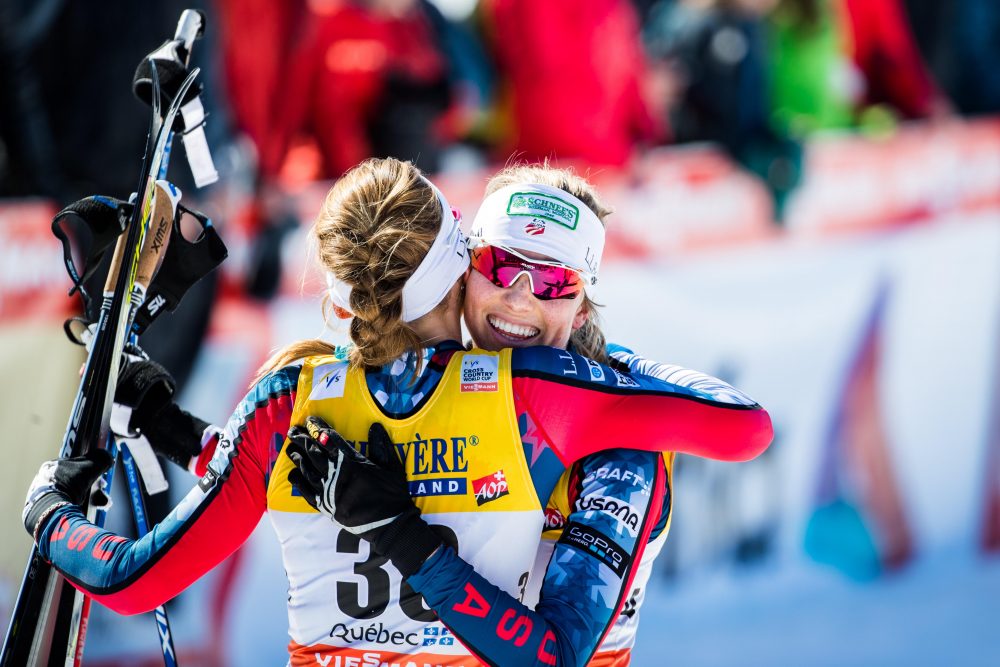
    American Erika Flowers (r) hugs her Stratton teammate Sophie Caldwell following the women’s 10-kilometer freestyle race at the 2017 World Cup Finals in Quebec City (Photo: Gretchen Powers)

    After graduating from Dartmouth in 2012, Flowers regularly finished in the top 10 of the overall SuperTour standings. She, too, earned a few World Cup starts. Flowers completed in all three races at 2017 World Cup Finals in Québec City, Québec, with a best result of 48th in the skate sprint.

    In the end-of-year SuperTour standings, her ranking also saw a steep jump. From 2013 to 2014, she went from 32nd to fifth overall and was fifth again in 2015. The next season, she finished seventh overall and was fifth again in 2017. She capped off this season with her best finish to date, earning fourth.

    Still, the sought-after World Cup starts remained elusive. As she developed, the USST also gained steam. Any progression she made also seemed to be matched by the cohort of American skiers she had be racing against since her departure from Dartmouth.  

    So why did she, summer after summer, push through intervals on rollerskis? Why spend each winter traveling to competitions, as Flowers put it, “living out of a bag”? Why did she continue to ski race year after year?

    ***

    Flowers was five years old when she first learned that her mother had breast cancer. Four years after her mother’s diagnosis, the family moved from Missoula to Bozeman. There, Flowers and her younger sister, Natalie, joined the Bridger Ski Foundation (BSF) cross-country youth program.

    The BSF community provided a niche for the Flowers siblings. The cancer treatments their mother was receiving also showed promise. Following her diagnosis and treatments in 1995, Hedvig Rappe-Flowers, Erika’s mom, was cancer-free for more than five years, according to an article by the Bozeman Daily Chronicle.

    But the cancer returned. Rappe-Flowers, a native of Sweden, encouraged her daughters to keep skiing. Do what made them happy. Both of them did.

    Erika Flowers during the early stages of her nordic career. “It was the first time I’d ever had my photo taken by any sort of professional and I remember just having no idea what I was doing but its become one of my favorite photos if only because it’s very raw and unedited and from a time when I was just starting to gain some real confidence both in who I was as a person and an athlete,” Flower wrote. (Photo: Chris Milliman)

    “My mom passed away from breast cancer when I was 17 which gave me a strong appreciation for how precious and valuable each day is and I know that I don’t want to waste one of them,” Flowers wrote in an email. “I think that’s another reason I probably decided to ski race for as long as I did — it was my first love and for all I know I could find out I have breast cancer tomorrow.

    “What I do know is that I spent the last 16 years of my life doing something I absolutely loved!” she continued. “I think that has been on my mind a lot these days, especially given Kikkan’s recent diagnosis.”

    Randall was diagnosed with breast cancer last month.

    “Kikkan’s a tough cookie though and I have no doubt she will tackle cancer the same way she has her many other challenges in skiing and in life — with equal parts fierce tenacity, bravery and grace,” Flowers added.

    While joining Randall in skiing’s elite racing ranks was certainly a goal, it wasn’t the only reason Flowers skied. Nor did she ski in her mother’s name — though Hedvig did instill in her daughters an enthusiasm for nordic sport and a steely resolve in all that they chose to do.

    “At her memorial service, one of the songs we played was ‘Hard Headed Woman’ — that really kind of describes her,” Flowers said. “She wouldn’t take no from anyone and believed so strongly in the idea that you could do anything you set your mind to.”

    The mercurial sport of cross-country ski racing had taken its hold. And Flowers was not about to let go.  

    Racing brought numerous challenges. Days when her body felt great, but the wax was too slow. Times when foul weather hit midway through a competition, slowing the course. 

    “Those variables can be extremely frustrating when they don’t go your way,” Flowers wrote.

    Frustrating, but simultaneously motivating, in its own way.

    “When everything does come together, it’s the most exhilarating and addicting feeling in the world!” she noted. “I think I always thrived on the challenge of it all.” 

    Four years ago, Flowers even gave biathlon a shot, traveling to Lake Placid, N.Y., for a US Biathlon talent camp. While she showed promise, Flowers ultimately stuck with cross-country.

    Erika Flowers (l) and Andy Newell at the 2017 World Cup Finals in Quebec City. (Photo: Gretchen Powers)

    Skiing had deeper roots than racing and results for Flowers. It was a family affair (she credits her mother with having taught her how to skate ski). It was how she met most of her closest friends. It was also how she met her husband, Newell, whom she married last year.

    “The people, the fact that every day my job is to go outside and work on getting better at something I love, the travel, and the challenge and unpredictability of professional sport,” Flowers wrote of what had kept her ski racing into her late twenties. “Lastly the support of countless friends, sponsors and supporters is one of the most important things that kept me involved for so long. Had I not had that level of support I would not have been able to race for as long as I did or reach the levels of success I did.”

    At the root of Erika’s lifelong élan was, and still is, skiing.

    ***

    About a year and a half shy of her 30th birthday, Flowers is back where it all started. She and her husband and former Stratton Mountain School (SMS) teammate, Newell, packed up a U-Haul this spring and drove from Vermont to Bozeman. Back in her hometown, Flowers competed in the 20-mile Ed Anacker Bridger Ridge Run in June. She still trains, most often with Newell, and unabashedly states that yes, she still rollerskis.

    Since leaving Stratton, she does not currently have a formative training plan or program. Prior to moving, Flowers explored every “decision matrix possible” and spoke with numerous athletes and non-athletes alike about what she should do next. In the end, taking a step back from skiing seemed best.

    Team photo of last season’s Stratton Mountain School T2 Team: (back row, right to left) Erika Flowers, Sophie Caldwell, Jessie Diggins, Julia Kern, and Annie Hart. (Front row, r to l) Andy Newell, Simi Hamilton, head coach Pat O’Brien, Ben Saxton, and Paddy Caldwell. (Photo: Reese Brown)

    “It wasn’t that I was sick of the lifestyle or anything like that,” Flowers explained. “I think it was more I’ve been doing it for long enough to recognize that my improvement curve is not what it needs to be in order to ultimately be able to make skiing into something that’s sustainable; something that can help me achieve some of the other goals I have in life, whether that’s getting a house or sitting on the board of a company.

    “I think that’s also what made it so hard,” she continued. “In some ways it’s walking away from something I absolutely love to start at the bottom of another passion.”

    Skiing has opened up a few other professional outlets for Flowers to pursue. She unofficially began social-media work for the National Nordic Foundation and USST this spring. She also is an athlete ambassador for the Women’s Sports Foundation. Her ties to nordic skiing becoming ever more intricate. 

    “Some people want to go all in for X number of years and retire and never look at a pair of rollerskis or race skis again,” Flowers reflected. “But to me, the word ‘retire’ sounds like something reserved for people in their late 60s, early 70s … maybe that’s why I haven’t used that word, it just doesn’t fit.

    “I think for me, it’s more deciding to take a step back from pursuing racing full time and looking at opportunities to pursue something else more fully,” she said. 

    The change of pace is in no way preventing her from getting outside. With Newell still planning on ski racing, just not full time on the World Cup, she’s still plenty invested in the nordic world.

    “From my end I just try to be supportive no matter what,” Newell said on the phone. “I think she’s been training so much and so well … she can take this year and try something new, even take a few months and try something new, and it would still be be pretty easy for her to jump into some races and make a comeback. Because I can tell you from my perspective, as her husband and as somebody that trains with her on a regular basis, she’s not slowing down even though she has other goals outside of skiing.”

    Former Stratton Mountain School teammates, now husband and wife, Andy Newell and Erika Flowers during a rollerski training session. (Photo: Reese Brown)
  • The Andy Newell Anti-Retirement Story

    The Andy Newell Anti-Retirement Story

    Andy Newell (c) of the U.S. Ski Team (USST) and Stratton Mountain School T2 Team after winning the men’s classic sprint at 2018 SuperTour Finals on March 24 in Craftsbury, Vt. His Stratton teammate Ben Saxton (l) placed second and Erik Bjornsen (r), of the USST and Alaska Pacific University, placed third. (Photo: John Lazenby/Lazenbyphoto.com)

    When Andy Newell took to social media about a week and a half ago to announce that he was parting ways with the U.S. Ski Team (USST) after 16 years, some people might have assumed that he was leaving the sport. They would be wrong.

    Newell, a 34-year-old Shaftsbury, Vermont, native and USST A-team member for the last 12 seasons, was quick to clarify that he’s not retiring from racing. After four Olympics and 16 years on the team, he’s just ready to be his own boss and set his own schedule.

    “I guess in the back of my mind I always knew once the [2018] Olympics were over I would most definitely take a step back from being a full-time international ski racer and definitely take a step back from being a U.S. Ski Team national-team racer,” Newell said in a phone interview earlier this week. “Because that way, it allows me much more flexibility with my schedule even in the summer as far as training camps go and obviously a ton more flexibility in the winter as far as how much time I need to spend away from home racing World Cups.”

    American Andy Newell racing the men’s 1.5 k freestyle-sprint qualifier at Stage 1 of the 2017/2018 Tour de Ski on Dec. 30 in Lenzerheide, Switzerland. He qualified 20th and went on to finish 19th on the day. (Photo: Fischer/Nordic Focus)

    Newell spent all of last season — from Oct. 29 until mid-March — on the World Cup circuit in Europe (except for when he was at the Olympics in PyeongChang, South Korea, for the month of February). He rarely saw his wife, Erika Flowers, whom he married last June. The two arranged quick trips to see each other when they could, but as full-time ski racers on different circuits, it was a challenge.

    “Five, six, seven, or ten years ago, I was making many of these decisions as an individual, and now that I’m married, I definitely have a lot more to consider than just myself when I make decisions when it comes to planning and scheduling,” Newell said.

    While he was hesitant to elaborate on his plans moving forward, Newell emphasized that he’ll continue to race in the near future.

    “Right now, I guess my plan would be to get back to a simpler schedule where I am still training at a high level but not focused really at all on World Cup racing,” he said. “So I might target a few races that I’ve always really wanted to do, for example some of the Ski Classics possibly over in Europe like the [Norwegian] Birkebeiner, possibly the American Birkebeiner. I think there’s so many great ski experiences that we have out there other than racing World Cups every weekend.”

    And at this point, he’s not completely ruling out another run at World Championships.

    “If I’m feeling like a complete champion by doing some of these different races, then you might see me trying to take a stab at something like World Championships,” Newell said. “But I’m not really putting any pressure or expectations on that, I’m more just looking to get back to a more simple training and racing routine where I can come up with my own schedule and plans and just remember what it’s like to really enjoy ski racing and doing the ski races that I want to do.”

    Growing Up on the Ski Team

    Andy Newell with some hardware after placing fourth in the season-long Sprint World Cup for the 2009/2010 season. (Photo: Kikkan Randall)

    Newell first landed a spot on the U.S. Ski Team as a high-school senior at the Stratton Mountain School (SMS) in Stratton, Vermont. He was initially selected to the development team, which came with invitations to national-team training camps — like the present-day development “D” team — as well as summer housing at the USST base in Park City, Utah.

    That season, in 2002/2003, Newell raced at World Championships in Val di Fiemme, Italy, and nearly qualified for the heats in the skate sprint (placing 31st). Just 19 years old at the time, he also competed at Junior World Championships in Sollefteå, Sweden, where he placed second in the qualifier and seventh overall in the freestyle sprint.

    He competed in his first World Cup in 2004 and made the leap to the USST A-team in 2005. Newell then began his 12-season streak on the A-team, which entailed the team’s highest level of financial support. He reached the World Cup podium three times as an individual — first in 2006 in Changchun, China, where he placed third in a freestyle sprint. In doing so, Newell became the first American to medal in a World Cup race since Bill Koch did the same 23 years prior.

    While Koch was a distance racer — like every international nordic racer of his era — Newell earned his chops as a sprinter and came onto the World Cup scene when short-distance sprint races were in full swing (the format was introduced at 1999 World Championships and 2002 Winter Olympics).

    “I think back on those years, and they were so cool,” Newell said of his early days on the team. “To be, like, 20 years old and beginning to race World Cups. … I remember in ’05, I got a top 15 in a World Cup, and that was the first time that had happened for the U.S. in the last however many years, and because of things like that, every weekend something new and exciting was happening.

    “I started doing better in some of the sprints and winning the qualification and getting a top 10 here, and the next year I was on the podium after that in ’06,” he continued. “And so it was a very quick trajectory to becoming one of the best sprinters in the world at that time.”

    He raced at eight World Championships with his best result coming in 2007 in Sapporo, Japan, where he placed fifth in a classic sprint.

    “I won the qualification in the sprint and ended up finishing fifth, but I remember being pretty disappointed,” Newell reflected. “I thought I totally could’ve been on the podium there.”

    Andy Newell racing in late 2009. (Photo: Fischer/NordicFocus)

    His other two World Cup podiums came when he placed second in a 2008 skate sprint in Lahti, Finland, and third in a 2010 classic sprint in Drammen, Norway. In four Olympics, Newell achieved two individual top 20s in skate sprints (16th in 2006 and 18th in 2014), and ninth in the freestyle team sprint at the 2010 Olympics in Vancouver, B.C.

    In PyeongChang this past February, he raced to 37th in the classic sprint and 14th with the men’s 4 x 10-kilometer relay. Reflecting on those Olympics, Newell said he was personally disappointed with his results, but thrilled to be a part of history with his team.

    “I felt like I had put in the time, time and effort and preparation to race better than I did,” he said. “But at the same time, we created such a great, tight unit and team throughout the last four years that for me, it was just so great to be there, to be there on the day that Jessie [Diggins] and Kikkan [Randall] won a gold medal. … Even though I didn’t ski my best, it was still, to me, in a lot of ways a success to be there; it’s been a successful year in that respect.”

    ‘A Little Bit of a Guinea Pig’

    Asked how the sport, specifically sprinting, has changed over the years, he said it’s been gradual but noticeable. Moreover, his ability and willingness to adapt is what has kept him in it this long.

    “If you were to look back on a World Cup sprint from 2005, the technique would look a lot different than it does now,” he said. “Many of the courses are the same, some are a little longer now than maybe what you would see back in the early 2000s for sprinting, but I think, in order to be competitive then, and also still competitive now, I’ve had to try to adapt as best as I can, and always be willing to learn new things.

    Fifth in the 2012/2013 Sprint World Cup, Andy Newell (r) with women’s Sprint World Cup winner and fellow U.S. Ski Team member Kikkan Randall at 2013 World Cup Finals in Drammen, Norway. (Courtesy photo)

    “I think if I would have assumed I was doing everything right or couldn’t improve, then I would have definitely been left behind I think years and years and years ago,” Newell continued. “I think people like Kikkan have done a really good job of that, and something that I’ve really tried to do, too, over the years, is always being willing to learn something new and not really have an ego about your shortcomings as an athlete.”

    He explained that a consistent theme of his career was his willingness to venture into unchartered waters when it came to training.

    “I’ve been a little bit of a guinea pig for the U.S. Ski Team in a lot of ways,” Newell said with a laugh. “I was probably the first athlete to go over and race an entire World Cup season. They hadn’t done that before we started scoring those kind of World Cup points in the mid-2000s, so it was like, how do we create a training plan that’s going to allow us to be successful at World Championships but also still race an entire World Cup season? So it’s been a great learning process for me and also I think the coaches over the last 20 years.”

    Over the last two decades, Newell said he’s mainly worked with Chris Grover, the current U.S. Ski Team head coach, and more recently, USST Assistant Coach Jason Cork.

    “Chris Grover wrote my training plans for probably the majority of my career,” Newell explained. “In the last four years or so, I started to work more with Jason Cork and also myself, I do a lot of the writing myself.

    “I think I’m someone who likes to be a student of the craft of what I’m working on; I think I’ve always been like that,” he continued. “When a coach tells you to do something, you’re always kind of like, OK, but I would always want to ask why we do a certain workout the way we do and how it builds … I’ve just liked to learn about training principles over the years, and so as I’ve gotten older, I’ve gotten more involved in writing, going over training plans myself, and incorporating ideas and workouts that I want to do. And I’ve done a lot of dumb, crazy stuff over the years, too.”

    Andy Newell celebrating the end of the 2012/2013 season with some acrobatics in Falun, Sweden. (Photo: Adam Alexander Johansson, XHC)

    Newell may be best remembered for his extreme stunts on ‘X Ski Films’, a filmmaking company he owned and starred in for several years, which included backflips and other airborne tricks on cross-country skis.

    He’s also spent the last two decades training out of Stratton with three main coaches: Sverre Caldwell, Gus Kaeding, and most recently, Pat O’Brien, head coach of the SMS T2 Team. Newell met Flowers on that team, and while he won’t be a full-fledged member of SMS T2 this year, Newell said he’s looking to maintain a strong relationships with both Stratton and the U.S. Ski Team.

    “In some ways I don’t think it feels like I’m retiring because I’ve kind of always had such a passion for pushing the level of skiing forward in this country,” he said. “And for me as an athlete, that was the best way I could do that, and I know as I transition into different roles in the skiing community, my goal [is] to continue hoping to improve the level of skiing in this country and improve the professionalism of skiing in this country and inspiring the youth skiing movement in this country — all those goals that I had as a ski racer — I will continue to have as a coach or a team leader or whatever my next role is going to be.

    “I’d like to work with development as far as helping some younger kids out, so I’m going to try to look for opportunities where I can do that,” he added. “I think it’s kind of a natural transition from athlete to coach in a lot of ways, but I’m still very much going to be an athlete at least in the near future.”

    Looking back on his years with the national team, he likened it to the pride one would have in a college or university they graduated from.

    “I’m just really proud of my time that I’ve spent with the team and so grateful for all of the opportunities that the U.S. Ski Team has given me over the past two decades,” he said. “It’s probably the same way that people who go to universities and so forth feel about having that kind of pride for their alma mater. I never went to college so it’s like the U.S. Ski Team kind of scooped me up at 16, 17 years old. Everything that has built me up into the kind of person that I am now, that has molded me into my character, everything has more or less has come through the U.S. Ski Team.”

    Andy Newell (U.S. Ski Team) after his quarterfinal at a 2015 World Cup freestyle sprint in Davos, Switzerland. (Photo: JoJo Baldus)

    Is he nervous about going out on his own? Newell said it’s been a long time coming, and he’s more excited than anything.

    “The spring’s always a funny time because you’re pretty exhausted from the season,” he said. “In a lot of ways, kind of the last thing you want to think about is skiing, but for me, I’ve always been one of those people that in the springtime gets super excited about all the opportunities. … By April 1, I [would be] already thinking, ‘Oh, what can I do for training next year?’ … and I start throwing around all these crazy ideas. I think that’s one of the things that’s kept me in the sport for so long, is having that excitement around training and preparation.

    “I think it will be exciting in a lot of ways to try to be my own boss and do some of the training camps I want to do and partner up and train with some of the athletes that I want to train with,” he said of this spring and summer. “Not that I was ever held back by the U.S. Ski Team, but you definitely had to adhere to a certain schedule so I think it will be exciting to do some different things.”

    From Sprints to Marathons?

    In late January 2016, shortly before Newell spoke with FasterSkier about mulling retirement, or at least taking a step back from full-time ski racing, he double poled his way to second place in the 42-kilometer Dolomitenlauf classic marathon (part of the FIS Marathon Cup series) in Lienz, Austria. Never one to like being labeled a “sprint specialist”, Newell is looking forward to trying more marathon races like that.

    American Andy Newell (r) outsprints Italy’s Mauro Brigadoi, for second place in the 2016 Dolomitenlauf 42 k classic race in Lienz, Austria. (Photo: Fischer/NordicFocus)

    “I have a lot of great friends who train for the Ski Classics [marathon series] and a lot of my Norwegian buddies who I have raced World Cups with over the years have gone that route after their World Cup racing career,” he said. “It’s a cool idea because those races are super fun, there’s great prize money, there’s a lot of excitement over them, and I think it’s really impressive when you see somebody just crush 90 k’s of double poling like they do in the Vasaloppet.

    “So I’m definitely inspired by those guys and I, as an athlete, really like classic skiing,” he continued. “I love traditional-style classic skiing and I like double poling, so I think maybe in the future I will try to get into a few of those races, but it’s hard to do those and not be committed 100 percent because those guys that do those, they’re training to crush double pole like nobody’s business, so it’s hard to just show up on a weekend and race one of those races.”

    Andy Newell and Erika Flowers, both of the Stratton Mountain T2 Elite Team, after both won the 2014 Jim Bridger Trail Run in Bozeman, Montana.

    Aside from the fitness required to double pole an entire marathon, the logistics of these races — many of which start in one town and end in another — is particularly challenging without a full-support crew or team.

    “I’d really like to do the [Norwegian] Birkebeiner and I think it will take a few times to be able to consider yourself a threat to the podium in a race like that,” Newell said. “I would be foolish to think I could just jump into a Ski Classics race and crush it, but it’s definitely a goal of mine to maybe do some of those over the next years because I think they’re such legendary, badass ski races.”

    In the near future, Newell and Flowers are headed out on a three-week “surf trip” to Australia and Indonesia.

    After that, “it’s yet to be seen how everything will fit in,” Newell said in regards to his future plans, both living, training, racing, and otherwise. “There will be more to say later as far as what I have going on for next year as far as what my goals will be.”

  • Spring Series Rundown: Diggins Anchors Another Stratton Mixed-Relay Win

    Spring Series Rundown: Diggins Anchors Another Stratton Mixed-Relay Win

    The mixed relay podium on Sunday at 2018 SuperTour Finals in Craftsbury, Vt., with Stratton (center: Simi Hamilton, Paddy Caldwell, Jessie Diggins, and Sophie Caldwell) in first, APU (left: Erik Bjornsen, Scott Patterson, Sadie Bjornsen, and Kikkan Randall) in second, and Craftsbury (right: Adam Martin, Alex Howe, Ida Sargent, and Caitlin Patterson) in third. (Photo: John Lazenby/Lazenbyphoto.com)

    2018 U.S. SuperTour Finals (Craftsbury, Vermont): Mixed relays

    For the second-straight year at the SuperTour’s season-ending Spring Series, the Stratton Mountain School (SMS) T2 Team won the mixed relay, with three of the four athletes who raced on last year’s 4 x 5-kilometer mixed relay squad.

    Simi Hamilton, Sophie Caldwell, Paddy Caldwell, and Jessie Diggins combined for the win on Sunday in Craftsbury, tagging off in that order, with Diggins crossing the finish line first for the third-straight day. Diggins is undefeated in three races so far at Spring Series, after winning Friday’s classic sprint and Saturday’s 10 k freestyle mass start. The women’s 30 k classic mass start remains on Tuesday, followed by the men’s 50 k classic mass start on Wednesday.

    Diggins and her Stratton teammates beat the Alaska Pacific University (APU) first team by 13.2 seconds at the line with a time of 53:43.2. The co-ed mixed relay has been held at SuperTour Finals for the last five years, and APU won the first three editions of the race from 2014 to 2016. Stratton won last year in Fairbanks, Alaska, with Ben Saxton, Hamilton, Caldwell, and Diggins.

    APU led most of Sunday’s race, with Erik Bjornsen starting them off. He came through the first exchange in first place, just 0.2 seconds ahead of Hamilton in second. Behind them, Adam Martin of the Craftsbury Green Racing Project tagged in third, 0.8 seconds out of first.

    Paddy Caldwell (302) tags his Stratton Mountain School (SMS) T2 Team teammate Jessie Diggins (402) in second, while Craftsbury’s Caitlin Patterson (430) looks on, at the final exchange of the mixed relay at 2018 SuperTour Finals in Craftsbury, Vt. Diggins went on to anchor Stratton to first place. (Photo: John Lazenby/Lazenbyphoto.com)

    Sadie Bjornsen then extended APU’s lead to 7.3 seconds over Stratton’s Sophie Caldwell in second. Behind them, Craftsbury’s Ida Sargent came through the second exchange in 10.3 seconds back in third.

    APU’s Scott Patterson went on to hold off Stratton’s Paddy Caldwell on the third leg, tagging 3.5 seconds ahead in first. Diggins came up big for Stratton on the anchor leg, passing APU’s Kikkan Randall to secure the win.

    Craftsbury held its third-place position during the second half of the race with Alex Howe and Caitlin Patterson to finish third, 56.2 seconds behind Stratton. More than a minute later, APU 2 (Tyler Kornfield, Rosie Brennan, Logan Hanneman, and Rosie Frankowski) crossed in fourth (+2:04). Stratton’s second team (Saxton, Julia Kern, Andy Newell, and Erika Newell) placed fifth (+2:47.3), APU 3 (Reese Hanneman, Becca Rorabaugh, Eric Packer, Hannah Halvorsen) sixth, Dartmouth Ski Team (Luke Brown, Katharine Ogden, Gavin McEwen, Abigail Drach) seventh, Northern Michigan University (Zak Ketterson, Vivian Hett, Ian Torchia, Nicole Schneider) eighth, Middlebury College (Peter Wolter, Cate Brams, Adam Luban, Katie Feldman) ninth, and US Biathlon (Russell Currier, Clare Egan, Raleigh Goessling, Susan Dunklee) 10th.

    Thirty-one “official” teams and eight “unofficial” teams competed, with NMU/CSS/NYSEF leading the unofficial teams with a time of 1:00:01.9 (which ranked 19th overall).

    Racers have the day off Monday before the women’s 30 k and men’s 50 k classic mass starts (part of U.S. Distance Nationals) on Tuesday and Wednesday, starting at 9 a.m. EDT. Watch the races live on the SuperTour live stream.


    Relay results: Official teams | Unofficial teams

    Complete SuperTour Finals results

  • Under 23 Questions with Julia Kern

    Under 23 Questions with Julia Kern

    Julia Kern (U.S. Ski Team/SMS T2) racing to 43rd in last weekend’s World Cup classic sprint in Planica, Slovenia. (Photo: Toko)

    It’s back! In an effort to showcase the North Americans competing at next week’s International Ski Federation (FIS) 2018 Nordic Junior/U23 World Championships in Goms, Switzerland, we asked those qualifying athletes several questions about themselves — actually, we had them fill in the blanks. Here we have 20-year-old Julia Kern, of the Stratton Mountain School (SMS) T2 Team and U.S. Ski Team Development Team, who’s representing the U.S. at her first U23 Worlds (she’s been to Junior Worlds the last three years and earned bronze last year in the women’s relay at Soldier Hollow).

    ***

    Julia Kern (U.S. Ski Team/SMS T2) racing in a World Cup skate-sprint qualifier this past December in Davos, Switzerland. She finished 57th. (Photo: Reese Brown/U.S. Ski & Snowboard)

    “My full name is Julia Kern.

    I was born in Berkeley, California, and raised in Waltham, Massachusetts, and I learned to ski in Germany.

    I spent my time before U23 Worlds in Germany with my family and on the World Cup circuit.

    The most fun workout I did in the last training year to prepare for this year was crust cruising in New Zealand with my U.S Ski Team teammates as well as my SMS T2 teammates.

    This is at least my fifth time in Switzerland and I don’t even know how many times racing internationally, and so far it’s been incredible!

    One difference I’ve noticed between Switzerland and the U.S. is that they speak four different languages in Switzerland.

    Skiing and racing in the Alps is beautiful! Usually racing at altitude is okay for me because even though I don’t feel good racing at altitude, I have had some strong results at altitude. There are no big mountains around where I live.

    One of the things I’m most excited about for Junior/U23 Worlds in Goms is racing with my teammates and good friends, and having an awesome staff here working super hard to help us achieve our goals!

    One race I’m especially targeting there is the skate sprint.

    I really hope I can chat/make friends with someone from Sweden and ask them what they do for training.

    My favorite thing at the breakfast where we are staying is the fresh eggs and good Swiss cheese.

    Fondue is yummy. The cheese here is delicious. And the chocolate is tasty.

    If I had a totally free day here and didn’t have to worry about race fitness or training, I’d spend it backcountry skiing.

    The best way to follow me on social media is on Instagram @juliakernski.”

    The first U.S. women’s team to podium at Junior World Championships: (from left to right) Hailey Swirbul, Katharine Ogden, Hannah Halvorsen, and Julia Kern, after placing third in the women’s 4 x 3.3 k at 2017 Junior World Championships at Soldier Hollow in Midway, Utah. (Photo: FlyingPointRoad.com)
  • Wednesday Workout: 100 k Ski-A-Thon with SMST2

    Wednesday Workout: 100 k Ski-A-Thon with SMST2

    Sophie Caldwell leads a train of SMST2 skiers during the team's 100 k rollerski fundraiser. (Photo: SMST2 Blog)
    Sophie Caldwell leads a train of SMST2 skiers during the team’s 100 k rollerski fundraiser. (Photo: SMST2 Blog)

    Anne Hart had many thoughts running through her mind last Saturday. At one point all she could think about was barbecue chicken, asparagus and freshly baked bread with butter.

    Contrary to what you might think, Hart wasn’t participating in one of her many culinary projects. Instead, she was rollerskiing 100 kilometers.

    The SMS T2 men partake in 100 k Ski-A-Thon on Sept. 20, 2014. The event serves both as a fundraiser and an over-distance workout. (Photo: SMST2 Blog)
    The SMS T2 men partake in 100 k Ski-A-Thon on Sept. 20, 2014. The event serves both as a fundraiser and an over-distance workout. (Photo: SMST2 Blog)

    Hart was joined by her Stratton Mountain School (SMS) T2 teammates in the third-annual 100 k Ski-A-Thon on Sept. 20. A clever mix between a fundraiser and an over-distance workout, the event is a way for the team to reap both physical and financial benefits over the course of 62.1 miles.

    “We always welcome donations, but it’s easier to ask people for money if it is paired with an event,” Hart explained in an email. “We wanted something that is out of our normal training regimen, and also demonstrates our commitment to skiing.  The 100 K was the perfect event for both of those goals.”

    The 100 k Ski-A-Thon has proven to be one of the team’s biggest individual fundraisers of the year and especially helps non-U.S. Ski Team athletes pay for unfunded racing and travel.

    “Our 100 k ski is very important to us because it allows our athletes to get to the races that they need to go to. It doesn’t cover everything, but it does make a huge dent in things and it allows them to be in a good place where they don’t have to make tough decisions,” SMST2 Head Coach Patrick O’Brien said in a phone interview.

    The Ski-A-Thon wasn’t always a fundraiser. Andy Newell, who has been with SMS since his high-school days, remembers skiing 100 k with the program’s then-head coach Sverre Caldwell (now program director) when he was younger.

    “Sverre liked to do things like that just to ‘show us we could’ and it was always pretty inspiring to do that as a high school kid,” Newell wrote in an email. “Nowadays 100k is still long but easily doable without any real preparation, we all do normal training the day before I still had a double session 4 hour day leading into it.”

    The Inside Scoop:
    According to SMS T2 coach Patrick O’Brien, a 100 k rollerski is basically an extended workout that requires extra planning and support.“Everything you’re going to get from a three-hour ski, you’re going to see that over a six-hour workout as well. The recovery time is going to be longer,” he said.O’Brien explained that it’s important to make sure that a 100 k ski doesn’t come as a shock to an athletes training plan. He said that both sufficient rollerski fitness and planned rest before and after the workout ensured that his athletes gained the most from the workout and weren’t overly exhausted or “bonk-ing.”According to Hart, nutrition before and during such a long workout is key.

    “Ideally I would have eaten quite a bit more the day before, and also brought some non-power bar food. Staying fueled is definitely the hardest part of the day. According to my watch we burned just over 3,700 calories.”

    She said another important factor for a successful 100 k ski is the athlete’s mindset.

    “For me, and I think for a lot of us, the battle isn’t so much physical as mental. 6 hours is a long time to be doing anything, and the hardest part is wrapping your head around that,” she explained.

    Other than individual preparation, O’Brien said that it is also important to choose a route that will have minimal traffic and relatively smooth pavement. He also said that this year’s Ski-A-Thon was held in September because of the cooler weather and often busy schedule of the summer.

    While the 100 k workouts of Newell’s high school days were without much fanfare, the 2014 Ski-A-Thon attracted the most attention to-date. A full team SMS T2 athletes participated in the event including Newell, Hart, Ben Saxton, Simi Hamilton, Paddy Caldwell, Sophie Caldwell, Erika Flowers, Annie Hart, Annie Pokorny, and Jessie Diggins.

    Hamilton, who is still suffering from the lasting effects of an August ankle injury, was able to rollerski the entire 100 k. He said that while he is still unable to run, he was happy to participate in the “great adventure.”

    The athletes were joined by U.S. Ski Team men’s coach, Jason Cork, Sverre Caldwell, and a mix of parents, relatives and friends who attended the event to help with logistics and encourage the athletes as they skied over the New England pavement.

    This year’s course started in Vermont but mostly traversed the back roads of New York. Unfortunately for the athletes, a strong headwind for most of the ski made progress slow. However, the men were able to finish around the five hour and 45 minute mark while the women were roughly half and hour behind.

    For Hart, the most challenging part of the Ski-A-Thon was pushing through the “dark periods” where she felt the length of 100 k start to take it’s toll.

    “I would be lying if the thought of sitting down on the side of the road and just waiting for a van didn’t cross my mind at least once,” she joked. “But then we would have a little break, eat some sugar and espresso and get back rolling.”

    A SMS T2 skier's watch reads 100 k, marking the end of 2014 the Ski-A-Thon. (Photo: SMST2 Blog)
    A SMS T2 skier’s watch reads 100 k, marking the end of 2014 the Ski-A-Thon. (Photo: SMST2 Blog)

    Newell said that the Ski-A-Thon is not only a great opportunity to build both funds and fitness, but that it was also an important team building exercise.

    “One of the coolest things about the 100 k is that it really feels like a team challenge,” he said. “We cheer each other on during the ski and will loop back to the girls.”

    During the event, the team participated in what Newell called a “secret skier” gift exchange in which members would surprise a fellow teammate with a treat at some point in the day. Newell was Hart’s “secret skier” and presented her with ice-cold seltzer water at the finish.

    O’Brien, who biked over half the Ski-A-Thon to break the strong winds and encourage his athletes, said that while there’s nothing “magical” about the number 100, there’s something to be said about participating in a six-hour workout.

    “It is a really, really big OD (over distance workout),” he said, pointing to the fact that his athletes would need some extra rest in the coming days.

    Despite the length of the Ski-A-Thon, no one from the Stratton team was overly exhausted at its conclusion. The only true challenge of the day was when the team’s van suffered a flat tire 15 minutes away from its return to Stratton.

    The team made a quick tire change and returned to their small Vermont town, both tired and content. Now that the Ski-A-Thon is finished, the Stratton skiers will partake in some well-deserved rest before they enter the next block of fall training.

    “We really do have the greatest team, and I am so happy I get to spend painful days and not so painful days with them,” Hart said. “But now it’s on to the next block of training.”

    The SMS T2 team at the 2014 100 k Ski-A-Thon. From left to right: Annie Pokorny, Annie Hart, Jessie Diggins, Andy Newell, Erika Flowers, Ben Saxton, Paddy Caldwell, Sophie Caldwell, and Simi Hamilton. (Photo: SMST2 Blog)
    The SMS T2 team at the 2014 100 k Ski-A-Thon. From left to right: Annie Pokorny, Annie Hart, Jessie Diggins, Andy Newell, Erika Flowers, Ben Saxton, Paddy Caldwell, Sophie Caldwell, and Simi Hamilton. (Photo: SMST2 Blog)
  • Despite Back Injury, Newell Recovers to Win Bozeman Running Race

    Despite Back Injury, Newell Recovers to Win Bozeman Running Race

    Andy Newell and Erika Flowers, both of the Stratton Mountain T2 Elite Team, pose after both won the Jim Bridger Trail Run in Bozeman, Mont. for their respective genders.
    Andy Newell and Erika Flowers, both of the Stratton Mountain T2 Elite Team, pose after both won the Jim Bridger Trail Run in Bozeman, Mont. for their respective genders. The two skiers were in Bozeman for the wedding of Flowers’ father.

    As Andy Newell flew down the drenched foothills of Bozeman, Mont., during the Jim Bridger Trail Run last Saturday, there was no guessing that the U.S. Ski Team member had been unable to run only a few days before.

    Having thrown out his back two weeks earlier while doing power-cleans, the 29 year old had neither run nor weight lifted since the incident.

    With a strong start to this year’s training, including a trip to Oregon for the U.S. Ski Team’s Bend training camp, the injury was disappointing.

    “It was a bummer,” Newell said.

    Despite his injury, he came to Montana with teammate and former Bozeman resident Erika Flowers for the wedding of her father, Pat. Upon their arrival from Vermont, Pat brought Newell to a local physical therapy practice where he received care for his back.

    After some much-needed adjustments, Newell was quickly healing, and by the time the Jim Bridger Trail Run rolled around on Saturday, he decided that his back was ready for the challenge.

    It appeared that the combination of the physical therapy and the crisp mountain air served Newell well as he crossed the finish line of the 10-mile race first in 1:20:03. Former biathlete, Dan Campbell finished the race roughly a minute and a half behind him in second.

    Flowers also seemed to benefit from her trip home, finishing first for the women with a time of 1:30:52, almost six minutes ahead of the next competitor. Having competed in the race as a junior with the Bridger Ski Foundation, she was happy to find success at home especially on the day of her father’s wedding.

    According to Newell, the race, which boasts over 2,000 feet of elevation gain, was an excellent way for both him and Flowers to train during an otherwise extremely busy trip to Bozeman.

    “We’re here in town for the wedding, but we need to train too,” Newell said. “Doing a running race is a lot more fun than doing intervals. This was a great chance to say hi to the ski community here.”

    After the race Newell and Flowers rushed home to prepare for the wedding and its numerous activities that took place later that the day. Newell and Flowers were later recognized for their efforts in the run by the race-organizer during the wedding reception.

    Newell and Flowers will continue their summer training in Alaska at the U.S. Ski Team’s on-snow training camp in July.

  • Wednesday Workout: Ski Walking with Erika Flowers

    Wednesday Workout: Ski Walking with Erika Flowers

    Wednesday Workout
    The SMST2 Team hard at work last season. (Photo: Erika Flowers/SMS)

    This week’s Wednesday Workout comes from Erika Flowers, a member of the Stratton Mountain School T2 elite team. Flowers graduated from Dartmouth in 2012 where she was a three-time NCAA All-American skier. Throughout her career with SMS, she has had multiple top-10 finishes at the U.S. Cross Country Championships. Keep up with Flowers and her training by following her blog.

    ***

    Most of the workouts we do here at Stratton are pretty simple. Especially during the early training season, the focus is on quality, practicing good technique and building a strong base. Ski walking up Stratton Mountain is one of our basic go-to workouts that we use throughout the summer to improve efficiency at threshold, build explosive power, and fine-tune ski technique. Although we introduce more bounding towards the middle and end of the summer, we try to force the “walking” early in the season in order to practice a good forward body position and avoid simply running up the mountain with poles.

    The basic workout:

    25-30 minutes easy running/ski walking with poles plus a few short uphill pickups (15-30 sec.) to get the body primed and ready for ski walking at threshold

    6×8 minutes uphill ski-walking with poles at Level 3 or Threshold with 2-4 minutes active recovery between each interval

    20-30 minute cool-down

    Total time: About 2 hours

    A few notes:

    Erika Flowers and Sophie Caldwell work together during their ski walking intervals in Stratton in 2013.
    Erika Flowers and Sophie Caldwell work together during their ski walking intervals in Stratton in 2013. (Photo: SMS)

    Equipment needed: Running shoes, water bottle and holder, HR monitor/watch, ski-walking/bounding poles (shorter than classic ski poles), a fun group who want to go charge up a mountain (or hill… depending on where you live)

    Interval options: During the early spring and summer the ski walking intervals tend to be shorter (6X6-8 minutes). We will increase length and/or number of the intervals throughout the training season as we build fitness and total time at threshold (6X10-15 min. towards the end of the summer).

    This workout also allows us to really dial in our heart rate at threshold by testing blood lactate between intervals. The goal is to maintain blood lactate levels around 4mM.

    Recovery Time: The recovery time is largely dictated by terrain. We try to run down the mountain between each interval for 3-4 minutes so that we finish our last interval at the top of the Stratton.

    If you have a smaller mountain you may need to run down a little further between each interval. Alternatively, if you live out West where the mountains climb for days, you may be able to take shorter breaks and still not reach the summit by the end of the workout.

    Technique tips:

    Our coaches emphasize a few basic technique tips for ski walking intervals:

    1. Fall “up” the mountain with forward hips rather than reaching with legs

    2. Use your poles; Engage your lats, core and arms to weight your poles and push off of them

    3. Full extension with legs

    The SMS T2 Team is joined by the SMS Juniors in their ski walking intervals.
    The SMST2 Team is joined by the SMS juniors in their ski-walking intervals.(Photo: SMS)

    Group/Team Suggestions:

    The SMST2 team often joins the SMS juniors for ski walking intervals. This workout is great for groups because it is easily adaptable for different ages and abilities and allows athletes to work together and learn from each other.

    Between intervals, the fastest skiers run down the mountain for recovery while the slower skiers walk down. This way, the slower ski-walkers can learn from some of the more experienced athletes by jumping in behind them at the start of each interval.

    The younger skiers can hop in behind older athletes to mimic technique and practice keeping pace, even if just for a minute or two at a time. The interval number and length can also be modified for skiers of different fitness levels and abilities.

  • The 12: Stratton Mountain School T2 Team

    The 12: Stratton Mountain School T2 Team

    The 2013/2014 Stratton Mountain School T2 Team (from left to right): Head coach Gus Kaeding, Andy Newell, Annie Pokorny, Eric Packer, Jessie Diggins, Sophie Caldwell, Simi Hamilton, Erika Flowers, and nordic program director Sverre Caldwell. (Photo: Annie Hart)
    The 2013/2014 Stratton Mountain School T2 Team (from left to right): Head coach Gus Kaeding, Andy Newell, Annie Pokorny, Eric Packer, Jessie Diggins, Sophie Caldwell, Simi Hamilton, Erika Flowers, and nordic program director Sverre Caldwell. (Photo: Annie Hart)

    Note: This is the third preview in our series on U.S. elite teams, which we’ve dubbed the “The 12.” We asked coaches to tell us what’s new and whom to look out for in the coming season and will publish additional previews in the coming weeks in no particular order.

    Team: Stratton Mountain School T2 Team (SMST2)

    Coaches: Gus Kaeding (head coach), Sverre Caldwell (nordic program director) Senior roster: Andrew Newell (U.S. Ski Team) Simi Hamilton (USST), Skyler Davis, Eric Packer; Jessie Diggins (USST), Sophie Caldwell (USST), Annie Pokorny, Erika Flowers

    Post-Graduates: Ben Saxton (Lakeville, Minn., formerly of F.A.S.T Performance Training), Mollie Hoopes (Hanover, N.H.)

    Who’s new: Hamilton (formerly of Sun Valley Ski Education Foundation Gold Team, Middlebury College), Pokorny (skied two seasons for Middlebury)

    Who’s missing: none.

    Top results last season: It starts with World Champion Diggins — who teamed up with fellow U.S. Ski Team (USST) member Kikkan Randall to win the 2013 World Championships freestyle team sprint in Val di Fiemme, Italy — and the talent doesn’t drop off from there. Half of the roster is on the national team.

    Newell finished fifth in the overall World Cup sprint rankings last season. Hamilton struggled with respiratory illness after a breakthrough 2011/2012 season. Caldwell made the most of her World Cup starts and was rewarded with her first nomination to the USST.

    Stratton Mountain School T2 Team Head Coach Gus Kaeding gets a lactate reading from Annie Pokorny, one of the team's newest members, during a bounding-interval session last week.
    Stratton Mountain School T2 Team Head Coach Gus Kaeding gets a lactate reading from Annie Pokorny, one of the team’s newest members, during bounding intervals last week near Stratton, Vt.

    In Kaeding’s opinion, the optimal athlete-to-coach ratio is 4-to-1; 6-to-1 is pushing it. 8-to-1 is really pushing it. So the current eight-person roster is probably at its max unless a coach or two joins his staff, he said, which he doesn’t foresee in the near future.

    The SMST2 squad added two skiers to the original six they debuted as an elite team with last year. Already familiar with Vermont, Hamilton and Pokorny both went to Middlebury College, a couple of hours north of Stratton.

    Originally from Aspen, Colo., Hamilton, 26, previously raced domestically for the Sun Valley Ski Education Foundation (SVSEF) Gold Team. He had two top-10 finishes in World Cup sprints two seasons ago, but got sick right before World Championships last winter. “I think the biggest thing I learned while I was living [in Park City, Utah] is that for me personally, I needed to be training with other people,” Hamilton said. “Especially guys that are right around the same [ability] level.”

    Born in Washington state, Pokorny, 20, cracked the top 10 twice at U.S. Cross Country Championships in January and qualified for the U23 World Championships. After two stellar years of college racing, she decided to focus on skiing full time.

    “I think what’s really fun about this team and this program is that the entire summer is like one big training camp,” Pokorny said. “We have so many good people here that we don’t really need to go anywhere else.”

    Caldwell made the quarterfinals in her first World Cup sprint in Quebec City in December and was the second-fastest American in the classic sprint at World Championships.

    A former USST Development Team member, Davis was not renominated to the national squad despite scoring his first World Cup points in Canmore, Alberta. He placed fourth in the classic sprint at U.S. nationals.

    Packer injured his foot in March, but before that, notched 40th place in the 30-kilometer skiathlon at the U23 World Championships.

    Flowers finished a career-best eighth in the 10-kilometer skate at U.S. Nationals and was fifth in the SuperTour Finals hill climb.

    Coach’s comment: Two weeks ago, the entire SMST2 Team united for the first time this summer in Stratton to help out with hosting the annual Eastern REG Camp. Now, for the most part, they’re staying put. According to Kaeding, the goal is training consistency and to counter all the travel the World Cup skiers endure during the season.

    “We have six returning people out of eight,” he said. “They all know how I work and I know how they work. I haven’t really had to do too much with the new members. They’ve just kind of fallen into the flow.”

    As far as USST camps go, Diggins is headed to Eagle Glacier to meet up with other members of the USST later this month, and Newell and Hamilton are headed to New Zealand for three weeks in August. It makes for some adjustments, but Kaeding said it hasn’t been a problem.

    “When you’re here, you are on the U.S. Ski Team, but you’re not any different from anyone else on the team,” he said. “It’s just a difference of what jacket you’re going to wear at some point this winter and maybe what races you’re going to do.”

    ***

    Other previews: Craftsbury GRP | SSCV/Team HomeGrown

  • FasterSkier Podcast: Interview with SMS T2’s Gus Kaeding

    FasterSkier Podcast: Interview with SMS T2’s Gus Kaeding

    Just three seasons after finishing his career as a ski racer, Gus Kaeding this year was named the head coach of the newly formed Stratton Mountain School T2 team, where his athletes include star sprinter Andy Newell and breakout talent Jessie Diggins.

    Topher Sabot and Nathaniel Herz caught up with Kaeding last week, as his team prepared for the first SuperTour races of the season.

    The podcast will be off next week for Thanksgiving, but check back a week later for a breakdown of the first World Cup races of the year, featuring our Canadian bureau chief Kieran Jones.
  • From Different Corners, Stratton’s Senior Team Comes to Life

    From Different Corners, Stratton’s Senior Team Comes to Life

    The Stratton Mountain School (SMS) T2 Team gets ready for an overdistance rollerski June 24 on Owl Kill Road near Cambridge, N.Y. From left to right: Andy Newell, Eric Packer, Sun Valley skier Mikey Sinnott (behind Packer), Sophie Caldwell, head coach Gus Kaeding and Erika Flowers.

    Note: This story accompanies two videos of the Stratton Mountain Team training, which were posted last week.

    CAMBRIDGE, N.Y. – Ripping down a familiar dirt road in a Toyota pickup, Andy Newell glanced at his rear-view mirror to make sure he hadn’t lost Gus Kaeding. Sure enough, Newell’s high-school classmate at the Stratton Mountain School (SMS) was right behind him, driving an SMS van with a school-bus sign on top.

    The sign wasn’t active. This wasn’t a regular bus route.

    Before the dust from their tracks settled, Newell and Kaeding turned onto a paved road just west of the Vermont border into New York. Newell parked his truck in the tall grass alongside a forked intersection, and Kaeding pulled off to the other side.

    This was the spot, Newell decided. His coach, Kaeding walked across the rural road to discuss the details.

    Meanwhile, four Dartmouth graduates emerged from the back of the Stratton van. Three of them, Eric Packer, Sophie Caldwell and Erika Flowers, earned their diplomas about two weeks earlier. The fourth, 27-year-old Mikey Sinnott of Sun Valley, had returned to the area for his college reunion and spent a few extra days training with Stratton’s new elite team.

    At the time on June 24, the group didn’t have a title sponsor, but by early July, it became officially the SMS T2 Team. Kaeding, formerly an assistant at Central Cross Country (CXC), was the head coach.

    The six-person squad – with U.S. Ski Team members Jessie Diggins, Skyler Davis and Newell, and Caldwell, Flowers and Packer – came to life under SMS Nordic Program Director Sverre Caldwell. Sophie’s father, Sverre dreamed up the team years ago, but seriously revisited the idea in a conversation with Kaeding last summer. Earlier this year, the two laid the framework to make it happen.

    Several months later in June, four SMS skiers and Sinnott strapped on their rollerski gear for a three- to four-hour skate in upstate New York. It was the team’s second week of training together, and Newell had mapped a route just a few minutes from his home in Shaftsbury, Vt. Kaeding instructed his skiers to go easy and follow his lead.

    He hopped back in the van and put it in drive. It was just after 8 a.m.

    “It’s a long day and it’s been a big week for everyone,” Kaeding later said after chalking more than 10 intersections. Each time, he’d stop the van, step out and draw a big sweeping arrow. Newell knew where they were going, but none of the other skiers did.

    The newly formed T2 Team heads up a hill during an overdistance rollerski on June 24 in Cambridge, N.Y.

    An unseasonably hot spell in June marked their first training week, making what was supposed to be a transition period much harder. The following week, they met for five workouts and two strength sessions, including a three-hour run, overdistance rollerski, speed work and bounding intervals.

    Davis, 20, worked out with them earlier that week while recovering from sinus surgery, but was in Bermuda for his grandmother’s 80th birthday when the team drove east to New York. Diggins, who recently turned 21, was in Alaska at the North American Women’s Training Alliance camp.

    Kaeding explained the goal of their Sunday across-the-border rollerski was to keep a consistent pace without too much effort. He also hoped the change of terrain on seldom-used, paved farms roads would keep them entertained for several hour. If he thought anyone was pushing too hard, he planned to take lactate tests, but after checking in several times throughout the workout, Kaeding found that wasn’t the case.

    “They’re doing really well, but everyone has their own things [to work on],” Kaeding said. “The college skiers coming in are still working on adapting to what it’s like to train every day as kind of your first and foremost priority. They’re enjoying not having to worry about studies, you can tell, but I think a few days they’ve overdone it a little bit and then a few days had to back off.”

    Veterans like Newell, 27, were also transitioning. Last year, he and Davis – both Stratton alumns – trained with each other and some Stratton students, but the group wasn’t always available or doing what they need to. This season, Newell has eager young skiers like the 22-year-old Packer pushing him, but he’s figuring out how to get the most out of their company.

    “He’s not used to having training partners every day,” Kaeding said.

    SMS teammates Newell (r) and Packer (l) during a 50-plus-kilometer rollerski with Sun Valley’s Mike Sinnott.

    The same goes for Packer, who had competitive teammates for four years, but at the collegiate level. In his second week of training with Stratton, Packer said he was feeling the effects of full-time training on a professional scale.

    “I learned my lesson early in the week [when I] followed Andy for three days and three pretty hard workouts and got kind of tired,” Packer said after rollerskiing 52 kilometers with Newell and Sinnott on June 24. Those two, who both raced on the World Cup circuit last season, continued for another hour.

    “It’s good to follow them around, but you have to balance it out with going your own speed,” Packer said. “It’s really important to make sure you’re not tiring yourself out too much every single day of the week so there’s some contrast between the workouts.”

    That fine line is key for all of three college grads in their first season with the pro team, Kaeding said. On the women’s side, Caldwell and Flowers later teamed up with Diggins, who made an impact her rookie season on the World Cup.

    “The trick, I think, is going to be finding that balance, especially with the men, where, how can you utilize Andy without destroying yourself?” Kaeding said. “As a group, when Sverre and I put it together, one of our biggest things was to make sure not that they’re just good skiers, but everyone would get along. Just adding Mikey into the mix, too, you can hear when they’re just skiing on their own, they’re talking about little things that have worked well for them in the past.”

    That blend accompanied with familiarity between all its members is what Kaeding and Caldwell hope makes the team successful.

    “To a certain extent, you get a good group of athletes, and especially ones who are intelligent … and really you just have to put them together, put them in an environment where they’ll succeed and the rest will take care of itself,” Kaeding said. “You see it in pieces, and as they become more and more comfortable with each other, I think you’ll start to see it pay off.”

    The Big Picture

    Back at the homestead, that is, the house Newell grew up in, the team ate lunch and cooled off by his family’s in-ground pool. Kaeding tried to make three-point shots from a swim float, and the others laughed as they watched from lounge chairs.

    Some, like the Dartmouth skiers, didn’t personally know Kaeding before signing onto the team. But they knew what he had accomplished at CXC with former coach Jason Cork, now the U.S. Ski Team (USST) men’s coach, and how he helped skiers like Diggins progress.

    Kaeding also remained good friends with Newell since their adolescent days on Stratton’s high-school team. It was a bit strange coaching him at first, Kaeding said, but Newell made the job easy. Not only does he seek Kaeding’s feedback, but Newell has also stated several times that he wants him to be his full-time coach. Right now, USST head coach Chris Grover oversees Newell’s plan, but the eventual switch could bring big-time credibility to Stratton’s elite program.

    “Gus has a lot to offer as far as working on technique,” Newell said. “We’re looking at this Stratton program as a long-term type of thing so I think Gus will be around for a while and the Stratton team hopefully will be around for a while. I think we’re going to start to transition to having Gus be more of a full-time coach because we know he’ll be in this area a lot of the time, and it will be easy for me to work with him.”

    Gus Kaeding (in orange) and SMS program director Sverre Caldwell (in blue) meet with several senior skiers and older juniors during a double-pole workout near Stratton, Vt. Elite-team members Skyler Davis (second from left) and Eric Packer (third from right) check in.

    A native of Worcester, Vt., Kaeding is currently a resident SMS employee, and at least for his first year, he’ll help the academy’s current nordic staff coach the high-school and post-grad skiers. So far, he’s mostly been involved with joint practices, which include about 40 Stratton athletes three times a week in the summer.

    “It’s been exactly what I’ve expected,” Kaeding said of the new job after spending the last decade in the Midwest. “I’ve been close enough with [Sverre], I knew what was going to happen there. I’m familiar with Vermont, and with CXC, I was writing training plans similar to what I am now. It’s been no different, the only difference is I have to call Jason [Cork] on the phone now instead of look over and he’s in the passenger’s seat.”

    The two talk regularly about everything from Skid Row concerts to Davis’ training plan.“We’ve remained pretty close,” Kaeding said. “It hasn’t been a big change besides location.”

    A Minnesota native, Diggins made the switch with Kaeding, leaving CXC to train with her coach in Vermont. She was promoted to the USST A-team this spring.

    “I wanted to stick with coaches that already knew me, my style of skiing, what I need to be working on and how I respond to training,” Diggins wrote in a blog post.

    Jessie Diggins leads the women’s pack during her first workout with Stratton’s T2 Team during Level 3 double-pole intervals July 12 in Jamaica, Vt.

    On Wednesday, July 11, Kaeding picked Diggins up at the airport in Albany, N.Y., and drove her to Stratton, which she had never seen before. She moved into a resort apartment with Caldwell and Flowers, and the next day, jumped into training with Level 3 double-pole intervals.

    About 30 other Stratton skiers also showed up for the rollerski workout at the Ball Mountain Dam access road in Jamaica, Vt. One girl told assistant junior coach Poppet Boswell that she “just loves Jessie.”

    Boswell said she should go ski with Diggins.

    “Really?” the girl responded.

    “So she did, and Jessie saw what she was doing and said, ‘Get in here!’ ” Boswell said.

    That morning, the J2 and J3 skiers Boswell coached did about three shortened intervals while the seniors did longer stretches on a 5 k course. Davis and Packer did three out-and-back intervals along a long incline and decline, and the women, which included Diggins, Caldwell and Flowers, did about seven shorter intervals. Kaeding conducted lactate tests for the seniors at the top of the hill, trying to catch each athlete once.

    “Usually double-pole intervals are on a long uphill, but this one is kind of different because there’s a downhill,” Kaeding said. “It’s good because it’s like a race.”

    During their warm down, Davis and Packer showed they had a little left before the top of the hill.

    “Sverre, say go!” Davis said.

    Holding a clipboard with handwritten times, Caldwell gave the go-ahead. They sped by for the final pickup, and Caldwell smiled. A few minutes later, the larger women’s group opted for an extra interval, and the young Stratton athletes moved to the side to make room.

    Earlier in the workout, Caldwell instructed the junior boys to start higher on the hill and follow Davis and Packer when they passed by. Assistant coach Liz Kantack kept tabs on the older girls.

    “I don’t want to blow them out of the water, I just want them to feel like they got a workout,” Boswell said of the youngest athletes. “Just the exposure to the older athletes is great.”

    Not Missing a Beat

    Later that afternoon, the T2 Team athletes reconvened for a strength session in Stratton’s weight room, where Diggins and Davis compared their USST plans and raced across the soccer field.

    The T2 Team works out in the Stratton weight room on July 12 as head coach Gus Kaeding (left) looks on. Sophie Caldwell (r) uses a foam roller while Eric Packer (second from left) works on abs. Also pictured: Skyler Davis (back left) and Jessie Diggins (back right).

    Inside, music filled the room, and Diggins giggled as she danced between exercises. This was her new home, and by 6 p.m., she took a moment to reflect on her first day there.

    “I had never been to this area of Vermont,” she said. “It’s really nice to jump in with a coach that already knows you, already knows, ‘All right, this is what you’ve been working on.’ Right off the bat, he can say technique stuff and he knows what key words to say for me, so it’s nice.”

    She knew most everyone on the team, and toward the end of the gym session, Diggins got on the ground to show Caldwell and Flowers some plank techniques. They held each in unison for a minute or so, grimacing then relaxing when it was all over.

    This kind of energy is what Kaeding expects to sustain the team, and it’s what’s fired them up so far.

    “There’s been a few days where I’ve been pretty excited myself,” he said with a laugh. “You come home and you’re like, ‘Oh man, people got better today.’ ”

    For a skier of any level, that’s the ultimate goal. After struggling with health issues last season, Davis said he’s feeling better than ever coming off sinus surgery, which moved bones in his nasal cavity so he could breathe. He added that it’s been great to have Newell and Packer pushing him this summer, and he intends to stay consistent in his training.

    SMS teammates Eric Packer (l) and Skyler Davis during a double-pole interval on July 12 in Jamaica, Vt.

    “Basically what I’ve been doing is going really well,” Davis said. “[I want] to keep on doing that and be really fit going into the fall for those big [USST] camps, Lake Placid and Park City. Going forward, I think if I feel good, I’ll race fast.”

    For Packer, Caldwell and Flowers, this season is about making progress without burning out.

    “I love skiing and I’ve put about eight years of my life into it more or less full time,” Packer said. “I just want to at least spend a couple years, three or four years, seeing where I can go with it.”

    An engineering major who laughed about being offered a job at Stratton’s Wanderlust yoga festival in June, Packer said he can go down that career path later on.

    “I’ve had my parents, a whole bunch of professors say, you should do this now, you’re not going to have a chance to do it later,” he said. “I’m really excited about it. It’s something that I love to do. As long as I’m liking it and having fun, enjoying the racing and enjoying the training then I’m going to keep doing it.”

    For Caldwell, a psychology major, the decision to ski on her father’s team was relatively easy.

    “I think a lot of it comes down to what makes you happiest,” she said. “I figure now is really the only time I have to give everything to skiing and I spent the last four years balancing skiing [with school]. Having a balance is great, but I wanted to try just skiing.”

    That poolside and relaxation time outside of training is what these grads have soaked up so far. In June, they spent some time people watching at Wanderlust, where they also dared one another to drink beet-and-kale smoothies.

    The SMS T2 Team in action for a team photo. From left to right: Program director Sverre Caldwell, Skyler Davis, Jessie Diggins, Eric Packer, Sophie Caldwell, Andy Newell, Erika Flowers and Gus Kaeding.

    “It’s really nice to get a chance to just focus on skiing and not have the stress of school to worry about,” Flowers said. “To have the time to be able to do a workout and not worry about getting onto the next thing, you can really just focus on what you’re doing.”

    The spring of her junior year, Flowers volunteered at a medical clinic in Guatemala. There, she made up her mind to pursue skiing after college.

    “I thought that’s what I wanted to do when I graduated, apply to medical school and go do that, and while I liked being down there and working in that environment, I really missed ski training,” she said.  “I feel like I still have a lot of room to improve and so I’m just hoping to build on that. Stratton was the perfect combination of location and teammates and coaching and support, and I think all those kind of came together.”

    The three college teammates didn’t sit down and decide together, but they’re happy it worked out.

    “There’s obviously a couple different options out there… but it’s kind of cool that we all ended up at the same place,” Caldwell said. “We spend a lot of time together outside of practice. We have dinner together a lot, and we all seem to get along well. I don’t think any of us have a super-hard personality to get along with so that’s been great.”

    ***