From the FasterSkier archive — posts syndicated from athletes’ and coaches’ own blogs between 2004 and 2012, kept online as published. Current coverage is at fasterskier.com.
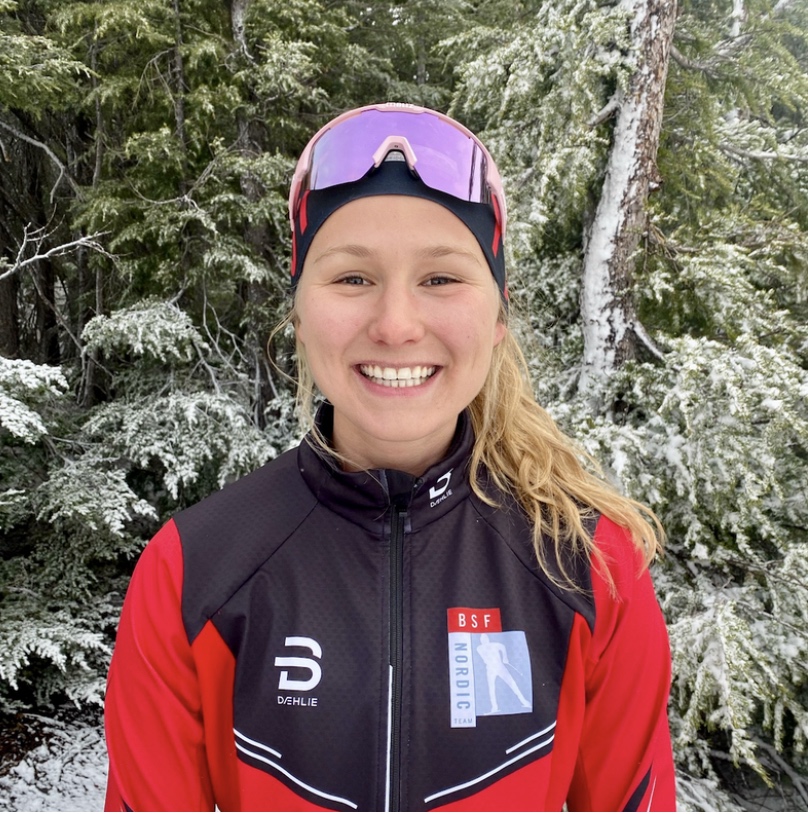
We’re happy to welcome Patrick O’Brien back to the ranks of the Craftsbury Ski Club, this time as the Assistant GRP Ski Coach. Pat, a native of Putney, VT, raced collegiately for Dartmouth before his stint as a professional ski racer with the Green Racing Project from 2010-2014.
While on the GRP, Pat competed in multiple World Cups and also became known to the Craftsbury community as a hardworking jack-of-all-trades with a deep love of skiing and the outdoors. Pat moved on from racing to become the head coach of the SMS T2 team from 2014-2022. Although he coached multiple athletes to international success, he’s most proud of the role he played in building a program that brought together athletes of all ages and rooted the team in its local community.
In recent years, Pat has supported various junior, college, and elite teams as a service technician, all while juggling a job as a builder and wrangling a growing young family. When not up to his eyeballs in ski wax or construction detritus, Pat can often be found outdoors with his wife Ida, who also has deep ties to Craftsbury, and their two kids. Welcome back, Pat!
Registration is open for the Stratton Mountain School BKL Summer Camp, which runs August 3-6, 2026, on the SMS campus in Stratton Mountain, Vermont. The camp is open to athletes ages 10 to 14, with a maximum grade of eighth.
The four-day program is built around progressive skill work in a low-pressure setting. Hiking, swimming, roller skiing, ski bounding, and games are all on the schedule, along with the camp’s annual lip-sync contest. Campers will also sit down with members of the SMS T2 Elite Team for a Q&A — the T2 group has put skiers on World Cup and Olympic start lists, and the session is one of the camp’s longer-running traditions.
The camp is split into two sections, one for male athletes and one for female athletes, both running the same August 3-6 dates. Registration and payment deadlines are both July 31, 2026.
If the camp fills before the deadline, SMS is keeping a waitlist through a Google form linked on the registration page. Note that the form does not allow duplicate phone numbers. Cancellations made fewer than 30 days before the camp start date are non-refundable.
For questions, contact Nordic Program Director Matt Boobar at mboobar@gosms.org or 570-594-7555.
On a late-October morning, Julia Kern sat in San Diego, sunlight spilling through the window after cradling her infant nephew. “He’s a cutie for sure,” she laughed. In a few short weeks, she’ll trade baby giggles for the squeak of ski pole baskets on the cold Finnish snow, but the warmth in her voice already says a lot about where she is mentally this Olympic year: grounded, grateful, and still having fun.
“It’s been a really good lead-up this year,” Kern said. “I’ve been able to stay healthy. I’ve done a lot of physical therapy on my back from my injury last year, and that’s finally going well. So being able to link consistent training together without major disruptions has been the biggest difference this year. That makes me really excited to see what will happen this season.”
Cycling gives Julia Kern a place to turn her mental rhythm and flow into motion. (Courtesy Photo)
The Year of Steady Rhythm
After an injury-plagued 2024 season, Kern’s return to full health has been both physical and psychological. She’s worked closely with physical therapist Brie Beckwith and coaches Kristen Bourne and Colin Rogers to rebuild her movement patterns and ski technique. “A lot of what I’m doing from my back rehab is retraining movement patterns—learning to actually use my glutes, push through the right way, fully transfer weight,” she explained. “Part of it is having less pain, which lets me move more fluidly. But it’s also about translating that from the gym to skiing.”
For the first time, she spent a full three-week training block with Bourne in New Zealand, where daily feedback deepened their connection. “That was really cool because I’ve never had that before,” Kern said. “It’s one thing to text once a week; it’s another to work together every single day. We built a real rhythm.”
That word—rhythm—is perhaps the throughline of Kern’s 2025 Olympic campaign. Rhythm in training, in recovery, in how she manages a long World Cup season without burning out. Her “don’t reinvent the wheel” approach to the Olympic year reflects a maturity hard-won through injury and experience. “You do what’s working well,” she said. “Changing things is always a risk.”
Jessie Diggins and Julia Kern flank their US Ski Team coaches Jason Cork (kneeling) and Kristen Bourne (standing) at their annual on-snow training camp in New Zealand. (Courtesy Photo)
Learning the Language of the Body
If Kern’s early career was marked by her ability to push, her recent evolution is defined by knowing when to pull back. “Recovery is a big one,” she said. “Not just lying in bed—but mental recovery, physical therapy, fueling, hydration. As I get older, I spend more time on that. I’ve learned what works and what doesn’t, and how to read cues—whether I’m ‘good tired‘ or ‘bad tired.’“
Her typical week includes two or three intensity sessions, distance training, and strength work, but with flexibility to fit around life: weddings, visits home, mountain-bike trips. “Working around the life schedule is what makes it rewarding,“ she said. “You’re excited to go do it, and you also feel like you can do all those fun life things too.”
That balance shows in how she approaches her mental game. Kern has worked with the same sports psychologist for over five years, meeting weekly or monthly. Together, they’ve developed what she calls a “good energy“ framework: a way to make decisions rooted in joy rather than obligation. “It doesn’t mean bouncing off the walls,“ she explained. “It means asking: What makes me feel good in skiing? If I’m dreading something because I’m missing an important life event, that probably isn’t bringing me good energy. So I make decisions based on that.”
Patience, she says, has been her greatest teacher. “Everyone has their bumps in the road,“ she said. “Taking those as learning experiences rather than failures is huge. Setbacks force you to approach things differently, and you can actually learn a lot about yourself that way.”
Spending time being active and relaxing with friends and family is a cornerstone to Julia Kern’s success. (Courtesy Photo)
A Culture of Team First
If there’s a single quality that defines Kern, according to U.S. Ski Team Head Coach Matt Whitcomb, it’s her blend of positivity and perseverance. “She’s had a hard road,“ Whitcomb said. “Even as a junior, she battled compartment syndrome, mono, back troubles, shoulder troubles, nerve issues—you name it. That would defeat most athletes. But despite it all, Julia goes on to win World Cup and World Championship podiums.”
Whitcomb sees her as both a survivor and a student. “She had incredible leaders to follow—Sophie, Liz, Kikkan, Sadie—and she was always listening, always learning,“ he said. “Julia’s a scholar. Her parents are scholars, her sister’s a scholar. She comes from a learning family. And now she’s the sum of all those experiences. She reminds me so much of Kikkan Randall—so driven individually, but without a team to celebrate it with, she’d quit skiing. Julia’s the same way: such a team-oriented person.”
That team ethos is something Kern now passes along to younger teammates, such as Kate Oldham. “I really appreciated when older athletes just showed by doing,“ Kern said. “Now I try to do the same. When we do race prep, anyone who wants can join. Like at World Champs—Kate, Jessie, Rosie, and I practiced that final corner together. It was so slushy and tricky, and Kate ended up being the best one out of all of us. So we said, ‘Okay, we’re learning from her here.‘ Everyone has value on this team.”
It’s a culture built not on hierarchy, but on collaboration—crafting beaded bracelets during camps, sharing meals, and creating ways to connect off the snow. “It’s easy to be isolated in hotel rooms,“ Kern said. “We make time for activities that bring us together. Everyone brings something.”
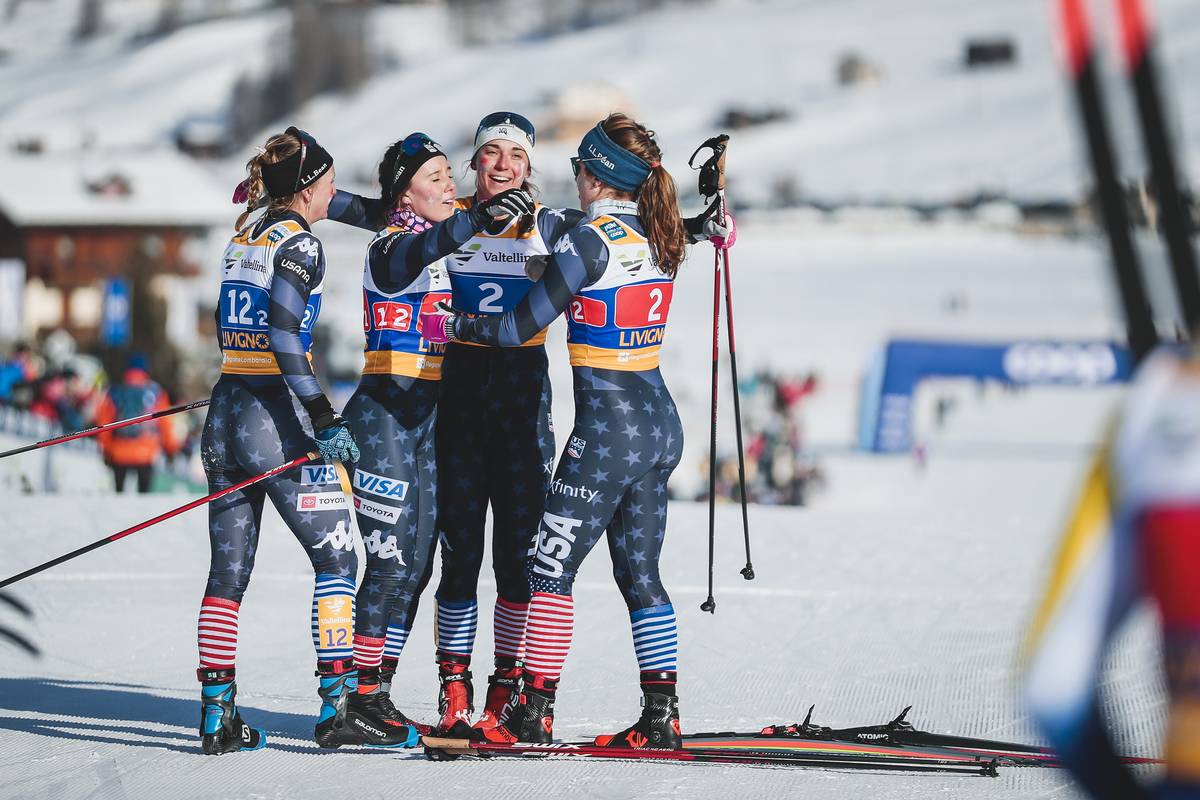
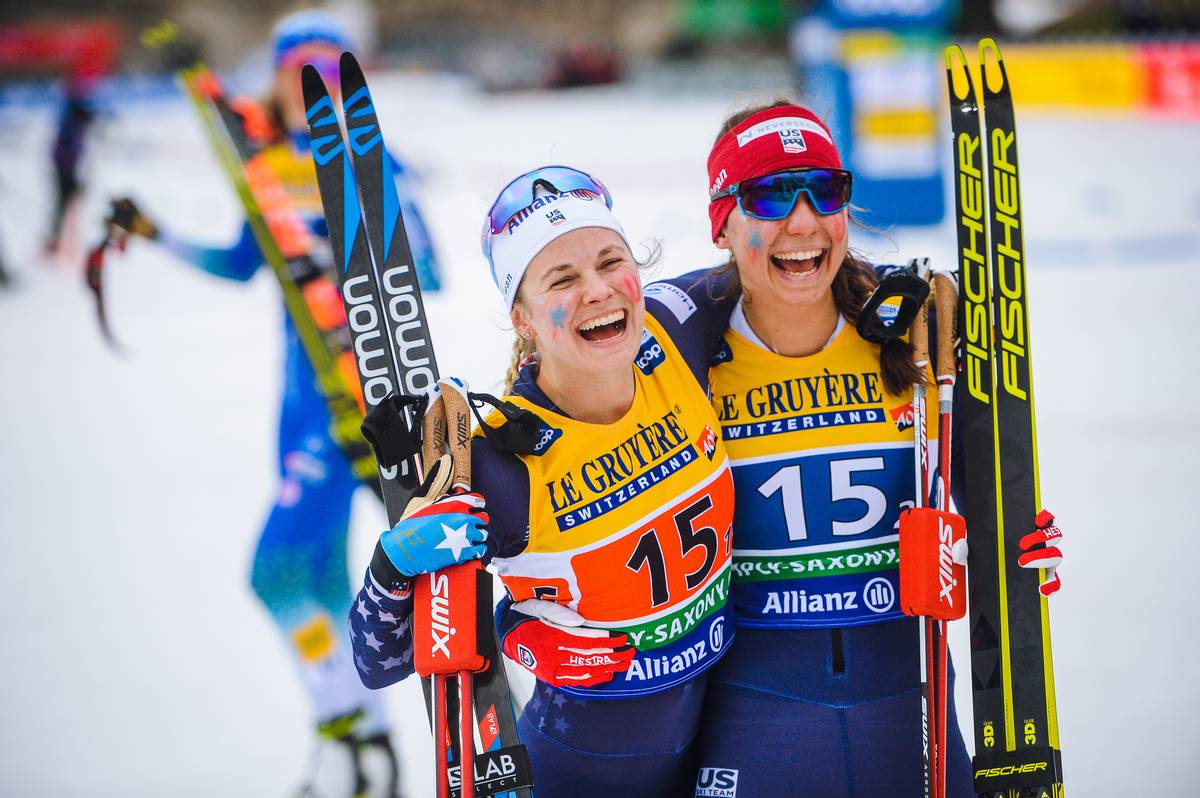
The American women celebrate after United States I – Rosie Brennan and Julia Kern – finished 3rd in a Team Sprint in 2023. (Photo: Nordic Focus).
Learning from Leaders, Leading by Example
When asked what she’s learned from her longtime teammates Rosie Brennan and Jessie Diggins, Kern doesn’t hesitate. “Rosie’s been such a great example of someone who’s had more adversity than maybe anyone I know and still shows up for the team,“ Kern said. “When I was first named to the team and had compartment-syndrome surgery, Rosie—who I didn’t even know—emailed me. She told me it would be tough but that I’d get through it. That stuck with me.”
From Diggins, Kern learned the art of curiosity. “Jessie never goes around thinking, ‘I’m the fastest in the world, I know everything,‘” she said. “She’s always got a growth mindset—always wanting to follow someone, to learn something. That’s really rare for someone at the top.”
Whitcomb has noticed the same instinct. “Julia’s evolved from someone who needed guidance into someone others now look to,“ he said. “She embodies that positive feedback loop of mentorship that defines this team.”
Mental Toughness in the Grind
On the World Cup circuit, there’s little room for reflection. Races pile up; travel blurs weeks together. Kern’s approach to a long season is both pragmatic and optimistic. “I love to race,“ she said. “The World Cup is part of the bigger plan. Early season, we’re still training on the road. You’re not trying to peak at Ruka. It’s about understanding where you are in the load of the season.”
She deliberately builds in breaks—two weeks at home after the Tour de Ski, Christmas with her boyfriend, family visiting during the Olympics. “Those resets make all the difference,“ she said. “They help you stay excited.”
You’re probably already following Kern on Instagram, but if you aren’t, you are missing out on a lot of delicious food inspiration. Cooking has become another activity for her to recover and connect with her friends and family. (Courtesy Photo)
Her outcome goals are clear: make sprint finals consistently, push into the top-10 in distance races, and—if everything lines up—fight for a team-sprint medal at the Olympics. “That’s what I think about during hard intervals,“ she admitted. “The team sprint is a big goal of mine.”
But Kern’s definition of success extends well beyond medals. “A successful season for me,“ she said, “is staying healthy, enjoying the process, and feeling good about how I carried myself. Pressure is a privilege. I want to soak up the experience and make it fun again.”
Beyond the Podium
For Kern, the sport’s meaning has broadened. As an athlete representative to FIS and an advocate with Protect Our Winters, she’s become a voice for climate responsibility and athlete well-being. During the 2025 World Championships, when environmental protests threatened to disrupt races, Kern helped mediate between activists and organizers. “We agreed that protesting during the race wasn’t the way to send a strong message,“ she said. “Now we have an open dialogue. These things take time, but they’re moving.”
Her motivation, she said, “is less about results and more about impact.“ She wants younger athletes to know that skiing fast can be both a platform and a privilege. “I feel grateful that I had such an active childhood and want that for the next generation,“ she said. “Clean air affects everyone. Being outside isn’t something we can take for granted anymore.”
Using her success as a platform to make a lasting impact on children has become a priority for Kern. (Courtesy Photo)
The Joy of Motion
Talk to Kern for long enough, and you realize skiing is just one part of her athletic identity. She’s an all-around mover—mountain biking, surfing, beach volleyball. “I’ve always loved doing every sport imaginable,“ she said. “Even as a kid, I just wanted to move. There’s so much value in being active and having fun. You don’t have to specialize too early. Playing lots of sports keeps it fresh and helps you avoid burnout.”
Cooking has become her creative outlet. “My boyfriend and I love to cook together,“ she said. “We have a CSA, so we get creative with whatever veggies we have. It’s like art—making the food look pretty, connecting with what we eat. It’s a kind of recovery, too.”
From the Gym to the World Stage
Whitcomb sees this blend of drive and joy as Kern’s secret strength. “Julia’s positivity isn’t surface-level,“ he said. “It’s a choice she makes every day despite setbacks. That’s what makes her such an anchor on this team.”
For her part, Kern sees the season ahead not as a culmination, but as another chapter in a long-term process. “Fourteen-year-old me would be surprised I’m still ski racing,“ she said, laughing. “Back then, I thought junior nationals were the pinnacle. I didn’t even know what the World Cup was. I think she’d be proud that I’m still doing this—and still having fun with it.”
Enjoyment is what keeps Kern chasing perfect rhythm through the snow, trusting that good energy leads to good skiing, and that joy and excellence can, in fact, coexist.
Kern seems fully ready to send it this season. (Courtesy Photo)
Love Stories Like This? Help Keep Them Coming.
Feature interviews like this one take time, access, and care to produce. If you value thoughtful storytelling and independent ski journalism, please consider becoming a Voluntary Subscriber. Your support directly fuels the work we do to cover the people, places, and moments that make our sport special.
This reporting costs money. Please support this coverage with a voluntary subscription (below) so FasterSkier can provide this level of access to the sport we all love year-round.
This reporting costs money. Please support this coverage with a voluntary subscription (below) so FasterSkier can provide this level of access to the sport we all love year-round.
This reporting costs money. Please support this coverage with a voluntary subscription (below) so FasterSkier can provide this level of access to the sport we all love year-round.
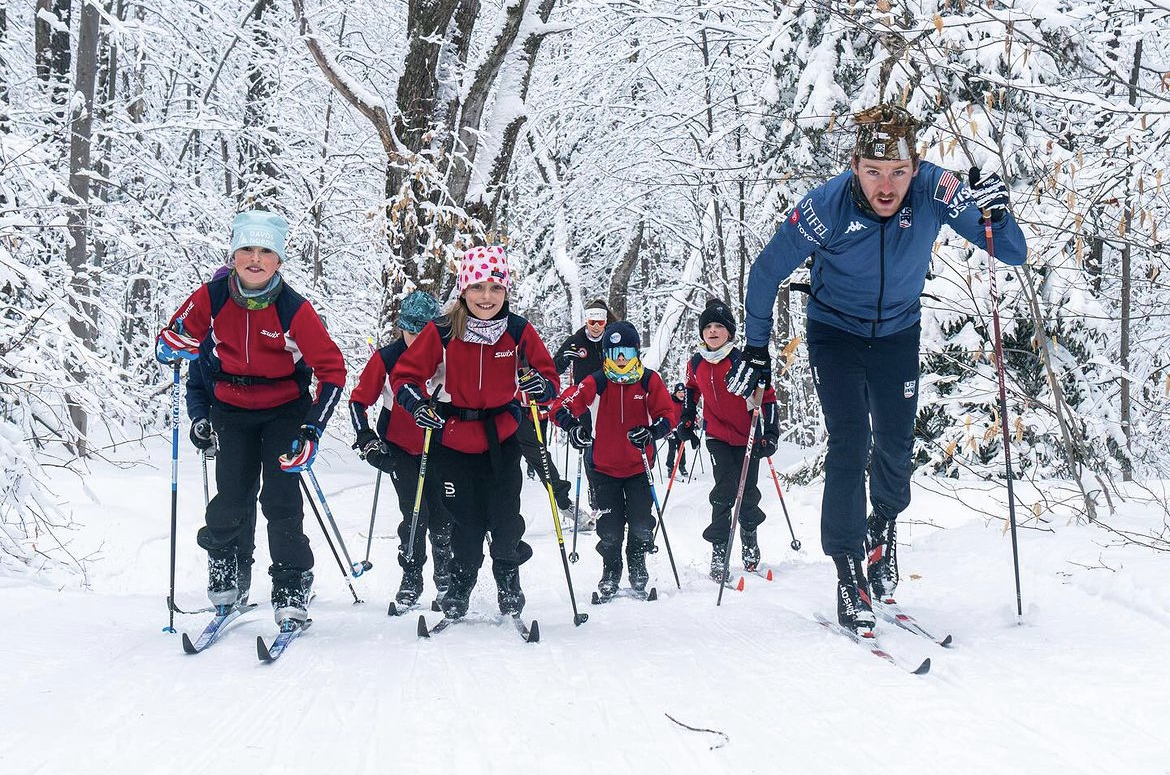
Homecoming day for Ben Ogden (USA), who paused in his World Cup campaign for a quick visit to his original club team—West River Nordic—and his old stomping grounds in Southern Vermont. (Photo: George Forbes)
At the edge of the parking lot at the Wild Wings Ski Touring Center stands a strategically placed, much used, and much loved snow pile. Getting up speed by dropping down the short slope in front of the main building, young skiers catch air off the top of the pile, daring each other to ever-bigger, ever-trickier leaps. They’ve been doing it for years. Ben Ogden, Sophie Caldwell, Simi Hamilton, Katharine Ogden, Bill Koch, Fin Bailey. . . a disproportionate number of America’s recent ski-stars have tested their young courage—and honed their young skills—on this particular snow pile. This neighborhood produces skiers, and the view out windows along the North Road, the Hapgood Pond Road, and through Peru and Landgrove Villages frames the passing of Olympians, World Cup winners, NCAA champions as they run, stride, and roller ski past. This little Southern Vermont valley is home to many American skiers whose names are familiar to ski-fans around the country. And for those globe-trotting skiers, winter homecomings are particularly sweet.
With a break in the World Cup schedule to allow teams, equipment, and athletes to travel from Europe to North America (for upcoming World Cup events in Canmore, Alberta and Minneapolis, Minnesota), Ben Ogden took the opportunity to return home to Vermont. Part of Ogden’s membership in his team, SMS T2, involves a responsibility to give back to local ski communities, to engage with fans and developing skiers. It’s something Ogden does with ease, so it was more of a treat than a surprise when he arrived to share a practice session with West River Nordic (Ogden’s boyhood club team) on the trails near Stratton Mountain.
With many of West River’s young skiers sporting false paste-on mustaches (a nod to Ogden’s now-famous affectation) the workout included games, drills, and an unforgettable tour through the snowy woods of southern Vermont. And while a Minnesota World Cup is bound to get the attention of the American ski community, this is how a star can really have an effect on his sport. Ogden, himself, remembers ski stars of the past visiting his own practices at Wild Wings. Now Ogden gives back to these young skiers who follow his every move, who emulate his every technical nuance, and who go home with false mustaches tucked in their pockets as reminders of the day when Ben Ogden’s homecoming brought him back to the valley that raised him.
Follow the leader in the snowy woods near Stratton Mountain. West River Nordic celebrates Ben Ogden’s recent homecoming. (Photo: George Forbes)
This is Part II of an article reporting on the recent appearance of the SMS T2 team at an evening where FasterSkier partnered with The Memory Clinic of Bennington, Vermont. The video posted below features the entirety of a wide-ranging Question & Answer session that involved most of the SMS T2 team, including Julia Kern, Jessie Diggins, and Ben Ogden. It was a treat to be among so many of our skiing heroes, and to hear how they responded to questions from the audience.
We also want to thank our industry partners Atomic, Alpina and Salomon for providing prizes at the event.
Be sure to check out Part One, where Julia Kerns talked about how to Strengthen You Mental and Physical Self.
The world of professional skiing is big and broad, but each professional team has a community they call “home.” For SMS T2, they are definitely the Home Team in the Nordic community of southern Vermont and western Massachusetts. It’s always fun and inspiring when the team and the community get to come together (as SMS T2 has always been devoted to doing) for events, for conversations, for competitions, and for cameraraderie. FasterSkier recently teamed up with our friends at The Memory Clinic in Bennington, Vermont for an evening with Olympic skier and 2023 World Championship medalist Julia Kern and her SMST2 teammates, including Jessie Diggins and Ben Ogden. Julia was kind enough to serve as the keynote speaker for the evenings festivities:
FasterSkier would also like to thank our industry partners Atomic, Alpina and Salomon for providing prizes at the event.
In an article scheduled to follow this one, FasterSkier will also provide video coverage of the entire SMS T2 Team engaged in an open Q&A devoted to the discussion of big dreams, goal setting, nutrition, and mental health. It was a great night to be in southern Vermont, and we’re happy to share it with you. Stay tuned!
BENNINGTON, VERMONT – FasterSkier is excited to team up with The Memory Clinic to present an evening with Olympic Athletes Julia Kern, Jessie Diggins, and Ben Ogden to discuss the Integration of Physical and Mental Health. On Monday, September 25, in Bennington, Vermont these SMS T2 team members will be on hand to discuss the importance of goal-setting and maintaining motivation for athletes and non-athletes, alike.
The evening’s keynote speaker will be World Championship bronze medalist—and SMS T2 team member—Julia Kern, who will discuss lifestyle factors such as diet and exercise, and their role in overall health. Also in attendance will be 2023 FIS U23 champion, Ben Ogden, and Olympic gold medalist, Jessie Diggins, who will be signing copies of her book, Brave Enough (signed copies of which will be presented, free, to the first 50 attendees). The conclusion of the event will also include a Q & A with these SMS T2 team members.
FasterSkier reached Julia for comment on her personal connection to philosophies of physical and mental health: “I think physical and mental health are equally important,” she said. “And often the recovery and self care aspect is overlooked. I find that getting outside to exercising most days boosts my mental health by being active and spending time outside. Equally as important are finding times to recover my body and mind by spending time with family and friends, and doing the activities that make me happy outside of ski training.”
Jessie Diggins—the most decorated American cross-country Olympian—will be at The Memory Clinic signing copies of her book, Brave Enough (of which the first 50 event attendees will receive a free signed copy). (Photo: NordicFocus)
“I got into cross country skiing [as a result of] outreach from Jessie Diggins and other SMS T2 athletes,” Kern commented. “They came to one of my club practices and I vividly remember getting to do a speed against Jessie. Little did I know, 10 years later we would be racing at World Champs together, and go to win a Bronze medal! I hope outreach events like this one in Bennington will inspire kids and families that they can dream big and be one of the best skiers in the world, or even just fall in the love with the sport and get to experience the amazing cross-country skiing community locally and beyond!”
The entire staff of The Memory Clinic will be in attendance to answer specific questions from attendees, and to provide an overview of some of the recent achievements in the field of Alzheimer’s disease research, including the FDA-approved medications that are proving effective in slowing the progress of this heart-breaking, degenerative disease.
Support from FasterSkier and SMS T2 also makes possible numerous ski-related giveaways, and music provided by DJ Break Doctor. This is a FREE event, so come join us at The Memory Clinic (357 Shields Drive, Bennington) for a fun and informative evening with these remarkable athletes!
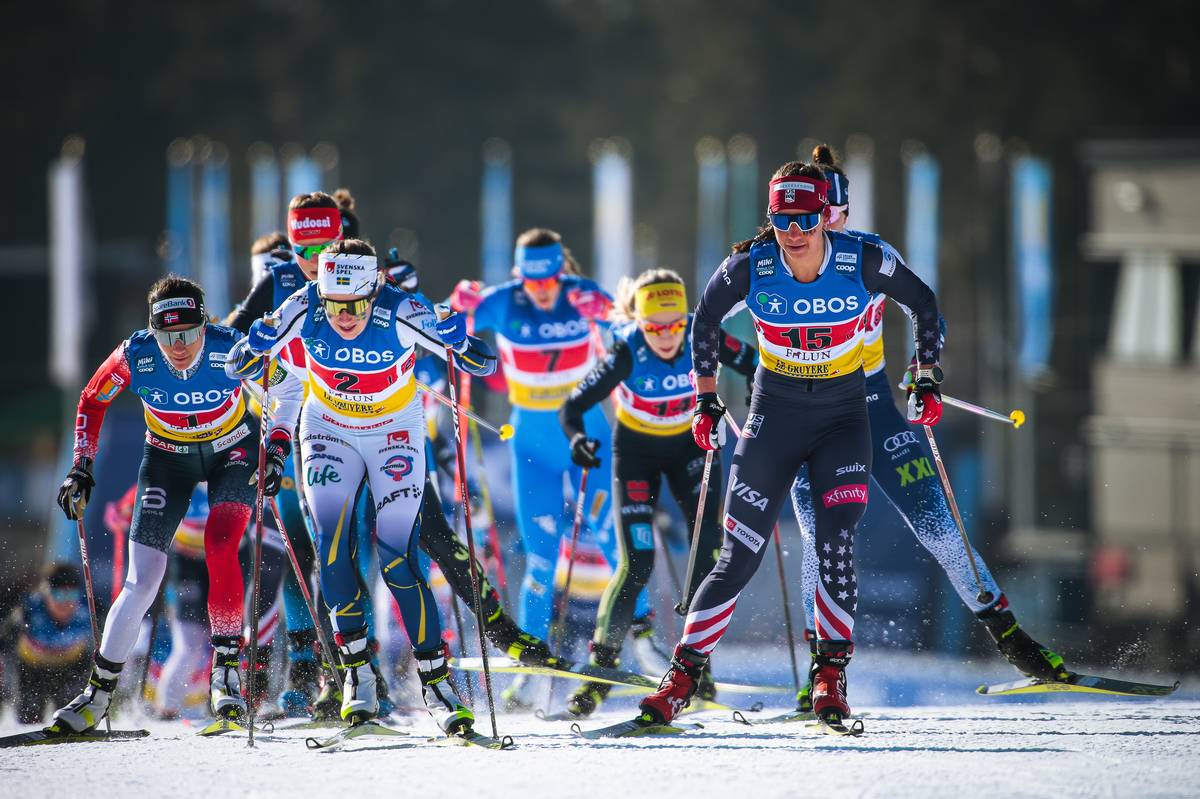
Julia Kern leads the pack during the first leg of the 4 x 5 k mixed relay in Falun, SWE in March 2022. (Photo: NordicFocus)
At 24-years-old, Julia Kern is quickly becoming a seasoned veteran in her 7th year on the U.S. Ski Team. However, her career trajectory has been stepwise, not exponential.
After making breakthroughs during the 2019-20 season, including her first World Cup podium in a skate sprint in Planica, Slovenia, she faced injuries and setbacks heading into the following season in 2020-2021, leaving her walking away from that season feeling disappointed in both her World Cup and World Championship racing. Reflecting on her takeaways in an interview that summer, she said “Progress isn’t linear from season to season.”
Hailey Swirbul (bib 19) and Julia Kern embrace at the finish of their first Olympic appearance in the 15 k skiathlon. (Photo: NordicFocus)
Recently named the recipient of the US Nordic Olympic Women’s Gold Rush Award for her grit and grace as a professional skier, Julia has demonstrated what it takes to rebound, reframe, and move past these challenges. As she describes in this conversation, the start of Julia’s 2021-22 race season happened in fits and starts – some strong early-season results with promising body sensations followed by a series of untimely mild illnesses. After catching a cold midway through the Tour de Ski in early January, she suddenly was faced with the reality that she would not have any opportunities to race until arriving in Zhangjiakou for the Olympics over a month later – the longest race break of her career.
Her first Olympic appearance took place in the opening event, the 15 k skiathlon, where Julia finished 53rd. The individual freestyle sprint three days later was her goal race; Julia qualified in 14th and raced a gutsy quarterfinal, ultimately finishing fourth in the heat and 18th overall on the day. A myriad of factors left her wanting more from this first Olympic experience, though she approached it without placing high expectations on herself.
Jessie Diggins and Julia Kern take second in the team sprint in Dresden, GER in December 2021. (Photo: NordicFocus)
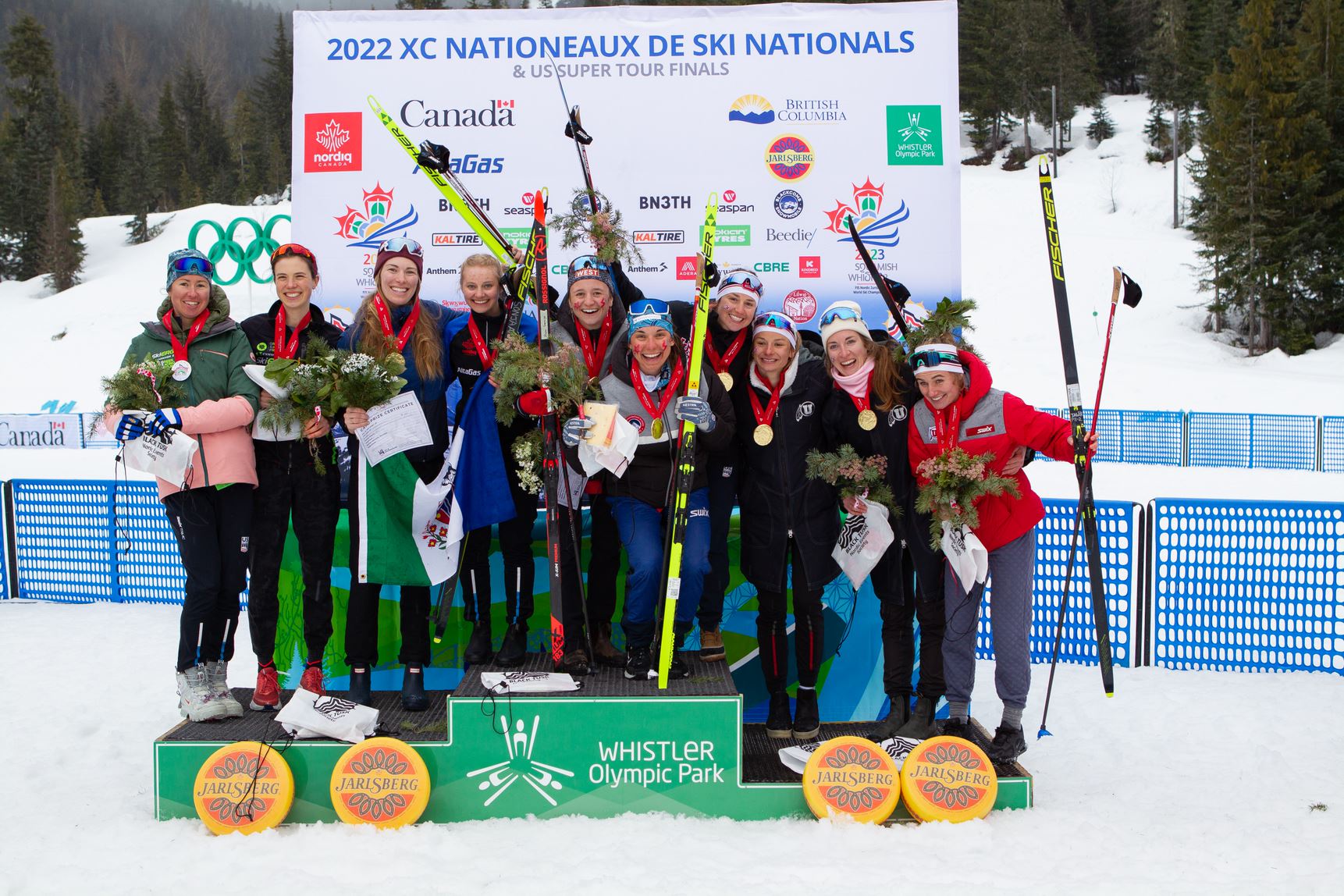
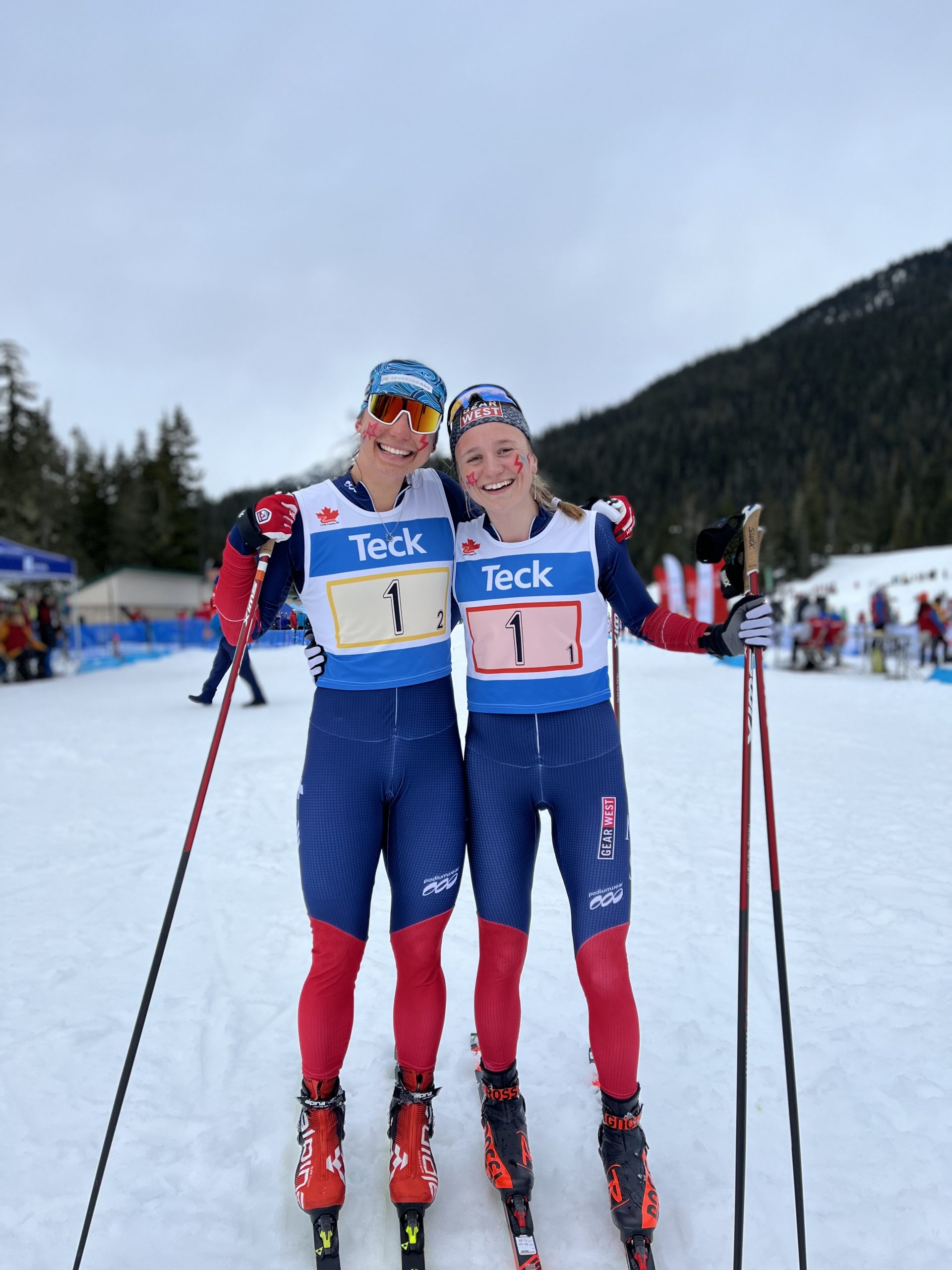
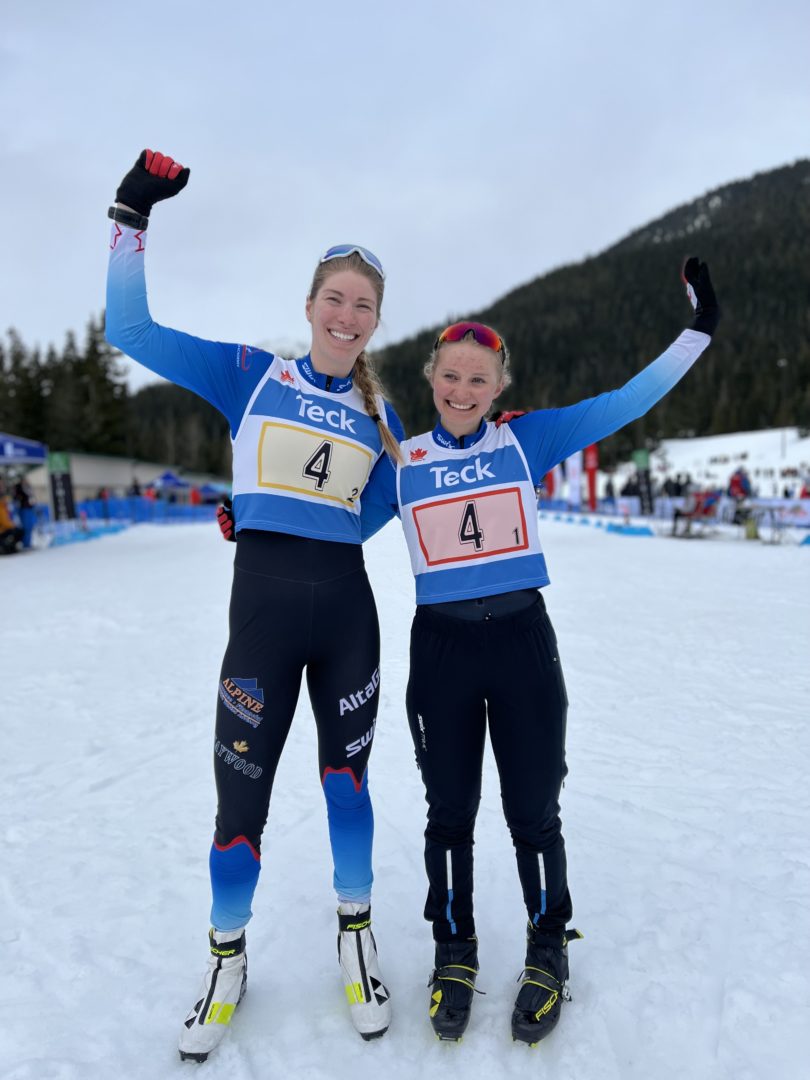
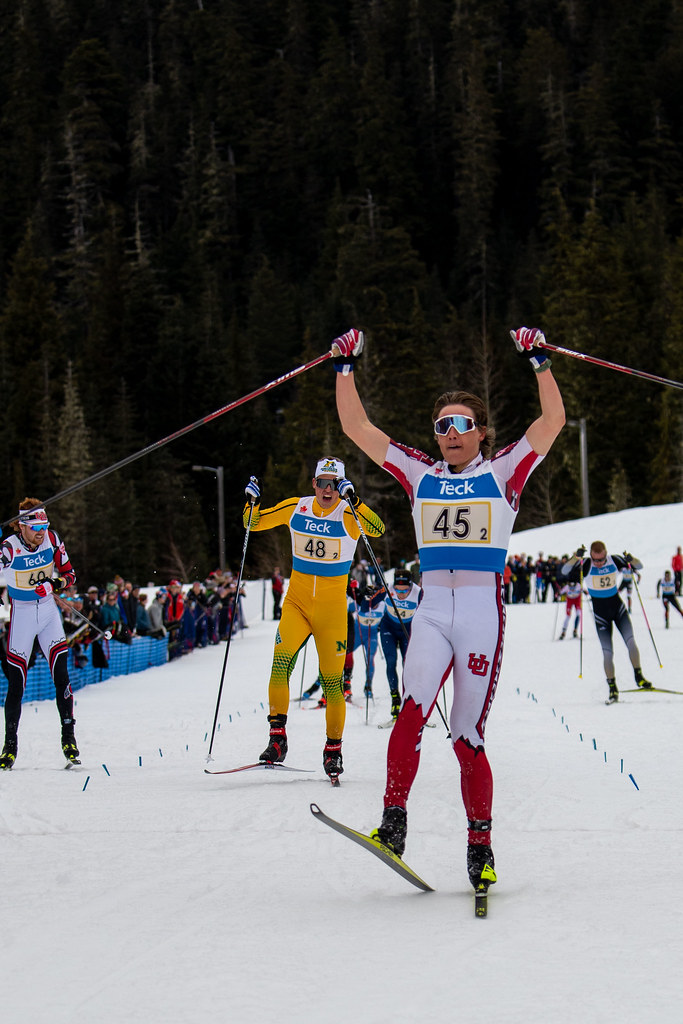
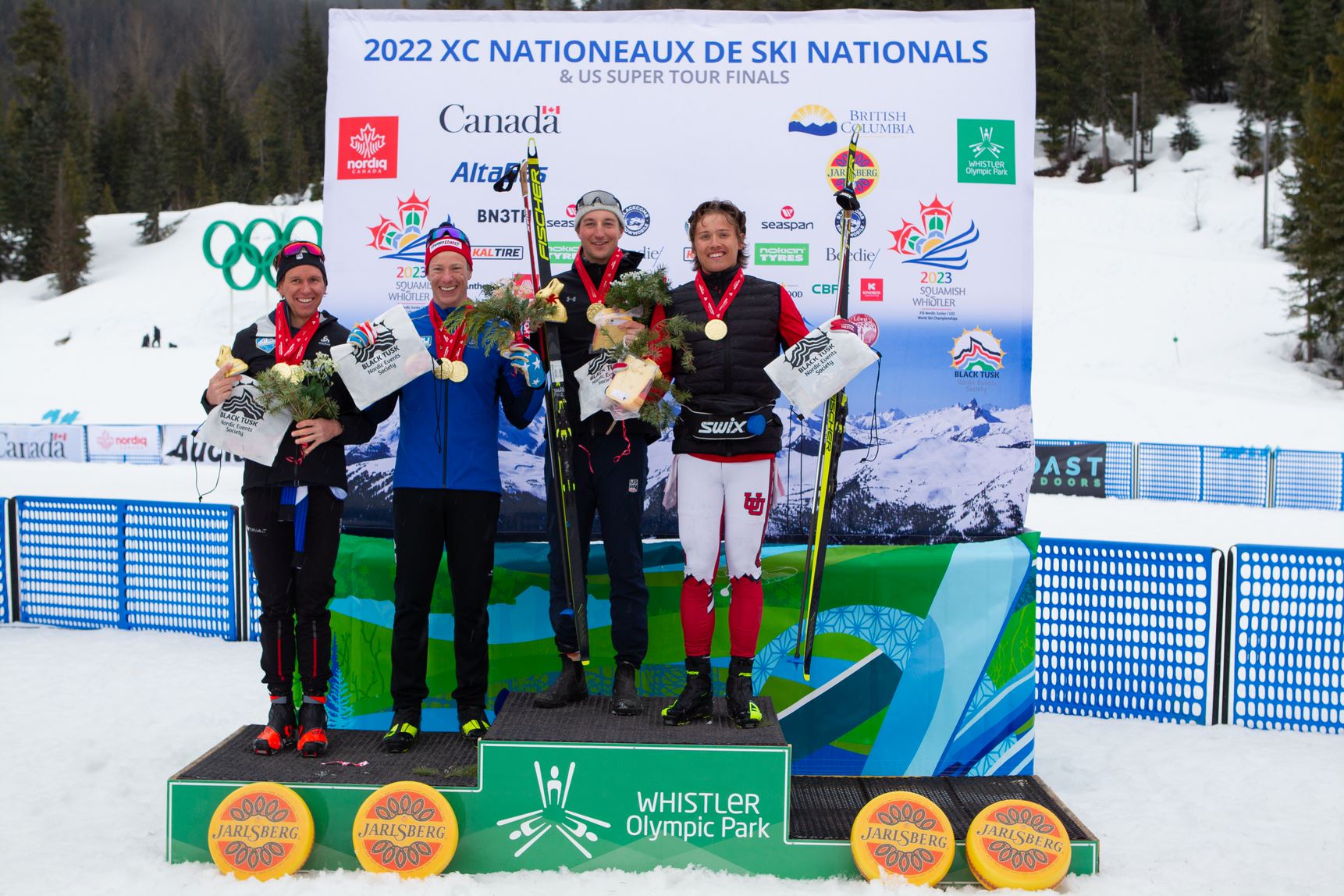
Rebounding once more after the Games, Julia began a tear of World Cup sprints in Period IV. She was 8th in the freestyle sprint in Lahti, 7th in the classic sprint the following week in Drammen, and finished just off the podium in fourth in the World Cup Finals in Falun. From there, she headed to Whistler to finish the season at the joint Canadian National Championships and U.S. SuperTour Finals, where she took second to Jessie Diggins in Jessie’s signature 5 k freestyle event, and won the remaining three races.
During this conversation, Julia discusses the highs and lows of the season, as well as how she has been able to compartmentalize and move past setbacks over the past few years of navigating the transition to the World Cup. We also discuss her start in the sport, why the Stratton Mountain School (SMS) T2 Team has been a good fit for her, and how leaning into other creative outlets, passions and work helps energize her for the long haul.
Thanks for listening and thanks to New Moon Ski and Bike for supporting this podcast.
Julia Kern races the quarterfinal of the individual freestyle sprint in Zhangjiakou during the 2022 Beijing Olympic Winter Games. (Photo: NordicFocus)
After eight years at the helm of the Stratton Mountain School (SMS) T2 team, head coach Pat O’Brien is in the process of taking a few steps back, passing the reins to Perry Thomas, who has spent the last five years as the assistant coach at the University of Vermont.
Perhaps highlighting this transition and the sharing of responsibilities the two are in the process of navigating, FasterSkier connected with Thomas in mid-May while he was in his second week of supporting the SMS T2 athletes who had joined the U.S. Ski Team for their spring training camp in Bend, OR, and with O’Brien who was back in Stratton, having recently wrapped up with his participation in U.S. Ski & Snowboard spring congress sessions.
Pat O’Brien supports some of the SMS T2 athletes during a 2022 SuperTour weekend in Sun Valley, ID. (Photo: SMS T2)
A 2006 graduate of SMS himself, O’Brien raced collegiately for Dartmouth College, then spent four years training and racing professionally with the Craftsbury Green Racing Project. His move from Craftsbury back to Stratton was timed with his retirement following the 2014 Sochi Olympic Quad. Given his age and the proximity to his racing career at that time, many of the athletes on the T2 team were among what he called his “peer group”, having overlapped with many of them during either high school, college, on the race course, or all of the above. Jessie Diggins and Sophie Caldwell Hamilton were quickly becoming rising World Cup stars on the women’s team, while Andy Newell and Simi Hamilton headlined the men’s roster, and a young Julia Kern and Katharine Ogden were spending a PG year training with the T2 team.
Eager to stay connected with the sport after retirement, O’Brien seized the opportunity to take over in Stratton, stepping in as his predecessor Gus Kaeding departed.
“Ski coaching is the one thing that I’ve always known that I wanted to do, it was just kind of a natural progression for me. I knew that I was done with my athletic career – I didn’t really want to ski race anymore – but I knew that I still wanted to ski, I still wanted to be involved and to give back to the sport. I felt like, to some extent, when you spend basically your entire life skiing, you get pretty good at understanding the sport. But we never know as much as we think we do, and we always need to be students of the sport and have an open mind and learn.”
As he began his coaching career, he quickly realized that writing training plans and facilitating training was only a small subset of the responsibilities of an elite club coach.
“Good coaching is being comfortable wearing a bunch of different hats. And I mean, I joke, but the actual coaching is such a small part of it. The nitty gritty of pulling an athlete on the side of the trail and looking at video and all of that is important, but you’re there as a friend, a drill sergeant at times, and as someone that is just really trying to be supportive.
“And that’s all-encompassing. So for me, it has been a pretty fun experience to see people figure stuff out and be there to support them when they needed a little extra help and to do it in a pretty collaborative, dynamic way.”
He described his experience transitioning to coaching primarily as a mindset shift from the inevitable self-centric focus required of professional athletes toward selflessness; but the work required and pace of life remained equally taxing.
“When you coach at a club level – all coaching is a demanding job. I do think that you have to – I don’t want to use the word ‘sacrifice’, but when you transition from being an athlete yourself to being a coach, your job as an athlete is to be a little selfish. You’re trying to maximize your athletic performance. You need to have balance… but at the end of the day, you need to make sure that you’re training well and with purpose, you’re recovering well, you have goals and you’re going about achieving them. It shouldn’t be simply looked at as like what you have to give up to do that, but to be the most professional athletes and succeed against people who are trying to do the exact same thing, you just have to do a really, really good job with it. And coaching is the same thing. You have to be willing to approach everything that you do with the same degree of drive and focus that you would as an athlete…
“Basically, I just threw myself into it with the same approach that I had as an athlete which is, I’m just going to work, and work, and work, and learn all along the way. And then give it my best push and know that if I get to the point where that balance starts becoming harder and harder, or I can’t really do the job that I want, to be supportive of the athletes [to the level I want to be], that’s when you’ve got to know that you either double down and keep pushing or make a transition.”
While O’Brien is no less dedicated to the SMS T2 program or its athletes, a new endeavor has begun which will make achieving the balance he described significantly harder: he’s about to become a father. His wife, two-time Olympian and long-time U.S. Ski Team member Ida Sargent, is due in mid-August.
After eight years as head coach of the SMS T2 team, Pat O’Brien takes a step back as he and his wife, Ida Sargent, begin their family. (Photo: SMS T2)
Since retirement, Sargent has been working for her high school alma mater, Burke Mountain Academy, in Northern Vermont, and is currently the Academic Director for the school while also teaching STEM classes. O’Brien has been splitting his time between Burke and Stratton, which lies roughly 150 miles southeast in the opposite corner of the state. His usual coaching schedule pulled him around the country for weeks at a time to support athletes at U.S. Nationals and SuperTour events, and sometimes around the globe for World Cup, U23s, and other international camps and races.
While he acknowledged that there are many examples of coaches at all levels who have successfully juggled a demanding work and travel schedule with raising a family, what felt like the best fit given his and Ida’s vision and priorities for their own growing family was for O’Brien to decrease his level of responsibility with the T2 program, allowing greater flexibility and more time at home.
“I just felt like there’s part of me that was like, ‘I’m not seeing a pathway that I feel like I can still commit [to coaching] at the level that I want and know that you need to in order to to do the best job with your job, while simultaneously trying to start a family.’ I felt like it was my time to reevaluate and maybe step back or be completely done with ski coaching, because I certainly didn’t want Ida to have to put her growing career on hold to be the [primary] caregiver…
“Eight years is a long time to do something and I am very proud of what the team has accomplished in that time… it’s really cool having spent this time seeing athletes grow, not just not just athletically and within their their ski careers, but as individuals from high schoolers to finishing up college to full blown ‘this is my job.’”
While his role will be smaller, O’Brien is certainly not stepping away from the T2 team altogether. “Starting a family does not necessarily mean that it means the end of being involved in the sport,” he said. “It just means trying to figure out what the right relationship is with it.”
Pat O’Brien supports SMS T2 skiers Julia Kern and Alayna Sonnesyn at the 2022 U.S. SuperTour Finals in Whistler. (Photo: SMS T2 Blog)
The exact balance and distribution of responsibilities remains a work in progress as Thomas moves into the head coach role and the new season of training begins, and both O’Brien and Thomas are excited to collaborate and support one another throughout the year.
Explaining his philosophy as “under-commit so I can open perform”, O’Brien anticipates taking on many of the behind the scenes tasks that support the team, from collaboratively blocking out the season calendar, to managing travel logistics for camps and SuperTour races. As he put it, the little details of deciding “which flights to take to get from Canmore to Sun Valley” and where to stay are often made easier with several years of trial and error under your belt.
While Thomas will spend more time with ski boots on the ground, both in Stratton during the summer and at races and camps throughout the year, O’Brien anticipates he’ll still be plugging in a fair amount too. Though his stay might be shortened to the period immediately surrounding races, he plans, at minimum, to be in Houghton, MI for U.S. Nationals in January, and also the SuperTour finals in Craftsbury in late March.
He’s also excited to reconnect with the team in Stratton early in the summer before Ida gets close to her due date, but also to take off a few of his usual coaching hats while doing so.
“I think it’ll be really fun for me to actually be able to flow in and out get to see people, connect with them, but also not be like ‘Okay, now I don’t have to worry about making sure that the van’s filled up with gas, or water jugs have been filled, or that I’ve ordered all the lactate strips in advance so that we don’t run out.’”
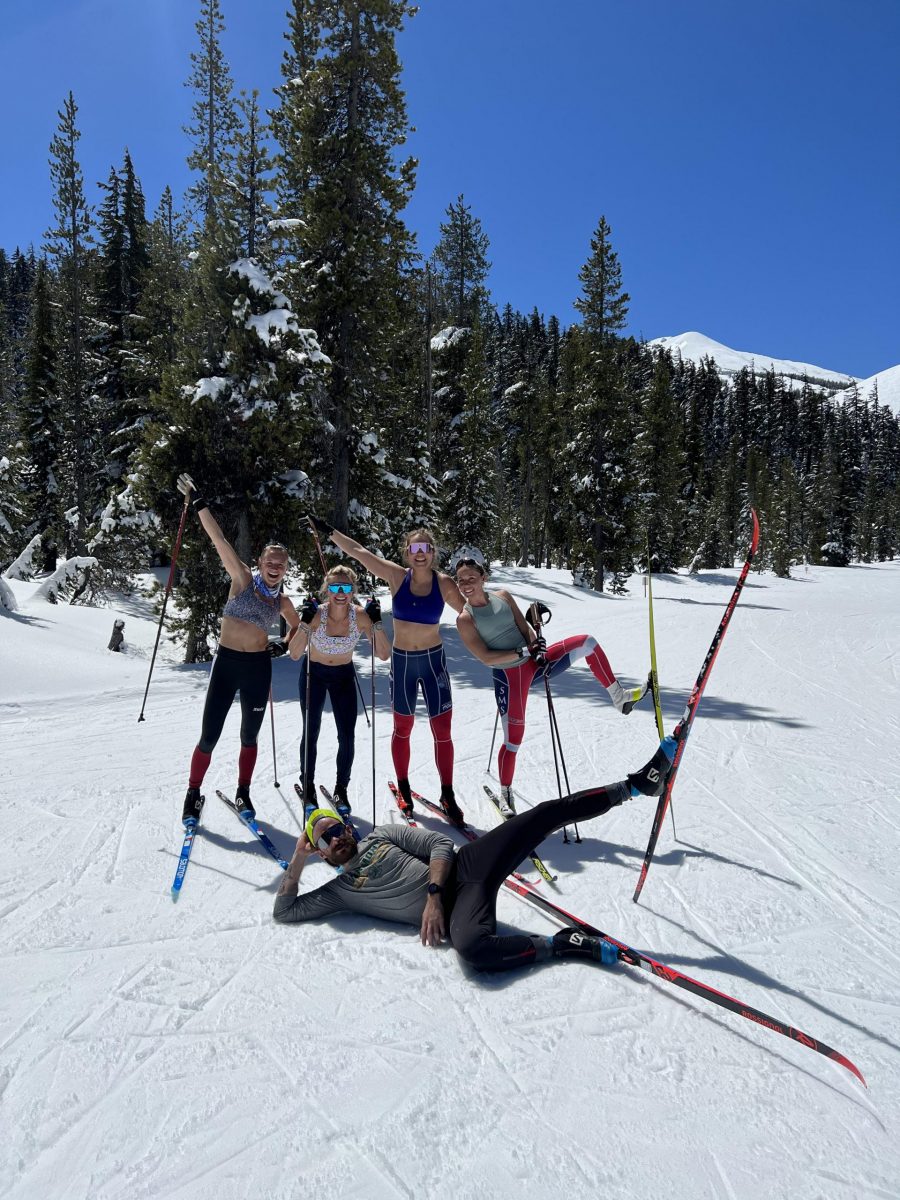
Perry Thomas out for a crust ski with the SMS T2 athletes who joined the national team training camp in Bend, OR this spring. (Courtesy photo)
As Thomas gets his feet under him in Stratton, he explained that he feels “very fortunate that Pat will still be involved.”
“As much as I can have him in the mix, the better,” Thomas said. “His knowledge with skis and wax is just unreal, so tapping into that resource is huge for me, for sure.”
***
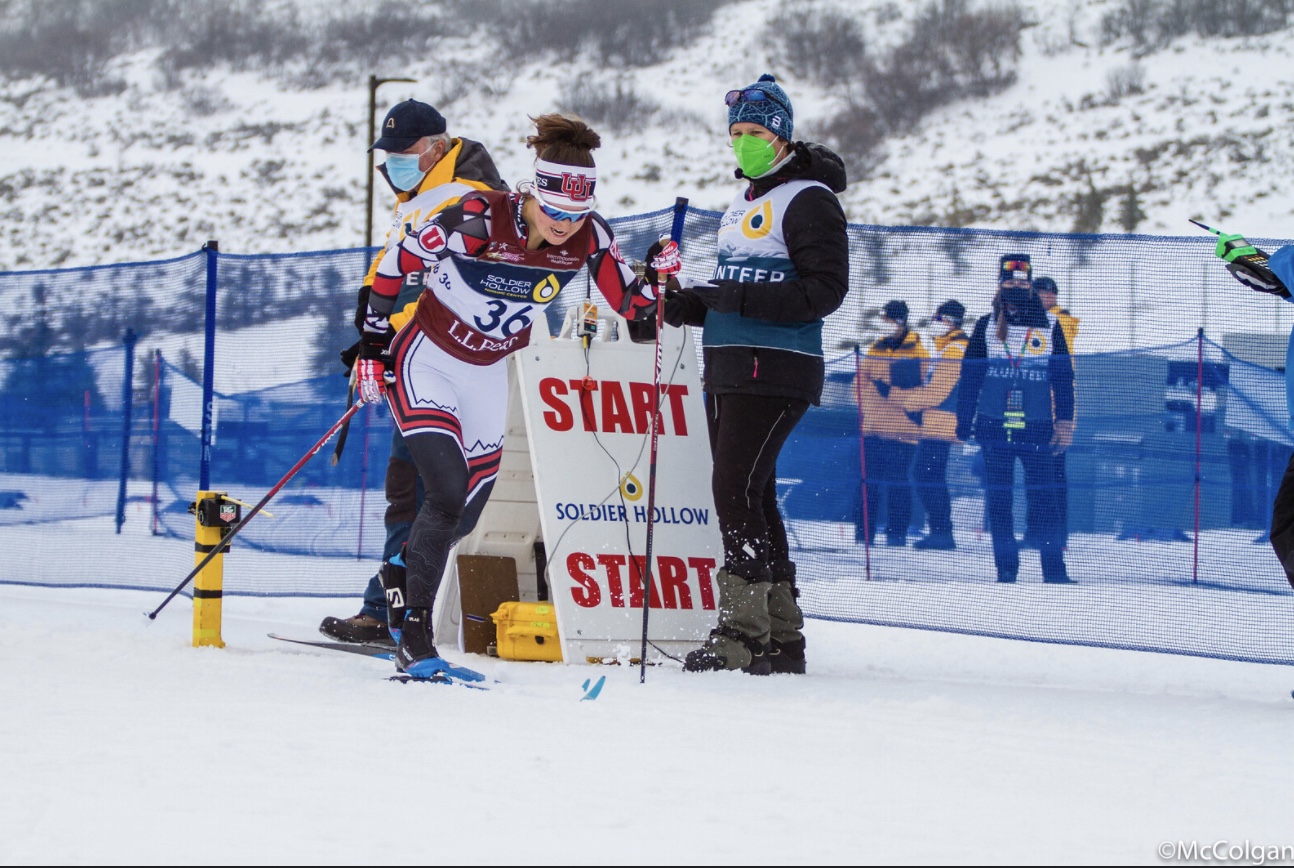
UVM assistant coach Perry Thomas in action during the 2022 U.S. Cross Country Skiing Championships in Soldier Hollow. (Photo: Instagram @oneswellperry)
Prior to joining the UVM program, Thomas spent five years as the assistant coach at the University of Vermont, working alongside head coach Patrick Weaver. During his own collegiate racing career, Thomas spent four years racing for the University of New Hampshire, where he served as team captain during his senior year in ‘12-13. Departing briefly from the cross-country ski world, he spent a year teaching high school science to underprivileged youth in the Oakland area of California, before returning to the Northeast to begin his coaching career as the assistant coach at Williams College in Massachusetts.
“Working at UVM was unreal – a great experience,” Thomas said emphatically. “I really loved working with Patrick Weaver and the athletes there and it seems like almost a seamless transition, in many ways. Four of the skiers on the T2 team I actually coached at UVM. So knowing a lot of athletes here already – what they’re working on with technique, and racing, and goals and all that – has been very seamless, and that’s been great.”
The UVM graduates who now ski for SMS T2 include Alayna Sonnesyn (‘18), Bill Harmeyer (‘20), Lina Sutro (‘21), and Ben Ogden (‘22).
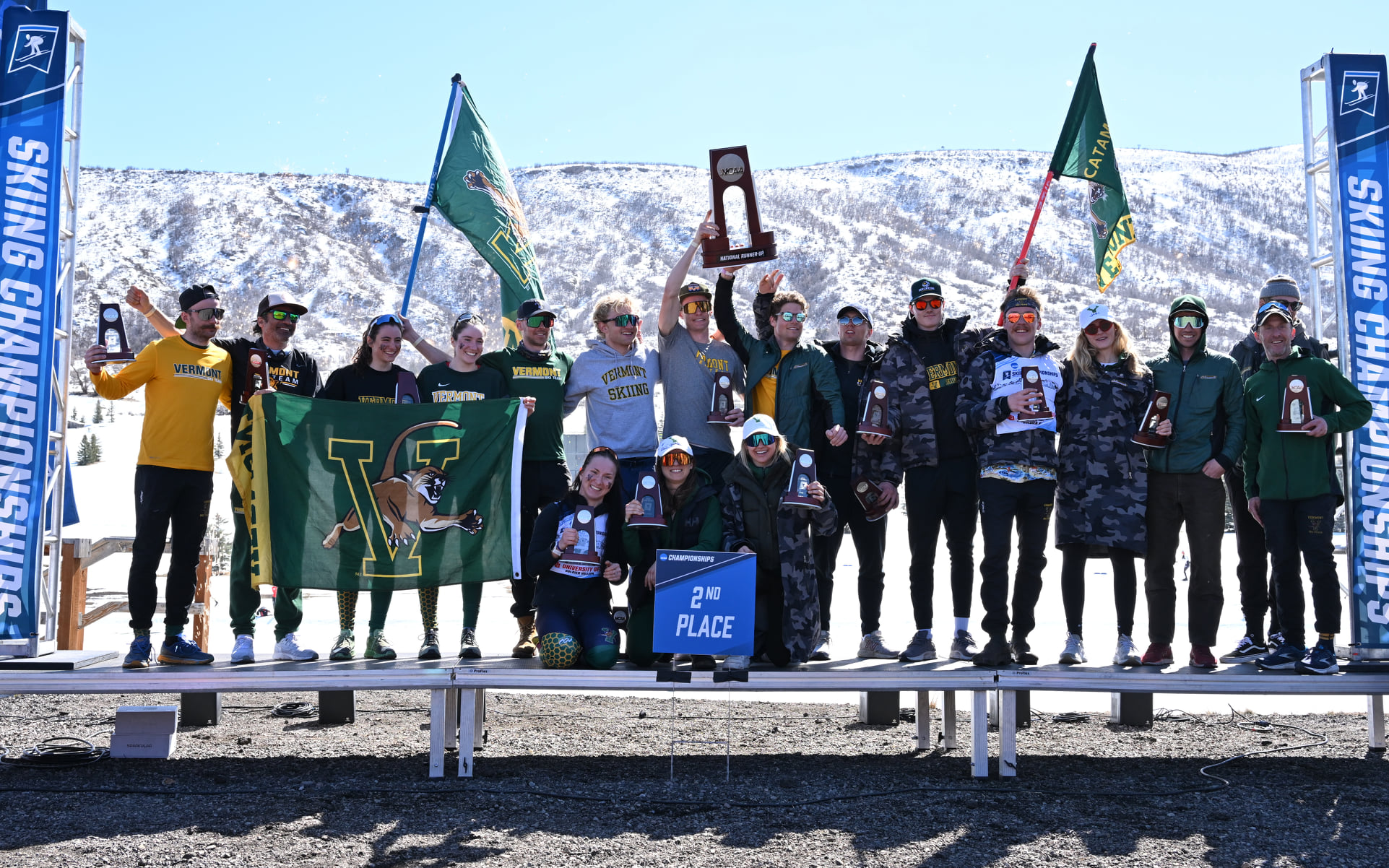
The UVM ski team celebrates a successful 2022 NCAA Championship. Assistant coach Perry Thomas is at the far left. (Photo: UVM Skiing)
Given the caliber of these athletes and the success of the UVM team as a whole during his tenure, Thomas credits his time with the program to the acceleration of his development as a coach, preparing him to take his next steps forward with SMS T2.
“Patrick Weaver definitely gave me a lot of opportunities and ownership over different facets of coaching that team and I think that’s been instrumental in me being here now with T2. I was able to go to World Cup Finals with Ben Ogden in Quebec his first year in school [in 2019], and I was just able to do trips like that on my own with athletes. That was huge for my development as a coach and for my experience of waxing, ski testing, and [other responsibilities at that level of racing]. So working at UVM was a lot of fun – I’m gonna miss it for sure – but it set me up very well for this transition.”
Ben Ogden gets a congratulatory fist bump as he heads to the podium during his sweep of the 2022 NCAA Championships. (Photo: Tobias Albrigtsen / @untraceableg)
A theme of both Thomas and O’Brien’s comments on the difference between collegiate and elite club coaching is small in terms of the training and technique coaching itself, but vastly different in terms of the opportunities elite club coaches have to support their athletes.
“I think the big differences are what we can and can’t do throughout the year from collegiate [racing] to the elite team,” Thomas explained. “Like, I wouldn’t be here [in Bend] and been doing an on-snow training camp if I were at a college team. And obviously the racing schedule is super different.
“The college schedule is pretty efficient, whereas the SuperTour calendar is quite a bit more spread out. And then, in addition to that, you have an athlete’s like Jesse Diggins, and Ben Ogden, and Julia Kern that are going to be on the World Cup, as well as athletes that are trying to make it to the World Cup. And at UVM, we had crazy talented athletes – Ben Ogden is one of them – so working with with high caliber athletes is nothing entirely new, but dealing with athletes where some are on the World Cup and some of them on the SuperTour is an interesting dynamic that you don’t often get with the college teams.”
In terms of what Thomas adds to the program as he steps in as head coach, he described his coaching philosophy and the environment he seeks to create within the training group, which keeps athletes motivated and happy through the arduous and long-term development process.
“[Cross-country] skiing is such a hard sport – it’s so much time that that we’re putting in, and so many sacrifices that we’re making, that I wholeheartedly believe in making that time that we’re together training and working hard fun and enjoyable,” Thomas said. “I think that’s a big part of what we do – and it has to be a big part of what we do – because like I said, it’s a hard sport. So I think making things light and having fun with all that is super important. And that’s definitely something I bring to the table in that regard.”
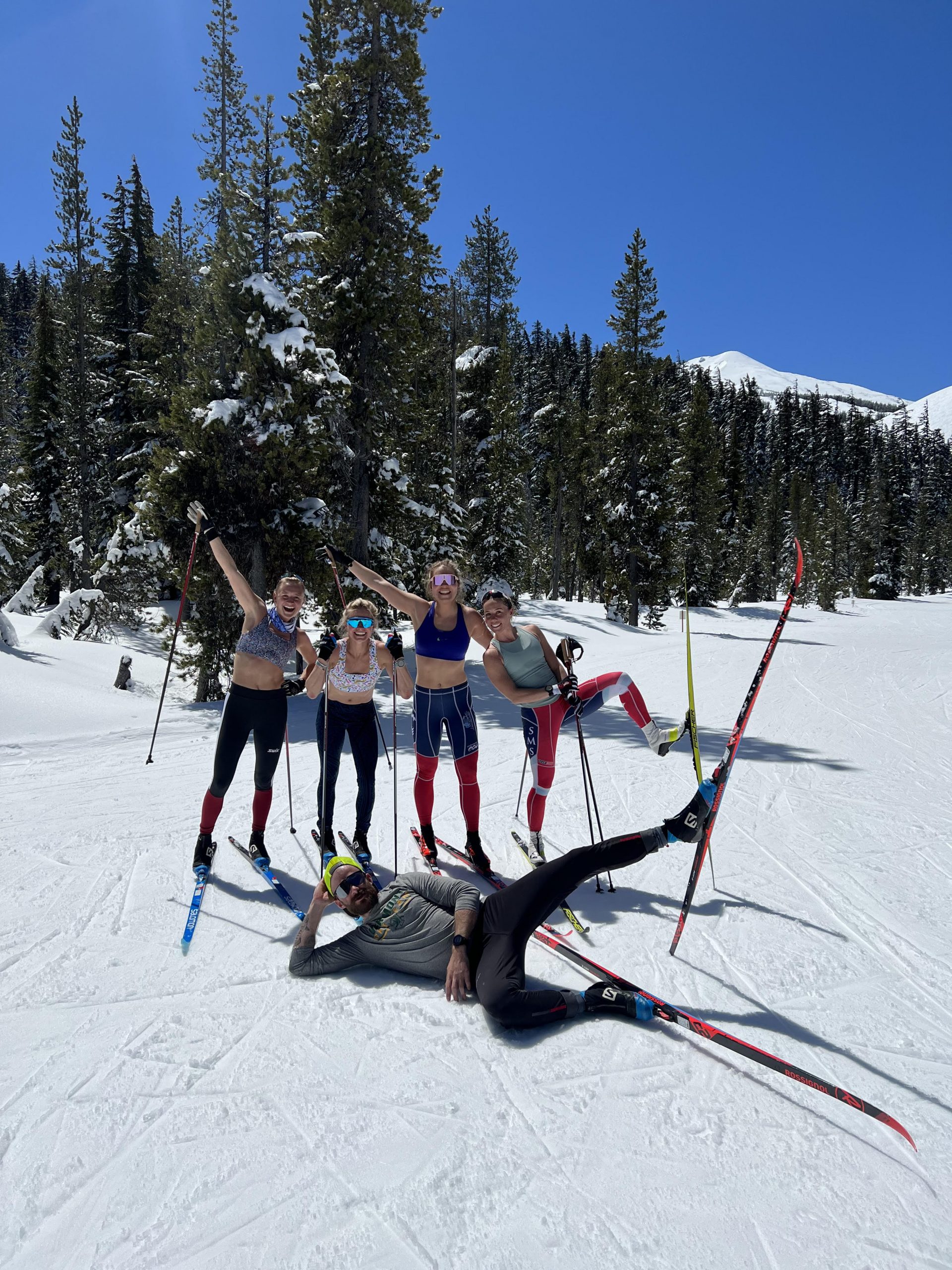
The SMS T2 team enjoys spring skiing at the Mt. Bachelor Nordic Center. From left to right, Alayna Sonnesyn, Jessie Diggins, Lina Sutro, and Lauren Jortberg, with head coach Perry Thomas. (Photo courtesy Alayna Sonnesyn)
But Thomas will add more than just fun to the T2 program. While he may be, as phrased by his new colleague, “almost too humble”, O’Brien was quick to highlight Thomas’s preparedness to prescribe training, coach technique, and otherwise lead an elite team stacked with some of the nation’s best athletes.
“If you have been at a D1 college program where you’re dealing with 15-20 athletes and that dynamic environment where student athletes are constantly balancing all these different commitments and time constraints… And really, what you learn there as an athlete and what you learn there as a coach is that working with a club – it just isn’t that different.”
O’Brien added that the shift to an elite club from college may, in fact, be easier than going in the other direction. When athletes no longer have to miss key workouts to take an exam or rush off to class halfway through a team meeting, barriers to consistent communication and training are removed, and consequently a coach has a greater capacity to build relationships with the athletes as they stack together the bricks of the training program.
“You get an opportunity to really work one-on-one with the athletes and to really be there to facilitate and support their training and their racing. In that sense, I think coming from a college background – especially given his ties with many of the current athletes that are on the team – you’re just working with the same people and you’re doing the same stuff.
“I mean, there’s no magic formula,” O’Brien continued. “Someone can claim that they can write the best training plan in the world. And that’s all fine and dandy – there are definitely people who do an amazing job with it and they really enjoy that aspect of that aspect of the sport. But at the end of the day, it’s just really just working with people. You don’t need to make it more complicated than it is. The best athlete is not a robot. The best athlete is someone that is self aware, that can think critically, learn from mistakes, recognize when things go well, and the coach is there to support them along the way.”
New SMS T2 head coach Perry Thomas working with his athletes during a 2022 spring training camp at the Mt. Bachelor Nordic Center. (Photo: Lauren Jortberg)
Thomas identified building upon his relationships and experience with his former athletes, who account for half of the team’s eight athletes, as something he’s looking forward to in joining T2.
“I am very appreciative of the continuity and being able to work with some athletes I’ve worked with in the past,” said Thomas. “I love all of them – they’re incredible people, incredibly hard workers. So to be able to continue working with them is just awesome. With that, too, it’s like – I have been working with Ben for the last four years, I worked with Lina Sutro for four years, I worked with Alayna for a little bit. It’s just a matter of knowing how they operate and how they train and knowing what they’ve been working on too. It’s easy for me in training, [even] this morning, to see some of them and be like, ‘okay, like this is something we’ve been working on for the last however many years’ or maybe, ‘a couple years ago, this was something we’re working on’. So let’s continue this, let’s continue these cues that we’re working on, and have that continuity there.
“It’s been awesome to be able to continue that work with them. It’s nice to see the progress – to see what they were doing in college a few years ago, and then to see where they are now, and then also to be able to help them through the transition to professional skiing.”
Simultaneously, these UVM-T2 athletes are excited to be working with their former UVM coach again. In an email to FasterSkier, Alayna Sonnesyn reflected on her time as a professional skier guided by O’Brien, while crediting Thomas’s contributions at UVM for her reaching the professional level in the first place.
“Stepping into the professional ski world four years ago and onto the SMS T2 team was super intimidating to me,” wrote Sonnesyn. “The team has been home to some of the fastest skiers in the world and I was clueless when it came to racing at that high of a level. Pat O’Brien helped steer me in the right direction as I made this adjustment and took huge jumps in my skiing ability. He taught me when to train for fun and when it was time to buckle down and get serious. When Pat says it’s go time, you go! He helped develop me from a reasonable distance skier to a strong and powerful distance AND sprinter, a trait I never thought I would be capable of. Pat’s knowledge of the sport and ski waxing, as well as the mental and emotional obstacles that come along with it, is unparalleled. He was a coach that believed in me as a junior skier and saw potential. The only thing that can make a good ski race even better is when Pat gives you a proud hug at the finish line. Although I will miss these hugs and his direct coaching, I know that he will use these skills to care for his growing family and I am excited to see where life takes him next.
Perry Thomas works with a few of the SMS T2 ladies in Bend. (Photo: Alayna Sonnesyn)
“Back when Pat was just seeing the potential in my college skiing, I was working with Perry Thomas when he was the assistant coach at UVM. I feel like my athletic career has come full circle as I get to transition back to a coach who helped put me in a place where I first believed skiing professionally was an option. Although I only had the pleasure of working with Perry for one year at UVM, it was a very special season! I instantly trusted him with my skis and could feel his enthusiasm for the sport radiate on the ski trails. I’ve witnessed just how hard Perry has worked over the years and how well-prepared he is to take over the position as head coach of the SMS team. Just in the first month of working with Perry again, I already know the team is heading down a path to continue its mission; local inspiration, international excellence.”
Likewise, Lina Sutro shared she is looking forward to the transition, applauding Thomas’s dedication to his athletes.
“I am truly so excited to be working with Perry again,” she wrote. “He is one of the most hard working and committed coaches I have worked with. He has a strong work ethic that I am excited for the Stratton community to experience. Pat and Perry both give so much back to the ski community and their athletes, I am excited to see the two of them work together.”
The 2021/2022 SMS T2 Team. Back row (l – r): Ian Torchia, Ben Ogden, Bill Harmeyer, and Will Koch; front row: Alayna Sonnesyn, Julia Kern, head coach Pat O’Brien, Lina Sutro, Katharine Ogden, and Jessie Diggins. (Photo: SMS T2 Blog)
As for the broader questions of “what’s new?” and “what lies ahead for the SMS T2 team this summer?” Following Katharine Ogden’s retirement in March, Lauren Jortberg will join the team as the fifth athlete on the women’s side – five and five is what the team identifies as the sweet spot for numbers. Jortberg joins Jessie Diggins, Julia Kern, Alayna Sonnesyn, and Lina Sutro. The men’s team is light this season, as Ian Torchia moved on this spring also, leaving behind a three-man roster of Bill Harmeyer, Will Koch (who also competes for University of Colorado), and Ben Ogden.
After Bend camp, the team will part ways with many attending “a big event in the Midwest” which happened over Memorial Day Weekend. The SMS T2 team will finally reconvene as a whole in Stratton in early June. Though regional and international camps are planned, particularly for athletes named to the national team, Thomas anticipates ample quality training based in Vermont and the surrounding region.
“We’ll be in the Stratton area for the majority of this summer,” he explained. “I think one of the cool things that we’re doing is: Sverre, and Pat and I have started working on doing a summer [training] program, so we have some awesome athletes joining our crew this summer.”
This list includes University of Utah and U.S. Ski Team skiers Sydney Palmer-Leger, Novie McCabe, and former SMS junior athletes Adam Witowski and Zander Martin, who now ski for Michigan Tech and Bates College, respectively. JC Schoonmaker and Gus Schumacher also plan to join the T2 team for some training in Vermont throughout the summer.
“So a really stacked crew, for sure,” said Thomas. “It’s gonna be a really exciting summer to say the least.”
Anyone who has had the pleasure of interacting with Katharine Ogden, also commonly known as KO, can tell you that she is humorous, kind, and thoughtful – both in regard to others as well as in her own self-introspection. She is also a wicked good skier, proving herself both nationally and internationally in competition. Ogden recently shared that she was stepping away from professional skiing, having already experienced a range of career ups and downs at her relatively young age of twenty-four.
Katharine Ogden races the classic sprint during the 2021/22 Tour de Ski in Oberstdorf, Germany. (Photo: NordicFocus)
I had the privilege of overlapping with Ogden for two years as teammates on the Dartmouth Women’s Ski Team, during which time I was undergoing my own personal, though distinctly less significant, reckoning with ski racing. Thus, when Ogden announced her retirement at the end of last month, I asked to be the one to write this piece, hoping to do justice to the story of a career that is as important in its low moments as it is at its heights. Ogden herself wrote an eloquently expressed reflection of her career on the SMS T2 blog which can – and should – be read here.
Ogden began skiing at the tender age of two, after her family moved from Seattle to Vermont. Shortly thereafter her brother Ben was born and as Ogden explained it, “I was now living in Vermont, no longer an only child, and so I spent a lot of time with my dad, while my mom was having, you know, the baby. And my dad, once we moved back to Vermont, kind of re-engaged with the Nordic ski community and started coaching the local ski program.” Ogden’s father, John, has long been an active member in the Eastern ski community, most recently through his work with the timing company, Bullitt Timing, which he runs with a colleague. “Pretty much since I can remember, my dad has been coaching for [West River Sports] my childhood club, and bringing me to practices and he would also go to the local races and bring me along,” said Ogden.
A young KO takes to the race course. (Courtesy photo)
These early memories of ski racing instilled a strong sense of ski community within Ogden and given the high level of participation in Nordic skiing among her elementary school peers, Ogden explained that this was a big reason why she stuck with ski racing. “And, of course, my dad coaching the team,” she added, “Definitely he encouraged us to do it.” Racing with her best friends throughout elementary school and middle school, while participating in events like the Bill Koch Festival, played a big part in growing Ogden’s love for the sport.
Entering high school, Ogden attended Stratton Mountain School in southern Vermont, the well-known private school which, according to its website, “provides a unique environment that offers each student the opportunity to pursue excellence in competitive winter sports and college preparatory academics.” Around the same time, Ogden was earning her first international starts, as she participated in the U18 Scandinavian Cup trips in 2013 and 2014. “That was kind of a cool progression up to World Juniors,” shared Ogden, “I think it’s very important, and honestly sometimes underrated in my opinion, to build up your international experience in that way.”
For at least one, if not both of the years, Ogden had also qualified for World Juniors but she explained that her coaches encouraged her to choose the U18 trip instead. “Sometimes there are really young kids who got to World Juniors and I think that it’s a bit of a missed opportunity, because those U18 team trips are still a really high level of competition,” Ogden said, “And a good way to be like with people your own age, which really improves the experience.”
Katharine Ogden (SMS) competing at U.S. Nationals in 2013 representing Stratton Mountain School. (Photo: Bert Boyer)
After having built some international racing experience, Ogden attended her first FIS World Junior Ski Championship in Almaty, Kazakhstan in 2015. “At that point, I had made a lot of good friends in the ski world,” shared Ogden, “I knew Julia Kern and Hailey Swirbul really well, so that was a blessing for me to have people that I knew and cared about and relied on in that type of situation being there for support. [It] makes the whole experience a lot more enjoyable and it takes a little bit of the pressure off to just be able to treat it as a fun trip.”
This approach seemed to pay off as Ogden placed 11th and 6th in the individual races, besting some familiar names such as this year’s Tour de Ski winner, Natalia Neprayeava. “[It] was fun to go to a crazy country that I wouldn’t normally go to and be able to experience that, while also getting to focus on some higher level racing,” explained Ogden. Her second World Juniors appearance came in Rasnov, Romania the following year where she placed 13th in both individual races.
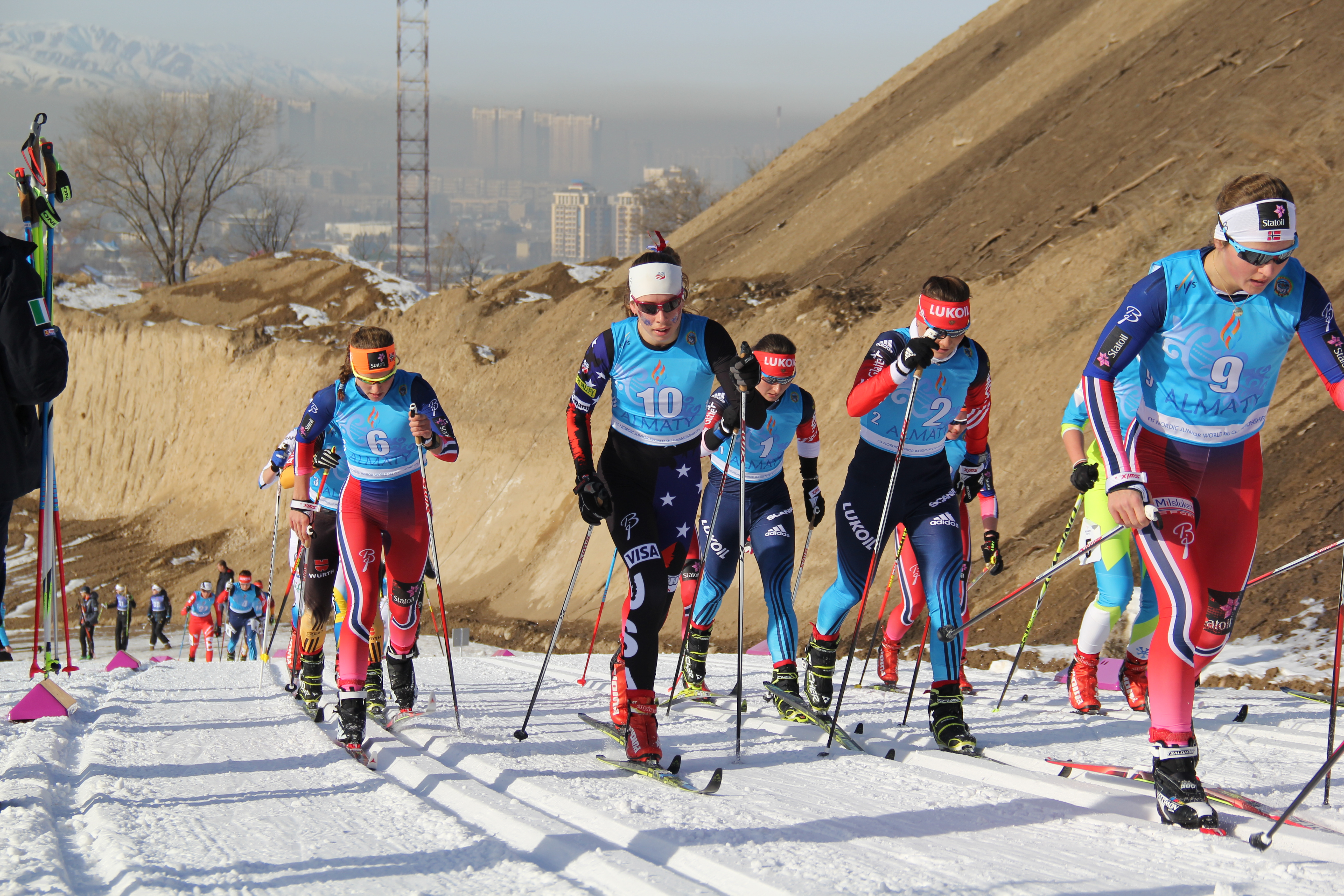
Katharine Ogden (10) on her way to a sixth-place finish in the women’s 10 k skiathlon at the 2015 Junior World Championships in Almaty, Kazakhstan. (Photo: Bryan Fish/USSA)
In June of 2016, Ogden graduated from Stratton, and having applied to college but deferred her acceptance to Middlebury College – her father’s alma mater – she embarked on a gap year. Remaining at SMS, she began training more with the pro team (SMS T2) and focusing a little more seriously on ski racing. “That was definitely an interesting experience for me, it was a pretty mentally difficult year,” said Ogden, “it felt like a convergence of a lot of things in my life that were difficult for me to emotionally handle.”
For one, the 2017 World Junior Championships would be held at Soldier Hollow in the US, an exciting prospect that simultaneously created pressure to perform for the American young athletes who would be in attendance. “There was a lot of hype about it being in the US, which was cool, don’t get me wrong, but I felt that – not by anyone else’s fault other than mine – but that I was putting a lot of pressure on myself because of that.”
Self-aware and reflective, Ogden was open about the difficulty of this time, “Because I’d had previous success at the other two World Juniors that I went to, it kind of felt like it was a lot of pressure on me for those races. On top of that, I didn’t have school to focus on anymore, so I was really not doing much other than skiing, which is not something I would recommend to anyone, even if you’re a professional skier.” Ogden stressed the importance of having something else to balance your attention, “whether it’s a job or school, or even just working on your self-marketing or whatever – something that takes some brain power that is not just directly related to training.”
Katharine Ogden racing in her first World Cup events during the Tour de Canada in 2016, pictured here in the women’s 15 k skiathlon in Camore, Alberta. (Photo: Fischer/NordicFocus)
In addition to these pressures, Ogden’s father, who earlier had been diagnosed with cancer, was in worsening condition. “So that was also kind of weighing on me,” explained Ogden, “all of those things culminated into me not having a good time.” She shared that she has struggled with anxiety since she was young, but in 2017 it morphed into something that became unmanageable at times. (Read Ogden’s January 2020 narrative on her experience with severe anxiety here.)
“I couldn’t functionally live with it anymore,” said Ogden, “So at that point, I was really struggling to eat because the manifestation of my anxiety disorder was that it really caused me to have a lot of gastrointestinal distress and a really upset stomach, so it was difficult for me to fuel myself enough to train and I didn’t have a lot of energy, partly from not eating and partly from just being stressed all the time.”
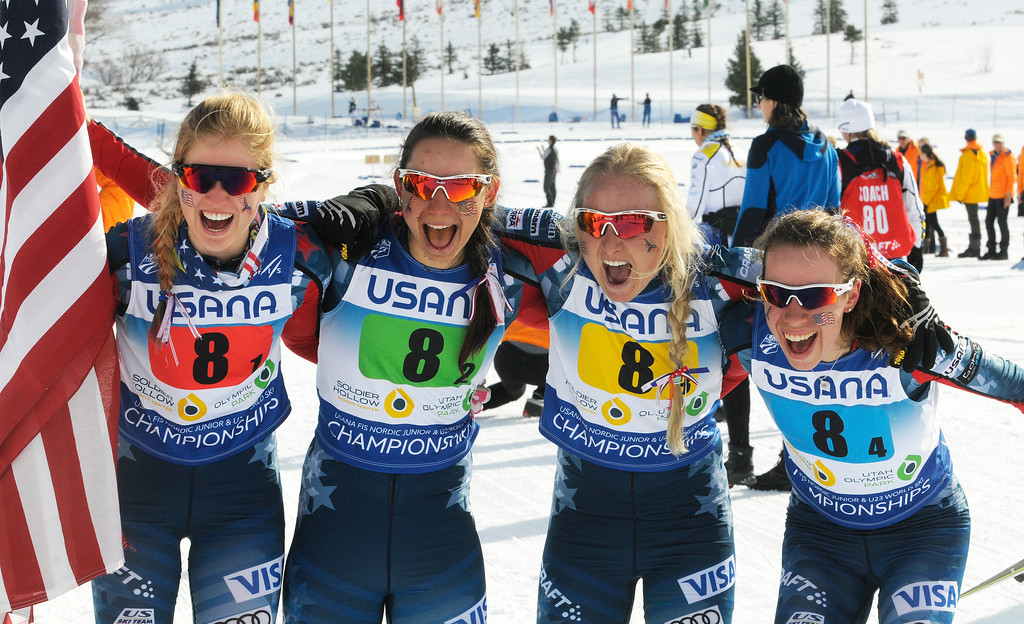
The U.S. women’s relay after taking a historic third in the 4 x 3.3 k relay at 2017 Junior World Championships on Sunday at Soldier Hollow in Midway Utah, with (from left to right) Hailey Swirbul, Julia Kern, Hannah Halvorsen, and Katharine Ogden. (Photo: U.S. Ski Team/Tom Kelly)
Reflecting on this achievement, Ogden shared, “Because I haven’t really had a ton of podium results since then, on an international scale, that is something that my ski career often gets boiled down to. It’s really bittersweet for me because it was a really incredible achievement, especially the relay day, when I was able to work with three of my best friends to accomplish something pretty cool. I still have a lot of pride and such about that experience, but on the other hand, it’s really hard for me to remember that without remembering how awful I was feeling, and how that was really honestly one of the hardest parts of my life to date.”
Returning home to Vermont in early February, Ogden started just one other ski race that season, “I think I did one random Eastern Cup ski race that I ended up actually dropping out of,” she explained. “[After] that race I didn’t put on my skis or anything… I did not go for a ski or a run or do anything for the rest of that year, basically up until May.” At this point, Ogden thought her ski racing career might be over. However, the idea of collegiate skiing started to bring her back around.
Rewind to early December 2016, before World Juniors, and Ogden and the SMS team were in Silver Star, BC for the season-opening Nor-Am events. “My dad was on that trip, because he was helping SMS with some waxing and logistics, and we talked about how I wasn’t very happy, how I wasn’t feeling well, and I was struggling to want to ski and ski race,” said Ogden. While she had accepted a spot at Middlebury, she explained that “no part of me really thought I would go to college.” Examining this feeling, she reflected, “I think part of SMS is that, it’s an interesting environment where sort of everyone’s expected to got to college, but on the other hand, the people who are having a lot of success in their respective sport are almost really expected not to go to college.”
Referring to the infamous US Ski Team “pipeline” and expectations for members of the national team at that time, Ogden said, “I honestly didn’t think a ton about going to college. From pretty early in my high school experience I was like, ‘I’m not gonna do that, I’m gonna be like Liz [Stephen] and Kikkan [Randall] and Andy [Newell],’ and I have so much respect for their ability to focus on skiing that much,” she added, “Like Jessie [Diggins], those people who are really emotionally and mentally healthy and ready enough to be able to accomplish what they did in the ski racing world, without distractions, it’s amazing to me.”
Katharine Ogden, of the Stratton Mountain School and U.S. Ski Team D-team, in the women’s 20 k classic at 2017 U.S. nationals at Soldier Hollow in Midway, Utah. She finished second among the senior women. (Photo: U.S. Ski Team)
As the race season was about to get underway, Ogden was reexamining her priorities. Among the many skiers and teams present for these Nor-Am races was the Dartmouth Women’s Ski Team (DWST), who were wrapping up their annual Thanksgiving camp at Silver Star. “I was kind of watching the Dartmouth team from afar,” said Ogden, “they were always smiling, and they were nor-pining (alpine skiing on nordic skis), and they were going on long skis together. And something about seeing that, I was like, ‘That seems like something I want.’”
Recognizing this, though still not ready to fully commit, Ogden met with long-time Dartmouth coach Cami Thompson-Graves. Like many of the US Ski Team athletes, both alpine and nordic, who chose to attend Dartmouth, Ogden was drawn to the flexibility of the Dartmouth “D-plan”, and thought that perhaps she would take classes in the spring but continue ski racing full time in the winter. Breaking some rules with Middlebury, to whom she had already committed attendance, Ogden applied to Dartmouth that winter. When her acceptance letter arrived in the spring following World Juniors, she talked to Thompson-Graves again. “I was like, ‘I don’t really know what’s going to be the case by the time September comes around. I want to try to ski, but I’m going to ski for Dartmouth, I’m not going to ski for SMS or the national team.’”
Katharine Ogden (fifth from left) with the 2017/18 Dartmouth Women’s Ski Team training in Silver Star BC. (Photo: DWST)
With this new plan in place, Ogden started to re-engage with training and the ski world. “That summer, I was back to training with Stratton some. I also worked at a preschool that summer, which I loved. I generally went on a bit of an upward trend,” she said. When fall rolled around, she showed up in Hanover unsure of what to expect. “When I got to Dartmouth, it was honestly life changing,” she said, “The team was incredible, full of inspiring and interesting and passionate women, people who were passionate about ski racing, yeah, but also a million other things, which was not something I’d really been exposed to. Stratton Mountain School is incredible in a ton of ways, and was instrumental in facilitating my ski career and getting me to where I got to, but that being said, there’s not a lot of diversity of opportunity there. Because it really is, as advertised, very focused on skiing and ski success.”
Ogden explained that arriving at Dartmouth opened her eyes to the many possibilities that existed beyond the realm of ski racing. “When I got to Dartmouth, it was kind of the first time I’d been able to be like, holy cow, there’s so much else out there that I could be passionate about, not just skiing.” She detailed how the team of women her freshman year displayed the many ways in which one could be both an amazing ski racer and also completely invested in an opposite pursuit. “Lydia [Blanchet] for example, to be so excited about skiing and so talented as a ski racer, but then also sometimes, she would prioritize whitewater kayaking. Or, Taryn [Hunt-Smith] who was casually one of the best skiers on the team but also getting citations in every class and being pre-med… I think that was really eye opening to me.”
Lydia Blanchet, Taryn Hunt-Smith, and Katharine Ogden (l-r) of the Dartmouth Women’s Ski Team celebrate post-race. (Photo: DWST)
With these role models and examples, Ogden allowed herself to pursue other things outside of skiing. She also devoted herself wholeheartedly to the team and racing collegiately and didn’t compete in any international races for those first two years of school. “My freshman year that was kind of on purpose,” she explained, “I just needed a break, and I just wanted to focus on college skiing.” In November of the following year, as she was warming up to the idea of returning to international racing, Ogden broke her hand. “I was like, man, I don’t need to do that, I’ll just ease into the season and get my hand healed. But in the process of not going to the U23 [Championships], I also got booted off the national team, because I didn’t do any international racing for two years at this point.”
This turned out to be a blessing in disguise for Ogden. “I think in the moment I was sad about it, I had been on the development team for three years at that point, and I was a little bummed to lose that,” she shard, “But also, I wasn’t as sad about it as I expected to be and that next season, when I wasn’t on the national team, it was like a huge sigh of relief, if anything, because I felt a lot less pressure to perform.”
Dartmouth Women’s Ski Team freshmen Sofia Shomento, Katharine Ogden and Maddie Donovan (l-r) happy and ready for Dartmouth Carnival. (Courtesy photo)
However, the lack of international racing didn’t stop Ogden from achieving outstanding results. In 2018, as a freshman named to the National Collegiate Athletic Association (NCAA) team for Dartmouth, she took the win in both events at the championships by astonishing margins. In addition she earned seven collegiate victories that season, landed on the podium ten times, and never finished lower than fourth place. The next year, recovering from a broken hand, Ogden finished on the podium in every collegiate race she entered, save for one fourth place finish at NCAAs.
Dartmouth freshman Katharine Ogden racing to her second-straight victory of the 2018 NCAA Skiing Championships in Steamboat Springs, Colorado. She won the 15 k freestyle mass start by more than 38 seconds. (Photo: Dartmouth Sports/Clarkson Creative)
Moving into her junior year of college, Ogden found herself back on the international stage for the Tour de Ski (2019/2020) as well as for the Scandinavian Ski Tour. “It was kind of a perfect system for a college student because it was a ton of World Cup racing, but really condensed, into just two weeks of missed school,” she explained. In this way, Ogden was able to accrue eight and six World Cup starts from each event series respectively, making for fourteen international appearances after several seasons away. “That year, I got pretty inspired to pursue that a little bit more fully. So throughout the winter, I started making the decision that I wanted to ski more for the national team and for Stratton again, instead of Dartmouth, the next year, after my three years of skiing for Dartmouth, so that I could take the winter term off from school and try to do a few more World Cups because I was feeling really excited about that, and had some success, especially in the Tour de Ski.”
Ogden finished in the top-thirty in her first attempt at the challenging multi-stage event, ending up 28th overall. “I was feeling confident in my ski racing, and excited and passionate about it again, so I wanted to pursue it,” explained Ogden.
Katharine Ogden during the 2019-2020 Tour de Ski. (Photo: NordicFocus)
If you’ve been following the timeline of this story, you will know what happens next. Enter COVID-19.
At the end of the 2019/2020 season, the World Cup finals scheduled to take place in Minneapolis, Minnesota were canceled and everyone headed home. For Ogden, the timing of the global pandemic happened to work in her favor. The following race season, 2020/2021 was virtually non-existent for the eastern collegiate circuit and with college classes moved online, Ogden was able to keep up with her studies no matter where in the world she was. “When COVID hit, no one was skiing for Dartmouth, it turned out, so I got really lucky on that one, and I was able to take some online terms and continue training with Stratton. So, it was really a year where I was skiing professionally, even though I was still in college.” Ogden reflected that she got “weirdly lucky” with the COVID, “because otherwise, I think I probably would have graduated late if I hadn’t been able to take those remote terms.”
As it was, Ogden graduated from Dartmouth in June of 2021, having completed school in just four years, and the 2020/2021 race season became the first season that she was fully on the World Cup circuit. Ogden wasn’t guaranteed a full season of World Cup racing to begin with but she had starts for Period I, and if she raced well there she could stay for Period II, and so on. Racing in Davos before Christmas break, Ogden finished 22nd in the 10 k skate, securing her ticket to later season races. “That worked out great for me, partly because of COVID, it meant that some of the World Cups were a bit poorly attended, so it was pretty easy to score points and keep on racing, whereas in a normally year it’s a little tougher to score points in Period One,” she explained.
Katharine Ogden, racing to 22nd in the Davos 10 k skate, 2020. (Photo: NordicFocus)
Although, there were other, less desirable outcomes from COVID. “I really enjoyed being on the road longer in the fact that I was able to get to know the team really well and feel like I was really a part of it, and feel really accepted in that environment and that group, but parts of it were also, really, really hard for me,” she said.
For one, as a COVID precaution, the US Ski Team implemented “bubbles” and athletes stayed with the same roommate all season, limiting interactions even among teammates. “One thing that was really tough was, because of the COVID travel restrictions, it was very claustrophobic because we weren’t really supposed to leave to go home at all, or leave the bubble,” Ogden explained. “And even if we could, like if we wanted to, for me it was hard because I was really worried about my parents.” At this point, Ogden’s father, John, was undergoing another round of chemotherapy for cancer, putting him in a high-risk category if he were to catch COVID. “So I didn’t want to travel home and get him sick, but I was feeling very stuck. I couldn’t leave, and I’m definitely a homebody, so being on the road for that long was really tough for me.”
American Katharine Ogden (SMS/USST) and her dad John celebrate her bronze medal in the women’s 10 k skiathlon at the 2017 Junior World Championships in Soldier Hollow in Midway, Utah. (Photo: U.S. Ski Team/Tom Kelly)
These feelings were building, particularly as Christmas break approached, “right before Christmas, I was definitely overwhelmingly homesick, where I was just like, I don’t even know what to do,” said Ogden. “I was feeling stuck, I couldn’t go home, the coaches didn’t want me to go home, and I didn’t really want to put my parents in any sort of danger because I was worried about that.” Thankfully, around this time, John became eligible for a vaccine which took some of the worry off his daughter’s plate. “[That] was one of the most exciting things, I was just thrilled about that because I had to worry a bit less about him, but also because it meant I could feel okay about going home.”
Ogden stayed in Europe to race the Tour de Ski, her second showing at the event. She finished 23rd overall, having posted two top-twenty finishes over the course of the Tour and several more top-thirties. After completing the Tour, Ogden returned home to Vermont for two weeks before the World Championships in Oberstdorf, Germany.
Katharine Ogden on her 30 k classic journey in Oberstdorf, Germany at the 2021 World Championships. (Photo: NordicFocus)
At the 2021 World Championships, Ogden was joined by her brother Ben, who made an impressive championship debut, qualifying 11th in the sprint and ultimately finishing in 17th. Regarding having her brother around, Ogden shared, “Having Ben on the World Cup was great. He’s an entertaining kid. It has also been really fun to watch him finding success and navigating the World Cup in his own unique way. I am really proud of the way that he approaches training and racing, he doesn’t let anyone tell him what he can and can’t do, and makes sure he prioritizes school and jobs and his teammates, even when it appears on the surface to be the detriment of a perfect training/racing plan.”
Ogden finished out the 2021/2022 World Cup season with the rest of her teammates in Engadin, Switzerland before returning home. “I was pretty excited to go home at the end of the season, but a little bit less desperate at that point.” In spite of this, Ogden had realized that being on the road for such a long time was a significant challenge and said it was “hard for me to rationalize doing it again.” Surrounded by older teammates who had been navigating this challenge for many seasons, Ogden asked for advice. “They [told me] this year has been really different than every other year, because of COVID, and you can’t judge the experience based on a COVID year.” Hearing this, Ogden decided to give it another year.
At the same time, she was wrapping up her time at Dartmouth. Given her gap year experience, Ogden was nervous about losing the balance and distraction that school provided from skiing. “I actually, that winter, started applying to grad schools with remote programs for social work,” explained Ogden, “I wanted to have something to do the next year and also, because I was kind of thinking maybe this [skiing] wouldn’t last that much longer for me, because I just really was not enjoying myself that much.” Ogden also pointed out that, perhaps an oft-underrated part of professional skiing is the challenge of earning money from it. “It’s pretty tough to do,” said Ogden, “and involves either being very fast, or extremely good at Instagram marketing… so [that] made it a little bit less sustainable for me, on top of the homesickness and not really enjoying the traveling too much.”
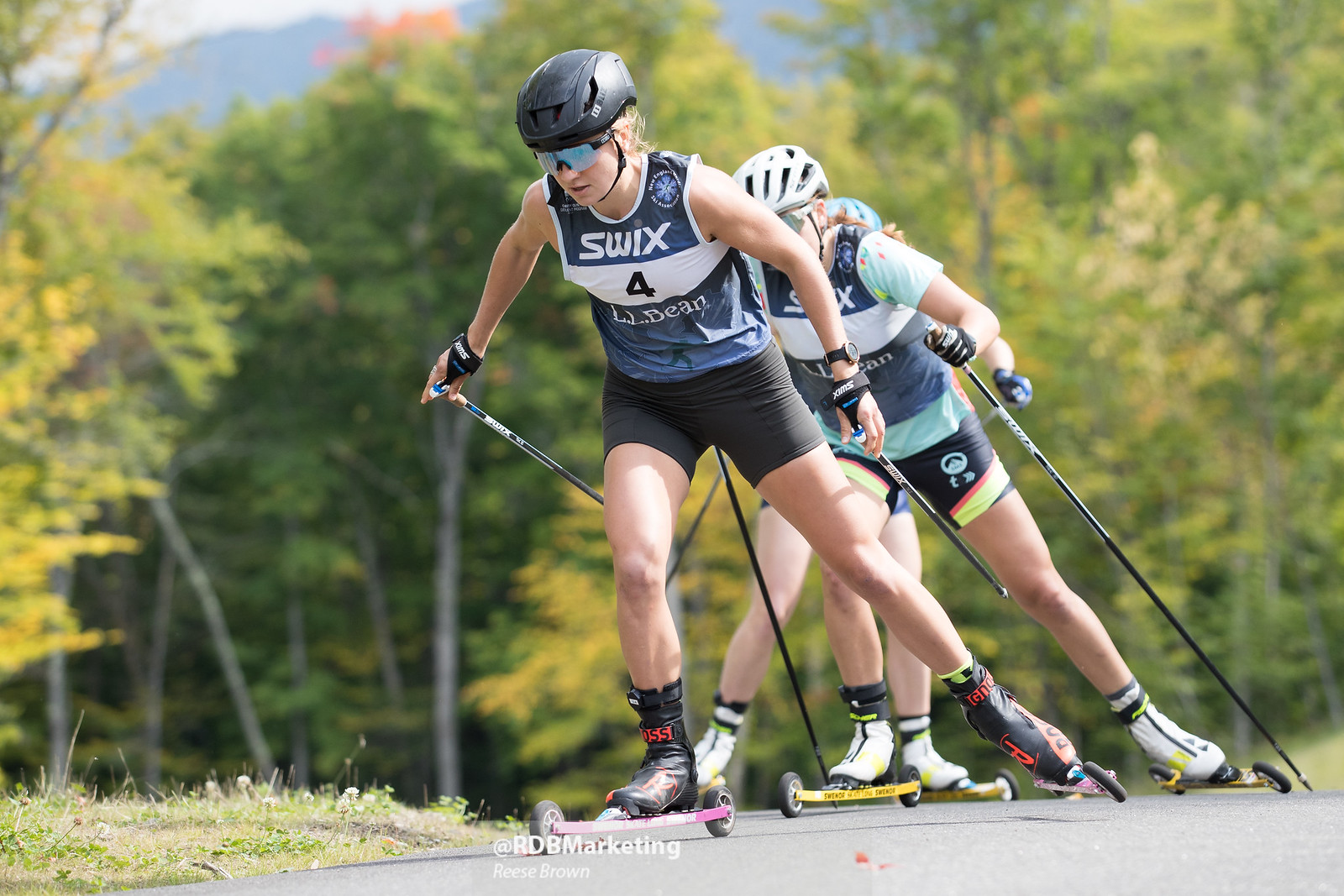
Katharine Ogden racing the App Gap rollerski race with SMS T2 teammate Evelina Sutro. (Photo: Reese Brown – xcski.org)
Recognizing this, Ogden started graduate school online in September (2021) through the Columbia School of Social Work. Having committed to these studies, Ogden would soon have to make another decision, given that part of the program requires a practical, internship component. “At the end of the winter, I had to decide if I would not be ski racing next winter so that I could do my practical, and I had pushed that off for a year, so that I could just do the online classes and some ski racing.” With this knowledge, Ogden entered the 2021/2022 season with an open mind, asking herself the questions, “is this sustainable? Is it something I want to do for longer? In which case I will apply for a leave of absence from school? Or is it something that I’m not really that excited about anymore and I will instead start the process of getting myself placed for that internship?”
An added boon to keep racing this season was the fact that it was an Olympic year. In the end, Ogden was not named to the 2022 Olympic team but she was quick to make it clear that this did not factor into her decision to retire at the end of the season. “I wanted to put my best foot forward, to see if I could qualify for the Olympics. Which obviously, I didn’t. But I would like to clarify that was not why I wanted to stop… I was thinking about it before that.”
Katharine Odgen after finishing 20th in Stage 5 of the 2021 Tour de Ski. (Photo: NordicFocus)
That being said, Ogden shared candidly that it was difficult not to make the team. “[I] can’t understate the fact that it was really hard emotionally to not qualify, to put that much effort and training and goals and everything into trying, and then fall short. That was definitely hard, emotionally.” But putting on a positive spin, Ogden noted, “I got really lucky, because when I was home, instead of going to the Olympics, I was in Vermont and I love it in Vermont.”
Taking a bit of a mid-season break, Ogden lifted a little pressure off herself for training and skied for enjoyment, rather than in pursuit of a goal. She also did some volunteer coaching for the local ski club, Ford Sayre Nordic. “I really loved doing that, and it got me really excited about that aspect of the ski world,” explained Ogden. “During that month of the Olympics, I was kind of sad from not qualifying but also kind of happy because I got to do this stuff where I was hanging out with kids and going skiing with different people, and skiing for fun and going to the eastern SuperTours… I sort of forgot how much it’s like a blast. The eastern ski community is pretty cool.”
Through these various outlets, Ogden was coming to a realization. “Showing up to a race where I knew so many people there and a community where I felt really valued for myself and not for how I ended up doing in the races, or that type of thing – it was just really amazing to see people and re-engage with that community in a way that reminded me that I’m a part of it because of who I am, and not because of any results I had.” The weeks that she spent in New England showed Ogden a path to fulfillment and engagement with the ski community outside of competitive racing, “I think over those few weeks, when I was home and racing in the east and really enjoying that, I started being ready to be done with skiing, in part because I was like, I’m really happy right now,” she explained.
Katharine Ogden celebrates a victory and fourth place finish at NCAA’s in Stowe, VT 2019. (Photo: DWST)
For someone whose life and identity has been so integrally tied to ski racing, making the decision to step away can be a frightening prospect. “Part of me was scared of losing the ski community,” reflected Ogden, “It’s been such a huge part of my life that I was really scared of not having it anymore, and part of that experience reminded me that I’m not going to lose it. It’s not ever going to be something that goes away, I’m going to be a part of this community and with these people forever. I think it hadn’t really occurred to me that that was the case. I’d never been a part of the ski community as anything other than an athlete.”
With this decision “figured out,” Ogden was ready to return to the World Cup season to get some closure and to go race for fun. She rejoined the US team abroad in Lahti, Finland and was able to race the legendary Holmenkollen 30 k event where she finished 37th, before a positive COVID test took her out of contention. “So I didn’t end up actually doing my last World Cups,” laughed Ogden, “But I still had a great time being quarantined with Hailey [Swirbul] (who also tested positive). We were kind of suffering, but once we were feeling a little better we got to explore Oslo. And Hailey is one of my best friends and a really important part of my ski career, so it was kind of fun, honestly, [to have] a little impromptu vacation with just Hailey at the end of the season.”
Katharine Ogden (left) and Caitlin Patterson (right) take to the course at the start of the women’s 30 k classic at the Holmenkollen, 2022. (Photo: NordicFocus)
Wanting to close out her career with her SMS T2 teammates, Ogden traveled to Whistler, BC for the combined Canadian Nationals/Super Tour Finals event once she was no longer contagious. Unfortunately, an untimely ear infection meant that she spent most of the week watching Netflix and taking antibiotics. “By the end of the week, [I] was finally able to rally for some races, where I truly had no expectations. I had literally not trained in the past month and still kind of had an ear infection and a cough from COVID, so not thriving, but it was pretty fun. It was nice to be able to celebrate the end of my career with my Stratton teammates who’ve been there, especially Julia [Kern] and Jessie [Diggins], since day one. So I was lucky to be able to do that, even though they were not the most enjoyable races of my life, per se,” she concluded.
Asked to reflect on her career highlights, Ogden mentioned the World Junior performances in Soldier Hollow, but added quickly, “I don’t like that to be my career highlight because I was not happy then. But I would say the 2019/2020 Tour de Ski was one of the real highs of my career. That was something that was a hard thing to do and I was really excited that I’d accomplished it.”
She also noted her first World Cup starts during the 2016 Canadian Ski Tour when she was a senior in high school were a high point. “I think it was an eight-stage tour, and the first World Cup I’d ever done, and that was really gratifying and exciting. Putting on my World Cup bib for the first time was a moment that I will not forget. I got to give my dad a hug on the side of the course when I was warming up, and he was crying. Very cute,” smiled Ogden.
Katharine Ogden crests a hill during the women’s 10 k freestyle at Stage 7 of the 2016 Ski Tour Canada in Canmore, Alberta. (Photo: Fischer/NordicFocus)
Her collegiate races were another notable experience for Ogden, “Almost all the races I did for Dartmouth were really up there,” she said, “but going to NCAA my freshman year was a pretty incredible experience. I had never really had the experience of racing on a team until college. I absolutely loved being able to go into races and know that my result was going towards something bigger and that I was working with a bunch of people to accomplish a goal.”
Offering advice to the next generation, Ogden said “my advice to younger skiers would be to make sure you’re thinking about what makes skiing fun and making sure you prioritize that the whole time. And also, not trying to be just a skier — trying to focus on everything that makes you a complete person, because if you focus on being 100% skier, sometimes it can make this game a little harder.”
Though she is stepping away from competitive racing, Ogden fully intends to remain involved in the ski community. She applied to be on the NENSA board and says, “I’m going to really throw myself into this community, but in a way that’s a little bit more sustainable for me and feels more fulfilling and exciting.” She is continuing to work her way towards a master’s degree in social work, in the specific track of clinical social work with a focus on working with children and families. The current plan is to start her internship for the program in September and eventually graduate in the spring of 2024. “After that I hope to get a job, but as to what job, I’m not sure!” Ogden said, “Hopefully by that point I will have more clarity on that.”
Katharine Ogden celebrates her last professional ski race with 45 k and a tutu. (Photo: Joern Rohde / www.joernrohde.com)
“You need some Gordie Howe elbows out there today” said the commentator on the live feed at one point during Friday’s Team Sprint in Whistler.
You know, just in case you needed a reminder that this is Canadian Nationals.
Alongside his legacy as one of hockey’s greatest players of all time, leaving his mark on the sport as an indomitable force with both his goal scoring and dynamism on the ice, Howe was known as an — ahem — impassioned athlete. One achieves a “Gordie Howe hat trick” by scoring a goal, making an assist, and engaging in a fight within one game. In short, he was a bit of a wild card, and he wasn’t going to let someone else stand in his way en route to the net.
In watching the Team Sprint livestream, you can see why a similar need to protect one’s space was relevant. The wet and variable spring weather in Whistler created a tricky mix of fast, wet, and mushy snow conditions that combined with fast mass start sprinting to produce racing that tested a skiers balance and “feel” as much as their lungs and muscles. Or more succinctly, racing that was fun, and a little bit chaotic. Staying upright and not losing your own footing or being taken out by another skier might be more important than technique or tactics.
Andy Newell (BSF Pro – Coach), Julia Kern (SMS T2), and Cendrine Browne (Fondeurs-Laurentides) chat on the warm up before the freestyle team sprint. (Photo: Doug Stephen / VR 45 Photography)
Adding another layer to the challenge, the Team Sprint was raced “Dresden-style”, where two partners took turns on a 750 m lap until the pair of them had completed eight total laps. The Nordic skiing equivalent of a short-track skating relay, and with the same flow to the action.
Early attacks could fizzle out through all or any of factors like a bad transition, fatigue, or a tangle up with another skier. All those factors had the equal and opposite effect as well; no team was truly out of it until they crossed the finish line. A late surge between two teammates could pull together a race, and often did when the fields of 15 teams were unleashed on the course today.
The 750 m course was an abbreviated version of the sprint course seen on Wednesday. Each lap left the stadium and shot up a steep but short climb which lengthened into a false flat where the mushy snow on course saw some skiers muscle out a V2 while others kept to a light-footed hop-skate. Then skiers shot down a sweeping downhill where the course widened to allow for two different lines, before doing a long left turn into the finishing straight.
Every skier completed an individual lap of this course in the morning, which when combined with their team partner, yielded a seeding time. With no semi-final, the top 15 fastest combined teams qualified for the Open A finals.
The women’s team sprint podium saw a win for SMS T2, with Yukon Team 7, University of Utah 1, Craftsbury Green Racing Project, and University of Utah 2 rounding out the top five. (Photo: Joern Rohde / Nordiq Canada)
Open Women’s
In the women’s qualifier, Julia Kern (SMS T2) completed the course in the fastest time, 1:21.70. That combined with 8th place Alayna Sonneysn (+3.45 seconds) to give their SMS T2 team the top seed for the women’s A final (combined time 2:46.85). Second seed (combined, +3.73) was earned by Nakkerertok 32’s Hannah Shields (7th, +3.12) and Zoё Williams (13th, +4.01), with third seed (combined, +4.12) going to the University Utah I team of Karianne Dengerud (2nd, +2.34) and Sydney Palmer-Leger (23rd, +5.23).
When the top-15 teams started in the A final, Alayna Sonneysn shot off the front for SMS T2, which stretched the field out immediately and may have helped avoid the pile ups that had been a feature of the Challengers and College Cup heats earlier in the day. Sonneysn was covered by Yukon Team 7 (Whitehorse), with Sonjaa Schmidt catching Sonnesyn as they rounded the corner into the first exchange. Schmidt also pulled back the entire group, and so the racing was extremely tight as they handed off to their teammates. SMS T2 and the Yukon Team continued to push the pace at the front, with the University of Utah I (UU I, Palmer-Leger and Dengerud) and University of Utah II (UU II, Novie McCabe and Julia Richter) teams bridging the gap to form a four-team group leading the race.
Team SMS T2, Julia Kern and Alayna Sonnesyn, after taking the win in the SuperTour Team Sprint in Whistler, BC on Friday. (Photo: Nordiq Canada / Nathaniel Mah).
From there, as the teams swapped partners through laps three, four, five, and six, a strategy of attrition started to emerge from the SMS T2 team of Kern and Sonnesyn. At each exchange, they jumped off the handoff, hopped up the hill, and continuously pushed the pace. Their gap slowly opened at the front, until, like looking up after being taken by a riptide, the mass of racing behind them was unexpectedly distant. By Sonnesyn’s final trip around the course at lap seven, their win was all but secured.
Sonnesyn said that the goal from SMS T2 was to remain consistent throughout the race, saying in an interview with Nordiq Canada that “I just wanted to be patient. I was a little surprised at the pace we went out [in] because I knew four laps on this course was going to catch up to us quick, but I kept telling myself ‘be patient, go the same pace.”
In the push for the overall podium behind, a new player had entered the scene. On lap five, Craftsbury’s Caitlin Patterson pushed across the gap to the UU I, UU II, and Team Yukon group. On lap six, her partner Alexandra Lawson held there. As the scrambling partners went out for their final lap on lap seven, UU I and UU II had formed a gap, but when the skiers handed off for the final exchange, a four-team pack came back together with UU I, UU II, Team Yukon, and Craftsbury I.
Then, it split once again.
Team Yukon’s Dahria Beatty came off the downhill on course wide to try and take an inside line into the final turn. UU I’s Karianne Dengerud took the downhill corner more inside, and tried to beat Beatty to the inside on the final turn. In the end, Beatty won, and then closed in the final stretch to take Team Yukon (Schmidt & Beatty) to second place (+11.99) behind the first place SMS T2 (12:22.16). UU I (Palmer-Leger & Dengerud) took third (+12.78).
The Yukon Team 7 duo of Dahria Beatty and Sonjaa Schmidt were second overall in the women’s team sprint, taking home the Canadian national title. (Photo: Nordiq Canada / Nathaniel Mah)
The resounding win for the pairing of Kern and Sonneysn punctuated a tremendous week for Stratton Mountain School, and in particular for Kern. Apart from a second place behind teammate Jessie Diggins (SMS T2) in the 10 k skate on Monday, she has won every race at these SuperTour finals, despite tricky and variable conditions.
Team Yukon’s (Whitehorse) second place overall gives the pairing of Dahria Beatty and Sonjaa Schmidt top Canadian honors, adding to Beatty’s accumulation of National Championships this week.
Open Men
The men’s top individual qualifier was Logan Diekmann (BSF), with a time of 1:12.83, who combined with his BSF Pro I teammate Finn O’Connell (51st, +5.93) to take 5th seed (+4.44). They ran behind the top seeded (2:27.15) University of Utah I (UU I) pairing of Noel Keefe (4th, +0.67) and Luke Jager (5th, +0.82). Second seed (+2.42) went to the SMS T2 team of Finegan Bailey (6th, +1.01) and Bill Harmeyer (14th, +2.91), and third seed went to the Team Brew-ski Canmore (+3.43) pair of Russell Kennedy (3rd, +0.57) and Reed Godfrey (27th, +4.35).
Xavier McKeever (Foothills Nordic) works with teammate Tom Stephen to win the Canadian National Title in the team sprint. (Photo: Doug Stephen / VR 45 Photography)
With qualifying times extremely tight across the board, the A final promised to stay close throughout the whole 8 laps.
Noel Keefe mirrored Alayna Sonnesyn’s move from the women’s final, looking to get ahead of any tangles by pushing the pace from the start for UU I. Once the field was out of the stadium, Keefe tucked in behind Orford’s Leo Granbois, and Orford and UU I went into the first exchange with a slight gap.
Keefe handed off to Luke Jager, who looked relaxed as he allowed the field to come back together again. Animating the move that closed the gap was Northern Michigan University (NMU) skier Kristoffer Karsrud, who alongside his partner Kjetil Bånerud ducked and weaved at the front of the pack throughout the duration of the race.
On the 5th lap, another UU team, UU II, moved to the front of the pack, as Brian Bushey put in a surge. When Bushey and Keefe handed off to Bjørn Riksåsen and Jager, the race looked like it may turn into a UU team practice for the last couple of laps. That was, until Scott Patterson flew in from Alaska Pacific University (APU) in his last time around the course on lap seven. Following Patterson’s move was Bånerud from NMU, and as the four team pack of UU I, UU II, APU, and NMU went into the final exchange, it became clear; the Team Sprint would well and truly live up to the sprint moniker.
Jager for UU I came out of the exchange with a slight advantage over the field. APU’s Logan Hanneman countered that by exploding up the climb leaving the stadium. Jager used the downhill to catch Hanneman, with Rikssasen (UU II) and Karsrud (NMU) in tow. Jager, the youngest of the bunch but with plenty of sprint experience, got the inside edge into the final turn. He exploded off of that corner into the final stretch, lifting a ski and two poles as he came across the line to take the win for UU I (11:15.32).
Luke Jager closes for the University of Utah 1 team, taking the win alongside teammate Noel Keeffe. (Photo: Doug Stephen / VR 45 Photography)
Hanneman finished in second (+1.39) for APU, and the NMU team finished third with Karsrud crossing the line (+1.45) right behind.
Outside of the mix for most of the race, the Foothills I team of Xavier McKeever and Tom Stephen deftly moved through the pack to come in fifth overall and claim the Canadian title on the day.
The University of Utah pairing of Jager and Keefe were especially happy to win this edition of the Team Relays, saying to Nordiq Canada that “It’s a mix-up [in these relays]. Since the race got canceled at SuperTour finals two years ago, we had this race in our scopes. The qualifier went well, we had good skis, and the race turned out great.”
University of Utah’s Noel Keefe and Luke Jager took the SuperTour and overall win in the team sprint, with APU’s Scott Patterson and Logan Hanneman in second. (Photo: Joern Rohde / Nordiq Canada)
SuperTour racing continued on Friday in Craftsbury, Vermont, as part of the Henchey Memorial Carnival, which also included Eastern Cup and collegiate racing. The three-day event is presented by the Craftsbury Outdoor Center, NENSA, U.S. Ski & Snowboard, and the University of Vermont (UVM), the EISA carnival host school.
Racers were faced with snowy conditions for the opening 1.4-kilometer freestyle sprint as a winter storm made its way across the Northeast. Friday morning’s grooming report mentioned 6 inches of fresh snow, as more continued to fall throughout the morning.
On the women’s side, last weekend’s 10k freestyle winner, Alayna Sonnesyn (SMS T2), won the qualifier in 3:58.27, ahead of BSF Pro Team’s Lauren Jortberg in second and APU’s Rosie Frankowski in third. Perhaps a nod to the wintery conditions, these top three finishers were separated by over six seconds.
Sonnesyn advanced from the first heat of the quarterfinals into the semis, where she finished third in the first heat behind Katharine Ogden (SMS T2) and Ava Thurston (Mansfield Nordic Club), who crossed the line together, roughly 0.4 seconds ahead of Sonnesyn. As the second semi, which was won by Jortberg, was roughly four seconds faster on average, Sonnesyn did not earn a lucky loser spot in the final. Instead, Jortberg advanced with Anna Bizyukova of UVM, Frankowski, and Craftsbury’s own Margie Freed.
Despite the trend seen in the qualifier, the final featured tight racing, with the top five athletes finishing within two seconds of one another. Just 0.6 seconds separated second from fifth.
A scene from the women’s final of the 1.4k freestyle sprint in Craftsbury. (Photo: Instagram @nensa_nordic)
Coming out on top was Ogden, who won the final in 3:59.08. After racing on the World Cup from the opening races in Ruka through the midway point of the Tour de Ski, Ogden has gone three-for-three in SuperTour sprints since returning stateside, winning classic sprints in Soldier Hollow and Lake Placid before checking off a skate win today.
Just behind, Jortberg took second place (+1.30) with U18 athlete Thurston closing in third (+1.78). Bizyukova was next to the line in fourth (+1.86), with Frankowski less than a meter behind in fifth (+1.91). Freed rounded out the women’s final in sixth (+4.51).
“I think that the biggest thing to note about today was that it was blizzarding!” wrote Ogden in a post-race email. “The heavy falling snow made the heat racing very tactical and rewarded being very quick off of the line. There was one lane on the course that was packed down by traffic and the other areas were pretty soft!”
Ogden was just 11 points behind Caitlin Patterson on the Olympic qualification distance list, based on the athletes’ best two distance races on the SuperTour or at the U.S. Cross Country Championships, during which Ogden competed in only one race – the 10k individual start classic where she was second to Patterson. The following weekend in Sun Valley, she was second in one distance race and fourth in the other, behind three Olympians and ahead of Patterson in each. As the races at U.S. Nationals were scored at a higher point value, Patterson took the final Olympic spot, leaving Ogden on the wrong side of the cusp.
Nevertheless, Ogden has found silver linings in the additional time back east.
“It was a blast to be able to race with the EISA. I miss skiing for Dartmouth (Ogden graduated in 2021), so it was fun getting to ski with some of my old teammates and some new Dartmouth skiers. It was also pretty great to ski in lots of natural snow, we rarely get a snowstorm this big anymore and it was undeniably very fun.”
The women’s podium after the opening freestyle sprint race which kicked off a weekend of SuperTour, Eastern Cup, and EISA racing. (Photo: APU Nordic Ski Center / Instagram)
As Thurston is, remarkably, still in high school, Bizyukova was the top collegiate racer to earn today’s EISA sprint title. The second and third placed collegiate racers both hailed from Dartmouth College, with Callie Young finishing fifth in the first semifinal and 10th overall, and Jasmine Drolet taking sixth in the second semi for 11th overall.
The men of the Sun Valley Ski Education Foundation (SVSEF) Gold Team swept the top-three spots in the men’s qualifier, with Karl Schulz leading the way in 3:23.48. Peter Holmes was 0.33 behind in second, with Johnny Hagenbuch in third (+1.21).
Schulz carried momentum from the qualifier win into the first quarterfinal, which he won by half a second, but his day ended soon after in the semifinal. Racing in a fast first heat that contained two eventual podium winners and found both lucky losers, Schulz was fifth in the heat, +1.72 behind winner Matias Øvrum of UVM. Sam Wood (SVSEF) was second in the heat, ahead of last weekend’s sprint winner Zak Ketterson (Team Birkie) and Gregory Burt (UVM).
In the second semi, which was nearly three seconds slower, Canada’s Étienne Hébert (CNEPH) edged out Holmes by 0.1 seconds to go 1-2 and advance to the final round.
Zak Ketterson leads up the final climb in the men’s freestyle sprint final in Craftsbury. (Photo courtesy Zak Ketterson)
The top two spots in the final were decided by a close finish between Ketterson and Øvrum, with Ketterson crossing 0.28 ahead in a time of 3:22.57 to earn his third SuperTour sprint title of the season. Øvrum was second, though he was named the collegiate race winner for UVM, with Hébert crossing the line a few meters behind on his own in third (+2.17).
“I’ve always really liked racing at Craftsbury,” Ketterson wrote to FasterSkier after the race. “It’s an awesome place and this year Team Birkie has been lucky enough to stay right at the Outdoor Center. The race course is right out our back door!”
Ketterson also provided insights to the final round for those following from afar.
“The final was really close! I gave it everything I had at the top of the last hill but I definitely started to get tired and bogged down a bit into the finish. Matias skied a smart race and gave me a really good challenge in the last few meters but luckily I was able to fend him off. It was a tricky day with super soft fresh snow and I’m happy I was able to execute.”
Zak Ketterson races a snowy freestyle sprint qualifier in Craftsbury. (Photo courtesy Zak Ketterson)
Wood was fourth in the men’s final (+6.9), with Burt fifth (+7.17), and Holmes sixth (+10.82).
The men’s freestyle sprint podium after the opening day of SuperTour racing in Craftsbury. (Photo: Instagram @nensa_nordic)
As mentioned, Øvrum was the top collegiate racer, with Burt second, going one–two for UVM. Third place among college athletes was Allan Luke of Dartmouth, who finished sixth in the first semifinal and 12th overall.
Craftsbury’s Day 1 coverage of the the 2022 Henchey Memorial Carnival: SuperTour, NENSA Eastern Cup and UVM EISA carnival.
After a brief break, the SuperTour picked up in Lake Placid this weekend, with a fluoro-free Period III kicking off with a 1.5-kilometer classic sprint. The frigid forecast called for overnight lows of -5 Fahrenheit, with a wind chill as low as -23F. Highs during the day were only predicted to climb into the low single digits. Qualifiers were scheduled for 10/10:45 am, with quarterfinals for the open men beginning at noon – hopefully, enough time for a few degrees of warmth to reach the trails.
The weekend competitions would be hosted on Mt. Van Hoevenberg’s new World Cup trails, which are paved for rollerski use in the summer, and played host to NENSA’s “Keys to the Castle” sprint event in September. For those familiar with the venue, the new courses are tucked into the north-facing hillside, just south of the 1980 Olympic stadium and biathlon range. The new serpentine loop intersects with the final Ks of the classic “Ladies 5” outer loop, but overall remains closer to the stadium to allow access to the recently improved snowmaking system.
Jessie Diggins (SMS T2/USST) pushes over the climb during the final round of the Keys to the Castle sprint. (Photo: Matt Whitcomb)
With a large reservoir and advanced technology, this new World Cup loop can be made winter competition ready within four days, though Van Hoevenberg’s nearly 50k of open trail might suggest that coverage is not currently an issue.
There was praise for the course from many athletes, including those that have seen both Lake Placid, and everywhere in the world beyond Lake Placid.
“It raced much more like a world cup course!” said Alayna Sonnesyn (SMS), in an email to FasterSkier. Katharine Ogden (SMS) too, said of the course, “it was WAY more fun than the old one…[which] was pretty flat.”
The course designers at Lake Placid seem to have carefully been taking notes on what makes sprint racing exciting over the course of its evolution as a discipline in the sport. An historic venue for American skiing, these developments may be a long-time coming for Mt. Van Hoevenberg, but it’s clear that they were executed with mastery so VanHo can continue to expand upon its legacy in the decades to come.
This course featured a long, final uphill climb to test a skier’s mettle, then a short, technical downhill into the finish to test their tactical brains. And in between; transitions, transitions, and more transitions.
Becca Rorabaugh (APU) said of this : “The final climb always turned into a drag race, and I liked the pitch because it favored a bit of a stride over an all-out run. Skiers still had to be alert through the downhill and finish, though; positions often changed in the stadium.”
The weekend, hosted by the Olympic Regional Development Authority (ORDA) in Lake Placid, also served as the second NENSA Eastern Cup weekend. Thus, senior athletes from American elite clubs lined up alongside regional junior racers, eastern collegiate racers, and Canadian athletes who traveled from Quebec, Ontario, and beyond. 382 athletes, 176 women and 206 men, on the start lists for the qualifier, and separate heats were run for the U18/U20 and U16 categories.
Without livestream, FasterSkier has relied on live timing and athlete interviews to shed light on how the sprint races unfolded.
Men’s 1.5-kilometer Classic Sprint
After returning from a stint in Europe where he raced the Tour de Ski, Team Birkie’s Zak Ketterson set the mark in the men’s qualifier, stopping the clock at 3:04.79. Sun Valley’s Peter Holmes skied the next fastest time in qualification (+0.72), while Étienne Hébert was just behind in third (+1.41). Hébert hails from Quebec and currently trains at the Centre National d’Entraînement Pierre-Harvey (CNEPH), based at Mont Ste Anne.
Each of these men moved smoothly through the rounds, with Ketterson getting edged out by Bill Harmeyer (SMS T2) in the first semi, and Homes and Hébert going 1-2 in the second. Racing in the second semi saw a tighter spread and faster times, bringing Julien Locke (Black Jack Ski Club) and Logan Diekmann (BSF Pro) who had finished a close third and fourth, respectively, along to the final as lucky losers.
The final featured a tight finish among the top four men, with Ketterson off the front to finish in 3:04.71, earning his second consecutive classic sprint victory. Ketterson had dominated the classic sprint in Cable, WI, and stood at the top of the SuperTour leaderboard, thereby earning start spots for the Tour de Ski. The timing of the Tour caused him to miss the subsequent classic sprint in Soldier Hollow, UT.
During the Tour, his first World Cup starts, Ketterson was less than a second shy of qualifying for the classic sprint heats in Oberstdorf, Germany, and had been roughly five second out of the Top-30 the day prior in a 15k skate. He was the only American on the men’s team to finish the Tour. After the Tour, Ketterson made a quick turnaround to attend the weekend of distance racing in Sun Valley, Idaho, where his results (15th in the 15k classic and 34th in the 10k free) were far below what might be expected from him.
Zak Ketterson races the freestyle sprint qualifier in Lenzerheide, SUI, the first event of the 2021/22 Tour de Ski. (Photo: NordicFocus)
In a post-race email to FasterSkier, Ketterson shared how he felt about the Tour and what the recovery process has been like for him.
“The Tour de Ski was a fantastic learning experience with lots of ups and downs. I am pretty happy with my performance on the Tour given it was my first time on the World Cup, but I definitely think I will be faster next time around now that I have had the experience. Post Tour I was incredibly empty, both physically and mentally. To have to change gears pretty much immediately after the last stage of the Tour and head straight to Sun Valley for some super competitive SuperTour races at high altitude was definitely a recipe for disaster on my body. I felt like I was just going through the motions and my body wanted nothing to do with those races.
“These last few weeks at home in Minneapolis provided me with some long-overdue recovery. My hunch after some really lackluster racing in Sun Valley was that there was no need to overthink anything and that the issue was probably just that I was tired. I took time at home to mentally and physically reset and started to feel a lot more like myself as the Placid races approached. Today, it all came together and I felt a lot more race-ready.”
Ketterson also commented on the improvements that have been made at the Mt Van Hoevenberg venue, explaining how it supports the growth and elevation of domestic skiing.
“I am blown away with the venue at Mt. Van Hoevenberg! The venue truly feels like it’s ready for World Cups, or even another Olympics. It’s really inspiring to see big investments into nordic skiing venues in the United States, and I can’t stress enough how big it is for us athletes. I can’t wait to come back to Lake Placid sometime later to really experience this place because I think it’s so awesome here.”
Behind Ketterson, just 0.26 seconds separated second through fourth in the men’s final. Holmes won the boot slide to snag second (+0.72), while Harmeyer took the final podium spot in third (+0.92). Hébert was just 0.06 seconds shy of the podium, ending the day in fourth (+0.98).
Harmeyer provided insights into his approach to the day, along with insights into the moves that contributed to the excitement at the finish line.
“I felt really good in the heats today,” he wrote via email. “The course was certainly difficult and tactical. Placement in the group was really important and that was especially apparent in the final. We had a group of four dudes going over the top of the final climb into the long descent before the finish. It was an absolute scramble trying to get into the tracks on that final downhill. At one point, I had my left ski in the right part of the track and Étienne had his right ski in the left side of the track. Not easy to squeeze two guys going 30+ mph into a single track but somehow, I came out ahead which was just enough to lunge at the finish for third.”
During Period I, Harmeyer took third in the classic sprint final in Cable, and was just off the podium in fourth the weekend prior after the freestyle sprint in Duluth, MN. After qualifying in fifth, a crash in the quarterfinal left him 24th in the freestyle sprint in Soldier Hollow during the U.S. Cross Country Championships. A few days later, he was 51st in the 15k classic. In the Soldier Hollow SuperTour classic sprint, Harmeyer qualified in fourth, and just missed the final to end his day in eighth.
Reflecting on the season as a whole, Harmeyer wrote, “I had a really good start to the season with some strong races in the Midwest. But overall, things have been frustrating. I’ve been struggling with some cold weather triggered exercise induced asthma that got really bad after the first supertours in the Midwest. I continued to struggle with it through a disappointing Senior nationals and decided to take a bit of time off to reset, recover and do some testing. I’m hopeful the worst is behind me and that I’ve got some good protocols lined up to prevent anything from happening in the future. My primary goal for the remainder of the season is to win the Stowe Derby, specifically the derby meister.”
Wrapping up with a comment on the venue, Harmeyer added, “The new courses at Lake Placid are sweet! The sprint course is incredibly tactical but also rewards tough, explosive skiing. I had an absolute blast out there in the heats. The distance courses are hard but I’m excited to be doing a mass start on those for this Sunday. Overall, Van Ho has done a great job with course management and their snowmaking to put together some killer courses.”
After a gap, Diekmann crossed the line in fifth (+5.81), while Locke rounded out the men’s final in sixth (+9.11).
The women’s field began right where it left off in SuperTour classic sprints, with the winner of the last race at Soldier Hollow, Katharine Ogden, (SMS) finishing the qualifier in first place (3:40.49). She was followed by Lauren Jortberg (BSF Pro Team) in second (+2.2), and Ava Thurston (Mansfield Nordic Club) in third (+6.1). The qualifier indicated, again, the overall strength of the field that has characterized this year’s SuperTour, with the heat qualifiers all within 30-seconds of each other (26.0 seconds to be exact).
That field remained tight in the quarterfinals as well. All five quarterfinals saw winning times within a mere five seconds of one other, with Katharine Ogden turning in the fastest time of the round at 3:42.77, and Alayna Sonnesyn winning her heat in 3:46.12.
Ogden commented to FasterSkier that she “didn’t really have any strategy in particular. I find that it is better for me to make strategy in the moment during sprint heats because you never know what’s going to happen out there… I just tried to conserve as much energy as possible in the quarter and semi.” It would pay off later on.
Meanwhile, also progressing to the semifinals was the APU one-two punch of Rosie Frankowski and Becca Rorabaugh out of quarterfinal 2. Despite being primarily known as a distance racer, Frankowski, came into today leading the SuperTour sprint classification and “set a blistering pace,” according to teammate Rorabaugh. With it, she pulled the duo into the semifinals together.
After all the quarterfinals were through, the semifinals were set with a who’s-who at the top of the SuperTour sprint standings, rounded out by Canadian Katie Weaver (Hollyburn XC Ski Club) and Minnesotan Margie Freed (Craftsbury).
The first semifinal featured a battle between two SMS T2 teammates, Katharine Ogden and Alayna Sonnesyn, and two APU teammates, Rosie Frankowski and Becca Rorabaugh. Frankowski again set the pace for the heat, with teammate Rorabaugh commenting that “[Rosie] is so strong on the uphills that she pulls the whole heat to a faster time.” Frankowski, however, couldn’t quite outlast Ogden and Sonnesyn, who used the downhill after the final climb to launch into the first two positions. Ogden won the heat in a time of 3:39.23, with Sonnesyn and Frankowski in second and third, respectively, by less than a second. Rorabaugh finished fourth, but along with Frankowski won the lucky loser spots into the finals – setting up another round of the SMS-APU duel.
In the other semifinal, a close battle throughout yielded a win for Lauren Jortberg (3:45.15) and a second place for Erika Flowers (+0.90). The result sent another teammate pairing into the finals, with both skiers coming from Bridger Ski Foundation (BSF).
At Lake Placid – a place that has over the past century proved to be able to gather the entire world around skiing – it was perhaps appropriate that the women’s final would bring together three teams from across the American continent. Two from Vermont (SMS), two from Montana, two from Alaska (APU), and away they went!
Katharine Ogden commented that the field didn’t waste any time: “It was pretty hard from the gun, as per usual.”
Rorabaugh, meanwhile, made a change in strategy, deciding to follow her teammate Frankowski more closely in the early part of the race. “I was trying to stay closer to the front of the pack since I had let a large gap form in the semifinal that I couldn’t make up,” she explained.
That adjustment was one that helped create a pack that was tight throughout the race, and that was a bit harder to find a position in.
Sonnesyn commented that this led to her having to adjust. “I had great energy but got tangled up a few times on the second hill, so I really had to ski from behind in the second half of the race,” she wrote. “Luckily, I had great skis and remained calm and was able to push through the final stretch.”
In that final stretch, on the final hill, a “drag race,” as Rorabaugh described it, ensued. It was instigated by Ogden, who saw the final climb as the place to make her move, and made it. She came over the top in first place.
“[I] got lucky,” she told FasterSkier. “Pat [O’Brien, SMS T2 head coach] had provided me with some really fast skis that allowed my move to stick going back down the hill.”
Perhaps it wasn’t all luck though. Ogden came across the finish line in first place (3:40.13) after winning the qualifier, her quarterfinal, and her semifinal. It was an all-around dominant performance for one of the U.S. brightest stars in the classic sprint.
Meanwhile, Becca Rorabaugh had powered through the transition into the final downhill and came up with the reward of second place (+3.40), She was followed by Alayna Sonnesyn, who remained cool, calm, and collected as she skied her way through the pack to third place (+4.29).
The final was rounded out by fourth place Rosie Frankowski (+4.74), fifth place Lauren Jortberg (+5.63) and sixth place Erika Flowers (+17.77).
The result was reached at the end of an exciting day that encapsulated the beauty of ski racing – with excitement and energy perfectly juxtaposed against the extreme absence of that energy in the air. Preparing for cold temperatures that are forecasted again for the 10k freestyle mass start tomorrow, the top finishers today all expressed that the temps are part of the appeal in the northeast this weekend.
From Rorabaugh, “I don’t mind cold temperatures – I grew up in Fairbanks, Alaska!”
From Sonnesyn, “I like to think the Midwesterner in me prepared well!”
And from Ogden, the perfect Vermont tip: “As Sverre [Caldwell] told us last night, tricky race conditions can work to your advantage if you prepare better than anyone else. Wise man :)”
Last year, in an effort to create a standardized workout that could be easily replicated and repeated, national team coaches presented the concept of the “U.S. Pace Project.” The concept is straightforward: a shift away from time-based intervals to distance-based, centered around repeated laps of a 5-kilometer course.
This familiar distance is key. In a call in July, Matt Whitcomb, U.S. Ski Team Head Coach, and one of the creators of the project explained that: “5k is essentially the building block of just about every race we ever do. It’s a very tangible distance that everybody knows right from childhood.”
Jessie Diggins races the Keys to the Castle Rollerski Race in Lake Placid. (Photo: Matt Whitcomb)
Whitcomb continued that while the session itself is not revolutionary, it has provided a shared pathway for clubs to explore pacing during intensity sessions. Usually athletes will complete three rounds of the same 5k course, and repeat the workout intermittently throughout the training season to track overall progress or fine-tune pacing strategy. Given the ease of implementation, clubs of all levels nationwide can adopt the concept.
“Clubs are encouraged to find a 5 kilometer stretch of rolling road, something that can replicate race terrain as best and as safely as they can,” Whitcomb explained. “If it’s on a rollerski track, that’s even better.”
As the training year progresses, so does the nature of the Pace Project. “This is a workout that is meant to build in intensity throughout the year, but also in creativity,” Whitcomb stated.
Creativity, in this context, is an ongoing experiment with pacing, fueling, technique, and effort, followed by a discussion of individual outcomes amongst the group. Essentially, the U.S. Pace Project is a personal study for athletes to find their own fastest and most efficient approach to racing.
Ian Torchia races NENSA’s Trapp Invitational Rollerski race in November, 2021. (Photo: George Forbes/SMS)
Another motive behind the project, according to Whitcomb, is to promote the sharing of insights between athletes and coaches nation-wide as they incorporate and discuss the takeaways from the Pace Project format. He explained that time-based intervals offer less concrete information to learn from, as there is more room for variation in training venue and conditions.
“[The sport] is challenged with regards to metrics,” Whitcomb said. “So this is meant to catalyze more objective feedback and learning.”
As many national team members train in Stratton, VT in the summer, SMS T2 head coach Pat O’Brien provided a look into his experience facilitating the workout with his athletes and his current takeaways.
“If you give the athletes a set distance workout, they are going to learn how to manage their energy over that distance,” O’Brien said, citing supporting research by Norwegian based Sports Science Professor Steven Seiler.
“The whole point,” O’Brien continued, “is in a training type environment, go out and play around with different [approaches]. It might not all work. It might fail. But it’s better to learn those lessons in a training environment than in a race.”
Ben Ogden (bib 13) races the Keys to the Castle Rollerski Race in Lake Placid. (Photo: Matt Whitcomb)
While a nationally shared workout is new, the project itself grew out of conversations with previous American athletes who incorporated similar workouts as a fitness benchmark.
“I think the most notable one is Kris Freeman,” O’Brien explained. “He was truly one of the best in the world at the 15k distance. He would do a repeated workout of 3x5k, and he knew if he could sustain three repeats on [a particular] 5k stretch of road, he was in good shape.”
O’Brien said that inspiration had also come from one of his mentors, Sverre Caldwell, former Nordic Director at SMS.
“Back in the early 2000s, the Stratton program had a string of successes with high schoolers going on to these great sprint results when sprinting had just started coming out,” he said. “What was interesting talking to [Caldwell] was they didn’t go out seeking to pace sprints. He wanted to make his athletes stronger and tougher, so he devised a double pole test.”
The test involved double poling up a specific hill, which happened to take high schoolers like Andy Newell about three minutes. “It was not intentional, but they got good at figuring out how to go up that hill as best they could for about three minutes, which happened to be about how long a sprint was. They didn’t go out with the intention of being great sprinters, but if you give the athletes a set distance workout, they are going to learn how to manage their energy over [that distance].”
These ideas have fused into the Pace Project. Still in its infancy, it remains an elastic concept meant to help American skiing in a number of ways. Part nationally shared workout, part personal experimentation project, part data gathering opportunity, there are many objectives at play.
“The pacing project is an idea where if we subject ourselves to all these different stimuli, we can be more flexible,” O’Brien said. “The point is, we’re always going between environments, and we’re always trying to get athletes better at finding what their red line is, so to speak.”
Bill Harmeyer and Ian Torchia lead the charge during a fall training session. (Photo: George Forbes/SMS)
O’Brien explained that coaches had been seeking a way to reap the benefits of racing without the physiological toll they require.
“How can we construct workouts that challenge you in a similar way to what you experience in a race without the same cost?” he asked rhetorically.
The Pace Project seems to be filling this gap, by offering athletes a chance to experiment with novel pacing strategies outside of a race environment.
“I don’t care if someone goes into it too hard and blows up,” said O’Brien. “We’re not looking for an objective time, It’s about how athletes pace themselves.”
O’Brien stressed that the key to the pace project lies in athletes figuring out what works best for them, both in what technique they use on specific sections of the course, and for overall pacing.
“Every athlete has a style,” he said, “a way they want to move. [It’s] not ‘you should do this because it works for you.’ I think that’s how we unlock our athletes’ best potential.”
The Pace Project has received favorable reviews from athletes and coaches beyond the SMS T2 team. The SVSEF Gold team in Sun Valley, Idaho use their 1.2k rollerski trail for pace sessions according to Head Coach Chris Mallory.
“This workout basically brings a little more focus to threshold workouts,” wrote Mallory in an email. “Athletes can play around with different pacing strategies, whether it’s starting more conservatively, using different techniques, or skiing different parts of terrain harder or easier to see what works best for them… It’s nice to have something that’s repeatable, where you can measure progress.”
Strava users who follow some of the top domestic skiers may have seen some of them completing these workouts, like this example of Gus Schumacher’s October iteration. Schumacher explained in an email the role the workout has played in his summer training this season:
“[The Pace Project] is a cool format because it allows for a lot of different strategies, similar to racing. Usually in the earlier summer we’ll use it as a way to get L3 while lapping a track with similar features to a race course. Later however, like at our camp in Park City, it was fun to use it as almost a race simulation.”
Gus Schumacher completes a 4 x 5k pace project session during a fall training camp in Soldier Hollow. (Photo: Strava)
Schumacher described one of his sessions in October: “I started the first 2 minutes hard like I would in a mass start,” he wrote. “After that I eased back to a sustainable pace, then in the last one I finished hard. This made it feel a lot like a race without the same cost (because of 3 minute rest between each interval). Breaking it up into segments also allows us to change our strategy more from lap to lap, which can help with testing new pacing strategies, especially at altitude.”
Reflecting on the outcomes for coaches, Whitcomb said that he was pleased with how the Pace Project sessions had increased the conversations between athletes.
“What we’ve observed is that there’s more interesting discussion before and after these sessions, than there is for just your standard threshold interval workouts.”
Over the summer, Whitcomb stopped by Stratton during a SMS T2 pace session and remarked on the depth, variety, and value of the subsequent conversations.
“Of the ten athletes that were there that day, there were ten different approaches to this workout, because Bill Harmeyer is setting his sights on one specific goal on that day, and Jessie Diggins on perhaps another goal, and everybody’s learning and discussing and crowdsourcing ideas effectively.”
Alayna Sonnesyn pushes the pace in a fall training session. (Photo: George Forbes/SMS)
While the value of the project lies in its idiosyncratic freedom, the aim is competitiveness.
“Hopefully,” Sun Valley’s Mallory suggested, “it helps our nation to continue to make progress in distance racing.”
Precipitation was no longer a threat for the final day of racing in Soldier Hollow on Friday, a 1.5-kilometer classic sprint offered alongside the 2022 U.S. Cross Country Championships, yet classified as SuperTour only. However, athletes still faced unseasonably warm weather as blazing sun brought temperatures into the low 50’s on course during the midday heats.
Howling wind and rippling bibs could be heard as background noise as Adam Verrier called the event on the livestream, creating extra work for the athletes who would fight through degrading course conditions throughout the heats. This extra work showed in the times on course; with the combination of freestyle technique and significantly faster course conditions, Sunday’s sprint races featured times over a minute faster on average. A similar difference was seen even between the qualifier today at 9 a.m., when temperatures were still colder and tracks firmer, and the heats which began at 12:30 p.m.
Warm temperatures, degrading tracks, and loose granular spray set the stage for a challenging classic sprint in Soldier Hollow. (Photo: Tobias Albrigtsen / @untraceableg)
“Sprint” seemed to perhaps be a misnomer, as times in the women’s heats climbed over five minutes and were well above four minutes in the men’s heats. Combined with a qualifier, this meant athletes who raced through the final saw between 16 and 20 minutes of racing, testing their endurance and fitness differently from the average sprint event.
Women’s Race: Katharine Ogden on Top from Qualifier to Final
On the heels of a second place finish in yesterday’s 15k classic, Katharine Ogden (USST/SMS T2) set the bar in the qualifier, finishing in 3:51.79.
Julia Richter (U of Utah) was the second fastest qualifier (+0.77), ahead of Lauren Jortberg (BSF Pro) in third (+1.48). Both Ogden and Jortberg won their quarterfinal to advance comfortably into the semis, however, Richter took fifth in Heat 4 and did not advance.
In the first semifinal, two Craftsbury teammates Annika Landis and Caitlin Patterson led the way in the opening climb, with Ogden and Sydney Palmer-Leger (USST/U of Utah) sitting in third and fourth a few strides behind. Descending from the high point, a third Craftsbury racer, Michaela Keller-Miller, had pulled to the front, but was quickly overtaken by Patterson and Ogden as the pack headed into the final short herringbone climb before the long descent toward the stadium. Patterson and Ogden sat in low tucks, letting their fast skis glide as long as possible before transitioning to doublepole as they headed over the bridge and into the finish.
Sydney Palmer-Leger heads out for the 10k interval start classic race during the 2022 U.S. Cross Country Championships in Soldier Hollow. (Photo: John McColgan)
Upping the power in the final 200m, Palmer-Leger accelerated to make contact with Patterson as the women crossed over the bridge, but Patterson had better glide in the quick descent from the bridge’s exit, maintaining an advantage as they headed into the final stretch. Patterson tucked in on the tails of Ogden in the left-most track to go one-two in the heat, with Palmer-Leger not quite in the fight for an automatic qualifier spot finishing 1.5 seconds behind Patterson in third.
In the second semi, Bridger Ski Foundation (BSF) Pro Team members, Lauren Jortberg and Hannah Rudd lead the charging, looking as if their skis were gliding well as they pushed the downhills, perhaps with compromised kick as both showed signs of slipping in the final punchy climb.
In the long glideout, Lauren Jortberg moved from the far left side of the course outside of the track into the second track, losing some time on Rudd who had stuck with the second track from the start. Nevertheless, both held a significant gap over the remainder of the heat as they doublepoled over the bridge and into the finish lanes. Rudd took the win in 4:55.52, roughly +0.7 seconds ahead of Jortberg in second.
A few meters behind, Craftsbury teammates Margie Freed and Alexandra Lawson raced side by side to third and fourth, and as the heat proved to be seven seconds faster on average than the first, both advanced to the final.
As the women’s final headed out of the stadium and toward the first climb, Lauren Jortberg who was the first in a train of two BSF skiers, had her ski stepped on as she was switching from doublepole to a run outside the track. This caused Jortberg to stand up, spin sideways and crash in slow motion. Rudd, who was just behind, quickly moved around Jortberg without going down, soon taking the lead charging up to top of the first climb with Patterson, Freed, and Ogden close behind.
Patterson looked strong with solid kick as she chased a slipping Rudd up and over the final long climb, but it was Ogden on fast skis who quickly moved into second on the subsequent downhill.
Over the last punchy climb the women ran. Heading into the long glideout, Ogden was off the front in the left-most track, but Rudd and Patterson remained within reach a few ski lengths behind. Descending off the bridge, the top three accordioned together, all choosing the same track with Ogden confidently leading the way to the finish. Patterson, who was in third, moved into her own lane to the right, slowly gaining ground on Rudd as they headed to the line.
Katharine Ogden leads Caitlin Patterson and Hannah Rudd to the line during the SuperTour classic sprints in Soldier Hollow. (Photo: Livestream Screenshot)
Ogden maintained her lead to stop the clock in 5:01.63, while Patterson edged out Rudd for second (+0.98) and third (+1.53), respectively. After regaining contact with the pack following her crash, Jortberg finished fourth (+6.64), with Lawson fifth (+7.11), and Freed sixth (+21.55).
“I was having a lot of fun out there today!” Ogden wrote to FasterSkier after the race. “The sprint was definitely on the long side, especially late in the day, but that did not significantly affect my strategy; I am confident in my endurance as well as my short duration power. I was really excited to have fast skis from Pat [O’Brien] and it was fun to experience the high level of sprinting in the U.S. currently. I also haven’t really done a full sprint day in a while so that was a lot of fun! It was also so impressive to see Caitlin get her fourth podium in as many races and to see Hannah Rudd have an incredible breakout performance today!”
Katharine Ogden celebrates her win in the classic sprint while Caitlin Patterson edges out Hannah Rudd for second and third. (Photo: Livestream Screenshot)
In a post-race email, Patterson reflected on her experience racing through the heats.
“My racing today went fairly well, and it was a beautiful day to be out skiing and spectating,” wrote Patterson. “The sun-warmed snow became quite wet and broken apart for the heats, and combined with the wind, it certainly made a long sprint with plenty of herringbone and some sloppy tracks. I tried not to really think about the time duration much, it was mostly about getting from start to finish, however long it would take. All of the heats required some scrappy skiing, moving around through the slush and timing the length of the tuck. Now I’m really looking forward to some recovery after a good week!”
Patterson also spoke to the week of racing in Soldier Hollow, where she finished on the podium four times in as many races, including wins in both the 10k individual classic and the skate sprint. But she was not the only person in a green suit putting together a successful week. Yesterday, she shared the distance classic podium with teammate Adam Martin. On Tuesday, Crafstbury went 3-4-5 in the 20k skate, with Lawson and Freed leading a chase group behind Frankowski and Patterson. And today, five CGRP women raced in the semis, with three advancing to the final.
“Everyone at Nationals is really feeling the fatigue, and myself and my team were no exception out there today. The race coughs are becoming quite terrible from so many days of racing at altitude, which is not the most fun to be coughing uncontrollably in this time of COVID. However, I was really proud of our whole team, with 5 women in the top 10! We have a really strong group, as evidenced by the performances in the distance races too; it came as no surprise to me that the women were awesome today, because training and doing intervals all summer and fall we’ve been neck-in-neck and pushing each other.”
The women of Craftsbury with coach Pepa Miloucheva. CGRP put five women into the semifinal and three into the final of the SuperTour classic sprint in Soldier Hollow. (Photo: Facebook Crafsbury Green Racing Project)
For Rudd, this was her first career SuperTour podium. Originally from Plymouth, MN, she graduated from University of Alaska Anchorage (UAA) in May, 2020 before heading to Bozeman to join the newly minted BSF Pro Team. Placing in the top-10 in each of the three stages of the 2022 U.S. Cross Country Championships, Rudd has steadily worked her way up the results list, finishing 10th in Sunday’s freestyle sprint, 8th in the 20k mass start free, and 6th in the 10k interval start classic. She ends her week in Soldier Hollow on a podium high note.
Hannah Rudd is a member of the BSF Pro Team based in Bozeman, MT. (Photo: bridgerskifoundation.org)
“Yesterday was a pretty exciting day for me!,” Rudd wrote to FasterSkier after the race. “The sprint course at Soldier Hollow this year was very challenging as it included three solid climbs. During the qualifier, the course remained very firm and fast. However, the temperature quickly began to rise throughout the day, and by the time the quarterfinals began, the sun was baking the course, the wind was blowing, and temps were nearing 50 degrees. This made the snow begin to transform and slow down and turned the tracks into mashed potatoes in some sections.
“I woke up in the morning feeling quite tired from the past week of racing so I was not sure how the day was going to play out,” Rudd continued. “I ended up qualifying in 22nd, so it was clear that I had some work to do in the heats. I felt like I was able to gain momentum and energy throughout the day, and progressed through the quarters, and semis and onto the final. Going into the final, I knew that my team’s skis were running really well so I tried to ski big and relaxed and put myself in a good position for the last downhill. It was pretty neat to be in a final with my BSF teammate Lauren Jortberg, who is an incredible sprinter and someone that I have learned a lot about sprint racing from over the past few years. I was extremely excited to land myself a spot on the podium and think it will help me to continue building momentum and confidence for the rest of the season!”
The podium ceremony for the women’s final following the SuperTour classic sprint in Soldier Hollow. Katharine Ogden took the win ahead of Caitlin Patterson and Hannah Rudd, with Lauren Jortberg 4th, Alexandra Lawson 5th, and Margie Freed 6th. (Photo: Facebook Craftsbury Green Racing Project)
Men’s Race: Colorado’s Magnus Bøe Upsets Schoonmaker in the Final
In qualifying, JC Schoonmaker (USST/UAA) showed why he has been the U.S. Ski Team’s most reliable fixture of World Cup Classic heats this season, winning the qualifying with a time of 3:08.43, 6.42 seconds ahead of 2nd place Peter Holmes (Sun Valley SEF). Andreas Kirkeng (University of Denver) rounded out the top 3 (+6.57), in a field where the top 30 were all within 20 seconds of each other.
With a dominant performance in qualification, the racing throughout the day always seemed to have one eye on where Schoonmaker was in the field. In his quarterfinal, Schoonmaker looked to start conservatively from the back of the field, which led the whole heat to sit back as well. When he moved to the front at the beginning of the first climb, the race surged forward with him. No one could match him, however, and he finished with a comfortable lead, with Kjetil Bånerud (NMU) taking the 2nd semifinal spot (+1.02).
JC Schoonmaker prepares for a sunny and warm classic sprint in Soldier Hollow. (Photo: Tobias Albrigtsen / @untraceableg)
The following two quarterfinals also previewed the competitors, and their preferred way of attacking the course, that would define the semifinal and final racing later on.
The second heat set a stark contrast in pace to the previous heat, with Noel Keefe (U of Utah) and Bill Harmeyer (SMS T2) leading the field out hard from the gun. Hunter Wonders (APU) and Johnny Hagenbuch (SVSEF) were able to keep with the pair though, and ended up out-sprinting Keefe and Harmeyer going into the finish. Still, the duel between Keefe and Harmeyer led to a blistering pace for the heat overall, and they would claim the lucky loser spots for the semifinals.
Then came the 3rd quarterfinal, featuring winner of today’s most aggressive racer award (unofficially handed out here, by Fasterskier), Ian Torchia (SMS T2), who in every heat he was in today would hammer out to the front of the pack while others seemed content to let the field play out. He was joined in the heat by Magnus Bøe (U of Colo.), who made his move on the first climb, stayed out in front, and came through in first place. Torchia, meanwhile, held onto second to advance automatically to the semifinal.
The semifinals marked more an amalgamation of race strategies than anything unique. But it was an amalgamation – which requires multiple parts. And indeed, on a course known for rewarding smart-racing, and in conditions – above freezing, on man-made, wind-swept snow – that reward smart waxing as well.
Magnus Bøe and JC Schoonmaker are off the line during the 2022 U.S. Cross Country Championships freestyle sprint stage. (Photo: Tobias Albrigtsen / @untraceableg)
The first semifinal featured Schoonmaker and Bøe, both of which stayed back in the back during the early part of the course. Going into the first climb, Bøe took a look back, saw Schoonmaker and Harmeyer were sitting in fifth and sixth place, respectively, and decided to attack. He led over the top, into the downhill, and up the final climb. Schoonmaker successfully did maneuver through the pack to counter the move, and on the final climb took the outside line up, cutting in to tuck behind Bøe going into the final downhill. When they came up, Schoonmaker had used the draft to put himself out front, while Bøe held off a late-surge from Hunter Wonders (APU) to take the second qualifying spot into the finals.
The second semifinal was again led out by Ian Torchia, who was then followed by former sprint National Champion Tyler Kornfield (APU). Kornfield seemed content to sit behind Torchia until the first climb, when he put in a burst of speed and broke open the field. The smartest racer, however, may have been Karl Schulz (SVSEF), who rode Kornfield’s attack, and then drafted, to go into the final climb with speed. By the time he hit the downhill, he had a gap which would remain unclosed. Kornfield, who had gone into the downhill in second, found himself joined by Noel Keefe and Ian Torchia into the final sprint for the second spot. As it would happen, all three would make it through to the finals, with Kornfield in second, and Keefe and Torchia being rewarded for their efforts early in the race by claiming the two lucky loser spots to the final.
The A-final then looked like this: JC Schoonmaker, Magnus Bøe, Karl Schulz, Tyler Kornfield, Noel Keefe, and Ian Torchia.
JC Schoonmaker races the qualifier during the SuperTour classic sprints in Soldier Hollow, UT. (Photo: Tobias Albrigtsen / @untraceableg)
With memories of Schoonmaker’s dominating qualifier in mind, it seemed like the field orbited around him off the line. Schulz found himself in front, but not going full bore to open the field up. Even Torchia, when he did make a move to the front, didn’t seem to do so with the same force that had marked his quarter and semifinal attacks. Schoonmaker waited until the first climb to move to the front, and then the final really was on. Schultz seized on the attack, and then put an extra-push into the downhill to try and open up an unclosable gap like he had in his semifinal. It was a good move, but one that didn’t prove to have the same force as his previous attack, and going into the final climb he was joined up with Bøe and Schoonmaker.
Then, Schoonmaker’s pace seemed to drop-off, with a few noticeable slips that progressed into a herringbone. Bøe, meanwhile, went for the herringbone from the get-go. He was the one that made contact with Schulz before the course gave way to a final downhill on the day. Schultz held a gap on the field through the glideout and over the bridge, but it proved not to be enough of a margin to feel comfortable in the final stretch. Meanwhile, Schoonmaker had fallen back to fifth.
Utilizing his dominating doublepole sprint, when they hit the final 100m it was all Bøe, who closed a significant gap to catch Schulz in the final 50 meters. Looking as if he was leaping forward with each push, Bøe switched lanes, overtaking Schultz just before the line and letting out a fist pump as he realized a SuperTour – and collegiate – victory in a time of 4:08.28. Pushing to the line, Schulz was a close second (+0.35). (Video clip here.)
Magnus Bøe overtakes Karl Schultz just before the finish of the men’s classic sprint final. (Photo: Instagram @cubuffs)
After a gap, Schoonmaker, who was fighting for the final podium spot alongside Kornfield and Torchia, crossed the line outside of the track in third place (+4.53). Kornfield was a half second back from Schoonmaker for fourth (+5.10), with Torchia fifth (+5.64), and Keefe sixth (+11.02).
After the race Bøe explained that he changed his tactics in the heats relative to Sunday’s freestyle sprint, though he joked he thought it wise not to reveal everything.
“Today was a windy and slow-condition day,” Bøe wrote in an email. “There was headwind in the first half, and tailwind in the second half. Hence, pulling during the first half would be pointless. Furthermore, the second half, particularly for the last downhill there was very little to gain on the slipstream, due to the low speed and the ‘suctiony’ snow (cold conditions create better glide for the person coming behind on ‘heated tracks’). Therefore during all my heats I pretty much went all out from the top of the last uphill all the way to the finish, which on sunday would’ve been a suicide.”
Bøe walked through the final, including how he reacted to lead changes and adjusted his strategy when the race began to play out differently than anticipated.
“The final started off very slow, but then the positioning battle developed gradually from under the bridge. My main focus was to keep my eyes on JC, since he was clearly the favorite of the day, and I knew I would do well if I laid it up to beat him. Hence I never fell for the temptation of passing him, even though I had many chances of doing so. However, he did get tired during the last climb and tried to get others to pass him. This is when Karl took off and gained a massive gap that at first seemed too late to close. As soon as I realized that JC might not be able to catch up, I committed to catching Karl by myself. I made sure to put in a great push before the downhill straight, and did the ‘supertuck’ to gain every single inch I could. Once I started double poling towards the last bend it was just heads down and maximum effort. Was never certain I would catch Karl, I thought maybe he’d have something left at the very end. But lucky for me he didn’t and I had just enough to pull it off.”
University of Colorado’s Magnus Bøe heads out for the men’s 30k mass start free during the 2022 U.S. Cross Country Championships in Soldier Hollow. (Photo: Tobias Albrigtsen / @untraceableg)
A dual citizen of Korea and Norway, 23-year-old Bøe has already built a robust resume in international ski racing, including competing for Korea during the 2018 Olympics in Pyeongchang. Earlier this week, Bøe was fifth in Sunday’s freestyle sprints and finished 11th in the 15k classic. His only down race of the series happened in the 30k mass start freestyle, where he finished 43rd (+12:30.9).
“This week of racing has been up and down, from a miserable 30km where I got lapped, to today’s win. It’s been a lot of fun, and not least has been helpful for my shape. Next up is the Super Tour in Sun Valley, which I am looking forward to. Think I would be able to build on top of what I gained during this week.”
For Schultz, today also marked a career-first SuperTour podium. The 23-year-old Lake Placid, NY Native raced for the University of Vermont (UVM) until graduating in May, 2020, then heading to Sun Valley. Schultz had a podium just-miss earlier this year in a freestyle sprint where he finished fourth during the opening weekend of SuperTour racing in Duluth, MN.
“I was pretty fatigued from the three races prior,” Schultz wrote after the race. “I knew there was a decent headwind on that first climb, so I decided I’d tuck in behind up and over the first climb. I figured I’d need to save my strength for the final climb and long finishing straight, so I played my cards well and pushed where I needed to, and it just worked perfectly. I’ve learned sprinting is about preserving energy for critical parts of the course, it couldn’t have gone better.”
“And I won’t lie,” Schultz continued. “The spectators and everyone cheering allowed me to find another gear, especially up the last climb. I dug deeper than I have before.”
The men’s podium of the SuperTour 1.5k classic sprint in Soldier Hollow: Magnus Bøe took the win ahead of Karl Schultz and JC Schoonmaker. (Photo: Instagram @nysefnordic)
Writing to FasterSkier after the race, Schoonmaker explained how changing conditions forced athletes to make tough decisions about skis as well as tactics.
“It was a pretty crazy difference from this morning to the afternoon,” Schoonmaker explained. “The morning was icy and fast and the heats got really sloppy and slow. I had amazing skis in the morning and in the heats I struggled a bit with choosing whether to go for more kick or glide. I ended up asking for less kick to free the ski up a bit and I’m still not sure what was the right call. It was just really challenging conditions.”
Schoonmaker also explained that he had made fewer adjustments to the technique he had found such success with in Sunday’s skate sprint, however, the final proved to break the mold of what has historically proven to be the recipe for Soldier Hollow sprint racing.
“For this course I tried to take a somewhat similar approach as in the skate race by respecting the draft on the last downhill and trying to be careful about the guys behind me there. In the quarterfinal I felt I was able to ski away and create a big enough gap so that I couldn’t get sucked back in by the draft. In the semifinal, I tried to stay more in the pack and use the draft for myself. The final was tricky because I was going to try and use the draft again but Karl put in a really good move on the last hill that I couldn’t match. Then I was leading the rest of the pack and I decided to push over and try to catch Karl rather than go to the back to find the draft. It ended up not working out so great, but I’m happy with the day and the tough effort.”
We conclude a week of racing at Soldier Hollow, then, with a race that highlighted the strength and depth of the domestic circuit of U.S. skiing at present. Variable conditions on a technical course, which racers approached with tactics as diverse as the regions they hail from, indicated that this is a field that represents top-level racing. It was a testament to the development and growth of the sport in this country that a top-level racer like Schoonmaker can come off the World Cup and find a field where every heat is raced with closeness and intensity in his own country. That bodes well, and is a great place to leave the last national gathering of the US ski racing community before its best representatives look to take a crack at the Olympic Games in Beijing next month.
The spirit of the sport captured at the finish line as Alaska Winter Stars athlete Meredith Schwartz embraces her coach at the finish of the classic sprint in Soldier Hollow. (Photo: Tobias Albrigtsen / @untraceableg)
FasterSkier extends congratulations to all athletes who competed in Soldier Hollow this week, commending their efforts in a fiercely competitive field through a variety of race formats and course conditions. Also, a big thank you to Tobias Albrigtsen and John McColgan, who generously shared their photos with us throughout the week. Stayed tuned for an upcoming gallery highlighting many of the fantastic images that were not included in our reports.
Over the bumps, Jessie Diggins heads out for her qualifier during the Keys to the Castle rollerski race in Lake Placid, NY. (Photo: Reese Brown / RDB Marketing)
As summer turned to fall, skiers from the Stratton Mountain School T2 team (SMS T2), the Sun Valley Gold Team (SVSEF), and the Bridger Ski Foundation Pro Team (BSF) met in Lake Placid, NY for a collaborative training camp, capped off with two stages of rollerski racing. The weekend featured a freestyle sprint event — The Keys to the Castle — on the rollerski track at Mt Van Hoevenberg, followed by a distance stage dubbed the Free Fall Rollerski Race in Jericho, VT. These events are perhaps the climax of NENSA’s summer rollerski series, which has helped feed the energy and momentum of the cross country ski community throughout the Northeast.
“Lake Placid and Jericho were fantastic events and the beginning of the vision becoming a reality,” NENSA competitive programs director Justin Beckwith shared in an email. “They also highlight the amazing partnerships we have with clubs, venues and sponsors. We have four more roller races this fall including Climb to the Castle this weekend, which is paired with our Eastern Coaches Symposium — back in the Empire State. The really exciting part is we hope to carry the enthusiasm from rollerski into our Popular Race calendar, which will be released in the coming month.”
The man behind the wheels: NENSA competitive programs director Justin Beckwith. (Photo: Reese Brown / RDB Marketing)
After a year with minimal opportunity for cross-club collaboration, the events provided not only a solid training stimulus, but also invigorated the teams as they prepare for the upcoming season. It left U.S. Ski Team head coach Matt Whitcomb scheming about the opportunity to grow the events in the years to come.
“Pulling off a stage-style roller ski race weekend, with over 100 competitors on two different roller-ski tracks, reminds me of summer racing in Norway and Sweden,” wrote Whitcomb in an email. “NENSA has upped its game. Think of the potential, too; we could do four stages, using four different tracks, and all within 1-2 hrs in VT and NY. Start in Craftsbury, move on to Jericho, and then to each of Lake Placid’s tracks. Everyone camps together at each location, and it’s just a giant summer ski party.”
The facilities at Mt Van Hoevenberg, home to the 1980 Olympics and an Olympic & Paralympic Training Center, have been undergoing extensive renovations and improvements, including the building of the new four-kilometer rollerski track which was finished this past August. (You can take a tour of the track via YouTube courtesy of Paul Schommer/Biathlon Uncharted.)
“If I win the lottery, I’m putting in more roller-ski tracks in the U.S.,” said Whitcomb. “It’s a game-changer to not have to worry about cars. Also, the best way to replicate the demands of a ski course is to ski on a ski course.”
Bill Harmeyer (SMS T2) makes his way through the heats during the Keys to the Castle rollerski sprint. Harmeyer finished 4th overall on the day. (Photo: Matt Whitcomb)
Mt Van Hoevenberg has also improved their snow making operations, allowing for 5k of groomed skiing with 3-4 days of blowing snow in cold weather. Whitcomb explained the value this provides to American cross country skiing.
“This was our second time utilizing New York’s investment in its facilities at Mount Van Hoevenberg. I’d be surprised if we’re not racing World Cups here in the future. A lot of work by ORDA has resulted in a world class roller-ski track and new race trails. What excites me is the chance for easterners to have early November skiing in years when the weather cooperates. Their snow-making capacity is impressive.”
With the added twist of a rolling ramp at the start, racers skied their way through the qualifier and rounds. In the women’s field, Jessie Diggins (SMS T2/USST) won the qualifier, cruising onward to snag the top spot on the podium, followed by teammates Julia Kern (SMS T2/USST) in second and Alayna Sonnesyn (SMS T2) in third.
Jessie Diggins (SMS T2/USST) over the climb during the final round of the Keys to the Castle sprint. (Photo: Matt Whitcomb)
“This is the time of year where the intensity in training starts to ramp up and it’s always awesome to have the chance to test out your race day preparation,” wrote Diggins after the race. “Things like the timing of pre-race meals to warmups and what you do in between sprint heats to stay activated but not get tired — this was a perfect chance to tune in to those little details at the race in Lake Placid!”
Diggins only competed in the sprint stage of the weekend, bowing out before the teams headed to Vermont.
“I’m super grateful to the organizers and hosts as it was an amazing new roller ski track and venue, and it was very cool to have so many teams and athletes there, from junior skiers to professional teams. The track was challenging and honestly just like a world cup sprint course, in terms of length, challenge and technical aspects. It was fun to fire up the engines and see what I still need to be working on in our final prep phase before the season begins!”
Jessie Diggins stomps the qualifier, continuing through the rounds to win the overall at the Keys to the Castle. (Photo: Reese Brown / RDB Marketing)
On the men’s side, Ben Ogden (SMS T2) also doubled up on the qualifier-final victories. He was followed by Peter Holmes (SVSEF) in second, and Logan Diekmann (BSF) in third.
“This weekend’s rollerski race was like a breath of fresh air for me and I think most of the competitors,” wrote Ogden in an email. “As fun as constant training, time trials and quarantining was, ski racing is all about racing. Getting together with such a talented group and pushing each other on such a beautiful New England weekend seemed almost too good to be true. Having the BSF Pro Team, Sun Valley gold team, and SMS T2 team, all on sight made it a crazy stacked fall time trial, which was such a treat after a year of so many small group time trials.
“This weekend was especially cool for me because It bridged the gap between all the ski worlds, something that has certainly not happened in a long time. Many of the college skiers were there, the SMS t2 team (who I ski with in the summers) was there, even a few fellow US ski team athletes and coaches were there. It’s rare that all these groups get together so that was a lot of fun.”
Putting on a clinic, Ben Ogden powers through the Keys to the Castle, winning both the qualifier and the overall. (Photo: Matt Whitcomb)
While racing in Vermont was not possible for much of the ‘20/21 season, Ogden, now 21-years-old, had a solid first run of international World Cup racing. On form when the stakes were highest, he qualified in 11th in the classic sprint at the World Championships in Oberstdorf, Germany and finished 17th. He was also the third fastest qualifier in the same event at U23 World Championships in Voukatti, Finland, where he finished 11th overall.
Ogden provided insight into his current status with training, and how the races provided him with insight into how his body is responding.
“I had a big period of training ending in these races and in true fall rollerski race style I didn’t change up much of my training for the races. I just thought of them as hard workouts with a bunch of friends who I don’t ski with all too often. I was really pleased to find some good speed through the entire skate sprint day. The course was really fast and tons of fun on rollerskis, so it was awesome to ski all three heats on Saturday…
“I’m really excited to get this winter underway. Feeling good about summer training in Stratton and the beginning of fall training at Groovy. (‘Groovy UV’ = University of Vermont, where Ogden is beginning his third year.) Lots of work to be done!! I think it’s going to be a fun year.”
The men’s podium of the Keys to the Castle rollerski sprint in Lake Placid. Ben Ogden (SMS T2) was the top qualifier and overall winner ahead of Peter Holmes (SVSEF) and Logan Diekmann (BSF Pro). (Photo: Reese Brown/RDB Marketing)
Heading east to the Camp Ethan Allen Training Site, men and women in the open division raced a 15k skate while juniors completed 5k.
For the men, Johnny Hagenbuch (SVSEF) stopped the clock at 32:00.9 with the fastest time of the day. He was pursued by Ben Ogen in second (+1:07.3), with Ian Torchia (SMS T2) on his tails in third (+1:07.6) with a tight finish.
“It was an awesome way to cap off a productive training camp!” wrote Hagenbuch after his race. “Being from altitude in Sun Valley, the main goal for the camp was to capitalize on some great venues for intensity training in and around Lake Placid. We had a bunch of really good sessions on rollerskis and foot, and it was awesome to collaborate with Andy Newell’s BSF Pro Team crew on a number of those quality workouts.”
20-year-old Hagenbuch was born and raised in Ketchum, ID. After taking a gap year following high school graduation, Hagenbuch will be attending Dartmouth College in the fall. He explained that his time spent in the east surrounding these events left him eager for what is to come in the years ahead.
“The new venues in Lake Placid at the Mount Van Hoevenberg were incredibly well-designed, and I really look forward to checking out the ski trails in the winter as opposed to bounding. The rollerski track is a really great resource, and NENSA did a fantastic job of hosting that event. There was a surprisingly robust field for a rollerski race in Upstate NY, and it was cool to see how much energy there is for skiing and rollerskiing in the East. I actually had never previously spent any substantive period of time in New England – winter or summer, so it was great to experience orientation at Dartmouth the week before the camp as well. My perception of the East has completely changed; it’s very different from the West, but I love it!”
Johnny Hagenbuch powers through his qualifying round during the Keys to the Castle rollerski sprint in Lake Placid, NY. (Photo: Matt Whitcomb)
Breaking down the combined stages that led Hagenbuch to a third place finish in the overall standings, he explained his approach to the weekend including how it fits within his overall summer training plan.
“The sprint went pretty well for me, especially considering that I historically and currently have not self-identified as the most talented sprinter. At this point in the season, it was a fun, low-stakes way to throw down with a great group of guys. Ben Ogden is fun to watch. The distance day in Jericho was much more my wheelhouse, as distance skate races are typically my best format. The 5km rollerski track on the National Guard base in Jericho was a treat to experience. I haven’t skied on Craftsbury’s rollerski track, but the Jericho rollerski track could easily be the best in the nation. Given that I’m still training at a relatively large volume, I wasn’t really expecting to feel particularly good or race anywhere near to my best form, but it was still a pretty good effort.
“One of my goals for the past couple of seasons has been to get stronger and ski more powerfully, and it was cool to see some of that effort pay off in Jericho. I felt that I was skiing much more powerfully in general, and I don’t think I lost much on the uphills – despite having gained 25 pounds in the last year. It was an encouraging result in the end, and I’m excited for the next couple of months of training before the season kicks off in earnest in West Yellowstone. I’ll be pretty consistently alternating between being at home for two weeks and away training or racing for two weeks until January, which’ll be a nice way to break it up (and will make time fly)!”
The women’s podium of the Free Fall distance race in Jericho, VT. Alayna Sonnesyn (SMS T2) took the win ahead of teammate Lina Sutro, with Mariah Bredal (BSF Pro) in third. (Photo: Matt Whitcomb)
On the women’s side, Alayna Sonnesyn took the win on the second day in a time of 37:55.3, sealing the overall victory for the combined events. Her SMS T2 teammate Lina Sutro rolled through in second (+49.3) with BSF Pro Team member Mariah Bredal in third (+2:33.6).
“In Lake Placid, it was really cool to ski on the new roller ski track,” wrote Sonnesyn in an email after the events. “I had heard stories about a pretty twisty and technical track but to finally have the opportunity to ski on a course similar to a World Cup level race was pretty sweet. Not to mention the new facilities at Mt. Van Hoevenberg are unbelievable! It was really fun to get into a sprint simulation with all of the other elite ski teams that were there and it felt almost like a SuperTour. That being said, it’s still September so although I brought a competitive spirit to the races, I still approached them as a workout. It was great to practice going super hard in the qualifier and then play around with tactics in the heats, but it was all in good fun too. With a pretty sketchy corner coming out of the last downhill, the women agreed this race wasn’t worth losing skin over. All in all, a great day!”
Alayna Sonnesyn leads her heat during the Keys to the Castle rollerski sprint in Lake Placid, NY. (Photo: Reese Brown / RDB Marketing)
“The following day in Jericho I was definitely feeling a little tired from the sprints the day before, but that was great practice for wintertime when we frequently race back to back,” Sonnesyn continued. “Also, during my time at UVM we skied at Jericho almost every week so it felt good to be back on a track that I knew so well and felt like home. Adding to that, it was great to see the UVM ski team and other junior/college racers attending this event. It had been a while since I had been at an event with so many New England skiers and I felt like everyone was just really happy to be there. Again, I was finding the balance in this race to approach it as a workout while still taking advantage of the opportunity to practice race warm ups, tactics, fueling, pacing, etc.”
Sonnesyn also concluded with insight into her overall feelings at this point in the season.
“I’m feeling really good and lucky to have these races to test things out. I gained a lot of takeaways on little things I can work on in the next few months, but also built some confidence behind what we have already been doing all summer. I’m excited to potentially compete in a few more NENSA races this fall and get ready for snow to fall!”
The women’s final of the Keys to the Castle rollerski sprint in Lake Placid, NY. From left to right, Lauren Jortberg (BSF Pro), Julia Kern (SMS T2/USST), Jessie Diggins (SMS T2/USST), Alayna Sonnesyn (SMS T2). (Photo: Reese Brown RDB Marketing)
Inside the tunnel: Julia Kern focused on the track ahead (Photo: Bill Harmeyer)
With temperatures dropping steadily each day and the first signs of winter visible on distant mountaintops, the mind of a skier inevitably turns towards thoughts of snow. For the professionals this goes one step further: how and when can they get on snow before the season starts? In the US, pre-season snow time is limited. Once the snow disappears on Mount Bachelor, the Eagle Glacier in Alaska is typically the only domestic pre-season skiing available, although this year even this venue was off the table due to renovations.
Internationally, the skiing options are numerous and varied in their scope, distance, and travel feasibility. However, COVID restrictions and rules still play a major part in travel abroad, and the decision of where to go becomes even harder.
Having carefully considered all of these factors, the SMS T2 team took flight at the beginning of September, searching for the goods. Their chosen destination was a ski tunnel in Oberhof, Germany, specifically, the LOTTO Thüringen Skisport-HALLE. Oberhof is located in central Germany and hosted a stage World Cup in 2013 (Jessie Diggins placed 5th in the 3k skate prologue). The Craftsbury Green Racing Project and USA ParaNordic will also be taking advantage of this venue.
Oberhof Germany, site of the LOTTO Thüringen Skisport-HALLE (photo: Google Maps).
This year, SMS T2 is composed of nine skiers, seven of whom made the trip to Germany. Patrick O’Brien, who has now been the team’s head coach for four years, shared his insight on the decision to go to Oberhof.
“Certainly on-snow time was a focal point of the trip for us,” said O’Brien. “Last year with Covid it made for a pretty clear cut decision. We couldn’t leave Vermont or jump on a plane without a lengthy quarantine period upon return, making any major camps or travel difficult to justify in the middle of a worsening and unknown pandemic. It was actually great in some ways because we just trained well and made the most of our fantastic roller skiing, running, and biking that we have out the door in the Green Mountain State. And with less travel we were still able to get out and follow the travel guidelines we had in Vermont and explore some trails and locations closer to home that normally we wouldn’t have time for with lots of camp and travel commitments.
“The one team camp that we did was a three-day mini camp to Green Woodlands across the river in Lyme, NH, which was amazing but gives you an idea of how restricted travel was for us. These measures kept case numbers very low in VT and were the right thing to do at the time… Having our entire team vaccinated and the state of emergency lifted this spring when we hit 80% of VT vaccinated made our options for camps and travel much more open this prep period.”
This year the team was looking to return to a venue with snow for some quality pre-season hours, particularly for those team members who will be racing Period 1 of the World Cup.
“It’s already a long race season for people that leave for the entire year, and going over earlier to a place like Munio or Rovaniemi, might help with the initial transition to snow, but certainly can extract a heavy toll mid season when you are away from family and friends for that much longer,” explained O’Brien. “So getting a focused block of on-snow time late summer/early fall should help make the transition from dryland to on-snow right before Ruka a little easier and faster to keep people with the best energy and fitness for February at the target races.”
Julia Kern, Jessie Diggins, Alayna Sonnesyn and Lina Sutro are stoked to be getting ski time in the tunnel (Photo: Bill Harmeyer).
Another goal of the camp was to simulate a bit of the World Cup travel experience and re-remember what international travel and being away from home is like.
“A very real goal of the camp was to bring our whole team to a new and unique environment, and to collaborate with other nations (the German team),” said O’Brien. “Again, getting used to that sort of time change and environment for a ten-day focused camp makes the travel in the later fall and winter following the World Cup circuit around that much easier and manageable.”
Traditionally, the SMS T2 team, and the US Ski Team, have traveled to New Zealand for several weeks of skiing in late August or early September. The snow farm in New Zealand offers, “midwinter conditions, low altitude, stable weather, gorgeous scenery and amazing people,” said O’Brien. However, New Zealand is still under tight travel restrictions and wasn’t a feasible option this year. Additionally, some of the SMS T2 athletes were hoping to head to Alaska for a camp on Eagle Glacier in mid-July, “when that got scrapped we were caught off guard and scrambled at the last minute to see what alternatives were out there,” explained O’Brien.
“Oftentimes, glacier skiing is super high, involves taking a tram up (Ramsau), the weather can be very variable (to the point you really shouldn’t be skiing), and the snow is pretty slow and rotten.”
Enter the Oberhof tunnel. O’Brien listed the reasons why this ended up being the best fit, “The facility is really impressive, unlike a normal tunnel which often is simply a loop, this one has a variety of different terrain, a large central area for drills and speeds, and two out and back fingers as well so you have some ability to put together different courses for easy skiing or intensity. In 1.7K you have everything from good hills for V1/Striding, steep hills for ski running/jump skate, to a big stadium area where you can have multiple people practicing starts/finishes head to head. Additionally you know the training is stable and high quality. They warm the tunnel on Sunday afternoon by opening the doors to bring it up to freezing, then groom it with one of their two Pisten Bully’s (PB100+400) and close everything up and crank the AC units and close the track until Monday afternoon, at which point its set up and stable at -4C for the rest of the week. By not over-grooming or working the snowpack they preserve its integrity by limiting grooming cycles. For snow that is three years old, it’s in very good condition and means each day you go out to train you know you will have high quality training. You don’t lose a day in a ten-day camp to a weather closure or poor conditions.”
Crucially for the SMS T2 team, the town is just over 200 miles (330 km) north of the airport in Munich, making logistics simpler. Coming from Stratton Vermont, this made travel for the team to Oberhof roughly the same time-wise as getting to Bend, OR, where they typically kick off the training season in May.
“For us, we are three hours from the Boston airport and an overnight flight to Munich, Germany,” said O’Brien, “So while the travel is still substantial, getting to Central Europe for us is a long overnight flight and 3 hours of driving on the front and back ends. A place like Voukatti (FIN) is a much more exhaustive journey with many connections for us coming from the US.”
Compared to New Zealand, entering Europe COVID-wise is relatively straightforward. Since the team is entirely vaccinated, they weren’t required to quarantine upon arrival but did need to fill out paperwork in advance for their whereabouts and, O’Brien added, “we did test our entire group before departure in VT out of an abundance of caution.”
Bill Harmeyer happy to be on snow (Photo: Julia Kern).
Once they were in Germany, they were tested twice again during the camp just for surveillance purposes.
“The rates of COVID in Germany are quite low and there is near universal compliance with masking indoors and straightforward and effective COVID protocols over there,” said O’Brien. “They have different time slots for training in the tunnel and limit the numbers in the tunnel at any one time. It’s a pretty large amount of airspace that is continually cycled over, so while we were entering and exiting the tunnel everyone was required to be masked, but when skiing masks weren’t expected which was great for doing intensity and harder training sessions. Overall while we were cognizant of still being in a pandemic, the fact that our entire group was vaccinated, getting tested, and following existing protocols really made for a safe and comfortable environment to have a training camp”
Furthermore, the team was able to integrate some training sessions with the German ski team who O’Brien said were “absolutely fantastic to work with.” Not only in regards to training but, “ they helped with all sorts of logistics, getting us extra waxing gear, lodging, getting set up at the tunnel, administering Covid tests during our camp, and running combined sessions with their athletes that live locally (Victoria Karl and Antonia Frabel).”
“I cannot say enough how cool it was to collaborate with them during the camp and how open and engaging the sharing of information was,” emphasized O’Brien, “I think that is something that kind of was lost last year (for obvious reasons with COVID). Out of necessity we had to form our ‘pod’ and keep our circle tight with all the testing and possible quarantine that could derail a race weekend. Simply being able to exchange ideas, information, and training with others was a huge benefit for both of our groups.”
Jessie Diggins talks with German coach and former racer, Axel Teichmann (Photo: Ronny Knoll).
For SMS T2 athlete, Ian Torchia, his personal goals for the trip were focused on really “dialing in my on-snow technique from the adaptations I have made from roller skiing this summer, as well as executing some high-quality intensity and speed sessions to zero in on that unique snow feeling.”
Making the most of the trip, the team squeezed in a 45 minute ski the first day they arrived, making for a total of ten-days on-snow.
“The first day was the worst day on snow for me as I was super jet lagged and half asleep,” said Torchia, “other than that, the entire team was vibing with the snow tunnel and I honestly never got sick of the many many loops we skied. There is always something to focus on with your technique that the monotony of the loops doesn’t really take much affect. Getting on snow in the summer was super valuable and I am so grateful for the opportunity.”
Bill Harmeyer (left) and Ian Torchia (right) line up for a sprint start (Photo: Ronny Knoll).
Looking forward, Torchia said “I am super amped for (hopefully) a normal season of racing and for a shot to make the Olympic team. Right now, my roommate Bill Harmeyer is the only other guy in Stratton (along with the girls on the team) and we have been working super well together in training, pushing each other on our weaknesses and dialing in technique. Let the snow fly!”
When the race season begins in a few short months, many SMS T2 members will be heading back to Europe to start the World Cup, while others will stay in the US to race in the Super Tour and other North American competitions. As usual, the World Cup kicks off in Ruka Finland at the end of November where SMS T2 athletes Jessie Diggins, Julia Kern, Katharine Ogden and Ben Ogden will be competing. Alayna Sonnesyn has also been named as an alternate. The US Super Tour circuit starts in Cable, Wisconsin this year with races December 10-12th.
Jessie Diggins kicking up spray during a speed session in the tunnel (Photo: Ronny Knoll).