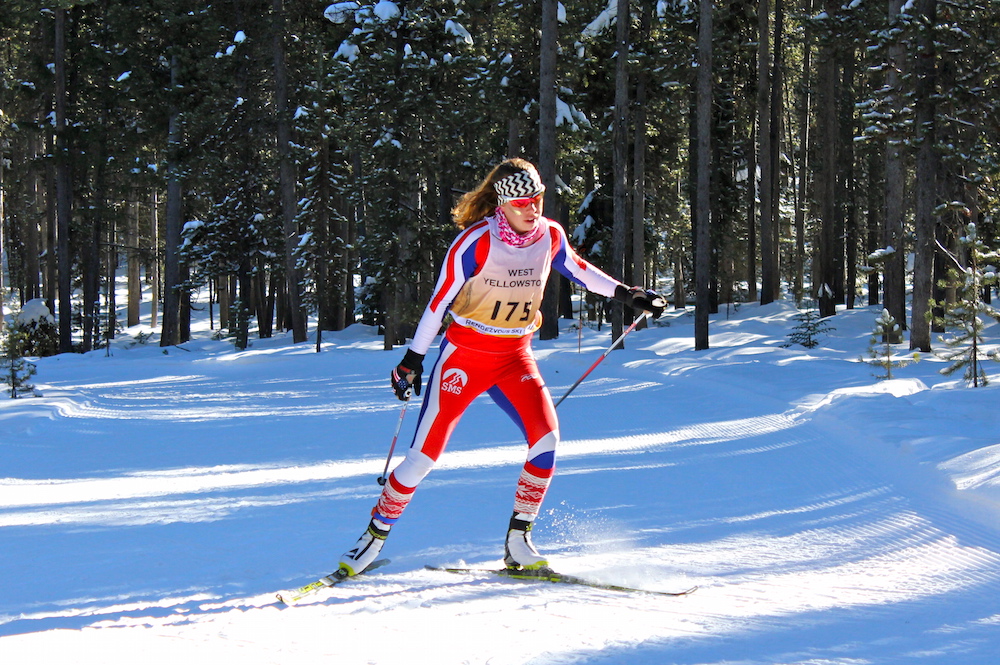
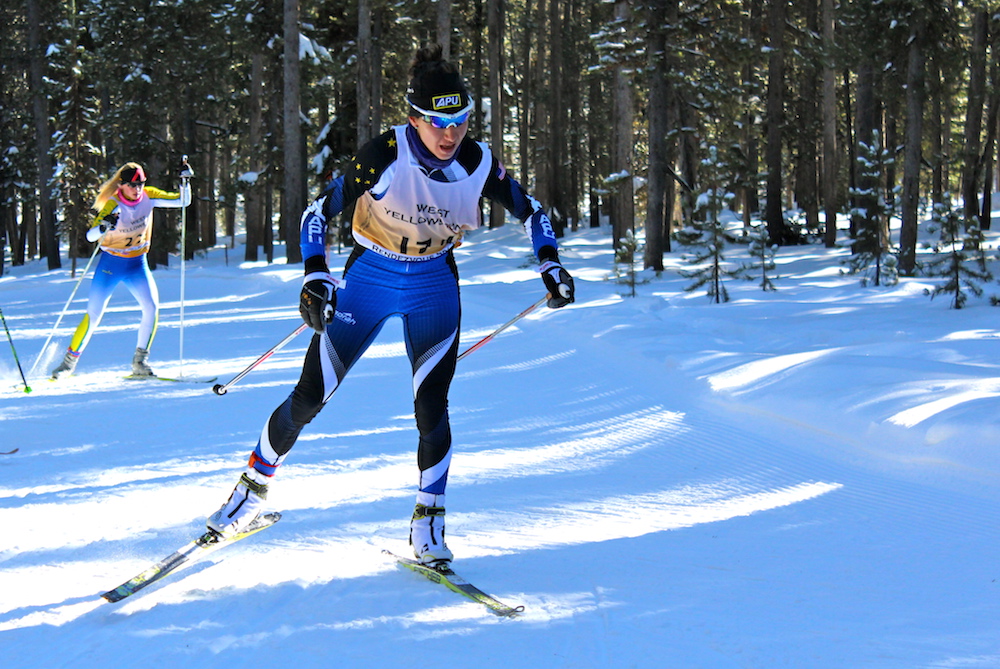
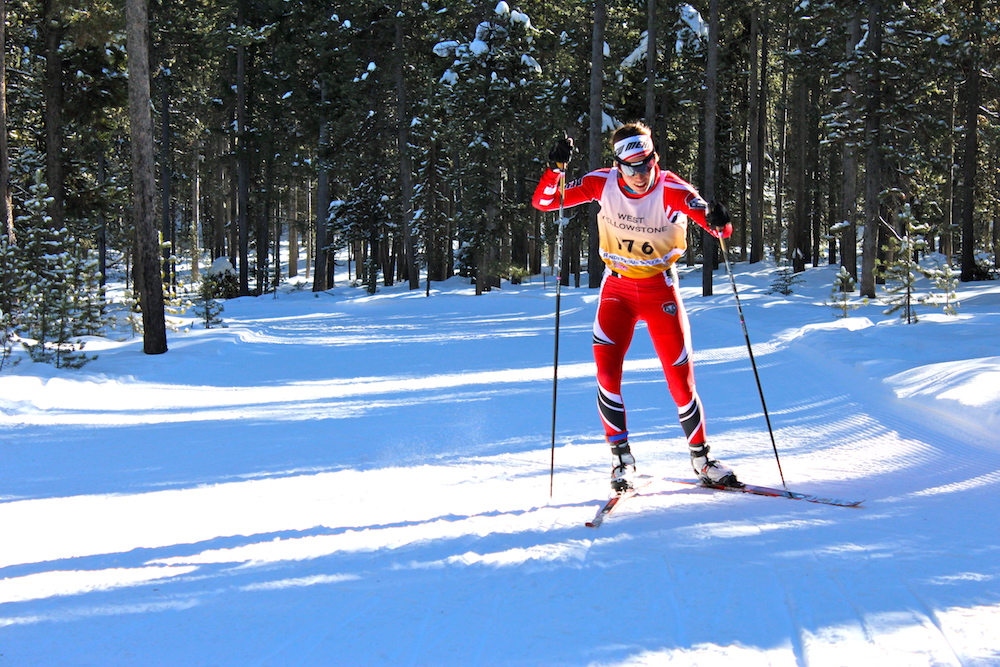
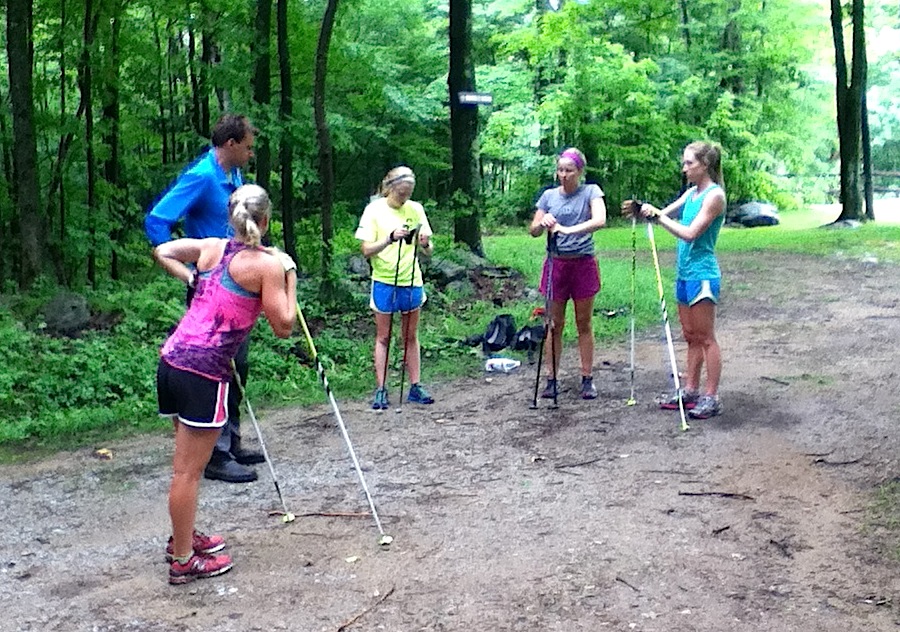
The Stratton Mountain School is looking for an assistant nordic coach for the 2016-2017 season. The position will be either during the winter only (4-5 months) or for the entire school year, depending on the availability and qualifications of the applicant. Interested applicants should contact Sverre Caldwell at: scaldwell@gosms.org
I went pretty simple on glide for the classic race, waxing with HF Blue cut with AX134 for the guys in the AM, and a mix of HF Blue, AX134 and HF yellow for the ladies who were racing second. The traffic from all of the competitors was releasing a pretty decent amount of moisture and I wanted to soften the relatively colder HF blue paraffin for the later races. I found that I was not liking the way straight HF red was running early that week in testing so ended up on a mixed paraffin. AX134 tends to run really well at high speed or any place there is some free moisture or the track is glazed. I ended up using a different powder that I preferred in the higher moisture snow over either Jetstream red or yellow powder. Topcoat was Jetstream Red block. Safe and effective, tested well in the AM. Helix sprays felt good feel testing but weren’t drastically improving runout. I ran a pretty simple hand structure on the tails of the skis to deal with moisture in the track.
For kick, I did not go ahead and race wax with Toko kick waxes. Their red and yellow hard waxes can run really well in the warmer range, the yellow being a great last wax to try before switching away from dry wax. Although I have had a lot of success with them, I stuck to a different brand that gave m e a few different options for both speed and kick. I ran a warmer wax over a light tacky binder to form my kicking layer and ran a colder wax over top for a shell.
Skate Sprint:
I ran a pretty similar glide combo to the classic distance day for the skate sprint. The only difference was the temperature was a bit colder so I pulled the warmer paraffin out of the mix. I found that both floro blocks and certain liquids were improving the top end speed on top of powders so I burnt powder early in the day for durability. I intended to have the floro powder down as an insurance policy for the rounds and didn’t want to rework the skis too much. In testing the day before I felt that Helix 2.0 spray was once again improving the slippery feel of the ski climbing but some other liquids had higher top end speed which I really wanted to get athletes to the front of the race for the rounds. Again, I went with a pretty moderate hand structure to keep the skate skis from being too aggressive and bitey on the climb back into the stadium. Skis seemed very competitive on the day with Anne Hart finishing a career best 2nd place in the skate sprint.
Skate Mass Start:
Warmer temps greeted us for the skate mass start race. I pushed people out on warmer softer skate skis, especially for the women’s race at 1:30 PM. I figured that given the humidity in the snow and the amount of traffic, we would see a pretty hard glaze develop. Athletes wanted enough structure (especially hand structure) to deal with this moisture while still having a stiff enough ski to deal with variable track conditions. I ran a pretty warm buildup for both the guys and girls skis with HF Red, warm powder, block and liquid. I found again that certain liquids delivered better characteristics than just blocks. I buried Helix 2.0 spray under the block on a few skis and corked together for climbing freeness and topped with another brands liquid that was gliding out really well and is always a very safe bet for warmer temperatures. I ran a full length light crossing structure on the skate skis with a heavier linear structure on the tail to help with the glaze but still climb well. It seemed that this pretty straightforward approach to prioritizing hand structure and topcoat testing the morning of worked well with 3 athletes in the top 5 for the women’s 20k race.
Classic Sprint:
Warm temperatures in the 30s cooling off to low 20s by the end of the round.
I threw on paraffin without too much testing. I figured that I can always change the topcoats and dealing with kick would be more the priority. HF Red was a safe bet because it runs pretty well in a wide range of temperatures and conditions. I did burn a powder (the same powder from a different brand) that I had been running all week. It was very safe and seemed to improve speed with topcoats over it. For whatever the reason (pretty moist snow would be my guess) the Jetsteam powders were not clear test winners. I kept putting them on snow and could not get them to beat some other product out there. I find they usually prefer some more transformed snow, or much drier snow than the new moist lake effect snow we had. I ran the same topcoat build from the skate sprint.
Again for kick wax I started with a pretty warm dry wax and shell and cleaned it off after the qualifier and the semi and kept stepping down to a colder option from the same hard waxes I used on the classic day. Structure was a light crossing structure on the tails only.
Overall I felt we had decent skis on the week. I used Toko products where I knew they were safe and effective. When I could find something running better, I used it, but my familiarity with the waxing line and knowing that they wouldn’t be a liability allowed me to get skis waxed and focus my energy on testing and chasing more unknown variables.
Pat O’Brien, Head Coach SMS T2
U.S.S.A. Nationals Wax Report
We were fortunate to have had Sugar Bowl assistant coach Christina Mishica, who grew up in Hancock and raced for Michigan Tech. Her hometown knowledge was especially valuable when picking skis and waxing. The early part of the week was characterized by conditions that favored colder grinds and underlayers. Despite the cold air temps, the snow was relatively fast, especially with glazing classic tracks and during the skate heats. Throughout the week, we liked the new Toko 2.0 Jetstream Red powder.
Classic Individual: For base layer, we liked an under layer of Toko X-Cold powder, with our race paraffin a mix of HF Blue and HF AX134. The Blue provided good durability for the 10/15 km distances, while the AX134 helped the high end speed. That was key in a course where maintaining speed is crucial. For powder, the 2.0 Red Powder was consistently at the top of our test. The final layer was 2.0 Red Helix. With glazing tracks the Helix provided the best high-end speed. Blue and Red kickers with a klister/hardwax mixed binder provided good options for kick and speed.
Skate Mass Start: With slightly warmer temps for this race day, we opted for a paraffin layer of HF Red. We kept the X-Cold powder in as an underlay; happy with the breaking speed it gave us. For topcoats, based on our success with 2.0 red through the week, this was our natural starting point. We had 2.0 Red Powder ironed in with a layer of 2.0 Red Block ironed in over the top. Ironing in the block gave us better durability than rotofleecing.
Skate Sprint: Once again, Jetstream 2.0 Red Powder was a winner on the sprint day. We tried similar wax to the day before, and found that blocks were running better than any liquids. JetStream 2.0 Red Block was a clear winner in glide outs as well as on feel. Even as the day progressed, conditions remained consistent and our skis were good. We did rotofleece the block as opposed to corking it in.
– Spencer Eusden, Sugar Bowl Elite Team
Annie Hart Videos from Classic and Skate Sprints at US Nationals
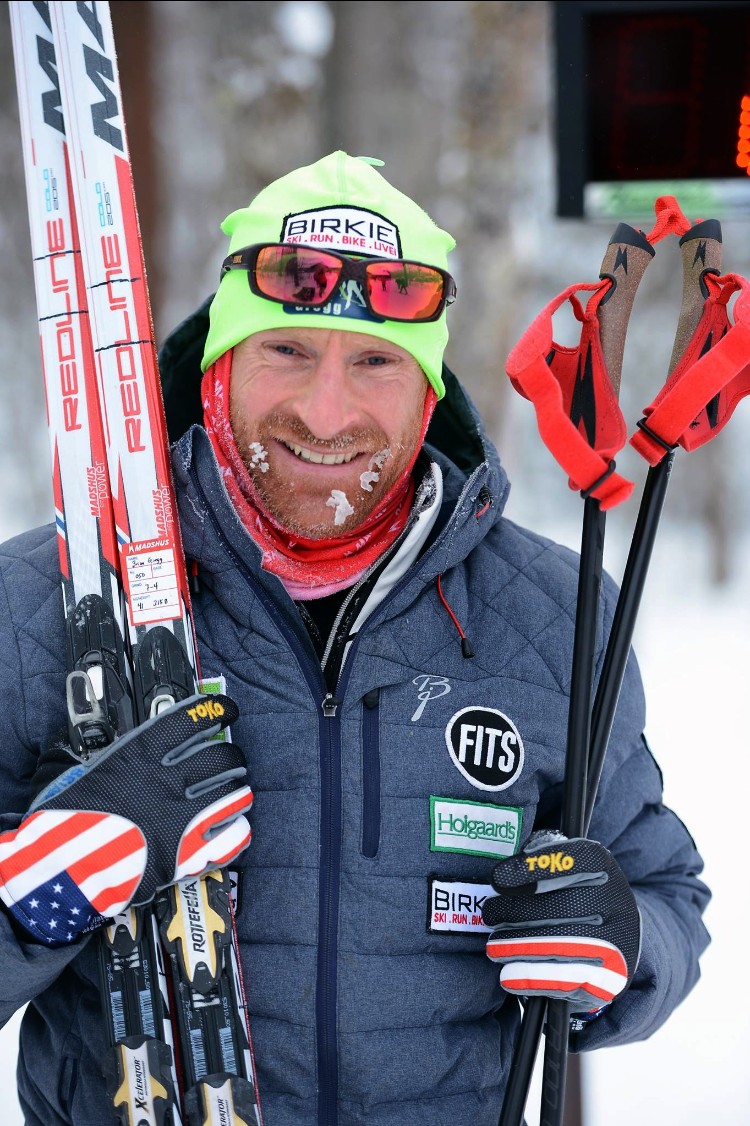
Temperatures plummeted from +25F friday to -8 F on race morning. I knew going in to the race that finding speed would be the greatest challenge. Caitlin and I have had fantastic results with Toko on the Birkie Trail over the years and went with one of our favorite combinations. I hardened my base with a layer of LF Blue and Cold Powder before putting on my final race layer of HF Blue and Cold Powder. I opted not to go with a flouro bloc with the temperature being so cold with the high forecasted as -2F. I sanded my kick zone aggressively and ironed in a green base binder, making it pretty thick under the foot and tapering out the edge, ending about an inch short of my normal kick zone. I kicked on Toko Blue hard wax covered with one layer of flourinated Swix XF30. My skis were rockets and I had great kick the entire race. Thankfully I dressed warmly and enjoyed some fantastic classic skiing. This same combination proved fantastic the next day in even colder temperatures for the Birkie Tour.
– Brian Gregg
(Congratulations to Brian on his win)
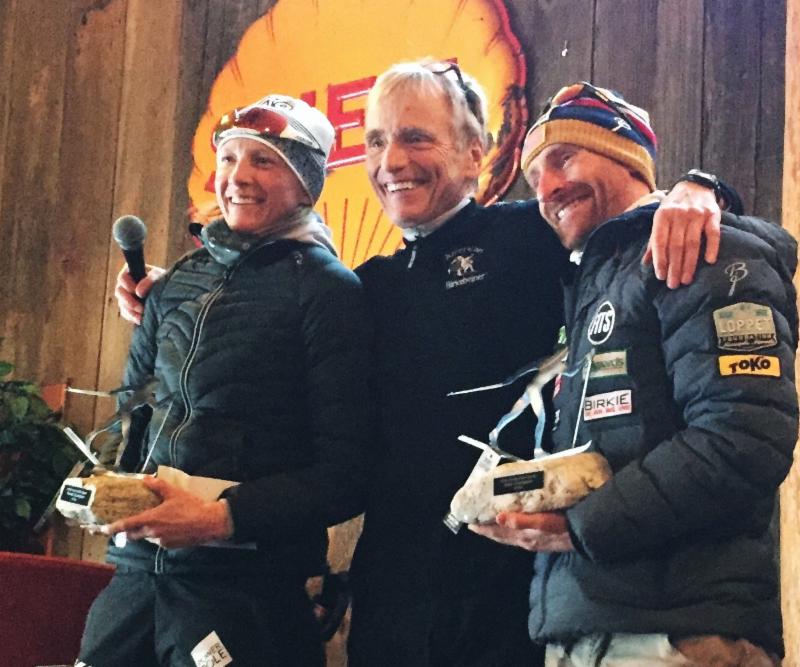
Brian Gregg at the Seeley Hills Classic (Photo credit: Once in a Blue Moon Studio- Kelly Randolph )The Seeley Hills Classic winners Natalia Naryshkina and Brian Gregg with race director Dennis Kruse
Wax Report from Seeley Hills Classic
Glide: Applied Toko LF Blue — scraped warm Applied Toko LF Blue — cooled, scraped, brushed Apply Toko HF Blue — scraped warm Applied 2nd coat of Toko HF Blue, sprinkled in Toko Cold Powder, cooled, scraped, brushed Crayoned on Blue JetStream Ironed the JetStream with a sheet of fiberlene to protect the base Cooled and Brushed Brushed again, and then polished bases with a Toko pad
Kick: Ironed in a thin coat Toko Base Green in kick zone (just to the Hard wax marking, not the Powder marking) Let cool, then cork smooth Five thin layers of Toko X-Cold kick wax — cork smooth each layer (just to the Hard wax marking, not the Powder marking) Two thin layers of Toko Blue kick wax — cork smooth each layer Two thin layers of Toko X-Cold kick wax — cork smooth each layer
Congratulations to Natalia Naryshkina on her win
– Bruce Manske, CXC Development Coach
Reports from Junior Olympic Qualifiers
BEND JNQ – Wax Report
CLASSIC RACE: Conditions were slated to be cold and clear for the first day of racing, an individual start classic race. We base-waxed with Toko LF blue, a no-brainer given how versatile and wide-ranging that wax is. On race day I tested a few different blocks but given how cold it was I didn’t find huge differences between block vs. no block and so opted to focus my attention on finding a fast kick wax in the cold snow. I tried Toko X-Cold straight, Toko Blue straight, and compared them to a few other brands’ cold waxes. After some different combos I found that two layers of Toko BLUE covered with a layer of X-Cold for speed did the trick; it was faster than straight blue and provided the softness underneath for good kick.
SKATE RACE: It was a bit warmer and fresh snow was falling for the skate day. We stuck with Toko LF Blue for base paraffin but I jumped right on testing blocks and liquids when we arrived, along with structure. I was joint-waxing with Jordan Buetow of BEA and he had some Finite tools to use for structure, so we tested those against the Toko red structure tool, run only from the heel to the tail. The Finites ran a bit faster so we went with that; both the Toko and Finite were faster than no structure and I think had he not had the Finite we would’ve definitely chosen the red structurite over any other choices.
Block choice was between a wax he thought was best and Toko JS Blue and JS Red. I thought Blue would be the ticket but it was slower than his wax. But then putting Red against his wax I felt it was faster, especially on initial acceleration; once they were up to speed it was pretty equivalent. Jeff Hashimoto of Ellensburg concurred with me and they went with JS Red block, as well.
We had two podium finishes in the U14 race and several top-12s in the U16 and up categories – a sure sign that our skiers are getting more competent with their technique and fitness and able to compete with the experienced teams.
Kongsbergers Gunnar Hagen 7.5km:
This past weekend was the KSC Gunnar Hagen, a 30km and 7.5km classic race. Dave Ford was up there as the Toko rep so he and I set up our tables in the middle of the stadium and acted as the Wax Knowledge Stations for the day. He had tested early; the temps had gone from 26F in the middle of the night, up to 32F and then back down to 23F by race time. As such there was some transformation in the snow. He and I immediately thought of Base green thick ‘n short application, and tried it with success. He called it as the top pick, but when I tested straight Toko Yellow I found that to be quite good as well. Another brand’s wax was also running but I was nervous about its speed on the back sections of the course; it didn’t seem as free as the Yellow. My athletes all went on Yellow and felt the kick was great without icing. I ended up converting a lot of the masters skiers from their choices of klister or similar gook over to an application of Toko Yellow and they all reported great skis. Once again, I was pleased at how wide a range that wax has without suffering speed.
– Sam Naney, Head Coach Momentum Northwest
Wax report from Wasatch Citizen Series 10k Classic at Mountain Dell, just outside of Salt Lake City, UT 16 January
Recently, there had been a lot of 32f and snowing type weather, so I was curious to see what the weather was going to bring for this race.
Upon arrival, snow termperature was 18f and air was 20f. I was the first skier on the course and found that the well groomed tracks had completely filled in with new fallen windblown snow. Windblown snow is generally very dry and “grabby”. I tested various kick waxes (also joined by my fellow Toko Tech Team members) and we found that a few layers of Toko Nordic Grip Red covered by a thin layer of Blue was best. Noteworthy was that as the track got skied in, the platform for skiing on was not very flat (due to all of the new snow not having been skied in perfectly flat – it resembled more of an old style track that was simply skied in). Additionally the snow was breaking on itself (shearing). So, the kick wax was sticking to the top layer of snow in the track, but the snow under the top layer wasn’t sticking to that snow resulting in less sure kick. So, in general, the snow was a bit grabby, especially in the more shaded sections, and the kick was not very sure due to the nature of the track (despite the excellent grooming by the volunteer Tuna crew – thanks!). If a person were to try for perfect kick, the only result would be a sacrifice in glide since the kick was not bomber due to the nature of the snow in the tracks.
As the air temperature rose to 28f and the snow to 24f, we settled on a race kick wax recommendation of straight Toko Nordic Grip Red put on as thinly as possible with a bit more underfoot. For glide, we went with our recommendation which was LF Black, HF Red, and an application of JetStream Red (block/fiberlene application method). As it turns out, the addition of HelX 2.0 Red was also excellent. It was nice to see that after all the dialing it in and testing, this turned out to be the exact wax recommendation made two days before the event by TTT member Barry Makarewicz. Nice job Barry!
Thanks to the Tuna crew and Mountain Dell Groomers for a great day!
SUN VALLEY, Idaho — U.S. Ski Team rookies and Stratton Mountain School teammates Julia Kern and Katharine Ogden (last weekend’s SuperTour 10 kilometer freestyle race winner) sat down with FasterSkier this week to discuss their summer training with the U.S. Ski Team (USST) and how they are feeling coming into the race season.
Kern also provided a unique preview of the 1.3-kilometer course that will be used for Saturday’s SuperTour classic sprint at the Lake Creek trails in Sun Valley.
Katharine Ogden (SMS/USST) racing to her first SuperTour win in Saturday’s 10 k freestyle individual start at the West Yellowstone SuperTour in Montana. She beat Chelsea Holmes (APU) by 1.8 seconds.
WEST YELLOWSTONE, Mont. — Katharine Ogden, or KO as she’s known to many of her friends on the SuperTour circuit, used patience, pacing and tactics to deliver a knock-out punch to the rest of the women’s field in the first distance SuperTour race of the 2015/2016 season.
Cold temperatures persisted in West Yellowstone, the annual site of the season-opening SuperTour races, but despite a one-hour start delay to let temperatures rise, the competition heated up quickly. The course for the women’s 10-kilometer freestyle individual start was flatter than many that the SuperTour regulars face throughout the season, but because they also offer fewer opportunities to glide on downhills, courses with less climbing aren’t always easier. Saturday’s race utilized a 5 k loop in near-perfect, cold conditions.
As a concession to the cold, racers started at 15-second intervals, and after about 20 B-seeded skiers through, the elite women in the field started out on the course.
Chelsea Holmes (APU) led most the women’s SuperTour 10 k freestyle on Saturday in West Yellowstone, Mont. She ultimately finished second to U.S. Ski Team rookie Katharine Ogden, who had been sitting in third or fourth for much the race.
Chelsea Holmes of Alaska Pacific University (APU), certainly one of the favorites heading into the day, was one of the first A-seeds to start.
“I was psyched on the late start – I love a long morning,” Holmes said in a post-race interview. “My skis were great, the techs worked really hard and did an amazing job, but honestly, I was rather terrified in my warmup. I just felt smashed.”
An experienced competitor, Holmes, 28, didn’t let that get to her.
“I don’t think that how you feel in warmup is always an indication of how your race is going to go, so I just tried to keep that in mind,” she said.
However, as one of the first A-seeds on the course, Holmes didn’t get a lot of feedback regarding her position in comparison to others.
“I tried not to let it affect me, I was going as hard as I could, and honestly, I don’t know if those splits would have made any difference,” she said. “I was focused on my race plan and not really thinking about what was happening behind me.”
Holmes is often a fast starter, and Saturday was no exception. She had a strong lead at 5 k, and at the 7.5 k mark, she was still some 22 seconds ahead of Ogden, according to splits from coaches on course.
A U.S. Ski Team rookie, Ogden of the Stratton Mountain School (SMS) started 15 seconds behind Holmes. In the same distance opener last year, Ogden, who turned 18 earlier this month, placed second in West Yellowstone.
Going into Saturday’s race, she said she was “feeling pretty nervous but trying not to think about it … I had a lot of expectations, partly because I had a pretty good day last year on this course.”
Emilie Cedervaern (University of New Mexico) placed third in Saturday’s SuperTour 10 k freestyle in West Yellowstone, Mont., 35.6 seconds behind winner Katharine Ogden (not shown).
After a good warmup, and feeling that her “skis were really fast,” she set out behind Holmes and 15 seconds ahead of of eventual third-place finisher, Emilie Cedervaern of the University of New Mexico.
“My first lap was pretty slow actually,” Ogden said. “That wasn’t part of my race plan, but it happens to me pretty often. … I was pretty psyched because I was starting behind Chelsea Holmes, and she’s really fast. It was awesome to be able to get a glimpse of her now and then and think ‘OK, this is a good race because she hasn’t completely dropped me!’ ”
As the race progressed, Ogden continued to ski well, but didn’t pose an obvious threat.
“Emilie actually passed me at one point,” Ogden reflected, “but I managed to pass her back.”
At the 7.5 k mark, with just 2.5 k left to go, on-course splits indicated that Ogden was still some 20 seconds down to Holmes, skiing in third or fourth place. In those last few kilometers, however, she found another gear.
“I was getting myself back into a position where I could see Chelsea again, and at the bottom of the last hill, my coach Matt Boobar told me that I was only four seconds down. I thought, ‘OK, maybe I can catch up.”
She did. At the finish, Ogden clocked 27:07 minutes, beating Holmes’ time by 1.8 seconds.
As the A-seed skiers continued to roll in to the finish, it became apparent that Holmes and Ogden had outpaced the rest of the field. When final results were posted, the up-and-comer Ogden had eked out the victory and Cedervaern held on for third, 35.6 seconds behind Ogden. It was her first SuperTour win and third podium.
Despite narrowly missing the win, Holmes, who placed fourth in Friday’s sprint, called it a “very successful start to the race season.”
In a text message after the race, Cedervaern wrote that she was generally happy with her race despite feeling “tired and slow” between 5 and 7 k. “Other than that I thought it went very well!” she wrote.
Six-and-a-half seconds off the podium, Jennie Bender, who won Friday’s freestyle sprint, placed fourth (+42.1). The Bridger Ski Foundation skier finished 3.1 seconds ahead of the University of Utah’s Veronika Mayerhofer in fifth (+45.2), and Caitlin Patterson (Craftsbury Green Racing Project) was sixth (+52.4).
Seventh through ninth were separated by half a second, with APU’s Rosie Frankowski in seventh (+53.4), Eliska Hajkova, a Boulder Nordic Junior Racing Team coach, in eighth (+53.6), and Becca Rorabaugh (APU) in ninth (+53.9). Utah’s Sloan Storey rounded out the top 10 in 10th (+1:01).
The SuperTour’s next stop is in Sun Valley, Idaho, for next weekend’s classic sprint and distance races.
About the Author: Travis followed up a somewhat undistinguished competitive career with the University of Colorado with coaching positions in Steamboat, Boise, and most recently as the Gold Team Coach in Sun Valley. As of 2011, he works with middle school skiers, including his own two boys, and sells second homes to dot-com millionaires in Nordic Town USA: Sun Valley, Idaho.
WEST YELLOWSTONE, Mont.–The list of athletes and clubs is seemingly endless. Skiers from from the elite to the novice cruise the Rendezvous Ski Trails at the 2015 Yellowstone Ski Festival. Though the range of abilities varies greatly from athlete to athlete, one point of contact connects all festival skiers together: Thor Godar.
“I am working for the entire week and I am the pass checker at the main entrance point,” said Godar, the one-way stop for all nordic skiers attending the event. “I’ve been doing this for about ten years; this is my 22nd fall festival. … I’m planning on having my ashes scattered somewhere on the trails. I just haven’t decided [which trail] yet.”
Thor Godar (l), Yellowstone Ski Festival trail-pass checker and West Yellowstone native, chats with Bridger Ski Foundation skier Jennie Bender on Tuesday at the trailhead of the Rendezvous Ski Trails.
That’s dedication in it’s truest form. While most individuals attending the ski festival hit the trails in the morning, head out around 11 for lunch, and return again for the late afternoon, Godar remains at the trailhead from when athletes first arrive until their final departure, for the whole week.
“I have over boots, over gortex hiking boots. I have fleece lined jeans, and I believe I have three coats,” he said after examining his layers of protection for the long hours standing outside. “No matter what I wear on my hands my fingers get cold because I have Raynaud’s syndrome,” he added.
Eight hours in the cold is plenty long, regardless. However, with close to 4,000 people estimated to attend the festival, Godar’s time does not go unwarranted.
“Last year our best estimate was about 4,000 [skiers]. But it’s hard to know how to count them because most people are skiing twice a day and some of them have been here for three weeks already,” he reflected, “I’m going to say 4,000…But I’m the only one who looks them all in the eye.”
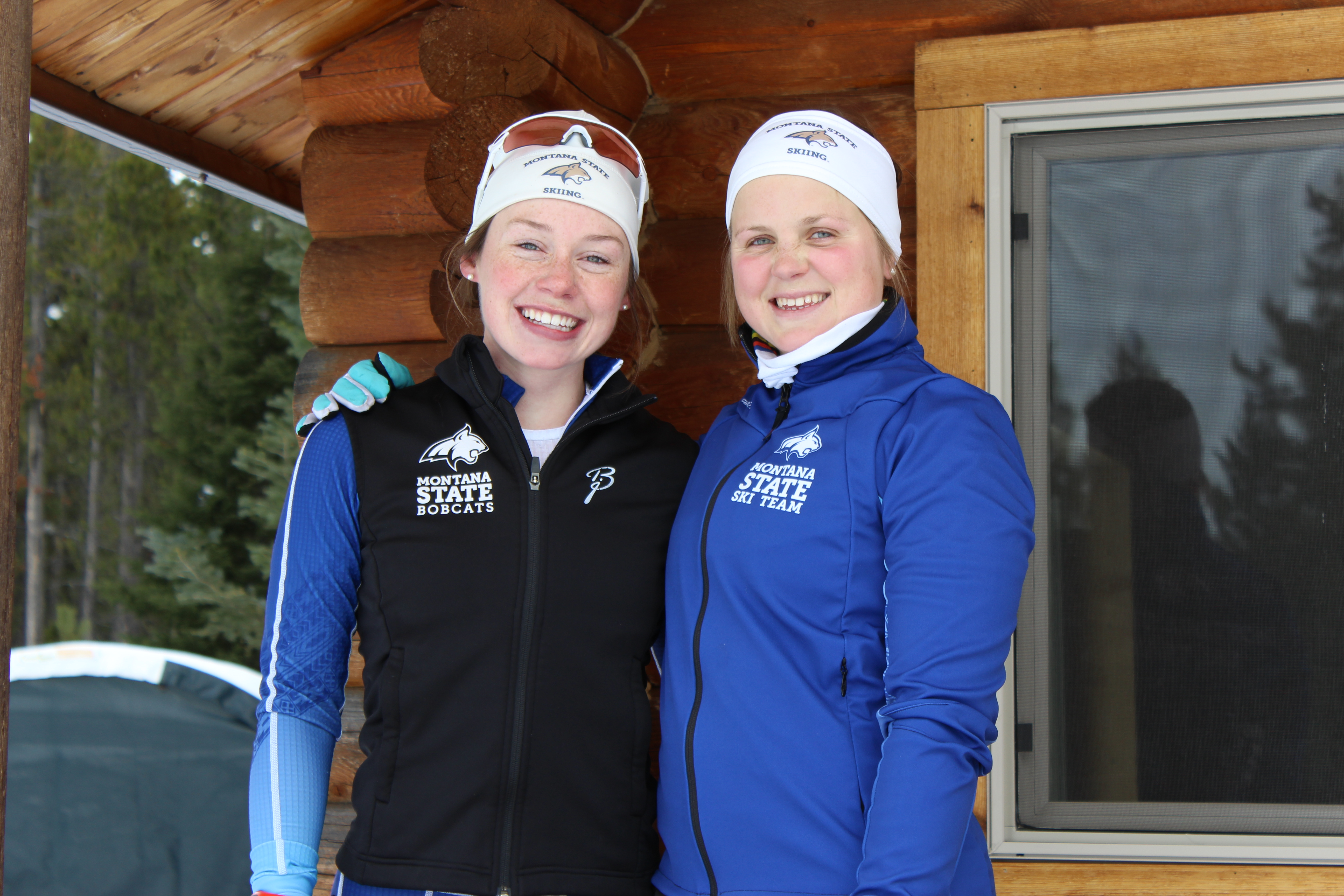
Montana State University nordic team captains Cambria McDermott and Lina Hultin in the stadium at the Rendezvous Ski Trails during the Yellowstone Ski Festival in late November.
While the occasional forgotten trail pass may induce Godar’s moralizing look, for the most part, he feels trails users appreciate his service.
“Some of them are very grateful that I’m here every year and they know me. Some of them probably hate my guts because I ask to see their passes — most of the high-end people are in a desperate rush to get to the trail,” he said. “So I would say that it varies. But, I’m kinda famous.”
Despite his claim to fame, Godar deems his return to the festival gates is all part of the atmosphere.
“It’s my favorite week of the year. It’s like a family reunion of a large highly dysfunctional family,” he said. “Everybody knows everybody else and people are hugging all over the trails, some of them propose marriage on the trails and, I love it.
“I’m a highly paid professional, but I might even do it for nothing,” he added.
SMS athlete Kamran Husain finishes his team’s Vertical Challenge at a recent mini camp in Stratton, Vt., with the fastest overall time. (Photo: Sverre Caldwell/SMSXC.blogspot.com)
When the Stratton Mountain School (SMS) team began its July mini camp this year, its athletes knew the focus was going to be a little different than years past. Rather than focusing on maintaining a low intensity during a high-volume camp, the SMS high-school athletes pushed themselves by going at a relatively high intensity while maintaining a high volume. This year’s Vertical Challenge, which is the pinnacle workout of the mini camp, exemplifies the new approach.
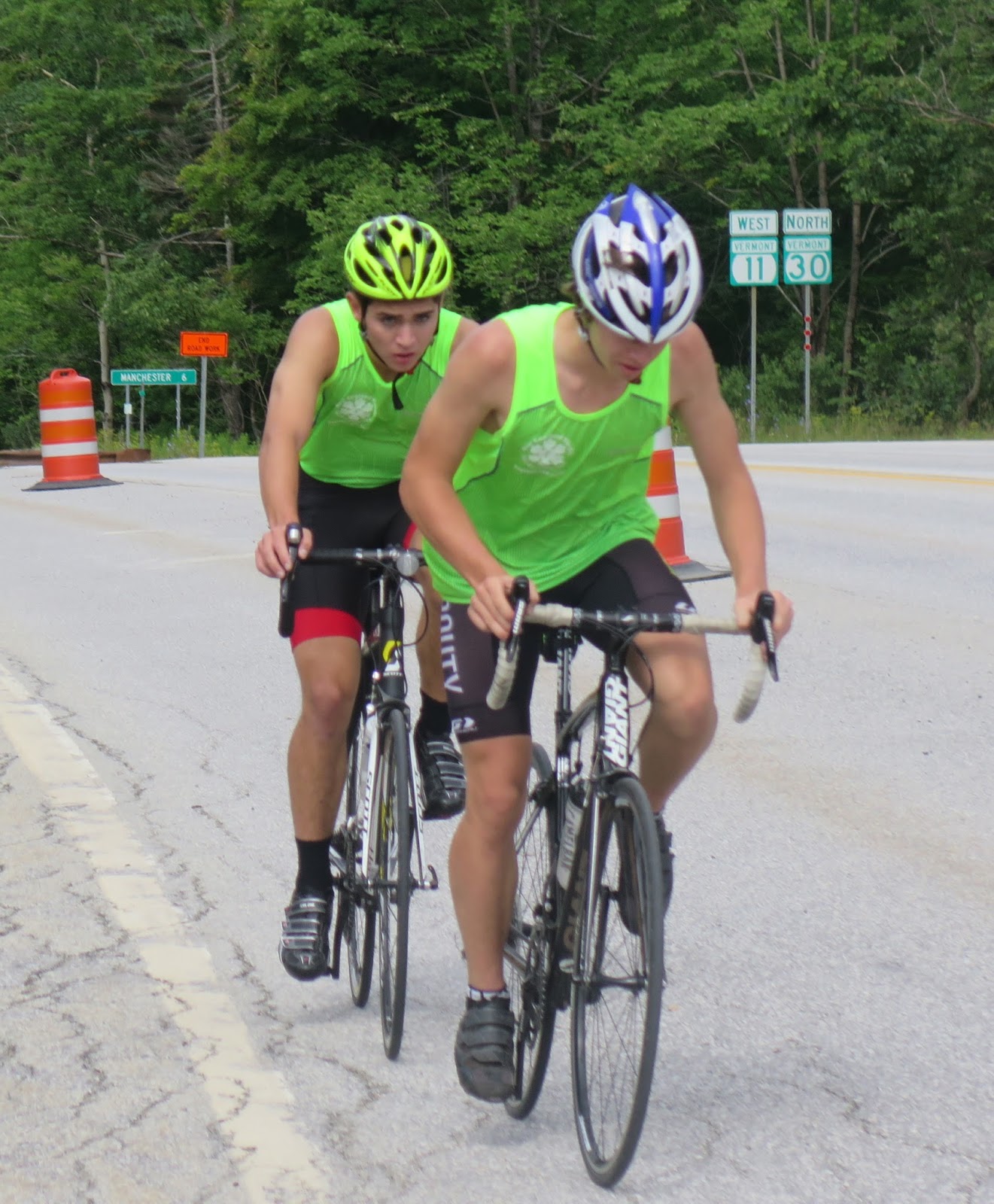
Kamran Husain and Russell Boswell ascend out of Manchester, Vt., on the first leg of the Stratton Mountain School nordic team’s Vertical Challenge on July 15. (Photo: Sverre Caldwellk/smsxc.blogspot.com)
“I think the first time we did it we just said, you know we’ve been doing some combi ODs [over-distance workouts], and we said, let’s do one that’s kind of … gnarly because there is a lot of vertical gain,” SMS Nordic Program Director Sverre Caldwell explained in a phone interview. “We said, we want you to go hard.”
This did not turn the workout — held July 15 — into a full-on race, but it did shift the focus. Athletes started at one-minute intervals and maintained a threshold effort for around two hours. In this case, threshold would be a pace in which one can push themselves but also stay in control enough to keep that pace for a long time.
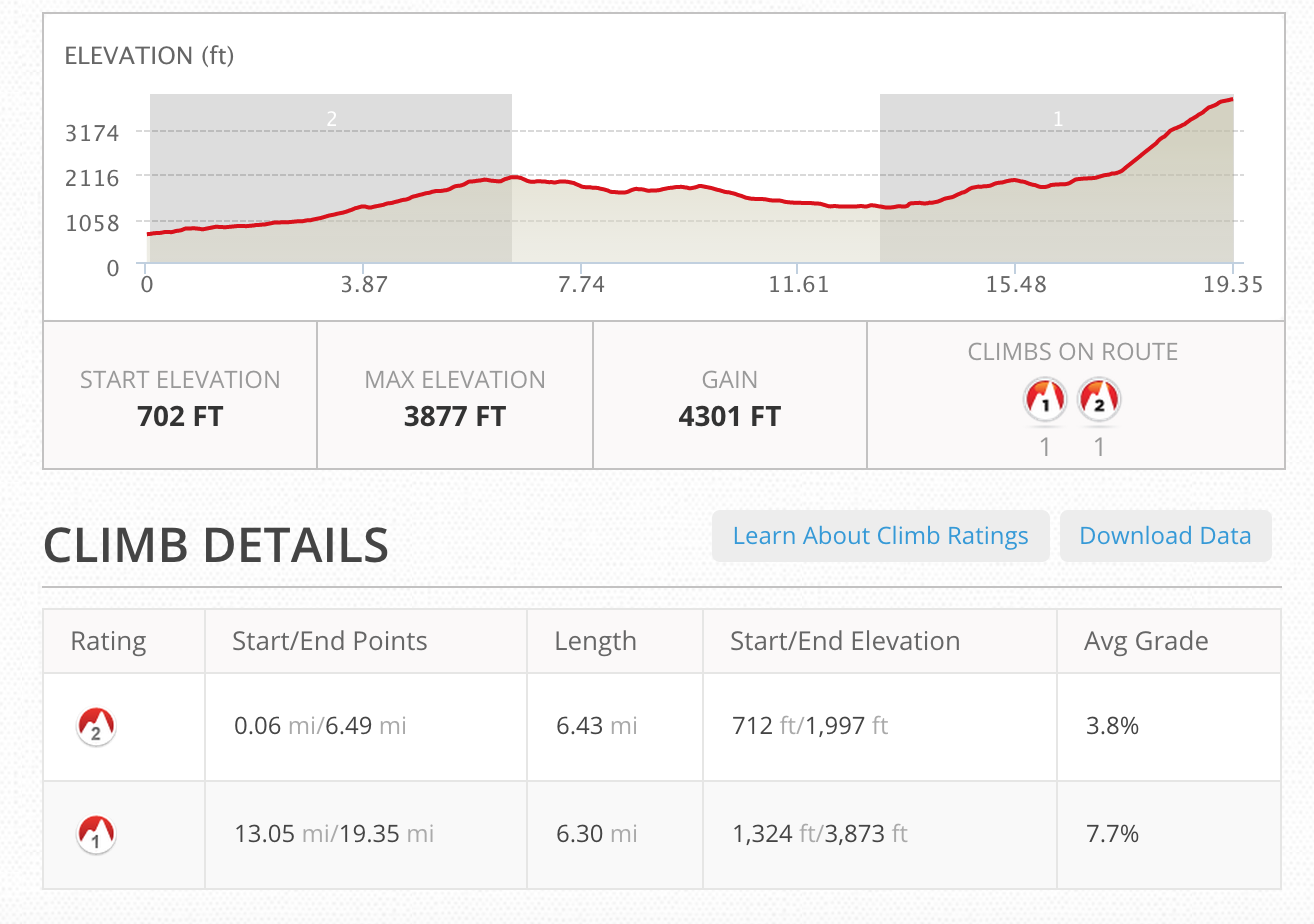
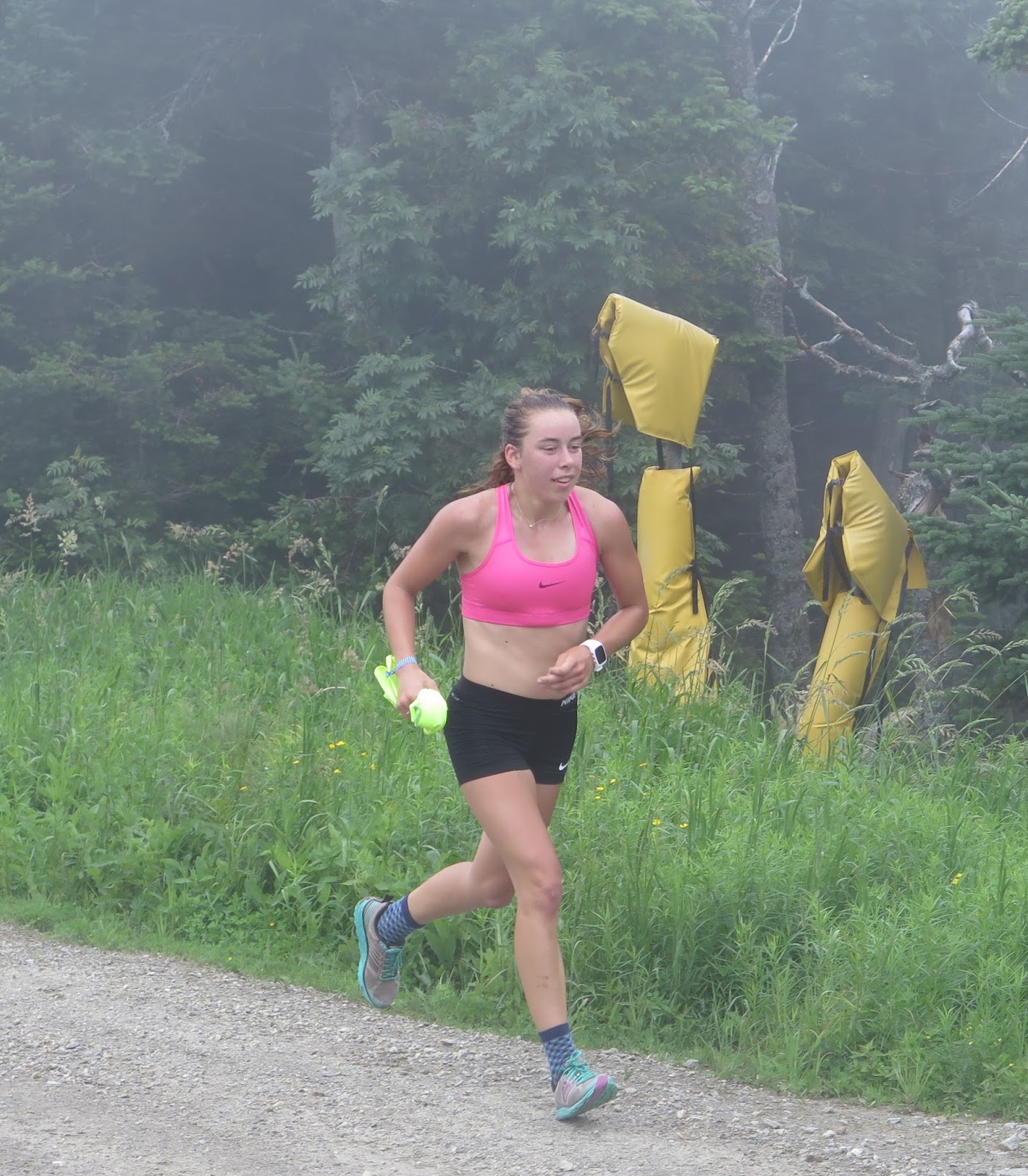
Adding to the difficulty was that the course had a net gain of 3,185 feet, so there was little rest. The workout began in Manchester, Vt., where SMS skiers started climbing on road bikes. After 12.5 miles, they reached Bondville, Vt., where they switched from bikes to rollerskis to ascend the Stratton Mountain access road. After another five miles, contestants made the final change into running shoes before climbing about two miles to the summit of Stratton Mountain. Needless to say, it was a lot of climbing and a lot of threshold.
“The reason we did it was … just to do something that’s hard,” Caldwell said. “That’s much more than you would do in a race or in normal training, to put everything in perspective. Like now, when you have to go out and have go hard for 5 k, it’s pretty easy.”
The goal of the camp and the Vertical Challenge specifically was to push the limits and test the resolve of its athletes. It was also meant to make them feel tough, which that can be difficult to accomplish during low intensity ODs.
As for the SMS athletes, Caldwell said they definitely thought it was tough. They all knew the Vertical Challenge was going to be difficult going in, but they understood what the goals were and were well prepared for the challenge.
“[The increased intensity] made it harder, but not necessarily better or worse. It was just different,” he said. “I think they had a good feeling of accomplishment because you know, when you finish something that’s tougher then you tend to feel a little better about it as long as you pushed hard through it.”
After finishing the workout, the SMS nordic team celebrated with a cookout.
The course profile and some specifics of the Stratton Mountain School nordic team’s Vertical Challenge workout, which it completed on July 15 in Manchester and Stratton, Vt. (Photo: smsxc.blogspot.com)
The Workout
Step 1: Organize
– Find a low point and a high point about 20 miles apart. These will be the start and end points of the workout.
– Decide on transition points from biking to rollerskiing (leaving the bike and putting rollerskis on), and from rollerskiing to running (where you’ll leave your ski boots and lace up your sneakers). Ideally the running and hiking section would be on the steepest terrain, the rollerskiing would be on the next steepest terrain, and the biking would be on the most gradual terrain, though this could vary depending on your area. Someone with a car to carry equipment and extra water and snacks is also very useful for meeting at these transitions.
Step 2: Ascend
– Begin by doing a warmup as if the workout was a 25 k or 50 k ski race.
– Next, start the ascent on the bike at around threshold. Try and maintain this effort throughout the rollerski and the run/hike as well. Because speed isn’t of the utmost importance in this workout, don’t worry if the transitions are a little slow.
– Once you have summited, celebrate by doing a low-intensity warm down before continuing the celebration with some food or even a cookout.
Katharine Ogden nearing the summit of Stratton Mountain during the Stratton Mountain School nordic team’s Vertical Challenge workout on July 15. (Photo: Sverre Caldwell/smsxc.blogspot.com)
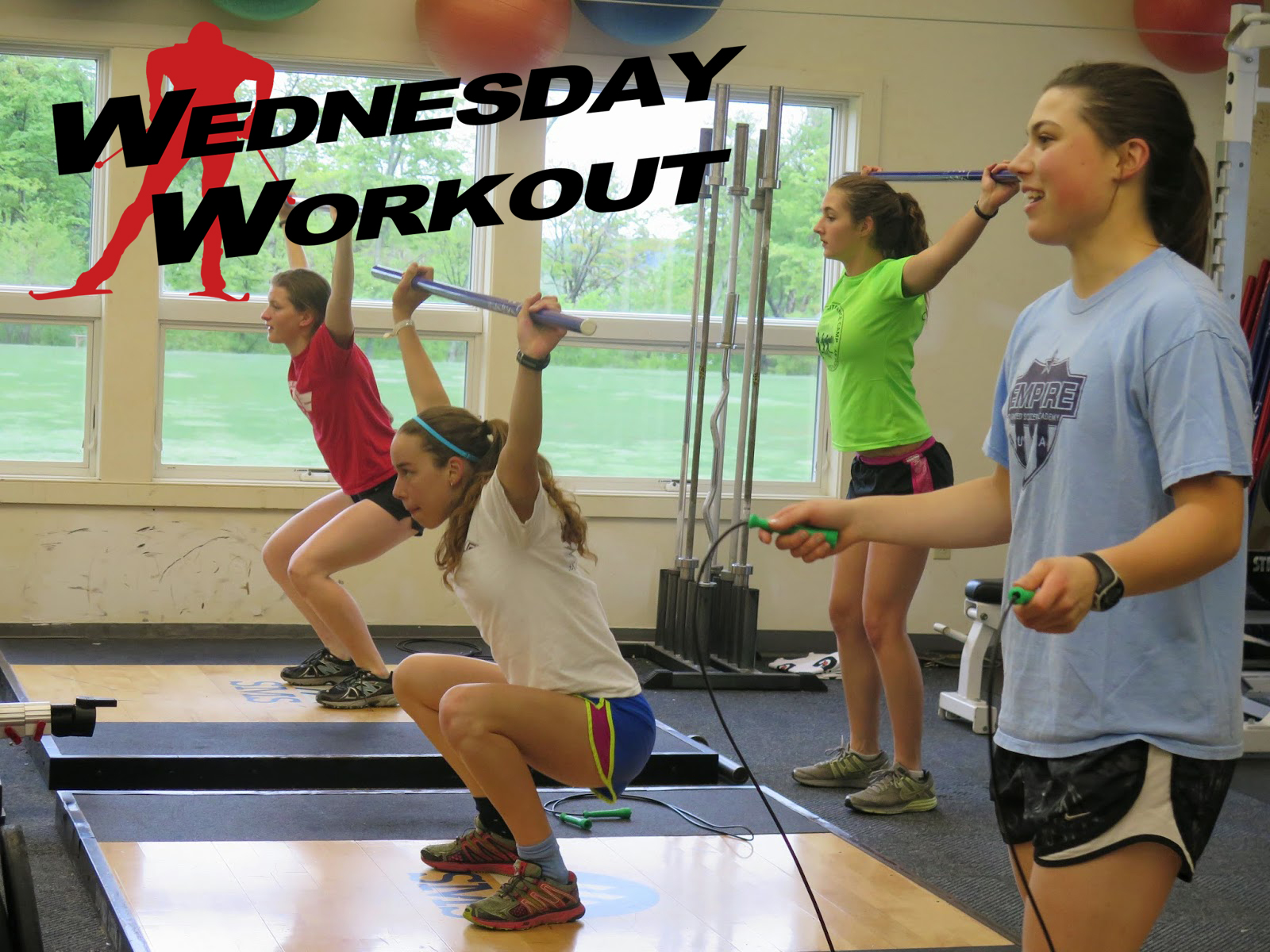
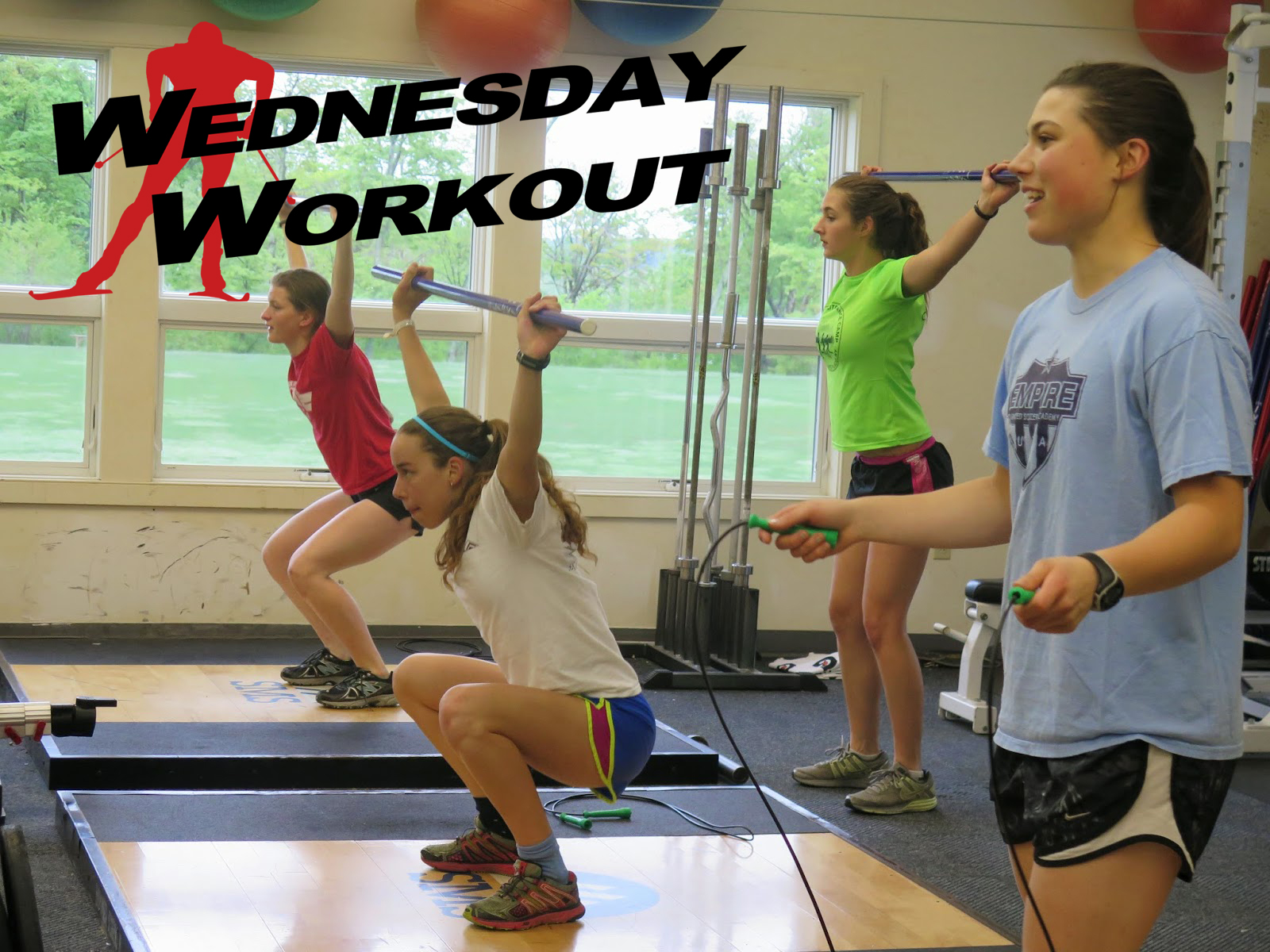
Stratton nordic skiers work on general strength, specifically overhead squats, last summer. From left to right: Mackenzie Rizio, Katharine Ogden, Tegan Thorley, and Ana Witkowski. (Photo: Sverre Caldwell)
This week’s workout comes from Sverre Caldwell, the nordic program director at the Stratton Mountain School (SMS) in Stratton, Vt., whom the U.S. Ski and Snowboard Association (USSA) recently named Cross Country Domestic Coach of the Year. Here, Caldwell shares a typical day in the life of a Stratton athlete in May, when the academy is getting back into the swing of training.
***
Two-a-days:
“At SMS we use May as a period to build some general strength and lay a foundation down for great summer training,” Caldwell explained in an email. “Our Wednesday class schedule gives us two training blocks; one from 11-12 p.m. and the other from 3:30-6 pm.”
Morning session: General strength
“During the morning session we go to the weight room, do a short spin warm up and then some general strength,” he continued. “At this time of year our strength consists of a 15-minute warm up (spin, jump rope, sumo squats, inch worms, etc..) followed by our strength routine, then core.
“We usually choose 3 leg, 3 upper body and several core/balance/stability exercises. We will do two rounds/sets. Early in the spring we use very little weight, going for the proper movement and high repetitions. We slowly add weight and lower the repetitions, but never throw heavy weights around.”
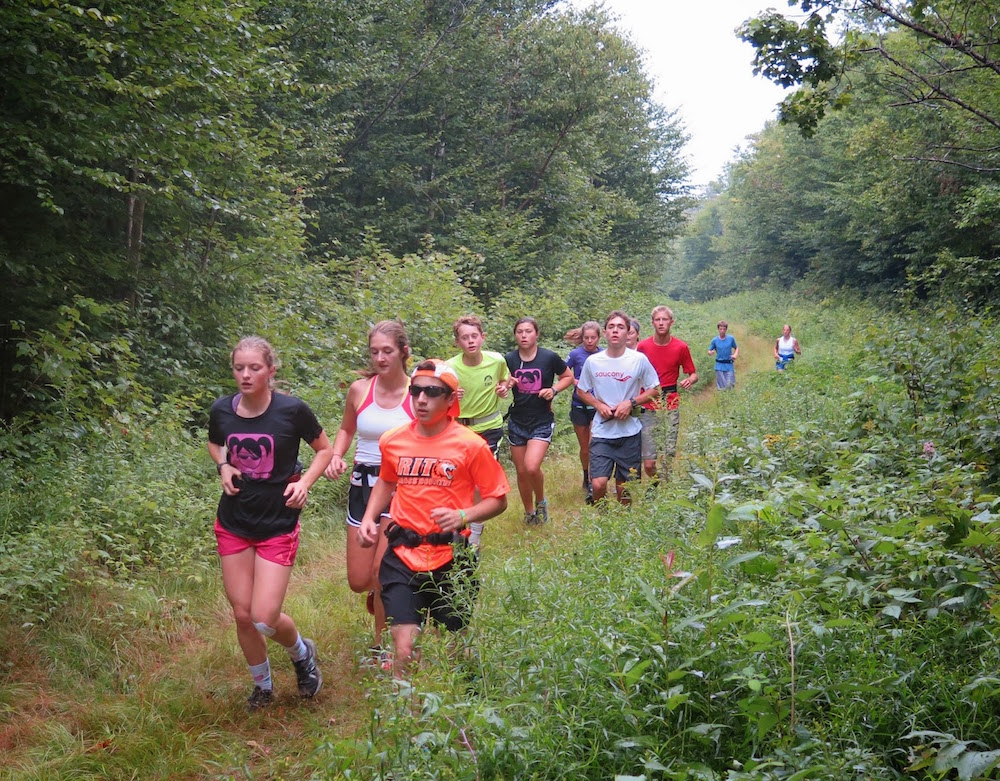
Mackenzie Rizio (l) and Mid-Atlantic skier Adam Marino (r) lead Stratton skiers on a trail run last summer during a training camp. (Photo: Sverre Caldwell)
Afternoon session: Easy distance
Trail running and biking are two early season favorites at Stratton, according to Caldwell.
“Our goal is to build up through the spring so we can do a team 100-mile bike and an 11-mile trail run/race in early June,” he wrote.
“The [Long Trail/Appalachian Trail] goes over Stratton so we have lots of great trail running spots. We love the trail running because it helps build aerobic fitness, agility and coordination.”
Go-to trail run:
From Kelly Stand Road to Stratton Pond and back to school. Most of trail is soft dirt, “but there are enough rocks, short boardwalks and puddles to keep you on you toes,” Caldwell explained.
Length: About 10 miles with rolling terrain, making it easy to run in Level 1 (L1) and low Level 2 (L2).
Time: About 1 1/2 hours
“For base aerobic training, it is important to have a longer, steady effort keeping your heart rate above 120, but at a ‘conversation’ pace,” Caldwell wrote. “General rule of thumb is that you can talk pretty easily in L1, you shorten the sentences in L2 (breathing a bit harder). On the distance days we shoot for staying in L1 for everything except the sustained uphills on which you will drift into L2. If the hill gets steep, we will often break into a ski walk instead of pushing the running.”
What do Matt Whitcomb (USST), Chris Hall (Swix), Sverre Caldwell (SMS), Patrick O’Brien (SMS T2), and the Stratton T2 Team all have in common? Other than being huge contributors to our sport and to our New England Nordic community, they’ll all be at Stratton Mtn. School for the 2015 NENSA Coaching Symposium November 15-16.
Join NENSA for two days in Vermont with presentations from USST Women’s Head Coach, Matt Whitcomb, Swix’s Chris Hall (yeah, there will be swag for all), and the Stratton coaching staff, as well as hands-on work with the elite T2 athletes. This is going to be a very cool weekend. Cost is just $95 for NENSA members.
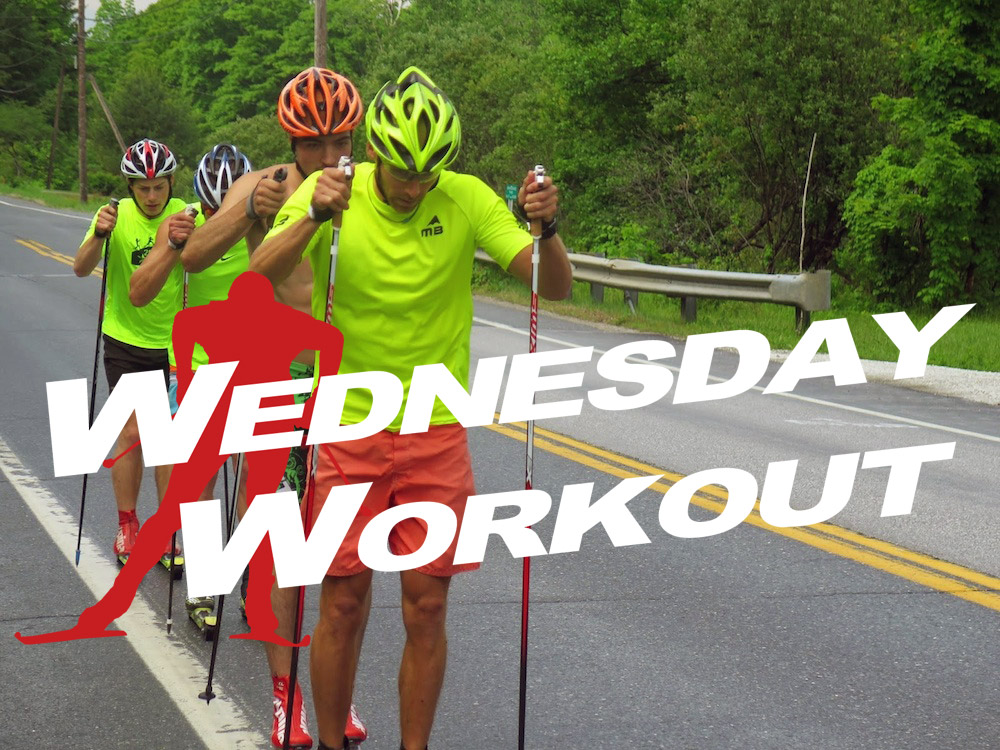
Andy Newell leads Ben Saxton (second from front) and two others during a double-pole rollerski workout at Stratton earlier this summer. (Photo: SMST2)
This week’s workout comes from Ben Saxton of the Stratton Mountain School (SMS) T2 Team in southern Vermont. Now in his second season with SMS, the 21-year-old Minnesota native, Dartmouth freshman, and U.S. Ski Team D-team member explains that this double-pole workout is a staple at Stratton. Why? Because it works.
***
One of our summer workout staples at Stratton Mountain School is the Level 3 (threshold) double-pole intervals in Weston, Vt. SMS has been doing this workout for many years, and since I joined the crew in 2013 we’ve been doing this workout almost every other week in the summer months. It is perfect for building a strong base as we move forward into higher intensity intervals later on in the training year.
The workout is nothing crazy, it’s nothing groundbreaking, but that’s because it works. Everyone from the little kiddos in our Junior program to my teammates and I on the SMST2 team meet up at the infamous Weston playhouse before beginning the intervals.
The Basic Workout
30-minute warmup
5-7 by 8 minutes of double poling at threshold pace with 4 minutes of active recovery in between intervals
20-minute cooldown.
Total time: About 2 hours
Tips: Vary intervals on different terrain to mix up technique. “I generally follow the pattern of doing one interval on the flats followed by one of sustained climbing,” Saxton writes.
Try to repeat the workout at the same place to gauge your progress. “Returning to the same spot so often for similar intervals allows us to measure our fitness and our strength in a very simple way.”
Everyone’s on-time varies, but I usually do anywhere from 40-60 minutes of Level 3. The other week, I did 5 x 8-minute intervals. During the intervals, younger skiers are able to hop in behind us and mimic technique for a minute or two during each interval. Like our bounding workouts, we generally recover for about half the time of the intervals, in this case 4 minutes, which are spent milling around for active recovery.
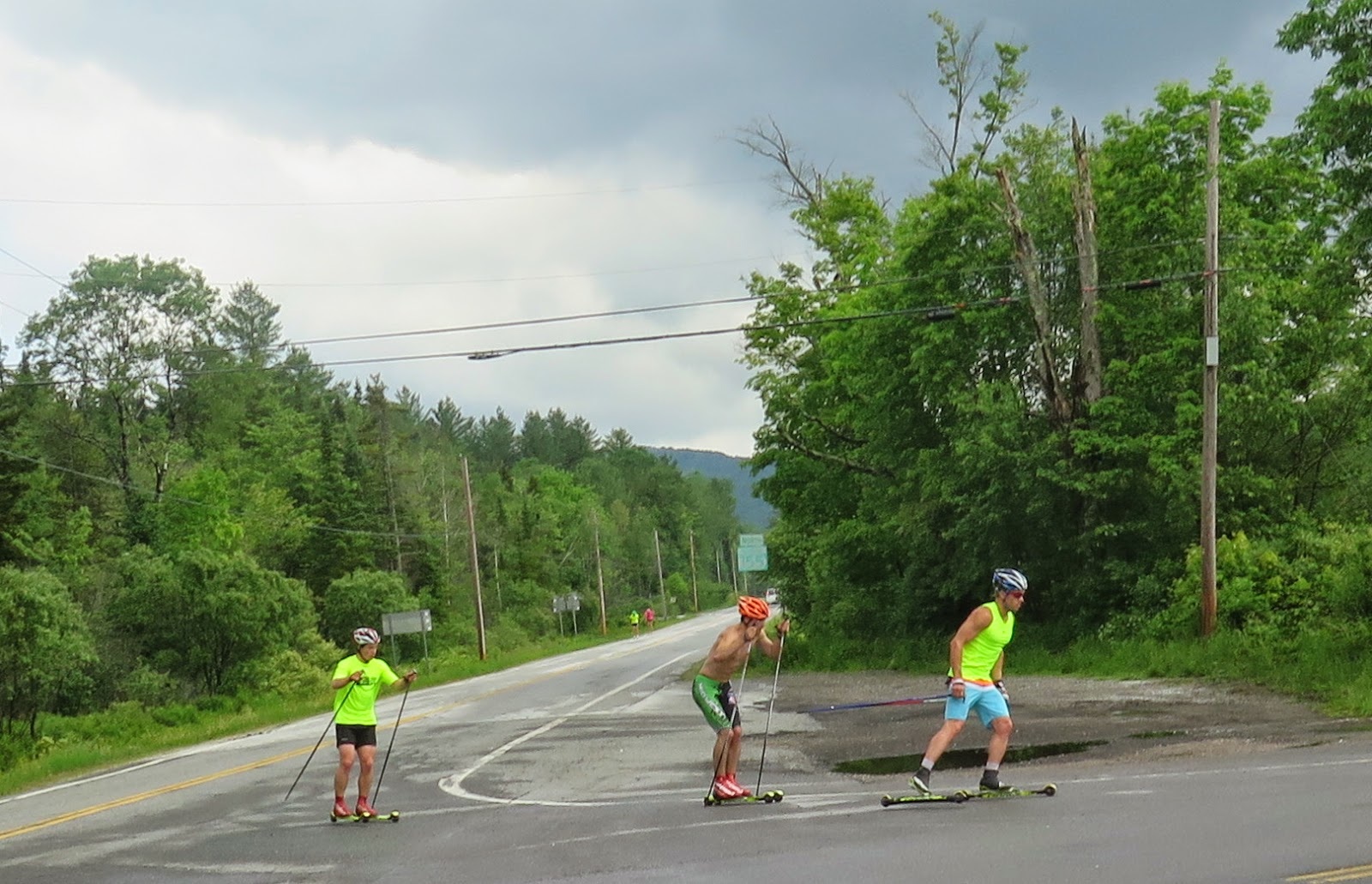
SMST2 skiers during a rollerski workout near Stratton, Vt. (Photo: SMST2)
I love this workout because we get to practice all different types of double poling. Weston has long flat sections of skiing at the base of several mountain roads, which allows for sustained uphill intervals. I generally follow the pattern of doing one interval on the flats followed by one of sustained climbing in order to mix up the technique used in the intervals.
Our Coach Pat (affectionately referred to as “Herb” in honor of Herb Brooks who might be his only coaching equal) emphasizes varying our technique with the changing terrain.
Level 3 intervals can often be limited to one type of terrain (and subsequently one type of skiing) but in Weston we are able to mix it up and practice the long powerful double poling required on flats as well as the shorter faster double poling used when going uphill.
I also believe that returning to the same spot so often for similar intervals allows us to measure our fitness and our strength in a very simple way, which provides great feedback for the training we’ve been doing.
During the winter these are the workouts I often find myself thinking back on, because they give us the strength needed to kick butt on the snow!
Patrick O’Brien racing to third for the Craftsbury Green Racing Project in the 10 k skate at the University of Vermont Carnival at Trapp Family Lodge in Stowe, Vt., this past winter. After four years on the pro circuit, O’Brien, 26, is entering a new chapter of his ski career as head coach of the Stratton Mountain School T2 Team.
Patrick O’Brien was hired last Sunday and started on Monday. That’s the kind of turnover Sverre Caldwell, nordic director of the Stratton Mountain School (SMS) in southern Vermont, was looking for when he first sought a replacement for SMST2 Head Coach Gus Kaeding.
The transition from professional skier to coach happened quickly for O’Brien, who wasn’t sure what his future held — or what he wanted to do next — five weeks earlier. At the end of his 2013/2014 racing season in late March, the 26-year-old Vermont native packed up his skis and flew from Alaska to Moab, Utah, for some quality time in the desert with friends. He spent the next week mountain biking, regenerating and thinking about anything but skiing. Pretty sure he was ready to end his competitive career, O’Brien wasn’t set on leaving the sport.
A Dartmouth grad who majored in environmental studies, O’Brien had spent the last four years with the Craftsbury Green Racing Project, which he described as both rewarding and fun. When he wasn’t training as a professional nordic racer, he was fulfilling his obligations to the Craftsbury Outdoor Center in northern Vermont, working on sustainability and trail-maintenance projects.
Contemplating retirement, he wondered how he’d stay involved in the sport. Perhaps through the ski industry? Maybe even coaching? The latter evolved into a very real possibility when he applied for the position of head coach of the T2 Team about two weeks ago. Caldwell invited him over to talk more about the position.
Rewind about 10 years to when Caldwell coached O’Brien at Stratton (along with assistant coach Amy Caldwell, the wife of Sverre’s cousin). An avid Bill Koch League skier from his youngest days of racing, O’Brien started seriously pursuing the sport in high school. Growing up 45 minutes from Stratton in Putney, Vt., he enrolled as a junior and spent the next two years commuting to the ski academy and learning from the Caldwells.
A Stratton graduate, he went on to captain the Dartmouth nordic team. There, O’Brien became an NCAA All-American as a junior in 2009, two-time first-team All-East skier, and two-time Academic All-American.
He graduated Dartmouth in 2010 and dove into professional skiing with Craftsbury. In 2012, O’Brien qualified for his first World Cups in Quebec and Canmore, Canada, which he ranked high on his list of achievements. He spent two seasons, including this year, on the European OPA Cup circuit in March, and notched domestic SuperTour podiums over several seasons.
According to O’Brien, who spoke on the phone Wednesday while helping his dad, an arborist, in Putney, he gave skiing a four-year commitment. At the end of this winter, he was ready for a change.
“I just felt like last year was tough and I didn’t achieve my goals for the year,” he said.
He first spoke with his coach, Pepa Miloucheva, about his plans for next winter before leaving to race in Europe a few months ago.
“She, of course, offered me the option to come back and ski in Craftsbury again,” O’Brien recalled. “But we had a very honest conversation and the conclusion we came to is, I was ready to be done, ready to have a different stimulus … moving into coaching or the ski industry or anything else. I was gonna have to look or figure out where I wanted to go from there.”
“I decided that this position at Stratton was something I really wanted to do,” he said.
Kaeding, the man whom O’Brien was ultimately hired to replace, was completely behind him. Caldwell pointed out that he had a similar start to his coaching career. Kaeding was an athlete skiing for Central Cross Country (CXC) when the team’s coaches at the time, Jason Cork and Bryan Fish (now USST coaches) encouraged him to become an assistant coach.
“He did that for one year at CXC then he came here and no one questioned anything,” Caldwell said.
Kaeding was in Miami and Costa Rica during much of the interview process last month, but said O’Brien had been his “number-one choice right from the start.”
“When he told me he wasn’t going to ski next year we were in a bunker in Slovenia,” Kaeding recalled. “I emailed Sverre and said, how about this guy for next year?”
On Wednesday, Caldwell confirmed the decision, which he had made Saturday night. He called O’Brien, O’Brien accepted on Sunday, and Caldwell notified his athletes later that day.
“I wanted someone who would be there to coordinate things and be totally enthusiastic and organized,” Caldwell said, adding that he chose O’Brien out of about five top applicants. “He knew more about the program and the area and the [racing] circuit and he could start right away to work with Gus. He hadn’t coached, but in a way that was not a detriment because he was going to be totally open minded.”
Caldwell said he didn’t recruit anyone for the job. “I didn’t want to be kind of casing someone who’s already in a different program. If they come to me that’s fine. It’s a small community, but that’s weird,” he said with a laugh.
“Most of the responses were really early … so then I had to send out [more information] to people who had expressed interest who looked viable,” he explained. “… We were not able to pay a ton so that cut out some people.”
Craftsbury’s Patrick O’Brien (l) and Stratton’s Andy Newell (r) lead a pack in the mixed relay at U.S. Distance Nationals in Anchorage, Alaska. (Photo: Charlie Renfro)
For O’Brien, it was an enticing opportunity — even if he was inexperienced.
“I’m younger than Andy and Simi and I’m not gonna pretend that I have a whole bunch of coaching experience, but I think maybe it’s a good thing that I have skied with or been on trips with many of those athletes,” he said. “It’s not like somebody totally foreign coming in and trying to bring their own training philosophy. I feel that having worked with Sverre as a high school coach, I have a pretty good understanding where he’s at. I think Sverre, Gus and I are all on a very similar page.”
He was most apprehensive about being the make-or-break factor for his athletes when it came to waxing skis.
“The fear as a coach, who also would be a service-staff person, is the last thing I want to do is have athletes show up, do their training well, be rested and ready to go and then screw their race over,” he said with a laugh. “That’s something that an athlete thinks about as well. I think Gus did a good job keeping things low stress and making safe, sound decisions. If the athletes show up and if they have fair skis, they’re going to be the ones showing off their hard work … they don’t need anything magic.”
O’Brien will also have the assistance of other Stratton coaches, who will travel to many of the same domestic races as him. Nearly half of the SMST2 roster is on the national team, so he won’t have to worry about those athletes for early season races; they’ll be in Europe.
As head coach, O’Brien will be the one leading and overseeing the execution of workouts, not necessarily writing them. Stratton’s four U.S. Ski Team members — Andy Newell, Simi Hamilton, Jessie Diggins, and Sophie Caldwell — remain in touch with national-team coaches about their training. Newell works with USST head coach Chris Grover, Hamilton and Diggins receive plans from Cork, and Sophie Caldwell will continue to work with USST women’s coach Matt Whitcomb and Kaeding, even while he pursues a masters in business, according to Kaeding.
The other members of the SMST2 Team — Erika Flowers, Annie Pokorny, Annie Hart, Ben Saxton, and training partner Paddy Caldwell — have already started their yearly training plans, which Kaeding mostly wrote.
Gus Kaeding (third from l) with the original SMS T2 Team, including (from l to r) Erika Flowers, Eric Packer, Andy Newell, Skyler Davis, and Sophie Caldwell. (SMS courtesy photo)
(Eric Packer left the team to join Alaska Pacific University in his hometown of Anchorage. “This spring, I realized how much I like living and skiing in Alaska,” Packer wrote in an email. “That was the driving force behind the change. I do think I made a lot of gains while at Stratton – the opportunity to train with guys like Newell and Simi on a daily basis was really awesome — but for whatever reason I struggled to transfer those gains into results.” Caldwell recognized this and said he fully supported Packer’s decision to join APU at home.
A former USST D-team member, Skyler Davis left Stratton’s T2 Team in January to pursue a college degree, according to Caldwell. “That was a good move,” Caldwell said.)
This week, O’Brien planned to join four training sessions — Monday, Tuesday, Thursday, and Friday — to observe and shadow Kaeding, who will be in Stratton for another week.
Next Wednesday, Kaeding will leave for Park City, Utah, to represent Stratton at the U.S. Ski and Snowboard Association’s Spring Congress. After the weekend, he’ll return to Stratton and fly out again on May 30 for a family trip to Sweden: his dad and brother are running the Stockholm Marathon. Kaeding will return June 8 and leave for a GMAT study course in Salt Lake City on June 15.
He’ll be in Utah for at least a month, assisting Sophie Caldwell and other Stratton athletes from a strategic location a short drive from the USST headquarters in Park City. Should he stay in Salt Lake through October, Kaeding will be able to check in on certain athletes during the USST training camp there that month.
And if he passes the exam, Kaeding hopes to be accepted at a graduate school in Boston or California — somewhere in sharp contrast from a typical ski town or rural Vermont.
Caldwell said the short time frame in which Kaeding will be in Stratton made hiring O’Brien as soon as possible essential.
“We had this window where he could really work with Gus and it will hopefully be a seamless transition,” he said, adding that O’Brien will visit three or four days a week to observe and start learning more about each athlete on the team.
“He knows the athletes, but [we’ll] go over each athlete that he’ll be more responsible with for their training,” Caldwell said. “It’s gonna be just a natural progression.”
According to Caldwell, O’Brien will start in earnest July 1, when his one-year contract begins. A big part of the job will be communicating with USST coaches and making sure the national-team workouts line up with the rest of the T2 Team’s.
“He needs to set up the workouts [and eventually write] good solid training plans, which he’s going to get plenty of help with,” Caldwell said. “He’s doing well; he’s just taking it all in. … It’s good for him to throw it in the fire and then come back and digest everything.”
“It’s logistics, coordination, it’s planning, all that stuff,” O’Brien observed. “I see that as a real challenge and something to put all my energy [toward].”
“He’s definitely kind of the shell I was picturing,” Kaeding said. “He’s a really good skier, especially good technician who has grown up around skiing. He’s good at waxing; I’ve seen him have to take care of himself. As far as the coaching goes, he doesn’t know a whole lot and that’s kind of what we were after. We do things here a little bit differently than some programs, so I was hoping we’d find someone that could come carry that on, come observe and fill in the cracks with what the team needed.”
The athletes were onboard, too, Caldwell said.
As for whether it will be hard to drive the van, supply the feeds, and shoot video from the sidelines while his athletes — his peers — continue training, O’Brien said he’s ready.
He brought his rollerskis to his first day in Stratton on Monday. He had planned to ski with Flowers while Kaeding drove the van. He ended up in the passenger’s seat.
“It was a cold, rainy day and I was more than content to sit in the van,” O’Brien said. “You can often learn more from the coaching perspective [that way].”
Simi Hamilton (c) races toward the finish of the 1.5 k freestyle sprint final at the Tour de Ski Stage 3 in Lenzerheide, Switzerland. Hamilton held off Canada’s Alex Harvey (l) and Norway’s Martin Sundby (5) as well as Italy’s Federico Pellegrino (r) for the win. (Photo: Fischer/Nordic Focus)
Gus Kaeding literally had one foot out the door and his vehicle running Tuesday morning, but he couldn’t draw himself away from what was unfolding some 3,700 miles away in Lenzerheide, Switzerland.
The Stratton Mountain School (SMS) T2 Team head coach almost missed his flight from Vermont to Utah because of the success four of his athletes — all on the U.S. Ski Team — were having in Stage 3 of the Tour de Ski. He didn’t, but said on the phone from his connection in Detroit that it would’ve been fine if he did.
Sophie Caldwell (U.S. Ski Team) winning her 1.5 k freestyle sprint semifinal on Tuesday at Stage 3 of the Tour de Ski in Lenzerheide, Switzerland. (Photo: Fischer/Nordic Focus)
To start the 1.5-kilometer freestyle sprints, Sophie Caldwell and Jessie Diggins qualified in ninth and 16th, respectively, 5.24 seconds and 6.93 seconds behind Norwegian qualifier winner Ingvlid Flugstad Østberg.
Their male counterparts from SMST2 in southern Vermont, Simi Hamilton and Andy Newell did the unthinkable and qualified first and second, with Hamilton putting down the fastest 1.5 k time of 2:35.01 and Newell ranking second, 0.31 seconds back.
Hamilton went on to win his quarterfinal then advance in third out of the semifinals to make his first final in his three years on the U.S. Ski Team (USST). Newell placed second in his quarterfinal and fourth in his semifinal to end up eighth overall, a season best for the USST veteran.
Diggins placed fifth in her quarterfinal, 1.74 seconds behind Germany’s Denise Herrmann, who won the heat in 2:58.47 and went on to place third overall. Diggins ultimately took 21st to put her 15th in the overall Tour standings.
“My body felt OK, and then as soon as I started trying to go hard, I couldn’t find that extra gear,” Diggins said on the phone. “In my quarters, I kind of let myself get screwed over in the first 100 meters, tried to get behind Denise Herrmann, but I started to get squeezed out.”
Stuck behind a skier who tripped, Diggins said she spent the rest of the two-lap race fighting her way back toward the lead pack.
“I didn’t have the energy to go really wide and pass and I just couldn’t find an open window,” she said. “The heat was not spectacular for sure and I wish I could have done the opening bit again and just tried to get a better start, but the Tour is a long thing and I just have to focus on recovery get ready for tomorrow and the day after that and the day after that.”
Caldwell placed second in her quarterfinal then relied on fast skis and finishing kick to carry her to her first win, which she took 0.25 seconds ahead of Herrmann in 3:01.93.
“I felt awesome in my semifinal, I don’t know what got into me there!” Caldwell wrote in an email. “I had talked a bunch of strategy with the coaches, especially about positioning with that final corner. I thought that I might be able to pick up a place or two by pushing not only over the top of the hill, but a little ways down the hill. I believe I was in 2nd over the top, and I pushed hard and my plan worked! I came into the corner first, so I was able to guard the inside and pick my lane into the finish.”
In her first year on the USST, Caldwell, 23, also advanced to her first final, where she finished sixth for a career best, 6.81 seconds behind Østberg, who won it in 2:58.00.
“I simply just got tired,” Caldwell wrote. “I actually had one pretty decent move that put me into a good position coming around the lap, but then it was downhill (figuratively) and uphill (literally) after that.”
The finish put her sixth overall in the Tour standings, which will put her up front for the start of Wednesday’s 10 k classic mass start. She’ll leave the Tour after that, resting up and spending some time with family in Europe before gearing back up for the World Cup that resumes in Jan. 11 and 12 in Nove Mesto, Czech Republic.
Simi Hamilton (U.S. Ski Team) after becoming the first American man to win a Tour de Ski stage at the third of seven races in the 2013/2014 Tour. Hamilton won the 1.5 k skate sprint in Lenzerheide, Switzerland. (Photo: Fischer/Nordic Focus)
As if watching all this unfold wasn’t enough, Kaeding remained glued to his live stream as Hamilton hung in the mix for the early part of the men’s final. Up the long climb, he rose from fourth to third, then third to first as he slingshot around the last corner.
“I literally had my bags all packed … and I was just standing there,” Kaeding recalled. “As soon as I saw Simi, I was like, ‘Come on Simi, come on Simi.’ ”
Hamilton flew past Italy’s Federico Pellegrino and held off Canadian Alex Harvey and Norway’s Martin Johnsrud Sundby, who also caught the downhill draft, for the victory in 2:37.02, three-tenths of a second faster than Harvey in second and 0.74 seconds ahead of Sundby in third.
For Hamilton, it bested his previous top result of seventh in a sprint, and although not technically a World Cup (Tour stages are worth half the World Cup points), Hamilton became the first man to win a Tour de Ski stage.
“I definitely had a smile on my face all day,” Kaeding said. “I’ve literally been traveling every moment since, but I sent everyone quick emails.”
For Stratton, having four skiers in the heats, three of them make the semifinals and two continue to the final, was huge for the Vermont ski academy. Caldwell’s father, Sverre, overseas the nordic program there, and two years ago he started Stratton’s first elite team with the title sponsorship of the T2 Foundation, a non-profit that financially supports American skiers.
On Tuesday, Eurosport commentators talked about Stratton, but as Kaeding pointed out, ironically failed to mention Newell as a part of the group — and he’s been a local staple for the last two decades.
“I thought it was pretty cool … We always joke about those announcers not even knowing the names of the Americans in the friggen heats,” Kaeding said. “But it’s good to get the school and a little [publicity] … It’s good to know all those athletes are from the same club, but they’re really part of Team USA and that’s the important thing.”
Sophie Caldwell (U.S. Ski Team) on her way to qualifying in ninth in Tuesday’s 1.5 k freestyle sprint at Stage 3 of the Tour de Ski in Lenzerheide, Switzerland. (Photo: Fischer/Nordic Focus)
Regardless of where they come from (Hamilton from Colorado, Diggins from Minnesota and both Caldwell and Newell from Vermont), the mental and physical training is what got them where they ended up Tuesday and in various other races this season.
Kaeding said they don’t do anything special at Stratton, but it’s the mental capacity and natural talent of athletes like Hamilton that he was happy to see pay off. Two days earlier at Stage 2 in Oberhof, Germany, Hamilton as a late starter saw his qualifying time squashed by a snow squall and he missed the heats in 35th.
“Simi’s been on the verge of doing really well here for a couple days and has been really close to pushing something over the top,” Kaeding said. “To his credit, he kept pushing on. … We work on things like that.”
In terms of strategy, Kaeding said Newell and Hamilton are especially good tacticians out on course, and with teammates Skyler Davis and Eric Packer (also sprinters), they learn from one another each day in training throughout the summer.
“Andy, really a veteran, has been in the heats forever; Simi’s just a really a beautiful skier, can ski between cracks that nobody can get through … and those guys all really compliment each other really well,” Kaeding said. “When they train together every day, it’s basically like a World Cup sprint heat. I think it sets them up really well.”
In the last four (of five) sprints she’s raced this season, Caldwell has consecutively made the rounds in each. On Sunday, she qualified in a career-best fifth to finish 22nd and two weeks earlier in Davos, Switzerland, qualified in ninth and went on to place ninth in the freestyle sprint.
Kaeding said he chats with her remotely after races, and in the last two sprints, they discussed her strong finishing speed, but need to to get out front sooner and “see what happens, dictate the pace even if she lacks a little pop at the end,” Kaeding said. “So she tried that two days ago in Oberhof. She said it went pretty well, but maybe that would’ve been a better day to follow.”
Caldwell told him she’d check out Lenzerheide’s sprint course and base her strategy off that. With a boilerplate track, both agreed that sitting in and conserving might be best.
“She kind of hit it perfect and exploded into winning the heat, much like Simi did,” Kaeding said.
“She skied great all day, skied technically well [and] made smart moves out there,” USST Head Coach Chris Grover said on the phone. “She just ran out of gas in the final, and that’s just because she’s a little bit younger and still developing, but she’s going to be a big name for the future.”
Heading into the fourth of seven stages, the U.S. has two skiers in sixth (Caldwell and Newell) overall in the Tour, Hamilton ranks 11th and Diggins 15th, and Hamilton and Newell are currently seventh and eighth in the sprint standings, respectively, Caldwell 10th and Diggins 24th.
“The start of the Tour really favors sprinters … so their Tour standing is reflecting that,” Grover said. “But they’re able to get in there and stay healthy and execute.”
Caldwell, Newell, Hamilton and Holly Brooks (37th on Tuesday) plan to end their Tour after Lenzerheide, but Diggins, Liz Stephen (44th, 37th overall), and Noah Hoffmann (83rd, 89th overall) plan to complete all seven stages with the final races Friday through Sunday in Italy.
“I am so excited for Simi! He was incredible today,” Hoffman wrote in an email. “The course and conditions were perfect today. Racing in the Swiss Alps on a bluebird day is pretty fun, even if it is a sprint race. I felt good. I didn’t have many expectations for results today. I’m certainly looking forward to distance racing.
“[Wednesday] will be challenging starting in the back,” he added. “I’m going to be patient. It’s a good course for me, and I’m looking forward to moving up. … The energy on the team is very high. I’m sorry we’re splitting up tomorrow. It’ll be a very small group for the final three days of the Tour.”
— Lander Karath, Seth Adams and Pasha Kahn contributed reporting
STRATTON, Vt. — FasterSkier ventured to Vermont this week when we got word that the entire Stratton Mountain School T2 Team had arrived for their first week of training together this summer. Half of the eight-person roster had to fulfill U.S. Ski Team (USST) obligations out West before making their way to New England.
Stratton’s elite team debuted last year with six skiers (Andy Newell, Skyler Davis, Eric Packer, Jessie Diggins, Sophie Caldwell, and Erika Flowers) and has grown by two in its second season.
Several women with the Stratton Mountain School T2 Team check in with head coach Gus Kaeding during a bounding intervals on Tuesday in Stratton, Vt.
USST veteran Simi Hamilton, 26, is back in the state where he spent his college years at Middlebury. Born in Aspen, Colo., Hamilton was previously affiliated with the Sun Valley Ski Education Foundation in Idaho.
Originally from Spokane, Wash., Annie Pokorny, 20, excelled during her first two seasons at Middlebury, but elected to leave school early to pursue skiing full time. Ben Saxton of Lakeville, Minn., and Mollie Hoopes, of Hanover, N.H., are spending a post-graduate year with the group.
Head coach Gus Kaeding had a rollerski time trial planned for Tuesday morning, but had to adjust with rain showers in the forecast. Instead, the athletes grabbed their shorter bounding poles and jogged to the nordic trails at the Sun Bowl ski resort for continuous Level-3 bounding intervals.
They did three to four laps of a 12- to 15-minute loop (with two minutes recovery after each lap), running the flats and downhills and bounding the climbs while maintaining an elevated-but-sustainable heart rate.
The goal, Kaeding explained, was to not become exhausted by one particular hill or section of trail, but by the accumulated “on time.” Hamilton and Davis added to the challenge by combining their second and third of four intervals. In mid-afternoon, the team met in the SMS weight room for a strength session.
Dartmouth junior Annie Hart (left) with her training partners from the Stratton Mountain School T2 Team: Sophie Caldwell (second from l), Jessie Diggins and Erika Flowers (r). Before starting the USST dryland camp in Park City, Utah, the women participated in a Fast and Female event in Park City on Oct. 7. (Erika Flowers photo)
Annie Hart has been hanging out with the Stratton Mountain School (SMS) T2 Team for a couple months now, but don’t get it wrong, she’s still a Dartmouth skier.
A 20-year-old junior, Hart spent most of the summer studying and training at Dartmouth College in Hanover, N.H. That way, come late August, she could take the fall off.
Annie Hart (r) rollerskiing with SMS skier and former Dartmouth teammate Erika Flowers. (Austin Caldwell photo)
In an email from Park City, Utah, where she’s been training with the U.S. Ski Team (USST) for the last week, Hart explained she’s taking advantage of Dartmouth’s D-Plan. Typically, it allows sophomore or juniors to take one term off after attending summer classes.
“I decided to take the fall off, which works great with skiing because the fall is a super important time to work on technique and fitness and going fast,” Hart wrote.
Once she made her decision, which her parents and college coach Cami Thompson fully supported, Hart needed a team to train with. A Minnesota native, she was familiar with Vermont’s new SMS elite team since her former teammates Sophie Caldwell and Erika Flowers were on it.
“I figured it would be an easy transition, given that I’d spent the past two years training and racing with Soph and Erika and thought this would be a good way to spend the fall,” Hart wrote. “One of the things that is sort of scary with taking a fall off to focus solely on skiing is the very good possibility of overtraining.”
She knew Stratton’s nordic program director, Sverre Caldwell, and worked with its head coach, Gus Kaeding, with Central Cross Country (CXC) last summer in the Midwest. Given her past experiences with those them, as well as her college teammates, Hart chose Stratton without giving much thought to other programs.
Stratton skiers Sophie Caldwell (l) and Erika Flowers (c) having fun with Dartmouth junior Annie Hart, who has been training with the SMS team this fall. (Erika Flowers photo)
Still on the university racing circuit, she had to keep the arrangement training-based without being a member. Kaeding said on the phone from Park City that he didn’t hesitate to invite her to join workouts and USST camp trips (Hart also went to Lake Placid, N.Y.), but she paid her own way.
“I thought it would be good to have one more good skier around that fits in well with the group,” Kaeding said. “She’s an excellent cook, which makes up for my inability there. So she’s been with us and she’s not officially on the team. We’ve given her a few of the shirts and stuff, but she pays for everything on her own.”
On Wednesday, Hart will travel to Canada with the team for the USST on-snow camp at Frozen Thunder in Canmore, Alberta, through Oct. 27. She’ll stick with Stratton through the SuperTour races in Bozeman, Mont., Dec. 1-2.
Last summer, Kaeding said Hart proved she was at another level while training with CXC. She went on to finish fourth at NCAA Championships in the 15-kilometer classic and was eighth at the SuperTour Finals in the 10 k classic.
“I think she got in a lot better shape last summer,” Kaeding said. “I’d like to think that was some of the reason she improved her results last year.”
Hart explained her time spent with Kaeding and Jessie Diggins (SMS/USST) at CXC made the decision even easier.
“He obviously knows his stuff, and seeing him work with Jessie and then watching her progression to being completely and totally amazing also helped me make my decision,” she wrote.
Regarding her thought process in taking this fall semester off, Hart had a couple of reasons.
“One of them is to sort of test drive what my future beyond college skiing will look like,” she wrote. “I like having a lot to do and one of my biggest worries is that if I didn’t have anything to do besides ski I would go crazy and not in a good way. So by taking off this fall, I could sort of practice what it would be like to do nothing but ski. And so far so good! I don’t find myself rotting away in a basement or just waiting for training sessions to happen.
“What helps this is that I really love the SMS team and we all keep each other busy,” she added. “The other main reason is that last year I had a pretty good season, and I would like to see what I could do if I didn’t have school as a distraction in the fall. I’ve come to realize how much time school can take up, and how it definitely plays a limiting factor. That said, I think that by having to deal with school and skiing at the same time, I have proven to myself that I can do it (both school and skiing), and that I really do love school and I have no regrets about going to Dartmouth.”
At the same time, it’s nice taking a break from homework, she wrote. This winter, she’s going in with some high expectations coming off several personal bests last season. No. 1: she wants to make the U23 World Championships in Liberec, Czech Republic. Also, she wants to improve her performances at NCAAs.
“Once I get back to Dartmouth and on the carnival circuit, I want to help our team to some team carnival victories, and then hopefully carry that on to NCAAs,” she wrote. “In terms of measuring progress, I just go by how I’m feeling. I understand that there are ups and downs in training, but as long as the general trend in terms of feeling good is at an upward slope, then all systems go.”
***
Extras: USSA photos from Oct. 7 Fast and Female event in Park City, which Hart participated in.
Stratton Mountain School (SMS) T2 teammates Erika Flowers (l), Jessie Diggins (c) and Sophie Caldwell doing some planks in the SMS weight room on July 12. It was Diggins’ first training session with the team since moving from the Midwest.
Since its inception earlier this year, the Stratton Mountain School T2 Team has grown to a six-skier strong elite club based in the resort town of Stratton, Vt.
Stratton Mountain School (SMS) graduates Andy Newell and Skyler Davis were originally part of the program. This year, the two U.S. Ski Team (USST) members are joined by three Dartmouth graduates — Eric Packer, Sophie Caldwell and Erika Flowers — and USST member Jessie Diggins, formerly of Central Cross Country (CXC). Head coach Gus Kaeding also came from CXC, where he was an assistant, but grew up in Vermont and went to Stratton with Newell.
FasterSkier met the group twice this summer, first in late June with Newell, Packer, Caldwell, Flowers, and Mikey Sinnott of Sun Valley for a distance rollerski and again in July during Diggins’ first training session with the team. The following videos capture the action. Stay tuned for a full story on the T2 Team.
Andy Newell (r) and Stratton Mountain School teammate Eric Packer (l) during an over-distance rollerski on June 24 in Cambridge, N.Y. Newell led his teammates on a tour of some rural roads near his house in Shaftsbury, Vt.
SHAFTSBURY, Vt. – Andy Newell had been home in southern Vermont for just about a week – and he hadn’t had a ton of free time between pre-dawn photo shoots with Karhu and Craft two hours away in Hanover, N.H., and training.
The U.S. Ski Team veteran went to his high-school reunion in Stratton, Vt., watched Ziggy Marley in concert and soaked up the sights of the town’s Wanderlust Festival. Yet for a guy that lives in an assortment of European hotels at least five months of the year, the pace of Shaftsbury seemed just right for the 27-year-old World Cup skier.
Andy Newell (r) leads his SMS teammate Eric Packer (l) and Mike Sinnott (Sun Valley Gold Team) during an OD rollerski in upstate New York on June 24.
After a four-hour rollerski in nearby upstate New York, Newell and his Stratton Mountain School (SMS) teammates returned to his house to a lunch spread of tuna salad, deli meat, bread, fruit, nuts and homemade cookie bars set out by his father, David.
Around the same time, his mother, Carol, walked in after completing the Vermont Sun Triathlon that morning. Three seconds short of placing third in her age group, she was a little disappointed, but greeted her guests with interest and enthusiasm. Her husband checked in with everybody, then resumed his yard work.
FasterSkier caught up with Newell on June 24, about a week after he started training with the new SMS elite squad, known as the T2 Team.
After working with the U.S. Ski Team (USST) in the spring – first at a May training camp in Bend, Ore., and then in Park City, Utah, for altitude training and testing, Newell said he’d be in Vermont for most of July. There, he’d work with his five Stratton teammates (Skyler Davis, Eric Packer, Jessie Diggins, Sophie Caldwell and Erika Flowers) and new coach, Gus Kaeding, before heading to Austria at the end of the month for a USST on-snow camp.
FasterSkier: What have you been up to since you’ve been home?
Andy Newell:[I] made it back just in time for the Stratton high-school reunion and then started into probably one of the bigger weeks of the year, training 26-27 hours this week [June 17-23], so a lot of volume, which was tough with the heat. We had a few days in the 90s, but we were able to get it done and train basically every day with the Stratton team.
Newell at his home in Shaftsbury, Vt.
It was fun to jump in with a big week and start training every single day with Gus and Eric [Packer] and have Mikey [Sinnott of Sun Valley] here for a lot of the workouts. It was cool to have everybody together for the first big week of training.
FS:Considering you previously trained at Stratton when you were home with program director Sverre Caldwell, how does this new team change things?
AN: It’s not a ton different. Stratton’s always had a big training group and Sverre meets with us at least three days a week during the summer. Now that we have Gus around and now that we have Soph and Erika and Packer and Skyler, instead of just meeting three days a week with Stratton, we’re meeting basically every single day. It’s a real team atmosphere.
I’m at home now and I drive up 35 minutes or 40 minutes to Stratton, and I do that almost every day. On a day like today, we trained down near my house, which was cool, but there’s so many good training opportunities whether it’s down here or up at Stratton. Instead of doing some of that traveling by myself, now I meet up with the guys and we’ll train together.
FS:You’ve been racing internationally at the highest level for several years. How do you use less-experienced teammates as effective training partners?
AN: Just having anybody there is a benefit really. I know that I have a lot to learn from anybody, too. Just because I have more racing experience than somebody else doesn’t necessarily mean that I don’t learn from them on a daily basis.
Eric and Mikey and Skyler … push me really well during a speed workout. Just to have those guys right next to me instead of doing sprints by myself is really helpful.
FS:What’s it like to see the team come to life?
AN: It’s awesome to see it become a reality. We have Diggins on the team and Soph and Erika, myself, Packer and Skyler, so not only did we get the team going but I think we have one of the strongest clubs maybe in the entire country now … as far as how well we can compete both in the U.S. and internationally. I think we did a great job of recruiting skiers and so now our goal is to kind of infiltrate the community and let everyone in southern Vermont know that this team is around. We want to be southern Vermont’s team.
We just want to spread out everywhere so that people all around southern Vermont know that we’re the elite-racing team in the area. We can get a lot of support from them because even though we have some of the best skiers in the country here right now, we still have a ways to go as far as fundraising goes. We need to raise a lot of money basically, between now and the winter, and to keep the program going summer after summer and year after year. The more we can kind of reach out to the people in the area, the better.
[Note: Last week, the T2 Foundation signed on as Stratton’s title sponsor, making it officially the SMS T2 Team.]
Newell during a World Cup classic-sprint qualifier on March 14 in Stockholm. Newell posted the 16th fastest time and went on to place seventh in the final.
FS:How’s training going personally? Have you made any changes?
AN: I’ll change a few things. I trained a lot last year as far as hours and trained a lot on the distance side of things, basically training [as a] pure distance skier and not focusing on the sprinting at all. That’s what I wanted to try last year and I’ll train pretty similar to last year, but I’ll do a little more sprint-specific stuff and slightly more intensity. Last year was such a big volume year. … I’ll be training similar hours, but maybe slightly more intensity and I think that will kind of sharpen me up for the season.
FS:How did you think last season went?
AN: I was in great shape last year during the summer, like racing in New Zealand. I had some great races in New Zealand against Bird [Kris Freeman] and the other Canadian guys. (Newell won the skate sprint and was second in the 15 k classic mass start.)
I was building, building, building and I pushed the volume a little too much in October. Instead of dropping the hours and doing more intensity to kind of sharpen yourself up for the season, I just pushed it too hard so I was flat for the first half of the season. So we’ll learn from that and this year hopefully I’ll push the volume, too, but when it comes to October, November, like when we start to get into the race season, I’ll cut that stuff back and train more like sprint-specific and race-specific.
FS: And Kaeding as your new personal coach is collaborating with USST head coach Chris Grover?
AN: Myself and Grover and Gus kind of come up with the monthly outline and the yearly outline. We decide what we want to get done this year and what we want to get done this month and even down to this week. And then Gus knows what we want to accomplish each week, and we’ll piece together the training days to best fit the Stratton schedule. Gus has a lot to offer as far as working on technique and it’s good to have him there for interval sessions and stuff.
FS:At this point in your career, why did you want to shake things up?
AN: We’re looking at this Stratton program as a long-term type of thing so I think Gus will be around for a while and the Stratton team hopefully will be around for a while. I think we’re going to start to transition to having Gus be more of a full-time coach because we know he’ll be in this area a lot of the time, and it will be easy for me to work with him.
FS:So in late July you’re off to Austria?
AN: I’m here ’til Austria camp, which starts in basically end of July-beginning of August, and we’ll do 2 ½ weeks in Europe training on the [Dachstein] glacier and training in the [Oberhof ski] tunnel [in Germany], and then we’ll be back home through Lake Placid camp [in mid September].
FS:And Packer is going to the glacier with you and the rest of the U.S. men’s team?
AN: Yep.
FS:You guys will be inseparable by the end of the summer.
Stratton Mountain School T2 Team coach Gus Kaeding (r) watches his athletes during an over-distance rollerski in Cambridge, N.Y. Erika Flowers (second from right) and Sophie Caldwell wait for Andy Newell, Eric Packer and Sun Valley skier Mike Sinnott.
Note: This one of several previews in a quick-and-dirty series on U.S. elite teams. We asked coaches to send their 2012/2013 rosters and tell us what’s new for the coming season. We will be publishing additional reports over the next few weeks. Teams are presented in no particular order.
The SMS T2 Team (l to r): Erika Flowers, Eric Packer, coach Gus Kaeding, Andy Newell, Skyler Davis, and Sophie Caldwell. Not pictured: Jessie Diggins. (SMS courtesy photo)
Team: Stratton Mountain School T2 Team (SMST2)
Coaches: Gus Kaeding (first year; former assistant at Central Cross Country, or CXC)
Roster: Andy Newell (U.S. Ski Team), Skyler Davis (U.S. Ski Team), Eric Packer;
Jessie Diggins (U.S. Ski Team), Sophie Caldwell,Erika Flowers
Who’s new: Everyone, in the first-year elite program. Read more about how it got started here.
Who’s missing: N/A
Top results last season:
Jessie Diggins racing to a ninth-place finish in the 10 k classic on March 18 at the World Cup finals in Falun, Sweden.
Diggins made serious waves in her World Cup debut, placing fifth in a 10 k skate race in Rybinsk, Russia, and sixth in a skate sprint in Moscow. The Midwest native and CXC transfer also went in the history books with U.S. women’s team, anchoring its fifth-place 4×5 k relay in Nove Mesto, Czech Republic. At 20, Diggins makes the jump up to the USST A-team this year.
A USST veteran with two Olympics under his belt, Newell came into his sprinting form in March. The Stratton alum had a season best of sixth in a classic sprint in Drammen, Norway, and was 15th at the preceding World Cup classic sprint in Lahti, Finland. Back in January, he notched seventh in a classic sprint in Otepaa, Estonia.
A second-year USST Development Team (D-team) member who also comes from Stratton, Davis battled mononucleosis early in last season, and had a top result of fifth in the classic sprint at U.S. nationals.
Packer celebrates placing third at U.S. nationals in the 30 k classic mass start on Jan. 6 in Rumford, Maine. (Photo: Flying Point Road)
Packer, Caldwell and Flowers recently graduated from Dartmouth, where they achieved significant results on the NCAA scene.
In addition to finishing fourth in the 20 k classic at NCAA championships, Packer won the SuperTour Finals classic sprint, was third at U.S. nationals in both the classic sprint and 30 k classic in Rumford. He further proved his depth at U.S. Distance Nationals in Craftsbury, Vt., where he was seventh in the 50 k mass start.
Another Stratton alum, Caldwell made the podium twice at NCAAS, placing second in a photo finish in the 15 k classic and third in the 5 k skate. At U.S. nationals, she was sixth in the classic sprint at U.S. nationals. Flowers, who comes from Bozeman, Mont., was a two-time All-American at NCAAs this year.
Coach’s comment:
After Packer, Caldwell and Flowers graduated Dartmouth in early June, the SMS team started training together in southern Vermont. Diggins will join the team on July 11 for a few weeks and Davis was out for a brief period getting his adenoids removed (similar to tonsils; located in back of nasal cavity), but Kaeding was excited about their progress so far.
Stratton skiers Andy Newell (r) and Eric Packer (l) during a 50-plus-kilometer rollerski with Sun Valley’s Mike Sinnott on June 24 near Cambridge, N.Y.
“The first month of organized training has just been about establishing a good comfort level between everyone,” Kaeding wrote in an email. “I’ve been getting to know athletes’ strengths and weaknesses and the athletes have been getting used to the organizational styles of [program director] Sverre [Caldwell] and I. So far everything seems to be going very smoothly allowing us to focus on the training and minimize the extra stuff.”
Note: The Stratton Mountain School elite team landed a title sponsor last week and will henceforth be known as the Stratton Mountain School T2 Team. The T2 Foundation is a nonprofit that supports athletes in Olympic snow sports, including nordic, alpine and freestyle.
Note: This is the third profile in a series about working out with high-performance athletes. The idea is to shed light on the daily routine of someone dedicated to training and share a regular Joe’s story of trying to keep up.
U.S. Ski Team rookie Skyler Davis poses in front of the South Londonderry Visitors' Center after a run on Oct. 5 in South Londonderry, Vt.
LONDONDERRY, Vt. — As I pulled my vehicle up alongside Skyler Davis’ black Subaru in a grocery store parking lot, I wasn’t sure what to expect.
I had seen him once before at this year’s U.S. Ski Team dryland-training camp in Lake Placid, N.Y., where he was so ill he had to leave. His condition wasn’t exactly conducive to interview — he was hacking so hard he could barely catch his breath while warming up on rollerskis.
There, I kept my distance. A few weeks later, I contacted the youngest member of the USST to see how he was recovering in his home state of Vermont. Davis, 19, said he was fine and agreed to let me join him on a workout.
Great, I thought. He’s on the mend; there was a chance I could stay with him.
A little unclear about what his plan was for the afternoon, I brought everything: my road bike if he rollerskied (let’s be sensible), my sneakers, my trail shoes, and a change of clothes for all conditions.
Idling in front of Clark’s IGA in Londonderry, Davis rolled down his window and smiled. With a quick exchange, we were off and a mile or two later parked at the South Londonderry Visitors’ Center.
The 6-foot-3, development-team rookie emerged from his car and immediately struck up a conversation. How are you? How was the drive? I figured Clark’s would be a good place to meet. I embraced his friendliness and figured he was feeling better.
Davis gets ready for a run by his Subaru in South Londonderry, Vt., on Oct. 5.
About four weeks after leaving the September camp with what turned out to be a lingering sinus infection, Davis was back to his regular training schedule. When we met in early October, he was up for a combi workout with an hour or two classic rollerski followed by an hour trail run.
I happened to catch him for a Level-1 “easy” session and hoped he would want to chat along the way. Most days of the week while in Vermont, Davis typically trained with teammate and USST veteran Andy Newell, who lived about 20 minutes away in Weston, Vt. When he wasn’t with Newell, Davis sometimes trained with the Stratton Mountain nordic team, which included a few skiers who liked to push the pace, he said.
That wouldn’t be me; he could count on that.
We set off on Winhall Hollow Road, a rural stretch with decent pavement that winds back to the Stratton Mountain access road. We started on a flat and talked about Davis’ background — interestingly in soccer.
He lit up when he reminisced about the sport. His Far Post soccer club in Essex Junction, Vt., won its age-group state title when he was in ninth grade — a year after he started taking classes and nordic skiing at the Stratton Mountain School in the winter.
With a three-hour drive separating Davis from hometown of Jericho, it seemed a year-round commitment to either sport was inevitable. His omen came in the fall of 10th grade.
Then on the Southern Vermont select soccer team, Davis as a midfielder played deep into the season again, all the way to the state final. On rollerskis, Davis reenacted the moment in the championship that changed his soccer career — he went up to head the ball and came down on his right ankle. He tore several ligaments and that was it.
Prior to the injury, Davis had already made up his mind to get serious about skiing. He remembered visiting Stratton’s ski-and-snowboard academy in fifth grade, when Newell was an upperclassman taking the college-racing scene by storm. The Stratton nordic coach, Sverre Caldwell, advised Davis to train year-round if he wanted to reach Newell’s level, and by his sophomore year, he listened.
Davis made his grandparent’s seasonal condo at Stratton his new home and rehabbed his ankle while refocusing on his skiing goals. By the end of his junior season, Davis saw the results he had hoped for.
The top J1 skier in New England, Davis ranked second of high-school male skiers in the region. At the 2009 Junior Olympics, he earned All-American status.
As a senior, Davis continued to dominate the sprints and boosted his ranking to first in New England and second of all male high-school skiers in the nation. In 2011, he made the Junior World Team and kept in close contact with USST coaches Chris Grover and Pete Vordenberg.
When the 2011/2012 USST nominations came out in April, Davis said he wasn’t exactly surprised, but he was hoping to be named.
“I kept my fingers crossed for a couple of weeks,” he said.
According to him, head coach Grover and Vordenberg, Davis’ personal mentor, were initially unsure if they’d have a development team. If they did, he’d be on it.
The decision not only brought Davis relief, but he said it helped him gain recognition and sponsors.
“The title of the U.S. Ski Team just kind of makes everything easier to accomplish on a daily basis,” he said.
When his size-13 feet didn’t fit well in his ski boots, he contacted Rossignol. Almost the next day, a new pair arrived at his house, he said. Training around Stratton, Davis felt like his hard work had paid off in a way others suddenly understood.
“People aren’t like, ‘Oh, well, what are you doing now with your life?’ ” Davis said a year after graduating from the ski academy. “It’s like, ‘Oh, you’re skiing.’ ”
Minor Tweaks
As we crested the top of a long incline, I blurted out something about the hilly terrain. Since we started, Davis hadn’t had much of a break except for the briefly level start. It seemed like we had been climbing for miles.
Davis double poles at the top of a hill during nearly two-hour rollerski in South Londonderry, Vt., on Oct. 5.
“Yeah, there are two monster hills on this road,” he said. “The first one’s right up here.”
He wasn’t kidding. If I thought the first was hard, it was all I could do to keep from screaming as I went down the other. I had a feeling we would eventually turn around and head back up it.
I frequently checked back to watch Davis in action, navigating even the steepest downhill without any sign of angst. I know — that’s what he did for a living — but still.
To him, the paved-and-unforgiving descent hardly compared to the one on the backside of Stratton Mountain. He and Newell sometimes trained there, notching speeds upwards of 50 miles an hour while tucking.
As we topped yet another hill, Davis looked up, took a swig of Gatorade and rolled down the other side. I stopped to snap a photo of the landscape, with a large farm in the foreground and the Stratton ski area in the back. At the turnaround, Davis commented on the view; he looked forward to it every time he rollerskied there.
For a teenager, Davis was pretty insightful. He realized the value of quality coaching, goal-setting and being in a place that furthered his training, he said. Stratton did that for him, and he was excited to build off his work with Caldwell and Vordenberg in an effort to do well this season.
Upon Davis’ nomination, the USST coaching staff decided he was on the right track. Davis continued to design his training schedule, making it similar to that of Newell and the rest of the team. Caldwell revised the plans, and Vordenberg gave the final stamp of approval.
That worked well for Davis, who preferred doing workouts he enjoyed.
“You can have the philosophy of doing a workout you hate and going through them and gunning them out,” he said. “But for me, I’m working out so much, I’d rather do workouts I like and get the job done right.”
Relatively bigger than most skiers, the 195-pound Davis used to hate running. He got over that this year with the help of his girlfriend, Middlebury College cross-country runner Summer Spillane, who pushed him to keep up.
In July, Davis lowered his 5 k road-race personal best by more than a minute to 17:35, winning his age group and placing second overall at the Susan G. Komen Race for the Cure in Manchester, Vt.
“Running definitely used to be my worst thing,” Davis said, recalling the pain he previously felt about 10 minutes into any jog. “Now I run probably over an hour, five days a week. So that’s a lot.”
The discomfort he felt running stemmed from injuries, which also took a toll on his ski racing. Last February in Europe, severe hamstring and hip tightness hindered his performances.
“I couldn’t even use my legs in a skate race,” he said. “I didn’t have any power in them.”
He returned to Stratton for three weeks of rehab and went on to win the freestyle sprint at Junior Nationals. Just before the end of the season in April, Davis was third in the US Super Tour classic sprint, behind Newell and Simi Hamilton.
He considered that one of his biggest races, and he had a sinus infection at the time.
Taking Care of Business
After Davis’ 17-mile rollerski, we switched gears and jogged along a flat river path, where Davis went easy on me. In his first 20-hour training week since his sickness forced him to take four days off, he said he felt great and that his speed and strength had improved over the last few months.
“I can breathe harder, go harder. Everything’s up this year,” he said. “I’m just excited to get on snow, back on snow.”
In August, Davis came down with the ailment that kept him from competing at full-tilt on snow at New Zealand Winter Games. It also shorted him out of a post-camp surfing trip with Newell and Hamilton.
When he came home, Davis met with four physicians about his condition. He went on several antibiotics but nothing worked. Upon feeling like he was literally coughing up a lung in Lake Placid, he sought one more opinion.
Last spring, Dr. David Kaminsky, a pulmonary specialist in Burlington, determined Davis had asthma. It made sense; Davis had struggled with racing in cold temperatures for years. An inhaler immediately helped.
During that visit, Kaminsky gave Davis his email and told him to write any time he needed an appointment. One of the most sought-after lung specialists in the region, Kaminsky was booked for months — so Davis used the advantage.
“I got in the next day,” Davis said.
Kaminsky found a severe sinus infection was the root of Davis’ troubles and prescribed a stronger medication that cured him within days. Fearing a virus had spread to his lungs, Davis was relieved and soon back in action — starting with a 16-hour week, followed by a 19-hour week of solid training.
“Every day, I just felt awesome,” he said over a buffet-style lunch in the Stratton Mountain School dining hall.
Davis stretches while talking to a student outside the Stratton Mountain School in Stratton, Vt., on Oct. 5.
After initiating a lengthy conversation with the head of the cafeteria, Davis ate a heaping plate of salad with meat on top like it was his best meal in years. Upon leaving, he carefully cleared his spot and called out a loud “Thank you” to the dining-hall staff.
I asked Davis what it was like to deal with sickness and unexpected recovery periods as a newcomer to the USST. He said it was nothing new.
“In the past, I’ve been sick like five times a year,” he said. “And it’s just sinus infections. Sometimes, it’s actually good for me to get sick because I kind of shut down and then I restart and then I look forward to everything.
“So you can look at it either way, you can get bummed out. I get bummed out obviously because I can’t train, but when you get back into it, it’s like a fresh start.”
When he felt good, he always had great results, he said with a laugh. In order to maximize the amount of healthy days, Davis jotted down all of his issues at the end of last season and resolved to fix them.
“Spring came around and I had all these things on my list and I just got them all dealt with in an orderly fashion,” he said. “So now it’s just maintenance.”
He said it was also mental and realized he was maturing during the process.
“Because I’ve had all this stuff, I kind of brush it off,” he said. “You’ve got to refocus after it. It’s what you do after (that matters).”
By spending time with USST A-teamers like Newell, Davis said he has learned how to grow as an athlete. While he mimicked Newell’s technique, he didn’t attempt to stay with him on similar-intensity distance workouts. Newell needed to take it a little easier and Davis had to push a little harder for them to match up. They scheduled their workouts accordingly and often finished the day building Newell’s cabin in Weston.
“Hopefully in a couple years I can hang with him,” Davis said of training. “That’s the goal … and then hopefully be fast in distance, too.”
For now, Davis said he was focused on potential World Cup starts and top finishes at Senior Nationals and the U23 World Championships. While the USST provided him with several coaching and training opportunities, including a career coach, Davis wanted to make next year’s B-team. This year, he depended on fundraisers and grants to cover his travel and living expenses, with a few thousand dollars coming from the New England Nordic Ski Association and the Level Field Fund.
At the top of his Twitter page, just below his name (@skylerskidavis), Davis summed up his attitude: “The more practice, the luckier I get.”
For him, it wasn’t so much a matter of sheer luck — it was about eliminating excuses.
“I feel fortunate, but I definitely had outlined a goal and I made it happen,” he said. “You can only prepare for yourself. That’s big.”
Davis rollerskis off into the distance near Stratton Mountain, as pictured in the background, in South Londonerry, Vt., on Oct. 5.
The SMS training group finished the first half of their summer training with a great weekend of training. The group is progressing nicely and building an excellent endurance base that will help them be successful in the years to come.
The group of 18 regulars plus 8-10 who come for special workouts and the bi-weekly mini camps has been focusing on aerobic fitness and specific strength. The big hours don’t always lead to short term success, but they have proven invaluable for long-term success ( just ask the 13 SMS Nordic Olympians). Everyone is doing a great job of “putting money in the bank”. Last week we had five days with at least 3 hrs of training. The week started with a time trail up Moosilauke at our annual White Mtns camp and was topped off with a running race.
Each week we have 3 group workouts. Every other week we also have a weekend mini camp so people who live farther away can stay in touch.
It has been great to have Andy Newell plus NCAA all-Americans Patrick O’Brien, Rosie Brennan and Sophie Caldwell training with us. Next weekend we expect skiers from Dartmouth, Middlebury, UNH and UVM to join us for ski bounding, skating and a 60 km classic ski.
The summer will finish with the SMS training camps for BKL and Junior skiers. We have 80 skiers signed up and they should have fun chasing Andy Newell in skate pick-ups and Justin Freeman up the mountain.
Follow us at smsxc.blogspot.com
Patrick O'Brien, Rosie Brennan and the gang doing jumpsAndy Newell leading ski walking intervalThe group doing specific strength (single poling) up Terrible Mtn.