From the FasterSkier archive — posts syndicated from athletes’ and coaches’ own blogs between 2004 and 2012, kept online as published. Current coverage is at fasterskier.com.
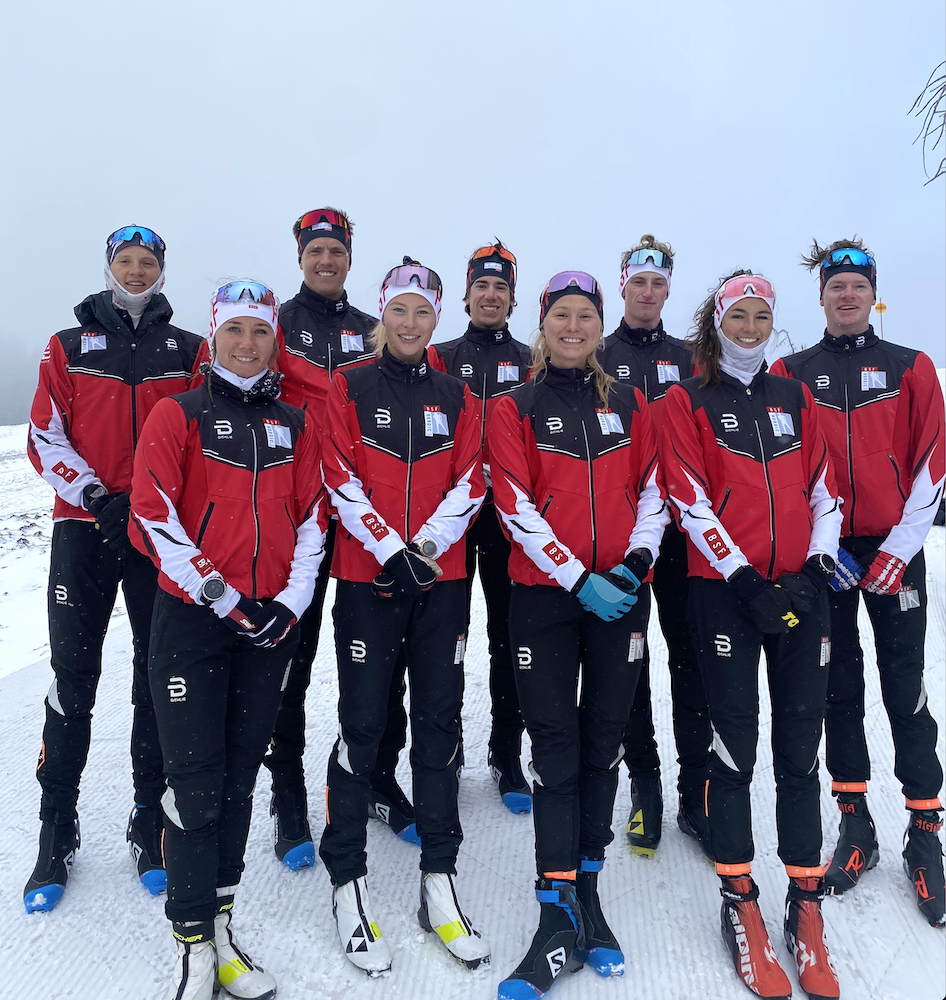
The 2021 Bridger Ski Foundation squad. (photo: courtesy BSF)
We tend to highlight World Cup races on this website, but those results, and those athletes, don’t happen in a vacuum. Skiers are made in the summer, as the well-worn saying accurately has it, and summer training means time spent with a domestic ski club. So we’re going to be highlighting the athletes on several prominent American ski clubs over the next few weeks, only a small portion of whom will be starting on the World Cup this fall.
If World Cup skiers are the pinnacle of a pyramid, then their club teammates are the indispensable supporting layer just beneath them. Go back and peruse one of Jessie Diggins’s multiplepostshighlightingthe importance ofherteam. Diggins doesn’t say, “I’d like to thank my teammates who ski with me on the World Cup, and only those teammates.” Diggins instead, of course, just says, “I’d like to thank my teammates.” There’s not much place for pedigree when you’re digging deep in bounding intervals in July, months and miles away from snow-covered European race courses.
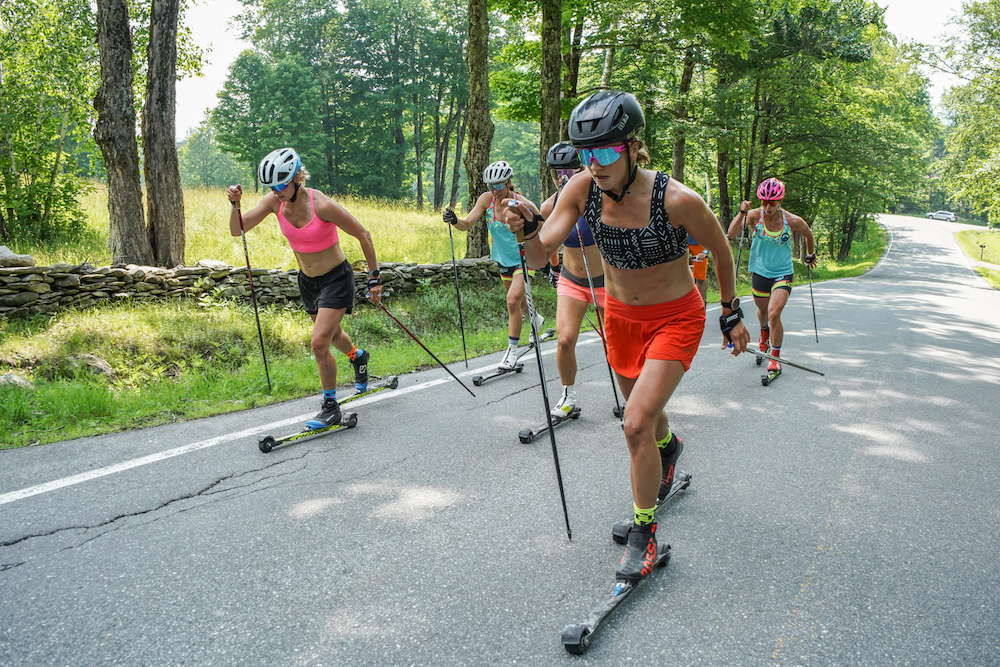
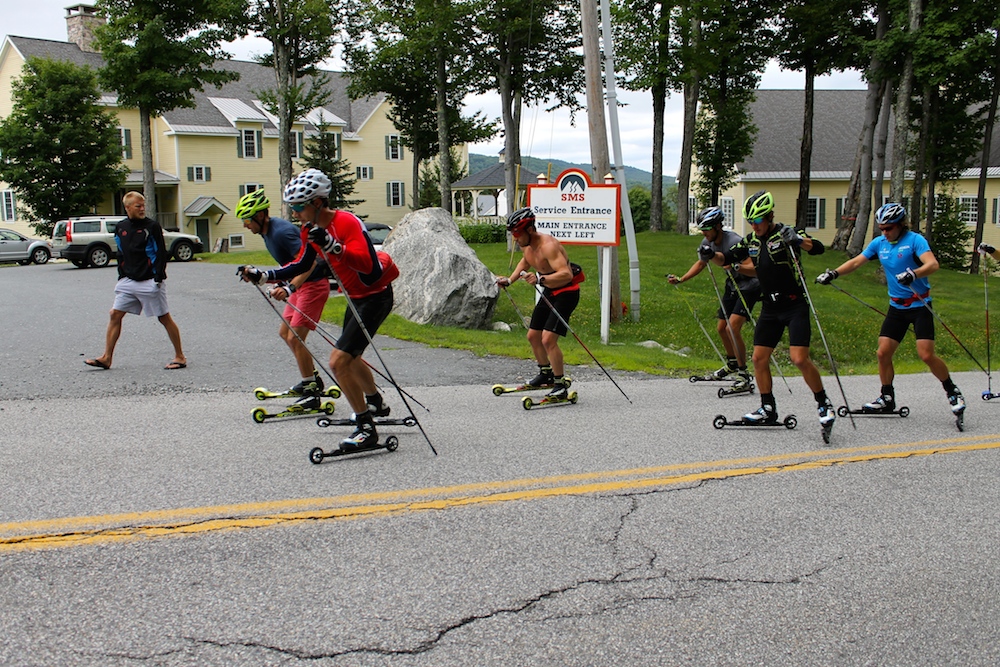
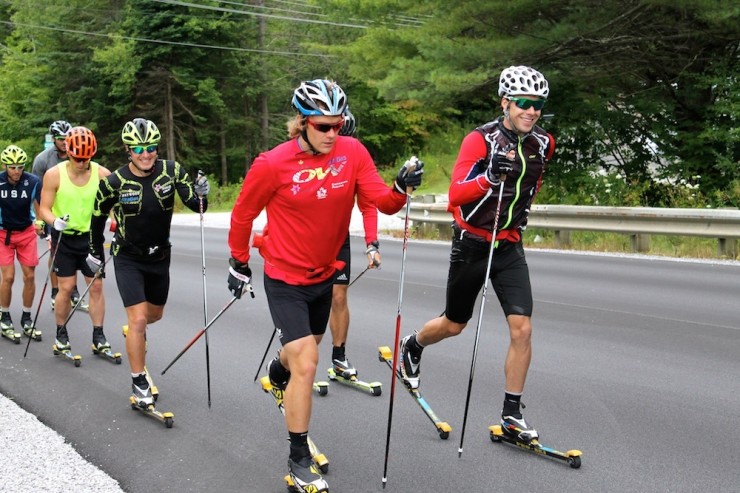
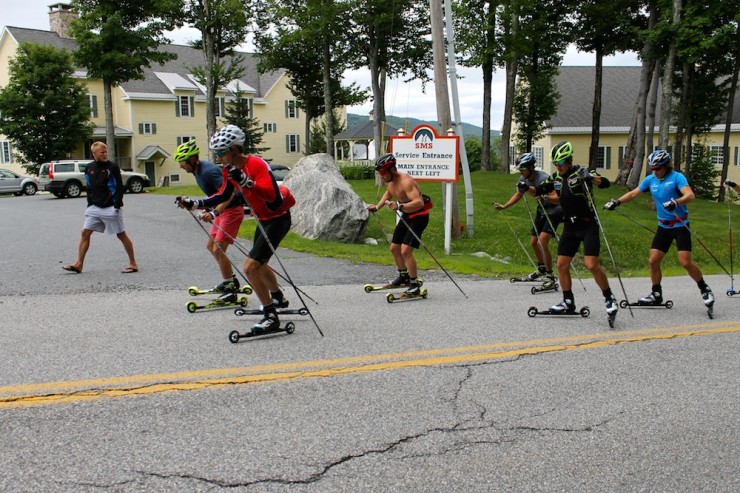
Stratton Mountain School athletes, including Alayna Sonnesyn, far right, rollerskiing in Vermont in summer 2021. (photo: courtesy SMS)
This isn’t just an attempt to make club skiers feel good, either. Consider Caitlin Gregg’s World Championships bronze in 2015, Chelsea Holmes’s 13th in the 2017 World Championships 30km, Rosie Frankowski’s 21st in the 2018 Winter Olympics 30km. None of them was on the national team at the time of this breakthrough result; all of them were “just” club skiers. There are larger, complicated questions here about the interplay between the domestic race circuit and the World Cup when it takes so much time and money to travel between America and Europe, and World Cup–based skiers seldom race SuperTour-based skiers head-to-head, but it seems fair to say that some Americans racing at home are comparable to some Americans racing overseas.
(It also seems fair to say that the fact that Holmes was the third alternate on that memorable day, and got the start only after two U.S. Ski Team athletes, who were also her club teammates, turned it down, speaks to some of these larger questions.)
All that said, please enjoy our preview of six domestic ski clubs and their athletes, starting tomorrow and continuing over the next several weeks.
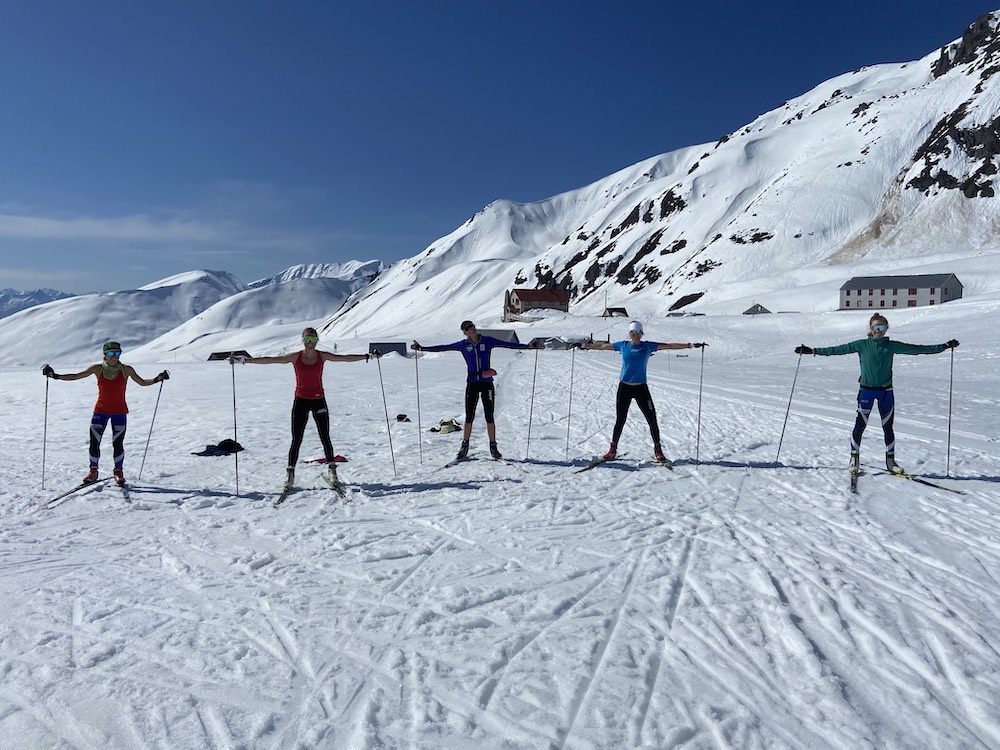
APU athletes maintaining early-pandemic social distancing, Hatcher Pass, May 13, 2020. (photo: courtesy Sadie Maubet Bjornsen)
This is not the first time that FasterSkier has written such a preview, but it is the first time in a few years. And compared to prior installments in this series, the ecosystem of American skiing has become notably more homogenous, at the same time that American skiing has become more successful. Here are the six clubs that we will preview this fall:
Alaska Pacific University Nordic Ski Center
Bridger Ski Foundation
Craftsbury Green Racing Project
Stratton Mountain School
Sun Valley Ski Education Foundation
Team Birkie
And here are the twelve clubs featured in, for example, summer 2012 (links to the whole series are at the bottom of this article from November 2012, if you’d like to really go down memory lane for a bit):
Alaska Pacific University Nordic Ski Center
Bend Endurance Academy
Bridger Ski Foundation
Craftsbury Green Racing Project
Central Cross Country (CXC)
Far West Farm Team
Maine Winter Sports Center
Methow Olympic Development
SMS T2 Team
Ski and Snowboard Club Vail Team HomeGrown
Sun Valley Ski Education Foundation (SVSEF) Gold Team
XC Oregon
Twelve is, obviously, more than six; spare a thought for Bend Endurance Academy, Far West Farm Team, Maine Winter Sports Center, Methow Olympic Development, Team HomeGrown, and XC Oregon as high-level American club teams (and, sort of, CXC Elite, though Team Birkie is in many ways its spiritual heir, with Caitlin and Brian Gregg as the through line).
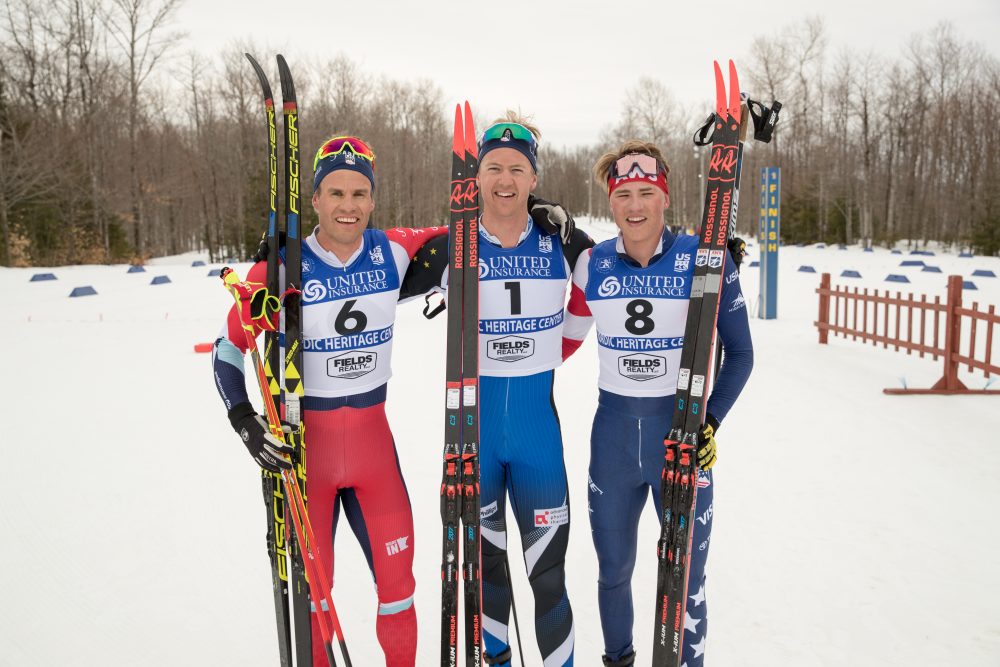
The men’s podium for the 2019 15-k mass start classic during the Super Tour Finals in Presque Isle, Maine. Erik Bjornsen (USST/APU, center) took the win ahead of Simi Hamilton (USST/SMST2, left) and Gus Schumacher (USST/Alaska Winter Stars, right). (Photo: U.S. Ski & Snowboard – Reese Brown)
We’ll leave it to you to debate whether this is “good,” “bad,” or neutral – whether it is good that more high-level skiers are training in consort in larger groups; bad that fewer coaching ideas or philosophies may have the chance to be heard, and that athletes outside four regions of the country have to travel to find a team (those members of the U.S. Ski Team A-Team who originally hail from Utah, Colorado, California, or Minnesota, for example, which currently describes four-fifths of the A-Team, had to leave home to find a club team); or neutral because improved American results justify a homogenization of the domestic training landscape, regardless of what might have been lost along the way. Maybe some of all of the above.
But regardless of the merits of this shift, it’s worth noting that things change. At the turn of the century, the best ski program in Alaska was the college team at University of Alaska Anchorage. In summer 2010, an ascendant Diggins was the nucleus of a strong CXC team, alongside Caitlin Compton (now Gregg), Jennie Bender, Tad Elliott, Garrott Kuzzy, Brian Gregg, and Matt Liebsch. In fall 2012, this site wrote, surveying the prior season’s SuperTour racing, “Central Cross Country (CXC) was indisputably the best all-around team last year.” And it alluded to the potential of a new group forming at Stratton Mountain – which was at that point still just potential, because the team had officially formed only earlier that year. Indeed, this article, entitled, “With Elite Team, Stratton Aims To Create ‘Hotbed of Skiing’ in Southern Vermont,” was published in 2012. (Spoiler alert: this worked.)
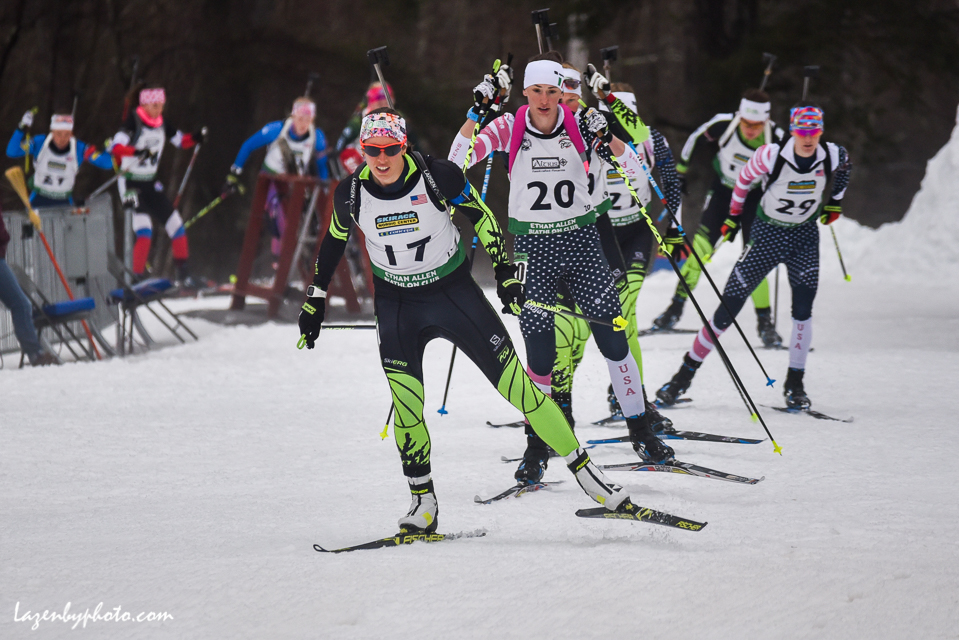
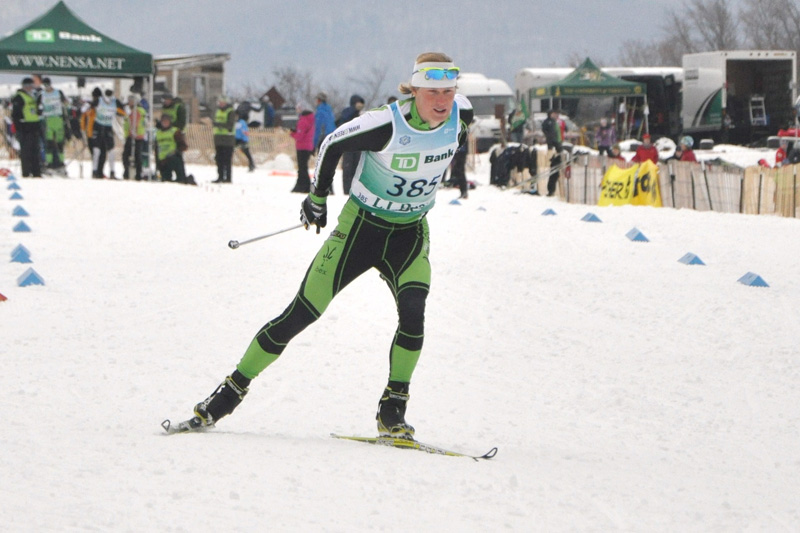
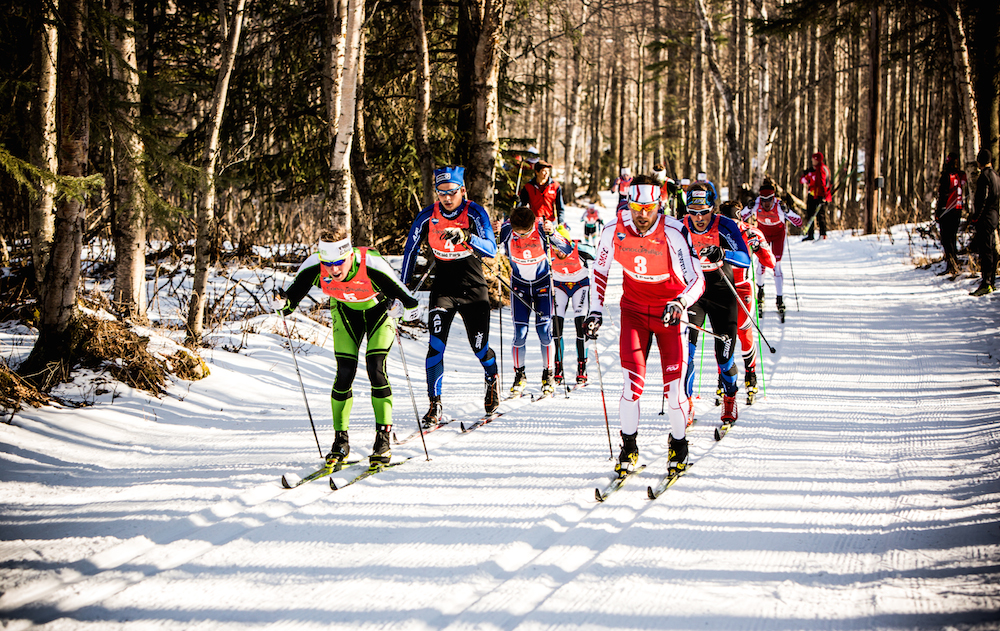
Craftsbury Green Racing Project athlete Susan Dunklee (bib 17) leads a pack including multiple CGRP suits at USBA Nationals in March 2019. (Photo: John Lazenby/lazenbyphoto.com)
Now we’re at a point where APU* or SMS frequently send six athletes each to a World Cup race or global championship, where there are currently eight national team athletes in one club alone (APU), and no current U.S. Ski Team members primarily based in the Midwest. No one knows what this list will look like in another decade, but for the time being, six clubs is decidedly fewer than twelve clubs.
Please enjoy the first preview, coming tomorrow.
* Disclaimer: I live in Anchorage, and have trained with the APUNSC Masters program for eight seasons and counting. On the one hand, the Masters group has been an important part of my personal and athletic life for many years now; on the other hand, on a day-to-day basis the Masters team has little to do and no overlap with the APU Elite Team, and is not coached by Elite Team Coach Erik Flora. I don’t receive free gear from APU or easier interval assignments from my Masters coach, or anything in that vein, in exchange for writing about the APU Elite Team.
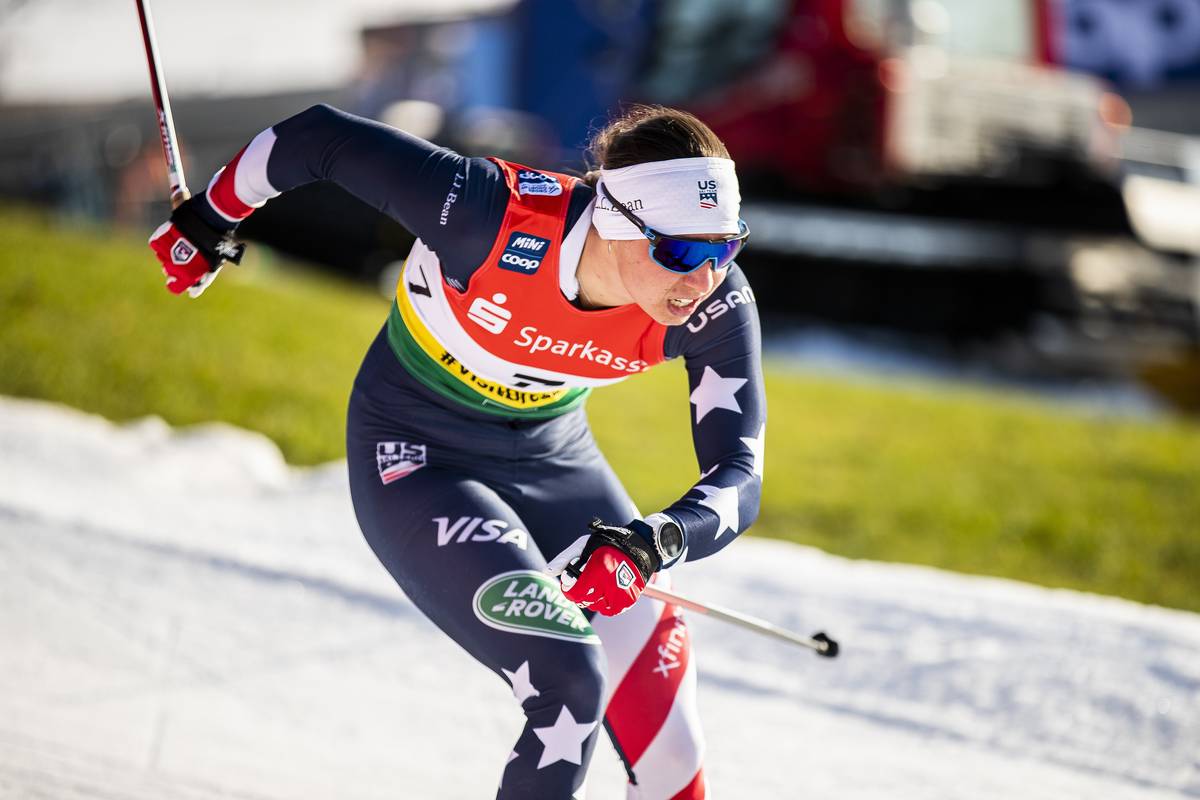
Julia Kern racing during the 2019-2020 season in Dresden, Germany. (Photo: NordicFocus)
Julia Kern finds herself heading into an Olympic season as one of the veterans for the US women’s cross country ski team. At the age of twenty-three, she’s ready to take on the leadership role left by the retirements of long-time team members Sadie Maubet Bjornsen and Sophie Caldwell Hamilton. After a lackluster season — by her own lofty standards — she has shaken off the disappointment, along with a hamstring injury she picked up last fall, to have one of the best summers of training in her career.
Kern spoke to FasterSkier in late July about where she’s been, how things are going, her philosophy for dealing with adversity, and her new role on the US women’s team.
“So far, the summer has been really good,” said Kern, who completed her degree at Dartmouth this spring with a major in Economics and a minor in Human Centered Design. After graduation and the US Ski Team camp in Bend, Oregon, she rejoined her SMS T2 teammates in Stratton, Vermont.
“We’ve had a really solid group training together most days. And it’s been really fun to work with such an incredible team and group every day.”
Kern has put a special emphasis on improving her double poling this season after working on it on snow in Bend this spring . “We had a few really productive double pole technique sessions there,” Kern said. “I’ve taken what we started doing on snow and have tried to apply it in every training session. The more reps you do, the easier it is to feel that progress. I do feel like my double pole has been better now than in the past, and I want to continue that into the season.”
Matt Whitcomb, Head Coach of the US Ski Team said that “she’s skiing with the best double poling technique that I’ve ever seen her ski with.”
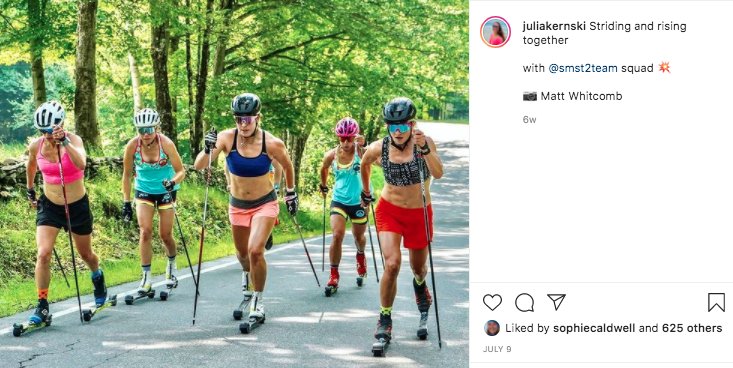
Julia Kern pushes through a set of classic intervals with her SMST2 teammates. (Photo: Instagram @juliakernski)
Kern has also made an adjustment to her strength training, saying, “I’ve changed my strength approach a little bit this year. It’s more of a physical therapy, injury prevention approach.”
Kern has been bothered by an injury she picked up last fall. “I don’t know exactly what I did, but I kind of strained my hamstring in November doing some sprints, right before heading over to Europe,” Kern said. “So I’ve been dealing with that. Since it was unfortunate timing right before the season, I couldn’t really heal it up; I just managed it all winter. I kind of had constant pain skiing last year. So this spring, I focused a lot on rehabilitating the injury, working with doctors and PTs, and just have been really consistent with PT to get back to being pain free.”
“Any injuries are concerning of course,” said Whitcomb. “But it seems to be under control. It’s nothing that’s going to prevent her from being successful.”
“For the last three weeks, I have had a pain free stretch for the first time since November,” Kern said. “Now, in the last few days, I’ve started to feel it. Progress is never linear, you take two steps forward, one step back. I would say it’s something that I don’t have to consider in my training anymore, which is really awesome.”
Kern didn’t think that the injury played into last season, which results-wise didn’t go the way she had wished. “I wouldn’t say that was the reason for not having the season I’d hoped for,” she said. “I think I’ve dealt with injuries a lot in the past.”
The hamstring injury did, however, prevent certain types of training. “It limited my ability to do sprint training, especially classic striding and speeds,” Kern said. “I had to be really careful with my reps. I couldn’t do any plyometrics. So I think in that sense, it changed my training a little bit, but I don’t think it affected in the grand scheme my whole entire season. I don’t think it played that huge of a role.”
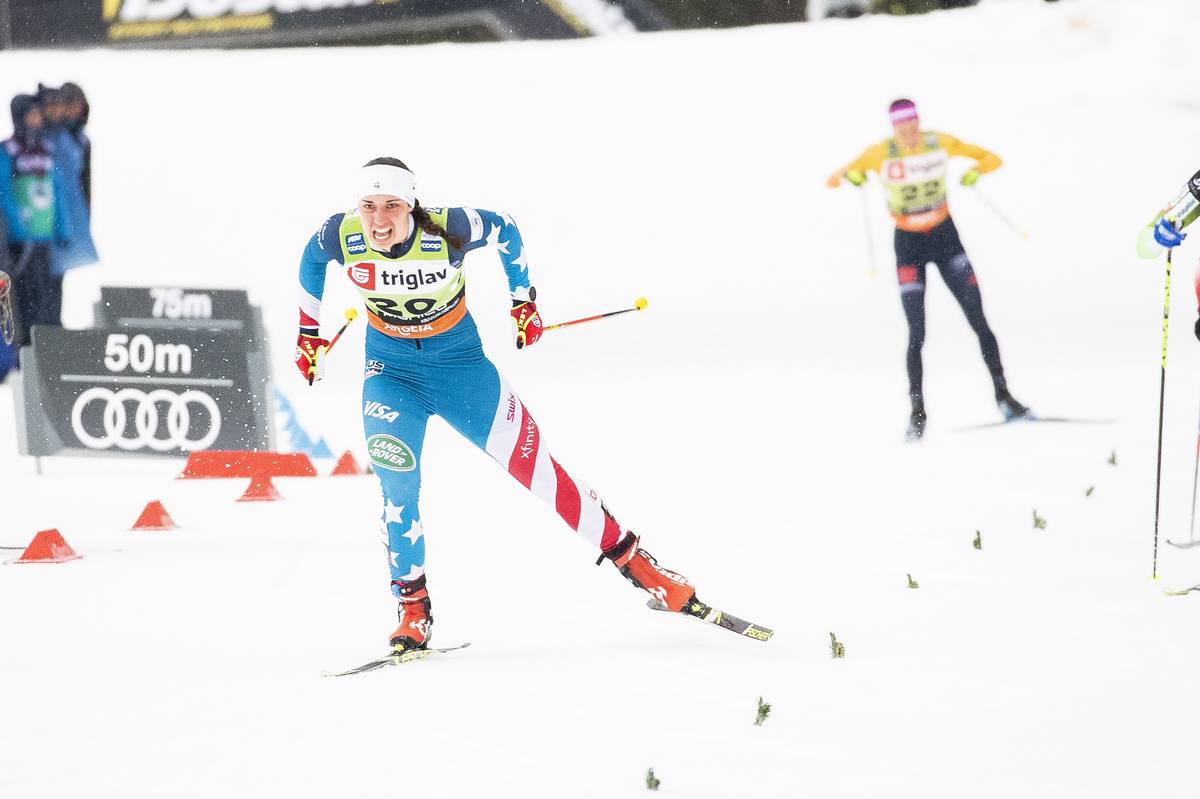
Julia Kern locks eyes on the finish as wins her semi-final heat of the 1.2-kilometer freestyle sprint in Planica, Slovenia. (Photo: NordicFocus)
Whitcomb praised her resiliency and leadership during a challenging season.
“Julia is coming off a season that was disappointing for her,” Whitcomb said. “But even on a disappointing season, an athlete like Julia can still qualify in the top place for sprinters and get 25th in a distance race…so it’s not like it was a disaster. One thing that I find very important to point out with Julia is that with this last season being a huge disappointment for her, you would assume that would be reflected in her general spirit, day to day. When that happens it’s usually almost as if poor days lead to more days when [an athlete doesn’t] perform because it becomes very difficult emotionally to stay focused on how to right the ship. With Julia, I don’t know that I’ve ever seen somebody believe so consistently throughout the season that things are going to turn around. I think that is why currently she’s having one of the best prep seasons that she’s had in a while. It’s because of patience and belief that she’s been able to do that. A lot of athletes put together a bad season and it takes them another season to recover from it because they just can’t turn things around. And Julia just never got stuck in the mud that way.”
Kern also reflected on her handling of the season, and what she’ll take away from it as she moves forward through her career.
“I would say it was a big learning year for me,” said Kern. “Progress isn’t linear from season to season either. I think it was a very challenging year—I never really found my rhythm, never really raced the way I thought I could, and was a bit confused and baffled for a while. But I think I learned a lot with COVID. It just changed what we normally do in ways that weren’t even intentional. It was an accidental learning year, we didn’t travel for training camps and training was really, really consistent. As a result, I never had really big weeks followed by easy weeks. I just had really consistent weeks, and I learned that maybe that isn’t the best way for my body to train.
“I’ve always seen this with injuries, where you have certain situations that force a change in how you normally train or behave. Either you learn from it and say, ‘oh, that worked really well and was unexpected,’ or you learn from it say, ‘okay, that’s not what works well. So, how can I figure out what does work?’ I think that’s important for the learning process. When things change, you have to react and then look back and say, ‘okay, was this a positive thing or negative thing’? And, ‘what can I take away from it?’”
Luckily for Kern, she is familiar with seasons that did not go as expected, and can put this into perspective as still being a valuable part of her overall athletic career.
“I have had seasons where things come around pretty late. I thought, ‘Oh, it’ll come around, it’ll come around,’ and it never did, which was a really hard reality. I never really had races like I wanted. But at the same time, I think it was really cool, because it gave me an opportunity to see how I can contribute to the team in other ways.”
Despite her own struggle, Kern looked outward and found ways to help her team.
“One of my big goals this last year was: how can I be a good teammate, even when my performances are far from what I want them to be? It’s easy to be upbeat, and be a good teammate, when you’re on top of the world and things are going well. But it’s really hard to not be a Debbie Downer when you’re just having a tough season and you don’t know why. Especially with COVID [protocols], we were so isolated in our rooms. We couldn’t even do the natural social things that make being on the road really fun. I just took it as an opportunity. How can I learn from this? How can I learn to deal with disappointment and bad races and still be a good teammate?
“At the World Championships I ended up racing for three minutes—total. And I was like, ‘Well, I’m here, how can I contribute to the team?’ and that meant helping with glide outs with the wax techs on certain races. It was incredibly rewarding to contribute to the team in a different way and help people succeed, collectively. I think I reframed it in a way of ‘okay, even if I’m not performing my best, I’m still growing as an athlete and learning, and I’m also still contributing to this team even if right now my performances aren’t where I want them to be.’”
These actions were visible to her coaches; Whitcomb praised Kern’s selfless role on the team.
“Julia is an incredible leader. We operate a team where we don’t name captains, we don’t like to have one men’s team leader and one women’s team leader. We really like, and request, and encourage everyone to lead in some way. And Julia is just so creative when it comes to the ways in which she leads, and she’s so bought into the idea of building something where everyone is connected and working together. She’s really a productive athlete, not just for herself, but for her teammates. It’s really, really a coach’s dream to get somebody like this.”
The women’s skate sprint podium from 2019 SuperTour finals (l-r): Ida Sargent (CGRP) in third, Sadie Bjornsen (APU) first, and Julia Kern (SMS T2) second. (Photo: Reese Brown).
With team veterans Sadie Bjornsen-Maubet and Sophie Caldwell announcing their retirement from the team this spring, there is a changing of the guard on the women’s national team and Kern is ready to act as a leader for the new generation.
“It’s crazy to think I went from being the youngest athlete to now being one of the more experienced older athletes on the team,” said Kern. “It’s definitely a transition. But I think it’s also exciting to see the next group of young girls and guys coming up, and I remember when Hailey Swirbul, Katharine Ogden, Hannah Halvorsen, and I were that group when we first joined the team. I just hope to follow in the footsteps of what Sadie and Sophie were able to do for me, and Kikkan [Randall], and Liz [Stephen], and Ida [Sargent did for them]. I mean, they all wanted to share all of their experiences, so that when I came around, I didn’t have to relearn all these tips and tricks about venues or being on the road. I hope I can be that resource to the athletes coming up now, so that they don’t have to have that learning curve. I had the luxury of the older girls teaching me and sharing those experiences, so that when you join the World Cup, you’re not figuring things out, you’re ready to succeed right when you come over.”
Kern commented that the transition of the team as it ushers in a new era will be “interesting”. Considering the ages of the women starting in Period 1 for the first time during the upcoming season, Sophia Laukli will be 21-years-old, Novie McCabe 20, and Sydney Palmer-Leger 19.
“I think that with young people, there comes a different energy, which is really exciting, and a little bit of freshness. When I joined the team, everyone was a seasoned World Cup athlete, so it was very much the same for them every year. Now, there’s going to be a lot more transition of people coming and going. A lot of people will be going to World Cups for the first time, and it’s always exciting to have that. Our team is just pretty open to sharing their experience. There’s a lot to be learned from the younger athletes and older athletes. But yeah, I’m curious to see how the dynamic is. The Bend camp this year was super fun. Everyone’s really engaged with having conversations about the team and beyond. A lot of people are passionate about doing big things collectively.”
Kern is looking ahead to the Olympic season, focused on her individual goals in sprinting and the success of the team as a whole. “I want to be one of the top sprinters and see if I can consistently start making semifinals and finals,” said Kern. “The sprint’s definitely a big goal of mine, and, of course, to be named to the Olympic team, qualify for the Olympic team, and then give it my best at the Olympics if I get to race.
“I’m a huge fan of the team sprint and relay, so if I get named to the Olympic team, fighting for a spot on that team would be an absolute privilege and honor. That’s a big goal of mine that’s motivating, and what’s cool about that too is I train with Jesse [Diggins], Katharine [Ogden], Alayna [Sonnesyn] and Lina [Sutro], and so collectively, I feel like whether we’re training for individual spots or for team results, it’s all one and the same. I think having those team and individual goals is super motivating.”
With an excellent spring and summer of training, Kern is on track.
“I think things are going really well for her right now,” said Whitcomb. “She’s happy and focused and executing some great workouts.”
“I’m just excited for more,” Kern said. “More training camps to come, and excitement for the winter.”
An ecstatic Julia Kern celebrates her first World Cup podium performance with her coaches after the 1.2-kilometer freestyle sprint in Planica, Slovenia. (Photo: NordicFocus)
Author Alayna Sonnesyn during a crust ski at the Snow Farm this summer near Wanaka, New Zealand. (Photo: Matt Whitcomb)
The following was written by Alayna Sonnesyn, a new member of the Stratton Mountain School (SMS) T2 Team who graduated from the University of Vermont (UVM) this past spring.
Originally from Plymouth, Minnesota, Sonnesyn, 22, raced on the UVM Ski Team for four years and qualified for four NCAA Skiing Championships teams. She placed second and third in two races at 2017 NCAA Championships, and in her senior season, won the first five Eastern Intercollegiate Ski Association (EISA) races and went on to reach the podium in 10 out of 11 EISA races. Sonnesyn expressed an interest in exploring the dilemma many of the nation’s top skiing talents face out of high school: whether to attend college or get an early jump on a pro-racing career. Part 1 can be viewed here, and the two-part series is also on her blog.
***
According to the Bureau of Labor Statistics about 70 percent of 2017 high school graduates enrolled in some form of college the following fall. In addition, a handful of the working population decided to either start college after a few years or return to classes after a much-needed hiatus. But what happens if you stray from the norm … and something pulls you in another direction? For Jessie Diggins and Andy Newell, there were alternative ideas for the future.
At the time, both Jessie and Andy followed the same route, exploring collegiate racing right out of high school. Similar to many high school skiers, they went through the process of applying to schools, talking to coaches and establishing academic opportunities for themselves after graduation.
Jessie Diggins being goofy during our recent training camp in New Zealand. (Photo: Julia Kern)
“When I decided to go full-skiing, I had deferred a place at NMU, and had that as my Plan B if I decided that full-time skiing was too stressful or not as fun as I wanted it to be,” Jessie said.
“What I decided to do was defer from UVM, but I was also able to take some classes from the University of Utah with tuition reimbursement and a loaned laptop courtesy of the US Ski Team,” Andy explained.
At the time, both skiers were still open to going to college, but decided to “take a year off.” The only difference was that they never experienced that longing to go back into full-time school. As previously mentioned in Part 1 of this series, many skiers who decided to take a gap year soon came to the realization that something was missing and that they still wanted a balance in their life. It made sense for them to go back to school and ski in college. But why change something when you’re already happy?
According to Jessie, “At the end of the day, a happy skier is a fast skier… For me, I was super happy having all my eggs in one basket and making skiing my full-time job. I love having skiing as my career, and I perform well under stress so having the pressure of becoming a professional athlete at a young age didn’t create too much anxiety.”
This stress worked well for Jessie. With such a unique combination of personality, work ethic, and training load, she knew taking this route would be better for her.
“Personally, going to college wasn’t going to work for me if I wanted to get the grades I wanted and train as hard as I wanted,” she said.
Jessie went on to note how important it is to figure out your own personality; whether you can do a good job at balancing school and skiing, or whether you’re excited to focus all of your time and energy on one goal. She found that specificity suited her lifestyle really well after high school and carried that momentum for years to follow.
Similarly, Andy found success from a young age and didn’t see a reason to change what was already working so well for him.
“To get that kind of international exposure was sweet for a junior, but more importantly it got me hooked on skiing — the addiction to the big show and excitement of European racing,” Andy said of racing at World Juniors, U23’s and World Championships his first year out of high school.
With the need for speed and an obvious progression into becoming an elite skier, Newell admitted that he pretty much gave up any opportunities for racing in college after he started signing contracts and collecting win money. Although, he notes that the ski racing environment was slightly different at the time he made this choice. In high school, Andy was named to the U.S. D-team, which, at the time, provided free housing in Park City, access to daily coaching, and most of the Winter travel expenses covered.
“I consider myself lucky that the U.S. Ski Team was in a position then to support D-team members a little bit better,” Andy said.
He explained that he wouldn’t have given up his opportunities for anything. He was feeding his addiction to the big show of European racing, making decent money, and having the time of his life! What else could he need or want?
So, the big question is, do all the stars need to align? Do you need to have the right opportunities present themselves at just the right time? Maybe! But it’s important to note that this right moment appears differently for everyone! What is more impactful, is the way you respond to the opportunities presented to you.
U.S. Ski Team coach Matt Whitcomb pointing us in the right direction during a crust cruise at the Snow Farm in New Zealand. (Photo: Julia Kern)
“There are a lot of options these days,” said U.S. Ski Team coach Matt Whitcomb, “but those who become exceptional are the ones who actually pick something from the list, and they run like hell with it.”
You don’t need to do exactly what your teammate did, or what an Olympic medalist did.
“Create your own path, get vulnerable,” Whitcomb advised. “Most people just run down America’s path of mediocrity, when they could instead be cutting their own unique route.”
Every skier can take a different road. Maybe that road is pin-straight without a single bump, or maybe that road has curves and hills and potholes. It doesn’t matter what it looks like or how you approach it, as long as you figure out the best scenario for you and what makes you happiest. One way to solve this solution would be to test out every possibility; take a gap year, go to one school, maybe transfer, take another year off — but this is unrealistic and requires far too many resources. I think that the easiest way to find your way is to talk to others that have faced a similar situation — an older sibling, teammate, coach, or friend. Also, remember that you really can’t go wrong. No matter what choice you make you will still face unexpected fears, experience a new lifestyle, and figure out why exactly you still love this crazy sport!
For those of you taking a year off from school, I wish you the best of luck in finding the perfect place where you belong. For those heading back to school, I hope you cherish every moment of it, because it goes by far too quickly. Regardless of which road you choose, own it! Make it your decision and give it your best shot/all you’ve got. If you do that, you can’t go wrong.
“There is no right or wrong decision, do whatever works for you!” — Sophie Caldwell
“You can be the fittest person out there, but if you are not happy and motivated, it will be very hard to ski fast.” — Julia Kern
“My only regret in my skiing career is that I was not mentally prepared to win a medal at my first Olympics as a 22 year old…. I thought I had a chance of winning a medal but I didn’t actually BELIEVE I could do it. So above anything else I want young skiers who are graduating from high school to know that four years is not a long time and you can find yourself at the start line of the Olympics before you know it.” — Andy Newell
“I don’t think there’s one model that fits every person. It’s also important to remember that it’s not forever!” — Jessie Diggins
“The opportunities will present themselves when the the time is right!” — Ida Sargent
“If you want to be exceptional, don’t be afraid of being an exception.” — Matt Whitcomb
Alayna Sonnesyn with one of her former UVM coaches Perry Thomas at the 2018 App Gap Challenge Rollerski Race in Vermont this summer. (Courtesy photo)
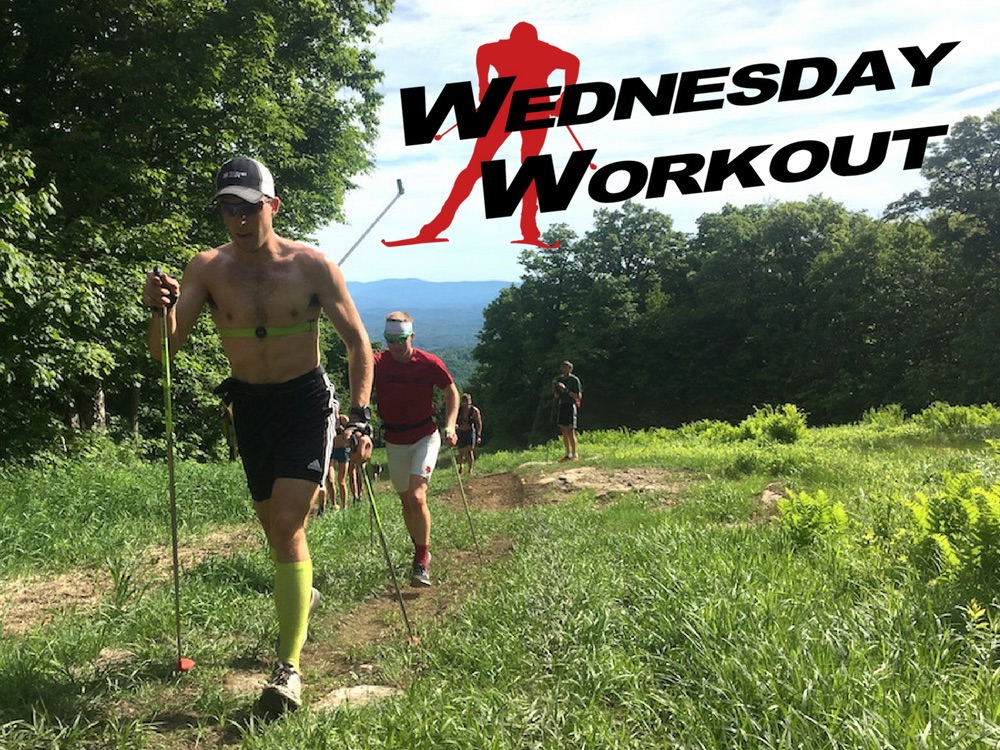
Paddy Caldwell (l) of the Stratton Mountain School T2 Team leads the way during a summer ski-walking workout up Stratton Mountain in souther Vermont. (Photo: Patrick O’Brien)
For this week’s workout, we feature the Stratton Mountain School T2 Team, also known as the Elite Team, out of Stratton, Vermont. The team’s full-time athletes live near the base of the alpine resort and take advantage of the following Level 3 (L3) ski-walking workout right out their front door.
In an email, coach Patrick O’Brien explained why they often repeat this workout during the summer: “We can safely have a large number of people training together (no worries about cars like on an open road) and the younger athletes get lots of contact and can hop in behind the senior athletes for a portion of their intervals,” he wrote. “The dirt work road up the Stratton Mountain Resort has good footing and lots of vertical for good steady state training.”
***
The workout: Level 3 Mountain Ski Walking
Need: A mountain with enough vertical to fit in 6-7 intervals of ski walking (lasting 7 minutes apiece). A good pair of trail shoes, bounding poles (about 10 centimeters shorter than one’s classic pole length), and a drink belt with sports drink and some food.
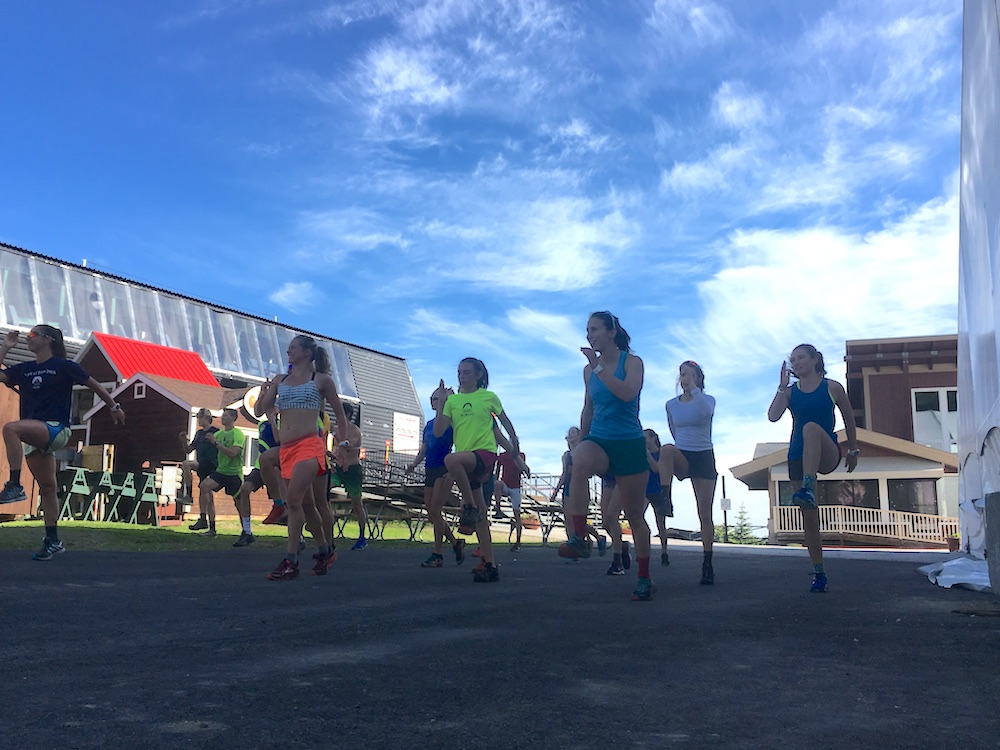
Warmup: Light 15-minute jog around the base. “Then we have our T2 team go through their ‘power warmup’ and lead the younger athletes through this progression,” O’Brien explained. “The goal with this program that US Ski and Snowboard strength coach Tschana Schiller has devised is to get our muscles sequencing and firing well before our intensity session so we are really working on explosive movements while we are most fresh versus trying to incorporate this to a late afternoon gym session. This improves our ability to generate power and is a really effective way to warm up! It usually starts with some mobility exercises, then foot drills and culminates with explosive plyometric jumps and bounds.”
Jessie Diggins (neon orange shorts) helps lead her Stratton Mountain School teammates through A-skip drills during a “power warmup” at the base of Stratton Mountain. (Photo: Patrick O’Brien)
Threshold component: 30-60 minutes, depending on how hard the week is/what kind of volume you’re aiming for in a given training block.
“Older athletes tend to do more, younger development athletes do a little less as they don’t need the same amount of stimulus,” O’Brien wrote.
Ski-walking intervals: 7 minutes of “on” time followed by 3 minutes of recovery. Repeat six to seven times. Option to add faster, flatter running intervals at the top if needed.
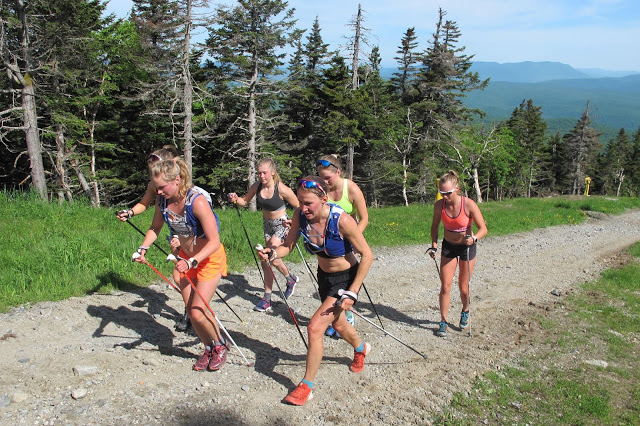
Jessie Diggins (front) and Sophie Caldwell (third from r) lead fellow Stratton skiers during a ski-walking workout up Stratton Mountain in southern Vermont. (Photo: Patrick O’Brien)
Tips:
Keep the group together: “We usually have the younger devo athletes start farther up the workroad and jog their recovery in place. The T2 team starts lower down and runs downhill on their recovery,” he noted. “This way the groups keep leapfrogging and the younger athletes can always tag along for a portion of their interval and follow the faster senior athletes and learn from their motions.”
Aim for “good, crisp ski-walking motions,” generating power from both lower and upper body: These aren’t as hard as all-out bounding intervals, O’Brien explained, “but we still want athletes to have a degree of impulse to their motions and not just walk up hill with poles on.” Stratton’s work road has some flatter grades, which allows athletes to “incorporate a lower energy bound on these sections and skiwalk on the steeper terrain,” if they choose. “Properly executed this workout looks pretty tame. Nothing flashy, no labored breathing or collapsing at the end of each interval. It is strenuous but not exhausting.”
Pace yourself. It should feel hard but sustainable: “With these longer steady state intervals it’s pretty easy to feel out that threshold line as there is no recovery during the intervals,” he noted. “Go too hard and you will feel it in your legs and lungs! We have people monitor heart rates and take blood lactates regularly but all of these are checks are for collecting background information. Ultimately what we want is for people to have a good sense of pacing and be able to ‘feel it out’ without needing the external feedback of a watch or lactate strip. Usually after a time or two doing this workout people have this pretty well dialed!”
Cool down: Jog back to base area, “or better yet download on the gondola when it is running on the weekend to save their legs from the impact of 1500 feet of decent!” O’Brien wrote.
Total workout time: 1:45 to 2:15 hours
***
Stratton’s 2018/2019 elite team includes seven returners (six of which are on the U.S. Ski Team) and four newcomers. Returning are Ben Saxton and USST members Simi Hamilton, Paddy Caldwell, Jessie Diggins, Sophie Caldwell, Julia Kern, and Katharine Ogden. According to an SMS blog post from late May, Paddy Caldwell was finishing up his studies at Dartmouth College, and Saxton, Kern and Ogden are taking classes there as well.
“We work closely with the Dartmouth coaches and fully support these athletes’ choices of when to attend school and when to be with us,” the post by Sverre Caldwell stated. “Paddy is finishing his last term at Dartmouth and he will join Simi, Jessie and Sophie as a full time SMST2 and USST member.”
New to the team are Kyle Bratrud (formerly of the CXC Team), Kelsey Phinney (formerly of the Sun Valley Ski Education Foundation), Alayna Sonnesyn (University of Vermont graduate), and Ben Ogden (of the Stratton Mountain School).
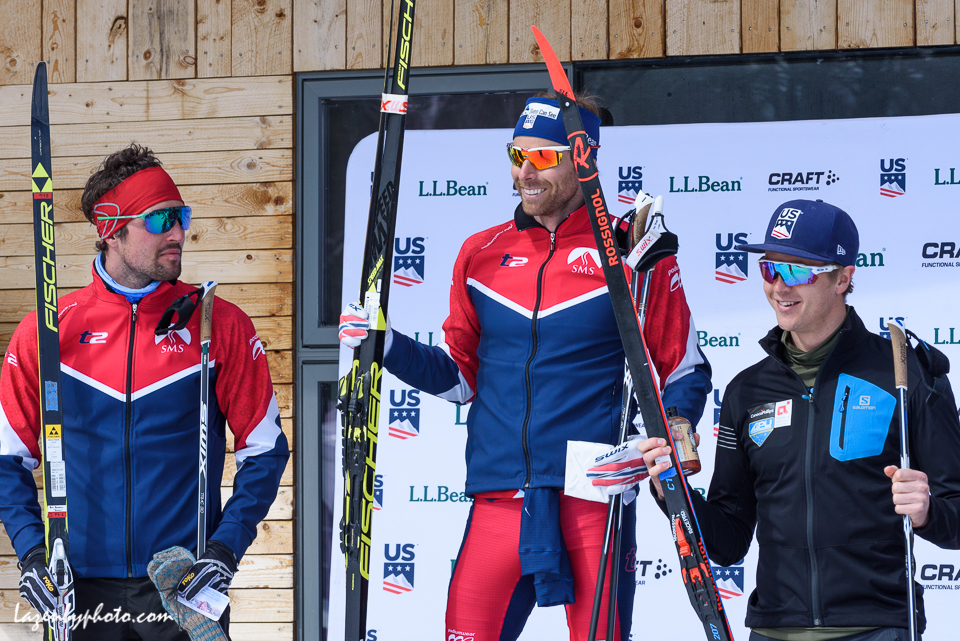
Andy Newell (c) of the U.S. Ski Team (USST) and Stratton Mountain School T2 Team after winning the men’s classic sprint at 2018 SuperTour Finals on March 24 in Craftsbury, Vt. His Stratton teammate Ben Saxton (l) placed second and Erik Bjornsen (r), of the USST and Alaska Pacific University, placed third. (Photo: John Lazenby/Lazenbyphoto.com)
When Andy Newell took to social media about a week and a half ago to announce that he was parting ways with the U.S. Ski Team (USST) after 16 years, some people might have assumed that he was leaving the sport. They would be wrong.
Newell, a 34-year-old Shaftsbury, Vermont, native and USST A-team member for the last 12 seasons, was quick to clarify that he’s not retiring from racing. After four Olympics and 16 years on the team, he’s just ready to be his own boss and set his own schedule.
“I guess in the back of my mind I always knew once the [2018] Olympics were over I would most definitely take a step back from being a full-time international ski racer and definitely take a step back from being a U.S. Ski Team national-team racer,” Newell said in a phone interview earlier this week. “Because that way, it allows me much more flexibility with my schedule even in the summer as far as training camps go and obviously a ton more flexibility in the winter as far as how much time I need to spend away from home racing World Cups.”
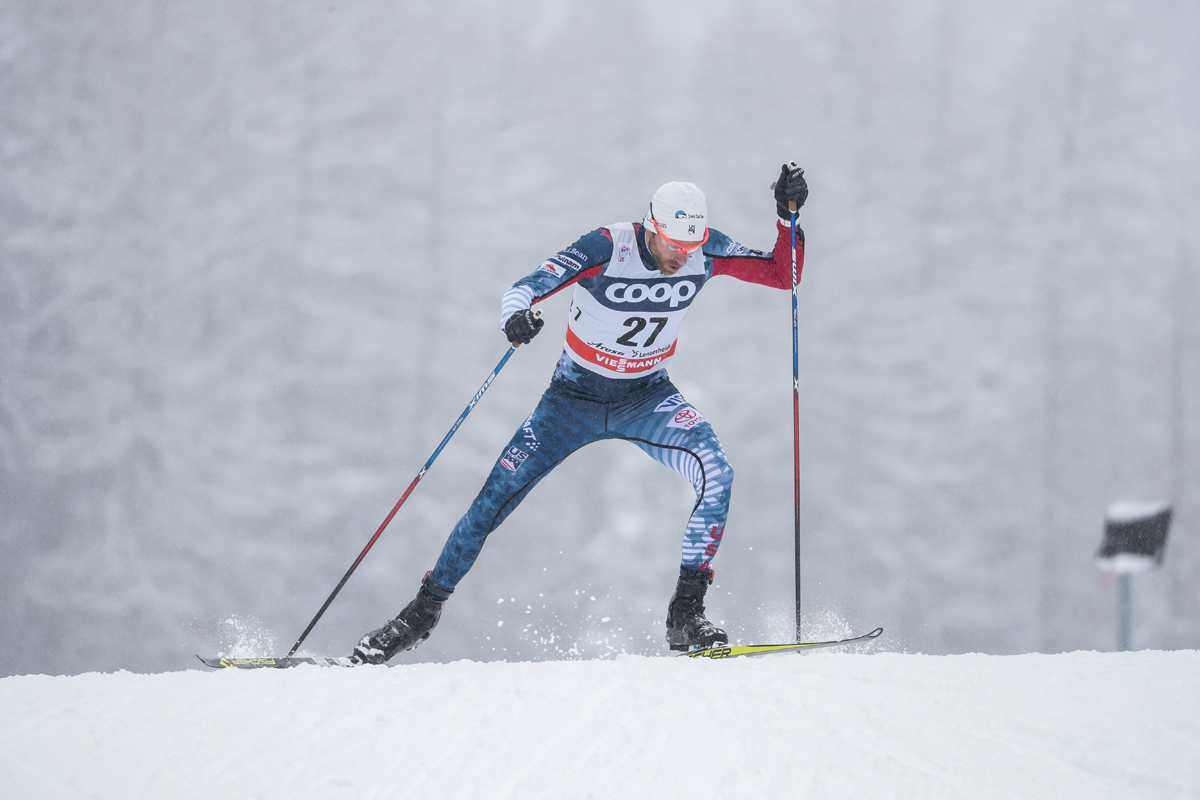
American Andy Newell racing the men’s 1.5 k freestyle-sprint qualifier at Stage 1 of the 2017/2018 Tour de Ski on Dec. 30 in Lenzerheide, Switzerland. He qualified 20th and went on to finish 19th on the day. (Photo: Fischer/Nordic Focus)
Newell spent all of last season — from Oct. 29 until mid-March — on the World Cup circuit in Europe (except for when he was at the Olympics in PyeongChang, South Korea, for the month of February). He rarely saw his wife, Erika Flowers, whom he married last June. The two arranged quick trips to see each other when they could, but as full-time ski racers on different circuits, it was a challenge.
“Five, six, seven, or ten years ago, I was making many of these decisions as an individual, and now that I’m married, I definitely have a lot more to consider than just myself when I make decisions when it comes to planning and scheduling,” Newell said.
While he was hesitant to elaborate on his plans moving forward, Newell emphasized that he’ll continue to race in the near future.
“Right now, I guess my plan would be to get back to a simpler schedule where I am still training at a high level but not focused really at all on World Cup racing,” he said. “So I might target a few races that I’ve always really wanted to do, for example some of the Ski Classics possibly over in Europe like the [Norwegian] Birkebeiner, possibly the American Birkebeiner. I think there’s so many great ski experiences that we have out there other than racing World Cups every weekend.”
And at this point, he’s not completely ruling out another run at World Championships.
“If I’m feeling like a complete champion by doing some of these different races, then you might see me trying to take a stab at something like World Championships,” Newell said. “But I’m not really putting any pressure or expectations on that, I’m more just looking to get back to a more simple training and racing routine where I can come up with my own schedule and plans and just remember what it’s like to really enjoy ski racing and doing the ski races that I want to do.”
Growing Up on the Ski Team
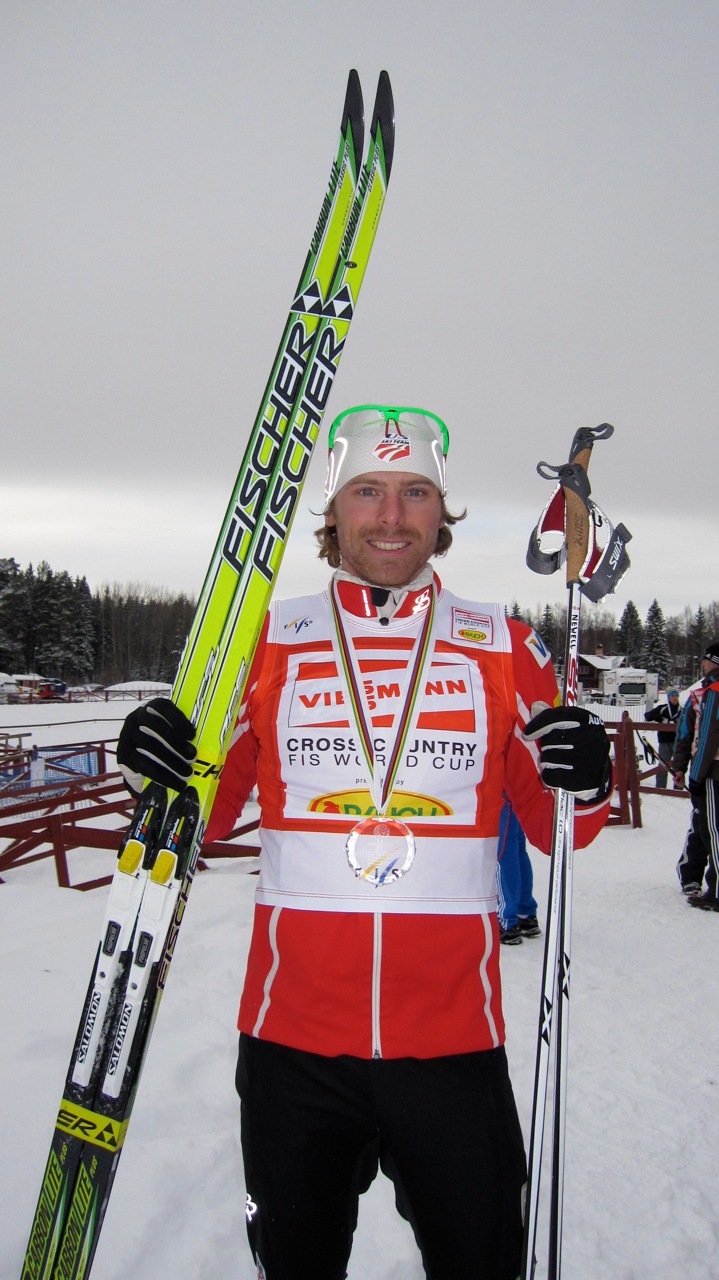
Andy Newell with some hardware after placing fourth in the season-long Sprint World Cup for the 2009/2010 season. (Photo: Kikkan Randall)
Newell first landed a spot on the U.S. Ski Team as a high-school senior at the Stratton Mountain School (SMS) in Stratton, Vermont. He was initially selected to the development team, which came with invitations to national-team training camps — like the present-day development “D” team — as well as summer housing at the USST base in Park City, Utah.
That season, in 2002/2003, Newell raced at World Championships in Val di Fiemme, Italy, and nearly qualified for the heats in the skate sprint (placing 31st). Just 19 years old at the time, he also competed at Junior World Championships in Sollefteå, Sweden, where he placed second in the qualifier and seventh overall in the freestyle sprint.
He competed in his first World Cup in 2004 and made the leap to the USST A-team in 2005. Newell then began his 12-season streak on the A-team, which entailed the team’s highest level of financial support. He reached the World Cup podium three times as an individual — first in 2006 in Changchun, China, where he placed third in a freestyle sprint. In doing so, Newell became the first American to medal in a World Cup race since Bill Koch did the same 23 years prior.
While Koch was a distance racer — like every international nordic racer of his era — Newell earned his chops as a sprinter and came onto the World Cup scene when short-distance sprint races were in full swing (the format was introduced at 1999 World Championships and 2002 Winter Olympics).
“I think back on those years, and they were so cool,” Newell said of his early days on the team. “To be, like, 20 years old and beginning to race World Cups. … I remember in ’05, I got a top 15 in a World Cup, and that was the first time that had happened for the U.S. in the last however many years, and because of things like that, every weekend something new and exciting was happening.
“I started doing better in some of the sprints and winning the qualification and getting a top 10 here, and the next year I was on the podium after that in ’06,” he continued. “And so it was a very quick trajectory to becoming one of the best sprinters in the world at that time.”
He raced at eight World Championships with his best result coming in 2007 in Sapporo, Japan, where he placed fifth in a classic sprint.
“I won the qualification in the sprint and ended up finishing fifth, but I remember being pretty disappointed,” Newell reflected. “I thought I totally could’ve been on the podium there.”
Andy Newell racing in late 2009. (Photo: Fischer/NordicFocus)
His other two World Cup podiums came when he placed second in a 2008 skate sprint in Lahti, Finland, and third in a 2010 classic sprint in Drammen, Norway. In four Olympics, Newell achieved two individual top 20s in skate sprints (16th in 2006 and 18th in 2014), and ninth in the freestyle team sprint at the 2010 Olympics in Vancouver, B.C.
In PyeongChang this past February, he raced to 37th in the classic sprint and 14th with the men’s 4 x 10-kilometer relay. Reflecting on those Olympics, Newell said he was personally disappointed with his results, but thrilled to be a part of history with his team.
“I felt like I had put in the time, time and effort and preparation to race better than I did,” he said. “But at the same time, we created such a great, tight unit and team throughout the last four years that for me, it was just so great to be there, to be there on the day that Jessie [Diggins] and Kikkan [Randall] won a gold medal. … Even though I didn’t ski my best, it was still, to me, in a lot of ways a success to be there; it’s been a successful year in that respect.”
‘A Little Bit of a Guinea Pig’
Asked how the sport, specifically sprinting, has changed over the years, he said it’s been gradual but noticeable. Moreover, his ability and willingness to adapt is what has kept him in it this long.
“If you were to look back on a World Cup sprint from 2005, the technique would look a lot different than it does now,” he said. “Many of the courses are the same, some are a little longer now than maybe what you would see back in the early 2000s for sprinting, but I think, in order to be competitive then, and also still competitive now, I’ve had to try to adapt as best as I can, and always be willing to learn new things.
Fifth in the 2012/2013 Sprint World Cup, Andy Newell (r) with women’s Sprint World Cup winner and fellow U.S. Ski Team member Kikkan Randall at 2013 World Cup Finals in Drammen, Norway. (Courtesy photo)
“I think if I would have assumed I was doing everything right or couldn’t improve, then I would have definitely been left behind I think years and years and years ago,” Newell continued. “I think people like Kikkan have done a really good job of that, and something that I’ve really tried to do, too, over the years, is always being willing to learn something new and not really have an ego about your shortcomings as an athlete.”
He explained that a consistent theme of his career was his willingness to venture into unchartered waters when it came to training.
“I’ve been a little bit of a guinea pig for the U.S. Ski Team in a lot of ways,” Newell said with a laugh. “I was probably the first athlete to go over and race an entire World Cup season. They hadn’t done that before we started scoring those kind of World Cup points in the mid-2000s, so it was like, how do we create a training plan that’s going to allow us to be successful at World Championships but also still race an entire World Cup season? So it’s been a great learning process for me and also I think the coaches over the last 20 years.”
Over the last two decades, Newell said he’s mainly worked with Chris Grover, the current U.S. Ski Team head coach, and more recently, USST Assistant Coach Jason Cork.
“Chris Grover wrote my training plans for probably the majority of my career,” Newell explained. “In the last four years or so, I started to work more with Jason Cork and also myself, I do a lot of the writing myself.
“I think I’m someone who likes to be a student of the craft of what I’m working on; I think I’ve always been like that,” he continued. “When a coach tells you to do something, you’re always kind of like, OK, but I would always want to ask why we do a certain workout the way we do and how it builds … I’ve just liked to learn about training principles over the years, and so as I’ve gotten older, I’ve gotten more involved in writing, going over training plans myself, and incorporating ideas and workouts that I want to do. And I’ve done a lot of dumb, crazy stuff over the years, too.”
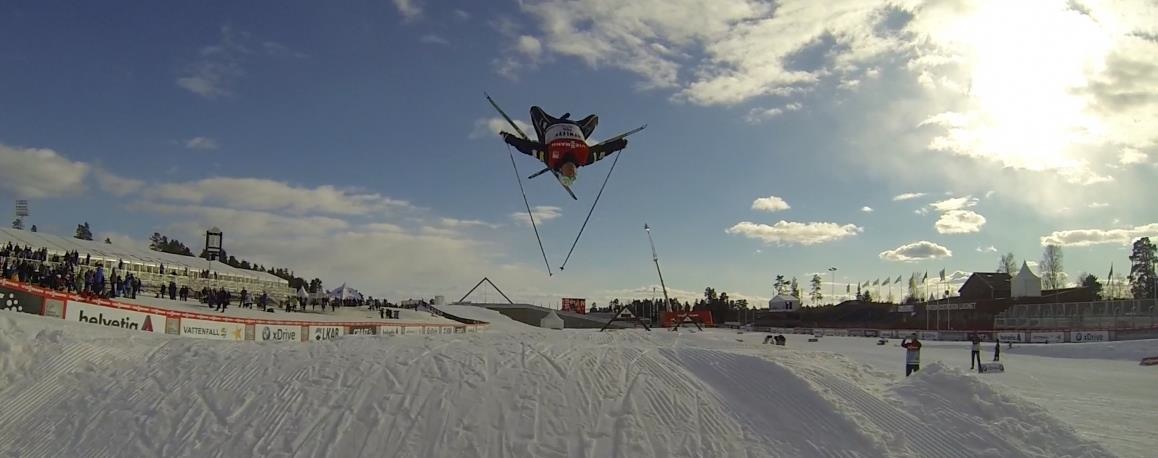
Andy Newell celebrating the end of the 2012/2013 season with some acrobatics in Falun, Sweden. (Photo: Adam Alexander Johansson, XHC)
Newell may be best remembered for his extreme stunts on ‘X Ski Films’, a filmmaking company he owned and starred in for several years, which included backflips and other airborne tricks on cross-country skis.
He’s also spent the last two decades training out of Stratton with three main coaches: Sverre Caldwell, Gus Kaeding, and most recently, Pat O’Brien, head coach of the SMS T2 Team. Newell met Flowers on that team, and while he won’t be a full-fledged member of SMS T2 this year, Newell said he’s looking to maintain a strong relationships with both Stratton and the U.S. Ski Team.
“In some ways I don’t think it feels like I’m retiring because I’ve kind of always had such a passion for pushing the level of skiing forward in this country,” he said. “And for me as an athlete, that was the best way I could do that, and I know as I transition into different roles in the skiing community, my goal [is] to continue hoping to improve the level of skiing in this country and improve the professionalism of skiing in this country and inspiring the youth skiing movement in this country — all those goals that I had as a ski racer — I will continue to have as a coach or a team leader or whatever my next role is going to be.
“I’d like to work with development as far as helping some younger kids out, so I’m going to try to look for opportunities where I can do that,” he added. “I think it’s kind of a natural transition from athlete to coach in a lot of ways, but I’m still very much going to be an athlete at least in the near future.”
Looking back on his years with the national team, he likened it to the pride one would have in a college or university they graduated from.
“I’m just really proud of my time that I’ve spent with the team and so grateful for all of the opportunities that the U.S. Ski Team has given me over the past two decades,” he said. “It’s probably the same way that people who go to universities and so forth feel about having that kind of pride for their alma mater. I never went to college so it’s like the U.S. Ski Team kind of scooped me up at 16, 17 years old. Everything that has built me up into the kind of person that I am now, that has molded me into my character, everything has more or less has come through the U.S. Ski Team.”
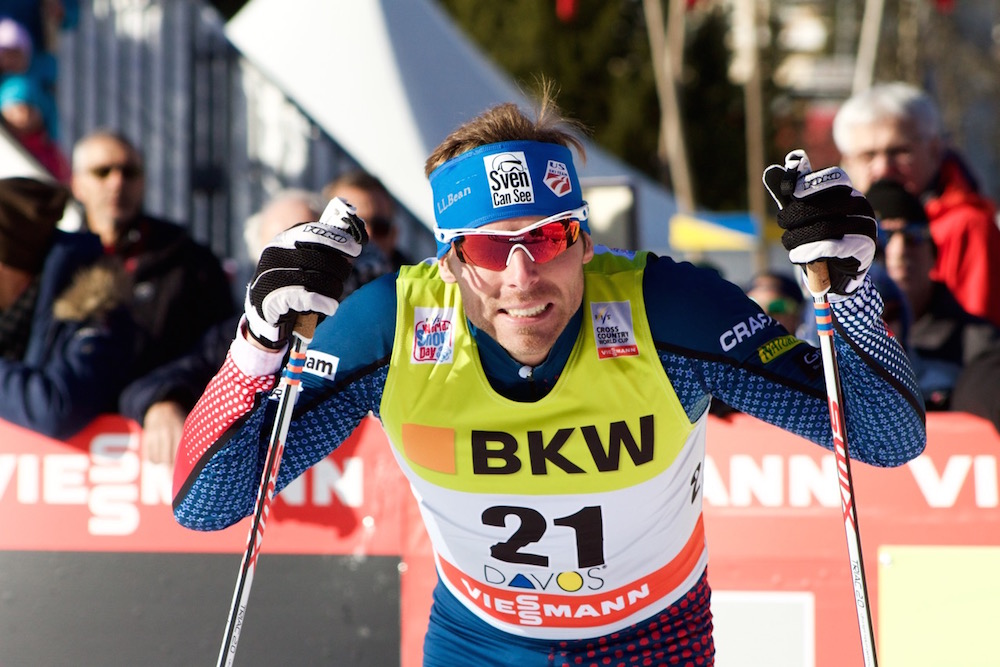
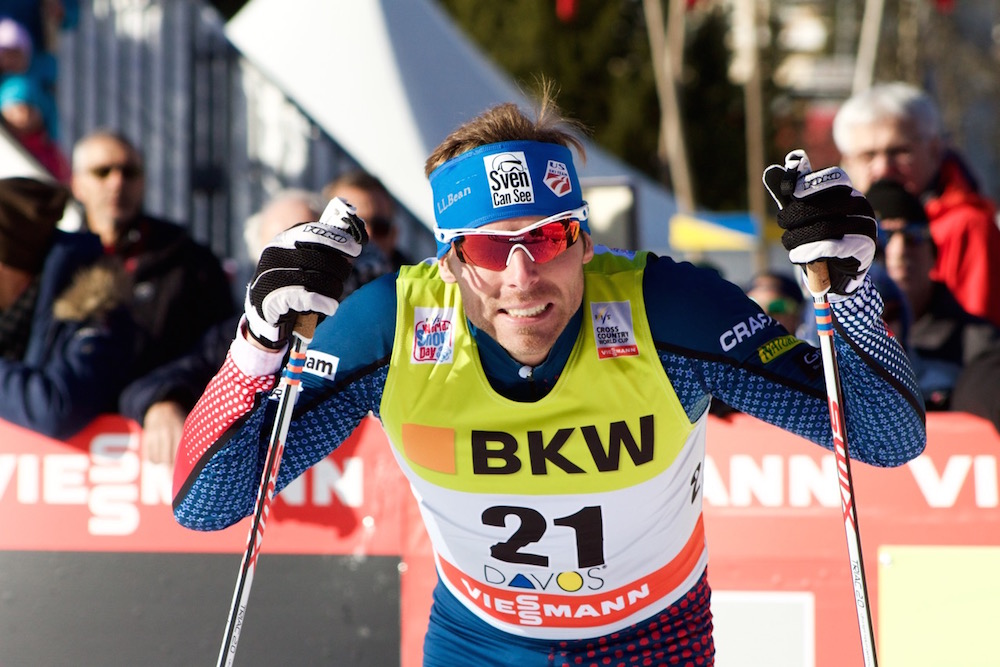
Andy Newell (U.S. Ski Team) after his quarterfinal at a 2015 World Cup freestyle sprint in Davos, Switzerland. (Photo: JoJo Baldus)
Is he nervous about going out on his own? Newell said it’s been a long time coming, and he’s more excited than anything.
“The spring’s always a funny time because you’re pretty exhausted from the season,” he said. “In a lot of ways, kind of the last thing you want to think about is skiing, but for me, I’ve always been one of those people that in the springtime gets super excited about all the opportunities. … By April 1, I [would be] already thinking, ‘Oh, what can I do for training next year?’ … and I start throwing around all these crazy ideas. I think that’s one of the things that’s kept me in the sport for so long, is having that excitement around training and preparation.
“I think it will be exciting in a lot of ways to try to be my own boss and do some of the training camps I want to do and partner up and train with some of the athletes that I want to train with,” he said of this spring and summer. “Not that I was ever held back by the U.S. Ski Team, but you definitely had to adhere to a certain schedule so I think it will be exciting to do some different things.”
From Sprints to Marathons?
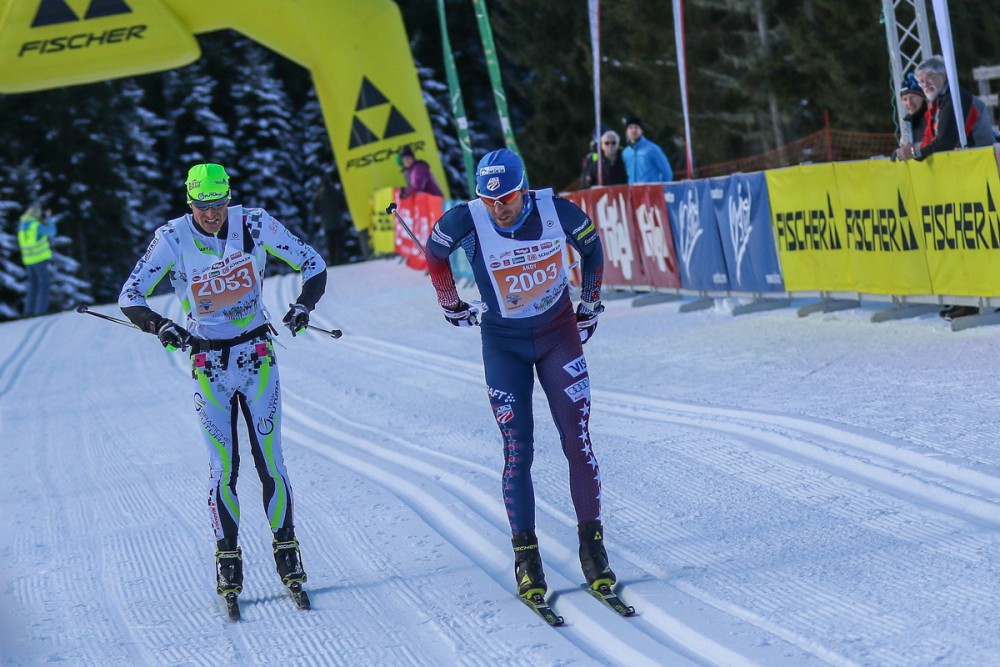
In late January 2016, shortly before Newell spoke with FasterSkier about mulling retirement, or at least taking a step back from full-time ski racing, he double poled his way to second place in the 42-kilometer Dolomitenlauf classic marathon (part of the FIS Marathon Cup series) in Lienz, Austria. Never one to like being labeled a “sprint specialist”, Newell is looking forward to trying more marathon races like that.
American Andy Newell (r) outsprints Italy’s Mauro Brigadoi, for second place in the 2016 Dolomitenlauf 42 k classic race in Lienz, Austria. (Photo: Fischer/NordicFocus)
“I have a lot of great friends who train for the Ski Classics [marathon series] and a lot of my Norwegian buddies who I have raced World Cups with over the years have gone that route after their World Cup racing career,” he said. “It’s a cool idea because those races are super fun, there’s great prize money, there’s a lot of excitement over them, and I think it’s really impressive when you see somebody just crush 90 k’s of double poling like they do in the Vasaloppet.
“So I’m definitely inspired by those guys and I, as an athlete, really like classic skiing,” he continued. “I love traditional-style classic skiing and I like double poling, so I think maybe in the future I will try to get into a few of those races, but it’s hard to do those and not be committed 100 percent because those guys that do those, they’re training to crush double pole like nobody’s business, so it’s hard to just show up on a weekend and race one of those races.”
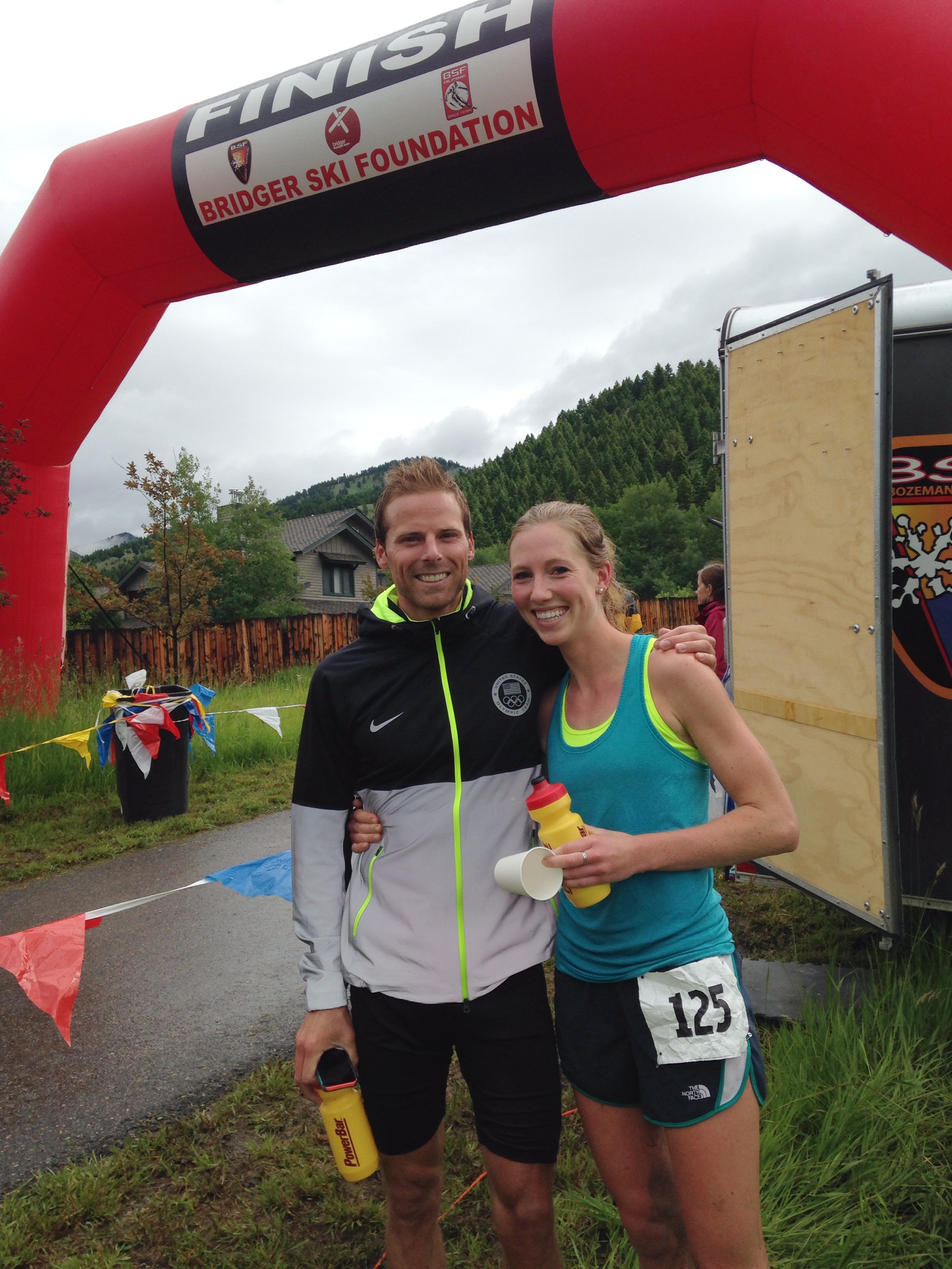
Andy Newell and Erika Flowers, both of the Stratton Mountain T2 Elite Team, after both won the 2014 Jim Bridger Trail Run in Bozeman, Montana.
Aside from the fitness required to double pole an entire marathon, the logistics of these races — many of which start in one town and end in another — is particularly challenging without a full-support crew or team.
“I’d really like to do the [Norwegian] Birkebeiner and I think it will take a few times to be able to consider yourself a threat to the podium in a race like that,” Newell said. “I would be foolish to think I could just jump into a Ski Classics race and crush it, but it’s definitely a goal of mine to maybe do some of those over the next years because I think they’re such legendary, badass ski races.”
In the near future, Newell and Flowers are headed out on a three-week “surf trip” to Australia and Indonesia.
After that, “it’s yet to be seen how everything will fit in,” Newell said in regards to his future plans, both living, training, racing, and otherwise. “There will be more to say later as far as what I have going on for next year as far as what my goals will be.”
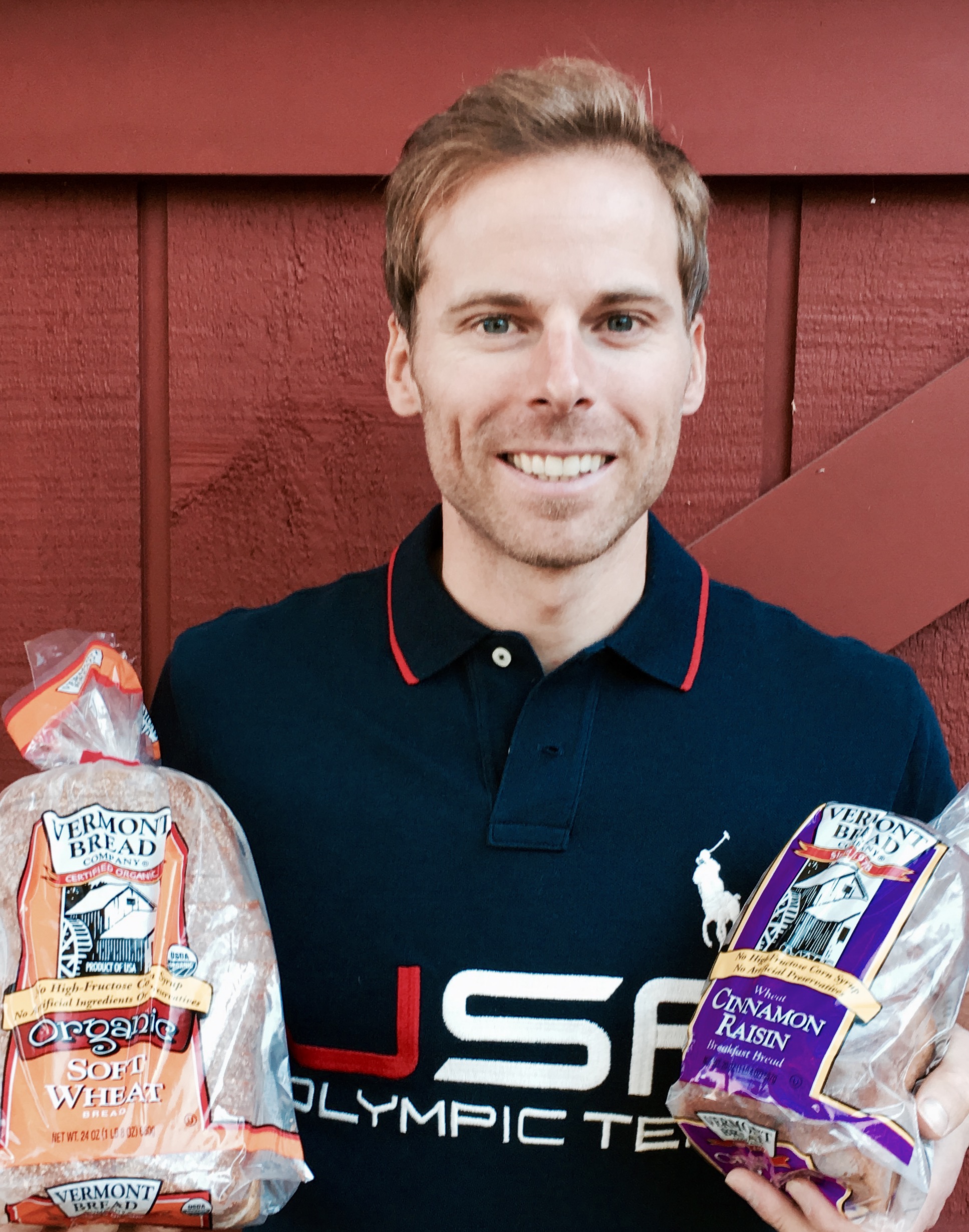
Andy Newell recently signed a two-year partnership with the Vermont Bread Company. (Courtesy photo)
(Press release)
Cross-country skier Andy Newell of Shaftsbury, Vermont, has competed in three Winter Olympic Games, representing Team USA in pursuit of that elusive gold medal. In addition to hours of training in the gym and on snow, his preparation for the 2018 Olympics looks a little bit different. This time he will be fueled by Vermont Bread Company.
Last week Vermont Bread Company and Newell solidified a two-year partnership that will run through the skier’s preparations for the 2018 Olympics in PyeongChang, South Korea. Newell, who has long been an advocate of youth physical fitness, is excited about the opportunity.
“I’ve teamed up with a number of organizations over the years that focus on childhood exercise and health, and visiting with elementary schools is something I love to do. Nutrition is a huge part of youth health and fitness so I’m excited to partner up with Vermont Bread Company to help bring nutrition to the forefront of school health education.”
As a full-time professional athlete, Newell also relies on good nutrition to fuel his own training and racing and is excited to partner with a company that shares his values for environmentally conscious and wholesome ingredients. Vermont Bread Company doesn’t use any artificial ingredients or high fructose corn syrup when creating their products. Newell, who spends much of the year training around Stratton, is a proud Vermonter and is enthusiastic about Vermont Bread Company’s commitment to local production and USDA Certified Organic breads.
“Just the other day I was visiting with their facility in Brattleboro and was blown away at the level of professionalism and care that goes into the baking process. I thought it was so cool that a lot of my favorite products like the all Organic English Muffins and Whole Wheat Cinnamon Raisin breads are made right here in Brattleboro, which is such an iconic Vermont town. Talk about buying local! I hope Vermonters will join me in supporting this amazing company.”
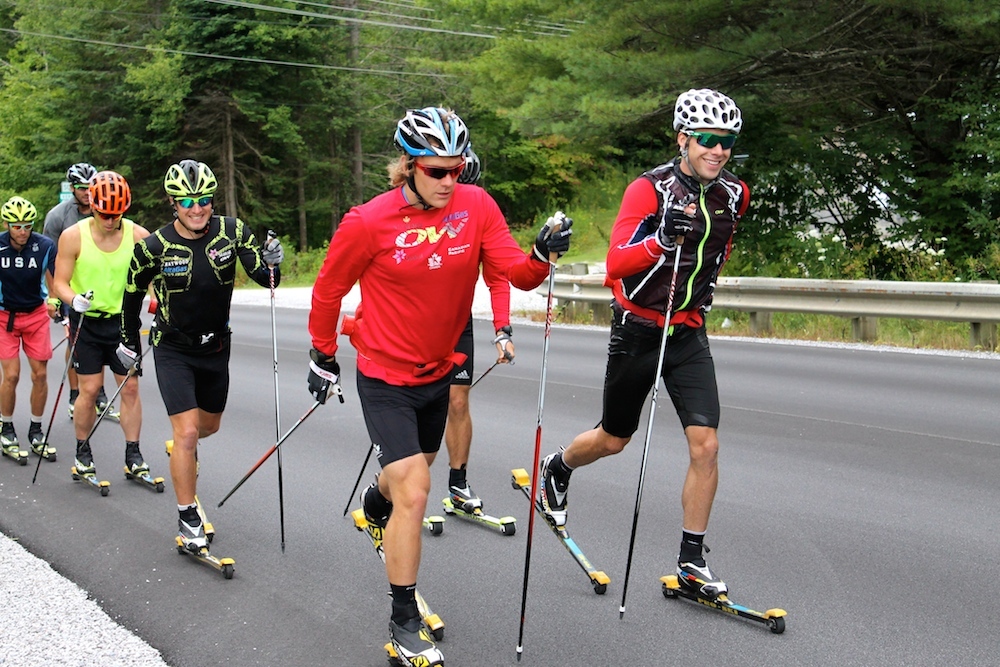
Canadians Alex Harvey (r), Devon Kershaw (front left) lead six others, including Ivan Babikov (third from l), Kris Freeman (second from l) and Andy Newell (l), during a combo over-distance rollerski on Aug. 15 near Stratton, Vt.
STRATTON, Vt. — When Tor-Arne Hetland thought of the U.S., his mind went to places he had been before, like New York City and Park City, Utah.
Stratton — a small town in southern Vermont with roughly 200 year-round residents (not including the private ski school near the height of the land) — was a surprise, but Hetland figured if Andy Newell grew up training there, it had to be worth visiting.
Canada’s newest World Cup coach and his four-man team of Ivan Babikov, Devon Kershaw, Alex Harvey, and Lenny Valjas ventured to the land unknown in early August for a sea-level, dryland intensity camp with the Stratton Mountain School (SMS) T2 Team. They rented a house in Stratton and brought a physical therapist along, and let Newell, an SMST2 skier and longtime U.S. Ski Team (USST) member, show them around.
Newell, of nearby Shaftsbury, Vt., picked the rollerski routes and joined the Canadians for about half of their workouts during their two-week stay, as did fellow USST and SMST2 skier Simi Hamilton.
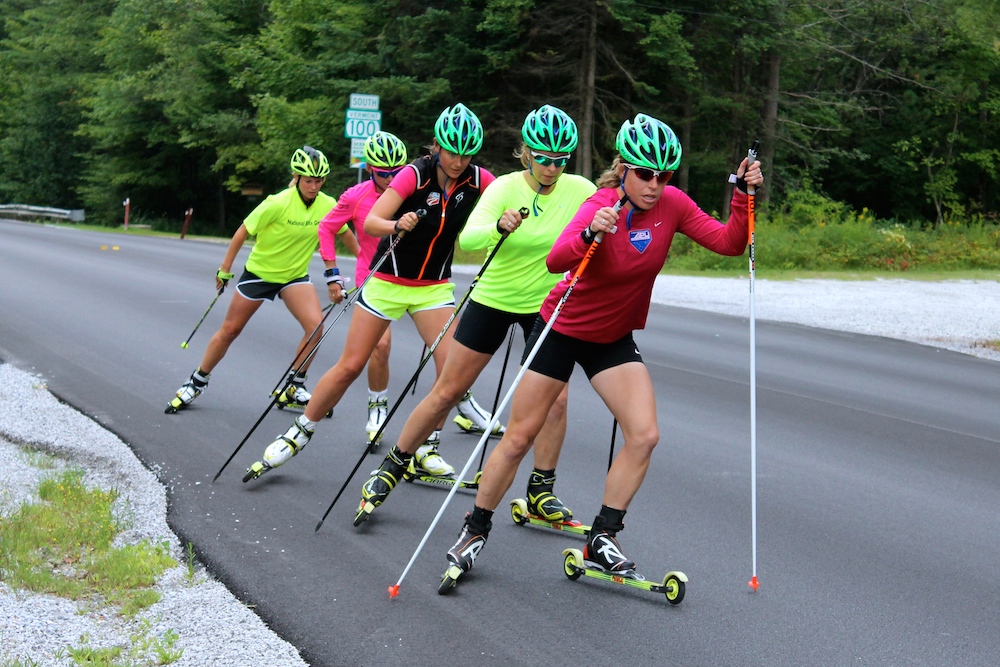
APU’s Rosie Brennan leads Stratton skiers Anne Hart (second from r), Annie Pokorny (c), Sophie Caldwell (second from l), and Jessie Diggins (l), during a combo over-distance rollerski in Stratton, Vt.
Stratton’s new head coach in his third month with the team, Patrick O’Brien said the Canadians were a welcome addition while most of his team was training together, two weeks before the USST training camp in Lake Placid, N.Y.
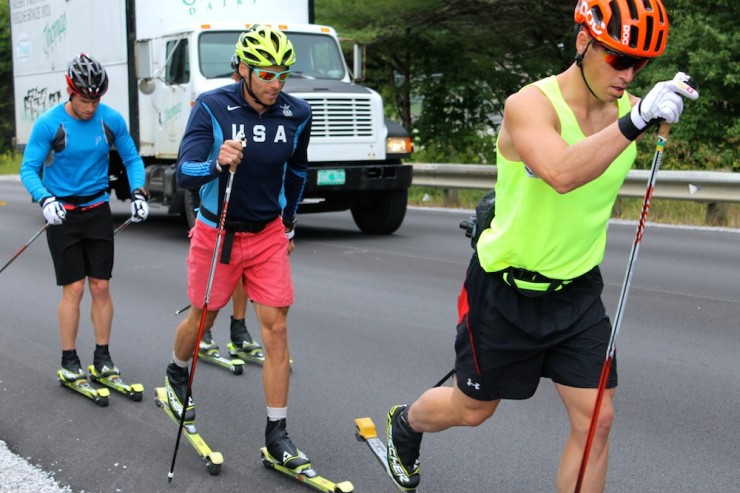
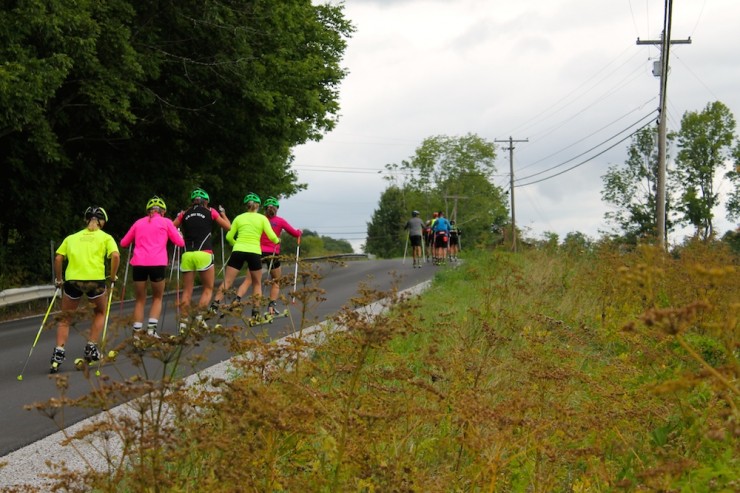
Hetland and Canada’s World Cup assistant coach Louis Bouchard, who drove five hours down from Quebec City, came with two vans — making logistics somewhat easier for supporting eight men during a given workout. On Aug. 15, they did a three-hour, combo over-distance rollerski (mimicking a skiathlon), looping around hilly backroads.
“It’s been really cool working with Tor-Arne and Louis,” O’Brien said. “As a young coach, I’ve been picking their brains … They’ve been really accommodating.”
Not all the workouts lined up. The Canadians, with a fifth athlete in Raphaël Couturier of the Pierre-Harvey Training Centre (where Bouchard is head coach), generally focused on high-intensity (Level 4-5) rollerskiing during the camp. The amount of hours they wanted to put in didn’t always match those of Newell, Hamilton and Ben Saxton on the T2 Team, O’Brien explained.
“Kind of our go-to is threshold and speeds with some L4,” O’Brien said.
Newell had been scaling back the amount of L4 workouts this summer and doing longer workouts to increase volume, he added. Plus, Newell and Hamilton recently returned from the USST camp in Alaska.
During the Canadians’ camp in Stratton, O’Brien also had five female athletes to coordinate workouts for: Jessie Diggins, Sophie Caldwell, Erika Flowers, Anne Hart, and Annie Pokorny.
The crew from north of the border originally wanted to hold their own camp in Lake Placid at the recommendation of U.S. head coach Chris Grover. When they couldn’t find a house to rent in August, they turned their attention to Vermont at the suggestion of Grover and Justin Wadsworth, Canada’s other World Cup and National Team head coach.
Canadian World Cup Team coach Tor-Arne Hetland (r) talks with the SMST2 Team during a water stop on an over-distance rollerski session on Aug. 15 near Stratton, Vt.
“Londonderry, Brattleboro,” Hetland read out loud from street signs along the rollerski route. Not much imagination those English settlers had, he chuckled.
No, not in New England, but weren’t these 18th-century buildings neat? More like cute by his standards, considering Norway was 900 years older.
Regardless, Stratton had something he wanted to see in person.
“I was thinking, Andy Newell can train here for many years so … that’s the reason we are here,” said Hetland, an Olympic gold medalist who coached the Swiss national team with his wife from 2010-2014. He and his wife, Guri Hetland, currently live in Davos, Switzerland.
Another plus: Stratton’s near-sea-level altitude with a low point around 1,900 feet (580 meters). The Canadians wanted to train a lot and test their limits, so recovery times needed to be shorter, Hetland explained. In mid-October, they’ll head to Park City for their annual altitude camp with less intensity, and they previously got together as a group in Canmore, Alberta, and also in Bend, Ore.
Back when they were planning their late-summer camp, they ruled a few locations out. Their regular stop in New Zealand for actual skiing at the Snow Farm couldn’t happen because of Cross Country Canada’s budget cuts. Whistler, British Columbia, was a possibility, but it wasn’t great for rollerskiing, Hetland said. Then they couldn’t find a place to stay in Lake Placid.
But Newell, Hamilton and their SMST2 teammates: “We can use [them],” Hetland said.
“The U.S. and Canada have great skiers, but they’re alone,” he explained. “[That’s the] biggest difference to Russia and Norway.”
“Anytime you can make the group larger without sacrificing quality, it’s great,” O’Brien began, noting the high-caliber of the Canadians. “These guys are really fast.”
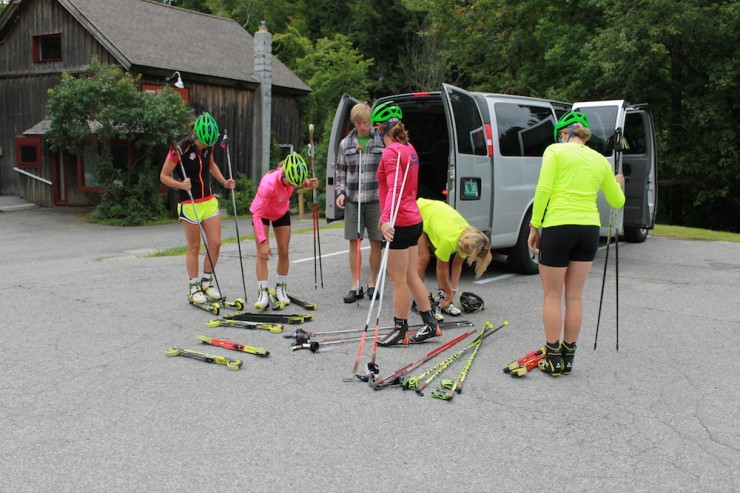
An hour and 30 minutes in, eight men — Newell, Hamilton, Babikov, Kershaw, Harvey, Valjas, Couturier, and Kris Freeman of Waterville, N.H. — clicked out of their bindings and switched from classic to skate. Hetland and Bouchard had parked their two vans on the side of the road and carefully laid out each athletes’ equipment a few minutes before.
Four months into his new role with the team, Hetland was still getting to know them. He remembers his parents’ first impression of the Canadians, having only seen them on TV.
“My parents, who never met them, said that will be good,” Hetland said.
Simply put, they seemed like they liked each other, and having worked with them for the last few months, Hetland could attest to that.
The key to their chemistry over the years hasn’t been a fluke: consistency in training partners and coaches has been a major factor, Hetland said. For instance, he linked Harvey’s success to his longtime coach, Bouchard.
As for the changes he’s instilled within the team, Hetland said there’s no one secret.
“The work over a long time is important, and also for the athletes to hear the same ideas about technique,” he said. “I’m saying it a different way … something old, but in a new way.”
Andy Newell (second from l) and Alex Harvey (r) lead an over-distance rollerski past the Stratton Mountain School while Canadian coach Tor-Arne Hetland (l) checks in.
Just a few minutes earlier, five women — Alaska Pacific University’s Rosie Brennan in place of Flowers — transitioned from skate to classic (Flowers helped at the Stratton junior camp that morning). Three of them — Caldwell, Hart and Pokorny — logged three hours for their longest rollerski of the season.
After picking their way through the woods to bypass a culvert-construction site on their go-to rollerski road, appropriately called Mountain Road, they ended in Stratton’s town center, a quiet intersection with a couple municipal buildings.
“26.25 miles,” Caldwell read off her GPS watch. “We just rollerskied a marathon!”
Later this month, after the USST camp in Lake Placid, the SMST2 Team plans to do its annual 100-kilometer (62-mile) rollerski to raise money for travel expenses for the upcoming season.
“I really enjoy watching and supporting these guys in training sessions,” said O’Brien, a Stratton alumnus who raced for the Craftsbury Green Racing Project until this spring.
Now he’s writing training plans for Hart, Pokorny, Flowers, and Saxton. The rest of the T2 skiers are on the USST, and O’Brien collaborates with their coaches to make sure they’re on target.
“I’m as much a facilitator as I am a club coach,” O’Brien said. “It’s kind of like putting pieces of a puzzle together.”
Early morning at the Stratton Mountain School on Aug. 15
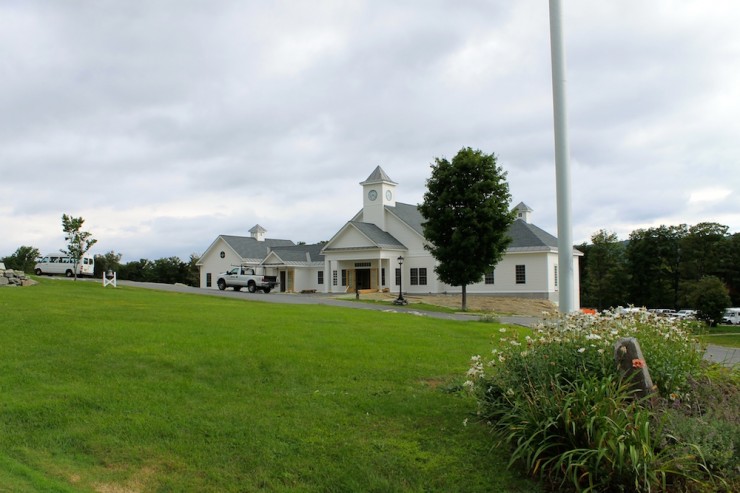
One of the new buildings at the Stratton Mountain School in southern Vermont
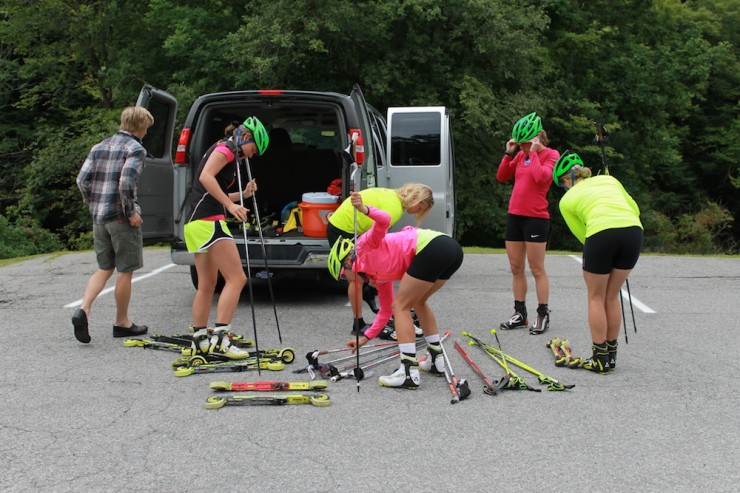
SMST2 Team preps for its over-distance combi workout
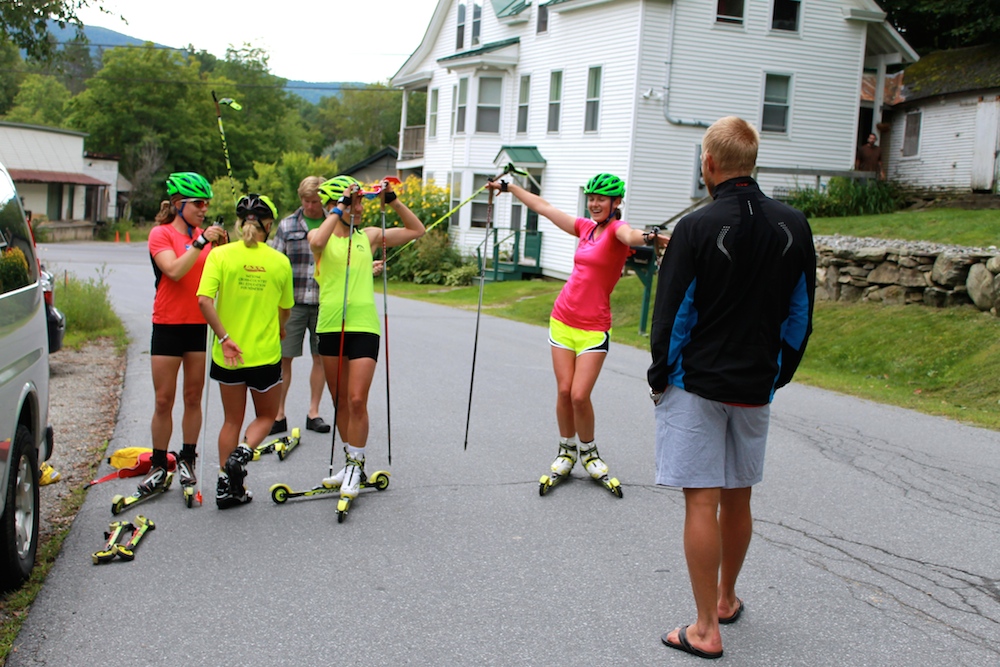
SMST2 Head Coach Patrick O’Brien talks to his women’s team before their three-hour combi rollerski on Aug. 15 in Stratton, Vt.
The Canadian men’s team gets ready in the same parking lot in Stratton
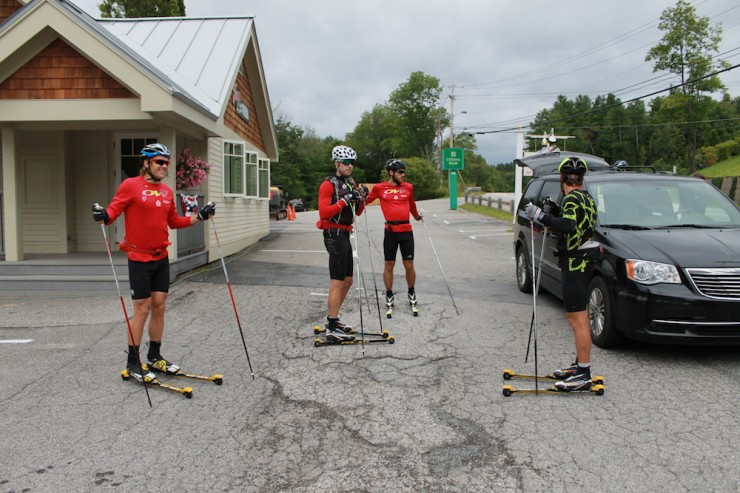
Start of a 3+ hour workout
Canadians Alex Harvey (r), Devon Kershaw (front left) lead six others, including Ivan Babikov (third from l), Kris Freeman (second from l) and Andy Newell (l), during a combi over-distance rollerski near Stratton, Vt.
Kris Freeman (r) and Andy Newell during a rollerski workout in Stratton, Vt.
Kris Freeman (r) leads Andy Newell (c) during a rollerski workout in lAugust in Stratton, Vt. There, he trained with the Stratton Mountain School T2 Team as well as the Canadian World Cup Team (not shown).
Rosie Brennan leads Stratton skiers during a over-distance, combi rollerski in Stratton, Vt.
Rosie Brennan leads Stratton skiers during a over-distance, combi rollerski in Stratton, Vt.
Sophie Caldwell (r) and Jessie Diggins
The women chase the men up a climb
Canadian World Cup Team coach Tor-Arne Hetland (r) talks with the SMST2 Team during a water stop on its over-distance rollerski session on Aug. 15 near Stratton, Vt.
Devon Kershaw (front), Andy Newell (l), Alex Harvey, and Ivan Babikov (r) slow for a water break
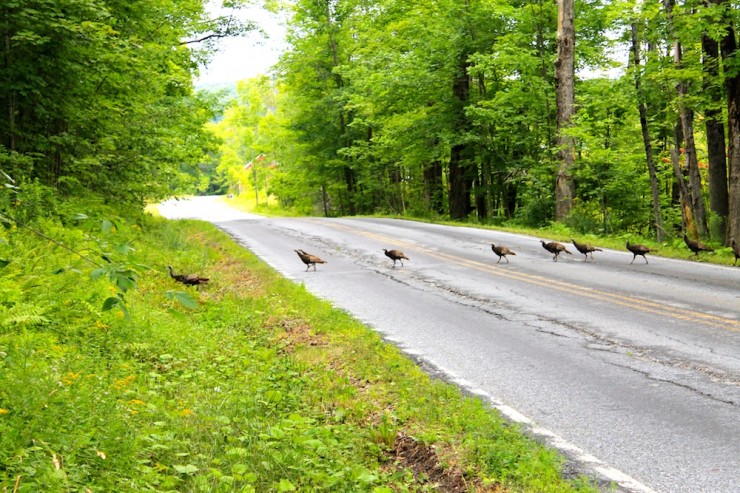
Turkey crossing on Winhall Hollow Road in South Londonderry.
Alex Harvey (front r), Andy Newell (front left), Lenny Valjas, and Devon Kershaw (r)
Andy Newell (l) and Alex Harvey (r) lead an over-distance rollerski past the Stratton Mountain School on Aug. 15 in Stratton, Vt.
Andy Newell (l) and Alex Harvey (r) lead an over-distance rollerski past the Stratton Mountain School while Canadian coach Tor-Arne Hetland (l) checks in.
The SMST2 women venture around a construction site to avoid a hole in the road where a new culvert is being installed on Mountain Road in Stratton, Vt.
The SMST2 women venture around a construction site to avoid a hole in the road where a new culvert is being installed on Mountain Road in Stratton, Vt.
Patrick O’Brien racing to third for the Craftsbury Green Racing Project in the 10 k skate at the University of Vermont Carnival at Trapp Family Lodge in Stowe, Vt., this past winter. After four years on the pro circuit, O’Brien, 26, is entering a new chapter of his ski career as head coach of the Stratton Mountain School T2 Team.
Patrick O’Brien was hired last Sunday and started on Monday. That’s the kind of turnover Sverre Caldwell, nordic director of the Stratton Mountain School (SMS) in southern Vermont, was looking for when he first sought a replacement for SMST2 Head Coach Gus Kaeding.
The transition from professional skier to coach happened quickly for O’Brien, who wasn’t sure what his future held — or what he wanted to do next — five weeks earlier. At the end of his 2013/2014 racing season in late March, the 26-year-old Vermont native packed up his skis and flew from Alaska to Moab, Utah, for some quality time in the desert with friends. He spent the next week mountain biking, regenerating and thinking about anything but skiing. Pretty sure he was ready to end his competitive career, O’Brien wasn’t set on leaving the sport.
A Dartmouth grad who majored in environmental studies, O’Brien had spent the last four years with the Craftsbury Green Racing Project, which he described as both rewarding and fun. When he wasn’t training as a professional nordic racer, he was fulfilling his obligations to the Craftsbury Outdoor Center in northern Vermont, working on sustainability and trail-maintenance projects.
Contemplating retirement, he wondered how he’d stay involved in the sport. Perhaps through the ski industry? Maybe even coaching? The latter evolved into a very real possibility when he applied for the position of head coach of the T2 Team about two weeks ago. Caldwell invited him over to talk more about the position.
Rewind about 10 years to when Caldwell coached O’Brien at Stratton (along with assistant coach Amy Caldwell, the wife of Sverre’s cousin). An avid Bill Koch League skier from his youngest days of racing, O’Brien started seriously pursuing the sport in high school. Growing up 45 minutes from Stratton in Putney, Vt., he enrolled as a junior and spent the next two years commuting to the ski academy and learning from the Caldwells.
A Stratton graduate, he went on to captain the Dartmouth nordic team. There, O’Brien became an NCAA All-American as a junior in 2009, two-time first-team All-East skier, and two-time Academic All-American.
He graduated Dartmouth in 2010 and dove into professional skiing with Craftsbury. In 2012, O’Brien qualified for his first World Cups in Quebec and Canmore, Canada, which he ranked high on his list of achievements. He spent two seasons, including this year, on the European OPA Cup circuit in March, and notched domestic SuperTour podiums over several seasons.
According to O’Brien, who spoke on the phone Wednesday while helping his dad, an arborist, in Putney, he gave skiing a four-year commitment. At the end of this winter, he was ready for a change.
“I just felt like last year was tough and I didn’t achieve my goals for the year,” he said.
He first spoke with his coach, Pepa Miloucheva, about his plans for next winter before leaving to race in Europe a few months ago.
“She, of course, offered me the option to come back and ski in Craftsbury again,” O’Brien recalled. “But we had a very honest conversation and the conclusion we came to is, I was ready to be done, ready to have a different stimulus … moving into coaching or the ski industry or anything else. I was gonna have to look or figure out where I wanted to go from there.”
“I decided that this position at Stratton was something I really wanted to do,” he said.
Kaeding, the man whom O’Brien was ultimately hired to replace, was completely behind him. Caldwell pointed out that he had a similar start to his coaching career. Kaeding was an athlete skiing for Central Cross Country (CXC) when the team’s coaches at the time, Jason Cork and Bryan Fish (now USST coaches) encouraged him to become an assistant coach.
“He did that for one year at CXC then he came here and no one questioned anything,” Caldwell said.
Kaeding was in Miami and Costa Rica during much of the interview process last month, but said O’Brien had been his “number-one choice right from the start.”
“When he told me he wasn’t going to ski next year we were in a bunker in Slovenia,” Kaeding recalled. “I emailed Sverre and said, how about this guy for next year?”
On Wednesday, Caldwell confirmed the decision, which he had made Saturday night. He called O’Brien, O’Brien accepted on Sunday, and Caldwell notified his athletes later that day.
“I wanted someone who would be there to coordinate things and be totally enthusiastic and organized,” Caldwell said, adding that he chose O’Brien out of about five top applicants. “He knew more about the program and the area and the [racing] circuit and he could start right away to work with Gus. He hadn’t coached, but in a way that was not a detriment because he was going to be totally open minded.”
Caldwell said he didn’t recruit anyone for the job. “I didn’t want to be kind of casing someone who’s already in a different program. If they come to me that’s fine. It’s a small community, but that’s weird,” he said with a laugh.
“Most of the responses were really early … so then I had to send out [more information] to people who had expressed interest who looked viable,” he explained. “… We were not able to pay a ton so that cut out some people.”
Craftsbury’s Patrick O’Brien (l) and Stratton’s Andy Newell (r) lead a pack in the mixed relay at U.S. Distance Nationals in Anchorage, Alaska. (Photo: Charlie Renfro)
For O’Brien, it was an enticing opportunity — even if he was inexperienced.
“I’m younger than Andy and Simi and I’m not gonna pretend that I have a whole bunch of coaching experience, but I think maybe it’s a good thing that I have skied with or been on trips with many of those athletes,” he said. “It’s not like somebody totally foreign coming in and trying to bring their own training philosophy. I feel that having worked with Sverre as a high school coach, I have a pretty good understanding where he’s at. I think Sverre, Gus and I are all on a very similar page.”
He was most apprehensive about being the make-or-break factor for his athletes when it came to waxing skis.
“The fear as a coach, who also would be a service-staff person, is the last thing I want to do is have athletes show up, do their training well, be rested and ready to go and then screw their race over,” he said with a laugh. “That’s something that an athlete thinks about as well. I think Gus did a good job keeping things low stress and making safe, sound decisions. If the athletes show up and if they have fair skis, they’re going to be the ones showing off their hard work … they don’t need anything magic.”
O’Brien will also have the assistance of other Stratton coaches, who will travel to many of the same domestic races as him. Nearly half of the SMST2 roster is on the national team, so he won’t have to worry about those athletes for early season races; they’ll be in Europe.
As head coach, O’Brien will be the one leading and overseeing the execution of workouts, not necessarily writing them. Stratton’s four U.S. Ski Team members — Andy Newell, Simi Hamilton, Jessie Diggins, and Sophie Caldwell — remain in touch with national-team coaches about their training. Newell works with USST head coach Chris Grover, Hamilton and Diggins receive plans from Cork, and Sophie Caldwell will continue to work with USST women’s coach Matt Whitcomb and Kaeding, even while he pursues a masters in business, according to Kaeding.
The other members of the SMST2 Team — Erika Flowers, Annie Pokorny, Annie Hart, Ben Saxton, and training partner Paddy Caldwell — have already started their yearly training plans, which Kaeding mostly wrote.
Gus Kaeding (third from l) with the original SMS T2 Team, including (from l to r) Erika Flowers, Eric Packer, Andy Newell, Skyler Davis, and Sophie Caldwell. (SMS courtesy photo)
(Eric Packer left the team to join Alaska Pacific University in his hometown of Anchorage. “This spring, I realized how much I like living and skiing in Alaska,” Packer wrote in an email. “That was the driving force behind the change. I do think I made a lot of gains while at Stratton – the opportunity to train with guys like Newell and Simi on a daily basis was really awesome — but for whatever reason I struggled to transfer those gains into results.” Caldwell recognized this and said he fully supported Packer’s decision to join APU at home.
A former USST D-team member, Skyler Davis left Stratton’s T2 Team in January to pursue a college degree, according to Caldwell. “That was a good move,” Caldwell said.)
This week, O’Brien planned to join four training sessions — Monday, Tuesday, Thursday, and Friday — to observe and shadow Kaeding, who will be in Stratton for another week.
Next Wednesday, Kaeding will leave for Park City, Utah, to represent Stratton at the U.S. Ski and Snowboard Association’s Spring Congress. After the weekend, he’ll return to Stratton and fly out again on May 30 for a family trip to Sweden: his dad and brother are running the Stockholm Marathon. Kaeding will return June 8 and leave for a GMAT study course in Salt Lake City on June 15.
He’ll be in Utah for at least a month, assisting Sophie Caldwell and other Stratton athletes from a strategic location a short drive from the USST headquarters in Park City. Should he stay in Salt Lake through October, Kaeding will be able to check in on certain athletes during the USST training camp there that month.
And if he passes the exam, Kaeding hopes to be accepted at a graduate school in Boston or California — somewhere in sharp contrast from a typical ski town or rural Vermont.
Caldwell said the short time frame in which Kaeding will be in Stratton made hiring O’Brien as soon as possible essential.
“We had this window where he could really work with Gus and it will hopefully be a seamless transition,” he said, adding that O’Brien will visit three or four days a week to observe and start learning more about each athlete on the team.
“He knows the athletes, but [we’ll] go over each athlete that he’ll be more responsible with for their training,” Caldwell said. “It’s gonna be just a natural progression.”
According to Caldwell, O’Brien will start in earnest July 1, when his one-year contract begins. A big part of the job will be communicating with USST coaches and making sure the national-team workouts line up with the rest of the T2 Team’s.
“He needs to set up the workouts [and eventually write] good solid training plans, which he’s going to get plenty of help with,” Caldwell said. “He’s doing well; he’s just taking it all in. … It’s good for him to throw it in the fire and then come back and digest everything.”
“It’s logistics, coordination, it’s planning, all that stuff,” O’Brien observed. “I see that as a real challenge and something to put all my energy [toward].”
“He’s definitely kind of the shell I was picturing,” Kaeding said. “He’s a really good skier, especially good technician who has grown up around skiing. He’s good at waxing; I’ve seen him have to take care of himself. As far as the coaching goes, he doesn’t know a whole lot and that’s kind of what we were after. We do things here a little bit differently than some programs, so I was hoping we’d find someone that could come carry that on, come observe and fill in the cracks with what the team needed.”
The athletes were onboard, too, Caldwell said.
As for whether it will be hard to drive the van, supply the feeds, and shoot video from the sidelines while his athletes — his peers — continue training, O’Brien said he’s ready.
He brought his rollerskis to his first day in Stratton on Monday. He had planned to ski with Flowers while Kaeding drove the van. He ended up in the passenger’s seat.
“It was a cold, rainy day and I was more than content to sit in the van,” O’Brien said. “You can often learn more from the coaching perspective [that way].”