From the FasterSkier archive — posts syndicated from athletes’ and coaches’ own blogs between 2004 and 2012, kept online as published. Current coverage is at fasterskier.com.

Tag: smst2

  • Blueprinting Beliefs: Ben Ogden’s Mind, Mechanics, and the Engineering of a Community

    Blueprinting Beliefs: Ben Ogden’s Mind, Mechanics, and the Engineering of a Community

    Somewhere over the Atlantic, on a red-eye to another winter in Europe, Ben Ogden opens his laptop and stares at a grid of digital joinery. Tiny posts, miniature knee braces, angled mortises — a small timber-frame sauna, scaled down to the dimensions of an airline tray table. He sketches in precise strokes, clicking through angles and offsets, rotating the model the way he rotates race courses in his head: looking for structure, looking for flow.

    “I learned CAD in college,” he says. “Something that I hope to use in a future career post-skiing. It feels good to keep those skills up.” For the past several winters, Ogden has leaned into his engineering degree, which he earned at the University of Vermont. When you talk to him outside of training and racing, you realize this engineering mind was not learned at UVM; it is deeply ingrained in who he is, who he has always been. On planes, in wax truck corners, in small Scandinavian hotel rooms, he opens the software that once helped him model truss systems for class projects. Now, it helps him breathe.

    “It kind of gives me a good outlet,” he says. “It’s exactly like you say — the projects in the summertime are fun, and you learn a lot, but ultimately for me the biggest reason to do them is that it gives me this outlet from skiing… gives me a break from everything that’s going on.”

    This winter’s project is ambitious in a miniature way: a timber-framed sauna built from small hand-cut pieces, a practice run for a full-sized dream he can’t yet afford the time or money to tackle. In his travel bag, he carries a book — The Art of Japanese Joinery — the same way another skier might carry a novel. “I’m gonna use my CAD software and sort of build all the little pieces,” he says. “Then I’ll have a little plan for what joints get cut where.”

    The sauna will be small. The intention behind it is anything but.

    Like many New Englanders, Ben Ogden has made it a tradition to conclude his season every spring at Cochran’s Nordic Cross at Cochran’s Ski Are in Richmond, Vermont. (Photo: Courtesy Photo)

    Vermont Roots, Wide Horizons

    Ogden left for Finland on November 17 — a date marked not with dread, but with a kind of vibrating readiness. “I’m super pumped,” he says. “This season has come with more anticipation than any other.” Partly because it’s the Olympic year, but also because he feels “a little bit better equipped” each season, even as he accepts that no amount of planning can smooth the chaos of a World Cup winter.

    “There’s guaranteed curveballs and sicknesses and highs and lows,” he says. “You can only manipulate that so much… at a certain point, you just have to get going.”

    He arrived in Europe later than many teammates. While some seek early-snow training blocks, Ogden stays in Vermont — a deliberate choice, not an oversight. “I decided not to change that this year,” he says. “It’s important for me to be home, and the season is very long. I didn’t really want to elongate that by going to Europe or finding snow pre-Finland.”

    That choice means his first days on snow in Ruka can feel awkward, but the tradeoff is worth it. It’s also an expression of who he is. Ogden’s identity is tied to Vermont in ways both obvious and subtle — in his work ethic, his self-sufficiency, and the ease with which he moves between elite training sessions and OD runs with college teams.

    He feels tugs of longing, at times, when he thinks of the powerhouse men’s group training year-round with Alaska Pacific University. But the pang is mild, not consuming. “I do,” he admits, “feel a little bit” of FOMO. But he has “recognized the importance for me to just kind of live my own life, be a little bit removed from the intense, Nordie vibe all the time.”

    Staying rooted means staying whole. It also means arriving each winter hungry for the team environment, not burnt out from it.

    It is unusual for a top U.S. skier to build a World Cup foundation outside of a mega-group or a Western training hub. But Ogden sees the value in his separateness. “I kind of took pride in the fact that I was a little bit different,” he says. “Came from a different group and was able to mesh right in when we did come together.”

    This, too, is its own kind of engineering: building stability into a system that demands constant travel, constant performance, constant uncertainty.


    The Body as a Machine, the Mind as a Circuit

    When Ogden talks about training, he toggles easily between the physical and the psychological — but if asked which is more important, he leans toward the mind.

    “I think… ski training is a combination of physical and mental adaptations,” he says. “It can be fun to think of things as mental adaptations. I like to, because the power of the mind is just so huge.”

    In the fall, he transitions into higher-intensity workouts earlier than he did in college, where the NCAA season starts late and dictates the timeline. “It’s just really good,” he says, “because I find that coming to Ruka and getting into the race season… I’ve had to remind myself what it feels like to go hard for that long.”

    That reminder is primarily mental. Hard workouts aren’t just about generating lactate or cardiovascular strain; they’re about rehearsing discomfort.

    “You have to learn how to push yourself,” he says. “You have to learn how to go hard, and you have to learn how to pace for a 10k… that, to me, feels like a mental battle.”

    This is where his internal monologue — the one few athletes talk about, but all experience — becomes central to his craft.

    His best sessions come when he stops listening to the noise inside his body — the burning legs, the heavy breathing — and instead directs his mind outward. “My best races… come when I’m not dwelling on ‘my legs hurt’ or ‘I’m breathing really hard,’” he says. “I’ll be thinking: ‘All right, the top of the hill is right there. I’m gonna push hard until there, and after that I’ll figure it out.’”

    But the ideal and the real don’t always align. Not every October time trial feels like a breakthrough. Sometimes he finishes intervals worried that the heaviness in his legs signals doom for the season ahead.

    “You sort of forget that you’re still training hard otherwise,” he says. “You don’t have respect for the fact that you’re just tired… it wasn’t a day you wanted to be in peak form, so you’re not.”

    In those moments, doubt tries to multiply. It’s a habit of the mind he has learned to anticipate. And anticipation is power.

    “When it happens, you can say, ‘Remember, I knew this was gonna happen,’” he says. “Every time, I’ve been happier if I don’t allow it to take over.”

    Landmarks on the Course, Checkpoints in the Head

    Ogden’s most vivid explanation of mental strategy comes when discussing something humble and universal: a hill in a cross-country running race.

    If you tell him two high school runners are nervous about a big climb at the two-mile mark. His response is instant and intuitive — as if he’s revisiting a dozen races at once.

    “I would set goals on the course,” he says. “Each goal would have a physical location attached to it.” A tree. A signpost. A bend in the trail. Something visible and near.

    He creates segments rather than distances—dividing the race into digestible tasks rather than one looming ascent. “You can really make a hill feel like nothing,” he says, “because you’re like, ‘Okay, I know I can do it if I check these boxes.’”

    He gives the example of a 14-minute climb he does in Vermont, a personal benchmark of suffering. The first five to eight minutes are brutally hard. “All you’re thinking about is, ‘Oh my God… this isn’t even the first half.’” But with preparation — knowing where a micro-rest appears, where the next pitch starts, where the end is “in striking distance” — the pain becomes structured. Predictable. Contained.

    The same approach guides his 10ks. In the first 5k, he aims to crest hills “breathing, but able to ski crisp.” In the second half, he allows himself to reach the edge — “gassed to the point where I can’t ski with as good of technique” — but only once it’s time.

    This is pacing, not as restraint, but as architecture.

    The Gus Workout

    If the sauna project is the mental escape hatch, then the “Gus Workout” is Ogden’s sharpening stone — a ritual he returns to every year to feel strong again.

    “It’s a workout I randomly did in college before a Junior Worlds event with Gus [Schumacher],” he says. The structure is beautifully nerdy and deeply painful:

    • Six minutes of 20 seconds on / 40 seconds off
    • Another six minutes of the same
    • Three minutes of 1 minute on / 1 minute off
    • All layered on top of an L3 warmup and a progressive L4 effort

    Sometimes he does two sets of the 6-minute blocks. The effect is both physiological and emotional.

    “It’s an awesome, total sharpening workout,” he says. “It gets you moving at high speed without being a huge cost… By the time you’re done, it’s a pretty hard L4 workout.”

    But the real value is how it makes him feel.

    “It has often mentally made me feel really good. I think it makes me feel strong… confident.”

    He’s done it before “every major championship and before every season since 2017.”

    Ben Ogden poses with his UVM coach, Patrick Weaver and his children. (Photo: Courtesy Photo)

    Coaching the Machine

    Ogden works closely with both longtime mentor Patrick Weaver and newer SMS T2 coach Colin Rodgers, each offering different inputs into the system.

    Weaver provides the long arc — the accumulated wisdom of years together, the memory of what has always worked. “Having Patrick involved… is really nice for me mentally,” Ogden says. “We’ve had so many good years together.”

    Rodgers provides the in-person structure: “Colin is kind of coming in as the day-to-day,” Ogden says. “He’s the one at practice.” They build training plans collaboratively, with Ogden adjusting based on feel, Weaver offering feedback from afar, and Colin guiding technique and lactate testing.

    It’s a three-person engineering team working on a single, complex machine.

    Paal Golberg (NOR), Iver Tildheim Andersen (NOR) and Ben Ogden (USA), (l-r) share the World Cup podium after a 10K in Les Rousses (FRA). (Photo: Modica/NordicFocus)

    The Long Game: From Sprinter to All-Arounder

    Ogden first burst onto the circuit as a sprinter, but his distance results have steadily climbed. He attributes that evolution to two things: years of accumulation and a physiological quirk he had to learn to manage.

    “I’m capable of generating tremendous lactate,” he says. “If I went out right now and sprinted for 90 seconds, my lactate could easily be in the 20s.”

    That makes him a powerful sprinter — and a volatile distance racer. Early in his career, he went out too hard too often. The memory that stays with him is the 2020 Junior Worlds 10k, when he led early and paid dearly late. “I just pushed so freaking hard,” he says. “I think I was winning the race by… 10 seconds. And then at the end, I just lost so much time.”

    Learning patience, he says, has been “huge.” Now, he races distance events with far more control — waiting, building, resisting the temptation to detonate early.

    Every year, he gets better at it, not by magic, but with patience and discipline.

    Kevin Bolger, Ben Ogden, JC Schoonmaker, and Zak Ketterson, (l-r) teamed up for the FIS World Championships relay in Trondheim (NOR) last season. (Photo: Modica/NordicFocus)

    The Olympic Year and the Team Sprint Dream

    His biggest goal this year is clear: “An Olympic medal for sure.” He’s unafraid to say it out loud. It’s a reach, he says, but not an impossible one — especially in the team events.

    “I’ve had a big asterisk on the team sprint,” he says. “I really want to be on that team, and I really want to just dream big for that event.”

    He spent the summer training specifically for it — brutal intervals on the Lake Placid roller-ski track, demanding repeats in Park City. The process goals between now and February are equally mental and physical: “Coming at those two team sprints before the Olympics mentally prepared and ready to execute at a high level.”

    Team sprinting is a balancing act. “There’s always this balance of exerting energy… staying at the front, staying out of trouble… and saving energy, staying in the pack,” he says. Believing he can do both — that duality — is the mindset he’s chasing.

    Friends, family and fans will be surrounding Ben Ogden with all the Vermont vibes in Lake Placid later this season for the World Cup Final. (Photo: Courtesy Photo)

    The Lake Placid Homecoming

    After the Olympics, he returns to something nearly as meaningful: a World Cup in Lake Placid, practically down the road from home.

    “I’m so fired up for that,” he says. Friends from UVM plan to come — people who helped him survive the missed classes, late assignments, and months of absences that came with racing the World Cup while still in school.

    “I always joke with them… they helped in my success as much as anybody,” he says. “They helped me by sending notes, helping with homework.” The Lake Placid races are his chance to show them the world he kept disappearing into.

    He’s excited for Vermonters — new fans, old friends, teachers, kids from ski programs — to see a World Cup in person. “Everybody who ever goes to a World Cup has a good time,” he says. “Even if they’re not huge ski fans.”

    The people who buoyed him will finally see the thing he disappears into all winter.

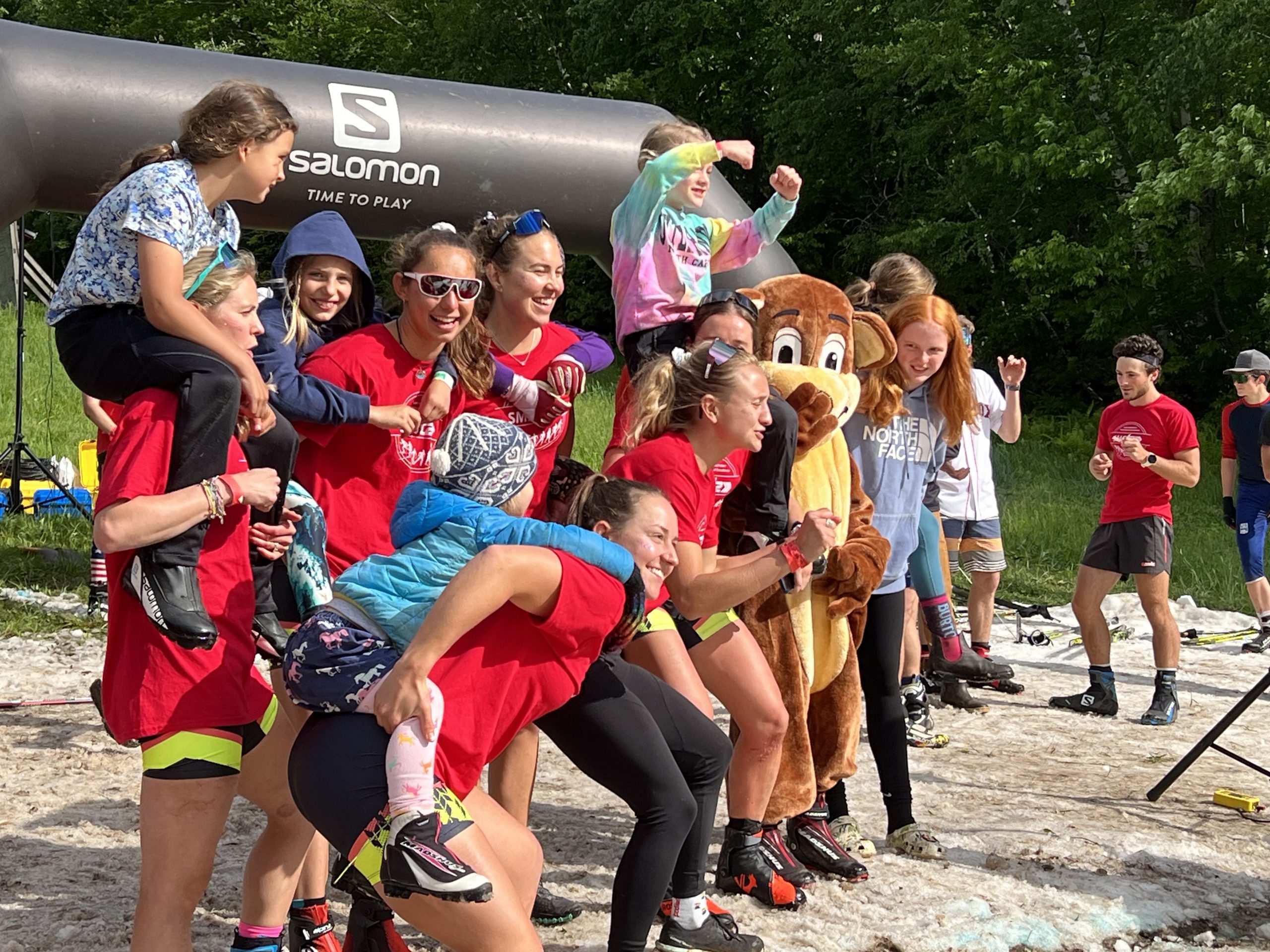
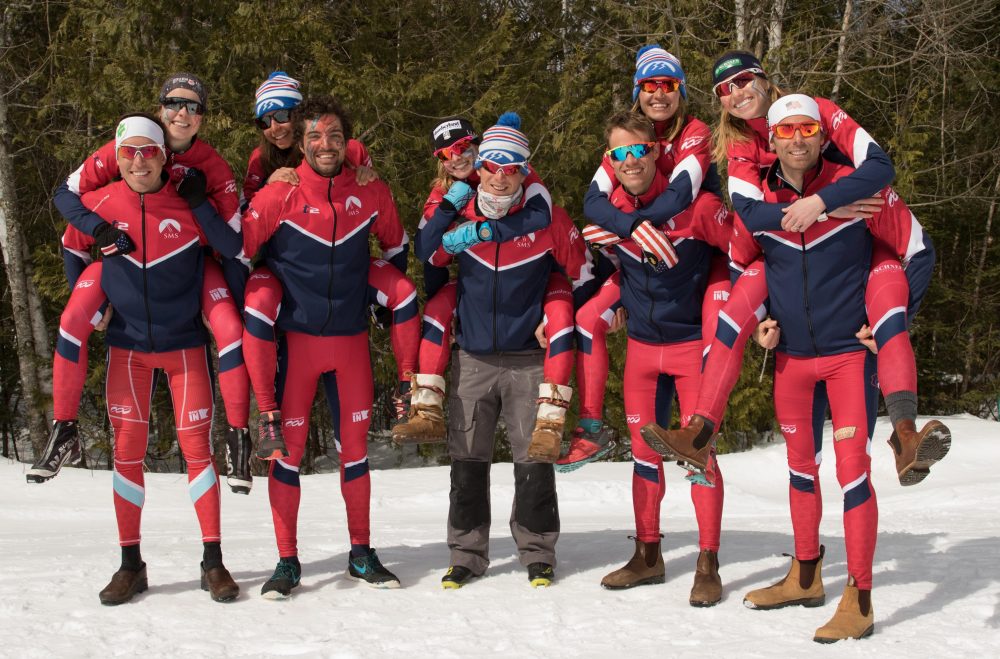
    Ben Ogden (and his SMST2 teammates) always make time to give back to Vermont’s local communities. (Photo: Courtesy Photo)

    Legacy: What He Wants to Build

    Ask Ogden how he wants to look back on his career decades from now, and the answer arrives with unmistakable clarity.

    “More than results,” he says, “I want to be remembered as something that was positive for the ski community.”

    He talks about the junior camps, the youth programs, the OD runs with college teams, and the way he feels energized by the enthusiasm of younger skiers. He talks about his “little side quest” of collecting T-shirts from New England ski programs: “Every one represents a skiing community I’ve reached out to or been part of in some capacity.”

    He lights up when discussing a recent run with the St. Michael’s College team. “It was raining and miserable, and we just had a great time,” he says. “That is so inspiring to me.”

    He wants to help more people get out the door. He wants skiing to feel accessible, exciting, and normal.

    And, like all good stories, this one has a lineage. His late father, a beloved figure in Vermont skiing, built communities the same way Ogden now does — with enthusiasm, generosity, and the kind of spirit that makes kids believe in themselves.

    “There’s nobody I’ve ever wanted to be like more than him,” he says. “He just made kids fired up. And I feel like I can do the same.”

    The Ogden children (Charlotte, Katharine, and Ben (l-r)) pose with their father, John. (Photo: Courtesy Photo)

    The Blueprint Ahead

    By the time January arrives, the first pieces of the miniature timber-frame sauna will be designed, and the digital modeling will start to look recognizable, even to those of us without an engineering degree.

    His book on Japanese joinery tucked among race suits and heart-rate straps — a reminder that even in the chaos of a World Cup season, he is building something.

    A structure.

    A mindset.

    A legacy.

    He is engineering a career that is not only about skiing fast, but about making more people love the sport he grew up in.

    He is designing a life that holds both ambition and community.

    Both suffering and joy.

    Both structure and imagination.

    He is building — in every sense of the word — something that will last.


    Love Stories Like This? Help Keep Them Coming.

    Feature interviews like this one take time, access, and care to produce. If you value thoughtful storytelling and independent ski journalism, please consider becoming a Voluntary Subscriber. Your support directly fuels the work we do to cover the people, places, and moments that make our sport special.

    Join the FasterSkier community!


  • Magic Mountain, Indeed:  SMST2 and West River Nordic Party on Vermont’s Very Last Snow.

    Magic Mountain, Indeed: SMST2 and West River Nordic Party on Vermont’s Very Last Snow.

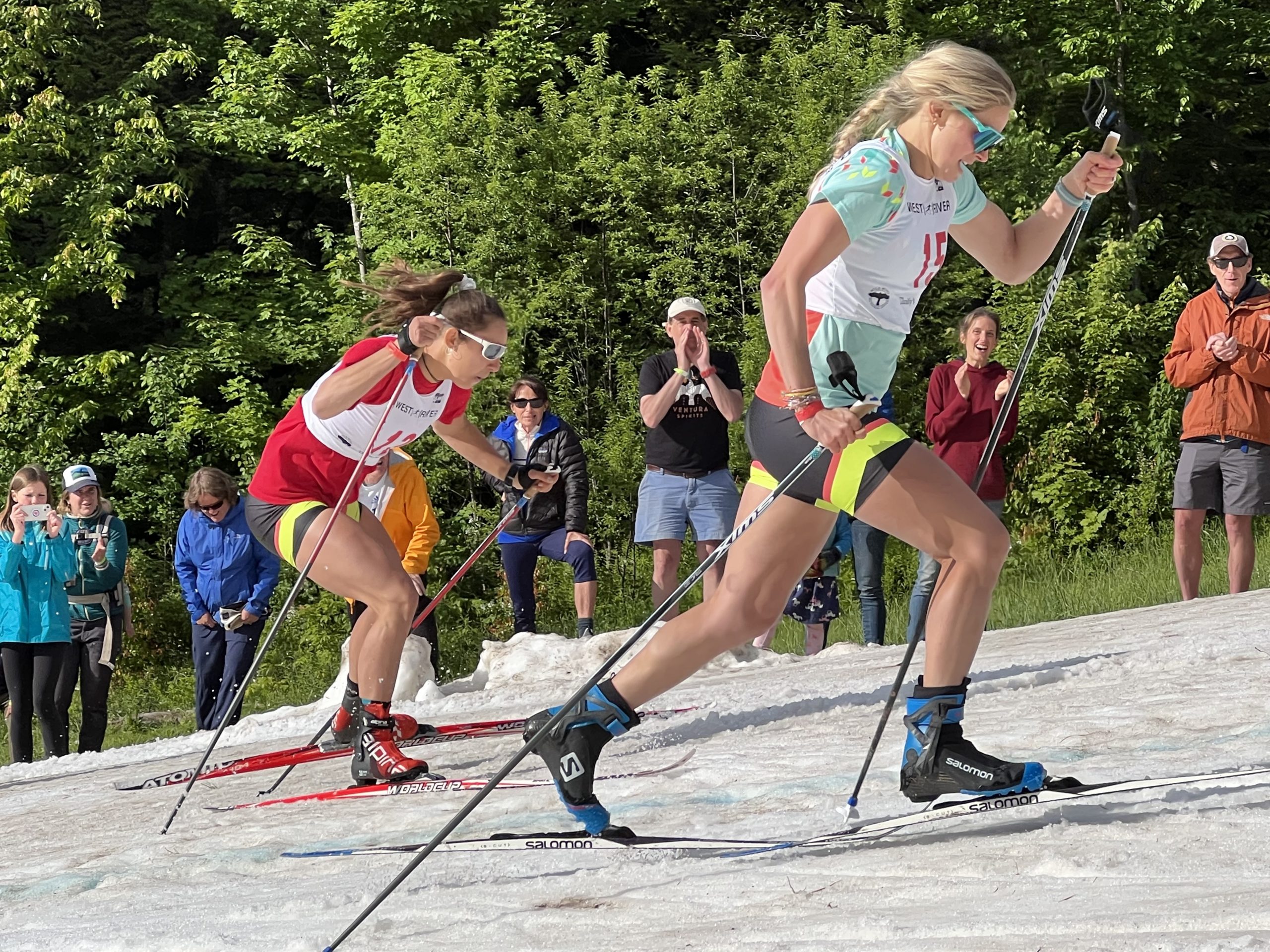
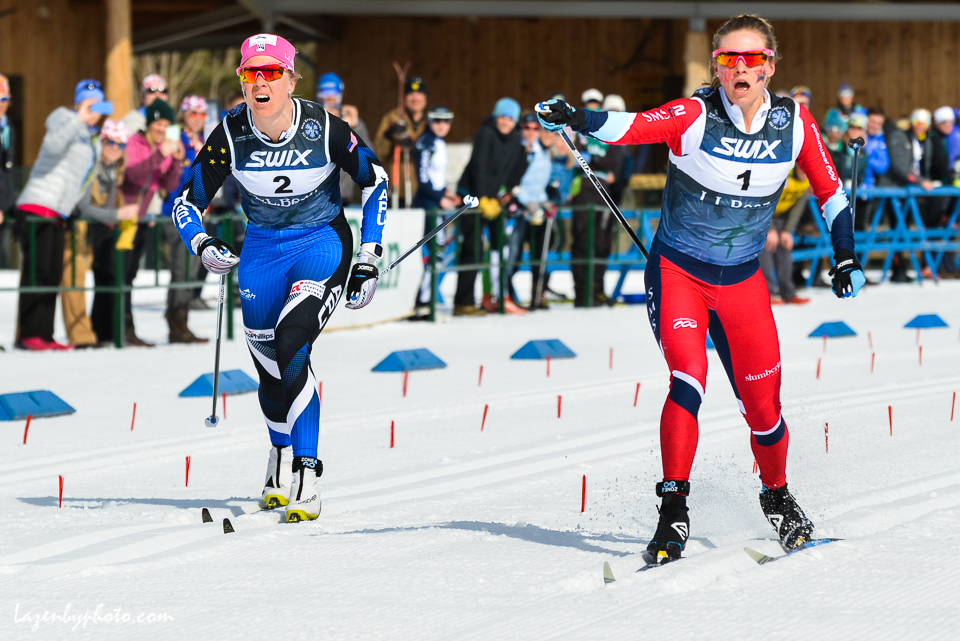
    SMST2 standouts, Jessie Diggins and Julia Kern, race the hotly contested Women’s Final at Magic Mountain, Vermont. Diggins’ fish-scale mini-skis turned out to be the secret weapon. (Photo: Fasterskier)

    June 3, Magic Mountain Ski Area, Londonderry Vermont

    It’s full summer in the Green Mountains of Vermont: high temperatures and summer thunderstorms, every tree leaf-covered, every meadow knee-deep in new grass, and the entire world the richest shade of green. Even those New England resorts that pride themselves on being the very last to keep their chairlifts turning had packed it in a week ago. But there’s still snow at Magic Mountain, stored for just such a day beneath mounds of fresh straw, uncovered just in time for SMST2 and West River Nordic to stage a late, late, late-season fund raiser. It was a magic day . . .

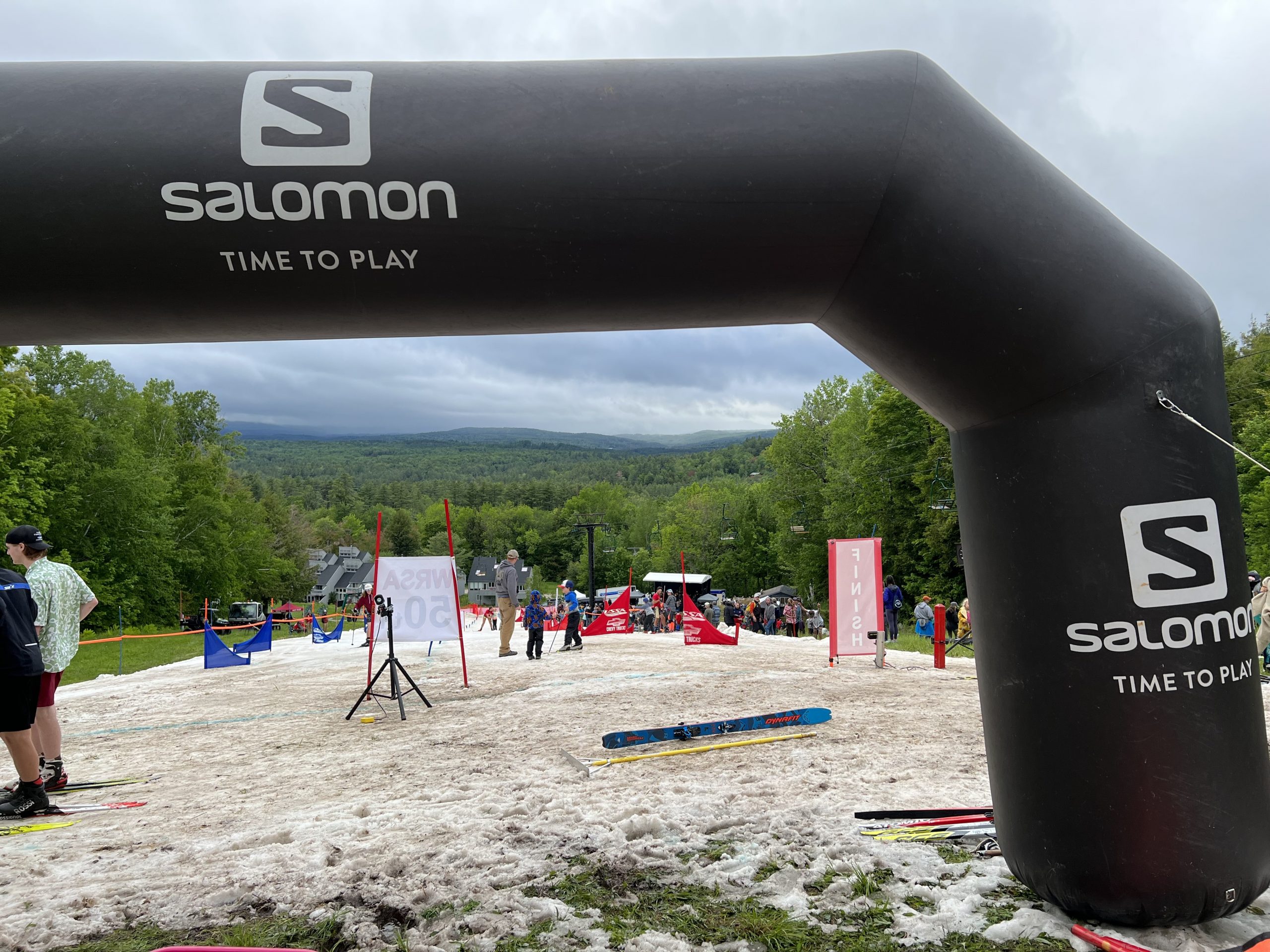
    The very last day of skiing in Southern Vermont; West River Nordic, SMST2, and Magic Mountain pull off the miracle. (Photo: FasterSkier)

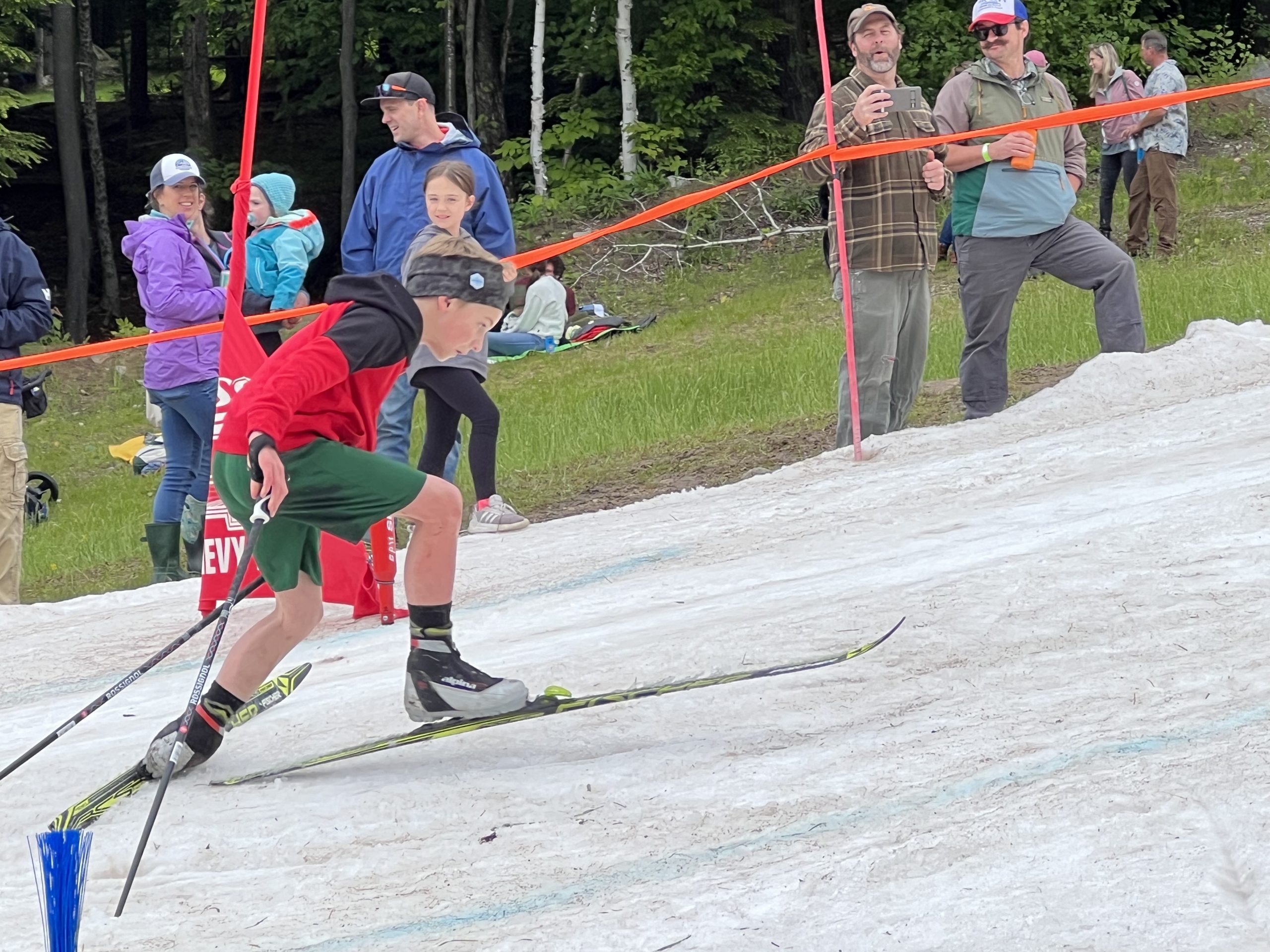
    The day’s races were both collegially lighthearted, and heatedly competitive. A two-lane slalom course challenged racers in head-to-head heats: slaloming down the gated course (a tricky prospect on nordic skis), a steeply banked turn-around at the bottom,  followed by an all-out sprint back to the top.

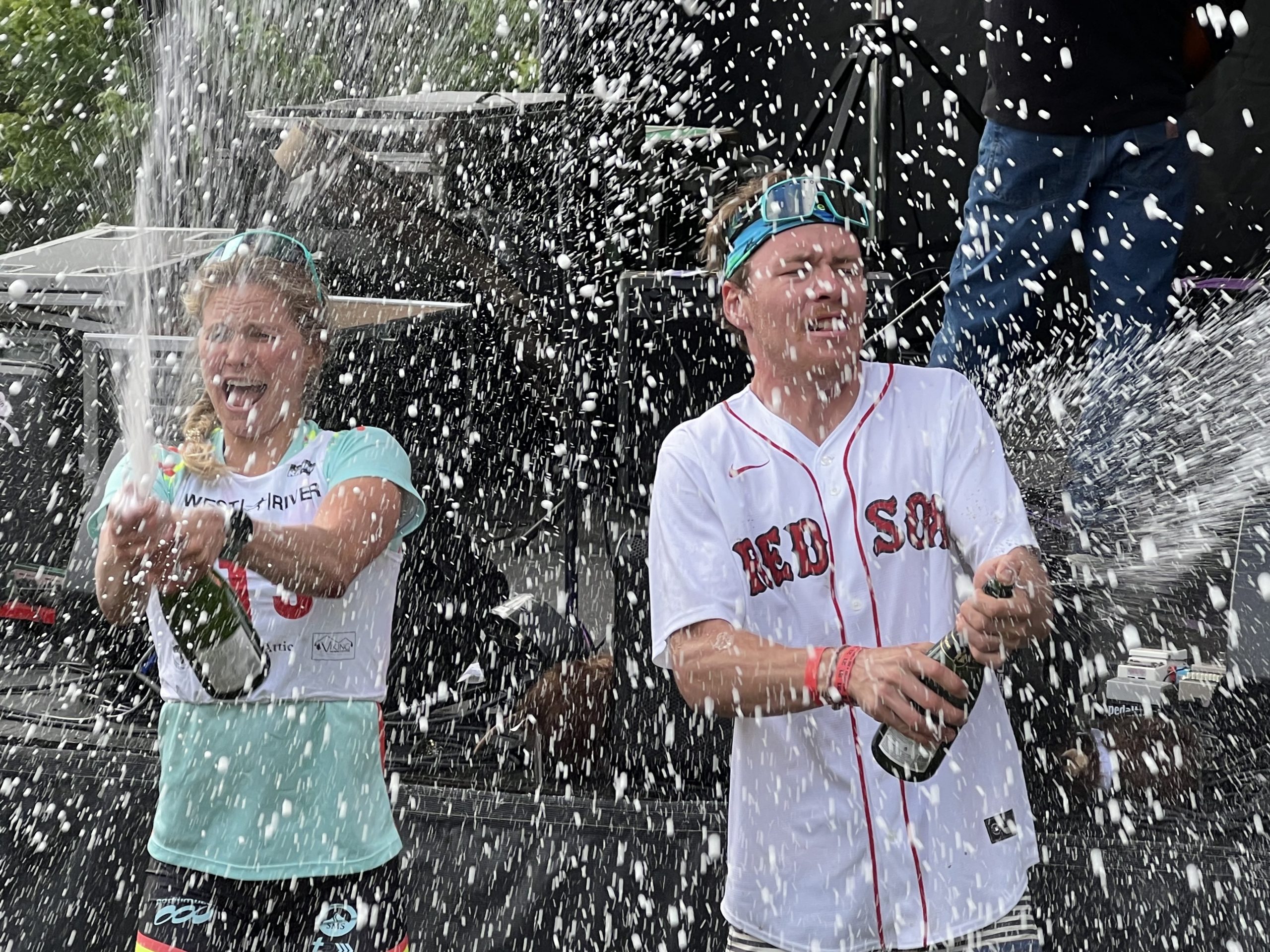
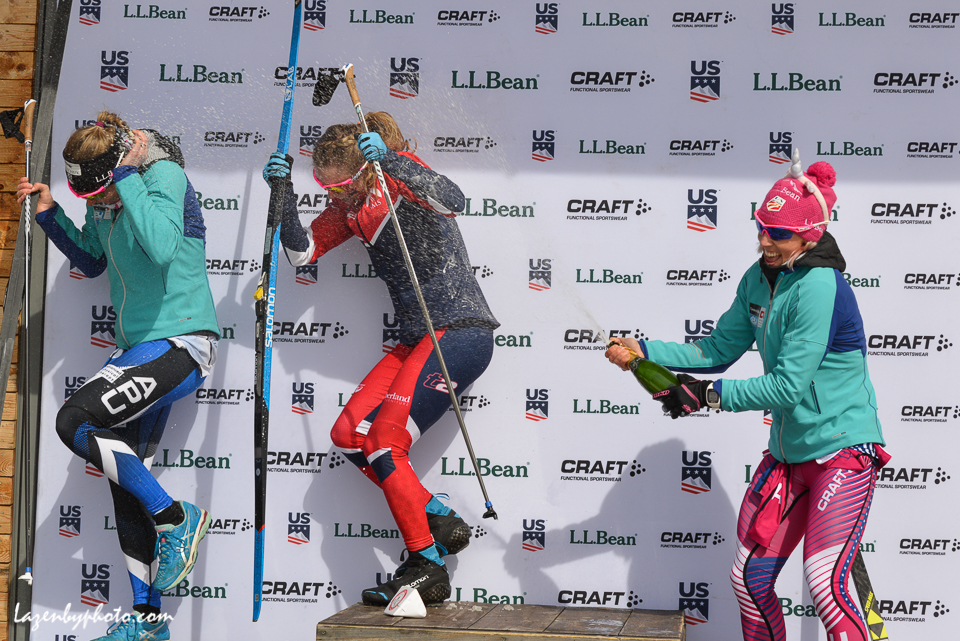
    Jessie Diggins and Ben Ogden—Champagne on the podium at Magic Mountain, Londonderry Vermont. (Photo: FasterSkier)

    The day was staged as a fund-raiser for the West River Sports Association, a local organization celebrating its 50th year bringing organized soccer and cross country skiing to kids in southern Vermont.

    “This is our club’s primary fund raising effort,” said Jennie Freeman, former Director and current board member of West River Sports Association. “[It’s] now become an annual event on the first Saturday in June.”

    Like many family-oriented ski organizations, West River relies upon the involvement of families and volunteers to cultivate skiing in winter communities. And the Dual Slalom event staged at Magic Mountain is just one more way that local kids get to rub shoulders with the professionals and Olympians of SMST2.

    “Jessie’s even talked about getting the Euros over here next year, hosting a training camp and including this event as part of the activities. How fun would that be!”

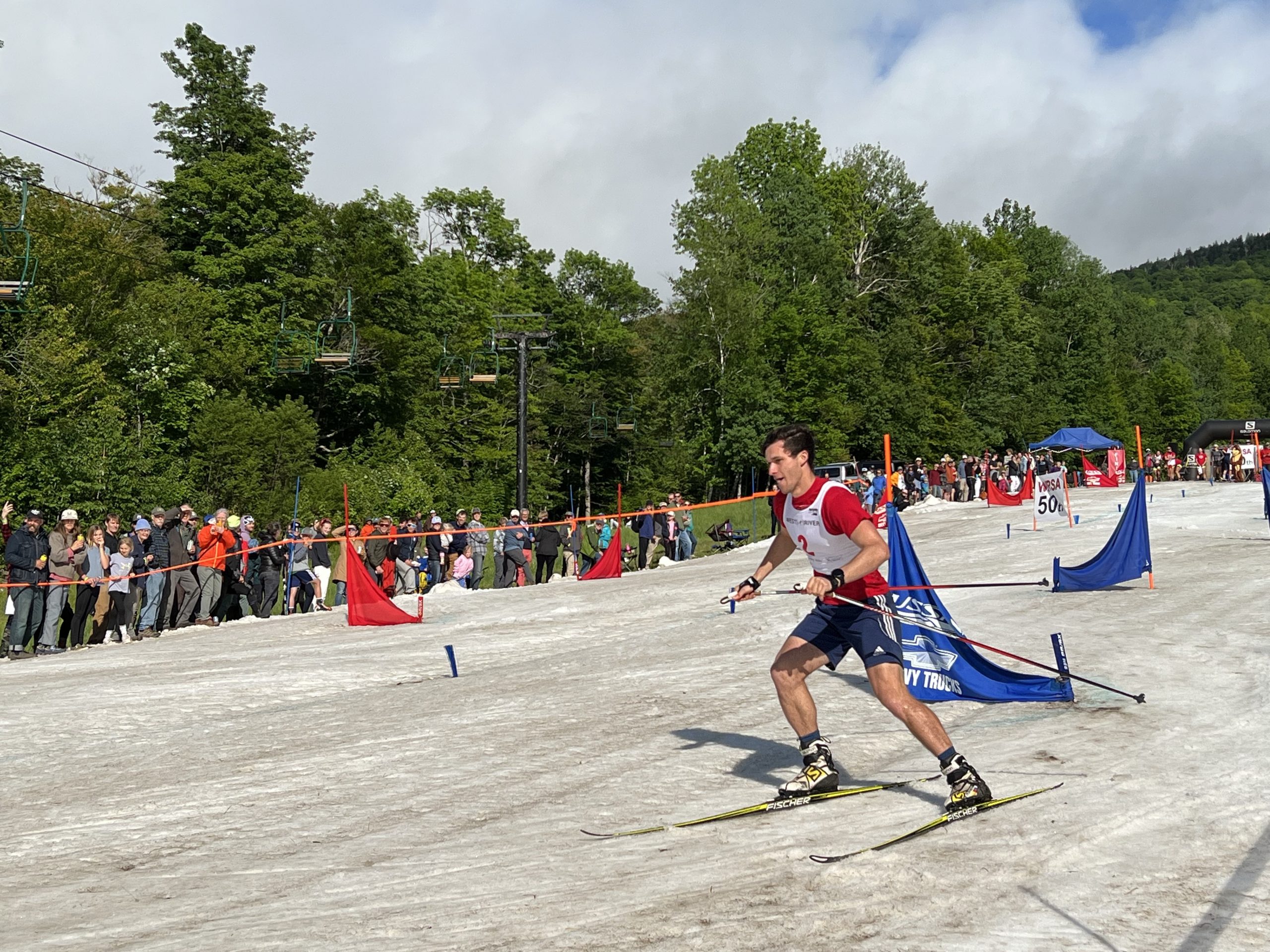
    SMST2 team member, Adam Witkowski, charging through the quarterfinals. (Photo: FasterSkier)

    SMST2 athletes and West River Nordic volunteers provided the energy and the labor to clear the mounds of insulating straw from the precious snow pile. Shovels and rakes, truck beds and wheelbarrows: this was old fashioned ski racing with the competitors, themselves, pitching in to set up the course and create the venue. The field included local contenders, near beginners, junior competitors, and masters standouts; all hoping to give SMST2 athletes a run for their money. World Cup and Olympic competitors could be seen holding back to keep things close in early heats, but when they decided to turn on the after-burners it really was an impressive spectacle to witness. And how fun it was to have the very best skiers putting on a show right here on this little patch of Southern Vermont snow.

    Live bands kept the crowds entertained while all entrants got the chance to qualify, followed by a set of heats to determine the day’s champion.

    “It’s really cool to see. Honestly, I just love the vibe here,” said Will Koch, SMST2 team member and lifetime area resident. “It’s amazing being part of this atmosphere, and getting to grow up in place where this is what people do for fun.”

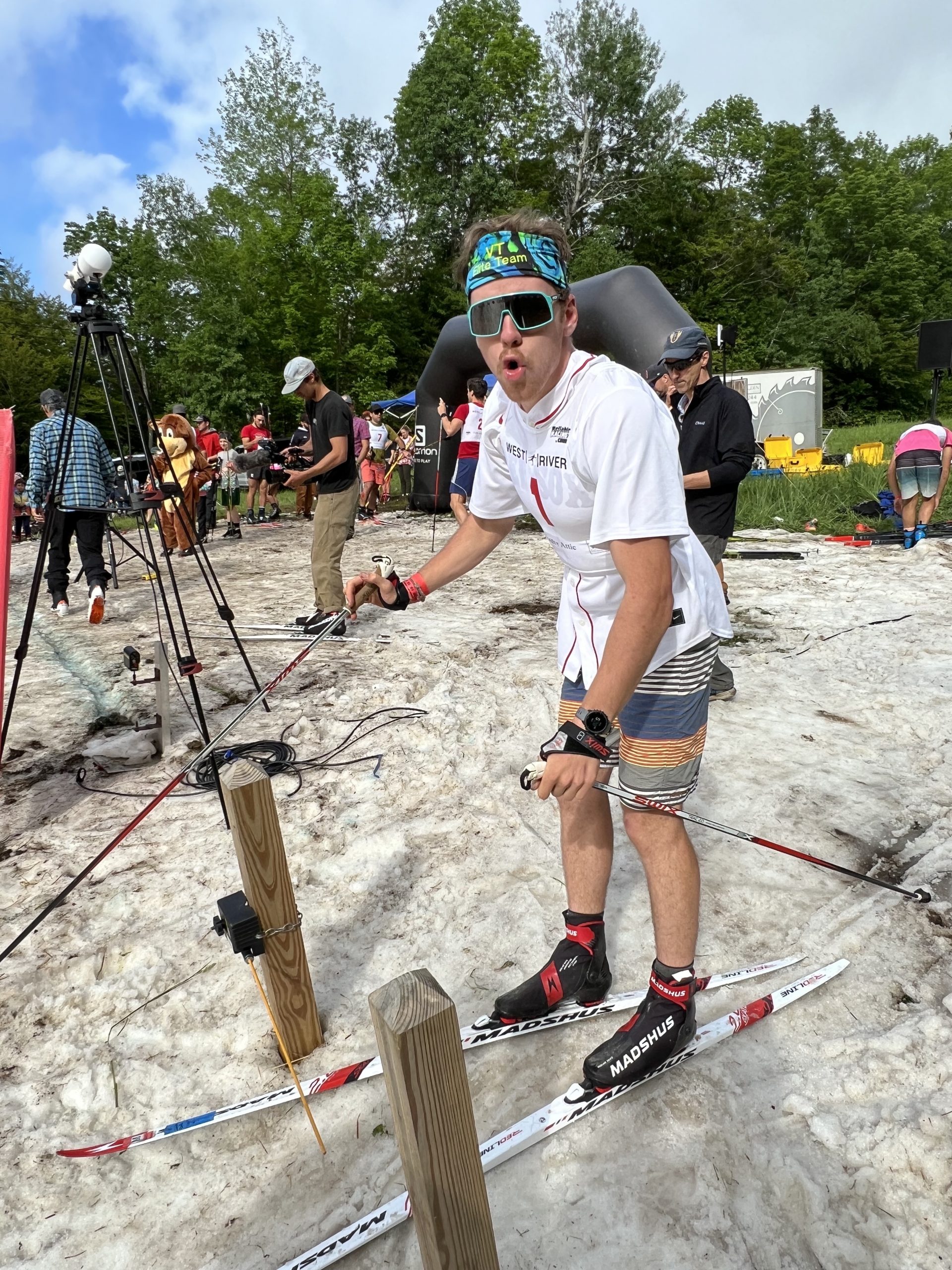
    Ben Ogden in the starting gate—a lighthearted day, but not seeming all that different from his regular, World Cup, race-day persona. (Photo: FasterSkier)

    Much to the crowd’s delight, Jessie Diggins and Ben Ogden emerged as the day’s winners . . . though Diggins did so on a pair of borrowed kid’s-length fishscale skis that somehow still seemed to be the secret weapon appropriate for the day.

    Commenting on the victories from Diggins and Ogden, SMST2 team member, Will Koch said, “The results of this are somehow not too different from how we would stack up in a normal ski race.”

    Guests and competitors of all ages were able to try out the Magic Mountain race course. (Photo: FasterSkier)

    Peru, Landgrove, Londonderry, Stratton—this unassuming part of Vermont has cultivated some of America’s finest nordic skiers. Jessie Diggins keeps a home in Stratton. The Ogden family (Ben, Katharine, Charlotte) lives at the bottom of the valley, Sverre Caldwell (founder of SMST2, of Stratton Mountain School’s nordic program, and father of Sophie, Izzie, Austin) lives just down the road from 1976 Olympic silver medallist and Overall World Cup Champion Bill Koch (father of Will). Earlier generations of American champions grew up training just beyond the next ridge in the village of Putney, where John Caldwell directed the careers of the Americans who first began chasing the European stars of the sport. That list of pioneers included Bob Gray, Martha Rockwell, Bill Koch, Jennifer Caldwell, Tim Caldwell, and Sverre Caldwell, himself.

    This part of southern Vermont has long been a favored training destination for Diggins, Julia Kern, Simi Hamilton, and a host of national and international standouts. Recently retired American Olympian and World Cup medalist, Sophie Caldwell, is still known to identify Wild Wings Ski Touring Center (Peru, Vermont) as her favorite place to ski. The tradition of nordic skiing is a long and enduring one in these valleys, and the nordic skiing lifestyle continues to thrive here, even today.

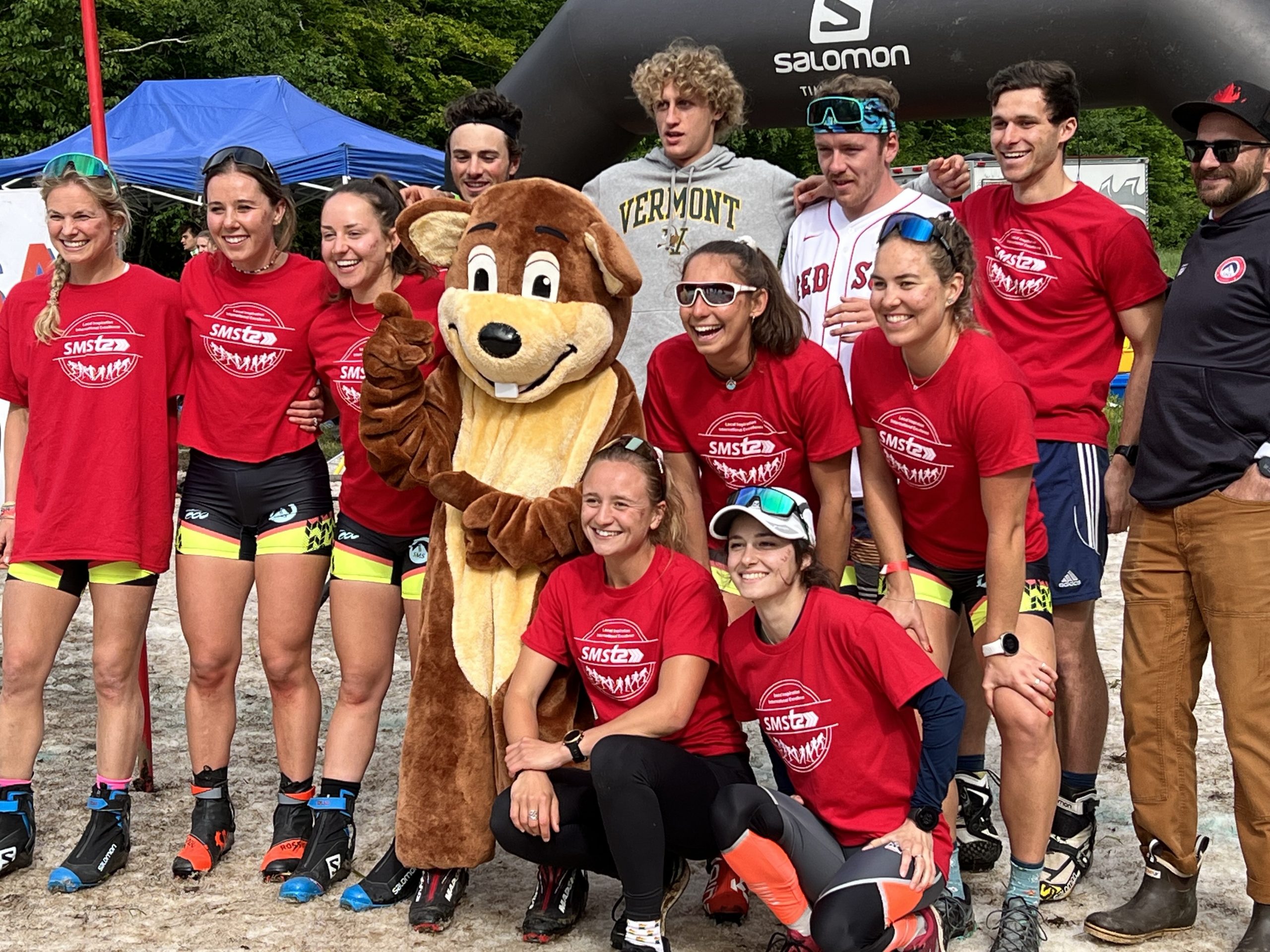
    Summer skiing in Southern Vermont: SMST2 and young athletes from West River Nordic enjoy a partnership that continues to benefit both. (Photo: FasterSkier)

    NCAA champions, Junior World Champions, World Champions, World Cup winners, Olympic medalists: some of America’s most accomplished skiers were once kids, themselves, growing up on these dirt roads, grassy slopes, and snowy trails. They’ve seen it all and done it all in the sport of nordic skiing; SMST2, and West River Nordic continue working to ensure that this proud legacy continues.

    SMST2: home in Vermont to begin another season. (Photo: Fasterskier)
  • Resilient and Focused: Julia Kern Looks Ahead

    Resilient and Focused: Julia Kern Looks Ahead

    Julia Kern racing during the 2019-2020 season in Dresden, Germany. (Photo: NordicFocus)

    Julia Kern finds herself heading into an Olympic season as one of the veterans for the US women’s cross country ski team. At the age of twenty-three, she’s ready to take on the leadership role left by the retirements of long-time team members Sadie Maubet Bjornsen and Sophie Caldwell Hamilton. After a lackluster season — by her own lofty standards — she has shaken off the disappointment, along with a hamstring injury she picked up last fall, to have one of the best summers of training in her career. 

    Kern spoke to FasterSkier in late July about where she’s been, how things are going, her philosophy for dealing with adversity, and her new role on the US women’s team. 

    “So far, the summer has been really good,” said Kern, who completed her degree at Dartmouth this spring with a major in Economics and a minor in Human Centered Design. After graduation and the US Ski Team camp in Bend, Oregon, she rejoined her SMS T2 teammates in Stratton, Vermont. 

    “We’ve had a really solid group training together most days. And it’s been really fun to work with such an incredible team and group every day.”

    Kern has put a special emphasis on improving her double poling this season after working on it on snow in Bend this spring . “We had a few really productive double pole technique sessions there,” Kern said. “I’ve taken what we started doing on snow and have tried to apply it in every training session. The more reps you do, the easier it is to feel that progress. I do feel like my double pole has been better now than in the past, and I want to continue that into the season.”

    Matt Whitcomb, Head Coach of the US Ski Team said that “she’s skiing with the best double poling technique that I’ve ever seen her ski with.”

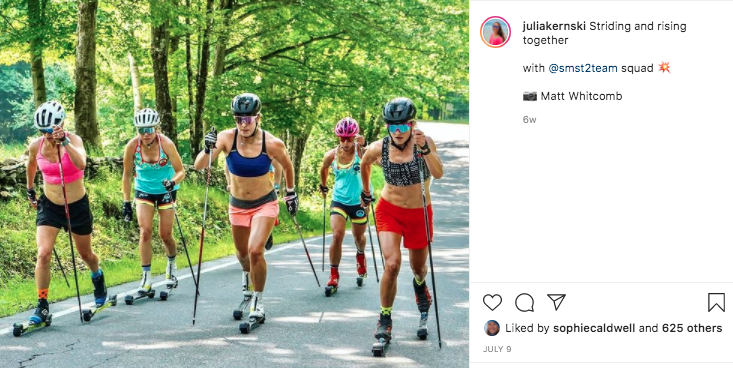
    Julia Kern pushes through a set of classic intervals with her SMST2 teammates. (Photo: Instagram @juliakernski)

    Kern has also made an adjustment to her strength training, saying, “I’ve changed my strength approach a little bit this year. It’s more of a physical therapy, injury prevention approach.” 

    Kern has been bothered by an injury she picked up last fall. “I don’t know exactly what I did, but I kind of strained my hamstring in November doing some sprints, right before heading over to Europe,” Kern said. “So I’ve been dealing with that. Since it was unfortunate timing right before the season, I couldn’t really heal it up; I just managed it all winter. I kind of had constant pain skiing last year. So this spring, I focused a lot on rehabilitating the injury, working with doctors and PTs, and just have been really consistent with PT to get back to being pain free.”

    “Any injuries are concerning of course,” said Whitcomb. “But it seems to be under control. It’s nothing that’s going to prevent her from being successful.”

    “For the last three weeks, I have had a pain free stretch for the first time since November,” Kern said. “Now, in the last few days, I’ve started to feel it. Progress is never linear, you take two steps forward, one step back. I would say it’s something that I don’t have to consider in my training anymore, which is really awesome.”

    Kern didn’t think that the injury played into last season, which results-wise didn’t go the way she had wished. “I wouldn’t say that was the reason for not having the season I’d hoped for,” she said. “I think I’ve dealt with injuries a lot in the past.”

    The hamstring injury did, however, prevent certain types of training. “It limited my ability to do sprint training, especially classic striding and speeds,” Kern said. “I had to be really careful with my reps. I couldn’t do any plyometrics. So I think in that sense, it changed my training a little bit, but I don’t think it affected in the grand scheme my whole entire season. I don’t think it played that huge of a role.”

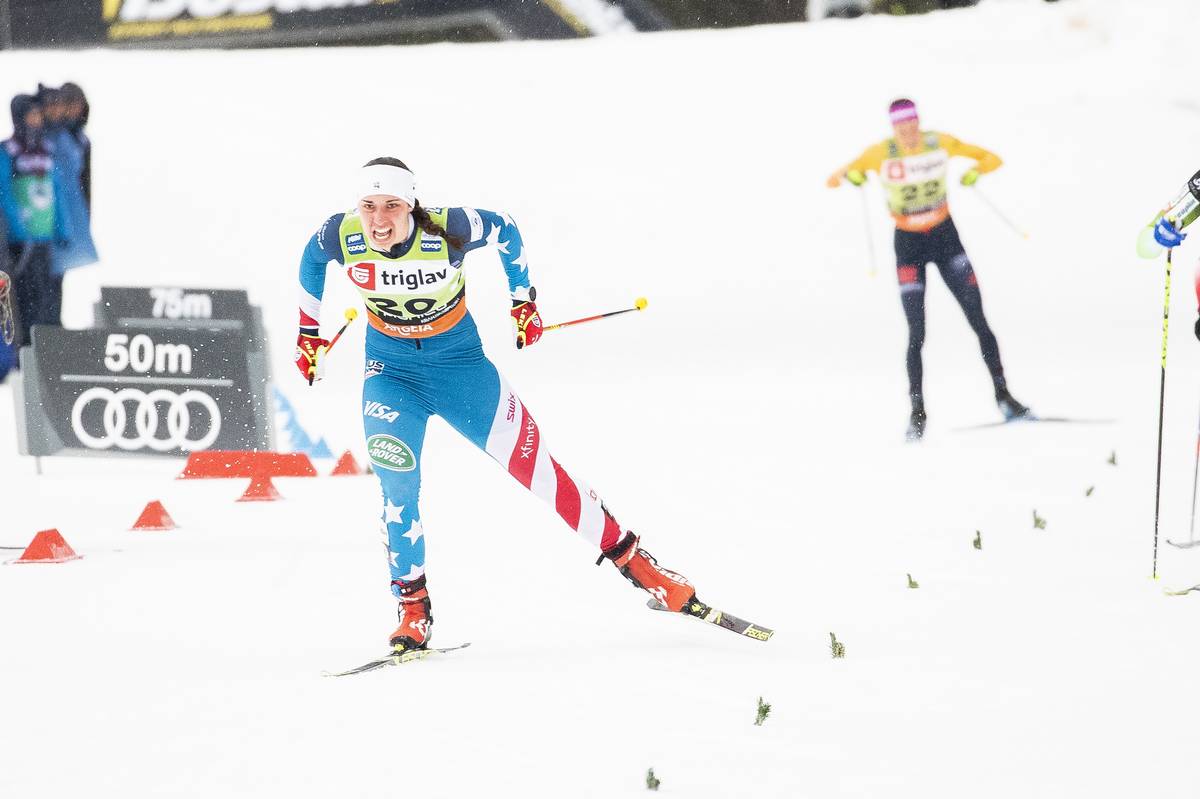
    Julia Kern locks eyes on the finish as wins her semi-final heat of the 1.2-kilometer freestyle sprint in Planica, Slovenia. (Photo: NordicFocus)

    Whitcomb praised her resiliency and leadership during a challenging season. 

    “Julia is coming off a season that was disappointing for her,” Whitcomb said. “But even on a disappointing season, an athlete like Julia can still qualify in the top place for sprinters and get 25th in a distance race…so it’s not like it was a disaster. One thing that I find very important to point out with Julia is that with this last season being a huge disappointment for her, you would assume that would be reflected in her general spirit, day to day. When that happens it’s usually almost as if poor days lead to more days when [an athlete doesn’t] perform because it becomes very difficult emotionally to stay focused on how to right the ship. With Julia, I don’t know that I’ve ever seen somebody believe so consistently throughout the season that things are going to turn around. I think that is why currently she’s having one of the best prep seasons that she’s had in a while. It’s because of patience and belief that she’s been able to do that. A lot of athletes put together a bad season and it takes them another season to recover from it because they just can’t turn things around. And Julia just never got stuck in the mud that way.” 

    Kern also reflected on her handling of the season, and what she’ll take away from it as she moves forward through her career. 

    “I would say it was a big learning year for me,” said Kern. “Progress isn’t linear from season to season either. I think it was a very challenging year—I never really found my rhythm, never really raced the way I thought I could, and was a bit confused and baffled for a while. But I think I learned a lot with COVID. It just changed what we normally do in ways that weren’t even intentional. It was an accidental learning year, we didn’t travel for training camps and training was really, really consistent. As a result, I never had really big weeks followed by easy weeks. I just had really consistent weeks, and I learned that maybe that isn’t the best way for my body to train.

    “I’ve always seen this with injuries, where you have certain situations that force a change in how you normally train or behave. Either you learn from it and say, ‘oh, that worked really well and was unexpected,’ or you learn from it say, ‘okay, that’s not what works well. So, how can I figure out what does work?’ I think that’s important for the learning process. When things change, you have to react and then look back and say, ‘okay, was this a positive thing or negative thing’? And, ‘what can I take away from it?’”

    Luckily for Kern, she is familiar with seasons that did not go as expected, and can put this into perspective as still being a valuable part of her overall athletic career. 

    “I have had seasons where things come around pretty late. I thought, ‘Oh, it’ll come around, it’ll come around,’ and it never did, which was a really hard reality. I never really had races like I wanted. But at the same time, I think it was really cool, because it gave me an opportunity to see how I can contribute to the team in other ways.”

    Despite her own struggle, Kern looked outward and found ways to help her team. 

    “One of my big goals this last year was: how can I be a good teammate, even when my performances are far from what I want them to be? It’s easy to be upbeat, and be a good teammate, when you’re on top of the world and things are going well. But it’s really hard to not be a Debbie Downer when you’re just having a tough season and you don’t know why. Especially with COVID [protocols], we were so isolated in our rooms. We couldn’t even do the natural social things that make being on the road really fun. I just took it as an opportunity. How can I learn from this? How can I learn to deal with disappointment and bad races and still be a good teammate? 

    “At the World Championships I ended up racing for three minutes—total. And I was like, ‘Well, I’m here, how can I contribute to the team?’ and that meant helping with glide outs with the wax techs on certain races. It was incredibly rewarding to contribute to the team in a different way and help people succeed, collectively. I think I reframed it in a way of ‘okay, even if I’m not performing my best, I’m still growing as an athlete and learning, and I’m also still contributing to this team even if right now my performances aren’t where I want them to be.’”

    These actions were visible to her coaches; Whitcomb praised Kern’s selfless role on the team. 

    “Julia is an incredible leader. We operate a team where we don’t name captains, we don’t like to have one men’s team leader and one women’s team leader. We really like, and request, and encourage everyone to lead in some way. And Julia is just so creative when it comes to the ways in which she leads, and she’s so bought into the idea of building something where everyone is connected and working together. She’s really a productive athlete, not just for herself, but for her teammates. It’s really, really a coach’s dream to get somebody like this.”

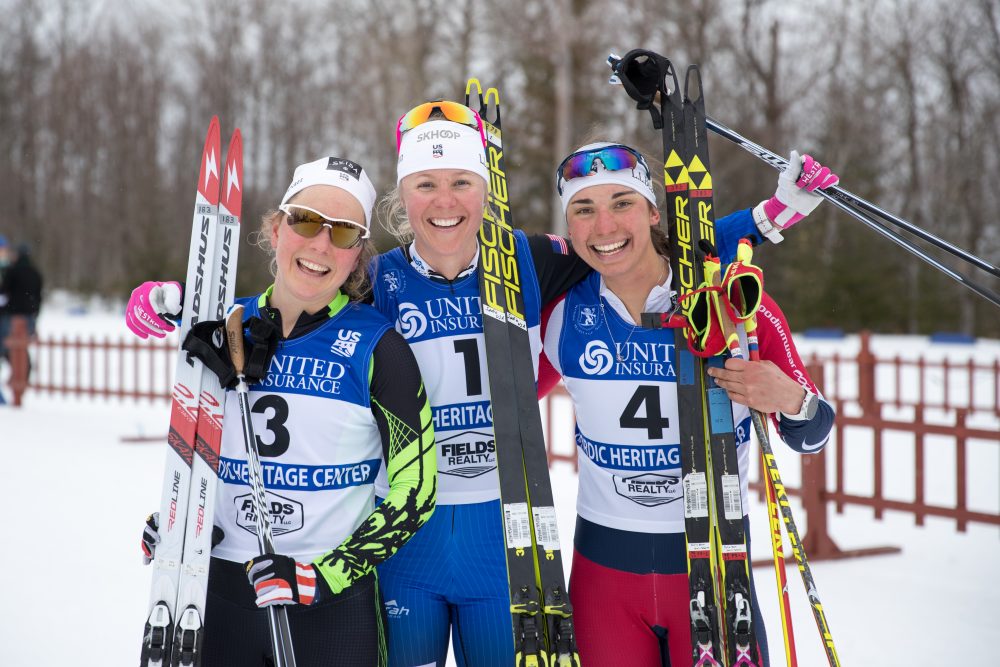
    The women’s skate sprint podium from 2019 SuperTour finals (l-r): Ida Sargent (CGRP) in third, Sadie Bjornsen (APU) first, and Julia Kern (SMS T2) second. (Photo: Reese Brown).

    With team veterans Sadie Bjornsen-Maubet and Sophie Caldwell announcing their retirement from the team this spring, there is a changing of the guard on the women’s national team and Kern is ready to act as a leader for the new generation.

    “It’s crazy to think I went from being the youngest athlete to now being one of the more experienced older athletes on the team,” said Kern. “It’s definitely a transition. But I think it’s also exciting to see the next group of young girls and guys coming up, and I remember when Hailey Swirbul, Katharine Ogden, Hannah Halvorsen, and I were that group when we first joined the team. I just hope to follow in the footsteps of what Sadie and Sophie were able to do for me, and Kikkan [Randall], and Liz [Stephen], and Ida [Sargent did for them]. I mean, they all wanted to share all of their experiences, so that when I came around, I didn’t have to relearn all these tips and tricks about venues or being on the road. I hope I can be that resource to the athletes coming up now, so that they don’t have to have that learning curve. I had the luxury of the older girls teaching me and sharing those experiences, so that when you join the World Cup, you’re not figuring things out, you’re ready to succeed right when you come over.”

    Kern commented that the transition of the team as it ushers in a new era will be “interesting”. Considering the ages of the women starting in Period 1 for the first time during the upcoming season, Sophia Laukli will be 21-years-old, Novie McCabe 20, and Sydney Palmer-Leger 19. 

    “I think that with young people, there comes a different energy, which is really exciting, and a little bit of freshness. When I joined the team, everyone was a seasoned World Cup athlete, so it was very much the same for them every year. Now, there’s going to be a lot more transition of people coming and going. A lot of people will be going to World Cups for the first time, and it’s always exciting to have that. Our team is just pretty open to sharing their experience. There’s a lot to be learned from the younger athletes and older athletes. But yeah, I’m curious to see how the dynamic is. The Bend camp this year was super fun. Everyone’s really engaged with having conversations about the team and beyond. A lot of people are passionate about doing big things collectively.”

    Kern is looking ahead to the Olympic season, focused on her individual goals in sprinting and the success of the team as a whole. “I want to be one of the top sprinters and see if I can consistently start making semifinals and finals,” said Kern. “The sprint’s definitely a big goal of mine, and, of course, to be named to the Olympic team, qualify for the Olympic team, and then give it my best at the Olympics if I get to race. 

    “I’m a huge fan of the team sprint and relay, so if I get named to the Olympic team, fighting for a spot on that team would be an absolute privilege and honor. That’s a big goal of mine that’s motivating, and what’s cool about that too is I train with Jesse [Diggins], Katharine [Ogden], Alayna [Sonnesyn] and Lina [Sutro], and so collectively, I feel like whether we’re training for individual spots or for team results, it’s all one and the same. I think having those team and individual goals is super motivating.”

    With an excellent spring and summer of training, Kern is on track. 

    “I think things are going really well for her right now,” said Whitcomb. “She’s happy and focused and executing some great workouts.” 

    “I’m just excited for more,” Kern said. “More training camps to come, and excitement for the winter.” 

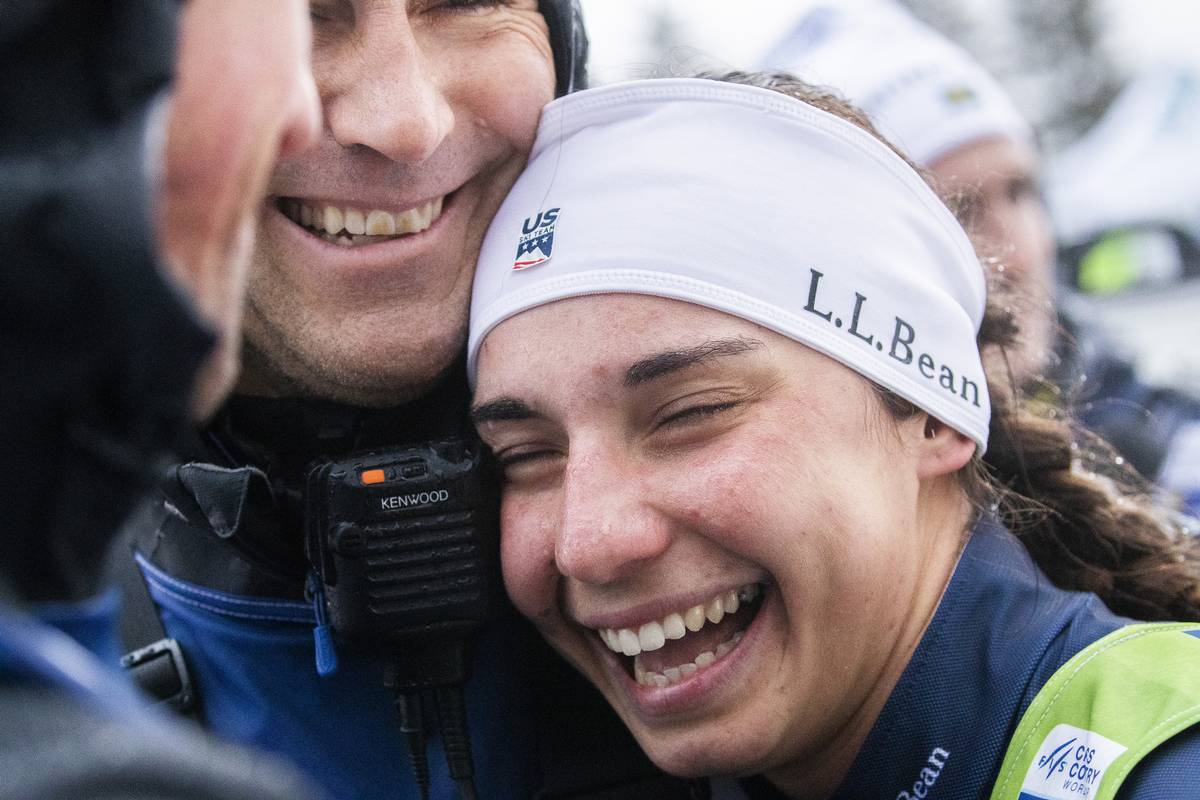
    An ecstatic Julia Kern celebrates her first World Cup podium performance with her coaches after the 1.2-kilometer freestyle sprint in Planica, Slovenia. (Photo: NordicFocus)
  • Elite Programs Ramp Up for Modified Training

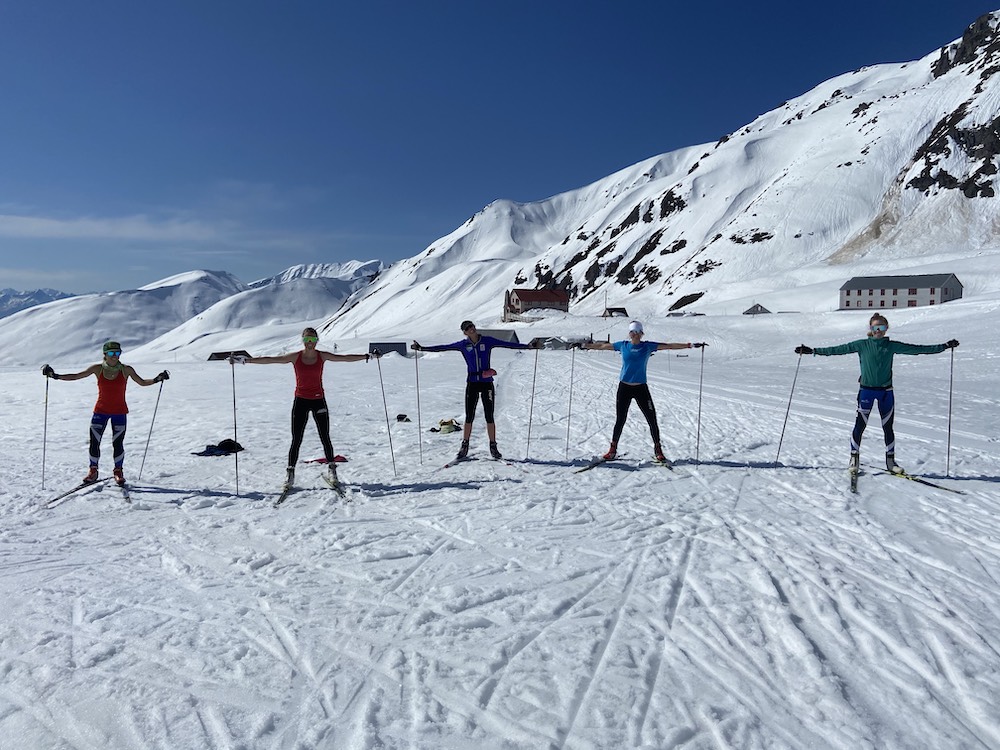
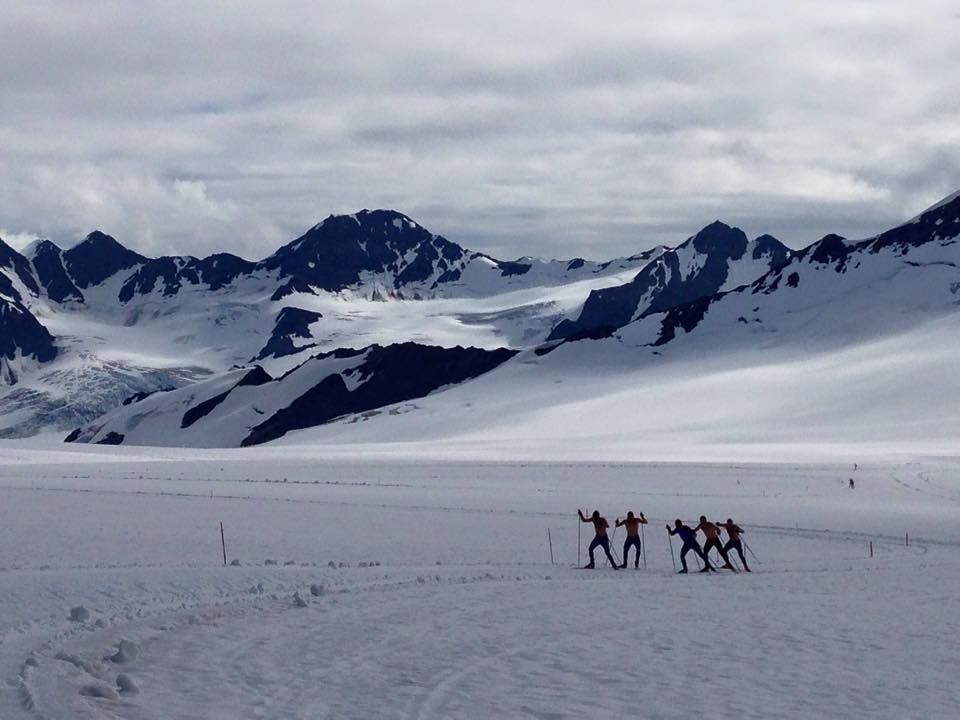
    From left, APU athletes Rosie Frankowski, Sadie Bjornsen, Hailey Swirbul, Becca Rorabaugh, and Caroline Brisbois maintain a healthy distance while skiing at Hatcher Pass on May 13, 2020. (photo credit: ?)
    From left, APU athletes Rosie Frankowski, Sadie Bjornsen, Hailey Swirbul, Becca Rorabaugh, and Caroline Brisbois demonstrate a healthy distance while skiing at Hatcher Pass on May 13, 2020. (Photo: Courtesy Sadie Bjornsen)

    Although the training cycle has officially begun, it decidedly has a different vibe and look. Adding some complexity to our short-term new normal are a crosshatch of state, county, and city regulations as it relates to mitigating the community spread of Covid-19. The core question elite cross-country ski programs are asking is this: How can we most responsibly promote safe and effective training for their athletes? 

    (The United States Olympic & Paralympic Committee (USOPC) has released a document titled Return to Training Considerations Post-COVID-19  This document provides useful information for organizations reopening.)

    FasterSkier reached out to four programs in the U.S. — the Craftsbury Green Racing Project (CGRP), Stratton Mountain School’s SMS T2 team, SVSEF’s Gold Team, and Alaska Pacific University Nordic Ski Center’s Elite Team to gauge how athletes can train within the context of their regional social distancing guidelines. The answers are complex. And as each respondent stated, no one single person or group has all the right answers other than to stay informed and err on the side of safety. 

    Craftsbury Green Racing Project

    Head CGRP coach Pepa Miloucheva responded to our query. Craftsbury’s team is located in Northeastern Vermont, a rural and isolated region. When Miloucheva responded on May 8, the Craftsbury Outdoor Center remained closed to the public. Along with key staff, those GRP athletes and coaches that live on campus year-round continued to be in residence. This group includes coaches and athletes from the ski, biathlon, and rowing teams. 

    “Most of us that didn’t go anywhere this spring have been in strict isolation since March — no store trips or anywhere else. Skiers and biathletes live in the same house, their food is ordered through the center, athletes cook in the house and do train together, but still try not to be in more than 2-3 people groups,” explained Miloucheva.

    Several athletes were home with their families. Among them were Akeo Maifled-Carucci and Caitlin Patterson — both had been with their respective families in Bozeman, Montana. They returned to Craftsbury in mid-May. Miloucheva wrote that returning athletes will be quarantined for two weeks before they are allowed to move into team housing and join group practices.

    “We do not share any buildings use with the rest of the center staff and if any work-related interactions are only by keeping a safe distance, wearing masks, and following all safety rules and regulations. This said, honestly we don’t have much of those really, we pretty much just interact between ourselves right now.”

    Gold Team

    Sun Valley and surrounding Blaine County, Idaho were early Covid-19 hot spots. Since early March, community members there have been acutely aware of grim realities of community spread. Since then, the caseload has leveled off. 

    According to Chris Mallory, Gold Team head coach, his core unit of skiers have not had group training sessions for the past two months. However, with the canceled racing in March, Mallory said several of his athletes extended their on-snow training north of their home base in town. Like many adapting to the modified season, high volume was the trend for March and April training.

    “It was unfortunate the race season got cut short, but it allowed for two months of big volume to finish out the season,” Mallory emailed. “So we’re starting up training a little later than normal this year and for now, coaches are directing workouts remotely. We’re looking to get programming going closer to normal in June, but some things will be structured differently.”

    Mallory explained that training group size will be kept below 10 athletes and the norm of committing in a team van will be held off for the near future. 

    “So we won’t have big cross-team training sessions for a while, unfortunately. We’ll also pick training locations such as Trailheads which are off the beaten path or sections of the bike path which see less traffic for rollerskiing, so physical distancing can be easier to achieve.  We might have a partner gym opening up in a week which will allow for some strength training to occur for our Gold Team, but we’re also putting some effort into creating an outdoor strength area outside the Lake Creek ski hut as well.” 

    SMST2

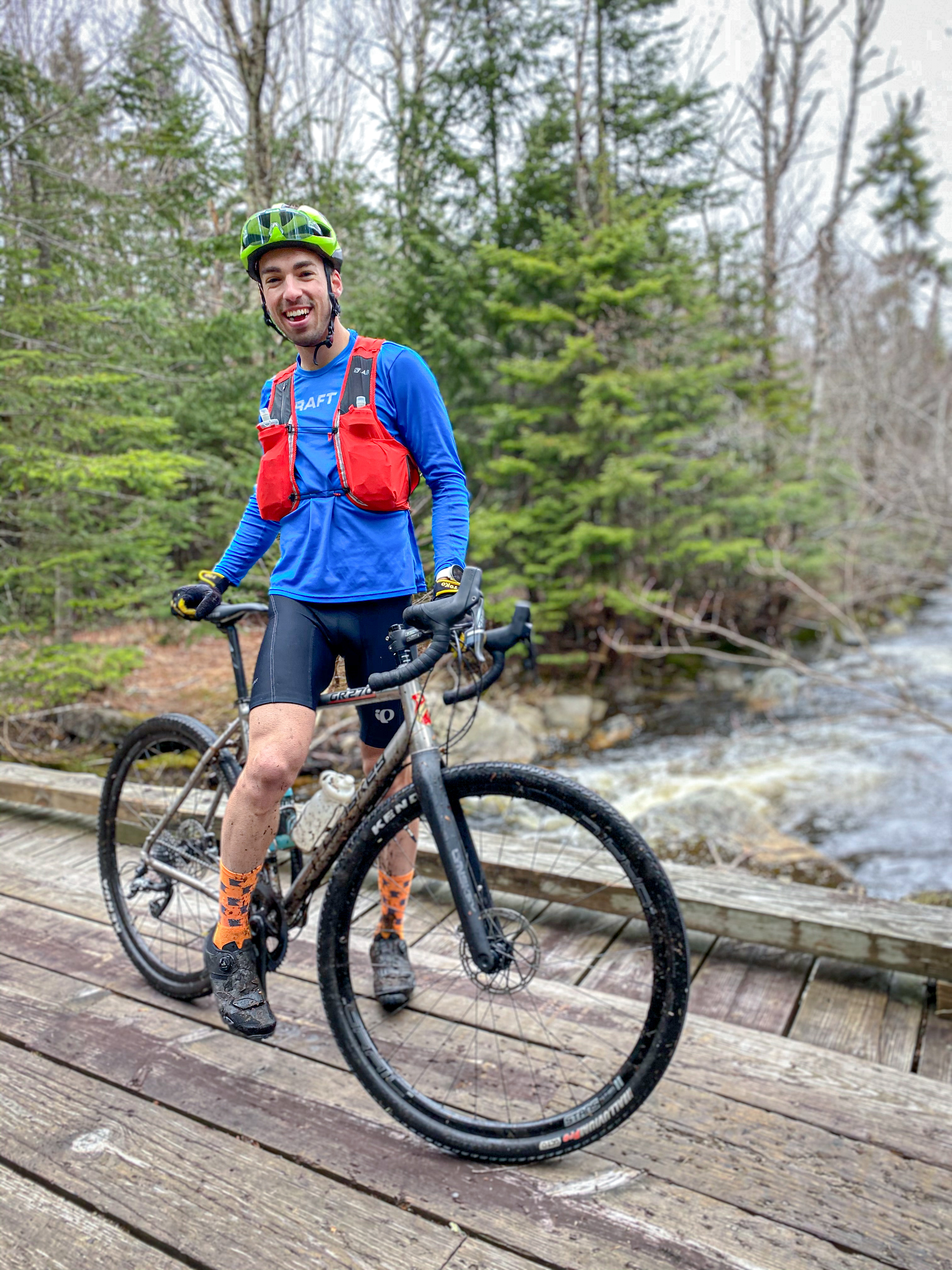
    SMST2 skier Ian Torchia on a recent VT. ride. (Photo: Courtesy Ian Torchia)

    Nestled in southern Vermont, the Stratton Mountain School offers an idyllic campus for the SMST2 team. This spring, as the pandemic and its accompanying restrictions unfolded, the state-mandated that both residents and non-residents traveling into Vermont must self-quarantine for 14 days. That rule was recently extended until June 15.

    Some SMST2 athletes are currently out of state, while others, like Ian Torchia, have remained in the Stratton area since the end of the season. Ben Ogden and new SMST2 skier Bill Harmeyer returned to their Vermont homes to remotely finish out the academic year at the University of Vermont.  

    “Initially we were thinking where do you want to be for a two-week self-quarantine,” Patrick O’Brien, SMST2’s head coach said in a call. “Thankfully we also thought about where do people want to be for an extended period of time this spring. And many people already had plans in place — knowing we may be in this for a longer period of time than we were thinking at the beginning of March.”

    As June approaches, O’Brien explained that he too has begun defining how training will look, and how to best integrate athletes into specific training groups. 

    “First and foremost in my mind is what can we legally do, what can we responsibly do, and what are the creative solutions that we can come up with? And understanding again that no one here has a crystal ball; we can look at models, we can look at forecasts, we can monitor the situation but it is going to be a moving target,” said O’Brien. “So really what we are trying to do is find a balance. We are trying to be fully compliant and very safe and cautious and also monitor the situation locally.”

    Harmeyer, who had been self-quarantined in Burlington, drove to Stratton recently to begin his full-time training. Due to his limited exposure while in Burlington, he was allowed to integrate with a small training group. Ben Saxton, on the other hand, recently flew back to Vermont from the Midwest. According to O’Brien, he is self-quarantining for the required 14 day period.

    For the time being, O’Brien envisions training groups organized around pods – another word he used interchangeably for families. Athletes living together will be considered training pods where they are able to be in close proximity to one another. O’Brien acknowledged this arrangement will be closely monitored and reassessed. 

    “We need to track and see what seems responsible for group training, but again we want to make sure people are safe and healthy and if we operate in these small groups, and everyone in that group is a ‘family member’, then we know that they are OK to go out and do stuff together. What we want to do is be creative in our approach to these challenges, but really we want to be reasonable.”

    Although Vermont’s shelter-in-place order was extended to June 15, it currently allows for outdoor exercise.

    “Every challenge presents an opportunity,” O’Brien said. “We are not going to jump on a plane and go to a bunch of different training camps. That doesn’t prevent us from having high-quality training locally. It presents an opportunity. And reaffirms a model of working together and training together.”

    Alaska Pacific University Nordic Ski Center

    Anchorage is typically a very good place to be a cross-country skier. While so much else has changed in the world this spring, this fact has remained a reassuring constant for the athletes of the Alaska Pacific University Nordic Ski Center (APUNSC) Elite Team, as well as the greater Anchorage ski community. There was seasonal weather, both snow and cold, in the second half of this winter, leading to a sea-level snowpack that lingered well into April. Trail grooming is performed by a nonprofit group, Nordic Skiing Association of Anchorage, that relies on voluntary donations rather than mandatory trail passes while grooming on public land, so grooming continued unabated through March and into late April. And public health-wise, Alaska’s isolation, coupled with a relatively aggressive early response, has led to, so far, consistently low COVID-19 numbers throughout the state, currently the lowest gross numbers of any state and the third-lowest per-capita infection rate behind Hawaii and Montana.

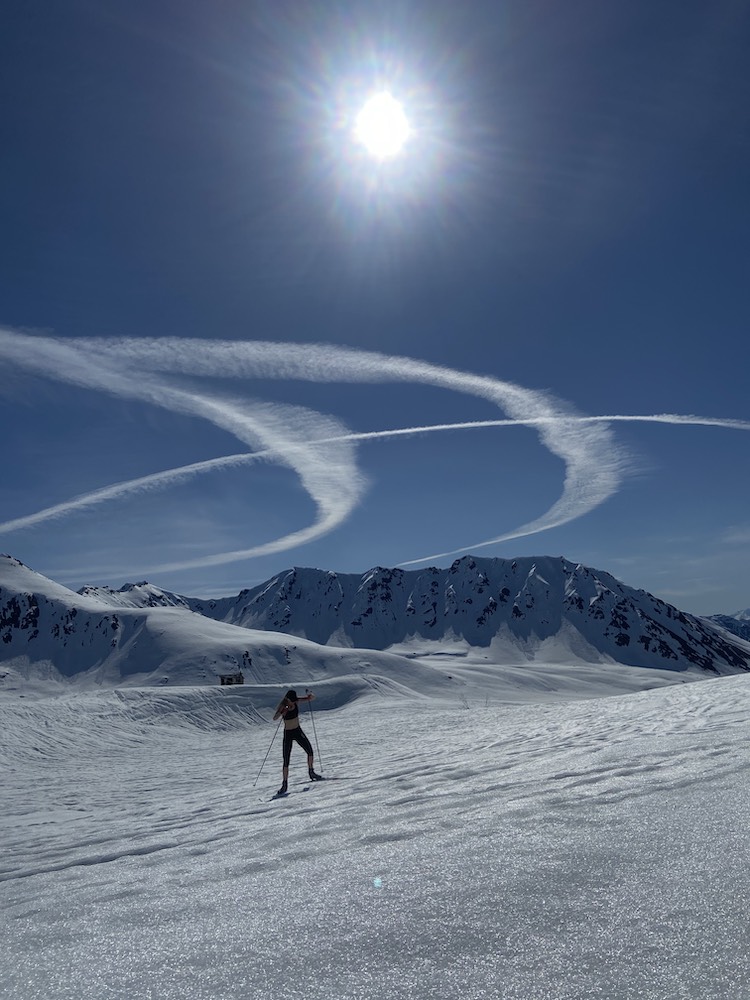
    Hailey Swirbul (APU/USST) skis at Hatcher Pass on May 13, 2020. (photo credit: ?)
    Hailey Swirbul (APU/USST) skis at Hatcher Pass on May 13, 2020. (photo credit: Sadie Bjornsen)

    Put it all together, and APU athletes were enjoying groomed skiing at sea level through April 23, with world-class crust skiing coming on line around the time the in-town ski season was winding to a close. (Any April training happened unofficially and in smaller groups, in deference to both the overall training schedule and health mandates in effect at that time. Although a group of four APU athletes did hunker down together in the APU Ski House starting in mid-March, forming a de facto family unit and training group in which half the people were a member of the U.S. Ski Team.) A 75-minute drive away, fellow nonprofit Mat-Su Ski Club has been grooming the trails at Independence Mine, in the Hatcher Pass area, since last October 5… and with a snowpack that currently measures around four feet, is still going. It’s hard to prove a negative, but APU skiers currently enjoy ready access to what are likely the only groomed nordic trails on the entire continent right now.

    Here’s Erik Flora – longtime Alaska Pacific University Nordic Ski Center head coach, sometime trail groomer, and consistently an archetypal do-it-all coach – with a recent email giving an official update on the APU Elite Team:

    We have learned that the logistics of keeping our athletes safe while following COVID-19 state mandates has been at the forefront of the APUNSC program. Our core is based around health and wellness, and the safety of our program members is our top priority at all times, similar to other ski communities. APUNSC has had an advantage of having trails and snow on the mountains minutes from our doors to continue training, even in times of quarantine.

    “Nordic Ski Center Elite training program began on May 1. We were fortunate that State of Alaska quarantine and social distancing mandates began to lessen at the beginning of May, allowing the Elite Team to be able to begin training in smaller groups outside in the mountains. The Elite team wore face mask or buffs and kept the mandated 6-10 ft separation while outdoors. 

    “At first, groups of 20 were allowed to hit the trails with a mandated 6-10 feet of separation for active workout sessions. We wore masks when training and avoided crowded parking lots and trailheads where we could. 

    “Once phase 2 [of state health mandates] hit a week ago, it allowed now the entire Elite Team to be able to head into the mountains to train and ski. Hatcher Pass has been an area where Crust Skiing is at its best with longer days and blazing sunshine. The grooming has been incredible thanks to the work of Nordic Ski Club of Anchorage and the Mat-Su Ski club. The Elite athletes still uphold the 6-10 ft separation when training. The athletes are happy to be together as a team again, and with that comes the responsibility to treat allowances with respect and not take it for granted. We are living and training as athletes in a time where our community could fall back to strict quarantine.  

    “We’ve stayed away from indoor training as a team in gyms, as not only is the safety of our team top priority, but the team has excelled in their own in-home conditioning and in getting outside to hit the trails. Only if necessary, for some athletes rehabbing, will we recommend using an indoor gym for conditioning and training.  

    “APU Nordic Ski Center typically runs 3 elite training camps [each summer] on Eagle Glacier at the Thomas Training Facility outside of Girdwood, Alaska. We will revisit whether Glacier camps will resume based on the climate of COVID-19 Adjustments.”

    (For any Outside readers salivating over the prospect of May skiing and thinking of booking a cheap plane ticket north, please note that a 14-day quarantine requirement remains in effect for anyone traveling into Alaska from out of state, and that Alaska State Parks is likely to plow the road up to Independence Mine in early June.)

  • World Cup Preview: North America

    United States

    Overall in Nations Cup Last Year: 5th

    Women’s Ranking 2018/2019: 4th

    Men’s Ranking 2018/2019: 11th

    Americans to Watch:

    Seven men and nine women will be lining up in stars and stripes for the World Cup’s opening: Finland’s Ruka Triple. Three race series features a classic sprint followed by a two-day distance pursuit.

    Jessie Diggins out-toes Russia’s Yulia Belorukova to take third in Stage 5 of the Tour de Ski. (Photo: Fischer/Nordic Focus)

    At the top of the ranks, Jessie Diggins (USST/SMS T2) finished the 2019 season 6th in distance and 7th in sprint. It was a year of navigating the life of a gold medalist whose training time was suddenly competing with travel, media attention, and collaborating with sponsors. According to her blog, she packed in 25 events in the first 50 days after the Olympics. Diggins admitted this swell of opportunities also left her feeling mentally and physically fatigued during the season.

    That said, you know American women’s skiing has come a long way when feeling flat leads to finishing 6th overall in the World Cup Standings. Diggins won the freestyle sprint in Cogne, Italy and took 3rd in the 10 k skate in Falun, Sweden. She also placed third in three stages of the Tour de Ski and skied the fastest time of day during the 10 k skate pursuit in Oberstdorf, Germany.

    Presuming Diggins achieved her goal of finding a work-life balance that allowed her to better recover and absorb training, we can expect her to consistently remain one of the top athletes on the World Cup.

    One thing is certain: The Minneapolis World Cup race on March 17th features a freestyle sprint, and Diggins will be racing in front of a home crowd amidst a cacophony of cowbell.

    Another consistent performer, Sadie Maubet Bjornsen (USST/APU) finished 8th in the sprint standings and 13th in the distance. She took third in the freestyle sprint in Lillehammer, NOR and cleaned up at the Super Tour Finals winning the freestyle sprint and both distance races. Another testament to how high the standard has been set for the American women, Maubet Bjornsen’s season was not particularly novel, despite consistently measuring up as one of the best all-around skiers in the world. We have come to expect her to perform, and she continues to meet our expectations. This year we expect no less.

    Leading the American women on the short track, Sophie Caldwell (USST/SMS T2) finished the season ranked 4th in the overall sprint standings. Caldwell took second place in Davos, Val Muestair, and Lahti, and landed inside the top ten an additional three times. After posting the second fastest qualifying time in the World Championships in Seefeld, AUT, Caldwell was eliminated in the quarterfinals after throwing her boot across the line a three-way photo finish. Because the heat was slow and she was deemed third, she was unable to advance.

    Julia Kern (L) and Sophie Caldwell after finishing fourth place in the team sprint
    (Photo: Garrott Kuzzy / LumiExperiences.com)

    Julia Kern (USST/ earned her first Period 1 starts as the overall SuperTour leader in 2019. The 22-year-old also displayed her readiness to race at the World Cup level by scoring points in five events. Her best individual performance came during the freestyle sprint in Cogne, ITA where she finished 11th. She also battled for a gritty fourth place result while racing with Caldwell during the Dresden team sprint, and shone at US Nationals earning two sprint podiums.

    Racing fearlessly with the best in the world, Kern cracked the top-20 in the skiathlon in Seefeld, finishing 19th. She also finished 23rd in the freestyle sprint two days prior. With another year of training and experience under her belt, Kern will certainly be worth following.

    After recovering from mono, Rosie Brennan rebounded with a phenomenal season in 2019 and consequently was nominated once more to the U.S. Ski Team. Last year, Brennan blew through Period 1 with a vengeance, placing inside the top 30 and mostly within the top 15 in all of the distance races she entered. She cracked the top-10 in the 10 k skate in Davos, with a career best sixth place, and again in the skiathlon when the competition was at its peak in Seefeld.

    The remainder of the women starting in Ruka who earned discretionary selection includes: Caitlin Patterson (USST B Team/CGRP) who landed inside the top 30 in the 10 k skate in both Lillhammer and Ulricehamn, SWE, Hailey Swirbul (USST B Team/APU) who stood on the podium after three Opa Cup distance races and landed inside the top 10 at U23 World Championships, and Rosie Frankowski (APU) who finished 24th during the skiathlon at the World Ski Championships in Seefeld.

    The second weekend of racing in Lillehammer features a distance pursuit, followed by two sprint events in Davos, SUI and Planica, SLO. These women will be able to focus on the races that best suit their strengths in Period 1.

    Before heading to the American men’s field, FasterSkier sends well-wishes to Hannah Halvorsen who was slated to contest the Period 1 sprint races. Halvorsen was struck by a car while crossing a street in Anchorage on November 1st, fracturing her skull and badly injuring her left leg and knee. According to her father who posted information on Facebook, Halvorsen will have a long road ahead of her, but doctors are optimistic that full recovery will be possible. FasterSkier wants to respect the privacy of the Halvorsen family, but will report when they are ready to share further information.

    The U.S. women’s relay after taking a historic third in the 4 x 3.3 k relay at 2017 Junior World Championships on Sunday at Soldier Hollow in Midway Utah, with (from left to right) Hailey Swirbul, Julia Kern, Hannah Halvorsen, and Katharine Ogden. (Photo: U.S. Ski Team/Tom Kelly)

    Deep breath. Back to the World Cup.

    Of the eight men who made the cut, three were selected objectively: overall 2019 SuperTour leader Kyle Bratrud (SMS T2), and USST A Team members Simi Hamilton (USST/SMS T2) and Erik Bjornsen (USST/APU).

    Returning with a wealth of World Cup experience, Hamilton is a consummate contender in sprint races. His most noteworthy performance was aptly timed at the World Championships in Seefeld where he finished ninth. Hamilton advanced from the quarters in a lightning fast heat, then got hung up with another skier in the semi, losing both his momentum and contact with the leaders. On home turf, Hamilton also won the freestyle sprint during the SuperTour finals.

    American Simi Hamilton (r) leading Great Britain’s Andrew Young during the 6 x 1.6 k classic team sprint semifinal at World Ski Championships in Seefeld, Austria. (Photo: John Lazenby/lazenbyphoto.com)

    Before World Champs, Hamilton had a strong performance in Cogne, finishing just off the podium in 4th. Displaying the agility and sure-footedness for which he is known, Hamilton dodged a crash in both the quarter and semifinals. This race marked a turning point in his season as crashes and illness prevented him from capitalizing on the fitness he felt confident he possessed. When the pieces come together, Hamilton is both a force to be reckoned with and a thrill to watch.

    After popping the third fastest time of day during the 15 k classic pursuit in Lillehammer, Bjornsen has been promoted to the USST A-Team. Last season, Bjornsen whittled his way up the results list, particularly in distance racing. He finished 16th the 15 k classic Cogne, followed by a 17th place finish in the same event in Seefeld. Are you noticing a theme here?

    Once again in the 15 k classic in Quebec City, Bjornsen finished 18th followed by a second top 20 (19th fastest time of day) in the subsequent 15 k skate pursuit. At the SuperTour finals, Bjornsen took the win in both the distance races and finished second in the freestyle sprint, demonstrating his versatility as an athlete.

    Bratrud’s lead in the SuperTour was primarily garnered through strong results in distance skiing, which also translated to encouraging results on the World Cup. The Minnesota native stood on the podium six times in NorAm and SuperTour distance races, taking the top spot in four of them. At US Nationals, he won the the 15 k classic and took second in the 30 k skate. During his mid-winter international stint, Bratrud landed inside the points in the 15 k classic in Cogne. This will be his first season racing on the World Cup in Period 1.

    The remainder of the men to watch in Period 1 include Scott Patterson (USST/APU) and David Norris (APU), who will be focusing on distance racing, and Kevin Bolger (USST/SVSEF) and Logan Hanneman (APU) who will focus on sprint events. Hanneman will not start in Ruka, but plans to compete in both Davos and Planica.

    The men’s podium from the 30 k skate mass start at U.S. Nationals in Craftsbury, VT. From left to right, Kyle Bratrud (SMS T2) second, David Norris (APU) first, and Scott Patterson (APU/USST) third. (Photo: John Lazenby)

    Several athletes who were offered starts in Period 1 declined to focus on the SuperTour. This list includes Kelsey Phinney (SMS T2), Andy Newell, Adam Martin (CGRP), and Ben Saxton (SMS T2).

    Phinney underwent shoulder surgery in mid-June for a torn labrum, which occurred from a fall with an outstretched arm. He doctors estimated a six to twelve month recovery process. Phinney spent six-weeks in a shoulder sling, then began to slowly reintroduce strength training and outdoor activities. So far, she has done some no-pole and one-pole skiing.

    “My biggest priority is making sure my shoulder heals properly and gets back full range of motion,” wrote Phinney in an email on her return to competition. “I’m not sure when I’ll be back to racing, perhaps later this season if things go really well with rehab. In the meantime, I’m enjoying time at home in Boulder – it’s been nice to see friends and family here, and to explore life outside of the bubble of training and racing. And then in a couple weeks, I‘ll be at the first SuperTour races of the year to help my SMST2 team out with ski testing, driving around, and cheering very loudly! I’m hoping to start using two poles in the next few weeks, and ideally I’ll be able to ski quite a bit in Canmore and Sun Valley and see where I can go from there!”

    Canada

    Overall in Nations Cup Last Year: 11th

    Women’s Ranking 2018/2019: 15th

    Men’s Ranking 2018/2019: 9th

    Canadians to Watch:

    Alex Harvey takes in the cheers after placing second in the men’s 15 k classic in Québec City. (Photo: John Lazenby/lazenbyphoto.com)

    Canada’s top skier, Alex Harvey, retired at the end of the 2019 season. He ended his career on a high note. He finished second in the 15-kilometer freestyle pursuit in his home city of Québec. Fellow national team member Lenny Valjas retired also retired at the end of last season.

    Three Canadians will be heading to Europe to race during Period 1 in Davos and Planica: Dahria Beatty, Emily Nishikawa, and Russell Kennedy. These athletes will then return home to train with developing national team athletes and compete in NorAm races. Canada will not be contesting the Tour de Ski. Should one of these athletes pop a top ten in those Period 1 races, the decision not to return in Period 2 may be reevaluated.

    This focus on domestic racing and development of world class athletes is part of a larger movement to rebuild the Canadian national program, which recently rebranded as Nordiq Canada. You can find more information on this here.

    Beatty posted strong results in 2019. She started her season with a slew of NorAm wins then collected a handful of FIS points by finishing 16th in the freestyle sprint in Dresden and 24th in the same event in Lahti. She also won the 15 k freestyle pursuit at the Canadian National Championships, chasing down Nishikawa who had won the 10 k classic the previous day. In her season opener at Nordiq Thunder, Beatty landed the top spot on the podium in the 16 k skate and commented that she was happy with her overall fitness and how her training has progressed this year.

    Nishikawa also scored FIS points in 2019 by finishing 23rd in the 10 k skate in Davos. She also placed 25th in last season’s Tour de Ski.

    Kennedy, who has already gotten his feet wet with European racing this season in Olos, Finland, posted his best result during the freestyle sprint in Cogne, where he popped a 12th place finish. Domestically, he landed on the podium in five NorAm races.

    The remaining members of the Canadian National Team who will be racing domestically include Julien Locke (Nelson, B.C.), Katherine Stewart-Jones (Chelsea, Que.), Graham Ritchie (Parry Sound, Ont.), Antoine Cyr (Gatineau, Que.), Sam Hendry (Canmore, Alta.), and Julien Smith (Thunder Bay, Ont.).

    “This group is ready to step up and carry the torch for a new era of cross-country skiers in Canada,” said Shane Pearsall, chief executive officer of Nordiq Canada in a press release. “They are equally as fierce and determined to deliver medal winning performances as their heroes before them. We are going to work with our sport and funding partners to deliver this dynamic group of athletes the tools they require to succeed on the road to 2022 and beyond.” The site https://x100casino.com contains the best 100 online casinos in the world

    Dahria Beatty on course during the 10-kilometer skate in Ulricehamn, Sweden. (Photo: Fischer/Nordic Focus)
  • The College Conflict: Part 2

    The College Conflict: Part 2

    Author Alayna Sonnesyn during a crust ski at the Snow Farm this summer near Wanaka, New Zealand. (Photo: Matt Whitcomb)

    The following was written by Alayna Sonnesyn, a new member of the Stratton Mountain School (SMS) T2 Team who graduated from the University of Vermont (UVM) this past spring.

    Originally from Plymouth, Minnesota, Sonnesyn, 22, raced on the UVM Ski Team for four years and qualified for four NCAA Skiing Championships teams. She placed second and third in two races at 2017 NCAA Championships, and in her senior season, won the first five Eastern Intercollegiate Ski Association (EISA) races and went on to reach the podium in 10 out of 11 EISA races. Sonnesyn expressed an interest in exploring the dilemma many of the nation’s top skiing talents face out of high school: whether to attend college or get an early jump on a pro-racing career. Part 1 can be viewed here, and the two-part series is also on her blog.

    ***

    According to the Bureau of Labor Statistics about 70 percent of 2017 high school graduates enrolled in some form of college the following fall. In addition, a handful of the working population decided to either start college after a few years or return to classes after a much-needed hiatus. But what happens if you stray from the norm … and something pulls you in another direction? For Jessie Diggins and Andy Newell, there were alternative ideas for the future.

    At the time, both Jessie and Andy followed the same route, exploring collegiate racing right out of high school. Similar to many high school skiers, they went through the process of applying to schools, talking to coaches and establishing academic opportunities for themselves after graduation.

    Jessie Diggins being goofy during our recent training camp in New Zealand. (Photo: Julia Kern)

    “When I decided to go full-skiing, I had deferred a place at NMU, and had that as my Plan B if I decided that full-time skiing was too stressful or not as fun as I wanted it to be,” Jessie said.

    “What I decided to do was defer from UVM, but I was also able to take some classes from the University of Utah with tuition reimbursement and a loaned laptop courtesy of the US Ski Team,” Andy explained.

    At the time, both skiers were still open to going to college, but decided to “take a year off.” The only difference was that they never experienced that longing to go back into full-time school. As previously mentioned in Part 1 of this series, many skiers who decided to take a gap year soon came to the realization that something was missing and that they still wanted a balance in their life. It made sense for them to go back to school and ski in college. But why change something when you’re already happy?

    According to Jessie, “At the end of the day, a happy skier is a fast skier… For me, I was super happy having all my eggs in one basket and making skiing my full-time job. I love having skiing as my career, and I perform well under stress so having the pressure of becoming a professional athlete at a young age didn’t create too much anxiety.”

    This stress worked well for Jessie. With such a unique combination of personality, work ethic, and training load, she knew taking this route would be better for her.

    buy ciprofloxacin online, ajedrezextremadura

    “Personally, going to college wasn’t going to work for me if I wanted to get the grades I wanted and train as hard as I wanted,” she said.

    Jessie went on to note how important it is to figure out your own personality; whether you can do a good job at balancing school and skiing, or whether you’re excited to focus all of your time and energy on one goal. She found that specificity suited her lifestyle really well after high school and carried that momentum for years to follow.

    Similarly, Andy found success from a young age and didn’t see a reason to change what was already working so well for him.

    “To get that kind of international exposure was sweet for a junior, but more importantly it got me hooked on skiing — the addiction to the big show and excitement of European racing,” Andy said of racing at World Juniors, U23’s and World Championships his first year out of high school.

    With the need for speed and an obvious progression into becoming an elite skier, Newell admitted that he pretty much gave up any opportunities for racing in college after he started signing contracts and collecting win money. Although, he notes that the ski racing environment was slightly different at the time he made this choice. In high school, Andy was named to the U.S. D-team, which, at the time, provided free housing in Park City, access to daily coaching, and most of the Winter travel expenses covered.

    “I consider myself lucky that the U.S. Ski Team was in a position then to support D-team members a little bit better,” Andy said.

    He explained that he wouldn’t have given up his opportunities for anything. He was feeding his addiction to the big show of European racing, making decent money, and having the time of his life! What else could he need or want?
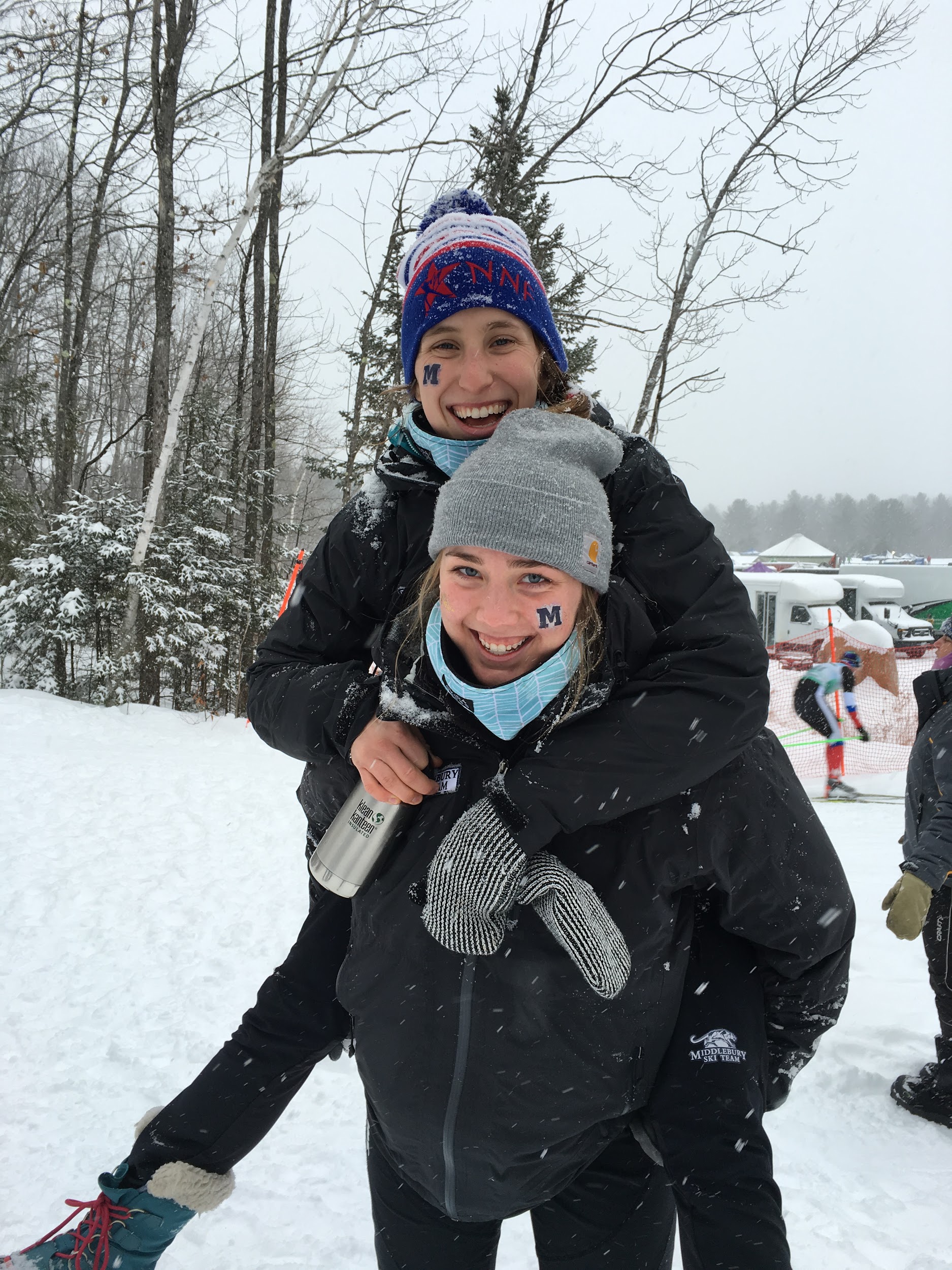
    So, the big question is, do all the stars need to align? Do you need to have the right opportunities present themselves at just the right time? Maybe! But it’s important to note that this right moment appears differently for everyone! What is more impactful, is the way you respond to the opportunities presented to you.
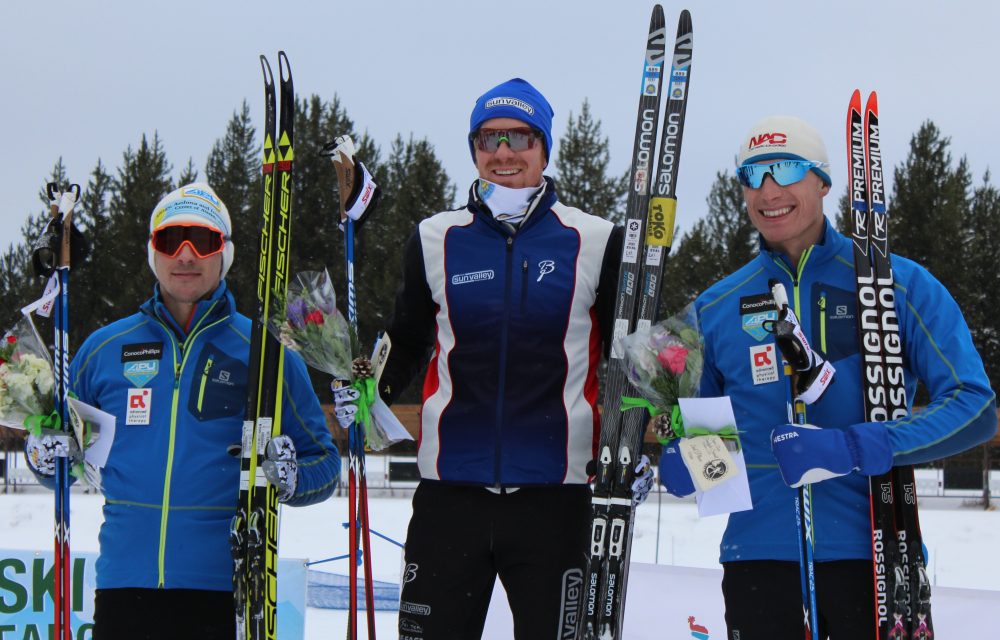
    U.S. Ski Team coach Matt Whitcomb pointing us in the right direction during a crust cruise at the Snow Farm in New Zealand. (Photo: Julia Kern)

    “There are a lot of options these days,” said U.S. Ski Team coach Matt Whitcomb, “but those who become exceptional are the ones who actually pick something from the list, and they run like hell with it.”

    You don’t need to do exactly what your teammate did, or what an Olympic medalist did.

    “Create your own path, get vulnerable,” Whitcomb advised. “Most people just run down America’s path of mediocrity, when they could instead be cutting their own unique route.”

    Every skier can take a different road. Maybe that road is pin-straight without a single bump, or maybe that road has curves and hills and potholes. It doesn’t matter what it looks like or how you approach it, as long as you figure out the best scenario for you and what makes you happiest. One way to solve this solution would be to test out every possibility; take a gap year, go to one school, maybe transfer, take another year off — but this is unrealistic and requires far too many resources. I think that the easiest way to find your way is to talk to others that have faced a similar situation — an older sibling, teammate, coach, or friend. Also, remember that you really can’t go wrong. No matter what choice you make you will still face unexpected fears, experience a new lifestyle, and figure out why exactly you still love this crazy sport!

    goochelaar, lugardepascuais

    For those of you taking a year off from school, I wish you the best of luck in finding the perfect place where you belong. For those heading back to school, I hope you cherish every moment of it, because it goes by far too quickly. Regardless of which road you choose, own it! Make it your decision and give it your best shot/all you’ve got. If you do that, you can’t go wrong.

    “There is no right or wrong decision, do whatever works for you!” — Sophie Caldwell

    “You can be the fittest person out there, but if you are not happy and motivated, it will be very hard to ski fast.” — Julia Kern

    “My only regret in my skiing career is that I was not mentally prepared to win a medal at my first Olympics as a 22 year old…. I thought I had a chance of winning a medal but I didn’t actually BELIEVE I could do it. So above anything else I want young skiers who are graduating from high school to know that four years is not a long time and you can find yourself at the start line of the Olympics before you know it.” — Andy Newell

    “I don’t think there’s one model that fits every person. It’s also important to remember that it’s not forever!” — Jessie Diggins

    “The opportunities will present themselves when the the time is right!” — Ida Sargent

    “If you want to be exceptional, don’t be afraid of being an exception.” — Matt Whitcomb

    Alayna Sonnesyn with one of her former UVM coaches Perry Thomas at the 2018 App Gap Challenge Rollerski Race in Vermont this summer. (Courtesy photo)
  • Nordic Nation: The Patrick O’Brien (Patty O’) Epsiode

    Nordic Nation: The Patrick O’Brien (Patty O’) Epsiode

    He’s another skier who bleeds maple syrup. Raised in Putney, Vermont. Skied at the Statton Mountain School (SMS), Dartmouth, and post-collegiately with the Craftsbury Green Racing Project — take a breath — and yes, still in Vermont as the SMS T2 Team head coach is Pat O’Brien. Thirty years old this summer, O’Brien has been at the helm of one of the dominant elite level programs in the U.S. since 2014. As he begins his fifth year leading the program, he has had the unique opportunity of guiding emerging athletes, like new SMS T2 skier Alayna Sonnesyn, along with a newly minted Olympic gold medalist, Jessie Diggins.

    Aviators? Check. Hi-vis attire? Check. Five o’clock shadow from a gruelling dryland camp? Check. SMS T2 coach Patrick O’Brien on the last day of this year’s Lake Placid summer training camp. (Photo: Matt Whitcomb)

    In this episode, we spoke with O’Brien on Aug. 15, shortly before his departure for an on-snow camp in New Zealand. He discussed how he entered the coaching game and how he navigates working with skiers who have found success on the World Cup to those just breaking into the world of SuperTours and post-collegiate skiing. Bonus info from the interview, O’Brien claims to have once beaten Simi Hamilton at something.

    Patrick O’Brien at the 2018 SuperTour Finals in Craftsbury, Vermont. (Photo: Reese Brown/ U.S. Ski and Snowboard)

    (To subscribe to the Nordic Nation podcast channel, download the iTunes app. If you have iTunes, subscribe to Nordic Nation here.)

  • The College Conflict: Part 1

    The College Conflict: Part 1

    2018 U.S. Ski Team camp at the Snow Farm in New Zealand, with author Alayna Sonnesyn (teal jacket) in the middle of the group shot. (Photo: Matt Whitcomb)

    The following was written by Alayna Sonnesyn, a new member of the Stratton Mountain School (SMS) T2 Team who graduated from the University of Vermont (UVM) this past spring.

    Originally from Plymouth, Minnesota, Sonnesyn, 22, raced on the UVM Ski Team for four years and qualified for four NCAA Skiing Championships teams. She placed second and third in two races at 2017 NCAA Championships, and in her senior season, won the first five Eastern Intercollegiate Ski Association (EISA) races and went on to reach the podium in 10 out of 11 EISA races. Sonnesyn expressed an interest in exploring the dilemma many of the nation’s top skiing talents face out of high school: whether to attend college or get an early jump on a pro-racing career. She plans to post this two-part series on her blog as well.

    ***

    For the first time in 17 years I will not be going back to school this fall. Saying that out loud is more daunting than I had anticipated. For the most part, the classmates that I graduated with can say that they are “going to grad school,” “starting a new job,” or “taking a year off to travel,” but I still don’t know where I lie. I am not taking any classes this year, I am not working anywhere consistently, and I am doing more than just traveling to explore, I’m traveling to race!

    I am wrapping up a three-week training camp in New Zealand with the SMS, Craftsbury, and US Ski Team. When I walked through customs I had to write down my reason for visiting New Zealand: Was I a student? Was I visiting a family or friend? Was I working? What was my job? In the rush of the moment and due to habit, I wrote that I was still a student and continued on my way. I later had a few reflections; I still haven’t reached the point yet where I can say I have a job. I don’t have a salary and there are no company benefits. Yet, I work 24/7 toward my job — my job is ski racing. But why is this so hard for me to admit to myself? Is it because, for my entire life, I’ve been a student? What if I hadn’t taken this route? How do others make this decision?

    National Training Group (NTG), summer 2013, in Park City, Utah.

    Racing throughout high school, I was given a number of perspectives about picking skiing versus school. My friends were all preparing to go to college and I always assumed I would go to college, too. My parents and older sister went to school, why wouldn’t I go as well? But then I thought about skiing. I never had the most outstanding results in high school (never qualified to race internationally), but I was good enough to qualify for regional and national level camps like REG, NEG and NTG. I traveled to these camps and trained with other high-level athletes, getting more and more motivated by each skier or coach that I met. Then the thought came to me… what if I didn’t go to college? I could focus on training, make those vital steps toward international racing, and continue along the “pipeline” that so many Olympians had followed. Maybe I would make bigger jumps and improve my skiing exponentially? I was entering the unknown and I was unsure how to pick the right choice for me. Looking back on this four years later, I realize that I was far from alone in this predicament.

    buy clomid online, buy yaz online, yasmin buy online

    I have since had the opportunity to talk to a wide variety of skiers and competitors and have learned so much that I wish I knew in high school. It’s OK to be confused. It’s OK to make your own path. Every athlete is in a different situation, comes from diverse athletic and academic backgrounds, and has various goals that they hope to achieve post-high school.

    “I’ve always believed that the most important thing to remember when discussing the decision to go to school or not (or when to go to school) is that is it a completely individual decision and the right decision for one person might not be the right decision for the next.” — Sophie Caldwell

    Personally, I finally decided that taking a gap year might be too big of a jump for me. I wasn’t ready to focus on skiing and I had a lot of goals for myself academically. I decided to attend the University of Vermont and upon reflection, can admit that this was one of the best decisions of my life. Similarly, SMS teammate, Kelsey Phinney, went from high school in Boulder, Colorado, directly to Middlebury College.

    “The reason I chose Middlebury College was simple: I went to visit and I was ready to unpack and stay for good. I loved the people, the area, the ski team, and the classes I sat in on.” — Kelsey Phinney

    Carnival love, with Kelsey Phinney (top) and Katie Feldman.

    Kelsey and I both fell in love with our schools from the start and knew we were where we belonged. We took these college experiences as learning opportunities; maybe we wouldn’t have been ready to jump right into the professional circuit but we both determined this was the right path for us.

    “I loved the experiences I had on the Carnival circuit. Both good and bad times taught me a lot about life and skiing, and I felt like the balance of school and sport made me better at both,” Kelsey reflects.

    Similarly, Sophie Caldwell had her mind made up without the need to hesitate over a gap year or jumping into full-time skiing.

    “I chose to go to college right out of high school, and it was something I had always known I wanted to do. I knew there was a good chance I wanted to ski professionally at some point in my life, but when I was 18, I wasn’t ready to 100% commit to skiing,” Sophie, a Dartmouth graduate, explains.

    With academic goals in mind and the confidence to pursue skiing in the long run, sometimes there’s no need to question it. Going directly to college might challenge you more than you think and it might make you question what you’re doing. The balance of school and skiing is great, but it’s TOUGH! At least you worked through those challenges and figured out where you want to be though.

    “I definitely had my ups and downs throughout college and at times I considered not pursuing skiing after college, but by the time I entered my senior spring, I knew I wanted to give skiing professionally a shot and knew it was because it was what I wanted to do, not what I had to do,” Sophie notes.

    Over the course of four years, we were able to say goodbye to our homes, grow into adults and develop as skiers, allowing a much smoother transition into the professional racing circuit post-college. This decision to go right to college made sense for Kelsey, Sophie and me — it was simple; but I recognize that this choice isn’t as straightforward for everyone.

    ***

    “I loved my time at Burke and wasn’t quite ready to leave. I also didn’t know where I wanted to go to college as part of me wanted to go out west while part of me wanted to stay closer to home.”  — Ida Sargent

    The conflict of picking a school, a place we are willing to spend at least four years of our lives at, can be intimidating to anyone. Taking a year off to think and explore what motivates you once the structure of school is taken out of the picture can be extremely vital to one’s skiing longevity. Other times, this year off can be done to test out what skiing professionally is actually like.

    “I wanted to test out whether I could do only professional skiing.” — Katharine Ogden

    A feat that might sound easy to accomplish — ski, eat, sleep, repeat — can’t be THAT hard! But what happens when you suddenly put all of your time and energy into one goal?

    “Ironically, my gap year did not turn out even close to how I had planned or imagined!” reflects Julia Kern.

    Julia Kern with swollen legs after surgery, requiring A LOT of physical therapy during the summer.

    After facing an early summer surgery for compartment syndrome and then an untimely back injury in the fall, Julia notes that her gap year was extremely tough with plenty of lows and setbacks.

    Ida Sargent offers, “My PG year was a bit of a disappointment as I wasn’t as happy as I was expecting and I also didn’t feel like I made as big of a jump with my results as I had hoped.”

    “I think in hindsight it was a good philosophy but I think I approached it wrong. I didn’t do a good job securing other things to do besides training and was thus pretty bored, which led to me putting a lot of stress on skiing and racing,” says Katharine Ogden.

    Maybe taking a gap year isn’t as easy as it sounds? Coming face-to-face with this type of ski-focused intensity as an 18 year old can be challenging.

    “It showed me how much I really wanted to go to college,” offers Katharine.

    It can also be validating, as it can prove to oneself where they really belong at that point in their life.

    “It made me realize that I wasn’t ready to ski full time and I still needed balance in my life,” reflects Ida.

    What might be the most beneficial aspect of taking a gap year are the lessons you learn throughout. How to deal with the pressure, free time, potential obstacles, and how to respond when you’re suddenly put in an unfamiliar situation.

    “My gap year turned out to be far from ideal from a training/fitness standpoint, but I became very in tune with my body, learned how my body responds to training, became mentally tougher, and learned that I love the skiing lifestyle (even if it is tough sometimes) and that I want to ski at the highest level possible,” says Julia.

    Some things you just can’t learn in a classroom.

    Julia Kern (on table) still smiling!
    Julia Kern taking the time to think about something other than skiing during her gap year. (Photo: Julia Kern)

    How to pass the time away, when you have so much of it. (Photo: Julia Kern)

    After taking a gap year to figure out what skiing was like full-time; Ida, Katharine, and Julia attended Dartmouth College (via various routes):

    Ida states, “I started by going to school full time and I raced for Dartmouth for three years and then made the National team so I took my senior winter off to race for the USST and then I went back for a spring term my fifth year.”

    “One year in [as a traditional student], I am very happy at Dartmouth and racing the collegiate circuit last year reignited my love for the sport,” adds Katharine.

    While Julia contributes, “I chose Dartmouth because I wasn’t sure what skiing and school balance I wanted to have, but I did know that I wanted to be able to take terms off to race internationally.”

    Regardless of which Dartmouth plan they followed, all three skiers seem to have enjoyed the choices they made. Whether taking a gap year is or isn’t part of your plan, the most important takeaway is that you should TAKE SOMETHING AWAY! Learn something new about yourself, about skiing, or about classes you want to study.

    So what about other options for pursuing a ski career? Jessie Diggins and Andy Newell both chose to skip college and go straight into skiing. Stay tuned for my next post when I’ll include input from both of them as well as what U.S. Ski Team coach Matt Whitcomb has to say on this topic.

  • Americans Dominate the Field, Podiums at Winter Games NZ (Updated)

    Americans Dominate the Field, Podiums at Winter Games NZ (Updated)

    Julia Kern leads Katharine Ogden, her fellow Stratton Mountain School (SMS) and U.S. Ski Team development team member, during the Snow Farm’s 21 k Snow Rake at the 2018 Merino Muster in Wanaka, New Zealand. (Photo: Garrick Cameron)

    Note: This article has been updated to include comments from Simi Hamilton of the U.S. Ski Team (USST) and Stratton Mountain School (SMS) T2 Team, and Kevin Bolger of the USST and Sun Valley Ski Education Foundation.

    ***

    It’s that time of year again where several members of the U.S. Ski Team, along with top-level skiers from the Craftsbury Green Racing Project (CGRP) and Stratton Mountain School (SMS) T2 Team are training at the Snow Farm above the town of Wanaka, New Zealand.

    The on-snow volume camp, which featured multiple days of racing, started Aug. 20 and continues through Sept. 10, and includes U.S. Ski Team (USST) athletes Jessie Diggins, Ida Sargent, Sophie Caldwell, Katharine Ogden, Julia Kern, Simi Hamilton, Kevin Bolger, and Paddy Caldwell, and coaches Matt Whitcomb, Jason Cork and Gus Kaeding.

    According to Sophie Caldwell, conditions have been “amazing” for the duration of camp so far. “New Zealand had a great snow year and we’ve been lucky to have sunny days almost every day,” she wrote in an email to FasterSkier.

    Japan’s Tomoka Satou (446) leads American Jessie Diggins (428) and others up a climb during the Merino Muster 42 k skate race on Sept. 1 at the Snow Farm in Wanaka, New Zealand. (Photo: Garrick Cameron)

    Diggins called it the annual trip one of her “all-time favorite camps because the living at the Snow Farm is great, the food is outstanding, and you can step out the door right onto the 65+ km of trails!” she wrote in an email.

    “I love having the chance to work on my on-snow technique for three solid weeks because that’s when I get to really see progress and make some changes in my striding,” Diggins wrote.

    Apart from logging kilometers on snow and soaking up the vitamin D, the team has also spent time trail running in Wanaka.

    “The highlight [of the camp] will probably be a crust cruise we go on in the next few days, but since we haven’t done that yet, some highlights so far are an awesome distance run down in Wanaka, and pretty much every day of bluebird skiing we’ve had up here!” Caldwell wrote.

    The camp also coincided with the Merino Muster, a 42 k freestyle marathon that is part of the Worldloppet series, and the Winter Games NZ, which doubled as the Australia/New Zealand Cup FIS races and included three days of nordic racing this year at the Snow Farm: a 5/10 k freestyle individual start, a freestyle sprint, and a 10/15 k classic mass start..

    Defending their 2017 Merino Muster titles last Saturday, Sept. 1, were two SMST2 and USST members, Diggins and Hamilton.

    Diggins finished a minute and 21 seconds faster than the second-place woman, Aurelie Dabudyk of France, while Hamilton edged Craftsbury skier Adam Martin by 3 seconds for the overall win.

    “The day of the Merino Muster was gorgeous and sunny, with fast conditions,” Diggins wrote. “I loved getting the chance to race a long race, and starting with the men as one big field is really exciting! I hope to get to race the 42km race every year. Huge thanks to the volunteers and organizers for making it such a fun day.”

    Crossing the finish line in 1:52:34 hours, Diggins placed sixth overall. Dabudyk was eighth overall and Alayna Sonnesyn (SMST2) was the third woman, 11th overall, 5:30 behind Diggins.

    Meanwhile, Hamilton finished in 1:39:46, beating his time of 1:40:33 from last year’s race. Martin followed 3 seconds later, while Kyle Bratrud (SMST2) finished 24 seconds after from Hamilton in third, followed by Tomoka Satou of Japan in fourth (+45.0).

    “The Merino Muster is always an awesome race,” Hamilton wrote in an email. “It actually lends itself to the type of intensity we are still mostly focused on in August/late September because the terrain and snow conditions usually make for a really good chance to get in about 1.5 hours of level 3 effort followed by a few minutes of really hard skiing in the last km before the finish. It’s a very rolling course and if you ski it in a pack with people switching leads it’s basically impossible to go much harder than level 3.”


    Also on Saturday, Americans also took the top spots in the 21 k Snow Rake. Ben Saxton (SMST2) ran away with the overall win by more than 12 minutes in 47:48, while Paralympic sit skier Dan Cnossen placed second (+1:12:13) nine seconds ahead of Petr Sykora of the Czech Republic in third (+1:12:22).

    Ogden was the fastest woman and second overall with a time of 50:29. Her SMS and USST teammate Kern finished 56 seconds later as the second woman, and Elizabeth Martin of the University of New Hampshire (UNH) followed in third, 7 minutes and 30 seconds behind Ogden.

    buy allopurinol online, buy motrin online, buy ibuprofen online

    With about 300 participants between three different races at the Merino Muster, Hamilton described the atmosphere as “super fun and light.”

    “But the grooming always rocks and it’s just a really fun course to ski,” he added. “I think that in this day and age of social media being so huge and cross-country skiing gaining more attention in the US and world-wide, we’ll start to see more and more people showing up for the marathon. I feel like in the last few years alone their has been noticeably more attention and attendance each year. The quality of skiing is a small part of the race atmosphere here… New Zealand’s south island is one of the most beautiful parts of the world and the culture is so welcoming and comfortable.”

    Many of the American skiers in New Zealand also competed in the Winter Games NZ races this week.

    “The New Zealand Winter Games are also a huge opportunity to get back into racing mode and test out all the technique work we’ve been putting in so far!” Diggins wrote. “And if you know me, you know how much I adore 5km individual skate races, and we no longer get to do those on the World Cup. So I’m so grateful to the Snow Farm and race organizers for keeping such a fun and hard, fast race alive! I forgot how much it can hurt to go so hard for 5km, but it was fun to really get that lung burn back for the first time since last winter.”

    Three days after her marathon win, Diggins won the 5 k skate at the Snow Farm in 15:02.6. The U.S. swept the top five with Sophie Caldwell finishing 10.5 seconds back in second place, Caitlin Patterson (CGRP) in third (+16.7), Sargent (USST/CGRP) in fourth (+1:02.6), and Kelsey Phinney (SMST2) in fifth (+1:16.6) out of eight women.

    Kyle Bratrud (SMST2) gets a feed from U.S. Ski Team coach Jason Cork during the 2018 Merino Muster 42 k skate race at the Snow Farm in Wanaka, New Zealand. He finished third behind two other Americans. (Photo: Garrick Cameron)

    In the men’s 10 k skate on Tuesday, Bratrud took the win in 27:48.1, 21 seconds clear of Kaichi Naruse of Japan in second, while Craftsbury’s Ben Lustgarten and Martin (CGRP) followed in fourth (+23.0) and fifth (+44.0), respectively. Eight men competed.

    Wednesday featured 1.1 k skate sprints, which saw Sophie Caldwell take the win in a field of 10 women, ahead of Sargent in second and Phinney in third.

    “The sprint was a short and tactical race that was awesome practice for what’s to come this winter,” Caldwell wrote. “It was really fun toeing the line with my USST and SMS training partners. On one hand, that final could have been any day of summer training, but it also could be a World Cup heat! It’s pretty cool to be pushed by so many strong training partners and friends and we were psyched to throw on a bib and put in a race effort.”

    In the men’s final, Bolger landed the top spot on the podium, ahead of Saxton in second and Satou in third. Eleven men competed in the sprint.

    “I really enjoy these early session races it gives us as races a chance to get in the mindset and practice real race strategy,” Bolger wrote in an email. “I wanted to go out there test myself, I approached every round like a final and attacked from the start getting out in front and leading into the finish, and was very happy to end the day on top, especially after a long camp down here with the US crew.

    “… Coming down here and having a good result in the sprint is of course a huge confidence booster heading into the September/ October training months, but there is still a ton of preparation to be done,” he added.

    On the final day of Winter Games NZ racing, Diggins continued her undefeated streak (after skipping the sprint), winning the 10 k classic mass start, while Patterson placed second and Sargent placed third. Saxton picked up his second win of the week, while Martin took second and Lustgarten third.

    Complete results will be posted once they’re available.

    “We have been incredibly lucky with weather and conditions this year,” Hamilton noted. “Usually, when you’re here at the Snow Farm for 3 weeks in the winter, you’re bound to get an extended period of really nasty weather and wind. But this year we’ve basically had sunshine and cold night time temps every single day, making for amazing skiing for pretty much 3 weeks straight. There is about 40-50 km of trails to ski when everything is groomed, so it’s essentially impossible to get bored. The highlight of our camp every year is a big crust ski up to and around Mt. Pisa. We are planning on getting out tomorrow [Friday, Sept. 7] because the crust hasn’t been great yet while we’ve been here, but conditions for tomorrow look promising. But even when we can’t get out for a huge adventure like that, it’s just one of the best and most fun places in the world to train.”

    Results:

    Sept. 1: 42 k Merino Muster /21 k Snow Rake

    Overall results

    Winter Games NZ

    Sept. 4: 5/10 k skate: Women| Men

    Sept. 5: Skate sprint: Women|Men

    Sept. 6: 10/15 k classic mass start: Women | Men

    https://www.instagram.com/p/BnU4ZSVgG56/?utm_source=ig_web_button_share_sheet

    https://www.instagram.com/p/BnXhCe2lq5m/?utm_source=ig_web_button_share_sheet/

  • Wednesday Workout: L3 Ski Walking Up Stratton Mountain

    Wednesday Workout: L3 Ski Walking Up Stratton Mountain

    Paddy Caldwell (l) of the Stratton Mountain School T2 Team leads the way during a summer ski-walking workout up Stratton Mountain in souther Vermont. (Photo: Patrick O’Brien)

    For this week’s workout, we feature the Stratton Mountain School T2 Team, also known as the Elite Team, out of Stratton, Vermont. The team’s full-time athletes live near the base of the alpine resort and take advantage of the following Level 3 (L3) ski-walking workout right out their front door.

    In an email, coach Patrick O’Brien explained why they often repeat this workout during the summer: “We can safely have a large number of people training together (no worries about cars like on an open road) and the younger athletes get lots of contact and can hop in behind the senior athletes for a portion of their intervals,” he wrote. “The dirt work road up the Stratton Mountain Resort has good footing and lots of vertical for good steady state training.”

    ***

    The workout: Level 3 Mountain Ski Walking

    Need: A mountain with enough vertical to fit in 6-7 intervals of ski walking (lasting 7 minutes apiece). A good pair of trail shoes, bounding poles (about 10 centimeters shorter than one’s classic pole length), and a drink belt with sports drink and some food.

    Warmup: Light 15-minute jog around the base. “Then we have our T2 team go through their ‘power warmup’ and lead the younger athletes through this progression,” O’Brien explained. “The goal with this program that US Ski and Snowboard strength coach Tschana Schiller has devised is to get our muscles sequencing and firing well before our intensity session so we are really working on explosive movements while we are most fresh versus trying to incorporate this to a late afternoon gym session. This improves our ability to generate power and is a really effective way to warm up! It usually starts with some mobility exercises, then foot drills and culminates with explosive plyometric jumps and bounds.”

    Jessie Diggins (neon orange shorts) helps lead her Stratton Mountain School teammates through A-skip drills during a “power warmup” at the base of Stratton Mountain. (Photo: Patrick O’Brien)

    Threshold component: 30-60 minutes, depending on how hard the week is/what kind of volume you’re aiming for in a given training block.

    “Older athletes tend to do more, younger development athletes do a little less as they don’t need the same amount of stimulus,” O’Brien wrote.

    • Ski-walking intervals: 7 minutes of “on” time followed by 3 minutes of recovery. Repeat six to seven times. Option to add faster, flatter running intervals at the top if needed.
    Jessie Diggins (front) and Sophie Caldwell (third from r) lead fellow Stratton skiers during a ski-walking workout up Stratton Mountain in southern Vermont. (Photo: Patrick O’Brien)

    Tips:

    • Keep the group together: “We usually have the younger devo athletes start farther up the workroad and jog their recovery in place. The T2 team starts lower down and runs downhill on their recovery,” he noted. “This way the groups keep leapfrogging and the younger athletes can always tag along for a portion of their interval and follow the faster senior athletes and learn from their motions.”
    • Aim for “good, crisp ski-walking motions,” generating power from both lower and upper body: These aren’t as hard as all-out bounding intervals, O’Brien explained, “but we still want athletes to have a degree of impulse to their motions and not just walk up hill with poles on.” Stratton’s work road has some flatter grades, which allows athletes to “incorporate a lower energy bound on these sections and skiwalk on the steeper terrain,” if they choose. “Properly executed this workout looks pretty tame. Nothing flashy, no labored breathing or collapsing at the end of each interval. It is strenuous but not exhausting.”
    • Pace yourself. It should feel hard but sustainable: “With these longer steady state intervals it’s pretty easy to feel out that threshold line as there is no recovery during the intervals,” he noted. “Go too hard and you will feel it in your legs and lungs! We have people monitor heart rates and take blood lactates regularly but all of these are checks are for collecting background information. Ultimately what we want is for people to have a good sense of pacing and be able to ‘feel it out’ without needing the external feedback of a watch or lactate strip. Usually after a time or two doing this workout people have this pretty well dialed!”

    Cool down: Jog back to base area, “or better yet download on the gondola when it is running on the weekend to save their legs from the impact of 1500 feet of decent!” O’Brien wrote.

    Total workout time: 1:45 to 2:15 hours

    ***

    Stratton’s 2018/2019 elite team includes seven returners (six of which are on the U.S. Ski Team) and four newcomers. Returning are Ben Saxton and USST members Simi Hamilton, Paddy Caldwell, Jessie Diggins, Sophie Caldwell, Julia Kern, and Katharine Ogden. According to an SMS blog post from late May, Paddy Caldwell was finishing up his studies at Dartmouth College, and Saxton, Kern and Ogden are taking classes there as well.

    “We work closely with the Dartmouth coaches and fully support these athletes’ choices of when to attend school and when to be with us,” the post by Sverre Caldwell stated. “Paddy is finishing his last term at Dartmouth and he will join Simi, Jessie and Sophie as a full time SMST2 and USST member.”

    New to the team are Kyle Bratrud (formerly of the CXC Team), Kelsey Phinney (formerly of the Sun Valley Ski Education Foundation), Alayna Sonnesyn (University of Vermont graduate), and Ben Ogden (of the Stratton Mountain School).

  • Back in Bozeman, Flowers Switches Gears

    Back in Bozeman, Flowers Switches Gears

    Erika Flowers (in red) racing at 2017 SuperTour Finals in Fairbanks, Alaska, where she posted a best result of third in the skate sprint. In the last six years, Flowers has reached the SuperTour podium 16 times and finished the 2017/2018 season fourth overall. (Photo: Clyde Hewitt)

    It wasn’t until recently that Erika Flowers learned the meaning of her middle name. At the time of her birth, her father had been cutting around Montana’s mountain slopes on Elan alpine skis. Though the brand’s company is based out of Slovenia, the definition of élan, according to Webster’s dictionary, is a vigorous spirit or enthusiasm.

    Whether Flower’s father, Pat, had researched the word’s meaning or whether the name had simply struck him, the skis were his muse. Erika became Erika Élan.

    “He just happened to be skiing on that brand, and I think he liked the sound of it,” Flowers said during a recent phone interview from her hometown of Bozeman, Montana. “So he and my mom named me Erika Élan Flowers.”

    For anyone familiar with Flowers, long, stick-straight, blond hair often bouncing around in a high ponytail and glacial blue eyes are idiosyncratic to the 28 year old. So is an intense verve, or élan.

    “I actually never knew it had any meaning (beyond just being a ski brand) until this winter when I randomly came across it in an article and looked up the definition,” Flowers wrote in an email. “That said, I think it describes how I try to approach life in general.”

    ***

    While many nordic skiers dream about racing against the all-stars of Norway, Sweden and other powerhouse ski nations, not everyone gets the chance to do so year after year.  

    A former University of Utah skier, Kevin Bolger, now 25, managed to make his way onto the international ski scene this past March, sprinting to 11th place in his debut World Cup race in Lahti, Finland. Two weekends later, Bolger claimed another top 30 at the World Cup Finals in Falun, Sweden.

    His breakthrough came after less than a year of training with the Sun Valley Ski Education Foundation (SVSEF) Gold Team; Bolger graduated from Utah in May of 2017.

    The timing was impeccable. Just as Bolger was working toward a spot at the World Cup level, two U.S. veterans stepped away from the circuit. Flowers’s husband, Andy Newell announced this spring that he would pursue new career adventures and train apart from the U.S. Ski Team (USST), and Noah Hoffman officially retired from ski racing in March.

    By the end of May, Bolger had earned a nomination to the USST B-Team.

    In an email to FasterSkier this spring, Bolger himself concluded that his transition to World Cup racing “couldn’t have been written any better.”

    Making it onto the women’s World Cup circuit as an American, at least for the past six years, has been more complicated. It’s even harder to make the USST. Since 2010, a number of strong names — like Sadie Bjornsen, Jessie Diggins, Ida Sargent, and Sophie Caldwell — have been added to the team, while few women have left.

    Aside from the retirements of Kikkan Randall and Liz Stephen this spring, Holly Brooks was the only other woman to retire from the team in the past six years. Brooks left in 2014.

    Rosie Brennan was first nominated to the USST in high school before being renominated in 2015,  and had been on the team ever since, but was not renamed for the upcoming season.

    In short, a roster of seven women (not including the development team) has been fairly standard to the USST for close to a decade.

    Outside the national team, the U.S. domestic women’s field also witnessed a surge in talent and depth over the last six years. From 2012 to 2018 alone, at least 10 non-national-team women worked their way to the World Cup race scene, including Caitlin Patterson, Kaitlynn Miller and Liz Guiney of the Craftsbury Green Racing Project, Chelsea Holmes, Becca Rorabaugh and Rosie Frankowski of Alaska Pacific University, Caitlin Gregg of Team Gregg (when she wasn’t on the national team in 2015), Jennie Bender of the Bridger Ski Foundation, and Anne Hart of the Stratton Mountain School.

    Any skier pushing to make a break would have a number of strong names to work around. But for Flowers, racing World Cups was a long-term goal, as was making skiing a sustainable profession for herself. She could spend hours sifting over rosters and names, but the only way to confirm anything was to try it out for herself. 

    American Erika Flowers (r) hugs her Stratton teammate Sophie Caldwell following the women’s 10-kilometer freestyle race at the 2017 World Cup Finals in Quebec City (Photo: Gretchen Powers)

    After graduating from Dartmouth in 2012, Flowers regularly finished in the top 10 of the overall SuperTour standings. She, too, earned a few World Cup starts. Flowers completed in all three races at 2017 World Cup Finals in Québec City, Québec, with a best result of 48th in the skate sprint.

    In the end-of-year SuperTour standings, her ranking also saw a steep jump. From 2013 to 2014, she went from 32nd to fifth overall and was fifth again in 2015. The next season, she finished seventh overall and was fifth again in 2017. She capped off this season with her best finish to date, earning fourth.

    Still, the sought-after World Cup starts remained elusive. As she developed, the USST also gained steam. Any progression she made also seemed to be matched by the cohort of American skiers she had be racing against since her departure from Dartmouth.  

    So why did she, summer after summer, push through intervals on rollerskis? Why spend each winter traveling to competitions, as Flowers put it, “living out of a bag”? Why did she continue to ski race year after year?

    ***

    Flowers was five years old when she first learned that her mother had breast cancer. Four years after her mother’s diagnosis, the family moved from Missoula to Bozeman. There, Flowers and her younger sister, Natalie, joined the Bridger Ski Foundation (BSF) cross-country youth program.

    The BSF community provided a niche for the Flowers siblings. The cancer treatments their mother was receiving also showed promise. Following her diagnosis and treatments in 1995, Hedvig Rappe-Flowers, Erika’s mom, was cancer-free for more than five years, according to an article by the Bozeman Daily Chronicle.

    But the cancer returned. Rappe-Flowers, a native of Sweden, encouraged her daughters to keep skiing. Do what made them happy. Both of them did.

    Erika Flowers during the early stages of her nordic career. “It was the first time I’d ever had my photo taken by any sort of professional and I remember just having no idea what I was doing but its become one of my favorite photos if only because it’s very raw and unedited and from a time when I was just starting to gain some real confidence both in who I was as a person and an athlete,” Flower wrote. (Photo: Chris Milliman)

    “My mom passed away from breast cancer when I was 17 which gave me a strong appreciation for how precious and valuable each day is and I know that I don’t want to waste one of them,” Flowers wrote in an email. “I think that’s another reason I probably decided to ski race for as long as I did — it was my first love and for all I know I could find out I have breast cancer tomorrow.

    “What I do know is that I spent the last 16 years of my life doing something I absolutely loved!” she continued. “I think that has been on my mind a lot these days, especially given Kikkan’s recent diagnosis.”

    Randall was diagnosed with breast cancer last month.

    “Kikkan’s a tough cookie though and I have no doubt she will tackle cancer the same way she has her many other challenges in skiing and in life — with equal parts fierce tenacity, bravery and grace,” Flowers added.

    While joining Randall in skiing’s elite racing ranks was certainly a goal, it wasn’t the only reason Flowers skied. Nor did she ski in her mother’s name — though Hedvig did instill in her daughters an enthusiasm for nordic sport and a steely resolve in all that they chose to do.

    “At her memorial service, one of the songs we played was ‘Hard Headed Woman’ — that really kind of describes her,” Flowers said. “She wouldn’t take no from anyone and believed so strongly in the idea that you could do anything you set your mind to.”

    The mercurial sport of cross-country ski racing had taken its hold. And Flowers was not about to let go.  

    Racing brought numerous challenges. Days when her body felt great, but the wax was too slow. Times when foul weather hit midway through a competition, slowing the course. 

    “Those variables can be extremely frustrating when they don’t go your way,” Flowers wrote.

    Frustrating, but simultaneously motivating, in its own way.

    “When everything does come together, it’s the most exhilarating and addicting feeling in the world!” she noted. “I think I always thrived on the challenge of it all.” 

    Four years ago, Flowers even gave biathlon a shot, traveling to Lake Placid, N.Y., for a US Biathlon talent camp. While she showed promise, Flowers ultimately stuck with cross-country.

    Erika Flowers (l) and Andy Newell at the 2017 World Cup Finals in Quebec City. (Photo: Gretchen Powers)

    Skiing had deeper roots than racing and results for Flowers. It was a family affair (she credits her mother with having taught her how to skate ski). It was how she met most of her closest friends. It was also how she met her husband, Newell, whom she married last year.

    “The people, the fact that every day my job is to go outside and work on getting better at something I love, the travel, and the challenge and unpredictability of professional sport,” Flowers wrote of what had kept her ski racing into her late twenties. “Lastly the support of countless friends, sponsors and supporters is one of the most important things that kept me involved for so long. Had I not had that level of support I would not have been able to race for as long as I did or reach the levels of success I did.”

    At the root of Erika’s lifelong élan was, and still is, skiing.

    ***

    About a year and a half shy of her 30th birthday, Flowers is back where it all started. She and her husband and former Stratton Mountain School (SMS) teammate, Newell, packed up a U-Haul this spring and drove from Vermont to Bozeman. Back in her hometown, Flowers competed in the 20-mile Ed Anacker Bridger Ridge Run in June. She still trains, most often with Newell, and unabashedly states that yes, she still rollerskis.

    Since leaving Stratton, she does not currently have a formative training plan or program. Prior to moving, Flowers explored every “decision matrix possible” and spoke with numerous athletes and non-athletes alike about what she should do next. In the end, taking a step back from skiing seemed best.

    Team photo of last season’s Stratton Mountain School T2 Team: (back row, right to left) Erika Flowers, Sophie Caldwell, Jessie Diggins, Julia Kern, and Annie Hart. (Front row, r to l) Andy Newell, Simi Hamilton, head coach Pat O’Brien, Ben Saxton, and Paddy Caldwell. (Photo: Reese Brown)

    “It wasn’t that I was sick of the lifestyle or anything like that,” Flowers explained. “I think it was more I’ve been doing it for long enough to recognize that my improvement curve is not what it needs to be in order to ultimately be able to make skiing into something that’s sustainable; something that can help me achieve some of the other goals I have in life, whether that’s getting a house or sitting on the board of a company.

    “I think that’s also what made it so hard,” she continued. “In some ways it’s walking away from something I absolutely love to start at the bottom of another passion.”

    Skiing has opened up a few other professional outlets for Flowers to pursue. She unofficially began social-media work for the National Nordic Foundation and USST this spring. She also is an athlete ambassador for the Women’s Sports Foundation. Her ties to nordic skiing becoming ever more intricate. 

    “Some people want to go all in for X number of years and retire and never look at a pair of rollerskis or race skis again,” Flowers reflected. “But to me, the word ‘retire’ sounds like something reserved for people in their late 60s, early 70s … maybe that’s why I haven’t used that word, it just doesn’t fit.

    “I think for me, it’s more deciding to take a step back from pursuing racing full time and looking at opportunities to pursue something else more fully,” she said. 

    The change of pace is in no way preventing her from getting outside. With Newell still planning on ski racing, just not full time on the World Cup, she’s still plenty invested in the nordic world.

    “From my end I just try to be supportive no matter what,” Newell said on the phone. “I think she’s been training so much and so well … she can take this year and try something new, even take a few months and try something new, and it would still be be pretty easy for her to jump into some races and make a comeback. Because I can tell you from my perspective, as her husband and as somebody that trains with her on a regular basis, she’s not slowing down even though she has other goals outside of skiing.”

    Former Stratton Mountain School teammates, now husband and wife, Andy Newell and Erika Flowers during a rollerski training session. (Photo: Reese Brown)
  • Spring Series Rundown: Undefeated Diggins Edges Bjornsen for 30 k Victory

    Spring Series Rundown: Undefeated Diggins Edges Bjornsen for 30 k Victory

    Kikkan Randall (r) sprays her U.S. Ski Team teammates Jessie Diggins (c) and Sadie Bjornsen (l) with champagne on the podium of the 30 k classic mass start at U.S. Distance Nationals in Craftsbury, Vt. Diggins won, Bjornsen placed second and Randall finished third. (Photo: John Lazenby/Lazenbyphoto.com)

    2018 U.S. Distance Nationals (Craftsbury, Vermont): 30 k classic mass start

    Jessie Diggins swept SuperTour Finals once again, after doing so last year in Fairbanks, Alaska, and winning every individual race at 2016 SuperTour Finals the year before in Craftsbury, Vt.

    Back in Craftsbury on Tuesday, and coming off three-straight victories in the classic sprint, 10-kilometer freestyle mass start and mixed relay with her Stratton Mountain School (SMS) T2 Team teammates, Diggins, 26, pulled out her fourth-straight win in her last race of the season: the women’s 30 k classic mass start, which is part of U.S. Distance Nationals.

    Jessie Diggins (r) edging her U.S. Ski Team teammate Sadie Bjornsen at the line for the win in the women’s 30 k classic mass start at 2018 U.S. Distance Nationals in Craftsbury, Vt. (Photo: John Lazenby/Lazenbyphoto.com)

    She did so in an all-out effort to the line, beating her fellow U.S. Ski Team (USST) member Sadie Bjornsen by just 0.4 seconds in 1:25:27.2 hours. Diggins, Bjornsen of Alaska Pacific University (APU), and another USST member Sophie Caldwell (SMST2) broke away from the pack on the first of five laps at the Craftsbury Outdoor Center. Caldwell dropped off the pace around 10 k and skied on her own for the next 15-plus kilometers before being caught by a chase group of six, led by Kikkan Randall (APU/USST), on the final lap.

    Meanwhile, Diggins and Bjornsen skied together, trading the lead for the rest of the race. On the final short climb up to the stadium, Diggins pulled ahead slightly then extended her lead in the finishing straight. After finishing first and second, respectively, Diggins and Bjornsen laid on the ground for what seemed like a long time, particularly spent from the effort, before congratulating each other. Behind them, Randall outlasted the chase pack for third (+2:21.7), Caldwell followed just behind her in fourth (+2:23.1), Ida Sargent of the Craftsbury Green Racing Project (CGRP) and USST placed fifth (+2:26.5) and Rosie Frankowski (APU) finished sixth (+2:29.2).

    Also in the top 10, Liz Stephen (USST) finished the last race of her professional career in seventh (+3:10.9), Caitlin Patterson (CGRP) eighth (+3:27.2), Kaitlynn Miller (CGRP) ninth (+3:56), and Chelsea Holmes (APU) 10th (+4:45.3).

    Stratton had two wins on the day with Charlotte Ogden (SMS) winning the junior women’s 20 k classic mass start in 1:04:33.9. Canada’s Catherine Reed-Metayer (Skibec Nordique) placed second (+11.8), Waverly Gebhardt (Steamboat Springs Winter Sports Club) finished third (+33.8), and Phoebe Sweet (Craftsbury Nordic) was the third American junior in fourth overall (+1:10.2).

    Spring Series concludes with the men’s 50 k classic mass start on Wednesday, starting at 9 a.m. EDT. Watch the races live on the SuperTour live stream.

    Results: 30 k | 20 k

    Complete SuperTour Finals results

  • Spring Series Rundown: Diggins Anchors Another Stratton Mixed-Relay Win

    Spring Series Rundown: Diggins Anchors Another Stratton Mixed-Relay Win

    The mixed relay podium on Sunday at 2018 SuperTour Finals in Craftsbury, Vt., with Stratton (center: Simi Hamilton, Paddy Caldwell, Jessie Diggins, and Sophie Caldwell) in first, APU (left: Erik Bjornsen, Scott Patterson, Sadie Bjornsen, and Kikkan Randall) in second, and Craftsbury (right: Adam Martin, Alex Howe, Ida Sargent, and Caitlin Patterson) in third. (Photo: John Lazenby/Lazenbyphoto.com)

    2018 U.S. SuperTour Finals (Craftsbury, Vermont): Mixed relays

    For the second-straight year at the SuperTour’s season-ending Spring Series, the Stratton Mountain School (SMS) T2 Team won the mixed relay, with three of the four athletes who raced on last year’s 4 x 5-kilometer mixed relay squad.

    Simi Hamilton, Sophie Caldwell, Paddy Caldwell, and Jessie Diggins combined for the win on Sunday in Craftsbury, tagging off in that order, with Diggins crossing the finish line first for the third-straight day. Diggins is undefeated in three races so far at Spring Series, after winning Friday’s classic sprint and Saturday’s 10 k freestyle mass start. The women’s 30 k classic mass start remains on Tuesday, followed by the men’s 50 k classic mass start on Wednesday.

    Diggins and her Stratton teammates beat the Alaska Pacific University (APU) first team by 13.2 seconds at the line with a time of 53:43.2. The co-ed mixed relay has been held at SuperTour Finals for the last five years, and APU won the first three editions of the race from 2014 to 2016. Stratton won last year in Fairbanks, Alaska, with Ben Saxton, Hamilton, Caldwell, and Diggins.

    APU led most of Sunday’s race, with Erik Bjornsen starting them off. He came through the first exchange in first place, just 0.2 seconds ahead of Hamilton in second. Behind them, Adam Martin of the Craftsbury Green Racing Project tagged in third, 0.8 seconds out of first.

    Paddy Caldwell (302) tags his Stratton Mountain School (SMS) T2 Team teammate Jessie Diggins (402) in second, while Craftsbury’s Caitlin Patterson (430) looks on, at the final exchange of the mixed relay at 2018 SuperTour Finals in Craftsbury, Vt. Diggins went on to anchor Stratton to first place. (Photo: John Lazenby/Lazenbyphoto.com)

    Sadie Bjornsen then extended APU’s lead to 7.3 seconds over Stratton’s Sophie Caldwell in second. Behind them, Craftsbury’s Ida Sargent came through the second exchange in 10.3 seconds back in third.

    APU’s Scott Patterson went on to hold off Stratton’s Paddy Caldwell on the third leg, tagging 3.5 seconds ahead in first. Diggins came up big for Stratton on the anchor leg, passing APU’s Kikkan Randall to secure the win.

    Craftsbury held its third-place position during the second half of the race with Alex Howe and Caitlin Patterson to finish third, 56.2 seconds behind Stratton. More than a minute later, APU 2 (Tyler Kornfield, Rosie Brennan, Logan Hanneman, and Rosie Frankowski) crossed in fourth (+2:04). Stratton’s second team (Saxton, Julia Kern, Andy Newell, and Erika Newell) placed fifth (+2:47.3), APU 3 (Reese Hanneman, Becca Rorabaugh, Eric Packer, Hannah Halvorsen) sixth, Dartmouth Ski Team (Luke Brown, Katharine Ogden, Gavin McEwen, Abigail Drach) seventh, Northern Michigan University (Zak Ketterson, Vivian Hett, Ian Torchia, Nicole Schneider) eighth, Middlebury College (Peter Wolter, Cate Brams, Adam Luban, Katie Feldman) ninth, and US Biathlon (Russell Currier, Clare Egan, Raleigh Goessling, Susan Dunklee) 10th.

    Thirty-one “official” teams and eight “unofficial” teams competed, with NMU/CSS/NYSEF leading the unofficial teams with a time of 1:00:01.9 (which ranked 19th overall).

    Racers have the day off Monday before the women’s 30 k and men’s 50 k classic mass starts (part of U.S. Distance Nationals) on Tuesday and Wednesday, starting at 9 a.m. EDT. Watch the races live on the SuperTour live stream.


    Relay results: Official teams | Unofficial teams

    Complete SuperTour Finals results

  • Gelso Wins Back-to-Back in West; Guiney Garners First SuperTour Title

    Gelso Wins Back-to-Back in West; Guiney Garners First SuperTour Title

    Matt Gelso (SVSEF) topping the SuperTour podium for the second-straight day on Sunday in West Yellowstone, Mont. Joining him on Sunday's 15 k classic podium: CGRP's Ben Lustgarten (l) in second and APU's Scott Patterson (r) in third.
    Matt Gelso (SVSEF) topping the SuperTour podium for the second-straight day on Sunday in West Yellowstone, Mont. Joining him on Sunday’s 15 k classic podium: CGRP’s Ben Lustgarten (l) in second and APU’s Scott Patterson (r) in third.

    WEST YELLOWSTONE, Mont. — It was the type of day every alpine enthusiast dreams about: fresh powder snow that keeps falling down.

    For cross-country skiers gearing up to race the first classic distance races of the SuperTour season, it was the type of day that creates questions: more or less kick? Chance a step out of the track or stay settled in? To double pole or not to double pole?

    With nearly an inch of fresh snow covering much of the 5-kilometer race loop by the time the men’s field hit the Rendezvous Ski Trails on Sunday for the 15 k classic event, a few skiers opted to forego kick wax altogether and pole through the powder.

    Sun Valley Ski Education Foundation skier, Matt Gelso racing to a first place finish in the men’s 15-kilometer individual start classic race on Sunday in West Yellowstone, Mont.
    Matt Gelso (SVSEF) racing to his second-straight victory at the West Yellowstone SuperTour on Sunday in the men’s 15 k classic. In two SuperTour races this season, he’s undefeated.

    Scott Patterson of Alaska Pacific University (APU) was one skier who saw kick wax as costing him seconds. The 28th skier out of the start, Patterson proved his double-pole strength, catching his APU teammate Logan Hanneman — who started 30 seconds ahead of him — within the first 2 k.

    However, by the second time Patterson reached the high point of the course, another blue-suited skier was closing in. Matt Gelso, of the Sun Valley Ski Education (SVSEF) Gold Team, who started 30 seconds after Patterson, was now striding within 15 meters of the APU skier.

    “I didn’t know how the [other] double polers were doing because the only double poler I saw was Scott,” Gelso, 28, told FasterSkier after. “Anybody could have a bad day at anytime, so I was like ‘OK, maybe Scott is having a bad day or maybe double pole wasn’t the right call.”

    Still a fairly early starter in the field, Gelso didn’t see the gap he was closing between himself and Patterson as a sign of securing the win. He continued to drive through the blowing snow, even after passing by Patterson.

    “It was hell of a day out there,” Gelso added. “On that third lap I came through … passed a few people and then it was like the track was blown in and it looked like no one had skied by in like 15 minutes.”

    Completing his third and final 5 k lap, Gelso finished in a time of 42:57, taking the top spot with a little over half the men’s field still on course. As each consecutive skier completed the 15 k, Gelso’s only challenger came from Ben Lustgarten, of the Craftsbury Green Racing Project (CGRP), who finished 32.2 seconds back in second.

    “Baring being super blown out from yesterday[’s sprint], I was expecting to be up there, in the top fighting for it with some guys because I knew my fitness was good,” said Gelso, who also won Saturday’s 1.3 k freestyle sprint. “But … I didn’t realize I had a lead like that.”

    With his back-to-back wins at this weekend’s SuperTour opener, Gelso sees his season and training as heading in the right direction.

    Craftsbury Green Racing Project’s Ben Lustgarten cresting the highest point on course during the men’s 15-kilometer individual start classic race on Sunday in West Yellowstone, Mont.
    Ben Lustgarten (CGRP) racing to the highest point of the course during the men’s 15 k classic on Sunday in West Yellowstone, Mont.

    “I always want to be up there, you don’t train to come in 10th,” Gelso said. “World Cup starts are always a goal …i t’s [also] a World Championship year. … I am sure not the only person out here whose overarching goal for the season is to go to world champs. I went two years ago and it would be pretty cool to go again.”

    In second place on Sunday, Lustgarten also hopes to earn World Cup starts. With that in mind, he will focus in on the upcoming Canadian NorAm/SuperTour races taking place this upcoming weekend at the Sovereign Lake Nordic Centre in British Columbia. 

    “As of now Matt has a great start to the season, so I will need a great few races next weekend to make Period 2,” Lustgarten wrote in an email.  “If not I always have Nationals to do well at.”

    Rounding out the men’s podium in third was Patterson, 1:16.8 seconds back from Gelso.

    “The third time I double poled up Telemark Hill I looked over at some of the guys striding and thought I wouldn’t have minded trading with them,” Patterson reflected. “But you know, whatever you decide, you have to go to the start line and have the confidence you made the right choice.”

    About two seconds behind Patterson, Kyle Bratrud (CXC Team) placed fourth (+1:18.9), and Kris Freeman (Team Freebird) finished fifth (+1:40.2). Completing the top 10, David Norris (APU) placed sixth, Brian Gregg (Team Gregg) was seventh, Ben Saxton (SMST2) eighth, Tyler Kornfield (APU) ninth, and Rogan Brown (SVSEF) 10th.

    (Article continues below)


    Left to right: Stratton Mountain School’s Katharine Ogden and Craftsbury Green Racing Project skiers Kaitlynn Miller, and Liz Guiney along with standing on the podium for the women’s 10-kilometer individual start classic race on Sunday in West Yellowstone, Mont.
    The women’s 10 k classic podium at the SuperTour in West Yellowstone, Mont., with (from left to right) Katharine Ogden (SMS) in second, Liz Guiney (CGRP) in first and Kaitlynn Miller (CGRP) in third.

    Guiney Gets the Ball ‘Rolling’ with First SuperTour Win

    In the women’s 10 k classic on Sunday, Craftsbury’s Liz Guiney (CGRP) took first, claiming her first ever SuperTour victory.

    Guiney covered the two-lap 10 k in a time of 33:52.8, besting second-place finisher Katharine Ogden, of the Stratton Mountain School (SMS) and U.S. Ski Team D-team, by 7.7 seconds.

    Craftsbury Green Racing Project’s Kaitlynn Miller leading Team Gregg’s Caitlin Gregg during the women’s 10-kilometer individual start classic race on Sunday in West Yellowstone, Mont.
    Craftsbury Green Racing Project (CGRP) skier Kaitlynn Miller leading Caitlin Gregg (Team Gregg) during the women’s 10-kilometer individual start classic race on Sunday in West Yellowstone, Mont.

    “Obviously there’s an opportunity to lead the SuperTour,” the 25-year-old Guiney told FasterSkier on Sunday. “[But] I’m kind of just taking it one race at a time … I’m happy with where my fitness is right now and am just going see if I can keep it rolling.”

    Ogden, who recently turned 19, saw her performance as a sign of improvement in her classic skiing.

    “I struggled a little bit with classic racing last year so this is a really encouraging result for me,” Ogden said after.  “I actually love West Yellowstone … I was petty excited, psyched [when the races were moved here].”

    The second Craftsbury GRP racer on the podium, Kaitlynn Miller placed third, finishing 28.4 seconds behind Guiney. While many racers may not have been rejoicing over Sunday’s snowy conditions, Miller explained that a 10 k classic individual race in fresh powder primed her performance.

    “This is kind of my favorite race format and favorite race conditions,” Miller said after.

    Miller, who started 30 seconds behind Caitlin Gregg (Team Gregg), had caught Gregg by the start of the second lap, and the two skied together for the rest of the race.

    “Honestly, I didn’t get a single split during the whole race,” Miller said. “I heard like, Craftsbury’s doing really well and some enthusiastic cheering so I figured things were going well, but mostly I was just out there going for it and having fun.”

    Gregg finished fifth, 1:01.1 behind Guiney and 32.7 seconds behind Miller. Saturday’s skate sprint winner, Jennie Bender placed fourth, 42.4 seconds out of first. Rounding out the top 10, Petra Hyncicova of the University of Colorado-Boulder (CU) placed sixth, Merete Myrseth (University of Utah) was seventh, Christina Rolandsen (CU)  eighth, Erika Flowers (SMST2) ninth, and Guro Jordheim (Utah) 10th.

    With her first SuperTour win packed away, Guiney is excited to get the rest of the season ‘rolling’, especially the upcoming U.S. nationals, which will be held in Park City, Utah, from Jan. 7 to Jan. 12, 2017.

    “Soldier Hollow is kind of my home course, having grown up in Park City,” Guiney said. So I’m excited to race in front of my family and friends and hopefully have some fast races.”

    Complete results

  • Gelso Wins First SuperTour Sprint; ‘Big Win’ for Bender in West

    Gelso Wins First SuperTour Sprint; ‘Big Win’ for Bender in West

    From left to right: Alaska Pacific University’s Reese Hanneman, Sun Valley Ski Education Foundation’s Matt Gelso and Alaska Pacific University’s Tyler Kornfield on the podium for the men’s SuperTour 1.3-kilometer freestyle sprint on Saturday in West Yellowstone, Mont.
    From left to right: Saturday’s third-place finisher Reese Hanneman (APU), winner Matt Gelso (SVSEF) and runner-up Tyler Kornfield (APU) on the podium at the men’s SuperTour 1.3-kilometer freestyle sprint on Saturday in West Yellowstone, Mont.

    WEST YELLOWSTONE, Mont. — With a little less than a kilometer left, the pack started to panic. Saturday marked the first SuperTour sprint of the season and the gap Sun Valley Ski Education Foundation (SVSEF) Gold Team veteran Matt Gelso had put on the five other skiers in the men’s sprint final was not getting smaller.

    The winner of last year’s SuperTour sprint season opener, Reese Hanneman of Alaska Pacific University (APU), saw the nearly 15-meter lead Gelso had established halfway through the 1.3-kilometer men’s freestyle sprint final heat as a sign.

    Alaska Pacific University's Tyler Kornfield racing during the qualifier for the men's SuperTour 1.3-kilometer freestyle sprint on Saturday in West Yellowstone, Mont.
    Tyler Kornfield (APU) racing during the qualifier of the men’s SuperTour 1.3-kilometer freestyle sprint on Saturday in West Yellowstone, Mont.

    “I was in third or fourth thinking, ‘Uh, OK, we better start closing this down,’” Hanneman said during an in-person, post-race interview.

    The odds seemed against Gelso. Racing behind him was not only Hanneman (a two-time national sprint champion), but also APU’s Tyler Kornfield (a 2012 national sprint champion), Bend Endurance Academy’s Dakota Blackhorse-von Jess (winner of three national sprint titles), as well as American junior sprint star Cole Morgan (SVSEF), and sprint specialist Ben Saxton of the Stratton Mountain School (SMST2).

    “Basically in the final it was five sprinters and then Matt,” Hanneman said. “So I think he knew that he had to go out like … and then I think none of us thought that [Gelso] could hold it all the way. … It was really impressive skiing by him to just go for it the whole time.”

    Yet, as Gelso began to climb the final hill of the course on the Rendezvous Ski Trails, he proved his gap on the other five finalists would take a strong challenge to beat. Hanneman pushed around Morgan, Saxton and Blackhorse-von Jess, while racing behind his teammate Kornfield. The two APU racers began gaining on Gelso, but not soon enough.

    With 100 meters to go, Gelso, a 28-year-old SuperTour regular best known for his distance skiing, left the two sprint champions chasing, and crossed the finish line first in a time of 2:36.85 for his first SuperTour sprint win.

    “I was pretty fired up,” Gelso said after. “I didn’t know going into the semifinal and final if [leading from the start] was going to still work … but I had the body and the skis to stay consistent with my plan.”

    Crossing 1.94 seconds after Gelso was Kornfield, who indicated that his second-place finish was his best performance on the West Yellowstone sprint course since the start of his sprint career.

    “The first year [I raced] here I didn’t even qualify,” Kornfield said after. “This is the first year I’ve moved on from the quarters…[last year] I got taken out and I took Eric Packer out too.”

    “I think none of us thought that [Gelso] could hold it all the way … It was really impressive skiing by him to just go for it the whole time.”— Reese Hanneman (APU), on Matt Gelso’s sprint performance Saturday

    The final podium finisher for the day was Hanneman, finishing 2.27 seconds after Gelso and 0.33 seconds out of second place.

    “I didn’t feel that good in the qualifier,” Hanneman said. “I was skiing a couple gears lower than I needed to be but then I started feeling better in the heats … I think after today I’ll definitely wake up and feel a little bit better.”

    The final three finishers included Saxton in fourth (+5.1), Morgan in fifth (+5.34) and Blackhorse-von Jess in sixth (+22.85).

    Results: Qualifier | Heats

    ‘Big Win’ for Bender

    In the women’s 1.3 k freestyle sprint, it was Jennie Bender of the Bridger Ski Foundation (BSF), who took first, besting SMST2’s Erika Flowers and Annie Hart.

    Bender, 28, started the day by winning the women’s qualifier in 3:08.76, holding off Hart by three hundredths of a second.

    “My goal is to do better in qualifying, and I did that today, so that was a big win for me,” Bender said. “I love this course and I hope to repeat last year, get back to Europe and race some World Cups.”

    From left to right: Stratton Mountain School skier Annie Hart, Bridger Ski Foundation skier Jennie Bender and Stratton Mountain School skier Erika Flowers on the podium for the women’s SuperTour 1.3-kilometer freestyle sprint on Saturday in West Yellowstone, Mont.
    From left to right: Saturday’s third-place finisher Annie Hart (SMST2), winner Jennie Bender (BSF), and runner-up Erika Flowers (SMST2) on the podium at the women’s SuperTour 1.3-kilometer freestyle sprint in West Yellowstone, Mont.

    After winning the qualifier, Bender’s course time only got faster. She won her quarterfinal in 3:08.24 and her semifinal in 3:06.86. By the time she finished the women’s final in first, she had covered the 1.3 k course in 3:04.78, almost four seconds faster than her qualifying time.

    With a strong headwind challenging many of the racers who chose to lead, Bender decided in her final to follow the other finalists for the first half of the course before making her move.

    “There’s a lot of wind happening so … you kind of have to play with the wind and whether or not you want to be the only one blocking it or not,” Bender said of the heats. “I led my quarter, and I was like  ‘Holy sh*t, I took all the wind myself!’ so I was trying to kind of mess around with sitting behind people the next two heats, and that felt way better.”

    While Bender’s plan for the final was to tuck in and conserve for the first half, then surge to the front in the second half, Hart decided to lead out of the start.

    “Because we had some big headwinds [today] … the debate was whether to lead or follow,” Hart said. “I went into the rounds and decided to lead most of them, because I ski better generally when I kind of feel like I’m in control.”

    Hart skied at the front of the pack up until the course’s last climb, where her teammate Flowers passed her on the right side and Bender cruised by on her left.

    “I just, one, didn’t have much energy left, and two, there really wasn’t anywhere to go,” Hart said of her attempt to hold onto the lead. “I typically don’t do very well in West Yellowstone, so this year was by far the best first race I have had … I will take it.”

    Bridger Ski Foundation skier Jennie Bender (bib 1) leading her semifinal during the women's 1.3-kilometer freestyle sprint on Saturday in West Yellowstone, Mont.
    Jennie Bender (1) of the Bridger Ski Foundation leading her semifinal during the women’s 1.3-kilometer freestyle sprint on Saturday in West Yellowstone, Mont.

    Rounding the final turn, Bender took the inside lane while Flowers remained to the far outside left. The two raced head-to-head through the final 100 meters, lunging to the line for a photo finish.

    Bender was eventually awarded the win and Flowers took second by a mere 0.09 seconds. Hart crossed in third, 1.94 seconds behind Bender.

    “I needed a lane, so I moved outside early and zoomed up the hill as fast as I could, and then into the finish,” Flowers said of final move up the course’s last climb. “I don’t think I quite realized I was as close to Jennie as I was until about ten feet from the finish line. It was exciting, I’ve never thought of myself as a sprinter, so it was fun to do well.”

    “She was behind me the whole time until that hill,” Bender said of Flowers. “And you just save so much energy, due to headwind, so I think that helped both of us. It’s funny, we talked about it before our quarter — she was in my quarter, I was like, ‘it’s better drafting,’ and it worked out!

    “I feel pretty fit compared to previous years, I would say, and I’m hoping for a good season,” Bender concluded.

    Also in the final was Hannah Halvorsen of the Sugar Bowl Ski Academy and U.S. Ski Team in fourth (+2.0), APU’s Chelsea Holmes in fifth (+3.86), and University of Colorado-Boulder (CU) skier Petra Hyncicova in sixth (+4.53).

    Results: Qualifier | Heats

  • Eric Packer: From Incremental Gains to World Cup Starts

    Len Valjas (Canadian World Cup Team) after placing 38th in the freestyle sprint the day before: "Now that my lungs are feeling a bit better I just don't have the snap. I'm stuck doing Zone 3 so it's frustrating, especially to be at home it's even worse ... but there's nothing I can do. I'm stuck. ... It's still a good day. ... It was a sweet event. I wished I could've raced a bit more."
    American Eric Packer (r) leads Canada’s Len Valjas (l) during the men’s 15 k freestyle pursuit at Stage 4 of the 2016 Ski Tour Canada in Quebec City in March. Packer placed 68th on the day. (Photo: FlyingPointRoad.com/NNF)

    Eric Packer is back home. The 26-year-old Anchorage native is in his third year of training with Alaska Pacific University (APU), after heading East for college at Dartmouth and following that with a two-year stint on the Vermont-based Stratton Mountain School (SMS) T2 Team. Now he’s back in Alaska for good, training with the APU men and enjoying the benefits of this environment.

    “We had a great summer of training with the whole [APU] team,” Packer said in a recent phone interview from Alaska. (Note: He’s currently in Europe on the World Cup circuit.) 

    “I feel really lucky to be part of this group of guys that’s really pushing the boundaries forward. Everybody’s looking really good, and I’m really excited to see what the team can do. I personally feel like I’ve made some big improvements. I’ve trained more than I ever have, and was more consistent throughout the entire summer than I ever have been before. So feeling really positive about that.”

    Packer reflected that the APU training facility on Eagle Glacier outside Girdwood, Alaska, is a key part of his estival endeavors. “Getting up on the glacier is a big component of that,” Packer said. “We had three really productive camps, with about 75 hours on snow. That really helped getting back on snow. I was having a conversation, I think, with Reese [Hanneman], and it was three-quarters of the way through the ski before he realized that it’s like technically our first ski. It’s like, ‘Oh yeah, this is the first ski.’ So that was kind of cool – just like having that contact with snow throughout the summer really makes the transition super easy, and that’s nice.”

    The APUNSC men pushing each other during the final workout of our recent Eagle Glacier training camp. (Photo: Zuzanna Rogers)
    The APU men on Eagle Glacier in summer 2015. (Photo: Zuzanna Rogers)

    While Packer was not logging 25 hours per week on snow for the entire summer, he did credit volume training for his steadily increasing fitness.

    Rather than a quantum leap, Packer identified the incremental gains that most athletes at his level are looking for. “Just every year chipping away at uphill running times, chipping away at ski bounding times,” Packer observed. “You never really see a big jump, but it’s just, every month, trying to get two, three, five seconds faster. And I felt like this year was a good continuation of the past few years – I saw a lot of improvements, just kind of across the board generally. … I’m feeling pretty good with that, where the base fitness is.”

    Packer said that he “was just able to train consistently through the whole summer, so I was really happy with that.”

    But that’s not a given after last summer, in June 2015, when Packer had a scary fall in the Chugach Mountains near Anchorage that left him falling off “a small vertical drop of 10-15” feet, then “tumbl[ing] head over heels down steep rocky terrain” for another 60 feet or so. “I had no control in the fall,” Packer wrote about the incident, “which was a really scary feeling, but I remember being pretty sure I was not going to survive.”

    The story has a happy ending: As Packer previously explained, “In terms of my actual injuries, I was incredibly fortunate for as bad as the fall was, I somehow managed to not break any bones, which still amazes me to this day.” Nonetheless, Packer said, “I was so banged up that I stayed home for a week with no training. Once I got the clearance from my doctor and PT to resume light activity, all I could do were easy walks.”

    Going through the injury and recovery process last year “definitely did” change his outlook for this year, Packer said. “It impacted my approach to last season, and I think this summer I just felt really lucky that I was injury-free, and was able to train at full capacity all summer long and not have any setbacks like that. It was definitely one of those moments where you take a step back, and kind of reflect on everything, and reflect on how lucky you are to be a ski racer, to be able-bodied and healthy and all those sorts of things. I have a history of ankle sprains; for the first time in six years I didn’t have a serious ankle sprain. Didn’t fall off any cliffs this time.”

    Packer planned to put that consistent training and improved fitness to the test in Europe; he had Period 1 World Cup start rights for 2016/2017 by virtue of being last season’s domestic SuperTour leader.

    But he didn’t think it would be easy. “Racing World Cups, Period 1 in Europe, is really tough,” Packer said before he left for northern Scandinavia. “There’s no question about that. It’s probably the hardest competition that you’ll see all year in terms of depth of the field.”

    (Packer’s comments seemed prescient a week later, when, in the season’s first World Cup race, Norway put two skiers on the podium it hadn’t planned on starting.)

    Nonetheless, Packer was “very excited” for his first World Cup races in Europe; he had previously raced in Europe and on the World Cup last season in Canada, but this marked his first overseas World Cup. “The Ski Tour Canada was obviously amazing and really a cool racing experience,” Packer enthused, “but getting to race at classic venues, in Finland and Norway and Switzerland, that’s really the dream. So I’m looking forward to it.”

    APU head coach Erik Flora (98) runs alongside his athletes Eric Packer (5) and Reese Hanneman during (4) the final of the men's 1.5 k classic sprint at U.S. nationals in Houghton, Mich., in January 2016. (Photo: Christopher Schmidt)
    APU head coach Erik Flora (98) runs alongside his athletes Eric Packer (5) and Reese Hanneman during (4) the final of the men’s 1.5 k classic sprint at U.S. nationals in Houghton, Mich., in January 2016. (Photo: Christopher Schmidt)

    Packer, who spoke with FasterSkier before leaving for Europe and racing in Ruka, said that he had two goals for his time in the opening swing of the World Cup season.

    “My main goal is to take advantage of the opportunity to get, potentially, nine World Cup starts, and build as much experience as I can over the next month, and also learn the venues, and learn the cadence of World Cup racing,” he said. “And just really … have my eyes and ears open, and learn as much as possible. And learn from what I’m seeing other competitors doing – tactically, technically, that sort of thing. So that’s the first goal.”

    “And the second goal,” he continued, “is to take each race as it comes. … I know that there will likely be tough days, but I’m just focused on taking each race, each day individually, and trying to give it my best shot in each one. It only takes one good day. So that’s really what I’m looking for, is to take advantage of the opportunity and give it my best on each day. Make the people back home proud.”

    By the “cadence” of World Cup racing, Packer explained, he meant “building comfort and familiarity with that routine. To the point that you have a system where you can be focused on preparing for the race, and not get distracted by all of the other things surrounding the race.”

    As an example, Packer cited the races at Gatineau this March: “At the World Cup venue there, they had a warmup track that was probably an 800-meter run from the wax cabin. And then the area that you actually accessed the course and accessed the start was yet a different location; that was probably like a 300- to 400-meter run. You’ve got ski boots on. And so just figuring out how to warm up, and then get on course.”

    A little wax testing on Gatineau's 1.7 k sprint course, with the start/finish area visible at the upper right. (Photo: John Lazenby/lazenbyphoto.com)
    A little wax testing on Gatineau’s 1.7 k sprint course, with the start/finish area visible at the upper right. (Photo: John Lazenby/lazenbyphoto.com)

    “More generally,” he said, the cadence involves “just figuring out the racing logistics, and getting used to the extra hurdles that exist at the World Cup level in the race-day routine, that’s a big goal, too. So that you get to the point where you’re focused on the racing, and you’re doing the optimum warmup and everything, and working within the constraints of that World Cup atmosphere.”

    When asked about his overall goals for the season, Packer hesitated to look much past Period 1 of the World Cup, although he acknowledged that World Championships in Lahti, Finland, were on his radar. “I would definitely be excited to qualify for Lahti, and that is one of the goals for the season,” Packer said. “I would say, right now my focus is first on Period 1, and doing my best there, and then I will reevaluate once that’s over.”

    Regarding possibilities for the second half of the winter, he reiterated, “It’s really hard to tell right now. There’s so many different potential paths through the winter. Definitely hoping to be racing in Europe, that’s always the goal. But if not, I would certainly like to come back and give the [American] Birkie my best shot, so there’s many different options there.”

    (Packer has raced the Birkie once before, in 2014, finishing 22nd overall.)

    But he was glad to look back to what he identified as the highlight of his ski career to date.

    “Winning Nationals last year,” was his immediate answer. “That was just – and not actually winning, but coming into the finish with Reese and with Tyler together,” Packer said, referring to his APU teammates Hanneman and Tyler Kornfield. “And having that moment of like, ‘Wow, we have three of us here in contention, and being part of that group.’”

    Packer continued: “And [APU head coach Erik] Flora was running next to us, and he was like swinging his arm around like a windmill, and just so excited. And then at the same time my childhood coach, Jan Buron from [Alaska] Winter Stars, and my college coach, Ruff Patterson, were both there at the finish. So kind of that moment of having everybody who’s been involved in my skiing from seventh grade all the way through now, and coming into the finish with my two teammates – that was a really special moment.

    Eric Packer racing in the Ski Tour Canada in March 2016, with the beard in full late-winter flourish. (Photo: FlyingPointRoad.com/NNF)
    Eric Packer racing in the Ski Tour Canada in March 2016, with the beard in full late-winter flourish. (Photo: FlyingPointRoad.com/NNF)

    “It was pretty fun. I got a big hug from Flora, then got a big hug from Jan, got a big hug from Ruff – it was a cool moment, for sure. It will definitely be a special moment for me.”

    Finally, Packer looked back more recently, to what he’d had for breakfast that morning, then once more ahead, to his plans for hirsute management over the course of the winter.

    “I had two pieces of toast, with avocado, and a fried egg on top of that; a cup of coffee, with just a little bit of half-and-half, no sugar; and a banana,” Packer explained, with the precision of someone whose Dartmouth degree is in mechanical engineering.

    And as for the facial hair? “So last winter,” recalled Packer, who was previously recognized with Bearded Honorable Mention #1: The Lumberjack in FasterSkier’s West Yellowstone beards roundup of Nov. 2015, “I went with the ‘grow it all season’ approach. I think I’m going to take a step back from that this year, and keep it more in check. We’ll see. You never know; it has a mind of its own.”

  • October in SoHo: Photos from U.S. and Canadian Ski Team Camps in Park City

    October in SoHo: Photos from U.S. and Canadian Ski Team Camps in Park City

    The U.S. Ski Team wrapped up its final dryland training camp of the season in Park City, Utah, on Monday, Oct. 31. Athletes arrived on Oct. 17, with skiers from Alaska Pacific University (APU), the Craftsbury Green Racing Project (CGRP), Stratton Mountain School T2 (SMST2) Team also in attendance, along with a development group contingent. Cross Country Canada’s national team (NST) also spent most of the month in Park City, with developing and World Cup athletes alike training at Soldier Hollow (SoHo) from Oct. 7 to Oct. 24.

    Here are some of the best photos FasterSkier could obtain. (We’re still seeking Canadian photos; send submissions with captions and credit information to info@fasterskier.com.)


  • USST Returns From New Zealand Training Camp (with Photo Gallery)

    USST Returns From New Zealand Training Camp (with Photo Gallery)

    Left to right: U.S. teammates Ida Sargent, Jessie Diggins and Katharine Ogden during their first ski of the camp at Snow Farm in Wanaka, New Zealand. (Photo: Erika Flowers)
    U.S. teammates Ida Sargent (l), Jessie Diggins (c) and Katharine Ogden during their first ski of the U.S. Ski Team’s camp at the Snow Farm in Wanaka, New Zealand. (Photo: Erika Flowers)

    Four inches of snow on one day, gray storm clouds and drizzling rain the next, followed the day after by blue skies, sunshine, and groomed trails of corn-snow. When it came to this year’s forecast for the U.S. Ski Team’s (USST) on-snow camp in Snow Farm, New Zealand, the weather was anything but consistent.

    For many American athletes and coaches who spent Aug. 30 to Sept. 14 training on the southern end of the country’s South Island, however, the inconsistency in weather was warmly welcomed.

    “New Zealand is the perfect place to work on technique!” Stratton Mountain School (SMS) T2 skier Erika Flowers, who joined the USST for its 16-day camp, wrote in an email. “The conditions change daily so we also had the opportunity to ski in many different conditions (think fluffy dry snow, pouring rain, wind, sun, icy, soft, slushy, and even some perfect corduroy) and practice adjusting technique based on weather, snow, terrain, etc. ”

    Skiers double pole up a hill during the USST's training camp at the Snow Farm in Wanaka, New Zealand. (Photo: Matt Whitcomb)
    Skiers double pole up a hill during the USST’s training camp at the Snow Farm in Wanaka, New Zealand. (Photo: Matt Whitcomb)

    It was not just opportunity to practice skiing in varying conditions that made Snow Farm — one of the USST’s favorite summer training destinations since 2002 — once again a top pick to return to. In her second visit to the Snow Farm, current USST member Jessie Diggins described the area as also having the perfect mix of training terrain.

    “I absolutely love this training camp,” Diggins wrote in an email. “It’s amazing skiing with 35km of groomed tracks, really fun crust skiing since it’s springtime here, and the terrain includes all the elements I like to work on: steep climbs, rolling tracks, turning downhills!…I don’t think the travel is actually much worse than going to Europe because once I get here, I adjust quickly every year and jump right into quality training!”

    Including Diggins and Flowers, a total of 10 athletes ventured to the Snow Farm with the U.S. team. Ida Sargent, Sophie Caldwell, Liz Stephen, and development-team member Katharine Ogden made up the rest of the women’s contingent, and U.S. men’s team veterans Andy Newell, Simi Hamilton and Noah Hoffman trained with SMST2 skier Ben Saxton.

    While Flowers and Saxton are not current USST members, U.S. head coach Chris Grover explained the team invited them to the camp.

    “We don’t create selection criteria for non-USST athletes to join camps; we simply invite athletes to join camps when we feel they will add quality training partners to the group, the camp will benefit their own development and help them get better, and we have the space and resources to accommodate them,” Grover wrote in an email.

    At New Zealand National Cross-Country Ski Championships, which took place Sept. 9-11 at the Snow Farm, Saxton raced to second in the 15-kilometer classic mass start and third in the classic sprint final. He described being appreciative of the chance to not only get so much time on snow, but spend that time with training partners who can push him.

    “While I’m taking the performance results of the camp as positive indicators of where my fitness is at right now, I know there’s a lot of work left to be done before we get on snow in Bozeman [at the U.S. SuperTour opener] this fall,” Saxton wrote in an email. “I was also very pleased with the technique work I got to do in camp. Being on snow is just so different than roller-skiing and I have so much to work on technically, that getting the chance to work behind World Cup athletes in unique and occasionally unstable snow conditions was, for me, a tremendous opportunity.”

    USST athlete Andy Newell carving a turn during a crust cruise at Snow Farm, New Zealand. (Photo: Erika Flowers)
    USST athlete Andy Newell carving a turn during a crust cruise at Snow Farm, New Zealand. (Photo: Erika Flowers)

    The winner of both the men’s sprint and 15 k classic mass start was Newell, Saxton’s SMST2 teammate. Hamilton (also of SMST2) won the 10 k freestyle individual start and Hoffman placed third the 15 k classic mass start.

    “The sprint, as normal, was a bit of a struggle and the classic race, I’ve always struggled at this time of year really putting down solid race efforts,” Hoffman, a distance skier, said on the phone from Park City, Utah. “I’m impressed with [Andy’s] form. He just easily skied away from me and Ben in the last kilometer or so of that race.”

    The weekend prior to New Zealand nationals, Hoffman won the Merino Muster 42 k freestyle marathon on Sept. 3. He explained that while his training load has been considerably higher this year, his body has been able to adjust fairly well so far.

    “[The 42 k race] came early in the camp so I didn’t feel super comfortable on my skis at that point, but it was a fun opportunity,” Hoffman said. “Simi raced as well and we got to ski together almost the entire race. It was in the last 2 k we were able to race against each other. That was good practice for me. That’s the part of the race that I need to be able to accelerate and be able to really lay it on the line in the World Cup.”

    Hamilton finished 23 seconds behind Hoffman in second place, while Diggins took third overall and won the women’s race. Twelve seconds behind her, Stephen was the second woman in fourth overall.

    “Not all of the team was ready for a 42k race that close to travel at the beginning of a camp, so we had half of the team do some lighter threshold in preparation for the FIS [New Zealand nationals] races the following weekend,” U.S. women’s coach Matt Whitcomb wrote in an email. “We talked with the racers – Simi and Noah, as well as Jessie and Liz, about skiing together at a comfortable race pace. We wanted them to take turns leading, to practice pulling as well as drafting, and to not tap the body too deeply so early in the camp. But at the end, everyone agreed to let each other have it in the final part of the race – no hand-holding across the finish line. Noah and Simi hit full-gas at 40k, and Jessie and Liz waited until the 500 meters-to-go mark.”

    Both Stephen and Diggins also reached the podium the next weekend at New Zealand nationals, which doubled as Australia/New Zealand Cup races. Diggins took second to Sargent in the classic sprint, and Caldwell placed third. Diggins then took first in the women’s 10 k classic mass start ahead of Sargent in second and Caldwell in third. Stephen won the final women’s event of the weekend, the 5 k freestyle individual start.

    American Sophie Caldwell skiing through fresh powder at Snow Farm, New Zealand. (Photo: Katharine Ogden)
    Sophie Caldwell skiing through fresh powder at the Snow Farm in New Zealand. (Photo: Katharine Ogden)

    While the USST left with quite a few podium finishes, Grover explained the primarly goals of the camp were not race results, but race starts and time on snow.

    “The primary goal was extended time on snow working on group and individual technique needs,” Grover wrote.  “Another goal of the camp was to touch base with racing.  Besides the Merino Muster, we had 3 AUS-NZ COC [Continental Cup] races.  All athletes had between 2-4 starts.”

    For athletes like Ogden, it was the chance to get race starts on snow without feeling pressure to perform that allowed her to focus on her technique and form during the camp.

    “I think that it was very valuable for my technique having a focused on snow block without the pressure of important races,” she wrote. “As for fitness I’m pretty happy with where I’m at, it was awesome to get some volume in and get to train with some older, more experienced athletes.”

    Ogden also competed in the first two races of the New Zealand nationals and placed fourth in both the classic sprint and 10 k classic mass start. She wrote she was “really happy” with her efforts in both races “optimistic about the upcoming season.”

    After arriving back in the U.S. last Thursday, most of the NZ camp athletes planned to spend a few days recovering before training at full steam again. The USST’s next camp is Oct. 17-31 in Park City, where most of its athletes will take part in high-elevation, dryland training. This year, the team opted out of its annual camp in Lake Placid, N.Y., which typically takes place in September and offers dryland training around sea level.

    “This year we dropped one camp from the schedule (total 4 camps) in order to prioritize high-quality camps followed by solid blocks of training for each athlete at home with their club teams,” Grover wrote. “We have at least 4 weeks at home for each athlete between camps.  I can’t remember the last time we didn’t have a camp in Lake Placid; I’ve personally been there the last 10 years in a row.  It’s a great training location and we love going there, so we will be back there in the future.  It simply didn’t fit this preparation period.”

    New Zealand nationals results: Classic sprint (women, men) | women’s 10 k classic mass start | 15 k classic mass start | women’s 5 k freestyle | men’s 10 k freestyle

    Merino Muster (Worldloppet) results: Men | Women (Complete results)

    — Alex Kochon contributed reporting


  • What SMS Elite Skiers Eat for Breakfast

    What SMS Elite Skiers Eat for Breakfast

    For the second installment of “What Elite Skiers Eat for Breakfast“, we asked Stratton Mountain School (SMS) athletes to share a photo of a typical breakfast for a weekday training day and describe what they eat. Here’s what they told us:

    Which elite nordic team (in the U.S., Canada or elsewhere) would you like to hear from next for our breakfast series? Leave your recommendations in the comments section below!

    .

  • FasterSkier’s U.S. Breakthrough Skiers of 2016: Kaitlynn Miller and David Norris

    FasterSkier’s U.S. Breakthrough Skiers of 2016: Kaitlynn Miller and David Norris

    David Norris (l) and Kaitlynn Miller (r) are FasterSkier's Breakthrough Skiers of the Year for the U.S. (Photos: Tom Kelly/USSA and Flying Point Road)
    David Norris (l) and Kaitlynn Miller (r) are FasterSkier’s Breakthrough Skiers of the Year for the U.S. (Photos: Tom Kelly/USSA and Flying Point Road)

    The 2015/2016 awards continue this week, chosen by the FasterSkier staff based on performances from last season. While not scientific, these points of recognition are intended to reflect a broader sense of the season in review.

    Previous categories: Biathletes of the Year | Collegiate Skiers | Juniors | Nordic Combined | Para-Nordic

    ***

    American Breakthrough Skiers (Canadian award winners will follow)

    Kaitlynn Miller, Craftsbury Green Racing Project

    If Craftsbury’s Kaitlynn Miller had been told at the beginning of last season that she’d be spending some her last few races on the World Cup at the Ski Tour Canada (STC), she might not have believed them.

    By the end of the 2016 season, Miller had pushed any doubt aside. The 24-year-old Elmore, Vt., native not only qualified for the STC in March, but also left 2016 U.S. nationals in January in Houghton, Mich., with a string of personal bests.

    Prior to this year, she had never reached the podium at nationals. In her second season as a CGRP athlete, Miller podiumed twice in Houghton — first in the women’s 10 k classic individual start and again in the classic sprint — the latter of which she won for her first national title. She finished the week within the top 10 in every race. Last season, her best result at U.S. nationals was 13th in last year’s 20 k classic mass start.

    “To come away from Nationals with two podium finishes, including a national championship, was incredibly exciting, a bit overwhelming, and definitely unexpected,” Miller wrote on her blog after nationals.

    Kaitlynn Miller (USA) on her way to 39th place.  Ski Tour Canada. Women’s 10.5 k classic mass start, Montreal.  (photo: flyingpointroad.com/NNF)
    Kaitlynn Miller (front) on her way to 39th in the Ski Tour Canada women’s 10.5 k classic mass start, the second stage of the Tour, in Montreal, Quebec. She went on to place 41st overall in her first World Cup Tour. (Photo: Flyingpointroad.com/NNF)

    Along with breakthrough performances in Houghton, Miller raced to her best-ever SuperTour result earlier last season in Sun Valley, Idaho, finishing second in a classic sprint in December.

    She also finished sixth in the Sun Valley 10 k classic and second in another 10 k classic SuperTour race in Lake Placid N.Y., fifth in the 30 k classic at U.S. Distance Nationals in Craftsbury, Vt., and 41st in her first World Cup multi-stage tour.

    “I’ve never raced a World Cup before, or even an international race for that matter (unless you count North American Midget Championships),” Miller blogged after the initial stages of the STC. “With each race I finish I have more confidence in myself and I’m very grateful to have this amazing opportunity to compete against the fastest women in the world.”

    David Norris, Alaska Pacific University

    Even after back-to-back victories in two SuperTour races this season, it was the third time at the top of the podium that left David Norris of Alaska Pacific University (APU) without words.

    For 25-year-old Norris, of Fairbanks, Alaska, some wins can only be summed up with a whoop.  

    That included his victory in this year’s American Birkebeiner in Hayward, Wis., in his first-ever Birkie. Norris’ breakthrough result also made him the first American male to win the Birkie since Tad Elliott did so in 2012.

    “Crossing the line Saturday was the first time in my life where I threw up my hands and screamed in excitement!” Norris wrote on his blog after winning the 51 k Birkie skate race. “Taking the win, having the confidence to lead the last 800 meters of the race, and to pull it all off was an incredible feeling.”

    David Norris (APU) celebrates his victory at the 2016 American Birkebeiner, holding off France's Ivan Perrillat Boiteux, Benoit Chauvet and Adrien Mougel in second, third and fourth, respectively. (Photo: James Netz/American Birkebeiner Ski Foundation©2016)
    David Norris (APU) celebrates his victory at the 2016 American Birkebeiner, holding off France’s Ivan Perrillat Boiteux, Benoit Chauvet and Adrien Mougel in second, third and fourth, respectively. (Photo: James Netz/American Birkebeiner Ski Foundation©2016)

    Leading the last 800 meters of the race for Norris included holding off France’s Ivan Perrillat Boiteux, of team Houte-Savoie, Frenchman Benoit Chauvet, Frenchman Adrien Mougel, Switzerland’s Candide Pralong (all of GEL intérim Rossignol), France’s Mathias Wibault, and the 2014 Birkie champion from Italy, Sergio Bonaldi (Team Salomon Italia).

    Norris had a number of other season firsts beyond his Birkie win. He also won his first ever SuperTour races at the Lake Placid SuperTour, topping the men’s freestyle sprint and posting the fastest time in the 10 k classic individual start. He finished on the U.S. Distance Nationals podium for the first time in two years by placing third in the men’s 50 k classic mass start in Craftsbury, Vt.

    “The highlights to my season would have to be my American Birkie win and picking up my first Super Tour wins ever,” Norris wrote in an email after the 50 k, his last race of the season.

    “I always want more from myself when any season comes to to an end,” he added. “I don’t think my results have put me in a different position that last year but I’m going into the summer with excitement knowing that some really great results are possible for me.”

    Honorable Mentions

    Tad Elliott, Ski & Snowboard Club Vail

    Although Tad Elliott of Ski Club Vail is not a new name to the top of U.S. distance results, this past season saw a re-breakthrough for the 27 year old from Durango, Colo.

    A former U.S. Ski Team member, Elliott returned to the U.S. nationals podium, winning the men’s 30 k freestyle mass start for his fourth-career national title.

    Photo: Tad Elliott of Ski and Snowboard Club Vail crosses the line in first for the men's 30 k freestyle mass start on Thursday at U.S. nationals in Houghton, Mich. (Photo: Christopher Schmidt)
    Tad Elliott of Ski and Snowboard Club Vail crosses the line in first for the men’s 30 k freestyle mass start on Thursday at U.S. nationals in Houghton, Mich. (Photo: Christopher Schmidt)

    “In the months leading up to the race, I could only dream of the podium,” Elliott said in an interview after his 30 k win. “Hell, I didn’t know if I was going to be healthy enough to even start, but as you know, once the gun goes off, it really is anyone’s race.”

    Elliott also raced to second place in the Craftsbury SuperTour 10 k classic in February, as well as a second place in the men’s 50 k classic mass start at U.S. Distance Nationals in Craftsbury in March. Before that, he qualified for the STC World Cup races in March, finishing the tour in 51st overall.

    “This season was a step in the right direction,” Elliott wrote in an email after his last race of the season. “To come off Ski Tour Canada, and a long week in Craftsbury and to ski like this after all the health issues the last two years shows that I am in a really good place. I am excited for the future.”

    Annie Hart, Stratton Mountain School T2 Team

    Hart is another skier that’s been a regular contender in recent years, but a few personal bests at U.S. nationals — second in both the women’s freestyle sprint and classic sprint, fifth in the 20 k freestyle mass start, and eighth in the 10 k classic — make the 23-year-old SMS T2 Team skier our pick for female honorable mention.

    American Anne Hart leads the start of the women's10 k freestyle at Stage 7 of the Ski Tour Canada in Canmore, Alberta. (Photo: Fischer/NordicFocus)
    American Annie Hart leads the start of the women’s 10 k freestyle at Stage 7 of the Ski Tour Canada in Canmore, Alberta. She placed 39th and would later finish the Tour in 43rd overall. (Photo: Fischer/NordicFocus)

    She won her first SuperTour race in February, posting the fastest time in the in the women’s 5 k freestyle in Craftsbury. She also placed third in the Lake Placid SuperTour freestyle sprint and competed in her first World Cup races at STC (finishing the tour in 43rd overall).

    After starting in bib 1 for the first time in the 10 k freestyle individual start in Canmore, Alberta, Hart raced to 39th in Stage 7. She previously placed 36th in the Stage 5 classic sprint, narrowly missing her first World Cup points.

    “With eight races in twelve days on the most elite and competitive cross country ski stage in the world, I was most certainly in for a lot of surprises,” Hart blogged after the STC. “I didn’t know what race day would bring, I didn’t know how the travel would go, and I really had no expectation results-wise. But [my strength coach Max Lipset’s] words reminded me that I could also be the surprise — it didn’t have to be other things surprising me, I could be surprising myself.