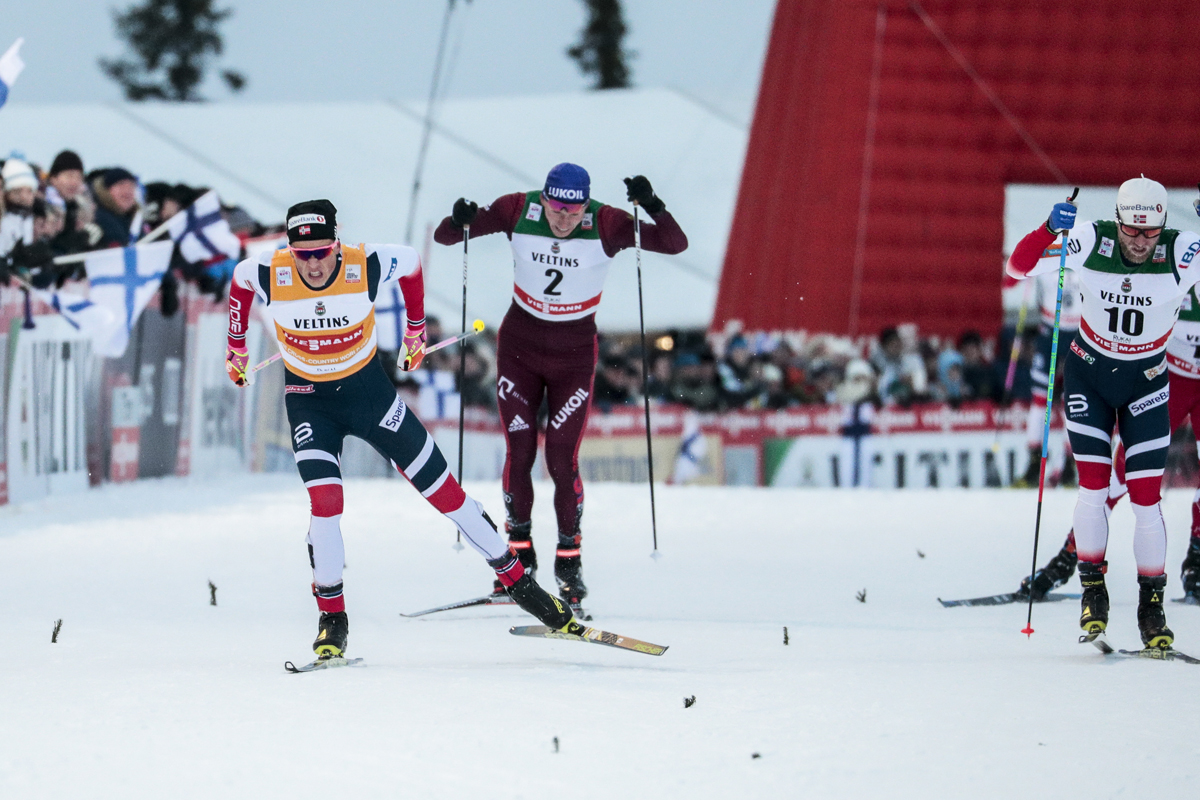
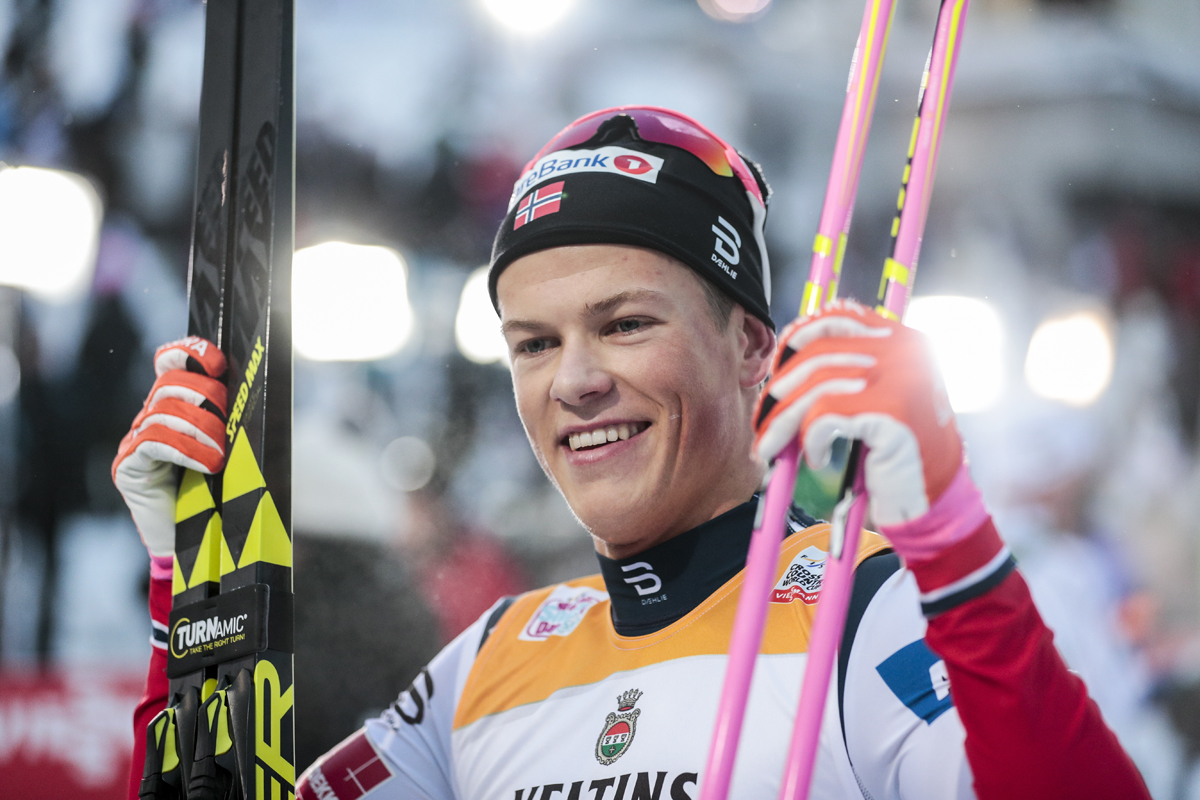
Norway’s Simen Hegstad Krüger celebrates after winning gold in the men’s 30 k skiathlon on Sunday at the 2018 Olympics in PyeongChang, South Korea. (Photo: FlyingPointRoad)
It was an improbable move: Norway’s Simen Hegsted Krüger attacked a few kilometers from the finish of the men’s 30 k skiathlon, and the rest of the field let him go. Krüger didn’t let up and at one point had a lead of 25 seconds with just about two kilometers to go, all the more impressive because he had crashed just meters into the race and broken a pole, having to then make up 35 to 40 seconds to get back to the lead pack.
Norwegian teammates Martin Johnsrud Sundby and Hans Christer Holund tried to close the gap to Krüger in the final kilometer, but the 24 year old hung on for a 8-second win. Sundby was second and Holund was third (+9.0) to give Norway a medal sweep.
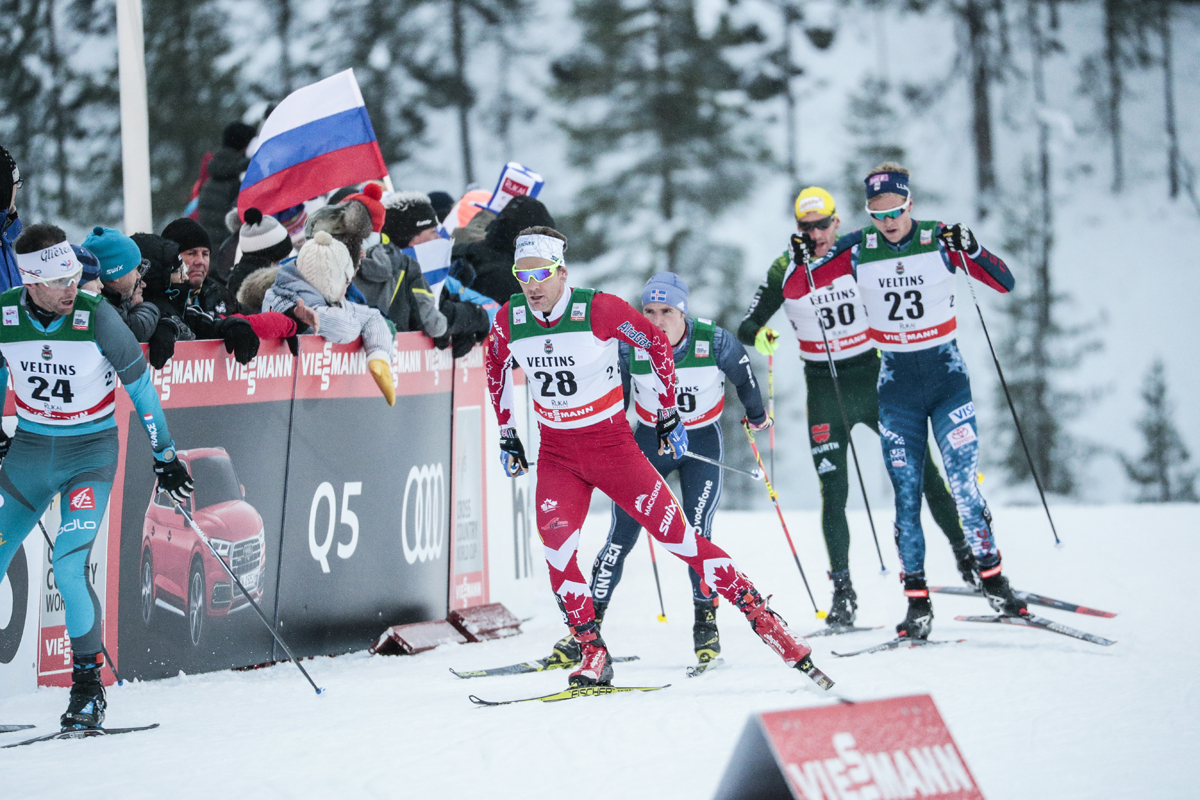
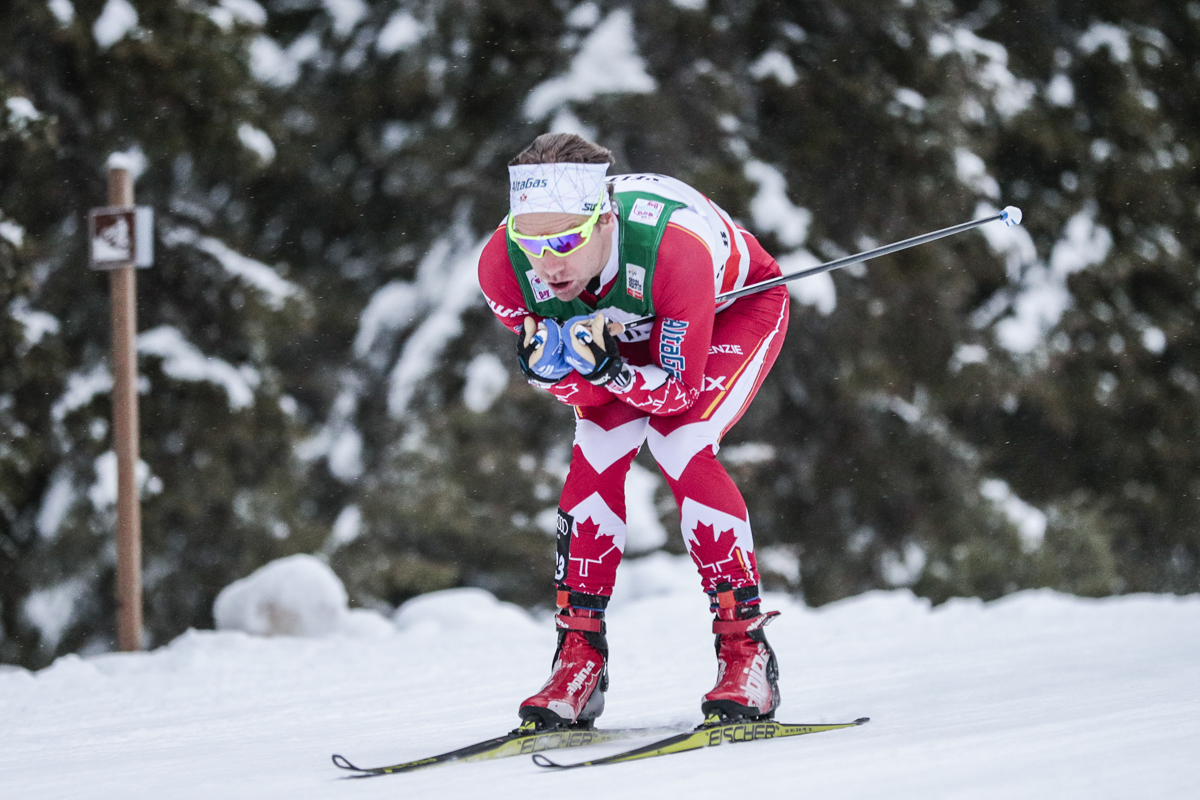
Denis Spitsov of the Olympic Athletes of Russia, also in his first Olympics, finished fourth, 12.7 seconds back. Maurice Manificat of France was fifth (+14.2), Dario Cologna of Switzerland sixth (+25.1), Andrew Musgrave of Great Britain seventh (+25.7), and Alex Harvey of Canada edged Martin Jaks of the Czech Republic for eighth (+33.4 and +33.8, respectively). Johannes Høsflot Klæbo of Norway, one of the pre-race favorites, finished 10th (+43.4).
For the U.S., Scott Patterson led the way in 18th (+1:07.5). Erik Bjornsen finished 42th (+4:34.7), Paddy Caldwell 51st (+6:58.1), and Noah Hoffman 54th (+7:08.7).
After Harvey’s top-10 finish, the next Canadian across the line was Devon Kershaw in 36th (+3:35.3). GraemeKillick finished 45th (+5:19.6), and Knute Johnsgaard was lapped and did not finish.
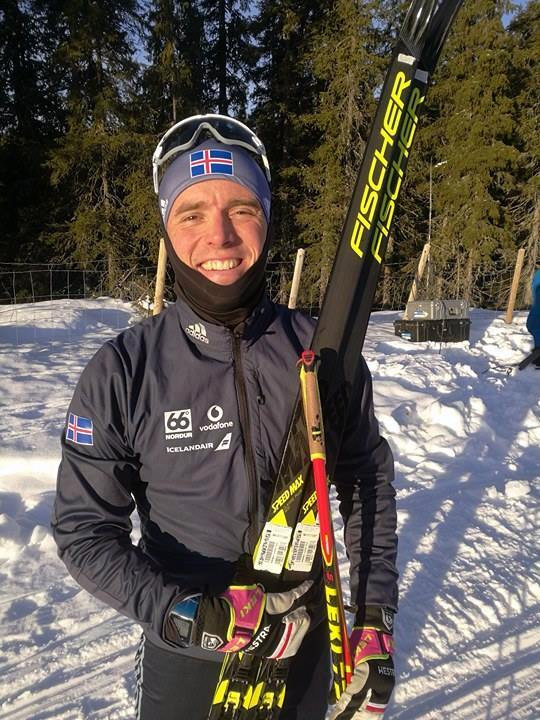
University of Utah alum Snorri Einarsson finished 56th (+7:13.9) in Iceland’s best result in Olympic cross-country skiing since 1994.
Arnd Peiffer on his way to winning the 10 k sprint at Alpensia Biathlon Center today. The German was one of just four men to shoot clean in windy conditions. (Photo: FlyingPointRoad)
With the race favorites each picking up a bevy of penalties, Germany’s Arnd Peiffer skated to a gold medal in the men’s 10 k sprint on Sunday. Both he and silver medalist Michal Krčmář of the Czech Republic shot clean, and were two of only four men in the field to do so. With that performance, Peiffer — whose lone senior Championship-level individual medal came when he won the World Championships sprint back in 2011 — made Germany two-for-two in biathlon races so far after Laura Dahlmeier’s win in the women’s sprint on Saturday.
The top of the results sheet was tight, with Krčmář finishing just 4.4 seconds slower than Peiffer. Krčmář only has one World Cup podium to his name, coming last season. Dominik Windisch of Italy finished with the bronze medal (+7.7) despite one missed shot, and edged out Austria’s Julian Eberhard (+8.4) seconds, who also had one penalty.
Erlend Bjøntegaard of Norway was fifth (+17.4) with two penalties, and Benedikt Doll (+17.6) and Simon Schempp (+21.4) gave Germany an impressive three spots in the top seven.
Those pre-race favorites? Martin Fourcade of France missed three shots in prone and despite cleaning standing, couldn’t make up enough time on the final loop for a top result. He finished eighth, +22.1. Johannes Thingnes Bø of Norway missed three shots in prone and then another in standing, finishing 31st, +1:12.7.
For the U.S., Lowell Bailey cleaned prone and then collected one penalty in standing to end the day 33rd (+1:15.6). Tim Burke had four penalties to land 47th (+1:47.5), and Leif Nordgren will join them in Monday’s pursuit after finishing 58th (+2:10.2) with two missed shots. Sean Doherty missed four of his five prone targets and was unable to come back from that blow, finishing 65th (+2:16.4).
The Canadians also suffered shooting woes. with Nathan Smith able to limit the losses to one penalty and finish 44th (+1:43.5). He is the only team member to make the pursuit. Brothers Scott and Christian Gow missed four and three shots, respectively, to earn the unlucky honor of being the first two men outside the pursuit cutoff in 61st (+2:14.0) and 62nd (+2:14.7). Brendan Green cleaned prone but then missed three shots in standing to finish 82nd (+3:09.2).
The women’s 10 pursuit and men’s 12.5 k pursuit are set for Monday at 5:10 a.m. and 7 a.m. Eastern Standard Time.
Iceland’s Snorri Einarsson, a University of Utah alum, at the Lillehammer World Cup earlier this month. (Photo: Icelandic Ski Federation)
What kind of ski racing hasn’t Snorri Einarsson done?
Einarsson moved from Norway to the United States for the 2007 season, racing for the University of Utah and winning an NCAA Championship title.
After returning to Norway, he got World Cup starts and represented Norway in two Tour de Ski editions.
After that, he raced the Ski Classics marathon series for Team Santander, one of the most successful squads in the league.
Now, he’s back to the World Cup and will compete for Iceland at the 2018 Olympics. Einarsson’s mother is Norwegian, and his father is Icelandic.
On Saturday in Davos, Switzerland, the World Cup didn’t seem very forgiving. He finished 94th in the sprint.
“It didn’t go that well,” Einarsson laughed. “I’m already here and I’m racing tomorrow – sometimes I feel like it’s good to do one short race for maintaining [fitness]. But I got really extremely slow after the last years.”
Distance races, though, have been better. Einarsson finished 22nd in the 10 k classic in Ruka, 27th in the overall mini-tour, 33rd in the skiathlon in Lillehammer, and 29th in the 15 k skate in Davos.
“We’ll see what I can do,” the 31-year-old said. “The first few weeks have been good.”
The Icelandic Ski Federation has only had a real team for two years, but Einarsson is aiming for a top finish at the Olympics using the years of training and competition he has under his belt. He has had it in his head to compete for his father’s country for a long time, but he had to wait until all the pieces fell into place.
“After I went back from the U.S. I wanted to race for Iceland the whole time, but they didn’t really have a team and they told me that World Cups was out of the question,” he explained. “So I thought, well, then I can’t really do that. A couple years ago they called me to say they had a team, and did I want to be on it. I said, yeah, of course!”
The team is small: four men and one woman. Einarsson has one wax tech, Dag Elvevold. That gives him little flexibility. In Davos, for instance, Elvevold was sick – “really sick”, Einarsson said. He had to get help with his skis from the British team.
But that’s one benefit of having skied in so many different places over the years, he said.
“I’ve been skiing for so long that you know people from earlier,” Einarsson said. “Coaches you had before, coaches who are somewhere else now, it makes it a little easier.”
And when he succeeds, it means something extra.
“I’m really proud when I do well with the Icelandic team – it meant a lot more to me to do well in Ruka, for example, in the first weekend [than it had in previous years],” Einarsson said. “The waxers are just my friends. The secretary general in the Icelandic Ski Federation arranges everything. We all do several jobs. I’m always alone until the day before the race and I have to arrange a lot of stuff too. We are all a little family. It’s different, but I enjoy it a lot.”
As a kid, Einarsson spent first grade in Iceland and often visited his father’s family; he lived most of the time in northern Norway.
Now, he is trying to help build up a ski culture in the island country.
“It’s just to get people interested in skiing really, and young people starting to ski earlier,” he said of the ski team’s goals. “It’s not like we are going to do that in a few years, but maybe something like with the Icelandic soccer team. We are a really small country and we are not a lot of people, so we have to do a really good job with the ones we have. Now we have a really good national team coach. I think we have done a lot in a short period of time. We have two young guys on the team, and I think they might be good in the future.”
It’s not for lack of ski trails that Iceland has never had a team. Einarsson waxed poetic about how good the skiing can be in the country.
“Fossavatn [ski marathon] last year, I would recommend it,” he marveled. “It was a beautiful, beautiful race. We had the best conditions. The original track has been skied only once before, because the weather was always wrong. But then we had the race on the original track and it’s just like, wow. I’ve done a lot of long-distance races, and well, I might be biased a little bit, but it’s just a really nice course for seeing some nature on the way. It’s just wild. It’s so open. It’s in the mountains.”
Much of the time, weather can be a problem – “people think they have seen that before they go to Iceland, and then they go and it’s like, no, really,” he said – but it can also be great.
And skiing is gaining some stature.
“It has been on the sport news a few times already,” Einarsson said. “Normally they are mostly into soccer, but that’s natural I guess. So I’m happy with being mentioned on the news every once in a while.”
Norway’s Johannes Høsflot Klæbo en route to his third-straight win in as many days of the World-Cup-opening Ruka Triple in Kuusamo, Finland. He won the 15 k freestyle pursuit for the mini-tour title. (Photo: Fischer/Nordic Focus)
Two previous days of racing, and back-to-back victories no less, had begun to take its toll on Johannes Høsflot Klæbo within the first few laps of the men’s 15-kilometer freestyle pursuit on Sunday in Kuusamo, Finland. The 21-year-old Norwegian could feel it throughout his body; he was tired and 38 seconds of a starting cushion wasn’t going to be enough to hold off the hungry challengers behind him.
Klæbo, who won Friday’s classic sprint and Saturday’s 15 k classic individual start on the World Cup opening weekend, wasn’t invincible and he couldn’t race to another win alone. Halfway through the pursuit, the man who started in second place, 38 seconds after him, Russia’s Alexander Bolshunov (who’s actually younger than Klæbo at age 20), had cut that deficit to 19.8 seconds. After him, Norway’s Martin Johnsrud Sundby, who started 10th and 1:05 minutes behind Klæbo, was up to third and just 25.3 seconds back.
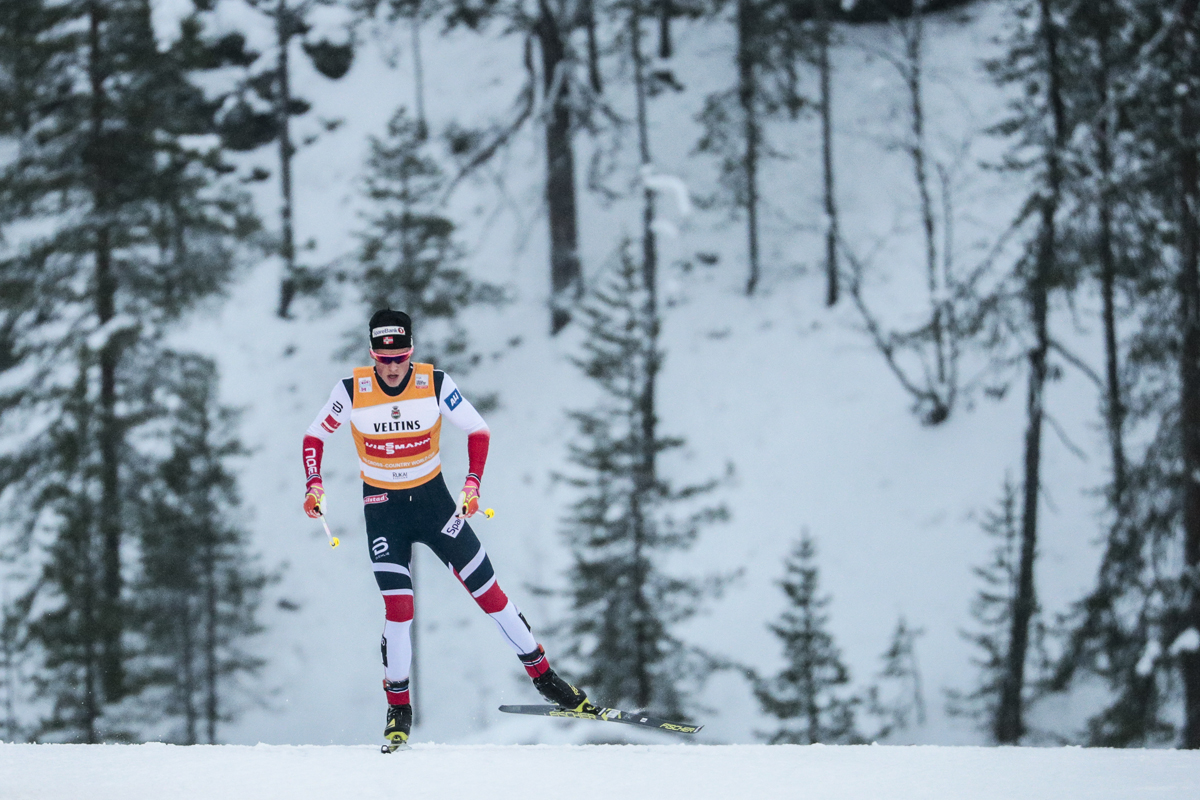
Norway’s Martin Johnsrud Sundby, who started 10th in the 15 k freestyle pursuit on Sunday, picking off the places on the final day of the Ruka Triple World Cup mini tour in Kuusamo, Finland. (Photo: Fischer/Nordic Focus)
On his fourth lap, Klæbo accepted the inevitable as Bolshunov and Sundby, who had linked up in an effort to catch him, in fact caught him on a climb around 8.6 k. A larger group of pursuers, including Canada’s Alex Harvey, locked on to the three leaders as well, and from there, the race truly began to take form. Klæbo had to recover, Sundby had to figure out how to try to drop him, Bolshunov had to see what he was capable of, and Harvey had to see how much he could give in the third race of the season.
The first races of each winter aren’t easy for anyone. Despite spending the summer training for skiing, most North American World Cup skiers don’t get the opportunity to actually race — even on rollerskis — too often during the offseason. Because of the rich ski culture in Europe, rollerski races are a big deal with lots of summer and fall competitions to chose from. And because of Europe’s geography, it’s often easier to get on snow than it is for North Americans.
(“I think this applies to all the North American actually, compared to Europeans we don’t race as much in summer,” Canadian World Cup coach Ivan Babikov said on the phone on Sunday. “They have races every weekend so they come into the season pretty sharp already with some good speed workouts, when we don’t have that opportunity. So that’s why, I think, every race is a step forward. It’s just, you have to remember or remind yourself how hard it is.”)
So while Canadians and American World Cup skiers alike often look at an opening weekend like Finland’s Ruka Triple mini tour as a “chance to blow the cobwebs out” or “shake off the rust”, as some have said, it’s also an opportunity to see where you stand — as was the case for Harvey in the final meters of Sunday’s pursuit.
Later in the fourth of six laps, Klæbo pushed the tempo up a climb, Bolshunov responded, and Harvey went with them. Soon after at 10 k, they lapped through the stadium with 11 men within 2.7 seconds of first. Up front, Bolshunov led Harvey, who had started the race 1:23 back in 12th.
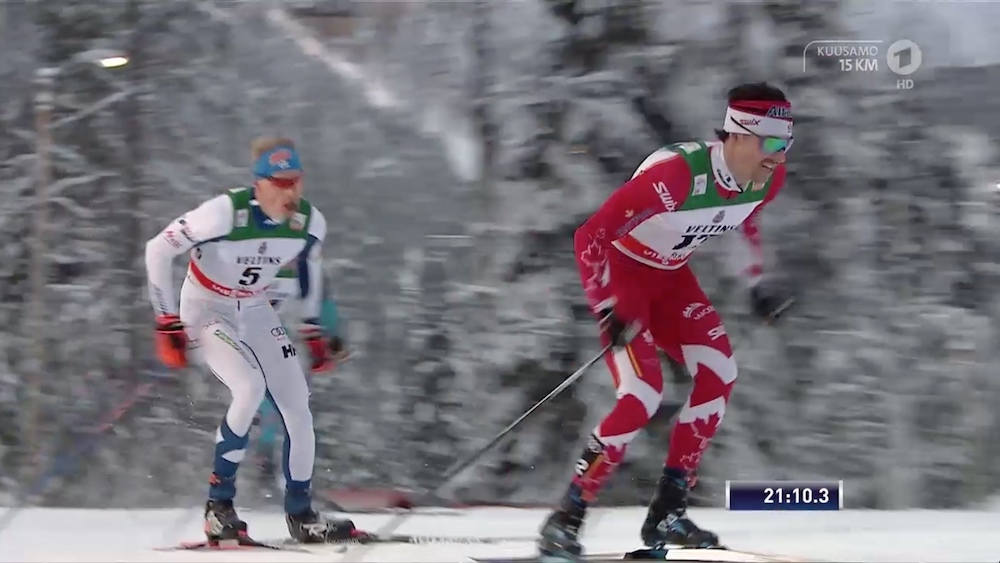
Canadian World Cup Team member Alex Harvey leads Finland’s Iivo Niskanen during the men’s 15 k freestyle pursuit on Sunday, the final day of the Ruka Triple mini tour in Kuusamo, Finland. (Screenshot: ARD)
Harvey had spent the first three laps working up to that lead group, initially with the likes of Russia’s Alexey Chervotkin (*who reportedly thanked Harvey after the race) and Sergey Ustiugov, Norway’s Hans Christer Holund and Sweden’s Marcus Hellner, and later with France’s Maurice Manificat, Sweden’s Calle Halfvarsson, Norway’s Emil Iversen, Chervotkin, and Holund, among others.
“I knew there’d be some fireworks on the last lap so I just wanted to be in the front third of the group, just be ready for a move,” Harvey explained in a post-race phone interview. “I thought Sundby would be the guy making the move, which in the end, that’s what happened. The big uphill in the last lap, that’s where he went. I just wanted to be close to Sundby and ready to respond when Sundby went.”
Sundby attacked as predicted on the second-to-last climb, around 13.6 k, and Harvey slotted behind him to follow him over the top.
“I was just actually there on that last uphill when Sundby attacked,” Babikov recalled. “Klæbo was right there. I think there were just Norwegian tactics … Sundby attacked on the last uphill and Klæbo just cooled down and wasn’t chasing him at all, so for Alex, that was his only chance. … If he didn’t chase him, then Sundby probably would have skied away and it would have been a bigger group at the finish, but at the moment he tried, and they actually created a gap … Alex second and Sundby first.”
With a few meters separating them from Norway’s Didrik Tønseth in third and Klæbo in fourth, Harvey thought he and Sundby had dropped them and that he would fight for first to the finish.
“I kind of went all-in with the Sundby move,” Harvey said. “When I looked in between my legs just before the last downhill I thought we had a big enough gap … so I was feeling pretty good about my chances there, but not good about taking [Sundby] because I was really, really dead.”
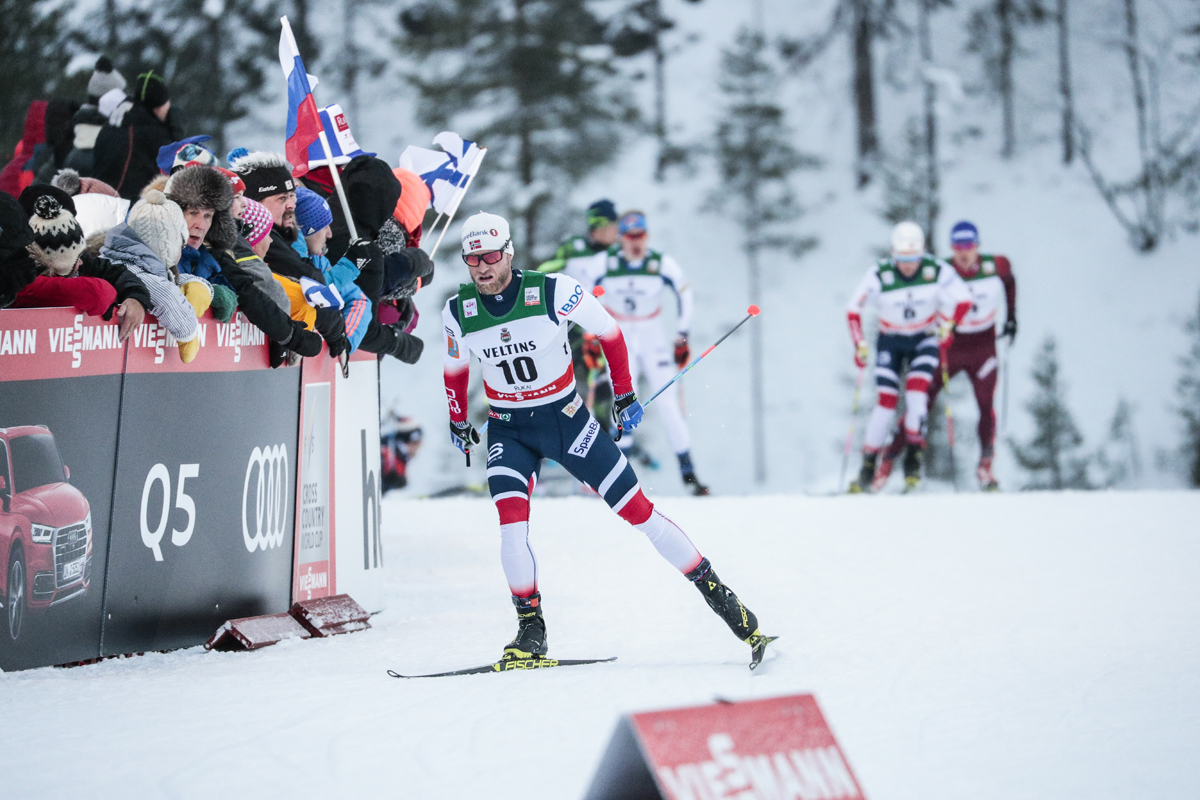
Johannes Høsflot Klæbo (l) passing fellow Norwegian World Cup Team member Martin Johnsrud Sundby (10) for the win in Sunday’s 15 k freestyle pursuit at the Ruka Triple mini tour in Kuusamo, Finland. Russia’s Alexander Bolshunov (2) was 1 second back in third place for his first World Cup podium while Canada’s Alex Harvey (behind Sundby) placed fourth. (Photo: Fischer/Nordic Focus)
After what Harvey estimated to be a 45-second downhill, he realized that wasn’t the case. Klæbo and Bolshunov had slingshot back toward the front, and while Sundby was first to the top of the last climb before the finish, Klæbo and Bolshunov were right behind him while Harvey followed in fourth.
They entered the stadium together in that order, and Klæbo passed Sundby with about 100 meters remaining to take his third-straight win of the weekend.
“Coming out of my tuck there I was just full of lactate, not feeling any fresher … then I just got passed on the hill,” Harvey recalled. “I had nothing left. That was my move. … I’m happy I made that move, but I couldn’t make a second burst after that.”
While Klæbo won the pursuit and with it, the Ruka Triple mini-tour title in 36:23.2 minutes, Sundby placed second, 0.4 seconds back, Bolshunov claimed his first World Cup podium in third (+1.0), and Harvey finished another 0.6 seconds back in fourth (+1.6).
On the day, Harvey’s course time ranked fifth fastest behind Manificat, who was the “winner of the day” in 34:50.9. Finland’s Matti Heikkinen was second fastest (+5.4) after starting 22nd and placing 14th, Holund was third fastest (+7.5) after starting 14th and finishing ninth, and Switzerland’s Dario Cologna, who started 26th and finished 17th, was fourth fastest (+8.7).
Harvey said starting 17 seconds behind Sundby was a tall task on its own, and he had started the race with a goal of breaking into the top 10 overall. All things considered, fourth place was better than he expected at this point in the season.
“… But I knew it was still within reach,” Harvey explained. “I believed in it, but I didn’t put too much hope in, let’s say, a top five or fighting for the podium. It was more like I wanted to be back in the top 10 and just that to me seemed already hard enough.”
Norway’s Johannes Høsflot Klæbo after winning the 15 k freestyle pursuit on Sunday to win the Ruka Triple mini tour in Kuusamo, Finland. (Photo: Fischer/Nordic Focus)
The fact that he was able to hang with Klæbo and Sundby to the finish was a good sign, he added.
“Right now, he’s not just a good sprinter, he’s the best distance skier in the world, too,” Harvey said of Klæbo. “I mean, to win a 15 k individual you have to be in very, very good physical shape, so he’s in really good physical shape and I know I’m not yet. I’m not in my best form and Sundby probably isn’t yet, so you never know what’s going to happen later in the season at the Olympics, but for now it’s hard to drop him when he’s actually just in better shape than everybody else in the world.”
After the race, Klæbo told NRK he was relieved to get the win and have some time to rest before next weekend’s World Cup in Lillehammer, Norway.
“My legs are shaking now,” Klæbo said. “Feels incredible to be the first to cross the finish line. Now I need a few days rest.
“This was brutal,” he added. “I’m actually glad they caught up to me and luckily I had good skis. I’m glad I had a few seconds today.”
Norwegian national-team coach Tor-Arne Hetland told NRK he was “really impressed” with Klæbo. “We have a diamond in the sport of cross country skiing now,” Hetland said.
“That’s very nice of him to say. It’s probably a little too much, but it has been a good start to the season,” Klæbo responded to NRK.
Sundby spoke excitedly about having Klæbo to contest for the overall World Cup lead.
“For the moment, he’s taking international cross-country skiing for men to a whole ’nother level,” Sundby told NRK. “It is a little humiliating for the rest of us, but at the same time it’s extremely inspiring to see what he does in his second year at this level. It’s hell of fun to have a guy like that on the team.”
Bjornsen 26th, Kershaw 29th; Caldwell Posts Top-20 Time of Day
Canada had two in the top 30 on Sunday with Devon Kershaw in 29th (+1:47.8), scoring World Cup points for the second-straight day. He started 28th and 1:59 out of first, just one second behind Cologna in 26th and Russia’s Andrey Larkov in 27th.
“I just wasn’t strong enough to go with Dario,” Kershaw said on the phone. “I had the perfect chance to be able to follow Dario up the field, but he just started so fast, and on the steep terrain, my legs just — I tried up the first steep wall and at the top, I’m like, man, if I keep going like this, after 5 k I’m gonna be dead.
Canada’s Devon Kershaw (28) leads American Erik Bjornsen (23) and others during the World Cup men’s 15 k freestyle pursuit on Sunday in Kuusamo, Finland. (Photo: Fischer/Nordic Focus)
“So I had to manage my energy a little bit and in the end, it turned out that Bjornsen and I’s group just wasn’t strong enough,” Kershaw continued, referring to U.S. Ski Team member Erik Bjornsen, whom he started eight seconds behind and spent most of the race with. “[Our group] had a good 7 1/2 k and then after that, between 7 1/2 kilometers and 12 k, we were skiing really slow. So that’s a bit frustrating in a pursuit because you’re just stuck there in no-man’s land.”
While he felt like he was skiing the flats well, Kershaw said he struggled with the “biting” conditions, which seemed to limit glide, especially on the notoriously steep course’s climbs.
“I had to make the choice to be like, OK, I’ve got to just stay in this group and I’m not strong enough to drive the bus, because my legs just weren’t there today on the terrain” he said. “In the end I made a tactical error in the last 600 meters. I should’ve followed Bjornsen on the outside and I went on the inside and was hoping it would open up for me and it didn’t. So I ended up 29th, but that’s OK.”
Bjornsen started 24th and finished the pursuit in 26th (+1:43.6), after following Larkov in 25th (+1:42.8) across the line and holding off Iceland’s Snorri Einarsson (a former Norwegian skier who raced for the University of Utah) in 27th (+1:46.2), Great Britain’s Andrew Musgrave in 28th (+1:47.2), Kershaw in 29th, and France’s Jean-Marc Gaillard in 30th (+1:49.2).
“I started right around Cologna and [Finland’s Matti] Heikkinen but there was no way I was going to hold their pace, they were flying,” Bjornsen wrote in an email. “I had to settle in with the group around me. It soon became clear our group was not going to catch anyone in front of us or get caught, so it became a tactical game. Some surges, but for the most part nobody wanted to lead.”
Devon Kershaw (Canadian World Cup Team) en route to 29th in the 15 k freestyle pursuit on the last day of the Ruka Triple World Cup mini tour in Kuusamo, Finland. (Photo: Fischer/Nordic Focus)
Kershaw laughed when he talked about some “tips” he gave Bjornsen during the race.
“He had really fast skis so there were a few times that he came by me on the downhill and then would kind of try to hammer for a minute and then get tired and slow down again,” Kershaw said. “I told him, like, ‘Dude, you’ve got great skis. Unless you can stay in the front and really press, then it’s better just to play the game and wait for the end.’ After that, he did that and he torched us all in the end. So that was kind of fun to see for him.”
According to Bjornsen, Kershaw suggested he sit back and wait for the sprint.
“My skis were good but I think my weight is what helped me the most on that last huge downhill,” Bjornsen wrote. “I was fine going for that tactic but at the same time it would have been nice to leave a little more out there today. Stoked to get double points for 26th though!”
Paddy Caldwell (U.S. Ski Team) racing to 70th in the men’s 15 k classic on Saturday, Day of the Ruka Triple World Cup mini tour in Kuusamo, Finland. In Sunday’s 15 k freestyle pursuit, he skied up to 51st with the 19th-fastest time of day. (Photo: Fischer/Nordic Focus)
Paddy Caldwell, new to the U.S. Ski Team B-team this year, posted his best World Cup result with the 19th-fastest time of day, 50.5 seconds back from Manificat. He started with the wave in 70th and finished 51st overall (+3:03.1).
“Going into the race my goal was to move up as much as possible,” the 23-year-old Caldwell wrote in an email. “I wasn’t really thinking about place or time of day – I was just trying to ski fast and put together a good effort.
“It was really hard to move up in the pack,” he added. “I started midway back in the wave and we kept picking up more and more skiers as the race went on. I tried to relax as much as possible on the hills and build in energy to pass where I could on the flats. … I am really excited with the day and psyched to have had a good result here in Ruka. I’m looking forward to the rest of period 1 and learning more from the big dogs!”
“Very exciting race out of Erik today,” U.S. Ski Team coach Matt Whitcomb commented on the phone. “… When he settled to the back of his pack on Lap 6 and headed into the downhill with one climb to go, we just all sort of expressed confidence over the U.S. radio channel, got ready see what he could do. It is so fun to watch him in a stadium when he has to go head to head against five other athletes … he did not disappoint today. Really proud of Erik’s 26th place.”
As for Caldwell, who skied the 25th fastest time of day in the 2017 World Cup Finals freestyle pursuit, Whitcomb said, “this is his race, the skate distance.”
“There were times that he was a little bit road-blocked out there, just the way the pursuit race unfolds in that start … and it looked like today Paddy could keep going, so really great signs out of him,” Whitcomb said.
Whitcomb also highlighted the races of Scott Patterson, who raced up from 78th to 55th (+3:28.4) with the 31st-fastest time, and Noah Hoffman, who improved from 45th to 39th (+2.33.3) with the 35th-fastest time. Also for the U.S., Andy Newell finished the tour out in 75th (+5:39.6).
American Paddy Caldwell (70) racing with Sweden’s Jens Burman (front) and Canada’s Len Valjas (46), among others, during Sunday’s World Cup 15 k freestyle pursuit on the last day of the Ruka Triple in Kuusamo, Finland. (Photo: Fischer/Nordic Focus)
Canada’s Len Valjas moved up two places for 44th overall (+2:47.5), Graeme Killick finished the tour in 68th (+4:39.5), Knute Johnsgaard 81st (+6:43.6), and Julien Locke 83rd (+7:33.6).
Babikov pointed out that Valjas had a shoulder injury that he mostly recovered from, but caused him to struggle with double poling in Friday’s sprint. Despite placing 63rd in that sprint, Valjas was the team’s third-best man in the weekend’s distance races.
“[In] two distance races, he was third best and actually placed higher than he placed in sprint in the distance, 15 k, hardest one with lots of climbing,” Babikov said. “So that shows he has a good shape, but just needs to scrape that rust off and remember how to go fast again. I think physically he is in a good place, just need to do some more races, and it will come.”
***
*Post-race sidenote: According to Harvey, after the race, the Russian team’s massage therapist told Canadian coach Ivan Babikov that Chervotkin wanted to thank Harvey for pulling him in the pursuit. Chervotkin, 22, started 11th and finished fifth, 6.2 seconds out of first and 4.6 seconds after Harvey in fourth.
“There’s a bit of beef with the Russians and me right now,” Harvey said. “I came in wondering if they were just going to punch me in the face. They said they wanted to break my teeth, so this is a good turn of things.”
“I read that in the Norwegian news, actually, that Petukhov wanted to …,” he said with a laugh. “But I knew the media likes that sort of thing. But I think things are good now.”
Harvey noted that Bolshunov and Chervotkin, neither of which have been implicated in the doping scandal, are part of “a new generation” in Russian cross-country skiing. “I saw the results in Bruksvallarna; it looks like the have almost as much depth as Norway does. They’re really strong.”
— Aleks Tangen, Ian Tovell, Jason Albert, and Harald Zimmer contributed
Racers in the Ruka Triple World Cup 15 k freestyle pursuit, including Russia’s Andrey Larkov, Switzerland’s Jonas Baumann, Italy’s Federico Pellegrino, Switzerland’s Dario Cologna, and Norway’s Simen Hegstad Krueger, ascend a climb in Kuusamo, Finland. (Photo: Fischer/Nordic Focus)
Racers navigate a steep climb and descent on the race loop at Bruksvallarna on Saturday. (Photo: Jocke Lagercrantz/Bruksvallsloppet.se)
The World Cup season draws ever-closer as season-opening races continued this weekend in Sweden, Finland, and Switzerland.
In Muonio, Finland, a long weekend of racing wrapped up with 10 and 15 k skate races. Finland’s Anne Kylloenen took the win in the women’s 10 k, besting Emilie Kristoffersen of Norway by 8.2 seconds. Kylloenen’s national-team teammates Laura Mononen and Aino-Kaisa Saarinen took third (+14.0) and fourth (+17.1), respectively. Merete Myrseth, a Norwegian skier who competed for the University of Utah on the NCAA circuit last season, finished 17th, +57.1.
In the men’s 15 k, Alexey Chervotkin of Russia took a 13.8-second win over Iivo Niskanen of Finland. Denis Spitzov of Russia was third, +17.5, and University of Utah alum Snorri Einarsson fourth, +21.2. Einarsson is competing for Iceland. Graham Nishikawa of Canada finished 19th, +1:14.4, and Brian McKeever 40th, + 2:05.3.
Finishing sixth (+37.0) was Maxim Vylegzhanin of Russia, who made his second flower ceremony of the weekend. The International Olympic Committee (IOC) decided on Thursdayto strip the Russian skier of three silver medals from the 2014 Olympics for doping violations and ban him from all future Olympic Games. However, the International Ski Federation (FIS) has not yet taken any action since he and five other skiers were banned from the IOC, meaning that all six athletes are currently free to take part in non-Olympic ski competitions. FIS has not yet responded to a request for comment about Vylegzhanin’s continued competition.
https://www.instagram.com/p/BbZO7VFFYpg/
In Bruksvallarna, Sweden, Sunday meant skate sprinting, and Norwegians took both the men’s and women’s wins. In the men’s race, Paal Troean Aune bested countryman Even Northug in the final, with Anton Persson the only Swede on the podium in third. None of the top sprinters from either country competed. Jack Carlyle of Canada finished 60th, 19.4 seconds behind Aune’s qualifying time.
In the women’s sprint, Wenche Aune Snildalsli took the win over four Swedes: Emma Thalin, Moa Olsson, Jackline Lockner, and Wilma Joensson were next across the line, and Latvia’s Patricija Eiduka finished sixth.
A large contingent of international racers has also been training in Davos, Switzerland, where organizers have a lengthy saved-snow loop covering some of the same terrain which will host the World Cup in mid-December. On Friday and Saturday, the Swiss competed with the German and Italian teams in sprint and distance races, with a few individual athletes from other countries attending as well.
In Friday’s sprints, Laurien Van Der Graaf came out on top for the home team, besting Germany’s Laura Gimmler and Steffi Boehler in the ‘A’ final after Gimmler had won beat her by 1.59 seconds in the qualifier. Fourth place went to Sandra Ringwald, also of Germany, and fifth to Ilaria Debertolis of Italy. In the men’s sprint Thomas Bing claimed the win for Germany, skiing away Switzerland’s Erwan Kaeser by more than two seconds. Giacomo Gabrielli and Stefan Zelger of Italy were third and fourth, and Janosch Brugger of Germany rounded out the ‘A’ final in fifth.
https://www.instagram.com/p/BbUYGpgl2V_/
In Saturday’s distance races, Katerina Smutna – racing for the Czech Republic after taking a break for several years to focus on a long-distance marathon career – won the three-lap, 10.5 k competition by just three seconds over Katharina Hennig of Germany, with Boehler another 12.2 seconds back in third. Van Der Graaf finished fourth, + 27.1, and Debertolis fifth, +39.6.
In the men’s four-lap race, covering 14 k, Swiss Olympic gold medalist Dario Cologna took a commanding 26.6-second win over Russia’s Ilia Chernousov. Jonas Dobler of Germany claimed third, +33.8, with Giandomenico Salvadori of Italy fourth (+59.2), narrowly beating out Livio Bieler of Switzerland (+1:00.9).
Chernousov could soon become an Olympic champion like Cologna. Vylegzhanin’s disqualification from the 2014 Olympics, along with that of Alexander Legkov, leaves Chernousov to inherit a gold medal in the 50 k freestyle, where he initially finished third. He has not been named in any of the doping investigations by the World Anti-Doping Agency or the International Olympic Committee. In fact, a Russian ski coach recently claimed that Chernousov had turned whistleblower and informed against his Russian teammate, but Chernousov has denied that allegation.
Many European skiers arrive in the U.S for college and are exhausted from year of trying to “make it” at the international level. While they find success in NCAA skiing, for some it is the last hurrah of a career that’s already lasted twenty years.
Snorri Einarsson was not one of those skiers. For one thing, when the Norwegian arrived at the University of Utah, he was just 20 years old. For another, he was incredibly motivated.
“It is rare to find someone that’s at that high level like Snorri… that realizes the value of having balance in their life, being part of a team, training hard, and using it as a stepping stone,” said Eli Brown, Einarsson’s coach at Utah.
Einarsson spent several years skiing for the Utes; in 2007 he won an NCAA Championship in the 20 k at Jackson, New Hampshire. Then he went back to Norway. If he was like most European college skiers, the U.S. community never would have heard from him again.
But once again, Einarsson was different. Since leaving Utah he has racked up consistently impressive results and climbed ever-higher in the Norwegian ski world. In 2010, he started his first World Cup and finished 32nd in the 50 k at Oslo. Last year, he raced the Tour de Ski and the 15 k in Drammen, where he finished poorly.
“I realized quickly on Saturday’s 15 k that it would not work as it should,” he wrote on his blog at the time. “I was finally almost done with the distance and realized that something is not right today. But as an Icelander and northerner in my throat, I know that it is no use to either quit the race or give up before the season is over.”
This year, the Tromsø resident is off to a good start. He took home the victory in Muonio, Finland last week in some of the first FIS race action of the year. Last year, Einarsson got lucky at the last minute and was added to the roster for the Tour de Ski; if he can keep his form from Muonio, even bigger things might be on his radar this year.
He’s currently ranked 101st on the FIS distance list; only three Americans outrank him (Kris Freeman in 33rd, Tad Elliott in 99th, and Noah Hoffman in 100th). He’s just ahead of the Czech Republic’s Martin Koukal.
FasterSkier caught Einarsson for a quick interview before the season started in earnest.
FasterSkier: What have you been up to since leaving Utah? What team are you training with?
Snorri Einarsson: After leaving Utah, I started studying physiotherapy at University of Tromsø. My first year home I pretty
much used for rehabilitation after having surgery in both my knees before leaving Utah. Since then things have just been going better every year. After coming home it was easier to train as much as the best, and then I started to do progress pretty fast. I train with a regional team here in northern Norway. Here I get to train with positive and strong racers from northern Norway. I love the atmosphere in the team, that is a really important thing for me.
Einarsson skiing with Lars Flora (USA) in Drammen last year.
FS: Who are your teammates? Will they get to race on the World Cup this year, do you think?
SE: I train mostly with Erlend Skippervik Sætre, Martin Vatshaug, Morten Eliassen, Andreas Nygaard, Bjørn Thomas Nygaard and Håkon Mikalsen. Of those, Håkon is most likely to get a World Cup start this year.
FS: Did you find it hard to get back into the community in Norway – did you feel like people had forgotten your name when you went to the U.S., or was it just like it had been before?
SE: I didn’t think it was hard to come back. I went to the U.S for the experience, and I trained and had a good time there. After spending two years in the desert I think it was really nice to come home and run in the mountains again. It’s not like anybody really knew my name before I left, so that part was pretty easy. I don’t really care if people know my name or not- if you ski fast enough people learn your name.
FS: What about training – when you came back to Norway, did you feel like you had lost any ground on your competitors, or were you right where you wanted to be?
SE: Training in the U.S gave me valuable experience with altitude, and taught me a lot about racing on a very close team. It was a new setting. It’s almost like you are part of a big family. When I got home I was very much on my own, training alone every day. It was hard in the beginning when you’re used to having your friends around every day, but also a lot more flexible.
I think it’s natural to increase the number of training hours compared to what I was doing in the U.S since I’m not in a time crunch all the time anymore. I went from about 600-650 hrs at Utah to around 900 hours in two years. I think I have found a system that works for me.
FS: You got to race the Tour de Ski last year, that’s pretty cool! How did that come about?
SE: I qualified through good results in the Scandinavian Cup and Norwegian Cup.
The Tour de Ski was a really fun experience- really tough, but fun. I was really nervous in the beginning and I’m not a fast sprinter, so in the beginning it didn’t go too well, but I had some better luck towards the end. After the Tour de Ski I was totally shot and it seemed really hard to ski fast for the rest of the season.
FS: How has your training gone this year?
SE: Training this year has gone very well. I adjusted the training a little, I’m now doing more level 4 intervals. Before I used to do a lot of level 3 and train more hours. Now I cut down on some of the volume and am training a little harder than before. I think it’s important to evaluate and change things up every year and not to train exactly the same thing every year. If your body gets too used to one thing it’s easy to get bored and sloppy. I also did some changes in my strength training turning it to more stabilization and balance exercises. I think this really helped my strength and technique on skis. I’m trying to link my strength training to skiing as much as I can- that keeps me motivated.
FS: Were you surprised to pick up the win in Muonio?
SE: I was really surprised to win in Muonio. I was not sure what to expect, but I was sure that a top 10 would be the best I could do on a good day. A friend of mine gave me splits every lap telling me that I was in the lead, so i just gave it everything and tried to finish strong. I was really glad to win.
FS: What are your plans and goals for the season?
SE: My initial plan was to ski fast in the Scandinvian Cup races and Norwegian championships. I didn’t plan to be in such good shape so early, so I guess I just have to wait and see what Sjusjøen brings and then just go from there. I don’t really plan too much, I wish I was better at that but it just doesn’t work for me. To me it seems kind of pointless to have a plan if you change it every five minutes.
Tim Reynolds (CGRP) on his way to 29th in Saturday's 10 k skate in Muonio. Photo: CGRP.
On a fast 5 k skate course, Justyna Kowalczyk (POL) notched her second victory in Muonio, Finland. The defending Tour de Ski and overall World Cup distance champ cruised over the icy, two-lap course in 10:31, four seconds ahead of a pack of six Finns.
“The route in Muonio was really fast,” said Kowalczyk on her website. “I am satisfied with the result and how the ball [is] rolling for me.”
Norway’s Snorri Einarsson held off Ville Nousiainen and Sami Jauhojaervi (FIN) for an 11-second win in the men’s 10 k, clocking in at 19:38. Tim Reynolds was the top American for the day, finishing a minute behind the winning time in 29th.
“Yesterday’s sprint was a pretty rough way to start the season, so it felt good to bounce back,” said Reynolds of his race. In Friday’s sprint, he was 104th.
The course was essentially the same as yesterday’s sprint, with a few added downhills for recovery each lap. Between junior racers and the open field, over 440 skiers took to the loop and scraped it clean of any man-made sugary snow pretty quickly, which made for squirrely conditions.
Though athletes didn’t have to worry about kick today, Reynolds said they still weren’t able to ski before the race. “We had to run to warm up again, which is a little more awkward for a skate race, but all the guys were in the same boat at least,” he said.
Following Reynolds, who was the first Craftsbury skier to start, was Pat O’Brien in 70th, Dylan McGuffin in 88th and Ethan Dreissigacker in 129th.
Hannah Dreissigacker getting ready to start in Friday's sprint. Photo: CGRP.
Ida Sargent led the American women for the second day in 35th, just over a minute behind Kowalczyk. Hannah Dreissigacker was only four seconds behind her in 44th. Though Sargent wasn’t happy with her day, Dreissigacker said she thought she had a decent race.
“I think I skied a little bit conservatively, and could have gone harder, but I at least felt like I was able to ski fairly well,” said Dreissigacker.
Clare Egan was 12 seconds behind Dreissigacker in 55th, making for a 16-second American spread overall. Place-wise, nearly all of Craftsbury, both men and women, improved over Friday’s sprint.
Tomorrow’s 5/10 k classic is the final day of competition in Muonio.
University of Utah Director of Skiing Eli Brown has resigned, leaving his job at the helm of one of the country’s most storied programs.
In an interview, Brown cited a desire to spend more time with his family combined with changes to the direction of the Utah program as the reasons for his decision. When the University finds a replacement, Brown will be heading to join his wife and two children on the family farm in Traverse City, Michigan—where he hopes to stay involved in the sport at a grassroots level.
“This is my extended family, the ski community,” Brown said. “I definitely want to keep that part of my life going.”
Eli Brown at the 2010 U.S. National Championships in Anchorage, Alaska
Brown, who coaches Utah’s cross-country team, replaced Kevin Sweeney as the director of skiing at Utah in 2005 after spending time as an elite skier, a coach, and the race director for Fischer Sports USA.
During his five seasons at the university, Brown said that he tried to expand Utah’s program to include as many athletes as possible.
He coached Snorri Einarsson to an individual national title in 2007, but the team—which won six titles in the eighties, and three in the nineties—has not been NCAA champion since 2003.
With Utah joining the Pacific-10 Conference in 2011, Brown said that “it’s getting more and more serious around there.”
“We’re going to move away from my strategy of having a big team, and get elite again,” he said.
In addition to the changes at Utah, Brown said that he has struggled to manage the twin demands of his professional and personal lives. His wife and children spend summers on the family farm, returning just as the ski season picks up in November.
“It’s hard being a ski coach and a dad in the winter,” he said.
The most difficult aspect of the decision, Brown said, was leaving his athletes. But he added that he will remain with the program for as long as is necessary, making the transition “smooth as they allow me—whether that’s a couple of weeks, or a couple of months.”
Brown acknowledged that it will be a tough time of year for Utah to find a new coach, given that most have already signed contracts for the upcoming winter. But the prestige and resources that come with the program should have no trouble attracting suitable candidates.
“I bet there’ll be some big names throwing their hats in,” Brown said.
Once in Michigan, in addition to working at local ski and bike shop Brick Wheels, Brown said that he hopes to help improve the skiing infrastructure in the Great Lakes region, which has consistently placed at the bottom of the standings at Junior Nationals. Brown said he would like to coach at the Junior National or high school level, and added that he would also work closely with the Central Cross-Country Ski Association (CXC)—which oversees the sport in the area, but has yet to develop the same degree of programming that it has in the Midwest.
“I just want to help use their structure, and build stuff up over there,” Brown said. “[The Great Lakes] have everything they need: snow, terrain, race schedule. I’m excited about that.”