From the FasterSkier archive — posts syndicated from athletes’ and coaches’ own blogs between 2004 and 2012, kept online as published. Current coverage is at fasterskier.com.
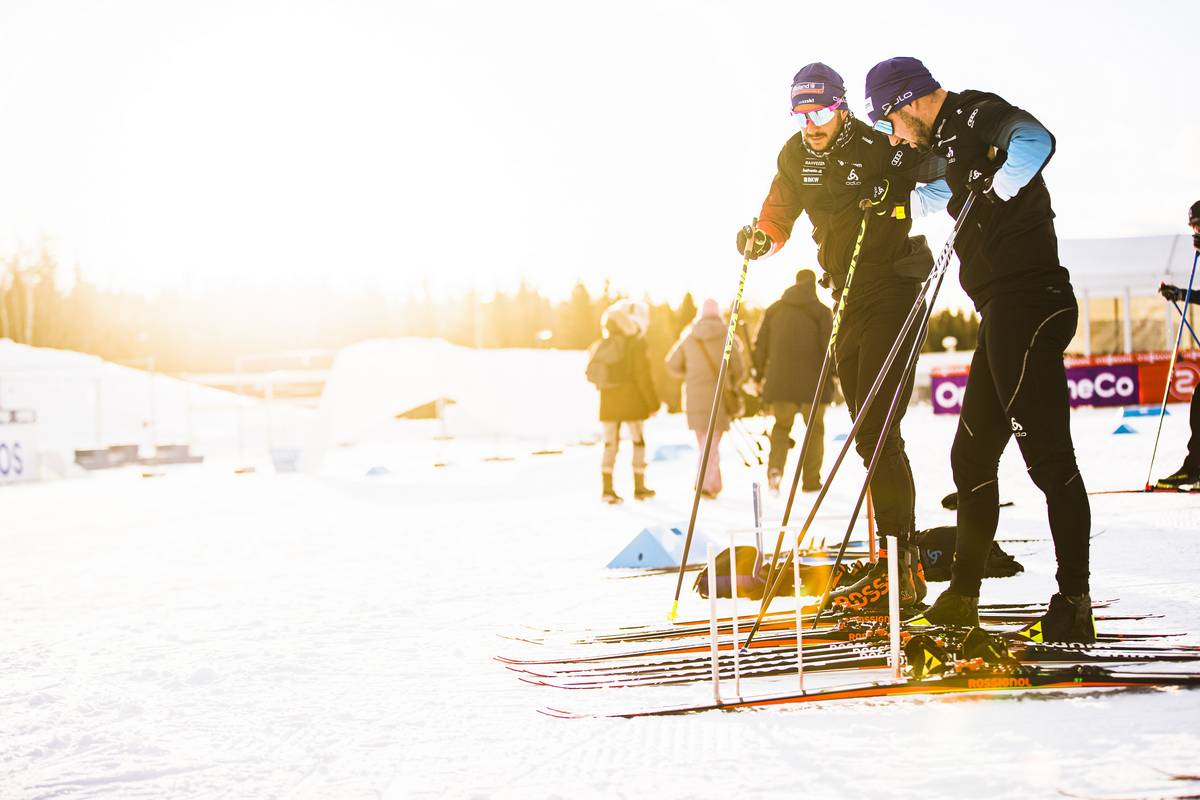
Swiss athletes ski testing in Lillehammer, Norway. (Photo: NordicFocus)
Much has already been written about snow. There are countless pictures of perfectly grown snow crystals, but very little about snow found on the slopes or in the cross-country skiing tracks. The newest article in our science series provides a vivid picture of snow in its many forms. With a cell phone and a mini microscope, you get fantastic pictures of snow grains. You can see their shape and the distribution of water between them. In addition, the article explains how to measure snow hardness. With this information and the knowledge of how snow humidity and snow temperature are connected, a safe wax recommendation can be made.
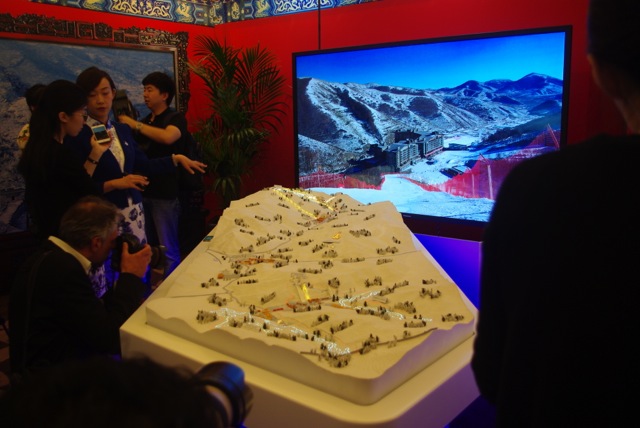
A whiter version of Beijing 2022 than athletes and fans might actually encounter.
In just over a month, the International Olympic Committee members will vote in Kuala Lumpur, Malaysia, on the site of the 2022 Winter Olympics. Their two choices: Almaty, Kazakhstan, and Beijing, China.
Only these two candidates remain after other bids from regions like Bavaria, Germany (centered in Munich), Graubunden, Switzerland (centered in Davos and St Moritz), Stockholm, Sweden, and Oslo, Norway, were felled by referendums.
That’s not a good sign for the IOC. Both bids have some problematic features, and are almost certainly not the ideal locations the organization was looking for.
While there are problems with the Almaty bid, to almost any reasonable person there appear to be far more, and more serious, problems with Beijing. Despite all of this, Beijing is the frontrunner.
That’s because it has the force of the Chinese government behind it. The IOC knows that the Chinese can deliver a Games. A Beijing Olympics would happen, without any major cost to the IOC except for bad publicity and a continued slide down from any moral high ground they might have left.
The Almaty bid closed part of its gap at the candidate city presentations in Lausanne, Switzerland, last week. But in the event that Beijing still comes out on top when voting is over, here’s an overview of six major issues that the Olympics would face – and examples of some of the misrepresentation and lies the bid committee says publicly when questions are brought up.
First, there’s the snow. As skiers, it is probably one of our main concerns. Will there be enough? Where will it come from? Zhangjiakou boasts about a meter, total, of snowfall each year.
The answer is, snow will come from water. But that leads to another question. What effect will that have on the regional water dynamics of a drought-prone region?
Then there’s air quality. It’s known to be terrible in Beijing. But organizers assert that air quality is great at the mountain venues. The problem is, that’s just not true.
Next up, how will spectators get to the mountain venues? At almost 200 k north of Beijing, travel times could be long. The bid committee touts a high-speed train connecting the clusters, but it’s becoming clear that this won’t solve all problems and could even be dangerous.
After the 2008 Olympics, it was clear that China followed through on few of their promises to improve human rights. Is there any reason to think that this time around will be different?
And finally, thinking long-term, what is the point of hosting a Games where winter sports are not popular and where snowmaking is so disruptive? Will the venues be used in the future?
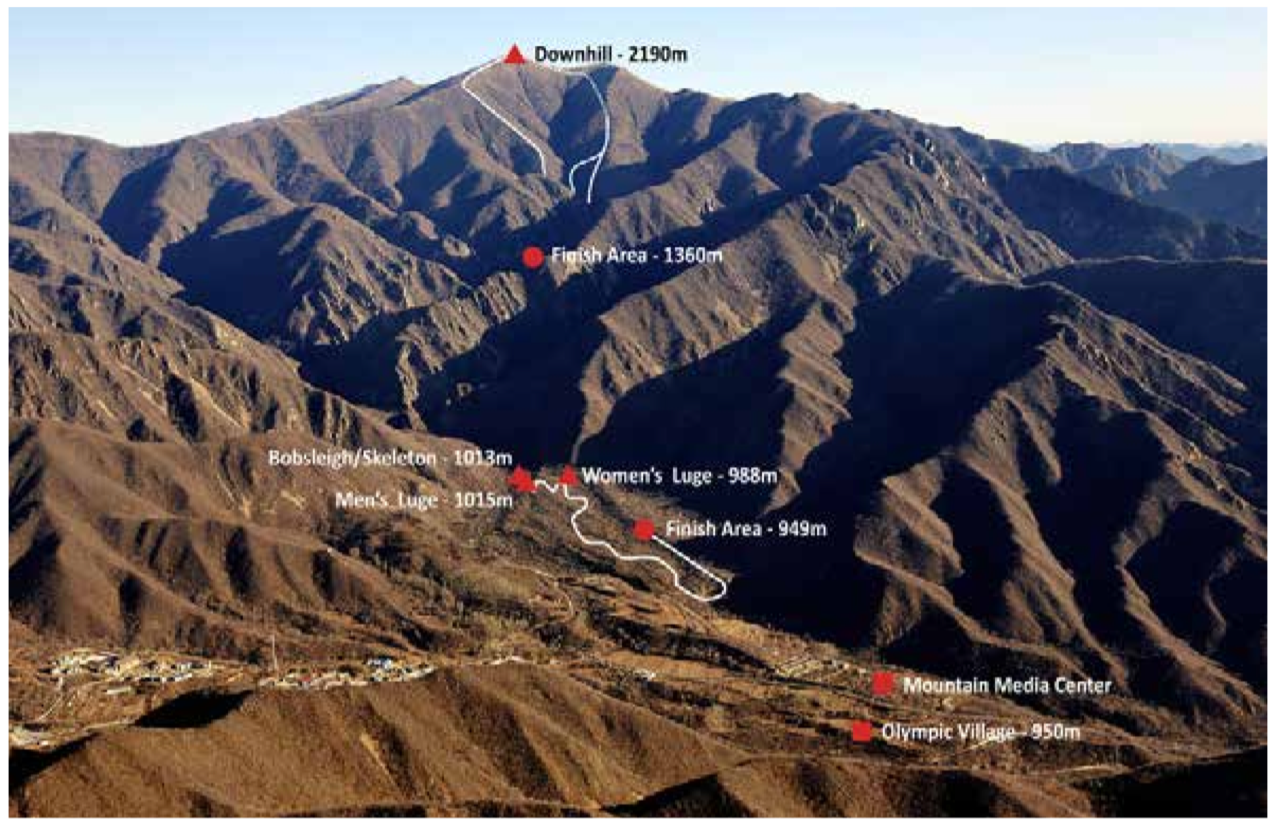
The site of the alpine skiing and sliding sports for Beijing 2022, photographed in January 2015 for the IOC Evaluation Commission report.
Snow: Quite honestly, there isn’t much.
The weather is cold and it’s enough to blow snow, however, at least for alpine skiing. The Chongli area outside of Zhangjiakou has four alpine ski resorts which host, according to the bid committee, 1.5 million visitors annually. Nordic facilities have not yet been built.
On the ground, the area isn’t always teeming with skiers.
“The chairlifts are somewhat slow, but queues are rare and the slopes are mostly empty,” a review of the Wanlong resort, one of the biggest in the area, notes.
By comparison, the state of Vermont gets about 4.5 million ski visits per year, although that is based on ticket sales and it is unclear whether the Chongli numbers are from all tourists or just those who buy a lift ticket.
Looking at meteorological data, it’s hard to imagine the region becoming a real winter sports mecca without snowmaking.
“The total annual snowfall here can reach more than one meter,” Liu Jianjun of Chongli’s weather bureau told the press.
One meter!?
And yet:
“We have a 20-year history of hosting skiing events… Each year there is a 25% increase in the population taking part in skiing in Zhangjiakou,” Hou Lang, the mayor of the city, said in a press conference in Lausanne. “The temperature, wind speed, and mountain situations are ideal for hosting a Games.”
The bid committee’s strategy is to make and hoard snow. Already, resorts feature snow on the trails but brown forests and dry, frozen ground beside them.
“In addition to natural snowfall we have a very comprehensive plan to ensure the quality and quantity of snow,” Zhang Li, the venue manager, said in the press conference. “This plan is based on the combination of appropriate temperature, abundant water supply, and reliable existing snowmaking facilities.”
The IOC Evaluation Commission noted in their report that the resorts are already situated on the highest mountains in the region, so there would be no way to haul in snow from other locations. And as was shown in Vancouver 2010, temperatures can unpredictably rise during warm snaps and prevent snowmaking.
During discussions about the two candidate cities, experts reportedly testified that a 50-50 mix of manmade and natural snow was ideal, and that this was attainable with the Beijing bid. Two problems: most athletes would argue that actually a zero-manmade, all-natural snow base would be ideal, and secondly, it’s not clear that 50% natural is even realistic.
Siting an Olympic Games in a place with essentially zero natural snow seems like a big risk. Yet the IOC does not seem overly worried with this issue compared to others.
Water: On top of all of that, it appears that the bid committee does not fully understand just how big an undertaking it would be to make all of that snow. 16 million cubic feet of snow were reportedly stockpiled before the 2014 Sochi Olympics, where there was more natural snow to use as a base anyway.
It took over 140 gallons of water to make just one of those cubic meters of snow.
“The Commission considers Beijing 2022 has underestimated the amount of water that would be needed for snowmaking for the Games,” the Evaluation Commission wrote.
Zhangjiakou is in a notoriously arid region. There simply isn’t a lot of water available: just 383 millimeters per year, or 15 inches. The winter is the dry season, and Zhangjiakou receives less than five millimeters per month then.
The New York Times reported earlier this year that the region is home to water conflicts, which those in the western U.S. might find familiar.
The small amount of water available is often sent south to Beijing, a major city which has priority over rural areas. It is now being used for snowmaking as well, and should Beijing win the 2022 bid the amount needed for snowmaking will only increase.
“The total amount of water used for the entire Games duration for snowmaking represents only 1% of annual available water supply in this area,” Zhang Li said in the press conference.
However, the Evaluation Committee had already made clear that they believed this estimate was incorrect. And in a region with barely any water, one percent can still make a big difference – just ask California.
Because of China’s controlling government and human rights problems, those suffering from further declines in water resources would certainly be the least affluent residents of the Zhangjiakou region. Pouring more effort into snowmaking would represent a further shift to focusing on an affluence tourist market instead of local dynamics.
Yet the bid committee insists that there’s nothing to worry about.
“To ensure an abundant the water supply, we have three sources of water,” Zhang Li said in the press conference. “One is the surface runoff which has been the sole source for the existing resorts for the last 20 years. The second source is large capacity reservoirs in 6 kilometers of the venues. The third source is that we will benefit from the already almost-completed National Water Transport plan, which is transferring an enormous amount of water from southern China to the north.”
That transport plan has reportedly cost as much as $80 billion, although detailed estimates are hard to pin down.
The bid committee also plans to recapture snowmelt and use it to blow more snow, but the Evaluation Commission wrote that the ability to do this had been greatly overestimated.
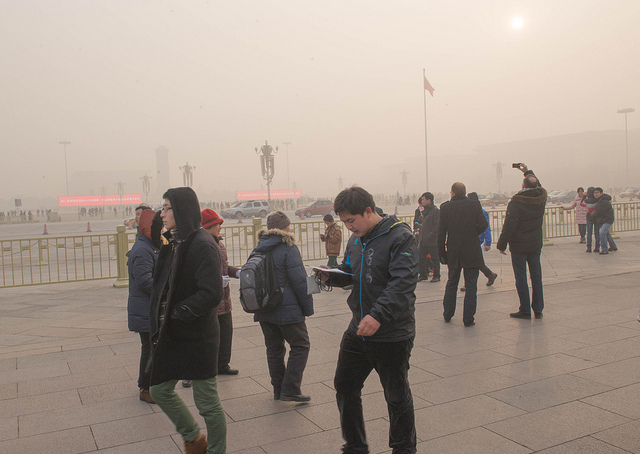
Air pollution in Tiananmen Square, Beijing, in 2013. (Photo: Michael Davis-Burchat, flickr)
Air Quality: Beijing currently faces some of the worst air quality in the world. During the 2014 Beijing marathon, particulate pollution was at 400 micrograms per cubic meter; the World Health Organization’s maximum for healthy outdoor activity is 25. Most participants wore masks and many did not finish the race.
“In Beijing, the ice sports will all be in indoor venues,” Wang Anshun, the mayor of Beijing and the head of the bid committee, helpfully noted in a press conference.
Beijing is in the midst of a five-year action plan to clean up air quality, which is costing about $130 billion and features 84 specific action points.
“At present, the action plan is already achieving excellent results,” Wang said. “Major pollutants in this period have dropped by 17.7 percent as compared to last year.”
After the plan ends in 2017, there are already plans in the works for another five-year agenda leading up to the 2022 Games.
In fact, the bid committee used the prospect of improving air quality in a not-so-subtle attempt to guilt people into supporting the bid.
“This also will be a form of permanent legacy that will benefit the local people of the city and the region,” Wang noted.
In other words: how could you turn this bid down when it will improve quality of life for millions of people, and make the air that they breathe no longer able to kill them?
However, it’s worth noting that an IOC mandate to fix pollution problems has not always in the past led to pristine conditions. Air quality was still a problem at the 2008 Summer Olympics in Beijing, even after much-publicized attempts to solve it by closing factories limiting the amount of vehicles in use. While vast improvements were made, pollution was still worse than in all but the most polluted U.S. cities and about six times higher than at the 1996 Atlanta Olympics.
Immediately after the 2008 Olympics, air quality worsened again, now to those levels seen during the 2014 Beijing Marathon. Improving air quality during the Games did not have lasting effects.
Another case of the IOC struggling to mandate pollution cleanup is in Rio de Janeiro, Brazil. Just a year before the 2016 summer Games, organizers are still struggling to clean up the water in the city. Last summer the IOC brushed off concerns, saying there was still time to clean up, but they now seem more alarmed, and at the recent Executive Board meetings in Lausanne demanded to see progress by the end of July.
Part of the Rio bid was a promise to reduce the flow of raw sewage into the sailing venue by 80%, but officials now acknowledge that will never happen. (More alarmingly, they say that the failure to clean up is irrelevant because the sewage poses no health risks to sailors.)
In other words, if the host city promises in a bid to clean up, the IOC has no real way to hold them to that promise. Statements by the bid committee about air quality do not mean that athletes won’t see significant health risks when they arrive in Beijing in 2022.
Finally, the bid committee says that at the two mountain clusters, air quality is ideal. However, while Zhangjiakou does have the best air quality in its region, it is still not good. In the next two days, for example, air quality is forecasted to dip into the “unhealthy” zone, with the definition “Everyone may begin to experience health effects; members of sensitive groups may experience more serious health effects.”
And local regulations cannot completely solve air pollution problems, anyway.
“Increased energy demand in winter coupled with seasonal weather patterns that can bring pollutants from other regions could create air quality issues across the Games zones,” the Evaluation Commission wrote.
Distances Between Clusters: The Beijing bid will feature three clusters for sports: arena ice sports will be held in Beijing; nordic sports, freestyle skiing, and snowboarding in Zhangjiakou; and alpine skiing and sliding sports in Yanqing.
The bid committee promoted this three-zone idea as a benefit to athletes, who will not have to travel far to reach their venues or deal with the more general hubbub of a compact Olympic Games.
“To ensure the athlete experience, I know from my experience as an athlete that the most important thing is the performance in the Olympics,” said Yang Yang, a gold medalist in short-track speedskating and now an IOC member. “So to minimize the travel times would bring much benefit to the athletes. Having three zones will help the athletes with short distance to travel from the venues to the villages. It will be about 15 minutes, which is a very good benefit to the athletes.”
Aside from athletes, travel times for spectators could be quite long. The bid committee has proposed building a high-speed train system which it says would cut the time needed to travel roughly 200 k from Beijing to Zhangjiakou to 50 minutes.
There’s several problems with this. First of all, the bid committee left the expenses associated with building the network off the books, claiming that it would have built the railway anyway. That’s false, and cut the bid’s budget down to better compete against Almaty. Officials still refuse to reveal the actual cost of the railway.
Secondly, only when pushed did officials admit that actually, it would take longer than 50 minutes to travel between the venues. They admitted that 10 minutes should be added for waiting times to board the trains.
IOC members pointed out that that’s not all; after all, they have to get from hotels to the train stations, and then from the stations to the venues. Members complained that it would likely take them 90 minutes.
And for regular spectators who don’t receive the special treatment of IOC members, it’s likely to be a lot longer. This, along with the lack of a snow sports culture in China, contributes to the strong possibility to sports in the mountains facing empty stadiums. That doesn’t exactly make for the best athlete experience.
Already in 2014 in Sochi, Russia – a country where cross-country skiing and biathlon are successful and popular – seats were empty in the stadiums. This was likely due in part to the sale of multi-sport ticket bundles. A non-ski fan might go check out a sport they had a ticket to if it’s close; if it takes hours of travel each way, they might decide to stay in Beijing.
Lastly, with well-documented catastrophic train disasters and high levels of corruption hindering safety measures in China’s railway construction (you can find an incredible piece from the New Yorkerhere), does anyone really want to be on a high-speed train system where a crash, or even just a decrease in speed, by a train that departed just five minutes earlier could lead to a pile-up?
Human Rights
One of the biggest problems will provide nothing more than a repeat show from the 2008 Olympics. When Beijing won the bid for the 2008 Games, China boldly proclaimed that this was an opportunity for the country to improve their human rights record before they showed off to the world.
That certainly did not happen.
Hundreds of thousands of residents were evicted in the leadup to the 2008 summer Games in order to build new stadiums and infrastructure. The 2022 Games will use some of that infrastructure, so evictions should not be as numerous. But the Evaluation Commission report still estimates that thousands of people will have to be relocated.
And relocation is not something that China handles well. Houses were demolished and when residents tried to protest their evictions or appeal through the legal process, they were arrested, jailed, and sometimes beaten. Citizens have no choice in the matter, and are not provided the means necessary to re-make their life somewhere else.
“Compensation rates have rarely enabled affected people to relocate while retaining the same standard of living,” the Geneva-based charity Centre on Housing Rights and Evictions noted in a 2008 report. “Instead, residents have been forced to move further from sources of employment, community networks, and decent schools and health care facilities.”
Journalists who covered these issues did not fare well, with dozens of members of the media detained in the leadup to Beijing 2008. The Foreign Correspondents Club of China reported that 40% of foreign journalists covering the 2008 Games had experienced some sort of governmental interference, and that since then, conditions for foreign journalists have declined substantially.
Even while reporting on the bid for the 2022 Games there have been incidents. When two foreign journalists tried to visit the site of the mountain cluster and interview locals, government “minders” scared people away from speaking to them and inhibited them from visiting parts of the sites.
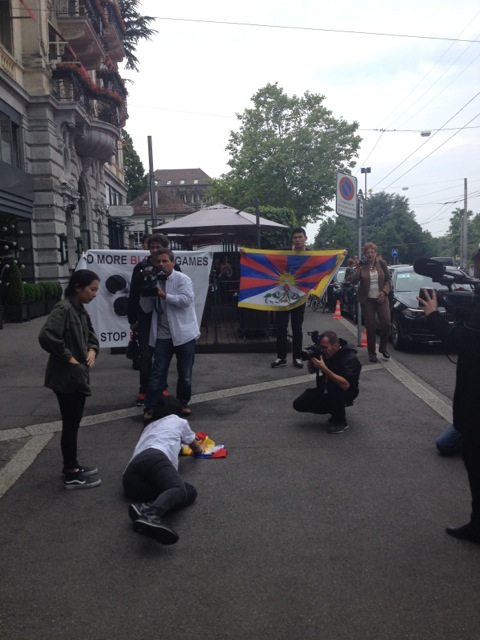
Protestors shouting “Beijing Lies, Tibet Dies” and “No More Bloody Games” appeared outside the hotel hosting the candidate city presentations. Later, another activist snuck into the Beijing presentation room. After unfurling a banner and chanting, he was forcibly removed.
Those outside the media fared much worse. Before the 2008 Games, citizens who spoke to foreign media were sometimes beaten by police in retaliation. According to Human Rights Watch, Chinese who spoke out on a variety of issues, from human rights to the environment or corruption, were often arrested. In some cases activists were kept in prison for longer than the actual term they were sentenced to.
Then there’s the athletes. According to The Guardian, China forbid athletes with any history of dissidence or activism from participating in the 2008 Olympic or Paralympic Games. For instance, Fang Zheng, whose legs were crushed by a tank in Tiananmen Square in the 1989 massacre, was not allowed to compete despite having two national records in the discus.
There’s many other human rights issues in the country. Tibetan activists, for instance, infiltrated the candidate city presentation room in Lausanne last week to stage a protest of China’s occupation of the region. Before 2008, the Olympics were seen as providing a platform for Tibetans to speak out about their oppression. But nothing changed for the better.
If the 2022 bid is successful, that means seven more years of Free Tibet protests. That’s seven more years of the world being reminded that the IOC has chosen to host the largest, most lucrative sporting event in the world in a country that does not support the basic tenets of the Olympic movement.
“The goal of Olympism is to place sport at the service of the harmonious development of humankind, with a view to promoting a peaceful society concerned with the preservation of human dignity,” the second point of the Olympic Charter reads.
Legacy: One of the main points of the Beijing bid is that should they win, they will bring winter sports to “hundreds of millions” of people and provide a lasting legacy. This is how the bid committee appeals to IOC President Thomas Bach’s “Olympic Agenda 2020” plan.
Frankly, this seems unlikely. Even in countries which already have a strong winter sports culture, building new venues in places which are only moderately accessible to the general population has rarely been successful in building lasting legacies.
Let’s look back at Sochi, 2014. The snow and sliding sports venues will certainly never be used again for World Cup competition, and it’s not clear that they are seeing significant use from Russian athletes either. $51 billion were spent to build this Olympics and the mountain cluster is eerily empty. Resorts were operating at losses and renting luxury rooms for as little as $17 per night.
What about Vancouver, four years earlier? Canada has strong nordic, alpine, and freestyle ski programs. But the cross-country and biathlon teams no longer base training groups in the Callaghan Valley, a venue which sees little traffic. Canadian ski jumping and nordic combined struggle to even remain funded. Whistler Sport Legacies has more costs than profits, although some venues, such as the luge and bobsled runs, see a lot of use.
British Columbia and the Canadian Rockies have plenty of alpine skiing opportunities, which is perhaps the reason that the Whistler Creekside venue, which hosted alpine racing for the Olympics, has not seen any FIS-level competition since 2010. Lake Louise, Alberta, beckons instead.
Pragelato, the site of nordic racing at the 2006 Torino Games, has not hosted a FIS-sanctioned cross-country ski race since the World University Games 2007. The luge track has been dismantled for economic reasons, but the hockey and speedskating arenas have hosted other sports events as well as plenty of concerts.
Sestriere, where the alpine racing was held, is still a popular venue for Europeans, but hasn’t hosted a World Cup since 2009. And unlike most other snow sports venues used in 2006-2014, Sestriere was already a high-profile destination for both tourists and elite racers; the Olympics likely did not significantly affect its future.
So even in countries where there are plenty of winter athletes, developing new venues for the Olympics hasn’t contributed much to sports programs. Reaching fans is a different story, but there’s still not much evidence that hosting an Olympics seriously shifts the support for winter sports within a country long-term, aside from a brief flush of enthusiasm surrounding the Games itself.
And considering the high water cost of running the snow sports venues, it’s not clear that they would even be maintained in the long run, especially as climate change progresses.
The bottom line, and the Almaty comparison. Almaty faces some of the same issues that Beijing does.
Air quality is not great in the city, although it is of course nowhere near as bad as Beijing. Kazakhstan is not a model for human rights, and there is expected to be significant corruption should Almaty win the lucrative bid.
But on many points, Almaty comes out clearly ahead. For instance, many stadiums are already built and being used by both Kazakh athletes and to host international competitions like the 2011 Asian Winter Games or the upcoming 2017 World University Games. Almaty has snow, and it has winter athletes; it’s much more likely that the Games would have a lasting legacy improving sports opportunities for residents.
It is also a compact Games, with everything close together, and a relatively cheap one.
What Almaty lacks is the slick, powerful, marketing machine that Beijing has already put into place. Should Beijing win, it will be a clear message that money, financial stability, and glossy PR lines matter more to IOC members than the actual tenets of the Olympic charter.
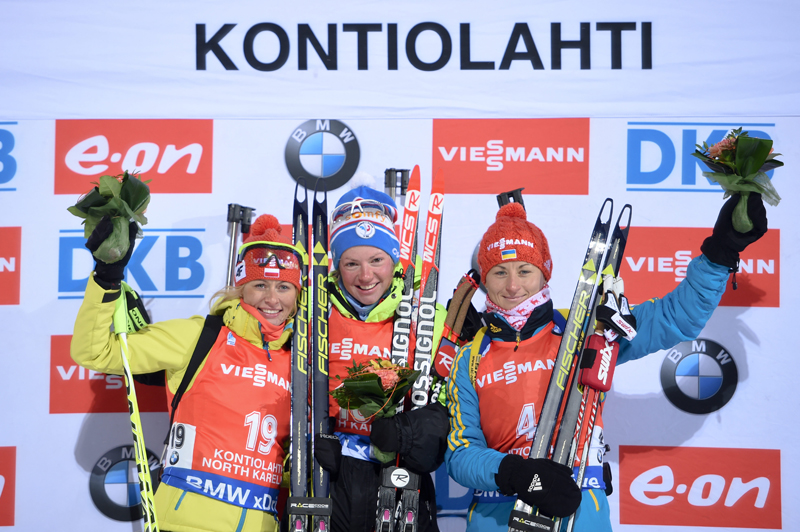
The women’s podium in Saturday’s 7.5 k sprint at the 2015 IBU World Championships in Kontiolahti, Finland. (From l-r) Weronika Nowakowska-Ziemniak of Poland (2nd), Marie Dorin Habert of France (1st), and Valj Semereko of Ukraine (3rd). (Photo: Fischer/Nordic Focus)
KONTIOLAHTI, Finland – While many men complained of the blustery Finnish weather in Saturday’s 2015 IBU World Championships sprint, they would soon become thankful for their race conditions after the start of the women’s sprint. Just half an hour before the start of the race — a 7.5-kilometer sprint — the wind strengthened and was joined heavy snow, making for blizzard-like conditions on the second day of competition in Finland.
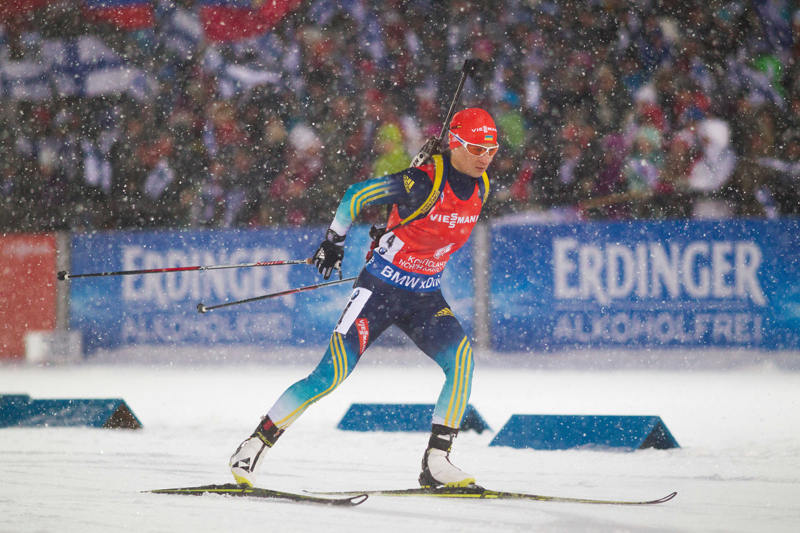
While the weather did its best to subdue the competitors, it was Marie Dorin Habert of France who landed on top of the podium. She earned her first-ever World Championships gold in addition to a first-career victory after cleaning prone and missing one shot in standing to notch a time of 22.16.8. Behind her was Weronika Nowakowska-Ziemniak of Poland, the only competitor to clean both prone and standing. The Polish biathlete, whose silver medal is the first podium of her career, finished 9.6 seconds back. Rounding out the podium was Valj Semereko of Ukraine, who missed one in standing to cross the line 19.7 seconds behind Harbert.
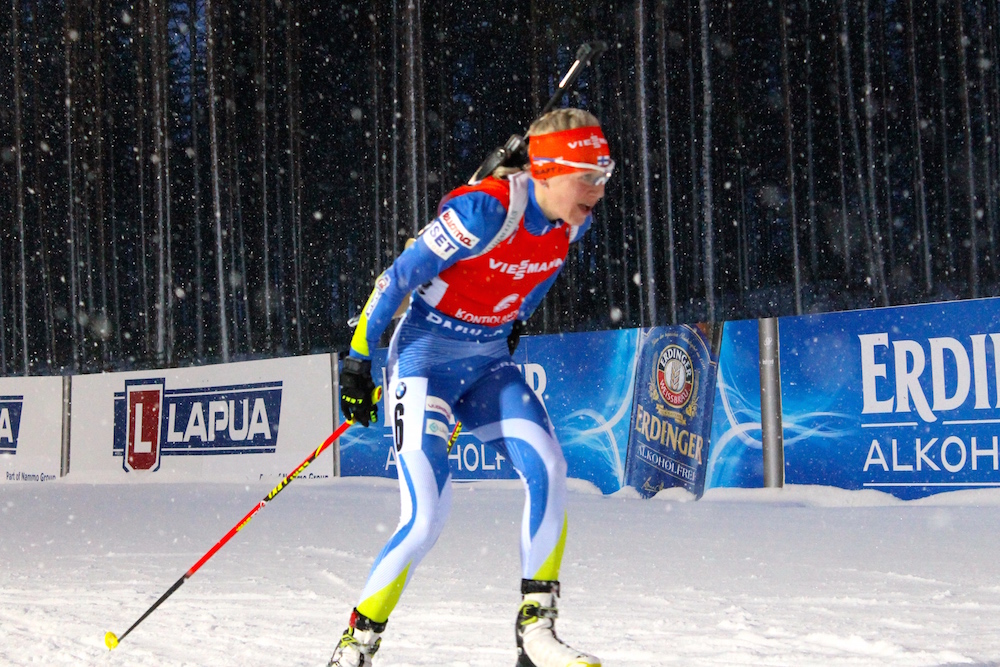
Saturday began with numerous expectations, the most popular of which was a predicted showdown between hometown-favorite Kaisa Mäkäräinen and overall IBU World Cup leader Darya Domracheva of Belarus. Mäkäräinen, who started with bib 6, battled the worst of the weather and faced a slow course that had barely been skied-in ahead of her. When she reached the first shooting stage, the 32 year old had posted the fastest course time on the first loop. But her lead would soon be gone as the Finnish skier missed three shots to the audible shock of the crowd. Mäkäräinen eventually missed two more shots in standing to finish 35th.
Kaisa Mäkäräinen of Finland was a favorite in the 7.5 k sprint but ultimately finished 35th.
Next up was Dormacheva in bib 10. The Belarusian had a promising start after missing one shot in prone and skiing the fourth-fastest course time, but eventually succumbed to the conditions in standing where she missed four of five shots to ultimately finish 25th.
With the two favorites out of contention, an opportunity was presented to the rest of the field. Semerenko, in bib 4, had already finished and posted the time to beat after notching the fastest range and shooting times of the day. Habert, in bib 16, wasn’t far behind Domracheva and chased the Belarusian. In the process, she posted the fastest cumulative time in the first lap. Her second and third laps were the second and third fastest of the day — enough to move her past Semerenko.
Meanwhile, Nowakowska-Ziemniak was three starters behind the Frenchwoman. Where she failed to match Habert in course time she overcame in range speed, earning the seventh overall ranked time on the day. After she cleaned the second round of shooting, the Pole worked to make full use of her advantage. In the end, however, it wasn’t enough to overcome Habert.
According to Habert, she knew before the race that a podium was likely but never expected to take her first individual gold in the 7.5 k sprint.
“I didn’t expect it was possible for me” she said in a press conference. “I wanted to be on the podium, but to win I think that it’s too hard for me, but it was done so it was nice.”
Habert explained that she didn’t mind the conditions, but acknowledged that her favorable view of the strong wind and blowing snow was likely due to her victory.
“It was hard conditionsn but it’s right for me so I’m happy for these hard conditions,” she said. “It was hard on the track because of the snow and shooting range because of the wind, but today it was nice for me.”
Valj Semereko of Ukraine racing to bronze in Saturday’s 7.5 k sprint at teh 2015 IBU World Championships in Kontiolahti, Finland. (Photo: Fischer/Nordic Focus)
The French biathlete gave birth in September. While she trained during her pregnancy, Habert said that she was uncertain as to how she was able to come back for such a successful season.
“Maybe I’m stronger before,” she explained. “I don’t have an answer of this progress, but I’m happy I’ve progressed.”
In second place, Nowakowska-Ziemniak said that she believed the 2015 World Championships would be her last prior to her podium. With Saturday’s silver medal, however, the Polish biathlete said that the joy of being on the podium might convince her to stay in the sport longer.
“I didn’t win, but I’m sure that I am the most happy person today here,” she said in a press conference. “It’s an amazing moment here in my career.”
Two of Nowakowska-Ziemniak’s teammates also finished in the top 10, with Krystyna Guzik in fifth and Magdalena Gwizdon in seventh. The bronze medalist explained that although the Polish women faced a hard season where results failed to live up to expectations, she was proud of her teammates for performing when it mattered.
“As a team, we’ve got many problems during this season with the shape but I’m triple happy that the whole team showed today that we are really strong and we deserve to be this high in the world,” she said. “I’m very happy for myself and for my teammates also.”
The sprint’s bronze medalist, Semerenko, has been on the podium four previous times this season and said that her main objective on Saturday was to achieve a solid position for Sunday’s pursuit.
“This is indeed a very good season for me,” Semerenko said. “I’m very happy about this race although I didn’t expect to be on the podium today, but I wanted to be close for pursuit race.”
Megan Heinicke racing to 23rd in Saturday’s 7.5 k sprint in Kontiolahti, Finland at the 2015 IBU World Championships. (Photo: Fischer/Nordic Focus)
Canada’s Heinicke Skis to 23rd; North Americans Left Wanting More
The snow and wind took a hard hit on the North Americans as they battled the elements to ski and shoot to the best of their abilities.
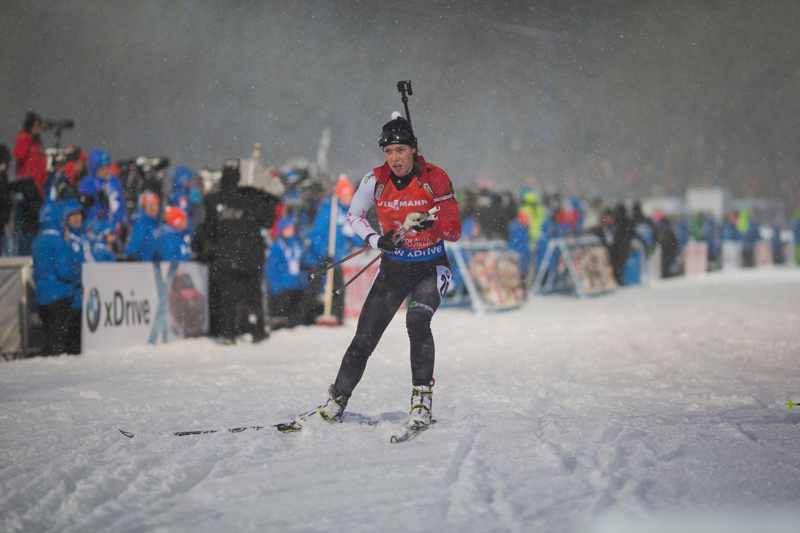
Canada’s Megan Heinicke was ultimately the top finisher in 23rd after missing one in prone and cleaning standing. Although she had the 78th-fastest course time, Heinicke was able to notch a top-30 result with precise shooting and the 18th-fastest range time.
“I was really happy with the shooting,” Heinicke said in a post-race interview. “Standing I was really satisfied with because I waited and I took the shots in the right moment. Usually standing shooting in the wind is something I’m not super confident about, and I feel like it’s been a weakness over the last years, so I’m really satisfied with the standing today.”
Heinicke was originally slated to start World Championships on Thursday in Canada’s mixed relay, but sat out to continue recovering from illness in Germany.
“I have been sick for 17 days out of the last 30, and I have two more days of antibiotics to go so I flew in late and didn’t do the mixed relay,” she explained.
The 26 year old said she entered Saturday’s sprint with no result-oriented goals, but instead was focused on shooting well and skiing smart. She was also aided by the earlier success of her teammate Nathan Smith, who was the first Canadian male to earn a World Championships medal after placing second in the preceding 10 k sprint.
“I was getting ready for the race and I was like, ‘I’m not gonna cry, just focus on your own race,’ ” Heinicke said. “I feel like we have a few athletes that have been flirting with the podium so it’s just really, really amazing to have someone do it.”
Behind Heinicke in 32nd was teammate Rosanna Crawford. The 26 year old, who was one of the first starters in bib 5, just ahead of Mäkäräinen, dealt with the worst of the blowing snow but managed to notch the 10th-fastest split in the first loop after cleaning prone. It was in standing that Crawford ran into trouble, ultimately missing three shots and losing precious time.
“I knew it was going to be the hardest in standing,” Crawford said in an interview. “Maybe I accepted defeat before I even got to the range.”
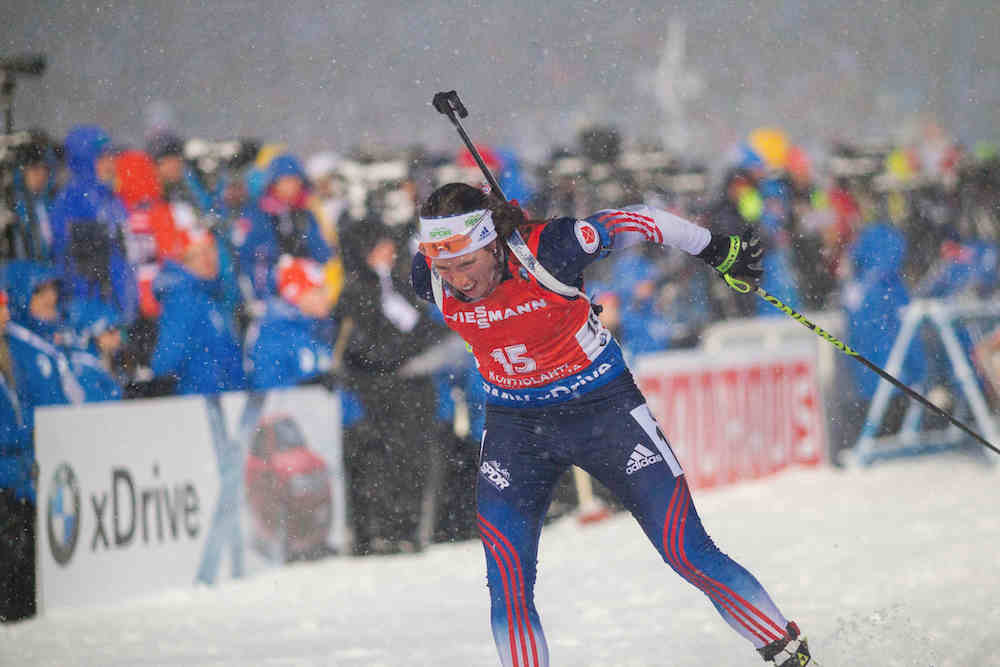
Susan Dunklee racing to 42nd in Saturday’s 7.5 k sprint at the IBU World Championships in Kontiolahti, Finland. (Photo: USBA/NordicFocus)
Once in the penalty lap, Crawford explained that the loop was incredibly slow due to the new snow and lack of skiers ahead of her.
“The penalty loop was awful because nobody was had been skiing in it,” she said. Crawford added that while she faced an “uphill battle” in her quest to qualify for the World Championships final mass start next weekend, she is looking forward to racing again.
The next North American and top U.S. biathlete in the women’s sprint was World Cup newcomer Clare Egan. A late starter, Egan said she benefitted from the break in snowfall that occurred midway through the race. However, the break in weather wasn’t the only reason for her success. According to the former University of New Hampshire skier, the steep hills on the 2.5 k course suited her skiing and aided her in qualifying for her first World Cup-level pursuit.
“[The course] has a really big climb in it and I pushed up that climb,” Egan said. “I’ve been working a lot with our coaches since we’ve been here on how to ski the flats and I think I did a pretty good job with what we’ve been working on.”
Egan missed two shots in both prone and standing, but said that compared to her previous World Cup shooting record, Saturday’s performance was an improvement. Prior to the World Championships sprint her previous best result was 73rd in a Nove Mesto sprint earlier this season.
“I wish I would have shot a little better, but honestly, I think I missed four in standing in both the other World Cup sprints I’ve done. Today I only missed two so that was an improvement and hopefully I’ll keep improving,” she explained.
Just two places behind Egan was veteran U.S. biathlete Susan Dunklee. The 29 year old has consistently placed in the top 30 and is no stranger to the top 10. In the sprint, Dunklee explained she lost confidence in the shooting range. She missed one in prone and two in standing, and marked the 101st-ranked range time of 103 finishers.
“I’m really bummed,” Dunklee said after the race. “I spent more time on the range than maybe ever. I was one shot at a time because it was so windy and so gusty. I just kind of lost my rhythm and flow and confidence, especially in the standing.”
While Dunklee acknowledged the difficult weather was a factor in her shooting, she said it was a part of racing that every competitor had to deal with. According to Dunklee, she entered the sprint with the goal of performing at the level she’s been at in the 2015 season, but hoped for something even better.
“I did want it, maybe a little bit too badly,” she said. “That’s the curse.”
First-time World Championships competitor Julia Ransom of Canada cleaned prone to rank 13th after the first shooting but fell to 52nd position after missing three in standing. She said she was very pleased with her result, which was the best of her World Cup career.
“I’m pumped. It’s the first pursuit I’ve made on World Cup and it’s been a really big jump from IBU Cup to World Cup so I’m happy,” Ransom said.
Ransom is no stranger to Kontiolahti. In 2012, she earned a silver medal in the Junior World Championships pursuit. Although this year is her first senior World Championships, Ransom said that the experience hasn’t been too different from the World Cups she’s attended.
“It’s feeling relatively the same. Nothing too exciting, but racing at night is fun, different. We’re going to bed at midnight, waking up at 9:30 and 10,” she said. “It’s the same faces just different names.”
Finishing 61st, U.S. biathlete Hannah Dreissigacker was one spot away from qualifying for Sunday’s 10 k pursuit. Dreissigacker said that she was interested to review her shooting with her coaches, as she was surprised the wind affected her so negatively.
“It was windy so I’m sure that affected me. Normally in prone, I’m not intimidated by the wind. I take clicks and I’m confident,” she explained.
Teammate Annelies Cook finished 68th and said her skiing felt much better than it had all season. At the same time, she explained that she was disappointed in her shooting. “I felt good skiing, but I let myself down in my shooting,” she said. “I definitely struggled a lot in standing with the wind, and I made a careless mistake in prone, accidentally pulling the trigger when I didn’t mean to.”
Canadian Audrey Vaillancourt ended the day in 77th and said that while the day was bad for her, she was read to move on to the next race.
“When I came into prone it was like a tornado. Prone is not that bad normally. I don’t think I clicked enough. It was very, very hard today,” she said.
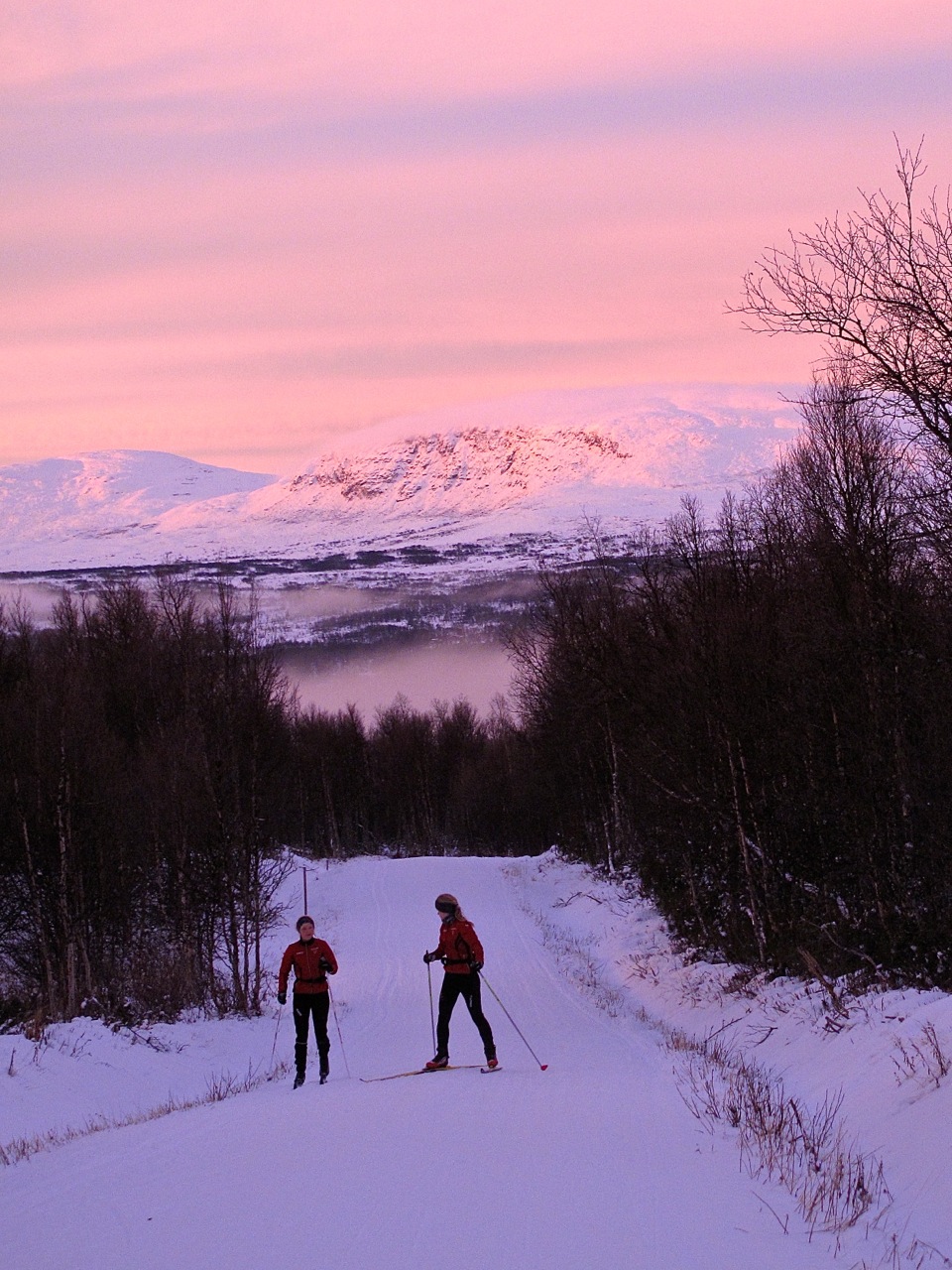
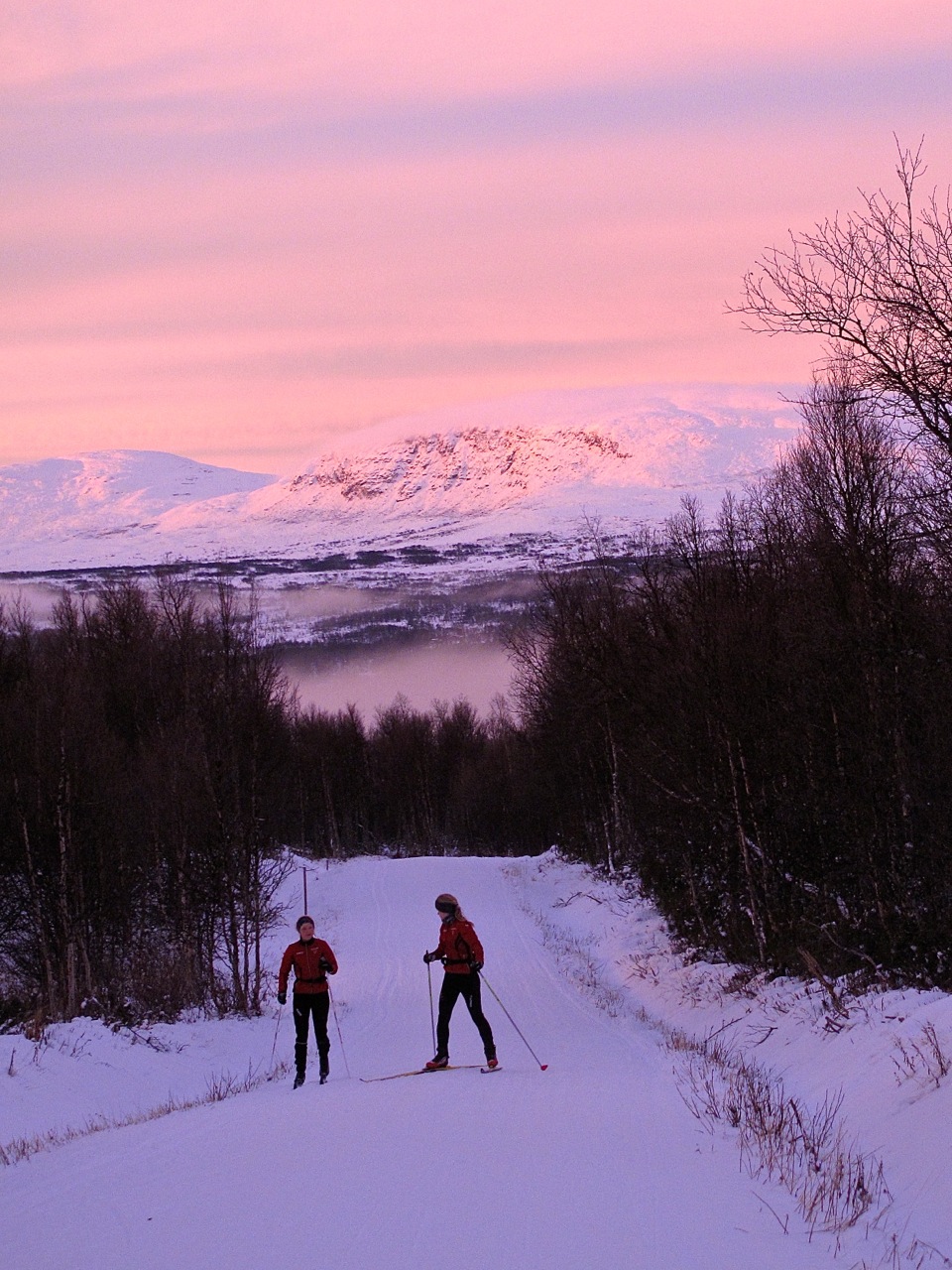
Early morning in Bruksvallarna. Photo: Simon Evans.
About the author: Simon Evans is a British postdoctoral researcher in the Animal Ecology department of Uppsala University’s Evolutionary Biology Center, and an avid skier. In 2013, his second year in Sweden (and thus his second year skiing), he finished the 90 k Vasaloppet in five hours and 57 seconds, placing him 692nd of the 15,800 total participants. Unsurprisingly, he was the first Brit. He is now planning a long-distance bike trip in northwestern Canada.
Uneasy in the icy conditions, I move out of the tracks for the steep downhill route that leads – via a tunnel that I am going to have to negotiate at speed – to the relative tranquility of the flatter tracks alongside the river. It’s my first time on skis for the winter and I am aware how conspicuously I look like Bambi as I struggle to portray myself as anything other than Horrendously Misplaced Brit, a characterisation my Swedish friends – schooled to ski from a young age – so often amuse themselves with. On this occasion, though, I was out of the door and clipping in my boots whilst they slept off our late arrival the previous evening. The result is an absence of sympathetic, friendly faces to turn to for reassurance, as far more accomplished skiers – Charlotte Kalla, Jörgen Brink and the Thunell brothers, to name a few – effortlessly glide past, seemingly immune to the difficulties I face, and clad in bright kit that boldly pronounces their national allegiances. My confidence takes a battering and after a couple of short loops I beat a hasty retreat to the safety of the lodge, consoling myself with unconvincing mutterings about “the wrong kick wax”. But how did a guy raised in a seaside town in southern England come to be sharing the tracks with some of the sport’s biggest names?
I moved to Sweden two years ago, having completed my PhD in the UK and been offered a job at Uppsala University, a small city about an hour north of Stockholm. Eager to make the most of what Scandinavia has to offer, and having been a keen runner, cyclist and university rower, the decision to take up cross-country skiing was an easy one. So it was that within a month of arriving in Sweden, I found myself in one of Uppsala’s sports stores worrying how a complete novice – and an appropriately impoverished graduate to boot – can justify spending several thousand kronor on a couple of thin planks and some flimsy carbon fibre poles.
Yet, as you probably already know from your own experience if you’re visiting this website, cross-country skiing is an enormously enriching pastime, so it didn’t take long before I was hooked. For someone with a marked sensitivity to the cold (and an accompanying hatred of being chilly), this speaks loudly of just how enjoyable Nordic skiing is. The weekends of my first winter were spent tracing circles across a frozen lake, the only place where the marginal snow depth of that year didn’t pose a threat to the precious base of my skis. As my second winter approached, my local ski shop’s friendly assistant, endlessly plagued by my questions on glide waxes, optimal skier weight and the rolling resistance of roller-ski wheels, pushed a pamphlet for the local ski club into my hands. I tentatively attended my first training session a few weeks later and, whilst my self-taught technique raised much amusement (“your technique is about 40 years out of date”, somebody eventually ventured to tell me), everyone was welcoming. My technique remains pretty rough, but I at least know now what I should be striving (and striding) for.
Now, with my second year of skiing behind me and my third winter in Scandinavia approaching, I joined a few club mates for an early-season trip to Bruksvallarna,in the Swedish mountains. Being decidedly less fashionable than their Alpine counterparts, Sweden’s ski resorts offer much better value for money, and my share of our lodge cost me 800 kr for four nights. This, for a lodge that was sited less than fifty metres from the tracks. And – this being Scandinavia – equipped with its own sauna.
We arrived a week after the snow in Funasfjällen, the umbrella name for the five neighbouring skiing resorts that have interlinked their ski trails and other aspects of their organisation, to create what is, in effect, a meta-resort. Whilst the other centres were yet to start preparing trails, at Bruksvallarna (or ‘Bruks’, as it’s generally called by those in the know) the snow machines had been working overtime to create thick trails in advance of the opening FIS races scheduled for the following weekend, from which Sweden would choose its World Cup team. There were thus a couple of fairly technical loops open and in heavy use, by both national teams and serious club skiers who were eager to get in some early training on the white stuff before it arrives in places like Mora.
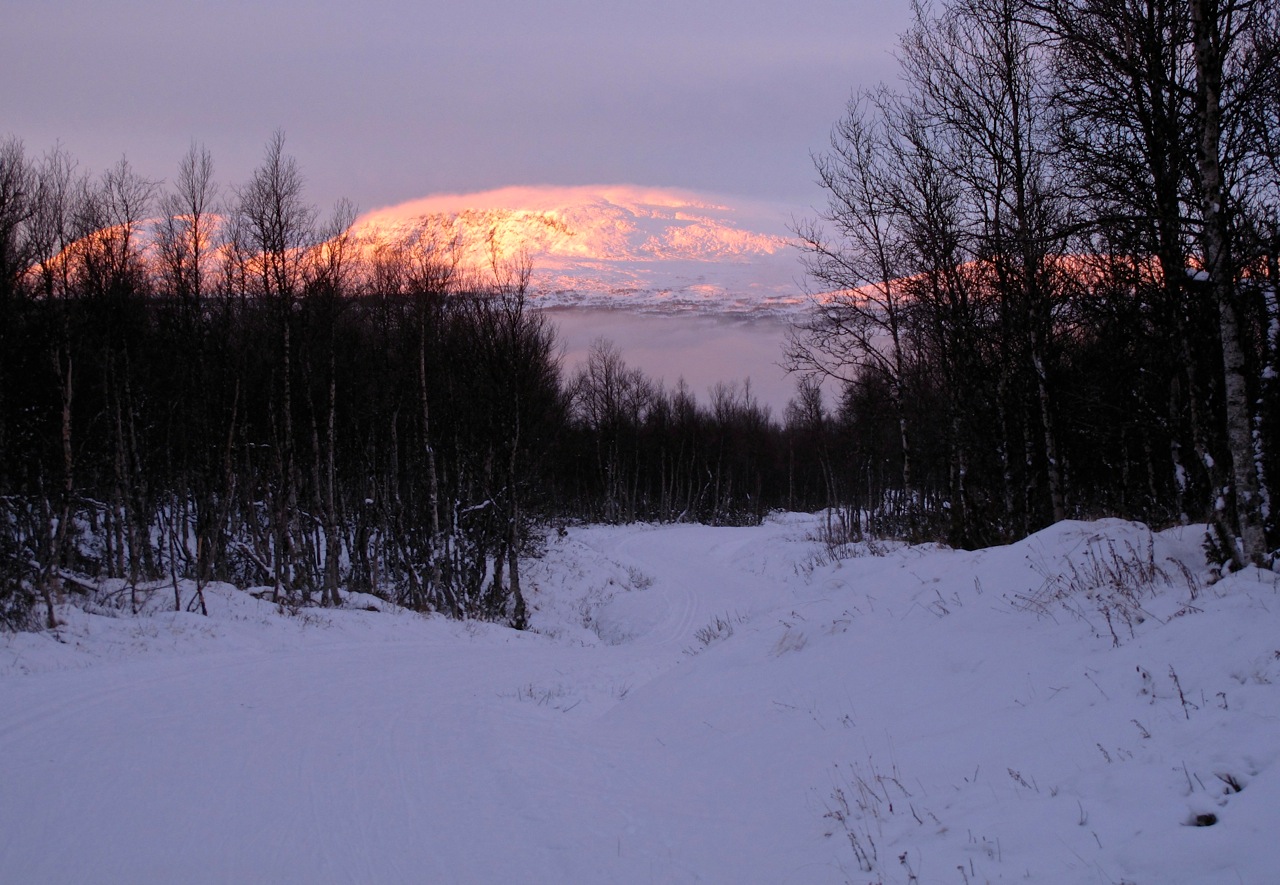
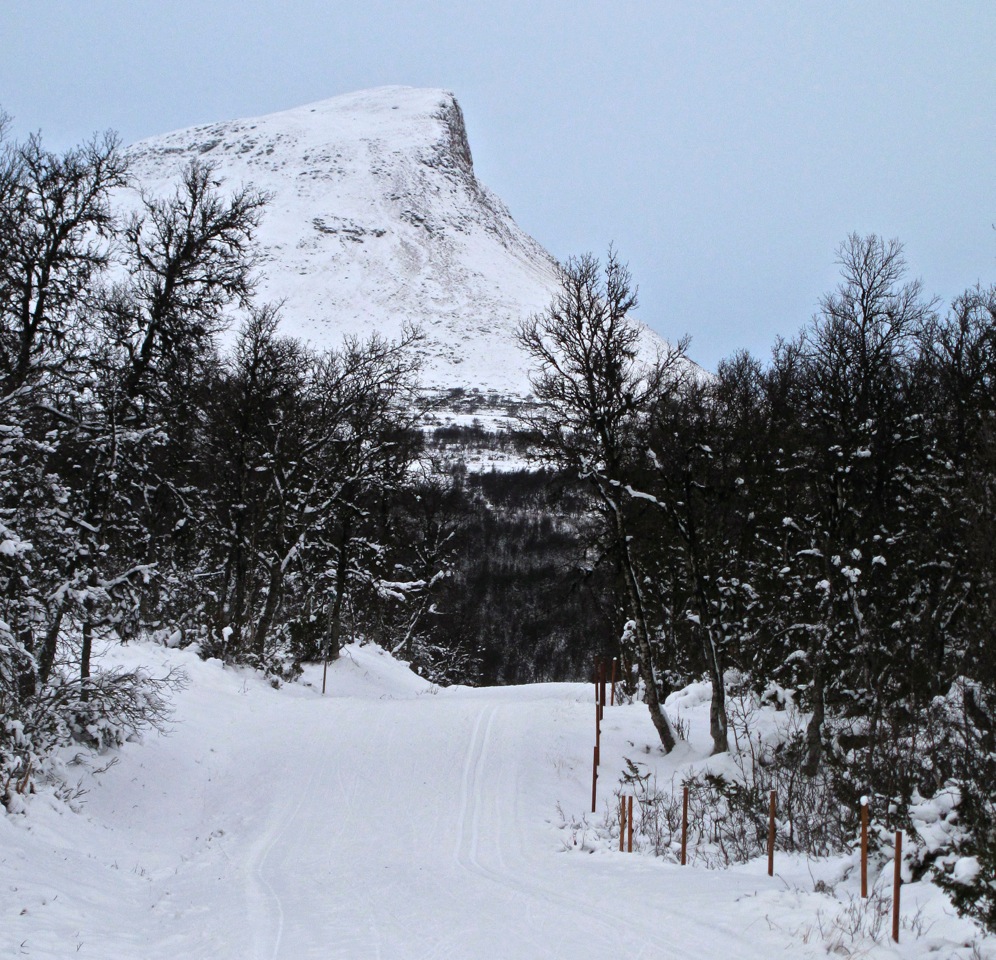
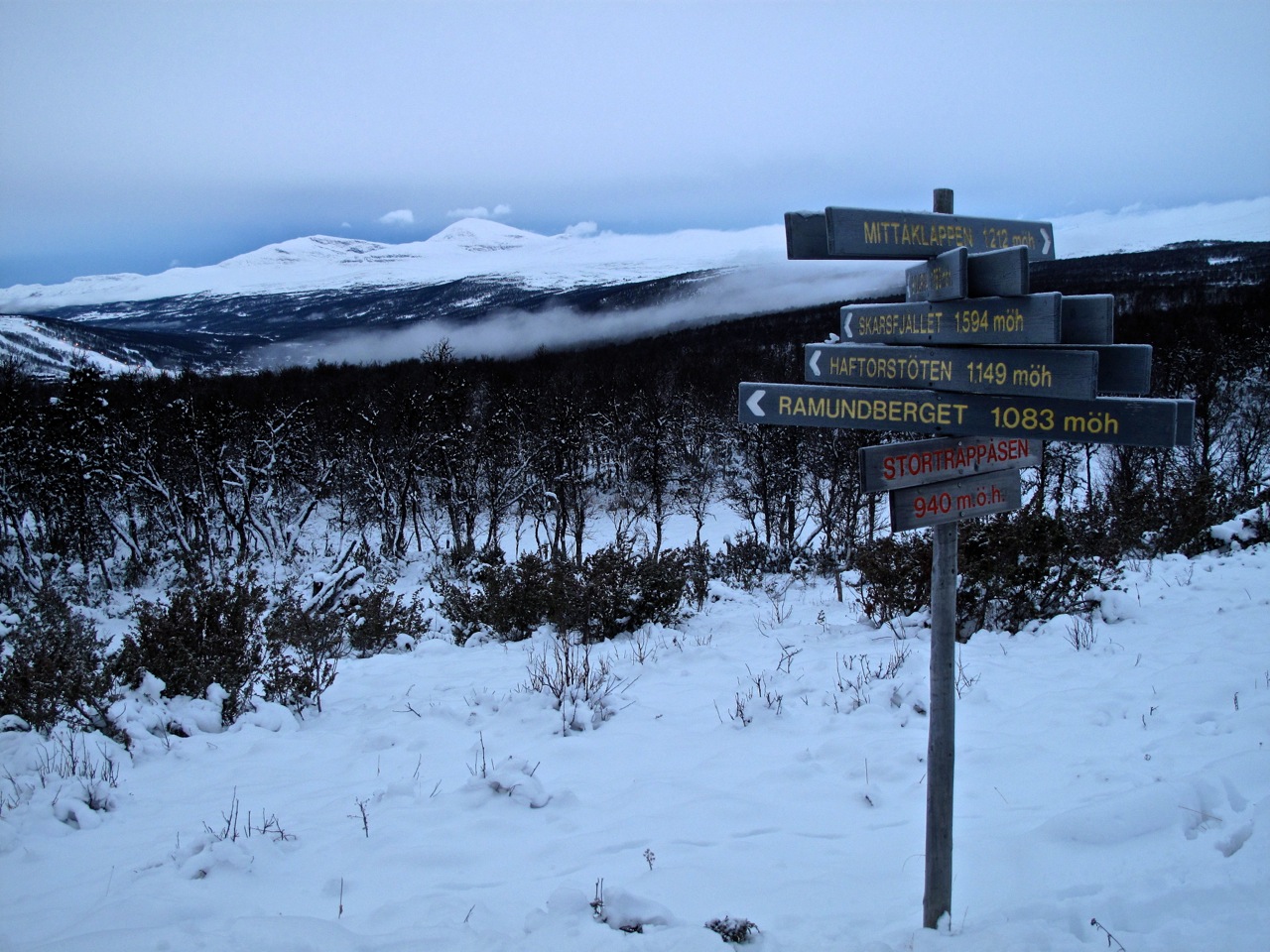
Alongside these loops, there was also a trail open that led up the slope overshadowing Bruks, which climbs steadily for perhaps 5 k. The high plateau and offers great views of the ski slopes of Ramundsberget, the northernmost of the five resorts that nestles into the head of the valley. The Mittåkläppen trail then descends into a depression in the plateau, terminating at a river crossing some 11k from Bruks. After my ‘Bambi’ moment and a cup of tea in the chalet to restore my bravado, it was up the mountain that I fled, where I could remind myself how to ski without feeling embarrassed in front of more accomplished practitioners. More relaxed, having found myself alone on the trail, with the aggressively undulating terrain of the trail loops down in the valley replaced by a satisfyingly elongated ascent (for some reason, I love going uphill), my limbs started cooperating. And the views from the ridge top are pretty special, more than enough to draw a smile on my face as I sucked in the pleasingly cold air and tried to focus on the technical flaws my club’s coaches had highlighted during the autumn’s roller-skiing. Here, on snow rather than a rural road, the skis slid near effortlessly with each heave of my quads or push on my poles. Having earlier arrived back at the chalet in a state of intimidation (at both skiing and skiers), I returned in a state of reverie, that feeling of wonderful bliss that accompanies many ski outings. And for me, that’s one of the greatest features of this addictive sport, that the simple act of a training ‘run’ takes me into some stunning terrain, beautiful scenery that I am immersed in as I traverse the landscape.
So it was that I largely abandoned the valley tracks over the next few days and instead pursued the vistas that the ridgetop track presented. I’d set my alarm to rouse me while it was still dark, distractedly eat some breakfast as I gazed out of the window at the oncoming daybreak, and then dash up the mountainside so as to be above the treeline as the colours of dawn were thrown over the peaks and gradually spilled down the slopes. By the time I’d made it to the trailhead and was on my way back, the sun would be flirting with the horizon.
It was still very early to be skiing, and we were lucky that fresh snow fell in the days before we arrived. We enjoyed two good days but on the third the wind turned, bringing warmer air that forced the mercury up and the thin covering of snow on the Mittåkläppen accordingly began to subside. As long as the accumulated efforts of the snow machines left the valley tracks unaffected, I persisted with my morning routine (although now armed with universal klister), eager to get my fix of mountain sunrise. However, with a lot of debris on the snow and the tracks barely existing, I struggled for grip on the long ascent out of the valley. So I unexpectedly began the next phase of my development as a nordic skier: skating. And this proved something of a revelation, for I discovered that freestyle is not necessarily the brash upstart I had assumed it to be. Rather, it had a serene rhythm all of its own.
This unplanned introduction to a whole new dimension of skiing challenges would make the long drive into the mountains worthwhile on its own. But when placed alongside the confidence regained, the friendships made and the household names spotted, our short break in the early season snow was even better than I had hoped.
Now, back in the flatlands of Uppsala, with the mountains and skiable tracks of Bruksvallarna far beyond the horizon, my clubmates wait impatiently for the arrival of snow. As for me, I’ve got more pressing concerns: which skate skis should I buy?
2011 U.S. Nationals was one of many races held with very little snow in the last few years. Here, one of the two main climbs on the Rumford, Maine, distance course before the races.
Twice now, Chris Steinkamp has gone to Washington.
And these weren’t just any old trips to Capitol Hill. Although Steinkamp, the Executive Director of Protect Our Winters (POW), met with myriad congressmen, his “coworkers” on the trips were also legendary: nine-time “Big Mountain Rider of the Year” Jeremy Jones, who founded the nonprofit. Olympic silver medalist and X Games champion snowboarder Gretchen Bleiler. Chris Davenport, the first big-mountain skier to conquer all 54 of Colorado’s 14,000-foot peaks. Jones’ brother Steve Jones, founder of the ski-film behemoth Teton Gravity Research.
The goal for the delegation was to encourage politicians to pass meaningful climate change legislation. Climate change is real, they said; humans are causing it, with the huge amounts of carbon dioxide and other greenhouse gases we emit into the atmosphere every year, far above natural levels. Over years of traveling the globe, the skiers and riders had watched firsthand as winters became less and less entertaining.
The interviews with congressmen didn’t go badly, but Steinkamp left knowing that the organization had to do more.
“Athletes give a very clear picture of how climate change has already begun to impact our sport, our industry, and the economies of the communities that depend on consistent winters and consistent snow for their economic survival,” Steinkamp said in a conference call with the Natural Resources Defense Council earlier this month. “But the response from senators on both sides was, ‘Great, thank you. But can you tell me what the effect is in my state when it doesn’t snow? I need to know this before I can think about climate legislation.’”
Like everything else in Washington, climate change legislation comes down to money – and which side can convince Senators and Representatives that the opposition will kill the economy. Unfortunately, while personal stories from the likes of Bleiler and Devenport were compelling, the POW crew “didn’t have an answer for them” about the money.
“We left with a clear mandate,” Steinkamp said in the conference call, which FasterSkier participated in. “If we were going to have any impact on climate change, the winter sports community needed to place a value on winter. We also heard that climate legislation was a jobs-killer.”
Steinkamp and the athletes knew that wasn’t true. The second trip came late in 2011, as the worst snow season in years was just getting started in all of its brown, rainy glory.
“We were hearing from our corporations, businesses, small resorts, and friends, that jobs were being lost, businesses closing, and resorts trimming staff,” Steinkamp said. “Lack of snow was having a direct economic impact on thousands, many of whom were friends and family.”
So POW – a handy acronym for a group of winter sports enthusiast who want just that – went out to get the data. They partnered with the Natural Resources Defense Council (NRDC) and the University of New Hampshire’s Natural Resources and Earth Systems Science program, whose PhD candidates Elizabeth Burakowski and Matthew Magnussson recently completed a wide-ranging report for the two organizations.
The numbers are in one sense staggering, but in another not altogether surprising to observant winter sport enthusiasts. In the last decade, employment typically declines by six to thirteen percent in a bad snow year compared to a good one, representing 13,000 to 27,000 jobs. In that decade, bad snow years have combined to cost the winter tourism industry over a billion dollars in lost revenue.
“The key thing to understand here is that snow is currency in the 38 states that benefit from the $12.2 billion winter tourism industry,” Burakowski said in the conference call. “If that currency is undermined by climate change then the industry, not just the manufacturers but the resorts, lodging, grocery stores, restaurants, and bars, is very much put at risk.”
By the Numbers: Scary
One thing that is inarguable is the warming that has already occurred in the United States. As the report – which you can download here from the NRDC – notes, average winter temperatures (December through February) have declined by 2.2 degrees Fahrenheit since 1970.
A separate report by the European Environment Agency earlier this year found that March and April snow cover across the Northern Hemisphere has decreased by seven to ten percent in the last forty years. Correspondingly, the National Ski Areas Association conducted a survey at the end of the 2012 season and reported that 50 percent of U.S. resorts had opened late that year and 48 percent had closed early.
The fourth-warmest winter on record in the United States and the third-lowest snow cover since 1966, when scientists began tracking it, 2012 resulted in nine million fewer tourist visits for the alpine ski industry compared to a typical good year. Snowmobile registrations have been on the decline since 2004. The researchers did not analyze economic or visitor data for nordic ski areas at the national level.
“It’s something we would have been interested in, but there isn’t really good data compared to the alpine skiing,” Magnusson told FasterSkier. “So that’s the primary reason that we weren’t able to come up with better information for that industry.”
Burakowski, however, has examined nordic skiing before. During her masters degree she completed an analysis of the effects of climate change in New Hampshire specifically, and found that nordic ticket sales decreased by 29 percent between 1984 and 2006, with an economic impact of over half a million dollars in that small state alone.
Sadly, the changes will only get worse. The study noted that temperatures will rise between four and ten degrees by the end of the century – or even worse in Alaska, as warming will be the most severe in the Arctic. That state will see an eight to thirteen degree rise in temperatures.
In some areas of the Rocky Mountains, snowfall could drop to zero by 2100. New York and New England can expect a 50 to 75 percent decrease in number of days with snow cover. The Pacific Northwest and the Sierra Nevada mountains could see 40 to 70 percent less snowpack in the next forty years alone.
Both the meteorological and economic forecasts vary significantly by region, and even at a finer scale.
“The lower elevation that your mountains are, the more likely that you’re going to be vulnerable to climate change and lose your snowpack,” Burakowski said. “At higher elevations, the snowline is likely to move up the mountain and you could retain some snow at the higher elevations. But overall the trend is for much more snowfall to come in the form of rain at lower elevations. And the further north you are, the more likely it is that you might have more snow in the future.”
Meanwhile, she predicted that big-ticket locations like the Rockies might be able to retain more of their tourist dollars.
“Colorado might be a little insulated because people book their vacations months in advance, and aren’t as tied to the snowfall,” Burakowski explained. “That’s different than a place like New Hampshire, where you get a lot of commuters coming up from the Boston area.”
Adaptation Isn’t Enough
Also on the conference call was Auden Schendler, the Vice President of Sustainability for the Aspen Skiing Company. While Schendler has been outspoken about climate change and what it means for his industry, Aspen is in the minority of resorts in terms of even having anyone with his job description.
“Auden Schendler at Aspen is the only high profile guy I know of who’s really taken the bit in his teeth–he’s a good guy,” climate activist and nordic ski enthusiast Bill McKibben wrote to FasterSkier in an e-mail last week. “We need it to spread. You know [Middlebury College coach] Andrew Gardner has been pushing hard in the nordic world.”
While Schendler’s credentials include a stint at the Rocky Mountain Institute, one of the nation’s most highly-respected environmental think tanks, he’s definitely in the minority among ski industry higher-ups. And as a result, his determination to address climate change is rare.
“The CEO of Hunter Mountain was recently asked about climate change,” he said. “And he said, yes, it’s absolutely happening. But then he said, I don’t know if this is a natural cycle or not. Well, the CEO of a ski resort is fiscally obligated to know if it’s human-caused or not, because the answer to that, which is pretty straightforward, enables you to solve the problem or not.”
So education is clearly lacking in the snow sports industry. Schendler said that he would love to see, for example, NASA meteorologist James Hansen invited to speak at the National Ski Areas Association annual convention. So far, that hasn’t happened.
But a large number of executives, Schendler said, know that climate change is real and perhaps even that it’s caused by humans. Unlike the Hunter CEO, they just choose not to take political action, instead tending towards adaptation, for instance installing more snowmaking or working to minimize their carbon footprint.
If the reasons are economic, then resorts are hiding from a false foe. Schendler used numbers to explain why legislation to reduce greenhouse gas emissions wouldn’t hurt a resort’s bottom line, even if the cost of electricity went up. Power represents roughly two to six percent of a resort’s budget; even if that increased by another point or two, the change could be erased by improving efficiency.
“Whereas climate change, if we see increased drought and big flooding events like the one that destroyed the base lodge at Killington [during Hurricane Irene], or the drought that cost Mammoth Mountain 20 million dollars last year, the impact is wildly disproportionate,” Schendler said.
Furthermore, adaptation is not a good strategy, according to Burakowski. As temperatures have climbed, nighttime minimums have increased more quickly than daytime average temperature. Snowmaking requires temperatures below 28 degrees, which are fewer and farther between on winter nights. So although alpine resorts and an increasing number of nordic areas (as recently featured in the New York Times) are extending their seasons by adding snowmaking, at some point it will be too warm to blow manmade snow.
Then there’s the issue of water. With less precipitation in the forecast, particularly in the mountain west, droughts will become more common and water rights an even bigger issue. Areas in the Rockies may struggle to find the larger and larger amount of water they need to cover their trails every year, or at least to justify using the water for such a recreational purpose.
Finally, Burakowski said, nordic ski areas as well as other industries such as snowmobiling will be hit harder than the opulent alpine ski world.
“I think it’s a pretty good guess that they will be hit a little bit harder than the alpine skiing industry, because they can’t compensate with extensive snowmaking,” she told FasterSkier. “It’s a trail system that is much more dispersed, and it’s not as concentrated on one mountain.”
Why No Action?
Across the board, conference call participants were puzzled as to why the snow sports industry hasn’t publicly called for climate change legislation.
“We know that if it doesn’t snow, we’re going to have less revenue,” Schendler said. “We will have less jobs for people. It’s harder for people in ski towns to feed their families. There’s less tax base for schools. There’s a monetized risk, and the solution should be for the ski industry leaders and trade group leaders to get off their asses and move as if this was an existential threat to their existence. Which it is.”
It’s true in the nordic world, too. While neither the United States Ski and Snowboard Association nor Cross Country Canada (CCC), for example, deny climate change – both mention it occasionally, even on their websites – neither organization appears to have made waves in trying to use their clout to address the problem.
“Global warming is a factor that will inevitably have an impact on cross-country skiing at different levels (e.g. accessibility and dependability of skiing conditions, duration of season),” CCC wrote in its strategic plan for 2018. “The exact nature and immediacy of these impacts is uncertain. As an immediate concern, short-notice cancellations and/or relocations of international competitions is becoming a significant expense for CCC, due to the related travel and accommodation costs.”
But the strategic plan made not reference to any strategy to minimize the future effects of global warming on the sport.
“I fear we’re at the point where structural change is required, which means politics, which means rocking the boat,” McKibben wrote. “Most industry types don’t like to do that–but you’d think the ski industry, above all others, would realize their backs are to the wall.”
For her part, Herzog of the NRDC called for the industry to “take its head out of the snow before it melts,” asking, “How long will people keep coming to the slopes after multiple bad snow years?”
One possible explanation for inaction is the fear of alienating potential customers. Burakowski cited research by fellow UNH investigator Larry Hamilton, which found that climate change was the most divisive issue in politics today – more divisive than abortion, gay marriage, or gun control.
Schendler cited a recent letter signed by over 100 ski resorts supporting a tax credit for wind power. Nowhere in the letter was climate change mentioned.
That doesn’t make much sense to Schendler, who feared that ski resorts would run themselves out of business, and destroy their communities in the process, if something didn’t change radically in the next few years.
“Unless these resorts start to explicitly talk about the issue instead of beating around the bush, it’s not going to be effective in driving change in Washington,” Schendler said, later describing what that would mean to his home in the Roaring Fork Valley. “It would essentially be sacrificing mountain communities throughout the West – that would be no fun and it doesn’t make any sense, especially when we can deal with this problem.”
If it wasn’t clear already, he’s disappointed in the ski industry.
“The response has been defensive, in large part, which has been to say that the ski industry isn’t responsible for a lot of emissions and we’re doing a lot on our own,” he said in the conference call. “Which is a puzzling response to a threat to the business which is increasing so fast…. this is business, this is industry. And if people say that we need action, we can make a significant difference.”
Athletes and Enthusiasts
As McKibben pointed out in his e-mail, industry can not only make a difference in reaching congressmen directly, but also in helping to educate the millions of people who travel to resorts every year.
“We could put a solar panel on every skilift tower on earth and it wouldn’t matter much–but a sign on every ski lift tower saying ‘pull our your cell phone and call your congressman to tell him to stop caving to the fossil fuel industry and do something about climate change before winter vanishes forever’ would be of great use,” McKibben wrote.
And that’s where POW, NRDC, and Schendler all see hope: if the industry itself continues to live in denial, at least there are millions of regular Americans out there that love snow and winter and could demand political action.
“Skiers and snowboarders are optimists,” Schendler said. “When we’re at the top of a steep slope with lots of hazards, we all think, I can do that. That’s the approach that we should take to climate. Here’s an opportunity for us to do what we do, which is to get in there, get active, and solve problems.”
As Steinkamp said, he wouldn’t tell the 50,000 people who support POW to work so hard or donate money if he didn’t think the fight could be won. POW and NRDC were part of a coalition that encouraging support of a recent EPA proposal to limit carbon pollution from power plants; the result was more than three million separate comments to the EPA, a record for the agency.
Next time around, Schendler, Steinkamp, and Herzog would like to see double that number. Or triple it.
“I’m hoping that this report will drive radical change,” Schendler said of Burakowski and Magunsson’s work. “[Change] in getting to Washington and making aggressive public speeches, writing op-eds, educating the industry as a whole, and using this incredibly passionate, 21-million person base of enthusiasts in the winter sports world to drive this critical policy change so that we can ski for the next 100 years.”
It might take some sacrifice. McKibben noted that he is taking the Presidents Day weekend off from skiing (“assuming we have any snow”) to go to Washington for a rally; he hopes to see some skiers there.
High profile athletes have also made time to be activists, although mostly in their off-seasons. And they’ve made time, too, to educate younger skiers. Through POW, elite snow sports athletes have visited classrooms and talked to over 15,000 students about climate change.
“Aspen Skiing Company is unique in the level of policy activism that we’ve done,” Schendler said. “But if you look at the athletes in snow sports, it’s very hard to pick one who isn’t mobilized and very concerned about climate change. All the big superheroes are.”
If that level of involvement spreads to more skier and riders, the NRDC believes that meaningful steps can be taken at the national level. Herzog called for constituents to contact not only their congressmen, but also President Obama, who “has the authority to do this” without Congress. Existing power plants, she said, should be the biggest target in terms of emissions reductions.
“It’s going to take a consolidated effort,” said Steinkamp, the POW Executive Director. “Doing the agreements is great, but having everybody sign one agreement would be the goal. That’s what will give us traction and make a difference.”
SIA & NOAA say that a snowy winter is in our future!
“La Nina” is certainly a friend of North American Nordic skiers. During La Nina winters, weather patterns are generally driven by a strong northerly storm track, which drops above average precipitation (ie: snowfall) with below average temperatures across the norther portion of the US. This past winter of ’10 – ’11, the average
Sunday, Oct. 4th brought a thick, wet snowstorm to Bend.
Power was out. Trees were down. The skiing was, and still is, amazing!
Members of the Bend Nordic Team continued to get after it Tuesday morning for some 4×7 minute intervals on near-perfect snow conditions.
Wax of the day: VR50, although 55 or 60 covered with 45 or extra blue would probably have been even better to match the softening conditions throughout the workout.
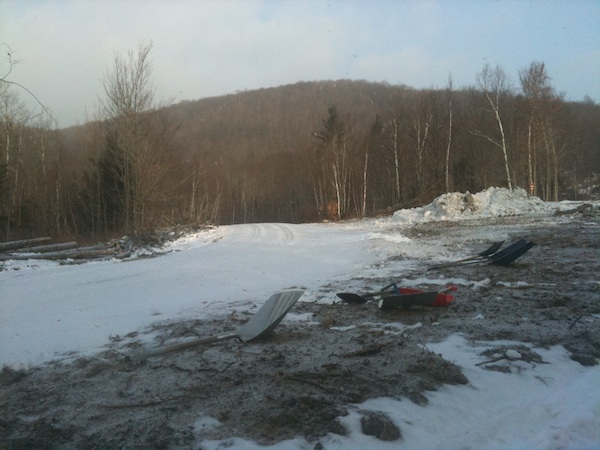
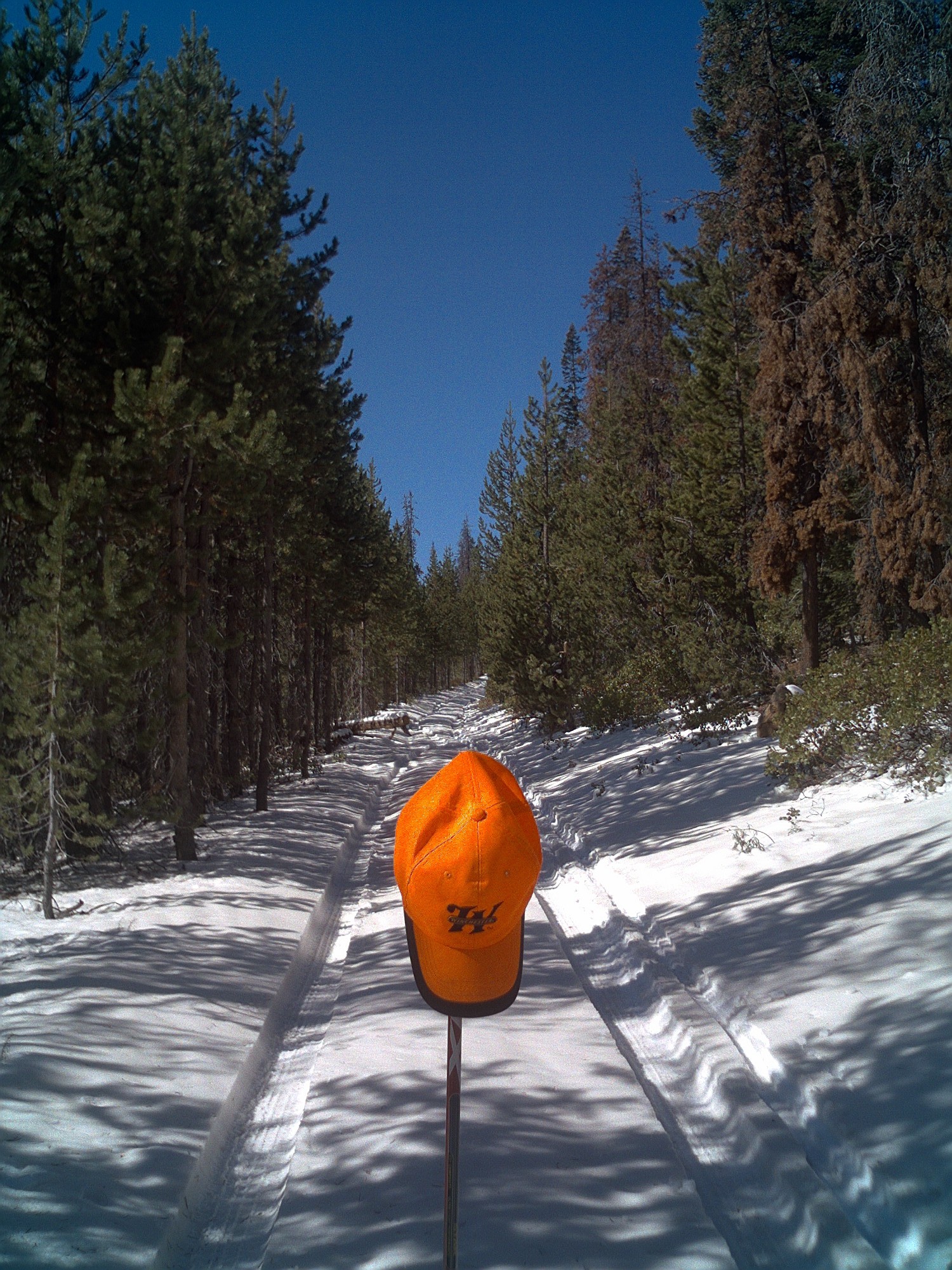
It’s hunting season, and those bold enough to drive the back roads in the Central Oregon forests left perfect tracks for Nordic skiing.
If we weren’t leaving for the coast and Surf Camp tomorrow, we’d be out there with shovels making a track that would last another week!
Check out these awesome pictures from an incredible morning of skiing.
And, check back next week for the report from the coast!
It's hunting season. Just be aware, we aren't alone in the woods. Interval track and bluebird skies in the background.Ready to go….
It isn’t yet October, and the snow reports are beginning to come in. The FAST blog posted skiing pictures a few days ago, and now SilverStar is joining in. SilverStar Nordic Director Glenn Bond pushes the envelop to take advantage of the first flurries.
Kick and glide – it doesn't take much.Time for the cows and bull to leave the mountain…