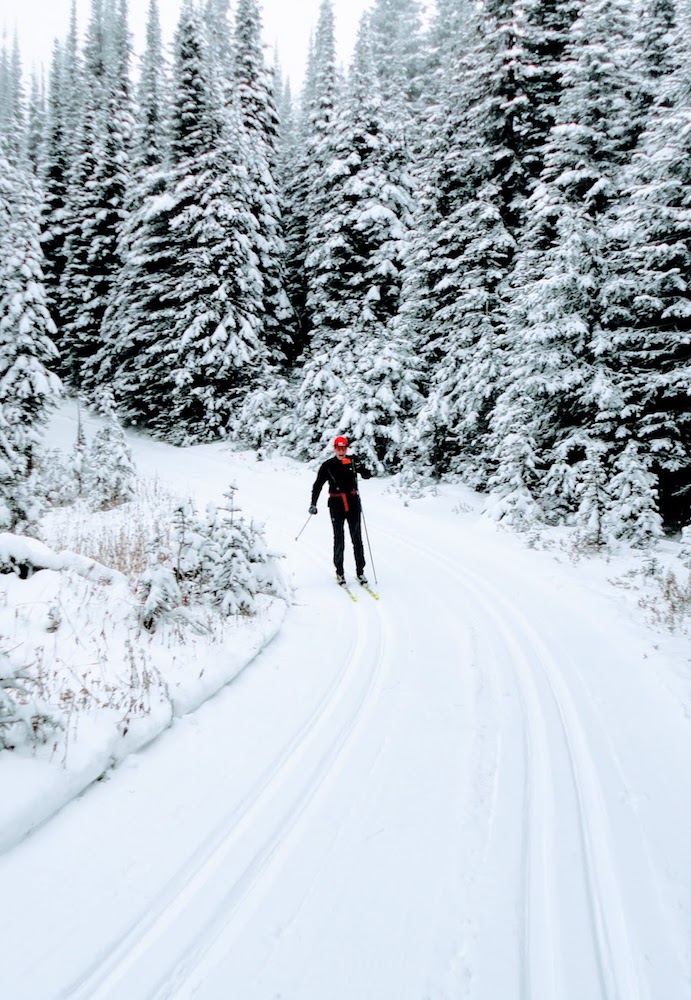
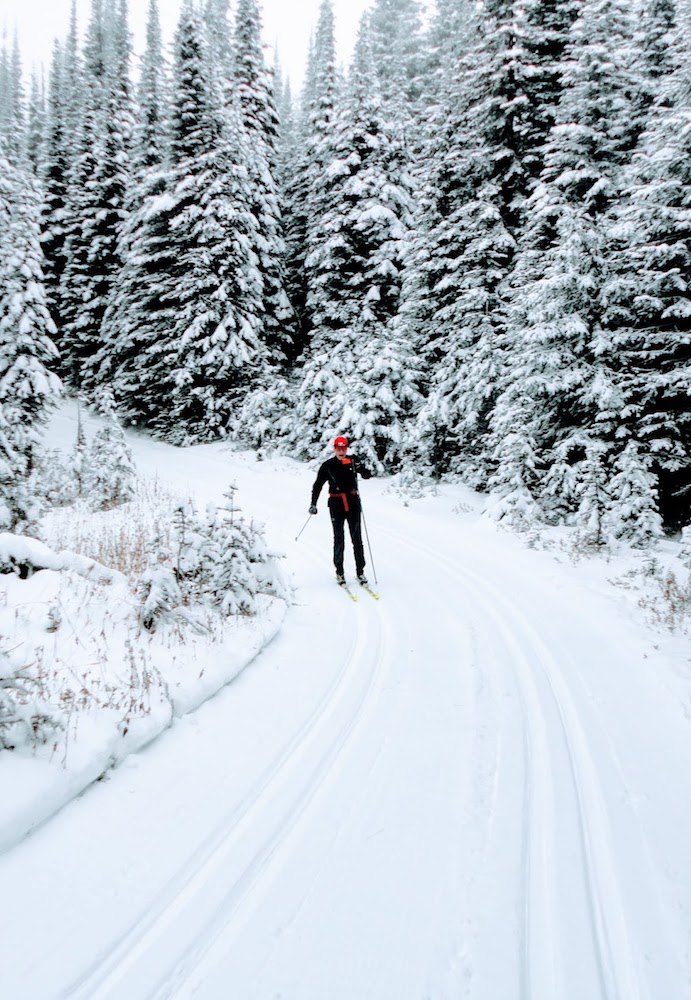
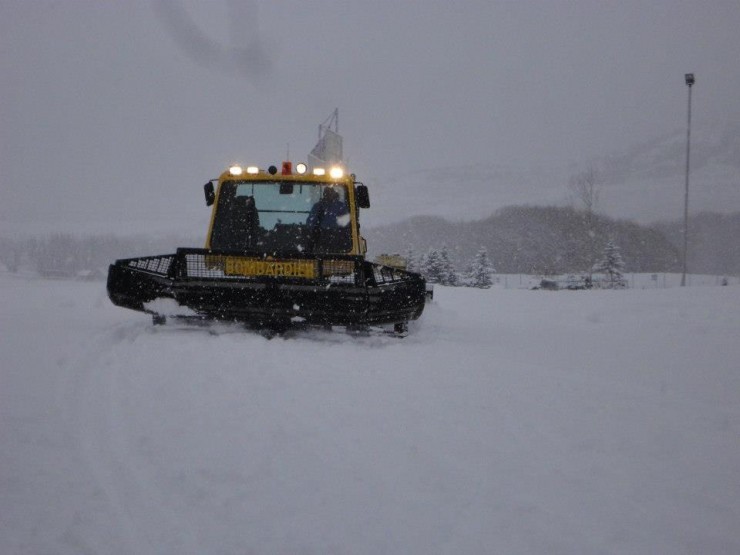
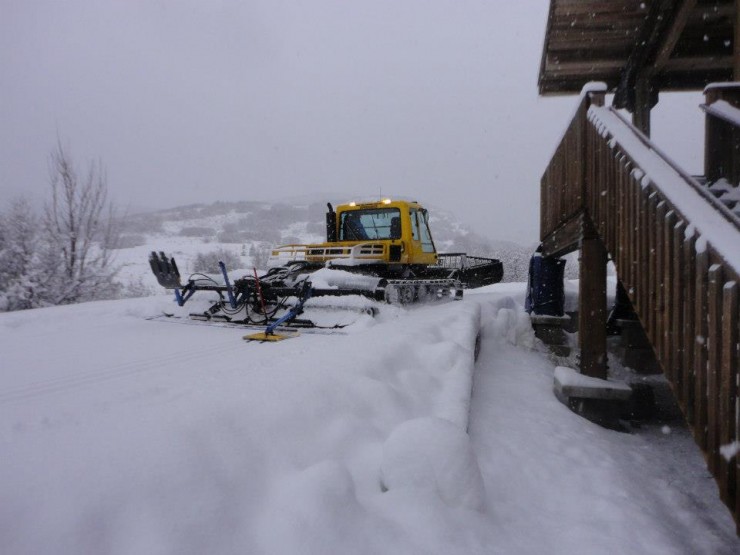
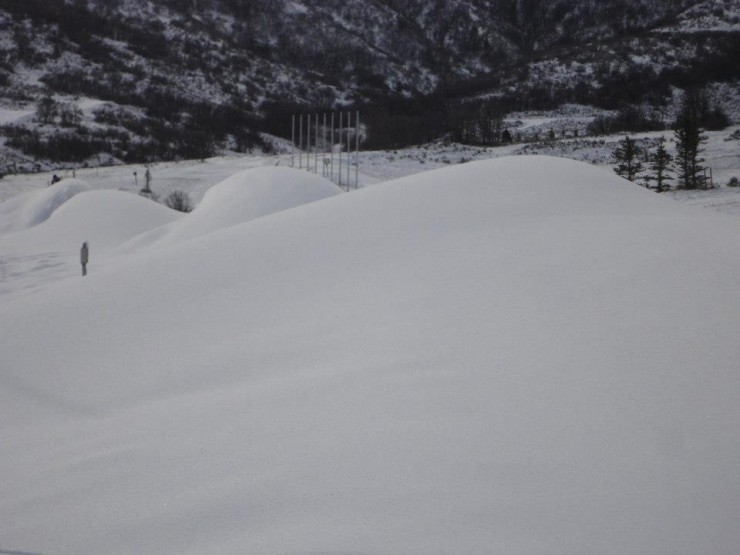
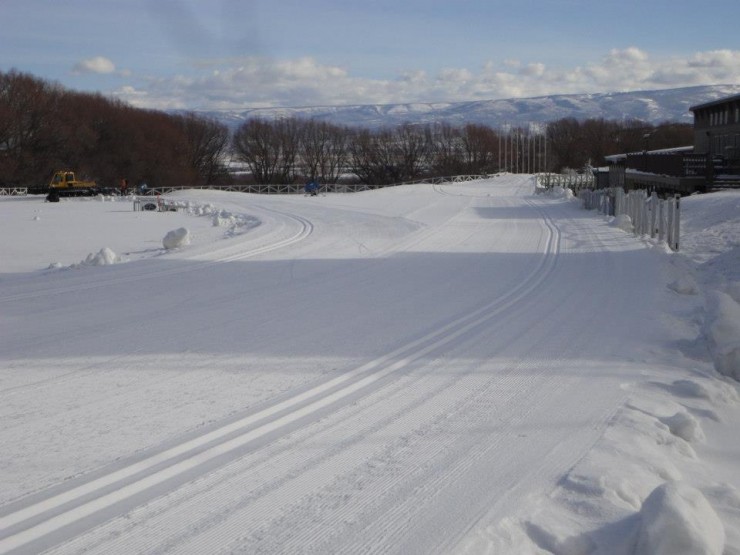
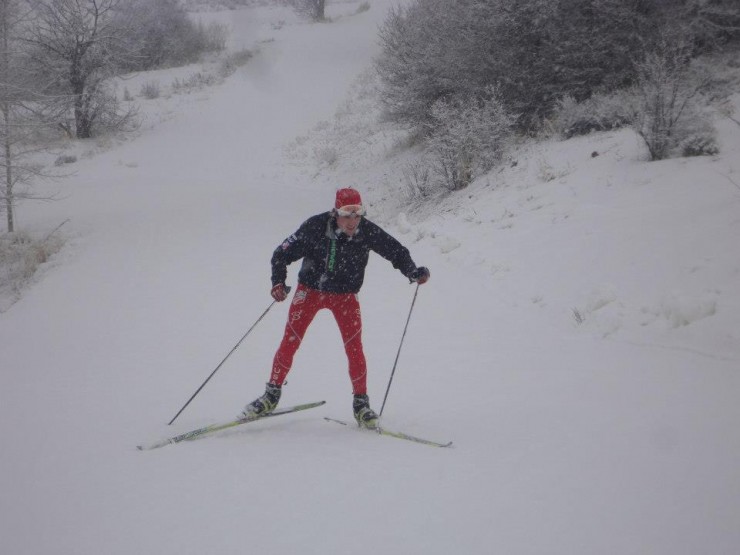
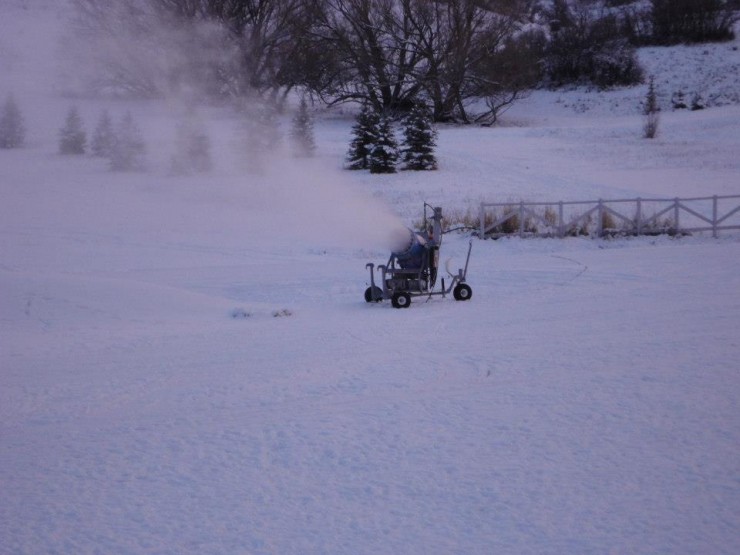
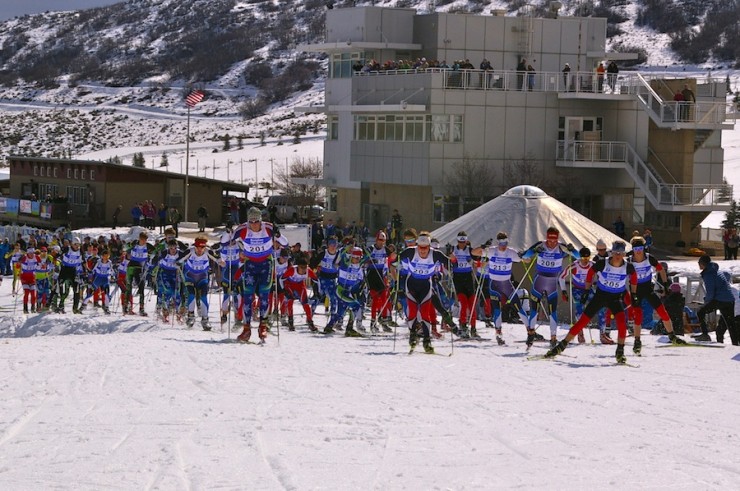
Early season skiing at the Sovereign Lake Nordic Centre on Oct. 14, 2017. (Courtesy photo)
When you think of skiing in Canada in October, Canmore’s Frozen Thunder is probably one of the first places that comes to mind. There are more options and some snowmaking that might surprise you.
This month, Canadians are skiing on natural snow, machine-made snow and farmed snow. We know skiers are already out and about in Alaska and other parts of the U.S. as well, which is why we want this year’s early season “Where The (Skiable) White Stuff Is” to compose of reader submissions. If you know where there’s November or even October skiing in the U.S. or Canada, please write us with details (When does it open or how long has it been open? How many groomed kilometers are there? Is there snowmaking? Any special events planned, like American Thanksgiving camps? Anything else we should know?)and original photos at info@fasterskier.com with the subject line: “Fall Skiing”. Deadline for submissions is Nov. 3.
To get the ball rolling, FasterSkier’s Gerry Furseth checked in with several nordic venues across Canada. They’ve already celebrated Thanksgiving, and full-on skiing is just around the corner.
Frozen Thunder
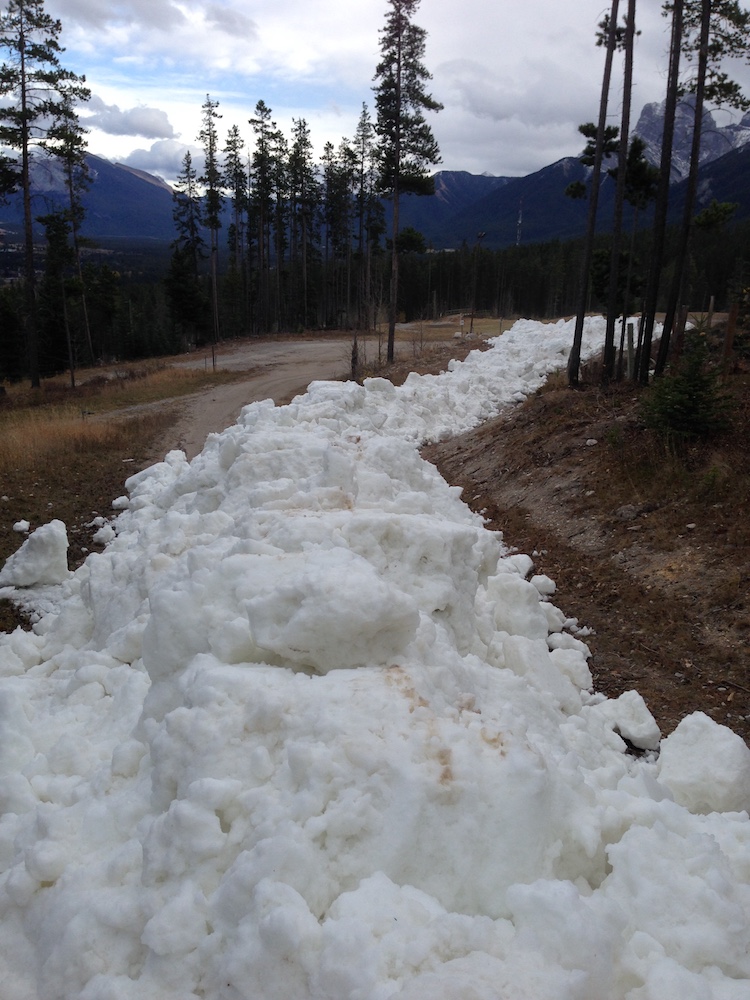
Canmore has started building Frozen Thunder for 2017. This is what it looks like with five days to go. (Courtesy photo)
The action starts on Oct. 21 with some changes for the eighth season. There will be a bigger hill as requested by the national teams and a new emphasis on avoiding exposed south-facing slopes.
The Canmore Nordic Centre (in Canmore, Alberta) is an unusual venue, one of the select few that has machine-made snow, farmed snow and natural snow.
“There is obviously an issue [with manmade snow] around warmer temperatures,” Area Manager Michael Roycroft told FasterSkier. “Last year is a good example where most of November was too warm to make snow, and that’s where Frozen Thunder comes in. That’s why we have our storage option, that allows us to essentially have snow no matter what.”
Frozen Thunder is funded mostly by national and provincial ski organizations and the focus is on providing training opportunities for high-level competitors. The snowmaking has a broader focus.
“The natural snow is obviously helpful, and it covers the rest of our trail system that’s further to the west and higher up, but it wasn’t for machine-made snow in Canmore and the nordic centre, we simply would not be able to run as a nordic facility,” Roycroft said.
Machine-made snow covers 30 kilometers, leaving 40 k dependent on natural snow.
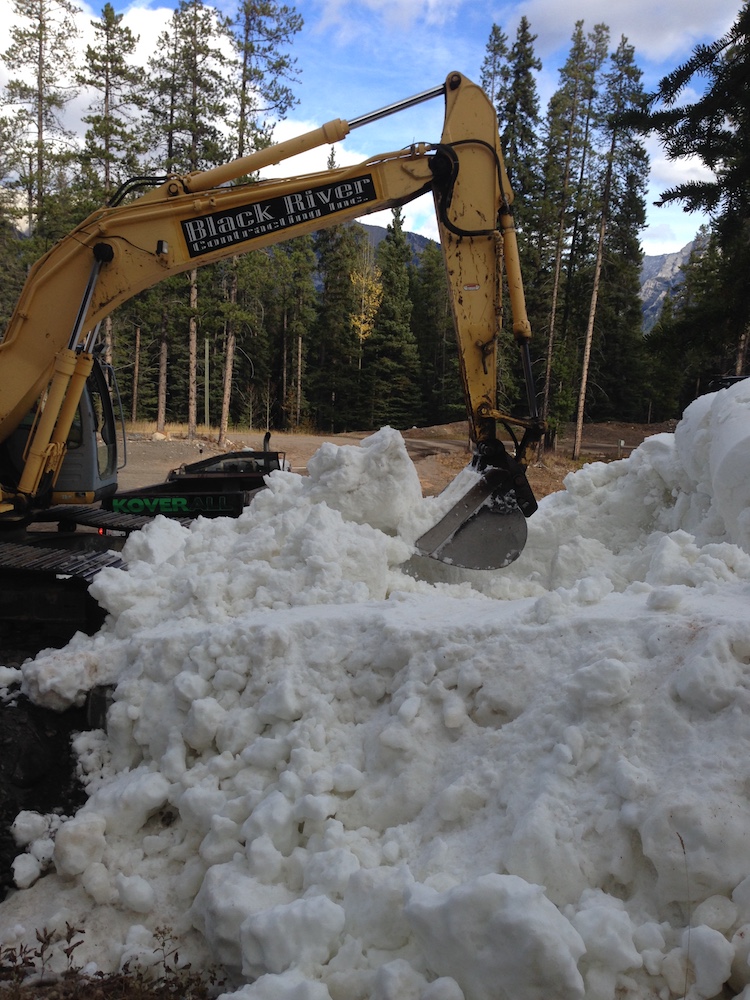
A big job requires big machinery. (Photo: Canmore Nordic Centre)
Whitehorse
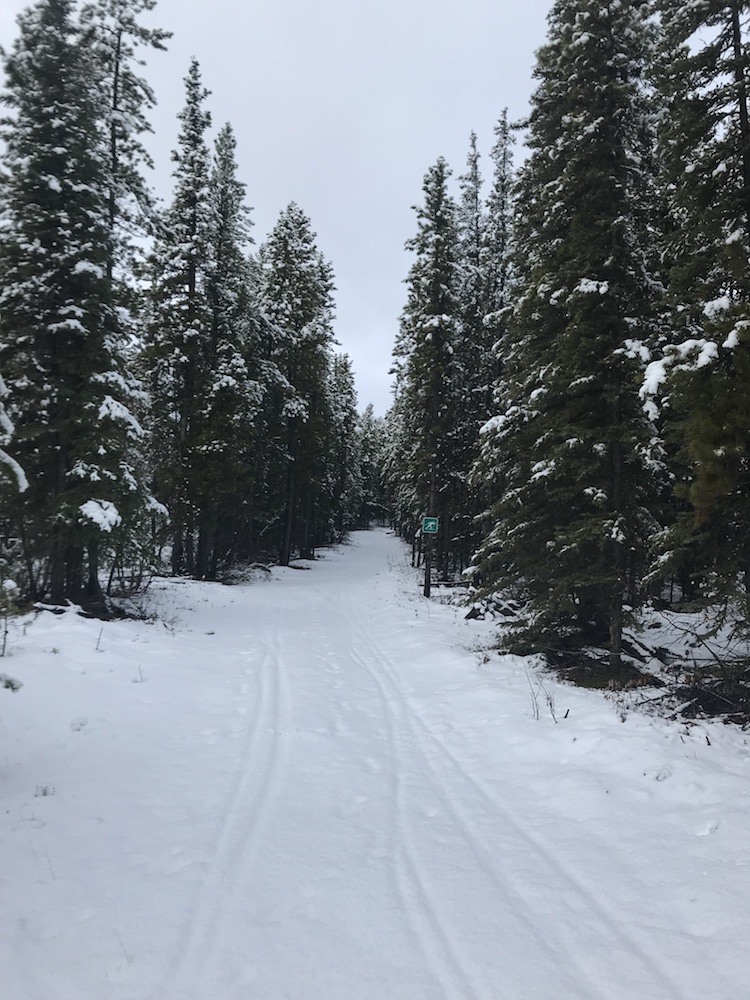
Whitehorse ski trails on Oct. 15, 2017. Another 5 centimeters was needed to set track. (Photo: Alain Masson)
When you think of Whitehorse, you probably don’t think of snowmaking. But Cross Country Yukon’s Alain Masson does.
“In the past, we often had snow available for skiing for our more advanced skiers, but it was not available to everyone,” Masson wrote in an email. “This year, our developing skiers will all have access to some early skiing in good man made snow conditions a month earlier than usual.”
Much of the early season skiing in Canada is not intermediate friendly. Thin snow, tripping hazards and travel to elevation create a barrier to less advanced or less committed skiers. The Whitehorse Cross Country Ski Club is using snowmaking to make the early season more inclusive.
The new snowmaking equipment will be used for the first time on Oct. 22.
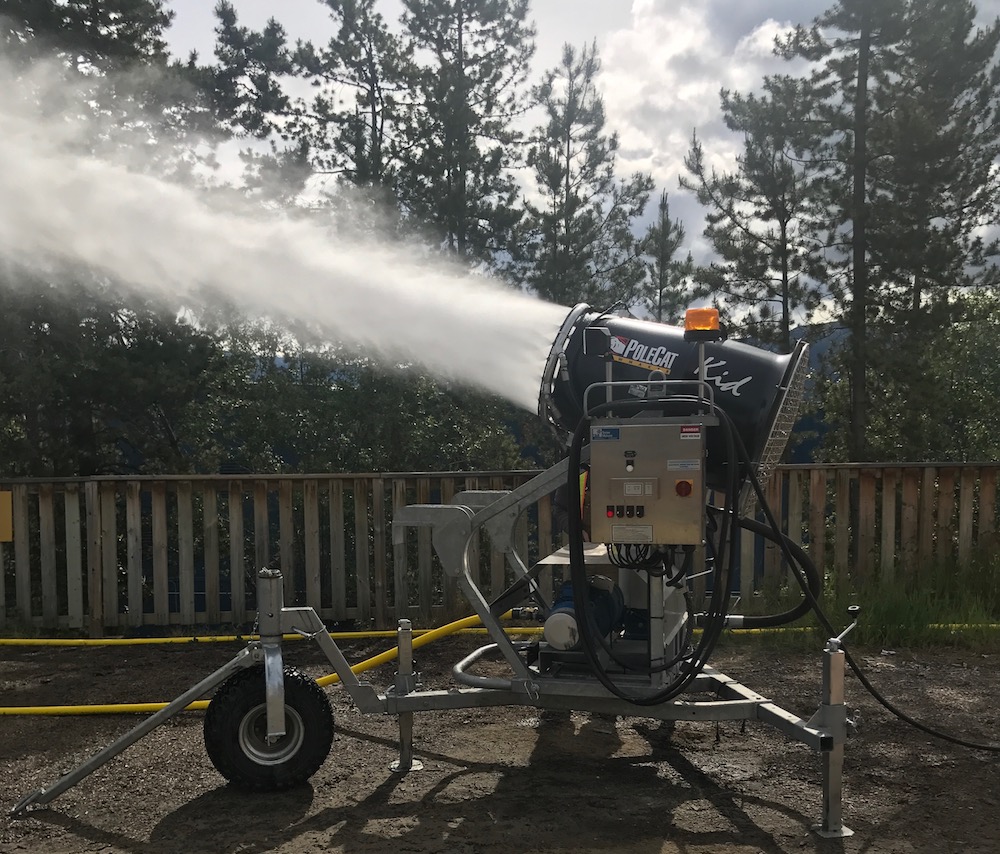
Testing the new gun in June 2017. (Photo: Alain Masson)
Sovereign Lake
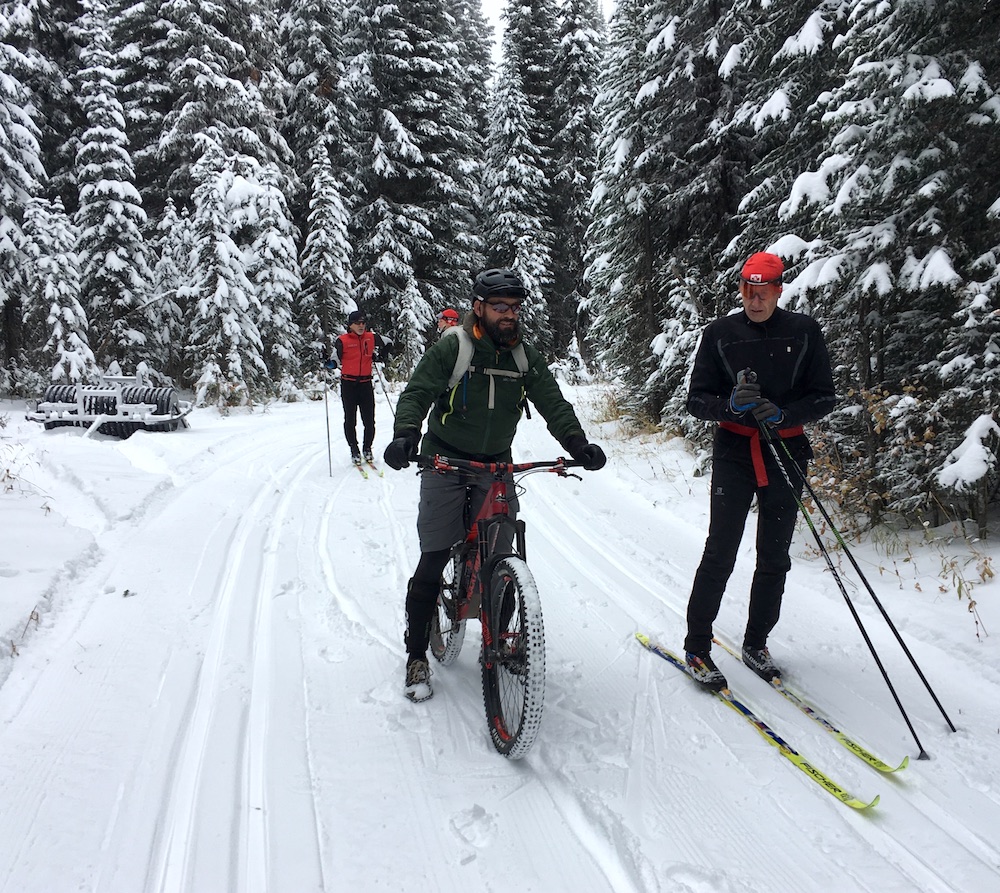
There is a difference of opinion on what season Oct. 14 belongs to. The bikers might have chosen fat bikes over plus bikes if they had realized how much snow they would see on their epic ride from Vernon to Lumby, B.C. (Photo: Gerry Furseth)
The Sovereign Lake Nordic Centre (near Vernon, British Columbia) is well known for November skiing and NorAm races. The season is limited not by loss of snow, but by biking conditions in the valley below.
“As soon as Sovereign gets snow in the fall we want to conserve as much as possible by rolling and track setting,” General Manager Troy Hudson wrote. “All of our early season grooming is done with Quads and snowmobiles to ensure a firm and supportive snowpack for the remainder of the season. Our high elevation (1,680m) and typical higher humidity in late October provides unpredictable weather that can often result in snowstorms of 10-15cm at a time.”
With 20 centimeters of fresh snow, the club set about 5 k of classic track on Oct. 14. While certain trails are open for preseason skiing, the nordic centre officially opens Nov. 10 for pass holders and day ticket sales.
Menihek Nordic
Menihek is another former national-team favourite destination that has since been replaced by Frozen Thunder. Located near Labrador City, Newfoundland and Labrador, it is a less-visited gem. While the Menihek Nordic Ski Club hasn’t received much snow to date, it is a safe bet that by the end of October they will be setting upwards of several kilometers of track.
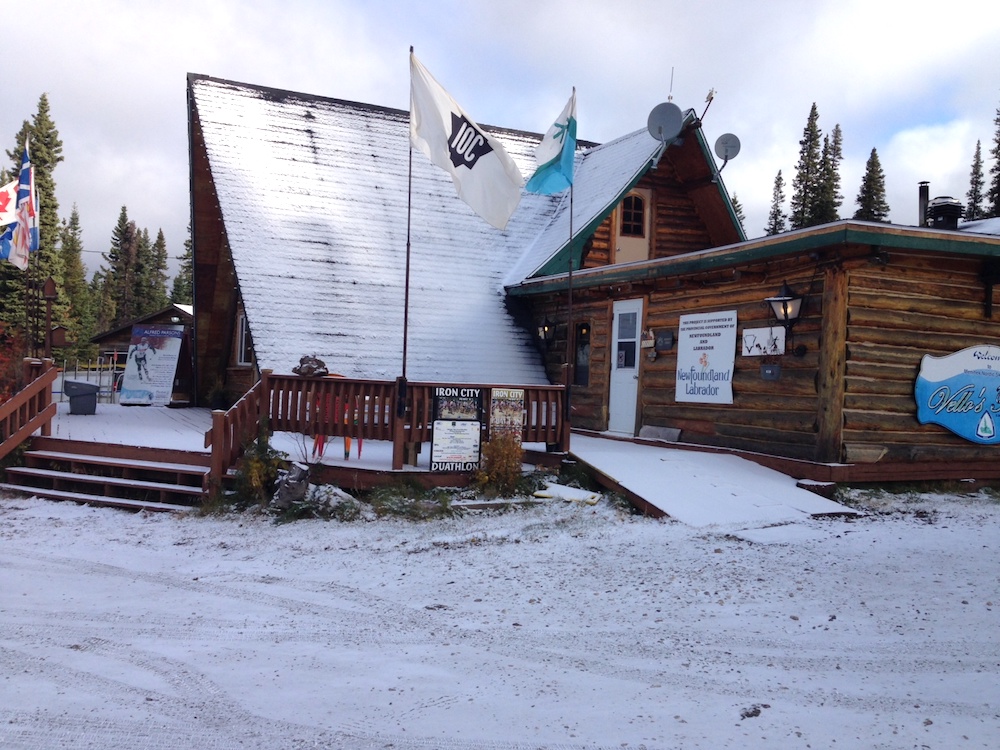
On Oct. 12, a dusting of snow was seen at the lodge. (Photo: Gerry Rideout)
CALGARY — While Canada’s summer Olympians take the podium, young cross-country and biathlon development athletes clamber for a Calgary training facility for the upcoming winter. WinSport Canada’s June 2016 announcement to install a tube park through the cross-country ski trails at Canada Olympic Park has left Foothills Nordic Ski Club and other local clubs scrambling to find an alternate venue for their 2016/17 winter programming.
Without suitable training facilities within the city, the training and competition goals of young biathlon and cross-country athletes are hindered, as precious hours are spent traveling outside of the city for regular training sessions. According to Alberta Development Team athletes, Anna and Ben Pryce, “Terrain loss in Calgary could mean driving to Canmore four times a week,” which the Pryce’s feel is, “simply impractical” for reaching their goals and taking their skiing to the next level.
Sustaining a healthy population of Nordic development athletes, who themselves have opportunities to take the podium, means providing access to suitable facilities for all ages and development stages within the city of Calgary (1988 winter Olympic host).
Foothills Nordic Ski Club is taking decisive action to ensure its members and all Calgarians have access to cross-country skiing in Calgary this winter by launching its Snow Making at Confederation Park crowdfunding campaign (www.gofundme.com/foothillsnordic) that kicks off on August 15. A successful campaign will see Foothills implement innovative, hydrant-based snowmaking along with snow farming and harvesting techniques – maximizing the longevity of natural snow.
Committed to the community, the non-profit Foothills Nordic has volunteer groomed ski trails at the City of Calgary’s Confederation Park Golf Course for over 20 years, to the benefit of its over 700 club members and all Calgarians, but Calgary’s chinook-influenced winters make snowmaking a necessity for delivering reliable programming and continuous ski days.
Former Canadian Cross Country Ski Team member and Foothills Jackrabbit Kevin Sandau says of growing up in Calgary, “I was fortunate enough to have accessible skiing within the city. Skiing and racing my entire life has shaped who I am, the people I’ve met, and my desire to live a healthy lifestyle. Now with the uncertainty of reliable, safe and consistent ski facilities within Calgary, we will lose out on grassroots programs that would create the next generation of Nordic enthusiasts.”
ABOUT FOOTHILLS NORDIC SKI CLUB
Foothills Nordic Ski Club (FNSC) is a not-for-profit, full service ski club based in Calgary, Alberta. Incorporated in 1964, FNSC has a long history of organizing and delivering programs geared towards cross-country skiers and biathletes of all ages and performance levels. The Club has an annual active membership of 720, ranging from Jackrabbits and Biathlon Bears to High Performance athletes, Masters level recreational skiers and para-Nordic skiers. With a 9-member Executive, approximately 70 cross-country and biathlon coaches (both paid and volunteer) and over 200 active volunteers, the Club’s initiatives also include the staging of major events and races in Calgary and the Bow Valley. Foothills is an 8-time Canadian national cross-country aggregate club champion, and is a member of Cross-Country Canada, Cross-Country Alberta, Biathlon Canada and Biathlon Alberta.
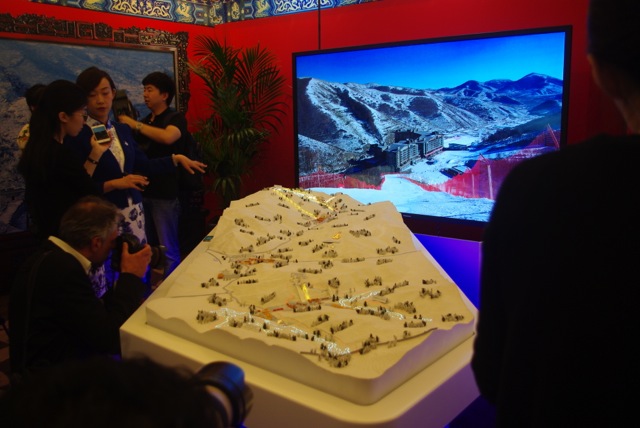
A whiter version of Beijing 2022 than athletes and fans might actually encounter.
In just over a month, the International Olympic Committee members will vote in Kuala Lumpur, Malaysia, on the site of the 2022 Winter Olympics. Their two choices: Almaty, Kazakhstan, and Beijing, China.
Only these two candidates remain after other bids from regions like Bavaria, Germany (centered in Munich), Graubunden, Switzerland (centered in Davos and St Moritz), Stockholm, Sweden, and Oslo, Norway, were felled by referendums.
That’s not a good sign for the IOC. Both bids have some problematic features, and are almost certainly not the ideal locations the organization was looking for.
While there are problems with the Almaty bid, to almost any reasonable person there appear to be far more, and more serious, problems with Beijing. Despite all of this, Beijing is the frontrunner.
That’s because it has the force of the Chinese government behind it. The IOC knows that the Chinese can deliver a Games. A Beijing Olympics would happen, without any major cost to the IOC except for bad publicity and a continued slide down from any moral high ground they might have left.
The Almaty bid closed part of its gap at the candidate city presentations in Lausanne, Switzerland, last week. But in the event that Beijing still comes out on top when voting is over, here’s an overview of six major issues that the Olympics would face – and examples of some of the misrepresentation and lies the bid committee says publicly when questions are brought up.
First, there’s the snow. As skiers, it is probably one of our main concerns. Will there be enough? Where will it come from? Zhangjiakou boasts about a meter, total, of snowfall each year.
The answer is, snow will come from water. But that leads to another question. What effect will that have on the regional water dynamics of a drought-prone region?
Then there’s air quality. It’s known to be terrible in Beijing. But organizers assert that air quality is great at the mountain venues. The problem is, that’s just not true.
Next up, how will spectators get to the mountain venues? At almost 200 k north of Beijing, travel times could be long. The bid committee touts a high-speed train connecting the clusters, but it’s becoming clear that this won’t solve all problems and could even be dangerous.
After the 2008 Olympics, it was clear that China followed through on few of their promises to improve human rights. Is there any reason to think that this time around will be different?
And finally, thinking long-term, what is the point of hosting a Games where winter sports are not popular and where snowmaking is so disruptive? Will the venues be used in the future?
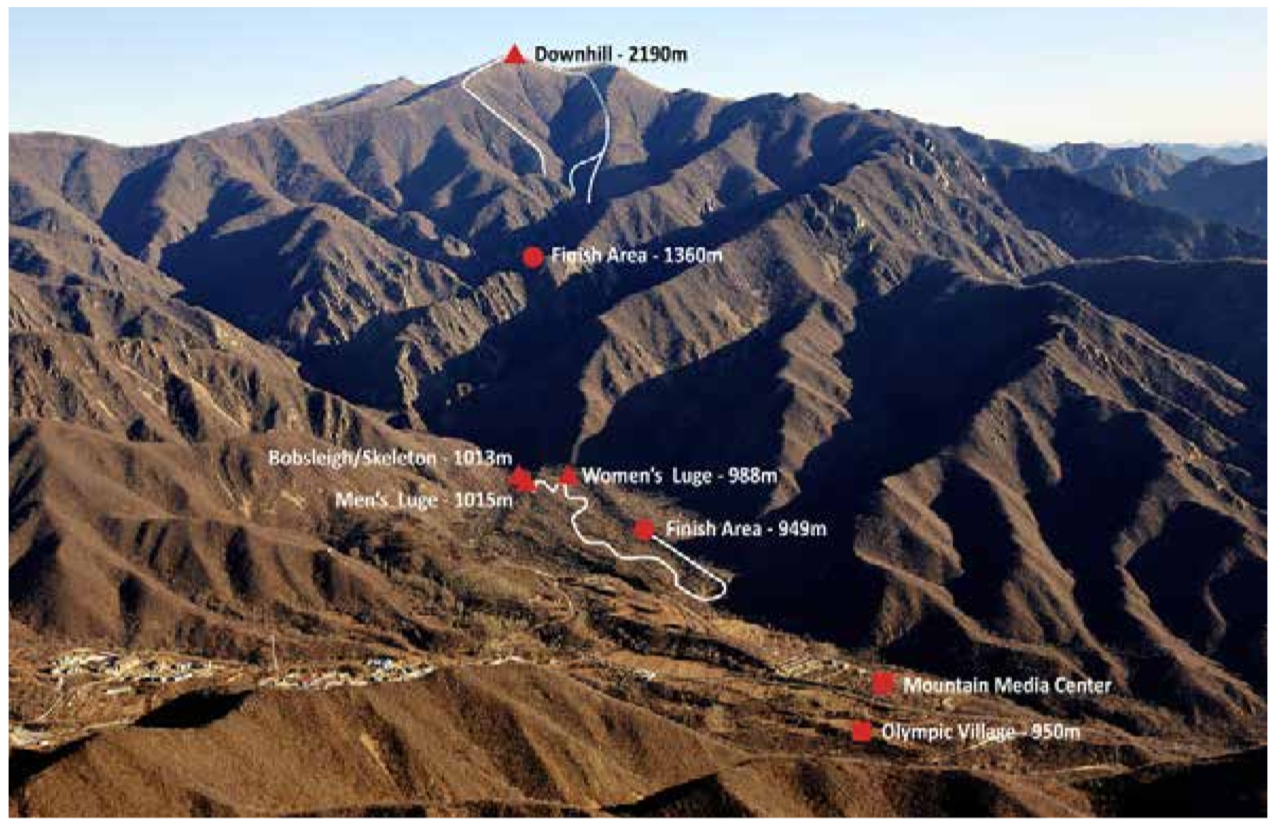
The site of the alpine skiing and sliding sports for Beijing 2022, photographed in January 2015 for the IOC Evaluation Commission report.
Snow: Quite honestly, there isn’t much.
The weather is cold and it’s enough to blow snow, however, at least for alpine skiing. The Chongli area outside of Zhangjiakou has four alpine ski resorts which host, according to the bid committee, 1.5 million visitors annually. Nordic facilities have not yet been built.
On the ground, the area isn’t always teeming with skiers.
“The chairlifts are somewhat slow, but queues are rare and the slopes are mostly empty,” a review of the Wanlong resort, one of the biggest in the area, notes.
By comparison, the state of Vermont gets about 4.5 million ski visits per year, although that is based on ticket sales and it is unclear whether the Chongli numbers are from all tourists or just those who buy a lift ticket.
Looking at meteorological data, it’s hard to imagine the region becoming a real winter sports mecca without snowmaking.
“The total annual snowfall here can reach more than one meter,” Liu Jianjun of Chongli’s weather bureau told the press.
One meter!?
And yet:
“We have a 20-year history of hosting skiing events… Each year there is a 25% increase in the population taking part in skiing in Zhangjiakou,” Hou Lang, the mayor of the city, said in a press conference in Lausanne. “The temperature, wind speed, and mountain situations are ideal for hosting a Games.”
The bid committee’s strategy is to make and hoard snow. Already, resorts feature snow on the trails but brown forests and dry, frozen ground beside them.
“In addition to natural snowfall we have a very comprehensive plan to ensure the quality and quantity of snow,” Zhang Li, the venue manager, said in the press conference. “This plan is based on the combination of appropriate temperature, abundant water supply, and reliable existing snowmaking facilities.”
The IOC Evaluation Commission noted in their report that the resorts are already situated on the highest mountains in the region, so there would be no way to haul in snow from other locations. And as was shown in Vancouver 2010, temperatures can unpredictably rise during warm snaps and prevent snowmaking.
During discussions about the two candidate cities, experts reportedly testified that a 50-50 mix of manmade and natural snow was ideal, and that this was attainable with the Beijing bid. Two problems: most athletes would argue that actually a zero-manmade, all-natural snow base would be ideal, and secondly, it’s not clear that 50% natural is even realistic.
Siting an Olympic Games in a place with essentially zero natural snow seems like a big risk. Yet the IOC does not seem overly worried with this issue compared to others.
Water: On top of all of that, it appears that the bid committee does not fully understand just how big an undertaking it would be to make all of that snow. 16 million cubic feet of snow were reportedly stockpiled before the 2014 Sochi Olympics, where there was more natural snow to use as a base anyway.
It took over 140 gallons of water to make just one of those cubic meters of snow.
“The Commission considers Beijing 2022 has underestimated the amount of water that would be needed for snowmaking for the Games,” the Evaluation Commission wrote.
Zhangjiakou is in a notoriously arid region. There simply isn’t a lot of water available: just 383 millimeters per year, or 15 inches. The winter is the dry season, and Zhangjiakou receives less than five millimeters per month then.
The New York Times reported earlier this year that the region is home to water conflicts, which those in the western U.S. might find familiar.
The small amount of water available is often sent south to Beijing, a major city which has priority over rural areas. It is now being used for snowmaking as well, and should Beijing win the 2022 bid the amount needed for snowmaking will only increase.
“The total amount of water used for the entire Games duration for snowmaking represents only 1% of annual available water supply in this area,” Zhang Li said in the press conference.
However, the Evaluation Committee had already made clear that they believed this estimate was incorrect. And in a region with barely any water, one percent can still make a big difference – just ask California.
Because of China’s controlling government and human rights problems, those suffering from further declines in water resources would certainly be the least affluent residents of the Zhangjiakou region. Pouring more effort into snowmaking would represent a further shift to focusing on an affluence tourist market instead of local dynamics.
Yet the bid committee insists that there’s nothing to worry about.
“To ensure an abundant the water supply, we have three sources of water,” Zhang Li said in the press conference. “One is the surface runoff which has been the sole source for the existing resorts for the last 20 years. The second source is large capacity reservoirs in 6 kilometers of the venues. The third source is that we will benefit from the already almost-completed National Water Transport plan, which is transferring an enormous amount of water from southern China to the north.”
That transport plan has reportedly cost as much as $80 billion, although detailed estimates are hard to pin down.
The bid committee also plans to recapture snowmelt and use it to blow more snow, but the Evaluation Commission wrote that the ability to do this had been greatly overestimated.
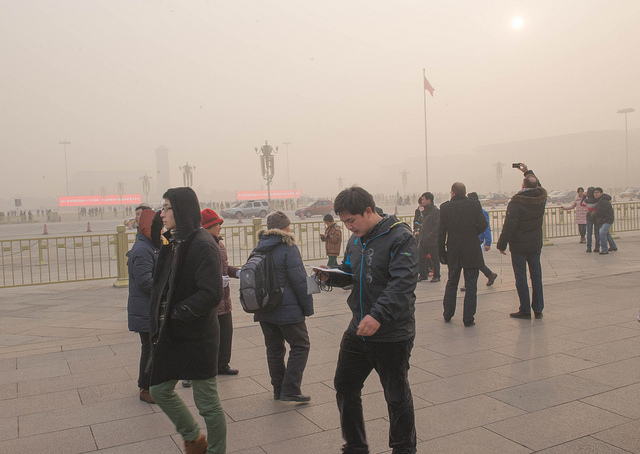
Air pollution in Tiananmen Square, Beijing, in 2013. (Photo: Michael Davis-Burchat, flickr)
Air Quality: Beijing currently faces some of the worst air quality in the world. During the 2014 Beijing marathon, particulate pollution was at 400 micrograms per cubic meter; the World Health Organization’s maximum for healthy outdoor activity is 25. Most participants wore masks and many did not finish the race.
“In Beijing, the ice sports will all be in indoor venues,” Wang Anshun, the mayor of Beijing and the head of the bid committee, helpfully noted in a press conference.
Beijing is in the midst of a five-year action plan to clean up air quality, which is costing about $130 billion and features 84 specific action points.
“At present, the action plan is already achieving excellent results,” Wang said. “Major pollutants in this period have dropped by 17.7 percent as compared to last year.”
After the plan ends in 2017, there are already plans in the works for another five-year agenda leading up to the 2022 Games.
In fact, the bid committee used the prospect of improving air quality in a not-so-subtle attempt to guilt people into supporting the bid.
“This also will be a form of permanent legacy that will benefit the local people of the city and the region,” Wang noted.
In other words: how could you turn this bid down when it will improve quality of life for millions of people, and make the air that they breathe no longer able to kill them?
However, it’s worth noting that an IOC mandate to fix pollution problems has not always in the past led to pristine conditions. Air quality was still a problem at the 2008 Summer Olympics in Beijing, even after much-publicized attempts to solve it by closing factories limiting the amount of vehicles in use. While vast improvements were made, pollution was still worse than in all but the most polluted U.S. cities and about six times higher than at the 1996 Atlanta Olympics.
Immediately after the 2008 Olympics, air quality worsened again, now to those levels seen during the 2014 Beijing Marathon. Improving air quality during the Games did not have lasting effects.
Another case of the IOC struggling to mandate pollution cleanup is in Rio de Janeiro, Brazil. Just a year before the 2016 summer Games, organizers are still struggling to clean up the water in the city. Last summer the IOC brushed off concerns, saying there was still time to clean up, but they now seem more alarmed, and at the recent Executive Board meetings in Lausanne demanded to see progress by the end of July.
Part of the Rio bid was a promise to reduce the flow of raw sewage into the sailing venue by 80%, but officials now acknowledge that will never happen. (More alarmingly, they say that the failure to clean up is irrelevant because the sewage poses no health risks to sailors.)
In other words, if the host city promises in a bid to clean up, the IOC has no real way to hold them to that promise. Statements by the bid committee about air quality do not mean that athletes won’t see significant health risks when they arrive in Beijing in 2022.
Finally, the bid committee says that at the two mountain clusters, air quality is ideal. However, while Zhangjiakou does have the best air quality in its region, it is still not good. In the next two days, for example, air quality is forecasted to dip into the “unhealthy” zone, with the definition “Everyone may begin to experience health effects; members of sensitive groups may experience more serious health effects.”
And local regulations cannot completely solve air pollution problems, anyway.
“Increased energy demand in winter coupled with seasonal weather patterns that can bring pollutants from other regions could create air quality issues across the Games zones,” the Evaluation Commission wrote.
Distances Between Clusters: The Beijing bid will feature three clusters for sports: arena ice sports will be held in Beijing; nordic sports, freestyle skiing, and snowboarding in Zhangjiakou; and alpine skiing and sliding sports in Yanqing.
The bid committee promoted this three-zone idea as a benefit to athletes, who will not have to travel far to reach their venues or deal with the more general hubbub of a compact Olympic Games.
“To ensure the athlete experience, I know from my experience as an athlete that the most important thing is the performance in the Olympics,” said Yang Yang, a gold medalist in short-track speedskating and now an IOC member. “So to minimize the travel times would bring much benefit to the athletes. Having three zones will help the athletes with short distance to travel from the venues to the villages. It will be about 15 minutes, which is a very good benefit to the athletes.”
Aside from athletes, travel times for spectators could be quite long. The bid committee has proposed building a high-speed train system which it says would cut the time needed to travel roughly 200 k from Beijing to Zhangjiakou to 50 minutes.
There’s several problems with this. First of all, the bid committee left the expenses associated with building the network off the books, claiming that it would have built the railway anyway. That’s false, and cut the bid’s budget down to better compete against Almaty. Officials still refuse to reveal the actual cost of the railway.
Secondly, only when pushed did officials admit that actually, it would take longer than 50 minutes to travel between the venues. They admitted that 10 minutes should be added for waiting times to board the trains.
IOC members pointed out that that’s not all; after all, they have to get from hotels to the train stations, and then from the stations to the venues. Members complained that it would likely take them 90 minutes.
And for regular spectators who don’t receive the special treatment of IOC members, it’s likely to be a lot longer. This, along with the lack of a snow sports culture in China, contributes to the strong possibility to sports in the mountains facing empty stadiums. That doesn’t exactly make for the best athlete experience.
Already in 2014 in Sochi, Russia – a country where cross-country skiing and biathlon are successful and popular – seats were empty in the stadiums. This was likely due in part to the sale of multi-sport ticket bundles. A non-ski fan might go check out a sport they had a ticket to if it’s close; if it takes hours of travel each way, they might decide to stay in Beijing.
Lastly, with well-documented catastrophic train disasters and high levels of corruption hindering safety measures in China’s railway construction (you can find an incredible piece from the New Yorkerhere), does anyone really want to be on a high-speed train system where a crash, or even just a decrease in speed, by a train that departed just five minutes earlier could lead to a pile-up?
Human Rights
One of the biggest problems will provide nothing more than a repeat show from the 2008 Olympics. When Beijing won the bid for the 2008 Games, China boldly proclaimed that this was an opportunity for the country to improve their human rights record before they showed off to the world.
That certainly did not happen.
Hundreds of thousands of residents were evicted in the leadup to the 2008 summer Games in order to build new stadiums and infrastructure. The 2022 Games will use some of that infrastructure, so evictions should not be as numerous. But the Evaluation Commission report still estimates that thousands of people will have to be relocated.
And relocation is not something that China handles well. Houses were demolished and when residents tried to protest their evictions or appeal through the legal process, they were arrested, jailed, and sometimes beaten. Citizens have no choice in the matter, and are not provided the means necessary to re-make their life somewhere else.
“Compensation rates have rarely enabled affected people to relocate while retaining the same standard of living,” the Geneva-based charity Centre on Housing Rights and Evictions noted in a 2008 report. “Instead, residents have been forced to move further from sources of employment, community networks, and decent schools and health care facilities.”
Journalists who covered these issues did not fare well, with dozens of members of the media detained in the leadup to Beijing 2008. The Foreign Correspondents Club of China reported that 40% of foreign journalists covering the 2008 Games had experienced some sort of governmental interference, and that since then, conditions for foreign journalists have declined substantially.
Even while reporting on the bid for the 2022 Games there have been incidents. When two foreign journalists tried to visit the site of the mountain cluster and interview locals, government “minders” scared people away from speaking to them and inhibited them from visiting parts of the sites.
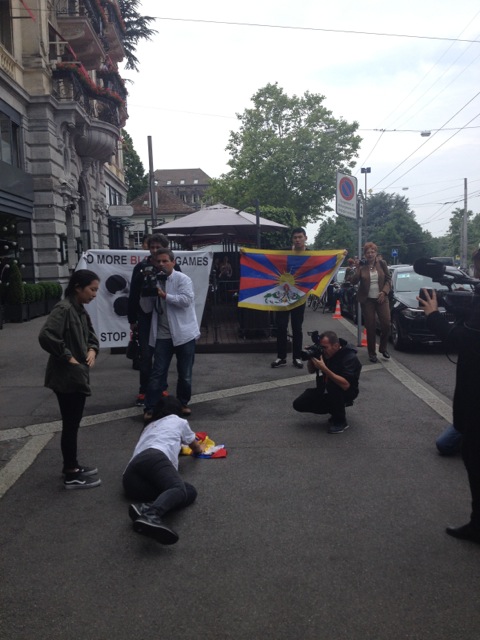
Protestors shouting “Beijing Lies, Tibet Dies” and “No More Bloody Games” appeared outside the hotel hosting the candidate city presentations. Later, another activist snuck into the Beijing presentation room. After unfurling a banner and chanting, he was forcibly removed.
Those outside the media fared much worse. Before the 2008 Games, citizens who spoke to foreign media were sometimes beaten by police in retaliation. According to Human Rights Watch, Chinese who spoke out on a variety of issues, from human rights to the environment or corruption, were often arrested. In some cases activists were kept in prison for longer than the actual term they were sentenced to.
Then there’s the athletes. According to The Guardian, China forbid athletes with any history of dissidence or activism from participating in the 2008 Olympic or Paralympic Games. For instance, Fang Zheng, whose legs were crushed by a tank in Tiananmen Square in the 1989 massacre, was not allowed to compete despite having two national records in the discus.
There’s many other human rights issues in the country. Tibetan activists, for instance, infiltrated the candidate city presentation room in Lausanne last week to stage a protest of China’s occupation of the region. Before 2008, the Olympics were seen as providing a platform for Tibetans to speak out about their oppression. But nothing changed for the better.
If the 2022 bid is successful, that means seven more years of Free Tibet protests. That’s seven more years of the world being reminded that the IOC has chosen to host the largest, most lucrative sporting event in the world in a country that does not support the basic tenets of the Olympic movement.
“The goal of Olympism is to place sport at the service of the harmonious development of humankind, with a view to promoting a peaceful society concerned with the preservation of human dignity,” the second point of the Olympic Charter reads.
Legacy: One of the main points of the Beijing bid is that should they win, they will bring winter sports to “hundreds of millions” of people and provide a lasting legacy. This is how the bid committee appeals to IOC President Thomas Bach’s “Olympic Agenda 2020” plan.
Frankly, this seems unlikely. Even in countries which already have a strong winter sports culture, building new venues in places which are only moderately accessible to the general population has rarely been successful in building lasting legacies.
Let’s look back at Sochi, 2014. The snow and sliding sports venues will certainly never be used again for World Cup competition, and it’s not clear that they are seeing significant use from Russian athletes either. $51 billion were spent to build this Olympics and the mountain cluster is eerily empty. Resorts were operating at losses and renting luxury rooms for as little as $17 per night.
What about Vancouver, four years earlier? Canada has strong nordic, alpine, and freestyle ski programs. But the cross-country and biathlon teams no longer base training groups in the Callaghan Valley, a venue which sees little traffic. Canadian ski jumping and nordic combined struggle to even remain funded. Whistler Sport Legacies has more costs than profits, although some venues, such as the luge and bobsled runs, see a lot of use.
British Columbia and the Canadian Rockies have plenty of alpine skiing opportunities, which is perhaps the reason that the Whistler Creekside venue, which hosted alpine racing for the Olympics, has not seen any FIS-level competition since 2010. Lake Louise, Alberta, beckons instead.
Pragelato, the site of nordic racing at the 2006 Torino Games, has not hosted a FIS-sanctioned cross-country ski race since the World University Games 2007. The luge track has been dismantled for economic reasons, but the hockey and speedskating arenas have hosted other sports events as well as plenty of concerts.
Sestriere, where the alpine racing was held, is still a popular venue for Europeans, but hasn’t hosted a World Cup since 2009. And unlike most other snow sports venues used in 2006-2014, Sestriere was already a high-profile destination for both tourists and elite racers; the Olympics likely did not significantly affect its future.
So even in countries where there are plenty of winter athletes, developing new venues for the Olympics hasn’t contributed much to sports programs. Reaching fans is a different story, but there’s still not much evidence that hosting an Olympics seriously shifts the support for winter sports within a country long-term, aside from a brief flush of enthusiasm surrounding the Games itself.
And considering the high water cost of running the snow sports venues, it’s not clear that they would even be maintained in the long run, especially as climate change progresses.
The bottom line, and the Almaty comparison. Almaty faces some of the same issues that Beijing does.
Air quality is not great in the city, although it is of course nowhere near as bad as Beijing. Kazakhstan is not a model for human rights, and there is expected to be significant corruption should Almaty win the lucrative bid.
But on many points, Almaty comes out clearly ahead. For instance, many stadiums are already built and being used by both Kazakh athletes and to host international competitions like the 2011 Asian Winter Games or the upcoming 2017 World University Games. Almaty has snow, and it has winter athletes; it’s much more likely that the Games would have a lasting legacy improving sports opportunities for residents.
It is also a compact Games, with everything close together, and a relatively cheap one.
What Almaty lacks is the slick, powerful, marketing machine that Beijing has already put into place. Should Beijing win, it will be a clear message that money, financial stability, and glossy PR lines matter more to IOC members than the actual tenets of the Olympic charter.
Scott Peterson, the U.S. Nationals competition chief, grooming the Soldier Hollow course this week. Photo: Bill Pierce/F.A.S.T. Performance Training.
The curse may be broken; U.S. Nationals could take place on natural snow yet. Ten inches of new-fallen powder accumulated at Soldier Hollow in Midway, Utah, over Tuesday and Wednesday, creating an additional three to four inches of packed corduroy on top of the artificial layer the venue began building up last week on an abbreviated course.
When Soldier Hollow had little to no natural snow last week, U.S. Nationals Chief of Competition Scott Peterson said the distance races would not be able to use the original 5 k loop without help from the sky. In light of the new accumulation, Peterson, who is also the head of grooming at the venue, thought skating would be possible on all available trails and that there was a “good possibility” that the four races scheduled to take place between January 2 and 8 will be able to happen on their full, original courses.
“It is nice to see,” Peterson said on Wednesday evening, adding that there may be a few bare spots on the course until more snow comes.
“I think it’s skateable, but I’m not sure about classic tracks,” Peterson said after he had skied the 5 k course on Thursday morning. In places where the rollerski loop lies under the snow his poles poked through the light, fluffy snow and hit the pavement underneath. If temperatures cool down enough for the snow to firm up he thought he might be able to set tracks on the full distance loop.
The 5 k distance course has been rolled with snowmobiles and is open for training. Peterson will decided whether racing on the distance course is possible on January 1, “when we see what we end up with,” he said. For now he still plans to race on the 3.3 k modified course.
Athletes competing in U.S. Nationals next week have begun to arrive in Utah; others have been living in Park City and the surrounding area through the holidays to acclimate early to Soldier Hollow’s elevation of 5,500 feet or so above sea level. Early arrivals have had the 1.3 k loop to themselves thus far but will soon be joined by many more; the first race begins on Wednesday of next week.
Ben Saxton of F.A.S.T. has been training at Soldier Hollow with other Central Cross Country skiers since last weekend. He thought it would take another few days of consistent snowfall for anything beyond the manmade loop to be suitable for racing. It has been snowing consistently since Tuesday and more snow is in the forecast for the next few days. Soldier Hollow has been making snow since last week.
“It’s great, it’s just short,” said F.A.S.T. coach Bill Pierce of the manmade loop. “It’s fine now because nobody [else] is here, but put 150 people on a 1.3 k loop and it’ll be pretty busy.”
Traffic concerns should become less of a concern now that natural snow has made training possible on more terrain. Peterson plans to have a complete 3 k of manmade skiing connected by the end of the weekend.
Check back on FasterSkier for further updates on conditions leading up to U.S. Nationals.
This article was updated 11:15 a.m. MST Dec. 27 to include Peterson’s comments from Thursday morning.
Peterson headed out onto the course on Wednesday. Photo: Bill Pierce/F.A.S.T. Performance Training.Piles of manmade snow wait on the sprint course. Photo: Bill Pierce/F.A.S.T. Performance Training.The stadium, before Soldier Hollow received new snow this week. Photo: Bill Pierce/F.A.S.T. Performance Training.A panoramic view from the Soldier Hollow lodge. Photo: Bill Pierce/F.A.S.T. Performance Training.Ben Saxton (F.A.S.T.) training on Wednesday. Photo: Bill Pierce/F.A.S.T. Performance Training.Snow guns have been running throughout the week. Photo: Bill Pierce/F.A.S.T. Performance Training.
The Junior Nationals freestyle mass start gets underway at Soldier Hollow in March, 2012. The venue has a big task ahead of it as it prepares to make snow for U.S. Nationals in January, 2013.
The dearth of snow that characterized the 2011-2012 season continues. Barring a surprise snowstorm in Midway, Utah, in the next 12 days, U.S. Nationals will take place once again on a modified loop of artificial snow. Such conditions have met athletes in Rumford, Maine, for the past two years; the draught now includes Soldier Hollow.
Thanks to recently cooling temperatures in Midway, however, Chief of Competition Scott Peterson is confident U.S. Nationals will be able to run smoothly, if on a shorter course (3.3 k) than originally planned.
This outlook is an improvement over recent conditions at the 2002 Olympic venue. Soldier Hollow held a series of Nordic Combined competitions last weekend on “about three inches over a couple hundred meters,” Peterson said. “We just barely pulled [that] off.”
With colder temperatures on Tuesday and Wednesday night, Peterson had good snowmaking conditions to work with for the first time all season. After two days of making snow, on Thursday afternoon he reported a 1.3 k loop of skiable course. In the coming days Peterson will continue to built up the artificial base to be ready for the first U.S. Nationals race, a classic sprint, on January 2.
The progress will be incremental. By Monday, he hopes to have made enough snow to cover a 2.5 k loop. From there he will gradually expand it to completely cover a 3.3 k backup course. With no significant amount of snow predicted from now until the end of the month, this backup homologated course will likely be the one organizers use for the distance and sprint races on the schedule.
Soldier Hollow has 17 snow blowers at its disposal, ten of which have been pointed on the cross-country trails for the past few days. The rest have been on the tubing hill, but Peterson planned to pull three more down to the course on Thursday night. His goal is to have a foot of snow covering the course by race time, a depth he is confident would be able to survive rain if it needed to.
Warm temperatures and low snowfall has made this season and the one before it challenging for many nordic ski areas, and Soldier Hollow finds itself among them this year.
“Usually snowmaking is much easier than it has been,” Peterson said. “This is the hardest year we’ve had.”
He added that the low snow coverage has affected early registration. Potential competitors, with a watchful eye to conditions, have delayed committing to the races and only 125 athletes had signed up for U.S. Nationals as of Thursday afternoon. Peterson encouraged skiers to register before December 26, the day that registration fees increase. To do so, follow the link on Soldier Hollow’s website. More information for coaches and athletes can be found in the event’s information packet.
Check back on FasterSkier in the days leading to U.S. Nationals for updates on conditions.
The irony of the unusually low natural snow facing U.S. Nationals organizers in Soldier Hollow is that Black Mountain got slammed with snow this week in Rumford.
Skiers converged on Craftsbury in the week leading up to spring series, and were greeted with 80 degree weather. Couresty photo.
It’s 80 degrees and you have five elite ski races to pull off for hundreds of athletes within a week. Go.
This was the outlook Northern Vermont’s Craftsbury Outdoor Center faced in the week leading up to the start of spring series at the end of March. Such a forecast might have cowed even the most experienced race organizers, but with its new snowmaking system in place, a bit of foresight, luck, and a lot of hard work, Craftsbury managed to pull of SuperTour Finals and Distance Nationals in seemingly impossible conditions. As a result, a general feeling of incredulity permeated the week of spring series. Athletes and coaches expressed unanimous amazement that races were happening at all in such thoroughly non-winter conditions.
We have now undeniably passed into the off-season, but Craftsbury’s feat bears revisiting. At the conclusion of the men’s 50 k awards, we stole away Craftsbury’s Chief of Competition Judy Geer for a few minutes to get a handle on what it took to make spring series happen.
Snowmaking during the last cold spell before spring series. Courtesy photo.
The numbers alone are daunting. It is difficult to parse out what resources were spring-series specific and what was spread out over their entire season, but in the snowmaking department at least, every last bit ended up counting.
From the time Craftsbury started making snow in November to when their water permit ran out on March 15, two million gallons of water from the nearby lake went towards making snow for the trails. Two Eastern Cups, a marathon, numerous transplanted high school races, one collegiate carnival, an ECSC race, and of course the entirety of spring series happened with the help of that artificial snow.
Without further ado, here’s what Geer had to say about the week, mere moments after wrapping up the week of racing.
FasterSkier:At what point did you start saving up the snow used this week?
Judy Geer: We started making snow for Thanksgiving, since we wanted to be open for that. From then on we were making it and stockpiling it. In the middle of the winter there was a huge mountain of snow here in the middle of the field, which actually became this favorite spot for all the kids, and some of the grownups.
Mount Craftsbury, mid-winter. Courtesy photo.
FS:What happened to the snow once you made it?
JG: Our plan was, rather than make it a lot of places, to stockpile it and then put it where we ended up needing it. As the event got closer and the forecast looked worse — even before we could really see the forecast — we knew we had to protect a certain minimum course.
And this comes partly from seeing the kids racing in Europe, seeing what happened in Muonio [Finland]: you have to get two, two-and-a-half k to be failsafe in the worst case. Which is what happened, you know, all hell broke loose.
It’s challenging to be disciplined enough to focus on just that short loop [throughout the season], because there’s this other snow around and you really hope you could run your whole 5 k, because it’s a great 5 k. I give [my husband] Dick a lot of credit for this, saying, ‘No, we’ve gotta focus.’ Some of the rest of us were like, ‘Oh but can’t we put a little more out further?’ But no, you’ve got to have that short loop.
And that was what got us through, was the fact that we did that. About three weeks ago was the last cold weather before the heat started coming in, and we saw this window to move snow all night and get another layer on that 2.5 k. Pat [O’Brien] and Dylan [McGuffin], who are racing, were up until 3:00 am getting the snow out.
So that was the last chance we had to put a significant amount of snow on this course. Since then it was taking any chances we had when it was cold for patching. Even on Wednesday, when everyone was at the hill climb, a small crew here put the rest of that pile from the lower field and put that out and tried to widen the climbs.
Moving snow in the warm week preceding spring series. Courtesy photo.
FS:Did you use it all?
JG: We used every last bit. There’s not really any left. Thank goodness the temperatures got cooler this week so we could make it.
FS:Your water permit also ended right before this week, was that a big issue for you?
JG: We have a permit to make snow from the lake until March 15. There was at least one date after March 15 where it would have been nice to make a little more, but then we still would have had to spread it around. We’re not going to break the permit, but it really wouldn’t have helped us that much anyway. By that time this was holding up, the temperatures were getting colder, and we were pretty sure it was going to be able to happen.
FS:What kind of labor went into moving around all the snow once it was made?
JG: Our whole crew is wonderful, I want thanks to go to the whole gang. And the volunteers; they’ve been coming in all week.
More snow moving. Courtesy photo.
The crew that did most of this work was the same crew who would have been doing a lot more grooming if there’d been more natural snow to groom! Once the races started, we also had help from both Jim Rodrigues and Will O’Brien, who volunteered their time to help move the last bit of snow.
That one last cold weekend, when we saw a cold weather window to be able to drive trucks on the trail, we decided to lay down another 8-12 inches of snow on the minimum course. A team of about six guys took turns over 20 hours straight, using two dump trucks and an excavator to load them. It was a marathon effort.
We’re really lucky to have a crew that, for the most part, are skiers themselves. Some of them are from the [Craftsbury Green Racing Project]. So they know what we’re trying to do and what makes a good course, and they don’t mind getting up in the middle of the night to work on it. We’re really lucky.
FS:You seemed outwardly confident everything would work out, but was there any point when you started to doubt that?
JG: I think it was Thursday, the last day it was 80 degrees. It was just — it was really good that was the last day, because I’m not sure we could have taken another 80-degree day. The next day it was in the 60s, so there was some melting, but it slowed a lot. After that it got to freezing or close to freezing at night.
I mean, there were times when I looked at it and thought we’d get through those SuperTour Finals races, but I really didn’t know if we’d get through the 30/50 k. But we did!
FS:And now you know that a 33-lap 50 k is possible.
The men's 50 k, partway through 33 laps.
JG: Yeah, the challenges of the 30/50 was — well with the shorter mass start we used the figure eight course, which was 2.5 k. That was great, but it was just going to be too complex to run all those laps with everyone figure-eighting. So that brought us back to the 1.5 k, at which point we had to make the decision: are we going to pull lapped people or not? We felt that people had come a long way, paid their money, wanted to race, and so we made the call not to pull people. If we had, there would have been five people left in the race at the end. And that’s not great, so I think that was the right decision.
It was a bit crowded for the guys race because that big pack stayed together for so long, but we got through it. Obviously we’d all rather have run this on our 5 k or longer. But we can do [1.5 k]. It is possible. Hopefully we’ll at least have a 2.5 k some other year.
We’ll be sitting down after this and making notes on what we would do differently next time. I think I’d love to have a 2.5 k course that we could protect that wasn’t a figure eight. I think we’ll look at the configurations and see how that could happen for another year.
FS:Is the plan to bid for more big races?
JG: Yeah, I think we’ll bid for more. It’s a little scary to bid on one at the end of March, but I think the gang has really gotten into it and really enjoyed it. We want to have a world-class venue here.
RUMFORD, Maine — A look at the freestyle sprint course on Black Mountain, about 1 1/2 hours before the start. The women’s 1.4 k qualifier kicks off at 9 a.m. and the men start the 1.6 k qualifier at 10 a.m.
Video: Athletes were busy warming up on the sprint course and some coaches had been testing wax since before dark.
Black Mountain lodge
Black Mountain course
Looking toward the stadium, where skiers start the sprint course on the left and return on the right.
U.S. Nationals course at Black Mountain
U.S. Nationals course at Black Mountain
U.S. Nationals course at Black Mountain
U.S. Nationals course at Black Mountain
Top of the last hill on the sprint course. Then it’s a long gradual downhill into the stadium for the 1.4 and 1.6 k sprints.
U.S. Nationals course at Black Mountain
U.S. Nationals course at Black Mountain
A look up the first hill of the U.S. Nationals freestyle sprint course at Black Mountain on Tuesday.
Looking over a pond near the U.S. Nationals sprint course with a snow machine blowing and the sun rising in the background at Black Mountain in Rumford, Maine, on Tuesday.
RUMFORD, Maine — The old adage “If you don’t like the weather, wait a minute,” was overheard many times at Black Mountain on both Sunday and Monday, but waiting around all morning didn’t change the fact that Sunday night’s rain put a serious damper on U.S. Nationals.
News broke early Monday morning that an overnight downpour had soaked the artificial snow at Black Mountain and forced race organizers to postpone the scheduled freestyle sprint indefinitely. From 6:00 am to mid-day, coaches, athletes and wax techs waited around in uncertainty while the race jury discussed their options, inspected the entire sprint course, and reconvened to finalize the revised schedule.
At noon, the second meeting broke and program speculation was put to rest. Monday’s skate sprint was moved to Tuesday, Wednesday’s 10/15 k freestyle shifted to Thursday, and the second half of this week’s races — a 20/30 k classic and a classic sprint — remained on the schedule for Friday and Sunday as originally planned.
The snow in the stadium was a sheet of ice on Monday morning, and remained slick through stretches of both sun and flurries into the afternoon when temperatures approached freezing. Further from the stadium, where snow hadn’t been spread as deeply, patches of dirt were visible.
According to Chief of Competition Carlie Casey, the trail crew begin making repairs Monday evening after the weather was comfortably below 32 degrees F and the snow had had all day to dry out. The plan was to use snow from what was already stockpiled to spread over thin spots on the 1.4 and 1.6 k sprint courses, and turn on the snow guns to make the snow still needed to cover the distance course.
“It’ll get icy [at night], but once it gets hard it’ll be groomed over,” said Casey just after the final jury meeting dispersed at midday on Monday. “We just need to let it dry out as much as we can.”
Andy Shepard, President and CEO of Maine Winter Sports Center (MWSC), which owns Black Mountain, said that it was the high temperatures and moisture in the snow, not the amount of snow available, that ultimately pushed the decision to postpone Monday’s sprint. He attended the later jury meeting that made the final decision. Manmade snow in particular soaks up water, and if a Pisten Bully were let loose on the course in such a state, the machine leaves behind a sheet of boilerplate ice.
“Today wasn’t an issue of snow; we had plenty of snow,” Shepard said in a phone interview on Monday evening. “It would have been possible to hold the race today probably, but I think the race organizers made the right call given the moisture that was on the course and the difficulty with grooming trails with that much wetness in the snow.”
The snow that was being saved for the distance course would have to be remade.
Though the announcement of the rearranged race schedule let coaches know how to begin rewaxing their athletes’ skis, questions still remained about the level of priority given to U.S. Nationals over regular alpine operations at Black Mountain. The chairlift on the northernmost hill at was still running on Monday, and the boarders and skiers carving turns all day stood in stark contrast to the closed sprint course.
Shepard said alpine obligations had not detracted from preparations for nationals. He said 100 percent of the venue’s snowmaking efforts had been focused on the nordic event up until they thought they had made enough snow to last them the week.
None of the weather reports predicted the amount of rain Rumford ended up getting on Sunday night, and instead Black Mountain lost a lot of the saved snow they’d been counting on.
“I know there’s been frustration out there,” Shepard said. “I’ve heard people say we’re trying to get guns off the nordic trails to make money for the alpine area.”
That notion, he continued, was inaccurate. “We got to the point where we thought we had enough snow to do the event, and then we moved our snow guns back to the alpine hill.”
He estimated that MWSC had put $85,000 to $100,000 into preparations for nationals before Sunday’s rain hit.
“We went into [hosting nationals] knowing that if it came down to choosing between nordic and alpine, we’d prioritize nordic,” Shepard said. “It has not been the hand-wringing, controversial challenge that people might think it has been.
“After last year’s event, we needed to do everything we could so that if we found ourselves in this situation again…we had everything we needed to make snow.”
Competition resumes on Tuesday at 9 a.m. U.S. Ski Team Development Coach Bryan Fish, who is observing the week’s racing in order to select the J1 Scando, Wold Junior, and U23 Championship teams, thought the hairy weather conditions and the need for athletes to adjust to them was good preparation for racing in Europe.
“It’s something that we need to adapt to as athletes and coaches,” he said.
Fish also emphasized that, though the conditions were not ideal, at least everyone had the same challenge.
“Is it fair? I think so. Everyone has the same shot, the same opportunity to get on the snow, albeit limited,” he said.
As the course was closed Monday to skiers, few athletes made the trek to the venue and instead went running in preparation for competition to resume.
The athletes, and the development of skiing in the state of Maine, is ultimately the reason Maine Winter Sports Center decides to host Nationals, Shepard said. As a nonprofit organization, MWSC does not aim to make money off the event and given the amount of snowmaking the past two years has required, they don’t break even at the end of the week.
“We don’t go into this because it will make or lose money, we do it because it’s important in the U.S calendar and Black Mountain has historically been a top nordic venue in the country,” Shepard said. “It’s important to the community, to our organization, and [we] want to continue to be a part of national racing.”
Snow-wise, the 2011-2012 season hasn’t gotten off to the best start. Just four weeks into the World Cup, low snow has caused nearly every European host to scramble to put together a man-made course, shorten (at least initially) its distance races, or give up and move to another venue entirely.
Domestically, competitors for the approaching U.S. Nationals are looking at a week of racing on a man-made loop in Rumford, ME for the second year in a row. Even in the Rockies, where powder is supposed to be a sure thing from November through April, spotty trail coverage is putting the location of upcoming NRL races up in the air.
Nature’s refusal to give skiers snow when they want it is hardly a new struggle, but its prevalence and persistence to this point in the season is a bit more worrying than usual. An ever-warming December begs the question: has climate change finally put us well on our way to the end of winter as we know it?
To help explain whether this fear is well-founded or not, we enlisted the help of Bill McKibben: environmentalist, journalist, educator and — luckily for us — lifelong nordic skier.
To say that McKibben is one of the most influential environmentalists on the planet is an understatement; with the publication of his widely-read The End of Nature in 1989, the fist book about climate change written for general audiences, he became a leader in the fight to mitigate global warming. Since then, he’s written over a dozen more books, including Long Distance, which chronicles his year-long project to train for nordic skiing at an elite level and see where it got him.
Though he’s based out of Vermont, where he is a scholar in residence at Middlebury College, McKibben has been on the road a lot this year with his non-profit, 350.org, leading campaigns against the Keystone XL tar sands pipeline. He took some time out of saving the planet to answer our questions about climate change, skiing, and the future of the winter we depend on.
FasterSkier: A handful of World Cups and domestic races have been affected by low snow cover this year. I know it’s important to be wary of pinning it all on global warming, but can we expect this to become more of a trend in the near future? Will the ski season (on natural snow) only get shorter and shorter from here on out?
Bill McKibben: Year to year variability is still quite real, but the general trend for the century has long been forecast: much shorter winters. Which of course is the saddest news possible for cross country skiers—in fact, a decade ago one of the first regional climate reports the EPA prepared for the northeast said cross country skiing would be functionally extinct by the middle to late century (along with snowmobiling).
The ski racers have been noticing it for years—even when I wrote Long Distance, which was a decade ago, they were complaining about races getting postponed, or having to move higher up the mountains to train. I fear cross country skiing is the canary in the coal mine of sports when it comes to global warming.
FS: Do scientists know yet what regions of the world will be affected by climate change in what ways? I know there are a myriad of factors that determine this, and some parts of the world may actually get colder while others get warmer, get more precipitation while others get less, but can we predict, say, what will happen in Scandinavia (and on what timeline)?
BM: Not in quite that detail. In general, dry places will get dryer and wet places wetter. When it’s below 32 degrees F, that wetness will translate into snow. But it will be below 32 less of the time. There are some short-term wildcards: maybe open water in the winter Arctic Ocean is pushing moisture and cold south? But the general trend, sadly, is unmistakable.
FS: The ski world is already dealing with the unreliability of snow: ski tunnels, more snow making, trucking snow into cities, stockpiling, etc. Do you think any of these strategies are appropriate?
Desperate, and probably appropriate. The hard part will come when they go from being occasional supplements to the main show. (Or worse yet, those plastic snow fields that show up in YouTube videos once a year or so. Or…catskis.)
Better news is the way many nordic skiers, citizen and world class both, are joining in the climate fight. Andrew Gardner, the Middlebury coach, has done a great job corralling fantastic skiers from around the world, along with a roster of other fine athletes, to join in our efforts, including Anders Aukland, Bill Demong and Sara Renner.
FS: Though nordic skiers are proud of the fact that they enjoy snow without the use of chairlifts, there is no denying that even our outdoor lifestyle has an environmental impact. We drive long distances to ski trails, jet off to Europe to do the Norwegian Birkie, buy new skis because they might just help us finally beat that one rival—and it adds up. We contribute to the destruction of the environment upon which our sport depends. How can we reconcile this? How do you, as an avid skier?
BM: It’s always seemed to me that everyone is allowed to be passionate about something, as long as it really is a passion. I have six or seven pairs of skis, and in the end I don’t feel all that guilty about it—skiing and training takes up so much of my spare time that I don’t have much left for other, more random consumption. Just don’t decide that you should buy nine kinds of scuba gear too.
That said, the endless travel is a real problem, and one that worries me: I’m lucky in that I can ski out my door a few kilometers through the woods, and reach the Breadloaf tracks, which now include a brand new homologated race trail where you could hold a World Cup if you wanted to—it’s the real monster of the east. Rikert has 50 k more, Blueberry Hill is 10 k down the snowmobile trail, the Catamount (backcountry) trail crosses about a half mile from my house—I really don’t need to leave all winter long.
FS: Between running 350.org, teaching at Middlebury, organizing protests (and going to jail for it!) and speaking all over the place about climate change, how much time do you actually have to ski?
I am on the go almost all year long organizing; the fight against global warming is all-consuming, because we have so little time left to deal with it—I had an email from my wife a few weeks ago noting that I’d spent more nights in jail than at home this fall (not the note you really want to get from your wife).
But I do my damnedest to carve out the winter months (when travel out of New England is a dicey proposition anyway) to stay home and write…and ski. Which I do every day I can—it’s kind of the local joke that I’ll ski on anything even vaguely white. Today was one of those days—two inches of snow on mushy, unfrozen ground, your poles picking up a bolus of icy mud with every plant. But it was great good fun anyway.
I confess, I just love the motion of cross country skiing so much (classic especially, though on the right day I’m a happy skater). There’s no other outdoor pursuit that comes close. A good year is 120 days of skiing; paradise would be 150.
FS: How did you first get into nordic skiing?
BM: I grew up in the suburbs of Boston, in a snowier time, and would just do it in the woods—always loved the feeling. I never even knew there was racing until much later. But when I was nearing 40, I knew I needed a year off from failing to save the planet, so I took a year and devoted it to serious training, at pretty much a World Cup level. I didn’t get fast, but I did have a heck of a good time, and made a lot of friends I still have—It’s always fun to get up to Craftsbury or over to Lake Placid for a race and see them.
And of course it’s been a great privilege to be a small part of the nordic scene at Middlebury College, where I’m faculty adviser to the team. It’s a remarkable program with a great history (and a great roster for this season!). We’re looking forward to seeing everyone for NCAA’s in 2013. It’s fun to get to watch kids I knew back when become international racers—Tim Burke, Garrott Kuzzy, Simi Hamilton, Tim Reynolds.
FS: How has your love of the outdoors affected the path you’ve taken as an environmentalist?
BM: Yep. My first book, The End of Nature, was also the first book about climate change for a general audience. It was half reporting, and half kind of philosophical meditation, mostly about how sad to me it felt to be losing the essential wildness of the world (especially my beloved Adirondacks, where I was then living very deep in the woods).
Since then I’ve traveled and learned more about the world, and figured out that there are other, maybe better, reasons to fight climate change: it’s already killing hundreds of thousands annually, and it represents the greatest threat to human civilization we’ve ever faced. But for me, that sadness about the world I love remains a big part of my work.
FS: What is the single best step a skier (or anyone) can take to reduce their impact on the environment?
BM: Don’t worry overmuch about reducing your impact on the environment—you know the things to do, and you’ll do those of them that you can. Worry instead about increasing your impact on the politics of climate. I fear we’re going to need more people spending the night in jail, more people figuring out how to stand up to the fossil fuel industry, more people out marching. 2011 actually showed that people may be ready to do some serious political work: I was thrilled not just with the turnout for our pipeline battle, but also the Occupy stuff. Join in—help us out at 350.org anyway!