From the FasterSkier archive — posts syndicated from athletes’ and coaches’ own blogs between 2004 and 2012, kept online as published. Current coverage is at fasterskier.com.

Tag: Sochi Nordic Combined

  • From Leukemia to Sochi: Fletcher Brothers Aim for Olympic Greatness

    From Leukemia to Sochi: Fletcher Brothers Aim for Olympic Greatness

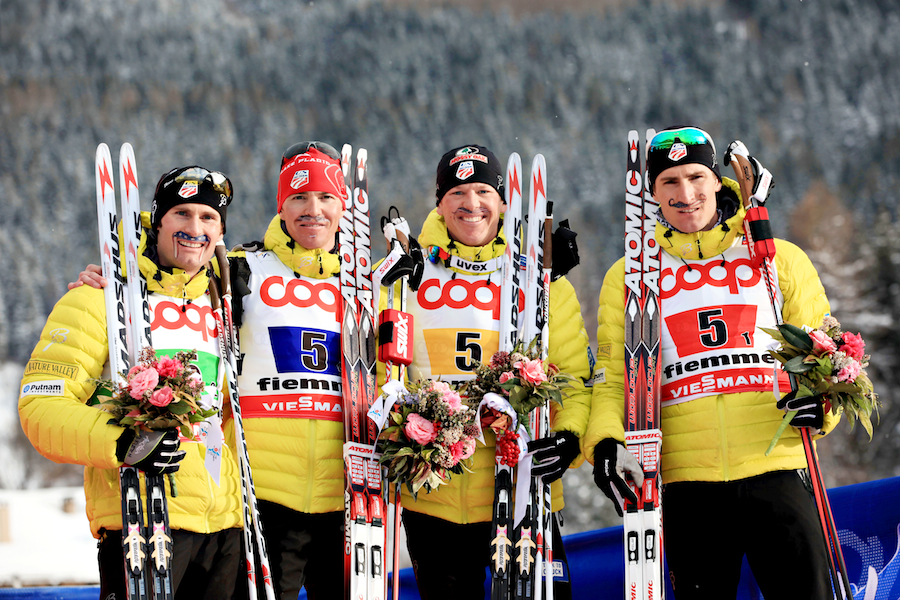
    From right to left: Taylor Fletcher, Billy Demong, Todd Lodwick and Bryan Fletcher sporting the "StacheTats" they wore to win bronze in Sunday's normal-hill/4x5 k team event at the 2013 Nordic World Ski Championships in Val di Fiemme, Italy. (Photo: Sarah Brunson/U.S. Ski Team)
    From left to right: Bryan Fletcher, Billy Demong, Todd Lodwick and Taylor Fletcher sporting the “StacheTats” they wore to win bronze in Sunday’s normal-hill/4×5 k team event at the 2013 Nordic World Ski Championships in Val di Fiemme, Italy. Bryan and Taylor were both named to the 2014 U.S. Olympic Team this past Wednesday. The nomination marks Bryan’s first trip to the Games, and Taylor’s second. (Photo: Sarah Brunson/U.S. Ski Team)

    The ski jumps of Howelsen Hill are hard to miss as you drive down Lincoln Avenue in Steamboat Springs, Colorado. Naturally derived from the hillside overlooking the small ski town, the jumps have served as a springboard for many athletes looking to make their way to the Winter Olympics.

    For the town’s locals, the jumps are a source of entertainment, training, or amusement. For one child, they were life saving.

    A Childhood in Question: Finding Relief in Skiing

    Growing up, Bryan Fletcher had no idea of what his future would hold. Diagnosed with Acute Lymphoblastic Leukemia just before turning three, the Steamboat Springs native was uncertain what life would be like while undergoing treatment for such a serious disease.
    BryanFletcher-L
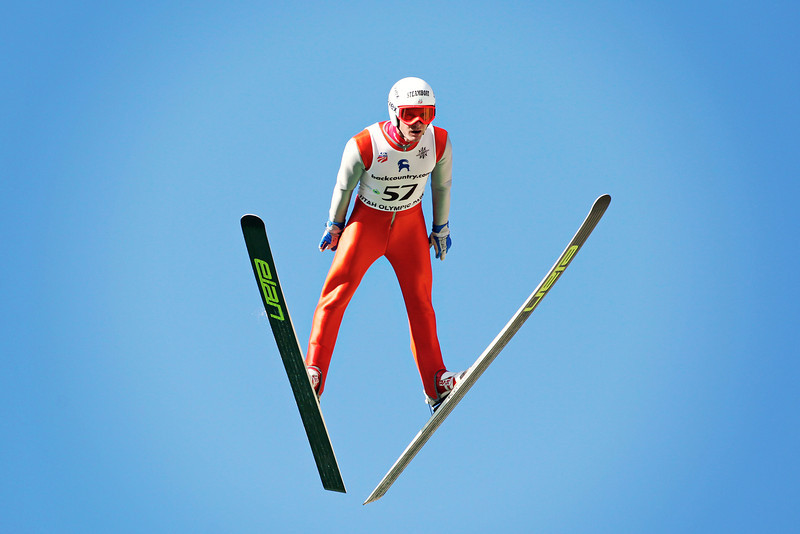
    Bryan Fletcher competing in the 2013 U.S. Nordic Combined Championships at the Utah Olympic Park, Park City. Bryan along with his brother, Taylor, was named to the 2014 Olympic Team January 21st. (Photo: Sarah Brunson/U.S. Ski Team)

    Despite the gravity of his situation, Bryan wanted to have the semblance of normal childhood. For the young child who had always “hit every bump and jump” on the side of a trail, that normalcy would take the form of a sport not so ordinary to the average American child: ski jumping.

    “As a young kid I remember saying to my parents, ‘those are the biggest jumps in the world! I have to do at least once in my life. That would be so cool.’ Shortly thereafter my parents signed me up for a learn-to-jump program and from the first day I was hooked,” said Bryan in an interview. “I couldn’t get enough of it and every time I went off a jump I would just be running straight up to the next one.”

    His start in the sport corresponded more-or-less with the start of his treatment.  From the age of four, would take week-long trips to Denver to receive his chemotherapy and then hurry back to Steamboat Springs to ensure he got in as many jumps as possible. While he listened carefully to do everything the Doctors asked of him, jumping was the one thing with which there was no compromise. It was the main source of happiness for Bryan, and his parents just couldn’t tell him to stop.

    “For two hours a day while I was training with my friends I was a worry free, happy, normal kid and that was all that mattered in the end.” – Bryan Fletcher

    Bryan would continue to fight his leukemia for seven years, going trough several year cycles of chemotherapy and remission. But the ordeal wouldn’t end there. In the middle of his treatment he survived a stroke that he was fortunate enough to escape relatively unharmed. Finally, after serval years of treatment he went into sustained remission.

    Through those seven years, Bryan also was looking for new ways to challenge himself, and that’s where cross country skiing came in. Once involved, he learned of nordic combined, and the rest was history.

    Once in remission, his career in nordic combined took off and he made the Junior World Championship team in 2003, 2005, and 2006. As a result from his rise in the nordic combined racing community, he was named to the U.S. Ski Team in 2004 and competed in this first World Championships in 2007 in Sapporo, Japan. He would continue his World Championship runs with appearances in 2011 and 2013

    But Bryan’s career wasn’t the only one born out of his disease.

    While he made his trips back and forth between Denver, Bryan’s brother, Taylor, watched with admiration as his older sibling balanced the challenges of chemotherapy and joy of ski jumping.

    Taylor soon joined a learn-to-jump program himself, instantly fell in love with the sport.

    “He (Bryan) is pretty much the reason I got into it. I was like any other kid that wanted to follow their brother. From that moment I knew that’s what I wanted to do.” – Taylor Fletcher

    His path was similar to that of Brian’s, earning 12th place at the World Junior Championships in 2009 and eventually becoming the highest ranked American in the 2013 World Cup standings in 16th.

    The 2010 Olympics: Missed and Realized Opportunities

    In the buildup to the 2010 Olympics in Vancouver Bryan found that the journey to the Olympics was harder than he had previously thought.

    Historically a skillful jumper, the older Fletcher brother focused on his cross country skiing throughout his training in the 2010 season. Unfortunately, the highly competitive Olympic year ended up being one in which everyone on the World Cup circuit was jumping better than usual.

    Struggling to crack the top 30, his results where below where he wanted them to be and he was unable to score world cup points, making his chances at competing in Vancouver slim.

    “I was selected to start that world cup that season, knowing that if I didn’t come out and secure World Cup points that I might not be able to represent my country at the games because they would have to give someone else a shot,” said Fletcher.
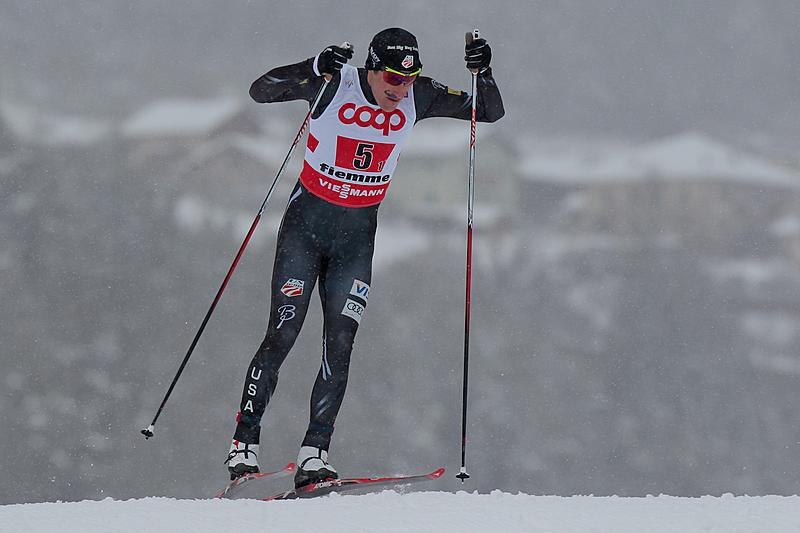
    U.S. Nordic Combined member Taylor Fletcher works to close a one-minute starting deficit on the first leg of Sunday's 4  x 5 k relay. Following his lead, the Americans placed third for their first medal in a World Championships team event. (Photo: Fiemme2013)
    U.S. Nordic Combined member Taylor Fletcher works to close a one-minute starting deficit on the first leg of the 4 x 5 k relay at the 2013 World Championships in Val di Fiemme, Italy. Following his lead, the Americans placed third for their first medal in a World Championships team event. (Photo: Fiemme2013)

    After sustaining an ankle injury, the U.S. Ski Team pulled him from World Cup competition and placed his brother Taylor in his stead. Taylor gave an excellent performance, scoring World Cup points and securing his spot on the Olympic team.

    “With him having the World Cup Points and me not being 100 percent healthy it was a no-brainer for the coaches,” said Bryan.

    Taylor had gone into the season expecting to only race in Continental Cups, but after he secured his first Continental Cup podium it was off to the World Cup.

    While he was offered an Olympic spot, he never expected that he would actually be able compete in Whistler. However, after the historic second place by the American relay team in the 4 x 5 k event, teammate Brett Camerota decided to give his spot in the individual race to Taylor.

    Aiming to have fun, Taylor went out and tried to ski his best but ultimately finished last in a field 45 skiers.

    Taylor is feeling more confident this time around, having four years of World Cup experience under his belt.

    “Going into this second Olympics, I have the experience from the first one. I know what to expect and I know what the field is like,” said Taylor. “It’s been four years competing at the world cup level. I know who is strong, fast, and who is a good jumper. I have a better idea of what the overall atmosphere is going to be like.”

    Sochi: A Chance at Greatness

    “This is something that I’ve been dreaming about for a while. It’s one of those thing that as a kid you dream of it but you’re like ‘man wouldn’t it be awesome if I could even get to a level even close to that.’ You start your goals with small steps. You start with ‘I want to go to Junior Olympics’ and then you work up and you get a little better and you’re like ‘I want to make Junior Worlds’ and then you’re like ‘I want to make the U.S. Ski Team.’ For me, as soon as I made the U.S. ski team the next goal was the Olympics.” – Bryan Fletcher

    After being named to his first Olympic team, Bryan felt nothing but excitement and gratitude that his childhood dreams, which had materialized on the jumps of Howelsen Hill, were finally coming true.
    Bryan_Fletcher_Individual_10k-L
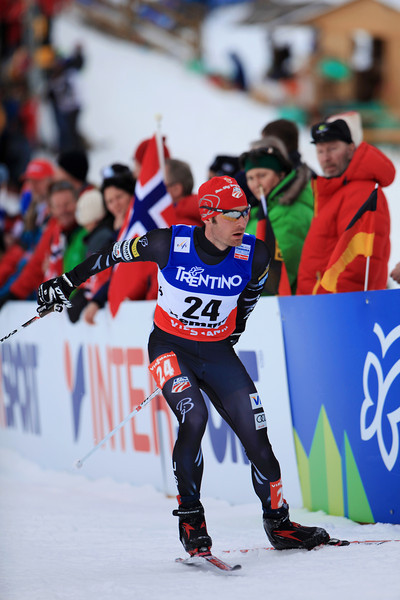
    Bryan Fletcher skiing in the Nordic Combined Individual Gundersen 10Km at the 2013 FIS Nordic World Ski Championships in Val di Fiemme, Italy. (Photo: Sarah Brunson/U.S. Ski Team)

    However, for Bryan and the rest of the U.S. Nordic Combined Team, the Olympic season didn’t start as planned. With weak results in the first weekend of World Cup racing in Kuusamo, Finland, Bryan knew that the team needed a boost of confidence and took it upon himself to help them arrive at the level of which they were capable of reaching.

    “My only goal was to just keep everyone optimistic and prove to ourselves that we can be there and not to be too defeated. Even when the going is tough, and we think we’re out of it… we’re not,” said Bryan.

    And rally they did. The U.S. team has continually been climbing the results all season with multiple top ten finishes since the Kuusamo World Cup, highlighted by Bryan’s season-best result with a fifth place at the Seefeld Triple in Austria.

    Another factor that both Bryan and Taylor said has played a role in their team’s progressing strength, not only this season but in season’s past, is the leadership from veteran’s Todd Lodwick and Billy Demong.

    “Those guys have more experience than anybody when it comes to the World Cup. Just having the steady experience and steady advice to follow has been amazingly helpful,” said Bryan.

    Taylor, agreed, saying that both Demong and former teammate Johnny Spillane, played an essential role throughout his development.

    “Bill and Johnny really took me in when I first got to the team. They helped me figure out the ropes of the world cup: what I can do, what I can expect, how to approach the competition and what not. I was a young guy getting my feet wet and not really sure what to expect,” said Taylor. “Even going back to when were 14 years old, Bill hosted these camps in Steamboat, Park City, and Lake Placid for the top juniors in the nation. He would take us out skiing and we’d get to train with Billy. That in itself was huge. Johnny was doing the same thing, and it gave you a good idea of what it takes to be a good combined skier and what I needed to do to get where I am at now.”

    When it comes down to it, both Fletchers agree that the team, from the rookies to the veterans, is a supportive group.

    “It’s easy to say that we’re a very solid and very close team. We are help each other as much as possible,” said Taylor.

    With lofty goals for Sochi, the Fletchers are going to need as much support as possible from their team.

    Both Brothers hope for a medal and know that if they perform to the best of their abilities they will have a chance of landing a place on the Olympic podium.
    Taylor_Fletcher_Billy_Demong_Bryan_Fletcher_Individual_10K_1-L
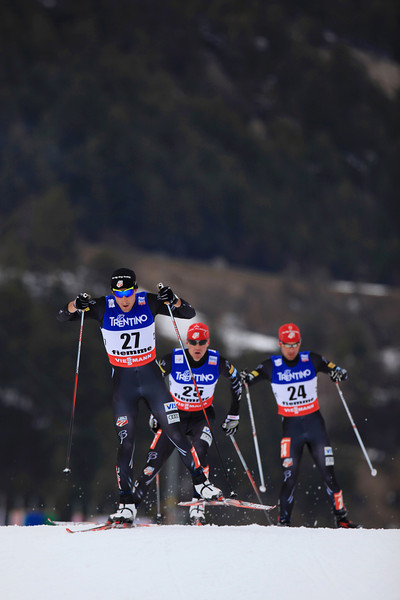
    Billy Demong, Taylor Fletcher, and Bryan Fletcher (l-r) compete in the Nordic Combined Individual Gundersen 10Km at the 2013 FIS Nordic World Ski Championships in Val di Fiemme, Italy. (Photo: Sarah Brunson/U.S. Ski Team)

    For Bryan, the plan is to continue his recent pattern of good results and perform at the same level in Sochi. “If I go out there and ski like I have been skiing, and jump like I have been jumping, then that’s all that I can ask for. Hopefully it will be good enough. Obviously the medals are a goal and I’m certainly going to be out there trying for one of those medals,” he said.

    U.S. Nordic Combined Head Coach Dave Jarret was confident in Bryan’s position headed into Sochi. “Bryan had a disappointing 2010, didn’t get named to the team but since then consistently he’s been our leading guy,” said Jarrett at the U.S. Olympic Team naming on the 21st of January. “He used the disappointment to refocus reenergize: fifth overall in the triple and having awesome races and beginning to find the jumping form that he’s had in the last 2 or 3 years.”

    Despite his wish for an individual medal, Bryan emphasized that as long as he delivers his best effort on the slopes of Sochi he will be content, regardless of his position.

    Taylor, who has had mixed results this year, knows he can ski with the best but realizes that his jumping needs some work. “A medal would be fantastic, but I’ve had an up and down year. In skiing I’ve been one of the fastest guys all year long, I’m just missing that key aspect in the jumping that can really change things around,” he said.

    In the hopes that he’ll be able to “deliver the jumps when it matters,” Taylor is using the next two weeks before the start of the games to practice his consistency and engrain the perfect technique to maximize his full jumping potential.

    “Taylor is probably one of, if not the fastest guy on the World Cup. It’s a matter of him really letting everything go on the jump to put himself in a position to win the race,” said Jarrett at the team naming. 

    Individual aspirations aside, the Fletchers are putting the majority of their focus on the 4 x 5 k team event in which the U.S. placed second at the 2010 Vancouver Olympics and third at the 2013 World Championships in Val di Fiemme, Italy.

    Despite their past successes in the team event, the Fletchers know that it will be difficult to medal with such a strong field in Sochi. Furthermore, Lodwick, who was the star of this year’s U.S. Olympic Trials, sustained a shoulder injury in France, bringing the veteran’s health and ability to race in the relay into question.

    “I would love to see us get a medal in the team event. I think we’re very capable and it just takes a strong day from each of us to be in contention. It’s not going to be an easy goal to achieve. We’re setting our sights high there and we know that there’s a very real possibility that we may not come away with it.” – Bryan Fletcher

    After such a successful in the 2010 Vancouver Olympics, in which the U.S. garnered 4 medals in the individual and team events, the pressure is certainly a weight of pressure on both the Fletcher brothers to repeat past success. Whether or not the Fletchers and the U.S. Nordic Combined Team will be able to rise to the occasion will be revealed in February, but the one thing that’s certain, is they will have each other’s backs no matter what.

    Brothers: A Lasting Partnership 

    Through the stress and challenges that the Fletchers have faced in this Olympic year, they both know that they can always count on each other for support. Moreover, they also know that their strengths compliment each other.

    Bryan has used his aptitude in on the jump to play a critical role in helping Taylor improve his jumping technique and capabilities. Conversely, Taylor, who has always been the stronger skier of the two, has aided Bryan in the advancement of the level of his skiing over the years by providing tips and training side by side.

    “It’s the best partnership you could ask for. He knows everything about me so if he sees something that seems odd he let’s me know. He’s like ‘hey dude you’re a little to hyped for this, you’re a little to pumped up. Calm yourself down, breath. You can do it.’ He’s my best supporter and I’m the same for him.” – Taylor Fletcher

    When talking to the Fletchers, their likeness is unavoidable: the mannerisms, sayings, and style of speaking are strikingly similar. What’s even more apparent, however, is their love for the sport which overtook them at such a young age.

    Whether it was a way to escape the hardships of disease, or a way to follow in the footsteps of an admired, older brother, Bryan and Taylor Fletcher have demonstrated the impact a sport such as nordic combined can have on the lives of two small-town Americans. It’s what the Olympic spirit is really all about.

    Whether or not their Olympic goals, individual or team, are realized in Sochi, it’s vey apparent that these two will be around to make their mark for a long time to come.

    IMG_2804-L
    Billy Demong, Taylor Fletcher, and Bryan Fletcher (l-r) pose for a U.S. Nordic Combined Team photo for the 2011/2012 season. (Photo: Sarah Brunson/U.S. Ski Team)
  • U.S. NoCo Soaks Up Sochi, Takes Results in Stride (with Photo Gallery)

    U.S. NoCo Soaks Up Sochi, Takes Results in Stride (with Photo Gallery)

    Todd Lodwick (second from left) after winning Sunday’s competition at the FIS Summer Grand Prix in Krasnaya Polyana near Sochi, Russia. Austrians Bernhard Gruber (l) placed second and Tomaz Druml was third. (Dave Jarrett courtesy photo)

    At the biggest international competition of the summer, hardly anyone could blame the Americans if their heads weren’t totally in it.

    It’s not that they weren’t focusing on nordic combined’s International Ski Federation (FIS) Summer Grand Prix. They just had a lot of other things to absorb during their first visit to Sochi, Russia.

    For veteran competitors like Todd Lodwick, Johnny Spillane and Billy Demong, the new venue was a welcome change to their routine trips to the sport’s typical sites. Sure, they loved their jumps in Park City, Utah, and enjoyed getting some practice in Oberstdorf, Germany, before heading to Russia about a week ago. But sometimes, unique sights are the most stimulating.

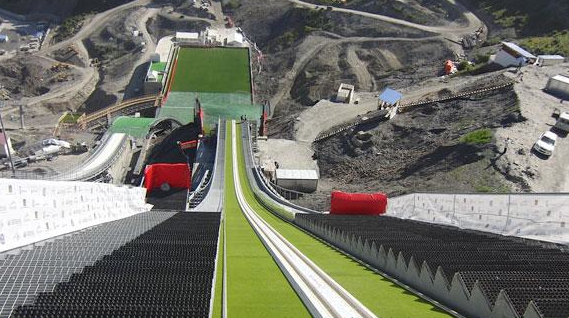
    View from the top of the 2014 Olympic ski jumping complex near Krasnaya Polyana, Russia. (USSA/Dave Jarrett photo)

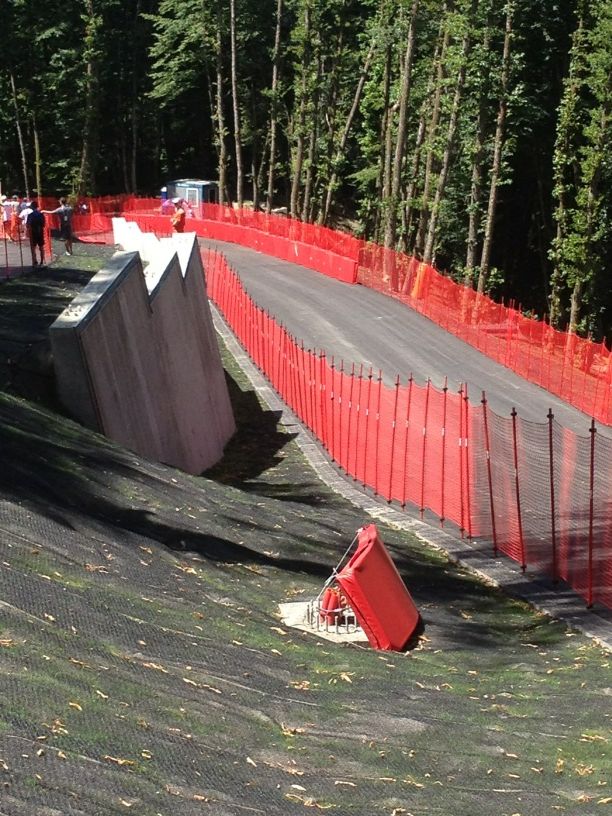
    The U.S. Nordic Combined team soaked up plenty last weekend at the under-construction venue near Krasnaya Polyana, about 40 kilometers northeast of Sochi. For the 2014 Olympics, the “Mountain Cluster” will host all the of the ski, snowboard and sled events (bobsled, luge and skeleton) and high-speed gondolas and trains will be in place to get people where they need to be.

    Eighteen months before the Winter Games, U.S. head coach Dave Jarrett estimated there were 60,000 laborers running around, working around the clock in six-week shifts to get the job done. The Americans were only there for an extended weekend at the Summer Grand Prix (SGP) July 21-22, yet managed to capture the energy.

    “I think everyone was psyched, especially the older guys,” Jarrett said on the phone from Florida, where he met his family for vacation after returning from Sochi. “It’s not every year that they get to go to a new jump or a new place. It [can be] like Groundhog Day all over again. Those guys were psyched to be somewhere new.”

    The oldest member of the A-team, Lodwick, 35, did exceptionally well in the hot and humid conditions, with temperatures around 95 degrees Fahrenheit that rose higher on the newly paved rollerski track. After placing second on Saturday, Lodwick won gold at the Grand Prix on Sunday and raced the fastest time on both days.

    While Lodwick couldn’t be reached for comment, Jarrett talked about his performance – more impressive considering Lodwick hadn’t competed since December of last season. The 2009 World Champion last won a race nearly two years ago at a Continental Cup in his hometown of Steamboat Springs, Colo. A five-time Olympian, Lodwick hadn’t been on the podium since the 2010 Vancouver Games, where he won silver in the team event, yet had six World Cup victories and 26 podiums to his name.

    “He’s definitely a competitor,” Jarrett said. “He’s been around for a long time. I wouldn’t bet against him, but I wouldn’t have picked him to do as well as he did … on the jumping hill. I think he was really psyched and I think it gives him some motivation moving forward.”

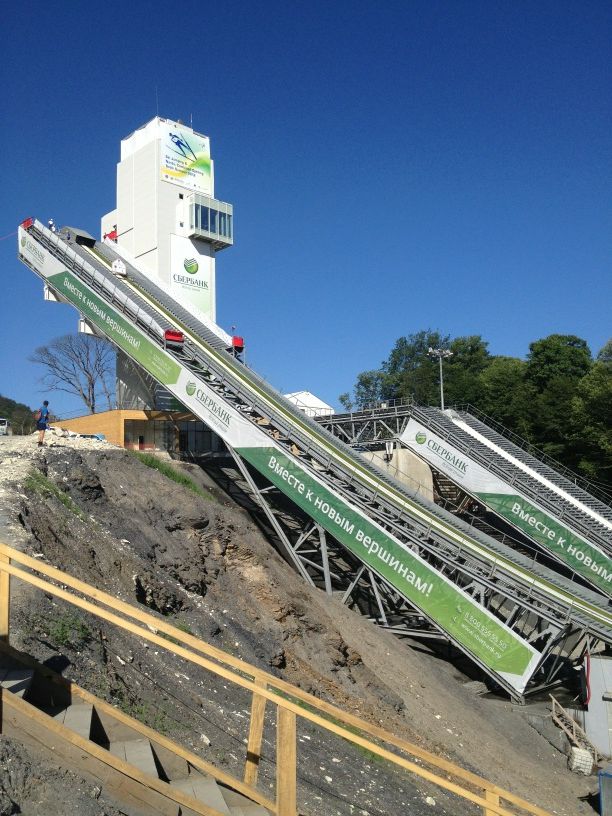
    Sochi’s nordic-combined jumps, which will be used in competitions leading up to the 2014 Winter Olympics, as seen in July. (Dave Jarrett courtesy photo)

    Jarrett knew Lodwick could dominate a relatively thin Grand Prix field in the 8.8 k rollerski race, but was surprised by how well he jumped on the 140-meter large hill. On Saturday, Lodwick ranked ninth in the jump and climbed seven places in the Gundersen-start race to finish second, and Sunday, he finished fifth in the jump and landed the top spot overall.

    “He’s been obviously doing a good job,” Jarrett said, adding that Lodwick hadn’t jumped as well in practice leading up to the event.

    Four months ago, Jarrett wasn’t sure what Lodwick’s plans were. He essentially took last year off to remedy some pulmonary issues, and with a wife and two young children at home, Jarrett couldn’t blame him. However, with the 2014 Olympics fewer than two years away, Jarrett had a more frank discussion with Lodwick this spring.

    “He and I sat down in March, and basically, I required him to make a commitment,” Jarrett said. “If he wasn’t going to commit to being a full-time athlete and good teammate, then there wasn’t going to be a place for him because he technically didn’t qualify for the team based on his results last year.”

    With his sixth Olympics in sight, Lodwick chose to commit. According to his biography on the U.S. Ski and Snowboard Association (USSA) website, Lodwick said last season was a difficult because his asthma prevented him from training.

    “I got down on myself and wondered if this was something I wanted to continue to do,” Lodwick said. “But this sport provides so much more to me than winning. I’m truly passionate about it. And with the staff we have and the athletes on the nordic combined team, I couldn’t ask for a better bunch of guys to work with to push the sport to the next level.”

    Lodwick wasn’t the only American who shined in Sochi; Spillane and Taylor Fletcher also made the top 10 on Sunday.

    Spillane, who finished seventh overall, said he was pleased with how things went at the SGP, but didn’t put too much thought into summer results.

    “It really doesn’t matter at all, but the trip served its purpose for us to go there and get a feel for what it’s like over there,” Spillane said on the phone from Steamboat Springs. “As far as the competitions go, I was happy with how it went, and my goals aren’t to do well in July by any means.”

    On the phone in Park City, Fletcher confirmed that his 10th place was a Grand Prix career best, but that didn’t mean a whole lot to him, either.

    “It wasn’t a full field, which is kind of a bummer, but it’s good to go,” he said of the competition, which included several top jumpers from Austria and Japan, but lacked some of the best athletes from Norway and Germany. “Nonetheless it was still a good show and everybody had a good time.”

    The Big Picture

    Aside from testing Sochi’s new venue, the U.S. team also wanted to get its bearings before traveling to Russia again this winter. From Feb. 2-3, they’ll compete on the same large hill near Krasnaya Polyana and race a similar course.

    About Taylor Fletcher and Billy Demong’s Grand Prix DQ’s:

    According to Jarrett, the Grand Prix presented a good opportunity to compete at a new World Cup and Olympic venue, but he didn’t take it too seriously.

    “On the jumping hill, it was clear that we certainly made improvements, which was what we were looking for,” Jarrett said.

    “To have those guys ski as well as they did was a bonus, but if they were horribly slow it wasn’t going to be the end of the world either. It turned out well.”

    Demong finished seventh on Saturday and was disqualified Sunday because his suit was three centimeters too loose. On Saturday, Taylor Fletcher was disqualified after the jumps because his undersuit had holes in it.

    Jarrett didn’t have a problem with the Demong’s disqualification – Demong opted not to tighten his suit the night before – but he did take issue with Fletcher’s DQ.

    “Taylor got disqualified because he broke an undersuit rule, an underwear rule,” Jarrett said with a laugh. “They didn’t enforce it last year. … They pick certain people to get checked every day, but the threat of being checked is there all the time.”

    Regardless, Jarrett couldn’t believe he was spending so much time discussing threads, needles and bobbins.

    “Now your suits basically become illegal because it becomes too big after a few jumps,” he said.

    “Tongue and cheek, I joked that we ought to hire a seamstress instead of a second service guy [to travel with us]. It’s pretty stupid when a sport comes down to that. … We brought our sewing machine from Europe and those guys were sewing their suits before the competition.”

    “The Grand Prix is just that; there wasn’t a lot of teams that came to Sochi,” Jarrett said. “It’s more important to just be there and jump on the jumps more so than the competition.”

    In the winter, racers will have to do the full 10 kilometers on a slightly longer loop (the rollerski course was shortened to keep within maximum climbing limitations), and they’ll start and finish in the jumping flats so that spectators can watch from their stadium seats.

    Another difference is that skiers probably won’t sink into the pavement like they did last weekend.

    “It was so hot out that our rollerski [pole] tips were sticking; we were digging into the pavement and our wheels were running on hot, hot tar,” Fletcher said. “It’s a hard course and it’s going to [be] really challenging in the winter because everything’s going to be a little bit longer and … you’re not going to have the same speed that you have on rollerskis, I don’t think.”

    Fletcher’s older brother, Bryan, tried to look beyond his results last weekend (16th on Saturday, 21st on Sunday) and envision himself competing there this winter.

    “I held some hopes for the jump hill however after an extremely tough week in France for our TDF [Tour de France] camp, I knew I would be tired heading into the competitions,” Bryan wrote in an email, referring to the team’s preceding cycling camp in the French Alps. “I am not strong in extreme heat and humidity and Sochi had plenty of both.”

    Outside of competition, he noted the magnitude of the development going on near Sochi, referring to the amount of construction as “astronomical.” All the snow venues will be accessed by gondolas and trains, which “could be fantastic for spectators,” he added.

    According to Spillane, there weren’t a huge amount of local spectators at the Grand Prix, but that was to be expected given its location.

    “The venues are not near anything; it’s a ways from the city,” he said. Taylor Fletcher estimated it took an hour and a half to drive there from Sochi.

    “All the hotels are under construction so there’s nothing done,” Spillane added. “It’s pretty incredible actually.”

    Before the Grand Prix competitions, the U.S. team hiked to a vantage point with former Canadian nordic-combined coach Nik Petrov, who works for the Russian Olympic Committee.

    “He kind of pointed everything out up high,” Taylor Fletcher said. “We could see where everything was going, where the [athletes’] village is going to be an whatnot.”

    One of the purposes of the trip was to find the best accommodations, and while their American-style hotel near their venue was suitable, they weren’t sure what other options would become available in the meantime. Jarrett felt the OC might be in a bit of a time crunch.

    “It’s a big undertaking,” he said. “I guess the road from the Sochi airport up to Krasnaya Polyana, the valley where everything happens, used to take two hours to go almost 50 k’s. Now they built this high-speed highway and double-decker highway up this valley. It looks like it’s going be really nice when they get everything done, tons of hotels, tons of skiing, but we’ll see, they don’t have a lot of time. I guess they have no choice.”

     ***

    Team photos from Sochi: