Tag: sochi skate sprint

  • Best of the Rest: North Americans Qualifiers Reflect on Skate Sprint

    SOCHI, Russia — Four U.S. women made the heats, Ida Sargent had one of her best freestyle sprints of the season in her first Olympic race, and Jessie Diggins tallied the second-best American result in 13th after Sophie Caldwell — who made U.S. women’s Olympic history in sixth in Tuesday’s sprint.

    So yeah, there were some bright spots for the North Americans in the women’s 1.3- and men’s 1.8-kilometer sprints — the second races of the 2014 Olympics.

    Sargent, 26, finished fourth in her quarterfinal, 2.43 seconds behind Norway’s eventual silver-medalist Ingvild Flugstad Østberg in first, after getting pinched out on a 180-degree corner coming down into the stadium.

    “I was trying to make a move on the inside, but Ingvild threw in a big snow plow and also tried to take the inside and I lost all my speed, and went to third to fourth by a lot,” Sargent explained. “I killed my speed coming into that.”

    After qualifying in 26th, she ended up 19th overall behind U.S. teammate Kikkan Randall in 18th.

    “The heats are always tough for me so I was pretty psyched to make it, especially with not a great qualification run for me,” Sargent said. “It’s the Olympics so I’m really excited to ski a heat and represent USA.”

    Diggins was the second-best U.S. qualifier in 12th after Caldwell clocked the ninth-fastest time behind qualifier winner Maiken Caspersen Falla, who won the prelim in 2:32.23. The 22-year-old Diggins went on to place third in her quarterfinal, 1.61 seconds after Slovenia’s Katja Visnar and 0.85 seconds behind Caldwell.

    “The course, it was tricky; it’s not the course I would’ve designed myself if I was going to play to my strengths,” Diggins said. “It was a short course and you had to kind of change your technique after they salted and it was slushy. I skied the best I could and I’m proud of that. … I couldn’t find windows in which to get through so I feel like I have more energy and I have more to give, but that’s sometimes the way it goes.”

    Diggins was most pleased with her form and the way she’s feeling about her fitness, especially for the event she’s most focused toward: the women’s 4 x 5 k relay on Saturday.

    “It’s great that we were able to get four women into the quarterfinals,” she said. “I think that says a lot about where our country’s come from and where we’re headed. A few years ago we would’ve maybe got one in and now we’re getting four girls in the heats mixing it up in there and I think that’s a really positive thing.”

    Andy Newell led the U.S. men in 18th, after qualifying 17th then placing fourth in his quarterfinal 0.84 seconds behind Norwegian winner Anders Gløersen.

    “I think it’s the hardest sprint I’ve ever done, and I’ve done a lot of sprints,” Newell said. “It’s challenging conditions and it’s pretty slow out there. With a course like that, with a hill like that, it makes it really tough. With the altitude and everything you’re breathing so hard when you cross the finish line. I didn’t feel great in qualification, didn’t pace it quite right. I had a good barf after that.”

    Before the quarterfinals, he still wasn’t feeling good and had a headache.

    “I regrouped and felt okay,” Newell said, despite a run-in with Austria’s Harald Wurm. “My tactic was to really give it on the hill because I know I can do that better than most people. I had a decent amount of energy in the lanes, but maybe just not quite enough. I tried to pull up around the Norwegians but didn’t quite have it.”

    In his third Olympics, Newell acknowledged how hard it is to put a great race together at this level.

    “Every race is different and every Olympics are different, too,” he said. “A skate sprint only comes around every eight years and the chances of that being on a similar course to what you’re used to is pretty slim. This is a very unique course. That’s what ski sprinting is all about, being able to adapt to these different courses, different lengths, and different conditions.”

    Simi Hamilton notched his best individual Olympic result at his second Winter Games in 27th, qualifying in 21st and ultimately placing sixth in his heat 1.84 seconds behind eventual gold-medalist Ola Vigen Hattestad of Norway. Not even 20 meters out of the start, Hamilton’s pole broke in the deep snow. Within 800 meters, he was back with the pack.

    “Fortunately the pace was pretty slow … [and] I was able to settle in the back with a new pole and stay there and made a move at the top of the hill to get back to the front and get my strap on,” he said. “But I was still was in the rough and tumble part of the pack.”

    Making his move on the final tight corner, he found himself boxed out on the far lane coming toward the finish.

    “I lost a lot of time there,” Hamilton said. “I felt like that was my moment to turn it on and right as I was about to I got shoved back to no man’s land.

    “It’s hard for sure,” he continued. “I feel like this season a lot of things were coming together. The Olympics are tough. It happens every four years. Some days you have it and some days you don’t and today I woke up and I was feeling good and wasn’t feeling the best I’ve ever felt but I was still really psyched. I guess I didn’t have it. It’s all right, it’s just another race. It sucks that it’s the big stage here today.”

    Canada’s Alex Harvey, Perianne Jones and Dasha Gaiazova qualified for the rounds in 19th, 23rd, and 25th, respectively. None of them made it past the quarterfinals, with Harvey placing fourth in his heat, 1.75 seconds behind Russian winner Sergey Ustiugov, for 19th overall. Gaiazova was fifth in her quarterfinal, 3.44 seconds behind Norway’s Astrid Urenholdt Jacobsen in first, for 25th.

    “Just that raw, raw speed up an offset, I just didn’t have it,” Harvey said. “And I don’t have it really often. I’m better on courses where it’s more 1-skating than offset.”

    After getting off to a good start, Harvey said he was happy about the beginning of the race.

    “I positioned myself well; I was in position to strike, I just didn’t have the strike,” he said.

    Jones had her second-best sprint result of the season and individual Olympic career-best in 23rd after placing fifth in the quarterfinal with Germany’s Denise Herrmann, Norway’s Marit Bjørgen, and American Kikkan Randall, who finished first, second and fourth, respectively. Italy’s Gaia Vuerich edged Randall by 0.05 seconds for third to advance to the semifinals, and Jones was nearly three seconds behind Randall in fifth, ahead of Finland’s Mona-Liisa Malvalehto.

    “I made a little move over the corner and came around Mona-Liisa just on the inside, a few extra pushes over the top so I was happy with that part,” Jones said. “I think we had really good skis because I was able to make up some ground on the downhill and stay on my feet around the corner.

    “I got off to a bit of a slower start than I would’ve liked,” she explained. “Other than that I felt pretty good. My body feels good so I’m looking forward to the classic team sprint. Obviously would’ve liked to make it through to the next round, but I’m happy with today.”

    Gaiazova said she skied aggressive from the start and was able to stay out of trouble out front.

    “I went so hard up the hill,” she said. “I was really pumped. It was really fun and I was feeling in control and feeling really good cresting, then I ran out of energy just a tiny bit at the end. When all the girls went by I tried to stay with them. In the end I’m pretty happy with how it went. I think strategically I was skiing well. If I could have gone a little harder at the top it could have been a little bit of a different outcome but at the same time I’m happy. It’s my first Olympic race and I have three more to go. The team sprint, the classic, I can’t wait.”

    In her native country, Gaiazova said the experience so far at the Olympics has “been unreal.”

    “Russia has done an amazing job. I know a completely different Russia. This is like fantasy land. It’s so nice, everything is so clean. Everyone is so resourceful and so polite.  Everything is running so well. It’s awesome to see it like this. They really care. They really wanted to pull off a good games and let people have good memories.”

    And she could hear people cheering for her in Russian.

    “They know me and they cheered for me,” she recalled. “I tried to stay focused on my race, but I would get distracted and excited. It’s emotional; a lot of nostalgia from growing up.”
    Results: Women | Men


  • Falla, Østberg Give Norway First 1-2 Finish of the Olympics; Fabjan Third in Skate Sprint

    Falla, Østberg Give Norway First 1-2 Finish of the Olympics; Fabjan Third in Skate Sprint

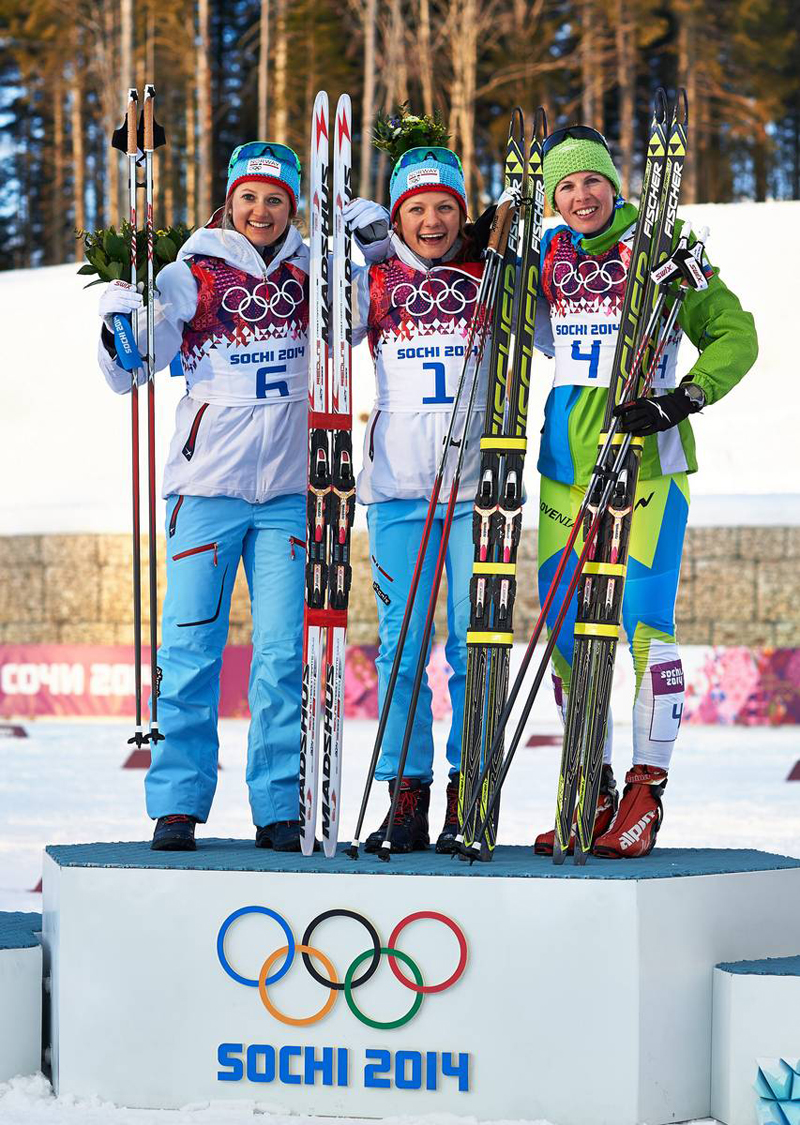
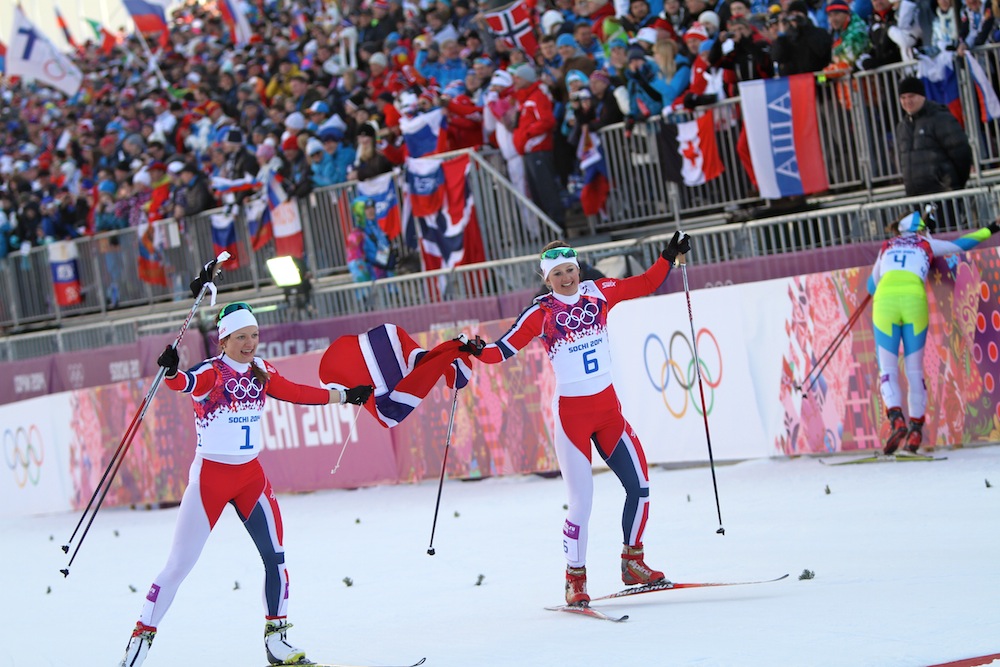
    Norwegian teammates and friends Maiken Caspersen Falla (l) and Ingvild Flugstad Østberg celebrate gold and silver, respectively, in Tuesday's Olympic skate sprint in Sochi, Russia.
    Norwegian teammates and friends Maiken Caspersen Falla (l) and Ingvild Flugstad Østberg celebrate gold and silver, respectively, in Tuesday’s Olympic skate sprint in Sochi, Russia. Slovenia’s Vesna Fabjan (r) took bronze.

    FasterSkier’s coverage is made possible through the generous support of Rudy Project.

    SOCHI, Russia — Tuesday’s Olympic freestyle sprint was more about survival than tactics, more about crashes and carnage than grace and finesse.

    But some people managed to stay on their feet and ski fast at the same time on the soft and, in some places, salted snow, and at least three of them were Norwegian.

    No, not Marit Bjørgen, the all-around favorite at this Olympics.

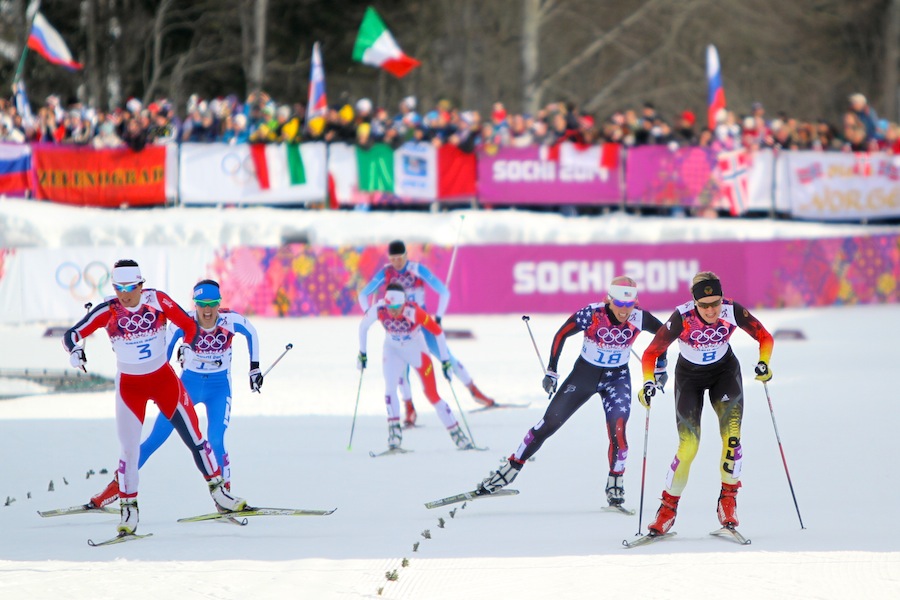
    Germany's Denise Herrman (r) leads Norway's Marit Bjørgen (l) down the finishing stretch of the women's freestyle sprint quarterfinals on Tuesday at the 2014 Olympics in Sochi, Russia. American race favorite Kikkan Randall (second from r) tries to hold onto third while Italy's Gaia Vuerich (second from l) charges from behind. Canada's Perianne Jones placed fifth after Randall, who was fourth in the heat, and Finland's Anne Kyllonen was sixth.
    Germany’s Denise Herrman (r) leads Norway’s Marit Bjørgen (l) down the finishing stretch of the women’s freestyle sprint quarterfinals on Tuesday at the Olympics in Sochi, Russia. Kikkan Randall (second from r) tries to hold onto third while Italy’s Gaia Vuerich (second from l) charges from behind.

    Not Kikkan Randall either, who was eliminated in a surprising turn of events in her quarterfinal, where she went from first to fourth between the last corner and the finish, then missed out on third in a photo finish that would’ve advanced her to the semifinals.

    The masters of sprinting on sugary snow turned out to be 23-year-old Norwegian teammates and friends, Maiken Caspersen Falla and Ingvild Flugstad Østberg, who won gold and silver, respectively, in the women’s 1.3-kilometer sprint.

    “My tactic was to stay in the front because so much can happen in sprints and I have learned that the hard way,” Falla said in a post-race press conference. “I get trouble because of other peoples skis or poles. … The people in front of you decide how your race will turn out.”

    Slovenia’s Vesna Fabjan took bronze in the photo finish for second, two-hundredths of a second behind Østberg and 0.4 behind Falla, who won the final for her first Olympic medal in 2:35.49.

    Fabjan’s result matched that of former Slovenian skier Petra Majdič, who placed third in the 2010 Olympic classic sprint and retired in 2011.

    “I think it’s a great achievement for our team,” Fabjan, 28, said of her first Olympic medal. “We weren’t so great organized before; it was everything around Petra and after she retired the sport is on us. I think we showed to the world that Slovenia is not just Petra Majdič.

    “We are much more connected than before,” she elaborated. “We are also like a big family supporting each other. We were working for this medal so hard. This medal is not just mine but it’s from all team.”

    Another Norwegian, Astrid Uhrenholdt Jacobsen, placed fourth (+1.82) less than a week after her brother died unexpectedly last Friday. She broke a pole after tangling with American Sophie Caldwell on a tight corner at the top of the course, but came back for her second-best sprint result of the season in her first race of the Olympics.

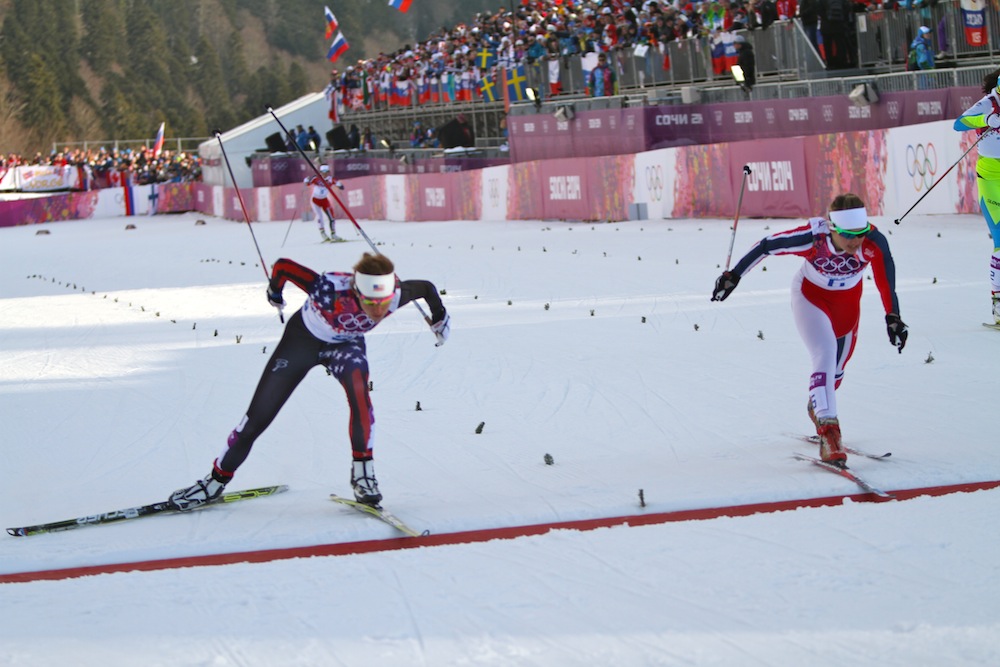
    Caldwell lunging for the line in a photo finish with Ingvild Flugstad Østberg in her semifinal heat.
    Caldwell lunging for the line in a photo finish with Ingvild Flugstad Østberg in her semifinal heat.

    Sweden’s Ida Ingemarsdotter passed Caldwell and placed fifth (+6.55) and Caldwell finished 5.7 seconds later in sixth for the best U.S. Olympic women’s result of all time in cross-country skiing.

    Earlier in the afternoon, with temperatures well above freezing, Falla won the qualifier by 0.4 seconds over Fabjan, and Bjørgen followed in third (+1.1). Randall had qualified in 18th behind her U.S. teammates Caldwell in ninth and Jessie Diggins in 12th.

    Caspersen went on to win the first quarterfinal by 0.78 seconds over Sweden’s Stina Nilsson, as did Østberg, who edged Ingemarsdotter in a photo finish for first in the third quarterfinal. Jacobsen won the second quarterfinal by 0.21 seconds over Fabjan, and Fabjan’s teammate, Katja Visnar, won the fourth quarterfinal, 0.76 seconds ahead of Caldwell. Diggins was third in that heat, eight-hundredths of a second back, narrowly missing out on the semifinals.

    The fifth quarterfinal could’ve easily been mistaken for a final, with Bjørgen, Randall and Germany’s Denise Herrmann squaring off, along with Finland’s Mona-Liisa Malvalehto, Canada’s Perianne Jones, and Italy’s Gaia Vuerich.

    Randall took charge on the pivotal climb out of the stadium then lost steam in the finishing straight, as Herrmann and Bjørgen unleashed their energy reserves to take first and second ahead of her. Vuerich lunged ahead of Randall as well, placing third by 0.05 seconds to capture the last lucky loser spot that went with it.

    Falla went on to win the first semifinal by 0.22 seconds, after Fabjan nearly caught her on the downhill with a slingshot that rocketed the Slovenian to second. Ingemarsdotter sprinted up to challenge Fabjan for second, and ended up third by three-hundredths of a second. Jacobsen finished 0.3 seconds later in fourth, and all four advanced to the final.

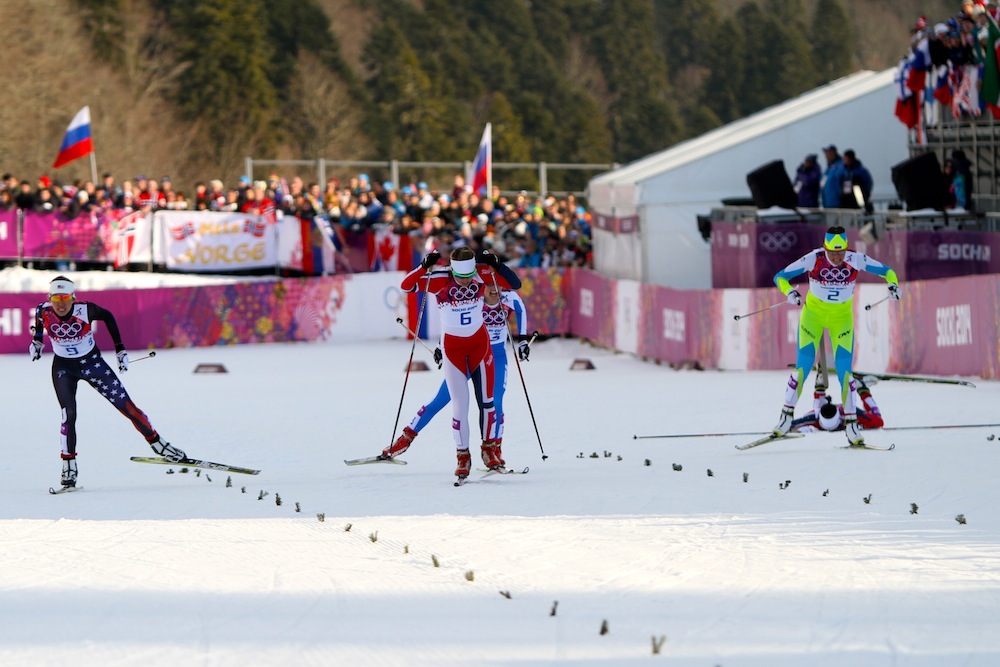
    Østberg leads while Caldwell challenges her to the line in the women's 1.3 k freestyle sprint semifinal, which Østberg won by 0.01 seconds. Marit Bjørgen crashed in the finishing straight to place sixth.
    Østberg (c) leads while Caldwell (l) challenges her to the line in the women’s 1.3 k freestyle sprint semifinal, which Østberg won by 0.01 seconds. Marit Bjørgen crashed in the finishing straight to place sixth.

    Østberg led Caldwell and Visnar up the first hill in the second semifinal, where Caldwell tucked into second. The order held all the way back to the stadium, while Bjørgen struggled to find room to come from behind.

    Herrmann took the lead early in the finishing stretch while Vuerich and Visnar followed. Østberg and Caldwell caught up along the horseshoe-shaped flat for a five-way fight to the finish while Bjørgen stumbled in last, falling flat on her stomach.

    “I have bad start and cannot find my [position],” Bjørgen told NRK, according to a translation. “There was fighting all the way, and finally it ends with a fall.”

    Østberg clinched first, 0.01 seconds ahead of Caldwell in second, and Vuerich again placed third (+0.21), not enough to advance the finals for seventh overall. Herrmann finished fourth in (+0.28), nearly a second ahead of Visnar in fifth. Bjørgen came through in sixth, nearly 16 seconds after Østberg.

    In the final, Caldwell in her debut Olympics said she was “thrilled to be there.”

    “I definitely wasn’t expecting that coming into today, so it exceeded any expectations that I had,” the 23-year-old Vermont native said.

    Falla and Fabjan led out of the start while Østberg stayed close in third. With a sharp righthand corner leading into the big climb, Ingemarsdotter and Caldwell hung close around fourth and fifth, while Jacobsen was just off the back in sixth.

    The front free broke away slightly down the backside of the hill, and remained in order until the S-turn final descent. Jacobsen pushed hard to make up significant ground on the leaders, nearly reining them in before the finish.

    Falla pressed on and outlasted her competition for gold in her second Olympics. Just 0.38 seconds behind, Østberg beat out Fabjan by two-hundredths of a second for silver.

    Together, Falla and Østberg notched Norway’s 100th gold medal in cross-country and their nation’s first 1-2 finish at the 2014 Winter Games.

    “It’s a little coincidence,” Falla said. “We’re coming from a great winter sport nation and it’s a really big part of that heritage.”

    “It’s great to win with Maiken,” Østberg added. “We’ve been training for so many years and we’re at the same age and still young, proud to be norwegian today.”

    With three women in the top four and a men’s winner in Ola Vigen Hattestad, it was the kind of day Norway needed four days after Jacobsen’s family tragedy.

    “It’s definitely been some hard days for the Norwegian team, but Astrid showed today that she’s really strong and I’m extremely proud of her,” Falla said. “She really pulled herself together … it’s bad that she broke a pole in the final because she also could get a medal. I’m proud of her and I’m proud of the team and I hope we have encouraged her to do a good sprint today.”

    Adding to the excitement for Falla, she got to meet the Crown Prince of Norway, Haakon Magnus. According to NRK, he said he pinned her as the winner from the first round.

    “I had absolutely wonderful skiing; the best ever!” Falla replied, according to a translation.

    “It feels like I have fallen from the moon and it’s so great to share the day with my good friend Ingvild and other supporters,” she added.

    “I have said that the goal is a medal,” Østberg told NRK. “I’m absolutely ecstatic and cannot believe it.”

    — Nat Herz and Chelsea Little contributed reporting

    Results


    Ingvild Flugstad Oestberg (NOR), Maiken Caspersen Falla (NOR), Vesna Fabjan (SLO) gather on the top step of the podium.  Photo: Fischer / Nordic Focus.
    Ingvild Flugstad Oestberg (NOR), Maiken Caspersen Falla (NOR), Vesna Fabjan (SLO) gather on the top step of the podium. Photo: Fischer / Nordic Focus.


  • Four U.S. Women and Two Men Qualify in Olympic Skate Sprint; Three Canadians Also Advance

    SOCHI, Russia — All four American women in Tuesday’s 1.3-kilometer freestyle sprint successfully locked up spots in the quarterfinals, advancing with top-30 qualifying results on a challenging and soupy course.

    With temperatures well into the 40’s and snow that didn’t freeze overnight, officials salted the critical climb out of the stadium, but the curving descent back toward the finish proved challenging. Of the first seven women who started, two fell (Sweden’s Hanna Erikson and Poland’s Sylwia Jaskowiec). Several others followed — between the women’s and men’s 1.8-kilometer qualifier — and China’s Wenlong Xu had to be assisted as he limped off the course.

    Sophie Caldwell led the American qualifiers in ninth, 3.11 seconds behind winner Maiken Caspersen Falla, who clocked 2:32.07. Slovenia’s Katja Višnar advanced in second, 0.4 seconds back, and Norway’s Marit Bjørgen was third (+1.10).

    Also for the U.S. Ski Team, Jessie Diggins clocked the 12th-fastest time (+3.57), Kikkan Randall made it through in 18th (+4.6), along with Ida Sargent in 26th (+7.73).

    Of the Canadian women, Perianne Jones qualified in 23rd (+6.56) and Dasha Gaiazova made the heats in 27th (+7.97). Heidi Widmer (Alberta World Cup Academy/National Senior Development Team) was 3.19 seconds out of qualifying in 43rd, and the defending Olympic skate sprint champion, Chandra Crawford, placed 44th — 0.23 seconds after Widmer.

    In the men’s race, Andy Newell was the fastest American in 17th, 7.17 seconds behind qualifier winner Ola Vigen Hattestad of Norway, who finished in 3:28.35. Russia’s young gun Sergey Ustiugov, 21, was nearly two seconds behind in second (+1.91), and Italy’s Federico Pellegrino advanced in third (+2.03).

    Alex Harvey was the lone Canadian male in the top 30, qualifying in 19th (+7.73). Simi Hamilton of the U.S. was just four-hundredths of a second back from Harvey in 21st.

    Canada’s Len Valjas in 36th was 1.99 seconds out of 30th — and 11.52 seconds behind Hattestad.

    “I caught a cold three days ago, so I was in bed for three days,” Valjas said. “Yesterday I dragged myself out to do a half-hour ski and I just felt like total crap. So this morning I did two laps pretty hard, just clearing out the cylinders, and I didn’t feel awesome there. But come the race, the skis were fast and I actually felt pretty good.

    “I would have liked to have been a few positions better, but I’m considering everything that’s happened this year … I think I did okay today,” he added. Valjas had knee surgery last summer and spent the last month taking a break from the World Cup to rehab it in Canmore, Alberta.

    Four-time U.S. Olympian Torin Koos finished 37th (+11.92) — consistent with his 35th- and 36th-place finishes in the freestyle sprint in the 2002 and 2006 Games, respectively.

    Erik Bjornsen of the U.S. Ski Team was 39th in his first Olympic sprint (+12.04), and Canada’s Jesse Cockney (Alberta World Cup Academy/National Senior Development Team) placed 53rd (+16.01) in his first Olympic race.

    Results: Women | Men