Tag: sochi team sprint

  • Canada’s Jones and Gaiazova Atkins on Russian Doping’s Ripple Effects

    Canada’s Jones and Gaiazova Atkins on Russian Doping’s Ripple Effects

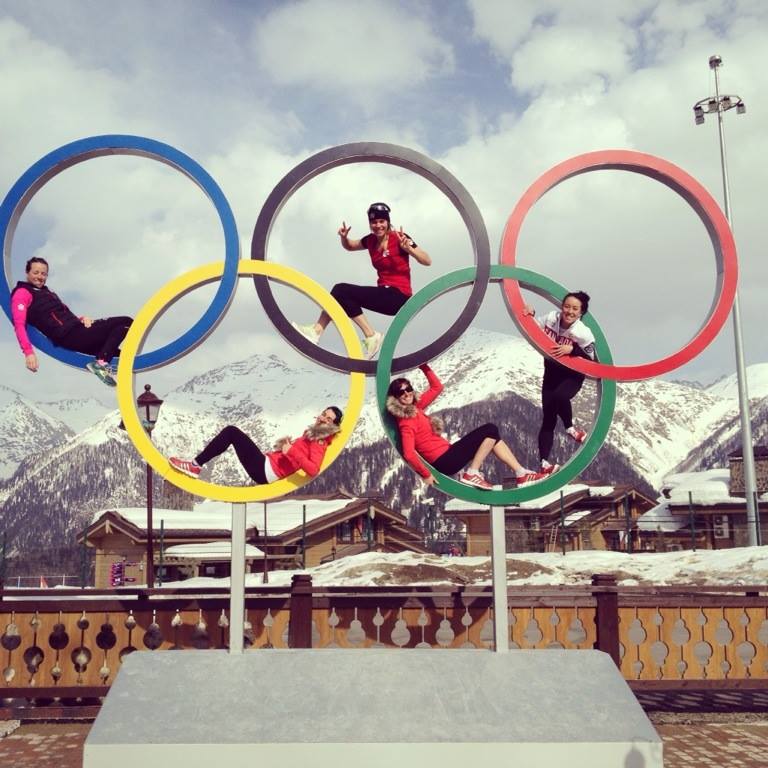
    Five members of Cross Country Canada’s 2014 Olympic team get the perfect photo opp at the Olympic rings in Krasnaya Polyana, Russia. (From left to right) Perianne Jones, Amanda Ammar, Heidi Widmer, Brittany Webster, and Emily Nishikawa. (Photo: Emily Nishikawa)

    On Nov. 9, news broke that four more Russian cross-country skiers had been sanctioned for cheating during the 2014 Sochi Olympics. So far, six Russian nordic athletes in total have had their 2014 Olympic results erased by the International Olympic Committee (IOC). These athletes are also prohibited from participating in all future Olympics due to their affiliation with Russia’s elaborate-state sanctioned doping enterprise.

    Julia Ivanova, half of Russia’s 2014 Olympic team-sprint duo, is one of the six penalized Russians. In Sochi, Ivanova and her teammate Anastasia Dotsenko skied to 10th place in the classic team sprint. (Thus far, Dotsenko has not been implicated in the doping scheme.)
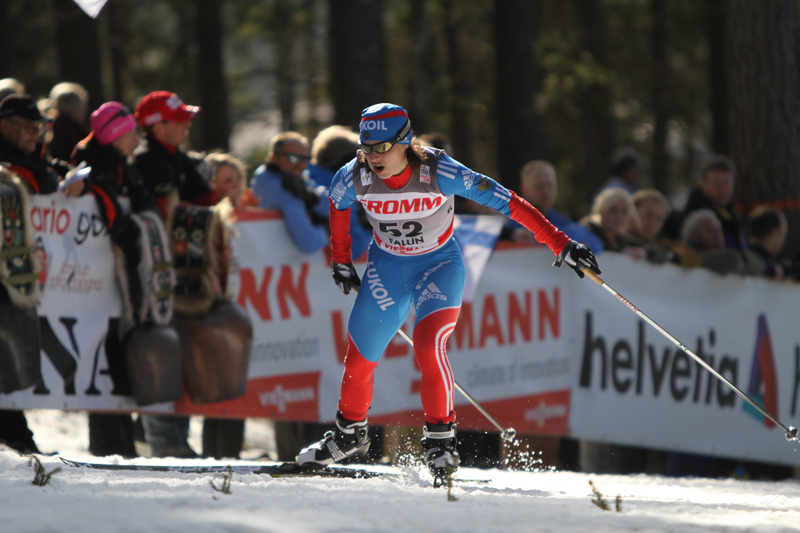
    Russia’s Julia Ivanova racing at 2012 World Cup Finals in Falun, Sweden.

    It’d be easy to say the Russian pair was way out of the medals — theirs was simply another tainted performance already removed from the official results.

    Yet among those clean athletes caught up in the win-at-all-costs mantra of the Sochi doping regime are Canada’s team-sprint pair Perianne Jones, now 32, and Dasha Gaiazova Atkins, 33. Looking back, “What might of been?” is a legitimate question the two retired skiers have asked.

    Ivanova and Dotsenko made the Sochi team-sprint final as what’s referred to as lucky losers — 10th place in their semifinal wasn’t enough for them to automatically advance but their time was fast enough relative to the rest of the field to put them through to the final. Jones and Gaiazova Atkins were right behind them in 11th, which was the end of their day.

    “I texted Peri that morning when the article came out in Fasterskier and said, ‘Should we start training for a redo?’ ” Gaiazova Atkins, who was born in Russia but spent more than half of her life in Canada, said on the phone from her home in Calgary. “Because we could have been in the finals and then you never know how that goes. It could have had a much, much better result and we could have had a chance for a medal.”

    One year before the 2014 Olympics, at the pre-Olympic World Cup in Sochi, Jones and Gaiazova (the latter of which has been married since, hence the new last name) placed third in the classic team sprint. Notably, they were third in a photo finish with the second-place Russians — Ivanova teamed up with Natalia Matveeva in that race.
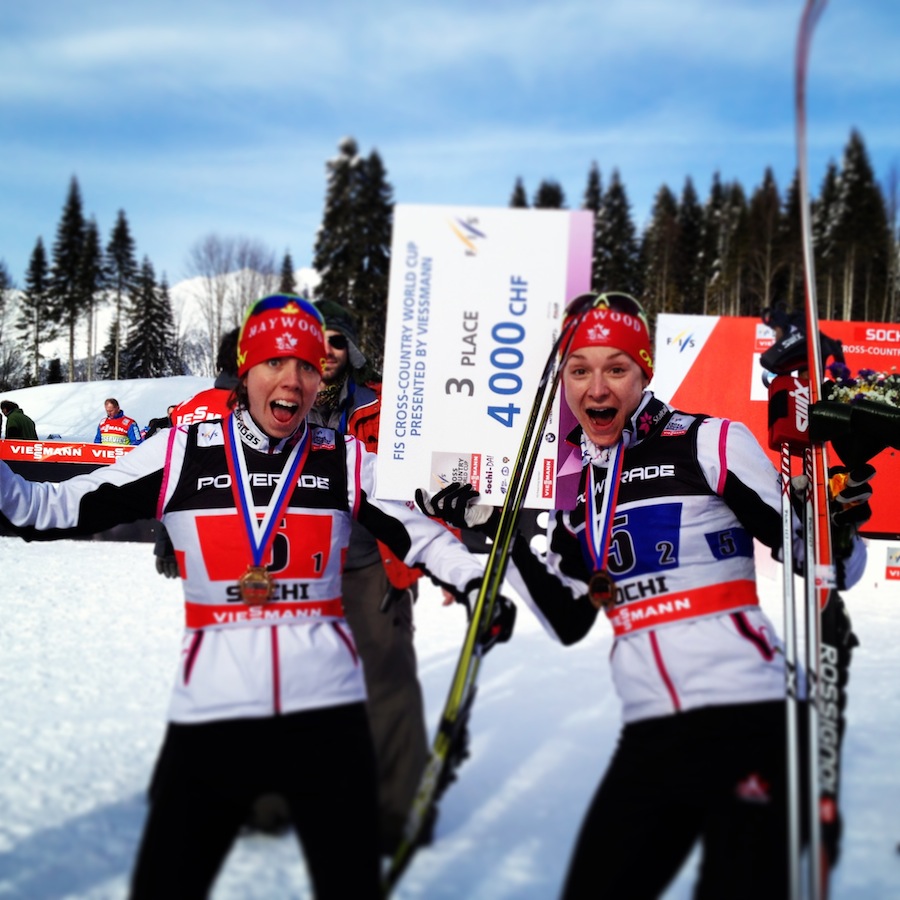
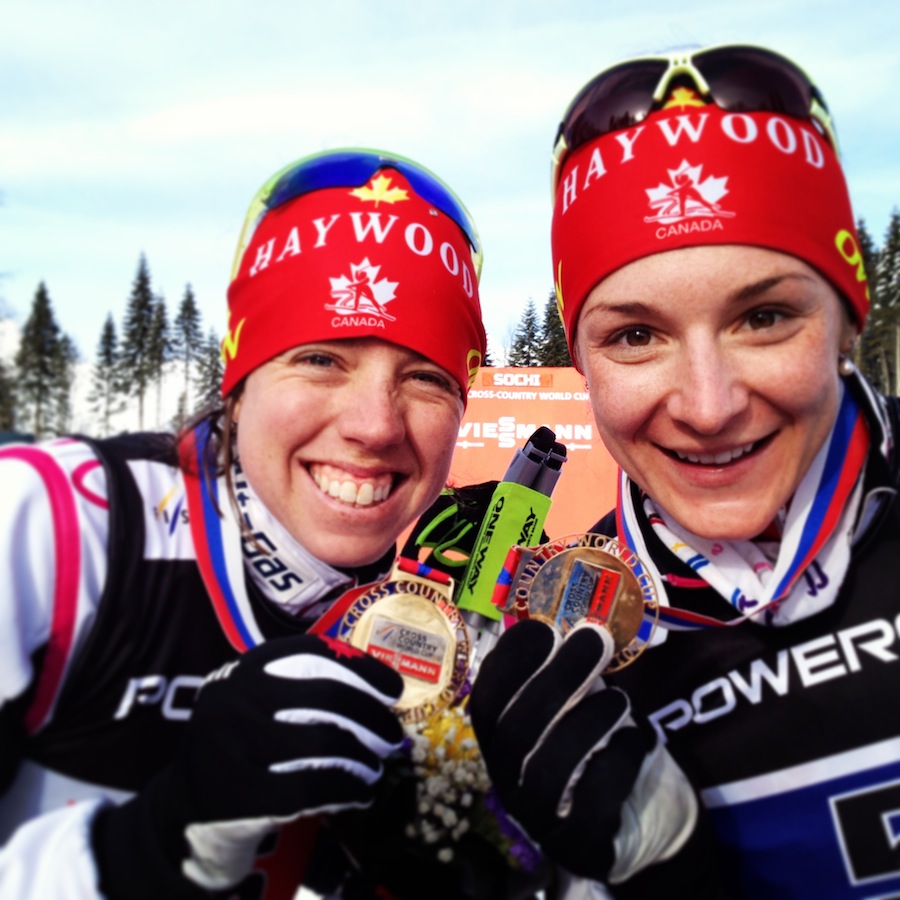
    Canada’s Perianne Jones (l) and Dasha Gaiazova having some fun after notching their first podium together with bronze in the classic team sprint at the Sochi pre-Olympic World Cup in February 2013. (Photo: Chandra Crawford)

    Jones first heard about the Ivanova news through Gaiazova Atkins’s text message.

    When it goes back and you realize that something could have gone a little bit differently or wonder what could’ve been, then you think about it a lot more and it definitely hits you a little personally,” Jones said on the phone from Canmore, Alberta. “For sure, it makes me feel sick and I cannot go back. No one can. That’s the unfair part. … It’s an interesting conundrum: people have put their lives into something and then are not given a fair chance.”

    The “what if” part of this story is multi-layered. Ivanova raced twice in the 2014 Olympics before the team sprint; first in the 10-kilometer classic on Feb. 13 and again in the 4 x 5 k relay on Feb. 15. What if Ivanova had been tested after those races and a legit lab had found her to be doped? What if Ivanova and Dotsenko never raced the team sprint on Feb. 19? Or a different iteration of Russians were slower in the semis? On paper at least, in this post-Sochi thought experiment, the Canadians advance to the final as lucky losers. 

    The perspective of time buffered by athletic retirement seemed to have taken the edge off the tone of both Jones and Gaiazova Atkins, based on their voices over the phone. They both sounded calm and measured, without a sense of bitterness. But they raised several important points as the fallout from the Russia’s doping program continues.

    Canada’s Perianne Jones racing to fifth in the 1.4 k classic sprint at 2015 World Championships in Falun, Sweden. She placed 24th overall and retired after that 2014/2015 season.(Photo: Flyingpointroad.com)

    On Jones’s mind were those athletes still competing, and those wondering if they, too, are racing in an unlevel playing field.

    “I am retired now,” Jones said. “So it would have been tough had all this stuff been coming out as I was still ski racing. I think it is tough for the athletes who are still competing now. Not that it is easy to hear about it after the fact, but you definitely have to believe you can do it while you are ski racing. I imagine that at least most of the playing field is clean and that would be hard given everything that has transpired over the last little while.”

    Gaiazova Atkins’s story resonates due to her literal mid-teen continental shift. At the age of 15, she moved with her family from Russia to Quebec. Although she started skiing in Russia, her swift trajectory up into the international ranks began as a Canadian. She did, however, recall a Russian ski culture where more than a healthy lifestyle choice was on the line.

    “I would say there is more pressure in Russia,” Gaiazova Atkins said. “And maybe because in Russia, in so many ways the country is so far behind in development … they have very few resources. So there is a lot of pressure to become a big skier because if you can race fast, you can do quite well for yourself in the country. … In America, it is not the same. And here in Canada, Chandra [Crawford] got a gold medal, shake her hand and off she goes to get an education.”

    Gaiazova Atkins’s perspective was one of trying to humanizing cheaters and would-be cheats, people with families and their own demons straddling their shoulders.

    “The incentive to perform is so much higher in Russia,” Gaiazova Atkins said.  “And the alternative? You can live in poverty and then, OK, I am going to take a chance. So for a lot of athletes, it may not be perceived as high risk because it’s the only chance to do well in life.”

    While she expressed that blame should be placed on those involved, Gaiazova Atkins emphasized truly understanding an athlete’s complicity.

    “I know these girls and I know the guys who are now being stripped of their results,” she said. “I follow them on Instagram and I see what they are saying in Russian, and it’s crazy they are still denying they did this. But then, you think about a big country like Russia and the whole thing, you almost ask yourself, ‘Did the athletes even know this was happening? Did they have any say?’ It is just like, you have no choice as an athlete.”
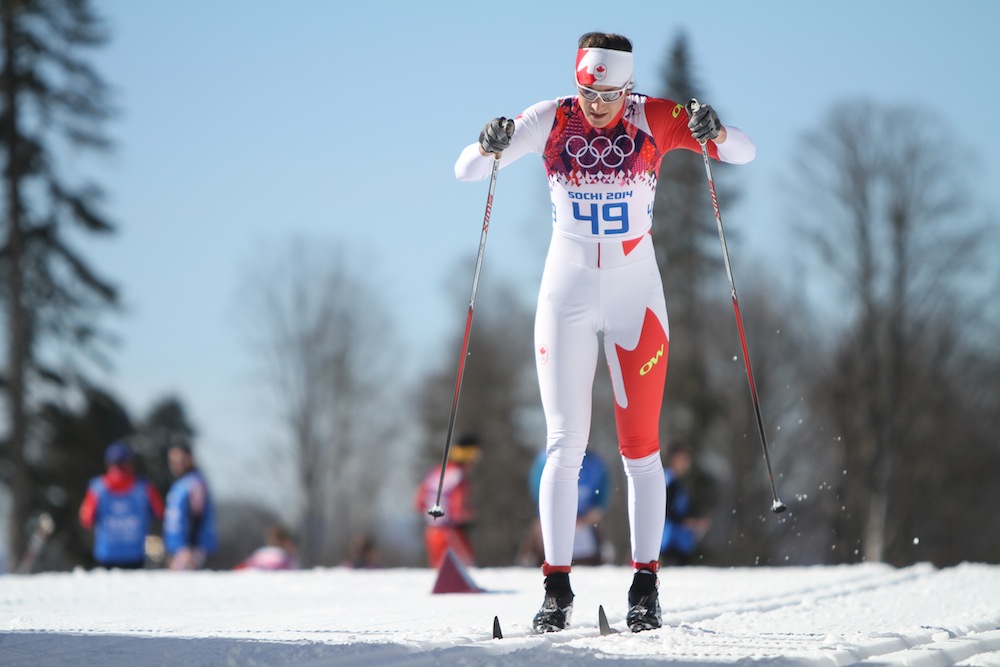
    Dasha Gaiazova racing to 44th in the women’s 10 k classic individual start at the 2014 Olympics in Sochi, Russia. She retired at the end of that 2013/2014 season and is currently coaching the Space Dogs Ski Club (where she’s also the president) in Calgary.

    Several times, Gaiazova Atkins stated her belief that the doping was a top-down mandate, a state-sanctioned endeavor with upper-government power plays manifesting with Sochi podiums. But she’s also no apologist. 

    “I follow on Instagram and their posts from all those guys, like Legkov and people that support him,” she said. “They say, we are with [Legkov] because we know how hard he works and how much work ethic he has. And I am thinking to myself, every single person racing is working just as hard and harder.

    “I feel sorry for those athletes, especially those who aren’t as systematic like the state-supervised program,” she added. “The ones who choose themselves and go to doctors, no pity for you.”

    As far as moving forward, Gaiazova Atkins said she was in favor of nothing less than a wholesale Russian ban from the upcoming PyeongChang Games.

    “You cannot slap them on the hand and say, ‘OK, don’t do this next time, please’,” she said. “It has to be with consequences for the state, for the country.”

    Gaiazova Atkins also believes that Ivanova’s doping has had lasting impact on potential funding for the current crop of Canadian cross-country skiers. “Eleventh place is not a top 10,” she said.  

    “Cross Country Canada funding is based on our results, and there is a big difference between a top 10 and 11th place sometimes,” she added. “To take us out of the equation, this had a trickle effect on the whole system, like our whole nation may have been affected by the funding because we did not get a top-10 result.”

    As the concentric ripples from Russian doping in Sochi move outward, they’ve arrived in North America, nearly four years late, with the 2018 Winter Olympics in PyeongChang, South Korea, on the horizon.
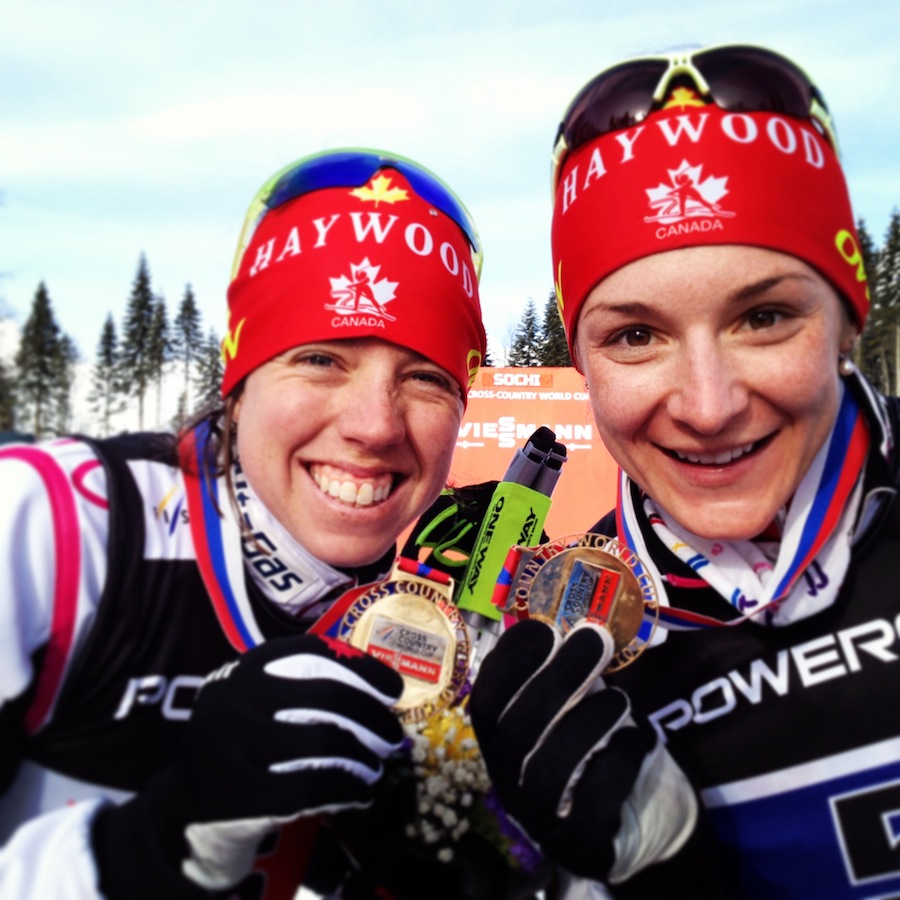
    Canadians Perianne Jones and Dasha Gaiazova celebrate their first bronze together in the 2013 Sochi World Cup classic team sprint. (Photo: Chandra Crawford)
  • Norway Finds Redemption, Olympic Record in Women’s Team Sprint

    Norway Finds Redemption, Olympic Record in Women’s Team Sprint

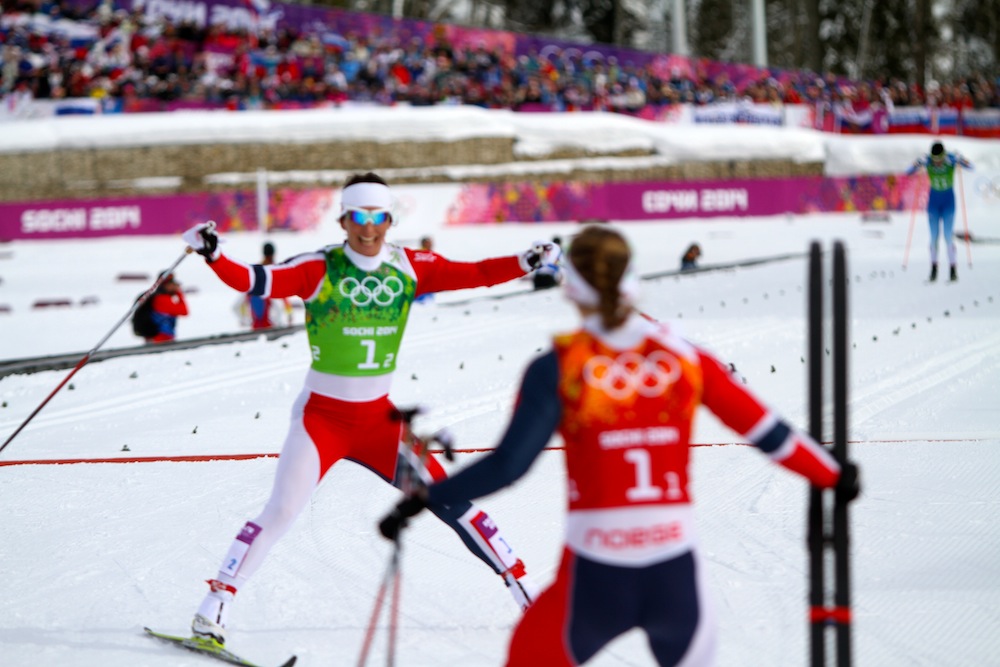
    Marit Bjørgen (l) skis toward her Norwegian teammate in Wednesday's Olympic 6 x 1.3 k classic team sprint, Ingvild Flugstad Østberg after anchoring the team to its first-ever team sprint victory at the Olympics.
    Marit Bjørgen (l) skis toward her Norwegian teammate in Wednesday’s Olympic 6 x 1.3 k classic team sprint, Ingvild Flugstad Østberg after anchoring the team to its first-ever team sprint victory at the Olympics.

    KRASNAYA POLYANA, Russia — The Norwegian women’s team of Ingvild Flugstad Østberg and Marit Bjørgen made Wednesday’s Olympic classic team sprint look like a walk in the park.

    At least this time, they weren’t walking.

    Following a series of bad races — badly timed smøreboms at the biggest races in four years — the Norwegian wax staff finally appeared to get things right on Wednesday as their women cruised to a semifinal victory in the 6 x 1.3-kilometer team sprint.

    A decade apart in age, the duo of Østberg, 23, and Bjørgen, 33, found both kick and glide on the taxing course, winning the semifinal in 16:43.45 minutes, 5.31 seconds ahead of Sweden’s Ida Ingemarsdotter and Stina Nilsson in second. The U.S. women placed third in the same semifinal, 7.91 seconds out of first after letting up in the final stretch, confident that their time was fast enough to advance to the final.

    A little over an hour later, the top 10 teams from the semifinals went head to head in the final — same scramble-leg, anchor-leg order, same course, and slightly different conditions after temperatures dropped a few degrees to just above freezing later that afternoon.

    The colder, the better for Norway, which struggled to finding the right wax for the fast-melting, heavily salted snow since the Olympics began a week and a half earlier. Since then, Bjørgen had been the highlight — winning the 15 k skiathlon on the opening day on Feb. 8.

    After that, she face-planted in the semifinals of the skate sprint, placed fifth in the 10 k classic (after teammate Therese Johaug in third), then anchored Norway to fifth in the relay. Not bad, but not exactly up to par by Norwegian standards.

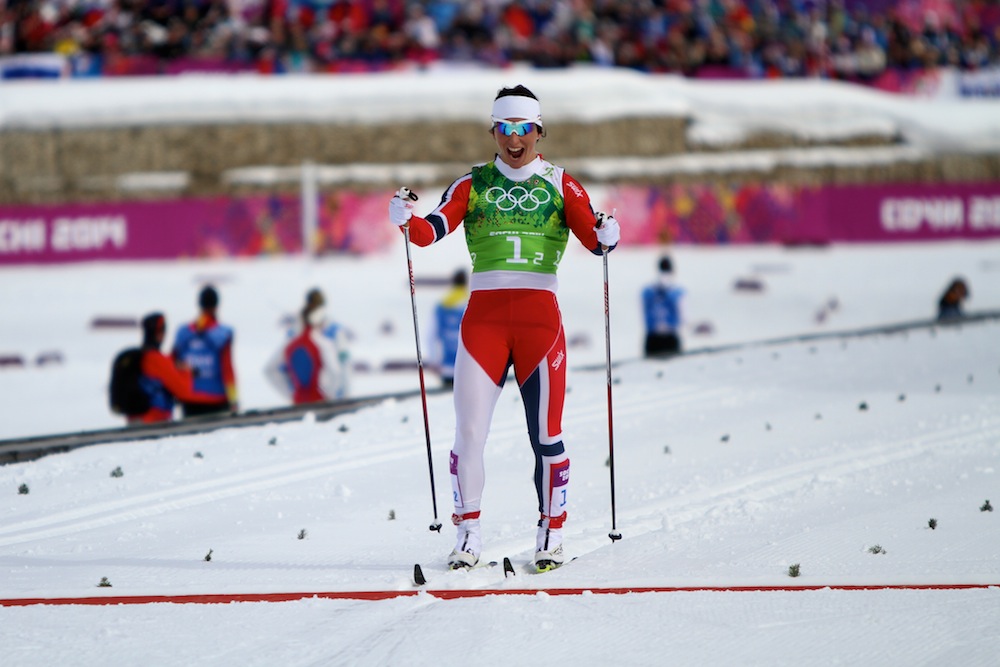
    Marit Bjørgen anchors the Norwegian women's 6 x 1.3 k classic team sprint victory at the 2014 Sochi Olympics. She teamed up with Ingvild Flugstad Østberg to do so, and it was Østberg's first Olympic gold.
    Marit Bjørgen anchors the Norwegian women’s 6 x 1.3 k classic team sprint victory at the 2014 Sochi Olympics. She teamed up with Ingvild Flugstad Østberg to do so, and it was Østberg’s first Olympic gold.

    Something had to change, and by Wednesday, the Norwegians got back to their winning ways — grabbing gold in the team sprint for the first time in the event’s history at the last three Olympics. In doing so, Norway became the first nation to win a medal in all 12 Olympic cross-country events.

    “The waxing team has done a very good job,” Bjørgen said in a press conference after the race. “They have been working very hard the last days and today we had the perfect skis. It was a hard time in the cabin and it’s good to see that we have good skis.”

    Led by a strong opening leg in the final, in which Østberg tagged Bjørgen in second, 0.11 seconds after Finland’s Aino-Kaisa Saarinen, the duo gradually blew apart the field. A 1.63-second lead over Finland by the third exchange grew to nearly 5 seconds by the fourth when Østberg started pushing the pace.

    At the end of the second-to-last lap, Saarinen had reined in Østberg slightly, tagging her Finnish teammate Kerttu Niskanen just 4.21 seconds back in second. With one leg remaining, Germany’s Stefanie Böhler and Denise Herrmann were another 7.86 seconds back in third, and Sweden an additional 3.71 seconds behind in fourth.

    Bjørgen proceeded to post the fastest time of the last lap, nearly four seconds faster than anyone else, and anchor the win in 16:04.05.

    “I was so excited Bjørgen would be able to stand on their feet in the last turn,” Østberg told NRK, according to a translation. “I thought it would be fine, but you never know.”

    Finland finished 9.09 seconds back in second, and Sweden’s Nilsson out-double-poled Herrmann for bronze about 10 seconds later.

    Bjørgen had nothing but praise for her young teammate, who helped her win her second race of the Sochi Olympics and fifth total gold medal.

    “She is totally raw,” Bjørgen told NRK. “She goes wonderfully well at distance races this year … so she is insanely strong.”

    Østberg has looked up to Bjørgen since her early days of skiing, writing an essay about her in high school in 2007.

    “The task was to write an essay about your role model,” Østberg told NRK. “I wrote that she was extremely good at skiing, strong and everything.”

    Seven years later, Østberg won her first Olympic gold with that very woman.

    “It’s crazy, really. I had never in my wildest imagination could have dreamed of this,” she said. “I’ve been training a lot with her and learned lots from Marit … She is a wonderful person both when things are going well and when it does not go well.”

    If we’re comparing apples, it’s interesting to consider that Bjørgen was 22 when she won the sprint at 2003 World Championships. Just a year older into her athletic career, Østberg is a gold and silver medalist in Sochi, after placing second to teammate Maiken Caspersen Falla in the skate sprint.

    “She is very strong, stronger than me,” Bjørgen said.

    The two got a visit from Norway’s King Harald V as well, who hugged and congratulated them after the finish.

    “I wonder if luck turned when the King came to Sochi yesterday,” Bjørgen told NRK. Harald reportedly came to Russia to follow Norwegian Olympians in contention for medals.

    He found it in Norway’s women, who salvaged the reputation of their team on a day when the Norwegian men (with Ola Vigen Hattestad and Petter Northug) failed to make the podium (finishing more than three seconds off in fourth).

    “It has been painful to see all the criticism [our wax technicians] have received recently,” Bjørgen said, according to a translation. “They work round the clock. Now it is incredibly amusing that this was the way. This is good for the wax technicians and all the support.”

    For Finland, silver was good omen for more to come — as its men’s team of Iivo Niskanen and Sami Jauhojärvi won the following 1.8 k classic team sprint for their nation’s first men’s Olympic gold since 1998.

    “We are so happy both of us for the men. They did really excellent work,” Saarinen said. “It was such an amazing race, so interesting to watch. We were screaming and laughing and crying, all the emotions going through.”

    Skiing in fourth behind Herrmann into the stadium, Nilsson knew there was a chance for a medal if she did something spectacular. She beat Herrmann in a sprint finish, although Herrmann told reporters slow skis made her feel like “a lame duck” coming down off the last hill into the final stretch.

    “When I came into the last 100 meters, I felt that I had a lot of power left, and I also saw that Denise was looking tired,” Nilsson said. “When I was right behind her I knew that I had a chance.”

    She beat Herrmann for third by 1.15 seconds. Poland finished fifth, nearly 11 seconds later and 32 seconds behind Norway with Sylwia Jaskowiec and Justyna Kowalczyk. Russia was sixth (Anastasia Dotsenko/Julia Ivanova), and Switzerland seventh (Bettina Gruber/Seraina Boner). The U.S. placed eighth (Sophie Caldwell/Kikkan Randall), Austria was ninth (Katerina Smutna/Teresa Stadlober), and Slovenia 10th (Alenka Cebasek/Kajta Visnar).

    Results

  • Hattestad’s Powerful Double Pole Secures Norwegian Win; Kazakhstan’s Poltoranin Second Again

    Hattestad’s Powerful Double Pole Secures Norwegian Win; Kazakhstan’s Poltoranin Second Again

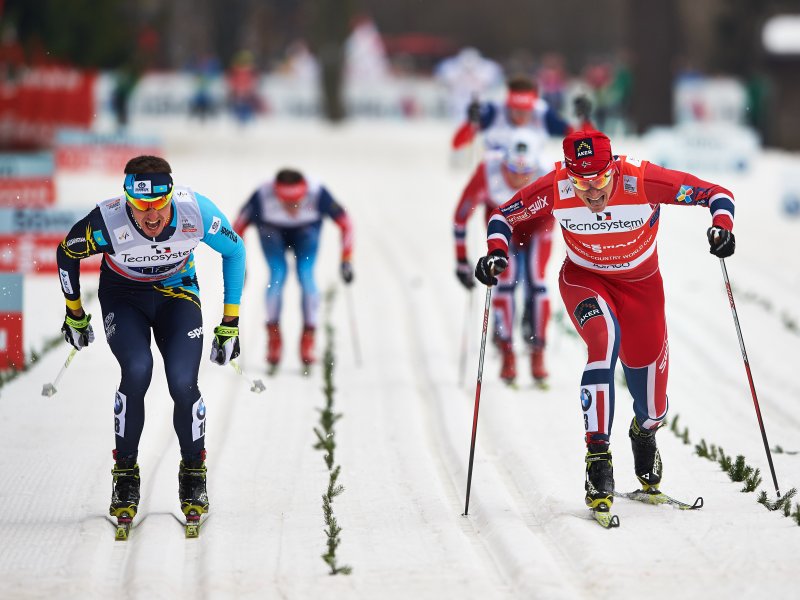
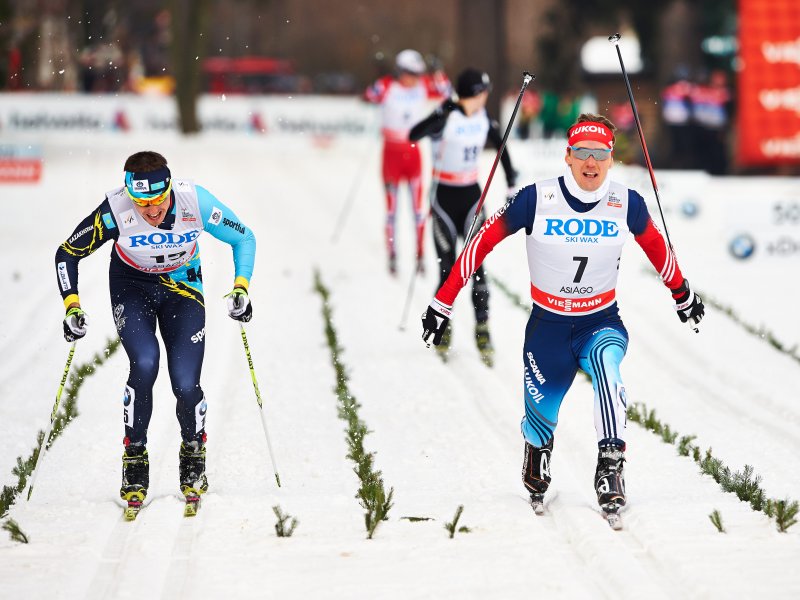
    Look familiar? Kazahstan's Alexey Poltoranin (l) placed second for the second-straight day at the Asiago World Cup in Italy, as Ola Vigen Hattestad (r) secured the Norwegian victory in the 6 x 1.65 k classic team sprint. (Photo: Fischer/Nordic Focus)
    Look familiar? Kazahstan’s Alexey Poltoranin (l) placed second for the second-straight day at the Asiago World Cup in Italy, as Ola Vigen Hattestad (r) secured the Norwegian victory in the 6 x 1.65 k classic team sprint. (Photo: Fischer/Nordic Focus)

    The way things were shaping up in the men’s 6 x 1.65-kilometer classic team sprint final at the World Cup in Asiago, Italy, it could’ve been anybody’s race.

    Yes, Norway’s Eldar Rønning and Ola Vigen Hattestad were generally leading the 10-team pack on Sunday, and yes, the top-four combination was often something like Norway, Russia, Norway, Russia (with each nation having two teams in the final), but you couldn’t count teams like Sweden and Kazakhstan out.

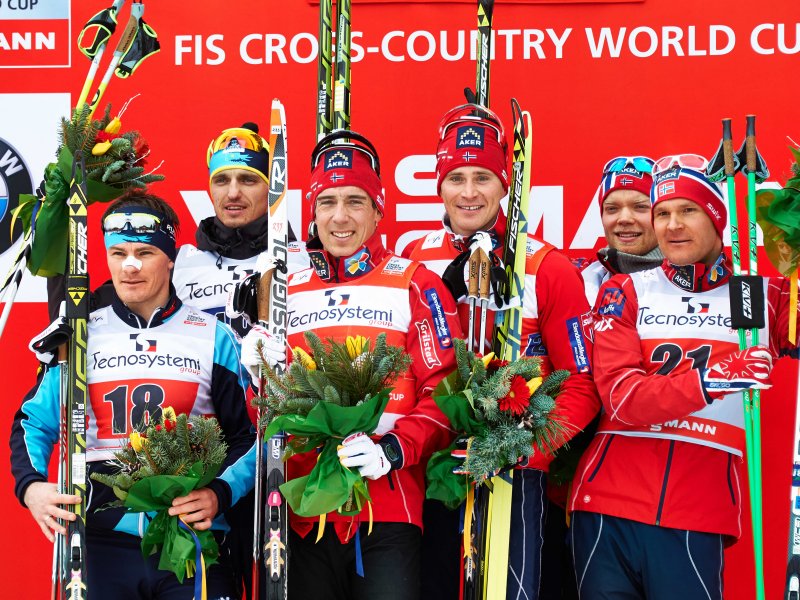
    The men's classic team sprint podium at the Asiago World Cup in Italy on Sunday: Norway I won with Eldar Rønning and Ola Vigen Hattestad (c), Kazakhstan's Nikolay Chebotko and Alexey Poltoranin (l) placed second, and Norway II was third with Eirik Brandsdal and Øystein Pettersen. (Photo: Fischer/Nordic Focus)
    The men’s classic team sprint podium at the Asiago World Cup in Italy on Sunday: Norway I won with Eldar Rønning and Ola Vigen Hattestad (c), Kazakhstan’s Nikolay Chebotko and Alexey Poltoranin (l) placed second, and Norway II was third with Eirik Brandsdal and Øystein Pettersen. (Photo: Fischer/Nordic Focus)

    While Sweden’s first starter, Teodor Peterson clocked the fastest leg in each of his rounds, his teammate Simon Persson repeatedly dropped several places after every exchange. Without their original starter in Emil Jönsson, who had to scratch because of a sore back on Sunday morning, Sweden slipped from first to sixth, second to sixth, and finally third to fifth.

    They weren’t a threat to Norway’s first team of Rønning and Hattestad, which won the first semifinal over Russia’s Alexander Panzhinskiy and Nikita Kriukov, but the Kazakhs were.

    Second in their semifinal after Norway II’s Øystein Pettersen and Eirik Brandsdal, Kazakhstan’s Nikolay Chebotko and Alexey Poltoranin sat patiently around fourth early in the final, then rose to second by the fourth of five exchanges.

    Just 0.6 seconds behind Rønning at the start of his last lap, Chebotko held his position until planting his pole between his legs and toppling over. Kazakhstan dropped from second to sixth, and it seemed their hope for a podium was slipping as the rest of the leaders skied into the exchange zone.

    Podium? The thought probably never crossed Poltoranin’s mind as he waited for the tag just a couple hundred meters later. He was going for the win. Norway’s Hattestad would have to try to stop him.

    After getting the tag in fifth, Poltoranin made up nearly 5 seconds on the leaders, including Hattestad up front, followed by Kriukov,  Persson and Brandsdal.

    Maxim Vylegzhanin lifted Russia II into the top four, but he and teammate Dmitriy Japarov were later disqualified for a “violation of classical technique rules,” likely skating on the mostly double-pole course. At least half the men’s field raced on skate skis, including most of the top men’s finalists.

    Coming out of a sharp corner on a long descent, Kriukov’s pole strap broke, but he quickly got a replacement and resumed his spot amongst the top five with Norway I, Russia II, Norway II, Russia I, and Kazakhstan.

    With 800 meters remaining, Poltoranin took a shortcut to second, cutting in on the inside lane around a tight turn. Most everyone had to snowplow on the final corner to avoid crashing in the sugary, melting snow, but Poltoranin remained in position to challenge Hattestad – who was still leading – to the finish.

    Hattestad didn’t have to look back. He needed to go hard the last 100 meters to the finish. Committed to a central lane, the Norwegian double poled like mad while Poltoranin jumped into the left lane behind him, which was considered one of the fastest in the homestretch.

    It may have been faster as Poltoranin came within centimeters of Hattestad, but the Norwegian held him off, throwing his leg across the line and winning in a photo finish in 24:47.4.

    “I did not know we had won until I saw Eldar come running towards me,” Hattestad told VG Nett, according to a translation.

    “It’s fun to win with only five centimeters,” said Rønning, who initially put Norway I in third, just 0.7 seconds behind Russia II up front.

    After the first tag, Hattestad brought the team to first, where they remained fractions of a second ahead of anyone else for the rest of the race.

    Norway II finished third, 2.17 seconds after Kazakhstan in second, but dropped as far back as seventh during the second leg, when Japarov fell on one of the last downhills and took out Pettersen. Brandsdal lifted them back to third with the fastest-course time for that leg, and Pettersen tagged him in fourth for the final lap.

    “Good day: back on the podium in WC, argue with a good Russian (became friends again), Christmas holidays and given away flowers to a little girl,” Pettersen tweeted after the race, according to a translation.

    “It is the best result of the season and I am very happy for that,” Pettersen told FIS. “Luckily we could get back. Team sprints are never easy.”

    NIkita Kriukov (RUS) edges Alexey Poltaranin (KAZ) for the victory in the classic sprint in Asiago, Italy. Photo: Fischer/Nordic Focus
    Russia’s Nikita Kriukov (r) edges Alexey Poltaranin (KAZ) for the individual classic sprint victory on Saturday in Asiago, Italy. (Photo: Fischer/Nordic Focus)

    They are especially tough one day after an individual classic sprint on the same soupy course in similarly warm (41-degree) temperatures. Poltoranin, who was just short of a victory behind Kriukov on Saturday, said he recovered well with some physio work.

    “Ola Vigen Hattestad is a very strong sprinter, but I think if we were not double poling in the finals, I would have had a chance to beat him,” said Poltoranin, who has placed second in his last three World Cup races.

    While he sat out the Davos World Cup last weekend, Poltoranin was second to Norway’s Pål Golberg in the 15 k classic on Dec. 7 in Lillehammer, Norway.

    Last season at the pre-Olympic World Cup classic sprint in Sochi, the Russians won on their home turf with Japarov and Vylegzhanin. Sweden’s Peterson and Jönsson placed second and Germany was third with Axel Teichmann and Tobias Angerer.

    (Teichmann teamed up with Tim Tscharnke for Germany I on Saturday, placing fourth in their semi and narrowly missing the final for 10th overall. Germany II’s Angerer and Alexander Wolz finished 12th of 15 teams in the first semifinal.)

    Russia’s No. 2 team of Alexey Petukov and Kriukov notched fourth last winter in Sochi, Norway’s Pettersen and Petter Northug placed fifth, and Kazakhstan’s Chebotko and Poltoranin finished sixth.

    Results