Tag: Soda Springs

  • Keep Showing Up: Will Sweetser’s Unglamorous First Principle

    Keep Showing Up: Will Sweetser’s Unglamorous First Principle

    This article was made possible through the generous support of our voluntary subscribers. If you value coverage like this, please support FasterSkier with a voluntary subscription.

    Two older girls on the Edward Little ski team went looking for bodies. It was the mid-1980s, the boys’ Nordic program at the Auburn, Maine, high school was thin and not very good, and the girls’ team was strong. The two girls, Becky Flynn (SVSEF) and Sarah Pribram (NWVE), knew a freshman who had skied a little in middle school. They asked him if he wanted in.

    Will Sweetser’s second cross-country ski race ever was the Maine High School State Championship, he finished 34th, the best result on the team.

    The next winter Edward Little won the state title. Sweetser placed seventh in the state — and fourth on his own squad. “I was the fourth guy running, I was the fourth guy skiing,” he said. The sport was tilting toward skating then, and almost nobody his age had figured out how to skate yet. Technique was a wash. So the results sorted themselves out the only way they could.

    “It turned out that engines won,” Sweetser said.

    That phrase could serve as an epigraph for everything he has done since, except for one inconvenient fact. His own engine was nothing special, at least by his own standards.

    He learned exactly how unspecial his was as a freshman skier at Dartmouth, when the team did VO2 max testing. The results put Sweetser, the slowest man on the roster, “squarely in the bottom half of the women’s team.” He ran the numbers on his own future and did not like the answer. “I was already running almost the times they suggest for my VO2 max,” he said. The writing, he decided, was on the wall.

    If the engine couldn’t get bigger, the speed had to come from somewhere else.

    “Wax makes things faster. Strength makes things faster. I better learn technique,” Sweetser said. “Maybe I was a genetic predeterminist, and that’s why I started learning all the physiology.”

    After graduating from Dartmouth, Sweetser took an assistant coaching position at Bates College in Lewiston, Maine, where he went to the library and more or less stayed there.

    At Bates, Sweetser became a fixture in the stacks while living with his grandfather, working into the evening. “I literally was in the library more than the team,” he said. For two years, he averaged four or five interlibrary-loan requests a week. He calls what he built in that period “a self-taught, master’s-level survey course” in exercise physiology. He was also, by his own account, one of the first coaches in the country mailing away for VHS tapes of World Cup races, freeze-framing technique frame by frame because there was no other way to see it.

    Will Sweetser (right) has worked with Olympian JC Schoonmaker (left), who now lives in Alaska and races for APU, since Schoonmaker was a young skier.

    Three decades later, that reading has produced one of the more idiosyncratic coaching minds in American skiing. Sweetser is now based in Soda Springs, California, high on Donner Pass, after a long stretch running the program at the Maine Winter Sports Center. And the first principle he’ll hand you is almost aggressively unglamorous.

    It’s consistency. Just showing up.

    Sweetser points to a Norwegian study he came across years ago — his recollection puts it around 2006 to 2008 — that examined the country’s top 14 nationally ranked women, essentially its entire World Cup pipeline. Researchers measured everything: VO2 max, speed broken into 20-second segments, correlation after correlation. The single factor that most cleanly separated the top seven from the next seven, Sweetser says, wasn’t engine size or top speed. It was days lost to illness and injury. The lower group averaged roughly two weeks of missed training a year. The top group averaged two or three days.

    “That seems to be the most correlated thing,” he said. Stretch it across a four- or five-year Olympic cycle and the gap stops being trivial.

    It sounds obvious. It is also not how a great many junior programs actually behave, which is where Sweetser’s second idea comes in, and that one is stranger.

    He builds training around fiber type, and he has a field test for sorting it. He’ll have an athlete — 15 or older — run a 400 meters, rest 20 minutes, then run a 3,000 meter. Then he looks at the ratio. A “normal” distance athlete, he says, holds about 76.5 percent of 400-meter pace over 3k. He can quote the figure to the hundredth. Drop below 68 percent and the athlete is built to sprint; climb above 82 and they’re built to grind. “This is how specific they are,” he said of the research he leans on.

    The athletes all come to the same session. What changes is the leash. The sprinter types get a short one, where Sweetser wants the heart-rate alarm to go off the instant it “faintly whispers” the next zone, because those athletes overshoot every interval.

    Where the distance types might run eight intervals, the sprinters run five or four. Body position stays the same for everyone. Cadence and power output are already different on their own. What he actually teaches, he says, is tactics — where on the course to spend, and where to wait based on each athletes strengths and weaknesses.

    This is also why he keeps reaching for the treadmill. It is measurable and it is controllable, and that combination lets him do something he values more than almost anything: build what he calls “an athlete persona that’s rooted in belief, not hope.”

    The clearest proof he offers was from an athlete he met at Bates, Sarah Dominick — the woman who would later become his wife and is now his coaching partner. At Bates, her running coaches kept pushing her mileage up, and every time she got much past 25 miles a week, she broke down. It made sense to Sweetser: she had a sprinter’s makeup, but was being asked to train like a distance runner. She was miserable enough that she sat out her junior year of competition entirely.

    When she came back as a senior wanting to race the 3k and 5k, Sweetser says her coach called it a waste of time.

    His plan went the other direction. He capped her running at roughly three hours a week and backfilled the volume with cycling and roller skiing. Warm-ups and cool-downs were run on grass, in the opposite direction around the track, to spare the leg that always flared. The key session, twice a week, was deceptively small: two sets of 15-seconds-on, 15-seconds-off at 3k race pace, jogging the corners, six minutes of rest between sets. Start to finish, it took about an hour.

    She went from 11:38 to 10:00 for 3,000 meters in a month. She became a Division III All-American and set a school record. The following year, training off skiing and running on a dirt road at altitude, she ran 9:27.

    The lesson Sweetser took from it is the one he now spends most of his time trying to give away. “Your best training computer is still between your ears,” he said.

    Will Sweetser doing lactate testing during a hill-bounding session two season ago with Quinn Holan.

    You can see what that looks like in Quinn Holan, the 18-year-old Sweetser coaches most directly and has worked with since the athlete was 11. These days, Holan, Far West’s standout U20 skier, writes his own training plans and brings Sweetser the questions, not the other way around. Increasingly, when the two disagree, the athlete keeps his own counsel, which is exactly the point. “You can call me his coach,” Sweetser said, “but it’s sort of like Klæbo’s grandpa is his coach.”

    It is a strange arc for a man who started with so little to work with. Sweetser was the high school freshman recruited because the team needed a warm body, the college skier in the bottom half of the women’s VO2 results, and the coach who had to teach himself the sport one interlibrary loan slip at a time. Thirty years on, the whole project — the fiber-type tests, the treadmill data, the athlete who outgrows his coach — is really just an effort to spare the next kid the loneliness of that library.

    Sweetser never did get the engine he wanted as an athlete, but as a coach, he has built something much more durable.

    Next: why Will Sweetser thinks American skiing is fighting over the wrong 30,000 people — and what he’s building on Donner Pass to prove it.


    Help Support Our Coverage!

    If you value the thoughtful work and access FasterSkier provides, please consider becoming a Voluntary Subscriber. Your support directly fuels our work to cover the people, places, and moments that make our sport special.

    Join the FasterSkier community!


    Will Sweetser and Matt Seline
  • Royal Gorge XC Resort to Offer Expanded Programming for Winter 2026-2027

    Royal Gorge XC Resort to Offer Expanded Programming for Winter 2026-2027

    Thanks to the fantastic success of the redesigned youth programs at the resort this past winter, Royal Gorge XC will offer expanded teams for the 2026-2027 season.

    New team offerings for the coming season will include middle school age racing, junior racing, gap year programming, pro level racing and masters training groups.

    Youth programming will remain the same as offered this past season, with groups comprised of young skiers from Kindergarten through 8th grade with a focus on skill development and fun.

    The new racing and training focused offerings will put into place a full ladder of nordic ski development at Royal Gorge XC, allowing every level of skier to see the complete range of possibilities this life-long sport can offer.

    Programs will be headed by Will Sweetser, now in his 33rd year of professional coaching. An expanded staff of U.S. Ski and Snowboard certified coaches will support programming and lead the Royal Gorge XC Teams as they represent the resort and Far West Nordic in local, regional and national racing.

    All programs will be competitively priced, with both à la carte and full menu pricing options. Registration for programs will open at SkiReg.com by April 1, 2026.

    Royal Gorge XC Programs 2026-2027

    Manzanitas — Grades K–2
    Fun, fun and more fun. Saturdays only. Classic skiing focus. Weekend and seasonal rentals available.

    Aspens — Grades 3–5
    Fun, coordination and skill development weekend program. Classic and skate skiing. Limited racing opportunities for those interested.

    Lodgepoles — Grades 6–8
    Fun, skill development and fitness focused weekend program for middle schoolers. Independent Middle School racing and limited racing opportunities for those interested.

    Devo — Ages 12–15
    September through March programming options, both fall/winter and winter only. Summer camp offered. Coached sessions held 3 days per week. Local and regional race support with experienced, certified coaches.

    Comp — Ages 15–19
    June through March programming options, both full year and winter only. Coached sessions held 4 days per week on average. Local, regional, and national race planning and support with experienced, certified coaches.

    Gap Year — Ages 18–20
    By application only. Program limited to 5 athletes. 4–5 days per week in conjunction with Pro Team. Head coach: Will Sweetser.

    Pro Team — Ages 19+
    By application only. Program limited to 5 athletes. Individual training and competition planning. Job opportunities. Coaching requirement. Head coach: Will Sweetser.

    Senior/Masters Training Groups — Ages 21+
    Multiple training groups offering beginner to expert skate and classic training. From “learn to” to racing level groups. 1–3 days per week. Scheduled in conjunction with youth and junior training groups and offering race/experience travel.

    Registration opens April 1, 2026 at skireg.com/rgxc-nordic-ski-team-2026.

  • Gold Rush Races Cancelled, But Festival Lives On at Royal Gorge

    Gold Rush Races Cancelled, But Festival Lives On at Royal Gorge

    Low snowfall and warming temperatures across the Sierra Nevadas have forced Royal Gorge XC Resort to cancel the Gold Rush, Silver Rush, and Bronze Rush races originally scheduled for March 21, 2026. Pre-registered racers will be offered a refund or a deferred entry to the 2027 races.

    The long course races are off, but the Gold Rush Festival itself will carry on in a modified form on Saturday, March 21. Royal Gorge is planning a full day of activities, including live music, food, ski demos from Atomic, waxing clinics from Maplus, a laser biathlon demo courtesy of the U.S. Biathlon Association, and their redesigned Slush Cup Super Sprints.

    The festivities kick off Friday evening with the cafe and bar opening at 4:00 p.m. serving tacos, pizza, fries, and drinks, followed by a free Maplus-USA glide waxing clinic at 5:00 p.m.

    Gold Rush 2010 (Photo: MacBeth Graphics)

    Saturday’s schedule runs from 8:00 a.m. through the afternoon:

    8:00 a.m. — Resort opens for demos and skiing
    9:00 a.m. — U.S. Biathlon Association “Take a Shot” laser rifle demo
    10:00 a.m. — Cafe opens; Maplus-USA glide waxing clinic
    12:00 p.m. — Music on the deck
    1:00 p.m. — Slush Cup Super Sprints qualifiers (day-of entry only; $20 adults / $10 under 20)

    The Slush Cup Super Sprints will feature a super short loop with single-lap qualifying, terrain elements, and gates. There will be Beginner, Fitness, and Expert classes, with heats of six following qualifying. Expert Class heats will be a minimum of 600 meters.


  • Saturday Rundown: Ulricehamn, Antholz, Chaux-Neuve, Zuoz, Whistler, & Truckee (Updated x6)

    Saturday Rundown: Ulricehamn, Antholz, Chaux-Neuve, Zuoz, Whistler, & Truckee (Updated x6)

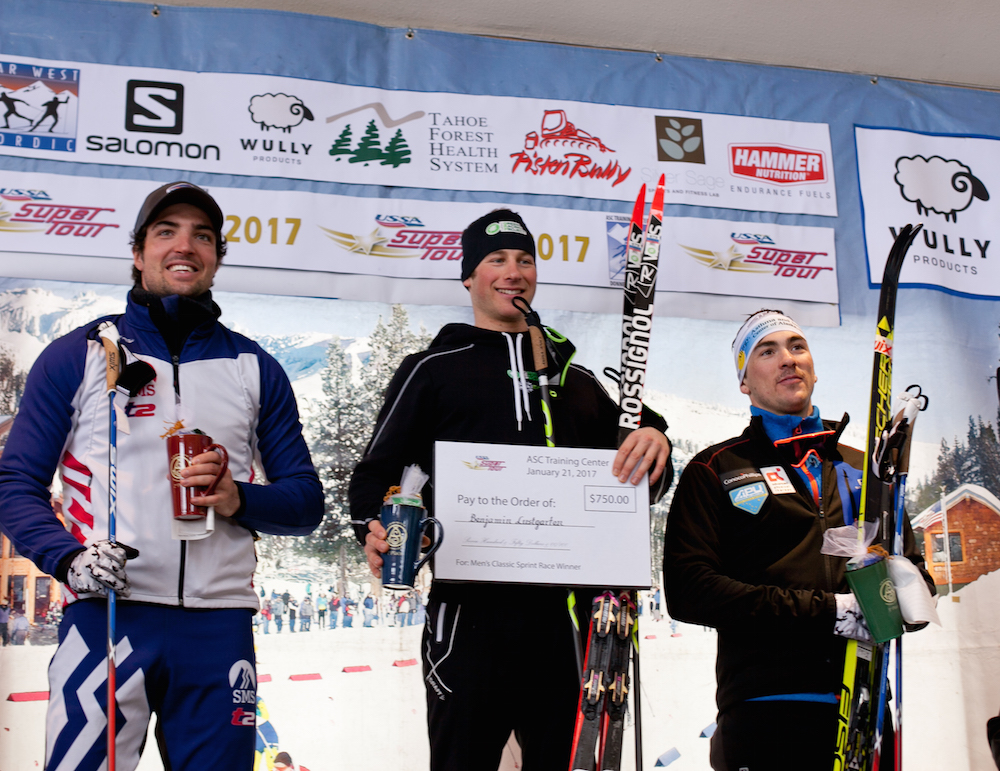
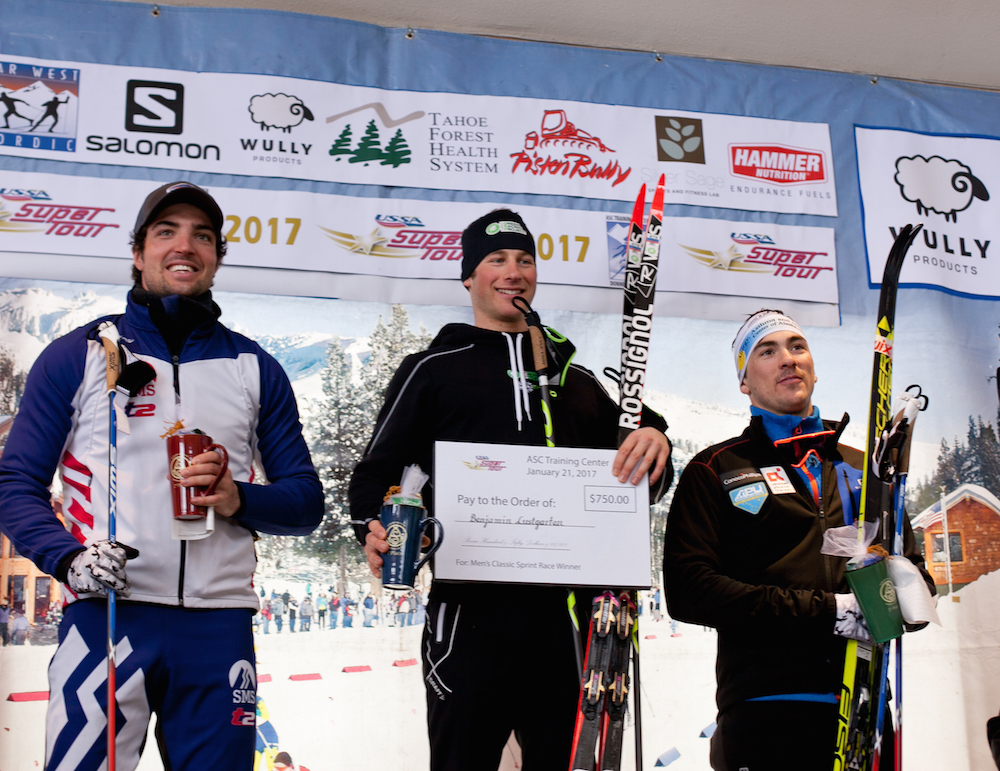
    Ben Lustgarten (Craftsbury Green Racing Project) with his $750-dollar check for winning the men's SuperTour classic sprint on Saturday near Truckee, Calif. Stratton's Ben Saxton (l) placed second and APU's Reese Hanneman (r) was third.
    Ben Lustgarten (Craftsbury Green Racing Project) with his $750-dollar check for winning the men’s SuperTour classic sprint on Saturday near Truckee, Calif. Stratton’s Ben Saxton (l) placed second and APU’s Reese Hanneman (r) was third.

    U.S. SuperTour (Truckee, Calif.): Classic sprints

    [UPDATED] Less than a week after being named to the U.S. team for 2017 World Championships, Ben Lustgarten — the men’s 30 k classic mass start champion at this year’s U.S. nationals — won Saturday’s SuperTour classic sprint as well.

    Lustgarten, of the Craftsbury Green Racing Project, raced to a 1.58-second victory in the men’s A-final at the Auburn Ski Club in Soda Springs, Calif., finishing in 3:03.4. Ben Saxton, of the Stratton Mountain School (SMS) Elite Team, placed second, and Reese Hanneman, of Alaska Pacific University (APU), was third (+2.77).

    Hannenman’s younger brother Logan also reached the final and placed fourth (+4.5), Dakota Blackhorse-von Jess (Bend Endurance Academy) was fifth (+5.86), and the third APU skier in the final, Tyler Kornfield sixth (+18.69).

    Blackhorse-von Jess started the day off as the fastest qualifier in 2:58.8. Saxton qualified second, 4.1 seconds back, Logan Hanneman qualified third (+4.2), and Lustgarten fourth (+6.5). Blackhorse-von Jess went on to win his quarterfinal and place second in his semifinal, while Lustgarten and Saxton both won their quarterfinals and semifinals.

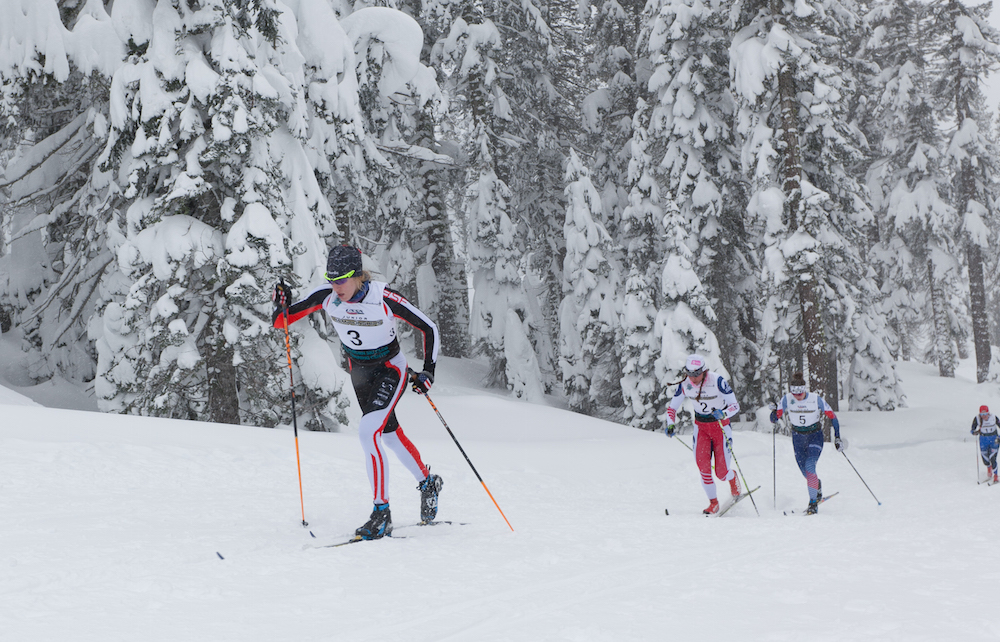
    Jennie Bender (3) of the Bridger Ski Foundation leading Stratton's Julia Kern (2) and Sun Valley's Deedra Irwin (5) during the second women's classic sprint semifinal at Saturday's SuperTour near Truckee, Calif. Bender went on to win the semifinal, as well as the final.
    Jennie Bender (3) of the Bridger Ski Foundation leading Stratton’s Julia Kern (2) and Sun Valley’s Deedra Irwin (5) during the second women’s classic sprint semifinal at Saturday’s SuperTour near Truckee, Calif. Bender went on to win the semifinal, as well as the final.

    In the women’s A-final, Jennie Bender of the Bridger Ski Foundation, coming off a classic sprint win at nationals, scored another victory in 3:29.07. She edged Craftsbury’s Kaitlynn Miller by just seven-hundredths of a second, and Stratton’s Julia Kern placed third (+3.42). Racing at home, Hannah Halvorsen (Sugar Bowl Academy) finished fourth (+3.88). Craftsbury had three in the women’s final with Caitlin Patterson in fifth (+3.93) and Heather Mooney in sixth (+27.35).

    Miller proved to be the woman to beat throughout the day, winning the qualifier in 3:30.9, along with her quarterfinal and semifinal. Kern qualified second (+3.2) and Bender third (+4.6). Bender went on to win her quarterfinal and semifinal as well before facing off with Miller in the final.

    Results: Men | Women

    ***

    NorAm Western Canadian Championships (Whistler, B.C.): 10/15 k classic 

    It was interval-starts day at Western Canadian Championships at Whistler Olympic Park and national-team veteran Emily Nishikawa completed the four laps of the women’s 10 k classic in 30:35.5 to win ahead of teammate Dahria Beatty, 16.5 seconds behind. Maya MacIsaac-Jones completed the national team and Alberta World Cup Academy (AWCA) sweep in third (+1:36.5).

    Sovereign Lake’s Hannah Mehain, of the national junior team, was the top junior for the second-straight day in eighth overall (+3:22.1).

    In the men’s 15 k, Lappe Nordic’s Andy Shields won the six-lap race in 40:34.2, showing some of the form that won him the NorAm overall last season. National-team member Jess Cockney collected his second-straight podium, finishing second, 4.3 seconds behind Shields. Evan Palmer-Charrette (NTDC Thunder Bay) completed the podium in third (+55.1).

    Results

    ***

    FIS Cross-Country World Cup (Ulricehamn, Sweden): 10/15 k freestyle

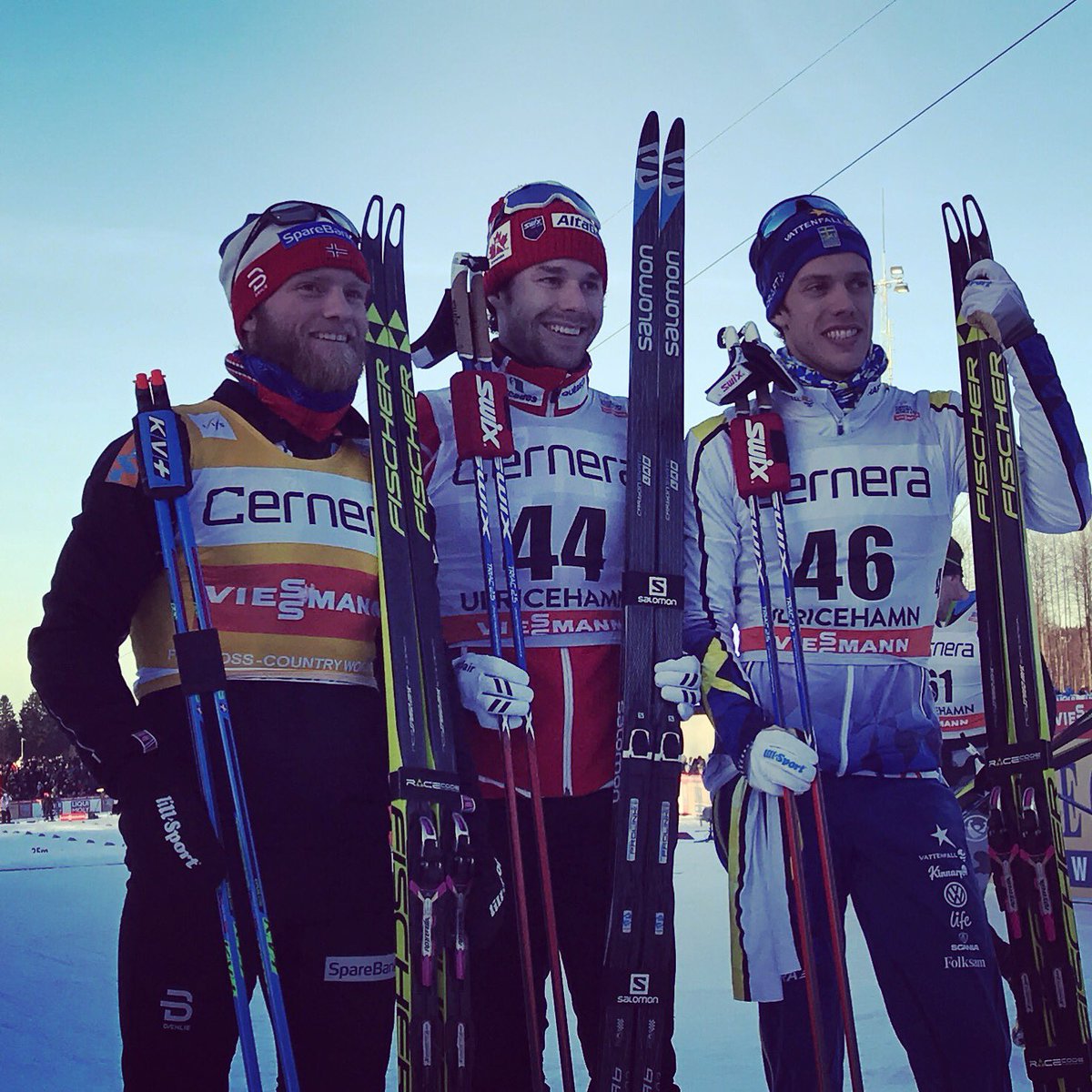
    The men's 15 k freestyle podium at Saturday's World Cup in Ulricehamn, Sweden, with Canadian winner Alex Harvey (c), Norwegian runner-up Martin Johnsrud Sundby (l), and Sweden's Marcus Hellner (r) in third. (Photo: FIS Cross Country/Twitter)
    The men’s 15 k freestyle podium at Saturday’s World Cup in Ulricehamn, Sweden, with Canadian winner Alex Harvey (c), Norwegian runner-up Martin Johnsrud Sundby (l), and Sweden’s Marcus Hellner (r) in third. (Photo: FIS Cross Country/Twitter)

    Men’s report | Women’s report

    First individual win of the season (second straight, after winning last weekend’s team sprint), fifth individual victory of his career. That’s the latest news on Canada’s Alex Harvey, who won the World Cup men’s 15-kilometer freestyle individual start on Sunday in Ulricehamn, Sweden, for his first victory in a 15 k skate race and fourth individual podium of 2016/2017.

    To say Harvey is on a roll is an understatement. On Saturday, he beat Norway’s Martin Johnsrud Sundby by 6 seconds after starting a minute behind the Norwegian defending World Cup champion. Harvey’s fastest time across the line in 32:46.2 held up through 76 finishers, with Sweden’s Marcus Hellner coming somewhat within range after starting a minute behind him. Hellner ended up 14.3 seconds back from Harvey at the finish for third place, behind Sundby.

    Switzerland’s Dario Cologna missed the podium by 0.5 seconds in fourth (+14.7), and Norway’s 24-year-old Daniel Stock broke through in fifth (+16.2) for his first World Cup top 20.

    Great Britain’s Andrew Musgrave placed sixth (+18.7), Sweden’s Daniel Rickardsson was seventh (+25.0), Norway’s Finn Hågen Krogh eighth (+32.2), Russia’s Petr Sedov ninth (+33.9), and Japan’s Keishin Yoshida 10th (+34.2).

    American Erik Bjornsen landed in the points as he tied Norway’s Simen Andreas Sveen for 28th (+1:09.2), leading fellow U.S. Ski Team members Noah Hoffman, who placed 41st (+1:28.8), and Simi Hamilton in 53rd (+1:56.2). Also for the U.S., Matt Gelso, the Period 1 SuperTour leader from the Sun Valley Ski Education Foundation (SVSEF) Gold Team, finished 68th (+3:00.3).

    Harvey’s Canadian World Cup teammates Len Valjas finished 35th (+1:17.7) and Devon Kershaw 38th (+1:22.2). Knute Johnsgaard (Canadian U25 Team) did not start.

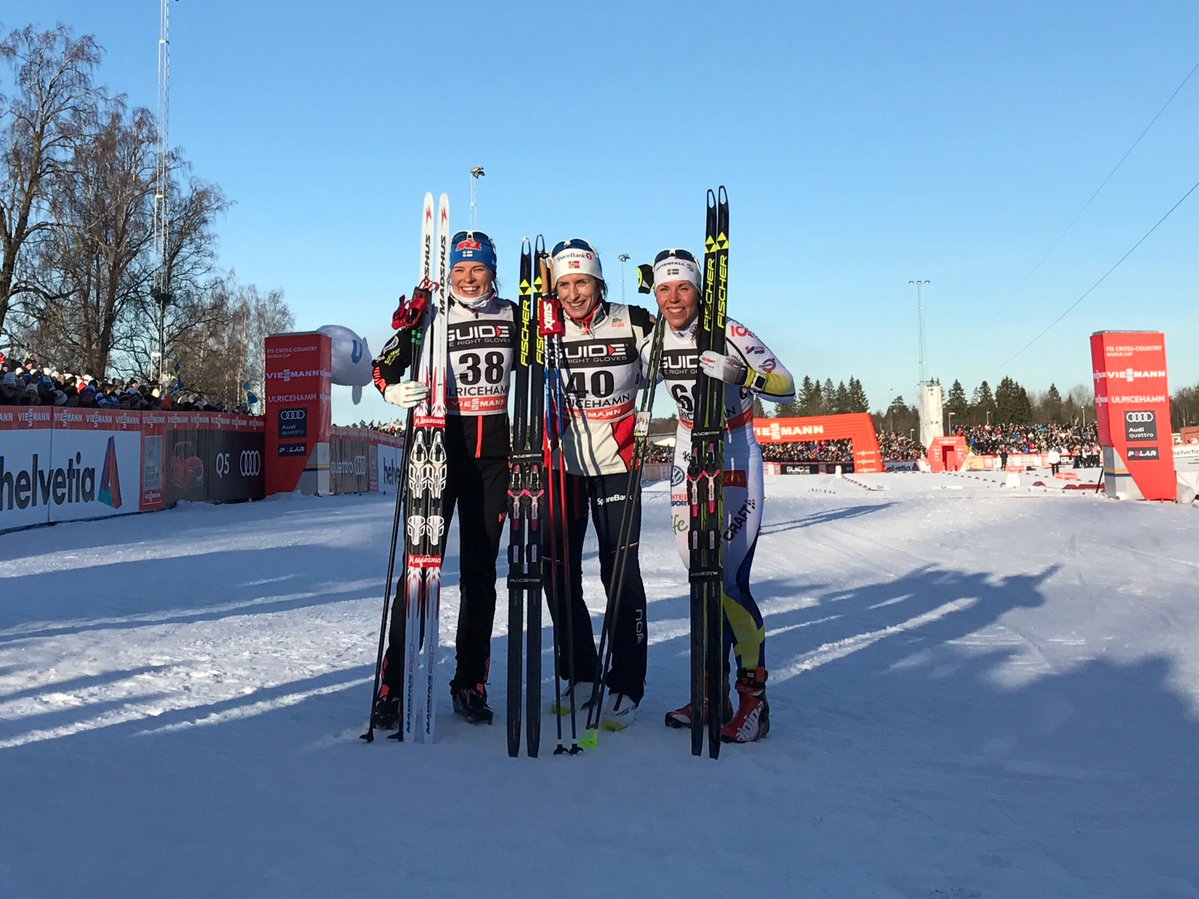
    The women's 10 k freestyle podium on Saturday in Ulricehamn, Sweden, with Norwegian winner Marit Bjørgen (c), Finland's Krista Parmakoski (l) in second and Sweden's Charlotte Kalla (r) in third. (Photo: FIS Cross Country/Twitter)
    The women’s 10 k freestyle podium on Saturday in Ulricehamn, Sweden, with Norwegian winner Marit Bjørgen (c), Finland’s Krista Parmakoski (l) in second and Sweden’s Charlotte Kalla (r) in third. (Photo: FIS Cross Country/Twitter)

    In her first World Cup race in over a month and at a brand-new World Cup venue, Norway’s 36-year-old Marit Bjørgen returned to her winning ways, topping the women’s 10 k freestyle on Saturday in Ulricehamn.

    Bjørgen started 40th out of 61 finishers and took the lead from Finland’s Krista Parmakoski at the finish with a time of 23:46.3 minutes. Parmakoski, who started a minute ahead of her in bib 38, ended up second, 10.7 seconds back. Sweden’s Charlotte Kalla reached the podium for the second time this season in third (+24.9).

    “It is always great to win,” Bjørgen said, according to an International Ski Federation (FIS) press release. “I stayed at home for five weeks and was training. It is great to come back with a victory. I know that the training I had done was good. It was an amazing atmosphere today by the course. There were people cheering everywhere.”

    Norway swept fourth through sixth with Astrid Uhrenholdt Jacobsen in fourth (+25.7), Ragnhild Haga in fifth (+32.3) and Heidi Weng in sixth (+34.0).

    American Jessie Diggins raced to seventh (+34.9), ahead of Sweden’s Hanna Falk, who recorded her best distance result in eighth (+36.4). Norway’s Ingvild Flugstad Østberg finished ninth (+44.8), and Germany’s Sandra Ringwald was 10th (+56.6).

    “I didn’t have the snappy good feelings I was hoping to have in my body today, but it was a solid race,” Diggins wrote in a post-race email to FasterSkier. “It’s always hard when you know that on your best days you are capable of more, but at the same time we had great skis, and it was really fun for me to be able to ski with my teammates today!”

    The U.S. had three in the top 20 and four in the top 30 with Sadie Bjornsen in 12th (+1:00.5), Liz Stephen in 16th (+1:07.3) and Rosie Brennan in 24th (+1:30.7).

    Cendrine Browne as Canada’s lone woman in the race achieved 35th (+1:52.0) for her career best in an individual race. Also for the U.S., Kikkan Randall placed 40th (+1:59.6) and Liz Guiney of the Craftsbury Green Racing Project 52nd (+2:33.2).

    Results: MenWomen

    ***

    IBU World Cup (Antholz, Italy): Men’s relay & women’s mass start

    Men’s reportWomen’s report

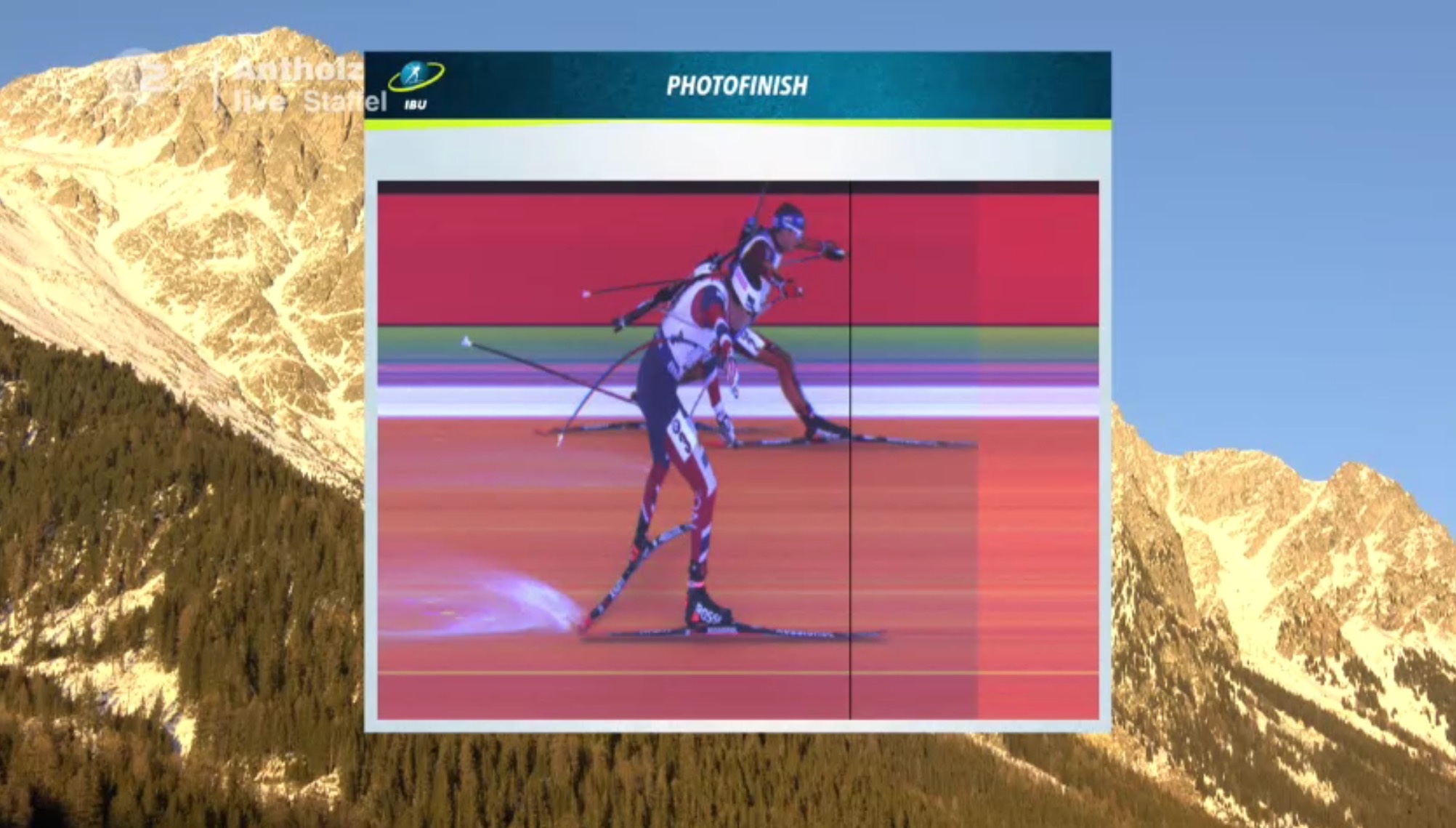
    The photo finish of the men's 4 x 7.5 k relay on Saturday at the IBU World Cup in Antholz, Italy, with Germany's Simon Schempp outlunging Norway's Emil Hegle Svendsen. (Photo: IBU screenshot)
    The photo finish of the men’s 4 x 7.5 k relay on Saturday at the IBU World Cup in Antholz, Italy, with Germany’s Simon Schempp outlunging Norway’s Emil Hegle Svendsen. (Photo: ZDF broadcast screenshot)

    For the U.S. men, top six was a target for the 4 x 7.5 k relay on Sunday in Antholz, Italy, according to US Biathlon Men’s Coach Jonas Johansson.

    Mission accomplished. In the final team event before 2017 World Championships, Lowell Bailey, Leif Nordgren, Tim Burke, and Sean Doherty combined for sixth, finishing 1:04.9 minutes behind the German winners. The Americans used a total of 10 spares but avoided the penalty loop, as did the Germans who used seven spares to clean the eight-stage race and won it in 1:13.57.2.

    Germany’s Simon Schempp narrowly outlasted Norway’s Emil Hegle Svendsen in the finishing stretch to secure the victory for Germany (with teammates Erik Lesser, Benedikt Doll and Arnd Peiffer) by one-tenth of a second. Norway finished second with nine spares and no penalties (with Lars Helge Birkeland, Henrik L’Abee-Lund, Johannes Thingnes Bø, and Svendsen), and Russia secured third (+33.6) with nine spares and zero penalties as well (with Maxim Tsvetkov, Evgeniy Garanichev, Dmitry Malyshko, and Anton Babikov).

    Ukraine used a total of just five spares and had zero penalties for fourth (+46.7), and Austria took fifth (+49.2) with eight spares and no penalties, after Austria’s Dominik Landertinger skied away from Doherty on the final loop and finished 6.9 seconds ahead of him for fifth place.

    For the U.S. men, sixth was close to their team-best fifth with the same lineup in last year’s World Cup relay in Presque Isle, Maine. The same group also took sixth in Ruhpolding, Germany, last year as well.

    With all four making US Biathlon’s World Championships team, announced Saturday, they will likely be aiming for a best championships result early next month in Hochfilzen, Austria.

    Canada (Christian Gow, Scott Gow, Macx Davies, and Brendan Green) finished 16th (+4:13.8) on Saturday with two penalties and 11 spares. Scott Gow skied them up to 15th by the second exchange but they dropped to 18th after Davies had two penalties on the third leg. With Green anchoring and using just one spare, they recouped two places before the finish.

    In the women’s race, Germany’s Nadine Horchler achieved a lifetime dream with her first World Cup win, after starting in bib 30 and earning her start as a reserve athlete. Germany took first and second with Laura Dahlmeier in second, and the Czech Republic’s Gabriela Koukalova placed third. Susan Dunklee of the U.S. was the lone North American starter and finished 24th after leading at the start of the second loop.

    Results: Men’s relay | Women’s 12.5 k mass start

    ***

    FIS Nordic Combined World Cup (Chaux-Neuve, France): Individual large hill/10 k

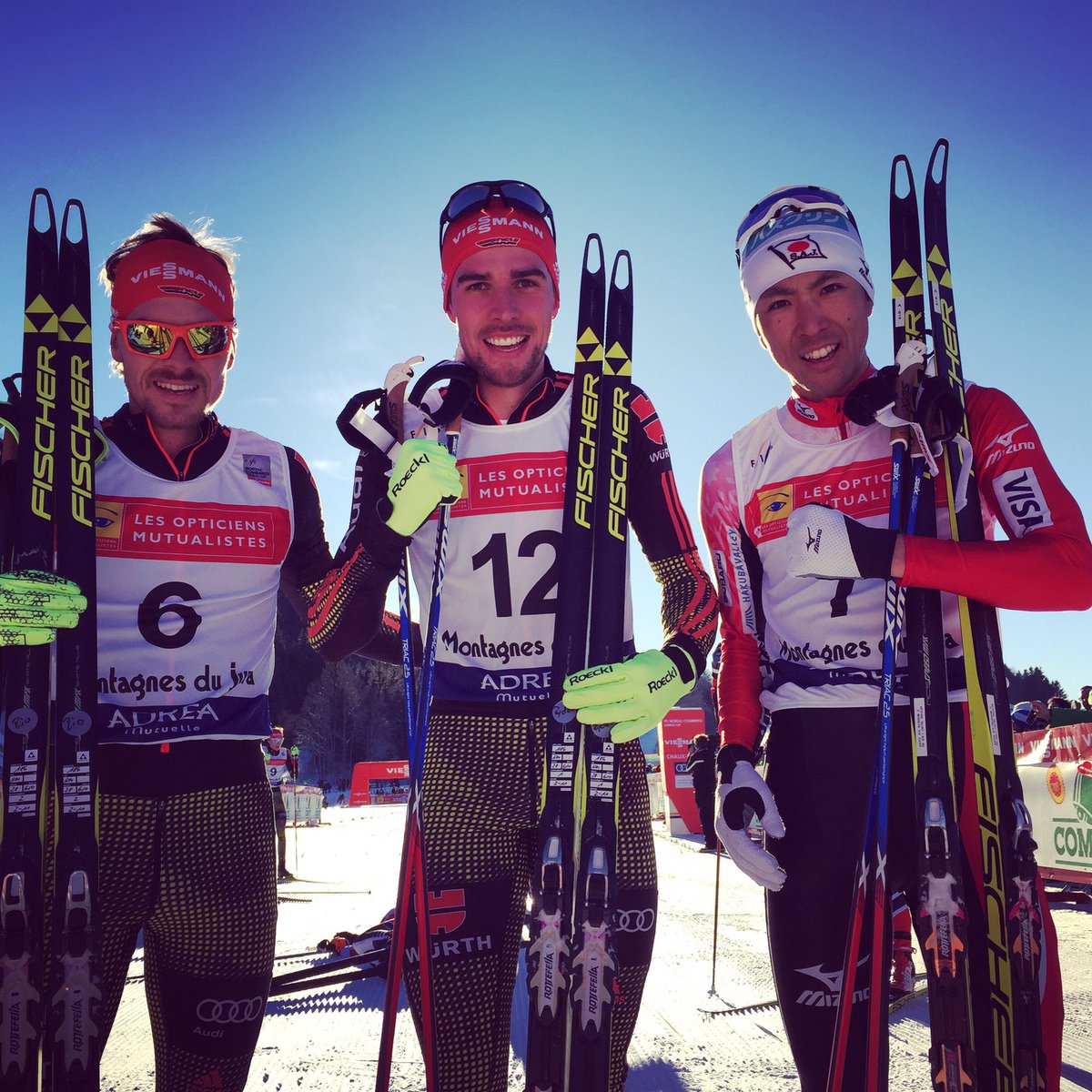
    Saturday's Nordic Combined World Cup podium in Chaux-Neuve, France, with German winner Johannes Rydzek (c), German runner-up Fabian Rießle (l) and Japan’s Akito Watabe (r) in third. (Photo: FIS Nordic Combined/Twitter)
    Saturday’s Nordic Combined World Cup podium in Chaux-Neuve, France, with German winner Johannes Rydzek (c), German runner-up Fabian Rießle (l) and Japan’s Akito Watabe (r) in third. (Photo: FIS Nordic Combined/Twitter)

    The first part of Saturday’s Nordic Combined World Cup individual large hill/10 k competition was a shining moment for U.S. Nordic Combined skier Ben Berend, who jumped to second for a total of 127.5 points, trailing only Norway’s Jarl Magnus Riiber with 139 points in Chaux-Neuve, France.

    Berend flew farther than Germany’s Eric Frenzel, who jumped to third on the Chaux-Neuve large hill.

    Later in the day, they started the 10 k Gundersen in that order, with Riiber heading out first, followed by Berend 46 seconds later, then Frenzel 53 seconds back in third.

    Germany’s Johannes Rydzek started 1:15 minutes back in 12th and skied the fastest 10 k to take the victory at the finish (in 23:01.7). He held off his German teammate Fabian Rießle by 2.8 seconds for the win, after Rießle started sixth and 1:01 back. Japan’s Akito Watabe reached the podium in third (+5.7) after jumping to seventh and starting the race 1 second behind Rießle.

    Frenzel ended up fourth (+8.3), and the fourth German in the top five, Björn Kircheisen improved to fifth (+22.6) after starting 11th.

    Riiber dropped to 15th (+54.0), and Berend fell outside the top 30 to end up 32nd (+2:26.0) with the 39th-ranked course time.

    Berend finished 12.2 seconds ahead of his U.S. teammate Taylor Fletcher, who placed 34th (+2:38.2) after the jump put him in 48th.

    Bryan Fletcher was 49th after the jump but did not start the 10 k.

    The Nordic Combined World Cup continues Sunday in Chaux-Neuve with another large hill/10 k.

    Results

    ***

    Ski Classics #5: La Diagonela (Zuoz, Switzerland): 50 k classic

    [UPDATED] Under “blue skies, no wind and perfect track conditions” in the Swiss Engadin Valley on Saturday, according to a Ski Classics press release, Russia’s Ilya Chernousov and the Czech Republic’s Kateřina Smutná won the men’s and women’s La Diagonela, respectively, in Zuoz, Switzerland.

    Chernousov, of Team Pioneer Investments, and Tord Asle Gjerdalen (Team Santander) led a large pack of men into the final major climb on the 50 k course. There, Gjerdalen attacked and Chernousov matched him, accelerating away from his competitors up the last steep pitch to the finish, according to the press release. He finished in 2:03:39.6 hours, holding off Gjerdalen by 1.5 seconds, while Øystein Pettersen (Team BN Bank) finished third (+3.0).

    In the women’s race, Smutná (Team Santander) pushed to break up the field around the halfway point, where the men caught the women. Britta Johansson Norgren (Lager 157 Ski Team) hung with Smutná, but lost contact over the last 5 k. After finishing second in the last two Ski Classics races, Smutná took the win by 1:03.2 minutes in 2:20:49.2. Nordgren finished second, ahead of Sara Lindborg (Team Serneke) in third, who finished more than three minutes later (+4:17.4).

    Results


  • Junior Nationals: Day 4 Classic Relay Photos and Overall Recap Video

    Junior Nationals: Day 4 Classic Relay Photos and Overall Recap Video

    One of the men's 3 x 2.5 k relays on the last day of 2015 U.S. Junior Nationals at Auburn Ski Club in Soda Springs, Calif. (Photo: Mark Nadell/MacBeth Graphics)
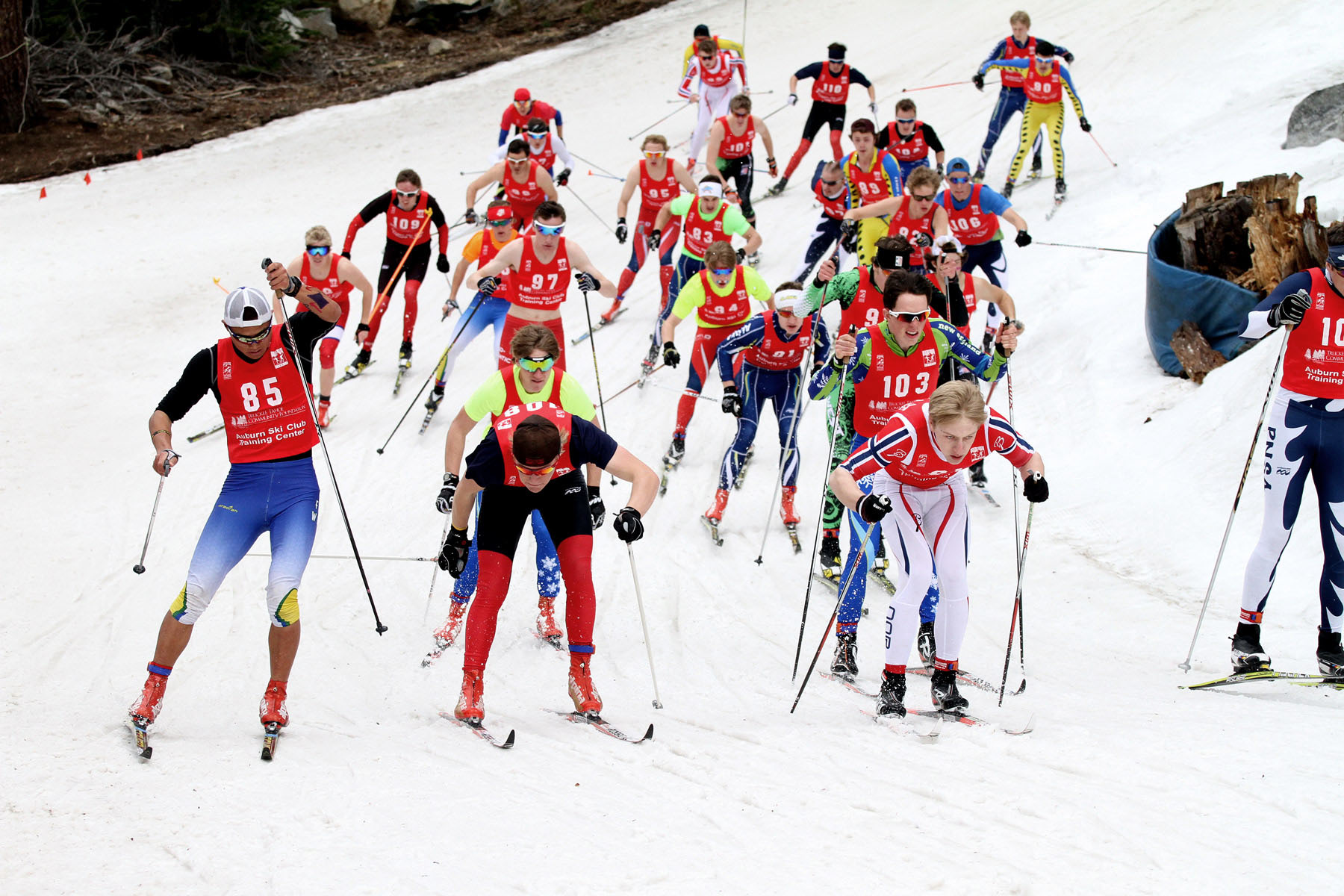
    The U18 men’s 3 x 2.5 k classic relay on the last day of 2015 U.S. Junior Nationals at Auburn Ski Club in Soda Springs, Calif. (Photo: Mark Nadell/MacBeth Graphics) All profits from photo sales will be donated to the National Nordic Foundation.

    The 2015 U.S. Junior Nationals came to a close Saturday with the 3 x 2.5-kilometer classic relays at Auburn Ski Club in Soda Springs, Calif., where New England and Midwest both tallied two relay wins. At the end of the weeklong series of races, New England took the overall team title, the Alaska Cup, by 167 points over Midwest. Intermountain placed third overall, 43 points out of second.

    Complete results

    For more videos, check out the 2015 XC Junior Nationals YouTube channel. Trouble viewing video above? Click here.

    Photos from Saturday’s relays and a complete gallery, courtesy of Mark/Nadell/MacBeth Graphics. All profits from photo sales will be donated to the National Nordic Foundation (NNF).

    On the podium:

    U16 women

    1. Intermountain (Sydney Palmer-Leger, Anna Gibson, Brooke Dunnagan) 24:55.4
    2. Midwest (Erin Moening, Abigail Jarzin, Anna Johnson) +13.7
    3. New England (Gabrielle Vandendries, Kirsten Miller, Mae Chalmers) +15.3

    U16 men

    1. Alaska (Luke Jager, Ti Donaldson, Canyon Tobin) 21:39.6
    2. New England (Adam Glueck, Russell Boswell, Adam Witkowski) +5.3
    3. Rocky Mountain (Noel Keeffe, Wyatt Gebhardt, Nolan Herzog) +24.7

    U18 women

    1. New England (Julia Kern, Leah Brams, Katharine Ogden) 24:44.4
    2. Rocky Mountain (Hailey Swirbul, Taeler McCrerey, Kathleen O’Connell) +1:22.6
    3. Midwest (Racquel Wohlk, Margie Freed, Nicole Schneider) +2:01.0

    U18 men

    1. Midwest (Mackinley Fitzpatrick, Leo Hipp, Zak Katterson) 23:04.2
    2. New England (Gavin McEwen, Koby Gordon, Daniel Streinz) +5
    3. New England (Lance McKenney, Kamran Husain, Henry Harmeyer) +16.5

    U20 women

    1. Midwest (Vivian Hett, Anna French, Caroline Brisbois) 25:59.1
    2. Alaska (Sarissa Lammers, Hannah Stevens, Taryn Hunt-Smith) +24.3
    3. Intermountain (Olivia Ekblad, Aja Starkey, Sophie McDonald) +35.4

    U20 men

    1. New England (Austin Huneck, Benjamin Hegman, Ian Moore) 22:21.3
    2. Intermountain (Sam Wood, Henry Gorman, Karsten Hokanson) +19.1
    3. New England (Parker McDonald, Blaine Ayotte, Nick Gardner) +54.2

    See alsoDay 1 skate sprints | Day 2 freestyle individual starts | Day 3 classic mass starts

  • 2015 U.S. Junior Nationals: Day 1 Skate Sprint Photos & Videos (Updated)

    2015 U.S. Junior Nationals: Day 1 Skate Sprint Photos & Videos (Updated)

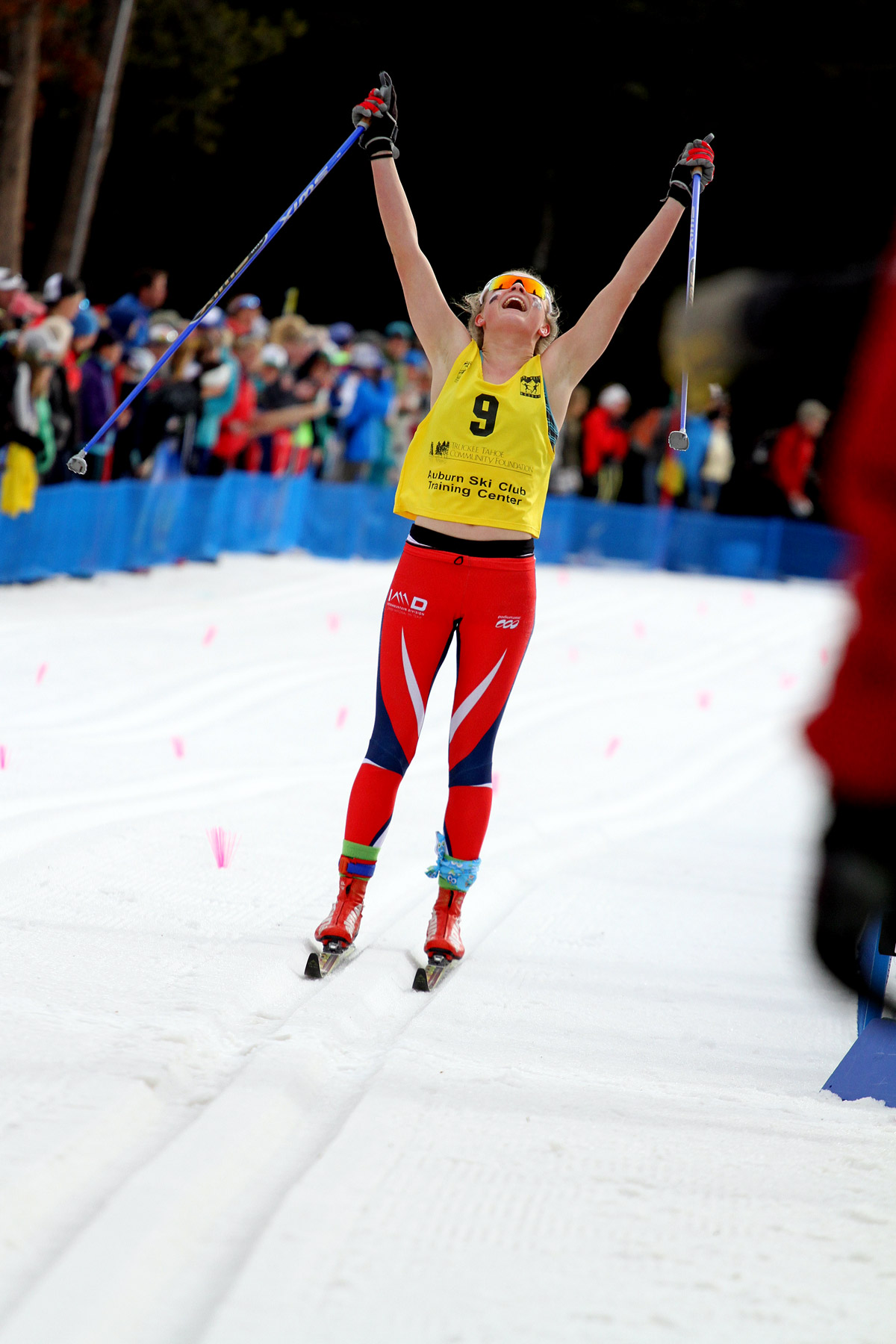
    The 2015 U.S. Cross-Country Junior Nationals kicked off Monday at Auburn Ski Club in Soda Springs, Calif., with the freestyle sprints on a 1.3-kilometer course. Below is a collection of photos from the flower ceremonies. Check out MacBeth Graphics for a complete gallery.

    Races continue Wednesday with the 5/10 k freestyle individual starts. Complete race schedule

    In partnership with Truckee Tahoe Community Television, organizers are offering a live stream of the races via their website: http://ttctv.org/online-services/2015-xc-junior-nationals/

    More videos from 2015 Junior Nationals, including this sprint recap:

    And check out this video of the U16 women’s A-final sprint finish by Frank Meyer of the Bridger Ski Foundation:

    Photo gallery by Mark Nadell/MacBeth Graphics

    A-final results:

    U16 women

    1. Brook Dunnagan (Intermountain) 2:31.39

    2. Erin Moening (Midwest) 2:31.48

    3. Madeline Donovan (Rocky Mountain) 2:32.66

    4. Anna Gibson (Intermountain) 2:35.5

    5. Sydney Palmer-Leger (Intermountain) 2:37.01

    6. Sofia Shomento (Intermountain) 2:38.16

    U18 women

    1. Julia Kern (New England) 3:00.99

    2. Hannah Halvorsen (Far West) 3:04.71

    3. Katharine Ogden (New England) 3:10.21

    4. Hailey Swirbul (Rocky Mountain) 3:11.8

    5. Jordi Floyd (Rocky Mountain) 3:22.11

    6. Lydia Blanchet (Alaska) 3:30.4

    U20 women

    1. Emily Hyde (Pacific Northwest) 3:18.33

    2. Hannah Hardenbergh (Rocky Mountain) 3:20.68

    3. Sarah Bezdicek (Midwest) 3:23.97

    4. Vivian Hett (Midwest) 3:29.9

    5. Katerina Paul (Intermountain) 3:34.64

    6. Taryn Hunt-Smith (Alaska) 3:42.8

    U16 men

    1. Sam Biskup (Pacific Northwest) 2:05.41

    2. Noel Keeffe (Rocky Mountain) 2:05.58

    3. Thomas Gebhards (Intermountain) 2:07.1

    4. Scott Schulz (Mid-Atlantic) 2:09.06

    5. Everett Sapp (Mid-Atlantic) 2:24.66

    6. Zach Williams (Intermountain) 2:30.28

    U18 men

    1. Henry Harmeyer (New England) 2:35.98

    2. Zak Ketterson (Midwest) 2:37.0

    3. Daniel Streinz (New England) 2:38.75

    4. Dylan Syben (Far West) 2:41.44

    5. Paolo Takagi-Atilano (Rocky Mountain) 2:42.57

    6. Bill Harmeyer (New England) 2:58.82

    U20 men

    1. Karsten Hokanson (Intermountain) 2:36.21

    2. Lars Hannah (Rocky Mountain) 2:36.57

    3. Noah Anderson (Intermountain) 2:39.5

    4. Thomas O’Harra (Alaska) 2:42.96

    5. Ian Moore (New England) 2:45.4

    6. John Farr (Alaska) 2:52.58

    Qualifying results

    Complete results