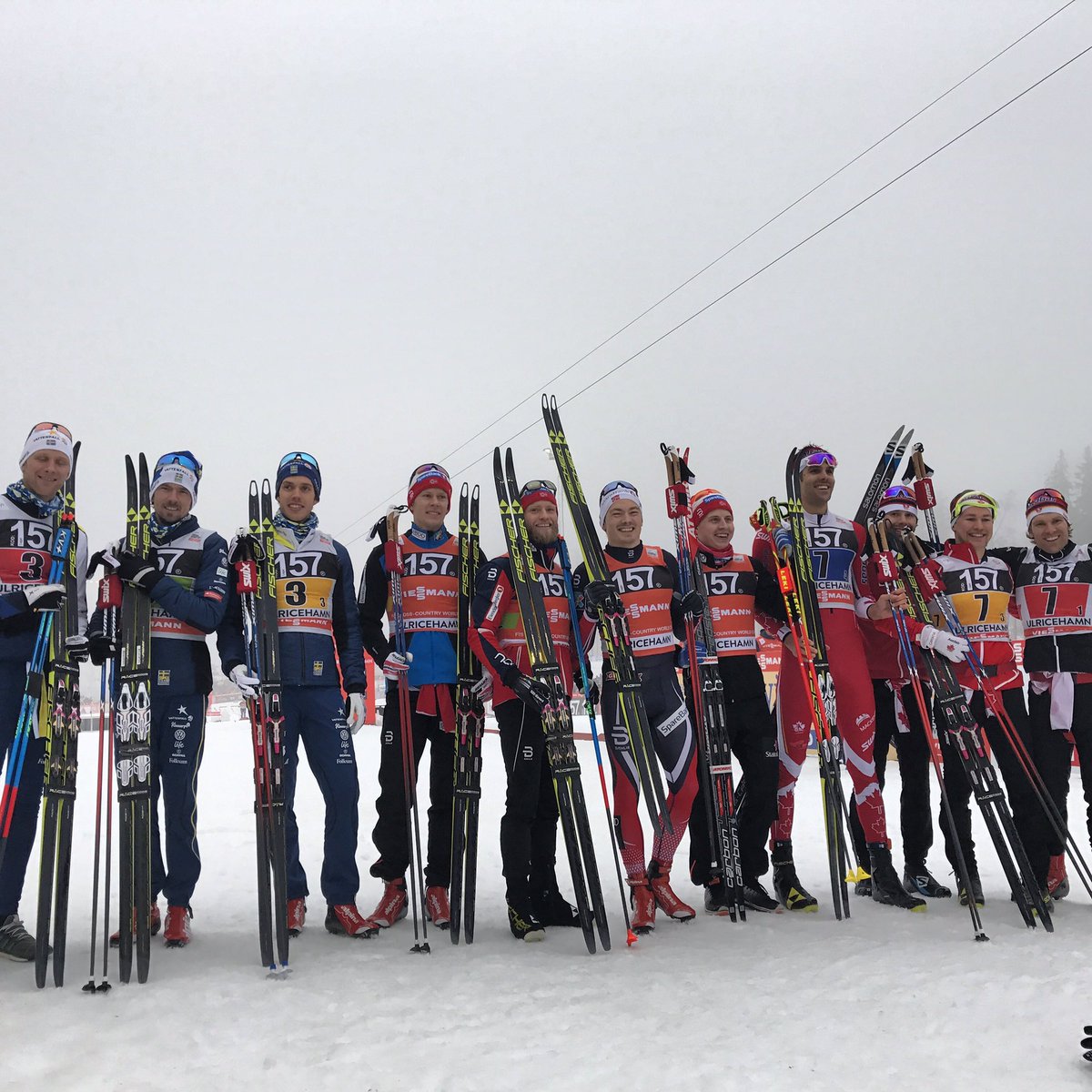
The men’s 4 x 7.5 k relay podium at the World Cup in Ulricehamn, Sweden, with Norway (c) in first, Sweden (l) in second, and Canada (r) with with its best-ever men’s relay in third. (Photo: FIS Cross Country/Twitter)
FIS Cross-Country World Cup (Ulricehamn, Sweden): 4 x 5 k and 4 x 7.5 k Relays
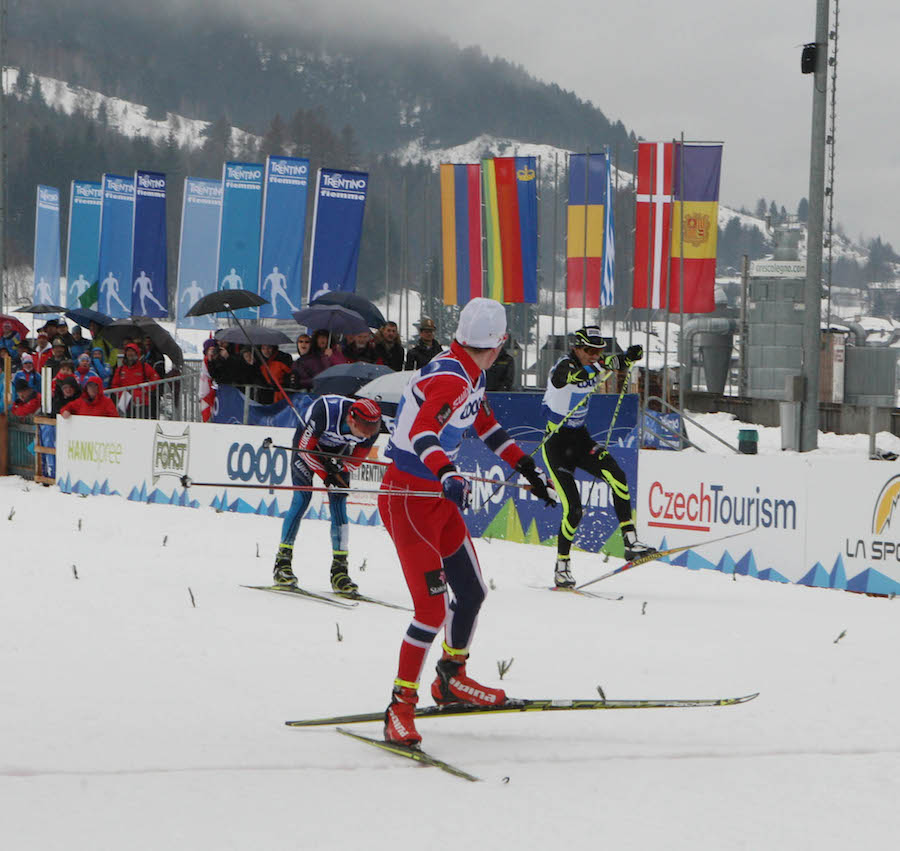
Norway notched back-to-back team victories in the women’s and men’s relays on Sunday at the World Cup in Ulricehamn, Sweden, with Finn Hågen Krogh securing a win in themen’s 4 x 7.5 k relay by 0.5 seconds over Sweden’s Calle Halfvarsson and Canada’s Lenny Valjas. With two kilometers remaining, nine teams were within 3.8 seconds of first. Krogh outlasted both Halfvarsson and Valjas in the finishing stretch, as Sweden placed second and Canada third for its best-ever relay result, according to a Cross Country Canada press release, besting its fifth-place finish from 2012 (with then-anchor Ivan Babikov, now a Canadian World Cup coach).
Krogh teamed up with Simen Hegstad Krüger, Martin Johnsrud Sundby and Anders Gløersen and finished in 1:06:47.5, while Sweden placed second with Daniel Rickardsson, Johan Olsson, Marcus Hellner, and Halfvarsson.
For Canada, with Devon Kershaw, Alex Harvey, Knute Johnsgaard, and Valjas, it was Harvey’s third-straight World Cup podium, Valjas’s second-straight team-event podium, and national U25 Team member Johnsgaard’s first podium.
“I have been waiting my whole career for this,” Kershaw said, according to a FIS press release. “All the guys did a great job today.”
The U.S. placed 10th (+1:16.5) with Andy Newell, Erik Bjornsen, Noah Hoffman, and Simi Hamilton.
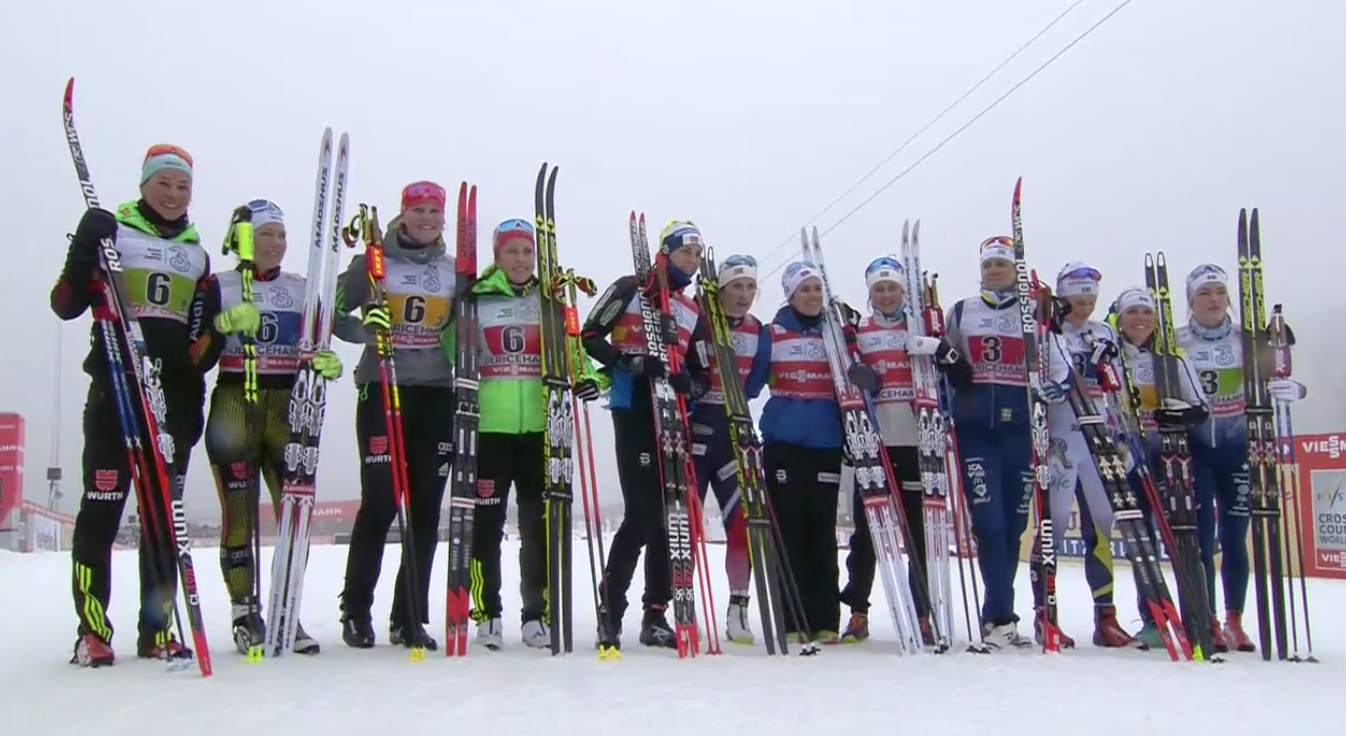
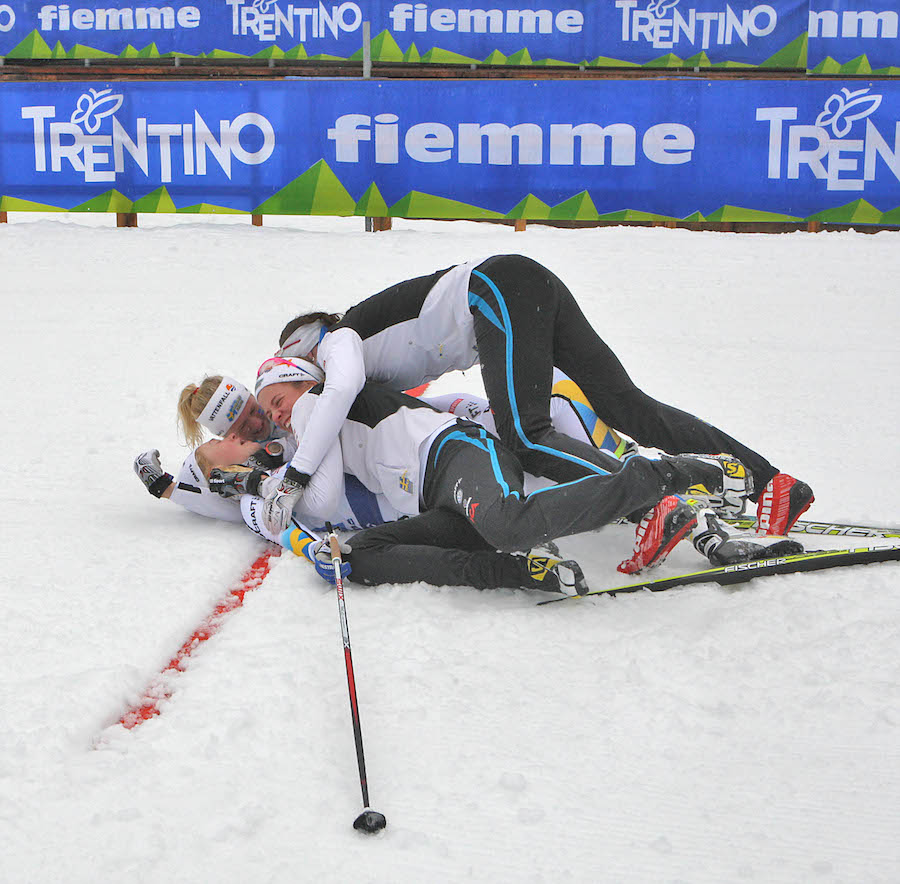
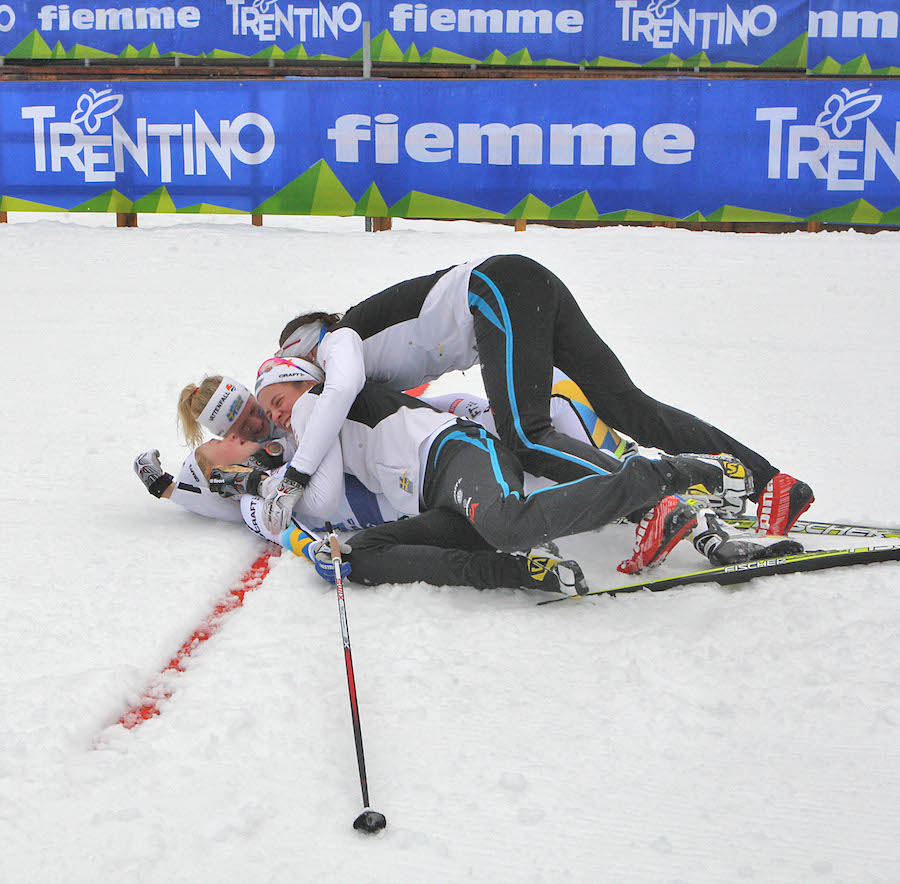
The Norwegian women’s team (center) won the 4 x 5 k World Cup cross-country relay in Ulricehamn, Sweden, by 8.8 seconds over Germany (left), with home team Sweden (right) edging the United States for third.
Earlier on Sunday, the women’s 4 x 5 k relay didn’t break apart until the second leg, but Norway still proved its dominance over the ski world with a win to start the day.
After the group of Ingvild Flugstad Østberg and Lotta Udnes Weng (Norway), Ida Ingemarsdotter (Sweden), and Anamarija Lampic (Slovenia) more or less stayed together on the first relay leg, Heidi Weng made a break for it, giving Norway a 16.8-second lead at the second tag. The Norwegian team never looked back and after the race Weng and teammates Østberg, Astrid Jacobsen, and Marit Bjørgen were able to climb to the top step of the podium.
The race for second place, though, wasn’t resolved until the finish line. Sweden, Slovenia, Norway’s second team, the United States, and Germany were all in contention at various points in the race.
On the last leg, Jessie Diggins of the U.S., Sandra Ringwald of Germany, and Hanna Falk of Sweden battled it out, dropping Kari Øyre Slind of Norway. The three shot to the finish line together, with Diggins stuck behind the other two. Ringwald eventually won the sprint finish by 0.2 seconds over Falk, with Diggins another 0.2 seconds back in fourth.
That gave Ringwald, Katharina Hennig, Stefanie Boehler, and Victoria Carl a second-place result, one of Germany’s best since taking silver at the 2010 Olympics. (The team won bronze at the 2014 Olympics.)
Ingemarsdotter, Falk, Charlotte Kalla, and Sofia Henriksson took the third step of the podium. Rosie Brennan, Sadie Bjornsen, Liz Stephen, and Diggins were left to settle for fourth.
The second U.S. team, of Kikkan Randall, Ida Sargent, Sophie Caldwell, and SuperTour leader Liz Guiney finished 12th after skiing in 8th and 9th earlier in the race.
NorAm Western Canadian Championships (Whistler, B.C.): Relays
[UPDATED] This season brought a changeup to the Western Canadian Championships with a three-person relay event in response to athletes’ request to add “fun” events to the NorAm series.
While 146 teams finished in 17 categories, it was Ontario winning the open men’s 3 x 7.5 k in 50:32.9 (Bob Thompson, Jack Carlyle and Andy Shields) and B.C. dominating the open women’s 3 x 5 k in 41:09.47 with three juniors (Katie Weaver, Anna Goodwin and Hannah Mehain).
The masters men and juvenile girls categories included the most teams, with 15 and 14, respectively.
FIS Nordic Combined World Cup (Chaux-Neuve, France): Individual large hill/10 k
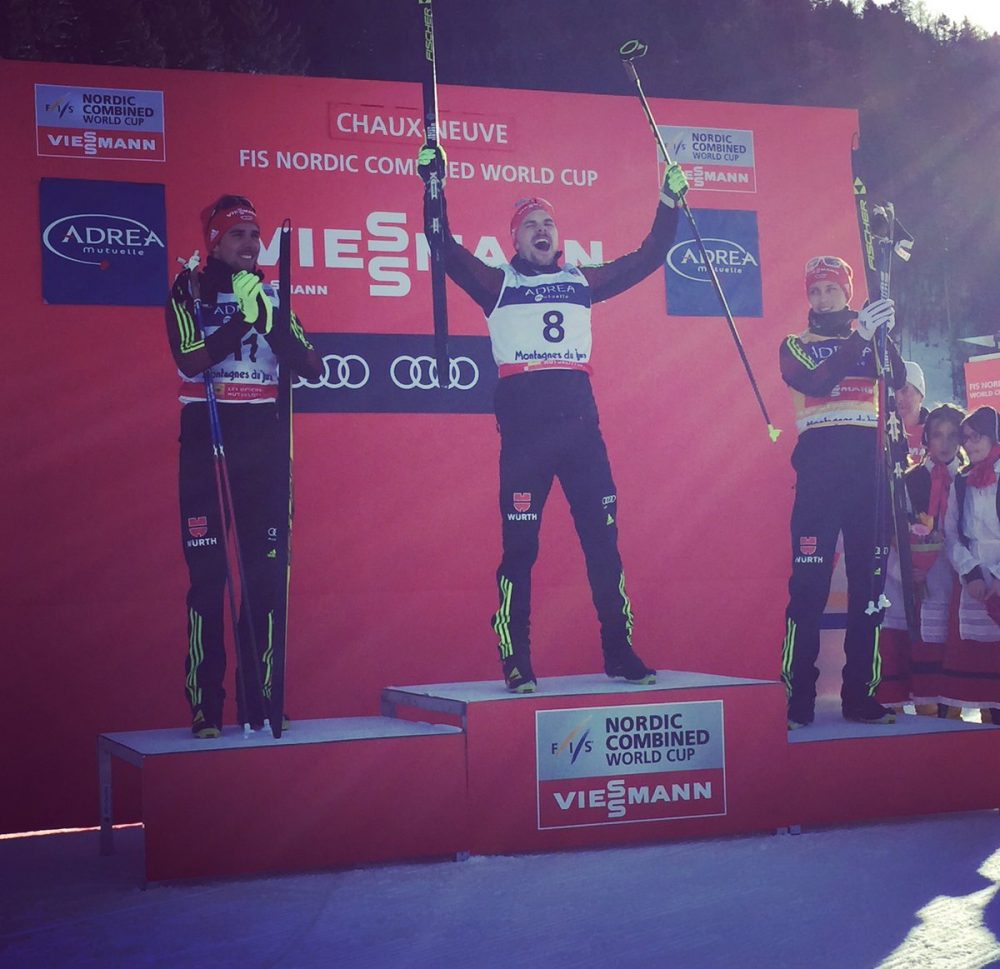
Sunday’s Nordic Combined World Cup podium in Chaux-Neuve, France, with German winner Fabian Rießle (c), German runner-up Johannes Rydzek (l), and Germany’s Eric Frenzel (r) in third. (Photo: FIS Nordic Combined/Twitter)
On Sunday, after the large hill jump and 10 k ski, Germany swept the podium in the second event of the NoCo World Cup in Chaux-Neuve, France. Fabian Rießle placed first in 22:44, and his German teammates Johannes Rydzek skied to second only 2.2 seconds back, and Saturday’s winner Eric Frenzel was third (+7.9).
(Frenzel leads the NoCo World Cup, Rydzek is second overall, Rießle is third.)
Norway’s Jarl Magnus Riiber flew the farthest with 139.8 points. Franz-Josef Rehrl from Austria jumped to second with 135.7 points while his teammate Bernhard Gruber jumped to third with 131.7 points.
Magnus faded to 23rd (+47.5) in the 10 k ski. Rehrl started 15 seconds back from Magnus and placed 17th overall (+31.5). Gruber maintained a top-ten, placing 9th (+13.5), after starting 32 seconds behind first place jumper Magnus.
While the top three jumpers all dropped back in the ski, it was a day of catch up for the German’s after the jumping portion.
Rießle ranked eigth after the jump and earned 128.7 points, he began the ski 0:44 back. Rydzek placed 11th in the jump with 126.9 points, while Frenzel jumped to fourth with 131.4 points.
The only U.S. skier entered in Sunday’s event was Ben Berend. The U.S. Nordic Combined skier jumped to 13th with 126.8 points — starting the ski 0:52 behind Magnus. Yet Berend couldn’t capitalize on his strong jump, he dropped to 37th (+2:06) after the ski.
The Nordic Combined World Cup continues next Friday in Seefeld, Austria.
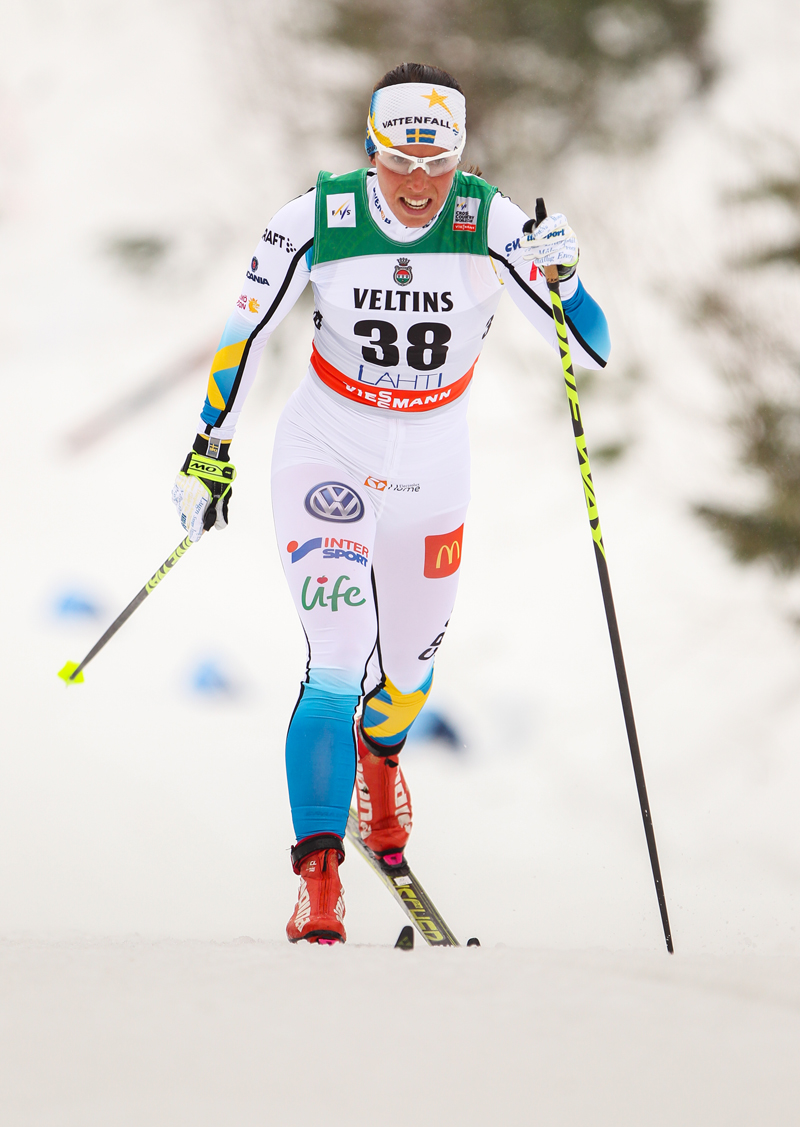
A world champion in the 10 k freestyle at 2015 World Championships last February, Charlotte Kalla is shown racing to third in the Lahti World Cup 10 k classic in Finland last March. (Photo: Fischer/NordicFocus)
Charlotte Kalla. Ida Ingemarsdotter. Those two names in first and second in Sweden’s first International Ski Federation (FIS) race of the season — the women’s 5-kilometer classic in Bruksvallarna — were more or less expected.
But Sofia Henriksson in third? The 21-year-old Swede hadn’t raced in nearly a year, coming off a hand injury and eating disorder. Leading up to U23 World Championships last season, she had been told she was “too thin and not allowed to go,” she wrote on her blog. “It seemed at first that everything collapsed.”
Yet on Friday, she finished 29.8 seconds behind 2015 world champion Kalla, the winner in 12:18.6. Another Swedish-national team member, Ingemarsdotter was 25.6 seconds back in second and 4.2 seconds ahead of Henriksson in third.
While Ingemarsdotter held off Henriksson for the lead late in the race, Kalla ultimately topped them both, leading at every checkpoint. By 1.4 k, Kalla was already 12.5 seconds faster than Ingemarsdotter. At 3 k, she was nearly 25 seconds up on Ingemarsdotter in second. Meanwhile, their teammate Hanna Falk sat in third, but Henriksson edged Falk in the second half of the race. Henriksson finished 1.9 seconds ahead of Falk — who placed fourth — for her first podium since placing second in the Bruksvallarna 5 k classic last year.
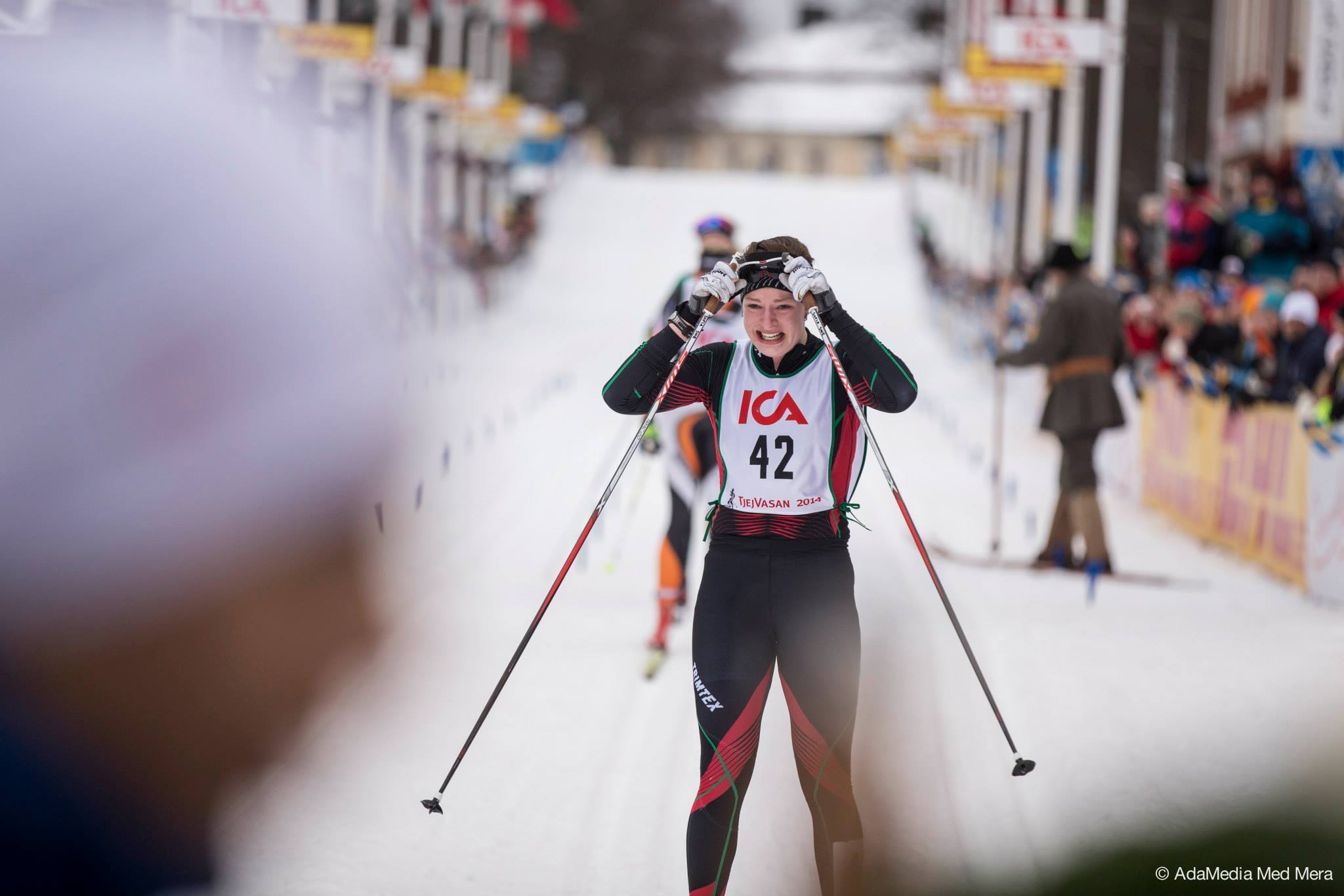
A teary-eyed Sofia Henriksson of Sweden at the finish of the Tjejvasan, an annual all-female event in Sweden, which she won in 2013. (Photo: Adam Alexander Johansson)
After the race, Henriksson wrote a blog with the English title: “Comeback”.
“There are many emotions that move inside me right now,” she began, according to a translation. “Above all, I feel joy and thanks largely to be back [racing]. Today’s race was my first since the middle of January. The 10 months outside racing have been a journey for me with both ups and downs and many emotional challenges.”
Her main focus had been to feel good on skis. Despite a tremendous amount of nerves in her first international start since December at the Davos World Cup last year, she felt she succeeded at that.
“I also got frequent updates on how I was doing in relation to the other skiers, but then many of the really [fast] girls started behind me, it was initially difficult to assess the splits,” Henriksson explained.
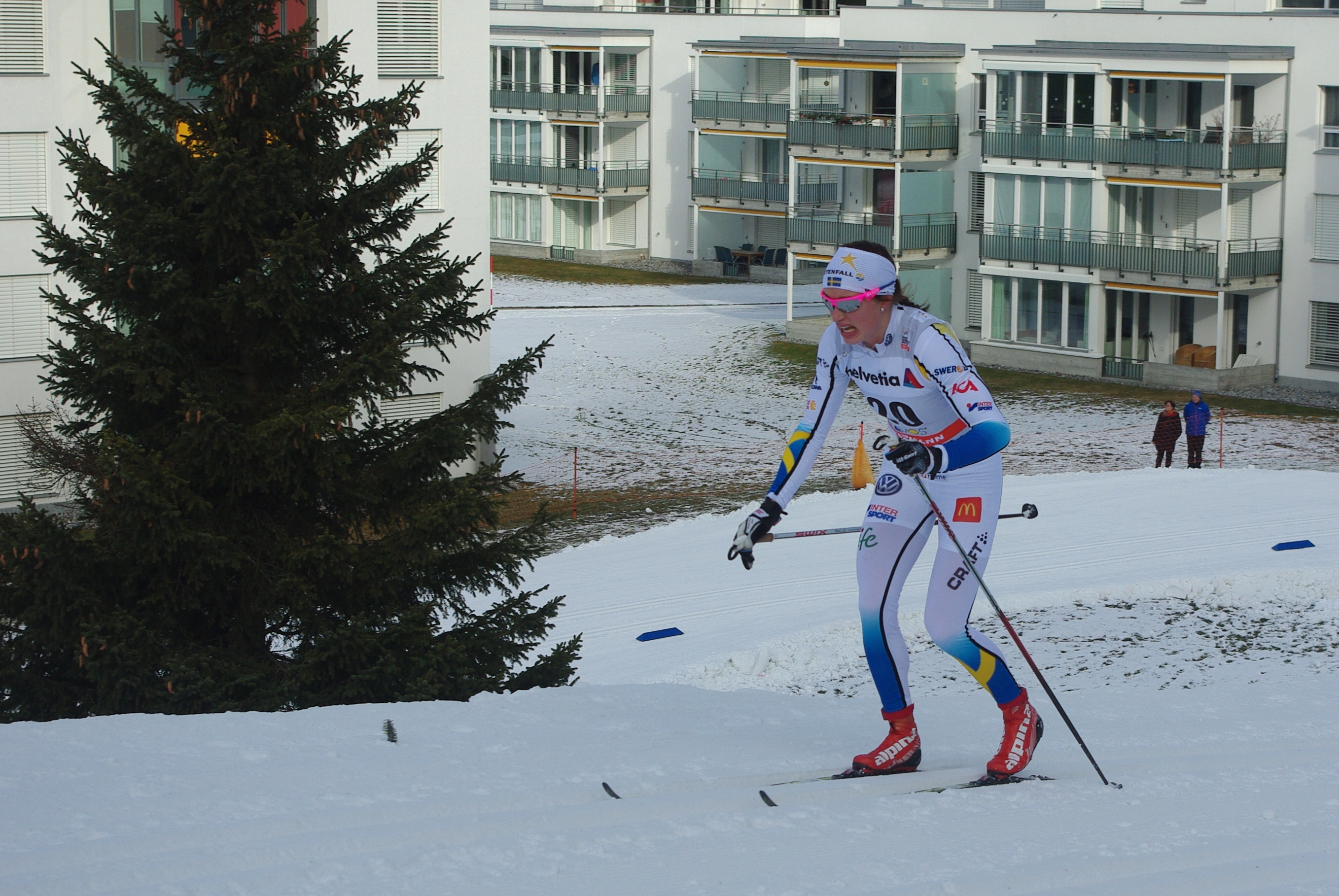
Sofia Henriksson acing to ninth in the Davos World Cup 10 k classic in Switzerland last December. That was her last race before the Bruksvallarna 5 k classic FIS race on Friday.
She never imagined placing in the top three.
“It was only a short while after the finish I could rejoice over my third place, a position I before could only dream about,” she added.
Most importantly, this result gave her hope for this season. “I’ve found it’s important to maintain good balance and also keep the focus on training,” she wrote.
As for Kalla, Swedish women’s coach Mattias Persson told Aftonbladet she is “better trained than ever.”
Kalla, 28, led a Swedish sweep of the top 15. Sixty-four women finished the 5 k, representing either Sweden, Norway, Slovenia, Croatia, or Great Britain.
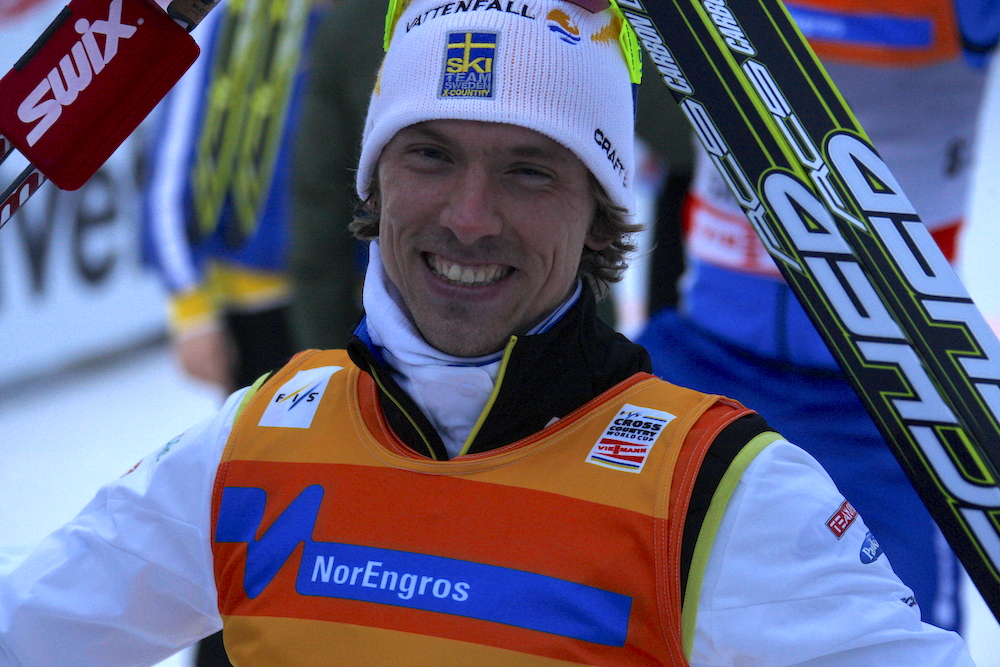
Sweden’s Johan Olsson three years ago at the 2011 World Cup opener in Sjusjøen, Norway. (Photo: Inge Scheve)
The first race of the season is a good one to get the kinks out. You don’t have to tell that to a few top contenders in Friday’s International Ski Federation (FIS) races in Bruksvallarna, Sweden.
Not only did Johan Olsson snatch the victory by less than half a second in a season-opening 10-kilometer classic race, but husband-wife duo Emil Jönsson and Anna Haag swapped timing chips and caused a lot of commotion in the timing shack.
Calle Halfvarsson dominated the men’s 10-kilometer classic race, but lost out on first by four-tenths of a second. The stadium announcer, Kjell-Erik Eriksson, took the blame.
“As a speaker, I generally have a good handle on everybody’s times,” Eriksson wrote on his website, Sweski.com.
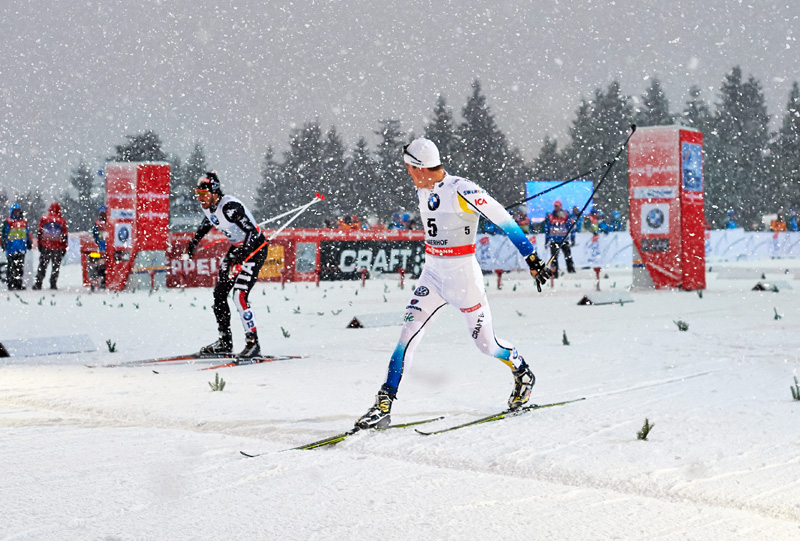
Swede’s Calle Halfvarsson (front) edges Italy’s Federico Pellegrino for the win in the individual skate sprint at the 2013/2014 Tour de Ski in Oberhof, Germany. In a 2014/2015 opening FIS Race on Friday in Bruksvallarna, Halfvarsson missed out on first by 0.4 seconds. (Photo: Felgenhauer/NordicFocus)
“I was sure Calle was going to win when he came into the stadium. At the last turn, he was clearly in the lead. Johan Olsson was 11 seconds behind, and at one point he was 18 seconds behind. That’s why I called out Calle as the winner as early as the start of the final straight stretch,” he explained.
“Calle wanted to give the spectators a little extra, he slowed down and just rolled across the finish, but that cost him the victory. Johan Olsson raced the last straight stretch as if it was an individual sprint race, and he won by less than half a second. … I take the blame for that, if it helps people sleep better tonight.”
Halfvarsson, 25, assumed full responsibility, telling Aftonbladet that it was “ridiculous” of himself. “It’s my fault,” he said, according to a translation.
“I was leading by 20 seconds and thought I could [lollygag] towards the finish. I thought I’d be cool and it was a bit cocky to slide into the finish,” he said.
Olsson, 34, said he felt a little sorry for Halfvarsson.
“I was in the stadium when I heard that Kjell-Erik said Calle stopped [skiing],” he told SportExpressen. “So I realized that I could pick on him with a hefty spurt.”
He added that he was a bit surprised with his result.
“It feels really nice,” he said, according to a translation. “You can ask my teammates — they know I have not been in shape. It’s almost as if I was starting to wonder if I did something wrong. But when the bib number goes on … it felt a lot better.”
Friday’s winner in Beitostølen, Martin Johnsrud Sundby had this to say in response to Olsson’s supposed poor form: “Has Johan Olsson ever claimed to be feel fit and prepared ahead of a race? WTF,” Sundby he told SportExpressen. “The day he does, the rest of us might as well not even bother to start.”
Sweden swept the top 18 with Lars Nelsson finishing third, 22.5 seconds behind Olsson and 22.1 behind Halfvarsson. Daniel Richardsson was another 5.6 seconds back in fourth and Jesper Modin took fifth, 7.9 seconds later.
“Has Johan Olsson ever claimed to be feel fit and prepared ahead of a race? WTF. The day he does, the rest of us might as well not even bother to start.” — Norway’s Martin Johnsrud Sundby, reacting to Olsson’s statement after his Bruksvallarna win, after Sundby won Friday’s FIS opener in Beitostølen, Norway
***
Emil Jonsson and Anna Haag trying the Americans’ strength plan in the summer of 2011. (Photo: Kikkan Randall/Liz Stephen)
Apparently Jönsson and Haag are so connected that they even share timing chips, causing a major mixup for the timing crew.
Jönsson had marked the chips with each their names, but he inadvertently switched the chips so that they had the wrong name. Haag discovered the mistake after finishing and was mostly just happy not to get DQed. However, she got no splits skiing with Jönsson chip, Eriksson noted. Jönsson was not listed as starting or finishing — but the results did not indicate a disqualification, either.
Haag ended up third in the women’s 5 k classic, 50.4 seconds behind Swedish national teammate Charlotte Kalla — the winner in 16:04.4 — and 13.4 seconds back from 20-year-old runner-up Sophia Henriksson.
Kalla, who strained a back muscle a few weeks ago, said she wasn’t sure how she’d fare heading into Friday’s race.
She was pleased with her result.
“It feels great to start off the season in this way,” Kalla told Aftonbladet.
Sofia Henriksson sheds tears at the finish of last year’s Tjejvasan, an annual all-female event in Sweden, after skiing in the lead pack but missing a top finish because of a pileup. (Photo: Adam Alexander Johansson)
“Today I felt like I got the answer I hoped for,” she added, according to a rough translation. “I thought it went well in skiing. I had good skis and took hold. I knew that there were some parts where you can earn on kick-double poling so I tried to find the pressure there too. It’s one of my strengths.”
A first-year senior with Piteå Elit, Henriksson found herself surprised with her performance.
“I knew that I can go well in a classic race, but not quite this good,” she told Skidzonen.
“I didn’t have much courage, but I bet it all and it went really well,” she added. “It is important to get the confidence directly and of course fun with this kind of start.”
A 17-year-old junior, Sweden’s Ebba Andersson also surprised in 10th.
Sweden filled the top five with Emma Wiken in fourth, 51.1 behind Kalla, and Sara Lindborg in fifth (+53.4). Switzerland’s Seraina Boner was sixth.
The Swedish women’s relay team congratulates anchor Jonna Sundling at the finish, with Anna Dyvik, Sofia Henriksson, and Maja Dahlqvist, after defending their Junior World Championships relay title with another win on Monday in Val di Fiemme, Italy. (Photo: Fiemme2014)
Monday’s final event of the Junior World Championships included the women’s 4×3.3-kilometer and men’s 4×5-kilometer relays. Both events alternated classic and skating legs in Val di Fiemme, Italy.
According to a press release, Russia, France and Sweden led through the classic legs, while Norway and Finland sat patiently. On the last leg, Norway’s Eirik Sverdrup Augdal was first to pick up the pace at the end of a long uphill. AlexeyChervotkin, of Russia, and JeanTiberghien, of France, were surprised and forced to react quickly. Over the final sprint, Augdal found the best line and captured gold for Norway in 53:36.6, exactly 1 second ahead of Tiberghien who outskied Chervotkin by a tenth of a second for second.
Norway’s Eirik Sverdrup Augdal looks back after anchoring his 4×5 relay to gold on Monday on the last day of Junior World Championships in Val di Fiemme, Italy. France took second, 0.1 seconds ahead of Russia. Augdal teamed up with Eivind Krane Heimdal, Petter Reistad, and Johan Hoel. (Photo: Fiemme2014)
In the women’s relay, Russia led the first leg, but Sweden’s Sofia Henriksson did not let the Russian off easily, according to press release. Early in the the skate portion, Sweden was a hair ahead of Russia, while Norway was shortly behind, attempting to make up ground. At the final exchange, Russia’s Natalia Nepryaeva started off with a slight advantage over Jonna Sundling of Sweden, but by the end of the last leg, Sundling had gained enough ground to surpass — and even create a gap on — Nepryaeva, sealing the win for Sweden in 39:54.8. Russia took second, 7.7 seconds behind, and Norway’s Lotta Weng followed in third, 26.8 seconds behind the Swedes.
With four gold, two silver, and eighth bronze medals, Norway was crowned as the winning team at the 2014 FIS Nordic Junior/U23 World Ski Championships.
Among the North Americans, Canada placed just above the U.S. women in 10th (out of 14 teams). The Canadian females chosen to participate in the day’s event included Frédérique Vézina of the Pierre-Harvey National Training Centre (CNEPH), Dahria Beatty (Alberta World Cup Academy), Anne-Marie Comeau (CNEPH), and Katherine Stewart-Jones (Nakkertok). They raced in that order and Team Canada finished 2:49.9 behind the winners.
“I love mass starts so I was pretty pumped when I knew what position I had for the relay,” Vézina wrote in an email. “It was a great fast fight right from the start. My body felt very good and I was able to stay with the lead pack up the first long up hill.”
With slightly slower skis, Vézina explained she struggled on the downhills, but was able to catch back up to the pack on the climbs. “I am very happy with our race and it was as always a lot of fun!” she wrote.
The American women finished about a minute after, 3:51.4 behind the leaders in 12th. Racers included Nichole Bathe (University of Alaska-Fairbanks), University of Vermont’s Marion Woods and Stephanie Kirk, as well as Sloan Storey (University of Utah), respectively.
The Americans men placed 12th out of 18 teams, 3:08.4 behind the winners, with Canada finishing 45 seconds later in 13th. The U.S. men’s team included Adam Martin (Northern Michigan University), Lars Hannah (Steamboat Springs Winter Sports Club), Thomas O’Harra (Alaska Pacific University), and Patrick Caldwell (Dartmouth College),in that order.
“It was exciting to race today, because we got another chance to race head to head with the best junior athletes,” Martin wrote on Monday. “I was able to hang with the Norwegian skier for both 2.5 k loops. … In general the relay was fun, it was a nice way to conclude the week. … It is very motivational to see some of the other athletes’ strong form and on days like today realize that I can really get in and race them.”
The Canadian men’s team included Ricardo Izquierdo-Bernier (Fondeurs Laurentides), Alexis Dumas (Skibec), Scott James Hill (NDC Thunder Bay), and Benjamin Wilkinson-Zan (NDC Thunder Bay), who crossed the finish line in 13th. The Canadians finished in 57:30.4, 3:53.8 minutes behind the winners.
Russia Roman Kaygorodov racing to his first Junior World title on Sunday in the 10 k classic individual start in Val di Fiemme, Italy. (Photo: Fiemme2014)
Note: This article has been updated to include comments from Canadians Ricardo Izquierdo-Bernier, Scott Hill and Katherine Stewart-Jones.
Russia went out on a high note on the last day of individual racing at Junior World Championships in Val di Fiemme, Italy, with Natalia Nepryaeva and Roman Kaygorodov winning the women’s 5- and men’s 10-kilometer classic individual starts, respectively, on Sunday.
Russia’s 18-year-old Natalia Nepryaeva celebrates her 2.7-second victory in Sunday’s 5 k classic individual start, her first title at Junior World Championships in Val di Fiemme, Italy. (Photo: Fiemme2014)
For Nepryaeva, 18, the victory was her first at the world championships and she did so by edging Sweden’s Sofia Henriksson by 2.7 seconds in 14:05. Another Russian, Anastasia Sedova rounded out the podium in third, 13.6 seconds after her teammate.
“I am exhausted, but winning a gold medal in a world championship is an incredible satisfaction,” Nepryaeva told FIS after the race. “I kept focused on my pace throughout the whole race, although I wasn’t sure I was going to be able to climb the last uphill. There was another girl in front of me and I kept skiing really close to her to keep control of my pace. I am really happy for the other girls in my team too, it’s a great day for Russia.”
For Henriksson, 19, the silver marked her first individual podium at her fourth Junior World Championships.
“I feel so happy today because I have been struggling for this medal for so long,” she told FIS. “In 2012 in Erzurum in the 5km Classic I finished fourth, only one second behind the bronze medal. It feels good to break up the three Russians.”
As Nepryaeva and Henriksson passed through the intermediate checkpoints, it was clear they were gunning for top two. Nepryaeva narrowly prevailed on a hilly and challenging course at Lago di Tesero, leading four Russians in the top six, with Alisa Zhambalova in fourth (+16.4), Germany’s Julia Belger in fifth (+24.2) and Russia’s Yulia Belorukova in sixth (+27.4).
In the men’s race, Kaygorodov, 18, won his first race at the championships in 26:36.9 for his first title (and podium) as well, beating Swedish runner-up Jens Burman by 5.5 seconds. Norway’s Petter Reistad was another 0.3 seconds back in third.
“I can’t believe it!” Kaygorodov told FIS. “In the first part I didn’t want to push too much, the snow was pretty slow and I wanted to save most of my energy for the last lap. When I finished this race I was totally exhausted, and for me this result will be unforgettable.”
Burman said he felt like he had good power and energy throughout his race.
“I think that was a good race for me,” he told FIS. “I don’t do anything in particular to get encouragement or motivation, I only think I have to go fast.”
Canada’s Ricardo Izquierdo-Bernier leads a teammate in the 20 k skiathlon on Jan. 31 at 2014 Junior World Championships in Val di Fiemme, Italy. (Photo: Ricardo Izquierdo-Bernier)
France’s Jules Lapierre and Valentin Chauvin were fastest through the first checkpoint, but Kaygorodov picked it up for the last half of the race and put time into his competitors over the final kilometers.
Lapierre ended up fourth (+12.9) and Chauvin placed seventh (+18.4), while Sweden’s Simon Lageson placed fifth (+13.5) and Marcus Ruus took sixth (+16.9).
Monday’s relays were the final races on the schedule, with Sweden winning the women’s 4 x 3.3 k, defending their title from last year with Anna Dyvik, Henriksson, Maja Dahlqvist, and Jonna Sundling.
Canada placed 10th with Frédérique Vézina, Dahria Beatty, Anne-Marie Comeau, and Katherine Stewart-Jones. The Americans finished 12th of 14 teams with Nichole Bathe, Marion Woods, Stephanie Kirk, and Sloan Storey.
Norway won the men’s 4 x 5 k with Eivind Krane Heimdal, Reistad, Johan Hoel, and Eirik Sverdrup Augdal. The U.S. men placed 12th of 18 teams, with Adam Martin, Lars Hannah, Thomas O’Harra, and Patrick Caldwell Canada was 13th with Ricardo Izquierdo-Bernier, Alexis Dumas, Scott Hill, and Benjamin Wilkinson-Zan.
Two Canadians in Individual Top 15
Izquierdo-Bernier (Fondeurs Laurentides), who’s living in France with his family until August, when he’ll return to Montreal, notched 14th in the 10 k on Sunday.
In an email, he xplained his goal was top 20 in one race at his first Junior World Championships.
“I had identified the skiathlon to be my best chance to accomplish it, but bad skies in the classic part ruined my race … it’s part of cross country,” he explained of the preceding race, in which he placed 57th. “Sunday morning I had no expectations, my only goal was to do a good race in classic and keep a steady pace for the 2 laps. Up to now this year in classic, I didn’t have any good race and the result of Sunday morning surprised me a little!”
Throughout the 10 k, he focused on managing himself and his effort.
“I knew that I had a good race but I was not expecting to finish in the top 20,” Izquierdo-Bernier wrote. “After the race I was watching the screen with the timings, as the other skiers were ending their race and my time was staying tin the top ones. As the last racer finished, I was very happy and my goal was achieved.”
Izquierdo-Bernier moved to the French Alps, specifically the Vercors, for his father’s sabbatical year.
“Last summer I trained at the training center in Québec and when I came to France I trained 2 months with some French athletes and had finalised my preparation alone with a personal coach,” he explained.
Dahria Beatty (Alberta World Cup Academy) racing to 29th in Friday’s 10 k skiathlon at Junior World Championships in Val di Fiemme, Italy. She notched 15th in the 5 k classic on Sunday. (Photo: FlyingPointRoad.com/Proceeds go to the National Nordic Foundation)
The lone Canadian man in the top 40, he shared a personal best in the top 15 with Dahria Betty of the Alberta World Cup Academy (AWCA), who was 15th in the women’s 5 k.
For Beatty, 19, the result was her best in three world championships after she placed 20th in the freestyle sprint on Jan. 29. She explained in an email that her goal was top 15.
“I am really happy to have achieved that,” Beatty wrote. “The 5k classic was the race I was most looking forward to as I prefer classic races to skate races. I’d like to think I can be both a sprinter and a distance skier, and I hope that I showed that with my 20th place finish in the skate sprint the first day!”
Her plan for the 5 k was to start fast but relax on the climbs, then push hard over the remaining parts of the course.
“I didn’t push enough on the second last climb in the skiathlon Friday so I made sure not to make that mistake again today and went all all out up the climb at 3.5km,” she wrote. “All along I was getting splits that I was leading at my bib, which is what I was hoping for. It’s always great to cross the line in first and see your name with a 1 beside it even if you know it won’t last. I had the chance to sit in the winners chair for a minute too which is always great!”
The 2014 U.S. women’s Junior World Championships team (Photo: Sloan Storey)
Two Americans tied for the best U.S. result of the day in 26th: Nichole Bathe (University of Alaska-Fairbanks) and Adam Martin (Northern Michigan University). For both, it was their first top 40 at their first world championships.
“My goal going into to today’s race was to top 40 and to just feel like I was skiing strong and to really leave it all out there,” Bathe wrote on Sunday. “I didn’t know what place I was in while racing, I went off third so there where only two girls started ahead of me so I just went out as hard as I could and tried to hold on and set down a time that would hold to a certain extent.”
After breaking through with her first podium at U.S. nationals a month ago, Bathe explained that results like third-place in the nationals classic sprint gave her confidence, but she also knew she would be racing at another level internationally.
“I knew … these girls … are the fastest juniors in the world and that it was going to be tough to even hang in there,” she wrote. “I’m feeling pretty good about where I am at, I’m looking ahead to the next couple weekends of racing leading into the end of the collegiate year knowing that those are going to be some tough races so I’m just gonna try and keep everything going for another month and a half and hope that it all goes well.”
Martin wasn’t sure how he’d stack up in the 10 k after placing 40th in the preceding 20 k skiathlon on Jan. 31. He thought top 30 “would be cool,” but tried not to dwell on results — instead focusing on having a strong race in difficult conditions. He remembered seeing the thermometer read 8 degrees Celsius (46 Fahrenheit) at one point.
“The race was back seeded with the best ranked skiers starting last, so I tried not to think too much about splits, but they did help me gauge that I was picking up a few spots towards the end,” Martin wrote. “I was pleased when I saw that I was 26th. More so, I was happy that I was 1:24 off of the leader. While this certainly is a notable amount of time back in a 10k, it seems like a margin that I can hopefully work with.”
About 3 1/2 seconds after Martin, Caldwell (Dartmouth College) placed 29th. Two days earlier, he notched 10th in a 20 k skiathlon.
Woods, a University of Vermont freshman, placed 34th, and her U.S. teammate Storey (University of Utah) was 43rd.
Canada’s Katherine Stewart-Jones (Nakkertok) finished 36th, Anne-Marie Comeau of the Pierre-Harvey Training Centre (CNEPH) was a second behind in 38th. Also of CNEPH, Vézina finished 51st of 72 women.
Stewart-Jones wrote in an email that she was aiming for top 25 and felt good before falling on a downhill after the first 2 k.
“After that I really picked it up,” she added. “I have had a lot of fun so far. … I also improved my placings in every single race, so it is encouraging to see that improvement!”
Comeau, 17, wrote than her goal was to have fun and give 100 percent. She had already placed 21st in the 10 k skiathlon, and two years ago at Junior Worlds, she was 18th in the skiathlon.
“I’m happy about the result,” she wrote Sunday. “I felt good during my race and I gave all that I had! I think that’s important.”
Also for Canada, Hill (NDC Thunder Bay) placed 45th, Dumas (Skibec) was 1.2 seconds behind in 46th, and Wilkinson-Zan (NDC Thunder Bay) placed 66th of nearly 100 men.
“Going into this season I had my sights set on a top 10 at world juniors,” Hill wrote in an email. “Unfortunately I wasn’t feeling that great leading into the championships and I knew that I wasn’t going to get to the top 10 unless I was in good race shape.
Rain before his race, which made the snow wet and heavy and ruined the tracks on the hill made things tougher.
“I knew I wasn’t capable of reaching my original race goal but I was still hoping for a top 30 so I was disappointed with where I ended up,” he explained. “I have been disappointed with my racing in Italy but I really like the venue and courses, more than last year in the Czech Republic. This year I was solely focused on my racing and results compared to last year where I was more just trying to get experience. My season has been good up until now and I hope I can rest up and finish the season on a strong note at nationals.”
Among the U.S. men, Hannah (Steamboat Springs Winter Sports Club) finished 57th in the 10 k and Cole Morgan (University of Vermont) was 68th.
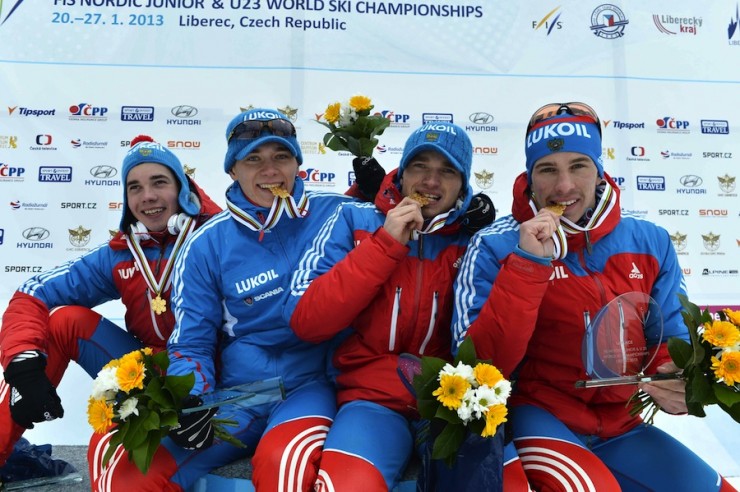
The Russian men’s relay celebrates their third victory in four races at 2013 Junior World Championships in Liberec, Czech Republic. Dmitry Rostovtsev (r) anchored the team’s win Sunday after winning two individual distance races this week. (Photo: Liberec2013)
If you knew nothing about the competitors at the International Ski Federation (FIS) Junior World Championships throughout the last week in Liberec, Czech Republic, all you had to look for were the blue-and-red suits with white Adidas stripes. Those were the Russians, and man, were they fast.
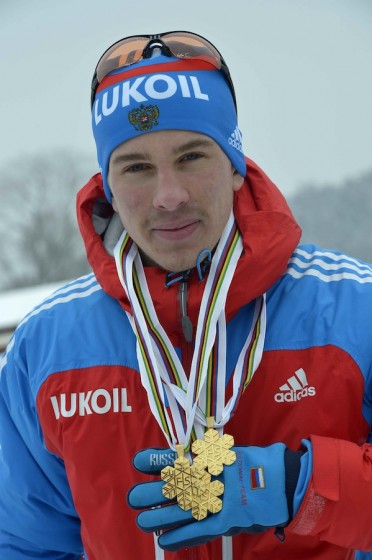
Russia’s three-time 2013 Junior World Champion, Dmitry Rostovtsev
Led by 19-year-old anchor Dmitry Rostovtsev, who won two of three individual world titles just days earlier, the Russian men rallied to a resounding victory in 4 x 5 k relay, beating runner-up Norway by 18.7 seconds in 45:35.5.
The Russians faltered just once – during the second leg – when two-time 2013 Junior Worlds silver medalist Artem Maltsev fell 12.6 seconds out of the lead into fourth. Alexey Chervotkin had put the Russians in first early, and Maltsev tagged off to Roman Tarasov, who brought them back up front. At the final exchange, Rostovtsev surged ahead with a four-second lead on Norway’s anchor Haavard Solaas Taugboel.
The Norwegians (Bjørn Vidar Suhr, Simen Hegstad Krueger, Magne Haga, and Taugboel) hung in for silver, more than 30 seconds ahead of Sweden in third (+52.2) out of 19 teams. With Oskar Svensson, Marcus Ruus, Oscar Ivars, and Rasmus Hornfeldt, the Swedes led after the second leg, but dropped 19.4 seconds off the pace in the third leg and remained in third thereafter.
“To win gold medal with the team is always something special, ” Rostovtsev said in a Liberec 2013 press release.
He previously won two Junior Worlds titles in this year’s 10 k freestyle and 20 k skiathlon. Maltsev, who stuggled during his classic leg Sunday, was the runner-up in both individual distance races.
“The boys did their best on their leg so I could control the race but I still wanted to ski fast and secure the victory, ” Rostovtsev added.
Rostovtsev and Maltsev defended their relay title from last year’s Junior Worlds in Erzurum, Turkey, where they beat Kazakhstan by nearly 45 seconds. Norway, with Taugboel, was third in the 2012 relay.
“I knew Rostovtsev is a tough guy; he is very strong, ” Taugboel said. “In the second 2.5 km lap he went away so fast, I just did not have enough power. I am satisfied with the silver medal. I have not been in a best shape during the championships, so it is a great satisfaction for us.”
It was the Norwegians’ first silver of the week, and Sweden made the podium for the first time at this Junior Worlds.
“I am very happy for the bronze medal, ” Swedish anchor Hornfeldt said. “Everybody gave the best performance of the week so we deserve the medal today. I felt pretty good. I saved same energy for the last uphill!”
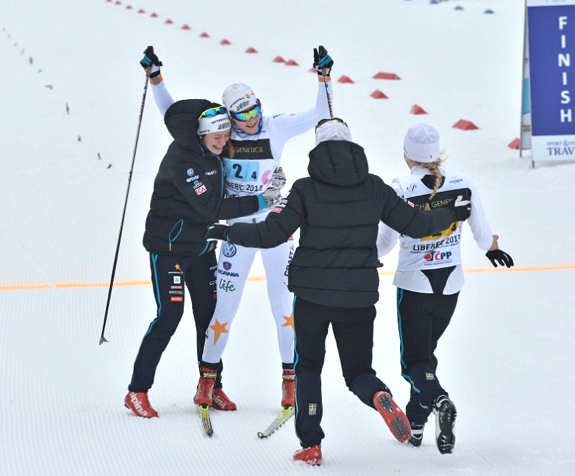
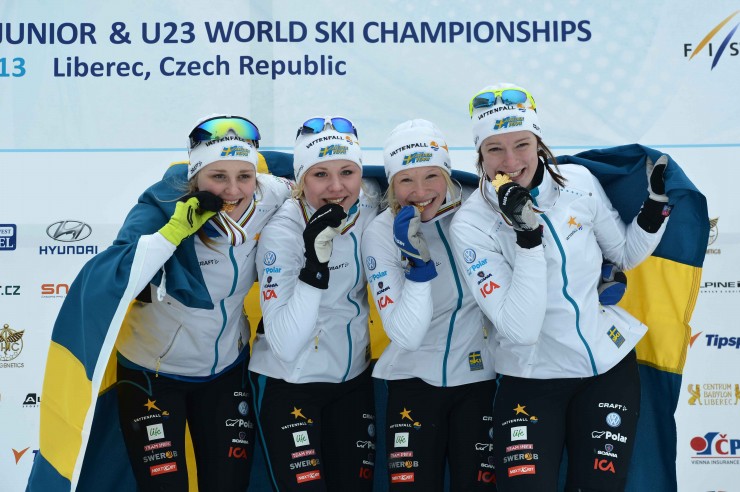
The Swedish women’s relay celebrates its Junior Worlds victory on Sunday with anchor Stina Nilsson. (Photo: Liberec2013)
The women’s 4 x 3.3 k turned out to be less predictable, with Sweden’s Stina Nilsson giving Russian Nadezhda Shuniaeva a run to the finish. Trailing Shuniaeva closely in second at the last exchange, Nilsson charged ahead late to seal the Swedish victory by 2.2 seconds in 35:41.1. It was Nilsson’s second win of the week after she claimed the classic-sprint title last Monday.
She repeated the feat with the help of teammates Julia Svan, Sofia Henriksson and Jonna Sundling, and Russia took second of 14 teams with Alisa Zhambalova, Natalia Nepryaeva, Anastasia Sedova and Shuniaeva. Germany was third, 50.3 seconds out of first, with Laura Gimmler, Katharina Hennig, Julia Belger, and Victoria Carl. The 5 k freestyle champion, Carl collected a different medal in every event she competed in this week, including silver in the classic sprint.
Early in Sunday’s relay, it became clear that the race would likely boil down to two teams: Russia and Sweden. With Nepryaeva, Russia built its biggest lead of 2.9 seconds after the second exchange. Sweden stuck in second and Germany was nearly 30 seconds back in third.
Sweden’s Sundling then latched on to Sedova on the third leg, closing within 0.4 seconds of her at the last tagoff. Not long after winning silver in a World Cup team sprint in Liberec a couple weeks ago, Nilsson made a late surge to capture the victory on Sunday.
“It is amazing to win the relay, ” the 19-year-old said. “I knew I would be strong in the finish and I was confident I could go for victory. The whole team did a great job. We have a big potential for the future.”
After she helped Russia win last year’s Junior Worlds relay, 13.4 seconds ahead of Sweden (with Henriksson, Sundling and Nilsson), Shuniaeva said silver was a “very good result.”
“I gave my best in the last leg but Stina was very fast in the finish,” she added.
Germany’s Carl was also satisfied with her team’s finish.
“I am very happy for the bronze medal,“ Carl said. “We have a young team and it is a great success for us. It gives us big motivation for the future work.”