From the FasterSkier archive — posts syndicated from athletes’ and coaches’ own blogs between 2004 and 2012, kept online as published. Current coverage is at fasterskier.com.
Earlier this month from Aug. 2-8, nine top American junior athletes had the opportunity to participate in the largest International Junior Camp to date. In total, 146 athletes and 37 coaches from nearly 20 nations gathered in Sjusjøen, Norway, for a week of training and collaboration. The camp offered athletes the opportunity to gain confidence by training with the best junior skiers in the world against whom they will soon be competing, and to learn from the prestigious Norwegian development team training methods.
To make the trip, athletes needed to be born in either 1999 or 2000 and have the lowest ranking on the FIS Distance and/or Sprint World Ranking list. The U.S. sent Gus Schumacher, Ti Donaldson, Noel Keeffe, Ben Ogden, and Wyatt Gebhart on the men’s side, and for the women, Sofia Shomento, Mae Chalmers, Abby Jarzin, and Molly Gellert. Two coaches joined the group: Bryan Fish, cross country sport development manager at U.S. Ski & Snowboard, and Maria Stuber, head coach at the College of St. Scholastica, and the National Nordic Foundation (NNF) partially subsidized the trip.
2018 International Junior Camp attendees: – Armenia
– Austria
– Bosnia/Herzegovina
– Belarus
– Canada
– China
– Czech Republic
– Estonia
– Italy
– Finland
– Japan
– Korea
– Latvia
– Norway
– Slovenia
– Slovakia
– Spain
– Sweden
– U.S.
The format of the camp was similar to what U.S. juniors might experience at an elite national camp; a large emphasis on volume (18-25 training hours), with some intensity, technique and strength mixed in. For most workouts, all the athletes trained together as one large group, only dividing into smaller groups for time trials or activities held in spaces that could not hold the nearly 200 attendees.
The camp opened with back-to-back time trials, beginning with a classic sprint event featuring “King’s Court” style heats, meaning that from each heat, the top skier moved up in the seeds and the last skier moved down. Each skier competed in four rounds of sprints plus the qualifier, one round more than in a typical sprint. The most notable result for the U.S. was a victory for Schumacher in the men’s final, and on the women’s side, an eighth-place finish for Gellert.
In the 10- and 15-kilometer distance races, the Americans continued to show their strength with another win for Schumacher and another eighth-place finish for Gellert.
“Local hero – Joergen Lippert from Lillehammer joined in on the 15 km freestyle race,” Fish explained. “This was a great measuring stick for the men since Joergen medaled in all four races last year at Junior Worlds (2018 Junior Worlds – 1 gold, 1 silver, and 2 bronze). At the 5km split, Lippert was leading, Ben Ogden was 2nd and Gus Schumacher 6th. Haavard Moseby took the lead after 10km. At 12km Haavard and Gus were tied, then Gus surged to edge Haavard for the second day in a row.”
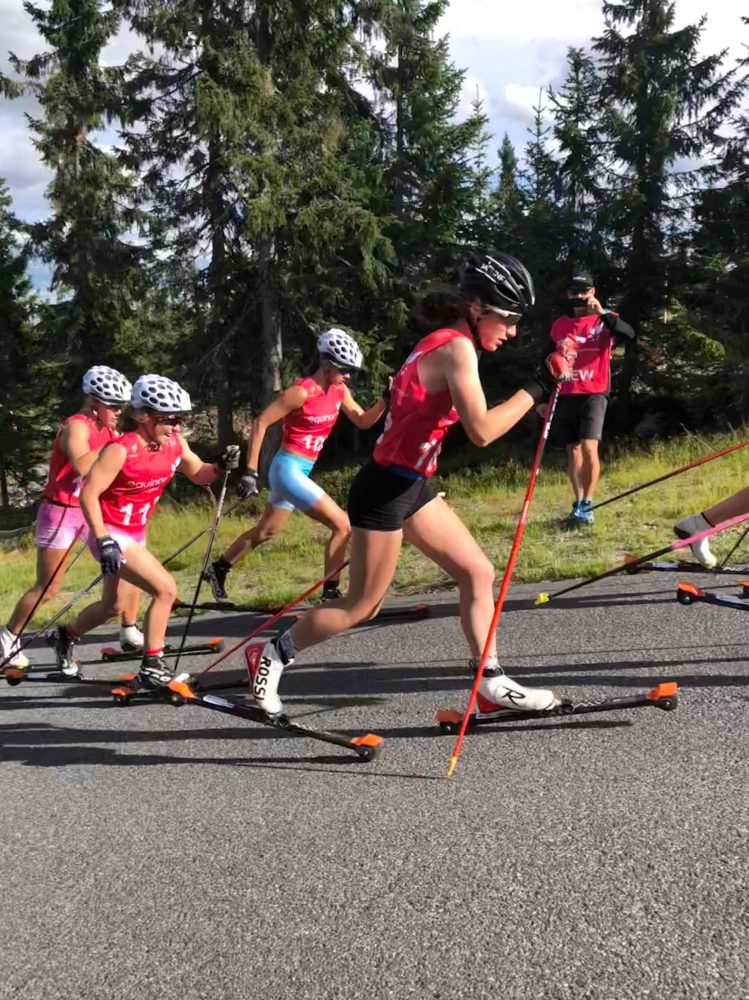
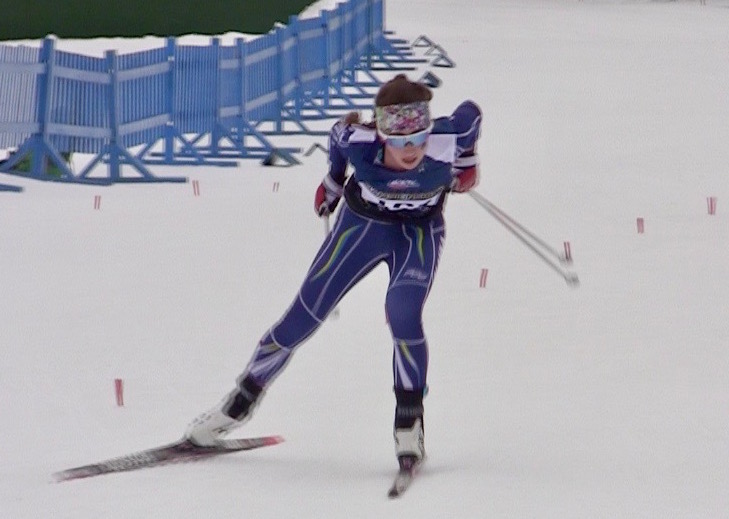
Molly Gellert striding in the sprint heats at the 2018 International Junior Camp in Sjusjøen, Norway. (Photo: Maria Stuber)
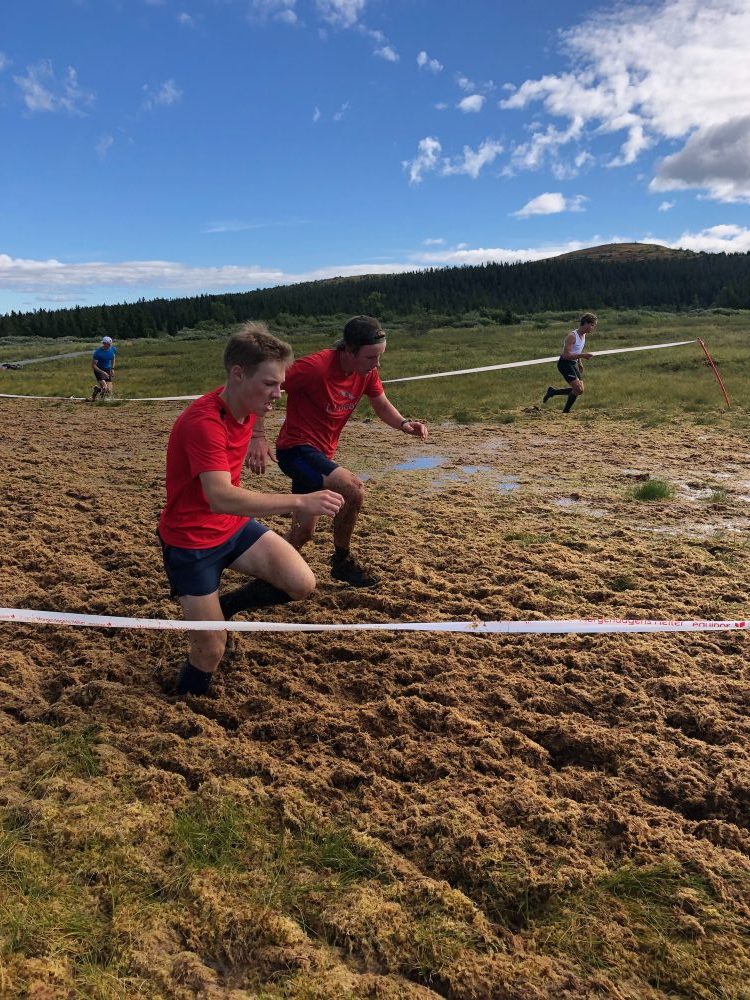
To take advantage of the unique terrain on the plateau around Sjusjøen, the group also participated in a 3 1/2- to 5-hour run crossing through several bogs, and a set of Level 4 bog intervals, which was reported to be the hardest workout of the entire camp. These 3-5 minute intervals were run in mud up to or above athletes knees, making it a full-body challenge to move forward through the course.
“Running through that stuff as hard as you can is incredibly hard,” Stuber told FasterSkier. “People were breathing at the end of those intervals harder than you ever hear, besides maybe the best athletes in the world in a 5- to 10-kilometer distance kind of race.”
Another highlight was getting to meet and hear from Olympic gold medalists Johannes Høsflot Klæbo, Ragnild Haga, and Astrid Uhrenholdt Jacobsen, who shared insight into the aspects of their training and development they felt have led to their success.
The U.S. coaches contributed to the camp by leading an agility workout, as this has been creatively emphasized in their own programs with positive results. Fish reportedly traveled with his own set of cones and plenty of sidewalk chalk to ensure they could set up a high-quality course.
“It was really fun to have the rest of the world interested in what we’re doing with agility,” said Stuber.
Ben Ogden (second from r) in the middle of a bog interval at the 2018 International Junior Camp in Sjusjøen, Norway. (Photo: Maria Stuber)
Apart from the training benefits, the U.S. development program considered the experience of collaborating with top athletes in this age group to be invaluable, as it showed how hard their international competition is working.
“In the U.S. when you’re a top athlete you feel like you’re working pretty darn hard, and this kind of shows them that, yeah, they’re working hard, but the kids that they want to be competing against are also working really hard,” Stuber said.
She added that the U.S. athletes were well-prepared for the camp, as all performed very well throughout the week despite the demanding training schedule.
“We fit in, we go there and see that we’re doing the right things, and we bring these kids back with the confidence that they can do this and the motivation to keep at it and work harder,” Stuber said.
It was noteworthy to the coaches that the U.S. is finally recognized as a nation that can train and compete with the best athletes in the world — a testament to the growth and success of the U.S. Ski Team at all levels over the last ten years.
“Going into this, I was expecting to just be learning a ton and less of a contributor,” Stuber said. “It was really cool to get there and feel like the U.S. was very much a country where people wanted to know what we were doing. Norway is clearly ahead, but otherwise, I think the U.S. had to say as much as any other place, which was a really eye-opening surprise for me.”
This is the third time that the U.S. has attended Norway’s International Junior Camp (also in 2015 and 2016), and American juniors will continue to make the trip biennially to maintain collaboration with other countries in the coming years. According to the U.S. coaches, because of the cost of the camp and the fact that it is similar each year, they plan to only attend every other year so they have a “fresh” group of athletes each time.
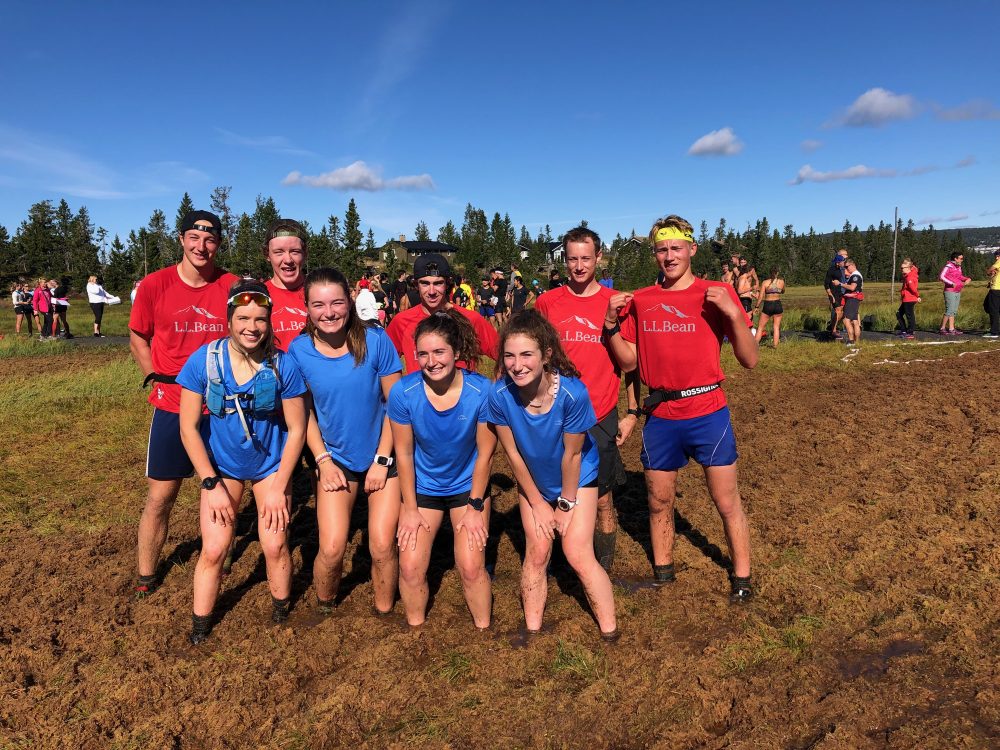
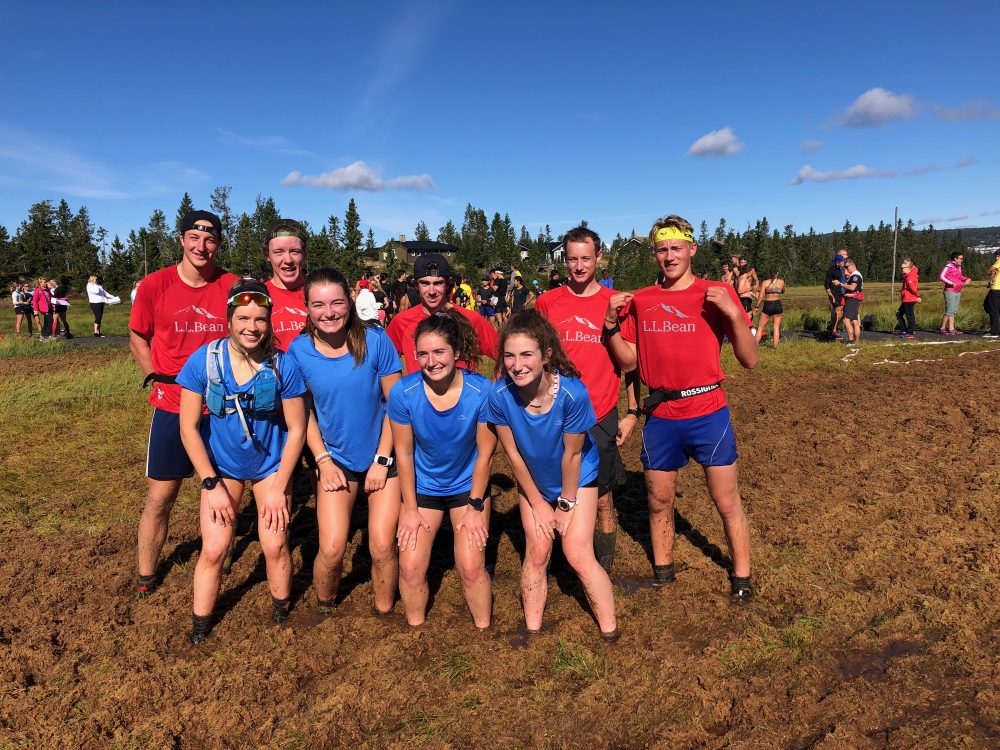
Americans during a muddy training session at the 2018 International Junior Camp earlier this month in Sjusjøen, Norway. (Front row, l to r) Abby Jarzin, Mae Chalmers, Sophie Shomento, Molly Gellert, and Noel Keeffe. (Back row, l to r) Ben Ogden, Wyatt Gebhart, Ty Donaldson, Gus Schumacher. (Photo: Maria Stuber)
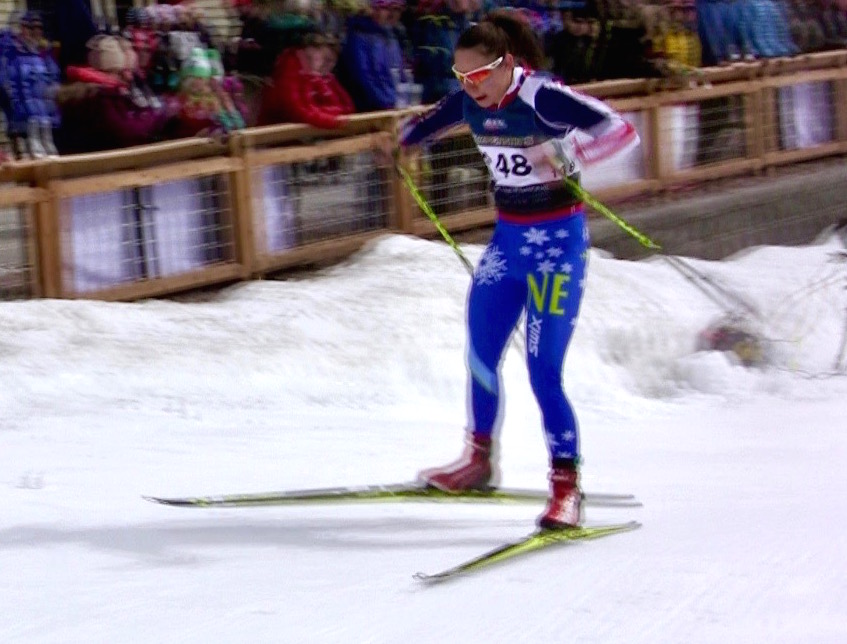
Sofia Shomento racing in the 5 k freestyle at the Colby Carnival in Waterville, Maine. (Photo: FlyingPointRoad)
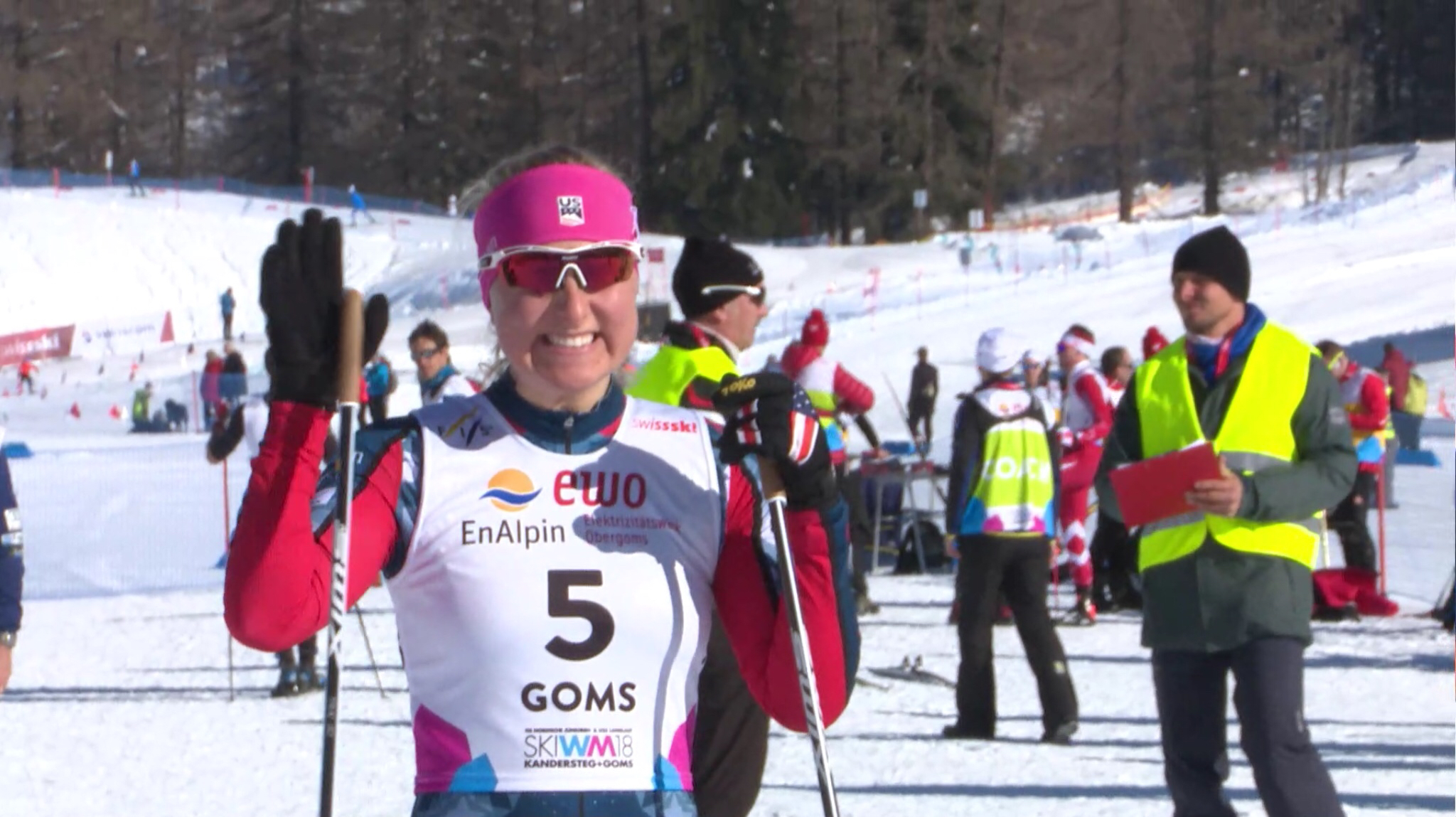
In an effort to showcase the North Americans who competed at last week’s International Ski Federation (FIS) 2018 Nordic Junior/U23 World Championships in Goms, Switzerland, we asked those qualifying athletes several questions about themselves — actually, we had them fill in the blanks. Here we have 18-year-old Sofia Shomento, of the Dartmouth Ski Team, who represented the U.S. at her first Junior Worlds.
Last week in Goms, Shomento qualified for the freestyle sprint in 26th and went on to place 23rd overall, and finished 58th in the 10 k skiathlon.
***
“My full name is Sofia Shomento, but you can call me Sof.
I was born and raised in Bozeman, Montana, and I learned to ski at Bohart Ranch with the Bridger Ski Foundation.
I spent the time between U.S. nationals and Junior/U23 Worlds catching up with classes and skiing with my teammates.
The funnest workout I did in the last training year to prepare for this was running 121 laps (about 14 miles) around the homecoming bonfire with my class of 2021 teammates.
This is my first time in Switzerland and second time racing internationally, and so far it’s been incredible!
One difference I’ve noticed between Switzerland and the U.S. is the snow banks are much taller here!
Skiing and racing in the Alps is breathtaking. Usually racing at altitude is fun for me because I grew up racing in the West. There are lots of mountains around where I live.
One of the things I’m most excited about for Junior/U23 Worlds in Goms is meeting new people from around the world.
One race I’m especially targeting there is the skate sprint.
I really hope I can chat/make friends with someone from Norway and ask them “what’s the secret?”
My favorite thing at the breakfast where we are staying is the fresh bread, cheese, and jam.
Fondue is yummy. The cheese here is delicious. And the chocolate is life changing.
If I had a totally free day here and didn’t have to worry about race fitness or training, I’d spend it alpine skiing.
The best way to follow me on social media is on Instagram @sofiashomento.”
American Hailey Swirbul (University of Alaska Anchorage) leads Norway’s Lone Johansen up a climb during the second half of the women’s 10 k skiathlon on Thursday at 2018 Junior World Championships in Goms, Switzerland. (Photo: JWSC2018.ch)
(This article has been updated to include comments from Americans Hailey Swirbul and Gus Schumacher.)
Junior World Championships (Goms, Switzerland): 10/20 k skiathlons
Hailey Swirbul is 2-for-2 when it comes to podiums at this year’s Junior World Championships; in her second-straight race this week in Goms, the 19-year-old American earned a medal in a distance race. On Thursday, it was bronze in the women’s 10-kilometer skiathlon.
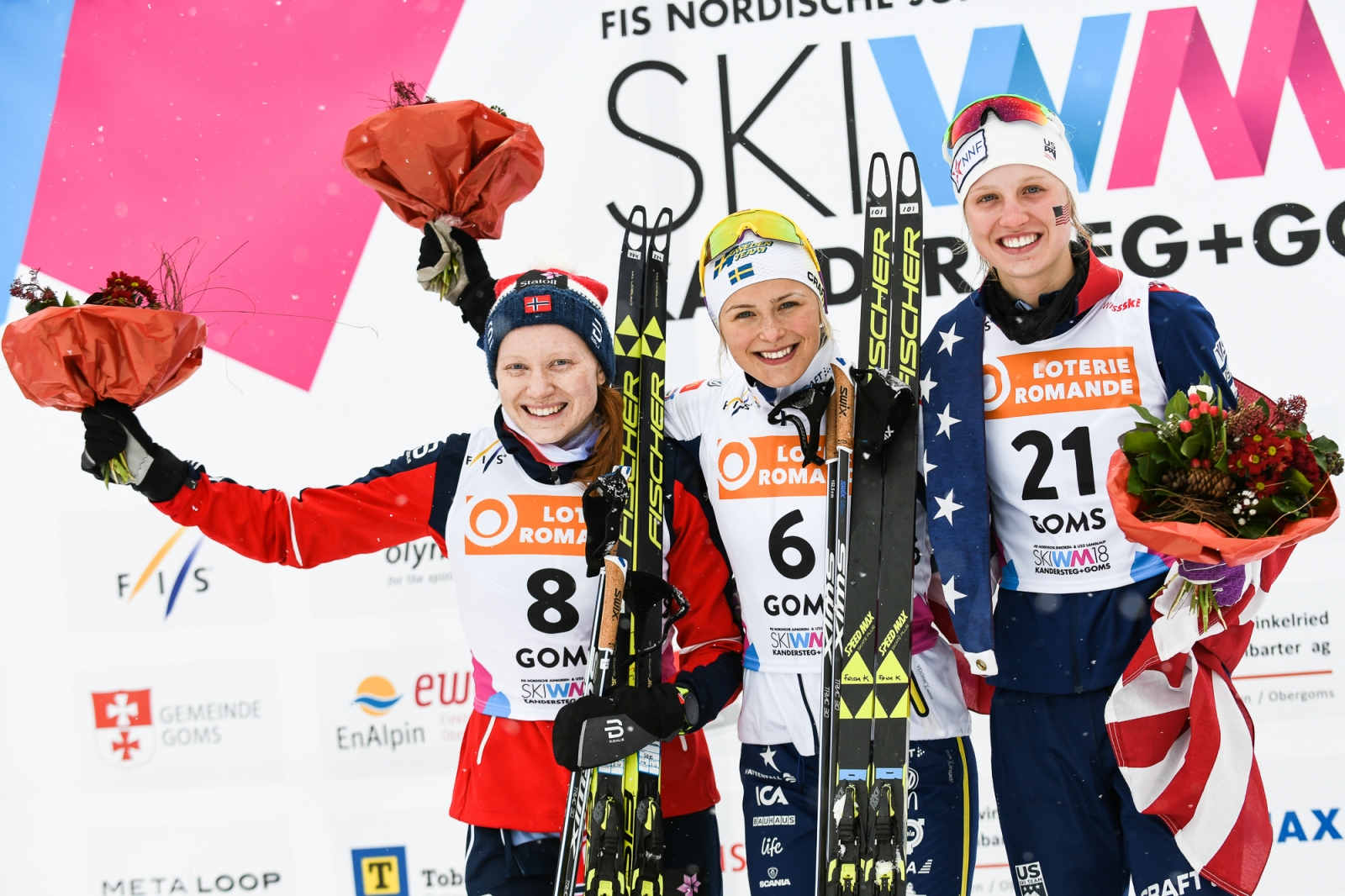
The women’s 10 k skiathlon podium at 2018 Junior World Championships in Goms, Switzerland, with Sweden’s Frida Karlsson (c) in first, Norway’s Lone Johansen (l) in second, and American Hailey Swirbul (r) in third. (Photo: JWSC2018.ch)
Swirbul, a sophomore at the University of Alaska Anchorage, closed the gap to the leaders over the final 5 k skate portion of Thursday’s race, doing so in tough, slow conditions with heavy snowfall. She ended up third in a sprint finish with Norway’s Lone Johansen, who took second by 0.7 seconds, as the two finished 35.5 seconds and 36.2 seconds behind the winner, Sweden’s Frida Karlsson, respectively.
Karlsson won it in 32:55.7 minutes. She had been second at the transition from classic to skate halfway through the race, just behind France’s Laura Chamiot-Maitral in first. Four women came through the exchange together within 2.6 seconds of first, while Swirbul was about 15 seconds back in eighth.
“Coming into the exchange I was right where I wanted to be,” Swirbul wrote in an email to FasterSkier. “I knew that some of the girls ahead of me would not be able to sustain their pace the entire skate leg. It was important for me to remember that and not try to close the gap too quickly with the Norwegian I was skiing with.”
While Karlsson broke away over the final 5 k, Swirbul helped lead the chase, moving into second and 31 seconds back on a long, steep climb at 6.7 k.
“I won’t lie, the skate leg was tough! I think everyone was suffering out there in the fresh snow,” Swirbul wrote. “I tried to conserve energy on the gradual downhill before the big climb to use on the hill.”
On the last lap, she worked to distance herself from fourth place.
“I knew that the fourth place skier was closing in on us the last lap,” she wrote. “Going up the final hill, I had to make a move to secure a podium spot and give what I had to ski away form the fourth place girl over the second to last big climb. The last few hundred meters were so intense! I didn’t have anything left to sprint it out for second place. Gotta work on that!”
Two days ago, Swirbul placed second in the 5 k classic for her first individual medal and the best-ever finish for the U.S. at Junior Worlds.
“This means so much,” she told race organizers after taking third in Thursday’s skiathlon. “I’m so happy to represent the United States here and show how we can improve in the future and what we have in our country.”
In her email to FasterSkier, Swirbul explained that she entered Thursday’s race confident yet calm.
“After my silver medal I believed in myself more than before,” she wrote. “However, I managed to stay calm and not put high expectations on myself for the skiathlon which allowed me to race my best. I was hoping to ski smart and relaxed and not be afraid to make it hurt! In a mass start that is really all I can control.”
For much of the first leg, about 4 k, she skied with what she described as “a huge pack of girls, which was kind of stressful for me.”
“It’s harder for me to match the stride of someone almost a foot smaller than I am in a classic track, so once the group broke up I was able to find my rhythm,” Swirbul wrote. “The snow storm made the tracks super slow where they weren’t skied in, so it was a waste of energy to try to pass people outside of the skied in track. I made that mistake a few times and ended up not passing anyone, just wasting energy plowing through powder.”
But her skis felt fast in both the classic and skate legs, she noted. “The wax techs have been killing it!”
With one race left, the women’s 4 x 3.3-kilometer relay on Sunday, Swirbul wrote that she was eyeing another podium.
“I think it is fair to think that our relay team has a good shot at the podium. That would be the cherry on top :)”
Karlsson told organizers that she was focused solely on the gold on Thursday.
“It was very fun today and my body felt very good, then I was just going for the gold today,” Karlsson said. In her first Junior Worlds, she had previously placed third in the skate sprint earlier in the week.
“It means a lot,” Karlsson, 18, added. “This is a very good sign that I’m doing the right thing. I have one more year left as a junior so I’m looking forward to next year’s Junior World Championships as well.”
Also for the U.S., Kathleen O’Connell (Montana State University) placed 20th (+2:18.2), Molly Gellert was 40th (+3:59.4) and Sofia Shomento was 58th (+6:25.7).
Canada’s Natalie Hynes (University of Alaska Anchorage) placed 24th (+2:40.0), Hannah Mehain was 37th (+3:54.9), Alexandra Racine 51st(+5:16.1), and Catherine Reed-Metayer 62nd (+7:17.7).
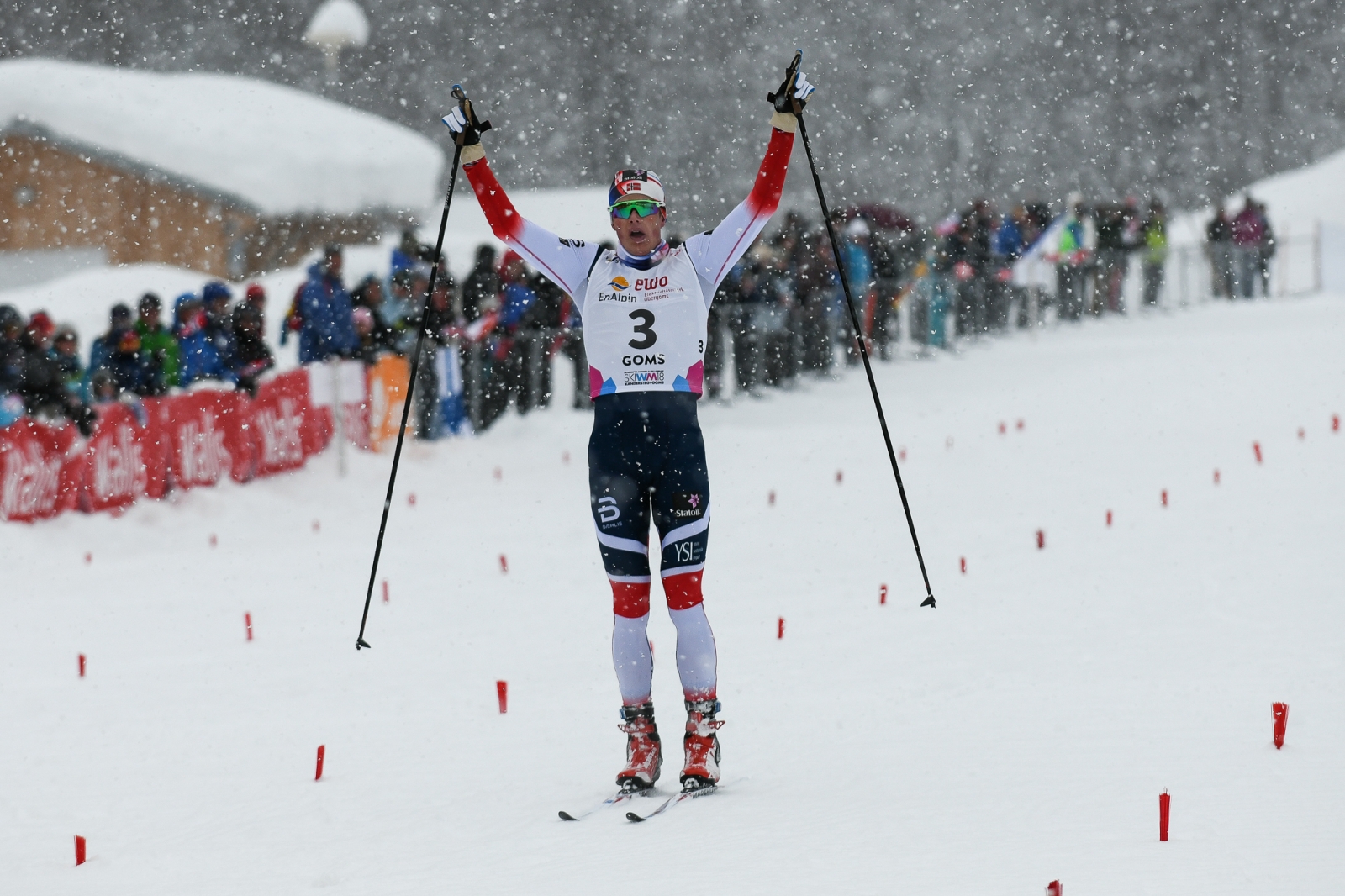
Norway’s Harald Østberg Amundsen winning the men’s 20 k skiathlon at 2018 Junior World Championships in Goms, Switzerland. (Photo: JWSC2018.ch)
In the junior men’s 20 k skiathlon that followed, Harald Østberg Amundsen pulled out a 34.7-second victory over fellow Norwegian Jon Rolf Skamo Hope, who won the 10 k classic two days ago. Norway swept the podium with Jørgen Lippert in third, 1:00.1 minutes back, two days after Lippert placed third in the 10 k individual start.
The win was Amundsen’s first individual gold after he was on Norway’s winning 4 x 5 k relay at last year’s Junior Worlds in Utah, where he placed third in the 10 k skiathlon. On Tuesday, he was fourth in the 10 k classic.
“Unbelievable,” he said during a post-race arena interview. “I tried to keep calm on the classic part, and on the skate part just tried to keep the speed up. … I tried to go fast on the beginning and end of the uphills, and a bit controlled in the middle. I think the final was great, unbelievable.”
American Gus Schumacher (Alaska Winter Stars) raced to 15th (+2:43.6) besting his two previous top 20’s this week (19th in the freestyle sprint and 17th in the 10 k classic) at his first Junior Worlds. He skied much of the race with Ben Ogden (Stratton Mountain School), who finished 18th (+2:51.2) for his second-straight top 20 (after placing seventh in the 10 k).
“My classic skis were great today,” Schumacher wrote in an email. “The techs nailed it and I had really solid kick and good glide. I was able to run up the steepest hills and kick the buildup off right at the top and glide right with everyone. During that first 10k I think I did a good job staying relaxed and now letting myself push too hard up the big climbs. The pace in the pack wasn’t bad, definitely a little rushed at the beginning but I was able to settle in well.
“On my second half I was still just focused on not pushing too hard and staying relaxed, while also keeping the pace fast and carrying speed through the corners,” he continued. “Generally I felt pretty good, but my body was just getting tired and I was hanging in there.”
While he dropped Ogden over the last kilometer, Schumacher wasn’t able to shake Italy’s Luca Del Fabbro, who finished half a second ahead of him in 15th.
“I pushed really hard up the last hill into first [ahead of Del Fabbro] but was a little weak over the top and he pulled up alongside me and crossed in front of me on the corner then almost fell,” Schumacher recalled. “Pulled up alongside on the flat, but had to get back on the inside and just couldn’t get past.
“Overall I’m pretty happy, I think I paced well and I generally executed well,” he concluded. “I think it wasn’t my best possible, but it was definitely a well-executed race.”
Also for the U.S., Hunter Wonders (Alaska Pacific University) placed 26th (+3:56.0), and Karl Schulz finished 60th (+8:30.3).
Félix Longpré led Canada in 28th (+4:07.0), Etienne Hebert followed in 30th (+4:33.3), Antoine Cyr was 32nd (+4:45.4), and Reed Godfrey 54th (+7:18.4).
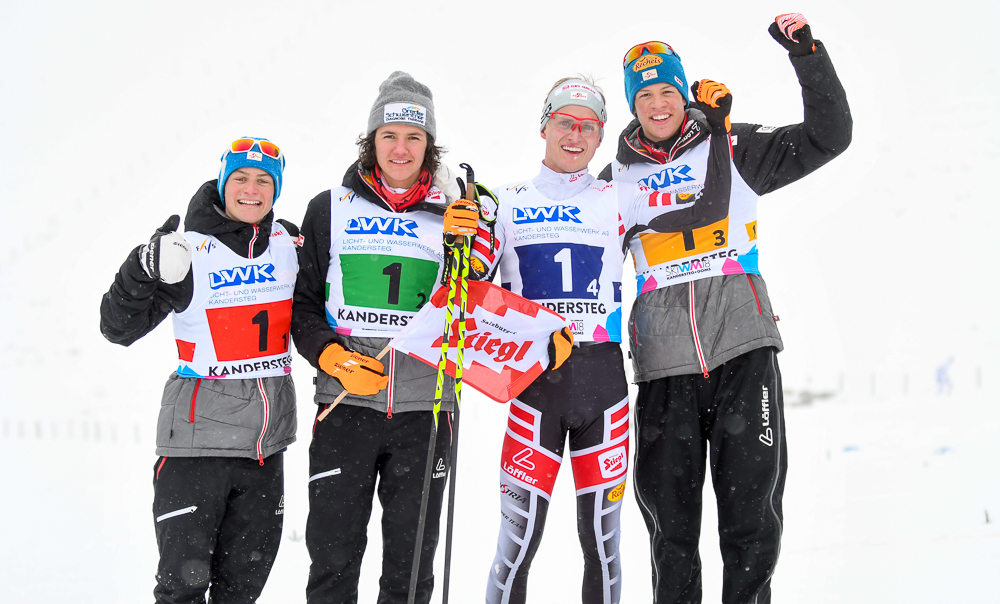
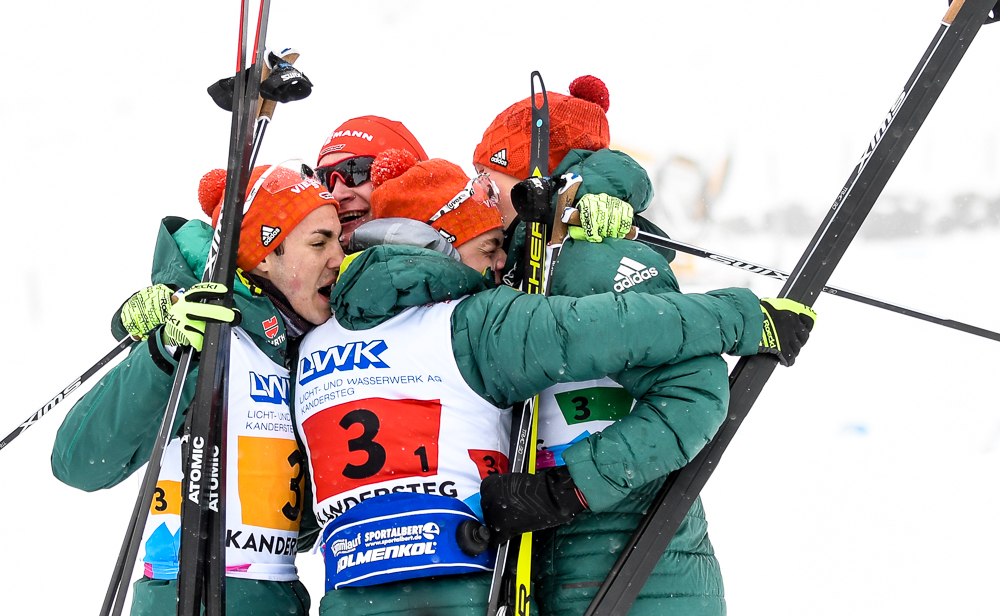
The Austrian team (from left to right: Johannes Lamparter, Florian Dagn, Dominik Terzer, and Mika Vermeulen) celebrates its win in the normal hill/4 x 5 k team event on Thursday at 2018 Nordic Combined Junior World Championships in Kandersteg, Germany. (Photo: JWSC2018.ch)
Nordic Combined Junior World Championships (Kandersteg, Switzerland): Normal hill/4 x 5 k Team Event
In the nordic combined team event at Junior World Championships on Thursday, Austria stole the show, jumping to first then finishing the 4 x 5 k relay first by nearly 48 seconds over Germany in second.
On the 106-meter normal hill in Kandersteg, Austria’s Johannes Lamparter, Mika Vermeulen, Florian Dagn, and Dominik Terzer combined for the best jumping score of the day, 11.8 points ahead of Norway (Simen Kvarstad, Andreas Skoglund, Jens Lurås Oftebro, and Einar Lurås Oftebro) in second. Germany jumped to third with Constantin Schnurr, Julian Schmid, Tim Kopp, and Luis Lehnert another 26 points back.
That put Norway 16 seconds back for the start of the 4 x 5 k relay, and Germany 50 seconds out of first in third.
The four Americans in the event, Tucker Hoefler, Jared Shumate, Stephen Schumann, and Ben Loomis, jumped to 11th out of 13 teams, and started the relay 2:46 minutes back.
Germany celebrates its silver medal in the normal hill/4 x 5 k team event on Thursday at 2018 Nordic Combined Junior World Championships in Kandersteg, Germany. (Photo: JWSC2018.ch)
Austria went on to hold its lead throughout the race, crossing the finish line first in 56:33.0 for the gold. Norway held onto second first Jens Oftebro’s first leg, then slipped to second behind Germany on the second leg. Ultimately, Germany claimed second, 47.8 seconds back, and Norway was third (+1:53.2).
The field remained largely strung out, as the Czech Republic finished fourth (+2:39.7) after starting fourth, France placed fifth (+3:07.7), up from eighth at the start, and Finland finished sixth (+3:27.6), after starting ninth.
The U.S. men improved to seventh (+3:36.4) thanks to a strong first leg from Loomis, who put them in seventh with the fourth-fastest first-leg time. Schumann then skied the fastest second leg and picked off two more places to tag in fifth at the second exchange. Hoefler slipped to seventh on the third leg, and Shumate held them there with the third-fastest anchor leg.
Nordic combined has one more event at Junior Worlds: the individual normal hill/5 k on Saturday.
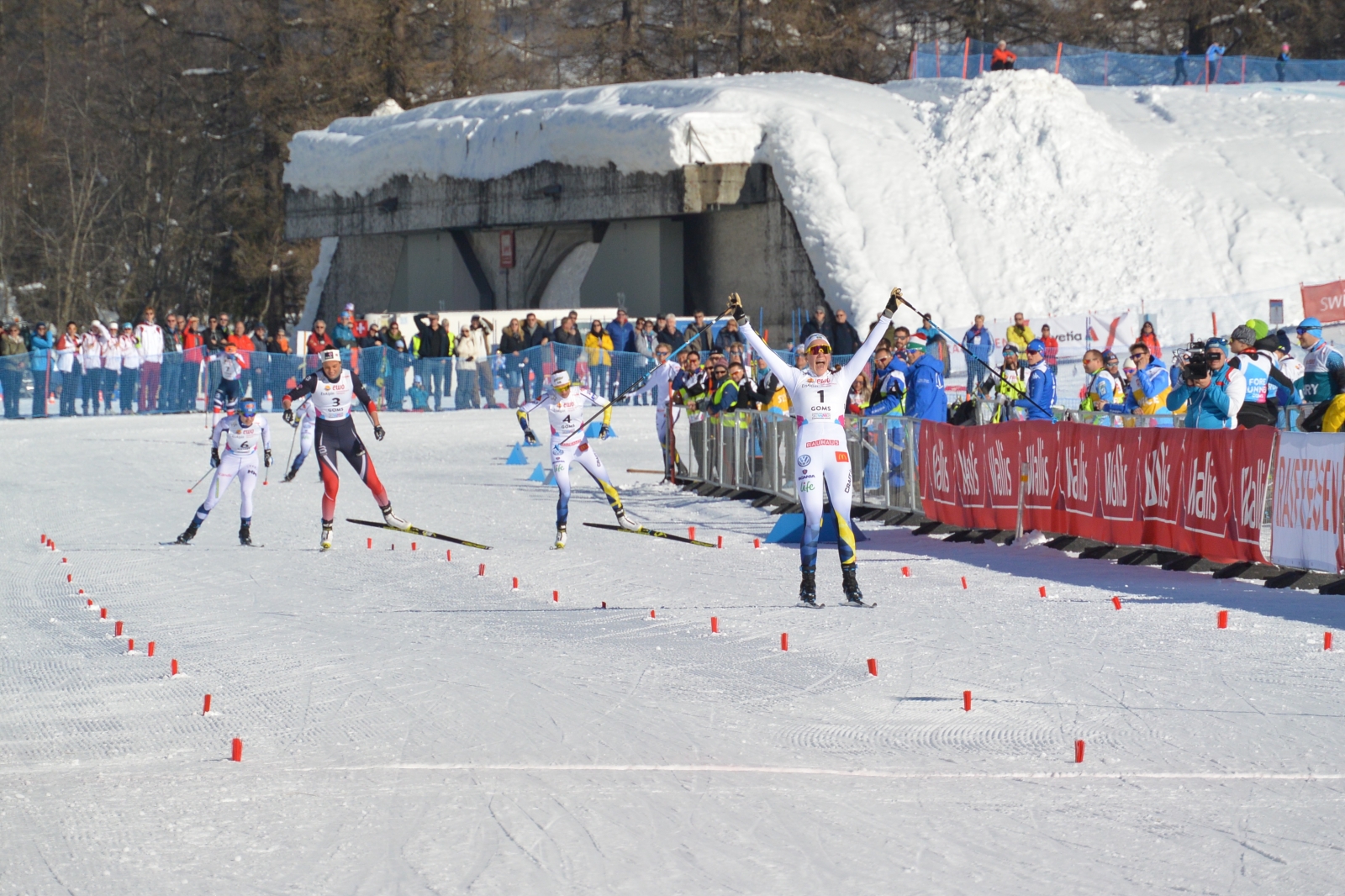
Moa Lundgren celebrates winning her first World Junior Championship after skating away from the field in the sprint in Ulrichen, Switzerland. (Photo: JWSC2018.ch)
(Note: This article has been updated to include comments from American Hannah Halvorsen.)
2018 World Junior Championships is off and running and two brand-new champions have been crowned. Moa Lundgren of Sweden took the women’s skate sprint title while the men’s final went to Tom Mancini of France.
On a perfect blue-sky day nestled deep in the Swiss Alps, the world’s best skiers under the age of 20 raced around a hilly sprint course with a few wicked corners. There were broken poles and pole-tosses; crashes; and a men’s final decided by just a tenth of a second.
“The competition was really high, and it was super cool to see so many high level skiers,” U.S. skier Gus Schumacher (Alaska Winter Stars) wrote in an email. “Nothing surprised me too much. I think it raced about as I expected, with even those crazy corners not being too unfair… my previous U18 trips and nationals races have exposed me to a big variety of tactics, so nothing was really new for me here.”
The narrow margin of the men’s final saw Mancini nip Norway’s Jørgen Lippert at the line.
“A very good race, I am very happy,” Mancini said in a TV interview after the race. “It’s a very good fight with the Norwegian and the Swiss. I am very happy. Sorry, I don’t speak English very good. I thank my family, my friends, and my coach. Voila.”
Third place went to Valerio Grond of Switzerland, who qualified in 21st position but skied aggressively to win his semifinal before landing on the final podium.
The results of the women’s final were somewhat delayed as Finland filed a protest, saying that third-place Frida Karlsson had obstructed Anita Korva, who ended up fourth. But the podium did not change. Lundgren had claimed a big win over Kristine Stavås Skistad of Norway.
Both the U.S. and Canada had a representative in the semifinals. For the U.S., Hannah Halvorsen (U.S. Ski Team/APU) qualified in fifth and then finished second in her quarterfinal, earning an automatic spot into the semis.
Once there, Halvorsen skied in third or fourth for much of the heat. Rounding the final corners she was still in fourth position and though she kept pushing, she couldn’t make up any ground on the women ahead of her. She ended the day in eighth, an improvement of a few places from her 11th-place result in the classic sprint at last year’s World Junior Championships in Utah.
“The skate sprint was my target race this year,” Halvorsen, 19, explained in an email. “My goal was to podium and I believed if everything went according to plan I was capable. I felt healthy and fit, my skis were fast, my mind was in the right place, but I didn’t make it happen. It is easy to mull over tactics and strategies and ‘what if’ situations, but I think the truth is that there are a lot of girls here that are just as fast, fit, prepared, and motivated as me, and I think some of them were sincerely better than me today. Even though I didn’t reach my goal, I feel proud to compete against the best girls my age and be right in the mix.”
She explained that she was excited about her strong qualifier. “It gives me a chance to see where I fall on an international stage,” Halvorsen wrote. “The top girls my age are starting to bridge the gap between world juniors and world cup, and I hope this qualifier gives me some idea of how much I need to improve to be fast enough to make world cup heats. Even though the top girls are faster than me, I can feel myself improving and getting closer.
“I had a lot of fun having the opportunity to race and feel good in the sprint,” she added. “One of the takeaways from this race was realizing how important it is to keep improving and to never settle. I am excited to build on this result and hopefully be stronger and faster next year. But right now, I mostly look forward to more racing this week and season.”
In the men’s field, Canada’s Graham Ritchie raced an impressive tactical quarterfinal. Qualifying in 25th, he was pushed to the back of his heat early thanks to taking the last choice of starting lanes.
“I’d say it was intentional that I stayed at the back,” Ritchie explained in an email. “I knew if I was going to have any chance, it would be to just hold onto the pack for as long as possible and then see where it would go in the end from there.”
Ritchie maneuvered his way towards the front and by the time the men hit the finishing stretch, he was speeding up and moved from fourth to second. A Russian athlete who had been among the leaders early in the heat crashed, leaving an extra opening.
“I was in fourth at the time when he fell and he was in front of me, so this had a pretty big impact on my result depending on how fast he would’ve been in the finishing stretch,” Ritchie wrote.
But regardless, Ritchie advanced to the semifinals, where he finished sixth in his heat for 12th overall.
“I was pretty shot for the second half of the [semifinal] and couldn’t hang on to the pack, but it was an amazing experience and lots of fun!” Ritchie wrote. “I was stoked to have made the semi’s and was happy with outcome! My main goal for today most importantly was to qualify. My stretch goal for the day was to make semis and get a top 12. Finishing in 12th place was a really incredible and eye-opening experience. I’m still trying processing it, the feeling of accomplishing this goal feels amazing and I am so thankful for this opportunity!”
“Great day for Graham today,” Ritchie’s coach at NTDC Thunder Bay, Timo Puiras, wrote in an email. “We were not expecting a top-12 result but it isn’t necessarily a surprise either… This result is definitely a big deal for Graham and the NTDC Thunder Bay program. The TBay program has had several athletes the past few years who I feel have the capacity for this kind of result so it feels great when it all comes together to happen. This result should serve as fuel for our other athletes to find the confidence to also have similar success.”
Schumacher of the United States was also in Ritchie’s quarterfinal, and ended up fourth in the heat and just over two-tenths of a second away from a lucky loser spot in the semifinals. But he did not advance and ended up 19th on the day.
“I was pretty confident in my speed,” Schumacher wrote in an email. “I knew that an eight second gap [in the qualifier] was small enough to be competitive in heats. My strategy was to just hang on up the first big hill and try to save my energy, then really punch it on the second hill. That strategy in my heat worked out pretty well. I thought I was a little too far back after the first hill, but I was able to come back and I had energy to really sprint up the end of the second hill.”
Canada’s Antoine Cyr, also qualified for the heats, and had a spectacular wipeout in his quarterfinal and ended up 30th after qualifying in 25th.
“I know that normally in the heats I am better [than in qualifying] and with the tight gap between all the juniors in the qualifier, it would give me a slight chance to go through,” Cyr wrote in an email. “On the top [of the first hill] I was in fourth place, right on their heels, but on the last uphill i got boxed in a little bit and could not accelerate fast enough. I found myself in fifth place. I went for it on the last corner knowing that I was taking a risk, and I crashed. I am bit bummed by the end of the day, but still really happy with a top 30. A first top-30 for me against the best in the world! I am not injured, just a couple of bruises – that snow was pretty hard packed, I can tell you!”
In the junior men’s sprint, Canada’s Reed Godfreyfinished a tough 31st, just 0.21 seconds out of making the quarterfinals. Etienne Hebertrounded out the Canadian finishers in 36th place (+11.81) in the qualifier.
“Our entire Junior Mens team definitely have the ability to qualify in the top-30 and after that it came down to good tactics and good finishing speed to move through the quarters,” Puiras wrote. “The Canadian team was super pumped with the results today and are in great spirits. It was a great way to start the championships. We are looking for more great results this coming week.”
Canyon Tobinwas 41st in qualification for the U.S. (+13.46), followed by Karl Schulzin 54th (+16.90) and Luke Jagerin 60th (+18.15).
In the junior women’s race, both Margaret Gellert and Sofia Shomento of the U.S. made the quarterfinals but failed to advance, finishing 18th and 23rd. Teammate Hannah Ruddfinished 35th in qualification, +18.15.
For Canada, Annika Richardsonfinished 52nd (+24.09), Catherine Reed-Metayer56th (+28.25), and Alexandra Racine69th (+37.27).
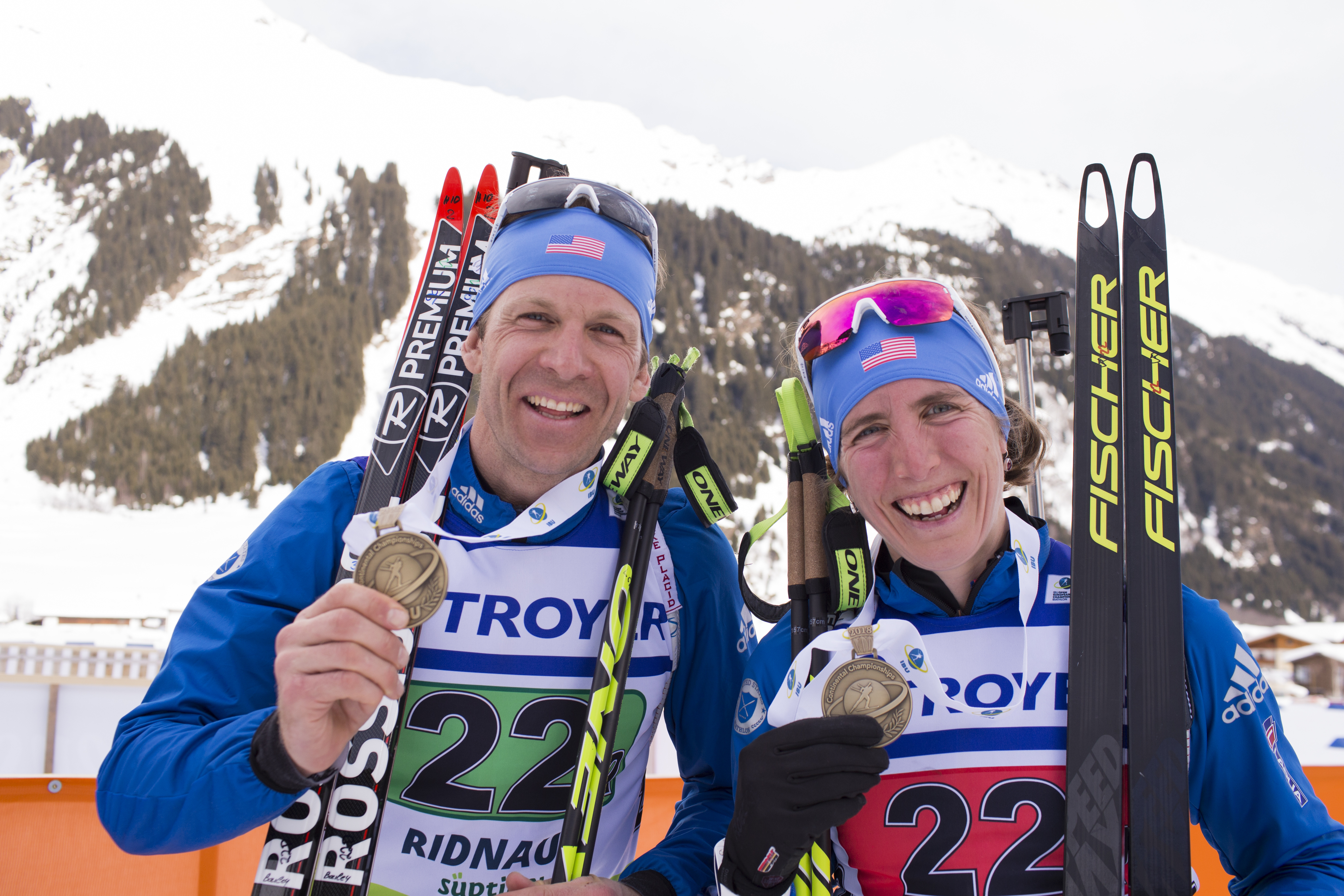
US Biathlon’s Lowell Bailey (l) and Susan Dunklee after teaming up for bronze in the single mixed relay at 2018 IBU Open European Championships on Sunday in Ridnaun, Italy. (Photo: Manzoni/NordicFocus)
IBU Open European Championships (Ridnaun-Val Ridanna, Italy): Single mixed & mixed relays
Susan Dunklee and Lowell Bailey teamed up for the final day of the 2018 International Biathlon Union (IBU) Open European Championships in Ridnaun, Italy, and raced to a bronze medal in the single mixed relay.
The American duo, both of which earned individual medals at last year’s IBU World Championships, finished just 9.1 seconds out of first, which went to Norway’s Thelka Brun-Lie and Vetle Sjåstad Christiansen. The Norwegians won in 35:39.6 with zero penalties and six spares. They took the lead after Brun-Lie’s second leg, where she cleaned both stages without spares.
France placed second, 8.6 seconds back, with Julia Simon and Emilien Jacquelin, who combined for no penalties and 11 spares. They led the first half of the race, but slipped to second behind Norway on Simon’s second leg.
Dunklee put the Americans off in second on her first leg, which she cleaned with a spare in each stage, then they slipped one place to third on Bailey’s first leg, where he cleaned as well and used three spares. In all, they used 10 spares and avoided the penalty loop, and finished half a second out of second place.
“Over Christmas, we trained a little bit with the French athletes, including Jacquelin,” Bailey said, according to a US Biathlon press release. “So I know that he has quite a fast finish, and I thought I am kind of an old man here, I should maybe try to go harder on the first part of the lap. But he stayed with me all the time and had me in the end.”
“It was a good opportunity to tune up the race shape, build some confidence and find that sharp feeling heading into the Olympics,” Dunklee told US Biathlon. “The single mixed relay is one of my favorite race formats and today was a blast!”
Canada’s Sarah Beaudry and Carsen Campbell placed eighth of 24 teams in the single mixed relay, finishing 1:03.6 out of first with just eight spares and zero penalties. In 11th after the first leg, they moved into eighth on Campbell’s first leg, which he cleaned with one spare. Beaudry then cleaned her second leg without any spares, and Campbell anchored them to eighth.
The U.S. entered a team in the mixed relay that followed, with Chloe Levins, Deedra Irwin, Paul Schommer, and Alex Howe placing 17th (+5:55.5) of 19 teams with no penalties and 12 spares.
Ukraine won the mixed relay to conclude the championships, with Yuliia Zhuravok, Iryna Varvynets, Artem Pryma, and Dmytro Pidruchnyi combining for zero penalties and six spares and finishing in 1:11:40.1.
Russia placed second (+11.7) with Victoria Slivko, Anastasia Zagoruiko, Evgeniy Garanichev, and Alexander Loginov combining for zero penalties and nine spares.
Norway followed in third (+33.2) with Emilie Ågheim Kalkenberg, Kaia Wøien Nicolaisen, Håvard Gutuboe Bogetveit, and Fredrik Gjesbakk combing for no penalties and just four spares.
U.S. SuperTour (Craftsbury, Vermont): 5/10 k freestyle
Two Alaska Pacific University (APU) athletes topped the podium on Sunday at the SuperTour in Craftsbury, Vermont, with David Norris winning the men’s 10-kilometer freestyle individual start in 21:54.9 and Becca Rorabaugh topping the women’s 5 k freestyle in 12:06.4.
Norris won the men’s race by 6 seconds over Canada’s Andy Shields (Lappe Nordic) and Kevin Bolger of the Sun Valley Ski Education Foundation (SVSEF) placed third (+15.8). Kris Freeman (Caldwell Sport) was the third American in fourth overall (+23.7), and three Canadians took fifth through seventh with Michael Somppi (Lappe Nordic) in fifth (+27.9), Evan Palmer-Charrette (NTDC Thunder Bay) in sixth (+37.5) and Scott Hill (Barrie Cross Country) in seventh (+37.6), ahead of Brian Gregg (Team Gregg/LNR/CXC) in eighth (+39.4), Tad Elliott (Ski Club Vail) in ninth (+44.3) and Jack Hegman in 10th (+50.4).
Rorabaugh won the women’s race by just 2.2 seconds over her APU teammate Rosie Frankowski in second, and Erika Flowers of the Stratton Mountain School (SMS) T2 Team placed third (+4.6). Two Craftsbury Green Racing Project (CGRP) skiers finished fourth and fifth, with Kaitlynn Miller in fourth (+12.1) and Liz Guiney in fifth (+22.5), Kelsey Phinney (SVSEF) was sixth (+25.8), and Canadians Olivia Bouffard-Nesbitt (Rocky Mountain Racers) seventh (+26.4) and Frederique Vezina (Pierre-Harvey National Training Centre) eighth (+36.0). Corey Stock, of the Bridger Ski Foundation (BSF) placed ninth (+39.9), and Felicia Geisor (CXC Team) was 10th (+44.4).
On Saturday, the Craftsbury Outdoor Center hosted its 37th annual Craftsbury Marathon, with Nils Koons winning the 48 k men’s race in 2:28:51.0 hours and Hannah Dreissigacker winning the 48 k women’s race in 3:01.48.7.
Hannah Halvorsen of the U.S. Ski Team and APU on the start line in Ulrichen, Switzerland, after finishing fifth in the sprint qualifier. (FIS screencap)
FIS Cross Country World Junior Championships (Ulrichen, Switzerland): Freestyle sprints
World Junior Championships kicked off today with freestyle sprints in Ulrichen, Switzerland. Moa Lundgren of Sweden claimed with women’s title by 1.89 seconds over Kristine Stavås Skistad of Norway in the final, with Sweden’s Frida Karlsson finishing third (+1.89).
Hannah Halvorsen of the United States qualified in fifth place before skiing to second in her quarterfinal heat. Halvorsen hovered around third or fourth place through much of her semifinal and was unable to snipe any spots in the finishing straight, ending up fourth in the heat and eighth on the day.
Fellow Americans Margaret Gellert and Sofia Shomento also made the quarterfinals, finishing 18th and 23rd, and Canada’s Hannah Mehain wound up 29th on the day.
The new men’s junior world champion is Tom Mancini of France, who nipped Norway’s Jørgen Lippert by just 0.10 seconds to take the win. Valerie Grond gave the Swiss crowd a thrill by making it all the way to the final and taking home bronze, despite qualifying in just 21st position. The Swiss junior narrowly edged France’s Vincent Buiatti for the final step on the podium.
Canada’s Graham Ritchie finished second in his quarterfinal after qualifying in 28th position, earning an automatic spot in the semifinals. There he finished sixth (+9.30 behind Mancini), winding up 12th on the day. Teammate Antoine Cyr also made the quarterfinals where he had an impressive crash, slinging off the trail and into the infield, finishing 30th on the day. For the U.S., Gus Schumacher was the lone qualifier for the heats. He finished fourth in his quarterfinal and was just 0.22 seconds away from a “lucky loser” spot in the semifinals. Schumacher finished 19th on the day.
In the junior women’s race, Hannah Rudd of the United States finished 35th in qualification, +18.15. For Canada, Annika Richardson finished 52nd (+24.09), Catherine Reed-Metayer 56th (+28.25), and Alexandra Racine 69th (+37.27).
In the junior men’s sprint, Canada’s Reed Godfrey finished a tough 31st, just 0.21 seconds out of making the quarterfinals. Etienne Hebert rounded out the Canadian finishers in 36th place (+11.81) in the qualifier. Canyon Tobin was 41st in qualification for the U.S. (+13.46), followed by Karl Schulz in 54th (+16.90) and Luke Jager in 60th (+18.15).
FIS Nordic Combined World Cup (Seefeld, Austria): Individual normal hill/15 k
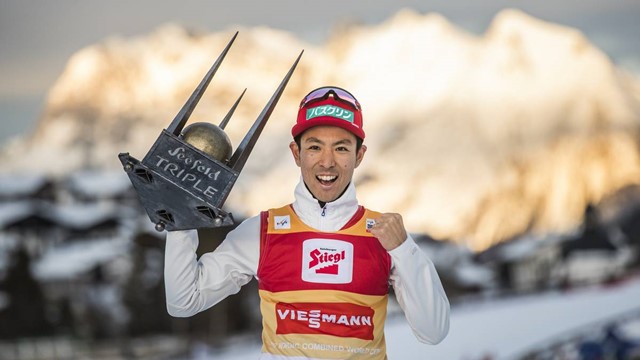
Japan’s Akito Watabe after winning the 2018 Seefeld Triple Nordic Combined World Cup. He is the only athlete besides Germany’s Eric Frenzel to win the event. (Photo: FIS Nordic Combined)
On the final day of the Seefeld Triple, Japan’s Akito Watabe completed his sweep of the three-day weekend and Norway’s Jarl Magnus Riiber reached the podium for the third-straight day, placing second. Germany’s Fabian Rießle placed third for his second podium in the last two days.
Watabe jumped to first on the normal hill and started the 15 k Gundersen 48 seconds ahead of Riiber in second. He went on to win the race by 1:14.9 minutes in 34:58.6, becoming the only man besides Germany’s Eric Frenzel to win the Seefeld Triple in its five-year history.
After jumping to fifth, Rießle won a photo finish for third (+1:57.9), edging Germany’s Vinzenz Geiger by less than a tenth of a second. Geiger moved up from ninth in the jump to fourth overall (+1:57.9).
Norway’s Jørgen Graabak followed in fifth (+2:02.4),Frenzel placed sixth (+2:07.4), Norway’s Jan Schmid was seventh (+2:09.8), Finland’s Eero Hirvonen eighth (+2:13.5), Norway’s Espen Andersen ninth (+2:28.0), and Austria’s Mario Seidl 10th (+2:42.1) out of 28 finishers.
No Americans contested the final day of the Triple, the last World Cup before the 2018 Winter Olympics in PyeongChang, South Korea.
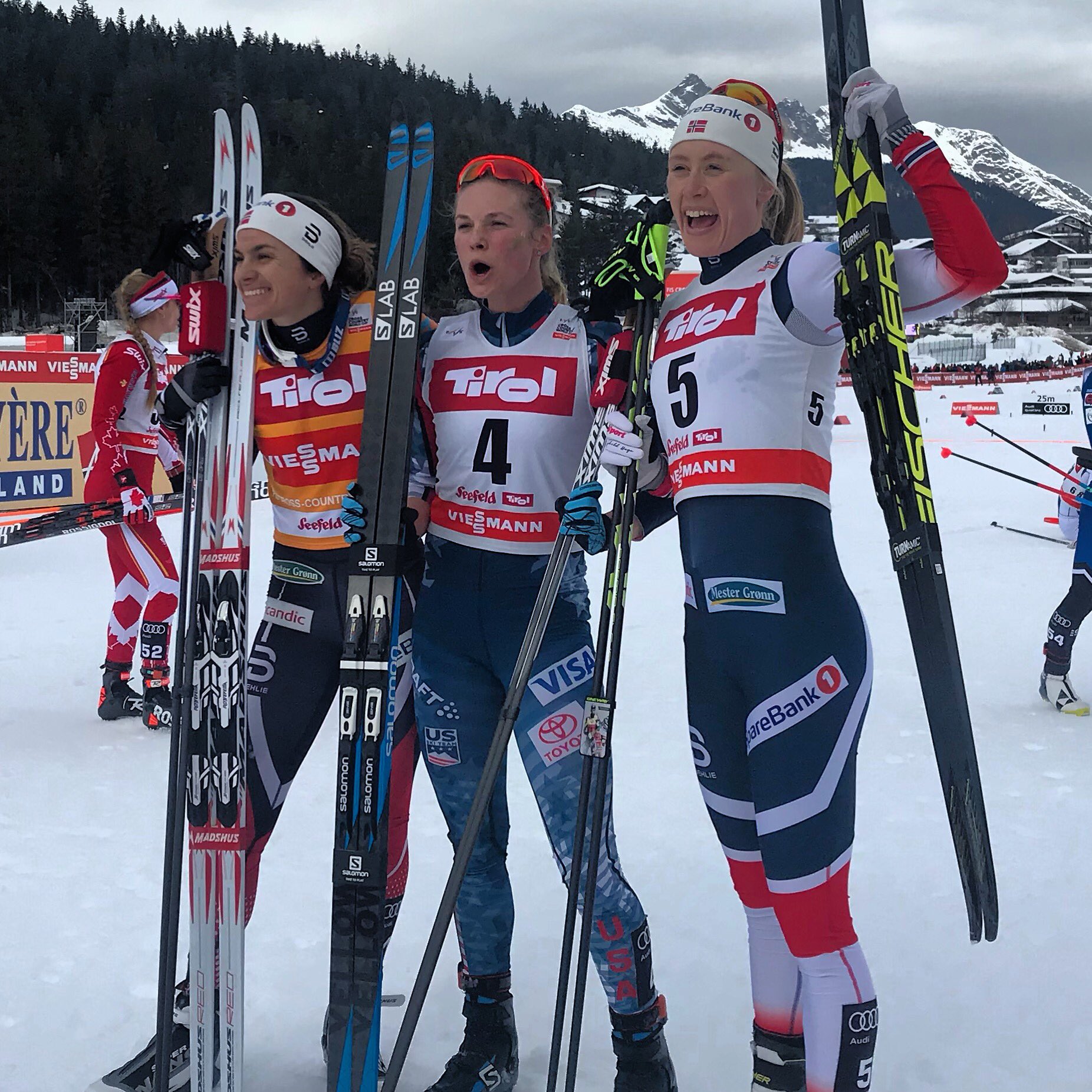
Jessie Diggins of the U.S. Ski Team (center) celebrates after winning the 10 k mass start freestyle in Seefeld, Austria, over Heidi Weng (left) and Ragnhild Haga of Norway. (Photo: FIS Cross Country/Twitter)
FIS Cross Country World Cup (Seefeld, Austria): 10/15 k mass start freestyle
In the final World Cup race before the 2018 Olympics, Jessie Diggins achieved the ultimate goal to give herself the utmost confidence heading into PyeongChang — winning the women’s 10-kilometer freestyle mass start at the World Cup in Seefeld, Austria, on Sunday.
The win was her first of the season and fourth individual victory of her career. Diggins, a 26-year-old U.S. Ski Team member, pulled it off by attacking on a long climb and leaving Norway’s Heidi Weng, Ragnhild Haga and Ingvild Flugstad Østberg chasing. While Diggins was several seconds ahead over the top and all alone on the long descent that followed, Weng and Haga worked to close the gap — and nearly did in the finishing stretch. But Diggins held them off, winning by 0.7 seconds over Weng in second place and 1 second ahead of Haga in third, and threw her fists down in celebration as she crossed the line first in 23:08.5 minutes.
“I just put my head down and it wasn’t pretty, but I just hammered,” Diggins told the International Ski Federation (FIS) in a televised post-race interview.
She was the only non-Norwegian in the top five, with Østberg in fourth (+8.7) and Marit Bjørgen in fifth (+16.7). Austria’s Teresa Stadlober placed sixth (+16.9), Norway’s Kari Øyre Slind was seventh (+19.1), and American Sadie Bjornsen placed eighth (+20.5), ahead of Switzerland’s Nathalie von Siebenthal in ninth (+30.3).
The U.S. had three in the top 15 with Kikkan Randall (U.S. Ski Team) in 14th (+48.5), and two more women in the top 30, with Caitlin Patterson (Craftsbury Green Racing Project) in 23rd (+1:00.7) and Liz Stephen (USST) in 29th (+1:18.2). Rosie Brennan (USST) finished 53rd (+2:26.9).
Emily Nishikawa led the Canadians in 35th (+1:36.5), followed closely by teammate Cendrine Browne in 37th (+1:36.6). Dahria Beatty finished 45th (+1:58.9).
Dario Cologna of Switzerland (center) won the men’s 15 k skate mass start in Seefeld, Austria, over Alex Harvey of Canada (left) and Martin Johnsrud Sundby of Norway (right). (Photo: FIS Cross Country/Twitter)
The Olympics are nearing and so Switzerland’s Olympic legend Dario Cologna is ramping up: after winning the Tour de Ski, he took another win in the 15 k mass start skate in Seefeld, Austria, on Sunday.
With much of the field staying relatively close together until the finish, Cologna nabbed the win by 1.4 seconds over Canada’s Alex Harvey, who took his second podium of the season in addition to also finishing third in the overall Tour de Ski.
Norway’s Martin Johnsrud Sundby was third (+2.9), then teammate Didrik Tønseth in fourth (+5.9) and France’s Maurice Manificat in sixth (+7.5).
The U.S. Ski Team’s Erik Bjornsen had a breakthrough day finishing ninth (+9.3), followed by Simi Hamilton in 12th (+12.4). Behind them, Scott Patterson placed 27th (+23.4), then Patrick Caldwell 49th (+1:26.2), Ben Lustgarten 55th (+1:42.7), and Tyler Kornfield 77th (+3:00.0).
Canada’s Devon Kershaw and Graeme Killick finished 30th (+26.5) and 31st (+27.4), respectively. Len Valjas placed 58th (+1:53.1), Knute Johnsgaard 82nd (+3:23.1), Bob Thompson 87th (+4:27.5), and Julien Locke 92nd (+4:56.9).
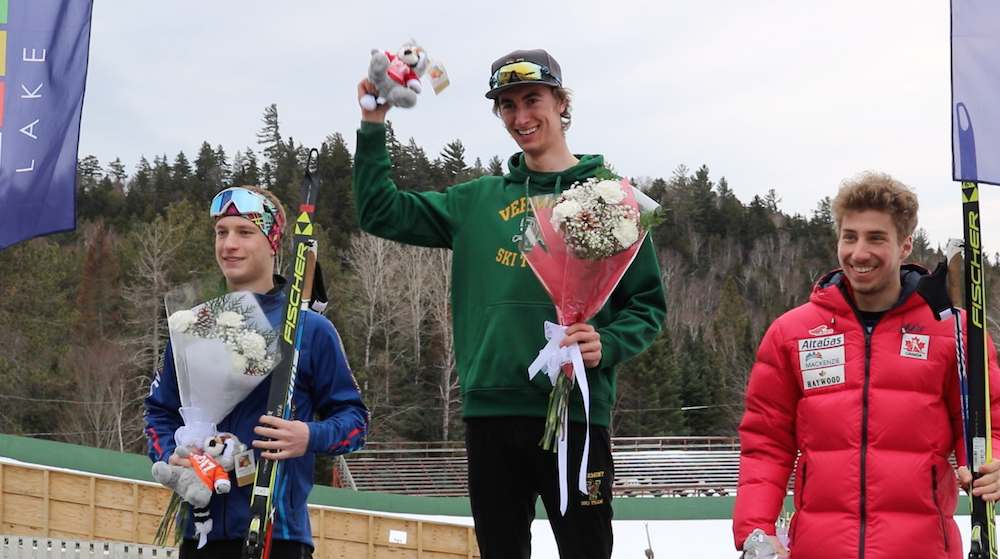
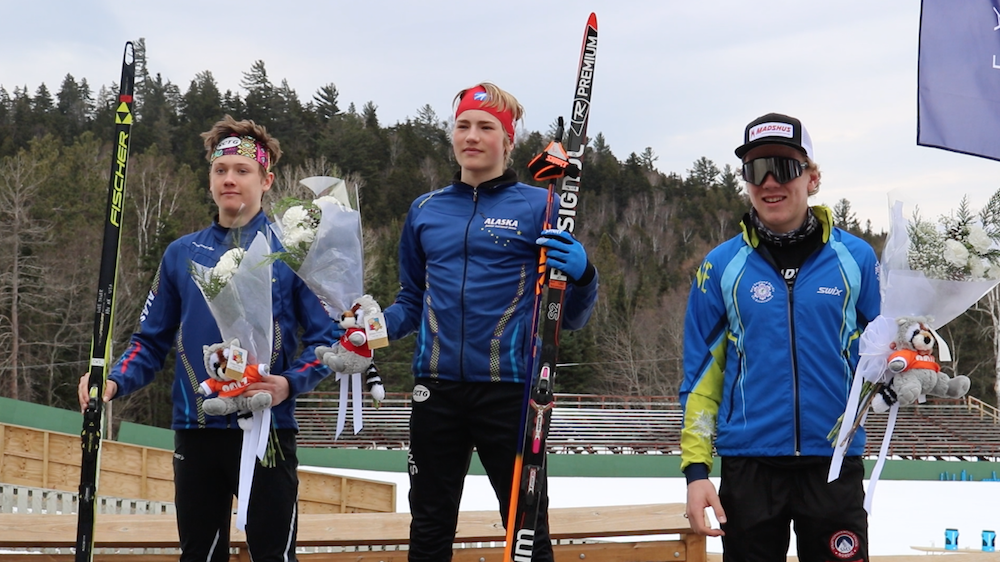
The U20 men’s 10 k freestyle podium on Day 1 of 2017 U.S. Junior Nationals in Lake Placid, N.Y., with Lake Placid’s own Karl Schulz (c) of the University of Vermont in first, Hunter Wonders (l) of Alaska Pacific University in second, and Canada’s Étienne Hébert (r) of Montériski in third. (All photos: India Harvey)
USSA Cross Country Junior Championships (Lake Placid, N.Y.): 5/10 k freestyle individual starts
The U.S. Ski & Snowboard Association (USSA) Cross Country Junior Championships (a.k.a. Junior Nationals) opened Monday in Lake Placid, N.Y., with U16, U18 and U20 men’s and women’s 5/10-kilometer freestyle individual start races taking place at the Olympic Jumping Complex trails just up the road from Mt. Van Hoevenberg, where organizers had originally planned to host the weeklong event. A lack of natural snow led to the use of a 2.5-kilometer loop on manmade snow at the Olympic Jumping Complex, US Biathlon’s home training base.
The U20 men’s 10 k freestyle proved to be the closest race of the day, with Karl Schulz, a University of Vermont (UVM) freshman who grew up in Lake Placid, winning by 0.1 seconds over Alaska’s Hunter Wonders, of Alaska Pacific University (APUNSC), in second place. Racing for the Mid-Atlantic division, Schulz clocked the fastest time in 24:58.6 minutes, which was 33 seconds faster than Canadian third-place finisher Étienne Hébert, of Montériski. New England’s Daniel Streinz (Mountain Endurance) was the third American in fifth overall, 59 seconds off Schulz’s winning time and 16.4 seconds behind another Canadian, Ty Godfrey (Canmore Nordic/Team R.A.D.) in fourth.
Julia Kern (New England/SMS) racing to the win in the U20 women’s 5 k freestyle on Monday at 2017 U.S. Junior Nationals in Lake Placid, N.Y.
Julia Kern, of New England and the Stratton Mountain School (SMS), won the U20 women’s 5 k by the biggest margin of the day: 42.4 seconds in 13:48.5. Canada’s Katherine Weaver (Hollyburn XC Ski Club) placed second and UVM’s Mackenzie Rizio took third (+43.9), while Sarah Goble (Great Lakes Division/Sun Valley) was the third American in fourth overall (+49.3).
The U18 boys’ 10 k freestyle podium on Monday at U.S. Junior Nationals in Lake Placid, N.Y., with Gus Schumacher (c) of Alaska Winter Stars in first, Luke Jager (l) of APU in second, and Ben Ogden (r) of SMS third.
In the U18 boys’ 10 k, Alaska took first and second with Gus Schumacher, ofAlaska Winter Stars (AWS) topping the podium in 25:07.3, and Luke Jager (APUNSC) finishing 3.7 seconds back in second. New England’s Ben Ogden (SMS) notched third (+10.6).
Alaska’s Margaret Gellert (Alaska Winter Stars) racing to a U18 girls 5 k freestyle victory at U.S. Junior Nationals on Monday in Lake Placid, N.Y.
Alaska topped the U18 girls’ 5 k as well, with Margaret Gellert (AWS) winning by 17.6 seconds in 14:02.9. Intermountain’s Sofia Shomento (Bridger Ski Foundation) finished second and Rocky Mountain’s Ezra Smith (Summit Nordic Ski Club) placed third (+23.6).
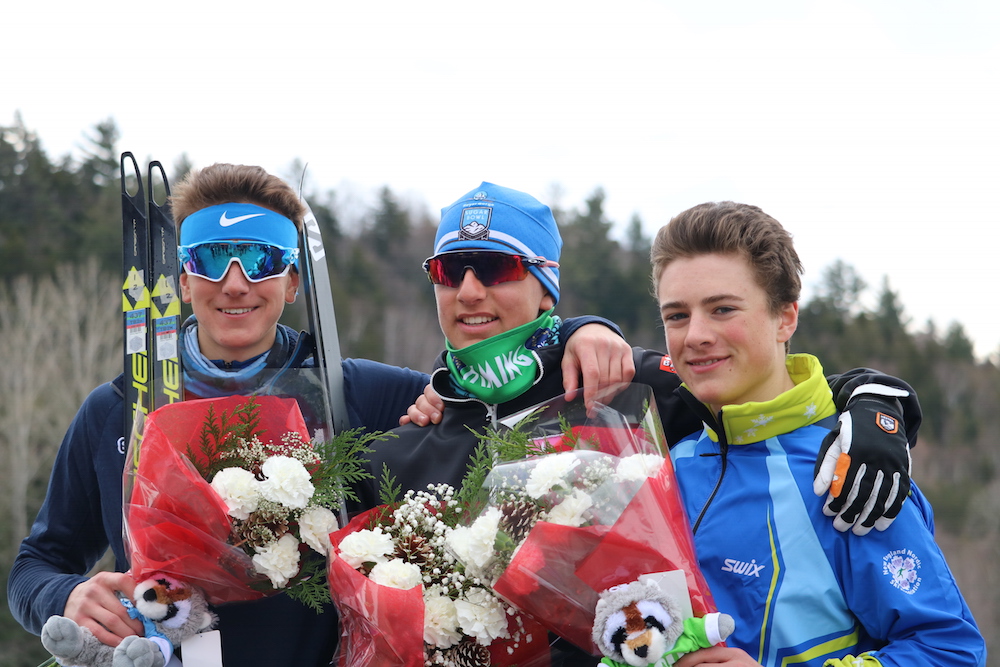
The U16 boys’ 5 k freestyle podium on the first day of 2017 U.S. Junior Nationals in Lake Placid, N.Y., with Haydn Halvorsen (c) of Sugar Bowl Ski Team & Academy in first, Johnny Hagenbuch (l) of SVSEF in second and Will Koch (r) of SMS in third.
In the U16 boys’ 5 k race, Far West’s Haydn Halvorsen (Sugar Bowl Ski Team & Academy) raced to a 5.3-second victory over Intermountain’s Johnny Hagenbuch, of the Sun Valley Ski Education Foundation (SVSEF). Halvorsen finished in 12:35.2 minutes, and New England’s Will Koch (SMS) was 29.5 seconds back in third.
In the U16 girls’ 5 k, Novie McCabe (Pacific Northwest/Methow Valley Nordic Ski Educational Foundation) earned a junior-national title by 1.7 seconds in 14:14.6. Intermountain’s Sydney Palmer-Leger (Park City Nordic Ski Club) placed second and Far West’s Nina Seemann (Auburn Ski Club Associates Inc.) reached the podium in third (+28.8).
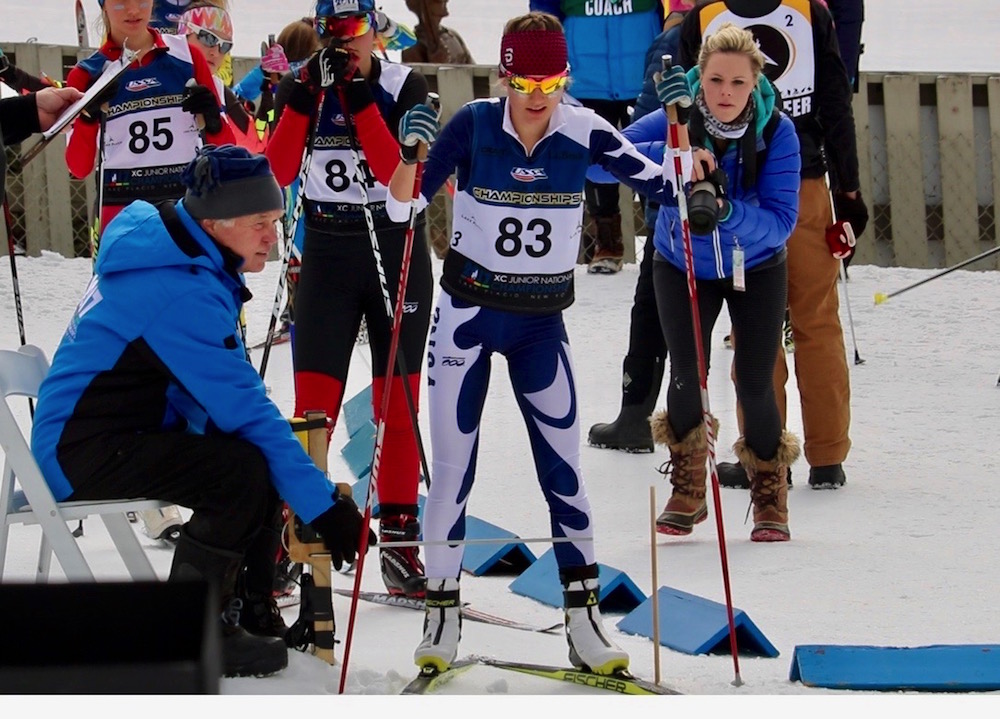
Novie McCabe (83) of Pacific Northwest/Methow Valley Nordic Ski Educational Foundation at the start of the U16 girls’ 5 k freestyle. She went on to win by 1.7 seconds on Monday at Junior Nationals in Lake Placid, N.Y.