Tag: Sognefjell

  • Caldwell Sport: Ski Factory Impressions

    Caldwell Sport: Ski Factory Impressions


    This article is a paid advertisement by Caldwell Sport, a ski-grinding service and new-ski retail shop operated by Amy and Zach Caldwell in Putney VT. It’s busy season in the ski industry and we’re cranking away at selling and grinding skis, so we’re recycling an article that Amy wrote for our website in late August. How many of you were paying attention in late August? OK – then this will be new material for you!


    This summer I was fortunate enough to visit several different ski factories in Europe with Zach. After our first year back in operation as Caldwell Sport, we felt that investing in my understanding of skis from the ground up was important for our business. We’re a small business, and it’s necessary for both of us to have a high level of expertise in all aspects of the operation. There is no better way to learn about skis than to go to the source and handle skis every day for a few weeks with no distractions. I am pretty sure this is Zach’s idea of heaven.

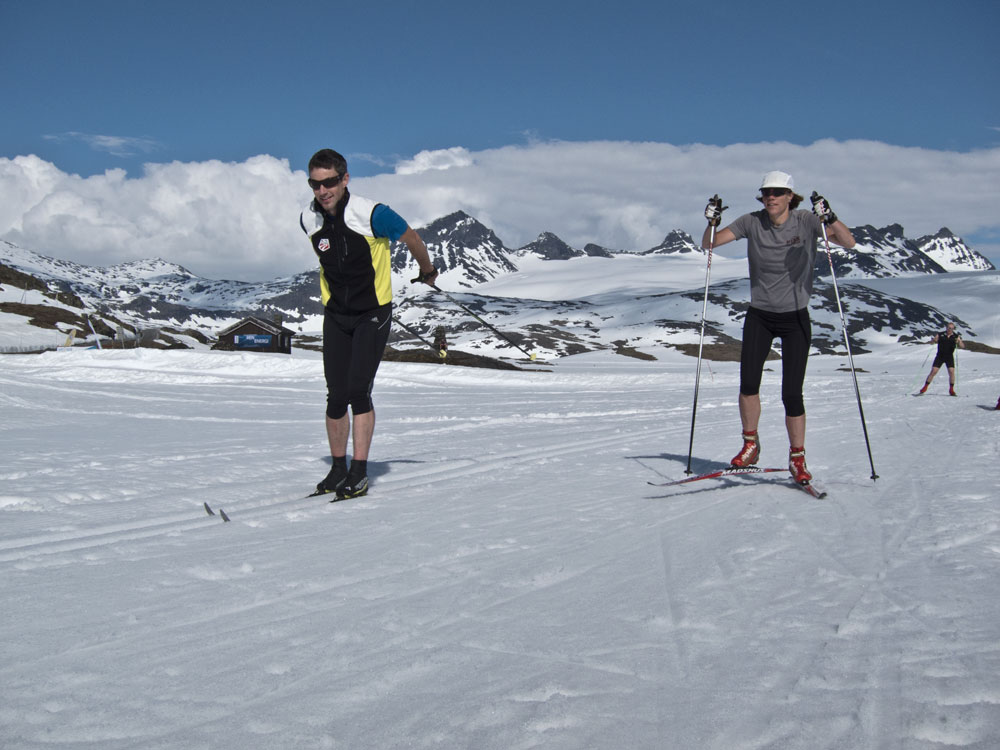
    Our first trip of the summer was to Norway. Zach planned the trip so that we could spend a few days skiing on the snow at Sognefjell, about a 3 hour drive north of Lillehammer, with some of the US Ski Team guys that he coaches. Sognefjell is a remote mountainous area located above the Sognefjord. Its elevation is about 4500ft and holds snow well into the summer. There is a hostel-like lodge there that serves five very carbohydrate rich meals a day. They salt and groom a 7km winding loop (with hills and turns) twice a day.

    When we were there, all of the major ski companies were testing their products along with some of the Norwegian National Team, German Biathlon, United Bakeries Marathon Team and a host of other teams from Norway, Sweden and Finland. Because all of the major ski companies are based out of Europe, this ends up being a relatively close testing area for them. While we were there, we were able to test some prototype products that are really interesting ideas. If all goes well, these products will be brought to market over the next few years. We were able to get a sense of what concepts ski companies were working with and what direction they are headed.

    After 15 hours of skiing in 6 sessions at Sognefjell, we headed back to Lillehammer to spend a week picking skis at the Madshus factory in nearby Biri. I have become a bigger and bigger fan of Madshus skis over the past few years, so I was really looking forward to going to the factory. Although any factory setting is far from glamorous, the Madshus factory was a totally impressive facility. They take extreme care selecting all of the materials that go into their skis and have built some of the most exact machines in the industry. They are so exact that they have to make slight adjustments during a production cycle so that not every pair of skis is identical! Anyway, after a week of drinking the Madshus “Kool Aid”, I left Madshus feeling even more excited to test their skis this season.

    After Madshus, the next stop on the ski pilgrimage for me was to the Salomon Headquarters in Annecy, France in August. While Salomon produces their skis in Altenmarkt, Austria; their World Cup service team is based out of Annecy and all their development and prototyping happens there. They actually have a press in Annecy where they can produce a new ski to test without having to halt the whole production line in Austria. It was a great opportunity to spend a little time with Patrice Frisson-Roche, one of the Salomon World Cup service guys, to learn a bit about what skis they have been testing and liking on the World Cup.

    Over the next two days, which also happened to be a weekend, we spent 10 hours on road bicycles near Annecy biking several of the roads and Cols that the Tour de France often visits. Thanks much to Alex Haas, the Salomon international marketing director, and his good friend who is the marketing director for German soccer for showing us some incredible riding around Annecy. In spite of very sore bums and legs, it was an amazing three days.

    From Annecy we went to the Salomon ski factory in Altenmarkt, Austria. Salomon shares a factory with Atomic which are both owned by Amer Sports. It is interesting to see two totally different ski companies working side by side. They have two separate design teams that work independently of one another. Most of the factory workers are working for Amer and not directly for either ski company. Jean-Marc Draeyer works for Salomon and is very involved with ensuring the quality of every pair of Salomon skis.

    Overall, my impressions of the Salomon factory were very positive. Although Salomon hasn’t been making skis for all that long compared to the other ski companies out there, they’ve done a good job bringing in some very hard working and knowledgeable people.

    Riding in Annecy, France.

    We were also very fortunate to have 2 free days in Altenmarkt due to an Austrian holiday and another weekend day. Zach and I took advantage of the nice weather and the Austrian Alps and did 2 fantastic hikes from Ramsau, one of them taking us up and around the Dachstein glacier. Although the Dachstein is used as a summer ski training venue, August tends to be its low point for good skiing during the year so we were happy to be hiking instead of slogging around on dirty, very slow glacier ice.

    Dario Cologna’s skis at Fischer.

    Also, during our week in Austria, we were able to squeeze in a day visiting the Fischer factory in Ried. Although Ried is unfortunately not located in the beautiful Austrian Alps, it was a great opportunity to get to take a look inside the factory that has been the leader in making cross country skis over the past few decades. The Fischer factory certainly did not disappoint. It is definitely the largest of the factories and it is clear that they continually reinvest in their machines and technology. It was also great to see into the racing department and see a whole bunch of Dario Cologna’s skis get dropped off for grinding. Thanks to Andy Forstner (another World Cup service guy) for showing us around.

    In all, I learned a lot about the different ski brands we carry this summer. One of the biggest lessons that I learned was that to be truly knowledgeable with skis, one must be a continuous and eager student of skis. Ski companies are constantly trying to refine their skis and make them lighter and faster. They come up with new concepts, develop them and then test them over and over again. I know one thing that I will do this winter is use every ski as a ski testing opportunity. Knowledge comes with hard work. Fortunately, like all of our customers, I don’t mind this type of “hard work”.

  • Freeman, Hoffman and Hamilton All Chat from Sognefjell

    Freeman, Hoffman and Hamilton All Chat from Sognefjell

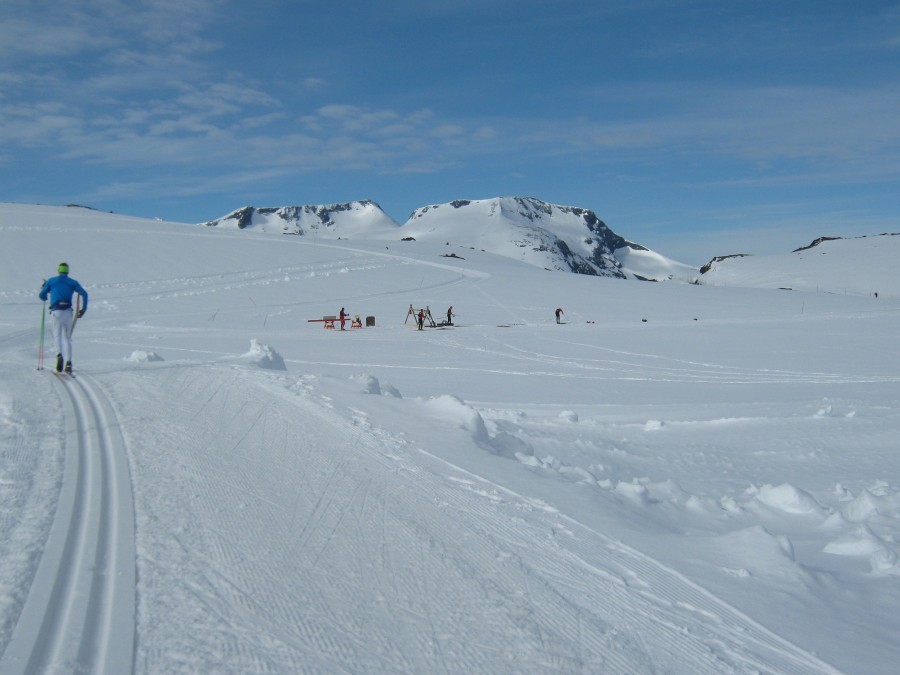
    View from the Sognefjell snowfields in Norway, where U.S. Ski Team members Noah Hoffman and Kris Freeman spent six days training with the Norwegian national team from June 3-8. (Photo courtesy of Noah Hoffman)

    Two weeks ago, Kris Freeman and Noah Hoffman weren’t exactly sure what they were in for before flying to Norway, but they were excited. The two had been invited to a Norwegian national team training camp, and without much else besides their bare necessities, they headed to the snowfields of Sognefjell.

    On June 3, the two U.S. Ski Team (USST) members jumped into action with the Norwegian men’s squad, kicking things off Sunday afternoon with at 2 ½-hour skate. The next day, Freeman and Hoffman spent five hours on snow, and the day after that, completed a two-hour skate with 20 kilometers at Level 3. They capped Tuesday afternoon with a two-hour classic ski, and ended up logging nearly 23 hours that week.

    Kris Freeman classic skiing during a Norwegian national team camp in Sognefjell, Norway. (Photo by Noah Hoffman)

    While both appreciated the volume training and generosity of the Norwegian team, which included Freeman and Hoffman in all their sessions, they were ready for an off day by the end of camp. Given that opportunity last Saturday, they ventured on what Freeman called a “crust cruise.” Two hours and one gigantic climb later, Freeman and Hoffman had gone much farther than they bargained for, but were glad they did so.

    “It was the most scenic ski I have been on in years,” Freeman wrote in a blog post. “And we only got lost once.”

    FasterSkier recently spoke with Freeman, Hoffman and Simi Hamilton, all of which were staying at Sognefjell’s remote mountain lodge. A recent addition to the USST A-team, Hamilton arrived Monday with Burke Mountain Academy as a guest coach on their two-week Scandinavian junior trip. He was helping his girlfriend, Kate Barton, who was leading the camp in place of the academy’s head coach, Pete Phillips.

    On Wednesday, Freeman and Hoffman left Sognefjel,with Freeman heading home and Hoffman continuing on in Lillehammer, Norway. Hamilton said he’d be in Norway until June 22.

    FasterSkier: Simi, how do you get involved with this trip?

    Simi Hamilton: They just needed someone else to tag along to help out with driving [including a two-hour trip to Sognefjord, Norway] and a couple of things with coaching. So I got a free trip over here and get to train and get to hang out with a bunch of immature-but-fun 15 year olds. It’s a good thing.

    FS: Have you been to Sognefjell before?

    SH: I’ve been here a couple times before, but it’s been probably about eight years since I was here last. I haven’t been here in a while, but it’s great. It’s a cool spot and it’s really nice living right on the trails. I got out [to ski on Tuesday] afternoon. I was later informed that this is the worst [snow] that they’ve had in a couple weeks, but I find it’s still pretty good. They have a ton of snow up here, which is really nice.

    Freeman pausing on the Sognefjell snowfield. (Courtesy photo)

    FS: Kris, what have the conditions been like for the past week and a half?

    Kris Freeman: When we first got here, we had probably three days where it was snowing and raining and pretty cold, and then the last five days I’ve been in shorts and a T-shirt.

    The snow has been phenomenal for this time of year. They’ve taken really good care of it; they’ve salted once or twice a day a day. The day where Hoff and I [toured] the mountain, it was pretty ideal crust training so I’ve got no complaints. Scenic and pristine.

    FS: How was training with the Norwegians?

    KF: I have a history of working with [Norwegian men’s coach] Trond [Nystad] when he was the coach of the U.S. Ski Team, and he was very helpful. Noah and I weren’t able to travel over here with a form bench or an iron or any of those things, and [Nystad] helped with those, which was very nice, gave us his training schedule. We were invited to every session. They took video of us, gave us technical advice. They treated us like members of the team, which was very, very generous.

    The athletes are friendly. Everything’s pretty professional out there. Not a lot of conversation while skiing, but they’re generally welcoming.

    FS: How’s your Norwegian fluency?

    KF: Absolutely non-existent.

    SH: I think that goes for all three of us. It’s hard because everyone speaks English well, so it seems like you never need to speak Norwegian. I think all of us could probably agree that it would be great if we could speak Norwegian, but there really isn’t a use.

    KF: I can’t even pronounce half the guys on their team, their names, properly.

    Norwegian Sjur Røthe during his national team's training camp in Sognefjell, Norway. (Photo courtesy of Noah Hoffman)

    FS: How big was the group?

    KF: There wasn’t like a line of guys going around. For the most part on the distance days, people kind of did their own thing. I skied mostly with Eldar Rønning, Martin Sundby and Sjur Røthe (laughs as he says final name). That’s not how you pronounce it, but I’m going to say ‘Sur Roth’ because I’m American.

    FS: Noah, how’s the training been?

    NH: It’s been awesome. I really felt like it was good to ski with and train with the Norwegians. I learned a lot in terms of some things those guys do differently than me, some great technical advice from their coaches and being able to ski behind those guys. We had two really productive threshold sessions. I just felt like it was a huge opportunity. I feel like it was a little overwhelming; maybe I need to go home and evaluate what I think is going to be super beneficial to carry forward and what I think maybe we do a little better in the U.S.

    FS: What’s one big difference between the way Americans and Norwegians train?

    NH: The big thing for me is that they train harder at camps than they do at home. They train hard at home, but they take some time to recover after camps. How we approach camps in the U.S. is we’ve always kind of done a sustainable [effort], so it’s just part of your training and more or less similar to what you’re doing at home. So that was a different concept.

    It was a really big load for me doing their schedule. It was two five-hour days, two threshold sessions, so it was a total of like 22 hours-ish in five and a half days so it was a lot. That was kind of something that stood out.

    Noah Hoffman at the top of a long and unplanned climb during a crust ski on June 9 in Sognefjell, Norway. (Photo courtesy of Kris Freeman)

    FS: How are you feeling?

    NH: I’m starting to get a little tired. Zach Caldwell is here now, who Kris and I both work with in a coaching capacity and on skis, so I’ve kind of switched gears a little bit towards technique and basically backed off the load significantly. That’s been kind of a nice change of pace at the end of camp here.

    KF: I’ve kept the volume and I’ve basically kept the Norwegian schedule going for the whole time here. I still feel good, but I’ve had enough skiing here and I’m ready to go home. I’ll be home for four or five days and then I have my first Maine Winter Sports camp. (Note: Freeman took the train to Lillehammer on Wednesday and flew out of Oslo on Thursday morning. Hoffman was headed to Lillehammer to work with Caldwell before flying home on Saturday.)

    FS: Noah, is there still a possibility that you’ll get some pointers from Thomas Alsgaard (Norway’s five-time Olympic gold medalist)?

    NH: He’s been up here [in Sognefjell] a little bit. I have been able to ski behind him a little bit, I know Kris has done that as well and that’s been great. I have not actually talked to him at all (laughs), but just skiing behind him has been a great opportunity. I’m going to stay a extra couple nights in Lillehammer and visit the Madshus factory and continue to work on Zach on technique, switching to dryland rollerskiing.

    FS: Before I forget, how are the accommodations in Sognefjell?

    KF: Rustic. … It’s fun, it’s quaint. They’ve only got four toilets for the whole men’s wing and three showers. I’ve never been into communal men’s showers.

     (Note: Freeman estimated there were 25 men staying at the lodge at a given time. The women stayed in a separate wing with their own facilities, which were apparently nicer than the men’s, he said.)

    The food’s been good and the skiing’s been good, and that’s the important thing.

    ***

    Related story: Freeman, Hoffman Invited to Norwegian Training Camp

  • Freeman, Hoffman Invited to Norwegian Training Camp

    Freeman, Hoffman Invited to Norwegian Training Camp

    Kris Freeman and Noah Hoffman in the 50 k at 2011 U.S. Distance Nationals.

    They spend half the year competing against Norway every weekend in Europe, but for a few days this June, U.S. distance specialists Kris Freeman and Noah Hoffman will be welcomed into the Norwegian National Team’s training camp on the snow fields at Sognefjell.

    If you don’t happen to read every paid advertisement that goes up on this site, you may have missed the announcement of this interesting tidbit by Caldwell Sport. As owner Zach Caldwell explains, the opportunity came about via invitation from Trond Nystad, who was a U.S. Ski Team (USST) coach before taking his current position at the head of Norway’s program.

    Caldwell will also be picking skis on this trip, but for the two USST athletes he coaches in his spare time, it’s primarily an opportunity to get on snow and learn from some pretty good skiers.

    FasterSkier met with Freeman and Hoffman before they headed out for an afternoon session in Bend, Ore., this week to ask about the trip. Both were looking forward to the chance to absorb training perspectives from foreign athletes.

    “The Norwegian National Team guys — I know a couple of them but I’ve never really done any training with those guys, really with any foreign athletes,” Hoffman said. “They have some of the best athletes in the world, so I’m really looking forward to that and hopefully … learn a lot and make some improvements.”

    Nearly nine years Hoffman’s senior, Freeman also thought exposure to other skiers would be beneficial experience in the offseason. He approached Nystad while on the World Cup this winter to ask if he could get some summer skiing in with the Norwegians.

    “Trond’s always been very helpful to me and supportive of the U.S. Ski Team, so there was no problem when I approached them,” Freeman said. “I’m hoping to see something from different skiers that I haven’t thought of yet and see a way of approaching the World Cup that I haven’t seen. I’ve been doing this for a long time and I do most of it solo, so getting perspectives from other people is going to be good.”

    On top of training with the current Norwegian all-stars, Hoffman’s Madshus sponsorship might also have him getting technique advice from the company’s technical adviser and resident nordic legend, Thomas Alsgaard.

    As Caldwell described on his website, Alsgaard saw Hoffman ski last December in Davos, Switzerland. Madshus’s Stian Grønås pointed Hoffman out to Alsgaard as the American skied around the day after placing 31st in the 30 k, which apparently impressed Alsgaard.

    Hoffman skiing the hill climb at Spring Series in March one day after dislocating his shoulder in the sprint. At the time, he was unsure if surgery was in store for him this summer.

    “He’s a great technician in terms of producing technique and I’m open to benefit from his expertise,” said Hoffman of the possibility of working with one of Norway’s most decorated skiers. “If I can do a couple of sessions with him that would be awesome.”

    Between the Bend camp, Sognefjell and USST camps scheduled in central Europe this summer, Hoffman’s training schedule appears to be fairly booked. We took this as a sign that his shoulder, which he dislocated in March at Spring Series, is recovering well — at least, well enough to ski on.

    As it turns out, the shoulder situation is “OK.” After getting an MRI and consulting with multiple doctors this spring, Hoffman learned that he re-tore his labrum in the same spot he had surgery last year. For now he doesn’t plan on going under the knife, but it could be a possibility down the road if the shoulder keeps popping out.

    “It doesn’t hurt or affect me on normal range, but I need to be cautious and I have a good understanding of it,” said Hoffman. “It’s looser and much more prone to coming out that it would be.”

    “If it goes two years and it doesn’t come out again, I’m not going to go under the knife,” he continued. “I happen to think that it might come out several times this year, and there’s not necessarily a huge increased risk each time it comes out except for it loosens up a little bit more and there is a long-term risk for arthritis if you let it come out over and over again.”

    Hoffman hopes he can at least wait until after the 2014 Olympics for any surgery, and in the meantime will be trying to strengthen his shoulder and reduce its risk of dislocating again with specific exercises and physical therapy.

    “I’ll try to do that — just looking to be a little cautious,” he said.

    — Chelsea Little contributed reporting.

  • Caldwell Sport Summer “Work”

    Caldwell Sport Summer “Work”

    This article is a paid advertisement by Caldwell Sport, a ski grinding service and new ski retail shop operated by Zach and Amy Caldwell in Putney Vermont. Caldwell Sport only does skis, and we have much more fun in the summer than those poor suckers who have to sell bikes as well.

    Since 2007 we have made an average of three trips a year to Europe for ski-related work. A lot of that has been coaching and ski service at events ranging from OPA cups and World Junior Championships to World Cups, Tour de Ski and World Championships. But well over half of the days spent in Europe during that whole time have come in the summer. Since FasterSkier is reduced to reporting on multi-sport events, we thought we’d take the opportunity to provide a little content and brag about how much fun we have in the summer.

    Kikkan at Sognefjell. Kikkan is BIG right now, so we’re definitely using a picture of her.

    Our goal is to provide our customers with access to the highest level of knowledge and understanding available. Doing World Cup ski service keeps us in touch with what is happening in the service world at the highest levels of ski racing. But providing the best available skis to our customers requires more than an understanding of World Cup service. We also need to know the skis, inside and out. So we go to the ski factories to learn.

    World Cup service is all about making the best of available materials (skis and wax) in a short amount of time. It’s hard work with a great deal of time pressure. In the summer we slow things down, examine materials closely, and ask a ton of questions. We talk to the factory race service guys about what other teams have had success with, and what direction they’re going in the future. And we look at (and select) a lot of skis.

    Original ideas are very rare. We can count the number of truly original ideas we’ve had on one hand. Almost everything we know and do with skis is learned, borrowed, adapted or flat-out stolen from something we’ve seen somewhere else. Summer trips to ski factories account for a huge portion of our stolen ideas. There are some amazing people working in the ski industry, and we’re lucky to be able to mine them for understanding.

    Browsing skis at Madshus.

    Our June trip this year is shaping up to be especially fun. Kris Freeman and Noah Hoffman will be flying to Norway at the beginning of June to join the Norwegian National Team for their on-snow camp on the Sognefjell snow fields. Amy and I will fly over to join them for three days on snow at the tail end of their camp, before heading to Lillehammer and Biri to work in the Madshus factory. Noah will also grab a day at Madshus to get an inside look at how his skis are made.

    Sognefjell in June is a scene worth checking-out. It’s not a glacier, but high snowfields near the top of a pass in the Jotunheim mountains, not far from the tip of the Sognefjord, the largest fjord in Norway. There’s not much up there – only what you need for a perfect summer ski training operation. A hotel with great meals, trails groomed and salted twice a day (fresh tracks for classic skiing after lunch), and a measurable portion of the world’s best skiers.

    Sognefjell also happens to be an easy drive from Lillehammer, and Biri, the headquarters of Madshus. Most of the ski companies conduct some ski testing with many of their top athletes at Sognefjell in June, but it’s almost like a home base for Madshus – they can come and go with new materials as they like, and it affords them a great opportunity to test new ideas for wet-snow skis.

    I was last there in June of 2010 with Nathan Schultz and Erik Nilsson for a couple of great days of skiing and testing. Per Wiik of Madshus had made all our arrangements, but was too busy with product and marketing meetings to come up skiing with us, so he asked Thomas Alsgaard to take us out for dinner on the company. I’m pretty sure Per figured we’d go get a pizza, but Thomas had a different idea. He booked us for a phenomenal meal at a restaurant owned by the chef who cooked for the Norwegian National Team when Thomas was racing. So we had a great meal with Thomas, Jorgen Brink (he’s won the Vasaloppet three times in a row now, but had just won it once at the time), and Stian Grønås, one of the Madshus racing guys (former Factory Team waxer, and Norwegian National Team waxer), and Peter Hale.

    During the meal Stian told us a funny story about how they found a pair of Thomas’s skis in the factory – the pair he used to win the relay gold for Norway at the 1998 Nagano Olympics. They mounted NIS plates, put a fresh grind on the skis, and put them out with a batch of new skis for Thomas’s next testing session without telling him anything. We all looked at Thomas for the conclusion of the story.  “So, how were the skis?” “I can’t believe I ever skied on such crap”, he said.

    After dinner, Thomas holding his “crap” gold-medal skis from 1998.

    Marketing-message interpretation aid for those of you who are not susceptible to subliminal messages:

    1 – Caldwell Sport is incredibly cool.

    2 – You should go to Sognefjell sometime.

    3 – If you’re still skiing on skis from 1998, even if they were the best skis in the world, it’s time for something new.

    4 – Order your new skis soon.

    http://www.caldwellsport.com/


  • Randall Takes Europe By Storm

    Randall Takes Europe By Storm

    Kikkan Randall taking a break from skiing at the Sognefjell snowfield in Norway. All photos courtesy of Kikkan Randall.

    Training with Marit Bjoergen and the Norwegian women’s cross-country team might be an intimidating prospect even for some of North America’s elite men. But not for Kikkan Randall.

    Kikkan Randall (L) with members of the Norwegian women's ski team

    In the middle of a two-week visit to Norway this month, Randall took up an offer to go head-to-head with the country’s women’s squad in a double-pole interval workout. And while the pace was high—“pretty much all out”—Randall wasn’t blown away.

    “It was pretty cool just to jump into that level, and just try to hang on,” Randall said. But at the same time, she added, “there isn’t any magic to it.”

    A consummate globetrotter—she won the 30 k national championship in Maine this March just a few days removed from three straight World Cup races in Sweden—Randall’s trip to Norway came on the tail end of three full days of meetings of the International Ski Federation in Antalya, Turkey, where she was serving as a member of the Athletes’ Commission.

    Two years into a four-year term, Randall said that she’s getting the hang of how the Federation runs. The commission set a number of priorities for the meetings, including making FIS more environmentally-friendly, getting more influence and voting rights for skiers on other FIS committees, and ensuring that severely-injured athletes can get financial support—and Randall said that their sessions were productive.

    Last year, Randall had attended similar meetings in Croatia and flown straight back to Alaska after three days, but this spring, she decided to make the most of her trip to Europe. So instead of returning home, Randall headed north to Norway, at the invitation of friend and fellow sprinter Ella Gjoemle.

    For two weeks, Randall got a taste of just about everything the country has to offer. First, the women headed to the town of Askim for a rollerski race, where Randall swept both events—a 200-meter sprint and an 1130-meter uphill time trial.

    Then, it was off to the Sognefjell snowfield for five days, a hotspot for European athletes during the summer. Randall is used to skiing on snow during the

    Randall with Oystein Pettersen (L), Thomas Alsgaard, and her host, Ella Gjomle

    summer—her team, Alaska Pacific University, has a facility that they use on the Eagle Glacier—but this was a new experience.

    “The difference there was skiing behind Thomas Alsgaard for a lap, and then Marit Bjoergen was skiing behind me,” Randall said.

    At Sognefjell, Randall said she was struck by the amount of support available to the Norwegian skiers. The national team’s wax bus and a number of service staff were at the glacier, which made it much easy for the athletes to test their fleets of skis.

    “They have the financial resources available to have so much manpower present to assist in the training process,” Randall wrote in a follow-up e-mail. “This is one luxury that we don’t quite have in the States.”

    In addition to Sognefjell and the sessions with the Norwegian women, Randall did some more travel, to Western Norway, and also to Oslo. There, she did some workouts at the Olympic Training Center, including some short sprints with Bjoergen.

    Back home in Anchorage with a chance to reflect on her trip, Randall said that at times, she was “a little in awe of all the tools and resources that the Norwegian athletes have at their disposal.”

    In addition to the level of service she observed at Sognefjell, Randall said that Norwegian skiers get much more personal financial support—local clubs offer their athletes money for basic living expenses, in addition to assistance with training.

    On the other hand, she added, the basics are still the same.

    “I was able to see that the way they train and stuff they are doing is not that much different than what we do,” she said. “I was…that much more proud of what we have accomplished from the U.S., with fewer resources.”

    Randall with Marit Bjoergen

    After relishing her experience in Norway, Randall said that she would like to return to Europe in future summers.

    “It was so cool to be over there and train with people at that level—just to keep in touch with that,” she said. “I’d like to take advantage of these relationships I’ve made on the World Cup.”

    Randall said that she spent time in Turkey with Swedish women Charlotte Kalla and Anna Haag—the pair was there in support of Sweden’s successful bid to host World Championships in 2015—and they told her that the door was open if she ever wanted to make an off-season visit.

    Randall now has one month at home before traveling to New Zealand for more on-snow training, this time with the U.S. Ski Team (USST).

    While Randall said she is excited to ski with her American teammates after missing the USST’s start-up camp earlier this year, the Canadians are also running a concurrent trip to New Zealand, so there will be no shortage of training partners.

    “I just talked to [Canadian Olympic medalist] Chandra [Crawford]…and we’re fired up to be able to train together,” Randall said.

    Randall on a scenic rollerski in Norway