
From the FasterSkier archive — posts syndicated from athletes’ and coaches’ own blogs between 2004 and 2012, kept online as published. Current coverage is at fasterskier.com.

Tag: Solleftea

  • Now a Swedish National Champion, Geraghty-Moats Says She’s ‘Still the American,’ Plans Return

    Now a Swedish National Champion, Geraghty-Moats Says She’s ‘Still the American,’ Plans Return

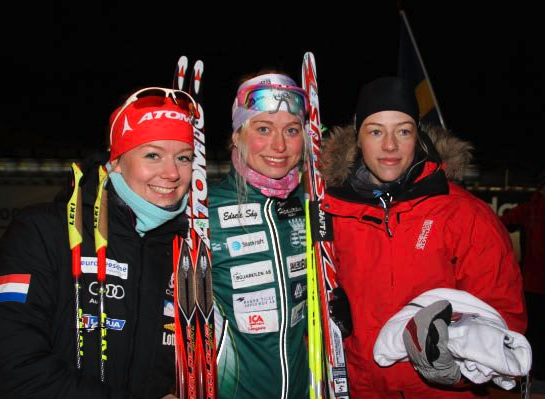
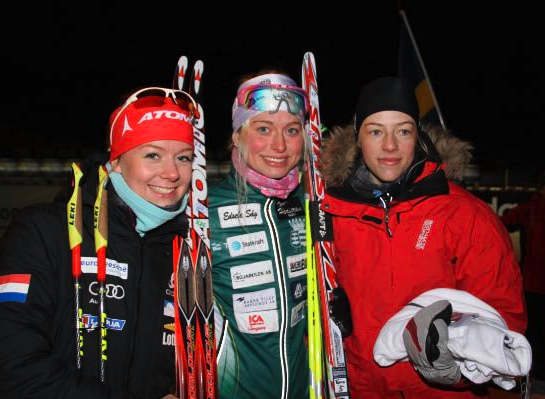
    Vermonter Tara Garaghty-Moats (center) after winning the junior sprint at Swedish Biathlon Championships for the I21 Biathlon Club, based out of Solleftea. Courtesy photo.
    Vermonter Tara Geraghty-Moats (center) after winning the junior sprint at Swedish Biathlon Championships for the I21 Biathlon Club, based out of Solleftea. Courtesy photo.

    By the time Tara Geraghty-Moats leaves Sollefteå, Sweden, next month, it will have been almost a year – a year marked by ups and downs, new friends and new places, a disappointing World Junior Championships and then a turn at Swedish National Championships that netted her a gold medal.

    So did the Vermont native, a former nordic combined athlete who has since switched to biathlon and now made three trips to World Juniors, become a Swede?

    Well, no.

    “It was really fun to train with everyone this year, we obviously all do biathlon and all train together, but I’m still ‘the American’,” she laughed in a Skype interview on Thursday.

    But that didn’t change the fact that the year presented not only ramped-up racing opportunities, but an entirely different training environment – one where she actually had a full-fledged team, with all of the training benefits and camaraderie that comes along with it.

    “I’ve trained with Craftsbury and Ford Sayre, which are really small clubs,” she said. “So it was nice to have a group to train with that were my age, and also a bigger group all winter long. To have a consistent schedule and people to train with almost every day was great.”

    The move to Sollefteå’s biathlon gymnasium came about after earaghty-Moats and several other top American juniors did an exchange with the National Sports Academy last spring, a trip that was organized by U.S. Biathlon head coach Per Nilsson. With the dramatic change in venue, Geraghty-Moats said her  goals were to keep her skiing speed the same, but to make improvements in her shooting. And that happened, thanks to the training environment. For young biathletes in the U.S., there’s really nothing that compares to a gymnasium. There’s barely as many athletes who compete at trials races as there are on a team in Sweden.

    “I definitely got more consistent shooting training than I’ve ever gotten before, and it really paid off towards the end of the season,” she explained. “Hopefully I can carry that through to next season.”

    A hip injury in January had sidelined her for a significant chunk of valuable training time; earlier this winter she told FasterSkier that it was “frustrating to go to Junior Worlds and not be able to do what I had been capable of earlier in the winter.” She finished in the 60’s in both the sprint and individual competitions. Geraghty-Moats was also picked to represent the U.S. in the junior races at Open European Championships, where she was “still not feeling awesome skiing, but [had] regained enough fitness to feel more in control of my races, which is a relief.”

    After that trip though – to Bansko, Bulgaria – a scraped elbow while running led to a surprising, but luckily not too serious, blood infection. That cost the biathlete, who turned 20 this spring, yet another week of training.

    “It would have been nice if it hadn’t happened, but it turned out not to be a big deal,” she admitted.

    Because the cherry on top of the Sweden experience came in the junior sprint at national championships. After a year of racing, Geraghty-Moats said she was definitely not expecting to win a race. Starting the two-stage sprint with two penalties in prone knocked her expectations back even further.

    "The history of Swedish junior national champions from I-21 skidskytte klubb," Garaghty-Moats posted on Facebook. "Definitely the coolest list I've ever been on. It was an honor to be part of such an awesome club this season!"
    “The history of Swedish junior national champions from I-21 skidskytte klubb,” Geraghty-Moats posted on Facebook. “Definitely the coolest list I’ve ever been on. It was an honor to be part of such an awesome club this season!”

    “I was really hoping for a podium, that was my goal,” she said. “And I knew that if I missed more than one [after that] I wouldn’t have a chance at even making the podium… and that even if I missed one but didn’t shoot fast, I still wouldn’t be able to make the podium. Going into the last hill I was five seconds behind Chardine [Sloof] and my coaches were just going crazy. I tried to ski really fast and surprisingly enough I was able to make up the last few seconds.”

    Sloof, a World Junior Champion last season, was relegated to second, and Geraghty-Moats collected top honors.

    As she tweeted later this spring, by winning the sprint she joined an impressive list of athletes from Sollefteå’s I21 club to win a junior title. Among them are many who currently represent Sweden on the World Cup, as well as two-time World Champion and 2009 World Cup overall winner Helena Ekholm.

    That thrill added to the general atmosphere at Swedish nationals, which is quite different than any domestic race Geraghty-Moats ever encountered in the America.

    “It was obviously really fun,” she said. “Sweden is a big biathlon country, not like the U.S., so there were a lot of different clubs. It was a lot more like an international competition than like what we would think of as nationals in the U.S. Chardine Sloof, who actually competes for the Netherlands on the international circuit, was competing, so there was a bit of an international side to it. It was fun.”

    So far this spring, Geraghty-Moats is back training with the ski gymnasium. She has about another month left in Sweden, so has been skiing, rollerskiing, and running with her team and coaches. The opportunity to get on snow at this time of year, she says, is special.

    “We’re rollerskiing again already, and running,” she said. “We have a skiing camp next weekend. That should be fun. I’m looking forward to getting back on snow – we’ve had a taste of rollerskiing, and it definitely made me miss skiing.”

    When she returns to Vermont, she’ll be living back home in West Fairlee, a small town of about 700 people on just off the Connecticut River, and training with Vermont Collegiate Biathlon coach Algis Shalna. She expects the general schedule to include two-week training camps in Jericho, Lake Placid, and Craftsbury, with rest periods at home.

    Although it will be a return to a more solitary ski life, Geraghty-Moats is looking forward to it. She’ll rejoin not only Shalna and the other Vermont Collegiate athletes, but Sean Doherty, a teammate who recently became a Youth World Champion at the same event that left Geraghty-Moats disappointed. Despite the duo’s success, she said, she has no more confidence than before – because she already knew the program was a perfect fit. Saying that she was more positive now would imply that she had doubts before, which was emphatically not true.

    “I’m really proud of Algis and Sean and their successes, but I’ve always thought Algis’s programs work great for me,” Geraghty-Moats said. “I think he does a really good job of having us all train at the same time, but having us focus on what each of us needs to focus on.”

    Her goals for the next season focus on World Juniors, which will be at home (relatively speaking) in Preque Isle, Maine. In the meantime, she’ll continue to take classes online from the Community College of Vermont, as she has for more than a year, working towards her Associates Degree.

    “There’s a certain amount of work I have to do every week, but there’s not set schedule that I have to do it on,” she said of her school schedule, which is ideal for an athlete. “That’s really nice. It can be a little iffy with the internet in Vermont though.”

  • After Trip to Sweden’s National Sports Academy, U.S. Juniors Have New Understanding of European Biathlon

    After Trip to Sweden’s National Sports Academy, U.S. Juniors Have New Understanding of European Biathlon

    (l-r) American junior biathletes Casey Smith, Sean Doherty, and Tara Geraghty-Moats at Swedish nationals. Photo courtesy of Per Nilsson.

    By the time Casey Smith, Tara Geraghty-Moats, and Sean Doherty reached U.S. Biathlon National Championships in March, they thought their seasons were coming to an end.

    All three were finishing an intensive race tour which had begun at World Junior Championships in Finland, continued a few days later at cross country Junior Nationals in Soldier Hollow, and then swung north to West Yellowstone for more biathlon. Doherty had also competed overseas at the Youth Olympic Games in Innsbruck, Austria, and Smith at the Open European Championships in Brezno, Slovakia.

    As they completed their victory laps in Montana – the two boys swept their respective age groups, while Geraghty-Moats won one title – they learned that they weren’t done yet.

    “[Coach] Algis Shalna said, ‘Oh, you’re going to Swedish nationals,’” Geraghty-Moats said in an interview. “So we thought, okay. We knew we were staying with host families and that we were competing at Swedish nationals, but we didn’t get too many details ahead of time. We were definitely a little raced out and beginning to get in ‘racing almost over’ mode, but I was super excited.”

    The three athletes were soon on a plane headed for Scandinavia as part of an exchange organized by U.S. Head Coach Per Nilsson, who lives in Sollefteå, Sweden, and had previously coached at the National Sports Academy “skidgymnasium” there. Swedish athletes will visit the U.S. this summer for a camp in Jericho, Vermont.

    It turned out that as full-blown exchange students, the three Americans didn’t focus on racing as much as on the cultural lessons from the trip.

    “I think the most important thing this time is the exchange, and for the athletes to get a perspective how it works in another country,” Nilsson told FasterSkier.

    Life at the Skidgymnasium

    Casey Smith rounding a corner at Swedish nationals. Photo courtesy of Per Nilsson.

    For the first week in Sollefteå, the Doherty, Smith, and Geraghty-Moats simply followed the schedule of all the other biathletes at the skidgymnasium. The reported for school at 8 a.m., either for class or a morning workout, and proceeded from there.

    Aspects of the trip could have been difficult; for instance, none of the Americans spoke any Swedish before arriving at the skidgymnasium. Geraghty-Moats admitted that she was apprehensive. Luckily, the Swedes were welcoming, helpful, and, importantly, spoke English well.

    “It turned out to be really fun and easygoing,” Geraghty-Moats said. “They just sort of took us under their arms and let us hang, so that was cool.”

    In terms of biathlon, the match with the Swedes was very apt – the Swedish junior national team certainly has talent, and their youth men’s and youth women’s relay teams both won silver at this year’s World Youth and Junior Championships. But they are also at a surprisingly similar level to the Americans in some regards. The Swedes had only two individual top-tens in twelve races at the Championships; the Americans had zero, but Doherty twice placed 13th and Geraghty-Moats finished 18th in the sprint.

    Training, then, was not intimidating.

    “Nordic ski training is really pretty much the same wherever you go, except that you have your own sort of local flavor to it,” Geraghty-Moats said.

    She had the chance not only to train with top junior biathletes, but also to do intervals with Sofia Henrikkson, a skier who was part of Sweden’s silver-medal team at this year’s World Junior Championships in Turkey and placed fourth and seventh in the distance races there.

    “It was definitely like, oh, these girls are human, they have their fast days and their slow days just like everyone else,” Geraghty-Moats said. “It was eye-opening to see that.”

    The Americans continued to hold their own when it came time to race at nationals; Doherty swept the sprint and pursuit in his age division, while Geraghty-Moats placed fifth in the sprint and fourth in the pursuit. Smith moved up from eighth after the sprint to place sixth in the pursuit.

    Perhaps the biggest surprise came not at the U.S. success in their age divisions – they had proved that potential at World Youth and Junior Championships – but when Doherty and Smith teamed up for the first two legs of the senior relay and Smith tagged off to a Swedish teammate in second place.

    “Sean made a big impression on everybody here,” Nilsson told FasterSkier at the time. “And Tara was one of the strongest ones on the course all day.”

    Developing Differently

    Geraghty-Moats on the range. Photo courtesy of Per Nilsson.

    With gracious, enthusiastic hosts – “they were just really excited to show us the town and their school and let us integrate with their whole system,” Geraghty-Moats said – the Americans were able to dig in and observe how differently Scandinavians approach biathlon.

    “It’s a bit of a difference for sure, and if you ask the athletes they probably have both pros and cons about the setup if you compare U.S. and the Swedish system for this age group,” Nilsson said.

    The differences start, of course, in culture. Not only are there simply more biathletes in Sweden, but there is a history to how they develop.

    “The gymnasium here in Sollefteå has a long tradition and started 1978,” Nilsson told FasterSkier. “It has developed a lot of good cross country skiers and biathletes during the years. For example, this year at the World Championships in Ruhpolding, you had six athletes representing Sweden who had studied at this school.”

    That’s quite different from the U.S. team, which has only one residential program for junior biathletes (at the Maine Winter Sports Center) and no program that tightly coordinates training and education. Ski academies, mainly in New England, offer an American take on the concept of the ski gymnasium, but none of them offer biathlon – and they have price tags.

    “Being a biathlete was more integrated into school,” Geraghty-Moats said of Sweden. “You get grades on being a biathlete, that help you get into college. You don’t have to shell out huge bucks for the sports academy. It’s definitely more along the lines of doing football here, if you know what I’m saying. It’s more respected in the community, which is always helpful.”

    Without the cultural support and central development hubs seen in Scandinavia, young Americans are left with a program that Geraghty-Moats described as “scattered.” The U.S. junior national team holds a few training camps throughout the year, but many of the country’s biathletes have scant company where they live.

    Doherty en route to a win. Photo courtesy of Per Nilsson.

    “We’re definitely fighting geography,” she said.

    They’re also fighting with their checkbooks. Geraghty-Moats said that the Swedes were surprised to hear that in the U.S., junior champions still had to pay their race entry fees and pay to be on club teams.

    She thought, however, that U.S. athletes turn those challenges into strengths.

    “I feel like American kids have to sacrifice more if they want to go into full-time racing,” she said. “So in a way American kids are a little bit more focused.”

    That didn’t change the fact that she was jealous of a few things.

    “The Swedish kids have a huge amount of opportunity and a huge depth of field right there, so it’s easier for them to get better faster. And if they want to go to competitions out of the country they just get on a bus. It’s not that hard.”

    Looking Towards Jericho

    The U.S. trio is looking forward to seeing their new friends in Vermont this summer.

    “I think they’ll be intrigued by the [U.S. system],” Geraghty-Moats said. “I certainly hope they’ll enjoy training at our facilities, and I’ll enjoy getting to see them too.”

    As for the Swedish leg of the exchange, Nilsson thought that the Americans enjoyed themselves, and also said that he appreciated the chance to work with them. As a senior national team coach who travels to the U.S. primarily for periodic training camps with his own athletes, it was nice for him to have a chance to get to know the juniors.

    That wasn’t the most important thing, though. Nilsson again stressed the importance of the education that the Americans received in Sweden.

    “We think this was good for the athletes for sure,” Nilsson said. “They have been introduced to the Swedish system with the ski gymnasium, and have participated both in the ‘normal’ school as well. One of the goals was to see and feel how it works with this system.”