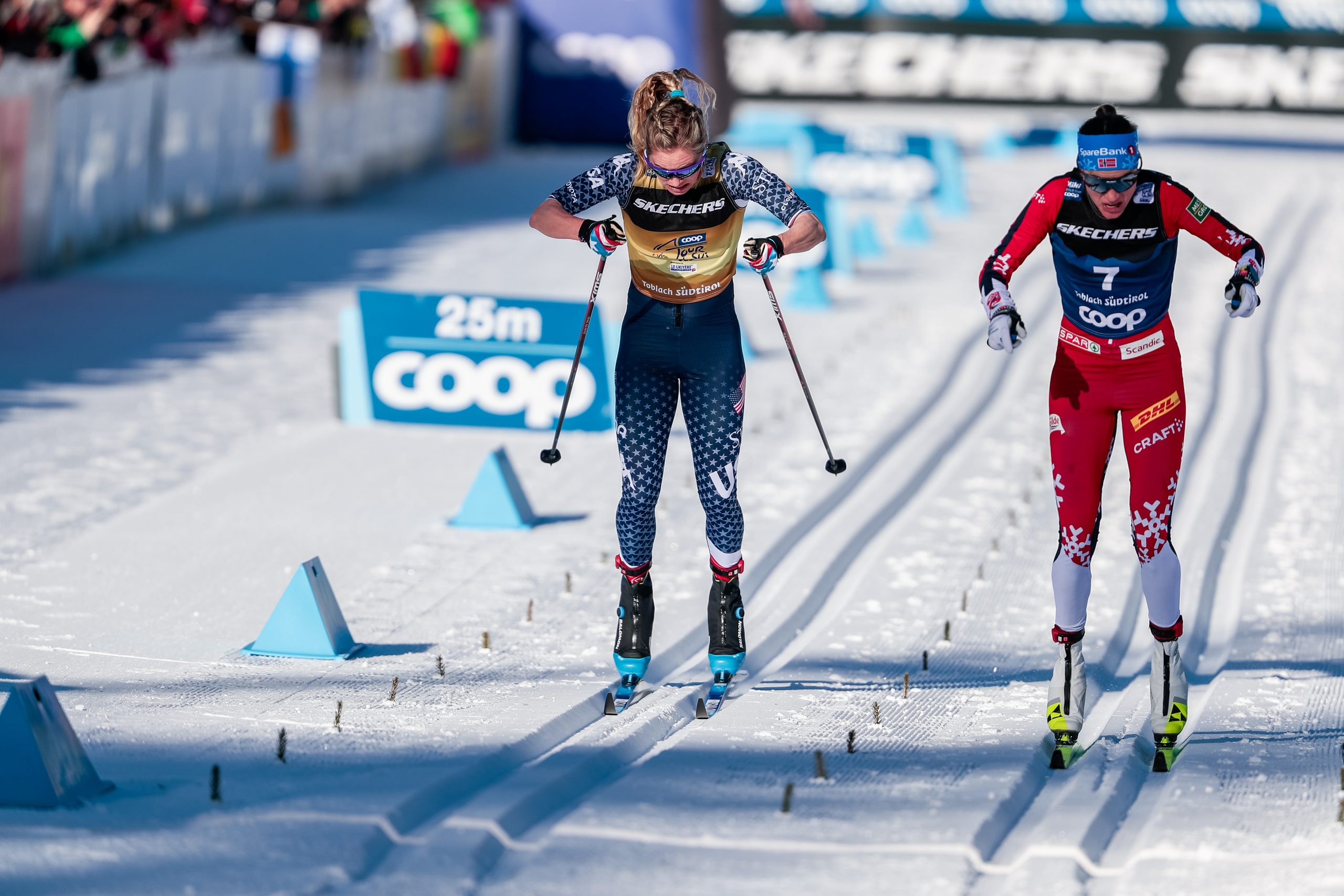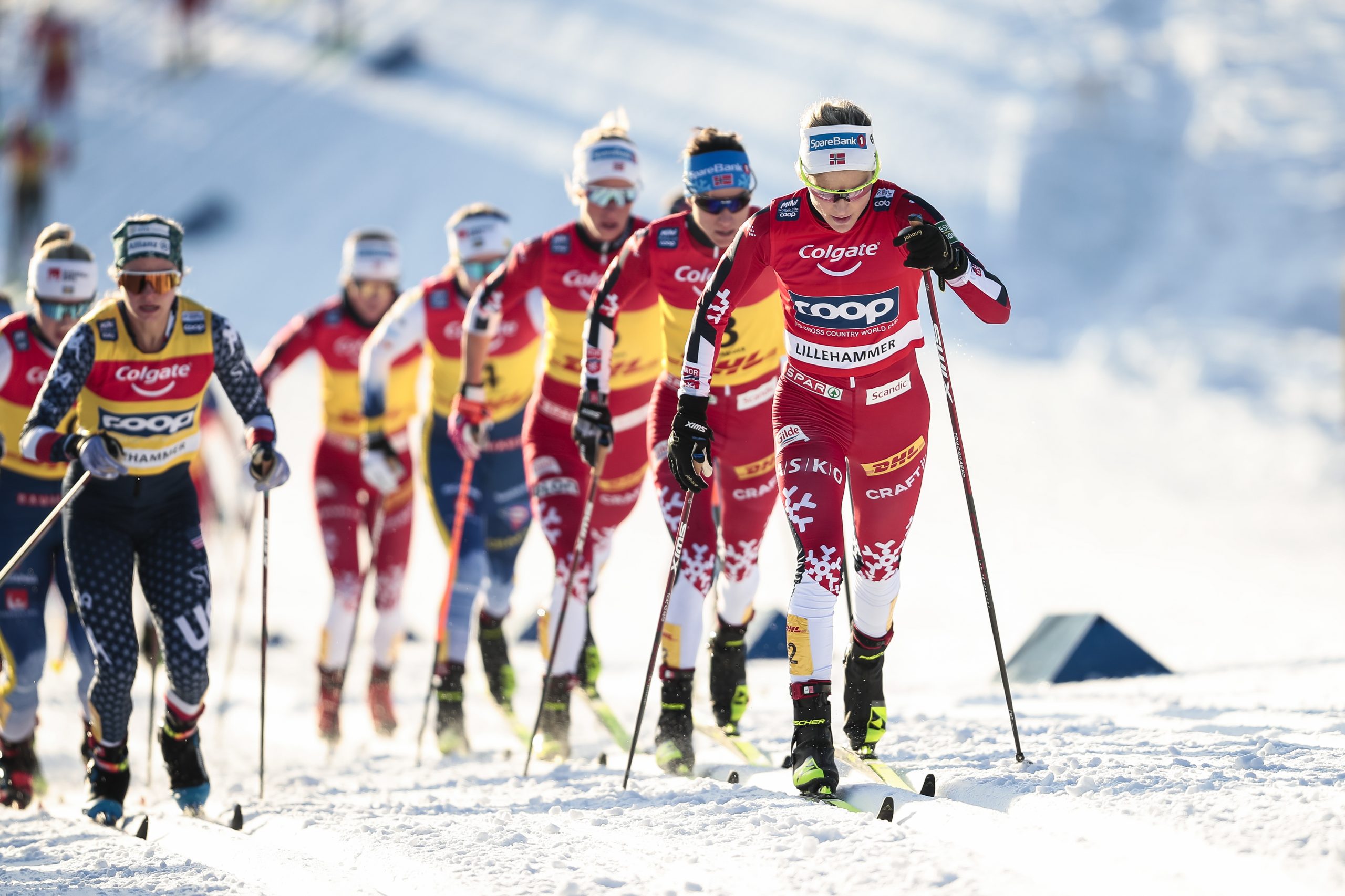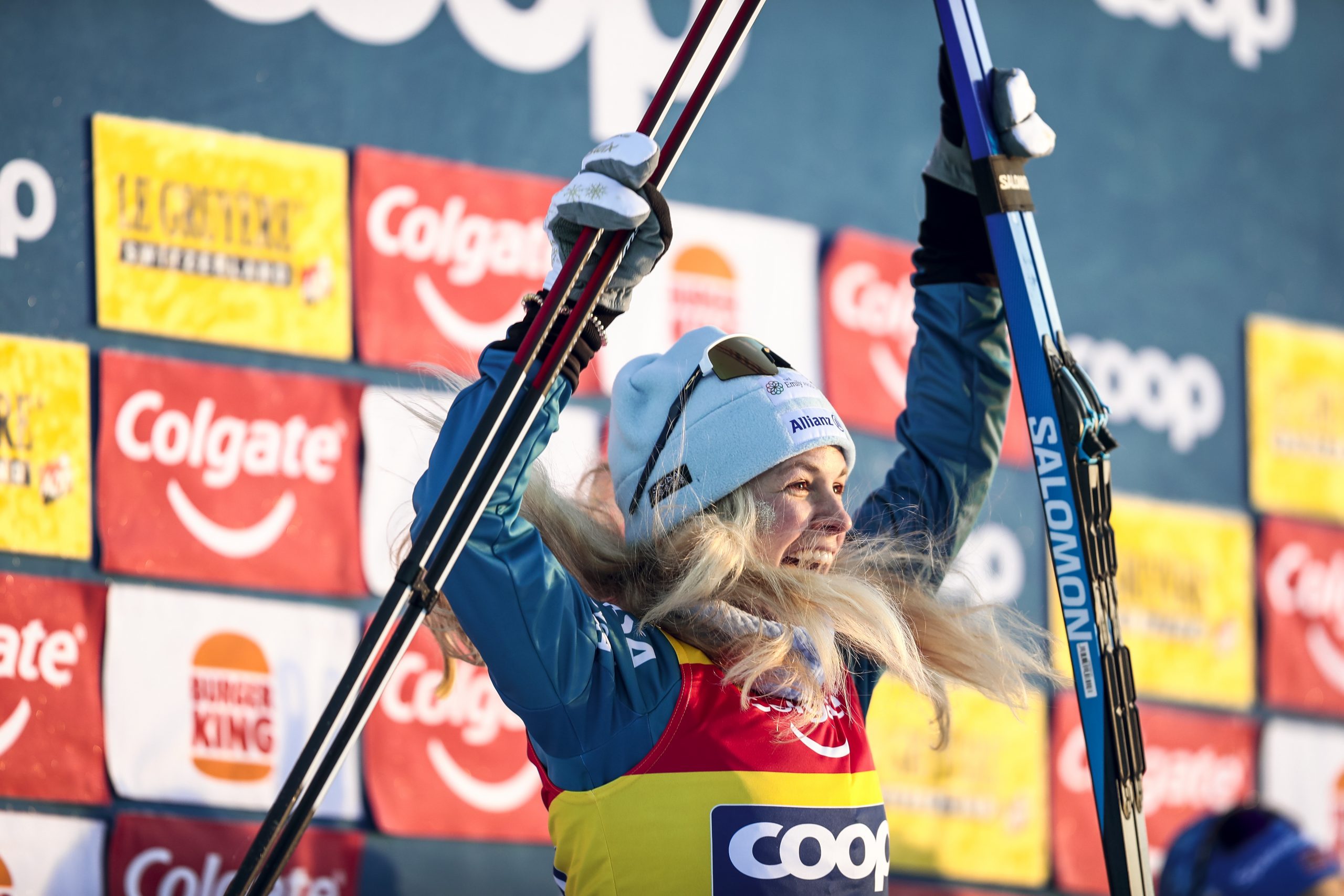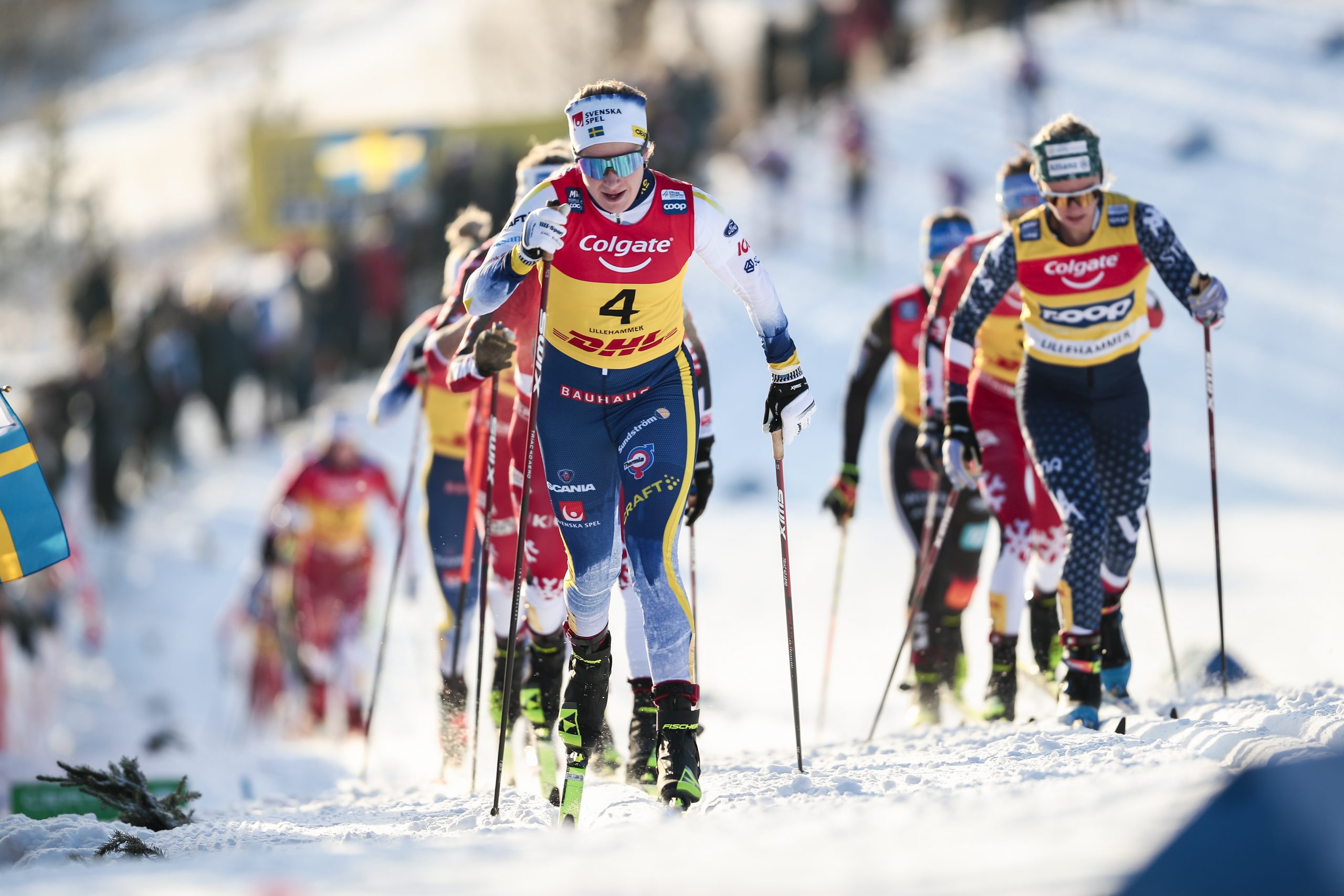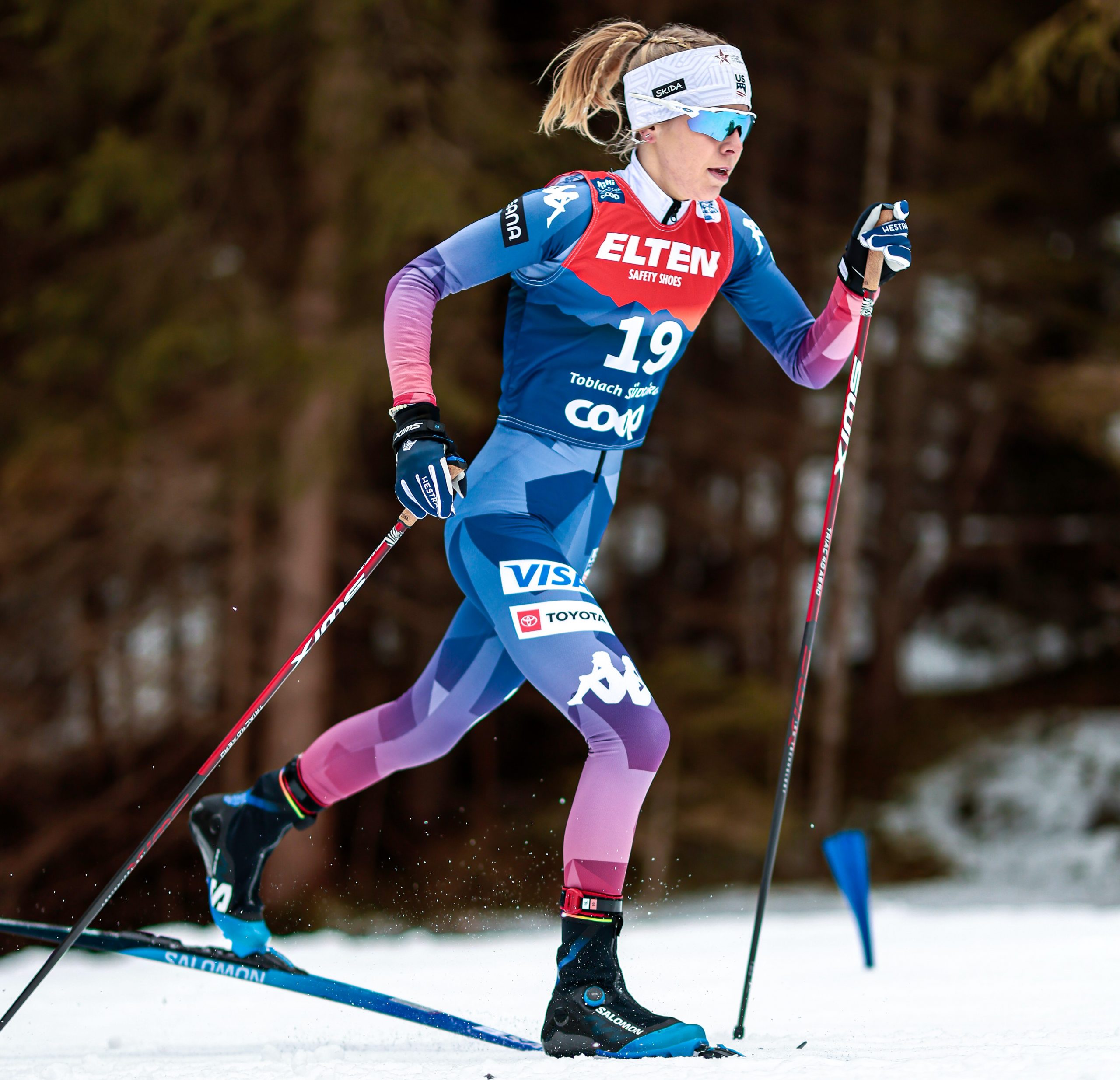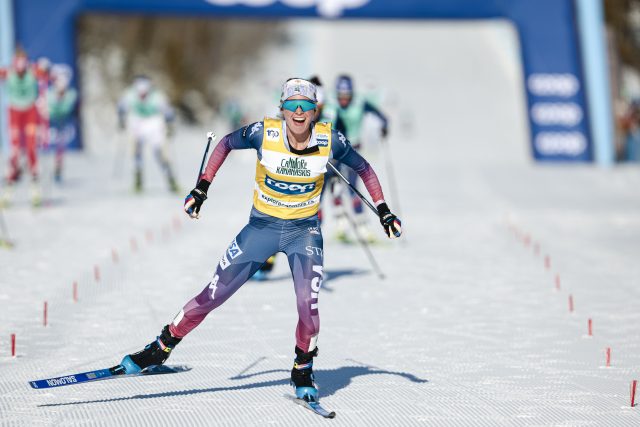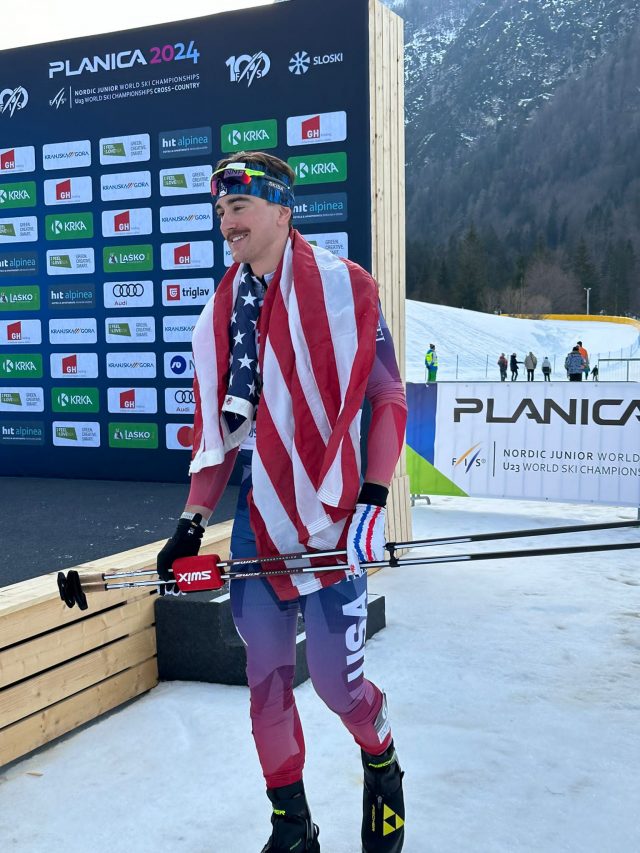
Tag: Sophia Laukli

  • A Side Quest to Broken Arrow Put Kendall Kramer on Another Team USA

    A Side Quest to Broken Arrow Put Kendall Kramer on Another Team USA

    This article was made possible through the generous support of our voluntary subscribers. If you value coverage like this, please support FasterSkier with a voluntary subscription.

    Cross-country skiers rarely travel light. For the Broken Arrow Skyrace, however, Kendall Kramer’s entire racing kit amounted to one pair of shoes and one outfit, both tucked into a carry-on. But after a winter ruled by equipment and logistics, simplicity was part of the point.

    The self-funded trip to California with her mother was supposed to be, in Kramer’s words, “a fun little side quest.” She had watched Jessie Diggins race at Broken Arrow in previous summers and submitted an elite application in February, when the event was already sold out. If the organizers accepted her, Kramer decided, she would take it as a sign to go. They did, and four months later the side quest sent her home with a place on another U.S. national team.

    Kramer completed the June 19 Ascent in 48 minutes, 14 seconds, finishing 11th among women in an international field and fourth in the separate USATF Uphill Mountain Running Championships. The latter result earned the 2026 Olympian one of four women’s spots on the U.S. team headed to the World Mountain Running Association (WMRA) World Cup Finale in Quebec this October.
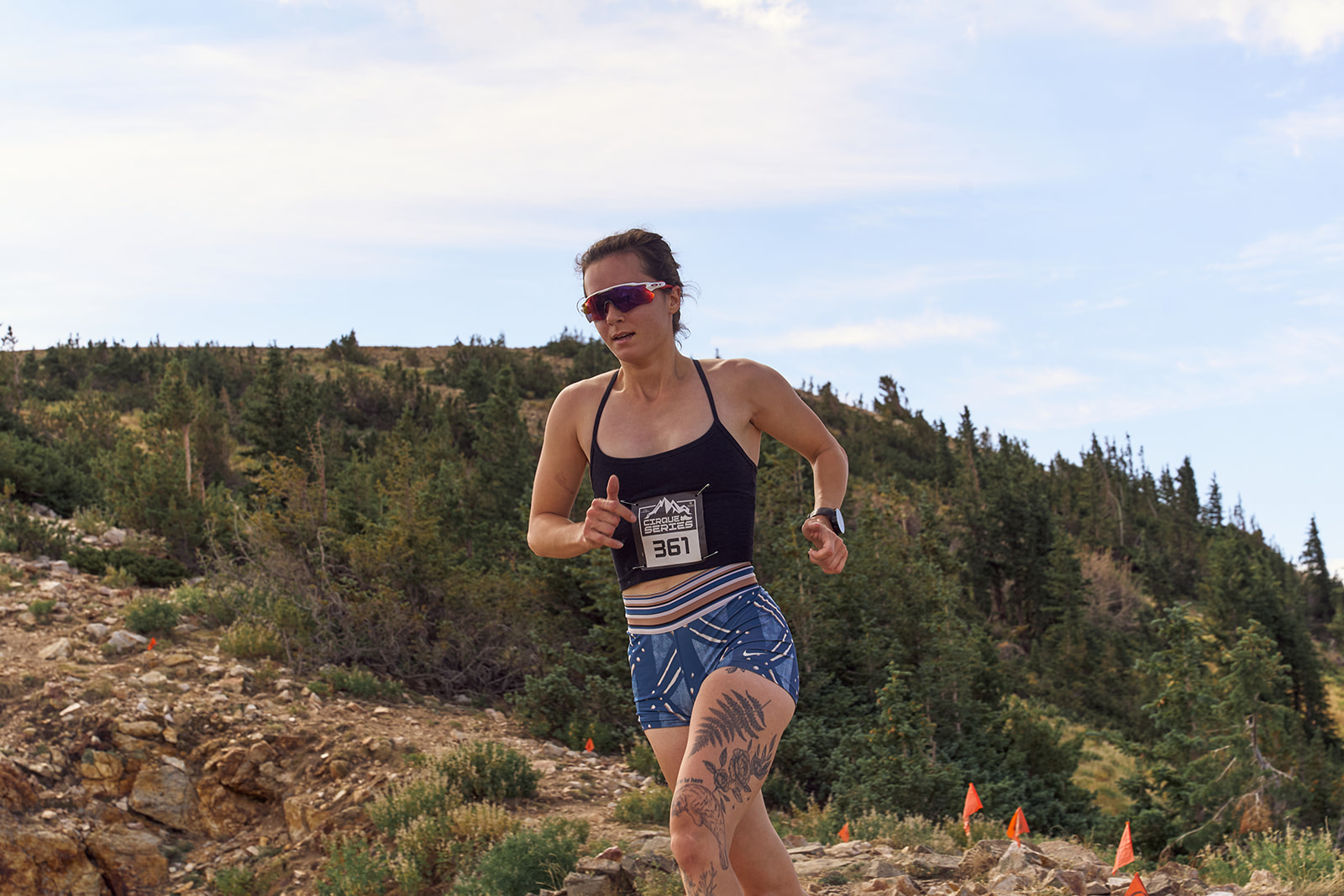
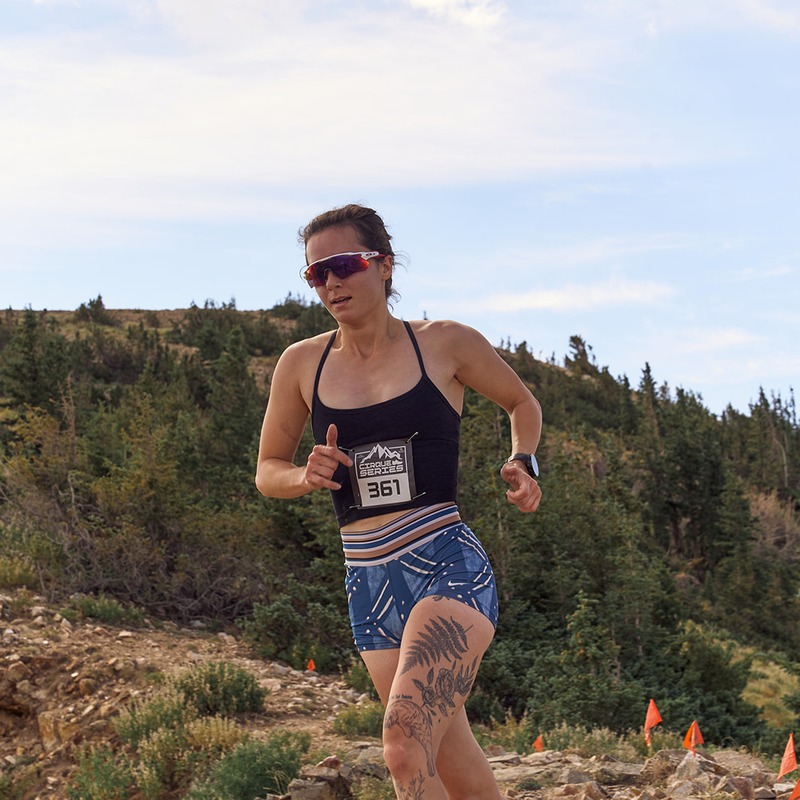
    Kendall Kramer running uphill on a rocky mountain course wearing race bib 361.
    Kramer climbing at the Cirque Series race at Alta, Utah, in 2025. Summer mountain races have been part of her calendar for years. (Photo: Austin Elliott Photography)

    A Race Within the Race

    The Broken Arrow Ascent rises 2,840 feet over 3.61 miles at Palisades Tahoe, ending near 9,000 feet on Washeshu Peak. The course offered Kramer a familiar kind of discomfort. Skiers spend plenty of summer training sessions running uphill, and she has raced mountains throughout her life in Alaska. She was also drawn to an uphill-only event, where she could attack the climb without risking the pounding, falls and injuries that can accompany a technical descent.

    The altitude complicated the effort. An ascent race can feel like a sprint, Kramer said, because its short length allows runners to push rather than settle into prolonged power hiking. Near 9,000 feet, that approach requires more restraint. Still, years of ski racing and training at elevation gave her a sense of how to manage those obstacles.

    Kramer had entered with a tangible goal: finish in the top 10 and earn prize money. The field was strong enough that doing so, she felt, would also establish her among other serious mountain runners.

    She started picking off competitors as the course climbed and found another surge near the end, when a cluster of women remained within reach. Kramer lost track of her exact position amid the passes but knew she was close. She crossed two seconds behind 10th place.

    “I was like, ‘Oh darn,’” Kramer said. “At least it was a good effort race.”

    Weeks earlier, the elite runners had been told that the Ascent would double as the USATF uphill championship and a qualifier for the World Cup Finale. Kramer bought a USATF membership and entered that competition, too, mostly because there was no reason not to. She skimmed the qualification information without giving it much thought.

    “This field is crazy,” she remembered thinking. “That’s not really going to be me.”

    After the race, Kramer and her mother began walking from the summit toward the tram. She checked the overall results first. Then she noticed a separate view for the USATF championship, which removed athletes who were not entered in the national race. Kramer had nearly forgotten about the competition within the competition.

    Her name was listed in fourth, and the top four qualified.

    “I totally didn’t factor myself into that,” Kramer said. “It was definitely a surprise. I was really proud that I could make a team like that.”

    Kramer may not have expected the qualification, but it drew on years spent building the aerobic engine and uphill strength that mountain racing rewards. She simply had not imagined that an ability maintained partly for balance and enjoyment would carry her onto another international team.

    A young Kendall Kramer running a road race alongside an adult runner wearing a race bib.
    Kramer came to athletics through running before she found skiing. Both of her parents are runners. (Courtesy photo)

    A Runner First

    Running has never felt like a secondary sport to Kramer, even as skiing became her profession.

    “Running was always my main sport, in the sense that that’s what I got into when I got into athletics,” she said.

    Both of her parents are runners, and running shaped the athletic culture of her family in Fairbanks. She tried soccer and baseball, but she liked the directness of a sport in which her work and her result felt closely connected. Skiing came later because, as she put it, it was “what all the cool kids did.”

    The two sports eventually became inseparable. At the University of Alaska Fairbanks, Kramer competed in both throughout college. She won three straight Great Northwest Athletic Conference cross-country titles and finished second at the 2024 NCAA Division II Cross-Country Championships. Four months later, in the final ski race of her collegiate career, she won the 20-kilometer freestyle at the NCAA Skiing Championships.

    Kramer’s skiing has since reached a new level. She made her Olympic debut in Italy in February and placed ninth in the World Cup skiathlon in Falun in March, her first top-10 World Cup result. Yet running still supplies something that skiing cannot.

    “If I didn’t have it, I wouldn’t be able to handle all of the skiing that I do,” Kramer said. “I like feeling like I have another athletic outlet to keep me happy, because skiing can be fleeting and have all sorts of disappointments with equipment and stuff. Running feels more in control.”

    That control is physical, but it is also logistical. A ski race can hinge on wax, snow, weather and the work of moving equipment from one place to another. Running asks much less before the gun goes off. On a running trip, Kramer said, there is more space to enjoy the people and the place around the competition.

    “It feels like it adds to your life,” she said. “It’s so manageable.”

    The harder question came when her college cross-country career ended. Kramer loved the sport’s courses, team culture and changing terrain, but there is no obvious post-collegiate version of NCAA cross-country. Track and road racing did not offer the same pull, and she was not ready to build her running life around marathons on pavement.

    Mountain racing offered another route. In Alaska, it had never felt like a separate niche so much as part of the local calendar. Races such as Mount Marathon and the Cirque Series became summer traditions, with familiar faces returning to familiar mountains each year. Two weeks after Broken Arrow, Kramer placed seventh at Mount Marathon in 52:53.

    “I loved running cross-country and being in the woods and going along a course that has different aspects,” Kramer said. “You have an uphill and downhill, and you have to change, just like skiing.”

    Mountain racing preserved the parts of running Kramer loved and opened a path to international competition she never expected to enter.

    Kendall Kramer racing the World Cup skiathlon at Falun, Sweden.
    Kramer on her way to a career-best ninth in the World Cup skiathlon in Falun, Sweden, in March. She argues that summer racing is part of what makes winter results like that possible. (Photo: Authamayou/NordicFocus)

    Keeping a Pulse on Racing

    For Kramer, racing in the summer is not a diversion from ski training. It is one of the ways she makes that training more useful.

    An occasional race does interrupt a perfectly planned week. She may back off for a few days beforehand, then need time to recover afterward. Some skiers see that as lost volume. Kramer believes the costs are outweighed by the chance to revisit sensations that ordinary training cannot reproduce.

    “Racing is very different from training,” she said. “At least I think so, and I think it should be different from training.”

    Kramer likes to race roughly once a month during the offseason. Each start provides a checkpoint on her fitness, pacing and ability to summon focus when a result matters. Those reminders make the first ski races of winter feel less abrupt; she arrives with recent evidence of how her body and mind respond in competition.

    Races also make weaknesses harder to ignore. A disappointing moment can become the direction for the next training block rather than a problem discovered after the ski season begins.

    “Sometimes you don’t get an idea of where you’re lacking and where your strengths are if you don’t tap into that throughout the summer,” Kramer said.

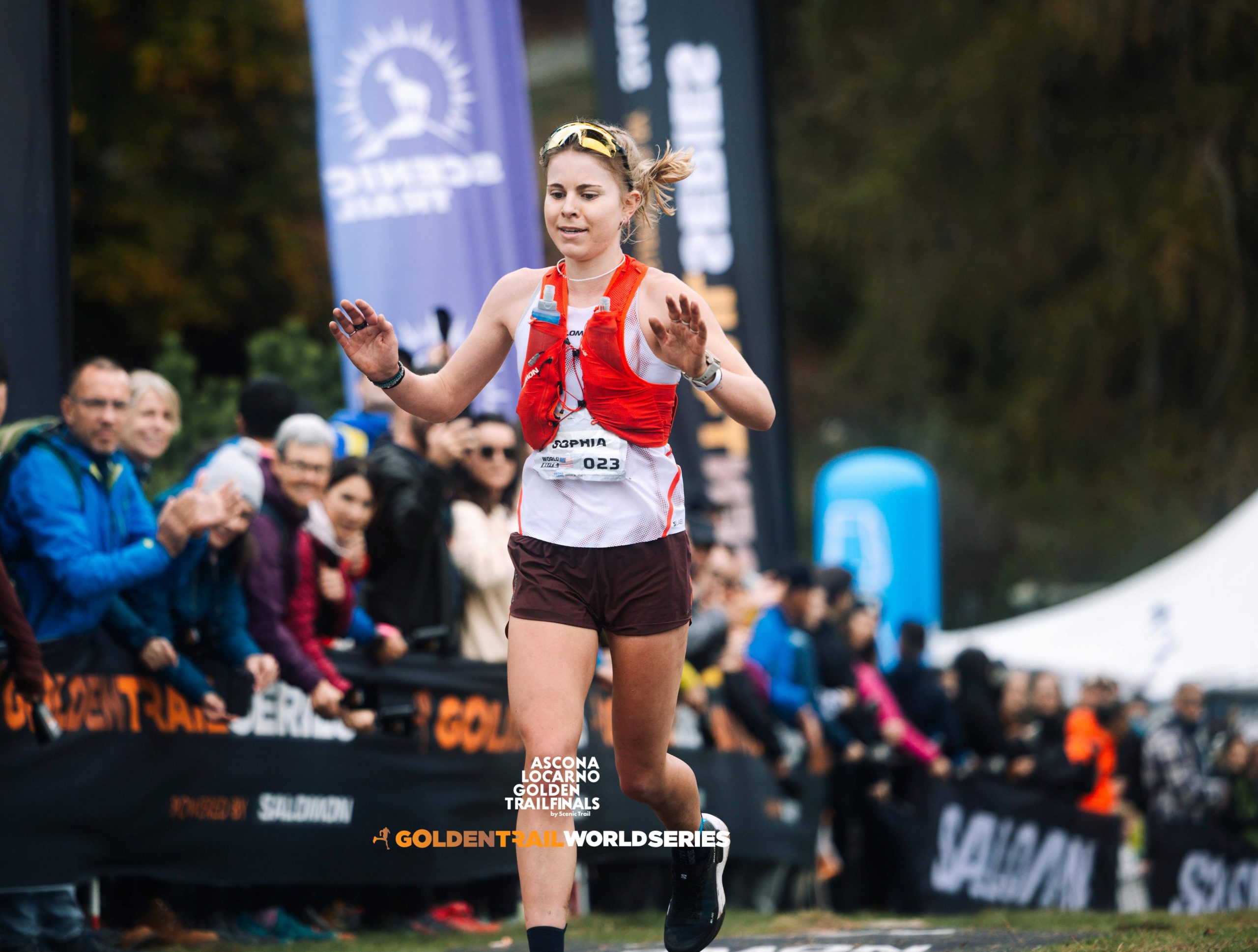
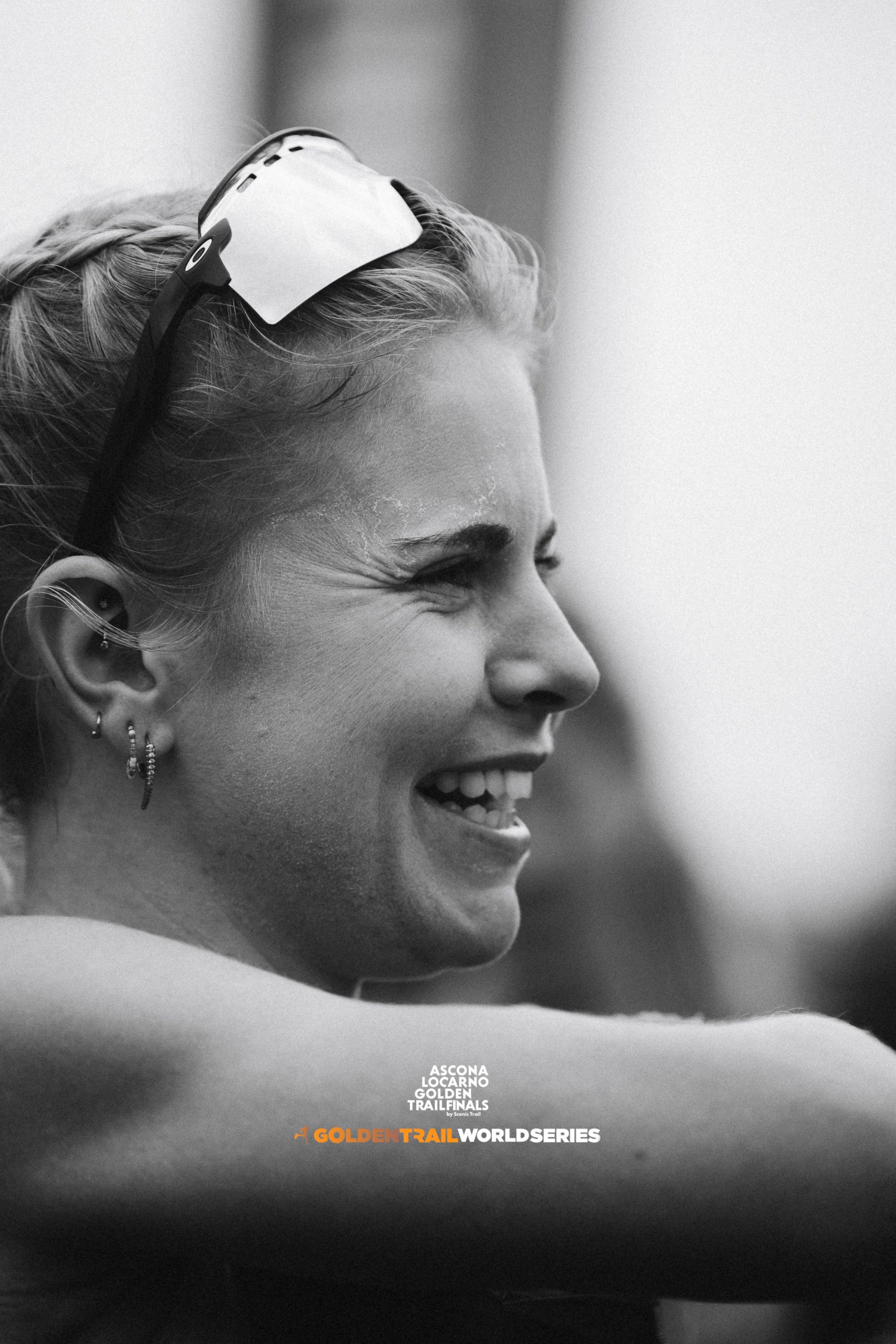
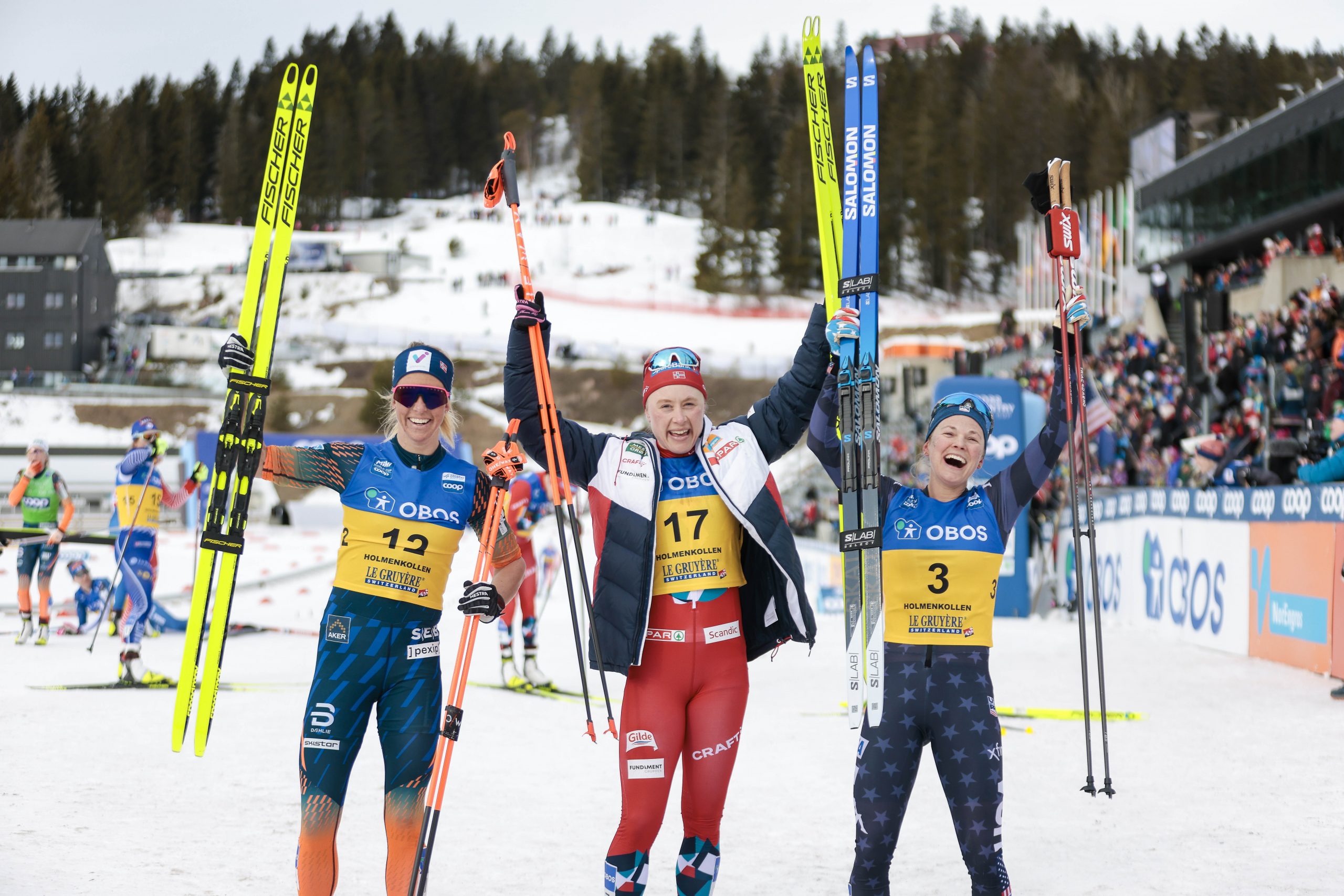
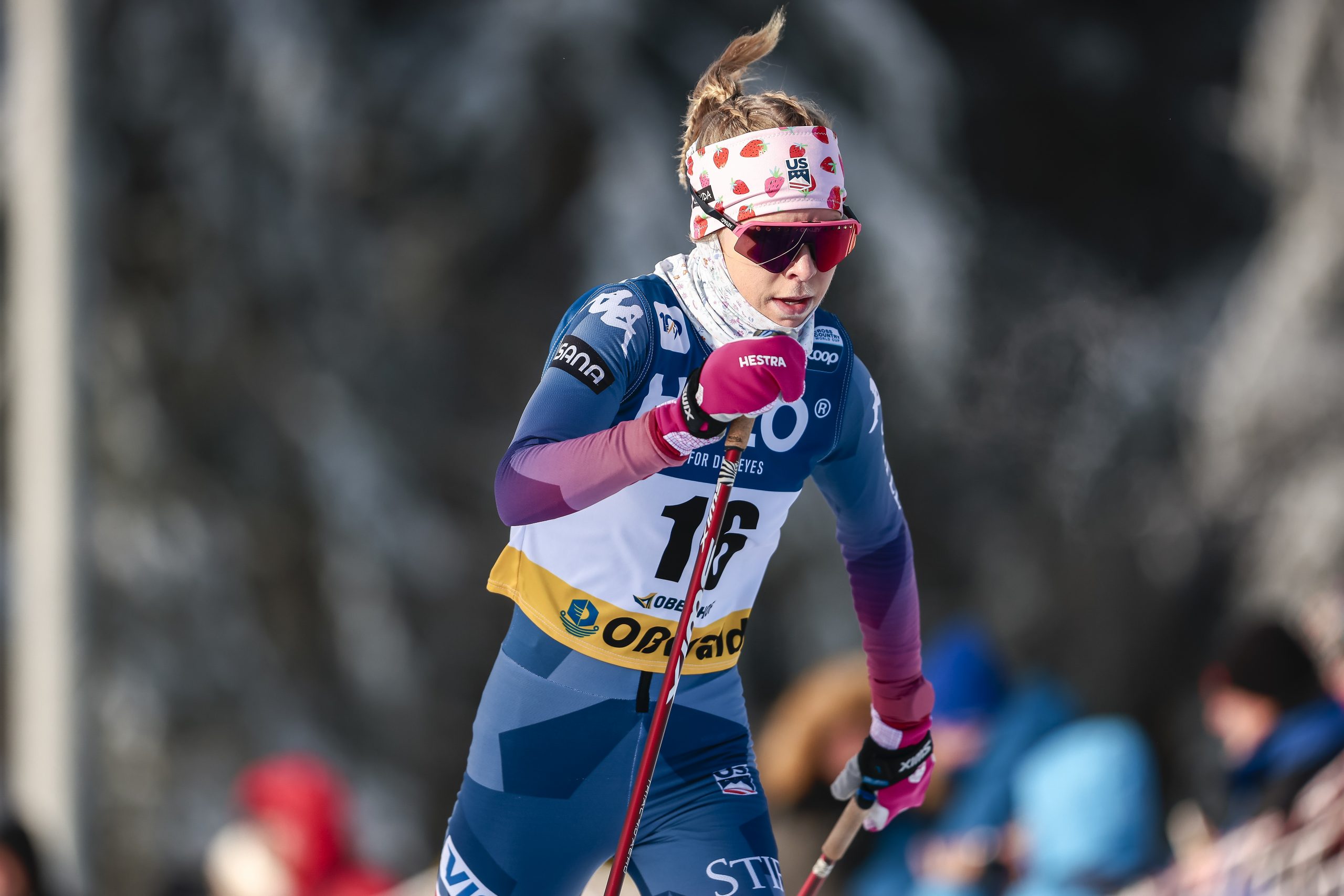
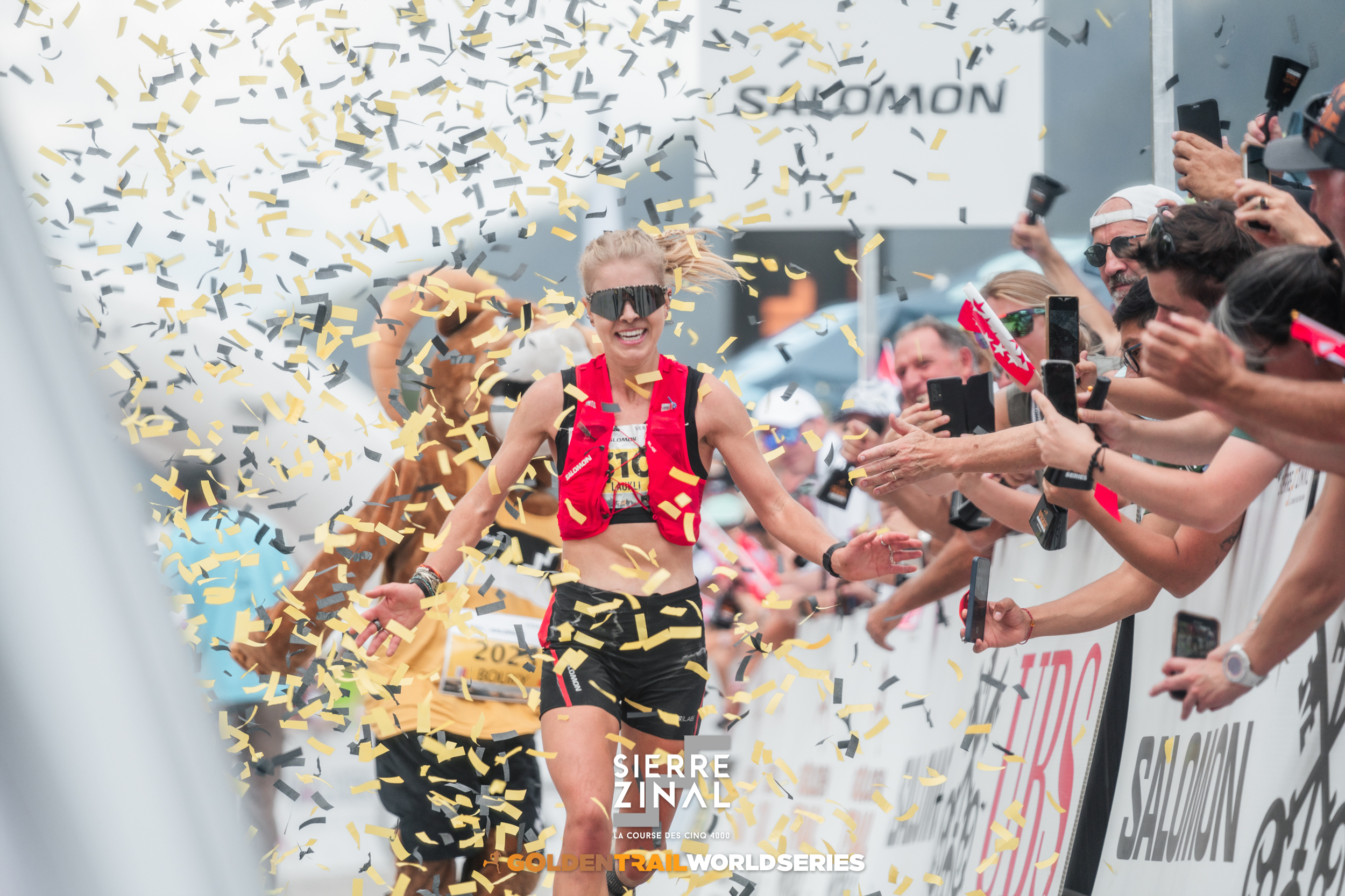
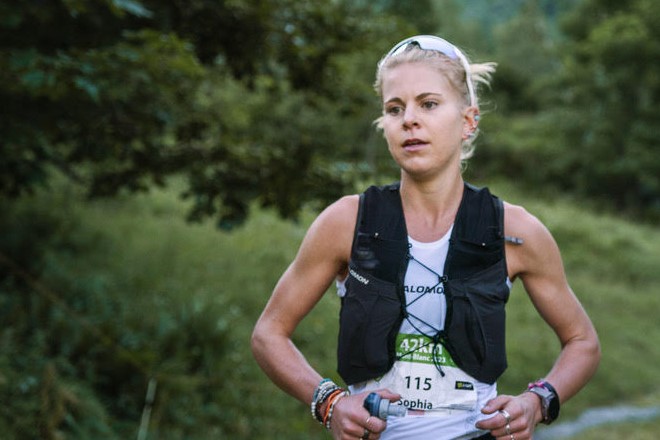
    At Broken Arrow, the crossover was all around her. Olympic ski mountaineer Anna Gibson won the Ascent and the U.S. uphill title in 43:15. Diggins completed all three races, a total of 75 kilometers with more than 16,000 feet of climbing, and finished fourth in the Triple Crown standings. Sophia Laukli has built an elite trail-running career alongside cross-country skiing, winning the 2023 Golden Trail World Series. In August, Gibson placed sixth among women at Switzerland’s Sierre-Zinal, while the recently retired Diggins finished 37th.

    Those examples helped Kramer recognize that mountain running can be more than incidental cross-training. The sport has international races, sponsors and prize money, particularly in Europe. Its U.S. elite pool remains relatively small, and a skier who already possesses a strong aerobic base can become competitive quickly. That does not make the crossover effortless.

    “I’m not going to act like I’m couch-to-mountain-running,” she said. “I’m definitely trying, and I’m also not downplaying the girls who do train for it. But I am saying that ski training works for it, and getting fit in general works for it.”

    The larger benefit may be less measurable than fitness. Elite skiers live by periodized plans: intervals on one day, over-distance training on another, each block designed to build toward winter. Kramer believes athletes can become so protective of that structure that they miss the value of occasionally disrupting it.

    “People are really scared to break away from that,” she said. “But I think you can be a really adaptable athlete and build skills that a regimented training plan can never get you.”

    Her confidence in that approach has been earned over years of combining running and skiing without sacrificing results in either. That history has also built trust with her coaches. An unplanned race or an imperfect training week does not look like recklessness when the larger pattern shows that she understands how to make the two sports work together.

    The mental return matters as much as the physiological one. A summer race provides the competitive charge that long weeks of training can lack and asks an athlete to solve problems in real time: exactly what winter racing eventually demands.

    Kendall Kramer in a running vest above an alpine lake in the Alaska mountains.
    Kramer on a run in the Alaska mountains. Her next start comes Oct. 10 at Mont-Sainte-Anne in Quebec. (Courtesy photo)

    The Next Side Quest

    Kramer’s next test comes Oct. 10 at Mont-Sainte-Anne in Quebec, where the circuit will make its first visit to Canada. The current course listing calls for five kilometers and roughly 800 meters of climbing. It will begin far below the altitude Kramer encountered at Broken Arrow, removing one variable while preserving a steep uphill challenge.

    She wants to finish in the top 10. Broken Arrow showed that she can stay close to that range in a deep international field, and the chance to race without a near-9,000-foot finish has left her curious about what more she can do.

    Beyond Quebec, Kramer would consider mountain races in Europe if a sponsor or U.S. team opportunity made the travel possible. She is not mapping out a second full professional calendar yet. The appeal lies partly in leaving room for opportunities to appear, then being fit and adaptable enough to take them.

    “I would love to look back and see that I took those opportunities,” Kramer said. “Running has never hurt me in the past. I’ve always been able to juggle both.”

    Kramer does not argue that every skier should copy her schedule. She wants more athletes to leave room for the experiences that may not fit perfectly into a training plan but help them handle everything racing asks of them.

    “It can make you a better skier in ways that maybe aren’t the best training on paper,” Kramer said. “But it makes you a good athlete, which comes in handy when you least expect it.”

    At Broken Arrow, that lesson was waiting in a second set of results she had nearly forgotten to check.

    Help Support Our Coverage!

    If you value the thoughtful work and access FasterSkier provides, please consider becoming a Voluntary Subscriber. Your support directly fuels our work to cover the people, places, and moments that make our sport special.

    Join the FasterSkier community!


    Kendall Kramer racing cross-country in an Alaska Fairbanks singlet, number 24, past a course flag line.
    Kramer racing cross-country for Alaska Fairbanks. She won three straight GNAC titles and finished second at the 2024 NCAA Division II championships. (Courtesy photo)
  • Ruka Launches an Olympic Winter: Karlsson Victorious, Diggins Fifth in 10k Classic Opener

    Ruka Launches an Olympic Winter: Karlsson Victorious, Diggins Fifth in 10k Classic Opener

    This coverage is made possible through the generous support of Marty and Kathy Hall and A Hall Mark of Excellence Award. To learn more about A Hall Mark of Excellence Award, or to learn how you can support FasterSkier’s coverage, please contact info@fasterskier.com.

    Okay, who else didn’t sleep last night? It felt like waiting for Santa Claus on Christmas Eve — that fizzy, restless anticipation you can’t shake, even as an adult who should know better. Part of it was simply the joy of finally watching World Cup racing again after eight long months. But more than that, this morning in Ruka felt like the beginning of something bigger: the start of the Olympic year, the opening chapter of a season that will define so many careers, answer so many questions, and launch a web of storylines that will stretch from today all the way to Milano-Cortina.

    This year, the stakes are different. For veterans, it’s legacy. For rising athletes, it’s opportunity. For everyone, it’s a race against time.

    And for those of us who follow this sport as if it were a second bloodstream, the first race in Ruka is the moment winter starts breathing again.

    Frida Karlsson (SWE) poses with Mr. and Mrs. Claus following the 10k Classic in Ruka (FIN). (Photo: Modica/NordicFocus)

    Before the Gun: What Was at Stake

    Even before the racers hit the snow, there were subplots everywhere.

    Norway opened the season in a moment of transition. Therese Johaug — retired again and pregnant with her second child — leaves a vacuum on the women’s team that hasn’t existed in over a decade. Who leads now? Is Heidi Weng’s late-career renaissance real? Is this the year Norway’s depth must finally be enough?

    Sweden, meanwhile, enters the Olympic season with the most complete women’s distance squad on earth. Their classic technique is crisp, balanced, efficient — a signature advantage on days like this.

    Finland carries the emotional core of the weekend. Krista Pärmäkoski, racing her final season, took her last opening-day start in Ruka on home snow. Kerttu Niskanen, always a threat in classic, lined up ready to test herself in front of the home crowd.

    And for the United States, the arcs were wide-ranging:

    • Jessie Diggins begins the final season of her career.
    • Rosie Brennan enters winter in deeply untraditional circumstances after an Epstein-Barr reactivation.
    • Julia Kern arrives healthier and steadier than in years.
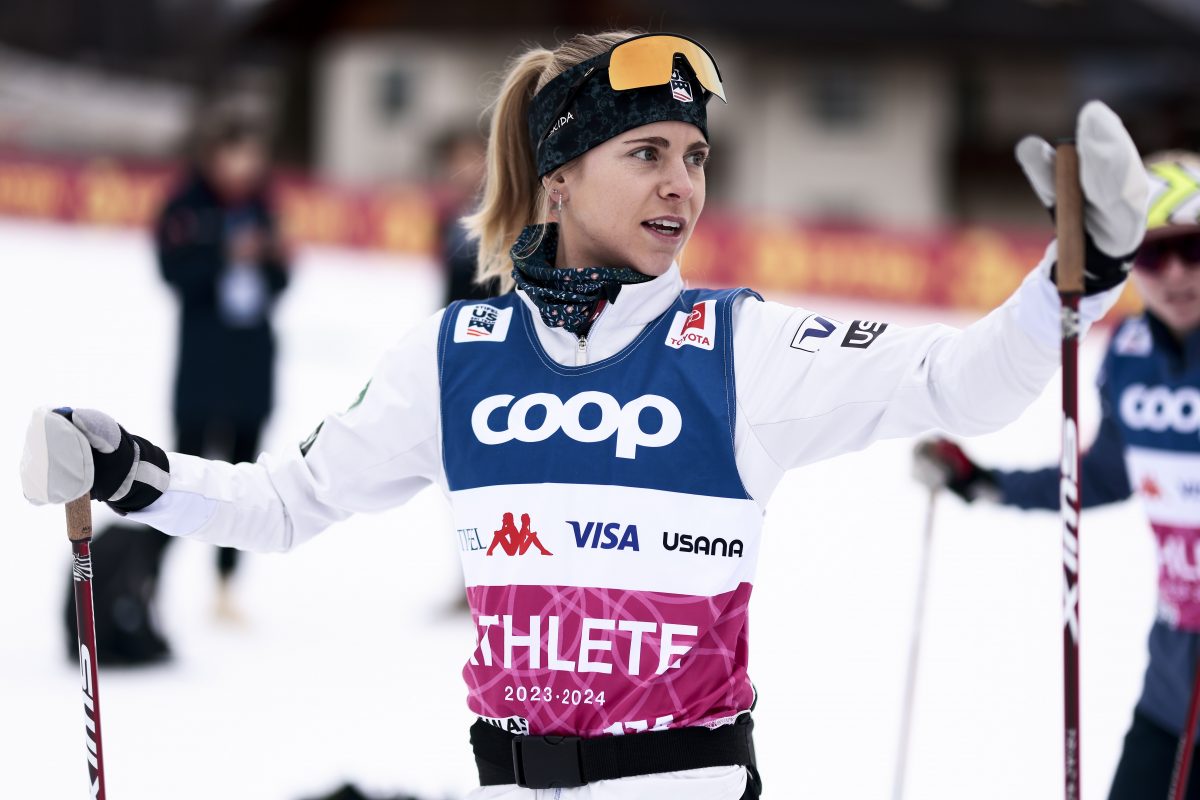
    • Sophia Laukli brings a redesigned training life out of Norway.
    • And three additional American women (Kate Oldham, Kendall Kramer, and Alayna Sonnesyn) who begin the short, intense race for Olympic qualification.
    Alayna Sonnesyn (USA) lunges for the line at the end of the 10k Classic in Ruka (FIN). (Photo: Modica/NordicFocus)

    A Day Shaped Before It Started: New Snow, Glazing Tracks, and Wax Tech Calculus

    Ruka had been bitterly cold in recent weeks — until a foot of new snow fell and temperatures climbed toward freezing. The result was a wax technician’s nightmare: soft snow in the shade, glazing climbs in the sun, and a classic course twisting through varying microclimates.

    Kick wax that worked at the start failed on the climbs. Skis that kicked well on the climbs dragged on the flats. Double-pole sections demanded freedom; the final climbs demanded grip. There was no perfect answer — only compromise and risk.

    This race was always going to reward the skiers with the best technical balance and the wax techs bold enough to choose the right kind ofwrong.”

    Moa Ilar (SWE) charges down the finishing stretch at the end of the 10k Classic in Ruka (FIN). (Photo: Modica/NordicFocus)

    The Race: Karlsson Sets the Standard, Weng Returns, Ilar Rises, Diggins Surges

    1.1 km — Jessie Diggins Takes the First Lead of the Season

    From the moment the race began, the tone was unmistakable.

    With bib #1 Julie Bjervig Drivenes setting the baseline, Jessie Diggins blasted through the first checkpoint with the early lead — 1.3 seconds ahead of Frida Karlsson.

    It was classic Diggins: joyful, aggressive, fearless.

    3.3 km — Karlsson’s Stride Takes Control

    By 3.3 km, the race reshaped itself. Frida Karlsson, with her strong hip stability and long, economical stride, surged into the lead on the climbing sections. Diggins, whose double-poling and downhill flow looked excellent, lost time on the steepest pitches and slid to seventh.

    Behind Karlsson, Sweden formed a front of precision:

    • Moa Ilar at +3.0
    • Ebba Andersson at +5.1
    • Three Swedes in the top three splits.

    A message, delivered early.

    6.1 km — Heidi Weng Charges Back Into the Story

    Heidi Weng, skiing 30 seconds behind Diggins, mounted the late charge of the day. She began cutting into Karlsson’s lead — from 14 seconds at 6.1 km to only 10.5 by the line.

    After several up-and-down years, Weng signaled something unmistakable: she’s not done yet.

    Final Kilometers — Diggins Closes Hard, Ilar and Andersson Duel, Fosnæs Threatens

    Jessie Diggins mounted her own push on the flats and downhills, gaining time between 6.1 and 8.1 km. She crossed the line in a time that held the top spot until the final seeded skiers, ultimately placing fifth — one of her strongest classic results ever on this course.

    Moa Ilar executed a poised final push, taking third and bumping Andersson to fourth. Kristin Austgulen Fosnæs threatened Diggins’ time but ultimately finished behind her in sixth.

    Jessie Diggins (USA) was all smiles after the 10k Classic in Ruka (FIN). (Photo: Modica/NordicFocus)

    Jessie Diggins: Racing the First Day of Her Last Season

    As Diggins enters the last year of her storied career, her goals have nothing to do with podiums.

    “My goals are really not about race results at all,” she said. “My goals for the season are to be happy and healthy and just in the present moment… just really soaking in the moment and the feeling of, like, wow, I get to do this.”

    She brought that joy directly into today’s start.

    “I just wanted to go hard and use this race to get the season started.”

    And yet, the question remains: when Diggins puts on a bib, does instinct overtake the plan?

    “I do like to push myself to the max whenever I race — maybe not 100% where I’m scraped off the snow, but really darn close,” she said.

    “It’s part of my training plan with Cork — we use early season races to build sharpness.”

    On a tricky waxing day, Diggins was clear-eyed about the team effort.

    “I was really happy with my skis… a great mix of just enough kick but also really free. We needed the skis to be fast in the double-poling, and knowing I was going to herringbone the climbs anyway, we went for that in-between.”

    For Diggins, this wasn’t just a top-five finish. It was a signal: the last season of her career may feature some of her best classic skiing.

    Rosie Brennan (USA) with her signature long stride during the 10k Classic in Ruka (FIN). (Photo: Modica/NordicFocus)

    Rosie Brennan: “This Is Uncharted Territory”

    Rosie Brennan entered the winter with one of the most unconventional lead-ups of her career — a necessity after an Epstein-Barr reactivation forced her into weeks ofmicro-intervalsand tightly controlled volume.

    Her return to full-distance racing revealed both progress and uncertainty.

    “If I’m honest, I had a little higher expectations for myself today, so I’m feeling a bit mixed about it,” she said.

    “There were some moments of skiing I was really happy with and some that left me wanting more.”

    The hardest part, she explained, has been adapting to Europe — travel, fatigue, recovery — with a body that no longer responds as it used to.

    “It’s been a really hard adaptation to Europe with a body that isn’t as resilient as I’m accustomed to… this is uncharted territory for me, and I just don’t know what will happen.”

    Still, she holds hope — and patience.

    “I have to keep trying and experimenting and figure out what will work for me this winter. I’m sure there will be a lot of ups and downs in the process.”

    For Brennan, today wasn’t a verdict — it was the next step in a complicated, courageous return.

    Ebba Andersson (SWE), Julia Kern (USA), (l-r) push up the climb in Ruka (FIN). (Photo: Modica/NordicFocus)

    Julia Kern: A Personal Best Hidden Behind the Result Sheet

    Julia Kern’s final ranking might not have turned heads on the results page, but the performance meant far more than the number beside her name. For Kern — often a slow starter in Ruka — today marked meaningful progress.

    “Actually, I’m proud of my race today,” she said. “If you just look at the result… You would think I’d be quite dissatisfied, but this was a personal best for me in the opening Ruka 10km.”

    The opener in Ruka has long been one of the toughest venues for her, a course whose steep climbs, cold temps, and early-season timing rarely align with her strengths.

    “This was my eighth time doing this race, and the result has never been great or representative of other races later in the season,” Kern explained. “I was proud of having moments out there where I skied with good technique, and my body had good energy.”

    Her long-term confidence remains intact — today was a step, not a verdict.

    “Of course, I want to climb higher in the results list, but my result today doesn’t worry me,” she said. “I use this race to race myself into shape and wake up the body for the sprint tomorrow and the rest of the season.”

    Like many in the field, she dealt with some of the day’s most fickle challenges: a mix of new snow, fog, drizzle, and instant glazing that made finding kick nearly impossible.

    “It was on and off snowing/light fog or drizzle… a classic Ruka day where the tracks seem to glaze in an instant,” she said. “The glaze made it really challenging to kick from the start, and even harder in the second lap.”

    But where the climbs demanded compromises, the flats rewarded her strengths.

    “Otherwise the conditions felt fast on the downs and flats,” Kern added, “and I felt strong on the flatter terrain today.”

    Kern leaves day one not discouraged, but energized — a skier who knows this course never tells the whole story and who trusts what today’s moments of good skiing suggest about what’s ahead.

    Heidi Weng (NOR), Frida Karlsson (SWE), Moa Ilar (SWE), (l-r) share the podium of the 10k Classic in Ruka (FIN). (Photo: Modica/NordicFocus)

    The Podium: Sweden Opens the Olympic Year With Authority

    The final standings reflected both power and depth:

    1. Frida Karlsson (SWE) 23:31.8
    2. Heidi Weng (NOR) +10.5
    3. Moa Ilar (SWE) +18.3
    4. Ebba Andersson (SWE) +21.2
    5. Jessie Diggins (USA) +27.6
    6. Kristin Austgulen Fosnæs (NOR) 37.2

    Sweden finished with three in the top four. Karlsson earned her 16th career victory; Weng her 139th career podium; Ilar her 9th.

    On the Finnish side, Krista Pärmäkoski delivered a valiant final Ruka classic performance. Kerttu Niskanen, traditionally a force here, struggled to find her usual early-season spark.

    And for the Americans, the opener delivered clarity: Diggins strong, Brennan resilient, the younger athletes gaining essential early-season data for Olympic qualification.

    The 10k Classic podium with Heidi Weng (NOR), Frida Karlsson (SWE), Moa Ilar (SWE), (l-r) in Ruka (FIN). (Photo: Modica/NordicFocus)

    What It All Means

    Today’s 10k classic didn’t answer every question — but it answered enough to shape the early contours of an Olympic year:

    • Sweden has the momentum.
    • Norway has a leader again.
    • Finland is beginning a farewell tour.
    • The U.S. has real reasons for belief — and real reasons for patience.
    • The waxing cabins will decide as much as the athletes.
    • The Olympic shadow looms over every split, every selection, every training day.

    And for those of us lying awake the night before the opener, waiting for winter like children waiting for Christmas — the season is here again.

    It begins in Ruka, with a direct path to the Olympics in Italy, and ends in Lake Placid.

    And today was the first chapter.

    Complete Results:  Women’s 10k Classic


    Love Stories Like This? Help Keep Them Coming.

    Feature interviews like this one take time, access, and care to produce. If you value thoughtful storytelling and independent ski journalism, please consider becoming a Voluntary Subscriber. Your support directly fuels the work we do to cover the people, places, and moments that make our sport special.

    Join the FasterSkier community!


    Frida Karlsson (SWE) looked pretty comfortable in the reindeer pelt-covered leaders chair following the 10k Classic in Ruka (FIN). (Photo: Modica/NordicFocus)
  • The Norwegian Experiment: Sophia Laukli’s Back-to-Basics Reboot

    The Norwegian Experiment: Sophia Laukli’s Back-to-Basics Reboot

    By the time Sophia Laukli picks up the phone from Lillehammer, it’s raining again.

    “There is, like, a small 1k loop up at Sjusjøen,” she says, “but it’s… yeah, it’s, like, raining every day, so it’s not really great conditions.”

    On paper, Laukli is one of the most intriguing dual-sport athletes in endurance sport: a U.S. Ski Team member and Olympian who has also become a force in international trail running. In person—or over Zoom—she’s thoughtful, understated, and very clear on one thing: the way she trains now, in Norway, looks a lot more boring than the world might imagine.

    You come to Norway expecting secrets, she says. What she found instead was simplicity.

    “They’re so simplistic around ski training,” Laukli explains. “It’s not rocket science. You can do the same… You do essentially the same workouts every single week, all year round.”

    That realization—combined with a crash-and-burn experiment as a full-time runner and a new coaching relationship with her boyfriend, longtime Norwegian pro skier Gjøran Tefre—has quietly reshaped her career.

    As this Olympic season approaches, Laukli’s bet is clear: train like a skier, keep the training simple, stay within herself, and let the results show up in both sports.

    Maine Roots, Late Commitment

    For all the talk about Norway, Laukli’s story really starts in coastal New England.

    “I was actually in the Boston area until I was, like, six or seven,” she says. Then came a year and a half in Norway, and finally Yarmouth, Maine—the place that still feels like home.

    “From my memories and my ski memories, it’s all from Maine.”

    Her father is Norwegian, so skis were always around. Winters meant skiing, family trips to Norway, and a life that looked, from the outside, like an early pipeline to the World Cup. From the inside, it didn’t feel that way at all.

    “It was a very recreational thing,” she says. “I didn’t really enjoy it that much. It was just kind of like, obviously, we’re gonna ski because it’s winter. But I didn’t know anything else.”

    In Maine, her parents weren’t just ski parents—they were essentially the ski people in the community.

    “They were my coaches,” she says. “And very present in the ski world, which was hard for me… A part of me became pretty hesitant towards skiing.”

    She gravitated toward soccer and tennis. Skiing felt obligatory.

    “Up until midway through high school, skiing was kind of just something I did because my family did it,” she says.

    The idea of becoming a professional athlete wasn’t just unrealistic—it was unimaginable.

    “I was gonna just go to school and be a nerd or something,” she says. “Being a professional skier wasn’t even a consideration.”

    Then came the pivot: joining the iconic Yarmouth High School ski team, coached by the legendary Bob Morse.

    “It opened my eyes a lot,” she says. “It wasn’t super competitive, but it showed me the sport that felt forced on me was actually something I liked—and could be really good at if I tried.”

    Looking back, she’s grateful it took so long.

    “I’m super happy I went through that zero-pressure, uncommitted relationship to skiing,” she says. “Today I have so much motivation to be 100% committed… and I’m far from burnt out compared to many skiers who commit when they’re 12.”

    Discovering Running (By Hating It First)

    The other half of her dual-sport identity—trail running—comes from an even stranger origin story.

    “Running was something that I actually hated,” she says, laughing. “I really, really, really did not like to run when I was young.”

    Running in Maine didn’t help.

    “It just wasn’t enjoyable to run there,” she says. “Unless you really liked running on roads and golf courses.”

    She ran cross country her senior year only because the coach wanted her on the roster for states. She ran track for one year and found it “horrible.”

    “It wasn’t until I started training out West in the summers, finding mountains… that I actually enjoyed running.”

    Those Western US trails served as the practice grounds, preparing Laukli for some of the world’s biggest trail races. But first she had to figure out college—and how training would fit around it.

    Sophia Laukli takes the collegiate national title in the 15 k skate in 2022. (Photo: Tobias Albrigtsen / @untraceableg)

    Middlebury to Utah: Building a Life Around Skiing

    Laukli chose Middlebury because, at the time, academics were the top priority.

    “I knew I didn’t want to be done skiing,” she says, “but it wasn’t the priority.”

    Covid changed everything. Remote classes allowed her to chase early World Cup opportunities without living on campus. Once Middlebury required students to return in person, the timing coincided with the rapid ascent of her ski career.

    That led to a transfer to the University of Utah.

    “Utah is built for athletes,” she says. Most classes were online and flexible. She chose economics not out of passion but practicality.

    “I didn’t necessarily choose the thing I thought was interesting,” she says. “I chose what would best suit my ski career.”

    Now, even as a full-time pro based in Norway, she’s studying again—an online Norwegian MBA.

    “I’ve never been someone who can come home from training and sit on the couch until my next session,” she says. “I think I was missing having more than just training.”

    Balancing skiing and school helps her prevent the sport from consuming everything.

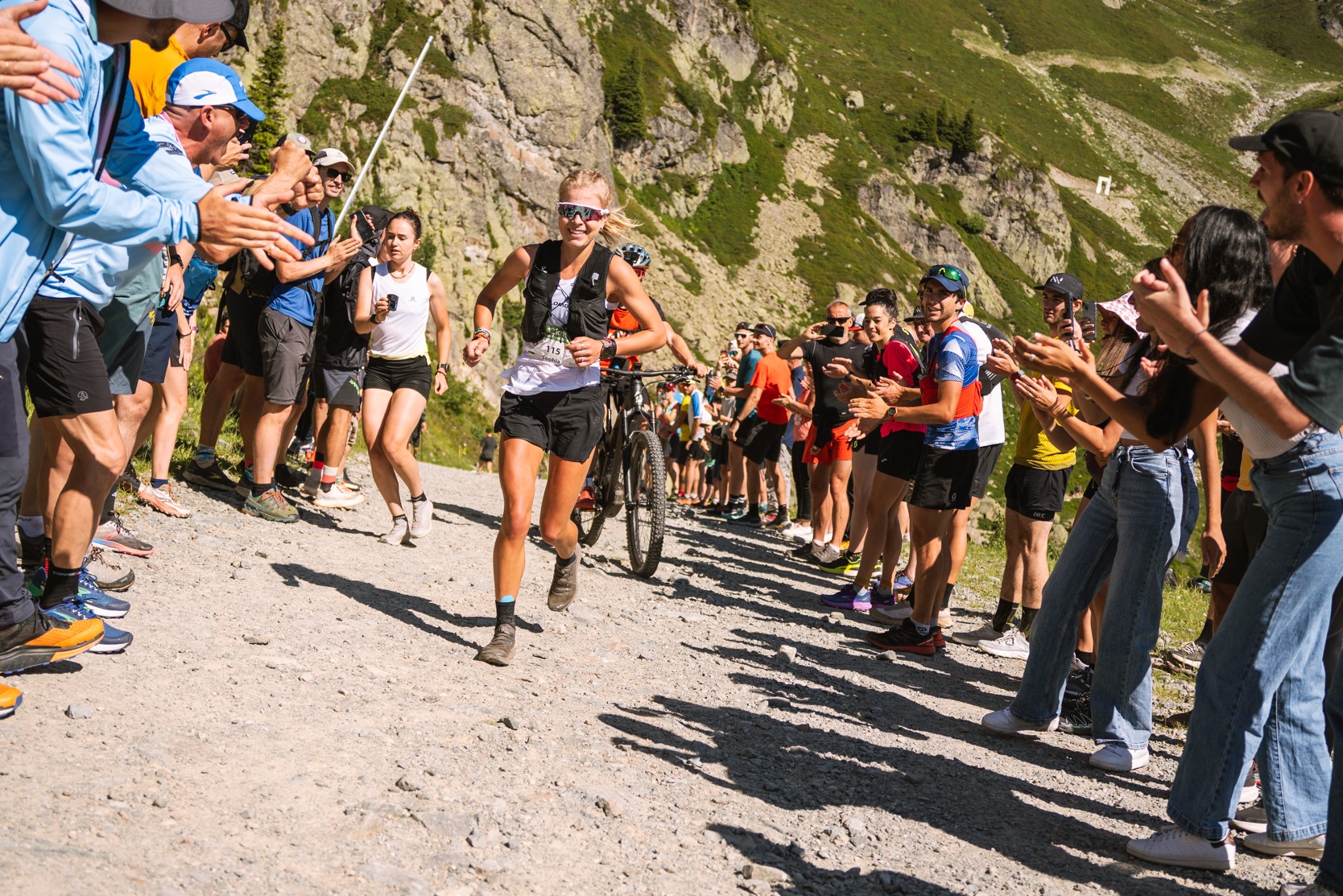
    Over flowing crowds filled the streets at the Golden Trail Series finish line in Chamonix in 2023. (Photo: GoldenTrailSeries and @the.adventure.bakery,® Mont-Blanc Trail Marathon.: ©GoldenTrailSeries® – Zegama Aizkorri – Jordi Saragossa)

    The Running-Only Experiment That Failed

    Last year, after the World Championships, Laukli decided to lean all the way into running. It seemed logical—if she’s good at running without specifically training for it, imagine how good she’d be if she did.

    “I always thought I’d be a much better runner if I had just run,” she says.

    So she tried it. No roller skiing. No ski sessions. Just running—every day.

    “I was running 10 to 12 hours a week,” she says. “And I was so tired each day. I was getting worse and worse at running. And obviously not good at skiing.”

    The experiment collapsed at a race where she felt utterly depleted. She flew home, frustrated and confused. That’s when she sat down with her boyfriend, Gjøran Tefre.

    “He said, ‘It’s fine. I’ll write a plan. Don’t freak out,’” she says. “‘We’ll get you a coach, but ski training is straightforward. We’re gonna baby you into ski training again.’”

    Two weeks completely off. Then a return to “textbook” ski training.

    Within a week of roller skiing, something wild happened: her running started feeling good again.

    The pattern was clear. She ran better when she trained like a skier.

    Sophia Laukli (USA) during the World Cup 20km in Engadin (SUI). (Photo: Authamayou/NordicFocus)

    Kristen Bourne Saw The Same Thing

    “Last season was definitely a struggle for her, both running and skiing,” says U.S. Ski Team assistant coach Kristen Bourne, who monitors Laukli’s training load. “And she’s just trying to figure out why.”

    For Bourne, the shift wasn’t just physical—it was psychological.

    “I’m a huge believer that what makes a difference from a good athlete to a great athlete is the athlete who is very invested in their own process,” Bourne says. “The ones who are thinking, advocating for what they need—not just deferring to a coach because the coach’s word is gospel.”

    That ownership, she says, is new in Laukli.

    “She’s definitely leaning into that more this year,” Bourne says. “Which is really cool.”

    Sophia Laukli and Gjøran Tefre at the Cross Country Skiing World Championships. (Photo: Courtesy Photo)

    The Gjøran Factor: Coach, Partner, Check on Reality

    Mixing a relationship with coaching is a delicate thing. Laukli knows the risks—she’s heard them all.

    “I’ve been told by many people this is not a good idea,” she says. “And other people are like, ‘Wow, I wish I could do that.’”

    She also knows why it works.

    For one, they communicate constantly. For another, his intentions are pure.

    “One of the hardest parts of finding the right coach was that they either only cared about skiing or only cared about running,” she says. “He’s the only one who actually wants me to do well in both.”

    Still, she doesn’t call him her “coach.”

    “I want our personal life and work life to be separate,” she says. “We need other people in the room.”

    That’s where Bourne plays a key role.

    “At this level, athletes have so much experience—they do know what they need,” Bourne says. “So my goal isn’t to dictate everything. It’s to help Sophia articulate what she feels and translate it into training.”

    The two systems—Tefre’s daily presence and Bourne’s structured oversight—meet in the middle.

    One of the key themes that has emerged from all our recent interviews is the importance of making time for fun. Sophia Laukli and Gjøran Tefre embrace that notion entirely. (Photo: Courtesy Photo)

    The Norwegian Experiment: Simple Workouts, Serious Control

    When Laukli moved to Norway, she expected cutting-edge workouts—maybe some secrets behind the country’s dominance.

    “It’s almost been the opposite,” she says. “They’re so simplistic around ski training.”

    Five-by-ten-minute intervals around the Holmenkollen loop. The same long, easy days. Repeated blocks of threshold.

    “You’re gonna become better if you do five-by-ten once a week for 12 weeks in a row,” she says. “You’re gonna become better.”

    The key difference from the U.S.? Control.

    Almost every Norwegian skier has a weekly treadmill “profile test,” which involves six-minute stages at a 10 percent incline, with lactate samples taken at each step and heart rate recorded.

    “It’s to see if you’re in the right range,” Laukli says. “Not to get better each week.”

    Bourne sees value in that simplicity.

    “Sometimes a coach wants to prescribe the flashy intervals,” Bourne says. “But honestly, the athletes who can execute the basics really, really well—that’s where the gains are.”

    She sees Laukli finally embracing that mindset.

    “Athletes shouldn’t feel like training is something done to them,” Bourne says. “They should feel like they’re building something in collaboration with the coach. Sophia is starting to live that.”

    Laukli agrees that American juniors often overtrain because they don’t know any better.

    “If I go too hard too many times in a row, it’s a much worse year,” she says.

    The hardest part? Slowing down when training with Norwegian women who can drop her on almost every roller-ski interval.

    “Every interval I do here, I know I’m not gonna keep up,” she says. “At 17, that would’ve crushed me. Now I have evidence that I can beat them in the winter.”

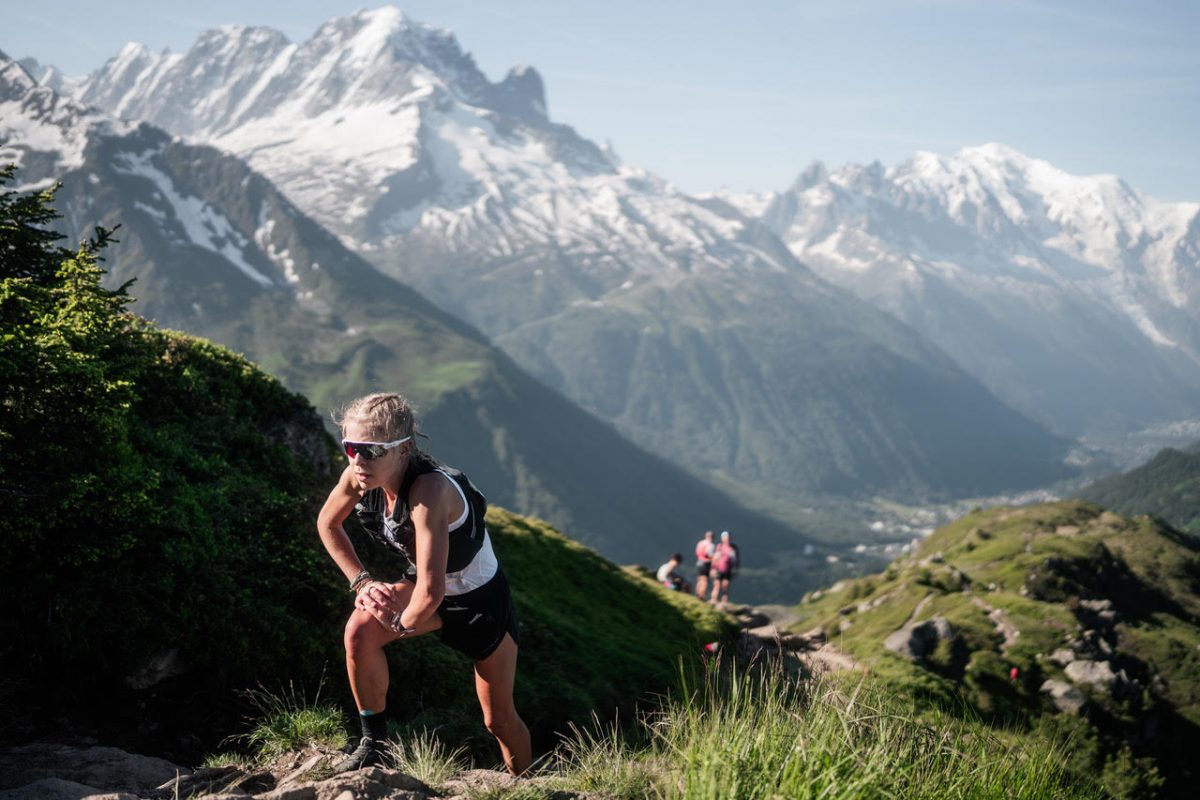
    Laukli racing Sierre-Zinal in the Gold Trail World Series in 2024. (Photo: @rising.story_@colinolivero_GTWS_SierreZinal

    Two Seasons, One Mindset

    Running and skiing back-to-back seasons creates year-round excitement—and pressure.

    “I have two competition periods,” she says. “It’s easier to motivate. But it also means I’m 100% consumed by performance all year.”

    That obsession became a barrier last year. Now, Laukli is working with Bourne and Tefre to shift her mindset.

    She has clear goals for skiing: the Olympic 10k, the Olympic relay, and the final hill climb at the Tour de Ski.

    She has equally specific running goals: above all, returning to Sierre-Zinal, where she once ran 2:53 on the iconic 31 km route.

    However, she’s no longer defining success solely by results.

    “There’s so much I’m working on—technique, tactics, how I ski courses,” she says. “It’s easy to be on a start line and focus on whether those things show up.”

    Bourne sees that evolution clearly.

    “Sophia has the instincts of a really high-level athlete,” Bourne says. “But learning to trust those instincts—rather than obsessing about the result column—is where she’s growing most.”

    Laukli nears the finish of the final climb of the 2024 Tour de Ski on Alpe Cermis, where she claimed the victory. (Photo: NordicFocus)

    Why Salomon Fits: One Athlete, Two Worlds

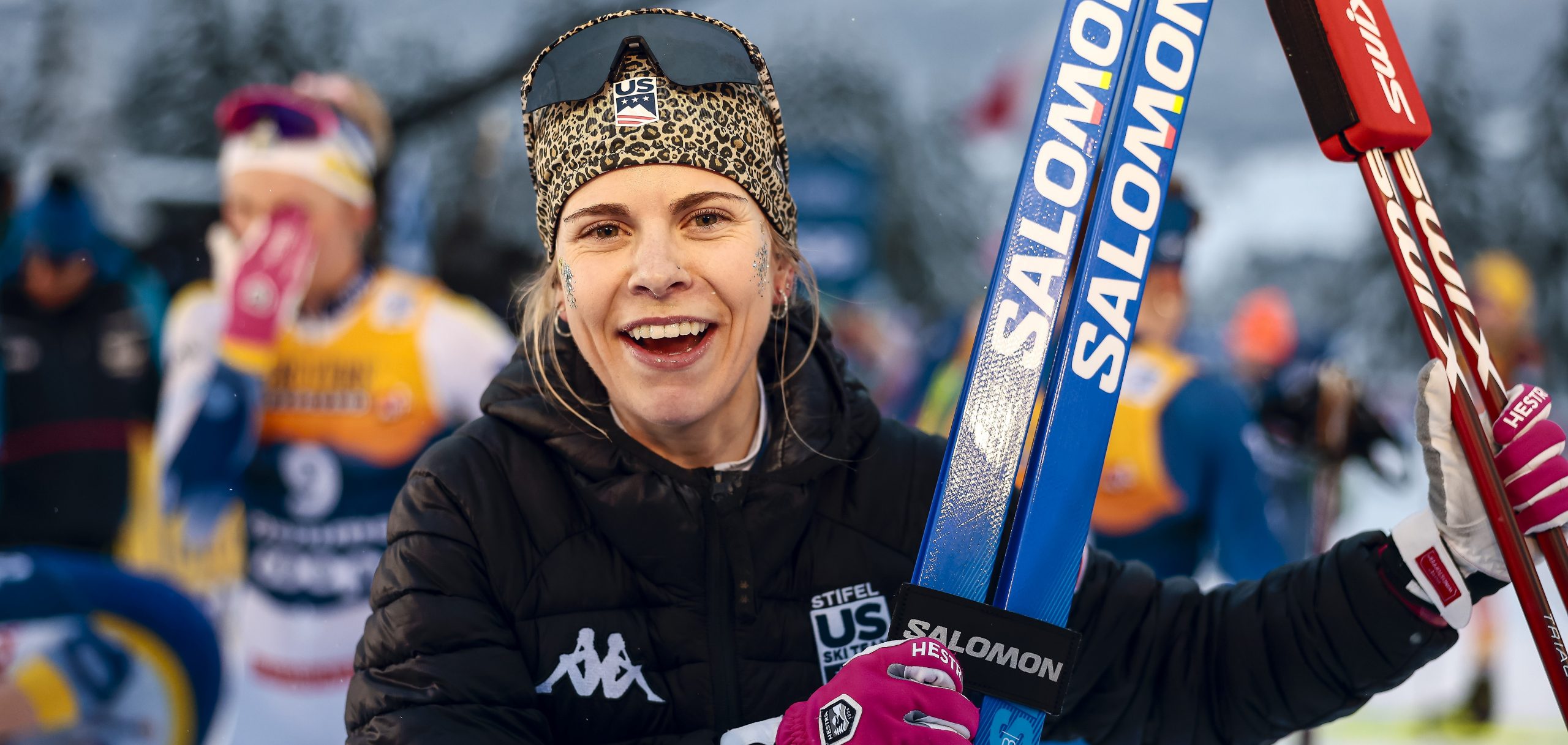
    For an athlete splitting her year between the World Cup and the Golden Trail Series, sponsorship could easily become complicated. Many runners work with running-only brands; many skiers work with ski-only brands. For Laukli, that would have been a logistical mess — and maybe even a dealbreaker.

    Instead, she found the perfect home with Salomon.

    “I’m super grateful that I get to have my sponsor, my main sponsor, support me in both,” she says. “Because then it’s a lot easier to focus on each season. I know that they’re supporting me in that.”

    That unified support matters. It lets her shift from skis to singlets without the politics of competing brand calendars and conflicting performance expectations.

    “I don’t really know if it would be possible for me to be a runner for another brand and a skier for a different brand,” she says. “Like, defending to them that I can’t run a normal running season because it’s the Olympics, or I need to drop World Cups so I can run better this year — that just wouldn’t work.”

    With Salomon, the opposite is true. Everyone’s aligned.

    “Having everyone be on the same team makes it manageable,” she says. “And a lot more motivating, because everyone has the same goal.”

    She works directly with Salomon’s France-based team, and Laukli lights up when she talks about the group behind her.

    “They’re all French,” she says, laughing — a nod to the company’s deep culture in both ski sport and trail running. It’s also a reminder that Laukli lives firmly in the middle of two endurance worlds that Salomon understands and embraces.

    That harmony matters. Her identity isn’t split; it’s blended. And Salomon is built for that.

    Sophia Laukli (USA) racing the World Cup Mass Start in Les Rousses (FRA). (Photo: Modica/NordicFocus)

    Sunny Weekends and Simple Breakfasts

    Some things have gotten simpler, like her pre-race breakfast.

    “I used to do peanut butter and banana,” she says. “Now I just have cereal. Apparently, simple is better.”

    World Cup life has also taught her the importance of flexibility.

    “You learn how to adapt,” she says. “Something will always go wrong on a race weekend.”

    When she’s asked for her favorite place on the circuit, she doesn’t hesitate.

    “Davos,” she says. “It’s sunny. You can have bad races, and it doesn’t matter because it’s a really nice place to hang out.”

    That small detail fits her evolving philosophy. Training is simpler. Goals are more balanced. And the sport—skiing and running—feels more sustainable.

    Somewhere between Maine and Norway, between Middlebury and Utah, between World Cup stadiums and alpine trails, Sophia Laukli has built a training model that doesn’t look flashy. It’s repetitive. It’s measured. It’s rooted in trust, communication, and doing the basic things right, over and over again.

    And if the Norwegians are right—and if Laukli’s instincts keep sharpening—those basics may be exactly what carry her to the front this season, in both sports.


    Love Stories Like This? Help Keep Them Coming.

    Feature interviews like this one take time, access, and care to produce. If you value thoughtful storytelling and independent ski journalism, please consider becoming a Voluntary Subscriber. Your support directly fuels the work we do to cover the people, places, and moments that make our sport special.

    Join the FasterSkier community!

     

  • The Secret Weapon Is Fun: Inside Kristen Bourne’s Collaborative Coaching on the U.S. Ski Team

    The Secret Weapon Is Fun: Inside Kristen Bourne’s Collaborative Coaching on the U.S. Ski Team

    When we spoke, Kristen Bourne was sitting on the couch in her living room in Truckee, California, a small ski town she now calls home. Tibetan prayer flags hung loosely behind her, shifting gently in the morning light that poured through the window. The room felt warm and calm — the kind of quiet space that comes from someone who spends much of her year on the move. Bourne smiled easily as she spoke, her voice’s cadence unhurried, like someone grounded in both her work and the mountain rhythm around her.

    She had just returned from camp and was preparing to leave again this weekend to start the World Cup with the U.S. Ski Team. Between talk of travel logistics and packing lists, she mentioned the soundtrack that keeps her company on solo skis. “When I’m skiing by myself? Yes,” she said, grinning. “I really like skiing to Machine Gun Kelly… it kind of brings me back to the Blink-182, Sum 41 days. It feels almost like nostalgic, but newer age.”

    That small confession says a lot about Bourne, now in her fourth season on the U.S. Cross-Country Ski Team coaching staff: rooted in rhythm, grounded in joy, and always blending the familiar with the fresh.

    Joy, she’ll tell you, isn’t a garnish. It’s the point.

    Kristen Bourne, Olivia Nesbitt Bouffard, and Jessie Diggins on an afternoon run in Wanaka, New Zealand. (Photo: Jessie Diggins)

    “Happiness goes such a long way in professional sport… our secret weapon as a team is having fun. Our staff genuinely enjoys being together. The athletes genuinely enjoy being together. We love to all come together.”

    The proof, for her, is a memory from the day Jessie Diggins won the 10 K at the World Championships in Planica. The scene isn’t what the public imagines. “You’d think everybody is stressed,” Bourne said. “We were ahead of schedule, and we all just sat down in [our wax truck], Yolanda, and made instruments out of whatever we could find for, like, 30 minutes.” The room filled with improvised drums and laughter. “It was so fun,” she said. “That’s the stuff people never see.”

    Northern Michigan University’s Kristen Bourne (c) after the 5-kilometer classic race at the 2017 NCAAs in Jackson, New Hampshire. (Photo: Jackie Schneider)

    Minnesota Roots, and a Goal Cut in Half

    Bourne grew up just outside the Twin Cities, where endurance sport was a family language. “Our family vacations were going to [my dad’s] marathons and triathlons,” she said. She started by hopping into a mile here and there, handing him nutrition at the end of the driveway, learning the cadence and care that go into long efforts.

    Skiing arrived as a nudge. A new high-school coach was recruiting runners to cross-country ski at Mounds Park Academy. The first season was rough: “I swore I was going to quit. Every single race I did, I cried after most races,” she said. In a 5k, Jessie Diggins (then a rival in the same section) beat her by 12 minutes. Bourne’s response was characteristic—specific, measurable, gritty: next year, get that down to six.

    She continued to run and ski through high school, then headed to Northern Michigan University after spending a semester at the University of Colorado. She transferred mid-winter 2014 and skied at NMU through 2018, working under a rotation of assistants. Her path after graduation would tilt everything she thought she knew about training.

    Kristen Bourne spent time in Norway after college training with Lyn Ski / Team Obos. Bourne is pictured here racing in a Norwegian Cup race in Gålå. (Photo: Martin Riseth)

    Norway: Where Individual Plans Meet Shared Trails

    Right out of college, Bourne moved to Norway for a year and a half. She intended to ski; illnesses complicated the plan. But a concurrent internship at the Norwegian School of Sports Science opened doors into a different coaching world. Back home, she was used to “show up and the coach tells you the workout and everybody does the same thing.” In Norway, she said, “you sit down with a coach and you generate your plan… It was the first time I was exposed to individual planning—thinking about what’s best for you, not necessarily the team.”

    Interval days there could look like organized chaos: “Every single person… almost had a different workout, but people would sync up where they could.” At first, she struggled; she missed the mob grind. Then she looked around at a culture of success and realized what was happening: athletes were learning their bodies early, practicing agency. The lesson stuck. “Team workouts are also the way to go,” she said, “but giving athletes a platform to think for themselves—creating this athlete-coach collaborative experience versus coach telling athlete, ‘this is what you should do’—had a tremendous impact” on how she now works.

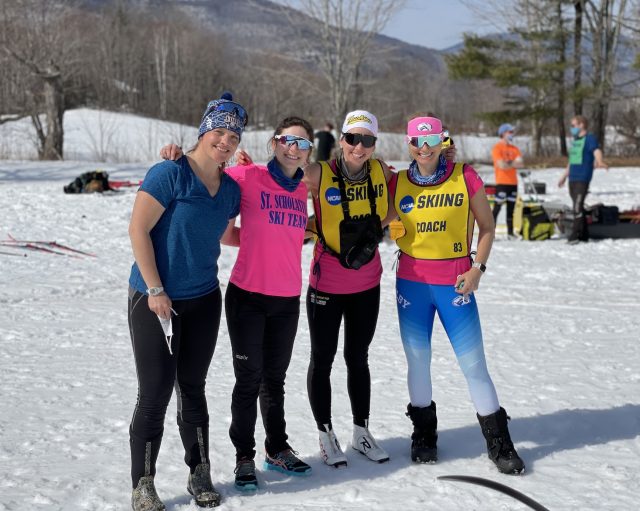
    (l-r) WSCA members Maria Stuber (then CSS), Kristen Bourne (then CSS, now with the US Ski Team), Kristen Monahan-Smith (Michigan Tech), and Tracey Cote (Colby College) at the NCAA Championships in Jackson, New Hampshire, in 2021. (Courtesy Photo).

    The Parking-Lot Pivot

    Her return to the U.S. was abrupt. She lost her residence permit—”turns out it was under the seat of my roommate’s dad’s car”—and flew home with two days’ notice, arriving just as COVID was beginning to ripple into sport. She kept racing a little, then decided she was done.

    That’s when a well-timed email—and a parking-lot shout—changed everything. Her dad reached out to Maria Stuber, who was building the Women’s Ski Coaches Association. “Maria found me in a parking lot at U.S. Nationals and yelled out her window, ‘I’m going to call you,‘” Bourne remembered. A call later, Maria offered her a position at the College of St. Scholastica and connected her with Pepa Miloucheva at the Craftsbury Green Racing Project. After two school years at Scholastica, with summers in Craftsbury, Bourne joined the U.S. Ski Team staff.

    The transition was, by her own admission, intimidating. “It was this idea of, like, how am I here? she said. But Norway’s reminder—that fresh eyes are valuable—kept her steady. “Just because you’re newer and have less experience doesn’t mean your ideas aren’t valid, she said. “You’re maybe fresher out of a ski career, you relate with athletes in a different way. There’s a lot of value in that.”

    She also learned to de-personalize the miss. “Technique feedback doesn’t always stick. That’s not a reflection of me as a coach or the athlete, she said. “We tried that idea; it’s fine. We’ll try something else. Each year, she felt more confident; more importantly, she built deeper connections.

    Julia Kern—one of the athletes Bourne works with most closely—sees that same quality every day.

    “Kristen is unique in the sense that she’s able to connect with just about any personality type on the team, Kern said. “One of her strengths is figuring out how to connect differently with different athletes. Every athlete responds differently and has different needs, and she just gets that. She’s very approachable and sees athletes as whole people.”

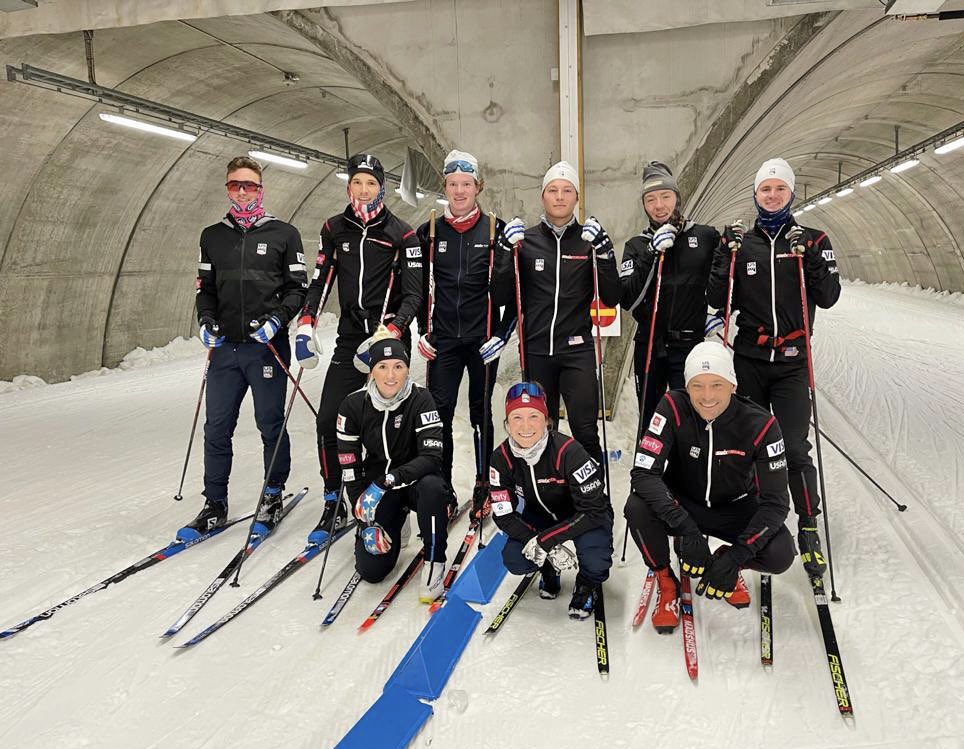
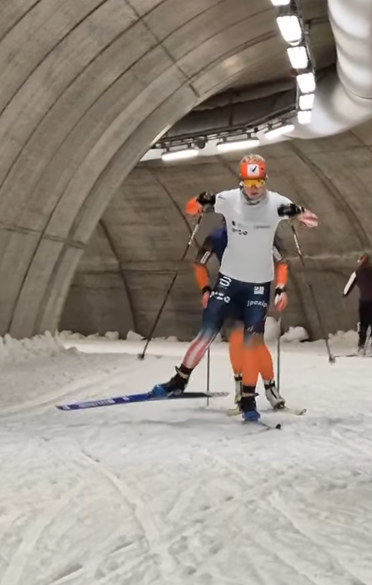
    USST athletes and coaches in the Torsby Ski Tunnel, August 2022. Back row, from left: Johnny Hagenbuch, Kevin Bolger, Finn O’Connell, JC Schoonmaker, Ben Ogden, and Walker Hall. Kneeling, from left: coaches Greta Anderson, Kristen Bourne, and Matt Whitcomb. (photo: François Faivre)

    Mentors and a Collaboration-First Culture

    Ask Bourne about mentors and the names tumble out: Matt Whitcomb, Chris Grover, Jason Cork. “From the very beginning… incredibly supportive, she said. “Matt will answer his phone every time. He usually likes to FaceTime… we brainstorm ideas. The flow goes both ways: she calls when the connection is hard; he calls when he’s stuck on something.

    Her women’s network is just as active. “Maria Stuber, hands down, Bourne said. “And Sam Benzing at Montana State—we coached together at Scholastica. She’s younger, but her perspective is so interesting. Group FaceTimes are common: Maria, Sam, Kristen, swapping angles and problem-solving. It’s not just helpful; it’s survival. “It would be really hard to be in this job and not have that, Bourne said. “The collaboration makes it so much more sustainable.”

    That same approach underpins her work with athletes like Kern.

    “Kristen’s helped me figure out what kind of training plan works well for me, Kern said. “We’ve tried some new things the last few years—different kinds of workouts, always thinking creatively. She’s open-minded, reads up on what other athletes are doing, but also thinks for herself. She’s got such a growth mindset.”

    Julia Kern and Kristen Bourne in Sjusjøen at the 2025 pre-World Championships camp. (Photo: Matt Whitcomb)

    Coaching Women, Coaching Men — and Being Seen

    On the World Cup, visibility is progress measured in inches. FIS’s women-coach bibs created access (up to two additional bibs if teams have women on staff), but change is slow. “Every year, maybe there’s one or two new women… it definitely hasn’t blown up, Bourne said. Old assumptions linger. “I probably get asked a couple times a year from male coaches: ‘Are you the massage therapist or PT?’

    For Kern, Bourne’s presence is more than symbolic.

    “It’s huge, Kern said. “She’s one of the few female coaches on the World Cup level, and she’s down to work hard and just have fun with it too. I hope the next generation of women who want to coach feel inspired that they can do it too. Kristen’s paving the way, even in ways people might not see from the surface.”

    Bourne herself agrees that visibility matters. “You can’t be it if you can’t see it, she said. “It’s important for young men, too, to see women in leadership roles. Our men’s team has been incredible—they’ve never made me feel like I don’t belong.”

    Her advice to aspiring women coaches is emphatic: build a robust support community. “Ask for advice, she said. “It makes a world of difference.”

    Kristen Bourne and Sophia Laukli on the pre-race day at Val di Femme during the 2025 Tour de Ski. (Photo: Leann Bentley)

    Athlete Work: Julia Every Other Day, Gus and Sophia on the Radar

    Bourne’s primary day-to-day is Kern. “We’re talking basically every other day—texting or on the phone, training planning. We work very closely, very in depth, she said. She also monitors Gus Schumacher and Sophia Laukli.

    Kern said that beyond the workouts, Bourne has shaped the team culture itself.

    “She’s really good at encouraging athletes to bring their own sense of leadership, Kern said. “Not everyone is going to be outspoken—some are quiet leaders, some lead through training. She empowers people to be leaders in their own way. She creates a team atmosphere that’s a judgment-free zone. No idea is a bad idea.”

    Gus Schumacher and Kristen Bourne after his 4th place finish in the Davos sprint during the 2023 Tour de Ski. (Photo: Leann Bentley

    Season Outlook: Keep the Vibe, Chase the Team Moments

    Last year’s long illnesses made for uneasy preseason reading. This year feels different. “People are in a pretty good place, Bourne said. “At our camp in Utah, I would assume there would be a little more stress—it’s an Olympic year. Not at all. People were so relaxed and chill and vibing and doing their thing.”

    If there’s a metric she’d choose for success, it’s carrying that “happy momentum through everything—the Olympics, Lake Placid World Cup Finals. “In a year with so many eyes on cross-country skiing, that would be massive, she said.

    Results still matter, of course. And she lights up talking about the collective ones. “It would be so awesome to see success in team events, she said. “Relay and the sprint relay—those mean so much when it’s a collective team event. We want to do well there.”

    Lucas Wilmot, Kristen Bourne, Murphy Kimball, Tabor Greenberg in Bend, Oregon 2025 after wrapping up the first L3 intervals at camp. (Photo: Leann Bentley)

    Representation, Purpose, and the Long Run

    There’s a moment near the end of our conversation when Bourne zooms out to the why. “We are very deeply intertwined in another person’s process and journey, she said. “What an absolute privilege to be part of that. It’s impossible not to come to absolutely love and care so much about these people.”

    Kern echoed that sentiment from the athlete side.

    “Kristen understands there’s life outside of skiing, Kern said. “She also knows what it takes to be one of the best in the world—and when it’s time to step away. She helps us stay grounded.”

    Five years from now, Bourne hopes she’s doing exactly this, just deeper—”coaching, getting to know these athletes more and more.”

    And she hopes the picture around her looks different: more women coaches on staff, on other staffs, in other sports at U.S. Ski & Snowboard; more women wax techs. “If I can have a tiny ounce of contribution into changing that, she said, “I’d be so, so happy.”

    Kristen Bourne and Colin Rodgers out for a run during the OD run at Park City camp, 2025. (Photo: Matt Whitcomb)

    Purpose, Rhythm, and Joy

    As our conversation wound down, Bourne slightly rotated her position as the light spilling through the window shifted—yet still filtering across the prayer flags behind her. She laughed when she mentioned her must-pack item: heated socks for Finland. “I get cold fast, she said. “Those are my best friend.

    There’s rhythm in that, too: warmth, joy, and purpose, all braided into one.

    Because for Kristen Bourne—and for the athletes who work with her—the secret weapon really is fun.

    Leann Bentley, Kristen Bourne, and Bernie Nelson at Val di Fiemme the morning of one of the last stages of the 2024 Tour de Ski. (Photo: Matt Whitcomb)

    Love Stories Like This? Help Keep Them Coming.

    Feature interviews like this one take time, access, and care to produce. If you value thoughtful storytelling and independent ski journalism, please consider becoming a Voluntary Subscriber. Your support directly fuels the work we do to cover the people, places, and moments that make our sport special.

    Join the FasterSkier community!
  • Fast Tracks: World Champs—US Women discuss influencing climate change following the relay

    Fast Tracks: World Champs—US Women discuss influencing climate change following the relay

    This reporting costs money. Please support this coverage with a voluntary subscription (below) so FasterSkier can provide this level of access to the sport we all love year-round.

  • Karlsson Dominates Les Rousses 20 K Classic. Diggins Sidelined by Injury. Brennan Out Indefinitely

    Karlsson Dominates Les Rousses 20 K Classic. Diggins Sidelined by Injury. Brennan Out Indefinitely

    This coverage is made possible through the generous support of Marty and Kathy Hall and A Hall Mark of Excellence Award. To learn more about A Hall Mark of Excellence Award, or to learn how you can support FasterSkier’s coverage, please contact info@fasterskier.com.

    Frida Karlsson (NOR) dominated the field setting a blistering pace which no one could match. (Photo: NordicFocus)

    The timing of the Norwegian national championships has already had a dramatic effect on world cup races in Les Rousses, France. Today’s women’s 20 kilometer Classic mass start race would not be an exception.

    Absent from the start list were perennial favorites Therese Johaug (NOR) and Heidi Weng (NOR). Those two finished one-two respectively in yesterday’s Norwegian championship 20 kilometer skiathlon.

    Jessie Diggins (USA) disclosed that her foot injury was worse than originally believed. (Photo: NordicFocus)

    But the absences on the American squad were perhaps even more meaningful and certainly likely to have a longer lasting impact on the race season. The U.S. women who have consistently been celebrated for their depth and top performances are now plagued by injuries.

    One critical absence was the Overall world cup leader Jessie Diggins (USA) who decided not to race today because of her ongoing foot injury. She revealed that after double poling the entirety of the Classic Sprint yesterday that she would not compete in today’s Classic race. She also disclosed that after the Tour de Ski she had an MRI which revealed that she has a partial rupture of the fascia by the heel bone in addition to the plantar fasciitis. She indicated that, “this is something that I don’t want to risk. My number one goal is long term foot health.” She stated that she couldn’t stride “with any intensity,” but that she could double pole, which is why she double poled all of yesterday’s Sprint course to finish 40th. Diggins doesn’t know when her next Classic race will be. World Championships are still in her sights, but there is no certainty about whether she will be able to do any Classic racing by then. It was an absence which further dug into an already depleted American squad.

    Joining Diggins on the sidelines were Rosie Brennan who also did not race today, and Julia Kern who is still recovering from the Tour de Ski.

    The news from Brennan was bad. “I am struggling with my health and as I hope you can observe, racing does not feel good,” said Brennan. She elaborated that, “I really hoped with two weeks away, I could sort things out but that has unfortunately not been the case. It’s been very challenging to get the medical help I need overseas, and without friends, family, and my coach, so I am currently on a plane to Alaska. I am crushed and scared and don’t know what the future holds but a change was needed to try to move forward. I haven’t given up on returning to racing but need to put myself in a place where I can learn more about what my body is telling me and be able to take care of my physical and mental self before I can make a decision on when I will return.”

    So that meant that only two Americans were in today’s field. Sophia Laukli, who turned in an excellent performance finishing 16th,, and Alayna Sonnesyn who was 36th.

    “Each classic race this year is definitely getting a bit better each time, but I do still feel there’s a lot of room for improvement.,” said Laukli. “I’m for sure feeling there’s fatigue from the Tour so I’m just happy to put together a solid Classic race for the time being. In past years I wouldn’t be able to do that unless I was in peak form.” The challenging Les Rousses course also worked to the Distance specialist’s favor. “The course was definitely a grind which always works to my advantage, maybe less so today because I was pretty tired. But in general I will always do better on a course with minimal double pole and lots of work.”

    The absence of Norwegian and American stars provided an opening for others. Frida Karlsson (SWE) took full advantage of some of her top rivals’ absence and turned in an epic performance, totally dominating the field winning by almost 1:30. Karlsson led from the start, and it was immediately clear that no one would be able to keep pace with her today. Her performance certainly made fans wonder what the race would have looked like had Johaug been present. Karlsson was followed in second place by her teammate Ebba Andersson, with Teresa Stadlober (AUT) taking third. After the race Karlsson said, “it was really fun today.” She continued that, “I felt relaxed and strong. It was just fun.” Karlsson indicated that she intended to do some altitude training before the world championships, which didn’t give much of a clue as to whether she would do additional world cup races before the world championships.

    Sophia Laukli (USA), (left) finished 16th, just behind Karoline Simpson-Larsen (NOR), (right) (Photo: NordicFocus)

    Canadian Katherine Stewart-Jones continued to impress, she finished 14th. Other Canadian finishers were Lilian Gagnon in 23rd, and Alison Mackie 34th.

    Perhaps no one trying to take advantage of Norway’s thin lineup was a more unlikely sight than the appearance of Norway’s own Kristine Stavaas Skistad’s name on the start list. Skistad is a well-known name, having won more Sprints than most can remember—but a Distance race —well that’s not exactly in her wheelhouse. She has completed some distance races in the Tour de Ski. But outside of those, the only world cup Distance races on Skistad’s resume appeared to be … none! But apparently Skistad reevaluated the benefit and reality of doing a 20 kilometer Classic race, thought better of it, and chose not to start.

    But after today’s race, there were more questions than answers swirling around the American team. With it’s usual dominating duo of Diggins and Brennan ailing, and the reliable Kern resting, it would be up to some of the other women to shoulder the racing load, at least in Classic races. With the world championships on the horizon, it is not the position that the American team was hoping to be in.

    The Women’s 20 Kilometer Classic Mass Start

    Karlsson wasted no time going to the front of the pack and by two kilometers she was out front setting the pace ahead of Astrid Oeyre Slind (NOR). Karlsson’s brisk pace was able to string out the field very early. By 3.5 kilometers she was at the front of a six person pack with the Classic expert Kerttu Niskanen (FIN) at the back of it. Katharina Hennig (GER), Slind, Ebba Andersson (SWE), and Teresa Stadlober (AUT) rounded out the group.

    At the five kilometer mark Hennig double poled past Karlsson and the two jockeyed for position at the head of the pack. It was the only few moments at the front for Hennig, and the only time when Karlsson would relinquish the lead.

    Niskanen was the first to show that she was having trouble keeping up with the pace as she was dropped off the back and the lead pack was quickly down to five skiers.

    Alayna Sonnesyn (USA) was one of only two American starters. She finished 36th. (Photo: NordicFocus)

    At 8.1 kilometers Karlsson continued to push the pace with Andersson, Hennig, Stadlober, and Slind hanging right with her. At this point, Sophia Laukli (USA) was the top American in 18th place, and Canadian Katherine Stewart-Jones, who was having another good day, was holding on to 14th.

    Ebba Andersson (SWE) (left), tried to keep pace with teammate Frida Karlsson (SWE), (right), but no one could match Karlsson’s tempo. (Photo: NordicFocus)

    Toward the front Karlsson was picking up the pace like a locomotive gaining speed, and only Andersson was able to go with her. Stadlober was now in third and by the half-way mark she was over four seconds behind Karlsson.  Hennig had drifted to over 11 seconds back. Slind, Carl, and Niskanen were now in a second chase group that was over 25 seconds behind the leaders.

    But Karlsson was on a mission and set a pace which no one could match. By the 13.4 kilometer mark she had dropped her teammate Andersson and was skiing by herself 23 seconds ahead of Andersson.

    With five kilometers left Karlsson already had the race in hand, and the competition was now for the rest of the podium spots. While Karlsson had extended her lead to 41 seconds over Andersson, Stadlober, who was in third place, was trying to reel in Andersson. Surprisingly, long distance specialist Slind was unable to maintain the pace and was over 30 seconds behind Stadlober.

    Teresa Stadlober (AUT) made a bid for second, but couldn’t catch Ebba Andersson (SWE). Photo: NordicFocus)

    With 3.8 kilometers remaining Karlsson’s lead ballooned to over 54 seconds. In second place, her teammate Andersson was fighting desperately to hold off Stadlober who continued to stalk her. Stadlober was six seconds behind Andersson and showed no signs of relenting. But the fight was exclusively for second and third place with the rest of the field now too far back to play into the podium standings.

    Stadlober was keeping Andersson in her sights, but try as she might, she couldn’t begin to close the small gap on the second place skier.

    As the skiers approached the finish, Karlsson’s total domination clearly showed as there wasn’t another skier to be seen—for a long time. Karlsson had just given an absolute Classic skiing clinic finishing over 1:29 ahead of Andersson as she double poled across the finish line with an enthusiastic smile on her face and looking jubilant. Meanwhile, Andersson had fought off Stadlober’ s efforts and was able to keep her second place position. Stadlober finished third having fallen back to almost 12 seconds behind Stadlober. It was total domination by Karlsson who showed that she appeared to be back in top form.

    Les Rousses Women’s 20 kilometer Classic Mass Start

    Frida Karlsson (SWE) completely imposed her will on the field. (Photo: NordicFocus)
  • Le Rousses 10 k Freestyle—This Is Jessie’s Race

    Le Rousses 10 k Freestyle—This Is Jessie’s Race

    This coverage is made possible through the generous support of Marty and Kathy Hall and A Hall Mark of Excellence Award. To learn more about A Hall Mark of Excellence Award, or to learn how you can support FasterSkier’s coverage, please contact info@fasterskier.com.

    Team USA celebrates the victory of Jessie Diggins (USA) in the World Cup 10 k Freestyle Interval Start in Les Rousses, France. (Photo: Modica/NordicFocus)

    When Jessie Diggins (USA) first stepped onto the World Cup scene (as a fresh-faced Minnesota school kid straight out of Junior Nationals), her only real chances to excel were in Freestyle Sprints or 5 k Freestyle races. Memorably, she showed everyone her Sprint abilities by out-dueling World Cup Sprint champion, Stina Nilsson (SWE), for Olympic Gold (with Kikkan Randall). A season later, she was proving herself to be a threat at 5 k Freestyle events . . . until that event just plain went away. The 5 k distance once was a staple for women’s World Cup racing; but FIS’ efforts to apply distance equality between men’s and women’s fields meant that the 5 k was replaced with 10 k races. Suddenly, Diggins’ best shot at a distance medal became a race twice as long. Well, if the last few seasons are any indication—and if Diggins’ performance today in Les Rousses offer any additional proof—she has more than adjusted to this distance challenge.

    Today in Les Rousses, Diggins started fast (a bit of a risk on this particular Distance course with its immediate and super-steep uphill), and just kept building her lead throughout the distance. She won going away with only Victoria Carl in her vicitity (19 seconds behind) followed by Astrid Oyre Slind in third (at 20 seconds).

    “Originally, I had planned to pace the race a little bit slower,” said Diggins. ” But then we were watching the men’s race, and we were like ‘Holy moly, a 19 minute 10 k. This is going to be so fast! Talking with the coaches, I was like ‘I don’t think I can afford to give up any seconds anywhere.’ I gave Ben a big hug after his race, and asked if he had any tips. He said, ‘Yeah, I started really hard!” So I did end up being influenced by Ben Ogden, and it ended up being a great thing for my race.”
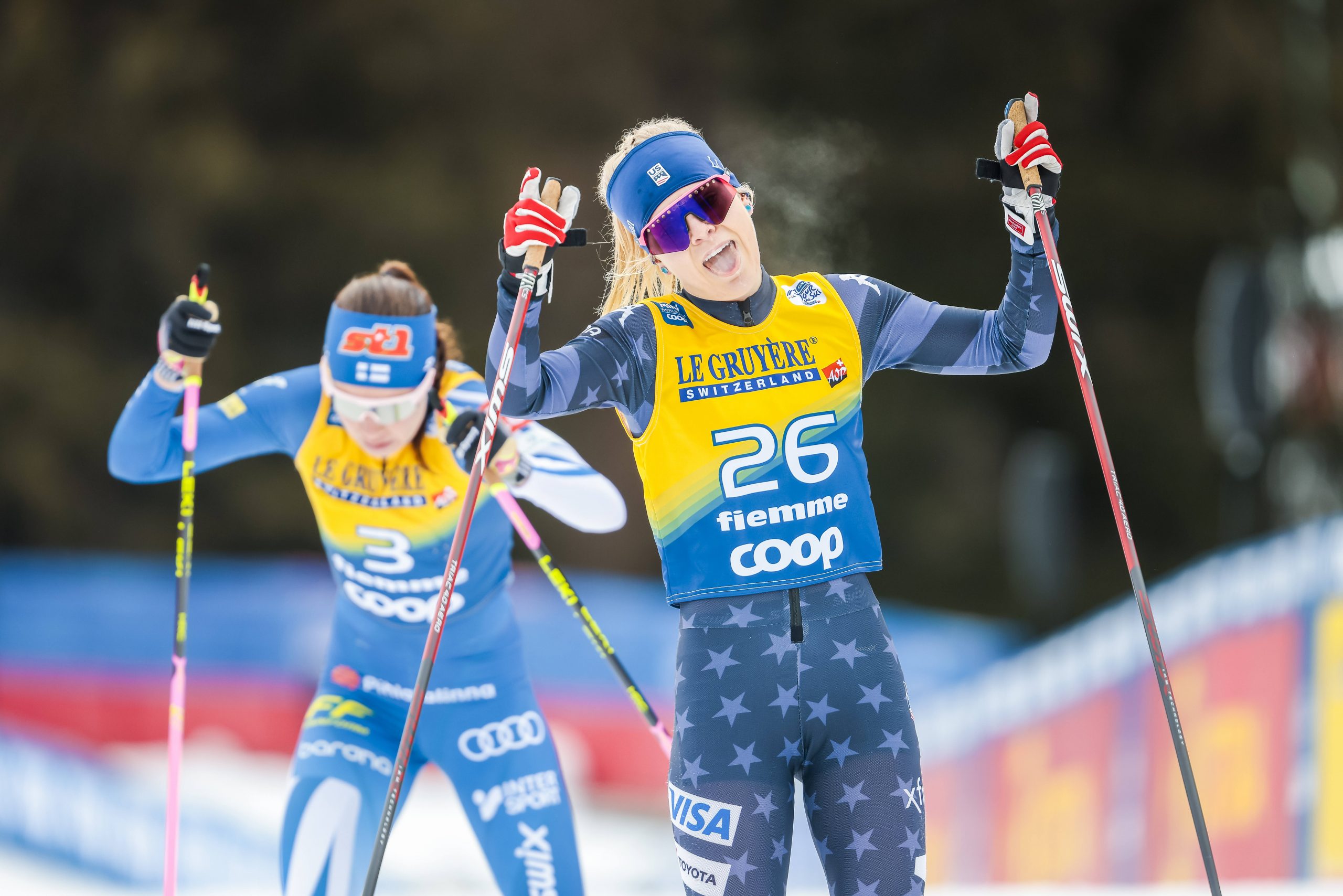
    Sophia Laukli (USA) posted an impressive eighth place finish in the 10 k in Les Rousses, an indication that she is recovering from her efforts in the recent Tour de Ski. (Photo: Authamayou/NordicFocus)

    Among Americans, Diggins was followed in the standings by a resurgent Sophia Laukli in 8th, Lucinda Anderson 22nd, Rosie Brennan 28th, and Alayna Sonnesyn 34th (tie). Among Canadians Katherine Stewart-Jones and Lilliane Gagnon both skied strongly for 14th and 15th respectively, followed by Allison Mackie 33rd, and Olivia Bouffard-Nesbitt 38th.

    Jessie Diggins (USA) is known for leaving it all on the race course, a level of effort that earned her the victory in the 10 k Freestyle Interval Start in Les Rousses. (Photo: Modica/NordicFocus)
    Les Rousses 10 k Freestyle Interval Start

    The 10 k Distance course at Les Rousses is one that demands both courage and fortitude: courage in addressing the need to attack the initial uphill (which, if raced too aggressively, results in racers being totally gassed at the top, struggling through a fog of lactic acid, and still with nine kilometers to go), and fortitude in dipping into physiological and psychological reserves to finish strongly on this unrelenting three lap course. It’s a level of discipline that only seasoned racers are likely to possess. Diggins is not the only seasoned competitor in the field, but she may just possess more fortitude than any skier in the world. Today in Les Rousses was an opportunity for her to put that fortitude on display.

    Jessie Diggins in full flight is a sight to behold. Her fans got a look at “that Jessie” today. Starting fast and fearlessly, Diggins’ split times must have broken the hearts of her competitors. Frida Karlsson (SWE) started out even with Diggins, then consistenly lost time to her throughout the race. Karlsson would finish the day in seventh, 38 seconds off the lead.

    Astrid Oeyre Slind (NOR) chased Diggins throuhgout the race, only surrendering additional time to her rival in the final kilometer. (Photo: Authamayou/NordicFocus)

    Slind would remain close to Diggins at every time check, but could not overcome Diggins’ finishing surge. Slind would finish third, 20 seconds behind.

    Carl was the only competitor to take a conservative approach to the early kilometers, and successfully accelerate through the finish. She chipped away at Diggins’ lead at every time check, ultimately powering into second place (19 seconds behind).

    Victoria Carl (GER) was the most adept at negative splitting her effforts on the challenging course at Les Rousse. She would finish the day in second place, just 19 seconds behind Jessie Diggins ((USA). (Photo: Authamayou/NordicFocus)

    For such a short race (the shortest Distance race that World Cup fields contest), the Les Rousses course was extremely daunting. Laukli shed some light on the particular challenges of the Les Rousses course: “It was definitely a challenge to balance pacing and avoid blowing up, but also not going too slow,” Laukli said. “I’m typically not one to start very fast so for me I just had to go all out and hope I didn’t blow up, which mostly worked out.”

    Sophia Laukli (USA) raced bravely and aggressively in an event that hadn’t initially seemed likely to play to her strengths. (Photo: Modica/NordicFocus)

    Laukli ended the recent Tour de Ski less than satisfied with her performance, and hampered by injuries sustained in a fall during one of the Tour’s mass start stages. Though 10 k is not her favorite distance, today’s strong result in Les Rousses felt like a bit of redemption for Laukli.

    “Today’s race was a really really fast 10km and definitely a bit shorter than I would’ve liked,” said Laukli. “But because of that I’m happy with my result because it was really not a distance skiers course, so I probably did the best I could. I was unsure if I would be back racing this weekend after the tour just because of some injury and bad feelings over the tour, so I was just happy to be back and able to race, and closer to what I know I’m capable of.”

    Following Diggins’ victory in today’s race, she takes over the leader’s bib in the World Cup Distance standings.

    “I do feel like I’m well rested and recovered from the Tour,” said Diggins. “It was great to feel like my body bounced back well.”

    I was really really thrilled and relieved that it didn’t hurt at all during warmup, that it didn’t hurt at all during the race,” said Diggins. “Crucially, it did not hurt at all afterwards. It was really nice to NOT be limping my way out of there.”

    Diggins also explained her recent injury and the ways it has affected her training and race preparation. “I have plantar fasciatis, but also a partial rupture of the fascia down by where it attaches to my heel bone,” explained Diggins. “It’s less than 50% ruptured, but still a much bigger risk. And so we are gonna take it super super carefully, because my primary goal is to be skiing and running for my whole life.”

    If that primary goal is carefully pursued, it seems (based on today’s results) like Diggins might also be pretty ready when World Championships roll around next month in Trondheim.

    Women’s Interval Start RESULTS

    Elation on the 10 k podium in Les Rousses: Victoria Carl (GER), Jessie Diggins (USA), Astrid Oeyre Slind (NOR). (Photo: Modica/NordicFocus)
  • Johaug Wins Alpe Cermis and Tour. Diggins Third Overall

    Johaug Wins Alpe Cermis and Tour. Diggins Third Overall

    This coverage is made possible through the generous support of Marty and Kathy Hall and A Hall Mark of Excellence Award. To learn more about A Hall Mark of Excellence Award, or to learn how you can support FasterSkier’s coverage, please contact info@fasterskier.com.

    Therese Johaug (NOR) won the climb up Alpe Cermis, and the Tour de Ski. (Photo: NordicFocus)

    Today marked the end of the journey on the long and hilly road that is the Tour de Ski. All that remained is one of the more daunting challenges in cross-country ski racing; the fabled climb up Alpe Cermis. Over a week ago 67 energetic bright-eyed women lined up to start the Tour. Now only 31 drained skiers remained to start the race, ready to charge up a mountain, and then take a much needed rest.

    Leading the 10 kilometer Mass Start Freestyle race up the mountain today would be Tour leader Therese Johaug (NOR). Going into the race she led Astrid Oeyre Slind (NOR) by 22 seconds and had a 1:47 advantage over Jessie Diggins (USA). In a FIS (International Ski Federation) interview before the Tour began, Johaug described the climb as “perfectly suited” for her. She speaks from experience. Johaug has had the fastest time in the uphill race an incomprehensible eight times. So, it’s not bragging when she says the race is “perfect” for her.

    The goal for the other two women currently on the podium would be to hold onto their second and third place positions. Diggins would start the race 1:25 behind Slind, so the odds of her catching Slind were very slim. Diggins’ biggest concern would be Kerttu Niskanen (FIN) who was 40 seconds behind her. Niskanen has finished in the top 10 on the climb several times, and a 40 second lead, while substantial, can evaporate quickly if things blow up on the mountain, and you are being chased by a proven performer in the uphill race. Diggins would have to carefully pace herself to make sure things didn’t get out of hand going up the mountain.

    Jessie Diggins (USA) did exactly what she needed to do to stay on the Overall podium. She kept Kerttu Niskanen behind her all day. (Photo: NordicFocus)

    Probably the most compelling pre-race story was the upcoming inter-generational battle between the titans of mountain climbing Johaug and Sophia Laukli (USA). Last year Laukli won the climb and did so in what appeared to be an effortless fashion. If the Alpe Cermis is perfect for Johaug it is also right in Laukli’s wheelhouse. The American spends her summers racing in the world trail running championships so a 35 minute climb up a mountain is really just a warm up for her. Laukli was starting with bib 25 and would have to expend some energy to work to the front of the pack, but with such a small field it was unlikely to take a lot out of her.

    But age triumphed over youth as Johaug crushed the field winning Alpe Cermis by over 25 seconds and in doing so became a four time Tour de Ski winner. Laukli was never a factor. Slind did more than she needed to do, finishing second and securing her second place Overall finish. Diggins also did exactly what she needed to do. She finished sixth, 54 seconds behind Johaug, but over a second ahead of Niskanen to secure her place on the podium.

    Therese Johaug (NOR) made it look easy blasting up the steep climbs. (Photo: NordicFocus)

    “The last stage was fantastic,” Johaug said after the race was over. “I love the climb, so I can’t wait for it. It’s so fun to be here again after four years. Four times winning feels really good. It was not my goal this season because I shouldn’t be here.” Johaug was non-committal when asked when she would rejoin world cup racing. “I will be home for a while. I will go the World Championships.” It was a response which left a lot of room for interpretation as she didn’t commit to rejoining world cup racing before the World Championships.

    Diggins was relieved to have the Tour behind her. “I don’t know if you’ve ever seen a happier third place in your life. It was an epic Tour, in ways I didn’t ask for, but I got a chance to see how tough I could be. I’m definitely excited for some rest now. It was great to fight out there today. I’m really proud of how this Tour went.”

    It was a rough day for Laukli who never really established a rhythm and ended up 15th. The other American finisher was Julia Kern who finished 19th.

    The top Canadian finisher was Katherine Stewart-Jones who finished 14th. Liliane Gagnon was 26th.

    The much anticipated duel between Sophia Laukli (USA) and Therese Johaug (NOR) didn’t materialized as Laukli never established a serious threat. (Photo: NordicFocus)
    The Women’s 10-kilometer Alpe Cermis Freestyle Climb

    There was no surprise as Johaug led the field out of the stadium, as she was followed by three time Alpe Cermis winner Heidi Weng (NOR). Weng has had a challenging Tour, so a good showing today would be a measure of redemption for her. Niskanen and Krista Parmakoski (FIN) closely followed the two Norwegians.

    As the skiers reached the 2.7 kilometer mark there was already a small gap forming with a lead group of Weng, Johaug, Diggins, Slind, and Ebba Andersson (SWE) stringing out the field into a single file line. Laukli was still toward the back of the pack, 17 seconds behind the leaders. It was clear that Johaug and Weng were determined to race hard from the start and punish the rest of the field. But Diggins was right behind the two Norwegians not letting them establish a gap on her.

    As the field began to start the climb Johaug was out front with Weng and Diggins right behind her and Slind hanging on to Diggins. Entering the Alpine climb, Johaug continued a relentless V-2 technique. At this point, Laukli began to make a move going into eighth place, and she now had the leaders in her sight. But it would turn out to be the most the American had to offer in today’s climb.

    Julia Kern (USA) had another good distance day finishing 19th. (Photo: NordicFocus)

    As the serious climbing began Johaug, Weng, and Andersson formed a trio that put a gap on Diggins who was leading the chase group. Laukli seemed to be mired in a group in the back and had dropped back to 11th. The pace seemed to be too much for her to maintain and early on in the race the narrative shifted away from the Johaug-Laukli battle to whether anyone could keep up with Johaug.

    As the race course hit the 28 percent grade, Johaug put the pedal to the floor and pulled away from the group. But the rest of the podium contenders were doing what they needed to do. Niskanen was not mounting a threat to Diggins and Slind was still hanging with the chase group which was now led by Andersson.

    Johaug was relentless as she assaulted the mountain at a tempo which no one else could match. At the steepest section of the climb Johaug hammered away and enlarged the gap on the field. She had already beaten down the field and the outcome was not in doubt. But the race for the other podium spots continued. Nora Sanness (NOR) was now leading the chase group in front of Weng, Slind, Andersson and Diggins. Niskanen was thrown off the back of the group and was unable to cut into Diggins’ Overall advantage over her.

    With half a kilometer to go Johaug was skiing relaxed and looked as fresh as she did at the bottom of the mountain. Diggins began to fade off the chase group, but was still in front of Niskanen as the mountain began to flatten out.

    Jessie Diggins (USA) never let Kerttu Niskannen (FIN) threaten her podium lead. (Photo: NordicFocus)

    Coming into the finish Johaug was out of sight of the chase group. She glided over the finish alone and had enough time and energy to grab a Norwegian flag as she skied across the finish line.

    Slind crossed the finish second with Weng right behind her. It was mission accomplished for Slind who actually gained time on Diggins in the Overall standings. Diggins finished sixth, 54 seconds behind Johaug, but a second ahead of Niskanen which meant that Diggins had also done what she needed to do to stay on the Overall podium.

    Team USA celebrates a podium finish in the Tour de Ski. (Photo: NordicFocus)

    It was a disappointing day for Laukli when the match with Johaug never materialized as Laukli slid into 15th place.

    The punishing Alpe Cermis climb ended up not affecting the Overall standings, but still served as an entertaining race to finish off the Tour. Now the racers will enjoy some well-deserved rest.

    Tour de Ski Alpe Cermis Climb

    Tour de Ski Overall Standings

    05.01.2025, Val di Fiemme, Italy (ITA):
    Astrid Oeyre Slind (NOR), Therese Johaug (NOR), Heidi Weng (NOR), (l-r) (Photo: NordicFocus)


  • Slind and Johaug Dominate 15-k Classic Pursuit. Diggins 6th, Relinquishes Tour Lead

    Slind and Johaug Dominate 15-k Classic Pursuit. Diggins 6th, Relinquishes Tour Lead

    This coverage is made possible through the generous support of Marty and Kathy Hall and A Hall Mark of Excellence Award. To learn more about A Hall Mark of Excellence Award, or to learn how you can support FasterSkier’s coverage, please contact info@fasterskier.com.

    Try as she might, Jessie Diggins (USA) and the rest of the field couldn’t match the pace set by Slind and Johaug. (Photo: NordicFocus)

    Part of the attraction of the Tour de Ski is the quick ebb and flow of the leader board. One day you’re sitting on top of the world with a big lead, and the next day you’re wondering where it all went. American star Jessie Diggins is thick in the middle of riding the Tour’s roller coaster. She went into yesterday’s 20 kilometer Freestyle race with a minute plus lead over three time Tour winner Therese Johaug (NOR), only to find that lead quickly shrunk to 41 seconds. At the start of today’s race, the formidable Kerttu Niskanen (FIN) was sitting in second place only 22 seconds behind Diggins, and the sudden darling of the Tour, Astrid Oeyre Slind (NOR) was a scant 32 seconds back in third place, when today’s event, the 15 kilometer Classic Pursuit began.

    But in this year’s Tour, Diggins has already performed against type twice, having won both a Sprint and a Classic race—neither considered her strength. So, the hope for the American star going into today’s race was that she would again perform against type.

    There was also an upside to yesterday’s time loss; it meant that in the Pursuit format, Diggins would start sixth, 37 seconds behind Slind (in a new format, starting spots are based on yesterday’s finish). So instead of being the hunted, Diggins would now be doing the hunting. She would also have the added benefit of starting off sandwiched between Victoria Karl (GER), Katherine Stewart-Jones (CAN), and Heidi Weng, which would give her the opportunity to join fast company to help close the starting gap on Slind who would start the race four seconds in front of Johaug. Slind has made her living for several years off long Classic races on the Ski Classics circuit, and she would have to be considered dangerous in any Distance Classic race.

    Astrid Oeyre Slind (NOR), and Therese Johaug (NOR), (l-r) worked together the entire race, and no one could catch them. (Photo: NordicFocus)

    Another skier also performing against type was Niskanen, who is best known for her Classic prowess. But Niskanen finished a strong third in yesterday’s Freestyle race and would be one of the favorites going into today’s Classic Pursuit.

    In another development with the potential to affect the Tour’s outcome, Maja Dahlqvist (SWE) did not start yesterday. She joined a growing list of Swedish women—including Johanna Hagstroem—on the sidelines. Both racers are usually in the mix for podiums, and their absence would now have the potential to affect race outcomes.

    But after the race was over the top Norwegians were able to regain dominance in the Classic technique with Slind and Johaug working together the entire race to control the field. Slind finished slightly ahead of Johaug with Niskanen taking third. But from the early kilometers there was a sense of inevitability as Slind and Johaug teamed up to work together relentlessly pushing the pace that no one else could come close to matching.

    Diggins didn’t have a group to work with until about 5 kilometers into the race when she settled in with Heidi Weng (NOR) and Stewart-Jones. But they simply couldn’t match the firepower of Slind and Johaug, though Diggins was still glad to have someone to work with. “I’m really grateful that I got to work with Heidi. That was really helpful for both of us.” Diggins finished 2:08 behind the leaders and she now sits in fourth, 1:01 behind Slind in the Overall Tour standings. Despite losing time Diggins remained upbeat. “I’m really proud of that race, I battled through a lot of pain out there, and was pushing for every single second. Yeah, the time was not indicative of my fitness levels, or what I know I can do on a perfect day, but at the same time, you get the day that you have, right here, right now, and I did everything I could, and I’m proud of that.”

    Johaug is in second place, six seconds back with Niskanen in third 28 seconds behind. Heidi Weng’s fortunes have fallen, while she is in fifth place Overall, she is over two minutes behind Slind, which is likely to be an insurmountable hurdle for her.

    Other American finishers today were Sophia Laukli 17th, Julia Kern 25th, and Rosie Brennan 31st. Alayna Sonnesyn did not start, and her Tour is now over.

    Katherine Stewart-Jones had another career great day finishing seventh. Liliane Gagnon was the other Canadian skier, she finished 32nd.

    It was a good showing for Laukli, “I think today was a pretty big improvement for my Classic skiing.” She continued that, “I could ski with a lot of strong Classic skiers and normally I’m not able to do that, so in that sense it was good.”

    Women’s 15 Kilometer Classic Pursuit

    It was a gorgeous cloudless bluebird day in Toblach for the start of stage four, as Slind started the race first out of the gate onto the three-lap race. Johaug began only four seconds behind Slind and went out quickly to bridge the gap to start working with Slind. The pair were double poling in unison by the time they hit the 1.7 kilometer mark. At this point they were the only Tour leaders who were in a position to be able to work together, and it was quickly paying dividends. Niskanen was trying to close the gap on Slind and Johaug, but in a theme which would continue throughout the race, she was working on her own and was unable to keep up with the Norwegians.

    Jessie Diggins (USA) was eventually able to join a group with Heidi Weng (NOR) and Katherine Stewart-Jones (CAN), but even working together, they lost ground to the leaders. (Photo: NordicFocus)

    A half a kilometer later, Diggins had caught Stewart-Jones but initially didn’t spend time working with her as she passed the Canadian, but everyone in the field was now losing time to the two leaders who were constantly working together and were powering through the course on a level no one could match.

    As the skiers hit the five kilometer mark the theme remained the same. Slind and Johaug working together with the rest of the top Overall contenders struggling on their own or in their own small groups to keep the pace. Behind Diggins, Weng and Stewart-Jones had finally joined together and were able to catch up to Diggins. The three were now able to ski as a trio, giving some hope to Diggins who was losing time to the leaders in every kilometer.

    But Slind and Johaug’s lead continued to grow the further they skied. At the 6.7 kilometer mark Diggins was now 1:07 behind the leaders and her Overall Tour lead was gone. She continued to struggle as Weng and Stewart-Jones took over the lead in their trio.

    At 8.0 kilometers Diggins was clearly working hard as she appeared to need a lot of effort to set her kick wax even though she had lots of kick wax. “I felt like I had really great kick,” said Diggins. “I asked for a lot on purpose, and also, I own that, because it may have slowed them down a little, but at the same time, I knew I was going to need a lot of kick out there today.” While the leaders in the Tour were desperately trying to keep up with Slind and Weng, Sophia Laukli (USA) was working with a group of her own and was in 13th place. It was a strong performance for the American who is an excellent Distance skier but has always struggled with Classic.

    Kerttu Niskanen (FIN) was in the unenviable position of skiing alone all race. (Photo: NordicFocus)

    Two-thirds of the way through the race, Slind and Johaug continued to punish the rest of the field with their lead having grown to 43 seconds over Niskanen and 1:36 ahead of the Diggins group.

    With 3.3 kilometers left the outcome of the race wasn’t in doubt. Either Slind or Johaug would cross the finish line first, the only questions remaining were how much time they would put into Diggins and when would they begin to start racing each other and not work together? In the meantime, Diggins was still with Weng and Stewart-Jones who was turning in another tremendous race.

    Therese Johaug (NOR) and Astrid Oeyre Slind (NOR), (l-r) worked together until the finish line. (Photo: NordicFocus)

    Slind and Johaug didn’t appear too interested in expending extra energy to take the stage win as the Norwegian duo were still together as they entered the stadium. Slind approached the finish area first maintaining a brisk double poling pace. Johaug had no answer for her teammate who easily kept Johaug at arm’s length to take the victory. Both skiers looked remarkably fresh, comfortable, and relaxed after finishing. Niskanen was able to finish within a minute of Slind and Johaug to take third.

    Sophia Laukli (USA) had an excellent finish in a Classic race. (Photo: NordicFocus)

    Still on the course, Diggins continued to push with Weng and Stewart-Jones still with her. But at the finish Weng double poled ahead of Diggins who finished 2:08 behind Slind and was now over a minute behind in the Overall lead. Sophia Laukli was able to hang on to finish 17th, a good finish for her in a Classic race.

    Heidi Weng (NOR) (right) was able to sprint past Jessie Diggins (USA) (left) at at the finish. (Photo: NordicFocus)

    For Diggins it was a tough day as she skied well but like the rest of the field had no answer for the lead Norwegians. The silver lining for Diggins is that the next race is another Sprint, but it’s a Classic Sprint which isn’t her best event. However, neither Slind nor Johaug is known for their Sprinting prowess so there is still an opportunity for her to retake the lead. But looking further down the Tour road, if Diggins is going to have an opportunity to win, she will not only have to re-establish a lead, but she will need to create a cushion before the final race of the Tour, the epic climb up Alpe Cermis which is one of Johaug’s best events.


    2024/25 Tour de Ski overall standings (after Stage 4):
    • Astrid Øyre Slind (NOR) 2:13:00.
    • Therese Johaug (NOR) +0:06.
    • Kerttu Niskanen (FIN) +0:28.
    • Jessie Diggins (USA) +1:01.
    • Heidi Weng (NOR) +2:09.
    • Slije Theodorsen (NOR) +2:59.
    • Victoria Carl (GER) +3:01.
    • Jasmi Joensuu (FIN) +3:14.


    Tour de Ski 15 kilometer Classic Pursuit Results

    Tour de Ski Women’s Overall Standings

    Astrid Oeyre Slind (NOR) celebrates the day’s victory and taking the Tour lead. (Photo: NordicFocus)


  • Not a “Comeback” Anymore: Johaug Smashes Skiathlon, Diggins Third

    Not a “Comeback” Anymore: Johaug Smashes Skiathlon, Diggins Third

    This coverage is made possible through the generous support of Marty and Kathy Hall and A Hall Mark of Excellence Award. To learn more about A Hall Mark of Excellence Award, or to learn how you can support FasterSkier’s coverage, please contact info@fasterskier.com.

    Therese Johaug (NOR) set a blistering pace throughout Lillehammer’s 20 k Skiathlon, dominating the field from start to finish. It’s not a “comeback” anymore. (Photo: Modica/NordicFocus)

    It’s weird . . . Skiathlon is hardly ever contested on the World Cup Tour, but is always on Olympic and World Championship event rosters. That means that Olympic and World Championship medals—and the everlasting fame accompanying the winning of those medals—are handed out in an event that hardly anyone ever does. In some years, there is a Skiathlon staged within the Tour de Ski, but the World Cup field can go years in a row without waxing up two different sorts of skis on race morning.

    Lillehammer’s 20 k Skiathlon was staged as a dress-rehearsal for the World Championships to be held in Trondheim later this winter. If today’s results are predictive of that later event, the Norwegian hosts are likely to be very satisfied, indeed. Therese Johaug (NOR) returned to the form that made her the most dominant distance skier of her generation, quick-tempoing her way to a 42 second victory over Heidi Weng (NOR) and Jessie Diggins (USA).

    In post race interviews with FasterSkier, Diggins commented on her own progression as a Classic skier: “I have worked really really really hard,” she said, “As evidenced by the fact that I’m literally looking around in Classic races watching technique and making notes!”

    Jessie Diggins’ (USA) third place finish in Lillehammer’s 20 k Skiathlon maintained her lead in the Overall FIS World Cup standings. (Photo: Modica/NordicFocus

    Diggins entered the day in the World Cup leader’s bib, followed closely by Johaug and Weng. Frida Karlsson continues to nurse a foot injury sustained some weeks ago; she elected not to start today’s Skiathlon. Likewise, Rosie Brennan (USA) is dealing with an undisclosed injury here in the early part of the World Cup season; she chose not to start on Sunday in Lillehammer.

    Among American finishers, Sophia Laukli skied to an excellent 11th, ahead of Julia Kern (20th), and Alayna Sonnesyn (43rd). Sydney Palmer-Leger did not finish the race.

    Canadian finishers included Liliane Gagnon (34th) and Katherine Stewart-Jones (39th).

    In the early kilometers of Sunday’s Skiathlon, Ebba Andersson (SWE) worked with Jessie Diggins (USA) and Therese Johaug (NOR) to keep the pace high. As it turns out, Johaug really doesn’t need any help in that regard. (Photo: Modica/NordicFocus)
    Women’s Skiathlon

    Hoping to challenge Johaug in a mass-start event? Get a good warmup—a REALLY good warm up—because Johaug is going to go from the gun. No waiting around, no easing into anything, no tactical shenanigans: Johaug just goes. From the start of Sunday’s Skiathlon in Lillehammer, there was a glaring  difference between the tempo chosen by Johaug and the tempo chosen by everyone else. Johaug’s metronome is simply set to a much more rapid setting. She doesn’t create the same sort of per-stroke power that her rivals employ, but it’s apparent that the sum total of her many-more pole plants is sufficient to more than make up any power deficit.

    Lillehammer’s Skiathlon consists of four laps of a 2.5 k Classic course, then a ski exchange, followed by three 3.3 laps of a Freestyle course. Within the first two kilometers, Johaug’s pace setting had begun to string out the field, creating an eleven-person breakaway group that included Diggins, Weng, Kerttu Niskanen (FIN), Astrid Oeyre Slind (NOR), Ebba Andersson (SWE) Jonna Sundling (SWE) Victoria Carl (GER), Emma Ribom, Katarina Hennig (GER), and Kristin Austgulen Fosnaes (NOR). The early pace created by Johaug and Andersson quickly trimmed away Fosnaes, Hennig, Sundling, Carl, and Ribom, leaving the top five contenders to continue on as a group.

    Kern and Laukli skied the opening kilometers together solidly positioned in the top 20.

    “The pace in the classic leg started super hot, and it was a quick realization that I wouldn’t keep up,” said Laukli. “But I was anticipating this a bit. Instead of stressing, I’m happy how I just found my rhythm and stayed in control, focused on technique and skied fast but made sure to be conservative so I could ski faster in the skate. So, I’m happy that I managed to play out this tactic well.”

    Nearing the end of the Classic leg, Johaug began to reassert the pace, stringing out the lead group. By the ski transition, Johaug led Slind, Weng, and Andersson by eight seconds, with Diggins just another two seconds behind. Diggins would transition quickly, leading the chase group in pursuit of Johaug.

    At one point in the broadcast, on-screen announcer Andrew Kastning, was heard to say “We’re seeing a bit of a surge from Johaug.” A more accurate analysis might be that Johaug never, ever, stops surging. She looks not unlike a determined, stubborn little kid racing in a field of adults . . . never willing to let anyone else’s ski tips be out front. Earlier in her career, the World Cup field would simply let her ski away (not that they really could’ve stopped her). Now, after her recent comeback, the primary contenders are not willing to surrender so early, skiing closely in Johaug’s wake for as long as possible. Bet that hurts . . .

    Sophia Laukli (USA) showed how far she’s come as a classic skier in the first leg of Lillehammer’s 20 k Skiathlon. (Photo: Modica/NordicFocus)

    Laukli exited the transition in 12th (1:22 behind the leader), attesting to the great improvements she continues to make in Classic skiing. She had no other skiers around her, and would be forced to ski much of the skate leg alone. Kern also skied a solid Classic leg, exiting the transition in 15th in the company of a group of chasers.

    Ten seconds, twenty, thirty, forty . . . Johaug continued to press the issue, and her lead over the chasing four continued to grow. Andersson did most of the pacing in the chase, but the camera switches between Johaug and her pursuers made it look like they were racing different events. Johaug’s intensity never waned, while the four in the chase group must’ve begun considering conserving their energy in the race for silver.

    Less than a kilometer from the finish, Diggins skidded unsteadily through a sweeping downhill curve, allowing Weng to jump to the lead, an advantage she was able to hold through the finish line. Andersson and Slind crossed the line moments later to round out the top five.

    Laukli continued driving forward in pursuit of a group containing Carl, Niskanen, Sundling, and Krist Parmakoski (FIN). She would latch on to the group a kilometer before the finish, having brought Fosnaes up with her. Laukli would finish the day in 11th.

    “I would definitely still consider myself a freestyle specialist, and will obviously still work the uphills best,” said Laukli. “But I’ve focused a lot on improving on the flats and descents this year so I can be more in the mix. The first few races this year have shown me that I can now ski more than just uphills, so it means I can be much more motivated and ambitious with skate results in general.”

    Kern’s 20th place finish suggests that she’s left her early season question marks behind her, and is rounding into form.

    Therese Johaug (NOR) had plenty of time to celebrate at the finish line of the Lillehammer Skiathlon. With a World Championship Skiathlon event scheduled for Trondheim later this winter, Norwegian fans are certainly thrilled to have her back on the team. (Photo: Modica/NordicFocus)

    Johaug allowed herself to ease up slightly, just enough to wave to the Norwegian crowd as she crossed the finish line more than 40 seconds ahead of her pursuers. We can stop calling it a “comeback” now. Therese Johaug is the dominant distance skier on the FIS World Cup circuit . . . almost as though she’s never been away at all.

    After the race, Diggins was seen in a smiling discussion with Johaug in the finish area: “I was complimenting her on her Classic technique!” Diggins confessed. “I saw that her wax was slipping, and I saw that she held super strong and stable and upright . . . I really admire that, because it’s incredibly hard to do. I think it was really cool to watch. I also think you should never waste an opportunity to compliment someone when they’ve done something well. So I wanted to make sure I told her that!”

    Women’s World Cup Skiathlon RESULTS

    Jessie Diggins (USA), Therese Johaug (NOR), and Heidi Weng (NOR) on the 20 k Skiathlon podium in Lillehammer. (Photo:  Modica/NordicFocus)
  • Laukli’s Summer of Ups and Downs Ends With a Surprise. Part II

    Laukli’s Summer of Ups and Downs Ends With a Surprise. Part II

    In Part I of our interview with Sophia Laukli, FasterSkier caught up with her before she had returned to the Golden Trail Series Tour, and discussed the ups and downs of the difficult summer she had. We’ll continue our discussion with Laukli about the upcoming race season but first, we need to bring readers up to date with how she fared in the Golden Trail Series finals, and how she is feeling after her summer of relentless challenges.

    Laukli glided into the finish at Ascona-Locarno, and looked fresher than she has all season. (Photo:@RisingStory/GTWS Final Ascona-Locarno @JustinGalant)

    In last Thursday’s prologue portion of the final’s race, Laukli had one of the more solid performances she has had all summer, and felt better than she had in months. After the prologue, she told FasterSkier: “Definitely on the right track in terms of feelings, compared to earlier this summer.” She finished fourth in the seven kilometer prologue and was within sight of the winner. Last Saturday, the finals continued with the 23.5 kilometer race.

    The 23.5 final on Saturday went well for her, though she didn’t dominate like she had last year. Laukli finished sixth, but was only a little over a minute off the podium, which might be a good barometer of how she is doing physically. Full results can be found here. It was a nice rebound performance and should serve to remove most of the sour taste of this last season.

    Laukli was looking refreshed and relaxed before the final race of the summer. Now all focus is on skiing. (Photo: @RisingStory/GTWS Final Ascona-Locarno @Colinolivero)

    After the race, Laukli share her observations with FasterSkier. “Yesterday’s race was decent but I realized pretty quickly that maybe I should not have done the prologue. My legs were totally dead so it made for a very tough and long race. I’m confident the fitness and ski shape is still good, but that doesn’t translate to back to back running races for me…I have done a lot of roller skiing, and not much running, so I guess it’s not the biggest shock. I’m definitely happy I raced the finals, but I think if I wanted to have my best performance before the season end, I should have committed to just doing the final long race.” It’s positive news for American ski fans that Laukli is back to feeling good and having strong race results. Her result might be a little bit off from last year, but not all of it rests with her physical condition. ” I think the biggest thing though is that the field is so deep and so much higher this year. It was honestly one of my better races even though the legs were super heavy, but I’ve had much worse races where I’ve still ended 2nd or 3rd, or even won. I would say I’m close to last year’s level and maybe still improved, it’s just hard to see that in the results.”

    At the end of the day, the decision to race looks like it proved to be the right move for Laukli, and it was definitely the right step psychologically. “So all in all, it’s super motivating for next year but I have a lot of improvement in running to do. But the competition being so high makes me want to put in just as much work as I do for skiing, and that’s a cool thing!”

    Laukli spent a week training in the ski tunnel, which she doesn’t like. But she did get to wear her very cool team Aker-Daehlie suit. “It’s super cool,” says Laukli. “I”m going to be wearing it as much as possible.” (Photo: Sophia Laukli/Instagram)

    To bore in on ski training, Laukli recently visited the ski tunnel in Torsby, Sweden. It’s a form of training which she admittedly isn’t thrilled with. “It was mostly technique focus, but I really honestly hate tunnel training. I don’t think I would ever do it if I didn’t see the benefit. I can do it once a year and have a little bit of a boot camp. Many people have no problem with it, but I find it very mentally tough.”

    In the midst of her summer of challenges Laukli did receive some good news. She was promoted on the U.S ski team from B team status to A team. Although there is limited day to day impact of the promotion, she appreciates the change in status. “It’s a motivating thing to move up, because it means that you’re better than the year before. I was really excited about it.”

    Laukli acknowledges that to move up in Overall Tour de Ski and World Cup standings, she needs to work on her Classic skiing. (Photo: NordicFocus)

    As she continues to develop as a skier, Laukli has noted, and is quite open, about a couple of significant holes in her game—Sprinting and Classic skiing. She is physically tuned to be a distance athlete, and there’s only so much she can do to change that. This past spring,  Laukli told FasterSkier that she was going to work a little bit more on her Sprinting skills this summer, if for no other reason than that she wouldn’t have to overcome as significant time deficits in the Tour de Ski. But she is realistic about her Sprinting abilities and acknowledges that even making the Sprint heats probably isn’t a realistic goal for this season. While not necessarily working specifically on Sprinting, “I’ve had a huge focus on strength this summer,” which should improve her Sprint results. She’s also been working on her Classic game. “Another thing that brings me down a bit (in Overall standings) is the difference in my Classic and Skating abilities, so I’ve had a bit more Classic focus, so at least I can get a little bit closer to my Skating (ability). I’m never going to be a Sprinter, but if I can get a little bit stronger, and at least get better at Classic, then it helps with focus on the Overall … so I don’t just think about the last stage (Alpe Cermis).”

    It was a huge step for Laukli to win a podium by conquering Alpe Cermis, but she wants to be able to focus on more. (Photo: NordicFocus)

    In addition to the Tour de Ski, this is a World Championships year, and Laukli has some definite goals in mind. “I’m very results driven, so not having any results goals makes it hard to figure out what you want to do in the season. What I first do is pinpoint the races that I have the most potential in and base my training around those; so I’m in the best shape for those. The results goals are a little vague, but beyond Alpe Cermis, and the races at altitude, trying for a top five … the biggest focus of the year is the 50k Skate at the World Champs. I want that race to be my best race ever.” For the non-World Championship races, Laukli is primed for racing at Engadin (20k Freestyle) and Les Rousses (10 k Freestyle and 20 k Classic).

    Based on the calendar layout, she will likely face about a two week layoff between her last World Cup race and her first World Championship race, which is fine by her. “You kind of always have these two week blocks of being off. I wouldn’t be confident that I would have a good World Champs if I was just racing through (without time off). I think you’ll see quite a few athletes not racing as much this year because of the World Champs.”  But Laukli acknowledges that when managing the schedule, “you have to be smart. That’s what has gotten me into in trouble now—always wanting to do everything, and not giving things up. So, I think this year, I’ll have to be more cautious, it’s not worth chasing every single race, because World Champs are the focus.”

    Laukli would really like to be part of the relay team for the World Championships, but she realizes that might not be in the cards for her. But the relay distances are longer now, so she might have a shot. (Photo: NordicFocus)

    When it comes to the World Championships, even casual cross-country fans know the importance of the relay for the women’s team. A World Championship podium finish in the relay has been the great white whale they have been chasing for years. But the nature of the chase changed somewhat when equal distance racing for men and women went into effect and the legs on the women’s relay were lengthened to 7.5 kilometers. With the longer distance comes an opportunity for Laukli. “I’m glad it’s not five kilometers. Five kilometers is definitely on the brink of being too short for me. 7.5k feels almost like a 10k, so it should be better for me. It’s possible for me (to be on the team). You go into the Championship not banking on it, because you don’t want to be let down. I’m not going in with the mentality that I have that spot, but I would really-really like it.”

    Laukli sacrificed a Holmenkollen 50k Skate to race at the NCAA championships. She thought there would be more chances, but now she isn’t so sure. (Photo: NordicFocus)

    With the 50 kilometer race taking place at the World Championships, that marathon distance race has been eliminated from the fabled Holmenkollen venue, and Laukli has some strong feelings on that issue. “I’m definitely bummed, but that’s very biased. I understand why (the change was made). It would be too much if you had double (back to back) 50ks, but for me, I’m very upset, because two years ago I gave up the 50k Holmenkollen Skate to race the NCAAs. But I was thinking it was fine because there are so many years of 50k Holmenkollen.” With the schedule changes, she has been deprived of her window of opportunity to Skate the 50k Holmenkollen this year. And, with Olympics in 2026 there’s a chance she might miss Holmenkollen again. “I don’t know what’s going to happen in the Olympic year, there’s a perfectly good excuse not to have it then, and that’s a race I really want to do one day. It will be very telling if they realize how much of a loss not having the race is. The skiers may be less upset about it than the culture of skiing. It’s a pretty crazy decision to make.”

    Laukli has now been on team Aker-Daehlie for two seasons and has grown to see Norway as her home for the foreseeable future. “I was skeptical when I moved last year and wondered if I would just want to move right back, but I’ve been super happy with it, and, as long as I’m a skier, I won’t be moving back to the U.S. I consider Norway more home now.” Laukli’s Norwegian is even becoming respectable. “It has definitely improved. I make the effort to speak it to a handful of people and that has made me improve. I’m not perfect.” But Norway isn’t without some challenges. The food has been a bit of an issue. “That was definitely a big challenge. I was missing a lot of my American food, but I have since realized that there are a couple of things that are way better here.” Bolle, a sweet cinnamon bun has become one of her favorites. “I would still choose American food, and any time my mom comes over, she travels with my American breakfast food because I don’t do Norwegian breakfasts.”

    It seems that Laukli has figured out how to adjust to life in Norway. If her adaptations to training as a two sport athlete prove as adept, there’s no limit on the future for Sophia Laukli.

    FasterSkier thanks Sophia Laukli for taking the time to speak with our reporter.

    Sophia Laukli (USA) Oberhof, Germany. (Photo: NordicFocus)


  • Laukli’s Summer of Ups and Downs Ends With a Surprise. Part I

    Laukli’s Summer of Ups and Downs Ends With a Surprise. Part I

    Last running season it was all smiles and great finishes for Laukli. Here she was winning Sierre-Zinal last year. This year has been a non-stop struggle. (Photo: @the.adventure.bakery)

    Last year was a breakout season for Sophia Laukli. She reached the top of the podium in a World Cup race and had a solid skiing season. In her non-skiing job, she also won the Golden Trail Series championship, being crowned the best international trail runner, all while making it look fairly easy. She dominated the race circuit and gave the best professional trail runners fits as she casually strolled to the race starts fresh off her ski training. It was a story which shattered what many pundits thought possible.

    Laukli readies herself for her comback in the finals. (Photo: @RisingStory/Golden Trail World Series Final/Locarno@JustinGalant)

    Few professional athletes have attempted to do what Laukli has been doing—excelling as a professional at two sports at the same time— and some observers were waiting for the other shoe to drop. And drop it did, as this summer Laukli has faced numerous obstacles. This year, the running deities have taken their revenge as Laukli has struggled with injury, overuse issues, and illness, all of which in early August forced her to announce the cancellation of her trail running season. But, in an unusual twist, after a long period of rest, Laukli has chosen to return to trail racing to compete in the finals of the Golden Trail Series held this weekend (October 17th-October 20th), in the Ascona-Locarno region of Switzerland. This year, she won’t be racing to win all of the marbles and earn her spot as the best trail runner in the world. Instead, she will be racing for validation— of sorts— validation that she’s found her groove again and is ready to fire on all cylinders. But, with the shattered shards of a truncated running season still clearly visible in the rear view mirror, it’s fair to ask whether she is tempting fate as she makes an unexpected return to the trail running scene. For the record, she claims there shouldn’t be any worries.

    Despite the prologue only being seven kilometers it had some very serious terrain challenges. (Photo: @RisingStory/Golden Trail World Series Final/Locarno@JustinGalant)

    Laukli has no shot of winning the overall title this year. Going into the finals, she was in 27th place and while it’s not mathematically impossible for her to take the championship, it would require dozens of athletes ahead of her to not show up or do very poorly. She recognizes that she’s not there to win the title, but she chose to race this coming weekend to use it as a barometer, and a bit of a statement to herself, about where her health is now. So far, her choice seems to have paid off. On Thursday, Laukli finished fourth in the final’s prologue, a seven kilometer race which serves as a prelude to Saturday’s 23.5 kilometer main event. She was only 42 seconds off the lead which in a relatively short race is a strong showing for her. The good finish moved her into 21st place in the Overall standings. After the prologue she told FasterSkier that, “yesterday was decent!” She continued that, “definitely on the right track in terms of feelings, compared to earlier this summer. The fitness was back, the downhill skills were maybe more of the issue. But I’ll take that, and think tomorrow will be better!”

    The prologue at the Golden Trail Series had some intense downhills. (Photo:@RisingStory/Golden Trail World Series Final/Locarno@JustinGalant)

    FasterSkier recently spoke with Laukli while she was in Norway before she left for the finals. She shared the details of her summer of trials and tribulations, and how she feels she’s positioned for the upcoming World Cup season. You can return to FasterSkier after Saturday’s race for an update of how Laukli did in the  Golden Trail Series finale, and for part two of this interview.

    FasterSkier had spoken with Laukli last May when she was in Japan to race the Golden Trail’s Asian events. But she was unable to compete due to a knee injury, and cancelled participation in the Asian races. The knee issue turned out to be a little bit different than originally diagnosed. “Now that’s over,” said Laukli, speaking of her knee problem. “A lot of what happened all summer goes back to that time (of the knee injury). The beginning of what caused an up and down summer was going to running camp two days after the Norwegian (ski) Championships. That was a problem, going straight to running.” The knee pain which kept her out of the Asian events had been attributed to too much running too soon, but only weeks later would she learn that there was more to it. “I had a bike crash, which at the time I didn’t know, but later learned, caused the issue in my knee. It was never super serious, but it did take me out of running for the Asia trip, all of May and the beginning of June.” It wasn’t until she had an MRI later that the pieces were put together and learned that she had damaged her knee in the crash.

    Laukli put on a brave smile at the Mont Blanc finish, but she knew things weren’t right. (Photo: @RisingStory/Golden Trail World Series @mathisdecroux )

    When she got home from Asia, she wasn’t running, but she was still able to roller ski at full volume. “I got into pretty good shape with that and thought the crossover to running would be pretty simple, but I quickly realized I needed longer to have the running legs. The first race went ok, but it was really hard on my body. That first race was like a band aid rip off.” But Laukli says that the knee injury is behind her and she’s not feeling any ill effects from it.

    That first race was the Mont Blanc marathon, held June 30th in France. She was able to seriously run with minimal pain for only three weeks before Mont Blanc. “I gave myself three weeks of running before trying my first race … which was maybe mistake number two.” Despite her lack of preparation, she ended up finishing fourth, in a race she had won last year. To an outside observer it might have appeared that she was well on her way to recovery, but she knew things still weren’t right.

    Laukli took a little more time off and tested the running waters again by racing outside of the Golden Trail Series circuit. She competed in the Eiger Ultra trail 54 kilometer race July 20th. The race is held on the face of the famous Eiger mountain which is home to decades of famous Alpine climbing history. The race was the longest she had ever run. She ended up winning that race, and once again, to an outsider, it looked like the ship had been righted, and all was well. But the victory didn’t feel right. Despite winning, “I noticed that I was not normal, and thought that maybe it was just going to take more time to get back into running shape.” The lack of depth in the field compared to a Golden Trail Series run helped to create the optics that Laukli was back on top. But it was an optical illusion.

    It was after Sierre-Zinal that Laukli decided to call it quits for the regular season. (Photo:@goldentrailseries// @rising.story)

    More time passed and she decided to rejoin the Golden Trail Series at the Sierre-Zinal run held August 10th in Switzerland; another race which she had won last year. This year she finished seventh, and the wheels were beginning to come off. “The weeks leading into it, I was starting to acknowledge that I had been, since the beginning of May, very tired and just ignoring it. It’s hard when you’re not sick, and not horribly over trained and just ‘mid’ for a very long time. I did some running tests, and they weren’t good, but I thought on race day I’d be fine. I was able to trick myself a bit before Sierre-Zinal thinking that maybe I would have a chance. But that race was the final straw that I really-really needed a break. It kind of all tracked back to the decision in March—going two days from skiing my last race to starting the running season. The knee injury was an added element. But the reason I’ve had such a hard summer trying to get back to my normal level is that I never took any time off. I think last year I was probably lucky that I didn’t think too much, and everything just worked out.”

    As Laukli readied herself for Sierre-Zinal, she knew circumstances were working against her. (Photo: @rising.story_@colinolivero_GTWS_SierreZinal)

    Last year Laukli took a month off after the ski season, but it wasn’t by design, it just happened that way because of her schedule. Now she realizes that she needs the time off after skiing. “It was a long time coming in August. It maybe wasn’t the best mentality, but I knew on the start line (of Sierre-Zinal) that if this is s–t, I’m going home and sit on the couch for a month. I was starting to re-think everything. I had two to three months of pretty bad training and being consistently tired. I kept taking little breaks. The week before Sierre-Zinal, I kind of knew it was not going to go well. It was a horribly tough race mentally”

    It was after Sierre-Zinal that Laukli knew she needed extended rest. (Photo: @rising.story @JustinGalant)

    In addition to all the training snafus, she also tested positive for Covid as soon as she got home from Sierre-Zinal. “I have no idea when I actually got it, but that whole July and August I wasn’t feeling normal.” She’s not certain if she was suffering from Covid during the race, but her time was 20 minutes slower than last year’s which made her think something was definitely wrong.

    But having skiing as her principal sport provided some level of solace. “This is where it’s super nice to be a skier. The day I came home from Sierre-Zinal, I said ‘I’m going to call it for running, now I’ll just be super good in the winter.’ Covid made it easier to take time off.”

    She describes her situation at the time as “mentally and physically frustrated and exhausted. I was in this constant cycle of starting the training, feeling bad, taking a couple of days off, then starting again. After eight weeks of that I knew I had to do something different so that I wasn’t also jeopardizing my ski season. I think what made it easier to deal with was that I knew exactly what I had done wrong. Things have really always gone my way, and this showed me that I have to be more intentional with my training and recovery. I really want to do both of these sports, and this bum year is not a huge dagger in the motivation or confidence because it’s super easy to pinpoint what I need to do differently next year.”

    Laukli was very candid in her public comments that she needed to make some adjustments in her schedule and training. (Photo: Sophia Laukli/Instagram)

    Laukli has been very public and transparent in her mistake and blames no one but herself. She had an Instagram post that said, “realizing there’s more that goes into managing two sports and doing it successfully, and sometimes it takes a little bit of  f—k up to figure that out … ” She was referring to her training errors and not planning better for the season “I know I’m still young, but I can see that I can’t handle doing absolutely everything as much as three years ago when it didn’t really matter if I had a month off. I have to do a little more picking and choosing, and there will be sacrifices. Having another year like this would be very devastating and make me question whether I should try to do both.” But she is not deterred from being a two sport athlete. “I feel like there’s a good way to do it. I’m now ending the summer and starting the ski season knowing what I’m gong to try next, and hopefully it works out better.”

    That’s where the choice to run in the finals of the Golden Trail Series comes in. After a season of fatigue and injury, taking on another running race may seem like an odd choice, but Laukli has a plan. “When I came home from Sierre-Zinal, I committed that I wasn’t going to chase these races (regular season trail races). But I did think that the finals are pretty far away, and if I’m back in normal shape, I’d like to try one more running race, not for the Overall, the results don’t matter. For me it’s the potential for a confidence boost if I can be back to my normal level in a race instead of ending on a sour note. Why not try one more time when I know I’m in a different place now than I have been most of the summer.” And, for the first time in months Laukli feels good about her position. “I finally feel normal in training, and that’s enough to get excited about racing again.” She’s not seeking redemption, “I just want to run where I’m not running on fumes.”

    But is she receiving pressure to race and taking an unnecessary risk with the ski season just around the corner? Laukli says she’s not feeling outside pressure to get in one more running race this season, even with the lucrative payouts running provides compared to skiing. “Maybe in the beginning of the season I was putting pressure on myself since I won the overall last year, that I have to try (to defend her title).” But she has nothing but praise for her sponsor’s support and isn’t feeling pressured. “That’s what’s cool about running and skiing for the same brand, everyone has the same interest, and no one wants me racing if I’m not actually at my level. I’m only going to race if I know it’s not going to harm my health.” Laukli feels that she and her brand, Salomon, are in complete alignment on this issue.

    Despite this year’s setbacks, Laukli’s running technique has been steadily improving. Her downhill running skills have improved even though when she was tired it didn’t necessarily feel that way. “It helps that my starting point was pretty bad. I hadn’t given the downhills enough credit. You have to be in good running form to run good downhills.” Laukli does have a handicap on the downhill sections which her competitors don’t face. They are mostly full time runners and are able to be more aggressive on downhills without having to worry about injuring themselves and ruining their ski season. “It’s hugely mental. I get super nervous … I constantly overthink and brake and sit back. That’s just practice. But if I was not a skier, I’d be a bit more into it, but you’re always worried about injury, so it’s not worth it to be one of the crazy downhill runners.”

    Laukli is unwavering in her commitment to skiing even after her running triumphs.(Photo: NordicFocus)

    Worrying about the ski season is top of mind for Laukli, and it was after Sierre-Zinal that she began to become concerned about making sure she didn’t adversely affect her ski season. But she is sanguine about the upcoming winter. “I still have time to have a perfectly good ski season. I just need to make sure that I do everything right for that. I am fairly confident for the ski season.”

    She also has the complete support of her team Aker-Daehlie coaches. “Last year was a learning experience for everyone … it seemed to work. I’m open that these (trail races) are very important races to me, and it’s totally manageable to fit in these races and have perfectly good ski training if you just work together. I think it has worked very well in that sense.”

    Please return to FasterSkier for Part II of our interview with Sophia Laukli

  • Catch Me if You Can—Sophia Laukli: Part II

    Catch Me if You Can—Sophia Laukli: Part II

    This coverage is made possible through the generous support of Marty and Kathy Hall and A Hall Mark of Excellence Award. To learn more about A Hall Mark of Excellence Award, or to learn how you can support FasterSkier’s coverage, please contact info@fasterskier.com.

    Laukli captured the Golden Trail Series championship last summer by dominating the season-long race series. (Photo: ©GoldenTrailSeries®, Il Golfo dell’Isola Trail Race,@the.adventure.bakery)

    Sophia Laukli likes to keep busy. That is an understatement. Her non-stop, year round ski and running schedule keeps her trotting across the globe to pursue racing on dirt and snow. In part I of FasterSkier’s interview with Laukli, she spoke with us from Japan about her current injury, defending the trail running world title, and her commitment to skiing.

    Sophia Laukli (USA) won the Tour de Ski stage up Alpe Cermis and had strong performances throughout the ski season. (Photo: NordicFocus)

    Laukli is coming off the best ski season in her career, but she doesn’t always see her results in such a positive light. “It’s easy to forget about the best races of the year,” she said. “Especially in the World Cup when you’re racing so much. The last few races of the year I was definitely bummed out and then I started to think back, even thinking of Minneapolis. I was 15th there, I was not psyched, but then I realized last year if you were 15th , you would have been over the moon. It’s funny how our expectations shift so quickly. I didn’t have a lot of time to reflect at the end of the season, but it was pretty cool to compare everything to one year before. That was pretty insane of a jump. Quite a bit of room for improvement, but that’s an exciting thing to end the year on and focus on for next year. In general, it was quite a jump, and that doesn’t always happen. It was very motivating.”

    Sophia Laukli (USA) realizes she still has room for improvement in skiing and this year’s success is motivation for more gains. (Photo: NordicFocus)
    Training Changes: Keep Easy Workouts Easy

    So, what accounted for Laukli’s performance leap? She gives much credit to joining team Aker Daehlie. “I think it’s (her improvement) a combination of a lot of things. Another year under the belt; but a lot it has to do with my move to Norway and working with a new coach. This was the first really strong coaching relationship I’ve had; it was very collaborative. Before that, it was bouncing around with various coaches and it’s hard to build a strong relationship which leads to improvement.”

    There were, however, additional specific training changes which Laukli can point to which aided her improvement. “I changed quite a bit of my training in the summer, and I had a lot more fun. Because I had a base in Norway, I got to go home quite a bit (during the ski season) so I wasn’t so exhausted mentally which made the racing more enjoyable.” There were a couple of specific training changes which she employed, and one was an increase in her double poling training. “I had never done strict double pole training sessions before. It wasn’t so much for improving double poling itself, but how that improvement transitions to skating and ski strength. Also, a lot of technique work. Also, my intervals were the same thing each week. Having a standard interval set to compare to and improve on.”

    Laukli’s running colleagues are a bit mystified by her training pace. Here with her closest rival, Switzerland’s Judith Wyder. (Photo: ©GoldenTrailSeries®, Il Golfo dell’Isola Trail Race, @the.adventure.bakery)

    Her summer training mirrors Aker Daehlie’s philosophy of polarized training: make easy days very easy and make hard days hard. “What I do is definitely zone one. A lot of very very easy training. I’ve noticed that when easy training is too hard is when you struggle the most. It’s been a funny realization in the running world. A lot of runners I run with are beyond confused with how slow I run in training. My training is successful when I’m specific about it, so on easy days it’s very very easy and I’m able to go much harder on intervals.”

    The hillier the better for Laukli. She’s done well at the Blink rollerski festival the last two years. (Photo: Nordic Focus)
    Changes to Team Aker Daehlie and Looking Forward

    Laukli’s team has undergone some recent changes with its leader Knut Nystad announcing his departure. But Laukli doesn’t think it will affect her. “I’ve had discussions about what that means, but it won’t change a whole lot (about how it affects me).

    For the next ski season, Laukli hopes to continue to build upon her past improvement. “I always set the goal of having more consistent top results and moving up in Overall results instead of pinpointing races. Getting more top tens and having that be more of a norm is a super cool achievement. In the Tour de Ski, I’ll always be thinking about the hill climb.” But there’s work ahead for her to move up in the Tour de Ski standings. She has been candid that Sprinting just isn’t in the cards for her. “Improving a few seconds in Sprinting can help a lot in the Overall. If I put a little bit of focus on strength it would help with the Overall. I don’t think a top thirty in a Sprint is a realistic goal, but not having such a massive time back is a first step.”

    Laukli is still a bit bemused about some of the press coverage she received over the summer. (©GoldenTrailSeries and @the.adventure.bakery,® Mont-Blanc Trail Marathon.: ©GoldenTrailSeries® – Zegama Aizkorri – Jordi Saragossa)
    Dealing With Adverse Press Coverage

    Laukli is still a little disconcerted about some adverse press coverage which followed her last season after a statement she made on a podcast about enjoying having an active social life and enjoying the party scene. The European press quickly picked up on it, and there were headlines splashed across European papers about Laukli’s partying habits. When asked if she felt she was treated fairly Laukli responded that, “I was definitely a bit shocked with how what I said was twisted.” She continued that “it was quite the learning experience because I was trying to portray this message in a podcast that for me it’s important to have a social life and have a life outside of running and skiing. Because I’m competing 12 months a year, I need a place where I can totally distract and not have to think about sport, and for me, that’s having a normal social life. The way that message got taken and put into all these articles…I had a hard time reading them and eventually stopped, because this is not what I said. This is sometimes how the press works and I have to be careful. In a way, they didn’t take it out of nowhere, but the way it was twisted was pretty unfortunate, and for me I want to be seen as a respectable athlete, and that was my biggest fear and frustration. There were little snippets from here and there put together that made it sound worse, but it wasn’t all fabricated. I need something outside of training racing and sports, going out and being able to put skiing and racing aside temporarily; this is an outlet.” Laukli was disappointed that she was portrayed as partying to excess. “It’s hard to be off the rails and also be competing at this level. The only message I want to send is that training and racing doesn’t have to be everything. For me, it’s important to express that and have more to my life than just that.”

    For Sophia Laukli she will continue what she sees as the symbiotic relationship between being a professional runner and professional skier. Though her path may be unconventional, so far, her results confirm her career choices. For Laukli, the longer the race the better, and the more career challenges; well, that’s just fine also.

    FasterSkier thanks Sophia Laukli for taking the time from her busy schedule to talk to our reporter while she was traveling in Japan.

    Sophia Laukli at the 2022 Lysebottn Opp race. Laukli returned to take 2nd place in 2023. (Photo: Ingeborg Scheve)
  • Catch Me if You Can—Sophia Laukli: Part I

    Catch Me if You Can—Sophia Laukli: Part I

    This coverage is made possible through the generous support of Marty and Kathy Hall and A Hall Mark of Excellence Award. To learn more about A Hall Mark of Excellence Award, or to learn how you can support FasterSkier’s coverage, please contact info@fasterskier.com.

    Sophia Laukli is determined to remain a two sport athlete and sees each sport as helping the other. (Photo: NordicFocus)

    Sophia Laukli likes to keep busy. The 23 year old Maine native is coming off her best season as a professional skier. After a grueling four month World Cup season which included a trip to North America, and back to Europe, she still hadn’t had enough skiing. A post World Cup 30-kilometer Freestyle race as part of the Norwegian National Championships was just too tempting a target to pass up. For Laukli, the longer the race, the better; and Freestyle better than Classic. So, a 30-kilometer Freestyle would be the bespoke frosting on her World Cup cake.

    Sophia Laukli (USA) won the final hill climb at Val di Fiemme (ITA) in Tour de Ski. The longer and harder the race, the better for her. After the World Cup season finished, she placed second in the Norwegian Championships in the 30 k Freestyle. (Photo: NordicFocus)

    So, on March 23rd Laukli lined up with the best skiers that Norway had to offer and showed them why when it comes to distance Freestyle, she’s always a serious threat. Laukli finished second, ahead of Norwegian stalwarts Astride Oeyre Slind, Heidi Weng, and Margrethe Bergane. The only woman to beat her: Therese Johaug. Yes, she’s back. Unfortunately for the rest of the field, she doesn’t appear to have lost a step. Johaug beat the best Norway could throw at her by almost three minutes. But Laukli was philosophical about finishing second and recognized the context of the race. “That race was definitely for fun,” she said. “And it was an Individual 30-k skate race; I don’t think there’s any race that is better for me than that. I was very excited with my results. Everyone was kind of expecting it (Johaug’s performance). It’s highly likely that she’ll be coming back, so I guess we’re just going to go back to this life (Johaug winning races by minutes). But I had to think about it a minute, because the last time I was racing her, I would have been 10 minutes back. It sucks to be three minutes back, but I guess I’ll take what I can get. We want to race the best, but it’s tough to go back to a ski circuit where one person is winning everything. I’m under the impression that the motivation for her comeback is the World Championships being in Trondheim, Norway.” But Johaug won’t have an open highway to World Cup distance gold. Laukli is also gunning for the World Championships next season where the distance race will be an Individual Start 50-kilometer Freestyle race on the last day of competition. A race tailor-made for her. “We’ll see if anyone can take her (Johaug) down. I’m excited for that race, for sure.”

    It’s a long way off and a lot can happen between now and then, but a showdown between an American upstart and an imposing veteran who dominated distance racing unlike anyone ever has is an enticing teaser.

    Laukli didn’t waste any time transitioning from skiing to running this season. As it turned out; it wasn’t a good idea. (Photo: @goldentrailseries and @the.adventure.bakery. Sierre-Zinal)

    After her second place finish, Laukli’s competition season wasn’t over. Shortly after the Norwegian Championships, she packed her bags and began work—only three days later—at her second job that pays most of the bills: being a professional trail runner.

    Last year, Laukli dominated the professional worldwide trail running circuit, handily winning the Golden Trail Race series. Laukli shocked the running world by using her world class endurance talent and innate running ability to pummel the best trail runners in the world. At the end of the season, she was crowned the new queen of dirt racing when she won the Overall title.

    Laukli’s incredible trail running success last year led her to misjudge the transition needed from skiing to running this year. (©GoldenTrailSeries and @the.adventure.bakery,® Mont-Blanc Trail Marathon.: ©GoldenTrailSeries® – Zegama Aizkorri – Jordi Saragossa)
    Running Stumbles—Change in Plans

    The transition to running did not go smoothly for her this year, and Laukli may have to miss the two races she had planned on doing in Asia this month. Her original schedule had her racing in Japan April 20th, and China on April 27th. But things are not likely to go as planned. “I finished the last ski race (the Norwegian national championships), and three days later did a running camp with no preparation: not my greatest decision. I tried to implement more running during the whole ski season so (transitioning to running) wouldn’t be such a shock. I now realize that running on treadmills and roads doesn’t prepare me well for trail running. I have some tendonitis issues in my knee. It’s a lot of pain running. So doing a race is the last thing I need to do. The race is three days out (as of this writing on April 17th ), and I can’t really walk correctly. Last year I managed it better because I wasn’t racing until June, but this year I wanted to do the two races in Asia. I might have had a little too much belief in myself. In order for this not to be a real injury I might need to skip these two races.” Laukli acknowledged that she had the same issue last year following a running camp after the ski season, but she had time to rest last year and everything recovered fine. This year the schedule she had set didn’t afford that opportunity.

    Laukli has identified the need to deviate from her schedule after going out too hard too soon after the ski season.(©GoldenTrailSeries® and @the.adventure.bakery,® Mont-Blanc Trail Marathon.: – Jordi Saragossa)

    Her overuse injury has forced her to tweak her schedule. “Now the next race for me is the end of May, Zegama-Aizkorri, in Spain (42-kilometers with over 2,700 meters elevation gain). So, I’ll go home after this, take 5-10 days of other training. Then in June there’s Marathan Du Mont Blanc (which Laukli won last year). Then I’ll do Sierre-Zinal (which Laukli also won last year). The tradeoff for not doing these races in Asia is that I’d have to go back to the U.S. (in the fall) and do those two races (Headlands 27K and Mammoth 26K), which I was hoping to not have to, because it’s nice to not have to race in the fall.

    Laukli sees herself as a two sport athlete for the foreseeable future. (©GoldenTrailSeries and @the.adventure.bakery,® Mont-Blanc Trail Marathon.: ©GoldenTrailSeries® – Zegama Aizkorri – Jordi Saragossa)
    Still a Skier Who Runs

    Despite this setback, Laukli is undaunted about continuing as a two sport professional athlete. “So far all it means is that I need to trial and error a bit more in how I need to prepare,” she said. “So, for next year I know what I need to focus on, and I’ve decided that I’m not going to try and race in April. I don’t see being a two sport athlete changing.”

    But now that Laukli is the defending champion of the Golden Trail series, there’s a new challenge waiting for her. Last year she was a bit of an unknown—or at least a wildcard—but this year she’s the defending champion with a bullseye on her back. “I’m definitely a little bit more stressed. I definitely like being a nobody and having no pressure. In the running world in particular they are very vocal about ‘oh, you’re supposed to win.’ That’s how it works when you start to do well in this sport. But it’s a good problem to have.”

    Laukli is unwavering in her commitment to skiing even after her running triumphs.(Photo: NordicFocus)

    Despite being a professional two sport athlete, she still sees herself as primarily a skier. “Skiing is still the priority. It’s sometimes hard—I’m much more successful at running, maybe I should commit to that? But the way I’ve combined the two now, is honestly making me more successful in both, so I don’t see a motivation to change. In skiing, there’s a lot more ambition there (for her). I’ve been skiing forever, and constantly improving on the World Cup. I find more reward in that than in my running, even though I’m more successful on paper in running. But financially, it’s running that pays the bills. From a financial point, running is providing much more and, in a sense, it’s financing skiing. But that was an after-the-fact thing. I didn’t know running had all this money. It means I can now fully commit to being an athlete because running can now support my skiing. My ski training is supporting my running from the physical standpoint.”

    Please return to FasterSkier for Part II of our conversation with Sophia Laukli.

    For Laukli, running pays the bills, and skiing is the passion. (Photo: NordicFocus)


  • For U.S. Skiing, Minneapolis is a High-Water Mark

    For U.S. Skiing, Minneapolis is a High-Water Mark

    This coverage is made possible through the generous support of Marty and Kathy Hall and A Hall Mark of Excellence Award. To learn more about A Hall Mark of Excellence Award, or to learn how you can support FasterSkier’s coverage, please contact info@fasterskier.com.

    Jessie Diggins has led the way for U.S. skiing in recent years. But the team’s success is now blossoming to include many other athletes. (Federico Modica/Nordic Focus)

    MINNEAPOLIS — The last time cross-country ski racing’s most elite race circuit, the World Cup, traveled to the United States from Europe, Jessie Diggins was nine years old.

    At the time, in 2001, the fastest American woman on skis was Nina Kemppel, an Alaskan nearing the end of her career.

    It’s hard to imagine the obstacles that athletes of Kemppel’s generation had to face.

    Kemppel trained for most of her career without the support of teammates or a local club. On the World Cup, the U.S. team might have had a one- or two-man paid ski tuning staff, and sometimes, Kemppel had to wax her own skis herself.

    “It was daunting,” Kemppel said by phone Friday. “But amazingly impactful, I think, in shaping my career.”

    The World Cup returns to the U.S. this weekend, with a pair of races in Minneapolis. And the events mark an appropriate occasion to step back and reflect on just how far American cross-country skiing has come since the last time the circuit was here.

    Let’s be honest: The sport is still on the fringes. The average resident of Manhattan or even Michigan would say, “Jessie Who?” if you asked them about the three-time Olympic medalist. But there’s almost no comparison between the U.S. Ski Team of 2001 and the squad that’s gathered to compete in the races here.

    Today’s athletes travel across Europe supported by a paid crew of ski technicians who drive a converted semi trailer to work out of each race weekend.

    An array of regional club teams provide groups of racers with structured training and coaching during the spring, summer and fall.

    A nonprofit organization, the National Nordic Foundation, raises hundreds of thousands of dollars to subsidize expenses that elite racers rack up traveling to training camps and competitions.

    And the Americans currently rank third in the International Ski Federation’s “Nations Cup”—a measure of a country’s success over the course of the season to date—behind Norway and Sweden and just ahead of Finland.

    “I think when I came back to work for the U.S. Ski Team in 2006, we were 15th in the Nations Cup,” Chris Grover, U.S. cross-country program director, said recently. (The ski federation’s statistical database doesn’t reach that far back.)

    Chris Grover


    “Consistency, and actually, investment—that’s really what it comes down to,” Grover added. “Gradually expanding the program, letting it be more comprehensive. The club coaches keep getting better, the clubs keep getting stronger.”

    While the past few years’ Olympic medals from Diggins and Kikkan Randall have thrilled fans, perhaps the most exciting thing happening in the U.S. program today is its depth.

    In the past, the Americans have had a few athletes at a time capable of mixing it up on the World Cup, or challenging for the podium. But now, there are multiple athletes of each gender who are contending for top 20s.

    On the women’s side, veterans Diggins, 32, and Rosie Brennan, 35, have become regulars on the podium. Sophia Laukli, who’s just 23, won her first World Cup earlier this year, in a race up the Alpe Cermis in Italy, and she again challenged the sport’s fastest women at a race in Canada last week. Julia Kern, 26, has landed on the podium in previous years and regularly vies for the top 10 in sprinting, her strongest discipline.

    On the men’s side, 24-year-old Ben Ogden was the International Ski Federation’s top-scoring young athlete last year, and had his first-ever top-three World Cup finish in December. That was weeks after another huge talent, 23-year-old JC Schoonmaker, also finished on the podium for the first time, in Sweden. Gus Schumacher, 23 and a former world junior champion, has had his own breakout season, including a fourth-place finish last month.

    The list goes on. And even younger athletes than those have been scoring huge results at the junior level. No fewer than three Americans—Sammy Smith, 18, Haley Brewster, 20, and John Steel Hagenbuch, 22—notched medal-winning performances this month at the world under-23 and junior world championships in Slovenia.

    John Steel Hagenbuch after winning a bronze medal at the under-23 world championships in Slovenia this month. (Greta Anderson)

    “We just have so much more depth, in the women’s side and on the men’s side,” said Andy Newell, the retired U.S. sprinter who’s coaching in Minneapolis this week. “It’s a testament to the ski culture in the U.S.”

    There’s still plenty of work to do. Some of the lower-ranking American athletes who competed on the World Cup in Canada last weekend had to shell out their own money, or resorted to crowdfunding, to cover some of their expenses. Innumerable children are still shut out from participating in the sport because of the steep price of equipment and limited capacity of coaching programs.

    Nonetheless, this weekend’s races—expected to draw some 30,000 fans, with a strong likelihood of a Diggins podium—will be a new high water mark for the sport in America, and a reminder of the enormous progress it’s made in the past two decades.

    “It’s everything, right?” Brennan said at a news conference at the Minneapolis race venue, referring to financial support, professionalism, and teamwork.

    “I find myself telling some of these kids quite often what it was like back in the day. It’s truly insane, what’s happened,” Brennan said. “It’s really important to take a second and think about that. It’s something I try to do periodically, just to gain some perspective. And it allows me to have so much gratitude for all the work that everyone has put in—team staff, and support, and the community—to make something like this happen. And to make us be a team that actually has a chance of winning these races this weekend.”

  • Diggins Rules Canmore 15 k, Laukli Eighth

    Diggins Rules Canmore 15 k, Laukli Eighth

    This coverage is made possible through the generous support of Marty and Kathy Hall and A Hall Mark of Excellence Award. To learn more about A Hall Mark of Excellence Award, or to learn how you can support FasterSkier’s coverage, please contact info@fasterskier.com.

    Jessie Diggins (USA) once again turned in a tactically masterful performance and won the World Cup 15 k Freestyle Mass Start in Canmore, Alberta. (Photo: Nordic Focus)

    The arrival of World Cup racing in North America has brought tremendous excitement to the United States and Canada. It has also brought a surprise: as the cross-country world assembled in Canmore, Alberta, fans expected to be treated to a ten kilometer individual start Freestyle race today. What they received instead was a 15 kilometer Freestyle Mass Start. The reason for the change was in part due to the logistical challenges of races being held in North America. FIS’ official timer—Swiss Timing—was counting on having all of its equipment shipped from Europe to North America; however, that plan was disrupted by strikes in Europe, resulting in tons of equipment lying stuck in transit. The originally planned Individual Start format posed a particular difficulty for the equipment shortage. So, at the last minute, organizers rejiggered the program and changed the format to a Mass Start.

    Sophia Laukli (USA) (far left) used her endurance skills to push the pace for much of the race. (Photo: NordicFocus)

    For the women’s race, regardless of the format, the question was still the same: would anyone be able to catch Jessie Diggins (USA) in the hunt for the overall Crystal Globe competition? Coming into the race, Diggins had a 283 point lead over Linn Svahn (SWE). Diggins’ teammate Rosie Brennan is in a fight for the podium in the Overall competition sitting 71 points behind Frida Karlsson (SWE) for third place. However, the competition for the Distance championship is even tighter. Diggins has a commanding lead over Brennan who is in second. But Brennan has only an eight point lead over Victoria Carl (GER), and only 18 points over Ebba Andersson (SWE). With every point being critical, the format change tossed a wild card into the mix.

    Diggins was clearly looking forward to the race. “I’ve been looking forward to this, like pretty much all our athletes, for a very long time. I have great memories of Canmore, I love being here.”

    So, ready or not, the race goes on and the fight for the Crystal Globes continues. After all of the timing issues had been sorted, it was Jessie Diggins taking the win ahead of Delphine Claudel (FRA) in second, and Heidi Weng (NOR) third.

    Weng also appreciated being in North America. “It’s one of my favorite stretches in the World Cup,” she said. “I like this track … for me, it’s perfect conditions. I really like this place.”

    Other American finishers were Sophia Laukli eighth, Rosie Brennan 15th, Julia Kern 19th, Sydney Palmer-Leger 25th, Margie Freed 29th, Mariah Bredal 30th, Lauren Jortberg 35th, Alexandra Lawson 36th, Emma Albrecht 40th, and Alayna Sonnesyn 43rd. Erin Bianco did not finish.

    The top Canadian was Anna Parent 41st. Anna Stewart was 44th, Elie-Anne Tremblay 45th, Katya Semeniuk 46th, and Maeve Macleod 47th. Katherine Stewart-Jones and Olivia Bouffard-Nesbitt did not start.

    As she has done before, Jessie Diggins (USA) used her top downhill skills to catapult to the front and take both bonus Sprints. (Photo: NordicFocus)
    Women’s 15 k Freestyle Mass Start

    With both Canada and the United States fielding extra skiers due to the allocation allotted to host nations, the course was awash with various shades of red, white, and blue. The changed race format would also mean a change of strategy as pack tactics were now in play. Being the World Cup leader, Diggins was in the front from the start where she wasted no time applying a quick pace to the field. She was quickly joined by Carl and Karlsson who had been skiing extremely well prior to the long break for travel to North America. The lingering question was whether Karlsson could maintain that form after time off and traveling?

    It didn’t take long for Carl to push to the front to try and become the pace setter. She was joined by Karlsson and Andersson. At the 4.7-kilometer mark, the pace slowed considerably with Karlsson and Andersson at the front; the pack consolidated.

    One third of the way through it was Andersson and Karlsson continuing to control the tempo. As racers entered the second of four laps, Diggins did what she did best and used the downhills to her advantage. She used that tactic to take the first bonus point sprint at 6.7  kilometers. This was a strategy which she has used several times this year. After the bonus point sprint, Diggins dropped back to the middle of the lead pack which now consisted of 18 skiers. Laukli and Brennan were both in that lead group.

    Sophia Laukli (USA) (second from left) knew that she had to take energy out of the sprinters to have a shot at the podium. (Photo: NordicFocus)

    About 1.5 kilometers later, Laukli surged to the front of the lead group to take advantage of the course’s climbs. Her sprint to the front spread out the field considerably; skiers were racing single file. It was a high risk move for most skiers, but for Laukli it played to the strength of her long distance abilities: trying to take the legs out from the sprinters.

    Laukli quickly created a five second gap between the lead group and the chase pack. But at the next downhill Diggins reasserted herself and again catapulted to the front at the end of a long downhill. At 10.5 kilometers, Diggins again won the highest number of possible bonus points. It was now Diggins and Laukli 1-2, leading a pack of five skiers with a large chase group only a few seconds back.

    As the pace slowed, the chase group caught up allowing Heidi Weng (NOR) to move to the front. But Laukli wouldn’t let her stay there as they began to climb one of the remaining big hills. Laukli’s strategy was clear: she couldn’t let the race come down to a sprint or else all would be lost.

    “I definitely liked the hill part,” Laukli observed. “The downhill was a little too long for my liking. I did some more ambitious tactics than I normally do. My sprint abilities don’t allow me to be up in the pack [at the finish], so today I was feeling good, so just go like crazy and try and make the pack as small as possible.”

    As they dashed up the final climb, it was Laukli and Diggins leading the charge. Laukli noted that, “my strength is going uphill and that’s what I’m going to stick to.”


    Delphine Claudel (FRA) made a late charge coming from the middle of the pack to take second. (Photo: NordicFocus)

    Coming down the last big downhill, Diggins once again charged to the front. Laukli was able to hang with her. In the final short climb Delphine Claudel (FRA) came out of nowhere to surge to the front with Diggins marking her. As they entered the downhill technical stretches, Laukli faded and was passed by several skiers. But Diggins was not to be deterred as she sprinted into the stadium and blew past Claudel, with Weng finishing third. Laukli had dropped to eighth.

    It was another masterful tactical race by Diggins and a tremendous effort by Laukli to break up the field and use her strengths to her advantage. After the race, Diggins was overheard saying that she “skied a smarter race.” Her self-assessment was as accurate as could be. She also remarked on her strategy for the last kilometer. “Maybe things don’t string out because there is a draft,” She noted. “Rhings could come back together … I was making myself stay patient, be smart, trust your sprint finish. I knew the only chance I would have would be either be leading by at least 20 feet, or don’t lead. So when Delphine went to the lead, I thought perfect.”

    It was an impressive performance by the two Americans who perhaps gave the Europeans a taste of their own medicine when it comes to dealing with the challenges of long-distance travel and racing.

    “That was really exciting,” Diggins said after the race. “We had amazing skis. My plan was to deal with my nerves by putting on glitter on all of the USA women and be flexible, I didn’t know if I could pull away, so I decided to be patient.”

    Diggins’ patience paid huge dividends as she continues to dominate long distance Freestyle events.

    Delphine Claudel (FRA), Jessie Diggins (USA), Heidi Weng (NOR) celebrate at the finish of Canmore’s World Cup 15 k Freestyle Mass Start. (Photo: NordicFocus)

    RESULTS


  • Diggins Thrills at 20 k Finish, Laukli Fifth, Brennan Seventh

    Diggins Thrills at 20 k Finish, Laukli Fifth, Brennan Seventh

    This coverage is made possible through the generous support of Marty and Kathy Hall and A Hall Mark of Excellence Award. To learn more about A Hall Mark of Excellence Award, or to learn how you can support FasterSkier’s coverage, please contact info@fasterskier.com.

    Jessie Diggins (USA) took advantage of the technical nature of the Goms course to remain near the front with pace-makers Ebba Andersson (SWE) and Frida Karlsson (SWE). Digggins victory in the 20 k Freestyle Mass Start was sweet confirmation of her place atop the World Cup Overall standings. (Photo: Modica/NordicFocus)

    Jessie Diggins (USA) continues to pursue the season-long World Cup Overall title, having successfully defended her lead in those standings through the recent weekends of sprints and mass start races. And with so many World Cup bonus point sprints incorporated into those mass start events, there is simply no time to surrender the lead. Diggins has appeared willing to take on that challenge, and to be willing to risk losing in order to win; that’s nowhere near as simple as it sounds. Only a few years ago, Diggins would not have been considered a distance-race contender in anything longer than a 5 k Freestyle. But in Goms, Switzerland, Diggins once again showed that she has matured into a skier who can push the pace in races of any distance, control the field on a challenging and technical courses, and sprint like a rocket even when it appears she’s out of gas. Say what you will about Jessie Diggins, but always remember that she is the quintessential fighter. Today in Goms, that fighting spirit was on thrilling display.

    After four 5 k laps of Goms’ challenging and technical course, Diggins outsprinted an on-form and determined Frida Karlsson (SWE) to take the win in the World Cup 20 k Mass Start Freestyle. Her American teammates, Sophia Laukli and Rosie Brennan, followed closely in fifth and seventh, respectively. The third place on the podium was captured in tremendous form by a skier better known for her sprinting—Nadine Faendrich—who may have been energized by the cheering of her Swiss countrymen.

    Having been securely positioned in the lead pack throughout the day, Lilliane Gagnon (CAN) finished a tremendous ninth. Additional North American finishers included Sammy Smith (USA) 45th, and Olivia Bouffard-Nesbitt (CAN) 54th.

    Ebba Andersson (SWE), Frida Karlsson (SWE), Jessie Diggins (USA), and Nadine Faendrich (SUI) (r-l) combined throughout the day to keep the pace high in the 20 k Freestyle Mass Start in Goms, Switzerland. (Photo: Modica/NordicFocus)
    20 k Mass Start Freestyle

    A week ago in Oberhof, Germany, Diggins won both Bonus Points Sprints on her way to a sixth place finish in the 20 k Classic Mass Start, allowing her to effectively protect her lead in the World Cup Overall standings. The rest of the field—and the other contenders in the chase for the overall—continue to search for chinks in Diggins’ armor. Today’s 20 k Mass Start Freestyle represented another opportunity to continue that search in earnest, though Diggins would prove more than capable of withstanding the combined efforts of her rivals.

    From the very beginning of Sunday’s race, Diggins found herself at the front setting the pace with Victoria Carl (GER) and Karlsson.

    “I loved all of the winding downhills. That was really fun to ski,” said Diggins. “I’m glad to have kept it together and skied with better tactics today; that was my goal.”

    Brennan skied the opening kilometers always in the top ten, while Smith and Laukli attempted to work their way forward from less advantageous starting positions. By 2.5 k, Laukli had succeeded in erasing the deficit, and moving al the way forward to the tails of her teammate, Brennan.

    “I had an early crash which put me quickly at the very back of the pack,” said Laukli. “[That] certainly caused some initial stress. Even though it was a long race, I knew it was the type of course and conditions where I really wanted to be in the front early on. I knew I felt very good but it’s definitely challenging to actually maneuver around the whole field. It was pretty daunting to look up and see how many women there were to try and pass. I just pushed really hard the rest of the first lap and tried to ski a bit more aggressive/confident than normal to make up all the spots. It used up some energy for sure, but was worth a little surge to get back up.”

    It pays to stay near the front, as the pack broke up after Delphine Claudel (FRA) tangled her ski tips in specators and course markers near the five kilometer mark. Her fall (on a curve at the top of an uphill section) impeded a number of Swedish athletes, and a rupture in the field was created. Led by Diggins, a group of seven managed to slip away, closely pursued by Laukli. Ultimately, Laukli was able to re-connect to this lead pack, along with Kristen Austgulen Fosnaes (NOR) and Katharina Hennig (GER).

    Most racers slowed to take on fluids at the feed zone just after the five kilometer mark; the earlier gap began to disappear, though the field remained strung out. Diggins and Laukli remained near the front, while Brennan hovered near the 20th spot where she was forced to deal a bit more with crowding and clogging in the trail and the accordion affects of the field’s maneuvers through curves, descents, and climbs.

    “Ideally, I would‘ve been more in the front,” said Brennan. “But that was easier said than done. I had to focus more on being patient and picking smart places to try to move up. Sometimes that’s how the race unfolds.”

    Diggins came through to take 15 winner’s bonus points at the 9 k checkpoint, followed closely by Karlsson (12 points), Svahn (10 points) and Andersson (8 points). So, near the halfway point of the race, Diggins had succeeded in protecting her overall World Cup lead. Laukli (4 points) and Brennan (3 points) came through seventh and eighth, respectively.

    “[It’s] a 30 point swing if you’re able to take both bonus points: that’s actually quite a lot!” said Diggins. “I do feel a little bit of pressure to strategically go for those. I’m kind of evaluating through the race: how do I feel? What might this cost me? How much do I think I can recover? In this race in particular—we’ve got a big downhill, we’ve got a big flat stadium—this won’t cost me in the end, so then it’s worth going for.”

    A split formed soon after the bonus sprint, as 12 contenders pulled away in a group that also contained Laukkli and Brennan. This group swerved and dodged its way through the second feed zone with most competitors opting to take the hand-up of drink mix.

    The inclusion of bonus points sprints (at 9 k and 14 k) and feed zones coming in such close proximity disturbed the field, and forced a number of racers to work harder even as the pace slackened. Pace-makers returned to the front: Carl, Karlsson, Diggins, and Svahn. Brennan and Laukli remained firmly in the top ten as Canadian, Lilliane Gagnon, joined the contenders in the lead pack.

    The technical nature of the course in Goms was definitely a factor in the way the field accelerated and slowed, bunched and split. And large cheering crowds may have played a role in inspiring the remarkable podium performance of Switzerland’s Nadine Faendrich. (Photo: Modica/NordicFocus)

    The technical nature of the course continued to challenge all competitors, as Carl skied off the course—dramatically catching air as she flew through the course markers—on a significant downhill curve. She was able to get back to her feet rapidly and to maneuver back into the course, but the pace-makers quickly left her behind.

    Near the front throughout the day was Switzerland’s Faendrich, presumably inspired by the presence of so many Swiss fans, and skiing on a course that she must have known well. Faendrich shadowed the Swedish pace makers (Karlsson and Andersson) as the field approached the final bonus points sprint at 14 kilometers. Points awarded to the leaders: Diggins (15) Karlsson (12), Andersson (10, Faendrich (8), Hennig (6), Laukli (5).

    With three Swedes in the lead pack, it wouldn’t have been surprising to see them attacking Diggins with team tactics. But throughout the day the Swedes seemed content to push the pace without launching individual attacks that Diggins would be forced to cover. If they thought they could drop Diggins simply by tightening the screws, they would be mistaken.

    As the field began to feel the finish line approaching, the lead group had grown to 14, with Brennan and Carl (who had managed to claw her way back to the lead group) latched on the back. Laukli moved forward into the top five in the company of Diggins, Karlsson, Andersson, and Faendrich. With only 2.5 kilometers remaining, Karlsson launched herself up the A Climb with Diggins in tow. Andersson and Faendrich faltered a bit, and may have blocked the line that the true climbers—Laukli and Claudel—would’ve preferred.

    Jessie Diggins (USA) punches the air as she crosses the finish line ahead of Frida Karlsson (SWE). Diggins appeared knackered in the finishing kilometers, but no knowledgable ski fan would ever count her out. (Photo:  Modica/NordicFocus)

    Karlsson and Diggins continued to battle at the front, while Laukli gave chase ahead of Andersson and Faendrich. With 500 meters remaining, it looked like Karlsson would storm to the finish line in the lead as Diggins continued to appear a bit ragged on the final uphill. But as the lead pair curled through the final turn Diggins turned on the jets, powering past Karlsson down the finishing straightaway, punching the air as she crossed the line for the win.

    “My plan was to go as hard as you can, ski smart and tactically, which became hard because towards the end,” said Diggins. “I couldn’t really feel my legs, but just had to stay on my feet!”

    Faendrich followed closely to finish third, while Andersson outsprinted Laukli who rounded out the top five. Brennan recovered to outsprint Hennig for seventh. Canada’s Gagnon crossed the line moments later to secure a career-best ninth place finish.

    Women’s 20 k Mass Start Freestyle RESULTS

    As she so often does, Jessie Diggins (USA) gave it her all in the 20 k Freestyle Mass Start in Goms, Switzerland.(Photo: Modica/NordicFocus)
  • Sophia Laukli—One on One

    Sophia Laukli—One on One

    This coverage is made possible through the generous support of Marty and Kathy Hall and A Hall Mark of Excellence Award. To learn more about A Hall Mark of Excellence Award, or to learn how you can support FasterSkier’s coverage, please contact info@fasterskier.com.

    It’s been Sophia Laukli’s (USA) best start to a World Cup season. Winning Alpe Cermis has been the hightlight. (Photo: NordicFocus)

    On the last day of the Tour de Ski, Stifel U.S. Ski Team member Sophia Laukli had a first-ever win in a World Cup race. She’s also on pace to have her best season as a professional skier. After the Tour de Ski, the 23 year old Laukli spoke to FasterSkier from her residence in Oslo, Norway. She shared her thoughts about her Tour, climbing Alpe Cermis, how her professional running career is affecting her skiing, and—what she admits are her weaknesses­—Sprinting and Classic races.

    This interview has been edited for length and clarity.

    FasterSkier: Congratulations on completing the Tour. Now that it’s behind you and you’ve had a couple days to rest and look back, what’s your own self-assessment on how your Tour went for you?

    Sophia Laukli: I’ve done [the Tour de Ski] three times now, and it always ends on a high note. I’ve always done well on the [Alpe Cermis], so it maybe skews my perception of the Tour. It was definitely up and down. Like many people, I had gotten sick right before Christmas with the flu, and so I had not had the prime lead-up with training. The first few races were definitely quite the suffer-fest, and I was very much debating if it was worth continuing. This year it was different because I was sick, but each year I’ve definitely had slower starts to the Tour. It’s easy to say that when a lot of the first races are Sprints and Classic races, which don’t suit me so well. But this year, I was mostly conflicted about going all the way through with the rest of the season in mind and what was going to be smart. But, I was eventually feeling better each race. And I was pretty psyched with the later Classic races. I’m definitely having much better results than normal in Classic races, and that was very motivating. So, I would say, halfway through the Tour I decided to continue and then it kind of all started falling into place. Davos was OK and then we got to  Val de Fiemme and I definitely had some good results there. I don’t know if we’ll ever have a Tour de Ski where I don’t have a few hiccup races at the beginning, but yeah, it’s easy to say that it was a great Tour just because of the last day, but it was a bit of a roller coaster … like, most people have.

    Sophia Laukli (USA) is getting more comfortable with the Tour de Ski, but by her own admission she still has room to grow in Sprints and Classic races. (Photo: NordicFocus)

    FasterSkier: Did your illness affect you all the way through the Tour?

    Sophia Laukli: Whatever flu I had gotten really got to my lungs, and that was something I was worried about because with COVID this summer and last winter, I had some pretty gnarly comebacks from it affecting my lungs. So that was where I felt it most, and definitely in Toblach. Davos was the first race where I felt a bit more normal and kind of felt good enough to go to Val de Fiemme and just finish it. It’s a fine line deciding if racing is just going to put me more in the hole; in this case, it seemed to be helping me, or I was just feeling better each time.

    FasterSkier: Since you brought up the Classic races, in Davos, several of the Swedish women decided to double pole the course. Given that striding isn’t your strongest asset, did you consider that approach?

    Sophia Laukli: No, definitely not. When it comes to Classic skiing, striding is what I’m able to do and double pole is what I’m not.

    FasterSkier: Now that the Tour is behind you and you can kind of pull illness out of the equation, do you have any ideas for over the summer: what you’re going to be focusing on as areas of growth for you?

    Sophia Laukli (USA) acknowledges that she needs to work on Classic skiing, and that she is more motivated to improve in Classic than in Sprinting. (Photo: NordicFocus)

    Sophia Laukli: I worked a lot on Classic and I did do a lot of double pole this summer, which certainly improved my double pole in general, but I think it helped my overall ability, Skating, and Classic. Next year, I would like to dial in a bit more Classic. It’s a bummer just to think about Skate races an entire season. I’m obviously never going to be thinking about Sprinting, but if I can focus on every distance race, that is really the goal. Focusing a bit more on Classic technique will be a big thing for the summer. I just started working with my new team and coach with Aker Daehlie this summer, and I’m sure that there will be some changes.

    FasterSkier: You just made an interesting comment about Sprints, and how that’s not a strength. Do you think that you have room to improve in the Sprints or are you kind of at your physiological limit as a sprinter? 

    Sophia Laukli (USA) acknowledges that she will likely never be a Sprint podium contender, but that a little improvement would definitely help her Tour de Ski results. (Photo: NordicFocus)

    Sophia Laukli: I think it’s a combination. It is possible for me to get slightly better because I am probably held back a little bit physiologically. There are plenty of people that work on it and get better and are maybe never going to be the top. But they can totally be in the mix. I think for me it’s almost like a mental thing. I’ve just completely given up, and so that doesn’t help me get any better at them. I do essentially two Sprints a year, and those days I have zero nerves. I don’t even think of it really as a race, and I’m sure I go even slower because I put no effort into it. But it’s a balance where I think it would be nice to get a little bit better, but I don’t necessarily have the motivation to. This year though, I was realizing, ‘Oh, it would be kind of fun to do the Tour and actually put more into the overall Tour standing.’ I don’t have to be doing super well in the Sprints, but just having a slight improvement could go a far way.

    Sophia Laukli (USA) (left) took a conservative approach up Alpe Cermis and stayed behind Heidi Weng (NOR) until the finish. (Photo: NordicFocus)

    FasterSkier: Let’s focus on something that you really like, and something that you’re obviously really good at; that was the climb up Alpe Cermis. When you crossed the finish line you looked like you could just keep on going. Did you feel that way?

    Laukli: Honestly, this is the first race and the first time going up the hill where I finished and I was like, ‘Oh, that should have probably been harder.’ I definitely thought very tactically about it and was just going to stay with whoever was leading and hope to be able to keep up with them. As I was following Heidi Weng (NOR), I felt like I probably could have gone faster, but at the same time I was worried; you see so many people blow up. I’ve done it [Alpe Cermis] twice now, but I still was still a little bit unsure of where it finished. So, I just decided to stay behind until I really knew that I could make a move. I think I waited till 400 meters, and I was ‘OK, I’m not going to blow up.’ But when I got to the finish, I realized that I could have probably made a move quite a bit earlier. I don’t really regret it. This is the one race in the year where I typically actually need to lie down at the finish line and when I got there, after the race, I was a bit shocked that I didn’t need to lie down.

    Laukli had lots to spare at the end of the Alpe Cermis climb, but a conservative strategy was her plan for the stage. Heidi Weng (NOR), Sophia Laukli (USA), Delphine Claudel (FRA), (l-r) (Photo: NordicFocus)

    FasterSkier: It sounds like you think you could have won by an even wider margin if you had either broken away from Heidi earlier or just set your own pace the entire way?

    Sophia Laukli: I think potentially. But it’s also hard to say. Maybe if I had sent it earlier, I would have blown up a bit and then lost a lot of time. But I think it was a bit conservative of an effort, but with that type of race, especially when I’m not really fighting for an overall position, the time doesn’t matter. I was more just thinking about winning the stage and so being just a little bit cautious probably pays off.

    FasterSkier: Before the climb, you probably had a sense that Heidi was going to make a charge, but your plan sounds like regardless of who was in the lead, that you were just going to mark them the entire way and go by them at the finish; let them set the pace and then use your long distance abilities to charge past them?

    Sophia Laukli: I was definitely anticipating either Heidi or Delphine [Claudel] to make a move. If no one was really making a move, or there was still a big pack, I would have maybe tried to do my own attack, but it worked out pretty great that Heidi made a move and then no one else followed besides me. It just couldn’t have worked more perfectly to my benefit. The goal was to do as little effort as possible until the very end. So that worked.

    FasterSkier: I’m wondering if you had any feeling at all of not wanting to get ahead of Heidi and pull her along and help her put time into Jessie Diggins?

    Sophia Laukli: To be honest, I didn’t. Going into the last stage, I was very much under the impression that Jessie just pretty much had it, no problem. And so, it wasn’t until after the race that I realized that really benefited her [Diggins, by not pushing the pace too much]. And so that was kind of cool. But no, I honestly wasn’t intentionally doing that throughout the race.

    Rosie Brennan (USA) and Sophia Laukli (USA) (l-r) skiing together during the Tour de Ski. (Photo: NordicFocus)

    FasterSkier: You had a little stumble about 3/4 of the way up the climb. It looked like you either tripped over your own ski or pole?

    Sophia Laukli: I straddled the gate— went on the other side of the gate . . . I was stressed after the fall because I was actually thinking about it, ‘Don’t put your ski on the other side and don’t straddle that [gate]. That would be dumb.’ And then of course I did.

    FasterSkier: Did that take much out of you, between the fall and then having to catch back up with Heidi?

    Sophia Laukli: Initially I was a little bit panicked in the moment because, a lot of times it seems like a little bit of a gap opens up on the hill; you just can’t catch back up. But I think that was where I realized that I had probably the most energy out there and I just threw in a little bit of a sprint to catch up to Heidi. I was like, ‘Oh, this is actually going to be OK, because I think her pace is fine for me.’

    FasterSkier: You regained the ground in just a matter of a couple of seconds, which was really impressive. That’s why I was wondering how much that took out of you?

    Sophia Laukli: I was definitely worried in the moment, but as soon as I did make it up, that was when I realized oh, maybe I’m feeling better than her because I don’t feel that I wasted any energy and now, I can just sit in behind. No matter what, it’s always worth putting in a little extra energy to catch up to someone, and then let them do the rest of the work.

    FasterSkier: We still have a lot of the World Cup season left, but now that the Tour is behind you, I wonder if it’s given you any additional perspective on how your trail running career has affected your performance so far; either positively or negatively?

    Sophia Laukli: So far, I’ve been pleasantly surprised. I don’t know if I can pinpoint that it’s benefited my skiing because I have had way more success this year in general. I’m attributing it mostly just to my summer training for skiing. I was definitely worried, especially just after period one, because period one was quite good for me; anticipating maybe now is when I’m burned out? So, I think having the end of the Tour go that well …  I don’t know if it’s the running that helped me? I think probably the all the super long efforts from running allowed me to have quite a bit of energy at the end of the Tour and that’s probably why I had such a good last day. I probably had more energy that day than some of the very first days, which is not the case for most others. When I’m doing those three to four hour long efforts in the summer, I’m sure that plays into the mix for something like the Tour. I think this is the first season where I’ll really be able to figure out how much I can do and if I can sustain a whole ski season right after running season. Obviously, I don’t want to jinx it, but it is exciting for me to see that for at least half of the season, I’m able to continue.

    FasterSkier: So, you don’t feel like it’s affected your strength negatively?

    Sophia Laukli: No. I don’t think I could say that there’s been really any negatives from the running.

    FasterSkier: There are several long races coming up in the second half of the season. There’s Holmenkollen, but that’s a Classic this year.

    Sophia Laukli: Yeah, so that’ll be interesting (laughing).

    FasterSkier: Holmenkollen, being the distance that would be prime for you but in the technique that isn’t your favorite; you have to kind of be looking at that with a little bit of mixed emotion right now?

    Sophia Laukli: Oh definitely. I was pretty devastated to miss it last year, with NCAAs, because it was skate. And I justified that by saying I’ll have several opportunities, but at this point I honestly don’t know the next time it will be a skate because the World Champs and Olympics always mess with that. But that is why I am motivated to get better at Classics so that I can get just as excited for that race.

    Sophia Laukli (USA) played it smart by playing safe going up Alpe Cermis. She has seen too many people blow up by going out too hard. (Photo: NordicFocus)

    FasterSkier: Since you mentioned other Championships affecting the Skate/Classic schedule for Holmenkollen, I’m wondering if you have any thoughts, given how many people dropped out of this year’s Tour; is the Tour something that should be done in Olympic and World championship years?

    Sophia Laukli: I haven’t thought too much about it, but I think it is a little bit scary for someone that is very much a medal contender and this year in particular, it seemed really, really bad. I think you saw Therese Johaug in the last Olympics, she skipped it. I’m feeling that they’re never going to take [the Tour de Ski] away, but I have a feeling in 2026 there may be very, very few participants. I think for me that amount of racing is not what makes me sick. It is interesting why the Tour correlates with so much sickness. I think this year in particular there’s just been way more sickness in general. I don’t know why it’s delayed like that, but I know personally, the Tour makes me tired, but I’m just as likely to get sick in period one. I think there must be a lot of the top skiers considering it not being worth it. Trying to find a balance [is difficult] because you see some of the people that are in the overall [cup] and then they miss the Tour and then they’re kind of giving up the overall position at the end of the World Cup. It’s a little bit scary to miss World Cups, at the same time, even though it might also make you sick and miss more. The whole new like point system and everything else makes a lot of conflicting decisions for sure.

    FasterSkier: Is skipping the Tour a point of conversation that comes up amongst skiers?

    Sophia Laukli: I think maybe; yeah. Not this year, but I do remember that conversation before Beijing, and I think a lot of people see it that way, but a lot of people see it that racing that much can really put you in good racing shape in a couple of weeks after and, that’s how I look at it. It puts me in better racing shape for period three and period four. And I’m also someone that for better and for worse doesn’t put too much stress on getting sick. I think this whole year there’s a wide range of masking and being very, very adamant about it, or very cautious about sickness, and I’m on the lower end of that. And so I’m never someone to put that as my decision whether to race or not, and obviously when I got sick right at the end of period one, it was, ‘Yep, I probably deserved that, because I haven’t been so careful,’ but I guess that’s why when it comes to next year and the year after, when there are Championships; I don’t worry enough to want to bail on the Tour, at least as of now.

    FasterSkier: Well, I appreciate you taking time out of your day to give me a call. Thanks again for taking so much time. You’re going to stay in Oslo until racing starts again?

    Sophia Laukli: Exactly. Thank you.

  • Aker Daehlie: A Measured Approach

    Aker Daehlie: A Measured Approach

    One of the rising stars on Team Aker Daehlie, Sophia Laukli (USA) stormed to victory in Val di Fiemme, Italy on the final climb of the Tour de Ski. (Photo: Modica/NordicFocus)

    Sophia Laukli’s dominant win in the final stage of the Tour de Ski catapulted her into the spotlight. She has been racing fast for a while, but this result was on another level from her past performances. As the world gets to know her better, it’s interesting to look at the training philosophy of her club, Aker Daehlie. Training is sometimes secretive, but Aker Daehlie puts their training philosophy online for all to see. This transparency is great to see; there’s little complete information about what teams are doing for training. They often talk about a workout they love or a great coach but rarely an overall philosophy for their program.

    In a world being shaped by Tick Tock, it’s easy to get small pieces of information. We see a video of someone doing something that is most likely part of their training, but we perceive it to be an integral part and that becomes something we base our training around. The more of these little pieces we put together, the further away from real sport science we get. Aker Daehlie’s success is probably based on many things, but one of them is that in their training philosophy they sight many well-respected sport science publications and books. By using this science as their foundation, they can bring in some pieces of pop culture training if they wish to try to improve on their results, but they don’t stray from their core principals because they are rooted in the science. I would guess that this science is really the foundation of their success.

    Briton, Andrew Musgrave (GBR)—seen here competing in the World Cup Skiathlon in Trondheim, Norway—is one of the high-profile international athletes benefitting from the training and coaching available to members of Team Aker Daehlie. (Photo: Modica/NordicFocus

    One thing that resonated with me in their philosophy was that training a certain number of hours doesn’t deliver the best performances. Skiers rely on training based on hours because we can’t reliably compare performances. Some runners and cyclists do this with miles, but it is not as universal as it is in skiing. There are great examples of this in history, for example Roger Bannister. Nobody cares that he only trained 30 minutes over his lunch break, he ran a sub four minute mile. There is some conjecture that he would have been better if he had more time to train. But maybe 30 minutes a day was the perfect amount of training for him. It allowed him to achieve his goal, so it was extremely successful.

    Training hours and the culture of more is better is hard to break. To be clear, the philosophy stated by Aker Deahlie is not that more is bad. The team’s philosophy does hold that more for the sake of more is not necessary: more for the sake of speed is the desired outcome. As a coach I have grouped my athletes by the number of hours they plan to train this year. It seems like a logical place to start as a ski coach; however, the culture and training for coaches is based on more is better. Runners often talk about junk miles, but the idea of junk hours does not seem to be used by cross country skiers or coaches. The Aker Daehlie training philosophy simply reminds us that more for the sake of more is not useful.

    Patricija Eiduka (LAT)—Team Aker Daehlie—competes in the Tour de Ski Classic Mass Start in Val di Fiemme, Italy. (Photo: Barbieri/NordicFocus)

    It’s easy to lose sight of the goal: ski as fast as possible. Strides have been made with tools like the SkiErg to simulate skiing and create metrics. The CCC Strength test is also a useful proxy metric, but these tests are not skiing. We often use roller skis as a substitute for skiing, and roller ski time trials can have times associated with them but those are also impacted by temperature, rain and traffic. Running can be a good measure of an individual’s motor, but again it’s not skiing; it doesn’t correlate perfectly for all athletes.

    Keeping the eye on the prize is hard without good metrics, but it’s important to make sure all the work being done is for the purpose of skiing faster.

  • The Devon Kershaw Show: Laukli, Diggins crown a historic Tour de Ski finish for USA

    The Devon Kershaw Show: Laukli, Diggins crown a historic Tour de Ski finish for USA

    They’ve reached the summit — the athletes, have, anyway. Devon certainly has not, thanks to frozen pipes in his Oslo apartment. He and Nat persevere to bring you the recap of this year’s final Tour de Ski stages, which featured some spicy and sloppy racing in Italy. Stay tuned til the end for an ode to Le Gruyère cheese.

    Next week, during the break from the World Cup, we’ll have a mailbag episode. Send us your questions at nat@fasterskier.com and devon@fasterskier.com. Have a great week.