From the FasterSkier archive — posts syndicated from athletes’ and coaches’ own blogs between 2004 and 2012, kept online as published. Current coverage is at fasterskier.com.
On a late-October morning, Julia Kern sat in San Diego, sunlight spilling through the window after cradling her infant nephew. “He’s a cutie for sure,” she laughed. In a few short weeks, she’ll trade baby giggles for the squeak of ski pole baskets on the cold Finnish snow, but the warmth in her voice already says a lot about where she is mentally this Olympic year: grounded, grateful, and still having fun.
“It’s been a really good lead-up this year,” Kern said. “I’ve been able to stay healthy. I’ve done a lot of physical therapy on my back from my injury last year, and that’s finally going well. So being able to link consistent training together without major disruptions has been the biggest difference this year. That makes me really excited to see what will happen this season.”
Cycling gives Julia Kern a place to turn her mental rhythm and flow into motion. (Courtesy Photo)
The Year of Steady Rhythm
After an injury-plagued 2024 season, Kern’s return to full health has been both physical and psychological. She’s worked closely with physical therapist Brie Beckwith and coaches Kristen Bourne and Colin Rogers to rebuild her movement patterns and ski technique. “A lot of what I’m doing from my back rehab is retraining movement patterns—learning to actually use my glutes, push through the right way, fully transfer weight,” she explained. “Part of it is having less pain, which lets me move more fluidly. But it’s also about translating that from the gym to skiing.”
For the first time, she spent a full three-week training block with Bourne in New Zealand, where daily feedback deepened their connection. “That was really cool because I’ve never had that before,” Kern said. “It’s one thing to text once a week; it’s another to work together every single day. We built a real rhythm.”
That word—rhythm—is perhaps the throughline of Kern’s 2025 Olympic campaign. Rhythm in training, in recovery, in how she manages a long World Cup season without burning out. Her “don’t reinvent the wheel” approach to the Olympic year reflects a maturity hard-won through injury and experience. “You do what’s working well,” she said. “Changing things is always a risk.”
Jessie Diggins and Julia Kern flank their US Ski Team coaches Jason Cork (kneeling) and Kristen Bourne (standing) at their annual on-snow training camp in New Zealand. (Courtesy Photo)
Learning the Language of the Body
If Kern’s early career was marked by her ability to push, her recent evolution is defined by knowing when to pull back. “Recovery is a big one,” she said. “Not just lying in bed—but mental recovery, physical therapy, fueling, hydration. As I get older, I spend more time on that. I’ve learned what works and what doesn’t, and how to read cues—whether I’m ‘good tired‘ or ‘bad tired.’“
Her typical week includes two or three intensity sessions, distance training, and strength work, but with flexibility to fit around life: weddings, visits home, mountain-bike trips. “Working around the life schedule is what makes it rewarding,“ she said. “You’re excited to go do it, and you also feel like you can do all those fun life things too.”
That balance shows in how she approaches her mental game. Kern has worked with the same sports psychologist for over five years, meeting weekly or monthly. Together, they’ve developed what she calls a “good energy“ framework: a way to make decisions rooted in joy rather than obligation. “It doesn’t mean bouncing off the walls,“ she explained. “It means asking: What makes me feel good in skiing? If I’m dreading something because I’m missing an important life event, that probably isn’t bringing me good energy. So I make decisions based on that.”
Patience, she says, has been her greatest teacher. “Everyone has their bumps in the road,“ she said. “Taking those as learning experiences rather than failures is huge. Setbacks force you to approach things differently, and you can actually learn a lot about yourself that way.”
Spending time being active and relaxing with friends and family is a cornerstone to Julia Kern’s success. (Courtesy Photo)
A Culture of Team First
If there’s a single quality that defines Kern, according to U.S. Ski Team Head Coach Matt Whitcomb, it’s her blend of positivity and perseverance. “She’s had a hard road,“ Whitcomb said. “Even as a junior, she battled compartment syndrome, mono, back troubles, shoulder troubles, nerve issues—you name it. That would defeat most athletes. But despite it all, Julia goes on to win World Cup and World Championship podiums.”
Whitcomb sees her as both a survivor and a student. “She had incredible leaders to follow—Sophie, Liz, Kikkan, Sadie—and she was always listening, always learning,“ he said. “Julia’s a scholar. Her parents are scholars, her sister’s a scholar. She comes from a learning family. And now she’s the sum of all those experiences. She reminds me so much of Kikkan Randall—so driven individually, but without a team to celebrate it with, she’d quit skiing. Julia’s the same way: such a team-oriented person.”
That team ethos is something Kern now passes along to younger teammates, such as Kate Oldham. “I really appreciated when older athletes just showed by doing,“ Kern said. “Now I try to do the same. When we do race prep, anyone who wants can join. Like at World Champs—Kate, Jessie, Rosie, and I practiced that final corner together. It was so slushy and tricky, and Kate ended up being the best one out of all of us. So we said, ‘Okay, we’re learning from her here.‘ Everyone has value on this team.”
It’s a culture built not on hierarchy, but on collaboration—crafting beaded bracelets during camps, sharing meals, and creating ways to connect off the snow. “It’s easy to be isolated in hotel rooms,“ Kern said. “We make time for activities that bring us together. Everyone brings something.”
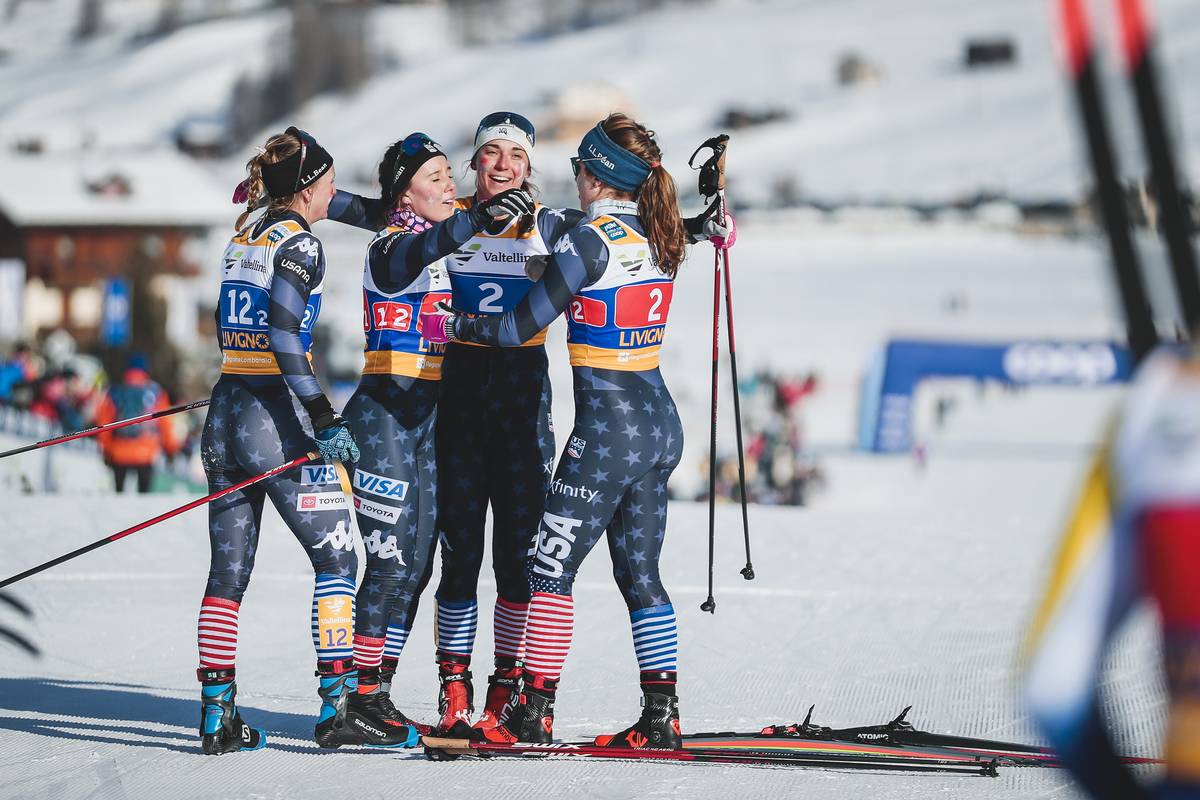
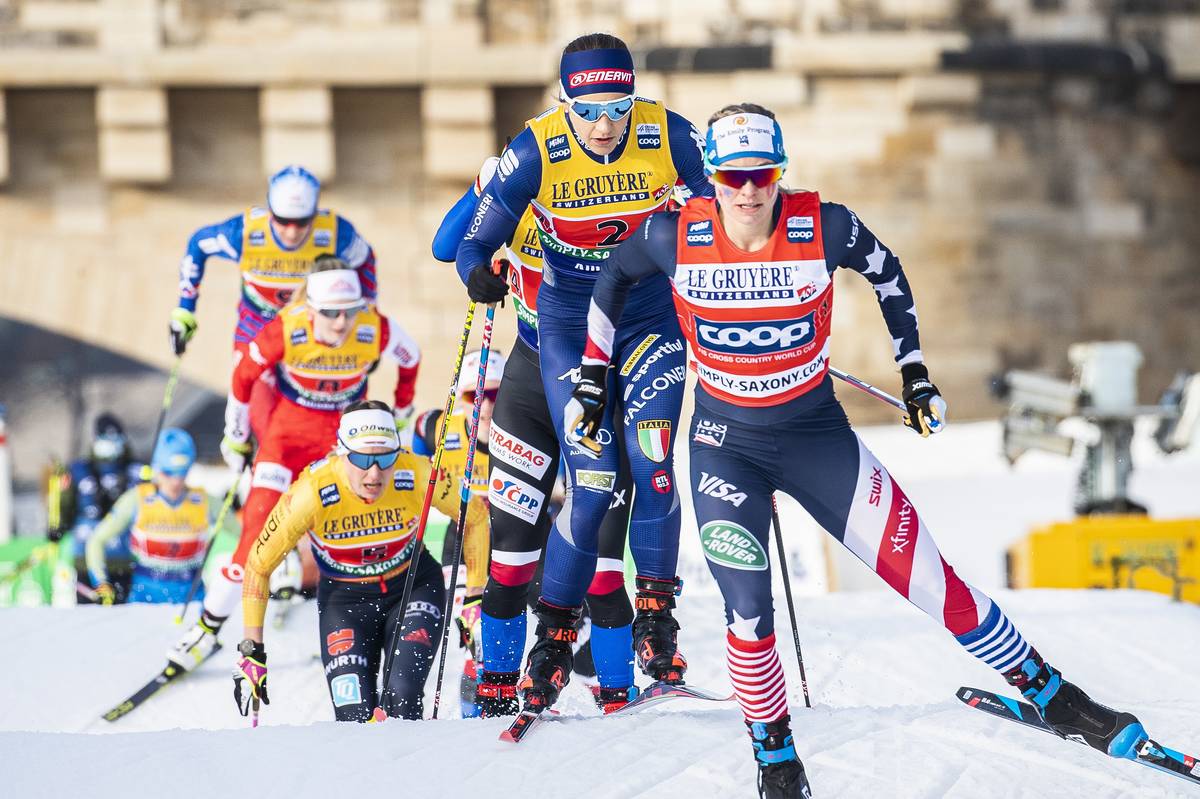
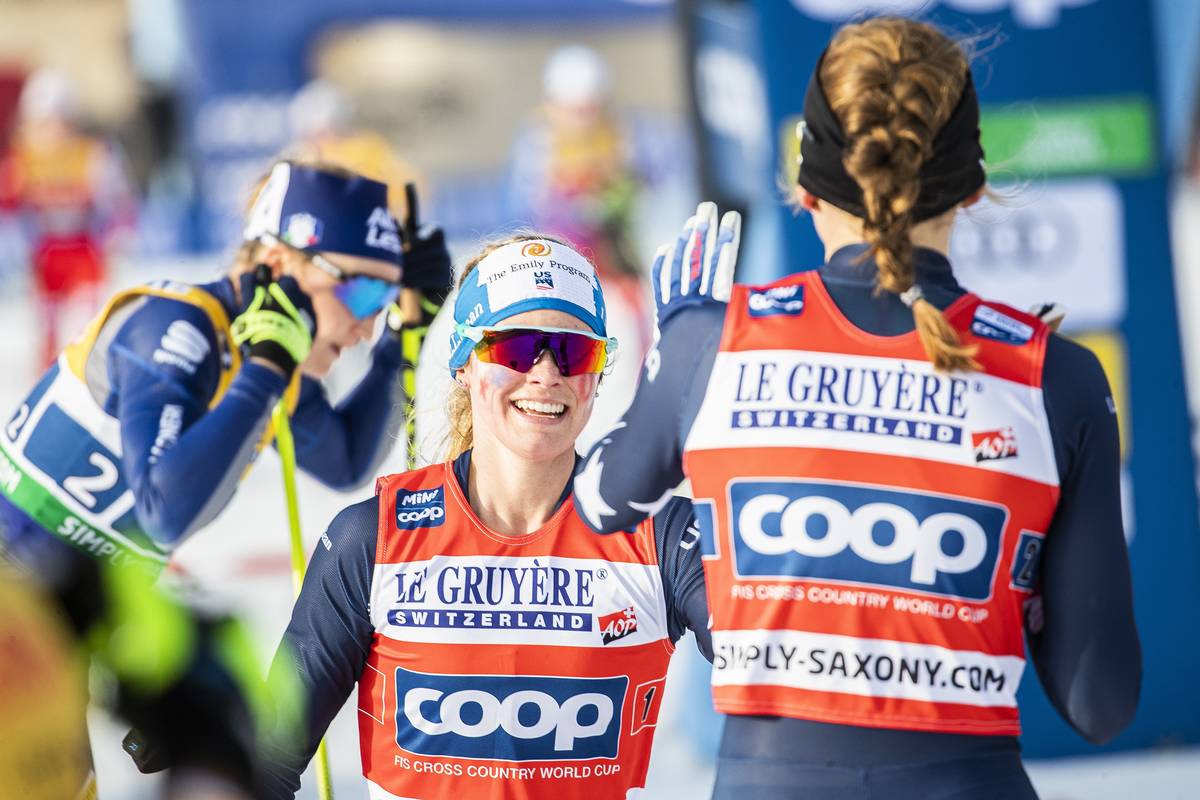
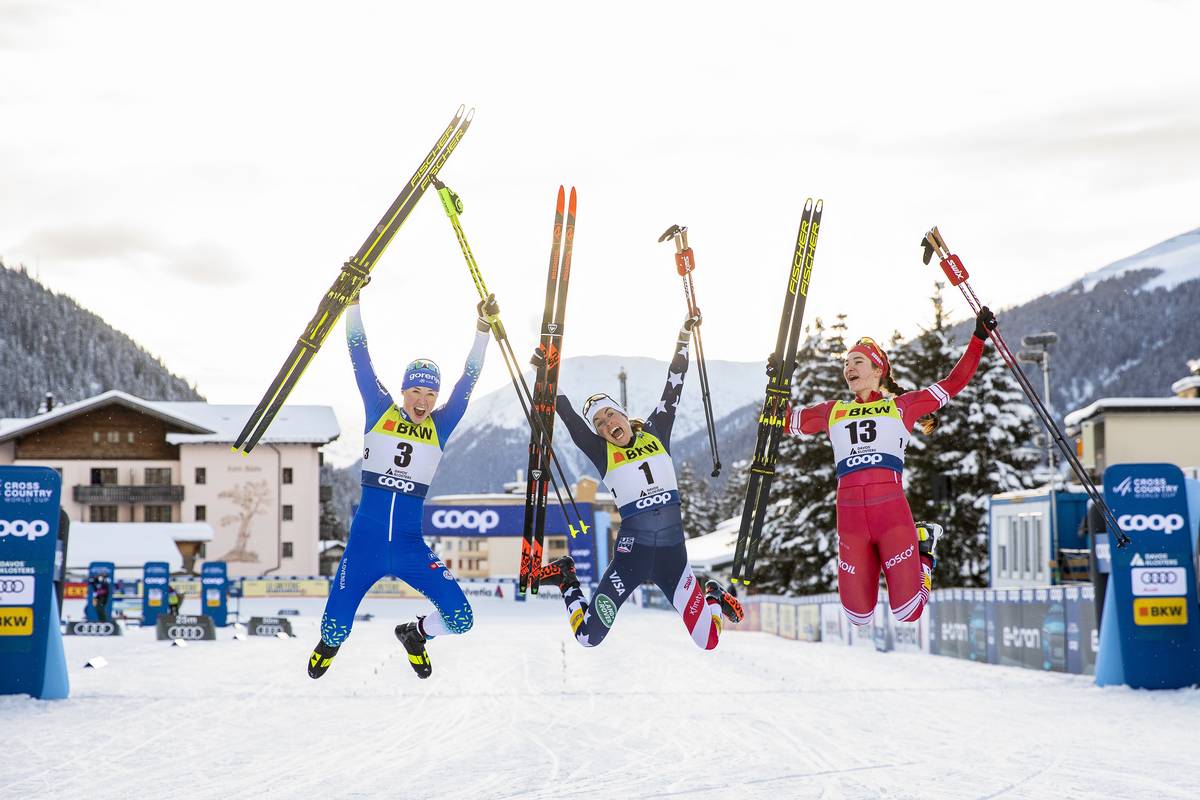
The American women celebrate after United States I – Rosie Brennan and Julia Kern – finished 3rd in a Team Sprint in 2023. (Photo: Nordic Focus).
Learning from Leaders, Leading by Example
When asked what she’s learned from her longtime teammates Rosie Brennan and Jessie Diggins, Kern doesn’t hesitate. “Rosie’s been such a great example of someone who’s had more adversity than maybe anyone I know and still shows up for the team,“ Kern said. “When I was first named to the team and had compartment-syndrome surgery, Rosie—who I didn’t even know—emailed me. She told me it would be tough but that I’d get through it. That stuck with me.”
From Diggins, Kern learned the art of curiosity. “Jessie never goes around thinking, ‘I’m the fastest in the world, I know everything,‘” she said. “She’s always got a growth mindset—always wanting to follow someone, to learn something. That’s really rare for someone at the top.”
Whitcomb has noticed the same instinct. “Julia’s evolved from someone who needed guidance into someone others now look to,“ he said. “She embodies that positive feedback loop of mentorship that defines this team.”
Mental Toughness in the Grind
On the World Cup circuit, there’s little room for reflection. Races pile up; travel blurs weeks together. Kern’s approach to a long season is both pragmatic and optimistic. “I love to race,“ she said. “The World Cup is part of the bigger plan. Early season, we’re still training on the road. You’re not trying to peak at Ruka. It’s about understanding where you are in the load of the season.”
She deliberately builds in breaks—two weeks at home after the Tour de Ski, Christmas with her boyfriend, family visiting during the Olympics. “Those resets make all the difference,“ she said. “They help you stay excited.”
You’re probably already following Kern on Instagram, but if you aren’t, you are missing out on a lot of delicious food inspiration. Cooking has become another activity for her to recover and connect with her friends and family. (Courtesy Photo)
Her outcome goals are clear: make sprint finals consistently, push into the top-10 in distance races, and—if everything lines up—fight for a team-sprint medal at the Olympics. “That’s what I think about during hard intervals,“ she admitted. “The team sprint is a big goal of mine.”
But Kern’s definition of success extends well beyond medals. “A successful season for me,“ she said, “is staying healthy, enjoying the process, and feeling good about how I carried myself. Pressure is a privilege. I want to soak up the experience and make it fun again.”
Beyond the Podium
For Kern, the sport’s meaning has broadened. As an athlete representative to FIS and an advocate with Protect Our Winters, she’s become a voice for climate responsibility and athlete well-being. During the 2025 World Championships, when environmental protests threatened to disrupt races, Kern helped mediate between activists and organizers. “We agreed that protesting during the race wasn’t the way to send a strong message,“ she said. “Now we have an open dialogue. These things take time, but they’re moving.”
Her motivation, she said, “is less about results and more about impact.“ She wants younger athletes to know that skiing fast can be both a platform and a privilege. “I feel grateful that I had such an active childhood and want that for the next generation,“ she said. “Clean air affects everyone. Being outside isn’t something we can take for granted anymore.”
Using her success as a platform to make a lasting impact on children has become a priority for Kern. (Courtesy Photo)
The Joy of Motion
Talk to Kern for long enough, and you realize skiing is just one part of her athletic identity. She’s an all-around mover—mountain biking, surfing, beach volleyball. “I’ve always loved doing every sport imaginable,“ she said. “Even as a kid, I just wanted to move. There’s so much value in being active and having fun. You don’t have to specialize too early. Playing lots of sports keeps it fresh and helps you avoid burnout.”
Cooking has become her creative outlet. “My boyfriend and I love to cook together,“ she said. “We have a CSA, so we get creative with whatever veggies we have. It’s like art—making the food look pretty, connecting with what we eat. It’s a kind of recovery, too.”
From the Gym to the World Stage
Whitcomb sees this blend of drive and joy as Kern’s secret strength. “Julia’s positivity isn’t surface-level,“ he said. “It’s a choice she makes every day despite setbacks. That’s what makes her such an anchor on this team.”
For her part, Kern sees the season ahead not as a culmination, but as another chapter in a long-term process. “Fourteen-year-old me would be surprised I’m still ski racing,“ she said, laughing. “Back then, I thought junior nationals were the pinnacle. I didn’t even know what the World Cup was. I think she’d be proud that I’m still doing this—and still having fun with it.”
Enjoyment is what keeps Kern chasing perfect rhythm through the snow, trusting that good energy leads to good skiing, and that joy and excellence can, in fact, coexist.
Kern seems fully ready to send it this season. (Courtesy Photo)
Love Stories Like This? Help Keep Them Coming.
Feature interviews like this one take time, access, and care to produce. If you value thoughtful storytelling and independent ski journalism, please consider becoming a Voluntary Subscriber. Your support directly fuels the work we do to cover the people, places, and moments that make our sport special.
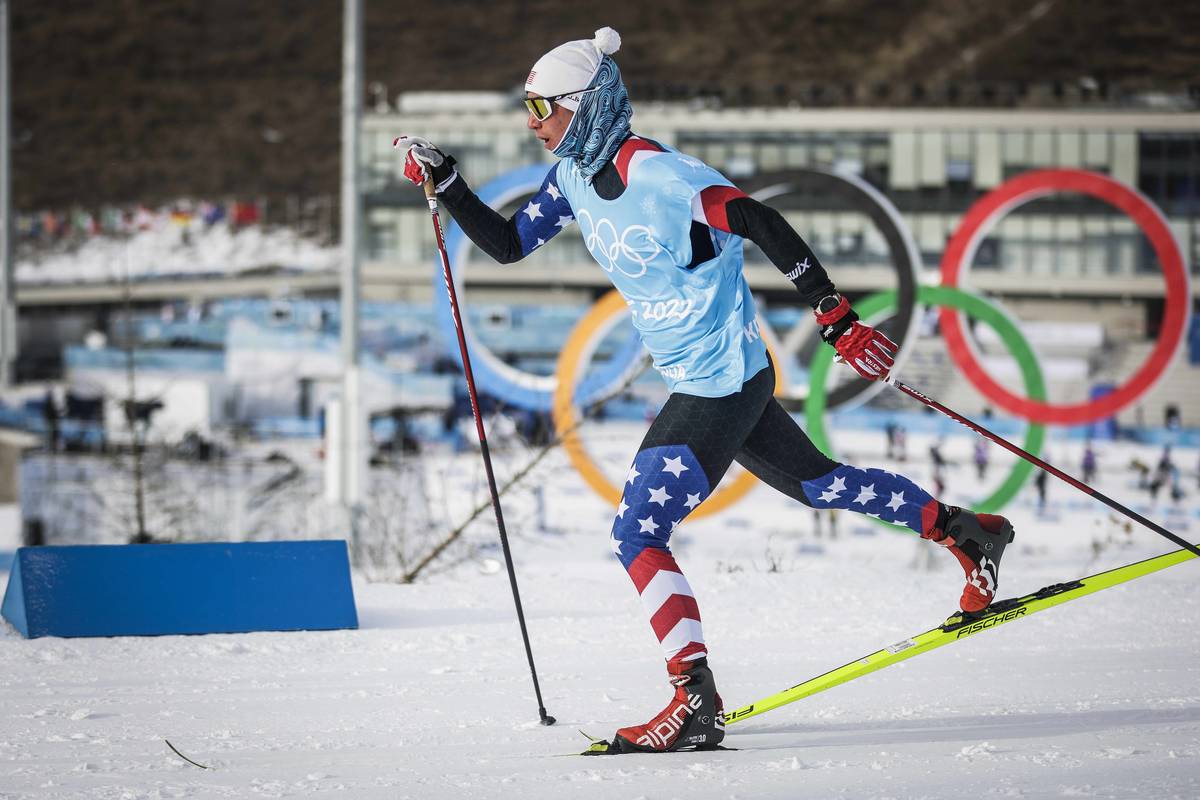
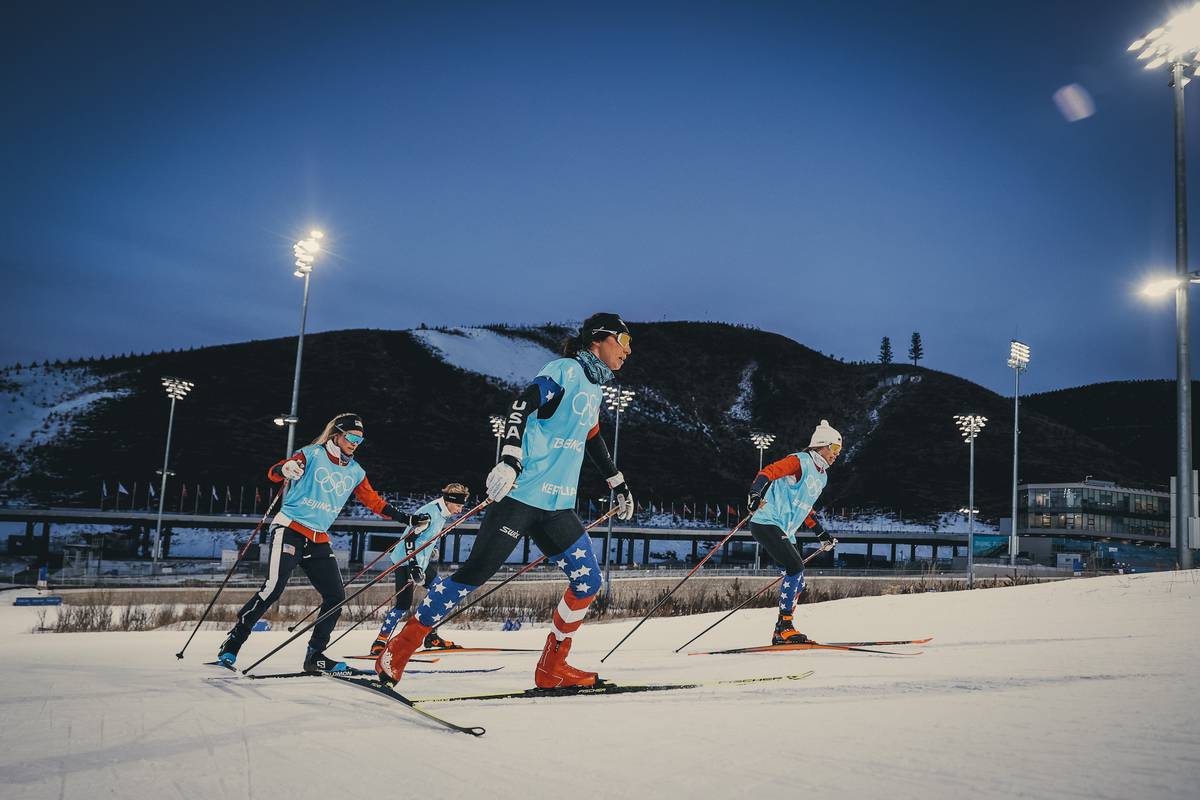
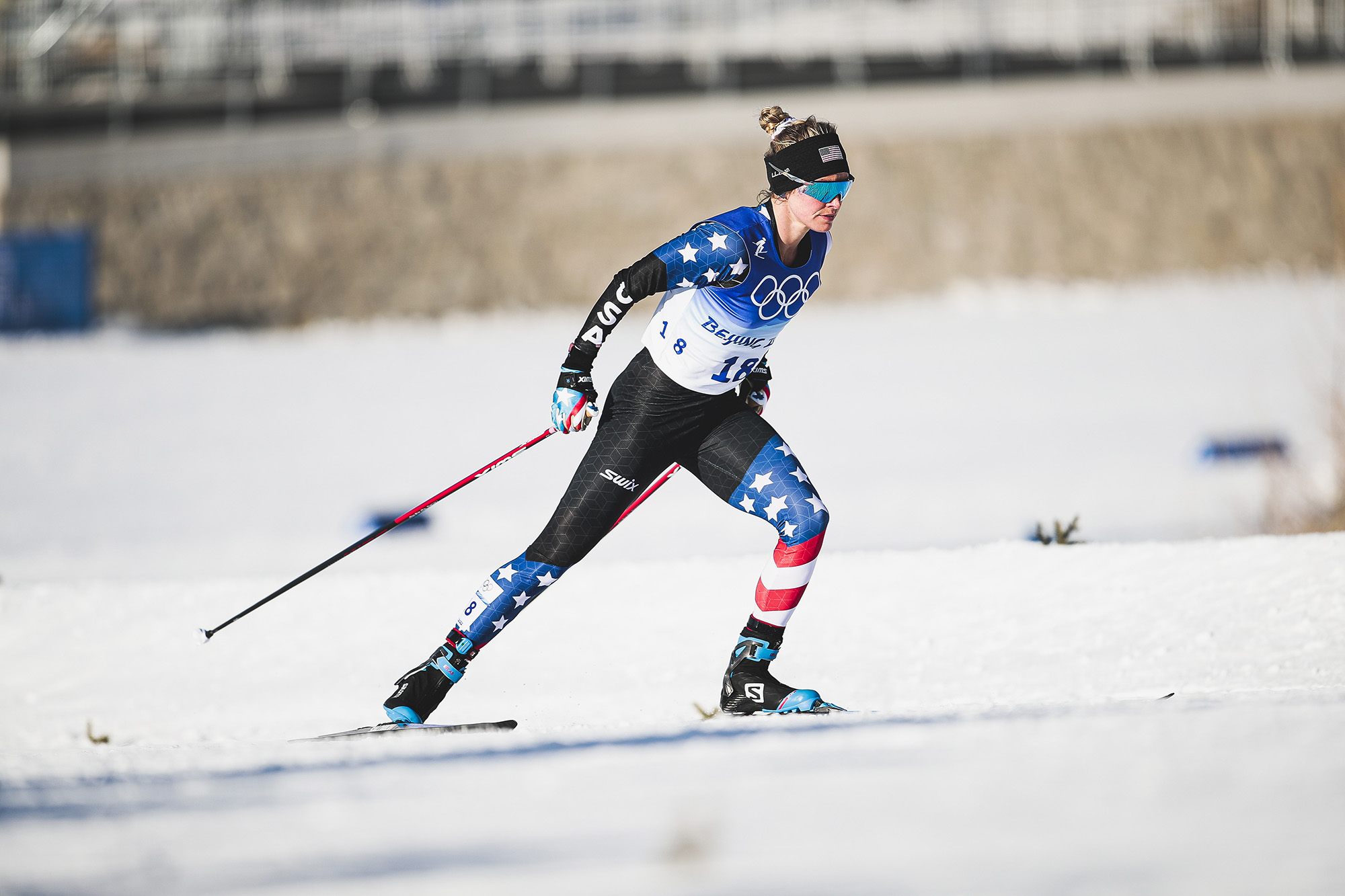
Julia Kern prepares for her Olympic debut on the tracks in Zhangjiakou, CNH. (Photo: NordicFocus)
FasterSkier recently shared a press release on behalf of the US Nordic Olympic Women (US NOW) announcing Julia Kern as the 2022 recipient of the fourth annual Gold Rush Award. The release included comments from 2021 winner Jessie Diggins on the qualities that she, along with the other past winners, recognized made Kern deserving of this year’s award, but it became clear that there was a gap in FasterSkier’s coverage on the history of US NOW and the evolution of the award.
To learn more, FasterSkier connected with the spark that launched Gold Rush Award into existence: recent U.S. Ski & Snowboard hall of fame inductee and early groundbreaker for American women’s skiing, Alison Owen-Bradley. It was Owen-Bradley who planted the seeds to bring together the generations of women who have represented United States in cross-country skiing at an Olympic Games, bringing US NOW into fruition.
According to Owen-Bradley, US NOW filled a gaping hole in connection among the women who helped set the foundation for what is now one of the most successful women’s ski programs in the world. Though each of the 53 women Olympians had played a role in propelling the next generation forward, opportunity for connection between the generations had been lacking. With individual efforts, a network amongst these women slowly began to connect sooner, but when the World Cup swung through Quebec City in March 2019, it provided an ideal opportunity to reunite as a collective.
“We ended up having quite a few Olympic women there,” recalled Owen-Bradley in a call. “And it was fun because we wore our vintage clothing to the race, so we had all kinds of different eras of Olympic clothes. It was so congruent because we were really cheering on the latest, greatest women racing but we were also together with our teammates from the past, and it kind of just kind of grew from there.”
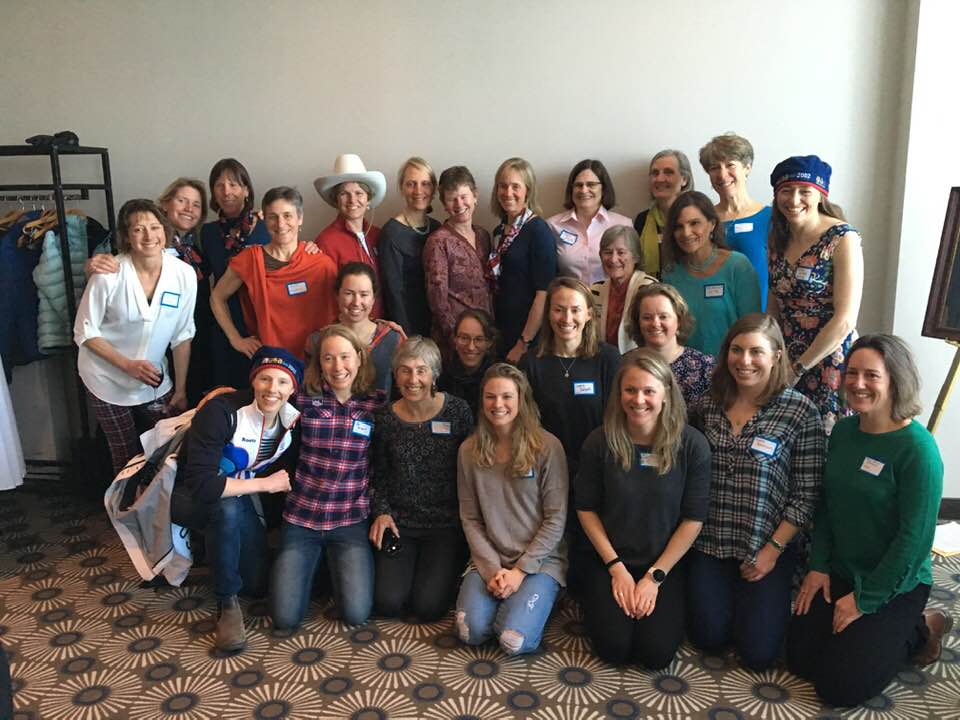
An intergenerational collective of Olympic women reunite at the 2019 World Cup Finals in Quebec City. (Photo: Peggy Shinn)
Having been teammates long before the era of Facebook – in fact, some well before the internet – it had been hard for these women to feel connected and maintain ties after careers ended. Owen-Bradley said that before the reunion, she didn’t have contact information for many of these women, and consequently didn’t feel the relationships had been sufficiently developed among the various generations.
With some word-smithing to nail a catchy acronym, the energy and camaraderie established at this reunion evolved into US NOW. But there’s much more to the name than meets the eye.
“US NOW – being retired from ski racing, who are we now? What have we learned? There’s so much gold in that for mining, in a metaphoric way. All these women, what have they learned? What have they gone on to do? How was it good and bad in their lives to devote their time to this? I don’t think we’ve even come close to exploring that and getting the nuggets [of wisdom] out of what women went through and and got from those experiences. But also, how hard was that? And was it worth it? And what would have made it more worth it? And then to just go forward in a way that uses that wisdom.”
And so, the organization was built by Olympic women and for future generations of Olympic women.
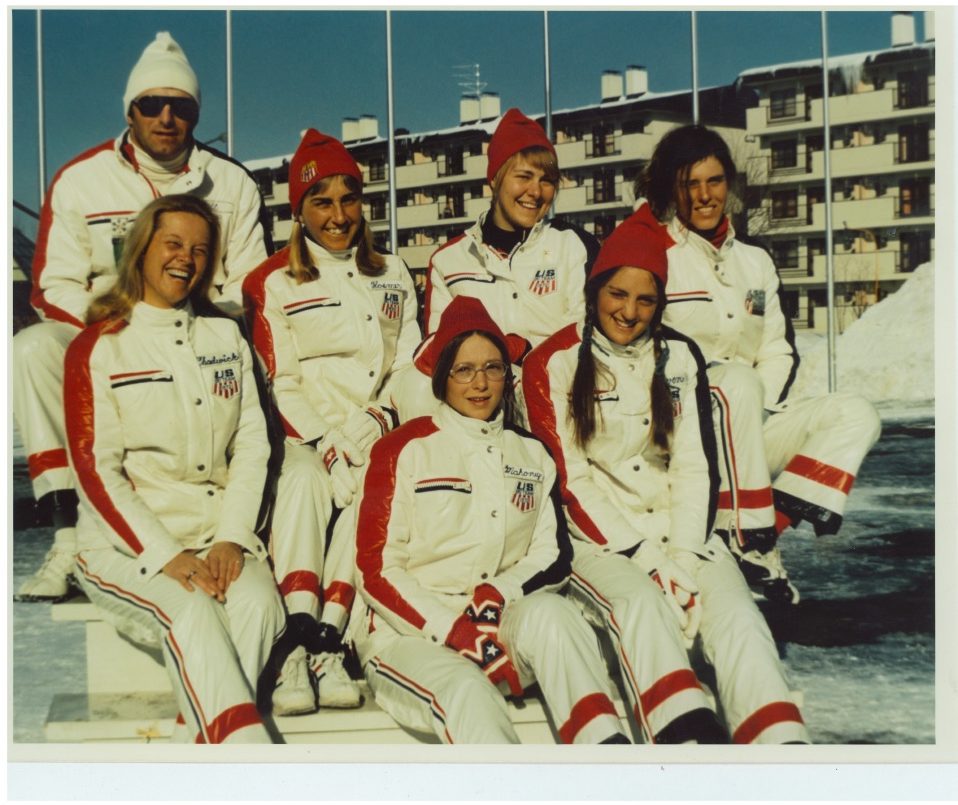
The first Women’s cross-country Olympic Team. The 1972 Games were held in Sapporo, Japan. Bottom row—Gloria Chadwick, pseudo Chaperone, Margie Mahoney, Alison Owen Top Row—Marty Hall, Trina Hosmer, Barbara Britch, Martha Rockwell. (Photo: courtesy Alison Owen-Bradley)
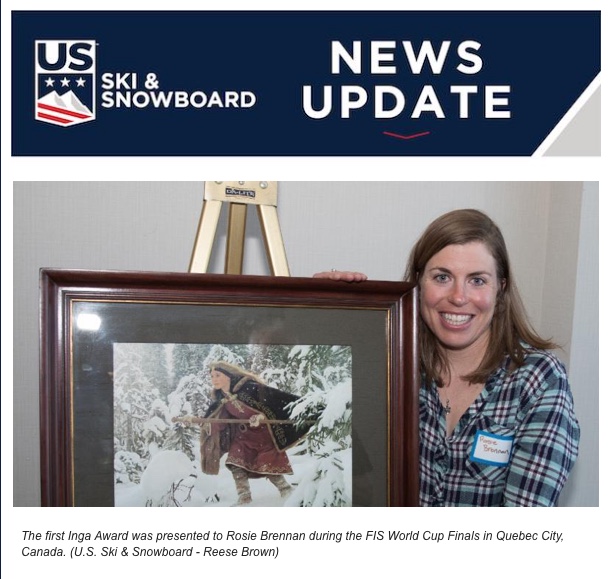
When the coach of the first women’s Olympic team, Marty Hall, was inducted into the U.S. Ski & Snowboard Hall of Fame in the spring of 2018, he invited Owen-Bradley to attend the ceremony, having been one of his original athletes. While traveling through Norway to race at World Masters, a print inspired by the Birkebeiner story caught her eye; instead of the image she was familiar with, which depicted two warriors valiantly carrying Prince Haakon to safety on their trek through the mountains, it was an image of Prince Haakon’s mother, Queen Inga. She too had made the arduous journey on skis to save her son, and yet, Owen-Bradley had never seen her included in the story’s artwork.
Finding it symbolic of the emergence of women’s cross-country skiing in the US over the last 50 years, Owen-Bradley purchased the print, and decided it would be a fitting gift to honor Hall at the ceremony. “He had been the first Olympic coach for women and had kind of gotten us on the map.”
However, the piece of artwork was large. She laughed as she recalled giving it to him, but also telling him it did not need to take up a wall in his home.
“We decided that it would be a traveling picture, and we would pick someone every year to give it to, and so out of that came this idea [for the award].”
In 2019, following the World Cup, the Inga Award was presented to its first recipient: Rosie Brennan. Having rebounded from a season impaired by the effects of the mononucleosis virus, Brennan was selected based on the “courage, fortitude, grit, determination and raw talent [it took] to achieve an extremely high level of success on the international ski racing circuit [that] season.”
Over the next year, however, Owen-Bradley began to dwell on why the image of a Norwegian woman should be the symbol for the efforts of the women in the American cross-country program. She began looking for inspiration closer to home, eventually finding an equally strong, noteworthy, and under-recognized alternative.
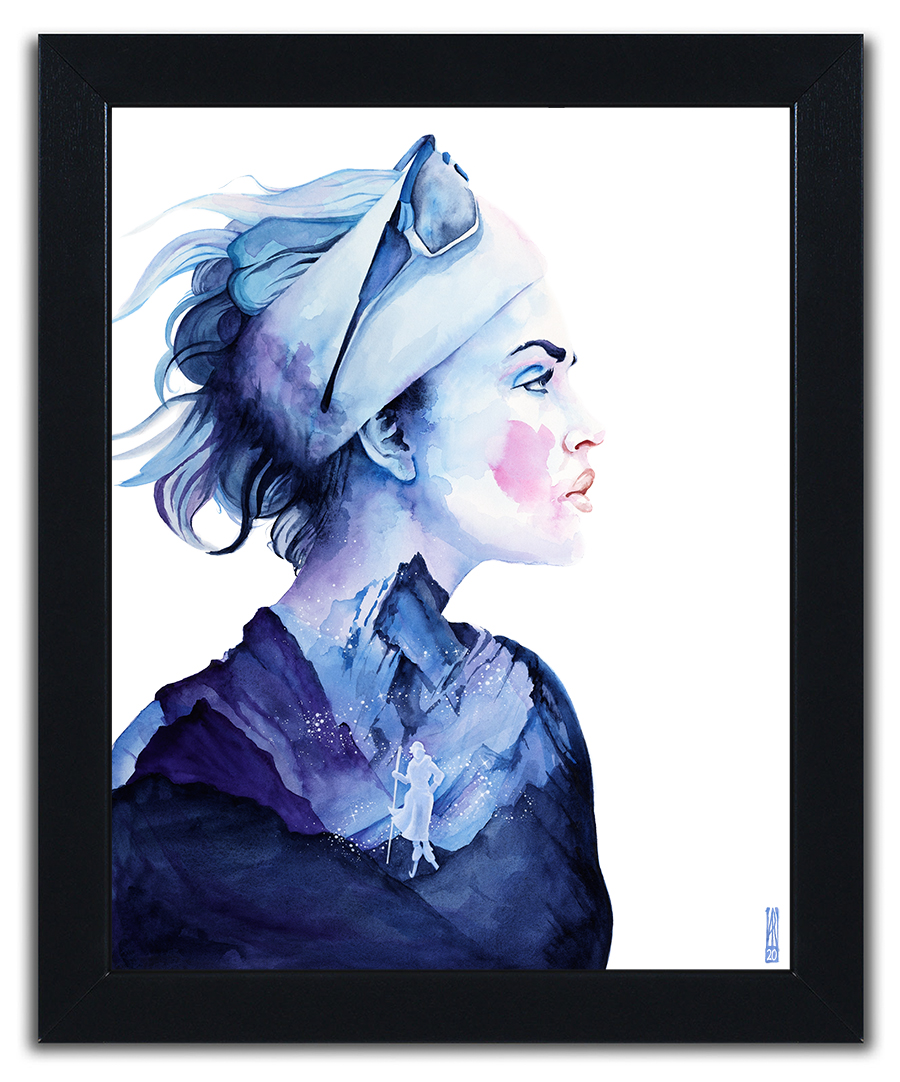
“I changed it to the Gold Rush award because in the High Sierras during the Gold Rush era, women were nordic racing. Not on the same levels that we do it [now], but they had cross country races that that women raced in… So I thought, ‘Oh, what a cool thing — the Gold Rush.’”
She also noted the ties between racing for gold medals at the Olympics, which Kikkan Randall and Jessie Diggins achieved in 2018. Working with artist Andy Rogers, a new image was created, superimposing the image of a woman on skis in the High Sierra on the bust and profile of a determined and modern-looking woman in a race headband and sport sunglasses. In 2019, this image was presented to co-recipients Sadie Maubet Bjornsen and Sophie Caldwell Hamilton.
Gold Rush Award: (Artist Andy Rogers)
While each of the women mentioned to this point have unquestionably racked up an impressive resume of results, the award is not meant to recognize what happens on the race course directly. Rather, Owen-Bradley explained a recipient is selected for the award by “exemplifying and showing the grit and the grace that it takes to be successful.” It’s what happened behind the scenes to get the result, not the result itself.
“An example would be Sophie whose mother died [in 2019] and she still went on with such grace and was so successful through all of that. And Sadie because of all the injuries she worked through and kept going… So, to me, it’s been about the grit and the grace of what it takes to be a woman nordic ski racer at that level.”
Approaching the 50-year mark of her own Olympic debut and now focusing more of her time and energy on her small farm in Idaho rather than the cross-country ski world, Owen-Bradley explained that this year, she felt less directly connected to the potential recipients for the Gold Rush award. She decided the decision should be made collectively amongst the four previous winners, to which she would add a fifth vote. After some discussion, the group voted unanimously for Julia Kern.
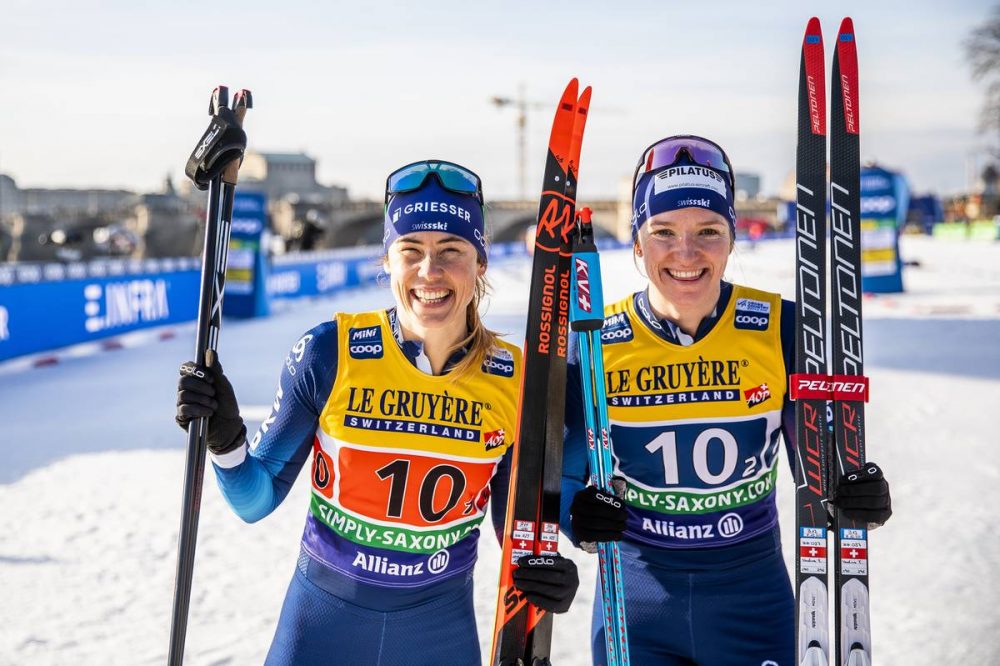
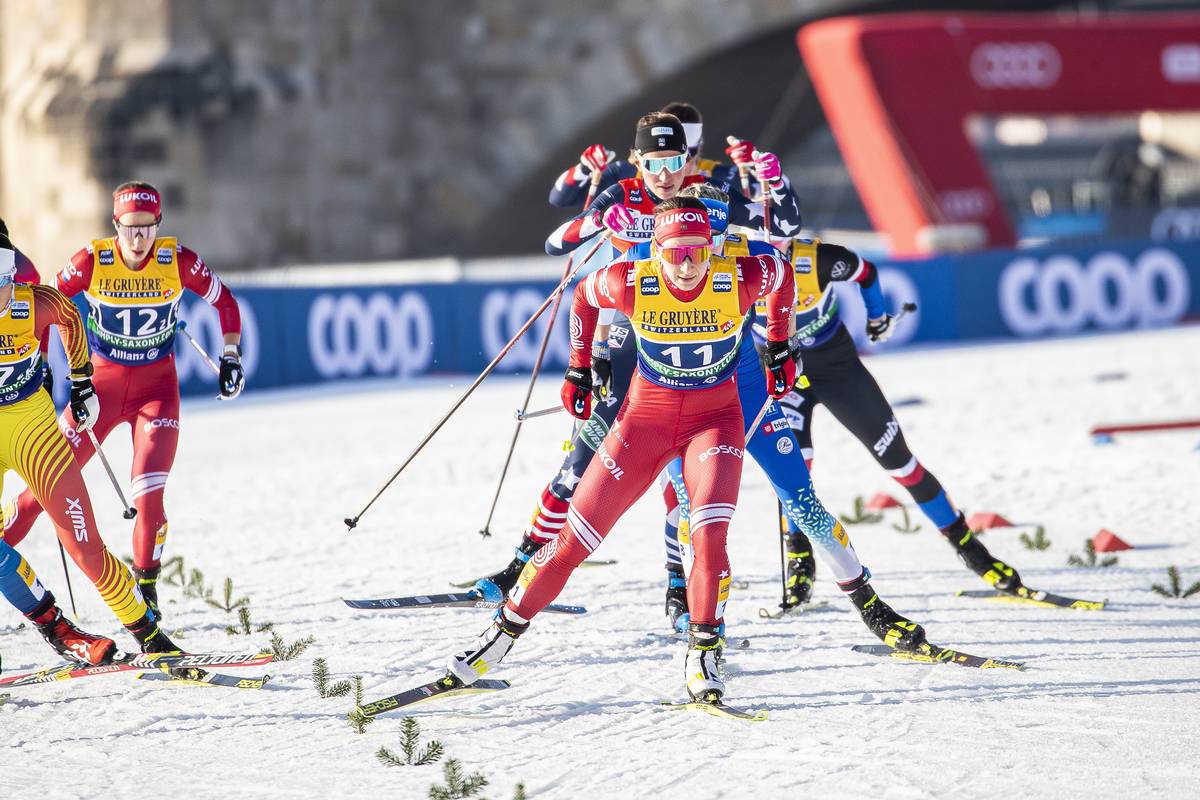
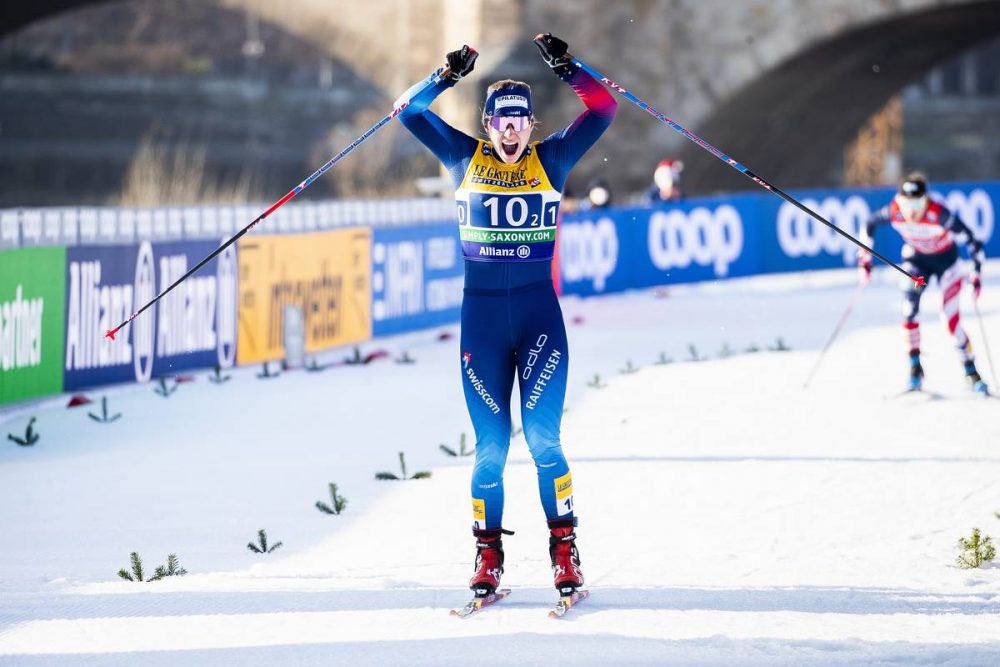
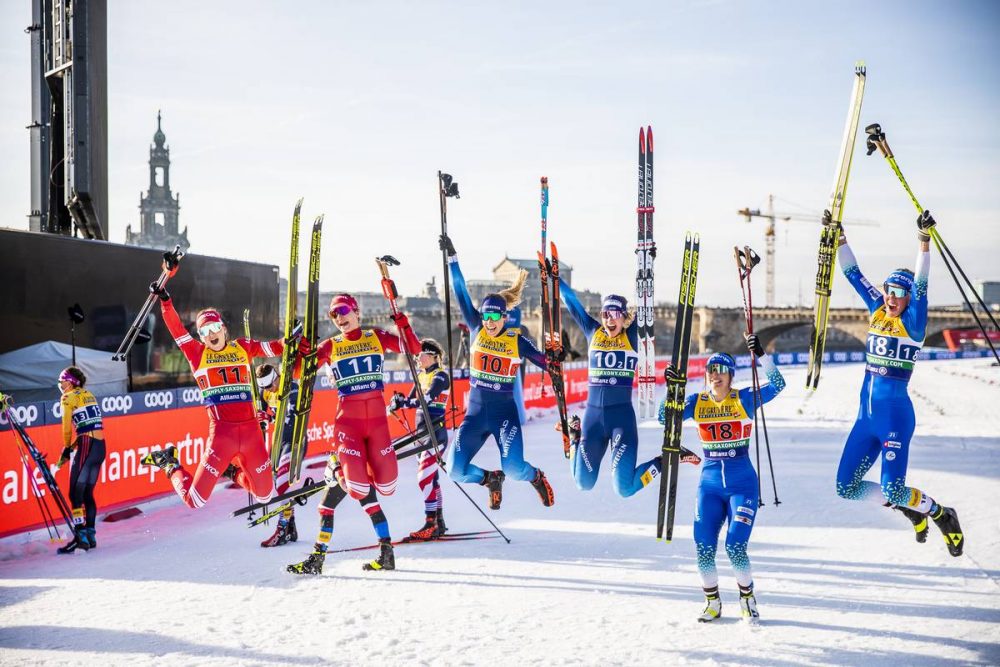
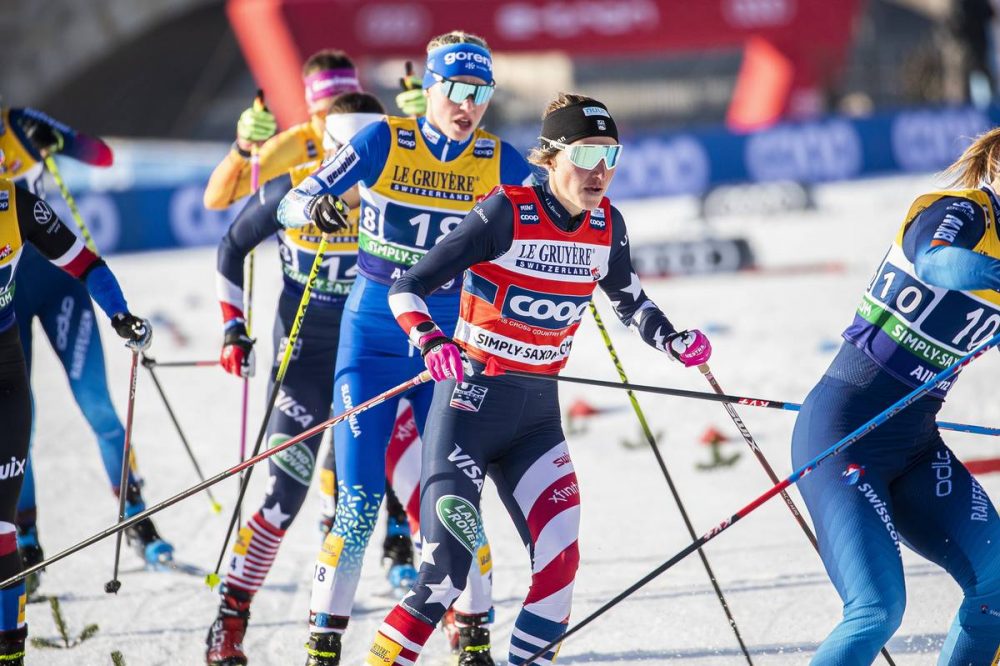
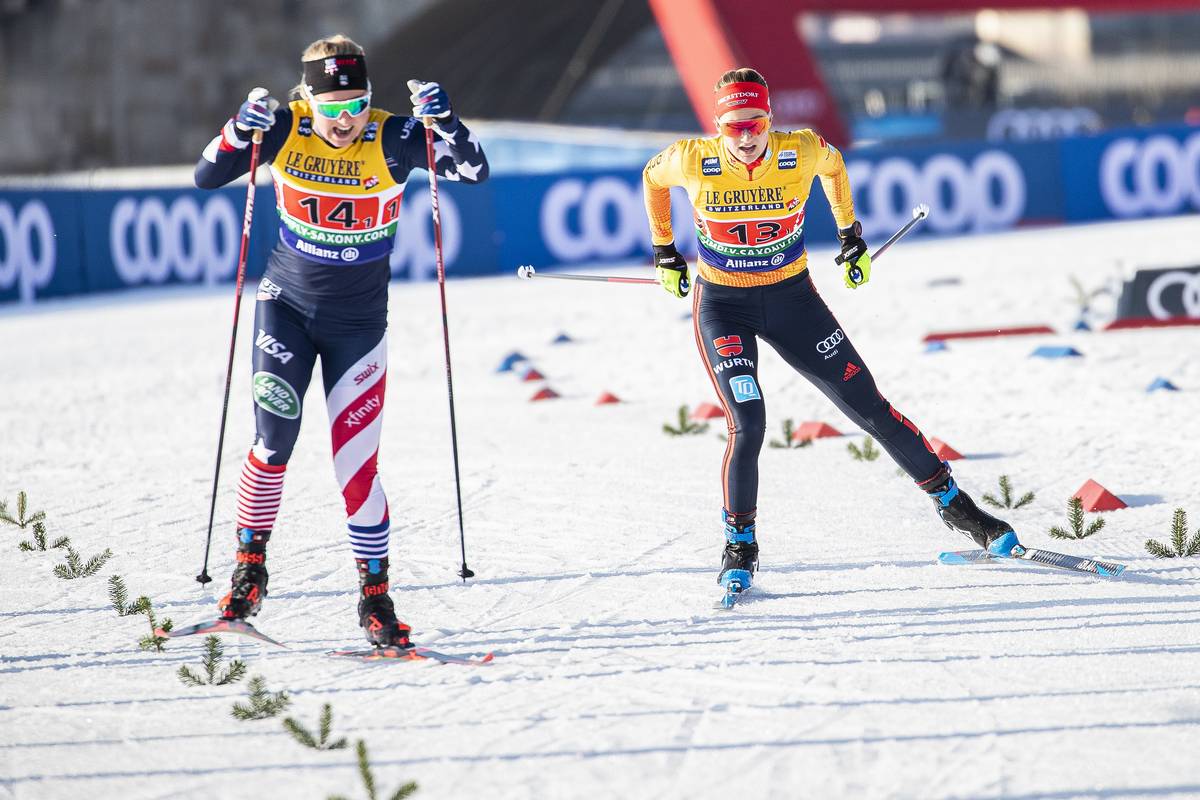
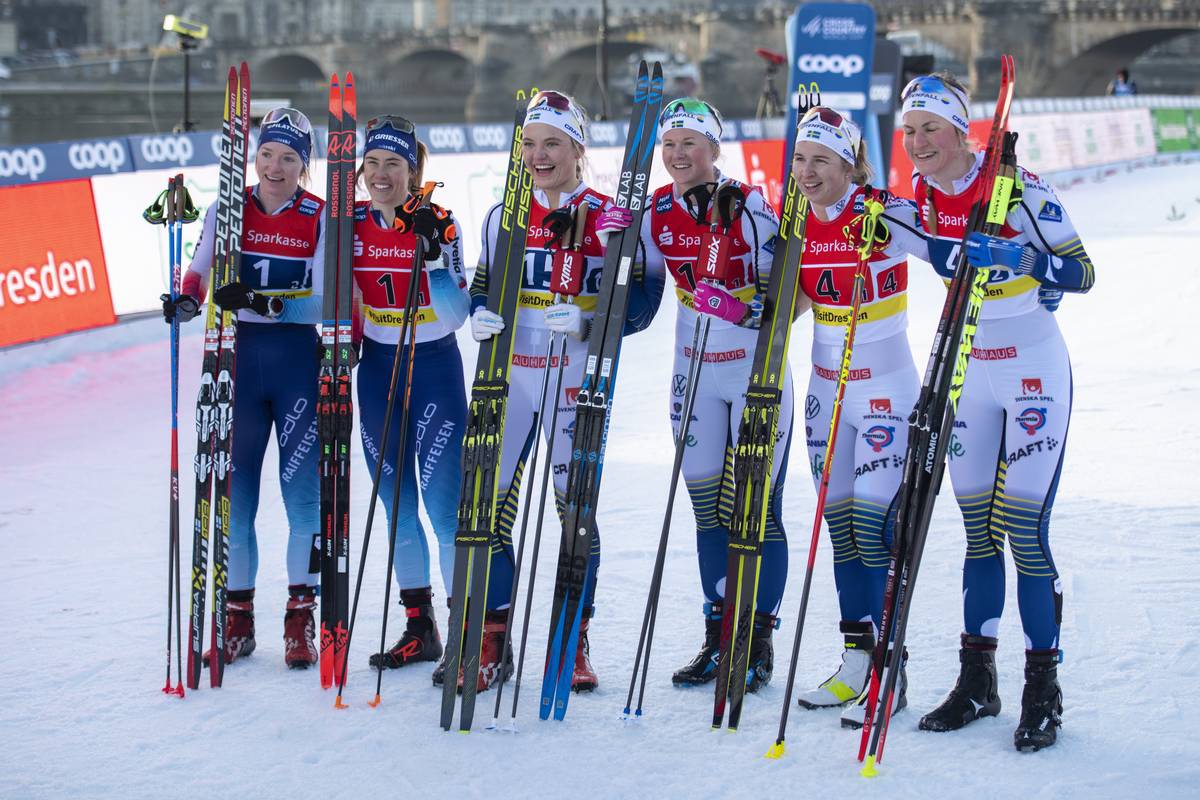
Jessie Diggins and Julia Kern celebrate a second-place team sprint finish in Dresden, GER in December, 2021. (Photo: NordicFocus)
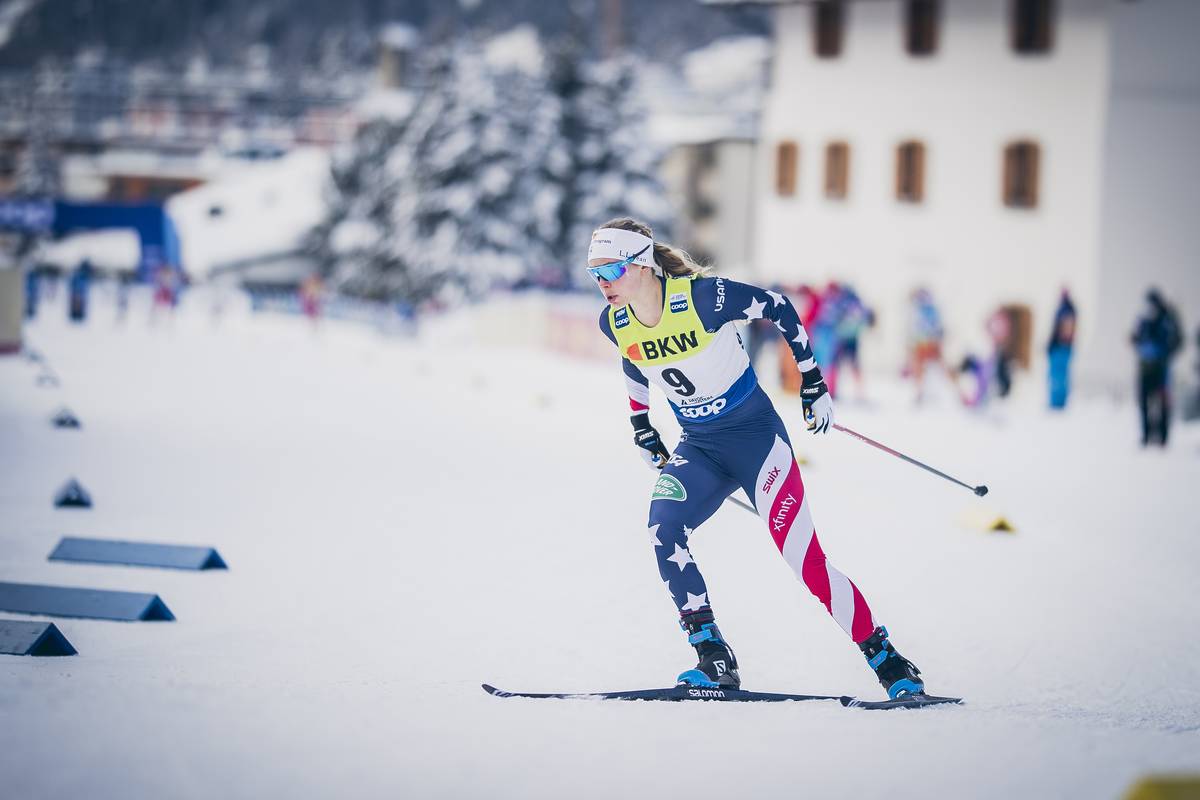
A member of the U.S. Ski Team since 2017, Kern’s progression on the international level has been steady, but non-linear. Alongside leaps forward, she’s faced her fair share of injuries and setbacks. Both the 2020/2021 season and her first Olympic appearances in 2022 left her wanting more, but interjecting these lows during the 2021/22 race season were a slew of career highlights. Her top results include two individual fourth-place sprint finishes on the World Cup, a team sprint podium in Dresden, a handful of other World Cup top tens, and finishing the year winning three out of four events at the joint U.S SuperTour Finals / Canadian National Championships in Whistler, BC.
And in February 2023, she’s heading into a World Championship which will take place at the venue where she earned her first World Cup podium in December 2019: Planica, Slovenia.
Sophie Caldwell Hamilton / Julia Kern
Julia Kern / USST Coaches
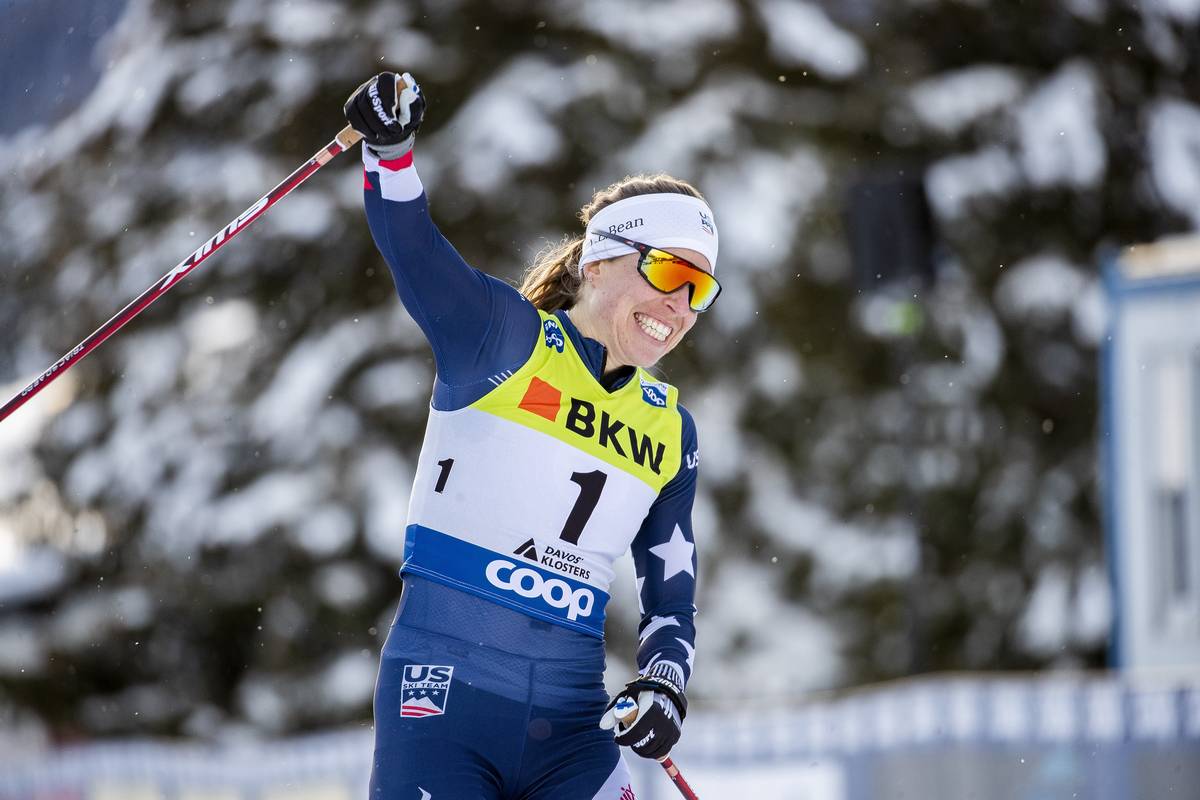
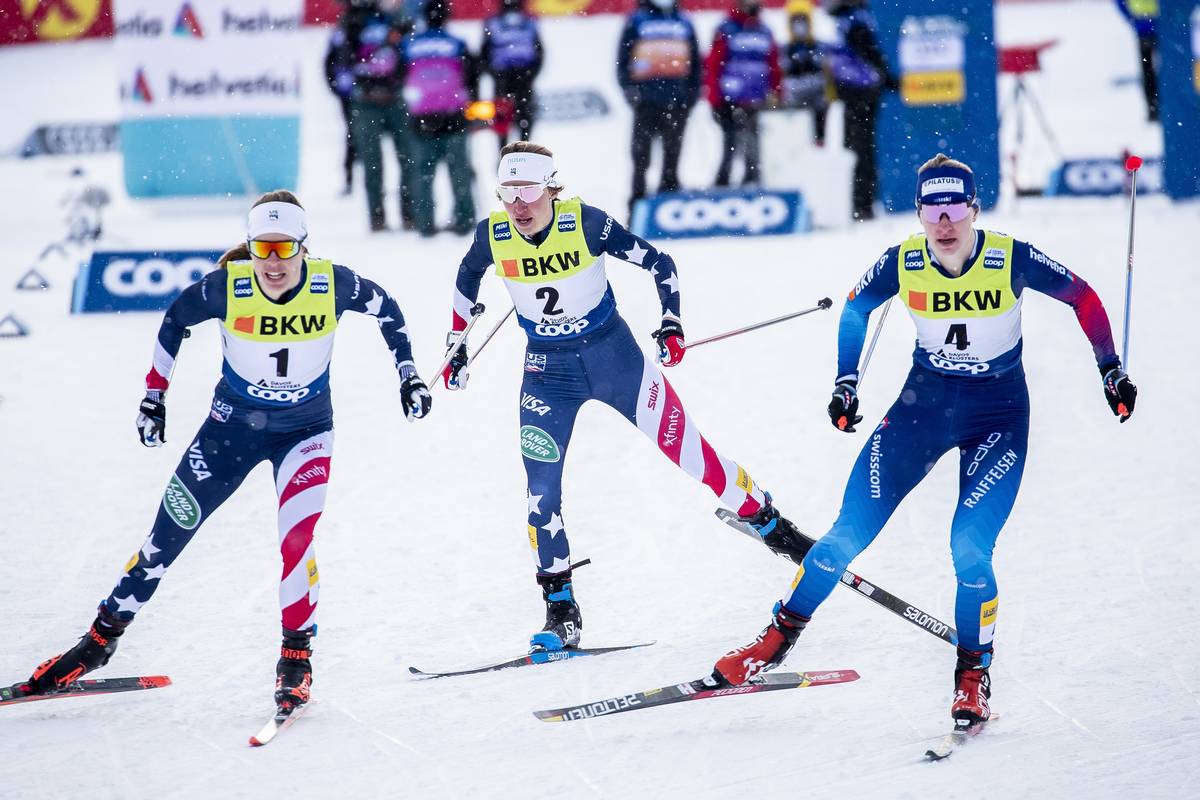
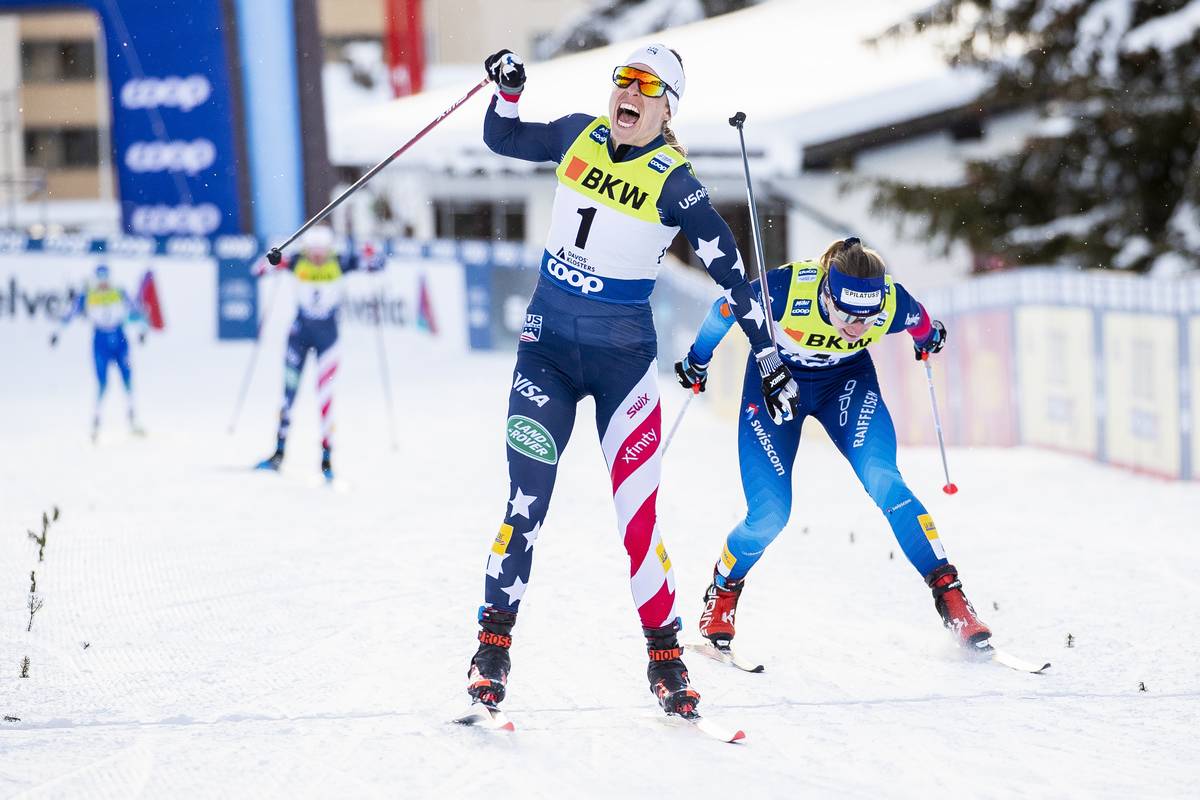
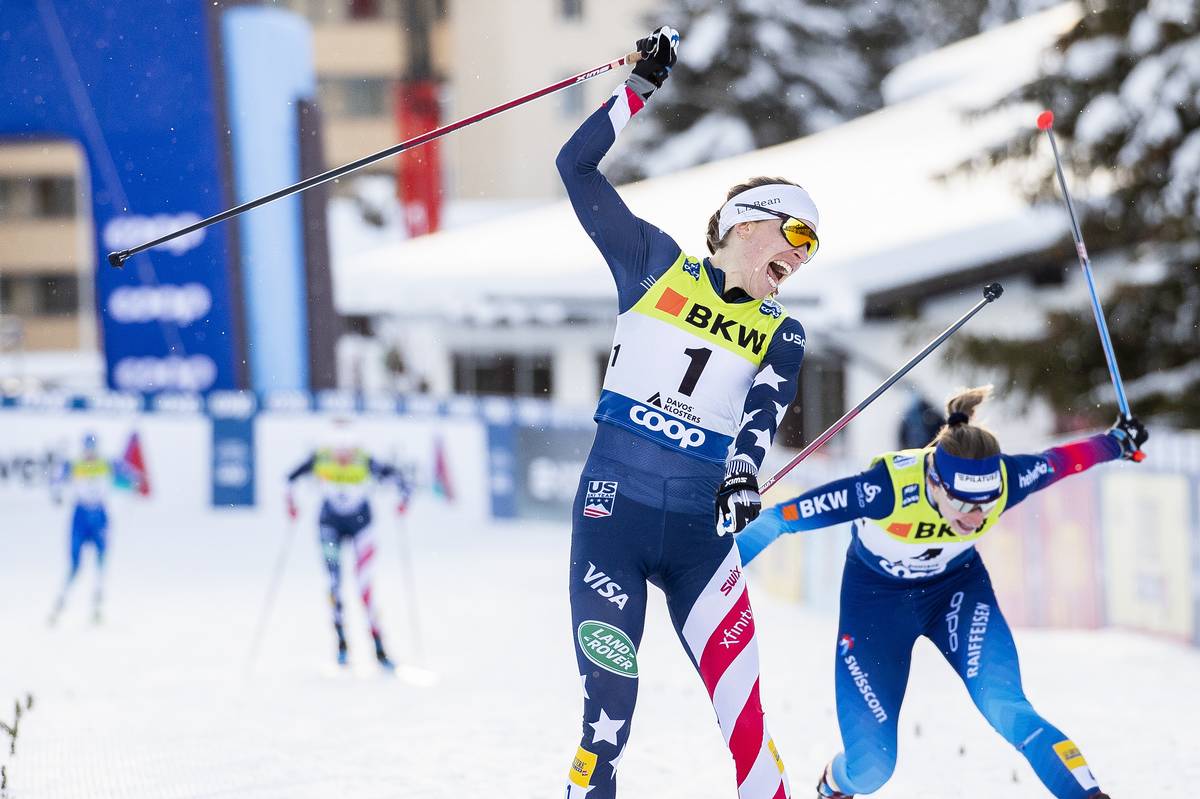
Smiles and hugs all-around to celebrate Julia Kern’s first World Cup podium in Planica, Slovenia in December 2019. Kern finished third in the freestyle sprint, with Sophie Caldwell Hamilton just behind in fourth. (Photos: NordicFocus)
According to the past award recipients on the selection committee, it was the juxtaposition of these celebrations and challenges over the last few seasons that highlighted Kern’s candidacy for the award this spring.
“To me, what is special about this award, is first that it was voted on by this very incredible group of women who all share tenacity and drive to get through challenges and be better on the other side and second, that it awards just that and not results,” explained Brennan in an email. “Julia exemplifies this in her ability to be a strong teammate, no matter what the circumstances are. She holds her head high and goes out of her way to never bring people down when things are tough, aren’t going her way, or she’s faced with a challenge. When something doesn’t work out for her, she immediately jumps gears and does literally whatever she can to help her teammates have success.
“On top of that, she doesn’t lose faith in herself, she continues to fight, look for opportunity and carry an optimistic outlook towards her future. She has shown this many times after coming off a slump, injury, or some other challenge to find herself notching career bests. I think these things aren’t mutually exclusive and that we all have a lot to learn from Julia’s ability to be an exceptional teammate and in turn have that give her energy to continue chasing her own goals.”
Smooth and powerful, Julia Kern races through the heats during a classic sprint in Falun, SWE in March 2022. (Photo: NordicFocus)
Commenting on her nomination, Kern attributed her own success to the efforts of the women who came before her, including those who would present her with the award.
“I am incredibly honored to be given the Gold Rush Award by such an incredible group of women. US NOW is a group of women who have paved the way for U.S. skiing, many of whom have been personal role models and mentors to me in skiing and in life. I would not have had the opportunities, experience and knowledge without their hard work and passion for giving back to the younger generations. The past few years have been challenging for a variety of factors, and it was rewarding to come back stronger with my best season yet.”
As the list of award winners grows and US NOW builds momentum, Owen-Bradley hopes the award can be expanded to include a monetary prize in addition to the print and tribute. Acknowledging the increase in representation for women across various aspects of skiing, such as coaching and waxing, she would love to see new awards developed to recognize these important examples also.
When Owen-Bradley began skiing as a child in the 1960’s, her only option was to join the boys program; Title IX did not pass until June 1972, at which point she was 19 and had already raced at a World Championship. As she reflected on the amount of opportunity for women in cross-country skiing now, and what the creation of US NOW and the Gold Rush Award means to Owen-Bradley personally, she expressed feelings of joy and optimism.
“For me to go from not having a place, to having these strong women’s teams – it’s just so fun.”
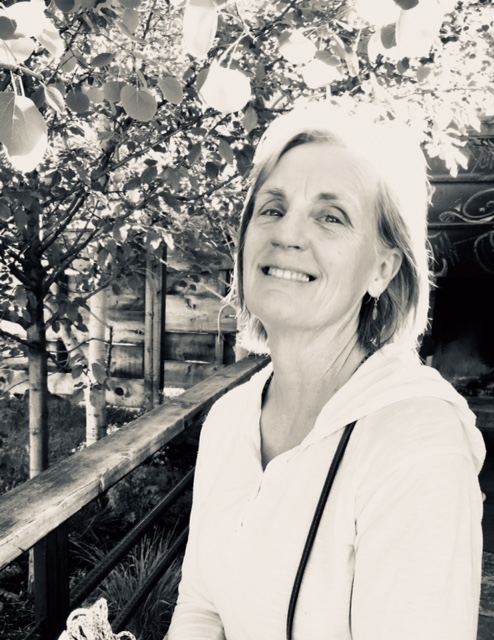
Alison Owen-Bradley, a pioneer of elite level women’s cross-country skiing in the U.S. (courtesy photo)
This World Cup coverage is made possible through the generous support of Marty and Kathy Hall and the A Hall Mark of Excellence Award. To learn more about A Hall Mark of Excellence Award or to learn how you can support FasterSkier’s coverage please contact info@fasterskier.com.
The History:
A survey of the last five Olympic cycles shows a clear trend in American women’s sprint results: upward. In the 2002 Games in Salt Lake City, no Americans qualified in the freestyle sprint. Tessa Benoit was the top qualifier in 38th, with an up-and-coming Kikkan Randall next for Team USA in 44th. Randall was then 20 years old.
In the freestyle sprint four years later in Torino, Randall was the only American to qualify for the heats. She was 10th in qualification, then moved to 9th in the final standings. Switching to classic for the 2010 Games in Vancouver, Randall again qualified in 10th to be the only American in the heats, this time racing her way up to eighth.
And then there was Sochi.
The 2014 Games in Sochi were a turning point for the American squad, with all four women qualifying inside the Top-30 in the freestyle sprint. This time, a new name topped the list for qualification: Sophie Caldwell in 9th. Not to be overlooked, USA also had Jessie Diggins 12th, Kikkan Randall 18th, and Ida Sargent 25th.
Racing in her first Olympiad, Caldwell (now Hamilton) entered uncharted territory as she won her quarterfinal to advance into the semis, which she finished in a thrilling boot slide to be 0.1 seconds behind heat winner Ingvild Flugstad Østberg of Norway. Though she crashed in the final, she again moved the needle upward for the Americans by finishing sixth in the final heat.
The remaining American women also finished inside the Top-20, though none made it beyond the quarterfinals. Diggins was 13th, Randall 18th, and Sargent 19th.
The American women’s sprint team prepares for the individual freestyle sprint. (Photo: NordicFocus)
Carrying momentum from these Games through the next Olympic quad, the Americans had three women in the Top-30 for the classic sprint in PyeongChang in 2018, with Sargent just outside in 33rd.
This time it was Diggins in 7th – the top Olympic qualification result of any American woman – with Sadie Bjornsen 9th, and Caldwell 12th.
Despite it being her weaker technique, Diggins raced with confidence, landing in second in both her quarter and semi to advance automatically into the final. Losing touch with the leaders, Diggins repeated Caldwell’s historic result to finish 6th overall.
Perhaps a less apparent victory, Caldwell also raced into the semis, finishing 8th overall after taking third in her semi and missing a lucky loser spot in the final by just 0.18 seconds. Bjornsen was eliminated in her quarter after taking third in her quarter, on the wrong side of the lucky loser mark, but just barely, to end her day in 14th.
Fast forward four years and get excited.
Rosie Brennan (USA) on her way to the 2nd fastest time during qualification. (Photo: NordicFocus)
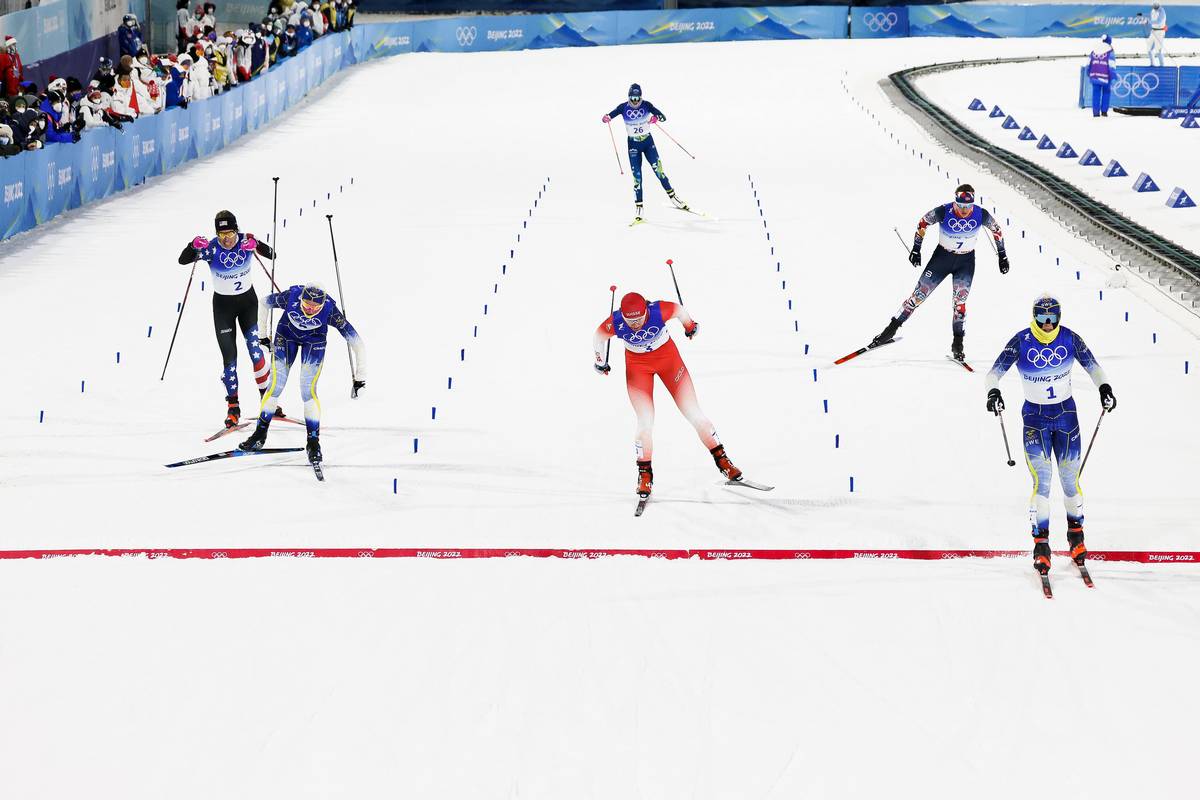
Sweden’s Jonna Sundling smashed the qualification round of the 1.5-kilometer freestyle sprint, setting the mark at 3:09.03. The next name on the list? Rosie Brennan in second (+5.80), ahead of Nadine Fähndrich (SUI) in third (+6.62), Yulia Stupak (ROC) fourth (+7.98), and… Diggins in fifth (+8.69).
Have you been reading closely? Both Brennan and Diggins both exceeded the previous best result in qualification from any American woman in history.
Also posting a strong qualifier, Julia Kern was 14th in qualification (+11.66), rebounding from Saturday’s skiathlon which left her wanting more. The final American starter, Hannah Halvorsen, finished 43rd (+20.10) in qualification – outside the Top-30, but still above Randall’s result from her first Olympic Games 20 years ago.
Jessie Diggins (USA) skis the 5th fastest time during qualification. (Photo: NordicFocus)
You may be wondering about the spread of times; the top-10 were nearly 11 seconds apart. After a quick descent out of the stadium, the course in Zhangjiakou features a 30-meter climb – nearly 100 vertical feet – followed by a sweeping downhill that leads back toward the stadium. From there, athletes face a 14-meter climb back into the stadium, finishing with a gradual rise to the line. Combined with cold dry snow, these factors can contribute to an above-average spread amongst the top qualifiers.
Here we go: the heats.
Brennan lined up alongside Sweden’s Sundling in the first quarterfinal heat. With nerves running high, a false start brought the six women back into the gate after the first starting beep. On the second go, the women pushed through the wands cleanly, but on one of her first doublepole pushes, Brennan caught the edge of her boot, dropping down to her knees and losing any momentum she had picked up as the field rocketed away from her.
Not willing to let the day end there, Brennan collected herself and focused on the task at hand, regaining contact with the group at the bottom of the climb and grinding her way into second position, looking strong as she crested the top of the hill just behind Sundling and rounded the curve to head into the descent.
After stumbling out of the start, Rosie Brennan (USA) charges back to the front of her quarterfinal heat. (Photo: NordicFocus)
Given the effort required for such a comeback, would there be enough left in the tank for the B-climb or had the matches been burned early? With Sundling holding steady in the lead Brennan was challenged by Slovenian sprint champion Anamarija Lampic as the women pushed up the final climb, but found another gear for a commanding second-place finish, +2.4 behind Sundling, but +0.7 ahead of Lampic, who would advance as a lucky loser.
The second heat featured medal favorite Maja Dahlqvist of Sweden, who qualified in sixth. Norway’s Tiril Udnes Weng set the pace, leading up the A-climb with Dahlqvist alongside, and Russia’s Natalia Nepryaeva on their tails. Powering out of the B-Climb, Dahlqvist held the advantage at the front, while Nepryaeva and Weng slid over the line in a photo finish for second and third. A closer look showed Weng’s boot accelerate as she reached forward, just in time to nip Nepryaeva at the line by 0.03 seconds for the automatic advancement to the semifinal. The second heat was six seconds slower than the first, leaving Nepryaeva out of the running for a lucky loser spot.
A fast third heat saw Nadine Fähndrich of Switzerland and Maiken Caspersen Falla advance automatically, pulling Germany’s Victoria Carl over the line as the second lucky loser.
Dancing and smiling in the start gate, Diggins got out with a clean start, positioned near the front and looking powerful as the women headed into the downhill curve out of the stadium. Around this curve, she was pushed to the outside as she skied defensively to dodge potential snags with the other skiers’ equipment, leaving the curve near the back of the pack.
Jessie Diggins (USA) leads Emma Ribom (SWE) in the early rounds. (Photo: NordicFocus)
Then, Diggins put on a show up the climb. Steadily moving up along the outside, she was perfectly balanced in a crisp V2 while other were in V1, catching the Swedish leader Emma Ribom. Leading over the top, Diggins kept the pace high to take the sting out of other sprinters. Carrying momentum out of the descent and again holding a strong V2 up the B-Climb, Diggins carried her lead through the finish to win by over 2 seconds, with Ribom next. There was no doubt that Diggins was looking good heading into the semi.
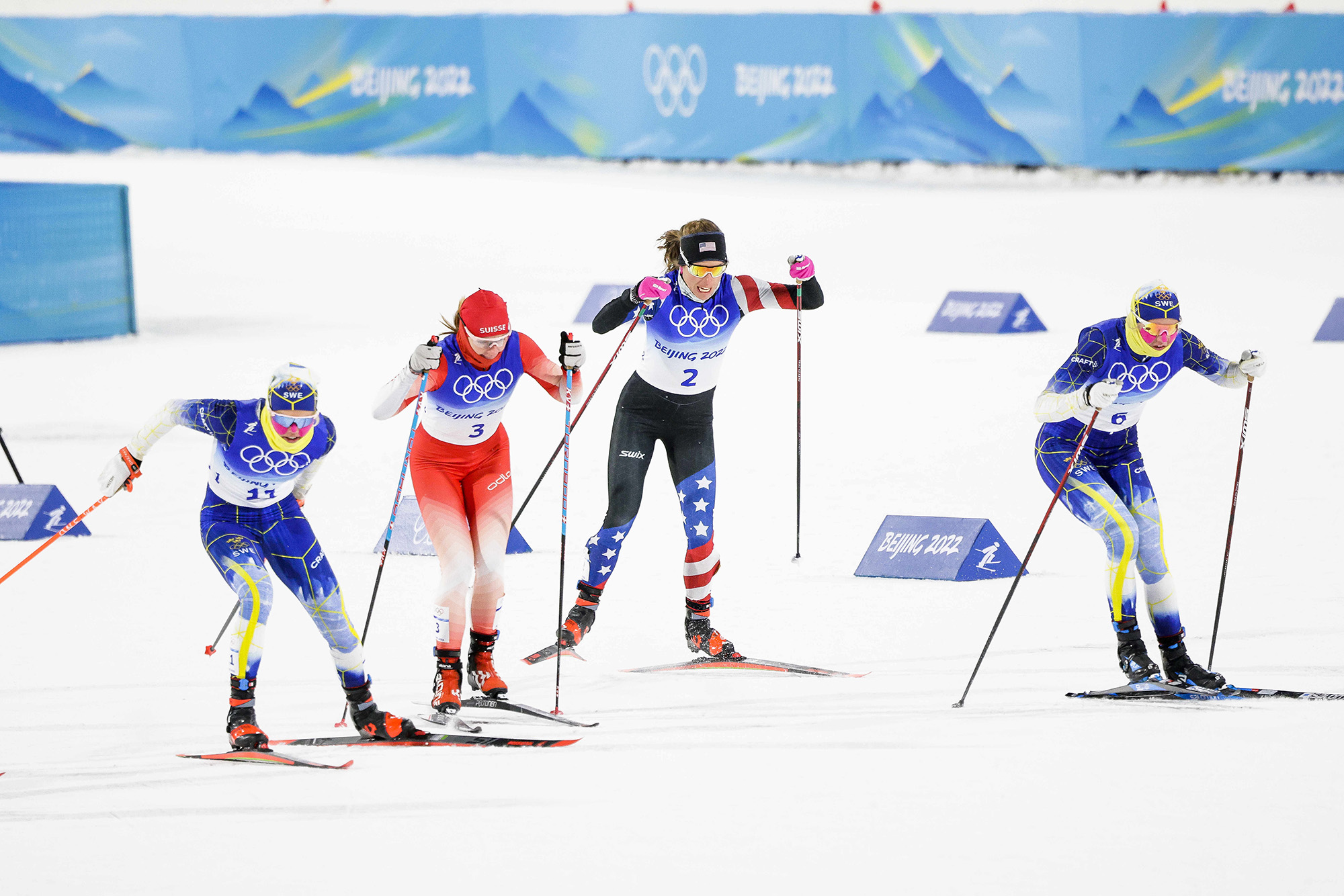
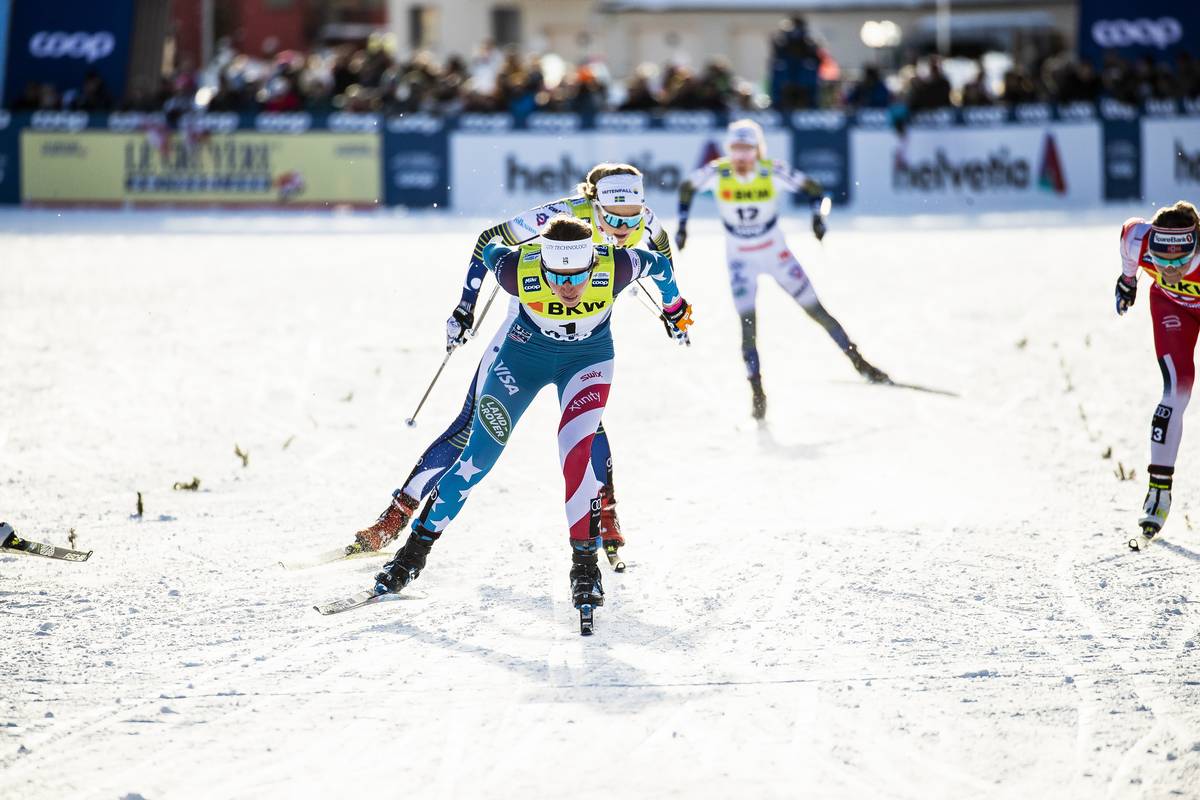
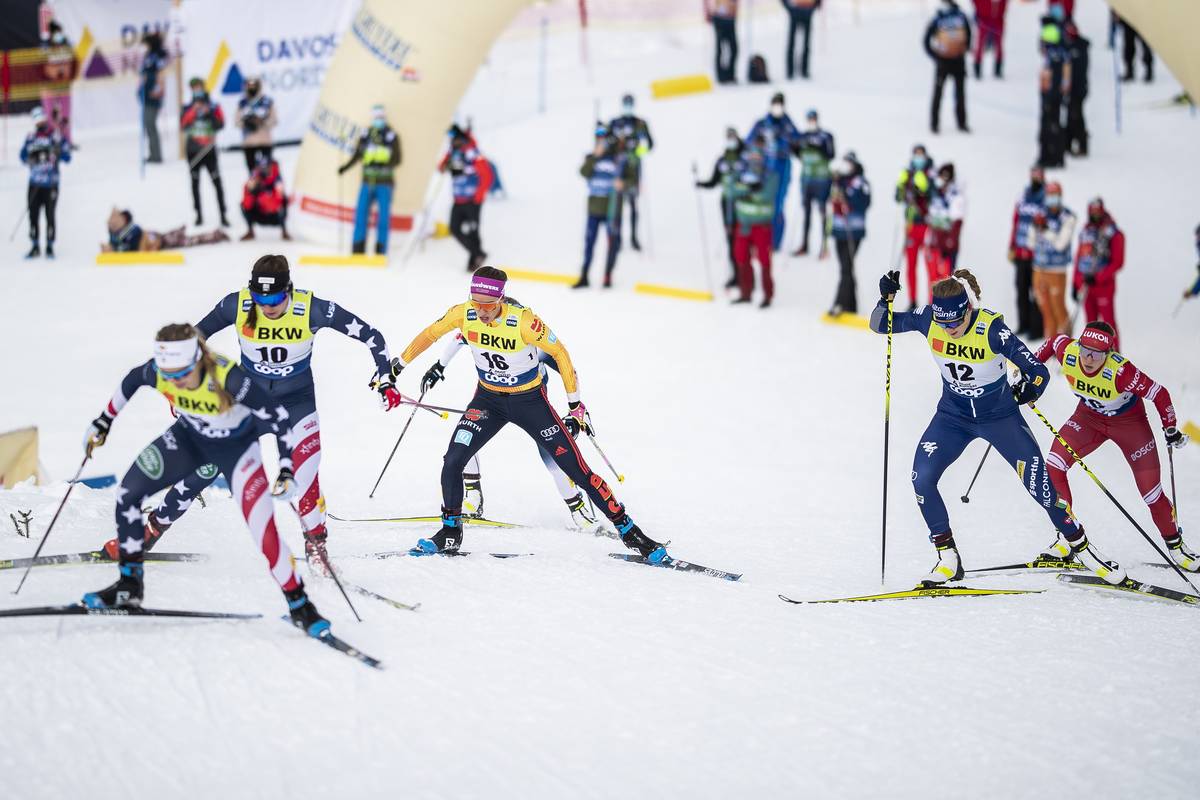
In the final quarter, Julia Kern pushed the pace in the first half, positioning herself in the lead as the pack headed out of the climb. She held her position through the downhill and around the hard right turn, carrying momentum into the hill. Perhaps paying for her efforts early on, Kern was dropped on the final climb as Veronika Stepanova (ROC) and Sofie Krehl (GER) broke away before heading into the stadium. Kern kept herself in the fight, staying in contact with Alina Meier (SUI) through the false flat to the finish, but ended up fourth in the heat, +3.5 back from the leader and behind the mark needed for a lucky loser spot in the semis. A gusty and tactical performance in her first Olympic sprint appearance.
Julia Kern (USA) led her quarterfinal early during the individual freestyle sprint. (Photo: NordicFocus)
To regroup: we now have two Americans in the semi, matching the previous best result from 2018.
Lining up in the first heat of the semis, Brennan got out of the start smoothly, tucking into the back of the back to safely descend out of the stadium and carry momentum out of the left-hand bend and into the A-climb.
Following the effective, albeit unforeseen, strategy from her first round, Brennan pushed her way up the A-Climb, moving from sixth place into the lead. The American kept the effort high as she pulled Sundling, Dahlqvist, Fähndrich. Brennan charged the downhill, stepping powerfully around the right hand bend to head into the B-climb at high speed. In the second climb, the two Swedes, Sundling and Dahlqvist, worked their way around Brennan, with Fähndrich also accelerating. No relief until the finish, Brennan did not let up in the undulating terrain that follows the B-climb, rounding the final curve in fourth place just behind Dahlqvist.
After setting a fast pace for the heat, Rosie Brennan finishes fourth in her semifinal to advance as a lucky loser. (Photo: NordicFocus)
Sundling stretched out the spread of the top-four in the final stretch to take the win in 3:11.94, with Fähndrich second, Dahlqvist third, and Brennan fourth, +1.35 behind Sundling. Brennan’s efforts to keep the pace hot contributed to a lightning fast heat, with Sundling’s time nearly four seconds faster than the top finish in the quarterfinal. This left Brennan in good standing for a lucky loser spot in the final, but she would need to hold her breath to see what the second heat would decide.
The second semi was quick out of the gate, with Sweden’s Ribom leading up the start of the A-climb. Diggins was comfortably tucked into the pack, beginning to set her race plan into action as she V2ed steadily up the side of the track, holding her form longer than the others as she moved into the lead. Nearing the high point, Diggins switched to a rapid tempo V1 with Norway’s Falla matching pace to head out of the climb in first and second.
Diggins sat in a low tuck at the front, stepping around the sweeping left-hander and heading into the B-Climb with Ribom and Falla trying to match pace and challenge at the front. Ribom moved ahead near the top of the climb to lead into the final curve. Diggins sat on the Swede’s tails, with Stepanova alongside. A bobble zapped some of Diggins’ momentum and could have been devastating, but the American kept her composure and stayed upright, staying in contact with Ribom as they headed into the finish lanes.
With Ribom in the lead, Diggins powered toward the finish line to secure a second place auto-qualifier spot for the final. She crossed the line +0.4 behind Ribom’s mark of 3:15.22, with Falla and Stepanova crossing in third and fourth a few meters back.
As the second heat times were roughly four seconds slower than the first, Brennan could let out a sigh of relief. The second lucky loser spot was now hers.
And now, we watch history unfold. Two American women in the final, as Brennan and Diggins set a new mark for the stars and stripes.
The final lineup saw Sundling, Dahlqvist, and Ribom racing for Sweden, alongside Diggins and Brennan, with Fähndrich representing Switzerland in red.
Emma Ribom (SWE), Nadine Faehndrich (SUI), Rosie Brennan (USA) and Maja Dahlqvist (SWE), (l-r) get up to speed at the beginning of the women’s individual sprint final. (Photo: NordicFocus)
Taking charge from the start, Sundling skied with authority, smoothly leading her teammates Dahlqvist and Ribom up the A-climb to put Sweden in first through third heading out of the climb. Diggins was fourth as they crested the high point, with Fähndrich on her tails and Brennan just behind.
Utilizing the speed of her skis and her strength in the downhill, Diggins moved up alongside the Swedes in the descent, looking for position heading into the final climb. Maintaining her command of the race, Sundling rocketed off the front to gap the remaining five women who all remained in contention for a medal leaving the climb.
Ribom quickly fell off the pack, leaving Dahlqvist leading a tight group of four over the undulating terrain that led to the final bend before the stadium. Diggins and Brennan looked to be boxed out as they headed around the final curve in third and fourth, respectively, but the Americans were patient versus panicked, which could put them at risk of a fall.
Coming out of the curve, Diggins accelerated around Fähndrich to challenge Dahlqvist for the silver medal. Brennan followed her teammate to surge past the fading Swiss athlete, setting the stage for a three-way sprint for two podium positions.
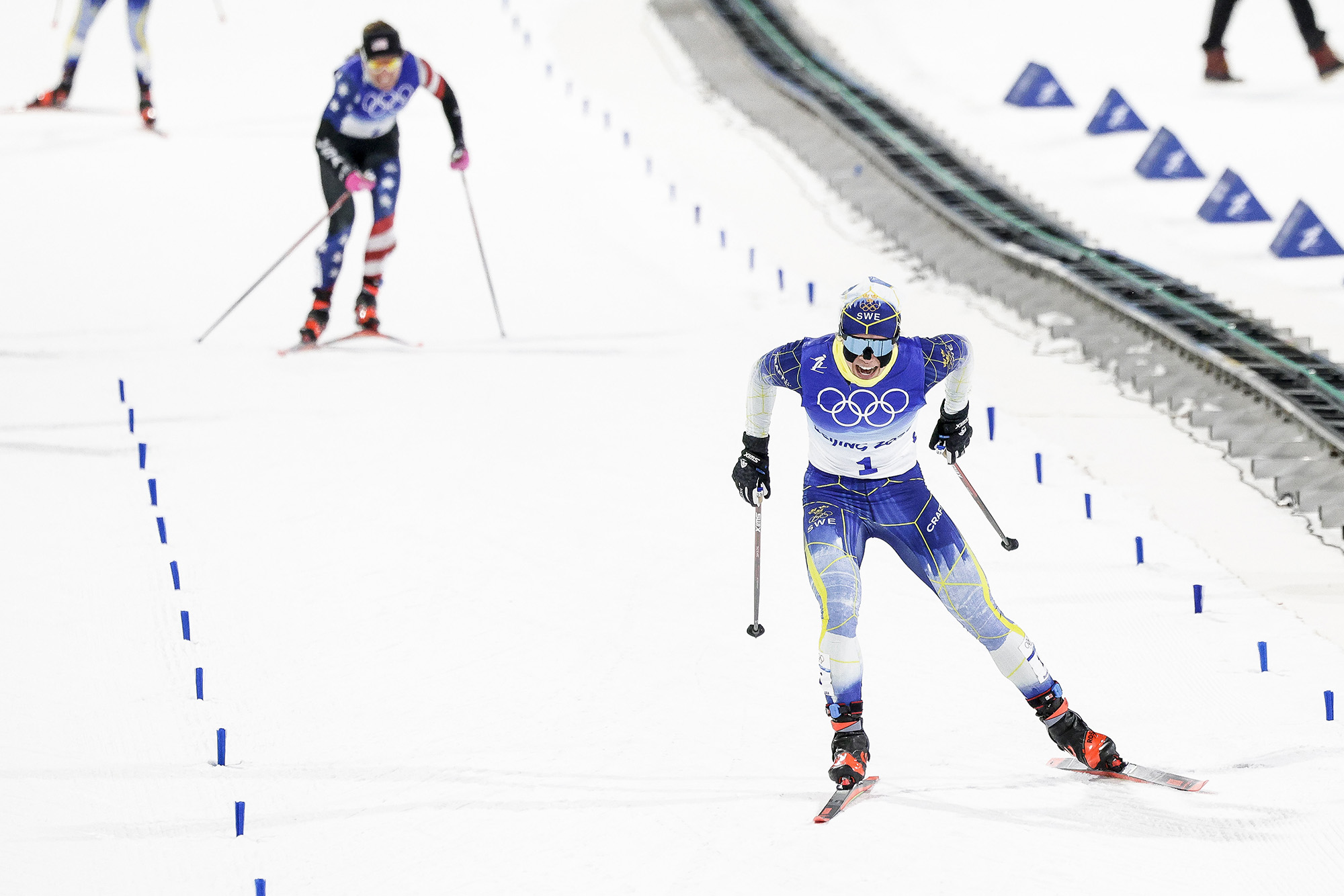
Sundling had gold on lock, nearly three seconds ahead as she crossed the finish line in 3:09.68.
Jonna Sundling (SWE) with a commanding victory in the individual freestyle sprint comes to the finish with Rosie Brennan (USA) in the background on her way to fourth. (Photo: NordicFocus)
In her wake, Dahlqvist and Diggins were taking it to the line, with the Swede carrying a slight advantage in the final meters. Still, with Brennan close behind and both Fähndrich and Ribom off the back, the Americans were almost guaranteed their first individual medal in history.
Skiing their fastest splits of the day, Dahlqvist held her ground to the silver medal (+2.88), with Diggins on her right, less than a ski length back for bronze (+3.16).
Jessie Diggins crosses the line in third to earn the first individual Olympic medal in women’s cross country ski history. (Photo: NordicFocus)
Just over a second back, Brennan crossed fourth (+4.49), for the second best individual finish in American women’s history. The Americans maintained a gap to Fähndrich in fifth (+7.21) and Ribom sixth (+11.11).
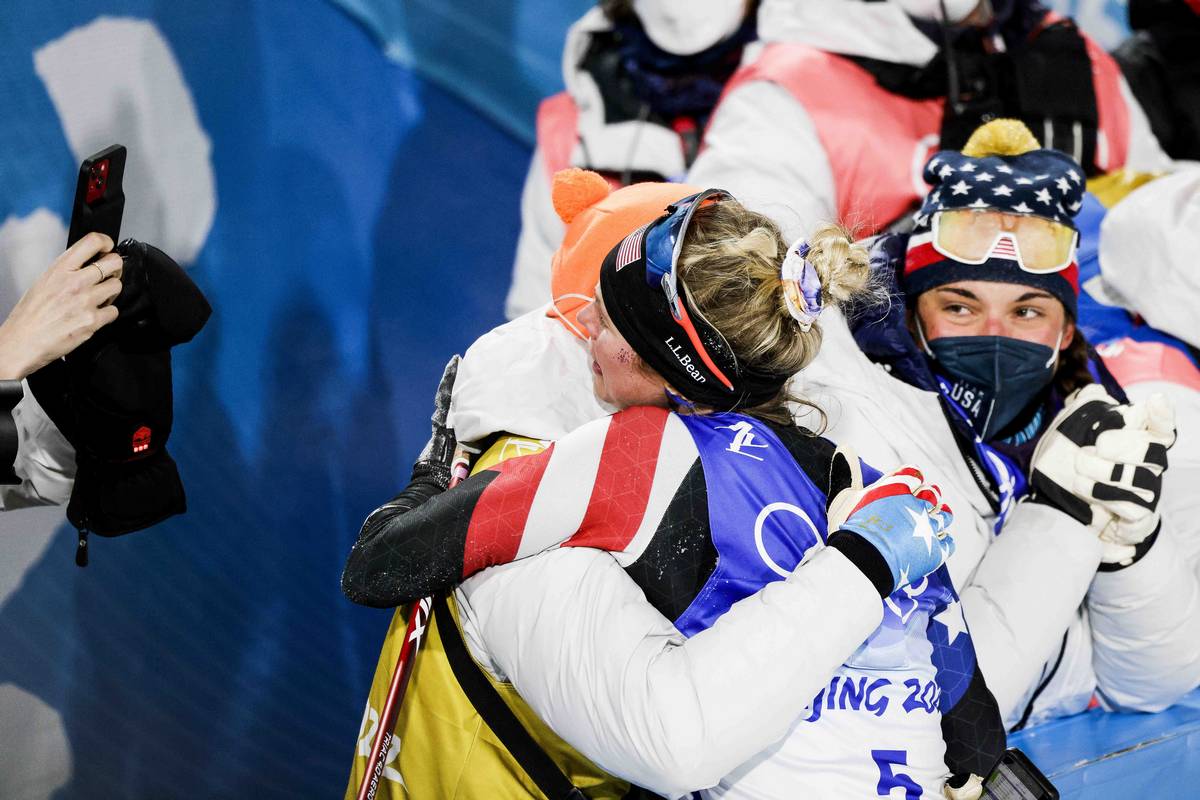
Diggins collapsed to the ground, overcome by the emotion of what she had accomplished. Perhaps a testament to her team-centric approach, she was heard saying, “Good job, Rosie!” between gasps, as she got back to her feet to immediately hug the coaches, support staff, and teammates that lined the edge of the course.
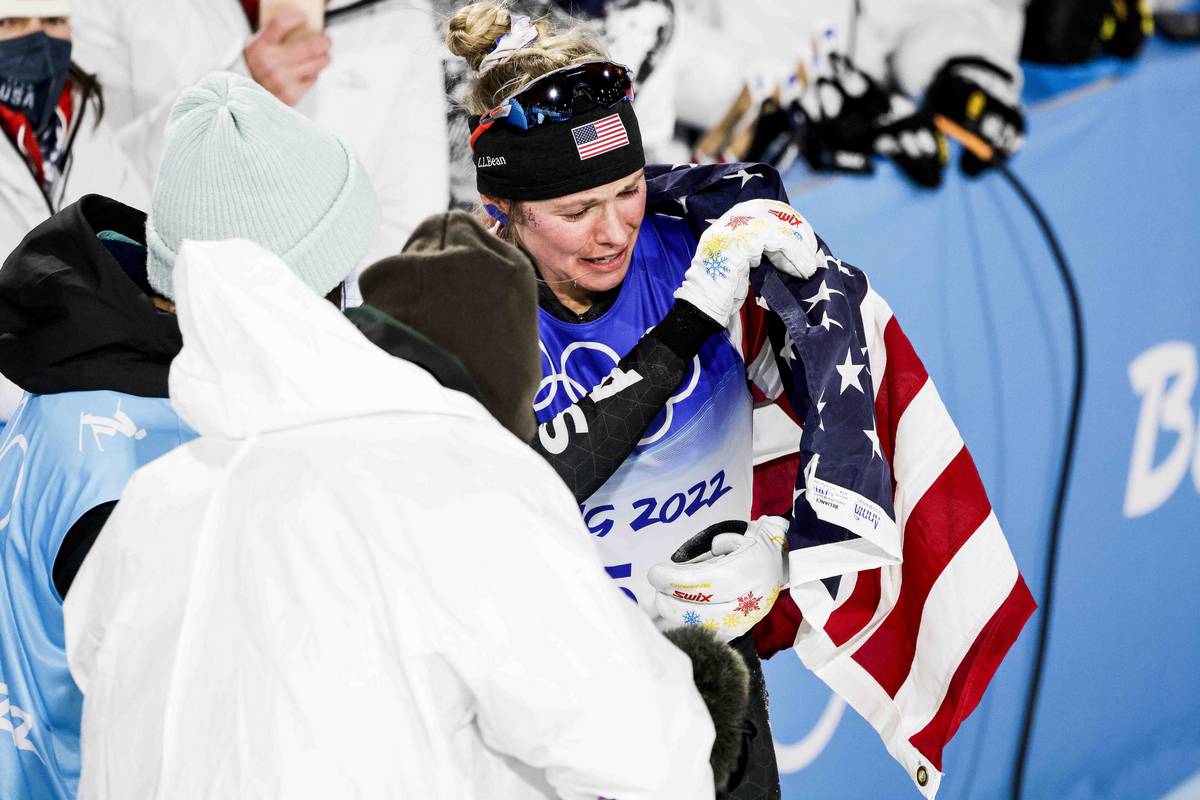
Jessie Diggins hugs her coaches and teammates after finishing third in the individual freestyle sprint in Zhangjiakou. (Photo: NordicFocus)An emotional Jessie Diggins wraps the American flag around her shoulders after taking bronze in the freestyle sprint. (Photo: NordicFocus)
Tearfully wrapping an American flag around her shoulders, Diggins was aglow as she savored the moment before heading back to the finish to stand alongside Sundling and Dalhqvist for the podium shot.
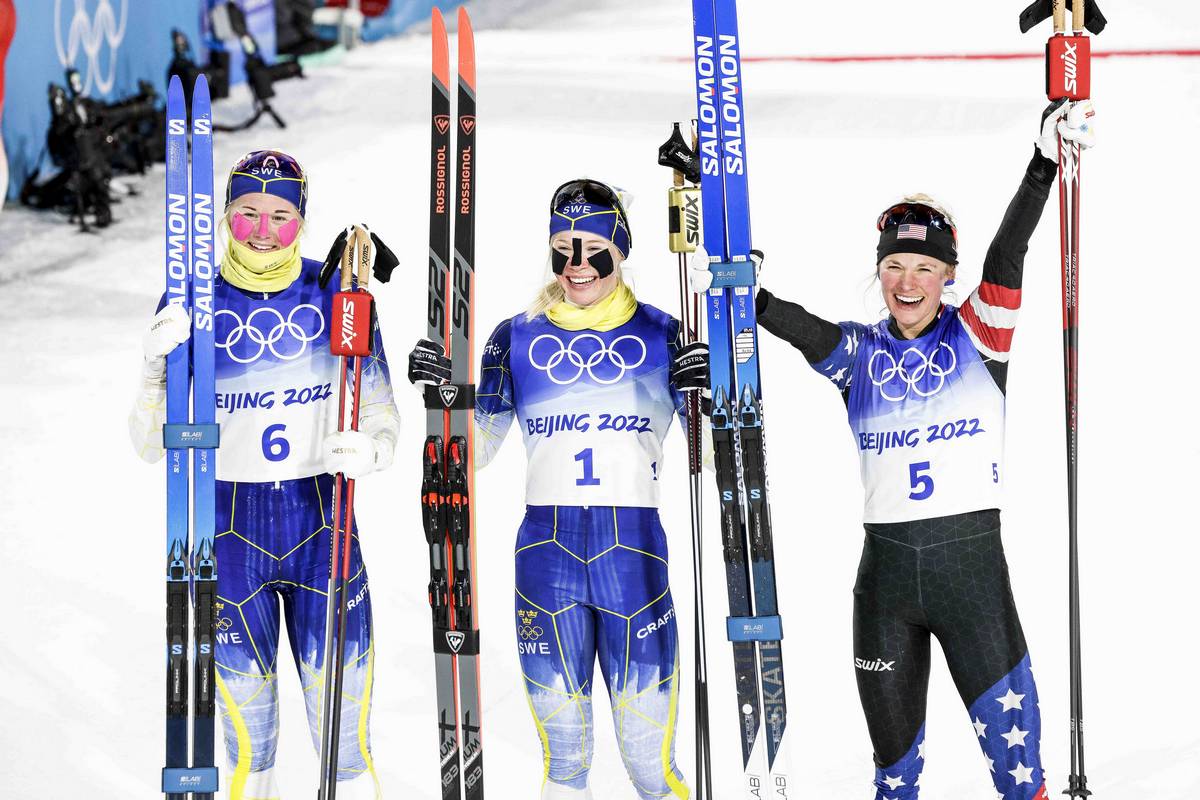
Jonna Sundling (SWE) takes gold in the freestyle sprint, ahead of Maja Dahlqvist (SWE) and Jessie Diggins (USA). (Photo: NordicFocus)
Though she was the one whose name would be highlighted in history books, Diggins focus on the importance of those around her remained at the forefront as she celebrated the many victories of the American team in today’s event.
“It was so cool to be there with Rosie,” Diggins said in the mixed zone. “She’s skiing so amazingly well… and I’m just so grateful. That’s the overwhelming emotion, because it takes so much from such a huge team to make this happen. And we had obviously amazing skis, but also amazing teammates for years and years and years, helping me train, pushing me, supporting me – amazing coaches, amazing volunteer staff. You can’t even imagine how much it took from so many people, and so I’m just so thankful because I feel like this medal belongs to about 1000 different people. And I hope they really feel that and know that.”
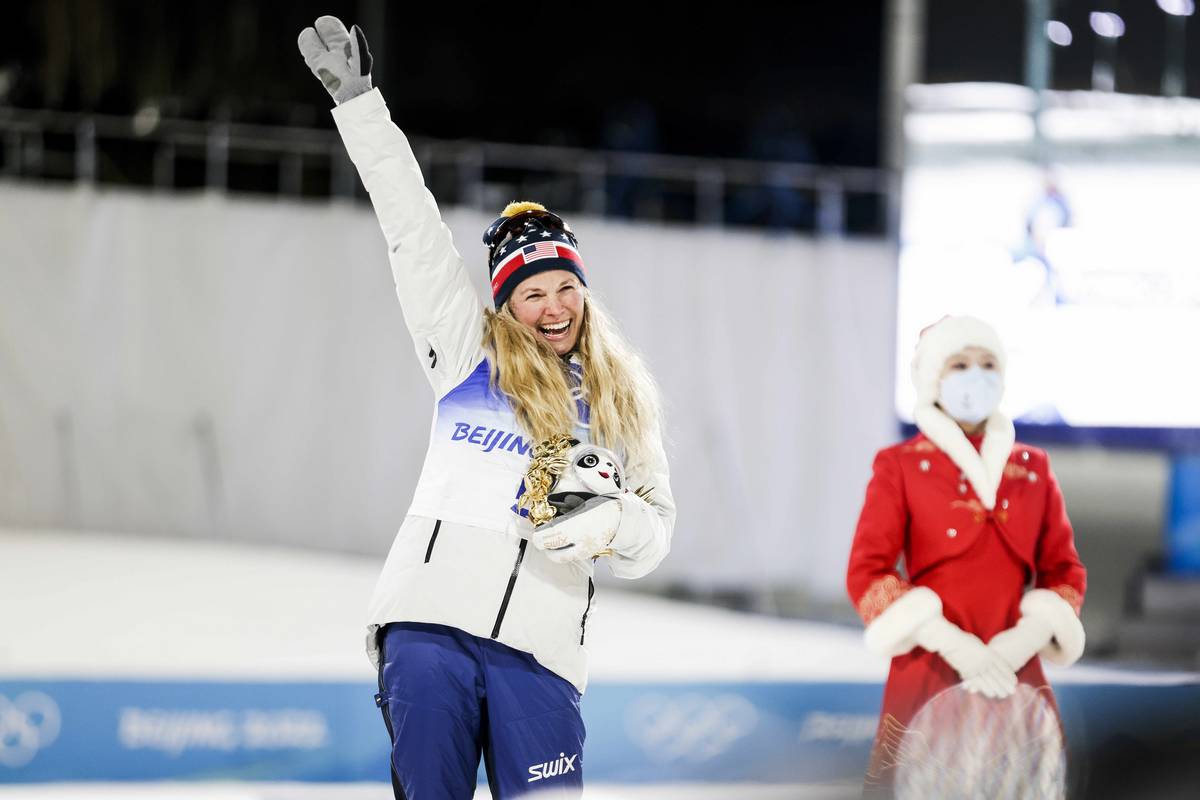
Jessie Diggins takes Olympic bronze in the freestyle team sprint. (Photo: NordicFocus)
Of her approach to the course, Diggins gave a simple response, acknowledging that she has a way of blacking out while having great races, “which is really annoying,” she laughed, “because I’d love to be able to remember exactly what I did.”
“I was just so focused on trying to push as hard as I could,” Diggins explained. “Just trying to ski as well as I could and stay balanced. The snow felt a little greasy, so especially in the finishing lane, just trying to put as much power as I could into every single push. And honestly, that’s all I can remember.”
Jessie Diggins (USA) on her way to the USA’s first ever individual women’s medal in the Olympics. (Photo: NordicFocus)
Perhaps the FasterSkier audience needs no reminder that Diggins came into the 2022 Games as a gold medalist, having won the freestyle team sprint with Kikkan Randall in 2018, a day that brought many Americans, including this writer, to tears. Diggins was asked to reflect on the last four years, and the progress she’s made in her career.
“The last four years, I’ve really found my voice,” Diggins said confidently. “I’ve really found a lot of my purpose, and I feel like I’ve grown a lot. But also, I’m exactly the same person in pretty much every other way. I think one of the big things has been dealing with is the pressure and expectations, because there’s been a lot of it, and it hasn’t been easy. So for me, I think it was such a victory just to make it to the final and know that I’m skiing well. I came into this as prepared as I could be, which one of my biggest goals was to come in prepared. The second goal, cross the finish line with nothing left. And the third goal was to just have fun, and keep focusing on the process, because that’s what gets me where I am today. Like win, lose, or draw, it’s just focusing on the process and, and executing those process goals to the very best of my ability, because then I’m always proud of how I finished. I’m just proud of this effort today as I was at the skiathlon, even though they were different outcomes.”
Jessie Diggins was all smiles as she passed through the mixed zone following her bronze medal performance in the women’s individual sprint. (Photo: Nat Herz/FasterSkier-ADN)
Fourth place at the Olympics – fourth in the world on its most prestigious stage – is both a truly incredible feat and perhaps the most challenging final rank to wrap one’s head around. The “wooden medal”, just shy of the Olympic hardware skiers dream about from their youth.
“Fourth place was hard,” Brennan said honestly in the mixed zone. “You feel really happy and also frustrated at the same time. I have a lot of mixed emotions about it. But I did everything I could today, and maybe not everything went perfectly my way. But I have to be happy with that at the end of the day.”
Jessie Diggins (USA) and Rosie Brennan find their position in the early moments of the women’s final. (Photo: NordicFocus)
Asked what she would have said if four years ago, someone told her she would be in this position, Brennan laughed, “I probably wouldn’t have believed it so much.”
She talked through a rough start to the day, sharing that she has always struggled with start gates and had spent the last six weeks practicing to ensure a clean start.
“So, there I was on the ground, I was like, ‘So much for all that practice.’ But I knew my strength was in the climb, so I just had to pull it back [together] and focus on the all the time I had left and see what I could do to try and make it up.”
On her approach through the heats, Brennan played to her strengths, recognizing she could take the lead, work the hills, and not let her heats unfold as a casual first 1200 meters with a tactical final sprint that might leave her in the dust.
“My strength lies more in the endurance aspect of it,” she explained. “I tried to just keep the pace high so that I could count on being a lucky loser – by having a fast heat time. So that was my strategy in the semifinal, and it worked. Once I got to the final, I tried to then be a little more smart about my racing. I tried to be patient and wait until the last climb. I was a little far back, so I kind of got the door closed on me to make it through. So I had to kind of adjust and go for a strong finish sprint, which isn’t always my strength. But I did all I could do.”
With Ben Ogden racing into the semis in the men’s race, it was an historic day for the American program as a whole. Speaking to this landmark day, Brennan concluded with an inspiring message for those who dream of following in their footsteps.
“I think it shows the growing depth in our country. And I hope it shows a lot of people just to have some patience and keep training, keep going for it. You never know where you’ll end up.”
Jonna Sundling (SWE) takes gold in her first Olympic appearance in the women’s freestyle sprint. (Photo: NordicFocus)
Taking a closer look at the winner, Sundling is the 2018 World Champion in the freestyle sprint. Returning from injury, she has built her way into the season. Though Dahlqvist has shined as the undefeated World Cup star for Sweden, Sundling has crept up alongside, taking second to Dahlqvist in the individual sprint in Dresden, and working together to win the team sprint. Sitting out the Tour de Ski, Sundling beat Dahlqvist in their next matchup in a Scandinavian Cup race in Falun, Sweden.
This is Sundling’s first Olympic appearance, though she and Dahlqvist will be a likely pairing in the classic team sprint next Wednesday.
Once the final rounds were complete, Kern’s final placement was determined to be 18th. This marks a significant step forward from her first appearance in the skiathlon, where she finished 53rd.
Julia Kern (USA), who finished in 18th place overall, pushes to the finish during her quarterfinal round. (Photo: NordicFocus)
“It was really tough out there, but a lot of fun to have a challenging course and give it my all,” Kern told FasterSkier in the mixed zone.
Dahria Beatty 28th in qualification (+14.51) to be the only Canadian woman to make the heats. Beatty raced in the first semifinal, where she finished fifth in the heat to finish 25th on the day.
Just 0.7 seconds off the top-30 mark, Cendrine Browne was 35th in qualification (+15.82) with Olivia Bouffard-Nesbitt close behind in 40th (+16.89). Laura Leclair rounded out the Canadian team in 58th (+26.28).
Dahria Beatty (CAN) races in the quarterfinals on her way to 25th place overall. (Photo: NordicFocus)
An Australian dual citizen who is a long-time APU team member, Jessica Yeaton was 52nd (+23.82) in the qualifying round.
Sophie Caldwell Hamilton (right) beaming in Toblach, Italy. (Photo: NordicFocus)
By the time you read this story, Vermont’s Sophie Caldwell Hamilton will have turned a fresh thirty-one. Her birthday is today, Monday, March 22. Although Caldwell Hamilton began representing the U.S. Ski Team on the World Cup in Québec City in 2012, she is profoundly Green Mountain State. Raised in Peru, Vermont near where she later attended the Stratton Mountain School, we’re pretty certain that, in a metaphorical sense, she bleeds maple syrup. As much as she has been the object of our European cross-country ski racing coverage for nearly a decade, she is a Vermonter. She graduated from New Hampshire’s Dartmouth College, we’ll let that slide, but it’s only a sprint finish few hundred meters across the Connecticut River from Vermont. Post-college, she trained with the SMS Elite team with the likes of Jessie Diggins, and husband Simi Hamilton.
As we begin this close-out piece regarding Caldwell Hamilton’s retirement, which she announced March 11th as she was quarantined in Engadin, Switzerland, we’ll begin with the race stats. According to the modern FIS database, Caldwell Hamilton is one of five U.S. women to have won a World Cup race. Alison Kiesel (formerly Owen-Spencer) won the inaugural women’s World Cup event in December 1978 at Mount Telemark in Wisconsin. Kikkan Randall broke her ground by initially winning in 2007. Caldwell Hamilton first won in 2016, to be followed by Diggins that same year. Rosie Brennan posted her first World Cup victory this season. That, when considering the women’s team has headlined the U.S.’s cross-country media coverage for a decade, is rarefied ground.
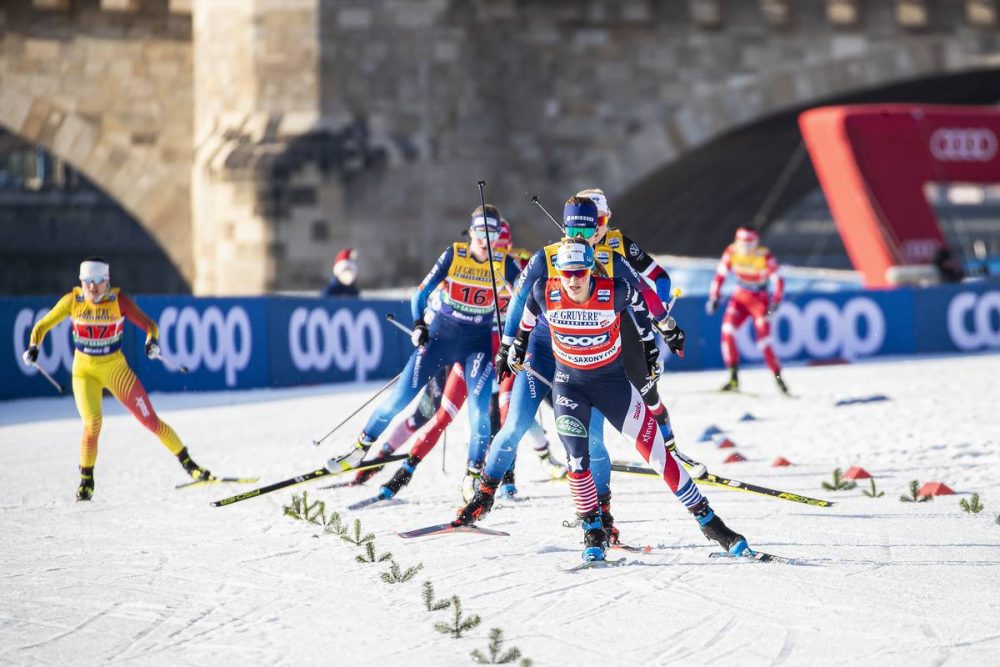
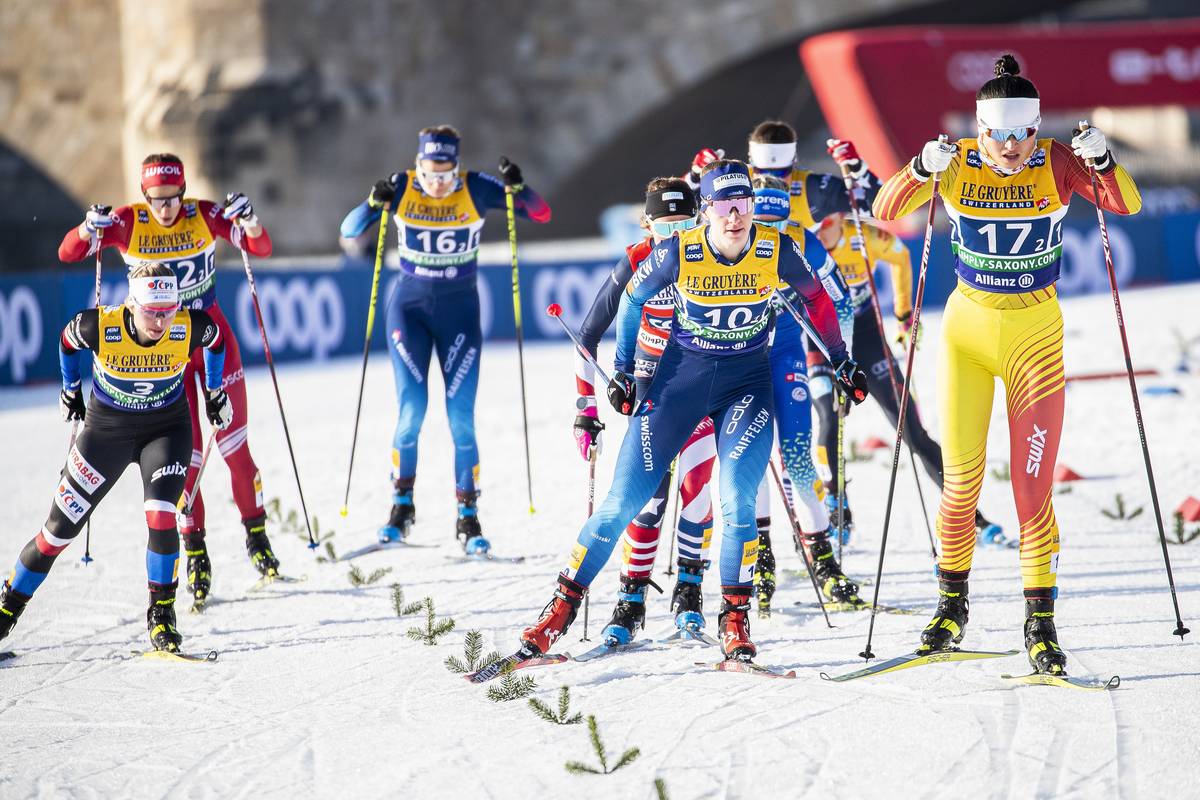
Caldwell Hamilton during the 2021 Dresden, Germany team sprint. (Photo: NordicFocus)
Caldwell Hamilton racing Planica, Slovenia, 2019. (Photo: NordicFocus)
Caldwell Hamilton won two World Cup sprints, one in Davos the other in Oberstdorf. Over her World Cup career, during which she was a feared sprinter, she advanced to 16 sprint finals for four fourth places, and 10 podiums. She notched five second-place finishes, three third-place finishes, and the two aforementioned wins.
At the 2014 Olympics she placed sixth in the skate sprint, and eighth in the 2018 Olympic classic sprint. Her top result at the World Championships was sixth place in the 2017 Lahti, Finland skate sprint.
Sophie Caldwell Hamilton in Planica, Slovenia, 2019. (Photo: NordicFocus)
From a consistency standpoint, Caldwell Hamilton shined. In 2014 she was ranked eighth overall in the sprint standings. That was followed by a 20th, seventh, eleventh, third, fourth, sixth, and tenth this season considering her career World Cup sprint rankings.
Compartmentalizing her as a sprinter isn’t totally accurate either. This is the World Cup after all. She ranked in the top-30 in the distance standings five times. In 2018 when she was third overall in the sprint cup, she was 19th in distance.
She was also part of a 2016 second place 4 x 5-kilometer relay team with Sadie Maubet Bjornsen, Liz Stephen, and Diggins. That result was repeated with a Caldwell Hamilton, Maubet Bjornsen, Brennan, and Diggins quartet in 2019. Caldwell Hamilton placed third twice in the team sprint, both times paired with Ida Sargent, in 2017, and 2018, respectively.
Her technique, wholly refined, was smooth, the angles perfect, and at times, crushingly powerful. She raced sprints with smarts, knowing her capacity was not her ace card. But damn, could she toe at the line. A mix of old-school Nuryev in its grace and the “pow” of Ali.
Sophie Caldwell Hamilton lunges to edge Norway’s Heidi Weng (not shown) for the win at the 2016 Tour de Ski in Oberstdorf, Germany. (Photo: Marcel Hilger)
We’ve condensed Caldwell Hamilton’s results for roughly 400 words. A much smaller part of this written whole. That is, perhaps, on-point. Although historic in the annals of American cross-country skiing, Caldwell Hamilton’s human qualities, foremost among them, empathy and compassion, may, be her lasting legacy. As much as physical exertion can reveal the core of a person, Caldwell Hamilton’s energy exuded while skiing was revealing. “Serene,” was a word writer Bill McKibben used on several occasions on our podcast recently to describe Caldwell Hamilton as she sped past either in a local Vermont race or the World Cup.
Her coach at Dartmouth, Cami Thompson Graves, added that Caldwell Hamilton led by example and has inspired. “Sophie has always been a pro when it comes to racing, when she puts on the bib, she knows how to race hard, although she is one of the most graceful skiers I have ever seen so she makes it look easy! I am so glad that she decided to make skiing her career for a while,” wrote Thompson Graves. “How cool is it to see that friendly, young woman who grew up racing in Vermont and New England, who trained locally and helped out at numerous camps in the off season go out there and fiercely compete for World Cup medals. I know she has inspired many, many young women to follow in her footsteps.”
***
I’m going to take a moment to allow longtime U.S. Ski Team and personal coach to Caldwell Hamilton, Matt Whitcomb, fill in some gaps for us with this Q & A:
FasterSkier: Nugget of wisdom that you have learned and now apply in coaching/life from Caldwell Hamilton?
Matt Whitcomb: Just because someone says they are okay, and seems like they are okay, doesn’t mean they are okay. Ask again, later.
FS: Most difficult aspect about Caldwell Hamilton in terms of priming her for peak racing, and how did you navigate that issue?
MW: This year notwithstanding for Sophie, she’s been easy to peak for championships. The main difficulty with her is maintaining muscle mass when we can’t find good gyms. She needs two good strength workouts per week or she will lack adequate power. Fortunately, she also puts on muscle mass responsively.
FS: Easiest part of coaching Sophie?
MW: For me, the most important skill a coach can have is the ability to connect with others. Simi and Sophie are great friends, so that connection—that two-way flow of concern—makes coaching them easy. A hard part of coaching is not knowing the unspoken stresses of an athlete. This stuff needs to be tackled first before any training can take.
FS: Non-competition personality trait that made the “team” more of a team?
MW: Sophie makes everyone a better person. Who is the best human I know? I’m not being dramatic; it’s Sophie Caldwell.
FS: Sophie describes her side of the room as a hurricane. How might this trait manifest as an xc skier?
MW: The one whose clothes singe on the lamps, and carpet the floors, and whose passport gets lost in the couch cushions, and who might race a semi-final at World Championships on Jessie Diggins’ poles even though they are five centimeters shorter, and who… okay I’ll stop… well, she just needs to be fit and happy on race day. She’s better at adapting in the moment.
FS: Proudest moment as Sophie’s coach?
MW: I don’t hang my hat on results, so nothing really jumps out there. That they raced into their 30’s is my proudest accomplishment for them. Many good athletes in the U.S. quit in their early 20’s before they had a chance to bloom. I’m also feeling proud of the way they handled their quarantine during their intended last World Cup races, which should’ve been a week-long celebration of their ski careers. (As I write, they successfully boarded and are on a plane home.)
FS: I know Sophie and Simi, who is also retiring, consider you a close friend. How did you balance that when coaching her? How did that enrich the experience?
MW: I don’t subscribe to the you-can’t-be-friends-with-athletes rule when it’s adults coaching adults, but that only works if you can maintain your ability to get tough from time-to-time. We’ve been through some hard personal times together, and it hasn’t always been just me supporting them. I ski coach because I like to ski, and because I like to connect with people. Sophie and Simi are two of the people I credit for me still loving my job after so many years.
FS: Sophie’s lasting legacy when it comes to team culture?
MW: For Sophie, everyone—except those who lack empathy—are good enough for her. It doesn’t matter who you are; Sophie Caldwell will ski with you, or sit with you at lunch. She will not judge you, and her departure will expose us. We’ll need that role filled in, and I have a couple of safe guesses on who it will be.
***
In her element. Sophie Caldwell Hamilton in the 2019 Davos, Switzerland skate sprint. (Photo: NordicFocus)
Devon Kershaw, a former Canadian skier who knows Caldwell Hamilton from the World Cup, commented in a recent podcast that Caldwell Hamilton had a rare type of leadership skill set. “The leadership qualities of Sophie that might not shine through to those who are not so close to the project, she has this quiet confidence that I have not seen by many athletes in my career,” said Kershaw. “Not only that, she is incredibly kind, she is incredibly caring, she doesn’t take up a lot of space, which you might think, ‘Is that good or is that not good?’ But when you think about it, you are traveling the world for months on end, having someone so kind, so caring, who doesn’t take a lot of real estate, but when she talks, when she says something, everyone listens.”
There is also the real person, non-ski racer side to Caldwell Hamilton. A little FasterSkier mining reveals these nuggets from Caldwell Hamilton: “I was bald until I was 2!”; “I grew up with two Dalmatians named Daisy and Douglas. They were around my age, so I thought I was a dog for the first couple of years of my life.”
Sophie Caldwell Hamilton racing in Toblach, Italy in 2015. (Photo: NordicFocus)
First on skis at 10 months old, her confidence on dicey downhills and hunting podiums is masked by an endearing self-effacing quality. “I was probably the last person who woke up this morning and thought this would happen,” Caldwell Hamilton told FIS in a post-race interview after her first World Cup win in 2016. “I’m thrilled.”
Thrills, by definition, are fleeting. We’ll explore more about that with Caldwell Hamilton in the interview that follows. We conducted this lightly edited interview with Caldwell Hamilton last week as she was concluding her mandatory 10-day quarantine in Switzerland after testing positive for Covid-19 one day, and negative the next. Either way, the Swiss keep it tight. Despite several negative tests and no symptoms, Caldwell Hamilton missed the final weekend of World Cup racing. She has subsequently returned to Vermont.
***
Sophie Caldwell Hamilton after her first World Cup win. (Photo: NordicFocus)
FasterSkier: You’ve been high in the sprint standings throughout your career. You were someone fighting for top-fives and podiums. Holistically, how would you categorize yourself as a sprinter?
Sophie Caldwell Hamilton: I guess the consistency of the sprint standings does kind of go hand in hand with how I like to approach each season. I wanted to have that consistency of being confident that I could make the finals on any given sprint day just helped. Rather than focusing on a podium at a specific race, or win a medal here, I think for me, it was if I can get in a groove of consistently making the final, I know I’d have the confidence to get some podiums. For me, that was kind of a nice way to approach the season, and I think I felt like I was in a good place and confident when I could have that consistency — which I maybe did not have so much of this year. But I think results build on each other out of that consistency.
I’ve known for a long time that I don’t have the biggest capacity. For me, I think when I approach sprints, I always tried to see myself as technically and tactically one of the best sprinters in the world because I knew I didn’t have the biggest motor. So my style is never to go out and lead from the beginning. I always try to be the smartest racer I could and that was something I was proud of. I think it’s important for younger skiers coming up to know that just because they don’t have the biggest engine or the most hours trained, you can find other ways that you can be the best.
FasterSkier: You can see it in some at an early age, a real deep instinct to “win,” I mean some call it the “killer instinct”. You know, win, win, win and that is all that matters. You’re obviously competitive – you are a professional ski racer. But, can you describe your competitive drive? When I speak to you and watch you, what I do not see manifesting are any of the negative attributes we might associate with being a competitive person.
SCH: That’s a topic that I’ve spent a lot of time thinking about especially later in my career. Sometimes I do wonder if I’m competitive enough to be doing this. I think you do have to have some sort of base level of competitiveness to pursue professional sport, or maybe even sport in general. But, I think as I’ve gotten older, it’s been harder and harder for me to find that competitive drive. I don’t think you have to be the most competitive person in the world to be successful. That said, it can be hard sometimes because I think especially as I’ve gotten older, I’ve watched some of these young girls coming out, not necessarily Americans, but, you know, the Swedish girls maybe for example. They want more than anything to win. And that’s hard to compete with. I think mentally that’s been a little tough for me because I’m kinda like, well, that’s certainly not how I feel now, and I don’t know if I was ever like that, even when I was 20 years old.
I guess my level of competitiveness has definitely been something that I’ve put a lot of thought into. I don’t think it’s necessary, but sometimes it can be hard to compete with. Again, just as an example on the Swedish team, it’s like my gosh, that level of competition just to get a sprint start is incredible.
Jonna Sundling (SWE), Sophie Caldwell Hamilton, and Katerina Janatova racing in Planica, Slovenia. (Photo: NordicFocus)
FasterSkier: How has your perception of the World Cup evolved?
SCH: Well, you know, I think the level of competition is always rising, which is really cool. It’s crazy to watch how the sport is changing. I obviously have done sprints, but I think if you go back and you watch a sprint from 2012 or 2014, you have someone like Kikkan who’s just absolutely dominating. She is so much stronger and so much better than anyone else in the sprint.
It seems like now, you don’t see so much of that. I know Klæbo can show up on the men’s side. And Linn Svahn can be dominant, but it’s not like people go out and they drop the field in the first 20 seconds. I think everyone’s level has risen so much. Everyone is fit. Everyone is strong. So you have to ski to the finish and be strong and ski the smartest. So I think that’s a pretty cool thing to see, just to watch the level rise. Of course, since I’ve been doing it non-stop for the last eight years, I don’t really notice that until I go back and I watch a race from a long time ago or think about what sprints used to be like for me when I first got it on the World Cup.
FasterSkier: You’re choosing to step away before an Olympics. You’ve been to several Olympics, and I understand it’s not like you need that feather in your cap to validate who you are. But you’re stepping away, you know with say 11 months to go before the Olympics. Was that planned all along, or just sort of organic and you simply don’t have the energy to deal with the uptick in demands during an Olympic year?
SCH: I mean we never knew this was going to be the year we retired. I think for a while we took it a year at a time. But, yeah, I think a lot of people have been surprised that we’re retiring right before the Olympics. I guess the way I see it is that I’ve been before and so I don’t feel like I need to go to the Olympics just to go to the Olympics. And, if I went to the Olympics, I would want to be in a place where I could be competitive and ski at my best. I think I’m at the point where I’m too mentally tired to put in the work for another year. I would rather see someone who has never been, like one of the young girls, to be able to go and have that experience that I had at my first Olympics rather than go to my third Olympics just to have gone to my third Olympics.
The Olympics are an incredible experience. My first Olympics in Sochi will always be one of my favorite experiences. You know, as far as competition goes, World Cups aren’t any less competitive, or they’re more competitive. So, yeah, I feel like the weight of the Olympics isn’t as big for me anymore, especially if I feel like I’m not in a place where I can prepare myself to be performing at that level.
I think for every person, no matter what they do, there’s always an evolution as you age. You’re aware of what’s happening around you and you simply age out of things, and sports is an obvious one because it favors the young.
Sophie Caldwell Hamilton shows her cornering skills in Val Mustair, Switzerland, 2015. (Photo: Nordic Focus)
FasterSkier: For you, on a high power women’s team, what has it been like for you in terms of being part of the core, the center, and slowly moving to the side as other women have stepped up?
SCH: This might have to do with that question. Part of the reason we also want to be done now is I think we want to stop while we still love the sport and finding some success, because I think it always feels good, rather than the sport become stale or having everyone else be like, ‘Oh, they’re still skiing’.
But, yeah, back to the other question. It’s been interesting because when I first came on to the World Cup, at 22 or 23 years old, everything was new and exciting. You don’t have any expectations and in a way that’s really nice to not put any pressure on yourself or have any expectations. You can just enjoy it and screw up every once in a while. But learning from your mistakes, I think, in a way, becomes harder and harder the more results you get because your expectations grow.
That said, it’s been really cool watching those young girls come up. I forget sometimes how much younger they are, eight years younger or something, which is about the time when I was coming on the World Cup and I feel like they’ve already accomplished so much compared to what I had at that age.
Sometimes I find myself wanting to guide them and give them advice, and I think I have and it’s been helpful. But they also have to figure it out on their own as we did. And like I said before, I was young with expectations and having some good results at that age but I was also screwing up and doing some things that didn’t work early.
I was having a conversation with Julia [Kern] the other day just about the inconsistency at that young age. I remember my first few years on the World Cup, I felt like I had a good year then an off-year. I remember thinking like, ‘Oh my god, I think it’s just how it’s gonna go it’s gonna be up and down and up and down.’
I figured it out. That’s what you’re doing when you’re young, you’re trying things and sometimes it works and sometimes it doesn’t. And when it doesn’t you change something for the next year and after a few years of doing that, I think you kind of figure out what works for you. But so many of those girls are still at the age where they haven’t figured it out, which I think is really cool, and they probably will have some inconsistency in their careers early on. But they’ll get to a point where they’ll figure it out. When you look at my training or Jesse’s training, it is not rocket science. I figured out what worked for me and I changed it a tiny bit each year, but I’m not going to go try something crazy different at this point because I’ve found a pretty good routine.
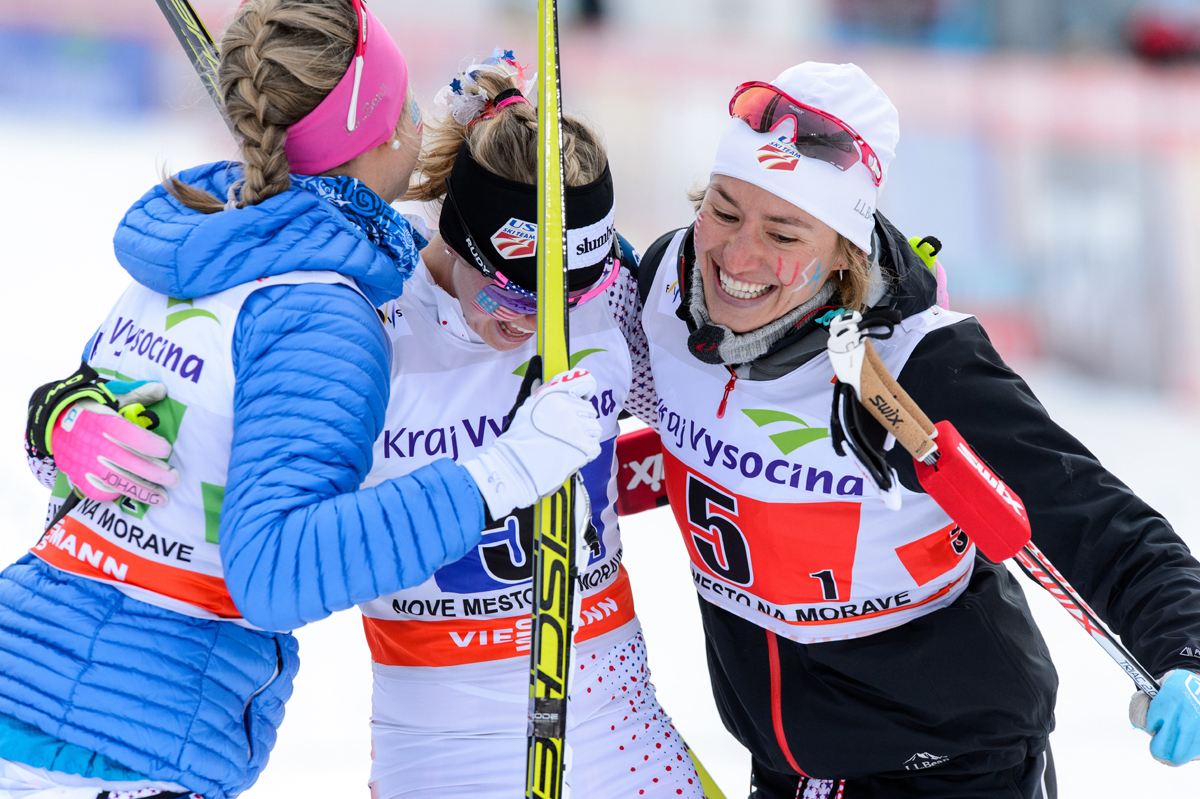
Jessie Diggins (c) celebrates with teammates Sadie Bjornsen (l), Sophie Caldwell Hamilton (r) and Liz Stephen (not shown) after anchoring the U.S. women’s 4 x 5 k relay to a second place in the 2016 Nove Mesto World Cup in the Czech Republic. (Photo: NordicFocus)
FasterSkier: The softball retirement question. What are you most proud of?
SCH: I mean I guess I touched on this a little bit before, but I think I’m proud of my consistency as one of the top sprinters, and just showing that there are different ways to be successful. Sometimes people think a specific win is what you should be most proud of. Or that you go out there and put your head down and work harder than everyone else. But I think I found a different way to do it. And like I said, relying on technique and tactics and being a smart skier is something I’m proud of.
FasterSkier: What are you most proud of when it comes to your legacy on a positive team culture?
SCH: Well it’s interesting. I have had this conversation about the importance of safe spaces or feeling like you’re in a safe space and not judged when you’re on the road for a whole season. I think it’s really important to have one or two people that make you feel that way. Maybe it’s you who is the safe person or you provide a safe space. I think, for me, it’s always been very fulfilling and been a goal of mine to be that for other people, and I think, in general, I’ve been able to do that — particularly with the younger girls, I hope.
I’m not someone who is very loud or says much at team meetings or in public. I hate public speaking. But I do love connecting with people one on one. So yeah, the relationships, the connections I’ve been able to make and the relationships that I’ve had that are more in a one-on-one setting. I feel I have been very valuable and meaningful and I hope that I’ve been able to be kind of a safe person for people.
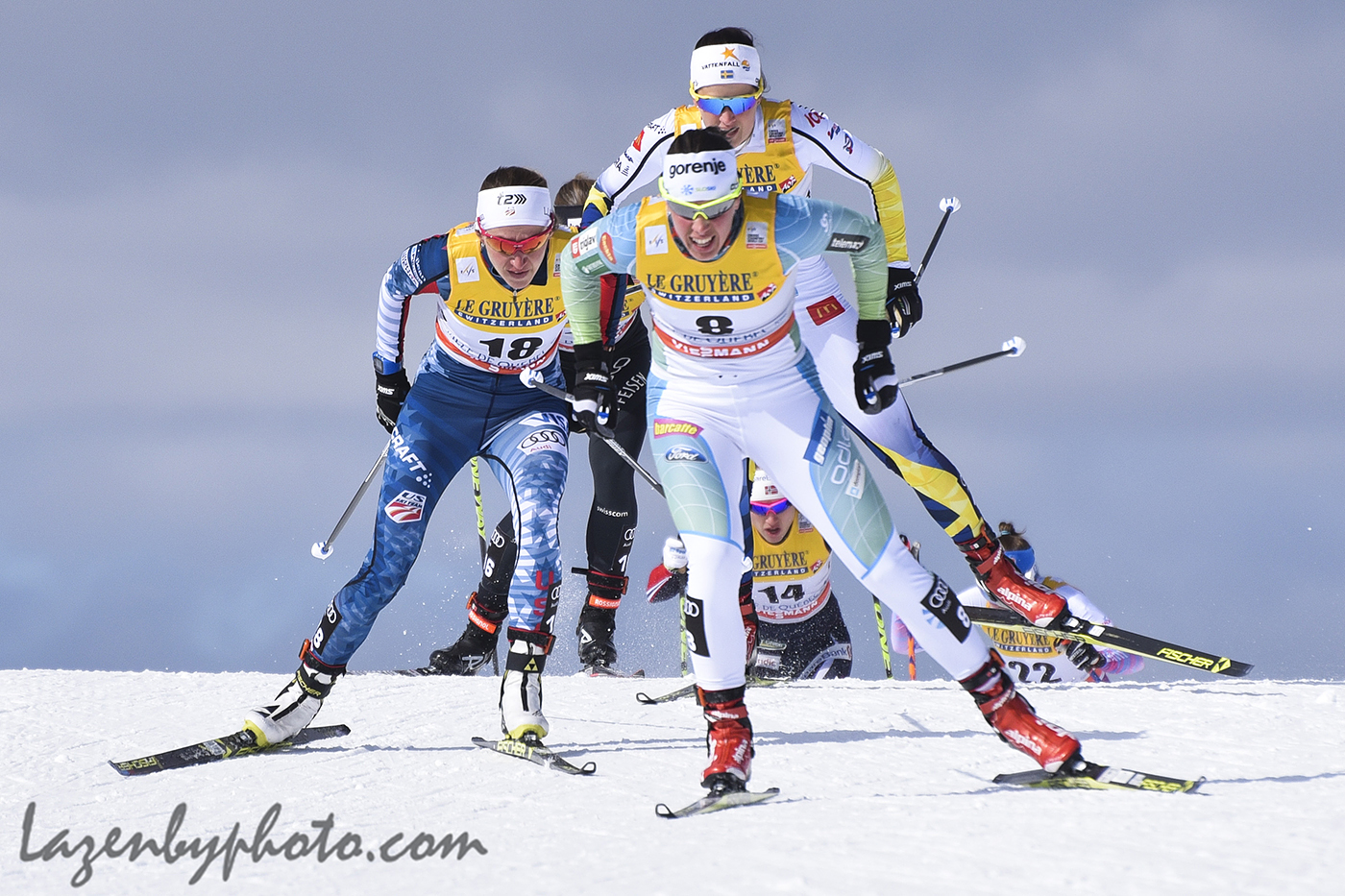
Sophie Caldwell Hamilton (bib 18) sprinting at the 2017 World Cup Finals in Québec City. (Photo: John Lazenby/Lazenbyphoto.com)
FasterSkier: How do you frame this sport, as you begin thinking about having a family of your own, when you think about competition and when you think about it as just a way to engage with nature? Those are two very different experiences. And I mean let’s face it, you have had a competitive experience that very few people can relate to.
SCH: We hope that we can start a family someday and I think that’s something we’re both looking forward to at some point. Navigating that relationship with sports, with our kids, will be interesting because I think, I mean I’ve probably said this before to you, but I think for me, the reason that I ski raced for as long as I did was that my parents were very good about how they exposed me to the sport without putting much pressure on me to be a ski racer.
I think the greatest thing about sports when you’re young is that it can be this social thing you do with your friends. And I think it’s so important to try a bunch of different sports. I definitely plan on introducing my kids to cross-country skiing but I hope they’ll try a bunch of different things whether they pursue cross-country skiing or not. That’s totally up to them. But, I do plan to introduce them to it at a young age and hopefully, it’s something that their friends do too and they can enjoy it that way and then decide where they want to take it. But I’m sure it’s easy to say, I’m not going to put any pressure on them now and maybe as a parent, or when you become a parent, it becomes more difficult. But I think my parents did a very good job. So I would plan to model it off whatever they did, and hopefully, my dad can give me some advice on that.
FasterSkier: I know you lost your mom not so long ago and I know you were close. I also know you’re not a very public person. But I’m curious how that experience may have informed you about keeping things in perspective when it comes to sport?
SCH: I’ve always tried to look at skiing as just one part of the bigger picture. Skiing has never been my life, it’s something I do in my life. I’ve always tried to be a real person before I’ve been a skier. And I think when my mom got sick and when I lost her, that definitely put it all into perspective even more. It was a no-brainer to fly home that winter and to spend the next year at home with her. There’s nothing I would change about those last ten months I had with her from when she was diagnosed to when she passed away.
It was interesting because she passed away not this last fall, but the November before. And so, I went on the World Cup about a week after she passed away and I didn’t know what it was going to be like. In hindsight, I think I was probably a little numb all that winter. I had my fair share of sad moments and Simi was usually the only one to see.
But in general, I was a pretty happy person. I remember looking back and realizing I didn’t cry about a single result that year — not that I was a huge results-crier before. But sometimes you get a disappointing result and you’re tired and your emotions take over and you shed a tear. But I think that whole experience just put it into perspective for me. You’re allowed to care about skiing for sure, I hope people care about it. But in the grand scheme of things, it’s just a ski race and there are so many more important things in life.
I was still able to have a really great season that year, and my preparation going into that season was absolutely not ideal and it was a huge emotional roller coaster. But, I spent her last year doing exactly what I wanted to do and what I needed to do. In that sense, I think I was and am in a place where I have no regrets even though it was, obviously, a very sad time.
For me, it highlighted the importance of relationships, even more. And so, yeah, you know I’ve had, I have a very strong support system between my Simi and my family and my best friends and Matt and I can’t imagine having gone through any of this without them but I think it’s also made me kind of try to find connections in these last two years on the road with the younger skiers and, yeah, when it’s become harder and harder to be purely focused on results I think it’s been nice to, to know that what really matters is, those relationships that I’ve made.
I think it’s worth acknowledging again that one of the main reasons I’ve been able to do all this is because Simi has been a safe space for me, particularly the last couple of years. While I enjoy being able to be strong for others, I think the reason I can do that is that I don’t always have to be strong for him.
Matt has also been an instrumental part of both of our ski careers and lives. I know we both consider him one of our closest friends, which at times probably made it harder for him to coach us, but he is a very special person to both of us who has been much more than a coach.
Lastly, I just want to acknowledge the importance of my family in my ski career and coping with the loss of my mom. My dad has the most incredible outlook on life of anyone I’ve ever met and he made sure we spent the time we had with my mom with no regrets, which mostly just meant being together, and that allowed us to be grateful more than devastated. I used to talk to my mom on the phone every day, but now I talk to one (but usually two) of my dad, sister, brother or cousin every day and I can’t imagine going through something like that without them.
Sophie Caldwell Hamilton racing this season in Davos, Switzerland. (Photo: NordicFocus)
Sweden’s Linn Svahn winning the first stage of the 2021 TdS in Val Müstair, Switzerland. (Photo: NordicFocus)
This World Cup coverage is made possible through the generous support of Marty and Kathy Hall and their A Hall Mark of Excellence Award. To learn more about A Hall Mark of Excellence Award or to learn how you can support FasterSkier’s coverage please contact info@fasterskier.com.
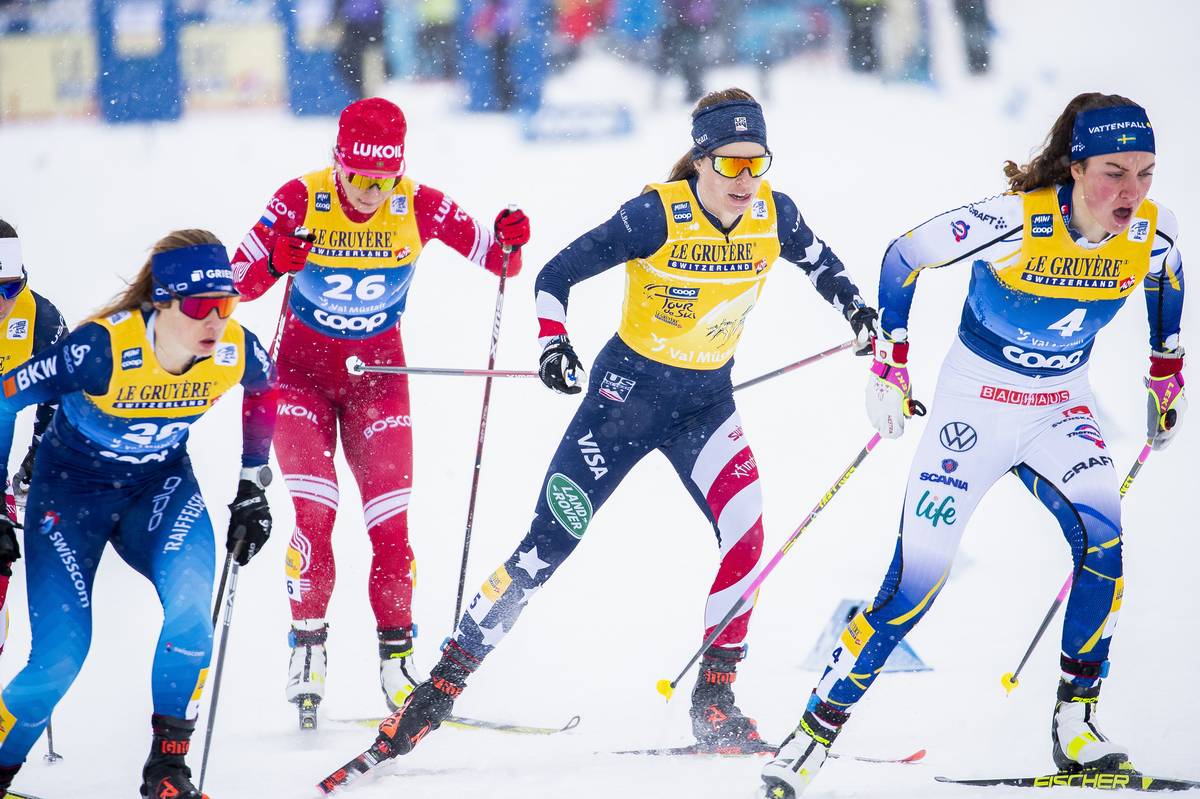
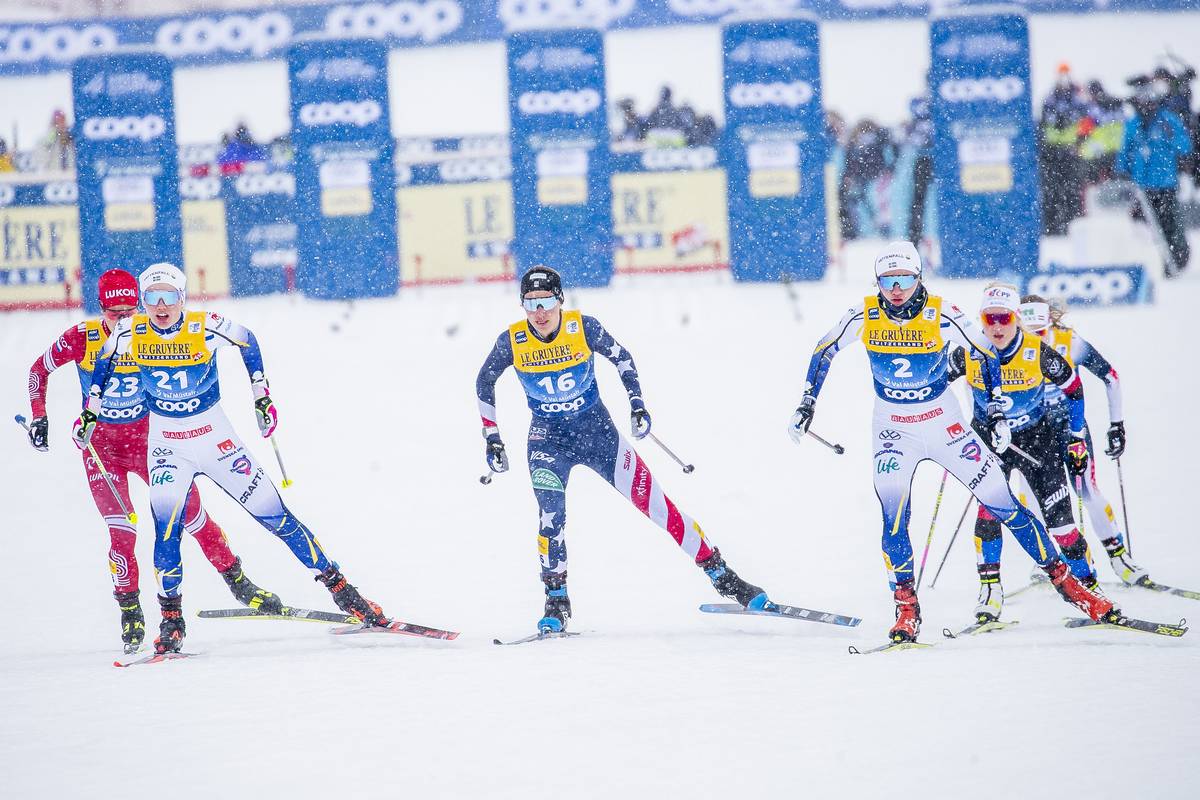
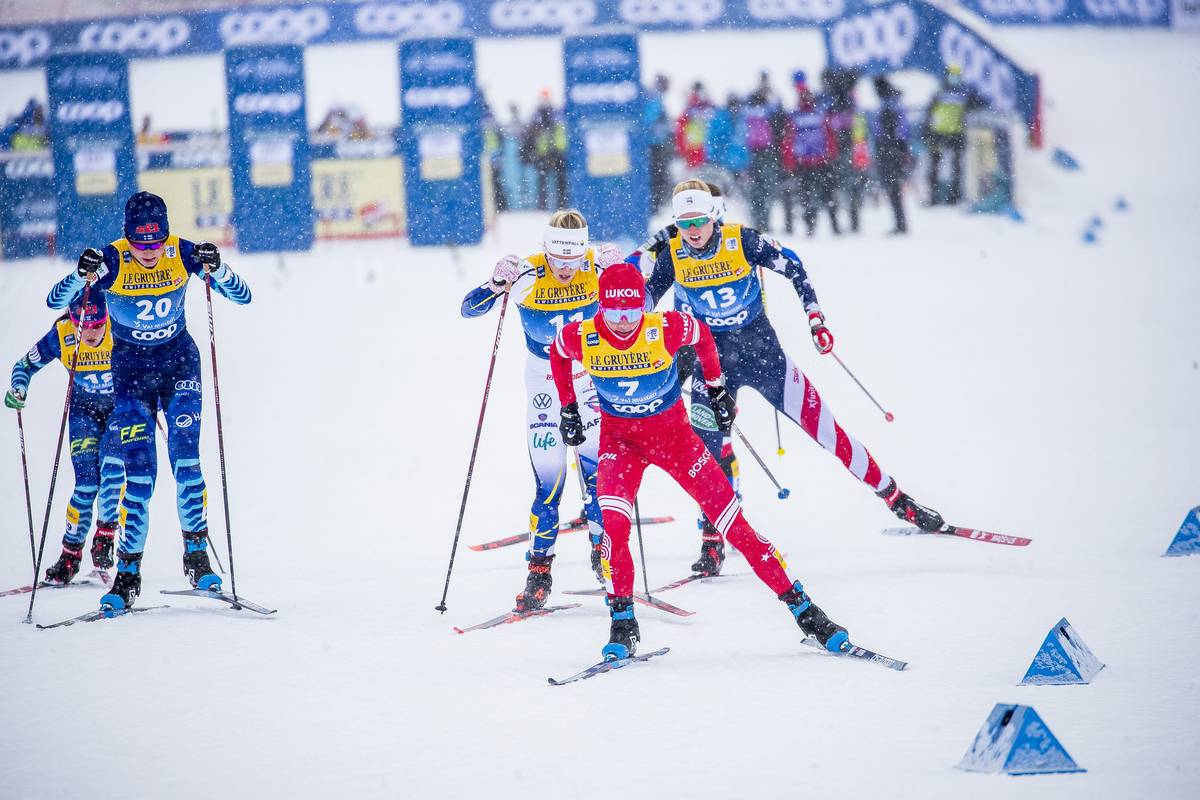
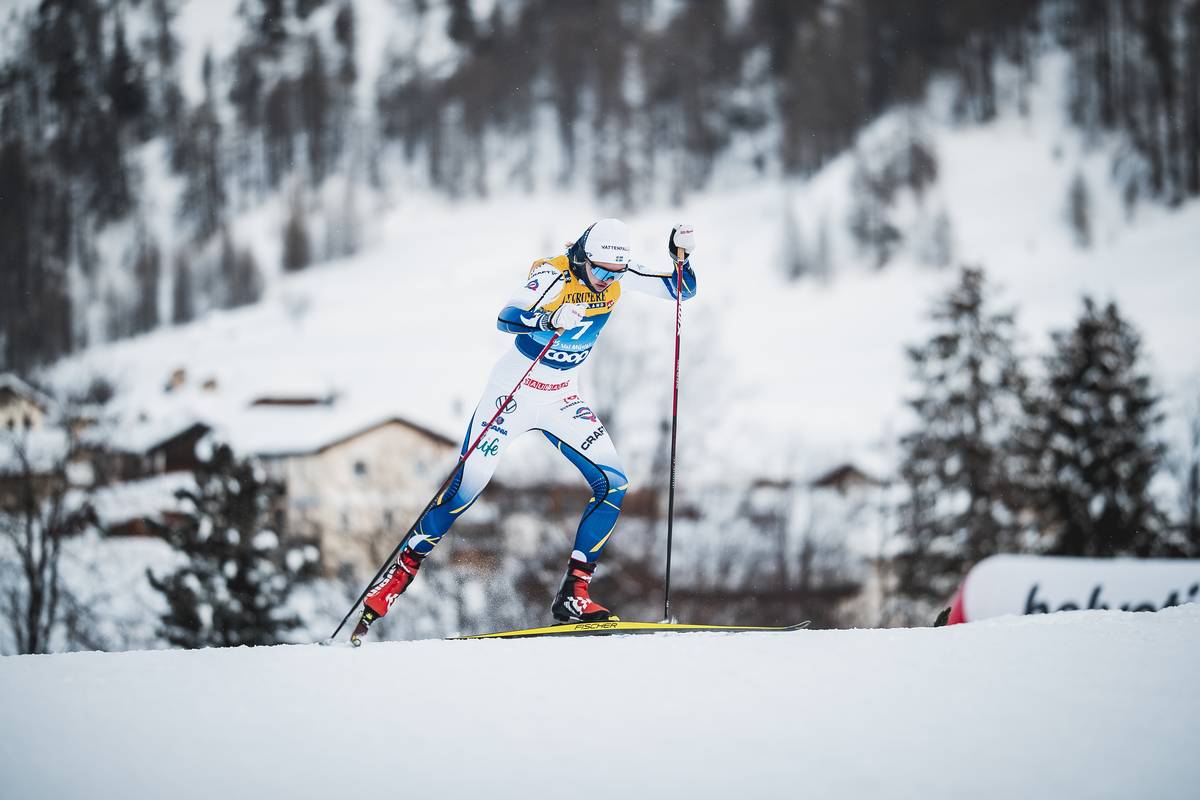
Out with 2020, in with 2021. Here in the world of multicolored lycra and skinny skis, we are kicking off the new year with the opening of the Tour de Ski on the sprint track of Val Müstair, Switzerland. As snow fell lightly but steadily, the usually remarkable mountain backdrop was veiled, narrowing our focus to the athletes as they embark on the grueling eight stages over ten days that is the TdS.
The two-lap 1.4-kilometer sprint course in the alpen valley featured two punchy climbs per lap leading down into fast and tight S-turns. Small rollers after these turns kept the skiers on their toes as they charged around the course.
Though the Norwegian athletes remain absent from the World Cup and TdS, the Swedish women are back in full force. They made their sprint prowess known in the qualifier, with 26-year-old Maja Dahlqvist setting the fastest time by nearly three seconds in 3:30.86. Seven members of their squad qualified for the heats, with an additional three in the top 10: Linn Svahn in 2nd, Moa Lundgren 4th, and Frida Karlsson in 8th. Though Karlsson is normally known for her distance racing (in particular besting Norway’s dominant Theresa Johaug at last year’s Holmenkollen 30 k), her possession of the green U23 Overall World Cup leader bib evidenced that she was not to be dismissed as a contender for the stage.
Wearing the yellow Overall World Cup leader bib, Rosie Brennan was the top American qualifier in 5th (+4.38), followed by Hailey Swirbul in 13th (+8.65), Jessie Diggins in 14th (+8.96), Sophie Caldwell Hamilton in 16th (+9.77), and Julia Kern in 25th (+12.61).
Brennan raced in a stacked first heat of the quarterfinals, racing against two of the top Swedes, Dahlqvist and Lundgren, in addition to Russia’s Natalia Nepyaeva, teammate Kern, and Switzerland’s Laurien van der Graaff. Brennan stayed near the front and in position to advance from the get-go, but couldn’t break from the lead group of four. She finished in a three-way photo finish with Nepyraeva and Lundgren, taking third but snagging a lucky loser spot allowing the threesome to all advance into the semis.
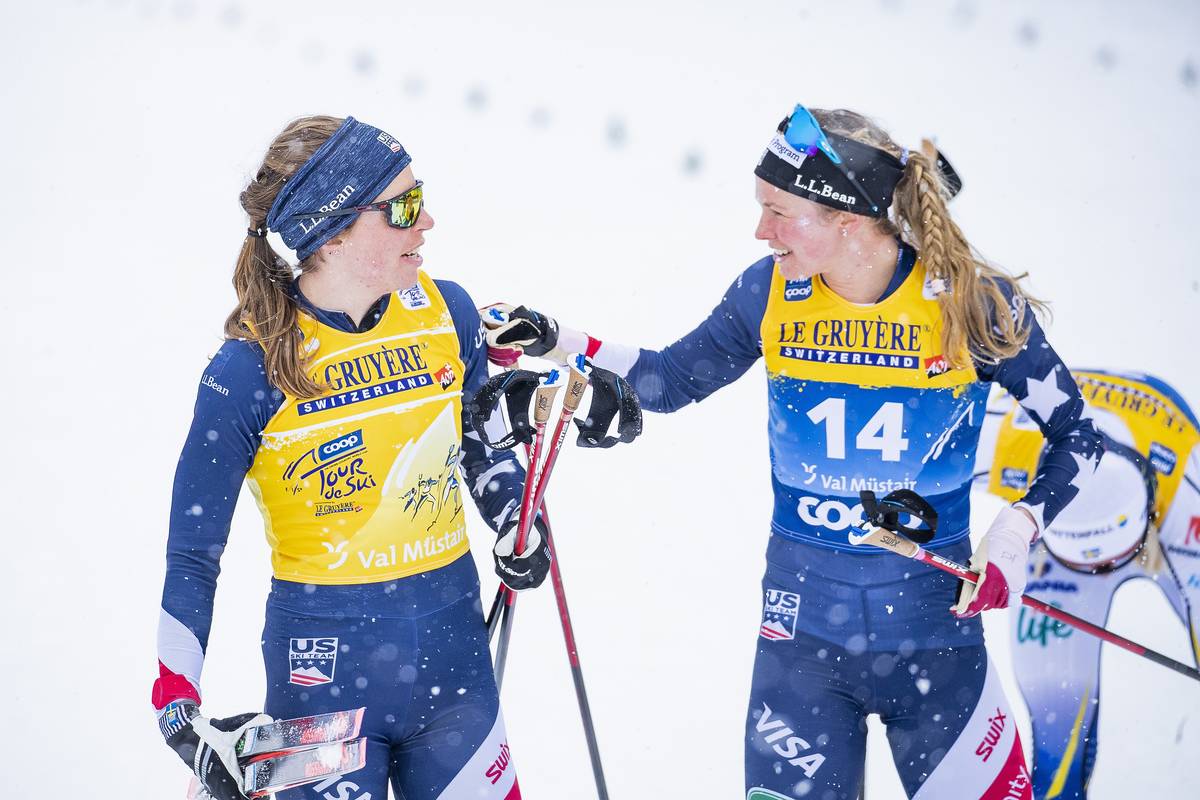
Jessie Diggins finding her form in Val Müstair, Switzerland where she placed second overall in the TdS stage 1 sprint. (Photo: NordicFocus)
Also advancing from the quarters from the fifth heat, Diggins held a position near the front throughout her heat, showing with her lightning-fast tempo that she intended to advance. She pushed Karlsson and Italy’s Greta Laurent break from the remainder of the group. In the second lap, Diggins had the fastest V1 cadence on the climbs and stayed smooth in the descents, priming herself for good positioning in the final sprint to win the quarter.
Ending their day after the quarters, Caldwell Hamilton marked Swedes Svahn and Emma Ribom. In her usual calm, cool, collected manner, she skied smoothly through the S-turn and tucked in comfortably on Ribom’s tails. Despite great position coming into the final lanes, Caldwell Hamilton could not quite overtake Ribom and finished centimeters behind for third in the heat. Swirbul stayed close to the leaders but was unable to fight for the top two and ultimately ended the heat in third also. Neither heat was fast enough to obtain a lucky loser spot.
Sophie Caldwell (bib 16) qualified in 16th and placed 16th overall in Friday’s skate sprint. (Photo: NordicFocus)Hailey Swirbul, here in bib 13 during stage 1 of the 2021 Tour de Ski, placed 15th overall. (Photo: NordicFocus)
On to the semifinals. Racing on home soil in the tight first heat, Nadine Fähndrich (SUI) edged out her opponents for the win in a three-way photo finish with Slovenia’s Anamarija Lampic and Sweden’s Dahlqvist. Considering Lampic and Fähndrich both finished in the top four of the last two freestyle sprints in Davos and Dresden, this result serves as a testament to the depth of the sprint field in those venues despite the lack of Swedes, Finns, and Norwegians.
Brennan and Diggins took off in the second heat, marking Swedes Svahn and Karlsson who held the front in the first lap. In the second lap, Brennan upped the tempo on the climbs, while Diggins pushed over the top and worked the downhill, free skating out of the rollers and putting herself into position to charge down the lanes ahead of Karlsson to hold onto the second position and a secure advance to the final.
Frida Karlsson (SWE), Jessie Diggins (USA), Greta Laurent (ITA), (l-r) during stage 1 of the 2021 TdS. (Photo: NordicFocus)
Fighting for millimeters, Karlsson and Brennan were just behind in third and fourth. Both squeaked through as lucky losers, but only just as Brennan’s time was a mere 0.1 seconds faster than the next fastest time.
The pace stayed hot and the pack stayed tight in the first lap of the final. Diggins and Brennan stayed in the mix near the middle of the pack and in contention for the podium.
As the racers rounded the bend into the second lap, Svahn began firing on all cylinders, taking off at the front with Lampic and Fähndrich marking her from a couple ski lengths back. Just when the top-3 positions seemed locked up, Lampic and Fähndrich brushed skis in the downhill S-turn causing Fähndrich to crash, losing sight of the podium. Svahn continued to hammer, flying down the final stretch to take the win with Lampic nearly a second behind her.
Seizing the opportunity, Diggins nimbly dodged around the downed Fähndrich, hopping over her pole and hitting the gas to drop a chasing Karlsson and snag third.
Linn Svahn during qualification in Val Müstair, Switzerland. (Photo: NordicFocus)
“I didn’t know how I’d feel in high altitude,” Svahn told FIS after the race. (Val Müstair sits above 4000 ft.) “I tried to take the first lap to get into my own zone and technique, then I tried to push all I had in the last uphill since the other girls were going really strong beside me.”
FIS also asked about Svahn’s goals for the tour ahead.
“I try to focus on each race, and now I’ll just focus on getting my legs working again after these tracks,” Svahn said with a tired laugh.
After a lengthy review, during which Diggins demonstrated the importance of staying on top of nutrition during the arduous tour by refueling with a bowl of pasta on the sidelines, Lampic was deemed to have interfered and was disqualified. This moved Diggins into the second position on the podium, with Karlsson stepping into third.
“Today was a fun way to start 2021,” wrote Diggins in a post-race email to FasterSkier. “But I think it’s important for me to say that I’m equally as proud of my all-out effort and our team today as I am when I’m not on the podium! It was just another day of giving it my absolute best effort, but the patience and trust in the training plan that Cork and I set down together has been paying off and my race form is coming into sharper focus now.”
Jessie Diggins finishing second overall on Friday’s stage 1 sprint. (Photo: NordicFocus)
So far this season, Diggins had a near miss at the podium with a 4th place at the individual sprint in Dresden and was unable to advance from the quarterfinals in Davos after getting boxed out on a curve just before the final straightaway. Today marks her first podium of the season in sprint or distance.
“The final was exciting, for sure,” she wrote. “I fell behind a bit on the steep climb, and was working my way down the downhill sections with as much speed as I could when I saw Nadine go down and slide around the corner in front of me. I didn’t want to hit her (or break her equipment, or my own) so I jumped over her pole while rounding the corner! In sprinting you can get lucky or be the recipient of incredibly bad luck, and today the luck definitely came my way (and I’m grateful for it).
“It was so exciting to have Team USA be 1/3 of the women’s final,” concluded Diggins. “And for myself, it was exciting to be out there having fun, not putting pressure on myself but still skiing with confidence and enjoying the banked turns and rollers all at the same time.”
Rosie Brennan (l) and Jessie Diggins in Val Müstair, Switzerland after the first stage of the TdS. (Photo: NordicFocus)
“It was a surreal day to be starting the Tour de Ski with the yellow bib,” Brennan wrote in a post-race email to multiple news outlets. “My one goal was to fight with what I had and I felt I did that well so I am proud of my effort out there today. I still have to remind myself just how far my sprinting has come and not change my expectations so quickly. This was only my second final ever and I am just so excited by the gains I’ve made.
“This might be the hardest sprint course I have ever raced,” Brennan continued. “It’s long, at altitude, and had some slow snow out there today. With that in mind, I tried to keep things under control, but also use my strengths. I had a near miss in the quarterfinal and was really happy about my quick acceleration in the finish after getting stopped up. I worked hard in the semi to keep the pace high to ensure our heat would have lucky losers which I then benefited from. However, I was pretty beat by the time we got to the final. I tried to open up on the second lap, but there wasn’t much there. I stayed out of trouble and for that was rewarded another two places. That’s a sprint race for you…That was a tough start to the Tour so the focus will now be on recovery to get ready for tomorrow and all the races to come. It’s also very cool to note that we had our 4th different girl on the podium in just 4 weeks of racing. Our team is really working hard to get through this tough season together and support one another as we navigate the world.”
Outside the top 30, Katharine Ogden finished 49th in the qualifier (+20.07), followed by Caitlin Patterson in 57th (+22.25).
Jessie Diggins leads the pack during the team sprint in Dresden, Germany. (Photo: NordicFocus)
This World Cup coverage is made possible through the generous support of Marty and Kathy Hall and their A Hall Mark of Excellence Award. To learn more about A Hall Mark of Excellence Award or to learn how you can support FasterSkier’s coverage please contact info@fasterskier.com.
Another lovely spring-like day in Dresden, Germany with vibrant green grass contrasting the ribbon of man-made snow along the Elbe River bank. On course in the women’s team sprint final, a ten-team affair became a relative runaway as it concluded.
For the uninitiated and new to the team sprint concept, two-athletes form a team, and they tag off to one another six times each. In other words, each athlete races a .65 k lap (one time around the Dresden course) and tags off to their partner. Each partner races six 0.65 k laps for a total of 7.8 k for the team. It is dizzying. And yes, it can seem like a blur of Lycra and skis and poles. Roller derby meets cross-country ski refinement is one way to describe it.
At the race’s midpoint, the racing blur was led by an upstart team from China, pulling the pack along in their yellow and red highlighted suits. Switzerland I, U.S. I, Slovenia, Russia I, and Germany I were separated by 2.8 seconds. Just enough time back for those in the rear to keep hope alive, and for viewers to see that no real breakaway and podium locks had been determined. We’ll call it semi-scrum in its organization.
Dinigeer Yilamujiang of China leads the women’s pack halfway through the team sprint in Dresden, Germany. (Photo: NordicFocus)
5.2 k into the race, at the eighth exchange, Russia I played their hand as they burned fuel upfront. The race became a four-team affair with Russia I setting the pace, and Switzerland I, Slovenia, and the U.S. racing in the slipstream. This trend continued with the U.S. falling off slightly at 6.5 k, 1.4 seconds back. Not much time, but in a team sprint event, when drafting and maintaining a lock on those in front are key, it can appear to be a mighty gap.
Russia I continued it’s work up front and the pattern was set on the final tag. With 0.7 k to go, the Russians were up 2.3 seconds on the Swiss, 2.5 seconds on Slovenia, and 2.6 seconds on the U.S.
Natalie Nepryaeva of Russia takes charge in the second half during the team sprint in Dresden, Germany. Caldwell Hamilton tucks in just behind. (Photo: NordicFocus)
In that final lap, Fähndrich for the Swiss, reeled in Russia’s Nepryaeva, who at the onset seemed uncatchable, seized control of the front and took the win in 16:38.34 minutes. Nepryaeva crossed 0.32 seconds back to secure second for Russia I. Lampic crossed 1.12 seconds back for Slovenia’s third place. Caldwell Hamilton, slightly off the pace, finished in fourth (+3.01) for U.S. I.
Switzerland’s Nadine Fähndrich celebrates bringing home a team sprint victory with partner Laurien Van Der Graaff. (Photo: NordicFocus)
“I felt very good and saw that Natalia [Nepryaeva] was already a bit tired and I could catch up a lot from behind. So I had a very good feeling, and was hoping and fighting to make it happen today,” said Fähndrich to Swiss broadcaster SRF about her team’s last loop.
Laurien Van Der Graaff and partner Nadine Fähndrich take the win for Switzerland in the team sprint in Dresden, Germany. (Photo: NordicFocus)
Van der Graaff, Fähndrich’s teammate, added, “I knew I had to send off Nadine in a good position. So I fought and suffered on my last leg, and talked to myself the whole time ‘come on, just a little bit more until I can tag off to her’. We already saw yesterday that she’s in great shape, she’s the strongest athlete at the moment. And I knew in the end she’d make it.”
The women’s podium of the team sprint in Dresden Germany. Switzerland’s Laurie Van Der Graaf and Nadine Fähndrich took the win with Russia’s Yulia Stupak and Natalia Nepryaeva in second, and Eva Urevc and Anamarija Lampic of Slovenia in third. (Photo: NordicFocus)
Sophie Caldwell Hamilton marks the leader around the bend during the team sprint in Dresden, Germany. (Photo: NordicFocus)
“We fought hard out there, and I am so proud of all our teams for giving it out best effort!” wrote Diggins in a post-race email. “Personally I struggled a bit with positioning on such a short and tactical loop, but I was proud of how I held my own in city sprinting on a course that challenged me in different ways! I thought we had great skis and it’s nice to feel that we’re working our way into better and better racing form.”
Both Caldwell Hamilton and Diggins were coming off of strong performances on the course in yesterday’s individual sprint event, finishing 2nd and 4th, respectively. Both seemed well matched for the flat and spicy course, with tight corners where the manmade snow crumbles to a dicey sugar.
Jessie Diggins in control over the rollers during the team sprint in Dresden, Germany. (Photo: NordicFocus)
“It was fast and furious out there today, as Dresden always is,” emailed Caldwell Hamilton. “I think Jessie and I both wanted to fight for a podium today and knew we were capable of it, but this race is a wild card and I think overall we skied quite well. For me personally, I always look back at these Dresden team sprints and wish I had skied more aggressively, but with so much carnage out there, you’re riding a fine line between aggressive and risky, so that sweet spot can be tricky to find. In hindsight, we can always find a small thing or two we would have done differently, but it’s still an effort I’m proud of and any time I get to team up with Jessie is an honor. Dresden hosted an exciting weekend as usual and now I’m looking forward to a little Christmas break in Seefeld!”
Jessie Diggins and Sophie Caldwell Hamilton celebrate a 4th place finish in the team sprint in Dresden, Germany. (Photo: NordicFocus)
Hannah Halvorsen and Julia Kern placed eighth in the final, 12.35 seconds off the winning time. The duop advanced to the final after placing fifth in the first semi-final. The top five teams from each semi advance to the finals.
Hannah Halvorsen faces off with Germany’s Laura Gimmler during the team sprint in Dresden, Germany. (Photo: NordicFocus)
A quick look to the overall standings as Period 1 draws to a close: Despite sitting out the city sprints in Dresden, Rosie Brennan is still in charge of the yellow bib with 377 points. Missing this World Cup stop was part of Brennan’s season plan. Russia’s Tatiana Sorina trails by 41 points in second (334 pts), followed by Norway’s Therese Johaug in third (301 pts).
Rosie Brennan was all smiles after her first World Cup victory and podium in Davos, Switzerland. Photo: NordicFocus
This World Cup coverage is made possible through the generous support of Marty and Kathy Hall and their A Hall Mark of Excellence Award. To learn more about A Hall Mark of Excellence Award or to learn how you can support FasterSkier’s coverage please contact info@fasterskier.com.
With a thick, fresh coat of fluffy white snow that fell over the last week, Davos, Switzerland looked regal as ever despite the smaller field and lack of spectators for today’s 1.5-kilometer freestyle sprint. FIS described conditions as hard-packed, elevating what Sophie Caldwell Hamilton, who landed on the podium in Davosthe last two years, called in a pre-race interview with FIS as a “technical and tactical” two lap course. Pumping music and cheering coaches, though perhaps a muted version of the norm, made the stadium feel significantly more full than the no-spectator reality.
With the Scandinavian teams out of the running as they withdrew from the December rounds of the World Cup due to Covid-19 concerns, it would be easy to focus on who did not in Davos. Let’s instead focus on who did.
Rosie Brennan during the skate sprint qualification in Davos, Switzerland. Brennan won the qualifier – a career-best for the American. (Photo: Nordic Focus)
On a roll this season, Rosie Brennan won the qualifier by 1.75 seconds in a time of 2:40.03. Rounding out the Americans in the finals, Caldwell Hamilton took second, Diggins fifth, Julia Kern 10th, and Hailey Swirbul 18th.
Jessie Diggins racing to 5th in the Davos sprint qualifier. (Photo: Nordic Focus)
In the quarterfinals, Caldwell Hamilton faced off with Switzerland’s Nadine Fähndrich in what would be the fastest heat. The pack stayed together in the first lap, but the two peeled off to finish comfortably off the front, Fähndrich in the lead.
The next heats were much closer. Brennan finished second in a pack of four behind Slovenia’s sprint star Anamarija Lampic in heat two, and after taking the lead in the second lap, Kern won the third heat.
Jessie Diggins (left) leads Julia Kern (bib 10) at the front of the group during the quarterfinal of the 1.5 k sprint in Davos, Switzerland. (Photo: NordicFocus)
Dropping into a tuck on the last descent and on Kern’s tails in the fast and furious final turn into the stadium, Diggins was in a tough position. Rather than putting herself in position for the sprint to the finish, she maneuvered to avoid tangling skis with Kern and lost some of her momentum. Despite powering down the straightaway and throwing her boot, she took third in the heat and was not fast enough to earn a lucky loser spot.
Round the bend, Julia Kern in the lead heading into the final straight during the quarterfinal of the 1.5 k skate sprint in Davos, Switzerland. (Photo: NordicFocus)
Swirbul was also eliminated in the quarters after taking fourth in her heat.
Hailey Swirbul climbs amidst the pack during the quarterfinal of the 1.5 k skate sprint in Davos, Switzerland. (Photo: NordicFocus)
In the semis, the three remaining American women lined up together in a stacked first heat with Lampic and Fähndrich. Brennan and Caldwell Hamilton held strong in the middle of the group while the Swiss and the Slovene set the pace. The foursome stayed tight, jockeying for positions in the second lap.
It was anyone’s game in the final straight, but Fähndrich held the others off on home turf to win the heat with Lampic and Brennan in a photo finish for second and third, respectively, behind her and Caldwell half a ski length further back in fourth. Both were able to secure lucky loser positions to advance into the final. Kern was eliminated after finishing 6th in the heat.
To the line, Rosie Brennan (L) leads Switzerland’s Nadine Fähndrich and teammate Sophie Caldwell Hamilton in the final sprint during the semifinal of the rounds in Davos, Switzerland. (Photo: NordicFocus)
Eva Urevc of Slovenia and Natalia Nepryaeva of Russia advanced from the second heat of the semifinals.
Fähndrich and Lampic again took the pace out hot in the final round, but Brennan kept herself in the mix. Challenging Fähndrich, she powered into the lead on the final climb, cresting the hill in front and dropping into a tuck on the downhill. Brennan held her lead out of the final turn and into the straightaway, but Lampic, Fähndrich and Nepryaeva were close on her tails.
Adrenaline pumping and poles lashing, Brennan held her lead by a narrow margin, pumping her fist in the air as she crossed the finish line in 2:37.36, breaking into a wide grin as she gasped for air.
Rosie Brennan celebrates her victory and first World Cup podium after the freestyle sprint in Davos, Switzerland. (Photo: NordicFocus)Rosie Brennan celebrates her victory and first World Cup podium after the freestyle sprint in Davos, Switzerland. (Photo: NordicFocus)
“It’s wild,” Brennan told FIS after the race. “I’ve never considered myself a sprinter, so to find myself on the podium is something I couldn’t even dream of.”
Lampic finished on her tails in second (+0.28), with Nepryaeva and Fähndrich in a photo finish for the final podium spot. They finished third (+0.49) and fourth respectively (+0.53).
The women’s podium at the 1.5 kilometer skate sprint in Davos, Switzerland. (Left to right) Anamarija Lampic (SLO) 2nd, Rosie Brennan (USA) 1st, Natalia Nepryaeva (RUS) 3rd. (Photo: NordicFocus)
After losing contact with the lead group, Caldwell Hamilton finished fifth (+6.83), with Urevc behind in sixth (+15.58).
FasterSkier spoke with Brennan while she awaited a blood draw at antidoping. Still euphoric, Brennan recounted her day and a result that she called “pretty unbelievable” and hadn’t fully set in. In fact, she thought there may have even been a mistake in the timing when she saw her name at the top of the qualifying list. Brennan also discusses training separately with clubs throughout the season, then coming together as a full American squad in Europe.
Post-race interview with Rosie Brennan.
Exhale. Sophie Caldwell in the mix during the heats of the 1.5 k skate sprint in Davos, Switzerland. (Photo: Nordic Focus)
In a post-race interview, Caldwell Hamilton discussed her own strategy to keep herself out of risk of becoming tangled up with other skiers while staying in contention throughout the heats. She also shared how significant today’s results are for the team as a whole, regardless of the presence of the Scandinavian teams.
Post-race interview with Sophie Caldwell Hamilton.
Hannah Halvorsen, qualifying in 38th, in her first World Cup since suffering devastating injuries when she was hit by an automobile in 2019. (Photo: Nordic Focus)
Returning to the World Cup just over a year after being struck by a car and sustaining severe injuries, Hannah Halvorsen placed 38th in today’s qualifier. Halvorsen provided an optimistic comment on how she feels after her first race.
“It was such a thrill to be able to get back on the race course,” wrote Halvorsen in an email. “I was both nervous and excited going into today’s race because I wanted to put down my best race. Everything went really well today so I am quite happy. Thanks to the coaches and wax techs, I had great skis and support. This feels like a great starting point, and I hope to improve off of this as the season continues. It is such an opportunity and honor to be here. The US team performed incredibly well today, and I couldn’t be more proud to be a part of this team.”
Post-race interview with U.S. Head Coach Matt Whitcomb.
Coming in hot! Jessie Diggins leads teammate Sophie Caldwell, Laurien Van Der Graaff (SUI), and Julia Stupak (RUS) during a sprint time trial in Davos. (Photo: Matt Whitcomb)
Lillehammer cancels World Cup events. Norway, Sweden, and Finland pull from the World Cup after the opening weekend in Ruka citing COVID safety concerns. To an outsider, these headlines paint a seemingly bleak picture of the start of the race season. However, an international time trial featuring a skate sprint day Friday and distance event Saturday sparked hope for the American team as they remain in Europe focused on the upcoming weekend of racing in Davos, Switzerland.
FasterSkier spoke with U.S. Ski Team head coach Matt Whitcomb to learn more about the event and its role in helping the American team gain on-snow race experience, sharpen their form and find their race gears amidst a stacked field of friendly competitors.
Taking a step back, Whitcomb shared that travel from Ruka to Davos felt both safe and easy. The team booked a flight through a FIS travel agent from Kuusamo, FIN to Munich, GER, then drove the remaining 3.5 hours to Davos. By reserving through FIS, they ensured that the only other passengers on the flight were other world cup athletes, coaches, and techs, who had been tested in order to participate in the opening World Cup events.
“It was probably the safest flight we’d ever been on and it made for a really easy day,” Whitcomb stated.
Athletes were required to obtain a negative test result within 72 hours prior to entering Finland per the country’s border control policies, then were tested a second time upon arrival at the venue in Ruka. This put them inside what Whitcomb called the “World Cup bubble”.
“FIS tracks our daily whereabouts all winter,” wrote Whitcomb in an email for clarification on testing and travel safety precautions. “We fill out a twice-daily questionnaire for U.S. Ski & Snowboard, as well. We did not need [a test 72 hours] before entering Switzerland. As a team policy, we got one anyway. We were tested again upon arrival to Switzerland, and now that we’ve been here one week, we will test the entire team over the next two days.”
In addition to this testing protocol, the U.S. team is operating an agreed upon team health policy regarding behavior, which Whitcomb outlines below.
“Travel and ride with your roommate. No indoor socializing, other than meals. No family visits, no friend visits. Our current hotel has a separate room and buffet line for our team to use. New athletes and staff arriving to the World Cup enter a ‘quarantine bubble’ until they’ve cleared a PCR test, so we eat in two shifts, and two locations.”
Back to the time trial. Whitcomb explained that the idea for the time trial was raised by one of the Italian coaches, who approached Whitcomb about getting together for some intensity in the week leading up to Ruka.
Gleb Retivykh leads JC Schoonmaker around a bend during the heats of the sprint time trial in Davos. (Photo: Matt Whitcomb)
“We’ve had some pretty good joint workouts and camps over these years with these teams, but I think this was probably the coolest where we had five nations with quite a few athletes entered,” he shared.
The start list for the King’s Court style skate sprint time trial in Davos. (Courtesy: Matt Whitcomb)
With names like Federico Pellegrino (ITA), who finished the 2019/2020 season ranked 4th in the sprint standings, Laurien Van Der Graaff (SUI), who has five World Cup podiums, and last seasons overall World Cup Champion Alexander Bolshunov (RUS) on the start list, the concept gained enough traction that some international athletes chose to stay put in Davos for the collaborative workout rather than travel to a nearby Opa Cup race in Goms, SUI.
Through a text thread, the coaches from each nation agreed upon both COVID safety plans and event format, creating an event that Whitcomb described as “easy-going” in terms of the level of planning and logistics required and the relaxed start time. Teams agreed to forgo fluoros, throwing on CH6 or an equivalent. Despite this seemingly casual atmosphere, putting together a group of fiercely competitive athletes ensured that the event would not be all fun and games.
“It was really nice because — you know, it’s low key and people are relaxed, but you show up and people are warming up har,” said Whitcomb. You just had to bring any bib, so everyone threw on bibs and was wearing their national team uniforms. As soon as you’re suited up, it’s game time, and there was not a lot of holding back out there. It was a really valuable day for us and for everybody. The coaches were all really excited at the end of it.”
Whitcomb explained that because the event was for training purposes, the results would not be released publicly. However, the USST Instagram account calls it a Pellegrino (1)–Bolshunov (2)–Schumacher (3) podium for the men. That said, Whitcomb shared that the effort and results of the athletes were universally positive and indicative that strong performances in true race events are on the horizon.
“Every day that we’re actually on snow doing intensity and in particular head to head racing or intervals is really elevating the level of performance on our team. We’re seeing that just in general comments on feelings in intervals, and this particular day — the skate sprint — I think was a good breakthrough for the team. People were starting to feel good. Conditions were really fast and firm — it was that hero snow that we all love to ski on. And people skied fast, so that was the first time that as a group that we skied at an elevated level rather than just having one or two people knocking one out of the park and the rest of the team skiing just okay at best.”
Some noteworthy results he was able to share include Sophie Caldwell winning the sprint qualifier, the American men keeping the time-back margin tight to top qualifier Pellegrino, and impressive performances by Jessie Diggins and Katharine Ogden in the two lap 10-kilometer distance race.
Katharine Ogden comes on form in the distance time trial in Davos. (Photo: Matt Whitcomb)
Gus Schumacher hammers during the qualifier of a sprint time trial in Davos. (Photo: Matt Whitcomb)
Caldwell’s result was especially encouraging to Whitcomb following what the coach called a “fluke” in Ruka. Finding the last time she had not qualified for the rounds in a sprint event required a lot of scrolling on her FIS athlete profile. Her last time outside the top-30 in qualification happened in Drammen, Norway on March 11th, 2015.
“I think it was a big weight off her shoulders to win the qualifier and just be aware that she’s still the same skier she has been and she’s not suddenly over the hill. I think she can now focus a little bit more without concern that ‘Wow, maybe I’ve overtrained or maybe I’ve really screwed something up here.’”
In her own words, Caldwell shared the following via email.
“I think it’s good practice to get in a race effort, especially when many of us have had so few this year. It was run King’s Court style, so if you won your heat you would move up and if you were last in your heat you would move down. As a result, all the heats were very competitive and well-matched and between three heats and a qualifier it ended up being a very hard day. I was psyched to do my first skate sprint effort on snow and mix it up with some of the girls we will be racing with next weekend.”
(Left to Right) Gus Schumacher (USA), Federico Pellegrino (ITA), Kevin Bolger (USA), JC Schoonmaker (USA), and Alexander Bolshunov (RUS) take to the course in the quarter-final of a sprint time trial in Davos. (Photo: Matt Whitcomb)
As the upcoming race weekends leading up to the Tour de Ski remain scheduled as planned, Whitcomb does not currently anticipate additional workouts like this taking place. He concluded by reflecting on the impact that the development of these international relationships has had on the growth of the American program and his optimism that it’s example will play for continued domestic development.
“For me, the coolest angle of this whole deal is that as unapproachable as the World Cup once seemed to me, that turns out to be not at all the case these days. It’s really a tight family,” said Whitcomb. “The amount of teams that are working together, even if it’s just transferring bags or borrowing wax, it happens on an almost daily basis when we’re in the same location. I just love seeing the same thing happening back in the US. It’s really going to be about partnerships for the US to succeed moving forward and this really left us with a good feeling.”
Interview with Matt Whitcomb following the international time trial in Davos.
Federico Pellegrino (ITA), Gus Schumacher (USA), and Jovian Hediger (SUI) in a trailside chat between the heats of a sprint time trial in Davos. (Photo: Matt Whitcomb)
Sophie Caldwell matches Sweden’s Jonna Sundling stride for stride up the climb in Falun in 2020. (Photo: NordicFocus)
Perhaps, by the time you read this, Sophie Caldwell will have already sped her way around the sprint circuit in Ruka, Finland. The World Cup begins on Friday. At once Caldwell possesses a down-to-earth humility and a killer’s instinct to find the gaps and repeatedly progress through World Cup sprint heats. Off the course, she’s more likely to ask about your day than she is to dwell on a World Cup podium.
We caught up with Caldwell for this interview while she was still in Vermont, prior to her departure for Finland on November 18.
***
FasterSkier: I think Vermont received some early season snow. Have you been able to get out and ski a bit?
Sophie Caldwell: There’s actually this dirt road, just kind of past my parent’s house. It’s a little higher elevation, we have been doing some limited early season skiing there, but it’s kind of just back and forth on that road. It’s not good skiing, but at this time of year, it’s exciting just to have it. So we just kind of tromp around on it. But there’s no tolerance for complaining about bad skiing, right?
FasterSkier: Correct, that is a good rule of thumb. Generally, how was your off season?
SC: Simi and I have been living with my dad this summer, which has been really nice for all of us. And my dad has been busy. He did a ton of gardening in the summer which I think is awesome. I feel like we didn’t have to buy any vegetables at the grocery store because his garden was doing so well.
FasterSkier: The pandemic has been ruling all. What has your experience been?
SC: I guess the pandemic kind of impacted the basic training that I would normally undergo as an elite athlete. But starting early summer, we didn’t have any of our usual camps. And that’s been our chance to get on snow, late spring, early summer. And so that was the first big change. And then all the camps were canceled throughout the summer. So I’d say that’s been the biggest change is not having any national team camps.
And it’s tricky, because a lot of our team is in Vermont, and a lot of our team is in Alaska. So national team camps are the one thing that brings us together to meet in the middle. We haven’t seen a lot of our teammates since we left the World Cup in February or March. But, really, I feel very lucky to have such a strong club team here in Stratton. We’ve been training as a group, we’ve more or less been kind of a pod all summer.
And if we know if someone leaves the state or travels or we’re exposed to anything, that person would come back and either quarantine for a week and get a test or quarantine for two weeks before resuming train.
I feel like everyone’s been very respectful of those rules. And as a result, it’s worked quite well. And we’ve been able to stay healthy and put in some really good training back here. Even though I’ve missed the national team camps, it’s actually been really nice to get into a good training routine in Southern Vermont, and in a way, be a bit of a Vermont tourist. I feel like we’re exploring more of our backyard, and maybe going up to Northern Vermont a little more. So we’ve been staying closer to home, but still getting out for some adventures, which has been fun.
FasterSkier: How did the vibe change from say the first couple months of the pandemic where it was seemingly like, and I’m just projecting here, “Oh, my gosh, don’t go near other people or don’t do this.” Then, of course, we knew to mask-up and wash-up. Then we became more familiar with how the virus is transmitted, and how it appears to correlate to the duration of exposure. I’m just kind of curious, how did that look for the first month or two for you, and how did that change as we began to better understand this from a scientific perspective?
SC: You know, I think in the beginning, it was pretty terrifying because we didn’t know how to protect ourselves. We didn’t know how to protect the ones we love or maybe those higher risk among us, we didn’t know how you got it really, or how you got sick.
There were just so many unknowns. And while they’re still some for sure, some unknowns, I feel like, we better know how to protect ourselves. I think that’s been the biggest change. And I’m not scared of going to the grocery store now. because I am wearing my mask. Everyone else is wearing their mask, I sanitize my hands as soon as I get back to my car, and just these little things that I know if I wear my mask and wash my hands they help.
And I’m not sticking my fingers in my eyes and my mouth all the time. I’m doing a pretty good job of protecting myself. So I think that’s been helpful.
I guess the change for me has mostly been, the virus hasn’t gone away. But we’ve learned to live with it and how to protect ourselves the best we can. And in the beginning, I think there were just so many unknowns that it seemed the only safe thing to do was to lock yourself in your house and never leave.
Now, it’s nice, because we’re still not doing indoor gatherings or anything, but you can at least get out a little more and return to a small sense of normalcy.
Although this is kind of becoming the new normal, I guess. I have to say it’s sadly normal.
FasterSkier: I am curious, when I look at the world map and the national map right now, there’s a lot of red. I’m referring to high transmission rates for COVID. I know you plan on heading over for Period I on the World Cup. What is that going to look like for you? How are you wrapping your brain around all this?
SC: I feel like it still hasn’t really sunk in. I mean, there’s still just so many unknowns and things change so much each day that I think the key is going to be being able to be flexible, going with the flow. But right now our plan is to fly over a week from today on the 18th.
Our first stop is Finland. And Finland is actually doing remarkably well compared to Europe and to the rest of the world. And so I do feel okay about that. And as far as I know, they’re planning on holding those races.
And then it gets really tricky because then we’re down in Central Europe. Pretty much everywhere in Europe is in the red, Sweden and all of Central Europe. And so, yeah, I don’t know, I don’t know what’s going to happen. I think we go over there with the mindset that we could have a full season. But I just don’t know what’s going to happen after those first two weeks, because a lot of those countries are as bad or worse than even us right now.
Which, when you think about it, is pretty crazy. I really don’t know how much the country or national government itself has to do with holding races, you know, but we could run into the problem like we did in Québec last year where no one really wants to cancel. I think those local organizing committees and communities lose a lot of money.
But my hope is that if we are racing, we can do it in a responsible way that provides entertainment for everyone. Back home we have pretty strict COVID protocols, we’re all gonna do our best to be always wearing our masks and washing our hands and not interacting with any of the other athletes. On the World Cup we’ll probably have the same roommates for a whole period on the World Cup, if not the whole season.
Sophie Caldwell (USA), and Katerina Janatova (CZE), (l-r) during the women’s team 2019 sprint in Planica, Slovenia. (Photo: NordicFocus)
FasterSkier: Outside of this, I don’t consume a ton of sports, to be honest. You know, I just get enough doing what I’m doing. I know some people who cover sports discuss openly that they are flummoxed they are even speaking of sports at all. I’m bringing this up because you mentioned the idea of entertainment. I mean, you are right, at the end of the day, I guess some people see sport as entertainment. I’m just curious, how have you worked through that, to say I’m a professional athlete and I have a job to do?
SC: I think this also provides people like me and people who like to watch the sport, a sense of normalcy. They get to see and know that people are going about their business and preparing to race.
My feelings about it go back and forth a lot. I’m often pretty torn because, I mean, like you said, right now it sometimes seems so crazy to be thinking about sports and thinking about training. But, you know, if we are able to pull this off somehow, and do it safely, that can be a positive.
I understand we can’t really have a bubble, like some of the other major sports. It’s hard because we’re going from country to country, but hopefully, the cross-country World Cup isn’t going to be a super spreader event. Hopefully, it’s not a huge risk and I do think if we can have even just a few races to provide some entertainment for people back home and for families to provide a sense of normalcy, that can be a positive. I do think there’s that mental aspect for we, to think that maybe our racing circuit could be helping out. But I know that is a hard line to draw when considering all that is going on. Like when is it worth it and when is it not worth it?
But yeah, I go back and forth on it. It’s tricky. But, hopefully, we can do it and make it interesting.
FasterSkier: Have you set your own guidelines when it comes to COVID? Like, if this is going on and that is going on then you tell yourself that you’re out? For you personally, what will you consider a situation where you pull the plug? I’m just curious if you have thought about what your own limits are?
SC: Yeah, I guess I haven’t set any hard limits but I think if I feel they are not following the guidelines they agreed to, or races aren’t being held safely, I would have no problem saying I’m not comfortable with this and I’m out of here. My hope is that their guidelines are very strict and their standards are very high and of course everyone is expected to follow them.
I guess it’s not like ‘oh if I see this one particular thing I’m gone’. It’s just sort of a general feeling of safety and security and if it becomes super uncomfortable at any point, then no, I don’t think it’s worth it to continue on.
FasterSkier: Are you planning on coming back to Vermont at all during the season? Let’s assume a best-case scenario with COVID — Are you just going to stay for the duration in Europe through World Champs?
SC: The original plan A would be to stay till the end of the season. But considering other scenarios, then it gets tricky because if they start canceling things and they cancel things far enough in advance, then I think we’d come home. But you know, there’s a chance that maybe they would cancel things a week at a time.
That makes it really hard for North Americans because we’re just kind of stuck over there playing the waiting game. I guess we’ll navigate that as we get to it. But plan A would be to stay over in Europe for the whole season.
FasterSkier: From a training perspective, do you feel good?
SC: It’s been nice to just get in some consistent training back here. We have one more week and we’re doing an intensity block with some time trails this weekend. So I guess the idea is to try to sharpen this weekend then cut it back next week until races get started.
FasterSkier: The softball question, what are the season’s goals?
SC: The personal goals, the focus has always been World Champs but I’ll be focusing on every sprint and I think this season, in particular, it’s important just to show up all-in for every weekend because you never know when it’s going to get cut short. You never know how many races we’re going to have. I think it’s a little more important to show up sharp rather than really try to work into the season this year. So hopefully I can do that.
FasterSkier: Okay, you’ve been married a year. All things considered, life is good. Do you feel like you have much to prove from a ski career standpoint?
SC: My approach to ski racing and my ski career is pretty different from what it was when I was 20, just starting out on the team. But I would say, you know, I think we’re definitely nearing the end of our ski careers. It’s been really nice for me to end these last couple of years and really feel like I’ve found a sustainable ski-life balance. I think that’s helped both my skiing and my life outside of skiing. So maybe being married was part of that, but it is nice because it makes me feel like I’m a real person and taking these real steps in life.
So I think in that sense, I think my mindset towards skiing is different than it was when I was 23. And it doesn’t mean that I’m any less fired up. It’s just that I’ve kind of found a nice balance and found a good healthy way and scheme to fit it into my life.
Sophie Caldwell racing in Toblach, Italy during Tour de Ski. (Photo: NordicFocus)
Here are some vital stats from trailrunproject.com as it relates to the Audi Power of Four 50k trail run in Aspen, Colorado: 32.6 miles, 9,873’ vertical climb, 9,407’ descent, 56 percent max grade, and 74 percent “runnable”.
This weekend, Simi Hamilton, U.S. Ski Team member and Aspen native was peerless in the men’s 50 k trail run. At 33 years old, Hamilton won the race in 5:18:37.1 hours. The second-place finisher, although nearing his fifth decade at 47-years-old, Troy Howard from Basalt, CO., was 56:42 minutes back.
“It’s really important for your psyche … you want to be able to revisit the racing mentality throughout the summer. Put a bib on and go through the same emotions, because that’s just as important as doing the intervals in the summer,” Hamilton told the Aspen Times after the race.
Audio Power of Four 50 k trail run course. (Screenshot: trailrunproject.com)
Audio Power of Four 50 k trail run course profile. (Screenshot: trailrunproject.com)
The 50 k grind tops out on Aspen’s four iconic ski areas which include Aspen Mountain, Aspen Highlands, Buttermilk, and Snowmass.
U.S. Ski Team teammate, and Hamilton’s wife, Sophie Caldwell Hamilton, made a last-minute decision to race Sunday’s 25 k Power of Two. Caldwell placed second in 2:17:50.4. Jessie Young of Aspen won the women’s 25 k in 2:17:50.4.
“The Council decision to postpone the FIS Congress 2020 is based on the FIS policy of respecting that the health and safety of all participants at all of its events as the highest priority,” FIS stated in a press release. “On the advice of the FIS Medical Committee Expert Group, organising the FIS Congress in October would not meet these standards of safety. Additionally, the current travel restrictions subject participants from many of the FIS member National Ski Associations’ countries to quarantine and other restrictions.”
A good read from Track & Field News:
A sound mantra in these unsettled times goes something like this: Focus on what you can control. There remains social upheaval due to the pandemic and a groundswell of anti-racist sentiment many hope will manifest in real systemic change. What comes next is anybody’s guess.
So a rethink or realignment when considering the status and viability of collegiate cross-country ski programs is nothing new.
Without going any further, we should state we have no information regarding any NCAA programs that might be in jeopardy. That said, we came across an excellent piece in Track & Field Times exploring what the post-COVID track and field world might resemble.
“Most would say It all started with COVID-19,” writes Jeff Hollobaugh in his piece titled What Will College Track Look Like On The Other Side?“Yet what we’re hearing from college coaches is that existential struggle they face has been a long time coming because the financial foundation for collegiate athletics is not nearly solid enough to bear the weight of football.
“Picture it: Div. I sports as the Titanic trying to thread its way through icy waters in the night. Enter the C19 iceberg. The worldwide outbreak threatens to sink everything from finances to schedules, putting college sports underwater in an unparalleled crisis.”
Hollobaugh explores a world where the coffers of NCAA football, the richest in the land, become diminished due to a reduced or canceled competition schedule.
“It’s estimated that a year without football means an average loss of $62 million for each Power 5 school,” claims Hollobaugh. (The Power 5 includes the ACC, Big 10, Big 12, Pac-12, and SEC).
This may seem far away from cross-country skiing. And for all practical purposes, it is. But it simply means that during a season and perhaps a year with curtailed competition, many of the bottom feeders in the sports world will most likely be going with less, if not without.
This is all just the tip of the iceberg. Hollobaugh provides solid reporting and informed analysis as he attempts to determine if a path forward exists for collegiate track and field.
U.S. Ski & Snowboard has announced the Davis U.S. Cross Country Ski Team nominations for the 2020-21 season. Nominations include those active athletes who qualified based on published selection criteria in the prior season.
“The 2021 U.S. Cross Country Team has more depth than any team in modern American cross country ski racing history,” said Davis U.S. Cross Country Team Program Director Chris Grover. “From our seasoned veterans who will be focused on bringing home hardware from the 2021 FIS World Championships in Oberstdorf, Germany, to the members of the Development Team, who can nearly all boast having at least one World Junior Championships medal, this team offers so many ways to win. Athletes in this group have systematically broken down every barrier in cross country performance that traditionally blocked American athletes, including World Junior gold, to World Championships gold, to Olympic gold.”
The 2020-21 team is highlighted by an experienced group of World Cup, World Championship and Olympic Winter Games athletes, including Olympic gold medalist, Jessie Diggins and 2020 FIS Junior World Championship double-gold medalist Gus Schumacher.
The 2020-21 team also includes the largest D Team squad ever nominated with 11 athletes, including members of the gold-medal winning 2019 and 2020 FIS Junior World Ski Championships men’s relay team: Luke Jager, Ben Ogden, and Johnny Hagenbuch. The D Team also includes all four members of the silver-medal winning FIS Junior World Ski Championships women’s relay team: Kendall Kramer, Sydney Palmer-Leger, Novie McCabe and Sophia Laukli.
“The strength of the 20- 2021 U.S. Cross Country Team speaks to the commitment and professionalism of the community that has helped these athletes achieve excellence,” Chris said. “Our coaches’ education system, the stability and quality of our development preparation projects, and the dedication and knowledge of our club and school coaching partners has been instrumental in helping these athletes succeed internationally.
“The big steps forward over the last two decades have happened via community collaboration and pulling in the same direction,” he continued. “Together, we’ve created a truly American solution that meets the needs of our culture and our geography.”
Athletes nominated to the team are scheduled to open the season in with their first training camp in Park City, Utah (pending COVID-19 considerations).
Each athlete accepting the nomination to U.S. Ski Team receives world-class program support, along with access to the U.S. Ski and Snowboard Center of Excellence, as well as athletic benefits including an elite coaching, sport science, sports medicine, and high performance staff, and education opportunities.
An official Davis U.S. Cross Country Ski Team announcement will be made in the fall.
Sadie Maubet Bjornsen demonstrates the range of motion available in Skhoop’s “The Sadie” vest. (Photo: Instagram @sbjornsen)
We’ll be publishing a few select gear reviews moving forward. It’s not business as usual for FS or readers: we are posting gear reviews as a brief respite from grim news. We know minds are on more serious Coronavirus related issues.
‘Tis the season for layering. Here in Colorado, the high altitude sun wrestles with the snow packed mountains to create highly variable temperatures. One moment the sun is shining and I’m stripping down to a tee shirt, the next an afternoon winds pick up, the sun dips behind a ridge, and my core temperature begins to plummet.
Named for Skhoop sponsored U.S. Ski Team member and two-time Olympian Sadie Maubet Bjornsen, the versatile vest is the perfect intersection of lifestyle and performance wear. Breathable yet warm, fitted yet unrestricting, stylish yet functional.
It was love at first zip, though I was uncertain whether the length would be comfortable while skiing. For me at roughly 5’5”, a size small vest hits mid-thigh, gently hugging my hips. Despite my skepticism, I did not experience any decrease in mobility in skate or classic. There is also a two way zipper to conveniently add additional range of motion if needed.
The nylon shell blocks wind, while a stretch fabric panel on the back increases breathability, helping regulate body temperature while skiing. This vest will surprise you — it’s warmer than it looks, but won’t overheat you when the temperature or your heartbeat starts to rise.
Sophie Caldwell strides it out while wearing Skhoop’s “The Sadie” vest. (Photo: Instagram @sophiecaldwell)
Apart from its performance on the ski trail, the Sadie vest looks great over jeans, corduroys, or leggings as a casual everyday layer. The deep zippered side pockets fit a cell phone or the random odds and ends you need to stuff in there while at the playground with your toddler. It’s sleek design fits comfortably under a coat on cold days, potentially lengthening your protection and making you question why you never realized an insulated layer over your bum could keep your whole body so warm.
You can also feel good about the impact your purchase has on the environment. The vest is filled with PrimaLoft Eco Insulation, a synthetic material produced from 70% recycled fibers. The environmentally friendly DWR coating repels moisture and dirt, preventing falling snow or sweat from soaking in, and keeping the vest looking clean even after leaning against the road-sprayed car.
Skhoop is based in Åre, Sweden (home of the sprint hill climb stop during this season’s Scandinavian Ski Tour) where founder Sissi Kewenter originally sewed an old down jacket into a skirt to keep her bum and legs warm on chilly morning walks with her dog. Skhoop now offers a full line of warm and cozy clothing from insulated skirts, vests, and jackets to wool leggings and Scandinavian style sweaters.
You can find Skhoop products at retailers throughout the snowy parts of the United States, or order online. The Sadie vest retails for $239.
The author, wearing Skhoop’s “the Sadie” vest, crests a climb on the Spring Gulch Nordic Trails near Carbondale, CO.
On March 13th, the rapidly evolving situation with COVID-19 caused the World Cup to come to an abrupt halt. Quebec, Minneapolis, and Canmore: all cancelled. SuperTour finals: also cancelled.
For some U.S. athletes including Gus Schumacher and Katie Feldman, this meant missing their first ever World Cup starts. For others, like Andy Newell, it meant missing his last. Jessie Diggins was in sixth place in the overall standings, less than 300 points out of third with one of the women in front of her, Ingvild Flugstad Østberg, injured and unable to compete.
Yes, in the grand scheme of a global pandemic, ski racing is insignificant, but human emotion is natural, and disappointment and frustration in the lost opportunity is to be expected.
In the spirit of spreading a little levity and positivity to contrast the uncertainty of the times, FasterSkier reached out to a subset of the coaches and crew who would have raced in the North American tour to find out what their “silver lining” to the early end of the season has been.
Here are the responses they’ve shared over the last week.
Jessie Diggins (MN)
“Getting time with my dogs and my family that I otherwise wouldn’t have had!”
Jessie Diggins enjoys quality time with her parents newest addition, Lucy. (Courtesy photo)
Gus Schumacher (AK)
“My silver lining has been coming back to Alaska in its ideal state. So sunny and snowy and cold still, all making for amazing cross country and alpine skiing. Doing these outside activities help me keep my distance from people. I still get bummed when I think about how I’d be racing in Minneapolis right now but I’ve been distracted by doing fun things and seeing friends at home.”
Gus Schumacher shares a scene from Alaska in its “ideal state”. (Courtesy photo)
Gus Schumacher tours the Alaskan backcountry with friends. (Courtesy Photo)
Matt Whitcomb (VT)
“I’m feeling healthy, but put myself in quarantine immediately after returning from Quebec City, since I’d like to see my parents this spring. (Apparently there was a staff member from another team in QC with the virus.) Today is my 4th day in lock-down. I love it. Yesterday I skied 50k from my cabin door on a pair of Rossignols I hadn’t waxed in 15 years. They were great on the crust.
“I took a long break at 47k, and then limped it in to finish reading ‘Confederacy of Dunces.’ I fell asleep after one page. My only vehicle—at the moment—is a motorcycle, and with newly fallen snow, and only one potato and 75 ProBars remaining, I walked 4 miles into town to get groceries. I’m melting snow in a big pot for drinking water. So, the silver lining is that we all are forced to take the rest we need. The downside is that [my girlfriend] Steffi is stuck in Germany.”
A cozy scene from inside Matt Whitcomb’s Vermont cabin. (Courtesy Photo)
Simi Hamilton (VT)
“Sophie and I, along with a few other southern Vermont locals, have been taking advantage of these crazy times and great spring weather to explore our back yard here in Peru. Since the announcement of the World Cup cancellations we’ve gone on a couple pretty epic forest adventures on some really good crust. Even though you can’t cover quite as much ground as in the west when the crust is good, it’s pretty cool to be able to explore the woods and connect a lot of dots on the map that you can’t do in the summer in your running shoes.
“Although Bill Koch has explored probably every square inch of the thousands of acres behind where he lives and where the Caldwells live, it still feels like you’re skiing through land where no one else has ever been before when you’re out there. There are frozen lakes and beaver ponds you can ski across, glades you can make turns in, and countless thickets of buckthorn and hemlock to scrape your way through.
“Yesterday our crew consisted of Sophie, Sverre, and me, as well as John, Ben, and Katherine Ogden (who live 10 minutes down the road). We’re for sure taking all the recommended precautions with proximity and exposure to others, but it’s just been great to share conversations, laughs, and adventures with good friends during these challenging times.”
Sophie Caldwell shares a crust tour with her husband, Simi Hamilton. (Courtesy photo)
Sophie Caldwell tries to stay dry at a creek crossing while adventure crust skiing in Vermont with her husband, Simi Hamilton. (Courtesy photo)
Erika Flowers (MT)
“While I would have loved to be racing and traveling right now, being home has meant more backyard adventures with my sister, Natalie and husband, Andy. There’s a mountain about 20 minutes from our house called Little Ellis that has always been on my backcountry bucket list. It’s not particularly epic but it’s beautiful and when racing every weekend during the winter I’ve never found a good time to ski it. The spring the snowpack can be iffy so a few extra weekends at home in March meant we had the chance to tour up there earlier this week.
“All the local ski trails are still being groomed even though the lodges are technically closed. I may not have had the chance to wear my U.S. Ski Team suit at the World Cup but I suited up today for some fun intervals today in the sunshine!”
Erika Flowers suits up in her USA kit for some intervals in place of World Cup races. (Courtesy Photo)
Erika Flowers and husband Andy Newell enjoy the opportunity for backcountry tours near their home in Bozeman, MT. (Courtesy photo)
Kevin Bolger (WI)
“I am using this time to enjoy quality time with loved ones at home, finally reading the books I’ve been wanting to, and enjoying some northern Wisconsin spring days.”
Becca Rorabaugh (AK)
“I got to ski the Arctic to Indian traverse for the first time! Personally, I know I’ll never be this fit in Alaska in March with so much free time— I intend to make the most of it (sans carpooling). The route traverses the Chugach mountains from Arctic Valley Road to the Indian Valley Trailhead. It’s 20 miles — mostly gradual uphill terrain followed by a fun descent from Indian pass down to the trailhead. There are lots of boggy areas and creek crossings that aren’t fun in the summer, so late winder tends to be the time to do it.
“It’s been really fun this week to experience skiing in lots of different forms: doing so AT skiing, some nordic touring, and exploring places I don’t usually get to see this time of year.”
Becca Rorabaugh stops to take in a spectacular view while touring in Alaska. (Photo: Instagram @beccarorabaugh)
Therese Johaug, untouchable during Stage 6 of the Ski Tour 2020. (Photo: NordicFocus)
We’ll start with the weather: think all over the place. A moving target for meteorologist with moisture spitting from the skies, and air masses swirling this way and that making the trees sway like a mamba line along the course. A wax tech’s nightmare scenario? Yes. It certainly trended in that direction.
By all measures, this was Therese Johaug’s, Norway’s latest version of a cross-country skiing record-breaker, stage and tour. Of six stages total, she won five outright, with the lone exception, Saturday’s Stage 5 classic sprint in Trondheim.
Stage 6 featured a 15 k classic pursuit. Call it a pursuit, however, on the race’s sharp end, this was a runaway. Although the field was, in theory, pursuing Johaug, she simply put more time into her challengers on Sunday. She began 2:33 ahead of Norwegians Heidi Weng in second, while Ingvild Flugstad Østberg set off another second back.
Johaug expanded her lead at the finish, by over a minute, to Weng and Østberg. Johaug won the pursuit in 41:13.8. Weng placed second (+3:40.8) with a slight gap over Østberg, who toed the line 0.7 seconds further back. Sweden’s Ebba Andersson, the day’s fourth starter at 4:48, lost time to0, finishing 5:54.3 back to end the Ski Tour in fourth overall.
“I felt really good today and the waxers had done a really good job the whole Ski Tour and today as well I have the perfect skis,” Johaug told FIS after the race. “When the skis are good and the shape is good I can just go out there and enjoy all the people that come here and cheering us.”
Heidi Weng (bib 2) and Ingvild Flugstad Østberg pacing along during Stage 6. (Photo: NordicFocus)
Norway’s Heidi Weng and Ingvild Flugstad Østberg (bib 3) pursing Johaug during Stage 6 of the Ski Tour 2020. (Photo: NordicFocus)
As far as time of day, Johaug took that prize as well. However, Norway’s Astrid Uhrenholdt Jacobsen placed fifth overall and had the second-fastest race time, 44.8 seconds off Johaug’s winning mark. Krista Pärmäkoski of Finland notched the third-fastest time of day (+1:04.4).
Jessie Diggins of the U.S. was the top placed North American in sixth (+8:40.1). (She skied the 17th fastest time of day.)
“Today, like yesterday, was a crazy day in terms of weather and waxing. It kept snowing on and off, the sun coming out and then the wind picking up as more snow came down! I was pretty much skiing an individual start race as I was alone the entire time, but I was really proud of my pacing and efforts as I held my placing without anyone to work with. There was a really tricky time in the middle of the race when the skis weren’t kicking very well (for much of the field, I think) but I was able to refocus and reset and keep pushing as hard as I could.
“As for the overall tour, I’m really happy with my efforts and how I hit my goals for every race. One of my big goals was to see each day as an entirely separate opportunity and to not put pressure on myself for the overall tour, since there are so many factors that I can’t control that play into that placing. But by hitting my own process goals for each race and staying consistent I was able to have a tour that I’m proud of.
“I’m really proud of our tech team and coaches for their tireless efforts day in and day out through this tour. It’s been exhausting but they’re the hardest working guys out there!”
Jessie Diggins racing to sixth overall in the Ski Tour 2020. (Photo: NordicFocus)
Post Stage 6, a spent Jessie Diggins. (Photo: NordicFocus)
Sadie Maubet Bjornsen ended her tour in 10th (+9:43.8). With the big time gaps, the second wave of skiers (the mass start) began with Pärmäkoski in bib 13, starting at 8:08 back. Maubet Bjornsen (bib 12), began 16 seconds ahead and was the initial target of the wave starters. Maubet Bjornsen held off a charging Pärmäkoski for over 5 k.
“Wow, I made it!! That was one heck of a tough tour! Things were looking mighty rough to begin with, but I knew I had to just keep fighting and believing!,” Maubet Bjornsen emailed.
“But among some challenging times, there were some glimmering hopes in there. Tours are my favorite types of racing, because you have to be so resilient and such a fighter. Day after day, you have to put your fatigue and emotions aside, and just stay so positive.
“The tummy troubles at the beginning of the tour were particularly tough! It was scary to start a tour so depleted, but I was thankful we had our nutritionist, Susie Parker Simmons around to help me stay on my feet! From there it was just a matter or fighting for every second from there on.
“Today was a totally wild scene! Conditions were constantly changing, and it was hard to find the perfect skis! I knew the name of the game was to just keep fighting, because everyone would be struggling at some point out there. I managed to find something to work, and went through some highs and lows out there in the 15k which brought me to 10th overall in the tour! I’m super happy and satisfied with that, given the little fatigue hole I had to crawl out of this past month. Thank you to our team for helping make a tricky classic day at the finish of the tour possible to fight with the others.
“I’m looking forward to taking a rest now, and finding the energy to finish the end of the season strong, for the third tour of the season.
“Thanks to the Ski Tour 2020 for bringing some different types of racing. While it wasn’t always the best type of races for my strengths, it was so refreshing to visit some new locations with some different types of events! These are some of my favorite memories this season!
“And of course, hugest thanks to the staff. We couldn’t race day after day like this without them!!! They are the heroes.”
Sadie Maubet Bjornsen (bib 12) racing to 10th overall in the Ski Tour 2020. (Photo: NordicFocus)
Rosie Brennan, starting in bib 10, 7:27 behind the first starter Johaug, placed 12th (+9:53.3).
“Today was a very challenging day,” Brennan wrote in an email. “Due to the massive time gaps in the overall, the wave started at bib 13 so I had a big pack starting not too far behind. The conditions were very challenging with snow, sun, rain and everything in between and some very icy tracks. I did my best to stay in front of the wave but just didn’t have the skis or the energy to make it happen today. I am very disappointed in myself. After having a great tour, it was hard to end on this note, but I am doing my best to look at all the positives from the tour as a whole and make a nice little work list to improve on the things that were so tough today.”
Rosie Brennan (stars and stripes) during Stage 6 of the Ski Tour 2020. (Photo: NordicFocus)
Also for the U.S., Julia Kern placed 30th (+14:51.4), Caitlin Patterson 36th (+16:38.4), Katharine Ogden 42nd (+20:26.6), Rosie Frankowski 43rd (+20:36.7), Sophie Caldwell 44th (+21:41.2), and Alayna Sonnesyn 48th (+24:34.6).
Canada’s Katherine Stewart-Jones placed in the points for the tour overall, by finishing 29th in the pursuit (+14:46.3). Cendrine Browne was 33rd (+15:47.5), and Emily Nishikawa 35th (+16:08.4).
Katherine Stewart-Jones during Stage 5 of the Ski Tour 2020. (Photo: NordicFocus)
This stage concludes the Ski Tour. Racing continues in Lahti, Finland next Saturday.
The day began in Trondheim with a centimeter of snow, which then transitioned to big blue skies for the thousands of fans attending the fifth stage of the Ski Tour 2020, a 1.5 k classic sprint. The Norwegians can throw a cross-country race party. The scene, despite the different setting, was reminiscent of the festive cowbell and camp-out sideshow of Holmenkollen’s Frognerseteren. It’s not quite the Yankee stadium of cross-country skiing, but a sign that in the hot-beds of the sport, fans arrive in droves.
The sprint course was more traditional, meaning this was no simple VO2 max test of an effort — that went down on Stage 3, in Åre, Sweden as athletes ascended an uber steep alpine ski hill to close out that event. Trondheim’s classic sprint was bolstered by two punchy climbs on a three-terrace course, long and fast glide outs, and two speedy corners which swung skiers through a 180-degree direction change to keep it spicy.
Sweden’s Jonna Sundling laid down the fastest qualifying time in 3:22.75, shadowed by her teammate, Linn Svahn, 0.24 seconds back. Maybe, not surprisingly, Therese Johaug was the third-fastest qualifier, 0.83 seconds back. Johaug won her first career sprint on Stage 3 of the Ski Tour.
Jonna Sundling of Sweden in bib 1, during her quarterfinal of the Stage 5 classic sprint in Trondheim, Norway. (Photo: NordicFocus)
The U.S. packed five skiers into the heats. Sadie Maubet Bjornsen qualified in 10th (+6.20). Rosie Brennan in 11th (+6.34), Sophie Caldwell 15th (+7.32), Jessie Diggins 20th (+8.58), and Julia Kern 24th (+9.54). Yet the story on the U.S. women’s side ended earlier than their highwater mark norm, which is most often, representation in the six skier final. In no uncertain terms, this is the golden age of U.S. women’s cross-country skiing. A stars and stripes void marked the semis and final. No U.S. skiers advance beyond the quarterfinals.
In the third quarterfinal, Kern and Brennan lost contact with Sundling and Tiril Udnes Weng who came in 1-2, respectively. Kern was fourth in the heat (+3.7), Brennan fifth (+7.71).
Maubet Bjornsen and Diggins fell off the pace as well in the fourth heat, placing fourth and fifth respectively. Both were over four seconds off Norway’s Anna Svendsen’s pace of 3:19.34 who won that quarterfinal.
Sadie Maubet Bjornsen during the Stage 5 classic sprint in Trondheim, Norway. (Photo: NordicFocus)
“It was an extremely tricky weather day with a combo of rain/snow/sun, and everything in between,” Maubet Bjornsen emailed.
“I was excited to put together a solid qualifier, but felt like a few adjustments would allow things to be even better for the heats. My body felt sharp and powerful, so I knew the key for me was to be quick out of the start, and do my favorite thing… ski from the front. I was quick out of the start, but struggled to hold the speed up the first climb. Since climbing is generally my strength, it’s unclear whether it was skis, body, or both that held me back. But, that’s how ski racing is. You can’t overthink anything too much, you just keep believing, and chasing away!
“It is the tour of crazies for me, so I’m going to let it go, and look on to “the chase” tomorrow. With the tour ending with a 15k classic, I am sitting just outside top 10 overall, and really hoping to climb my way within that tomorrow. Let’s see if I can channel all amounts of frustration towards some constructive racing in the final day!”
The last U.S. athlete eliminated was Caldwell. She placed third in the fifth quarterfinal, 1.53 seconds back on Norway’s Heidi Weng in first. Caldwell placed 14th in the final standings, Maubet Bjornsen 16th, Kern 20th, Brennan 21st, and Diggins 23rd.
Sophie Caldwell (bib 15) during her quarterfinal in Trondheim: Stage 5 of the Is Tour 2020. (Photo: NordicFocus)
Post-race interview with U.S. World Cup Coach Matt Whitcomb
Wintry weather moved in during the men’s quarterfinals. The blue-bird scene morphed quickly into an intermittent snowglobe. With the swift winds swirling around the stadium, the snow squalls eventually moved on as the semifinals progressed.
The 12 skier field in the two women’s semis consisted of six Norwegians, four Swedes, and two Swiss skiers in Laurien van der Graff in the first semi, and Nadine Fähndrich in semi two. Fähndrich kept Swiss hopes alive by advancing to the finals after winning her semi.
The first semifinal featured Norway’s Maiken Caspersen Falla and Sweden’s Sundling. These two athletes were the skiers to watch. For Falla, by her own high standards, this has been an offseason, as the young Swedish sprint team has pushed her aside for precious top-of-the-podium real estate. Falla won the opening World Cup sprint in Ruka, Finland, otherwise, it’s been a first-place void for the former Crystal Globe sprint winner.
In bib 12, Maiken Caspersen Falla strides it during her quarterfinal in Trondheim. (Photo: NordicFocus)
In Falla’s semi, she and Sudling took first and second, respectively, with Astrid Uhrenholdt Jacobsen and Linn Svahn of Sweden in close contact, only a few tenths of a second back. In the final, Falla was locked in. Although at moments Sundling was side by side with Falla, the Norwegian dictated the decisive move off the front. Over the second climb, at roughly 2:25 into the race, Falla powered over the hill and into the glide out transition with only Sundling able to match two meters back.
Falla took the win in 3:15.55 with Sundling in second (+0.48). Fähndrich was third (+2.88), Anna Dyvik of Sweden fourth (+3.71), Svendsen fifth (+5.26), and Heidi Weng sixth (+6.64).
Maiken Caspersen Falla on her way to her second sprint win of the 2019-2020 World Cup season. (Photo: NordciFocus)
Sealing it: Maiken Caspersen Fall in Trondheim. (Photo: NordicFocus)
“This feels always like the [World Championships] so crowded and so many people screaming my name at the start and after the finish,” Falla told FIS after the race. “It’s an amazing atmosphere and I’m so happy to be here. There has been some hard distance races for me now. The 30 k and also 10 k was really hard so I’m really happy that I stayed in the tour, didn’t go home and got this opportunity to win here and race in this amazing atmosphere.”
This was Falla’s 21st individual sprint win. She sits second overall in total World Cup sprint wins. Marit Bjørgen of Norway still reigns with 40 World Cup sprint victories. For Fähndrich, this was her second career individual podium. Prior to her third place on Saturday, the Swiss skier posted up a second place in Cogne, Italy’s 2019 10 k classic for her first World Cup podium.
Hands up: Nadine Fähndrich earns a third place for the Swiss in Trondheim. (Photo: NordicFocus)
Katharine Ogden in 37th was the top-U.S. skier outside the top-30. Alayna Sonnesyn placed 42nd, Caitlin Patterson 48th, and Rosie Frankowski 51st.
For Canada, Emily Nishikawa finished in 34th, Katherine Stewart-Jones 35th (+14.19), Cendrine Browne 40th,
The Ski Tour overall looks certain for Johaug who placed ninth in Saturday’s sprint. She leads with a total time of 2:19:28. Weng remains in second (+2:33), and Ingvild Flugstad Østberg third (+2:34). Østberg finished 22nd in Stage 5. This Norwegian trio is the likely overall podium, as Sweden’s Ebba Andersson is fourth at 4:48 back. Racing concludes for the Ski Tour on Sunday with Stage 6, a 15 k classic pursuit for the women.
Norway’s Therese Johaug (yellow bib) the Ski Tour’s overall leader was the third overall qualifier. (Photo: NordicFocus)
When Therese Johaug wins a sprint qualifier by 4.5 seconds and Sophie Caldwell qualifies in 23rd, you know it is not your average course. Held at the Swedish national alpine ski area in Åre, today’s event seemed to blend the infamous climb up the Alpe Cermis in the final stage of the Tour de Ski with skier cross on perhaps the shortest but toughest sprint on the World Cup.
A gradual uphill start led skiers to a fast downhill into a swooping banked turn to the left. The course then ascends a pitch as steep as 28% up the base of the alpine hill, climbing nearly 60 meters within the final 200 meters of the course. Athletes would then need to walk back down to the start area.
The Åre sprint hill climb in profile. (Photo: Screenshot FIS Broadcast)
Though less than 700 meters in total length, nearly half the usual distance, the course took the women roughly two and a half minutes, on par with a usual sprint time.
The event drew a roaring crowd, with fans lining the course, their yells and gaps echoing as athlete’s skied by. After the race, Matt Whitcomb recognized the event organizers for putting together a unique stage and drawing so many energetic spectators.
Post-race comments from Matt Whitcomb.
With Johaug at the top of the qualification list were Heidi Weng (NOR), Greta Laurent (ITA), Linn Svahn (SWE), and Laura Mononen (FIN), the most diversity in nations among the top five in the tour so far. This result also added mystery and excitement as it could be anyone’s game. Weng is a top distance skier, Laurent and Svahn are most recognized for their sprint performances, and Mononen normally hovers on the border of the top-30 FIS point scorers list, a relative unknown.
Rosie Brennan climbs to the top American result in qualification during the Stage 3 “sprint”. (Photo: NordicFocus)
Rosie Brennan was the top American qualifier in 14th, followed by Jessie Diggins in 17th, Julia Kern in 18th, Sadie Maubet Bjornsen in 21st, and Caldwell in 23rd.
Racing in the second wave of the quarterfinal, Diggins and Brennan took the pace out hot, trying to create a gap over the two top qualifiers, Johaug and Weng. Diggins led the way over the gradual climb and into the downhill, fearlessly flying into the banked turn with high speed. Riding up the berm to the outer lip of the curve, Diggins stayed in control, though only just.
Brennan and Diggins were still in the lead beginning the hill climb, but the two high-tempo Norwegians were gaining quickly. Weng and Johaug overtook the Americans midway up the climb, but Diggins did not let them get away. Maintaining contact, she crossed the line within 1.5 seconds of the Norwegians and advanced as lucky loser, her early effort to push the pace making it the fastest of the five heats.
Diggins attacks the hill climb during the Stage 4 sprint in Åre, Sweden. (Photo: NordicFocus)
Brennan fell back to fifth in the heat and did not advance. She ended her day in 22nd.
Maubet Bjornsen and Kern raced in the fourth heat, finishing fourth and sixth, respectively. Maubet Bjornsen’s final rank was 20th.
At the start of the last quarterfinal round, Caldwell skied off the front, navigating the banked turn with ease and picking up momentum as she approached the base of the hill in V2. Caldwell stayed near the front through the climb, her technique smooth and controlled. As the course curved and leveled to the finish, it was Mononen and Caldwell at the front. They crossed the line together, immediately folding with hands on their knees in anguish.
If this is what the finish of the quarters looks like, what will happen as the deep burn of cumulative fatigue starts to sink in?
In the semis, Diggins faced off again with Johaug and Weng. Rather than flying off the front, Diggins sat in the middle of the pack over the first climb, hooking 180 degrees left and dropping into a tuck heading into the banked downhill.
Johaug was last into this turn and last to the base of the climb, but she was far from out of the race. Jump skating up the left side of the course, Johaug rocketed from the back of the pack to the lead, edging out Weng to win the round.
Diggins fell off the pack at the base of the climb and finished last in the heat, and 11th for the day.
Relaxed, smooth, collected, per usual, Caldwell rounded the banked turn in second and was in the mix at the base of the climb. Then it was over.
At the front, Svahn, Astrid Urenholdt Jacobsen (NOR), Laurent, and Mononen stepped powerfully up the climb. In the final meters, Svahn was at the front with Laurent close on her tails looking like a lock for second, until a last second surge by Jacobsen snuck her just ahead of the Italian at the line. As the heat was slower than the first, only Svahn and Jacobsen advanced.
After falling off the pack, Caldwell took last in the heat and ended the day in 12th.
Breaking down the lineup in the final, you’ve got two pure distance skiers with a history of outstanding results in the TdS hill climb, Johaug and Weng, alongside their teammate, Jacobsen, an all-arounder skewed toward distance. These three women paired with three sprinters, Svahn, Jonna Sundling (SWE), and Nadine Faehndrich (CHE). A World Cup cocktail.
The Swedes took the lead at the start of the final, shooting around the banked curve and into the climb. Johaug, again, the last to the base of the hill.
As the grade increased, Weng and Jacobsen accelerated up the right side of the course, while Johaug repeated her uphill attack as she weaved through the other women to the front. The Norwegians skied three abreast as they passed under the Audi e-tron arch toward the steepest pitch, shortly before the finish.
Therese Johaug leads Heidi Weng and Astrid Urenholdt Jacobsen through the final meters of the sprint hill climb. (Photo: NordicFocus)
Increasing her tempo and beginning to jump skate, Johaug rounded the final bend in the lead with the win locked up. Her teammates, Weng then Jacobsen, crossing behind her in second and third, respectively.
As the other wobbly-legged women collapsed, writhing in agony with faces turned toward the snow, Johaug raised her arms in celebration, her lungs still functional enough to let out a loud yell. She looked as though she had just completed a particularly successful interval session, a much different appearance than the others.
Therese Johaug takes Stage 3 of the FIS Ski Tour 2020. (Photo: NordicFocus)
“It was a crazy race,” smiled Johaug as she spoke with FIS at the finish. “But, as you know, I love uphills, and today as well was my day. Of course, you cannot call it a sprint race, but for me, it means a lot to stand atop the podium and I worked really hard for that, so I’m really happy.”
The third straight all-Norwegian women’s podium of the FIS Ski Tour 2020. (Photo: NordicFocus)
Commenting on the event in a post-race email, Caldwell wrote:
“Today was a very different kind of sprint. I wasn’t sure what to expect, but when we checked out the course yesterday, I was pretty shocked that we were literally going up an alpine hill! I had never done anything like this because and I know I have the potential to flood, so I wanted to make sure I did some pacing for my qualifier. It didn’t end up being a ripping fast qualifier, but it was good enough and I was honestly psyched to qualify on a course like this that doesn’t exactly play to my strengths.
“In my quarter I tried to get out fast and ski the technical corner how I wanted to and then I just focused on finding the faster snow and leaving a little left for the end. I was really happy with how my quarter went and on a course like this, making the semi final is a really good day for me. I also left everything I had in my legs on the course, so unfortunately in my semi final, even though I didn’t feel like I was breathing very hard, my legs weren’t exactly moving. So that was pretty different from a normal sprint where I usually feel like I can keep pretty good legs and energy through the final. Now it’s time for some recovery before the next stage!”
Head down and grinding, Sophie Caldwell skis to 12th place in Åre. (Photo: NordicFocus)
Outside the heats, Alayna Sonnesyn skied to 42nd (+17.24) in the qualifier, followed closely by Hailey Swirbul in 43rd (+17.31). Caitlin Patterson finished 46th (+19.76), Rosie Frankowski 56th (+23.55), and Katherine Ogden 59th (+27.58).
Racing for Canada, Katherine-Stewart Jones was the top qualifier in 34th (+15.56), followed by Cendrine Brown in 45th (+18.88), and Emily Nishikawa in 49th (+20.04).
In a post-race call, Whitcomb provided further insight into the women’s day, expressing that the his athletes were “quite positive” about the result, but impressed by the difference in feelings between qualification and the quarterfinal.
Whitcomb also explains that because of impending weather, the planned 38-kilometer point to point race across the Sweden-Norway from Storlein to Meråker may not be possible. The backup plan is a 15 k race for both men and women on an approximately 3 k loop in Meråker.
Early race agitators: Norway’s Therese Johaug and Heidi Weng. (Photo: NordicFocus)
As always, it was a reset: a new day at the start of a World Cup race. On Sunday, the ribbon of snow in Falun, Sweden offered an opportunity for a sixty-six women field to race head to head in a 10 k mass start freestyle race.
With a course that some noted was softened in difficulty by eliminating the infamous Moderbakken climb — which has become a feared incline on the World Cup circuit — the racing was expected to be a close contact affair. The women raced four laps of a roughly 2.5 k circuit featuring punchy hills and terrain requiring athletes to work with little opportunity to recover.
Coming into the race, Norway’s Therese Johaug had been synonymous with the words distance race and victory. She has been unstoppable. She has won 11 of the last 13 individual distance events on the World Cup. According to FIS, in a string of 24 distance races, Johaug has placed first or second in 23 of them: the only outlier a 4th place in the 10 k mass start classic in Val di Fiemme, Italy during the fifth stage of the 2019-2020 Tour de Ski.
Again, it has been a year in which Johaug has been dominant in the win column, but not necessarily in her margin of victory. In year’s past, seeing Johaug way off the front, a minute plus ahead of the field was not uncommon. This season, the gaps have been more humane.
From the start on Sunday, Johaug was out front and the skier to match. Through the first lap, it was Johaug, Heidi Weng of Norway, Ebba Andersson of Sweden, Astrid Uhrenholdt Jacobsen of Norway, and Sweden’s reassimilating Frida Karlsson who had been off the World Cup this season since the opening weekend in Ruka, Finland for failing to meet team body-metric requirements, who looked poised to keep pace.
Early on, Weng took pulls and Andersson contributed to a pace that would snap any imaginable cord to those wishing to gap up. At 3.6 k Johaug, Weng, and Andersson pushed discernibly ahead, as Jacobsen and Karlsson fell off to a bit more than six seconds back. Jessie Diggins, starting in bib 5 for the U.S., came through the 3.6 k check in eighth, at 17.2 seconds behind, as the Norwegians and Swedes kept the tempo hot.
Frida Karlsson back on the World Cup for Sweden. (Photo: NordicFocus)
Although a mass start, the race at the sharp end whittled away at the masses. Three off the front was for real. Morderbakken or not, there would be no catching them: the three leaders had 18.8 seconds on Karlsson in fourth and 19.4 seconds on Jacobsen in fifth by 6.7 k.
Weng hung on until the closing 1.5 k when she too began to wither as Johaug began to write the conclusion to this 10 k script. The overall World Cup distance leader, Johaug, won in 25:04.1. And as she crossed the line, arms raised to the sky, Johaug displayed a stoke often reserved for bigger championship stages. Andersson, who missed the first part of the season with an injury, placed second (+6.5). For Andersson, her second place matched her season best result during the fourth stage of the Tour de Ski, a 10 k mass start classic. Weng hung on for third (+23.8).
Johaug stoke: the 10 k mass start win in Falun. (Photo: NordicFocus)
After Sunday’s race, Johaug has a commanding lead in the distance standings with 1011 points. Weng sits in second with 665 points.
“It was tough conditions and of course with a mass start in Skating it’s not my favorite but I think the tracks were so slow and it was better than I had expected it,” Johaug told FIS after the race.
Diggins was the top American in 14th, 57 seconds back. At moments Diggins appeared poised to link up with Jacobsen and Karlsson in the early stages, but oftentimes she found herself working alone. In the windy conditions, the effort became too taxing.
“It wasn’t my best day out there but I was proud how I just kept fighting even as a large pack was moving in to catch me up, I did everything I could in the moment,” Diggins said after the race.
She comes off a training camp at mid-altitude in Seefeld, Austria and a mystery kink in her neck that appeared the morning of Saturday’s classic sprint in Falun. (In the audio posted below, Diggins discussed how she has been handling the pressure of expectations after realizing the dream of an Olympic gold medal.)
Diggins driving during the 10 k mass start skate in Falun. (Photo: NordicFocus)
Post-race interview with Jessie Diggins
U.S. skiers Sadie Maubet Bjornsen placed 21st (+1:28.2), and Rosie Brennan 23rd (+1:31.1).
“I had a challenging day today,” Brennan emailed. “Nothing went particularly wrong but I just wasn’t moving as fast as I thought I should be. It was very tough conditions with no natural snow and warm temperatures and falling rain. It was a short 2.5km loop that didn’t provide much rest but also not too many climbs. While this type of race has never been my forte, I did expect a little bit more of myself. I will take the week to hopefully find a little more speed and be ready for the Ski Tour 2020.”
Also for the U.S., Hailey Swribul placed 35th (+1:56.2), Sophie Caldwell 38th (+2:11.3), Alayna Sonnesyn 49th (+2:38.8), and Julia Kern 57th (+3:20.1).
Post-race interview with World Cup Coach Matt Whitcomb
Canada’s Cendrine Browne scored in the points with a season best 29th place (+1:40.1). Katherine Stewart-Jones skied to 37th (+1:59.9), Dahria Beatty 40th (+2:14.1), and Emily Nishikawa 46th (+2:35.5).
Canada’s Cendrine Browne racing into the points in Falun. (Photo: NordicFocus)
Racing continues next Saturday with a skate sprint in Åre, Sweden — the start of the Ski Tour 2020.
The 10 k mass start podium from Falun: Ebba Andersson (SWE) second, Therese Johaug (NOR) first, and Heidi Weng (NOR) third, (l-r). (Photo: NordicFocus)
The women’s podium in Falun, Sweden. Linn Svahn (SWE) took the win ahead of Natalia Nepryaeva (RUS) and Jonna Sundling (SWE). (Photo: NordicFocus)
Not the backdrop one might expect from Scandiavia in mid-winter, rather, green grass, bare ski jumps, and a ribbon of snow were found in Falun, Sweden. However, what was lacking in snow was made up for by a densely packed crowd of cheering fans, erupting as athletes flew by in the women’s classic sprint.
An occurrence that might meet our expectations is that the Swedish women showed up on home turf. Johanna Hagström won the qualifier in 3:15.96, followed by Anna Dyvik. Sweden also took 4th, 5th, 8th, 9th, and 10th. Yes, seven of the top ten qualifiers were from Sweden. Only Sophie Caldwell, Ane Appelkvist Stenseth of Norway, and Anamarija Lampic of Slovenia in 3rd, 6th, and 7th, respectively, were the outliers from other nations.
Sophie Caldwell chases Anna Svendsen (NOR) and Jonna Sundling (SWE) during the quarterfinal of the classic sprint in Falun. (Photo: NordicFocus)
Five of the seven continued on to the semifinals, along with four Norwegians who weren’t going to back down easily. To round out the remaining three nations, Sophie Caldwell advanced to the semis as a lucky loser after a photo finish with Sweden’s Jonna Sundling in the first heat, which was won by Russia’s Natalia Nepraeva. Lampic moved on by taking second in the next heat.
Fast racing in the semi-final of the 2020 classic sprint in Falun, Sweden. (Photo: NordicFocus)
The intensity ramped up in the stacked first heat of the semi: Nepryaeva, Lampic, Hagström, Jonna Sundling (SWE), Maiken Caspersen Falla (NOR), and — perhaps unexpected in a sprint semi — Therese Johaug. Nepryaeva led the charge with Sundling and Hagström. The pack took the troublesome corner fast, but the women kept their composure, with Nepraeva shooting out of the turn with high speed. She held the lead all the way into the stadium as a group of Lampic, Sundling, and Falla duked it out for the remaining spots in the final.
In the final sprint, Lampic and Sundling created a gap to Falla, surging to a photo finish. Lampic took second, Sundling third, and Falla crossed a second behind in fourth. As the pace was hot, all four women moved on.
Sophie Caldwell matches Sweden’s Jonna Sundling stride for stride up the climb in Falun. (Photo: NordicFocus)
For Caldwell, the next round was spicy. With a misstep on a punchy climb, Sweden’s Anna Divyk dropped to her knee, catching Caldwell’s arm and pole with hers and robbing some of the American’s momentum. Climbing halfway, Caldwell was trapped on the inside of a left turn. Skis were stepped on, racers were slipping, but she made it through. Calm and collected, she dropped into a tuck and glided into third as they headed for the final climb.
Attacking the double pole sprint down the straightaway, Caldwell challenged Norway’s Astrid Jacobsen for the second guaranteed spot in the final. Caldwell threw her boot early, with Jacobsen’s foot matching hers at the line for a photo finish. After review, the two could not be differentiated. It was declared a perfect tie, down to the hundredth. Though their times were too slow for a lucky loser, both women advanced, making it a final of seven women.
Captured. A perfect tie between Sophie Caldwell and Astrid Jacobsen during the semifinal of the classic sprint in Falun. (Photo: Screenshot FIS-ski.com)
Six women across, with the second lucky loser, Falla, in the second row behind Svahn. And off they went.
The two Swedes, Svahn and Sundling, led the charge into the first climb, Lampic occupying the outside lane. Around the sweeping turn they went unscathed, Sundling continued to push the pace up the next climb, with Lampic losing grip alongside her. The lead group was four deep in the final climb and into the downhill towards the stadium.
Three across, Svahn, Sundling, and Nepryaeva powered down the final stretch as the crowds leaned in with bated breath. In the final meters, Svahn crept just ahead of the other two, throwing her boot for the win in 3:23.54. At her heel, the boots of Sundling and Nepryaeva slid across in a photo finish. It was deemed that the Russian was 0.02 seconds ahead of the Swede, taking the second spot on the podium. Both women were within a tenth of a second of Svahn.
By a boot, Linn Svahn takes her third World Cup victory as Johnna Sundling crosses just behind. (Photo: NordicFocus)
Linn Svahn takes the win in Falun, Sweden. (Photo: NordicFocus)
“It’s fantastic. I wanted to win so, so much today,” gushed an out of breath Svahn during her interview with FIS. “I pushed so hard on the final, and managed to win. Before the start, I saw Maiken behind me and I thought, ‘What is happening?’ So it was special, but so nice to compete in my hometown and to win. And to get Jonna on the podium as well, we are a strong team.”
A unique statistic, Svahn is the second woman to win three individual World Cup sprints before her 21st birthday, which she celebrates in September.
Lampic took the fourth spot in the final (+0.93), followed by Falla in fifth (+3.70). Jacobsen and Caldwell had fallen off the pace by the halfway mark. They finished sixth (+7.00) and seventh (+8.46), respectively.
After the race, Caldwell discussed her three week training block in Seefeld, Austria, interrupted by the races in Oberstdorf, Germany, where she finished fourth. She also spoke to the tangle with Divyk and how she stayed relaxed in order to ski the downhill well in order to reconnect with the group. She also discussed the evolution of her career and the effect of her plans to head back to Vermont after the FIS Ski Tour, missing the city sprints in Drammen, Norway to focus on the sprints in Quebec and Minneapolis.
Post-race interview with Sophie Caldwell.
Three victories before her 21st birthday, Linn Svahn strikes again in Falun, Sweden. (Photo: NordicFocus)
Three other Americans headed into the heats with Caldwell. Sadie Maubet Bjornsen qualified in 11th. Racing in the 4th heat, Maubet Bjornsen tucked into the middle of the group. As they reached the swooping icy found along the downhill halfway, the women began pumping the brakes to stay upright, and Maubet Bjornsen was nearly slingshot off course into the banner lining the outer edge of the turn. She regained her composure and made it through the remaining turns with more speed. However, she was not able to catch the leaders and finished 4th in the heat, 17th overall.
“I always struggle a bit in these conditions, so I didn’t have a star performance, but felt proud that I fought back even after coming dangerously close to falling on the fast, crazy corner,” Maubet Bjornsen emailed after the race. “At one point I feel like I skied the side of the fence, so I sure hope Bode Miller was watching me try to reinact his famous move!
“Despite a 17th place classic sprint, I am still believing in my body’s ability to feel sharper and shaper going into the Tour de 2020. Sometimes when I have been training at altitude, it takes my muscles a bit to get firing on high speed. The Swedes sure managed to find that speed today, so I will have to kick it into gear quickly to keep up! I look forward to another wild ride tomorrow for the 10k mass start. My goal is to stay on my feet, and find some of my gears that I know are in there!”
Jessie Diggins fights through the quarter final of the classic sprint in Falun, Sweden. (Photo: NordicFocus)
Jessie Diggins was the next American qualifier in 25th. She too finished 4th in her heat, ending the day in 20th. In a post-race call, Matt Whitcomb explained that Diggins was fighting a “tweaked neck”, but with the help of Zuzanna Rogers, the team therapist, it is showing improvement.
Whitcomb provided further insight into Diggins’ day, her likelihood to rebound tomorrow, and how the course and conditions affect the type of athlete that can excel on the tracks of Falun.
Post-race interview with Matt Whitcomb.
Hailey Swirbul qualified just behind Diggins in 28th for her third set of World Cup points. She landed in the top-30 on both days in Davos, Switzerland. Swirbul raced in the first heat with Caldwell, where she finished 5th in the heat and 25th for the day.
Hailey Swirbul charges the hill for the 28th fastest qualifying time in Falun, Sweden. (Photo: NordicFocus)
“I am learning so much with every World Cup race this season,” wrote Swirbul in a post-race email. “I thought my skis and support were great today on the tricky course. It was sweet to race in a heat with Sophie and learn from the best in the world up those climbs! I hope to get another opportunity to mix it up in the heats soon.”
Outside the points, Alayna Sonnesyn qualified in 46th (+23.45), followed by Caitlin Patterson in 47th (+23.50).
For Canada, Maya Macisaac-Jones qualified in 23rd and raced in the fifth heat, which was won by Svahn. She was fifth in the heat, ending her day in 24th.
Canada’s Maya Macisaac-Jones chases Katri Lylynpera (FIN) during the quarterfinal of the classic sprint in Falun. (Photo: NordicFocus)
Also bearing the maple leaf, Dahria Beatty qualified in 37th (+17.03), followed by Cendrine Browne in 43rd (+22.96), and Katherine Weaver in 48th (+23.62).
The speedy women of Oberstdorf. Natalia Nepryaeva (RUS) won the classic sprint ahead of Anamarija Lampic (SLO) and Jessie Diggins. (Photo: NordicFocus)
Onward and upward. Day two in Oberstdorf, Germany featured a 1.5-kilometer classic sprint with three sharp toothlike climbs. Seemingly riding the edge of their capability inside the tracks, athletes pumped their way up each pitch before wrapping around a bend and descending an equal grade back toward the stadium.
Wolf jaw or race course? The Obesrtdorf sprint loop in profile. (Photo: Screenshot FIS Broadcast)
After what Matt Whitcomb called an “off day”, the Americans demonstrated their ability to rebound. To not let the sensations or disappointment from one day percolate into subsequent races. Onto the next.
This was clearly demonstrated in the qualifying round: three, four, nine, eleven. Diggins was the fastest of the crew finishing 2.24 seconds behind top qualifier Natalia Nepyaeva of Russia, who stopped the clock at 3:38:08. Diggins was 0.8 seconds behind Anamarija Lampic of Slovenia, who won both sprint events, skate and classic, during the Tour de Ski, and took second the weekend after the Tour in the freestyle sprint in Dresden. Lampic also popped the second fastest qualifying time of the day.
Sadie Maubet Bjornsen nearly matched Diggins time in fourth (+2.35), followed by Sophie Caldwell in ninth (+5.38), and Rosie Brennan in eleventh (+5.90). The only other country to put three athletes in the top ten was Norway, a testament to the strength of the American women on a day where our expectations meet reality.
Striding it out in Oberstdorf, Caitlin Patterson skis to 61st in the qualifier. (Photo: NordicFocus)
Also starting for the U.S., Caitlin Patterson took 61st (+24.18), and Alayna Sonnesyn finished 66th (+26.7).
In the quarterfinals, Maubet Bjornsen wore the lowest bib number in the first heat, which is curious as this is often the choice of the top two qualifiers (see Diggins comments on heat selection below). Maubet Bjornsen took second in a tight finish with Lotta Udnes Weng and Astrid Uhrenholdt Jacobsen of Norway, moving with Weng into the first wave of semis.
Caldwell won the third heat of the semis in a photo finish with Ane Appelkvist Stenseth of Norway. Brennan was eliminated after finishing fourth in the fourth heat to finish 16th for the day, a top result in the event.
“Sprint is always such a bitter sweet event for me,” Brennan emailed. “While today was the best classic sprint of my career, I still felt that I made some mistakes and didn’t ski as well as I felt. The course here is long and has some good striding which I was really excited about. I know there are probably some sprinters that aren’t excited about the length but I felt the course did a good job of including all kinds of skiing and really rewarding good skiers. I am really happy with my feelings and for sure have a little list of things to work on moving forward.”
Diggins charged full gas through the fifth heat of the quarters for the win, beating out Sweden’s Linn Svahn who advanced alongside her.
Jessie Diggins leads Sweden’s Linn Svahn during the quarterfinal in Oberstdorf. (Photo: NordicFocus)
In the first semi, Caldwell and Maubet Bjornsen took it out with the leaders, matching Nepryaeva’s long powerful bound up the climbs and the speedy out-of-the-track tempo of Anna Svendsen of Norway. Coming into the final downhill, Svendsen, Nepryaeva and Caldwell pulled ahead, creating a small gap to the remaining women. Caldwell held her tuck longer than the other women, collecting herself for a spicy double pole sprint to the finish. Sliding across the line at the heels of Nepryaeva, Caldwell stayed ahead of the Norwegian to take second in the heat. Maubet Bjornsen finished fifth between Nadine Faehndrich of Switzerland and her opponent from the quarters, Weng.
“It was one heck of a thrill out there today on the courses for next year’s World Championships,” wrote Maubet Bjornsen in an email to several outlets. “This is certainly one of the hardest sprint courses I have sprinted on, but I really enjoyed it! My legs felt a lot stronger than last weekend, but still not quite recovered enough to put together the race I was dreaming of today. Finishing 9th is still and achievement, but I know I am capable of more when I have my full strength.
“My tactic today was to race at the front of the group, even if it required a bit more energy, because then I knew I wasn’t going to get stuck behind anything. I always feel most confident skiing that way. In the final climb of the semi’s, I think I paid the price a bit.”
Sadie Maubet Bjornsen matches Astrid Uhrenholdt Jacobsen (NOR) up the climb in Oberstdorf. (Photo: NordicFocus)
Striding hot out of the gate, Diggins also held a position at the front, matching Lampic, who dictated the pace, up the climbs and tucking into her draft on the descents. On the last and longest climb, Diggins was overtaken by Svahn and Heidi Weng of Norway and she was unable to regain her position on the subsequent downhill. Though her tempo was faster than her opponents in the final double pole sprint, she finished fourth. As her time would have won the previous heat, Diggins and Svahn advanced with Lampic and Weng as the lucky losers.
Again taking the reins from the start-beep, Lampic surged to the front of the group and stayed there, though she could not drop the strong group of women in her wake. Up the final climb, Nepyaeva matched Lampic stride for stride, her long powerful pushes keeping her alongside the Slovenian’s green and black suit.
Like a slingshot, Nepryaeva sped around Lampic as they rounded the final curve into the straightaway. The duo duked it out double poling in perfect synchrony, but Lampic recovered no ground on the Russian. Nepraeva stopped the clock at 3:27:08, the fastest split of the day.
Down to the final meters, Natalia Nepraeva (RUS) and Anamarija Lampic (SLO) sprint to the line with two Americans on their heels. (Photo: NordicFocus)
Winning by centimeters, Natalia Nepryaeva (RUS) celebrates her accomplishment. (Photo: NordicFocus)
Racing for the last podium position, Diggins and Caldwell flew into the final straight in neighboring tracks, with Svahn not far behind. Firing on all cylinders, Diggins pulled ahead of Caldwell to take third by just over a second (+2.44). After being left behind by the Americans, Svahn finished fifth (+5.16), followed long after by Stenseth (+30.20). The Norwegian had fallen off the pace midway through the round, ceding her chances to contend with the pack.
Jessie Diggins takes third in Oberstdorf, with Sophie Caldwell just behind. (Photo: NordicFocus)
Two up, one down. Anamarija Lampic (SLO), Natalia Nepyaeva (RUS), and Jessie Diggins celebrate their top results in Oberstdorf. (Photo: NordicFocus)
Due to poor WiFi connection, athletes chose to send comments via email. Reflecting on her performance, Diggins expressed that she “loved” the long sprint course.
“You had time to try out different tactics and that last hill saw some moves, for sure. We had awesome skis today so I was able to use a little bit of a slingshot to get into good position in the finishing lanes, and I just worked to stay smooth and calm in the first half, while looking for openings to get into better position.”
Diggins explained that heat selection is variable, and did not feel today’s variance from a usual bracket was explained by the length of the course. Her choice to race in the fifth quarter and second semi were based simply on her perception of the opportunity to advance.
“I chose the latter heat because it was wide open, and seemed to be a good path forward out of the quarters. But you never know how it’s going to go, and I was happy to secure lucky loser time in the fast semifinal!”
Gasping for air after an effort Diggins can be proud of in Oberstdorf. (Photo: NordicFocus)
After finishing 22nd in the skiathlon, some might question from the comfort of their couches whether Diggins is on the same form that we have seen in previous years. As was discussed with Matt Whitcomb, “success breeds expectation.” We expect to see Diggins at the top of the results sheet day in and day out, and that pressure can creep into an athletes self-expectation as well. When asked how she handles this, Diggins explained that she does not dwell on what is on the paper or posted in the comments.
“That’s a great question about handling expectations and pressure…and my plan for that has always been to set really concrete process-oriented goals, work as hard as I can to meet them, and then regardless of the result on paper I can decide if it was a “good” day for myself or not based on my effort, focus, technical progress and strategy.”
In her post-race remarks, Caldwell offered an insightful perspective that took into account her strengths as a sprint specialist versus an all-arounder like Diggins or Maubet Bjornsen.
“This sprint was definitely one of our longest ones, and for sure the longest one of the year. I think it’s really exciting to have varying sprint courses throughout the year and this is about as far from the Dresden course as you can get. I used to think short and flat suited me best, but now I don’t really know what I like, especially for classic, but I try to be excited for any kind of sprint so I don’t count myself out before it begins. That said, I do think that there are already a lot more distance races than sprints, so when it gets much over 3 minutes, it’s starting to favor distance skiers more, which is fine to do sometimes, it’s just too bad when there are already so few sprints if too many of them start getting really long. But I personally really enjoyed the course and the race today. I don’t think it’s too much different for recovery for me whether the course is 3 mins or 3:30, but I think for the men it is probably harder because if they’re in the second half of the bracket, they have a lot less recovery. I usually just try to move around until I’ve flushed my legs out and then relax for a little bit and then start moving around again before my next heat!
“Today was a really awesome day for our team. I was psyched to make my first classic final in years, and I think only my third ever. I’ve now had three 4th places in the last four races, which is a little bittersweet, but it’s important to remind myself that 4th is still a really strong result, especially in a tough classic sprint. It was great to ski with Sadie in my semi and I know she’s bouncing back from giving her all in the tour, but is getting stronger each day and a good result today is a huge step in the right direction. And Jessie was on fire all day and it was awesome to see her get another classic podium. So really fun to have such a strong day for our women and even though it was a tough day for the guys, I know they will be fighting back in Falun!”
Sophie Caldwell skis to 4th place in Oberstdorf. (Photo: NordicFocus)
Between the city sprints in Dresden and today’s event in Oberstdorf, Caldwell headed to Austria for an altitude camp. She explains the role this plays in balancing training and recharging, and how the sprinters use an altitude stint to build fitness without losing their top end speed.
“Simi and I just took a little break in Seefeld during the distance weekend in Nove Mesto and it’s was really nice both physically and mentally. The schedule this year is very demanding, with almost no weekend off, so we felt it was important to find in a couple times to work in a break, remove ourselves from the World Cup, and take some time for ourselves. I was really tired right after Dresden and didn’t realize it until I allowed myself to take a break, so it was nice to have a few days of true recovery and then I felt I was able to train really well for 9 or 10 days before coming here. Seefeld is at mild altitude, but I think it’s only at 3,700 ft, so as long as I keep my easy skis easy, I don’t feel too many effects of altitude and don’t worry about not being sharp when coming down a little in elevation.”
Maya Macisaac-Jones posted the top qualifying time for Canada in 35th. (Photo: NordicFocus)
Racing for Canada, Maya Macisaac-Jones posted the top qualifying time in 35th (+14.28), followed by Dahria Beatty (+15.79), Katherine Stewart-Jones in 50th (+18.58), and Katherine Weaver 65 (+26.08).
Spectators gather in Dresden, Germany to watch the team sprint. (Photo: NordicFocus)
It was dizzying in Dresden for the skate team sprints. The man-made loop of lightning-fast snow had skiers going literally round and round for a total of 11 exchanges between teammates. Each skier skated a single 0.7-kilometer lap, for a total of 7.8 k. Each skier raced six laps. Turn your head dizzy.
Maja Dahlqvist (bib 15) and teammate Linn Svahn maintain their lead in the final laps of the Dresden team sprint. (Photo: NordicFocus)
The Women’s Final
The finals consisted of ten teams. Sweden I animated the race with its display of pull ahead speed late in the race. Sweden I featured Maja Dahlqvist, who won this event last year with Stina Nillson. This year, Dahlqvist and Linn Svahn, yesterday’s skate sprint winner, had the pleasure of burning plenty of matches in Dresden.
Sweden I’s tactics were clear: late in the race, with several exchanges remaining, apply speed to the front, separate from the pack, and position themselves for the win. According to FIS, that has been somewhat easy for Sweden to do of late: Sweden has won seven of the last eight women’s team sprint World Cup events. This includes the last five in succession.
So it was today, as Dahlqvist tagged to Svahn on the final lap with a 0.8-second gap on Switzerland I’s Nadine Faehndrich. Norway I came through 3.6 seconds back, and Sweden II another 0.4 seconds behind.
That was the race. Faehndrich was able to close down and give Svahn a scare at the line for a photo-finish.
The finish line item read: Sweden I in first at 15:43.7, Switzerland I second (+0.09), and Sweden II third (+3.27).
The U.S. team of Julia Kern and Sophie Caldwell placed fifth overall (+6.61). The U.S. pairing advanced out of the semis after placing third behind Norway I in first and Switzerland I’s Laurien Van Der Graaf and Nadine Faehndrich.
Sophie Caldwell (bib 3) finds her line heading into the u-turn before the exchange zone. (Photo: NordicFocus)
Julia Kern (bib 3) shows poise in the pack during the team sprint. (Photo: NordicFocus)
Canada I’s Katharine Stewart-Jones and Dahria Beatty placed third in the second semi-final — in a photo finish with Germany I for second — and did not advance as a lucky loser. In the team sprint format, the two top teams advance, with the six remaining spots in the final given to the next six fastest teams via lucky loser spots. Canada I placed 11th on the day.
Canada II’s Maya Macisaac-Jones and Katherine Weaver were 23rd overall.
Laurien Van Der Graaff (SUI), Nadine Faehndrich (SUI), Maja Dahlqvist (SWE), Linn Svahn (SWE), Evelina Settlin (SWE), Linn Soemskar (SWE), (l-r) take the podium positions. (Photo: NordicFocus)
The Men’s Final
Looking for some smooth skiing technique cues for high speed skate skiing? Look no further than the Frenchman crossing the line in first on Sunday for France I. Lucas Chanavat — paired with Jay Renaud — was the kinesthetic perfection of coaches advising – and sometimes commanding — athletes to ski big and tall.
Lucas Chanavat (bib 1) put on a clinic this weekend in Dresden, Germany. (Photo: NordicFocus)
On Dresden’s quick 0.7 oval loop and deteriorating snow, Chanavat was simply big and smooth and just enough faster than the others.
In an event that saw five teams on the final tag within 1.4 seconds, France did not exactly have this Dresden team sprint nailed shut.
With the front five teams out of trouble, they came into the final straight drag race style. As noted, France I pipped in for the win. Sweden I’s Marcus Grate and Johan Haeggström were second (+0.09), and Russia I’s Andrey Krasnov and Gleb Retivykh third (+0.18). Norway I’s Håvard Solås Taugbøl and Sindre Bjørnestad Skar were fourth (+0.56).
Great Britain’s James Cluget and Andrew Young were eighth overall (+7.07).
Canada I’s Graham Ritchie and Bob Thompson were 14th overall, with Canada II 20th. For the U.S., JC Schoonmaker, a junior skier for the University of Anchorage Alaska, and Kevin Bolger were paired. They placed 21st for the day.
Marcus Grate (SWE), Johan Haeggstroem (SWE), Renaud Jay (FRA), Lucas Chanavat (FRA), Andrey Krasnov (RUS), Gleb Retivykh (RUS), (l-r) earn top honors in the men’s team sprint. (Photo: NordicFocus)