From the FasterSkier archive — posts syndicated from athletes’ and coaches’ own blogs between 2004 and 2012, kept online as published. Current coverage is at fasterskier.com.
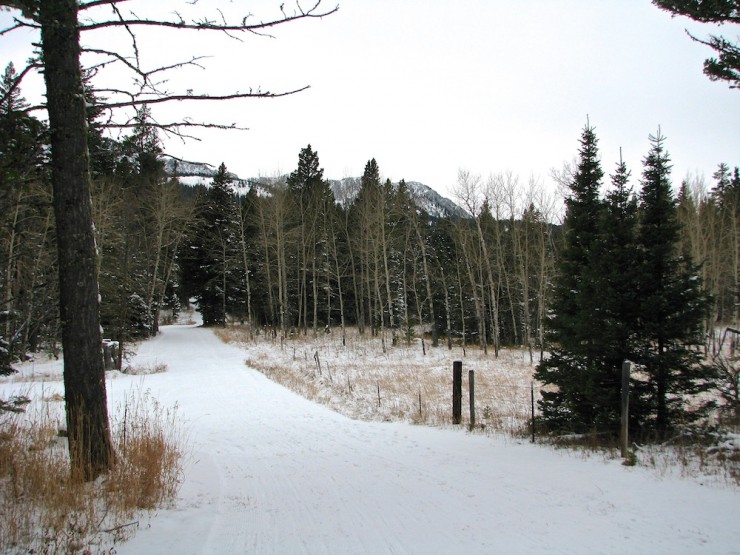
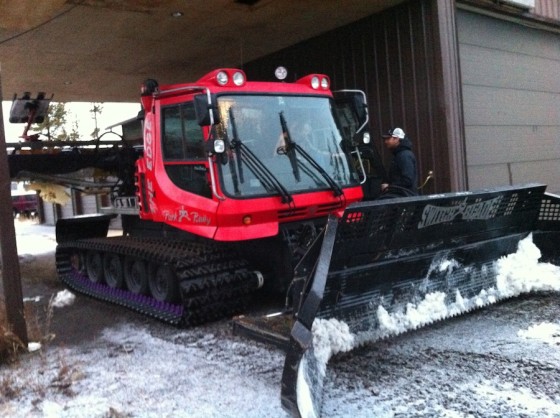
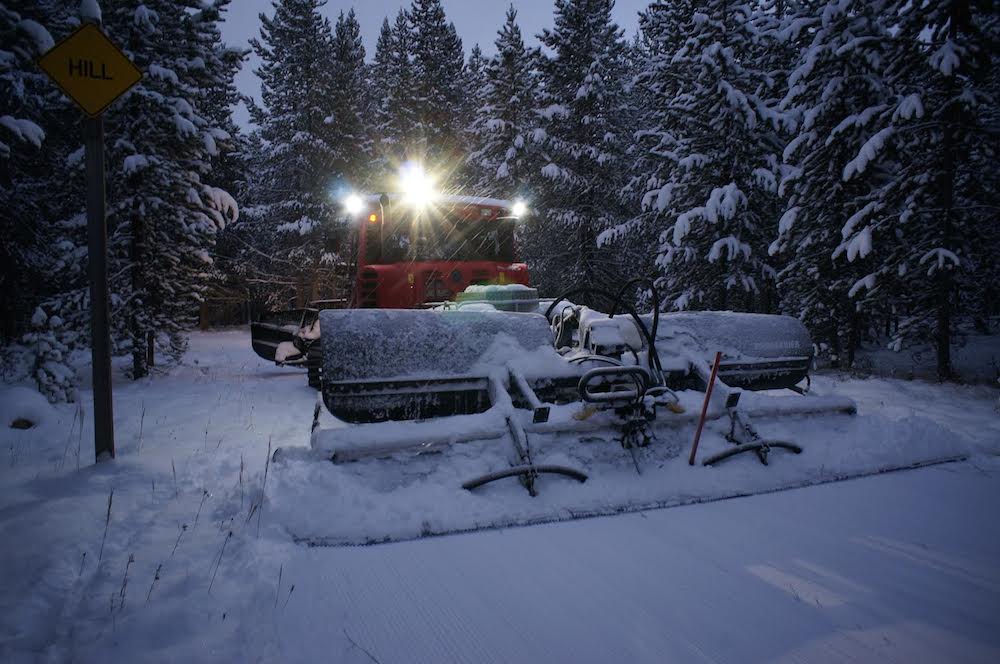
West Yellowstone’s PistenBully goes out for its maiden voyage of the 2014/2015 winter season on the Rendezvous Ski Trails on Friday, Nov. 14, in West Yellowstone, Mont. “8+ [inches] and still falling,” Yellowstone Ski Festival Program Director Moira Dow wrote in an email. (Photo: Moira Dow)It has been an unseasonably warm and dry fall in Southwest Montana, with highs well above freezing and no snow events, but race directors are feeling better after the arrival of the first winter weather of the season.
The area plays host to two USSA SuperTour events in the coming weeks — at the Yellowstone Ski Festival on Nov. 28-29 in West Yellowstone, Mont., and at Bohart Ranch Cross Country Ski Center on Dec. 6-7 — and race organizers are confident about the snow situation, particularly in West Yellowstone.
According to Moira Dow, program director for the Yellowstone Ski Festival (YSF), there were 8 inches of snow at the Rendezvous Ski Trails as of Nov. 16. This is enough to hold the scheduled skate races at the trails, but in the event of a lack of snow, the races would be moved to a plateau six miles from West Yellowstone. As of Sunday, there was a base of 19 inches on the plateau, and according to the National Weather Service (NWS) temperatures should remain below freezing for the next seven days, preventing any significant snowmelt.
Dow explained that while it is difficult to drive to the plateau — which is usually reserved for snowmobilers — it is well set-up for hosting skiers. Two years ago, YSF organizers moved the races to the plateau, substituting two point-to-point races (a skate prologue and 9-kilometer individual skate race) in place of the scheduled full-fledged sprint and looping 10/15 k individual race. The plateau, however, isn’t as accommodating to spectators, and without a range, it is unable to host biathlon events.
Both of this year’s cross-country races are scheduled as freestyle, so organizers won’t have to worry about having enough snow to set tracks.
“We plan for the worst-case scenario and hope for the best-case scenario,” Dow said.
Fortunately, it looks like Dow and the YSF will not have to worry about the worst-case scenario. The NWS predicts a large-scale Pacific trough to move through the area over this coming weekend, bringing accumulating snow to West Yellowstone. In addition, temperatures are expected to peak at 30 degrees on Thursday and Friday before falling to near 20 by the weekend. The six-to-10 day outlook looks favorable as well, with temperatures remaining below normal and precipitation above normal — meaning snow should keep falling.
The six-to-10 day outlook looks favorable as well, with temperatures remaining below normal and precipitation above normal — meaning snow should keep falling.
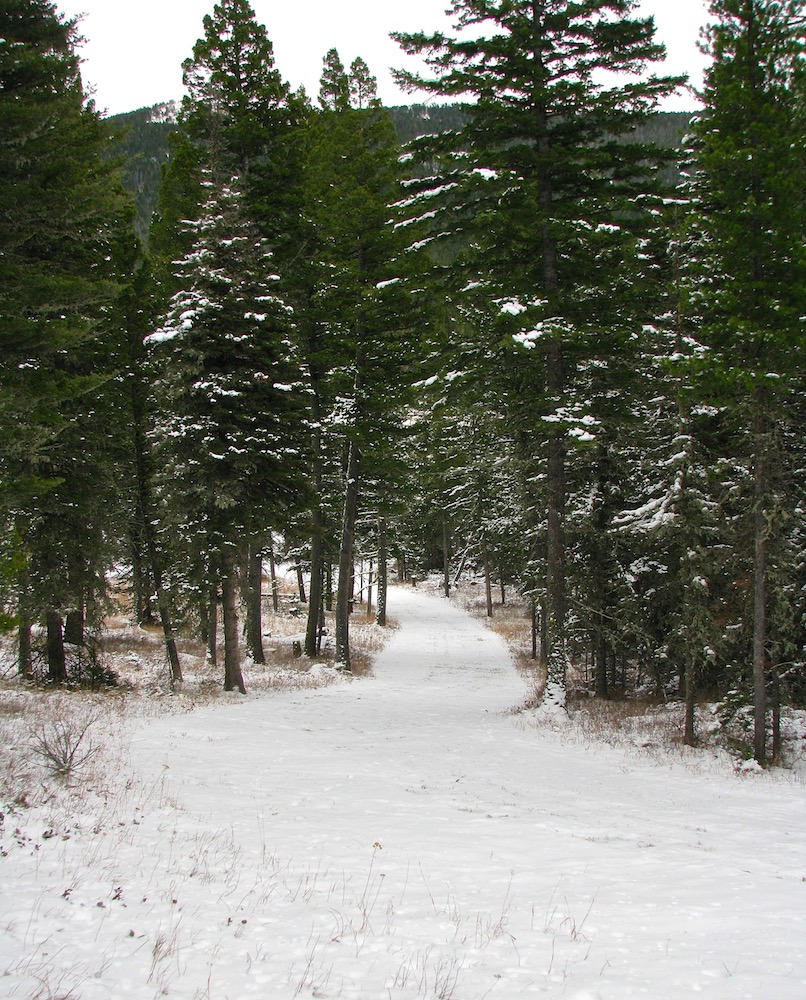
A look at one of the ski trails on Tuesday, Nov. 18, at Bohart Ranch near Bozeman, Mont.
However, conditions are less favorable at Bohart Ranch, located at 6100 feet elevation and 16 miles northeast of Bozeman, Mont. Bohart “has five or six inches of snow,” said ski instructor John Skemp, and is currently closed to skiers. The center also does not have snowmaking capabilities (nor does West Yellowstone).
Dragan Danevski, nordic program director for the Bridger Ski Foundation, remains optimistic. Three weeks remain until the SuperTour races, and “every snow we get from now on will stick” due to the frozen ground, Danevski said over the phone.
He explained that the sprint course only requires about four inches of snow before it can be groomed with a snowmobile roller.
Fortunately, as in West Yellowstone, the forecast looks favorable for additional accumulating snow at Bohart Ranch. The same system affecting West Yellowstone will bring a good chance of snow to Bohart Ranch, while the NWS calls for a high of 32 on Thursday before highs fall to the upper 20s by next week.
“We depend on nature,” Danevski said, and it looks like in Southwest Montana, skiers will get some help from nature in the next couple weeks.
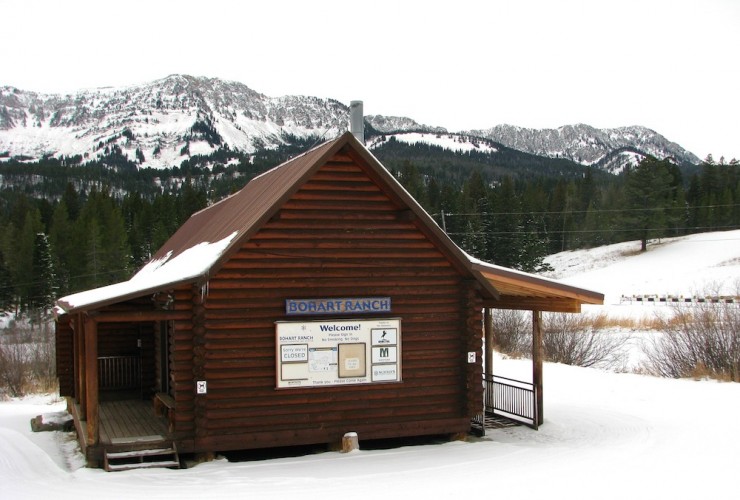
One of the trailside cabins at Bohart Ranch in Bozeman, Mont.
Ryan Scott (SSCV/Team HomeGrown) bringing it home for his first career win at the West Yellowstone SuperTour prologue on Nov. 24.
WEST YELLOWSTONE, Mont. — Friday’s distance results in the first SuperTour of the season weren’t easy for everyone to swallow, especially not Ryan Scott of Ski & Snowboard Club Vail/Team HomeGrown.
His coach Eric Pepper racked it up as a bad day. “He went out a little hard, blew up pretty hard [and] didn’t have great legs,” Pepper said on Saturday.
Still, seeing he ranked 78th in the 9-kilometer skate individual start hurt.
“That was embarrassing,” Scott said after finishing more than 2 ½ minutes behind first. Fortunately, he could seek some redemption in Saturday’s 1.6-kilometer freestyle prologue.
Scott skating to a victory at the West Yellowstone prologue on Nov. 24.
With just one shot in the point-to-point race, he could go all-out and try for a drastically better result. More than jump 70-plus places, he wanted to win.
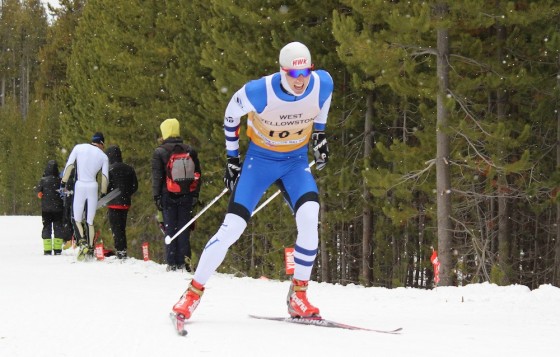
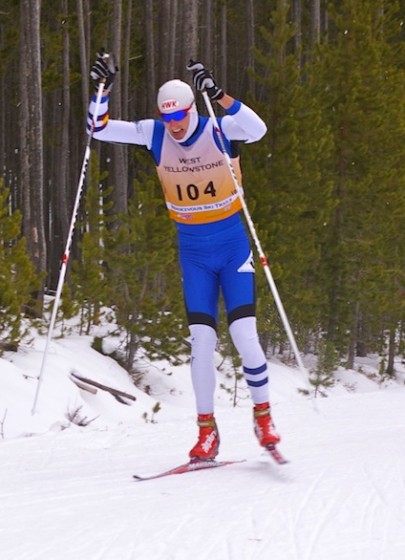
Scott successfully took the top honor for the first time in his skiing career, clocking 3 minutes, 0.96 seconds on the South Plateau course. He beat Erik Bjornsen of the U.S. Ski Team (USST) and Alaska Pacific University by 2.33 seconds.
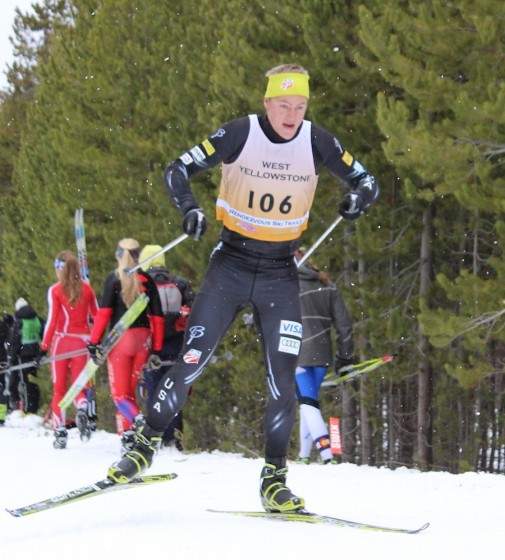
David Norris of Montana State University (MSU) and Mikey Sinnott (Sun Valley Ski Education Foundation) were just 0.01 seconds apart in third and fourth, respectively. Skyler Davis of the USST and Stratton Mountain School T2 Team, who was 105th on Friday, improved 100 places to finish fifth.
In the men’s prologue, second through fifth place were separated by just 0.68 seconds.
While Scott welcomed the victory, after never having won a SuperTour, International Ski Federation (FIS) or college race, it was more of a primer than anything.
Low snow at the Rendezvous Ski Trails in town forced organizers to change the sprint format earlier in the week from sprint rounds to a prologue. The snowmobile trails on the plateau couldn’t sustain full sprints: they were neither wide enough nor conducive for getting athletes from the finish back to the start multiple times.
The prologue didn’t count toward SuperTour standings and qualifying standards for the upcoming Canadian World Cups, but it was FIS-sanctioned and good practice for the Bozeman SuperTour freestyle and classic sprints as World Cup qualifiers next week.
Either way, the 23-year-old MSU graduate was excited to drastically improve on his distance performance with his first win.
“It was a solid effort,” Scott said. “I felt real quick, and yeah, it went well. I had a lot of confidence going into this course, being that it was so quick and flat, and the finish was pretty good, only a slight uphill, so I thought it could be a good day.”
It turned out to be a great day for Scott, who finished 11th in the SuperTour sprint rankings last year. The course was one he and some 175 other competitors – male and female – were familiar with. It ended where they started Friday’s race, which meant one gradual climb to the finish and mostly flat before it.
Unlike full sprints, where racers tend to conserve energy through the rounds, a prologue required a maximal effort. Pepper said he hadn’t expected Scott to win, but he didn’t rule him out, either.
“He’s better in rounds than qualifying,” Pepper said. “This shows he’s been working on qualifying, so for him to have a good day like that is great.”
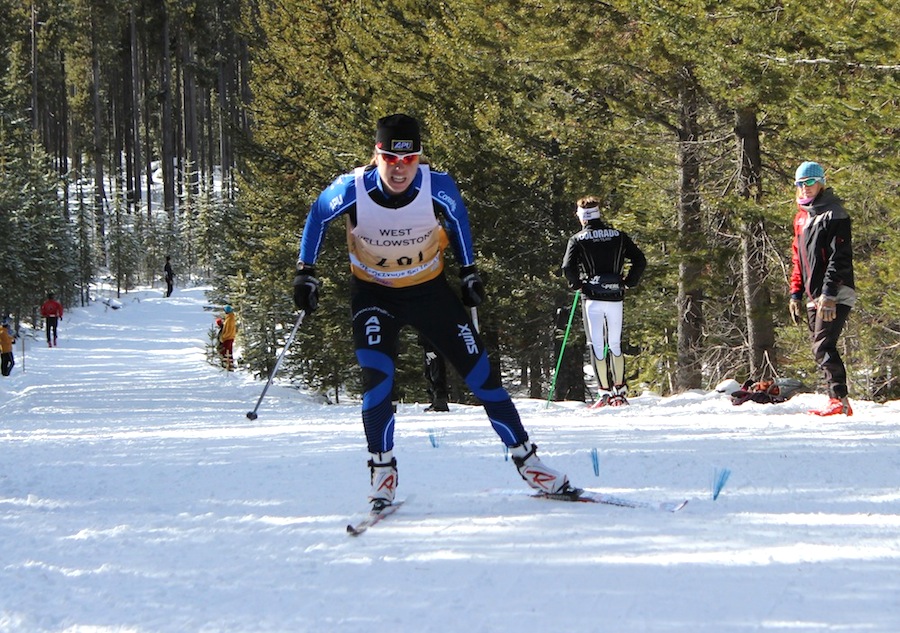
Erik Bjornsen (APU/USST) puts it into high gear in the finishing stretch to place second at the West Yellowstone prologue on Nov. 24.
At the same time, he was particularly impressed Scott could outdo a stacked field in which the top 20 finished within 10.21 seconds of one another.
“A win is a bonus really,” Pepper said. “It’s impressive, those first 20 or 30 guys, they’re all really good. To get on top of that group when only a couple of top guys aren’t there feels great.”
Even though Friday’s race didn’t cater to his strengths, Saturday’s result was a major boost moving forward.
“It’s fairly rewarding to be able to come out and race fast today,” Scott said. “I know I can still kick it in gear and move pretty quick so that’s kind of what I’m shooting for. I’m glad I was able to perform well enough today and we’ll see, end of next week for the rounds and whatnot, the races up in Bozeman.
“I’ve been really training for sprint this year,” he added. “I’m hungry.”
Bjornsen as the runner-up tied his best SuperTour result – even though Saturday’s race wasn’t technically a SuperTour – since placing second in last year’s 15 k classic in Bozeman.
He said last year wasn’t his best as far as sprints go (although he did place third in a NorAm classic sprint at Sovereign Lake, B.C.), so he made that a priority this year. Considering Saturday didn’t have World Cup implications, he used the prologue to try a few things.
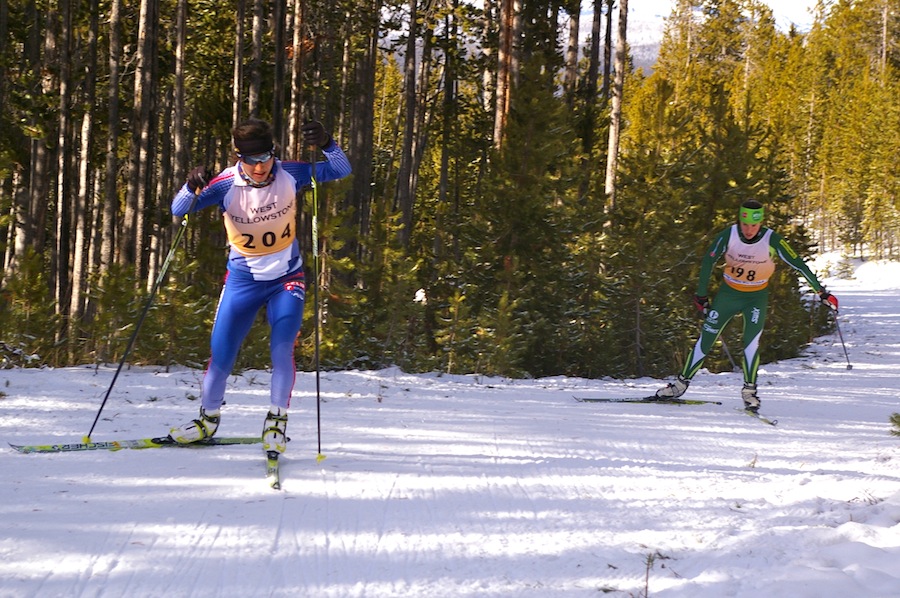
Mikey Sinnott (SVSEF) en route to a fourth-place finish.
“I warmed up pretty hard and the goal was to go out hard and hammer the V2 alternate on the flats,” Bjornsen said.
After the race, he spoke with some people who said they did some tuck skating. He didn’t do any of that, he said, just tall V2-ing to make every stroke count. When he reached a road sign a few hundred meters from the finish, he focused on turning it on. With 100 meters to go, Bjornsen searched for the finishing kick he usually has, but it wasn’t there.
“I knew that I left it all out there,” he said. “I actually ended up throwing up a little bit [after], but I definitely laid it all out there which I’m happy about.”
While Bjornsen might have been pegged as a favorite, Norris was a sprint surprise finishing 2.72 seconds behind Scott.
David Norris (MSU) racing to a third-place finish.
It’s not that Norris hasn’t logged impressive results; he was second in the 20 k classic at NCAA Championships in March for MSU’s first-ever podium. The 21-year-old was second in the 30 k mass start at U.S. nationals last year and third in the Bozeman SuperTour 15 k classic behind Bjornsen.
But a sprint podium?
“I always want to win, so I was just going for that,” Norris said. “I just went hard right from the start. I was trying to hang on that last hundred meters.”
He held on just enough to edge Sinnott, who was second to Sun Valley teammate Reid Pletcher in the West Yellowstone freestyle prologue last year. Preliminary results listed Davis in second, Norris in third and Bjornsen in fourth, but once timing data updated and results became official, the final standings came through.
Just 0.29 seconds off the podium, Davis felt like he had a great race. The uncharacteristic leaping and shouts from his Stratton coaches indicated he was on the right track. With 100 meters to go, Kaeding was yelling for him harder than he’d ever heard, Davis said. Earlier in the race, program director Sverre Caldwell gave him a “woo hoo!” and jumped as he passed by.
Skyler Davis (SMS/USST) in the finishing stretch of the West Yellowstone freestyle prologue. After thinking he was second initially, he ultimately placed fifth.
“I was like, ‘I’ve never seen that so I better keep going real fast,’ ” Davis said after the race.
While warming up, he laid out a pretty distinct game plan. Only one downhill made the course tough so he needed to build momentum fast and stay smooth. Like Bjornsen, that “little squiggly sign” was his cue to go hard.
“I put it down from there and I saw the hundred meter and it was like, ‘Wooo, [then], uh oh, it’s hurting bad, like, really bad,’ ” he recalled. That’s where Kaeding’s presence helped him.
“More than results everybody had kind of check marks they wanted to do, little process goals,” Kaeding said of his team, which included women’s prologue winner Sophie Caldwell. “Checked those all off. Everyone was happy with how those went. The results take care of themselves.”
Rosie Brennan (APU) posting the fastest time in the West Yellowstone SuperTour 9 k individual start on Friday at the South Plateau near West Yellowstone, Mont.
WEST YELLOWSTONE, Mont. – The distance course on the South Plateau wasn’t too bad if you didn’t think about it too much. The 9-kilometer freestyle race – the first of the 2012/2013 U.S. SuperTour series – netted a slight elevation gain of about 300 feet from start to finish. A course profile indicated that the terrain was rolling. No problem.
Try racing it.
The individual start began around 7,260 feet above sea level, which is enough to make breathing difficult for lower-altitude dwellers. After gradual downhill out of the start – a teaser for what was to come – racers endured several kilometers of working hills with little rest and a grand finale at the final multi-tiered climb.
If anything was going to test one’s fitness in the first race of the season, this was it.
Rosie Brennan (APU) on her way to winning the West Yellowstone SuperTour 9 k freestyle individual start Friday on the South Plateau. (Photo: Swix Sport)
The eventual winner, Rosie Brennan of Alaska Pacific University, didn’t feel that great right off the bat – and she’s originally from altitude in Park City, Utah.
“When you race at altitude, within the first k, I feel like as bad as I do the whole race,” she said after winning in 24:36.3, beating runner-up Chelsea Holmes (Sun Valley Ski Education Foundation) by 5.3 seconds. “It’s figuring out how to deal with the taste of blood in your mouth for 9 k or whatever. It’s sort of part of racing at altitude, but I really like it.”
She laughed. That was the kind of grit it took to win Friday’s race on a course that was the same for both men and women. Many said they felt similarly on the final hill, arguably the toughest one of all: horrible.
“I think I V2ed everything but the last steep hill,” Brennan said. “I sort of struggled up that thing, but I made it.”
A staple on APU’s female squad with the likes of U.S. Ski Team members Kikkan Randall and Sadie Bjornsen, the 24-year-old earned some more attention with Friday’s performance. It was her first SuperTour win in nearly half a decade of racing at that level. She had made the podium several times before, but this confirmed her offseason training paid off.
Skating isn’t usually her forte, Brennan said. Flats aren’t great for her, either. The course was certainly rolling, but unforgiving if you let off the gas. One could lose time quick, but burn out even faster.
Brennan thought about all the work she had put into her skate technique and concentrated on making every movement count along the flats.
“I guess I must’ve figured something out this summer so it’s really great,” she said.
While her Anchorage-based team tapered its training for the West Yellowstone SuperTour, which includes a freestyle sprint prologue on Saturday, Brennan hadn’t expected to be in top form.
“We haven’t tried to peak or anything for these races so I still feel like I have race fitness to gain so I’m really encouraged by doing well today,” she said of taking one gigantic step forward toward securing a Canadian World Cup start next month.
Qualifiers for the Québec City skate sprints and Alberta World Cup (which includes a freestyle sprint, skiathlon and classic distance race) will be decided following next week’s SuperTour races in Bozeman, Mont.
Brennan’s not counting herself out of an opportunity to make the World Cup sprints as well.
“I was a really good sprinter when I was a junior and then I had a lot of injuries and lost some of my fast twitch,” she said after having knee surgery in 2010. “It’s something that I’ve been working on trying to get back.”
Chelsea Holmes (SVSEF) after passing Heidi Halvorsen (GMVS) on the last hill of the West Yellowstone SuperTour 9 k.
Not far behind Brennan, Holmes was excited to race in Montana after missing last year’s SuperTour opener to an injury of her own. About three weeks before the 2011 races, she broke her thumb and was in a cast until mid-December.
On Friday, she was raring to go. Training at altitude throughout the summer between Sun Valley, Idaho, and Canmore, Alberta, where she joined some Canadian Ski Team workouts, Holmes anticipated how racing at even higher elevations would feel. So when her breathing redlined and overpowered the splits people were giving her, she didn’t freak.
“My breathing was just about loud enough to cover anything I could hear,” Holmes said with a laugh. “I had an idea [what place I was in], but you can never really tell until you finish.”
Second at this point in the race season was great, she said. After starting 1 ½ minutes behind Brennan, Holmes gauged how she was doing off her.
“It was just a fight the whole way,” Holmes said. “I kept hearing that Rosie was kind of just in front of me. I just couldn’t get her, but I mean, she had a killer day.”
Caitlin Patterson (CGRP) cresting the final hill before ultimately finishing third.
Less than a second behind Holmes, Caitlin Patterson of the Craftsbury Green Racing Project took third (+6.2). Like Holmes, Patterson wasn’t sure the course necessarily suited her. Both were hill climbers, but the mostly V2 race on the plateau didn’t include many of the hills they usually thrive on.
“For a while I was thinking I felt like I started too hard, but that might just be the altitude feeling to some extent,” Patterson said.
Throughout the race, she tried to catch Holmes, who started 30 seconds in front of her. Patterson frequently lost sight of her on the varied and twisting terrain, but didn’t give up.
“She’s a really good skier at altitude and uphill terrain so I knew she would be a good one to chase down,” Patterson said.
By the last climb, however, Patterson said she was nearly done for. From her conversations with competitors and teammates after the race, she discovered everyone suffered there. Luckily, she heard some motivating final splits that pulled her through.
“I knew it was a big hill at the end and I wanted to ski fast as possible, but its amazing how it twists and turns at the top and doesn’t crest,” she said. “Even when you get to the top it’s not even a steep downhill on the other side. It was all I could do to free-skate and not tuck.”
Sadie Bjornsen (APU/USST) skating to fourth-place finish at West Yellowstone SuperTour 9 k.
Also holding steady through the suffer-fest, Bjornsen finished fourth (+23.3) in her first race after a summer hindered by back and foot injuries. Sophie Caldwell (Stratton Mountain School T2 Team) was fourth, 52.7 seconds behind Brennan, Kate Fitzgerald (APU) was sixth, and one of the race favorites, Caitlin Gregg (Central Cross Country), was seventh.
Several A-seeded skiers said they used Greg as a measuring stick. One of the smoothest skaters on the circuit, she started right in front of Brennan.
“I knew when I was catching her that I was having a good race,” Brennan said.
From Gregg’s point of view, the race “hurt like hell,” she said, considering she hadn’t raced or done any sort of time trial since March.
“But I think it did for everybody. It’s at high altitude and a lot of uphill and the first race of the season so it’s just a recipe for pain out there, which felt really good for me,” she said. “This was a definitely good race for me to blow the cobwebs out and remember what that next level, that next gear, feels like.”
While she felt good about her team, sponsor and outside support, Gregg said she simply needs to log some more hard efforts.
“Obviously it’s always great to win the race, but I think the trajectory I want to head in is right on,” she said.
Extras
— Bjornsen is coming off some lingering injuries, and while the tendonitis isn’t completely gone in her foot, she’s happy to have started the race season strong after a walking warmup.
“This year will be a lot about racing myself into shape, so today was a great day to feel the burn and gain some fitness,” she wrote on Skype. “I had the goal of holding my technique together throughout the course, and remembering how to ski at altitude. I felt like I was able to keep pushing even when it felt bad, so it was nice to finally feel like an athlete and a racer again today. So all in all, I am stoked.
“I am also super happy for Rosie. I have been living with her this summer watching her train, and I know she is going to be doing nothing but turning heads this winter. It will be fun!”
Bjornsen knew how well she was doing based on splits from Gregg, who started right behind her.
“I just kept listening for how quickly people were cheering for her after me,” she wrote. “At one point I think she nearly caught me … so that was my split system.”
Asked how her foot felt Friday after the race, she explained that it was an ache and pain that fortunately took a backseat to the burning in her legs and lungs while racing.
“I didn’t feel it once in the race, and it actually doesn’t feel too bad now,” she wrote. While Bjornsen will skip Saturday’s prologue to rest her foot, she’s looking forward to the rest of the season – especially the middle.
“I want to be racing in the World Cups, but these first months are training,” she explained.
— Considering that 10 k skate races aren’t exactly her specialty, Caldwell was pleased with how she fared Friday. The sprint lover had hoped for a top 10.
“I really had no idea where I’d stack up because really the only girls I’ve skied against are the girls on my [Stratton] team,” Caldwell said. “I went to those U.S. Ski Team camps, but those girls weren’t here, either.”
To keep herself in the running, she tried not to go above Level 3 before the last hill. She paced herself pretty well, running in fifth or sixth early and as high as third mid-race, but she worried about blowing up before the end. She thought back to the classic intervals her team had done nearly a week ago on that same climb, and later remembered they didn’t reach the top.
“I kind of forgot once you get around that corner you’re only halfway up,” Caldwell said. “But once you get so close to the finish, you get an adrenaline rush and that pumps you to the finish.”
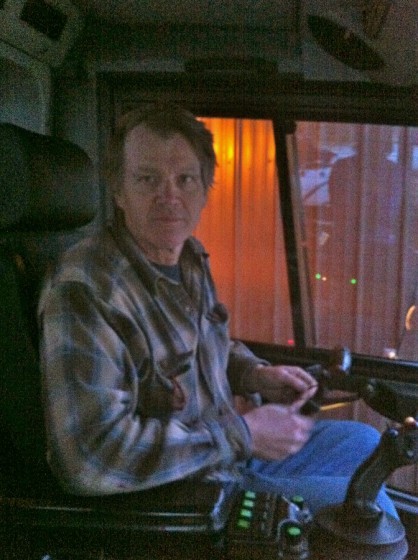
WEST YELLOWSTONE, Mont. — Doug Edgerton is the man, literally, in West Yellowstone. A resident since 1971, he’s been the town’s primary nordic groomer for nearly as long, getting his starts as grooming snowmobile trails in the ’70s then towing bed springs and a track setter up on South Plateau for then-U.S. Ski Team coach Marty Hall and his crew for the first time in 1978.
Doug Edgerton, Yellowstone Ski Festival chief of grooming, founder/owner of Yellowstone Track Systems, Inc.
Thirty-four years later, Edgerton, 62, has worked several Olympics and is widely considered a go-to guy when it comes to grooming. Technology has changed and the number of people seeking early cross-country skiing in November has grown significantly from the first fall training camp in West Yellowstone. In 1984, Edgerton started his own grooming-equipment business, Yellowstone Track Systems, and remains the man in charge to this day.
He’s the head and only groomer at Rendezvous Ski Trails, which occupies most of his nights in the winter, and works around the clock for nearly three weeks leading up to the annual Yellowstone Ski Festival (YSF) each November. This year, low snow forced organizers to move the SuperTour opening races from Rendezvous to South Plateau, exactly where skiing got going in West Yellowstone.
While the trails and roads up on the plateau, at elevations between 7,000 and 8,000 feet, are mostly used by snowmobiles after December, they’re also a dependable backup for skiers in November. Has West Yellowstone changed much then?
“Oh yeah,” Edgerton said. “The whole world has changed.”
This year’s lack of snow is nothing anyone can control, and it’s similar to what YSF organizers experienced in 2008 when they had to move the SuperTour races to South Plateau for the first time.
West Yellowstone chief groomer Doug Edgerton sits in his PistenBully with summer tracks while talking to Steve Hoovler, assistant director of the Yellowstone Ski Festival, after grooming South Plateau early Nov. 22.
The difference this year is the amount of snow up on there, about 1,000 feet higher than town. With about a 3-inch base on Wednesday morning, it wasn’t much and about the least Edgerton had ever seen. Then again, Thanksgiving fell earlier this year, moving the festival up to mid-November.
At 3:45 a.m. Edgerton waited in his illuminated PistenBully Edge, one he recently bought used from Mount Baker in Washington, as a FasterSkier reporter hopped in. From there, he drove the 14-foot-wide snowcat several miles up an access road to the plateau and proceeded to groom the 14-foot-wide snowmobile routes: first the Whiskey Trail, then South Plateau.
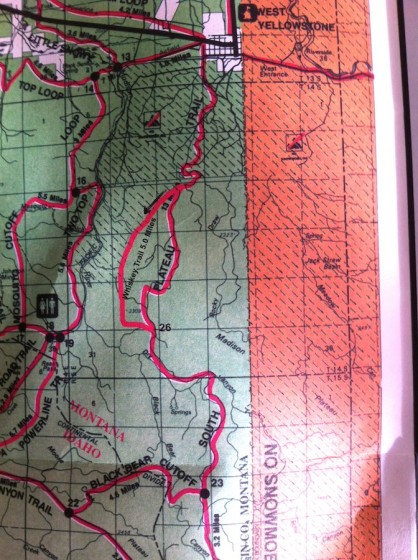
Check out FasterSkier’s firsthand experience of the nearly four-hour trip as Edgerton prepped the trails for hundreds of skiers to use throughout the rest of the week (see video above). For an idea of where they went, and where people are skiing, refer to the map below.
Map of South Plateau trails, including 5-mile Whiskey Trail (where Friday’s point-to-point SuperTour distance race will be held) and the South Plateau road/trail to Black Bear Cutoff near the Idaho border.
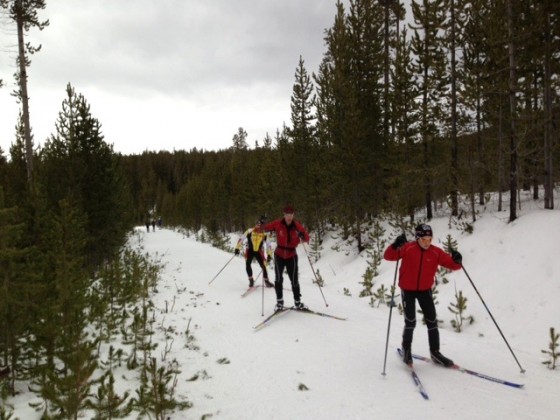
Skiers near the end of the 9 k Whiskey Trail on the South Plateau Nov. 21 in West Yellowstone, Mont.
WEST YELLOWSTONE, Mont. – Last week, Yellowstone Ski Festival organizers took a very realistic look at the cards Mother Nature would likely deal them. Most forecasts predicted an undependable amount of snow in the days leading up to the first SuperTour races of the season, which were supposed to take place at the Rendezvous Ski Trails in town.
They could’ve opted to wait and see while doing a nervous snow dance in the meantime, but instead made a contingency plan. Skiing on the South Plateau was always an option, one frequently used by skiers at the start of each season. At elevations between 7,000 and 8,000 feet, the snow tended to stick around longer up there than in West Yellowstone, which sits 6,666 feet above sea level.
The problem was getting people up to there. The access road from town, which belongs to the US Forest Service and lies just outside West Yellowstone National Park, is a hairy one. Not usually plowed, it opens for snowmobile traffic Dec. 1, but anyone who wants to drive six and a half miles to the South Plateau Trail (a snowmobile trail) can do so at their own risk.
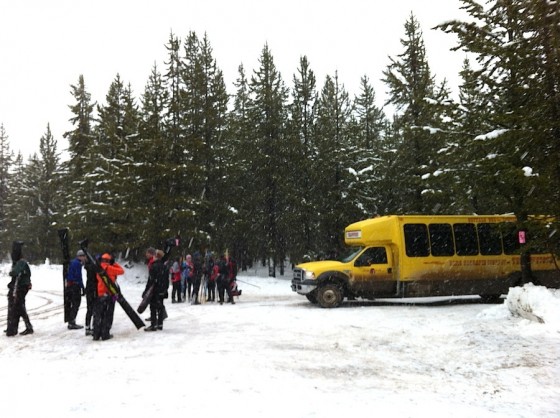
Skiers wait to board a shuttle down from the South Plateau near West Yellowstone, Mont., on Nov. 20.
If people want to get on snow sooner, they can pull off the single-lane dirt road around mile 4 at the lower gate, the start of the Whiskey Trail. But they need to park far enough on the side for others (including 32- and 14-passenger vans) to pass through.
Festival organizers imagined how this could all play out with thousands of skiers flocking to the plateau on Thanksgiving week. Not handled properly, it could be a mess.
“We’re still putting a plan into place,” assistant director Steve Hoovler said Tuesday, the second day organizers provided a complementary shuttle service from town to the upper parking lot at the South Plateau trailhead.
It was the first time they implemented such a transport plan, offered Monday through Wednesday from 8 a.m. to 4 p.m. with a more limited schedule tentatively planned for Friday and Saturday. Hoovler said they rounded up three donated shuttles to run continuously as a practical means of getting up the road safely.
Four years ago, race organizers had a similar situation when low-snow conditions moved the International Ski Federation (FIS) sanctioned races to the South Plateau, which skirts the western edge of West Yellowstone National Park and the Idaho border. But they didn’t offer shuttles back then.
“That was something we were not expecting to have to deal with,” Hoovler said. “The main reason we’re having a shuttle is we had some large teams from back East that came and brought a large number of kids in big buses and there was no way to get those kids up, and [essentially] they were stuck in town.”
Once festival organizers got the go-ahead from the forest service to open the plateau to traffic, they had to hire an independent contractor to plow and sand the roads. They also had to figure out schedule for uphill and downhill traffic to eliminate any two-way scenarios, and finally, devise a plan to get busloads of skiers – mostly juniors – up there safely.
But there was another added element: while they could limit traffic to one way, with shuttles leaving every hour and other vehicles following them up and down, organizers couldn’t prevent others from using what was essentially a public road.
Theoretically, anyone could drive up to hunt elk or big game this time of year. Snowmobilers in Idaho could cross over from the backside while using a nearly 400-mile trail system, which includes the South Plateau and Whiskey trails.
Race organizers couldn’t prevent snowmobilers from doing so, but they could put up signs warning them of the cross-county skiers ahead. Fortunately from the West Yellowstone side, snowmobile rentals didn’t start until December.
Last time organizers had to move the races higher in 2008, Hoovler said they didn’t have much control over the road. That was the first time anything of that magnitude had been held on the plateau, with a hefty amount of skiers and spectators coming out for elite racing and recreational skiing.
“We definitely have that advantage this time; we’ve been up there so we have an idea of where we can go and what we can work with,” Hoovler said. “In 2008 we were reacting to everything, and this time we can plan a little bit more.”
Still, the logistics required some trial and error. On Monday, some independent drivers parked in impassable spots alongside the road. The first shuttles didn’t start on time, which delayed the schedule for the rest of the day.
Each one-way trip to the upper parking lot takes about 30 minutes, leaving skiers with nearly an hour to ski between shuttles. There was no lodge or place to keep warm or dry with wet snow falling at times, and on Monday, organizers brought in port-o-potties.
According to Hoovler, Tuesday went much smoother. The vans took off on time and most people were able to catch a ride down if they correctly timed the shuttle schedule. At certain peak times, like noon, there were too many skiers than seats available and some people had to wait an hour for the next ride.
“We’ve definitely had some hurdles,” he said. “It’s a tight space so we’re trying to get as many people up there skiing and turned around as we can. We’re running into hiccups now and there; everyone’s having to make concessions. It was certainly a learning curve for everybody.”
At the bottom, local celebrity Tom Barr, who works for the forest service and has checked trail passes at Rendezvous for years, switched roles to direct traffic and provide information. Four volunteers were stationed along the road to help drivers park in designated spots, and local caterers donated lunches to keep the three shuttle drivers nourished during their seven roundtrips each day.
In all, the shuttles would log about 820 miles in three days, which the festival had to budget additionally for to pay for fuel. Organizers intended to shuttle people Friday and Saturday for the races, with a schedule pending a meeting on Wednesday afternoon.
While the shuttles won’t run Thursday on Thanksgiving, Hoovler said the road will be open to traffic. As advised by the festival’s publicized travel restrictions, four-by-four and studded tires, even chains, are strongly recommended.
“The road is in good shape, but it’s slick and narrow in places where the parking is tight,” Hoovler said. “There’s not much room to maneuver and we’ve had a lot of two-wheel drive vehicles get stuck in that situation.”
That said, people have been driving up there since the ’70s and been an important part of the early season skiing in West Yellowstone ever since.
“Even on a normal year where we’ve would’ve been skiing up there,” Hoovler said. “The big difference between is there’s typically a lot more snow up there than in town. … It’s a low-snow year for the plateau.”

![West Yellowstone's PistenBully goes out for its maiden voyage of the 2014/2015 winter season on the Rendezvous Ski Trails on Friday, Nov. 14, in West Yellowstone, Mont. "8+ [inches] and still falling,” Yellowstone Ski Festival Program Director Moira Dow wrote in an email. (Photo: Moira Dow)](http://fasterskier.com/wp-content/blogs.dir/1/files/2014/11/unnamed-12.jpg")