From the FasterSkier archive — posts syndicated from athletes’ and coaches’ own blogs between 2004 and 2012, kept online as published. Current coverage is at fasterskier.com.
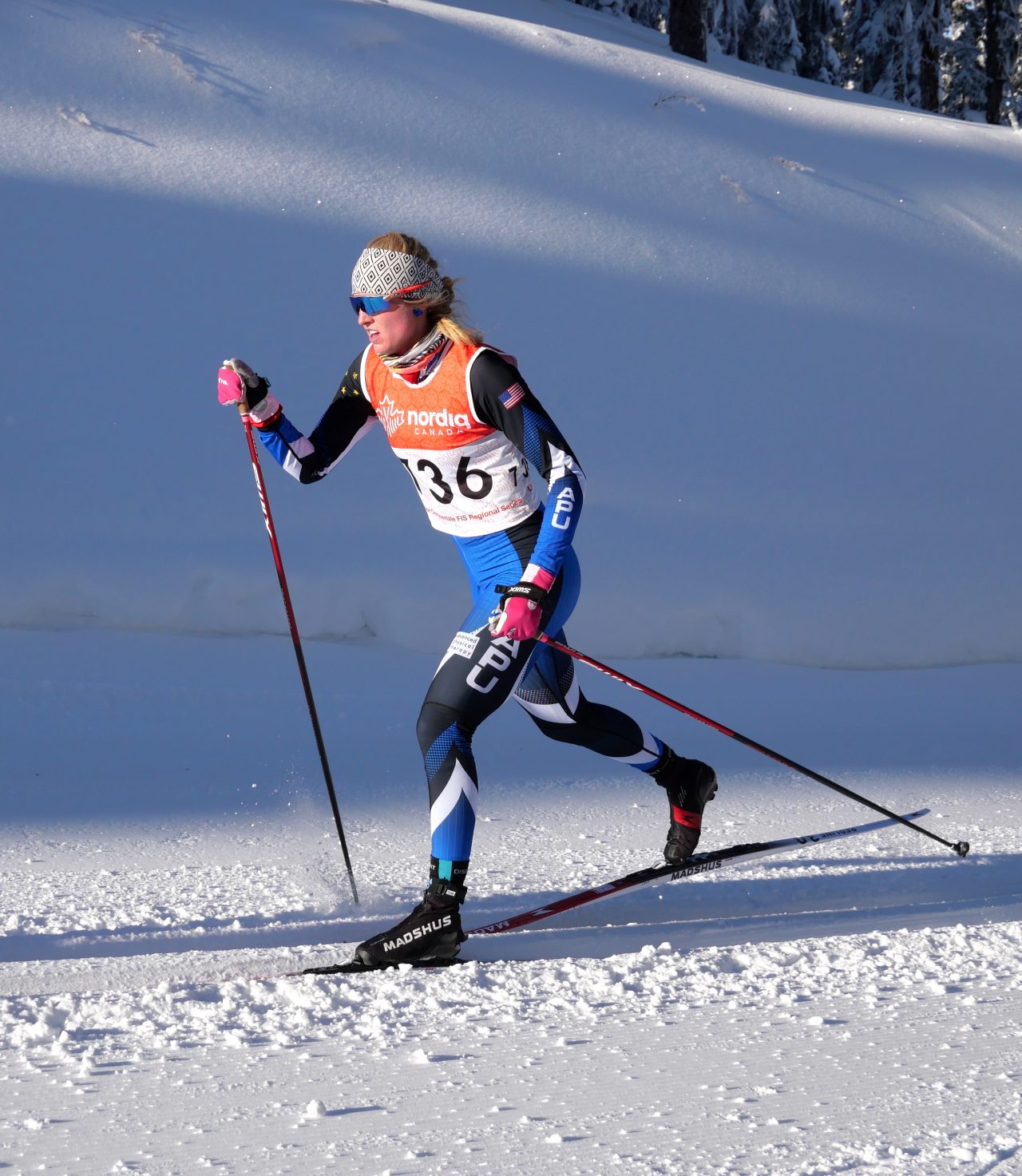
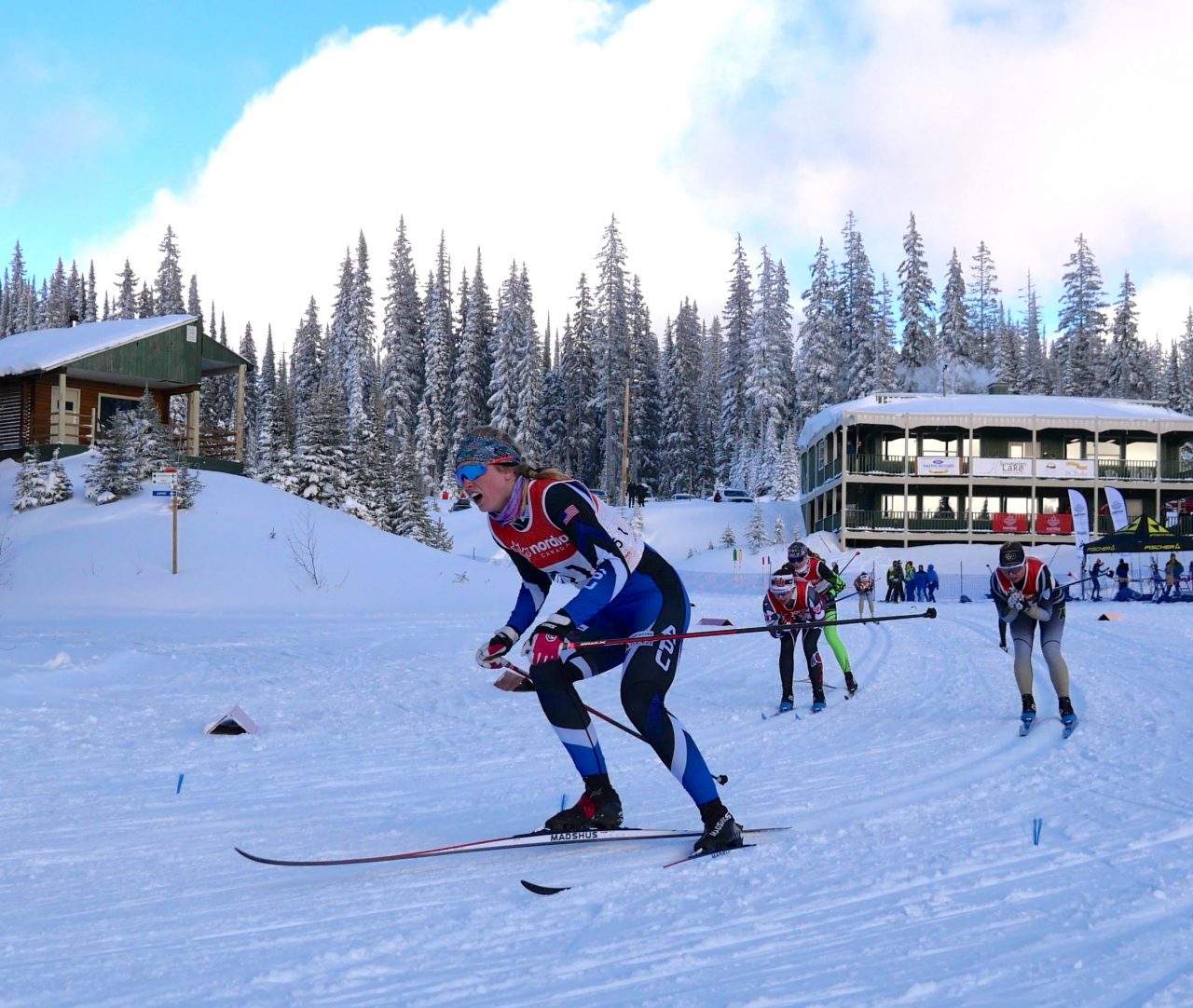
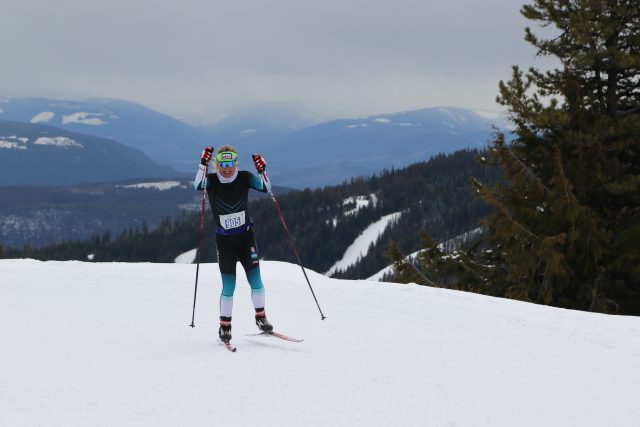
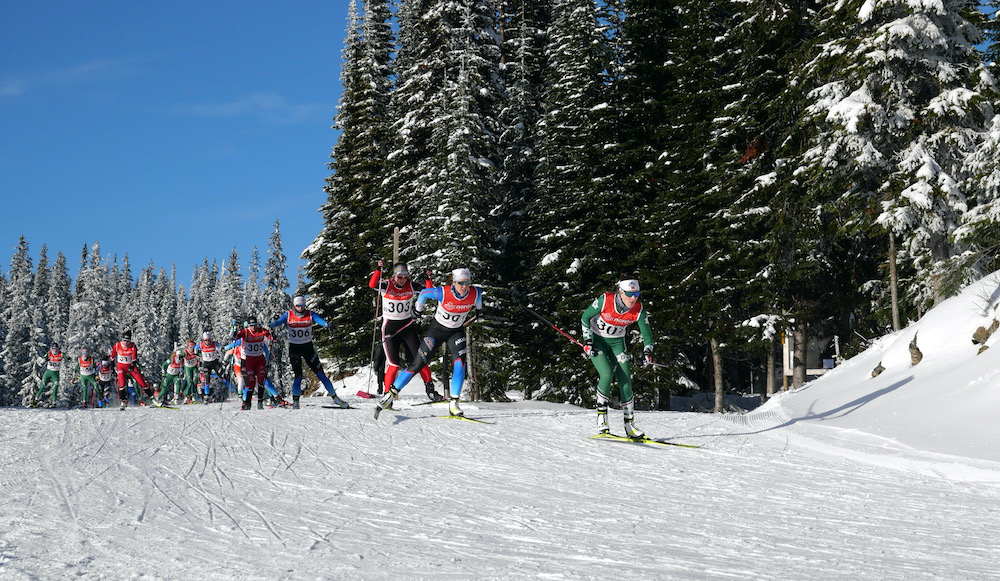
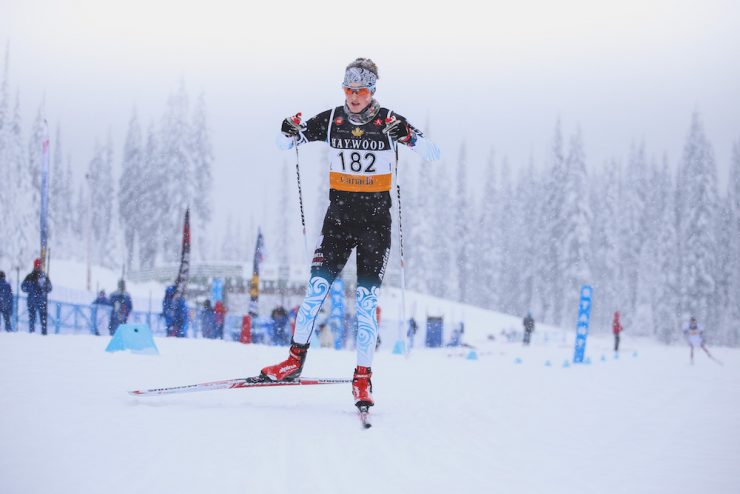
Hailey Swirbul striding to victory at Sovereign Lake. (Photo: Peggy Hung)
Race day four at Sovereign Lake was a 10km individual start classic in the sunshine. With humid new snow at -10C all day while the air warmed up to -4C, all the teams found fast skis and solid kick on a great day for striding.
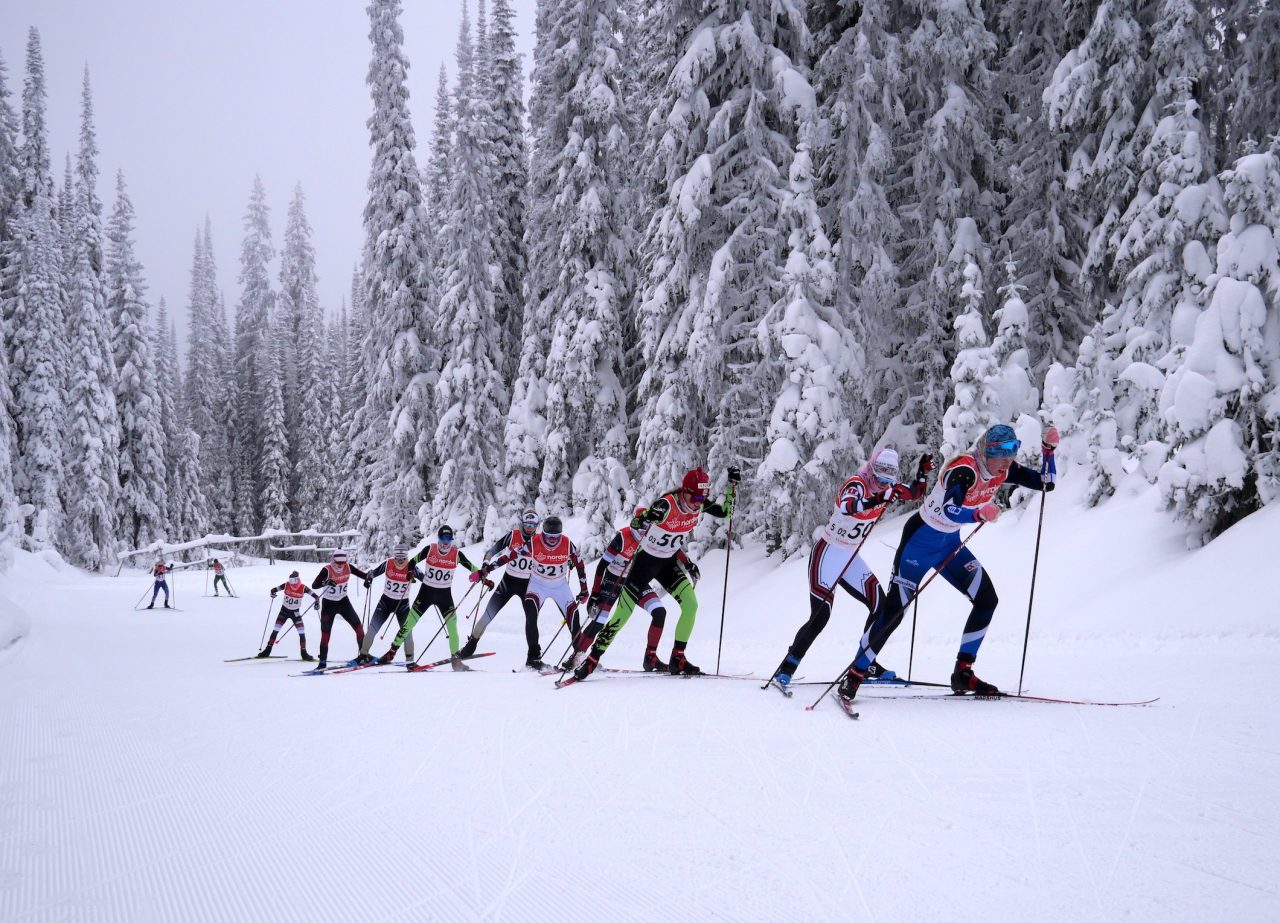
Once again, the Open and U20 categories skied 2x5km first, followed by U18 and U16 who skied 2×2.5km, for a total of 385 starters Sunday.
Individual start races are about skiing fast, but also about pacing. Keep reading to the end to see the different pacing ideas from top skiers.
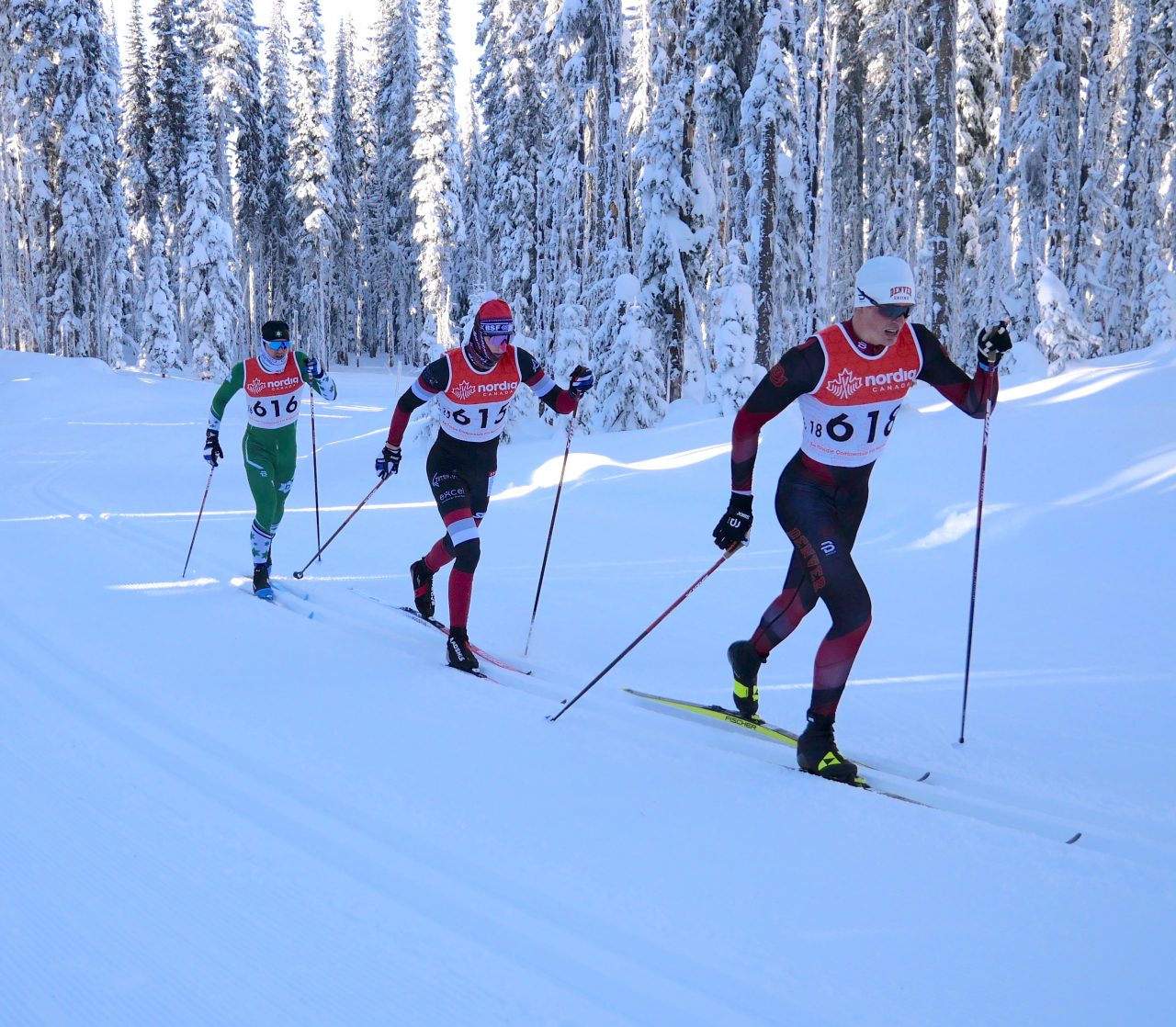
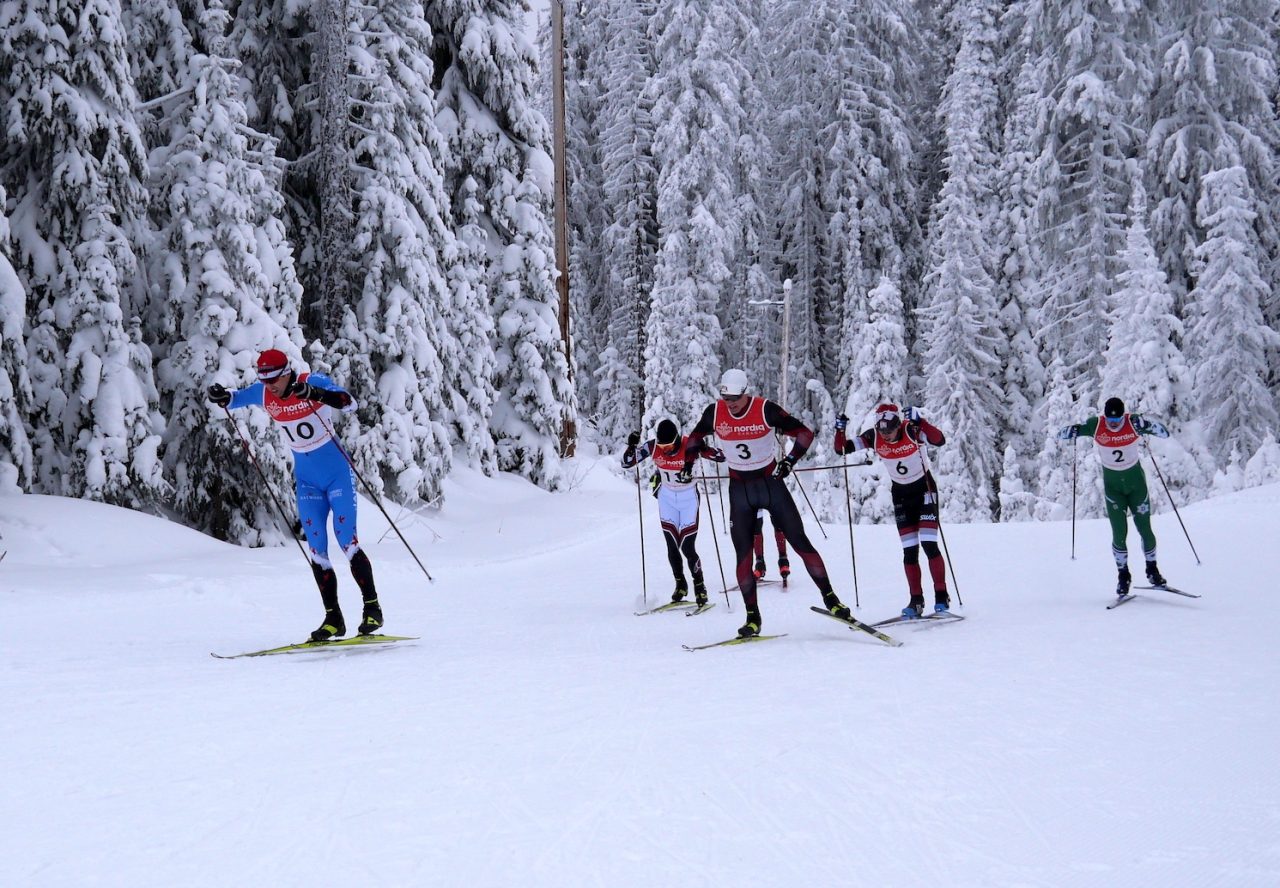
Andreas Kirkeng (618) leads Reid Noble (617) and John Steel Hagenbuch (616) on the second A climb. (Photo: Peggy Hung)
At the end of a hard week of racing, only 102 men of 118 would finish, with University of Denver’s Andreas Kirkeng (NOR) taking his second win in his second race, completing the 10km in 27:17.7. Bridger’s Finn O’Connell (USA) was second, 53.1 seconds back. Dartmouth’s John Steel Hagenbuch (USA) was third at 1:08.6.
Canada took the next three spots, with AWCA’s Scott Hill at 1:09.6, U of Utah’s Sam Hendry at 1:23.5, and National team member Xav McKeever at 1:25.3 (and top U20).
Kirkeng was pleased with his racing, having skipped Wednesday and Thursday to complete a volume block here.
“Today, I was really good. I felt super strong and my skis were perfect. They were like real good kick, more than enough to do the hills here and the speed on them in the downhill were just insane. So perfect day.”
Here is Kirkeng’s second time up the final ‘kicker’ climb with 500m to go:
O’Connell was more moderate about his second place: “It was pretty solid I’d say. The goal is always to go out there and fight for to win and I felt good today, skis were really good. Thanks to both my coaches and yeah, gave it everything I had.”
So many skiers commented on having great skis that it would become repetitive to quote each one.
“It was good,” Hagenbuch said. “It was definitely quite hard after a long week of racing and a lot of cold air that has been breathed so far this week. So like the lungs are definitely feeling that but I tried hard.”
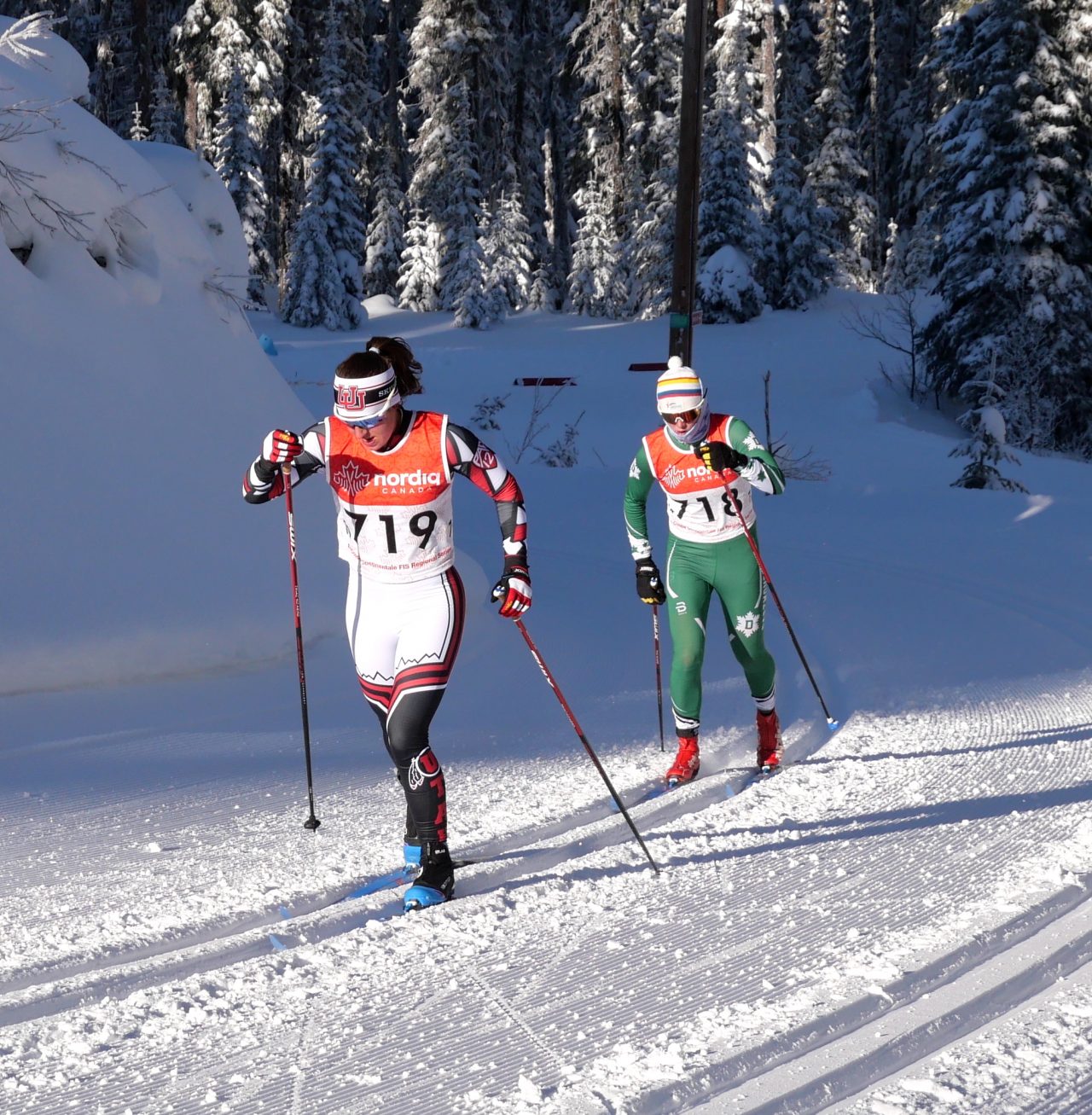
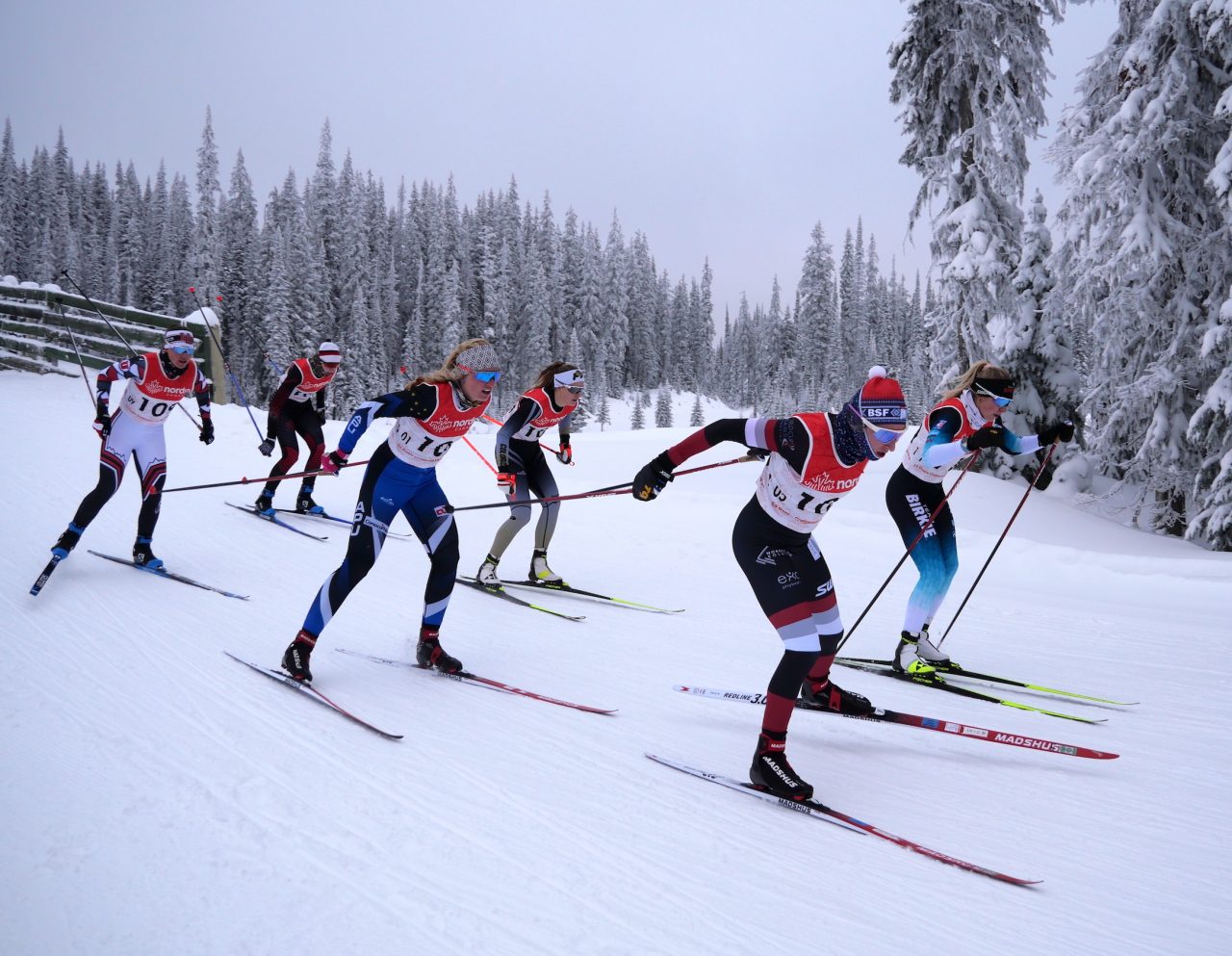
Sydney Palmer Leger (719) on her way to a fourth podium in five days. (Photo: Peggy Hung)
On the women’s side, APU’s Hailey Swirbul (USA) continued her solid week with a third win, skiing the 10km in 31:55.9. U of Colorado’s Hanna Abrahamsson was 23.6 seconds back with U of Utah’s Sydney Palmer Leger (USA) taking third at 1:12.5. AWCA’s Sonjaa Schmidt was top Canadian, in sixth at 1:33.5.
Swirbul was happy: “Today was a really good one for me. I felt like I paced it well and tried to race really smart for me. And I think that paid off.”
Abrahamsson was all smiles on Sunday and FasterSkier has the video evidence:
FasterSkier missed Palmer Leger, but did get some video on the final ‘kicker’ climb:
The women’s field was also diminished by a hard week, with only 75 of 87 starting. There were a lot of smiling faces on those that persevered.
For some, the Upper World Cup 5km is a course they can ski in their sleep. Or nightmares. For others, it was the first visit. The course looks simple on paper, with only 154m of climbing in 5.2km. With 14 splits per lap, there is endless opportunity to compare pacing.
Kirkeng won by 53 seconds. Almost a minute in a 10km with a deep North American field. Which means when he talks about pacing, FasterSkier records video:
Kirkeng took a different view of the course than most of the others and maybe that made the difference.
“I knew with fast skis that some of the downhills and flats that were tracked I would be able to rest quite a bit. So I really just pushed the hills and got up with as quick as I could, knowing that there was rest ahead.” — O’Connell
“It’s at altitude. And it’s there’s a lot of sustained climbing on this course. So I think you have to start out the first lap almost in threshold. And that actually is race pace on a course like this. I also had the benefit of, honestly, some of the best skis I’ve had in years. And my coaches did an amazing job with skis today. So that really helps to have good kick and also enough glide through the double pole you can make up time because there’s a lot of time to be made on those transitions. ” — Swirbul
“I started out a bit easier on the first lap, especially because it’s a lot. There’s a lot of uphill the very first half of the first lap. So I started out a bit easier. And then when I came around for my second lap, I really started to dig deep and give it all I had.” — Schmidt
“Oh, just crush it up hill and double pole like a maniac in the flatter part. I would say and just survive. Yeah, enjoy a little bit of a nice view, it was so beautiful out there today.” — Abrahamsson
“You got to really keep it controlled in the first k. I almost feel like I’m warming up the first climb and then kind of get into the race. But yeah, thinking about it, I don’t think I’ve raced a race course in any part of the world more than this course, I’m used to it. ” — Hill
“It’s always hard to race at Sovereign because it’s high altitude. Always hard racing. So yeah, it’s probably one of the tougher spots to race in Canada.” — McKeever
“Just kind of settling into a rhythm on the long climb there [pointing to the first A climb] and just working it and then making sure you save something for those last two punchy climbs into the finish.” — Hendry
How Was Your Week
After a long five days that both Swirbul and her coach Erik Flora compared to the start of the Tour de Ski, FasterSkier asked skiers for their impressions.
The wax techs had skis dialed by sunrise. (Photo: Peggy Hung)
“Oh, I absolutely love SilverStar. And there’s no better day like today to finish off this really good week of racing and just well, well put on races by everyone here.” — Swirbul
“I really like this place. I don’t want to go home. We’re flying back to Boulder tomorrow. And I don’t want to do that. I want to be here. It’s like, it’s so amazing. The skiing is so good. And yeah, so beautiful.” — Abrahamsson
“It was great. I’ve never been to SilverStar [before] but the conditions have been unbelievable and races have been very, very well organized. The volunteers and race organizers did an amazing job and I look forward to coming back sometime.” — Hagenbuch
“I live over in Canmore, so as soon as Sovereign gets snow, I’m hopping in the car and coming here [and] did a two week training camp leading into these races. So yeah, the SilverStar magic is a real thing.” — Hill
It is an early start under the lights for the coaches. (Photo: Jacqueline Akerman, Sovereign Lake Nordic Development Academy)
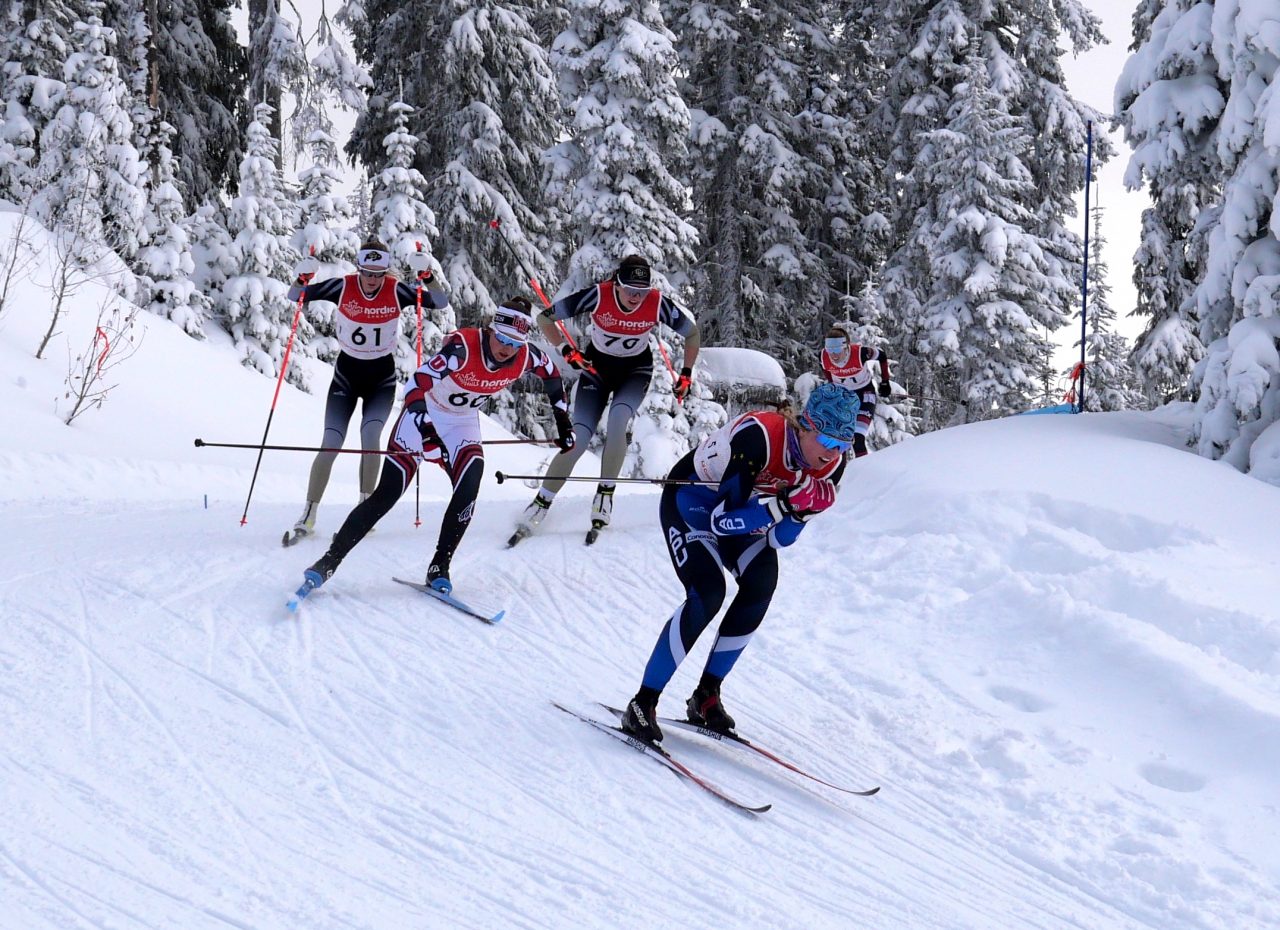
The U20 women’s semifinal 2 heading up onto the bridge at Sovereign Lake. (Photo: Peggy Hung)
Day 3 of the Sovereign Lake race week brought a skate sprint on a shorter course and warmer weather: -10C with no wind and occasional light snow.
Wednesday and Thursday were Nordiq Cup events, with only U20 and Open categories. Saturday and Sunday are Canada Cup races, with the addition of U18 and U16 categories, resulting in 402 racers across the eight groups. All four race days are part of the US SuperTour.
All groups completed the 1.2km qualifiers first, starting at 8:30am, and the heats ran from 11am until 4pm, finishing 1 minute ahead of schedule. Though today’s skate course incorporates one meter more of climbing than Wednesday’s classic course (37m total skate climb, compared to 36m on the classic course), many athletes described the feel of skate course as flatter. For comparison, the fastest women’s qualifier on the skate course—APU’s Hailey Swirbul (USA)—finished in 2:46.77, significantly faster than her 4:10.99 win in Wednesday’s classic sprint on a slightly longer 1.3km course.
Julien Locke leads the men’s final up into the finish straight. (Photo: Peggy Hung)
Men’s Freestyle Sprint
The men raced first today, with University of Denver’s (DU) Andreas Kirkeng (NOR) taking the victory in 2:20.30. Dartmouth’s John Steel Hagenbuch (USA) was second, at 0.07 back, with Black Jack’s Julien Locke (CAN) in third at 0.54 seconds behind. Tom Mancini (U Utah, FRA) who won Wednesday’s classic sprint was fourth, followed by Bridger’s Graham Houtsma (USA) and teammate Finn O’Connell (USA).
Kirkeng liked the course: “It’s a flat course, but you don’t have any rests so every small uphill, over the top, transitions, turns, everything matters in this course. The finish is really hard . . . 25 seconds with slightly uphill and a long flat section to the finish line. So the finish is really hard and that’s coming after like two minutes with all out flat skiing so it’s a challenging course, not like in terms of steep hills and a lot of climbing, but just because you have to ski fast and be on top of everything all the way.”
As with many of the podium finishers, Kirkeng tried to save energy for the end.
“For the final, I plan to stay like in third, fourth position and go all out from like the last turn, up and under the bridge, and it worked out real well,” he told FasterSkier. “[Hagenbuch] was coming real fast like the last 100 meters but I managed to stay in front of him.”
“I actually did better than I thought considering I’m usually a distance skier,” Hagenbuch said. “And it was super fun out there. I think, tactically, I was kind of doing the same thing, where I was sitting back a little bit for the first part of the course, and then really pushing on the final hill through the finish.”
Hagenbuch liked the course: “it’s super fun. It’s fast. And obviously a very competitive field here today.”
Locke was the top Canadian, expressing satisfaction with the day as he builds back from injury. He pushed hard into the ‘hole’ descent and led the climb back to the bridge.
“My tactics in all the heats was just cruise the first half and then try to have some good punch at the end,” he said. “Unfortunately, I didn’t have great legs in the finishing straight. But it was not a bad day; a step in the right direction for me.”
Many racers would be happy with a SuperTour/Canada Cup podium under any circumstances, but skiers reach the top by always chasing the next target, each success leading to a higher goal.
The women’s Final descending the stadium bridge towards the final downhill. (Photo: Peggy Hung)
Women’s Freestyle Sprint
After the men’s open and U20 heats completed, it was the women’s turn. “It was a really fun and exciting day,” top qualifier, Swirbul, told FasterSkier. “It’s a shorter sprint course than last time so it was fun to do some real sprinting and tactics.”
Swirbul wanted to try something new today: “I’m normally a racer that will kind of hammer from the gun. So today I challenged myself to try to play more strategy and try and sit behind people into that last downhill. In the last downhill, I’ve tried to free skate as hard as I could and carry as much speed into the final corner and up into the last climb into the drag race in.”
Swirbul won the final in 2:43.02, 0.87 seconds ahead of Bridger’s Sarah Goble (USA). U of Colorado’s Weronika Kaleta (POL) completed the podium, 1.17 seconds back.
Goble was happy with her hard finishing tactics in the earlier heats: “I tried to do that again in the final when I was in third, and I pushed over the top of the hill to put myself into second and kind of control the race through there,” Goble said. “And then Hailey had a really good final push to the finish but [I] couldn’t quite hang.”
Kaleta was very happy with her racing and sticking to her plan: “I wanted hard to be controlled, make sure that I save some energy for the last part. So I tried to do it and I guess I did it quite great.”
U of Utah’s Sydney Palmer Leger (USA) continued her solid week in 4th at 3.49 behind, followed by top Canadian Liliane Gagnon from CNEPH and Team Birkie’s Erin Bianco (USA).
U20 skiers who qualified in the top 30 were automatically moved to the Open heats. Sun Valley’s Samantha Smith (USA) and Chelsea Nordiq’s Tory Audet (CAN), both born in 2005, ‘raced up’ in the U20 group, and qualified into the Open heats where they were eliminated in separate semi-finals.
Tory Audet (bib 108) on her way to a lucky loser spot in her Open quarterfinal. (Photo: Peggy Hung)
Asked about the challenge of racing in the open heats instead of U18, Audet was direct: “I love it. I love the competition,” she told FasterSkier. “World juniors would be probably the biggest goal this year. And then a national title would be awesome. Due to COVID and then a concussion last year, I wasn’t able to attend.”
As Canada ignores the U18 championships, Audet is targeting U20 World Championships in Whistler in late January.
Many of the skiers appreciated the race volunteers at these Sovereign Lake events, but Hagenbuch may have phrased it best: “Sovereign put on a great event. The volunteers have been great. I think they’re gonna be out here for something like nine hours today. So pretty Herculean effort. So big thanks to all the volunteers for their hard work and another day of racing tomorrow.”
Hailey Swirbul (USA) leads the 10km Nordiq Cup/SuperTour at Sovereign Lake (Photo: Peggy Hung)
Continental Cup racing at Sovereign Lake continued Thursday with a 10km mass start skate for both genders, using the traditional Upper World Cup 5km course. The weekday races are U20 and Open categories only, with ‘smaller’ fields of 87 women and 127 men registered Thursday.
“I think this is probably the most competitive race in North America this year, so there were a lot of really strong and talented skiers.” — John Steel Hagenbuch, Dartmouth Ski Team
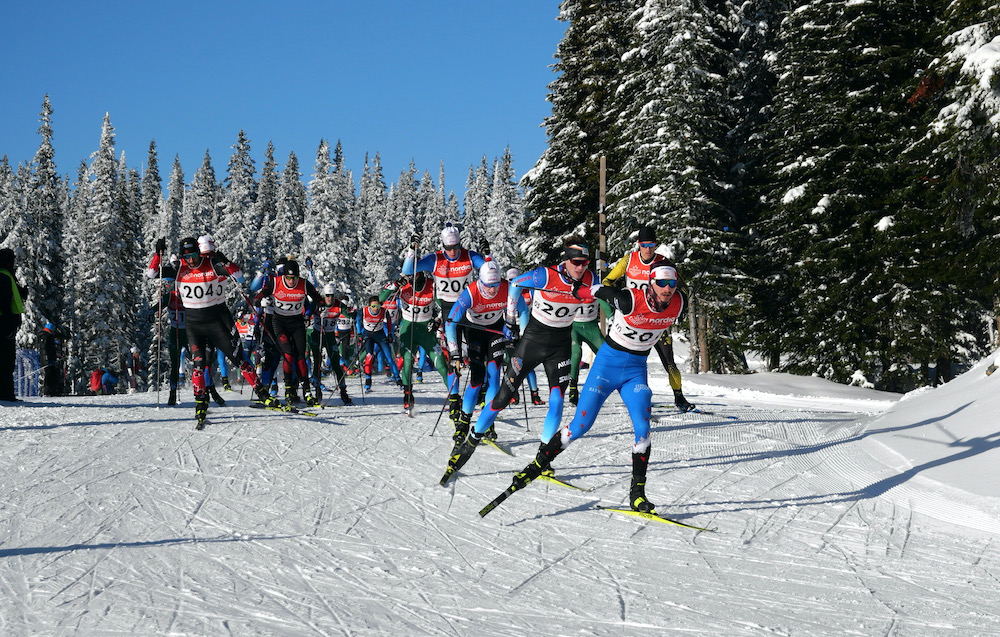
Mass start races at this level usually run in two modes. The group at the front has a tactical race, with most of the group skiing in control and making plans. Behind this group, all the skiers are drilling it, pushing hard to reduce the time gap to the leaders. Many of the men experienced their first 10km mass start today, as this has traditionally been a distance offered primarily in women’s racing.
The day was cloudy and cold, with temperatures hovering at -18C.
The women raced first, with APU’s Hailey Swirbul (USA) setting the pace to reduce the lead pack to 15 skiers by the end of the first 5km lap. The video is at the mid-point of the first A climb, just short of 1km into the race.
“I often find it comforting to be able to ski my own pace and take my own line,” Swirbul told FasterSkier. “I did that. And yeah, it ended up not working out for me, but that’s the way it goes.”
Swirlbul estimated that she led for 9.5km: “I tried making a move,” Sydney Palmer Leger (University of Utah, USA) said, “and then right at the finish, I ended up sliding on my butt.”
Palmer Leger stepped on a ski at the Tree Island turn leading into the finish straight, but was able to sprint back to take second place to U of Colorado’s Anna-Maria Dietze (GER). Dietze finished in 29:59.0, 0.6 seconds ahead of Palmer Leger, with U of Utah’s Karianne Dengerud (NOR) 1.1 seconds back.
“I feel like always kind of sitting in the back for the first loop,” Dietze said, “trying to figure out like which downhills I can take where I can like draft a little bit and was trying to stay relaxed and then when people started to attack, just trying to stick with them and then putting everything on the finish line.”
“I was just trying to take the [last] turn really well,” Dietze continued. “My legs were hurting and I was like I’m just gonna send it and I felt pretty powerful. Felt like I had few metres on them. I thought that was gonna be it and it was awesome.”
Dengerud followed a similar strategy: “I managed to stay like quite far up in the front from the beginning of the race and that helped me save a lot of energy so I had a lot towards the end. And then I wish I’d passed one girl earlier, but except from that, it was great.”
Dengerud skied the loop for the first time in her pre-race warmup and liked the course: “It’s really good. I didn’t ski it before this morning and I heard that it was really hard. But I skied it on my warm up and I figured out that it was as many downhills as uphills, as it should be.”
Dengerud, who grew up near the famous Holmenkollen venue, prefers this course which was built for a 2005 World Cup: “I like it better when you can work the flats a little bit more and it’s not only downhill or uphill, and this course has it all.”
Liliane Gagnon from the Centre National d’Entraînement Pierre Harvey (CNEPH) was the top Canadian in 6th at 9.8 seconds back, trailing Bridger’s Sarah Goble (USA) and Swirbul.
“It was pretty fast at first,” Gagnon said, “but then it calmed down a bit, but on the second lap, the pace got picked up. So you really had to be in the game for it to finish strong.”
Russell Kennedy leads up the second A climb during the Nordiq Cup/SuperTour 10km at Sovereign Lake. (Photo: Peggy Hung)
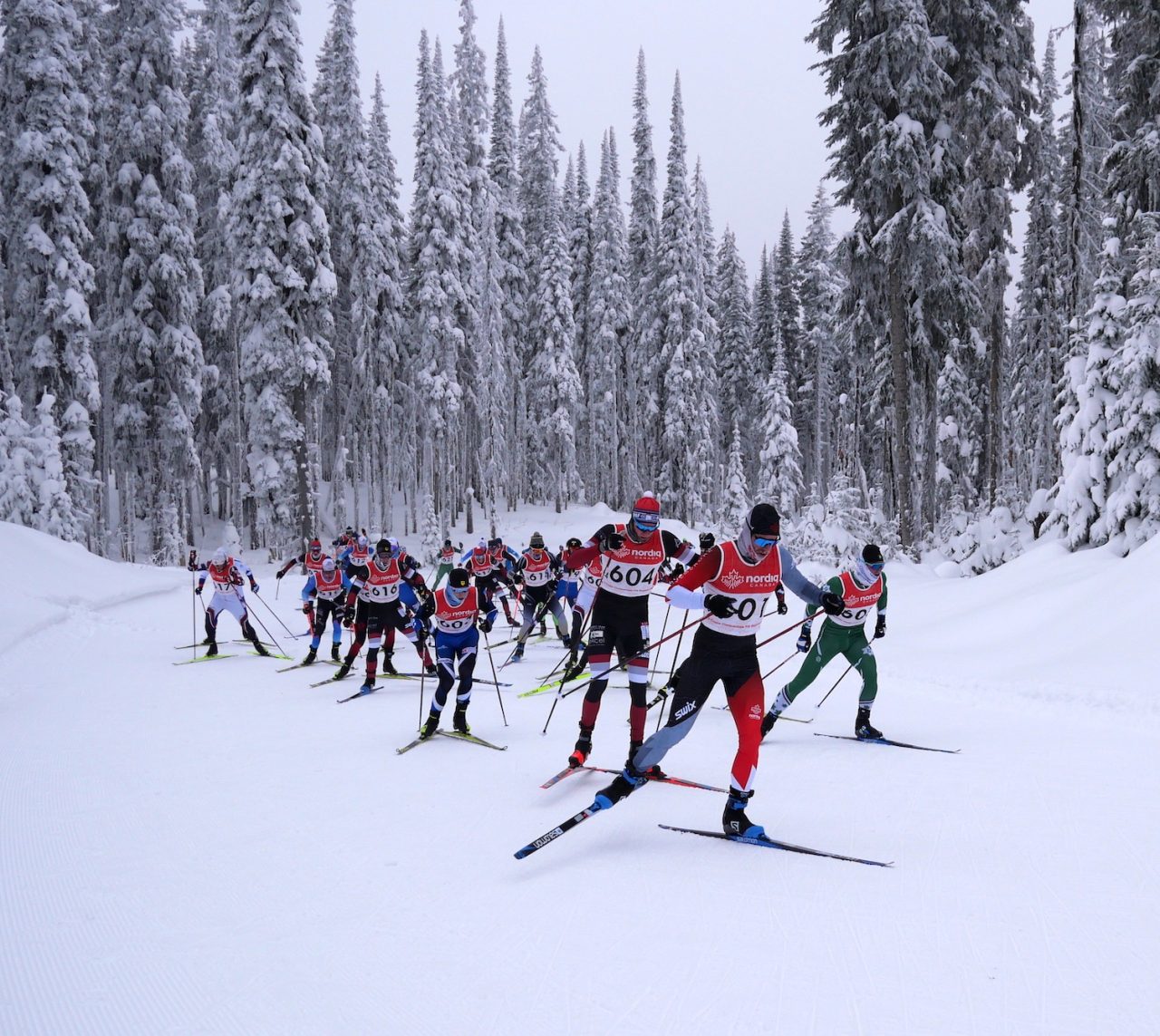
The men’s race played out in similar fashion to the Women’s, with 22 men finishing the first lap together, passing through the stadium at a comfortable pace.
“I will say that a 10k skate mass start is definitely fast and pretty hectic,” Hagenbuch confirmed. “So there was definitely some carnage out there.”
Wednesday’s winner Magnus Bøe (U of Colorado, NOR) broke a pole in the first kilometre, losing the advantage of his second row start.
Canmore’s Russell Kennedy (CAN) was one of the people pushing the pace, shown here at the top of the second A climb, about 2km into the race.
“[It was] a lineup of guys ripping it and then Johnny [Hagenbuch] started moving up and I saw the attack coming but I wasn’t sure when he was gonna go,” Kennedy said. “And then the second last hill, he pushed super hard. I got boxed in and then tried to make up time but I couldn’t see really what was going on in the finish for them.”
Ten skiers reached that second last hill, known locally as the ‘Wall’ climb together.
“There’s a pretty big steep kicker hill, about a kilometer and a half out from the finish,” Hagenbuch said. “I kind of felt the moment there and I went for it. And luckily, I was able to drop most of the field. But Tom Mancini, he was able to stick on me after that. And then we kind of duked it out towards the end, but I knew going up against Tom in the finishing stretch probably wouldn’t go my way given that he’s such a strong, older skier and obviously a 2018 World Junior Champion.”
U of Utah’s Tom Mancini (FRA) took the win in 25:24.2, 0.6 seconds ahead of Hagenbuch and 4.7 seconds clear of Kennedy.
“Yesterday, I was disqualified [for micro-skating], ” Mancini said. “I wasn’t totally agree with this decision. But so, today, I wanted to race nice. And also just enjoy my first race here. And this is what I did.”
Mancini moved to Utah in the fall and still thinks in French grammar. He also was seeing this course for the first time, unlike Kennedy who has years of experience here.
“I noticed that they have a nice finish,” Mancini revealed. “So I was like, I just need to stay in this game until the last two kilometres. And so the pace was hard since the beginning. So it started pretty high, so pretty fast. So at the beginning, it was a bit hard for me and then after maybe one lap, I felt better. And I was like, alright, no, just have to keep focus and wait until the end.”
It was a challenging day for clothing selection, with many athletes struggling to stay warm on course. “I think we got prepared by being in Alaska last year and Canmore two weeks ago,” Dengerud shared, “so had a lot of clothes on, for sure.”
If the Alaskan skiers (names withheld to protect the guilty) are complaining about the cold after the race, that is a sign that others suffered more.
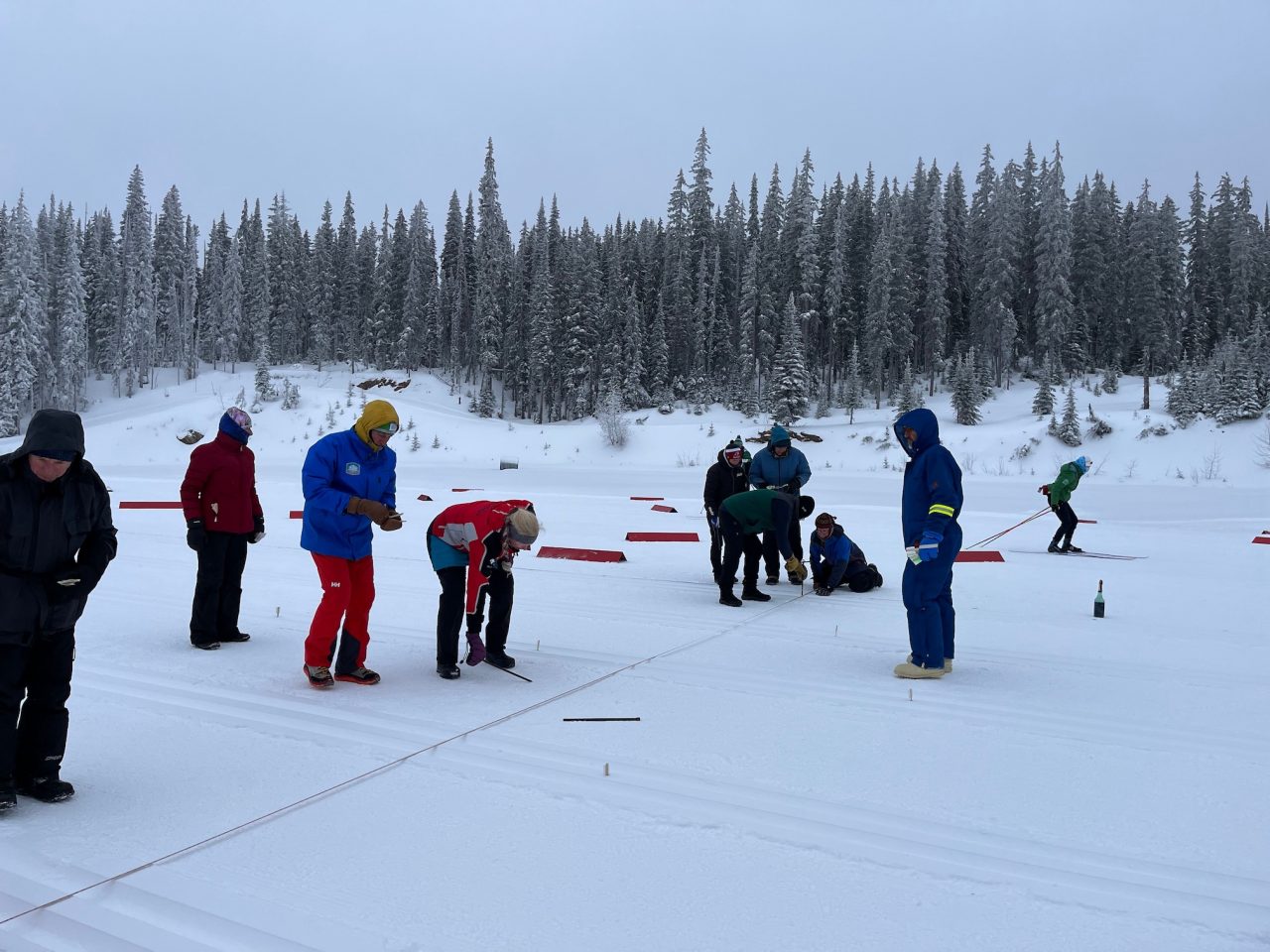
Mass starts are ‘easy’ to host: today’s event used 65 volunteers over a 12 hour period, including this group building a start grid with numbered marks for 127 athletes. (FasterSkier photo)
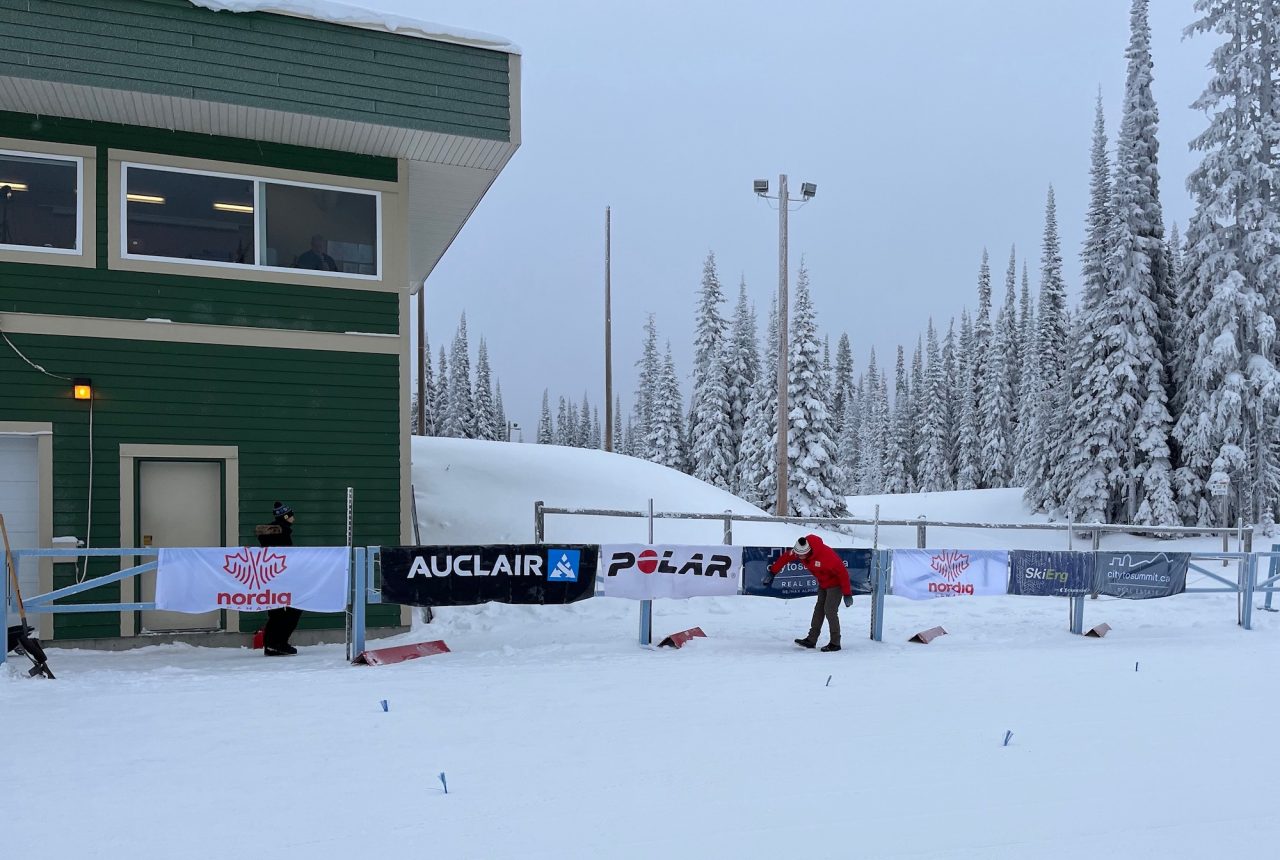
What does the CEO of a National Ski Federation actually do? Stéphane Barrette was found clearing frost from the sponsor’s banners early this morning. (FasterSkier photo)
Hailey Swirbul leads over the biathlon bump in classic sprint quarterfinal 1. (Photo: Peggy Hung)
North American racing hit high gear today with the opening of the combined Nordiq Cup and SuperTour series at Sovereign Lake with classic sprints. This week brings together the top skiers from all of North America, Mexico included, and Wednesday’s qualification was kicked off by the top ranked skiers: USA’s Hailey Swirbul and Canada’s Russell Kennedy.
Many teams arrived two weeks in advance to enjoy some elevation training on corduroy while teams with good early skiing—like Alaska Pacific University (APU) and University of Utah—rolled in just in time for official training.
Race day dawned with heavy snowfall and strong winds at -11C. Roughly 20cm of snow fell while the grooming team was preparing trails, starting at 3am. The snowplow got stuck before clearing the Sovereign Lake access road, forcing a one hour delay. The wind and snow ended about 10:30, half an hour before Swirbul started her qualification. As the day rolled on, skiers saw clouds and sunshine, but ended under the lights as the sun set on the men’s final.
APU’s Swirbul qualified first, completing the 1.2km course in 4:10.99. University of Colorado’s Anna-Maria Dietze (GER) was second, 3.29 back, followed by University of Utah’s Karianne Dengarud (NOR) at 4.29.
For the men, Sun Valley’s Peter Wolter (USA) was fastest, completing the same course in 3:32.38. U Utah’s Noel Keefe (USA) was close behind at 0.86 seconds, with national team member Kennedy third at 1.78 back.
Canada has joined a number of countries in automatically shifting U20 athletes into the open heats if they qualify in the top 30 overall. National team member Xav McKeever (CAN) was the fastest U20 male in 9th, 3.29 back,
Mexico’s Karla Schleski Shepard did not qualify for the heats, but her presence made this a truly North American event.
In the heats, racing progressed smoothly with a minimum of jury intervention, although many racers commented on how long the 1.2km course felt.
Hailey Swirbul leading the final into the saddle climb. (Photo: Peggy Hung)
Swirbul won all three heats on her way to victory, leading the final in 4:02.05. Sydney Palmer Leger (USA) was a close second at 0.35 with Dietze completing the podium at 1.05. The final was distinctly international with Germany, Poland, and Norway represented.
Swirbul and Palmer Leger talked about their races and the full North American field, watch it here.
“It’s definitely a hard course,” Dietze told FasterSkier, “it was really tough to do four of these loops all out. A lot of fun.”
Canada’s top woman was CNEPH’s Liliane Gagnon in 10th, followed by AWCA teammates Katie Weaver and Sonjaa Schmidt in 11th and 12th.
Magnus Bøe (161) attacking into the finish straight. (Photo: Peggy Hung)
On the men’s side, U Colorado’s Magnus Boee (NOR) won in 3:23.83, with APU’s Zanden McMullen (USA) at 0.46 and McKeever leading the U20 contingent at 2.70 seconds back.
U Colorado’s Will Koch (USA), Kennedy, and Bridger Ski Foundation’s Graham Houtsma (USA) completed the final heat, with U Utah’s Walker Hall (USA) scoring the same 3:28.68 lucky loser time as Houtsma, but losing out on a tie breaker.
FasterSkier reporters didn’t locate race winner, Magnus Bøe, in the post-race darkness, but we caught up with the other podium finishers.
“I think it was important to keep your energy low early, in the first half of the race, and then coming around the last turn, you want to be in a good position,” McMullen said. “Make sure you really gunned it from there.”
“It’s amazing to be here. SilverStar is beautiful and Sovereign Lake here. This is my first time here, only second time in Canada,” McMullen continued. “So yeah, no complaints. I’ll definitely be back again.”
“I had a pretty spicy semifinal there, broke a pole going into the biggest climb of the course,” McKeever said of his lucky loser path the final. “I just tried to ski as best as possible in the final and just try and be tactical and position myself well and came out third.”
Thunder Bay’s Julian Smith was the third Canadian, going out in the semifinals for 8th.
Russell Kennedy leads the final through the lights of the stadium. (Photo: Peggy Hung)
Athletes will spend a lot of time combing through results from these first high level races, and comparing those with results of Canadian NextGen skiers from Bruksvallarna earlier in November.
“I was happy with my races overall and was happy to come back here to SilverStar, as it’s one of my favourite places in the world to ski and compete in.” McKeever said. “I had a good time in Europe, just warming up with some first races of the season, competing with some really strong people, had some good sprints.”
The “strong people” mentioned by McKeever included a list of stars like Sweden’s Calle Halfvarsson and Ebba Andersson , who moved on to the World Cup in Ruka. Many domestic racers will be looking at the NextGen results in Bruksvallarna and Sovereign Lake to get a sense of how North American racing compares to Scandinavian speed.
Look for some action video on Nordiq Canada’s social media, because Nathaniel Mah is raising the bar.
SilverStar/Sovereign Lake
Confused about the Sovereign Lake versus SilverStar thing? Sovereign Lake Nordic Club has 50km of trails hosting races in Silver Star provincial park. SilverStar Mountain Resort has lodging, an interconnected 50km of trail, and an alpine resort, but isn’t in the park.
The 1.2km loop used today is nicknamed the Beckie Scott course. In December 2005, Beckie Scott earned her first World Cup win in a skate sprint here. This was also Canada’s first dual WC podium when Sara Renner snatched a bronze medal. Nothing brings the passage of time into focus like realizing that both Scott’s and Renner’s children will be racing in the U16 group this weekend.
Men’s semifinal #2 catching the sun. (Photo: Peggy Hung)
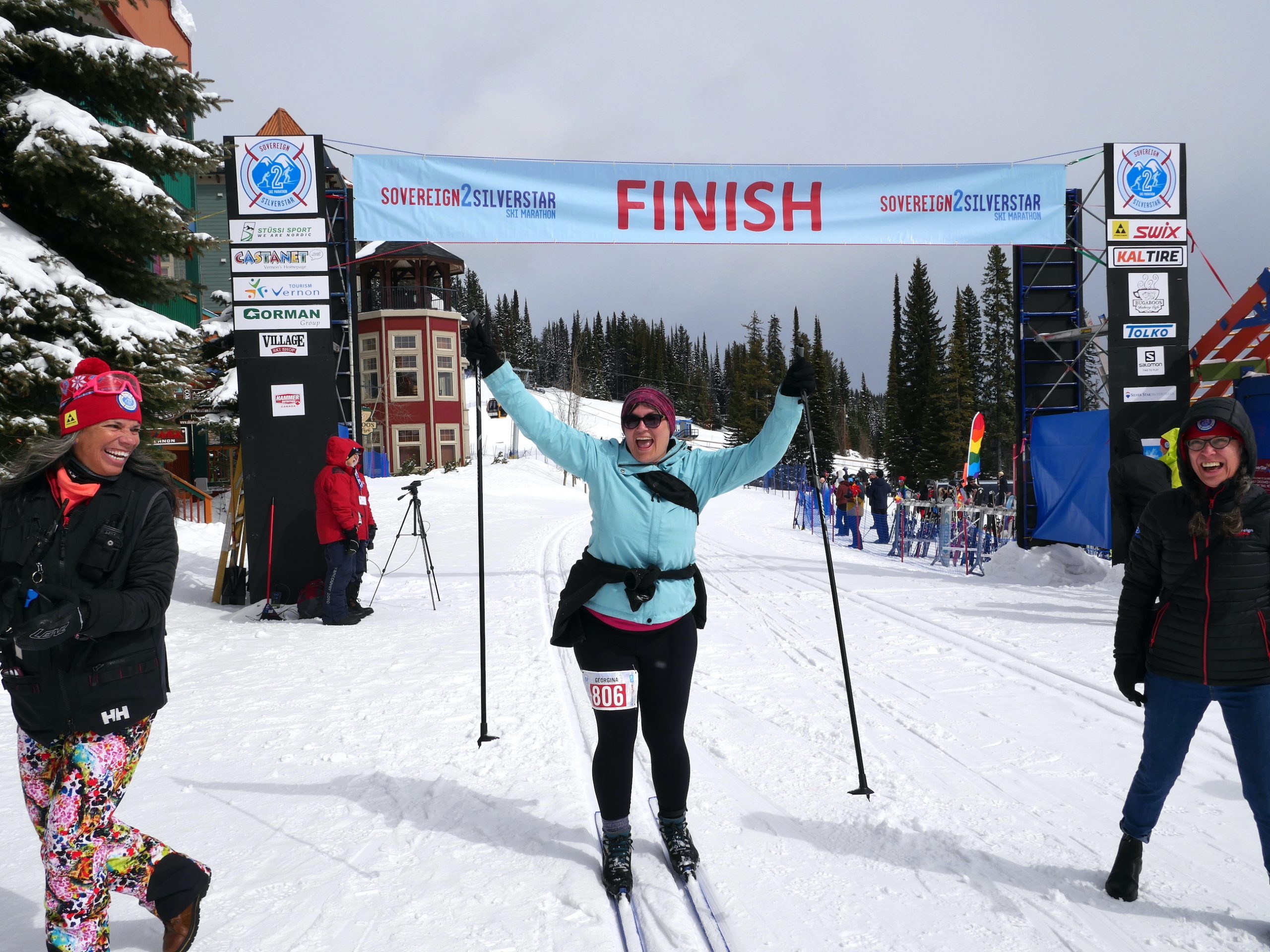
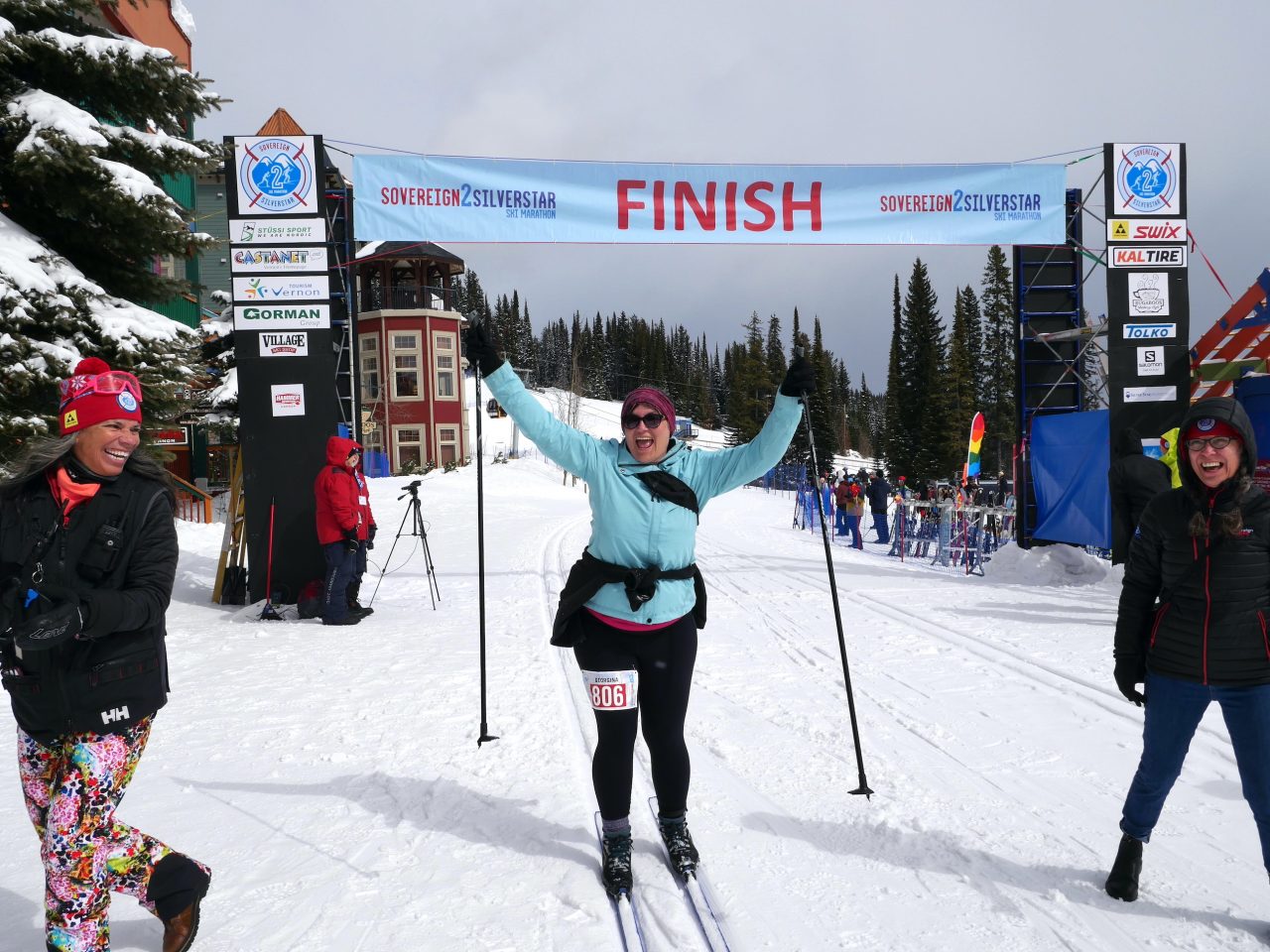
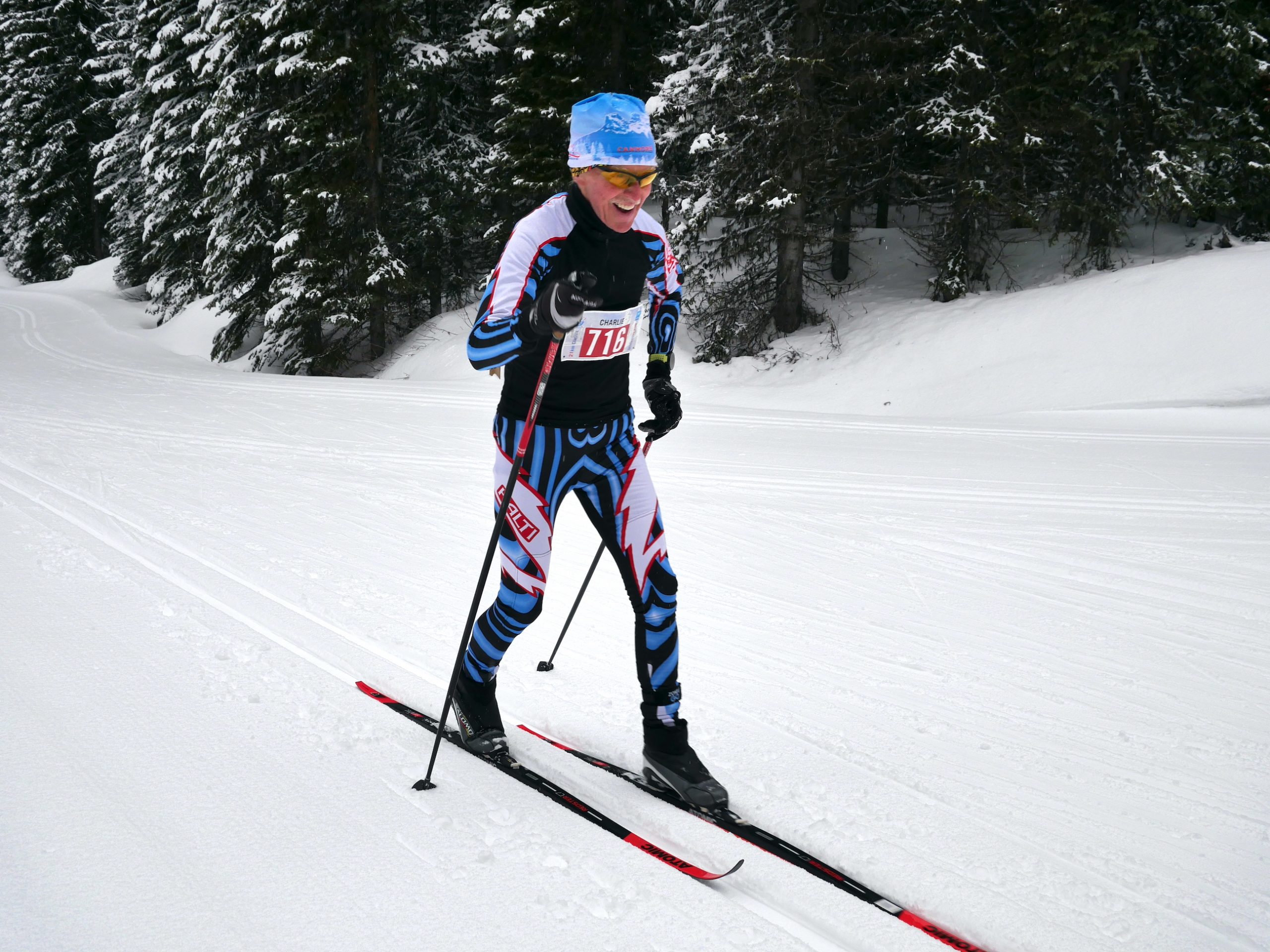
Finishing with a smile at the Sovereign2SilverStar Ski Marathon (photo: Peggy Hung)
Disclaimer: The author skied both days and was one member of the large S2S organizing committee. This may seem like a conflict of interest, but also allows a more detailed look behind the curtain at how a new event was built.
Click here to learn more about the origins of the Sovereign2Silverstar Ski Marathon, and to take a look at the successful first year of the event.
***
The motto for S2S was ‘finishing is winning’, a phrase that also served as the touchstone for the bigger decisions.
The members of the Organizing Committee (OC) had a lot of experience hosting ski races, from local loppets to Canada Cup/SuperTour weekends to World Cups, and even a combined Nationals plus SuperTour Finals that got cancelled by a pandemic in 2020. A destination event is a different beast, however. High-level events under the FIS umbrella don’t need marketing: athletes follow the events calendar. Local loppets are advertised with a few posters at the neighbouring ski areas. FIS events have required distances, homologated courses, and rules for everything.
A destination event, by definition, has to entice skiers to travel. In the midst of a pandemic, this is not as easy as it once was, even to a destination with quality late-season snowpack and a mountain backdrop. The question then becomes, ‘What can be done to make the event attractive?’ Immediately followed by ‘how can we keep the participants, volunteers, and local community safe?’
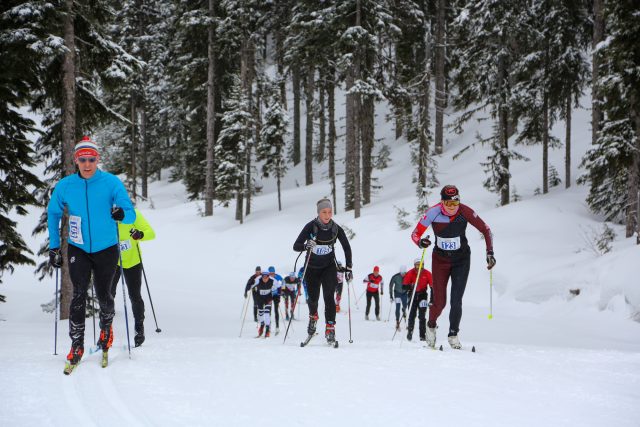
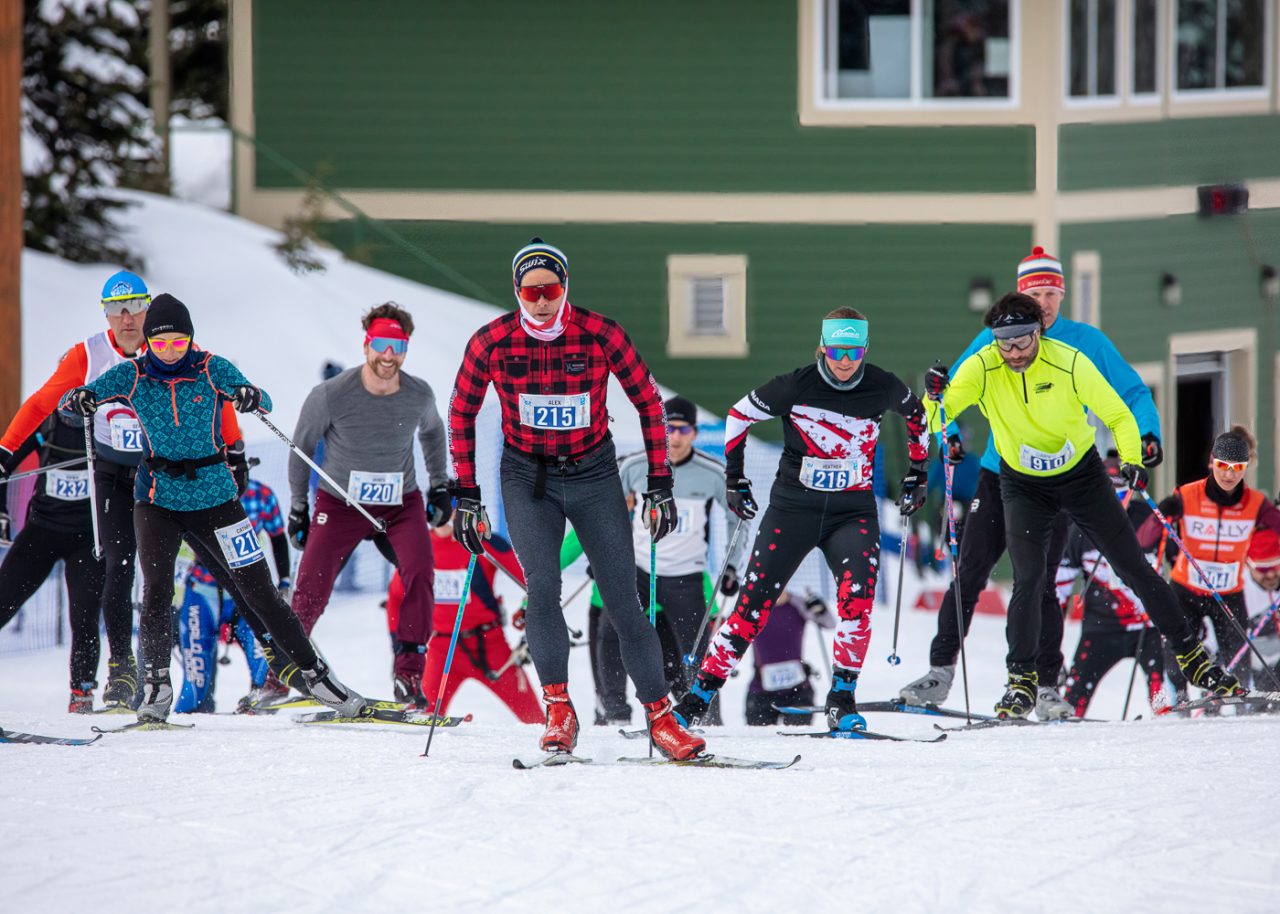
One of the 21km waves heading out of the stadium on S2S Skate day. Look closer for a mix of ages, a pair of headphones, and a backpack. (photo: Robert Conchie)
Which skiers?
The club already hosts high level events in nordic and biathlon, which led the OC to a focus on inclusion for the new event.
To get a larger number of skiers, it is necessary to look outside the group of committed competitors and attract recreational skiers. Thus, the motto ‘Finishing is Winning’ was chosen to both appeal to non-racers but also give the OC a vision to follow.
The motto led to a list of goals: Inclusive. No time limit. Small waves. No technically difficult course features. A minimum of climbing, but enough to discourage classic racers from double poling on skate skis.
When?
One of the original goals was to show the trail system at its best, which means late March and early April. March is most often the big snowfall month and has been the choice for the annual 30km for two decades. The elite skiers always visit in early December or late November for Continental Cup races. As a result, generations of racers have visited just before the skiing gets really good.
The OC wanted to add to the season calendar instead of competing with existing events. Choosing the same weekend as the American Birkie, for example, would limit future growth.
The early 2021/2022 international calendar had no events for April 2nd and 3rd.
Using historical data, there is a 70% chance of blue hard wax skiing on the first weekend of April. Unfortunately, history doesn’t account for climate change and the increasing risk of extreme weather. In 2021, the Vernon area set new records for lowest precipitation in March, April, and May, based on data going back to 1904. In June, heat records were broken all over BC and Washington state. Then, an atmospheric river in November washed away all four highways to Vancouver and dramatically thinned the snowpack.
With the extreme 2021 weather as a backdrop, there was some nervousness about hosting in April. Club members are usually committed to cycling and paddling by mid-March. An entire web page was devoted to showing what April skiing looks like.
The final choice also became an effort to change perceptions. In a year where many people were limiting travel and pandemic rules changed monthly, success would depend on persuading local skiers to keep skiing into April. Early data suggests there were more skier visits in late March and early April than previous years.
Shortly after the OC committed to the dates, the Fossavatn moved to the same weekend and in December the Alex Harvey Classic was announced. The worldwide calendar is crowded, and there really aren’t any ’empty’ weekends.
Course Design
At this venue, a long flat double pole route is simply not an option. Sovereign Lake is a small pond and the flat trail around it is less than 1km long. Spectacular mountain views like Canmore or Toblach require nearby mountains and the twin ski areas are just part of the Interior Plateau that was eroded less after the glaciers receded. What the OC does have is twisting, rolling trails through a coniferous forest, tonnes of snow, and a few beautiful viewpoints.
Many of the OC had skied in events with fast downhills, wild corners, road crossings, and chaotic starts. To be inclusive to newer skiers, the course would avoid tight switchbacks, avoid steep climbs, and be relatively flat.
Starting in the Sovereign Lake stadium and finishing on Main Street in SilverStar village were the main selling points. With that decided, the Alder Point loop was essential, with views of the Monashee mountains on one side and views of many alpine runs busy with skiers on the other. That decided, it was a matter of building a route with no repeats, no technical sections, a moderate amount of climbing, and exactly 42km long.
There were many candidate routes that met the requirements, but there was also a 40km route that was more fun to ski.
After some debate, the OC decided that the fun 40km course fit the ‘Finishing is Winning’ motto best. The first 10km is a flat warmup before the climbing starts. There are three ‘long climb’ sections with about 70m gained over 3km. The finish is a gentle 3km downhill leading into a ‘feature’ finish onto Main Street.
Exact distances can be important. While every long-time skier has done events that are very different than advertised, some participants want precision. And precision usually means that their watch or phone records the exact advertised numbers.
There are two common causes of GPS accuracy errors: mountains and trees. As the venue is well equipped with both, the OC quickly learned that only the homologated loops had accurate mapped distances. A sub-team was recruited to get more accurate map data using LIDAR data.
Scanning through Strava on April 3rd, most of the 40km skiers posted distances between 38km and 41km. The measured elevation gains varied even more.
The 21km course splits from the long course at the 5km point, heading directly to SilverStar while the 40km skiers ski a 17km loop to arrive at the same intersection from another direction. The 21km course also skips the final climbing section up Howie’s loop and on the Bergstrasse alpine run.
Making the 21km a subset of the 40km course and using the same course both days resulted in a huge reduction in volunteer effort.
Small Waves
Many of the OC had skied in major events where there were queues at the first pinch point. To be inclusive to non-racers who aren’t used to skiing in a pack, the decision was made to spread the skiers out so they could watch the scenery instead of the butt of the skier in front. The final choice was a series of waves, spaced three minutes apart.
One of the larger packs 4km into the 40km. (photo: Paul Pickard)
The largest wave had 42 skiers and it spread out quickly. The telephoto and steep hill combine to compress the B wave group above, which is actually spread out over about 100m of the short climb.
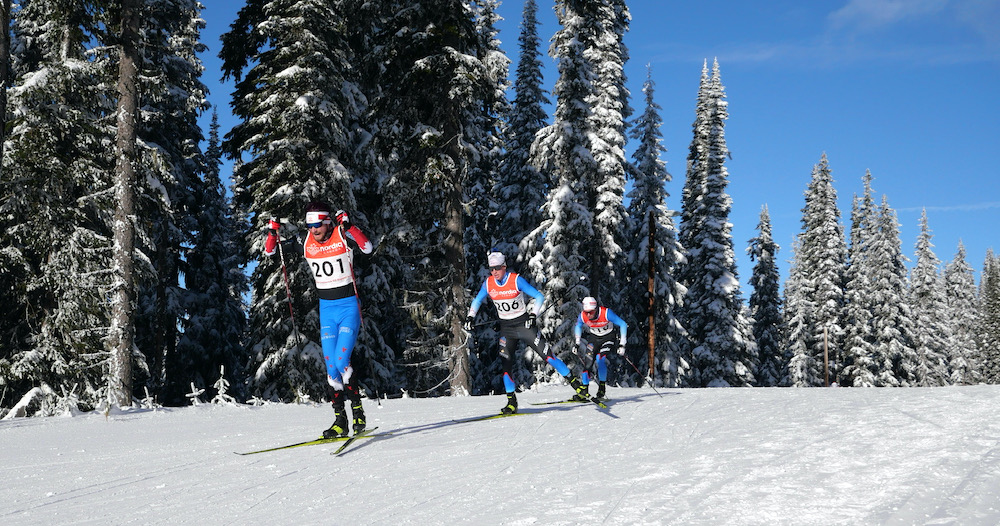
The first pinch point on the 40km course is at 21km, where the packed trail is only 6m wide and there is just enough room to skate two abreast. The lead pack on classic day was three skiers here, mostly because the short climbs in the Zumas tend to explode packs.
A few skiers didn’t like the small waves while most participants loved the space to ski at their own pace. The elite skiers were indifferent to wave size, possibly because they would immediately ski away from any size of group.
Working Together
SilverStar Mountain Resort is a commercial alpine ski area answering to shareholders, with trails for nordic, snowshoeing, and fat biking. Sovereign Lake Nordic Club is a 3,200 member ski club set in a provincial park, answerable to the nordic skiing members and BC Parks. Twin nordic areas to be sure, but fraternal not identical.
The differences between the areas can sometimes make it challenging to reach win/win consensus, but the desire to work together gets there in the end.
The local community has dreamed of a joint nordic event for years. In 2021, three people came up with a vision that both areas could say yes to, resulting in the birth of the 50/50 event committee. That name was abandoned, as it was quickly apparent that any 50km course would be more epic than inclusive (see an example course profile here).
The local snowmobile club loaned us 500m of one of their trails for five days, allowing the removal of two tricky hairpins and giving locals a new experience.
Learning From Others
The US Birkie and the Gatineau OC’s provided example budgets, registration advice, examples of what can go wrong. And then each event provided a top OC volunteer to spend an hour answering questions from the S2S OC. The nordic skiers on the OC thought this level of assistance was extremely helpful, but not unexpected. The alpine skiers on the OC were surprised that major events would actively help their ‘competition’.
Cortina-Dobbiaco is a good example of a fun event: point to point, one day for each technique, and a big effort to create an experience beyond the race.
The Vasaloppet is an example of how to grow big, but also an example of crowd management.
The decision to join the Visma Ski Classics challenger series was a surprise. One of the Cortina-Dobbiaco OC had explained the economics of the ProTour series, which put that idea on the year six or later list. Then it was discovered that the chief of volunteers knows every skier in every country, which led to a Norwegian friend of his making a pitch for the Ski Classics Challengers series and a cost-effective way to connect with a worldwide group of skiers who like to build vacations around ski events.
The Region
Vernon is an unusual place. The three lakes are just under 400m above sea level. The mountain bike trails at Kalamalka lake sprawl up the east ridge to 1,400m. Some years, the lower mtb trails are good all winter. Other years, the snow level is lower and bikers are waiting for April for the trails to dry. The nordic trails are higher, ranging from 1,500m to 1,915m. Skiing starts in October, with grooming beginning in early November. In April, the grooming stops when the supply of skiers runs out. In non-pandemic years, the Spring Fling snow camp in May provides an opportunity to start the new training year on groomed snow. SLNC and SilverStar have a combined 105km of nordic trails, groomed daily.
Vernon is a ‘small town’ of 40,000 people with strong sports communities and a high proportion of retirees. Silverstar village has a smaller population and an even larger sense of community. Some of the volunteers that committed hours as course marshals on the alpine run crossings are alpine skiers who have never tried nordic skiing.
Charitable Partner
Our target audience of adults who travel to ski events could be called privileged. With so many skiers who appreciate what sport has given them, the OC wanted to find a charity that could give sport to others. KidSport is an organization that helps financially disadvantaged youth participate in organized sport and the local chapter was a good fit for our goals.
The first year of any event is financially challenging and breaking even can be difficult. With an unknown event during a pandemic that wasn’t ending as quickly as hoped, there was uncertainty around raising a significant amount of money for the cause. Thanks to strong support from sponsors, volunteers, and skiers, the event raised $8,000, about 20% of the local division’s annual budget.
It turns out that partnering with a charity makes it easier to attract sponsors and volunteers, an unexpected but welcome benefit.
Promotion
There is a popular quote: ‘if you build it, they will come.’ A more useful version would be ‘if you invite people, they will come.’
A good logo and wordmark means the swag looks good.
Partnering with an alpine ski area comes with some significant advantages here. SilverStar has a marketing team with skills far above what is common in the North American nordic community. A stunning logo, word mark (that ‘text’ brand image), event colour scheme (based on both areas’ existing colours), and a branding document allowed the OC to present a consistent and attractive package to skiers, volunteers, and sponsors.
While ‘branding’ has always been an essential element in creating a successful business, it is equally valuable in building a new event. Many of the participants commented on how much this first event felt ‘organized’ and ‘polished’. A big part of that comes from providing a good athlete experience, but the polish is a direct result of that branding document.
Volunteers
Last on the page, but not last in importance. Over 250 volunteers worked tirelessly to bring energy and enthusiasm to the event day experience. Dozens of skiers made the effort to find someone wearing an ‘OC’ bib to talk about the atmosphere generated by the volunteers.
How much did the OC value the volunteers? When the financial team had to make hard choices to be ready for a last minute cancellation by any of three levels of government, one of the expenses eliminated was a toque for each participant. Because if you spend all the entry fee money in advance, how will you provide refunds?
The Volunteer team worked with one of the sponsors to give every volunteer a toque (a toque is a ski hat to Americans, a beanie to Brits). Thanks to supply chain constraints we all are living with, the sponsor had to pay the expense months in advance. Another sponsor provided food and drink for a volunteer party on Sunday afternoon. Many of the elite skiers and past Olympians known to FasterSkier readers made the effort to connect with the volunteers at the party.
In the end, the volunteers are what brought smiles to the participants faces. The event will need those people next year, which means showing volunteers the love is one of the biggest steps towards a successful second year.
The Sovereign2SilverStar Ski Marathon started with small waves. (photo: Robert Conchie)
Disclaimer: The author skied both days and was one member of the large S2S organizing committee. This may seem like a conflict of interest, but also allows a more detailed look behind the curtain at how a new event was built.
When the moment comes to create a new destination ski marathon, how would you compile all of your dreams and mould them into a single cohesive weekend?
A group of Canadian skiers was faced with that question in the spring of 2021. And they found an answer.
Start with twos. Two interconnected ski areas. Two days. Two techniques. Two distances. Two finish line parties.
Using that model, the first annual Sovereign2SilverStar Ski Marathon was a success, at least as measured by smiles.
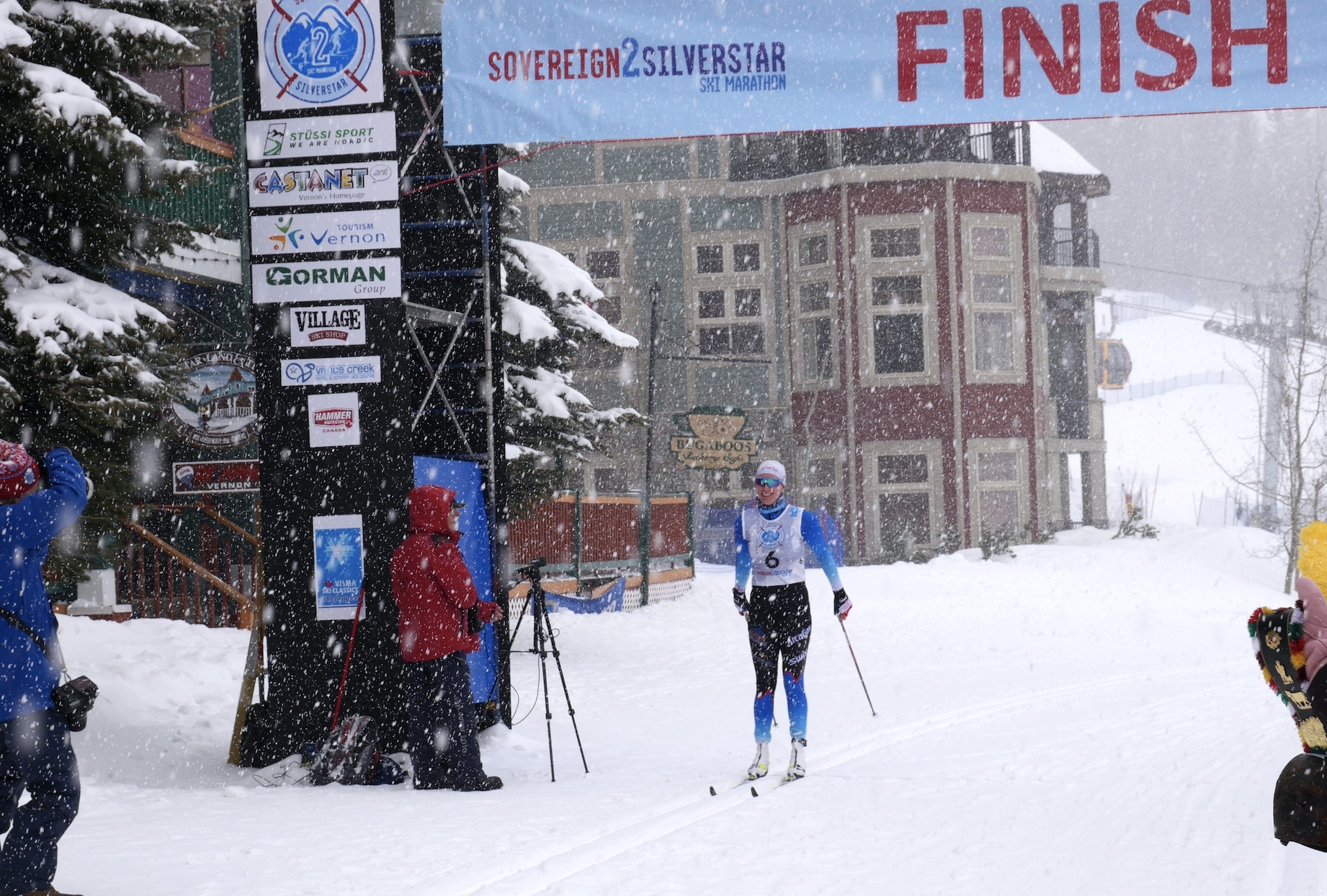
Dahria Beatty crosses the line for the women’s win in classic during the Sovereign2Silverstar Ski Marathon. (Photo: Peggy Hung)Fun at the finish line of the 2022 Sovereign2Silverstar Ski Marathon. (Photo: Peggy Hung)
The weekend kicked off with a classic day on Saturday, April 2nd. The first wave for the 21km course left at 8:30 am, followed by the 40km waves at 9:05. Predicted weather was cloudy with afternoon snow, but the first flurries hit about 8 am, setting the tone for the day.
Of the 195 finishers on Saturday, the majority were on skin skis. Many of the skiers who chose grip wax were fooled by the race date into waxing for ‘typical’ spring skiing. However, when the groomed track is set at -5C, with fresh, cold snow overnight and more dry snow falling, blue hard wax is a better choice. Three of the six athletes on the 40km podium chose VR45 covered with VR30. The Organizing Committee (OC) posted a recommendation of Swix VP45 or V45 (the event encouraged fluoro-free waxing) on Friday afternoon. Early Saturday morning, the wax recommendation was updated to VP45 covered by VP40, except that this update didn’t get shared. Oops! Add that to the list for next year.
Benoit Chauvet last skied on the World Cup in 2010 and now coaches at Toby Creek, in BC. And he did place higher in the skate 40km.
Skate day on Sunday was overcast without significant snowfall, resulting in faster conditions and a larger field of 255 finishers.
As on Saturday, the 21km waves started first at 8:30, followed by the 40km waves at 9:05. This added a fun twist as the faster 40km skiers were passing the average 21km skiers coming into the finish. Despite the number of finishers, the largest of the nine waves had 42 skiers, which meant there was a lot of room to work with.
The course crossed a number of alpine runs on the final long descent to the finish. The course marshals, who were tasked with preventing collisions, were also ringing cowbells to energize the passing skiers. Many alpine skiers and snowboarders stayed on to cheer when the marshals signalled they were free to move. It was a new experience for many participants to see spectators 4km away from the finish, cheering and recording phone videos.
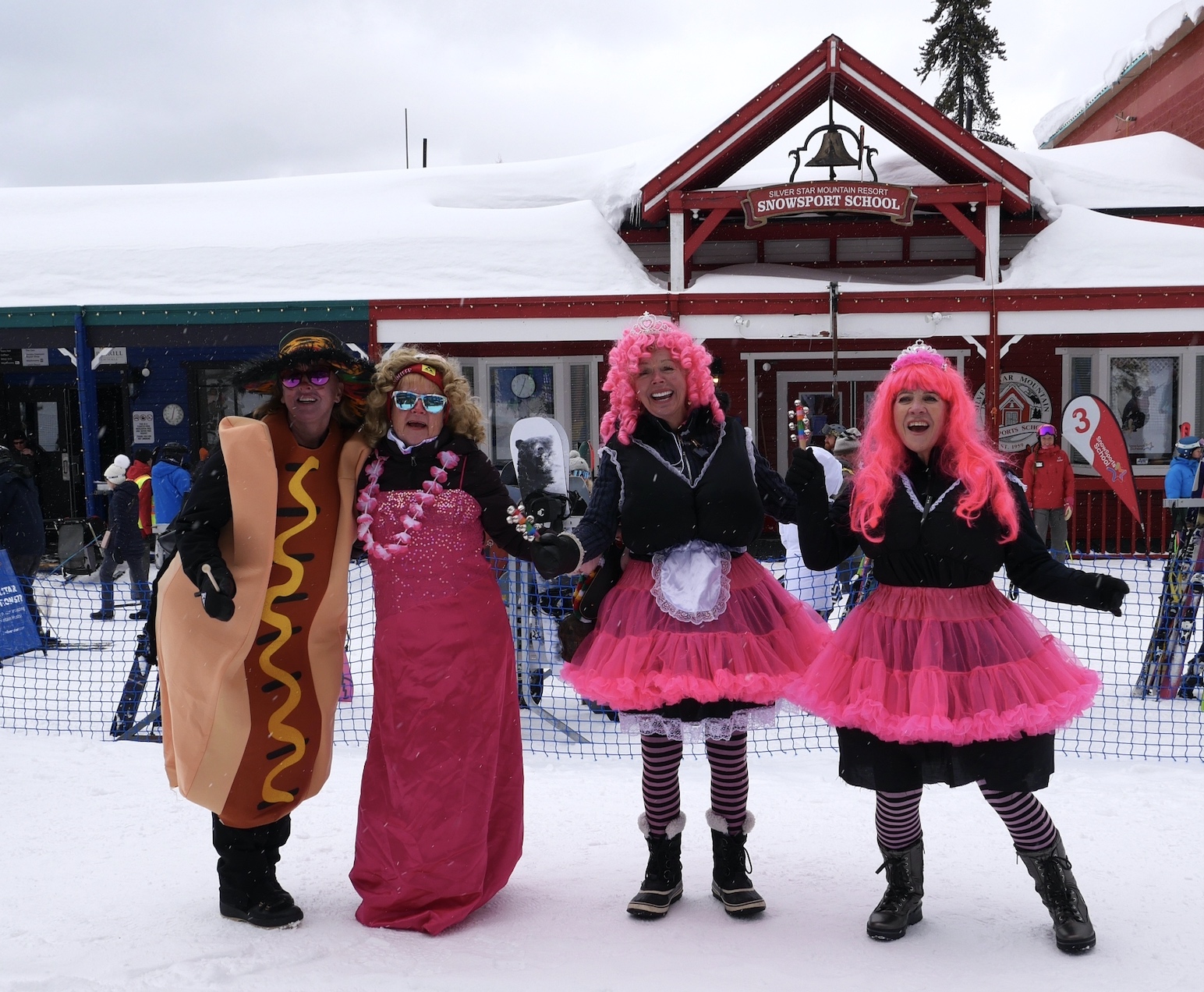
Participants who skied both days were prepared to be greeted at the finish by a dance team, lead by a hot dog. Some people were smiling because they were excited to have completed the distance, and some were smiling at the welcome.
The pandemic has greatly reduced international travel, with many skiers choosing to defer trips. S2S had one Europe-based skier registered, a Norwegian-born Swede who happened to be in Canada for a vacation.
“It’s a very fun course,” Asbjørn Grøvlen said after finishing the 40km classic. “I would recommend this one.” He went on to explain that many Ski Classics courses in Europe are just double poling and it was a nice change to stride more. Grøvlen, like a number of others, chose to do both 40km days.
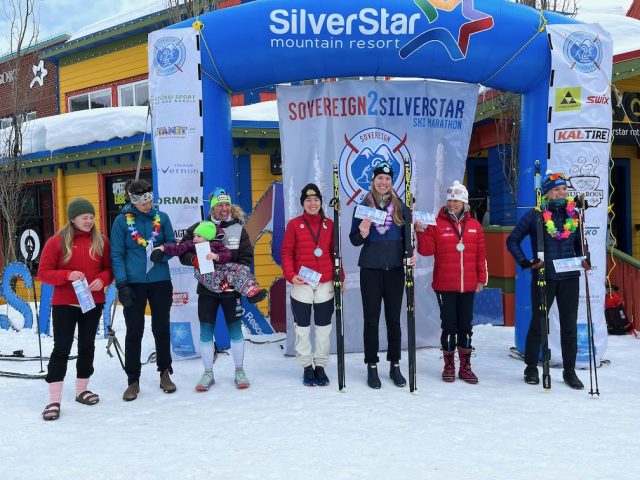
The overall podium on Sunday. L to R: Annika Hicks, Julia Ransom, Caitlin Gregg, Katherine Stewart-Jones (2nd), Dahria Beatty (1st), Laura McCabe (3rd), Anna Sellers. That is 5 Olympians, 2 biathletes, and 2 mothers.
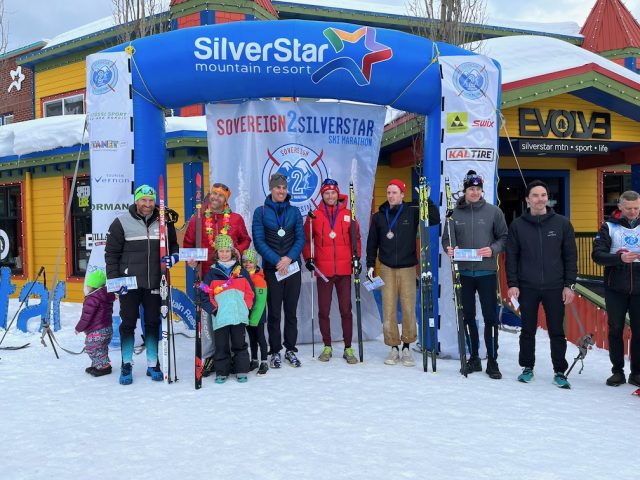
The overall podiums went to elite skiers, many of whom volunteered to present medals to the age group podiums.
Dahria Beatty was the first woman to the finish on the classic day, followed by Katherine Stewart-Jones, Novie McCabe, and Mariah Bredal. Bredal had registered late and started in the second wave, which left her 0.3 seconds behind Beatty for second place overall. Another learning moment for year two, save a few extra bibs in the elite wave for last day registrants.
Sovereign2SilverStar overall podium. L to R: Brian Gregg, Benoit Chauvet, Scott Hill (2nd), Rémi Drolet (1st), Jack Carlyle (3rd), Julien Locke, Jess Cockney, S2S Event Director.
There was a rumour on Saturday morning that Luke Jager would double pole on skate skis, as he “always does that on long classic courses.” Jager, found before the start while applying grip wax to his skis, disagreed.
Timing was essential to get the mountain views at Alder Point. (photo: Marshall Moleschi)
In a world where ‘us versus them’ often creates divisions between similar communities, it was fun to watch alpine skiers and snowboarders stopping on Main Street to cheer on nordic finishers.
“That is so cool,” one twenty-something snowboarder said to his friends. “We are doing this next year!”
Mike Mandli, an American master who has travelled the world to ski, summed up the weekend: “This was a skier’s dream. One of the best dreams ever.”
For results, more videos, Andy Newell’s waxing advice, and over 2,000 photos, visit the event page.
Katherine Stewart-Jones ready to start a skiathlon at the Olympic Prep Camp.
The Canadian Prep Camp in Sovereign Lake and SilverStar, BC prior to the 2022 Beijing Olympics sounds like a nordic skier’s heaven.
A two-week ski vacation with 100 kilometres of perfectly groomed snow. A private room above a great coffee shop (pain au chocolate!) and next door to some great beer. January weather just below freezing with enough falling snow to make every day a hardwax day. Two weeks of what locals call superhero snow. A whole lot of sunshine.
The reality was a little different: COVID stress, travel uncertainty, and outside pressure combined to make this very much a work trip, not a vacation.
The camp, which ran from January 12th to 25th, included nine athletes, the high-performance manager plus two coaches, two wax techs, a massage therapist, and a cook.
The athletes included the majority of the 2022 Olympic Team: Katherine Stewart-Jones, Laura Leclair, Dahria Beatty, Tony Cyr, Olivier Léveillé, and Graham Ritchie. Alternates Olivia Bouffard-Nesbitt and Rémi Drolet would officially join the team after the quota reallocation during the second week. Second alternate Russell Kennedy will not add to his Olympic CV and will instead go to his third Paralympics as a guide, supporting the well-decorated visually impaired athlete, Brian McKeever. The only Olympic team member not in attendance was Cendrine Browne, who chose to train in Canmore, while second alternate Jasmine Drolet returned to school at Dartmouth and earned her first collegiate wins.
World Cup coach Erik Bråten, Next Gen coach Eric de Nys, Team Lead and high performance manager Joel Jaques, techs Simon Boisvert and Félix-Antoine Vezina, massage therapist Stephen Waterreus, and Zoe the cook made up the support crew. Everyone except de Nys and Zoe are going to Beijing.
When this writer asked for last names, the response was always, “Zoe? You know Zoe.” In the end, it was revealed that Zoe is Zoë Roy, who retired from racing in 2014 as a founding member of Team Ninja. Yup, we all know Zoë.
All interviews were done on snow, from a distance, with FasterSkier wearing an N95 mask.
On Snow Training
The on-snow part of the camp was reported to have gone very well. The coaches were able to find times and trails that allowed training races that closely matched the Olympic course for profile and elevation while keeping distance from the local skiers.
The Zhangjiakou 5km course elevation range is 1639m to 1696m. The Sovereign Lake upper World Cup 5km is 1651m to 1708m, with the stadium at 1660m.
The Friday sprint course worked fairly well, despite a layout that would give any technical delegate apoplexy. As Bråten explains above, the coaches chose to do four qualifiers instead of heats to manage risk.
The Sunday skiathlon course ended up being 13km for the women and 17km for the men, with some flat sections removed from the 5km loop to better mimic the Olympic courses.
Bråten was often seen working with athletes one-on-one.
As the days counted down to departure, skiers were working on filling their bags with seconds gained: a tweak in one skate (V2) poling, free skating further on a fast flat section, experimenting with pacing on courses that simulate Zhangjiakou.
The mood of the camp seemed slightly tense, at least to a journalist who was careful not to pierce the bubble. The change on Tuesday morning, 12 hours after everyone passed the final COVID test, was dramatic, with smiles everywhere.
“It’s been fantastic conditions and just a really nice camp all around, it’s always nice when you get some sunshine,” Kennedy told FasterSkier. “So yeah, especially after a [World Cup] Period One in Finland in the dark.”
First time Olympian Rémi Drolet is all smiles after passing the final pre-travel testing.
COVID Management
COVID protocols at the camp were strict, races were more relaxed.
A positive test would be the end of one person’s Olympic dreams and a logistical nightmare for the support team. Any close contact of the infected person would not be able to travel. Any replacement person, athlete or not, would need to follow the same testing protocol. If that replacement wasn’t ready for the scheduled flight, the complexity of travel planning might be insurmountable.
In order to travel to the Olympics, the athletes, coaches, and techs would all have to pass two PCR tests less than 24 hours apart in the final 96 hours before boarding. Once at the Calgary airport, there would be another PCR test, with a fourth upon arrival in China.
Nordiq Canada chose a more restrictive plan than some other countries. Each person (athlete, coach, tech, cook, massage therapist) had their own room and didn’t enter other rooms. Meals were delivered. Grocery shopping was done by local resident, de Nys, scheduled for 7am to avoid crowds. No one entered coffee shops, bars, or restaurants. Each morning, everyone would do a rapid antigen test in their room. Athletes skied from their accommodation at SilverStar to the homologated trails at Sovereign Lake to avoid close contacts in vehicles. Only de Nys and Zoë the cook had contacts outside the bubble, and neither is going to Beijing.
The goal behind this aggressive protocol was twofold. First, to prevent exposures. Second, if one person tested positive, there would be no close contacts forced into isolation or removed from the Olympics. The two wax techs (Simon Boisvert and Félix-Antoine Vezina) inevitably had a shared bubble as they shared a private waxing room.
Was this the right answer? We got three answers to that.
Drolet found the camp harder than usual: “We were still able to ski together a little bit, but it was definitely a little bit lonely at times.”
Kennedy, entering with a mentally tough prospect of only making the team if disaster struck a friend, found the positive. “The guys have been playing, like hanging out online together… And we’ve been skiing together. So it’s separate, but at the same time, not too lonely.”
“Ask me on Monday afternoon when we get all the results back,” Jaques told FasterSkier on Sunday morning. “We’ve taken the right precautions so we’ll just see. But I think it’s looking good.”
A number of athletes mentioned feeling comfort in knowing they were doing everything possible to protect their Olympic dreams.
The system has worked. Everyone tested negative and the entire team is now on snow in Zhangjiakou.
Rémi Drolet leads out the first mass start of the season. (Photo: Peggy Hung)
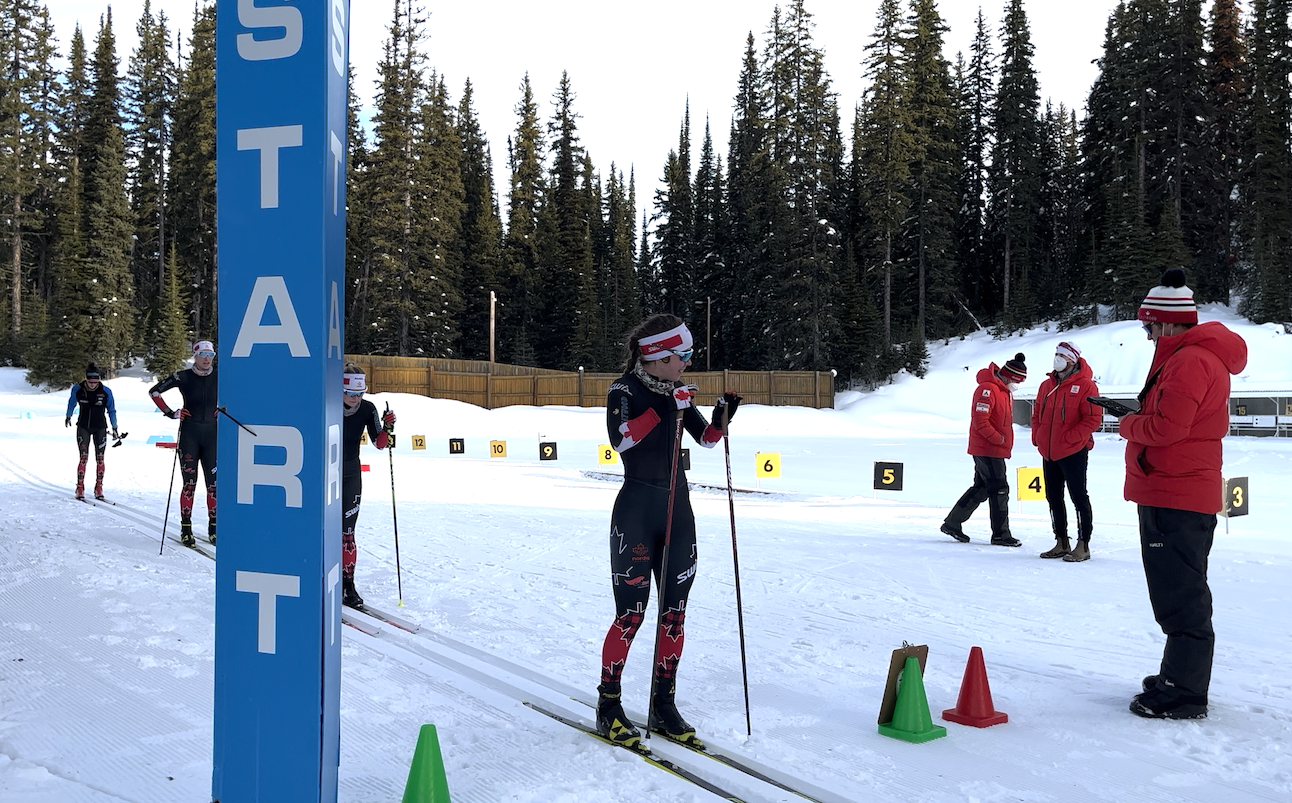
Race, rinse, repeat. The Western Canada Cup series returned to Sovereign Lake for race days 3 and 4 of the new season.
Originally scheduled for Rossland, BC, the event had to be moved after an ‘atmospheric river’ event delivered warm rain to almost all southern BC trail systems on December 1st. Sovereign Lake was the least damaged, able to hold WCC #1 and #2 on the 4th and 5th as scheduled. By December 11th, skiing conditions were much improved and the racers were primed to go again.
The organizing committee was a little less primed, with four chiefs unavailable, along with many of the 180 volunteers from the previous weekend. With some timely help from Nordiq Canada, it all came together. Next Gen coach Eric de Nys (a Vernon resident) could be seen moving V-boards with High Performance Manager Joel Jaques (from three ski areas to the south in Penticton) while Al Maddox shortened his vacation to fill in as Technical Delegate.
Despite hosting major events on the two previous weekends, the club was able to find enough volunteers to make it work.
While there was still plenty of rust on display, more athletes were getting more things right than last weekend.
Saturday: 5km/10km Classic Interval Start
The weather gods delivered one of everything for Saturday’s classic, with fresh snow, strong winds, a brief blizzard during wax testing, before settling for overcast race conditions with firm tracks that occasionally filled with dry blowing snow at -4C.
On the flat 2.5km course, there were enough skiers lapping to keep the tracks packed. This is the first time this course has been used for the open categories and it has a distinctly different feel to the traditional 5km loop. Eliminating much of the climbing, the new course turns downhill halfway up the first A-climb at the 5km mark, before skipping the second A-climb entirely.
Dartmouth’s Jasmine Drolet took the win in 17:22.0, matching her result from last Sunday with an overall win, in addition to topping the U20 list. AWCA’s Olivia Bouffard-Nesbitt was 3.0 back in second ahead of teammates Laurence Dumais in third (+47.1) and Beth Granstrom in fourth (+1:00.8).
“Definitely not my favourite race,” Jasmine Drolet told FasterSkier, despite preferring classic technique. “I tend to prefer the longer races but still good and a good effort out there.”
“I was happy with it,” Bouffard-Nesbitt explained after the race. “It was unusual for us to start so late at one [pm]. It was sunny this morning, beautiful, mild. We showed up to the racecourse this afternoon and it was blizzarding, so windy. And then it cleared up for our race. So it was fun to do 5km.”
“It’s definitely quite a bit different than the five km [course]: it’s less climbing and more flat,” Dumais told FasterSkier. “Which is in my favour, because I’m better at double polling, so it was good.”
In the men’s 10km, Black Jack’s Rémi Drolet matched his sister’s achievement, finishing in 30:37.2, edging out Foothills junior teammates Tom Stephen by 4.7 seconds and Xavier McKeever by 7.0. AWCA’s Jack Carlyle (39.2 back) and Hardwood’s Scott Hill (54.3 behind) completed the senior podium.
“It was a pretty good day,” Stephen explained. “Not a course that favours me, but I still pushed hard and I’m happy with the results.”
Asked about ski and wax choices, Stephen said “the coaches were really accommodating today because they tested my skis before we got here, because we had such a late start. So that was nice, a lot less stress than having to get here and test all the skis with the new tracks and stuff like that.”
McKeever enjoyed the ‘new’ course.
“I felt really strong with the double pole, there was a lot of double poling on this course. That really played into my favour.”
McKeever also broke down how the course skied during the race.
“Overall, there’s some good climbs. there’s two good climbs in there for sure. But once again, it’s it’s a lot of double pole. So I’d say in that sense, it’s like fairly flat overall. There’s like gradual sections, but yeah, you definitely can’t get caught off guard.”
There were 112 finishers. The smaller field was a result of only two age groups (open and U20) and road closures affecting some teams.
Sunday: 10km/15km Mass Start Free
Sunday was a great day of skiing, with snow clouds blowing away in the morning for a sunny afternoon of mass start racing on the traditional Upper World Cup 5km course that older racers know so well.
Rémi Drolet leads Xav McKeever and Tom Stephen at the end of lap 2. (Photo: Peggy Hung)
The men raced first, with a very tactical first lap before the action began on the second of three laps.
On the third lap, McKeever attacked on the ‘wall’ climb to get a gap he would not relinquish in the final 1.x km. With only one small climb left, racers need either a gap at the top of the wall or confidence in their final sprint.
McKeever took his first open win in 37:22.3, 1.2 seconds clear of fellow U20 Tom Stephen. Carlyle passed a fading Rémi Drolet to take third, 21.0 seconds behind, while Bob Thompson narrowly missed out on fourth, finishing 40.0 back.
“I was really happy with my race and how I skied both tactically and technically, so overall, [it was a] good day,” McKeever said after collecting his first senior win at age 18.
He continued that he “couldn’t really have asked for anything better from a start [to the season], but we’ve just got to keep putting in the work, keep training hard.”
Stephen, in his last year as a U20, was more philosophical.
“I’m definitely feeling a little tired,” Stephen said. “There’s a lot of racing back to back for me. But yeah, I think it went well. I’m happy with the result.”
On his approach to racing, Stephen explained how the weather factored into his race plan.
“I think I was pretty smart in the tactics part. There were a lot of people throwing down sprints halfway through trying to break away and then easing up because the wind plays a big factor into it.”
Carlyle also enjoyed the day: “It was good, super fun to ski in the pack and do a mass start race and it felt like Real Racing was back.”
“I didn’t really think too much about how to win I just kind of wanted to like make their day as hard as I possibly could,” Carlyle continued. “The way it played out was going into the second last climb, I guess it would have been the like the super steep hill [the wall], Xav just had so much speed. So much speed. So Tom and I are kind of standing still and that’s pretty impressive.”
Jasmine Drolet stretches out the group at the start of the 10km. (Photo: Peggy Hung)
Shortly after the top men finished, the women began their first mass start of the season with two laps of the same course. Jasmine Drolet strung the group out quickly, opening passing opportunities for lower ranked skiers like Bouffard-Nesbitt who would quickly join the action at the front. After the pandemic break, the points list is a much less useful guide to current performance, but today there was no difficulty to pass on the wide opening climb with room to skate four abreast for over a kilometre.
Bouffard-Nesbitt finished alone in 29:04.4.
“It was really good. I love mass starts and I’m so happy that sovereign decided to host a mass start race today,” she said. “The conditions were the best they’ve been in the last two weeks. It was a great day.”
Jasmine Drolet took second, 12.4 seconds back, followed by fellow U20 Marielle Ackermann from Kimberly in third (+21.0), and Granstrom in fourth (+26.5).
Jasmine Drolet leads a large pack near the end of lap 1. (Photo: Peggy Hung)
“It was pretty chill for the first lap,” Bouffard-Nesbitt said. “I didn’t feel that I needed to lead especially, [since] I’m pretty confident in my sprint. So I was happy just to follow and then, yeah, on the second lap, I started to have fun playing around, going to the front a little bit and pushing the downhills and unfortunately, as Jasmine might tell you if you interview her, she had a fall before the last two climbs. That was too bad and that’s where my gap opened up. I just pushed it from there.”
Jasmine Drolet did include her fall in her post race comments, reflecting on an experience that was “Pretty hard. That’s all, really hard.”
“A little bit frustrating,” Drolet continued. “I mean, I lead a lot of the race, which is not really what I wanted, but then fell and couldn’t catch up again. So a little bit frustrating, but that’s how mass starts are.”
She fell on the one tricky corner on the course, a fast hairpin that becomes challenging as the lactate builds in the legs.
The pandemic has made student life easier, with distanced exams that can be done anywhere. Easier, but not easy, with a large number of athletes needing a quiet space to write exams Sunday evening after the racing was done. Ackermann was one of those student athletes who rushed away before FasterSkier could catch up with her.
In addition to all the racing, there were bets to be settled.
Rémi Drolet explains his new purple hair to Next Gen coach Eric de Nys.
This writer entered a casual masters program mass start classic race on Saturday morning, using the same course as the elite skiers used in the afternoon. The finish times were very different, but I am still smiling days later. To twist up Joni Mitchell, “you don’t know what you’ve got til it’s back!”
It starts and ends here, in the Sovereign Lake stadium. The snowpack was 22% above normal on February 1, 2020.
A middle of the pack master would have to be an idiot to sign up to race 50km against the best skiers in North America on a FIS-approved World Cup course. The top skiers will be fresh from World Cup Finals in Canmore and competing for important titles, national team selection, and future World Cup starts. With 2020 Nationals combined with US SuperTour Finals, the field will be deep. So why is my name on registration list?
Not much climbing here. Sovereign Lake coach Greg Kilroy guarantees a big pack will hit the final climb together.
The Sovereign Lake ‘West 7.5km’ loop is easy by World Cup standards. There are no long steady climbs like Canmore. There are no unending series of steep climbs like Holmenkollen. The ‘final four’ climb at Sov requires many transitions, but doesn’t have the bite of Val di Fiemme’s A climbs. There are no tricky downhills like Whistler Olympic Park. The Upper 2.5 is easier than the Upper 5 used at Norams. The Lower 5 is flatter than the Lower 2.5 and 3.75 that were used for the 2005 World Cup. Put those pieces together and the result is a loop that flows over small undulations with only two gentle A climbs and five rolling B climbs for 1,438m total climb over 49km. There won’t even be man-made snow or a narrow ribbon of trucked in snow. For elite skiers, it doesn’t get much easier than this: Day8-FIS_7.5km
With the race loops set full width for Nationals, there will be lots of room for the lead pack to pass lapped skiers. Yes, there are two classic tracks on the right edge.
By master’s standards, the course no longer looks gentle and forgiving. Pushing past the redline for a moment too long will result in seconds lost on every subsequent transition. Failing to push over the top will cost even more seconds.
So what kind of idiot would sign up to be lapped by the very same elite skiers he has been interviewing for eight seasons and timing for even longer?
Maybe the kind who celebrates making the top half of his age group in the local loppets. The kind who expects to lose a minute per kilometre to elite skiers on loppet courses, even when those skiers are just cruising in the pack for much of the race. The kind who bemoans less than perfect skis on race day because he doesn’t have the technique or engine to push past.
Maybe the kind who can’t let go of the fact that he couldn’t get it done when he was young and had endless training opportunities. Other people simply skied faster. Pierre Harvey and Donald Farley were six years on either side of me, and they are remembered because they delivered when the opportunity was there. Harvey has nothing to prove and can have fun skiing local events. I am still trying to prove something, possibly that I still have relevance on SlowerSkier.com, where it is all about getting more time on course for your money.
Maybe the kind who didn’t get to race Nationals at his hometown club as a junior because BC decided to give starts to only the top four skiers in each age group.
At the end of the analysis, I know better. I laughed at the idea that I would ever join the Canadian tradition of having some podgy middle-aged man start the 50km to show just how big the gap to elite is. And then one sunny summer intensity day on a dusty trail with the masters group, my coach told me I should enter: “If you work hard this year, you will only be lapped once.” And then my mouth said yes while my brain was screaming no.
On April 2nd, look for me chasing that reverse podium, seven (7) times up that final four climb carrying the lanterne rouge.
This video is from April 7th, 2019, with a below normal snowpack for April. 2020 is looking to be better.
Most xc skiers are nice people, even the top racers. Does this have something to do with getting your ego handed to you in travel-sized pieces on a fairly regular basis? And if so, will I be a better person on April 3rd?
To start at Nationals, a Canadian skier simply needs a CCC license and points on the Canadian Points List, a new requirement introduced in 2019. As the CPL will be updated after the World Cup Final in Canmore, there is still time to improve your ranking, which uses the average of the best 7 Tier 2 or higher results in the last 12 months. While all races are technically open to qualified masters, only the long mass start is really friendly to older athletes (30km for women, 50km for men).
Non-Canadian skiers need active FIS points, which are automatically included in the CPL. Should Alexander Bolshunov decide to show up for a week of natural snow, he will be seeded first.
Please note that if you sign up without both a valid license and active points, the host club will thank you for your donation but Nordiq Canada will not allow you to start.
As I just renewed my license after a 36 year lapse, I will be skiing in the open category at BC Championships on the Telemark trails in March to earn some points. It is possible that the masters category will be assigned points at select Tier 2 events (as a separate wave), but the only safe bet is registering in the open category.
My three digit CCC license number looks a little out of place on the registration list where most of the athletes have numbers above 30,000.
Fun fact about aging: My retirement race was 1984 BC Championships, also at Telemark Trails. This was the first time I used two skate (aka V2 alternate in the USA, skate 3 in Scotland, and gear 4 for HC Holmberg) during a points race.
1984 was near the end of the golden age of ski racing. Classic racing had not yet been invented and the marathon skate dominated all. We were still using a short section of kick wax as that was essential to be competitive on the steeper climbs. There was no internet and no YouTube. We only saw skiers on TV every four years at the Olympics, but didn’t record it because VCR’s were too expensive for home use. There were also no mass starts other than relays.
One of my teammates, who was also one of the first victims of my coaching, was trying hard to push his limits and started us down a path to figure out a way to add poling to speed skating technique. Once we had the basics down, Joe would shout ‘Gaétan Boucher’ with a dubious French accent anytime he found a trail wide enough and firm enough to use it on. (This was just after the 1984 Olympics where a Canadian named Gaétan Boucher had dominated the speed skating events.) In this era, most courses were set by snowmobile, not snowcat, and often the only snow firm enough to plant a pole was the edge of the classic track.
It wasn’t until the final race of the season, and the final race of my career, that opportunity knocked. Joe won his age group in dominating style and I finished 5th in mine. It would have been my best result of the season, but the guys who had just barely beaten me all season started 30 and 60 seconds behind me and got the split information they needed to close the gap over the final 3km.
This new ‘out of the tracks’ skating would get a (confusing but official) name the next season and be joined by ‘one skate’ (aka V2 in the USA, skate 2 in Scotland, and gear 3 by HC Holmberg). For Christmas in 1985, Joe came back from a national team camp and taught me the final piece of the puzzle, a new climbing technique called ‘offset’, just like paddling a canoe. Suddenly, skating was possible on every steep hill and grip wax was gone forever. Best Christmas present ever.
In December, skiers have to climb the steps into the Daylodge after the race. It gets easier by February, which could be important for masters after 50km of foolishness.
Eric de Nys (left) keeping the masters motivated at the end of a ski-striding intensity workout.
VERNON, British Columbia — There are a lot of master blasters who are training hard all year. There are a lot less that progress from one season to the next. This strength program is designed to help one group of masters ski faster as they age.
The club’s regular masters program has 160 participants and is as much social as it is about learning to ski better. Its HP program is focussed on progressing to better results and has a limit of 20 skiers. At the first on-snow session early last November, de Nys set the group goal of showing significant gains at the 2019 World Masters, 15 months in the future.
The masters program is very different than the youth programs. The primary difference is that the kids show up for the scheduled sessions and don’t need videos to learn what they missed. The next big difference is that the school system trains kids to pay attention for an hour at a time. For masters, the videos never exceed four minutes in length.
For Mesocycle 1, there are two strength workouts each week.
Each workout starts with a 15- to 20-minute run/bike/treadmill/row in Zone 1.
Next there is a warmup series of simple mobility drills, including high forward and backward skips, side shuffles, and hip mobility.
The meat of the workout is the Day 1 and Day 2 exercises, followed by a Zone 1 cool down.
The order and number of reps are laid out in this spreadsheet, but as de Nys explains in the intro video, one size does not fit all. Very few of the HP group are able to do this program unmodified. Check out these videos on progressions.
Sovereign Lake would like to invite you to the 4th Annual Spring Fling Ski Camp, taking place May 10-13th, 2018.
There is still over 2m of snow as of April 26th and we are anticipating even better conditions than last year. Expect 20+ km of ski trails to be open and groomed daily. The image below is from our webcam on April 26th. Watch the weather at this link. https://www. sovereignlake.com/info/webcam/
Trails are open from 7am to 2pm each day and there will once again be access to the Altitude Training Centre’s strength and conditioning room at SilverStar.
In addition, we will be featuring a new race format on Sunday! “The Lightning Round” is a new format Enduro Race that will include 3 timed downhill sections including Aberdeen. Check out the website for a map of the course. It’s going to be a doozie. Bring your speed skiing helmet! You have one of those right??
This event is NOT included in a season pass nor can you use Punch Passes for this event. All registrants must pay online by the registration deadline in order to take part. Prices increase by $10 for multi-day passes on May 4th.
Not interested in racing or focussed on training? That’s fine with us. Come up for a ski a brag to your friends about skiing corduroy in May. We are open to everyone.
Come join us for a great late spring ski experience. We can’t wait to see you!
Crust skiing on April 17 in Chugach State Park, at the edge of town above Anchorage, Alaska. (Photo: Gavin Kentch)
This article has been updated with additional information on pro skiers who volunteered with Skiku, and additional pictures from Montana and New York.
* * *
It’s the last week of April. Skier New Year, May 1, looms next Tuesday. It’s roughly six months till the presumptive first race of the 2018/2019 season, seven till the first World Cup weekend. Whether you’re a pro or an amateur, whether you’re targeting your first World Championships or your first Birkie elite wave, now is the time to start thinking about setting goals and writing training plans.
For a certain subset of athlete, those spring training plans still involve skiing. On snow. In some cases, really good snow, in surprisingly wintry weather.
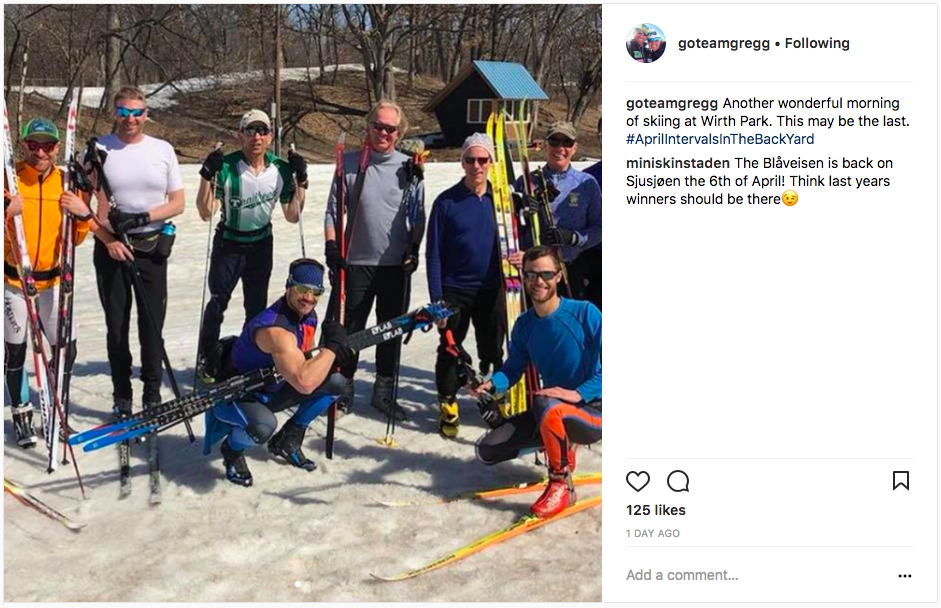
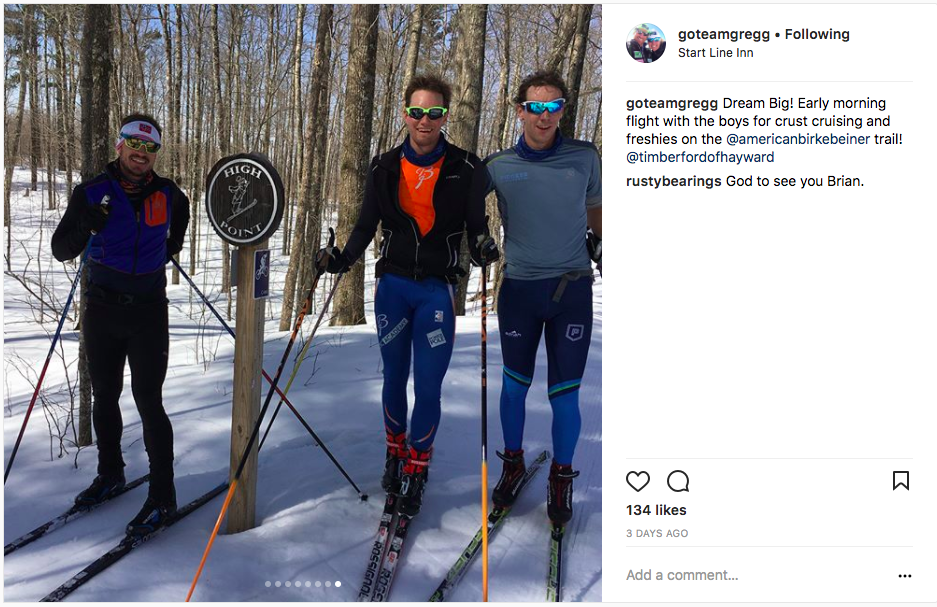
In honor of the last week of the offseason, please join FasterSkier as we channel our inner Us Weekly and flit through an extremely unscientific social-media roundup of those athletes who are still on snow, arranged in very approximate order of most to least surprising to be skiing at this time of year. (Actually, it’s only the Midwest and Vermont where it seems somewhat surprising to still have skiable snow in late April; no offense is intended to anywhere on the list after that.)
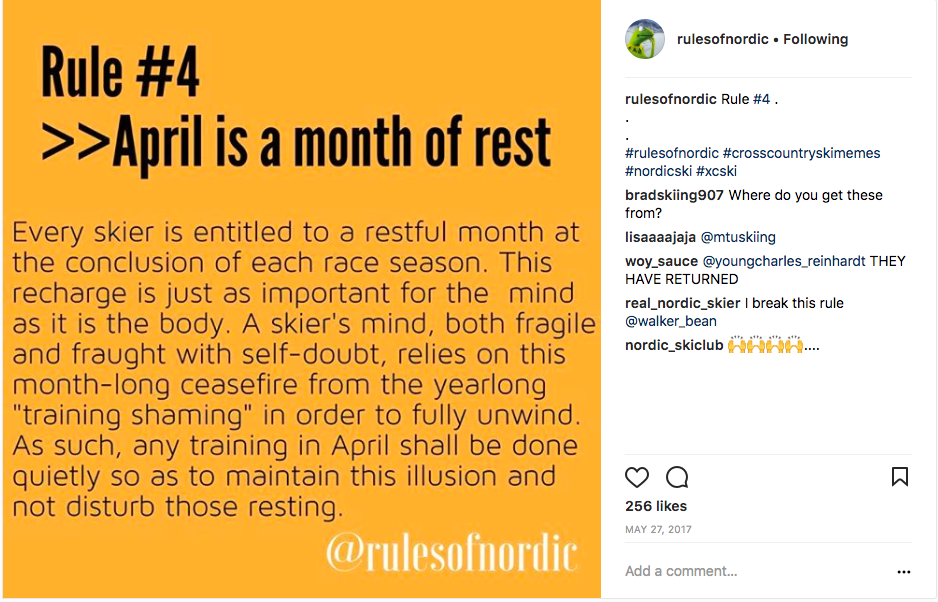
And before we begin, a quick note on methodology: This social media roundup is by definition limited to those athletes who are not only currently out in the snow, but who are also posting about it on social media. This second criterion threatens to bring your average recovery-month athlete into conflict with what has been codified as Rule of Nordic No. 4, “April is a month of rest.”
So, caveat lector: Just because your favorite skier has been taking a well-deserved break from finding and curating Instagram-worthy content for your enjoyment, this doesn’t mean that they’ve been sitting on their butt since Spring Series. They just might not want to tell you what they’ve been up to, and/or they wish to avoid damaging the fragile psyches of their colleagues.
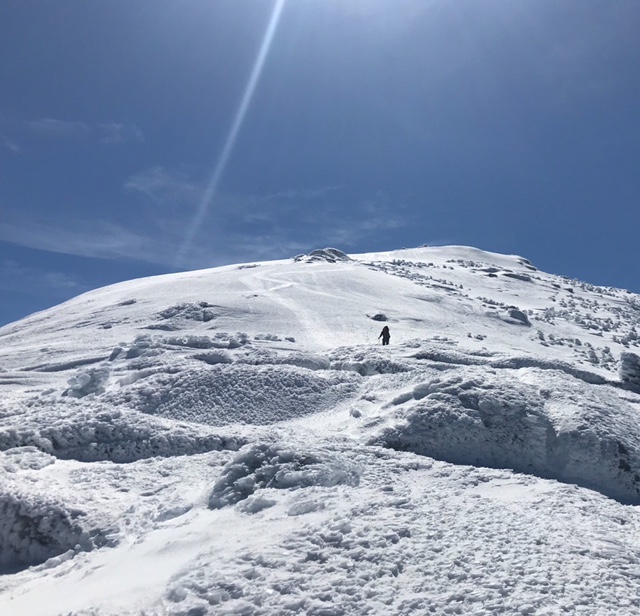
Skiing on New York’s highest peak? Check. David Hochschartner of the North Country School in Lake Placid sent us this photo of backcountry shredding on Mount Marcy, the highest point in the state at 5,343 feet above sea level.
“Monday skiing from bottom to the summit of Mount Marcy in New York,” Hochschartner wrote in an email to FasterSkier on Wednesday. “Over 3500′ vertical … backcountry skiing does not break rule #4 because it isn’t training, it’s just fun!”
Backcountry skiing near the top of Mount Marcy in New York’s High Peaks region on Monday, April 23. (Photo: Tim Ely)
The mid-April Midwest blizzard was notable, to be sure. But was it historic? Yes, says Ari Ofsevit, who now lives in Boston but was formerly the source behind Twin Cities XC Commentary and who remains the one-man operation behind the indispensable BirkieGuide.com.
Here’s Ofsevit with some historical meteorological perspective:
Basically, the current weather in the Twin Cities is pretty unprecedented. The only other similar year was 1975, when there was at least 3″ of snow on the ground in MSP for 11 days in April (this year had 12), but that year it was an old, melting base that mostly fell in late January. This year will set the following records:
* Most days with at least 3″ of snow on the ground in April (skiable snow): 12
* Most snow in April: 26.1″
If the current forecast to hit the 70s this weekend holds, it won’t wind up the coldest April on record, but will likely be in the top three. But it’s a good combination of cold and snow, which hasn’t been seen to this degree before.
The average year has the snow depth dipping below 3″ around March 1, so it’s an extra month and a half of winter.
Vermont
There’s a lot of snow at Prospect Mountain in Woodford, Vermont, too. (“Getting 80″ in a week in March didn’t hurt,” Ofsevit notes.) Here’s a stunning screenshot from the conditions report for Tuesday, April 24 (just offscreen is the current temperature, 69°):
Dartmouth skier Adam Glueck skied 50 k there on Sunday, describing conditions as “50+ F and transformed.”
Montana
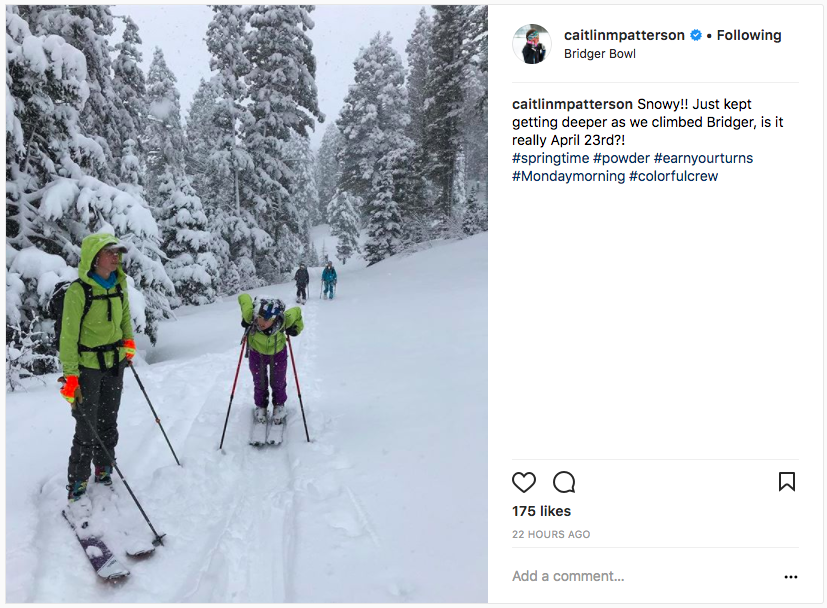
Effective Tuesday morning, they were still grooming some nordic trails at Crosscut Mountain Sports Center (formerly Bohart Ranch). Pictures of nordic skiing there are hard to come by right now, so here’s a screenshot from Caitlin Patterson’s Instagram page showing backcountry skiing at adjoining Bridger Bowl on April 23 in fresh powder:
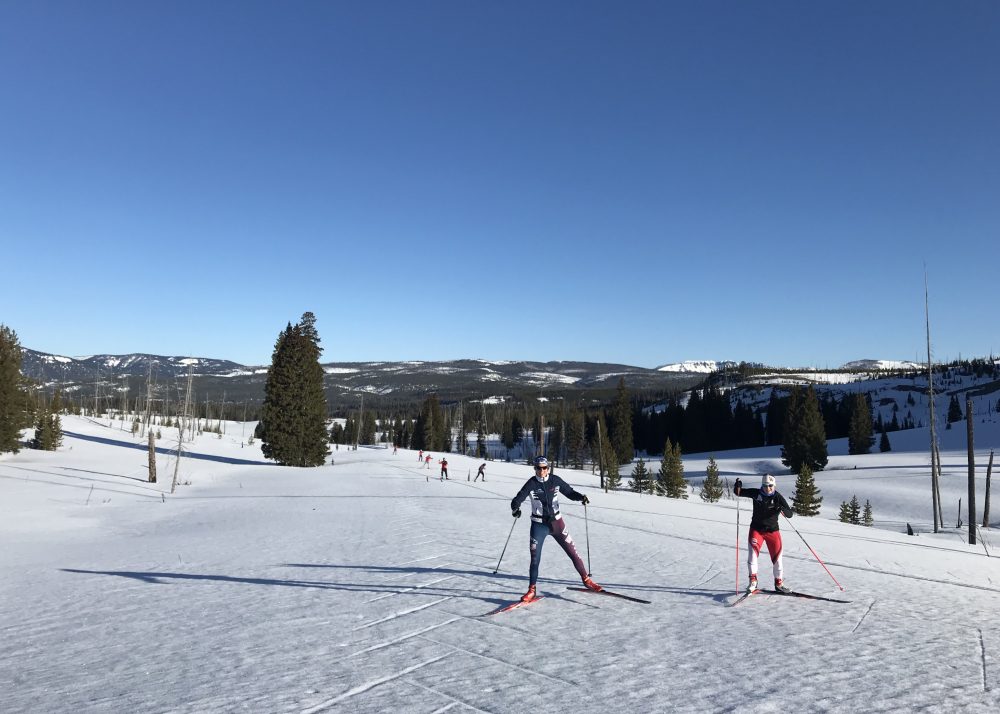
And from two days before that, here’s some prime crust skiing at Fawn Pass on Saturday:
Crust skiing at Fawn Pass, outside West Yellowstone, Montana, April 21, 2018. (Photo: Caitlin Patterson)
Canada
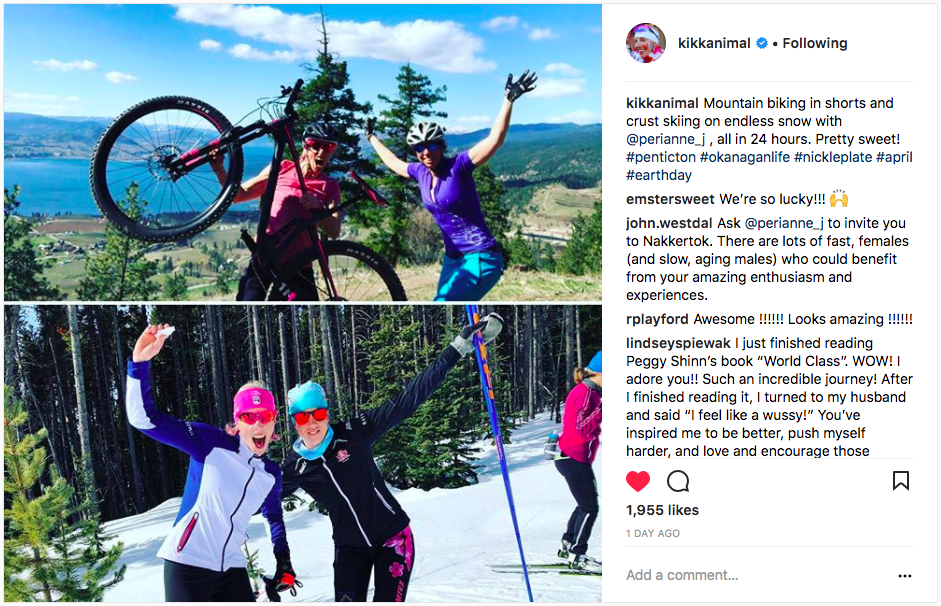
Recently retired American skier Kikkan Randall doesn’t seem to be suffering from her move to Penctiton, B.C., judging from Sunday’s shot of crust skiing with former Canadian World Cup racer Perianne Jones:
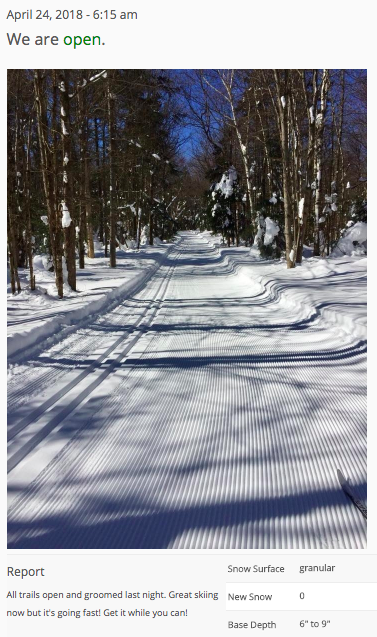
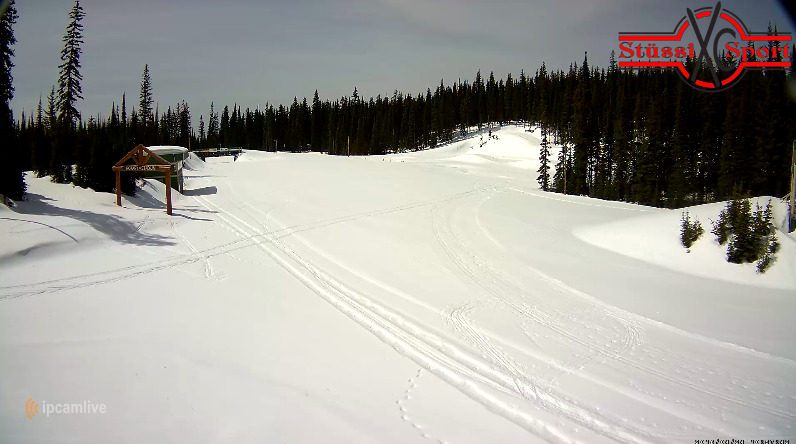
And 100 kilometers to the north, Sovereign Lake Nordic Centre isn’t lacking for snow, either. Here’s a screenshot from the webcam as of Tuesday morning, showing impeccable coverage:
That’s a base of 256 centimeters, or over eight feet (!) in American, according to a current conditions report. Sovereign Lake is closed to official skiing at present, but reopens from May 10-13 for its Spring Fling Ski Camp.
Oregon
Mt. Bachelor currently has a base of 85″ at 6,300 feet near the base of the alpine area, which is somehow less than Sovereign Lake but still, you know, more than seven feet of snow. Here’s the nordic grooming report from Tuesday morning:
There’s still a lot of snow in Alaska right now. Maybe not at sea-level Anchorage, which is staggering toward spring with a series of high-30s, mid-40s raw and windy days culminating in snow squalls Tuesday evening – Kincaid is down to the dregs of a snowmaking loop by this point, and formal grooming there ended last weekend – but pretty much everywhere else. This reporter found fresh snowfall and blowing spindrift at 2,200′ at the edge of town Monday morning, and most places higher than that are still snow-covered. There is over five feet of snow at Hatcher Pass, and temperatures there remained below freezing even as it rained at sea level on Tuesday. The Mat-Su Ski Club should presumably once more be grooming through mid-May with ease.
Kequyen Lam skiing at the Sovereign Lake Nordic Centre on Jan. 19, three days before he was officially named to the Portugal Olympic team. (Photo: Raj/theprimaldesire.com)
VERNON, B.C. — In May of 2015, a new skier turned up at the Sovereign Lake snow camp. He struggled to skate up small hills and fell down often. In the coming week, that same skier will represent Portugal at the 2018 Winter Olympics in PyeongChang, South Korea.
At first glance, Kequyen Lam seemed like a typical Canadian nordic newbie. Great lateral balance combined with regular falls forward and backward revealed his alpine background. Six months later, Lam turned up at the Sovereign Lake NorAm with intermediate technique, much-improved fitness and a total determination to recover from a bad cough in time for the distance race. Asked by FasterSkier to explain the shocking improvement over the summer, he said, “I used to be a snowboarder. And I worked hard.”
Fast-forward to 2018 and Lam, 38, has a FIS ranking that created an Olympic quota spot for Portugal. The journey was anything but simple, both as a skier and as a dual citizen.
FasterSkier caught up with Lam at the Sovereign Lake Nordic Centre on Jan. 21, one day before the official announcement of the 2018 Olympic quota allocation.
“I’m a united-nations individual. I would say that I’m proud to have the entire heritage that I do have, the history. I’m super proud that my parents are boat people, refugees.” — Kequyen Lam, 2018 Olympian
Becoming A Nordic Skier
A bit of Googling shows that Lam’s casual reference to snowboarding wasn’t the whole truth. He competed at the 2013 Sochi Snowboard World Cup and was on track to qualify for the 2014 Olympics in that sport. A season-ending crash in Austria resulted in a shoulder injury that stopped that dream and changed Lam’s path.
“Everything was going super well, but at this track, something mentally wasn’t right,” he recalled. “I was in a state of fear: fear of getting hurt, fear of injury. Physically, I believe I was ready, but mentally, it was tough.”
After the end of his snowboarding dream, Lam worked in Golden, B.C., as a pharmacist.
“I kind of moved on with my life, lived in Golden, did the whole career thing, did things for fun,” Lam explained. “I’m just the type of person where doing things for fun isn’t enough.”
Lam’s path into cross-country skiing started less than three years ago, at age 36, with Paralympic athlete and friend Tyler Mosher, who told Lam to “talk to Maria.”
“I talked to Maria Lundgren, and she forwarded me to Tony Chin,” he said of Lundgren, a British Columbia Ski Team coach, and Chin, one of the head coaches at the Nordic Racers Ski Club in Vancouver.
Through Chin, he met Ryan Olson, a masters skier.
“Ryan Olson is pretty hardcore guy when it comes to skiing,” Lam said. “He is dedicated and he gives ‘er hard. That was the reason I was able to learn the beginning steps of cross-country skiing.”
Olson connected Lam with Matt Liebsch, an American Birkebeiner champion and competitive American skier who organizes an annual camp at the Haig glacier near Canmore, Alberta. Lam spent three days there with Canadian Olympians Dasha Gaiazova and Ivan Babikov before training with Liebsch’s group on the glacier.
“I spent ten days total up at the Haig in 2015, and that’s when I learned how to ski, how to skate ski,” Lam explained.
His introduction to nordic skiing took him through a who’s who of Western Canadian skiing in just his first three months of the sport. From Mosher to Glenn Bond (Lam’s current coach), there was and is a large community of people who help skiers progress. For Lam and the Olympics, progress is measured in FIS points.
“The magic points! The first races happened in Finland,” Lam explained. “Last year, I went to Finland, I did a couple races there. I scored some good points there. And then there were some [rollerski] races in Columbia in December of this year where I got the majority of my points. It was actually those races that got me enough points to get under the 300-point standard to meet the Olympic qualification criteria.”
Representing Portugal
How does a Canadian come to have dual citizenship with Portugal? The story starts in Asia.
Lam’s grandparents immigrated to Vietnam from China before being driven out by the Indochina War (a 31-year Vietnamese civil war which bled over into Cambodia and Laos). When the war ended in 1975 with the defeat of the South Vietnamese government, Lam’s parents returned to their noodle business. The new Socialist Republic of Vietnam was not forgiving to groups that were believed to have supported the losing side. In 1978 and ’79, around 450,000 Vietnamese of Chinese ethnicity were expelled or escaped from Vietnam. Lam’s parents left as ‘boat people’, spending a month on an open boat before landing in Macao. Lam was conceived and born in a refugee camp in Macao in 1979, which was then a Portuguese colony, before being flown to Canada at the age of three months to live with a host family in Abbotsford, British Columbia.
“My grandfather on my mum’s side, they had made it to Abbotsford from Hong Kong,” Lam said. “The family split up entirely. [My grandparents] went to Hong Kong and they made their way to Abbotsford, and when they found out that we were coming over, they went to one of the churches in Abbotsford and found a family to take care of us when we got there. I mean, the Canadian government would have figured that out, but [my grandfather] wanted to make sure that the people that were going to take care of us were gonna be good people. That’s what he did. We were super, super fortunate.”
At 27, Lam started the process of connecting with his family history.
“I contacted the [Portuguese] consulate in Vancouver, they contacted the hospital that I was born in in Macao, and sure enough my name was there,” he said. “I get a letter in the mail, all in Portuguese, I had no idea what it meant.”
That all happened in 2006, the year he started pharmacy school.
“I took a year of Portuguese, I enrolled in two semesters, learning how to read and write, how to understand,” he said. “Then I spent two months in Portugal, travelling all over the coast, surfing. I did some volunteer work in a pharmacy in Faro, for a few days, just to see what it was all about.”
The Portuguese media has connected with Lam’s story and a part of Portugal’s colonial history. Their country has a second representative in PyeongChang, alpine skier Arthur Hanse, whose parents emigrated from Portugal to France. Lam was selected to be the flag bearer at Friday’s Opening Ceremony.
According to The Portugal News Online, the last time Portugal sent more than one athlete to the Winter Olympics was in 1988 when its four-man bobsled team qualified. That team competed against the famous Jamaican bobsled team and finished last in the final, while Jamaica did not finish.
“I’m a united-nations individual,” Lam said. “I would say that I’m proud to have the entire heritage that I do have, the history. I’m super proud that my parents are boat people, refugees.”
The Olympic Dream
Lam is one of many who dream of representing ‘small nations’ at the Olympics: athletes who work together to build a worldwide community and inspire others to chase their dreams.
“For two and a half years, nobody really knew what I was doing,” he said. “They knew that I was skiing, that I was passionate. That was 100 percent, but there was a purpose behind it, and that purpose was to make it to the Games in 2018. And tomorrow [Jan. 22] is judgment day.”
The ‘big nations’ in nordic skiing have big solutions. From dedicated wax teams in country-specific waxing rooms to physio staff to multiple coaches, the support is total. The ‘small nations’ live in a different world, sharing wax rooms among multiple countries and relying on the wax companies and ski companies for testing.
Team Portugal has Lam, supported by coach (and Atomic ambassador) Glenn Bond.
“What we’re going to do is we are going to see if Atomic will look at skis, wax skis and get everything dialed for training days and the race day,” Lam said. “I think that’s the best route to go. They’re testing skis every day, and they know what’s going to be fast.”
Like many of his peers, Lam has qualified for one event: the 15-kilometer freestyle individual start next Friday, Feb. 16. The people who have met him on his journey will be celebrating. You can follow Lam on his website or Instagram @kequyenlam.
The show will go on in West Yellowstone, Montana. After organizers of the Yellowstone Ski Festival (YSF) announced in an e-blast on Monday that the West Yellowstone SuperTour, set for this coming weekend, was canceled due to “damage done to the snowpack from the significant rainfall over the past few days,” it’s back on — according to a YSF press release on Tuesday.
“After much deliberation, alternate planning, checking and re-checking weather forecasts, and some more deliberation, the West Yellowstone Organizing Committee, Coaches, and US Ski & Snowboard officials, the decision has been made to hold the Super Tour openers in West
Yellowstone,” the release stated. Robert Lazzaroni, U.S. Ski & Snowboard’s nordic domestic program director, confirmed the races would be held in West in an email to FasterSkier.
As of Tuesday, the snow in the stadium and race course at the Rendezvous Ski Trails were suitable for 1.3-kilometer freestyle sprints to be held as planned on Saturday, Dec. 2, according to the release.
Sunday’s classic races (originally supposed to be 10/15 k classic mass starts) are another story. Organizers are considering four race options, the first three of which are classic races.
“On Saturday, December 2, the powers that be and the powers that ski will meet to decide on one of the following options for the race scheduled for Sunday, December 3,” the release stated, while listing the following:
“A. Classic Distance Mass Start Super Tour
a. We need 10 cm of natural snow to make this happen plus some help spot shoveling
B. Classic Distance Interval Start on homologated trails and with the Super Tour designation
a. We need 6-7 cm of snow to make this happen plus some spot shoveling
C. Classic Distance Interval Start on Dead Dog Super Tour
a. We need 4-5cm of snow to make this happen
D. Skate Distance Interval Start NOT A Super Tour, NRL with prize money
a. If we do this the Super Tour will move to Silver Star on Friday Dec 8th or Monday Dec 11th with the preference being on the 8th”
After this weekend, the SuperTour circuit will head north to link up with Canada’s NorAm opener as scheduled at Sovereign Lake near Vernon, British Columbia. Sovereign is set to host classic sprints and 10/15 k freestyle NorAm/SuperTour races Dec. 9-10.
If there’s no classic distance event in West this weekend, SuperTour organizers will aim to hold a classic distance mass start at Sovereign on Friday, Dec. 8. And if Dec. 8 doesn’t work, they’ll move it to Monday, Dec. 11.
“The West Yellowstone OC will meet tomorrow morning to begin the process of scouting for snow to harvest. An announcement will be made about a meeting time and plan of attack,” the release stated. “An agreement has been made to keep the race courses closed to preserve the snow as much as possible. Please respect this closure and keep off the course. We will do our best to get as many kilometers groomed as we can and will attempt to groom more on the Plateau Road. Keep your eyes on the daily grooming reports for the most up-to-date trail conditions.”
As of Wednesday morning, there was no rain in West Yellowstone’s forecast, but rather a chance of snow showers on Wednesday, Saturday and Sunday.
FIS Race Results
Last Saturday, Nov. 25, season-opening International Ski Federation (FIS) sanctioned races were held on the Rendezvous Trails, with Caitlin Gregg (Team Gregg) winning the women’s 5 k freestyle and Kyle Bratrud (CXC Team) topping the men’s 10 k freestyle.
Gregg won the individual start by just 0.9 seconds over Caitlin Patterson, of the Craftsbury Green Racing Project (CGRP), in 12:01.0 minutes. Petra Hyncicova, a University of Colorado Boulder (CU) senior from the Czech Republic, placed third, 5.6 seconds back.
Erika Flowers, of the Stratton Mountain School (SMS) Elite Team), finished fourth (+11.1), and Christina Rolandsen, a CU junior from Norway, took fifth (+19.7). Another Norwegian Anne Siri Lervik (Team Asker) finished sixth (+21.2), Mary Rose, of the Sun Valley Ski Education Foundation (SVSEF) was seventh (+28.0), Sydney Palmer-Leger (UOP Sports Clubs) was eighth (+32.5), Felicia Geisor ninth (+33.8), and Corey Stock, of the Bridger Ski Foundation (BSF) 10th (+41.1) out of 38 women.
In the men’s race, Bratrud edged Rogan Brown (SVSEF) by 0.6 seconds with a winning time of 21:32.0. Sun Valley had two on the podium and three in the top four with Kevin Bolger in third (+3.7) and John “Jack” Hegman in fourth (+8.7). Karsten Hokanson, a Montana State University junior, placed fifth (+12.2), Brian Gregg (Team Gregg) was sixth (+15.5), Akeo Maifeld-Carucci (Bend Endurance Academy) seventh (+22.9), Ben Lustgarten (CGRP) eighth (+30.3), Cole Morgan (SVSEF) ninth (+32.8), and Silas Talbot (BSF) 10th (+37.8) out of 49 men.
Sovereign Lake’s XC105 trails on November 23rd, 2016.
(Press release)
INVITATION TO PARTICIPATE in the first edition of the XC105 Nordic Ski Festival in British Columbia!
From November 23rd to 26th, 2017, the XC105 Nordic Ski Festival will take place at Sovereign Lake Nordic Club and SilverStar Mountain Resort Ltd in Vernon, BC. Renowned for their exceptional ski conditions, especially at the beginning of the season, the two ski resorts will be jointly hosting activities that will appeal to all, whatever your level: beginner, intermediate or elite skier.
Fun is our mission! During the Festival, you will have the opportunity to ski on the joint trails of Sovereign Lake Nordic Club and SilverStar Mountain Resort Ltd and to participate in fun activities!
Whether you choose the 4 day or 2.5 days package, you will have the choice to participate in one or several activities such as:
Night skiing/dancing with DJ and headlamp relay
BeerCanBeiner (Ski a short “race course” with beer tasting stations)
Turkey Trot (Point to point ski with chocolate tasting stations)
Ski the World Cup course with an Elite skier
Biathlete for an hour
Informal Time Trial
Yoga
Event costs
$99 includes 4 day ski pass (dual area), Friday night dance party and night skiing and Informal Time Trial.
$55 includes 2 days (Sat-Sun) ski pass (dual area), Friday night dance party and night skiing. Additional fee « A la carte » per chosen activity. See Event costs on our website at https://www.sovereignlake.com/event/november-nordic-festival/
Schedule of activities and friendly races:
Thursday November 23rd 7pm, SilverStar village
Turkey Dinner A catered dinner, complete with motivational ski videos.
Friday November 24th
Informal Time Trial 10am, Sovereign Lake Stadium. Take an early opportunity to put on a bib and raise your heart rate in a time trial with a twist.
Ski Yoga4pm SilverStar village Spend a gentle hour restoring mobility after a hard day’s skiing in a yoga session led by a fellow nordic skier with experience in ski-specific yoga.
Night skiing with music and a headlamp relay7pm Sovereign Lake day lodge. It is a proper party this time. The night lodge has music and dancing, the lights are on for night skiing, and the relay is heading out into the dark trails.
Saturday November 25th
Ski demos, on snow starting 9am. Sovereign Lake Stadium
Ski the World Cup 5k loop with an elite skier, learning pacing and transition strategies to gain time, while supporting Olympic dreams. Top active athletes are taking time from their preparation for the NorAm/ SuperTour series to lead groups of five skiers. 100% of the money from this event goes directly to these athletes to support their training and preparation. You can choose between skate or classic technique, World Cup or world masters course, and English or French language for your two-hour session.
Be a biathlete1pm or 2:15pm, Sovereign Lake biathlon range
Have you ever wondered why biathlon is so popular in Europe? Spend an hour learning the basics from our coaches, including learning to shoot with your skis on, and then test your skills in a ‘sprint’ race. These are small group lessons.
Named after the famous Norwegian Birkebeiner ski race, this event involves skiing short distances between craft beer sampling stations.
Sunday November 26th
Turkey Trot9 am On trails This is a point to point ski with chocolate stations starting in the Sovereign Lake stadium and finishing at the SilverStar Village Main Street.
Ski demos, on snow starting 9 am at Brewer’s Pond, SilverStar
Early season skiing at the Sovereign Lake Nordic Centre on Oct. 14, 2017. (Courtesy photo)
When you think of skiing in Canada in October, Canmore’s Frozen Thunder is probably one of the first places that comes to mind. There are more options and some snowmaking that might surprise you.
This month, Canadians are skiing on natural snow, machine-made snow and farmed snow. We know skiers are already out and about in Alaska and other parts of the U.S. as well, which is why we want this year’s early season “Where The (Skiable) White Stuff Is” to compose of reader submissions. If you know where there’s November or even October skiing in the U.S. or Canada, please write us with details (When does it open or how long has it been open? How many groomed kilometers are there? Is there snowmaking? Any special events planned, like American Thanksgiving camps? Anything else we should know?)and original photos at info@fasterskier.com with the subject line: “Fall Skiing”. Deadline for submissions is Nov. 3.
To get the ball rolling, FasterSkier’s Gerry Furseth checked in with several nordic venues across Canada. They’ve already celebrated Thanksgiving, and full-on skiing is just around the corner.
Frozen Thunder
Canmore has started building Frozen Thunder for 2017. This is what it looks like with five days to go. (Courtesy photo)
The action starts on Oct. 21 with some changes for the eighth season. There will be a bigger hill as requested by the national teams and a new emphasis on avoiding exposed south-facing slopes.
The Canmore Nordic Centre (in Canmore, Alberta) is an unusual venue, one of the select few that has machine-made snow, farmed snow and natural snow.
“There is obviously an issue [with manmade snow] around warmer temperatures,” Area Manager Michael Roycroft told FasterSkier. “Last year is a good example where most of November was too warm to make snow, and that’s where Frozen Thunder comes in. That’s why we have our storage option, that allows us to essentially have snow no matter what.”
Frozen Thunder is funded mostly by national and provincial ski organizations and the focus is on providing training opportunities for high-level competitors. The snowmaking has a broader focus.
“The natural snow is obviously helpful, and it covers the rest of our trail system that’s further to the west and higher up, but it wasn’t for machine-made snow in Canmore and the nordic centre, we simply would not be able to run as a nordic facility,” Roycroft said.
Machine-made snow covers 30 kilometers, leaving 40 k dependent on natural snow.
A big job requires big machinery. (Photo: Canmore Nordic Centre)
Whitehorse
Whitehorse ski trails on Oct. 15, 2017. Another 5 centimeters was needed to set track. (Photo: Alain Masson)
When you think of Whitehorse, you probably don’t think of snowmaking. But Cross Country Yukon’s Alain Masson does.
“In the past, we often had snow available for skiing for our more advanced skiers, but it was not available to everyone,” Masson wrote in an email. “This year, our developing skiers will all have access to some early skiing in good man made snow conditions a month earlier than usual.”
Much of the early season skiing in Canada is not intermediate friendly. Thin snow, tripping hazards and travel to elevation create a barrier to less advanced or less committed skiers. The Whitehorse Cross Country Ski Club is using snowmaking to make the early season more inclusive.
The new snowmaking equipment will be used for the first time on Oct. 22.
Testing the new gun in June 2017. (Photo: Alain Masson)
Sovereign Lake
There is a difference of opinion on what season Oct. 14 belongs to. The bikers might have chosen fat bikes over plus bikes if they had realized how much snow they would see on their epic ride from Vernon to Lumby, B.C. (Photo: Gerry Furseth)
The Sovereign Lake Nordic Centre (near Vernon, British Columbia) is well known for November skiing and NorAm races. The season is limited not by loss of snow, but by biking conditions in the valley below.
“As soon as Sovereign gets snow in the fall we want to conserve as much as possible by rolling and track setting,” General Manager Troy Hudson wrote. “All of our early season grooming is done with Quads and snowmobiles to ensure a firm and supportive snowpack for the remainder of the season. Our high elevation (1,680m) and typical higher humidity in late October provides unpredictable weather that can often result in snowstorms of 10-15cm at a time.”
With 20 centimeters of fresh snow, the club set about 5 k of classic track on Oct. 14. While certain trails are open for preseason skiing, the nordic centre officially opens Nov. 10 for pass holders and day ticket sales.
Menihek Nordic
Menihek is another former national-team favourite destination that has since been replaced by Frozen Thunder. Located near Labrador City, Newfoundland and Labrador, it is a less-visited gem. While the Menihek Nordic Ski Club hasn’t received much snow to date, it is a safe bet that by the end of October they will be setting upwards of several kilometers of track.
On Oct. 12, a dusting of snow was seen at the lodge. (Photo: Gerry Rideout)
The BC development team getting ready to ski out of the biathlon stadium at Whistler Olympic Park last weekend.
While most people have moved on to other sports by May, the more obsessive skiers are starting the new training year on snow.
Canada’s “first” cross-country ski “races” of the 2017/2018 season were held on May 6. “First” because, while we haven’t exhaustively researched this, it was the first Saturday after May 1, which is the traditional new year for the Northern Hemisphere. “Races” is also a bit misleading as most athletes were viewing the events as an opportunity to do some intensity.
Here then, in the order which photos arrived, are the places where people are skiing in May. Did we miss one? Share in the comments below or email photos with caption and credit info to info@fasterskier.com.
Sovereign Lake, Vernon, B.C.
The Sovereign Lake Nordic Centre (SLNC) re-opened from May 4 to 7 for the Spring Fling camp and the “SLNC 1st Annual Pushups Classic Time Trial” race. The May camp has been running for years, but was moved to earlier in the month to ensure prime conditions. A number of clubs brought athletes out for technique lessons and long snow sessions. Canmore Nordic broke the pattern by focussing on low-elevation training with shorter training sessions. As the Canmore athletes live at 1,400 metres above sea level, the opportunity to train at 400 metres was more exciting than skiing at 1,700 metres.
The first day of camp on May 4 was a warm one, but the 16 k of trails held up well.
Julien Locke (Canadian National U25 Team) disappearing into the mist.
Three generations of Williams (Madeleine Williams, her baby and her parents) enjoying the sun and snow.
Canmore Nordic found bluebird skies and fresh tracks.
Graham Nishikawa smiling early on the first of four long ski days for him.
+17 C on Thursday, May 4, 30mm of rain on Friday, May 5, fresh snow on Saturday morning, and this salamander doesn’t care because he skipped the time trial.
SLNC General Manager Troy Hudson (second from left) explaining the race rules to Gareth Williams, Annika Richardson and others on May 6 at the Sovereign Lake Nordic Centre.
If the stairs are reappearing, it must be spring!
Sovereign Lake closing day: May 7, and the last set track here until November. (Photo: Troy Hudson)
Canmore, Alberta
The Canmore Nordic Centre lost its snow at the end of April, but Sunshine Meadows just a short drive west in Banff National Park hosted a large group of skiers starting May 9. Ivan Babikov is leading a training block for the Canmore-based national team members, Chris Jeffries has the Alberta World Cup Academy crew, and a number of other groups are there as well.
OK, not in Canada, but Canadians Dahria Beatty and Russell Kennedy went and enjoyed some superb skiing conditions. They raced at Bysprinten in Mosjøen, Norway, and then moved on to Sjusjøen’s 100 kilometres of trails.
Dahria Beatty and Russell Kennedy in Sjusjøen in early May. (Courtesy photo)
Russell Kennedy, Annika Taylor, Dahria Beatty, Brian Gregg, Caitlin Gregg in the Susjøen stadium. (Photo: Russell Kennedy)
Dahria Beatty, Russell Kennedy, and friends enjoying some spring skiing in Norway in early May. (Photo: Dahria Beatty)
Kennedy and friends skiing on a warm May day in Sjusjøen. (Photo: Russell Kennedy)
Russell Kennedy enjoying May sunshine in Sjusjøen. (Photo: Russell Kennedy)
Dahria Beatty in Norway in early May. (Photo: Dahria Beatty)
Sun, snow and Norwegian friends. (Photo: Russell Kennedy)
Menihek, Labrador City, Newfoundland and Labrador
The Menihek Nordic Ski Club is officially closed, but has snow and will set track for Mother’s Day, according to club president Gerry Rideout.
Menihek “Happy Trails” on April 21. (Photo: Gerry Rideout)
Whistler Olympic Park, Whistler, B.C.
This venue is closed to the public, but has been hosting camps on natural snow. Biathlon got the first weekend of May and cross-country has the Victoria Day weekend. These photos are from the biathlon camp on the Olympic trails, mostly below 900 metres in elevation.
The XC stadium in May sunshine.
The BC Development team getting ready to ski out of the biathlon stadium at Whistler Olympic Park last weekend.
Skiers on the connector trail between Whistler’s biathlon and XC Olympic trails.
The low bridge on the Olympic XC trails.
The Hub, an intersection that leads to the lower trails, closed in April.
800 meters from the finish of the Olympic blue loop, with just Hermod’s Hill to go.
The view from Hermod’s Hill. (Yes, John Aalberg and Hermod Bjørkestøl designed these trails, too.)
“Callaghan Gold” got its name the first (trial) season in which WOP started storing snow in 2013. Sawdust (seen here in early May 2017) was used to cover the snow over the summer and discoloured it. Expect white snow this October.
Sovereign Lake General Manager Troy Hudson (second from left) explains the rules of a time-trial format he came up with the night before on May 6 at the Sovereign Lake Nordic Centre near Vernon, B.C. (Photo: Gerry Furseth)
On May 6, Sovereign Lake hosted a classic time trial with a twist.
Instead of using a standard interval start, each skier drew a number, did that many pushups, put their skis on, and started the 5-kilometre, one-lap course. When one skier hit the 5-metre line, the next skier stepped up to the pushup station.
Troy Hudson, general manager of the Sovereign Lake Nordic Club (SLNC), came up with the format the night before, so the special equipment was all improvised. The numbers 1 to 10 were written on plastic coffee spoons drawn from a coffee cup. The pushup station was a floor mat from the entrance of the day lodge. Start and finish times were taken from the interval start clock (the club has one, and it’s easier than keeping your phone from going to sleep at crucial moments).
At the start line, Hudson explained the rules, had Telemark’s Gareth Williams (named to the national U25 Team the night before) demonstrate, and then started Annika Richardson (of the national junior team, NTDC Thunder Bay and Hollyburn Ski Club) precisely at the 10 a.m. start time.
Attentive viewers will notice that Richardson (1) and her Hollyburn teammate Jenna Sim (5) did 10 pushups, while Telemark coach Adam Elliot (3) did one pushup. Evan Palmer-Charrette (9), of NTDC Thunder Bay, and Williams (11) both drew one pushup, which makes for a fast start sequence, which is even faster as there is no delay for missing bibs. The video ends suddenly when the videographer realizes that his own start (18) would go smoother with no phone, two gloves and some skis.
“It wasn’t a race, it was a blast!” Graham Nishikawa, a guide for Canada’s Para-Nordic Ski Team, said after.
Nishikawa and Palmer-Charrette both did two 5 k laps at a target heart rate to suit their training goals during a volume block. A Sovereign board member participated on skin skis borrowed from the rental pool as she was skating that day. One of the local masters worked on striding technique at 5 k race tempo instead of the 30 k race tempo used during the loppet season. Most entrants were in the middle of a volume block on snow and many had skied at least an hour before the start.
Williams and Richardson ‘won’ the event and got the glory: a seat in the winner’s chair:
Gareth Williams (l) and Annika Richardson (r) soaking up the glory of their time-trial wins on Saturday, May 6 at the Sovereign Lake Nordic Centre near Vernon, B.C. (Photo: Troy Hudson)Sometimes you don’t need to be digital. (Photo: Troy Hudson)
“I wish I had slightly bigger baskets, then it would have been ideal!” Palmer-Charrette said of the on the course conditions, right before he realized a large part of his pole basket had broken off.
“It was my first time trial on skin skis, only because I forgot my other skis,” Nishikawa explained.
Will there be a second-annual SLNC pushups classic time trial? Absolutely. Unless Hudson thinks of something even more fun.
Canadian Andy Shields competing in the men’s 10-kilometer freestyle earlier this month in Lillehammer, Norway. (Photo: Fischer/Nordic Focus)
At the start of last season, Canadian cross-country skier Andy Shields specified two goals on his personal blog: 1.) to be the NorAm leader and earn World Cup starts by 2016, and 2.) to race the Ski Tour Canada.
Though several of his fellow Canadian competitors may have had similar ambitions, Shields was one of the few who lived them out. He emerged the 2015/2016 NorAm overall men’s winner, besting runner-up Kevin Sandau of the Alberta World Cup Academy (AWCA) by just one point.
Canada’s Andy Shields competing in a 2016 World Cup men’s team sprint last season in Planica, Slovenia (Photo: Fischer/NordicFocus)
With some of his early season results –including a first place finish in last year’s NorAm skate sprint at Sovereign Lake, B.C. –Shields earned the opportunity to compete for Canada in two World Cup races in Planica, Slovenia. They were his first.
A little less than a month later, Shields returned to Canada to compete in more domestic racing, and before he knew it, he found himself living out his second goal of racing in his native country’s Ski Tour.
While last year marked his debut appearance on the international World Cup, this season is the first time the 25-year-old Shields has joined Cross Country Canada (CCC) for Period 1 of the World Cup.
“I’ve know I have had these World Cups starts for several months now, so I am really prepared for the day to day racing weekend after weekend,” Shields told FasterSkier after the men’s freestyle sprint last Sunday in Davos, Switzerland. “I am just not as recovered as I would like to be to actually compete against the best in the world … it’s not like Ski Tour Canada last year where they were on their last legs, and I was in top form.”
Shields is also venturing into new territory after leaving his national training centre and returning to his original coach — his dad. For the last six years, Shields was a member of the Thunder Bay National Development Centre (now the National Team Development Center). Before that, he skied for Waterloo Region Nordic Ski Club.
“I joined my club where my dad is the coach,” Shields said of his father, Kevin Shields, who coaches at Lappe Nordic, north of Thunder Bay. “I kind of am … focusing on some of the things I felt like I needed to improve, rather than what the team was doing. I had been [with] the training centre for six years, so it was time for a change for sure.”
Though no longer affiliated with NTDC Thunder Bay, Shields indicated that he maintained a good relationship with Thunder Bay’s head coach Timo Puiras. Throughout the summer and fall, he jumped into team training sessions, which he said Puiras had “no problem with.”
Former NDC Thunder Bay skier Andy Shields racing a NorAm skate sprint qualifier last season at Sovereign Lake in Vernon, British Columbia. (Photo: BUFF Canada/M-Eve Bilodeau.C.)
After making the switch, Shields does not feel he has lost any opportunities, but rather gained some.
“It was what I needed,” Shields said. “[I’m] starting to get into the last half of my career now so I kind of have an idea of what I want to be doing.”
A change for Shields this season was not just starting the season on the World Cup, but doing so after having worked with his dad as his club coach. With a few weekends of World Cup racing behind him, Shields sees himself as headed in the right direction.
“I am always a little slow for the first couple races of the season so you know [Saturday’s 30 k], even though it wasn’t that great it was still a big improvement over how I was racing in Ruka and Lillehammer,” Shields said on Sunday, referring to the first two weekends of World Cup racing in Finland and Norway leading up to last weekend in Switzerland.
His next stop will be France for the men’s skiathlon and relays. Following those races, he will fly back to Canada for the holidays and then to Utah for the 2017 U.S. nationals race series at Soldier Hollow.
With goals of competing at 2017 World Championships in Lahti, Finland, Shields is simply focused on racing fast, unconcerned at this point with any criteria qualifications.
“I don’t even know what the criteria exactly is or if there [will] even going to be spots up for grabs at trials down there,” Shields said, referring to U.S. nationals. “I just want to race fast and see what happens, I don’t really need to see the criteria.”
— Chelsea Little and Ian Tovell contributed
Canada’s Andy Shields (Lappe Nordic) racing to 83rd in the 15 k classic pursuit at the 2016/2017 World Cup opener in Kuusamo, Finland. (Photo: Fischer/NordicFocus)
Team R.A.D.’s Russell Kennedy (r) powering through the snow to finish at the top Canadian in ninth in the men’s 15 k freestyle on Sunday, Dec. 11, at the Sovereign Lake NorAm/SuperTour. (Photo: Marie-Éve Bilodeau-Corriveau)
VERNON, B.C. –The combined Noram/SuperTour last weekend at Sovereign Lake, British Columbia, produced some exciting skiing and some challenging photography conditions with almost non-stop snowfall both days. Some of our best photos that didn’t make the two-day race recap are included below, but first, a little background and feedback:
The NorAm circuit has not been a fully North American circuit since 2006. This year, Canada and the U.S. planned two combined NorAm/SuperTour events in Bozeman, Montana, and Sovereign Lake, B.C. With the relocation of the Bozeman event to West Yellowstone, Sovereign Lake became the only combined event of the season.
While many athletes dream of a return to the glory days of this series, the 2006/2007 birth of the SuperTour coincided with a second Continental Cup quota spot, allowing each country to send one “COC” leader of each gender. Effectively, each country became a “continent” in the eyes of the International Ski Federation (FIS). Combining the two series could reduce North America to one COC position per gender.
FasterSkier asked athletes and organization leaders what they thought of the 2016 combination of the early season NorAm and SuperTour:
“I think what became very clear last year [in] the discussion with the coaches and the Canadian people, instead of trying to send to our athletes East to West, maybe it’s better to send them North to South. In terms of saving cost, obviously, and more competition between better athletes, [this] is better to improve the quality of our athletes in Canada and the US.” — Robert Lazzaroni, U.S. Ski & Snowboard Association (USSA) nordic domestic program director
“If you back to the NorAm races, when we used to do them with the U.S., when Devon Kershaw was racing Justin Wadsworth … ‘x’ number of years later, the one guy is coaching the other guy. Crossing over generations is very important.” — Thomas Holland, Cross Country Canada (CCC) high performance director
“The altitude at West Yellowstone is too high to use it as a selection race for the Canadian team.” — Holland, on applying the FIS limits to selection races.
“I think it’s an incredible opportunity. I think we as North Americans don’t get the opportunity to have such a competitive field and I think coming together and making each other better is super important and think there’s just so much more to learn.” — Julia Kern, Stratton Mountain School (SMS) Elite
“I really like it. This has been a very well-run, well-organized event. It’s really fun to race against other athletes, more people than the usual SuperTour field. It would be awesome to have more.” — Kaitlyn Miller, Craftsbury Green Racing Project (CGRP)
“I can’t express to you how much I love it and how happy I am. I’ve been telling everyone I run into that I absolutely love it, and I would wish that the entire circuit could be combined the way it is today. I know that logistically, that’s not totally possible, but it’s so good for us, it adds such a depth of field. It’s just so much more fun, I love it. Yeah, I love it.” — Olivia Bouffard-Nesbitt, Alberta World Cup Academy (AWCA)
“I think it’s awesome. I think we should do more of these, for sure. Rossland and Silver Star and Canmore, it’s always beautiful snow and great grooming, and a really hilly, challenging course. I think all three of those have some really good terrain; it’s always fun to come up here and get a little bit different than our usual back courses back home.” — Jennie Bender, Bridger Ski Foundation (BSF)
“It’s been great. I’ve been amazed at the professionalism here. They’ve put on an amazing event. For us in North America, we have it unique that we are separate from Europe and it’s cool to be able to challenge each other against the Canadians, and I think we should have more of it.” — Heather Mooney, CGRP
“It’s just great. In sport and in skiing, I always believe that you need to race against the best. That’s why we’ll be racing in Europe in February. It’s a super good idea, and I don’t know why we didn’t do it earlier. They’re so close to us, so we need to race against them, and they need to race against us.” — Antoine Briand, Pierre-Harvey National Training Centre (CNEPH)
“I think it’s incredible. Last year at our athlete meeting at Canadian Nationals, I made that point very strongly a couple times. I raced U.S. nationals in Houghton last year. That was an awesome event, I thought. Having a higher level of competition benefits everyone and then when we get to racing deeper fields in Europe, we’re not caught quite as offguard.” — Evan Palmer-Charrette, Thunder Bay National Team Development Centre (NTDC)
“I think it’s awesome. I think it’s better for both the Americans and the Canadians. Everybody that I’ve talked to likes it. It raises the level of competition, we’re still competing for SuperTour points and NorAm points respectively. It just makes a deeper, faster field.” — Reese Hanneman, Alaska Pacific University (APU)
“It raised the level of competition a lot, brings everyone’s game up, I think it’s good for North American skiing.” — Cole Morgan, Sun Valley Ski Education Foundation (SVSEF)
“It’s the best, we need to do this all the time. It’s so good to mix it up and see all of our best racers. I think if you look back generations, guys like [Chris] Jeffries and [George] Grey and Kersh [Devon Kershaw], like [Ivan] Babikov, they cut their teeth on a combined circuit. I think their success on the world cup is definitely in part due to that. I hope we get a couple more opportunities to keep racing each other.” — Ben Saxton, SMS Elite (Note: Jeffries is the AWCA head coach, Grey placed eighth in the skiathlon at the 2010 Vancouver Olympics, Kershaw was second overall in the 2012 World Cup, and Babikov is one the Canadian World Cup coaches.)
“I think it’s a great idea. It’s really nice to get some deeper fields, to get the Americans and Canadians racing together. It wasn’t so fun to watch the podium here, to watch it filled up with Americans, but when all the Canadians go down in the semi, that was happens. We’ll be down at US Nationals for sure.” — Angus Foster, NTDC Thunder Bay
“It’s really good, because the level is really high with the U.S. Good for us to see other skiers, and other fast guys.” — Alexis Dumas, CNEPH, the second Canadian and 15th overall in the men’s 15 k
“I love it! I think it’s like the best thing for our sport. The camaraderie, and also you learn so much from your peers, it’s super important and so valuable.” — Chelsea Holmes, APU
“I love it, I hope we do more. I think it’s awesome for everyone involved.” — Katharine Ogden, SMS Elite
“I love it. It’s fun having a bigger field and a new venue. I love Silver Star, this place is hard to beat.” — Erika Flowers, SMS Elite
APU’s Reese Hanneman earned the NorAm leader’s big in Saturday’s sprints. (Photo: XTS Photography)
Three Canadians won’t be advancing to the A final. CNEPH’s Simon Lapointe (standing) watches NTDC TBay’s Angus Foster try to stand up with Lapointe’s ski stuck through his bib. Evan Palmer-Charrette is more interested in breathing after getting the wind knocked out of him. (Photo: XTS Photography)
Bend Endurance Academy’s Nick Michaud passes the 83% test during the heats. (Photo: XTS Photography)
Denver U and Finland’s Jasmi Joensuu powers to a 17th place qualification. (Photo: XTS Photography)
Cole Morgan and Reese Hanneman are easily through to the A final. (Photo: Russell Kennedy)
SMS Elite’s Katherine Ogden was the top junior with her second overall in the 10km free. (Photo: Marie-Éve Bilodeau-Corriveau)
Junior Gareth Williams found the one hour drive worthwhile, qualifying 27th overall and top junior, before winning the junior men heats. (Photo: XTS Photography)
FasterSkier was on the scene, learning how to spell Joensuu’s hometown of Kuortane. (Photo: XTS Photography)
Get your hot chocolate here! (Photo: XTS Photography)
The open women’s A final. (Photo: XTS Photography)
Angus Foster (309) untangles himself after a semifinal crash at the Sovereign Lake NorAm/SuperTour on Dec. 10, as his NTDC Thunder Bay teammate Evan Palmer-Charrette tries to get his breath back. The ski through the bib belongs to Simon Lapointe. (Photo: Shelley Woodman)
Vail’s Tad Elliot leads Brian Gregg to third and fourth place. (Photo: XTS Photography)
APU’s Jack Novak can hear his teammate Scott Patterson coming up fast on his way to victory. (Photo: XTS Photography)
Two each from NTDC TBay and Dartmouth on the final climb of the loop. (Photo: XTS Photography)
Three skiers on three different laps. Canmore’s Sebastian Boemler-Dandurand leads Dartmouth’s Paolo Takagi-Atilano and APU’s David Norris. (Photo: XTS Photography)
SVSEF’s Matt Gelso leads Denver U’s Lars Hannah through the falling snow. (Photo: XTS Photography)
Team R.A.D.’s Russell Kennedy (r) powering through the snow to finish at the top Canadian in ninth in the men’s 15 k freestyle on Sunday, Dec. 11, at the Sovereign Lake NorAm/SuperTour. (Photo: Marie-Éve Bilodeau-Corriveau)
AWCA’s Olivia Bouffard-Nesbitt in the lap lane on her way to a second day as top Canadian. (Photo: Marie-Éve Bilodeau-Corriveau)
CNEPH’s Antoine Briand stretches for the last lucky loser spot in semifinal 1. (Photo: Russell Kennedy)
Sovereign Lake’s junior Hannah Mehain was 20th overall in the 10 km free. In the sprint, she qualified 8th overall before easily winning the junior A final. (Photo: Jeff Bassett)