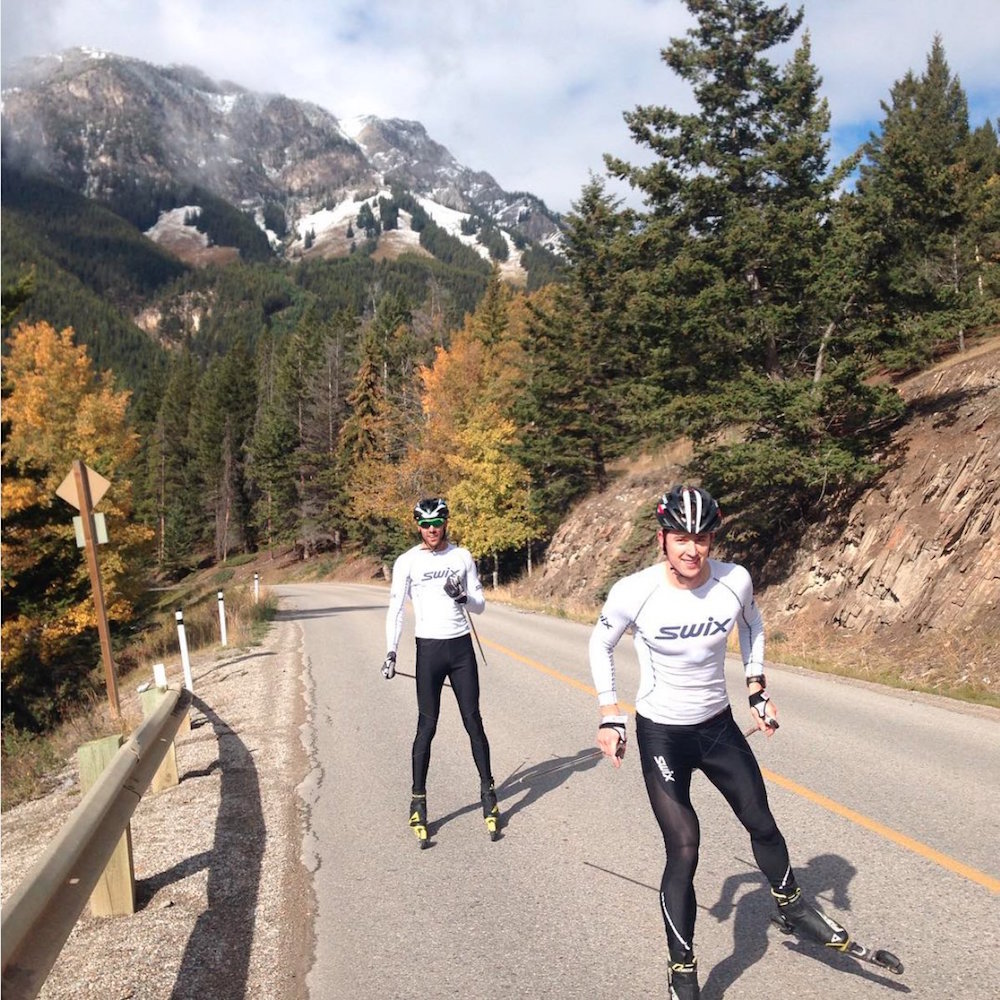
Julien Locke (right) rollerskiing up Mount Norquay in Banff, Alberta, with Canadian National Ski Team teammate Lenny Valjas. (Courtesy photo)
Welcome to “17 Questions for 2017″, where we are catching up with American and Canadian national-team members before the beginning of the winter season.
***
Julien Locke had an unusual distinction last year: he was the only athlete to podium at both Canadian and U.S. national championships, taking third in the skate sprints at both events.
The British Columbian also snagged NorAm wins and a 16th-place performance in the U23 World Championships sprint. Locke, now 23 years old, was named to Canada’s national team for the first time in May and has since relocated to Canmore, Alberta.
1. Biggest change in your life in the last five or so months since the ski season ended?
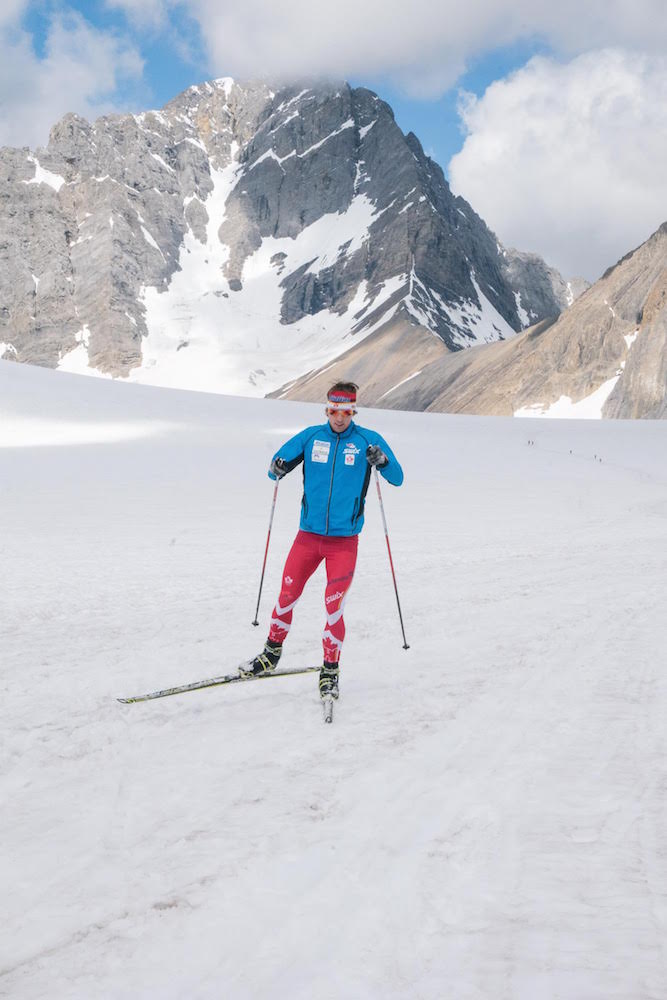
Locke getting some glacier time. (Courtesy photo)
This season is my first year on the Canadian National Ski Team. After 9 years skiing with the Black Jack Ski Team in Rossland, BC, I am now living in Canmore, AB.
2. Biggest change in your training?
Training this year has been quite consistent with what I’ve done previously with some small differences. There was a bit more travel this year with a NST camp in Quebec in late June. With World Cup sprint opportunities on the line on November 1/3, the training season has been adjusted in order to be in race shape a good month earlier than usual. Aside from that, not much has changed.
3. Major areas of improvement you’ve seen so far?
I am happy with where how my double pole has been this year. Last year I double poled nearly half of the classic races on the calendar and I feel quite solid as we get close to the upcoming season.
4. Whom you’ve been working closest with this offseason (coaches or training partners)?
I’ve been training a lot this year with the Canmore NST group of Len Valjas, Jess Cockney, Graeme Killick and Knute Johnsgaard.
5. Best trip in the last five months (and why)?
I just returned from a fantastic training camp in Park City. The NST guys all stayed up in Deer Valley at 2600m. Great roads for roller skiing, wonderful fall colours and nice weather (plus a few snowy days!) for training.
6. Favorite cross-training?
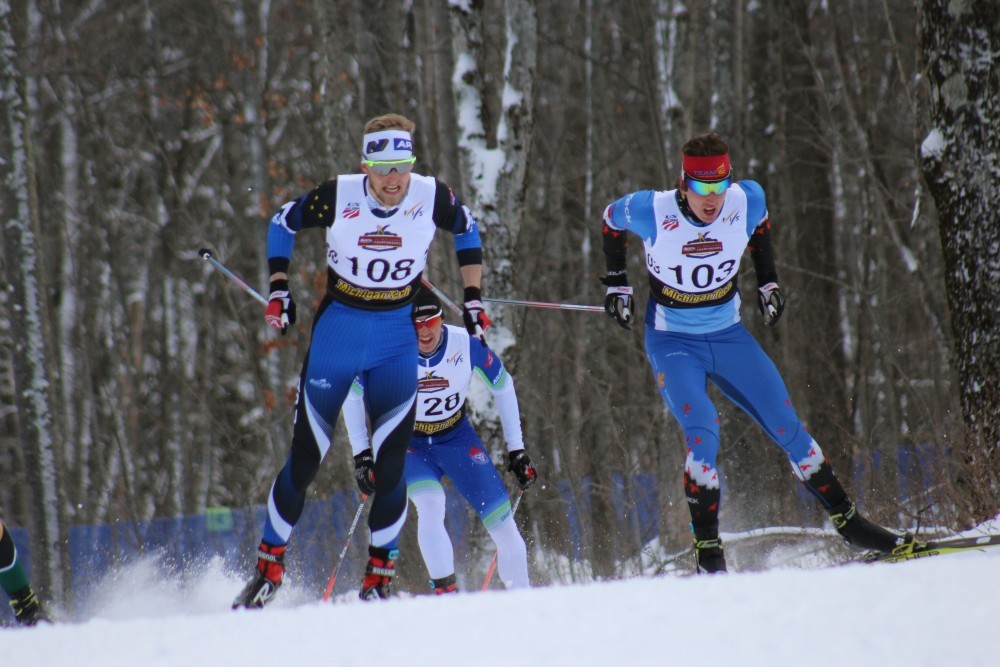
Julien Locke (r, Team Black Jack) challenges APU’s Eric Packer at around 400-meters to the finish of the semi-final for the men’s 1.5 k freestyle sprint at 2016 U.S. National Championships in Houghton, Mich. Locke went on to finish third overall.
I’m a big fan of everything we do for training: roller skiing, trail running, paddling and cycling.
7. Favorite non-athletic activity or pastime this summer?
I had a busy and productive summer with work (I am a web developer) and have recently launched a couple new sites. Check out the new Sovereign Lake Nordic website: www.sovereignlake.com
8. Song that was your jam this summer?
Josh Ritter’s Hello Starling album.
9. All time favorite race moment?
That is a difficult question! The highlight of last season was racing the Keski (Gatineau Loppet) and competing against Alex and Lenny in the Canadian Nationals sprint.
10. First thing you pack in your bag when you leave for Europe?
Race boots are the first priority when I am traveling. Everything else can be borrowed if needed, but it’s difficult to ski if you don’t have boots that fit. I always travel with either both my skate and classic, or just pursuit boots in my carry-on.
11. Venue/event you’re most excited to visit this season?
My main focus for the winter is the World Championships in Lahti, Finland. The pre-Olympic World Cups in Pyeongchang are the second priority.
12. Who will win the men’s and women’s World Cup titles this year?
Well… given the recent news from Norway, the start lists may look a bit different this year. I would bet on Sundby for the mens overall with Alex Harvey up there as well. For the women, Heidi Weng.
13. Biggest sacrifice you feel you’ve made choosing this career path?
I don’t feel that I have to make sacrifices in order to ski. I feel very fortunate to have the opportunity to train and compete full time.
14. If you could change one thing about your sport, what would it be?
It would be amazing for our sport in North America if we could bring skiing to the masses. Cross country skiing is such a great sport for all ages and the more excitement we can generate for young skiers, new recruits and the general public, the more we can grow our sport. It was fantastic to see the atmosphere at the Tour de Ski city sprints in Quebec last year and hopefully we can continue to have similar events in North America. Additionally, bring back the 50km Individual!
15. What did you have for breakfast this morning?
Bowl of oatmeal with yoghurt, fruit and honey and 2 poached eggs.
16. In 5 years, I’ll be ____?
… training hard at altitude for the last fall camp before the 2021/22 Olympic season begins.
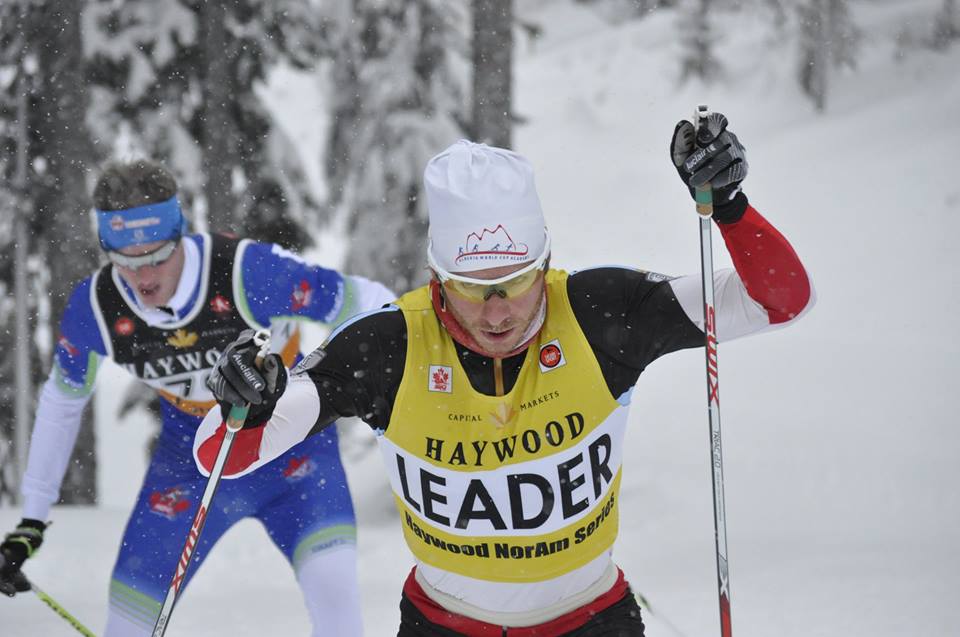
Race winner Kevin Sandau (AWCA) (r) in the leader’s bib leads Bob Thompson (Team Hardwood) during the men’s NorAm 15 k freestyle individual start on Sunday in Vernon, British Columbia. (Photo: XTS Photography)
Kevin Sandau is aiming for the Ski Tour Canada at the end of the season, so he didn’t feel like he needed to lead the NorAm circuit right away.
But being the Period I leader? That was nice, he admitted.
“To win NorAms is a pretty good feeling,” the Alberta World Cup Academy skier said in an interview. “West Yellowstone too, it was a tight race, so I was happy with that. At the beginning of the season I wasn’t gunning that do-or-die, I needed to win races. It’s great that I’m winning. But if I wasn’t, the season is long. It’s nice to see that there’s some good speed there and some good fitness even though the focus is on the later part of the season.”
Sandau swept the distance races at the opening NorAm weekend in Canmore, Alberta, and then also won the 15 k skate in Sovereign Lakes, British Columbia. Before that, he had started the season in West Yellowstone, Montana, placing fifth in the 15 k skate just 20 seconds behind 2014 Olympian Brian Gregg of the United States.
But it hasn’t been all racing; with his focus on a grueling World Cup tour at the end of the season, Sandau has been training as well. He skipped the sprint race at Sovereign Lakes to fit in two four-hour days of volume training.
That unique focus on the season-ending World Cups is also leading Sandau to do something you don’t see so often: he’s turning down an opportunity to race on the World Cup.
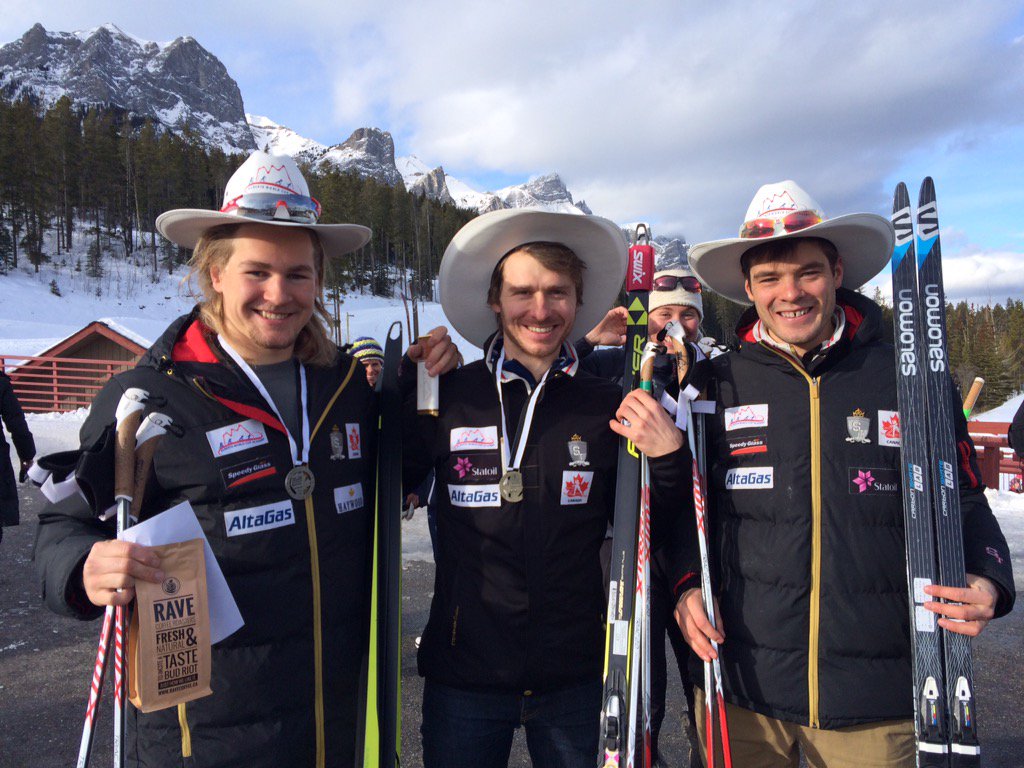
Kevin Sandau (c) and his Alberta World Cup Academy teammates Knute Johnsgaard (l) and Patrick Stewart-Jones (r) placed first, second and fourth, respectively in the men’s NorAm 16.5 k freestyle mass start on Dec. 6 in Canmore, Alberta. (Photo: Alberta World Cup Academy/Twitter)
As the NorAm leader, Sandau has automatic start rights for Period II of racing. That is provided through FIS, which does the same for the leader of each Continental Cup circuit around the world, and is independent of the fact that Cross Country Canada has declared Period II to be an Under-25 tour (Sandau is 27 years old).
But the provision does not include the Tour de Ski, which is the first batch of races after New Years; the Tour de Ski has only quota spots for each country, no additional quota spots for Continental Cup leaders.
“Granted we have never filled our full quota before,” Sandau wrote in an email. “Tours are great bang for your buck in terms of the number of races over a short period of time, and I’ve always considered racing the Tour if the opportunity arose. I find I handle race volume pretty well. There is no domestic criteria to qualify for the tour (only World Cup criteria). They are announcing the team today I believe, but a few athletes on the World Cup Team didn’t meet the criteria and I would assume they will make concessions anyway to bring them.”
After the Tour de Ski, Period II includes only two more World Cup weekends, with a team sprint, a relay, and importantly for Sandau, only one individual distance race.
“For me that trip was never a focus at all,” Sandau said. “I’d rather stay in Canada and race.”
And so he will head south to Houghton, Michigan, after New Years for U.S. National Championships, then follow the NorAm circuit to Thunder Bay, then to Western Canadian Championships, and finally to Eastern Canadian Championships. All with the goal of strong performances at the Ski Tour.
“That leaves just under a month of time to incorporate an altitude block and volume block as final preparations for the Tour,” Sandau said. “It’s nice to have these races in Canada because the logistics of going to Europe and finding altitude to ski at and volume, it’s expensive and difficult, especially since I’m not on the World Cup team. They have the flexibility. For me it would be more difficult.”
With not only normal World Cup quotas but also Nations Group start spots for Canada in the Ski Tour, Sandau is not worried about whether he will qualify. And once he gets there, he’s looking forward to a chance to ski his best races without the politics of team selection or national team spots.
“It feels like a more level playing field for the domestic guys,” he said.
Sandau was looking for a spot on the 2015 World Championships team last year, but was left off. Cross Country Canada did not fill all of their quota spots. Just before the Championships, which were in Falun, Sweden, Sandau was in Europe racing on a “B” tour.
He won the 15 k skate at Latvian national championships, but then watched from afar as Canada only started three, not the allowed four, men in the 15 k skate, and one of them was Jesse Cockney, a sprint specialist.
“When I found out they put a sprinter in the 15 k it was like a slap in the face,” Sandau said. “I was in Europe and it would have been a short flight over. But to them it was like I wasn’t part of their umbrella and so I didn’t meet their criteria, but there was other flexibility given to other athletes on that trip.”
He also saw that Cross Country Canada is placing an emphasis on developing young athletes, and doesn’t see value in carrying older athletes on tours if they have not yet had international success. That’s bad enough for Sandau, but he sees it hurting the women’s team even more.
“Especially women in this country, we don’t have too many and we don’t have too many above 25,” he said. “The last thing we should be doing is to discourage them from continuing to ski. I think that they can be seen as role models. They have a wealth of knowledge. It girls are getting beaten by older girls, they are just going to go back and want to be faster. Competition breeds excellence. It’s silly.
“When you look at the big picture, you see that they say they want to focus on the younger generation but it’s kind of like, well, at the cost of ignoring the current generation?”
-Kevin Sandau
By qualifying for the Ski Tour Canada through domestic criteria and focusing his season on doing the preparations that he thinks will be best, Sandau hopes to avoid the drama and emotions that he experienced last season, and also in a failed bid for the 2014 Olympic team.
“Last year when I was fighting to get a spot on the World Championships team because they had unused distance spots, I was a stress case and not sleeping and it was kind of sad,” he said. “That’s behind me now, but that’s why the Ski Tour is such a nice thing. As long as you qualify for a spot, there’s no age criteria on that spot and there’s just such a level playing field.”