Tag: Specific Strength

  • Wednesday Workout: Old-School Strength with the NTG

    Wednesday Workout: Old-School Strength with the NTG

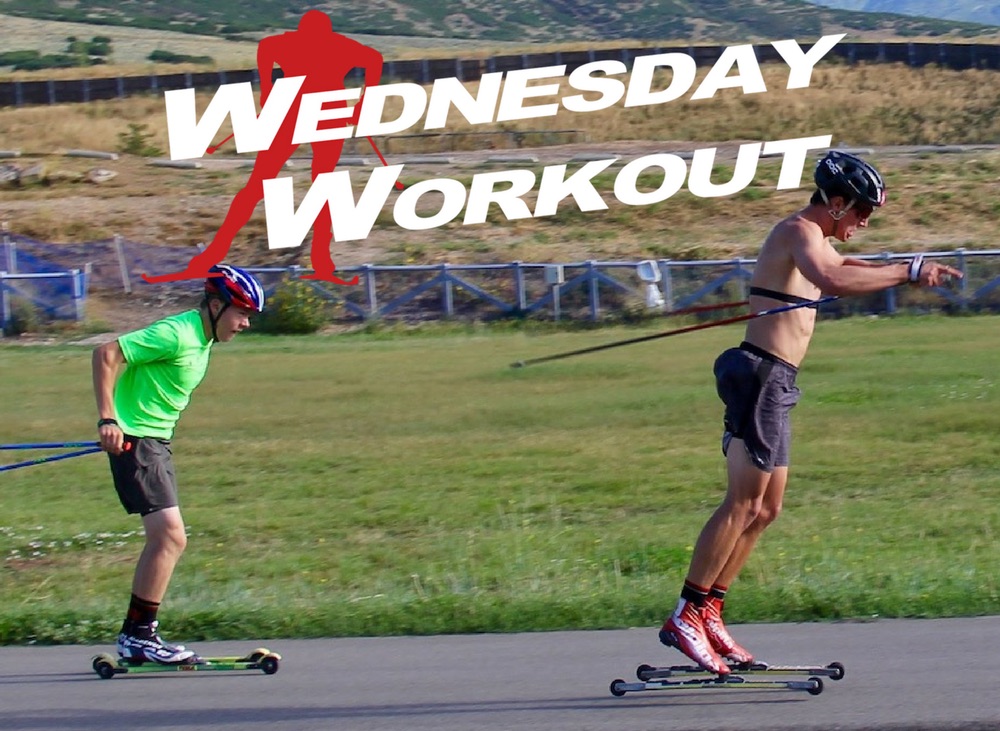
    Ben Ogden and Bill Harmeyer during double-pole speeds at the 2017 Junior NTG Camp earlier this month at Soldier Hollow in Midway, Utah. (Photo: Bryan Fish)

    For this week’s workout, we asked for a specific-strength workout from this year’s Junior National Training Group (NTG) Camp, which was held Aug. 2-15 near Park City, Utah. One of three coaches at the camp, Maria Stuber (head nordic coach at the College of St. Scholastica), shared the following, which she described as an “old-school endurance strength workout.” She led the camp with two U.S. Ski Team (USST) staff members, development coach Bryan Fish and World Cup wax technician Tim Baucom. Eighteen athletes attended — 10 men and eight women — all under the age of 21.
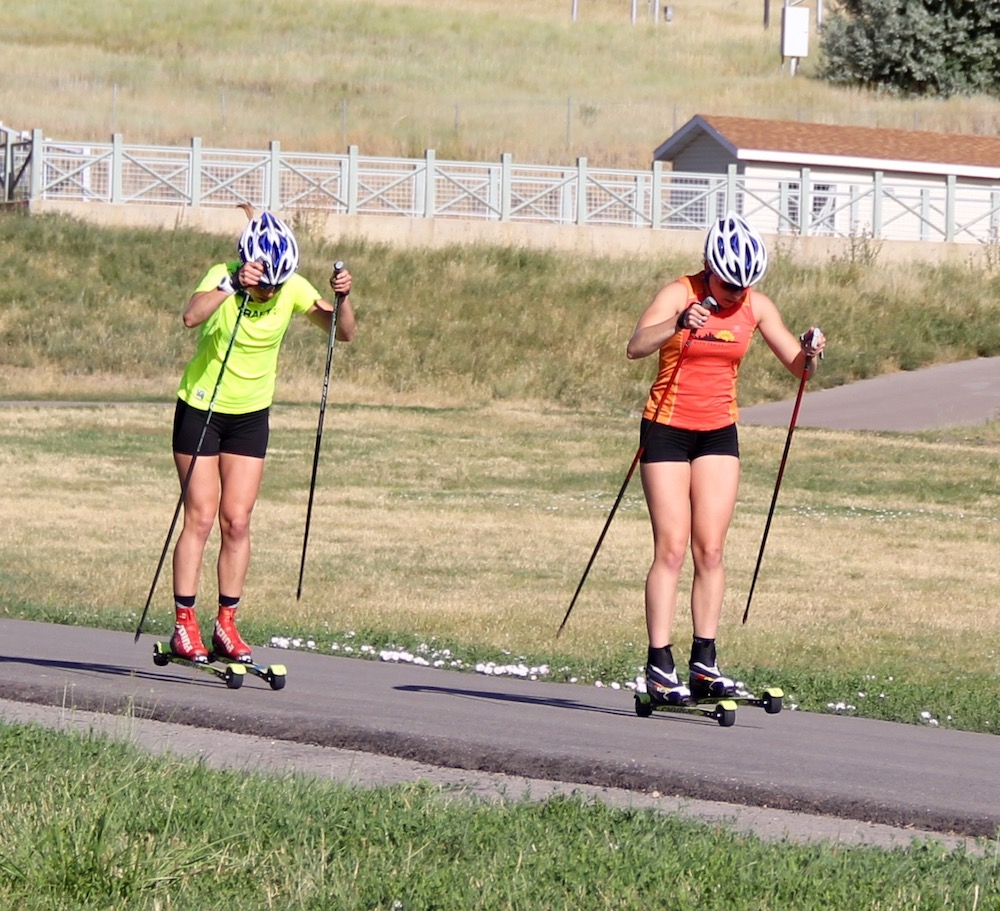
    Lauren Jortberg and Nicole Schneider doing double-pole speeds at the 2017 Junior NTG Camp earlier this month at Soldier Hollow in Midway, Utah. (Photo: Bryan Fish)

    “The U24’s are invited to other U.S. Ski Team camps like our October camp and our May Bend camp,” Fish explained in an email.

    The goal of this month’s camp was “to get our very best together to train and learn from one another,” he wrote. “These are athletes that are already or very well may soon be on the U.S. Ski Team, so building a healthy and positive training environment for these athletes is critical.  Secondly, building an environment where these athletes push each other yet trust one another is critical.  Many of these athletes have already traveled overseas together and continuing to strengthen their comfort and focus toward how we can support, lean on and succeed together – as a group, as a nation, as a team.

    “Third, we want to provide these athletes with meaningful feedback,” Fish continued. “The athletes work with our high performance department at U.S. Ski & Snowboard to learn what individual items they are already strong as well as windows of opportunities for improvement.”

    The primary focus was to provide a “strong training environment,” he wrote, while also testing athletes in areas like strength, power and mobility with a protocol similar to the U.S. Ski Team.

    Throughout the two-week camp, there was an abundance of rollerskiing and threshold ski walking/bounding, as well as strength work.

    “One question that commonly comes up is why such workouts are becoming less familiar or possibly less utilized in coaches’ training plans,” Fish wrote, referring to specific strength. “I think it is because more programs are incorporating this type of effort into classic sprint training sessions. That being said … [this workout develops] many important technical and physical skills.”

    Stuber explained that the workout emphasizes repetition “to work out technique issues and to feel efficiency differences,” she wrote. “It is also a fun social workout because the whole team stays in one place and you can have a good time with rivalries and inter squad competition. “

    The workout: Specific Strength on Skis

    • 20-minute warmup
    • Followed by:
      • 8 x 30 seconds single stick
      • 6 x 30 seconds core-only double pole
      • 8 x 30 seconds double pole
    • 20-minute cool down

    “We did not harp on technique too much and let the athletes think and discover what was working best to move across the ground with the group,” Stuber noted.  “We had video on an iPad for those who wanted to see what they looked like and if the changes they were feeling were showing up on camera.

    “There were a lot of blisters,” she added. “Gloves are recommended for this workout.”
  • Wednesday Workout: Uphill Double-Pole, Specific Strength with MSU (with Video)

    Wednesday Workout: Uphill Double-Pole, Specific Strength with MSU (with Video)


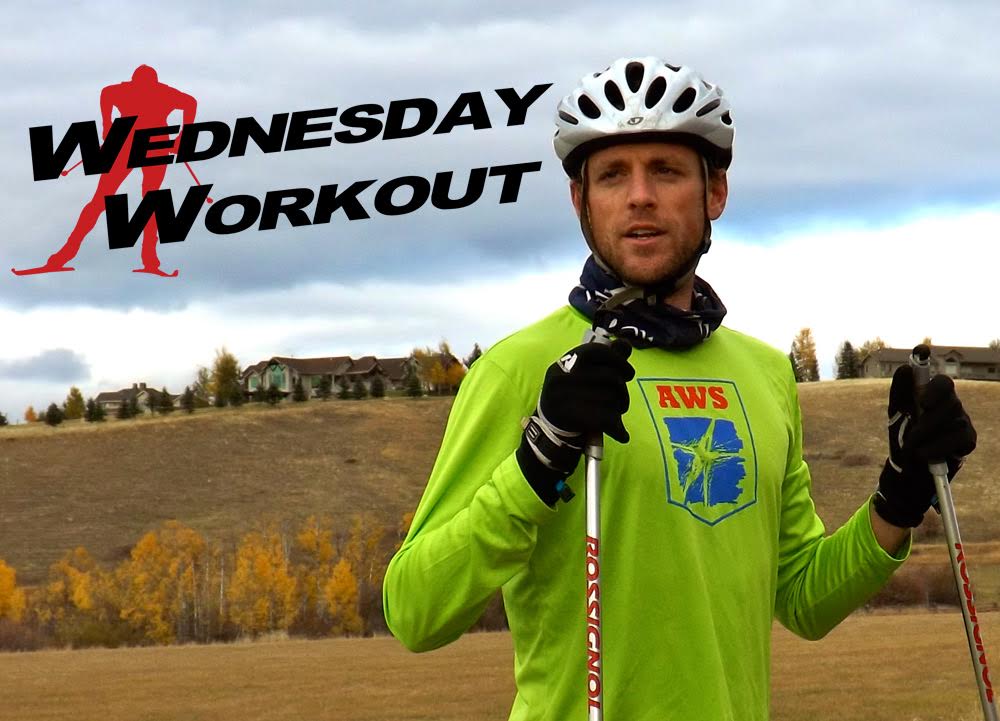
    Montana State University (MSU) Nordic Head Coach Matt Johnson before an uphill double-pole strength session in late October at Triple Tree Ranch in Bozeman, Mont.
    Montana State University (MSU) Nordic Head Coach Matt Johnson before an uphill double-pole strength session in late October at Triple Tree Ranch in Bozeman, Mont.

    For this week’s workout, FS tagged along during an uphill double-pole session with the Montana State University nordic team on Oct. 27. Reporter Gabby Naranja did a few sets on bike, which she found equally fun and thrilling.

    ***

    BOZEMAN, Mont. — The one workout no skier should sacrifice? Specific strength. At least, according to Matthew Johnson, head coach of the Montana State University (MSU) nordic team.

    “We try to do a specific arm strength workout once a week,” said Johnson, who joined the MSU Bobcats in June after the resignation of former head coach Kristina Trygstad-Saari.

    The importance of a double pole, specific-strength workout, Johnson explained, goes beyond just grinding your arms to a pulp in order to climb up a hill. These workouts are about “figuring out how to use the technique and the strength that you’re finding in the gym and applying it to your poling motions out here in varying types of terrain,” he said during an MSU training session last week.

    Of course, that in no way negates the noodle-arm effect brought on by most double pole, strength-specific workouts.

    “Sometimes it is about getting a consistent steep grade and working it, making your arms tired and then just being able to hold it [while] keeping your technique together and keeping your core strength together,” he said.

    As a cross-country skier, arm strength is just part of the game.

    “Rollerskis are great imitations of skis, but they’re not perfect,” Johnson said. “[Therefore] a lot of our classic skiing is going to be arm specific, strength specific, because that’s a really important thing with actual skiing.”

    For MSU skiers at least, the arms do not go neglected.

    “We want to develop a team that trains together and races together,” Johnson said. “We also want to see an upward result trend for every athlete right through [U.S. SuperTour] Spring Series [in March]. Since our college season doesn’t start until the 10th of January or so, we’re really pushing the fitness aspect of this all the way through November into December.”

    According to Johnson, it’s workouts like this that will lead to better ski performances, particularly with the college race schedule in mind.

    “It’s really easy to waste time rollerskiing,” he said. “[When] you do a double pole or a ski session you’re doing the same motion thousands of times. Every single time you practice that motion you’re either making yourself better at it or you’re ingraining bad habits. Like they say in music, practice makes permanent, so we try to practice good permanence.”

    Especially for a college athlete with limited time to ski, “practicing good permanence” is important.

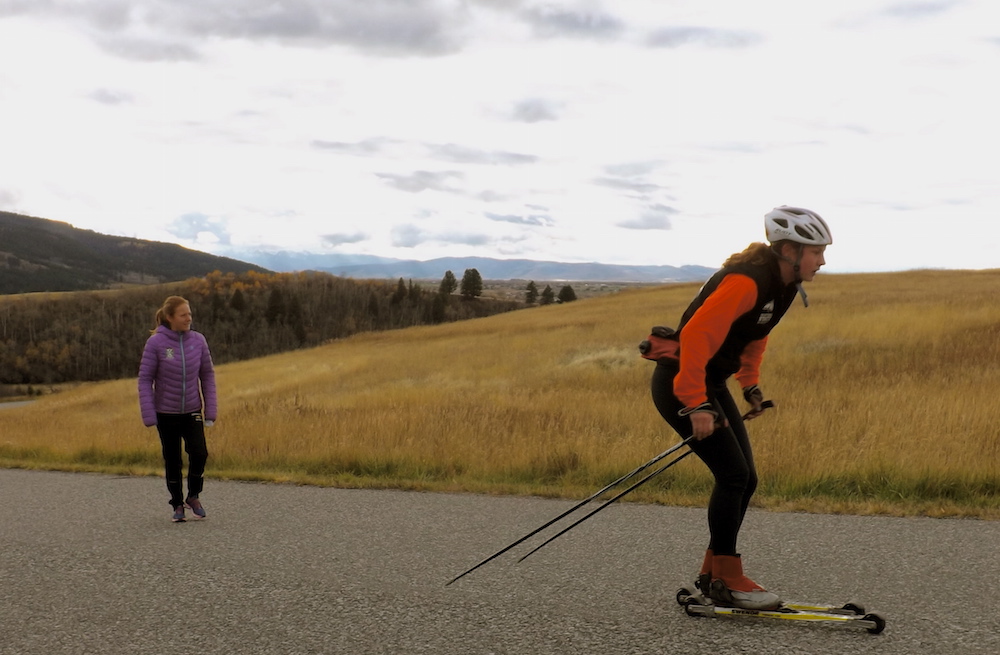
    MSU assistant coach Anja Gruber (l) with MSU skier Maria Gesior during an uphill double-pole workout.
    MSU assistant coach Anja Gruber (l) with MSU skier Maria Gesior during an uphill double-pole workout.

    “College skiing is so incredibly hard sometimes because there’s a huge time constraint with school and social life,” explained Anja Gruber, former University of Vermont (UVM) college ski racer, two-time NCAA champion, UVM business-school valedictorian, and current assistant coach for the MSU nordic team. “I don’t think anybody could get through college racing on their own. It’s really important to be part of a team with good energy.”

    And despite a recent high turnover of coaches, the MSU nordic team maintains an upbeat outlook.  Super-senior Sawyer Kesselheim of Bozeman, Mont., indicated that he would like to see MSU men’s nordic “consistently have three guys place in the top ten at races.”  When asked about Johnson, Kesselheim spoke favorably of the new coach.

    “I really like Matt,” he said. “He’s super focused, organized, and professional. He has good workout plans and keeps the workouts exciting.”

    This enthusiasm extends into MSU’s newer team members as well. “It’s been great having Matt coach us,” said freshman Sarah McCandless from Jackson Hole, Wyo. “He’s got great positive energy.”

    Whether or not Johnson’s athletes actually have fun during these workouts, the benefits are undeniable.

    “We’re dealing with a group of athletes who are here to work hard,” Johnson said. “It’s a big responsibility being on a team at a school like this and as they expect a lot of us, we expect a lot of them. There are a lot of moving parts, so you have to be creative, flexible, and on top of things, motivated.”

    The Workout

    Warmup: 25-30 minutes easy Level 1 skiing double pole and double-pole kick

    The Set: 2-4 times double pole up a 3 k hill. Johnson suggests “finding something with some rest so you can recover and feel the difference between the different [transitions].”

    Purpose: To figure out how to apply gym strength to double pole motions in varying types of terrain

    Goal: Rather than speed, focus on maintaining correct double pole body position throughout the hill while in a fatigued state

    Cool Down: 25-30 minutes easy Level 1 skiing

  • Pro Workout: Specific Strength With Jennie Bender

    Pro Workout: Specific Strength With Jennie Bender

    For Central Cross Country’s Jennie Bender, summer is for both building strength and taking time out for unstructured workouts.

    The winner of the classic race at last year’s Birkie tries to balance the exact focus of specific strength training with free form over distance.  By losing track of time on a long run or canoe paddle, she gets inspired to challenge herself with a grueling intensity session.

    Her go-to intervals, usually done on classic skis, are broken into three sets of six to eight uphill repeats of 30 to 60 seconds each. For each set, she works on double poling, single stick, double pole kick or striding.

    Bender racing in West Yellowstone last November.

    For the University of Vermont alum, the best part about these intervals is being able to shift the focus of a particular session by tweaking certain aspects of the same basic workout.  For more strength, she finds a steeper hill.

    To focus on technique, she slows it down and concentrates on proper form.  For higher intensity, she’ll increase the interval length or speed.

    Bender will do this workout or a double pole-only one just like it at least once a week.

    “Specific strength is one of those workouts where I always finish feeling like I just became a better athlete,” she said.

    If you’ve got access to training partners, this session can be even more valuable.

    “There is always something to learn from those around you, even if it’s what not to do,” she said.

    Speaking from home in Vermont, Bender also stressed the importance of going outside and having fun during the off-season.  In returning home and talking with her high school coach, she was reminded that her desire for adventure can apply to her training. Some of Bender’s most memorable workouts are ones where she didn’t look at her watch.

    Whether it was an all day canoe with high school teammates or a long hike in college with just her iPod, she would always feel reenergized afterwards.

    “I didn’t focus on how long it would take me.  I just went until it was time to go home.”

    When she’s not getting lost in the woods, Bender will also mix things up by playing Ultimate Frisbee, practicing yoga, or going salsa dancing. “You have to be serious about training, yes, but don’t forget to challenge yourself and have adventures,” she said.

  • How General Strength Makes Specific Strength Easier

    How General Strength Makes Specific Strength Easier

    Jessie Diggins recently graduated from Stillwater High School in Minnesota, where she earned three individual state championship titles, among other impressive national and international results.  Diggins skis for CXC Team Vertical Limit.

    Diggins pumps out dips (Photo: CXC)

    One might wonder why an endurance athlete like a skier or runner would ever bother lifting weights. Isn’t specific strength enough? Shouldn’t skating without poles, single-sticking and double-poling build all the muscles a skier would need? The truth is, general strength does more for an athlete than give them killer beach muscles.

    The simple answer is that the stronger all your muscles are, the more specific strength you are capable of doing. If you have stronger arm muscles, you will be able to double-pole farther. Another incentive for general strength is that it balances and stabilizes your muscles while you do specific strength. You won’t get very far if you only develop ski-specific muscles.

    However, there is more to strength training than lifting as much as you can every day; periodization, or dividing strength training into separate phases to accomplish different goals, is key to improving strength for a specific sport.

    Lifting weights is important to skiers because whether you are a sprinter who needs explosive power, or a distance racer who needs a lot of muscular endurance, the bottom line is that you need to be strong all over. General strength is necessary for building specific strength in the same way that distance skis are necessary for intervals. You can’t do intervals until you’ve gotten base training, and the same is true with strength.

    I spoke with Jason Cork, head coach of the CXC Team Vertical Limit, for his perspective on why general strength is necessary before improving ski-specific strength. He said that athletes have many basic muscles, like your quads, which provide a basis for strengthening the smaller, more ski-specific muscles. If you don’t have a good base, you won’t be able to develop much power, so before you start getting too specific, you need to be strong enough to do the exercises well, and with good technique.

    One way to get maximize the benefits of general strength training is to break it up into periods. In the spring, athletes need to get their feet back under them after the race season, and thus skiers on CXC start with a general strength phase. This allows athletes to build a base and get the basic moves down with good technique.

    From there, skiers move on to max strength: more focus on heavier weights with fewer reps, which then leads into the power-velocity phase. Then athletes begin getting more ski-specific, with max power and ski-specific power-velocity phases. During race season, skiers use the weight room to maintain the power they’ve already developed.

    Endurance athletes are often worried that too much strength might slow them down by making them too bulky or hindering their agility. This is not the case, as long as a strength program is designed to coexist with endurance training.  With the help of CXC Team Vertical Limit coaches and specialists, CXC Academy has created a sample training plan that addresses all of these concerns.  When you combine specific strength with general strength, and adapt them both to endurance sports you have a perfect balance.

    Finding the key to improved skiing can often be found in strength-based exercises.  As long as you maintain a balance between strength and endurance training, general strength can be an asset, and improve performance.