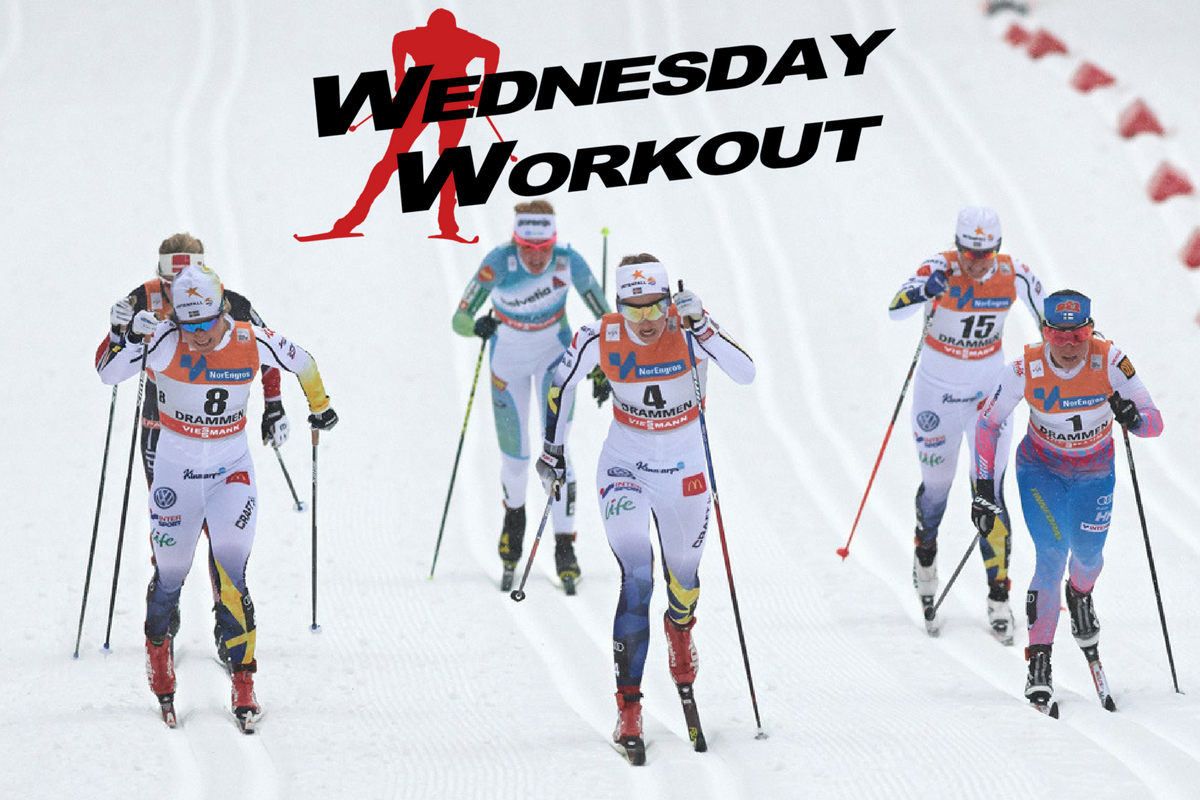
Sweden’s Hanna Falk (8) going for it in a sprint finish in Drammen, Norway, with her teammate Stina Nilsson (4) and Finland’s Krista Parmakoski (1) on March 8, 2017. (Photo: Fischer/NordicFocus)
“I have a workout that I like and usually do in the autumn when it’s time to shape up.”
Those are the words of Swedish national-team member Hanna Falk. To take Falk’s words literally, it is that time of year: in the Northern Hemisphere, it’s officially autumn and “time to shape up”. In two months, the 2017/2018 World Cup will open with classic sprints on Nov. 26 in Kuusamo, Finland.
For the figurative aspect of Falk’s comment, if you’ve been eschewing hard workouts and log six days a week of perfunctory OD, yes, “it’s time to shape up”. For World Cuppers, potential 2018 Olympians and those giving a Heisman to Father Time, it’s the season to think about priming for those moments when latching on to those skiers pushing the sharp-end pace is paramount.
In group sprints or distance events, no one likes to be yo-yoed off the back of the pack.
Last season on the World Cup, Falk finished third in the sprint rankings and 20th overall (a combination of both sprint and distance results.) Although certainly a sprinting force, Falk now considers herself an all-arounder. She placed eighth in the World Cup 10-kilometer freestyle race held in her birthplace of Ulricehamn, Sweden. After we interviewed Falk for FasterSkier’s Nordic Nation, we reached out for a Wednesday Workout, requesting something she uses this time of year to round herself into shape.
The Workout: 6 x 5 minutes with 2 minutes rest
“I usually do the workout on roller skis in variable/tough terrain,” she explained. “I also try to do a real sprint start in the start of each interval, just to practice that special moment. It means 10 seconds all out and then continuing the interval in the speed you can manage. You can also do a short sprint at the end of the interval if you want to practice the change of frequency in the finish. It’s a race-inspired workout that will get you tired!”
How to pace it:
“You should try to go hard, at high speed, without losing the technique — and with the same speed from the first to the last interval. It probably means Level 4. If you start off too hard and you are not able to have the same speed on the last interval, you are doing it wrong!”
Astrid Uhrenholdt Jacobsen (far right) in the lead pack of the women’s 30-kilometer freestyle mass start at 2017 World Championships in Lahti, Finland, along with (from left to right) fellow Norwegians Marit Bjørgen and Heidi Weng, and Sweden’s Charlotte Kalla. (Photo: John Lazenby/Lazenbyphoto.com)
In this Wednesday Workout, we’ll focus on the non-academic side of Jacobsen’s calculus: her quest for endurance and her stick-with-attacks speed.
Jacobsen shares an idea for athletes training for this upcoming winter’s Masters World Cup in Minneapolis or other hallmark races like Sun Valley’s Boulder Mountain Tour. In fact, if any mass-start race where there’s a pulse of pace when the leaders try to gap the field is on your calendar, this workout could keep you in the hunt. It works for Jacobsen, it might just work for you.
Sweden’s Charlotte Kalla leads Norway’s Therese Johaug and Astrid Uhrenholdt Jacobsen in the final kilometers of the 15 k skiathlon at the 2015 FIS Nordic World Ski Championships in Falun, Sweden. (Photo: Flyingpointroad.com)
“The sessions I feel develops me the most at the time are level 3 intervals with short sprints in the middle or to finish the interval,” Jacobsen wrote in an email. “It helps me work on my ability to follow attacks in sprint — or mass start competitions … To make this interval with good quality you need to be sure to not race faster than level 3, with is similar to the speed you keep in a 30km. Then you are able to hit your max speed for the sprints. If you start out too hard the sprints will be slower and the whole session more like a level 4. Takes discipline to make this training with high quality, But it has made me a better mass start skier.”
The Workout
Jacobsen explained that her usual session when completing this workout involves 6 x 8 minutes on a rollerski track or rollerski treadmill.
“To make this interval with good quality you need to be sure to not race faster than level 3, with is similar to the speed you keep in a 30km,” Jacobsen explained. “Then you are able to hit your max speed for the sprints. If you start out too hard, the sprints will be slower and the whole session more like a level 4. It takes discipline to make this training with high quality, But it has made me a better mass-start skier.”
About midway through the interval, Jacobsen puts in a burst of sprint-worthy speed.
“After 4 minutes, I will do a 10-second sprint, then go back to level 3 speed for almost 4 minutes and finish the interval with a new sprint,” Jacobsen wrote. “I break until my heart rate is below 100, 1-2 min.”
Charlotte Kalla of Sweden skiing to a monster win in the 10 k skate at 2015 World Championships on home turf in Falun, Sweden. (Photo: Fischer/NordicFocus.com)
Fresh off an interview with Nordic Nation, Sweden’s 29-year-old Charlotte Kalla offered up a Wednesday Workout for those looking for technical sharpness and speed on flatter terrain. Here’s the workout straight from the combined 17-time world champ and Olympic medalist.
“This time of year I take the opportunity to work on keeping my speed up also on flatter terrain,” Kalla wrote in an email. “I usually go interval training uphill during summer and fall. It is simple to just move yourself up to the top of the hill by roller skis and you know you will have a higher heart rate just by getting there. When I do intervals in flatter terrain I have to be more focused on my technique and to keep the speed up. It is important to be able to keep up the speed during competition also on the flat.”
The workout:
Warmup: 20 minutes easy skiing
10 minutes of intervals (85-90% of max heart rate). After that, easy skiing for 2 1/2 minutes. Repeat 5 times and focus on having a good technique and keeping up the speed.
Cool down: 20 minutes slow skiing
The video below provided by Kalla was taken on May 24 when indeed she worked on speed and technique in flatter terrain.
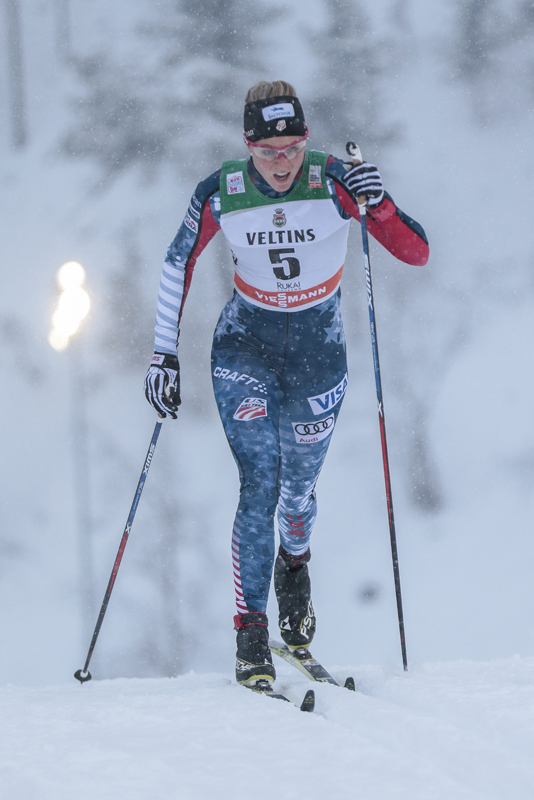
Out of Kuusamo and onto Lillehammer. U.S. Ski Team member Sadie Bjornsen (pictured racing to seventh in the women’s classic sprint qualifier last Saturday in Finland) enjoyed an off-the-race-course ski to Sjusjøen, Norway, this week. (Photo: Fischer/NordicFocus)
We hear a lot about the details of a cross-country ski racer’s day on race day, but what about those four or five days in between? What do World Cup racers do then, in the middle of the week? FasterSkier Norwegian contributor Aleks Tangen ventured to Lillehammer on Wednesday and Thursday to find out.
***
LILLEHAMMER, Norway — The first mini tour of the World Cup season starts today — Friday — in Lillehammer. A year ago at this venue, the U.S. women’s team placed third in the relay a day after Sadie Bjornsen finished 20th in the skiathlon. This year’s three-day series consists of a classic sprint on Friday (the second of the season), 5- and 10-kilometer freestyle races on Saturday and 10/15 k classic pursuits on Sunday. FasterSkier spoke with Bjornsen, Jessie Diggins, Andy Newell and U.S. Women’s Coach Matt Whitcomb to see how they prepare for Lillehammer and in particular, this mini tour.
Whitcomb explained that on Wednesdays, in this case two days before a race, it’s common for the athletes to do 90 to 120 minutes of light skiing in the morning and a strength session in afternoon.
“Some might do an easy jog instead,” Whitcomb said. “On a normal week, our strength session falls on a Wednesday. That gives us two full days of recovery before the races. Usually this is also our intensity day and we like doing strength in the afternoon of those. However, in an instance such as this one, where we’re going from a World Cup weekend into a mini tour, we have limited time to recover and for most of our team that means that they will have to pass on mid-week interval session in place for something speed-oriented.”
On Wednesdays, in this case two days before a race, it’s common for [U.S. Ski Team] athletes to do 90 to 120 minutes of light skiing in the morning and a strength session in afternoon.
Bjornsen, who placed 17th last Sunday in the Ruka 10 k classic, did just that. She said this week that she thinks it’s possible to improve upon that performance and that she is looking for more.
“Two weeks ago, I was not even sure that I was going to be here…,” she said, referring to bone spurs in her feet that impeded her World Cup leadup. “Each time I ski, it’s going to become more familiar and hopefully better.”
This week, Bjornsen opted for a distance ski with some speed.
“I find it really special that we can ski on the non-race courses, because we’re always dealing with the lack of snow and then we’re left with a 3.5 k, exceptionally hard, groomed course,” she explained. “It’s something that can contribute to built up fatigue.”
She also did speed work on the course to familiarize herself with the transitions and plan where to change gears.
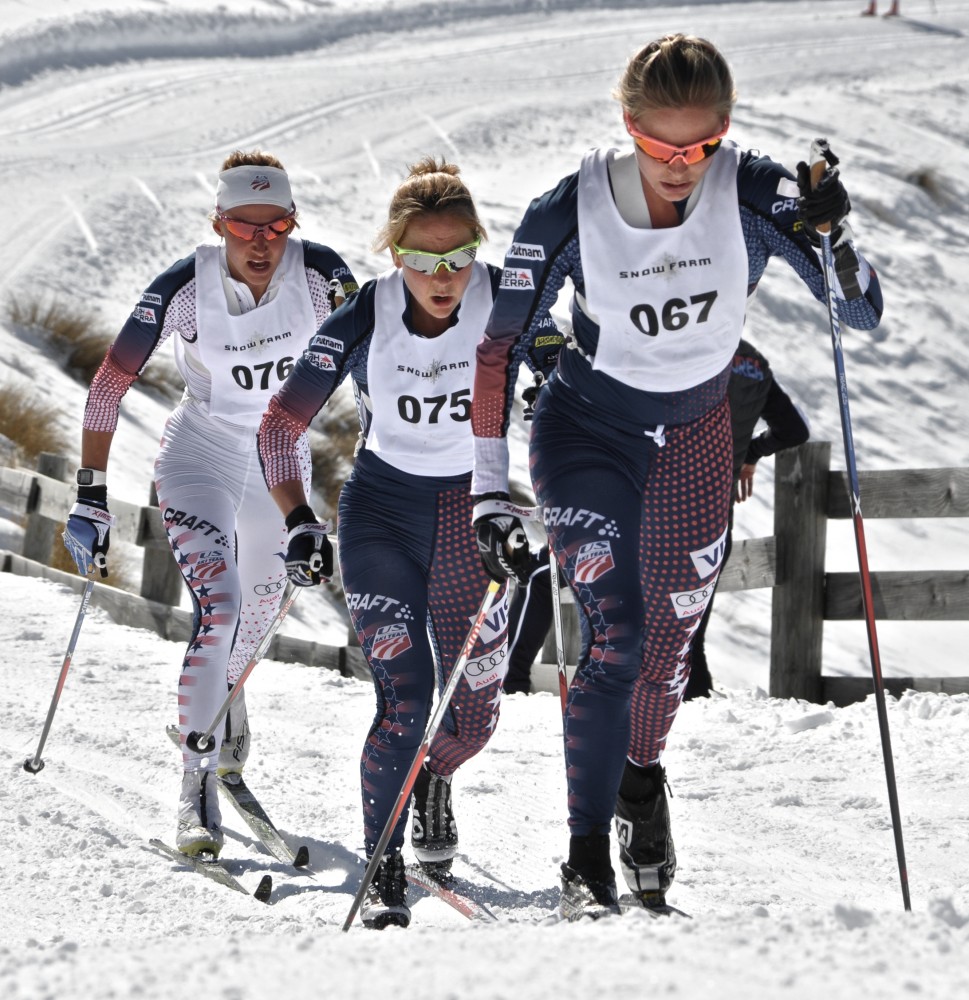
Jessie Diggins leads fellow U.S. Ski Team members Ida Sargent (c) and Sophie Caldwell (l) in the women’s classic sprint at New Zealand National Championships on Sept. 9 at the Snow Farm in Wanaka, New Zealand. Sargent won the final, Diggins placed second and Caldwell was third. (Photo: Matt Whitcomb)
Her teammate Diggins chose a similar kind of workout on the trail leading to Sjusjøen, for 90 minutes of easy skiing.
Asked on Wednesday what goes through her mind during a training session two days before a race, Diggins said it doesn’t have much to do with the race itself.
“I don’t think about the race really, I just try to stay relaxed and do what I’m supposed to do,” she said. “In the middle of two race weekends, you want to stay relaxed, but also improve your conditioning, so I did five minutes at L3 [Level 3 intensity] and 4 x 4 [minutes] at low level on Tuesday in order to have time to recover from traveling and in time for the race.”
In terms of how she balances recovery and improves conditioning at the same time, she said, “That’s a good question. I think it’s really about listening to your body and paying attention to the signals it’s sending you. If you don’t feel good in the morning then maybe you should take it easy and vice versa. And you should always communicate with your coaches, but I really think that first and foremost, it’s important to pay attention to your mind before schedule.”
Diggins said her schedule amounts to roughly 750 training hours a year, but she warned against looking too far into those numbers.
“I don’t like to think about the numbers, really, I feel like that’s not the right thing to do,” she said. “It’s what you do in those hours that matter. It’s more about quality than quantity, and I feel like focusing on the numbers sends the wrong message to for example young athletes.”
Asked what she would say to young athletes considering increasing their volume, Diggins said they should be “very careful about increasing hours. Don’t just throw on hours for the sake of more, think about what the hours contains and go from there.”
According to Whitcomb, Diggins “is in a great state of fitness. … She’s just a really hard worker who does what she needs to do during workouts. She has also gotten to a point where she absorbs her training really well,” he explained.
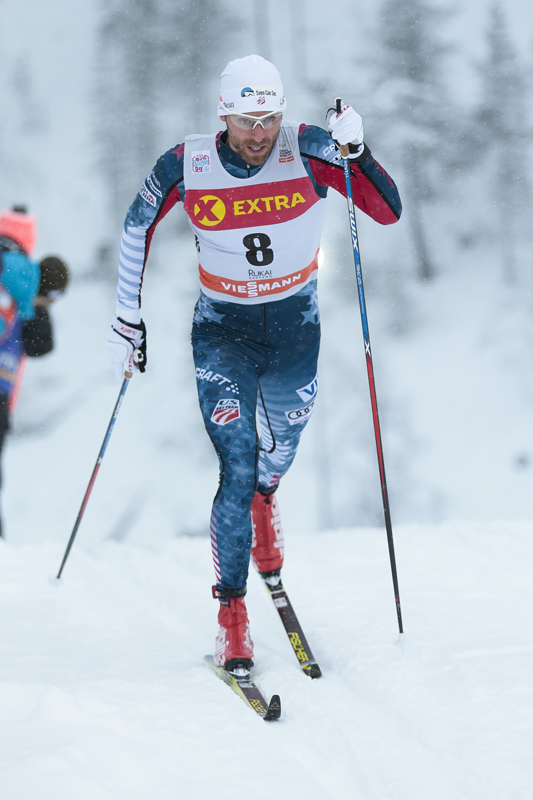
Andy Newell (U.S. Ski Team) on his way to 40th in the men’s classic-sprint qualifier in the first race of the 2016/2017 World Cup season last Saturday in Kuusamo, Finland. (Photo: Fischer/NordicFocus)
Newell met with FasterSkier on Thursday to talk about his preparations. Normally he would do some form of threshold training “like 3 x 8 minutes and some shorter speeds, just to get a feel for the track,” but this Wednesday, things didn’t turn out quite the way he had hoped. Newell skipped training to treat a cold that had been brewing since last Thursday.
“I might have gotten sick from traveling” he said.
If he had been training, his race-prep day would have likely included an hour of skiing, with ski testing (maybe four or five pairs) for the first 45 minutes.
“Once I find a good pair, we usually get together as a team and ski the lap, once at 70 percent of max and once at 90 percent.” Newell said of previewing the course.
When asked about how he balances recovery and fitness, Newell’s answer was similar to that of Diggins and Bjornsen. He said it’s about feeling good before the races, and since the races are like hard workouts, what matters in the time in between is to recover well enough in order to feel good when you’re on the starting line.
“Some people come out of, for example, the Tour de Ski super-fit and that’s the kind of magical balance we’re striving for, where we can be in a state of fitness where we can absorb the benefit of the races,” he said. “For me, that means to maintain threshold base and focus on short bursts of speed during the races.”
And how does nutrition factor into this equation, especially considering you’re in a different country every week?
“I normally don’t have any problems with it, the foods really good here and there is so much to choose from,” Newell said. “I might supplement with multivitamin or fish oil, especially in places like Kuusamo.”
Speaking specifically about Lillehammer, Newell said he loves the course, calling it “perfect”, “very challenging but very skiable, unlike Kuusamo, which are not that fun. Lillehammer’s [courses] are very enjoyable.”
This season, Newell explained that his biggest goal is “to stay strong and healthy.”
“I am trying to be careful with the cold I have now. I know I can be among the strongest in the world and I try not think about place, but instead feeling strong and take one race at the time,” he said.
Nakkertok skiers hard at work during a track workout in 2013. Read more about their team and Level 3 running loops workout. (Photo: Jesse Williams)
FS Editor Alex Kochon submitted the following, adapted from a Combo Track Workouts article by Runner’s World, as a sort of self-help, get-back-into-shape-with-limited-time article, but the workouts can be suited to super-fit athletes as well.
***
We know the reason you ski is your love for variable terrain, ever-changing scenery and snow, but sometimes, you’ve just got to get a workout in. And in the summer, those feeling a lack of “me-time” might find they can work up one heck of a sweat in minimal time at a local track.
At least I have.
As a new mom, I’ve been struggling with the idea of training. I set a loose goal for a race I wanted to do in September, and stupidly picked a triathlon. Now, one week out from the big event I have yet to swim more than a few floppy freestyle strides, done mostly to cool off.
Needless to say, I’m not racing next weekend. But I have been running. And at least a couple times, I revisited the track after a LONG hiatus, and I did speed work.
The best thing about track workouts is you can easily measure progress. I’m not suggesting that skiers need to do this frequently or even regularly, but an occasional speed session measured by mindless laps around a 400-meter track and a trusty stopwatch (and headphones, if you’re running solo and could use the extra motivation) can give an added boost to your endurance training.
I recently tried some combo workouts, adapted from Runner’s World (RW).
“Your training should be diversified and well-balanced,” RW contributor Kristin Barry wrote. “It should have a mix of different types of workouts and pace variation — V02 max intervals, tempo runs, progression runs and near maximum speed intervals. Each of these is an important piece in a balanced program.”
Barry gave some ideas for incorporating a variety of paces into a single workout: thus, the combo workout, which are great for saving time as well (i.e. if you can’t get a two-hour workout in most days). Some of these I’ve cut short or abbreviated for the purpose of saving time — and easing back into shape.
Workout #1: 20-minute tempo, 3 X 1,000M at 5 k pace or faster
(Total: 20 minutes at half-marathon pace + 3 kilometers of faster 1,000-meter repeats, with 6-9 total minutes of recovery in between)
How: Begin with an easy 15-to 20-minute jog. After warming up and doing a few strides, run for 20 minutes at approximately 10-mile or half marathon race pace. Jog 400m and then go immediately into 1,000m repeats at 5K pace or just faster. Take 2-3 minutes rest between each 1,000m repeat.
When: This workout is best performed well into a training schedule when your fitness is relatively high, as it’s a fairly demanding, challenging workout.
Why: In addition to targeting lactate threshold, this workout allows you to practice running goal 5K pace on fatigued legs and simulates what the last mile of a 5K feels like. It’s a great confidence booster and good workout to go back to mentally when your legs begin to tire in the last third of a 5K.
Workout #2: 2 X 6:00/5:00/4:00/3:00/2:00/1:00
(Total:42 minutes + 15 minutes recovery in between)
How: After an appropriate warm-up, run each timed interval followed by a minute recovery jog; take a 5:00 recovery jog between the two sets. Run the 6:00 interval at marathon pace, the 5:00 interval at half marathon pace, the 4:00 interval at 10K pace, the 3:00 interval at 8K pace, the 2:00 interval at 5K pace and the 1:00 interval at 3K pace.
When: This is a great early season workout, a rust buster of sorts. It allows you to become familiar again with faster running without hammering 1200m repeats right away.
Why: This workout touches upon many different paces and encourages Hudson’s notion of keeping all systems fit and not neglecting any particular component of running fitness. It provides tremendous variation in both pace and intensity. As mentioned, Hudson believes it’s important to have a high level of non-race-specific fitness before beginning race specific workouts, and this workout addresses all the fundamentals.
Workout#3: 2 X 3,000M/2,000M/1,000M
(Total: 12 k + 16 minutes recovery in between)
How: After warming up, run 3,000m at tempo pace, or approximately half marathon pace. Take a 2:00 recovery jog and then run 2,000m a bit faster. Take another 2:00 recovery jog and then run 1,000m at 10K pace or faster. Then jog for 4:00 and repeat the set.
When: This workout can be used at various points during the season. Hudson has his athletes run 10K pace for the 1,000m interval earlier in the season and has them bring it down to 5K pace later in the season as their fitness improves. The key is that as fitness advances, the intervals-particularly the 1,000m interval-become progressively faster.
Why: This workout is designed to bolster power endurance, which Hudson defines as long intervals that support the specific endurance needed to run your best in a goal race. Hudson says specific endurance is “the type of endurance that is needed to maximize performance at a particular race distance. It is the ability to resist fatigue at your goal pace long enough to reach the finish line without slowing down.”
Workout #4: (5 X 400M)/MILE + (5 X 300M)/1200M + (5 X 200)
(Total: 7.3 k, or 4 1/2 miles, with 37 minutes recovery in between)
How: After warming up, run 5 x 400m at approximately 3K pace with a minute rest between each repetition. Jog for 5-6 minutes and then run one mile at approximately 10K pace. Take another 5:00 jog and then run 5 x 300m at about mile pace with a minute rest between repetitions. Jog 5:00 again and then run 1200m at 5K pace. Once again, jog for 5:00 and then run 5 x 200m at mile pace or faster with a 2:00 recovery jog between each repetition.
When: Performing this workout in the final few weeks before a goal race accomplishes a bit of sharpening and also aids the neuromuscular coordination needed to run at goal pace.
Why: This workout provides a solid measure of speed training, which boosts neuromuscular fitness and running economy. Work done at near maximal speed-the 200m repeats at the end of the workout at faster than mile pace-makes all other running paces more economical. Furthermore, this workout helps you practice maintaining strong running mechanics while under great stress.