ANCHORAGE, Alaska — There are several strategies for winning the Tour of Anchorage, the annual 50-kilometer freestyle marathon from one side of town to the other that is the unofficial citizens’ race championship for the State of Alaska. There is one obvious way to lose it: Go out too hard on the climbs of the first 10 k, only to lose steam and be swallowed up by a chase pack at some point in the 40 k of flats and rolling downhills that follow.
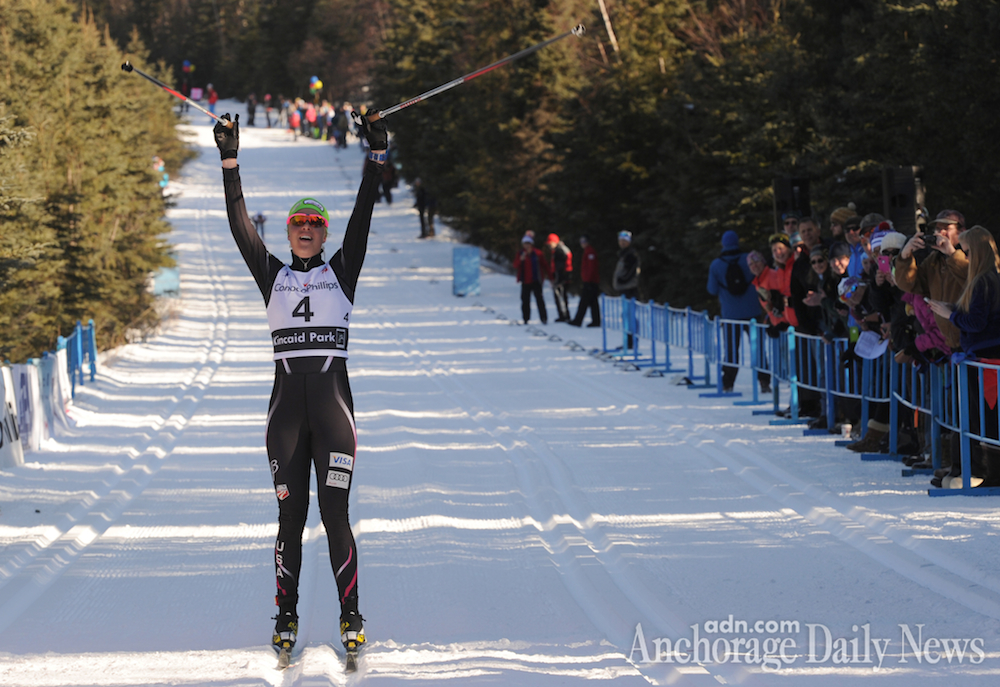
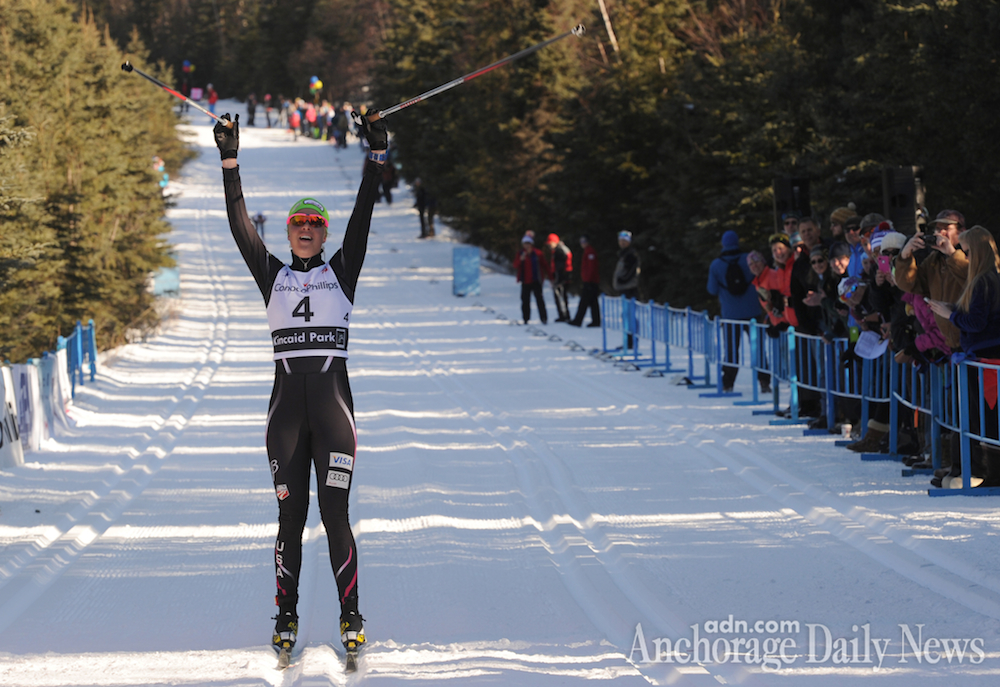
But Alaska Pacific University skiers Thomas O’Harra and Rosie Frankowski were undeterred by these risks, as both got a gap early in the race and held it to reach the finish line unchallenged, claiming victory in the 30th Tour of Anchorage on a bluebird Sunday morning.
For Frankowski, pushing hard from the start was her plan all along. “I went off the line,” she told FasterSkier during an in-person interview after the race. “I knew that the only place where it’s easy to build a gap is Spencer’s, and I would much rather ski uphill any day than ski on a flat downhill course. So from the gun I went for it. I tried to ski relaxed, and then the minute I got to even the climbs heading up to the Gasline, I just hammered as if I was in like a 20 k race.”
Despite the fast pace at the start of a long day, Frankowski was relatively unconcerned about her effort level. “I knew that there’d be tons of recovery, even on Spencer’s,” she said. “We raced a 30 k there a couple years ago [at Spring Series 2014], and you hammer the uphills and you get two minutes of recovery on downhills. So I just went for it. I caught some groups, I had people to chase, people from the men’s waves, and had a lot of local support that definitely moved over.” By the bottom of the Spencer Loop, Frankowski was hearing that she had a five-minute gap on her nearest pursuer.
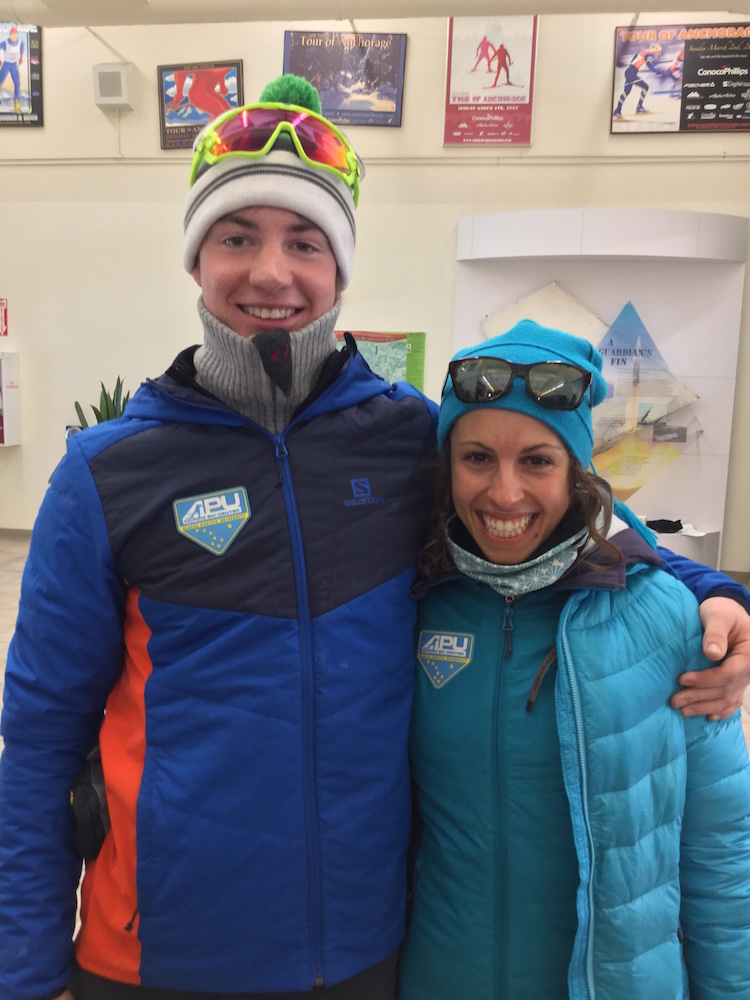
“And so I just tried to hammer” at that point and catch the next group, she recounted, “because I wanted to catch a group to draft for the mid-part of the race, and I caught Rob Whitney’s group.”
Frankowski had nothing but praise for her on-course treatment from Whitney, once a leading American junior and now a formidable Masters skier. “And with Rob and three other guys, we traded off the lead. And it was fun, because they were psyched to have me in the group, compared to – I mean, you hear about sometimes some of the male skiers being annoyed, but they were awesome. And we had this little group going with switching the lead every minute toward the end to try to catch some of the APU guys we could see in front of us. It was really fun.”
Ahead of all those APU guys was the fastest skier on the day, Thomas O’Harra. The 20-year-old junior and Anchorage native was skiing alone on familiar trails, at one point passing the house he had grown up in. “My season hasn’t really gone the way I’d hoped and so today felt awesome to have a good race at home, on trails that I grew up learning to ski on,” O’Harra said in an APU press release.
Like Frankowski in the elite women’s wave starting two minutes behind him, O’Harra led the race off the line. While Frankowski dropped the other women almost immediately, O’Harra had somewhat more company, leading a pack that included fellow APU skiers Reese Hanneman, Tyler Kornfield, and Jack Novak up through Gasline, roughly four kilometers into the race. O’Harra sat in second through the ensuing climbs of the Spencer Loop, until, he recounted, “I made a move going up Wall Street [at the top of the main climb] on Spencer, and I led from there to the finish line.”
O’Harra was pleasantly surprised that the gambit worked. “My plan coming into the race was to see how my skis were running and decide from there,” O’Harra told FasterSkier after the race, “Once I figured out that my skis were running pretty well compared to everybody else, I decided to go for it and try and stretch it out. I expected – I didn’t expect to ski alone the whole 50 k. I expected everybody else to chase me. And they tried, I heard, but I had a little bit too much of a gap.”
O’Harra crossed the line in 2:10:49.2. Hanneman (+2:11) and Kornfield (+2:54.8) made up the rest of the podium, with Novak finishing several more minutes back in fourth (+7:21.8). APU skiers took six of the top seven spots in the men’s race, including APU Masters Coach Galen Johnston and former Tour champ Dylan Watts.
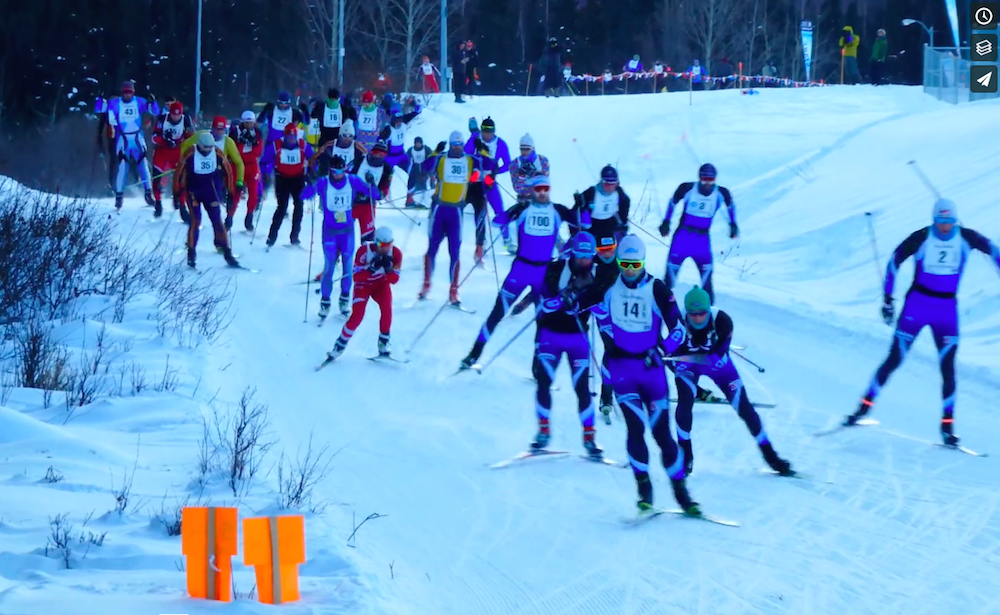
Breaking away at the 7 k mark carries risk in any 50 k, because of the differences in efficiency between leading solo versus skiing in a chase pack that characterize any long race. It is particularly fraught in the Tour, given the elevation changes and topography of the point-to-point race from one side of town to the other.
Briefly put, the Tour goes up for the first 10 k, but down or flat almost all the rest of the way. More specifically, the 50 k course ascends the rolling uphills of the Hillside ski trails for around 5 k, then tackles the Spencer Loop. Spencer is locally notorious for having more climb than is allowed under International Ski Federation (FIS) regulations – the maximum climb of 104 meters readily exceeds the 80-meter limit permitted for an A-climb on a FIS-homologated course of any distance. Within the first 7 kilometers of the Tour, skiers have climbed more than 150 meters above where they started. (For comparison, the American Birkebeiner, famous for its hills, climbs roughly 105 meters over 11 kilometers.)
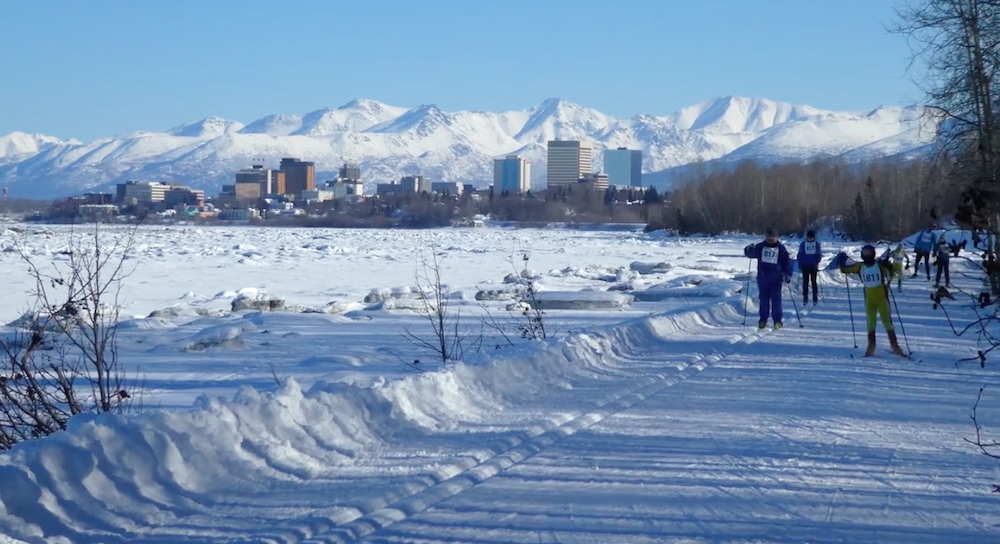
But it’s virtually all downhill from there. Racers descend Spencer, ski on rolling downhills back through the Hillside lighted trails, drop down through Campbell Tract, and then cruise on greenbelt trails until the 44 k mark before climbing up to the finish at Kincaid over the last six kilometers. For parts of the course skiers are on the Coastal Trail alongside the ice floes of Cook Inlet, elevation approximately one meter. All of which is to say that a chase pack has a lot of time to work together on the flats to reel in an early solo breakaway.
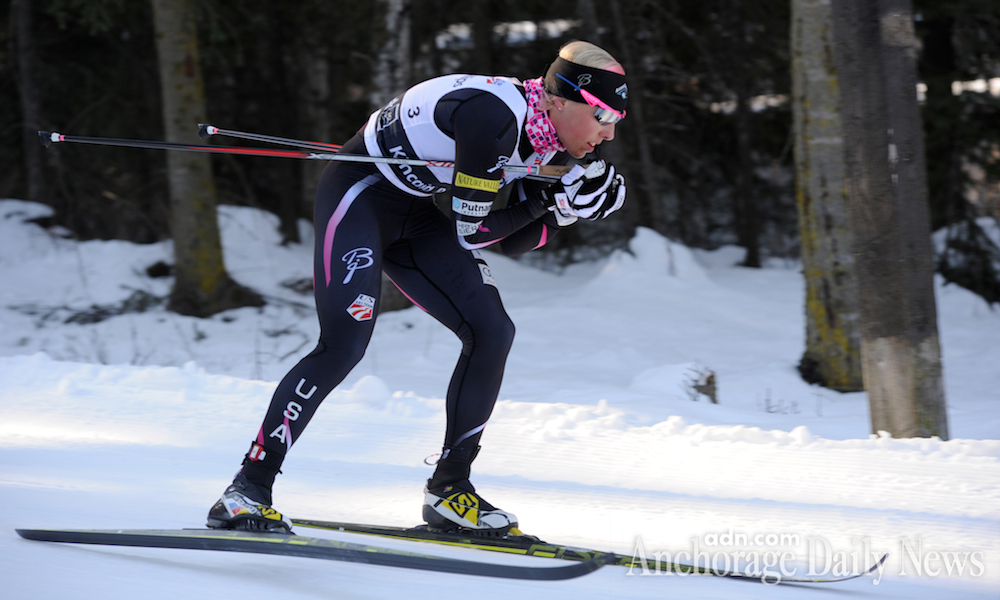
Oh, and it was not warm out there, so leaders were dealing with slow snow as well. Race-time temperatures Sunday morning were -4 degrees Fahrenheit at the starting line, down to -12 degrees in a notorious icebox spot in the black spruce forest of Campbell Tract. Skiers sported the latest in face-tape fashion – Frankowski carried the day with her pink tape and pink buff ensemble – and race photos show a series of frosty faces, ice beards, and clouds of frozen breath.
Even Frankowski, who dominated the women’s field en route to finishing sixth overall in 2:23:42 (Shalane Frost and Nicole De Yong followed roughly 15 minutes back), noticed the cold.
“I don’t think it was particularly fast,” Frankowski said. “I never race with a watch, but definitely the snow was slow. … It was not a warm day out there. And by the end – normally I die with 10 k left in all the 50 k’s I’ve done, so today I died with four k left, which was a vast improvement. And the worst part is, I had to stop like four times during the race, because I dropped my waterbottle, or it froze and I couldn’t get it back in my pack. So at one point at Westchester Lagoon I dropped it, my whole group had to go around me because I snowplowed to a stop to pick it up, and then I just threw it onto the Lagoon. So I have to go find it after the race.”
O’Harra also had plans for after race: “I was informed after the awards ceremony that there is a bottle of wine for me, waiting for when I turn 21, which is next Sunday, and I get it then.”
But last Sunday morning, as skiers flocked to the outdoor beer garden following the race, O’Harra was left inside. Let his former roommate Frankowski graciously explain: “I am really excited mostly for my teammate Thomas O’Harra’s win. Thomas and I had been roommates, until December, for about a year, and Thomas now has my room on the APU campus. Which, obviously, the karma contributed to why he won. And in fact, Thomas isn’t even 21, so he can’t go to the beer garden that the Tour of Anchorage and [Nordic Ski Association of Anchorage] has graciously provided for us. So unfortunately, the Tour winner’s stuck inside.”
Other than bottles, of either wine or water, what were the winners’ future plans? Frankowski, reflecting the realities of life as a professional cross-country skier, was planning to use her $500-dollar winner’s check toward rent money. And as for the rest of her first-place prize, the roundtrip Alaska Airlines plane ticket? “You can’t fly to Cuba” with it, she lamented, “which is basically the main destination I wanted to go to. So now I have to find another destination where Alaska flies. Honestly, I’ll probably go to Minnesota, where I’m from.”
O’Harra, meanwhile, was planning to put in a three-week training block, “and be in good shape for Spring Series in Fairbanks” in late March.
O’Harra explained that he had been planning on racing this year’s Birkie before it was canceled, “so that would have been my first 50 k. This instead became my first 50 k. So hopefully my second 50 k, in Spring Series in Fairbanks, will be just as good.”
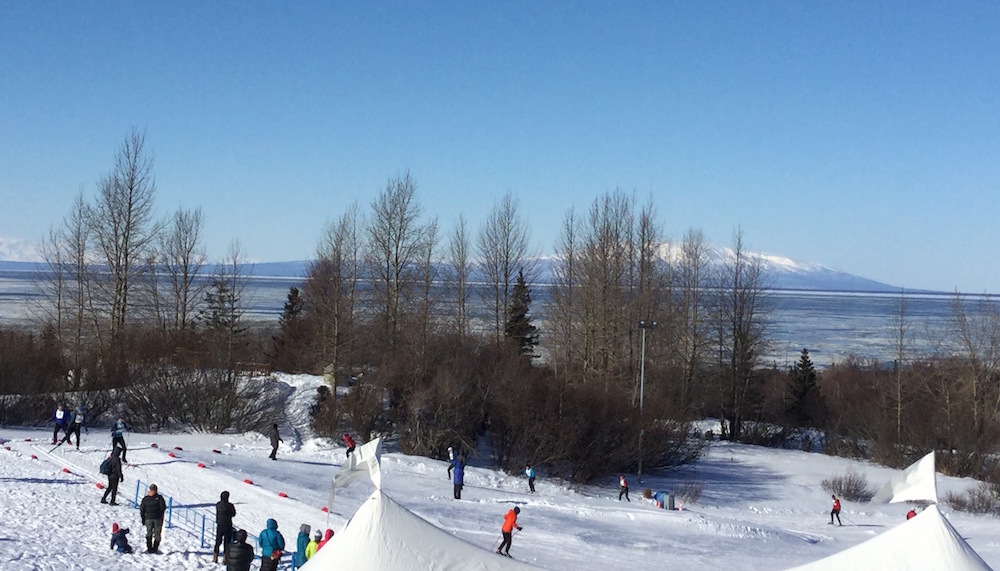
For Frankowski, Sunday marked the fourth-career 50 k for the Midwest native, including two Birkies and a win in last year’s Great Bear Chase in Calumet, Mich. “This is definitely the prettiest 50 k I’ve ever done in my life,” Frankowski said of a perfect day when mountains and ocean were visible in all directions throughout the course. “It was beautiful out there.”
A triumphant return
Frankowski’s sentiments were clearly shared by many in the crowd of 872 finishers, which marked both the smallest Tour field in over twenty years but also, with this year’s Birkie washed out, the largest ski race in the country this winter to date. Although the Tour was held over its full course 25 times in its first 26 years, the race only went halfway across town in 2014, and was confined to a lap race on Kincaid snowmaking trails in 2015 and 2016 as snowfall was scant and participation numbers plummeted.
But this year the Tour returned to Anchorage, and Anchorage returned to the Tour. Families raced. Parents raced. Grandparents raced. Anchorage Mayor Ethan Berkowitz raced. Alaska State Representative Matt Claman (D–Anch.), whose house lies within 100 meters of the course, raced. A 9-year-old completed the 25 k (in a healthy 2:08), and 87-year-old Reno Deprey classic skied the 40 k in 4:47. It was a great day for skiing in Anchorage.
It was also an historic day: March 5, 2017, was just over one century removed from the first recorded ski race in Anchorage, a town founded in 1914 as a construction camp for workers on the Alaska Railroad.
As former U.S. Ski Team athlete Tim Kelley recounts in more detail on his blog, a 10-mile race was held, starting and finishing on Fourth Avenue in downtown Anchorage, on March 4, 1917 (start line photo here). The winning time was a solid 1:08:30 for 10 miles, more than respectable considering what we would now term the primitive ski technology involved. First place went to a John Aho, with one Emil Gustafason second. A man whose given name was literally “Young Viking” served as race director. They raced again the following weekend, by which time the winning time was down to 57:25 for 10 miles. O’Harra posted a faster pace in March 2017 for 50 k, but not that much faster.
Other races
Three other races were held on Sunday. In the 40 k, which skips Spencer Loop and most of the Hillside trails, first place in the women’s division went to former junior standout and Besh Cup Trophy winner Jaime Bronga in 2:05:15.1. Christina Pohl and Melina Park followed.
In the men’s 40 k, three local juniors used the 40 k to once again unofficially see who is the fastest local junior not selected for Team Alaska for Junior Nationals. (One has to be 18 years old to race the 50 k. The 11 year old who skied this year’s 40 k in 3:06 suggests that there may be no lower age limit for the 40 k.) This year it was Chip Schoff, 17, who took the victory in 1:48:16.3, over 17-year-old Trent Fritzel and 16-year-old Hans Personius.
In the 25 k skate race, Jasmine Maurer of Homer took the victory for the women in 1:32:59.9, followed by Clare Ross of Anchorage and Mallory Conger of Nome, reflecting the fact that the Tour draws racers from the entire state. For the men, it was Kai Meyers, 16, in first in 1:12:22.6, Kevin Donley, 51, in second, and Dale Baurick, 14, in third.
And first overall in the 25 k classic was University of Alaska Anchorage skier Sadie Fox in 1:30:28.1, followed by Alison Arians and Anna Rix for the women. First among men, and second overall, was Erik Hjelm in 1:31:42.6, followed by Paul Kari and Karl Volz.
Next year’s Tour is scheduled for March 4, 2018.
Results (all races) | Race video