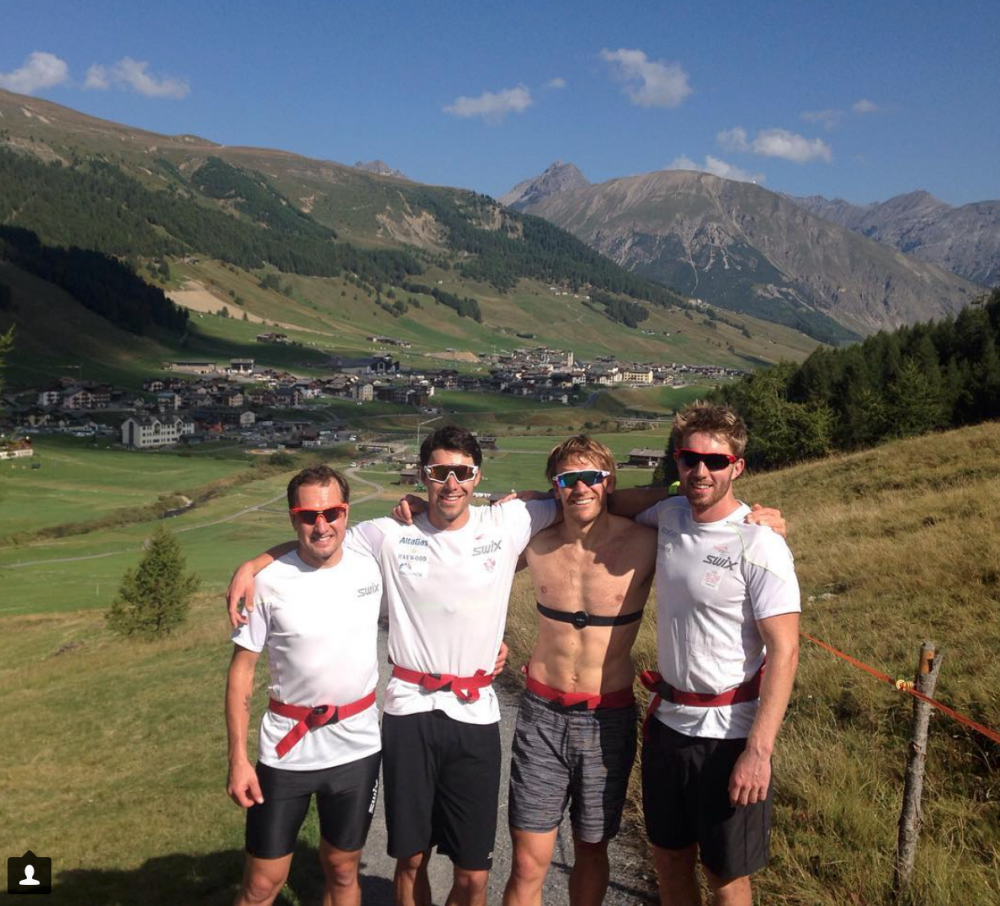
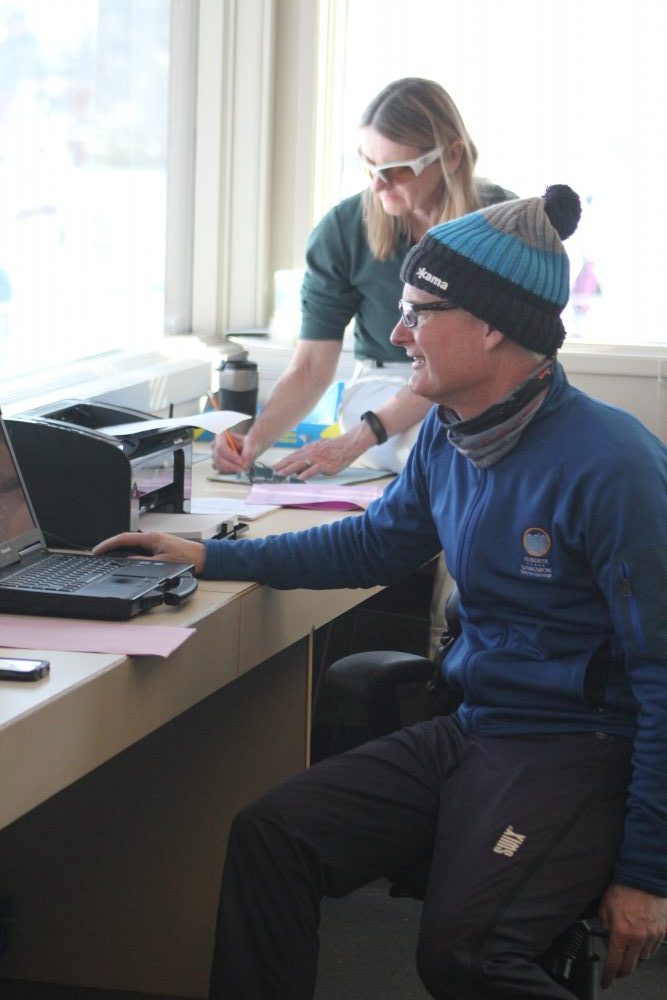
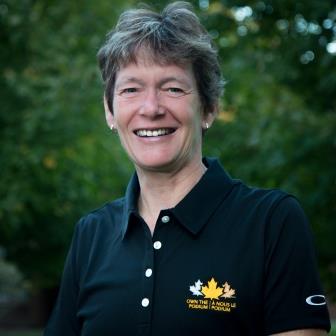
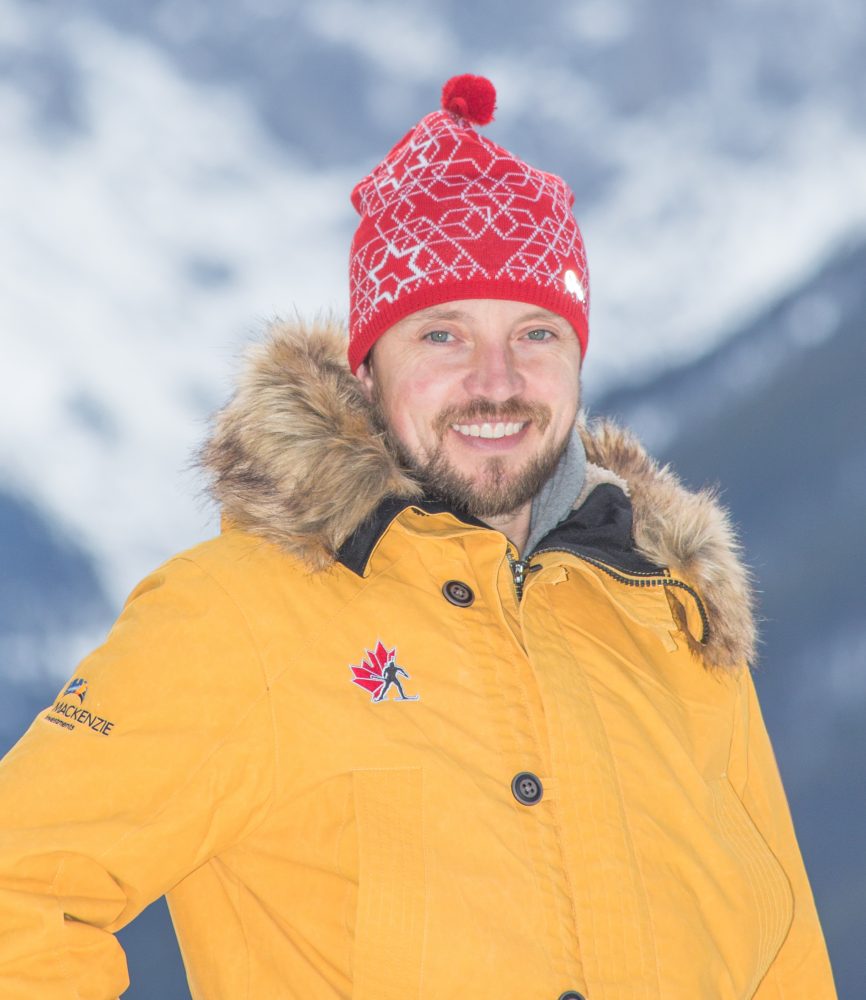
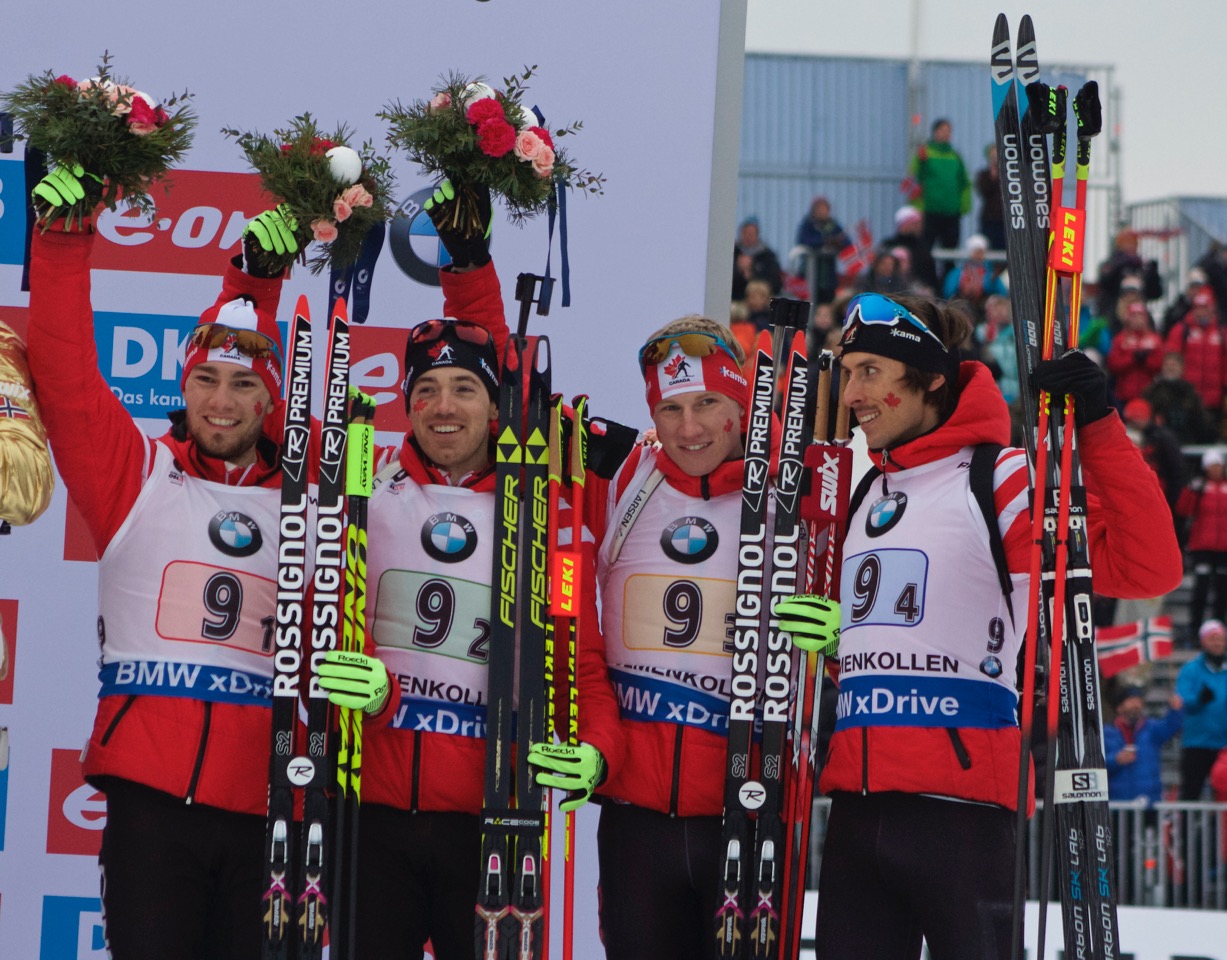
Coach Ivan Babikov (l) at a 2016 fall training camp with Canadian World Cup Team members Alex Harvey, Devon Kershaw and Graeme Killick in Livigno, Italy. (Photo: Ivan Babikov/Instagram)
Cross Country Canada (CCC) has appointed a new high-performance and development advisor, Nic Lemyre, and laid off four staff members, CCC Chief Executive Officer Shane Pearsall confirmed in a phone interview on Thursday.
The news of Lemyre’s hiring came in the form of a press release Thursday morning, two days after four CCC employees — Ivan Babikov, Mike Edwards, Lisa Patterson, and Martine Zilligen — were informed of their release.
Babikov has spent the last two seasons as a national team and World Cup coach, Edwards was the high-performance director for CCC’s Para-Nordic Ski Team, Patterson was a longtime high-performance development coach, and Zilligen has been communications and marketing manager since 2013.
According to Pearsall, the layoffs were a direct result of CCC’s annual operating budget (which covers both able-bodied and para nordic skiing) decreasing from about $4.5 million dollars last year to what he anticipated to be $3.9 or $4 million dollars this year. The budget is not finalized, as CCC is waiting on the amount it will receive from Own the Podium (OTP), a government-backed nonprofit, which Pearsall estimated to be about 20 percent of CCC’s operating budget. That final amount is expected by mid-July, he said.
Fifty percent of CCC’s budget comes directly from the government branch of Sport Canada, and that amount has been determined, Pearsall said. He explained that money is tighter on the whole for CCC as a result of decreased government funding and sponsorship revenue.
One of CCC’s main sponsors, Mackenzie Investments, will no longer support nordic or four other snow sports as it had previously. Instead, the investment firm opted to stick with freestyle and alpine.
On the upside, he explained that another sponsor and investment firm, Haywood Securities, has agreed to sponsor the NorAm circuit as it has in the past.
Asked if budget cuts were among the biggest challenges affecting CCC at the moment and the reasoning behind the latest layoffs, Pearsall said, “Yes. If things had stayed the same that would’ve been good, but obviously that’s not the case.”
He added that CCC is faced with the ongoing challenge of competing with other sports for the support of “corporate Canada”.
“At the same time, we continue to talk to people and try to get them on our side to become part of our programs,” Pearsall said. “There’s a part of it where it always will be the challenge. You’re always looking for money for places to spend the money, and we just continue on trying to get more money.”
Asked specifically why CCC chose to release those four employees, Pearsall said, “Just trying to create a better future, efficiencies that we think we can find. It’s appropriate that at the end of the quad [Olympic quadrennial], you look at things and how to set the stage for the next quad. And even for us, we were looking at 2026. So we’ve decided this the way we’re going to go.”
CCC now has a staff size of 12. Louis Bouchard retained his job and is listed on CCC’s website as its lone national ski team/World Cup coach. Bouchard is also Alex Harvey’s personal coach and head coach of the Pierre-Harvey National Training Centre (Centre National d’Entraînement Pierre-Harvey) in Quebec.
Pearsall said he broke the news to Babikov, Edwards, Patterson, and Zilligen individually during one-on-one meetings on Tuesday.
“It’s one of those things, when you do a change, you tend to want to something like this all at one time, and that’s the strategy we executed,” he said.
CCC will be looking to replace Babikov’s position as co-World Cup coach through an “open job search,” Pearsall stated. As for Patterson’s role as a NextGen coach and development trip leader (for international competitions including U23 and Junior World Championships), Pearsall was unsure if CCC would fill that vacancy.
“When something like this happens — I’ve been involved in the corporate sector — you do a bit of a reshuffle on responsibilities, so we’re working on those on how we’ll go about that,” he said. “At this point in time, I can’t say we’ll necessarily hire somebody in that specific area, but we’re looking at how we cover responsibilities.”
As for the timing of these layoffs in early June, two months after the end of the season, Pearsall said that was a tough one.
“Can you ever find perfect timing? There’s questions about that, but this is the way we decided to go, and we’re going to make the timing work,” he said. “… This is the way things lined up. This is the way we’ve gone about it.”
According to Babikov, the layoff, which was effective immediately, caught him off guard.
“I had no idea it was coming, and it didn’t cross my mind that something like this would happen because we had already started the new summer,” Babikov said on the phone on Thursday. “I just came back from training and our CEO just called me for a meeting, and I thought it was regarding our new HPD, if we hired somebody, but then he just handed me papers and I was told to leave my credit card and keys, and we go separate ways. And that’s all that was said.”
Babikov, who’s been part of the Canadian national team for the last 10 years, first as a two-time Olympic athlete and then as a coach starting in June 2016, said there was no notice. “It was without a cause,” he said.
Asked why Babikov was fired, Pearsall said he couldn’t comment.
‘The Rebuild’
Lemyre as the high-performance and development advisor will fill the roles previously held by Edwards and Thomas Holland, the former high-performance director of able-bodied cross-country who retired at the end of last season. A Montreal native who is primarily based in Norway as a professor of sports psychology at the University of Oslo, Lemyre will work part time for CCC.
He’ll be the head of one of CCC’s two new departments, Pearsall explained, overseeing the sport side of the organization while Pearsall and Megan Begley, CCC’s operations & strategic development manager, oversee operations. Lemyre will make decisions in his department, but Pearsall will have “final approval on all personnel decisions”, according to CCC media relations consultant Chris Dornan.
Dornan clarified that Lemyre is “advising on the rebuild” and that CCC will communicate the structure of its high-performance department in the near future.
“His role is going to be advising us, going forward, on how we should look at things, and develop things,” Pearsall said of Lemyre. “He’s going to be an integral part of the decisions we make, in different areas, in the high-performance area. He will be overseeing, in the re-org, I’ve basically created two departments. One is operations, and one is sport. He will be in the mix on the sport side. Under the old structure, there was a para-nordic [director] and there was an able-bodied [director], and I’ve brought those two together to gain efficiencies and exchange more knowledge, if you will, between the two sections of para and able.”
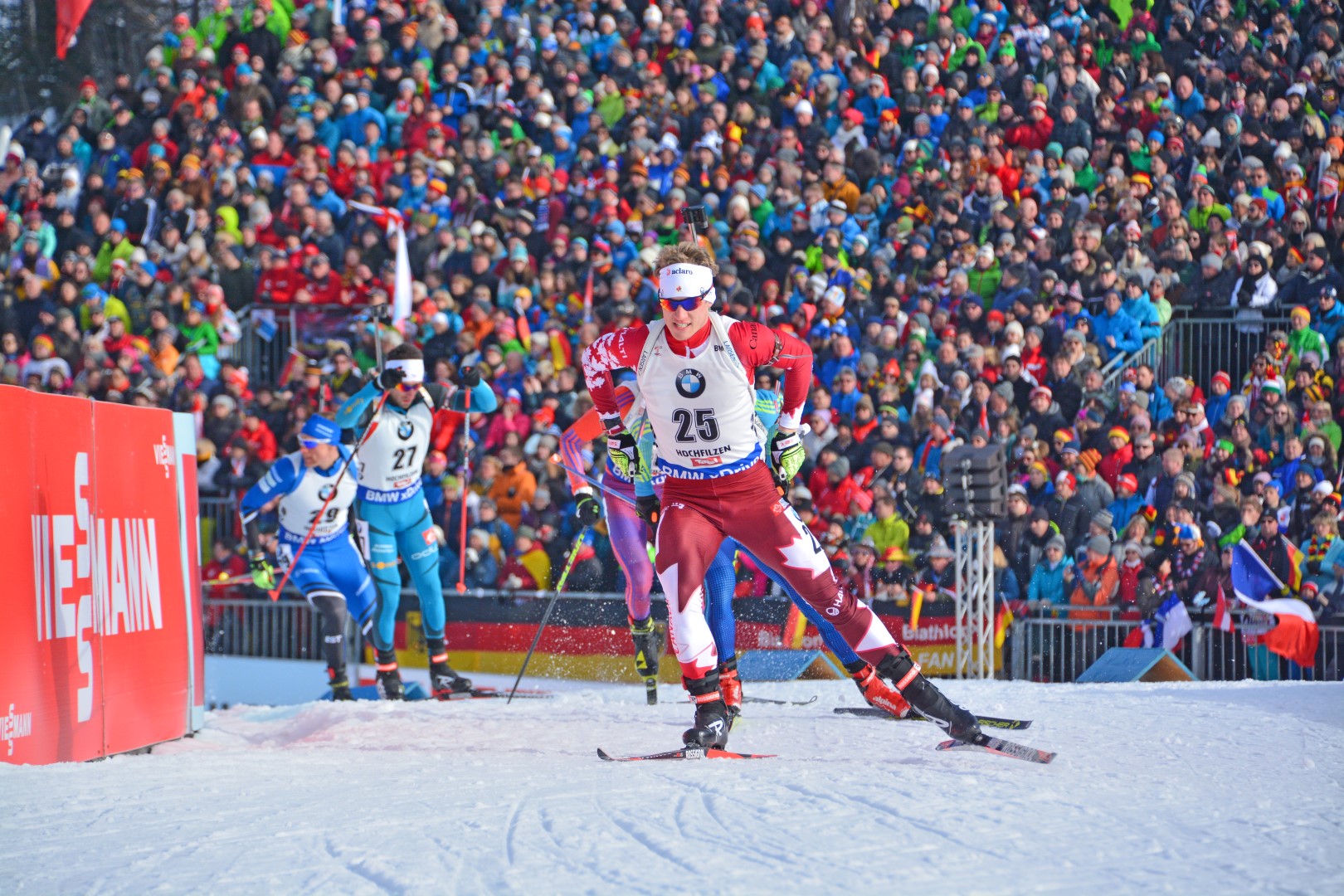
Biathlon Canada’s Scott Gow racing to 47th in the men’s 12.5 k pursuit at 2017 IBU World Championships in Hochfilzen, Austria. Biathlon Canada is facing a tightening of purse strings for the 2018 Olympic season as Own The Podium cut its base funding to zero. (Photo: Glen Crawford)
If you made it past the article’s title, then get ready to immerse yourself in the intricacies of Canadian high-performance sports funding.
OK, here it goes…money, money, money. Add this for effect, $.
Imagine for a moment you’re the CEO of a national sporting body and you’ve got high aspirations — things like championship and Olympic medals. There’s an infinite amount of puzzle pieces to organize and assemble. There are two critical pieces to even fathom success: the motivated athletes-coaches combo along with ample funding.
Biathlon Canada finds itself in a precarious position for the 2017/2018 season— a critical year considering that many athletes sharpied in the 2018 Winter Olympics in PyeongChang, South Korea, in mid-February as their performance peak just after the 2014 Sochi Olympiad.
The financial hammer fell in May when Own The Podium (OTP), a Canadian nonprofit focused on supporting Olympic medal contenders, cut its base funding to Biathlon Canada to zero dollars. ((Biathlon Canada is the National Sporting Organization (NSO) overseeing biathlon in Canada.))
Andy Holmwood, Biathlon Canada’s general manager (Photo: Pam Doyle)
During the final run-up to PyeongChang, Biathlon Canada must belt-tighten and evolve in a climate of continued funding scarcity. At the time of publication, the exact amount of Biathlon Canada’s budget was unclear despite a request to Biathlon Canada General Manager Andy Holmwood to confirm his organization’s 2017/2018 budget.
“I am not in a position to discuss any of our budget numbers,” Holmwood said in a phone interview on July 11th.
Biathlon Canada receives the majority of its funding from three major sources. There’s Sport Canada, a government agency providing funds to NSO’s through its Sport Support Program. Jon Schofield, a Sport Canada spokesperson and media-relations specialist, explained to FasterSkier in an email that Sport Support Funding is for a four-year cycle.
Then there are corporate and private donations made directly to Biathlon Canada.
Lastly, there’s funding from Own The Podium (OTP). According to Schofield, OTP makes the recommendations upon which other groups base their monetary support.
“Those sports that have athletes which have demonstrated the potential to achieve a podium result at the Olympics and Paralympics, are also eligible for enhanced excellence support,” Schofield wrote in an email. “The assessment of podium potential is done yearly by Own the Podium which provides funding recommendations to Sport Canada, the Canadian Olympic Committee and the Canadian Paralympic Committee – (the two latter) which in turn support the sports directly.”
It can be tricky and frustrating. Biathlon Canada is in a constant struggle to promote and financially support athletes who have already arrived while keeping promising athletes in the development pipeline.
The OTP Ask
Here’s how the basics work between OTP and Biathlon Canada. The NSO, or Biathlon Canada in this case, presents its supporting evidence — in both a formal proposal and in-person meeting — that its athletes have Olympic medal potential. OTP officials then recommend funding based on their assessment of the submitted evidence.
OTP funding is considered to be “top-up” funding, or monies for athletes at the very highest level of their respective sport. Amongst the high-performance scene in Canada, the philosophy of emphasizing those athletes already at the top is referred to “targeted excellence”. In total, OTP redistributes approximately $64 million annually. To put that in perspective, that $64 million is part of the larger $200 million the government invest in Canadian sport annually.
Anne Merklinger, Own The Podium chief executive officer (Photo: OTP)
“Our mandate, which is prescribed by the national funding partners, is to provide technical advice for National Sport Organizations and to provide investment recommendations for those sports organizations that have evidence of medal potential for the upcoming set of Games,” Anne Merklinger, OTP chief executive officer, said in a phone interview. “Secondly, we also provide investment recommendations for the subsequent set of Games, so in winter that would be for 2022. So those investment recommendations are being considered by the minister and they are not final yet.”
According to Holmwood, Biathlon Canada presented a portfolio highlighting the medal potential of its men’s relay team.
“I think we made a strong case for our men’s relay team as a medal hopeful,” Holmwood said. “I think it’s fair to say they didn’t agree with us completely. They didn’t share that perception. It is clear that OTP in an Olympic year, they refer to sharpening their pencils and really focusing the funding on strong medal contenders. In their eyes, we did not fit in that.”
Two seasons ago, the men’s relay team earned a historic bronze medal at 2016 International Biathlon Union (IBU) World Championships in Oslo, Norway. Last season, their best finish was seventh at the World Cup in PyeongChang, South Korea, where many nations did not start all of their top athletes. (More on last season’s results later.)
“Their base funding for ’17-’18 is zero,” Merklinger said about OTP’s funding for Biathlon Canada. “But they are receiving $50,000 for the coaching position … to support a coach through the Olympic Legacy Coaching Fund. So that is the extent of the funding recommendation for biathlon for the ’17-’18 fiscal year.”
Starting at the top of Canada’s biathlon pyramid, the collective gasp came at the depth of the cuts, not that OTP cuts were made.
“OTP takes a very actuarial approach,” Holmwood said. “It’s not subjective. And to their credit, they are very clear in their mandate. It’s not a big massive surprise. I think what surprised us was just how deep the cut went.”
Roddy Ward, Biathlon Canada high-performance director (Photo: Ric Rowan)
“In the end, it seems as though they believe we have some up-and-coming athletes but no medal prospect for 2018 Olympics,” Ward said. “By their mandate, it means we get cut out of the pot of money for the Olympic season. I don’t doubt they followed through with their mandate, but ultimately, decisions like that undermine growth towards consistent podiums in our sport.”
Ward has a point about diminished funding decreasing the odds of future podiums. But OTP’s mandate only looks to a two-Olympic cycle “event horizon”. At the moment, OTP is not obligated to look further than Beijing 2022.
OTP publishes what it calls a Winter Historical Comparison on it’s website. It outlines OTP funding recommendations for Olympic winter sports by quadrennial. For the Vancouver quadrennial, Biathlon Canada received $1,784,173. It received $1,324,623 for the Sochi quadrennial.
According to Merklinger, for the ’14-’15 fiscal year, Biathlon’s base funding from OTP was $250,000, $400,000 for ’15-’16 and $435,000 for the ’16-’17 fiscal year. Accounting for the ’17-’18 cuts, and adding the $50,000 from the coaching legacy fund, the PyeongChang quadrennial total for Biathlon amounts to $1,135,000.
(On OTP’s website, a figure of $1,200,000 is used for the first three years of the PyeongChang quadrennial. Using that figure, an amount of $1,250,000 would have been recommended for Biathlon during the PyeongChang quad.)
Although Merklinger was clear in explaining to FasterSkier that Biathlon Canada’s base funding was “zero”, Holmwood said this about OTP’s potential allocations: “Our OTP funding for this coming season is uncertain. It is fair to say, I would say that we have received a substantial cut, but just what we will be getting from OTP is not certain.”
OTP’s Merklinger said the funding door as it applies to the medal potential of Canada’s national biathlon team isn’t exactly slammed shut. OTP maintains the administrative flexibility to infuse money into a high-performance program on short term notice.
“We can do that from today until the start of the Olympic Games,” Merklinger said when asked if OTP could recognize medal potential with monetary support if an athlete or team proves they are on form in races scheduled a few months before the Games. “We are eager to work with biathlon as the season unfolds to assess the progress of their preparations and their performance for PyeongChang and would be delighted to be in a position where we could provide a very specific incremental funding recommendation that is focused and that responds to a positive side of the program and indicates that they indeed have evidence of medal potential.”
The Potential
Medal potential is exactly that — potential. There are no absolutes. Although actuarial means may be used to determine the likelihood for an Olympic medal, sport is fickle.
Take biathlon, for example. There’s the shooting range and wind conditions, the rifle and its complex moving parts, the wax, the skis, and of course the athlete. The number crunching for potential would have to consider the likelihood of all things aligning for a Canadian athlete and the likelihood a veritable podium lock, like France’s Martin Fourcade, has an unlikely off-day. No matter where the OTP assessment falls, OTP’s job is a tough one — determining the likelihood of an event before that event transpires and basing its funding decisions on that likelihood.
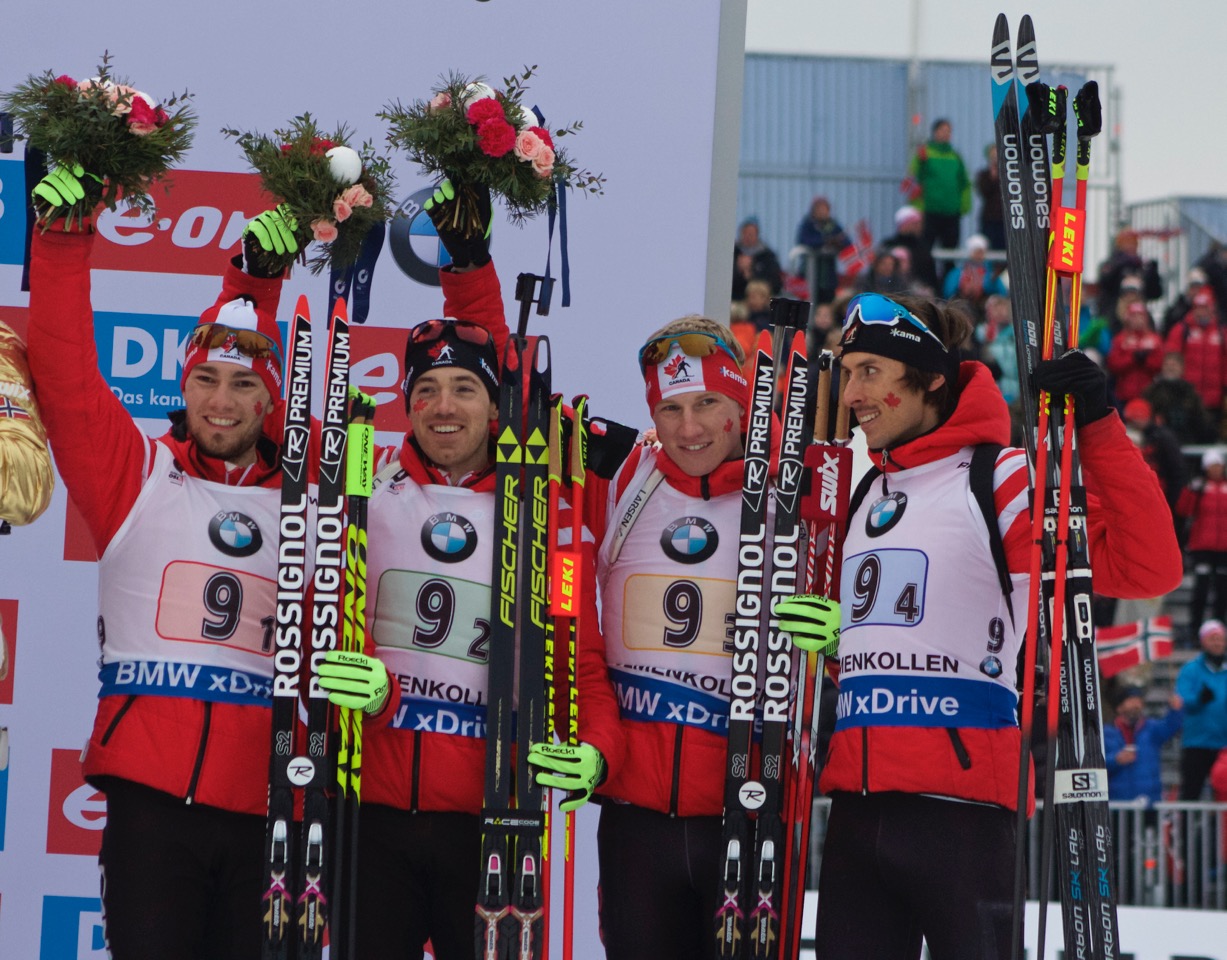
The Canadian men’s team (from left to right) Christian Gow, Nathan Smith, Scott Gow, and Brendan Green celebrating bronze in the men’s 4 x 7.5 k relay at 2016 World Championships in Oslo, Norway. (Photo: JoJo Baldus)
One wouldn’t need to be transported back far in time to underscore Biathlon Canada’s positive medal potential. For starters, the time machine’s date could be set to March 12, 2016. In the pressure cooker of Oslo’s Holmenkollen stadium, Canadian biathletes Christian Gow, Nathan Smith, Scott Gow, and Brendan Green claimed bronze in the World Championships relay.
The past season was a down year for Canadian biathlon. Smith, the team’s highest-profile male skier, was sidelined for much of the season while he battled a virus. Brendan Green, another veteran with multiple top 10’s to his name, scored a single top-30 World Cup result in 2016/2017. Meanwhile, Scott Gow raced to three top 30’s, earning 23rd, 18th, and 17th places on the World Cup.
On the women’s side, Rosanna Crawford had been the team’s rising star, earning fourth-, fifth- and seventh-place finishes on the World Cup during the 2014/2015 season; she also placed 15th at 2016 Oslo World Champs in the 12.5 k mass start. Individually, Crawford scored six World Cup top 30’s this past season with a best result of 19th at the PyeongChang test event. She placed 26th in this year’s World Championship sprint.
As has been written before about Biathlon Canada’s tenuous funding, OTP considers medal potential at World Championships and Olympics. It’s not obligated to consider stand alone results on the World Cup circuit when making those judgments. So performance on the big stage matters.
In recent years, it has been rumored that Biathlon Canada has run a deficit.
“Biathlon Canada has always kind of operated in the red,” Crawford said in a phone interview.
It’s possible that the prospect of programmatic cuts due to the NSO’s financial standing wasn’t unforeseen. According to a February 2015 article in The Crag and Canyon out of Canmore, Biathlon Canada will maintain the same annual expenditures through 2018. In that article, that reporter states that Biathlon Canada’s annual budget is $1.4 million. This number reflects the NSO’s total budget, not the portion set aside for funding the high-performance program.
With a lack of substantial OTP support this year, Biathlon Canada is implementing a high-performance austerity program during the training season.
“We must move on and do our best to deliver on our results despite the massive cuts,” Ward said. “We have virtually cut everywhere; no funded camps, reduced IST (physiologist, strength coach, nutrition, sport psych etc), less staff, athletes will pay to compete on the World Cup. We are doing our very best to build a solid program for our National Team with limited resources, this means an ‘all hands on deck’ approach by staff. I can tell you staff are extremely motivated so in some way, it’s very exciting to be a part of and could be the perfect storm for us.”
Canada’s high-performance biathletes are accustomed to traveling for training camps. Athletes have experienced on-snow training camps in New Zealand, Park City, Utah camps, dryland racing and training in Jericho, Vermont, Haig glacier camps in the Canadian Rockies, as well as a Jasper, Canada camp. Other camps have included a Dachstein glacier camp and training in Norway. This dryland season will be more restrictive. According to Crawford, the women’s team traveled and trained in Kelowna, British Columbia, where costs were minimized: Ransom’s parents housed the team, and a sponsor donated funds for groceries.
Rosanna Crawford (Biathlon Canada) racing to 26th in the women’s 7.5 k sprint at 2017 IBU World Championships in Hochfilzen, Austria. (Photo: Glen Crawford)
Crawford also wrote in an email that both the men’s and women’s team will be spending two to three nights on the Haig glacier outside of Canmore later this summer, and Christian and Scott Gow will be attending a self-funded Park City camp.
“The majority of the cuts we have seen have been in those extensive trips, or out of country trips, maybe more precisely,” Holmwood said. “We were thinking of going to Jericho in August, but we removed that simply because the cost is pretty high. Our dollar is not strong right now, also. The U.S. is not typically a place we need to go to.”
New terrain, opportunities to thwart dryland-season staleness, and exposure to different athletes are value added aspects of training camps. Crawford, who is based in Canmore, home of Biathlon Canada and a world-class biathlon training facility, said the lack of camps are a setback, but not a season-killer.
“In some ways, it’s fuel for the fire, like, ‘We’re gonna show you’,” she said. “We don’t have to travel, we can do really good recovery, everyone can be with their significant others, and the coaches get to spend more time with their families so maybe they’ll be less likely to get burnt out in the winter. So I think we’re all just trying to find the positives from this scenario.”
With an important competition year looming, Crawford explained the real compromise may come if the funding limitations impact service on the international competition circuit.
“Truly I don’t think this summer is going to be the hard part. I have complete faith in our coaches and Jess Kryski, who’s our physiologist, that they know exactly what to do with us to get us nice and strong,” she said. “It’s more the concerns around the wintertime of how many wax techs we’re going to have, whether we’ll have massage therapists, whether athletes will have to pay to go and race. I think those are some of my bigger concerns.”
Holmwood stated that when snow flies and athletes toe the line internationally, the financial gut-shot will not impact athlete support.
“The key theme is that we are tightening our belts primarily with regard to camps,” Holmwood continued. “But come World Cup season, IBU Cup season, we will be supporting teams to the extent that we have in the past, and we will give them the resources they need to succeed.”
The Financial Seesaw and Its Cost: Reforms Coming
In 2010, Biathlon Canada’s charitable status was called into question and ultimately rescinded by the Canada Revenue Agency. Prior to the ruling, Biathlon Canada could issue tax receipts for donations. That’s no longer the case. As a result, corporate and individual donors must be compelled to contribute funds based on Biathlon Canada’s marketing exposure or simply the gift of giving.
Without the possibility of issuing tax receipts as a nonprofit, Biathlon Canada finds itself with hands wide open without a tax deduction incentive to attract corporate sponsors.
It appears Biathlon Canada has come to rely on OTP funding for its elite level athletes, despite the fact that in the Canadian sports system this funding is supposed to be a “top-up”.
“OTP makes up the bulk of the funding for the National Team and our winter competitive tours so it hit our National Team budget hard,” Ward said.
Exposed with OTP’s lack of funding is the cost of relying on a single source to meet the financial demands of running a NSO of a niche sport. The money is hard to come by.
Yet high-performance athletes in Canada have direct support from Sport Canada through what is called the Athlete Assistance Program (AAP). The requirements for athlete support through Sport Canada are different than OTP’s medal-driven approach.
“Support is provided yearly to those athletes whose sport has identified them either being or having the potential for a top 16 result in the world,” wrote Schofield, of Sport Canada. “Each sport has a number of stipends that they have access to, based on previous results and future potential.”
AAP qualifying athletes are considered “carded” athletes. Carded athletes receive a monthly check from the government to help offset living expenses while they train with the end goal of representing Canada at the Olympics or international competitions. Since 2004, $1,500 was the maximum monthly stipend an athlete could receive. As of this March, the federal funding for the AAP was increased 18 percent — eligible athletes can now receive up to $1,770 per month.
Here’s the verbiage straight from the AAP website: “AAP support seeks to relieve some of the financial pressures associated with preparing for and participating in international sport and assists high-performance Canadian athletes to combine their sport and academic or working careers while training intensively in pursuit of world-class performances.”
It remains to be seen if carded biathletes must use their monthly check for training necessities and sport recovery rather than rent or mortgage and food.
“We’ll still get the same,” Crawford said when asked if the OTP cut would impact the team’s carded athletes. “Each individual athlete will still get the same amount of money they’ve been getting in the past years from the government. Of course, it’s great for us to have funding, but it would be better if Biathlon Canada could also have a big funding partner so that we could do training camps and stuff like that, and the money we that we get could go toward groceries and the high cost of living in Canmore.”
As with the government’s intent to increase the maximum allotment to its carded athletes to compensate for a long overdue adjustment for inflation, reform minded stakeholders in government and the NSO’s should see changes to how the OTP “targeted excellence” philosophy is implemented.
Almost exactly a month ago, a report titled “Review of Sport Canada’s Targeted Excellence Approach,” was released on June 22. Essentially, the 72-page report highlights the underlying success of OTP — it has helped produce more Canadian Olympic medals — but also reports on findings that call for systemic change.
One of the main concerns raised in the report was that OTP funding decisions are made annually. The negative consequence for NSO’s and athletes is that a climate of instability persists in some sports when funding remains questionable from year to year. When cuts occur, it can leave less financially nimble NSO’s too little time to pick up the funding slack. And potential corporate sponsors shy away from longer-term sports sponsorships when defunding or deep cuts from OTP remain an ongoing possibility.
The report does suggest a model premised on funding obligations longer than a single year.
And for those in nordic sport concerned about the development pipeline, the report makes requests for a greater emphasis on longer-term funding. A common critique of OTP, as featured in a Nordic Nation podcast, is that investments in what in Canada is referred to as the “NextGen”, or up and coming athletes, are lacking.
Here’s a major concern: The medal bounty OTP has helped Canada haul in since the 2010 Vancouver Games could be a well that’s drying up. Without investing in developing its younger athletes, medal famine may be the new norm.
The Government of Canada mentioned in its April 2015 budget that increased monies for athlete development — the so called “NextGen” — would be forthcoming. The report released on June 22 recommends the following strategy when it comes to emerging athletes and allocating funds: “The current targeted approach should not be used with younger athletes deep in the ‘pipeline’. Instead, an approach that favoured focusing on training groups and larger numbers was recommended.”
For now, the brutal funding cycle continues for Canada’s biathletes and high-performance support team as feast and famine remain the backdrop to a strict definition of high-performance success: medals. The return on investment in the near term for all the stakeholders might be a zero-sum game, and in that case, who wins?
Canada’s Zina Kocher finished 32nd in the 2014 Olympic 7.5 k sprint in Sochi, Russia. After a top World Cup performance of 48th this year, she won back her Sport Canada funding support through an illness provision, but was left off the national team roster.
Three-time Olympian Zina Kocher has not been named to the Canadian national biathlon team this season, a status she disputes. Kocher has been representing Canada on the World Cup since 2002.
After a lackluster season, Kocher had a top World Cup finish of 48th place, short of the three top-30 results she would need to meet the national “A” team standards or the one top-40 needed to meet national “B” team standards.
Besides the national team snub, that meant that Kocher was not eligible for Athlete Assistance Program (AAP) “carding” from Sport Canada: financial support for top athletes that is intended to keep them training without having to hold a full- or part-time job. Kocher and teammate Scott Perras, who was in a similar situation, appealed the ruling based on performance and lost. (For more about carding and this appeal process, scroll to the bottom of the article.)
Next, they submitted paperwork seeking injury/illness exemptions from the criteria, and regained their carding that way.
“I was on vacation and was having to deal with this,” Kocher explained in an interview. “Scott emailed me and told me, okay, he had applied for an illness provision and it went through. So a few days after I found out that my appeal was rejected, I applied for an illness provision. I also had reasons that I was dealing with some medical stuff since September.”
Kocher had taken a month off to travel through southeast Asia. While she was there, she was deciding whether or not to continue with biathlon. Upon deciding that she did want to keep training, she was frustrated not to be able to do so with the national team.
“I wasn’t sure that I was going to continue until the end of April, when I decided that I wanted to do one more year,” she said. “… I really needed that month to step away, and to do something totally different and really relaxed. And also to help me make a decision whether to put in the effort to train again, for another year or not.”
Perras was added to the national team after he regained his carding through the illness provision. Kocher also got her carding back, but not a national team nomination. Now she’s at an impasse where she believes that her name should and will be added to the team roster, but team staff insist otherwise.
Neither Kocher nor Perras disclosed the nature of the injuries or illnesses.
“I just want to put it behind me,” Perras wrote in an email. “Sorry. I am grateful to be on the team this year and for the support of my teammates through my difficult year and am just looking forward.”
On to the National Team?
After being bounced from the World Cup mid-season, Kocher returned to Canmore, where she finished second in an IBU Cup sprint. (Photo: Pam Doyle.)
For Kocher, the dispute is over whether national team status is tied directly to carding. Kocher says that carding should automatically confer national team selection.
“I was in the exact same situation as Scott Perras, so now there’s an inequality issue,” Kocher said.
But according to Biathlon Canada High Performance Director Chris Lindsay, even if an athlete is carded, they still have to meet national team selection criteria to be nominated to the national team.
“It is related, but it is not directly linked,” Lindsay explained. “Being named to a squad in many situations will then get you into the carding list. But it doesn’t work the opposite way. If you are carded but you haven’t met our squad criteria, then we are not obligated to give an athlete a position on a training squad.”
Biathlon Canada has no specific injury/illness provision for its national teams; that was only relevant for Sport Canada and carding. Athletes can be named to the “A” or “B” squads by the High Performance Working Group, which includes Lindsay and the coaching staff, by discretion if they do not meet one of three potential objective criteria. Reasons for inclusion by the working group are listed in the squad criteria:
“A single or multiple exceptional performance(s) internationally in the current season; Near achievement of the WC Performance Standard at the end of the season; Significant than average fitness testing results from standardized tests during the training season; Exceptional circumstances.”
Injury or illness might certainly be considered an exceptional circumstance, but these issues are not mentioned explicitly. While Biathlon Canada’s carding and national team requirements are listed in one document, that document is divided into two parts. The requirements for an injury/illness provision are listed under the carding requirement section, but not mentioned in the national squad criteria section.
Perras and Scott Gow, who contributed to a fifth-place World Cup relay result this season, were named to the “B” team through the High Performance Working Group. In Kocher’s case, despite her documented illness, she was not named.
“The deliberation by the High Performance Working Group was that based on the principles of selection and the objectives for training squad members, Scott Perras was going to have a greater opportunity to contribute towards World Championships medals next season than Zina,” Lindsay said.
Biathlon Canada indicated in a press release that Lindsay will soon be leaving the organization to work as a High Performance Advisor for Own The Podium, the Canadian sports funding agency. Kocher believed that after his departure, other team staff would add her name to the national team roster.
“To sum it up, we’re all in discussion,” Kocher said on Saturday. “As Chris is resigning, it’s now going to our team manager [Andy Holmwood]. It’s in our team manager and coaches’ hands, and I’m waiting til the end of the weekend so we can sort things out.”
There’s not much evidence of discussion, though. Kocher said that the coaches told her to talk to Lindsay; Matthias Ahrens, the head coach of the national team, also declined to comment for this story and referred all questions to Lindsay.
“It is my belief that there was strong consensus that she not be nominated to the Training Squad,” Lindsay wrote in a follow-up email. “This is based on the selection principles outlined in the Squad selection document and is supported by the goals outlined in our strategic plans.”
Kocher does not dispute that her performance in the 2014-2015 season was subpar. She knew about her medical situation in September, but did not tell coaches or adapt her training because she did not think it would be a major problem. Looking back, she says, it’s clear that it was.
“I think it would have changed how I was training in September, and the amount of rest I needed before the World Cup season started, and maybe not have started racing right away,” Kocher said. “I just think that I should have modified things earlier and taken more rest. But at that time, you think, oh, I’m not feeling that bad. You just keep pushing through it.”
Kocher said that she hasn’t developed a plan other than making the national team.
“I haven’t figured out a second option because I thought that this option would work,” she said. “I can’t say that I would go back to Richard Boruta and Biathlon Alberta Training Center. I think that would be my next option, but I haven’t spoken with Richard yet.”
Lindsay also didn’t have a plan for Kocher, but was confident she would land in a good spot.
“Where she decides ultimately to go for training is entirely up to her,” he said. “As a mature athlete who has been doing this for a number of years, certainly we trust her judgment on where she feels she would be best fit. Should she require any assistance finding a place, we have encouraged her to ask us any questions. But, she is not a member of the national training squad for the 2015-2016 season.”
What is Carding?
Although carding itself is not the issue under dispute – both Perras and Kocher received their carding after submitting injury/illness appeals – it’s hard to understand the source of Kocher’s conflict without also addressing carding.
There are several different types of “cards” available through Sport Canada’s Athlete Assistance Program. Some (SR, SR1, and SR2) confer monthly payments of $1500. Others (C1, D) confer monthly payments of $900. This is intended to allow the best Canadian athletes to train full-time without having to find a part-time job.
(There’s other benefits too, like funding for childcare, moving expenses to centralize with a national team, and a fund to pay for university tuition after retirement.)
Millions of dollars are spent by the Canadian government each year on this program, which supports Olympic disciplines and a few non-Olympic teams with major World Championship events. Sports receive different amounts of carding depending on the number of disciplines and potential medals, and must allocate this into “cards” based on their own internal standards.
There’s one exception: top-eight finishes at Olympics and World Championships events, including relays. Across all sports, that confers an SR1 card the following season, and an SR2 card the next season. After the 2014 Olympics in Sochi, Russia, all eight Canadian relay members (four men and four women) received SR1 cards because they had finished in the top eight in the men’s or women’s relay.
The catch is that national federations can add additional requirements to SR2 funding.
“A NSO may adjust a criterion or include sport specific requirements to the senior international criteria specific to their sport in order to strengthen the criteria,” the Sport Canada AAP guidelines read.
“Other sports would put in, you must have a 10 k running time of sub-[some time] in the next season, or you must do so many appearances on TV,” Lindsay said. “You can put in just about anything. For a long time Biathlon Canada had no maintenance criteria at all.”
That aligned them with several other major sports federations. For instance, speed skating, figure skating, and several other major winter sports federations appear to give SR2 carding as long as athletes maintain basic requirements like Canadian residency and signing a contract with the organization.
But other teams do attach additional requirements to receive an SR2 card. For instance, Cross Country Canada requires that to receive an SR2 card, athletes must continue to meet the eligibility standards, which include being part of the national team or a national development center. Swim Canada requires athletes to “have maintained a performance level within a threshold of 1% of the time they performed to earn the SR1”. Track and field requires that an SR1 athlete “achieves prescribed performance targets and benchmarks over the course of the two years” to continue receiving carding money.
This season, Biathlon Canada added an SR2 maintenance requirement for the first time. Kocher asserts that as a result, she and Perras did not realize that the second year of post-Olympic carding was contingent on any maintenance criteria.
“We thought that it was just going to go into effect the following year since the six of us that continued on had made the criteria in Sochi,” Kocher said. “Then in December at Christmas, Scott Perras and I found out that we hadn’t had a top 30 yet and we needed to do this if we were to get carding for the next year.”
On September 3, 2014, the carding criteria for the 2015-2016 season was posted online; the document header read, “Effective September 1st, 2014.”
At the bottom of the third page, the maintenance criteria for the second year of carding (SR2 status) is listed:
“The second year is subject to the athlete meeting the minimum National A Training Squad Priority 1, 2, or 3 performance standard, being re-nominated by Biathlon Canada, submitting a training and competitive program approved by Biathlon Canada and Sport Canada, and signing an Athlete NSO Agreement, and completing the AAP application form for the year in question.”
Those three “Training Squad Priorities” are listed on page eight.
“It is the responsibility of the athletes to review carding and selection documents,” Lindsay wrote in an email. “In an effort to assist them we have our website set to provide twitter and facebook updates when new material is published… Any athlete who has any questions is always welcome to come to my office for answers.”
Biathlon Canada initially nominated both Kocher and Perras for carding money, but Sport Canada rejected the nominations because they violated Biathlon Canada’s own internal procedures. Kocher and Perras had to appeal to Biathlon Canada. The substance of the appeal was that it was unfair for them to have to meet maintenance requirements.
“Scott Perras and I both appealed on that basis that we had made our S1/2 AAP carding criteria at the 2014 Olympics with the top 8 relays (criteria set by Sport Canada), and that is suppose to be a guaranteed 2 years of carding,” Kocher wrote in an email. “… We argued that we had already signed our 2014/15 Athlete Contract and 2014/15 AAP contract before the [September] changes, plus had made the criteria prior to the changes.”
Biathlon Canada rejected these appeals, perhaps because Sport Canada was now looking closely to see whether they followed their internal policies – awarding carding outside of the established criteria would make Biathlon Canada noncompliant with Sport Canada’s quidelines.
So Kocher and Perras tried a new tactic.
“A few weeks before that, Scott Perras found out what was wrong with him,” Kocher explained. “He was ill, and it had been going on since July. He had medical references and stuff. So he applied for an illness provision, which is a totally different process. You tell Biathlon Canada and then they send that to Sport Canada. At the end of April he won that appeal and provision.”
That provided a path for the reinstatement of Kocher’s own carding.
Jean Philippe Le Guellec of Canada leading the Olympic 12.5 k pursuit after 6 kilometers, before being undone by a crash. His 5th-place finish in the sprint was the best-ever by a Canadian man at the Olympics.
When Own The Podium (OTP), one of the two main funding sources for Olympic sport national governing bodies, released their funding numbers to the sports last Monday, Biathlon Canada was in for both good news and bad news.
The good news: they are set to receive more money for the 2014-15 year than they had for the previous year.
“[It’s] $250,000 in high performance enhancement money, as opposed to $200,000 last season,” Biathlon Canada High Performance Director Chris Lindsay told FasterSkier. “We received an increase, which we are thankful for, and which we certainly feel we deserved – the performance of the athletes makes it clear that we deserve an increase.”
The bad news: it still wasn’t close to the amount of money that they requested. While Lindsay noted that not once has OTP ever matched their full request, it was potentially a surprise based on the last time Biathlon Canada went through this process in a post-Olympic year.
“In the beginning of this quad, I would have preferred to see a number that was more in line with what we received at the beginning of the previous quad, when we received $430,000 in performance enhancement money,” he said.
It’s notoriously tough to parse OTP decisions. For one thing, the organization almost certainly has a smaller overall budget to work with compared to when they were coming off a home Olympics with huge public enthusiasm for winter sports in particular. And funding priorities have shifted for plenty of other sports too, for instance, he said, from sports like speedskating and figure skating towards freestyle skiing and snowboarding.
But despite the acknowledged challenges for OTP, Lindsay wasn’t entirely pleased with the decision.
“I base my concern off of what I see as better results coming out of the Sochi Olympics than what we were able to achieve out of the Vancouver Olympics, and also the prospect for having multiple athletes capable of winning medals at World Championships and, with appropriate support 4 years down the line, at Olympic Games, is greater than the long-term prospects that we had post-Vancouver,” he explained.
In Sochi, Jean Philippe Le Guellec re-set his own best mark for a Canadian man by finishing 5th in the sprint, and Brendan Green and Nathan Smith notched finishes of 9th and 11th. On the women’s side, Megan Imrie became the first Canadian woman to qualify for the 30-racer mass start competition since the format was introduced to the Olympics. After the Games, Zina Kocher and Megan Heinicke finished 13th and 15th in World Cup races, while Rosanna Crawford collected her first top-10 in the last race of the season.
Of that group, only Le Guellec and Imrie have retired. The rest of the team is already back training toward 2015 World Championships in Kontiolahti, Finland.
For OTP, though, only championship medals matter. And Canadian biathlon didn’t find any of those, despite some close calls.
Methods vs. Vision
The decision highlights a common issue faced by Nordic sports in North America: whether it’s cross country or biathlon, Nordic combined or jumping, in the U.S. or Canada, major funding bodies, be it OTP or, in the case of U.S. Nordic combined, the U.S. Ski and Snowboard Association, don’t always see these programs as good investments.
And like many, Lindsay sees that as a problem for countries who set goals like winning the overall medal count or the gold medal count.
“If the goal is to really be on top of the podium, we need to be constantly re-evaluating where we are going to get our next medals,” he said. “I see great potential in the Nordic sports where a single athlete who is at that level – similar to where we had JP, where we have Nathan Smith and Brendan Green – can win multiple medals.”
He noted that there are 11 Olympic medals available in biathlon, and a similar number in cross country. Furthermore, athletes in both sports have shown that they have the potential to be on the podium, even if they haven’t done it at the Olympics yet.
“They can show up on the first day of competition and be legitimately in the hunt for a medal,” Lindsay asserted. “And then the next day of competition they can be legitimately in the hunt for a medal. On the fourth day of competition, they can legitimately be in the hunt for a medal. And also on the relay days. This seems to me like a multiple opportunities for an athlete to be on a podium, as opposed to some other sports where it’s all one shot, and potentially it’s over one day where if they have a bad day on that day, there’s no getting that day back.”
At the moment, OTP is not prioritizing that possibility, despite the fact that Jean Philippe Le Guellec was in the hunt for medals in two different races and the men’s relay team was also at the front of the pack for part of the race.
“I don’t think that anyone disagrees with the goals of Own the Podium,” Lindsay said. “The goals are clear: we want to win the Olympics. Or, that we want to have Canadian athletes on Olympic podiums. Nobody has a problem with this. The execution of those goals, and the side goals that pop up from time to time, are not quite as clear.”
As he perceives it, less popular and historically successful sports are not being seriously supported in working towards that goal.
“I think we’re going to get to a point eventually where Canada is going to put an athlete on every single sport’s podium at the Games,” he asserted. “But if we continue down the path we’re on, we’re potentially going to be missing out on a bunch of those podiums. That’s a significant chunk of the Games that we’re not putting as a priority… [and] the potential is there. All it takes is one superstar, and the resources dedicated to creating one superstar, to potentially have multiple medals at the Games. We saw this back in 1992 and 1994 where Biathlon Canada was able to put together the resources for Myriam Bédard, and this payed off tremendously for us with one bronze and two gold medals over those two Olympics.”
Other Options
OTP is not the only funding source for Biathlon Canada, and there’s actually more money available. While OTP has made its decisions on high performance funding, they are still dividing up research and development money, which Lindsay hopes will help.
“The focus of R&D money for this next quad has moved away from the Nordic consortium model where each of the Nordic sports would be able to benefit from this technology and projects if they chose to, and has moved to a system where the R&D money will be allocated directly to the sports project by project again,” he said.
Biathlon made the most of the Nordic consortium going into Sochi, and had noticeably fast skis at the Laura stadium. If the organization can use this to appeal for more money from this pot, then their high performance budget will loosen slightly.
There’s also support from the other major funder in Canada, Sport Canada. One of its main methods for funding is to provide money for “carding” athletes, basically giving them a salary which allows them to train and travel without having to worry about having a job. Unlike OTP which focuses on podiums at championship events, Sport Canada considers top-8 finishes as well as other subjective factors.
In the previous season, Biathlon Canada had carding money for eight athletes. After the Olympics, Sport Canada recognized their strong performances and gave them an additional card. And this week, they confirmed that they would bring the total up to 11.
Because a governing body can also divide cards into smaller pools and give the amount of money from two full cards to three developing athletes as smaller amounts, Biathlon Canada will now be able to fully salary its “A” and “B” teams, which it has never done before. That’s a total of 13 athletes. Lindsay still estimated that his team lags behind cross country in carding money, while a sport like track and field might receive 80 or more full cards.
And finally, Lindsay hopes that biathlon might eventually be considered along with the other, medal-winning, sports for higher OTP funding. At the moment OTP has placed the sport on a 1-year “probational” funding scheme, since it doesn’t “fit” into any of the categories the organization has created depending on how many medals have been won in the last three Olympics.
“But OTP does recognize the potential that we have, and we will be working out with OTP a set of goals that we will try to achieve over the next season to continue proving that we have potential for medals in 2018,” Lindsay said. “I have absolutely no concerns that we will be able to meet whatever goals which are put up for us.”
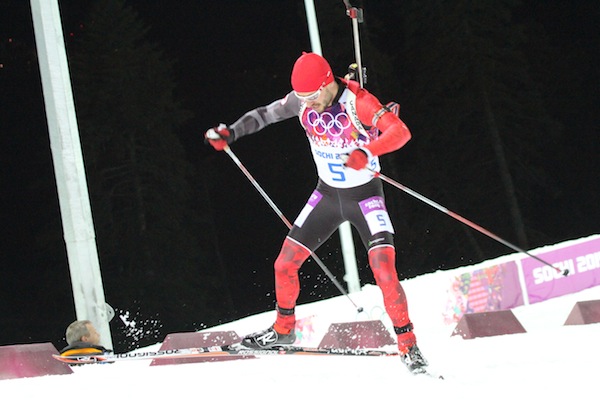
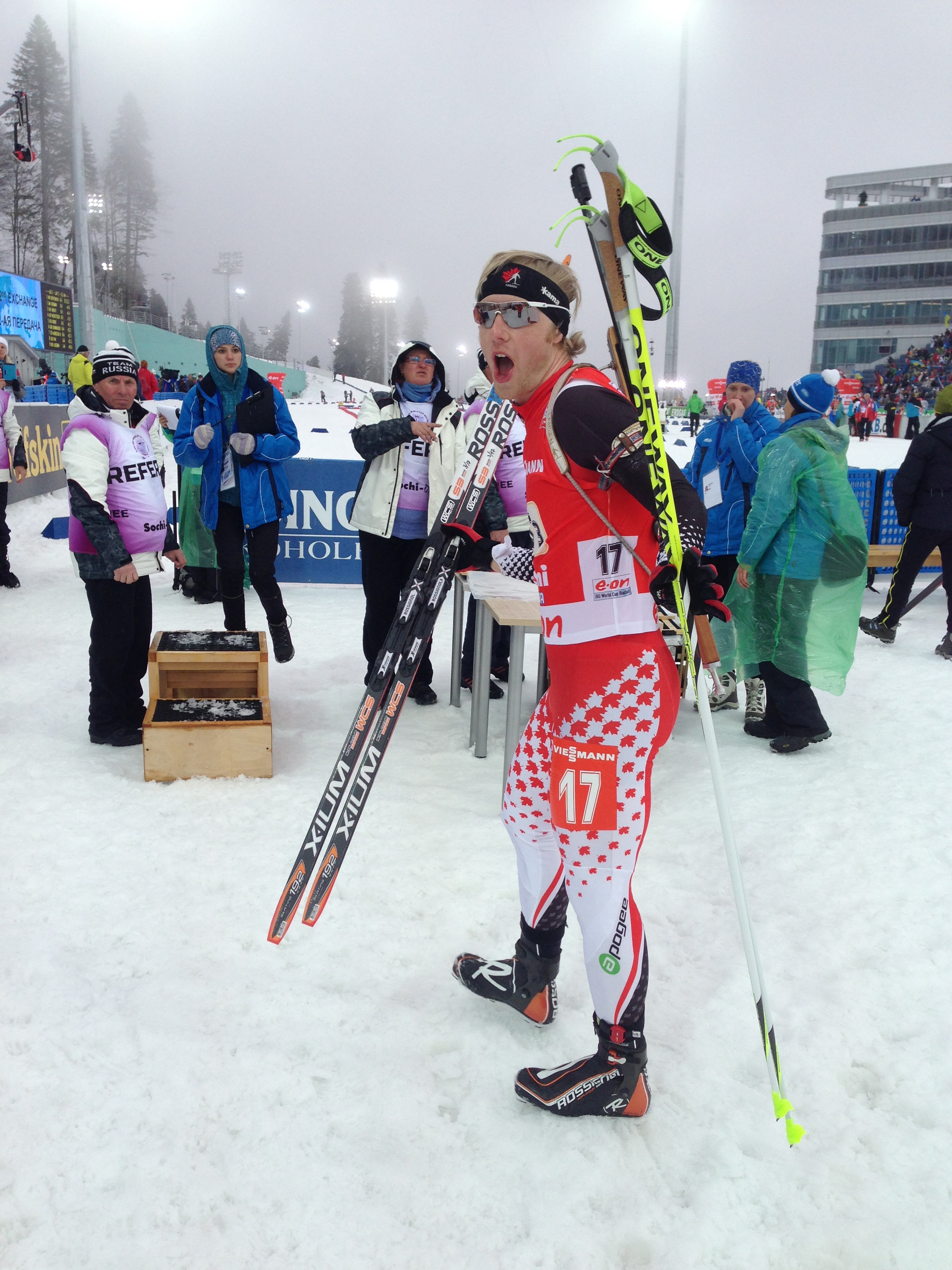
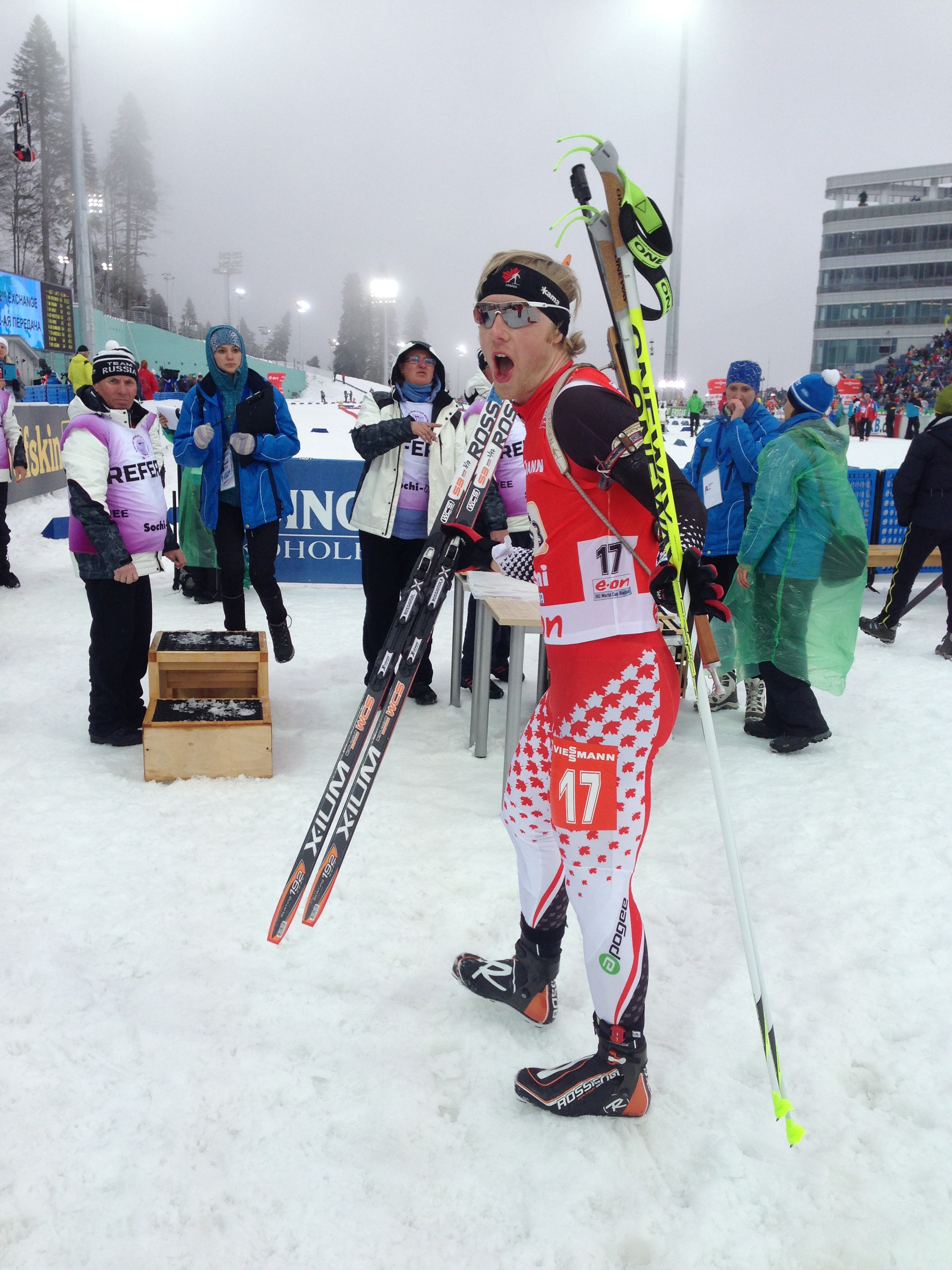
Canadian biathlete Kurtis Wenzel after the first and only World Cup biathlon race of his career, in Sochi, Russia, in March. Courtesy photo.
Just one week ago, Canadian biathlete Kurtis Wenzel told FasterSkier that winning his first national championship was “a perfect way to end the season.”
Hidden inside that statement, though, was a bigger one: Wenzel contacted Fasterskier yesterday to announce that he is ending his career as a biathlete. The 22-year-old had raced in his first World Cup only a month or so before.
And he joined another national team member in calling it quits. After a difficult season where her body never really got going, Melanie Schultz also decided to hang up her skis and move on. Both were probably outside shots for the 2014 Olympics, and would have had to fight hard to unseat more seasoned World Cup veterans.
So it’s not so much the Olympics where Canada will feel the loss, but rather what comes after – for instance, what if there’s a spate of retirements by older athletes, as often happens after a Games?
“Athlete recruitment and athlete retention are definitely two issues we face, being such a marginal sport to start with,” World Cup winner Jean Philippe Le Guellec told FasterSkier in an e-mail.
Upward Trajectories…
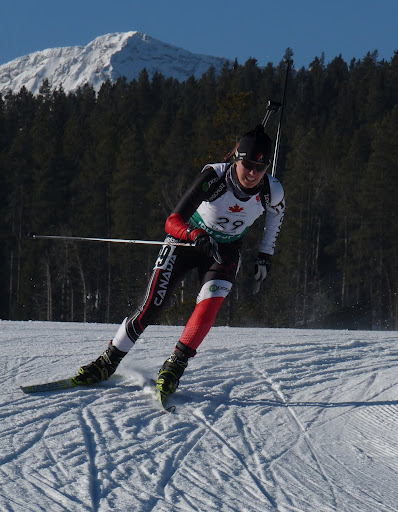
Melanie Schultz racing in Canmore last year. Photo: Michael Potter.
Wenzel’s biathlon career was marked by ups and downs: in 2009 he won the World Youth Championships sprint, then in 2011 took the year completely off from biathlon after feeling overwhelmed. He was as surprised as anyone else when he came back to win the World Junior Championships individual race in 2012.
The rags-to-riches-to-rags-to-riches story was certainly one of the most compelling of a 2012 Championships that also featured the first win by an athlete from the Netherlands; it was a good year for underdogs.
“I was really excited to be racing in the international scene again and lucky I could have one of my best races so far this year at Worlds,” he said at the time.
Yet in his first senior year, 2013 put the young Canadian back at the bottom of the heap. He did an IBU Cup tour and then, by the end of the season, had begun to climb upwards, starting the World Cup relay in Sochi, Russia and then winning the national championship pursuit. As he earned more and more start rights, it seemed like he might be able to mimic the path of Scott Gow, who finished his junior career just one year before Wenzel and was the youngest competitor to make the pursuit race at World Championships.
So the Sochi trip could have been a preview for an Olympic bid next year, but Wenzel says he realized he no longer felt that drive.
“I don’t actually dream of going to the Olympics anymore,” he said. “When I realized that, the decision was easy. However, I was very luckily to live out my long time fantasy of racing a World Cup in a packed stadium. I am also luckily to have had such a great support network of people to help me through my career and with this decision. I cannot thank them enough!”
Wenzel had first considered retirement back in December, but knew he wouldn’t decide anything final until the end of the season.
“Now I have had some time and it still feels right,” he said.
As for Schulz, the 27-year-old struggled to find her ski speed at the beginning of the season. A few health issues had slowed her down during dryland, and when she hit the IBU Cup she couldn’t get going. Concluding that her body had just had too much training over the past few years, she spent a month relaxing in southeast Asia, hoping that the rest would help her find some energy.
But upon returning to the sport later in the winter, Schultz still couldn’t get up to full speed.
“After nine years of focused training and racing where I continually pushed myself to my limit and beyond, it was apparent my body and mind were saying, ‘Enough!’” Schulz wrote on her website. “Listening to my intuition, I decided it was time to hang up my skis and rifle for good and give myself a much needed and much deserved rest. I definitely have mixed feelings about my decision, as I imagine most athletes do when they retire from sport.”
The departure comes just one year after Schultz seemed to be really making a leap in results; she was named Biathlon Canada’s Female Athlete of the Year in 2012, and also received the Ruedi Setz award for “exemplary standards of sportsmanship and significant contribution to the development of biathlon.”
… Aren’t Enough
Le Guellec, who is the same age as Schultz but has been involved in the sport much longer, has seen athletes come and go from the national team – mostly, go.
But the spate of younger athletes calling it quits seems a bit new to him. For one thing, there wasn’t always such a strong cohort of older athletes to fight against for starting spots. He explained that back in 2004, both junior and senior athletes qualified to receive financial support from Sport Canada. Now, the national team is “saturated,” Le Guellec said, making it much harder for younger athletes to get paid.
“In this day and age, we have a full flock of seniors all getting carded by Sport Canada,” he said. “So if you’re a youth, a junior and even a senior, you have to train and race on your own dime for the most part: season in, season out. When you add up the costs for a full year of training, it can’t surprise you that that can be a deal breaker after a certain time.”
Just making it as far as Wenzel and Schultz did requires a large and diverse support network, and both said they appreciated the many people that had made their careers possible.
“I want to say a HUGE THANK YOU to all my sponsors, coaches, teammates, support staff, family, friends and fans of my biathlon career for the last nine years,” Schultz wrote on her website. “I wouldn’t have been able to accomplish all I have without all of you!”
Both athletes were part of Canada’s national team last season, but that’s hardly a guarantee of financial security.
“I’m not aware of numbers for budgets and such,” Le Guellec said, “but I guess comparing our federation to a family of say 14 kids while being a single parent on welfare could be pretty spot on. They’re in a situation where they have very little money to make an entire sport run in a huge country. Their biggest challenge is, unfortunately, finding the resources to fund development squads, camps, cut costs for travel to competitions and so, and so and so on… with pennies.”
Biathlon Canada could not be reached for comment.
Having a significantly more robust senior national team is obviously a boon to the sport. But it’s just one reason that young athletes might look at the years ahead and begin to wonder if they can hang on for long enough to finally reach the top: Gow, Wenzel, and teammates Yolaine Oddou and Audrey Vaillancourt were unusual in their ability to translate success at the junior level to World Cup starts in just a year or two, but none spent the entire season on the top circuit.
And while none of the debuts went badly, it’s a tough transition to make. Le Guellec thought that seeing the real level of competition might make athletes think differently about what lay in store in the coming years.
“Having an Olympic dream is nice,” he said. “Being motivated is also nice. Resources and passion aside, I’ve seen athletes be exposed to the international field and it can be very intimidating. It doesn’t take a math degree to start adding up the work you’ll need to do in order to climb the ranks – plus this is a process that can be long. I wouldn’t say they scare off, but when you add up points 1 and 2, maybe its just a lot of work for not much in return to at least help you through it.”
All of that is, of course, harder when you are from North America. The amount of time spent on the road is difficult for many athletes, who may not return home to see their families for months at a time.
Wenzel confirmed that after one long tour in Europe this year, he was a bit overwhelmed.
“The decision was spurred by a combination of my difficulty dealing with life on tour and a desire to expand the other parts of my life that were put on the back burner,” he said.
Next Steps
The most common thing that athletes give up is school, and that’s where Wenzel will be headed in the fall, if all goes well.
“I will hopefully be studying economics at the University of Calgary, but I still have to apply,” he said. “I have done a couple courses at U of C before and I was accepted into the Kinesiology program, but I realized that’s not what I would like to study.”
A few elite-level biathletes and skiers have been able to make school work, somehow, while still competing on the World Cup: Alex Harvey is in law school, Astrid Jacobsen is in medical school, Maurice Manificat is studying biology. But Wenzel knew that he couldn’t be like them, at least not with any level of success.
“I have definitely been putting school on hold because of training,” he explained. “It would have been impossible for me to hold down my job in Calgary, go to school in Calgary and train properly in Canmore. I am also a horrible procrastinator at times so correspondance courses wouldn’t have worked for me. Honestly, this winter was the first time I really started looking forward to going to school. I think that helped make the decision for me.”
Schultz, meanwhile, will be transitioning from part-time to full-time work as a patent agent at an intellectual property firm in Canmore.
“I’m transitioning into the life of a non-athlete,” she wrote on her website.
That’s never an easy transition, but Wenzel hopes to stay involved with the sport just enough not to miss it. Coaching was a possibility, he said.