From the FasterSkier archive — posts syndicated from athletes’ and coaches’ own blogs between 2004 and 2012, kept online as published. Current coverage is at fasterskier.com.

Tag: sports psychology

  • Lauren Jortberg and the Long Way Around to the Olympics

    Lauren Jortberg and the Long Way Around to the Olympics

    This article was made possible through the generous support of our voluntary subscribers.  If you value coverage like this, please support FasterSkier with a voluntary subscription.  

    By the time Lauren Jortberg made the U.S. Olympic Cross-Country Ski Team, the achievement arrived not as a burst of disbelief or relief, but as something quieter and stranger: a moment that required processing.

    “It is a lot to take in,” she said, speaking from Seefeld, Austria in the middle of a pre-Olympic training block. “It’s been a big goal. But it’s one of those big goals that I’ve tried not to think about too much and just really focus on being my best self.”

    The phrasing matters. Jortberg did not describe the Olympics as a finish line or a culmination. She spoke about it as something she had to learn how to hold — something earned, yes, but also something that could overwhelm if mishandled. “Now,” she said, “I’m trying to put aside the completion of the goal and really focus on performing. And performing really well.”

    That distinction — between achievement and performance, between arrival and presence — has come to define her career. It is also the reason her story resists easy telling. Jortberg was not a prodigy. She was not a junior star. She did not dominate early or move cleanly through the system. She took the long way around.

    The Long Way Around

    Jortberg grew up in Boulder, Colorado, a town dense with endurance athletes and outdoor ambition. “I’m super fortunate to have been born and raised in Boulder,” she said. “It has one of the highest percentages of Olympians for cycling and running.”

    Her parents were athletic — her mother was a professional runner, her father competed in multiple sports — and movement was woven into daily life. There was mountain biking, trail running, hiking, time spent at a family place in Winter Park. But skiing, she noted, was not central to Boulder’s identity. “If you’re familiar with Boulder, it’s not really a winter place. We had to work hard to get to snow.”

    Her earliest athletic identity was split. She loved soccer deeply and still wonders what might have happened had she stayed with it. “I do kind of wonder what I could have done if I had pursued soccer,” she said. Her father spent hours training with her, and she took pride in improvement more than outcome.

    The turn toward skiing came, in part, through her older sister — six years ahead, a steady presence, someone to chase. When her sister tore her ACL playing soccer and pivoted fully to skiing, Jortberg followed. “I really looked up to my sister,” she said. “She went to U18 Scandinavian Cup, Junior Nationals, skied at the University of Denver. Seeing her do all these cool things with skiing really felt like, well, I can do that.”

    But progression was slow. In high school, Jortberg struggled. She did not make Junior Nationals her first year — a moment she still remembers clearly. “I was devastated,” she said. “It was one of the first big adversities in my career.”

    She never cracked the top ten at Junior Nationals until she was a U20. “I had a lot of 11th places,” she said. “I could never crack that top ten.”

    It is difficult, in hindsight, to overstate how thoroughly unremarkable her junior results were by Olympic standards. This is not revisionism; it is the point. There was no obvious through-line, no early validation to cling to.

    After high school, she took a gap year at Stratton Mountain School. It did not go smoothly. She fractured her arm in a parking lot crash. The season was disrupted. Progress stalled again.

    What she had, instead, was a willingness to stay.

    Dartmouth and the Work of Becoming

    At Dartmouth, something shifted. Not overnight, and not magically — but structurally.

    “I think it was a big surprise starting at Dartmouth,” Jortberg said, “the level I was at and the level the team was at.” She majored in environmental science and found herself inside a women’s program that emphasized individual growth within collective intensity.

    Under coach Cami Thompson Graves, the team culture was demanding but non-coercive. “She’s really amazing at coaching athletes to really know what is good for them,” Jortberg said. “She’s incredibly good at getting athletes to become very independent with an amazing team culture.”

    The women’s team was deep, competitive, and internally driven. “We were going one through five, or one to four, five, eight, ten,” she said. “It was insane.” NCAA spots were scarce; no one could coast.

    Crucially, Dartmouth supported international racing alongside collegiate commitments. Jortberg went to World Juniors, U23s, OPA Cups — sometimes twice in a season. “Having that support was super helpful,” she said. “Not just to perform in a green suit, but to perform later on.”

    For the first time, development felt cumulative.

    The women’s final of the 2021 Keys to the Castle rollerski sprint in Lake Placid, NY. From left to right, Lauren Jortberg (BSF Pro), Julia Kern (SMS T2/USST), Jessie Diggins (SMS T2/USST), Alayna Sonnesyn (SMS T2). (Photo: Reese Brown RDB Marketing)

    The Bubble Years

    Post-collegiately, Jortberg entered what many American skiers know intimately: the bubble.

    She moved through programs, spent time with Bridger Ski Foundation Pro and later SMS T2, and began working with coach Perry Thomas. She earned World Cup starts, lost them, re-earned them. Progress was intermittent. Confidence, fragile.

    “It was a lot of back and forth,” Thomas said. “Getting starts and not getting starts. Proving herself again in the U.S. and then getting those World Cup starts again.”

    Thomas had recruited Jortberg as one of his first athletes when he began coaching at the professional level. Their early years together were not seamless. “Our first year together, there was a lot of figuring things out,” he said. “There were ups and downs.”

    What mattered was not immediate success but shared patience. “We were both willing to make it work,” Thomas said. “And work through difficulty together.”

    During this period, Jortberg made a deliberate choice that would shape the rest of her career: she doubled down.

    Lauren Jortberg (USA) training in Tignes, France, last June. (Photo: Authamayou/NordicFocus)

    Choosing One Thing

    Sprinting had always been her strength — particularly skate sprinting. Classic sprinting lagged behind. Rather than attempting to become broadly better at everything, Jortberg and Thomas made a narrower decision.

    “Let’s spend one day a week, every week, for an entire summer and fall, working on classic skiing,” Thomas said. “Double pole. Thirty to sixty minutes. Just consistently.”

    It was not glamorous work. It was not optimized for social media or immediate payoff. But Jortberg committed fully. “She was like, ‘Hell yeah, let’s do this,’” Thomas said.

    Even when they were no longer formally affiliated with the same team, she continued the work remotely. “She continued that work on her own,” he said. “From afar.”

    At the same time, something else was happening — something less visible.

    Lauren Jortberg (USA) during the qualification of the World Cup Individual Skate Sprint in Oberhof, Germany, two weeks ago. (Photo: Authamayou/NordicFocus)


    The Mental Turn

    Jortberg began working seriously with a sports psychologist. She and Thomas independently immersed themselves in books, podcasts, and writing about mental performance. They traded recommendations. They talked openly about processing failure.

    “I don’t care how pretty your technique is,” Thomas said. “If you don’t have control over the on-off switch in your brain, you’re not going to get to the line fastest.”

    What Thomas noticed later, during Period 1 Super Tour in Alaska, was a change. “That was a different Lauren than even a year ago,” he said. “In such a good way.”

    Jortberg describes it less as a breakthrough than a reframing. “Everyone is going to have setbacks,” she said. “It’s about how you respond. Chipping away little by little. Not letting setbacks impact how you see yourself.”

    She learned to loosen her grip on outcomes. “Often when we think things have to happen a certain way,” she said, “that’s when they don’t.”

    Lauren Jortberg with boyfriend Antoine Cyr (CAN). (Photo: Courtesy Photo)

    Two Places at Once

    In the fall, Jortberg moved to the Mount Sainte-Anne area of Quebec. The decision was partly personal — she is dating Canadian skier Antoine Cyr — but also practical.

    She began training at the Pierre Harvey Training Centre, known for its demanding terrain and extensive roller-ski infrastructure. “The terrain is really hard,” she said. “I think it’s been awesome for intensity. Especially my classic skiing.”

    Her coaching arrangement became hybrid: remote communication with Thomas, daily training in Quebec. “We text pretty much every day,” Thomas said. “Or we’re on the phone.”

    Jortberg chose not to maintain two residences. “That’s just not something that financially would be feasible,” she said. More importantly, she valued stability. “I really prioritize my personal life. That’s what allows me to perform at the highest level.”

    It is an unromantic truth of elite skiing: stability is performance.


    Alaska and Leadership

    When Jortberg declined early World Cup starts to focus on Super Tour and U.S. Nationals, she rejoined Coach Thomas and the rest of the Mansfield Nordic Pro team in Alaska. What stood out was not just her skiing.

    “I was so impressed with her as a leader,” Thomas said. “We used her a ton in team meetings. Tactics. Pacing. Course preview.”

    After Alaska, the decision to formally add her back to the team was unanimous. “It was an easy decision,” Thomas said. “She just wanted to be part of the team and demonstrated awesome leadership.”

    Kendall Kramer, Samantha Smith, Lauren Jortberg, and Julia Kern (l-r) will join Jessie Diggins, Rosie Brennan, Novie McCabe, and Hailey Swirbul to represent the United States in Val di Fiemme, Italy, from Feb. 6–22, 2026. (Photo: Authamayou/NordicFocus)

    Not Jaded

    Jortberg will arrive at her first Olympics as one of three women on the U.S. team making their Olympic debut. She sees that as an asset.

    “I want to bring non-jaded energy,” she said. “Just that first-time excitement.”

    She wants to be present — not consumed by outcome. “I want to look back and be grateful that I was even there,” she said. “And really appreciate the experience.”

    It is not a rejection of ambition. It is a different relationship to it.

    Forward

    Jortberg plans to continue racing. She hopes for 2030, in the French Alps — a place she loves, a skate sprint on a stage that suits her. She is considering an online master’s program in sustainability and renewable energy, thinking carefully about how to prepare for the life that will follow skiing without rushing herself toward it. For the first time in her career, she feels no urgency to escape the present.

    “I feel the most stable I’ve ever felt in my career,” she said. “And it’s showing.”

    Stability, for Jortberg, has never been accidental. It is something she built deliberately, after years of motion without certainty — years of chasing snow from a town where Olympians ran past her on bike paths and reservoir loops, where excellence was ambient and ordinary at the same time. In Boulder, she grew up watching greatness move casually through public space, learning early that world-class athletes were not mythical figures but people who showed up every day and kept going.

    She was not the fastest junior in that environment. She was not the one with the early results or the easy narrative. She lingered on the edges, finished just outside the frame, learned patience in a place that celebrated inevitability. And still, she stayed.

    Lauren Jortberg (USA) anchors the relay for the United States in Toblach, Italy, in 2023. (Photo: Modica/NordicFocus)

    Now she is an Olympian — not because she followed the shortest line between promise and performance, but because she learned how to endure the long arcs in between. She learned when to narrow her focus, when to loosen her grip, when to trust work that did not announce itself right away. She learned how to live inside uncertainty without mistaking it for failure.

    There is something quietly astonishing about that return: a young woman who grew up surrounded by Olympians, never quite believing she was one of them, becoming one anyway — not by force or speed, but by accumulation. By choosing stability when chaos was easier. By learning how to stay.

    For an athlete who never arrived early, this moment is not a surprise step so much as a natural one. The long way around, it turns out, still leads somewhere.


    Help Support Our Olympic Coverage!

    FasterSkier will have our own Nat Herz on the ground at the Olympics, which, to be honest, is a very big financial lift for us. If you value the thoughtful work and access FasterSkier provides at championships like this one, please consider becoming a Voluntary Subscriber. Your support directly fuels the work we do to cover the people, places, and moments that make our sport special.

    Join the FasterSkier community!


  • “You Can’t Live Nervous”

    “You Can’t Live Nervous”

    Finals week has a way of compressing time. Days shrink into problem sets and exams; nights stretch just long enough to make sleep negotiable. When Jack Lange logged onto Zoom from Hanover in late November, he was finishing his senior fall at Dartmouth, a mechanical engineering major balancing equations while packing for a training block at Silver Star. The snow out west wasn’t cooperating. Races were being reformatted. Nothing felt settled.

    That uncertainty didn’t seem to bother him much.

    “We’re wrapping up school right now and then heading to Silver Star next Tuesday,” Lange said. “Hopefully, the snow conditions there improve a little bit.”

    It was a measured answer—calm, almost deliberately so. Over the next hour, that calm would reveal itself not as indifference, but as something learned the hard way.

    Young Jack Lange skiing in a New England BKL race. (Photo: Heidi Lange)

    A kid who wasn’t supposed to be good at this

    Lange grew up in Vermont’s Upper Valley, skiing out of Green Woodlands and the Ford Sayre Bill Koch League. It was the kind of childhood that feels almost mythic now: full-moon skis to a cabin, hot chocolate on a frozen pond, friends everywhere.

    “I’ve always just made sure that that’s the thing that comes first,” he said. “Getting outside and enjoying being outside and enjoying pushing myself and having fun.”

    He played everything. Soccer, where he was very aware he wasn’t the best. Swimming, where he gravitated toward breaststroke. Cross-country running. Mountain biking. For a while, he did both alpine and Nordic skiing, until a choice had to be made.

    “My sister was doing more Nordic and more of my friends were on the Nordic,” he said. “So I just went with Nordic.”

    Lange and friends meeting Jessie Diggins and Sophie Caldwell Hamilton at the Quebec World Cup. (Photo: Heidi Lange)

    It wasn’t a natural fit at first. Lange remembers being the odd kid out on relay day—the one paired with a skier from another team because the numbers didn’t work.

    “I wasn’t good at it,” he said simply.

    What hooked him wasn’t speed. It was curiosity.

    “I really like the amount that you can learn from being out in training,” he said. “Not even structured training—just being outside and having fun. I really enjoy the process of figuring out how hard I can push myself.”

    By freshman year of high school, something shifted. He trained more. He paid attention. And suddenly the results were better than expected.

    “That was kind of the confidence boost that launched me into, like, ‘Oh, this is something I can do.’”

    2019 Junior National Championships in Alaska. Lange finished in fifth place with Dartmouth teammate Wally Magill in first. (Photo: Heidi Lange)

    The pressure builds—and breaks

    Lange’s junior years were uneven. Seasons were disrupted. Races were canceled. One winter meant nine consecutive weekends racing at Craftsbury, all interval starts—an exercise in patience for someone who loved head-to-head competition.

    “I love mass starts,” he said. “I love racing next to people. Mind games and competitiveness.”

    By his senior year, he had narrowed his focus to Junior Nationals. The goal was simple: qualify. Nothing more.

    When he arrived at the 2019 Junior National Championships in Alaska, he was the last skier to qualify from New England. He started near the back in the 5-kilometer skate race at Kincaid Park.

    “My goal for the entire season was to make JN’s,” he said. “And I was there, and I was like, I’m in Alaska. This is kind of crazy.”

    Mid-race, a coach called out a split.

    “One of the New England coaches is like, ‘You’re like three seconds out of top ten,’” Lange recalled. “And I was like, that’s pretty funny.”

    He kept skiing. He finished fifth.

    “That was way, way beyond where I ever could have expected to be.”

    There’s a photo from that day—Lange among a group of skiers who would later become familiar names on the U.S. Ski Team. At the time, it felt surreal. In hindsight, it was clear it wasn’t the performance itself that mattered most, but the conditions under which it happened: no expectations, no fear.

    That lesson wouldn’t fully sink in until later.

    Lange with his parents, Heidi and Greg. (Photo: courtesy photo)

    Dartmouth, and the weight of wanting it too much

    Lange chose Dartmouth largely because it felt right. He wanted engineering. He liked the people. He trusted the coach.

    “Brayton [Osgood] is such an amazing coach to work with,” Lange said. “He’s never the guy to show up and be like, ‘This is what you’re doing.’ He’s super approachable. He really wants us to find our spot in the sport.”

    At Dartmouth, skiing wasn’t isolated from the rest of life—it was embedded within it. That integration became most visible during the most stressful week of the year: NCAAs, which overlap directly with finals.

    “My freshman year, that finals week with NCAAs was kind of a dark time,” Lange said. “I was close to tears on the start line of the 20k race. Just so much pressure, so overwhelmed.”

    He remembers warming up briefly, then stopping.

    “I skied like fifteen minutes in the warm-up and just put my skis down,” he said. “I was completely broken.”

    A kilometer into the race, he was in dead last.

    And then something shifted.

    “I saw Brayton on the side of the trail,” Lange said. “And I was like, you know—I don’t need to take this so seriously. I can show up, do my best at everything, and give 100 percent effort. If I do that, it’s gonna come through.”

    It did. That race became one of his best of the season.

    Dartmouth Ski Team (Photo: courtesy photo)

    The things that make it lighter

    The story of Dartmouth skiing is often told through tradition—green suits, first-years with mohawks, time trials. Lange points to different details.

    There’s a sauna in the locker room.

    “That’s a prime spot to get to know the team,” he said. “We rip this on all the time.”

    There’s also life beyond skiing. Every non-freshman on the men’s team is in a fraternity. Lange lives in the Zeta Psi house with teammates and classmates—engineers, computer scientists, people whose lives orbit entirely different centers.

    “I’m surrounded by a ton of people who have no clue what skiing means to me,” he said. “And that’s been a really huge part of being at Dartmouth.”

    His best season, he said, came immediately after pledging.

    “It taught me how to not put as much pressure on myself,” Lange said. “How to make this a sustainable thing that I could really enjoy.”

    That balance—academic, athletic, social—isn’t accidental.

    “None of the three would be as good without the others,” he said.

    Lange’s favorite race: Prospect relay with Cam Wolfe and Cooper Camp. (Photo: Heidi Lange)

    “You can’t live nervous”

    Lange keeps a training log. He trains consistently. He admits he’s overcooked himself before. What he doesn’t do is chase numbers obsessively.

    “I don’t think I’ve ever had an hour’s target that I’m trying to hit,” he said. “I’ve just trained for the enjoyment of it.”

    There was a time, early on, when outside voices crept in.

    “I was getting a lot of people saying, ‘You’re training too much. You’re doing this wrong,’” he said. “I got a little worked up about it and a little nervous.”

    He paused.

    “You can’t live nervous.”

    It’s the line that keeps resurfacing, whether he’s talking about high school racing, college pressure, or the future beyond Dartmouth.

    “I think anyone who’s in high school, middle school—just go out there because you enjoy it,” he said. “You’re gonna have crappy days. But if you go out there every day and just have a good time, and surround yourself with people you like to be around, things will work out.”

    That philosophy shapes how he defines success now. Lange talks about team first. About racing in a green suit. About showing up energized.

    “The guys here are here for the right reasons,” he said. “They’re skiing because they really enjoy skiing. That’s super energizing.”

    Lange with his long time coach and mentor, Dennis Donahue. (Photo: Heidi Lange)

    A quiet kind of confidence

    Ask Lange where he sees himself years down the road, and he doesn’t reach for outcomes. He talks about process.

    “The process of showing up every day,” he said. “How can I be the best athlete I can be today? That’s the most rewarding thing.”

    Skiing, he believes, has taught him how to live—how to work, how to recover, how to stay curious.

    “Wherever I am fifteen years from now,” he said, “all of the lessons that I’ve learned are still going to be extremely relevant and important.”

    For now, there are finals to finish and skis to pack. The snow will either come or it won’t. The races will sort themselves out.

    Lange will keep doing what he’s learned to do best: show up, stay loose, and ski without fear.

    Because speed, he’s learned, is hard to find when you’re holding your breath.

    Love Stories Like This? Help Keep Them Coming.

    Feature stories like this one take time, access, and care to produce. If you value thoughtful storytelling and independent ski journalism, please consider becoming a Voluntary Subscriber. Your support directly fuels the work we do to cover the people, places, and moments that make our sport special.

    Join the FasterSkier community!


    Enjoying adventures with Luke Allan. (Photo: Jack Lange)
  • Blueprinting Beliefs: Ben Ogden’s Mind, Mechanics, and the Engineering of a Community

    Blueprinting Beliefs: Ben Ogden’s Mind, Mechanics, and the Engineering of a Community

    Somewhere over the Atlantic, on a red-eye to another winter in Europe, Ben Ogden opens his laptop and stares at a grid of digital joinery. Tiny posts, miniature knee braces, angled mortises — a small timber-frame sauna, scaled down to the dimensions of an airline tray table. He sketches in precise strokes, clicking through angles and offsets, rotating the model the way he rotates race courses in his head: looking for structure, looking for flow.

    “I learned CAD in college,” he says. “Something that I hope to use in a future career post-skiing. It feels good to keep those skills up.” For the past several winters, Ogden has leaned into his engineering degree, which he earned at the University of Vermont. When you talk to him outside of training and racing, you realize this engineering mind was not learned at UVM; it is deeply ingrained in who he is, who he has always been. On planes, in wax truck corners, in small Scandinavian hotel rooms, he opens the software that once helped him model truss systems for class projects. Now, it helps him breathe.

    “It kind of gives me a good outlet,” he says. “It’s exactly like you say — the projects in the summertime are fun, and you learn a lot, but ultimately for me the biggest reason to do them is that it gives me this outlet from skiing… gives me a break from everything that’s going on.”

    This winter’s project is ambitious in a miniature way: a timber-framed sauna built from small hand-cut pieces, a practice run for a full-sized dream he can’t yet afford the time or money to tackle. In his travel bag, he carries a book — The Art of Japanese Joinery — the same way another skier might carry a novel. “I’m gonna use my CAD software and sort of build all the little pieces,” he says. “Then I’ll have a little plan for what joints get cut where.”

    The sauna will be small. The intention behind it is anything but.

    Like many New Englanders, Ben Ogden has made it a tradition to conclude his season every spring at Cochran’s Nordic Cross at Cochran’s Ski Are in Richmond, Vermont. (Photo: Courtesy Photo)

    Vermont Roots, Wide Horizons

    Ogden left for Finland on November 17 — a date marked not with dread, but with a kind of vibrating readiness. “I’m super pumped,” he says. “This season has come with more anticipation than any other.” Partly because it’s the Olympic year, but also because he feels “a little bit better equipped” each season, even as he accepts that no amount of planning can smooth the chaos of a World Cup winter.

    “There’s guaranteed curveballs and sicknesses and highs and lows,” he says. “You can only manipulate that so much… at a certain point, you just have to get going.”

    He arrived in Europe later than many teammates. While some seek early-snow training blocks, Ogden stays in Vermont — a deliberate choice, not an oversight. “I decided not to change that this year,” he says. “It’s important for me to be home, and the season is very long. I didn’t really want to elongate that by going to Europe or finding snow pre-Finland.”

    That choice means his first days on snow in Ruka can feel awkward, but the tradeoff is worth it. It’s also an expression of who he is. Ogden’s identity is tied to Vermont in ways both obvious and subtle — in his work ethic, his self-sufficiency, and the ease with which he moves between elite training sessions and OD runs with college teams.

    He feels tugs of longing, at times, when he thinks of the powerhouse men’s group training year-round with Alaska Pacific University. But the pang is mild, not consuming. “I do,” he admits, “feel a little bit” of FOMO. But he has “recognized the importance for me to just kind of live my own life, be a little bit removed from the intense, Nordie vibe all the time.”

    Staying rooted means staying whole. It also means arriving each winter hungry for the team environment, not burnt out from it.

    It is unusual for a top U.S. skier to build a World Cup foundation outside of a mega-group or a Western training hub. But Ogden sees the value in his separateness. “I kind of took pride in the fact that I was a little bit different,” he says. “Came from a different group and was able to mesh right in when we did come together.”

    This, too, is its own kind of engineering: building stability into a system that demands constant travel, constant performance, constant uncertainty.


    The Body as a Machine, the Mind as a Circuit

    When Ogden talks about training, he toggles easily between the physical and the psychological — but if asked which is more important, he leans toward the mind.

    “I think… ski training is a combination of physical and mental adaptations,” he says. “It can be fun to think of things as mental adaptations. I like to, because the power of the mind is just so huge.”

    In the fall, he transitions into higher-intensity workouts earlier than he did in college, where the NCAA season starts late and dictates the timeline. “It’s just really good,” he says, “because I find that coming to Ruka and getting into the race season… I’ve had to remind myself what it feels like to go hard for that long.”

    That reminder is primarily mental. Hard workouts aren’t just about generating lactate or cardiovascular strain; they’re about rehearsing discomfort.

    “You have to learn how to push yourself,” he says. “You have to learn how to go hard, and you have to learn how to pace for a 10k… that, to me, feels like a mental battle.”

    This is where his internal monologue — the one few athletes talk about, but all experience — becomes central to his craft.

    His best sessions come when he stops listening to the noise inside his body — the burning legs, the heavy breathing — and instead directs his mind outward. “My best races… come when I’m not dwelling on ‘my legs hurt’ or ‘I’m breathing really hard,’” he says. “I’ll be thinking: ‘All right, the top of the hill is right there. I’m gonna push hard until there, and after that I’ll figure it out.’”

    But the ideal and the real don’t always align. Not every October time trial feels like a breakthrough. Sometimes he finishes intervals worried that the heaviness in his legs signals doom for the season ahead.

    “You sort of forget that you’re still training hard otherwise,” he says. “You don’t have respect for the fact that you’re just tired… it wasn’t a day you wanted to be in peak form, so you’re not.”

    In those moments, doubt tries to multiply. It’s a habit of the mind he has learned to anticipate. And anticipation is power.

    “When it happens, you can say, ‘Remember, I knew this was gonna happen,’” he says. “Every time, I’ve been happier if I don’t allow it to take over.”

    Landmarks on the Course, Checkpoints in the Head

    Ogden’s most vivid explanation of mental strategy comes when discussing something humble and universal: a hill in a cross-country running race.

    If you tell him two high school runners are nervous about a big climb at the two-mile mark. His response is instant and intuitive — as if he’s revisiting a dozen races at once.

    “I would set goals on the course,” he says. “Each goal would have a physical location attached to it.” A tree. A signpost. A bend in the trail. Something visible and near.

    He creates segments rather than distances—dividing the race into digestible tasks rather than one looming ascent. “You can really make a hill feel like nothing,” he says, “because you’re like, ‘Okay, I know I can do it if I check these boxes.’”

    He gives the example of a 14-minute climb he does in Vermont, a personal benchmark of suffering. The first five to eight minutes are brutally hard. “All you’re thinking about is, ‘Oh my God… this isn’t even the first half.’” But with preparation — knowing where a micro-rest appears, where the next pitch starts, where the end is “in striking distance” — the pain becomes structured. Predictable. Contained.

    The same approach guides his 10ks. In the first 5k, he aims to crest hills “breathing, but able to ski crisp.” In the second half, he allows himself to reach the edge — “gassed to the point where I can’t ski with as good of technique” — but only once it’s time.

    This is pacing, not as restraint, but as architecture.

    The Gus Workout

    If the sauna project is the mental escape hatch, then the “Gus Workout” is Ogden’s sharpening stone — a ritual he returns to every year to feel strong again.

    “It’s a workout I randomly did in college before a Junior Worlds event with Gus [Schumacher],” he says. The structure is beautifully nerdy and deeply painful:

    • Six minutes of 20 seconds on / 40 seconds off
    • Another six minutes of the same
    • Three minutes of 1 minute on / 1 minute off
    • All layered on top of an L3 warmup and a progressive L4 effort

    Sometimes he does two sets of the 6-minute blocks. The effect is both physiological and emotional.

    “It’s an awesome, total sharpening workout,” he says. “It gets you moving at high speed without being a huge cost… By the time you’re done, it’s a pretty hard L4 workout.”

    But the real value is how it makes him feel.

    “It has often mentally made me feel really good. I think it makes me feel strong… confident.”

    He’s done it before “every major championship and before every season since 2017.”

    Ben Ogden poses with his UVM coach, Patrick Weaver and his children. (Photo: Courtesy Photo)

    Coaching the Machine

    Ogden works closely with both longtime mentor Patrick Weaver and newer SMS T2 coach Colin Rodgers, each offering different inputs into the system.

    Weaver provides the long arc — the accumulated wisdom of years together, the memory of what has always worked. “Having Patrick involved… is really nice for me mentally,” Ogden says. “We’ve had so many good years together.”

    Rodgers provides the in-person structure: “Colin is kind of coming in as the day-to-day,” Ogden says. “He’s the one at practice.” They build training plans collaboratively, with Ogden adjusting based on feel, Weaver offering feedback from afar, and Colin guiding technique and lactate testing.

    It’s a three-person engineering team working on a single, complex machine.

    Paal Golberg (NOR), Iver Tildheim Andersen (NOR) and Ben Ogden (USA), (l-r) share the World Cup podium after a 10K in Les Rousses (FRA). (Photo: Modica/NordicFocus)

    The Long Game: From Sprinter to All-Arounder

    Ogden first burst onto the circuit as a sprinter, but his distance results have steadily climbed. He attributes that evolution to two things: years of accumulation and a physiological quirk he had to learn to manage.

    “I’m capable of generating tremendous lactate,” he says. “If I went out right now and sprinted for 90 seconds, my lactate could easily be in the 20s.”

    That makes him a powerful sprinter — and a volatile distance racer. Early in his career, he went out too hard too often. The memory that stays with him is the 2020 Junior Worlds 10k, when he led early and paid dearly late. “I just pushed so freaking hard,” he says. “I think I was winning the race by… 10 seconds. And then at the end, I just lost so much time.”

    Learning patience, he says, has been “huge.” Now, he races distance events with far more control — waiting, building, resisting the temptation to detonate early.

    Every year, he gets better at it, not by magic, but with patience and discipline.

    Kevin Bolger, Ben Ogden, JC Schoonmaker, and Zak Ketterson, (l-r) teamed up for the FIS World Championships relay in Trondheim (NOR) last season. (Photo: Modica/NordicFocus)

    The Olympic Year and the Team Sprint Dream

    His biggest goal this year is clear: “An Olympic medal for sure.” He’s unafraid to say it out loud. It’s a reach, he says, but not an impossible one — especially in the team events.

    “I’ve had a big asterisk on the team sprint,” he says. “I really want to be on that team, and I really want to just dream big for that event.”

    He spent the summer training specifically for it — brutal intervals on the Lake Placid roller-ski track, demanding repeats in Park City. The process goals between now and February are equally mental and physical: “Coming at those two team sprints before the Olympics mentally prepared and ready to execute at a high level.”

    Team sprinting is a balancing act. “There’s always this balance of exerting energy… staying at the front, staying out of trouble… and saving energy, staying in the pack,” he says. Believing he can do both — that duality — is the mindset he’s chasing.

    Friends, family and fans will be surrounding Ben Ogden with all the Vermont vibes in Lake Placid later this season for the World Cup Final. (Photo: Courtesy Photo)

    The Lake Placid Homecoming

    After the Olympics, he returns to something nearly as meaningful: a World Cup in Lake Placid, practically down the road from home.

    “I’m so fired up for that,” he says. Friends from UVM plan to come — people who helped him survive the missed classes, late assignments, and months of absences that came with racing the World Cup while still in school.

    “I always joke with them… they helped in my success as much as anybody,” he says. “They helped me by sending notes, helping with homework.” The Lake Placid races are his chance to show them the world he kept disappearing into.

    He’s excited for Vermonters — new fans, old friends, teachers, kids from ski programs — to see a World Cup in person. “Everybody who ever goes to a World Cup has a good time,” he says. “Even if they’re not huge ski fans.”

    The people who buoyed him will finally see the thing he disappears into all winter.

    Ben Ogden (and his SMST2 teammates) always make time to give back to Vermont’s local communities. (Photo: Courtesy Photo)

    Legacy: What He Wants to Build

    Ask Ogden how he wants to look back on his career decades from now, and the answer arrives with unmistakable clarity.

    “More than results,” he says, “I want to be remembered as something that was positive for the ski community.”

    He talks about the junior camps, the youth programs, the OD runs with college teams, and the way he feels energized by the enthusiasm of younger skiers. He talks about his “little side quest” of collecting T-shirts from New England ski programs: “Every one represents a skiing community I’ve reached out to or been part of in some capacity.”

    He lights up when discussing a recent run with the St. Michael’s College team. “It was raining and miserable, and we just had a great time,” he says. “That is so inspiring to me.”

    He wants to help more people get out the door. He wants skiing to feel accessible, exciting, and normal.

    And, like all good stories, this one has a lineage. His late father, a beloved figure in Vermont skiing, built communities the same way Ogden now does — with enthusiasm, generosity, and the kind of spirit that makes kids believe in themselves.

    “There’s nobody I’ve ever wanted to be like more than him,” he says. “He just made kids fired up. And I feel like I can do the same.”

    The Ogden children (Charlotte, Katharine, and Ben (l-r)) pose with their father, John. (Photo: Courtesy Photo)

    The Blueprint Ahead

    By the time January arrives, the first pieces of the miniature timber-frame sauna will be designed, and the digital modeling will start to look recognizable, even to those of us without an engineering degree.

    His book on Japanese joinery tucked among race suits and heart-rate straps — a reminder that even in the chaos of a World Cup season, he is building something.

    A structure.

    A mindset.

    A legacy.

    He is engineering a career that is not only about skiing fast, but about making more people love the sport he grew up in.

    He is designing a life that holds both ambition and community.

    Both suffering and joy.

    Both structure and imagination.

    He is building — in every sense of the word — something that will last.


    Love Stories Like This? Help Keep Them Coming.

    Feature interviews like this one take time, access, and care to produce. If you value thoughtful storytelling and independent ski journalism, please consider becoming a Voluntary Subscriber. Your support directly fuels the work we do to cover the people, places, and moments that make our sport special.

    Join the FasterSkier community!


  • The Mind Makes a Winner: An Interview with Emotional Intelligence Researcher Sylvain Laborde

    Dr. Sylvain Laborde. (Photo: German Sports University Cologne)
    Dr. Sylvain Laborde. (Photo: German Sports University Cologne, where you can find out more about Dr. Laborde’s research.)

    In July, we reviewed a recent paper summarizing research into how emotional intelligence is important for athletic success. It turned out to be one of the five most popular articles of the month.

    Why so much interest? Besides physical training, mental and emotional training are keys to a winning trajectory. Sylvain Laborde, the researcher who penned the original review paper, defines emotional intelligence as “how people manage and deal with their own emotions, and with others’ emotions- so it’s both the personal and the other.”

    Concepts included in emotional intelligence have helped athletes in the nordic sports find success already.

    Last January Sean McCaan, a sports psychologist employed by the U.S. Olympic Committee to work with the biathlon team, said that one of the big things that he focuses on is resilience and how to manage emotions around failure, which is a big part of the volatile skiing and shooting sport.

    “It’s been interesting to see that a lot of veterans on the team have learned through trial and error that being resilient, letting it go, allowing you expect good things to happen the next day – it’s absolutely essential,” McCaan said.

    So with emotional intelligence so key to success and with so much interest by the ski community, we caught up with Laborde for a chat about his research and what it means for athletes. Laborde is currently a postdoctoral researcher at the German Sport University in Cologne.

    This interview has been edited and condensed.

    FasterSkier: What got you interested in studying emotional intelligence in relation to sports?

    Sylvain Laborde: I started by studying sports psychology, and I did my PhD on the influence of emotions on decision-making. In sports, emotions play an extremely important role. Whatever sport you do, you can notice it at different levels. To be able to produce in a high-pressure competition, you can train that.

    We have a symptom in sports that we call the “Training World Champion”, someone who can do everything at training, and as soon as it comes to competition it’s like nobody is there anymore. This has everything to do with emotions and stress management.

    At our research institute, we have shown that emotional intelligence will act like a shield against stress. It’s like a protector… What is stress in the end? It’s just the way that you think about stress. If you think that stress is a threat to you, then of course it will have negative consequences. Emotional intelligence will make you appraise stressful situations more like a challenge that you have the resources to cope with.

    FS: So is there a lot of variability in existing levels of emotional intelligence in different people?

    SL: Yes. And those individual differences will be reflected in how we can observe that some people can cope with pressure, or others will be more likely to choke under pressure.

    Very interestingly, at the biological level we can see a lot of differences in, for example, the way the heart is beating.

    Let’s imagine a bottle. If this bottle is full, then I can regulate myself very well. People with high emotional intelligence will have high vagal activity going from the vagus nerve in the heart to the brain, and will help this person cope with anything in their environment. People will high emotional intelligence will have a bottle full of this vagal activity.

    People with lower emotional intelligence will have a bottle half full of this vagal activity, and that means that in stressful situations they can’t use as much of this energy.

    FS: And how is that connected to your heart rate?

    SL: Basically, your heart can race much faster. It’s simplifying it, but the heart will have much more pronounced signs of stress when there’s low emotional intelligence.

    At a similar level, we find things at the hormonal level. For instance cortisol, the hormone of stress. We can [test for] it in people’s saliva. So we had tennis players and we stressed them, and we found that people with higher emotional intelligence had lower cortisol.

    Maybe you are familiar with this: if you are nervous when you have to speak in public, you notice that your mouth is dry. This is mainly because of the effects of cortisol.

    FS: So is this one way that you can tell if you have high emotional intelligence or not?

    SL: It’s just one parameter, but if you combine it with the heart, yes, you can have some idea.

    I like it because we have hundreds, if not thousands, of questionnaires which claim to assess your emotional intelligence. But actually there are only a few which really do a good job. We can see that because we find links to those things in the body which I just explained. If they can’t do that, then they aren’t really helpful.

    Then on the reverse, with those good questionnaires, it’s very interesting because by answering a couple of questions you can learn about how your body might react in stressful emotional situations.

    [Note: Laborde later explained by email that one of the best questionnaires is the Trait Emotional Intelligence Questionnaire, by Dino Petrides of University College London. If you’re interested in taking it, you can find more information at http://www.psychometriclab.com and look at the options under TEIQue. The questionnaire takes about 30 minutes.]

    FS: How do you study emotional intelligence? Is it a lot of observational study, or can you do experiments?

    SL: We are trying to design experiments where we assess the emotional intelligence of athletes or students, and then we manipulate something. For example, we like to manipulate stress situations. Here are the German Sport University, we love to put people under stress. [laughs]

    FS: What kind of stress?

    SL: Normally in our experiments we try to include both low-pressure and high-pressure situations. Emotional intelligence doesn’t really play a role in the low-pressure situations, but as soon as we put people under pressure, yes, it does play a role on behavior, on the heart rate, on the cortisol. This can affect their performance at the cognitive or the motor level, specifically what they will do on the competitive field.

    To give you some ideas, to induce pressure, we tell them that the results of the task or competition will be displayed publicly on the campus- which is of course not true, by the way. Or we film them and tell them that experts will analyze their performance. We can tell them during the experiment, “please don’t forget the camera, the camera is on.” Or we have a room with a one-way mirror, and we tell them that experts are currently watching them.

    FS: How does emotional intelligence affect post-competition anxiety, and long-term performance and attitude?

    SL: I believe that emotional intelligence has both acute effects, and long-term influences. It is highly linked to resilience.

    No matter what the result of the competition, even if you are the winner, you still have to deal with being the winner and potentially being the favorite in the next competition. So that is pressure and needs emotional management. And if you lose, then emotional intelligence helps you to reconsider things, how and why things went this way.

    It helps you to bounce back from failure, no matter what that failure is. In many sports, already the second position is a failure, because you didn’t win. You need to cope with that.

    FS: What are you working on at the moment? What’s the next step?

    SL: I’m actually very interested in those emotional intelligence trainings. All the emotional intelligence training that exists is not specific to sport. There are a few trials that I referred to in the review, but I’m not fully satisfied with them. So I tried to inspire myself from the work in general populations, and to try to integrate this into sport.

    If you provide athletes with a specific emotional intelligence training, targeting for example emotional understanding, expressing emotions, perception of emotions, and so on, then yes, we can improve emotional intelligence.

    The best emotional intelligence training so far was proven to decrease the cortisol reaction to stress not over a short period, but over a longer period of six months to one year. I believe it was a total of 15 hours of training over one month, plus some homework.

    I want to prove to people that this kind of training for 15 to 20 hours can have a really significant effect on athletes’ emotional intelligence, and that this has a direct impact on how their body will react to the next competition.

    FS: When you talk to coaches and athletes and teams, are they generally receptive to this idea?

    SL: I have to say, indeed yes. In the first try I did, it was with a rugby team. In the beginning it was not easy. It was professional rugby players in France and they were not so open to the idea.

    But I was working with the sports psychologist of the team, and as soon as the players saw that they were getting some very interesting feedback from their emotional intelligence result, some of them even said oh, last time I did the questionnaire I was watching TV and I didn’t do it very seriously, so can I do it again?

    They understood after the first session that they could really get something out of this.

    So we might still face some barriers which are due to the way that sports psychology is perceived. You see athletes who want to show that they are tough and that they don’t need mental training. That’s really the wrong approach.

    FS: A lot of the very best athletes probably do very similar physical training; they are all at the top of their form. So is this the training that can make the biggest difference?

    SL: If you ask a sports psychologist what makes the difference, at the end of a competition, between a gold medal, a silver medal, and a bronze medal, the amount of training is very similar between these athletes. They will differentiate themselves on very few variables.

    The very top athletes, what differentiates them, is in the mind. You can see it sometimes. I like to think about tennis players, sometimes you see them doing very well but then they get to the end and they start to think too much. And then they lose the game. Then they lose the set. In the end they lose the match.

  • All About Emotional Intelligence and How It Boosts Sports Performance

    All About Emotional Intelligence and How It Boosts Sports Performance

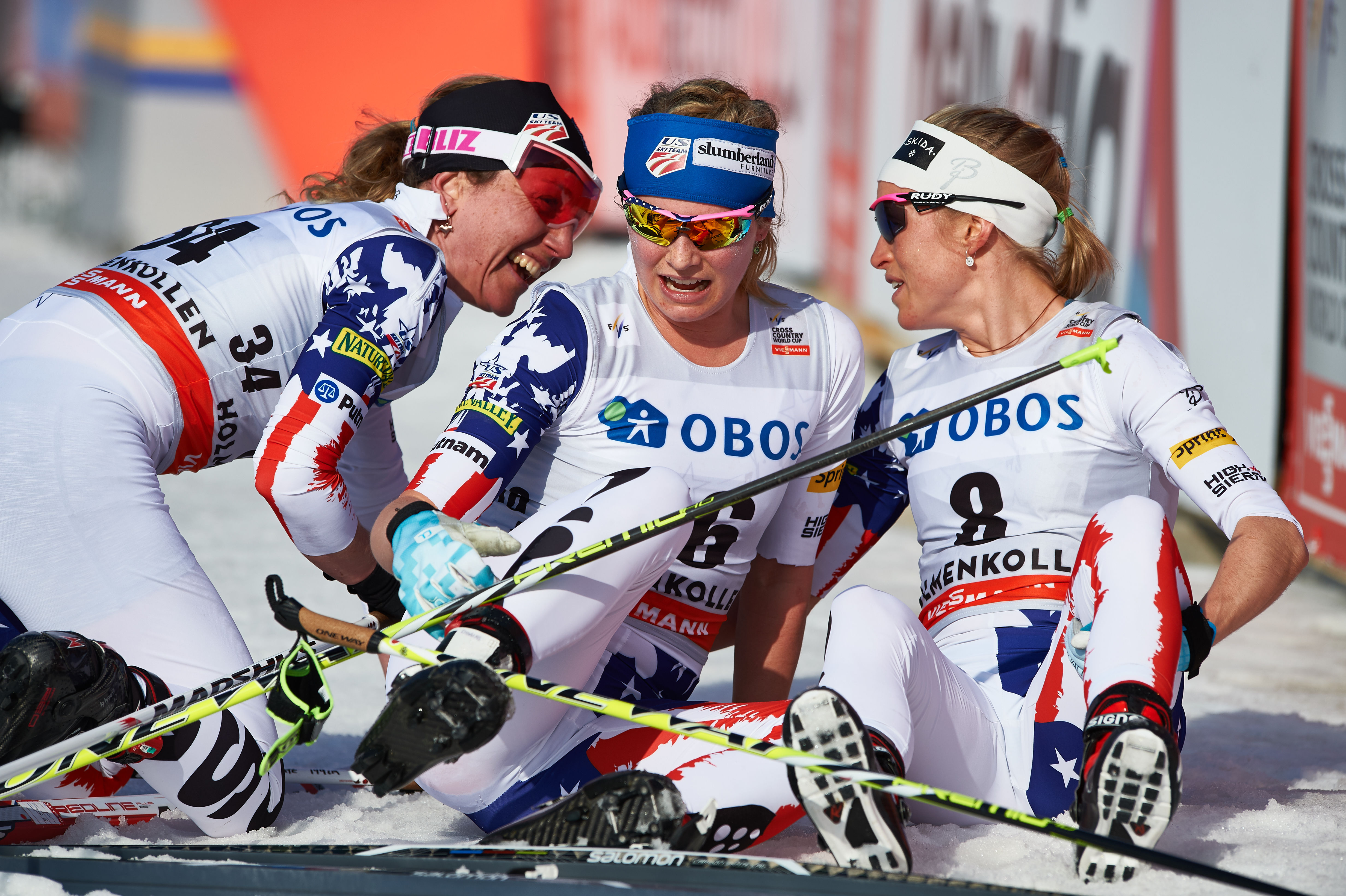
    Staying positive and motivated is something the U.S. women's cross-country ski team is famous for. Is it a sign of high emotional intelligence? Here, USST's Caitlin Gregg (r), Jessie Diggins (c) and Liz Stephen (r) in the finish of the 2015 Holmenkollen 30 k. Stephen led the three in ninth, while Diggins and Gregg Placed 14th and 19th. (Photo: Madshus/Nordic Focus)
    Staying positive and motivated is something the U.S. women’s cross-country ski team is famous for. Is it a sign of high emotional intelligence? Here, USST’s Caitlin Gregg (r), Jessie Diggins (c) and Liz Stephen (r) in the finish of the 2015 Holmenkollen 30 k. Stephen led the three in ninth, while Diggins and Gregg Placed 14th and 19th. (Photo: Madshus/Nordic Focus)

    Emotional intelligence (EI) is associated with both increased performance in athletes and with healthy engagement with exercise in the general population. So what is it, and can you train it?

    A recent review, penned by Dr. Sylvain Laborde of the German Sport University in Cologne with two collaborators in the Scandinavian Journal of Medicine & Science in Sports, sought to answer just those questions.

    “EI refers to individual responses to intrapersonal or interpersonal emotional information and encompasses the identification, expression, understanding and regulation of personal or others’ emotions,” the authors explain.

    Self-awareness, empathy, patience, respect, positivity, and self-control are all things associate with EI – and things that can be beneficial to athletes.

    Emotional intelligence is sometimes thought of to as a trait, something which is relatively unchanged through time or situation and is intrinsic to the individual person. It’s also sometimes thought of as an ability, which someone can learn and improve over the course of their career.

    Depending on which viewpoint research is coming from, assessing EI might be done with a test, like the Mayer-Salovey-Caruso Emotional Intelligence Test – think Myers-Brigs, but different. Or it might be assessed by giving athletes a survey and asking them to self-report their emotional intelligence.

    To really understand how EI might influence sports performance or engagement, the best viewpoint might be the one that Laborde and his coauthors seem to advocate: the tripartite model. In this model, components of EI are based on knowledge, trait, and ability.

    “An athlete might know that using a challenge reappraisal technique [to minimize stress] before a competition would help them (knowledge level) and can perform the technique efficiently (ability level), but does not often incorporate the technique (trait level),” the authors wrote. “In this example, we can see that the three levels are loosely connected and an understanding of all three would be most useful for the practicing sport psychology consultant.”

    Surveying the scientific literature, the French-German-Austrian team found 33 papers examining EI, which is also sometimes called emotional competence, in relation to exercise.

    Most of the research had to do with athletic competition. But to address that might be jumping ahead. An under-investigated, but very intriguing, line of research first showed that EI was associated with the difference between an inactive person and one partaking in a healthy amount of exercise.

    In six studies about the relationship between EI and exercise, this manifested in different ways. In one study of undergraduates, EI was correlated with exercise behavior and diet. In another, high school students with high EI were able to intentionally use exercise to stabilize and improve their mood. As a result, they both got a healthy does of exercise, and also stayed mentally and emotionally more balanced.

    What might the connection be? Staying true to an exercise regime requires motivation, and understanding and managing ones emotions is key to staying optimistic and motivated. Furthermore, a lot of recreational exercise and sports are done in groups, and being able to manage interactions with teammates, instructors, and exercise buddies makes the workout itself more enjoyable, and more likely to be repeated.

    So it’s not surprising that these relationships between EI and exercise carry through to a more serious sporting environment, for instance one where practice is mandatory. Although everyone shows up to practice, for instance, what an athlete gets out of that practice might easily be related to their EI.

    And there are new dimensions, too: recognizing emotions in others might mean that an athlete works better with his or her teammates, and expressing emotions might allow teammates to do the same. Recognizing and understanding emotions might also reveal a competitor’s mental state and use that towards victory.

    Awareness and empathy might make an athlete a better team leader, or a better coach.

    Indeed, studies of both teams and individuals found that higher EI scores were correlated with better performance metrics or objectives. In an earlier paper, Laborde used a technique called Structural Equation Modeling to reveal one mechanism for why this might be so. He wrote in 2014 that EI helps athletes deal with stress, and assists with coping mechanisms.

    (For more on coping and what it means in sports, read our story on “competitive suffering”.)

    Other researchers found that athletes with high EI were more likely to use psychological strategies and skills, such as task-oriented coping strategies or success motivation.

    Emotional intelligence might even be related to physiological performance. One study found that as a trait, EI was related to cortisol responses to anxiety in competition. Another found that EI was related to the maximal muscle contractions an athlete was capable of. These relationships need much further study.

    In the life of an elite athlete, managing emotion is key, especially when competition goes on for days, or regularly for months through an entire career. Endurance runners with high EI felt more positive over the course of a six-day competition, and track and field athletes had less anxiety over the course of a meet than their lower-EI colleagues.

    Even when the outcome of a competition is negative, researchers have repeatedly found that athletes with high EI have more positive feelings. It’s logical to think that this might help them move on to the next competition more easily.

    So, with all of this evidence that EI is important for athletic success or even just healthy exercise, is it something that can be trained? Laborde and his colleagues list this as one major area that needs to be studied. But of the two studies which looked at EI training, there were some encouraging findings.

    For instance, a South African cricket team was randomly divided into control and treatment groups. The treatment group was sent to 10 sessions of EI training, 3 hours each, teaching emotion perception, facilitation, understanding, and management. At the end of the experiment, their EI had increased.

    Another study found that simply discussing the results of an EI test in a 30-minute coaching session led athletes to improve their EI in future tests.

    “The theoretical advancement brought by the tripartite model makes it possible to envisage long-term changes in EI through interventions that target all three levels of the model and we recommend future applied studies to take steps toward designing interventions that target knowledge, ability, and trait components in sport and physical activity,” the authors conclude.

    Unsurprisingly, EI is also being touted in the business world as a desirable trait in employees. Online seminars abound; for a sports application, the best strategy might be to find a sports psychologist to consult with (one option: the Association for Applied Sports Psychology). Many university athletic departments also have in-house staff.

  • How Your Sports Psychology Research Gets Done: Based on Days Spent Ski Racing

    How Your Sports Psychology Research Gets Done: Based on Days Spent Ski Racing

    Dr. Blair Evans. Photo: Eys lab webpage.
    Dr. Blair Evans. Photo: Eys lab webpage.

    In our monthly series highlighting research relating to skiing, we have twice covered the work of Dr. Blair Evans of Wilfred Laurier University in Waterloo, Ontario. First, we summarized his work on how group dynamics affects performance in individual sports; then we dedicated a whole story to his study on competitive suffering, when athletes fail to meet their goals mid-competition. The latter was extremely popular on the site, so we figured at this point we should probably just call Evans up and chat.

    As it turns out, Evans (who just recently defended his PhD dissertation and acquired that “Doctor” in front of his name) was a college skier, and his experience has informed most of his research questions in sports psychology ever since.

    “I grew up doing all team sports,” he laughed in an interview last week. “Then I went to university with the idea of getting on the basketball team. That didn’t work out my first year, so my second and third year I started training with the ski team. I actually had a lot of assumptions about what individual sports were like, and most of them were shattered when I joined the team.”

    What’s Special About Skiing?

    Evans’ PhD work revolved around the influence of teammates on athlete’s ability to perform in an individual sport. As summarized earlier, he found that having strong friendships and collective goals was extremely important to individual performance.

    “If you’re on a team in an individual sport, having a collective goal always helps but it’s especially important when you have teammates who are competing directly against one another,” he explained. “If you’re in a sport like cross-country skiing where everyone is in the same race, if you don’t have that collective outcome then things can get really competitive.”

    Aside from the specific questions he has researched, Evans believes that there are a few unique and remarkable things about cross country skiing from a psychological viewpoint. The group dynamics aspect was one thing that stood out early – it’s a sport where there is very great potential to develop strong bonds between teammates.

    “One of the things involves the year-round training and the different types of training you have to do, which I think is really unique,” he explained. “And also the amount of travel that’s required. Those things might change the types of relationships that you might develop with your teammates.”

    Doing drills on a basketball court, laps in a pool, or running stadiums is very different than level one aerobic training for a couple of hours outside.

    “A lot of the training is often pretty enjoyable, and the training is in a setting that’s outdoors and quite [beautiful], so it might create the opportunity for a lot of really positive shared experiences between teammates,” he said. “If you have to go run up a mountain with them or go travel to the top of a glacier, you might be forced to make some friendships… If you’re training 15 hours a week, that’s probably 4 hours of really intense, and then 11 hours where you’re just coasting. You can just chat and make those relationships.”

    Furthermore, because skiing requires a lot of different types of training – on snow, on rollerskis, running, biking, bounding, work in the weight room – it’s likely that an athlete will dislike or be weak in at least one of those areas.

    “I’ve heard this from a lot of people, if you didn’t have your teammates it would be just terrible,” Evans said. “If you had to go for a 3-hour training run, if you don’t like running, you’d have a really terrible experience, but if you’re there with really close teammates, it can make it a really positive experience.”

    Evans will soon move to Queens University in Kingston for a postdoctoral fellowship, focusing on youth sports. He might have the chance to look at some of these topics as they relate to young athletes, a prospect he’s excited about.

    “I think that will give me a really good opportunity to look at these things in youth settings, maybe how your sport team might shape your development in sport,” he said. “There’s a lot of different stages that an athlete might go through in sport. They’ve showed some of the really negative outcomes of early specialization in certain situations. I’m really excited about that, for the chance to take some of this work and look at it with younger age groups.”

    How To Do Science?

    All these questions, plus many more, were raised when Evans began skiing. But when he moved first to a masters program and then into a PhD, he was tasked with the challenge of turning them into testable hypotheses that could be addressed in studies using human subjects (there are strict rules about consent, privacy, and ethics, and researchers must apply to a board for permission before conducting studies; the Canadian guidelines are here).

    Plus, people are a little more unpredictable than, say, bacteria, mice, or plants, common study organisms for researchers in other fields.

    “The one thing that I’ve started to learn is that you’re never going to have a perfect study when you’re working with human participants,” Evans laughed. “Do you want the study to be really perfect – they call it “internal validity”, which means that you can be confident that what you’re seeing is really what’s going on. But at the same time, if you take a study like that, they are almost always going to have less meaning for the average individual. There’s always a balance.”

    Plus, Evans’ goal is to have his findings interpreted in a way that is useful to athletes and coaches – after all, the questions were generated in his own athletic life. But it takes a lot to move from a hypothesis to an applicable message.

    “You have to make it a progression in order to have a big impact,” he said. “You have to start with these really stringent methods, and then slowly but surely advance to something where it’s more applied and can be directly picked up.”

    The competitive suffering study, for example, was part of Evans’ masters work. Although he feels like it needs a lot of follow up, his masters ended and the work was dropped. In the group dynamics work, on the other hand, he had a four-year PhD to follow up on as many leads as possible, so he was able to look at the topic using several different kinds of studies, from broad to quite specific, and questionnaire-based to experimental.

    Evans tries not to chase publicity by claiming an application for each result. Studies typically only address a specific question in a specific framework, or only measure a few variables. While that adds to the understanding of a concept as a whole, in general single studies can’t explain everything about how athletes act.

    “I’m always cautious about providing really clear and specific conclusions if I haven’t tried it myself,” he explained. “If you look at the suffering paper, I could make some suggestions for athletes and coaches, but without having tested it first, I might be leading people down the wrong pathway. There’s so many questions to ask.”

    And even when a study is done, challenges remain.

    “The desire to do it always comes from an applied need,” he said. “But you have to balance that with the need for, when you’re developing concepts you have to be really specific and academically-minded. In my writing I try to do the best I can to make it palatable at least for the average Joe to read, but at the same time it’s a matter of trying to balance that. It’s a struggle.”

    There’s a few more challenges in academia. First of all, grant funding might not be available for every interesting question – for instance, the government is more likely to fund research which has implications for the general public in terms of health and happiness, than research about elite athletes which impacts relatively few people.

    And then there’s the issue of whether a study on one group of athletes can be applied to another.

    “For instance, in the competitive suffering study, I had a very wide range of athletes in terms of their 5k times,” he said. “If you’re chasing that 15:30 5k time, you need to overcome emotions – you have a shorter time frame. Someone doing a 25 minute or 30 minute 5k, probably the most important thing is to come out having enjoyed the race. That was one of the struggles with that work. The huge range really changed the findings.”

    About That Suffering…

    The suffering study generated a lot of interest on this site, and Evans was able to fill us in a little more on how it translates out of large, scientific words into real English. First of all: yes, it was inspired by experience.

    “Of course, with competitive suffering, I’ve had lots of experiences where you may have set your goals too high or maybe something goes wrong during a race, and you try to cope with that while still trying to compete,” he laughed.

    And that was a big part of the reason why he found the issue compelling. From a completely logical point of view, if we are failing at our goals and are totally miserable, we should probably just quit. Academics told Evans that very thing.

    “I think that’s the biggest question with competitive suffering,” Evans said. “I had a professor I discussed it with, and he said, ‘if you’re not making your goal, I would just drop out of that race.’ But there’s a lot of cases where you might not be making your goal, but it’s still important to perform as well as you possibly can. Even if you’re not getting that top-10, you’re not going to give up. The only way to perform in that situation is to try to maintain some sense of drive to attain some goal.”

    As proud, stoic, endurance athletes though, we’re conditioned that it’s shameful to DNF, even if there’s not anything (for instance a team score) on the line. And so Evans reiterated the findings of his work.

    “There’s different ways of dropping out,” he explained. “If you’re not meeting your ideal goal and you don’t have a secondary goal prepared beforehand, you have a couple of choices. You can completely drop out, or you can still stay in the race but let off on the gas pedal, or to try to reframe your goals or change the situation so that you’re still competing at the best of your abilities.”

    And while some people thrive under adversity, re-setting those goals is probably the best way to cope for most people.

    “Based on what we know about sport and endurance sport, people have different emotional states that they are going to perform best at,” Evans said. “Some people perform best if they are as negative as possible, but for the majority, a lot of us do need some sort of positive mindset and a goal to pursue. I think being able to cope well that kind of competitive suffering is pretty important.”

  • Ask A Sports Psychologist: Making The Bigtime

    Ask A Sports Psychologist: Making The Bigtime

    Qualification for big races can take more than perfect physical preparation – it takes a mental edge, too. Whether it’s the Olympics, World Junior Championships, or making your region’s squad for junior nationals, many athletes face the pressure of having to perform when it counts, and coming into races with the wrong mindset can be a big detriment.

    We talked to Dartmouth College sports psychologist Dr. Mark Hiatt about what it takes to get your head in the game. For more background on Dr. Hiatt and sports psychology in general, as well as an introduction to some of the concepts and tools he advocates, check out our segment from last week, when we talked to him about team and interpersonal dynamics. As always, if his suggestions spark your interest, seek out a sports psychologist to work one-on-one through your own situation. Many universities offer appointments for students and sometimes also the public. The Association for Applied Sport Psychology also has a “find a consultant” online tool.

    As in that piece, the FasterSkier staff brainstormed some situations that skiers might find themselves in, and asked Dr. Hiatt to weigh in. Here’s what we came up with.

    Scenario 1: It’s trials time, for Olympics or maybe World Junior Championships. An athlete has a very outside chance of making it based on last year’s results, but thinks that he has improved a lot and has a shot. However, every time he thinks about it he gets a little hopped up because he has to have his best race ever. He’s afraid he will try to hard in the beginning of the race and blow it. What’s a good strategy to manage the pressure?

    Mark Hiatt: “I would recommend starting with relaxation/breathing techniques. Sometimes this is referred to as ‘energy management’ in the Sport Psychology literature. Athletes can also use visualization strategies to see themselves performing at a pace that is optimal for the race. It may be useful to incorporate cognitive strategies to manage any negative thoughts. These can include strategies to recognize negative thinking, dismiss the negative thoughts, or counter and challenge them.”

    Highlights: Visualization can be extremely helpful, but it also holds a danger: if you picture yourself racing perfectly, and things don’t get off to such a great start, you might lose a lot of confidence. Dr. Patrick Cohn of Peak Performance sports has a podcast you can listen to about what might be the most productive way to use visualization. The magazine Psychology Today offers a run-down of relaxation and breathing techniques; one is progressive muscle relaxation, a routine that is more of a long-term strategy to learn how to get, and stay, relaxed. You can find a script for progressive muscle relaxation here.

    Scenario 2: Two races into a four-race trials series, an athlete is ranked solidly within the team picked for these races. He still has to have one more good race to clinch his spot, but his success so far is making him relax – maybe too much. How does he stay focused through the whole trials series?

    Mark Hiatt: “The athlete may want to review his/her personal goals for the season to reinforce why the particular race is important. One question may be to see if there are ways to make the goals more challenging or interesting to the athlete (e.g., targeting a particular time). Again, we could work on visualization exercises and cognitive strategies to reinforce competitive thinking. Mindfulness breathing strategies have been found to be helpful for some athletes in improving attention and focus. Mindfulness breathing exercises train athletes to pay close attention to breathing while trying to let go of distractions such as thoughts, feelings, and physical sensations.”

    Scenario 3: A skier is widely expected to qualify for the Olympics, but still must go through the actual trials process. She has been building up for this since the last Olympics, where she just missed qualifying, and has attracted a lot of support from family, friends, even local businesses. It’s a little bit overwhelming to think how many people have bought into this dream and put their money on the line. She feels like if she doesn’t qualify, she’ll be letting them down, but she knows that these thoughts are not productive for racing. How does she put them out of her mind or turn them into something positive?

    Mark Hiatt: “It might be useful to spend some time exploring these thoughts and feelings with the athlete, as it sounds like she is putting a lot of pressure on herself to perform. I think that cognitive strategies, such as observing/dismissing negative thoughts, challenging them, or affirming more productive/competitive thoughts could be helpful for her. Having negative thoughts before, during, and after competition is normal and happens to all athletes (as well as everyone). There are a few options for managing negative/unproductive thoughts. In general, the first step is to distinguish between what is healthy and productive competitive thinking versus unproductive thinking for an athlete. I often have athletes think back to their top performances and go through them to help identify what all the thoughts and emotions were that contributed to that great performance.

    “Once there is a better sense of what the productive versus unproductive thoughts area, we can practice skills to dismiss the unproductive thoughts and focus on the more productive ones that we want for competition. One example is using mindfulness meditation based skills to dismiss negative thinking. Good competitive thinking may be more general or focused on a specific skill. Ideally we might have a combination of them to use at different times, general thoughts before the competition and skill-bases specific thoughts (e.g., “push off strong”) during competition.”

    Scenario 4: Congrats – you were picked for these big races in Europe that have been your goal for years! Several weeks into the trip, though, is your birthday. All of a sudden you realize how much you really miss your family. You just can’t focus because you’re imagining how comforting it would be to be at home celebrating together, but right now your only support on the road comes from teammates and coaches. How can you overcome this?

    Mark Hiatt: “I think the first step is to acknowledge these feelings and not try to fight them. These feelings are normal and natural to have in this type of situation and for many people the more you try to fight them the worse it gets. So I think the first step is accepting acknowledging these feelings and accepting them openly. It’s not something to overcome as much as it is to help athletes figure out how they want to act with them. On a practical level, I might ask if there are there some possible solutions in terms of reaching out and touching base with the athlete’s family? Is this something that would help the athlete? Are there ways for the athlete to communicate with coaches and teammates about how he or she is feeling? Again, I might revisit goals for competition and training and work on cognitive strategies, visualization, and relaxation techniques to help prepare for competition.”
  • Ask a Sports Psychologist: How Do I Deal with My Team?

    Ask a Sports Psychologist: How Do I Deal with My Team?

    Sometimes in skiing, there are issues that can’t be solved by just pushing through that last interval, getting a good night’s sleep, or spending a couple extra hours in the gym each week. Whether in high school or college, a full-time elite athlete or a master blaster with a desk job, skiers have to balance their athletic goals with their everyday lives. And a lot of the time, life creeps into athletics, whether you want it to or not.

    Sometimes it’s in a good way – the support of family, friends, and teammates can make an athlete more confident and perform better. But sometimes it’s not in a good way. Whether it’s the stress of school or difficulties in relationships with other people, all of this can affect the outcome on race day. These are things that coaches may not be able to help with – and athletes may not want to share their personal life with their coach, either. The relationship with the coach may even be part of the problem (we hope not – love you, coaches!).

    Luckily, there’s an entire field dedicated to understanding how sport life and normal life interact. Sports psychology is the study of human behavior in sports; another way to say that is that it looks at the influence of psychological state on athletic performance, and conversely at the impact of performance on an athlete’s psyche. Sports psychology has an academic, research-oriented branch, but you can also meet up with a sports psychologist to get help with your own performance. They reside in hospitals and clinics; national teams have psychologists available, often through national Olympic committees, and so do many universities through their athletic departments.

    If you’re serious about approaching your athletic goals from this viewpoint, you should meet with a sports psychologist in person. But for an idea of how to deal with some of these situations, read on. We reached out to Dr. Mark Hiatt, a clinical psychologist at Dartmouth College, both in the school’s general Health Services and as a member of the athletic department’s interdisciplinary Peak Performance team. The FasterSkier staff came up with some common scenarios that skiers might face, and asked Dr. Hiatt for a quick overview of what’s going on and what tools they might use to improve their performance.

    A lot of these – like goal-setting and visualization – are things that athletes are probably already familiar with, if in a less-formal framework. Others are not – and we’ll explain more along with his answers.

    We’ve divided the scenarios into two general categories. This week, we’ll talk about team dynamics and other personal relationships; next week we’ll deal with the pressure of big races.

    Scenario 1: A student has just arrived at college, is living away from home for the first time, and is faced with more challenging classes than she saw her senior year of high school. She’s very excited to make new friends and spending a lot of time socializing as well. Faced with a new training plan, she is nervous about where she will fit in on her college roster, too, and whether she should make all the changes suggested by her coach. How can she stay focused and calm, even if the first races of the season turn out to go pretty badly?

    Mark Hiatt: “One place to start with a student in this situation is to talk about goals and aspirations both with skiing and with life in general. I think it is very important for collegiate athletes to find a healthy balance between the demands of their sport, academic life, and social life. I would encourage this athlete to be patient and work on both long term and short term goals, including goals for individual practices. The athlete may benefit from relaxation strategies and visualization techniques, as well as cognitive strategies when she experiences thoughts that create a lot of doubt or anxiety.”

    Highlights: The idea of goal-setting is commonly used by coaches, and some teams specifically practice setting short-, medium-, and long-term goals at the beginning of each training year. This can help in a lot of different ways. First, coming up with a goal for each individual training session can ensure that other concerns don’t become distracting, or that no matter how tired or stressed an athlete is, he or she can get the most possible out of that afternoon’s practice. It can also help keep an athlete realistic, by focusing on small things rather than overreaching. On the opposite end of the spectrum, setting some long-term, multi-season goals can keep motivation going even if current race results aren’t as good as he or she had been hoping for.

    For more on “cognitive strategies”, check out scenario 4.

    Scenario 2: A college athlete is at a camp over Christmas break with all of his teammates, sharing a room with three other guys who are all competing for varsity starts. They’re his friends, but sometimes he secretly wishes they would have a bad day (or break a leg?) so he could get the carnival start. How can he compete against his friends?

    Mark Hiatt: “This is a very difficult situation for a lot of collegiate racers, and students can come up with different ways of managing these relationships. I would support the student to have a sense of acceptance that these relationships in particular involve multiple roles. He is friends with his teammates and (not ‘but’) they are also competitors. It’s okay to be competitive with your teammates and to want to do well for yourself. I think the important think is to try to strike a balance with these feelings. Another strategy is to focus on goals that are more team focused than individually based. I would encourage him to work on strategies that focused on his performance rather than that of his teammates. With swimmers and track and field athletes we have talked about it in terms of ‘staying in your lane’ and ‘running your race’.”

    Highlights: Study after study has shown that having good relationships among teammates can make a team, and all the individuals on it, better. Peer support is crucial and on of the reasons that society views sport as creating something good. Does it suck to compete against your teammates? Yes, a little bit. But that’s not what skiers should focus on. There’s not quite room for everyone on a six-person varsity, a four-person relay team, or a three-person NCAA squad (or a four-quota-spots World Cup start list), but to some extent, teammates can all succeed, together. Coaches and older team members should try to create this dynamic, but anyone can do it – particularly if they are a talented athlete, but even if they are not. A study of 10 U.S. Olympians, who had won 32 medals between them, found a trend that most of these successful athletes were deemed “good teammates”. One athlete’s parent said that one of his good qualities was to “infect his teammates with his drive and intensity.” Aim for that.

    Scenario 3: Another college skier came into school as a mediocre skier who loved the sport but also had many other interests, and many friends who were not athletes. Now, she has improved and is taking skiing more seriously, which means more hours of training, sleeping, and careful time management. She’s feeling guilty that she is now turning down many invitations from her friends even though she would love to see them, and she is losing sleep worrying that she will lose these relationships – it’s beginning to make her resent the sport that she loves. What to do?

    Mark Hiatt: “I would encourage the skier to reflect on her values and goals across skiing, social life, academics, etc., and to develop a sense of balance that is meaningful to her.  There are always going to be trade-offs when you are competing at this level, and athletes make tremendous sacrifices for their sport. It may be that this athlete has been neglecting other areas of her life and needs to rebalance a bit to make her participation more healthy and sustainable. I would also recommend that she reflect on what she enjoys about the sport so as not to lose sight of this as she goes forward.”

    Highlights: Balance is hard, but important. A paper in the International Journal of Sport and Society found that having interests, hobbies, and friends outside of your sport can help you perform better. The authors surveyed elite Australian athletes and noted that “Elite athletes are faced with increased training and competition demands. As a result, they are in danger of developing a one-dimensional identity as an ‘athlete’, may lack life balance, be more prone to burnout, be less prepared to transition into life after sport and fail to recognise that life-skills acquired through sport can be transferred into other settings… More than 90% of athletes indicated that actively engaging in non-sporting pursuits helped to lengthen their sporting career.” Seeing friends less often does not mean losing them, and taking some extra time off from your training from time to time may help you out in the long run.

    Scenario 4: An athlete has realized that she doesn’t get along very well with her coach – maybe it’s a personal issue or maybe he doesn’t believe in the training system anymore. However, it’s only the beginning of the race season and this is his team. He has to stick with for the remainder. How can he focus on getting his best performances without letting these issues get in the way?

    Mark Hiatt: “I would recommend cognitive strategies to dismiss or counter negative (unproductive) thoughts and focus more on his goals and performance. Visualization strategies and time to process his feelings about the coach may also be helpful.”

    Highlights: The coach-athlete relationship has been studied a lot. It’s called a “dyad”: both people’s behaviors are interconnected and affect the other. Much research has gone in to determining how athletes should act and approach their job in order to maintain the best possible relationship, and recent work has revolved around the three “C”‘s, Closeness, Co-Orientation, and Complementarity. Psychologists believe that when coaches and athletes are incompatible in one of these areas, or when they perceive differently how the other behaves or thinks of them in one of these areas, problems arise. But that doesn’t help much in real time, with coaches and athletes who are who they are and are unlikely to change their approach to their side of the relationship.

    So just what are these “cognitive strategies” that Hiatt has been talking about? Self-instruction. Self-motivation. Stress management. Self-monitoring. After all, even with a good coach-athlete relationship, skiers can’t rely on other people to do everything for them. According to one review article, these strategies are beneficial to training and skills acquisition: “Differential self-monitoring is the process of systematically observing and recording successful (positive self-monitoring) or unsuccessful (negative self-monitoring) behaviors. In situations where subjects display low task mastery, positive self-monitoring, compared to negative self-monitoring, appears to enhance performance. However, when subjects are highly skilled, the addition of negative self-monitoring may provide information for further refinement of the self-regulated behavior.” If your coach can’t help you, then learn to help yourself.

    Or maybe cognitive strategies can be ways to trick youself. Here’s one example: the New York Times recently posted on its fitness blog, Well, about a study that found that self-talk, for instance telling yourself that you’re feeling good even if you aren’t, actually does improve performance. You can trick your mind into perceiving fatigue differently – just as you can focus on different aspects of any situation. One cognitive strategy is taking a negative thought and replacing it with a positive one. Instead of thinking, “we shouldn’t be doing this workout at this time of year,” focus on some other aspect of the coach-athlete relationship, one that is going well. Or, as Hiatt suggests, stop thinking about the coach (or parent, or frenemy), and think about yourself, the aspects of your training and performance that you can control, and what you can do given the circumstances to fulfill your goals.