From the FasterSkier archive — posts syndicated from athletes’ and coaches’ own blogs between 2004 and 2012, kept online as published. Current coverage is at fasterskier.com.
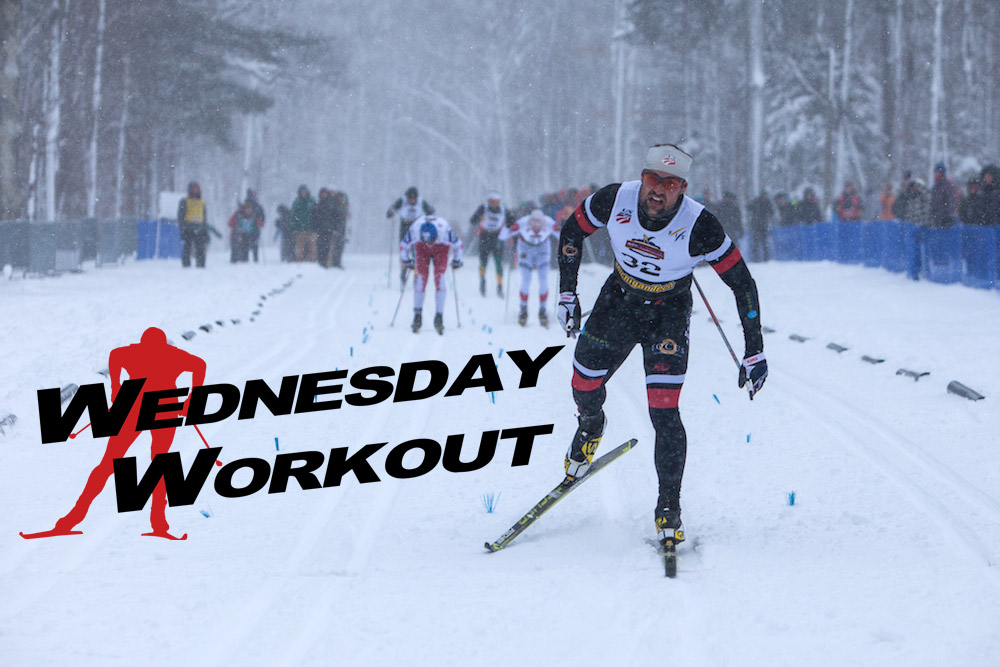
Dakota Blackhorse-von Jess (Bend Endurance Academy) clinches a nearly seven-second win in the 1.5 k classic sprint at the 2015 U.S. Cross Country Championships in Houghton, Mich. (Photo: Jake Ellingson)
For this week’s workout, we caught up with the Bend Endurance Academy’s Dakota Blackhorse-von Jess, who won back-to-back sprint titles last week at U.S. nationals in Houghton, Mich. As he told FasterSkier after his skate-sprint win last Saturday, that was exactly his goal — to put himself in contention for a call up to the U.S. World Championships team and at the very least, earn World Cup starts later in the season as the SuperTour sprint leader.
“This year everything has been geared toward Word Championships so this is a stepping-stone,” he said after his initial classic-sprint victory on Jan. 6. “The goal was to put myself in a position to win and see if I can do it. Everything worked out really well and I’m excited. Obviously I can’t control if I go to World Championships, but I know that the way we set up the training, we are on the upswing and things will continue to rise in February.”
As of Tuesday, Blackhorse-von Jess, 29, was home in Bend, Ore., where he explained the weather was “awful. We need snow!! And to kick this fog … but it will come around. It’s never nasty here for long!”
In an email, he wrote that this period leading up to the next set of races, the Craftsbury SuperTours Jan. 30-Feb. 1 and Feb. 6-8, is his last chance to log a good training block before leaving for Europe.
“Obviously there are a few different scenarios in play but the gist of the training plan is to make sure that I have my feet under me and then start ramping up the intensity and use the sprints in Craftsbury as a tune-up for Europe,” he wrote.
And while it wasn’t exactly ideal not to have access to good snow, the Bend Endurance Academy (BEA) has been getting a few workouts done on rollerskis.
“The benefits of being at 3500 feet instead of 6000 feet and of a consistent high impact scenario on the roads (as opposed to the potentially soft and low impact scenario of snow) mean that we just aren’t that negatively affected by the lack of snow for intensity training,” Blackhorse-von Jess explained. “There’s plenty of snow up in the high country and plenty of terrain to get good distance training in, so that’s not a worry.
“We are sticking to our tried-and-true training model of continuing to build upon specific capacities and edging ever closer to my absolute values: aerobic, anaerobic, and maximal speed,” he added. “I have yet to do any true speed work this season, so that will play a more prominent role in our training these next four weeks. This is our fifth year in a long term training progression and every year we get a little further with the plan and we are really excited to see what I can bring to the table in Europe this spring!
“I have yet to do any true speed work this season, so that will play a more prominent role in our training these next four weeks.” — Dakota Blackhorse-von Jess (Bend Endurance Academy), who won both sprints at 2015 U.S. Cross Country Championships
The workout: Qualifier prep with the 15-15
“Of the many, many facets of training one of the most critical is understanding race pace. People throw around the word ‘race pace’ an awful lot, but I see very little overlap between a true race simulation and other intensity workouts.
While technique, conditions, race distance, mass start vs. individual start, and terrain all play a role in determining what race pace means, using measured training can be one of the most effective tools for internalizing that meaning. Personally I have an incredibly hard time replicating a race effort. There is just a lightness and intensity that possesses me when I step up to the line. Even when I’m not ‘feeling great’, my body just knows what to do — for the first ten strides or so. Then what? That’s where pace training comes in.
As a sprinter, the 15-15 is how I practice qualification. In my personal notation, the colon denotes the break between intensity and rest while the dash shows a change inside the intensity. For example, 3x6x60:30 would be 3 sets of 6 repeats of 1 minute on, 30 seconds off, consistent intensity.
In this case, the workout goes 10×15-15 or 10 repeats of 15-15 (I like 4.5 minutes of rest, but rest can be a pretty individual thing). The purpose of the workout is to simulate qualification pace without the taxation of a full-duration simulation.
Here’s how it goes:
45 seconds to go, get into line behind the starting cone. Whether you do this alone or with teammates, I think it’s important to simulate the minute BEFORE starting qualification. This can be a critical time and it’s an opportunity to try different mental strategies. You never know when you’re going to stumble across a technique that really syncs with you. Hear the clock in your head and see the skiers ahead of you starting. Step up to the line, see the wand, move your skis, set your poles, whatever your thing is – do it. See the clock, hear the beeps, and go. This is a great opportunity to practice different styles of starting. If you can use the clock to get into a routine that becomes automatic, you’ve already made yourself a better racer. When I do this workout, I like to have my coach time the first interval and yell at me at 15 seconds and 30 seconds, then set out cones so a.) no one has to be keeping an eye on the watch and b.) it’s immediately obvious when you start to slow down — or speed up.
I try to make the first 15 seconds of the interval exactly the way I’d want the first 15 seconds of qualification to go: quick smooth start, build speed, find rhythm, relax and flow. The second 15 seconds is a maximal effort; a simulation of the final stretch of a qualification. Don’t forget to ski THROUGH the final cone. That 10th of a second could make all the difference. Each repetition should be a test of your muscles and your neurons but not an aerobic test or a lactate loading workout. For me, it’s the management of the workout that is the best indicator of actual ‘race pace’. If each subsequent intervals is slower and slower, I started too fast. If there is no change in pace between the first and second half of the interval, I either started too fast or I have no top-end. Once I’ve started to find repeatable paces this workout really becomes effective because I can play with the paces — the “feeling”, if you will. Can I use more pace in the opening 15 seconds? Can I find MORE speed, whether through relaxation or technique focus under fatigue in the final 15 seconds? Are there mental queues or mantras that make a difference?
In the past I’ve done this workout three or four times in my race prep, but this year I’ve only done it once during the lead up for Nationals. It’s a great way to remind myself what racing should feel like — both how “easy” and how ‘hard’ it can be — in the same race. We might not do this workout again this year, but even just the one session helps me feel like I’m in full race rode.”
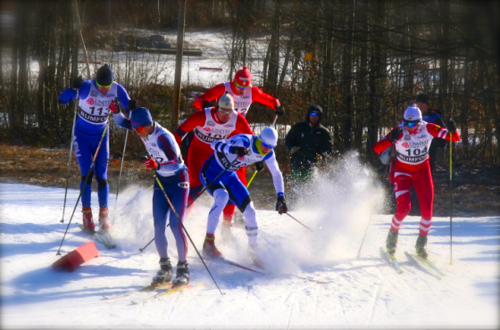
Athletes collide during sprint heats at U.S. Nationals in Rumford, Maine, 2012.
A sprint qualifier can be defined as the preliminary stage of a sprint race in nordic skiing. In a race against the clock, competitors leave the starting gate at intervals and go as hard as they can for anywhere between 1 and 1.8 kilometers. The top 30 in most internationally sanctioned competitions, and sometimes a lesser number in other events, move onto the quarterfinals to face off against five other athletes at a time for the right to advance to the next round.
Sprint races progress in this manner all over the world; on the World Cup, in Continental Cups, in the collegiate circuit, and sometimes at small-scale high school races.
In the winter of 2009, the term “sprint qualifier” took on another meaning. The U.S. Ski and Snowboard Association (USSA) introduced a sprint race to the SuperTour that was truncated at the qualifying round; medals were awarded to skiers who clocked the fastest qualifying times, and the athletes’ entire day was done in a matter of two to four minutes. No longer just a prologue, the qualifier became a race all its own.
At the time, the trial run was met with mixed reviews. Athletes felt robbed of the chance to develop head-to-head sprint skills. Coaches acknowledged the challenges the organizers faced in putting on full heats, but agreed that the format was not ideal. Canadians who occasionally dabbled in the SuperTour simply didn’t understand it.
Qualifier-only sprints started with a trial run in West Yellowstone, Mont. that first winter, but have since spread to three other stops on the SuperTour in 2012. What began as confusion is now ranting fury — some still fail to understand why the experimental format was deemed a success and allowed to proliferate.
To begin to answer that question, we start with that first time qualifier-only sprints were held in the U.S.
When the format was first conceived of prior to the 2009-2010 season, then-USSA Nordic Director John Farra intended for it to do two things. First and foremost, the decision to leave out the heats from the West Yellowstone sprint was a philosophical one. Farra believed it to be the right move for U.S. skiing at the time, and today stands by his decision.
“We still don’t have enough Americans, in my personal opinion, who can qualify, period,” said Farra, who has since left USSA to become the High Performance Director for Paralympic skiing, in a phone interview in December. “That’s a problem. For me, at this point in our development, there’s an argument for getting athletes in more races where they’re just throwing down… I think it works on a gear all Americans need to keep working on.”
Secondly, it put an additional sprint race back on the calendar in the first period of the SuperTour where, at the time, there was only one in Bozeman, MT. It would not be the first time sprint races were held in West Yellowstone. Regular sprints, complete with heats, were held on the Rendezvous trails up until 2007, but according to Farra, coaches complained that the trails were too narrow and the altitude too punishing for a full sprint day.
One of the jobs of the Nordic Director is to select skiers at the end of the Period 1 to send to the World Cup. With an additional sprint thrown into the mix, Farra’s theory was that the overall points leader would have to be a decent sprinter and distance skier to earn those coveted European start rights.
Rankings of the best distance skiers and sprinters on the domestic circuit are often very similar, however. For example, at the end of Period 1 this winter, the women’s SuperTour sprint leader, distance leader, and overall leader were all one person: Jessie Diggins (CXC/USST).
On the men’s side, overall leader Mike Sinnott (SVSEF) had two top-5 distance results along with his two sprint wins and one second.
The sprint qualifier has also been accused of having another motive. It was introduced in the season leading up to the 2010 Vancouver Olympics, and it’s been suggested that the qualifier, in squeezing another race into a short time frame, was a grab for better FIS points to boost the U.S. quota for the Games.
Farra said this was never the case. Points are always based off the qualifier, so heats would have no effect on FIS points either way. Additionally, as Farra pointed out, “you can only ‘boost’ the points if you have a quality field in the race.”
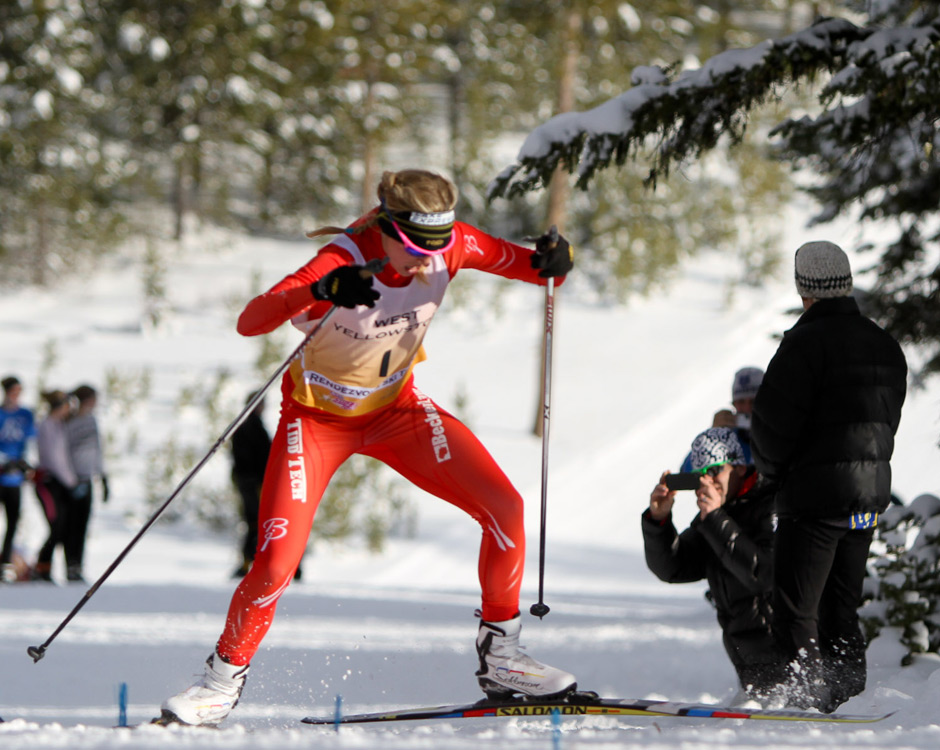
Jessie Diggins competing in the qualifier-only skate sprint in West Yellowstone, Mont., in November 2011.
With his idea for a modified sprint in mind, Farra went to the West Yellowstone Chief of Competition at the time, Sara Hoovler, with the proposal.
From the organizer’s perspective, the introduction of an additional race in West Yellowstone brought with it organizational and financial burdens, which became the main point of negotiation.
“As an organizing committee we were pretty maxed out,” said Hoovler, who is now a school teacher in the area. “We couldn’t put on another full-scale race.”
When Farra brought the proposal to the organizers, they agreed to try out the additional sprint as long as it didn’t come with a significant extra cost—specifically, as long as it didn’t require coming up with the additional prize money. At $3,900 per race, prize money is one of the single most expensive components of hosting a SuperTour.
“Purses for these races can sink the entire event,” said Dan Cantrell, Hoovler’s successor as the West Yellowstone race director.
He estimates that between all the major costs involved with putting on the SuperTour every year—notably prize money and gas for grooming—the event runs the Yellowstone Ski Festival around $20,000. When the weather is especially uncooperative, the number goes up as tents and space heaters are brought in, or the Pisten Bully has go over the course multiple times.
With the introduction of homologation standards this year, any argument for heats became moot—the venue simply doesn’t have the terrain to meet the standards on a traditional sprint loop. For the race to count as a SuperTour complete with FIS points, there needed to be a certain amount of total climbing.
The only sprint course West Yellowstone could come up with that met the standards is a point-to-point 1.5 k, which ruled out the possibility for heats. For timing and officiating purposes, heats have to start and end in the same stadium.
“We were able to FIS homologate West for a sprint qualifier only. That’s a big deal, otherwise we don’t sprint there,” said Farra.
The other option would be to hold the fall SuperTours at locations that could homologate a sprint loop, but choices are limited by the reliability of snow anywhere else in the country in late November, and the number of venues willing to take on a SuperTour.
With the advent of homologation standards looming for 2011, Cantrell also had to account for the cost of the trail work necessary to get the courses up to standard. In addition to sitting on National Forest land, the Rendezvous Ski Trails occupy endangered grizzly bear habitat. Every time the ski trails are modified, the Forest Service requires an environmental impact assessment.
“To put it in perspective, the improvements from this year, with the connectors and homologation, was about a three year process,” said Cantrell. “We had a bulldozer out there two weeks before Thanksgiving.”
With these demands on the race organizers in mind, Farra was loath to push West Yellowstone to take on significant extra cost in adding a sprint qualifier to the schedule.
“We weren’t prepared to make the organizer come up with the prize money,” said Farra.
Since USSA strategically thought it was important to hold a sprint in Yellowstone, the organizers were excused from the obligation to hand out the prize money for sprint qualifiers. The exception is laid out in the USSA Rulebook—none of the sprint qualifiers on the SuperTour schedule this year award the usual purses to the top six finishers.
Since 2009, Yellowstone’s sprint qualifier has become two. In the second and third years of its existence, the opening day of the SuperTour was a double-header. The “SuperTour Sprint Showdown” starts with a skate sprint qualifier, and ends one hour later with a classic sprint. Each of the two races is an opportunity to earn points, but the single winner of the Showdown and recipient of the $250 purse is calculated from the combined times.
The first running of the Showdown at West Yellowstone, on the whole, was a success in the eyes of the organizers and USSA. There were a few kinks to work out—the flow of athletes from the finish back to the start was congested, and cold weather made the trek an uncomfortable one for athletes still just in spandex—but overall, organizers felt good about the trial run.
For her part, Hoovler thought the number of participants in the sprint qualifiers as reason to look positively at the outcome.
“We saw a lot of junior skiers, just getting some race experience, and also master skiers that weren’t competing for FIS points but challenging themselves,” she said. “I was very shocked at the amount of racers that participated.”
When West Yellowstone still had sprint heats in 2007, 42 women and 51 men participated. In 2009, 61 women and 67 competed in the qualifier-only version. In 2011, more athletes competed in the freestyle sprint than the classic, but the totals in the freestyle qualifier were 60 women and 92 men.
Amongst elite skiers, the sprint qualifier was met with some complaints about the absence of heats. Despite this feedback during the season, Farra said the format wasn’t a major issue at the spring USSA meetings, and he saw no reason not to keep experimenting with it.
“This is not a new topic,” Farra emphasized. “There’s been at least two springs for people to say, ‘Hey, this is ridiculous.’ I don’t remember there being significant discussion about that.”
The release of the 2011-2012 SuperTour calendar saw the addition of sprint qualifiers to three new venues: in Bozeman, Mont. one week after West Yellowstone; in night-sprint form at the Tour de Twin Cities, which took place just two weeks ago in Minneapolis, Minn.; and as a prologue to the upcoming 5/10 k classic on day one of the Owl Creek Chase in Aspen, Colo.
In the negotiating phase of calendar planning prior this season, Farra proposed the addition of sprint qualifiers to each of the new hosts. As with West Yellowstone, at each location, the investment that new homologation standards required already had organizers strapped for cash and volunteer power.
Austin Weiss, the Race Director for the Aspen SuperTour and Owl Creek Chase, agreed to add the sprint qualifier to the schedule on February 11 in order to make the entire weekend a more attractive package to racers. Weiss said the Aspen organizing committee was never asked if they could hold a full sprint with heats. He indicated that it would be a challenge, as heats require a separate day of racing, but didn’t rule it out as a possibility in the future.
“Logistically, everything is possible,” said Weiss. “It’s biting off a bit much—it’s not out of the question, but it’s something that the organizing committee would have to consider.
“The other benefit of a sprint qualifier is that it doesn’t require that much more work on the part of organizers.”
The race director in Minneapolis had a similar view.
John Munger, the director of the City of Lakes foundation, which hosted the first three races of the Tour de Twin Cities, pointed to the challenge of putting on a number of high-profile events within a short timeframe.
“It takes a long time to do sprints and lots of volunteer power,” Munger said in a phone interview. “We’re doing the Mayor’s Challenge, the IPC Paralympic World Cup, and the City of Lakes Loppet all within about two weeks.”
This is the compromise Farra sought to strike as he set about adding more sprints to the SuperTour last spring: give skiers more opportunity to develop their sprinting ability without pushing organizers to the point where they wouldn’t hold sprints at all. Just as in West Yellowstone, he saw qualifiers as the best solution.
“It’s a fine dance between what athletes and coaches want, and what we think organizers can do,” said Farra.
The financial burden of the additional race was also lessened at the new sprint venues. As with the two independent sprints in West Yellowstone, none of the three new sprint qualifiers come with the normal win payout, which adds up to $3,900 between both men and women (1st – $750, 2nd – $500, 3rd – $250, 4th – $200, 5th – $150, 6th – $100).
“Imagine if you push Bozeman, and we say, ‘Come up with four grand,’ and they say, ‘Sorry, can’t do it.’”
According to Dragan Danevski, director of the Bridger Ski Foundation, the additional prize money would have been more than they could afford, and was a point of negotiation when Farra asked them to hold a sprint qualifier in the spring.
“It would be nice if we could have $100,000 in prize money, but I said, ‘Look, in this economy, in this situation, we are lucky to have SuperTour races even with [some] money,’ sad Danevski in December.
“I had to make the decision that we would no be able to do three races and have prize money for three.”
The financial compromise has not gone unnoticed by the athletes, particularly those who have repeatedly placed in the top six in the SuperTour sprints thus far.
“I don’t understand it,” said Mike Sinnott (SVSEF), who was first and second in the two sprints in West Yellowstone and won the freestyle sprint the next week in Bozeman.
“It’s unprofessional in my opinion.”
In Sinnott’s view, the $250 check he won as the Sprint Showdown champion in West Yellowstone should have been a bonus.
“I think it’s pretty clear in the rules that you get $750 for a win,” he said.
Caitlin Gregg (CXC) has similarly excelled in sprinting this winter. She began with a fourth and first in West Yellowstone, a second-place in Bozeman, and a third in Minneapolis. Like Sinnott, she believes the sprint qualifiers should have prize money.
“If any race requires a registration fee and awards points…there needs to be prize money,” Gregg wrote in an email in December. While she understands that qualifier-only sprints, as a format, are easier on race volunteers than full heats, she believes that leaving out their prize money altogether undermines sprinting development in the U.S.
“It seems as though there was once a push to hold more sprints and team sprints on the circuit and suddenly (ironically coinciding with some of the best results ever for U.S. skiing, which came from sprints and team sprints internationally), the U.S. has decided to reduce the opportunities domestically for sprinters to develop,” said Gregg.
“Without prize money, sprint specialists or those who are competitive in both distance and sprint races would be loosing a large percentage of potential earnings that could allow them to continue competing on the SuperTour domestic circuit.”
As a solution, she proposed getting a title sponsor to help fund the SuperTour purses in the future.
If USSA is adamant about adding more sprints to the SuperTour, and has found race committees unable to produce the extra prize money, would USSA ever contribute their own cash to the pot to make up for it?
Given the state of its budget, “No way would USSA pay,” said Farra. “The SuperTour has never been funded by USSA… Given the state of the union at USSA, it’s highly doubtful that any prize money will come from them.”
Farra empathizes with the opinion of the athletes, but notes that contesting the sprints are still worth something.
“While I agree—I would be disappointed not to benefit from that prize money— World Cup qualifying is still up for grabs,” he said.
But for many athletes on the SuperTour, not even that is enough. Without heats, some don’t feel sprint qualifiers to be a valuable format.
Pat O’Brien (CGRP), who placed second in the night sprint qualifier two weeks ago in Minneapolis, believes the heats are critical to developing competitive sprinters.
“While I agree that it is important for US skiers to be able to qualify well (and make the heats), the real test to me is how well an athlete skis rounds,” said O’Brien. “It doesn’t matter how fast you are in the qualifier if you can’t move out of the quarters. Skiing well in a group is a skill that you only can develop through practice.”
“Cutting full sprints out of the schedule and replacing them with just qualifiers undermines this development.”
His teammate Tim Reynolds (CGRP) suggested an alternative format for heats that would be less demanding on organizers, and in cases like Minneapolis where there were fewer numbers, make more sense.
“You don’t have to take 30 onto the heats… I think you can adapt the format to the field size,” said Reynolds, pointing to the Madison, Wisconsin SuperTour as an example. In the past, the Madison event has taken on eight skiers from the qualifier on to the heats, which reduces the number of rounds to two semis and one final.
“Heats are a valuable experience,” said Reynolds.
If dissatisfaction with sprint qualifiers is as widespread as the vocal skiers would make it seem, then Farra agrees that USSA should go back to the drawing board.
“It’s part of being progressive,” said Farra. “How we’ll be a better ski nation is being open-minded to trying different things.”
“My memory is that we are still testing this concept. Until coaches come back in the spring and say, ‘This doesn’t work, we need to stop’—until that happens, we’re still testing it.”
If athletes really want to see qualifiers scaled back next year, Farra encourages them to go to the USSA spring meetings, or make sure their views will be represented at them.
“The USSA Congress really does work,” he said. “It’s amazing how many coaches go out of their way in the spring and engage in dialogue when they don’t want to be thinking about skiing.
“Athletes need to be able to remind their coaches, ‘This is what we’d like to see; this is how the SuperTour could be improved… Everybody is working their butts off, but it’s only going to get better if people bring their ideas forward.”
Michael Sinnott (SVSEF) felt like he couldn’t have asked for a better afternoon to do a classic sprint qualifier.
“It was beautiful racing, blue skies about 20 degrees and fast, hard tracks,” Sinnott, said to FasterSkier after the race. “It was fun.”
Second place is not first loser
With a time of 3:20.30, Garrott Kuzzy of Team CXC was only 0.3 seconds behind Sinnott, and more than eight seconds ahead of Petter Sjulstad of Michigan Tech in third place. He clocked in at 3:28.70.
“Once I finished, I knew that I placed really well,” said Garrott Kuzzy of Team CXC. Missing first place by a split second was simply how the dice fell this time, he explained.
“I had done pretty much everything right. Mikey (Sinnott) was just that much faster today,” said Kuzzy, who won both the USSA SuperTour races on home turf in Minneapolis last weekend.
“It was really fun to do well at home last week,” he said.
Fast, technical course
Kuzzy noted that when the team drove up to Michigan on Thursday, it was raining lightly, which resulted in a hard, slightly crusted course as it froze onto the surface overnight.
“Conditions were beautiful, and it’s a brand new course. It was a great course for a qualifier,” Kuzzy said, adding that he didn’t consider skate skis and double-poling.
“It’s a hard, technical course. Skate skis wouldn’t have been as fast today,” he said.
Double sweet victory
For Sinnott, Friday’s victory awarded him not only the 250 dollar prize money. It gave him another 30 SuperTour points in the pocket, which reduced Lars Flora’s (Alaska Pacific University Nordic Ski Club) overall lead by nearly one third in just over three minutes.
A couple of weeks ago at US Nationals, Sinnott’s entire season focus got rearranged when he narrowly missed being named to the US World Championships team headed for Oslo next month.
“My season goals got derailed. I skied well, but I was just not named to the team. I was the next in line. That was a little disappointing. So now I’m trying to be the overall leader of the SuperTour,” Sinnott said, noting that he has eight SuperTour races to make up 67 points on Flora. And Flora won’t even be here for a good part of those.
“I like my chances,” Sinnott concluded with a grin.
No-heat qualifiers
Friday’s classic sprints at the Michigan Tech Nordic Training Center featured a qualifier event on the 1.5K highly technical course for both men and women, but no subsequent heats. This is a unique race format that showed up last season and serves several purposes, Kuzzy and Sinnott explain, adding that they enjoy the no heat sprint races, and see the value in the exercise.
“It’s a race format that doesn’t really happen anywhere else outside North America, but it’s designed to identify the fastest qualifiers. It’s important to qualify fast, because if you qualify low in the US you still make it to the rounds, but in Europe you wouldn’t necessarily make it to the rounds,” Sinnott said.
No heats also mean that the sprint takes a lesser toll on the athletes and allow more of them to do a three-race weekend with full-on distance races.
“With full heats, that means that the skiers who go all the way in the sprints have three more races in their legs the next day than those who didn’t make the it out of the qualifiers,” Kuzzy notes.
Challenging classic course
The SuperTour continues tomorrow with 5K classic for women and 10K classic for men, both races with interval starts. Sinnott has tested the course before, knows what’s in store, and has respect for the challenge.
“We had nationals here a couple of years ago. There are long hills and it’s easy to bury yourself. I need to keep the lid on for the first lap to have a good second lap,” Sinnott said.
In the women’s sprint race, Christina Turman of Northern Michigan University won in 4:05.20, with a comfortable 5-second margin to Deedra Irwin, an older junior who is redshirting with Michigan tech this season, in second place with the time 4:10.50. Audrey Weber (Go! Training) was third, finishing in 4:11.50.